Ethereum bulls charge past $3300 level

By ForexTime 

  • Ethereum hits fresh 22-month high
  • Firm uptrend on D1 & H4 timeframe
  • Strong weekly support at 3216.64
  • Potential impulse wave on H4 charts
  • Next weekly bullish target at 3572.61

The world’s second-largest cryptocurrency is on a tear!

Ethereum jumped to a fresh 22-month high on Wednesday thanks to the growing bullish market sentiment in the crypto space.

With prices trading above $3300 as of writing, further gains could be on the horizon due to anticipation over the ‘Dencun’ upgrade and potential approval of spot Ethereum Exchange-Traded Funds (ETFs).

Note: The ‘Dencun’ upgrade for Ethereum is expected to go live on March 13. It aims to improve the cryptocurrency’s scalability and efficiency. Should this result in increased demand, this may push prices higher.

Focusing on the technical picture…

Ethereum broke through a weekly resistance level yesterday. This is the result of a strong uptrend that started on 25 January and has been running with little interference from the bearish side.

A weekly resistance turned support level at 2877.42 did cause a short pause but the bulls quickly overcame that and showed their strength again. The same thing seems to be in store with the weekly resistance turned support level at 3216.64 and this produces opportunities in the lower time frame.

On the 4-hour chart, a strong uptrend can also clearly be seen with a potential new impulse wave in action. The short cycle Stochastics Oscillators as well as the longer price cycle Moving Average Convergence Divergence (MACD) Oscillators confirm the upward run and the target for any long positions taken by traders can be the next weekly resistance level at 3572.61.


Forex-Time-LogoArticle by ForexTime

ForexTime Ltd (FXTM) is an award winning international online forex broker regulated by CySEC 185/12 www.forextime.com

Does hosting the Olympics, the World Cup or other major sports events really pay off?

By Ivan Savin, ESCP Business School 

After a long battle, Paris’s beloved bouquinistes will be staying put this summer. The decision, announced on 13 February by the French government, came after considerable public backlash to the police prefecture’s original plan to move part of the iconic Seine booksellers elsewhere for the inauguration of the Olympics Games on 26 July.

Meanwhile, less than six months away from the event, Parisians continue to grumble over a lack of consultations with locals, warnings of gridlocked traffic, closed metro stations, extensive video surveillance and other grievances. So for host countries, what was the point of the Olympics, again?

In academia, the debate about the potential positive and negative effects of large-scale sporting events is ongoing. Although these events are often associated with substantial economic losses, the long-term benefits are the main argument in favour of hosting them. These include the development of material and soft infrastructure such as hotels, restaurants or parks. Big games can also help put the host region on the map as an attractive place for sports and cultural events, and inspire a better entrepreneurial climate.

The pros and the cons of big sporting events?

The cost of these benefits, as the Parisians have realised, is steep. Host countries appear to suffer from increased tax burdens, low returns on public investments, high construction costs, and onerous running cost of facilities after the event. Communities can also be blighted by noise, pollution, and damage to the environment, while increased criminal activity and potential conflicts between locals and visitors can take a toll on their quality of life. As a result, in the recent past several major cities, including Rome and Hamburg, withdrew their bids to host the games.

A common feature of the economics of large-scale sporting events is that our expectations of them are more optimistic than what we make of them once they have taken place. Typically, expenditure tends to tip over the original budget, while the revenue-side indicators (such as the number of visitors) are rarely achieved.

Host regions typically have to jump through many hoops before they can begin to enjoy the benefits from large-scale sporting events such as the Olympics.
Peter Skitterians/Pixabay, CC BY

When analysing the effect of hosting large-scale sporting events on tourist visits, it is important to take into consideration both the positive and negative components of the overall effect. While positive effects may be associated with visitors, negative effects may arise when “regular” tourists refuse to visit the location due to the event. This might be because of overloaded infrastructure, sharp increases in accommodation costs, and inconveniences associated with overcrowding or raucous or/and violent visitors. On top of that, reports of poverty or crime in the global media can actually undermine the location’s attractiveness.

When big sporting events crowd out regular tourists

In an article published in the Journal of Sports Economics with Igor Drapkin and Ilya Zverev, I assess the effects of hosting large-scale sporting events, such as Winter and Summer Olympics plus FIFA World Cups, on international tourist visits. We utilise a comprehensive dataset on flow of tourists covering the world’s largest destination and origin countries between 1995 and 2019. As a first step, we built an econometric model that effectively predicts the flow of tourists between any pair of countries in our data. Subsequently we compared the predicted tourist inflow in a hypothetical scenario where no large-scale sporting event would have taken place with the actual figures. If the actual figures exceed the predicted ones, we consider the event to have a net positive impact. Otherwise, we consider that it had a “crowding out” effect on “regular” tourists. While conducting this analysis, we distinguished between short-term (i.e., focusing just on the year of the event) and mid-term (year of the event plus three subsequent years).

Our results show that the effects of large-scale sporting events vary a lot across host countries: The World Cup in Japan and South Korea 2002 and South Africa 2010 were associated with a distinct increase in tourist arrivals, whereas all other World Cups were either neutral or negative. Among the Summer Olympics, China in 2008 is the only case with a significant positive effect on tourist inflows. The effects of the other four events (Australia 2000, Greece 2004, Great Britain 2012, and Brazil 2016) were found to be negative in the short- and medium-term. As for the Winter Olympics, the only positive case is Russia in 2014. The remaining five events had a negative impact except the one-year neutral effect for Japan 1998.

Following large-scale sporting events, host countries are therefore typically less visited by tourists. Out of the 18 hosting countries studied, 11 saw tourist numbers decline over four years, and three did not experience a significant change.

The case for cautious optimism

Our research indicates that the positive effect of hosting large-scale sporting events on tourist inflows is, at best, moderate. While many tourists are attracted by FIFA World Cups and Olympic games, the crowding-out effect of “regular” tourists is strong and often underestimated. This implies that tourists visiting for an event like the Olympics typically dissuade those who would have come for other reasons. Thus, efforts to attract new visitors should be accompanied by efforts to retain the already existing ones.

Large-scale sporting events should be considered as part of a long-term policy for promoting a territory to tourists rather than a standalone solution. Revealingly, our results indicate that it is easier to get a net increase in tourist inflows in countries that are less frequent destinations for tourists – for example, those in Asia or Africa. By contrast, the United States and Europe, both of which are traditionally popular with tourists, have no single case of a net positive effect. Put differently, the large-scale sporting events in Asia and Africa helped promote their host countries as tourist destinations, making the case for the initial investment. In the US and Europe, however, those in the last few decades brought little return, at least in terms of tourist inflow.The Conversation

About the Author:

Ivan Savin, Associate professor of quantitative analytics, research fellow at ICTA-UAB, ESCP Business School

This article is republished from The Conversation under a Creative Commons license. Read the original article.


EUR/USD Shows Resilience Amid Risk Appetite

By RoboForex Analytical Department

The EUR/USD pair is trading close to 1.0821, demonstrating a strong stance in the current market environment. Investors are leaning towards riskier assets, buoyed by the anticipation of several key macroeconomic releases this week.

A critical focal point for the market will be the upcoming US inflation data, particularly the core Personal Consumption Expenditures (PCE) price index, a preferred measure of inflation by the Federal Reserve. The report, expected to be released on Thursday, is forecasted to show a 0.4% month-on-month increase. This data is crucial as it influences the Fed’s monetary policy decisions.

The prevailing market sentiment suggests that the Federal Reserve may not be poised to embark on a monetary easing cycle just yet, opting instead to maintain the current interest rate levels for a longer duration.

Technical Analysis for EUR/USD

On the H4 chart, EUR/USD has shown a downtrend, reaching a low of 1.0802. It’s anticipated that a corrective movement could occur next. After this correction, the price is expected to decline to 1.0785, where it might form a consolidation range. A break below this range could lead to a further decrease towards the local target of 1.0720. This bearish scenario is supported by the MACD indicator, with its signal line positioned below zero and the histogram indicating a sharp decline, suggesting a potential further decline in the price to new lows.

The H1 chart presents a consolidation phase around 1.0824, followed by a potential drop to 1.0784. After reaching this level, the price may rebound to 1.0850 before descending again to 1.0720. This analysis is corroborated by the Stochastic oscillator, with its signal line currently near 80 and anticipated to drop to 20, indicating the likelihood of further price movements within this trend.


Disclaimer: Any forecasts contained herein are based on the author’s particular opinion. This analysis may not be treated as trading advice. RoboForex bears no responsibility for trading results based on trading recommendations and reviews contained herein.

XAGUSD: Poised to fill the gap?

By ForexTime

  • Silver rangebound on D1 chart
  • US PCE report could trigger volatility
  • H1 inverse head & shoulders formation
  • Key levels of interest at $22.72 and $22.614

Silver kicked off Tuesday’s session on a bullish note with prices approaching the H1 161.8 golden Fibonacci point at $22.722.

The precious metal could see heightened levels of volatility this week due to key US economic data and speeches by Fed officials that could offer clues on the outlook for rates. It will be wise to keep a close tab on the US January PCE report on Thursday, especially the Core Personal Consumption – the Fed’s preferred inflation gauge.

Silver often follows gold’s lead, with interest rate expectations influencing appetite for non-yielding assets like precious metals.

To put things into perspective, silver and gold have moved in tandem 68% of the time, in any given 30-day period over the past decade! Essentially, traders who have been closely following gold can expect similar price action on silver.

From a technical perspective, silver remains trapped within a wide range on the daily charts.

But after opening the week with a downward gap, the question is whether the precious metal can close the gap?

At the time of writing, silver is fulfilling the measured move objective of an inverse head and shoulder pattern on the H1 timeframe.

After the completion of the “Inverse Head and Shoulders Pattern“, silver bulls (those looking to see the precious metal rally) will have their attention turned to the $22.72 level which is the golden 161.8 Fibonacci ratio, to act as near-term resistance.

  • A breach of the 161.8 golden Fibonacci ratio may give way to the closure of the gap.

On the other hand, XAGUSD bears (those looking to see the precious metal decline) may look for a close below the 100 Fibonacci level at $22.614 with a retest and breach of the neckline of the inverse head and shoulder patterns neckline at $22.565 as a possible sign of a decline to lows below $22.437.

The Fibonacci levels are taken from the February 26th intraday high of $22.614 to February 26th intraday low of $22.437.

According to Bloomberg’s FX forecast model, there’s a 73% chance that XAGUSD will trade within the $22.0165 – $23.3762 range over the next one week.


Forex-Time-LogoArticle by ForexTime

ForexTime Ltd (FXTM) is an award winning international online forex broker regulated by CySEC 185/12 www.forextime.com

Inflationary pressures are easing in Japan. Natural gas producers want to stop prices from falling

By JustMarkets

On Monday, stock indices gave up early gains and closed lower, consolidating below last week’s record highs. At Monday’s stock market close, the Dow Jones Index (US30) was down 0.16%. The S&P 500 Index (US500) decreased by 0.38%. The NASDAQ Technology Index (US100) closed the day negative 0.13%. Supply-side pressure pushed bond yields higher on Monday and was bearish for stocks.

In extended trading, Zoom Video (ZM) shares jumped by 10% after beating revenue and earnings expectations, while Unity Software fell by 18% after reporting weak financial guidance.

This week, investor attention is focused on PCE inflation data and Federal Reserve speeches. PCE and core inflation are expected to show a small monthly increase, but the annual rate is expected to slow. In addition, the second estimate of US GDP growth for Q4 will be released.

Equity markets in Europe traded flat on Monday. German DAX (DE40) rose by 0.02%, French CAC 40 (FR40) fell by 0.46% yesterday, Spanish IBEX 35 (ES35) rose by 0.08%, and British FTSE 100 (UK100) closed negative by 0.29%.

Speaking at the European Parliament, ECB President Christine Lagarde said that the current disinflation process should continue at a pace that could lead to the first rate cut by June, although some favor an earlier approach. Money markets have also reassessed their expectations for the first rate cut by the US Fed from May to June. With the ECB generally following the US Fed’s lead, investors should not expect the first rate cut from the ECB until summer.

Silver retreated yesterday amid the negative impact of iron ore prices falling to a 4-month low on Monday on concerns about Chinese demand for industrial metals.

WTI crude futures are holding above $77 a barrel on Tuesday after jumping more than 1% in the previous session, helped by ongoing supply disruptions that have raised supply concerns. Houthi rebels in Yemen continued attacks on Red Sea vessels, driving up freight costs and delaying deliveries. Meanwhile, in the United States, analysts noted strong demand from refineries, benefiting from high margins. Refineries with high profit margins buy more barrels, and foreign buyers favor US crude to avoid Red Sea transportation problems.

Natural gas prices rose moderately on Monday thanks to some coverage of short positions by funds ahead of Tuesday’s March futures contract expiration. Also, it was reported last week that major shale gas producers will cut production due to extremely low prices, and Chesapeake Energy will be the first to do so. The low prices result from weak demand, so producers are beginning to take action to stop the drop in natural gas prices. Seasonally, natural gas has a positive March-April performance, so there is plenty of upside for prices in the coming weeks.

Asian markets traded flat yesterday. Japan’s Nikkei 225 (JP225) jumped by 0.35% yesterday, China’s FTSE China A50 (CHA50) declined 1.64% on Monday, Hong Kong’s Hang Seng (HK50) ended the day down 0.54%, and Australia’s ASX 200 (AU200) closed positive 0.12%.

Japan’s core consumer price index, which excludes fresh food but includes the cost of fuel, was 2% in January 2024, slowing from 2.3% in December and the lowest since March 2022. Still, the January figure was above market forecasts of 1.8%. Japan’s core inflation is now within the central bank’s 2% target. This eases pressure on the BoJ to raise interest rates after months of speculation that rising wages and prices would force it to do so. The BoJ’s ultra-confident stance has been a key fulcrum for Japanese markets in the past year as rising interest rates in the rest of the world and a weakening yen have sent foreign investors rushing into local equities.

While additional stimulus measures from Beijing helped Chinese markets bounce off multi-year lows, markets are now waiting for signs of real improvement in the economy. Purchasing managers’ index data for February is due out later this week and is expected to provide clearer signals on the health of Asia’s largest economy.

S&P 500 (US500) 5,069.53 −19.27 (−0.38%)

Dow Jones (US30) 39,069.23 −62.30 (−0.16%)

DAX (DE40)  17,423.23 +3.90 (+0.022%)

FTSE 100 (UK100) 7,684.30 −21.98 (−0.29%)

USD Index  103.78 −0.16 (−0.15%)

Important events today:
  • – Japan National Core CPI (m/m) at 01:30 (GMT+2);
  • – German GfK Consumer Confidence (m/m) at 09:00 (GMT+2);
  • – US Durable Goods Orders (m/m) at 15:30 (GMT+2);
  • – US CB Consumer Confidence (m/m) at 17:00 (GMT+2).

By JustMarkets


This article reflects a personal opinion and should not be interpreted as an investment advice, and/or offer, and/or a persistent request for carrying out financial transactions, and/or a guarantee, and/or a forecast of future events.

Israel and Hamas are close to negotiations. Bank of America believes that it is not yet time to sell the dollar

By JustMarkets

At Friday’s close of the stock exchange, the Dow Jones Index (US30) rose by 0.16% (for the week 0.98%). The S&P 500 Index (US500) was up 0.04% (up 1.15% for the week). The NASDAQ Technology Index (US100) closed negative 0.28% (for the week 0.54%). All 3 indices set new all-time highs on Friday. However, after this week’s sharp rally in technology stocks, there was profit-taking in technology stocks, which led to the NASDAQ (US100) Index being in negative territory.

On Friday, the US dollar index posted its first weekly decline in 2024 as investors took a break from buying the currency after a nearly two-month rally built on expectations that the Federal Reserve would begin cutting rates later than previously thought. Investors shifted expectations for the Fed’s first rate cut to June rather than May, significantly reducing the extent of prime rate cuts by the US Central Bank. But, if the US economy remains as strong as it is, the Fed may not be able to go for a rate cut in June. According to analysts at Bank of America (BofA), it is not yet time to sell the dollar, but it will start to weaken in the second quarter, assuming the Fed cuts rates in June and continues to cut rates quarterly. This will cause the euro to strengthen to 1.15 against the US dollar by the end of the year.

New York Fed President Williams said Friday he expects consumer spending growth to slow this year. At some point, it will be appropriate for the Fed to back off from restrictive monetary policy, likely later this year.

Equity markets in Europe were mostly up on Friday. Germany’s DAX (DE40) rose by 0.28% (week-to-date 2.01%), France’s CAC 40 (FR40) gained 0.70% on Friday (week-to-date 2.89%), Spain’s IBEX 35 (ES35) declined 0.08% on Friday (week-to-date 2.49%), and the UK’s FTSE 100 (UK100) closed positive 0.28% (week-to-date -0.07%).

Frankfurt’s DAX (DE40) and France’s CAC 40 (FR40) rose to new record highs on Friday as investors welcomed dovish remarks from ECB officials. ECB official Centeno said the central bank should remain open to the possibility of a rate cut as early as March, while his counterpart Schnabel expressed confidence that inflation expectations are under control.

On Friday, a survey showed business activity in Germany improved in February, but probably not enough to prevent Europe’s largest economy from sliding into another recession. ECB President Christine Lagarde on Friday called relatively favorable fourth-quarter wage growth data encouraging but not enough for the European Central Bank to be confident that inflation has been beaten.

Markets are now pricing in a similar trajectory of future interest rate cuts for the US and Eurozone, forecasting just over three 25 basis point cuts this year. However, Europe is not in the same enviable position as the US. The world’s largest economy has beaten growth expectations, maintains a tight labor market, and consumers appear healthy at first glance. On the other hand, Europe has narrowly avoided a technical recession several times already, escaping with only minimal losses as quarterly GDP growth hovered around zero. Bundesbank chief Joachim Nagel cited that the ECB will receive key price data in the second quarter, cementing expectations of a possible rate cut around mid-year. Earlier on Friday, Robert Holzmann confirmed that the ECB usually follows the Fed regarding the timing of rate adjustments, further weakening bets on a rate cut.

Wednesday and Thursday this week will be G20 meetings, which could indirectly impact financial markets. The sessions are held behind closed doors, but many participants talk to the press between meetings. As this body directly sets interest rate policy, news from here could cause increased volatility.

Crude oil and gasoline prices fell on Friday on concerns about energy demand in China. According to RBC Capital Markets, China’s domestic oil demand has been weak, and limited stimulus measures from the government have disappointed. Oil was also pressured by signs that Israel will join peace talks in Paris, which could reduce some geopolitical risks in the Middle East.

US natural gas prices fell over 6% to $1.6 per bbl on Friday, they were driven by oversupply, ample storage, and lower heating demand amid a mild winter. The mild weather has pushed inventories well above average, with the latest EIA data showing inventories 22.3% above the seasonal norm.

Asian markets were mostly up last week. Japan’s Nikkei 225 (JP225) jumped by 1.51% for the week, China’s FTSE China A50 (CHA50) gained 2.44% last week, Hong Kong’s Hang Seng (HK50) ended the week up 2.40%, and Australia’s ASX 200 (AU200) ended the week negative 0.19%.

According to analysts, if the annual compensation negotiations between major Japanese companies and labor unions, due to conclude in mid-March, result in wage growth of 4.0%, BoJ policymakers may gain confidence in the sustainability of wage growth to pull the trigger and move away from negative rates finally.

S&P 500 (US500) 5,088.80 +1.77 (+0.04%)

Dow Jones (US30) 39,131.53 +62.42 (+0.16%)

DAX (DE40)  17,419.33 +48.88 (+0.28%)

FTSE 100 (UK100) 7,706.28 +21.79 (+0.28%)

USD Index  103.96 0.0 (0.0%)

Important events today:
  • – US New Home Sales (m/m) at 17:00 (GMT+2);
  • – US Eurozone ECB President Lagarde Speaks (m/m) at 18:00 (GMT+2).

By JustMarkets


This article reflects a personal opinion and should not be interpreted as an investment advice, and/or offer, and/or a persistent request for carrying out financial transactions, and/or a guarantee, and/or a forecast of future events.

Trade Of The Week: EURNZD to keep above key support?

By ForexTime 

  • EURNZD rebounds from key support
  • RBNZ decision + EU data in focus
  • Trend bearish on D1 but bulls present
  • Key level of interest at 50-day SMA
  • Bloomberg model: 75% chance range 1.7384 – 1.7768

After practically erasing its 2024 gains last week, the EURNZD kicked off Monday with renewed bullish force!

Bulls returned to the scene, pushing prices back above 1.7550 ahead of a potentially volatile week for the minor currency pair.

Note: A minor currency pair does not include the USD but includes at least one of the world’s majors. 

Looking at the past few weeks, the EURNZD has been on a rollercoaster ride thanks to technical and fundamental forces. Although prices have been edging lower on the weekly charts, key support can be found at 1.7420.

To put things into context, the last time the EURNZD secured a weekly close below this level was back in early January 2023.

On the monthly charts, there is a similar picture with prices waiting for a fresh fundamental spark to trigger the next big move.

With all the above said, here are 3 reasons why this could be a wild week for the EURNZD:

  1. RBNZ rate decision

The Reserve Bank of New Zealand is widely expected to keep its key rates unchanged at 5.50% at its February 28th meeting.

Economic growth unexpectedly contracted in Q3 while there have been consistent signs of cooling price pressures. However, traders are still pricing in a 54% probability of one more rate hike by May 2024 with the first rate cut expected by November. Much attention will be directed towards the monetary policy statement which may provide fresh insight into the central bank’s thinking for 2024.

  • Should the RBNZ strike a hawkish note and signal one more hike could still be on the cards, this may strengthen the New Zealand Dollar. 
  • Any hint of doves or signs that the next move could be a cut has the potential to weaken the NZD, pushing the EURNZD higher as a result.
  1. Key EU data

It is a week packed with top-tier data from Europe, but the standouts are the Germany and Eurozone February inflation reports. 

These incoming inflation reports could influence expectations about when the European Central Bank (ECB) will start cutting interest rates in 2024. Traders are currently pricing in a 30% probability of a rate cut by April with a move by the ECB fully priced in by June 2024. 

Given how the inflation data and other data from Europe may influence these bets, it could be reflected in the EURNZD.

  • If overall data from Europe, including sticky inflation numbers, support the argument around the ECB keeping rates higher for longer – this could boost the euro.
  • Signs of cooling price pressures and soft data may fuel speculation around lower rates in Europe, dragging the euro lower. 
  1. Technical forces

The EURNZD remains in a noisy range on the daily charts with support at 1.7420 and resistance around 1.7700. Although the trend since mid-January points south, bulls are lingering in the vicinity.

  • A strong breakout and daily close above the 50-day SMA at 1.7600 may encourage an incline towards 1.7700 and the 100-day SMA at 1.7760. 
  • Should the 50-day SMA prove to be reliable resistance, this may trigger a decline back towards 1.7420 and 1.7384.

According to Bloomberg’s FX forecast model, there’s a 75% chance that EURNZD will trade within the 1.7384 – 1.7768 over the next week.


Forex-Time-LogoArticle by ForexTime

ForexTime Ltd (FXTM) is an award winning international online forex broker regulated by CySEC 185/12 www.forextime.com

Speculators push New Zealand Dollar bets to 51-week high

By InvestMacro

Here are the latest charts and statistics for the Commitment of Traders (COT) data published by the Commodities Futures Trading Commission (CFTC).

The latest COT data is updated through Tuesday February 20th and shows a quick view of how large market participants (for-profit speculators and commercial traders) were positioned in the futures markets. All currency positions are in direct relation to the US dollar where, for example, a bet for the euro is a bet that the euro will rise versus the dollar while a bet against the euro will be a bet that the euro will decline versus the dollar.

Weekly Speculator Changes led by Euro, Canadian Dollar & New Zealand Dollar

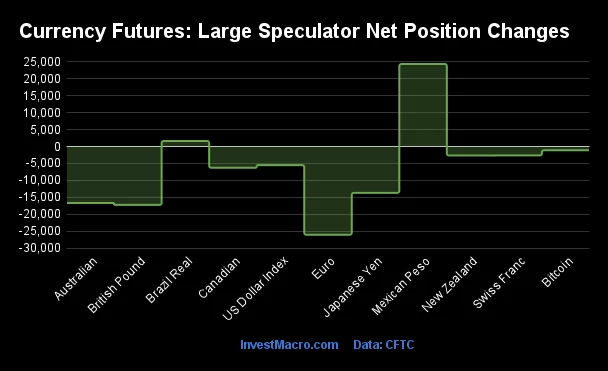
The COT currency market speculator bets were overall lower this week as three out of the eleven currency markets we cover had higher positioning while the other eight markets had lower speculator contracts.

Leading the gains for the currency markets was the EuroFX (15,178 contracts) with the Canadian Dollar (4,619 contracts) and the New Zealand Dollar (3,219 contracts) also having positive weeks.

The currencies seeing declines in speculator bets on the week were the Japanese Yen (-9,242 contracts), the Mexican Peso (-4,449 contracts), the British Pound (-4,160 contracts), the Swiss Franc (-3,909 contracts), the Australian Dollar (-2,899 contracts), the Brazilian Real (-2,826 contracts), the US Dollar Index (-456 contracts) and Bitcoin (-177 contracts) also seeing lower bets on the week.

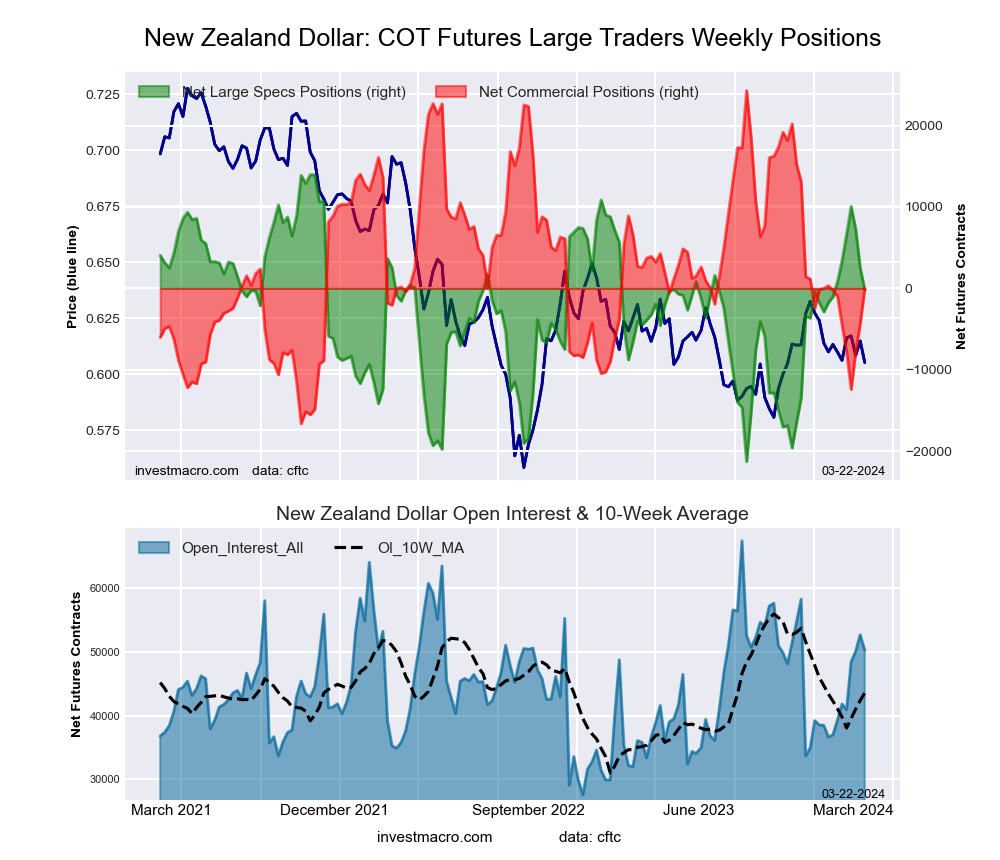
Speculators push New Zealand Dollar bets to highest in just about a year

Highlighting the COT currency’s data this week is the recent increase in the speculator’s positioning for the New Zealand Dollar. The large speculative New Zealand Dollar (NZD) currency positions gained this week by over +3,000 net contracts and have now climbed for six consecutive weeks. The NZD bets have also risen in nine out of the past twelve weeks, going from a total net position of -16,450 contracts on December 5th to a total of +6,626 contracts this week.

This improvement has taken the NZD to it’s most bullish level in the past fifty-one weeks, dating back to February 28th of 2023.

Helping the NZD speculator sentiment is the possibility that the Reserve Bank of New Zealand (RBNZ) may increase the bank’s interest rate at the next policy meeting. The  RBNZ is on schedule to hold its next meeting on February 27th with the official cash rate residing at 5.5 percent. Investment services such as ANZ Bank and TD Bank are anticipating the RBNZ to increase the cash rate by 25 basis points because of high inflation. The New Zealand consumer price index (most recently at 4.7 percent for December) continues to be higher than the bank’s target range of between 1-3 percent annually. However, weak economic growth that unexpectedly contracted by -0.60 percent (annual) in the third quarter of 2023 may help to persuade the RBNZ to hold the rate steady.

The NZD exchange rate versus the US Dollar has been on the rise recently with a weekly close just below 0.6200 level. The NZDUSD hit a multi-year low of 0.5558 in October of 2022 and more recently hit a low of 0.5809 in October of 2023. Since then, the currency pair has been able to rise and break through the 0.6000 major resistance and bounce off the 200-day moving average. The currency has ridden an eight-day win-streak to rise into this week’s close near 0.6200.


Currencies Net Speculators Leaderboard
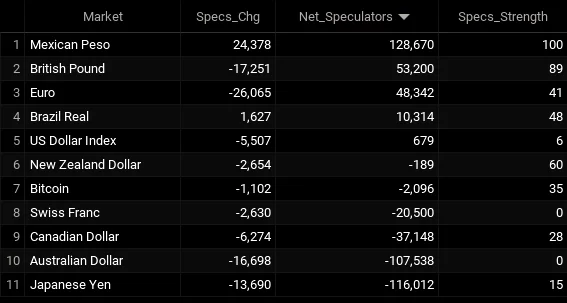

Legend: Weekly Speculators Change | Speculators Current Net Position | Speculators Strength Score compared to last 3-Years (0-100 range)


Strength Scores led by Mexican Peso & British Pound
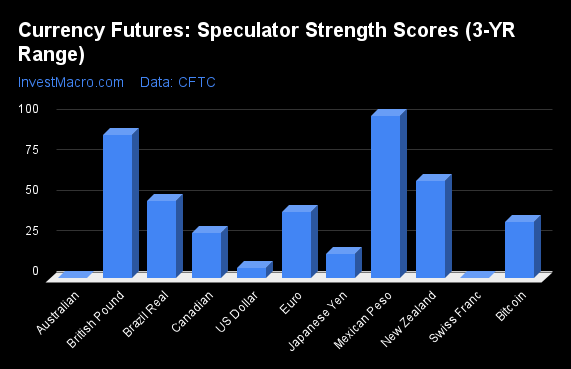
COT Strength Scores (a normalized measure of Speculator positions over a 3-Year range, from 0 to 100 where above 80 is Extreme-Bullish and below 20 is Extreme-Bearish) showed that the Mexican Peso (97 percent) and the British Pound (88 percent) lead the currency markets this week. The New Zealand Dollar (73 percent), Canadian Dollar (58 percent) and the Brazilian Real (56 percent) come in as the next highest in the weekly strength scores.

On the downside, the Japanese Yen (6 percent) and the Australian Dollar (14 percent) come in at the lowest strength levels currently and are in Extreme-Bearish territory (below 20 percent). The next lowest strength scores are the US Dollar Index (21 percent) and the Swiss Franc (31 percent).

Strength Statistics:
US Dollar Index (21.1 percent) vs US Dollar Index previous week (22.0 percent)
EuroFX (49.3 percent) vs EuroFX previous week (42.8 percent)
British Pound Sterling (87.9 percent) vs British Pound Sterling previous week (90.8 percent)
Japanese Yen (6.3 percent) vs Japanese Yen previous week (12.5 percent)
Swiss Franc (30.6 percent) vs Swiss Franc previous week (41.8 percent)
Canadian Dollar (58.4 percent) vs Canadian Dollar previous week (54.5 percent)
Australian Dollar (13.8 percent) vs Australian Dollar previous week (16.5 percent)
New Zealand Dollar (72.7 percent) vs New Zealand Dollar previous week (64.3 percent)
Mexican Peso (97.3 percent) vs Mexican Peso previous week (100.0 percent)
Brazilian Real (55.9 percent) vs Brazilian Real previous week (59.6 percent)
Bitcoin (34.8 percent) vs Bitcoin previous week (37.5 percent)


New Zealand Dollar & British Pound top the 6-Week Strength Trends
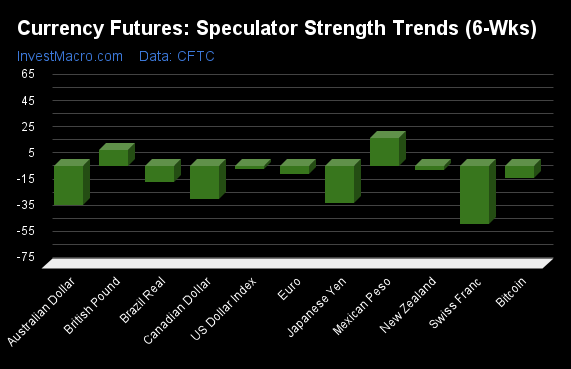
COT Strength Score Trends (or move index, calculates the 6-week changes in strength scores) showed that the New Zealand Dollar (22 percent) and the British Pound (18 percent) lead the past six weeks trends for the currencies. The Canadian Dollar (5 percent) and the Mexican Peso (5 percent) are the next highest positive movers in the latest trends data.

The Australian Dollar (-45 percent) leads the downside trend scores currently with the Japanese Yen (-43 percent), the EuroFX (-22 percent) and the Swiss Franc (-16 percent) following next with lower trend scores.

Strength Trend Statistics:
US Dollar Index (-2.5 percent) vs US Dollar Index previous week (-0.8 percent)
EuroFX (-21.7 percent) vs EuroFX previous week (-28.4 percent)
British Pound Sterling (17.8 percent) vs British Pound Sterling previous week (24.5 percent)
Japanese Yen (-43.4 percent) vs Japanese Yen previous week (-36.3 percent)
Swiss Franc (-15.8 percent) vs Swiss Franc previous week (-2.3 percent)
Canadian Dollar (5.5 percent) vs Canadian Dollar previous week (13.1 percent)
Australian Dollar (-45.4 percent) vs Australian Dollar previous week (-33.0 percent)
New Zealand Dollar (21.9 percent) vs New Zealand Dollar previous week (10.3 percent)
Mexican Peso (4.6 percent) vs Mexican Peso previous week (6.9 percent)
Brazilian Real (-11.1 percent) vs Brazilian Real previous week (-19.4 percent)
Bitcoin (-7.2 percent) vs Bitcoin previous week (4.5 percent)


Individual COT Forex Markets:

US Dollar Index Futures:
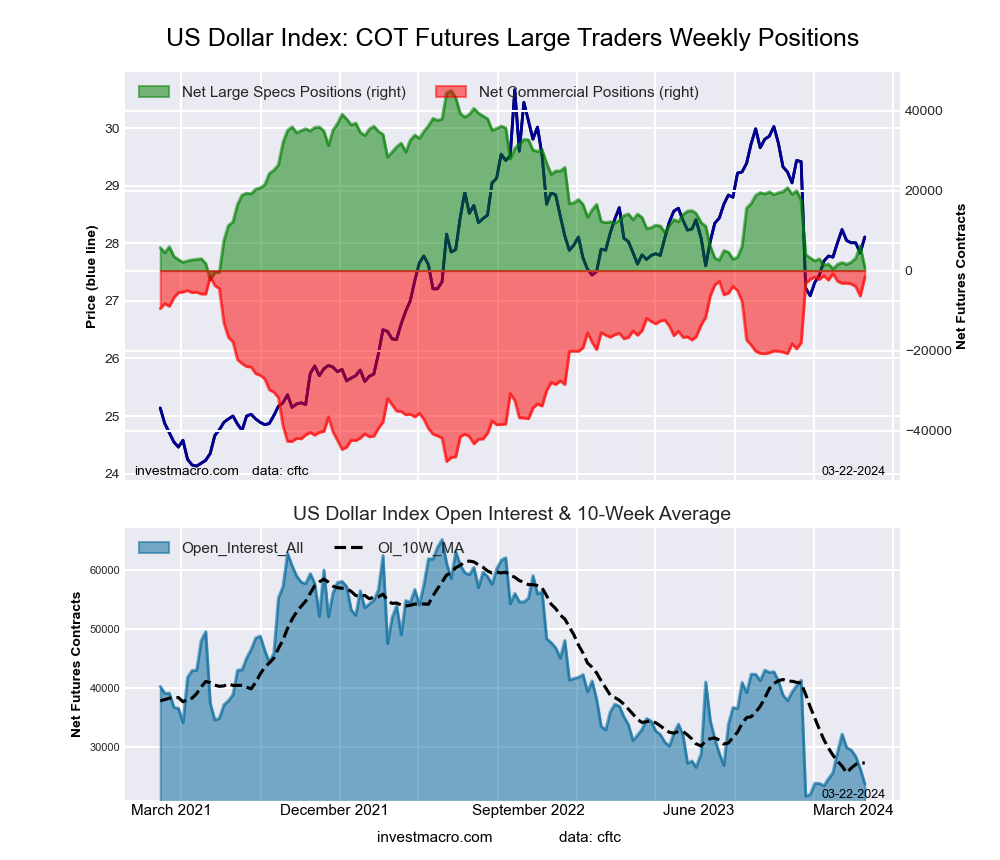
US Dollar Index Forex Futures COT ChartThe US Dollar Index large speculator standing this week totaled a net position of 1,546 contracts in the data reported through Tuesday. This was a weekly decrease of -456 contracts from the previous week which had a total of 2,002 net contracts.

This week’s current strength score (the trader positioning range over the past three years, measured from 0 to 100) shows the speculators are currently Bearish with a score of 21.1 percent. The commercials are Bullish with a score of 78.6 percent and the small traders (not shown in chart) are Bearish with a score of 29.6 percent.

Price Trend-Following Model: Downtrend

Our weekly trend-following model classifies the current market price position as: Downtrend. The current action for the model is considered to be: Hold – Maintain Short Position.

US DOLLAR INDEX StatisticsSPECULATORSCOMMERCIALSSMALL TRADERS
– Percent of Open Interest Longs:62.518.813.1
– Percent of Open Interest Shorts:57.429.27.8
– Net Position:1,546-3,1261,580
– Gross Longs:18,7325,6253,916
– Gross Shorts:17,1868,7512,336
– Long to Short Ratio:1.1 to 10.6 to 11.7 to 1
NET POSITION TREND:
– Strength Index Score (3 Year Range Pct):21.178.629.6
– Strength Index Reading (3 Year Range):BearishBullishBearish
NET POSITION MOVEMENT INDEX:
– 6-Week Change in Strength Index:-2.5-1.626.5


Euro Currency Futures:

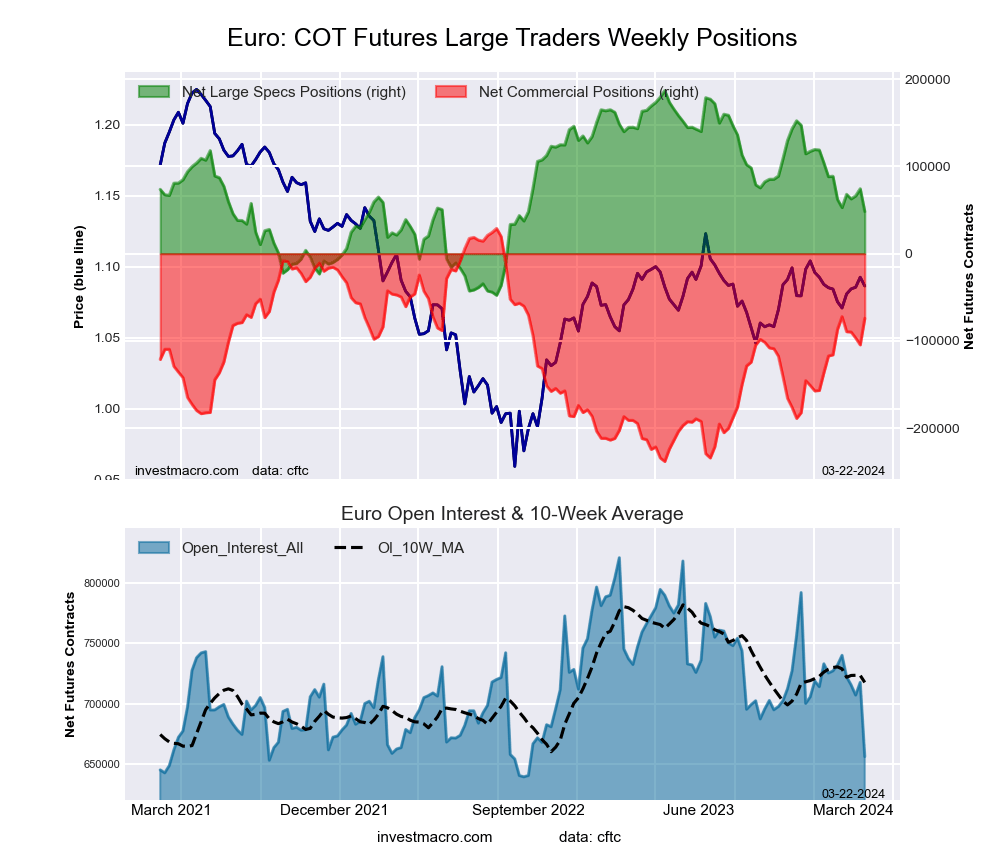
Euro Currency Futures COT ChartThe Euro Currency large speculator standing this week totaled a net position of 68,016 contracts in the data reported through Tuesday. This was a weekly rise of 15,178 contracts from the previous week which had a total of 52,838 net contracts.

This week’s current strength score (the trader positioning range over the past three years, measured from 0 to 100) shows the speculators are currently Bearish with a score of 49.3 percent. The commercials are Bullish with a score of 55.7 percent and the small traders (not shown in chart) are Bearish-Extreme with a score of 13.2 percent.

Price Trend-Following Model: Uptrend

Our weekly trend-following model classifies the current market price position as: Uptrend. The current action for the model is considered to be: Hold – Maintain Long Position.

EURO Currency StatisticsSPECULATORSCOMMERCIALSSMALL TRADERS
– Percent of Open Interest Longs:29.557.610.8
– Percent of Open Interest Shorts:20.170.07.8
– Net Position:68,016-89,45121,435
– Gross Longs:213,194416,18377,957
– Gross Shorts:145,178505,63456,522
– Long to Short Ratio:1.5 to 10.8 to 11.4 to 1
NET POSITION TREND:
– Strength Index Score (3 Year Range Pct):49.355.713.2
– Strength Index Reading (3 Year Range):BearishBullishBearish-Extreme
NET POSITION MOVEMENT INDEX:
– 6-Week Change in Strength Index:-21.725.2-26.4


British Pound Sterling Futures:

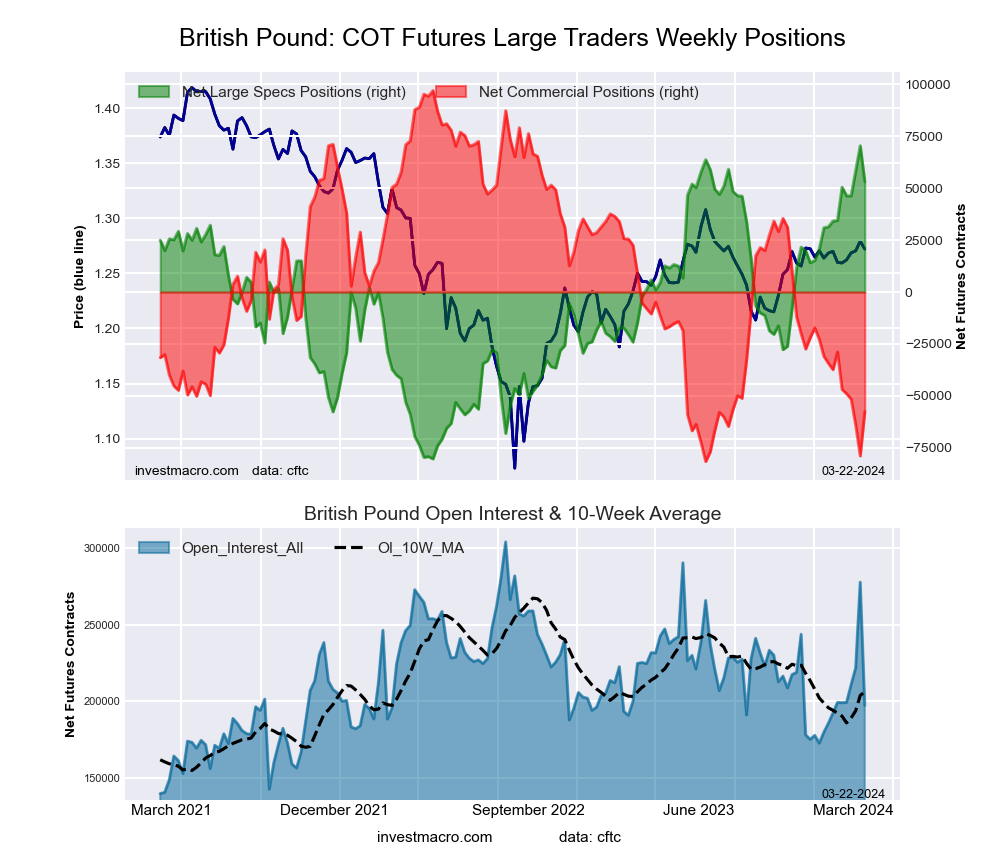
British Pound Sterling Futures COT ChartThe British Pound Sterling large speculator standing this week totaled a net position of 46,312 contracts in the data reported through Tuesday. This was a weekly reduction of -4,160 contracts from the previous week which had a total of 50,472 net contracts.

This week’s current strength score (the trader positioning range over the past three years, measured from 0 to 100) shows the speculators are currently Bullish-Extreme with a score of 87.9 percent. The commercials are Bearish-Extreme with a score of 18.2 percent and the small traders (not shown in chart) are Bullish with a score of 63.3 percent.

Price Trend-Following Model: Uptrend

Our weekly trend-following model classifies the current market price position as: Uptrend. The current action for the model is considered to be: Hold – Maintain Long Position.

BRITISH POUND StatisticsSPECULATORSCOMMERCIALSSMALL TRADERS
– Percent of Open Interest Longs:44.036.615.1
– Percent of Open Interest Shorts:20.761.213.7
– Net Position:46,312-49,0062,694
– Gross Longs:87,60272,90130,014
– Gross Shorts:41,290121,90727,320
– Long to Short Ratio:2.1 to 10.6 to 11.1 to 1
NET POSITION TREND:
– Strength Index Score (3 Year Range Pct):87.918.263.3
– Strength Index Reading (3 Year Range):Bullish-ExtremeBearish-ExtremeBullish
NET POSITION MOVEMENT INDEX:
– 6-Week Change in Strength Index:17.8-14.61.1


Japanese Yen Futures:

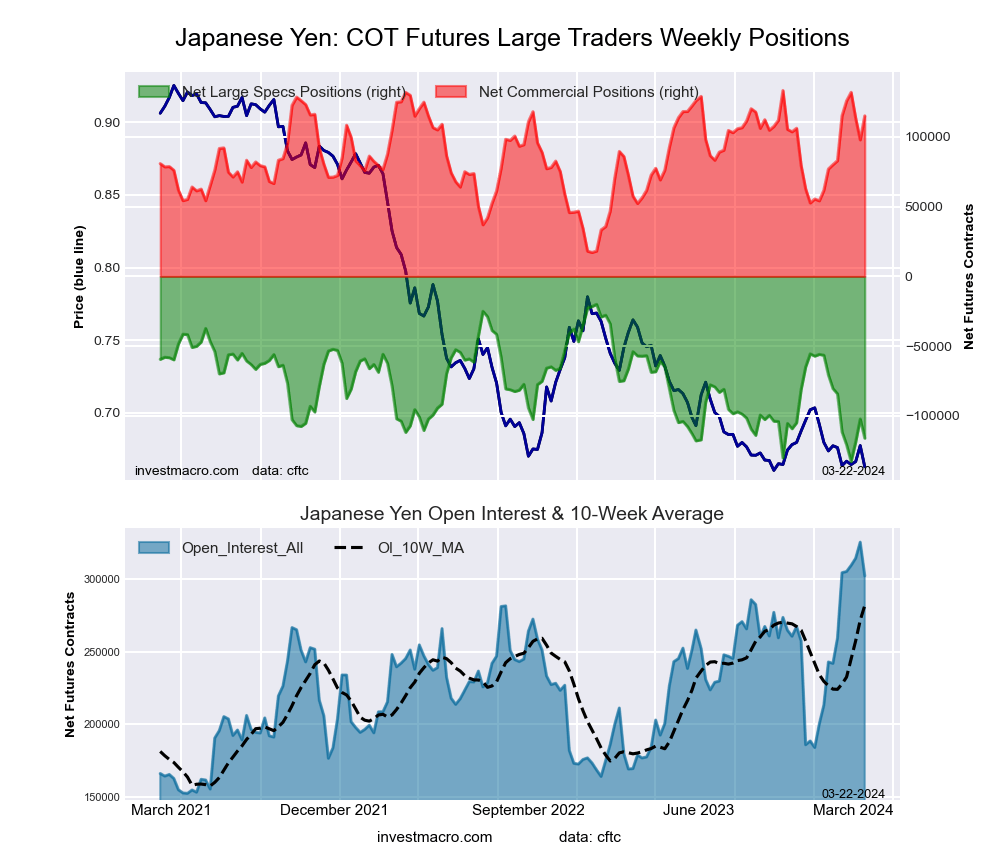
Japanese Yen Forex Futures COT ChartThe Japanese Yen large speculator standing this week totaled a net position of -120,778 contracts in the data reported through Tuesday. This was a weekly decrease of -9,242 contracts from the previous week which had a total of -111,536 net contracts.

This week’s current strength score (the trader positioning range over the past three years, measured from 0 to 100) shows the speculators are currently Bearish-Extreme with a score of 6.3 percent. The commercials are Bullish-Extreme with a score of 94.9 percent and the small traders (not shown in chart) are Bullish with a score of 66.7 percent.

Price Trend-Following Model: Weak Uptrend

Our weekly trend-following model classifies the current market price position as: Weak Uptrend. The current action for the model is considered to be: Hold – Maintain Long Position.

JAPANESE YEN StatisticsSPECULATORSCOMMERCIALSSMALL TRADERS
– Percent of Open Interest Longs:17.665.213.6
– Percent of Open Interest Shorts:57.224.015.3
– Net Position:-120,778125,854-5,076
– Gross Longs:53,862199,06141,618
– Gross Shorts:174,64073,20746,694
– Long to Short Ratio:0.3 to 12.7 to 10.9 to 1
NET POSITION TREND:
– Strength Index Score (3 Year Range Pct):6.394.966.7
– Strength Index Reading (3 Year Range):Bearish-ExtremeBullish-ExtremeBullish
NET POSITION MOVEMENT INDEX:
– 6-Week Change in Strength Index:-43.449.6-21.5


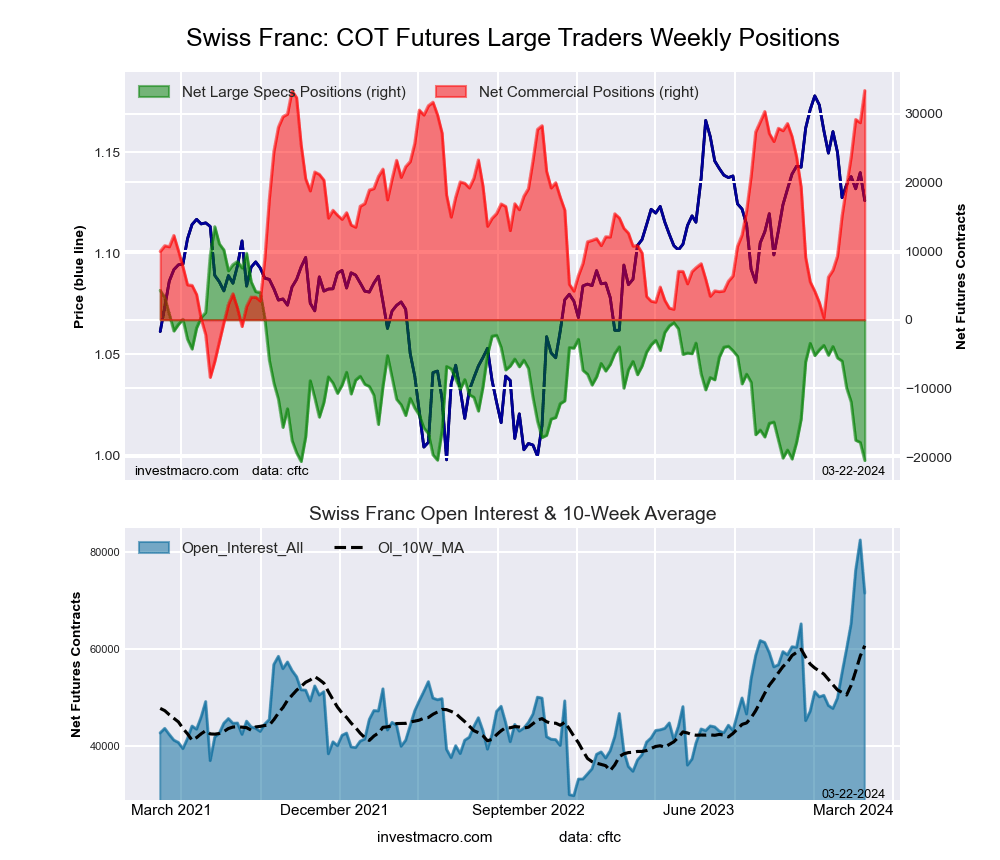
Swiss Franc Futures:

Swiss Franc Forex Futures COT ChartThe Swiss Franc large speculator standing this week totaled a net position of -9,923 contracts in the data reported through Tuesday. This was a weekly reduction of -3,909 contracts from the previous week which had a total of -6,014 net contracts.

This week’s current strength score (the trader positioning range over the past three years, measured from 0 to 100) shows the speculators are currently Bearish with a score of 30.6 percent. The commercials are Bullish with a score of 66.8 percent and the small traders (not shown in chart) are Bearish with a score of 33.8 percent.

Price Trend-Following Model: Weak Uptrend

Our weekly trend-following model classifies the current market price position as: Weak Uptrend. The current action for the model is considered to be: Hold – Maintain Long Position.

SWISS FRANC StatisticsSPECULATORSCOMMERCIALSSMALL TRADERS
– Percent of Open Interest Longs:21.762.415.7
– Percent of Open Interest Shorts:38.229.931.6
– Net Position:-9,92319,476-9,553
– Gross Longs:13,03637,4559,413
– Gross Shorts:22,95917,97918,966
– Long to Short Ratio:0.6 to 12.1 to 10.5 to 1
NET POSITION TREND:
– Strength Index Score (3 Year Range Pct):30.666.833.8
– Strength Index Reading (3 Year Range):BearishBullishBearish
NET POSITION MOVEMENT INDEX:
– 6-Week Change in Strength Index:-15.840.6-51.9


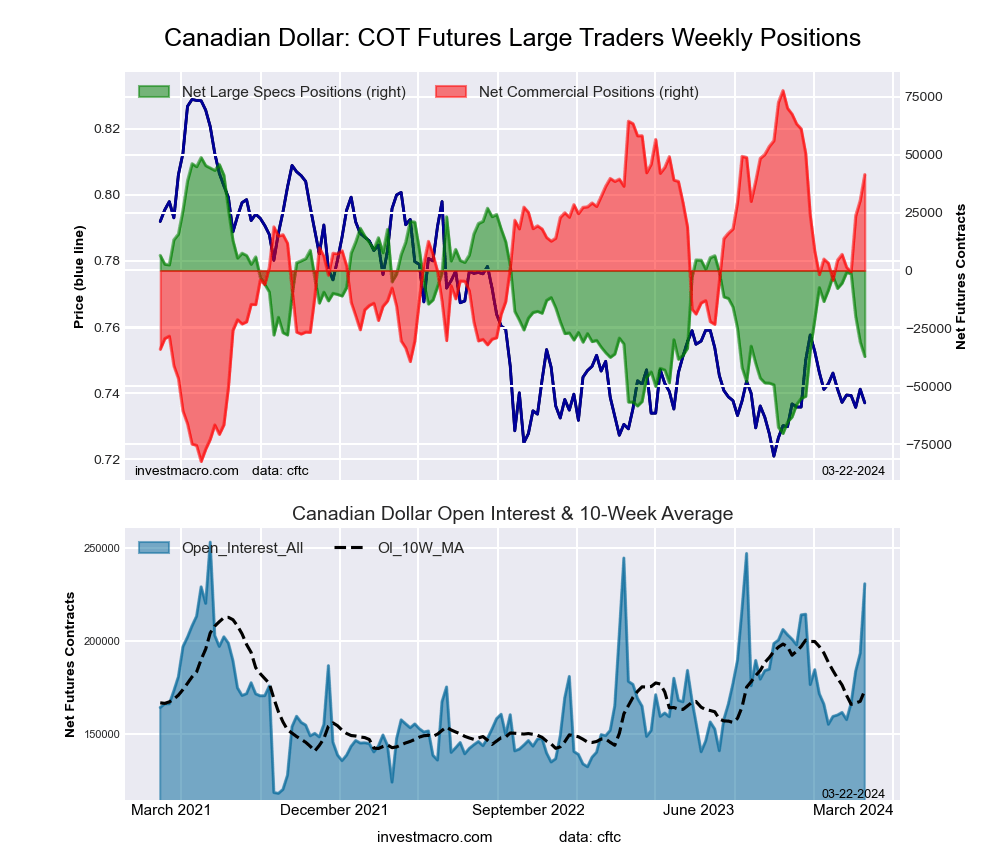
Canadian Dollar Futures:

Canadian Dollar Forex Futures COT ChartThe Canadian Dollar large speculator standing this week totaled a net position of -863 contracts in the data reported through Tuesday. This was a weekly boost of 4,619 contracts from the previous week which had a total of -5,482 net contracts.

This week’s current strength score (the trader positioning range over the past three years, measured from 0 to 100) shows the speculators are currently Bullish with a score of 58.4 percent. The commercials are Bullish with a score of 52.3 percent and the small traders (not shown in chart) are Bearish with a score of 21.7 percent.

Price Trend-Following Model: Uptrend

Our weekly trend-following model classifies the current market price position as: Uptrend. The current action for the model is considered to be: Hold – Maintain Long Position.

CANADIAN DOLLAR StatisticsSPECULATORSCOMMERCIALSSMALL TRADERS
– Percent of Open Interest Longs:23.555.918.5
– Percent of Open Interest Shorts:24.155.118.8
– Net Position:-8631,345-482
– Gross Longs:37,10888,20529,192
– Gross Shorts:37,97186,86029,674
– Long to Short Ratio:1.0 to 11.0 to 11.0 to 1
NET POSITION TREND:
– Strength Index Score (3 Year Range Pct):58.452.321.7
– Strength Index Reading (3 Year Range):BullishBullishBearish
NET POSITION MOVEMENT INDEX:
– 6-Week Change in Strength Index:5.52.0-21.4


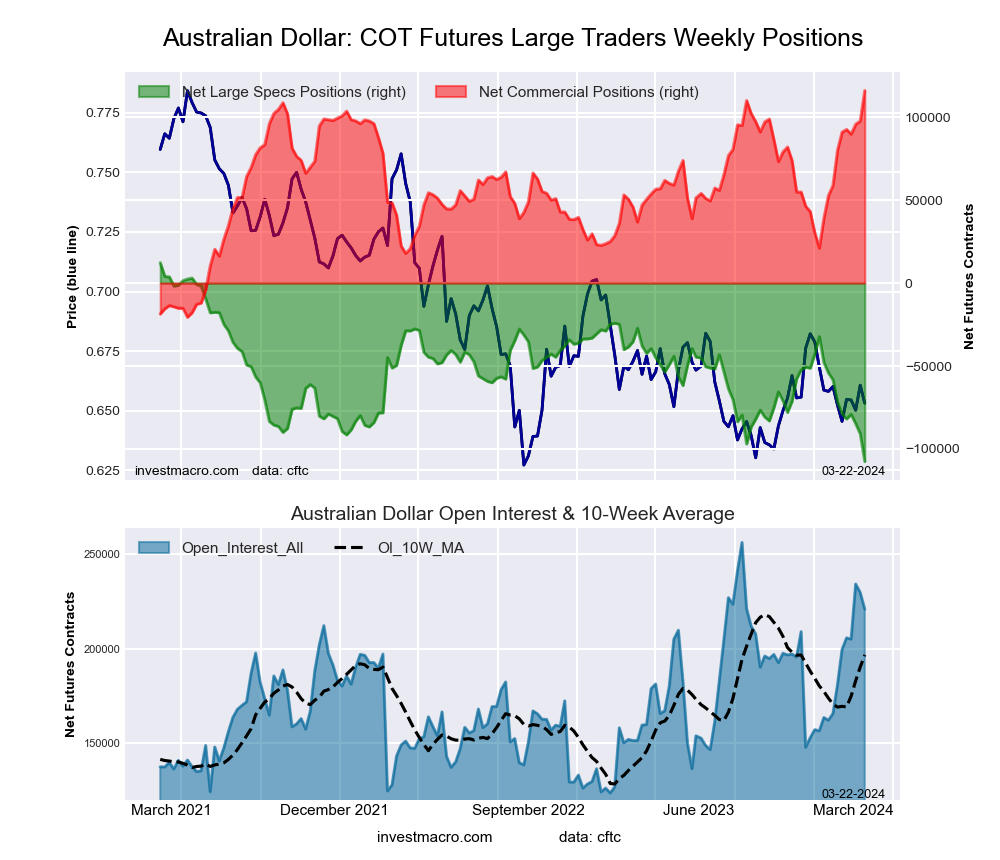
Australian Dollar Futures:

Australian Dollar Forex Futures COT ChartThe Australian Dollar large speculator standing this week totaled a net position of -81,875 contracts in the data reported through Tuesday. This was a weekly fall of -2,899 contracts from the previous week which had a total of -78,976 net contracts.

This week’s current strength score (the trader positioning range over the past three years, measured from 0 to 100) shows the speculators are currently Bearish-Extreme with a score of 13.8 percent. The commercials are Bullish-Extreme with a score of 86.9 percent and the small traders (not shown in chart) are Bearish with a score of 27.2 percent.

Price Trend-Following Model: Uptrend

Our weekly trend-following model classifies the current market price position as: Uptrend. The current action for the model is considered to be: Hold – Maintain Long Position.

AUSTRALIAN DOLLAR StatisticsSPECULATORSCOMMERCIALSSMALL TRADERS
– Percent of Open Interest Longs:23.964.09.4
– Percent of Open Interest Shorts:63.719.014.6
– Net Position:-81,87592,611-10,736
– Gross Longs:49,100131,69419,375
– Gross Shorts:130,97539,08330,111
– Long to Short Ratio:0.4 to 13.4 to 10.6 to 1
NET POSITION TREND:
– Strength Index Score (3 Year Range Pct):13.886.927.2
– Strength Index Reading (3 Year Range):Bearish-ExtremeBullish-ExtremeBearish
NET POSITION MOVEMENT INDEX:
– 6-Week Change in Strength Index:-45.453.9-55.3


New Zealand Dollar Futures:

New Zealand Dollar Forex Futures COT ChartThe New Zealand Dollar large speculator standing this week totaled a net position of 6,626 contracts in the data reported through Tuesday. This was a weekly rise of 3,219 contracts from the previous week which had a total of 3,407 net contracts.

This week’s current strength score (the trader positioning range over the past three years, measured from 0 to 100) shows the speculators are currently Bullish with a score of 72.7 percent. The commercials are Bearish with a score of 26.9 percent and the small traders (not shown in chart) are Bullish with a score of 69.3 percent.

Price Trend-Following Model: Uptrend

Our weekly trend-following model classifies the current market price position as: Uptrend. The current action for the model is considered to be: Hold – Maintain Long Position.

NEW ZEALAND DOLLAR StatisticsSPECULATORSCOMMERCIALSSMALL TRADERS
– Percent of Open Interest Longs:48.235.011.2
– Percent of Open Interest Shorts:32.154.18.3
– Net Position:6,626-7,7991,173
– Gross Longs:19,75814,3414,580
– Gross Shorts:13,13222,1403,407
– Long to Short Ratio:1.5 to 10.6 to 11.3 to 1
NET POSITION TREND:
– Strength Index Score (3 Year Range Pct):72.726.969.3
– Strength Index Reading (3 Year Range):BullishBearishBullish
NET POSITION MOVEMENT INDEX:
– 6-Week Change in Strength Index:21.9-17.3-10.3


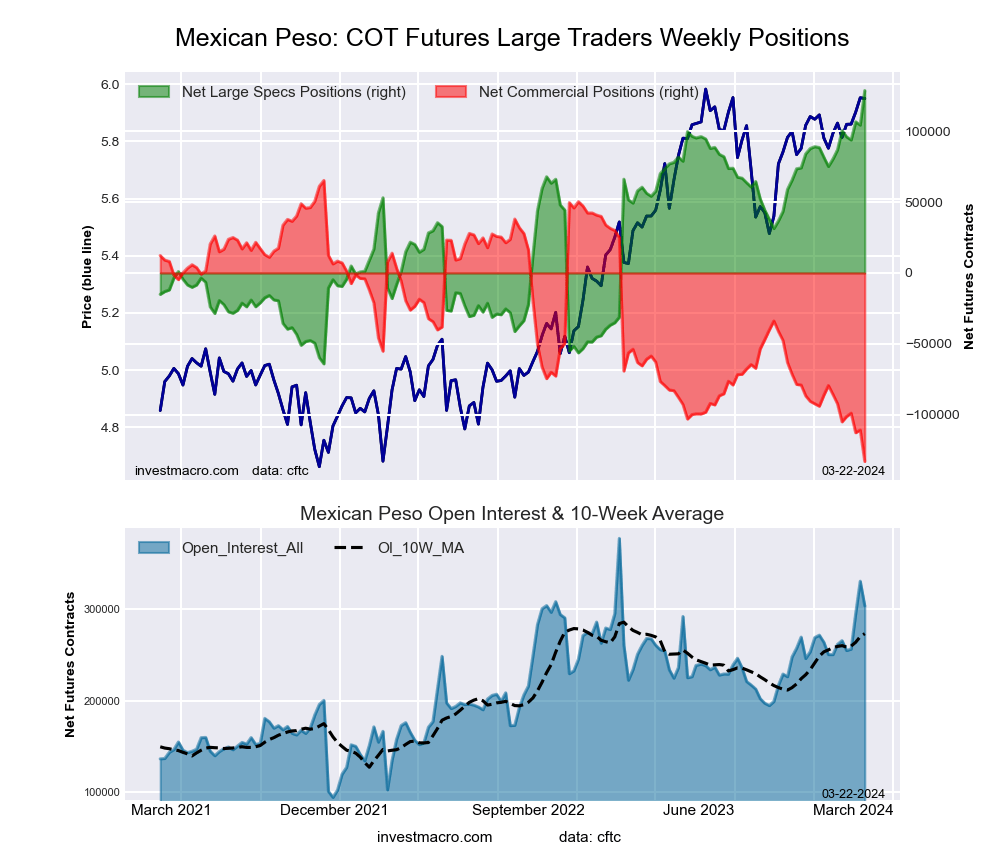
Mexican Peso Futures:

Mexican Peso Futures COT ChartThe Mexican Peso large speculator standing this week totaled a net position of 95,995 contracts in the data reported through Tuesday. This was a weekly decline of -4,449 contracts from the previous week which had a total of 100,444 net contracts.

This week’s current strength score (the trader positioning range over the past three years, measured from 0 to 100) shows the speculators are currently Bullish-Extreme with a score of 97.3 percent. The commercials are Bearish-Extreme with a score of 2.2 percent and the small traders (not shown in chart) are Bearish with a score of 45.2 percent.

Price Trend-Following Model: Uptrend

Our weekly trend-following model classifies the current market price position as: Uptrend. The current action for the model is considered to be: Hold – Maintain Long Position.

MEXICAN PESO StatisticsSPECULATORSCOMMERCIALSSMALL TRADERS
– Percent of Open Interest Longs:55.640.13.2
– Percent of Open Interest Shorts:17.979.91.1
– Net Position:95,995-101,3305,335
– Gross Longs:141,528102,0968,061
– Gross Shorts:45,533203,4262,726
– Long to Short Ratio:3.1 to 10.5 to 13.0 to 1
NET POSITION TREND:
– Strength Index Score (3 Year Range Pct):97.32.245.2
– Strength Index Reading (3 Year Range):Bullish-ExtremeBearish-ExtremeBearish
NET POSITION MOVEMENT INDEX:
– 6-Week Change in Strength Index:4.6-4.3-1.5


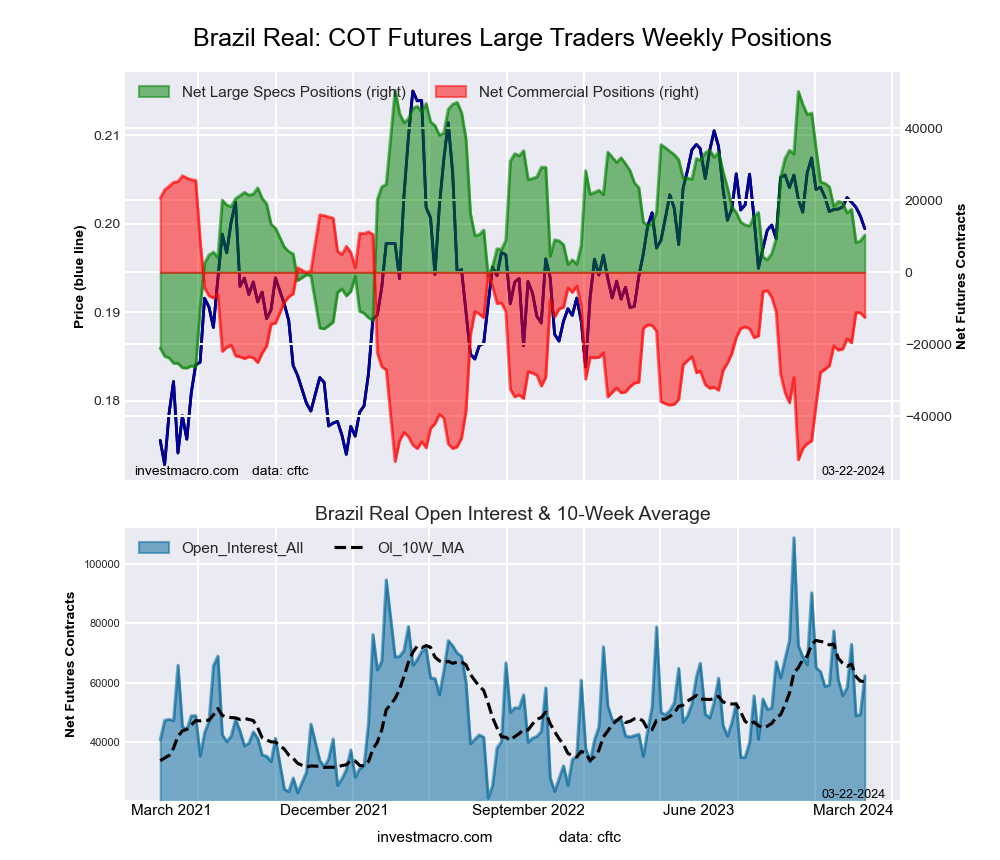
Brazilian Real Futures:

Brazil Real Futures COT ChartThe Brazilian Real large speculator standing this week totaled a net position of 16,522 contracts in the data reported through Tuesday. This was a weekly fall of -2,826 contracts from the previous week which had a total of 19,348 net contracts.

This week’s current strength score (the trader positioning range over the past three years, measured from 0 to 100) shows the speculators are currently Bullish with a score of 55.9 percent. The commercials are Bearish with a score of 43.0 percent and the small traders (not shown in chart) are Bullish with a score of 52.4 percent.

Price Trend-Following Model: Weak Uptrend

Our weekly trend-following model classifies the current market price position as: Weak Uptrend. The current action for the model is considered to be: Hold – Maintain Long Position.

BRAZIL REAL StatisticsSPECULATORSCOMMERCIALSSMALL TRADERS
– Percent of Open Interest Longs:55.738.85.2
– Percent of Open Interest Shorts:27.370.51.9
– Net Position:16,522-18,4531,931
– Gross Longs:32,45722,6193,031
– Gross Shorts:15,93541,0721,100
– Long to Short Ratio:2.0 to 10.6 to 12.8 to 1
NET POSITION TREND:
– Strength Index Score (3 Year Range Pct):55.943.052.4
– Strength Index Reading (3 Year Range):BullishBearishBullish
NET POSITION MOVEMENT INDEX:
– 6-Week Change in Strength Index:-11.111.7-6.6


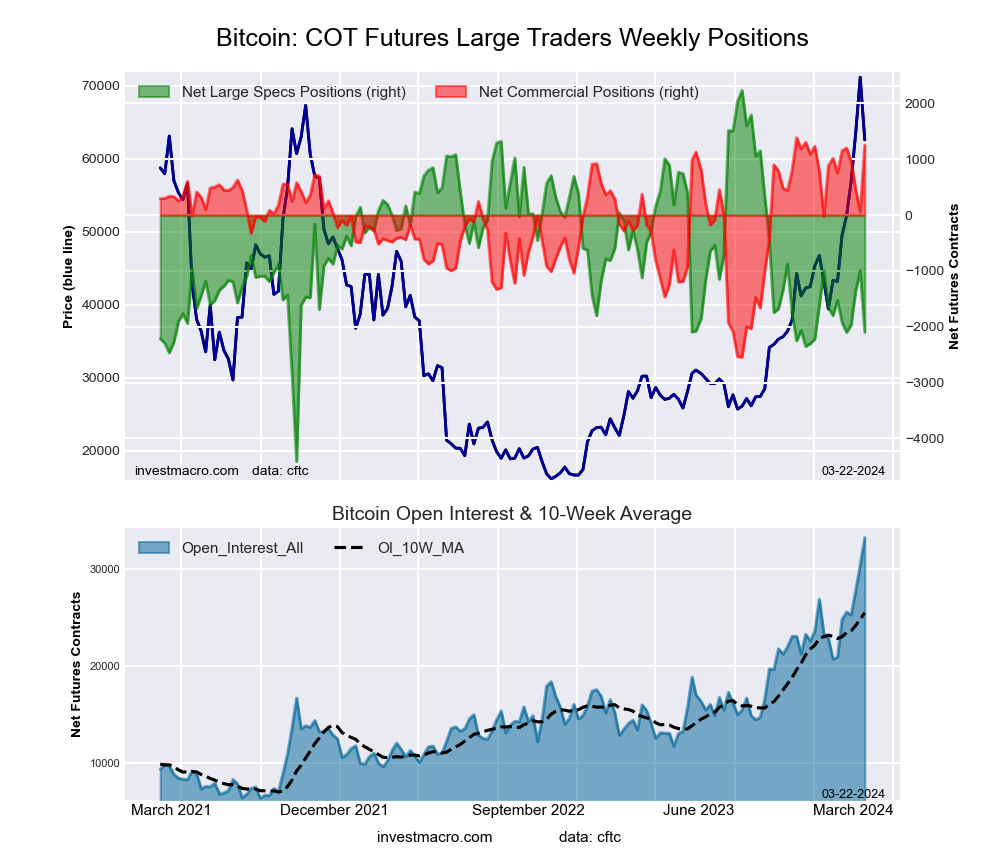
Bitcoin Futures:

Bitcoin Crypto Futures COT ChartThe Bitcoin large speculator standing this week totaled a net position of -2,098 contracts in the data reported through Tuesday. This was a weekly decline of -177 contracts from the previous week which had a total of -1,921 net contracts.

This week’s current strength score (the trader positioning range over the past three years, measured from 0 to 100) shows the speculators are currently Bearish with a score of 34.8 percent. The commercials are Bullish-Extreme with a score of 95.3 percent and the small traders (not shown in chart) are Bearish with a score of 33.3 percent.

Price Trend-Following Model: Strong Uptrend

Our weekly trend-following model classifies the current market price position as: Strong Uptrend. The current action for the model is considered to be: Hold – Maintain Long Position.

BITCOIN StatisticsSPECULATORSCOMMERCIALSSMALL TRADERS
– Percent of Open Interest Longs:76.97.36.8
– Percent of Open Interest Shorts:85.12.63.2
– Net Position:-2,0981,202896
– Gross Longs:19,6241,8621,724
– Gross Shorts:21,722660828
– Long to Short Ratio:0.9 to 12.8 to 12.1 to 1
NET POSITION TREND:
– Strength Index Score (3 Year Range Pct):34.895.333.3
– Strength Index Reading (3 Year Range):BearishBullish-ExtremeBearish
NET POSITION MOVEMENT INDEX:
– 6-Week Change in Strength Index:-7.210.81.3


Article By InvestMacroReceive our weekly COT Newsletter

*COT Report: The COT data, released weekly to the public each Friday, is updated through the most recent Tuesday (data is 3 days old) and shows a quick view of how large speculators or non-commercials (for-profit traders) were positioned in the futures markets.

The CFTC categorizes trader positions according to commercial hedgers (traders who use futures contracts for hedging as part of the business), non-commercials (large traders who speculate to realize trading profits) and nonreportable traders (usually small traders/speculators) as well as their open interest (contracts open in the market at time of reporting). See CFTC criteria here.

COT Metals Charts: Speculator Bets led higher by Copper, Silver & Gold

By InvestMacro

Here are the latest charts and statistics for the Commitment of Traders (COT) data published by the Commodities Futures Trading Commission (CFTC).

The latest COT data is updated through Tuesday February 20th and shows a quick view of how large traders (for-profit speculators and commercial entities) were positioned in the futures markets.

Weekly Speculator Changes led by Copper, Silver & Gold

The COT metals markets speculator bets were higher this week as five out of the six metals markets we cover had higher positioning while only one market had lower speculator contracts.

Leading the gains for the metals was Copper (16,755 contracts) with Silver (9,952 contracts), Gold (9,094 contracts), Platinum (6,557 contracts) and Palladium (1,058 contracts) also recording positive weeks.

The market with a decline in speculator bets for the week was Steel with a total change of -518 contracts on the week.


Metals Net Speculators Leaderboard

Legend: Weekly Speculators Change | Speculators Current Net Position | Speculators Strength Score compared to last 3-Years (0-100 range)


Strength Scores led by Steel & Silver

COT Strength Scores (a normalized measure of Speculator positions over a 3-Year range, from 0 to 100 where above 80 is Extreme-Bullish and below 20 is Extreme-Bearish) showed that Steel (86 percent) and Silver (54 percent) were the leaders for the metals markets this week.

On the downside, Palladium (6 percent) and Copper (19 percent) come in at the lowest strength level currently and are both in Extreme-Bearish territory (below 20 percent).

Strength Statistics:
Gold (39.7 percent) vs Gold previous week (35.6 percent)
Silver (53.6 percent) vs Silver previous week (38.4 percent)
Copper (19.4 percent) vs Copper previous week (3.0 percent)
Platinum (38.6 percent) vs Platinum previous week (22.0 percent)
Palladium (6.4 percent) vs Palladium previous week (0.0 percent)
Steel (86.0 percent) vs Palladium previous week (88.0 percent)


Copper & Steel top the 6-Week Strength Trends

COT Strength Score Trends (or move index, calculates the 6-week changes in strength scores) showed that all the metals markets had negative six-week trends. Copper (-3 percent) and Steel (-5 percent) have the least negative six weeks trends for metals currently.

Platinum (-38 percent) and Gold (-22 percent) lead the downside trend scores this week.

Move Statistics:
Gold (-21.8 percent) vs Gold previous week (-34.4 percent)
Silver (-6.1 percent) vs Silver previous week (-30.7 percent)
Copper (-2.7 percent) vs Copper previous week (-40.6 percent)
Platinum (-38.1 percent) vs Platinum previous week (-68.6 percent)
Palladium (-18.0 percent) vs Palladium previous week (-32.3 percent)
Steel (-4.7 percent) vs Steel previous week (-12.0 percent)


Individual Markets:

Gold Comex Futures:

Gold Futures COT ChartThe Gold Comex Futures large speculator standing this week reached a net position of 140,262 contracts in the data reported through Tuesday. This was a weekly lift of 9,094 contracts from the previous week which had a total of 131,168 net contracts.

This week’s current strength score (the trader positioning range over the past three years, measured from 0 to 100) shows the speculators are currently Bearish with a score of 39.7 percent. The commercials are Bullish with a score of 60.3 percent and the small traders (not shown in chart) are Bearish with a score of 35.7 percent.

Price Trend-Following Model: Uptrend

Our weekly trend-following model classifies the current market price position as: Uptrend. The current action for the model is considered to be: Hold – Maintain Long Position.

Gold Futures StatisticsSPECULATORSCOMMERCIALSSMALL TRADERS
– Percent of Open Interest Longs:51.826.110.3
– Percent of Open Interest Shorts:17.465.35.6
– Net Position:140,262-159,41119,149
– Gross Longs:211,034106,41941,846
– Gross Shorts:70,772265,83022,697
– Long to Short Ratio:3.0 to 10.4 to 11.8 to 1
NET POSITION TREND:
– Strength Index Score (3 Year Range Pct):39.760.335.7
– Strength Index Reading (3 Year Range):BearishBullishBearish
NET POSITION MOVEMENT INDEX:
– 6-Week Change in Strength Index:-21.823.8-31.9


Silver Comex Futures:

Silver Futures COT ChartThe Silver Comex Futures large speculator standing this week reached a net position of 22,377 contracts in the data reported through Tuesday. This was a weekly boost of 9,952 contracts from the previous week which had a total of 12,425 net contracts.

This week’s current strength score (the trader positioning range over the past three years, measured from 0 to 100) shows the speculators are currently Bullish with a score of 53.6 percent. The commercials are Bearish with a score of 45.9 percent and the small traders (not shown in chart) are Bullish with a score of 53.0 percent.

Price Trend-Following Model: Strong Downtrend

Our weekly trend-following model classifies the current market price position as: Strong Downtrend. The current action for the model is considered to be: New Sell – Short Position.

Silver Futures StatisticsSPECULATORSCOMMERCIALSSMALL TRADERS
– Percent of Open Interest Longs:39.331.020.7
– Percent of Open Interest Shorts:24.056.910.1
– Net Position:22,377-37,94515,568
– Gross Longs:57,58245,50730,394
– Gross Shorts:35,20583,45214,826
– Long to Short Ratio:1.6 to 10.5 to 12.1 to 1
NET POSITION TREND:
– Strength Index Score (3 Year Range Pct):53.645.953.0
– Strength Index Reading (3 Year Range):BullishBearishBullish
NET POSITION MOVEMENT INDEX:
– 6-Week Change in Strength Index:-6.17.3-10.2


Copper Grade #1 Futures:

Copper Futures COT ChartThe Copper Grade #1 Futures large speculator standing this week reached a net position of -15,942 contracts in the data reported through Tuesday. This was a weekly advance of 16,755 contracts from the previous week which had a total of -32,697 net contracts.

This week’s current strength score (the trader positioning range over the past three years, measured from 0 to 100) shows the speculators are currently Bearish-Extreme with a score of 19.4 percent. The commercials are Bullish-Extreme with a score of 83.9 percent and the small traders (not shown in chart) are Bearish-Extreme with a score of 16.8 percent.

Price Trend-Following Model: Strong Uptrend

Our weekly trend-following model classifies the current market price position as: Strong Uptrend. The current action for the model is considered to be: Hold – Maintain Long Position.

Copper Futures StatisticsSPECULATORSCOMMERCIALSSMALL TRADERS
– Percent of Open Interest Longs:34.839.17.1
– Percent of Open Interest Shorts:41.732.17.2
– Net Position:-15,94216,208-266
– Gross Longs:79,94189,88716,243
– Gross Shorts:95,88373,67916,509
– Long to Short Ratio:0.8 to 11.2 to 11.0 to 1
NET POSITION TREND:
– Strength Index Score (3 Year Range Pct):19.483.916.8
– Strength Index Reading (3 Year Range):Bearish-ExtremeBullish-ExtremeBearish-Extreme
NET POSITION MOVEMENT INDEX:
– 6-Week Change in Strength Index:-2.76.4-27.8


Platinum Futures:

Platinum Futures COT ChartThe Platinum Futures large speculator standing this week reached a net position of 8,495 contracts in the data reported through Tuesday. This was a weekly increase of 6,557 contracts from the previous week which had a total of 1,938 net contracts.

This week’s current strength score (the trader positioning range over the past three years, measured from 0 to 100) shows the speculators are currently Bearish with a score of 38.6 percent. The commercials are Bullish with a score of 60.1 percent and the small traders (not shown in chart) are Bearish with a score of 48.0 percent.

Price Trend-Following Model: Weak Uptrend

Our weekly trend-following model classifies the current market price position as: Weak Uptrend. The current action for the model is considered to be: Hold – Maintain Long Position.

Platinum Futures StatisticsSPECULATORSCOMMERCIALSSMALL TRADERS
– Percent of Open Interest Longs:59.822.310.5
– Percent of Open Interest Shorts:50.138.83.7
– Net Position:8,495-14,4715,976
– Gross Longs:52,50519,6269,191
– Gross Shorts:44,01034,0973,215
– Long to Short Ratio:1.2 to 10.6 to 12.9 to 1
NET POSITION TREND:
– Strength Index Score (3 Year Range Pct):38.660.148.0
– Strength Index Reading (3 Year Range):BearishBullishBearish
NET POSITION MOVEMENT INDEX:
– 6-Week Change in Strength Index:-38.131.515.1


Palladium Futures:

Palladium Futures COT ChartThe Palladium Futures large speculator standing this week reached a net position of -12,453 contracts in the data reported through Tuesday. This was a weekly advance of 1,058 contracts from the previous week which had a total of -13,511 net contracts.

This week’s current strength score (the trader positioning range over the past three years, measured from 0 to 100) shows the speculators are currently Bearish-Extreme with a score of 6.4 percent. The commercials are Bullish-Extreme with a score of 97.1 percent and the small traders (not shown in chart) are Bearish with a score of 35.5 percent.

Price Trend-Following Model: Downtrend

Our weekly trend-following model classifies the current market price position as: Downtrend. The current action for the model is considered to be: Hold – Maintain Short Position.

Palladium Futures StatisticsSPECULATORSCOMMERCIALSSMALL TRADERS
– Percent of Open Interest Longs:18.156.07.0
– Percent of Open Interest Shorts:68.45.37.4
– Net Position:-12,45312,557-104
– Gross Longs:4,46513,8581,733
– Gross Shorts:16,9181,3011,837
– Long to Short Ratio:0.3 to 110.7 to 10.9 to 1
NET POSITION TREND:
– Strength Index Score (3 Year Range Pct):6.497.135.5
– Strength Index Reading (3 Year Range):Bearish-ExtremeBullish-ExtremeBearish
NET POSITION MOVEMENT INDEX:
– 6-Week Change in Strength Index:-18.018.7-10.3


Steel Futures Futures:

Steel Futures COT ChartThe Steel Futures large speculator standing this week reached a net position of -2,701 contracts in the data reported through Tuesday. This was a weekly lowering of -518 contracts from the previous week which had a total of -2,183 net contracts.

This week’s current strength score (the trader positioning range over the past three years, measured from 0 to 100) shows the speculators are currently Bullish-Extreme with a score of 86.0 percent. The commercials are Bearish-Extreme with a score of 14.1 percent and the small traders (not shown in chart) are Bullish with a score of 54.5 percent.

Price Trend-Following Model: Weak Uptrend

Our weekly trend-following model classifies the current market price position as: Weak Uptrend. The current action for the model is considered to be: Hold – Maintain Long Position.

Steel Futures StatisticsSPECULATORSCOMMERCIALSSMALL TRADERS
– Percent of Open Interest Longs:12.381.31.9
– Percent of Open Interest Shorts:22.971.51.1
– Net Position:-2,7012,499202
– Gross Longs:3,13420,682471
– Gross Shorts:5,83518,183269
– Long to Short Ratio:0.5 to 11.1 to 11.8 to 1
NET POSITION TREND:
– Strength Index Score (3 Year Range Pct):86.014.154.5
– Strength Index Reading (3 Year Range):Bullish-ExtremeBearish-ExtremeBullish
NET POSITION MOVEMENT INDEX:
– 6-Week Change in Strength Index:-4.74.8-3.7


Article By InvestMacroReceive our weekly COT Newsletter

*COT Report: The COT data, released weekly to the public each Friday, is updated through the most recent Tuesday (data is 3 days old) and shows a quick view of how large speculators or non-commercials (for-profit traders) were positioned in the futures markets.

The CFTC categorizes trader positions according to commercial hedgers (traders who use futures contracts for hedging as part of the business), non-commercials (large traders who speculate to realize trading profits) and nonreportable traders (usually small traders/speculators) as well as their open interest (contracts open in the market at time of reporting). See CFTC criteria here.
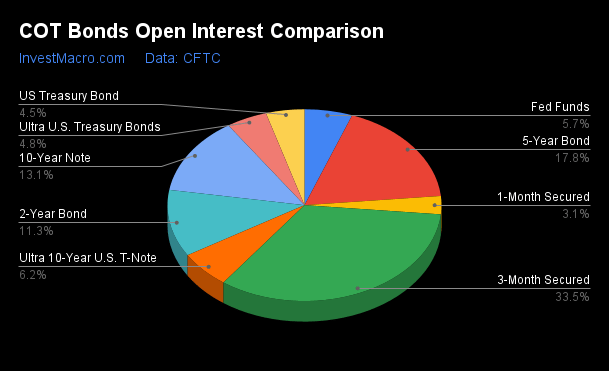
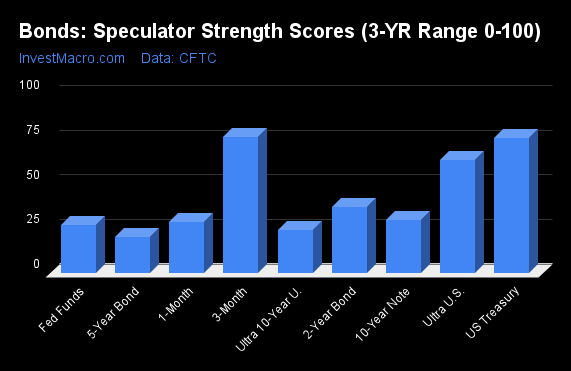
COT Bonds Charts: Speculator Bets led higher by 5-Year & 2-Year Treasuries
By InvestMacro

Here are the latest charts and statistics for the Commitment of Traders (COT) reports data published by the Commodities Futures Trading Commission (CFTC).
The latest COT data is updated through Tuesday February 20th and shows a quick view of how large traders (for-profit speculators and commercial hedgers) were positioned in the futures markets.
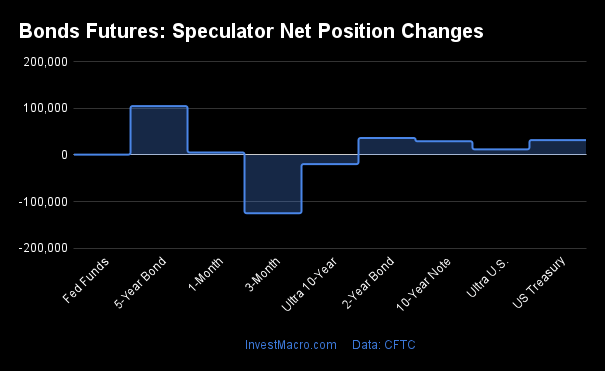
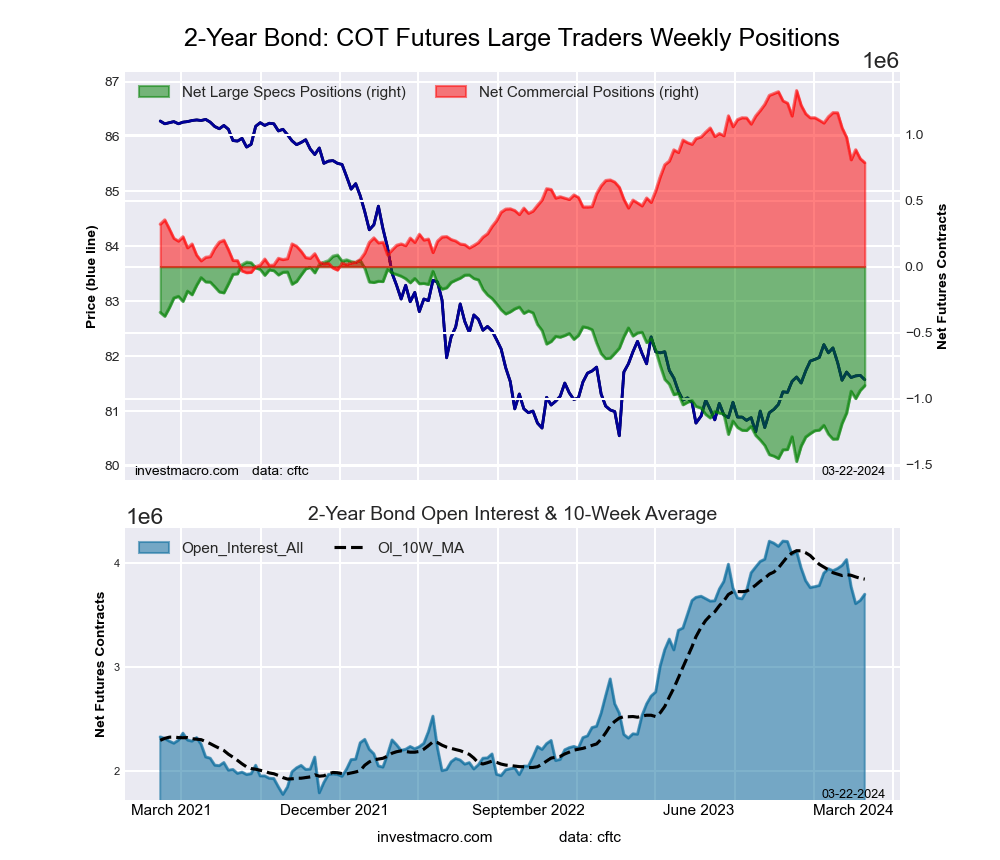
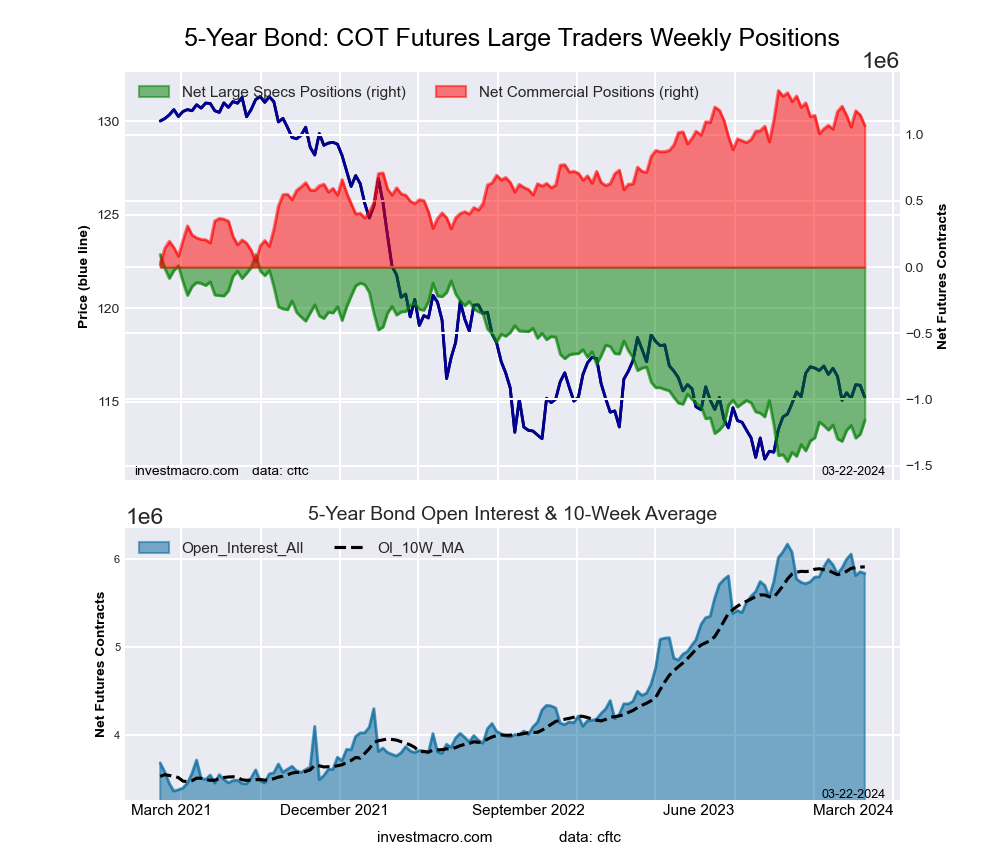
Weekly Speculator Changes led by 5-Year Bonds & 2-Year Bonds

The COT bond market speculator bets were higher this week as six out of the eight bond markets we cover had higher positioning while the other two markets had lower speculator contracts.

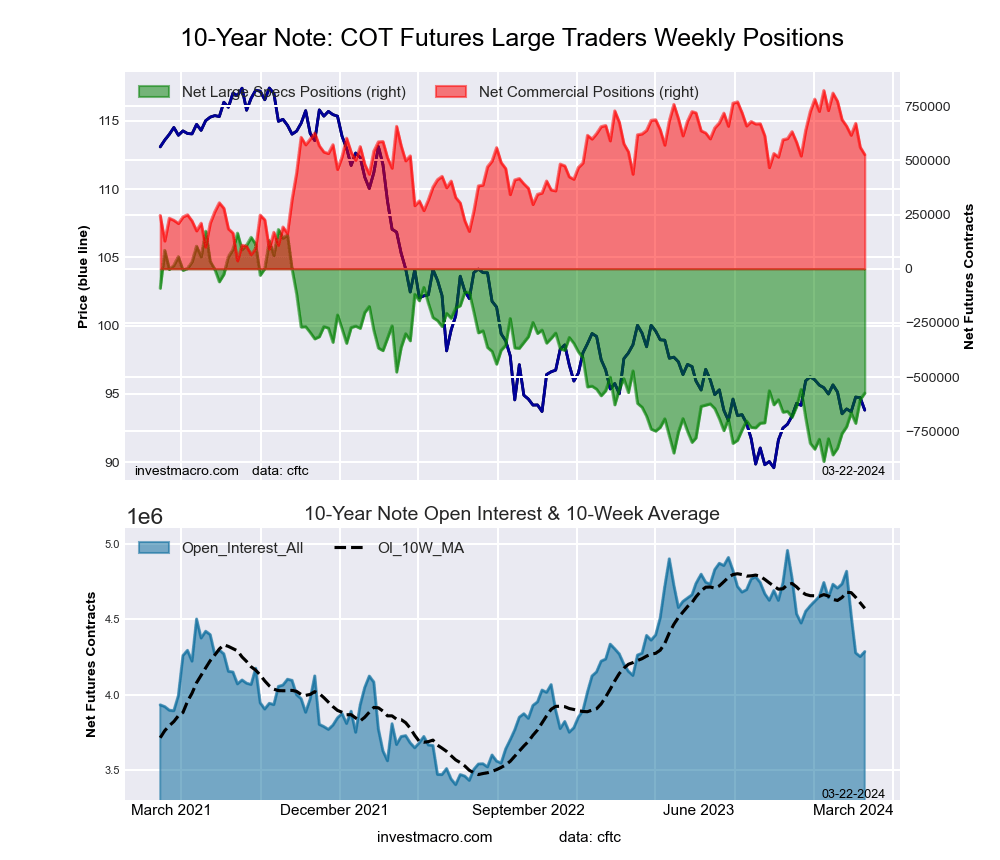
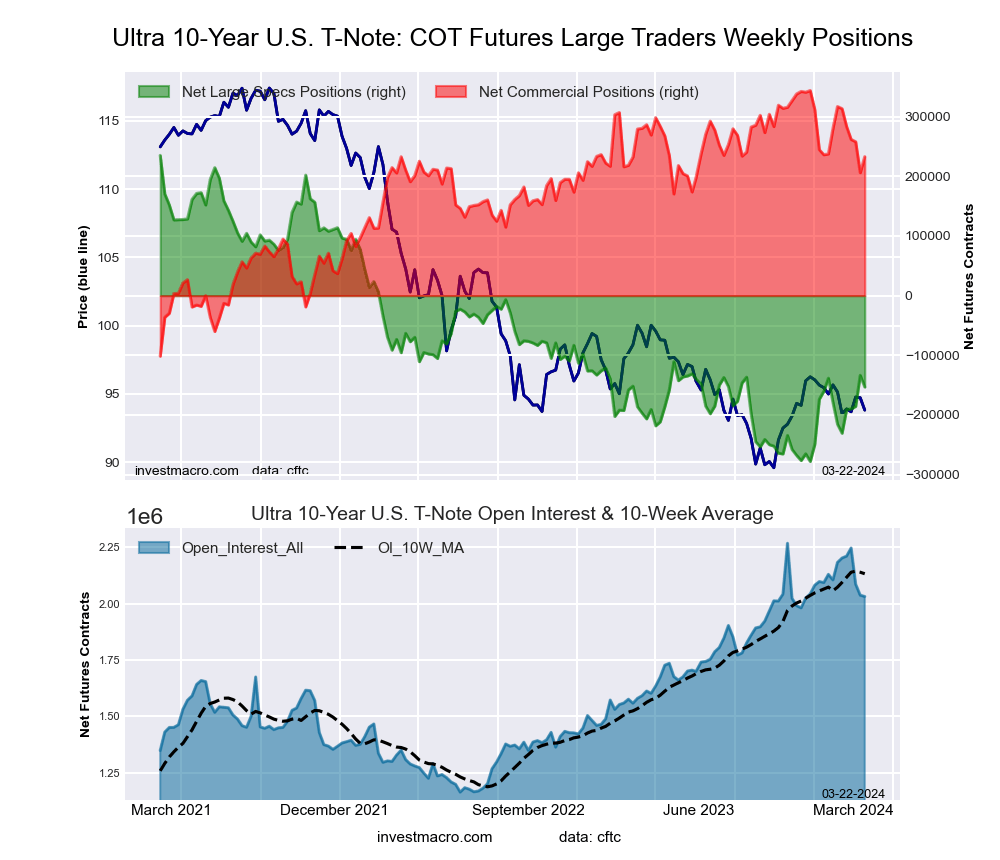
Leading the gains for the bond markets was the 5-Year Bonds (82,993 contracts) with the 2-Year Bonds (78,890 contracts), the Ultra 10-Year Bonds (39,667 contracts), the 10-Year Bonds (31,453 contracts), the US Treasury Bonds (18,577 contracts) and the Ultra Treasury Bonds (12,116 contracts) also showing positive weeks.

The bond markets with declines in speculator bets for the week were the SOFR 3-Months (-218,152 contracts) and the Fed Funds (-20,549 contracts).


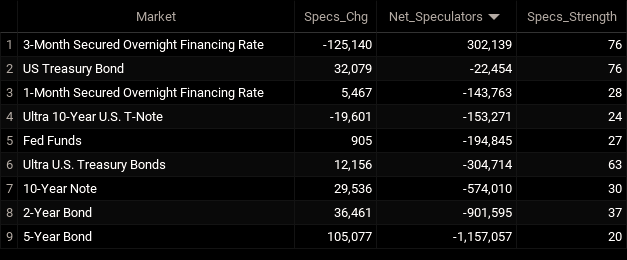
Bonds Net Speculators Leaderboard

Legend: Weekly Speculators Change | Speculators Current Net Position | Speculators Strength Score compared to last 3-Years (0-100 range)


Strength Scores led by SOFR 3-Months & Ultra Treasury Bonds

COT Strength Scores (a normalized measure of Speculator positions over a 3-Year range, from 0 to 100 where above 80 is Extreme-Bullish and below 20 is Extreme-Bearish) showed that the SOFR 3-Months (79 percent) and the Ultra Treasury Bonds (56 percent) lead the bond markets this week. The US Treasury Bonds (50 percent) come in as the next highest in the weekly strength scores.

On the downside, the 5-Year Bonds (15 percent), the 10-Year Bonds (15 percent) and the Ultra 10-Year Bonds (16 percent) come in at the lowest strength levels currently and are in Extreme-Bearish territory (below 20 percent).

Strength Statistics:
Fed Funds (33.8 percent) vs Fed Funds previous week (38.2 percent)
2-Year Bond (23.5 percent) vs 2-Year Bond previous week (18.4 percent)
5-Year Bond (15.0 percent) vs 5-Year Bond previous week (9.7 percent)
10-Year Bond (15.0 percent) vs 10-Year Bond previous week (12.0 percent)
Ultra 10-Year Bond (15.8 percent) vs Ultra 10-Year Bond previous week (8.6 percent)
US Treasury Bond (50.5 percent) vs US Treasury Bond previous week (44.0 percent)
Ultra US Treasury Bond (55.7 percent) vs Ultra US Treasury Bond previous week (50.6 percent)
SOFR 3-Months (79.3 percent) vs SOFR 3-Months previous week (90.6 percent)


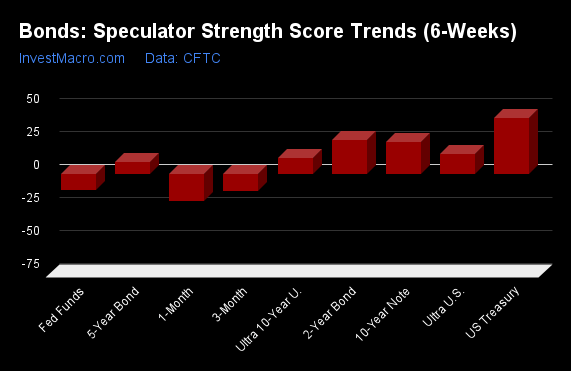
US Treasury Bonds & 2-Year Bonds top the 6-Week Strength Trends

COT Strength Score Trends (or move index, calculates the 6-week changes in strength scores) showed that the US Treasury Bonds (21 percent) and the 2-Year Bonds (8 percent) lead the past six weeks trends for bonds. The 10-Year Bonds (5 percent) are the next highest positive movers in the latest trends data.

The SOFR 3-Months (-16 percent), the Fed Funds (-6 percent), the Ultra Treasury Bonds (-4 percent) and the 5-Year Bonds (-4 percent) lead the downside trend scores currently.

Strength Trend Statistics:
Fed Funds (-5.6 percent) vs Fed Funds previous week (-2.3 percent)
2-Year Bond (8.3 percent) vs 2-Year Bond previous week (3.5 percent)
5-Year Bond (-4.0 percent) vs 5-Year Bond previous week (-1.7 percent)
10-Year Bond (5.4 percent) vs 10-Year Bond previous week (6.7 percent)
Ultra 10-Year Bond (-3.1 percent) vs Ultra 10-Year Bond previous week (3.4 percent)
US Treasury Bond (21.2 percent) vs US Treasury Bond previous week (9.5 percent)
Ultra US Treasury Bond (-4.0 percent) vs Ultra US Treasury Bond previous week (-13.3 percent)
SOFR 3-Months (-16.4 percent) vs SOFR 3-Months previous week (4.2 percent)


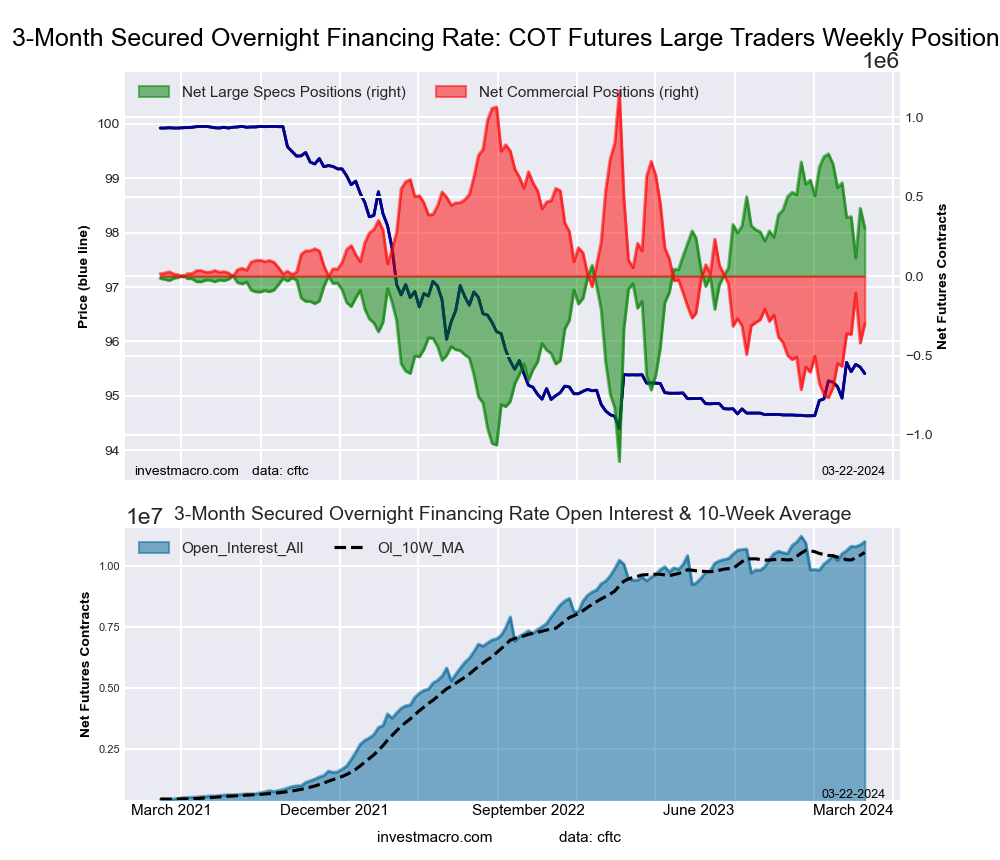
Secured Overnight Financing Rate (3-Month) Futures:

SOFR 3-Months Bonds Futures COT ChartThe Secured Overnight Financing Rate (3-Month) large speculator standing this week reached a net position of 368,390 contracts in the data reported through Tuesday. This was a weekly lowering of -218,152 contracts from the previous week which had a total of 586,542 net contracts.

This week’s current strength score (the trader positioning range over the past three years, measured from 0 to 100) shows the speculators are currently Bullish with a score of 79.3 percent. The commercials are Bearish with a score of 20.8 percent and the small traders (not shown in chart) are Bullish-Extreme with a score of 84.5 percent.

Price Trend-Following Model: Weak Uptrend

Our weekly trend-following model classifies the current market price position as: Weak Uptrend. The current action for the model is considered to be: Hold – Maintain Long Position.

SOFR 3-Months StatisticsSPECULATORSCOMMERCIALSSMALL TRADERS
– Percent of Open Interest Longs:16.253.50.3
– Percent of Open Interest Shorts:12.856.90.3
– Net Position:368,390-362,195-6,195
– Gross Longs:1,725,3665,681,65128,747
– Gross Shorts:1,356,9766,043,84634,942
– Long to Short Ratio:1.3 to 10.9 to 10.8 to 1
NET POSITION TREND:
– Strength Index Score (3 Year Range Pct):79.320.884.5
– Strength Index Reading (3 Year Range):BullishBearishBullish-Extreme
NET POSITION MOVEMENT INDEX:
– 6-Week Change in Strength Index:-16.416.22.4


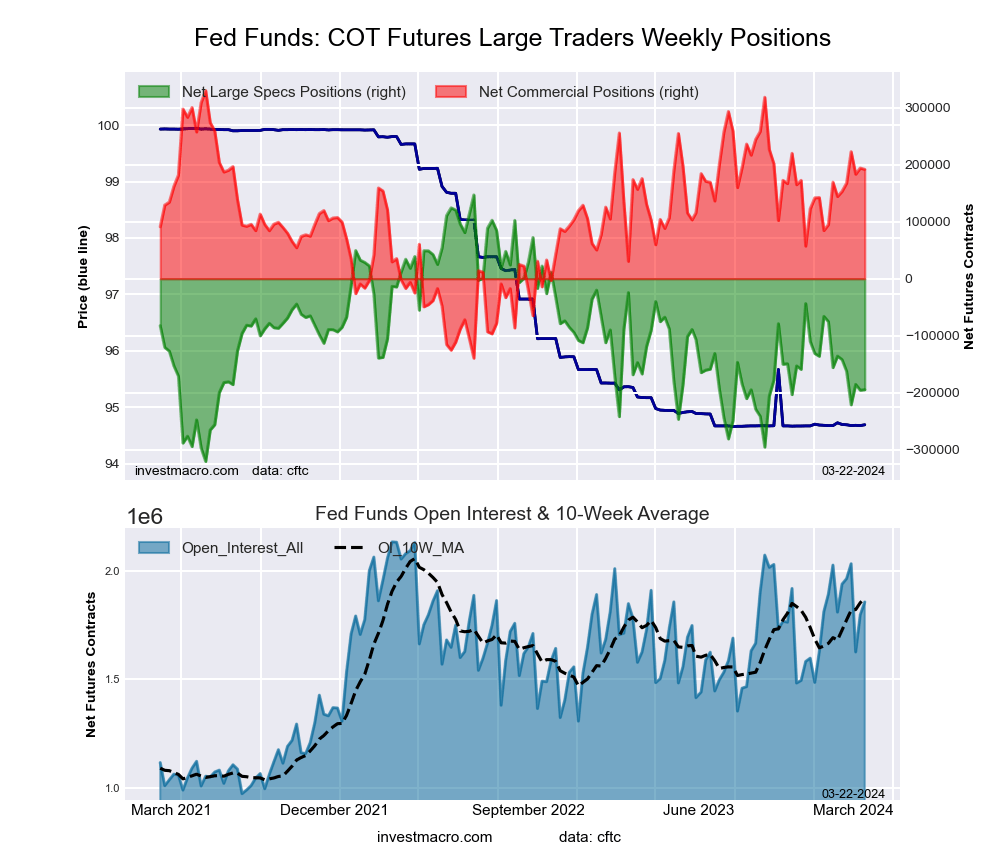
30-Day Federal Funds Futures:

Federal Funds 30-Day Bonds Futures COT ChartThe 30-Day Federal Funds large speculator standing this week reached a net position of -162,530 contracts in the data reported through Tuesday. This was a weekly reduction of -20,549 contracts from the previous week which had a total of -141,981 net contracts.

This week’s current strength score (the trader positioning range over the past three years, measured from 0 to 100) shows the speculators are currently Bearish with a score of 33.8 percent. The commercials are Bullish with a score of 65.4 percent and the small traders (not shown in chart) are Bullish-Extreme with a score of 80.7 percent.

Price Trend-Following Model: Downtrend

Our weekly trend-following model classifies the current market price position as: Downtrend. The current action for the model is considered to be: Hold – Maintain Short Position.

30-Day Federal Funds StatisticsSPECULATORSCOMMERCIALSSMALL TRADERS
– Percent of Open Interest Longs:13.870.81.8
– Percent of Open Interest Shorts:22.162.22.1
– Net Position:-162,530167,802-5,272
– Gross Longs:271,6681,388,80735,047
– Gross Shorts:434,1981,221,00540,319
– Long to Short Ratio:0.6 to 11.1 to 10.9 to 1
NET POSITION TREND:
– Strength Index Score (3 Year Range Pct):33.865.480.7
– Strength Index Reading (3 Year Range):BearishBullishBullish-Extreme
NET POSITION MOVEMENT INDEX:
– 6-Week Change in Strength Index:-5.65.42.3


2-Year Treasury Note Futures:

2-Year Treasury Bonds Futures COT ChartThe 2-Year Treasury Note large speculator standing this week reached a net position of -1,109,124 contracts in the data reported through Tuesday. This was a weekly increase of 78,890 contracts from the previous week which had a total of -1,188,014 net contracts.

This week’s current strength score (the trader positioning range over the past three years, measured from 0 to 100) shows the speculators are currently Bearish with a score of 23.5 percent. The commercials are Bullish with a score of 74.3 percent and the small traders (not shown in chart) are Bullish-Extreme with a score of 93.0 percent.

Price Trend-Following Model: Uptrend

Our weekly trend-following model classifies the current market price position as: Uptrend. The current action for the model is considered to be: Hold – Maintain Long Position.

2-Year Treasury Note StatisticsSPECULATORSCOMMERCIALSSMALL TRADERS
– Percent of Open Interest Longs:9.580.66.6
– Percent of Open Interest Shorts:37.056.33.4
– Net Position:-1,109,124980,154128,970
– Gross Longs:381,7523,249,920266,793
– Gross Shorts:1,490,8762,269,766137,823
– Long to Short Ratio:0.3 to 11.4 to 11.9 to 1
NET POSITION TREND:
– Strength Index Score (3 Year Range Pct):23.574.393.0
– Strength Index Reading (3 Year Range):BearishBullishBullish-Extreme
NET POSITION MOVEMENT INDEX:
– 6-Week Change in Strength Index:8.3-9.4-0.0


5-Year Treasury Note Futures:

5-Year Treasury Bonds Futures COT ChartThe 5-Year Treasury Note large speculator standing this week reached a net position of -1,233,300 contracts in the data reported through Tuesday. This was a weekly rise of 82,993 contracts from the previous week which had a total of -1,316,293 net contracts.

This week’s current strength score (the trader positioning range over the past three years, measured from 0 to 100) shows the speculators are currently Bearish-Extreme with a score of 15.0 percent. The commercials are Bullish-Extreme with a score of 85.7 percent and the small traders (not shown in chart) are Bullish-Extreme with a score of 81.3 percent.

Price Trend-Following Model: Uptrend

Our weekly trend-following model classifies the current market price position as: Uptrend. The current action for the model is considered to be: Hold – Maintain Long Position.

5-Year Treasury Note StatisticsSPECULATORSCOMMERCIALSSMALL TRADERS
– Percent of Open Interest Longs:7.083.66.4
– Percent of Open Interest Shorts:27.664.55.0
– Net Position:-1,233,3001,146,26087,040
– Gross Longs:423,0015,017,564386,235
– Gross Shorts:1,656,3013,871,304299,195
– Long to Short Ratio:0.3 to 11.3 to 11.3 to 1
NET POSITION TREND:
– Strength Index Score (3 Year Range Pct):15.085.781.3
– Strength Index Reading (3 Year Range):Bearish-ExtremeBullish-ExtremeBullish-Extreme
NET POSITION MOVEMENT INDEX:
– 6-Week Change in Strength Index:-4.010.5-15.8


10-Year Treasury Note Futures:

10-Year Treasury Notes Bonds Futures COT ChartThe 10-Year Treasury Note large speculator standing this week reached a net position of -729,066 contracts in the data reported through Tuesday. This was a weekly boost of 31,453 contracts from the previous week which had a total of -760,519 net contracts.

This week’s current strength score (the trader positioning range over the past three years, measured from 0 to 100) shows the speculators are currently Bearish-Extreme with a score of 15.0 percent. The commercials are Bullish with a score of 79.1 percent and the small traders (not shown in chart) are Bullish-Extreme with a score of 88.9 percent.

Price Trend-Following Model: Uptrend

Our weekly trend-following model classifies the current market price position as: Uptrend. The current action for the model is considered to be: Hold – Maintain Long Position.

10-Year Treasury Note StatisticsSPECULATORSCOMMERCIALSSMALL TRADERS
– Percent of Open Interest Longs:9.977.38.9
– Percent of Open Interest Shorts:25.063.67.4
– Net Position:-729,066658,45370,613
– Gross Longs:477,0123,724,770428,886
– Gross Shorts:1,206,0783,066,317358,273
– Long to Short Ratio:0.4 to 11.2 to 11.2 to 1
NET POSITION TREND:
– Strength Index Score (3 Year Range Pct):15.079.188.9
– Strength Index Reading (3 Year Range):Bearish-ExtremeBullishBullish-Extreme
NET POSITION MOVEMENT INDEX:
– 6-Week Change in Strength Index:5.4-8.72.2


Ultra 10-Year Notes Futures:

Ultra 10-Year Treasury Notes Bonds Futures COT ChartThe Ultra 10-Year Notes large speculator standing this week reached a net position of -191,039 contracts in the data reported through Tuesday. This was a weekly advance of 39,667 contracts from the previous week which had a total of -230,706 net contracts.

This week’s current strength score (the trader positioning range over the past three years, measured from 0 to 100) shows the speculators are currently Bearish-Extreme with a score of 15.8 percent. The commercials are Bullish-Extreme with a score of 88.0 percent and the small traders (not shown in chart) are Bullish with a score of 59.0 percent.

Price Trend-Following Model: Weak Uptrend

Our weekly trend-following model classifies the current market price position as: Weak Uptrend. The current action for the model is considered to be: Hold – Maintain Long Position.

Ultra 10-Year Notes StatisticsSPECULATORSCOMMERCIALSSMALL TRADERS
– Percent of Open Interest Longs:12.175.68.9
– Percent of Open Interest Shorts:20.762.813.1
– Net Position:-191,039283,638-92,599
– Gross Longs:267,7861,672,832196,088
– Gross Shorts:458,8251,389,194288,687
– Long to Short Ratio:0.6 to 11.2 to 10.7 to 1
NET POSITION TREND:
– Strength Index Score (3 Year Range Pct):15.888.059.0
– Strength Index Reading (3 Year Range):Bearish-ExtremeBullish-ExtremeBullish
NET POSITION MOVEMENT INDEX:
– 6-Week Change in Strength Index:-3.17.8-12.9


US Treasury Bonds Futures:

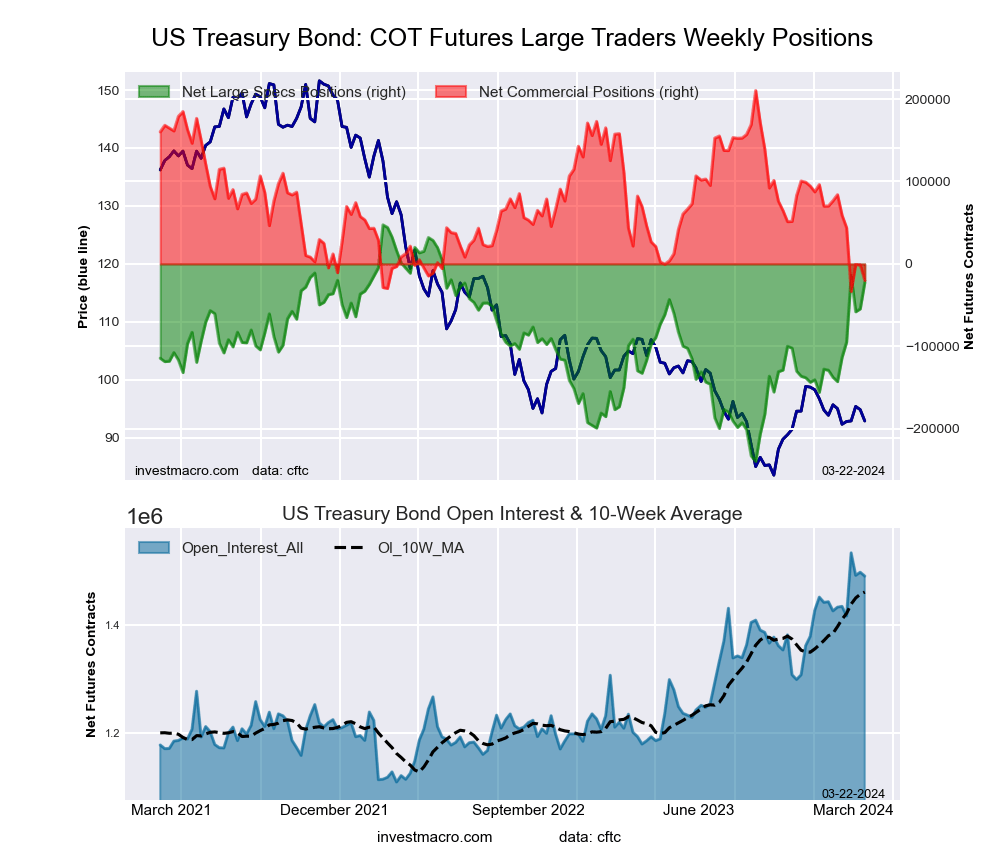
US Year Treasury Notes Long Bonds Futures COT ChartThe US Treasury Bonds large speculator standing this week reached a net position of -94,794 contracts in the data reported through Tuesday. This was a weekly advance of 18,577 contracts from the previous week which had a total of -113,371 net contracts.

This week’s current strength score (the trader positioning range over the past three years, measured from 0 to 100) shows the speculators are currently Bullish with a score of 50.5 percent. The commercials are Bearish with a score of 28.1 percent and the small traders (not shown in chart) are Bullish-Extreme with a score of 85.5 percent.

Price Trend-Following Model: Uptrend

Our weekly trend-following model classifies the current market price position as: Uptrend. The current action for the model is considered to be: Hold – Maintain Long Position.

US Treasury Bonds StatisticsSPECULATORSCOMMERCIALSSMALL TRADERS
– Percent of Open Interest Longs:13.171.214.6
– Percent of Open Interest Shorts:19.868.111.0
– Net Position:-94,79443,89950,895
– Gross Longs:185,8251,008,905206,932
– Gross Shorts:280,619965,006156,037
– Long to Short Ratio:0.7 to 11.0 to 11.3 to 1
NET POSITION TREND:
– Strength Index Score (3 Year Range Pct):50.528.185.5
– Strength Index Reading (3 Year Range):BullishBearishBullish-Extreme
NET POSITION MOVEMENT INDEX:
– 6-Week Change in Strength Index:21.2-19.9-6.4


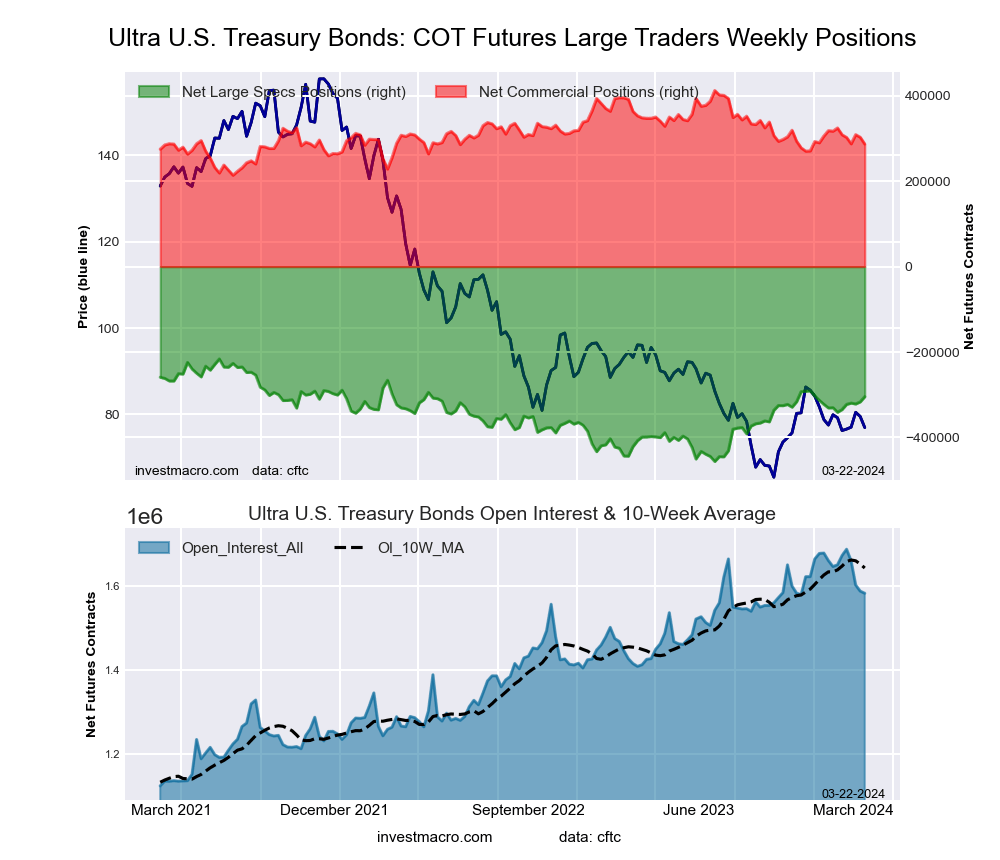
Ultra US Treasury Bonds Futures:

Ultra US Year Treasury Notes Long Bonds Futures COT ChartThe Ultra US Treasury Bonds large speculator standing this week reached a net position of -322,760 contracts in the data reported through Tuesday. This was a weekly lift of 12,116 contracts from the previous week which had a total of -334,876 net contracts.

This week’s current strength score (the trader positioning range over the past three years, measured from 0 to 100) shows the speculators are currently Bullish with a score of 55.7 percent. The commercials are Bearish with a score of 44.6 percent and the small traders (not shown in chart) are Bullish with a score of 56.1 percent.

Price Trend-Following Model: Weak Uptrend

Our weekly trend-following model classifies the current market price position as: Weak Uptrend. The current action for the model is considered to be: Hold – Maintain Long Position.

Ultra US Treasury Bonds StatisticsSPECULATORSCOMMERCIALSSMALL TRADERS
– Percent of Open Interest Longs:9.479.010.0
– Percent of Open Interest Shorts:28.561.08.8
– Net Position:-322,760302,66920,091
– Gross Longs:158,1421,333,231168,395
– Gross Shorts:480,9021,030,562148,304
– Long to Short Ratio:0.3 to 11.3 to 11.1 to 1
NET POSITION TREND:
– Strength Index Score (3 Year Range Pct):55.744.656.1
– Strength Index Reading (3 Year Range):BullishBearishBullish
NET POSITION MOVEMENT INDEX:
– 6-Week Change in Strength Index:-4.06.3-2.7


Article By InvestMacroReceive our weekly COT Newsletter

*COT Report: The COT data, released weekly to the public each Friday, is updated through the most recent Tuesday (data is 3 days old) and shows a quick view of how large speculators or non-commercials (for-profit traders) were positioned in the futures markets.

The CFTC categorizes trader positions according to commercial hedgers (traders who use futures contracts for hedging as part of the business), non-commercials (large traders who speculate to realize trading profits) and nonreportable traders (usually small traders/speculators) as well as their open interest (contracts open in the market at time of reporting). See CFTC criteria here.