COT Stock Market Charts: Speculator Bets led by VIX & DowJones-Mini

By InvestMacro

Here are the latest charts and statistics for the Commitment of Traders (COT) data published by the Commodities Futures Trading Commission (CFTC).

The latest COT data is updated through Tuesday September 17th and shows a quick view of how large traders (for-profit speculators and commercial entities) were positioned in the futures markets.

Weekly Speculator Bets led by VIX & DowJones-Mini

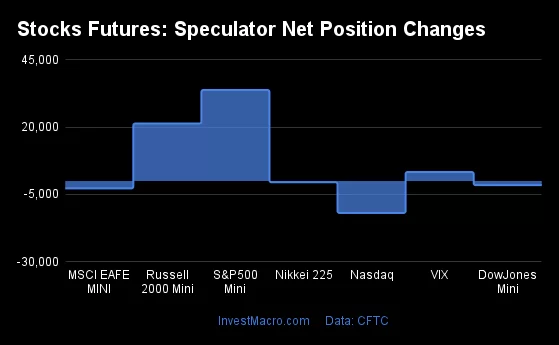
The COT stock markets speculator bets were lower this week as just two out of the seven stock markets we cover had higher positioning while the other five markets had lower speculator contracts.

Leading the gains for the stock markets was the VIX (8,598 contracts) with the DowJones-Mini (6,446 contracts) also showing a positive week.

The markets with the declines in speculator bets this week were the S&P500-Mini (-63,560 contracts), the MSCI EAFE-Mini (-11,500 contracts), the Nasdaq-Mini (-6,393 contracts), the Russell-Mini (-2,741 contracts) and with the Nikkei 225 (-498 contracts) also registering lower bets on the week.


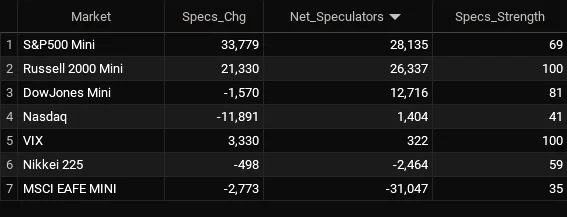
Stock Market Net Speculators Leaderboard

Legend: Weekly Speculators Change | Speculators Current Net Position | Speculators Strength Score compared to last 3-Years (0-100 range)


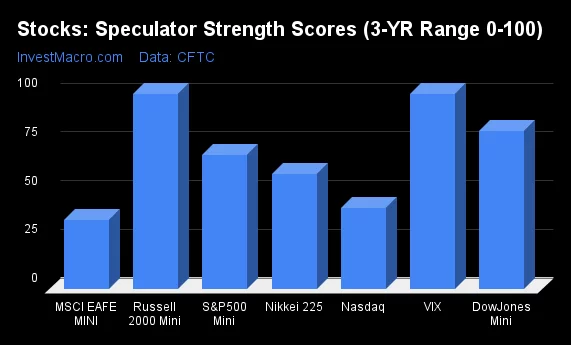
Strength Scores led by VIX & Russell-Mini

COT Strength Scores (a normalized measure of Speculator positions over a 3-Year range, from 0 to 100 where above 80 is Extreme-Bullish and below 20 is Extreme-Bearish) showed that the VIX (100 percent) and the Russell-Mini (87 percent) lead the stock markets this week. The DowJones-Mini (84 percent) and Nasdaq-Mini (69 percent) come in as the next highest in the weekly strength scores.

On the downside, the MSCI EAFE-Mini (25 percent) comes in at the lowest strength level currently. The next lowest strength score is the S&P500-Mini (46 percent).

Strength Statistics:
VIX (100.0 percent) vs VIX previous week (91.4 percent)
S&P500-Mini (46.4 percent) vs S&P500-Mini previous week (55.9 percent)
DowJones-Mini (84.1 percent) vs DowJones-Mini previous week (73.6 percent)
Nasdaq-Mini (69.0 percent) vs Nasdaq-Mini previous week (78.9 percent)
Russell2000-Mini (87.2 percent) vs Russell2000-Mini previous week (89.2 percent)
Nikkei USD (59.2 percent) vs Nikkei USD previous week (63.4 percent)
EAFE-Mini (25.1 percent) vs EAFE-Mini previous week (37.4 percent)


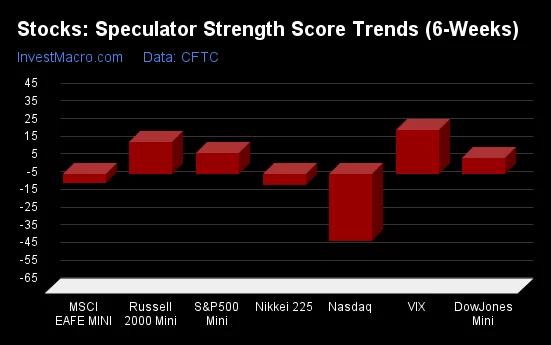
VIX top the 6-Week Strength Trends

COT Strength Score Trends (or move index, calculates the 6-week changes in strength scores) showed that the VIX (37 percent) leads the past six weeks trends for the stock markets. The DowJones-Mini (12 percent), the Nasdaq-Mini (10 percent) and the Russell-Mini (4 percent) are the next highest positive movers in the latest trends data.

The S&P500-Mini (-23 percent) leads the downside trend scores currently with the MSCI EAFE-Mini (-21 percent) coming in as the next market with lower trend scores.

Strength Trend Statistics:
VIX (37.1 percent) vs VIX previous week (34.6 percent)
S&P500-Mini (-23.4 percent) vs S&P500-Mini previous week (-10.6 percent)
DowJones-Mini (11.8 percent) vs DowJones-Mini previous week (-8.7 percent)
Nasdaq-Mini (10.3 percent) vs Nasdaq-Mini previous week (36.0 percent)
Russell2000-Mini (4.0 percent) vs Russell2000-Mini previous week (28.2 percent)
Nikkei USD (-6.3 percent) vs Nikkei USD previous week (16.2 percent)
EAFE-Mini (-20.6 percent) vs EAFE-Mini previous week (-10.9 percent)


Individual Stock Market Charts:

VIX Volatility Futures:

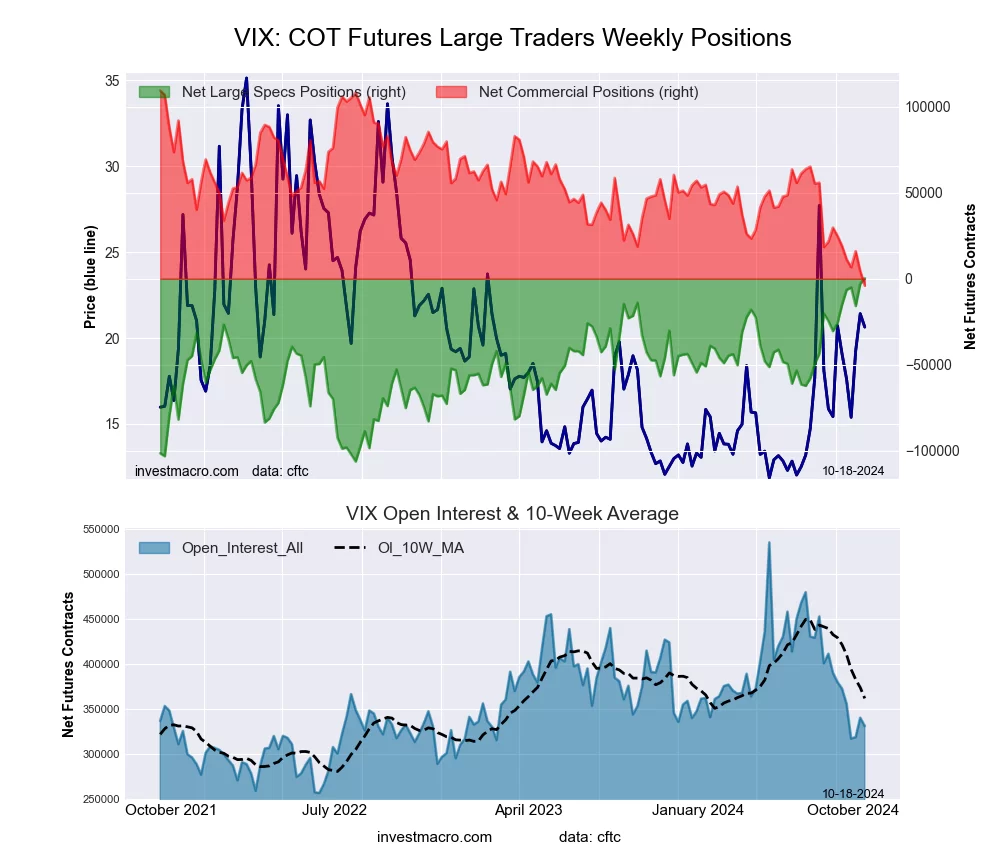
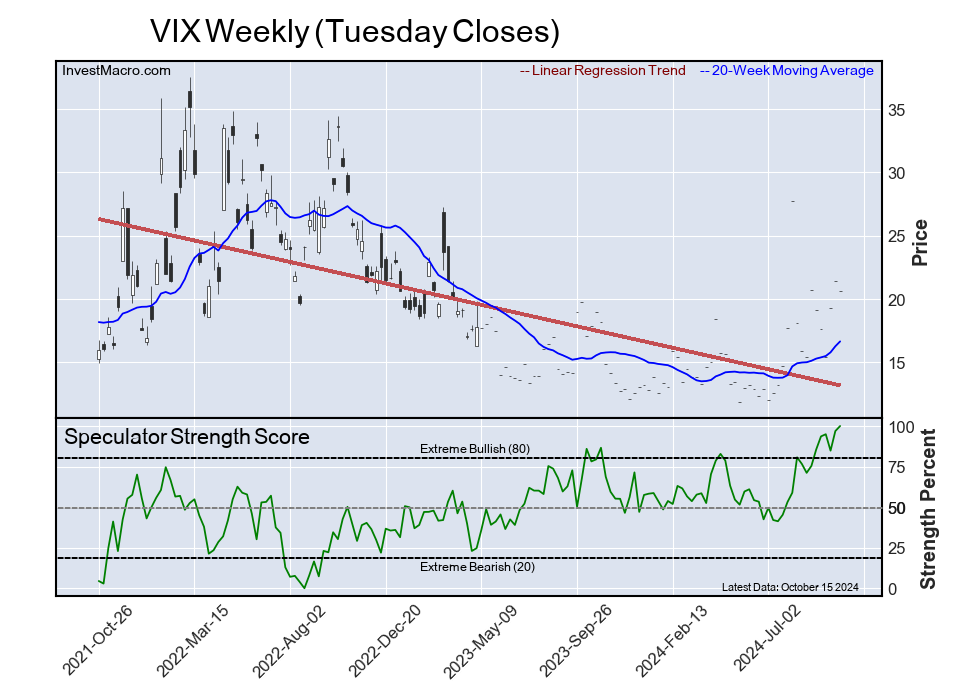
VIX Volatility Futures COT ChartThe VIX Volatility large speculator standing this week totaled a net position of -6,513 contracts in the data reported through Tuesday. This was a weekly lift of 8,598 contracts from the previous week which had a total of -15,111 net contracts.

This week’s current strength score (the trader positioning range over the past three years, measured from 0 to 100) shows the speculators are currently Bullish-Extreme with a score of 100.0 percent. The commercials are Bearish-Extreme with a score of 0.0 percent and the small traders (not shown in chart) are Bullish with a score of 64.2 percent.

Price Trend-Following Model: Uptrend

Our weekly trend-following model classifies the current market price position as: Uptrend. The current action for the model is considered to be: Hold – Maintain Long Position.

VIX Volatility Futures StatisticsSPECULATORSCOMMERCIALSSMALL TRADERS
– Percent of Open Interest Longs:20.742.27.2
– Percent of Open Interest Shorts:22.539.08.5
– Net Position:-6,51311,303-4,790
– Gross Longs:73,617150,29125,574
– Gross Shorts:80,130138,98830,364
– Long to Short Ratio:0.9 to 11.1 to 10.8 to 1
NET POSITION TREND:
– Strength Index Score (3 Year Range Pct):100.00.064.2
– Strength Index Reading (3 Year Range):Bullish-ExtremeBearish-ExtremeBullish
NET POSITION MOVEMENT INDEX:
– 6-Week Change in Strength Index:37.1-45.334.2


S&P500 Mini Futures:

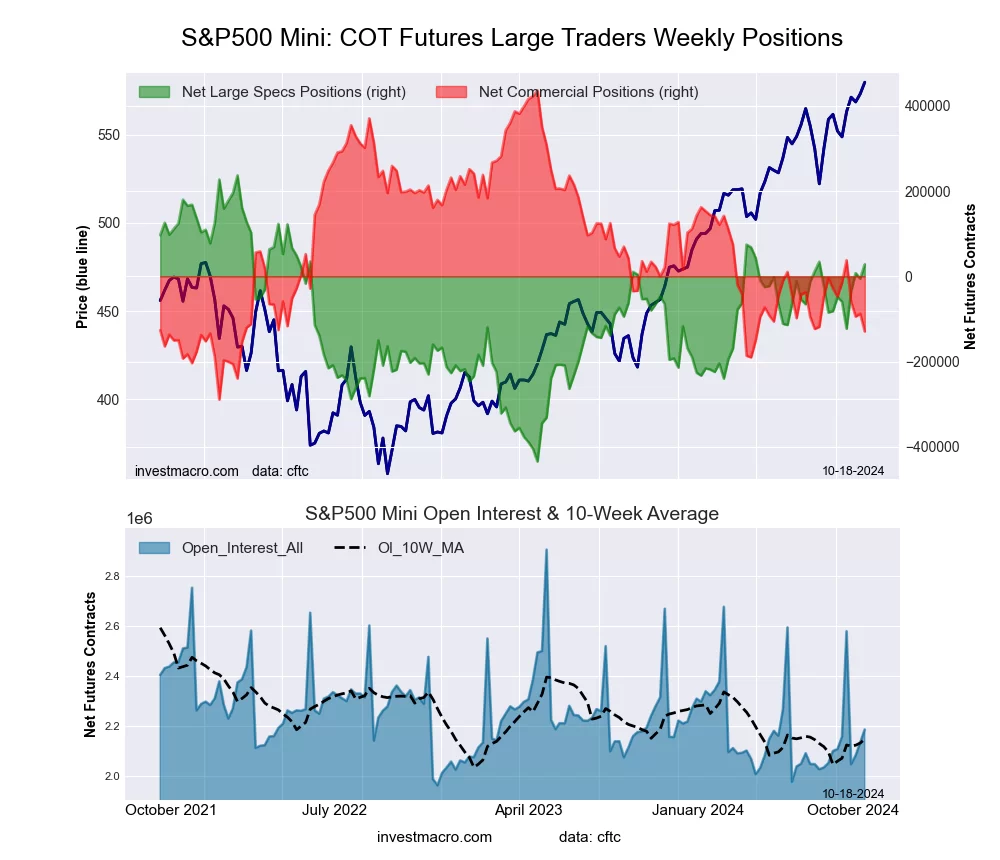
SP500 Mini Futures COT ChartThe S&P500 Mini large speculator standing this week totaled a net position of -122,948 contracts in the data reported through Tuesday. This was a weekly lowering of -63,560 contracts from the previous week which had a total of -59,388 net contracts.

This week’s current strength score (the trader positioning range over the past three years, measured from 0 to 100) shows the speculators are currently Bearish with a score of 46.4 percent. The commercials are Bearish with a score of 45.1 percent and the small traders (not shown in chart) are Bullish-Extreme with a score of 82.8 percent.

Price Trend-Following Model: Strong Uptrend

Our weekly trend-following model classifies the current market price position as: Strong Uptrend. The current action for the model is considered to be: Hold – Maintain Long Position.

S&P500 Mini Futures StatisticsSPECULATORSCOMMERCIALSSMALL TRADERS
– Percent of Open Interest Longs:11.672.110.7
– Percent of Open Interest Shorts:16.370.77.4
– Net Position:-122,94837,74585,203
– Gross Longs:298,5161,860,927277,262
– Gross Shorts:421,4641,823,182192,059
– Long to Short Ratio:0.7 to 11.0 to 11.4 to 1
NET POSITION TREND:
– Strength Index Score (3 Year Range Pct):46.445.182.8
– Strength Index Reading (3 Year Range):BearishBearishBullish-Extreme
NET POSITION MOVEMENT INDEX:
– 6-Week Change in Strength Index:-23.421.60.3


Dow Jones Mini Futures:

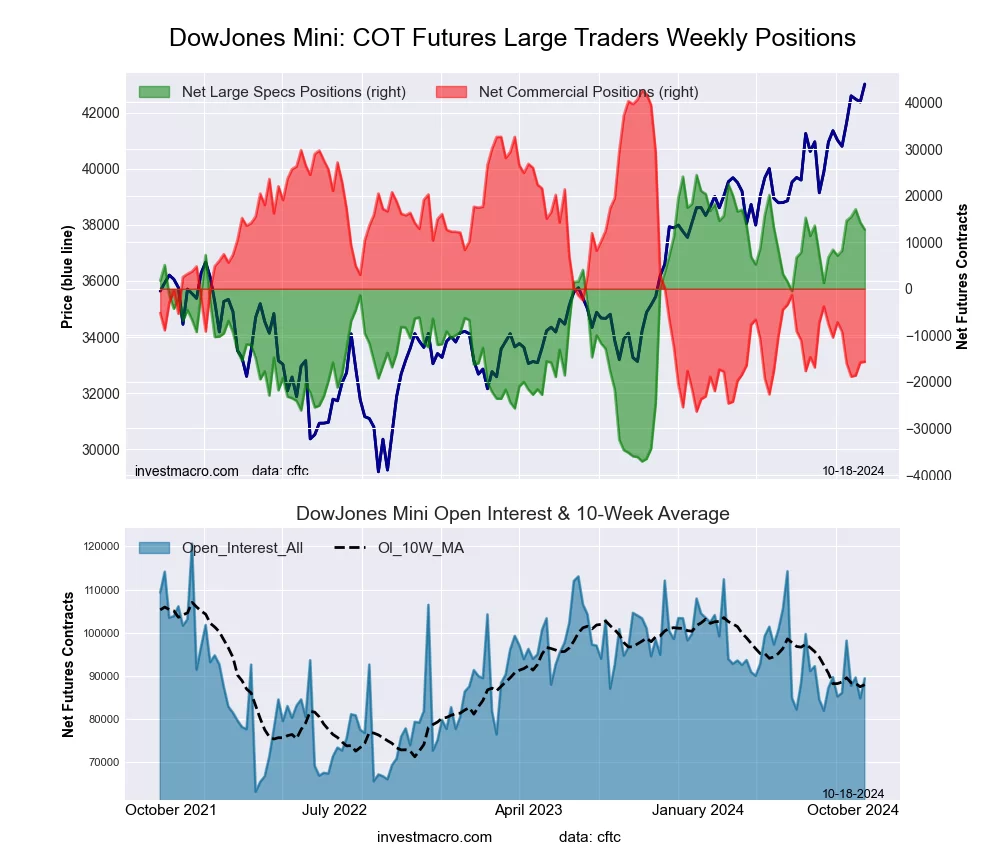
Dow Jones Mini Futures COT ChartThe Dow Jones Mini large speculator standing this week totaled a net position of 14,614 contracts in the data reported through Tuesday. This was a weekly gain of 6,446 contracts from the previous week which had a total of 8,168 net contracts.

This week’s current strength score (the trader positioning range over the past three years, measured from 0 to 100) shows the speculators are currently Bullish-Extreme with a score of 84.1 percent. The commercials are Bearish-Extreme with a score of 15.0 percent and the small traders (not shown in chart) are Bullish with a score of 62.8 percent.

Price Trend-Following Model: Strong Uptrend

Our weekly trend-following model classifies the current market price position as: Strong Uptrend. The current action for the model is considered to be: Hold – Maintain Long Position.

Dow Jones Mini Futures StatisticsSPECULATORSCOMMERCIALSSMALL TRADERS
– Percent of Open Interest Longs:23.056.816.5
– Percent of Open Interest Shorts:8.173.115.1
– Net Position:14,614-15,9811,367
– Gross Longs:22,58855,75616,195
– Gross Shorts:7,97471,73714,828
– Long to Short Ratio:2.8 to 10.8 to 11.1 to 1
NET POSITION TREND:
– Strength Index Score (3 Year Range Pct):84.115.062.8
– Strength Index Reading (3 Year Range):Bullish-ExtremeBearish-ExtremeBullish
NET POSITION MOVEMENT INDEX:
– 6-Week Change in Strength Index:11.8-12.68.6


Nasdaq Mini Futures:

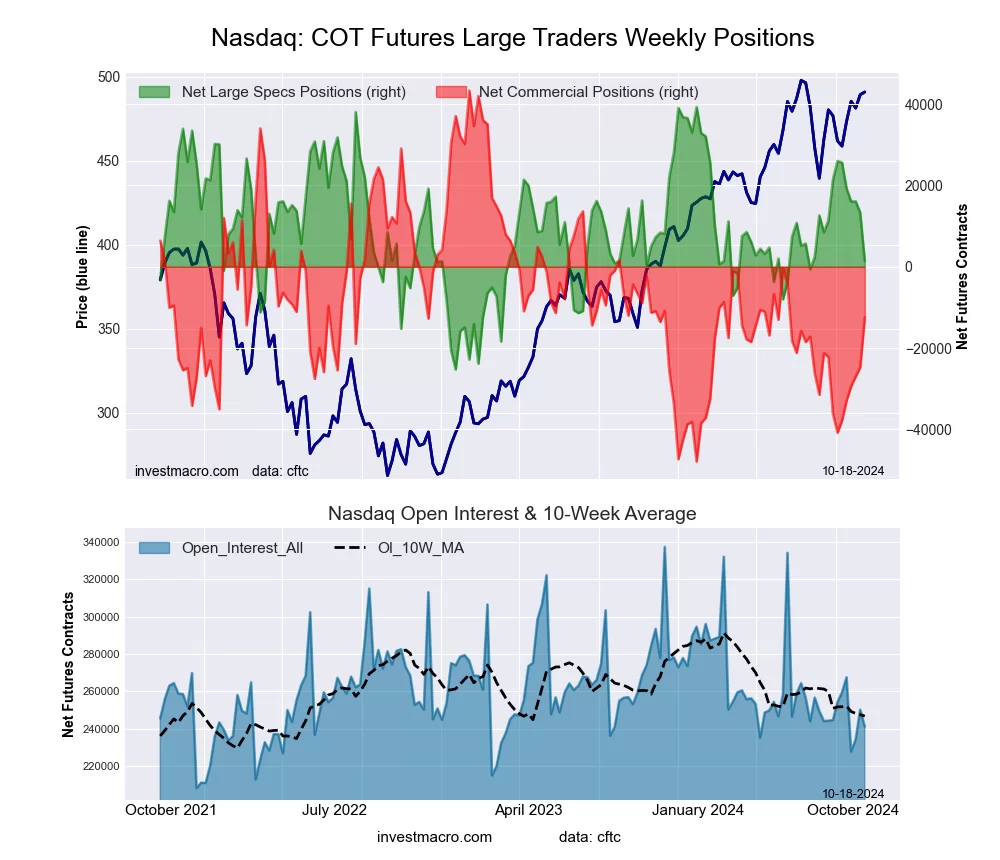
Nasdaq Mini Futures COT ChartThe Nasdaq Mini large speculator standing this week totaled a net position of 19,233 contracts in the data reported through Tuesday. This was a weekly fall of -6,393 contracts from the previous week which had a total of 25,626 net contracts.

This week’s current strength score (the trader positioning range over the past three years, measured from 0 to 100) shows the speculators are currently Bullish with a score of 69.0 percent. The commercials are Bearish-Extreme with a score of 16.4 percent and the small traders (not shown in chart) are Bullish-Extreme with a score of 80.7 percent.

Price Trend-Following Model: Strong Uptrend

Our weekly trend-following model classifies the current market price position as: Strong Uptrend. The current action for the model is considered to be: Hold – Maintain Long Position.

Nasdaq Mini Futures StatisticsSPECULATORSCOMMERCIALSSMALL TRADERS
– Percent of Open Interest Longs:25.555.415.7
– Percent of Open Interest Shorts:18.367.710.6
– Net Position:19,233-32,92813,695
– Gross Longs:68,287148,04242,112
– Gross Shorts:49,054180,97028,417
– Long to Short Ratio:1.4 to 10.8 to 11.5 to 1
NET POSITION TREND:
– Strength Index Score (3 Year Range Pct):69.016.480.7
– Strength Index Reading (3 Year Range):BullishBearish-ExtremeBullish-Extreme
NET POSITION MOVEMENT INDEX:
– 6-Week Change in Strength Index:10.3-1.6-9.9


Russell 2000 Mini Futures:

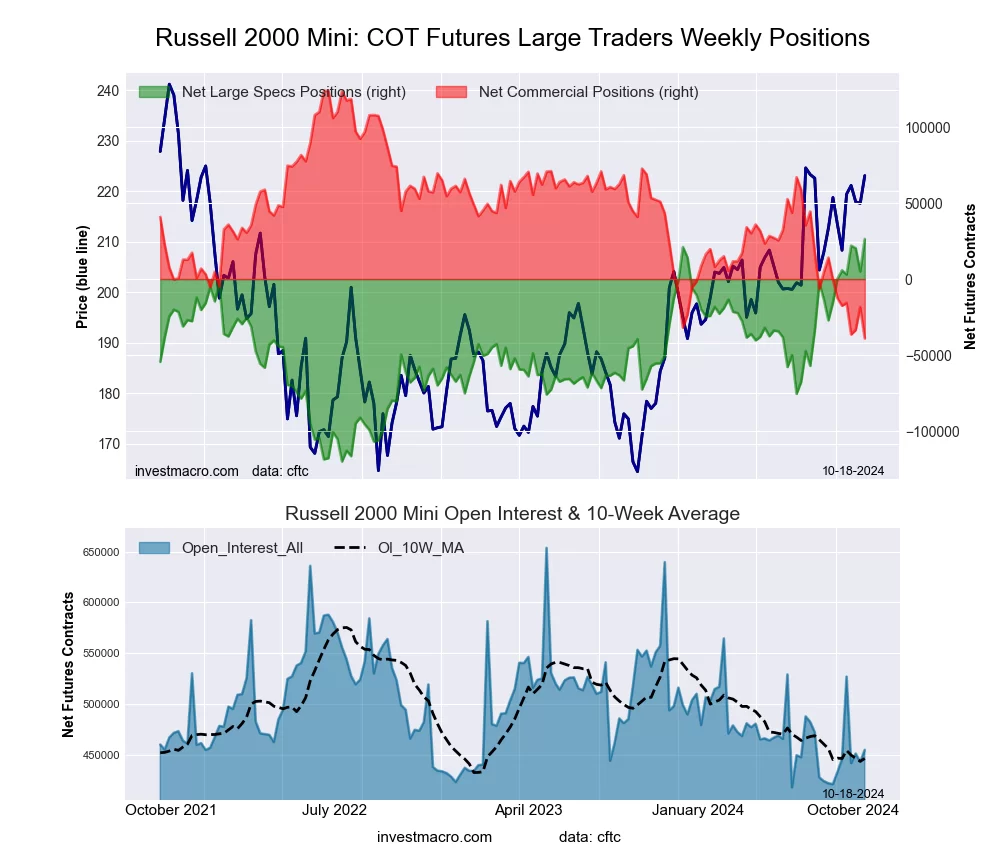
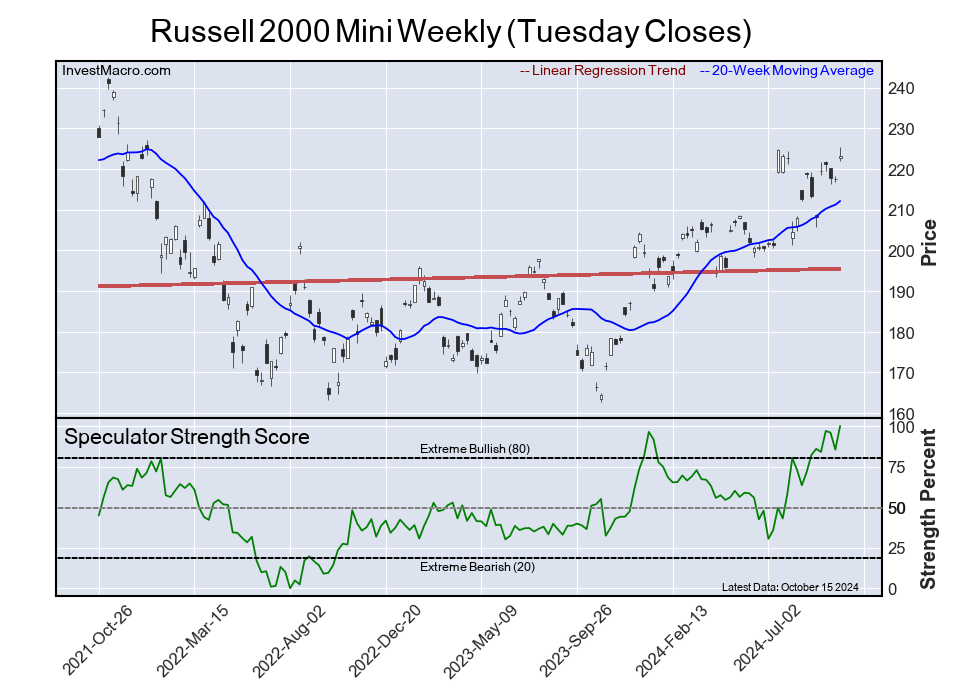
Russell 2000 Mini Futures COT ChartThe Russell 2000 Mini large speculator standing this week totaled a net position of 2,986 contracts in the data reported through Tuesday. This was a weekly decrease of -2,741 contracts from the previous week which had a total of 5,727 net contracts.

This week’s current strength score (the trader positioning range over the past three years, measured from 0 to 100) shows the speculators are currently Bullish-Extreme with a score of 87.2 percent. The commercials are Bearish-Extreme with a score of 10.4 percent and the small traders (not shown in chart) are Bullish with a score of 71.8 percent.

Price Trend-Following Model: Strong Uptrend

Our weekly trend-following model classifies the current market price position as: Strong Uptrend. The current action for the model is considered to be: Hold – Maintain Long Position.

Russell 2000 Mini Futures StatisticsSPECULATORSCOMMERCIALSSMALL TRADERS
– Percent of Open Interest Longs:14.873.06.1
– Percent of Open Interest Shorts:14.376.03.7
– Net Position:2,986-15,70512,719
– Gross Longs:78,186384,67032,407
– Gross Shorts:75,200400,37519,688
– Long to Short Ratio:1.0 to 11.0 to 11.6 to 1
NET POSITION TREND:
– Strength Index Score (3 Year Range Pct):87.210.471.8
– Strength Index Reading (3 Year Range):Bullish-ExtremeBearish-ExtremeBullish
NET POSITION MOVEMENT INDEX:
– 6-Week Change in Strength Index:4.0-5.912.2


Nikkei Stock Average (USD) Futures:

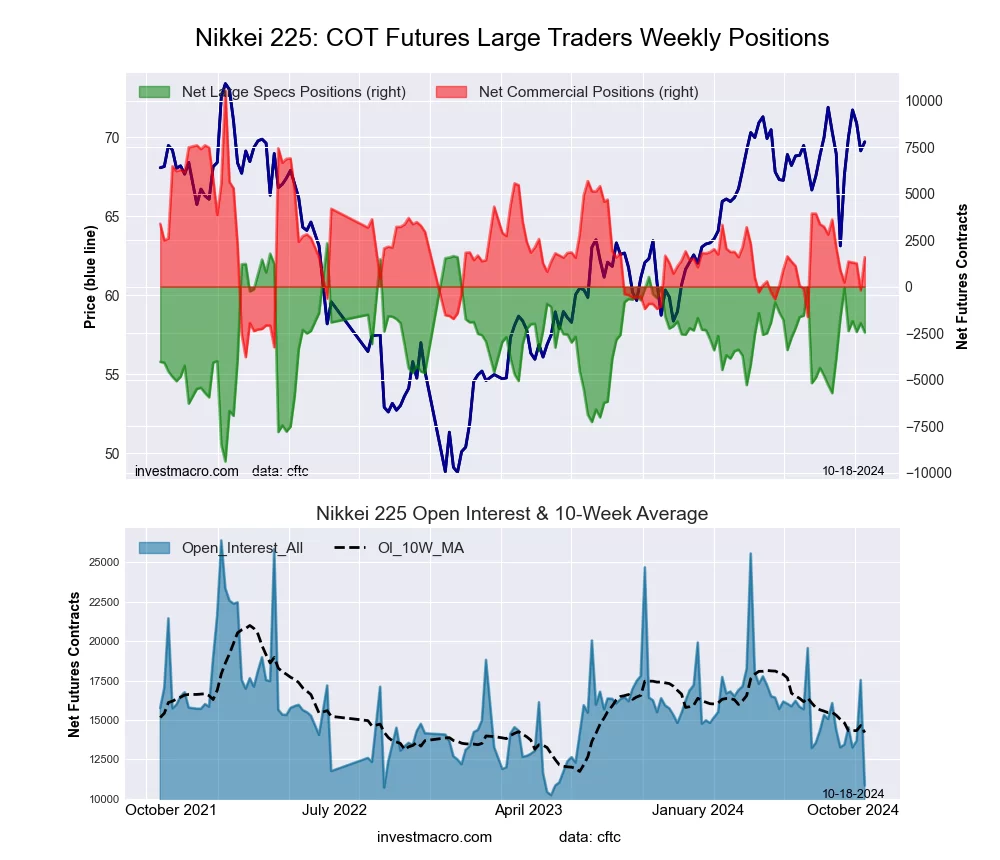
Nikkei Stock Average (USD) Futures COT ChartThe Nikkei Stock Average (USD) large speculator standing this week totaled a net position of -2,464 contracts in the data reported through Tuesday. This was a weekly lowering of -498 contracts from the previous week which had a total of -1,966 net contracts.

This week’s current strength score (the trader positioning range over the past three years, measured from 0 to 100) shows the speculators are currently Bullish with a score of 59.2 percent. The commercials are Bearish with a score of 37.5 percent and the small traders (not shown in chart) are Bullish with a score of 60.1 percent.

Price Trend-Following Model: Strong Uptrend

Our weekly trend-following model classifies the current market price position as: Strong Uptrend. The current action for the model is considered to be: Hold – Maintain Long Position.

Nikkei Stock Average Futures StatisticsSPECULATORSCOMMERCIALSSMALL TRADERS
– Percent of Open Interest Longs:2.070.227.7
– Percent of Open Interest Shorts:24.755.719.5
– Net Position:-2,4641,576888
– Gross Longs:2217,6203,008
– Gross Shorts:2,6856,0442,120
– Long to Short Ratio:0.1 to 11.3 to 11.4 to 1
NET POSITION TREND:
– Strength Index Score (3 Year Range Pct):59.237.560.1
– Strength Index Reading (3 Year Range):BullishBearishBullish
NET POSITION MOVEMENT INDEX:
– 6-Week Change in Strength Index:-6.34.81.0


MSCI EAFE Mini Futures:

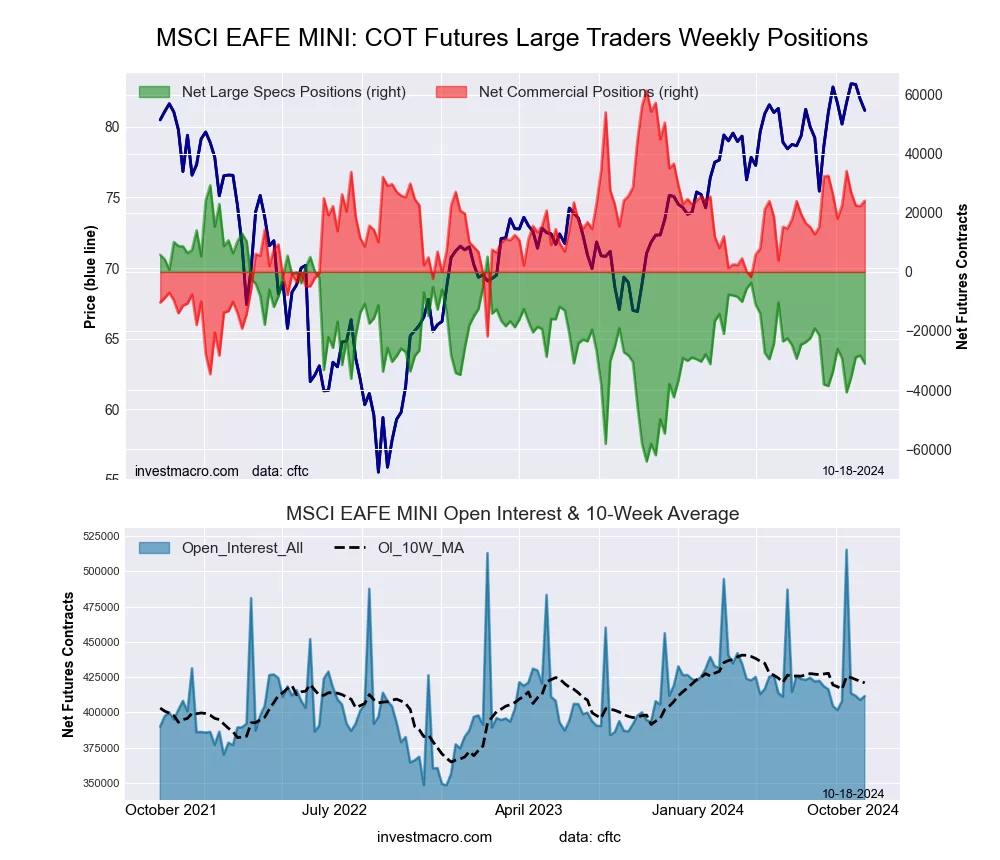
MSCI EAFE Mini Futures COT ChartThe MSCI EAFE Mini large speculator standing this week totaled a net position of -40,750 contracts in the data reported through Tuesday. This was a weekly fall of -11,500 contracts from the previous week which had a total of -29,250 net contracts.

This week’s current strength score (the trader positioning range over the past three years, measured from 0 to 100) shows the speculators are currently Bearish with a score of 25.1 percent. The commercials are Bullish with a score of 71.6 percent and the small traders (not shown in chart) are Bearish with a score of 49.9 percent.

Price Trend-Following Model: Strong Uptrend

Our weekly trend-following model classifies the current market price position as: Strong Uptrend. The current action for the model is considered to be: Hold – Maintain Long Position.

MSCI EAFE Mini Futures StatisticsSPECULATORSCOMMERCIALSSMALL TRADERS
– Percent of Open Interest Longs:5.590.03.8
– Percent of Open Interest Shorts:13.483.42.6
– Net Position:-40,75034,1446,606
– Gross Longs:28,094463,79219,771
– Gross Shorts:68,844429,64813,165
– Long to Short Ratio:0.4 to 11.1 to 11.5 to 1
NET POSITION TREND:
– Strength Index Score (3 Year Range Pct):25.171.649.9
– Strength Index Reading (3 Year Range):BearishBullishBearish
NET POSITION MOVEMENT INDEX:
– 6-Week Change in Strength Index:-20.619.62.1


Article By InvestMacroReceive our weekly COT Newsletter

*COT Report: The COT data, released weekly to the public each Friday, is updated through the most recent Tuesday (data is 3 days old) and shows a quick view of how large speculators or non-commercials (for-profit traders) were positioned in the futures markets.

The CFTC categorizes trader positions according to commercial hedgers (traders who use futures contracts for hedging as part of the business), non-commercials (large traders who speculate to realize trading profits) and nonreportable traders (usually small traders/speculators) as well as their open interest (contracts open in the market at time of reporting). See CFTC criteria here.


COT Soft Commodities Charts: Speculator bets led by Cotton & Soybeans

By InvestMacro

Here are the latest charts and statistics for the Commitment of Traders (COT) reports data published by the Commodities Futures Trading Commission (CFTC).

The latest COT data is updated through Tuesday September 17th and shows a quick view of how large traders (for-profit speculators and commercial entities) were positioned in the futures markets.

Weekly Speculator Changes led by Cotton & Soybeans

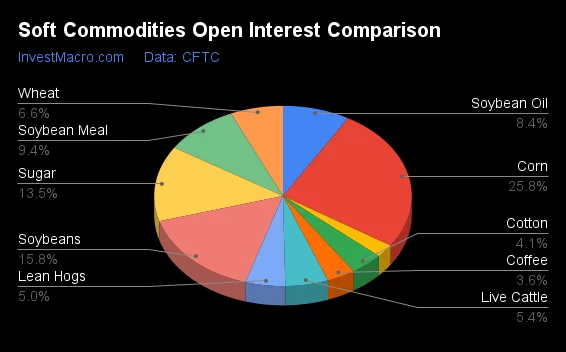
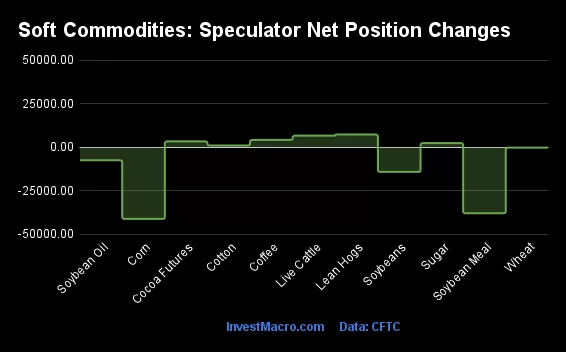
The COT soft commodities markets speculator bets were overall higher this week as eight out of the eleven softs markets we cover had higher positioning while the other three markets had lower speculator contracts.

Leading the gains for the softs markets was Cotton (19,749 contracts) with Soybeans (9,593 contracts), Sugar (8,847 contracts), Coffee (6,681 contracts), Soybean Meal (4,390 contracts), Lean Hogs (4,171 contracts), Wheat (2,114 contracts) and Cocoa (1,528 contracts) also showing positive weeks.

The markets with the declines in speculator bets this week were Corn (-18,535 contracts) with Soybean Oil (-4,028 contracts) and Live Cattle (-2,551 contracts) also registering lower bets on the week.


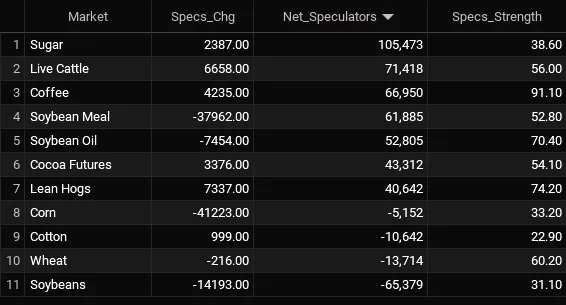
Soft Commodities Net Speculators Leaderboard

Legend: Weekly Speculators Change | Speculators Current Net Position | Speculators Strength Score compared to last 3-Years (0-100 range)


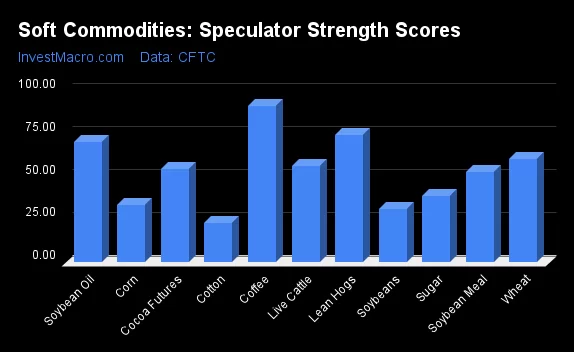
Strength Scores led by Coffee & Wheat

COT Strength Scores (a normalized measure of Speculator positions over a 3-Year range, from 0 to 100 where above 80 is Extreme-Bullish and below 20 is Extreme-Bearish) showed that Coffee (94 percent) and Wheat (60 percent) lead the softs markets this week.

On the downside, Live Cattle (12 percent), Cotton (12 percent) and Soybeans (15 percent) come in at the lowest strength levels currently and are in Extreme-Bearish territory (below 20 percent).

Strength Statistics:
Corn (25.4 percent) vs Corn previous week (27.8 percent)
Sugar (26.9 percent) vs Sugar previous week (23.8 percent)
Coffee (94.2 percent) vs Coffee previous week (87.7 percent)
Soybeans (14.8 percent) vs Soybeans previous week (12.5 percent)
Soybean Oil (36.6 percent) vs Soybean Oil previous week (38.8 percent)
Soybean Meal (45.2 percent) vs Soybean Meal previous week (43.4 percent)
Live Cattle (11.8 percent) vs Live Cattle previous week (14.6 percent)
Lean Hogs (29.9 percent) vs Lean Hogs previous week (26.1 percent)
Cotton (11.8 percent) vs Cotton previous week (0.0 percent)
Cocoa (44.4 percent) vs Cocoa previous week (42.8 percent)
Wheat (59.9 percent) vs Wheat previous week (58.3 percent)


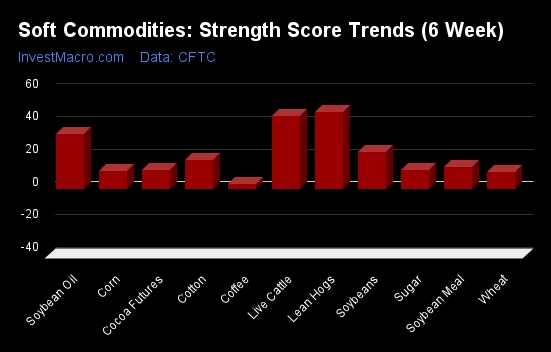
Soybean Oil & Wheat top the 6-Week Strength Trends

COT Strength Score Trends (or move index, calculates the 6-week changes in strength scores) showed that Soybean Oil (22 percent) and Wheat (19 percent) lead the past six weeks trends for soft commodities. Lean Hogs (17 percent), Sugar (16 percent) and Corn (11 percent) are the next highest positive movers in the latest trends data.

Live Cattle (-16 percent) leads the downside trend scores currently.

Strength Trend Statistics:
Corn (10.9 percent) vs Corn previous week (21.0 percent)
Sugar (16.4 percent) vs Sugar previous week (9.5 percent)
Coffee (10.6 percent) vs Coffee previous week (0.4 percent)
Soybeans (5.8 percent) vs Soybeans previous week (5.6 percent)
Soybean Oil (22.0 percent) vs Soybean Oil previous week (17.5 percent)
Soybean Meal (0.1 percent) vs Soybean Meal previous week (0.5 percent)
Live Cattle (-15.9 percent) vs Live Cattle previous week (-29.0 percent)
Lean Hogs (16.6 percent) vs Lean Hogs previous week (13.4 percent)
Cotton (9.3 percent) vs Cotton previous week (-5.2 percent)
Cocoa (2.7 percent) vs Cocoa previous week (-0.7 percent)
Wheat (18.9 percent) vs Wheat previous week (19.4 percent)


Individual Soft Commodities Markets:

CORN Futures:

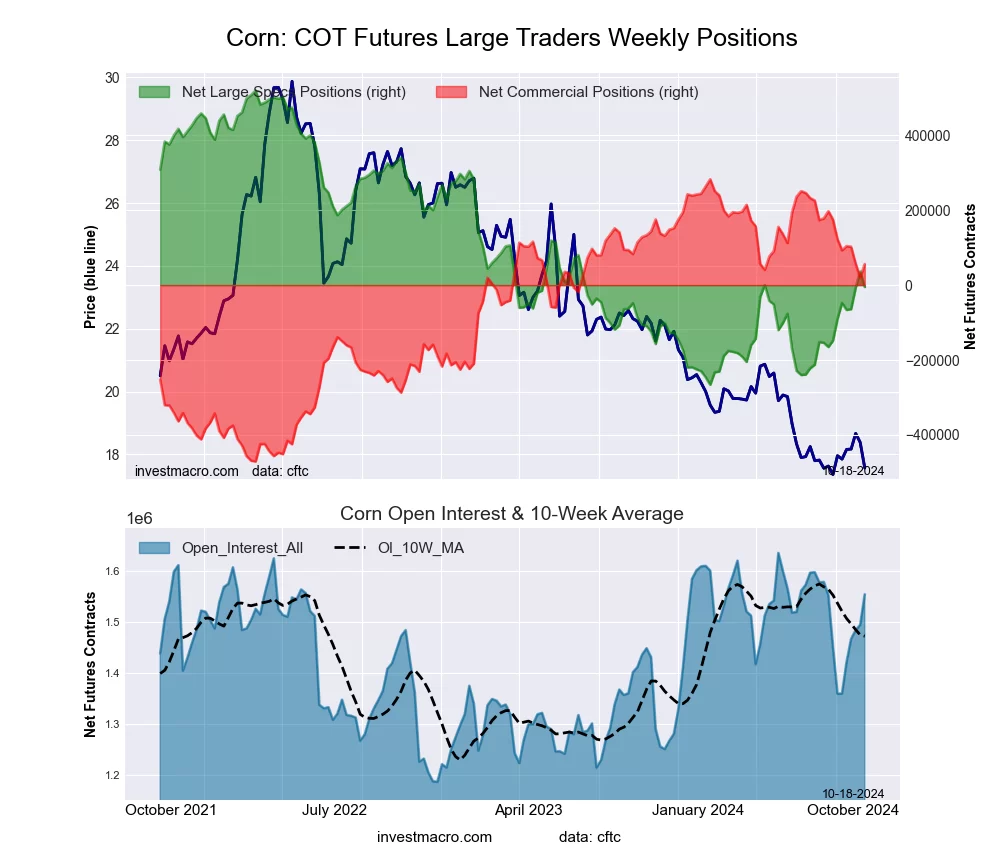
CORN Futures COT ChartThe CORN large speculator standing this week resulted in a net position of -66,295 contracts in the data reported through Tuesday. This was a weekly decrease of -18,535 contracts from the previous week which had a total of -47,760 net contracts.

This week’s current strength score (the trader positioning range over the past three years, measured from 0 to 100) shows the speculators are currently Bearish with a score of 25.4 percent. The commercials are Bullish with a score of 76.3 percent and the small traders (not shown in chart) are Bullish with a score of 57.4 percent.

Price Trend-Following Model: Downtrend

Our weekly trend-following model classifies the current market price position as: Downtrend. The current action for the model is considered to be: Hold – Maintain Short Position.

CORN Futures StatisticsSPECULATORSCOMMERCIALSSMALL TRADERS
– Percent of Open Interest Longs:23.843.89.5
– Percent of Open Interest Shorts:28.436.512.2
– Net Position:-66,295104,089-37,794
– Gross Longs:337,834623,438135,315
– Gross Shorts:404,129519,349173,109
– Long to Short Ratio:0.8 to 11.2 to 10.8 to 1
NET POSITION TREND:
– Strength Index Score (3 Year Range Pct):25.476.357.4
– Strength Index Reading (3 Year Range):BearishBullishBullish
NET POSITION MOVEMENT INDEX:
– 6-Week Change in Strength Index:10.9-9.2-21.6


SUGAR Futures:

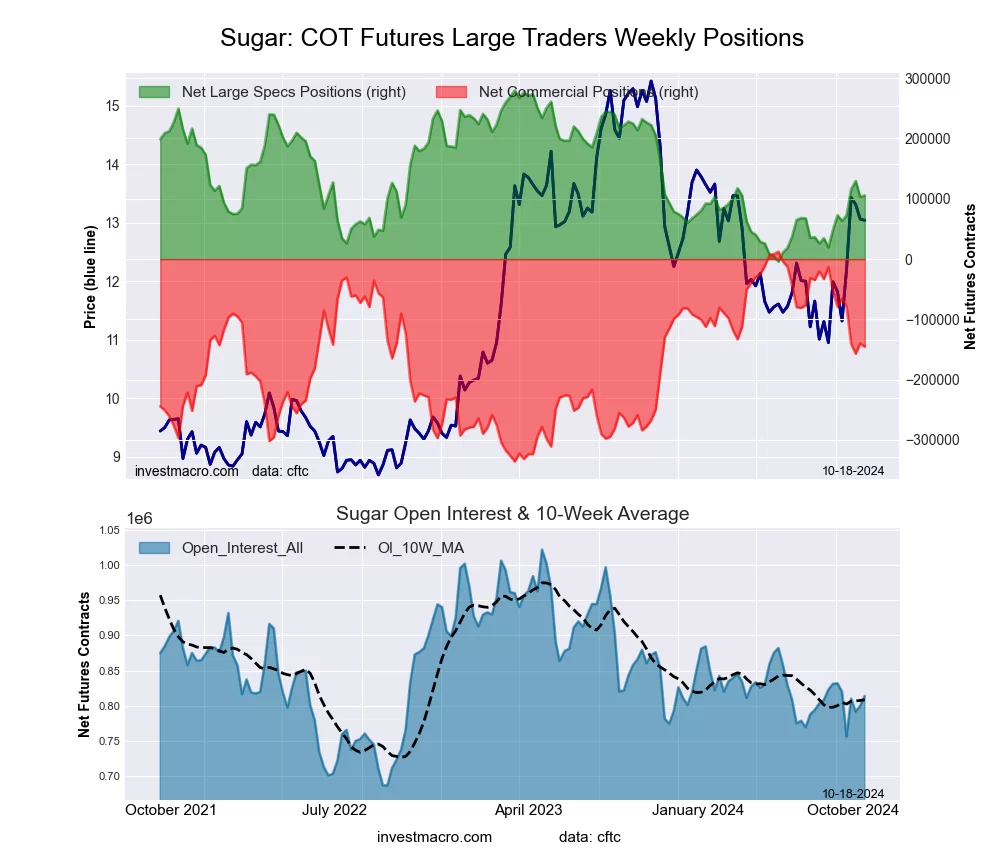
SUGAR Futures COT ChartThe SUGAR large speculator standing this week resulted in a net position of 72,250 contracts in the data reported through Tuesday. This was a weekly rise of 8,847 contracts from the previous week which had a total of 63,403 net contracts.

This week’s current strength score (the trader positioning range over the past three years, measured from 0 to 100) shows the speculators are currently Bearish with a score of 26.9 percent. The commercials are Bullish with a score of 73.7 percent and the small traders (not shown in chart) are Bearish with a score of 28.5 percent.

Price Trend-Following Model: Strong Uptrend

Our weekly trend-following model classifies the current market price position as: Strong Uptrend. The current action for the model is considered to be: New Buy – Long Position.

SUGAR Futures StatisticsSPECULATORSCOMMERCIALSSMALL TRADERS
– Percent of Open Interest Longs:23.154.28.9
– Percent of Open Interest Shorts:13.564.68.0
– Net Position:72,250-79,0586,808
– Gross Longs:174,439409,67067,622
– Gross Shorts:102,189488,72860,814
– Long to Short Ratio:1.7 to 10.8 to 11.1 to 1
NET POSITION TREND:
– Strength Index Score (3 Year Range Pct):26.973.728.5
– Strength Index Reading (3 Year Range):BearishBullishBearish
NET POSITION MOVEMENT INDEX:
– 6-Week Change in Strength Index:16.4-16.916.1


COFFEE Futures:

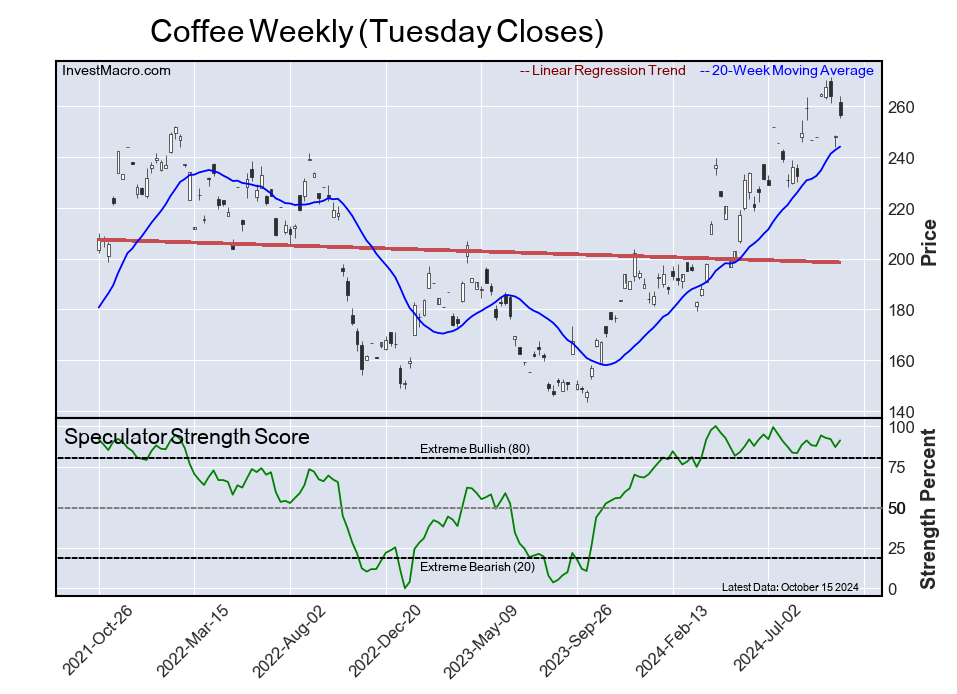
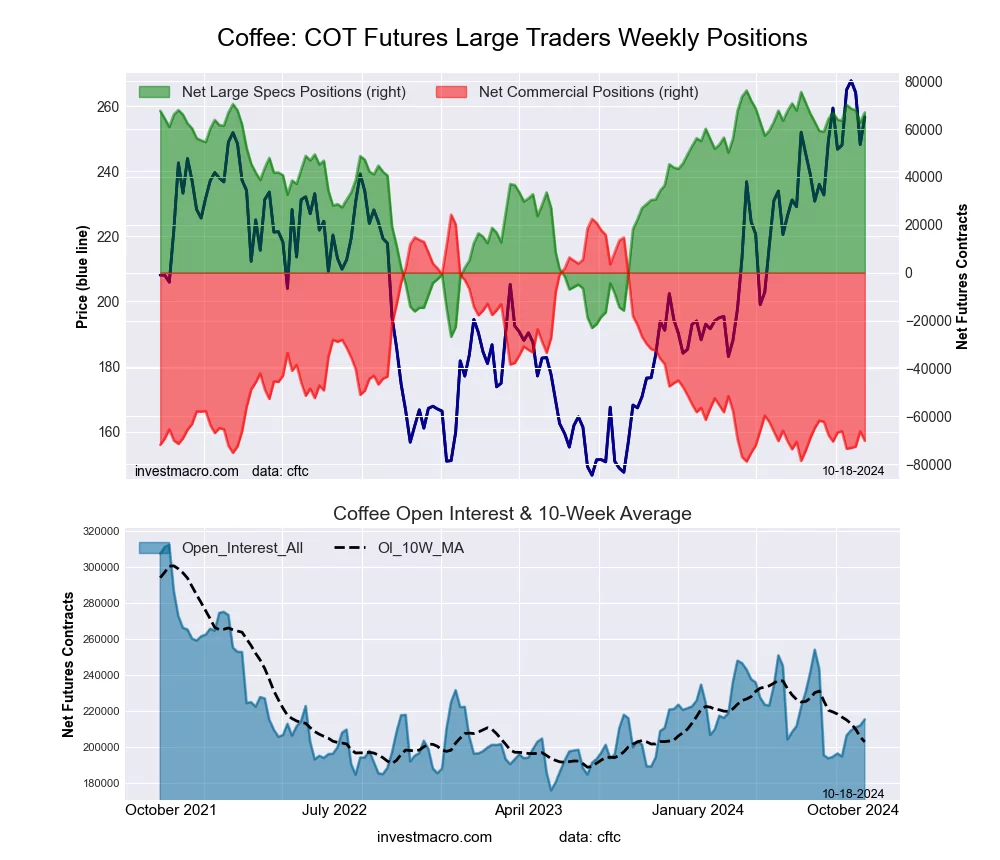
COFFEE Futures COT ChartThe COFFEE large speculator standing this week resulted in a net position of 70,128 contracts in the data reported through Tuesday. This was a weekly rise of 6,681 contracts from the previous week which had a total of 63,447 net contracts.

This week’s current strength score (the trader positioning range over the past three years, measured from 0 to 100) shows the speculators are currently Bullish-Extreme with a score of 94.2 percent. The commercials are Bearish-Extreme with a score of 5.2 percent and the small traders (not shown in chart) are Bullish with a score of 69.0 percent.

Price Trend-Following Model: Strong Uptrend

Our weekly trend-following model classifies the current market price position as: Strong Uptrend. The current action for the model is considered to be: Hold – Maintain Long Position.

COFFEE Futures StatisticsSPECULATORSCOMMERCIALSSMALL TRADERS
– Percent of Open Interest Longs:40.536.94.1
– Percent of Open Interest Shorts:6.572.62.5
– Net Position:70,128-73,5223,394
– Gross Longs:83,44876,1248,553
– Gross Shorts:13,320149,6465,159
– Long to Short Ratio:6.3 to 10.5 to 11.7 to 1
NET POSITION TREND:
– Strength Index Score (3 Year Range Pct):94.25.269.0
– Strength Index Reading (3 Year Range):Bullish-ExtremeBearish-ExtremeBullish
NET POSITION MOVEMENT INDEX:
– 6-Week Change in Strength Index:10.6-11.412.9


SOYBEANS Futures:

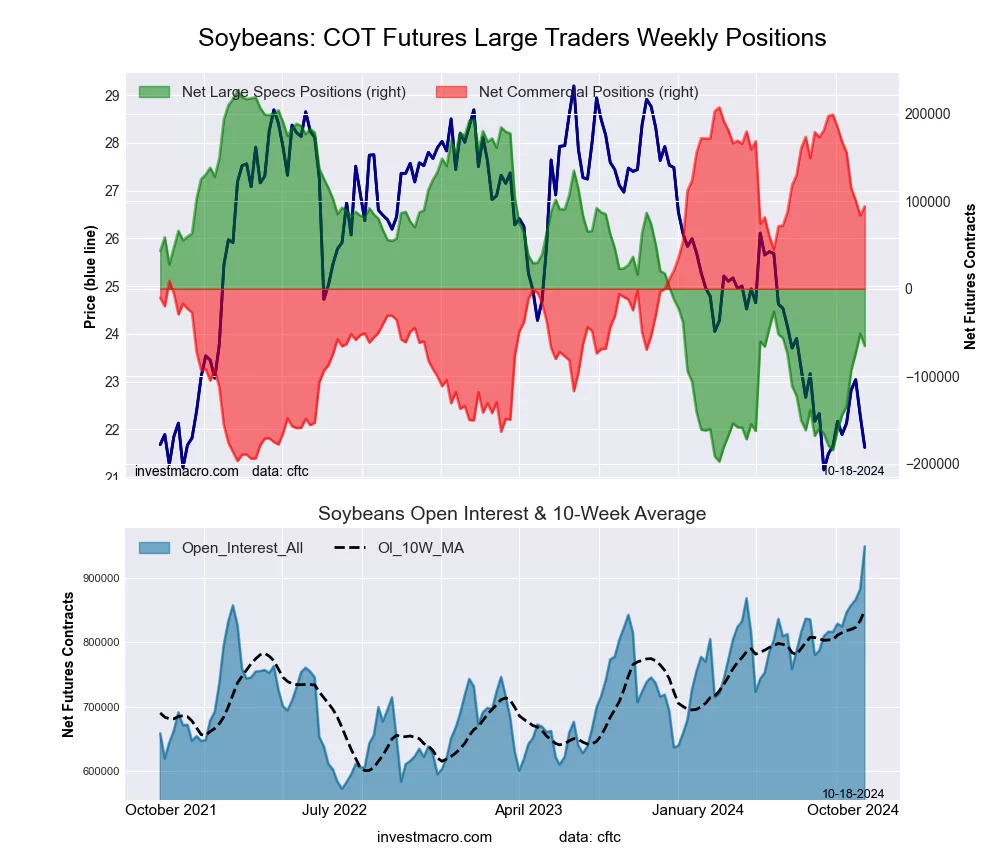
SOYBEANS Futures COT ChartThe SOYBEANS large speculator standing this week resulted in a net position of -134,638 contracts in the data reported through Tuesday. This was a weekly gain of 9,593 contracts from the previous week which had a total of -144,231 net contracts.

This week’s current strength score (the trader positioning range over the past three years, measured from 0 to 100) shows the speculators are currently Bearish-Extreme with a score of 14.8 percent. The commercials are Bullish-Extreme with a score of 87.2 percent and the small traders (not shown in chart) are Bullish with a score of 57.7 percent.

Price Trend-Following Model: Downtrend

Our weekly trend-following model classifies the current market price position as: Downtrend. The current action for the model is considered to be: Hold – Maintain Short Position.

SOYBEANS Futures StatisticsSPECULATORSCOMMERCIALSSMALL TRADERS
– Percent of Open Interest Longs:13.262.25.0
– Percent of Open Interest Shorts:29.143.87.5
– Net Position:-134,638155,638-21,000
– Gross Longs:111,373526,04742,565
– Gross Shorts:246,011370,40963,565
– Long to Short Ratio:0.5 to 11.4 to 10.7 to 1
NET POSITION TREND:
– Strength Index Score (3 Year Range Pct):14.887.257.7
– Strength Index Reading (3 Year Range):Bearish-ExtremeBullish-ExtremeBullish
NET POSITION MOVEMENT INDEX:
– 6-Week Change in Strength Index:5.8-4.3-18.0


SOYBEAN OIL Futures:

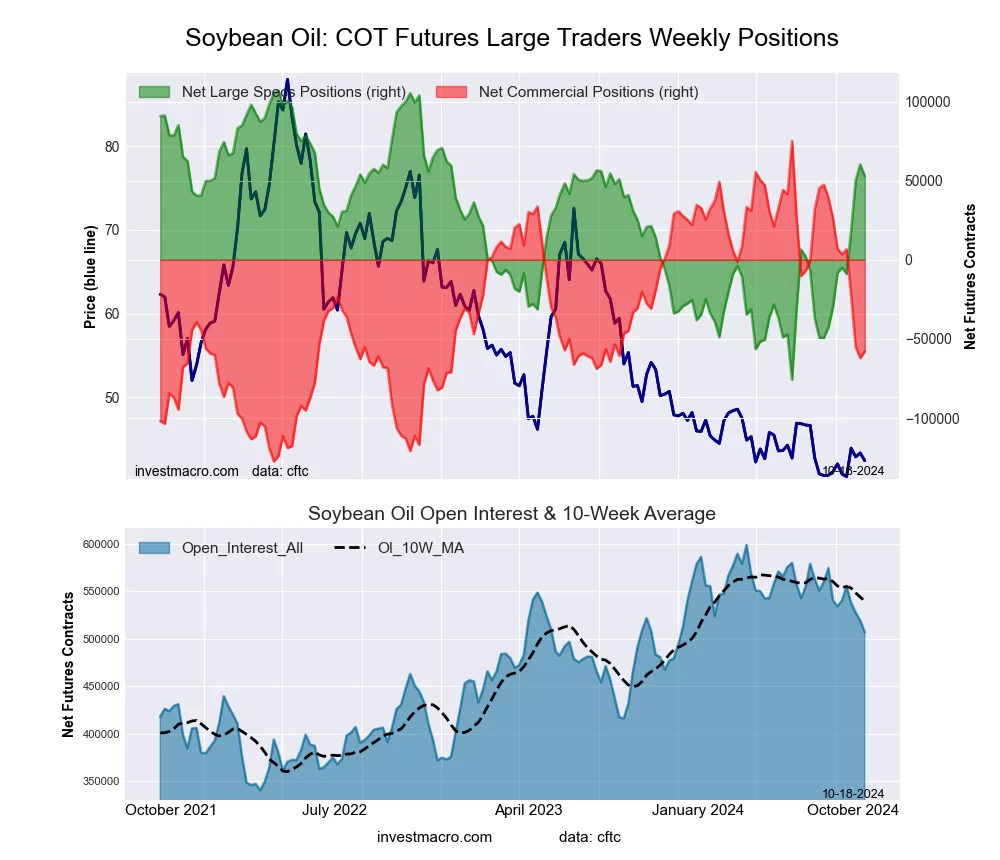
SOYBEAN OIL Futures COT ChartThe SOYBEAN OIL large speculator standing this week resulted in a net position of -8,897 contracts in the data reported through Tuesday. This was a weekly fall of -4,028 contracts from the previous week which had a total of -4,869 net contracts.

This week’s current strength score (the trader positioning range over the past three years, measured from 0 to 100) shows the speculators are currently Bearish with a score of 36.6 percent. The commercials are Bullish with a score of 66.2 percent and the small traders (not shown in chart) are Bearish with a score of 22.7 percent.

Price Trend-Following Model: Strong Downtrend

Our weekly trend-following model classifies the current market price position as: Strong Downtrend. The current action for the model is considered to be: Hold – Maintain Short Position.

SOYBEAN OIL Futures StatisticsSPECULATORSCOMMERCIALSSMALL TRADERS
– Percent of Open Interest Longs:25.650.05.3
– Percent of Open Interest Shorts:27.248.84.9
– Net Position:-8,8976,6682,229
– Gross Longs:141,892277,77629,225
– Gross Shorts:150,789271,10826,996
– Long to Short Ratio:0.9 to 11.0 to 11.1 to 1
NET POSITION TREND:
– Strength Index Score (3 Year Range Pct):36.666.222.7
– Strength Index Reading (3 Year Range):BearishBullishBearish
NET POSITION MOVEMENT INDEX:
– 6-Week Change in Strength Index:22.0-19.1-6.4


SOYBEAN MEAL Futures:

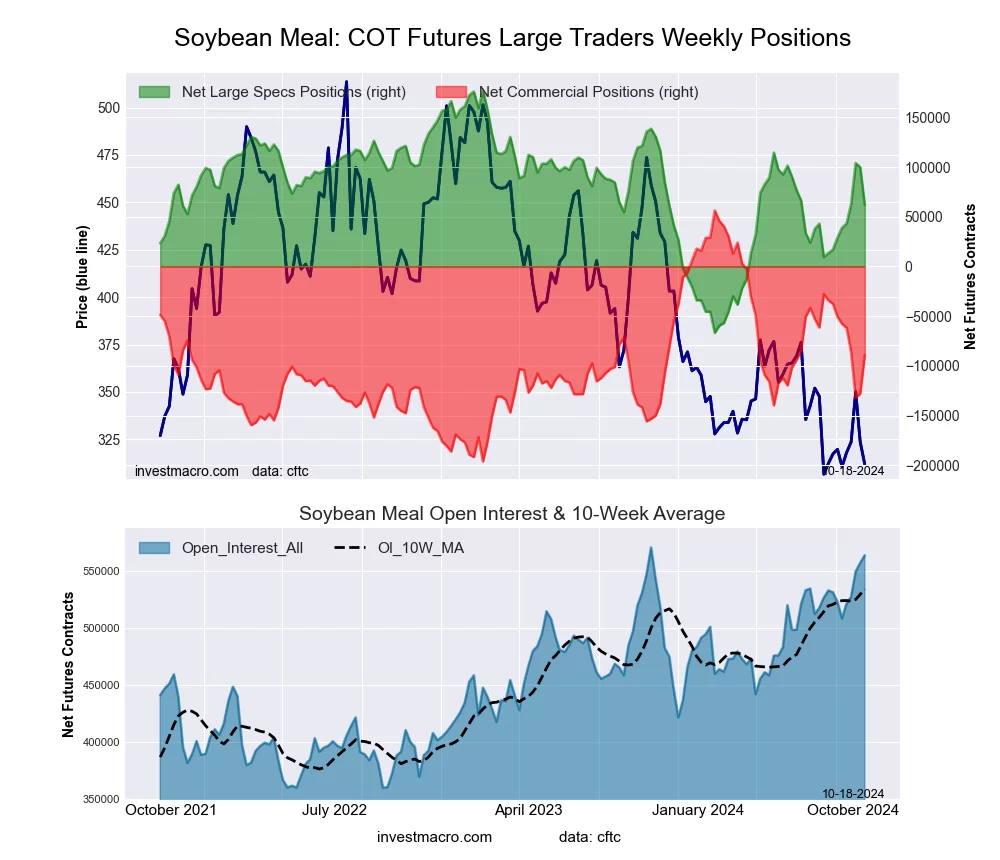
SOYBEAN MEAL Futures COT ChartThe SOYBEAN MEAL large speculator standing this week resulted in a net position of 43,288 contracts in the data reported through Tuesday. This was a weekly gain of 4,390 contracts from the previous week which had a total of 38,898 net contracts.

This week’s current strength score (the trader positioning range over the past three years, measured from 0 to 100) shows the speculators are currently Bearish with a score of 45.2 percent. The commercials are Bullish with a score of 53.3 percent and the small traders (not shown in chart) are Bearish with a score of 38.4 percent.

Price Trend-Following Model: Downtrend

Our weekly trend-following model classifies the current market price position as: Downtrend. The current action for the model is considered to be: Hold – Maintain Short Position.

SOYBEAN MEAL Futures StatisticsSPECULATORSCOMMERCIALSSMALL TRADERS
– Percent of Open Interest Longs:23.847.38.9
– Percent of Open Interest Shorts:15.559.15.4
– Net Position:43,288-61,67918,391
– Gross Longs:123,866246,50046,358
– Gross Shorts:80,578308,17927,967
– Long to Short Ratio:1.5 to 10.8 to 11.7 to 1
NET POSITION TREND:
– Strength Index Score (3 Year Range Pct):45.253.338.4
– Strength Index Reading (3 Year Range):BearishBullishBearish
NET POSITION MOVEMENT INDEX:
– 6-Week Change in Strength Index:0.1-0.10.6


LIVE CATTLE Futures:

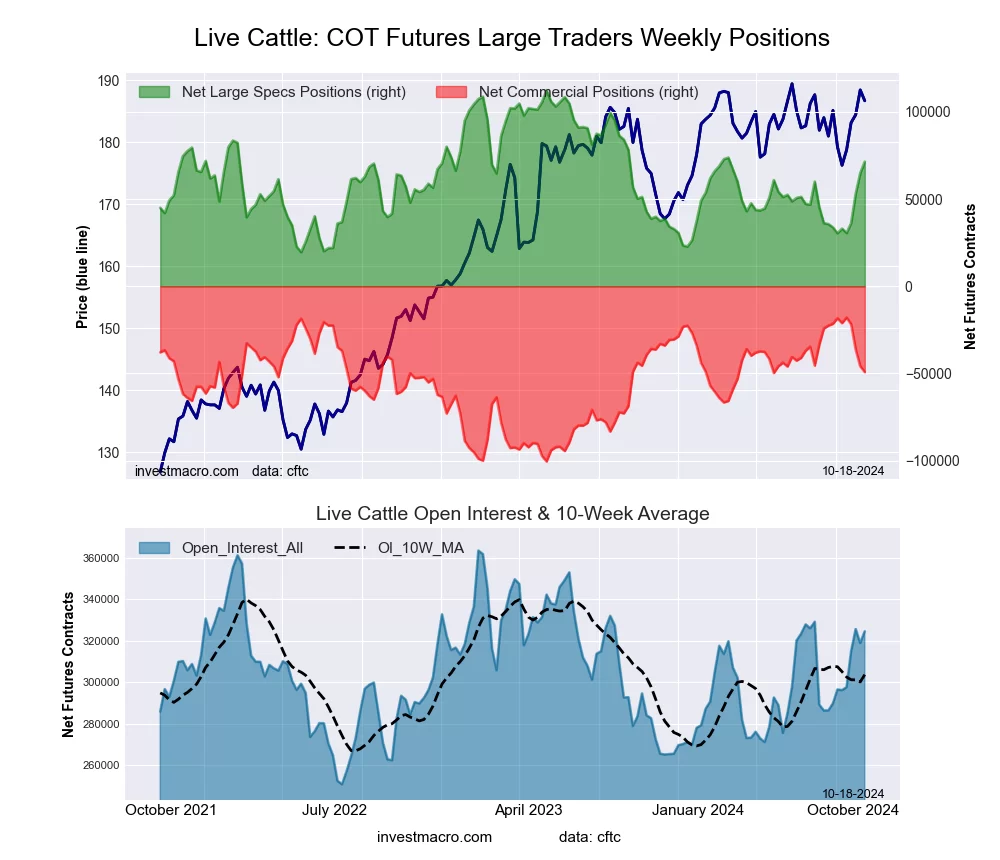
LIVE CATTLE Futures COT ChartThe LIVE CATTLE large speculator standing this week resulted in a net position of 30,498 contracts in the data reported through Tuesday. This was a weekly decline of -2,551 contracts from the previous week which had a total of 33,049 net contracts.

This week’s current strength score (the trader positioning range over the past three years, measured from 0 to 100) shows the speculators are currently Bearish-Extreme with a score of 11.8 percent. The commercials are Bullish-Extreme with a score of 100.0 percent and the small traders (not shown in chart) are Bearish with a score of 23.0 percent.

Price Trend-Following Model: Strong Downtrend

Our weekly trend-following model classifies the current market price position as: Strong Downtrend. The current action for the model is considered to be: New Sell – Short Position.

LIVE CATTLE Futures StatisticsSPECULATORSCOMMERCIALSSMALL TRADERS
– Percent of Open Interest Longs:32.536.29.2
– Percent of Open Interest Shorts:22.242.313.4
– Net Position:30,498-17,976-12,522
– Gross Longs:96,606107,83127,425
– Gross Shorts:66,108125,80739,947
– Long to Short Ratio:1.5 to 10.9 to 10.7 to 1
NET POSITION TREND:
– Strength Index Score (3 Year Range Pct):11.8100.023.0
– Strength Index Reading (3 Year Range):Bearish-ExtremeBullish-ExtremeBearish
NET POSITION MOVEMENT INDEX:
– 6-Week Change in Strength Index:-15.918.9-4.2


LEAN HOGS Futures:

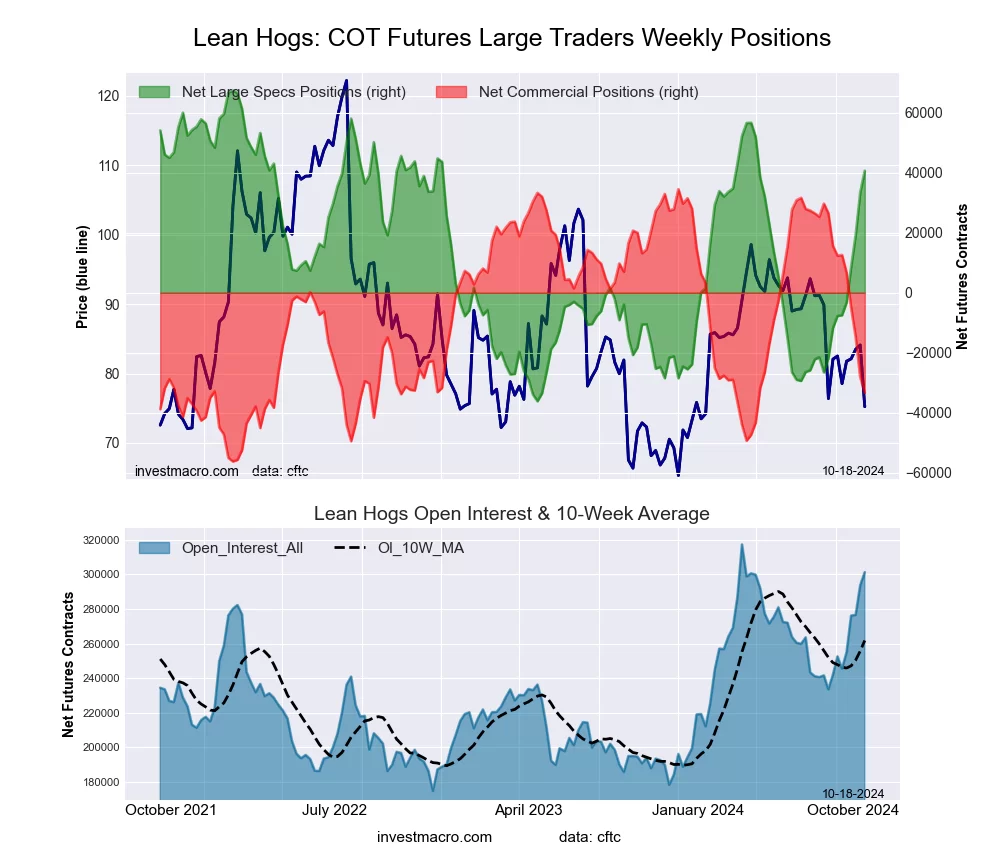
LEAN HOGS Futures COT ChartThe LEAN HOGS large speculator standing this week resulted in a net position of -3,310 contracts in the data reported through Tuesday. This was a weekly gain of 4,171 contracts from the previous week which had a total of -7,481 net contracts.

This week’s current strength score (the trader positioning range over the past three years, measured from 0 to 100) shows the speculators are currently Bearish with a score of 29.9 percent. The commercials are Bullish with a score of 69.7 percent and the small traders (not shown in chart) are Bullish with a score of 67.9 percent.

Price Trend-Following Model: Downtrend

Our weekly trend-following model classifies the current market price position as: Downtrend. The current action for the model is considered to be: Hold – Maintain Short Position.

LEAN HOGS Futures StatisticsSPECULATORSCOMMERCIALSSMALL TRADERS
– Percent of Open Interest Longs:36.638.58.0
– Percent of Open Interest Shorts:37.935.89.4
– Net Position:-3,3106,745-3,435
– Gross Longs:93,35898,06520,404
– Gross Shorts:96,66891,32023,839
– Long to Short Ratio:1.0 to 11.1 to 10.9 to 1
NET POSITION TREND:
– Strength Index Score (3 Year Range Pct):29.969.767.9
– Strength Index Reading (3 Year Range):BearishBullishBullish
NET POSITION MOVEMENT INDEX:
– 6-Week Change in Strength Index:16.6-20.21.6


COTTON Futures:

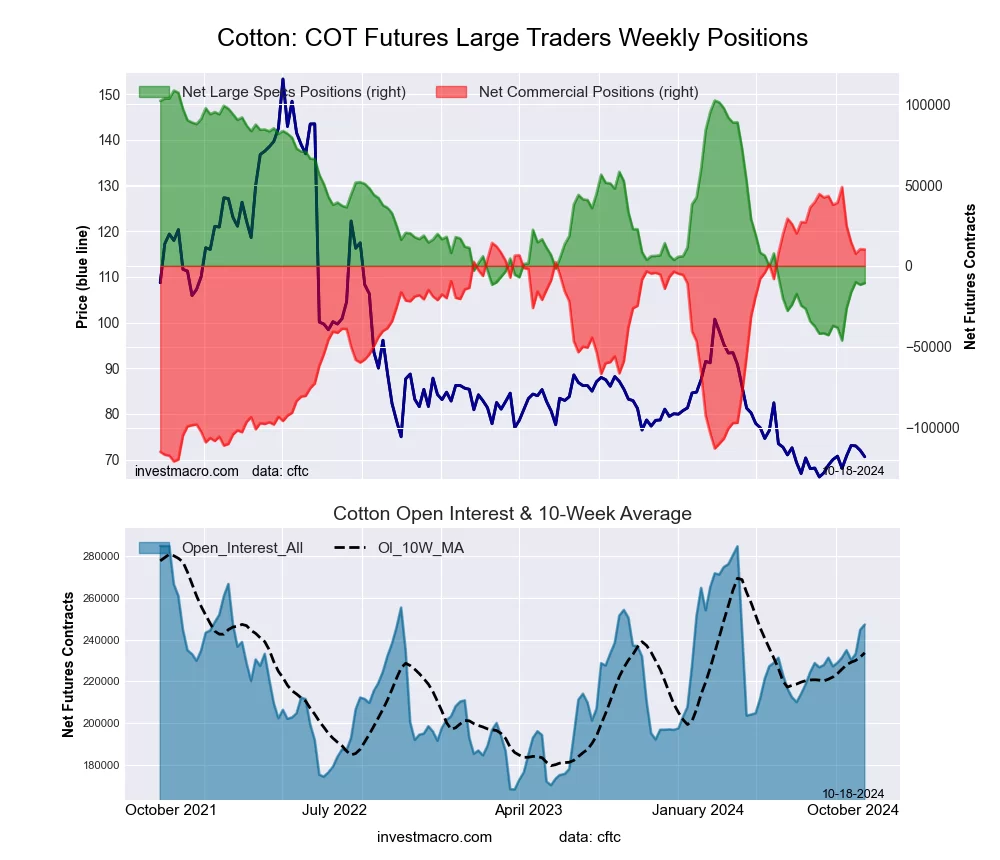
COTTON Futures COT ChartThe COTTON large speculator standing this week resulted in a net position of -26,362 contracts in the data reported through Tuesday. This was a weekly increase of 19,749 contracts from the previous week which had a total of -46,111 net contracts.

This week’s current strength score (the trader positioning range over the past three years, measured from 0 to 100) shows the speculators are currently Bearish-Extreme with a score of 11.8 percent. The commercials are Bullish-Extreme with a score of 86.8 percent and the small traders (not shown in chart) are Bearish with a score of 25.5 percent.

Price Trend-Following Model: Weak Downtrend

Our weekly trend-following model classifies the current market price position as: Weak Downtrend. The current action for the model is considered to be: Hold – Maintain Short Position.

COTTON Futures StatisticsSPECULATORSCOMMERCIALSSMALL TRADERS
– Percent of Open Interest Longs:25.247.85.9
– Percent of Open Interest Shorts:36.437.25.3
– Net Position:-26,36224,8541,508
– Gross Longs:59,144112,31213,978
– Gross Shorts:85,50687,45812,470
– Long to Short Ratio:0.7 to 11.3 to 11.1 to 1
NET POSITION TREND:
– Strength Index Score (3 Year Range Pct):11.886.825.5
– Strength Index Reading (3 Year Range):Bearish-ExtremeBullish-ExtremeBearish
NET POSITION MOVEMENT INDEX:
– 6-Week Change in Strength Index:9.3-10.824.5


COCOA Futures:

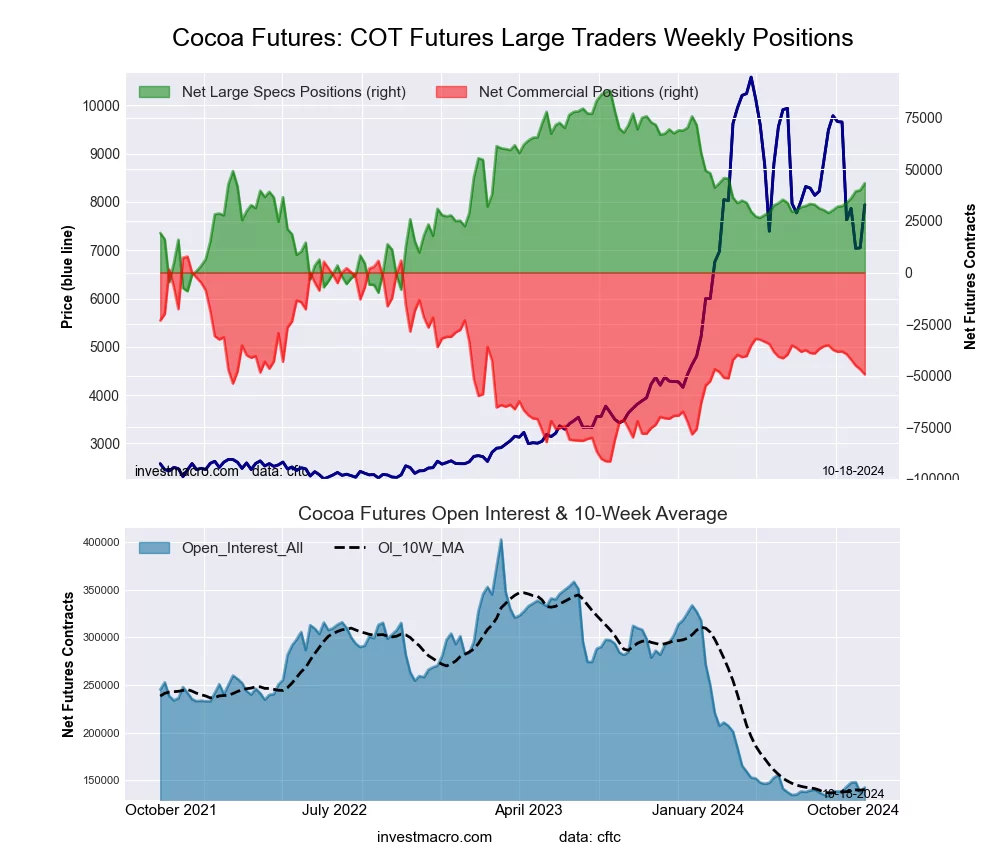
COCOA Futures COT ChartThe COCOA large speculator standing this week resulted in a net position of 33,753 contracts in the data reported through Tuesday. This was a weekly advance of 1,528 contracts from the previous week which had a total of 32,225 net contracts.

This week’s current strength score (the trader positioning range over the past three years, measured from 0 to 100) shows the speculators are currently Bearish with a score of 44.4 percent. The commercials are Bullish with a score of 52.3 percent and the small traders (not shown in chart) are Bullish with a score of 61.8 percent.

Price Trend-Following Model: Weak Uptrend

Our weekly trend-following model classifies the current market price position as: Weak Uptrend. The current action for the model is considered to be: Hold – Maintain Long Position.

COCOA Futures StatisticsSPECULATORSCOMMERCIALSSMALL TRADERS
– Percent of Open Interest Longs:36.135.07.1
– Percent of Open Interest Shorts:12.662.63.0
– Net Position:33,753-39,5805,827
– Gross Longs:51,81550,20210,154
– Gross Shorts:18,06289,7824,327
– Long to Short Ratio:2.9 to 10.6 to 12.3 to 1
NET POSITION TREND:
– Strength Index Score (3 Year Range Pct):44.452.361.8
– Strength Index Reading (3 Year Range):BearishBullishBullish
NET POSITION MOVEMENT INDEX:
– 6-Week Change in Strength Index:2.7-2.5-1.3


WHEAT Futures:

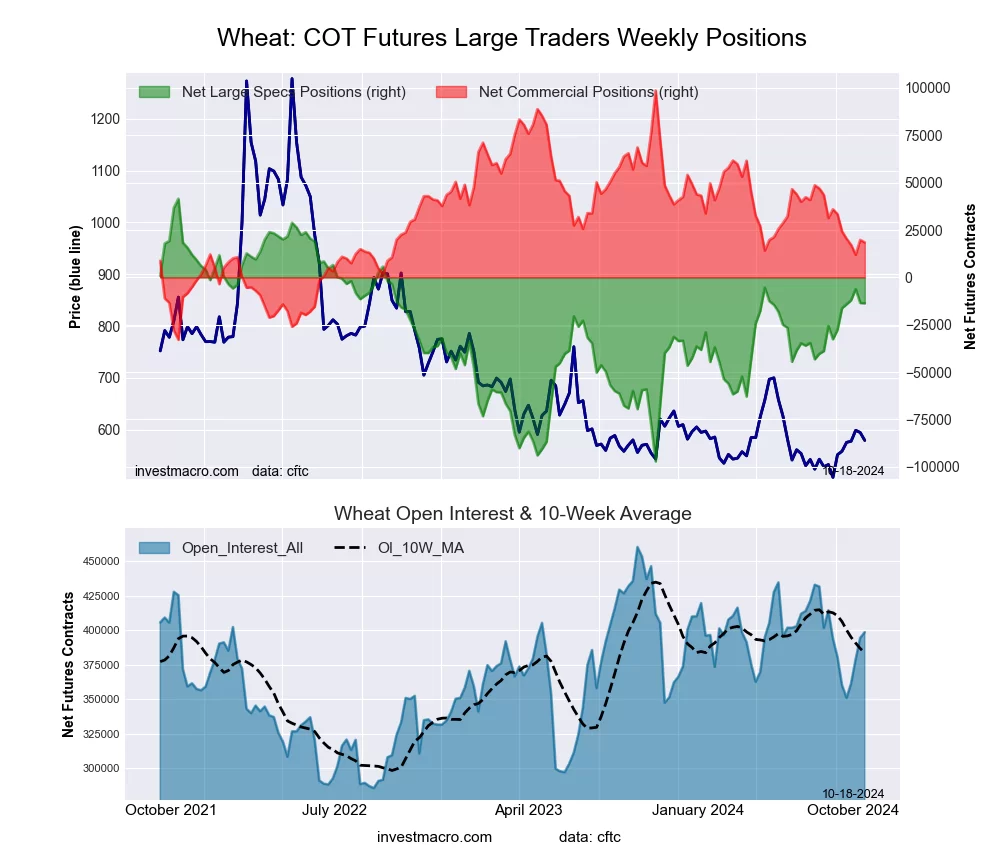
WHEAT Futures COT ChartThe WHEAT large speculator standing this week resulted in a net position of -14,189 contracts in the data reported through Tuesday. This was a weekly lift of 2,114 contracts from the previous week which had a total of -16,303 net contracts.

This week’s current strength score (the trader positioning range over the past three years, measured from 0 to 100) shows the speculators are currently Bullish with a score of 59.9 percent. The commercials are Bearish with a score of 40.5 percent and the small traders (not shown in chart) are Bearish with a score of 25.6 percent.

Price Trend-Following Model: Downtrend

Our weekly trend-following model classifies the current market price position as: Downtrend. The current action for the model is considered to be: Hold – Maintain Short Position.

WHEAT Futures StatisticsSPECULATORSCOMMERCIALSSMALL TRADERS
– Percent of Open Interest Longs:35.435.58.4
– Percent of Open Interest Shorts:39.429.710.1
– Net Position:-14,18920,379-6,190
– Gross Longs:124,164124,60929,368
– Gross Shorts:138,353104,23035,558
– Long to Short Ratio:0.9 to 11.2 to 10.8 to 1
NET POSITION TREND:
– Strength Index Score (3 Year Range Pct):59.940.525.6
– Strength Index Reading (3 Year Range):BullishBearishBearish
NET POSITION MOVEMENT INDEX:
– 6-Week Change in Strength Index:18.9-20.22.0


Article By InvestMacroReceive our weekly COT Newsletter

*COT Report: The COT data, released weekly to the public each Friday, is updated through the most recent Tuesday (data is 3 days old) and shows a quick view of how large speculators or non-commercials (for-profit traders) were positioned in the futures markets.

The CFTC categorizes trader positions according to commercial hedgers (traders who use futures contracts for hedging as part of the business), non-commercials (large traders who speculate to realize trading profits) and nonreportable traders (usually small traders/speculators) as well as their open interest (contracts open in the market at time of reporting). See CFTC criteria here.
The People’s Bank of China kept key rates unchanged. Oil grows amid escalating conflict in the Middle East

By JustMarkets

The US indices rose steadily on Thursday. The S&P 500 (US500) and Dow Jones (US30) indices rose to new record highs, while the NASDAQ (US100) rose to a 2-month high. At the end of the day, the S&P 500 Index (US500) was up 1.7%, the Dow Jones (US30) added 1.26%, and the NASDAQ Technology Index (US100) jumped 2.51%.

The Fed’s 50 bps rate cut and estimates of another 50 bps rate cut this year reinforced speculation that the Fed will provide a “soft landing” and boosted risk sentiment in asset markets. Stocks maintained gains on Thursday despite higher bond yields after weekly US jobless claims fell more than expected to a four-month low, a hawkish factor for Fed policy. US weekly jobless claims fell by 12,000 to a 4-month low of 219,000, indicating a stronger labor market than expectations of 230,000. Markets rate the odds of a 25bp rate cut at the November 6–7 FOMC meeting at 100% and a 50bp rate cut at this meeting at 44%.

Equity markets in Europe were mostly up yesterday. Germany’s DAX (DE40) rose by 1.55%, France’s CAC 40 (FR40) closed 2.29% higher, Spain’s IBEX 35 (ES35) gained 0.80%, and the UK’s FTSE 100 (UK100) closed up 0.91%.

Producer prices in Germany fell 0.8% y/y in August 2024, the same pace as the previous month and better than market projections, which expected a 1.0% drop. This was the 14th consecutive month of producer price deflation and the lowest in the sequence. UK retail sales in August 2024 were up 1% on the previous month, following an upwardly revised rise of 0.7% in July and well above prognoses of 0.4%. On a year-over-year basis, retail sales rose by 2.5%, the highest since February 2022.

The Bank of Norway left its key rate unchanged at a sixteen-year high of 4.5% at its sixth consecutive meeting in September 2024 in line with market expectations and noted that it is likely to keep the interest rate unchanged until the end of the year. The bank noted that the higher interest rate helped cool the Norwegian economy as growth remained subdued and unemployment rose from a lower level.

WTI crude oil prices rose above $71.5 a barrel on Thursday, extending their recovery from a 15-month low of $65 reached on September 10, amid expectations of higher global energy demand and rising risk premiums caused by rising tensions in the Middle East. There were reports that Hezbollah radios exploded in southern Lebanon late Wednesday night after similar pager blasts a day earlier, heightening fears of military action in the region and Iran’s involvement in the conflict. Israel’s defense minister warned that the country has entered a new phase of war against its neighbors.

Asian markets were predominantly rising yesterday. Japan’s Nikkei 225 (JP225) rose by 2.13%, China’s FTSE China A50 (CHA50) gained 0.42%, Hong Kong’s Hang Seng (HK50) added 2.00%, and Australia’s ASX 200 (AU200) gained 0.61%.

The offshore yuan strengthened to 7.05 per dollar, remaining at its highest level since May 2023 and posting gains for the third consecutive session. The surge followed the Chinese Central Bank’s decision to keep key lending rates unchanged during September, which was in line with market expectations. The one-year prime rate (LPR), the benchmark for most corporate and home loans, remained unchanged at 3.35%, while the five-year rate, the benchmark for real estate mortgages, remained unchanged at 3.85%. Both rates remain at record lows after unexpectedly falling in July.

The Bank of Japan (BoJ) unanimously kept its key short-term interest rate at around 0.25% during its September meeting, leaving it at its highest level since 2008, in line with market consensus. Friday’s decision underscored that the Central Bank is in no rush to raise rates further after raising them twice this year, in March and July. The board also said more time was needed to monitor financial markets amid hawkish views from some members.

S&P 500 (US500) 5,713.64 +95.38 (+1.70%)

Dow Jones (US30) 42,025.19 +522.09 (+1.26%)

DAX (DE40) 19,002.38 +290.89 (+1.55%)

FTSE 100 (UK100) 8,328.72 +75.04 (+0.91%)

USD Index 100.64 +0.04 (+0.04%)

News feed for: 2024.09.20

  • Japan National Core Consumer Price Index (m/m) at 02:30 (GMT+3);
  • China PBoC Loan Prime Rate (m/m) at 04:15 (GMT+3);
  • Japan BoJ Outlook Report at 07:00 (GMT+3);
  • Japan BoJ Interest Rate Decision at 07:00 (GMT+3);
  • UK Retail Sales (m/m) at 09:00 (GMT+3);
  • Canada Retail Sales (m/m) at 15:30 (GMT+3);
  • Eurozone ECB President Lagarde Speaks (m/m) at 18:00 (GMT+3).

By JustMarkets


This article reflects a personal opinion and should not be interpreted as an investment advice, and/or offer, and/or a persistent request for carrying out financial transactions, and/or a guarantee, and/or a forecast of future events.

Week Ahead: Can RUS2000 reach highest since 2021?

By ForexTime 

  • RUS2000: FXTM’s best-performing US stock index so far this week/month
  • RUS2000 forecasted to have the most potential upside over the next 12 months
  • Fed speakers, US data next week could help RUS2000 move closer to 2021 all-time high
  • Markets predict 89% chance Fed will cut rates by further 75-basis points by end-2024
  • Return of US recession fears could send RUS2000 plummeting


The RUS2000 index has been outshining its US peers of late.

This US stock index tracks the smallest 2000 publicly listed companies operating in the world’s largest economy i.e. companies that are more reflective of true US economic conditions.

Of late, the RUS2000 has been rejoicing the most, relative to FXTM’s other US stock indexes, over the Fed’s jumbo-sized 50 basis point rate cut!

That rate cut on September 18th, 2024 was the first US rate cut in 4 years.

With the Fed coming to the US economy’s aid with its rate cuts, the RUS2000 has outperformed other US stock indexes, both on a week-to-date (wtd) and month-to-date (mtd) basis:

  • RUS2000: up 3.2% wtd / 1.6% mtd
  • US400: up 3% wtd / 1.1% mtd
  • NAS100: up 1.7% wtd / 1.35% mtd
  • US500: up 1.56% wtd / 1.16% mtd
  • US30: up 1.53% wtd / 1.1% mtd


But RUS2000 still missing out on record-high club, for now

To be clear, the RUS200 has yet to join the record-high party which already features the likes of US500, US30, US400, and even gold of late.

At the time of writing, the RUS2000 remains about 8.5% below its all-time high, using intraday prices, of 2458.85 registered on November 8th, 2021.

Wall Street experts predict it will eventually set a new record high, but perhaps only by this time next year.


Wall Street most bullish on RUS2000 12-month outlook

Here are the forecasted potential gains for these US stock indexes over the next 12 months:

  • RUS2000: 19.4%
  • NAS100: 11.7%
  • US400: 9.9%
  • US500: 9.1%
  • US30: 5.4%

However, such gains are predicated on the notion that the Fed can indeed fend off a US recession.

And much of that will depend on the incoming US economic data, and whether the Fed can overcome their differing views and lower interest rates fast enough to avoid such a scenario.

Otherwise, a US recession is bound to send the RUS2000 plummeting, given the economically-sensitive nature of the stocks within this index.


What to look out for in the coming week?

The incoming scheduled speeches by Fed officials, fresh out of their September FOMC meeting, could provide further cause for RUS2000 bulls (those hoping prices will go higher) to rejoice even more:


Monday, September 23

  • NZD: New Zealand August trade balance
  • SG20 index: Singapore August CPI
  • TWN index: Taiwan August unemployment
  • EU50 index: Eurozone September PMIs
  • GBP: UK September PMIs
  • USD index: US September PMIs
  • RUS2000 index: Speeches by Chicago Fed President Austan Goolsbee, Atlanta Fed President Raphael Bostic, Minneapolis Fed President Neel Kashkari


Tuesday, September 24

  • JP225 index: Japan September PMIs
  • AUD: RBA rate decision
  • TWN index: Taiwan August export orders
  • GER40 index: Germany September business climate
  • Brent/Crude: OPEC releases annual World Oil Outlook
  • US400 index: US September consumer confidence


Wednesday, September 25

  • CNH: China medium-term lending facility rate
  • AU200 index: Australia August CPI
  • SEK: Riksbank policy rate decision
  • TWN index: Taiwan August industrial production


Thursday, September 26

  • JPY: BoJ meeting minutes
  • SG20 index: Singapore August industrial production
  • CHF: SNB policy rate decision
  • US500 index: US weekly initial jobless claims; US 2Q GDP (final)
  • USD index: Speeches by Fed Chair Jerome Powell (pre-recorded), New York Fed President John Williams, Treasury Secretary Janet Yellen


Friday, September 27

  • JPY: Tokyo September CPI; LDP internal elections
  • CN50 index: China August industrial profits
  • EUR: Eurozone September economic confidence; Germany September unemployment
  • US400 index: US August PCE, personal income and spending
  • RUS2000 index: Speeches by Boston Fed President Susan Collins, Fed Governor Adriana Kugler


Sure, the coming week also features key US economic data such as the US purchasing managers index (PMIs), consumer confidence, weekly jobless claims, final estimate of 2Q GDP, personal income and spending, as well as the Fed’s preferred inflation gauge – the personal consumption expenditures (PCE).

All of these quantitative data certainly hold the potential to move US stock markets, including the RUS2000 index.

However, markets may instead be more attentive to the forward-looking statements out of Fed officials in the days ahead.


Why are the Fed speakers so important?

These scheduled speeches come just days after the Fed’s jumbo rate cut on September 18th.

Note that this latest US rates decision also featured its first dissenting vote from any FOMC member since 2022.

Fed Governor Michelle Bowman voted in favour of a run-of-the-mill 25 basis point cut at the just-concluded September meeting.

A closer look at the FOMC’s famous “dot plot” also suggests that policymakers at the world’s most powerful central bank are at odds regarding the size and timing of future rate cuts:

Fed dot plot

  • 10 of 19 officials prefer another 50-bps in rate cuts by end-2024
  • 7 of the 19 voted for only one sole 25-bps rate cut by year-end
  • 2 of the remaining officials voted for no more rate cuts this year.


FOMC “dot plot” at odds with market forecasts

Not only are there differing views amongst FOMC members themselves, those views are also at odds with the market’s current forecasts.

At the time of writing, markets are forecasting a 89% chance that the Fed will lower its benchmark rates by another 75-basis points by Christmas.

Hence, the incoming Fed speak** will be stacked up against the latest Fed dot plot, and also current market forecasts.

**in bold in our coming week’s list of highlighted events (see above).

Notable shifts to existing market forecasts over incoming Fed rate cuts, either by way of signals from the Fed speak or US economic data, are bound to move prices across various asset classes in the week ahead.

In short, if you think the Fed watch is over, think again.


POTENTIAL SCENARIOS:

  • If the incoming Fed speak and US economic data assures markets that the Fed can proceed with the forecasted 75 basis points in rate cuts by end-2024, that could help RUS2000 punch its way past 2300 and closer to its November 2021 record high.
  • If the incoming Fed speak and US economic data pushes back on market forecasts for 75 basis points in Fed rate cuts by end-2024, that could drag the RUS2000 stock index back to its 21-day and 50-day simple moving averages (SMA) around 2170 for support.

Russell2000 index yet to join recent record-high club


Forex-Time-LogoArticle by ForexTime

ForexTime Ltd (FXTM) is an award winning international online forex broker regulated by CySEC 185/12 www.forextime.com

AUD/USD Reaches New Heights as Risk Sentiment Improves

By RoboForex Analytical Department 

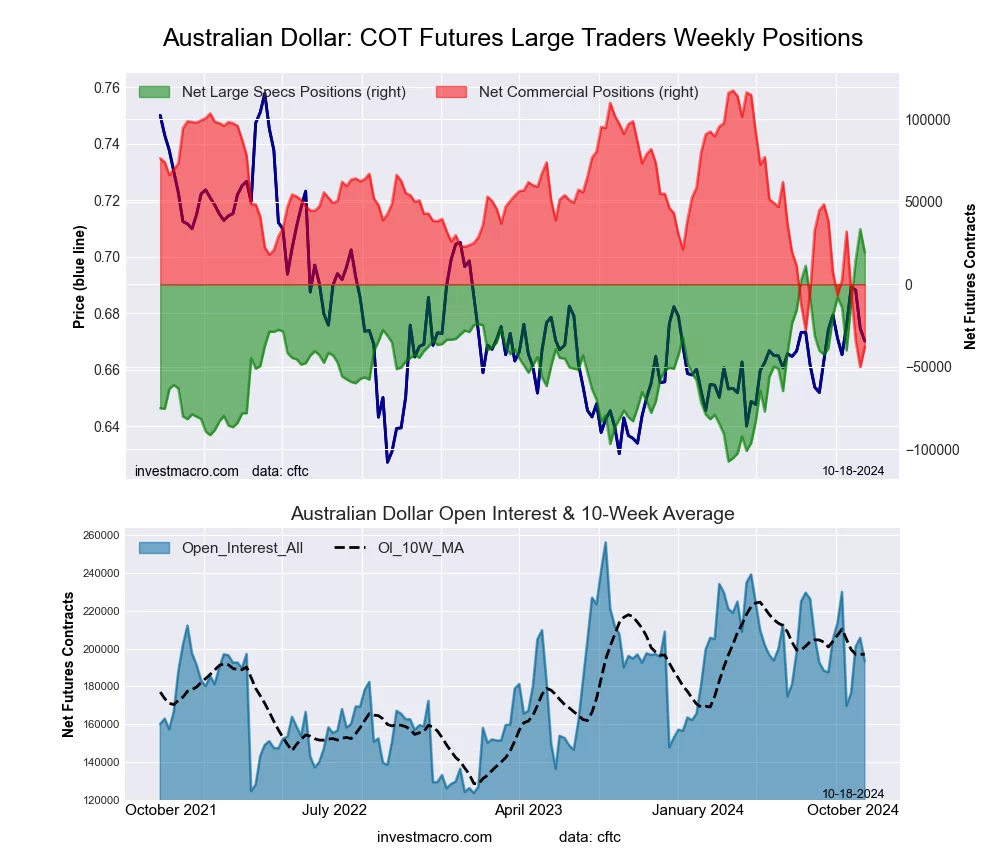
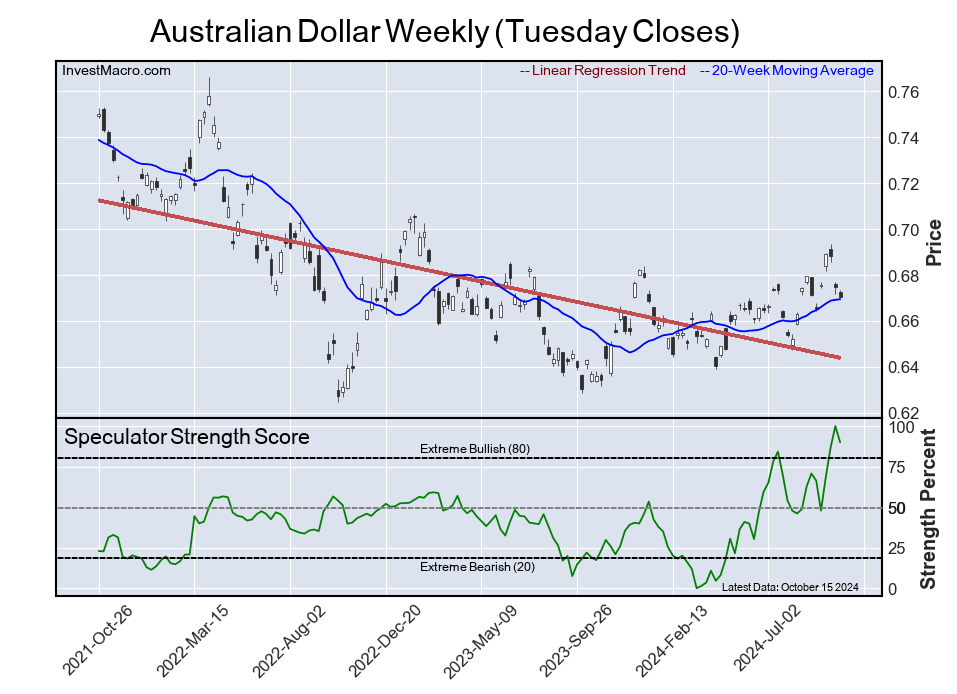
The AUD/USD pair has climbed to a new peak, reaching 0.6815, marking the highest level since 28 December of the previous year. This strength in the Australian dollar is partly due to the aggressive rate cuts by the US Federal Reserve, which has spurred expectations that other central banks might also ease monetary policies, enhancing the economic outlook and fuelling a rally in riskier assets.

This week, Australian employment data significantly outperformed expectations, showing a 47.5k increase in jobs for August, far exceeding the forecasted 25.0k. This robust job growth has kept the unemployment rate steady at 4.2%. Despite this positive economic indicator, the main expectation is that the Reserve Bank of Australia (RBA) will maintain its interest rate at the current level in its upcoming meeting, with analysts predicting no changes to monetary policy until at least December and possibly not until Q2 of next year. The RBA’s cautious approach to inflation underscores its strategy of not taking decisive action until there is apparent necessity.

Given the current favourable risk environment, the AUD could reach even higher levels soon.

AUD/USD technical analysis

The AUD/USD market is advancing in the fifth wave of growth towards 0.6855. This target will likely be reached soon, followed by a corrective movement to 0.6790, testing it from above. This could define the upper boundary of a new consolidation range. Should the pair break below this range, a further decline to 0.6736 might ensue, potentially signalling the start of a new downward trend towards 0.6640, with a continuation to 0.6590. The MACD indicator, currently at its highs and directed upwards, supports this bullish scenario in the short term.

On the H1 chart, AUD/USD is forming a growth structure towards 0.6855. A short rise to 0.6848 is expected, followed by a slight decline to 0.6825. Upon completion of this minor correction, another growth phase towards 0.6855 is anticipated, which could exhaust the potential of the current growth wave. The Stochastic oscillator, with its signal line above 50 and pointing upwards, corroborates the likelihood of continued upward movement before any significant pullback.


Disclaimer

Any forecasts contained herein are based on the author’s particular opinion. This analysis may not be treated as trading advice. RoboForex bears no responsibility for trading results based on trading recommendations and reviews contained herein.

Brent Crude Oil Rebounds Amid Monetary Easing and Market Dynamics

By RoboForex Analytical Department

Brent crude oil has regained its upward momentum, climbing towards 73.63 USD, following a recent decline triggered by comments from US Federal Reserve Chairman Jerome Powell. In his statement, Powell indicated that the Fed would be cautious about further easing monetary conditions, emphasizing that the rate cut schedule should not be seen as a definitive plan for all future actions by the Monetary Policy Committee (MPC).

Despite these cautious remarks, the Fed’s recent decision to lower rates by 50 basis points is fundamentally seen as positive for the commodity market. Lower borrowing costs might stimulate economic demand and enhance interest in energy resources.

Concurrently, the latest data from the US Department of Energy showing a decrease in crude oil inventories by 1.63 million barrels—exceeding expectations of a 0.50 million barrel reduction—also supports bullish sentiments in the oil market. This stock reduction is especially significant as it indicates a robust demand backdrop.

Additionally, the market is closely monitoring potential increases in oil production by OPEC+ countries and the economic data coming from China, the world’s largest oil consumer. Recent weaker-than-expected economic indicators from China have cast some doubts on the sustained strength of oil demand.

The geopolitical situation in the Middle East remains a critical factor, with any escalation potentially impacting energy supply routes and market stability.

Technical analysis of Brent Crude Oil

The market has established a consolidation range around 72.00 USD for the further Brent forecast, with current fluctuations extending to a high of 73.73 USD and a low of 71.78 USD. Having found support at 71.78 USD, there is potential for the market to breach the upper boundary of 73.73 USD today. A successful break above this level could indicate a continuation of the growth trend towards 75.15 USD, possibly reaching up to 75.77 USD. The MACD indicator supports this bullish outlook, with the signal line below zero but pointing upwards, suggesting an imminent upward movement.

Today, Brent surpassed the 73.00 USD mark, continuing its ascent towards the target of 75.15 USD. Upon reaching this target, a retest of the 73.00 USD level from above may occur, potentially setting the stage for another upward wave towards 75.77 USD. The Stochastic oscillator, currently above 80, is poised for a temporary decline, indicating that a corrective phase could follow before further gains.


Disclaimer

Any forecasts contained herein are based on the author’s particular opinion. This analysis may not be treated as trading advice. RoboForex bears no responsibility for trading results based on trading recommendations and reviews contained herein.

The US Fed surprised the market with a sharp rate cut. Australia’s labor market remains resilient

By JustMarkets 

Stocks rallied first on Wednesday afternoon, with the S&P 500 (US500) and Dow Jones (US30) rising to new record highs and the NASDAQ (US100) rising to a 3-week-high. The FOMC’s decision on Wednesday to cut the target range for the federal funds rate by 50 bps and project another 50 bps rate cut before the end of the year pushed stock prices higher. However, stocks later gave up their mid-session gains and moved lower as hawkish comments from Fed Chair Powell pushed bond yields higher and sparked a sell-off in shares of chip companies. As a result, the Dow Jones Index (US30) was down 0.25%, while the S&P 500 Index (US500) fell by 0.29%. The NASDAQ Technology Index (US100) closed negative 0.31%.

The FOMC voted 11–1 to cut the target range for the federal funds rate by 50 bps to 4.75–5.00% and said the committee is “firmly committed to supporting maximum employment” and returning inflation to the 2% target. The market did not expect a 50bp rate cut immediately, but the reaction was rather subdued. Powell tried to reassure participants by explaining that the double cut was not a reaction to economic problems, but rather a catch-up with other central banks and a pre-emptive measure to avoid recession. The FOMC lowered its 2024 US GDP estimate to 2.0% from 2.1% in June and lowered its 2024 core PCE projection to 2.6% from 2.8% in June. The FOMC also raised its 2024 unemployment prognosis to 4.4% from 4.0% in June.

Key talking points from Fed Chairman Jerome Powell’s speech:

  • The Fed rate was lowered to 5.00%, compared to market expectations of 5.25%; this is the first Fed rate cut in four years.
  • Fed balance sheet reduction (QT) continues as planned.
  • Declining inflation and a cooling labor market indicate the need for monetary policy easing.
  • The US economy is strong, but since other central banks have already cut rates earlier this year, the Fed may act more aggressively.
  • The Fed has kept rates high longer than other central banks, and that has had an effect: lower inflation is on the right trajectory.
  • The current 50bp rate cut is not a reaction to the economic problems but a signal that the regulator will not allow a significant deterioration in the labor market and the economy.

It should be noted that on Friday the quarterly expiration of derivatives in the US market will take place, and there is an active transfer of positions to the December expiration. The closing of the current week will be key to determining the medium-term prospects of the markets.

Equity markets in Europe were mostly down yesterday. German DAX (DE40) declined by 0.08%, French CAC 40 (FR40) closed down by 0.57%, Spanish IBEX 35 (ES35) fell by 0.16%, and British FTSE 100 (UK100) closed down 0.68%.

On Thursday, WTI crude oil prices fell to around $70.3 per barrel, declining for the second consecutive session, amid a rising US dollar. While the recent half-point cut in the Fed Funds rate would normally support oil prices, market sentiment was dampened by Fed Chairman Jerome Powell’s statement that the Central Bank would not be in a hurry to ease monetary policy and that the dot plot of the federal funds rate estimate should not be seen as a policy plan.

Asian markets mostly up yesterday. Japan’s Nikkei 225 (JP225) rose by 0.49%, China’s FTSE China A50 (CHA50) gained 0.34%, Hong Kong’s Hang Seng (HK50) added 1.37% and Australia’s ASX 200 (AU200) was positive 0.02%.

The Australian dollar rose to $0.678 as good employment data suggested that the economy remains strong, giving the Reserve Bank of Australia (RBA) room to hold policy. The data showed that the number of jobs in Australia increased by 47,55 in August, well above projections of 25,000. Meanwhile, the unemployment rate remained at its highest level in two and a half years at 4.2%. Markets currently believe that the RBA will not cut interest rates until at least December, with some economists expecting the first move as early as the second quarter of 2025.

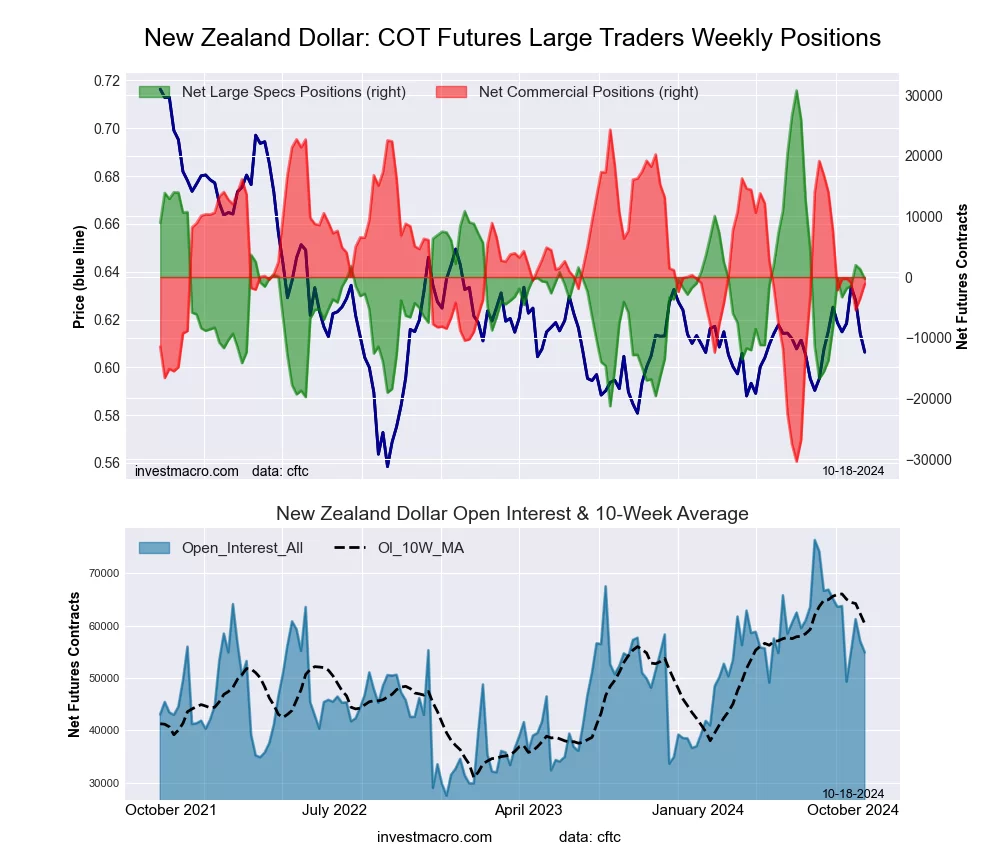
The New Zealand dollar rose to as high as $0.621 even after data showed that New Zealand’s economy contracted in the second quarter. Data released on Thursday showed GDP fell by 0.2% in the June quarter, which was better than the RBNZ’s estimate of a 0.5% contraction. On an annualized basis, GDP contracted 0.5%, which was in line with expectations. Markets have now fully priced in the possibility of another quarter-point rate cut in October, and there is a 28% chance of a 50 basis point rate cut.

S&P 500 (US500) 5,618.26 −16.32 (−0.29%)

Dow Jones (US30) 41,503.10 −103.08 (−0.25%)

DAX (DE40) 18,711.49 −14.59 (−0.08%)

FTSE 100 (UK100) 8,253.68 −56.18 (−0.68%)

USD Index 100.95 +0.06 (+0.06%)

News feed for: 2024.09.19

  • New Zealand GDP (q/q) at 01:45 (GMT+3);
  • Australia Unemployment Rate (m/m) at 04:30 (GMT+3);
  • Norwegian Interest Rate Decision at 11:30 (GMT+3);
  • UK BoE Interest Rate Decision at 14:00 (GMT+3);
  • UK BoE MPC Meeting Minutes at 14:00 (GMT+3);
  • US Initial Jobless Claims (w/w) at 15:30 (GMT+3);
  • US Philadelphia Fed Manufacturing Index (m/m) at 15:30 (GMT+3);
  • US Existing Home Sales (m/m) at 17:00 (GMT+3);
  • US Natural Gas Storage (w/w) at 17:30 (GMT+3).

By JustMarkets


This article reflects a personal opinion and should not be interpreted as an investment advice, and/or offer, and/or a persistent request for carrying out financial transactions, and/or a guarantee, and/or a forecast of future events.

Tiny robots and AI algorithms could help to craft material solutions for cleaner environments

By Mahshid Ahmadi, University of Tennessee 

Many human activities release pollutants into the air, water and soil. These harmful chemicals threaten the health of both people and the ecosystem. According to the World Health Organization, air pollution causes an estimated 4.2 million deaths annually.

Scientists are looking into solutions, and one potential avenue is a class of materials called photocatalysts. When triggered by light, these materials undergo chemical reactions that initial studies have shown can break down common toxic pollutants.

I am a materials science and engineering researcher at the University of Tennessee. With the help of robots and artificial intelligence, my colleagues and I are making and testing new photocatalysts with the goal of mitigating air pollution.

Breaking down pollutants

The photocatalysts work by generating charged carriers in the presence of light. These charged carriers are tiny particles that can move around and cause chemical reactions. When they come into contact with water and oxygen in the environment, they produce substances called reactive oxygen species. These highly active reactive oxygen species can bond to parts of the pollutants and then either decompose the pollutants or turn them into harmless – or even useful – products.

A cube-shaped metal machine with a chamber filled with bright light, and a plate of tubes shown going under the light.
To facilitate the photocatalytic reaction, researchers in the Ahmadi lab put plates of perovskite nanocrystals and pollutants under bright light to see whether the reaction breaks down the pollutants.
Astita Dubey

But some materials used in the photocatalytic process have limitations. For example, they can’t start the reaction unless the light has enough energy – infrared rays with lower energy light, or visible light, won’t trigger the reaction.

Another problem is that the charged particles involved in the reaction can recombine too quickly, which means they join back together before finishing the job. In these cases, the pollutants either do not decompose completely or the process takes a long time to accomplish.

Additionally, the surface of these photocatalysts can sometimes change during or after the photocatalytic reaction, which affects how they work and how efficient they are.
To overcome these limitations, scientists on my team are trying to develop new photocatalytic materials that work efficiently to break down pollutants. We also focus on making sure these materials are nontoxic so that our pollution-cleaning materials aren’t causing further pollution.

A plate of tiny tubes, with some colored dark blue, others light blue, and others transparent.
This plate from the Ahmadi lab is used while testing how perovskite nanocrystals and light break down pollutants, like the blue dye shown. The light blue color indicates partial degradation, while transparent water signifies complete degradation.
Astita Dubey

Teeny tiny crystals

Scientists on my team use automated experimentation and artificial intelligence to figure out which photocatalytic materials could be the best candidates to quickly break down pollutants. We’re making and testing materials called hybrid perovskites, which are tiny crystals – they’re about a 10th the thickness of a strand of hair.

These nanocrystals are made of a blend of organic (carbon-based) and inorganic (non-carbon-based) components.

They have a few unique qualities, like their excellent light-absorbing properties, which come from how they’re structured at the atomic level. They’re tiny, but mighty. Optically, they’re amazing too – they interact with light in fascinating ways to generate a large number of tiny charge carriers and trigger photocatalytic reactions.

These materials efficiently transport electrical charges, which allows them to transport light energy and drive the chemical reactions. They’re also used to make solar panels more efficient and in LED lights, which create the vibrant displays you see on TV screens.

There are thousands of potential types of hybrid nanocrystals. So, my team wanted to figure out how to make and test as many as we can quickly, to see which are the best candidates for cleaning up toxic pollutants.

Bringing in robots

Instead of making and testing samples by hand – which takes weeks or months – we’re using smart robots, which can produce and test at least 100 different materials within an hour. These small liquid-handling robots can precisely move, mix and transfer tiny amounts of liquid from one place to another. They’re controlled by a computer that guides their acceleration and accuracy.

A researcher in a white lab coat smiling at the camera next to a fume hood, with plates of small tubes inside it.
The Opentrons pipetting robot helps Astita Dubey, a visiting scientist working with the Ahmadi lab, synthesize materials and treat them with organic pollutants to test whether they can break down the pollutants.
Jordan Marshall

We also use machine learning to guide this process. Machine learning algorithms can analyze test data quickly and then learn from that data for the next set of experiments executed by the robots. These machine learning algorithms can quickly identify patterns and insights in collected data that would normally take much longer for a human eye to catch.

Our approach aims to simplify and better understand complex photocatalytic systems, helping to create new strategies and materials. By using automated experimentation guided by machine learning, we can now make these systems easier to analyze and interpret, overcoming challenges that were difficult with traditional methods.The Conversation

About the Author:

Mahshid Ahmadi, Assistant Professor of Materials Science and Engineering, University of Tennessee

This article is republished from The Conversation under a Creative Commons license. Read the original article.
Fed slashes rates by a half-point – what that means for the economy and the presidential election

By Michael Walden, North Carolina State University 

In a widely anticipated move, the Federal Reserve announced on Sept. 18, 2024, that it was cutting its benchmark interest rate by half a percentage point to a range of 4.75% to 5% – the first time the cost of borrowing has been lowered in four years.

The move marks an important pivot point, signaling that central bankers believe they have finally won their battle against inflation. It is also significant in timing, coming just months before the U.S. heads to the polls in a tight election that could turn on how Americans feel the economy is going.

The Conversation U.S. spoke with Mike Walden, distinguished professor emeritus at North Carolina State University, about what the rate cut means for the U.S. economy – and possibly the presidential campaign.

What does the Fed rate cut suggest about the state of the economy?

The Federal Reserve has two mandates: to pin inflation to around its target of 2% and to keep unemployment low. And the central bank balances that twin mandate when looking at whether to raise or lower base rates, or keep them the same.

For some time now, policymakers have concentrated on trying to get inflation under control through a series of interest rate hikes that took the Fed’s benchmark or base rate from a range of 0% to 0.25% in early 2022 to 5.25% to 5.5% in September 2024.

I believe what motivated them to drop the rate by a half-point now – rather than the quarter-point that some were expecting – is the labor market. The labor market is not exactly shaky – unemployment is currently at 4.2% – but it isn’t as robust as it was.

The latest job numbers were a little below expectations. And some economists are saying that there is a recession ahead. Indeed, there are some that are saying the U.S. is already in a recession.

So my guess is the majority of the Fed’s rate-setting board were convinced more by the latest unemployment data than inflation. In terms of the dual mandate, the Fed clearly feels it’s got the inflation fight in the bag, so it has turned to its second concern of keeping unemployment low.

So is this the soft landing the Fed was hoping for?

I would say so, yes. We are now in a soft landing – and I forecast the U.S. economy to slow but avoid a recession.

If I am right, then that is an achievement of Fed policy. A soft landing is very unusual – I can think of only one other occasion when it has occurred since the end of World War II. That was in mid-1995. And the story goes that then-Fed chair Alan Greenspan, during his daily soak in a tub for a bad back, became worried about the prospect of significantly higher prices. He proceeded to convince the Fed board to raise rates, which it did – a move that headed off a potential recession.

What impact will the rate cut have?

The first thing to note is that this will not mean we are returning back to 2019 prices – that would take wage cuts and deflation. This will merely slow inflation, or the rate at which prices rise.

But it will have an impact. In the first hour after the decision was made, stock markets jumped on the news – so investors were clearly happy – though the major indices ended the day lower.

Investment markets tend to anticipate any expected change, so we have already seen some lowering of mortgage rates – which have been trending down in the run-up to the Fed decision. Credit card interest rates have been trending down, too.

So the markets were clearly expecting a Fed rate cut. But we should see further drops in mortgage rates because the Fed has hinted at more interest rate cuts to come.

Is there a danger that some observers will see this as a political move?

I’m sure a lot of people will read this as Fed Chair Jay Powell helping the Democrats by cutting rates before the election.

But this is an economic-driven decision. There is no evidence that this has anything to do with the election.

What does history tell us about rate cuts and elections?

I think most serious observers know that the Fed is independent and makes decisions based purely on what is best for the economy. In fact, over the past 50 years, you will only find one period when eyebrows were raised. That was during the Nixon administration.

Under Fed Chair Arthur Burns, the central bank was accused of pumping money in the the system and cutting rates to make things look prosperous in advance of the 1972 election. But it later all blew up when the U.S. headed into a period of double-digit inflation.

Aside from that, you will be hard-pressed to find real evidence of interference. In fact, since then, presidential candidates from both parties have complained about the Fed.

Nonetheless, could the rate cut play into the election campaign?

In terms of how Americans feel about the economy? Not really. I don’t think mortgage rates will drop much more. And although the news is encouraging for borrowers, there is another side of rate cuts: They are negative for some types of investors. Money market investors, for example, will not look upon the Fed move so fondly.

But that doesn’t mean the two presidential tickets won’t try to turn the news to their benefit.

Democrats will happily take any credit for getting inflation back down on their watch and will point out how it will help Americans with home loans – avoiding the fact that they don’t actually have any role in the rate decisions themselves.

Meanwhile, Republicans might well say: “Hey, the Fed dropped rates because the economy is worse than we thought. And a half-point cut means they are desperate, the economy is horrible and we are heading for recession because of the Biden administrations’s policies.”The Conversation

About the Author:

Michael Walden, Professor and Extension Economist, North Carolina State University

This article is republished from The Conversation under a Creative Commons license. Read the original article.

The US Federal Reserve will begin its rate-cutting cycle today. In the UK, inflation figures were unchanged

By JustMarkets

At Tuesday’s close, the Dow Jones Index (US30) was down 0.04%, while the S&P 500 Index (US500) added 0.03%. The NASDAQ Technology Index (US100) closed positive 0.20%. Yesterday afternoon, equities came under pressure from long liquidations after bond yields rose ahead of the release of the results of the 2-day FOMC meeting on Wednesday.

Retail Sales for August unexpectedly rose by 0.1% m/m, stronger than expectations of a 0.2% m/m decline. US manufacturing production in August added 0.9% m/m, which was stronger than expectations of 0.2% m/m and was the largest increase in the last 6 months. Such data, along with the GDP growth estimates for Q3, allows the US Fed to start the easing cycle with a 0.25% rate hike. Fed Chair Powell’s comments after Wednesday’s meeting will also be scrutinized for further Fed policy intentions. Markets rate the odds of a 25bp rate cut at Tuesday/Wednesday’s FOMC meeting at 100% and a 50bp rate cut at this meeting at 52%.

Equity markets in Europe traded flat yesterday. The German DAX (DE40) rose by 0.50%, the French CAC 40 (FR40) closed higher by 0.51%, the Spanish IBEX 35 (ES35) Index gained 1.06%, the British FTSE 100 (UK100) closed up 0.38%.

The UK’s annual inflation rate for August 2024 remained at 2.2%, in line with July expectations. CPI rose 0.3% from the previous month, after falling 0.2% in July and matched expectations. The latest data had little impact on expectations that the Bank of England will keep policy steady on Thursday.

WTI crude oil prices fell to around $71 a barrel on Wednesday, breaking a two-day streak of gains, amid an unexpected increase in US crude inventories. API data showed US crude inventories rose by 1.96 million barrels last week, breaking a three-week streak of declines and beating market expectations for a 0.1 million barrel decline.

Silver fell below $30.5 an ounce, retreating from two-month highs, as traders grew cautious ahead of the US Federal Reserve’s expected monetary policy decision. In addition, disappointing economic data from China added to concerns about demand in the country, the world’s top metals consumer. Data released over the weekend showed that China’s industrial production, retail sales, and fixed asset investment in August fell short of prognoses.

Asian markets traded mixed yesterday. Japan’s Nikkei 225 (JP225) was down 1.03%, China’s FTSE China A50 (CHA50) did not trade due to a holiday, Hong Kong’s Hang Seng (HK50) was up 1.37%, and Australia’s ASX 200 (AU200) was positive 0.24%.

In Australia, investors await the country’s employment report on Thursday to gauge the state of the labor market and its potential impact on domestic monetary policy. Markets see a 4.35% cut in the money rate at next week’s Reserve Bank meeting as unlikely, given that policymakers have consistently maintained a hawkish stance.

S&P 500 (US500) 5,634.58 +1.49 (+0.03%)

Dow Jones (US30) 41,606.18 −15.90 (−0.04%)

DAX (DE40) 18,726.08 −15.90 (−0.04%)

FTSE 100 (UK100) 8,309.86 +31.42 (+0.38%)

USD Index 101.03 +0.26 (+0.26%)

News feed for: 2024.09.18

  • Japan Trade Balance (m/m) at 02:50 (GMT+3);
  • UK Consumer Price Index (m/m) at 09:00 (GMT+3);
  • UK Producer Price Index (m/m) at 09:00 (GMT+3);
  • Eurozone Consumer Price Index (m/m) at 12:00 (GMT+3);
  • US Building Permits (m/m) at 15:30 (GMT+3);
  • US Crude Oil Reserves (w/w) at 17:30 (GMT+3);
  • US Fed Interest Rate Decision at 21:00 (GMT+3);
  • US FOMC Statement at 21:00 (GMT+3);
  • US FOMC Economic Projections at 21:00 (GMT+3);
  • US FOMC Press Conference at 21:30 (GMT+3).

By JustMarkets


This article reflects a personal opinion and should not be interpreted as an investment advice, and/or offer, and/or a persistent request for carrying out financial transactions, and/or a guarantee, and/or a forecast of future events.