Archive for Opinions – Page 85

Speculator Extremes: MXN, Cocoa, US Bonds lead Bullish & Bearish Positions

By InvestMacro 

The latest update for the weekly Commitment of Traders (COT) report was released by the Commodity Futures Trading Commission (CFTC) on Friday for data ending on May 23rd.

This weekly Extreme Positions report highlights the Most Bullish and Most Bearish Positions for the speculator category. Extreme positioning in these markets can foreshadow strong moves in the underlying market.

To signify an extreme position, we use the Strength Index (also known as the COT Index) of each instrument, a common method of measuring COT data. The Strength Index is simply a comparison of current trader positions against the range of positions over the previous 3 years. We use over 80 percent as extremely bullish and under 20 percent as extremely bearish. (Compare Strength Index scores across all markets in the data table or cot leaders table)


Here Are This Week’s Most Bullish Speculator Positions:

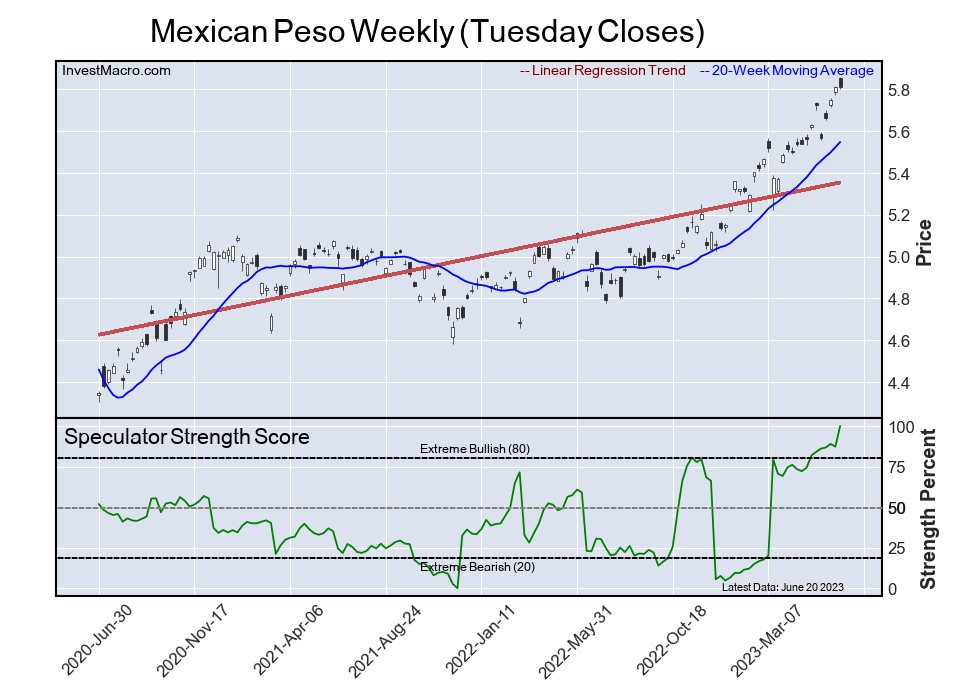
Mexican Peso


The Mexican Peso speculator position comes in as the most bullish extreme standing this week. The Mexican Peso speculator level is currently at a 100.0 percent score of its 3-year range.

The six-week trend for the percent strength score totaled 11.7 this week. The overall net speculator position was a total of 76,943 net contracts this week with a change of 3,308 contract in the weekly speculator bets.


Bloomberg Commodity Index


The Bloomberg Commodity Index speculator position comes next in the extreme standings this week. The Bloomberg Commodity Index speculator level is now at a 100.0 percent score of its 3-year range.

The six-week trend for the percent strength score was 9.7 this week. The speculator position registered -1,677 net contracts this week with a weekly change of 20 contracts in speculator bets.


Cocoa Futures


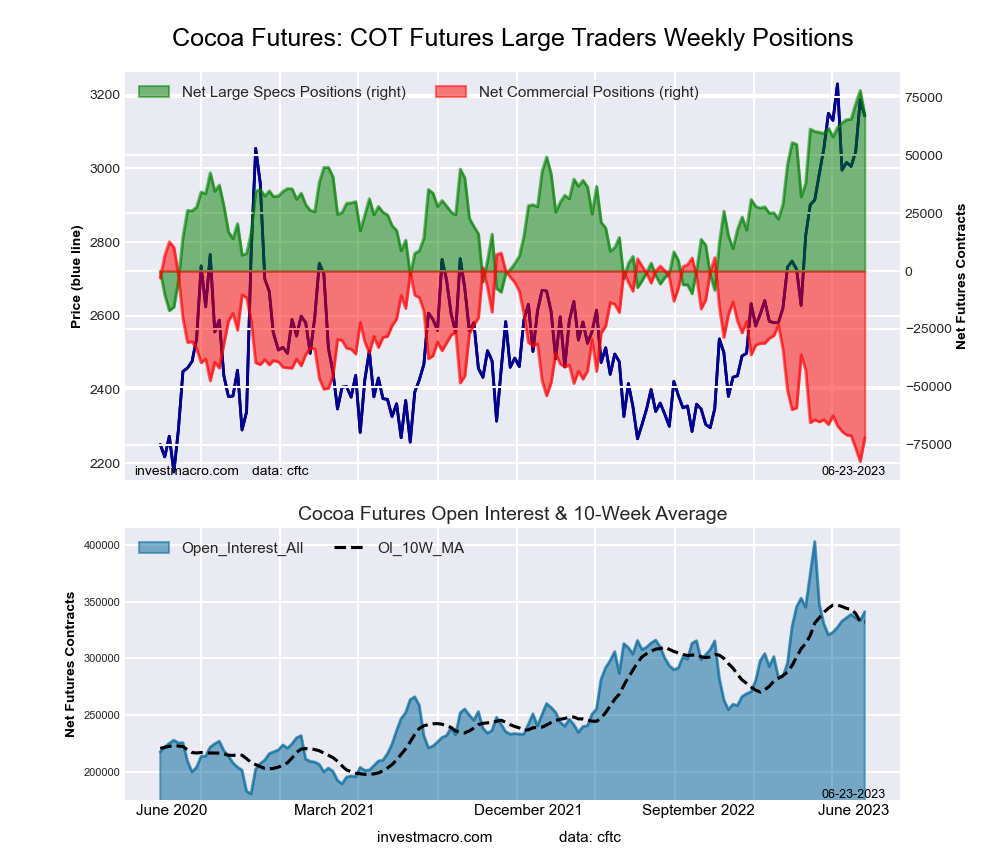
The Cocoa Futures speculator position comes in third this week in the extreme standings. The Cocoa Futures speculator level resides at a 100.0 percent score of its 3-year range.

The six-week trend for the speculator strength score came in at 6.6 this week. The overall speculator position was 65,374 net contracts this week with a change of 1,319 contracts in the weekly speculator bets.


Bitcoin


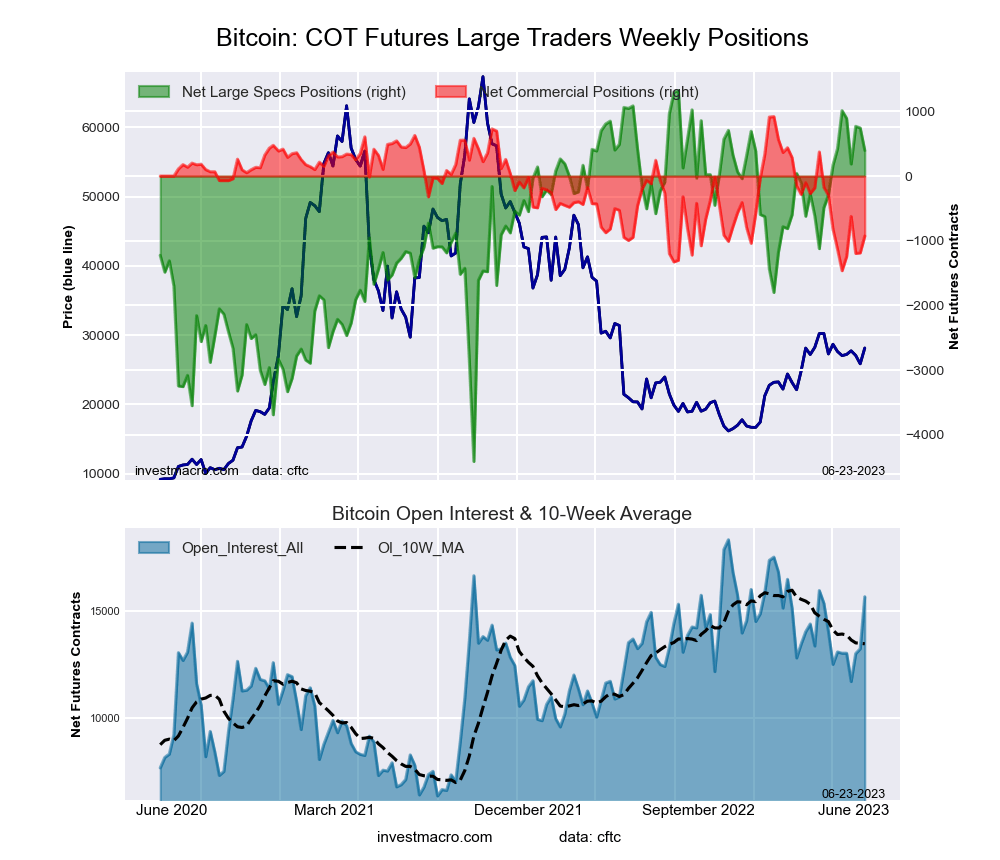
The Bitcoin speculator position comes up number four in the extreme standings this week. The Bitcoin speculator level is at a 92.5 percent score of its 3-year range.

The six-week trend for the speculator strength score totaled a change of 35.1 this week. The overall speculator position was 893 net contracts this week with a change of -118 contracts in the speculator bets.


Live Cattle


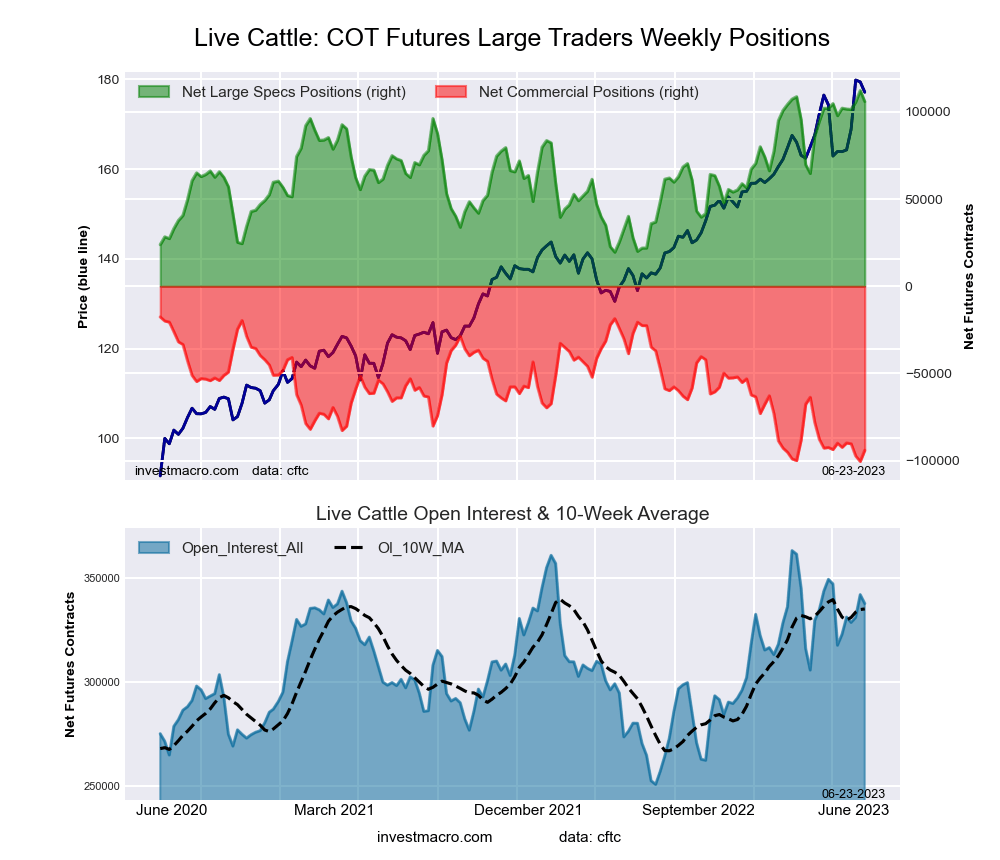
The Live Cattle speculator position rounds out the top five in this week’s bullish extreme standings. The Live Cattle speculator level sits at a 92.1 percent score of its 3-year range. The six-week trend for the speculator strength score was 7.9 this week.

The speculator position was 101,647 net contracts this week with a change of -469 contracts in the weekly speculator bets.


This Week’s Most Bearish Speculator Positions:

Lean Hogs


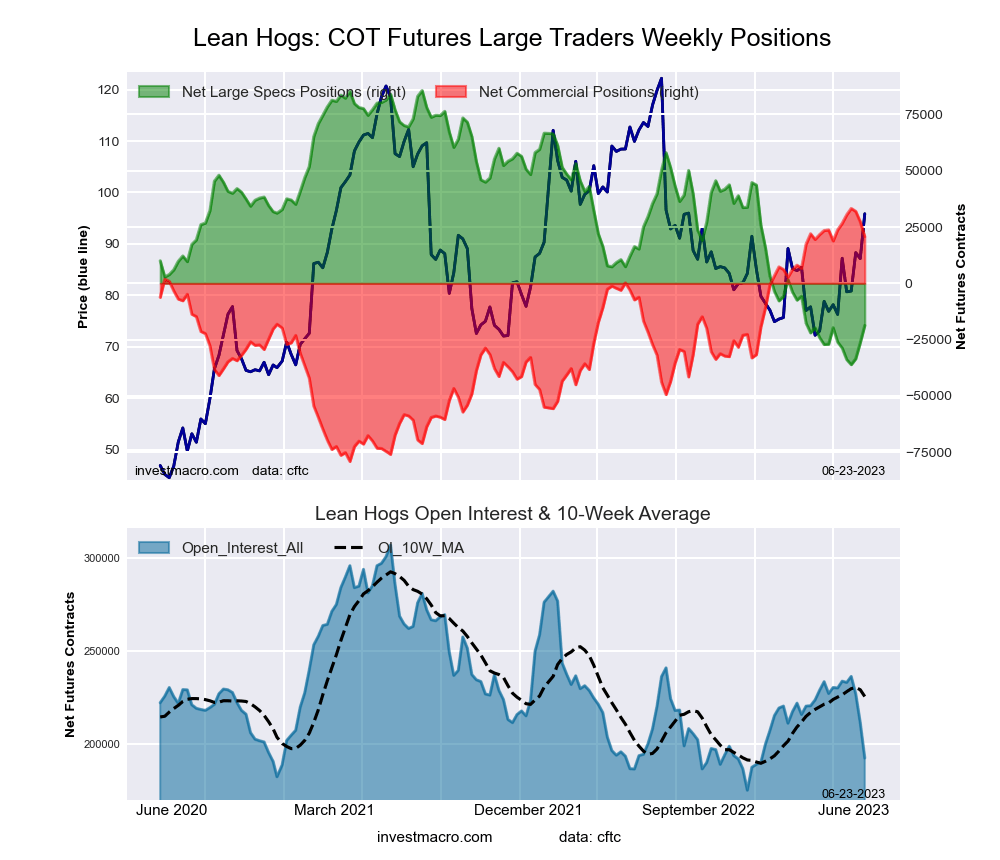
The Lean Hogs speculator position comes in as the most bearish extreme standing this week. The Lean Hogs speculator level is at a 0.0 percent score of its 3-year range.

The six-week trend for the speculator strength score was -8.2 this week. The overall speculator position was -33,852 net contracts this week with a change of -5,118 contracts in the speculator bets.


10-Year Note


The 10-Year Note speculator position comes in next for the most bearish extreme standing on the week. The 10-Year Note speculator level is at a 0.0 percent score of its 3-year range.

The six-week trend for the speculator strength score was -13.9 this week. The speculator position was -771,638 net contracts this week with a change of -79,196 contracts in the weekly speculator bets.


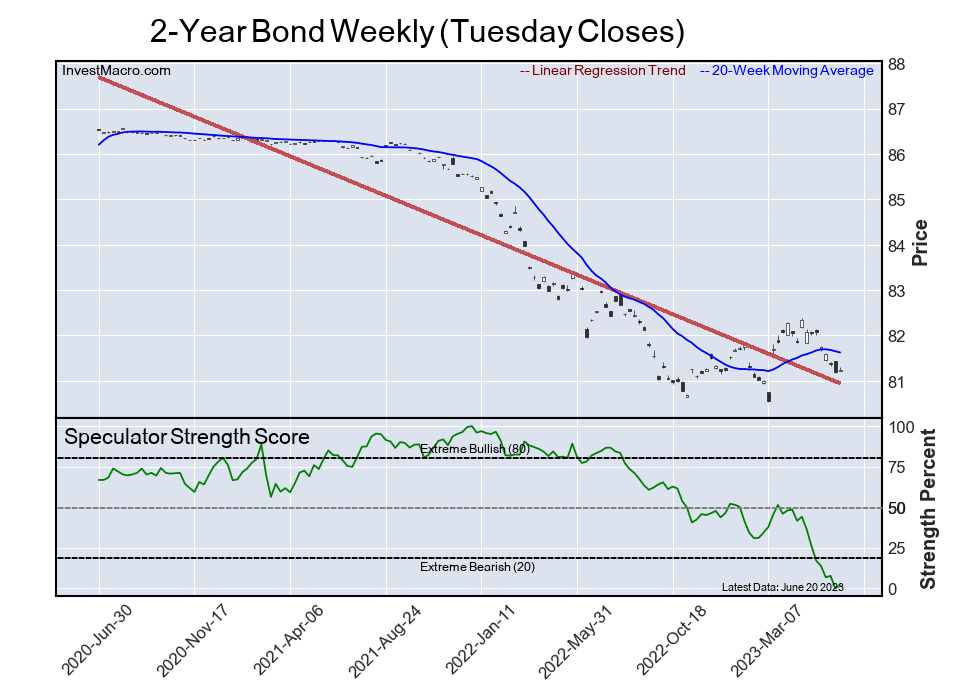
2-Year Bond


The 2-Year Bond speculator position comes in as third most bearish extreme standing of the week. The 2-Year Bond speculator level resides at a 0.0 percent score of its 3-year range.

The six-week trend for the speculator strength score was -40.2 this week. The overall speculator position was -890,202 net contracts this week with a change of -36,627 contracts in the speculator bets.


S&P500 Mini


The S&P500 Mini speculator position comes in as this week’s fourth most bearish extreme standing. The S&P500 Mini speculator level is at a 0.0 percent score of its 3-year range.

The six-week trend for the speculator strength score was -15.1 this week. The speculator position was -404,292 net contracts this week with a change of -15,571 contracts in the weekly speculator bets.


5-Year Bond


Finally, the 5-Year Bond speculator position comes in as the fifth most bearish extreme standing for this week. The 5-Year Bond speculator level is at a 0.0 percent score of its 3-year range.

The six-week trend for the speculator strength score was -16.7 this week. The speculator position was -934,069 net contracts this week with a change of -10,156 contracts in the weekly speculator bets.


Article By InvestMacroReceive our weekly COT Newsletter

Speculators or Non-Commercials Notes:

Speculators, classified as non-commercial traders by the CFTC, are made up of large commodity funds, hedge funds and other significant for-profit participants. The Specs are generally regarded as trend-followers in their behavior towards price action – net speculator bets and prices tend to go in the same directions. These traders often look to buy when prices are rising and sell when prices are falling. To illustrate this point, many times speculator contracts can be found at their most extremes (bullish or bearish) when prices are also close to their highest or lowest levels.

These extreme levels can be dangerous for the large speculators as the trade is most crowded, there is less trading ammunition still sitting on the sidelines to push the trend further and prices have moved a significant distance. When the trend becomes exhausted, some speculators take profits while others look to also exit positions when prices fail to continue in the same direction. This process usually plays out over many months to years and can ultimately create a reverse effect where prices start to fall and speculators start a process of selling when prices are falling.


*COT Report: The COT data, released weekly to the public each Friday, is updated through the most recent Tuesday (data is 3 days old) and shows a quick view of how large speculators or non-commercials (for-profit traders) were positioned in the futures markets.

The CFTC categorizes trader positions according to commercial hedgers (traders who use futures contracts for hedging as part of the business), non-commercials (large traders who speculate to realize trading profits) and nonreportable traders (usually small traders/speculators) as well as their open interest (contracts open in the market at time of reporting). See CFTC criteria here.

Speculators drop their 10-Year Bonds bets to lowest level on record

By InvestMacro

Here are the latest charts and statistics for the Commitment of Traders (COT) reports data published by the Commodities Futures Trading Commission (CFTC).

The latest COT data is updated through Tuesday May 23rd and shows a quick view of how large traders (for-profit speculators and commercial hedgers) were positioned in the futures markets.

Weekly Speculator Changes led by SOFR 3-Months & Ultra 10-Year Bonds

The COT bond market speculator bets were lower this week as three out of the nine bond markets we cover had higher positioning while the other six markets had lower speculator contracts.

Leading the gains for the bond markets was the SOFR 3-Months (65,278 contracts) with the Ultra 10-Year Bonds (28,348 contracts) and the US Treasury Bonds (18,345 contracts) also showing positive weeks.

The bond markets with declines in speculator bets for the week were the 10-Year Bonds (-79,196 contracts), the 2-Year Bonds (-36,627 contracts), the Fed Funds (-20,924 contracts), the Ultra Treasury Bonds (-20,128 contracts), the 5-Year Bonds (-10,156 contracts) and the Eurodollar (-4,665 contracts) also registering lower bets on the week.

10-Year Bonds Speculator bets hit lowest level on record

Highlighting the COT bond’s data this week is the record weakness in the 10-Year Treasury Bond contracts. The 10-Year Bond contract dropped this week by -79,196 contracts and fell for the sixth time out of the past eight weeks which has added a total of -300,060 contracts to the bearish level.

This weakness has pushed the 10-Year speculative positions to hit their most bearish level on record this week at a total of -771,638 contracts, according to CFTC data that stretches back to 1986. This eclipses the previous record of -756,316 contracts that was reached on September of 2018.

The 10-Year now joins both the 2-Year and 5-Year Treasury Bonds with current record low levels in speculator positions.

The 2-Year speculator positions fell again this week for the fourth straight week and has a new record low level position at -890,202 contracts. The 2-Year speculators have added a total of -343,895 contracts to the bearish standing in just the past four weeks.

Meanwhile, the 5-Year speculator positioning dropped again for the fifth consecutive week and hit a new record bearish position of -934,069 contracts. A total of-179,567 contracts has been added to the bearish position in the past five weeks.

The 10-Year futures price is back on the downtrend over the past three weeks after rising to touch a 7-month high in March. The futures price closed this week at 112.13 which still remains about 3.30 percent above the most recent low-point (and approximately 15-year low) that was hit in October.


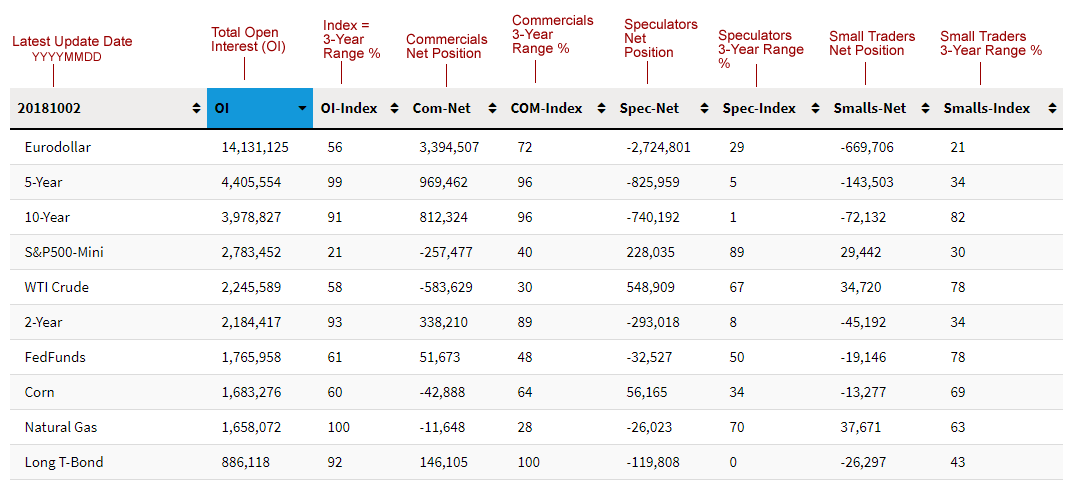
Data Snapshot of Bond Market Traders | Columns Legend
May-23-2023OIOI-IndexSpec-NetSpec-IndexCom-NetCOM-IndexSmalls-NetSmalls-Index
Eurodollar556,2780-41,5497343,73723-2,18899
FedFunds1,735,67466-88,49529107,29273-18,79754
2-Year3,266,610100-890,2020800,37110089,83199
Long T-Bond1,299,27483-43,236713,6961239,54077
10-Year4,902,288100-771,6380682,4029589,23693
5-Year5,105,531100-934,0690882,60710051,46295


Strength Scores led by SOFR 3-Months & Eurodollar

COT Strength Scores (a normalized measure of Speculator positions over a 3-Year range, from 0 to 100 where above 80 is Extreme-Bullish and below 20 is Extreme-Bearish) showed that the SOFR 3-Months (86 percent) and the Eurodollar (73 percent) lead the bond markets this week. The US Treasury Bonds (71 percent) comes in as the next highest in the weekly strength scores.

On the downside, the 5-Year Bonds (0 percent), the 10-Year Bonds (0 percent), the 2-Year Bonds (0 percent) and the Ultra 10-Year Bonds (12 percent) come in at the lowest strength level currently and are in Extreme-Bearish territory (below 20 percent).

Strength Statistics:
Fed Funds (28.8 percent) vs Fed Funds previous week (31.4 percent)
2-Year Bond (0.0 percent) vs 2-Year Bond previous week (3.7 percent)
5-Year Bond (0.0 percent) vs 5-Year Bond previous week (1.0 percent)
10-Year Bond (0.0 percent) vs 10-Year Bond previous week (8.3 percent)
Ultra 10-Year Bond (12.2 percent) vs Ultra 10-Year Bond previous week (6.5 percent)
US Treasury Bond (70.5 percent) vs US Treasury Bond previous week (64.5 percent)
Ultra US Treasury Bond (14.8 percent) vs Ultra US Treasury Bond previous week (23.4 percent)
Eurodollar (73.0 percent) vs Eurodollar previous week (73.1 percent)
SOFR 3-Months (86.3 percent) vs SOFR 3-Months previous week (81.0 percent)


US Treasury Bonds & Eurodollar top the 6-Week Strength Trends

COT Strength Score Trends (or move index, calculates the 6-week changes in strength scores) showed that the US Treasury Bonds (29 percent) and the Eurodollar (16 percent) lead the past six weeks trends for bonds.

The 2-Year Bonds (-40 percent) and the 5-Year Bonds (-17 percent) lead the downside trend scores currently with the 10-Year Bonds (-14 percent) and the Ultra Treasury Bonds (-4 percent) following next with lower trend scores.

Strength Trend Statistics:
Fed Funds (9.8 percent) vs Fed Funds previous week (9.9 percent)
2-Year Bond (-40.2 percent) vs 2-Year Bond previous week (-35.9 percent)
5-Year Bond (-16.7 percent) vs 5-Year Bond previous week (-13.9 percent)
10-Year Bond (-13.9 percent) vs 10-Year Bond previous week (-7.5 percent)
Ultra 10-Year Bond (7.9 percent) vs Ultra 10-Year Bond previous week (0.0 percent)
US Treasury Bond (29.1 percent) vs US Treasury Bond previous week (22.1 percent)
Ultra US Treasury Bond (-4.2 percent) vs Ultra US Treasury Bond previous week (8.0 percent)
Eurodollar (15.6 percent) vs Eurodollar previous week (15.7 percent)
SOFR 3-Months (4.7 percent) vs SOFR 3-Months previous week (2.8 percent)


Individual Bond Markets:

3-Month Eurodollars Futures:

Eurodollar Bonds Futures COT ChartThe 3-Month Eurodollars large speculator standing this week reached a net position of -41,549 contracts in the data reported through Tuesday. This was a weekly decrease of -4,665 contracts from the previous week which had a total of -36,884 net contracts.

This week’s current strength score (the trader positioning range over the past three years, measured from 0 to 100) shows the speculators are currently Bullish with a score of 73.0 percent. The commercials are Bearish with a score of 22.8 percent and the small traders (not shown in chart) are Bullish-Extreme with a score of 98.8 percent.

3-Month Eurodollars StatisticsSPECULATORSCOMMERCIALSSMALL TRADERS
– Percent of Open Interest Longs:28.161.09.9
– Percent of Open Interest Shorts:35.653.110.3
– Net Position:-41,54943,737-2,188
– Gross Longs:156,341339,28455,303
– Gross Shorts:197,890295,54757,491
– Long to Short Ratio:0.8 to 11.1 to 11.0 to 1
NET POSITION TREND:
– Strength Index Score (3 Year Range Pct):73.022.898.8
– Strength Index Reading (3 Year Range):BullishBearishBullish-Extreme
NET POSITION MOVEMENT INDEX:
– 6-Week Change in Strength Index:15.6-18.031.2


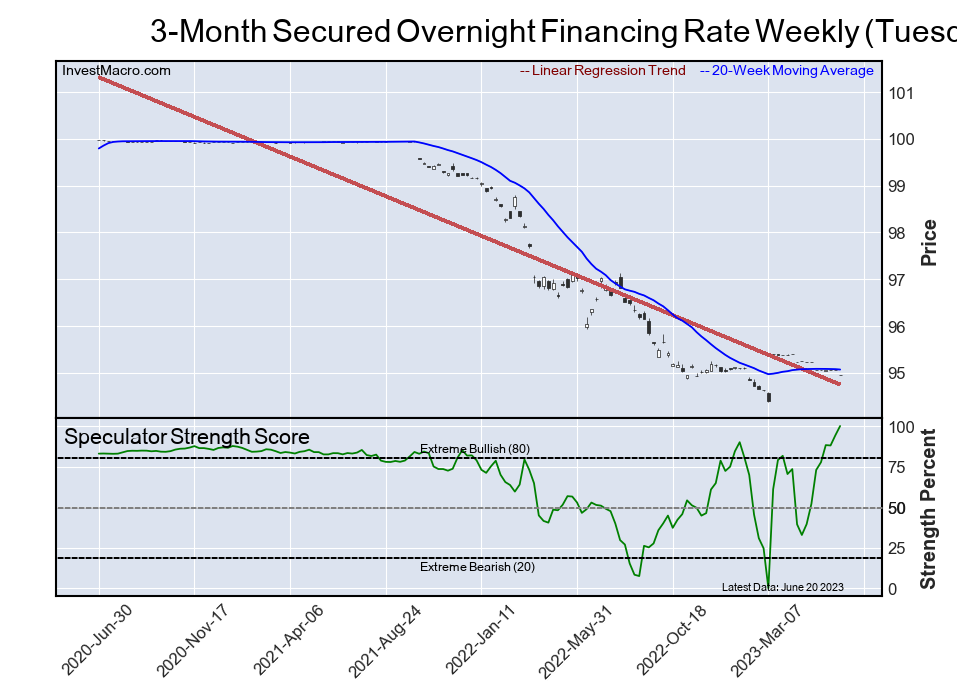
Secured Overnight Financing Rate (3-Month) Futures:

SOFR 3-Months Bonds Futures COT ChartThe Secured Overnight Financing Rate (3-Month) large speculator standing this week reached a net position of -101,543 contracts in the data reported through Tuesday. This was a weekly increase of 65,278 contracts from the previous week which had a total of -166,821 net contracts.

This week’s current strength score (the trader positioning range over the past three years, measured from 0 to 100) shows the speculators are currently Bullish-Extreme with a score of 86.3 percent. The commercials are Bearish-Extreme with a score of 14.2 percent and the small traders (not shown in chart) are Bullish-Extreme with a score of 83.8 percent.

SOFR 3-Months StatisticsSPECULATORSCOMMERCIALSSMALL TRADERS
– Percent of Open Interest Longs:16.161.10.5
– Percent of Open Interest Shorts:17.159.90.5
– Net Position:-101,543108,863-7,320
– Gross Longs:1,568,5925,953,38745,538
– Gross Shorts:1,670,1355,844,52452,858
– Long to Short Ratio:0.9 to 11.0 to 10.9 to 1
NET POSITION TREND:
– Strength Index Score (3 Year Range Pct):86.314.283.8
– Strength Index Reading (3 Year Range):Bullish-ExtremeBearish-ExtremeBullish-Extreme
NET POSITION MOVEMENT INDEX:
– 6-Week Change in Strength Index:4.7-4.1-4.1


30-Day Federal Funds Futures:

Federal Funds 30-Day Bonds Futures COT ChartThe 30-Day Federal Funds large speculator standing this week reached a net position of -88,495 contracts in the data reported through Tuesday. This was a weekly decrease of -20,924 contracts from the previous week which had a total of -67,571 net contracts.

This week’s current strength score (the trader positioning range over the past three years, measured from 0 to 100) shows the speculators are currently Bearish with a score of 28.8 percent. The commercials are Bullish with a score of 72.7 percent and the small traders (not shown in chart) are Bullish with a score of 54.1 percent.

30-Day Federal Funds StatisticsSPECULATORSCOMMERCIALSSMALL TRADERS
– Percent of Open Interest Longs:5.876.51.9
– Percent of Open Interest Shorts:10.970.33.0
– Net Position:-88,495107,292-18,797
– Gross Longs:100,0271,327,98833,520
– Gross Shorts:188,5221,220,69652,317
– Long to Short Ratio:0.5 to 11.1 to 10.6 to 1
NET POSITION TREND:
– Strength Index Score (3 Year Range Pct):28.872.754.1
– Strength Index Reading (3 Year Range):BearishBullishBullish
NET POSITION MOVEMENT INDEX:
– 6-Week Change in Strength Index:9.8-8.4-20.0


2-Year Treasury Note Futures:

2-Year Treasury Bonds Futures COT ChartThe 2-Year Treasury Note large speculator standing this week reached a net position of -890,202 contracts in the data reported through Tuesday. This was a weekly lowering of -36,627 contracts from the previous week which had a total of -853,575 net contracts.

This week’s current strength score (the trader positioning range over the past three years, measured from 0 to 100) shows the speculators are currently Bearish-Extreme with a score of 0.0 percent. The commercials are Bullish-Extreme with a score of 100.0 percent and the small traders (not shown in chart) are Bullish-Extreme with a score of 98.8 percent.

2-Year Treasury Note StatisticsSPECULATORSCOMMERCIALSSMALL TRADERS
– Percent of Open Interest Longs:8.382.47.5
– Percent of Open Interest Shorts:35.557.94.7
– Net Position:-890,202800,37189,831
– Gross Longs:270,4652,690,719244,689
– Gross Shorts:1,160,6671,890,348154,858
– Long to Short Ratio:0.2 to 11.4 to 11.6 to 1
NET POSITION TREND:
– Strength Index Score (3 Year Range Pct):0.0100.098.8
– Strength Index Reading (3 Year Range):Bearish-ExtremeBullish-ExtremeBullish-Extreme
NET POSITION MOVEMENT INDEX:
– 6-Week Change in Strength Index:-40.240.225.6


5-Year Treasury Note Futures:

5-Year Treasury Bonds Futures COT ChartThe 5-Year Treasury Note large speculator standing this week reached a net position of -934,069 contracts in the data reported through Tuesday. This was a weekly fall of -10,156 contracts from the previous week which had a total of -923,913 net contracts.

This week’s current strength score (the trader positioning range over the past three years, measured from 0 to 100) shows the speculators are currently Bearish-Extreme with a score of 0.0 percent. The commercials are Bullish-Extreme with a score of 100.0 percent and the small traders (not shown in chart) are Bullish-Extreme with a score of 95.1 percent.

5-Year Treasury Note StatisticsSPECULATORSCOMMERCIALSSMALL TRADERS
– Percent of Open Interest Longs:8.382.07.8
– Percent of Open Interest Shorts:26.664.76.8
– Net Position:-934,069882,60751,462
– Gross Longs:423,3534,186,028396,832
– Gross Shorts:1,357,4223,303,421345,370
– Long to Short Ratio:0.3 to 11.3 to 11.1 to 1
NET POSITION TREND:
– Strength Index Score (3 Year Range Pct):0.0100.095.1
– Strength Index Reading (3 Year Range):Bearish-ExtremeBullish-ExtremeBullish-Extreme
NET POSITION MOVEMENT INDEX:
– 6-Week Change in Strength Index:-16.716.63.3


10-Year Treasury Note Futures:

10-Year Treasury Notes Bonds Futures COT ChartThe 10-Year Treasury Note large speculator standing this week reached a net position of -771,638 contracts in the data reported through Tuesday. This was a weekly reduction of -79,196 contracts from the previous week which had a total of -692,442 net contracts.

This week’s current strength score (the trader positioning range over the past three years, measured from 0 to 100) shows the speculators are currently Bearish-Extreme with a score of 0.0 percent. The commercials are Bullish-Extreme with a score of 94.9 percent and the small traders (not shown in chart) are Bullish-Extreme with a score of 92.9 percent.

10-Year Treasury Note StatisticsSPECULATORSCOMMERCIALSSMALL TRADERS
– Percent of Open Interest Longs:9.877.59.3
– Percent of Open Interest Shorts:25.563.57.5
– Net Position:-771,638682,40289,236
– Gross Longs:480,0323,797,760454,534
– Gross Shorts:1,251,6703,115,358365,298
– Long to Short Ratio:0.4 to 11.2 to 11.2 to 1
NET POSITION TREND:
– Strength Index Score (3 Year Range Pct):0.094.992.9
– Strength Index Reading (3 Year Range):Bearish-ExtremeBullish-ExtremeBullish-Extreme
NET POSITION MOVEMENT INDEX:
– 6-Week Change in Strength Index:-13.96.515.9


Ultra 10-Year Notes Futures:

Ultra 10-Year Treasury Notes Bonds Futures COT ChartThe Ultra 10-Year Notes large speculator standing this week reached a net position of -158,079 contracts in the data reported through Tuesday. This was a weekly increase of 28,348 contracts from the previous week which had a total of -186,427 net contracts.

This week’s current strength score (the trader positioning range over the past three years, measured from 0 to 100) shows the speculators are currently Bearish-Extreme with a score of 12.2 percent. The commercials are Bullish-Extreme with a score of 84.5 percent and the small traders (not shown in chart) are Bullish with a score of 68.4 percent.

Ultra 10-Year Notes StatisticsSPECULATORSCOMMERCIALSSMALL TRADERS
– Percent of Open Interest Longs:10.076.010.8
– Percent of Open Interest Shorts:19.162.515.2
– Net Position:-158,079234,828-76,749
– Gross Longs:174,2701,319,934186,701
– Gross Shorts:332,3491,085,106263,450
– Long to Short Ratio:0.5 to 11.2 to 10.7 to 1
NET POSITION TREND:
– Strength Index Score (3 Year Range Pct):12.284.568.4
– Strength Index Reading (3 Year Range):Bearish-ExtremeBullish-ExtremeBullish
NET POSITION MOVEMENT INDEX:
– 6-Week Change in Strength Index:7.9-9.84.0


US Treasury Bonds Futures:

US Year Treasury Notes Long Bonds Futures COT ChartThe US Treasury Bonds large speculator standing this week reached a net position of -43,236 contracts in the data reported through Tuesday. This was a weekly increase of 18,345 contracts from the previous week which had a total of -61,581 net contracts.

This week’s current strength score (the trader positioning range over the past three years, measured from 0 to 100) shows the speculators are currently Bullish with a score of 70.5 percent. The commercials are Bearish-Extreme with a score of 11.9 percent and the small traders (not shown in chart) are Bullish with a score of 77.2 percent.

US Treasury Bonds StatisticsSPECULATORSCOMMERCIALSSMALL TRADERS
– Percent of Open Interest Longs:8.674.414.8
– Percent of Open Interest Shorts:12.074.111.8
– Net Position:-43,2363,69639,540
– Gross Longs:112,271966,329192,516
– Gross Shorts:155,507962,633152,976
– Long to Short Ratio:0.7 to 11.0 to 11.3 to 1
NET POSITION TREND:
– Strength Index Score (3 Year Range Pct):70.511.977.2
– Strength Index Reading (3 Year Range):BullishBearish-ExtremeBullish
NET POSITION MOVEMENT INDEX:
– 6-Week Change in Strength Index:29.1-23.5-17.2


Ultra US Treasury Bonds Futures:

Ultra US Year Treasury Notes Long Bonds Futures COT ChartThe Ultra US Treasury Bonds large speculator standing this week reached a net position of -409,108 contracts in the data reported through Tuesday. This was a weekly fall of -20,128 contracts from the previous week which had a total of -388,980 net contracts.

This week’s current strength score (the trader positioning range over the past three years, measured from 0 to 100) shows the speculators are currently Bearish-Extreme with a score of 14.8 percent. The commercials are Bullish with a score of 76.0 percent and the small traders (not shown in chart) are Bullish-Extreme with a score of 98.5 percent.

Ultra US Treasury Bonds StatisticsSPECULATORSCOMMERCIALSSMALL TRADERS
– Percent of Open Interest Longs:5.580.712.2
– Percent of Open Interest Shorts:32.157.98.4
– Net Position:-409,108350,43558,673
– Gross Longs:84,0631,239,774187,318
– Gross Shorts:493,171889,339128,645
– Long to Short Ratio:0.2 to 11.4 to 11.5 to 1
NET POSITION TREND:
– Strength Index Score (3 Year Range Pct):14.876.098.5
– Strength Index Reading (3 Year Range):Bearish-ExtremeBullishBullish-Extreme
NET POSITION MOVEMENT INDEX:
– 6-Week Change in Strength Index:-4.20.98.1


Article By InvestMacroReceive our weekly COT Newsletter

*COT Report: The COT data, released weekly to the public each Friday, is updated through the most recent Tuesday (data is 3 days old) and shows a quick view of how large speculators or non-commercials (for-profit traders) were positioned in the futures markets.

The CFTC categorizes trader positions according to commercial hedgers (traders who use futures contracts for hedging as part of the business), non-commercials (large traders who speculate to realize trading profits) and nonreportable traders (usually small traders/speculators) as well as their open interest (contracts open in the market at time of reporting). See CFTC criteria here.

Metals Speculators boost Copper & Platinum bets, trim Gold bullish positions

By InvestMacro

Here are the latest charts and statistics for the Commitment of Traders (COT) data published by the Commodities Futures Trading Commission (CFTC).

The latest COT data is updated through Tuesday May 23rd and shows a quick view of how large traders (for-profit speculators and commercial entities) were positioned in the futures markets.

Weekly Speculator Changes led by Copper & Platinum

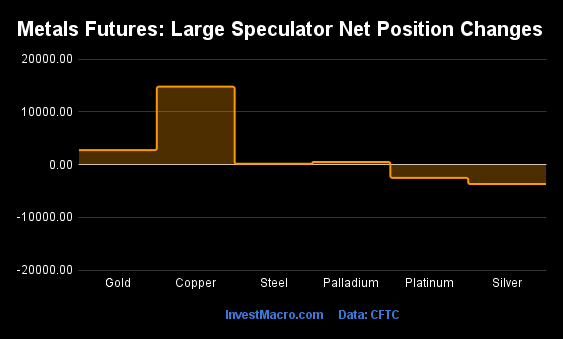
The COT metals markets speculator bets were lower this week as two out of the six metals markets we cover had higher positioning while the other four markets had lower speculator contracts.

Leading the gains for the metals was Copper (2,799 contracts) with Platinum (1,656 contracts) also showing positive weeks.

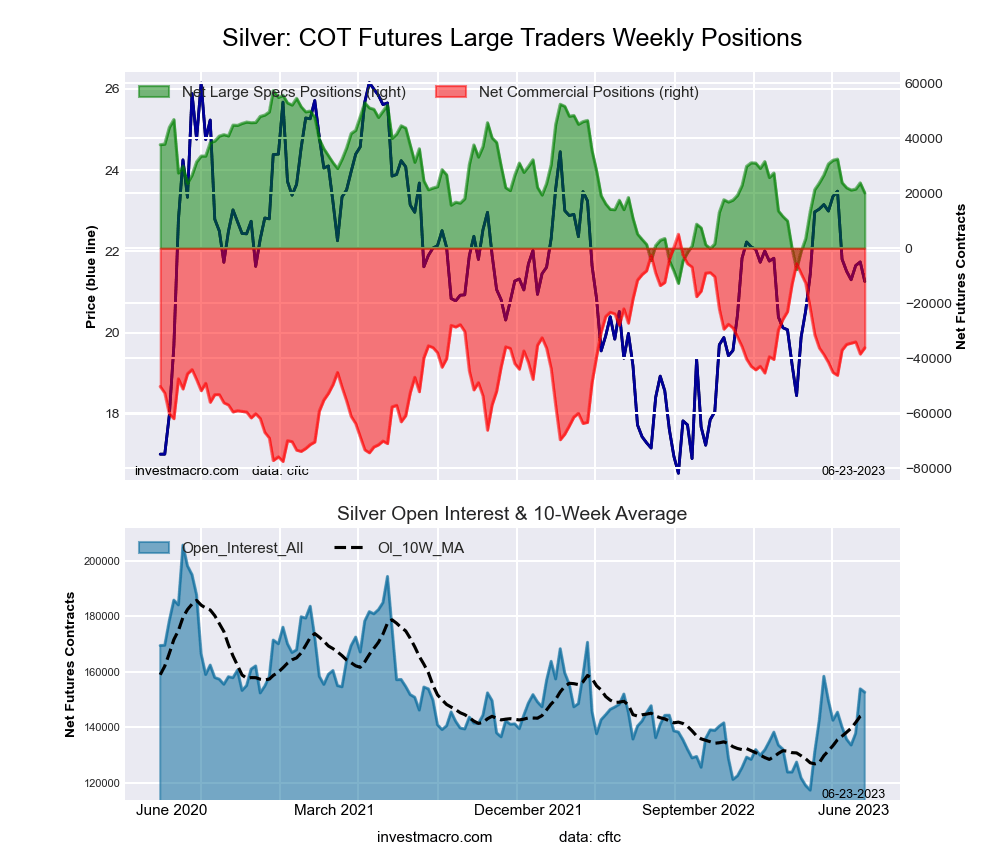
The markets with declines in speculator bets for the week were Gold (-19,082 contracts), Silver (-1,857 contracts), Steel (-891 contracts) and Palladium (-373 contracts).

Highlights of this week’s positions:

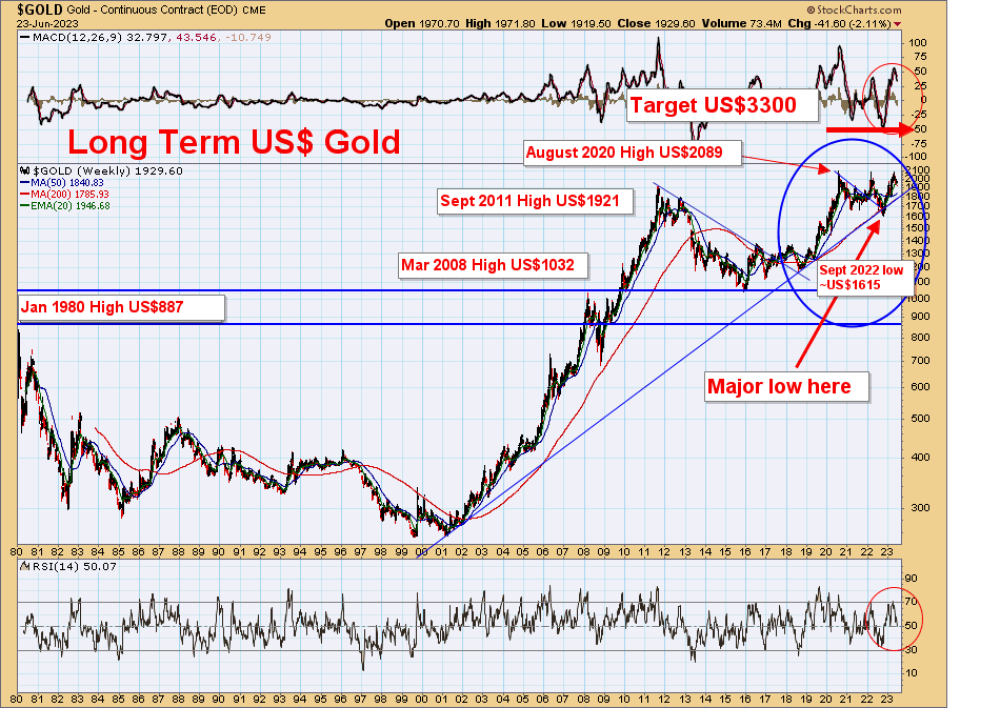
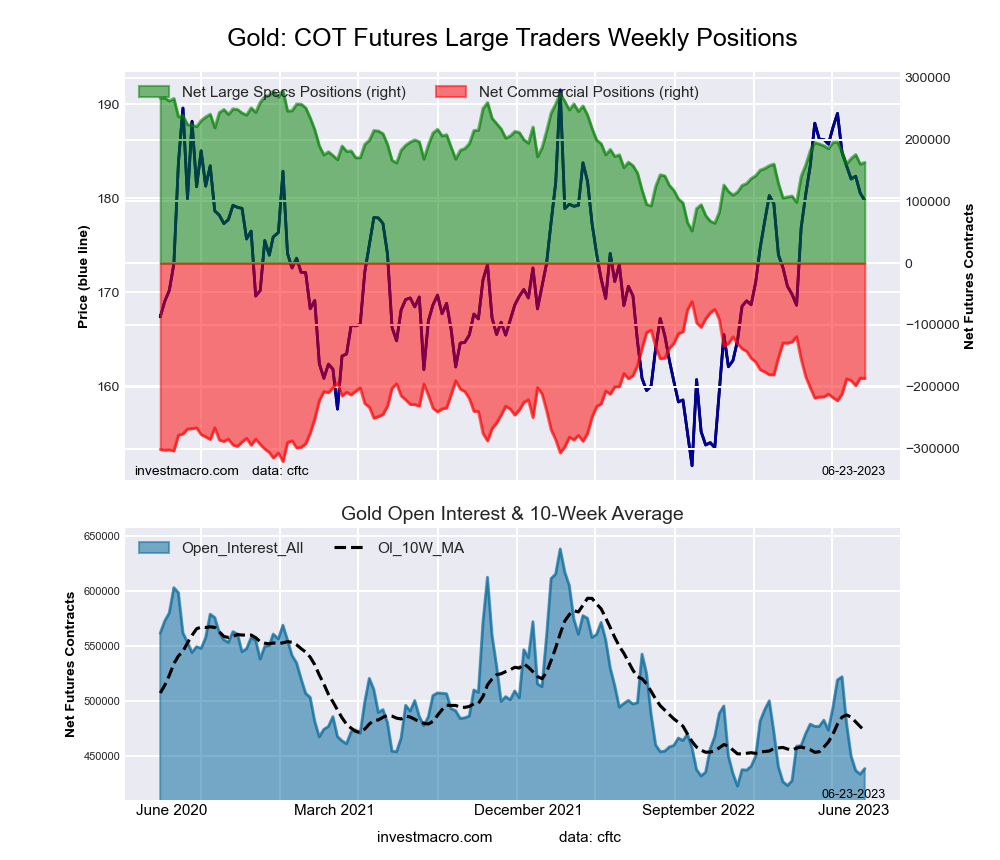
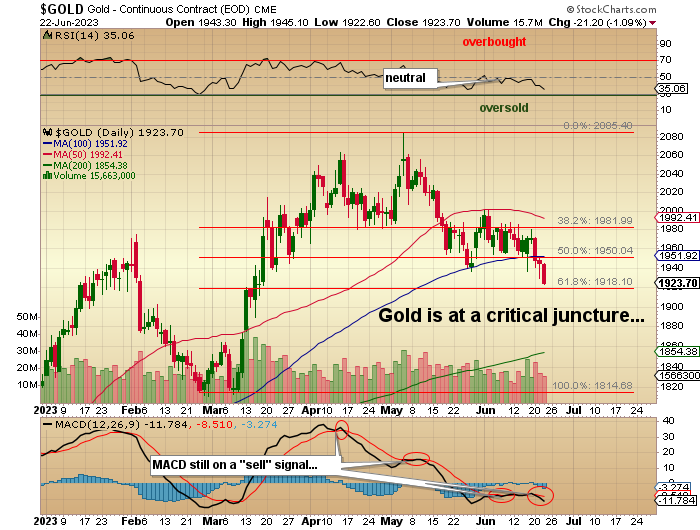
The largest mover of the week this week was the Gold speculative position. The large speculative position of Gold futures fell by over -19,000 contracts this week following a decline by -16,000 contracts last week. These declines have not taken much off the overall net position that has been trending higher since late in 2022 and recently reaching an approximate 1-year high of +195,814 contracts on May 9th. Gold prices have been strong lately as well with Gold futures prices reaching their highest levels since 2020 at over $2,000 in early May.

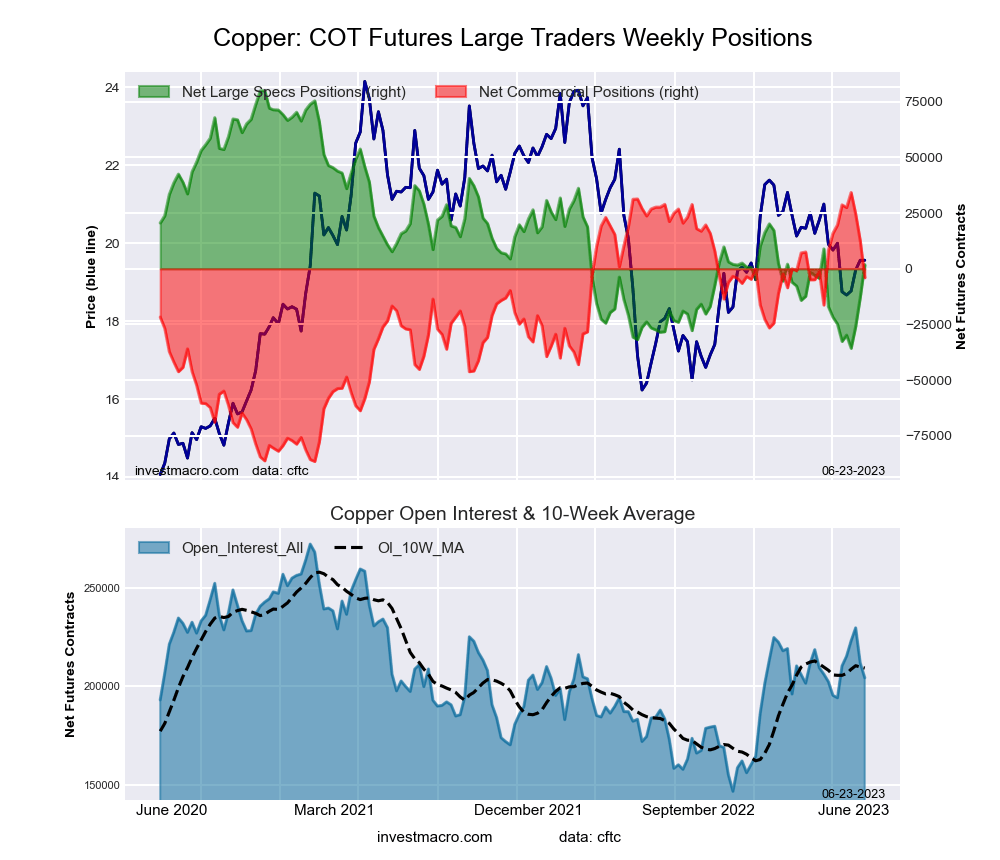
Copper speculator bets rebounded a bit this week after dropping for four weeks in a row and for six out of the past seven weeks. Copper positions have been dented by less than expected economic activity out of China and last week the Copper speculator positions dropped to the most bearish level in the past 165-weeks. Copper prices have also been on the downtrend since last year and have fallen approximately 25 percent from the highs of March 2022.

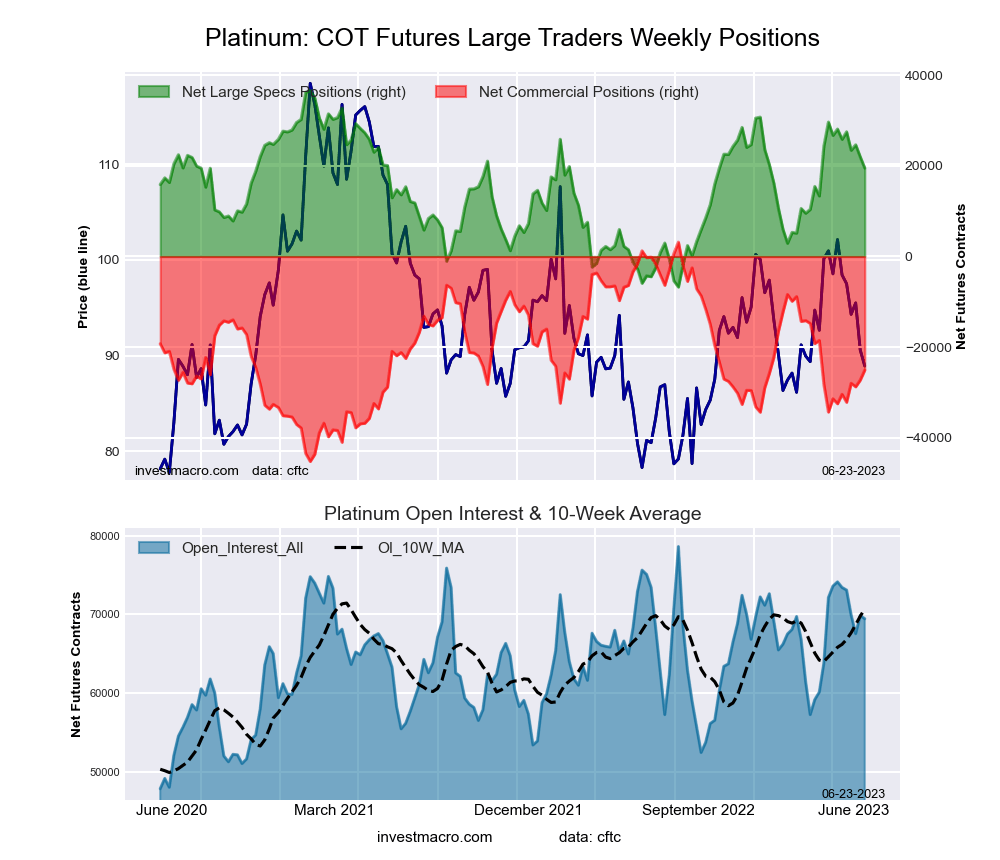
The Platinum speculative position continues to increase higher and has risen in six out of the past nine weeks. Platinum fundamentals have been boosted with car manufacturers starting to use more Platinum in their products, especially in electric vehicles. The futures price fell this week but has been in an uptrend since bottoming in September and recently touched its highest level in over a year at $1148.90 in late-April.


Data Snapshot of Commodity Market Traders | Columns Legend
May-23-2023OIOI-IndexSpec-NetSpec-IndexCom-NetCOM-IndexSmalls-NetSmalls-Index
Gold479,08026160,73248-187,0235226,29146
Silver135,7402121,95850-34,9725213,01439
Copper215,39455-29,808227,496972,31233
Palladium11,13871-5,289175,66985-38019
Platinum73,0798227,47979-32,157274,67831


Strength Scores led by Platinum & Steel

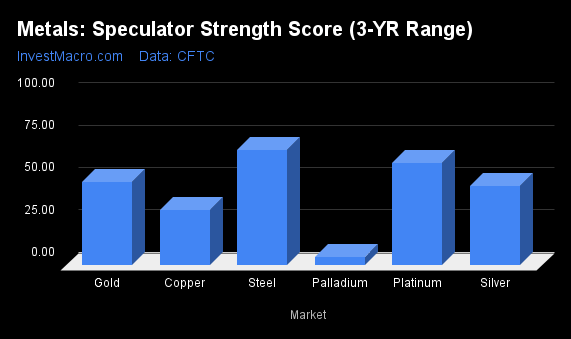
COT Strength Scores (a normalized measure of Speculator positions over a 3-Year range, from 0 to 100 where above 80 is Extreme-Bullish and below 20 is Extreme-Bearish) showed that Platinum (79 percent) and Steel (58 percent) lead the metals markets this week. Silver (50 percent) comes in as the next highest in the weekly strength scores.

On the downside, Copper (2 percent) and Palladium (17 percent) come in at the lowest strength levels currently and are in Extreme-Bearish territory (below 20 percent).

Strength Statistics:
Gold (47.8 percent) vs Gold previous week (56.2 percent)
Silver (49.6 percent) vs Silver previous week (52.2 percent)
Copper (2.5 percent) vs Copper previous week (0.0 percent)
Platinum (79.0 percent) vs Platinum previous week (75.2 percent)
Palladium (16.7 percent) vs Palladium previous week (20.1 percent)
Steel (57.8 percent) vs Palladium previous week (60.4 percent)


Platinum & Palladium top the 6-Week Strength Trends

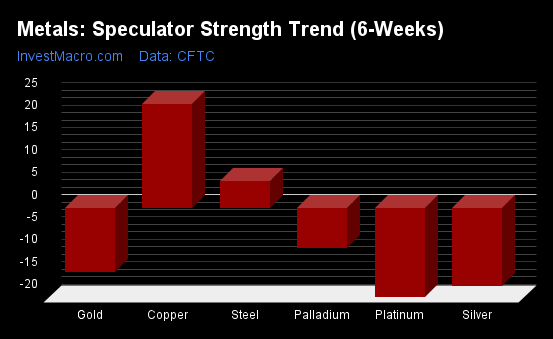
COT Strength Score Trends (or move index, calculates the 6-week changes in strength scores) showed that Platinum (33 percent) and Palladium (16 percent) lead the past six weeks trends for metals.

Copper (-23 percent) leads the downside trend scores currently with Gold (-14 percent) as the next market with lower trend scores.

Move Statistics:
Gold (-14.1 percent) vs Gold previous week (-6.8 percent)
Silver (-2.5 percent) vs Silver previous week (3.6 percent)
Copper (-22.6 percent) vs Copper previous week (-26.3 percent)
Platinum (32.6 percent) vs Platinum previous week (24.0 percent)
Palladium (16.5 percent) vs Palladium previous week (16.0 percent)
Steel (-0.6 percent) vs Steel previous week (-0.8 percent)


Individual Markets:

Gold Comex Futures:

Gold Futures COT ChartThe Gold Comex Futures large speculator standing this week equaled a net position of 160,732 contracts in the data reported through Tuesday. This was a weekly decline of -19,082 contracts from the previous week which had a total of 179,814 net contracts.

This week’s current strength score (the trader positioning range over the past three years, measured from 0 to 100) shows the speculators are currently Bearish with a score of 47.8 percent. The commercials are Bullish with a score of 51.7 percent and the small traders (not shown in chart) are Bearish with a score of 45.9 percent.

Gold Futures StatisticsSPECULATORSCOMMERCIALSSMALL TRADERS
– Percent of Open Interest Longs:49.329.810.3
– Percent of Open Interest Shorts:15.768.94.8
– Net Position:160,732-187,02326,291
– Gross Longs:236,149142,98449,327
– Gross Shorts:75,417330,00723,036
– Long to Short Ratio:3.1 to 10.4 to 12.1 to 1
NET POSITION TREND:
– Strength Index Score (3 Year Range Pct):47.851.745.9
– Strength Index Reading (3 Year Range):BearishBullishBearish
NET POSITION MOVEMENT INDEX:
– 6-Week Change in Strength Index:-14.111.46.3


Silver Comex Futures:

Silver Futures COT ChartThe Silver Comex Futures large speculator standing this week equaled a net position of 21,958 contracts in the data reported through Tuesday. This was a weekly lowering of -1,857 contracts from the previous week which had a total of 23,815 net contracts.

This week’s current strength score (the trader positioning range over the past three years, measured from 0 to 100) shows the speculators are currently Bearish with a score of 49.6 percent. The commercials are Bullish with a score of 51.5 percent and the small traders (not shown in chart) are Bearish with a score of 38.7 percent.

Silver Futures StatisticsSPECULATORSCOMMERCIALSSMALL TRADERS
– Percent of Open Interest Longs:41.831.118.9
– Percent of Open Interest Shorts:25.656.89.3
– Net Position:21,958-34,97213,014
– Gross Longs:56,68642,19425,655
– Gross Shorts:34,72877,16612,641
– Long to Short Ratio:1.6 to 10.5 to 12.0 to 1
NET POSITION TREND:
– Strength Index Score (3 Year Range Pct):49.651.538.7
– Strength Index Reading (3 Year Range):BearishBullishBearish
NET POSITION MOVEMENT INDEX:
– 6-Week Change in Strength Index:-2.51.62.7


Copper Grade #1 Futures:

Copper Futures COT ChartThe Copper Grade #1 Futures large speculator standing this week equaled a net position of -29,808 contracts in the data reported through Tuesday. This was a weekly boost of 2,799 contracts from the previous week which had a total of -32,607 net contracts.

This week’s current strength score (the trader positioning range over the past three years, measured from 0 to 100) shows the speculators are currently Bearish-Extreme with a score of 2.5 percent. The commercials are Bullish-Extreme with a score of 96.7 percent and the small traders (not shown in chart) are Bearish with a score of 33.1 percent.

Copper Futures StatisticsSPECULATORSCOMMERCIALSSMALL TRADERS
– Percent of Open Interest Longs:28.547.08.3
– Percent of Open Interest Shorts:42.434.27.3
– Net Position:-29,80827,4962,312
– Gross Longs:61,463101,16917,941
– Gross Shorts:91,27173,67315,629
– Long to Short Ratio:0.7 to 11.4 to 11.1 to 1
NET POSITION TREND:
– Strength Index Score (3 Year Range Pct):2.596.733.1
– Strength Index Reading (3 Year Range):Bearish-ExtremeBullish-ExtremeBearish
NET POSITION MOVEMENT INDEX:
– 6-Week Change in Strength Index:-22.624.4-20.2


Platinum Futures:

Platinum Futures COT ChartThe Platinum Futures large speculator standing this week equaled a net position of 27,479 contracts in the data reported through Tuesday. This was a weekly increase of 1,656 contracts from the previous week which had a total of 25,823 net contracts.

This week’s current strength score (the trader positioning range over the past three years, measured from 0 to 100) shows the speculators are currently Bullish with a score of 79.0 percent. The commercials are Bearish with a score of 27.0 percent and the small traders (not shown in chart) are Bearish with a score of 30.8 percent.

Platinum Futures StatisticsSPECULATORSCOMMERCIALSSMALL TRADERS
– Percent of Open Interest Longs:56.427.010.0
– Percent of Open Interest Shorts:18.871.03.6
– Net Position:27,479-32,1574,678
– Gross Longs:41,24619,6987,306
– Gross Shorts:13,76751,8552,628
– Long to Short Ratio:3.0 to 10.4 to 12.8 to 1
NET POSITION TREND:
– Strength Index Score (3 Year Range Pct):79.027.030.8
– Strength Index Reading (3 Year Range):BullishBearishBearish
NET POSITION MOVEMENT INDEX:
– 6-Week Change in Strength Index:32.6-28.2-6.7


Palladium Futures:

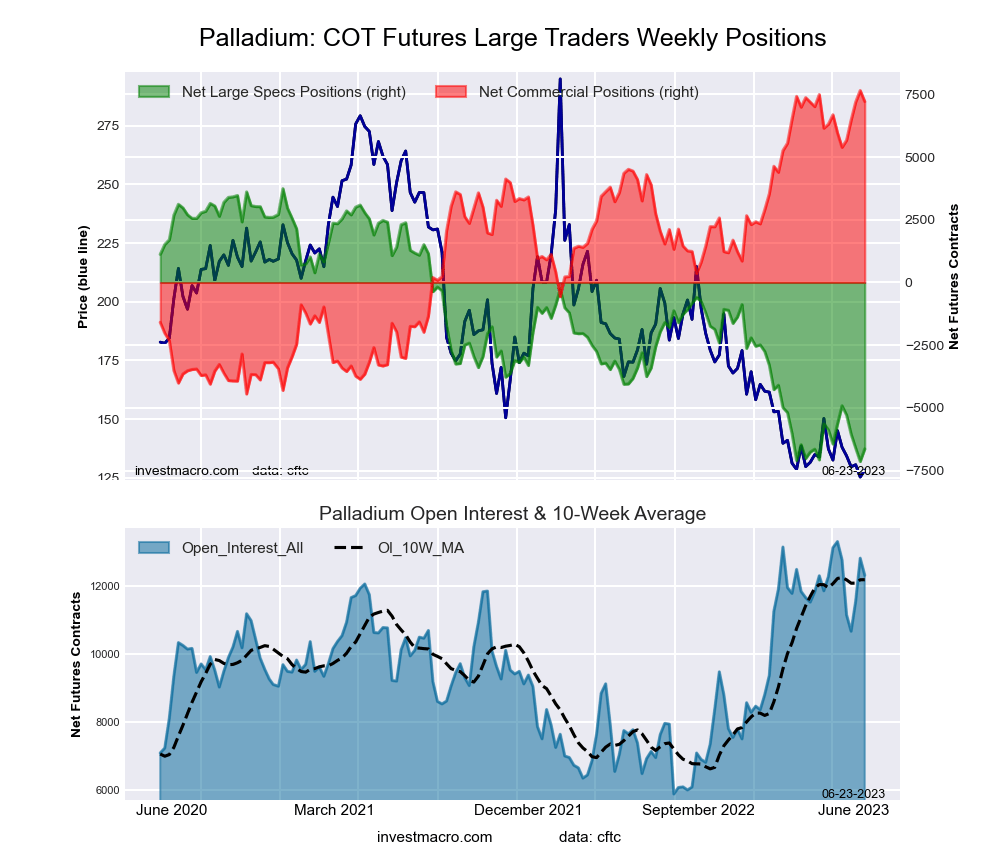
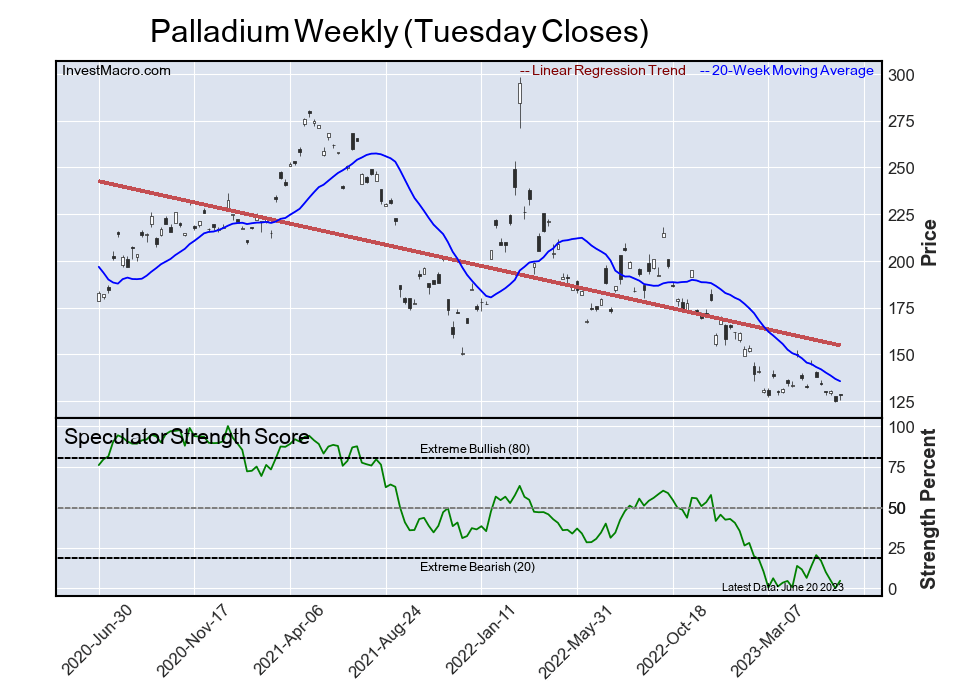
Palladium Futures COT ChartThe Palladium Futures large speculator standing this week equaled a net position of -5,289 contracts in the data reported through Tuesday. This was a weekly decrease of -373 contracts from the previous week which had a total of -4,916 net contracts.

This week’s current strength score (the trader positioning range over the past three years, measured from 0 to 100) shows the speculators are currently Bearish-Extreme with a score of 16.7 percent. The commercials are Bullish-Extreme with a score of 84.7 percent and the small traders (not shown in chart) are Bearish-Extreme with a score of 18.9 percent.

Palladium Futures StatisticsSPECULATORSCOMMERCIALSSMALL TRADERS
– Percent of Open Interest Longs:15.466.412.4
– Percent of Open Interest Shorts:62.915.515.8
– Net Position:-5,2895,669-380
– Gross Longs:1,7207,4001,379
– Gross Shorts:7,0091,7311,759
– Long to Short Ratio:0.2 to 14.3 to 10.8 to 1
NET POSITION TREND:
– Strength Index Score (3 Year Range Pct):16.784.718.9
– Strength Index Reading (3 Year Range):Bearish-ExtremeBullish-ExtremeBearish-Extreme
NET POSITION MOVEMENT INDEX:
– 6-Week Change in Strength Index:16.5-15.32.3


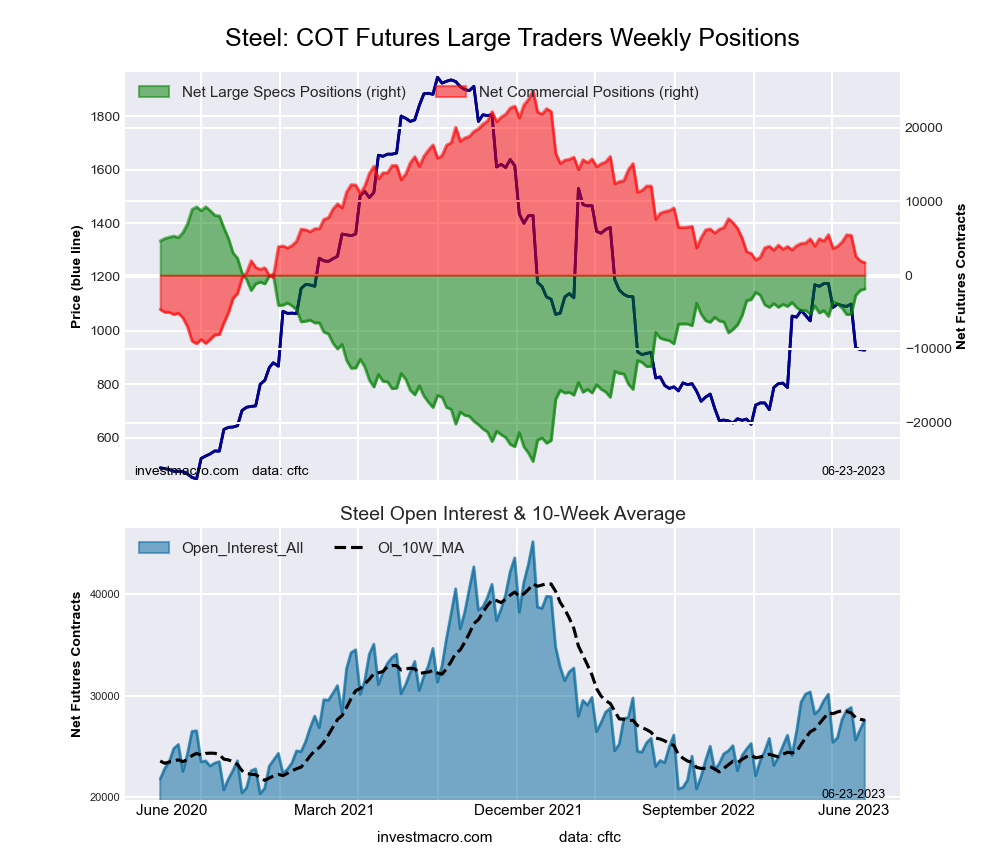
Steel Futures Futures:

Steel Futures COT ChartThe Steel Futures large speculator standing this week equaled a net position of -5,311 contracts in the data reported through Tuesday. This was a weekly fall of -891 contracts from the previous week which had a total of -4,420 net contracts.

This week’s current strength score (the trader positioning range over the past three years, measured from 0 to 100) shows the speculators are currently Bullish with a score of 57.8 percent. The commercials are Bearish with a score of 42.9 percent and the small traders (not shown in chart) are Bearish-Extreme with a score of 0.0 percent.

Steel Futures StatisticsSPECULATORSCOMMERCIALSSMALL TRADERS
– Percent of Open Interest Longs:7.482.60.7
– Percent of Open Interest Shorts:26.063.51.2
– Net Position:-5,3115,467-156
– Gross Longs:2,11223,604191
– Gross Shorts:7,42318,137347
– Long to Short Ratio:0.3 to 11.3 to 10.6 to 1
NET POSITION TREND:
– Strength Index Score (3 Year Range Pct):57.842.90.0
– Strength Index Reading (3 Year Range):BullishBearishBearish-Extreme
NET POSITION MOVEMENT INDEX:
– 6-Week Change in Strength Index:-0.61.5-40.4


Article By InvestMacroReceive our weekly COT Newsletter

*COT Report: The COT data, released weekly to the public each Friday, is updated through the most recent Tuesday (data is 3 days old) and shows a quick view of how large speculators or non-commercials (for-profit traders) were positioned in the futures markets.

The CFTC categorizes trader positions according to commercial hedgers (traders who use futures contracts for hedging as part of the business), non-commercials (large traders who speculate to realize trading profits) and nonreportable traders (usually small traders/speculators) as well as their open interest (contracts open in the market at time of reporting). See CFTC criteria here.

Soft Commodities: Cotton Speculators boost their bullish bets

By InvestMacro

Here are the latest charts and statistics for the Commitment of Traders (COT) reports data published by the Commodities Futures Trading Commission (CFTC).

The latest COT data is updated through Tuesday May 23rd and shows a quick view of how large traders (for-profit speculators and commercial entities) were positioned in the futures markets.

Weekly Speculator Changes led by Cotton & Sugar

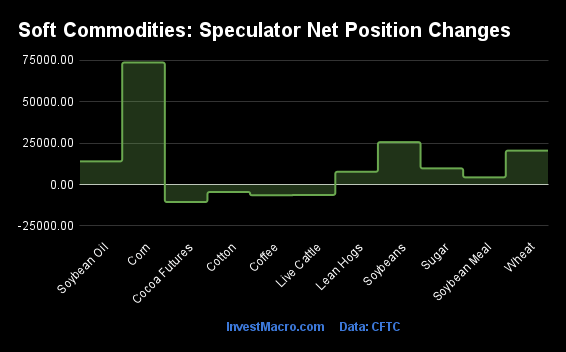
The COT soft commodities markets speculator bets were lower this week as five out of the eleven softs markets we cover had higher positioning while the other six markets had lower speculator contracts.

Leading the gains for the softs markets was Cotton (20,764 contracts) with Sugar (2,981 contracts), Coffee (1,713 contracts), Soybean Oil (1,620 contracts) and Cocoa (1,319 contracts) also showing positive weeks.

The markets with the declines in speculator bets this week were Corn (-13,808 contracts) with Soybeans (-8,949 contracts), Soybean Meal (-2,319 contracts), Wheat (-4,907 contracts), Live Cattle (-469 contracts) and Lean Hogs (-5,118 contracts) also registering lower bets on the week.

Highlights of Weekly positions:

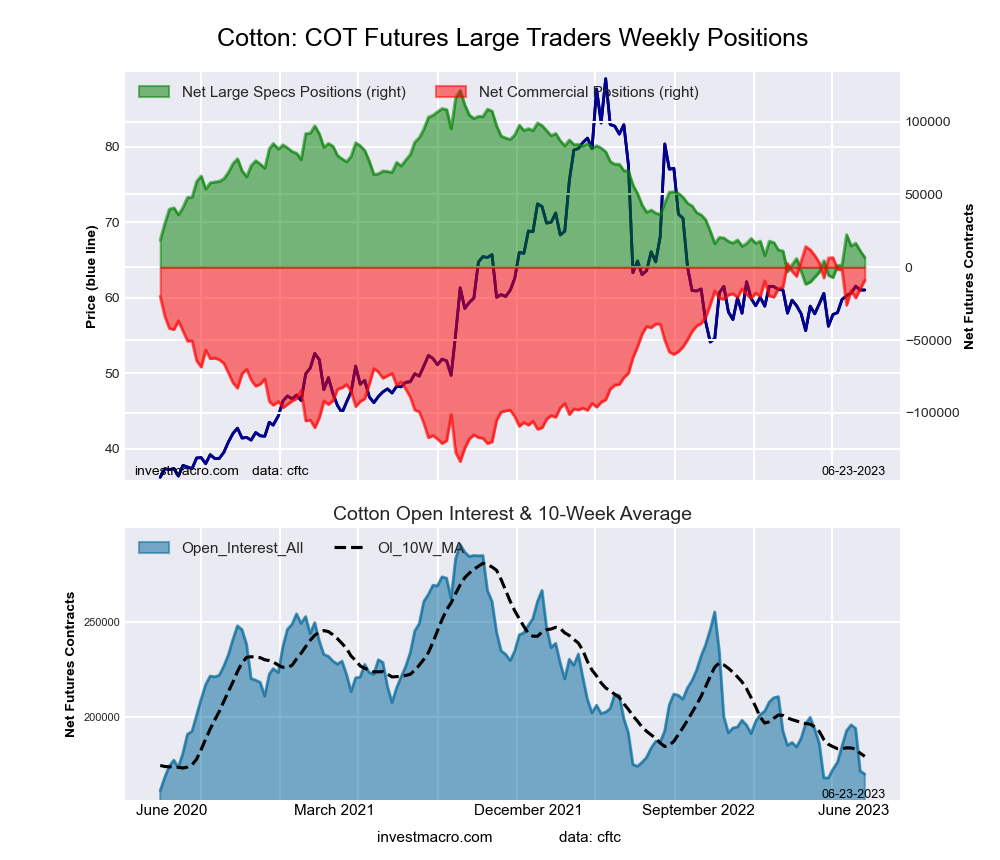
Cotton speculative bets this week (+20,764 contracts) jumped by the highest weekly amount in over a year. This has brought the current speculator standing to the most bullish level (+22,319 contracts) since October of 2021. Cotton prices have had a big downfall since their highs in May of 2022 with a peak-to-trough drop of over 50 percent but looked to have bottomed for the time being.

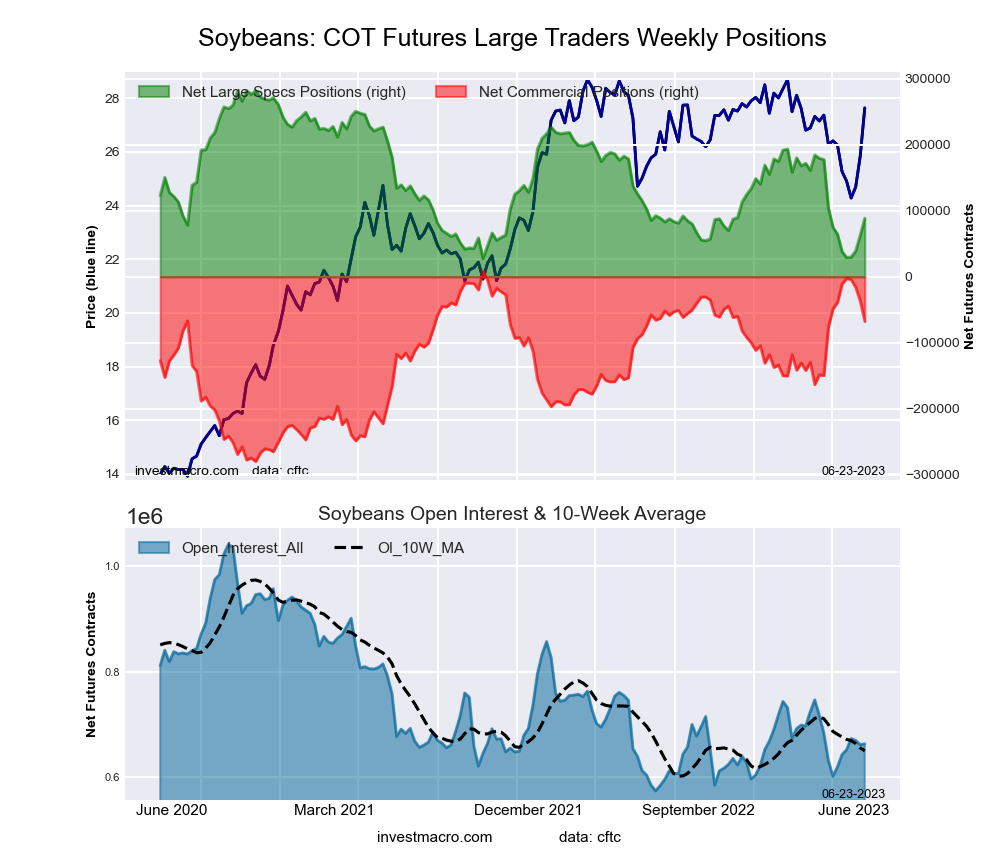
Soybeans bets have dropped sharply over the past two months with speculator positions falling for seven straight weeks. The current net position for Soybeans is at the lowest level since November of 2021 due to an expectation of a record crop in the United States.

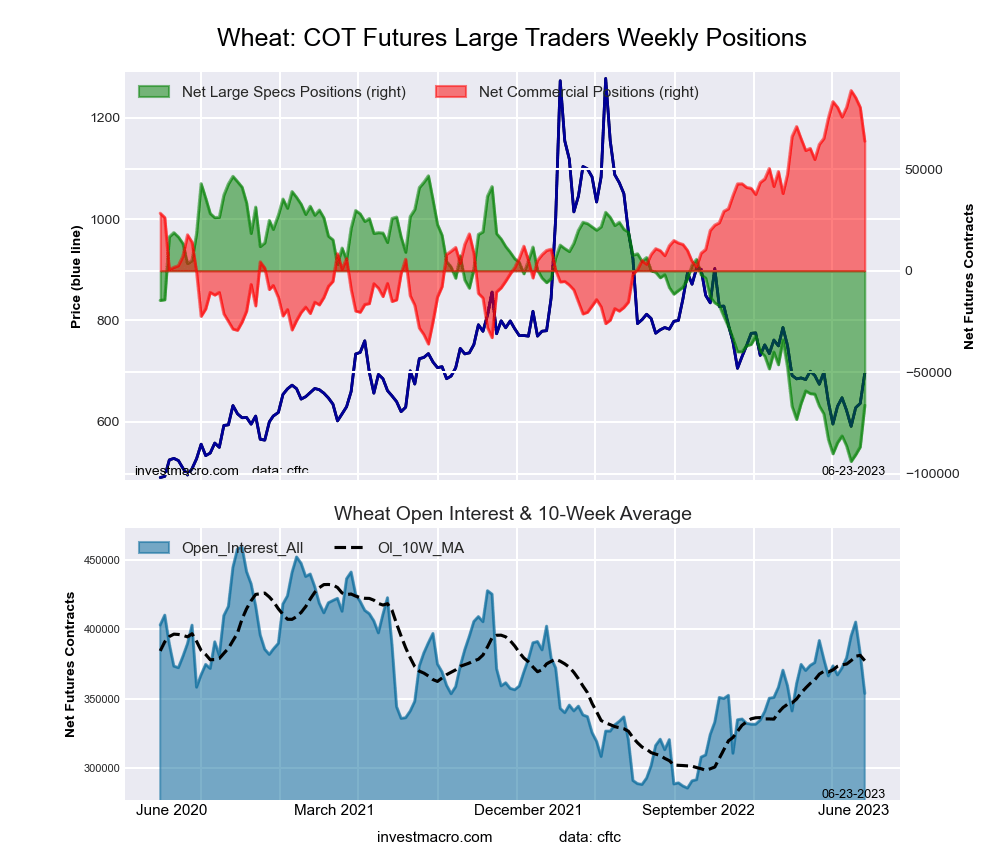
Wheat speculator bets dipped again this week and have declined in ten out of the past fourteen weeks. Wheat prices have cooled off markedly since screaming higher at the onset of the Russian invasion of Ukraine. The futures price has fallen over 50 percent from the highest levels of 2022 and has recently crossed below the 200-week moving average.

Corn speculator positions declined this week and have now fallen by a total of -167,903 contracts over the past 5-week period. This recent bearishness has brought the speculator positioning into an overall bearish level for the first time since August of 2020. Like many of the other agriculture soft commodities, Corn prices are down from their 2022 highs with the current Corn level lower by about 25 percent from May 2022.


Data Snapshot of Commodity Market Traders | Columns Legend
May-23-2023OIOI-IndexSpec-NetSpec-IndexCom-NetCOM-IndexSmalls-NetSmalls-Index
WTI Crude1,847,90140193,1199-217,3869124,26728
Gold479,08026160,73248-187,0235226,29146
Silver135,7402121,95850-34,9725213,01439
Copper215,39455-29,808227,496972,31233
Palladium11,13871-5,289175,66985-38019
Platinum73,0798227,47979-32,157274,67831
Natural Gas1,338,86876-112,2782780,8377231,44155
Brent146,77619-47,8061045,210922,59644
Heating Oil306,360399,09743-16,705807,60825
Soybeans651,2481729,2051-2,40496-26,80128
Corn1,299,84114-62,26722115,83288-53,56523
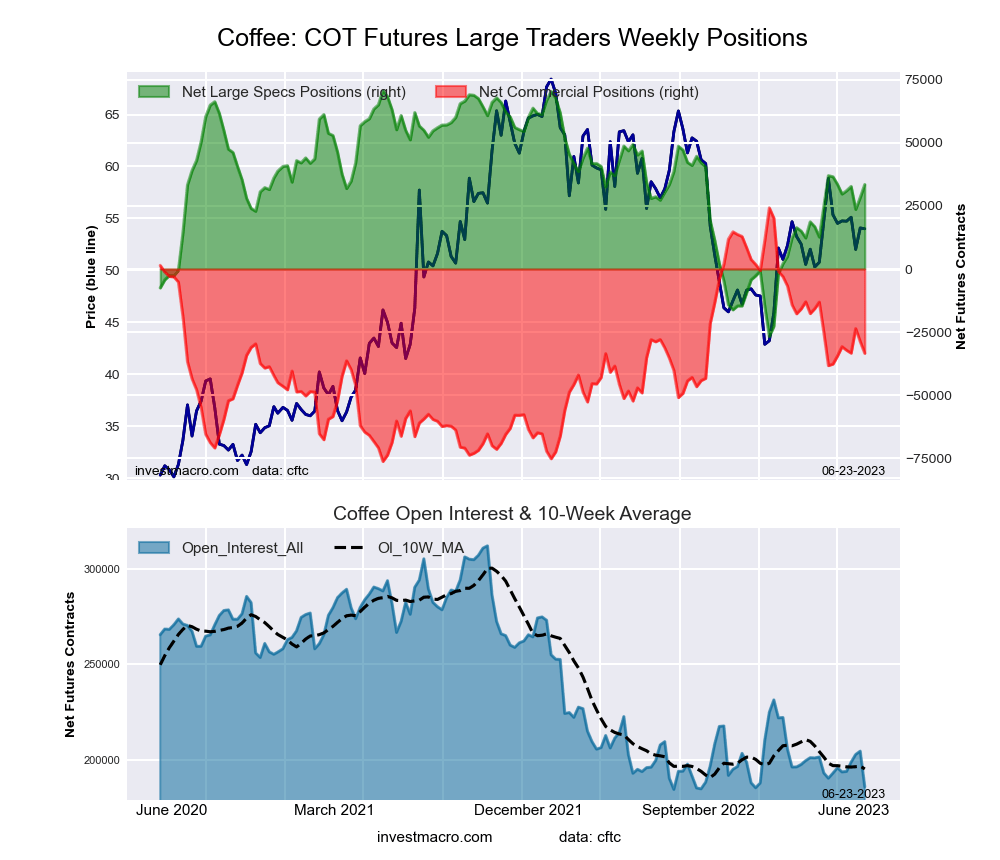
Coffee198,6831132,74861-33,3734362520
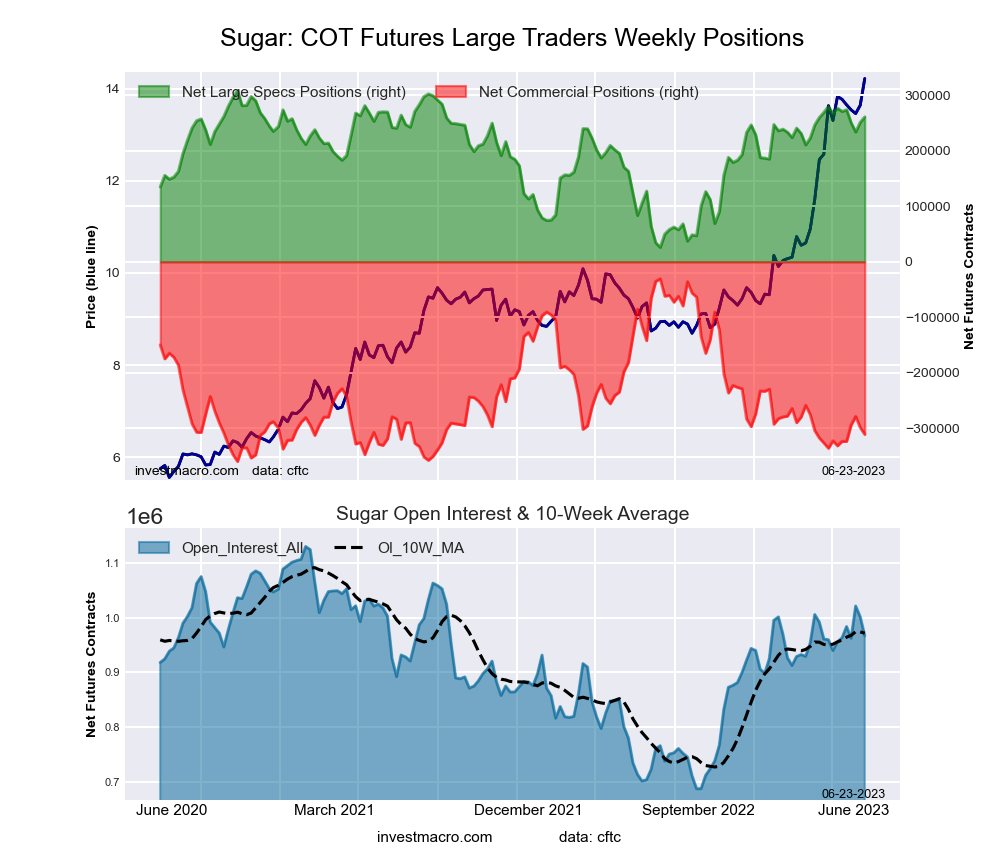
Sugar983,88767273,81088-323,3231149,51367
Wheat379,45354-86,319380,586985,73393


Strength Scores led by Cocoa & Live Cattle

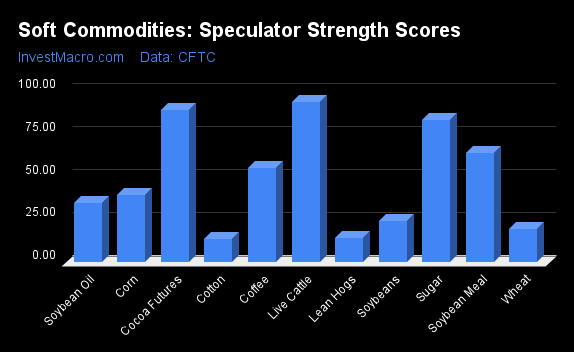
COT Strength Scores (a normalized measure of Speculator positions over a 3-Year range, from 0 to 100 where above 80 is Extreme-Bullish and below 20 is Extreme-Bearish) showed that Cocoa (100 percent) and Live Cattle (92 percent) lead the softs markets this week. Sugar (88 percent), Soybean Meal (65 percent) and Coffee (61 percent) come in as the next highest in the weekly strength scores.

On the downside, Lean Hogs (0 percent), Soybean Oil (1 percent), Soybeans (1 percent) and the Wheat (3 percent) come in at the lowest strength levels currently and are in Extreme-Bearish territory (below 20 percent).

Strength Statistics:
Corn (22.1 percent) vs Corn previous week (23.8 percent)
Sugar (87.7 percent) vs Sugar previous week (86.7 percent)
Coffee (61.0 percent) vs Coffee previous week (59.3 percent)
Soybeans (0.6 percent) vs Soybeans previous week (4.2 percent)
Soybean Oil (0.9 percent) vs Soybean Oil previous week (0.0 percent)
Soybean Meal (65.1 percent) vs Soybean Meal previous week (66.3 percent)
Live Cattle (92.1 percent) vs Live Cattle previous week (92.6 percent)
Lean Hogs (0.0 percent) vs Lean Hogs previous week (4.3 percent)
Cotton (25.5 percent) vs Cotton previous week (9.9 percent)
Cocoa (100.0 percent) vs Cocoa previous week (98.4 percent)
Wheat (2.8 percent) vs Wheat previous week (6.4 percent)


Cotton & Coffee top the 6-Week Strength Trends

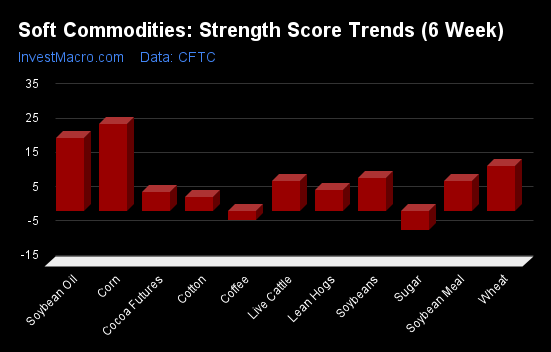
COT Strength Score Trends (or move index, calculates the 6-week changes in strength scores) showed that Cotton (19 percent) and Coffee (8 percent) lead the past six weeks trends for soft commodities. Live Cattle (8 percent), Cocoa (7 percent) and Sugar (5 percent) are the next highest positive movers in the latest trends data.

Soybeans (-59 percent) leads the downside trend scores currently with Corn (-21 percent), Wheat (-14 percent) and Soybean Oil (-13 percent) following next with lower trend scores.

Strength Trend Statistics:
Corn (-21.2 percent) vs Corn previous week (-17.1 percent)
Sugar (5.0 percent) vs Sugar previous week (8.6 percent)
Coffee (8.1 percent) vs Coffee previous week (18.9 percent)
Soybeans (-59.0 percent) vs Soybeans previous week (-57.4 percent)
Soybean Oil (-12.6 percent) vs Soybean Oil previous week (-11.8 percent)
Soybean Meal (-3.1 percent) vs Soybean Meal previous week (-0.4 percent)
Live Cattle (7.9 percent) vs Live Cattle previous week (17.9 percent)
Lean Hogs (-8.2 percent) vs Lean Hogs previous week (-7.5 percent)
Cotton (19.3 percent) vs Cotton previous week (6.2 percent)
Cocoa (6.6 percent) vs Cocoa previous week (4.6 percent)
Wheat (-14.3 percent) vs Wheat previous week (-15.0 percent)


Individual Soft Commodities Markets:

CORN Futures:

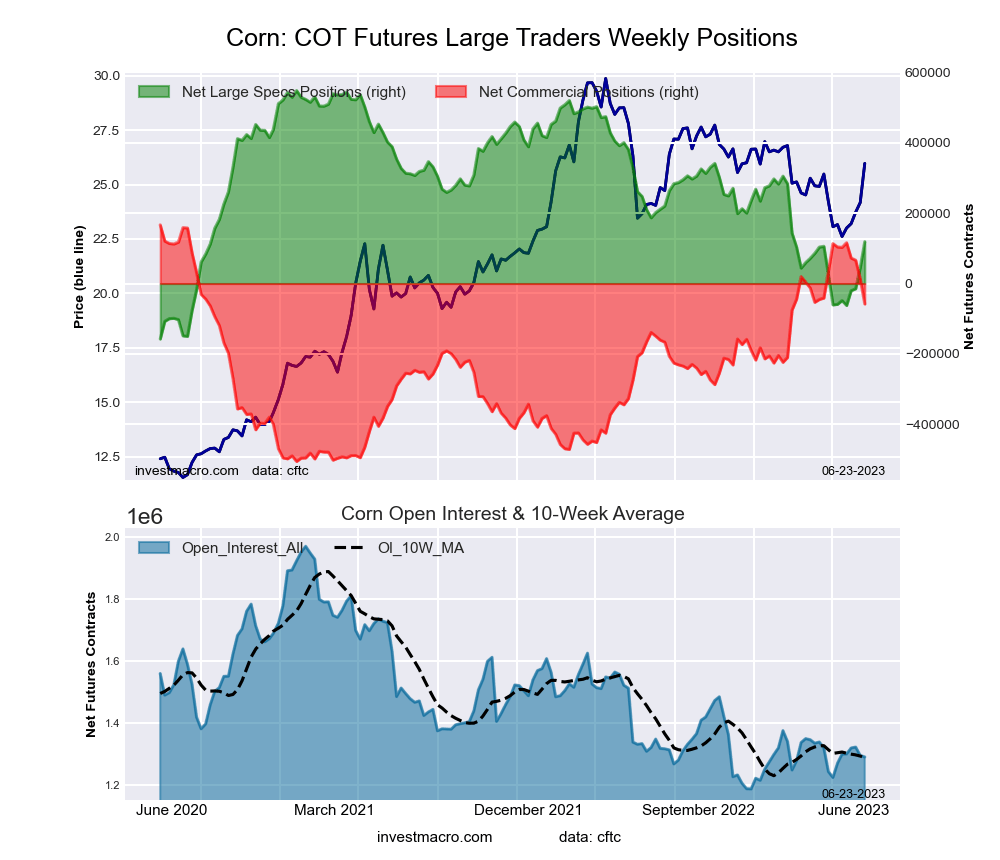
CORN Futures COT ChartThe CORN large speculator standing this week equaled a net position of -62,267 contracts in the data reported through Tuesday. This was a weekly lowering of -13,808 contracts from the previous week which had a total of -48,459 net contracts.

This week’s current strength score (the trader positioning range over the past three years, measured from 0 to 100) shows the speculators are currently Bearish with a score of 22.1 percent. The commercials are Bullish-Extreme with a score of 88.4 percent and the small traders (not shown in chart) are Bearish with a score of 22.6 percent.

CORN Futures StatisticsSPECULATORSCOMMERCIALSSMALL TRADERS
– Percent of Open Interest Longs:21.852.59.0
– Percent of Open Interest Shorts:26.643.613.1
– Net Position:-62,267115,832-53,565
– Gross Longs:282,880682,886116,884
– Gross Shorts:345,147567,054170,449
– Long to Short Ratio:0.8 to 11.2 to 10.7 to 1
NET POSITION TREND:
– Strength Index Score (3 Year Range Pct):22.188.422.6
– Strength Index Reading (3 Year Range):BearishBullish-ExtremeBearish
NET POSITION MOVEMENT INDEX:
– 6-Week Change in Strength Index:-21.222.93.7


SUGAR Futures:

SUGAR Futures COT ChartThe SUGAR large speculator standing this week equaled a net position of 273,810 contracts in the data reported through Tuesday. This was a weekly increase of 2,981 contracts from the previous week which had a total of 270,829 net contracts.

This week’s current strength score (the trader positioning range over the past three years, measured from 0 to 100) shows the speculators are currently Bullish-Extreme with a score of 87.7 percent. The commercials are Bearish-Extreme with a score of 11.0 percent and the small traders (not shown in chart) are Bullish with a score of 67.1 percent.

SUGAR Futures StatisticsSPECULATORSCOMMERCIALSSMALL TRADERS
– Percent of Open Interest Longs:35.639.29.4
– Percent of Open Interest Shorts:7.872.14.3
– Net Position:273,810-323,32349,513
– Gross Longs:350,244386,15092,284
– Gross Shorts:76,434709,47342,771
– Long to Short Ratio:4.6 to 10.5 to 12.2 to 1
NET POSITION TREND:
– Strength Index Score (3 Year Range Pct):87.711.067.1
– Strength Index Reading (3 Year Range):Bullish-ExtremeBearish-ExtremeBullish
NET POSITION MOVEMENT INDEX:
– 6-Week Change in Strength Index:5.0-1.8-10.5


COFFEE Futures:

COFFEE Futures COT ChartThe COFFEE large speculator standing this week equaled a net position of 32,748 contracts in the data reported through Tuesday. This was a weekly gain of 1,713 contracts from the previous week which had a total of 31,035 net contracts.

This week’s current strength score (the trader positioning range over the past three years, measured from 0 to 100) shows the speculators are currently Bullish with a score of 61.0 percent. The commercials are Bearish with a score of 42.7 percent and the small traders (not shown in chart) are Bearish with a score of 20.2 percent.

COFFEE Futures StatisticsSPECULATORSCOMMERCIALSSMALL TRADERS
– Percent of Open Interest Longs:27.044.63.7
– Percent of Open Interest Shorts:10.561.43.3
– Net Position:32,748-33,373625
– Gross Longs:53,68788,6287,267
– Gross Shorts:20,939122,0016,642
– Long to Short Ratio:2.6 to 10.7 to 11.1 to 1
NET POSITION TREND:
– Strength Index Score (3 Year Range Pct):61.042.720.2
– Strength Index Reading (3 Year Range):BullishBearishBearish
NET POSITION MOVEMENT INDEX:
– 6-Week Change in Strength Index:8.1-8.13.2


SOYBEANS Futures:

SOYBEANS Futures COT ChartThe SOYBEANS large speculator standing this week equaled a net position of 29,205 contracts in the data reported through Tuesday. This was a weekly lowering of -8,949 contracts from the previous week which had a total of 38,154 net contracts.

This week’s current strength score (the trader positioning range over the past three years, measured from 0 to 100) shows the speculators are currently Bearish-Extreme with a score of 0.6 percent. The commercials are Bullish-Extreme with a score of 96.0 percent and the small traders (not shown in chart) are Bearish with a score of 28.4 percent.

SOYBEANS Futures StatisticsSPECULATORSCOMMERCIALSSMALL TRADERS
– Percent of Open Interest Longs:21.353.96.8
– Percent of Open Interest Shorts:16.854.311.0
– Net Position:29,205-2,404-26,801
– Gross Longs:138,687351,02444,581
– Gross Shorts:109,482353,42871,382
– Long to Short Ratio:1.3 to 11.0 to 10.6 to 1
NET POSITION TREND:
– Strength Index Score (3 Year Range Pct):0.696.028.4
– Strength Index Reading (3 Year Range):Bearish-ExtremeBullish-ExtremeBearish
NET POSITION MOVEMENT INDEX:
– 6-Week Change in Strength Index:-59.050.67.0


SOYBEAN OIL Futures:

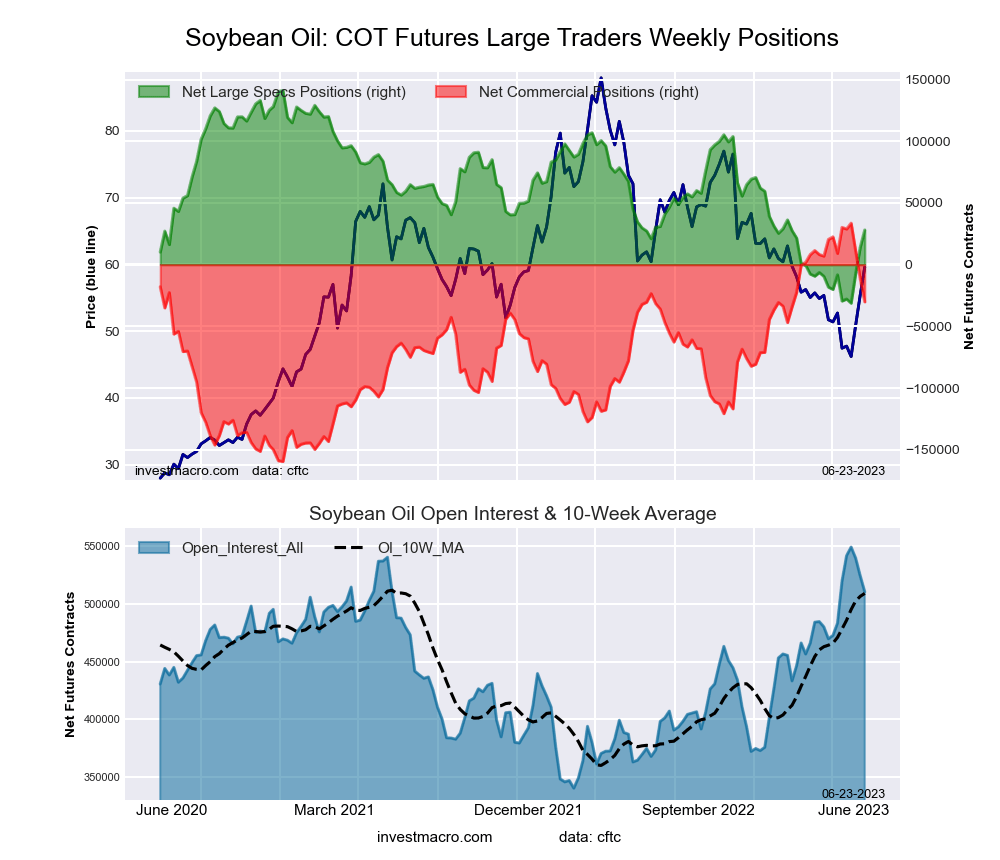
SOYBEAN OIL Futures COT ChartThe SOYBEAN OIL large speculator standing this week equaled a net position of -27,863 contracts in the data reported through Tuesday. This was a weekly lift of 1,620 contracts from the previous week which had a total of -29,483 net contracts.

This week’s current strength score (the trader positioning range over the past three years, measured from 0 to 100) shows the speculators are currently Bearish-Extreme with a score of 0.9 percent. The commercials are Bullish-Extreme with a score of 99.3 percent and the small traders (not shown in chart) are Bearish-Extreme with a score of 5.6 percent.

SOYBEAN OIL Futures StatisticsSPECULATORSCOMMERCIALSSMALL TRADERS
– Percent of Open Interest Longs:16.055.85.6
– Percent of Open Interest Shorts:21.250.55.8
– Net Position:-27,86328,911-1,048
– Gross Longs:86,842302,24830,161
– Gross Shorts:114,705273,33731,209
– Long to Short Ratio:0.8 to 11.1 to 11.0 to 1
NET POSITION TREND:
– Strength Index Score (3 Year Range Pct):0.999.35.6
– Strength Index Reading (3 Year Range):Bearish-ExtremeBullish-ExtremeBearish-Extreme
NET POSITION MOVEMENT INDEX:
– 6-Week Change in Strength Index:-12.610.93.0


SOYBEAN MEAL Futures:

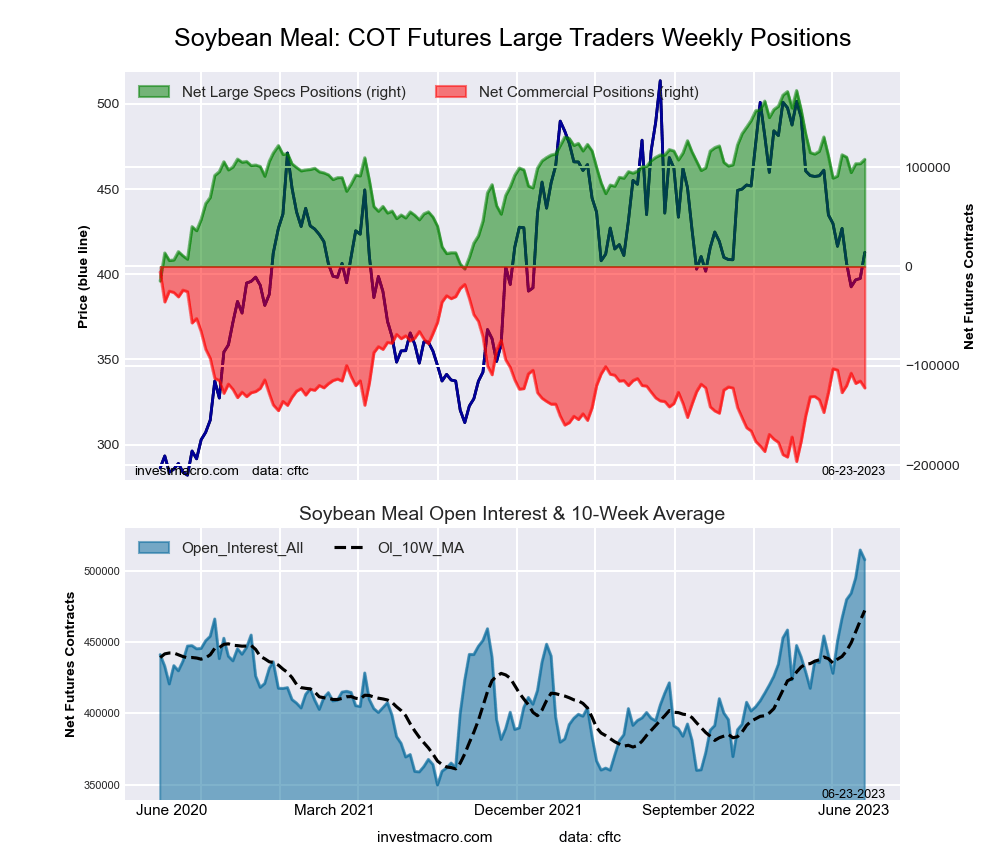
SOYBEAN MEAL Futures COT ChartThe SOYBEAN MEAL large speculator standing this week equaled a net position of 110,022 contracts in the data reported through Tuesday. This was a weekly decline of -2,319 contracts from the previous week which had a total of 112,341 net contracts.

This week’s current strength score (the trader positioning range over the past three years, measured from 0 to 100) shows the speculators are currently Bullish with a score of 65.1 percent. The commercials are Bearish with a score of 40.0 percent and the small traders (not shown in chart) are Bearish-Extreme with a score of 0.0 percent.

SOYBEAN MEAL Futures StatisticsSPECULATORSCOMMERCIALSSMALL TRADERS
– Percent of Open Interest Longs:28.538.49.1
– Percent of Open Interest Shorts:5.563.47.0
– Net Position:110,022-119,9029,880
– Gross Longs:136,546184,27143,425
– Gross Shorts:26,524304,17333,545
– Long to Short Ratio:5.1 to 10.6 to 11.3 to 1
NET POSITION TREND:
– Strength Index Score (3 Year Range Pct):65.140.00.0
– Strength Index Reading (3 Year Range):BullishBearishBearish-Extreme
NET POSITION MOVEMENT INDEX:
– 6-Week Change in Strength Index:-3.17.4-36.9


LIVE CATTLE Futures:

LIVE CATTLE Futures COT ChartThe LIVE CATTLE large speculator standing this week equaled a net position of 101,647 contracts in the data reported through Tuesday. This was a weekly fall of -469 contracts from the previous week which had a total of 102,116 net contracts.

This week’s current strength score (the trader positioning range over the past three years, measured from 0 to 100) shows the speculators are currently Bullish-Extreme with a score of 92.1 percent. The commercials are Bearish-Extreme with a score of 12.2 percent and the small traders (not shown in chart) are Bearish with a score of 24.0 percent.

LIVE CATTLE Futures StatisticsSPECULATORSCOMMERCIALSSMALL TRADERS
– Percent of Open Interest Longs:45.627.09.7
– Percent of Open Interest Shorts:15.054.113.3
– Net Position:101,647-89,891-11,756
– Gross Longs:151,17889,34432,235
– Gross Shorts:49,531179,23543,991
– Long to Short Ratio:3.1 to 10.5 to 10.7 to 1
NET POSITION TREND:
– Strength Index Score (3 Year Range Pct):92.112.224.0
– Strength Index Reading (3 Year Range):Bullish-ExtremeBearish-ExtremeBearish
NET POSITION MOVEMENT INDEX:
– 6-Week Change in Strength Index:7.9-2.6-27.2


LEAN HOGS Futures:

LEAN HOGS Futures COT ChartThe LEAN HOGS large speculator standing this week equaled a net position of -33,852 contracts in the data reported through Tuesday. This was a weekly fall of -5,118 contracts from the previous week which had a total of -28,734 net contracts.

This week’s current strength score (the trader positioning range over the past three years, measured from 0 to 100) shows the speculators are currently Bearish-Extreme with a score of 0.0 percent. The commercials are Bullish-Extreme with a score of 100.0 percent and the small traders (not shown in chart) are Bullish-Extreme with a score of 98.8 percent.

LEAN HOGS Futures StatisticsSPECULATORSCOMMERCIALSSMALL TRADERS
– Percent of Open Interest Longs:25.837.810.6
– Percent of Open Interest Shorts:40.324.79.1
– Net Position:-33,85230,4053,447
– Gross Longs:60,03388,00324,705
– Gross Shorts:93,88557,59821,258
– Long to Short Ratio:0.6 to 11.5 to 11.2 to 1
NET POSITION TREND:
– Strength Index Score (3 Year Range Pct):0.0100.098.8
– Strength Index Reading (3 Year Range):Bearish-ExtremeBullish-ExtremeBullish-Extreme
NET POSITION MOVEMENT INDEX:
– 6-Week Change in Strength Index:-8.28.04.4


COTTON Futures:

COTTON Futures COT ChartThe COTTON large speculator standing this week equaled a net position of 22,319 contracts in the data reported through Tuesday. This was a weekly rise of 20,764 contracts from the previous week which had a total of 1,555 net contracts.

This week’s current strength score (the trader positioning range over the past three years, measured from 0 to 100) shows the speculators are currently Bearish with a score of 25.5 percent. The commercials are Bullish with a score of 72.7 percent and the small traders (not shown in chart) are Bearish with a score of 38.5 percent.

COTTON Futures StatisticsSPECULATORSCOMMERCIALSSMALL TRADERS
– Percent of Open Interest Longs:32.946.06.7
– Percent of Open Interest Shorts:21.459.54.8
– Net Position:22,319-26,0173,698
– Gross Longs:63,54088,72213,024
– Gross Shorts:41,221114,7399,326
– Long to Short Ratio:1.5 to 10.8 to 11.4 to 1
NET POSITION TREND:
– Strength Index Score (3 Year Range Pct):25.572.738.5
– Strength Index Reading (3 Year Range):BearishBullishBearish
NET POSITION MOVEMENT INDEX:
– 6-Week Change in Strength Index:19.3-19.721.1


COCOA Futures:

COCOA Futures COT ChartThe COCOA large speculator standing this week equaled a net position of 65,374 contracts in the data reported through Tuesday. This was a weekly increase of 1,319 contracts from the previous week which had a total of 64,055 net contracts.

This week’s current strength score (the trader positioning range over the past three years, measured from 0 to 100) shows the speculators are currently Bullish-Extreme with a score of 100.0 percent. The commercials are Bearish-Extreme with a score of 0.0 percent and the small traders (not shown in chart) are Bullish with a score of 50.3 percent.

COCOA Futures StatisticsSPECULATORSCOMMERCIALSSMALL TRADERS
– Percent of Open Interest Longs:42.429.04.7
– Percent of Open Interest Shorts:23.050.13.1
– Net Position:65,374-70,7455,371
– Gross Longs:142,43897,45215,901
– Gross Shorts:77,064168,19710,530
– Long to Short Ratio:1.8 to 10.6 to 11.5 to 1
NET POSITION TREND:
– Strength Index Score (3 Year Range Pct):100.00.050.3
– Strength Index Reading (3 Year Range):Bullish-ExtremeBearish-ExtremeBullish
NET POSITION MOVEMENT INDEX:
– 6-Week Change in Strength Index:6.6-6.82.1


WHEAT Futures:

WHEAT Futures COT ChartThe WHEAT large speculator standing this week equaled a net position of -86,319 contracts in the data reported through Tuesday. This was a weekly reduction of -4,907 contracts from the previous week which had a total of -81,412 net contracts.

This week’s current strength score (the trader positioning range over the past three years, measured from 0 to 100) shows the speculators are currently Bearish-Extreme with a score of 2.8 percent. The commercials are Bullish-Extreme with a score of 97.7 percent and the small traders (not shown in chart) are Bullish-Extreme with a score of 92.8 percent.

WHEAT Futures StatisticsSPECULATORSCOMMERCIALSSMALL TRADERS
– Percent of Open Interest Longs:29.637.29.8
– Percent of Open Interest Shorts:52.416.08.3
– Net Position:-86,31980,5865,733
– Gross Longs:112,390141,28237,340
– Gross Shorts:198,70960,69631,607
– Long to Short Ratio:0.6 to 12.3 to 11.2 to 1
NET POSITION TREND:
– Strength Index Score (3 Year Range Pct):2.897.792.8
– Strength Index Reading (3 Year Range):Bearish-ExtremeBullish-ExtremeBullish-Extreme
NET POSITION MOVEMENT INDEX:
– 6-Week Change in Strength Index:-14.315.34.7


Article By InvestMacroReceive our weekly COT Newsletter

*COT Report: The COT data, released weekly to the public each Friday, is updated through the most recent Tuesday (data is 3 days old) and shows a quick view of how large speculators or non-commercials (for-profit traders) were positioned in the futures markets.

The CFTC categorizes trader positions according to commercial hedgers (traders who use futures contracts for hedging as part of the business), non-commercials (large traders who speculate to realize trading profits) and nonreportable traders (usually small traders/speculators) as well as their open interest (contracts open in the market at time of reporting). See CFTC criteria here.

Week Ahead: On the brink of crisis

By ForexTime 

Despite the holiday-shortened week ahead for US and UK financial markets, the US debt ceiling saga will remain centre stage as the clock ticks towards a potential June 1st “hard deadline”.

On top of this, traders will be dished up a series of top-tier economic data including the NFP, which could trigger more market volatility:

Monday, May 29

  • US Memorial Day Holiday

Tuesday, May 30

  • EUR: Eurozone economic confidence, consumer confidence
  • USD: US Consumer confidence, Richmond Fed President Thomas Barkin speech

Wednesday, May 31

  • CNH: China Manufacturing PMI, non-manufacturing PMI
  • CAD: Canada GDP
  • EUR: Germany May CPI, unemployment
  • USD: Philadelphia Fed President Patrick Harker, Boston Fed President Susan Collins and Fed Governor Michelle Bowman speech

Thursday, June 1

  • US Treasury Secretary Janet Yellen “hard deadline” to raise US debt ceiling
  • CNH: China Caixin manufacturing PMI
  • EUR: Eurozone Manufacturing PMI, CPI, unemployment
  • GBP: UK S&P Global / CIPS Manufacturing PMI
  • USD: US initial jobless claims, ISM Manufacturing

Friday, June 2

  • US May nonfarm payrolls (NFP)

The US debt ceiling negotiations have certainly held markets captive. A sense of tensions is set to grip global financial markets ahead of Treasury Janet Secretary Yellen’s June 1st “hard deadline” for raising the US debt ceiling.

While there have been recent reports of US negotiators moving closer to striking a deal, this is not the first time such headlines have boosted sentiment only to be followed by disappointment.

On the data front, the US May non-farm payroll report on Friday could offer major clues on the Fed’s next move. The US economy is expected to have created 180,000 jobs in May, a noticeable decline from the 253,000 jobs in March. The unemployment rate is forecast to tick higher to 3.5% while average hourly earnings are expected to rise 4.3% year-on-year. Ultimately, signs of cooling labour markets may support expectations around the Fed cutting interest rates later this year.

With the clock ticking on the US debt ceiling and key data due in the week ahead, here are 3 potential trading opportunities:

  • USInd to rally towards 105?

The potent combination of heavy-risk events could result in heightened volatility for the US Dollar Index. 

There is a possibility that the US debt ceiling developments overshadow key economic data including the NFP on Friday. 

  • If a deal is reached before Yellen’s deadline, this could come as a major relief to global financial markets and boost buying sentiment towards the USD. Such an outcome may push the US Dollar Index to levels not seen since early March 2023 at 105.00.
  • A scenario where a deal is not reached before the predicted June 1st deadline could spark explosive levels of uncertainty and hit confidence in the world’s reserve currency – ultimately weakening the dollar. The USDInd may slip back towards the 100-day SMA around 102.80.
  • While the dollar may react to the NFP report on Friday, this could depend on what happens on or before the June 1st “hard deadline” to raise the debt ceiling.

  • SPX500_m ready to breakout?

After bouncing within a range for the past 2 months, could the S&P 500 experience a breakout in the week ahead?

It has felt like the same old story for the SPX500_m as prices traded within a wide range on the daily charts. Support can be found at 4050 and resistance at 4200.

  • If a deal is reached before Yellen’s June 1st, investors may acquire an aggressive appetite for risk as relief sweeps across global markets. This may propel the SPX500_m towards the 4200 level and beyond.
  • Should US negotiators fail to strike a deal, the index could tumble back towards 4050 and 4000, respectively.
  • We could see some reaction to the NFP on Friday, but again this will depend on what happens in the days prior.

  • What next for gold?

It may be wise to fasten your seatbelts because gold could see heightened volatility in the week ahead.

The precious metal is heading for its third weekly loss amid growing expectations around the Federal Reserve keeping rates higher for longer. Given the slate of US economic data and heavy risk events in the week ahead, gold could be placed on a rollercoaster ride.

  • Positive news and breakthrough on debt talks could see gold tumble toward $1900
  • More complications and talks extending beyond Yellen’s 1st June deadline could boost prices back toward $2000
  • A solid jobs report that fuels speculations around the Fed hiking rates could fuel downside losses, dragging prices toward $1900 and lower.


Forex-Time-LogoArticle by ForexTime

ForexTime Ltd (FXTM) is an award winning international online forex broker regulated by CySEC 185/12 www.forextime.com

Farmers face a soaring risk of flash droughts in every major food-growing region in coming decades, new research shows

By Jeff Basara, University of Oklahoma and Jordan Christian, University of Oklahoma 

Flash droughts develop fast, and when they hit at the wrong time, they can devastate a region’s agriculture.

They’re also becoming increasingly common as the planet warms.

In a new study published May 25, 2023, we found that the risk of flash droughts, which can develop in the span of a few weeks, is on pace to rise in every major agriculture region around the world in the coming decades.

In North America and Europe, cropland that had a 32% annual chance of a flash drought a few years ago could have as much as a 53% annual chance of a flash drought by the final decades of this century. The result would put food production, energy and water supplies under increasing pressure. The cost of damage will also rise. A flash drought in the Dakotas and Montana in 2017 caused US$2.6 billion in agricultural damage in the U.S. alone.

How flash droughts develop

All droughts begin when precipitation stops. What’s interesting about flash droughts is how fast they reinforce themselves, with some help from the warming climate.

When the weather is hot and dry, soil loses moisture rapidly. Dry air extracts moisture from the land, and rising temperatures can increase this “evaporative demand.” The lack of rain during a flash drought can further contribute to the feedback processes.

Under these conditions, crops and vegetation begin to die much more quickly than they do during typical long-term droughts.

Global warming and flash droughts

In our new study, we used climate models and data from the past 170 years to gauge the drought risks ahead under three scenarios for how quickly the world takes action to slow global warming.

If greenhouse gas emissions from vehicles, power plants and other human sources continue at a high rate, we found that cropland in much of North America and Europe would have a 49% and 53% annual chance of flash droughts, respectively, by the final decades of this century. Globally, the largest projected increases would be in Europe and the Amazon.

Slowing emissions can reduce the risk significantly, but we found flash droughts would still increase by about 6% worldwide under a low-emissions scenario.

Charts show the amount of cropland experiencing flash droughts today in Africa, Asia, Australia, North America, South America and Europe, and project how flash drought exposure will increase based on greenhouse gas emissions that drive global warming.
Climate models indicate that more land will be in flash drought in every region in the coming decades. Three scenarios show how low (SSP126), medium (SSP245) and high (SSP585) emissions are likely to affect the amount of land in flash drought. In some regions, rising global emissions will bring more extreme rainfall, offsetting drought.
Jordan Christian

Timing is everything for agriculture

We’ve lived through a number of flash drought events, and they’re not pleasant. People suffer. Farmers lose crops. Ranchers may have to sell off cattle. In 2022, a flash drought slowed barge traffic on the Mississippi River, which carries more than 90% of U.S. agriculture exports.

If a flash drought occurs at a critical point in the growing season, it could devastate an entire crop.

Corn, for example, is most vulnerable during its flowering phase, called silking. That typically happens in the heat of summer. If a flash drought occurs then, it’s likely to have extreme consequences. However, a flash drought closer to harvest can actually help farmers, as they can get their equipment into the fields more easily.

In the southern Great Plains, winter wheat is at its highest risk during seeding, in September to October the year before the crop’s spring harvest. When we looked at flash droughts in that region during that fall seeding period, we found greatly reduced yields the following year.

Looking globally, paddy rice, a staple for more than half the global population, is at risk in northeast China and other parts of Asia. Other crops are at risk in Europe.

Ranches can also be hit hard by flash droughts. During the huge flash drought in 2012 in the central U.S., cattle ran out of forage and water became scarcer. If rain doesn’t fall during the growing season for natural grasses, cattle don’t have food, and ranchers may have little choice but to sell off part of their herds. Again, timing is everything.

It’s not just agriculture. Energy and water supplies can be at risk, too. Europe’s intense summer drought in 2022 started as a flash drought that became a larger event as a heat wave settled in. Water levels fell so low in some rivers that power plants shut down because they couldn’t get water for cooling, compounding the region’s problems. Events like those are a window into what countries are already facing and could see more of in the future.

Not every flash drought will be as severe as what the U.S. and Europe saw in 2012 and 2022, but we’re concerned about what may be ahead.

A flash drought developed in the span of a few weeks in 2019. NASA Earth Observatory

Can agriculture adapt?

One way to help agriculture adapt to the rising risk is to improve forecasts for rainfall and temperature, which can help farmers as they make crucial decisions, such as whether they’ll plant or not.

When we talk with farmers and ranchers, they want to know what the weather will look like over the next one to six months. Meteorology is pretty adept at short-term forecasts that look out a couple of weeks, and at longer-term climate forecasts using computer models. But flash droughts evolve in a midrange window of time that is difficult to forecast.

We’re tackling the challenge of monitoring and improving the lead time and accuracy of forecasts for flash droughts, as are other scientists. For example, the United States Drought Monitor has developed an experimental short-term map that can display developing flash droughts. As scientists learn more about the conditions that cause flash droughts and about their frequency and intensity, forecasts and monitoring tools will improve.

Increasing awareness can also help. If short-term forecasts show that an area is not likely to get its usual precipitation, that should immediately set off alarm bells. If forecasters are also seeing the potential for increased temperatures, that heightens the risk for a flash drought’s developing.

Nothing is getting easier for farmers and ranchers as global temperatures rise. Understanding the risk from flash droughts will help them, and anyone concerned with water resources, manage yet another challenge of the future.The Conversation

About the Author:

Jeff Basara, Associate Professor of Meteorology, University of Oklahoma and Jordan Christian, Postdoctoral Researcher in Meteorology, University of Oklahoma

This article is republished from The Conversation under a Creative Commons license. Read the original article.

Fed minutes hint at pause – this must be championed

By George Prior

The US Federal Reserve is likely to pause interest rate hikes in June, which will be welcomed by markets, says the CEO and founder of one of the world’s largest financial advisory, asset management and fintech organizations.

The comments from Nigel Green of deVere Group come as Fed officials were divided earlier this month on whether to continue with their interest rate hikes at their upcoming meeting in June, according to the minutes of their May 2-3 meeting, released on Wednesday.

“Several [policymakers] noted if the economy evolved along the lines of their current outlooks, then further policy firming after this meeting may not be necessary,” the minutes read.

The deVere CEO says: “Although officials agreed that inflation was still ‘unacceptably high,’ when the Fed says ‘may not be necessary’ this suggests a pause. In addition, the use of the word ‘several’ hints at a majority.

“Plus Chair Jerome Powell himself indicated in speeches last week that he and his officials were open to backing a pause in rate hikes at their next meeting in June.

“They also highlight that a debt default threatens tighter financial conditions, and that a mild recession could hit later in 2023, which would signal that they opt for a pause.”

Keeping rates unchanged for the first time since early 2022 – which at 5-52.5% are the highest since 2006 – is something that will be welcomed by markets, says Nigel Green.

“Markets will be buoyed as it will appear that the end of rate hikes is getting closer and closer.

“However, should this happen, investors must remember this would not yet be a pivot, it would remain a hawkish pause.”

The deVere boss says the US central bank would be right to pause for three main reasons.
“First, the crisis within the US financial system is still not over. There remain serious and legitimate concerns that after a string of bank failures, there could be more to come.

“The turmoil from the banking crisis is leading to a drop in bank lending, tightening the credit conditions for households and businesses. In turn, this will inevitably lead to a slowdown in economic activity and hiring.

“The Fed’s interest rate hiking agenda has tightened financial conditions which, in part, led to the banking crisis, and now the banking crisis itself is going to put the squeeze on financial conditions even more.

“Second, the time lag for monetary policies is very long. It is said that it takes about 18 months to two years for the full effect of rate hikes to filter fully into the economy.

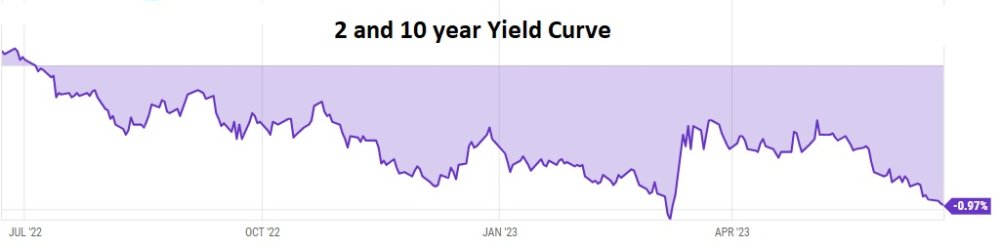
“Third, the bond market is suggesting a long and/or deep recession with its inverted yield curve. Yields are inversely related to bond prices.”

This is typically the sign of a coming recession – an inverted yield curve has emerged roughly a year before nearly all recessions since 1960.

Nigel Green concludes: “We hope and expect that the Fed will do the right thing in June and pause interest rate hikes, with a view to start cuts later this year.”

About:

deVere Group is one of the world’s largest independent advisors of specialist global financial solutions to international, local mass affluent, and high-net-worth clients.  It has a network of more than 70 offices across the world, over 80,000 clients and $12bn under advisement.

Mid-Week Technical Outlook: Market Mashup

By ForexTime

It is certainly shaping up to be another wild week for financial markets thanks to the US debt limit saga. The risk pendulum continues to swing back and forth on this major development with volatility expected to intensify as the so-called default X-date looms.

Markets could be injected with even more volatility thanks to geopolitical tensions, growth concerns, and more data from major economies. Later today, investors will direct their attention towards the minutes from the May FOMC meeting which could offer more clues about the central bank’s next move.

Here are some technical setups to keep an eye on ahead of the Fed minutes.

Dollar holds firm

The dollar has been trading a little firmer despite the impasse in US debt-ceiling negotiations. Bulls seem to be drawing strength from hawkish Fed speakers and technical forces. Prices have turned bullish on the daily charts with support found at 103.00. The upside momentum has already taken prices towards 103.80 with 104.00 the next key level of interest.

EURUSD breakdown alert?

The EURUSD remains bearish on the daily charts with bears grinding down the 1.0760 support level. A solid daily close below this point could signal a decline toward 1.0686. Should bulls push back above 1.8110 – where the 100-day SMA resides, this could open a path back toward 1.0845 and 50-day SMA at 1.0900.

GBPUSD wobbles above 1.2370

Sterling seems to be under pressure despite the UK inflation figures printing higher than expected. A solid breakdown below the 1.2370 level could open a path toward 1.2280. Should 1.2370 prove to be reliable support, prices may rebound back toward 1.2550.

AUDUSD poised to sink further?

The AUDUSD has smashed into the 0.6570 support level. A breakdown below this point may see 0.6480. If bulls are able to defend 0.6570, prices could rebound toward 0.6630.

NZDUSD breaches key support

Our trade of the week (NZDUSD), tumbled this morning after the Reserve Bank of New Zealand hiked rates by 25 basis points and signalled that it could be done with rate hikes. Prices are trading below the 200-day SMA as of writing and could hit 0.6100 in the short term. Below this level may see the NZDUSD hit levels not seen since November 2022 around 0.6070.

USDJPY upwards and onwards

After creating a fresh higher low of around 137.40, USDJPY bulls continue to eye higher levels. Further upside could be expected if a solid daily close above 139.00 is achieved. If prices slip back below 137.40, tough support around the 200-day SMA may limit downside losses.

SPX500_m trapped in wide range.

The index remains trapped within a range with support at 4050 and resistance at 4200. A potent fundamental catalyst may be needed for prices to experience a bullish or bearish breakout.

Gold approaches 50-day SMA

Gold remains heavily influenced by fundamental forces. Prices are choppy and noisy on the daily timeframe. Should $1970 prove to be reliable support, the upside could take prices towards the 50-day SMA and psychological $2000 level. If prices dip back under $1970, gold may see $1945.


Forex-Time-LogoArticle by ForexTime

ForexTime Ltd (FXTM) is an award winning international online forex broker regulated by CySEC 185/12 www.forextime.com

Is generative AI bad for the environment? A computer scientist explains the carbon footprint of ChatGPT and its cousins

By Kate Saenko, Boston University 

Generative AI is the hot new technology behind chatbots and image generators. But how hot is it making the planet?

As an AI researcher, I often worry about the energy costs of building artificial intelligence models. The more powerful the AI, the more energy it takes. What does the emergence of increasingly more powerful generative AI models mean for society’s future carbon footprint?

“Generative” refers to the ability of an AI algorithm to produce complex data. The alternative is “discriminative” AI, which chooses between a fixed number of options and produces just a single number. An example of a discriminative output is choosing whether to approve a loan application.

Generative AI can create much more complex outputs, such as a sentence, a paragraph, an image or even a short video. It has long been used in applications like smart speakers to generate audio responses, or in autocomplete to suggest a search query. However, it only recently gained the ability to generate humanlike language and realistic photos.

AI chatbots and image generators run on thousands of computers housed in data centers like this Google facility in Oregon.
Tony Webster/Wikimedia, CC BY-SA

Using more power than ever

The exact energy cost of a single AI model is difficult to estimate, and includes the energy used to manufacture the computing equipment, create the model and use the model in production. In 2019, researchers found that creating a generative AI model called BERT with 110 million parameters consumed the energy of a round-trip transcontinental flight for one person. The number of parameters refers to the size of the model, with larger models generally being more skilled. Researchers estimated that creating the much larger GPT-3, which has 175 billion parameters, consumed 1,287 megawatt hours of electricity and generated 552 tons of carbon dioxide equivalent, the equivalent of 123 gasoline-powered passenger vehicles driven for one year. And that’s just for getting the model ready to launch, before any consumers start using it.

Size is not the only predictor of carbon emissions. The open-access BLOOM model, developed by the BigScience project in France, is similar in size to GPT-3 but has a much lower carbon footprint, consuming 433 MWh of electricity in generating 30 tons of CO2eq. A study by Google found that for the same size, using a more efficient model architecture and processor and a greener data center can reduce the carbon footprint by 100 to 1,000 times.

Larger models do use more energy during their deployment. There is limited data on the carbon footprint of a single generative AI query, but some industry figures estimate it to be four to five times higher than that of a search engine query. As chatbots and image generators become more popular, and as Google and Microsoft incorporate AI language models into their search engines, the number of queries they receive each day could grow exponentially.

AI bots for search

A few years ago, not many people outside of research labs were using models like BERT or GPT. That changed on Nov. 30, 2022, when OpenAI released ChatGPT. According to the latest available data, ChatGPT had over 1.5 billion visits in March 2023. Microsoft incorporated ChatGPT into its search engine, Bing, and made it available to everyone on May 4, 2023. If chatbots become as popular as search engines, the energy costs of deploying the AIs could really add up. But AI assistants have many more uses than just search, such as writing documents, solving math problems and creating marketing campaigns.

Another problem is that AI models need to be continually updated. For example, ChatGPT was only trained on data from up to 2021, so it does not know about anything that happened since then. The carbon footprint of creating ChatGPT isn’t public information, but it is likely much higher than that of GPT-3. If it had to be recreated on a regular basis to update its knowledge, the energy costs would grow even larger.

One upside is that asking a chatbot can be a more direct way to get information than using a search engine. Instead of getting a page full of links, you get a direct answer as you would from a human, assuming issues of accuracy are mitigated. Getting to the information quicker could potentially offset the increased energy use compared to a search engine.

Ways forward

The future is hard to predict, but large generative AI models are here to stay, and people will probably increasingly turn to them for information. For example, if a student needs help solving a math problem now, they ask a tutor or a friend, or consult a textbook. In the future, they will probably ask a chatbot. The same goes for other expert knowledge such as legal advice or medical expertise.

While a single large AI model is not going to ruin the environment, if a thousand companies develop slightly different AI bots for different purposes, each used by millions of customers, the energy use could become an issue. More research is needed to make generative AI more efficient. The good news is that AI can run on renewable energy. By bringing the computation to where green energy is more abundant, or scheduling computation for times of day when renewable energy is more available, emissions can be reduced by a factor of 30 to 40, compared to using a grid dominated by fossil fuels.

Finally, societal pressure may be helpful to encourage companies and research labs to publish the carbon footprints of their AI models, as some already do. In the future, perhaps consumers could even use this information to choose a “greener” chatbot.The Conversation

About the Author:

Kate Saenko, Associate Professor of Computer Science, Boston University

This article is republished from The Conversation under a Creative Commons license. Read the original article.


Trade Of The Week: 3 Reasons Why NZDUSD Could Breakout

By ForexTime

This could be a wild week for the New Zealand Dollar thanks to fundamental and technical forces.

The New Zealand dollar is the best-performing G10 currency month-to-date, gaining roughly 1.7% against the dollar.

On the fundamental side, the NZD bulls continue to draw support from expectations around a 25-basis point hike by the Reserve Bank of New Zealand (RBNZ) at its May meeting. Taking a glance at the technicals, prices remain trapped within a wide range with key support at 0.6150 where the 200-day SMA resides while resistance is just above the 100-day SMA at 0.6320.

A major breakout could be on the horizon for the NZDUSD and here are 3 reasons why…

  1. Reserve Bank of New Zealand rate decision

Markets widely expect the RBNZ to raise interest rates by 25bps, taking the cash rate to 5.5%. This would be the highest among G10 nations and 12th straight increase.

Although inflationary pressures slightly cooled in the first quarter of 2023, policymakers still see more upside risks due to severe weather events. Investors will also keep a close on the bank’s new projections for growth and inflation which could offer fresh insight into the RBNZ’s next move. Any hawkish bias has the potential to strengthen NZD bulls.

  • Buying sentiment towards the New Zealand dollar may receive a boost if the RBNZ moves ahead with the expected 25 bps rate hike and signals further increases. This may push the NZDUSD towards the 0.6380 resistance.
  • If the RBNZ shocks market with a 50-basis point hike like what was witnessed back in April, this could send the NZD surging across the board, pushing prices beyond 0.6830.
  1. Extreme dollar volatility

This could be an explosively volatile trading week for the US dollar thanks to the US debt limit negotiations, Fed minutes, speeches, and key US economic data.

Despite the recent news around debt limit talks resuming on Monday, investors are likely to remain jittery as the window to strike a deal shrinks by the day. The Fed minutes and speeches from policymakers could provide more clues about the central bank’s next move. On top of this, much attention will be on the Fed’s preferred inflation gauge, the Core Personal Consumption Expenditure – especially after the central bank stressed that incoming data would influence monetary policy decisions. With so many forces influencing the dollar, this could translate to heightened volatility.

  • If dollar bulls dominate the scene this week, this could see the NZDUSD decline back toward the 200-day simple moving average at 0.6150.
  • Should all the combined forces translate to a weaker dollar, the New Zealand dollar has a stronger potential to experience a bullish breakout.
  1. NZDUSD in breakout mode?

The NZDUSD has been trapped within a wide range since early February 2023.

The first major resistance can be found at 0.6380 and secondary resistance at 0.6310. Looking at support levels, there is strong support at 0.6150, followed by another level of defence at 0.6100. It seems that the currency pair needs a potent fundamental spark to experience a strong breakout from this current range.

Should bulls seize the driving seat this week, prices could experience a breakout above 0.6310 and 0.6380, respectively. A weekly close above 0.6380 could signal a further incline toward 0.6460. Alternatively, if 0.6310 proves to be reliable resistance, bears may target the 0.6150 support – where the 200-day SMA resides and 0.6100.


Forex-Time-LogoArticle by ForexTime
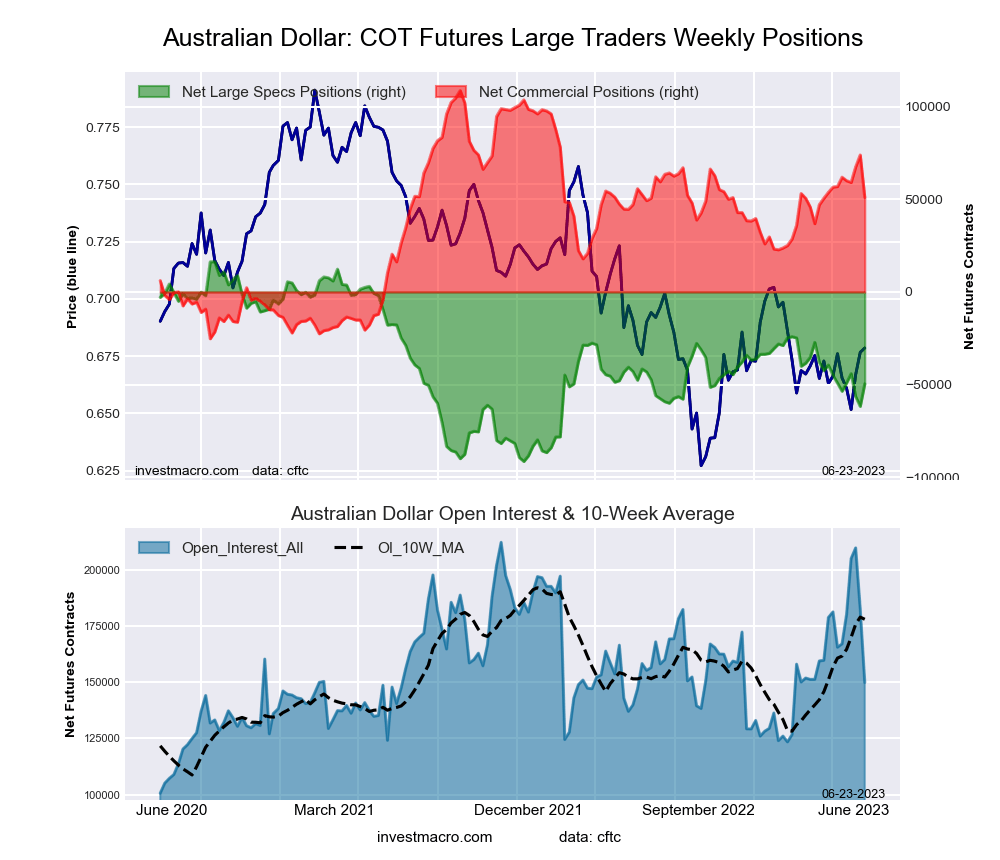
ForexTime Ltd (FXTM) is an award winning international online forex broker regulated by CySEC 185/12 www.forextime.com