Archive for Opinions – Page 51

What’s in a VIN? How to decode the vehicle identification number, your car’s unique fingerprint

By Jordan Frith, Clemson University 

Every vehicle built after 1981 has a unique vehicle identification number, or VIN. The location of this string of letters and numbers varies, but it’s located somewhere on every car, SUV, motorcycle and truck – typically on a small metal plate or a sticker.

VINs serve many purposes. They help consumers learn about a used car’s history, including whether it was stolen, or determine whether rebates for a particular electric vehicle are available. This code appears in the paperwork necessary to do everything from insuring your car to selling it.

I research data standards and became interested in VINs while doing research for my book about the cultural history of barcodes.

Like barcode numbers, a VIN’s characters are standardized. They can tell a story if you know what to look for.

A string of numbers and letters with the heading 'Decoding the VIN'
A lot of information is packed into these 17 characters.
The Conversation U.S., CC BY-SA

What VINs can tell you

VINs can convey at least seven pieces of information.

  1. Origin
    If a VIN begins with a 1, 4 or 5, that means it’s a vehicle assembled in the U.S. Many other countries have their own unique identifier. A 2, for example, means the vehicle was made in Canada; a J stands for Japan.
  2. Manufacturer
    The second and third characters indicate the manufacturer. In some cases, the code corresponds with a line of vehicles that now belongs to a larger corporation. Dodge and Jeep, now part of Stellantis, each has its own. So does Lincoln, which became a division of Ford Motor Co. in 1922.
  3. Description
    The fourth through eighth characters provide several details, such as body type and engine type.
  4. Security
    The ninth character is a “check digit” determined by a complex mathematical equation based on the rest of the VIN’s numbers and letters. This digit, either a number or the letter X, is used to authenticate that the VIN is not a forgery.
  5. Year
    The 10th character indicates the model year. There’s only one slot for this, and not all letters and numbers are used, resulting in repetition. An R could signal either 2024 or 1994, for example.
  6. Factory
    The 11th character indicates the specific plant where the vehicle was assembled.
  7. Serial number
    The VIN’s final six characters compose a serial number that differentiates the vehicle from all others made in the same factory that are the identical type and model year.
A drawing of a car with the heading 'Where's my VIN?'
Vehicle identification number locations vary but are generally found in one of four places.
The Conversation U.S., CC BY-SA

Finding more information

Only experts can tell where a vehicle was assembled or what type of engine it has by looking at its VIN. But help is available.

The National Highway Traffic Safety Administration provides a handy VIN decoder. When I plugged my vehicle’s VIN into the decoder, the site correctly determined that my SUV is a 2011 Subaru Forester with an automatic transmission.

Of course, I already knew all that.

What I didn’t realize was that it weighs between 4,000 and 5,000 pounds, has a 2.5-liter engine and features side curtain airbags to protect the driver and passengers in the front and back seats. I also learned that this Subaru Forester was assembled in Gunma, Japan.

Those details had been invisible to me as a consumer, but they had been within easy reach ever since I bought my Forester in 2018. I had somehow driven that car well over 100,000 miles without realizing the number on the side of my driver’s seat contained some history.

Before buying the Forester, even though I didn’t know that my VIN could say so much, I did run it through a free online system to make sure it hadn’t been stolen.

To be sure, VINs won’t tell you everything you might want to know about a vehicle, such as what color it was when it rolled off the line. But if you can do a little decoding and make use of widely available online tools, they do harbor important information.The Conversation

Where’s your VIN and what’s it for?


About the Author:

Jordan Frith, Pearce Professor of Professional Communication, Clemson University

This article is republished from The Conversation under a Creative Commons license. Read the original article.

Is Boeing (BA) a Recovery Play? Evaluating Upside Potential and Risks

By Ino.com

The Boeing Company (BA), a stalwart in aircraft manufacturing and services, has faced a cascade of challenges so far this year. Just as the dust was settling on its mid-air blowout incident in January, another report emerged of a plane having mechanical failures, though this one is somewhat different from the reports we’ve already heard.

This time, it’s a Delta flight from New York to Los Angeles, reporting a problem with the emergency slide on the right wing and a strange sound. While this isn’t good news for Boeing, given that the plane is quite old (flying since 1990), it’s not expected to cause too much trouble either.

Now, let’s evaluate the upside potential and risks associated with investing in BA, considering factors like financials, growth prospects, valuation, and industry dynamics.

A Tumultuous Start to 2024

Boeing and its aircraft manufacturer have faced significant media attention since the start of 2024, with a series of incidents prompting investigations. In January, an Alaska Airlines Boeing 737 MAX 9 had to make an emergency landing in Portland, Oregon, because a part of the plane’s fuselage blew out.

Although there were no casualties, the U.S. National Transportation Safety Board (NTSB) investigation revealed that the door was not properly secured due to missing bolts. As a result, it led to a grounding of its 737-9 MAX fleet, increased scrutiny of the plane maker’s 737 production and safety processes, and decreased overall plane production.

Later in January, an ANA (All Nippon Airways) Boeing 737-800 had to return to Japan after a crack was found on its cockpit window during flight.

On February 21, a United Airlines Boeing 757-200 made an emergency landing in Denver due to wing damage. Furthermore, in March, a United Airlines Boeing 777-200 had to land in Los Angeles after a tire fell off following take-off, damaging vehicles below.

Other incidents include a brief rudder control failure on a Boeing 737 Max in New Jersey, a United Airlines Boeing 737 MAX 8 going off the taxiway in Houston, and a Boeing 737 in Medford, Oregon, being found missing a panel.

Further, on March 18, an Alaska Airlines Boeing 737 had a cracked windshield upon landing in Portland.

Can Boeing Be Trusted Again?

Such incidents have dealt a significant blow to the company, raising concerns about BA’s approach of prioritizing profits over safety. Particularly, the Alaska Airlines incident led to tighter regulatory scrutiny, financial implications, and demands for compensation, potentially hampering Boeing’s growth trajectory.

However, the company has taken steps to improve quality, including expanding inspections, changing how work is performed, increasing training, and soliciting more feedback from employees.

“We are absolutely committed to doing everything we can to make certain our regulators, customers, employees and the flying public are 100 percent confident in Boeing,” Dave Calhoun, Boeing’s chief executive officer, said in a letter to employees last week.

Moreover, the company is also in talks to acquire Spirit AeroSystems Holdings, Inc. (SPR), a troubled supplier that builds the body of the Max jet, which had been a part of Boeing until it was spun out two decades ago. This potential acquisition reflects Boeing’s commitment to streamlining its supply chain, strengthening production capabilities, and exerting greater control over supplier policies and practices.

Disappointing Financial Performance

Despite a rocky start this year, Boeing reported a slightly better-than-feared quarter but continued to burn cash (almost $4 billion) as it tried to stabilize production. With fewer planes exiting factories in the last three months, Boeing’s revenue suffered a significant blow in the first quarter.

For the quarter that ended March 31, 2023, the company posted a 7.5% year-over-year decline in its total revenues to $16.57 billion. Its non-GAAP core operating loss came in at $388 million and $1.13 per share, respectively. Also, BA’s net loss for the quarter amounted to $355 million, which was not as steep as analysts had expected, and it was smaller than the $425 million loss in the prior year’s period.

Deliveries of Boeing’s commercial planes declined by 36% year-on-year in the first three months of 2024. The airline company also reported an operating cash outflow of $3.36 billion, compared with $318 million cash outflow in the last year’s period. Also, it posted a negative free cash flow of $3.92 billion, compared with a loss of $787 million a year ago. Further, the total company backlog grew to $529 billion, including over 5,600 commercial airplanes.

CEO Dave Calhoun, emphasizing the ‘tough moment,’ said, “Lower deliveries can be difficult for our customers and for our financials. But safety and quality must and will come above all else.”

Mixed Analyst Expectations

As Boeing continues to face substantial expenses in resolving identified issues, compensating affected parties, and handling potential legal matters, CFO Brian West believes the company will have a “sizable use of cash” in the second quarter.

Analysts expect BA’s revenue for the fiscal year (ending December 2024) to increase 4.2% year-over-year to $81.09 billion. However, the company is expected to report a loss per share of $0.55. For the ongoing quarter ending June 2024, its revenue is estimated to decline 3.6% year-over-year to $19.05 billion.

However, Street expects the company’s revenue for the next quarter (ending September 30, 2024) to increase by 18.5% year-over-year to $21.46 billion, while its earnings per share is expected to be at $0.41.

During this challenging period, Calhoun stated, “We are utilizing this period, challenging as it may be, to intentionally reduce the pace of operations, strengthen the supply chain, enhance our factory operations, and position Boeing to consistently deliver the reliability and quality our customers expect in the long run.”

Bottom Line

BA’s ongoing challenges, including numerous safety issues, production halts, and delayed deliveries, have put the firm in a complex situation where forecasting future demand has become increasingly precarious. These headwinds are significantly impacting its airline customer base, leading to declining profitability, cash flow problems, and inventory issues that might linger for a while.

Despite these short-term hurdles, the company is committed to strengthening its market position, achieving long-term growth outlooks, and improving predictability for both customers and investors. But this process is going to take some time and concerted effort.

Ultimately, the market’s confidence in Boeing depends on its ability to bounce back from its current challenges. However, the question remains: can the recovery be achieved soon?

Regarding price performance, the stock has plunged nearly 15% over the past three months and more than 33% year-to-date.

Moreover, the stock seems pretty pricey at the moment. In terms of forward P/E, BA is currently trading at 142.59x, which is substantially higher than the industry average of 23.99x. The stock’s forward EV/Sales of 1.81x is 2.9% higher than the industry average of 1.76x. Also, its forward EV/EBITDA of 33.92x compares to the industry average of 11.30x.

Besides, BA’s trailing-12-month gross profit and levered FCF margins of 11.48% and 4.01% are 62.7% and 38.9% lower than the industry averages of 30.80% and 6.56%, respectively. Also, its net income margin of negative 2.81% compares to the industry average of 5.86%.

Recently, Argus Research downgraded their outlook for BA stock from Buy to Hold, estimating a target price of $243.01, indicating a 40.1% upside. In addition, Northcoast Research downgraded the stock from Neutral to Sell.

Given these factors, we believe waiting for a better entry point in this stock could be wise now.

By Ino.com – See our Trader Blog, INO TV Free & Market Analysis Alerts

Source: Is Boeing (BA) a Recovery Play? Evaluating Upside Potential and Risks

FX Speculators reduce bearish bets for Yen, Canadian & Australian Dollars

By InvestMacro

Here are the latest charts and statistics for the Commitment of Traders (COT) data published by the Commodities Futures Trading Commission (CFTC).

The latest COT data is updated through Tuesday April 30th and shows a quick view of how large market participants (for-profit speculators and commercial traders) were positioned in the futures markets. All currency positions are in direct relation to the US dollar where, for example, a bet for the euro is a bet that the euro will rise versus the dollar while a bet against the euro will be a bet that the euro will decline versus the dollar.

Weekly Speculator Changes led by Canadian & Australian Dollars

The COT currency market speculator bets were higher this week as eight out of the eleven currency markets we cover had higher positioning while the other three markets had lower speculator contracts.

Leading the gains for the currency markets was the Canadian Dollar (13,249 contracts) with the Australian Dollar (13,004 contracts), the Japanese Yen (11,531 contracts), the New Zealand Dollar (3,496 contracts), EuroFX (3,212 contracts), the Swiss Franc (776 contracts), the US Dollar Index (178 contracts) and Bitcoin (6 contracts) also showing positive weeks.

The currencies seeing declines in speculator bets on the week were the Mexican Peso (-4,610 contracts), the British Pound (-2,757 contracts) and the Brazilian Real (-678 contracts).

Speculators reduce bearish bets for Yen, Canadian & Australian Dollars

This week’s COT currency’s data was mixed in the overall big picture and saw a pause in some of the major trends. There were many extremely weak currency positions (JPY, AUD, CAD, CHF, EUR) that saw a little turnaround for the week in their speculator bets while the extremely strong Mexican peso saw a little slide in its bullishness. The US dollar continues to remain in a strong speculative position overall versus just about all of the major currencies except the peso.

Here is this week’s COT currency roundup:

The British pound sterling speculator was one of the currencies that saw a weaker position on the week and contracts have now fallen for two consecutive weeks. The GBP bets have also dropped in six out of the last 7 weeks for a total 7-week change of -99,441 contracts — illuminating the deteriorating sentiment for the GBP. This has dropped the current speculator contract level to a new lowpoint since January 2023.

The Euro bounced back very slightly this week with a gain of +3,212 contracts. The overall net position, however, is now in bearish territory for a second straight week. This is the first time the Euro contracts have been bearish since September of 2022.

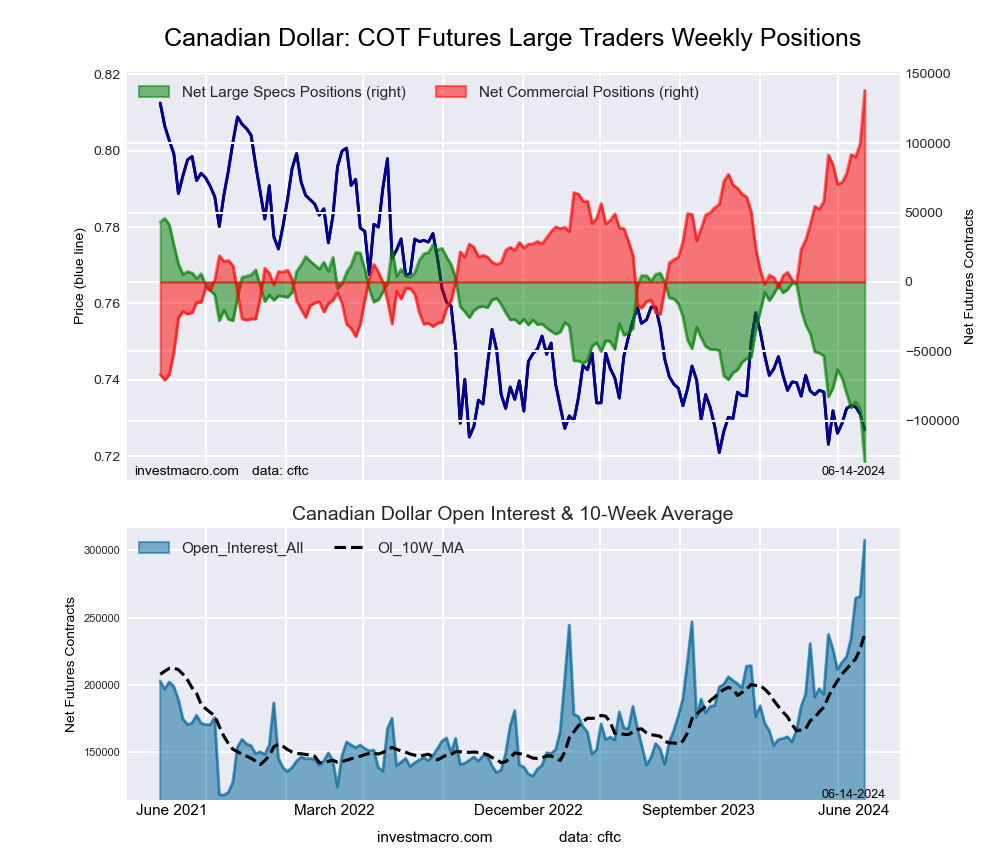
The Canadian dollar speculative position has bounced back with two weeks of gains following eight straight weeks of declines. The overall net position (currently at -63,201 contracts) remains extremely bearish with the current strength level at 15 percent of the past three-years range of positions.

Swiss franc speculator positions remain extremely bearish (1 percent strength score) and the overall net speculator position is greater than -40,000 contracts for a second consecutive week. The franc spec positioning is at the lowest levels since 2019.

The Japanese yen contracts got a little relief this week from the continued downtrend with a rise of +11,531 contracts. Previously, the JPY contracts had dropped in 13 out of 15 weeks for a -123,970 contract decline over those 15 weeks. The current speculative sentiment remains near the lowest standing since 2007. The Japanese authorities likely intervened in the currency markets earlier this week in order to pause the steep decline in the yen and the yen managed to end the week higher by approximately 3 percent vs the USD.

The Australian dollar speculator position saw improvement for a second straight week this week with a gain of +13,004 contracts through Tuesday. The Aussie spec position and sentiment have been historically bearish over the past few months with an all-time record low position reached on March 19th at a total of -107,538 contracts. The current positioning level sits at -83,235 contracts.

The Mexican Peso remains the one strong currency in the mix against the US dollar. The MXN speculative position has fallen for three straight weeks but remains in a very strong position with a current total of +119,045 contracts. The MXN speculator level has remained above the +100,000 level for nine consecutive weeks which is the first time that type of streak has taken place since late-2019 into early-2020. The MXN exchange rate versus the USD has experienced a pullback over the past month but remains slightly higher for 2024 so far and closed this week higher by over 1 percent.


Currencies Net Speculators Leaderboard

Legend: Weekly Speculators Change | Speculators Current Net Position | Speculators Strength Score compared to last 3-Years (0-100 range)


Strength Scores led by Mexican Peso & Bitcoin

COT Strength Scores (a normalized measure of Speculator positions over a 3-Year range, from 0 to 100 where above 80 is Extreme-Bullish and below 20 is Extreme-Bearish) showed that the Mexican Peso (90 percent) and Bitcoin (66 percent) lead the currency markets this week.

On the downside, the Swiss Franc (1 percent), the US Dollar Index (5 percent), the Japanese Yen (7 percent), the Canadian Dollar (15 percent) and the EuroFX (17 percent) come in at the lowest strength levels currently and are in Extreme-Bearish territory (below 20 percent).

Strength Statistics:
US Dollar Index (4.8 percent) vs US Dollar Index previous week (4.4 percent)
EuroFX (17.4 percent) vs EuroFX previous week (16.1 percent)
British Pound Sterling (34.1 percent) vs British Pound Sterling previous week (35.9 percent)
Japanese Yen (7.2 percent) vs Japanese Yen previous week (0.0 percent)
Swiss Franc (1.4 percent) vs Swiss Franc previous week (0.0 percent)
Canadian Dollar (14.9 percent) vs Canadian Dollar previous week (4.8 percent)
Australian Dollar (22.0 percent) vs Australian Dollar previous week (10.2 percent)
New Zealand Dollar (36.1 percent) vs New Zealand Dollar previous week (26.2 percent)
Mexican Peso (89.9 percent) vs Mexican Peso previous week (92.1 percent)
Brazilian Real (24.1 percent) vs Brazilian Real previous week (25.2 percent)
Bitcoin (66.5 percent) vs Bitcoin previous week (66.4 percent)


Bitcoin & Australian Dollar top the 6-Week Strength Trends

COT Strength Score Trends (or move index, calculates the 6-week changes in strength scores) showed that the Bitcoin (32 percent) and the Australian Dollar (22 percent) lead the past six weeks trends and are the only positive movers for the currencies.

The British Pound (-54 percent) leads the downside trend scores currently with the Swiss Franc (-38 percent), Japanese Yen (-33 percent) and the New Zealand Dollar (-24 percent) following next with lower trend scores.

Strength Trend Statistics:
US Dollar Index (-1.5 percent) vs US Dollar Index previous week (-13.5 percent)
EuroFX (-23.5 percent) vs EuroFX previous week (-35.9 percent)
British Pound Sterling (-54.5 percent) vs British Pound Sterling previous week (-64.1 percent)
Japanese Yen (-32.8 percent) vs Japanese Yen previous week (-48.5 percent)
Swiss Franc (-37.9 percent) vs Swiss Franc previous week (-44.0 percent)
Canadian Dollar (-19.8 percent) vs Canadian Dollar previous week (-34.6 percent)
Australian Dollar (22.0 percent) vs Australian Dollar previous week (-4.9 percent)
New Zealand Dollar (-23.7 percent) vs New Zealand Dollar previous week (-41.2 percent)
Mexican Peso (-4.7 percent) vs Mexican Peso previous week (9.5 percent)
Brazilian Real (-15.1 percent) vs Brazilian Real previous week (-11.7 percent)
Bitcoin (31.6 percent) vs Bitcoin previous week (15.0 percent)


Individual COT Forex Markets:

US Dollar Index Futures:

US Dollar Index Forex Futures COT ChartThe US Dollar Index large speculator standing this week totaled a net position of -35 contracts in the data reported through Tuesday. This was a weekly increase of 178 contracts from the previous week which had a total of -213 net contracts.

This week’s current strength score (the trader positioning range over the past three years, measured from 0 to 100) shows the speculators are currently Bearish-Extreme with a score of 4.8 percent. The commercials are Bullish-Extreme with a score of 96.0 percent and the small traders (not shown in chart) are Bearish with a score of 37.1 percent.

Price Trend-Following Model: Uptrend

Our weekly trend-following model classifies the current market price position as: Uptrend. The current action for the model is considered to be: Hold – Maintain Long Position.

US DOLLAR INDEX StatisticsSPECULATORSCOMMERCIALSSMALL TRADERS
– Percent of Open Interest Longs:68.920.39.0
– Percent of Open Interest Shorts:68.924.84.5
– Net Position:-35-2,1892,224
– Gross Longs:33,5939,8944,410
– Gross Shorts:33,62812,0832,186
– Long to Short Ratio:1.0 to 10.8 to 12.0 to 1
NET POSITION TREND:
– Strength Index Score (3 Year Range Pct):4.896.037.1
– Strength Index Reading (3 Year Range):Bearish-ExtremeBullish-ExtremeBearish
NET POSITION MOVEMENT INDEX:
– 6-Week Change in Strength Index:-1.5-1.014.1


Euro Currency Futures:

Euro Currency Futures COT ChartThe Euro Currency large speculator standing this week totaled a net position of -6,777 contracts in the data reported through Tuesday. This was a weekly advance of 3,212 contracts from the previous week which had a total of -9,989 net contracts.

This week’s current strength score (the trader positioning range over the past three years, measured from 0 to 100) shows the speculators are currently Bearish-Extreme with a score of 17.4 percent. The commercials are Bullish-Extreme with a score of 85.2 percent and the small traders (not shown in chart) are Bearish-Extreme with a score of 6.9 percent.

Price Trend-Following Model: Downtrend

Our weekly trend-following model classifies the current market price position as: Downtrend. The current action for the model is considered to be: Hold – Maintain Short Position.

EURO Currency StatisticsSPECULATORSCOMMERCIALSSMALL TRADERS
– Percent of Open Interest Longs:25.661.211.2
– Percent of Open Interest Shorts:26.762.88.5
– Net Position:-6,777-10,73717,514
– Gross Longs:167,185399,16373,035
– Gross Shorts:173,962409,90055,521
– Long to Short Ratio:1.0 to 11.0 to 11.3 to 1
NET POSITION TREND:
– Strength Index Score (3 Year Range Pct):17.485.26.9
– Strength Index Reading (3 Year Range):Bearish-ExtremeBullish-ExtremeBearish-Extreme
NET POSITION MOVEMENT INDEX:
– 6-Week Change in Strength Index:-23.523.7-13.2


British Pound Sterling Futures:

British Pound Sterling Futures COT ChartThe British Pound Sterling large speculator standing this week totaled a net position of -28,990 contracts in the data reported through Tuesday. This was a weekly lowering of -2,757 contracts from the previous week which had a total of -26,233 net contracts.

This week’s current strength score (the trader positioning range over the past three years, measured from 0 to 100) shows the speculators are currently Bearish with a score of 34.1 percent. The commercials are Bullish with a score of 70.1 percent and the small traders (not shown in chart) are Bearish with a score of 29.4 percent.

Price Trend-Following Model: Downtrend

Our weekly trend-following model classifies the current market price position as: Downtrend. The current action for the model is considered to be: Hold – Maintain Short Position.

BRITISH POUND StatisticsSPECULATORSCOMMERCIALSSMALL TRADERS
– Percent of Open Interest Longs:18.568.99.0
– Percent of Open Interest Shorts:30.850.415.2
– Net Position:-28,99043,560-14,570
– Gross Longs:43,668162,36621,215
– Gross Shorts:72,658118,80635,785
– Long to Short Ratio:0.6 to 11.4 to 10.6 to 1
NET POSITION TREND:
– Strength Index Score (3 Year Range Pct):34.170.129.4
– Strength Index Reading (3 Year Range):BearishBullishBearish
NET POSITION MOVEMENT INDEX:
– 6-Week Change in Strength Index:-54.556.6-37.2


Japanese Yen Futures:

Japanese Yen Forex Futures COT ChartThe Japanese Yen large speculator standing this week totaled a net position of -168,388 contracts in the data reported through Tuesday. This was a weekly rise of 11,531 contracts from the previous week which had a total of -179,919 net contracts.

This week’s current strength score (the trader positioning range over the past three years, measured from 0 to 100) shows the speculators are currently Bearish-Extreme with a score of 7.2 percent. The commercials are Bullish-Extreme with a score of 98.1 percent and the small traders (not shown in chart) are Bullish with a score of 58.3 percent.

Price Trend-Following Model: Downtrend

Our weekly trend-following model classifies the current market price position as: Downtrend. The current action for the model is considered to be: Hold – Maintain Short Position.

JAPANESE YEN StatisticsSPECULATORSCOMMERCIALSSMALL TRADERS
– Percent of Open Interest Longs:12.173.112.5
– Percent of Open Interest Shorts:62.420.514.8
– Net Position:-168,388176,122-7,734
– Gross Longs:40,435244,92041,917
– Gross Shorts:208,82368,79849,651
– Long to Short Ratio:0.2 to 13.6 to 10.8 to 1
NET POSITION TREND:
– Strength Index Score (3 Year Range Pct):7.298.158.3
– Strength Index Reading (3 Year Range):Bearish-ExtremeBullish-ExtremeBullish
NET POSITION MOVEMENT INDEX:
– 6-Week Change in Strength Index:-32.837.7-27.1


Swiss Franc Futures:

Swiss Franc Forex Futures COT ChartThe Swiss Franc large speculator standing this week totaled a net position of -41,786 contracts in the data reported through Tuesday. This was a weekly gain of 776 contracts from the previous week which had a total of -42,562 net contracts.

This week’s current strength score (the trader positioning range over the past three years, measured from 0 to 100) shows the speculators are currently Bearish-Extreme with a score of 1.4 percent. The commercials are Bullish-Extreme with a score of 100.0 percent and the small traders (not shown in chart) are Bearish-Extreme with a score of 2.2 percent.

Price Trend-Following Model: Downtrend

Our weekly trend-following model classifies the current market price position as: Downtrend. The current action for the model is considered to be: Hold – Maintain Short Position.

SWISS FRANC StatisticsSPECULATORSCOMMERCIALSSMALL TRADERS
– Percent of Open Interest Longs:11.279.39.2
– Percent of Open Interest Shorts:53.420.425.9
– Net Position:-41,78658,283-16,497
– Gross Longs:11,04078,4469,120
– Gross Shorts:52,82620,16325,617
– Long to Short Ratio:0.2 to 13.9 to 10.4 to 1
NET POSITION TREND:
– Strength Index Score (3 Year Range Pct):1.4100.02.2
– Strength Index Reading (3 Year Range):Bearish-ExtremeBullish-ExtremeBearish-Extreme
NET POSITION MOVEMENT INDEX:
– 6-Week Change in Strength Index:-37.937.3-16.4


Canadian Dollar Futures:

Canadian Dollar Forex Futures COT ChartThe Canadian Dollar large speculator standing this week totaled a net position of -63,201 contracts in the data reported through Tuesday. This was a weekly advance of 13,249 contracts from the previous week which had a total of -76,450 net contracts.

This week’s current strength score (the trader positioning range over the past three years, measured from 0 to 100) shows the speculators are currently Bearish-Extreme with a score of 14.9 percent. The commercials are Bullish-Extreme with a score of 87.9 percent and the small traders (not shown in chart) are Bearish-Extreme with a score of 6.8 percent.

Price Trend-Following Model: Downtrend

Our weekly trend-following model classifies the current market price position as: Downtrend. The current action for the model is considered to be: Hold – Maintain Short Position.

CANADIAN DOLLAR StatisticsSPECULATORSCOMMERCIALSSMALL TRADERS
– Percent of Open Interest Longs:16.068.213.4
– Percent of Open Interest Shorts:45.834.916.8
– Net Position:-63,20170,490-7,289
– Gross Longs:33,793144,35928,321
– Gross Shorts:96,99473,86935,610
– Long to Short Ratio:0.3 to 12.0 to 10.8 to 1
NET POSITION TREND:
– Strength Index Score (3 Year Range Pct):14.987.96.8
– Strength Index Reading (3 Year Range):Bearish-ExtremeBullish-ExtremeBearish-Extreme
NET POSITION MOVEMENT INDEX:
– 6-Week Change in Strength Index:-19.816.7-6.8


Australian Dollar Futures:

Australian Dollar Forex Futures COT ChartThe Australian Dollar large speculator standing this week totaled a net position of -83,235 contracts in the data reported through Tuesday. This was a weekly lift of 13,004 contracts from the previous week which had a total of -96,239 net contracts.

This week’s current strength score (the trader positioning range over the past three years, measured from 0 to 100) shows the speculators are currently Bearish with a score of 22.0 percent. The commercials are Bullish-Extreme with a score of 81.8 percent and the small traders (not shown in chart) are Bearish with a score of 31.1 percent.

Price Trend-Following Model: Weak Downtrend

Our weekly trend-following model classifies the current market price position as: Weak Downtrend. The current action for the model is considered to be: Hold – Maintain Short Position.

AUSTRALIAN DOLLAR StatisticsSPECULATORSCOMMERCIALSSMALL TRADERS
– Percent of Open Interest Longs:18.470.29.2
– Percent of Open Interest Shorts:55.529.013.3
– Net Position:-83,23592,394-9,159
– Gross Longs:41,293157,62920,613
– Gross Shorts:124,52865,23529,772
– Long to Short Ratio:0.3 to 12.4 to 10.7 to 1
NET POSITION TREND:
– Strength Index Score (3 Year Range Pct):22.081.831.1
– Strength Index Reading (3 Year Range):BearishBullish-ExtremeBearish
NET POSITION MOVEMENT INDEX:
– 6-Week Change in Strength Index:22.0-17.1-1.6


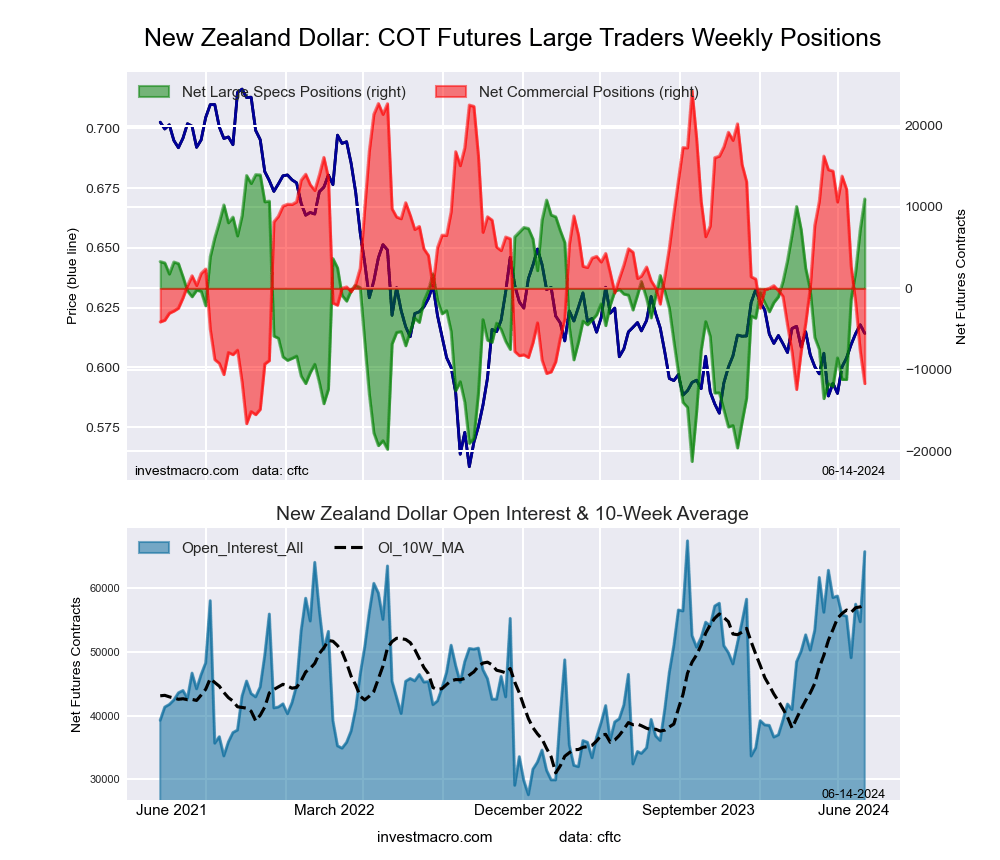
New Zealand Dollar Futures:

New Zealand Dollar Forex Futures COT ChartThe New Zealand Dollar large speculator standing this week totaled a net position of -8,551 contracts in the data reported through Tuesday. This was a weekly boost of 3,496 contracts from the previous week which had a total of -12,047 net contracts.

This week’s current strength score (the trader positioning range over the past three years, measured from 0 to 100) shows the speculators are currently Bearish with a score of 36.1 percent. The commercials are Bullish with a score of 66.5 percent and the small traders (not shown in chart) are Bearish with a score of 27.7 percent.

Price Trend-Following Model: Downtrend

Our weekly trend-following model classifies the current market price position as: Downtrend. The current action for the model is considered to be: Hold – Maintain Short Position.

NEW ZEALAND DOLLAR StatisticsSPECULATORSCOMMERCIALSSMALL TRADERS
– Percent of Open Interest Longs:36.657.75.5
– Percent of Open Interest Shorts:51.139.79.0
– Net Position:-8,55110,607-2,056
– Gross Longs:21,51433,9423,253
– Gross Shorts:30,06523,3355,309
– Long to Short Ratio:0.7 to 11.5 to 10.6 to 1
NET POSITION TREND:
– Strength Index Score (3 Year Range Pct):36.166.527.7
– Strength Index Reading (3 Year Range):BearishBullishBearish
NET POSITION MOVEMENT INDEX:
– 6-Week Change in Strength Index:-23.725.9-29.0


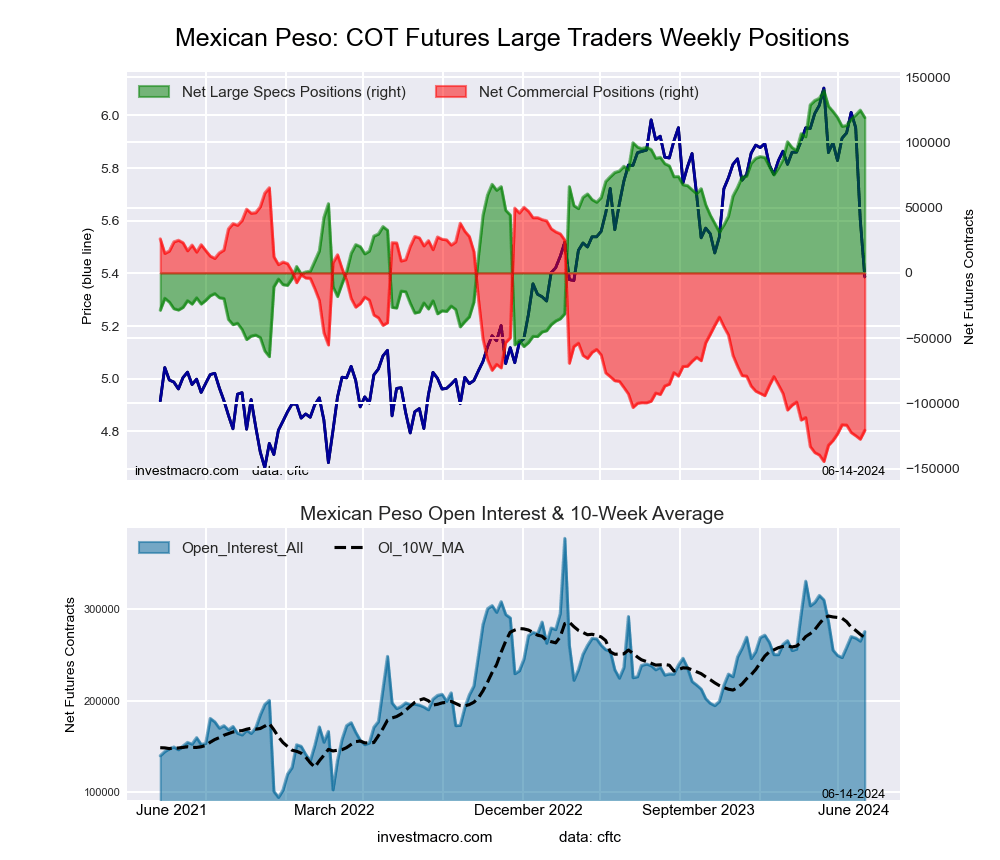
Mexican Peso Futures:

Mexican Peso Futures COT ChartThe Mexican Peso large speculator standing this week totaled a net position of 119,045 contracts in the data reported through Tuesday. This was a weekly decline of -4,610 contracts from the previous week which had a total of 123,655 net contracts.

This week’s current strength score (the trader positioning range over the past three years, measured from 0 to 100) shows the speculators are currently Bullish-Extreme with a score of 89.9 percent. The commercials are Bearish-Extreme with a score of 10.1 percent and the small traders (not shown in chart) are Bearish with a score of 38.5 percent.

Price Trend-Following Model: Weak Uptrend

Our weekly trend-following model classifies the current market price position as: Weak Uptrend. The current action for the model is considered to be: Hold – Maintain Long Position.

MEXICAN PESO StatisticsSPECULATORSCOMMERCIALSSMALL TRADERS
– Percent of Open Interest Longs:58.138.42.9
– Percent of Open Interest Shorts:10.387.91.2
– Net Position:119,045-123,3254,280
– Gross Longs:144,67995,7157,175
– Gross Shorts:25,634219,0402,895
– Long to Short Ratio:5.6 to 10.4 to 12.5 to 1
NET POSITION TREND:
– Strength Index Score (3 Year Range Pct):89.910.138.5
– Strength Index Reading (3 Year Range):Bullish-ExtremeBearish-ExtremeBearish
NET POSITION MOVEMENT INDEX:
– 6-Week Change in Strength Index:-4.74.6-0.2


Brazilian Real Futures:

Brazil Real Futures COT ChartThe Brazilian Real large speculator standing this week totaled a net position of 286 contracts in the data reported through Tuesday. This was a weekly fall of -678 contracts from the previous week which had a total of 964 net contracts.

This week’s current strength score (the trader positioning range over the past three years, measured from 0 to 100) shows the speculators are currently Bearish with a score of 24.1 percent. The commercials are Bullish with a score of 76.3 percent and the small traders (not shown in chart) are Bearish with a score of 34.8 percent.

Price Trend-Following Model: Downtrend

Our weekly trend-following model classifies the current market price position as: Downtrend. The current action for the model is considered to be: Hold – Maintain Short Position.

BRAZIL REAL StatisticsSPECULATORSCOMMERCIALSSMALL TRADERS
– Percent of Open Interest Longs:47.049.02.1
– Percent of Open Interest Shorts:46.749.32.0
– Net Position:286-32135
– Gross Longs:47,28149,3052,074
– Gross Shorts:46,99549,6262,039
– Long to Short Ratio:1.0 to 11.0 to 11.0 to 1
NET POSITION TREND:
– Strength Index Score (3 Year Range Pct):24.176.334.8
– Strength Index Reading (3 Year Range):BearishBullishBearish
NET POSITION MOVEMENT INDEX:
– 6-Week Change in Strength Index:-15.117.8-20.3


Bitcoin Futures:

Bitcoin Crypto Futures COT ChartThe Bitcoin large speculator standing this week totaled a net position of 6 contracts in the data reported through Tuesday. This was a weekly rise of 6 contracts from the previous week which had a total of 0 net contracts.

This week’s current strength score (the trader positioning range over the past three years, measured from 0 to 100) shows the speculators are currently Bullish with a score of 66.5 percent. The commercials are Bullish with a score of 51.2 percent and the small traders (not shown in chart) are Bearish with a score of 24.9 percent.

Price Trend-Following Model: Uptrend

Our weekly trend-following model classifies the current market price position as: Uptrend. The current action for the model is considered to be: Hold – Maintain Long Position.

BITCOIN StatisticsSPECULATORSCOMMERCIALSSMALL TRADERS
– Percent of Open Interest Longs:78.95.25.9
– Percent of Open Interest Shorts:78.97.33.8
– Net Position:6-530524
– Gross Longs:19,5691,2911,461
– Gross Shorts:19,5631,821937
– Long to Short Ratio:1.0 to 10.7 to 11.6 to 1
NET POSITION TREND:
– Strength Index Score (3 Year Range Pct):66.551.224.9
– Strength Index Reading (3 Year Range):BullishBullishBearish
NET POSITION MOVEMENT INDEX:
– 6-Week Change in Strength Index:31.6-45.4-7.3


Article By InvestMacroReceive our weekly COT Newsletter

*COT Report: The COT data, released weekly to the public each Friday, is updated through the most recent Tuesday (data is 3 days old) and shows a quick view of how large speculators or non-commercials (for-profit traders) were positioned in the futures markets.

The CFTC categorizes trader positions according to commercial hedgers (traders who use futures contracts for hedging as part of the business), non-commercials (large traders who speculate to realize trading profits) and nonreportable traders (usually small traders/speculators) as well as their open interest (contracts open in the market at time of reporting). See CFTC criteria here.

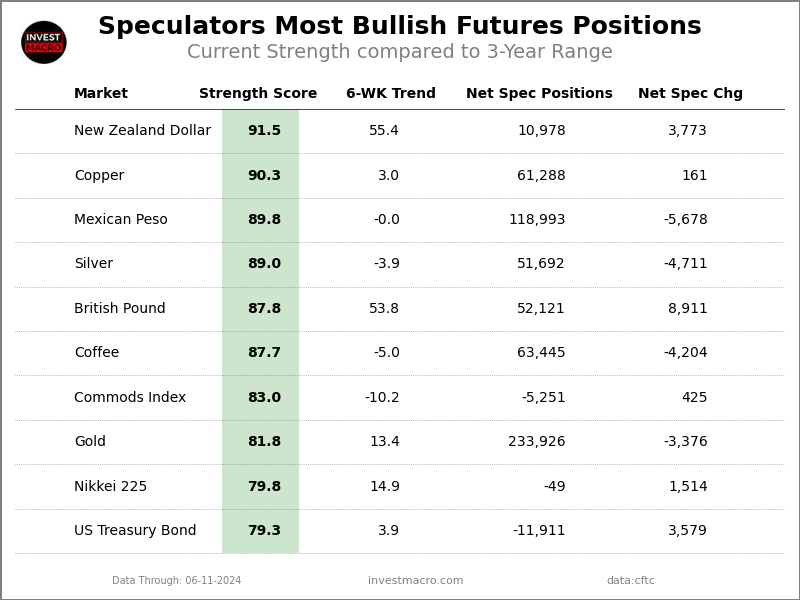
Speculator Extremes: Copper, Silver & Commodities Index lead Bullish Positions

By InvestMacro

The latest update for the weekly Commitment of Traders (COT) report was released by the Commodity Futures Trading Commission (CFTC) on Friday for data ending on April 30th 2024.

This weekly Extreme Positions report highlights the Most Bullish and Most Bearish Positions for the speculator category. Extreme positioning in these markets can foreshadow strong moves in the underlying market.

To signify an extreme position, we use the Strength Index (also known as the COT Index) of each instrument, a common method of measuring COT data. The Strength Index is simply a comparison of current trader positions against the range of positions over the previous 3 years. We use over 80 percent as extremely bullish and under 20 percent as extremely bearish. (Compare Strength Index scores across all markets in the data table or cot leaders table)


Here Are This Week’s Most Bullish Speculator Positions:

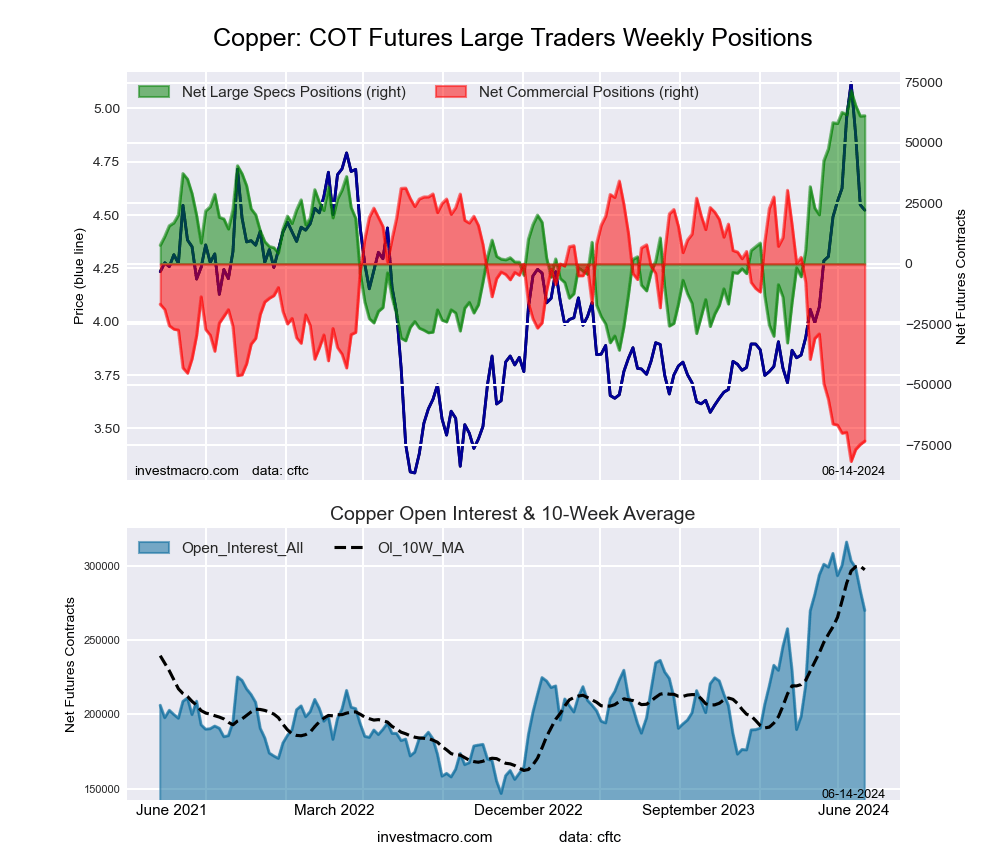
Copper


The Copper speculator position comes in as the most bullish extreme standing this week. The Copper speculator level is currently at a 99.6 percent score of its 3-year range.

The six-week trend for the percent strength score totaled 27.8 this week. The overall net speculator position was a total of 58,064 net contracts this week with a small decline of -330 contract in the weekly speculator bets.


Speculators or Non-Commercials Notes:

Speculators, classified as non-commercial traders by the CFTC, are made up of large commodity funds, hedge funds and other significant for-profit participants. The Specs are generally regarded as trend-followers in their behavior towards price action – net speculator bets and prices tend to go in the same directions. These traders often look to buy when prices are rising and sell when prices are falling. To illustrate this point, many times speculator contracts can be found at their most extremes (bullish or bearish) when prices are also close to their highest or lowest levels.

These extreme levels can be dangerous for the large speculators as the trade is most crowded, there is less trading ammunition still sitting on the sidelines to push the trend further and prices have moved a significant distance. When the trend becomes exhausted, some speculators take profits while others look to also exit positions when prices fail to continue in the same direction. This process usually plays out over many months to years and can ultimately create a reverse effect where prices start to fall and speculators start a process of selling when prices are falling.


Silver


The Silver speculator position comes next in the extreme standings this week. The Silver speculator level is now at a 93.3 percent score of its 3-year range.

The six-week trend for the percent strength score was 2.9 this week. The speculator position registered 54,494 net contracts this week with a weekly drop of -4,846 contracts in speculator bets.


Bloomberg Commodity Index


The Bloomberg Commodity Index speculator position comes in third this week in the extreme standings. The Bloomberg Commodity Index speculator level resides at a 93.2 percent score of its 3-year range.

The six-week trend for the speculator strength score came in at 21.9 this week. The overall speculator position was -2,975 net contracts this week with an edge up by just 4 contracts in the weekly speculator bets.


Coffee


The Coffee speculator position comes up number four in the extreme standings this week. The Coffee speculator level is at a 92.7 percent score of its 3-year range.

The six-week trend for the speculator strength score totaled a change of 17.9 this week. The overall speculator position was 68,590 net contracts this week with a shortfall of -3,324 contracts in the speculator bets.


VIX


The VIX speculator position rounds out the top five in this week’s bullish extreme standings. The VIX speculator level sits at a 90.8 percent score of its 3-year range. The six-week trend for the speculator strength score was 24.2 this week.

The speculator position was -22,433 net contracts this week with a decrease by -4,433 contracts in the weekly speculator bets.


This Week’s Most Bearish Speculator Positions:

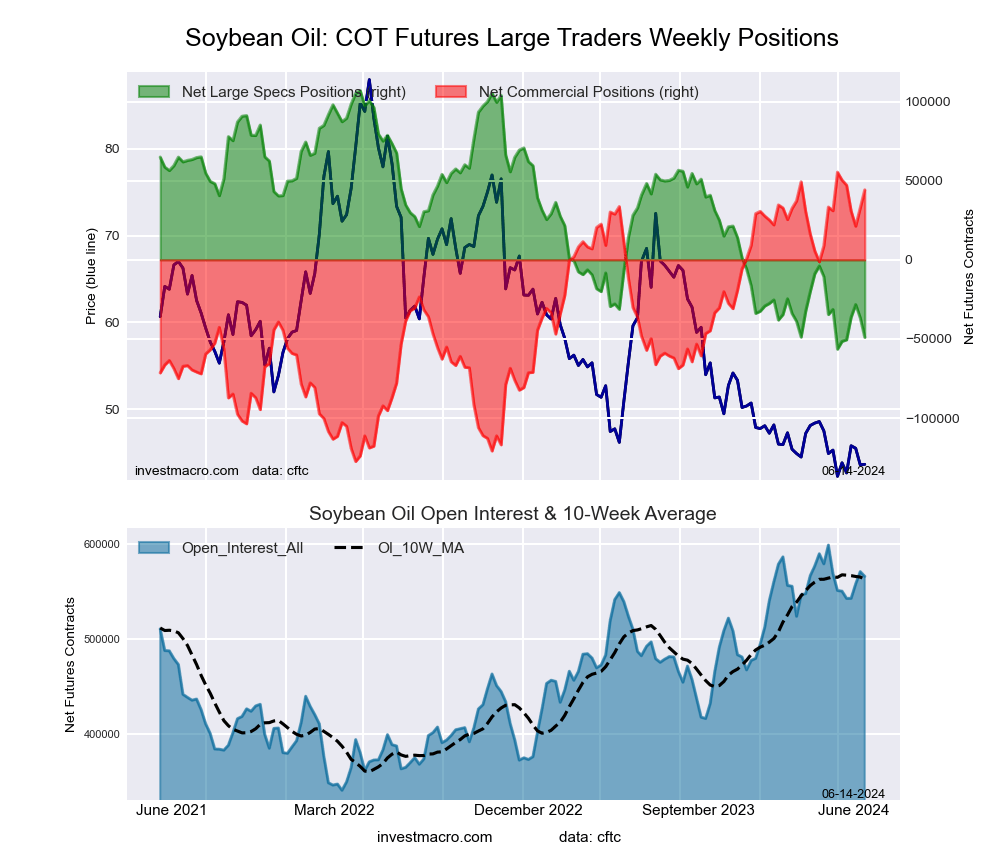
Soybean Oil


The Soybean Oil speculator position comes in as the most bearish extreme standing this week. The Soybean Oil speculator level is at a 0.0 percent score of its 3-year range.

The six-week trend for the speculator strength score was -22.2 this week. The overall speculator position was -56,442 net contracts this week with a sharp fall by -25,101 contracts in the speculator bets.


Swiss Franc


The Swiss Franc speculator position comes in next for the most bearish extreme standing on the week. The Swiss Franc speculator level is at a 1.4 percent score of its 3-year range.

The six-week trend for the speculator strength score was -37.9 this week. The speculator position was -41,786 net contracts this week with an edge higher by 776 contracts in the weekly speculator bets.


Ultra 10-Year U.S. T-Note


The Ultra 10-Year U.S. T-Note speculator position comes in as third most bearish extreme standing of the week. The Ultra 10-Year U.S. T-Note speculator level resides at a 2.9 percent score of its 3-year range.

The six-week trend for the speculator strength score was -22.4 this week. The overall speculator position was -263,683 net contracts this week with a decrease of -24,156 contracts in the speculator bets.


US Dollar Index


The US Dollar Index speculator position comes in as this week’s fourth most bearish extreme standing. The US Dollar Index speculator level is at a 4.8 percent score of its 3-year range.

The six-week trend for the speculator strength score was -1.5 this week. The speculator position was -35 net contracts this week with a gain of 178 contracts in the weekly speculator bets.


Sugar


Finally, the Sugar speculator position comes in as the fifth most bearish extreme standing for this week. The Sugar speculator level is at a 5.2 percent score of its 3-year range.

The six-week trend for the speculator strength score was -18.5 this week. The speculator position was 40,305 net contracts this week with a decline of -4,796 contracts in the weekly speculator bets.


Article By InvestMacroReceive our weekly COT Newsletter

*COT Report: The COT data, released weekly to the public each Friday, is updated through the most recent Tuesday (data is 3 days old) and shows a quick view of how large speculators or non-commercials (for-profit traders) were positioned in the futures markets.

The CFTC categorizes trader positions according to commercial hedgers (traders who use futures contracts for hedging as part of the business), non-commercials (large traders who speculate to realize trading profits) and nonreportable traders (usually small traders/speculators) as well as their open interest (contracts open in the market at time of reporting). See CFTC criteria here.

Is Intel (INTC) a Buy, Sell, or Hold Amidst Tough Competition?

By Ino.com

Intel Corporation (INTC), a prominent semiconductor company, is currently navigating a challenging phase characterized by a dwindling financial outlook and difficulties sustaining competitiveness within the semiconductor industry. Intel stands behind many tech stocks in the S&P 500 this year, while rival chipmaker NVIDIA Corporation (NVDA) emerges as the third-best performer in the index.

Now, we will evaluate the risks and opportunities associated with investing in Intel amidst competitive pressures.

Strategic Initiatives to Keep up With the Fierce Competition

Amid escalating competition in the tech arena, INTC, the foremost producer of processors driving PCs and laptops, has aggressively expanded its presence in the AI domain to remain abreast of its peers.

Last month, the company announced the creation of the world’s largest neuromorphic system, dubbed Hala Point, which is powered by Intel’s Loihi 2 processor. Initially deployed at Sandia National Laboratories, this system supports research for future brain-inspired AI and addresses challenges concerning AI efficiency and sustainability.

On April 9, Intel also unveiled a new AI chip called Gaudi 3, which was intended to compete against NVDA’s dominance in popular graphics processing units. The new chip boasts over twice the power efficiency and can run AI models one-and-a-half times faster than NVDA’s H100 GPU. The company expects more than $500 million in sales from its Gaudi 3 chips in the year’s second half.

In March, Reuters reported that INTC plans to spend $100 billion across four U.S. states to build and expand factories, bolstered by $19.5 billion in federal grants and loans (with an additional $25 billion in tax incentives in sight). CEO Pat Gelsinger envisions transforming vacant land near Columbus, Ohio, into “the largest AI chip manufacturing site globally” by 2027, forming the cornerstone of Intel’s ambitious five-year spending plan.

Such advancements enable the company to stay competitive and meet the growing demand for AI-driven solutions across various industries.

Solid First-Quarter Performance but Shaky Outlook

For the first quarter that ended March 30, 2024, INTC’s net revenue surged 8.6% year-over-year to $12.72 billion, primarily driven by growth in its personal computing, data center, and AI business. However, its revenue from the Foundry unit amounted to $4.40 billion, down about 10% year-over-year.

Intel’s gross margin grew 30.2% from the prior year’s quarter to $5.22 billion. Also, it reported a non-GAAP operating income of $723 million, compared to an operating loss of $294 million in 2023. Further, its non-GAAP net income and non-GAAP earnings per share came in at $759 million and $0.18 versus a net loss and loss per share of $169 million and $0.04, respectively, in the same quarter last year.

The solid financial performance underscores the vital innovation across its client, edge, and data center portfolios, driving double-digit product revenue growth. Total Intel Products chalked up $11.90 billion in revenue for the first quarter of 2024, resulting in a 17% year-over-year increase over the prior year’s period. Its Client Computing Group (CCG) contributed to about 31% of the gains of this unit.

However, the company lowered its outlook for the second quarter of 2024. The company expects its revenue to come between $12.5 billion and $13.5 billion, while its non-GAAP earnings per share is expected to be $0.10.

Following the company’s weak guidance for the ongoing quarter, Intel shares nosedived as much as 13% on Friday morning, overshadowing its first-quarter earnings beat. Also, the stock has plunged nearly 15% over the past six months and more than 39% year-to-date.

Bottom Line

INTC surpassed analyst estimates on the top and bottom lines in the first quarter of 2024, but achieving full recovery appears challenging. The chipmaker provided a weak outlook for the second quarter, validating concerns about its ongoing struggle to capitalize on the AI boom amid competition pressures.

Looking ahead, analysts expect INTC’s revenue to increase marginally year-over-year to $13.09 billion for the quarter ending June 2024. However, the company’s EPS for the current quarter is expected to fall 16.2% from the prior year’s period to $0.11.

For the fiscal year 2024, the consensus revenue and EPS estimates of $56.06 billion and $1.10 indicate increases of 3.4% and 5.2% year-over-year, respectively.

Recently, Goldman Sachs analysts slashed their price target for Intel stock by $5 to $34 per share and reaffirmed a ‘Sell’ rating in light of heightened competition in the artificial intelligence landscape.

Toshiya Hari noted that the company’s weak guidance was due to delayed recovery in traditional server demand, driven by cloud and enterprise customers’ focus on AI infrastructure spending. As a result, it could lead INTC to lose market share to competitors like NVDA and Arm Holdings plc (ARM) in the data center computing market.

Moreover, analysts at Bank of America decreased their price target on the stock from $44 to $40, citing rising costs, slower growth prospects, and intensified competition.

Additionally, INTC’s elevated valuation exacerbates market sensitivity. In terms of forward non-GAAP P/E, the stock trades at 27.58x, 18.9% above the industry average of 23.19x. Furthermore, its forward EV/Sales of 2.93x is 5.7% higher than the industry average of 2.77x. And the stock’s forward EV/EBIT of 31.80x compares to the industry average of 19.07x.

Also, the stock’s trailing-12-month gross profit and EBIT margins of 41.49% and 1.29% are 14.7% and 73.1% lower than the industry averages of 48.64% and 4.80%, respectively. Likewise, its asset turnover ratio of negative 0.29x compares to the industry average of 0.61x.

Given this backdrop, while we wouldn’t recommend investing in INTC now, keeping a close eye on the stock seems prudent.

By Ino.com – See our Trader Blog, INO TV Free & Market Analysis Alerts

Source: Is Intel (INTC) a Buy, Sell, or Hold Amidst Tough Competition?

Week Ahead: UK100 set for more record highs?

By ForexTime 

  • UK100 ↑ over 2% in April
  • Index could see heightened volatility
  • BoE decision & Q1 GDP in focus
  • Bullish on D1 but RSI overbought
  • Key levels of interest at 8200, 8110 & 8023

Even as the clock ticks down to the US jobs report this afternoon (Friday, 3rd May), markets are bracing for more action in the week ahead.

Key central bank decisions, top economic data, and another volley of corporate earnings could present fresh trading opportunities:

Monday, 6th May

  • CN50: China Caixin services PMI
  • EU50: Eurozone S&P Global Services PMI, PPI
  • CHF: SNB President Thomas Jordan speech
  • US500: New York Fed President Williams, Richmond Fed President Barkin speech

Tuesday, 7th May

  • CNH: China forex reserves
  • AU200: RBA rate decision
  • EU50: Eurozone retail sales
  • GER40: Germany factory orders
  • TWN: Taiwan CPI
  • USD: Minneapolis Fed President Neel Kashkari
  • US30: Walt Disney earnings
  • UK100: BP earnings

Wednesday, 8th May

  • GER40: Germany industrial production
  • SEK: Riksbank rate decision
  • TWN: Taiwan trade
  • USD: Fed Governor Lisa Cook speech
  • JP225: Toyota earnings

Thursday, 9th May  

  • CN50: China trade
  • JP225: BoJ summary of opinions
  • ZAR: South Africa manufacturing production
  • USD: US initial jobless claims
  • UK100: BoE rate decision

Friday, 10th May

  • CAD: Canada unemployment
  • JP225: Japan household spending
  • EUR: ECB meeting minutes
  • NZD: New Zealand home sales, PMI
  • USD: University of Michigan consumer sentiment, Chicago Fed President Goolsbee speech
  • UK100: UK industrial production, Q1 GDP, BOE Chief Economist Huw Pill speech

FXTM’s UK100 caught our attention this morning after kissing a fresh all-time high.

Note: UK100 tracks the FTSE100 index – the benchmark measuring the stock performance of the 100 largest listed companies on the London Stock Exchange.

After ending April over 2% higher and hitting record highs along the way, it looks like the FTSE100 has got its mojo back. Bulls have been supported by easing geopolitical risks and expectations around the BoE cutting interest rates by August.

With all the above said, the week ahead could be volatile for the UK100!

Here are 3 reasons why:

    1) BoE rate decision

The Bank of England is widely expected to leave interest rates unchanged next week.

So much focus will be directed towards the policy statement, BoE Bailey’s news conference and the quarterly Monetary Policy Report (MPR) – making it a super Thursday combo.

Note: Over 80% of the revenues from FTSE100 companies come from outside of the UK.

So essentially, when the pound appreciates, it results in lower revenues for those companies that acquire sales from overseas – dragging the UK100 lower as a result. The same is true vice versa.

Traders are currently pricing in a 45% probability of a 25-basis point BoE cut by June with this jumping to 89% by August.

  • The UK100 could push higher if the pound weakens on any hints around lower UK rates.
  • Should a hawkish-sounding BoE boost the pound, the UK100 could fall.


    2) Key UK data

Beyond the BoE rate decision, all eyes will be on first-quarter GDP figures published on Friday.

Markets expect a modest quarter-on-quarter growth of 0.4% as the economy rebounds from the mild recession in the second half of 2023. Also, keep an eye on the latest industrial production figures which could provide additional insight into the health of the UK economy.

  • Should the data support the case for lower UK interest rates, this could support the UK100.
  • If the reports push back BoE cut bets – this may hit the UK100 as the pound strengthens.

Note: On the earnings front, BP’s latest results published on Tuesday could trigger volatility as it accounts for just over 4% of the FTSE100 weighting.


    3) Technical forces 

The UK100 is firmly bullish on the daily charts with prices above the 50, 100 and 200-day SMA. However, the Relative Strength Index indicates that overbought conditions have been reached.

  • A solid weekly close above 8200 may encourage a move towards the next psychological level at 8300.
  • Should prices slip below 8200, this could trigger a decline towards 8111 and potentially 8023 before bulls jump back into the scene.


Forex-Time-LogoArticle by ForexTime

ForexTime Ltd (FXTM) is an award winning international online forex broker regulated by CySEC 185/12 www.forextime.com

Boeing’s Starliner is about to launch – if successful, the test represents an important milestone for commercial spaceflight

By Wendy Whitman Cobb, Air University 

If all goes well late on May 6, 2024, NASA astronauts Butch Wilmore and Suni Williams will blast off into space on Boeing’s Starliner spacecraft. Launching from the Kennedy Space Center, this last crucial test for Starliner will test out the new spacecraft and take the pair to the International Space Station for about a week.

Part of NASA’s commercial crew program, this long-delayed mission will represent the vehicle’s first crewed launch. If successful, it will give NASA – and in the future, space tourists – more options for getting to low Earth orbit.

From my perspective as a space policy expert, Starliner’s launch represents another significant milestone in the development of the commercial space industry. But the mission’s troubled history also shows just how difficult the path to space can be, even for an experienced company like Boeing.

GMT140_EHDC3 Files_1157

By NASA – https://www.flickr.com/photos/nasa2explore/52096388014/, Public Domain, Link

Origins and development

Following the retirement of NASA’s space shuttle in 2011, NASA invited commercial space companies to help the agency transport cargo and crew to the International Space Station.

In 2014, NASA selected Boeing and SpaceX to build their respective crew vehicles: Starliner and Dragon.

Boeing’s vehicle, Starliner, was built to carry up to seven crew members to and from low Earth orbit. For NASA missions to the International Space Station, it will carry up to four at a time, and it’s designed to remain docked to the station for up to seven months. At 15 feet, the capsule where the crew will sit is slightly bigger than an Apollo command module or a SpaceX Dragon.

Boeing designed Starliner to be partially reusable to reduce the cost of getting to space. Though the Atlas V rocket it will take to space and the service module that supports the craft are both expendable, Starliner’s crew capsule can be reused up to 10 times, with a six-month turnaround. Boeing has built two flightworthy Starliners to date.

Starliner’s development has come with setbacks. Though Boeing received US$4.2 billion from NASA, compared with $2.6 billion for SpaceX, Boeing spent more than $1.5 billion extra in developing the spacecraft.

On Starliner’s first uncrewed test flight in 2019, a series of software and hardware failures prevented it from getting to its planned orbit as well as docking with the International Space Station. After testing out some of its systems, it landed successfully at White Sands Missile Range in New Mexico.

In 2022, after identifying and making more than 80 fixes, Starliner conducted a second uncrewed test flight. This time, the vehicle did successfully dock with the International Space Station and landed six days later in New Mexico.

The inside of a Starliner holds a few astronauts. Crew members first trained for the launch in a simulator.

Still, Boeing delayed the first crewed launch for Starliner from 2023 to 2024 because of additional problems. One involved Starliner’s parachutes, which help to slow the vehicle as it returns to Earth. Tests found that some links in those parachute lines were weaker than expected, which could have caused them to break. A second problem was the use of flammable tape that could pose a fire hazard.

A major question stemming from these delays concerns why Starliner has been so difficult to develop. For one, NASA officials admitted that it did not provide as much oversight for Starliner as it did for SpaceX’s Dragon because of the agency’s familiarity with Boeing.

And Boeing has experienced several problems recently, most visibly with the safety of its airplanes. Astronaut Butch Wilmore has denied that Starliner’s problems reflect these troubles.

But several of Boeing’s other space activities beyond Starliner have also experienced mechanical failures and budget pressure, including the Space Launch System. This system is planned to be the main rocket for NASA’s Artemis program, which plans to return humans to the Moon for the first time since the Apollo era.

Significance for NASA and commercial spaceflight

Given these difficulties, Starliner’s success will be important for Boeing’s future space efforts. Even if SpaceX’s Dragon can successfully transport NASA astronauts to the International Space Station, the agency needs a backup. And that’s where Starliner comes in.

Following the Challenger explosion in 1986 and the Columbia shuttle accident in 2003, NASA retired the space shuttle in 2011. The agency was left with few options to get astronauts to and from space. Having a second commercial crew vehicle provider means that NASA will not have to depend on one company or vehicle for space launches as it previously had to.

Perhaps more importantly, if Starliner is successful, it could compete with SpaceX. Though there’s no crushing demand for space tourism right now, and Boeing has no plans to market Starliner for tourism anytime soon, competition is important in any market to drive down costs and increase innovation.

More such competition is likely coming. Sierra Space’s Dream Chaser is planning to launch later this year to transport cargo for NASA to the International Space Station. A crewed version of the space plane is also being developed for the next round of NASA’s commercial crew program. Blue Origin is working with NASA in this latest round of commercial crew contracts and developing a lunar lander for the Artemis program.

Though SpaceX has made commercial spaceflight look relatively easy, Boeing’s rocky experience with Starliner shows just how hard spaceflight continues to be, even for an experienced company.

Starliner is important not just for NASA and Boeing, but to demonstrate that more than one company can find success in the commercial space industry. A successful launch would also give NASA more confidence in the industry’s ability to support operations in Earth’s orbit while the agency focuses on future missions to the Moon and beyond.The Conversation

About the Author:

Wendy Whitman Cobb, Professor of Strategy and Security Studies, Air University

This article is republished from The Conversation under a Creative Commons license. Read the original article.

High interest rates aren’t going away anytime soon – a business economist explains why

By Christopher Decker, University of Nebraska Omaha 

The Federal Reserve held interest rates steady at its May 1, 2024, policy meeting, dashing the hopes of potential homebuyers and others who were hoping for a cut. Not only will rates remain at their current level – a 23-year high – for at least another month, there’s little reason to believe the Fed will start tapering until the fall. Indeed, if inflation starts to heat back up, it’s plausible — though at the moment unlikely — that the Fed will consider ratcheting up rates another 25 basis points or so in the coming months.

As recently as a few months ago, investors were betting that 2024 would bring a slew of rate cuts.

But speaking as a business economist, I think it’s clear that the latest economic data discouraged the Fed from easing up as it gathered for its latest policy meeting. There’s no sign of an imminent recession. Employment is still pretty strong, with the U.S. adding 303,000 jobs in March 2024 and 270,000 in February, and the unemployment rate – at 3.8% in March – ticked up only slightly from 3.5% in March 2023. That is simply not a large enough increase to be concerned that high rates are slowing the economy down too abruptly.

While it’s true that inflation-adjusted gross domestic product growth, after posting a remarkable 4.8% annualized increase in the fourth quarter of 2023, slowed significantly to 1.6% in the first quarter of 2024, slower growth is exactly what the Fed has been attempting to engineer by raising interest rates. By controlling demand for good and services, price growth slows. That’s still not a recessionary indication.

The inflation challenge

Getting inflation rates down to the Fed’s 2% target — a number that Federal Reserve Chair Jerome Powell repeated several times during his news conference — has been challenging, to say the least. The Fed began hiking interest rates in early 2022. Initially, it had some success in reducing inflation that had peaked at about 9% that year. Indeed, as Powell said, the reduction in inflation was historically fast, due in part to both rate increases and easing international supply chain disruptions. But since June 2023, when inflation was 3.1%, there’s been little decline. Indeed, consumer price index growth hasn’t fallen below 3% since March 2021.

One of the main reasons inflation has stayed high is that there aren’t enough workers. Economic growth increases labor demand, and labor supply simply hasn’t kept pace. The result is higher wages. With higher wages, firms need to cut costs elsewhere, increase prices, or both, to maintain profitability.

Another important driver of inflation, which Powell took pains to mention, is the rising cost of rent. With higher mortgage rates, the housing market has slowed considerably, and many Americans — especially younger ones — are renting instead of buying. Sustained demand for apartments, combined with increased costs of maintenance and upkeep of rental properties, is pressuring rents upward.

Could hikes be in the future?

The next rate decision, in June, is “unlikely” to bring an increase, Powell said during his news conference. He also indicated said the current regime of high rates should be sufficient to tame inflation.

Indeed, as he noted, new job openings have fallen from a peak of 12.1 million in March 2022 to 8.4 million in March 2024. While that’s still high in absolute terms, it’s a significant decline, which suggests slower labor demand. This should then reduce pressure on wages.

So, what about rate cuts? After all, some observers were expecting rate cuts to begin this summer. Based on the information I’m looking at, that is simply not going to happen. No move will occur until September at the earliest. Until then, expect a sluggish housing market and costly borrowing, but moderating inflation and slow but steady growth.The Conversation

About the Author:

Christopher Decker, Professor of Economics, University of Nebraska Omaha

This article is republished from The Conversation under a Creative Commons license. Read the original article.

Cybersecurity researchers spotlight a new ransomware threat – be careful where you upload files

By Selcuk Uluagac, Florida International University 

You probably know better than to click on links that download unknown files onto your computer. It turns out that uploading files can get you into trouble, too.

Today’s web browsers are much more powerful than earlier generations of browsers. They’re able to manipulate data within both the browser and the computer’s local file system. Users can send and receive email, listen to music or watch a movie within a browser with the click of a button.

Unfortunately, these capabilities also mean that hackers can find clever ways to abuse the browsers to trick you into letting ransomware lock up your files when you think that you’re simply doing your usual tasks online.

I’m a computer scientist who studies cybersecurity. My colleagues and I have shown how hackers can gain access to your computer’s files via the File System Access Application Programming Interface (API), which enables web applications in modern browsers to interact with the users’ local file systems.

The threat applies to Google’s Chrome and Microsoft’s Edge browsers but not Apple’s Safari or Mozilla’s Firefox. Chrome accounts for 65% of browsers used, and Edge accounts for 5%. To the best of my knowledge, there have been no reports of hackers using this method so far.

My colleagues, who include a Google security researcher, and I have communicated with the developers responsible for the File System Access API, and they have expressed support for our work and interest in our approaches to defending against this kind of attack. We also filed a security report to Microsoft but have not heard from them.

Double-edged sword

Today’s browsers are almost operating systems unto themselves. They can run software programs and encrypt files. These capabilities, combined with the browser’s access to the host computer’s files – including ones in the cloud, shared folders and external drives – via the File System Access API creates a new opportunity for ransomware.

Imagine you want to edit photos on a benign-looking free online photo editing tool. When you upload the photos for editing, any hackers who control the malicious editing tool can access the files on your computer via your browser. The hackers would gain access to the folder you are uploading from and all subfolders. Then the hackers could encrypt the files in your file system and demand a ransom payment to decrypt them.

Today’s web browsers are more powerful – and in some ways more vulnerable – than their predecessors.

Ransomware is a growing problem. Attacks have hit individuals as well as organizations, including Fortune 500 companies, banks, cloud service providers, cruise operators, threat-monitoring services, chip manufacturers, governments, medical centers and hospitals, insurance companies, schools, universities and even police departments. In 2023, organizations paid more than US$1.1 billion in ransomware payments to attackers, and 19 ransomware attacks targeted organizations every second.

It is no wonder ransomware is the No. 1 arms race today between hackers and security specialists. Traditional ransomware runs on your computer after hackers have tricked you into downloading it.

New defenses for a new threat

A team of researchers I lead at the Cyber-Physical Systems Security Lab at Florida International University, including postdoctoral researcher Abbas Acar and Ph.D. candidate Harun Oz, in collaboration with Google Senior Research Scientist Güliz Seray Tuncay, have been investigating this new type of potential ransomware for the past two years. Specifically, we have been exploring how powerful modern web browsers have become and how they can be weaponized by hackers to create novel forms of ransomware.

In our paper, RøB: Ransomware over Modern Web Browsers, which was presented at the USENIX Security Symposium in August 2023, we showed how this emerging ransomware strain is easy to design and how damaging it can be. In particular, we designed and implemented the first browser-based ransomware called RøB and analyzed its use with browsers running on three different major operating systems – Windows, Linux and MacOS – five cloud providers and five antivirus products.

Our evaluations showed that RøB is capable of encrypting numerous types of files. Because RøB runs within the browser, there are no malicious payloads for a traditional antivirus program to catch. This means existing ransomware detection systems face several issues against this powerful browser-based ransomware.

We proposed three different defense approaches to mitigate this new ransomware type. These approaches operate at different levels – browser, file system and user – and complement one another.

The first approach temporarily halts a web application – a program that runs in the browser – in order to detect encrypted user files. The second approach monitors the activity of the web application on the user’s computer to identify ransomware-like patterns. The third approach introduces a new permission dialog box to inform users about the risks and implications associated with allowing web applications to access their computer’s file system.

When it comes to protecting your computer, be careful about where you upload as well as download files. Your uploads could be giving hackers an “in” to your computer.The Conversation

About the Author:

Selcuk Uluagac, Professor of Computing and Information Science, Florida International University

This article is republished from The Conversation under a Creative Commons license. Read the original article.


Is scientific discovery driven by great individuals or by great teams?

By Denisa Mindruta, HEC Paris Business School 

“This isn’t mine; this is one for the team,” said Succession star Kieran Culkin as he accepted the Best Actor award at this year’s Golden Globes. It’s a familiar aspect of Hollywood awards speeches – a reminder that the stars dazzling us on screen could not exist without the people who support them. “It’s been said, but it’s a team effort, this show,” said Succession creator Jesse Armstrong at the awards, underlining the same sentiment.

Hollywood speeches aside, we do seem to focus on individuals when we acknowledge greatness. In business and science, the dominant cultural narrative is that the bulk of innovation is driven by a handful of exceptional individuals, or “stars.” We elevate pioneers like Steve Jobs or Albert Einstein, and reward individuals who show similar promise with resources that allow them to continue performing high-value work.

Star scientists are those who publish significantly more than their peers, producing papers with greater impact and actively participating in commercialisation ventures. However, science is rarely a solo effort. Even star scientists usually have a team ¬– a “constellation” – of collaborators behind them. Research teams have grown in size by 50% in the period between 1981 and 1999. In recent years, more than 80% of all science and engineering publications and over two-thirds of patents have been the product of multiple authors. Research collaborations that include star researchers typically achieve higher average performance than those without such individuals.

But what is the maximum impact that a single person can have on the joint performance of a collaboration? We examined the relative contributions individuals and their collaborators make to scientific innovation to understand how to optimize team composition to best perform.

Plus de trois fois sur quatre, c’est la complémentarité entre la tête d’affiche de l’équipe et le reste des membres qui apporte le plus de valeur aux recherches.
Flickr/NTNU, CC BY-SA

How star researchers improve collective performance

Star researchers improve collective performance in two ways. First, the presence and contributions of the star researcher improve the quality and output of their collaborators, leading to greater overall team success. Previous approaches have studied this so-called spillover effect by examining what happens when a star scientist leaves the group. These studies showed that when this happened, colleagues experienced a lasting 5-10% decline in publication rate.

Second, once a researcher has initial success, they find it increasingly easy to attract talent and resources. This is called the “Matthew effect,” named after a (loose) interpretation of a Biblical parable.

In practice, the Matthew effect reflects a feedback loop wherein star researchers can increase their success at a greater rate than their peers. It has been borne out by studies showing that star scientists gain preferential access to valuable resources like funding, talented graduate students, and advanced lab facilities in both in academia and in the private sector.

30 star scientists and their constellations

Prior research has treated spillover and the Matthew effect separately, but they are inextricably linked. So, we developed a model to capture this complexity.

We investigated the star-constellation relationship in collaborations that resulted in an invention. University researchers must disclose new inventions to their institutions. Because the disclosure is a legal document, it’s useful for our research because it sidesteps social noise such as favours and institutional politics that may skew rates of publication authorship. The data was taken from a U.S. university with a renowned medical school.

Analysis was performed using data on the 555 invention disclosures that were registered between 1988 and 1999. From the total cohort of 1003 scientists, of which 248 were team leaders, we identified a cohort of 30 “stars” who were in the top 5% of globally cited researchers.

Irreplaceable stars

The contribution of a star scientist to a team is dominant – i.e. their contribution exceeds that of their team – when they are “irreplaceable”. This means that they are so well-matched to the rest of the team that the constellation would be unable to produce work of the same standard without them, even with a new leader.

What makes a leader “well matched” to their team? We looked for trends in the dataset, considered the research impact, knowledge profile, and the range of seniorities in the group, so we could determine what matters the most when scientists choose collaborators.

We found that high-value team leaders tend to work with high-value collaborators, supporting the theory that star scientists attract talented constellations. Further, prominent leaders have access to, and are preferred by, collaborators with whom they share some expertise overlap, though a very high similarity makes the collaboration less favourable. Some common language and goals are a strength, but too much overlap in expertise stifles innovation.

In addition, high-value team leaders tend to work in groups where scientists of both senior and junior ranks come together. We therefore argue that diversity of perspectives and skills enables discovery. Last but not least, star scientists and their collaborators tend to share the same research profile with respect to the application domains of their research.

Star’s surprisingly small contribution

We used these findings to investigate whether the star or constellation makes the greater contribution to scientific discovery. When a star and constellation are well-matched, they produce higher quality research. For each collaboration, we calculated whether the star or constellation would be harder to replace.

To calculate the replaceability, we replaced a star or constellation with the substitute that was the second-best match. The greater the loss in research impact, the more irreplaceable the missing star or constellation was to the research.
Surprisingly, our results show that it is rare for a single person to make a more impactful contribution than their team. The relative contribution the star makes to knowledge creation surpasses the constellation’s in only 14.3% of collaborations. The constellation is the dominant party, in terms of relative value creation, in only 9.5% of cases. In more than three-quarters of cases, neither party dominates, with complementarity between star and constellation maximizing research value. In almost every pairing, innovation was a collective endeavor.

In short, to identify the drivers of innovation and discovery, we should not allow our view of the entire sky to be eclipsed by a few very bright stars.

Championing the whole team

Scientists perceived to bring star qualities are in demand and are often induced to transfer from one institution to another. This research suggests that administrators should endeavour to enable stars to move with their teams. Adjusting to work without their collaborators may have an adverse effect on the scientist’s research and their ability to attract additional talented hires. Dominating stars suffer a smaller loss without their team, but they are getting a bigger piece of a smaller pie.

However, the most significant takeaway for this research is that research credit is unfairly biased towards prominent individuals. Star scientists undoubtedly drive innovation, and a minority brings irreplaceable value. However, when considering the research output of a star, their achievements should be looked at within the context of a team. In most cases, the constellation brings a high contribution that merits recognition with IP credits, financial rents and other resources.The Conversation

About the Author:

Denisa Mindruta, Professeur Associé en Stratégie et Politique d’Entreprise, HEC Paris Business School

This article is republished from The Conversation under a Creative Commons license. Read the original article.