Archive for Opinions – Page 50

Ethereum: ETF D-Day looms

By ForexTime 

  • Ethereum ↑ over 20% this week
  • Crypto could rally another 35,000 points
  • Prices bullish on D1 but RSI overbought
  • Key level of interest at $3806.49 & $40000

Ethereum is back in the spotlight after soaring over 20% this week.

The world’s second-largest cryptocurrency by market cap has been boosted by growing expectations around US regulators finally approving spot ETFs.

Investors remain hopeful after the US Securities and Exchange Commission (SEC) showed an interest in giving the green light after months of uncertainty.

This could be a pivotal moment for Ethereum which may ride the crest of this ETF wave to a fresh year-to-date high beyond $4094.

However, this will depend on what the SEC does tomorrow (Thursday, May 23rd) – the final deadline to decide on VanEck’s spot Ethereum application.

Just like we saw with Bitcoin ETFs, the approval of an Ethereum ETF would increase the exposure of the cryptocurrency. This may lead to potential inflows of new investors due to the easier and greater access.

Regarding the technicals, Ethereum bulls (those looking to see Ethereum prices rally), could set their sights on these near-term resistance levels.

  • $3806.49: – The 261.8 Fibonacci level where price is testing today after being rejected yesterday.

  • $40000: – A psychologically important level.

The crypto bears (those looking to see prices of Ethereum decline), on the other hand may take advantage of a possible “buy the rumour sell the fact scenario”, and have their sights set on the near term support at:

  • $3445.05 which is the golden 161.8 Fibonacci ratio.

The Fibonacci retracement tool is drawn from May 6th, high at $3221.68 to May 14th, low at 2860.24.

Looking at the Relative Strength Index (RSI), an indicator that highlights zones in the market that are saturated with buyers (overbought) and sellers (oversold), Ethereum is technically overbought.


Forex-Time-LogoArticle by ForexTime
ForexTime Ltd (FXTM) is an award winning international online forex broker regulated by CySEC 185/12 www.forextime.com

Currency Speculators raise Euro & US Dollar bets into positive levels

By InvestMacro

Here are the latest charts and statistics for the Commitment of Traders (COT) data published by the Commodities Futures Trading Commission (CFTC).

The latest COT data is updated through Tuesday May 14th and shows a quick view of how large market participants (for-profit speculators and commercial traders) were positioned in the futures markets. All currency positions are in direct relation to the US dollar where, for example, a bet for the euro is a bet that the euro will rise versus the dollar while a bet against the euro will be a bet that the euro will decline versus the dollar.

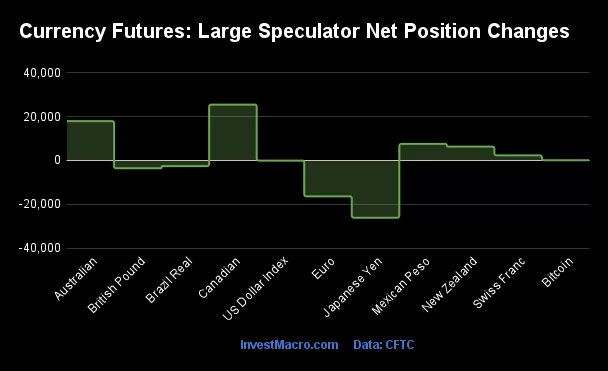
Weekly Speculator Changes led by Euro & Japanese Yen

The COT currency market speculator bets were higher this week as seven out of the eleven currency markets we cover had higher positioning while the other four markets had lower speculator contracts.

Leading the gains for the currency markets was the EuroFX (12,565 contracts) with the Japanese Yen (8,740 contracts), the British Pound (1,738 contracts), the Swiss Franc (680 contracts), the Mexican Peso (649 contracts), Bitcoin (606 contracts) and the US Dollar Index (582 contracts) also having positive weeks.

The currencies seeing declines in speculator bets on the week were the Australian Dollar (-12,655 contracts), the Canadian Dollar (-11,082 contracts), the Brazilian Real (-616 contracts) and the New Zealand Dollar (-9 contracts) also registering lower bets on the week.

Currency Speculators raise Euro & US Dollar bets into positive levels

This week’s COT currency’s data saw a continued improvement in many currencies (EUR, USDIndex, GBP, JPY) that had seen their positions weakening significantly over the past few months. Overall, most of the currency positions remain in weak levels versus the US dollar as only the Mexican peso, the Euro and the USD Index currently have positive bullish speculator positions.

Here is this week’s COT currency roundup:

The Euro positions continue to rebound after a deeply negative stretch in March and April that took -84,396 contracts off the speculator position and dropped the Euro contracts into a bearish position for the first time since September of 2022. This week the Euro bets rose by +12,565 contracts following last week’s +11,367 contract gain and has brought the speculator standing to a current level of +17,155 contracts. The Euro exchange rate has been on a 5-week winning streak as well and closed this week at the 1.0889 level against the US dollar.

The US dollar index positions rose modestly again this week and have now been higher for six consecutive weeks. This recent bullishness has taken the speculator standing back into bullish territory after the position dipped into negative or bearish levels in March for the first time since 2021.

Japanese yen speculator bets continued to improve for a third straight week after falling to a multi-year low of -179,919 contracts on April 23rd. The three-week improvement has totaled +53,737 contracts and coincided with a reported intervention in the currency markets by the Japanese government to stop a sharp slide in the yen. Despite the intervention, the yen’s exchange rate versus the dollar continues to be historically weak with the USDJPY currency pair closing the week right around the 155.60 level.

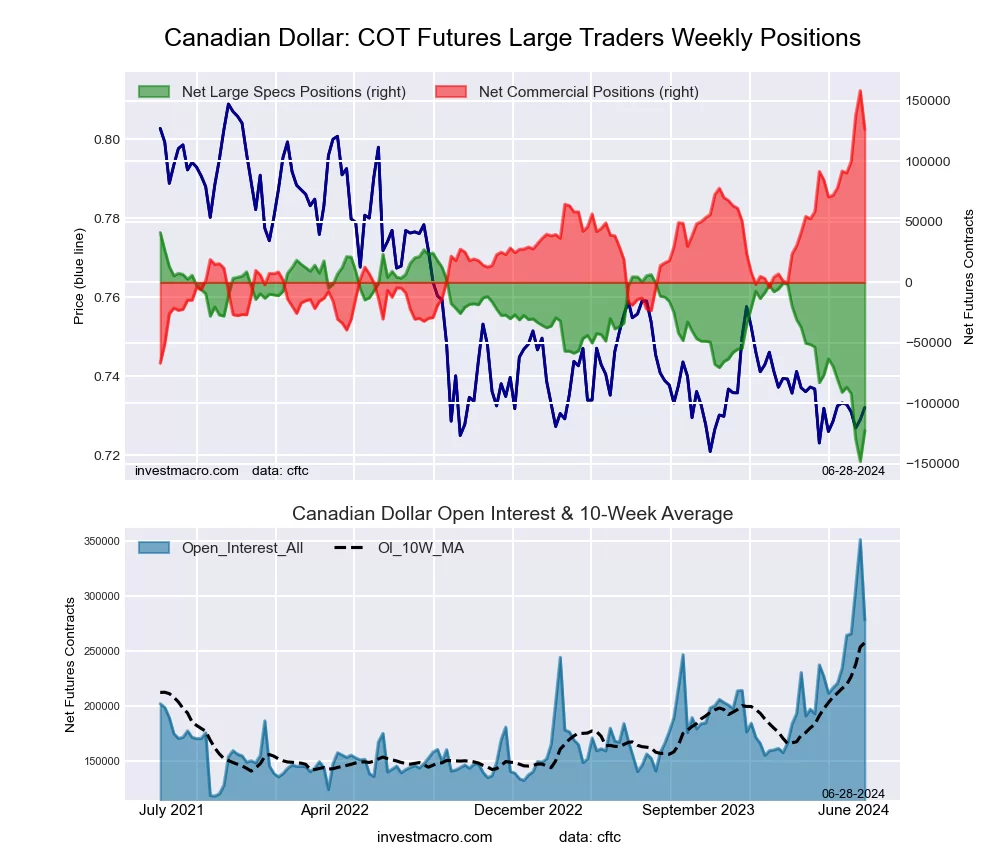
The Canadian dollar speculative position dropped for a second straight week this week and the current -80,303 contract level is the most bearish standing in a month for the CAD bets. The renewed bearishness for speculators has brought the CAD into extreme bearishness versus its range over the past three years with a 1.9 percent strength score. The Canadian dollar exchange rate remains in a down-trending channel versus the US dollar with our weekly trend model also considering the CAD to be in a downtrend at the moment. However, the CADUSD currency pair has recently bounced off a base of support around the 0.7250 level for the fourth time since 2022.

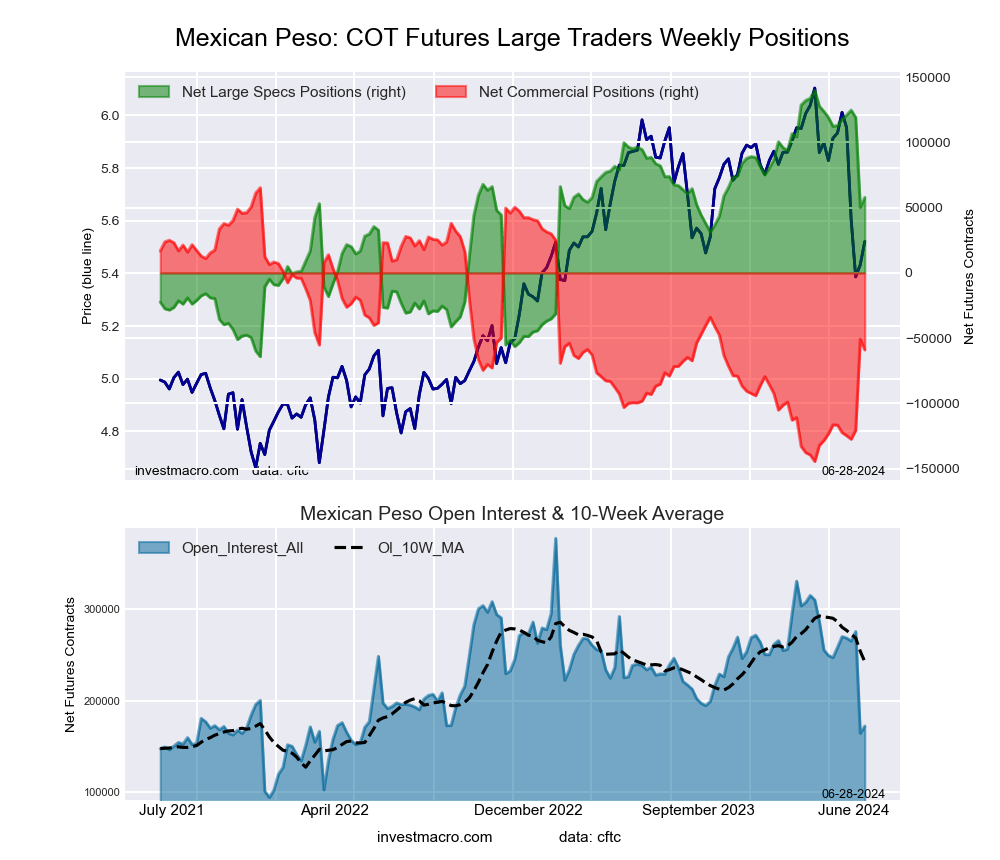
The Mexican Peso saw a small weekly gain by just 649 contracts but this broke a four-week losing streak that saw a total of -27,379 contracts subtracted from the overall bullish position. Despite the recent weakness in positions, the MXN speculative position has remained the most bullish currency versus the US dollar and has maintained a speculator position above the +100,000 contract level for eleven consecutive weeks. This is the best +100,000 contract streak since late-2019 into early-2020. The MXN exchange rate versus the USD has been trending strongly higher over the past three weeks with a gain of approximately 4 percent in these three weeks and has now brought the exchange rate into positive territory year-to-date.


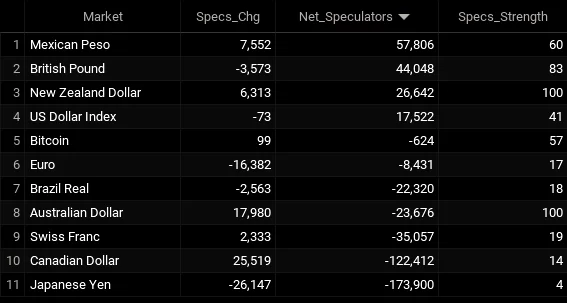
Currencies Net Speculators Leaderboard

Legend: Weekly Speculators Change | Speculators Current Net Position | Speculators Strength Score compared to last 3-Years (0-100 range)


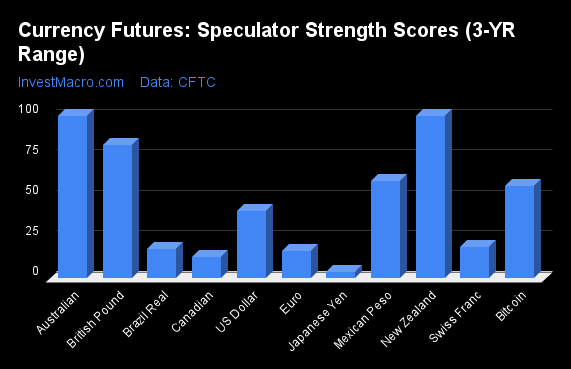
Strength Scores led by the Mexican Peso

COT Strength Scores (a normalized measure of Speculator positions over a 3-Year range, from 0 to 100 where above 80 is Extreme-Bullish and below 20 is Extreme-Bearish) showed that the Mexican Peso (87 percent) leads the currency markets this week. Bitcoin (64 percent) comes in as the next highest in the weekly strength scores.

On the downside, the Brazilian Real (0 percent), the Canadian Dollar (2 percent), the Swiss Franc (3 percent) and the US Dollar Index (10 percent) come in at the lowest strength levels currently and are in Extreme-Bearish territory (below 20 percent).

Strength Statistics:
US Dollar Index (10.0 percent) vs US Dollar Index previous week (8.8 percent)
EuroFX (27.6 percent) vs EuroFX previous week (22.3 percent)
British Pound Sterling (40.0 percent) vs British Pound Sterling previous week (38.8 percent)
Japanese Yen (33.6 percent) vs Japanese Yen previous week (28.1 percent)
Swiss Franc (2.6 percent) vs Swiss Franc previous week (1.4 percent)
Canadian Dollar (1.9 percent) vs Canadian Dollar previous week (10.3 percent)
Australian Dollar (28.5 percent) vs Australian Dollar previous week (40.3 percent)
New Zealand Dollar (28.6 percent) vs New Zealand Dollar previous week (28.6 percent)
Mexican Peso (86.9 percent) vs Mexican Peso previous week (86.6 percent)
Brazilian Real (0.0 percent) vs Brazilian Real previous week (0.7 percent)
Bitcoin (63.7 percent) vs Bitcoin previous week (54.6 percent)


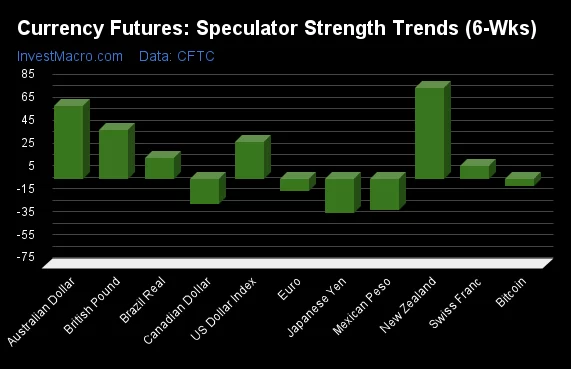
Australian Dollar & Japanese Yen top the 6-Week Strength Trends

COT Strength Score Trends (or move index, calculates the 6-week changes in strength scores) showed that the Australian Dollar (24 percent) and the Japanese Yen (11 percent) lead the past six weeks trends for the currencies. The US Dollar Index (9 percent) is the next highest positive mover in the latest trends data.

The British Pound (-42 percent) leads the downside trend scores currently with the Brazilian Real (-39 percent), Swiss Franc (-33 percent) and the Canadian Dollar (-22 percent) following next with lower trend scores.

Strength Trend Statistics:
US Dollar Index (9.2 percent) vs US Dollar Index previous week (5.2 percent)
EuroFX (0.2 percent) vs EuroFX previous week (-11.3 percent)
British Pound Sterling (-42.1 percent) vs British Pound Sterling previous week (-37.8 percent)
Japanese Yen (10.7 percent) vs Japanese Yen previous week (-3.6 percent)
Swiss Franc (-33.4 percent) vs Swiss Franc previous week (-35.3 percent)
Canadian Dollar (-22.1 percent) vs Canadian Dollar previous week (-14.4 percent)
Australian Dollar (23.9 percent) vs Australian Dollar previous week (38.4 percent)
New Zealand Dollar (-10.4 percent) vs New Zealand Dollar previous week (-14.7 percent)
Mexican Peso (-10.2 percent) vs Mexican Peso previous week (-9.7 percent)
Brazilian Real (-39.4 percent) vs Brazilian Real previous week (-52.2 percent)
Bitcoin (-5.1 percent) vs Bitcoin previous week (4.4 percent)


Individual COT Forex Markets:

US Dollar Index Futures:

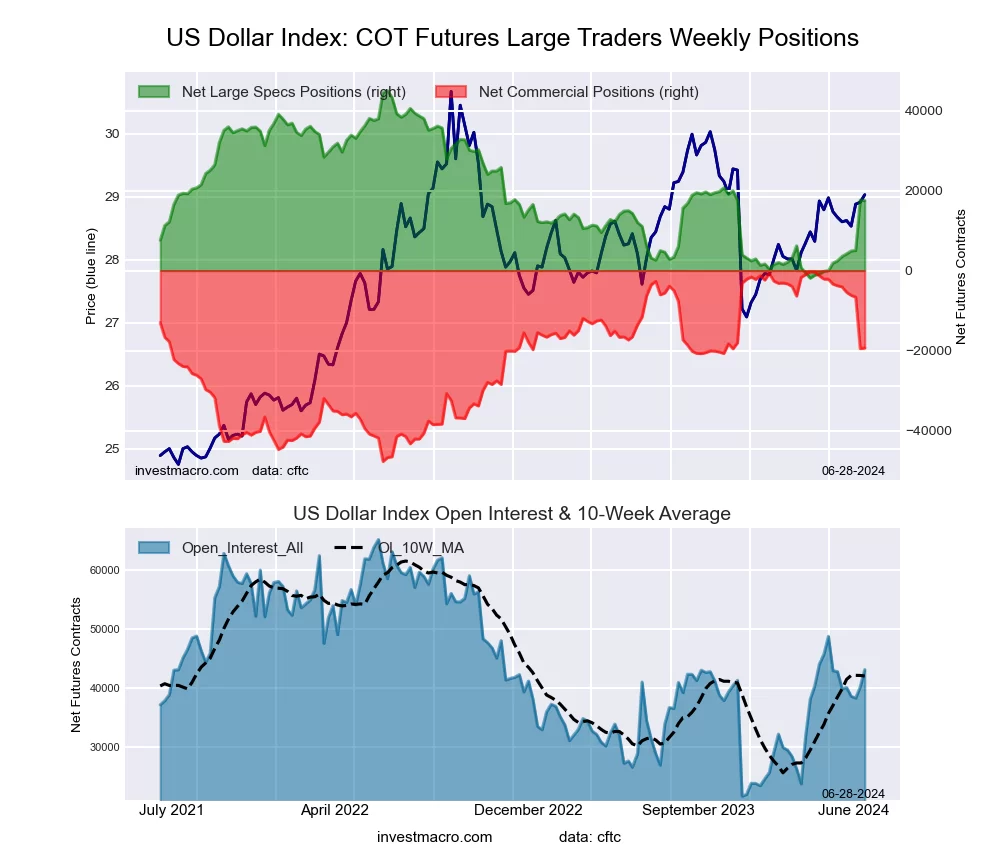
US Dollar Index Forex Futures COT ChartThe US Dollar Index large speculator standing this week was a net position of 2,435 contracts in the data reported through Tuesday. This was a weekly boost of 582 contracts from the previous week which had a total of 1,853 net contracts.

This week’s current strength score (the trader positioning range over the past three years, measured from 0 to 100) shows the speculators are currently Bearish-Extreme with a score of 10.0 percent. The commercials are Bullish-Extreme with a score of 92.7 percent and the small traders (not shown in chart) are Bearish with a score of 26.9 percent.

Price Trend-Following Model: Uptrend

Our weekly trend-following model classifies the current market price position as: Uptrend. The current action for the model is considered to be: Hold – Maintain Long Position.

US DOLLAR INDEX StatisticsSPECULATORSCOMMERCIALSSMALL TRADERS
– Percent of Open Interest Longs:69.319.88.3
– Percent of Open Interest Shorts:63.628.65.1
– Net Position:2,435-3,7901,355
– Gross Longs:29,6828,4723,535
– Gross Shorts:27,24712,2622,180
– Long to Short Ratio:1.1 to 10.7 to 11.6 to 1
NET POSITION TREND:
– Strength Index Score (3 Year Range Pct):10.092.726.9
– Strength Index Reading (3 Year Range):Bearish-ExtremeBullish-ExtremeBearish
NET POSITION MOVEMENT INDEX:
– 6-Week Change in Strength Index:9.2-7.3-9.8


Euro Currency Futures:

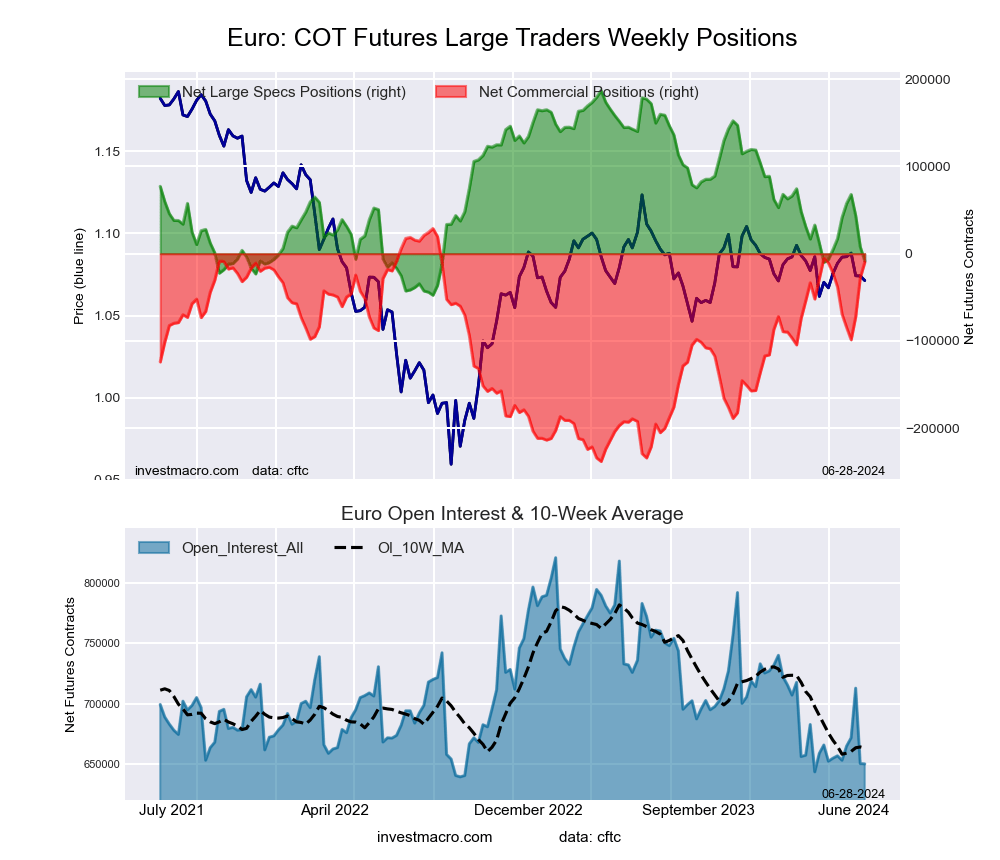
Euro Currency Futures COT ChartThe Euro Currency large speculator standing this week was a net position of 17,155 contracts in the data reported through Tuesday. This was a weekly boost of 12,565 contracts from the previous week which had a total of 4,590 net contracts.

This week’s current strength score (the trader positioning range over the past three years, measured from 0 to 100) shows the speculators are currently Bearish with a score of 27.6 percent. The commercials are Bullish with a score of 74.9 percent and the small traders (not shown in chart) are Bearish-Extreme with a score of 12.7 percent.

Price Trend-Following Model: Weak Downtrend

Our weekly trend-following model classifies the current market price position as: Weak Downtrend. The current action for the model is considered to be: Hold – Maintain Short Position.

EURO Currency StatisticsSPECULATORSCOMMERCIALSSMALL TRADERS
– Percent of Open Interest Longs:27.259.011.6
– Percent of Open Interest Shorts:24.564.98.4
– Net Position:17,155-38,28221,127
– Gross Longs:178,398387,81276,472
– Gross Shorts:161,243426,09455,345
– Long to Short Ratio:1.1 to 10.9 to 11.4 to 1
NET POSITION TREND:
– Strength Index Score (3 Year Range Pct):27.674.912.7
– Strength Index Reading (3 Year Range):BearishBullishBearish-Extreme
NET POSITION MOVEMENT INDEX:
– 6-Week Change in Strength Index:0.2-1.87.2


British Pound Sterling Futures:

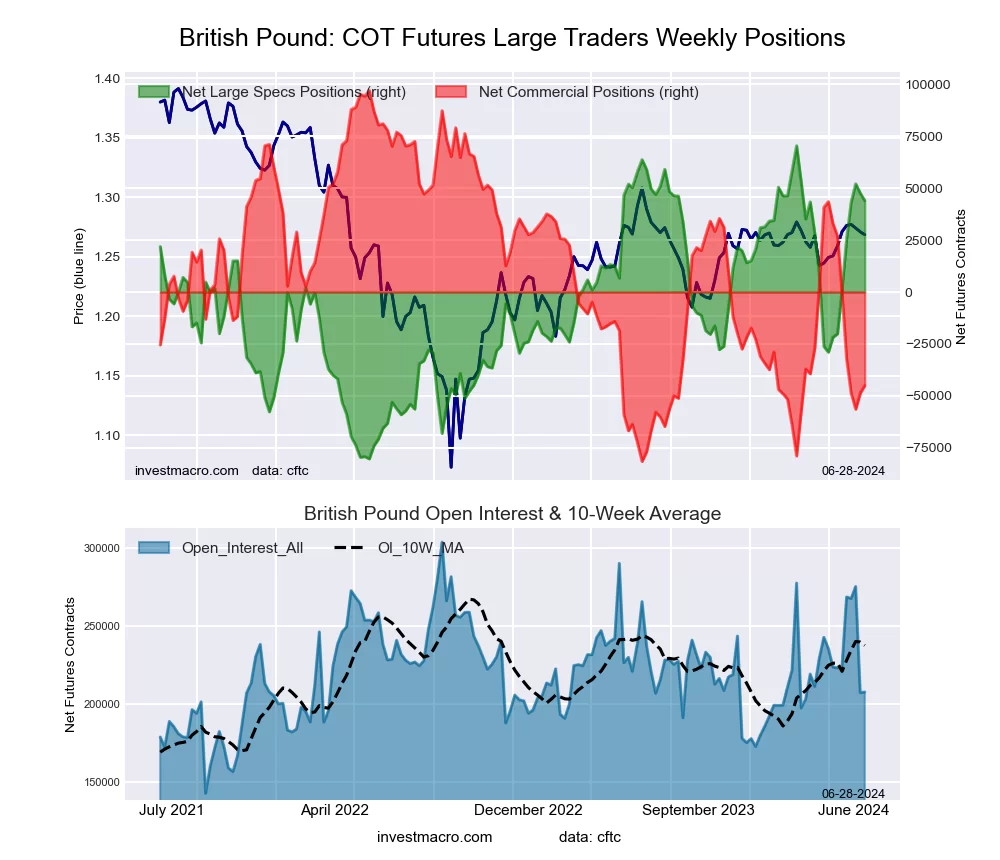
British Pound Sterling Futures COT ChartThe British Pound Sterling large speculator standing this week was a net position of -20,075 contracts in the data reported through Tuesday. This was a weekly lift of 1,738 contracts from the previous week which had a total of -21,813 net contracts.

This week’s current strength score (the trader positioning range over the past three years, measured from 0 to 100) shows the speculators are currently Bearish with a score of 40.0 percent. The commercials are Bullish with a score of 60.7 percent and the small traders (not shown in chart) are Bearish with a score of 46.5 percent.

Price Trend-Following Model: Weak Downtrend

Our weekly trend-following model classifies the current market price position as: Weak Downtrend. The current action for the model is considered to be: Hold – Maintain Short Position.

BRITISH POUND StatisticsSPECULATORSCOMMERCIALSSMALL TRADERS
– Percent of Open Interest Longs:21.861.811.6
– Percent of Open Interest Shorts:30.849.814.6
– Net Position:-20,07526,795-6,720
– Gross Longs:48,674137,91725,869
– Gross Shorts:68,749111,12232,589
– Long to Short Ratio:0.7 to 11.2 to 10.8 to 1
NET POSITION TREND:
– Strength Index Score (3 Year Range Pct):40.060.746.5
– Strength Index Reading (3 Year Range):BearishBullishBearish
NET POSITION MOVEMENT INDEX:
– 6-Week Change in Strength Index:-42.137.1-5.5


Japanese Yen Futures:

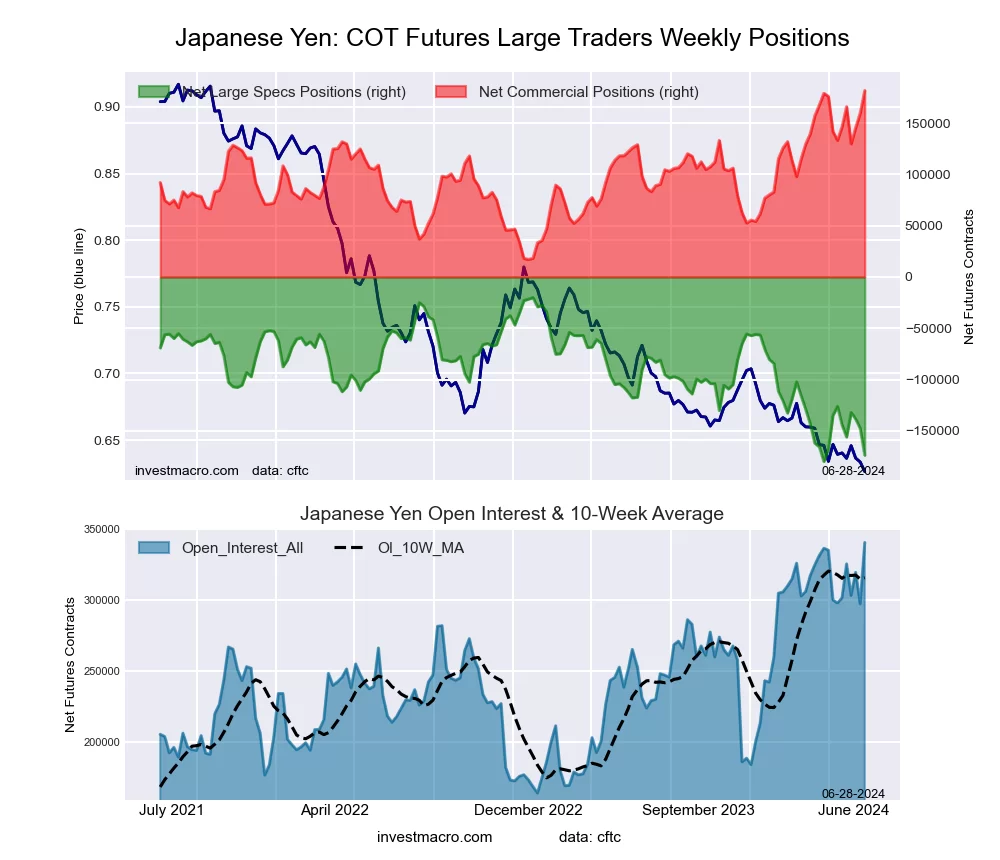
Japanese Yen Forex Futures COT ChartThe Japanese Yen large speculator standing this week was a net position of -126,182 contracts in the data reported through Tuesday. This was a weekly rise of 8,740 contracts from the previous week which had a total of -134,922 net contracts.

This week’s current strength score (the trader positioning range over the past three years, measured from 0 to 100) shows the speculators are currently Bearish with a score of 33.6 percent. The commercials are Bullish with a score of 71.7 percent and the small traders (not shown in chart) are Bullish with a score of 60.3 percent.

Price Trend-Following Model: Downtrend

Our weekly trend-following model classifies the current market price position as: Downtrend. The current action for the model is considered to be: Hold – Maintain Short Position.

JAPANESE YEN StatisticsSPECULATORSCOMMERCIALSSMALL TRADERS
– Percent of Open Interest Longs:11.972.713.3
– Percent of Open Interest Shorts:54.327.915.6
– Net Position:-126,182133,294-7,112
– Gross Longs:35,303216,44239,446
– Gross Shorts:161,48583,14846,558
– Long to Short Ratio:0.2 to 12.6 to 10.8 to 1
NET POSITION TREND:
– Strength Index Score (3 Year Range Pct):33.671.760.3
– Strength Index Reading (3 Year Range):BearishBullishBullish
NET POSITION MOVEMENT INDEX:
– 6-Week Change in Strength Index:10.7-3.8-34.1


Swiss Franc Futures:

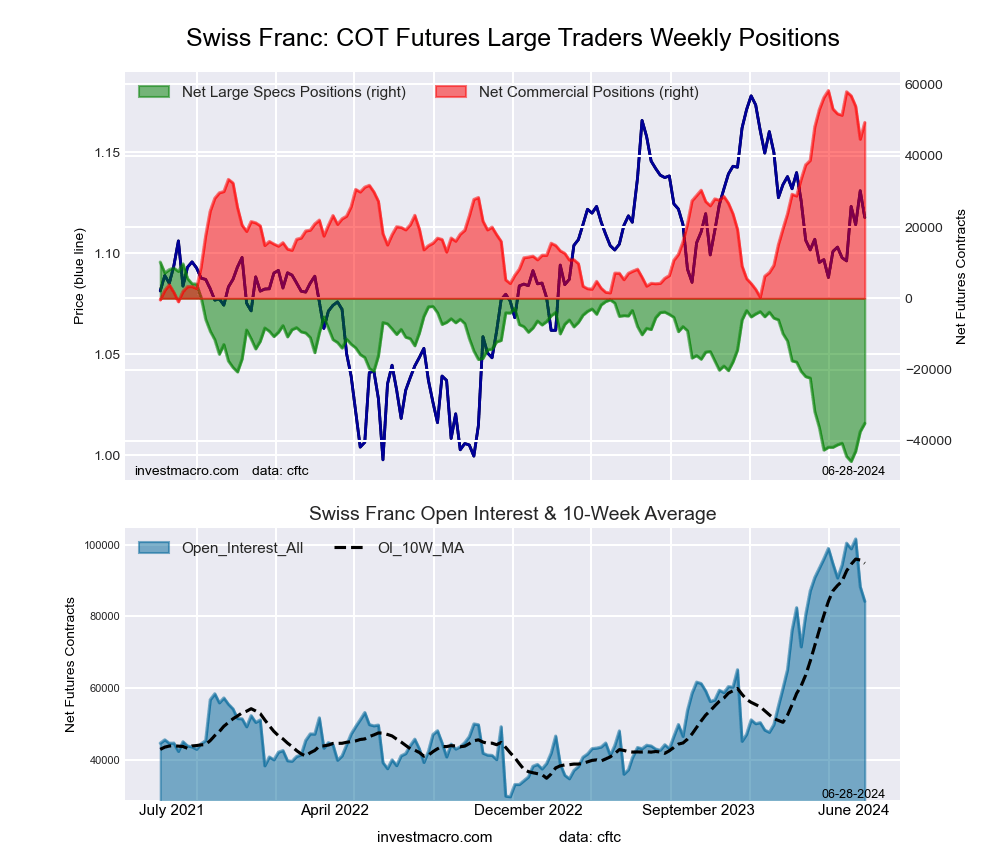
Swiss Franc Forex Futures COT ChartThe Swiss Franc large speculator standing this week was a net position of -41,107 contracts in the data reported through Tuesday. This was a small weekly advance of 680 contracts from the previous week which had a total of -41,787 net contracts.

This week’s current strength score (the trader positioning range over the past three years, measured from 0 to 100) shows the speculators are currently Bearish-Extreme with a score of 2.6 percent. The commercials are Bullish-Extreme with a score of 90.2 percent and the small traders (not shown in chart) are Bearish with a score of 28.8 percent.

Price Trend-Following Model: Downtrend

Our weekly trend-following model classifies the current market price position as: Downtrend. The current action for the model is considered to be: Hold – Maintain Short Position.

SWISS FRANC StatisticsSPECULATORSCOMMERCIALSSMALL TRADERS
– Percent of Open Interest Longs:7.379.112.3
– Percent of Open Interest Shorts:52.622.024.0
– Net Position:-41,10751,769-10,662
– Gross Longs:6,64671,74511,121
– Gross Shorts:47,75319,97621,783
– Long to Short Ratio:0.1 to 13.6 to 10.5 to 1
NET POSITION TREND:
– Strength Index Score (3 Year Range Pct):2.690.228.8
– Strength Index Reading (3 Year Range):Bearish-ExtremeBullish-ExtremeBearish
NET POSITION MOVEMENT INDEX:
– 6-Week Change in Strength Index:-33.419.625.7


Canadian Dollar Futures:

Canadian Dollar Forex Futures COT ChartThe Canadian Dollar large speculator standing this week was a net position of -80,303 contracts in the data reported through Tuesday. This was a weekly decrease of -11,082 contracts from the previous week which had a total of -69,221 net contracts.

This week’s current strength score (the trader positioning range over the past three years, measured from 0 to 100) shows the speculators are currently Bearish-Extreme with a score of 1.9 percent. The commercials are Bullish-Extreme with a score of 92.3 percent and the small traders (not shown in chart) are Bearish with a score of 28.1 percent.

Price Trend-Following Model: Downtrend

Our weekly trend-following model classifies the current market price position as: Downtrend. The current action for the model is considered to be: Hold – Maintain Short Position.

CANADIAN DOLLAR StatisticsSPECULATORSCOMMERCIALSSMALL TRADERS
– Percent of Open Interest Longs:15.566.814.7
– Percent of Open Interest Shorts:51.931.413.8
– Net Position:-80,30378,2202,083
– Gross Longs:34,286147,62632,492
– Gross Shorts:114,58969,40630,409
– Long to Short Ratio:0.3 to 12.1 to 11.1 to 1
NET POSITION TREND:
– Strength Index Score (3 Year Range Pct):1.992.328.1
– Strength Index Reading (3 Year Range):Bearish-ExtremeBullish-ExtremeBearish
NET POSITION MOVEMENT INDEX:
– 6-Week Change in Strength Index:-22.114.87.6


Australian Dollar Futures:

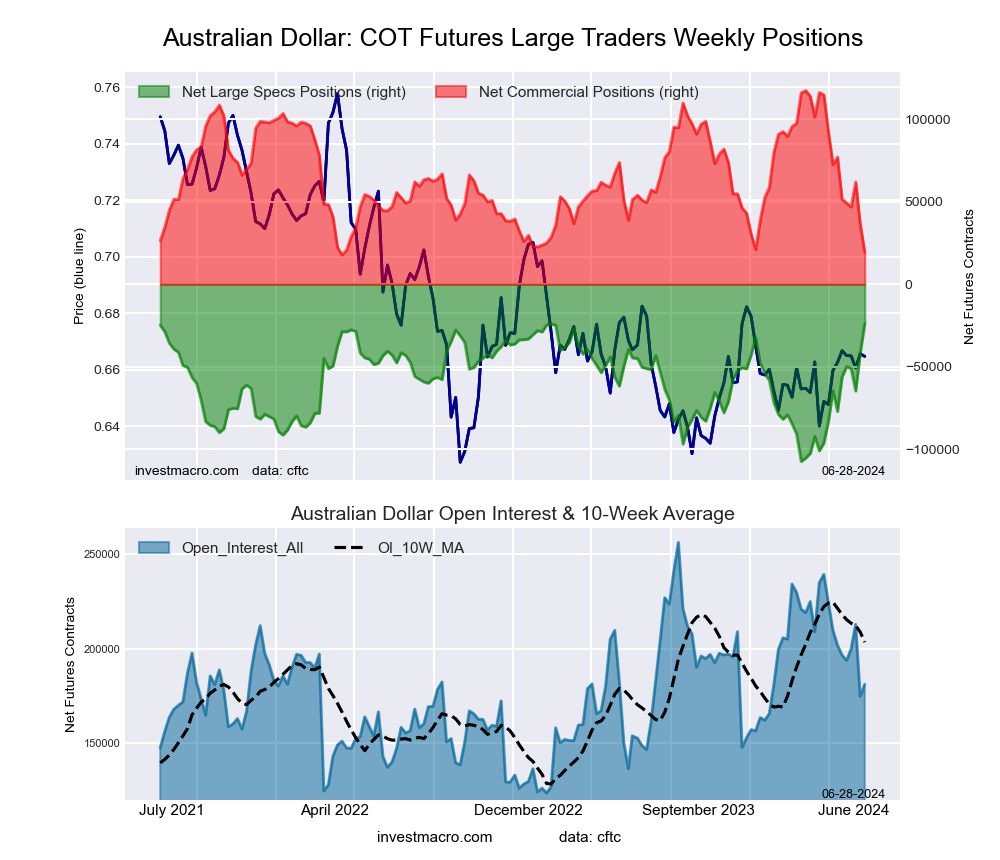
Australian Dollar Forex Futures COT ChartThe Australian Dollar large speculator standing this week was a net position of -77,171 contracts in the data reported through Tuesday. This was a weekly drop of -12,655 contracts from the previous week which had a total of -64,516 net contracts.

This week’s current strength score (the trader positioning range over the past three years, measured from 0 to 100) shows the speculators are currently Bearish with a score of 28.5 percent. The commercials are Bullish with a score of 69.0 percent and the small traders (not shown in chart) are Bullish with a score of 58.7 percent.

Price Trend-Following Model: Weak Downtrend

Our weekly trend-following model classifies the current market price position as: Weak Downtrend. The current action for the model is considered to be: Hold – Maintain Short Position.

AUSTRALIAN DOLLAR StatisticsSPECULATORSCOMMERCIALSSMALL TRADERS
– Percent of Open Interest Longs:19.965.212.8
– Percent of Open Interest Shorts:58.127.012.8
– Net Position:-77,17177,14229
– Gross Longs:40,059131,59625,881
– Gross Shorts:117,23054,45425,852
– Long to Short Ratio:0.3 to 12.4 to 11.0 to 1
NET POSITION TREND:
– Strength Index Score (3 Year Range Pct):28.569.058.7
– Strength Index Reading (3 Year Range):BearishBullishBullish
NET POSITION MOVEMENT INDEX:
– 6-Week Change in Strength Index:23.9-28.331.2


New Zealand Dollar Futures:

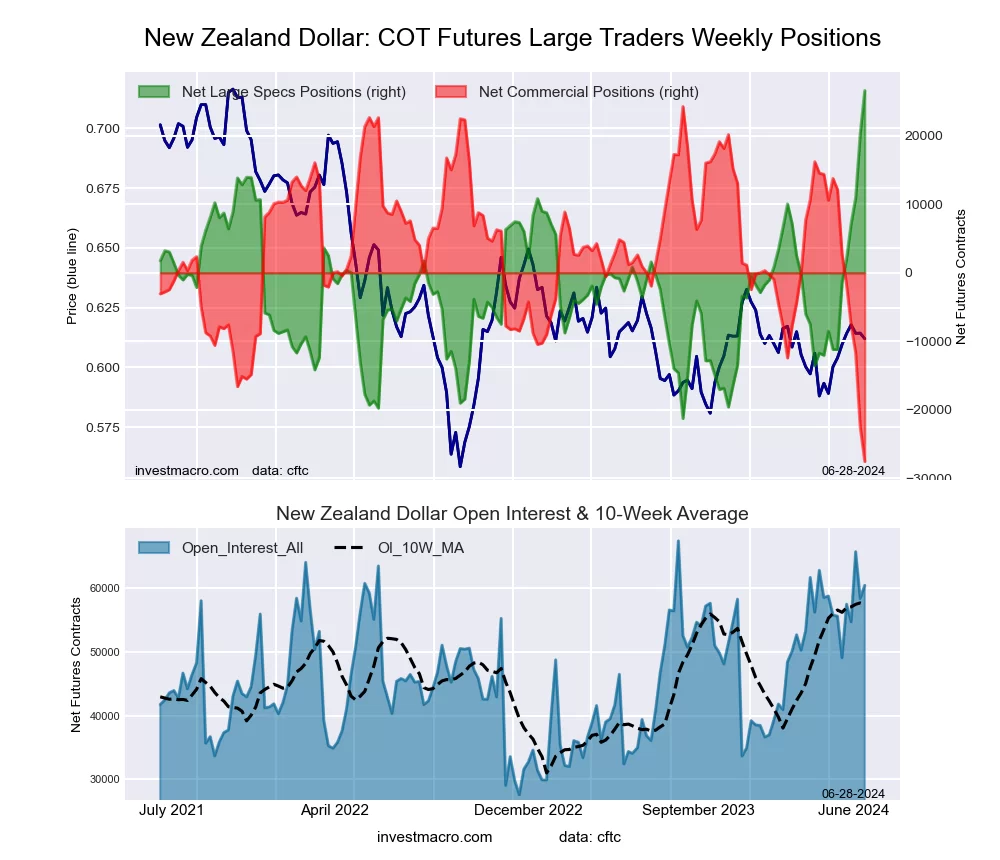
New Zealand Dollar Forex Futures COT ChartThe New Zealand Dollar large speculator standing this week was a net position of -11,200 contracts in the data reported through Tuesday. This was a weekly dip of just -9 contracts from the previous week which had a total of -11,191 net contracts.

This week’s current strength score (the trader positioning range over the past three years, measured from 0 to 100) shows the speculators are currently Bearish with a score of 28.6 percent. The commercials are Bullish with a score of 70.3 percent and the small traders (not shown in chart) are Bearish with a score of 41.8 percent.

Price Trend-Following Model: Weak Downtrend

Our weekly trend-following model classifies the current market price position as: Weak Downtrend. The current action for the model is considered to be: Hold – Maintain Short Position.

NEW ZEALAND DOLLAR StatisticsSPECULATORSCOMMERCIALSSMALL TRADERS
– Percent of Open Interest Longs:34.758.36.6
– Percent of Open Interest Shorts:54.836.58.3
– Net Position:-11,20012,162-962
– Gross Longs:19,28432,4513,683
– Gross Shorts:30,48420,2894,645
– Long to Short Ratio:0.6 to 11.6 to 10.8 to 1
NET POSITION TREND:
– Strength Index Score (3 Year Range Pct):28.670.341.8
– Strength Index Reading (3 Year Range):BearishBullishBearish
NET POSITION MOVEMENT INDEX:
– 6-Week Change in Strength Index:-10.43.628.4


Mexican Peso Futures:

Mexican Peso Futures COT ChartThe Mexican Peso large speculator standing this week was a net position of 112,961 contracts in the data reported through Tuesday. This was a weekly advance of 649 contracts from the previous week which had a total of 112,312 net contracts.

This week’s current strength score (the trader positioning range over the past three years, measured from 0 to 100) shows the speculators are currently Bullish-Extreme with a score of 86.9 percent. The commercials are Bearish-Extreme with a score of 13.3 percent and the small traders (not shown in chart) are Bearish with a score of 34.4 percent.

Price Trend-Following Model: Strong Uptrend

Our weekly trend-following model classifies the current market price position as: Strong Uptrend. The current action for the model is considered to be: Hold – Maintain Long Position.

MEXICAN PESO StatisticsSPECULATORSCOMMERCIALSSMALL TRADERS
– Percent of Open Interest Longs:55.941.02.7
– Percent of Open Interest Shorts:12.186.21.3
– Net Position:112,961-116,6013,640
– Gross Longs:144,307105,8406,997
– Gross Shorts:31,346222,4413,357
– Long to Short Ratio:4.6 to 10.5 to 12.1 to 1
NET POSITION TREND:
– Strength Index Score (3 Year Range Pct):86.913.334.4
– Strength Index Reading (3 Year Range):Bullish-ExtremeBearish-ExtremeBearish
NET POSITION MOVEMENT INDEX:
– 6-Week Change in Strength Index:-10.210.9-13.2


Brazilian Real Futures:

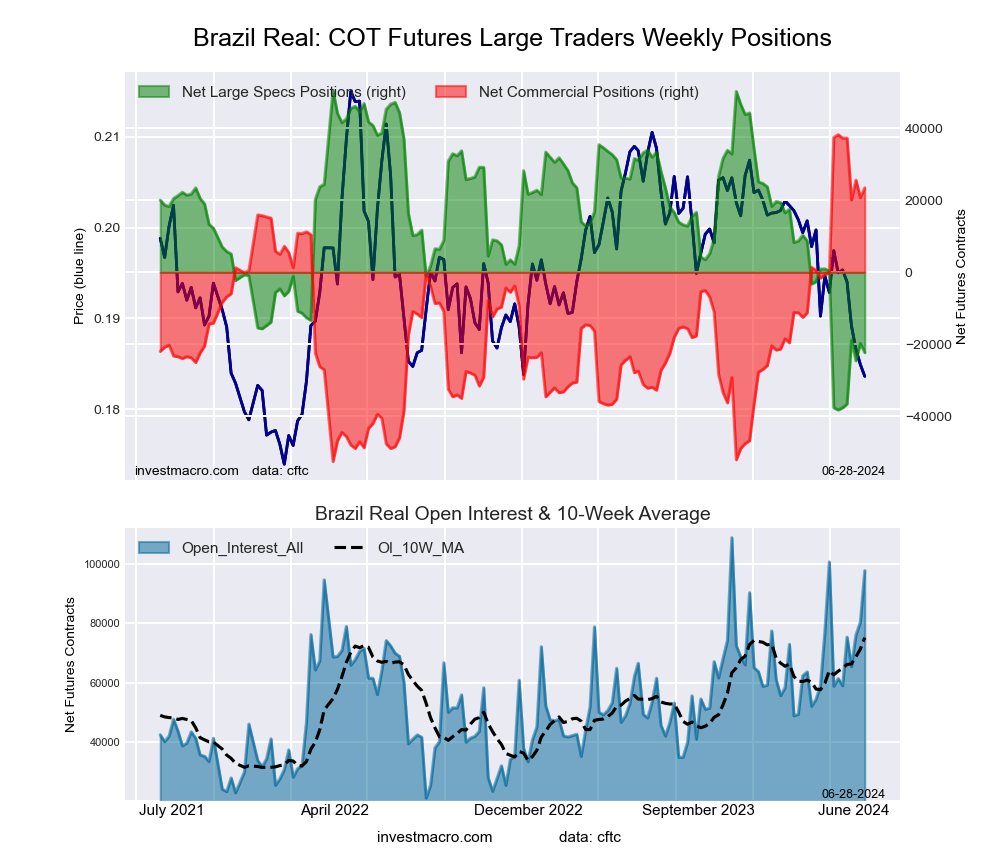
Brazil Real Futures COT ChartThe Brazilian Real large speculator standing this week was a net position of -38,259 contracts in the data reported through Tuesday. This was a weekly reduction of -616 contracts from the previous week which had a total of -37,643 net contracts.

This week’s current strength score (the trader positioning range over the past three years, measured from 0 to 100) shows the speculators are currently Bearish-Extreme with a score of 0.0 percent. The commercials are Bullish-Extreme with a score of 100.0 percent and the small traders (not shown in chart) are Bearish with a score of 34.5 percent.

Price Trend-Following Model: Downtrend

Our weekly trend-following model classifies the current market price position as: Downtrend. The current action for the model is considered to be: Hold – Maintain Short Position.

BRAZIL REAL StatisticsSPECULATORSCOMMERCIALSSMALL TRADERS
– Percent of Open Interest Longs:18.378.23.4
– Percent of Open Interest Shorts:80.715.93.4
– Net Position:-38,25938,24910
– Gross Longs:11,25747,9832,105
– Gross Shorts:49,5169,7342,095
– Long to Short Ratio:0.2 to 14.9 to 11.0 to 1
NET POSITION TREND:
– Strength Index Score (3 Year Range Pct):0.0100.034.5
– Strength Index Reading (3 Year Range):Bearish-ExtremeBullish-ExtremeBearish
NET POSITION MOVEMENT INDEX:
– 6-Week Change in Strength Index:-39.440.6-17.6


Bitcoin Futures:

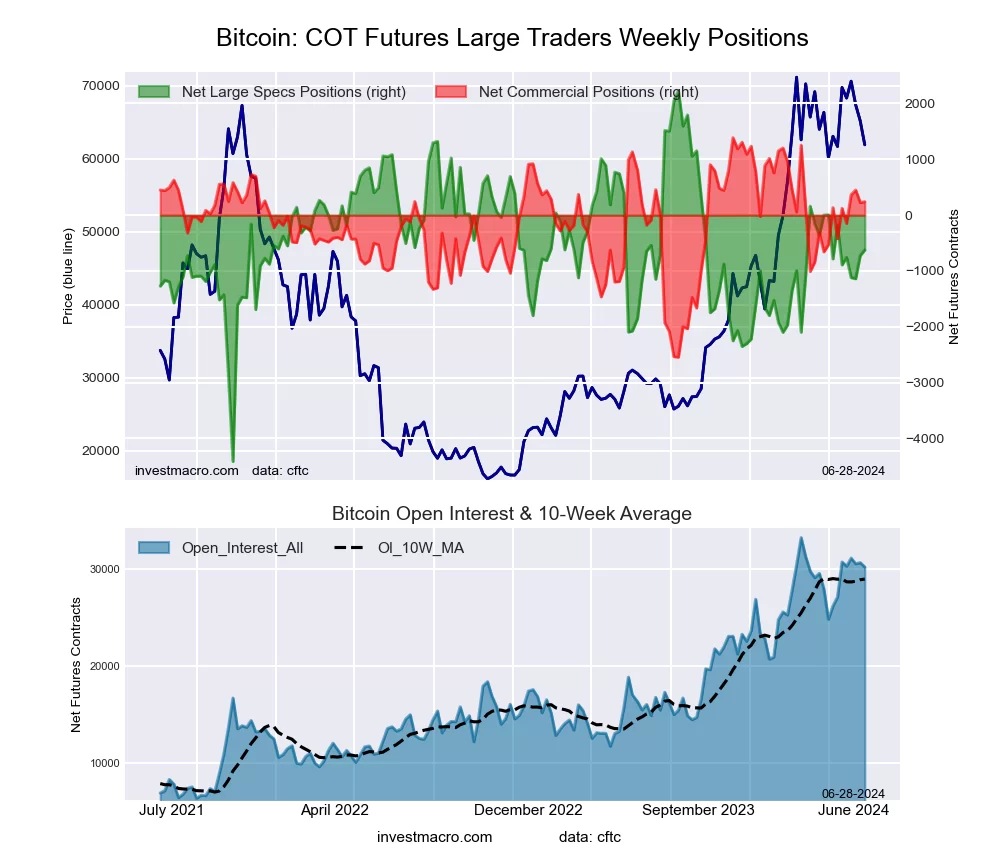
Bitcoin Crypto Futures COT ChartThe Bitcoin large speculator standing this week was a net position of -177 contracts in the data reported through Tuesday. This was a weekly rise of 606 contracts from the previous week which had a total of -783 net contracts.

This week’s current strength score (the trader positioning range over the past three years, measured from 0 to 100) shows the speculators are currently Bullish with a score of 63.7 percent. The commercials are Bullish with a score of 54.0 percent and the small traders (not shown in chart) are Bearish with a score of 26.5 percent.

Price Trend-Following Model: Uptrend

Our weekly trend-following model classifies the current market price position as: Uptrend. The current action for the model is considered to be: Hold – Maintain Long Position.

BITCOIN StatisticsSPECULATORSCOMMERCIALSSMALL TRADERS
– Percent of Open Interest Longs:77.84.15.6
– Percent of Open Interest Shorts:78.55.63.4
– Net Position:-177-421598
– Gross Longs:21,0781,0991,519
– Gross Shorts:21,2551,520921
– Long to Short Ratio:1.0 to 10.7 to 11.6 to 1
NET POSITION TREND:
– Strength Index Score (3 Year Range Pct):63.754.026.5
– Strength Index Reading (3 Year Range):BullishBullishBearish
NET POSITION MOVEMENT INDEX:
– 6-Week Change in Strength Index:-5.114.9-5.7


Article By InvestMacroReceive our weekly COT Newsletter

*COT Report: The COT data, released weekly to the public each Friday, is updated through the most recent Tuesday (data is 3 days old) and shows a quick view of how large speculators or non-commercials (for-profit traders) were positioned in the futures markets.

The CFTC categorizes trader positions according to commercial hedgers (traders who use futures contracts for hedging as part of the business), non-commercials (large traders who speculate to realize trading profits) and nonreportable traders (usually small traders/speculators) as well as their open interest (contracts open in the market at time of reporting). See CFTC criteria here.

Speculator Extremes: Silver, Copper, Brazilian Real & Sugar lead weekly Positions

By InvestMacro

The latest update for the weekly Commitment of Traders (COT) report was released by the Commodity Futures Trading Commission (CFTC) on Friday for data ending on May 14th.

This weekly Extreme Positions report highlights the Most Bullish and Most Bearish Positions for the speculator category. Extreme positioning in these markets can foreshadow strong moves in the underlying market.

To signify an extreme position, we use the Strength Index (also known as the COT Index) of each instrument, a common method of measuring COT data. The Strength Index is simply a comparison of current trader positions against the range of positions over the previous 3 years. We use over 80 percent as extremely bullish and under 20 percent as extremely bearish. (Compare Strength Index scores across all markets in the data table or cot leaders table)


Here Are This Week’s Most Bullish Speculator Positions:

Silver


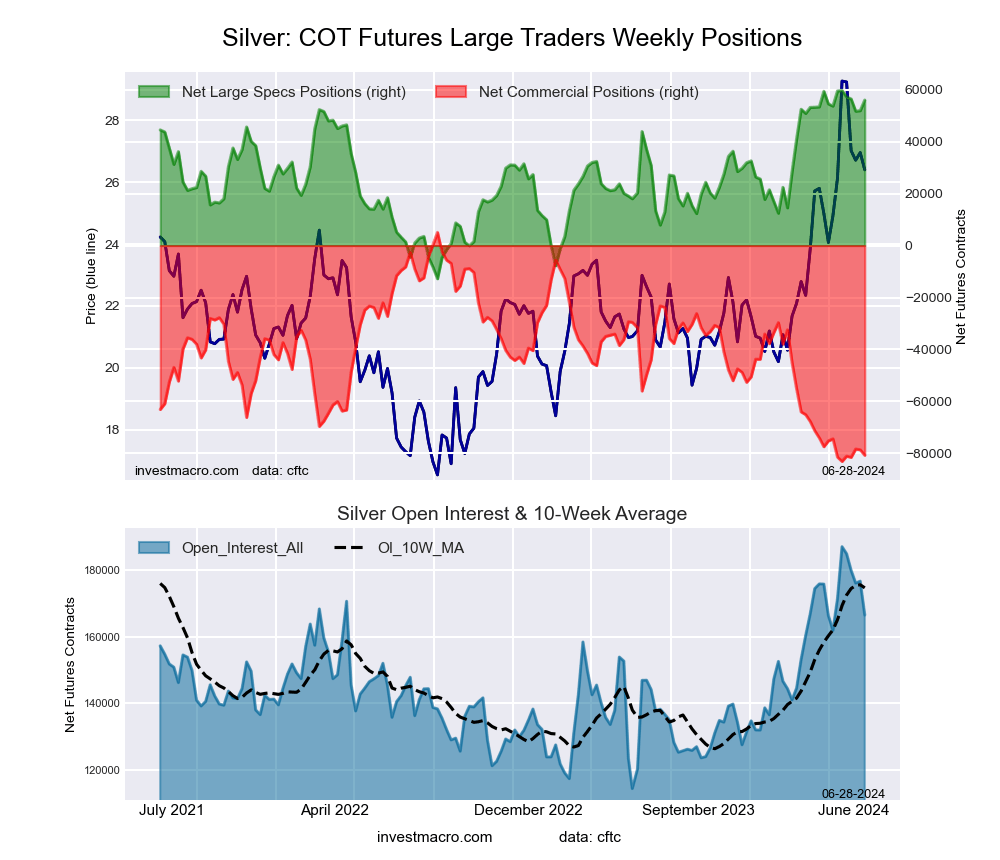
The Silver speculator position comes in as the most bullish extreme standing this week. The Silver speculator level is currently at a 100.0 percent score of its 3-year range.

The six-week trend for the percent strength score totaled 8.7 this week. The overall net speculator position was a total of 59,461 net contracts this week with a gain of 5,809 contract in the weekly speculator bets.


Speculators or Non-Commercials Notes:

Speculators, classified as non-commercial traders by the CFTC, are made up of large commodity funds, hedge funds and other significant for-profit participants. The Specs are generally regarded as trend-followers in their behavior towards price action – net speculator bets and prices tend to go in the same directions. These traders often look to buy when prices are rising and sell when prices are falling. To illustrate this point, many times speculator contracts can be found at their most extremes (bullish or bearish) when prices are also close to their highest or lowest levels.

These extreme levels can be dangerous for the large speculators as the trade is most crowded, there is less trading ammunition still sitting on the sidelines to push the trend further and prices have moved a significant distance. When the trend becomes exhausted, some speculators take profits while others look to also exit positions when prices fail to continue in the same direction. This process usually plays out over many months to years and can ultimately create a reverse effect where prices start to fall and speculators start a process of selling when prices are falling.


Copper


The Copper speculator position comes next in the extreme standings this week. The Copper speculator level is now at a 99.1 percent score of its 3-year range.

The six-week trend for the percent strength score was 42.2 this week. The speculator position registered 61,780 net contracts this week with a weekly dip of -868 contracts in speculator bets.


Fed Funds


The Fed Funds speculator position comes in third this week in the extreme standings. The Fed Funds speculator level resides at a 89.1 percent score of its 3-year range.

The six-week trend for the speculator strength score came in at 36.1 this week. The overall speculator position was 95,924 net contracts this week with a drop of -41,041 contracts in the weekly speculator bets.


Bloomberg Commodity Index


The Bloomberg Commodity Index speculator position comes up number four in the extreme standings this week. The Bloomberg Commodity Index speculator level is at a 88.5 percent score of its 3-year range.

The six-week trend for the speculator strength score totaled a change of -1.9 this week. The overall speculator position was -4,030 net contracts this week with a small dip of -40 contracts in the speculator bets.


Mexican Peso


The Mexican Peso speculator position rounds out the top five in this week’s bullish extreme standings. The Mexican Peso speculator level sits at a 86.9 percent score of its 3-year range. The six-week trend for the speculator strength score was -10.2 this week.

The speculator position was 112,961 net contracts this week with a slight edge higher by 649 contracts in the weekly speculator bets.


This Week’s Most Bearish Speculator Positions:

Brazil Real


The Brazil Real speculator position comes in as the most bearish extreme standing this week. The Brazil Real speculator level is at a 0.0 percent score of its 3-year range.

The six-week trend for the speculator strength score was -39.4 this week. The overall speculator position was -38,259 net contracts this week with a decline of -616 contracts in the speculator bets.


Sugar


The Sugar speculator position comes in next for the most bearish extreme standing on the week. The Sugar speculator level is at a 0.0 percent score of its 3-year range.

The six-week trend for the speculator strength score was -33.1 this week. The speculator position was 25,891 net contracts this week with a decrease by -2,670 contracts in the weekly speculator bets.


Ultra 10-Year U.S. T-Note


The Ultra 10-Year U.S. T-Note speculator position comes in as third most bearish extreme standing of the week. The Ultra 10-Year U.S. T-Note speculator level resides at a 0.3 percent score of its 3-year range.

The six-week trend for the speculator strength score was -27.1 this week. The overall speculator position was -276,454 net contracts this week with a drop of -62,155 contracts in the speculator bets.


Canadian Dollar


The Canadian Dollar speculator position comes in as this week’s fourth most bearish extreme standing. The Canadian Dollar speculator level is at a 1.9 percent score of its 3-year range.

The six-week trend for the speculator strength score was -22.1 this week. The speculator position was -80,303 net contracts this week with a decline of -11,082 contracts in the weekly speculator bets.


Swiss Franc


Finally, the Swiss Franc speculator position comes in as the fifth most bearish extreme standing for this week. The Swiss Franc speculator level is at a 2.6 percent score of its 3-year range.

The six-week trend for the speculator strength score was -33.4 this week. The speculator position was -41,107 net contracts this week with a small boost of 680 contracts in the weekly speculator bets.


Article By InvestMacroReceive our weekly COT Newsletter

*COT Report: The COT data, released weekly to the public each Friday, is updated through the most recent Tuesday (data is 3 days old) and shows a quick view of how large speculators or non-commercials (for-profit traders) were positioned in the futures markets.

The CFTC categorizes trader positions according to commercial hedgers (traders who use futures contracts for hedging as part of the business), non-commercials (large traders who speculate to realize trading profits) and nonreportable traders (usually small traders/speculators) as well as their open interest (contracts open in the market at time of reporting). See CFTC criteria here.

Sports gambling creates a windfall, but raises questions of integrity – here are three lessons from historic sports-betting scandals

By Jared Bahir Browsh, University of Colorado Boulder 

Sports betting is having a big moment across the United States. While gambling on sports has been legal for decades in countries such as the U.K., it wasn’t until 2018 that the U.S. Supreme Court ruled that states could legalize sports betting. Before then, sports betting had been permitted only in Nevada.

After the Supreme Court decision, the floodgates opened. Many states were happy to legalize sports gambling, enticed by the opportunity for more tax revenue. As of May 2024, sports gambling is legal in 38 states and Washington, D.C. Americans wagered nearly US$120 billion on sports in 2023 alone.

Until about 10 years ago, sports leagues in North America were apprehensive about – if not totally against – legalizing sports betting. The long history of sports gambling scandals in the U.S. led many to worry that legalizing sports betting would tarnish their sports’ credibility and image. The NCAA was one of many governing bodies that objected to legalizing sports gambling nationwide.

But now that the Supreme Court has blessed it, sports leagues have embraced gambling, forming partnerships with brands like Caesars Entertainment. The sportsbooks and platforms have integrity monitors to track potential inconsistencies. Still, a number of scandals involving athletes and the people around them have emerged since the Supreme Court ruling.

As a professor of critical sports studies, I teach students about the history of sports betting scandals. And I think they offer lessons for the present day.

Disgruntled players and pay disputes lead to temptation

The Black Sox Scandal of 1919 helped to further organize baseball, leading to the creation of the position of commissioner of baseball, which was first assumed by former judge and known racist Kennesaw Mountain Landis. Along with maintaining the color line, arguably his most notable action was banning, for life, the players on the Chicago White Sox involved in the fixing of the 1919 World Series.

Early professional baseball regulations explicitly banned gambling, but the money was too tempting for many players to ignore – and that included members of the 1919 White Sox. The players hated the team’s owner, Charles Comiskey, and felt that they were underpaid. But they were unable to change teams due to the reserve clause in their contracts, which gave owners exclusive rights to their players in perpetuity.

A faction of the team agreed to throw the World Series. Those players were ultimately indicted by a grand jury and went to trial. They were acquitted of criminal charges, but Landis suspended all of the players connected to the fix – including superstar “Shoeless” Joe Jackson, who admitted taking money from a teammate but maintained he was innocent of game fixing.

This was the the most notable of several attempts to fix baseball games early in the 20th century, as the game grew in popularity and a number of people associated with baseball, including players, managers and even umpires, looked to cash in.

Addiction isn’t limited to substances

Athlete salaries have soared in recent decades. However, this money hasn’t shielded players and others involved in sports from the grips of gambling addiction.

There are no rules banning athletes from sitting at a blackjack table or even gambling on other sports. Numerous players have wagered millions of dollars, with some athletes building up massive debts due to addiction.

These debts can lead to such desperation that athletes decide to risk their careers. Baseball legend and admitted compulsive gambler Pete Rose continues to sit outside the Hall of Fame because he bet on baseball games.

The most substantial gambling scandal in modern sports came in the NBA during the 2000s, involving referee Tim Donaghy. He admitted to providing information on NBA games, including those he officiated, which allegedly influenced his calls. Donaghy served time in prison as a result. So it isn’t just players who get in trouble.

Unpaid student-athletes are especially vulnerable to improprieties – and harassment

There have been several major point-shaving scandals in college basketball history, most famously at the City College of New York in the 1950s and at Boston College in the late 1970s – the latter of which involved Henry Hill, the subject of the blockbuster film “Goodfellas.”

The increasing use of prop, or proposition, bets, which focus on a specific outcome within a game rather than the overall result, has created a new point of vulnerability for student-athletes. While influencing an entire team is hard, history shows that individual players are more susceptible to pressure. A point guard or quarterback can slow down the game and reduce the margin of victory.

And while today’s unpaid student-athletes have the same financial incentives to cheat as earlier generations did, they face a new pressure: They’re often surrounded by gamblers on campus and on social media. Betting is pervasive not only at large universities but at smaller schools, too. According to NCAA surveys, 1 in 3 student-athletes have faced harassment from gamblers, ranging from derogatory comments to death threats.

New regulations and oversight measures could help

The sportsbooks have very little incentive to address potential violations, so it’s up to organizations that oversee sports to ensure the integrity of their games.

NCAA President Charlie Baker’s suggestion to ban prop bets is a good first step: The more individual players and gameplay are isolated, the easier it is for improprieties to occur.

Providing more guidance for players – and different types of punishments for different transgressions – could also be useful. Gambling violations that don’t affect competition outcomes should be treated differently from ones that do. The NCAA already does this by meting out lighter penalties for student-athletes who wager on other teams and sports as opposed to their own.

Providing treatment for players and others suffering from gambling addiction would be helpful as well, and there’s some evidence that open discussions of gambling addiction in European soccer have had a positive impact.

NBA Commissioner Adam Silver has suggested implementing federal oversight to eliminate the uncertainty of state-by-state regulations. Although scandals are still likely to occur, gambling commissions like the one in the U.K. can provide a framework for federal licensing and oversight.

The suddenness of states adopting sports betting has led to a windfall of profit for gambling companies and tax revenue for the states. But it may also endanger the integrity of sports. As policymakers mull how to address the issue, they might be wise to learn from history.The Conversation

About the Author:

Jared Bahir Browsh, Assistant Teaching Professor of Critical Sports Studies, University of Colorado Boulder

This article is republished from The Conversation under a Creative Commons license. Read the original article.


FXTM’s Soybean: On breakout watch

By ForexTime 

  • Soybean ↑ 5% month-to-date
  • Influenced by various fundamentals
  • Trapped in range on W1 timeframe
  • Breakout on the horizon?
  • Key levels at 1211, 1188, 1170

After bouncing within a weekly range since mid-January, FXTM’s new Soybean commodity could be on the brink of a major breakout!

Prices are flirting around the 1200 weekly resistance level as bulls and bears wait for a fresh directional catalyst.

Note: Soybean is priced per bushel. One bushel is equivalent to 60 pounds.

Before we break down the fundamentals, here are some fun facts about soybean:

  • Ancient crop that originates from China
  • More than 2500 varieties
  • Brazil is the biggest producer & exporter
  • China is the biggest importer
  • Gained over 5% month-to-date

What is Soybean?

Soybeans are simply the edible beans of the soya plant.

They come in many different shapes and sizes boasting various uses.

Humans and animals can consume this bean, also used for industrial and consumer products!

Note: Soya oil is extracted from Soybean. Soybean meal is the by-product of the extraction process.

Both can be traded along with Soybean on the CBOT (Chicago Board of Trade).

What does FXTM’s Soybean track?

FXTM’s Soybean tracks the CME Group’s Soybean futures, providing access to one of the world’s most widely grown crops.

The lowdown…

Soybean prices have been shaky in 2024, shedding almost 7% year-to-date.

A combination of rising global stockpiles and uncertainty over China’s demand has pressured the commodity.

Back in March, reports showed that China imported 13.04 million metric tons of soybeans for the first two months of 2024 – the lowest in 5 years.

Considering how China accounts for roughly 60% of global imports, it plays a key role in Soybeans outlook.

The bigger picture…

Brazil, the United States, and Argentina account for roughly 80% of total Soybean production.

Developments in these regions along with demand from China are likely to heavily influence the outlook for 2024.

There have been reports of severe weather conditions in Brazil threatening supplies of key agricultural commodities including soybeans. These concerns were reflected in the latest USDA report published last Friday which lowered estimates for Brazil’s production.

However, U.S. farmers are expected to produce near-record amounts of Soybean this year – adding to the rising global inventories.

What does this mean?

The various fundamental forces pulling and tugging at Soybeans could translate to fresh volatility.

Where there is volatility, this presents fresh opportunity.

Technical outlook…

Soybean prices remain in a wide range on the weekly charts with key support found around 1130 and resistance at 1200.

Zooming into the H1 timeframe, another range is in play with support at 1188 and resistance at 1211. Prices are trading below the 100 and 50 SMA and currently testing the 200 SMA.

  • A solid H1 close below 1188 could inspire a decline towards 1170.

  • Should prices push back above the 50 SMA, this could open a path back to 1211.

  • A break above 1211 may see prices test 1220 and 1235.


Forex-Time-LogoArticle by ForexTime
ForexTime Ltd (FXTM) is an award winning international online forex broker regulated by CySEC 185/12 www.forextime.com

Speculators boost Yen bets, bring Euro & USD Index out of bearish levels

By InvestMacro

Here are the latest charts and statistics for the Commitment of Traders (COT) data published by the Commodities Futures Trading Commission (CFTC).

The latest COT data is updated through Tuesday May 7th and shows a quick view of how large market participants (for-profit speculators and commercial traders) were positioned in the futures markets. All currency positions are in direct relation to the US dollar where, for example, a bet for the euro is a bet that the euro will rise versus the dollar while a bet against the euro will be a bet that the euro will decline versus the dollar.

Weekly Speculator Changes led by Japanese Yen & Australian Dollar

The COT currency market speculator bets were slightly lower this week as five out of the eleven currency markets we cover had higher positioning while the other six markets had lower speculator contracts.

Leading the gains for the currency markets was the Japanese Yen (33,466 contracts) with the Australian Dollar (18,719 contracts), the EuroFX (11,367 contracts), the British Pound (7,177 contracts) and the US Dollar Index (1,888 contracts) also showing a positive week.

The currencies with declines in speculator bets on the week were the Brazilian Real (-37,929 contracts), the Mexican Peso (-6,733 contracts), the Canadian Dollar (-6,020 contracts), the New Zealand Dollar (-2,640 contracts), Bitcoin (-789 contracts) and the Swiss Franc (-1 contract) also registering lower bets on the week.

Speculators boost Yen bets, bring Euro, USD Index out of bearish levels

Highlighting the COT currency’s data this week is that both the Euro and the US dollar index speculator positions were modestly boosted out of their bearish levels into small positive positions. Also, the Japanese yen and Australian dollar positions were well bid through Tuesday.

Here is this week’s COT currency roundup:

The Japanese yen contracts jumped this week by over +33,000 contracts which marked the highest one-week amount since 2020. The yen speculator position has now gained for two weeks in a row amid rumored currency intervention by the Japanese authorities that are trying to arrest deep declines in the yen. The USDJPY currency pair still trades over 155.00 which is close to over thirty-year highs for the US dollar against the yen.

The Australian dollar speculator position rose strongly this week by over +18,000 contracts following a boost by +13,004 contracts on April 30th. The AUD speculator bets have now gained for three straight weeks and for six out of the past seven weeks. Recently, the speculator position for the Aussie had dropped to an all-time record low on March 19th at a total of -107,538 contracts. Since then, speculator bets have improved significantly and are currently at -64,516 contracts.

The Euro bounced back again this week with a gain of +11,367 contracts and a follows up a small rise last week. The improvement in the overall net position has brought the speculative standing back into bullish territory following two straight weeks in bearish territory. That was the first time the Euro contracts had been in bearish territory since September of 2022.

The US dollar index bets also came out of bearish territory this week for the first time in seven weeks. The USD Index bets rose by 1,888 contracts and gained for the fifth straight week. The contracts had been in bullish territory for a total of 142 straight weeks before dropping into a bearish position on March 26th.

The Mexican Peso speculative position decreased this week for a fourth straight week but did so modestly (-6,733 contracts) and remains in a strong bullish level. The MXN speculator’s current standing (+112,312 contracts) remains above +100,000 contract level for 1oth consecutive week. The MXN peso exchange rate has bounced back with gains in the past two weeks after a steep pullback in the middle of April.

The Swiss franc position was virtually unchanged this week (-1 contract) but continues to remain near the lowest levels since 2019 at a total of -41,787 contracts. The franc is one of the most extremely bearish markets in the COT data we follow. The franc’s exchange rate against the US dollar has been on the decline with an approximate drop by over 8 percent since December 2023. The CHFUSD currently trades around the major levels near 1.1050 – 1.1100.


Currencies Net Speculators Leaderboard

Legend: Weekly Speculators Change | Speculators Current Net Position | Speculators Strength Score compared to last 3-Years (0-100 range)


Strength Scores led by Mexican Peso & Bitcoin

COT Strength Scores (a normalized measure of Speculator positions over a 3-Year range, from 0 to 100 where above 80 is Extreme-Bullish and below 20 is Extreme-Bearish) showed that the Mexican Peso (87 percent) and the Bitcoin (55 percent) lead the currency markets this week. The British Pound (39 percent), Australian Dollar (39 percent) and the New Zealand Dollar (29 percent) come in as the next highest in the weekly strength scores.

On the downside, the Brazilian Real (0 percent) and the Swiss Franc (1 percent) come in at the lowest strength levels currently and are in Extreme-Bearish territory (below 20 percent). The next lowest strength scores are the US Dollar Index (9 percent) and the Canadian Dollar (10 percent).

Strength Statistics:
US Dollar Index (8.8 percent) vs US Dollar Index previous week (4.8 percent)
EuroFX (22.3 percent) vs EuroFX previous week (17.4 percent)
British Pound Sterling (38.8 percent) vs British Pound Sterling previous week (34.1 percent)
Japanese Yen (28.1 percent) vs Japanese Yen previous week (7.2 percent)
Swiss Franc (1.4 percent) vs Swiss Franc previous week (1.4 percent)
Canadian Dollar (10.3 percent) vs Canadian Dollar previous week (14.9 percent)
Australian Dollar (38.9 percent) vs Australian Dollar previous week (22.0 percent)
New Zealand Dollar (28.6 percent) vs New Zealand Dollar previous week (36.1 percent)
Mexican Peso (86.6 percent) vs Mexican Peso previous week (89.9 percent)
Brazilian Real (0.0 percent) vs Brazilian Real previous week (43.0 percent)
Bitcoin (54.6 percent) vs Bitcoin previous week (66.5 percent)


Australian Dollar & US Dollar Index top the 6-Week Strength Trends

COT Strength Score Trends (or move index, calculates the 6-week changes in strength scores) showed that the Australian Dollar (37 percent) and the US Dollar Index (5 percent) lead the past six weeks trends for the currencies. The Bitcoin (4 percent), the Japanese Yen (-4 percent) and the Mexican Peso (-10 percent) are the next highest positive movers in the latest trends data.

The Brazilian Real (-53 percent) leads the downside trend scores currently with the British Pound (-38 percent), Swiss Franc (-35 percent) and the New Zealand Dollar (-15 percent) following next with lower trend scores.

Strength Trend Statistics:
US Dollar Index (5.2 percent) vs US Dollar Index previous week (-1.5 percent)
EuroFX (-11.3 percent) vs EuroFX previous week (-23.5 percent)
British Pound Sterling (-37.8 percent) vs British Pound Sterling previous week (-54.5 percent)
Japanese Yen (-3.6 percent) vs Japanese Yen previous week (-32.8 percent)
Swiss Franc (-35.3 percent) vs Swiss Franc previous week (-37.9 percent)
Canadian Dollar (-14.4 percent) vs Canadian Dollar previous week (-19.8 percent)
Australian Dollar (37.0 percent) vs Australian Dollar previous week (22.0 percent)
New Zealand Dollar (-14.7 percent) vs New Zealand Dollar previous week (-23.7 percent)
Mexican Peso (-9.7 percent) vs Mexican Peso previous week (-4.7 percent)
Brazilian Real (-52.6 percent) vs Brazilian Real previous week (-11.4 percent)
Bitcoin (4.4 percent) vs Bitcoin previous week (31.6 percent)


Individual COT Forex Markets:

US Dollar Index Futures:

US Dollar Index Forex Futures COT ChartThe US Dollar Index large speculator standing this week reached a net position of 1,853 contracts in the data reported through Tuesday. This was a weekly increase of 1,888 contracts from the previous week which had a total of -35 net contracts.

This week’s current strength score (the trader positioning range over the past three years, measured from 0 to 100) shows the speculators are currently Bearish-Extreme with a score of 8.8 percent. The commercials are Bullish-Extreme with a score of 93.5 percent and the small traders (not shown in chart) are Bearish with a score of 29.1 percent.

Price Trend-Following Model: Uptrend

Our weekly trend-following model classifies the current market price position as: Uptrend. The current action for the model is considered to be: Hold – Maintain Long Position.

US DOLLAR INDEX StatisticsSPECULATORSCOMMERCIALSSMALL TRADERS
– Percent of Open Interest Longs:67.221.68.7
– Percent of Open Interest Shorts:62.929.45.2
– Net Position:1,853-3,3921,539
– Gross Longs:28,8819,2603,753
– Gross Shorts:27,02812,6522,214
– Long to Short Ratio:1.1 to 10.7 to 11.7 to 1
NET POSITION TREND:
– Strength Index Score (3 Year Range Pct):8.893.529.1
– Strength Index Reading (3 Year Range):Bearish-ExtremeBullish-ExtremeBearish
NET POSITION MOVEMENT INDEX:
– 6-Week Change in Strength Index:5.2-5.0-1.2


Euro Currency Futures:

Euro Currency Futures COT ChartThe Euro Currency large speculator standing this week reached a net position of 4,590 contracts in the data reported through Tuesday. This was a weekly gain of 11,367 contracts from the previous week which had a total of -6,777 net contracts.

This week’s current strength score (the trader positioning range over the past three years, measured from 0 to 100) shows the speculators are currently Bearish with a score of 22.3 percent. The commercials are Bullish-Extreme with a score of 80.9 percent and the small traders (not shown in chart) are Bearish-Extreme with a score of 7.2 percent.

Price Trend-Following Model: Downtrend

Our weekly trend-following model classifies the current market price position as: Downtrend. The current action for the model is considered to be: Hold – Maintain Short Position.

EURO Currency StatisticsSPECULATORSCOMMERCIALSSMALL TRADERS
– Percent of Open Interest Longs:26.160.111.5
– Percent of Open Interest Shorts:25.463.58.8
– Net Position:4,590-22,27917,689
– Gross Longs:170,594393,84575,156
– Gross Shorts:166,004416,12457,467
– Long to Short Ratio:1.0 to 10.9 to 11.3 to 1
NET POSITION TREND:
– Strength Index Score (3 Year Range Pct):22.380.97.2
– Strength Index Reading (3 Year Range):BearishBullish-ExtremeBearish-Extreme
NET POSITION MOVEMENT INDEX:
– 6-Week Change in Strength Index:-11.311.9-8.4


British Pound Sterling Futures:

British Pound Sterling Futures COT ChartThe British Pound Sterling large speculator standing this week reached a net position of -21,813 contracts in the data reported through Tuesday. This was a weekly advance of 7,177 contracts from the previous week which had a total of -28,990 net contracts.

This week’s current strength score (the trader positioning range over the past three years, measured from 0 to 100) shows the speculators are currently Bearish with a score of 38.8 percent. The commercials are Bullish with a score of 64.1 percent and the small traders (not shown in chart) are Bearish with a score of 36.6 percent.

Price Trend-Following Model: Downtrend

Our weekly trend-following model classifies the current market price position as: Downtrend. The current action for the model is considered to be: Hold – Maintain Short Position.

BRITISH POUND StatisticsSPECULATORSCOMMERCIALSSMALL TRADERS
– Percent of Open Interest Longs:23.163.49.6
– Percent of Open Interest Shorts:32.948.714.6
– Net Position:-21,81332,970-11,157
– Gross Longs:51,777141,83521,445
– Gross Shorts:73,590108,86532,602
– Long to Short Ratio:0.7 to 11.3 to 10.7 to 1
NET POSITION TREND:
– Strength Index Score (3 Year Range Pct):38.864.136.6
– Strength Index Reading (3 Year Range):BearishBullishBearish
NET POSITION MOVEMENT INDEX:
– 6-Week Change in Strength Index:-37.839.2-26.0


Japanese Yen Futures:

Japanese Yen Forex Futures COT ChartThe Japanese Yen large speculator standing this week reached a net position of -134,922 contracts in the data reported through Tuesday. This was a weekly advance of 33,466 contracts from the previous week which had a total of -168,388 net contracts.

This week’s current strength score (the trader positioning range over the past three years, measured from 0 to 100) shows the speculators are currently Bearish with a score of 28.1 percent. The commercials are Bullish with a score of 76.9 percent and the small traders (not shown in chart) are Bullish with a score of 61.1 percent.

Price Trend-Following Model: Downtrend

Our weekly trend-following model classifies the current market price position as: Downtrend. The current action for the model is considered to be: Hold – Maintain Short Position.

JAPANESE YEN StatisticsSPECULATORSCOMMERCIALSSMALL TRADERS
– Percent of Open Interest Longs:11.773.112.5
– Percent of Open Interest Shorts:56.725.914.7
– Net Position:-134,922141,773-6,851
– Gross Longs:34,990219,30537,333
– Gross Shorts:169,91277,53244,184
– Long to Short Ratio:0.2 to 12.8 to 10.8 to 1
NET POSITION TREND:
– Strength Index Score (3 Year Range Pct):28.176.961.1
– Strength Index Reading (3 Year Range):BearishBullishBullish
NET POSITION MOVEMENT INDEX:
– 6-Week Change in Strength Index:-3.67.5-20.0


Swiss Franc Futures:

Swiss Franc Forex Futures COT ChartThe Swiss Franc large speculator standing this week reached a net position of -41,787 contracts in the data reported through Tuesday. This was a weekly lowering of -1 contracts from the previous week which had a total of -41,786 net contracts.

This week’s current strength score (the trader positioning range over the past three years, measured from 0 to 100) shows the speculators are currently Bearish-Extreme with a score of 1.4 percent. The commercials are Bullish-Extreme with a score of 92.2 percent and the small traders (not shown in chart) are Bearish with a score of 25.8 percent.

Price Trend-Following Model: Downtrend

Our weekly trend-following model classifies the current market price position as: Downtrend. The current action for the model is considered to be: Hold – Maintain Short Position.

SWISS FRANC StatisticsSPECULATORSCOMMERCIALSSMALL TRADERS
– Percent of Open Interest Longs:9.877.911.2
– Percent of Open Interest Shorts:53.921.723.1
– Net Position:-41,78753,109-11,322
– Gross Longs:9,23773,68410,557
– Gross Shorts:51,02420,57521,879
– Long to Short Ratio:0.2 to 13.6 to 10.5 to 1
NET POSITION TREND:
– Strength Index Score (3 Year Range Pct):1.492.225.8
– Strength Index Reading (3 Year Range):Bearish-ExtremeBullish-ExtremeBearish
NET POSITION MOVEMENT INDEX:
– 6-Week Change in Strength Index:-35.323.518.9


Canadian Dollar Futures:

Canadian Dollar Forex Futures COT ChartThe Canadian Dollar large speculator standing this week reached a net position of -69,221 contracts in the data reported through Tuesday. This was a weekly fall of -6,020 contracts from the previous week which had a total of -63,201 net contracts.

This week’s current strength score (the trader positioning range over the past three years, measured from 0 to 100) shows the speculators are currently Bearish-Extreme with a score of 10.3 percent. The commercials are Bullish-Extreme with a score of 88.7 percent and the small traders (not shown in chart) are Bearish-Extreme with a score of 17.4 percent.

Price Trend-Following Model: Downtrend

Our weekly trend-following model classifies the current market price position as: Downtrend. The current action for the model is considered to be: Hold – Maintain Short Position.

CANADIAN DOLLAR StatisticsSPECULATORSCOMMERCIALSSMALL TRADERS
– Percent of Open Interest Longs:15.268.513.7
– Percent of Open Interest Shorts:47.135.314.9
– Net Position:-69,22171,845-2,624
– Gross Longs:32,945148,39029,719
– Gross Shorts:102,16676,54532,343
– Long to Short Ratio:0.3 to 11.9 to 10.9 to 1
NET POSITION TREND:
– Strength Index Score (3 Year Range Pct):10.388.717.4
– Strength Index Reading (3 Year Range):Bearish-ExtremeBullish-ExtremeBearish-Extreme
NET POSITION MOVEMENT INDEX:
– 6-Week Change in Strength Index:-14.410.03.6


Australian Dollar Futures:

Australian Dollar Forex Futures COT ChartThe Australian Dollar large speculator standing this week reached a net position of -64,516 contracts in the data reported through Tuesday. This was a weekly rise of 18,719 contracts from the previous week which had a total of -83,235 net contracts.

This week’s current strength score (the trader positioning range over the past three years, measured from 0 to 100) shows the speculators are currently Bearish with a score of 38.9 percent. The commercials are Bullish with a score of 66.8 percent and the small traders (not shown in chart) are Bearish with a score of 36.8 percent.

Price Trend-Following Model: Weak Downtrend

Our weekly trend-following model classifies the current market price position as: Weak Downtrend. The current action for the model is considered to be: Hold – Maintain Short Position.

AUSTRALIAN DOLLAR StatisticsSPECULATORSCOMMERCIALSSMALL TRADERS
– Percent of Open Interest Longs:23.664.49.5
– Percent of Open Interest Shorts:54.429.813.3
– Net Position:-64,51672,522-8,006
– Gross Longs:49,480135,02319,859
– Gross Shorts:113,99662,50127,865
– Long to Short Ratio:0.4 to 12.2 to 10.7 to 1
NET POSITION TREND:
– Strength Index Score (3 Year Range Pct):38.966.836.8
– Strength Index Reading (3 Year Range):BearishBullishBearish
NET POSITION MOVEMENT INDEX:
– 6-Week Change in Strength Index:37.0-33.211.1


New Zealand Dollar Futures:

New Zealand Dollar Forex Futures COT ChartThe New Zealand Dollar large speculator standing this week reached a net position of -11,191 contracts in the data reported through Tuesday. This was a weekly fall of -2,640 contracts from the previous week which had a total of -8,551 net contracts.

This week’s current strength score (the trader positioning range over the past three years, measured from 0 to 100) shows the speculators are currently Bearish with a score of 28.6 percent. The commercials are Bullish with a score of 74.3 percent and the small traders (not shown in chart) are Bearish with a score of 20.6 percent.

Price Trend-Following Model: Downtrend

Our weekly trend-following model classifies the current market price position as: Downtrend. The current action for the model is considered to be: Hold – Maintain Short Position.

NEW ZEALAND DOLLAR StatisticsSPECULATORSCOMMERCIALSSMALL TRADERS
– Percent of Open Interest Longs:34.160.15.6
– Percent of Open Interest Shorts:54.235.410.3
– Net Position:-11,19113,792-2,601
– Gross Longs:19,06033,5313,124
– Gross Shorts:30,25119,7395,725
– Long to Short Ratio:0.6 to 11.7 to 10.5 to 1
NET POSITION TREND:
– Strength Index Score (3 Year Range Pct):28.674.320.6
– Strength Index Reading (3 Year Range):BearishBullishBearish
NET POSITION MOVEMENT INDEX:
– 6-Week Change in Strength Index:-14.714.8-11.5


Mexican Peso Futures:

Mexican Peso Futures COT ChartThe Mexican Peso large speculator standing this week reached a net position of 112,312 contracts in the data reported through Tuesday. This was a weekly fall of -6,733 contracts from the previous week which had a total of 119,045 net contracts.

This week’s current strength score (the trader positioning range over the past three years, measured from 0 to 100) shows the speculators are currently Bullish-Extreme with a score of 86.6 percent. The commercials are Bearish-Extreme with a score of 13.4 percent and the small traders (not shown in chart) are Bearish with a score of 37.1 percent.

Price Trend-Following Model: Strong Uptrend

Our weekly trend-following model classifies the current market price position as: Strong Uptrend. The current action for the model is considered to be: Hold – Maintain Long Position.

MEXICAN PESO StatisticsSPECULATORSCOMMERCIALSSMALL TRADERS
– Percent of Open Interest Longs:55.740.92.8
– Percent of Open Interest Shorts:10.288.11.1
– Net Position:112,312-116,3744,062
– Gross Longs:137,564101,0756,829
– Gross Shorts:25,252217,4492,767
– Long to Short Ratio:5.4 to 10.5 to 12.5 to 1
NET POSITION TREND:
– Strength Index Score (3 Year Range Pct):86.613.437.1
– Strength Index Reading (3 Year Range):Bullish-ExtremeBearish-ExtremeBearish
NET POSITION MOVEMENT INDEX:
– 6-Week Change in Strength Index:-9.710.2-9.8


Brazilian Real Futures:

Brazil Real Futures COT ChartThe Brazilian Real large speculator standing this week reached a net position of -37,643 contracts in the data reported through Tuesday. This was a weekly lowering of -37,929 contracts from the previous week which had a total of 286 net contracts.

This week’s current strength score (the trader positioning range over the past three years, measured from 0 to 100) shows the speculators are currently Bearish-Extreme with a score of 0.0 percent. The commercials are Bullish-Extreme with a score of 100.0 percent and the small traders (not shown in chart) are Bearish with a score of 36.1 percent.

Price Trend-Following Model: Strong Downtrend

Our weekly trend-following model classifies the current market price position as: Strong Downtrend. The current action for the model is considered to be: Hold – Maintain Short Position.

BRAZIL REAL StatisticsSPECULATORSCOMMERCIALSSMALL TRADERS
– Percent of Open Interest Longs:16.279.93.8
– Percent of Open Interest Shorts:80.316.23.5
– Net Position:-37,64337,468175
– Gross Longs:9,54646,9662,236
– Gross Shorts:47,1899,4982,061
– Long to Short Ratio:0.2 to 14.9 to 11.1 to 1
NET POSITION TREND:
– Strength Index Score (3 Year Range Pct):0.0100.036.1
– Strength Index Reading (3 Year Range):Bearish-ExtremeBullish-ExtremeBearish
NET POSITION MOVEMENT INDEX:
– 6-Week Change in Strength Index:-52.654.1-22.4


Bitcoin Futures:

Bitcoin Crypto Futures COT ChartThe Bitcoin large speculator standing this week reached a net position of -783 contracts in the data reported through Tuesday. This was a weekly reduction of -789 contracts from the previous week which had a total of 6 net contracts.

This week’s current strength score (the trader positioning range over the past three years, measured from 0 to 100) shows the speculators are currently Bullish with a score of 54.6 percent. The commercials are Bullish with a score of 68.1 percent and the small traders (not shown in chart) are Bearish with a score of 27.7 percent.

Price Trend-Following Model: Uptrend

Our weekly trend-following model classifies the current market price position as: Uptrend. The current action for the model is considered to be: Hold – Maintain Long Position.

BITCOIN StatisticsSPECULATORSCOMMERCIALSSMALL TRADERS
– Percent of Open Interest Longs:79.44.56.1
– Percent of Open Interest Shorts:82.44.03.6
– Net Position:-783134649
– Gross Longs:20,7701,1811,588
– Gross Shorts:21,5531,047939
– Long to Short Ratio:1.0 to 11.1 to 11.7 to 1
NET POSITION TREND:
– Strength Index Score (3 Year Range Pct):54.668.127.7
– Strength Index Reading (3 Year Range):BullishBullishBearish
NET POSITION MOVEMENT INDEX:
– 6-Week Change in Strength Index:4.40.6-7.2


Article By InvestMacroReceive our weekly COT Newsletter

*COT Report: The COT data, released weekly to the public each Friday, is updated through the most recent Tuesday (data is 3 days old) and shows a quick view of how large speculators or non-commercials (for-profit traders) were positioned in the futures markets.

The CFTC categorizes trader positions according to commercial hedgers (traders who use futures contracts for hedging as part of the business), non-commercials (large traders who speculate to realize trading profits) and nonreportable traders (usually small traders/speculators) as well as their open interest (contracts open in the market at time of reporting). See CFTC criteria here.

Speculator Extremes: Copper, Fed Funds, Brazil Real & Sugar top Bullish & Bearish Positions

By InvestMacro

The latest update for the weekly Commitment of Traders (COT) report was released by the Commodity Futures Trading Commission (CFTC) on Friday for data ending on May 7th.

This weekly Extreme Positions report highlights the Most Bullish and Most Bearish Positions for the speculator category. Extreme positioning in these markets can foreshadow strong moves in the underlying market.

To signify an extreme position, we use the Strength Index (also known as the COT Index) of each instrument, a common method of measuring COT data. The Strength Index is simply a comparison of current trader positions against the range of positions over the previous 3 years. We use over 80 percent as extremely bullish and under 20 percent as extremely bearish. (Compare Strength Index scores across all markets in the data table or cot leaders table)


Here Are This Week’s Most Bullish Speculator Positions:


Copper

The Copper speculator position comes in as the most bullish extreme standing this week. The Copper speculator level is currently at a 100.0 percent score of its 3-year range.

The six-week trend for the percent strength score totaled 40.2 this week. The overall net speculator position was a total of 62,648 net contracts this week with a gain of 4,584 contract in the weekly speculator bets.


Speculators or Non-Commercials Notes:

Speculators, classified as non-commercial traders by the CFTC, are made up of large commodity funds, hedge funds and other significant for-profit participants. The Specs are generally regarded as trend-followers in their behavior towards price action – net speculator bets and prices tend to go in the same directions. These traders often look to buy when prices are rising and sell when prices are falling. To illustrate this point, many times speculator contracts can be found at their most extremes (bullish or bearish) when prices are also close to their highest or lowest levels.

These extreme levels can be dangerous for the large speculators as the trade is most crowded, there is less trading ammunition still sitting on the sidelines to push the trend further and prices have moved a significant distance. When the trend becomes exhausted, some speculators take profits while others look to also exit positions when prices fail to continue in the same direction. This process usually plays out over many months to years and can ultimately create a reverse effect where prices start to fall and speculators start a process of selling when prices are falling.


Fed Funds

The Fed Funds speculator position comes next in the extreme standings this week. The Fed Funds speculator level is now at a 97.8 percent score of its 3-year range.

The six-week trend for the percent strength score was 67.7 this week. The speculator position registered 136,965 net contracts this week with a weekly surge higher of 126,619 contracts in speculator bets.


Silver

The Silver speculator position comes in third this week in the extreme standings. The Silver speculator level resides at a 92.1 percent score of its 3-year range.

The six-week trend for the speculator strength score came in at 3.9 this week. The overall speculator position was 53,652 net contracts this week with a small dip by -842 contracts in the weekly speculator bets.


Bloomberg Commodity Index

The Bloomberg Commodity Index speculator position comes up number four in the extreme standings this week. The Bloomberg Commodity Index speculator level is at a 88.6 percent score of its 3-year range.

The six-week trend for the speculator strength score totaled a change of -3.9 this week. The overall speculator position was -3,990 net contracts this week with a decline of -1,015 contracts in the speculator bets.


Coffee

The Coffee speculator position rounds out the top five in this week’s bullish extreme standings. The Coffee speculator level sits at a 87.2 percent score of its 3-year range. The six-week trend for the speculator strength score was 6.7 this week.

The speculator position was 62,877 net contracts this week with a drop of -5,713 contracts in the weekly speculator bets.


This Week’s Most Bearish Speculator Positions:


Brazil Real

The Brazil Real speculator position comes in as the most bearish extreme standing this week. The Brazil Real speculator level is at a 0.0 percent score of its 3-year range.

The six-week trend for the speculator strength score was -52.6 this week. The overall speculator position was -37,643 net contracts this week with a gigantic drop by -37,929 contracts in the speculator bets.


Sugar

The Sugar speculator position comes in next for the most bearish extreme standing on the week. The Sugar speculator level is at a 0.9 percent score of its 3-year range.

The six-week trend for the speculator strength score was -26.0 this week. The speculator position was 28,561 net contracts this week with a decrease by -11,744 contracts in the weekly speculator bets.


Swiss Franc

The Swiss Franc speculator position comes in as third most bearish extreme standing of the week. The Swiss Franc speculator level resides at a 1.4 percent score of its 3-year range.

The six-week trend for the speculator strength score was -35.3 this week. The overall speculator position was -41,787 net contracts this week with a tiny decline by just -1 contract in the speculator bets.


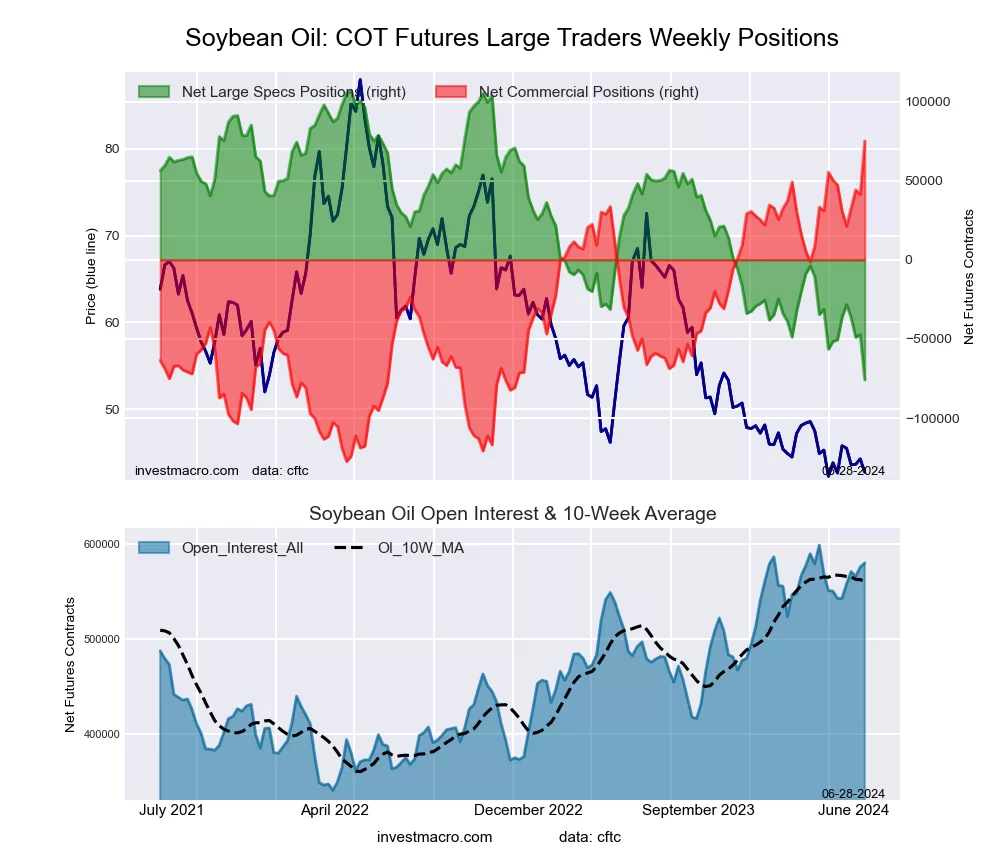
Soybean Oil

The Soybean Oil speculator position comes in as this week’s fourth most bearish extreme standing. The Soybean Oil speculator level is at a 3.0 percent score of its 3-year range.

The six-week trend for the speculator strength score was -26.1 this week. The speculator position was -51,553 net contracts this week with an increase of 4,889 contracts in the weekly speculator bets.


US Dollar Index

Finally, the US Dollar Index speculator position comes in as the fifth most bearish extreme standing for this week. The US Dollar Index speculator level is at a 8.8 percent score of its 3-year range.

The six-week trend for the speculator strength score was 5.2 this week. The speculator position was 1,853 net contracts this week with a change of 1,888 contracts in the weekly speculator bets.


Article By InvestMacroReceive our weekly COT Newsletter

*COT Report: The COT data, released weekly to the public each Friday, is updated through the most recent Tuesday (data is 3 days old) and shows a quick view of how large speculators or non-commercials (for-profit traders) were positioned in the futures markets.

The CFTC categorizes trader positions according to commercial hedgers (traders who use futures contracts for hedging as part of the business), non-commercials (large traders who speculate to realize trading profits) and nonreportable traders (usually small traders/speculators) as well as their open interest (contracts open in the market at time of reporting). See CFTC criteria here.

Week Ahead: USDInd set for volatile week?

By ForexTime 

  • USDInd ↑ almost 4% year-to-date
  • Key US CPI report under spotlight
  • Watch out for Fed speeches
  • Trading within range on D1 charts
  • Levels of interest – 106.50, 105.60 & 105.00

The week ahead is jampacked with top-tier data and speeches by numerous policymakers.

But the spotlight shines on the incoming US inflation data which may rock FXTM’s USDInd:

Saturday, 11th May

  • CN50: China CPI, PPI

Monday, 13th May

  • AU200: Australia business confidence
  • NZD: New Zealand food prices, inflation expectations
  • USDInd: Fed speech
  • CHF: SNB President Thomas Jordan speech

Tuesday, 14th May

  • JP225: Japan PPI
  • GER40: Germany CPI, ZEW survey expectations
  • UK100: UK jobless claims, unemployment, BoE Economist Huw Pill speech
  • USDInd: US PPI, Fed Chair Jerome Powell speech

Wednesday, 15th May

  • CAD: Canada housing starts, existing home sales
  • CN50: China rate decision
  • EU50: Eurozone industrial production, GDP
  • USDInd: US CPI, retail sales, empire manufacturing, Fed speech

Thursday, 16th May

  • AU200: Australia unemployment
  • JP225: Japan GDP, industrial production
  • EUR: ECB publishes financial stability review
  • USDInd: Initial jobless claims, industrial production, Fed speech

Friday, 17th May

  • CN50: China property prices, retail sales, industrial production
  • HK50: Hong Kong GDP
  • EU50: Eurozone CPI
  • SG20: Singapore trade

The USDInd has been trapped within a range since mid-April with major resistance at 106.50 and support around 105.00.

Note: FXTM’s USDInd tracks how the dollar is performing against a basket of six different G10 currencies, including the Euro, British Pound, Japanese Yen, and Canadian dollar.

Digger deeper, the dollar has appreciated against every single G10 currency year-to-date.

Dollar bulls have been supported by cooling Fed cut bets in the face of sticky inflation and strong data.

With all the above said, here are 3 reasons why the USDInd could see significant moves:

    1) US April CPI report

The April Consumer Price Index (CPI) published on Wednesday may influence expectations around what the Fed does in the second half of 2024.  

Markets are forecasting:

  • CPI year-on-year (April 2023 vs. April 2024) to cool 3.4% from 3.5% in the prior month.
  • Core CPI year-on-year to cool to 3.6% to 3.8%.
  • CPI month-on-month (April 2024 vs March 2024) to remain unchanged at 0.4%.
  • Core CPI month-on-month to cool to 0.3% to 0.4%.

Headline inflation and the annual core inflation figures are expected to have ticked lower in April. But this is still some distance away from the Fed’s 2% target.

Nevertheless, further evidence of cooling prices may stimulate expectations around the Fed cutting interest rates in the second half of the year.

Traders are currently pricing in a 36% probability of a 25-basis point Fed cut by July with this jumping to 90% by September.

  • A softer-than-expected US CPI report could send the USDInd lower as Fed cut bets jump.
  • Should the inflation report print above market forecasts, this could boost the USDInd.


    2) Fed speeches + US data

A string of speeches from numerous Fed officials including Jerome Powell could pump the USDInd with fresh volatility. Given the recent mixed signals from US policymakers on the path of rates, the incoming speeches may provide investors with fresh clarity on what to expect from the Fed.

Much attention will also be directed towards the latest US retail sales, Producer Prices Index (PPI), and initial jobless claims to gauge the health of the US economy.

  • The USDInd could push higher if Fed officials strike a hawkish note and overall data supports the “higher for longer” narrative for rates.
  • If economic data disappoints and Fed officials sound more dovish, the USDInd may trade lower.


    3) Technical forces 

The USDInd is trading within a range on the daily charts with prices hovering near the 105.00 level. Still, the candlesticks are trading above the 50, 100, and 200-day SMA while the MACD trades above zero.

  • A solid breakdown and daily close below 105.00 could encourage a decline toward the 50-day SMA and 200-day SMA.
  • Should 105.00 prove to be reliable support, this could trigger a rebound to 105.60 and 106.50.


Forex-Time-LogoArticle by ForexTime

ForexTime Ltd (FXTM) is an award winning international online forex broker regulated by CySEC 185/12 www.forextime.com

Why US offshore wind energy is struggling – the good, the bad and the opportunity

By Christopher Niezrecki, UMass Lowell 

America’s first large-scale offshore wind farms began sending power
to the Northeast in early 2024, but a wave of wind farm project cancellations and rising costs have left many people with doubts about the industry’s future in the U.S.

Several big hitters, including Ørsted, Equinor, BP and Avangrid, have canceled contracts or sought to renegotiate them in recent months. Pulling out meant the companies faced cancellation penalties ranging from US$16 million to several hundred million dollars per project. It also resulted in Siemens Energy, the world’s largest maker of offshore wind turbines, anticipating financial losses in 2024 of around $2.2 billion.

Altogether, projects that had been canceled by the end of 2023 were expected to total more than 12 gigawatts of power, representing more than half of the capacity in the project pipeline.

So, what happened, and can the U.S. offshore wind industry recover?

A map shows regions with the strongest offshore wind power potential, including off the US and Northern Europe.
Estimates of the mean annual wind speeds in meters per second extending 200 kilometers from shore at a height of 330 feet (100 meters).
ESMAP/The World Bank via Wikimedia, CC BY

I lead UMass Lowell’s Center for Wind Energy Science Technology and Research WindSTAR and Center for Energy Innovation and follow the industry closely. The offshore wind industry’s troubles are complicated, but it’s far from dead in the U.S., and some policy changes may help it find firmer footing.

Long approval process’s cascade of challenges

Getting offshore wind projects permitted and approved in the U.S. takes years and is fraught with uncertainty for developers, more so than in Europe or Asia.

Before a company bids on a U.S. project, the developer must plan the procurement of the entire wind farm, including making reservations to purchase components such as turbines and cables, construction equipment and ships. The bid must also be cost-competitive, so companies have a tendency to bid low and not anticipate unexpected costs, which adds to financial uncertainty and risk.

The winning U.S. bidder then purchases an expensive ocean lease, costing in the hundreds of millions of dollars. But it has no right to build a wind project yet.

A map shows lease areas, from South Carolina to Massachusetts.
Continental shelf areas leased for wind power development along the Atlantic coast.
U.S. Department of the Interior, 2024

Before starting to build, the developer must conduct site assessments to determine what kind of foundations are possible and identify the scale of the project. The developer must consummate an agreement to sell the power it produces, identify a point of interconnection to the power grid, and then prepare a construction and operation plan, which is subject to further environmental review. All of that takes about five years, and it’s only the beginning.

For a project to move forward, developers may need to secure dozens of permits from local, tribal, state, regional and federal agencies. The federal Bureau of Ocean Energy Management, which has jurisdiction over leasing and management of the seabed, must consult with agencies that have regulatory responsibilities over different aspects in the ocean, such as the armed forces, Environmental Protection Agency and National Marine Fisheries Service, as well as groups including commercial and recreational fishing, Indigenous groups, shipping, harbor managers and property owners.

For Vineyard Wind I – which began sending power from five of its 62 planned wind turbines off Martha’s Vineyard in early 2024 – the time from BOEM’s lease auction to getting its first electricity to the grid was about nine years.

Costs can balloon during the regulatory delays

Until recently, these contracts didn’t include any mechanisms to adjust for rising supply costs during the long approval time, adding to the risk for developers.

From the time today’s projects were bid to the time they were approved for construction, the world dealt with the COVID-19 pandemic, inflation, global supply chain problems, increased financing costs and the war in Ukraine. Steep increases in commodity prices, including for steel and copper, as well as in construction and operating costs, made many contracts signed years earlier no longer financially viable.

New and re-bid contracts are now allowing for price adjustments after the environmental approvals have been given, which is making projects more attractive to developers in the U.S. Many of the companies that canceled projects are now rebidding.

The regulatory process is becoming more streamlined, but it still takes about six years, while other countries are building projects at a faster pace and larger scale.

Shipping rules, power connections

Another significant hurdle for offshore wind development in the U.S. involves a century-old law known as the Jones Act.

The Jones Act requires vessels carrying cargo between U.S. points to be U.S.-built, U.S.-operated and U.S.-owned. It was written to boost the shipping industry after World War I. However, there are only three offshore wind turbine installation vessels in the world that are large enough for the turbines proposed for U.S. projects, and none are compliant with the Jones Act.

That means wind turbine components must be transported by smaller barges from U.S. ports and then installed by a foreign installation vessel waiting offshore, which raises the cost and likelihood of delays.

Dominion Energy is building a new ship, the Charybdis, that will comply with the Jones Act. But a typical offshore wind farm needs over 25 different types of vessels – for crew transfers, surveying, environmental monitoring, cable-laying, heavy lifting and many other roles.

The nation also lacks a well-trained workforce for manufacturing, construction and operation of offshore wind farms.

For power to flow from offshore wind farms, the electricity grid also requires significant upgrades. The Department of Energy is working on regional transmission plans, but permitting will undoubtedly be slow.

Lawsuits, disinformation add to the challenges

Numerous lawsuits from advocacy groups that oppose offshore wind projects have further slowed development.

Wealthy homeowners have tried to stop wind farms that might appear in their ocean view. Astroturfing groups that claim to be advocates of the environment, but are actually supported by fossil fuel industry interests, have launched disinformation campaigns.

In 2023, many Republican politicians and conservative groups immediately cast blame for whale deaths off the coast of New York and New Jersey on the offshore wind developers, but the evidence points instead to increased ship traffic collisions and entanglements with fishing gear.

Such disinformation can reduce public support and slow projects’ progress.

Efforts to keep the offshore wind industry going

The Biden administration set a goal to install 30 gigawatts of offshore wind capacity by 2030, but recent estimates indicate that the actual number will be closer to half that.

Despite the challenges, developers have reason to move ahead.

The Inflation Reduction Act provides incentives, including federal tax credits for the development of clean energy projects and for developers that build port facilities in locations that previously relied on fossil fuel industries. Most coastal state governments are also facilitating projects by allowing for a price readjustment after environmental approvals have been given. They view offshore wind as an opportunity for economic growth.

These financial benefits can make building an offshore wind industry more attractive to companies that need market stability and a pipeline of projects to help lower costs – projects that can create jobs and boost economic growth and a cleaner environment.The Conversation

About the Author:

Christopher Niezrecki, Director of the Center for Energy Innovation, UMass Lowell

This article is republished from The Conversation under a Creative Commons license. Read the original article.


US-Africa trade deal turns 25 next year: Agoa’s winners, losers and what should come next

By Bedassa Tadesse, University of Minnesota Duluth 

The African Growth and Opportunity Act (Agoa) is a landmark piece of trade legislation enacted by the United States in 2000. Its goal is to promote economic growth, development and poverty reduction in sub-Saharan Africa by providing qualifying countries with duty-free access to the US market for over 6,500 products. By eliminating import tariffs and quotas, Agoa aims to stimulate trade, attract foreign investment and foster economic integration between the US and African nations.

Agoa has made strides in boosting exports from eligible African countries to the US. Between 2001 and 2021, the annual value of US imports from Agoa-eligible countries nearly tripled, from US$8.15 billion to US$21.8 billion. The trade preferences have particularly benefited sectors like apparel, textiles, agriculture and light manufacturing. However, Agoa’s impact has been uneven across the region. Some countries have used the opportunities more effectively than others.

As Agoa approaches its 25th anniversary next year, policymakers are considering extending it for a further 16 years. I recently conducted a comprehensive review of scholarly articles and policy reports that analyse the impact of Agoa on the economic performance of sub-Saharan Africa. Below are the four key observations.

1. Some countries have benefited more than others

Agoa’s benefits can’t be measured in just one metric. They reflect in various terms for various countries. But available research indicates that the countries that benefited most from Agoa include South Africa, Kenya, Lesotho, Mauritius, Madagascar, Ethiopia and Ghana.

These nations have used Agoa preferences to substantially increase their exports to the US, particularly in sectors like apparel, textiles and light manufacturing.

Kenya, where apparel-dominated exports to the US have grown from US$55 million in 2001 to US$603 million in 2022, is a shining example of growth in exports. Mauritius exported chocolate and basket-weaving materials. Mali exported buckwheat, travel goods and musical instruments until its 2022 suspension. Mozambique exported sugar, nuts and tobacco. Togo exported wheat, legumes and fruit juices.

Lesotho’s success story is equally inspiring. It has had rapid export growth and job creation in its apparel sector, and this has contributed to new manufacturing jobs.

These success stories underscore the potential of Agoa to drive economic growth and job creation.

2. Some countries have not benefited much

Central and west African countries have not extensively used Agoa’s benefits. They have been held back by weakness in infrastructure, governance and global market integration.

Burundi, the Central African Republic, Equatorial Guinea, Eritrea, The Gambia, Guinea-Bissau and Mali have seen little export growth and foreign direct investment, or no benefits.

3. Reason for the uneven benefits

The variation in Agoa’s impact across sub-Saharan Africa is down to several factors. First, countries with better infrastructure, stable governance and conducive business environments are better positioned to attract foreign investment and increase exports.

Second, the level of economic diversification and export capabilities matters. Countries with more diversified export baskets and established manufacturing sectors have managed to make the most of Agoa’s opportunities.

Third, national policies and strategies to complement Agoa are essential. Countries that put in place policies to improve productivity, integrate value chains and ease supply-side constraints appear to have had success under Agoa. Cultural (historical) connections with the US market may have also provided an advantage for some countries, like Kenya and Lesotho.

4. What the future holds

The US Senate is considering extending Agoa for another 16 years. It is vital to consider the lessons learned from the past 25 years.

Diversify the economy and add value: Many countries still rely heavily on primary commodity exports. This leaves them vulnerable to global price movements and limits their economic development prospects.

Invest in infrastructure: Transport, energy and communication are critical to enhance competitiveness and attract more foreign direct investment. Public-private partnerships and multilateral development financing could help to fill infrastructure gaps.

Promote good governance, political stability and institutional reforms: These create an enabling environment for businesses and investors. It means strengthening legal frameworks, combating corruption and ensuring the rule of law.

Build capacity and develop skills: It should be a priority to enhance human capital and create a skilled workforce that can support the other steps outlined above.

Recognise the diverse economic, political and social contexts in sub-Saharan Africa: Tailored strategies and targeted assistance could work better for individual countries.

As Agoa approaches its 25th anniversary, the potential extension through 2041 presents a strategic opportunity. The sub-Saharan African countries should refine and broaden Agoa’s impact to better serve the diverse needs of the region. By tackling the uneven impacts and focusing on sustainable development goals, Agoa can continue to play a part in the region’s economic transformation. The US and beneficiary countries must work together closely to ensure the benefits are widespread and inclusive.The Conversation

About the Author:

Bedassa Tadesse, Professor of Economics, University of Minnesota Duluth

This article is republished from The Conversation under a Creative Commons license. Read the original article.