Archive for Opinions – Page 24

Weaponized storytelling: How AI is helping researchers sniff out disinformation campaigns

By Mark Finlayson, Florida International University and Azwad Anjum Islam, Florida International University 

It is not often that cold, hard facts determine what people care most about and what they believe. Instead, it is the power and familiarity of a well-told story that reigns supreme. Whether it’s a heartfelt anecdote, a personal testimony or a meme echoing familiar cultural narratives, stories tend to stick with us, move us and shape our beliefs.

This characteristic of storytelling is precisely what can make it so dangerous when wielded by the wrong hands. For decades, foreign adversaries have used narrative tactics in efforts to manipulate public opinion in the United States. Social media platforms have brought new complexity and amplification to these campaigns. The phenomenon garnered ample public scrutiny after evidence emerged of Russian entities exerting influence over election-related material on Facebook in the lead-up to the 2016 election.

While artificial intelligence is exacerbating the problem, it is at the same time becoming one of the most powerful defenses against such manipulations. Researchers have been using machine learning techniques to analyze disinformation content.

At the Cognition, Narrative and Culture Lab at Florida International University, we are building AI tools to help detect disinformation campaigns that employ tools of narrative persuasion. We are training AI to go beyond surface-level language analysis to understand narrative structures, trace personas and timelines and decode cultural references.

Disinformation vs. misinformation

In July 2024, the Department of Justice disrupted a Kremlin-backed operation that used nearly a thousand fake social media accounts to spread false narratives. These weren’t isolated incidents. They were part of an organized campaign, powered in part by AI.

Disinformation differs crucially from misinformation. While misinformation is simply false or inaccurate information – getting facts wrong – disinformation is intentionally fabricated and shared specifically to mislead and manipulate. A recent illustration of this came in October 2024, when a video purporting to show a Pennsylvania election worker tearing up mail-in ballots marked for Donald Trump swept platforms such as X and Facebook.

Within days, the FBI traced the clip to a Russian influence outfit, but not before it racked up millions of views. This example vividly demonstrates how foreign influence campaigns artificially manufacture and amplify fabricated stories to manipulate U.S. politics and stoke divisions among Americans.

Humans are wired to process the world through stories. From childhood, we grow up hearing stories, telling them and using them to make sense of complex information. Narratives don’t just help people remember – they help us feel. They foster emotional connections and shape our interpretations of social and political events.

Stories have profound effects on human beliefs and behavior.

This makes them especially powerful tools for persuasion – and, consequently, for spreading disinformation. A compelling narrative can override skepticism and sway opinion more effectively than a flood of statistics. For example, a story about rescuing a sea turtle with a plastic straw in its nose often does more to raise concern about plastic pollution than volumes of environmental data.

Usernames, cultural context and narrative time

Using AI tools to piece together a picture of the narrator of a story, the timeline for how they tell it and cultural details specific to where the story takes place can help identify when a story doesn’t add up.

Narratives are not confined to the content users share – they also extend to the personas users construct to tell them. Even a social media handle can carry persuasive signals. We have developed a system that analyzes usernames to infer demographic and identity traits such as name, gender, location, sentiment and even personality, when such cues are embedded in the handle. This work, presented in 2024 at the International Conference on Web and Social Media, highlights how even a brief string of characters can signal how users want to be perceived by their audience.

For example, a user attempting to appear as a credible journalist might choose a handle like @JamesBurnsNYT rather than something more casual like @JimB_NYC. Both may suggest a male user from New York, but one carries the weight of institutional credibility. Disinformation campaigns often exploit these perceptions by crafting handles that mimic authentic voices or affiliations.

Although a handle alone cannot confirm whether an account is genuine, it plays an important role in assessing overall authenticity. By interpreting usernames as part of the broader narrative an account presents, AI systems can better evaluate whether an identity is manufactured to gain trust, blend into a target community or amplify persuasive content. This kind of semantic interpretation contributes to a more holistic approach to disinformation detection – one that considers not just what is said but who appears to be saying it and why.

Also, stories don’t always unfold chronologically. A social media thread might open with a shocking event, flash back to earlier moments and skip over key details in between.

Humans handle this effortlessly – we’re used to fragmented storytelling. But for AI, determining a sequence of events based on a narrative account remains a major challenge.

Our lab is also developing methods for timeline extraction, teaching AI to identify events, understand their sequence and map how they relate to one another, even when a story is told in nonlinear fashion.

Objects and symbols often carry different meanings in different cultures, and without cultural awareness, AI systems risk misinterpreting the narratives they analyze. Foreign adversaries can exploit cultural nuances to craft messages that resonate more deeply with specific audiences, enhancing the persuasive power of disinformation.

Consider the following sentence: “The woman in the white dress was filled with joy.” In a Western context, the phrase evokes a happy image. But in parts of Asia, where white symbolizes mourning or death, it could feel unsettling or even offensive.

In order to use AI to detect disinformation that weaponizes symbols, sentiments and storytelling within targeted communities, it’s critical to give AI this sort of cultural literacy. In our research, we’ve found that training AI on diverse cultural narratives improves its sensitivity to such distinctions.

Who benefits from narrative-aware AI?

Narrative-aware AI tools can help intelligence analysts quickly identify orchestrated influence campaigns or emotionally charged storylines that are spreading unusually fast. They might use AI tools to process large volumes of social media posts in order to map persuasive narrative arcs, identify near-identical storylines and flag coordinated timing of social media activity. Intelligence services could then use countermeasures in real time.

In addition, crisis-response agencies could swiftly identify harmful narratives, such as false emergency claims during natural disasters. Social media platforms could use these tools to efficiently route high-risk content for human review without unnecessary censorship. Researchers and educators could also benefit by tracking how a story evolves across communities, making narrative analysis more rigorous and shareable.

Ordinary users can also benefit from these technologies. The AI tools could flag social media posts in real time as possible disinformation, allowing readers to be skeptical of suspect stories, thus counteracting falsehoods before they take root.

As AI takes on a greater role in monitoring and interpreting online content, its ability to understand storytelling beyond just traditional semantic analysis has become essential. To this end, we are building systems to uncover hidden patterns, decode cultural signals and trace narrative timelines to reveal how disinformation takes hold.The Conversation

About the Author:

Mark Finlayson, Associate Professor of Computer Science, Florida International University and Azwad Anjum Islam, Ph.D. Student in Computing and Information Sciences, Florida International University

This article is republished from The Conversation under a Creative Commons license. Read the original article.


NASDAQ Listing for Crypto Co. a Milestone

Source: Mark Palmer (5/27/25)

The upgrade from the OTC should afford this growing fintech various benefits, including greater visibility, noted a Benchmark report.

DeFi Technologies Inc. (DEFT:NASDAQ; DEFI:CBOE; R9B:FSE) received approval to list its common shares on the NASDAQ starting today, under the symbol DEFT, reported Benchmark Analyst Mark Palmer in a May 12 research note. Benchmark increased its target price on the fintech firm on expected growth in 2025.

“We believe DeFi’s uplisting to the NASDAQ is likely to result in significantly increased liquidity for the stock, broader institutional ownership and sell-side coverage of its shares and a lower overall cost of capital for the company,” Palmer wrote.

DeFi, offering exposure to a differentiated portfolio of cryptocurrencies, no longer will trade on the OTC. It will, however, continue on the CBOE in Canada (symbol DEFI), where it has traded since September 2016, and on the Frankfurt Stock Exchange (symbol R9B).

Target Price Raised

Benchmark raised its target price on the digital assets firm to CA$8 per share from CA$5 based on 15x its forecasted full-year 2025 earnings per share (EPS) of CA$0.53, noted Palmer.

“Our bullish stance toward DeFi’s shares is rooted in our confidence that it will be able to execute on its aggressive growth plans during the balance of the year and beyond,” wrote the analyst.

Those include adding at least 40 new crypto-focused exchange-traded products (ETPs) by year-end, taking the total count to more than 100. Plans also include expansion in the U.K., Africa, Asia, and the Middle East, toward which the company has been working.

DeFi announced in its last monthly update that it increased its assets under management (AUM) in April to CA$988 (CA$988M), reflecting an 11.7% month-over-month increase. This is attributed to rising crypto prices and CA$10.8M of net inflows into DeFi’s ETPs. In other growth news, the DeFi Alpha trading desk closed a CA$30.5M arbitrage trade on May 5.

Stock Undervalued, 44% Uplift

DeFi was trading, at the time of Palmer’s report, at CA$5.55 per share, the analyst noted. While this level is consistent with the fintech’s growth prospects, it is at a steep discount to other crypto-related stocks, including Coinbase Global Inc. (COIN:NASDAQ), Robinhood Markets Inc. (HOOD:NASDAQ) and Galaxy Digital Holdings Ltd. (GXLY:TSX).

From this share price, the return to target is 44%. DeFi is a Buy.

Changes to Estimates

Palmer reported that Benchmark tweaked its estimates for DeFi to account for its progress as well as the recent uptick in crypto prices. For Q1/25, estimated revenue was reduced to CA$27M from CA$52.7M and estimate earnings per share was lowered to CA$0.06 from CA$0.09.

Q2/25 EPS was raised to CA$0.16 from CA$0.10 to reflect DeFi Alpha’s May 5 arbitrage trade.

More Stock Details

Palmer reported that on May 12, DeFi had 298 million shares outstanding, a market cap of CA$1.2 billion and a 52-week range of CA$0.75–5.56 per share.


Important Disclosures:

  1. Doresa Banning wrote this article for Streetwise Reports LLC and provides services to Streetwise Reports as an independent contractor.
  2.  This article does not constitute investment advice and is not a solicitation for any investment. Streetwise Reports does not render general or specific investment advice and the information on Streetwise Reports should not be considered a recommendation to buy or sell any security. Each reader is encouraged to consult with his or her personal financial adviser and perform their own comprehensive investment research. By opening this page, each reader accepts and agrees to Streetwise Reports’ terms of use and full legal disclaimer. Streetwise Reports does not endorse or recommend the business, products, services or securities of any company.

For additional disclosures, please click here.

Disclosures for Benchmark Equity Research, DeFi Technologies Inc., May 12, 2025

alyst Certification The Benchmark Company, LLC (“Benchmark”) analyst(s) whose name(s) appears on the front page of this research report certifies that the recommendations and opinions expressed herein accurately reflect the research analyst’s personal views about any and all of the subject securities or issues discussed herein. Furthermore, no part of the research analyst’s compensation was, is, or will be, directly or indirectly, related to the specific recommendations or views expressed by the research analyst(s) in this research report.

Equity Research Ratings System Firm-Wide Stock Ratings Distribution As of March 31, 2025 All Covered Companies Investment Banking Clients Buy 266 73.7% 57 15.8% Hold 73 20.2% 5 1.4% Speculative Buy 20 5.5% 11 3.0% Sell 2 0.6% 0 0.0% Company Ratings Buy: Stock is expected to outperform the analyst’s defined Sector/Industry Index* over the following 6 to 12 months. Speculative Buy: The stock has a market value below $100M and/or a higher financial risk profile. It is expected to outperform the analyst’s defined sector/industry index over the following 6 to 12 months. Hold: Stock is expected to perform in-line with the analyst’s defined Sector/Industry Index* over the following 6 to 12 months. Sell: Stock is expected to underperform the analyst’s defined Sector/Industry Index* over the following 6 to 12 months. Industry Ratings Overweight: Analyst’s defined Sector/Industry Index* is expected to outperform the S&P 500 over the following 6 to 12 months. Market Weight: Analyst’s defined Sector/Industry Index* is expected to perform in-line with the S&P 500 over the following 6 to 12 months. Underweight: Analyst’s defined Sector/Industry Index* is expected to underperform the S&P 500 over the following 6 to 12 months. Benchmark Disclosures as of May 12, 2025 Company Disclosure DeFi Technologies Inc Research Disclosure Legend 1. In the past 12 months, Benchmark and its affiliates have received compensation for investment banking services from the subject company. 2. In the past 12 months, Benchmark and its affiliates have managed or comanaged a public offering of securities for the subject company. 3. Benchmark and its affiliates expect to receive or intend to seek compensation for investment banking services from the subject company in the next three months. 4. The research analyst, a member of the research analyst’s household, any associate of the research analyst, or any individual directly involved in the preparation of this report has a long position in the shares or derivatives of the subject company. 5. The research analyst, a member of the research analyst’s household, any associate of the research analyst, or any individual directly involved in preparation of this report has a short position in the shares or derivatives of this subject company. 6. A member of the research analyst’s household serves as an officer, director or advisory board member of the subject company. 7. As of the month end immediately preceding the date of publication of this report, or the prior month end if publication is within 10 days following a month end, Benchmark and its affiliates, in the aggregate, beneficially owned 1% or more of any class of equity securities of the subject company. 8. A partner, director, officer, employee or agent of Benchmark, or a member of his/her household, is an officer, director or advisor, board member of the subject company and/or one of its subsidiaries. 9. Benchmark makes a market in the securities of the subject company. 10. In the past 12 months, Benchmark, its partners, affiliates, officers or directors, or any analyst involved in the preparation of this report, has provided non-investment banking securities-related services to the subject company for remuneration. 11. In the past 12 months, Benchmark, its partners, affiliates, officers or directors, or any analyst involved in the preparation of this report, has provided non-securities related services to the subject company for remuneration. Investment Risk Risks to our investment thesis include crypto market volatility, regulatory risk, changing investor sentiment resulting in reduced ETP flows, and liquidity risk. Valuation Methodology Our C$8.00 price target for DEFI is based on 15x the company’s FY25E diluted earnings per share of C$0.53. We believe the multiple we have used reflects DEFI’s ample growth prospects. Price Charts Benchmark’s disclosure price charts are updated within the first fifteen days of each new calendar quarter per FINRA regulations. Price charts for companies initiated upon in the current quarter, and rating and target price changes occurring in the current quarter, will not be displayed until the following quarter. Additional information on recommended securities is available on request.

General Disclosures The Benchmark Company, LLC. (“Benchmark” or “the Firm”) compensates research analysts, like other Firm employees, based on the Firm’s overall revenue and profitability, which includes revenues from the Firm’s institutional sales, trading, and investment banking departments. No portion of the analyst’s compensation is based on a specific banking transaction. Analyst compensation is based upon a variety of factors, including the quality of analysis, performance of recommendations and overall service to the Firm’s institutional clients. This publication does not constitute an offer or solicitation of any transaction in any securities referred to herein. Ratings that use the “Speculative” risk qualifier are considered higher risk. Any recommendation contained herein may not be suitable for all investors. The Benchmark Company, LLC makes every effort to use reliable, comprehensive information, but we make no representation that it is accurate or complete. We have no obligation to disclose when information in this report changes apart from when we intend to discontinue research coverage of a subject company. Although the information contained in the subject report has been obtained from sources, we believe to be reliable, its accuracy and completeness cannot be guaranteed. This publication and any recommendation contained herein speak only as of the date hereof and are subject to change without notice. The Benchmark Company, LLC and its affiliated companies and employees shall have no obligation to update or amend any information herein. This publication is being furnished to you for informational purposes only and on the condition that it will not form a primary basis for any investment decision. Each investor must make its own determination of the appropriateness of an investment in any securities referred to herein based on the legal, tax and accounting considerations applicable to such investor and its own investment strategy. By virtue of this publication, none of The Benchmark Company, LLC or any of its employees shall be responsible for any investment decision. This report may discuss numerous securities, some of which may not be qualified for sale in certain states and may therefore not be offered to investors in such states. The “Recent Price” stated on the cover page reflects the nearest closing price prior to the date of publication. For additional disclosure information regarding the companies in this report, please contact The Benchmark Company, LLC, 150 East 58th Street, New York, NY 10155, 212-312-6770. The Benchmark Company, LLC is not in any way affiliated with or endorsed by the Menlo Park, California venture capital firm Benchmark Capital.

Critical minerals don’t belong in landfills – microwave tech offers a cleaner way to reclaim them from e-waste

By Terence Musho, West Virginia University 

When the computer or phone you’re using right now blinks its last blink and you drop it off for recycling, do you know what happens?

At the recycling center, powerful magnets will pull out steel. Spinning drums will toss aluminum into bins. Copper wires will get neatly bundled up for resale. But as the conveyor belt keeps rolling, tiny specks of valuable, lesser-known materials such as gallium, indium and tantalum will be left behind.

Those tiny specks are critical materials. They’re essential for building new technology, and they’re in short supply in the U.S. They could be reused, but there’s a problem: Current recycling methods make recovering critical minerals from e-waste too costly or hazardous, so many recyclers simply skip them.

Sadly, most of these hard-to-recycle materials end up buried in landfills or get mixed into products like cement. But it doesn’t have to be this way. New technology is starting to make a difference.

Multiple printed circuit boards laid on top of one another.
A treasure trove of critical materials is often overlooked in e-waste, including gallium in LEDs, indium in LCDs, and tantalum in surface mount capacitors.
Ansan Pokharel/West Virginia University, CC BY

As demand for these critical materials keeps growing, discarded electronics can become valuable resources. My colleagues and I at West Virginia University are developing a new technology to change how we recycle. Instead of using toxic chemicals, our approach uses electricity, making it safer, cleaner and more affordable to recover critical materials from electronics.

How much e-waste are we talking about?

Americans generated about 2.7 million tons of electronic waste in 2018, according to the latest federal data. Including uncounted electronics, a survey by the United Nations suggests that the U.S. recycles only about 15% of its total e-waste.

Even worse, nearly half the electronics that people in Northern America sent to recycling centers end up shipped overseas. They often land in scrapyards, where workers may use dangerous methods like burning or leaching using harsh chemicals to pull out valuable metals. These practices can harm both the environment and workers’ health. That’s why the Environmental Protection Agency restricts these methods in the U.S.

The tiny specks matter

Critical minerals are in most of the technology around you. Every phone screen has a super-thin layer of a material called indium tin oxide. LEDs glow because of a metal called gallium. Tantalum stores energy in tiny electronic parts called capacitors.

All of these materials are flagged as “high risk” on the U.S. Department of Energy’s critical materials list. That means the U.S. relies heavily on these materials for important technologies, but their supply could be easily disrupted by conflicts, trade disputes or shortages.

Right now, just a few countries, including China, control most of the mining, processing and recovery of these materials, making the U.S. vulnerable if those countries decide to limit exports or raise prices.

These materials aren’t cheap, either. For example, the U.S. Geological Survey reports that gallium was priced between US$220 to $500 per kilogram in 2024. That’s 50 times more expensive than common metals like copper, at $9.48 per kilogram in 2024.

Revolutionizing recycling with microwaves

At West Virginia University’s Department of Mechanical, Materials and Aerospace Engineering, I and materials scientist Edward Sabolsky asked a simple question: Could we find a way to heat only specific parts of electronic waste to recover these valuable materials?

If we could focus the heat on just the tiny specks of critical minerals, we might be able to recycle them easily and efficiently.

The solution we found: microwaves.

This equipment isn’t very different from the microwave ovens you use to heat food at home, just bigger and more powerful. The basic science is the same – electromagnetic waves cause electrons to oscillate, creating heat.

In our approach, though, we’re not heating water molecules like you do when cooking. Instead, we heat carbon, the black residue that collects around a candle flame or car tailpipe. Carbon heats up much faster in a microwave than water does. But don’t try this at home; your kitchen microwave wasn’t designed for such high temperatures.

Photo of a chemistry lab space with colorful gas bottles. At the center of the image is a microwave reactor connected by a waveguide to a microwave source.
West Virginia University researchers are using this experimental microwave reactor to recycle critical materials from end-of-life electronics.
Ansan Pokharel/West Virginia University, CC BY

In our recycling method, we first shred the electronic waste, mix it with materials called fluxes that trap impurities, and then heat the mixture with microwaves. The microwaves rapidly heat the carbon that comes from the plastics and adhesives in the e-waste. This causes the carbon to react with the tiny specks of critical materials. The result: a tiny piece of pure, sponge-like metal about the size of a grain of rice.

This metal can then be easily separated from leftover waste using filters.

So far, in our laboratory tests, we have successfully recovered about 80% of the gallium, indium and tantalum from e-waste, at purities between 95% and 97%. We have also demonstrated how it can be integrated with existing recycling processes.

Why the Department of Defense is interested

Our recycling technology got its start with help from a program funded by the Defense Department’s Advanced Research Projects Agency, or DARPA.

Many important technologies, from radar systems to nuclear reactors, depend on these special materials. While the Department of Defense uses less of them than the commercial market, they are a national security concern.

We’re planning to launch larger pilot projects next to test the method on smartphone circuit boards, LED lighting parts and server cards from data centers. These tests will help us fine-tune the design for a bigger system that can recycle tons of e-waste per hour instead of just a few pounds. That could mean producing up to 50 pounds of these critical minerals per hour from every ton of e-waste processed.

If the technology works as expected, we believe this approach could help meet the nation’s demand for critical materials.

How to make e-waste recycling common

One way e-waste recycling could become more common is if Congress held electronics companies responsible for recycling their products and recovering the critical materials inside. Closing loopholes that allow companies to ship e-waste overseas, instead of processing it safely in the U.S., could also help build a reserve of recovered critical minerals.

But the biggest change may come from simple economics. Once technology becomes available to recover these tiny but valuable specks of critical materials quickly and affordably, the U.S. can transform domestic recycling and take a big step toward solving its shortage of critical materials.The Conversation

About the Author:

Terence Musho, Associate Professor of Engineering, West Virginia University

This article is republished from The Conversation under a Creative Commons license. Read the original article.


Public health and private equity: What the Walgreens buyout could mean for the future of pharmacy care

By Patrick Aguilar, Washington University in St. Louis and Peter Boumgarden, Washington University in St. Louis 

Pharmacies are more than just stores – they’re vital links between people and their health care.

One of us, Patrick, witnessed this firsthand in 2003 while working as a pharmacy technician at Walgreens in a midsize West Texas town. Each day involved handling hundreds of prescriptions as they moved through the system – meticulously counting pills, deciphering doctors’ handwriting and sorting out confusing insurance issues. The experience revealed that how pharmacies are owned and managed is as much a public health issue as it is a financial one.

Fast-forward to today, and Walgreens – one of the world’s largest pharmacy chains, which filled nearly 800 million U.S. prescriptions in 2024 – is at a turning point. In March, the company announced it would be acquired by private equity firm Sycamore Partners for US$10 billion, just 10% of its peak market value. That deal takes the storied pharmacy chain off the public market for the first time in nearly 100 years.

We’re professors who study the intersection of medicine and business, and we think this deal offers a window into the future of pharmacy care. It matters not just to pharmacists but also to the tens of millions of Americans who rely on outlets like Walgreens to meet their everyday health needs.

The rise and struggles of Walgreens

A lot has changed in the pharmacy industry since 1901, when Charles R. Walgreen Sr. purchased the Chicago drugstore where he served as a pharmacist. The company went public in 1927, expanded rapidly throughout the 20th century and grew to 8,000 stores by 2013. By 2014, a merger with the European pharmacy chain Alliance Boots made Walgreens one of the largest pharmacy chains in the world.

More recently, however, the picture for the pharmacy industry hasn’t been so rosy. Labor costs have risen. Front-end retail sales – things like snacks, greeting cards and cosmetics – have fallen. And financial pressures from pharmacy benefit managers – those third-party groups that manage the cost of prescription drug benefits on the behalf of insurers – have grown.

All of these things have significantly constrained revenues across the industry, leading stores to shutter. Some estimates suggest that as many as one-third of U.S. retail pharmacies have closed since 2010.

Against that backdrop, Sycamore Partners’ March acquisition of Walgreens raises big questions. What does Sycamore see in this investment, and what might their strategies imply about the future of American pharmacy care?

Framing the private equity bet

Private equity firms typically buy companies, streamline their operations and seek to sell them for a profit within five to seven years of the acquisition.

This growing movement of private equity into the global economy is by no means limited to health care. In 2020, private equity firms employed 11.7 million U.S. workers, or about 7% of the country’s total workforce. The total assets under management by such investors have grown by over 11% annually over the past two decades, a trend that’s expected to continue.

In looking at Walgreens, Sycamore, like many of these businesses, likely sees an opportunity to buy low, cut costs and improve profitability. One survey of private equity investors found that the most common self-reported sources of value creation in these deals for companies of Sycamore’s size were changing the product and marketing it more robustly to drive demand, changing incentives for those within the business, and facilitating a high-value exit.

While private owners may have more patience than public markets, critics argue that private equity firms tend to have a short-term focus, looking for quick, predictable services of margin improvement – like, for example, cutting jobs.

There’s some evidence in favor of that claim. One study found that employment often drops in the years following a private equity buyout. And if the focus shifts to repaying debt or prepping for resale, long-term projects, such as investing in future innovation, can get deprioritized.

The history of privatized public companies offers a mix of successes and failures. Dell Technologies and hotel chain Hilton are two prominent examples of companies that went private, restructured successfully and came back stronger. In those cases, going private helped management focus without the constant pressure of quarterly earnings reports.

On the other hand, companies such as Toys R Us, which was taken private in 2005 and filed for bankruptcy in 2018, show how high debt and missed innovation can lead to collapse.

What’s next for Walgreens

So, where does this leave Walgreens − and the investors involved in the deal?

If part of the returns will be driven by “buying low” – the easiest indicator of potential future success to measure as of today – Sycamore started well: Its purchase price represents a mere 8% premium over the market trading value on the day of the announcement, significantly less than the 46% seen across industries in 2023. That said, Sycamore financed 83.4% of the purchase with debt, a number on the high end for these kinds of transactions. Health care groups have pointed to this number while raising concerns that innovation-focused investments may take a back seat to debt obligations.

As the dust settles on the purchase, Sycamore has indicated an interest in splitting Walgreens into three business units: one focused on U.S. pharmacies, one on U.K. pharmacies and one on U.S. primary health care through its VillageMD subsidiary.

That’s not unusual: Sycamore has used a similar approach before with its investment in the office supply retailer Staples, a strategy that has garnered strong financial returns but been called into question for its long-term sustainability.

Given the significant financial challenges VillageMD has faced since its acquisition by Walgreens, this represents an opportunity to separately evaluate and optimize its performance. Meanwhile, Sycamore’s historic focus on retail and customer-focused businesses might help it modernize the in-store experience or optimize staffing.

For more than a century, Walgreens has survived and adapted to sweeping changes in retail. Now, it’s entering a new chapter – one that could reshape not just its own future but the role of pharmacies in American life.

Will Sycamore help Walgreens thrive, using its resources to strengthen services and deliver more value to customers? Or will pressure to generate quick returns create problems? Either way, the answer matters – not just for investors but for anyone who’s ever relied on their neighborhood pharmacy to stay healthy.The Conversation

About the Author:

Patrick Aguilar, Professor of Practice of Organizational Behavior, Washington University in St. Louis and Peter Boumgarden, Professor of Family Enterprise, Washington University in St. Louis

This article is republished from The Conversation under a Creative Commons license. Read the original article.

Speculator Bets led lower by Canadian Dollar & Brazilian Real, USD Index Bets edge up

By InvestMacro

Speculators OI FX Futures COT Chart

Here are the latest charts and statistics for the Commitment of Traders (COT) data published by the Commodities Futures Trading Commission (CFTC).

The latest COT data is updated through Tuesday May 20th and shows a quick view of how large market participants (for-profit speculators and commercial traders) were positioned in the futures markets. All currency positions are in direct relation to the US dollar where, for example, a bet for the euro is a bet that the euro will rise versus the dollar while a bet against the euro will be a bet that the euro will decline versus the dollar.

Weekly Speculator Changes led lower overall by Canadian Dollar & Brazilian Real

Speculators Nets FX Futures COT Chart
The COT currency market speculator bets were decisively lower this week as just one out of the eleven currency markets we cover had higher positioning while the other ten markets had lower speculator contracts.

The currency with a gain this week was the US Dollar Index that showed a small rise of 69 contracts on the week.

The currencies seeing declines in speculator bets on the week were the Canadian Dollar (-21,705 contracts), the Brazilian Real (-17,226 contracts), the EuroFX (-10,321 contracts), the Australian Dollar (-9,731 contracts), the Japanese Yen (-4,938 contracts), British Pound (-3,223 contracts), the Mexican Peso (-3,174 contracts), Bitcoin (-1,125 contracts), the New Zealand Dollar (-1,040 contracts) and with the Swiss Franc (-698 contracts) seeing lower bets on the week.

Currency Speculator Position Roundup:

The latest data (through Tuesday May 20th) showed that all currency speculator positions pulled back, except for the US Dollar Index. However, the US Dollar Index only had a small rise and actually remains in a very small net speculator bearish position of -546 contracts as of Tuesday.

Overall, most currencies’ speculator positions remain in a bullish state against the US Dollar, including the Japanese Yen, which is not too far off its all-time record high that has was reached recently on April 29th at +179,212 contracts. The Euro is currently at approximately +75,000 contracts and has been in an overall bullish position for the past 11 weeks. The British Pound has also been in a bullish position for 13 straight weeks and is around +24,000 contracts at the moment.

The Mexican Peso has been mostly bullish since 2023 and is currently at approximately +62,000 contracts, which is above its average for 2025 (of around +34,000 weekly contracts). In comparison, the Mexican Peso contracts averaged +68,482 weekly contracts over the whole of 2024 which included a 15-week streak of over +100,000 contracts from March of 2024 to June 2024.

The Brazilian Real recently hit an all-time high and remains bullish for a 16th consecutive week at over +26,000 contracts.

The only speculator positions with negative positions right now against the US Dollar are the Swiss Franc, the New Zealand Dollar, the Australian Dollar, the Canadian Dollar and Bitcoin.

Euro Speculator Bets

The Euro speculator bets dipped this week by over 10,000 contracts for its largest pullback since early April. However, this speculator contract has been on the rise strongly since February, with gains in 10 out of the last 14 weeks. The 14-week rise has been over a total +138,000 contracts to bring the Euro position from a -64,425 contract position on February 11th to this week’s total of +74,453 contracts.

Bitcoin Speculator Contracts

The Bitcoin speculator positions have been in overall bearish territory for the last five weeks. Bitcoin contracts seem to be behaving similarly to some of the stock market contracts, which exhibit the behavior of hedging among the speculators. As the Bitcoin price has been going up, the contracts speculators have been going more bearish and vice versa. The Bitcoin price has been rising rapidly lately and reaching all-time record high prices despite the bearish speculator bets.

Exchange Rate Market

The US Dollar Index fell sharply on the week and closed under the significant 100 level, ending the week around the 99.30 level.

The Euro, the Pound, the Yen, the Swiss Franc, the Canadian Dollar, the Australian Dollar, and the New Zealand Dollar, despite the fall in speculator contracts, all had positive weeks against the US Dollar in the exchange rate markets.

Last week, the Mexican Peso was up for the third time in the last four weeks, while the Brazilian Real also squeaked out a positive week.


Currencies Data:

Speculators FX Futures COT Data Table
Legend: Open Interest | Speculators Current Net Position | Weekly Specs Change | Specs Strength Score compared to last 3-Years (0-100 range)


Strength Scores led by Japanese Yen & Brazilian Real

Speculators Strength Scores FX Futures COT Chart
COT Strength Scores (a normalized measure of Speculator positions over a 3-Year range, from 0 to 100 where above 80 is Extreme-Bullish and below 20 is Extreme-Bearish) showed that the Japanese Yen (97 percent) and the Brazilian Real (66 percent) lead the currency markets this week. The Mexican Peso (61 percent), EuroFX (57 percent) and the Swiss Franc (53 percent) come in as the next highest in the weekly strength scores.

On the downside, the US Dollar Index (6 percent) and the Bitcoin (9 percent) come in at the lowest strength levels currently and are in Extreme-Bearish territory (below 20 percent). The next lowest strength scores are the Australian Dollar (34 percent) and the New Zealand Dollar (37 percent).

3-Year Strength Statistics:
US Dollar Index (5.6 percent) vs US Dollar Index previous week (5.4 percent)
EuroFX (57.1 percent) vs EuroFX previous week (61.0 percent)
British Pound Sterling (45.4 percent) vs British Pound Sterling previous week (46.8 percent)
Japanese Yen (96.7 percent) vs Japanese Yen previous week (98.1 percent)
Swiss Franc (52.7 percent) vs Swiss Franc previous week (54.1 percent)
Canadian Dollar (41.4 percent) vs Canadian Dollar previous week (51.1 percent)
Australian Dollar (34.4 percent) vs Australian Dollar previous week (41.3 percent)
New Zealand Dollar (37.1 percent) vs New Zealand Dollar previous week (38.3 percent)
Mexican Peso (60.6 percent) vs Mexican Peso previous week (62.3 percent)
Brazilian Real (65.9 percent) vs Brazilian Real previous week (79.9 percent)
Bitcoin (8.7 percent) vs Bitcoin previous week (33.3 percent)


New Zealand Dollar & Swiss Franc top the 6-Week Strength Trends

Speculators Trends FX Futures COT Chart
COT Strength Score Trends (or move index, calculates the 6-week changes in strength scores) showed that the New Zealand Dollar (18 percent) and the Swiss Franc (13 percent) lead the past six weeks trends for the currencies. The Mexican Peso (12 percent), the Canadian Dollar (7 percent) and the EuroFX (6 percent) are the next highest positive movers in the 3-Year trends data.

The Bitcoin (-72 percent) leads the downside trend scores currently with the Brazilian Real (-15 percent), US Dollar Index (-7 percent) and the Australian Dollar (3 percent) following next with lower trend scores.

3-Year Strength Trends:
US Dollar Index (-7.2 percent) vs US Dollar Index previous week (-15.9 percent)
EuroFX (5.5 percent) vs EuroFX previous week (12.5 percent)
British Pound Sterling (3.1 percent) vs British Pound Sterling previous week (-3.4 percent)
Japanese Yen (5.6 percent) vs Japanese Yen previous week (13.9 percent)
Swiss Franc (13.2 percent) vs Swiss Franc previous week (39.9 percent)
Canadian Dollar (6.9 percent) vs Canadian Dollar previous week (21.4 percent)
Australian Dollar (3.0 percent) vs Australian Dollar previous week (18.8 percent)
New Zealand Dollar (17.9 percent) vs New Zealand Dollar previous week (25.9 percent)
Mexican Peso (12.0 percent) vs Mexican Peso previous week (7.5 percent)
Brazilian Real (-15.3 percent) vs Brazilian Real previous week (5.3 percent)
Bitcoin (-71.7 percent) vs Bitcoin previous week (-28.8 percent)


Individual COT Forex Markets:

US Dollar Index Futures:

US Dollar Index Forex Futures COT ChartThe US Dollar Index large speculator standing this week came in at a net position of -546 contracts in the data reported through Tuesday. This was a weekly gain of 69 contracts from the previous week which had a total of -615 net contracts.

This week’s current strength score (the trader positioning range over the past three years, measured from 0 to 100) shows the speculators are currently Bearish-Extreme with a score of 5.6 percent. The commercials are Bullish-Extreme with a score of 97.8 percent and the small traders (not shown in chart) are Bearish-Extreme with a score of 12.3 percent.

Price Trend-Following Model: Downtrend

Our weekly trend-following model classifies the current market price position as: Downtrend.

US DOLLAR INDEX StatisticsSPECULATORSCOMMERCIALSSMALL TRADERS
– Percent of Open Interest Longs:58.227.77.5
– Percent of Open Interest Shorts:60.121.511.8
– Net Position:-5461,870-1,324
– Gross Longs:17,5838,3692,252
– Gross Shorts:18,1296,4993,576
– Long to Short Ratio:1.0 to 11.3 to 10.6 to 1
NET POSITION TREND:
– Strength Index Score (3 Year Range Pct):5.697.812.3
– Strength Index Reading (3 Year Range):Bearish-ExtremeBullish-ExtremeBearish-Extreme
NET POSITION MOVEMENT INDEX:
– 6-Week Change in Strength Index:-7.28.8-13.8


Euro Currency Futures:

Euro Currency Futures COT ChartThe Euro Currency large speculator standing this week came in at a net position of 74,453 contracts in the data reported through Tuesday. This was a weekly decrease of -10,321 contracts from the previous week which had a total of 84,774 net contracts.

This week’s current strength score (the trader positioning range over the past three years, measured from 0 to 100) shows the speculators are currently Bullish with a score of 57.1 percent. The commercials are Bearish with a score of 38.0 percent and the small traders (not shown in chart) are Bullish-Extreme with a score of 89.6 percent.

Price Trend-Following Model: Uptrend

Our weekly trend-following model classifies the current market price position as: Uptrend.

EURO Currency StatisticsSPECULATORSCOMMERCIALSSMALL TRADERS
– Percent of Open Interest Longs:27.155.812.4
– Percent of Open Interest Shorts:17.372.55.5
– Net Position:74,453-126,83052,377
– Gross Longs:206,042423,45694,072
– Gross Shorts:131,589550,28641,695
– Long to Short Ratio:1.6 to 10.8 to 12.3 to 1
NET POSITION TREND:
– Strength Index Score (3 Year Range Pct):57.138.089.6
– Strength Index Reading (3 Year Range):BullishBearishBullish-Extreme
NET POSITION MOVEMENT INDEX:
– 6-Week Change in Strength Index:5.5-12.448.8


British Pound Sterling Futures:

British Pound Sterling Futures COT ChartThe British Pound Sterling large speculator standing this week came in at a net position of 23,993 contracts in the data reported through Tuesday. This was a weekly lowering of -3,223 contracts from the previous week which had a total of 27,216 net contracts.

This week’s current strength score (the trader positioning range over the past three years, measured from 0 to 100) shows the speculators are currently Bearish with a score of 45.4 percent. The commercials are Bearish with a score of 49.9 percent and the small traders (not shown in chart) are Bullish-Extreme with a score of 82.8 percent.

Price Trend-Following Model: Strong Uptrend

Our weekly trend-following model classifies the current market price position as: Strong Uptrend.

BRITISH POUND StatisticsSPECULATORSCOMMERCIALSSMALL TRADERS
– Percent of Open Interest Longs:45.129.517.0
– Percent of Open Interest Shorts:32.846.812.0
– Net Position:23,993-33,8179,824
– Gross Longs:88,14457,67533,168
– Gross Shorts:64,15191,49223,344
– Long to Short Ratio:1.4 to 10.6 to 11.4 to 1
NET POSITION TREND:
– Strength Index Score (3 Year Range Pct):45.449.982.8
– Strength Index Reading (3 Year Range):BearishBearishBullish-Extreme
NET POSITION MOVEMENT INDEX:
– 6-Week Change in Strength Index:3.1-7.523.8


Japanese Yen Futures:

Japanese Yen Forex Futures COT ChartThe Japanese Yen large speculator standing this week came in at a net position of 167,330 contracts in the data reported through Tuesday. This was a weekly decline of -4,938 contracts from the previous week which had a total of 172,268 net contracts.

This week’s current strength score (the trader positioning range over the past three years, measured from 0 to 100) shows the speculators are currently Bullish-Extreme with a score of 96.7 percent. The commercials are Bearish-Extreme with a score of 5.3 percent and the small traders (not shown in chart) are Bullish with a score of 76.9 percent.

Price Trend-Following Model: Uptrend

Our weekly trend-following model classifies the current market price position as: Uptrend.

JAPANESE YEN StatisticsSPECULATORSCOMMERCIALSSMALL TRADERS
– Percent of Open Interest Longs:53.027.810.5
– Percent of Open Interest Shorts:7.477.26.8
– Net Position:167,330-181,02113,691
– Gross Longs:194,510102,10238,497
– Gross Shorts:27,180283,12324,806
– Long to Short Ratio:7.2 to 10.4 to 11.6 to 1
NET POSITION TREND:
– Strength Index Score (3 Year Range Pct):96.75.376.9
– Strength Index Reading (3 Year Range):Bullish-ExtremeBearish-ExtremeBullish
NET POSITION MOVEMENT INDEX:
– 6-Week Change in Strength Index:5.6-4.9-2.1


Swiss Franc Futures:

Swiss Franc Forex Futures COT ChartThe Swiss Franc large speculator standing this week came in at a net position of -23,767 contracts in the data reported through Tuesday. This was a weekly decrease of -698 contracts from the previous week which had a total of -23,069 net contracts.

This week’s current strength score (the trader positioning range over the past three years, measured from 0 to 100) shows the speculators are currently Bullish with a score of 52.7 percent. The commercials are Bearish with a score of 40.8 percent and the small traders (not shown in chart) are Bullish with a score of 72.3 percent.

Price Trend-Following Model: Uptrend

Our weekly trend-following model classifies the current market price position as: Uptrend.

SWISS FRANC StatisticsSPECULATORSCOMMERCIALSSMALL TRADERS
– Percent of Open Interest Longs:10.470.918.5
– Percent of Open Interest Shorts:42.936.320.6
– Net Position:-23,76725,298-1,531
– Gross Longs:7,63251,87113,558
– Gross Shorts:31,39926,57315,089
– Long to Short Ratio:0.2 to 12.0 to 10.9 to 1
NET POSITION TREND:
– Strength Index Score (3 Year Range Pct):52.740.872.3
– Strength Index Reading (3 Year Range):BullishBearishBullish
NET POSITION MOVEMENT INDEX:
– 6-Week Change in Strength Index:13.2-20.425.4


Canadian Dollar Futures:

Canadian Dollar Forex Futures COT ChartThe Canadian Dollar large speculator standing this week came in at a net position of -103,861 contracts in the data reported through Tuesday. This was a weekly lowering of -21,705 contracts from the previous week which had a total of -82,156 net contracts.

This week’s current strength score (the trader positioning range over the past three years, measured from 0 to 100) shows the speculators are currently Bearish with a score of 41.4 percent. The commercials are Bullish with a score of 61.5 percent and the small traders (not shown in chart) are Bearish-Extreme with a score of 17.9 percent.

Price Trend-Following Model: Strong Uptrend

Our weekly trend-following model classifies the current market price position as: Strong Uptrend.

CANADIAN DOLLAR StatisticsSPECULATORSCOMMERCIALSSMALL TRADERS
– Percent of Open Interest Longs:8.581.38.3
– Percent of Open Interest Shorts:47.438.911.7
– Net Position:-103,861112,982-9,121
– Gross Longs:22,629216,73622,213
– Gross Shorts:126,490103,75431,334
– Long to Short Ratio:0.2 to 12.1 to 10.7 to 1
NET POSITION TREND:
– Strength Index Score (3 Year Range Pct):41.461.517.9
– Strength Index Reading (3 Year Range):BearishBullishBearish-Extreme
NET POSITION MOVEMENT INDEX:
– 6-Week Change in Strength Index:6.9-7.03.1


Australian Dollar Futures:

Australian Dollar Forex Futures COT ChartThe Australian Dollar large speculator standing this week came in at a net position of -59,077 contracts in the data reported through Tuesday. This was a weekly reduction of -9,731 contracts from the previous week which had a total of -49,346 net contracts.

This week’s current strength score (the trader positioning range over the past three years, measured from 0 to 100) shows the speculators are currently Bearish with a score of 34.4 percent. The commercials are Bullish with a score of 65.4 percent and the small traders (not shown in chart) are Bearish with a score of 47.9 percent.

Price Trend-Following Model: Strong Uptrend

Our weekly trend-following model classifies the current market price position as: Strong Uptrend.

AUSTRALIAN DOLLAR StatisticsSPECULATORSCOMMERCIALSSMALL TRADERS
– Percent of Open Interest Longs:11.868.211.7
– Percent of Open Interest Shorts:45.034.711.9
– Net Position:-59,07759,536-459
– Gross Longs:20,997121,27920,781
– Gross Shorts:80,07461,74321,240
– Long to Short Ratio:0.3 to 12.0 to 11.0 to 1
NET POSITION TREND:
– Strength Index Score (3 Year Range Pct):34.465.447.9
– Strength Index Reading (3 Year Range):BearishBullishBearish
NET POSITION MOVEMENT INDEX:
– 6-Week Change in Strength Index:3.0-6.417.0


New Zealand Dollar Futures:

New Zealand Dollar Forex Futures COT ChartThe New Zealand Dollar large speculator standing this week came in at a net position of -23,652 contracts in the data reported through Tuesday. This was a weekly fall of -1,040 contracts from the previous week which had a total of -22,612 net contracts.

This week’s current strength score (the trader positioning range over the past three years, measured from 0 to 100) shows the speculators are currently Bearish with a score of 37.1 percent. The commercials are Bullish with a score of 61.4 percent and the small traders (not shown in chart) are Bearish with a score of 45.7 percent.

Price Trend-Following Model: Strong Uptrend

Our weekly trend-following model classifies the current market price position as: Strong Uptrend.

NEW ZEALAND DOLLAR StatisticsSPECULATORSCOMMERCIALSSMALL TRADERS
– Percent of Open Interest Longs:16.376.35.9
– Percent of Open Interest Shorts:55.136.66.9
– Net Position:-23,65224,260-608
– Gross Longs:9,98146,5913,626
– Gross Shorts:33,63322,3314,234
– Long to Short Ratio:0.3 to 12.1 to 10.9 to 1
NET POSITION TREND:
– Strength Index Score (3 Year Range Pct):37.161.445.7
– Strength Index Reading (3 Year Range):BearishBullishBearish
NET POSITION MOVEMENT INDEX:
– 6-Week Change in Strength Index:17.9-19.119.5


Mexican Peso Futures:

Mexican Peso Futures COT ChartThe Mexican Peso large speculator standing this week came in at a net position of 62,532 contracts in the data reported through Tuesday. This was a weekly decline of -3,174 contracts from the previous week which had a total of 65,706 net contracts.

This week’s current strength score (the trader positioning range over the past three years, measured from 0 to 100) shows the speculators are currently Bullish with a score of 60.6 percent. The commercials are Bearish with a score of 41.3 percent and the small traders (not shown in chart) are Bearish with a score of 31.2 percent.

Price Trend-Following Model: Strong Uptrend

Our weekly trend-following model classifies the current market price position as: Strong Uptrend.

MEXICAN PESO StatisticsSPECULATORSCOMMERCIALSSMALL TRADERS
– Percent of Open Interest Longs:65.229.34.1
– Percent of Open Interest Shorts:19.676.03.0
– Net Position:62,532-64,0621,530
– Gross Longs:89,32340,0785,579
– Gross Shorts:26,791104,1404,049
– Long to Short Ratio:3.3 to 10.4 to 11.4 to 1
NET POSITION TREND:
– Strength Index Score (3 Year Range Pct):60.641.331.2
– Strength Index Reading (3 Year Range):BullishBearishBearish
NET POSITION MOVEMENT INDEX:
– 6-Week Change in Strength Index:12.0-14.324.2


Brazilian Real Futures:

Brazil Real Futures COT ChartThe Brazilian Real large speculator standing this week came in at a net position of 26,289 contracts in the data reported through Tuesday. This was a weekly lowering of -17,226 contracts from the previous week which had a total of 43,515 net contracts.

This week’s current strength score (the trader positioning range over the past three years, measured from 0 to 100) shows the speculators are currently Bullish with a score of 65.9 percent. The commercials are Bearish with a score of 27.6 percent and the small traders (not shown in chart) are Bullish with a score of 76.6 percent.

Price Trend-Following Model: Uptrend

Our weekly trend-following model classifies the current market price position as: Uptrend.

BRAZIL REAL StatisticsSPECULATORSCOMMERCIALSSMALL TRADERS
– Percent of Open Interest Longs:56.331.412.1
– Percent of Open Interest Shorts:27.670.91.3
– Net Position:26,289-36,1679,878
– Gross Longs:51,55228,73411,113
– Gross Shorts:25,26364,9011,235
– Long to Short Ratio:2.0 to 10.4 to 19.0 to 1
NET POSITION TREND:
– Strength Index Score (3 Year Range Pct):65.927.676.6
– Strength Index Reading (3 Year Range):BullishBearishBullish
NET POSITION MOVEMENT INDEX:
– 6-Week Change in Strength Index:-15.38.348.1


Bitcoin Futures:

Bitcoin Crypto Futures COT ChartThe Bitcoin large speculator standing this week came in at a net position of -1,952 contracts in the data reported through Tuesday. This was a weekly lowering of -1,125 contracts from the previous week which had a total of -827 net contracts.

This week’s current strength score (the trader positioning range over the past three years, measured from 0 to 100) shows the speculators are currently Bearish-Extreme with a score of 8.7 percent. The commercials are Bullish-Extreme with a score of 100.0 percent and the small traders (not shown in chart) are Bullish with a score of 50.8 percent.

Price Trend-Following Model: Weak Downtrend

Our weekly trend-following model classifies the current market price position as: Weak Downtrend.

BITCOIN StatisticsSPECULATORSCOMMERCIALSSMALL TRADERS
– Percent of Open Interest Longs:75.46.64.6
– Percent of Open Interest Shorts:81.51.33.8
– Net Position:-1,9521,692260
– Gross Longs:24,1422,1211,466
– Gross Shorts:26,0944291,206
– Long to Short Ratio:0.9 to 14.9 to 11.2 to 1
NET POSITION TREND:
– Strength Index Score (3 Year Range Pct):8.7100.050.8
– Strength Index Reading (3 Year Range):Bearish-ExtremeBullish-ExtremeBullish
NET POSITION MOVEMENT INDEX:
– 6-Week Change in Strength Index:-71.761.136.0


Article By InvestMacroReceive our weekly COT Newsletter

*COT Report: The COT data, released weekly to the public each Friday, is updated through the most recent Tuesday (data is 3 days old) and shows a quick view of how large speculators or non-commercials (for-profit traders) were positioned in the futures markets.

The CFTC categorizes trader positions according to commercial hedgers (traders who use futures contracts for hedging as part of the business), non-commercials (large traders who speculate to realize trading profits) and nonreportable traders (usually small traders/speculators) as well as their open interest (contracts open in the market at time of reporting). See CFTC criteria here.

Speculator Extremes: JPY, Ultra 10-Year lead weekly Bullish & Bearish Positions

By InvestMacro 

The latest update for the weekly Commitment of Traders (COT) report was released by the Commodity Futures Trading Commission (CFTC) on Friday for data ending on May 20th.

This weekly Extreme Positions report highlights the Most Bullish and Most Bearish Positions for the speculator category. Extreme positioning in these markets can foreshadow strong moves in the underlying market.

To signify an extreme position, we use the Strength Index (also known as the COT Index) of each instrument, a common method of measuring COT data. The Strength Index is simply a comparison of current trader positions against the range of positions over the previous 3 years. We use over 80 percent as extremely bullish and under 20 percent as extremely bearish. (Compare Strength Index scores across all markets in the data table or cot leaders table)


Extreme Bullish Speculator Table


Here Are This Week’s Most Bullish Speculator Positions:

Japanese Yen

Extreme Bullish Leader
The Japanese Yen speculator position comes in as the most bullish extreme standing this week as the JPY speculator level is currently at a 97 percent score of its 3-year range.

The six-week trend for the percent strength score totaled a rise 6 points this week. The overall net speculator position was a total of 167,330 net contracts this week with a decline of -4,938 contract in the weekly speculator bets.


Speculators or Non-Commercials Notes:

Speculators, classified as non-commercial traders by the CFTC, are made up of large commodity funds, hedge funds and other significant for-profit participants. The Specs are generally regarded as trend-followers in their behavior towards price action – net speculator bets and prices tend to go in the same directions. These traders often look to buy when prices are rising and sell when prices are falling. To illustrate this point, many times speculator contracts can be found at their most extremes (bullish or bearish) when prices are also close to their highest or lowest levels.

These extreme levels can be dangerous for the large speculators as the trade is most crowded, there is less trading ammunition still sitting on the sidelines to push the trend further and prices have moved a significant distance. When the trend becomes exhausted, some speculators take profits while others look to also exit positions when prices fail to continue in the same direction. This process usually plays out over many months to years and can ultimately create a reverse effect where prices start to fall and speculators start a process of selling when prices are falling.


Nikkei 225

Extreme Bullish Leader
The Nikkei 225 speculator position comes next in the extreme standings this week. The Nikkei 225 speculator level leveled this week at a 96 percent score of its 3-year range.

The six-week trend for the percent strength score was a boost 35 points this week. The speculator position registered 1,904 net contracts this week with a weekly increase of 2,025 contracts in speculator bets.


VIX

Extreme Bullish Leader
The VIX speculator position comes in third this week in the extreme standings as the VIX speculator level resides at a 94 percent score of its 3-year range.

The six-week trend for the speculator strength score came in at a boost by 16 points this week. The overall speculator position was 4,424 net contracts this week with a decrease of -1,675 contracts in the weekly speculator bets.


MSCI EAFE MINI

Extreme Bullish Leader
The MSCI EAFE MINI speculator position comes up number four in the extreme standings this week. The MSCI EAFE-Mini speculator level is at a 90 percent score of its 3-year range.

The six-week trend for the speculator strength score totaled a gain of 13 points this week. The overall speculator position was 774 net contracts this week with a drop of -1,935 contracts in the speculator bets.


Live Cattle

Extreme Bullish Leader
The Live Cattle speculator position rounds out the top five in this week’s bullish extreme standings with the Live Cattle speculator level at a 81 percent score of its 3-year range. The six-week trend for the speculator strength score was a decline of -4 points this week.

The speculator position was 103,416 net contracts this week with a dip by -7,231 contracts in the weekly speculator bets.


Extreme Bearish Speculator Table


This Week’s Most Bearish Speculator Positions:

Ultra 10-Year U.S. T-Note

Extreme Bearish Leader
The Ultra 10-Year U.S. T-Note speculator position comes in as the most bearish extreme standing this week as the Ultra 10-Year speculator level is at a zero percent score of its 3-year range.

The six-week trend for the speculator strength score was -55 points this week. The overall speculator position was -328,444 net contracts this week with a shortfall of -8,837 contracts in the speculator bets.


5-Year Bond

Extreme Bearish Leader
The 5-Year Bond speculator position comes in next for the most bearish extreme standing on the week. The 5-Year speculator level is at just 1 percent score of its 3-year range.

The six-week trend for the speculator strength score was -12 points this week. The speculator position was -2,275,941 net contracts this week with a drop by -95,898 contracts in the weekly speculator bets.


Soybean Meal

Extreme Bearish Leader
The Soybean Meal speculator position comes in as third most bearish extreme standing of the week. The Soybean Meal speculator level resides at a 4 percent score of its 3-year range.

The six-week trend for the speculator strength score was -5 points this week. The overall speculator position was -58,173 net contracts this week with a reduction by -7,245 contracts in the speculator bets.


US Dollar Index

Extreme Bearish Leader
The US Dollar Index speculator position comes in as this week’s fourth most bearish extreme standing with the USD Index speculator level now at 6 percent score of its 3-year range.

The six-week trend for the speculator strength score was -7 points this week. The speculator position was -546 net contracts this week with a small advance of 69 contracts in the weekly speculator bets.


Bitcoin

Extreme Bearish Leader
Finally, the Bitcoin speculator position comes in as the fifth most bearish extreme standing for this week. The Bitcoin speculator level is at a 9 percent score of its 3-year range.

The six-week trend for the speculator strength score was -72 points this week. The speculator position was -1,952 net contracts this week with a decrease by -1,125 contracts in the weekly speculator bets.


Article By InvestMacroReceive our weekly COT Newsletter

*COT Report: The COT data, released weekly to the public each Friday, is updated through the most recent Tuesday (data is 3 days old) and shows a quick view of how large speculators or non-commercials (for-profit traders) were positioned in the futures markets.

The CFTC categorizes trader positions according to commercial hedgers (traders who use futures contracts for hedging as part of the business), non-commercials (large traders who speculate to realize trading profits) and nonreportable traders (usually small traders/speculators) as well as their open interest (contracts open in the market at time of reporting). See CFTC criteria here.
US solar manufacturers lag skyrocketing market demand

By Mojtaba Akhavan-Tafti, University of Michigan 

U.S. consumer demand for renewable energy continues to grow, with more solar panel capacity installed in 2024 than in 2023, which saw more than in 2022. But U.S. trade policy is in flux, and high tariffs have been imposed on imported solar panels, which may cause shortages.

I am a scholar who studies the Sun, as well as an entrepreneur who is working to harness its power here on Earth by creating new designs for generating solar electricity. As part of that effort, I’ve studied market trends and manufacturing capabilities in the U.S. and abroad. Right now, U.S. manufacturers do not produce enough solar panels to meet the nation’s demand, but industry investments and federal tax incentives have been making progress, though recent federal moves have created uncertainty.

In 2024, U.S. installers put up enough solar panels to generate 50 gigawatts of electricity – enough to power New York City for a year.

U.S. manufacturers made only a small fraction of that – 4.2 GW of solar modules in the first half of 2024. That was a big boost, though – a 75% increase compared with the same period in 2023. And the prices were roughly three times the cost of imports.

A look at recent imports

In 2024, the U.S. imported far more panels than the country needed, suggesting developers may be stockpiling panels for future projects.

Most of those imported panels were made in Asia, particularly Malaysia, Vietnam and Thailand. In fact, nearly all of the U.S.-made panels used at least some components from overseas. China currently makes about 97% of the world’s supply of photovoltaic wafers, which are building blocks of solar panels.

The effects of proposed U.S. trade policies on the solar industry remain unclear. Through 2024, manufacturing continued a yearslong ramp-up to take advantage of government policies favoring domestic manufacturing. And imported panels seem slated to suffer from ever-increasing tariffs, which drive up costs.

Domestic production rises

Since 2010, U.S. solar panel production has increased about eightfold. But U.S.-made panels are more expensive than imported alternatives. In 2024, U.S.-made panels typically cost 31 cents per watt, but imported panels, even including tariffs that existed before President Donald Trump’s second term, cost about one-third of that: 11 cents per watt.

But domestic manufacturers are bringing costs down by ramping up production while relying on the government to maintain or increase tariffs on imports, which may make U.S. panels more competitive domestically in the future.

Reliance on overseas sources

Despite that increase in domestic production, U.S. demand for solar panels has grown even faster. To meet demand, the U.S. imports a substantial portion of its solar photovoltaic modules.

Tariffs, including a 30% tariff on solar cells and solar panels starting in 2018, aimed to boost domestic manufacturing.

But those tariffs and falling global prices made solar installations more costly in the U.S. than in the rest of the world. The average global cost of installed solar systems dropped from $1.15 per watt in 2012 to $0.72 per watt in 2016, nearly half that of U.S. installations.

The 2018 tariffs, as well as earlier rounds in 2012 and 2014, have shifted the source of U.S. imports of solar panels – from China and Taiwan to Malaysia and South Korea. Manufacturers are also building solar panels in Singapore and Germany to maintain access to the U.S. market. And Chinese companies are even investing in U.S. solar manufacturers to take advantage of federal incentives and avoid tariffs.

New tariffs emerge

Trump’s proposal for new tariffs on foreign-made solar goods, including panels and components, particularly target Chinese-owned companies in Southeast Asia.

They could include a potential 375% tariff on Thai products – nearly quadrupling prices – and a 3,500% tariff on products from Cambodia.

In contrast, U.S.-made solar panels will be cheaper. But a reduced supply of solar panels will raise prices even of domestic-made panels, at least until U.S. manufacturing can catch up with the demand. Some developers have begun to delay or cancel solar installations to address rising costs.

Domestic investment

Due in large part to the Biden administration’s Inflation Reduction Act, enacted in 2022, the U.S. solar panel industry has seen significant investments.

Since the law’s enactment, more than 95 GW of manufacturing capability have been added across the solar supply chain in the U.S., including new facilities that in a year can construct enough solar panels to produce nearly 42 GW, beyond existing manufacturing levels. This growth in manufacturing capabilities is largely located in Texas and Georgia.

Still, the new administration’s shifting priorities and trade policies make the landscape uncertain. Before Trump began discussing various solar-related trade policies, the industry projected it would install an average of 45 GW of solar panels every year for the next decade.The Conversation

About the Author:

Mojtaba Akhavan-Tafti, Associate Research Scientist, University of Michigan

This article is republished from The Conversation under a Creative Commons license. Read the original article.


Week Ahead: 3 assets that may hit new highs – Bitcoin, GBPUSD, and US500 index

By ForexTime 

  • Mon, May 26th: US, UK markets closed
  • Tue, May 27th: Positive signals out of Bitcoin 2025 conference may send Bitcoin to fresh record highs
  • Wed, May 28th: Better-than-expected Nvidia earnings could boost US500 index above 6k
  • Wed, May 28th: US dollar also sensitive to FOMC meeting minutes, Fed speak
  • Fri, May 30th: Weaker USD could send GBPUSD above 1.360 on higher-than-expected US PCE data, contentious US-Japan trade talks


Recent days have seen major assets claim new heights:

  • Tuesday, May 20: US500 stock index got close to 3-month high

The US500 index got to within 0.3% of the psychological 6k level – a level not reached since late-February – before paring gains.

Tiring optimism that the worst of the US-led trade war is now behind us eventually gave way mid-week to concerns about the US fiscal deficit (the gap between US government’s spending and income) prompted some profit taking on the benchmark US stock index.

Imagen
US500 got within touching distance of 6k, only to falter on US fiscal deficit concerns


  • Thursday, May 22: Bitcoin hits new record high

Bitcoin touched the $112,000 mark for the first time in its history on Thursday, May 22nd.

This ascent to a new all-time peak was fuelled by optimism that new US stablecoin legislation (potentially to be passed by the US House today – Friday, May 23rd) will lead to greater mainstream adoption of the world’s oldest and biggest cryptocurrency.

Imagen
Bitcoin hits new record high, briefly touched $112,000


  • Friday, May 23rd: GBPUSD punches up to 3-year high

This FX pair nickname “cable” is closing in on the psychological 1.3500 level, reaching its highest levels since February 2022.

This comes after stronger-than-expected UK economic data releases:

  • Wed: May 21: higher-than-expected inflation data
  • Fri, May 23: stronger-than-expected retail sales figures

These figures suggest a more resilient-than-expected UK economy, potentially delaying more rate cuts by the Bank of England (BoE), which in turn supports the British Pound.

GBPUSD also got a helping hand from the weaker US dollar, amid rising concerns about the US fiscal deficit, fuelled by President Trump’s “big, beautiful bill” narrow approval by the House, featuring tax cuts.

Imagen
GBPUSD hits new 3-year high


But there’s bound to be more market action in the final week of May 2025.

(despite US and UK markets being closed on Monday, May 26th)


The coming week features many potential market-moving events:

Monday, May 26

  • SG20 index: Singapore April industrial production
  • US, UK markets closed

Tuesday, May 27

  • CN50 index: China April industrial profits
  • USDJPY: Speeches by Bank of Japan Governor Kazuo Ueda and Minneapolis Fed President Neel Kashkari
  • EU50 index: Eurozone May economic confidence; Germany June consumer confidence
  • US30 index: US May consumer confidence
  • Bitcoin 2025 conference

Wednesday, May 28

  • AUD: Australia April CPI
  • NZD: RBNZ rate decision
  • TWN index: Taiwan 1Q GDP
  • GER40 index: Germany May unemployment
  • USDInd: FOMC May meeting minutes; speeches by New York Fed President John Williams, Fed Governor Christopher Waller, and Minneapolis Fed President Neel Kashkari
  • Nvidia earnings

Thursday, May 29

  • ZAR: South Africa rate decision
  • US400 index: US 1Q GDP (second estimate); weekly initial jobless claims
  • USDInd: Speeches by Chicago Fed President Austan Goolsbee, Dallas Fed President Lorie Logan, Richmond Fed President Tom Barkin, San Francisco Fed President Mary Daly

Friday, May 30

  • JPY: US-Japan trade talks; May Tokyo CPI
  • JP225 index: Japan April industrial production, jobless rate, retail sales
  • AU200 index: Australia April retail sales
  • EUR: Germany May CPI
  • MXN: Mexico April unemployment rate
  • CAD: Canada 1Q GDP
  • US500 index: US April PCE, personal income and spending


Now, we zoom in on specific events that could either determine if Bitcoin, the US dollar, and the US500 can extend their uptrend, or be forced to pull back:


1) Tuesday – Thursday, May 27-29: Bitcoin 2025 Conference

Although US President Donald Trump will not repeat his attendance from last year’s conference, there will be speeches by:

  • JD Vance, US Vice President
  • David Sacks, White House AI & Crypto Czar

These speeches come as a major stablecoin legislation is, at the time of writing, about to be passed by the Senate.

If Vance and Sacks, along with other crypto luminaries can further stoke optimism that even greater mainstream crypto adoption is in store, that could send Bitcoin closer to $120k this week.


2) Wednesday, May 28 (after US markets close): Nvidia earnings

With a market cap of US$ 3.24 trillion, Nvidia is now the 2nd biggest company by market cap on the benchmark S&P 500 index (tracked by FXTM’s US500) – just behind Microsoft’s US3.38 trillion market cap.

Nvidia is set to release its Q1 fiscal 2026 earnings (3 months ending April 30th) after US markets close on Wednesday, May 28th.

After this pivotal announcement, Nvidia’s shares are forecasted to react with a 1-day move of 6.5% up/down, when US markets reopen on Thursday, May 29th.

Using the closing price from Thursday, May 22nd as the base, a post-earnings 6.5% move to the upside on May 29th could launch Nvidia’s shares back above the $140 level, and even possibly the US500 above the 6,000 line!

Given that Nvidia alone accounts for about 6% of the S&P 500, the market’s reaction to Nvidia’s earnings is bound to move the broader US500 index as well.


3) Friday, May 30: US April PCE (personal consumption expenditure)

This is the Fed’s preferred way of measuring US inflation (as opposed to consumer price indexes – CPI – typically released mid-month).

Economists currently predict:

  • PCE month-on-month (April 2025 vs. March 2025): slight uptick to 0.1% vs. the 0% m/m figures in March 2025
  • PCE year-on-year (April 2025 vs. April 2024): slight cooling of 10 basis points respectively for PCE (2.2% y/y) and Core PCE (2.5% y/y).

Traders and investors will be relying next on these PCE figures to determine the timing of the next Fed rate cut.

Markets currently predict an 82% chance that the Fed will next cut rates in September.

Higher-than-expected PCE data may fuel fears of a US stagflation (stubborn inflation accompanied with sluggish economic growth).

US stagflation could in turn prevent the Federal Reserve from cutting interest rates despite a darkening US economic outlook.

Greater prospects of US stagflation could weaken the US Dollar and allow GBPUSD bulls (those hoping prices go up) to seek prices above 1.360.

According to Bloomberg’s FX model, there’s a 75.6% chance that GBPUSD will trade between 1.334 – 1.365 over the coming week.

Besides the PCE data, the US dollar is also set to react to more clues about the Fed’s rate cuts via:

  • May 27-29th: 7 different Fed officials making scheduled public comments from Tuesday through Thursday
  • May 28th: FOMC’s May meeting minutes release
  • May 30th: US-Japan trade talks, inflation data out of major economies (Japan, Germany).

Forex-Time-LogoArticle by ForexTime
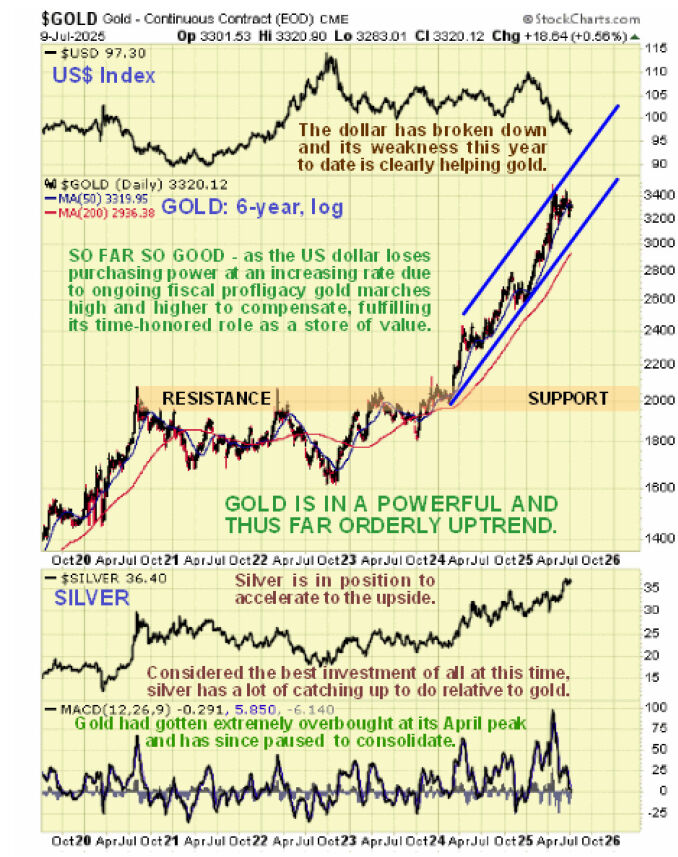
ForexTime Ltd (FXTM) is an award winning international online forex broker regulated by CySEC 185/12 www.forextime.com

Do photons wear out? An astrophysicist explains light’s ability to travel vast cosmic distances without losing energy

By Jarred Roberts, University of California, San Diego 

My telescope, set up for astrophotography in my light-polluted San Diego backyard, was pointed at a galaxy unfathomably far from Earth. My wife, Cristina, walked up just as the first space photo streamed to my tablet. It sparkled on the screen in front of us.

“That’s the Pinwheel galaxy,” I said. The name is derived from its shape – albeit this pinwheel contains about a trillion stars.

The light from the Pinwheel traveled for 25 million years across the universe – about 150 quintillion miles – to get to my telescope.

My wife wondered: “Doesn’t light get tired during such a long journey?”

Her curiosity triggered a thought-provoking conversation about light. Ultimately, why doesn’t light wear out and lose energy over time?

Let’s talk about light

I am an astrophysicist, and one of the first things I learned in my studies is how light often behaves in ways that defy our intuitions.

A photo of outer space that shows a galaxy shaped like a pinwheel.
The author’s photo of the Pinwheel galaxy.
Jarred Roberts

Light is electromagnetic radiation: basically, an electric wave and a magnetic wave coupled together and traveling through space-time. It has no mass. That point is critical because the mass of an object, whether a speck of dust or a spaceship, limits the top speed it can travel through space.

But because light is massless, it’s able to reach the maximum speed limit in a vacuum – about 186,000 miles (300,000 kilometers) per second, or almost 6 trillion miles per year (9.6 trillion kilometers). Nothing traveling through space is faster. To put that into perspective: In the time it takes you to blink your eyes, a particle of light travels around the circumference of the Earth more than twice.

As incredibly fast as that is, space is incredibly spread out. Light from the Sun, which is 93 million miles (about 150 million kilometers) from Earth, takes just over eight minutes to reach us. In other words, the sunlight you see is eight minutes old.

Alpha Centauri, the nearest star to us after the Sun, is 26 trillion miles away (about 41 trillion kilometers). So by the time you see it in the night sky, its light is just over four years old. Or, as astronomers say, it’s four light years away.

Imagine – a trip around the world at the speed of light.

With those enormous distances in mind, consider Cristina’s question: How can light travel across the universe and not slowly lose energy?

Actually, some light does lose energy. This happens when it bounces off something, such as interstellar dust, and is scattered about.

But most light just goes and goes, without colliding with anything. This is almost always the case because space is mostly empty – nothingness. So there’s nothing in the way.

When light travels unimpeded, it loses no energy. It can maintain that 186,000-mile-per-second speed forever.

It’s about time

Here’s another concept: Picture yourself as an astronaut on board the International Space Station. You’re orbiting at 17,000 miles (about 27,000 kilometers) per hour. Compared with someone on Earth, your wristwatch will tick 0.01 seconds slower over one year.

That’s an example of time dilation – time moving at different speeds under different conditions. If you’re moving really fast, or close to a large gravitational field, your clock will tick more slowly than someone moving slower than you, or who is further from a large gravitational field. To say it succinctly, time is relative.

An astronaut floats weightless aboard the International Space Station.
Even astronauts aboard the International Space Station experience time dilation, although the effect is extremely small.
NASA

Now consider that light is inextricably connected to time.
Picture sitting on a photon, a fundamental particle of light; here, you’d experience maximum time dilation. Everyone on Earth would clock you at the speed of light, but from your reference frame, time would completely stop.

That’s because the “clocks” measuring time are in two different places going vastly different speeds: the photon moving at the speed of light, and the comparatively slowpoke speed of Earth going around the Sun.

What’s more, when you’re traveling at or close to the speed of light, the distance between where you are and where you’re going gets shorter. That is, space itself becomes more compact in the direction of motion – so the faster you can go, the shorter your journey has to be. In other words, for the photon, space gets squished.

Which brings us back to my picture of the Pinwheel galaxy. From the photon’s perspective, a star within the galaxy emitted it, and then a single pixel in my backyard camera absorbed it, at exactly the same time. Because space is squished, to the photon the journey was infinitely fast and infinitely short, a tiny fraction of a second.

But from our perspective on Earth, the photon left the galaxy 25 million years ago and traveled 25 million light years across space until it landed on my tablet in my backyard.

And there, on a cool spring night, its stunning image inspired a delightful conversation between a nerdy scientist and his curious wife.The Conversation

About the Author:

Jarred Roberts, Project Scientist, University of California, San Diego

This article is republished from The Conversation under a Creative Commons license. Read the original article.

Lifecycle of a research grant – behind the scenes of the system that funds science

By Kelly S. Mix, University of Maryland 

Science funding is a hot topic these days and people have questions about how grants work. Who decides whether a researcher will receive funds? What’s the decision-making process? How is the money spent once a grant proposal has been approved?

As a veteran academic researcher, department chairperson and associate dean for research, I have seen this process play out from multiple perspectives – as a grant recipient, grant reviewer and university administrator.

Research organizations and major federal funders, including the National Institutes of Health, the National Science Foundation and the Defense Advanced Research Projects Agency (DARPA), all rely on careful systems of checks and balances to ensure high standards of scholarship and financial integrity at every stage of a grant’s lifecycle. Here’s how it all works.

The birth of a grant application

To receive research funding, scientists submit grant applications to specific programs. A cancer researcher might apply to the Bioengineering Research Grants program at NIH. Someone investigating sustainable fishing in freshwater habitats could seek funding from the Population and Community Ecology program at the NSF.

Applications must be responsive to the funding program’s specific request for proposals, or RFP. The RFP tells researchers what the agency wants to fund. For example, the NSF’s Education Core Research program currently only funds projects focused on STEM learning.

RFPs might have other application requirements, too, like explaining how a project will contribute to the public good, or supporting training for new scientists.

Grant applications have two main parts. First, the researcher presents an extensive literature review to explain why the new project is needed and what it will add to the existing knowledge base. Next, they write up a detailed description of the proposed research plan. This basic two-part structure ensures that funded research will yield important information that is both new and trustworthy.

Reviewers read the grant applications and compare them to the RFP. Applications that don’t address all the topics and research priorities listed there are unlikely to be funded. I once had a proposal rejected without further review because I left out a paragraph addressing one of the items in the agency’s new RFP. This initial review for RFP compliance is called “triage” and, believe me, nobody wants to see their hard work triaged out of the running.

Merit review: How funding decisions are made

Federal funding decisions are made through rigorous merit review.

For each round of funding, agencies assemble a panel of anonymous content experts who will look for strengths and weaknesses in the proposals – anything from innovation in the question posed to logical flaws in the hypotheses or technical problems with the planned data analyses. With a group of experts looking for every possible weakness, having your grant reviewed is a bit like running a gauntlet.

This careful review might help explain why 70% to 80% of grant applications typically go unfunded at agencies like the NIH and the NSF. But this level of scrutiny is necessary to prevent funding poorly designed or low-impact research.

Several safeguards head off bias or unethical influences during merit review.

First, reviewers must disclose any conflicts of interest with the pool of applicants before they can access the applications. Conflicts of interest can include situations like the reviewer having been the student of an applicant, the applicant and reviewer being divorced, or the proposal coming from the reviewer’s current institution.

When conflicts are identified, the reviewer can remain on the panel, but they are completely excluded from decisions related to that application. They cannot even be in the room when it is discussed.

Second, reviewers usually attend a meeting, supervised by program staff from the funding agency, where everyone debates the proposal’s merits before they score it. Sometimes panel members disagree in their initial critiques and use the meeting to hash out their differences. Other times, a reviewer might raise an important concern that others missed.

Group discussion helps ensure a transparent and thorough review. It also stops any single reviewer from dictating the fate of a proposal because everyone hears the discussion and then scores the proposal individually. Whether a reviewer thinks an application is outstanding or fatally flawed, they must convince the rest of the experts in the room for the group’s overall scores to be greatly affected.

Third, these discussions, along with the applications themselves and any written critiques, are strictly confidential. Reviewers sign written confidentiality agreements under penalty of perjury. This practice stops panelists from scoring political points by telling an applicant they defended their proposal, or divulging trade secrets and proprietary information.

Following the meeting, final decisions are made by program staff using the reviewers’ evaluations. Some agencies adhere closely to the reviewers’ numeric scores – like a grade – when making these decisions. Others ask reviewers to sort applications into “fundable” or “non-fundable” piles; program staff then have some discretion on the final decision. But all decisions are rooted in the peer critiques.

Spending the funds

Headlines about universities receiving large grants may leave the impression that such funds are simply added to the institution’s general coffers. But research funds are granted to support specific research projects, and agencies have strict rules about spending the money.

For example, if a researcher wants to present their findings at a conference, they can charge the grant for their travel costs, but they may not charge above a certain amount for their lodging or purchase business class airplane tickets. Similarly, if a researcher wants to have more time to devote to a funded project, they can use part of the money to pay their own salary in the summer, but there are precise limits on the amount of funding that can be used for this purpose.

It’s not up to the researcher alone to follow these rules. The organization that employs the researcher, usually a university, enforces the agency rules because it’s the employing organization that controls the grant accounts.

Returning to the conference travel example, a university researcher who wants to attend a conference must request permission and provide a budget for the trip before purchasing tickets. If the travel request is approved by their department chair, dean and the university travel office, they may go ahead with their reservations. However, if they don’t produce receipts when they return, they will not be allowed to charge the grant. The same process applies to buying new computers for the lab, ordering standardized tests for a study or purchasing gift cards for study participants.

Research organizations are highly motivated to enforce spending rules properly, because everyone in the organization is at risk of losing access to federal funds in the future if they let things slide. Funding agencies also require periodic reports and sometimes conduct audits to ensure compliance. These practices help guard against any misuse of funds.

The way agencies issue grants to researchers isn’t perfect. But processes like issuing detailed RFPs, conducting merit reviews and monitoring financial compliance go a long way toward protecting the integrity of the research funding process.The Conversation

About the Author:

Kelly S. Mix, Associate Dean for Research, Innovation, and Partnerships in the College of Education, University of Maryland

This article is republished from The Conversation under a Creative Commons license. Read the original article.