Archive for Opinions – Page 104

Currency Speculators cut Japanese Yen bearish bets for 6th time in 7 weeks

By InvestMacro

Here are the latest charts and statistics for the Commitment of Traders (COT) data published by the Commodities Futures Trading Commission (CFTC).

The latest COT data is updated through Tuesday December 13th and shows a quick view of how large market participants (for-profit speculators and commercial traders) were positioned in the futures markets. All currency positions are in direct relation to the US dollar where, for example, a bet for the euro is a bet that the euro will rise versus the dollar while a bet against the euro will be a bet that the euro will decline versus the dollar.

Weekly Speculator Changes led by Japanese Yen

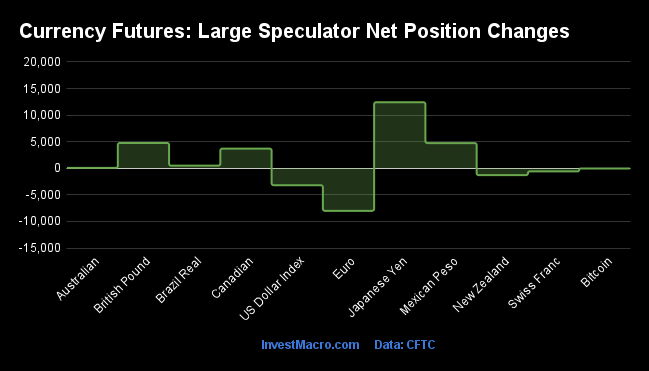
The COT currency market speculator bets were higher this week as six out of the eleven currency markets we cover had higher positioning while the other five markets had lower speculator contracts.

Leading the gains for the currency markets was the Japanese Yen (12,808 contracts) with the Australian Dollar (2,726 contracts), British Pound (2,454 contracts), Brazilian Real (1,261 contracts), US Dollar Index (892 contracts) and the Swiss Franc (419 contracts) also showing positive weeks.

The currencies seeing declines in speculator bets on the week were the Canadian Dollar (-5,158 contracts), Mexican Peso (-3,588 contracts), New Zealand Dollar (-1,008 contracts), EuroFX (-168 contracts) and Bitcoin (-107 contracts) also registering lower bets on the week.

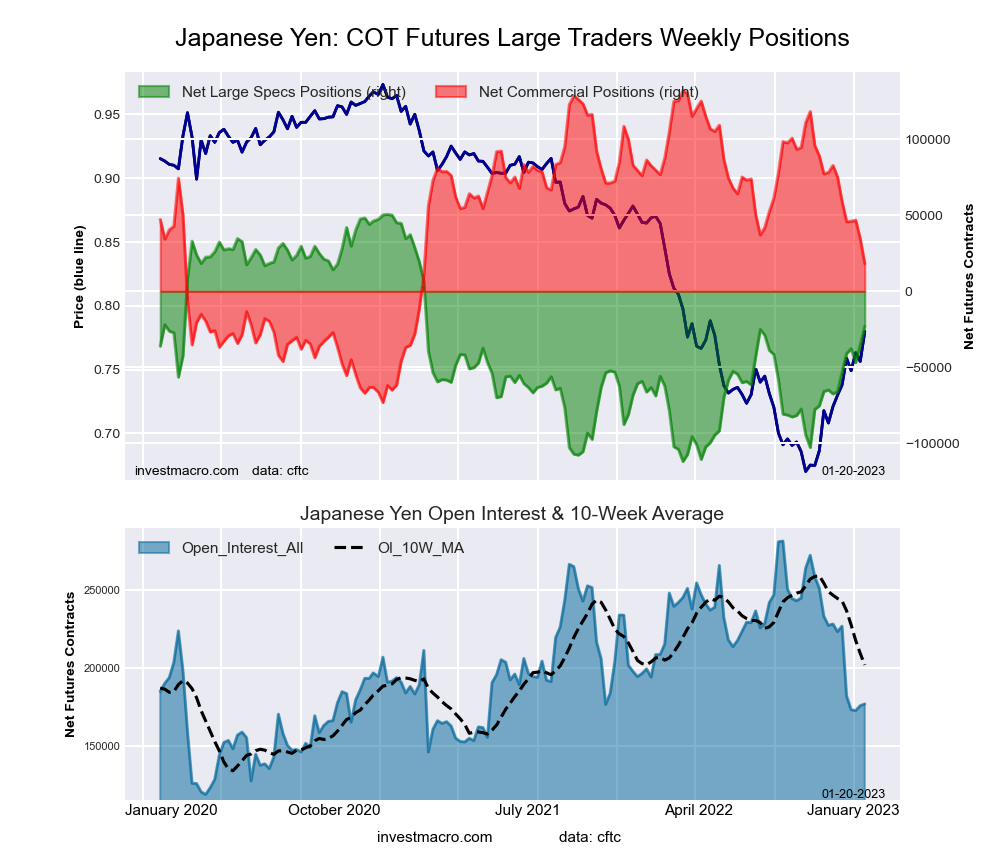
Highlighting the COT currencies data this week is the improvement being seen in the Japanese yen speculator positioning. The large speculator bets for the Japanese yen have risen for two straight weeks and in six out of the past seven weeks. This improvement for the yen has taken the net position from a total of -102,618 contracts on October 25th to just a total of -53,188 contracts this week for a total reduction in the bearish position by +49,430 contracts. The yen speculator position is now at the least bearish level in the past fifteen weeks.

The yen exchange rate versus the dollar has been on the mend as well after falling to over a 30-year low in October at the 151.94 exchange rate. The yen has rallied by approximately 10 percent since the recent low and has been helped out by a decreasing interest rate differential between the US bonds and the Japanese bonds (see chart below). The yen could see further improvement if the USDJPY falls below the approaching the 200-day moving average.

japanese yen vs us dollar interest rate differential


Data Snapshot of Forex Market Traders | Columns Legend
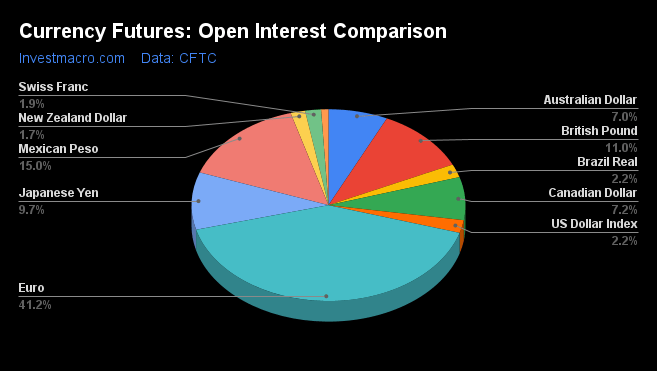
Dec-13-2022OIOI-IndexSpec-NetSpec-IndexCom-NetCOM-IndexSmalls-NetSmalls-Index
USD Index48,0696325,77868-28,482312,70446
EUR772,800100124,71573-157,3773132,66231
GBP240,26461-25,7394731,28855-5,54947
JPY226,96466-53,1883659,02964-5,84142
CHF49,34064-11,8112315,97271-4,16143
CAD169,43343-27,248924,924892,32435
AUD172,26962-37,8375042,84551-5,00840
NZD55,29464-7,506346,096611,41068
MXN290,1169144,36446-49,811525,44766
RUB20,93047,54331-7,15069-39324
BRL34,190193,45950-5,560492,10186
Bitcoin13,98971-4076-409044923


Strength Scores led by Bitcoin & EuroFX

COT Strength Scores (a normalized measure of Speculator positions over a 3-Year range, from 0 to 100 where above 80 is Extreme-Bullish and below 20 is Extreme-Bearish) showed that Bitcoin (76 percent) and the EuroFX (73 percent) lead the currency markets this week. The US Dollar Index (68 percent), Australian Dollar (50 percent) and the Brazilian Real (50 percent) come in as the next highest in the weekly strength scores.

On the downside, the Canadian Dollar (9 percent) is at the lowest strength level currently and is in Extreme-Bearish territory (below 20 percent). The next lowest strength scores are the Swiss Franc (23 percent), New Zealand Dollar (34 percent) and the Japanese Yen (36 percent).

Strength Statistics:
US Dollar Index (67.9 percent) vs US Dollar Index previous week (66.4 percent)
EuroFX (73.3 percent) vs EuroFX previous week (73.3 percent)
British Pound Sterling (46.9 percent) vs British Pound Sterling previous week (44.8 percent)
Japanese Yen (36.1 percent) vs Japanese Yen previous week (28.2 percent)
Swiss Franc (23.4 percent) vs Swiss Franc previous week (22.3 percent)
Canadian Dollar (9.3 percent) vs Canadian Dollar previous week (15.5 percent)
Australian Dollar (49.8 percent) vs Australian Dollar previous week (47.2 percent)
New Zealand Dollar (34.1 percent) vs New Zealand Dollar previous week (36.8 percent)
Mexican Peso (46.3 percent) vs Mexican Peso previous week (47.8 percent)
Brazilian Real (49.6 percent) vs Brazilian Real previous week (48.3 percent)
Bitcoin (76.2 percent) vs Bitcoin previous week (78.1 percent)


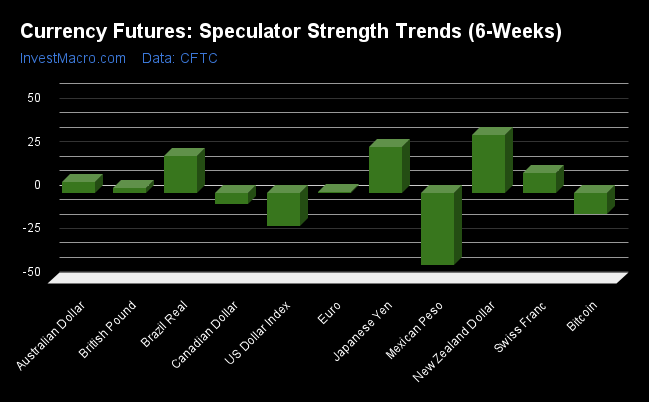
British Pound & Japanese Yen top the 6-Week Strength Trends

COT Strength Score Trends (or move index, calculates the 6-week changes in strength scores) showed that the British Pound (16 percent) and the Japanese Yen (15 percent) lead the past six weeks trends for the currencies. The Australian Dollar (12 percent), the Swiss Franc (8 percent) and the Bitcoin (7 percent) are the next highest positive movers in the latest trends data.

The Brazilian Real (-28 percent) leads the downside trend scores currently with the Canadian Dollar (-11 percent), New Zealand Dollar (-10 percent) and the US Dollar Index (-7 percent) following next with lower trend scores.

Strength Trend Statistics:
US Dollar Index (-6.7 percent) vs US Dollar Index previous week (-8.7 percent)
EuroFX (5.8 percent) vs EuroFX previous week (15.3 percent)
British Pound Sterling (16.4 percent) vs British Pound Sterling previous week (16.8 percent)
Japanese Yen (15.0 percent) vs Japanese Yen previous week (22.6 percent)
Swiss Franc (7.9 percent) vs Swiss Franc previous week (-2.5 percent)
Canadian Dollar (-11.5 percent) vs Canadian Dollar previous week (-4.7 percent)
Australian Dollar (11.8 percent) vs Australian Dollar previous week (10.1 percent)
New Zealand Dollar (-9.8 percent) vs New Zealand Dollar previous week (17.1 percent)
Mexican Peso (0.1 percent) vs Mexican Peso previous week (15.1 percent)
Brazilian Real (-27.5 percent) vs Brazilian Real previous week (-28.9 percent)
Bitcoin (7.2 percent) vs Bitcoin previous week (0.8 percent)


Individual COT Forex Markets:

US Dollar Index Futures:

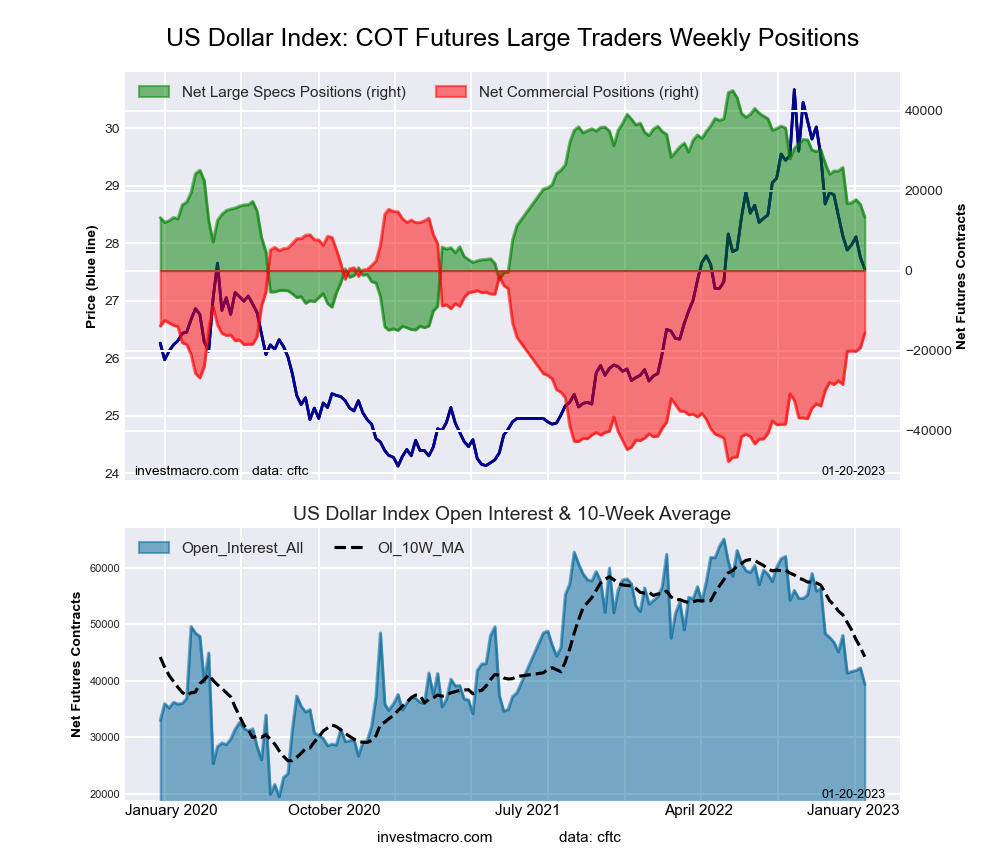
US Dollar Index Forex Futures COT ChartThe US Dollar Index large speculator standing this week recorded a net position of 25,778 contracts in the data reported through Tuesday. This was a weekly lift of 892 contracts from the previous week which had a total of 24,886 net contracts.

This week’s current strength score (the trader positioning range over the past three years, measured from 0 to 100) shows the speculators are currently Bullish with a score of 67.9 percent. The commercials are Bearish with a score of 30.5 percent and the small traders (not shown in chart) are Bearish with a score of 46.1 percent.

US DOLLAR INDEX StatisticsSPECULATORSCOMMERCIALSSMALL TRADERS
– Percent of Open Interest Longs:80.62.612.0
– Percent of Open Interest Shorts:27.061.86.4
– Net Position:25,778-28,4822,704
– Gross Longs:38,7661,2455,782
– Gross Shorts:12,98829,7273,078
– Long to Short Ratio:3.0 to 10.0 to 11.9 to 1
NET POSITION TREND:
– Strength Index Score (3 Year Range Pct):67.930.546.1
– Strength Index Reading (3 Year Range):BullishBearishBearish
NET POSITION MOVEMENT INDEX:
– 6-Week Change in Strength Index:-6.77.7-9.2


Euro Currency Futures:

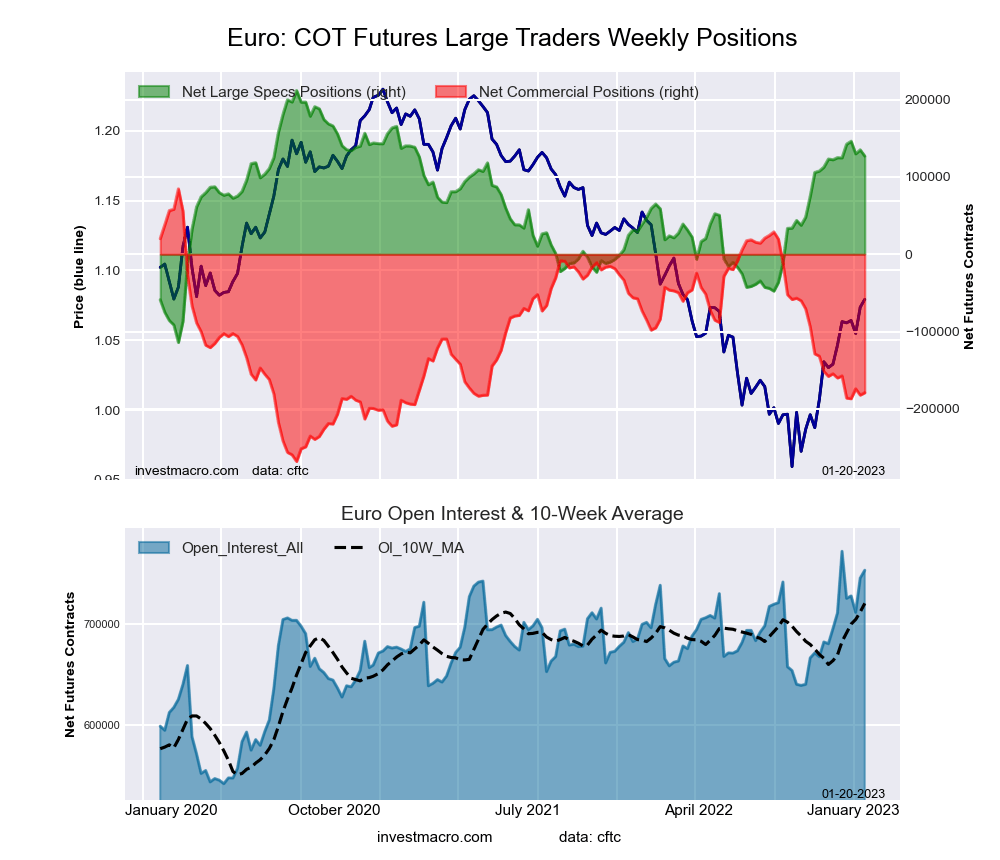
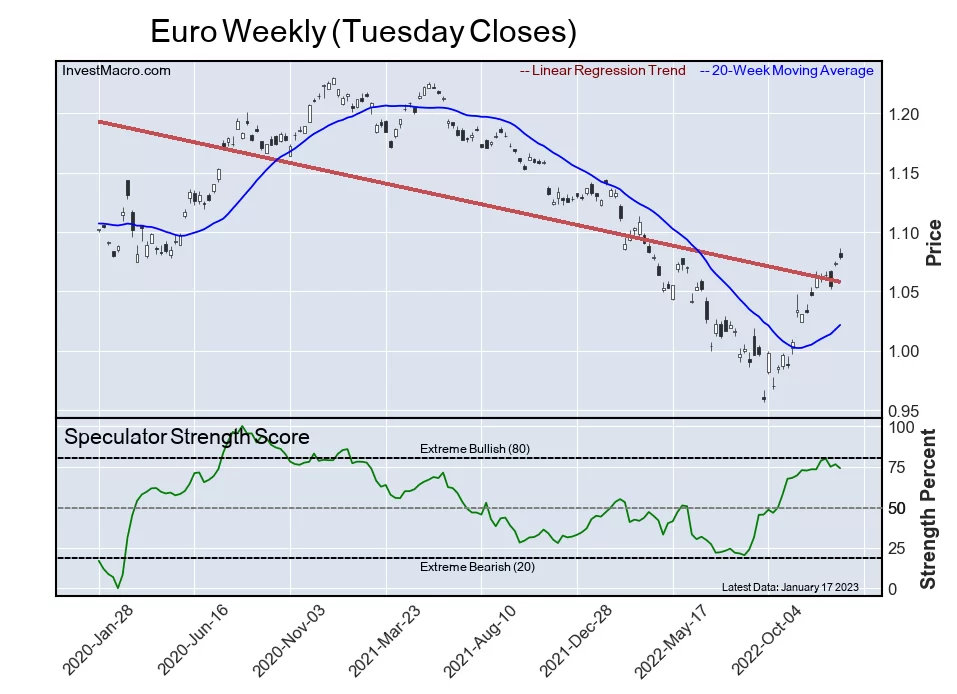
Euro Currency Futures COT ChartThe Euro Currency large speculator standing this week recorded a net position of 124,715 contracts in the data reported through Tuesday. This was a weekly reduction of -168 contracts from the previous week which had a total of 124,883 net contracts.

This week’s current strength score (the trader positioning range over the past three years, measured from 0 to 100) shows the speculators are currently Bullish with a score of 73.3 percent. The commercials are Bearish with a score of 31.4 percent and the small traders (not shown in chart) are Bearish with a score of 31.1 percent.

EURO Currency StatisticsSPECULATORSCOMMERCIALSSMALL TRADERS
– Percent of Open Interest Longs:30.653.612.2
– Percent of Open Interest Shorts:14.573.97.9
– Net Position:124,715-157,37732,662
– Gross Longs:236,415414,09094,033
– Gross Shorts:111,700571,46761,371
– Long to Short Ratio:2.1 to 10.7 to 11.5 to 1
NET POSITION TREND:
– Strength Index Score (3 Year Range Pct):73.331.431.1
– Strength Index Reading (3 Year Range):BullishBearishBearish
NET POSITION MOVEMENT INDEX:
– 6-Week Change in Strength Index:5.8-8.115.4


British Pound Sterling Futures:

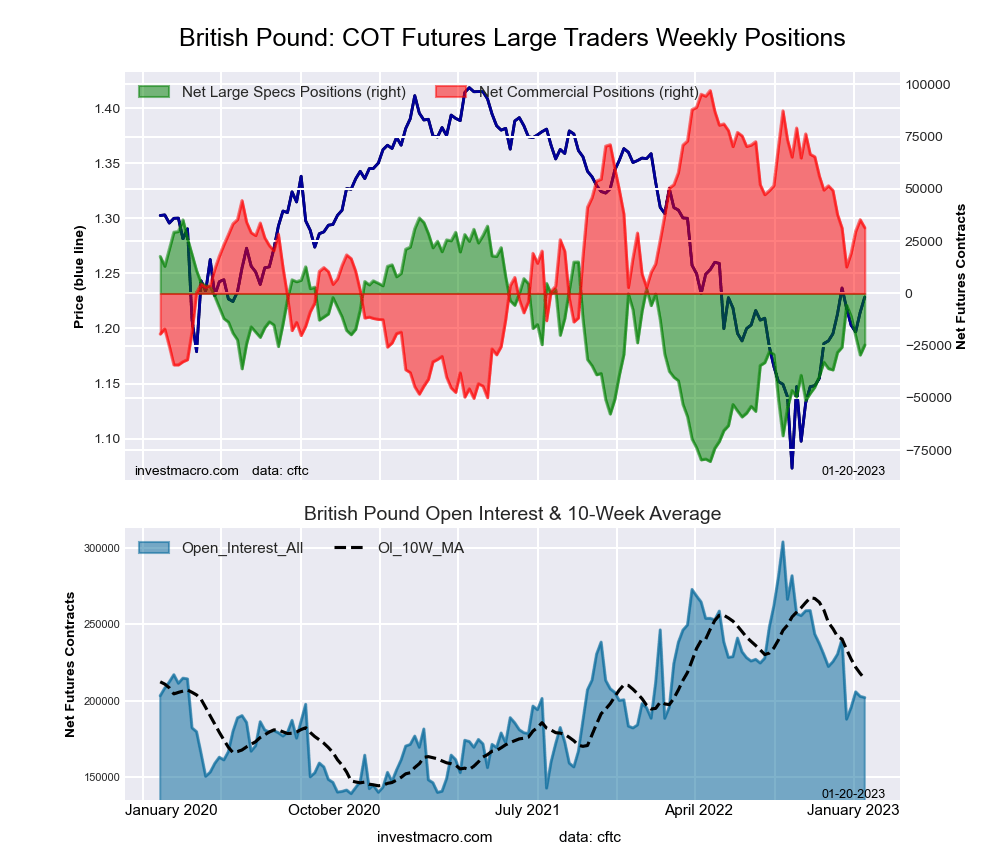
British Pound Sterling Futures COT ChartThe British Pound Sterling large speculator standing this week recorded a net position of -25,739 contracts in the data reported through Tuesday. This was a weekly rise of 2,454 contracts from the previous week which had a total of -28,193 net contracts.

This week’s current strength score (the trader positioning range over the past three years, measured from 0 to 100) shows the speculators are currently Bearish with a score of 46.9 percent. The commercials are Bullish with a score of 55.3 percent and the small traders (not shown in chart) are Bearish with a score of 47.1 percent.

BRITISH POUND StatisticsSPECULATORSCOMMERCIALSSMALL TRADERS
– Percent of Open Interest Longs:13.366.010.6
– Percent of Open Interest Shorts:24.053.012.9
– Net Position:-25,73931,288-5,549
– Gross Longs:32,008158,68625,472
– Gross Shorts:57,747127,39831,021
– Long to Short Ratio:0.6 to 11.2 to 10.8 to 1
NET POSITION TREND:
– Strength Index Score (3 Year Range Pct):46.955.347.1
– Strength Index Reading (3 Year Range):BearishBullishBearish
NET POSITION MOVEMENT INDEX:
– 6-Week Change in Strength Index:16.4-23.229.4


Japanese Yen Futures:

Japanese Yen Forex Futures COT ChartThe Japanese Yen large speculator standing this week recorded a net position of -53,188 contracts in the data reported through Tuesday. This was a weekly gain of 12,808 contracts from the previous week which had a total of -65,996 net contracts.

This week’s current strength score (the trader positioning range over the past three years, measured from 0 to 100) shows the speculators are currently Bearish with a score of 36.1 percent. The commercials are Bullish with a score of 64.5 percent and the small traders (not shown in chart) are Bearish with a score of 41.6 percent.

JAPANESE YEN StatisticsSPECULATORSCOMMERCIALSSMALL TRADERS
– Percent of Open Interest Longs:9.869.211.7
– Percent of Open Interest Shorts:33.343.214.3
– Net Position:-53,18859,029-5,841
– Gross Longs:22,290157,02126,668
– Gross Shorts:75,47897,99232,509
– Long to Short Ratio:0.3 to 11.6 to 10.8 to 1
NET POSITION TREND:
– Strength Index Score (3 Year Range Pct):36.164.541.6
– Strength Index Reading (3 Year Range):BearishBullishBearish
NET POSITION MOVEMENT INDEX:
– 6-Week Change in Strength Index:15.0-17.925.0


Swiss Franc Futures:

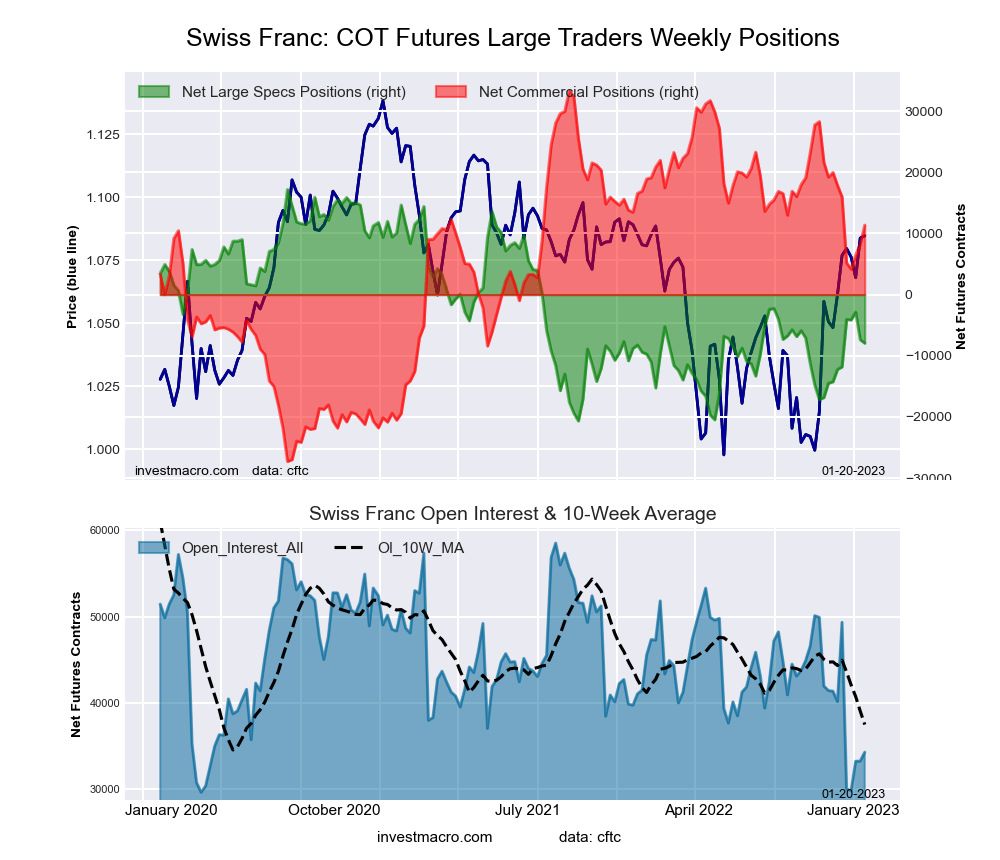
Swiss Franc Forex Futures COT ChartThe Swiss Franc large speculator standing this week recorded a net position of -11,811 contracts in the data reported through Tuesday. This was a weekly gain of 419 contracts from the previous week which had a total of -12,230 net contracts.

This week’s current strength score (the trader positioning range over the past three years, measured from 0 to 100) shows the speculators are currently Bearish with a score of 23.4 percent. The commercials are Bullish with a score of 71.3 percent and the small traders (not shown in chart) are Bearish with a score of 43.4 percent.

SWISS FRANC StatisticsSPECULATORSCOMMERCIALSSMALL TRADERS
– Percent of Open Interest Longs:4.268.921.5
– Percent of Open Interest Shorts:28.236.629.9
– Net Position:-11,81115,972-4,161
– Gross Longs:2,08134,01610,597
– Gross Shorts:13,89218,04414,758
– Long to Short Ratio:0.1 to 11.9 to 10.7 to 1
NET POSITION TREND:
– Strength Index Score (3 Year Range Pct):23.471.343.4
– Strength Index Reading (3 Year Range):BearishBullishBearish
NET POSITION MOVEMENT INDEX:
– 6-Week Change in Strength Index:7.9-19.429.7


Canadian Dollar Futures:

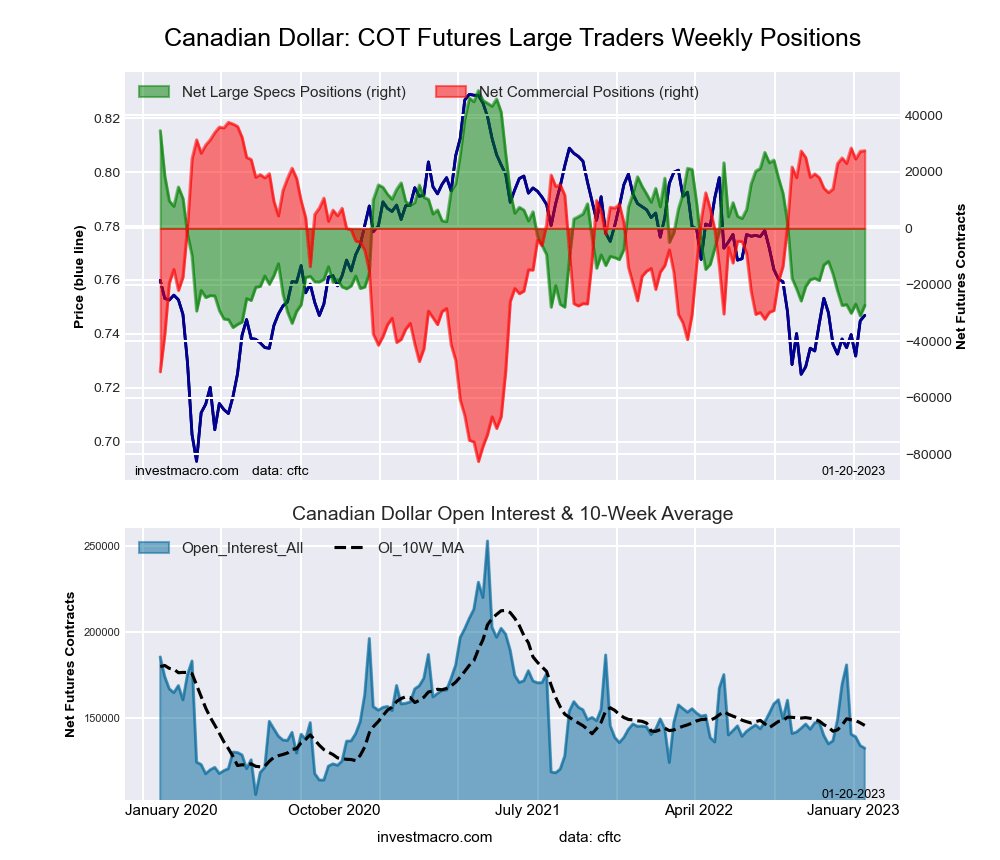
Canadian Dollar Forex Futures COT ChartThe Canadian Dollar large speculator standing this week recorded a net position of -27,248 contracts in the data reported through Tuesday. This was a weekly lowering of -5,158 contracts from the previous week which had a total of -22,090 net contracts.

This week’s current strength score (the trader positioning range over the past three years, measured from 0 to 100) shows the speculators are currently Bearish-Extreme with a score of 9.3 percent. The commercials are Bullish-Extreme with a score of 89.5 percent and the small traders (not shown in chart) are Bearish with a score of 34.8 percent.

CANADIAN DOLLAR StatisticsSPECULATORSCOMMERCIALSSMALL TRADERS
– Percent of Open Interest Longs:18.751.618.9
– Percent of Open Interest Shorts:34.836.917.6
– Net Position:-27,24824,9242,324
– Gross Longs:31,72087,47132,089
– Gross Shorts:58,96862,54729,765
– Long to Short Ratio:0.5 to 11.4 to 11.1 to 1
NET POSITION TREND:
– Strength Index Score (3 Year Range Pct):9.389.534.8
– Strength Index Reading (3 Year Range):Bearish-ExtremeBullish-ExtremeBearish
NET POSITION MOVEMENT INDEX:
– 6-Week Change in Strength Index:-11.54.77.9


Australian Dollar Futures:

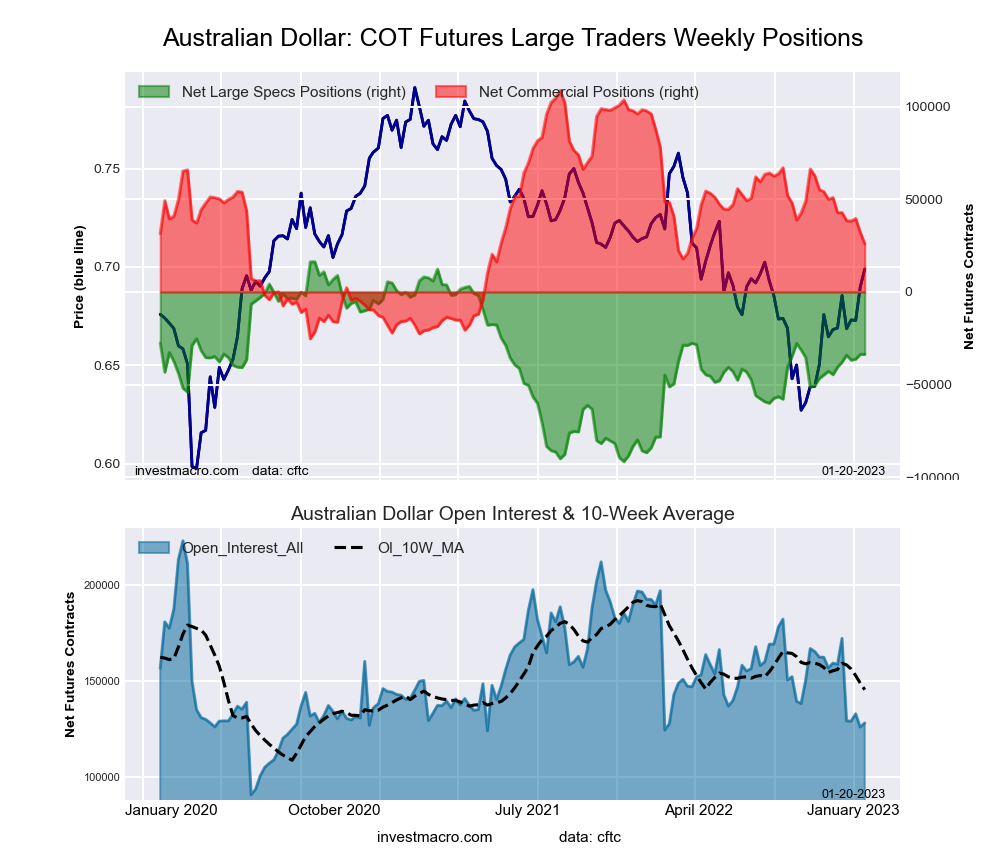
Australian Dollar Forex Futures COT ChartThe Australian Dollar large speculator standing this week recorded a net position of -37,837 contracts in the data reported through Tuesday. This was a weekly advance of 2,726 contracts from the previous week which had a total of -40,563 net contracts.

This week’s current strength score (the trader positioning range over the past three years, measured from 0 to 100) shows the speculators are currently Bearish with a score of 49.8 percent. The commercials are Bullish with a score of 50.8 percent and the small traders (not shown in chart) are Bearish with a score of 40.2 percent.

AUSTRALIAN DOLLAR StatisticsSPECULATORSCOMMERCIALSSMALL TRADERS
– Percent of Open Interest Longs:20.861.210.1
– Percent of Open Interest Shorts:42.836.413.0
– Net Position:-37,83742,845-5,008
– Gross Longs:35,825105,48017,339
– Gross Shorts:73,66262,63522,347
– Long to Short Ratio:0.5 to 11.7 to 10.8 to 1
NET POSITION TREND:
– Strength Index Score (3 Year Range Pct):49.850.840.2
– Strength Index Reading (3 Year Range):BearishBullishBearish
NET POSITION MOVEMENT INDEX:
– 6-Week Change in Strength Index:11.8-14.817.5


New Zealand Dollar Futures:

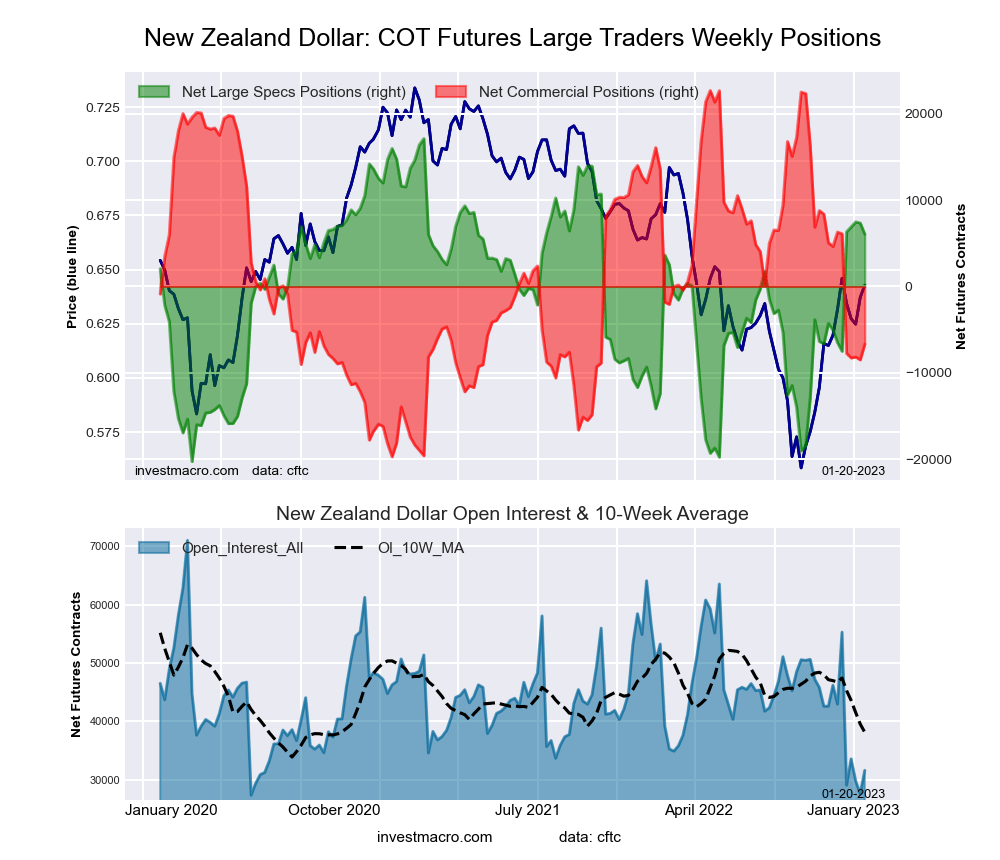
New Zealand Dollar Forex Futures COT ChartThe New Zealand Dollar large speculator standing this week recorded a net position of -7,506 contracts in the data reported through Tuesday. This was a weekly decrease of -1,008 contracts from the previous week which had a total of -6,498 net contracts.

This week’s current strength score (the trader positioning range over the past three years, measured from 0 to 100) shows the speculators are currently Bearish with a score of 34.1 percent. The commercials are Bullish with a score of 60.9 percent and the small traders (not shown in chart) are Bullish with a score of 67.9 percent.

NEW ZEALAND DOLLAR StatisticsSPECULATORSCOMMERCIALSSMALL TRADERS
– Percent of Open Interest Longs:35.652.19.6
– Percent of Open Interest Shorts:49.241.07.0
– Net Position:-7,5066,0961,410
– Gross Longs:19,70028,7935,297
– Gross Shorts:27,20622,6973,887
– Long to Short Ratio:0.7 to 11.3 to 11.4 to 1
NET POSITION TREND:
– Strength Index Score (3 Year Range Pct):34.160.967.9
– Strength Index Reading (3 Year Range):BearishBullishBullish
NET POSITION MOVEMENT INDEX:
– 6-Week Change in Strength Index:-9.8-1.951.1


Mexican Peso Futures:

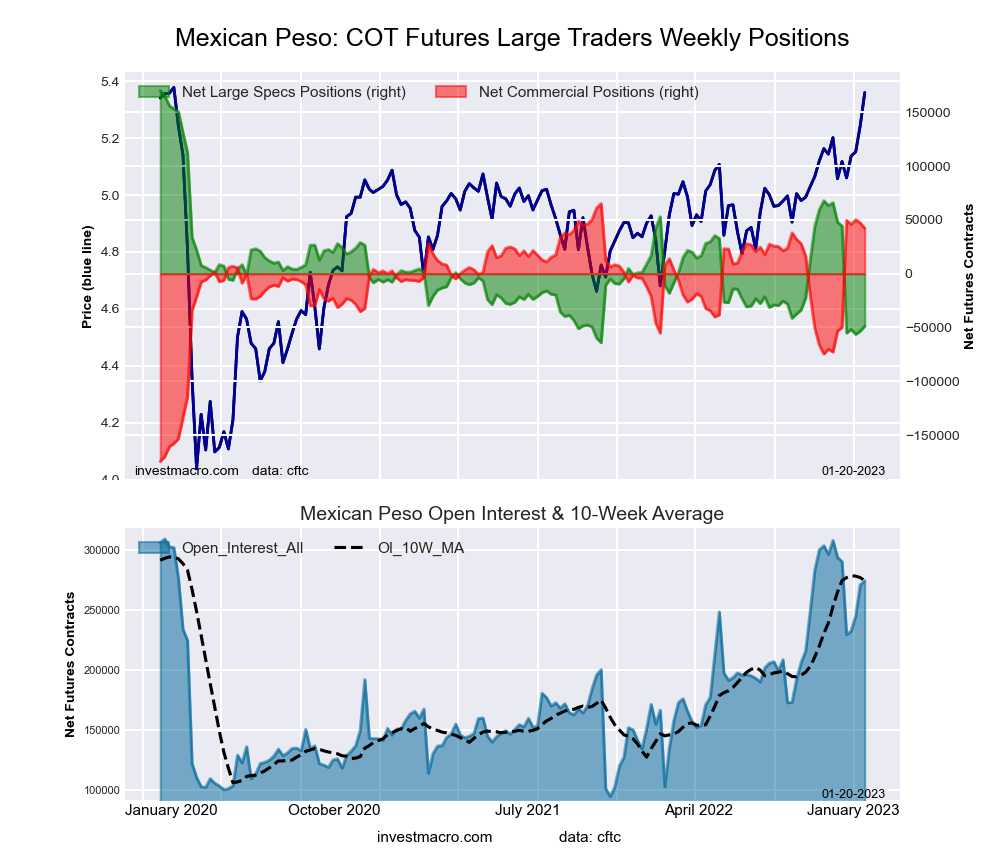
Mexican Peso Futures COT ChartThe Mexican Peso large speculator standing this week recorded a net position of 44,364 contracts in the data reported through Tuesday. This was a weekly lowering of -3,588 contracts from the previous week which had a total of 47,952 net contracts.

This week’s current strength score (the trader positioning range over the past three years, measured from 0 to 100) shows the speculators are currently Bearish with a score of 46.3 percent. The commercials are Bullish with a score of 52.0 percent and the small traders (not shown in chart) are Bullish with a score of 66.1 percent.

MEXICAN PESO StatisticsSPECULATORSCOMMERCIALSSMALL TRADERS
– Percent of Open Interest Longs:58.136.82.7
– Percent of Open Interest Shorts:42.853.90.9
– Net Position:44,364-49,8115,447
– Gross Longs:168,481106,6987,935
– Gross Shorts:124,117156,5092,488
– Long to Short Ratio:1.4 to 10.7 to 13.2 to 1
NET POSITION TREND:
– Strength Index Score (3 Year Range Pct):46.352.066.1
– Strength Index Reading (3 Year Range):BearishBullishBullish
NET POSITION MOVEMENT INDEX:
– 6-Week Change in Strength Index:0.10.3-4.3


Brazilian Real Futures:

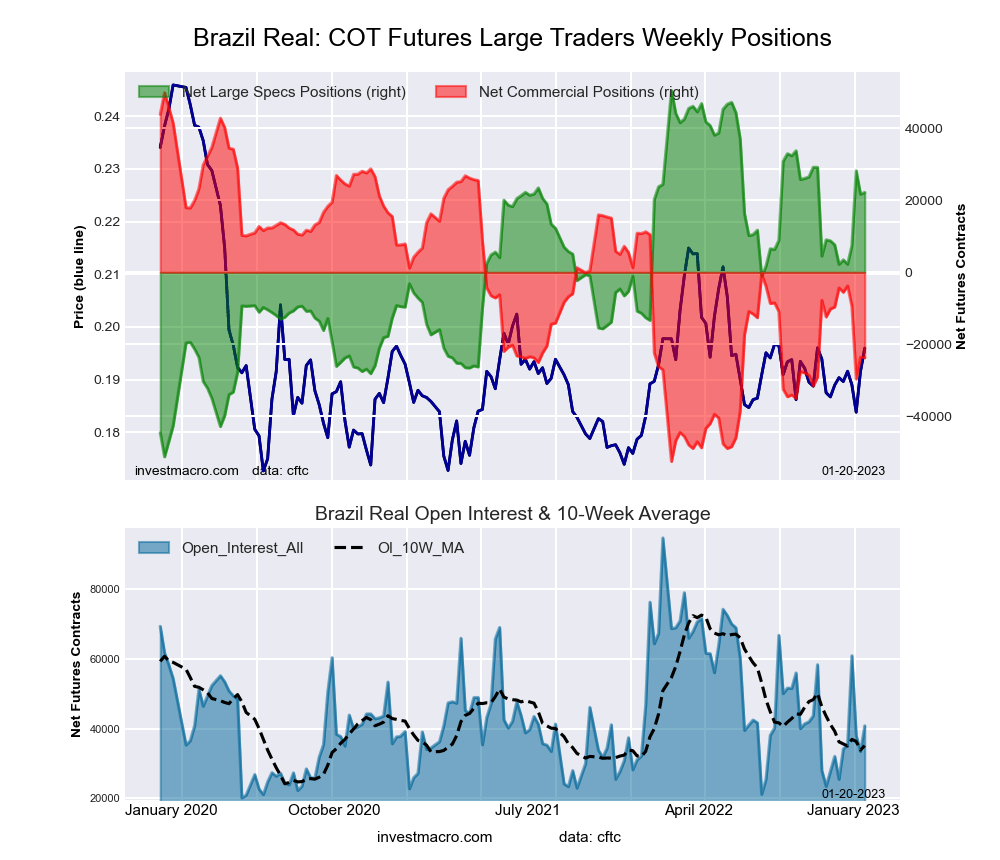
Brazil Real Futures COT ChartThe Brazilian Real large speculator standing this week recorded a net position of 3,459 contracts in the data reported through Tuesday. This was a weekly gain of 1,261 contracts from the previous week which had a total of 2,198 net contracts.

This week’s current strength score (the trader positioning range over the past three years, measured from 0 to 100) shows the speculators are currently Bearish with a score of 49.6 percent. The commercials are Bearish with a score of 49.3 percent and the small traders (not shown in chart) are Bullish-Extreme with a score of 85.6 percent.

BRAZIL REAL StatisticsSPECULATORSCOMMERCIALSSMALL TRADERS
– Percent of Open Interest Longs:67.722.210.1
– Percent of Open Interest Shorts:57.638.44.0
– Net Position:3,459-5,5602,101
– Gross Longs:23,1617,5743,455
– Gross Shorts:19,70213,1341,354
– Long to Short Ratio:1.2 to 10.6 to 12.6 to 1
NET POSITION TREND:
– Strength Index Score (3 Year Range Pct):49.649.385.6
– Strength Index Reading (3 Year Range):BearishBearishBullish-Extreme
NET POSITION MOVEMENT INDEX:
– 6-Week Change in Strength Index:-27.524.723.8


Bitcoin Futures:

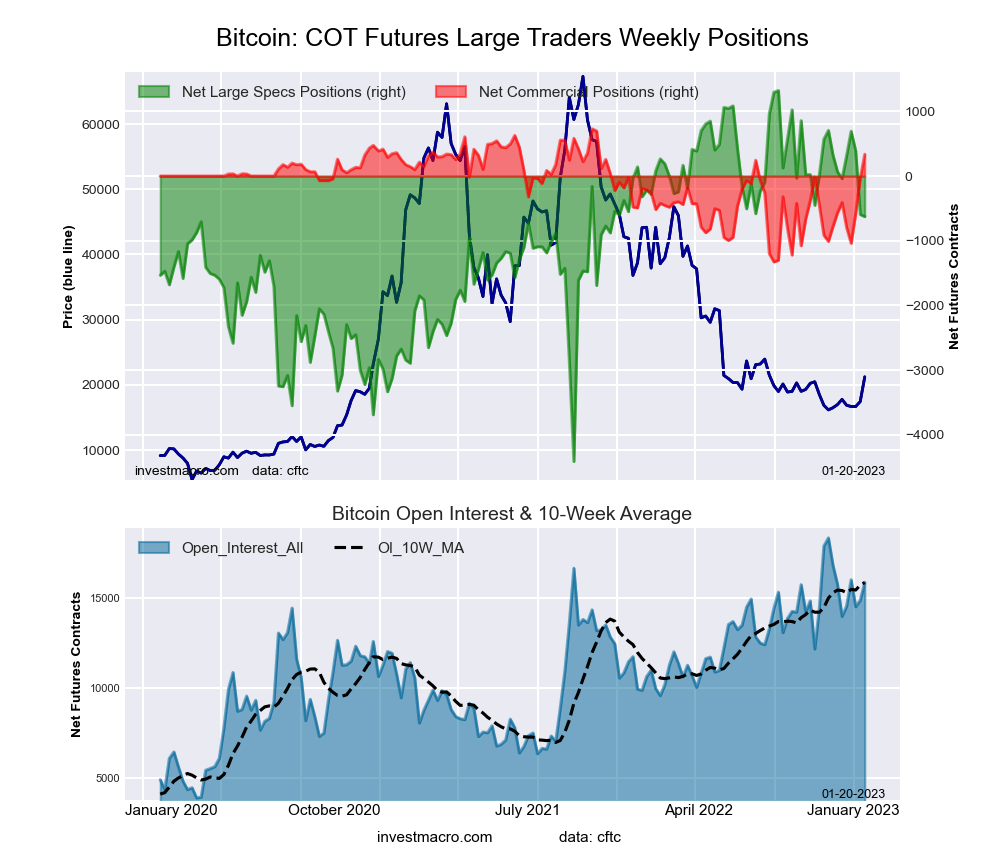
Bitcoin Crypto Futures COT ChartThe Bitcoin large speculator standing this week recorded a net position of -40 contracts in the data reported through Tuesday. This was a weekly decline of -107 contracts from the previous week which had a total of 67 net contracts.

This week’s current strength score (the trader positioning range over the past three years, measured from 0 to 100) shows the speculators are currently Bullish with a score of 76.2 percent. The commercials are Bearish with a score of 44.6 percent and the small traders (not shown in chart) are Bearish with a score of 23.1 percent.

BITCOIN StatisticsSPECULATORSCOMMERCIALSSMALL TRADERS
– Percent of Open Interest Longs:76.22.99.5
– Percent of Open Interest Shorts:76.55.86.3
– Net Position:-40-409449
– Gross Longs:10,6664031,329
– Gross Shorts:10,706812880
– Long to Short Ratio:1.0 to 10.5 to 11.5 to 1
NET POSITION TREND:
– Strength Index Score (3 Year Range Pct):76.244.623.1
– Strength Index Reading (3 Year Range):BullishBearishBearish
NET POSITION MOVEMENT INDEX:
– 6-Week Change in Strength Index:7.2-19.1-0.4


Article By InvestMacroReceive our weekly COT Newsletter

*COT Report: The COT data, released weekly to the public each Friday, is updated through the most recent Tuesday (data is 3 days old) and shows a quick view of how large speculators or non-commercials (for-profit traders) were positioned in the futures markets.

The CFTC categorizes trader positions according to commercial hedgers (traders who use futures contracts for hedging as part of the business), non-commercials (large traders who speculate to realize trading profits) and nonreportable traders (usually small traders/speculators) as well as their open interest (contracts open in the market at time of reporting). See CFTC criteria here.

COT Speculator Extremes: Soybean Meal, 5-Year Bond lead Bullish & Bearish Positions

By InvestMacro

The latest update for the weekly Commitment of Traders (COT) report was released by the Commodity Futures Trading Commission (CFTC) on Friday for data ending on December 13th.

This weekly Extreme Positions report highlights the Top Bullish and Top Bearish Positions for the speculator category. Extreme positioning in these markets can foreshadow strong moves in the underlying market.

To signify an extreme position, we use the Strength Index (also known as the COT Index) of each instrument, a common method of measuring COT data. The Strength Index is simply a comparison of current trader positions against the range of positions over the previous 3 years. We use over 80 percent as extremely bullish and under 20 percent as extremely bearish. (Compare Strength Index scores across all markets in the data table or cot leaders table).


Here Are This Week’s Most Bullish Speculator Positions:

Soybean Meal

The Soybean Meal speculator position comes in as the most bullish extreme standing this week. The Soybean Meal speculator level is currently at a 100.0 percent score or at the exact top of its 3-year range. The six-week trend for the strength score shows a gain of 7.7 over the past six-weeks.

The overall net speculator position was a total of 133,532 net contracts this week with a rise of 11,358 contract in this week’s speculator bets.


Bloomberg Commodity Index

The Bloomberg Commodity Index speculator position comes next in the extreme standings this week. The Bloomberg Commodity Index speculator level is now at a 95.7 percent score of its 3-year range. The six-week trend for the strength score was a gain of 11.3 percent.

The speculator position registered -3,090 net contracts this week with a weekly edge higher by 149 contract in speculator bets.


Nasdaq

The Nasdaq speculator position comes in third this week in the extreme standings. The Nasdaq speculator level resides at a 85.8 percent score of its 3-year range. The six-week trend for the speculator strength score came in at a plus 19.2 change over the past six-weeks.

The speculator position was 19,198 net contracts this week with a boost of 5,681 contract in this week’s speculator bets.


This Week’s Most Bearish Speculator Positions:

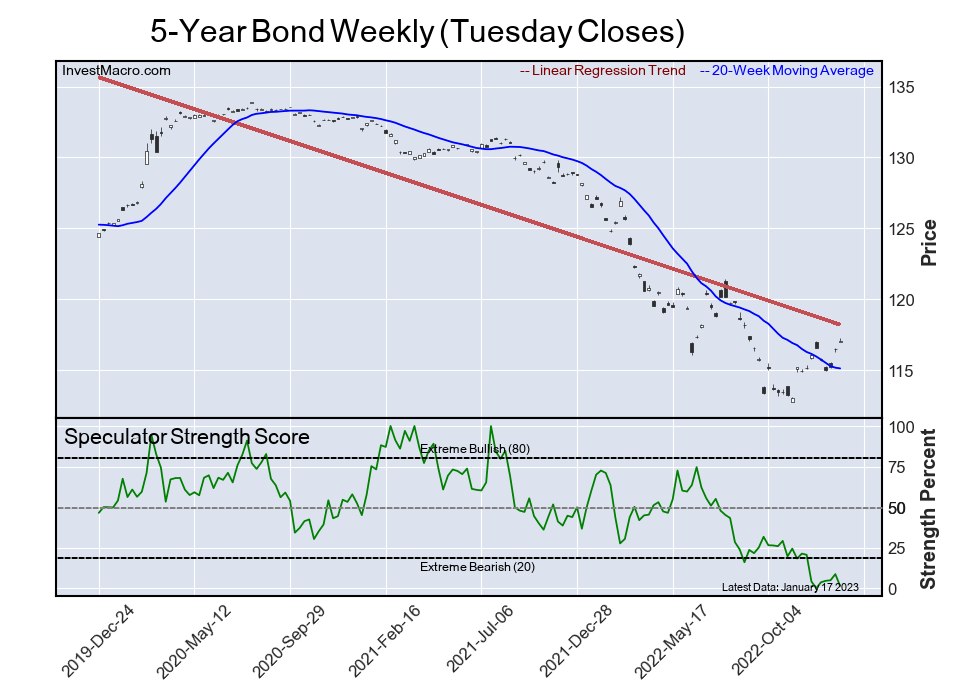
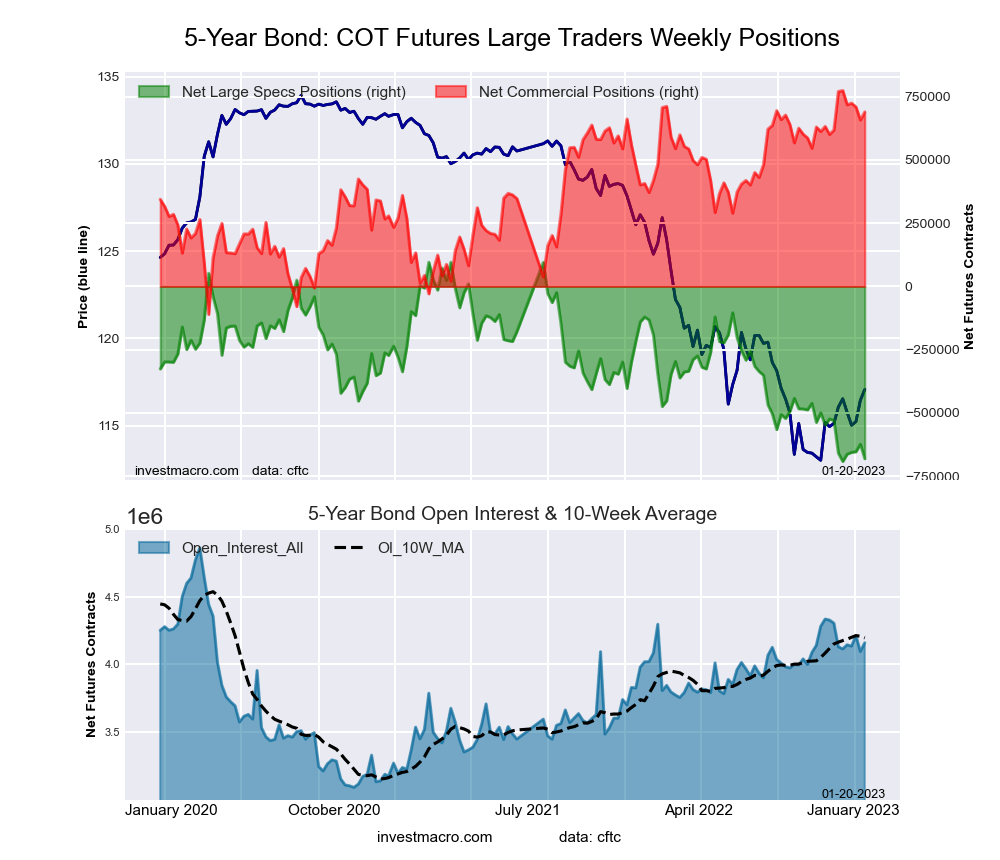
5-Year Bond

The 5-Year Bond speculator position comes in as the most bearish extreme standing this week. The 5-Year Bond speculator level is at a 0.0 percent score or at the bottom of its 3-year range. The trend for the speculator strength score is -19.6 over the past six-weeks.

The speculator position was -691,537 net contracts this week with a drop of -32,931 contract in this week’s speculator bets.


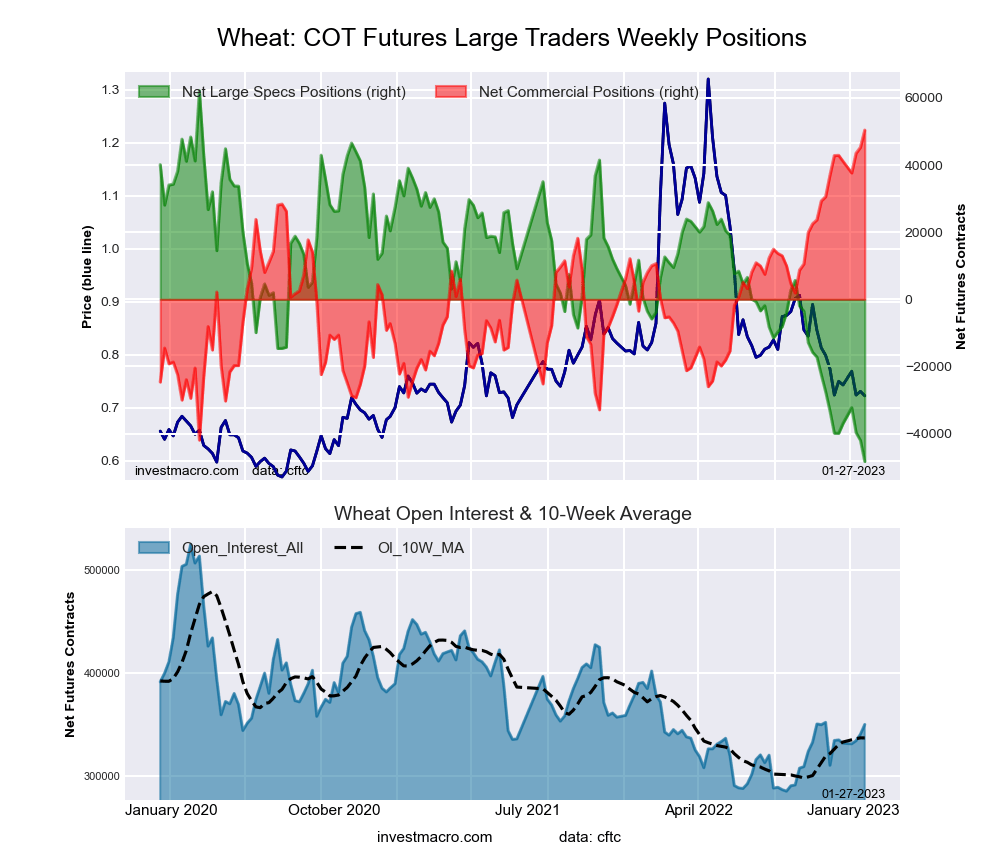
Wheat

The Wheat speculator position comes in next for the most bearish extreme standing on the week. The Wheat speculator level is at a 0.0 percent score of its 3-year range. The trend for the speculator strength score is -23.7 over the past six-weeks.

The speculator position was -39,918 net contracts this week with a tiny decline of -21 contract in this week’s speculator bets.


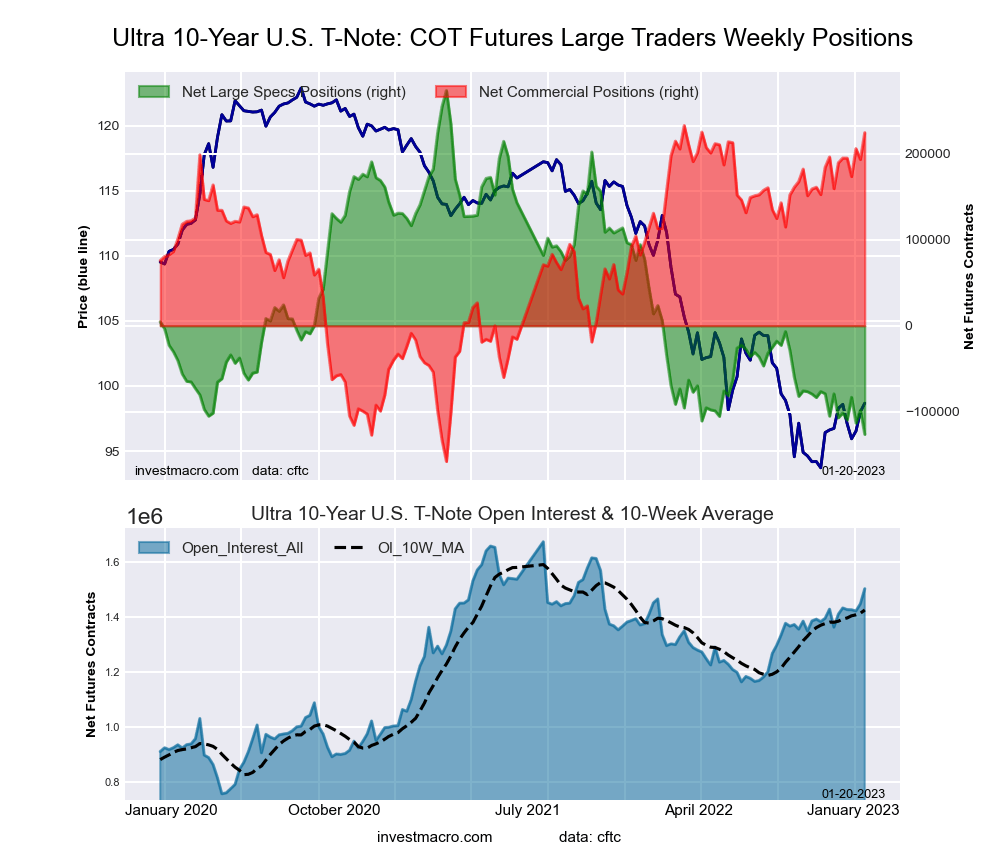
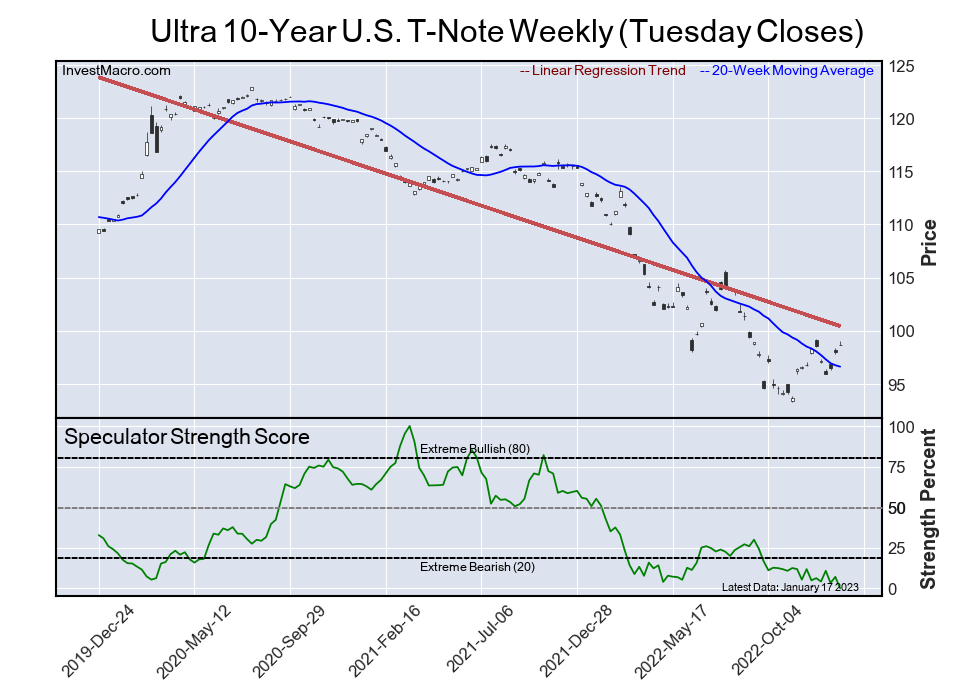
Ultra 10-Year U.S. T-Note

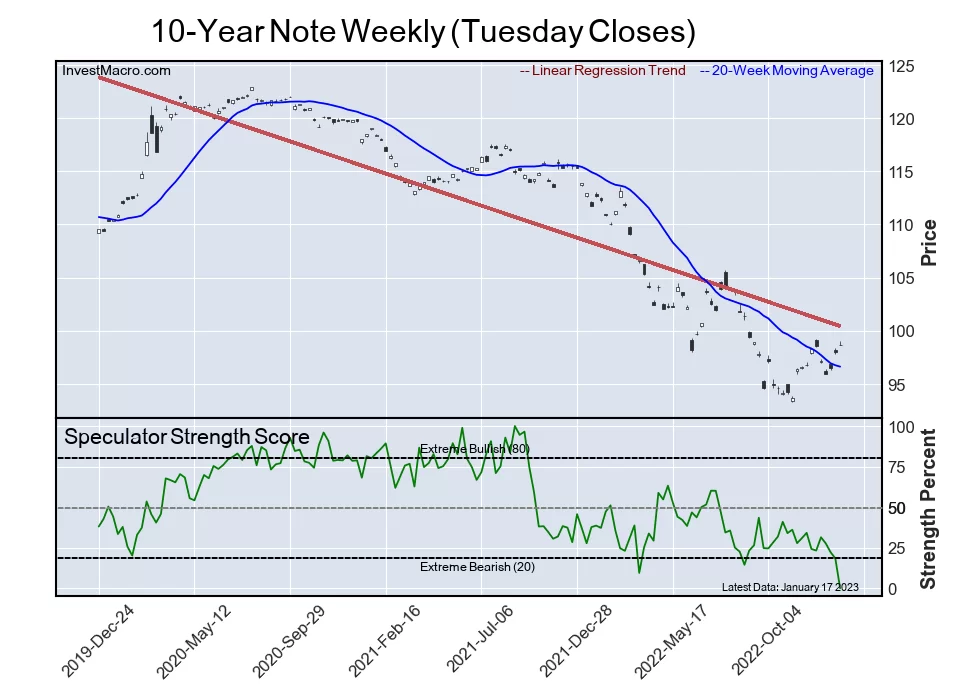
The Ultra 10-Year U.S. T-Note speculator position comes in as third most bearish extreme standing of the week. The Ultra 10-Year U.S. T-Note speculator level resides at a 2.4 percent score of its 3-year range. The trend for the speculator strength score is -4.7 over the past six-weeks.

The speculator position was -101,471 net contracts this week with a gain of 5,481 contract in this week’s speculator bets.


WTI Crude Oil

The WTI Crude Oil speculator position comes in as this week’s fourth most bearish extreme standing. The WTI Crude Oil speculator level is at a 5.0 percent score of its 3-year range. The trend for the speculator strength score has fallen by -6.7 percentage points over the past six-weeks.

The speculator position was 229,559 net contracts this week with a dip of -2,161 contract in this week’s speculator bets.


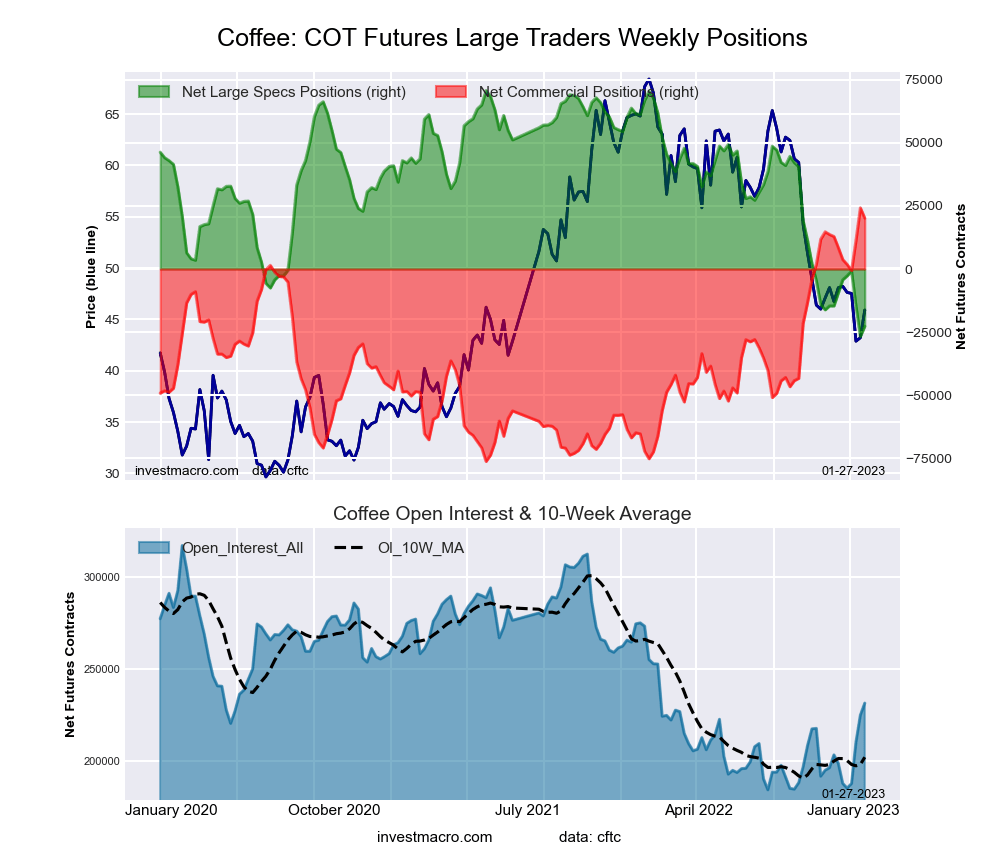
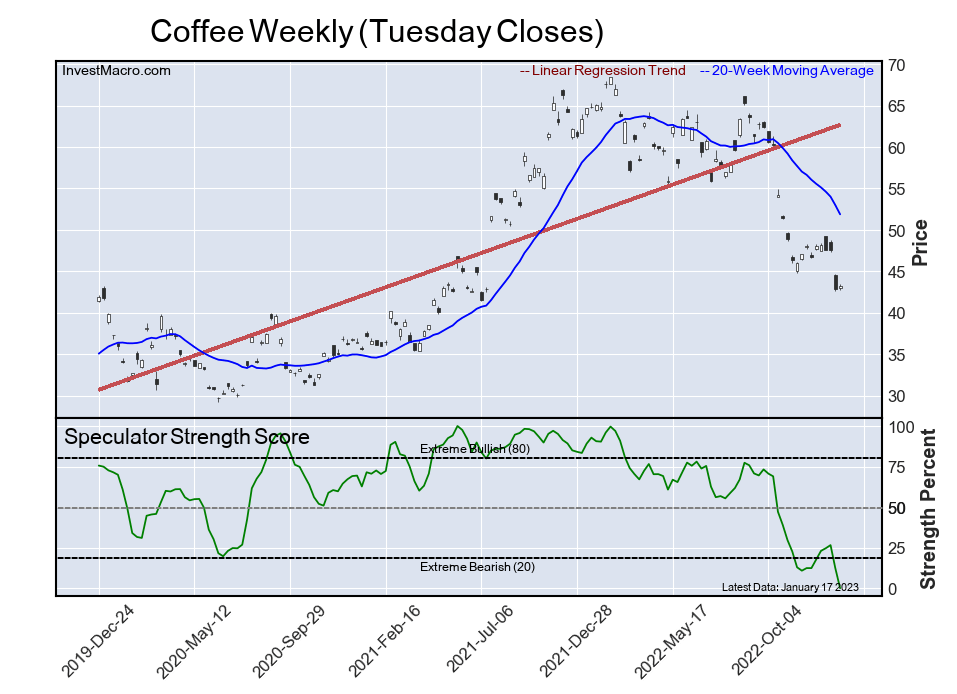
Coffee

Finally, the Coffee speculator position comes in as the fifth most bearish extreme standing for this week. The Coffee speculator level is at a 7.7 percent score of its 3-year range. The trend for the speculator strength score is fall of -13.4 over the past six-weeks.

The speculator position was -9,470 net contracts this week with a gain of 5,172 contract in this week’s speculator bets.


Article By InvestMacroReceive our weekly COT Newsletter

*COT Report: The COT data, released weekly to the public each Friday, is updated through the most recent Tuesday (data is 3 days old) and shows a quick view of how large speculators or non-commercials (for-profit traders) were positioned in the futures markets.

The CFTC categorizes trader positions according to commercial hedgers (traders who use futures contracts for hedging as part of the business), non-commercials (large traders who speculate to realize trading profits) and nonreportable traders (usually small traders/speculators) as well as their open interest (contracts open in the market at time of reporting). See CFTC criteria here.

Large Speculators raise their Metals bets led higher by Gold

By InvestMacro

Here are the latest charts and statistics for the Commitment of Traders (COT) data published by the Commodities Futures Trading Commission (CFTC).

The latest COT data is updated through Tuesday December 13th and shows a quick view of how large traders (for-profit speculators and commercial entities) were positioned in the futures markets.

Weekly Speculator Changes led by Gold & Silver

The COT metals markets speculator bets were higher this week as five out of the five precious metals markets we cover had higher positioning.

Leading the gains for the metals was Gold (10,524 contracts) with Silver (3,611 contracts), Platinum (2,809 contracts), Copper (877 contracts) and Palladium (489 contracts) all showing positive weeks.

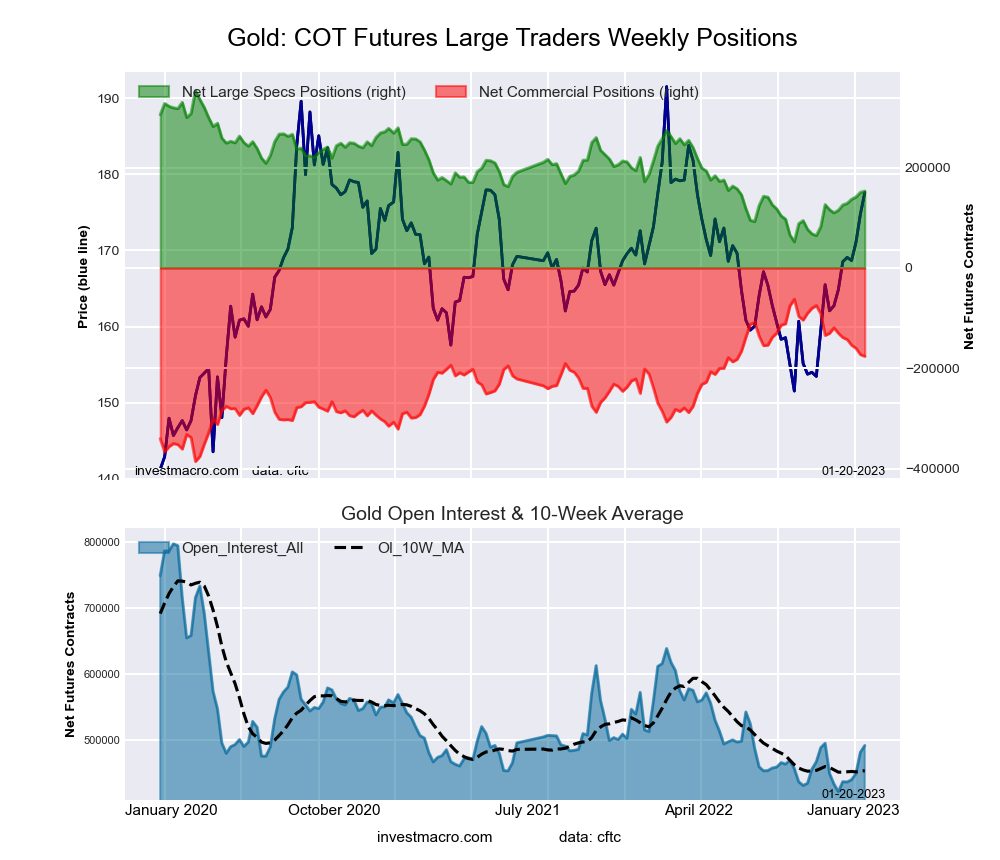
Highlighting the COT metals data this week is the gains in bets for the Gold positions. The large speculator position in Gold futures rose this week for a second straight week and for the fourth time over the past six weeks. Speculator bets have now increased by a total of +61,026 contracts over these past six weeks, going from a total of +64,623 contracts on November 1st to a total of +125,649 contracts this week. These recent gains have now put the net position above +100,000 for the fifth straight week after having been below that threshold for nine consecutive weeks (from September 13th to November 8th) which was the longest stretch under +100,000 net contracts since 2018.

The Gold futures price has been moving positively as well with prices closing higher on a weekly basis for five out of the past seven weeks. The Gold price hit a recent bottom at the $1,618.30 level in early November and has rallied by approximately 11 percent since then to close out this week slightly above the $1,800.00 price threshold.


Data Snapshot of Commodity Market Traders | Columns Legend
Dec-13-2022OIOI-IndexSpec-NetSpec-IndexCom-NetCOM-IndexSmalls-NetSmalls-Index
Gold437,0404125,64924-138,5297612,88012
Silver125,555422,81939-35,8066112,98733
Copper162,191112,55638-6,559624,00348
Palladium7,4948-88320854772943
Platinum72,4164328,44547-32,624554,17924


Strength Scores led by Platinum & Silver

COT Strength Scores (a normalized measure of Speculator positions over a 3-Year range, from 0 to 100 where above 80 is Extreme-Bullish and below 20 is Extreme-Bearish) showed that  Platinum (47 percent) leads the metals markets this week. Silver (39 percent) comes in as the next highest in the weekly strength scores.

On the downside, Palladium (20 percent) comes in at the lowest strength level currently while the next lowest strength score was Gold (24 percent).

Strength Statistics:
Gold (24.4 percent) vs Gold previous week (20.9 percent)
Silver (39.3 percent) vs Silver previous week (35.3 percent)
Copper (38.4 percent) vs Copper previous week (37.7 percent)
Platinum (47.3 percent) vs Platinum previous week (43.6 percent)
Palladium (20.3 percent) vs Palladium previous week (17.2 percent)


Silver & Gold top the 6-Week Strength Trends

COT Strength Score Trends (or move index, calculates the 6-week changes in strength scores) showed that Silver (23 percent) leads the past six weeks trends for metals. Gold (20 percent) is the next highest positive mover in the latest trends data.

Palladium (6 percent) is the lowest in trend scores currently with Copper (8 percent) coming in next. The all positive movement score underlines the change of sentiment for the metals category after spending many weeks of 2022 with all or most of the metals with negative trends.

Move Statistics:
Gold (20.2 percent) vs Gold previous week (15.6 percent)
Silver (23.5 percent) vs Silver previous week (21.3 percent)
Copper (8.0 percent) vs Copper previous week (14.8 percent)
Platinum (16.8 percent) vs Platinum previous week (19.2 percent)
Palladium (6.3 percent) vs Palladium previous week (2.4 percent)


Individual Markets:

Gold Comex Futures:

Gold Futures COT ChartThe Gold Comex Futures large speculator standing this week equaled a net position of 125,649 contracts in the data reported through Tuesday. This was a weekly increase of 10,524 contracts from the previous week which had a total of 115,125 net contracts.

This week’s current strength score (the trader positioning range over the past three years, measured from 0 to 100) shows the speculators are currently Bearish with a score of 24.4 percent. The commercials are Bullish with a score of 76.4 percent and the small traders (not shown in chart) are Bearish-Extreme with a score of 12.2 percent.

Gold Futures StatisticsSPECULATORSCOMMERCIALSSMALL TRADERS
– Percent of Open Interest Longs:51.327.48.5
– Percent of Open Interest Shorts:22.659.15.6
– Net Position:125,649-138,52912,880
– Gross Longs:224,409119,90837,309
– Gross Shorts:98,760258,43724,429
– Long to Short Ratio:2.3 to 10.5 to 11.5 to 1
NET POSITION TREND:
– Strength Index Score (3 Year Range Pct):24.476.412.2
– Strength Index Reading (3 Year Range):BearishBullishBearish-Extreme
NET POSITION MOVEMENT INDEX:
– 6-Week Change in Strength Index:20.2-19.76.8


Silver Comex Futures:

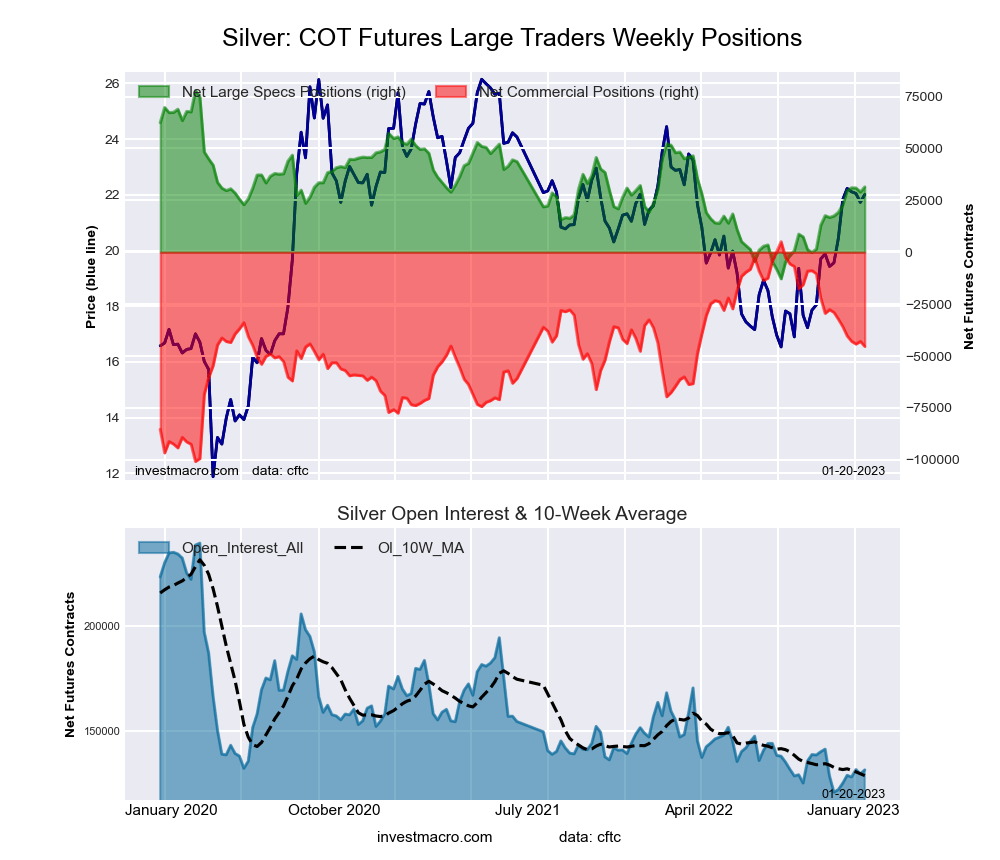
Silver Futures COT ChartThe Silver Comex Futures large speculator standing this week equaled a net position of 22,819 contracts in the data reported through Tuesday. This was a weekly lift of 3,611 contracts from the previous week which had a total of 19,208 net contracts.

This week’s current strength score (the trader positioning range over the past three years, measured from 0 to 100) shows the speculators are currently Bearish with a score of 39.3 percent. The commercials are Bullish with a score of 61.4 percent and the small traders (not shown in chart) are Bearish with a score of 33.1 percent.

Silver Futures StatisticsSPECULATORSCOMMERCIALSSMALL TRADERS
– Percent of Open Interest Longs:40.935.819.0
– Percent of Open Interest Shorts:22.864.38.6
– Net Position:22,819-35,80612,987
– Gross Longs:51,40544,91323,843
– Gross Shorts:28,58680,71910,856
– Long to Short Ratio:1.8 to 10.6 to 12.2 to 1
NET POSITION TREND:
– Strength Index Score (3 Year Range Pct):39.361.433.1
– Strength Index Reading (3 Year Range):BearishBullishBearish
NET POSITION MOVEMENT INDEX:
– 6-Week Change in Strength Index:23.5-24.019.9


Copper Grade #1 Futures:

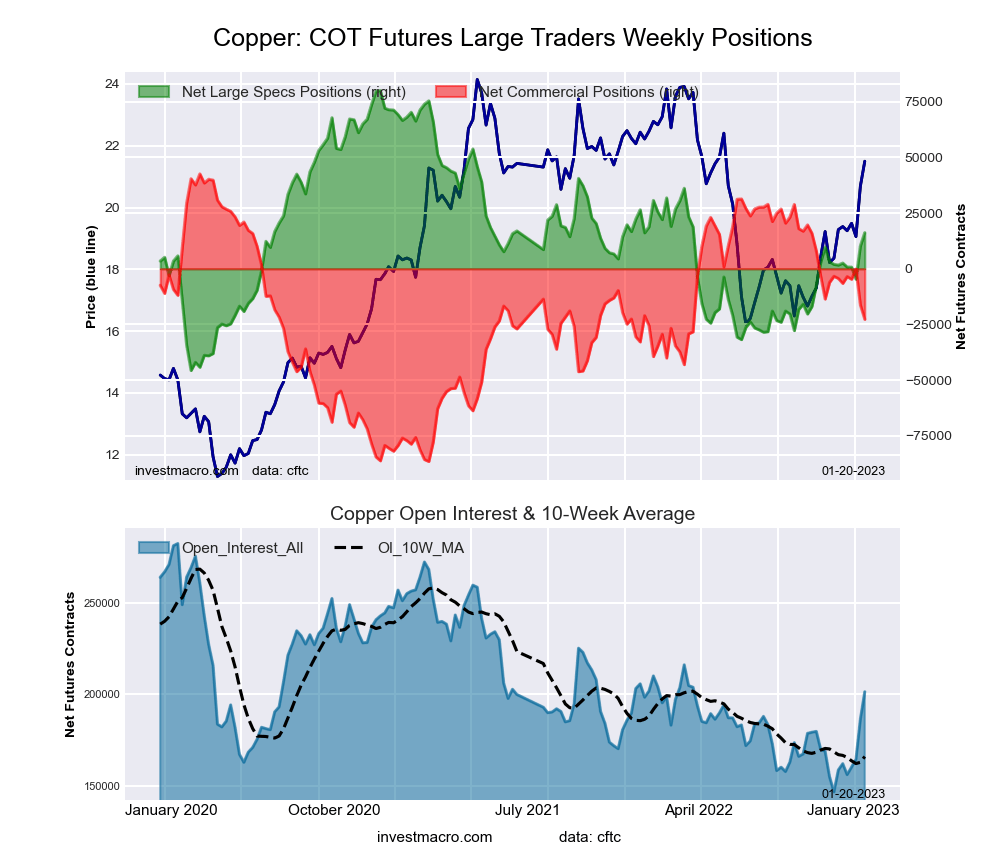
Copper Futures COT ChartThe Copper Grade #1 Futures large speculator standing this week equaled a net position of 2,556 contracts in the data reported through Tuesday. This was a weekly advance of 877 contracts from the previous week which had a total of 1,679 net contracts.

This week’s current strength score (the trader positioning range over the past three years, measured from 0 to 100) shows the speculators are currently Bearish with a score of 38.4 percent. The commercials are Bullish with a score of 61.9 percent and the small traders (not shown in chart) are Bearish with a score of 48.4 percent.

Copper Futures StatisticsSPECULATORSCOMMERCIALSSMALL TRADERS
– Percent of Open Interest Longs:35.840.910.3
– Percent of Open Interest Shorts:34.244.97.9
– Net Position:2,556-6,5594,003
– Gross Longs:58,05766,26516,760
– Gross Shorts:55,50172,82412,757
– Long to Short Ratio:1.0 to 10.9 to 11.3 to 1
NET POSITION TREND:
– Strength Index Score (3 Year Range Pct):38.461.948.4
– Strength Index Reading (3 Year Range):BearishBullishBearish
NET POSITION MOVEMENT INDEX:
– 6-Week Change in Strength Index:8.0-11.326.1


Platinum Futures:

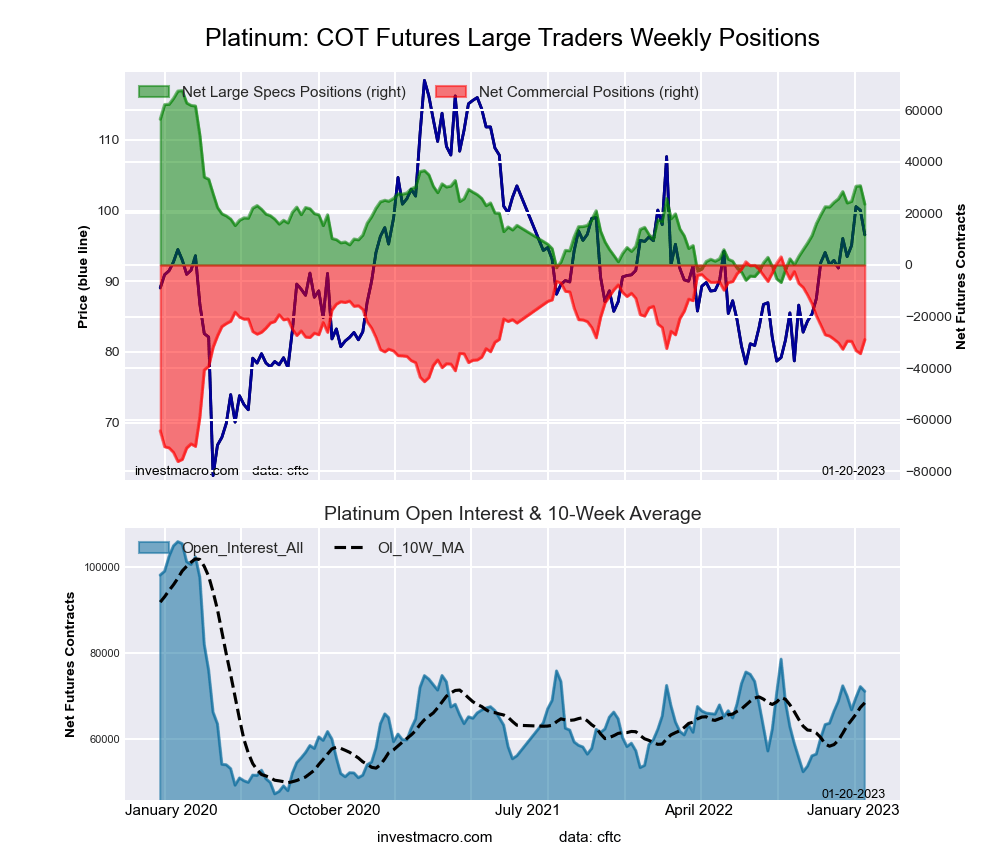
Platinum Futures COT ChartThe Platinum Futures large speculator standing this week equaled a net position of 28,445 contracts in the data reported through Tuesday. This was a weekly lift of 2,809 contracts from the previous week which had a total of 25,636 net contracts.

This week’s current strength score (the trader positioning range over the past three years, measured from 0 to 100) shows the speculators are currently Bearish with a score of 47.3 percent. The commercials are Bullish with a score of 54.9 percent and the small traders (not shown in chart) are Bearish with a score of 24.1 percent.

Platinum Futures StatisticsSPECULATORSCOMMERCIALSSMALL TRADERS
– Percent of Open Interest Longs:54.029.010.3
– Percent of Open Interest Shorts:14.774.14.5
– Net Position:28,445-32,6244,179
– Gross Longs:39,11221,0037,434
– Gross Shorts:10,66753,6273,255
– Long to Short Ratio:3.7 to 10.4 to 12.3 to 1
NET POSITION TREND:
– Strength Index Score (3 Year Range Pct):47.354.924.1
– Strength Index Reading (3 Year Range):BearishBullishBearish
NET POSITION MOVEMENT INDEX:
– 6-Week Change in Strength Index:16.8-16.36.3


Palladium Futures:

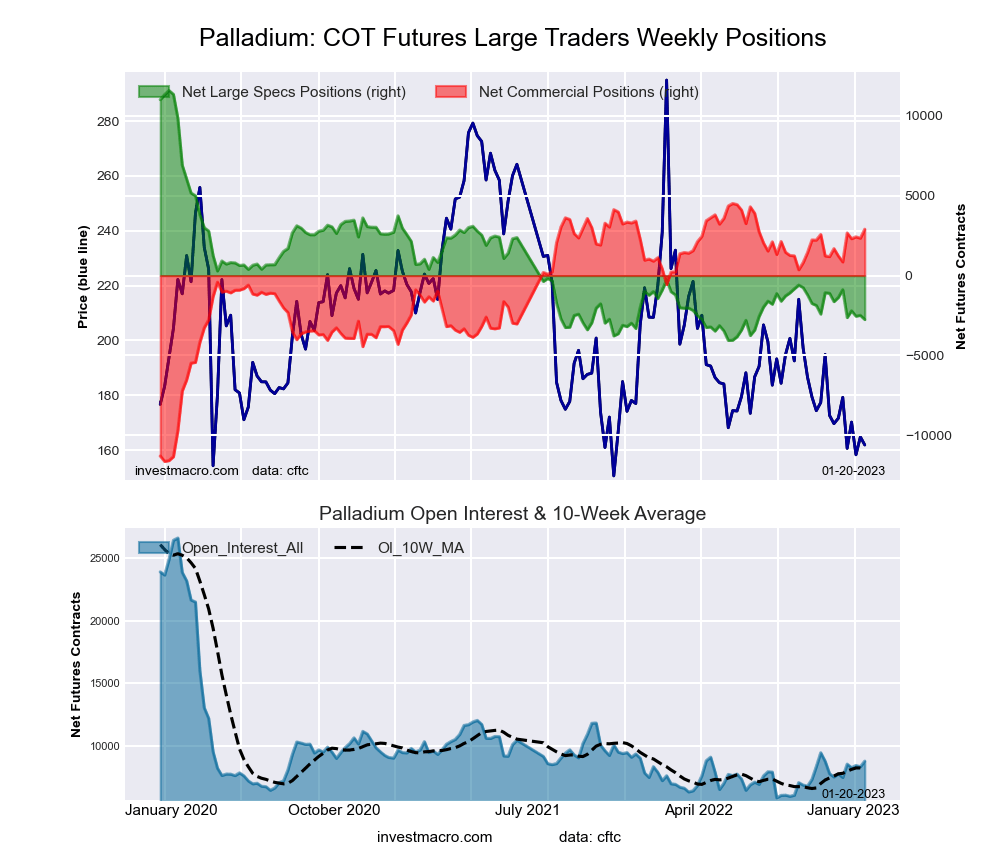
Palladium Futures COT ChartThe Palladium Futures large speculator standing this week equaled a net position of -883 contracts in the data reported through Tuesday. This was a weekly rise of 489 contracts from the previous week which had a total of -1,372 net contracts.

This week’s current strength score (the trader positioning range over the past three years, measured from 0 to 100) shows the speculators are currently Bearish with a score of 20.3 percent. The commercials are Bullish with a score of 77.3 percent and the small traders (not shown in chart) are Bearish with a score of 43.4 percent.

Palladium Futures StatisticsSPECULATORSCOMMERCIALSSMALL TRADERS
– Percent of Open Interest Longs:32.948.614.0
– Percent of Open Interest Shorts:44.737.213.6
– Net Position:-88385429
– Gross Longs:2,4663,6441,050
– Gross Shorts:3,3492,7901,021
– Long to Short Ratio:0.7 to 11.3 to 11.0 to 1
NET POSITION TREND:
– Strength Index Score (3 Year Range Pct):20.377.343.4
– Strength Index Reading (3 Year Range):BearishBullishBearish
NET POSITION MOVEMENT INDEX:
– 6-Week Change in Strength Index:6.3-8.523.0


Article By InvestMacroReceive our weekly COT Newsletter

*COT Report: The COT data, released weekly to the public each Friday, is updated through the most recent Tuesday (data is 3 days old) and shows a quick view of how large speculators or non-commercials (for-profit traders) were positioned in the futures markets.

The CFTC categorizes trader positions according to commercial hedgers (traders who use futures contracts for hedging as part of the business), non-commercials (large traders who speculate to realize trading profits) and nonreportable traders (usually small traders/speculators) as well as their open interest (contracts open in the market at time of reporting). See CFTC criteria here.

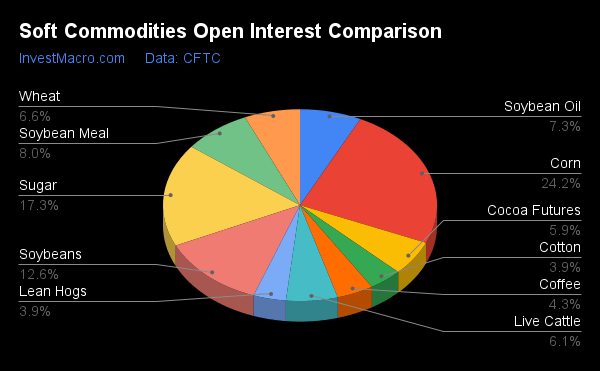
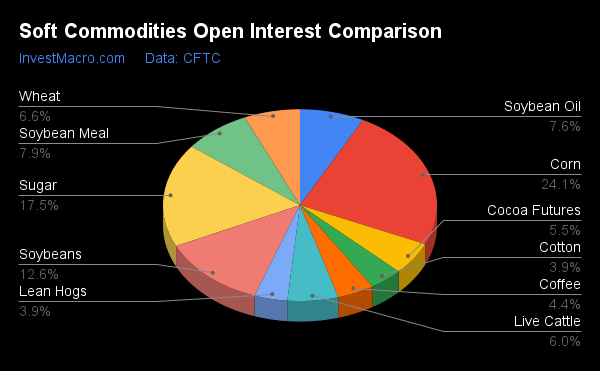
Soft Commodities Speculators boost Soybean Meal bullish bets to 236-week high

By InvestMacro

Here are the latest charts and statistics for the Commitment of Traders (COT) reports data published by the Commodities Futures Trading Commission (CFTC).

The latest COT data is updated through Tuesday December 13th and shows a quick view of how large traders (for-profit speculators and commercial entities) were positioned in the futures markets.

Weekly Speculator Changes led by Soybeans & Corn

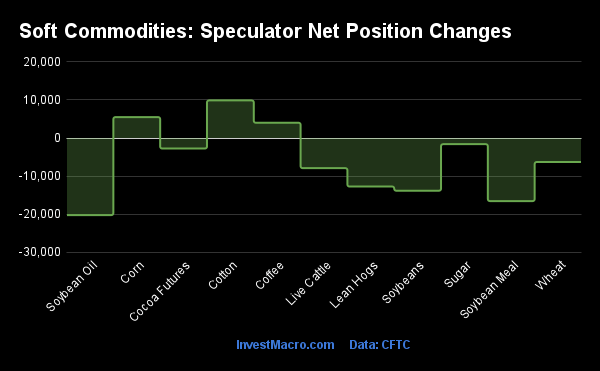
The COT soft commodities markets speculator bets were higher this week as seven out of the eleven softs markets we cover had higher positioning while the other four markets had lower speculator contracts.

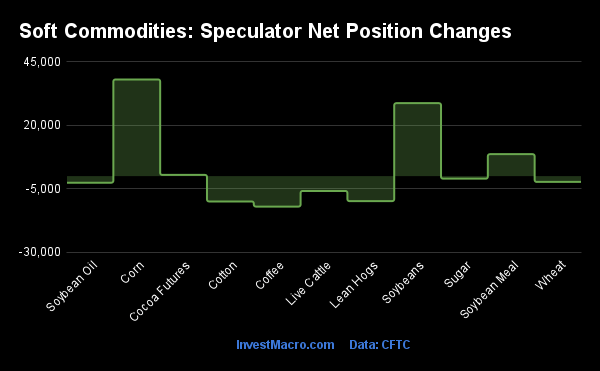
Leading the gains for the softs markets was Soybeans (23,398 contracts) with Corn (13,855 contracts), Soybean Meal (11,358 contracts), Sugar (9,927 contracts) with Cocoa (5,353 contracts), Coffee (5,172 contracts) and Live Cattle (3,552 contracts) also showing positive weeks.

The markets with the declines in speculator bets this week were Soybean Oil (-10,669 contracts) with Lean Hogs (-5,281 contracts), Cotton (-4,281 contracts) and Wheat (-21 contracts) also registering lower bets on the week.

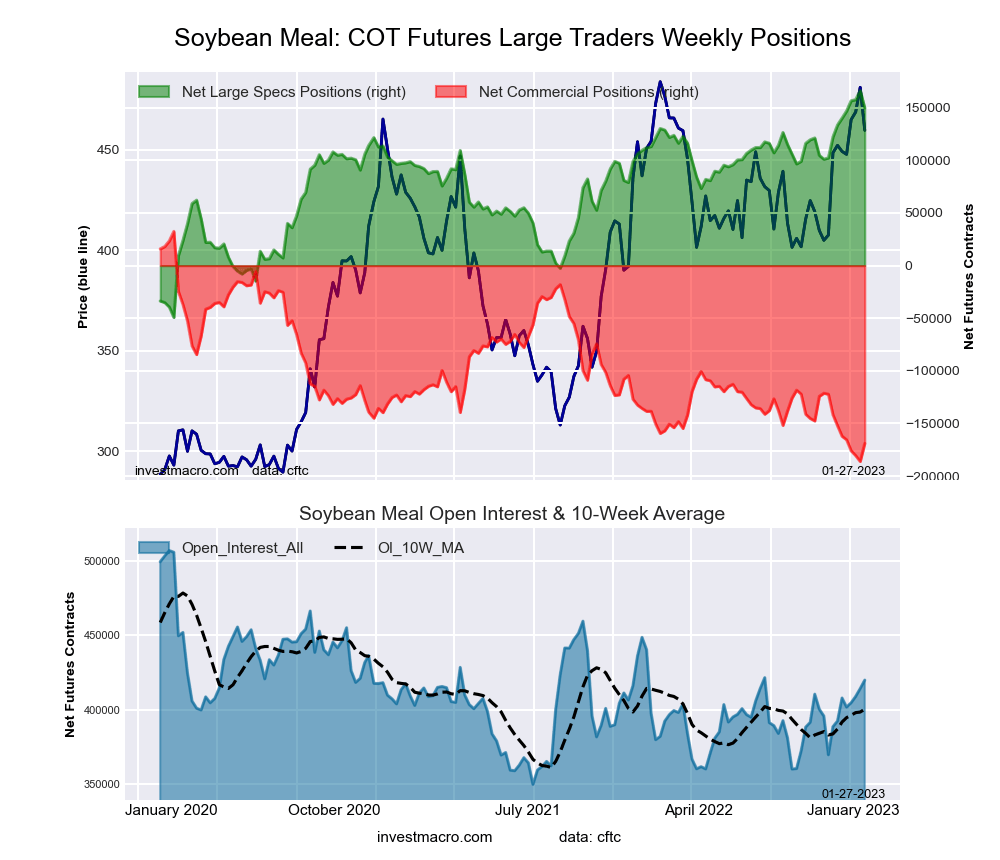
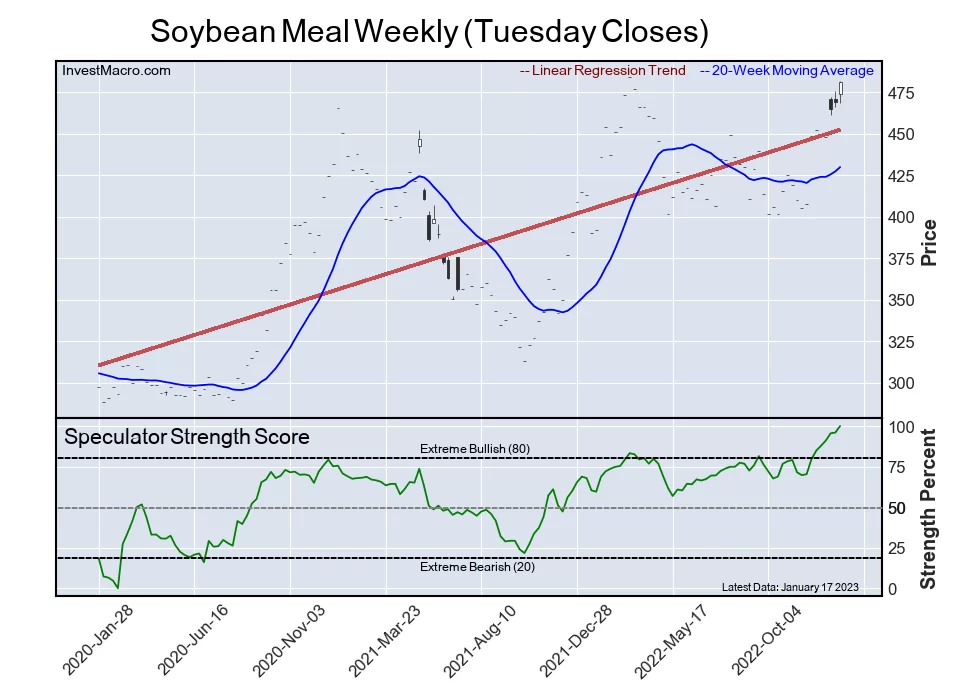
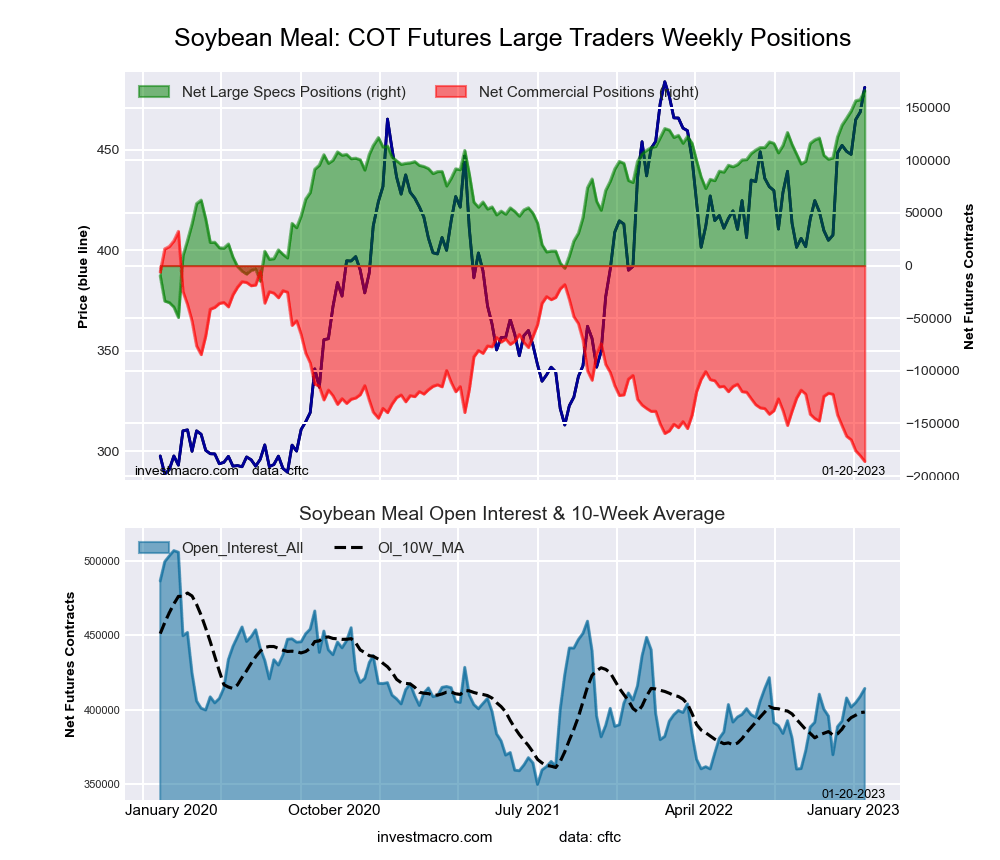
Highlighting the COT soft commodities data this week is the continued gain in the Soybean Meal speculator positioning. The large speculator bets for Soybean Meal rose this week for a third consecutive week and for the seventh time out of the past ten weeks. Speculators bets have now pushed the overall net position standing for Soybean Meal (currently at +133,532 contracts) to the highest level in the past two-hundred and thirty-six weeks, dating back to June 5th of 2018.

Soybean Meal futures prices dipped this week despite the continued strong sentiment. The Soybean Meal futures price had previously gained for three straight weeks and hit the highest price level since March above the 470.0 threshold. The futures price closed out the week right around the 460.0 support/resistance area.


Data Snapshot of Commodity Market Traders | Columns Legend
Dec-13-2022OIOI-IndexSpec-NetSpec-IndexCom-NetCOM-IndexSmalls-NetSmalls-Index
WTI Crude1,450,4824229,5595-247,7479718,18829
Gold437,0404125,64924-138,5297612,88012
Silver125,555422,81939-35,8066112,98733
Copper162,191112,55638-6,559624,00348
Palladium7,4948-88320854772943
Platinum72,4164328,44547-32,624554,17924
Natural Gas996,8239-153,68132129,9607223,72136
Brent148,09710-28,5676225,351363,21653
Heating Oil270,7512417,30868-32,7713615,46352
Soybeans638,74414113,05946-82,01164-31,04819
Corn1,205,2590212,23057-173,22347-39,00721
Coffee198,70211-9,47088,451931,01914
Sugar899,77738193,05160-228,5933835,54252
Wheat335,35421-39,918042,894100-2,97695


Strength Scores led by Soybean Meal & Sugar

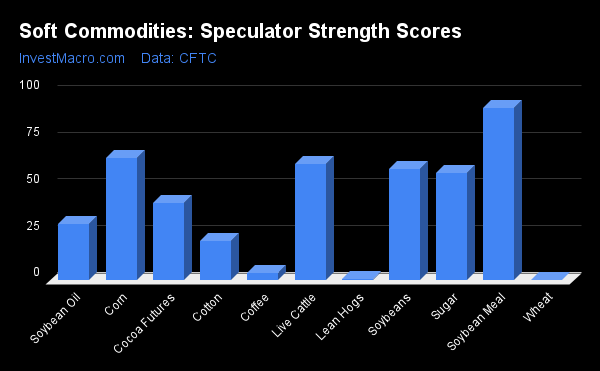
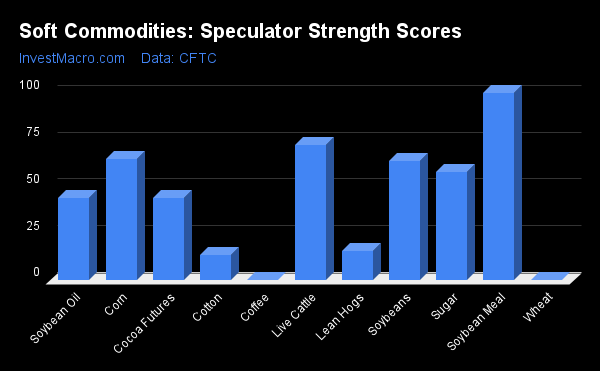
COT Strength Scores (a normalized measure of Speculator positions over a 3-Year range, from 0 to 100 where above 80 is Extreme-Bullish and below 20 is Extreme-Bearish) showed that Soybean Meal (100 percent) and Sugar (60 percent) lead the softs markets this week. Corn (57 percent), Live Cattle (53 percent) and Soybeans (46 percent) come in as the next highest in the weekly strength scores.

On the downside, Wheat (0 percent), Coffee (8 percent) and Cotton (18 percent) come in at the lowest strength levels currently and are in Extreme-Bearish territory (below 20 percent). The next lowest strength score this week was Lean Hogs (37 percent).

Strength Statistics:
Corn (57.1 percent) vs Corn previous week (55.4 percent)
Sugar (60.3 percent) vs Sugar previous week (56.9 percent)
Coffee (7.7 percent) vs Coffee previous week (1.8 percent)
Soybeans (45.9 percent) vs Soybeans previous week (38.5 percent)
Soybean Oil (41.2 percent) vs Soybean Oil previous week (48.5 percent)
Soybean Meal (100.0 percent) vs Soybean Meal previous week (93.8 percent)
Live Cattle (53.1 percent) vs Live Cattle previous week (48.7 percent)
Lean Hogs (37.2 percent) vs Lean Hogs previous week (43.6 percent)
Cotton (18.3 percent) vs Cotton previous week (21.5 percent)
Cocoa (39.9 percent) vs Cocoa previous week (34.6 percent)
Wheat (0.0 percent) vs Wheat previous week (0.0 percent)


Sugar & Cocoa top the 6-Week Strength Trends

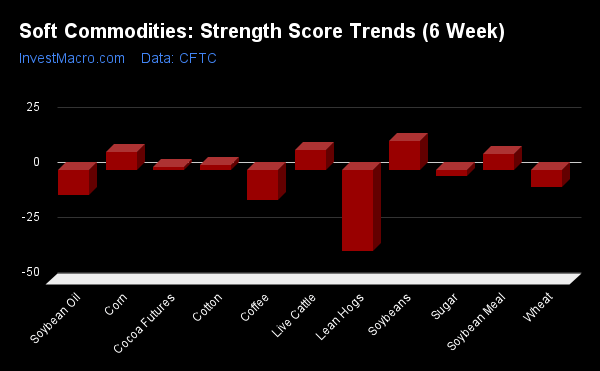
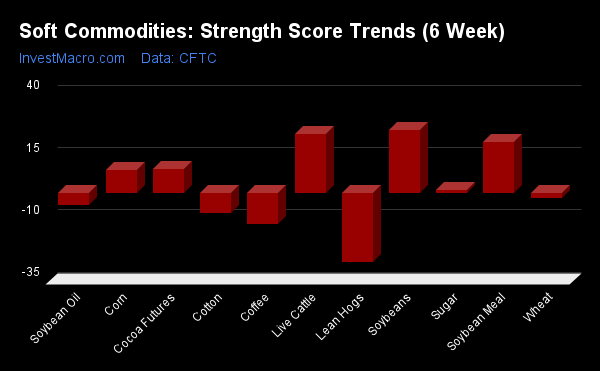
COT Strength Score Trends (or move index, calculates the 6-week changes in strength scores) showed that Sugar (43 percent) and Cocoa (31 percent) lead the past six weeks trends for soft commodities. Soybeans (9 percent) and Soybean Meal (8 percent) are the next highest positive movers in the latest trends data.

Soybean Oil (-29 percent) leads the downside trend scores currently with Wheat (-24 percent), Corn (-16 percent) and Lean Hogs (-14 percent) following next with lower trend scores.

Strength Trend Statistics:
Corn (-16.4 percent) vs Corn previous week (-16.8 percent)
Sugar (42.6 percent) vs Sugar previous week (24.5 percent)
Coffee (-13.4 percent) vs Coffee previous week (-29.9 percent)
Soybeans (8.5 percent) vs Soybeans previous week (10.3 percent)
Soybean Oil (-28.5 percent) vs Soybean Oil previous week (-18.5 percent)
Soybean Meal (7.7 percent) vs Soybean Meal previous week (3.3 percent)
Live Cattle (-5.8 percent) vs Live Cattle previous week (-11.1 percent)
Lean Hogs (-14.4 percent) vs Lean Hogs previous week (-1.8 percent)
Cotton (-1.3 percent) vs Cotton previous week (-4.6 percent)
Cocoa (31.2 percent) vs Cocoa previous week (19.3 percent)
Wheat (-23.7 percent) vs Wheat previous week (-26.4 percent)


Individual Soft Commodities Markets:

CORN Futures:
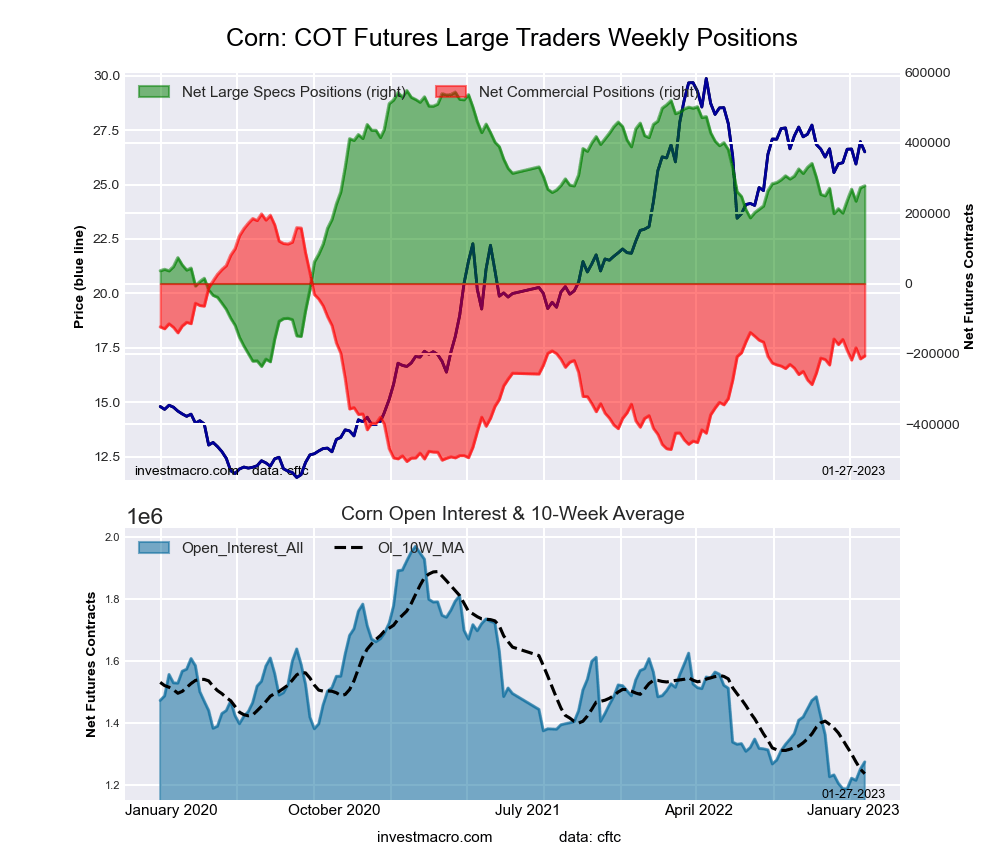
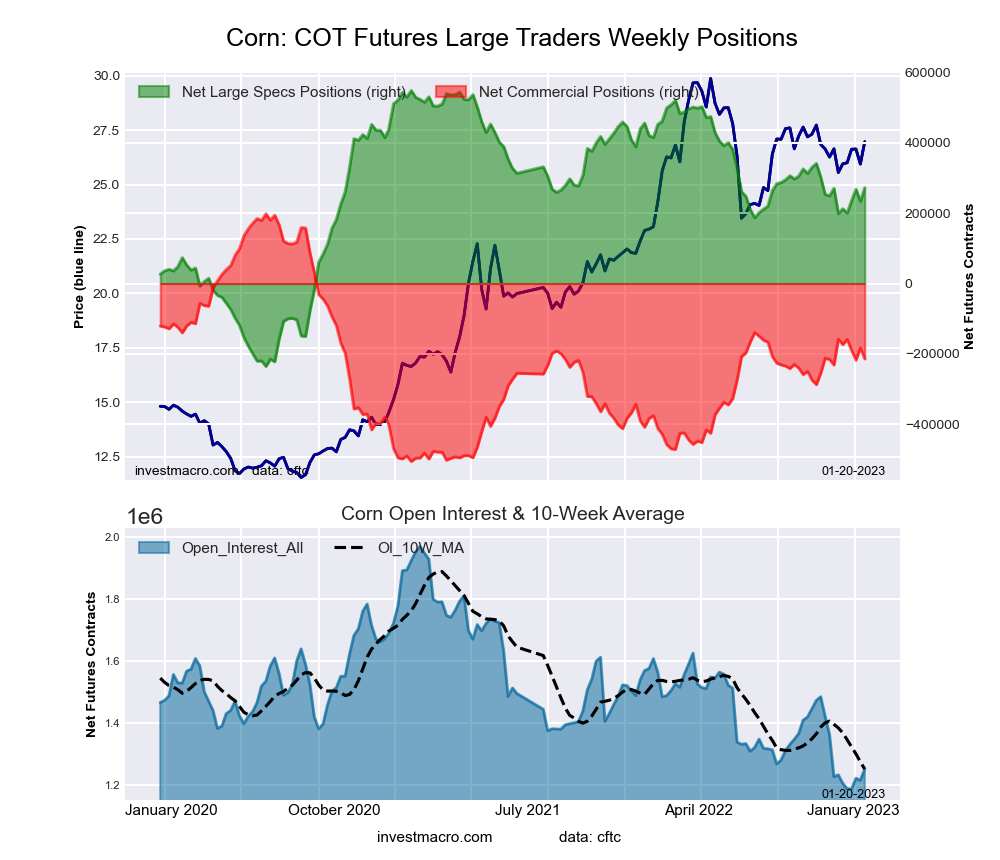
CORN Futures COT ChartThe CORN large speculator standing this week recorded a net position of 212,230 contracts in the data reported through Tuesday. This was a weekly boost of 13,855 contracts from the previous week which had a total of 198,375 net contracts.

This week’s current strength score (the trader positioning range over the past three years, measured from 0 to 100) shows the speculators are currently Bullish with a score of 57.1 percent. The commercials are Bearish with a score of 47.2 percent and the small traders (not shown in chart) are Bearish with a score of 21.3 percent.

CORN Futures StatisticsSPECULATORSCOMMERCIALSSMALL TRADERS
– Percent of Open Interest Longs:26.247.310.2
– Percent of Open Interest Shorts:8.661.713.4
– Net Position:212,230-173,223-39,007
– Gross Longs:316,184570,199122,422
– Gross Shorts:103,954743,422161,429
– Long to Short Ratio:3.0 to 10.8 to 10.8 to 1
NET POSITION TREND:
– Strength Index Score (3 Year Range Pct):57.147.221.3
– Strength Index Reading (3 Year Range):BullishBearishBearish
NET POSITION MOVEMENT INDEX:
– 6-Week Change in Strength Index:-16.416.28.9


SUGAR Futures:

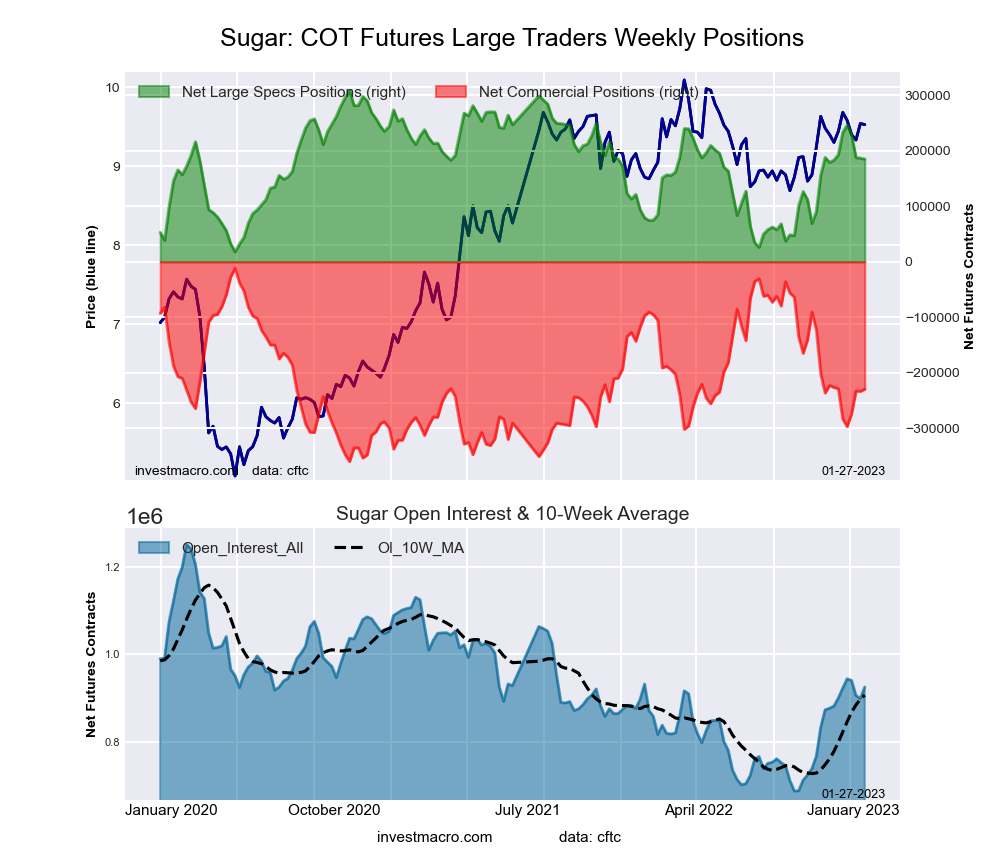
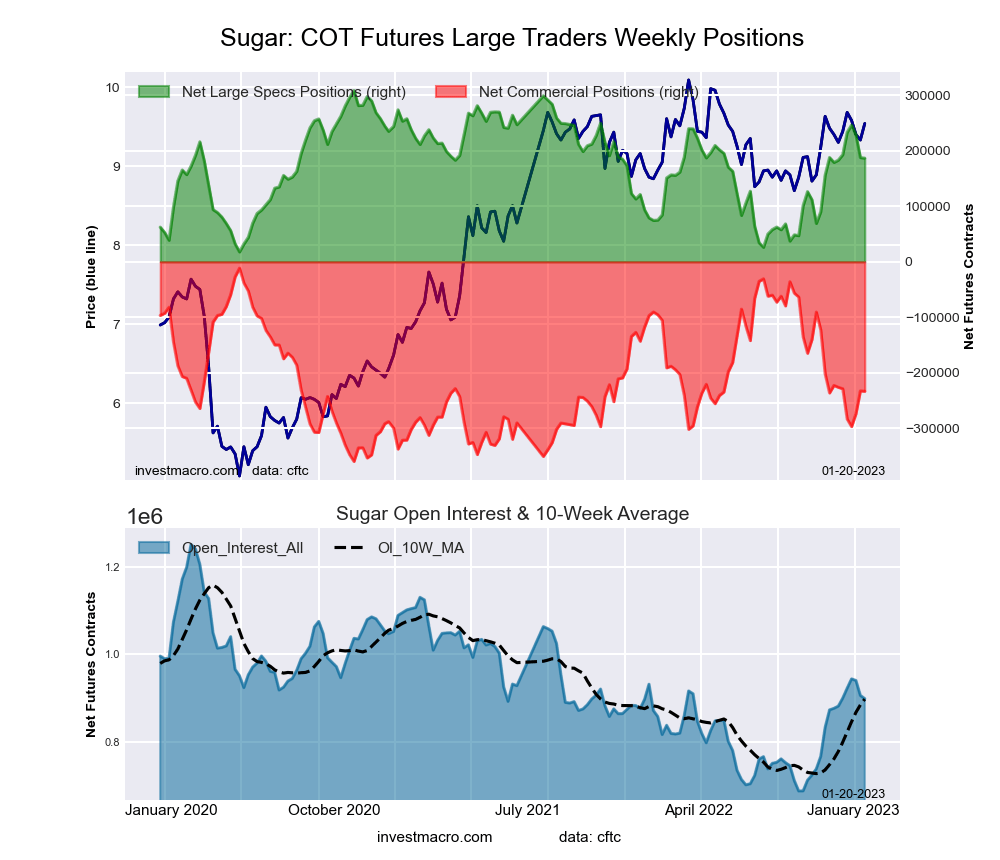
SUGAR Futures COT ChartThe SUGAR large speculator standing this week recorded a net position of 193,051 contracts in the data reported through Tuesday. This was a weekly lift of 9,927 contracts from the previous week which had a total of 183,124 net contracts.

This week’s current strength score (the trader positioning range over the past three years, measured from 0 to 100) shows the speculators are currently Bullish with a score of 60.3 percent. The commercials are Bearish with a score of 37.6 percent and the small traders (not shown in chart) are Bullish with a score of 51.8 percent.

SUGAR Futures StatisticsSPECULATORSCOMMERCIALSSMALL TRADERS
– Percent of Open Interest Longs:32.044.610.2
– Percent of Open Interest Shorts:10.670.06.2
– Net Position:193,051-228,59335,542
– Gross Longs:288,052401,48891,410
– Gross Shorts:95,001630,08155,868
– Long to Short Ratio:3.0 to 10.6 to 11.6 to 1
NET POSITION TREND:
– Strength Index Score (3 Year Range Pct):60.337.651.8
– Strength Index Reading (3 Year Range):BullishBearishBullish
NET POSITION MOVEMENT INDEX:
– 6-Week Change in Strength Index:42.6-39.717.4


COFFEE Futures:

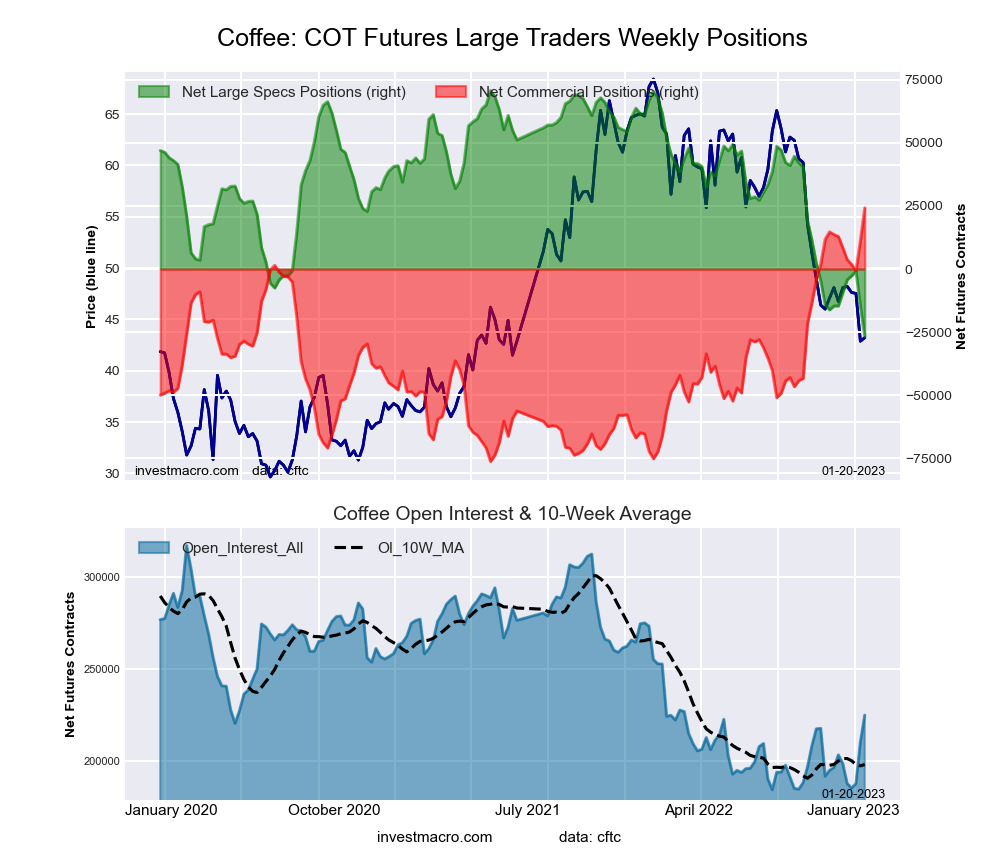
COFFEE Futures COT ChartThe COFFEE large speculator standing this week recorded a net position of -9,470 contracts in the data reported through Tuesday. This was a weekly advance of 5,172 contracts from the previous week which had a total of -14,642 net contracts.

This week’s current strength score (the trader positioning range over the past three years, measured from 0 to 100) shows the speculators are currently Bearish-Extreme with a score of 7.7 percent. The commercials are Bullish-Extreme with a score of 93.1 percent and the small traders (not shown in chart) are Bearish-Extreme with a score of 13.6 percent.

COFFEE Futures StatisticsSPECULATORSCOMMERCIALSSMALL TRADERS
– Percent of Open Interest Longs:22.553.04.5
– Percent of Open Interest Shorts:27.248.74.0
– Net Position:-9,4708,4511,019
– Gross Longs:44,628105,2408,917
– Gross Shorts:54,09896,7897,898
– Long to Short Ratio:0.8 to 11.1 to 11.1 to 1
NET POSITION TREND:
– Strength Index Score (3 Year Range Pct):7.793.113.6
– Strength Index Reading (3 Year Range):Bearish-ExtremeBullish-ExtremeBearish-Extreme
NET POSITION MOVEMENT INDEX:
– 6-Week Change in Strength Index:-13.413.9-13.4


SOYBEANS Futures:

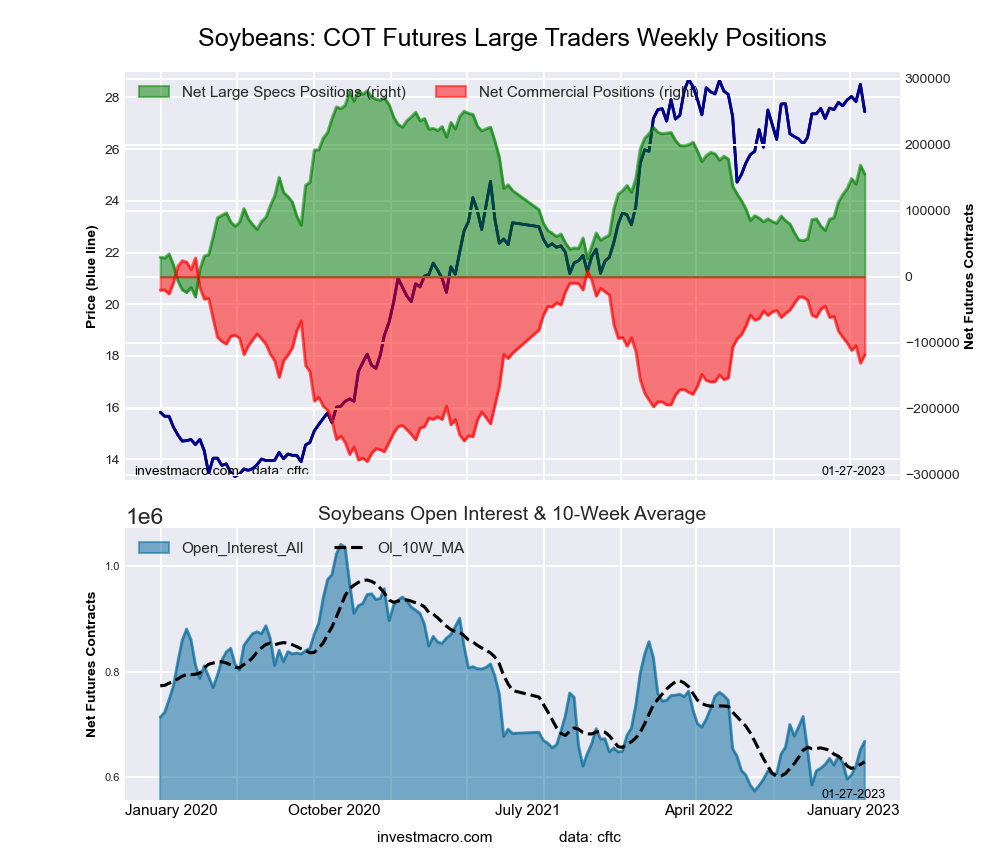
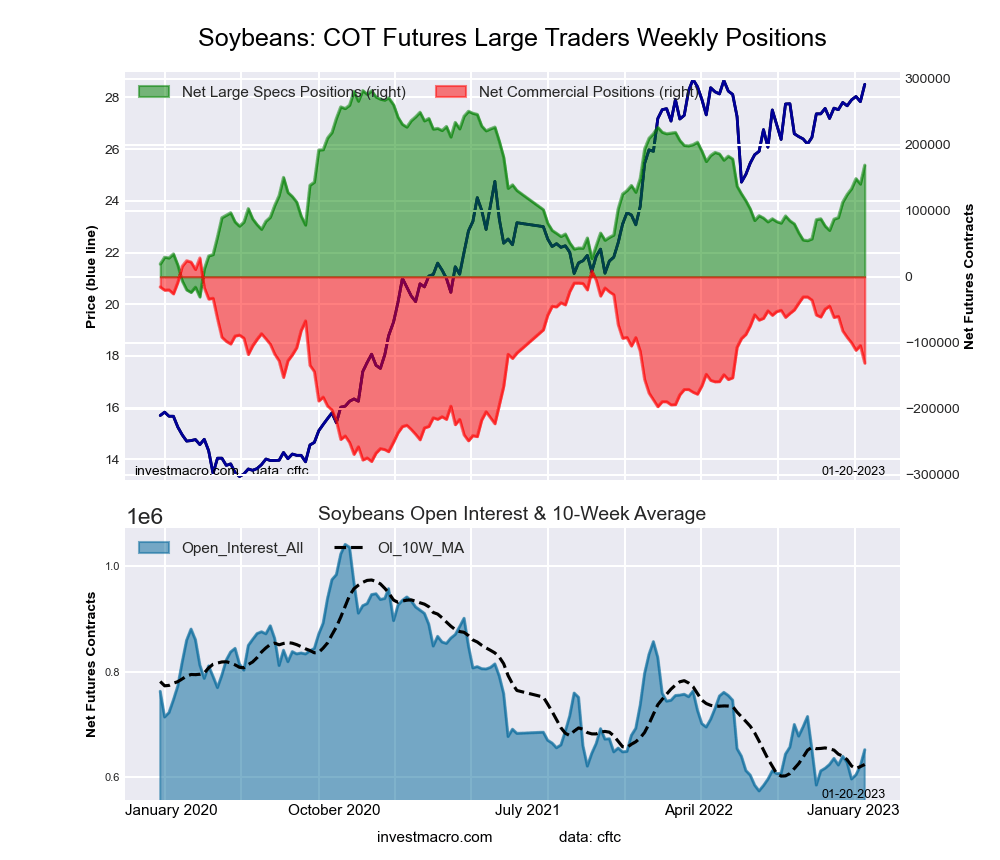
SOYBEANS Futures COT ChartThe SOYBEANS large speculator standing this week recorded a net position of 113,059 contracts in the data reported through Tuesday. This was a weekly rise of 23,398 contracts from the previous week which had a total of 89,661 net contracts.

This week’s current strength score (the trader positioning range over the past three years, measured from 0 to 100) shows the speculators are currently Bearish with a score of 45.9 percent. The commercials are Bullish with a score of 64.1 percent and the small traders (not shown in chart) are Bearish-Extreme with a score of 18.6 percent.

SOYBEANS Futures StatisticsSPECULATORSCOMMERCIALSSMALL TRADERS
– Percent of Open Interest Longs:27.050.77.5
– Percent of Open Interest Shorts:9.363.612.4
– Net Position:113,059-82,011-31,048
– Gross Longs:172,330324,12648,054
– Gross Shorts:59,271406,13779,102
– Long to Short Ratio:2.9 to 10.8 to 10.6 to 1
NET POSITION TREND:
– Strength Index Score (3 Year Range Pct):45.964.118.6
– Strength Index Reading (3 Year Range):BearishBullishBearish-Extreme
NET POSITION MOVEMENT INDEX:
– 6-Week Change in Strength Index:8.5-7.8-4.1


SOYBEAN OIL Futures:

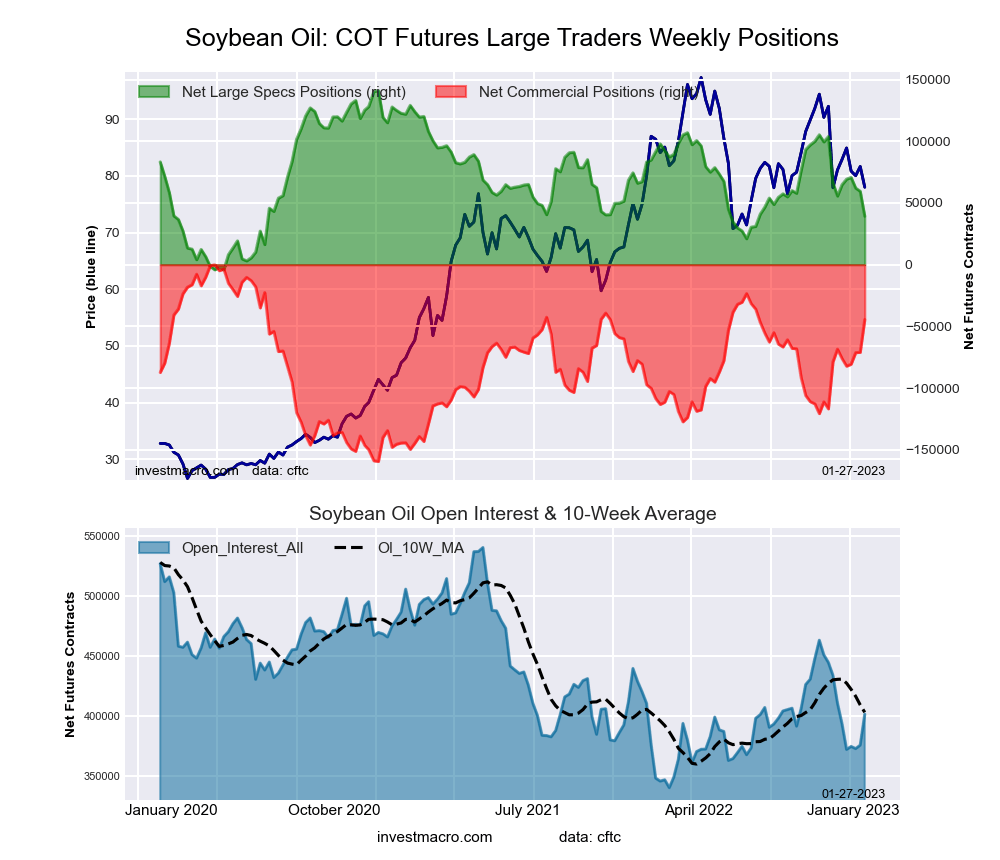
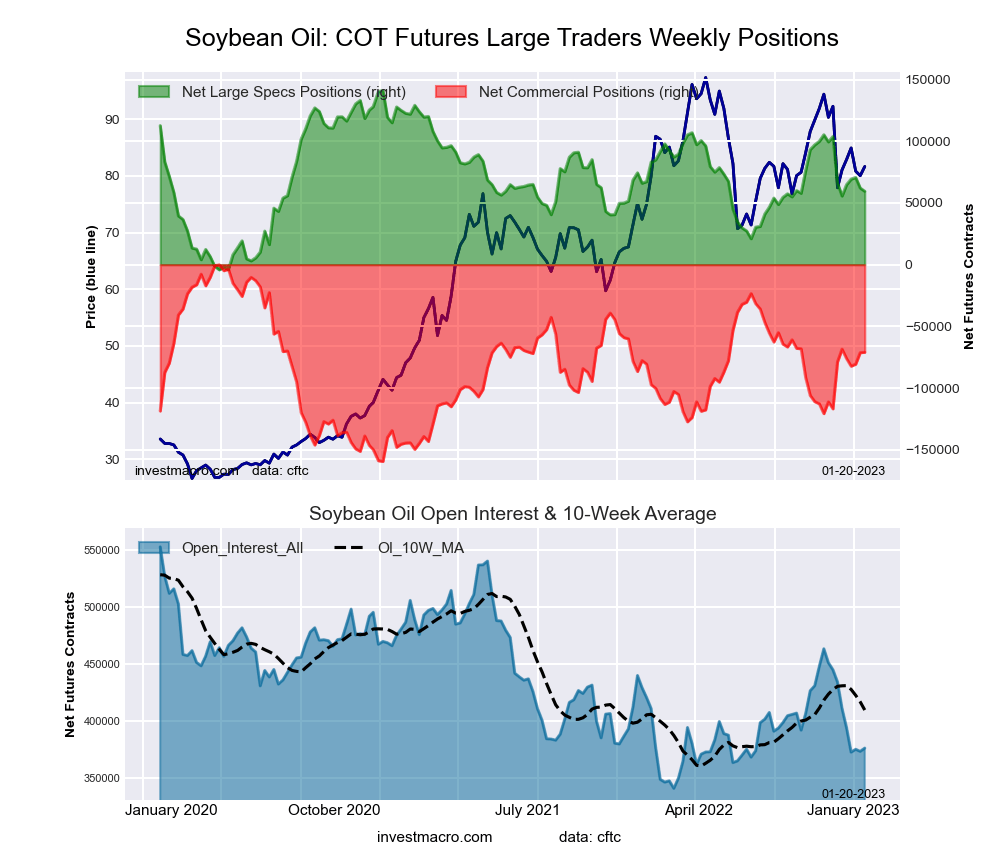
SOYBEAN OIL Futures COT ChartThe SOYBEAN OIL large speculator standing this week recorded a net position of 55,642 contracts in the data reported through Tuesday. This was a weekly decrease of -10,669 contracts from the previous week which had a total of 66,311 net contracts.

This week’s current strength score (the trader positioning range over the past three years, measured from 0 to 100) shows the speculators are currently Bearish with a score of 41.2 percent. The commercials are Bullish with a score of 57.1 percent and the small traders (not shown in chart) are Bullish with a score of 61.5 percent.

SOYBEAN OIL Futures StatisticsSPECULATORSCOMMERCIALSSMALL TRADERS
– Percent of Open Interest Longs:23.249.58.6
– Percent of Open Interest Shorts:9.766.25.5
– Net Position:55,642-68,52912,887
– Gross Longs:95,349203,43335,470
– Gross Shorts:39,707271,96222,583
– Long to Short Ratio:2.4 to 10.7 to 11.6 to 1
NET POSITION TREND:
– Strength Index Score (3 Year Range Pct):41.257.161.5
– Strength Index Reading (3 Year Range):BearishBullishBullish
NET POSITION MOVEMENT INDEX:
– 6-Week Change in Strength Index:-28.526.7-4.1


SOYBEAN MEAL Futures:

SOYBEAN MEAL Futures COT ChartThe SOYBEAN MEAL large speculator standing this week recorded a net position of 133,532 contracts in the data reported through Tuesday. This was a weekly increase of 11,358 contracts from the previous week which had a total of 122,174 net contracts.

This week’s current strength score (the trader positioning range over the past three years, measured from 0 to 100) shows the speculators are currently Bullish-Extreme with a score of 100.0 percent. The commercials are Bearish-Extreme with a score of 3.8 percent and the small traders (not shown in chart) are Bearish with a score of 29.4 percent.

SOYBEAN MEAL Futures StatisticsSPECULATORSCOMMERCIALSSMALL TRADERS
– Percent of Open Interest Longs:37.836.212.2
– Percent of Open Interest Shorts:3.875.07.5
– Net Position:133,532-152,14118,609
– Gross Longs:148,357142,14947,862
– Gross Shorts:14,825294,29029,253
– Long to Short Ratio:10.0 to 10.5 to 11.6 to 1
NET POSITION TREND:
– Strength Index Score (3 Year Range Pct):100.03.829.4
– Strength Index Reading (3 Year Range):Bullish-ExtremeBearish-ExtremeBearish
NET POSITION MOVEMENT INDEX:
– 6-Week Change in Strength Index:7.7-3.6-37.0


LIVE CATTLE Futures:

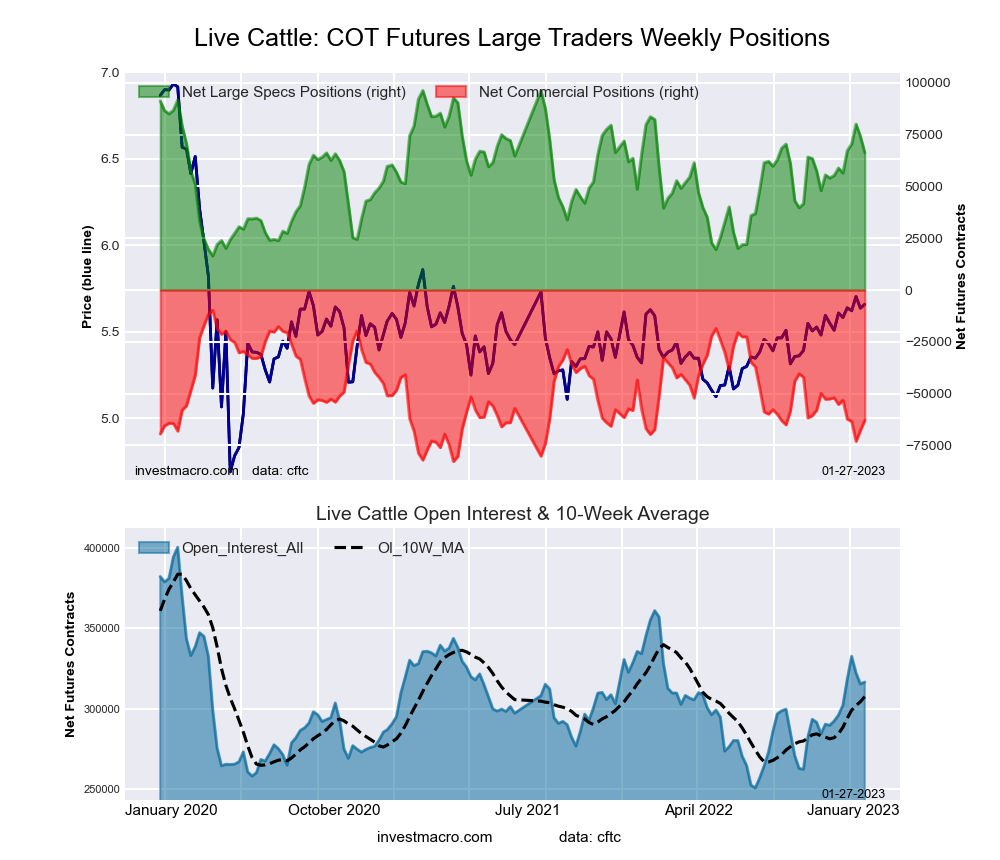
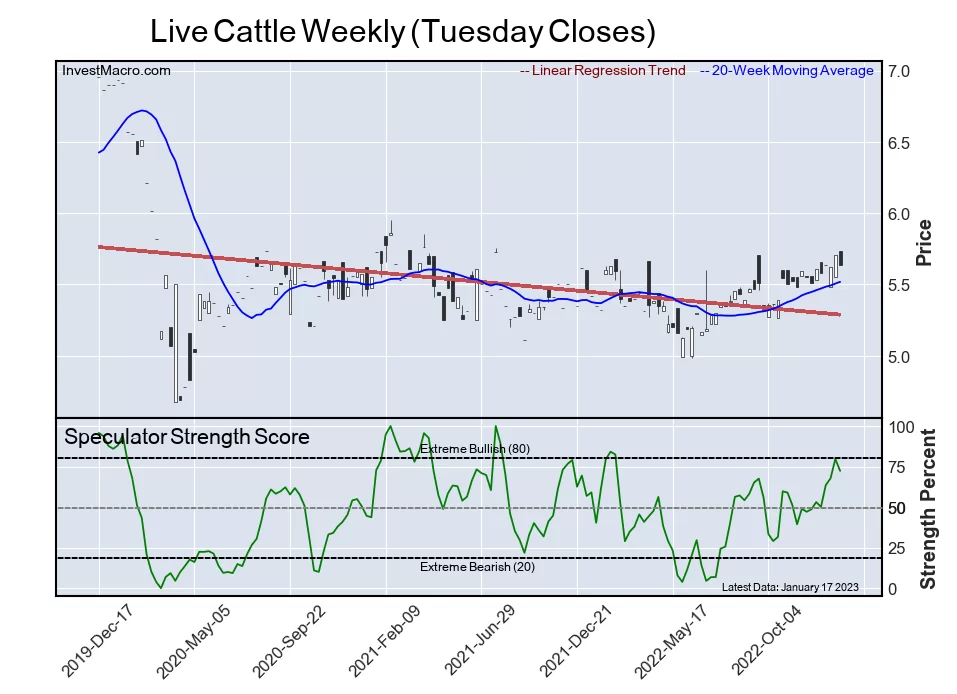
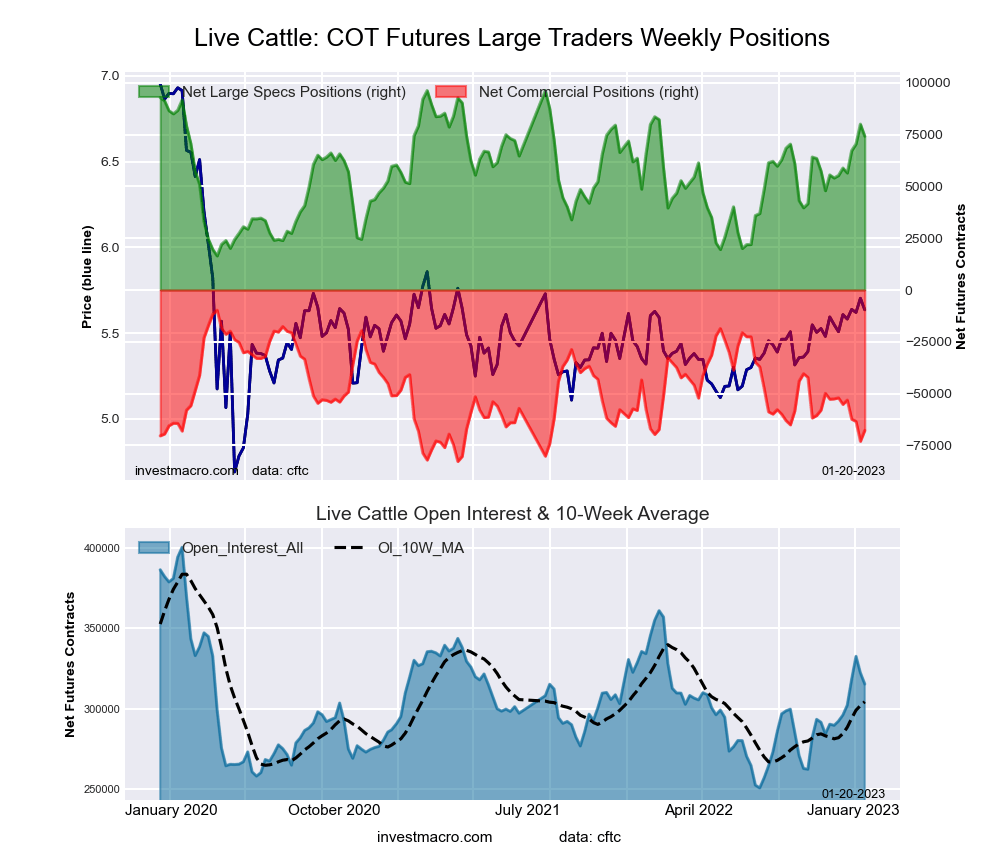
LIVE CATTLE Futures COT ChartThe LIVE CATTLE large speculator standing this week recorded a net position of 58,815 contracts in the data reported through Tuesday. This was a weekly advance of 3,552 contracts from the previous week which had a total of 55,263 net contracts.

This week’s current strength score (the trader positioning range over the past three years, measured from 0 to 100) shows the speculators are currently Bullish with a score of 53.1 percent. The commercials are Bearish with a score of 37.7 percent and the small traders (not shown in chart) are Bullish with a score of 78.1 percent.

LIVE CATTLE Futures StatisticsSPECULATORSCOMMERCIALSSMALL TRADERS
– Percent of Open Interest Longs:38.732.911.0
– Percent of Open Interest Shorts:18.851.512.2
– Net Position:58,815-55,162-3,653
– Gross Longs:114,47997,37832,476
– Gross Shorts:55,664152,54036,129
– Long to Short Ratio:2.1 to 10.6 to 10.9 to 1
NET POSITION TREND:
– Strength Index Score (3 Year Range Pct):53.137.778.1
– Strength Index Reading (3 Year Range):BullishBearishBullish
NET POSITION MOVEMENT INDEX:
– 6-Week Change in Strength Index:-5.87.4-2.8


LEAN HOGS Futures:

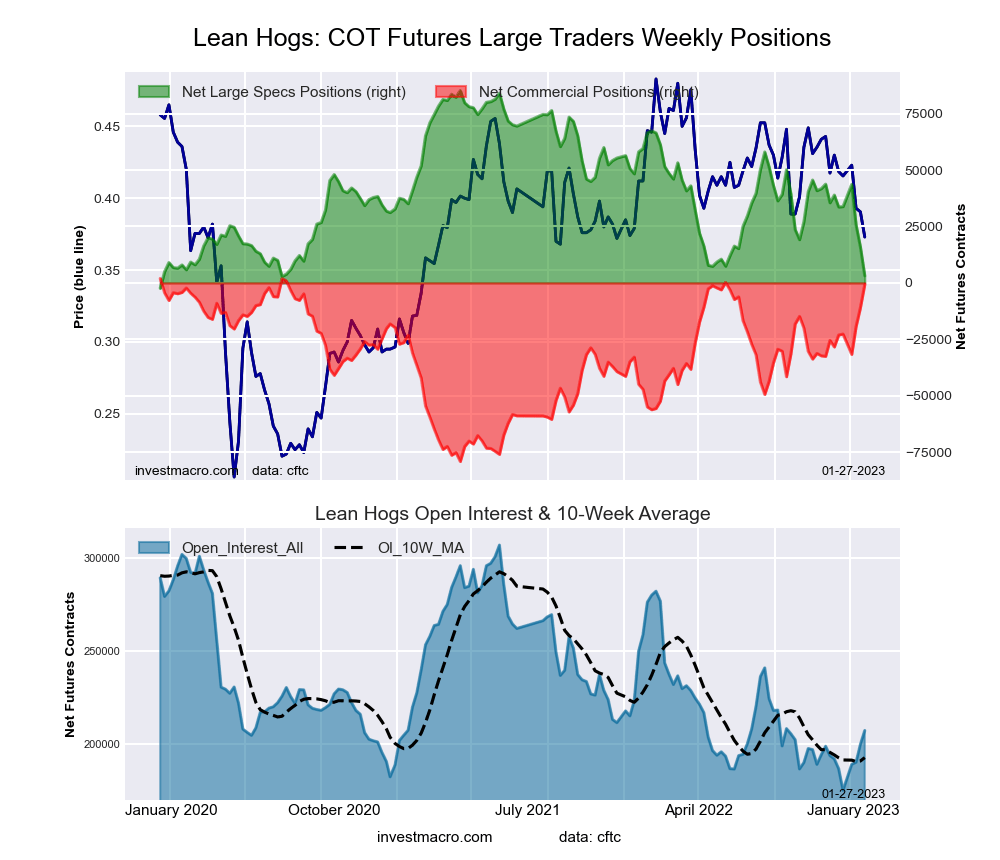
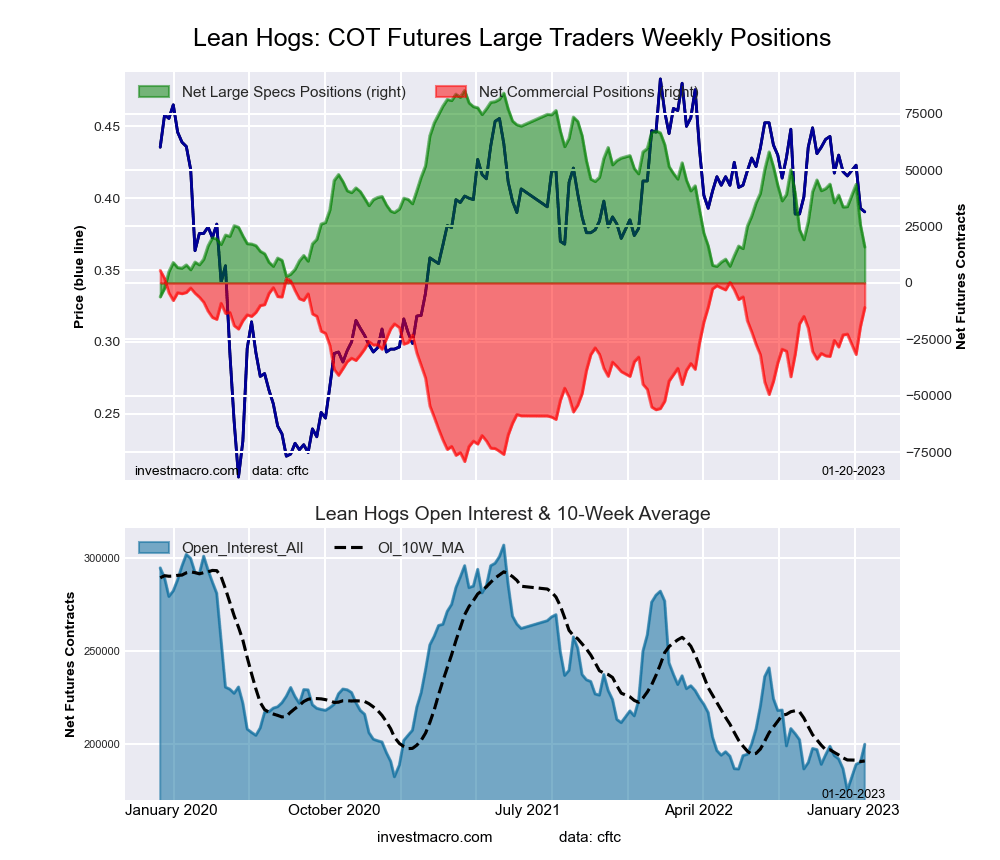
LEAN HOGS Futures COT ChartThe LEAN HOGS large speculator standing this week recorded a net position of 33,627 contracts in the data reported through Tuesday. This was a weekly decline of -5,281 contracts from the previous week which had a total of 38,908 net contracts.

This week’s current strength score (the trader positioning range over the past three years, measured from 0 to 100) shows the speculators are currently Bearish with a score of 37.2 percent. The commercials are Bullish with a score of 69.2 percent and the small traders (not shown in chart) are Bearish with a score of 44.5 percent.

LEAN HOGS Futures StatisticsSPECULATORSCOMMERCIALSSMALL TRADERS
– Percent of Open Interest Longs:37.536.67.4
– Percent of Open Interest Shorts:19.549.013.1
– Net Position:33,627-23,073-10,554
– Gross Longs:69,91068,31213,877
– Gross Shorts:36,28391,38524,431
– Long to Short Ratio:1.9 to 10.7 to 10.6 to 1
NET POSITION TREND:
– Strength Index Score (3 Year Range Pct):37.269.244.5
– Strength Index Reading (3 Year Range):BearishBullishBearish
NET POSITION MOVEMENT INDEX:
– 6-Week Change in Strength Index:-14.413.26.9


COTTON Futures:

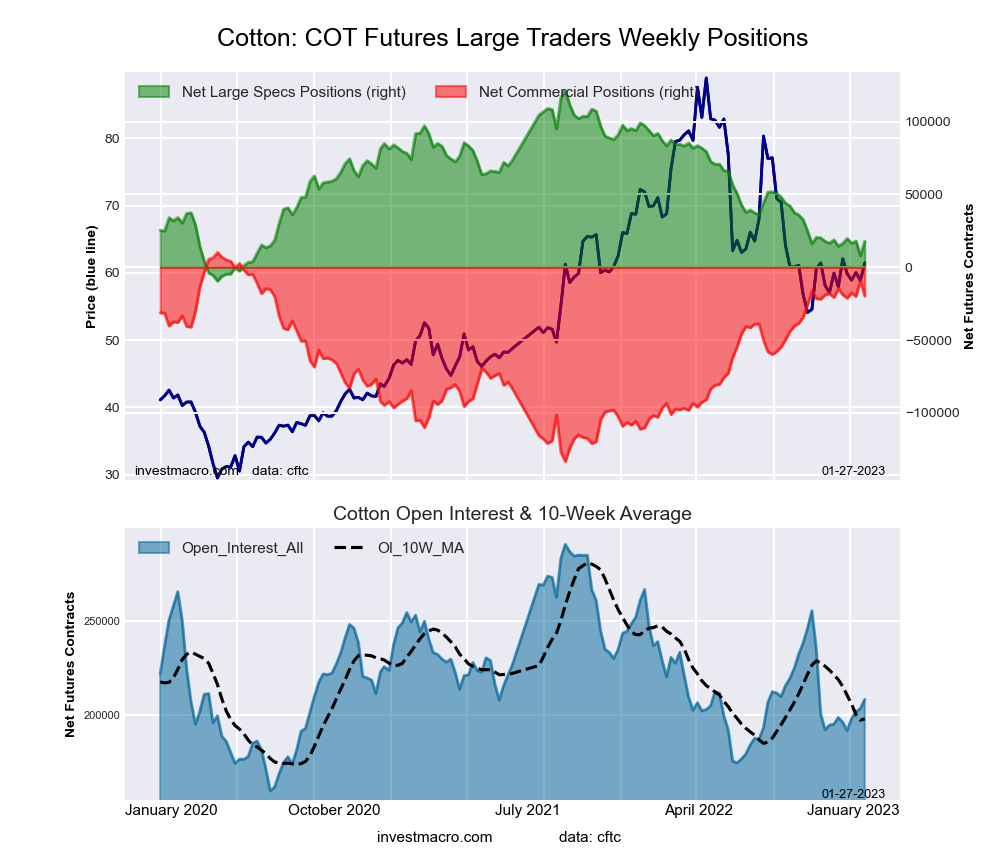
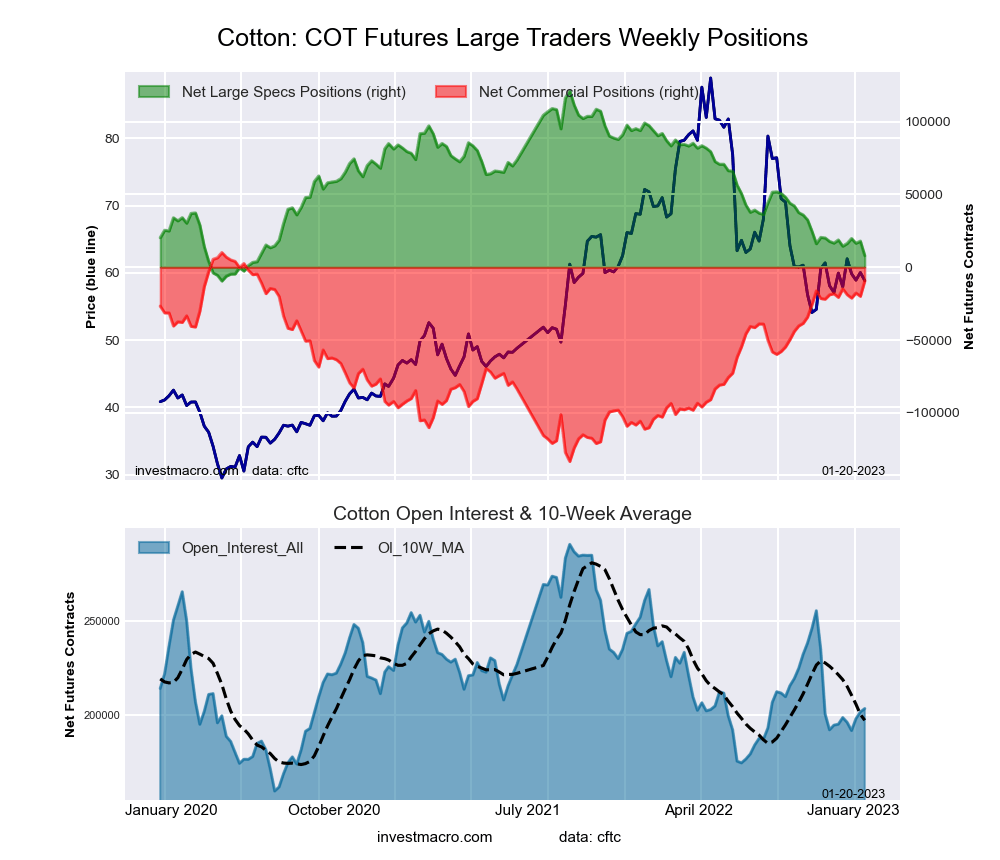
COTTON Futures COT ChartThe COTTON large speculator standing this week recorded a net position of 14,439 contracts in the data reported through Tuesday. This was a weekly decrease of -4,281 contracts from the previous week which had a total of 18,720 net contracts.

This week’s current strength score (the trader positioning range over the past three years, measured from 0 to 100) shows the speculators are currently Bearish-Extreme with a score of 18.3 percent. The commercials are Bullish-Extreme with a score of 82.6 percent and the small traders (not shown in chart) are Bearish-Extreme with a score of 12.8 percent.

COTTON Futures StatisticsSPECULATORSCOMMERCIALSSMALL TRADERS
– Percent of Open Interest Longs:31.349.56.1
– Percent of Open Interest Shorts:24.057.05.9
– Net Position:14,439-14,822383
– Gross Longs:62,06998,28612,021
– Gross Shorts:47,630113,10811,638
– Long to Short Ratio:1.3 to 10.9 to 11.0 to 1
NET POSITION TREND:
– Strength Index Score (3 Year Range Pct):18.382.612.8
– Strength Index Reading (3 Year Range):Bearish-ExtremeBullish-ExtremeBearish-Extreme
NET POSITION MOVEMENT INDEX:
– 6-Week Change in Strength Index:-1.30.92.3


COCOA Futures:

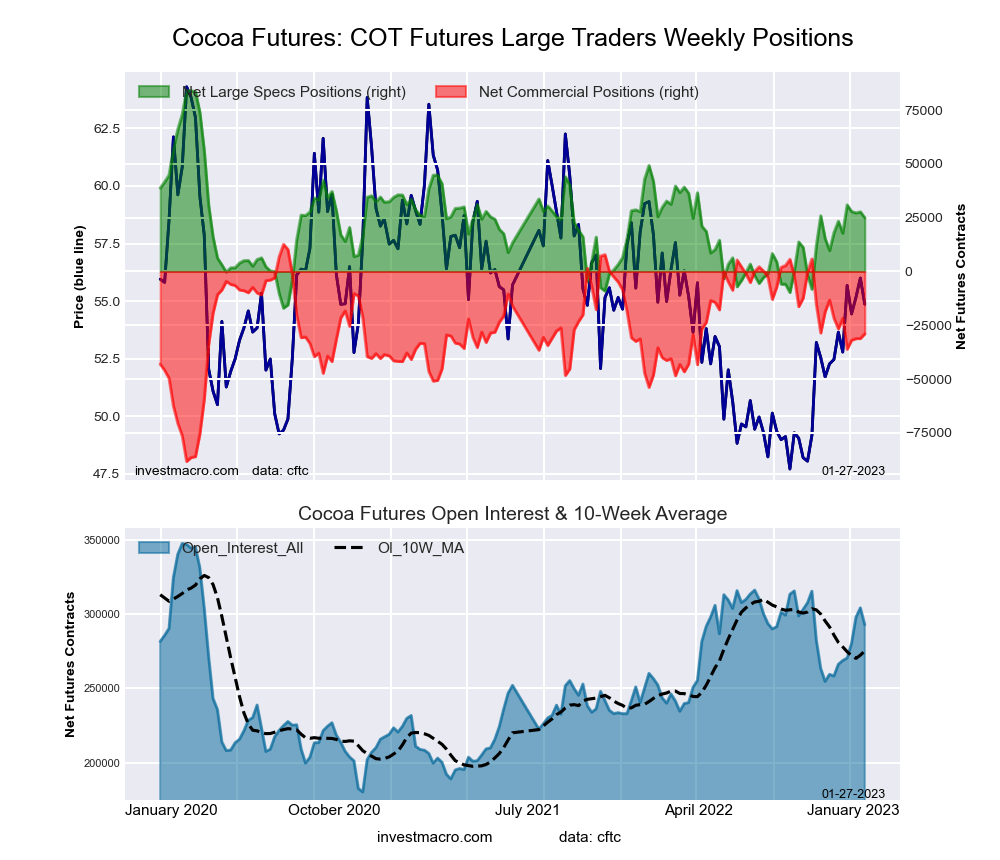
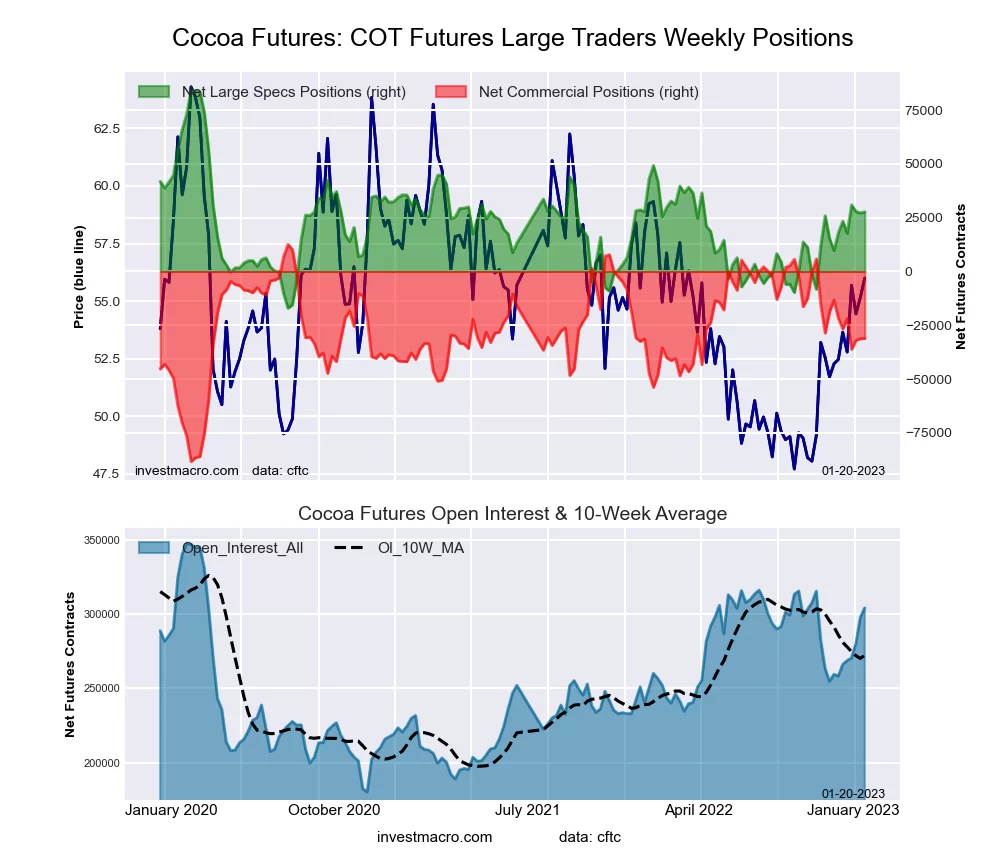
COCOA Futures COT ChartThe COCOA large speculator standing this week recorded a net position of 23,317 contracts in the data reported through Tuesday. This was a weekly gain of 5,353 contracts from the previous week which had a total of 17,964 net contracts.

This week’s current strength score (the trader positioning range over the past three years, measured from 0 to 100) shows the speculators are currently Bearish with a score of 39.9 percent. The commercials are Bullish with a score of 61.1 percent and the small traders (not shown in chart) are Bearish with a score of 30.1 percent.

COCOA Futures StatisticsSPECULATORSCOMMERCIALSSMALL TRADERS
– Percent of Open Interest Longs:31.946.54.2
– Percent of Open Interest Shorts:23.156.53.0
– Net Position:23,317-26,6693,352
– Gross Longs:84,900123,82511,260
– Gross Shorts:61,583150,4947,908
– Long to Short Ratio:1.4 to 10.8 to 11.4 to 1
NET POSITION TREND:
– Strength Index Score (3 Year Range Pct):39.961.130.1
– Strength Index Reading (3 Year Range):BearishBullishBearish
NET POSITION MOVEMENT INDEX:
– 6-Week Change in Strength Index:31.2-32.29.2


WHEAT Futures:

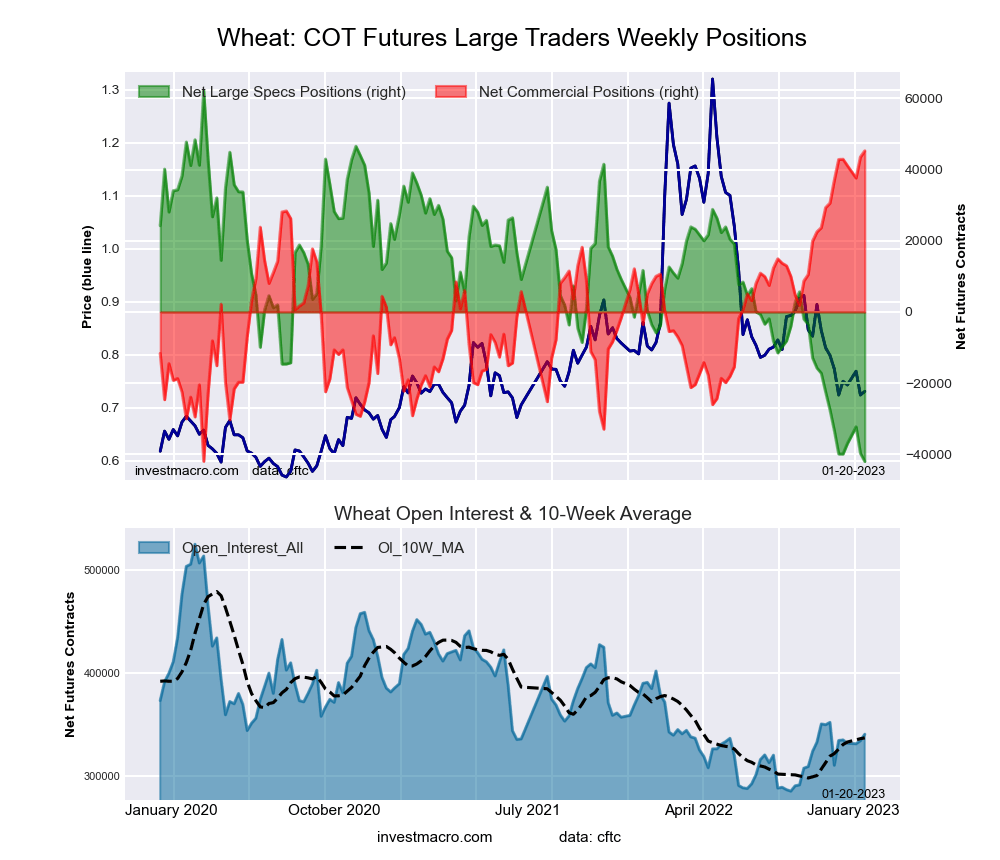
WHEAT Futures COT ChartThe WHEAT large speculator standing this week recorded a net position of -39,918 contracts in the data reported through Tuesday. This was a weekly fall of -21 contracts from the previous week which had a total of -39,897 net contracts.

This week’s current strength score (the trader positioning range over the past three years, measured from 0 to 100) shows the speculators are currently Bearish-Extreme with a score of 0.0 percent. The commercials are Bullish-Extreme with a score of 100.0 percent and the small traders (not shown in chart) are Bullish-Extreme with a score of 95.0 percent.

WHEAT Futures StatisticsSPECULATORSCOMMERCIALSSMALL TRADERS
– Percent of Open Interest Longs:28.140.99.7
– Percent of Open Interest Shorts:40.028.210.6
– Net Position:-39,91842,894-2,976
– Gross Longs:94,335137,31632,455
– Gross Shorts:134,25394,42235,431
– Long to Short Ratio:0.7 to 11.5 to 10.9 to 1
NET POSITION TREND:
– Strength Index Score (3 Year Range Pct):0.0100.095.0
– Strength Index Reading (3 Year Range):Bearish-ExtremeBullish-ExtremeBullish-Extreme
NET POSITION MOVEMENT INDEX:
– 6-Week Change in Strength Index:-23.724.019.5


Article By InvestMacroReceive our weekly COT Newsletter

*COT Report: The COT data, released weekly to the public each Friday, is updated through the most recent Tuesday (data is 3 days old) and shows a quick view of how large speculators or non-commercials (for-profit traders) were positioned in the futures markets.

The CFTC categorizes trader positions according to commercial hedgers (traders who use futures contracts for hedging as part of the business), non-commercials (large traders who speculate to realize trading profits) and nonreportable traders (usually small traders/speculators) as well as their open interest (contracts open in the market at time of reporting). See CFTC criteria here.

Federal Reserve just hiked interest rates for the 7th time this year – so why are mortgage rates coming down?

By D. Brian Blank, Mississippi State University 

The Federal Reserve raised interest rates by half a percentage point on Dec. 14, 2022, to a range of 4.25 to 4.5%, the seventh increase this year. So far in 2022, the Fed has lifted its benchmark short-term rate, which influences most other borrowing costs in the economy, by 4.25 percentage points from a low of near zero as recently as March.

But even as the U.S. central bank lifts rates – and plans to keep doing so in 2023 – homebuyers are beginning to notice a pleasant surprise: Mortgage rates have been falling.

What’s going on?

We asked Brian Blank, a finance professor who has researched mortgage rates and bank loans, to explain the paradox of falling mortgage costs at a time of rising base interest rates.

What’s happening with mortgage rates?

After soaring for much of 2022, mortgage rates and other long-term rates are starting to come down.

The average rate on a 30-year mortgage has fallen 0.75 percentage points in the past month or so, after hitting a 20-year high of 7.08% in early November. Rates reached 6.33% on Dec. 8, the lowest level since September. This occurred over the same period as the Fed lifted its benchmark interest rate 2 percentage points.

Another key rate that fell is the yield on 10-year Treasury bonds, which has declined by a similar amount, to 3.5%.

Why are mortgage rates falling if the Fed is still hiking?

The short and rather boring technical answer is that bond markets anticipated this rate hike many months ago. And as market factors largely dictate the costs of borrowing, the increase was already absorbed into home loan rates.

Mortgage rates, while rising due to the Federal Reserve’s rapid hiking pace, are actually more closely linked to the interest rate on Treasury securities, specifically the yield on the 10-year Treasury bond. That security began to anticipate the Fed’s interest rate increases a year ago and rose from less than 1.5% in December 2021 to more than 3.25% by June.

And now, with signs that inflation has already peaked and amid growing concerns of a slowing economy, these longer-term rates are coming down in anticipation of fewer future Fed rate hikes than expected only a short time ago. In fact, mortgage and other long-term rates may keep falling over the coming months – assuming the Fed manages to get inflation under control so it is able to lower its benchmark rate again.

Why do mortgage rates follow the yield on the 10-year Treasury bond?

Even though 30-year mortgages can be held for three decades, most people sell their house or refinance within a decade, which means the investor who is receiving the mortgage payments is effectively investing in a 10-year bond.

As a result, the average 30-year fixed rate mortgage interest rate is normally 1 to 2 percentage points higher than the yield on the 10-year Treasury bond.

However, when the economy has more uncertainty than usual, like earlier this year, this spread can get as large as 3 percentage points. This uncertainty can be the result of a potential economic downturn, the possibility of the Fed raising rates more than expected, inflation, Fed balance sheet changes or all of the above – as happened in 2022.

Why are mortgage rates higher than Treasury yields?

Since the United States Treasury is more likely to pay investors back than almost any individual homeowner, investors charge a higher interest rate due to the additional risk they are taking.

Even though individuals go to banks to borrow, banks often sell those loans to investors, who then receive the money individuals pay back on the loan.

Since individuals default on mortgages more often than the U.S. government defaults on Treasury bonds, investors require a higher return to purchase the rights to receive the payments from those mortgages.

If mortgage rates fall, will the Fed have to raise rates even higher to control inflation?

Falling mortgage rates preceded an increase in the home purchase index, which is a measure of current market conditions to purchase homes. This suggests the housing market may finally start to pick up steam after slowing down all year.

Since the Fed is trying to slow economic activity to bring down inflation, this could cause housing prices to increase again, thus forcing the Fed to raise its target rate more than planned.

However, I believe the effective federal funds rate, which is the market rate directly influenced by the Fed’s target range, is already sufficiently restrictive to slow the housing market and restore more normal economic conditions in 2023. Moreover, the decline in mortgage rates is still quite small – they remain over double what they were a year ago – so the drop isn’t likely to have much of an impact alone.

What the Fed itself thinks about this challenge – and where it projects to take interest rates next year – is what I and many other economists and investors will be monitoring closely after it met for the last time of 2022. It should tell us what to expect in 2023 – so stay tuned.

Article updated to include Fed raising rates.The Conversation

About the Author:

D. Brian Blank, Assistant Professor of Finance, Mississippi State University

This article is republished from The Conversation under a Creative Commons license. Read the original article.

Fed Signals More Rate Hikes, Focus Turns To BoE & ECB

By ForexTime

Asian shares flashed red on Thursday, tracking declines in Wall Street overnight after the Federal Reserve signalled interest rates will climb higher than anticipated.

This fresh development strained risk appetite as investors became concerned over tighter monetary policy triggering a recession. European futures are pointing to a negative open this morning amid the cautious mood and this could circle back to US indices later today.  In the currency space, the USD loitered near a six-month low against major peers despite the hawkish Fed while gold slipped back under $1800.

Overnight, more disappointing economic data from the second-largest economy in the world fuelled recession fears. China’s latest retail sales declined by 5.9% year-on-year in November which was much faster than the 0.5% witnessed in October and below the 3.7% market forecast. On top of this, the country’s industrial production for November grew 2.2% compared to the 5% expansion in October. With Coronavirus outbreaks worsening in China last month, the stricter control measures weighed heavily on the economy.

Let’s talk about the Fed…

As widely expected, the Federal Reserve raised interest rates by 50 basis points overnight, marking the end of the jumbo 75 basis point hikes seen in at the previous four meetings.

However, there were some key takeaways and golden nuggets in the policy meeting which offered investors fresh insight into the central bank’s thinking for 2023. Fed Chair Jerome Powell stated that the central bank had “some ways to go” in its battle against inflation. Although there have been signs of inflation cooling, at 7.1% it’s still well above the Fed’s 2% target. With policymakers projecting rates would end next year at 5.1%, this was higher than futures markets had predicted and the previously indicated 4.6% at their last dot plot in September. It looks like the Fed has ended 2022 on a hawkish note, leaving the doors wide open to more rate hikes in the New Year in an effort to control inflation.

After breaking below the 104.00 level, the Dollar Index (DXY) could be preparing for a steeper decline. Prices are trading below the 50-, 100- and 200-day Simple Moving Averages while the MACD is below zero. An intraday breakdown below 103.50 may signal a selloff towards 102.40. If bulls can push prices back above 104.00, a move towards 105.50 – a level just below the 200-day SMA – could be on the cards.

BoE expected to raise rates again

Markets widely expect the Bank of England to slow the pace of interest rate hikes today as it juggles the risks of sky-high inflation with concerns over economic growth.

After the jumbo 75-basis point hike back in November, the BoE is expected to shift into a lower gear with a 50-basis point hike today. This will put the benchmark rate at 3.5% which will be the highest level since 2008. Indeed, signs of easing inflationary pressures have reduced the pressure for the BoE to move ahead with a super-sized rate hike. The latest UK CPI data for November confirmed that inflation eased to 10.7% in November 2022, from 11.1% in October, suggesting that inflation may have peaked. Nevertheless, consumer prices are still well above the BoE’s 2% target – forcing the bank to continue raising interest rates in 2023, albeit at a slower pace.

It may be wise to keep a close eye on the latest UK retail sales, PMI figures, and consumer confidence which could offer additional insight into the health of the economy. But given how the UK economy is likely in recession due to the cost-of-living crisis, the central bank is trapped between a rock and a hard place. Whatever the outcome of the BoE meeting, it will most likely set the tone for the GBPUSD for the rest of 2022.

ECB meeting preview

After two consecutive rate hikes of 75 basis points, the European Central Bank (ECB) is also expected to slow down, raising rates by 50 basis points today.

The central bank is likely to announce Quantitative Tightening next year, however, no specific dates are expected to be revealed. Signs of cooling inflation in Europe may offer some breathing room for the ECB to adopt a less aggressive approach toward rates in 2023. Investors will direct much of their attention towards the staff projections which are expected to show inflation expectations pushed upwards for the New Year and economic growth forecasts lowered. Should the ECB strike a hawkish tone and signal more rate hikes in 2023, this could inject euro bulls with renewed inspiration. Alternatively, a cautious-sounding central bank that expresses concerns over the growth outlook could result in a weaker euro.

Looking at the technical picture, EURUSD remains firmly bullish on the daily timeframe. The recent breakout and daily close above 1.0600 could signal further upside with 1.0760 acting as a point of interest.

Commodity spotlight – Gold

Gold extended losses this morning as investors digested Fed Chair Jerome Powell’s hawkish statement overnight. With the Fed still waging war against inflation and interest rates expected to climb higher than anticipated, the appetite for zero-yielding gold took a hit. Prices are approaching the 200-day Simple Moving Average around $1785. A strong breakdown below this level could signal a selloff towards $1766 and $1750, respectively.


Forex-Time-LogoArticle by ForexTime
ForexTime Ltd (FXTM) is an award winning international online forex broker regulated by CySEC 185/12 www.forextime.com

Why One Fund Owns 13% of This Small-Cap Pharma

Source: Streetwise Reports  (12/12/22)

Clinical-stage Algernon Pharmaceuticals’ multiple pipelines include testing a psychedelic for the treatment of stroke, and testing other drugs for idiopathic pulmonary fibrosis and chronic kidney disease.

Clinical-stage drug development company Algernon Pharmaceuticals Inc. (AGN:CSE; AGNPF:OTCQB; AGN0:XFRA) has multiple drugs in its pipeline and has garnered the support of AlphaNorth Asset Management, which now holds approximately 13% of the firm’s shares.

Why has the firm taken such a large position? AlphaNorth President and CEO Steve Palmer explained in a recent episode of Streetwise Live!: “We like it primarily because of the valuation. It’s quite cheap. Currently, the value of the whole company is CA$6–7 million. We also like it because they have multiple programs; I like companies like have multiple shots on goal, so to speak. And the trials that they are conducting are also lower risk than the typical biotech because they are using drugs that are already known to be safe.”

Analyst Andre Uddin with Research Capital Corporation follows the company and notes that Algernon has an “in-depth pipeline based on its novel repurposing drug development strategy.” He has calculated a CA$10.25/share target price on the company, an implied fourfold return based on the current share price of CA$2.78.

Multiple Pipelines

Algernon is about to begin testing the psychedelic compound DMT (N, N-dimethyltryptamine) for ischemic stroke, the type of stroke caused by blood clots blocking the flow of blood in the brain. The current treatment, tPA, must be administered within about three hours of the start of symptoms to be effective, a threshold that a large proportion of stroke victims don’t meet.

“The trials that they are conducting are also lower risk than the typical biotech,” said Steve Palmer of AlphaNorth Asset Management

The company has commenced screening subjects for the Phase 1 clinical study that will be conducted at the Centre for Human Drug Research in The Netherlands and expects to dose the first subject soon. Up to 60 healthy volunteers are expected to participate.

Algernon notes that the purpose of the study is to identify the “safety, tolerability, and pharmacokinetics of DMT when administered as an intravenous bolus followed by a prolonged infusion, for durations which have never been studied clinically. In addition, several pharmacodynamic measures believed to be associated with neuroplasticity, including both measurements of biochemical markers and electroencephalographic readings, will be recorded.”

“The potential of a stroke treatment drug is enormous,” Christopher Moreau, CEO of Algernon, stated. “On the human side, for approximately 85% of ischemic stroke patients, there is no treatment except to watch and hope. And on the market side, it is estimated to become a US$15 billion market by 2027, and so it’s truly global in scale and would have a huge impact on patients who suffer from this terrible injury.”

The company noted that its decision to investigate DMT and move it into human trials for stroke is “based on multiple independent, positive preclinical studies demonstrating that DMT, at a sub-psychedelic dose, helps promote structural and functional neuroplasticity. These are key factors involved in the brain’s ability to form and reorganize synaptic connections, which are needed for healing following a brain injury.”

Research Capital Corp. analyst Andre Uddin noted, “We believe AGN’s best asset is ifenprodil.”

“The preclinical data shows that DMT promotes the production of brain-derived neurotrophic factor, which is an important part of the brain’s recovery process after an injury like a stroke,” Moreau stated.

Because other Phase 1 studies have been completed on DMT, the company is not expecting any serious adverse events.

Algernon is also looking into DMT for additional indications. In late October, the company announced that it has entered into a clinical trial agreement with Yale University School of Medicine, New Haven, Conn., for the use of DMT in a Phase 2 depression study. “Although the treatment of psychiatric disorders with DMT [is] not the company’s current focus, we have patents pending on novel forms of DMT which could potentially be used across a broad range of diseases,” stated Moreau. “In addition, we believe the data generated from this study may help inform Algernon’s stroke research program.”

Orphan Drug Status for Ifenprodil for IPF

Algernon has received from the U.S. Food and Drug Administration Orphan Drug designation for Ifenprodil for the treatment of idiopathic pulmonary fibrosis (IPF). Orphan drug status is conferred on diseases that affect fewer than 200,000 patients in the U.S. and provides tax credits for trials and an exemption from user fees. If the drug receives FDA approval, seven years of market exclusivity are granted.

“We appreciate the U.S. FDA’s decision to grant ODD status to Ifenprodil for IPF, a disease for which prognosis remains dismal, with 50% mortality expected within three to four years,” said Moreau. “This regulatory milestone comes at an important time in the development of Ifenprodil as a potential new therapy for IPF as we plan the next steps for our clinical program.”

Technical analyst Clive Maund of CliveMaund.com recently charted Algernon’s stock and rated the stock a Buy.

Algernon’s Phase 2a study of Ifenprodil in patients recently concluded and met its co-primary endpoint “with patients receiving Ifenprodil experiencing no worsening of their lung function, and significant improvements were seen in the frequency of their IPF-associated cough as well. In addition, improvements in patient-reported measures of cough severity and quality of life were observed. Ifenprodil was also confirmed to be safe and well-tolerated in the study.”

Research Capital Corp. analyst Andre Uddin noted, “We believe AGN’s best asset is ifenprodil for treating refractory chronic cough (RCC) in idiopathic fibrosis (IPF)/IPF patients. . . Based on the positive Phase 2a data, we expect management to advance its 3x per day formulation of ifenprodil and initiate a Phase 2b trial in chronic cough H2 CY2023. A data set from a Phase 2b chronic cough trial would potentially be a large value-creating inflection point.”

Catalyst: Company Will Begin Testing For Chronic Kidney Disease Drug

The company plans to begin testing repirinast, a drug sold for 25 years in Japan for asthma, for chronic kidney disease. Analyst Uddin noted that Algernon “expects to begin conducting a Phase 1 study using repirinast to treat CKD in calendar year Q2 2023.”

Analysts and Expert Coverage

Technical analyst Clive Maund of CliveMaund.com recently charted Algernon’s stock and rated the stock a Buy. He wrote in October that “those interested should aim to buy it as soon as possible.”

of The National Investor also commented on the stock in a September post, saying that he considered the company an Immediate Buy.

The stock is also covered by analyst Dr. André Uddin of Research Capital Corp. and newsletter writers of The National Inflation Association, of 321gold.com, and of Pennyqueen.com. 

Click “See More Live Data” in the data box above to read more of what they are saying.

Ownership and Share Structure

AlphaNorth Asset Management is Algernon’s largest shareholder owning 13.46% of Algernon’s shares.

Algernon has approximately 2.3 million shares outstanding and 3.6 million fully diluted. It trades on the Canadian Securities Exchange under the ticker AGN and under the ticker AGNPF on the U.S. OTCQB platform.

Sign up for our FREE newsletter

Disclosures:
1) Patrice Fusillo wrote this article for Streetwise Reports LLC and provides services to Streetwise Reports as an independent contractor.  She or members of her household own securities of the following companies mentioned in the article: None. She or members of her household are paid by the following companies mentioned in this article: None.

2) The following companies mentioned in this article are billboard sponsors of Streetwise Reports: Algernon Pharmaceuticals Inc. Click here for important disclosures about sponsor fees. As of the date of this article, an affiliate of Streetwise Reports has a consulting relationship with Algernon Pharmaceuticals Inc. Please click here for more information.

3) Comments and opinions expressed are those of the specific experts and not of Streetwise Reports or its officers. The information provided above is for informational purposes only and is not a recommendation to buy or sell any security.

4) The article does not constitute investment advice. Each reader is encouraged to consult with his or her individual financial professional and any action a reader takes as a result of information presented here is his or her own responsibility. By opening this page, each reader accepts and agrees to Streetwise Reports’ terms of use and full legal disclaimer. This article is not a solicitation for investment. Streetwise Reports does not render general or specific investment advice and the information on Streetwise Reports should not be considered a recommendation to buy or sell any security. Streetwise Reports does not endorse or recommend the business, products, services or securities of any company mentioned on Streetwise Reports.

5) From time to time, Streetwise Reports LLC and its directors, officers, employees or members of their families, as well as persons interviewed for articles and interviews on the site, may have a long or short position in securities mentioned. Directors, officers, employees or members of their immediate families are prohibited from making purchases and/or sales of those securities in the open market or otherwise from the time of the decision to publish an article until three business days after the publication of the article. The foregoing prohibition does not apply to articles that in substance only restate previously published company releases. As of the date of this article, officers and/or employees of Streetwise Reports LLC (including members of their household) own securities of Algernon Pharmaceuticals Inc., a company mentioned in this article.

6) This article does not constitute medical advice. Officers, employees and contributors to Streetwise Reports are not licensed medical professionals. Readers should always contact their healthcare professionals for medical advice.

Research Capital Corporation disclosures:

1. This Issuer has generated investment banking revenue for RCC.

Analyst Certification
I, Andre Uddin, Ph.D., certify the views expressed in this report were formed by my review of relevant company data and industry investigation, and accurately reflect my opinion about the investment merits of the securities mentioned in the report. I also certify that my compensation is not related to specific recommendations or views expressed in this report. Research Capital Corporation publishes research and investment recommendations for the use of its clients. Information regarding our categories of recommendations, quarterly summaries of the percentage of our recommendations which fall into each category and our policies regarding the release of our research reports is available at www.researchcapital.com or may be requested by contacting the analyst. Each analyst of Research Capital Corporation whose name appears in this report hereby certifies that (i) the recommendations and opinions expressed in this research report accurately reflect the analyst’s personal views and (ii) no part of the research analyst’s compensation was or will be directly or indirectly related to the specific conclusions or recommendations expressed in this research report.

CliveMaund.com disclosures:

Clive Maund has not been paid by the company and does not own shares of Algernon.

Why fusion ignition is being hailed as a major breakthrough in fusion – a nuclear physicist explains

By Carolyn Kuranz, University of Michigan 

American scientists have announced what they have called a major breakthrough in a long-elusive goal of creating energy from nuclear fusion.

The U.S. Department of Energy said on Dec. 13, 2022, that for the first time – and after several decades of trying – scientists have managed to get more energy out of the process than they had to put in.

But just how significant is the development? And how far off is the long-sought dream of fusion providing abundant, clean energy? Carolyn Kuranz, an associate professor of nuclear engineering at the University of Michigan who has worked at the facility that just broke the fusion record, helps explain this new result.

An image of the Sun.
Fusion is the same process that powers the Sun.
NASA/Wikimedia Commons

What happened in the fusion chamber?

Fusion is a nuclear reaction that combines two atoms to create one or more new atoms with slightly less total mass. The difference in mass is released as energy, as described by Einstein’s famous equation, E = mc2 , where energy equals mass times the speed of light squared. Since the speed of light is enormous, converting just a tiny amount of mass into energy – like what happens in fusion – produces a similarly enormous amount of energy.

Researchers at the U.S. Government’s National Ignition Facility in California have demonstrated, for the first time, what is known as “fusion ignition.” Ignition is when a fusion reaction produces more energy than is being put into the reaction from an outside source and becomes self-sustaining.

A gold and plastic canister.
The fuel is held in a tiny canister designed to keep the reaction as free from contaminants as possible.
U.S. Department of Energy/Lawrence Livermore National Laboratory

The technique used at the National Ignition Facility involved shooting 192 lasers at a 0.04 inch (1 mm) pellet of fuel made of deuterium and tritium – two versions of the element hydrogen with extra neutrons – placed in a gold canister. When the lasers hit the canister, they produce X-rays that heat and compress the fuel pellet to about 20 times the density of lead and to more than 5 million degrees Fahrenheit (3 million Celsius) – about 100 times hotter than the surface of the Sun. If you can maintain these conditions for a long enough time, the fuel will fuse and release energy.

The fuel and canister get vaporized within a few billionths of a second during the experiment. Researchers then hope their equipment survived the heat and accurately measured the energy released by the fusion reaction.

So what did they accomplish?

To assess the success of a fusion experiment, physicists look at the ratio between the energy released from the process of fusion and the amount of energy within the lasers. This ratio is called gain.

Anything above a gain of 1 means that the fusion process released more energy than the lasers delivered.

On Dec. 5, 2022, the National Ignition Facility shot a pellet of fuel with 2 million joules of laser energy – about the amount of power it takes to run a hair dryer for 15 minutes – all contained within a few billionths of a second. This triggered a fusion reaction that released 3 million joules. That is a gain of about 1.5, smashing the previous record of a gain of 0.7 achieved by the facility in August 2021.

How big a deal is this result?

Fusion energy has been the “holy grail” of energy production for nearly half a century. While a gain of 1.5 is, I believe, a truly historic scientific breakthrough, there is still a long way to go before fusion is a viable energy source.

While the laser energy of 2 million joules was less than the fusion yield of 3 million joules, it took the facility nearly 300 million joules to produce the lasers used in this experiment. This result has shown that fusion ignition is possible, but it will take a lot of work to improve the efficiency to the point where fusion can provide a net positive energy return when taking into consideration the entire end-to-end system, not just a single interaction between the lasers and the fuel.

A hallway full of pipes, tubes and electronics.
Machinery used to create the powerful lasers, like these pre-amplifiers, currently requires a lot more energy than the lasers themselves produce.
Lawrence Livermore National Laboratory, CC BY-SA

What needs to be improved?

There are a number of pieces of the fusion puzzle that scientists have been steadily improving for decades to produce this result, and further work can make this process more efficient.

First, lasers were only invented in 1960. When the U.S. government completed construction of the National Ignition Facility in 2009, it was the most powerful laser facility in the world, able to deliver 1 million joules of energy to a target. The 2 million joules it produces today is 50 times more energetic than the next most powerful laser on Earth. More powerful lasers and less energy-intensive ways to produce those powerful lasers could greatly improve the overall efficiency of the system.

Fusion conditions are very challenging to sustain, and any small imperfection in the capsule or fuel can increase the energy requirement and decrease efficiency. Scientists have made a lot of progress to more efficiently transfer energy from the laser to the canister and the X-ray radiation from the canister to the fuel capsule, but currently only about 10% to 30% of the total laser energy is transferred to the canister to the fuel.

Finally, while one part of the fuel, deuterium, is naturally abundant in sea water, tritium is much rarer. Fusion itself actually produces tritium, so researchers are hoping to develop ways of harvesting this tritium directly. In the meantime, there are other methods available to produce the needed fuel.

These and other scientific, technological and engineering hurdles will need to be overcome before fusion will produce electricity for your home. Work will also need to be done to bring the cost of a fusion power plant well down from the US$3.5 billion of the National Ignition Facility. These steps will require significant investment from both the federal government and private industry.

It’s worth noting that there is a global race around fusion, with many other labs around the world pursuing different techniques. But with the new result from the National Ignition Facility, the world has, for the first time, seen evidence that the dream of fusion is achievable.The Conversation

About the Author:

Carolyn Kuranz, Associate Professor of Nuclear Engineering, University of Michigan

This article is republished from The Conversation under a Creative Commons license. Read the original article.


Expert Says Gold Is Misunderstood, but It Is Bottoming

Source: Adrian Day  (12/12/22)

 Expert Adrian Day takes a look at gold and discusses why he thinks a turn is very close. Day also recommends his top stocks to buy if you do not already own.

Gold is flirting with US$1,800, and it’s only a matter of time before it breaks through.

Gold shines when the market senses that the central banks will be unable to contain inflation.

Many gold fans believed that this year, with a war in Europe, rising inflation, and a shaky stock market, should have been gold’s year to shine, leaving many disappointed, frustrated, and worse. Gold’s performance should be put in context, however.

Now, as I write, gold is within kissing distance of breaking even (in U.S. dollar terms) for the year, down less than 2% year, while the dollar (per the DXY index) remains up almost 10%.

In addition, in a period of deflating asset prices, gold has held up far better than U.S. and foreign stocks and bonds, as well as other assets such as crypto. This is quite amazing comparative strength for bullion.

Should Investors Be Disappointed in Gold’s Performance This Year?

There are some misunderstandings in the simple narrative that gold “should” be higher.

• Wars or other geopolitical events tend to have only a short-lived effect on the price unless there is concern about it spreading; the Russia-Ukraine conflict has
been contained.

• High inflation in itself is not in fact the main driver of gold, as we shall discuss below.

• And although weak stocks can be positive for gold, much depends on the reasons for the weakness.

Offsetting those ostensibly bullish factors for gold have been two critical negatives: rising interest rates and a strong dollar. For much of the year, a relentlessly strong dollar was a significant headwind for gold, but all along, gold’s decline was meaningfully less than the dollar’s strength.

Inflation Alone Is Not Good for Gold

Inflation itself is not necessarily the optimum environment for gold. Markets, being forward-looking, fear central bank tightening in an inflationary environment. If the market believes that central banks will be able to contain inflation, even as it rages, that is negative for gold.

Gold shines when the market senses that the central banks will be unable to contain inflation.

One only has to look to the inflationary decade of the 1970s to see this. The market did not have confidence that Arthur Burns, as Fed Chairman, would succeed in bringing down inflation.

But far higher inflation under Volker resulted in gold falling because the market believed he would control inflation. The market was correct in both cases.

When Will Gold Move Up?

Since gold’s drop in March, my response to repeated questions about when gold will “finally” respond to inflation has been the same: gold will turn when more investors realize that the Federal Reserve will be unlikely to achieve its 2% inflation goal. Its current policies — the most rapid interest rate appreciation ever — will likely provoke a serious recession, and at that point, it will not follow through and quash inflation.

In short, the market is beginning to sense that the Fed will not be able to bring inflation down towards its target any time soon and certainly will be unable to do so without provoking a recession that could be quite serious.

For most of this year, investors swallowed the Fed narrative; all indicators of inflation expectations, from surveys to markets such as the TIPs, were for inflation to drop significantly next year towards the Fed’s target and for it to happen without a recession. If you believe that, then you do not need gold.

Now, though, expectations are starting to shift. Although inflation expectations two and more years out are still in line with the Fed’s own targets, for next year, investors are forecasting a higher inflation rate than the Fed. And concerns about a recession have increased.

In short, the market is beginning to sense that the Fed will not be able to bring inflation down towards its target any time soon and certainly will be unable to do so without provoking a recession that could be quite serious (though FedHead Jerome Powell still believes a soft landing is possible).

Why a Recession Can Be Good for Gold

Again, since markets are forward-looking, a recession would be positive for gold if the market sees a shift in Fed policy towards easing. The Fed does not have to “pivot” — a misunderstood phenomenon in any event — for gold to move.

The market simply has to believe that the Fed will have to because it will be unable to achieve its inflation goals without a recession. Tough talk from Powell following this week’s final Fed meeting for the year might see gold pullback; that might be our last, best opportunity to load up.

The Economic Pain Is Only Beginning

The signs of an imminent recession are becoming more and more clear if, indeed, the U.S. is not already in one. The Fed recently noted Milton Friedman’s dictum that monetary policy acts with long and variable lags. Indeed, the effects of what the Fed has already done have barely registered so far in the headline numbers.

Even if the Fed were to pause right now, more economic harm is already baked in. Interest rate-sensitive sectors such as housing and automobiles are the first to feel the impact of rising (or indeed declining) rates.

For other sectors, the impact can be delayed, and it can be nine or 18 months before it is clear; meanwhile, everything looks rosy on the surface.

The Fed will likely try to tame optimism in the stock market — it doesn’t really care about gold — but that will also have the effect of dampening the gold price. That may well be a great opportunity to buy.

Retail sales are a good example. Since March, retail sales have been mostly flat or moderately higher. On the surface, there appears to be no problem. Dig deeper, and some things become apparent.

First, if consumer prices are increasing at a nearly 10% rate, then if sales remain flat, that means that people are, in effect, buying nearly 10% fewer goods.

Second, look at other indicators: the savings rate has collapsed to a 17-year low, while credit card debt has shot up at its fastest rate in over 20 years. (Vanguard reported last week that it had experienced record “emergency” withdrawals from 401k plans, another sign of consumer stress.)

Consumers are not buying from income; depleting savings and running up debt can last only so long. It is only a matter of time before the stress shows up in declining retail sales. As it becomes obvious that the U.S. is in a recession without the inflation goal being achieved — a stagflationary environment — then the focus becomes when the Fed will ease.

Gold and Gold Stocks Are Inexpensive

We are, then, entering the sweet spot for gold. A recession will result in a lower dollar and falling stock prices–the result of a weak economy — while gold looks to the eventual Fed reaction. The outlook is positive, and while gold has moved convincingly off its lows, it remains low relative to its price for most of the past two years. With gold almost $200 off the October lows, there has been very little response by investors in the gold ETFs, another indication of the lack of interest among investors in general for gold.
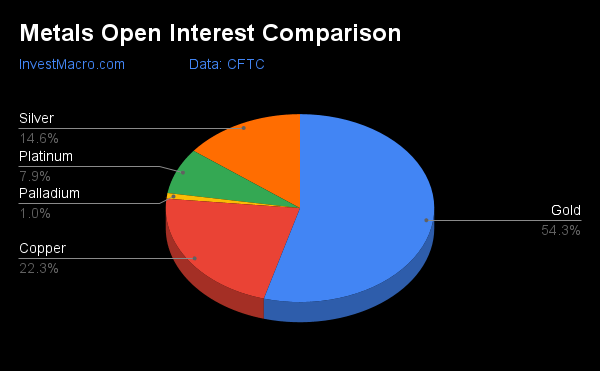
Last week’s action was perhaps a little aggressive for gold, particularly ahead of the last Fed meeting of the year. The Fed will likely try to tame optimism in the stock market — it doesn’t really care about gold — but that will also have the effect of dampening the gold price. That may well be a great opportunity to buy.

It is an anomaly for gold miners to be less expensive, have better balance sheets, and pay higher dividends than the broad market, and investors should take advantage of the opportunities in bullion and in the stocks before the crowd starts buying.

The gold stocks (per the XAU index), meanwhile, though up over 30% in the last two months, are trading, for the most part, well below their average historical valuations. The stocks are near their lows relative to bullion itself. While gold is up around 550% since 2000, gold stocks are up a little more than 100% and are still well below their levels from 2009 to 2013.

Let’s not forget that with the gold price at almost US$1800 and all-in-sustaining costs (AISC) below US$1,200 an ounce, while cash costs are far lower, margins are very strong. The sector in aggregate is net cash positive, while valuations are low: price-to-cash flow of fewer than nine times against 13.7 times for the S&P; price-to-NAV of 0.65 times against a seven-year average 50% higher; and with a yield 25% above that of the broad market.

It is an anomaly for gold miners to be less expensive, have better balance sheets, and pay higher dividends than the broad market, and investors should take advantage of the opportunities in bullion and in the stocks before the crowd starts buying.

From our list, the top stocks to buy if you do not own them would be Barrick Gold Corp. (ABX:TSX; GOLD:NYSE); Midland Exploration Inc. (MD:TSX.V); Lara Exploration Ltd. (LRA:TSX.V); and Orogen Royalties Inc. (OGN:TSX.V). Some of these I suspect we shall be able to buy at a somewhat lower price over the next week or two, but you should be alert if you do not currently own positions.

Adrian Day Disclosures:

Adrian Day’s Global Analyst is distributed for $990 per year by Investment Consultants International, Ltd., P.O. Box 6644, Annapolis, MD 21401. (410) 224-8885. www.AdrianDayGlobalAnalyst.com. Publisher: Adrian Day. Owner: Investment Consultants International, Ltd. Staff may have positions in securities discussed herein. Adrian Day is also President of Global Strategic Management (GSM), a registered investment advisor, and a separate company from this service. In his capacity as GSM president, Adrian Day may be buying or selling for clients securities recommended herein concurrently, before or after recommendations herein, and may be acting for clients in a manner contrary to recommendations herein. This is not a solicitation for GSM. Views herein are the editor’s opinion and not fact. All information is believed to be correct, but its accuracy cannot be guaranteed. The owner and editor are not responsible for errors and omissions. © 2022. Adrian Day’s Global Analyst. Information and advice herein are intended purely for the subscriber’s own account. Under no circumstances may any part of a Global Analyst e-mail be copied or distributed without prior written permission of the editor. Given the nature of this service, we will pursue any violations aggressively.
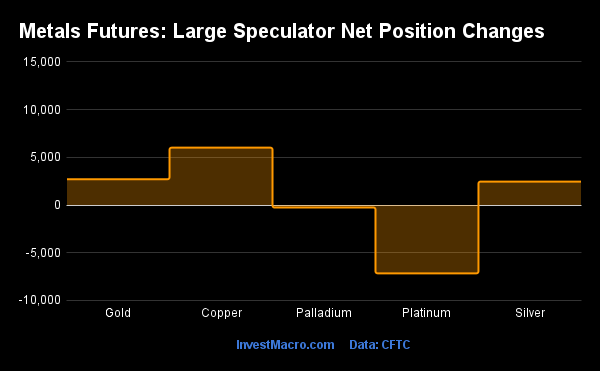
Disclosures:

1) Adrian Day: I, or members of my immediate household or family, own securities of the following companies mentioned in this article: All. I personally am, or members of my immediate household or family are, paid by the following companies mentioned in this article: None. My company has a financial relationship with the following companies mentioned in this article: None. Funds controlled by Adrian Day Asset Management, which is unaffiliated with Adrian Day’s newsletter, hold shares of the following companies mentioned in this article: All. I determined which companies would be included in this article based on my research and understanding of the sector.
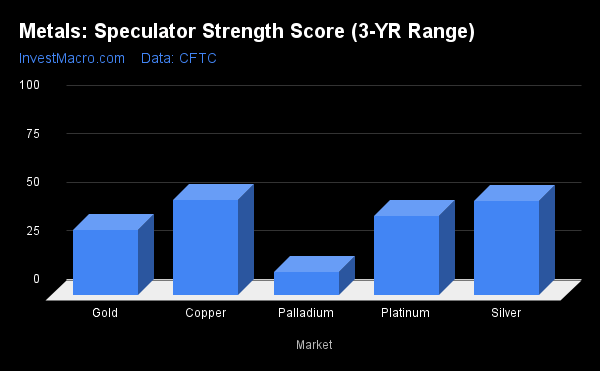
2) The following companies mentioned in this article are billboard sponsors of Streetwise Reports: None. Click here for important disclosures about sponsor fees. The information provided above is for informational purposes only and is not a recommendation to buy or sell any security.

3) Statements and opinions expressed are the opinions of the author and not of Streetwise Reports or its officers. The author is wholly responsible for the validity of the statements. The author was not paid by Streetwise Reports for this article. Streetwise Reports was not paid by the author to publish or syndicate this article. Streetwise Reports requires contributing authors to disclose any shareholdings in, or economic relationships with, companies that they write about. Streetwise Reports relies upon the authors to accurately provide this information and Streetwise Reports has no means of verifying its accuracy.

4) This article does not constitute investment advice. Each reader is encouraged to consult with his or her individual financial professional and any action a reader takes as a result of information presented here is his or her own responsibility. By opening this page, each reader accepts and agrees to Streetwise Reports’ terms of use and full legal disclaimer. This article is not a solicitation for investment. Streetwise Reports does not render general or specific investment advice and the information on Streetwise Reports should not be considered a recommendation to buy or sell any security. Streetwise Reports does not endorse or recommend the business, products, services, or securities of any company mentioned on Streetwise Reports.

5) From time to time, Streetwise Reports LLC and its directors, officers, employees, or members of their families, as well as persons interviewed for articles and interviews on the site, may have a long or short position in the securities mentioned. Directors, officers, employees, or members of their immediate families are prohibited from making purchases and/or sales of those securities in the open market or otherwise from the time of the decision to publish an article until three business days after the publication of the article. The foregoing prohibition does not apply to articles that in substance only restate previously published company release.

Fed wants inflation to get down to 2% – but why not target 3%? Or 0%?

By Veronika Dolar, SUNY Old Westbury 

What’s so special about the number 2? Quite a lot, if you’re a central banker – and that number is followed by a percent sign.

That’s been the de facto or official target inflation rate for the Federal Reserve, the European Central Bank and many other similar institutions since at least the 1990s.

But in recent months, inflation in the U.S. and elsewhere has soared, forcing the Fed and its counterparts to jack up interest rates to bring it down to near their target level.

As an economist who has studied the movements of key economic indicators like inflation, I know that low and stable inflation is essential for a well-functioning economy. But why does the target have to be 2%? Why not 3%? Or even zero?

Soaring inflation

The U.S. inflation rate hit its 2022 peak in July at an annual rate of 9.1%. The last time consumer prices were rising this fast was back in 1981 – over 40 years ago.

Since March 2022, the Fed has been actively trying to decrease inflation. In order to do this, the Fed has been hiking its benchmark borrowing rate – from effectively 0% back in March 2022 to the current range of 3.75% to 4%. And it’s expected to lift interest rates another 0.5 percentage point on Dec. 14 and even more in 2023.

Most economists agree that an inflation rate approaching 8% is too high, but what should it be? If rising prices are so terrible, why not shoot for zero inflation?

Maintaining stable prices

One of the Fed’s core mandates, alongside low unemployment, is maintaining stable prices.

Since 1996, Fed policymakers have generally adopted the stance that their target for doing so was an inflation rate of around 2%. In January 2012, then-Chairman Ben Bernanke made this target official, and both of his successors, including current Chair Jerome Powell, have made clear that the Fed sees 2% as the appropriate desired rate of inflation.

Until very recently, though, the problem wasn’t that inflation was too high – it was that it was too low. That prompted Powell in 2020, when inflation was barely more than 1%, to call this a cause for concern and say the Fed would let it rise above 2%.

Many of you may find it counterintuitive that the Fed would want to push up inflation. But inflation that is persistently too low can pose serious risks to the economy.

These risks – namely sparking a deflationary spiral – are why central banks like the Fed would never want to adopt a 0% inflation target.

Perils of deflation

When the economy shrinks during a recession with a fall in gross domestic product, aggregate demand for all the things it produces falls as well. As a result, prices no longer rise and may even start to fall – a condition called deflation.

Deflation is the exact opposite of inflation – instead of prices rising over time, they are falling. At first, it would seem that falling and lower prices are a good thing – who wouldn’t want to buy the same thing at a lower price and see their purchasing power go up?

But deflation can actually be pretty devastating for the economy. When people feel prices are headed down – not just temporarily, like big sales over the holidays, but for weeks, months or even years – they actually delay purchases in the hopes that they can buy things for less at a later date.

For example, if you are thinking of buying a new car that currently costs US$60,000, during periods of deflation you realize that if you wait another month, you can buy this car for $55,000. As a result, you don’t buy the car today. But after a month, when the car is now for sale for $55,000, the same logic applies. Why buy a car today, when you can wait another month and buy a car for $50,000 next month.

This lower spending leads to less income for producers, which can lead to unemployment. In addition, businesses, too, delay spending since they expect prices to fall further. This negative feedback loop – the deflationary spiral – generates higher unemployment, even lower prices and even less spending.

In short, deflation leads to more deflation. Throughout most of U.S. history, periods of deflation usually go hand in hand with economic downturns.

Everything in moderation

So it’s pretty clear some inflation is probably necessary to avoid a deflation trap, but how much? Could it be 1%, 3% or even 4%?

Maybe. There isn’t any strong theoretical or empirical evidence for an inflation target of exactly 2%. The figure’s origin is a bit murky, but some reports suggest it simply came from a casual remark made by the New Zealand finance minister back in the late 1980s during a TV interview.

Moreover, there’s concern that creating economic targets for economic indicators like inflation corrupts the usefulness of the metric. Charles Goodhart, an economist who worked for the Bank of England, created an eponymous law that states: “When a measure becomes a target, it ceases to be a good measure.”

Since a core mission of the Fed is price stability, the target is beside the point. The main thing is that the Fed guide the economy toward an inflation rate high enough to allow it room to lower interest rates if it needs to stimulate the economy but low enough that it doesn’t seriously erode consumer purchasing power.

Like with so many things, moderation is key.The Conversation

About the Author:

Veronika Dolar, Assistant Professor of Economics, SUNY Old Westbury

This article is republished from The Conversation under a Creative Commons license. Read the original article.