Archive for Metals – Page 37

Copper: The Most Important Metal We’re Running Short Of

Source: Rick Mills  (10/27/22) 

With global interest and use of copper rising, copper may not be able to meet demand. Expert Rick Mills of Ahead of the Herd reviews the demand for copper, the push for more infrastructure, and what he believes the future holds for this metal.

Copper is one of the most important metals, with more than 20 million tonnes consumed each year across a variety of industries, including building construction (wiring & piping,) power generation/ transmission, and electronic product manufacturing.

World mined copper production, in thousands of tonnes. Source: US Geological Survey

In recent years, the global transition towards clean energy has stretched the need for the tawny-colored metal even further. More copper will be required to feed our renewable energy infrastructure, such as photovoltaic cells used for solar power and wind turbines.

The metal is also a key component in transportation, and with increasing emphasis on electrification, demand is only going to increase.

According to S&P Global’s report, via Reuters, “Efforts to reach carbon neutrality by 2050 are likely to remain out of reach as copper supply fails to match demand amid the growing use of solar panels, electric vehicles, and other renewable technologies.”

A major rise in copper demand from new “blacktop” infrastructure (think roads, bridges, airports, etc.), combined with high demand for copper from large-scale efforts on behalf of governments to decarbonize and electrify, is not being met with an adequate supply of the industrial metal.

Trillions worth of new projects is thus in danger of falling by the wayside unless much more copper is discovered — more than is currently possible, in my opinion.

My position is supported by a recent report from S&P Global, which predicts the world’s appetite for copper will reach 53 million tonnes, on an annual basis, by mid-century. This is more than double the current global mine production of 21Mt, according to the U.S. Geological Survey.

How are we going to find the copper?

The Green Economy

According to S&P Global’s report via Reuters, “Efforts to reach carbon neutrality by 2050 are likely to remain out of reach as copper supply fails to match demand amid the growing use of solar panels, electric vehicles, and other renewable technologies.”

The continued move towards electric vehicles is a huge copper driver. In EVs, copper is a major component used in the electric motor, batteries, inverters, wiring, and in charging stations. An average electric vehicle contains about four times as much copper as regular vehicles.

Compared with traditional energy systems, renewables contain 12 times more copper. Wind farms use anywhere between 4 to 15 million pounds, while solar photovoltaic farms require 9,000 pounds per megawatt.

The big question is, will there be enough copper for future electrification needs globally? And remember, in addition to electrification, copper will still be required for all the standard uses.

The short answer is no, not without a massive acceleration of copper production worldwide.

According to a joint report from Ernst & Young (EY) and Eurelectric, Europe will have 130 million EVs by 2025. Each takes about 85 kg (187 pounds) of copper.

The report’s projections, cited by Bloomberg, show Europe’s EV fleet growing from its current <5 million to 65 million by 2030, then doubling over the following five years. This number of EVS will require 65 million chargers. Charging stations take 0.7 kg (for a 3.3 kW slow charger) or 8 kg (for a 200 kW fast charger), according to the Copper Alliance.

An EY leader notes it took 10 years to install 400,000 chargers; now, we will need about 500,000 per year until 2030 and 1 million every year between 2030 and 2035.

Source: Copper Alliance


We already know that we don’t have enough copper for more than a 30% market penetration by electric vehicles.

That would mean an extra million tonnes a year, over and above what we mine now, every year for the next 20 years! The world’s copper miners need to discover the equivalent of one Escondida, the largest copper mine on the planet, each and every year while keeping current production at ~20Mt.

There is also no shift from fossil fuels to green energy without copper, which has no substitutes for its uses in EVs (electric motors and wiring, batteries, inverters, charging stations), wind, and solar energy.

Copper is the most critical metal.

Infrastructure Push

Many countries need to reduce their so-called “infrastructure deficits.” Basic infrastructure, such as roads, bridges, water and sewer systems, has been poorly maintained and requires hefty investments, measured in trillions of dollars, to repair or replace.

China, the world’s biggest commodities consumer, has committed to spend at least US$2.3 trillion this year on major infrastructure projects. They are part of Beijing’s most recent five-year plan that calls for developing “core technologies,” including high-speed rail, power infrastructure, and new energy. More money will be aside in years two to five.

There is also the “Made in China 2025″ initiative, which seeks to end Chinese reliance on foreign technology by investing in a number of key sectors, including IT and robotics, and China’s $900 billion “Belt and Road Initiative,” designed to open channels between China and its neighbors, mostly through infrastructure investments. Dozens of countries have signed up for it, including Russia.

Research commissioned by the International Copper Association, quoted by Mining Technology, found that Belt and Road projects in over 60 Eurasian countries will push the demand for copper to 6.5 million tonnes by 2027.

China’s Belt and Road Initiative

That much copper equates to nearly a third of the 21Mt of copper produced in 2021 — a new copper supply that would need to be either mined from existing operations or discovered.

The U.S. is pursuing its own US$1.2 trillion infrastructure package, to be spent on roads, bridges, power & water systems, transit, rail, electric vehicles, and upgrades to broadband, airports, ports, and waterways, among many other items.

According to S&P GlobalAmong the metals-intensive funding in the legislation is US$110 billion for roads, bridges, and major projects, US$66 billion for passenger and freight rail, US$39 billion for public transit, and US$7.5 billion for electric vehicles.

As infrastructure needs multiply, copper supply can’t keep up.

Depletion

Some of the largest copper mines are seeing their reserves dwindle; they are having to slow production due to major capital-intensive projects to move operations from open pit to underground. Examples include the world’s two largest copper mines, Escondida in Chile and Grasberg in Indonesia, along with Chuquicamata, the biggest open-pit mine on Earth.

Without new capital investments, Commodities Research Unit (CRU) predicts global copper mined production will drop from the current 21Mt to below 12Mt, leading to a supply shortfall of more than 15Mt. Over 200 copper mines are expected to run out of ore before 2035, with not enough new mines in the pipeline to take their place.

Graph courtesy of Hamish Sampson, analyst at CRU’s copper team

Bank of America, in a recent report, predicts the copper market will flip into a deficit as early as 2025 following the completion of the current wave of project buildouts, the latest being Ivanhoe Mines’ massive Kamoa-Kakula project in the Democratic Republic of the Congo.

Five years later, analysts at Rystad Energy project that copper demand will outstrip supply by more than 6 million tonnes. That equates to nearly the entire annual production of Chile, the world’s top producer.

By 2040, the supply shortfall grows to 14Mt, according to a BloombergNEF August report, with a “best-case scenario” shortage of  >5 million short tons possible by 2040.

Copper fundamentals are strong despite price weakness.

Production Snafus


In fact, we don’t have to wait to see signs of an emerging copper crisis. Some of the world’s largest copper miners this year have proven unable to produce as much as they said they would. BHP, Rio Tinto, Anglo American, First Quantum Minerals, and Glencore have all pared back production forecasts, blaming higher costs for their lower output figures. (see ‘Cost creep’ below)

Following a 14% drop in copper production in Q1, Glencore cut its 2022 guidance by 3% or 40,000 tonnes.

According to Goldman Sachs, the incentive price to make mining attractive is now 30% higher than in 2018, at roughly US$9,000 a ton (as I write this copper is US$7060.00t).

Some of this has to do with deposits getting mined out. As grades decline, higher amounts of ore need to be processed to yield an equivalent amount of copper.

New deposits are getting trickier and pricier to find and develop. There is a lot of anti-mining sentiment in Canada and the United States, and politicians are beholden to these pressure groups. It can take up to 20 years to build a mine after all the stakeholders have been consulted and the many permitting requirements have been satisfied.

Overall, it is getting harder and taking longer for new projects to be green-lit.


Source: Energy & Capital

According to Goehring & Rozencwajg Associates, the number of new world-class copper discoveries coming online this decade “will decline substantially and depletion problems at existing mines will accelerate.”

According to the Wall Street firm’s model, the industry is “approaching the lower limits of cut-off grades,” and brownfield expansions are no longer a viable solution. “If this is correct, then we are rapidly approaching the point where reserves cannot be grown at all,” the report concluded.

It also shines a light on the importance of making new discoveries in establishing a sustainable copper supply chain.

Over the past 10 years, greenfield additions to copper reserves have slowed dramatically. S&P Global estimates that new discoveries averaged nearly 50Mt annually between 1990 and 2010. Since then, new discoveries have fallen by 80% to only 8Mt per year.

In fact, new copper supply is concentrated in just five mines — Chile’s Escondida, Spence and Quebrada Blanca, Cobre Panama, and the Kamoa-Kakula project in the DRC. Our analysis shows that in four of the five mines where new copper supply is concentrated, there are offtake agreements, either in place or implied, with non-Western buyers.

In the case of Kamoa-Kaukula, 100% of initial production will be split between two Chinese companies, one of which owns 39.6% of the joint venture project. Nearly half of Cobre Panama’s annual production goes to a Korean smelter under a 2017 offtake agreement.

Escondida and Quebrada Blanca are both partially owned by Japanese companies — one can make the assumption that a corresponding percentage of production will be going there.

Who owns the world’s future copper supply?


Copper discoveries and capital expenditures

Gold Miners Want Copper

One game plan for adding to supply is for mining companies to diversify from gold to copper and other so-called green-economy metals.

Diversification is the new mining buzzword.

Companies that diversify into copper now would be well-positioned to benefit from the coming copper shortfall, which should result in a much higher realized copper price.

Barrick Gold Corp. (ABX:TSX; GOLD:NYSE) and Agnico Eagle Mines Ltd. (AEM:TSX; AEM:NYSE) are two recent examples.

Agnico Eagle paid US$580 million for a 50% share in Teck’s San Nicolas copper-zinc mine in Zacatecas, Mexico.

About 20% of Barrick Gold’s production now comes from copper.

 Cost Creep

Copper mining has become an especially capital-intensive industry – the average capital intensity for a new copper mine in 2000 was US$4,000-5,000 to build the capacity to produce a tonne of copper; in 2012, capital intensity was US$10,000/t, on average, for new projects.

Today, building a new copper mine can cost up to US$44,000 per tonne of production, an AOTH analysis has found.

Capex costs are escalating because:

  • Declining copper ore grades means a much larger relative scale of required mining and milling operations.
  • A growing proportion of mining projects are in remote areas of developing economies where there’s little to no existing infrastructure.
  • Many inputs necessary for mine-building are getting more expensive as cross-the-board inflation, the highest in 40 years, infiltrates the industry. This includes two of the largest costs, wages and diesel fuel used to run mining equipment.

The bottom line?

It is becoming increasingly costly to bring new copper mines online and run them. According to Goldman Sachs, the incentive price to make mining attractive is now 30% higher than in 2018, at roughly US$9,000 a ton (as I write this, copper is US$7060.00t).

Copper mines becoming more capital-intensive and costly to run.

Resource Nationalism

Along with technical issues such as falling grades/deteriorating ore quality, there is also supply pressure from growing resource nationalism.

There is a need to go further afield and dig deeper to find copper at the grades needed to economically produce copper products. This usually means riskier jurisdictions that are often ruled by shaky governments.

In February, Goldman Sachs predicted a “scarcity episode” by the end of 2022 as global stocks of copper fell to dangerously low levels.

Peru and Chile, which together account for more than a third of global copper output, are both seeing a wave of resource nationalism, where governments try to exact a greater share of resource revenues through various means, such as higher royalties and export bans of raw ores.

Chile has attracted substantial mining investment in recent years, including from leading copper producers like BHP and Teck. But long-term, Chile’s declining ore grades present a key downside risk to production forecasts.

The chart below shows Chile’s average copper grades were more than cut in half between 1999 and 2016.

Source: Cochilco

Chile is also producing less copper. According to Cochilco, the country’s state copper commission, in 2000, Chile produced 34.7% of the world’s copper; by 2017, the percentage had fallen to 26.7% (the USGS’s latest figures show Chilean mine production at 26% of the global total).

State-owned copper miner Codelco, which is the largest copper company in the world, is facing challenges linked to the redevelopment of its copper mines, meaning it will produce 1.5 million tonnes of copper this year and next, compared with 1.7 million tonnes in 2021, Reuters said this week.

Making matters worse, after more than a decade of drought, freshwater supplies are becoming a big problem in Chile. Copper mines there require lots of water to process sulfide ores, and the lower the grade, the more water must be used.

The country’s leftward shift is another mark against the top copper producer as far as attracting mining investment. Although Chile’s constitutional assembly has rejected plans to nationalize parts of the mining sector, the government is now weighing how much to increase royalties; a decision is expected soon.

Like Chile, the world’s second-largest copper miner has underperformed. Copper production in July totaled 195,234 tonnes, following a respective 9.1% and 14.5% drop in output at the Antamina and Southern Copper mines. The result was a 6.6% year-on-year loss.

While copper production at China-owned Las Bambas recovered in June, following a truce with indigenous communities who oppose the mine, the agreement ended in July, and renewed protests could risk copper supplies, Reuters said.

The Chinese copper market is at its tightest in more than a decade as traders pay massive premiums for immediate supplies.

Peru’s President Pedro Castillo has proposed to raise taxes on the mining sector by at least 3%, which the country’s mining chamber says could cost USD$50 billion in future investments.

In the Democratic Republic of Congo (DRC), weak infrastructure, including a lack of power, is limiting the growth potential for major copper deposits. This past summer, the Congolese government suspended metal exports from Tenke Fungurume, a large copper-cobalt mine owned by China’s CMOC.

The DRC is the world’s top producer of cobalt and Africa’s leading copper-mining country. Tenke Fugurume accounted for more than 10% of global cobalt output in 2021.

Dwindling Inventories

In February, Goldman Sachs predicted a “scarcity episode” by the end of 2022 as global stocks of copper fell to dangerously low levels. That never happened due to the abrupt fall in the copper price, owing to the Federal Reserve’s interest rate increases, the high US dollar, a slowdown in China, and talk of a global recession. Still, Goldman’s warning about a “stock-out” remains well supported.

Goehring & Rozencwajg, the Wall Street firm, published a chart of copper warehouse inventories showing a four-year down-trend from around April 2018 to the present.

These days, there is a puzzling disconnect between the copper price, which has dropped to a five-week low of US$3.54 a pound (at the time of writing), and market tightness.

The latter is aptly demonstrated by what is happening in Shanghai, China, where for the past 15 years, a huge copper stockpile, larger even than the London Metal Exchange, has been used by Chinese companies as collateral for cheap financing.

Now, according to Bloomberg, China’s bonded warehouses are all but empty. The once-frenetic flow of metal into the stockpile has come to a juddering halt as two dominant financiers of Chinese metals, JPMorgan Chase & Co. and ICBC Standard Bank Plc, have halted new business there. Numerous traders and bankers interviewed by Bloomberg said they believe the trade is dead for now, and some predicted the bonded stocks could drop to zero or close to it.

The implications are being felt across the market as the world’s largest copper consumer becomes more reliant on imports to meet its near-term needs at a time when global stocks are already at historically low levels. The Chinese copper market is at its tightest in more than a decade as traders pay massive premiums for immediate supplies.

At their peak in 2011-12, China’s bonded stocks held about a million tons of copper. This month they totaled just 30,000 tons — down nearly 300,000t from earlier this year, the lowest level in decades.

Bloomberg explains that the decline began several years ago, with a massive warehousing fraud in 2014 that soured many banks and traders in the Chinese metals industry. This year, the country’s economic slump, rising interest rates, and several high-profile losses caused more participants to stay away.

The key point is, without the Shanghai buffer of bonded stocks, any pickup in Chinese demand could send copper prices soaring.

In short, says Woodmac, “the global energy transition presents an almost unattainable mine supply challenge, with significant investment and price incentives required.”

It’s not only in China that copper stockpiles are getting depleted. As of this week, CRU Group estimates global stocks are down to just 1.6 weeks of consumption. That’s the lowest ever in the copper consultancy’s data going back to 2001, Bloomberg said.

On October 19, Reuters reported the available copper in London Metal Exchange warehouses halved within eight days.

A squeeze on the Shanghai Futures Exchange (ShFE) has generated a scramble for metal, metals columnist Andy Home explained, adding that, As bonded stocks rapidly deplete to fill on-shore ShFE warehouses, physical premiums are, in turn, rising to attract more metal from the international market.

The Yangshan copper premium, a useful proxy for China’s spot import demand, has soared to $147.50 per tonne over LME cash, its highest trading level since 2013.

Western sanctions on Russian companies due to the war in Ukraine are also factoring into low copper inventories. The LME is reportedly talking about suspending deliveries of Russian metal (aluminum, copper, and nickel), which at the end of September comprised over 60% of the exchange’s copper stocks.

Locking In

Some copper buyers are so worried about the future availability of the metal that they are looking to secure longer-term deals than normal. For example, Bloomberg said that Codelco recently signed contracts with customers in Europe for three to five years versus the traditional annual deals.

“We are prepared to continue to strengthen our long-term relations with customers because we can understand that in their risk matrix, their concern about copper supply is one of their priorities,” Codelco’s Chairman Maximo Pacheco said in an interview.

Pointing to forecasts for strong copper demand growth, he said, “Obviously, they have a question: ‘Where are we going to get this copper from?’.”

Supply-Demand Gap

It’s a good question, we find ourselves asking it repeatedly.

A new report from Wood Mackenzie estimates that 9.7 million tonnes of new copper supply is needed over 10 years to meet the targets set out in the Paris Climate Agreement. As stated earlier, this is the equivalent of putting a new Escondida Mine into production every year.

Source: Wood Mackenzie

Figures from the commodities consultancy show that mining project approval rates have stalled despite historically high copper prices (in Q1).

During the first half of 2022, the volume of committed projects totaled just 260,000 tonnes of production per year (against total annual mine production of around 21 million tonnes).

Source: Wood Mackenzie

“To successfully meet zero-carbon targets, the mining industry needs to deliver new projects at a frequency and consistent level of financing never previously accomplished,” said Nick Pickens, research director of copper markets at Wood Mackenzie.

In short, says Woodmac, “the global energy transition presents an almost unattainable mine supply challenge, with significant investment and price incentives required.”

The firm estimates over US$23 billion a year will be needed over 30 years to deliver new projects under the 1.5 degrees Celsius Paris scenario — a level of investment previously seen only for a limited period from 2012 to 2016, following the China-induced commodity super-cycle.

The copper price needed to meet demand under this scenario is US$4.25 a pound, about 25% higher than currently.

Source: Wood Mackenzie

In an article titled ‘A Great Copper Squeeze Is Coming for the Global Economy,’ Bloomberg reported in September that the recent downturn in copper prices stands to worsen the coming deficit because the slump discourages new copper investments.

As an example, Newmont just shelved plans for its US$2 billion gold-copper project in Peru.

A massive copper shortfall that could be visited upon the industry in as short as two years’ time could, says Bloomberg, hold back global growth, stoke inflation by raising manufacturing costs, and throw global climate goals off course. . . 

And the latest market downturn stands to exacerbate future supply problems by offering a false sense of security, choking off cash flow, and chilling investments. It takes at least 10 years to develop a new mine and get it running, which means that the decisions producers are making today will help determine supplies for at least a decade. [in North America, the time frame is more like 20 years — Rick]

The coming supply squeeze will be truly breathtaking and deserves more of a numerical explanation.

According to a study from S&P Global, emissions goals commensurate with decarbonization and electrification will double copper demand to 50 million tonnes by 2035. Bloomberg New Energy Finance estimates demand will increase by over 50% from 2022 to 2040.

Supply growth is expected to peak around 2024, the result of very few new projects in the works and as existing mines are depleted. According to S&P’s research, this is setting up a supply deficit of 10 million tons in 2035 — the equivalent of 10 Escondidas.

Goldman Sachs thinks mining companies need to spend about US$150 billion over the next decade to solve an 8Mt deficit. BloombergNEF predicts that by 2040 the mined output gap could reach 14Mt.

Copper Prices

The next question is what this means for copper prices going forward. In 2021, when the copper deficit was 441,000 tons, copper prices jumped about 25%. 441,000t is less than 2% of demand, but in S&P Global’s worst-case scenario, 2035’s shortfall will be the equivalent of about 20% of consumption.

Goldman Sachs is forecasting the LME copper price to more than double its current level to US$15,000 a ton in 2025.  Let’s step back here and remember the incentive price to make mining copper attractive is US$9,000.00 a ton copper is trading currently at US$7,000.00t.

Copper will have to rise from its current price of US$3.54 to a minimum of US$4.50lb to incentivize miners to build mines.

Of course, one of the biggest wildcards in all this is China, the world’s largest metals consumer, accounting for about half of global copper demand. If the country’s property sector contracts significantly, it would obviously mean less copper-demanded construction.

Another unknown is the potential for a global recession. Citigroup, via CNBC, sees copper prices in the short-term falling due to an economic slowdown driven by Europe. The bank forecasted copper at US$6,600 a ton in the first quarter of 2023.

Other forecasters, and that includes us at AOTH, believe a recession will only delay demand, which is inevitable due to the trillions of dollars being planned for electrification and infrastructure investments. An August 31 presentation from BloombergNEF states that a recession will not “significantly dent” consumption projections going into 2040.

Bloomberg points out there is already very little wiggle room on the supply side: The physical copper market is already so tight that despite the slump in futures prices, the premiums paid for immediate delivery of the metal have been moving higher. 

Richard Adkerson, the CEO of Freeport McMoRan, recently weighed in on the disconnect between supply tightness and the lower copper price, saying during a conference call with analysts, “It’s striking how negative financial markets feel about this market, and yet the physical market is so tight.”

“We’re not seeing customers scaling back orders. Customers are really fighting to get products,” Adkerson said. He added that such a pricing environment will defer new copper projects and mine expansions just when the world’s epic shift to electrification requires a massive amount of the metal.

The copper price rose on Wednesday, October 26, to US$3.54 a pound, the highest since September 16, buoyed by a weaker US dollar. Hope for a rebound has also been strengthened due to recent news out of China.

The country is considering lessening its quarantine period for inbound visitors from 10 to seven days, an indication it is winning its war against the coronavirus pandemic that has resulted in nationwide lockdowns.

Conclusion

The demand pressure about to be exerted on copper producers in the coming years all but guarantees a market imbalance, resulting in copper becoming scarcer and dearer with each infrastructure initiative and with each ambitious green initiative rolled out by governments.

The problem is that existing copper mines are running out of ore, and the capital invested in new mines is far below the needed level.

In sum, the copper industry is in the grips of a structural supply deficit that, combined with inflationary cost pressures and creeping resource nationalism in some of the world’s largest copper producers, is only expected to get worse.

According to S&P Global Market Intelligence research, of 224 sizable copper deposits discovered in the past 30 years, only 16 have been found in the last decade.

It takes seven to 10 years, at minimum, to move a copper mine from discovery to production. In regulation-happy jurisdictions like Canada and the U.S., the time frame is more like 20 years.

The pipeline of copper development projects is the lowest it’s been in decades.

Why can’t we just mine more copper?

Over the past two decades, big mining companies have approached the problem of dwindling reserves by doing exactly that.

Historical Copper Price

Between 2001 and 2014, 80% of new reserves came from re-classifying what was once waste rock into mineable ore, i.e., lowering the cut-off grade.

The problem is that between lowering their cut-off grades and high-grading (removing all the best ore and leaving the rest), the grade of new reserves each year has steadily declined.

In 2001, the new reserves grade was 0.80% copper, but by 2012, it had fallen to 0.26%. The copper industry was still able to replace all the ore used in production with new reserves, but the quality of those reserves, i.e., the grade, had dropped by nearly two-thirds.

The authors of a recent report contend that even with prices above $10,000 per tonne, reserves cannot keep growing, specifically at porphyry deposits, where most copper is mined.

Their analysis also suggests that we are quickly approaching the lower limits of cut-off grades, concluding that we are rapidly approaching the point where reserves cannot be grown at all. In other words, peak copper.

Running on MT — peak copper.

The industry can no longer re-classify itself out of its problem. Billions and billions of dollars need to be invested in the exploration and development of new copper mines.

In sum, the copper industry is in the grips of a structural supply deficit that, combined with inflationary cost pressures and creeping resource nationalism in some of the world’s largest copper producers, is only expected to get worse.

Richard (Rick) Mills

aheadoftheherd.com

subscribe to my free newsletter

Legal Notice / Disclaimer

Ahead of the Herd newsletter, aheadoftheherd.com, hereafter known as AOTH.

Please read the entire Disclaimer carefully before you use this website or read the newsletter. If you do not agree to all the AOTH/Richard Mills Disclaimer, do not access/read this website/newsletter/article, or any of its pages. By reading/using this AOTH/Richard Mills website/newsletter/article, and whether you actually read this Disclaimer, you are deemed to have accepted it.

Any AOTH/Richard Mills document is not, and should not be, construed as an offer to sell or the solicitation of an offer to purchase or subscribe for any investment.

Disclosures:

1) Rick Mills: I, or members of my immediate household or family, own securities of the following companies mentioned in this article: None. I personally am, or members of my immediate household or family are, paid by the following companies mentioned in this article: None. I determined which companies would be included in this article based on my research and understanding of the sector.

2) The following companies mentioned in this article are billboard sponsors of Streetwise Reports: None. Click here for important disclosures about sponsor fees. The information provided above is for informational purposes only and is not a recommendation to buy or sell any security.

3) Statements and opinions expressed are the opinions of the author and not of Streetwise Reports or its officers. The author is wholly responsible for the validity of the statements. The author was not paid by Streetwise Reports for this article. Streetwise Reports was not paid by the author to publish or syndicate this article. Streetwise Reports requires contributing authors to disclose any shareholdings in, or economic relationships with, companies that they write about. Streetwise Reports relies upon the authors to accurately provide this information and Streetwise Reports has no means of verifying its accuracy.

4) This article does not constitute investment advice. Each reader is encouraged to consult with his or her individual financial professional and any action a reader takes as a result of information presented here is his or her own responsibility. By opening this page, each reader accepts and agrees to Streetwise Reports’ terms of use and full legal disclaimer. This article is not a solicitation for investment. Streetwise Reports does not render general or specific investment advice and the information on Streetwise Reports should not be considered a recommendation to buy or sell any security. Streetwise Reports does not endorse or recommend the business, products, services, or securities of any company mentioned on Streetwise Reports.

5) From time to time, Streetwise Reports LLC and its directors, officers, employees, or members of their families, as well as persons interviewed for articles and interviews on the site, may have a long or short position in the securities mentioned. Directors, officers, employees, or members of their immediate families are prohibited from making purchases and/or sales of those securities in the open market or otherwise from the time of the decision to publish an article until three business days after the publication of the article. The foregoing prohibition does not apply to articles that in substance only restate previously published company release. As of the date of this article, officers and/or employees of Streetwise Reports LLC (including members of their household) own securities of  Agnico Eagle, a company mentioned in this article.

Lithium Co. Signs CA$2B Supply Deal With EU Auto Maker

Source: Streetwise Reports  (10/21/22)

Rock Tech Lithium Inc. shares traded 30% higher yesterday after the company reported it executed a five-year supply contract with Mercedes-Benz AG of Germany. Under the terms of the agreement, Rock Tech will provide Mercedes with 10,000 tonnes of battery-grade lithium hydroxide yearly, which is expected to generate CA$2 billion in revenue for the company.

The agreement between the two companies will run for a period of five years and is expected to provide Rock Tech with total revenues of around CA$2 billion over the life of the agreement.

Rock Tech’s CEO Markus Bruegmann remarked, “Signing the Supply Agreement marks a significant milestone of our offtake strategy, and I am honored that Mercedes-Benz demonstrates trust in Rock Tech as a new but reliable player in a diversified European battery supply chain.”

Vancouver B.C.-based lithium explorer and developer Rock Tech Lithium Inc. (RCK:TSX.V; RCKTF:OTCQX; RJIB:FSE; A1XF0V:WKN), which owns a 100% interest in the Georgia Lake lithium project in Ontario’s Thunder Bay Mining District, yesterday announced that “it has entered into a definitive supply agreement with Mercedes-Benz Group AG (MBGYY:OTCMKTS;MBGAF:OTC-Pink) providing for the supply of an average of 10,000 tonnes of battery-grade lithium hydroxide per year.”

The contracted deliveries will account for about 40% of the forecasted annual production from Rock Tech’s planned converter capacity in Guben, Germany.

Rock Tech’s CEO Markus Bruegmann remarked, “Signing the Supply Agreement marks a significant milestone of our offtake strategy, and I am honored that Mercedes-Benz demonstrates trust in Rock Tech as a new but reliable player in a diversified European battery supply chain.”

“We intend to focus our efforts on providing lithium hydroxide that will help to bring Mercedes-Benz’s electric mobility ambitions into action. This arrangement is a major step forward in our plans to directly contribute to clean mobility,” Bruegmann added.

Mercedes-Benz Group’s Chief Technology Officer Markus Schäfer commented, “This significant amount of lithium sourced directly from Rock Tech will help Mercedes-Benz to advance localization of European production of state-of-the-art battery cells. The on average 10,000 tonnes of lithium hydroxide per annum will play a key role in securing the lithium supply for our battery production in Europe to help achieve our ambitious electrification goals.”

It is anticipated that the high-quality lithium hydroxide produced by Rock Tech will allow Mercedes-Benz to scale up production and equip approximately 150,000 electric vehicles (EVs) with premium high-performance batteries.

Both firms are striving to meet their goals of achieving carbon neutrality and, as part of the agreement, are committed to creating a roadmap to achieving CO2-neutral production of lithium hydroxide by year-end 2030. The companies noted that to ensure this objective is met, the agreement specifically requires that “all lithium hydroxide supplied by Rock Tech shall be sourced from mining sites audited by the Initiative for Responsible Mining Assurances (IRMA).”

Rock Tech is headquartered in Vancouver, B.C., and is focused on the exploration and development of lithium properties. The company holds a 100% interest in the Georgia Lake lithium project located within Ontario’s Thunder Bay Mining District. In addition to its upstream activities, the firm is investing in downstream operations, with the first planned lithium hydroxide converter built in Germany to supply the EU auto market with the materials needed to manufacture EV batteries. Approximately 40% of the product produced at this plant will be sold to Mercedes-Benz to satisfy the recently signed 5-year supply contract.

Mercedes-Benz Group AG is dedicated to moving toward CO2 neutrality and is strategically acting to transform its vehicle production to an all-electric platform. The company is highly focused on developing and integrating advanced battery cell technology with higher energy density and safety to increase the quality, range, and performance of its cars and vans.

Rock Tech Lithium has a market cap of around US$178.3 million, with approximately 84.7 million shares outstanding. RCKTF shares opened nearly 28% higher yesterday at US$2.63 (+US$0.572, +27.79%) over the previous day’s US$2.058 closing price. The stock traded yesterday between US$2.44 and US$2.70 per share and closed for trading at US$2.68 (+US$0.622, +30.22%).

Disclosures:
1) Stephen Hytha wrote this article for Streetwise Reports LLC and provides services to Streetwise Reports as an independent contractor. He or members of his household own securities of the following companies mentioned in the article: None. He or members of his household are paid by the following companies mentioned in this article: None.

2) The following companies mentioned in this article are billboard sponsors of Streetwise Reports: None. Click here for important disclosures about sponsor fees.

3) Comments and opinions expressed are those of the specific experts and not of Streetwise Reports or its officers. The information provided above is for informational purposes only and is not a recommendation to buy or sell any security.

4) The article does not constitute investment advice. Each reader is encouraged to consult with his or her individual financial professional and any action a reader takes as a result of information presented here is his or her own responsibility. By opening this page, each reader accepts and agrees to Streetwise Reports’ terms of use and full legal disclaimer. This article is not a solicitation for investment. Streetwise Reports does not render general or specific investment advice and the information on Streetwise Reports should not be considered a recommendation to buy or sell any security. Streetwise Reports does not endorse or recommend the business, products, services or securities of any company mentioned on Streetwise Reports.

5) From time to time, Streetwise Reports LLC and its directors, officers, employees or members of their families, as well as persons interviewed for articles and interviews on the site, may have a long or short position in securities mentioned. Directors, officers, employees or members of their immediate families are prohibited from making purchases and/or sales of those securities in the open market or otherwise from the time of the decision to publish an article until three business days after the publication of the article. The foregoing prohibition does not apply to articles that in substance only restate previously published company releases.
COT Metals Speculators push Platinum bullish bets to 28-week high

By InvestMacro

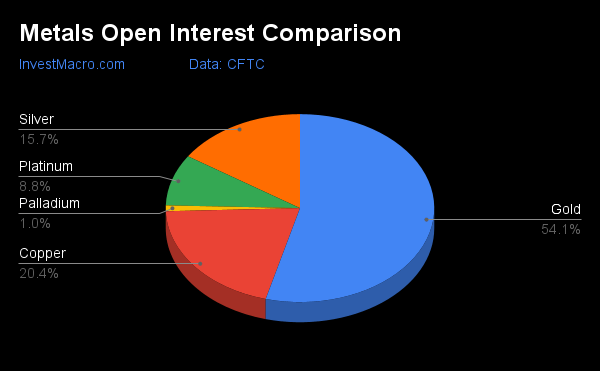
Here are the latest charts and statistics for the Commitment of Traders (COT) data published by the Commodities Futures Trading Commission (CFTC).

The latest COT data is updated through Tuesday October 18th and shows a quick view of how large traders (for-profit speculators and commercial entities) were positioned in the futures markets.

Platinum tops Weekly Speculator Changes

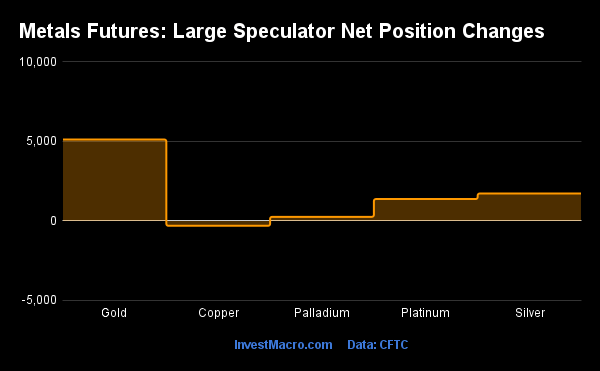
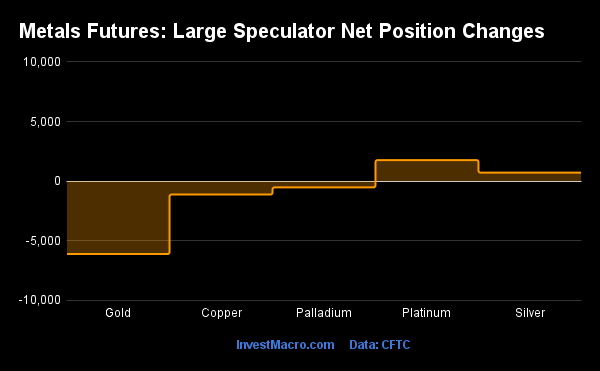
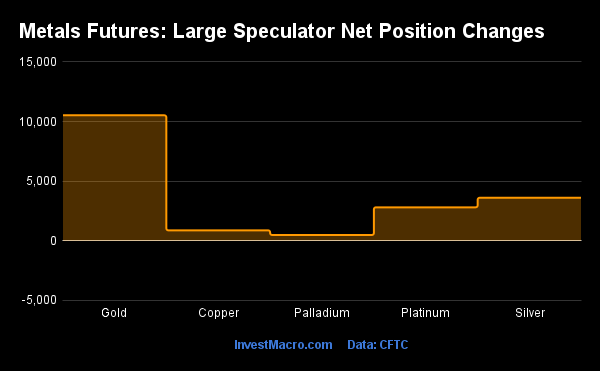
The COT precious metals speculator bets were lower this week as just one out of the five metals markets we cover had higher positioning this week while four markets had lower contracts.

Leading the precious metals markets was just Platinum (2,566 contracts) showing a positive week.

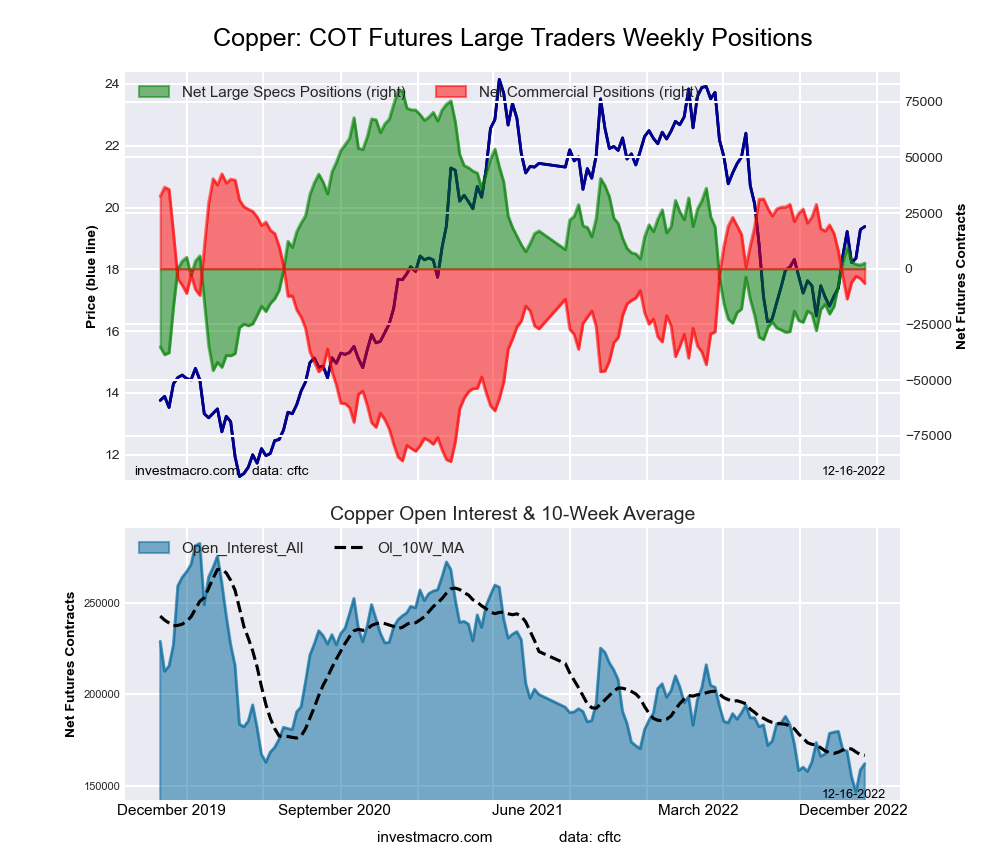
The metals markets leading the declines in speculator bets this week were Gold (-17,464 contracts) with Silver (-6,122 contracts), Copper (-4,403 contracts) and Palladium (-455 contracts) also registering lower bets on the week.

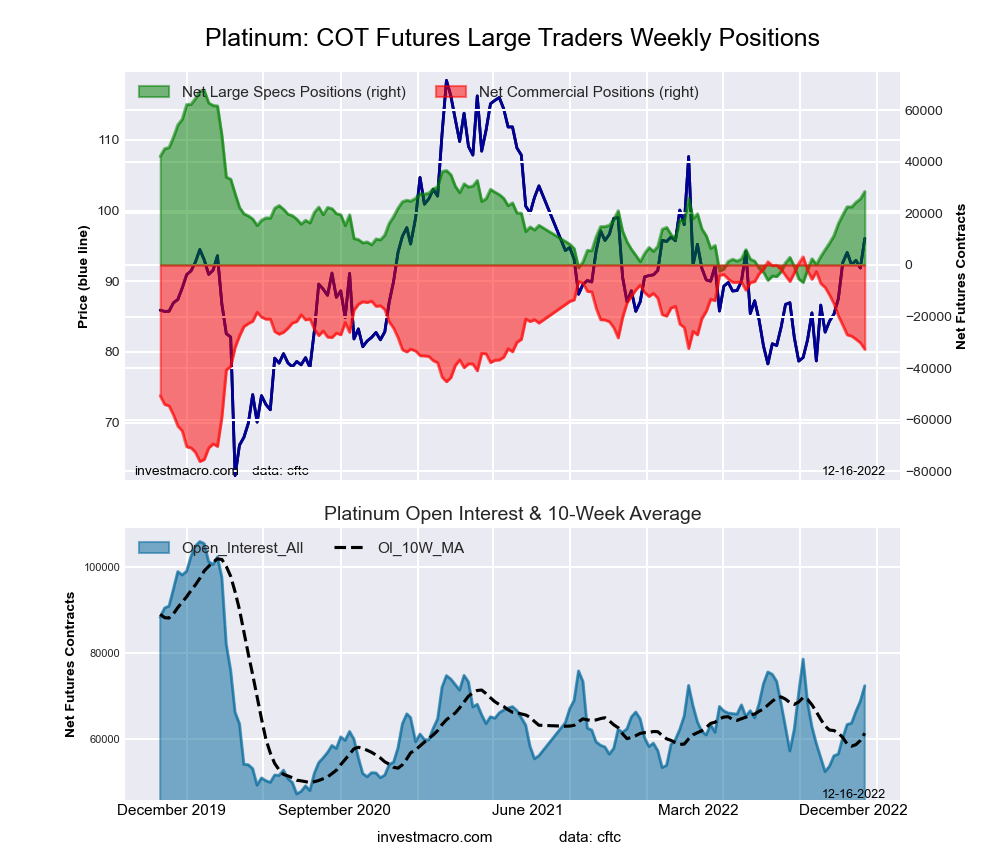
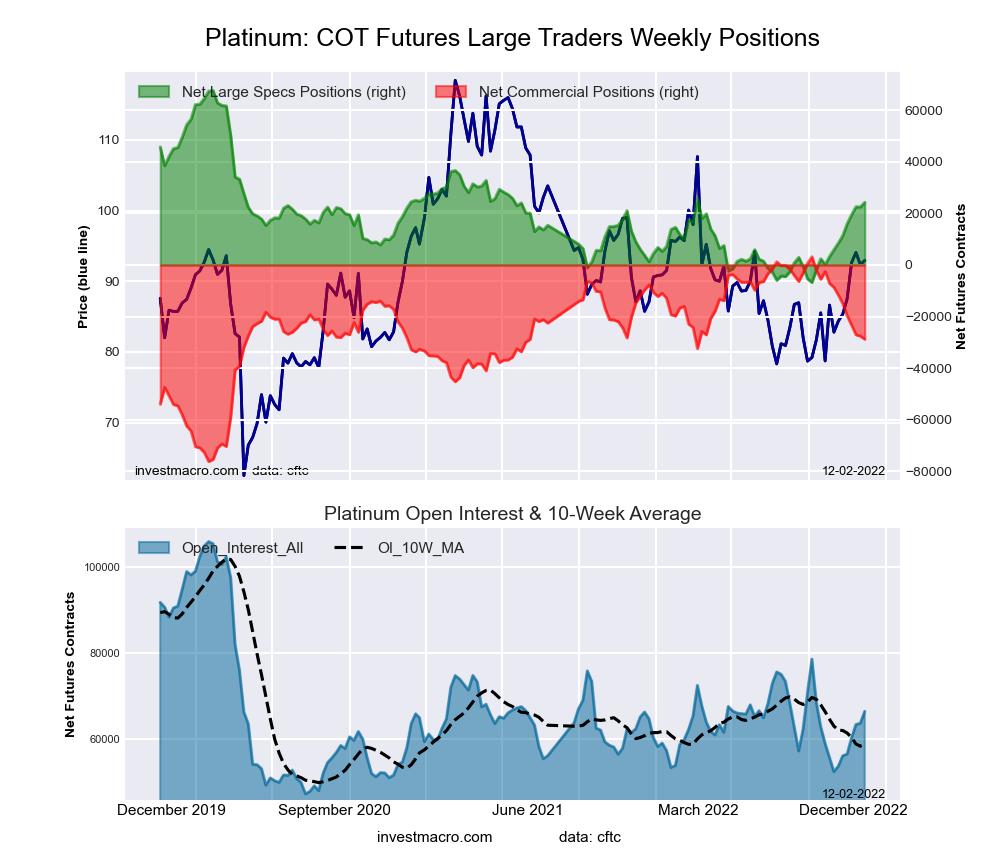
Highlighting the COT Metals data this week was the speculator positions in Platinum. The large speculative positions rose this week for a third straight week and for the fifth time in the past six weeks. Over the past six weeks, speculative bets have improved by a total of +15,245 contracts. This recent bullishness has brought the overall net standing to its highest level in the past twenty-eight weeks, dating back to April 5th of this year.

Platinum prices have been on the rise as well with a monthly gain above 8 percent so far in October. Platinum could also benefit going forward from an interesting tax loophole in India that has pushed Platinum imports to a record high to approximately 27 tonnes this September compared to a little over 1 tonnes last September, according to Reuters. Indian gold refiners are importing Platinum mixed with Gold to offset new higher taxes on Gold. A Gold/Platinum mix allows importers to classify the import as a Platinum alloy and pay a lower tax rate on it.

Platinum futures closed this week over 4 percent higher near the $933 level but below the $940 level which has acted as a resistance barrier over the past five weeks.


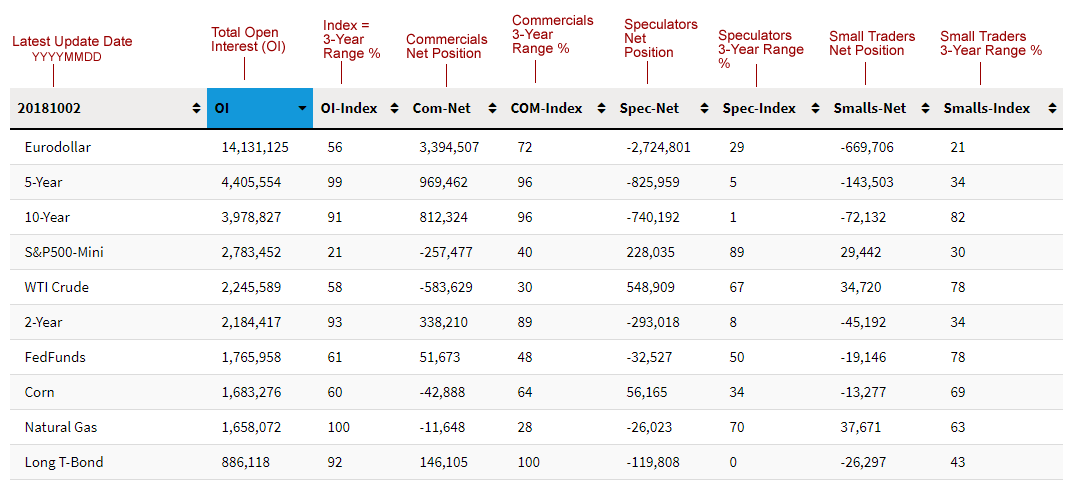
Data Snapshot of Commodity Market Traders | Columns Legend
Oct-18-2022OIOI-IndexSpec-NetSpec-IndexCom-NetCOM-IndexSmalls-NetSmalls-Index
WTI Crude1,454,4310251,54511-273,7579022,21237
Gold434,701176,9568-90,0309113,07412
Silver136,05591,26715-9,085877,8188
Copper178,73017-20,3022019,6968260629
Palladium6,8054-1,209161,44482-23530
Platinum53,728118,49421-11,632813,13810
Natural Gas963,7923-154,73432126,7607127,97446
Brent163,29611-41,8474138,681583,16652
Heating Oil283,7022924,55579-44,0312419,47666
Soybeans714,5323054,68330-30,59577-24,08830
Corn1,419,08722312,41970-249,25536-63,1647
Coffee196,729919,22353-21,605522,38224
Sugar711,6644126,41263-164,6713738,25955
Wheat309,42910-3,5411410,53475-6,99374


Strength Scores led by Platinum and Copper

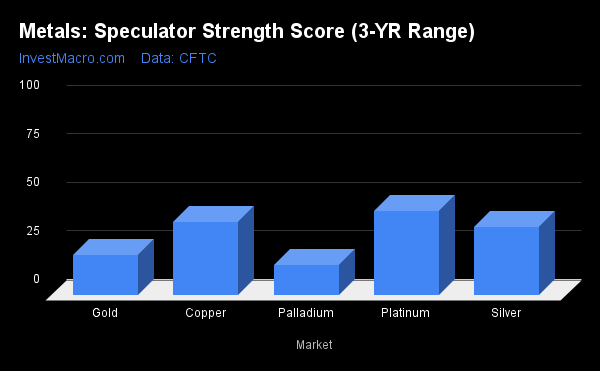
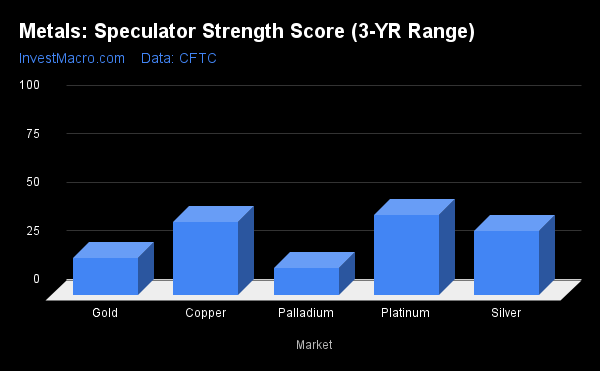
Strength scores (a measure of the 3-Year range of Speculator positions, from 0 to 100 where above 80 is extreme bullish and below 20 is extreme bearish) showed that Platinum (20.5 percent) and Copper (20.2 percent) lead the metals this week just above the bearish extreme level.

On the downside, Gold (8.2 percent) continues to be at the lowest strength level currently and is followed by Silver (15.5 percent) and Palladium (16.4 percent). All three markets in extreme bearish levels below 20 percent.

Strength Statistics:
Gold (8.2 percent) vs Gold previous week (14.0 percent)
Silver (15.5 percent) vs Silver previous week (22.3 percent)
Copper (20.2 percent) vs Copper previous week (23.7 percent)
Platinum (20.5 percent) vs Platinum previous week (17.1 percent)
Palladium (16.4 percent) vs Palladium previous week (19.1 percent)

Platinum leads the Strength Trend Scores

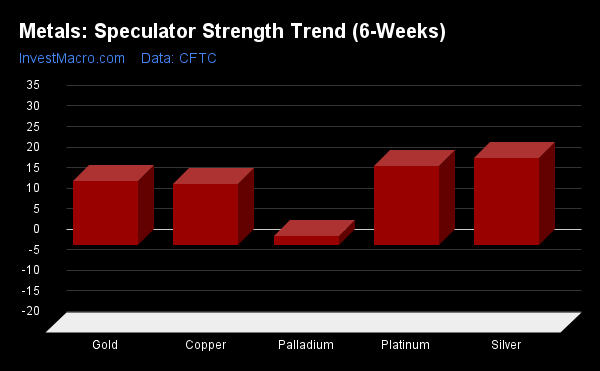
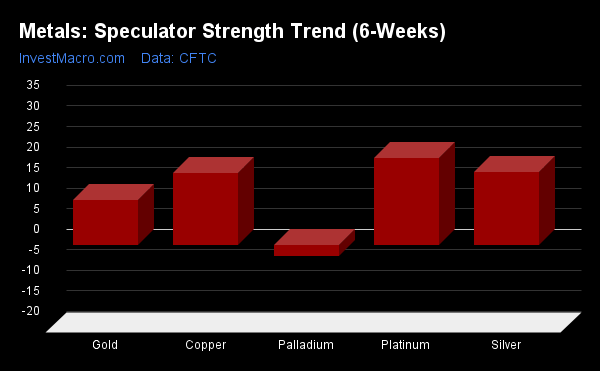
Strength Score Trends (or move index, calculates the 6-week changes in strength scores) show that Platinum (20.5 percent) leads the past six weeks trends for metals this week. Silver (15.5 percent), Copper (2.9 percent) and Palladium (2.3 percent) fill out the other positive movers in the latest trends data.

Gold (-8.9 percent) leads the downside trend scores currently as the only negative mover in the latest data.

Move Statistics:
Gold (-8.9 percent) vs Gold previous week (-7.7 percent)
Silver (15.5 percent) vs Silver previous week (17.3 percent)
Copper (2.9 percent) vs Copper previous week (5.9 percent)
Platinum (20.5 percent) vs Platinum previous week (15.2 percent)
Palladium (2.3 percent) vs Palladium previous week (2.2 percent)


Individual Markets:

Gold Comex Futures:

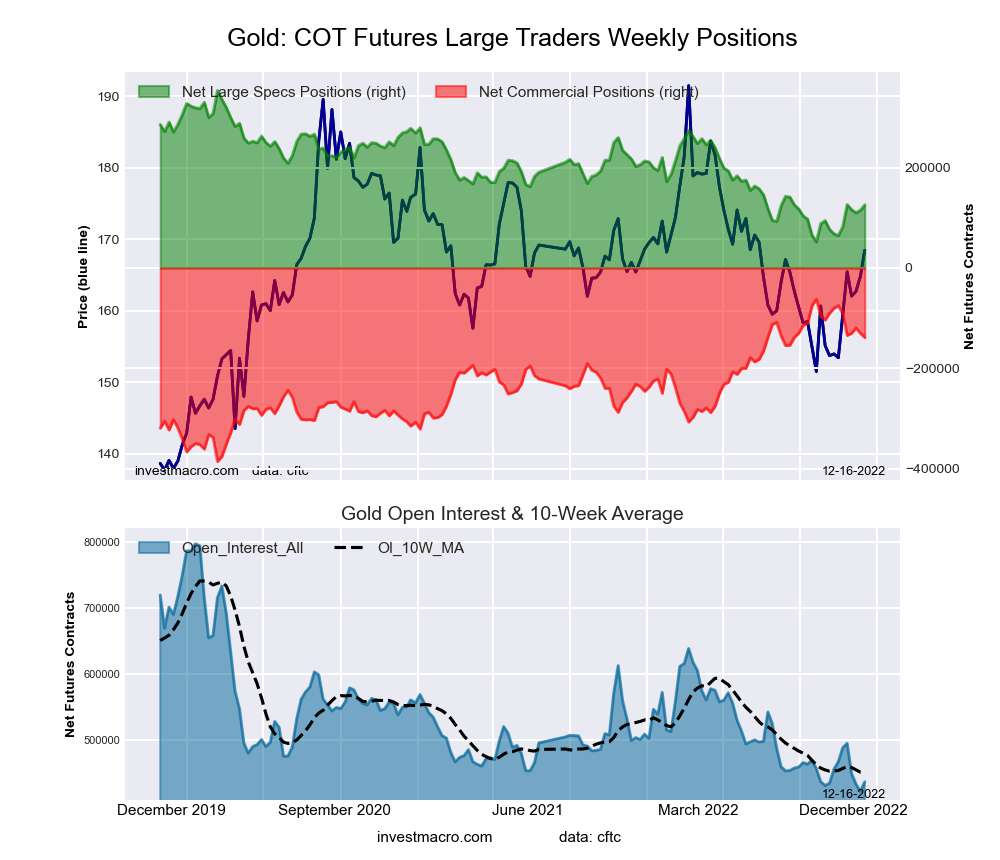
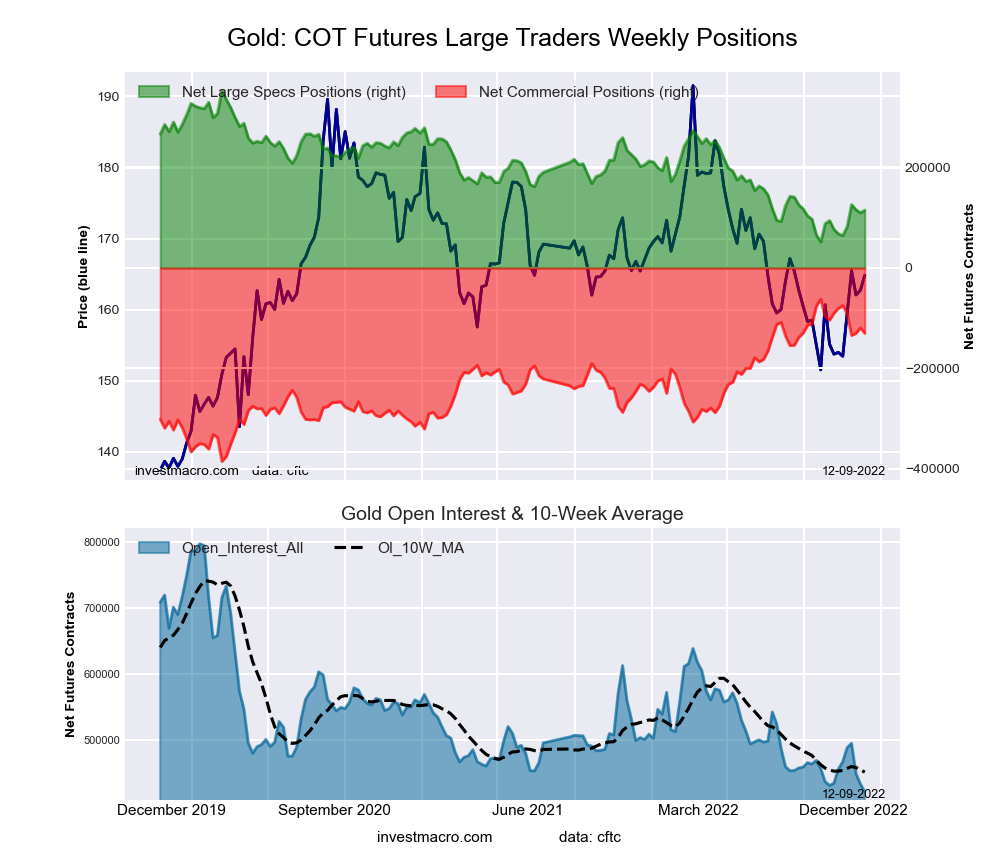
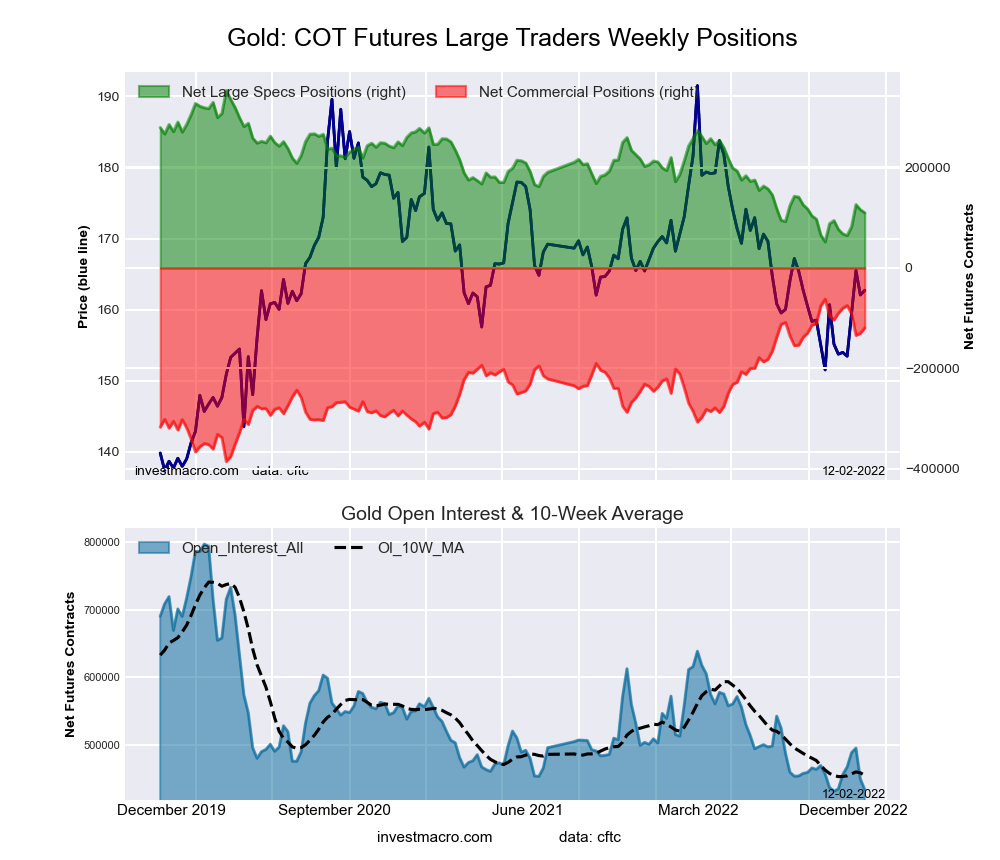
Gold Futures COT ChartThe Gold Comex Futures large speculator standing this week came in at a net position of 76,956 contracts in the data reported through Tuesday. This was a weekly reduction of -17,464 contracts from the previous week which had a total of 94,420 net contracts.

This week’s current strength score (the trader positioning range over the past three years, measured from 0 to 100) shows the speculators are currently Bearish-Extreme with a score of 8.2 percent. The commercials are Bullish-Extreme with a score of 91.4 percent and the small traders (not shown in chart) are Bearish-Extreme with a score of 12.4 percent.

Gold Futures StatisticsSPECULATORSCOMMERCIALSSMALL TRADERS
– Percent of Open Interest Longs:48.526.59.0
– Percent of Open Interest Shorts:30.847.26.0
– Net Position:76,956-90,03013,074
– Gross Longs:210,890115,07339,286
– Gross Shorts:133,934205,10326,212
– Long to Short Ratio:1.6 to 10.6 to 11.5 to 1
NET POSITION TREND:
– Strength Index Score (3 Year Range Pct):8.291.412.4
– Strength Index Reading (3 Year Range):Bearish-ExtremeBullish-ExtremeBearish-Extreme
NET POSITION MOVEMENT INDEX:
– 6-Week Change in Strength Index:-8.97.47.2


Silver Comex Futures:

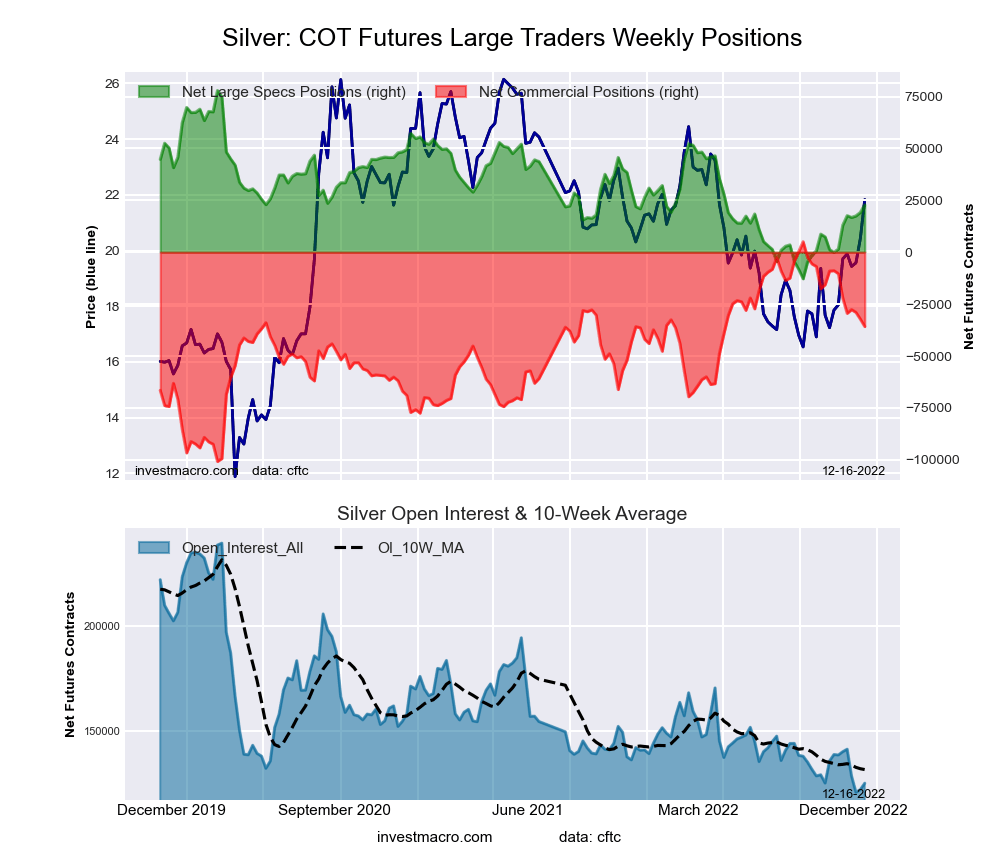
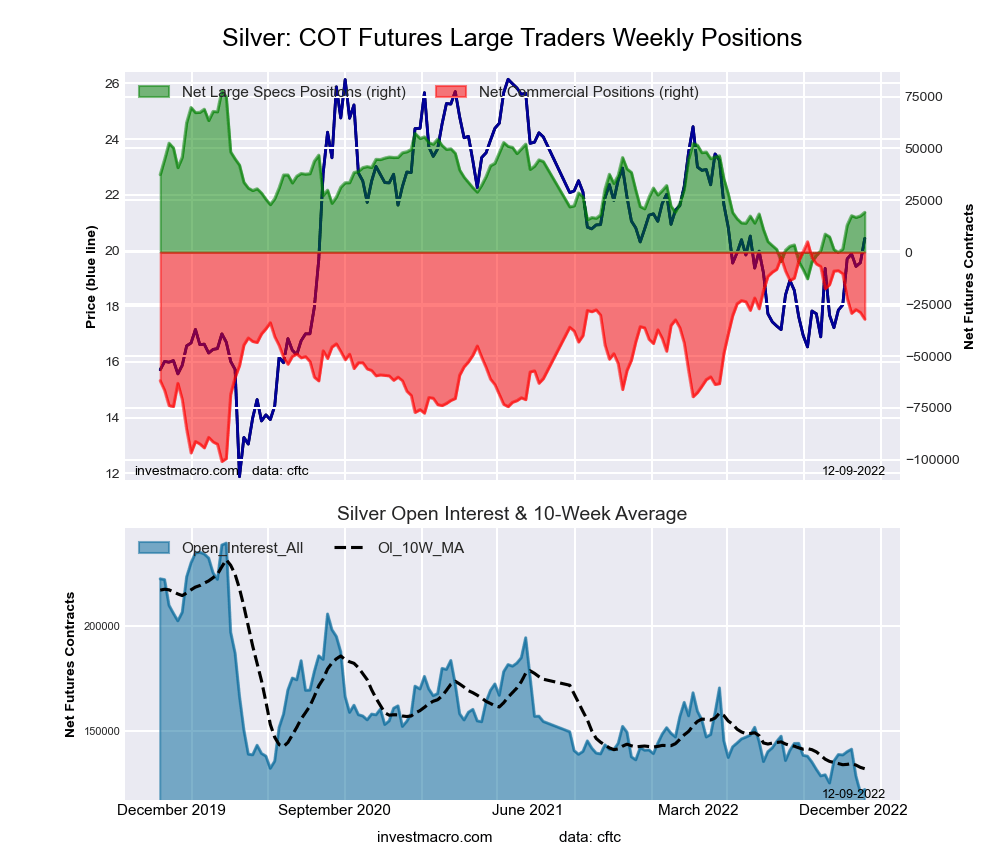
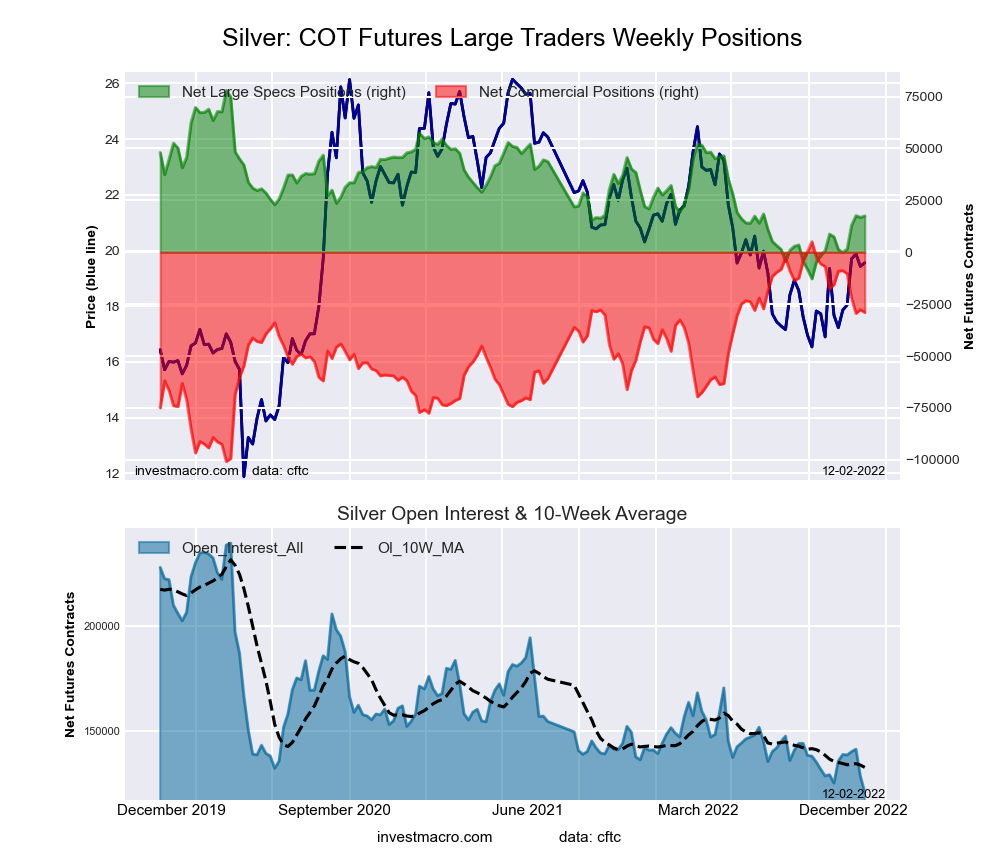
Silver Futures COT ChartThe Silver Comex Futures large speculator standing this week came in at a net position of 1,267 contracts in the data reported through Tuesday. This was a weekly decline of -6,122 contracts from the previous week which had a total of 7,389 net contracts.

This week’s current strength score (the trader positioning range over the past three years, measured from 0 to 100) shows the speculators are currently Bearish-Extreme with a score of 15.5 percent. The commercials are Bullish-Extreme with a score of 86.6 percent and the small traders (not shown in chart) are Bearish-Extreme with a score of 8.2 percent.

Silver Futures StatisticsSPECULATORSCOMMERCIALSSMALL TRADERS
– Percent of Open Interest Longs:37.937.516.2
– Percent of Open Interest Shorts:37.044.110.4
– Net Position:1,267-9,0857,818
– Gross Longs:51,54150,95622,014
– Gross Shorts:50,27460,04114,196
– Long to Short Ratio:1.0 to 10.8 to 11.6 to 1
NET POSITION TREND:
– Strength Index Score (3 Year Range Pct):15.586.68.2
– Strength Index Reading (3 Year Range):Bearish-ExtremeBullish-ExtremeBearish-Extreme
NET POSITION MOVEMENT INDEX:
– 6-Week Change in Strength Index:15.5-13.40.4


Copper Grade #1 Futures:

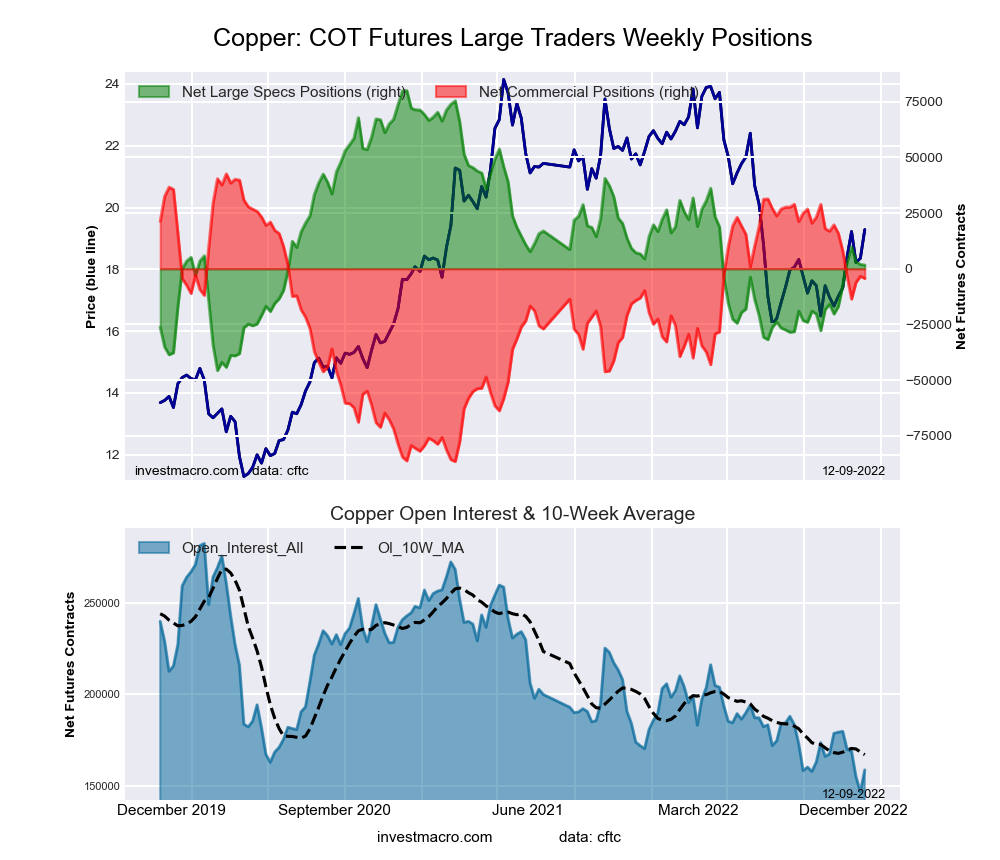
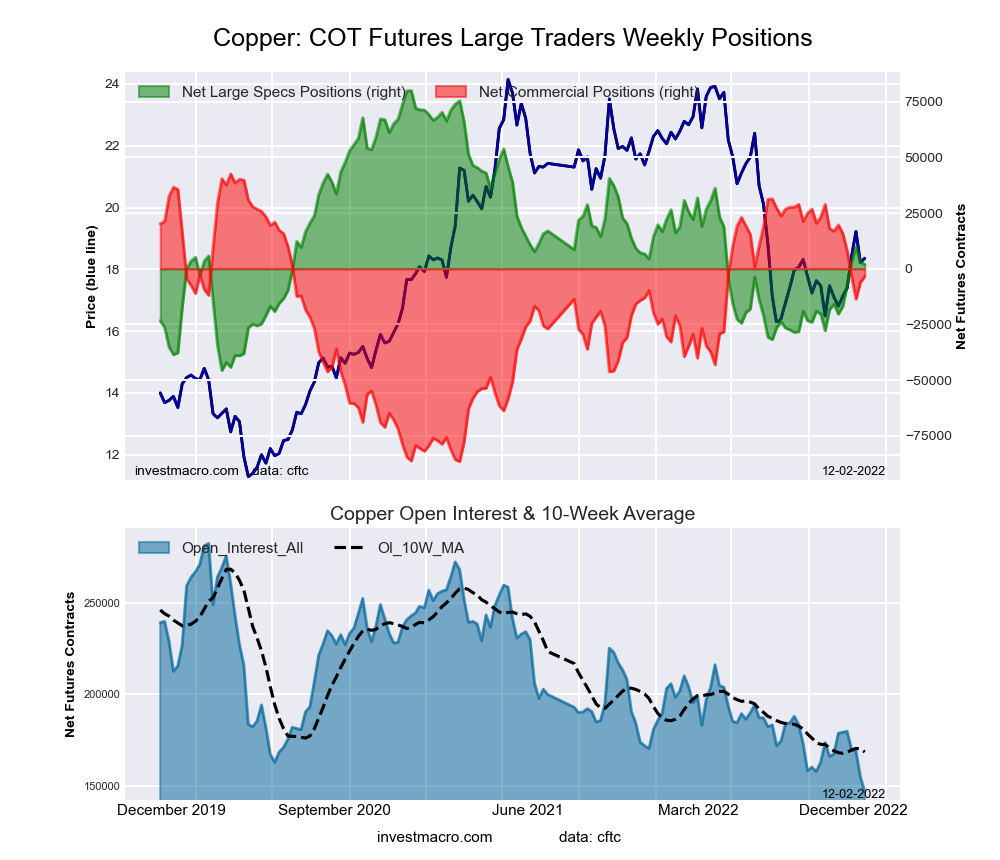
Copper Futures COT ChartThe Copper Grade #1 Futures large speculator standing this week came in at a net position of -20,302 contracts in the data reported through Tuesday. This was a weekly decline of -4,403 contracts from the previous week which had a total of -15,899 net contracts.

This week’s current strength score (the trader positioning range over the past three years, measured from 0 to 100) shows the speculators are currently Bearish with a score of 20.2 percent. The commercials are Bullish-Extreme with a score of 82.3 percent and the small traders (not shown in chart) are Bearish with a score of 28.8 percent.

Copper Futures StatisticsSPECULATORSCOMMERCIALSSMALL TRADERS
– Percent of Open Interest Longs:27.646.48.5
– Percent of Open Interest Shorts:39.035.48.1
– Net Position:-20,30219,696606
– Gross Longs:49,33582,89015,118
– Gross Shorts:69,63763,19414,512
– Long to Short Ratio:0.7 to 11.3 to 11.0 to 1
NET POSITION TREND:
– Strength Index Score (3 Year Range Pct):20.282.328.8
– Strength Index Reading (3 Year Range):BearishBullish-ExtremeBearish
NET POSITION MOVEMENT INDEX:
– 6-Week Change in Strength Index:2.9-5.519.9


Platinum Futures:

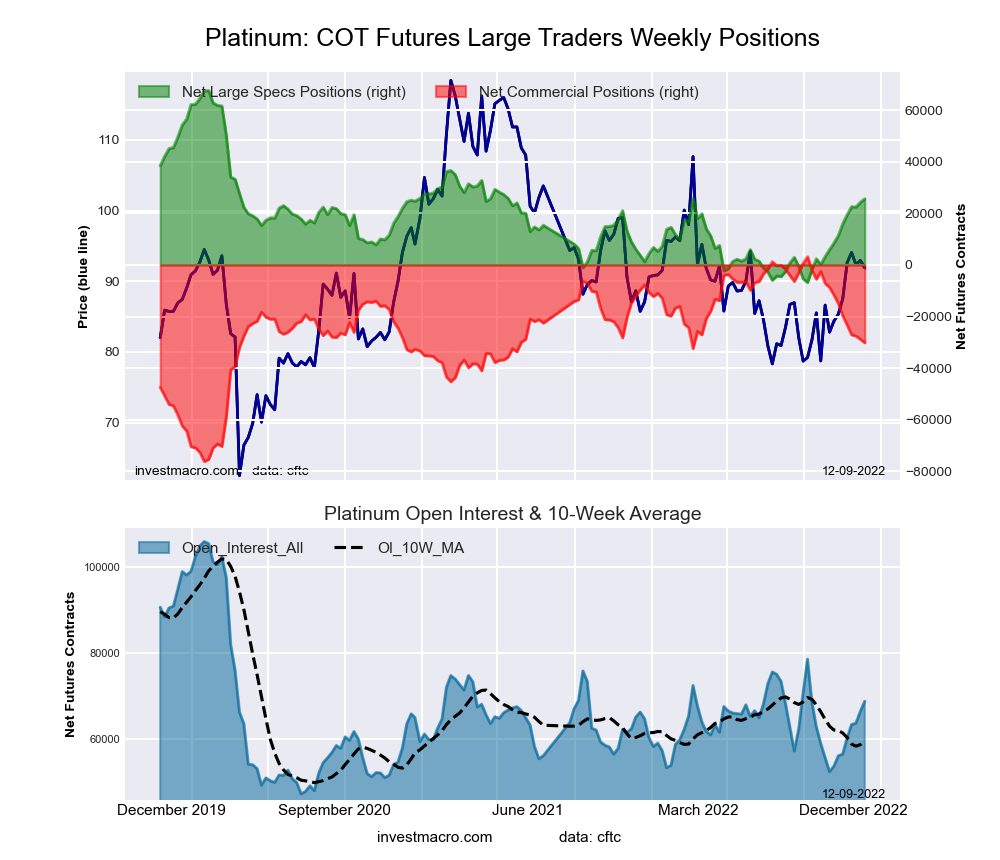
Platinum Futures COT ChartThe Platinum Futures large speculator standing this week came in at a net position of 8,494 contracts in the data reported through Tuesday. This was a weekly gain of 2,566 contracts from the previous week which had a total of 5,928 net contracts.

This week’s current strength score (the trader positioning range over the past three years, measured from 0 to 100) shows the speculators are currently Bearish with a score of 20.5 percent. The commercials are Bullish-Extreme with a score of 81.4 percent and the small traders (not shown in chart) are Bearish-Extreme with a score of 10.3 percent.

Platinum Futures StatisticsSPECULATORSCOMMERCIALSSMALL TRADERS
– Percent of Open Interest Longs:49.136.112.0
– Percent of Open Interest Shorts:33.357.86.1
– Net Position:8,494-11,6323,138
– Gross Longs:26,38519,4066,436
– Gross Shorts:17,89131,0383,298
– Long to Short Ratio:1.5 to 10.6 to 12.0 to 1
NET POSITION TREND:
– Strength Index Score (3 Year Range Pct):20.581.410.3
– Strength Index Reading (3 Year Range):BearishBullish-ExtremeBearish-Extreme
NET POSITION MOVEMENT INDEX:
– 6-Week Change in Strength Index:20.5-18.6-6.1


Palladium Futures:

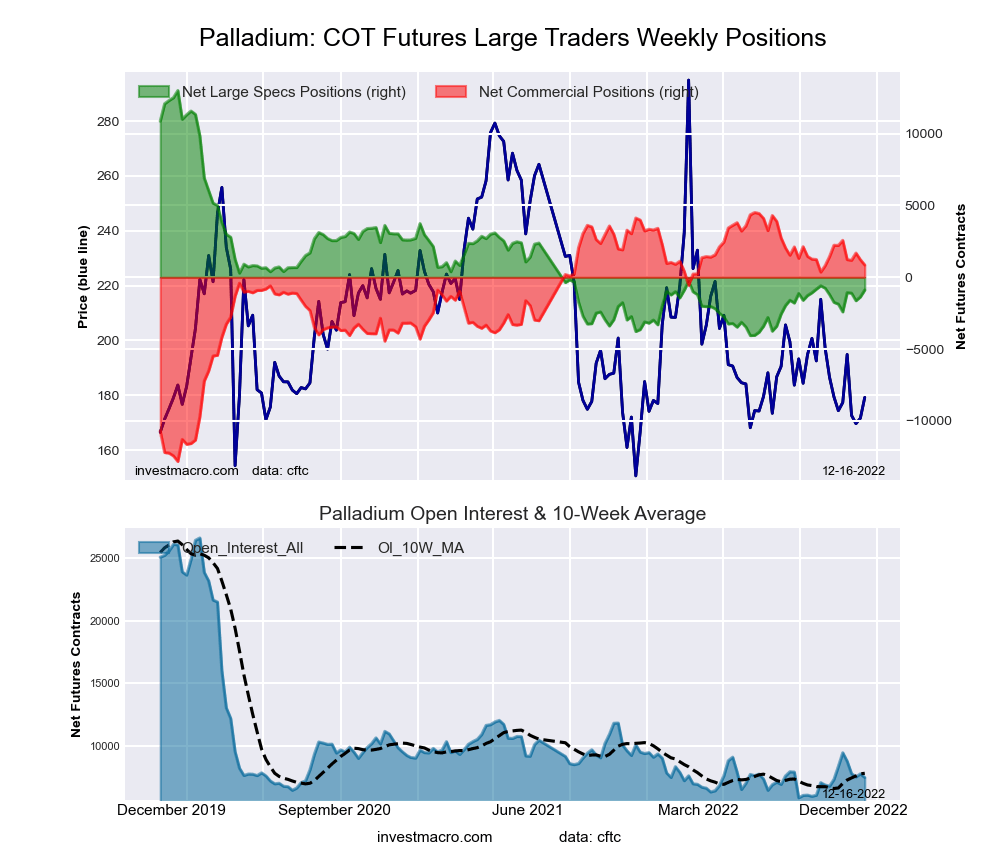
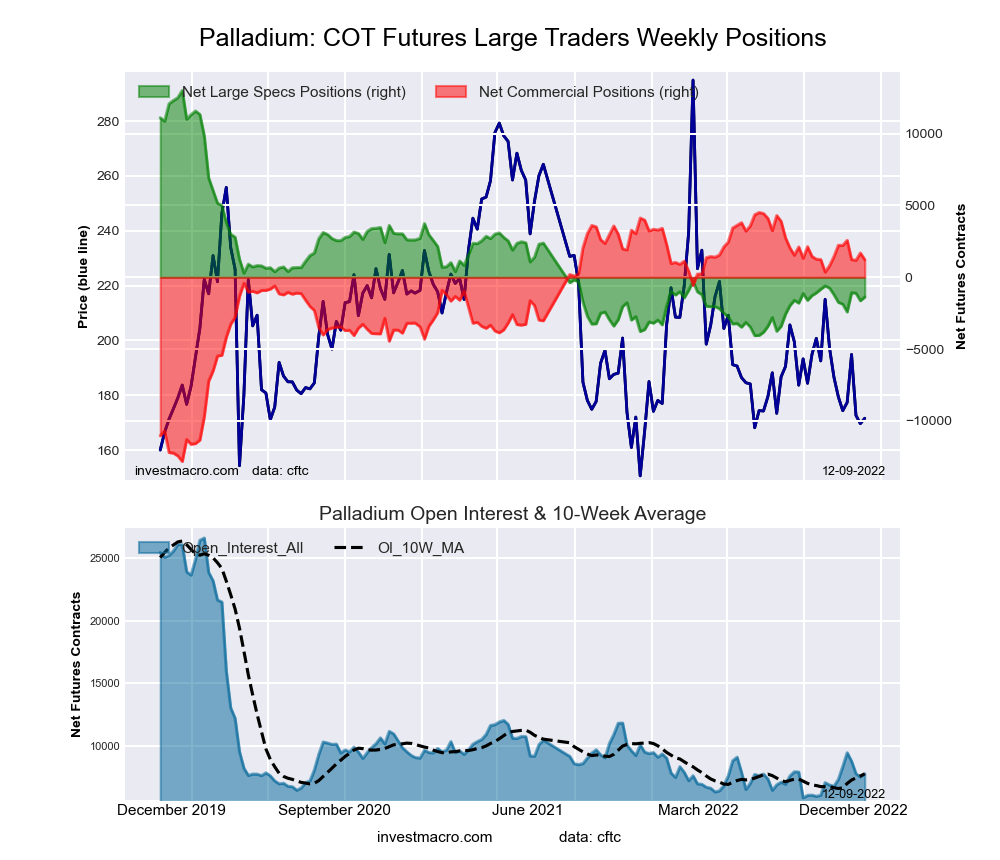
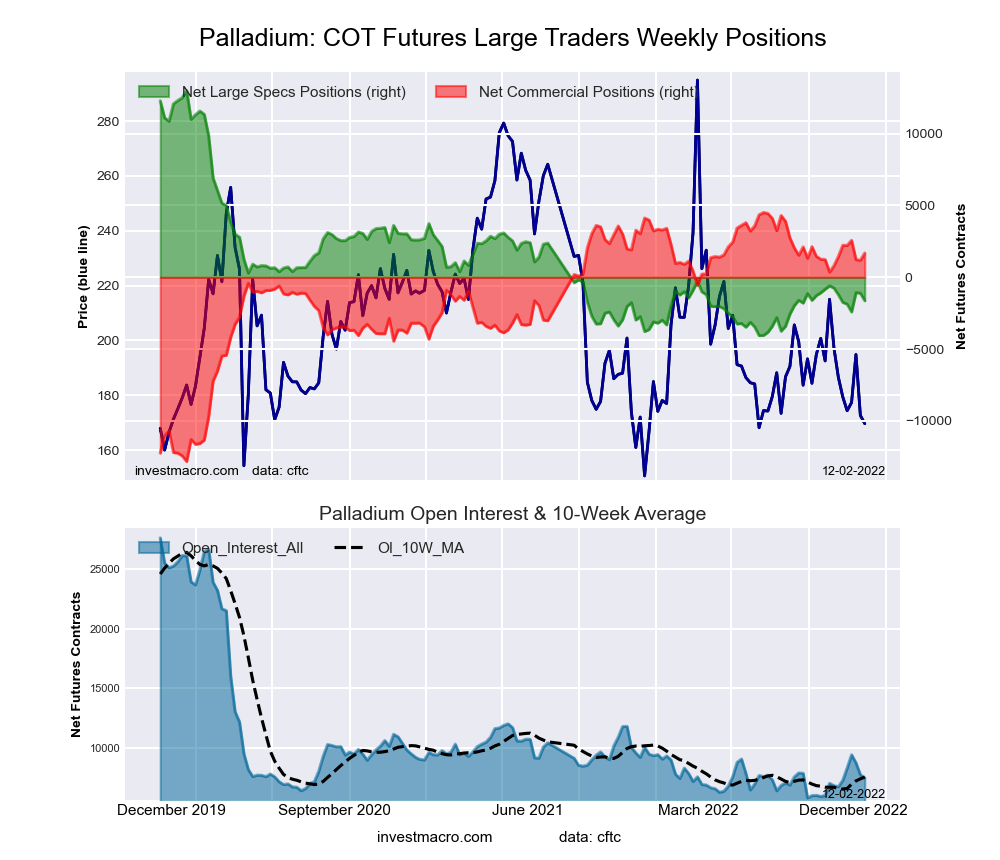
Palladium Futures COT ChartThe Palladium Futures large speculator standing this week came in at a net position of -1,209 contracts in the data reported through Tuesday. This was a weekly fall of -455 contracts from the previous week which had a total of -754 net contracts.

This week’s current strength score (the trader positioning range over the past three years, measured from 0 to 100) shows the speculators are currently Bearish-Extreme with a score of 16.4 percent. The commercials are Bullish-Extreme with a score of 82.3 percent and the small traders (not shown in chart) are Bearish with a score of 30.3 percent.

Palladium Futures StatisticsSPECULATORSCOMMERCIALSSMALL TRADERS
– Percent of Open Interest Longs:26.358.314.3
– Percent of Open Interest Shorts:44.137.117.8
– Net Position:-1,2091,444-235
– Gross Longs:1,7933,968975
– Gross Shorts:3,0022,5241,210
– Long to Short Ratio:0.6 to 11.6 to 10.8 to 1
NET POSITION TREND:
– Strength Index Score (3 Year Range Pct):16.482.330.3
– Strength Index Reading (3 Year Range):Bearish-ExtremeBullish-ExtremeBearish
NET POSITION MOVEMENT INDEX:
– 6-Week Change in Strength Index:2.3-4.016.9


Article By InvestMacroReceive our weekly COT Newsletter

*COT Report: The COT data, released weekly to the public each Friday, is updated through the most recent Tuesday (data is 3 days old) and shows a quick view of how large speculators or non-commercials (for-profit traders) were positioned in the futures markets.

The CFTC categorizes trader positions according to commercial hedgers (traders who use futures contracts for hedging as part of the business), non-commercials (large traders who speculate to realize trading profits) and nonreportable traders (usually small traders/speculators) as well as their open interest (contracts open in the market at time of reporting). See CFTC criteria here.

Lithium Co.’s Drill Results Spark Interest

Source: Streetwise Reports  (10/19/22)

Frontier Lithium Inc. announced the latest group of drill results from its Spark Deposit in northwestern Ontario. The firm reported it intersected 326.6m of pegmatite averaging 1.92% lithium oxide (Li2O), which included a 50m high-grade zone of 2.98% Li2O. Canaccord Genuity Corp. (Canada) advised in a research update that the positive results achieved in Frontier’s Phase XII drill program once again demonstrate grades that are well above the current mineral resource estimate of 1.38% Li2O.

Pure-play lithium developer Frontier Lithium Inc. (FL:TSX.V; LITOF:OTCQX; HL2:FRA) recently announced results from its ongoing Phase XII drill program that commenced in May 2022.

The firm’s 100%-owned PAK Lithium Project contains two delineated premium spodumene-bearing lithium deposits known as the Spark and the PAK deposits. The company stated that through September 11, 2022, it has drilled a total of 11,150 meters (m) across 34 holes during its Phase XII delineation and infill drilling program and indicated that the data it just released pertains to results from four holes drilled at Spark.

Canaccord Genuity Corp. (Canada) Analyst Katie Lachapelle, CPA, commented, “We continue to be impressed by the positive results from the Phase XII drill program.”

The firm said that these four additional drill holes targeting the Spark Deposit were designed to “convert inferred material to the indicated category for the planned open pit.”

Frontier highlighted that Hole DDH PL-065-22 intersected 171.5m of pegmatite averaging 1.57% lithium oxide (Li2O), and Hole PL-062-22 returned 19.2m of 2.88% Li2O, 2.23% cesium oxide (Cs2O) and 513 ppm (parts per million) tantalum pentoxide (Ta2O5).

The firm indicated that Hole DDH PL-067-22, which was drilled with the goal of converting inferred material at depth, intercepted 326.6m of pegmatite averaging 1.92% Li2O, including a section of 50m averaging 2.98% Li2O.

Two other holes, DDH PL-069-22 and DDH PL-072-22, intersected 275.3m of pegmatite, averaging 1.74% Li2O, and 124.1m of pegmatite, averaging 1.55% Li2O, respectively.

The company’s V.P. of Exploration Garth Drever remarked, “After tripling the meters drilled since the Resource update in March 2021 and targeting the Inferred, it is safe to say that the model remains robust and there will be substantial new Inferred.”

Drever noted that “the Spark deposit remains open in all directions with predictable grades and widths” and added that he is “extremely pleased with the drilling results to date.”

Lachappel commented, “The consistency of Frontier’s high-grade hits leads us to believe that there is a strong likelihood that the company will report an indicated resource with a higher overall grade. We also expect the updated mineral resource to include new inferred material, with drilling indicating that the Spark deposit is still open in all directions.”

In an October 11, 2022 research note, Canaccord Genuity Corp. (Canada) Analyst Katie Lachapelle, CPA, commented, “We continue to be impressed by the positive results from the Phase XII drill program, which continue to demonstrate grades well above the current mineral resource estimate (1.38% Li2O).”

The analyst emphasized this is evidenced by these latest results, which all returned significant widths averaging 1.55%, 1.57%, 1.74%, and 1.92% Li2O.

The report mentioned that the PAK Lithium Project encompasses nearly 27,000 ha (hectares) and “contains North America’s highest grade lithium resource that is top three in size on the continent and is considered premium quality globally as a result of its rare low-iron spodumene.” The PAK Project hosts a Measured and Indicated resource of 21.64 Mt (million tonnes) averaging 1.56% Li2O and an Inferred resource of 20.87 Mt averaging 1.42% Li2O.

As outlined in an N-43-101 compliant technical report issued on April 5, 2021, the plans for the Pak Project include “a fully integrated lithium operation from the resource to achieve downstream conversion plan for [the] production of battery-quality lithium salts.” The report estimated that the property had an after-tax net present value (NPV) of US$974M (million) with an internal rate of return (IRR) of 21%.

In addition, two other spodumene-bearing discoveries have been made within the confines of the PAK property, including the Bolt pegmatite and Pennock pegmatite areas.

The Catalyst

Frontier Lithium advised in its most recent news release that it is currently utilizing a phased approach to preparing a Preliminary Feasibility Study (PFS), which should be ready in Q1/23. The company indicated that during Phase 1, it will focus on mine advancement and mill development with the objective of producing premium-grade spodumene concentrates.

Canaccord presently maintains a “Speculative Buy” rating and a CA$4.75 per share target price for Frontier Lithium Inc. This target price is a 114.932% increase from the current price of CA$2.21.

During Phase 2, the firm said it will concentrate its efforts on raising mine and mill production volumes in order to supply its downstream refinery with materials needed to produce lithium chemicals intended for use in the energy storage and electric vehicle (EV) battery market.

The completion and delivery of the PFS may prove to be a positive catalyst going forward. In the October 11, 2022 research note, Canaccord Analyst Lachapelle stated that strong existing and future demand for concentrate provides a solid basis for a phased approach to development.

Lachappel commented, “The consistency of Frontier’s high-grade hits leads us to believe that there is a strong likelihood that the company will report an indicated resource with a higher overall grade. We also expect the updated mineral resource to include new inferred material, with drilling indicating that the Spark deposit is still open in all directions.”

Lachapelle noted that “Frontier Lithium currently trades at 0.48x NAV (net asset value), which we believe is an attractive discount to peers at 0.64x NAV.” Canaccord presently maintains a “Speculative Buy” rating and a CA$4.75 per share target price for Frontier Lithium Inc. This target price is a 114.932% increase from the current price of CA$2.21.

Resource Expansion Potential

Recent drill results show room for further resource growth at the company’s Electric Avenue District property.

Frontier Lithium’s V.P. of Exploration Garth Drever commented, “Our modeling beneath the central indicated resource appears solid, and drilling to the west continues to intersect significant pegmatite zones, and the Spark deposit remains open in all directions and zones of elevated tantalum and cesium along with lithium are being delineated.”

Lachapelle pointed out that Canaccord’s valuation for Frontier was predicated upon the extraction and processing of material produced by only a 23Mt resource, which is far below the firm’s total current resource, which has grown to 42Mt grading 1.54% Li2O and “is among the largest in North America and highest grade.”

Lachapelle continued, “Based on the consistency of infill drilling to date, we expect the majority of Frontier’s existing mineral resource at Spark to be upgraded and included in the mine plan in the future, which could result in a mine life extension of ~14-18 years (18Mt currently included in our mine plan; 32Mt current resource, ~1Mtpa processing).”

Company Operations

Frontier Lithium is a lithium exploration and development company based in Sudbury, Ont., Canada. The company is focused on the development and production of battery-grade lithium hydroxide and lithium salts for the North American EV battery and energy storage markets. Its wholly owned PAK Lithium Project is located in the premier Electric Avenue lithium mining district in northwestern Ontario.

The PAK project includes the PAK Deposit, which has a Measured, Indicated, and Inferred resource of 9.3 MT averaging 2.06% Li2O, and the larger Spark Deposit, which is located just 2.3 km away from PAK and has an estimated Indicated resource of 14.4 MT averaging 1.40% Li2O and an Inferred resource of 18.1 MT averaging 1.37% Li2O.

The property hosts what is believed to be one of the highest-grade large-tonnage hard rock lithium resources in North America. The company’s plans call for “a fully integrated operation from open pit mining through to chemical production (LiOH, 23kt per year).”

Share Structure, Ownership, and Coverage

Frontier Lithium has a diversified investor base. In aggregate, the firm’s management, directors, and advisors own about 25% of the company’s total outstanding shares. Institutional and private investors together account for about 20%, and the remaining 55% is owned by public shareholders.

The company has a market cap of CA$462.26 million with 213.02 million shares outstanding, and the firm’s shares trade in a 52-week range between CA$0.88 and CA$3.89.

Currently, Frontier Lithium is covered by Analyst Katie Lachapelle of Canaccord Genuity and newsletter writers Christ Temple and Clive Maund. Please click “See More Live Data” in the data box above to view more coverage. 

Frontier Lithium Inc.’s shares trade on the TSX Venture Exchange under the symbol “FL” and last closed for trading at CA$2.17/share on October 18, 2022. The company’s shares are also listed in the U.S. on the OTCQX under the symbol “LITOF” and under the designation “HL2” on the Frankfort Stock Exchange in Germany.

Disclosures:
1) Stephen Hytha wrote this article for Streetwise Reports LLC and provides services to Streetwise Reports as an independent contractor. He or members of his household own securities of the following companies mentioned in the article: None. He or members of his household are paid by the following companies mentioned in this article: None.

2) The following companies mentioned in this article are billboard sponsors of Streetwise Reports: Frontier Lithium Inc. Click here for important disclosures about sponsor fees. As of the date of this article, an affiliate of Streetwise Reports has a consulting relationship with None. Please click here for more information. The information provided above is for informational purposes only and is not a recommendation to buy or sell any security.

3) Comments and opinions expressed are those of the specific experts and not of Streetwise Reports or its officers. The information provided above is for informational purposes only and is not a recommendation to buy or sell any security.

4) This article does not constitute investment advice. Each reader is encouraged to consult with his or her individual financial professional and any action a reader takes as a result of information presented here is his or her own responsibility. By opening this page, each reader accepts and agrees to Streetwise Reports’ terms of use and full legal disclaimer. This article is not a solicitation for investment. Streetwise Reports does not render general or specific investment advice and the information on Streetwise Reports should not be considered a recommendation to buy or sell any security. Streetwise Reports does not endorse or recommend the business, products, services or securities of any company mentioned on Streetwise Reports.

5) From time to time, Streetwise Reports LLC and its directors, officers, employees or members of their families, as well as persons interviewed for articles and interviews on the site, may have a long or short position in securities mentioned. Directors, officers, employees or members of their immediate families are prohibited from making purchases and/or sales of those securities in the open market or otherwise from the time of the decision to publish an article until three business days after the publication of the article. The foregoing prohibition does not apply to articles that in substance only restate previously published company releases. As of the date of this article, officers and/or employees of Streetwise Reports LLC (including members of their household) own securities of Frontier Lithium Inc., a company mentioned in this article.


COT Metals Speculators boost their Gold bullish bets 2nd week

By InvestMacro

Here are the latest charts and statistics for the Commitment of Traders (COT) data published by the Commodities Futures Trading Commission (CFTC).

The latest COT data is updated through Tuesday October 11th and shows a quick view of how large traders (for-profit speculators and commercial entities) were positioned in the futures markets.

Weekly Speculator Changes shows Gold, Platinum & Copper have higher bets

The COT precious metals speculator bets were higher this week as three out of the five metals markets we cover had higher positioning this week while two markets had lower contracts.

Leading the gains for the precious metals markets was Gold (6,035 contracts) with Platinum (2,647 contracts) and Copper (2,352 contracts) also showing a positive week.

The metals markets leading the declines in speculator bets this week were Silver (-1,319 contracts) with Palladium (-158 contracts) also registering lower bets on the week.

Highlighting the metals COT markets this week is the Gold positioning that has rebounded slightly from the steep declines over the past couple of months. Gold speculator bets rose for a second straight week this week after seeing a decline in the previous seven straight weeks (a total drop of -90,770 speculator contracts over that period). The Gold position, on September 27th, had fallen to the lowest level in the past 179-weeks before rebounding over the past two weeks. Last week’s rise in speculator bets by over +36,000 contracts was the largest one-week increase since February 18th of 2020 and today’s speculator positioning is now back close to the +100,000 contract level. Gold prices, meanwhile, are currently trading just below the $1,650 support level after falling over 3 percent this week. The price decline is potentially setting up a new test of the 2-year lows under $1,620 that took place in late September.


Data Snapshot of Commodity Market Traders | Columns Legend
Oct-11-2022OIOI-IndexSpec-NetSpec-IndexCom-NetCOM-IndexSmalls-NetSmalls-Index
WTI Crude1,499,4983259,22013-283,6268824,40641
Gold431,395094,42014-103,728879,3083
Silver125,62307,38922-15,603808,21410
Copper167,4498-15,8992416,90380-1,00419
Palladium6,8905-7541981079-5641
Platinum52,43595,92817-8,690852,7625
Natural Gas974,4685-162,10330130,0997232,00456
Brent163,11311-41,8884138,882583,00650
Heating Oil275,2622519,42371-38,4483019,02564
Soybeans694,9602655,76930-30,61477-25,15529
Corn1,408,93920325,12172-258,22535-66,8965
Coffee188,198340,53473-43,359302,82529
Sugar687,2090101,11557-135,1454334,03050
Wheat307,9019-1,990168,70572-6,71576


Silver and Copper top the Strength Scores

Strength scores (a measure of the 3-Year range of Speculator positions, from 0 to 100 where above 80 is extreme bullish and below 20 is extreme bearish) showed that the Copper (23.7 percent) and Silver (22.3 percent) lead the metals this week.

On the downside, Gold (14.0 percent), Platinum (17.1 percent) and Palladium (19.1 percent) continue to be at the lower end of their range and are all in bearish extreme positions below 20 percent.

Strength Statistics:
Gold (14.0 percent) vs Gold previous week (12.0 percent)
Silver (22.3 percent) vs Silver previous week (23.7 percent)
Copper (23.7 percent) vs Copper previous week (21.8 percent)
Platinum (17.1 percent) vs Platinum previous week (13.5 percent)
Palladium (19.1 percent) vs Palladium previous week (20.0 percent)

Strength Trends led Silver and Platinum

Strength Score Trends (or move index, calculates the 6-week changes in strength scores) show that the Silver (17.3 percent) and Platinum (15.2 percent) lead the past six weeks trends for metals this week. Copper (5.9 percent) and Palladium (2.2 percent) fill out the other positive movers in the latest trends data.

This leaves Gold (-7.7 percent) as the only negative mover over the past six weeks. Gold, however, has been seeing improvements in the past few weeks and is higher this week from -12.4 percent last week.

Move Statistics:
Gold (-7.7 percent) vs Gold previous week (-12.4 percent)
Silver (17.3 percent) vs Silver previous week (14.6 percent)
Copper (5.9 percent) vs Copper previous week (0.6 percent)
Platinum (15.2 percent) vs Platinum previous week (5.2 percent)
Palladium (2.2 percent) vs Palladium previous week (6.9 percent)


Individual Markets:

Gold Comex Futures:

Gold Futures COT ChartThe Gold Comex Futures large speculator standing this week came in at a net position of 94,420 contracts in the data reported through Tuesday. This was a weekly gain of 6,035 contracts from the previous week which had a total of 88,385 net contracts.

This week’s current strength score (the trader positioning range over the past three years, measured from 0 to 100) shows the speculators are currently Bearish-Extreme with a score of 14.0 percent. The commercials are Bullish-Extreme with a score of 87.1 percent and the small traders (not shown in chart) are Bearish-Extreme with a score of 2.9 percent.

Gold Futures StatisticsSPECULATORSCOMMERCIALSSMALL TRADERS
– Percent of Open Interest Longs:49.326.28.6
– Percent of Open Interest Shorts:27.450.26.4
– Net Position:94,420-103,7289,308
– Gross Longs:212,561112,86736,988
– Gross Shorts:118,141216,59527,680
– Long to Short Ratio:1.8 to 10.5 to 11.3 to 1
NET POSITION TREND:
– Strength Index Score (3 Year Range Pct):14.087.12.9
– Strength Index Reading (3 Year Range):Bearish-ExtremeBullish-ExtremeBearish-Extreme
NET POSITION MOVEMENT INDEX:
– 6-Week Change in Strength Index:-7.78.0-6.6


Silver Comex Futures:

Silver Futures COT ChartThe Silver Comex Futures large speculator standing this week came in at a net position of 7,389 contracts in the data reported through Tuesday. This was a weekly decrease of -1,319 contracts from the previous week which had a total of 8,708 net contracts.

This week’s current strength score (the trader positioning range over the past three years, measured from 0 to 100) shows the speculators are currently Bearish with a score of 22.3 percent. The commercials are Bullish-Extreme with a score of 80.5 percent and the small traders (not shown in chart) are Bearish-Extreme with a score of 10.1 percent.

Silver Futures StatisticsSPECULATORSCOMMERCIALSSMALL TRADERS
– Percent of Open Interest Longs:38.237.917.0
– Percent of Open Interest Shorts:32.350.310.5
– Net Position:7,389-15,6038,214
– Gross Longs:47,93947,60321,347
– Gross Shorts:40,55063,20613,133
– Long to Short Ratio:1.2 to 10.8 to 11.6 to 1
NET POSITION TREND:
– Strength Index Score (3 Year Range Pct):22.380.510.1
– Strength Index Reading (3 Year Range):BearishBullish-ExtremeBearish-Extreme
NET POSITION MOVEMENT INDEX:
– 6-Week Change in Strength Index:17.3-15.01.0


Copper Grade #1 Futures:

Copper Futures COT ChartThe Copper Grade #1 Futures large speculator standing this week came in at a net position of -15,899 contracts in the data reported through Tuesday. This was a weekly gain of 2,352 contracts from the previous week which had a total of -18,251 net contracts.

This week’s current strength score (the trader positioning range over the past three years, measured from 0 to 100) shows the speculators are currently Bearish with a score of 23.7 percent. The commercials are Bullish-Extreme with a score of 80.1 percent and the small traders (not shown in chart) are Bearish-Extreme with a score of 19.5 percent.

Copper Futures StatisticsSPECULATORSCOMMERCIALSSMALL TRADERS
– Percent of Open Interest Longs:30.547.28.3
– Percent of Open Interest Shorts:40.037.18.9
– Net Position:-15,89916,903-1,004
– Gross Longs:51,02179,07913,853
– Gross Shorts:66,92062,17614,857
– Long to Short Ratio:0.8 to 11.3 to 10.9 to 1
NET POSITION TREND:
– Strength Index Score (3 Year Range Pct):23.780.119.5
– Strength Index Reading (3 Year Range):BearishBullish-ExtremeBearish-Extreme
NET POSITION MOVEMENT INDEX:
– 6-Week Change in Strength Index:5.9-6.34.2


Platinum Futures:

Platinum Futures COT ChartThe Platinum Futures large speculator standing this week came in at a net position of 5,928 contracts in the data reported through Tuesday. This was a weekly boost of 2,647 contracts from the previous week which had a total of 3,281 net contracts.

This week’s current strength score (the trader positioning range over the past three years, measured from 0 to 100) shows the speculators are currently Bearish-Extreme with a score of 17.1 percent. The commercials are Bullish-Extreme with a score of 85.1 percent and the small traders (not shown in chart) are Bearish-Extreme with a score of 5.3 percent.

Platinum Futures StatisticsSPECULATORSCOMMERCIALSSMALL TRADERS
– Percent of Open Interest Longs:46.438.012.5
– Percent of Open Interest Shorts:35.054.67.2
– Net Position:5,928-8,6902,762
– Gross Longs:24,30619,9476,554
– Gross Shorts:18,37828,6373,792
– Long to Short Ratio:1.3 to 10.7 to 11.7 to 1
NET POSITION TREND:
– Strength Index Score (3 Year Range Pct):17.185.15.3
– Strength Index Reading (3 Year Range):Bearish-ExtremeBullish-ExtremeBearish-Extreme
NET POSITION MOVEMENT INDEX:
– 6-Week Change in Strength Index:15.2-11.8-26.2


Palladium Futures:

Palladium Futures COT ChartThe Palladium Futures large speculator standing this week came in at a net position of -754 contracts in the data reported through Tuesday. This was a weekly fall of -158 contracts from the previous week which had a total of -596 net contracts.

This week’s current strength score (the trader positioning range over the past three years, measured from 0 to 100) shows the speculators are currently Bearish-Extreme with a score of 19.1 percent. The commercials are Bullish with a score of 79.0 percent and the small traders (not shown in chart) are Bearish with a score of 40.6 percent.

Palladium Futures StatisticsSPECULATORSCOMMERCIALSSMALL TRADERS
– Percent of Open Interest Longs:29.753.116.2
– Percent of Open Interest Shorts:40.741.317.1
– Net Position:-754810-56
– Gross Longs:2,0493,6561,119
– Gross Shorts:2,8032,8461,175
– Long to Short Ratio:0.7 to 11.3 to 11.0 to 1
NET POSITION TREND:
– Strength Index Score (3 Year Range Pct):19.179.040.6
– Strength Index Reading (3 Year Range):Bearish-ExtremeBullishBearish
NET POSITION MOVEMENT INDEX:
– 6-Week Change in Strength Index:2.2-2.98.0


Article By InvestMacroReceive our weekly COT Newsletter

*COT Report: The COT data, released weekly to the public each Friday, is updated through the most recent Tuesday (data is 3 days old) and shows a quick view of how large speculators or non-commercials (for-profit traders) were positioned in the futures markets.

The CFTC categorizes trader positions according to commercial hedgers (traders who use futures contracts for hedging as part of the business), non-commercials (large traders who speculate to realize trading profits) and nonreportable traders (usually small traders/speculators) as well as their open interest (contracts open in the market at time of reporting). See CFTC criteria here.

Silver Co. Posts Record Production in Q3; Raises FY Guidance

Source: Streetwise Reports  (10/13/22)

Shares of Gatos Silver Inc. traded 29% higher yesterday after the company reported it achieved record levels of production at its Cerro Los Gatos mine during Q3/22. The firm raised its FY/22 production guidance while lowering its operating cost estimates.

After U.S. markets closed Tuesday, silver explorer, developer, and producer Gatos Silver Inc. (GATO:TSX; GATO:NYSE) announced “record production results from its 70%-owned Cerro Los Gatos (CLG) mine for the quarter and nine months ended September 30, 2022.”

The company highlighted that in Q3/22, silver production at GLG increased by 59% to 2.7 Moz Ag (million ounces silver), compared to 1.7 Moz Ag in Q3/21.

The firm advised that due to the positive results it achieved in Q3/22, it is raising its FY/22 production guidance and, at the same time, is lowering its FY/22 cost guidance.

Gatos Silver’s CEO Dale Andres stated, “Our continued strong operating performance at CLG during the quarter reflects planned production sequencing, with mill throughput exceeding design capacity by 15% and with higher ore grades compared with a year earlier.”

Gatos Silver raised its forward silver production guidance at the CLG mine by 9.2% over its previous estimates and advised that for FY/22, it expects the mine to produce 9.35-9.65 Moz Ag (silver), compared to its prior projections of 8.50-9.0 Moz Ag.

“Our priority exploration and definition drilling objectives are to extend our mine life by converting the higher-grade portion of our current Mineral Resource into Reserves and to follow up on the mineralization recently discovered at depth in the new South-East Deeps zone while assessing its potential implications for the entire Los Gatos district, Andres added.”

In addition to the record silver production mentioned above, during Q3/22, the GLG mine also registered record production of both lead and zinc. Zinc production increased by 32% year-over-year to 17.8 Mlb (million pounds), and lead production rose 13% y-o-y to 12.2 Mlb.

The company explained that the gains in production were attributed to record amounts of higher-grade material processed at the mill, which averaged 2,862 tpd (tonnes per day). The firm stated that it expects to process the same volumes but of somewhat lower-grade ore in Q4/22 as the highest-grade sections of the orebody were milled in Q3/22.

The company said that in Q3/22, it completed a fourth lift of the tailings dam and indicated that the construction of its paste plant is nearly finished. These events are expected to increase productivity and lower operating costs beginning in Q4/22.

Gatos Silver raised its forward silver production guidance at the CLG mine by 9.2% over its previous estimates and advised that for FY/22, it expects the mine to produce 9.35-9.65 Moz Ag (silver), compared to its prior projections of 8.50-9.0 Moz Ag.

The company added that it is also raising its estimates for gold (Au), lead (Pb), and zinc (Zn) concentrates production by even higher per percentages and stated that for FY/22, it expects to produce 5.0-5.3 Koz Au (thousand ounces gold), 43-45 Mlb Pb (million pounds lead), and 58-61 Mlb Zn.

The firm pointed out that while it is increasing production, it is now incurring lower total operating expenses and now expects FY/22 all-in-sustaining costs (AISC) to decrease by about 14% compared to prior forecasts. The company said that for FY/22, it expects AISC on a co-product basis of $15.50-16.50 per Ag eq oz. Gatos added that AISC for payable silver ounces produced is expected to be even lower at $11.50 -12.50 per Ag eq oz.

The firm advised that it estimates that for FY/22, it will have total sustaining capital expenditures in the amount of $75 million.

Gatos Silver mentioned that after it finishes construction of its paste plant in Q4/22, it expects that all-in –sustaining costs (AISC) will fall substantially throughout FY/23. In addition, there are no large expenses projected for tailings dam construction in FY/23, which will also lower overall expenses.

The company noted that, as it previously announced, it is proceeding with its plans to move its executive offices to Vancouver, B.C., from Denver, Colo., and expects to complete the transition in Q4/22.

The firm indicated that as of September 30, 2022, the Los Gatos Joint Venture (LGJV) had a cash balance of $39 million, compared to $40 million on June 30, 2022. In addition, the company advised that because of the CLG mine’s strong operating performance in Q3/22, it received its second quarterly dividend from the LGJV in the amount of $10 million.

The company stated that last week “it announced an updated CLG Mineral Reserve Estimate, Mineral Resource Estimate and Life of Mine plan and expects to produce a new technical report at the end of October 2022.”

Gatos Silver reiterated that, as it advised in a prior news release, it is presently working to find a licensed auditor in B.C., Canada, to perform an audit and complete a review of its financial statements. The firm indicated that it anticipates that at least one material issue may exist and will take the necessary steps to remedy any items discovered in the audit process as soon as practicable.

Specifically, the company advised that “it anticipates completing an impairment assessment based on the 2022 Mineral Reserve in Q4/22 and is working towards completing all outstanding SEC and OSC filings as soon as practicable.”

Gatos Silver is focused on exploration, development, and production at the Cerro Los Gatos deposit in the State of Chihuahua, Mexico, in which it owns a 70% interest through a joint venture. The property encompasses about 103,087 ha and is highly prospective for mining silver, zinc, lead, and some gold.

Gatos Silver started yesterday with a market cap of around $178.4 million, with approximately 69.1 million shares outstanding and a short interest of about 2.4%. GATO shares opened 8% higher yesterday at $2.79 (+$0.21, +8.14%) over the previous day’s $2.58 closing price. The stock traded between $2.78 and $3.43 per share and closed for trading at $3.33 (+$0.78, +29.07%).

Disclosures:
1) Stephen Hytha wrote this article for Streetwise Reports LLC and provides services to Streetwise Reports as an independent contractor. He or members of his household own securities of the following companies mentioned in the article: None. He or members of his household are paid by the following companies mentioned in this article: None.

2) The following companies mentioned in this article are billboard sponsors of Streetwise Reports: None. Click here for important disclosures about sponsor fees.

3) Comments and opinions expressed are those of the specific experts and not of Streetwise Reports or its officers. The information provided above is for informational purposes only and is not a recommendation to buy or sell any security.

4) The article does not constitute investment advice. Each reader is encouraged to consult with his or her individual financial professional and any action a reader takes as a result of information presented here is his or her own responsibility. By opening this page, each reader accepts and agrees to Streetwise Reports’ terms of use and full legal disclaimer. This article is not a solicitation for investment. Streetwise Reports does not render general or specific investment advice and the information on Streetwise Reports should not be considered a recommendation to buy or sell any security. Streetwise Reports does not endorse or recommend the business, products, services or securities of any company mentioned on Streetwise Reports.

5) From time to time, Streetwise Reports LLC and its directors, officers, employees or members of their families, as well as persons interviewed for articles and interviews on the site, may have a long or short position in securities mentioned. Directors, officers, employees or members of their immediate families are prohibited from making purchases and/or sales of those securities in the open market or otherwise from the time of the decision to publish an article until three business days after the publication of the article. The foregoing prohibition does not apply to articles that in substance only restate previously published company releases.
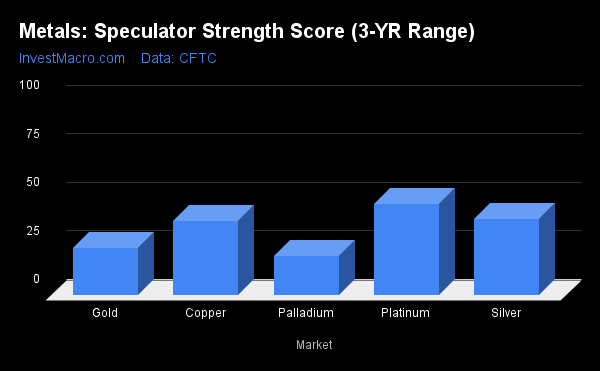
Rare Earths Co. Sees Big Results at British Columbia Project

Source: Streetwise Reports  (10/12/22)

Two core drill holes are showing broad mineralization at Defense Metals Corp.’s Wicheeda rare earth element deposit.

Defense Metals Corp. (DEFN:TSX.V; DFMTF:OTCQB; 35D:FSE) on Tuesday released results from two core drill holes showing broad mineralization at its 100%-owned Wicheeda rare earth element (REE) deposit in British Columbia.

The deepest hole drilled so far on the site at 395 meters, WI22-68, intersected 3.58% total rare earth oxide (TREO) over 124 meters, including 6.7% TREO over 18 meters and one 3-meter sample of 8.58% TREO.

Last month, Noble Capital Markets Senior Research Analyst Mark Reichman issued a note continuing to rate the company Outperform with a target of CA$0.90.

Just last week, analyst Michael Gray of Agentis Capital initiated coverage on Defense Metals, saying Wicheeda was well-located with access to key infrastructure and “could become a globally significant producer” of REEs.

“We are initiating coverage with a high conviction that DEFN is a best-of-breed North American REE developer that is well-positioned to its leverage growing global REE demand and government support to become part of a North American REE critical metals supply chain,” Gray wrote on October 3, 2022, when he set a 12-month valuation of CA$3.50 for the stock.

On Tuesday, he issued a note reaffirming his valuation, saying the hole “outperformed the deposit average.”

“We think the REE-enriched carbonatite unit could be larger than Defense anticipated, with coarse-grained mineralization encountered at depth in hole 68,” Gray wrote.

A second hole released this week, WI22-63, returned 2.29% TREO over 39 meters, including 5.08% TREO over 9 meters.

Last month, Noble Capital Markets Senior Research Analyst Mark Reichman issued a note continuing to rate the company Outperform with a target of CA$0.90.

The Catalyst

Gray said it’s an “excellent time to enter the REE space.” REEs are in high demand in the new green economy for purifying water, MRIs, fertilizers, weapons, research, wind turbines, computers, and permanent magnet motors for electric vehicles (EVs).

Defense Metals hopes to produce as much as 10% of the world’s light REEs to compete with China, which has about 85% of the world’s REE processing capacity. Political issues between the United States, China, and Taiwan put that vital supply at risk.

Given those needs, the company said it is moving as quickly as possible with the project.

Gray with Agentis said industries that use the elements are set to expand.

“We have taken our deposit from a bulk sample to pre-feasibility in four years,” Defense Metals Chief Executive Officer and Director Craig Taylor said. “I don’t think there is another rare earth deposit I can think of that has advanced this quickly.”

A preliminary economic assessment (PEA) for Wicheeda in 2021 showed an after-tax net present value of CA$512 million. Its 43-101 technical report showed a 5 million tonne indicated resource at 2.95% total rare earth oxides (TREO) and a 29.5 million tonne inferred resource averaging 1.83% TREO.

About 5,000 meters ended up being drilled this year over 15 holes. Results from 11 holes are still outstanding. The company is expecting to begin a preliminary feasibility study (PFS) before the end of 2022.

Industries Set to Expand

Realizing the importance of REEs, the U.S. government in February announced a US$35 million grant to MP Materials Corp. to process the elements at its California facility. The company has agreed to invest US$700 million to create more than 350 jobs in the permanent magnet sector by 2024.

Gray with Agentis said industries that use the elements are set to expand.

“The fundamentals for REE demand growth (are) very positive,” he wrote. “Demand is high, and forecasts suggest it will continue to grow, vis a vis the markets for EVs, wind turbines, and defense technologies.”

Currently, the analyst covering Defense Metals Corp. include Mark Reichman of Noble Capital Markets and Michael Gray of Agentis Capital. You can see all the analyst and newsletter coverage by clicking “See More Live Data” in the data box above.

Defense Metals recently also entered into a Mineral Exploration Agreement with the McLeod Lake Indian Band for Wicheeda that creates a framework for communication and cooperation between the company and the group as they move forward.

The company is also testing an acid bake extraction process for the REEs that could lower capital and operating costs. High-temperature concentrated sulfuric acid is used to convert the REEs to water-soluble sulfates, which can then dissolve during a water leach. A precipitation process is then used to recover the REEs.

The process is expected to allow for a more than 95% recovery rate for the REEs, compared to less than 90% with the alternative caustic cracking process. Testing for the new process will likely be finished soon.

Ownership, Analyst Coverage, and Share Structure.

Three money managers — Marquest Asset Management, U.S. Global Investors, and Probity/Qwest Funds — own a small percentage of the company. The rest is retail.

Currently, the analyst covering Defense Metals Corp. include Mark Reichman of Noble Capital Markets and Michael Gray of Agentis Capital. You can see all the analyst and newsletter coverage by clicking “See More Live Data” in the data box above.

Defense Metals has a market cap of CA$46.76 million with 183.4 million shares outstanding, 140.3 million of them free floating. It trades in a 52-week range of CA$0.36 and CA$0.17.

Disclosures:

1) Steve Sobek wrote this article for Streetwise Reports LLC. He or members of his household own securities of the following companies mentioned in the article: None. He and members of his household are paid by the following companies mentioned in this article: None.

2) The following companies mentioned in this article are billboard sponsors of Streetwise Reports: Defense Metals Corp. Click here for important disclosures about sponsor fees. As of the date of this article, an affiliate of Streetwise Reports has a consulting relationship with Defense Metals Corp. Please click here for more information. The information provided above is for informational purposes only and is not a recommendation to buy or sell any security.

3) The article does not constitute investment advice. Each reader is encouraged to consult with his or her individual financial professional and any action a reader takes as a result of information presented here is his or her own responsibility. By opening this page, each reader accepts and agrees to Streetwise Reports’ terms of use and full legal disclaimer. This article is not a solicitation for investment. Streetwise Reports does not render general or specific investment advice and the information on Streetwise Reports should not be considered a recommendation to buy or sell any security. Streetwise Reports does not endorse or recommend the business, products, services or securities of any company mentioned on Streetwise Reports.

4) From time to time, Streetwise Reports LLC and its directors, officers, employees, or members of their families, as well as persons interviewed for articles and interviews on the site, may have a long or short position in securities mentioned. Directors, officers, employees or members of their immediate families are prohibited from making purchases and/or sales of those securities in the open market or otherwise from the time of the decision to publish an article until three business days after the publication of the article. The foregoing prohibition does not apply to articles that in substance only restate previously published company releases. As of the date of this article, officers and/or employees of Streetwise Reports LLC (including members of their household) own securities of Defense Metals Corp., a company mentioned in this article.


Trade Of The Week: Are Gold Bears Back In Town?

By ForexTime 

– The past few days have been rocky for gold.

After briefly punching above the 50-day Simple Moving Average early last week, bear hijacked the driving seat as multiple fundamental forces dimmed the metal’s allure. Despite gaining over 1% since the start of October, prices are back below the psychological $1700 level with the path of least resistance pointing south.

Last Friday’s strong US jobs numbers coupled with hawkish speeches by Fed officials made life hard for zero-yielding gold with rising Treasury yields adding insult to injury.

The US economy added 263,000 new jobs in September, beating market expectations of 250,000. Despite the marginal beat, the figure raised concerns that the US labour market may be starting to cool. Nevertheless, market expectations remain elevated over the Federal Reserve unleashing more monetary bazookas against the inflation menace.

With the greenback drawing fresh strength from the US jobs report and rising Treasury yields, gold could be exposed to fresh downside risks.

The low down…

It has been a rough year for gold.

The precious metal is down over 8% year-to-date thanks to an appreciating dollar, rising Treasury yields, and expectations for aggressive interest rates enforced by central banks. Although geopolitical risks, periods of dollar weakness and global growth concerns have somewhat limited downside losses – bears are currently winning this war. According to Bloomberg, traders are pricing in a 92% of a 75-basis point rate hike at the next FOMC meeting in November. If such becomes reality, gold could be instore for more pain as 2022 slowly comes to an end.

Taking a brief look at the monthly chart, every single monthly candle has closed negative since April 2022.

The week ahead…

It may be wise to fasten your seatbelts because the next few days promise to be eventful for gold. Investors will be served a platter of key economic reports and speeches from numerous financial heavyweights. To top things up, all eyes will be on the latest US inflation which is arguably now the biggest data point on the risk calendar.

Thursday sees the release of the US inflation report with investors watching to see if prices are rising again or perhaps if we are finally peaking. According to Bloomberg, the headline print for September is expected to drop 8.1% from 8.3% while the core is expected to jump 6.5% from the shock of 6.3% in August. A higher-than-expected CPI figure may reinforce expectations around the Fed unleashing more monetary bazookas to tame the inflation beast. This could see gold prices tumble lower as the dollar and Treasury yields rise. Alternatively, a lower-than-expected inflation report could reduce rate hike bets and feed the “dovish pivot” narrative – ultimately providing room for gold bulls to fight back.

Gold ETFs favour bears

According to an automated report from Bloomberg, gold ETFs cut 95,021 troy ounces of gold from their holdings last Friday, bringing this year’s net sales to 1.01 million ounces. This was the fourth straight day of declines.

The outflows may be the result of last Friday’s strong jobs data which bolstered bets over the Fed moving ahead with a 75-basis point rate hike next month. It’s worth keeping in mind that a gold ETF provides investors exposure to the precious metal without owning the physical asset. Outflows from ETFs are generally seen as bearish for the underlying asset.

Gold ready for a steep selloff?

Gold remains dominated by bears on the daily and weekly timeframes. After breaking back below $1700, this could open doors towards $1655, $1615, and $1600. Given how the precious metal remains in a fierce battle against a stronger dollar and aggressive rate hike bets among other themes, bears remain in control. The pending inflation report may set the tone for gold for the rest of this month. Should prices push back above $1700, this could open a path back toward $1724, $1752, and $1770.


Forex-Time-LogoArticle by ForexTime

ForexTime Ltd (FXTM) is an award winning international online forex broker regulated by CySEC 185/12 www.forextime.com

Silver Speculator bets rise for 4th week, climb to highest since June

By InvestMacro

Here are the latest charts and statistics for the Commitment of Traders (COT) reports data published by the Commodities Futures Trading Commission (CFTC).

The latest COT data is updated through Tuesday October 4th and shows a quick view of how large traders (for-profit speculators and commercial entities) were positioned in the futures markets.

Weekly Speculator Changes

The COT precious metals speculator bets were higher this week all across the board as all five of the metals markets we cover saw stronger sentiment and increased positioning.

Leading the gains for the precious metals markets was Gold (36,304 contracts) with Copper (9,505 contracts), Silver (7,950 contracts), Platinum (3,120 contracts) and Palladium (235 contracts) also showing a positive week.

Highlighting the COT Metals this week is the gains in the Silver speculator positions. Silver speculators boosted their bets this week for a fourth straight week and have now pushed their bets higher by +21,492 contracts over that time-frame. This recent turnaround in sentiment brought the overall net position back out of bearish territory after spending five straight weeks there from August 23rd to September 20th. This week’s total net position of +8,708 contracts is the best level for Silver since June 28th. The Silver price closed this week above the $20.25 level and managed to touch its highest level since June above $21 before closing lower.


Data Snapshot of Commodity Market Traders | Columns Legend
Oct-04-2022OIOI-IndexSpec-NetSpec-IndexCom-NetCOM-IndexSmalls-NetSmalls-Index
WTI Crude1,495,5382241,9998-260,8549418,85531
Gold437,065088,38512-96,548898,1630
Silver129,52408,70824-17,617798,90913
Copper166,1617-18,2512318,0237922827
Palladium7,0805-596203647723257
Platinum55,682143,28113-7,137873,85620
Natural Gas967,1264-159,09631126,0467133,05058
Brent162,76210-39,8204438,106571,71432
Heating Oil282,9882815,75566-32,1033716,34855
Soybeans677,1782266,75734-40,08374-26,67426
Corn1,365,62214304,96269-239,95938-65,0036
Coffee184,698042,15175-44,264292,11319
Sugar687,018047,08746-63,3545616,26728
Wheat291,61435,624261,90162-7,52571


Strength Scores show Silver and Copper rise

Strength scores (a measure of the 3-Year range of Speculator positions, from 0 to 100 where above 80 is extreme bullish and below 20 is extreme bearish) showed that the Silver (23.7 percent) and Copper (22.8 percent) are leading the metals category currently. Both of these markets have now seen there strength scores improve and are above the 20 percent level and out of a bearish extreme position.

On the downside, Gold (12.0 percent), Platinum (13.5 percent) and Palladium (19.9 percent) continue to be at the lowest strength levels currently and in bearish extreme positions (below 20 percent).


Strength Statistics:
Gold (12.0 percent) vs Gold previous week (0.0 percent)
Silver (23.7 percent) vs Silver previous week (14.9 percent)
Copper (22.8 percent) vs Copper previous week (15.3 percent)
Platinum (13.5 percent) vs Platinum previous week (9.3 percent)
Palladium (19.9 percent) vs Palladium previous week (18.6 percent)

Silver leads the Strength Trends

Strength Score Trends (or move index, calculates the 6-week changes in strength scores) show that Silver (14.6 percent) leads the past six weeks trends for metals this week. Palladium (6.9 percent), Platinum (5.2 percent) and Copper (0.6 percent) are all seeing positive moves for the past 6-weeks in the latest trends data.

Gold (-12.4 percent) is the only market this week with lower trend scores.


Move Statistics:
Gold (-12.4 percent) vs Gold previous week (-29.5 percent)
Silver (14.6 percent) vs Silver previous week (-3.0 percent)
Copper (0.6 percent) vs Copper previous week (0.4 percent)
Platinum (5.2 percent) vs Platinum previous week (-3.7 percent)
Palladium (6.9 percent) vs Palladium previous week (4.4 percent)


Individual Markets:

Gold Comex Futures:

Gold Futures COT ChartThe Gold Comex Futures large speculator standing this week came in at a net position of 88,385 contracts in the data reported through Tuesday. This was a weekly boost of 36,304 contracts from the previous week which had a total of 52,081 net contracts.

This week’s current strength score (the trader positioning range over the past three years, measured from 0 to 100) shows the speculators are currently Bearish-Extreme with a score of 12.0 percent. The commercials are Bullish-Extreme with a score of 89.4 percent and the small traders (not shown in chart) are Bearish-Extreme with a score of 0.0 percent.

Gold Futures StatisticsSPECULATORSCOMMERCIALSSMALL TRADERS
– Percent of Open Interest Longs:49.426.68.4
– Percent of Open Interest Shorts:29.248.76.5
– Net Position:88,385-96,5488,163
– Gross Longs:215,964116,45136,704
– Gross Shorts:127,579212,99928,541
– Long to Short Ratio:1.7 to 10.5 to 11.3 to 1
NET POSITION TREND:
– Strength Index Score (3 Year Range Pct):12.089.40.0
– Strength Index Reading (3 Year Range):Bearish-ExtremeBullish-ExtremeBearish-Extreme
NET POSITION MOVEMENT INDEX:
– 6-Week Change in Strength Index:-12.412.8-10.2


Silver Comex Futures:

Silver Futures COT ChartThe Silver Comex Futures large speculator standing this week came in at a net position of 8,708 contracts in the data reported through Tuesday. This was a weekly boost of 7,950 contracts from the previous week which had a total of 758 net contracts.

This week’s current strength score (the trader positioning range over the past three years, measured from 0 to 100) shows the speculators are currently Bearish with a score of 23.7 percent. The commercials are Bullish with a score of 78.6 percent and the small traders (not shown in chart) are Bearish-Extreme with a score of 13.4 percent.

Silver Futures StatisticsSPECULATORSCOMMERCIALSSMALL TRADERS
– Percent of Open Interest Longs:40.136.917.0
– Percent of Open Interest Shorts:33.450.510.1
– Net Position:8,708-17,6178,909
– Gross Longs:51,92647,75522,040
– Gross Shorts:43,21865,37213,131
– Long to Short Ratio:1.2 to 10.7 to 11.7 to 1
NET POSITION TREND:
– Strength Index Score (3 Year Range Pct):23.778.613.4
– Strength Index Reading (3 Year Range):BearishBullishBearish-Extreme
NET POSITION MOVEMENT INDEX:
– 6-Week Change in Strength Index:14.6-12.60.4


Copper Grade #1 Futures:

Copper Futures COT ChartThe Copper Grade #1 Futures large speculator standing this week came in at a net position of -18,251 contracts in the data reported through Tuesday. This was a weekly boost of 9,505 contracts from the previous week which had a total of -27,756 net contracts.

This week’s current strength score (the trader positioning range over the past three years, measured from 0 to 100) shows the speculators are currently Bearish with a score of 22.8 percent. The commercials are Bullish with a score of 79.0 percent and the small traders (not shown in chart) are Bearish with a score of 26.6 percent.

Copper Futures StatisticsSPECULATORSCOMMERCIALSSMALL TRADERS
– Percent of Open Interest Longs:30.447.48.7
– Percent of Open Interest Shorts:41.436.68.6
– Net Position:-18,25118,023228
– Gross Longs:50,47078,81714,537
– Gross Shorts:68,72160,79414,309
– Long to Short Ratio:0.7 to 11.3 to 11.0 to 1
NET POSITION TREND:
– Strength Index Score (3 Year Range Pct):22.879.026.6
– Strength Index Reading (3 Year Range):BearishBullishBearish
NET POSITION MOVEMENT INDEX:
– 6-Week Change in Strength Index:0.6-2.414.3


Platinum Futures:

Platinum Futures COT ChartThe Platinum Futures large speculator standing this week came in at a net position of 3,281 contracts in the data reported through Tuesday. This was a weekly advance of 3,120 contracts from the previous week which had a total of 161 net contracts.

This week’s current strength score (the trader positioning range over the past three years, measured from 0 to 100) shows the speculators are currently Bearish-Extreme with a score of 13.5 percent. The commercials are Bullish-Extreme with a score of 87.0 percent and the small traders (not shown in chart) are Bearish-Extreme with a score of 19.8 percent.

Platinum Futures StatisticsSPECULATORSCOMMERCIALSSMALL TRADERS
– Percent of Open Interest Longs:46.037.912.9
– Percent of Open Interest Shorts:40.150.76.0
– Net Position:3,281-7,1373,856
– Gross Longs:25,61021,1167,197
– Gross Shorts:22,32928,2533,341
– Long to Short Ratio:1.1 to 10.7 to 12.2 to 1
NET POSITION TREND:
– Strength Index Score (3 Year Range Pct):13.587.019.8
– Strength Index Reading (3 Year Range):Bearish-ExtremeBullish-ExtremeBearish-Extreme
NET POSITION MOVEMENT INDEX:
– 6-Week Change in Strength Index:5.2-5.23.1


Palladium Futures:

Palladium Futures COT ChartThe Palladium Futures large speculator standing this week came in at a net position of -596 contracts in the data reported through Tuesday. This was a weekly lift of 235 contracts from the previous week which had a total of -831 net contracts.

This week’s current strength score (the trader positioning range over the past three years, measured from 0 to 100) shows the speculators are currently Bearish-Extreme with a score of 19.9 percent. The commercials are Bullish with a score of 76.6 percent and the small traders (not shown in chart) are Bullish with a score of 57.3 percent.

Palladium Futures StatisticsSPECULATORSCOMMERCIALSSMALL TRADERS
– Percent of Open Interest Longs:30.948.119.1
– Percent of Open Interest Shorts:39.443.015.8
– Net Position:-596364232
– Gross Longs:2,1913,4091,352
– Gross Shorts:2,7873,0451,120
– Long to Short Ratio:0.8 to 11.1 to 11.2 to 1
NET POSITION TREND:
– Strength Index Score (3 Year Range Pct):19.976.657.3
– Strength Index Reading (3 Year Range):Bearish-ExtremeBullishBullish
NET POSITION MOVEMENT INDEX:
– 6-Week Change in Strength Index:6.9-9.931.8


Article By InvestMacroReceive our weekly COT Newsletter

*COT Report: The COT data, released weekly to the public each Friday, is updated through the most recent Tuesday (data is 3 days old) and shows a quick view of how large speculators or non-commercials (for-profit traders) were positioned in the futures markets.

The CFTC categorizes trader positions according to commercial hedgers (traders who use futures contracts for hedging as part of the business), non-commercials (large traders who speculate to realize trading profits) and nonreportable traders (usually small traders/speculators) as well as their open interest (contracts open in the market at time of reporting). See CFTC criteria here.

Charts for Lithium Co. Show It’s ‘Heading Higher’

Source: Clive Maund  (10/4/22)

In light of yesterday’s lithium results from Argentina Lithium & Energy Corp., expert Clive Maund takes a look at the 10-year, 15-month, and 6-month charts for the natural resource company to tell you his outlook.

Regardless of how many electric vehicles spontaneously combust in the near future, the charts for Argentina Lithium & Energy Corp. (LIT:TSX.V; PNXLF:OTC; OAY3:FSE) suggest that it is headed higher, possibly much higher, perhaps for reasons of its own such as (this added later) the company coming out with positive lithium results yesterday from its second drill hole at Rincon West.

We’ll start by looking at the long-term 10-year chart to get a “big picture” perspective on what’s going on with the stock.

Argentina Lithium & Energy Corp is therefore rated an immediate speculative Buy here.

On this chart, we can see that, following a massive spike higher in 2016 and a lesser spike higher in 2017, it went into a bearmarket that did more than erase all of the prior gains — it became almost worthless, dropping to about CA$0.04 at the lows of the giant Cup & Handle base that is delineated on the chart.

A year ago, it spiked dramatically higher to complete the right side of the Cup before slumping back to slowly complete the Handle part of the pattern, which price / volumen action just over the past couple of weeks suggests that it may now have done.

The 15-month chart enables us to examine in much more detail the entire Handle part of the pattern that formed following the spike a year ago.

As we can see, this Handle has taken the form of an orderly downtrend, and in recent months, it has become clear that a base pattern has been forming at the support above its lower boundary that we will now proceed to look at in more detail on the 6-month chart.

The 6-month chart looks most encouraging. First off, we can see that a fine Double Bottom has formed from early August along a line of support at the 20-cent level.

Next, we can see the persistent heavy buying that started to kick in about two weeks ago that has driven the Accumulation line strongly higher.

Lastly, we can see that, after declining steeply for months, the 50-day moving average has started to turn up and thus converge with the falling 200-day, which of course, makes a rally more likely.

The advance late in September brought it up to a band of significant resistance in the CA$0.26 to CA$0.28 zone, where it was entitled to pause, which is what it has done, but the positive price/volume action of the past couple of weeks with largish white candles and strong upside volume suggest that “something is going on” with this stock and that it won’t be long before it succeeds in breaking above this resistance which should lead to a larger move.

Argentina Lithium & Energy Corp is therefore rated an immediate speculative Buy here. The stock trades in good volumes on the US OTC market, where there has been a big increase in upside volume in recent weeks.

Argentina Lithium & Energy Corp.’s website.

Argentina Lithium & Energy Corp. closed at CA$0.27, $0.189 on September 30, 2022.

CliveMaund.com Disclosures

The above represents the opinion and analysis of Mr. Maund, based on data available to him, at the time of writing. Mr. Maund’s opinions are his own, and are not a recommendation or an offer to buy or sell securities. Mr. Maund is an independent analyst who receives no compensation of any kind from any groups, individuals or corporations mentioned in his reports. As trading and investing in any financial markets may involve serious risk of loss, Mr. Maund recommends that you consult with a qualified investment advisor, one licensed by appropriate regulatory agencies in your legal jurisdiction and do your own due diligence and research when making any kind of a transaction with financial ramifications. Although a qualified and experienced stock market analyst, Clive Maund is not a Registered Securities Advisor. Therefore Mr. Maund’s opinions on the market and stocks can only be construed as a solicitation to buy and sell securities when they are subject to the prior approval and endorsement of a Registered Securities Advisor operating in accordance with the appropriate regulations in your area of jurisdiction.

Disclosures:
1) Clive Maund: I, or members of my immediate household or family, own securities of the following companies mentioned in this article: None. I personally am, or members of my immediate household or family are, paid by the following companies mentioned in this article: None.

2) The following companies mentioned in this article are billboard sponsors of Streetwise Reports: Argentina Lithium & Energy Corp. Click here for important disclosures about sponsor fees. As of the date of this article, an affiliate of Streetwise Reports has a consulting relationship with: None. Please click here for more information.

3) Statements and opinions expressed are the opinions of the author and not of Streetwise Reports or its officers. The author is wholly responsible for the validity of the statements. The author was not paid by Streetwise Reports for this article. Streetwise Reports was not paid by the author to publish or syndicate this article. Streetwise Reports requires contributing authors to disclose any shareholdings in, or economic relationships with, companies that they write about. Streetwise Reports relies upon the authors to accurately provide this information and Streetwise Reports has no means of verifying its accuracy.

4) This article does not constitute investment advice. Each reader is encouraged to consult with his or her individual financial professional and any action a reader takes as a result of information presented here is his or her own responsibility. By opening this page, each reader accepts and agrees to Streetwise Reports’ terms of use and full legal disclaimer. This article is not a solicitation for investment. Streetwise Reports does not render general or specific investment advice and the information on Streetwise Reports should not be considered a recommendation to buy or sell any security. Streetwise Reports does not endorse or recommend the business, products, services or securities of any company mentioned on Streetwise Reports.

5) From time to time, Streetwise Reports LLC and its directors, officers, employees or members of their families, as well as persons interviewed for articles and interviews on the site, may have a long or short position in securities mentioned. Directors, officers, employees or members of their immediate families are prohibited from making purchases and/or sales of those securities in the open market or otherwise from the time of the decision to publish an article until three business days after the publication of the article. The foregoing prohibition does not apply to articles that in substance only restate previously published company releases. As of the date of this article, officers and/or employees of Streetwise Reports LLC (including members of their household) own securities of Argentina Lithium & Energy Corp., a company mentioned in this article.