Archive for Metals – Page 36

Platinum Speculators raise their bullish bets to 38-week high

By InvestMacro

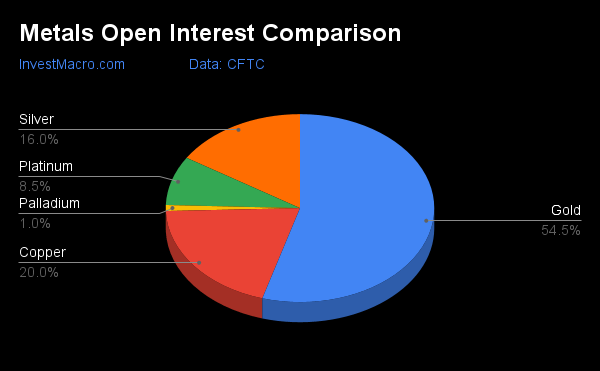
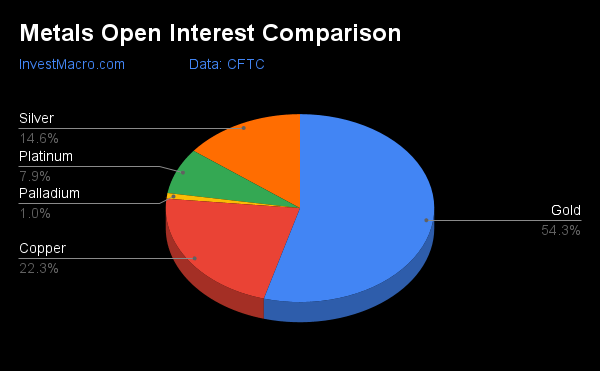
Here are the latest charts and statistics for the Commitment of Traders (COT) data published by the Commodities Futures Trading Commission (CFTC).

The latest COT data is updated through Tuesday November 29th and shows a quick view of how large traders (for-profit speculators and commercial entities) were positioned in the futures markets.

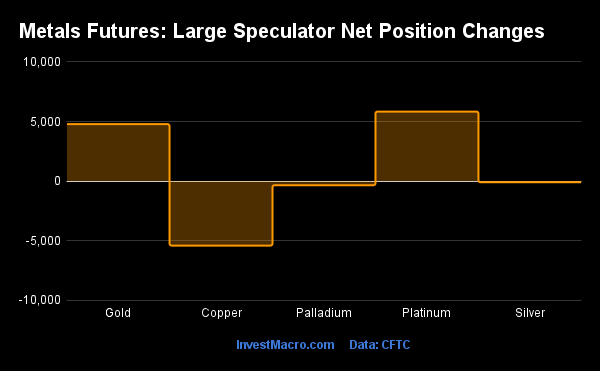
Weekly Speculator Changes led by Platinum

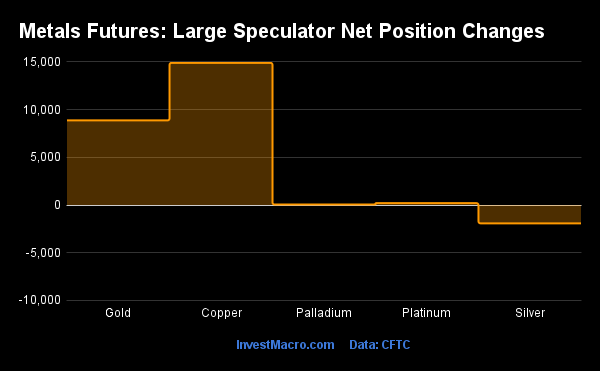
The COT precious metals speculator bets were a little lower this week as two out of the five metals markets we cover had higher positioning this week while three markets had lower contracts.

Leading the gains for the precious metals markets was Platinum (1,769 contracts) with Silver (717 contracts) also showing a positive week.

The metals markets leading the declines in speculator bets this week were Gold (-6,110 contracts) with Copper (-1,120 contracts) and Palladium (-523 contracts) also registering lower bets on the week.

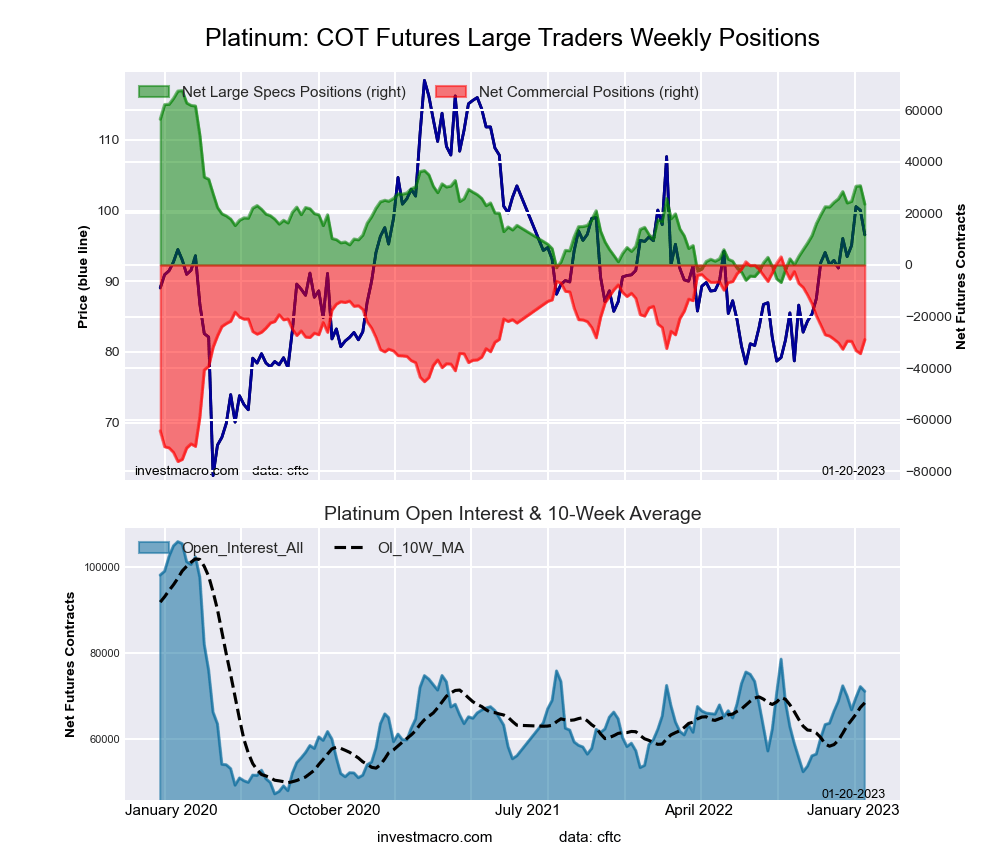
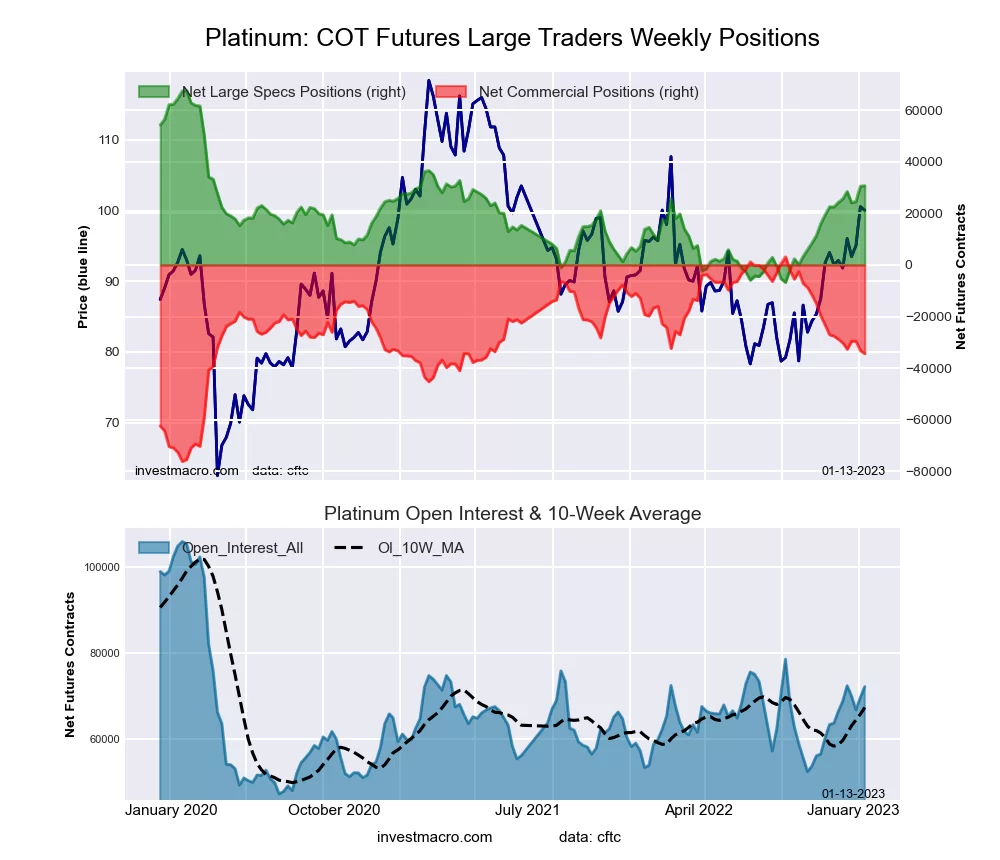
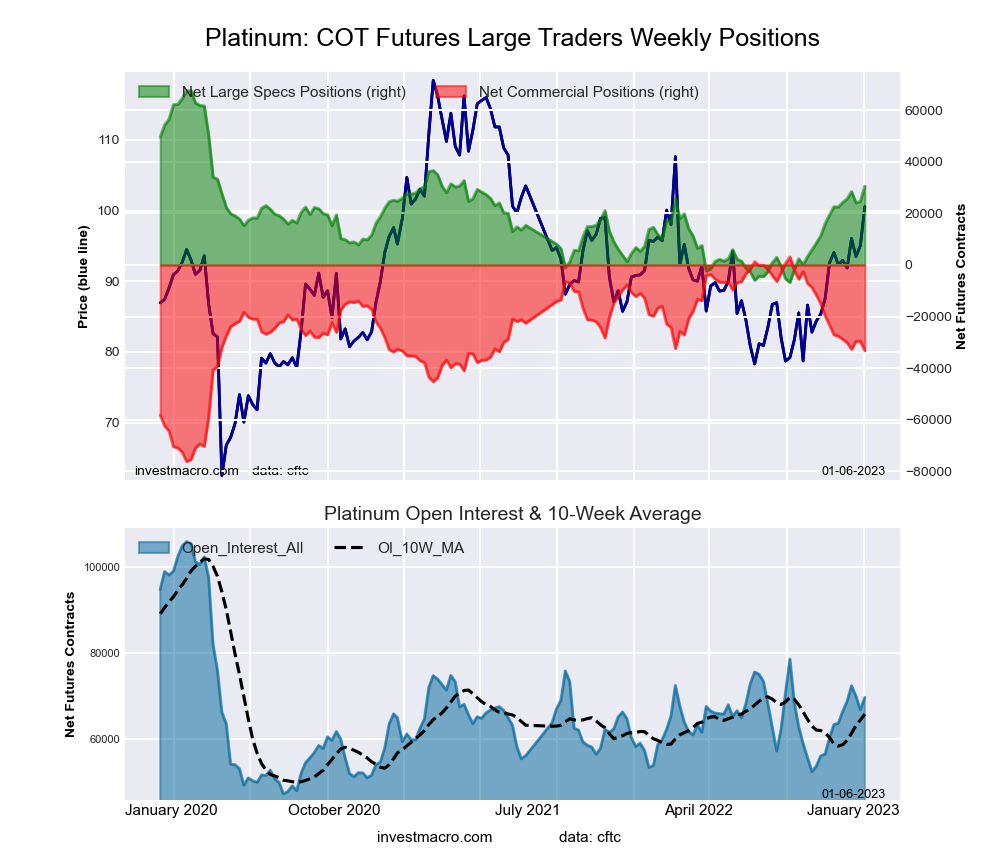
Highlighting the COT metals data this week is the continued bullishness of Platinum positions. The large speculator standing in Platinum futures rose this week by +1,769 contracts. Speculator bets have now gained in eight out of the past nine weeks with a total rise of +24,098 contracts over that period. This has pushed the overall speculator’s bullish level for Platinum to its highest level in the past thirty-eight weeks, dating back to March 8th when the net position totaled +25,833 contracts.

Platinum futures prices have also been on the rise since hitting a September low near the $800.00 level. Platinum futures closed out this week right around the $1,026.60 level for an approximate  gain by 28 percent since the September 1st low.


Data Snapshot of Commodity Market Traders | Columns Legend
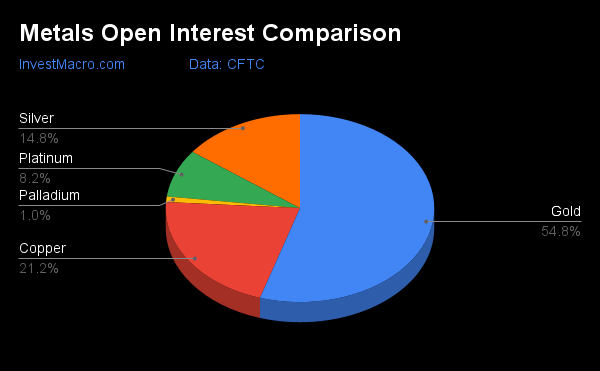
Nov-29-2022OIOI-IndexSpec-NetSpec-IndexCom-NetCOM-IndexSmalls-NetSmalls-Index
WTI Crude1,412,1211239,7398-262,6549322,91537
Gold433,6611110,00319-119,233829,2303
Silver121,258017,48333-28,9976811,51426
Copper146,76001,98438-3,362641,37833
Palladium7,5378-1,631141,68784-5638
Platinum66,4683324,25942-28,762604,50328
Natural Gas985,0107-163,42930136,1917427,23845
Brent155,50015-32,0875729,424422,66345
Heating Oil266,8292330,73388-48,2552017,52259
Soybeans634,7541387,20840-61,55168-25,65728
Corn1,226,4100270,24265-231,16939-39,07321
Coffee196,3659-14,636213,6959994112
Sugar876,30934179,03556-222,6073943,57262
Wheat310,66710-33,305037,024100-3,71991


Strength Scores led by Platinum & Copper

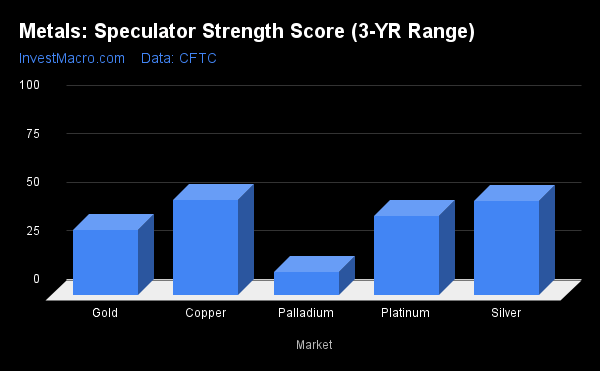
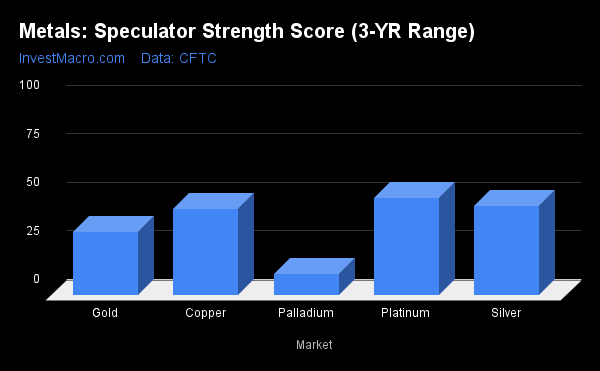
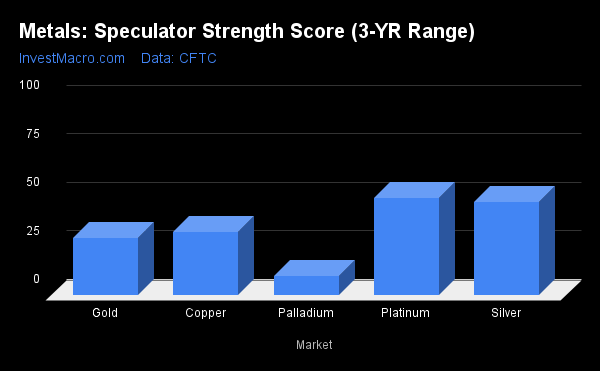
Strength scores (a measure of the 3-Year range of Speculator positions, from 0 to 100 where above 80 is extreme bullish and below 20 is extreme bearish) show that Platinum (41.7 percent) and Copper (37.9 percent) lead the metals category at the moment. Silver (33.4 percent) comes in as the next highest metals market in strength scores.

On the downside, Palladium (14.2 percent) and Gold (19.2 percent) are at the lowest strength levels currently and are both in extreme bearish levels.

Strength Statistics:
Gold (19.2 percent) vs Gold previous week (21.2 percent)
Silver (33.4 percent) vs Silver previous week (32.6 percent)
Copper (37.9 percent) vs Copper previous week (38.8 percent)
Platinum (41.7 percent) vs Platinum previous week (39.3 percent)
Palladium (14.2 percent) vs Palladium previous week (17.3 percent)

Platinum tops Strength Trends

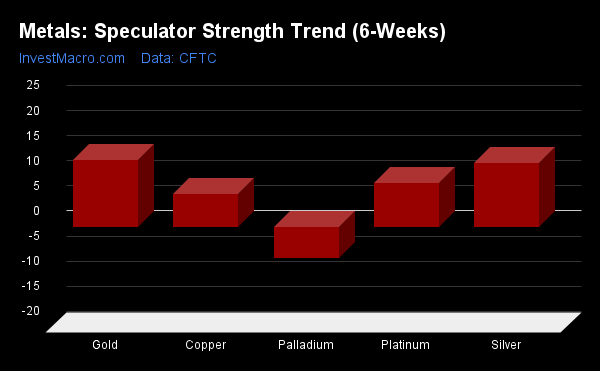
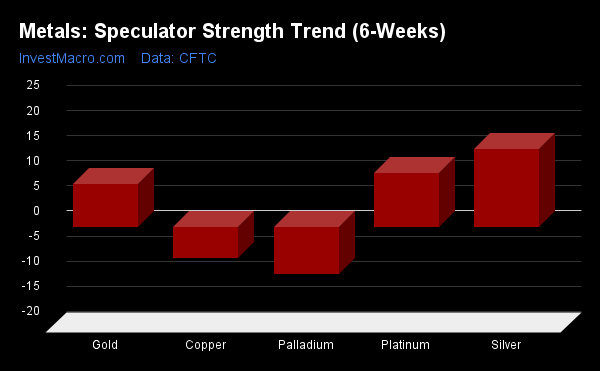
Strength Score Trends (or move index, calculates the 6-week changes in strength scores) show that Platinum (21.2 percent) leads the past six weeks trends for metals this week. Silver (17.9 percent), Copper (17.7 percent) and Gold (11.0 percent) are also positive movers in the latest trends data.

Palladium (-2.5 percent) leads the downside trend scores currently.

Move Statistics:
Gold (11.0 percent) vs Gold previous week (7.2 percent)
Silver (17.9 percent) vs Silver previous week (10.3 percent)
Copper (17.7 percent) vs Copper previous week (15.1 percent)
Platinum (21.2 percent) vs Platinum previous week (22.3 percent)
Palladium (-2.5 percent) vs Palladium previous week (-2.1 percent)


Individual Markets:

Gold Comex Futures:

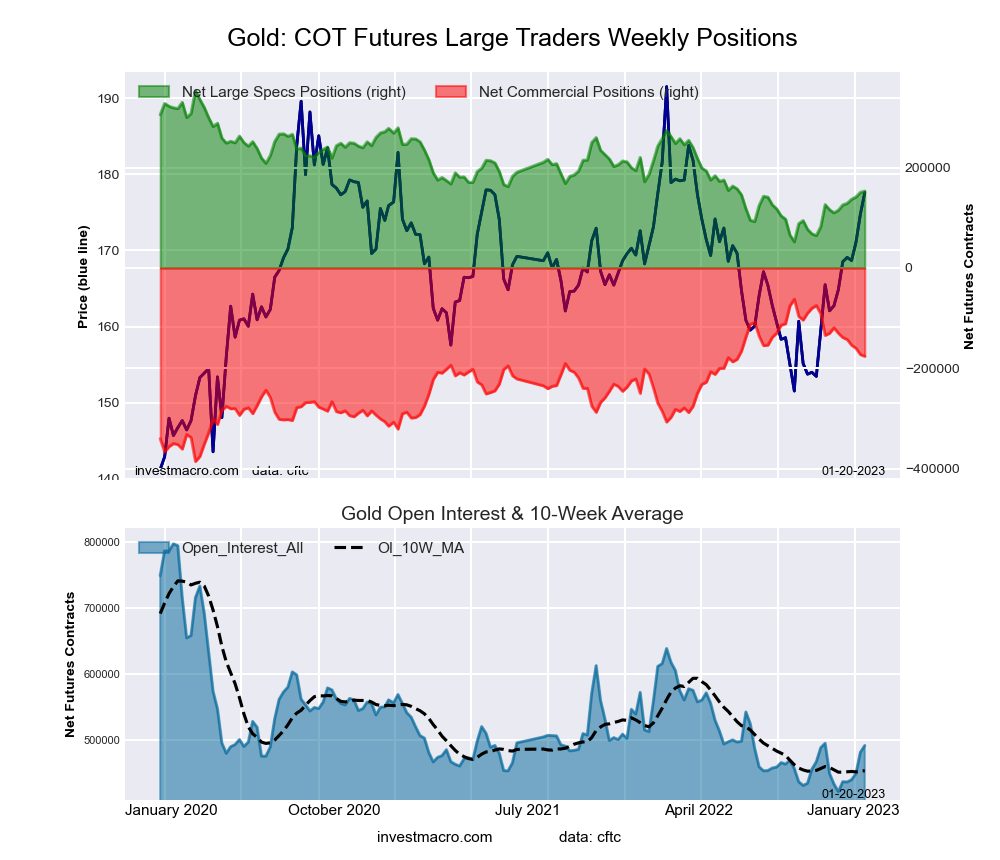
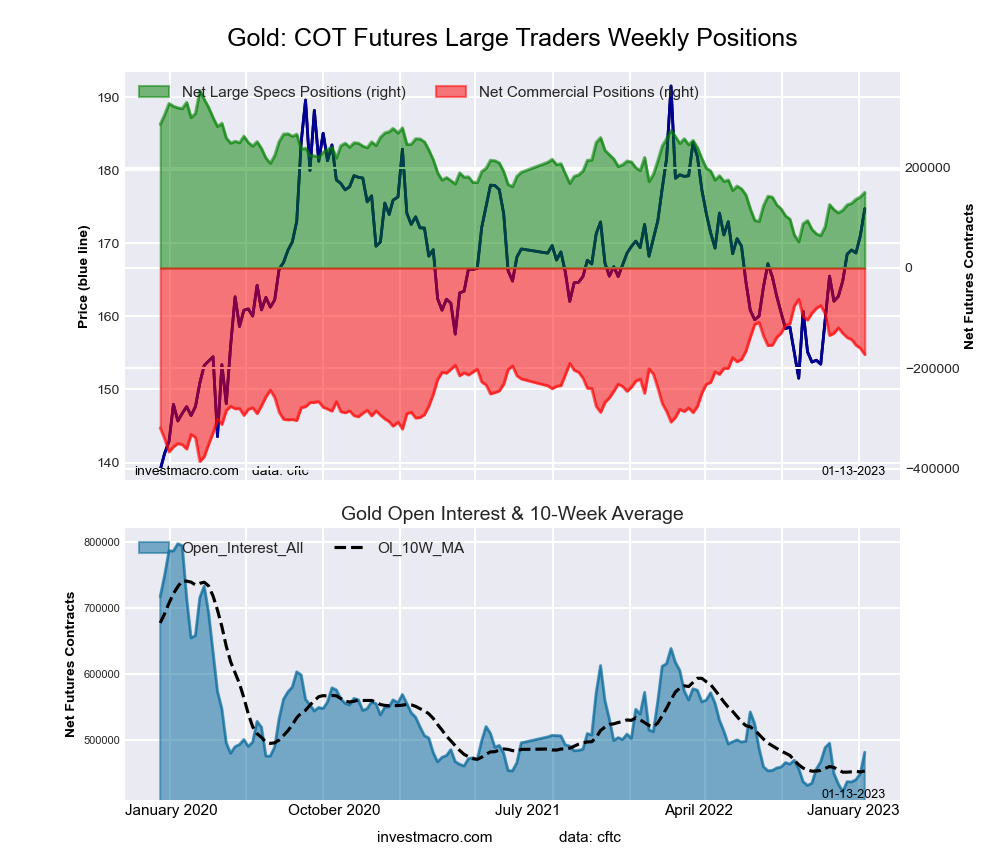
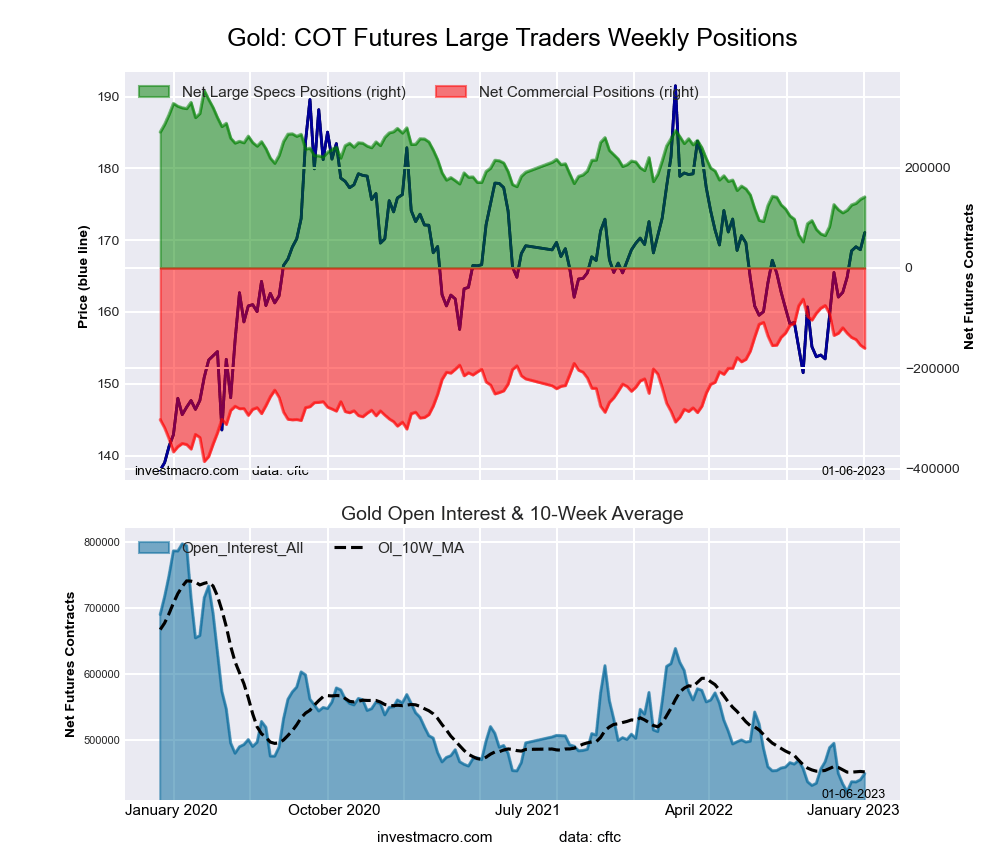
Gold Futures COT ChartThe Gold Comex Futures large speculator standing this week equaled a net position of 110,003 contracts in the data reported through Tuesday. This was a weekly decrease of -6,110 contracts from the previous week which had a total of 116,113 net contracts.

This week’s current strength score (the trader positioning range over the past three years, measured from 0 to 100) shows the speculators are currently Bearish-Extreme with a score of 19.2 percent. The commercials are Bullish-Extreme with a score of 82.3 percent and the small traders (not shown in chart) are Bearish-Extreme with a score of 3.0 percent.

Gold Futures StatisticsSPECULATORSCOMMERCIALSSMALL TRADERS
– Percent of Open Interest Longs:48.230.97.8
– Percent of Open Interest Shorts:22.958.45.7
– Net Position:110,003-119,2339,230
– Gross Longs:209,161134,18433,946
– Gross Shorts:99,158253,41724,716
– Long to Short Ratio:2.1 to 10.5 to 11.4 to 1
NET POSITION TREND:
– Strength Index Score (3 Year Range Pct):19.282.33.0
– Strength Index Reading (3 Year Range):Bearish-ExtremeBullish-ExtremeBearish-Extreme
NET POSITION MOVEMENT INDEX:
– 6-Week Change in Strength Index:11.0-9.0-9.7


Silver Comex Futures:

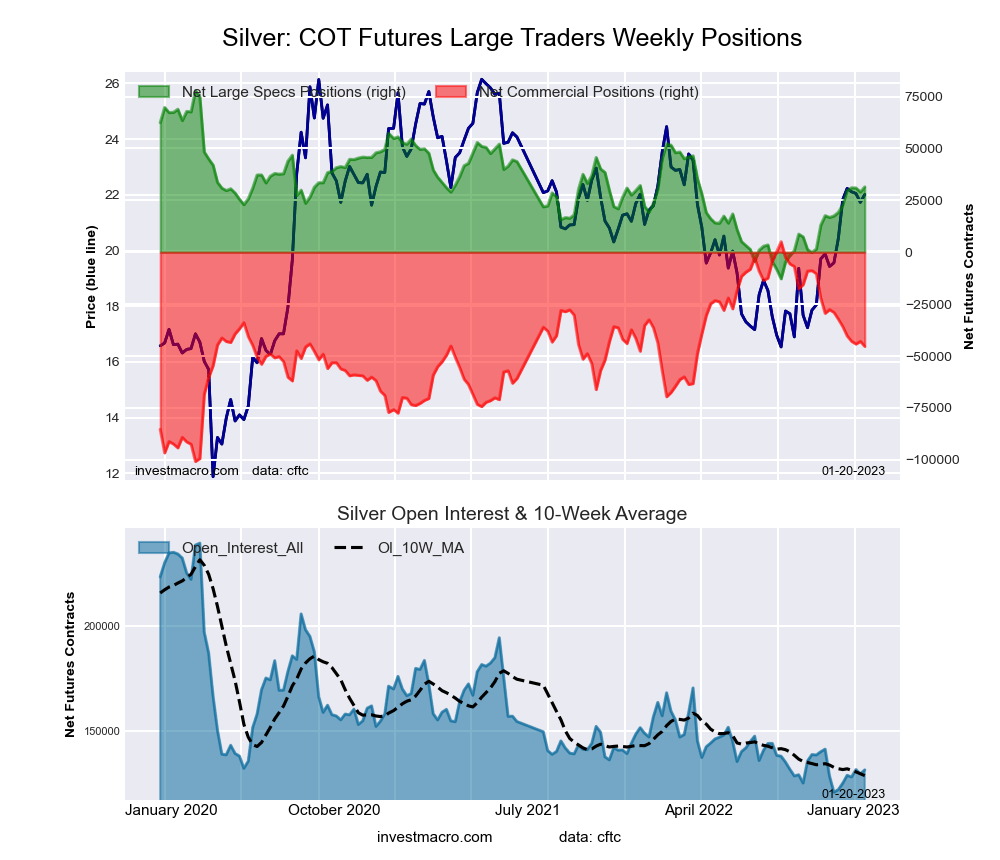
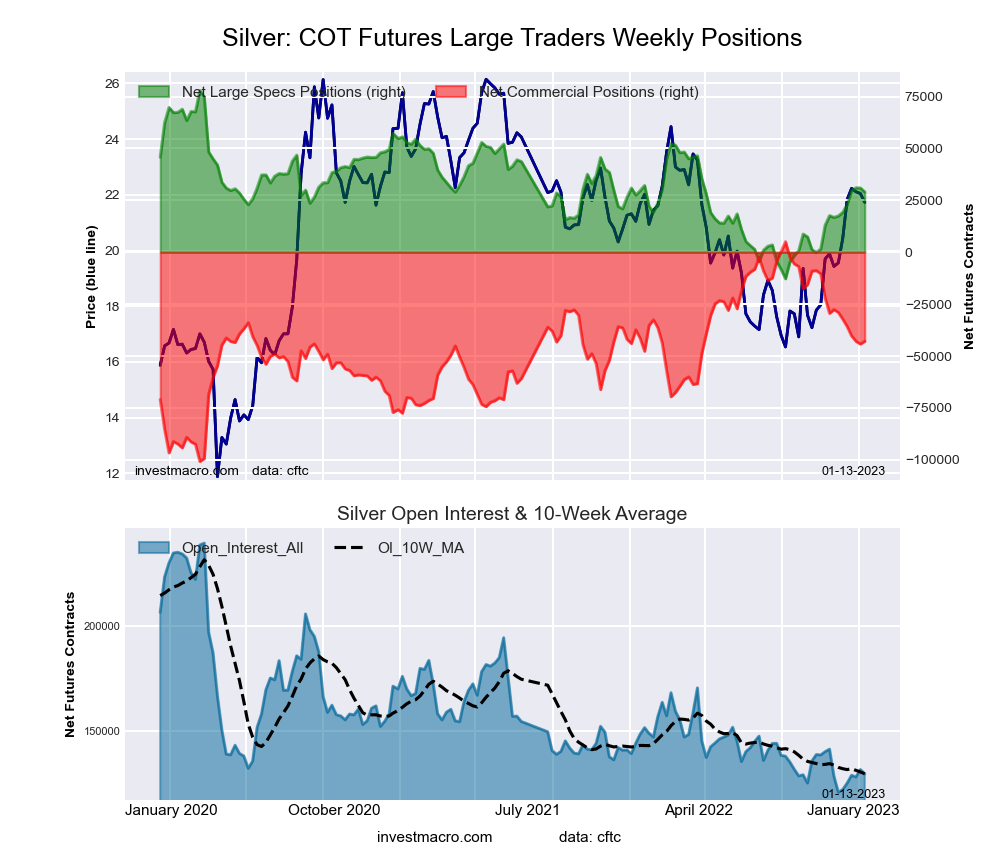
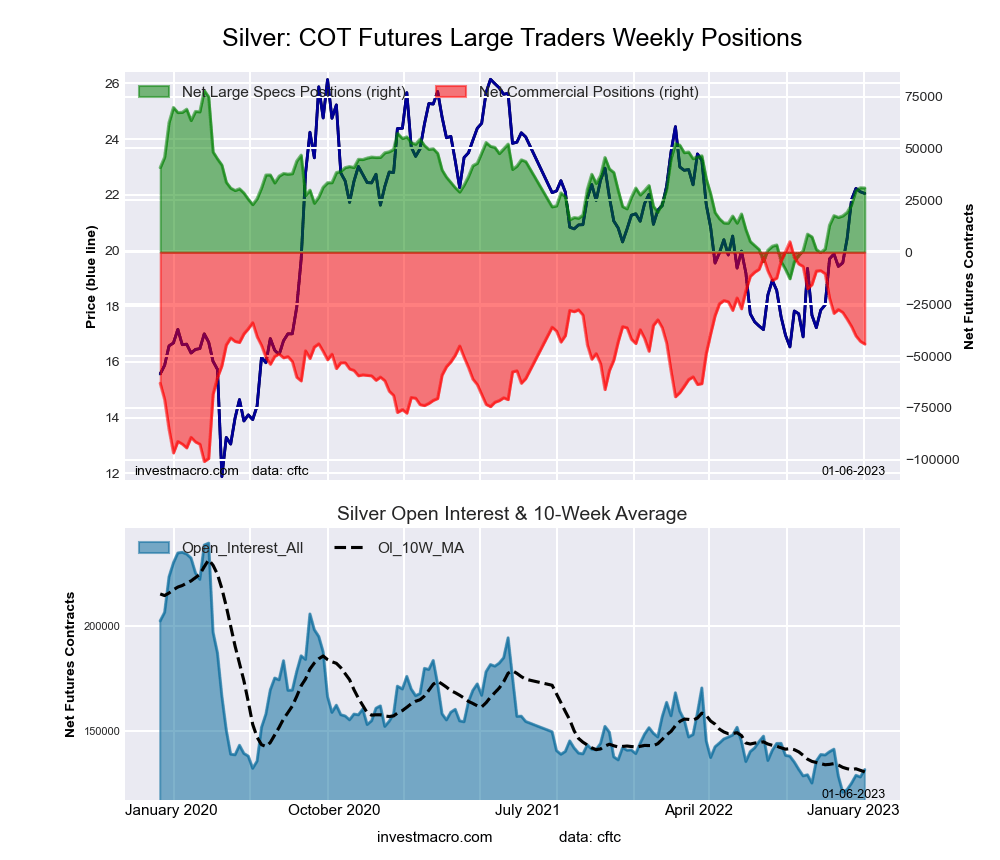
Silver Futures COT ChartThe Silver Comex Futures large speculator standing this week equaled a net position of 17,483 contracts in the data reported through Tuesday. This was a weekly boost of 717 contracts from the previous week which had a total of 16,766 net contracts.

This week’s current strength score (the trader positioning range over the past three years, measured from 0 to 100) shows the speculators are currently Bearish with a score of 33.4 percent. The commercials are Bullish with a score of 67.8 percent and the small traders (not shown in chart) are Bearish with a score of 26.0 percent.

Silver Futures StatisticsSPECULATORSCOMMERCIALSSMALL TRADERS
– Percent of Open Interest Longs:39.938.218.3
– Percent of Open Interest Shorts:25.562.18.8
– Net Position:17,483-28,99711,514
– Gross Longs:48,44146,27022,150
– Gross Shorts:30,95875,26710,636
– Long to Short Ratio:1.6 to 10.6 to 12.1 to 1
NET POSITION TREND:
– Strength Index Score (3 Year Range Pct):33.467.826.0
– Strength Index Reading (3 Year Range):BearishBullishBearish
NET POSITION MOVEMENT INDEX:
– 6-Week Change in Strength Index:17.9-18.817.8


Copper Grade #1 Futures:

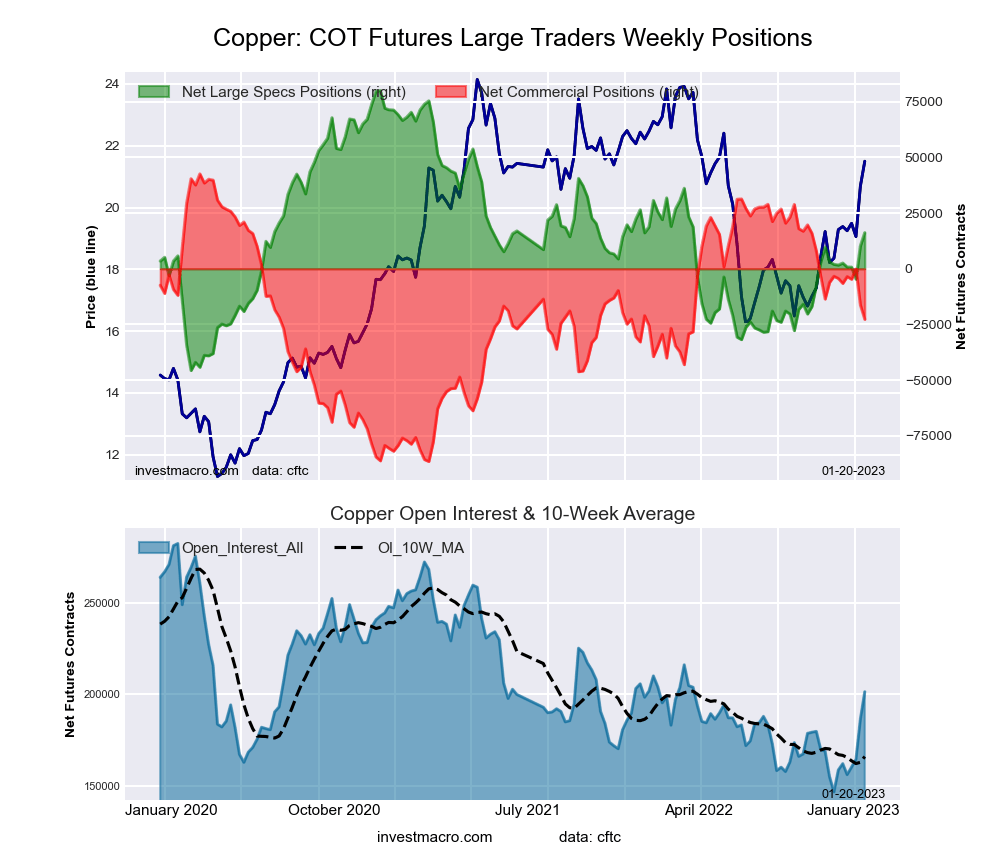
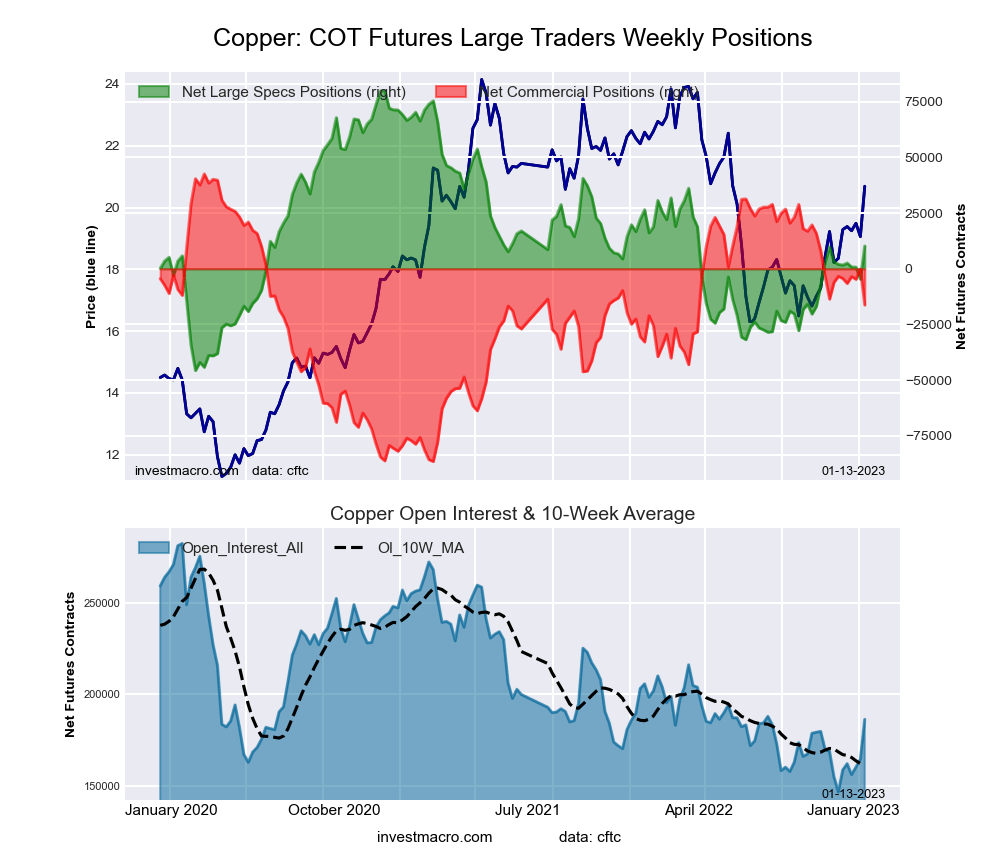
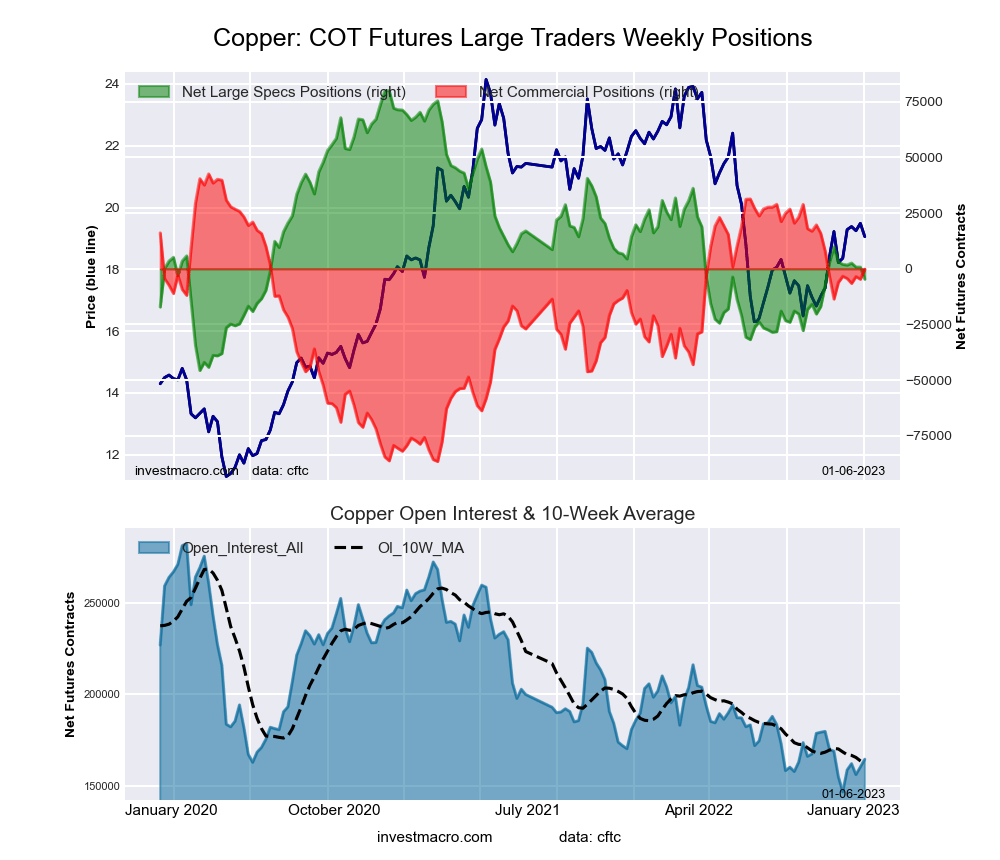
Copper Futures COT ChartThe Copper Grade #1 Futures large speculator standing this week equaled a net position of 1,984 contracts in the data reported through Tuesday. This was a weekly reduction of -1,120 contracts from the previous week which had a total of 3,104 net contracts.

This week’s current strength score (the trader positioning range over the past three years, measured from 0 to 100) shows the speculators are currently Bearish with a score of 37.9 percent. The commercials are Bullish with a score of 64.4 percent and the small traders (not shown in chart) are Bearish with a score of 33.3 percent.

Copper Futures StatisticsSPECULATORSCOMMERCIALSSMALL TRADERS
– Percent of Open Interest Longs:35.043.19.2
– Percent of Open Interest Shorts:33.745.48.3
– Net Position:1,984-3,3621,378
– Gross Longs:51,43363,19613,549
– Gross Shorts:49,44966,55812,171
– Long to Short Ratio:1.0 to 10.9 to 11.1 to 1
NET POSITION TREND:
– Strength Index Score (3 Year Range Pct):37.964.433.3
– Strength Index Reading (3 Year Range):BearishBullishBearish
NET POSITION MOVEMENT INDEX:
– 6-Week Change in Strength Index:17.7-17.94.5


Platinum Futures:

Platinum Futures COT ChartThe Platinum Futures large speculator standing this week equaled a net position of 24,259 contracts in the data reported through Tuesday. This was a weekly lift of 1,769 contracts from the previous week which had a total of 22,490 net contracts.

This week’s current strength score (the trader positioning range over the past three years, measured from 0 to 100) shows the speculators are currently Bearish with a score of 41.7 percent. The commercials are Bullish with a score of 59.8 percent and the small traders (not shown in chart) are Bearish with a score of 28.5 percent.

Platinum Futures StatisticsSPECULATORSCOMMERCIALSSMALL TRADERS
– Percent of Open Interest Longs:53.129.811.1
– Percent of Open Interest Shorts:16.673.14.4
– Net Position:24,259-28,7624,503
– Gross Longs:35,26819,8247,400
– Gross Shorts:11,00948,5862,897
– Long to Short Ratio:3.2 to 10.4 to 12.6 to 1
NET POSITION TREND:
– Strength Index Score (3 Year Range Pct):41.759.828.5
– Strength Index Reading (3 Year Range):BearishBullishBearish
NET POSITION MOVEMENT INDEX:
– 6-Week Change in Strength Index:21.2-21.618.2


Palladium Futures:

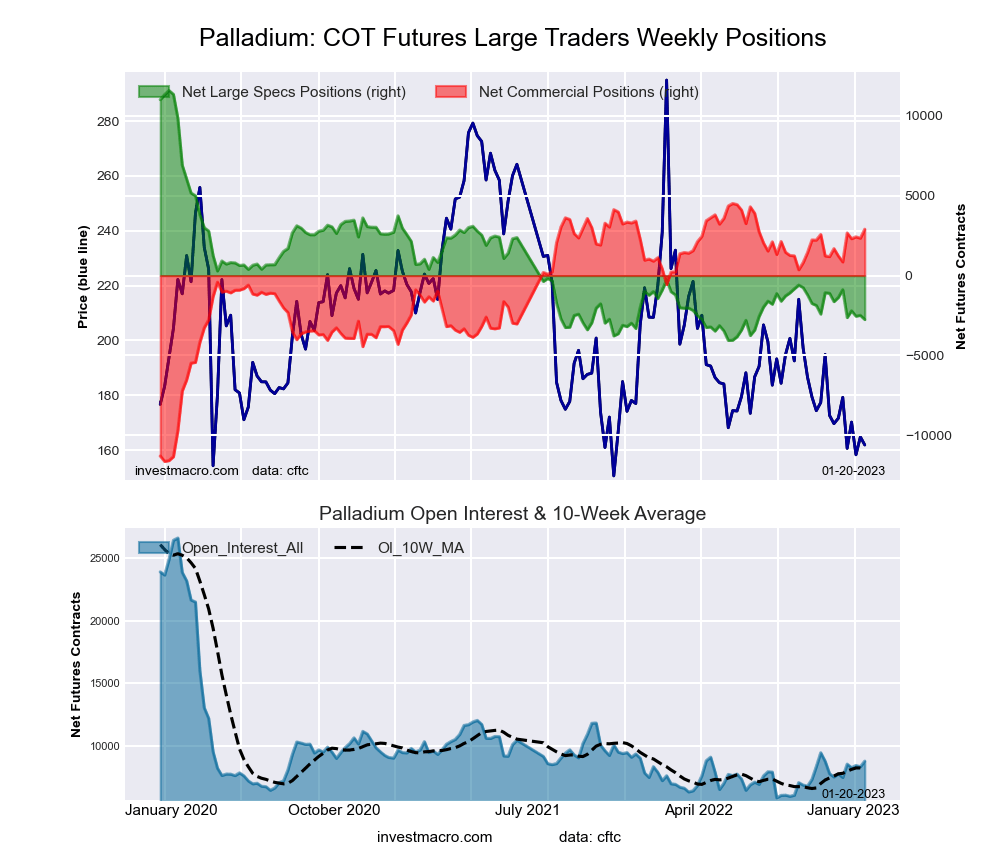
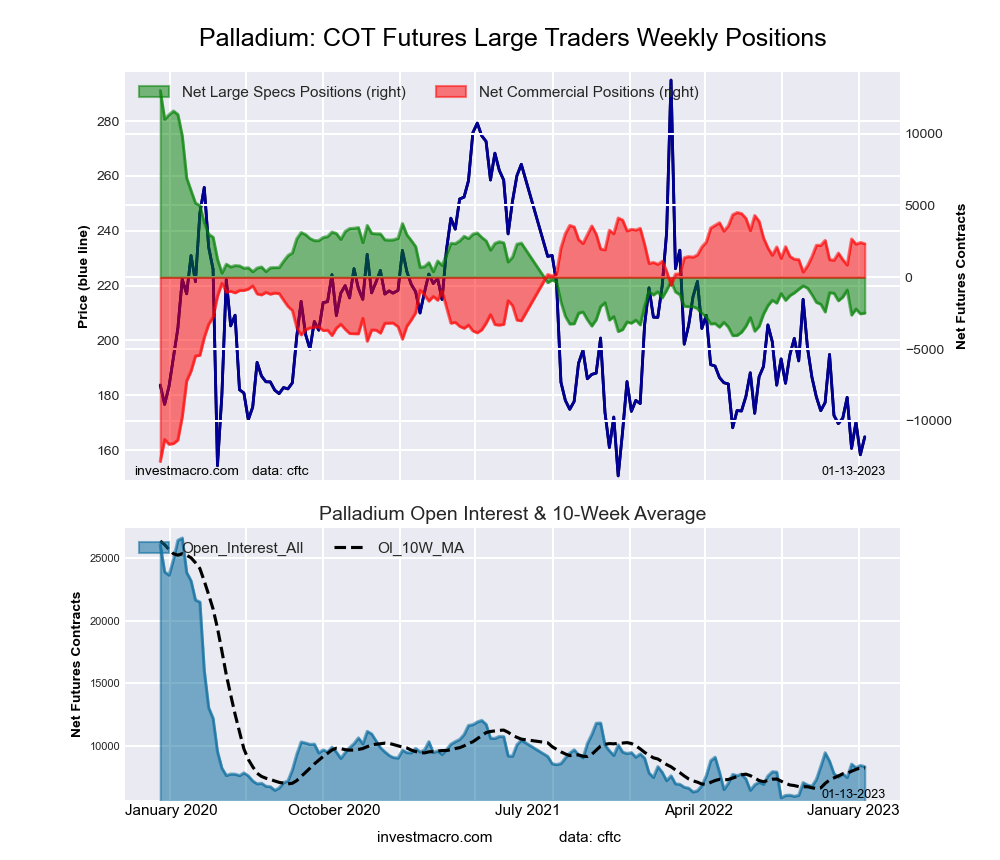
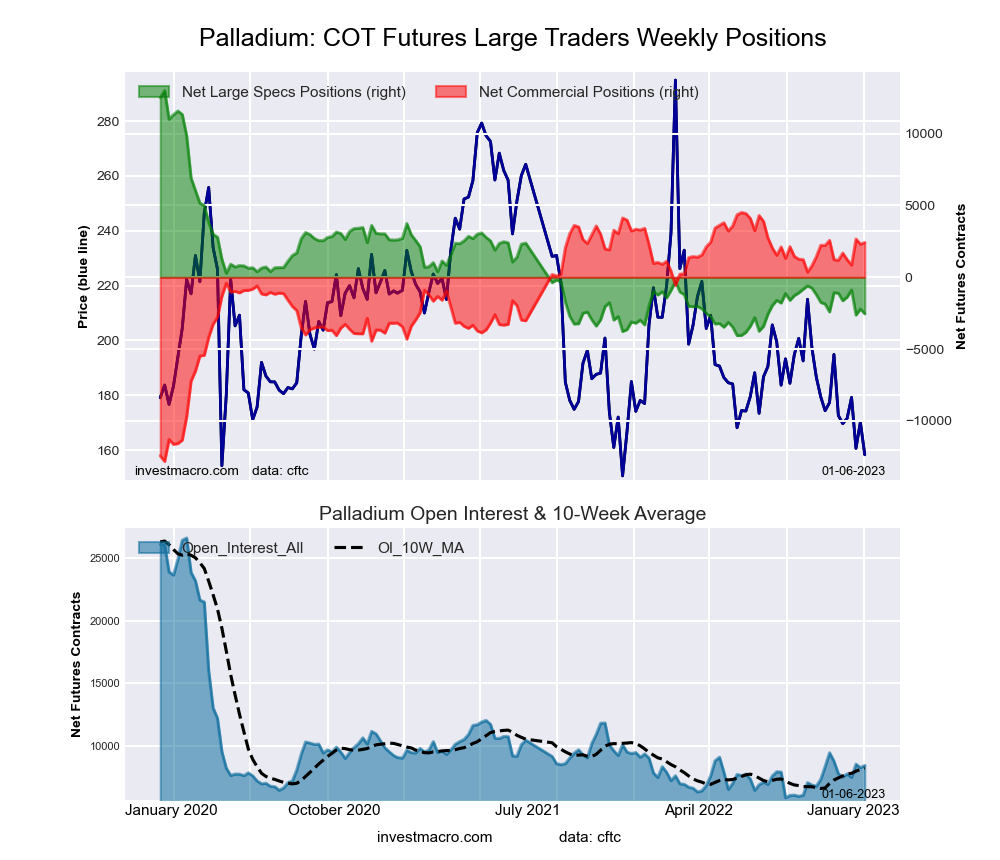
Palladium Futures COT ChartThe Palladium Futures large speculator standing this week equaled a net position of -1,631 contracts in the data reported through Tuesday. This was a weekly lowering of -523 contracts from the previous week which had a total of -1,108 net contracts.

This week’s current strength score (the trader positioning range over the past three years, measured from 0 to 100) shows the speculators are currently Bearish-Extreme with a score of 14.2 percent. The commercials are Bullish-Extreme with a score of 83.7 percent and the small traders (not shown in chart) are Bearish with a score of 38.3 percent.

Palladium Futures StatisticsSPECULATORSCOMMERCIALSSMALL TRADERS
– Percent of Open Interest Longs:30.452.414.1
– Percent of Open Interest Shorts:52.030.014.8
– Net Position:-1,6311,687-56
– Gross Longs:2,2893,9511,061
– Gross Shorts:3,9202,2641,117
– Long to Short Ratio:0.6 to 11.7 to 10.9 to 1
NET POSITION TREND:
– Strength Index Score (3 Year Range Pct):14.283.738.3
– Strength Index Reading (3 Year Range):Bearish-ExtremeBullish-ExtremeBearish
NET POSITION MOVEMENT INDEX:
– 6-Week Change in Strength Index:-2.51.410.8


Article By InvestMacroReceive our weekly COT Newsletter

*COT Report: The COT data, released weekly to the public each Friday, is updated through the most recent Tuesday (data is 3 days old) and shows a quick view of how large speculators or non-commercials (for-profit traders) were positioned in the futures markets.

The CFTC categorizes trader positions according to commercial hedgers (traders who use futures contracts for hedging as part of the business), non-commercials (large traders who speculate to realize trading profits) and nonreportable traders (usually small traders/speculators) as well as their open interest (contracts open in the market at time of reporting). See CFTC criteria here.

Graphene is a proven supermaterial, but manufacturing the versatile form of carbon at usable scales remains a challenge

By Kevin Wyss, Rice University 

“Future chips may be 10 times faster, all thanks to graphene”; “Graphene may be used in COVID-19 detection”; and “Graphene allows batteries to charge 5x faster” – those are just a handful of recent dramatic headlines lauding the possibilities of graphene. Graphene is an incredibly light, strong and durable material made of a single layer of carbon atoms. With these properties, it is no wonder researchers have been studying ways that graphene could advance material science and technology for decades.

I never know what to expect when I tell people I study graphene – some have never heard of it, while others have seen some version of these headlines and inevitably ask, “So what’s the holdup?”

Graphene is a fascinating material, just as the sensational headlines suggest, but it is only just starting be used in real-world applications. The problem lies not in graphene’s properties, but in the fact that it is still incredibly difficult and expensive to manufacture at commercial scales.

A black and white image of a crystalline layer on a surface.
Pure graphene is a uniform, single-atom-thick crystal of carbon arranged in a hexagonal pattern, as seen in this electron microscope image.
M.H. Gass/Wikimedia Commons, CC BY

What is graphene?

Graphene is most simply defined as a single layer of carbon atoms bonded together in a hexagonal, sheetlike structure. You can think of pure graphene as a one-layer-thick sheet of carbon tissue paper that happens to be the strongest material on Earth.

Graphene usually comes in the form of a powder made of small, individual sheets that are roughly the diameter of a grain of sand. An individual sheet of graphene is 200 times stronger than an equally thin piece of steel. Graphene is also extremely conductive, holds together at up to 1,300 degrees Fahrenheit (700 C), can withstand acids and is flexible and very lightweight.

Because of these properties, graphene could be extremely useful. The material can be used to create flexible electronics and to purify or desalinate water. And adding just 0.03 ounces (1 gram) of graphene to 11.5 pounds (5 kilograms) of cement increases the strength of the cement by 35%.

As of late 2022, Ford Motor Co., with which I worked as part of my doctoral research, is one of the the only companies to use graphene at industrial scales. Starting in 2018, Ford began making plastic for its vehicles that was 0.5% graphene – increasing the plastic’s strength by 20%.

Graphene has many incredible physical properties that arise from its one-atom-thick carbon structure.
AlexanderAlUS/Wikimedia Commons, CC BY-SA

How to make a supermaterial

Graphene is produced in two principal ways that can be described as either a top-down or bottom-up process.

The world’s first sheet of graphene was created in 2004 out of graphite. Graphite, commonly known as pencil lead, is composed of millions of graphene sheets stacked on top of one another. Top-down synthesis, also known as graphene exfoliation, works by peeling off the thinnest possible layers of carbon from graphite. Some of the earliest graphene sheets were made by using cellophane tape to peel off layers of carbon from a larger piece of graphite.

The problem is that the molecular forces holding graphene sheets together in graphite are very strong, and it’s hard to pull sheets apart. Because of this, graphene produced using top-down methods is often many layers thick, has holes or deformations, and can contain impurities. Factories can produce a few tons of mechanically or chemically exfoliated graphene per year, and for many applications – like mixing it into plastic – the lower-quality graphene works well.

A thin, folded, rough-edged piece of graphene.
Graphene flakes made from top-down methods are usually more than one atom thick and have impurities like folds and tears, as seen in this image.
Дагесян Саркис Арменакович/Wikimedia Commons, CC BY-SA

Top-down, exfoliated graphene is far from perfect, and some applications do need that pristine single sheet of carbon.

Bottom-up synthesis builds the carbon sheets one atom at a time over a few hours. This process – called vapor deposition – allows researchers to produce high-quality graphene that is one atom thick and up to 30 inches across. This yields graphene with the best possible mechanical and electrical properties. The problem is that with a bottom-up synthesis, it can take hours to make even 0.00001 gram – not nearly fast enough for any large scale uses like in flexible touch-screen electronics or solar panels, for example.

So what’s the holdup?

Current production methods of graphene, both top-down and bottom-up, are expensive as well as energy and resource intensive, and simply produce too little product, too slowly.

Some companies do manufacture graphene and sell it for US$60,000 to $200,000 per ton. There are a limited number of uses that make sense at these high costs.

While small amounts of top-down or bottom-up graphene can satisfy the needs of researchers, for companies even just the process of prototyping a new material, application or manufacturing process requires many pounds of graphene powder or hundreds of graphene sheets and a lot of time and effort. It took significant investment and more than four years of study, development and optimization before graphene hit the production line at Ford.

Current production can barely cover experimentation, much less widespread use.

Improving manufacturing

For a material that has been around since only 2004, a lot of progress has been made in scaling up the production and implementation of graphene.

There are hints that graphene is starting to break through at a commercial level. There are a huge number of graphene-related startups looking at a wide range of uses ranging from energy storage to composites to nerve stimulation. Major companies – such as Tesla, LG and chemical giant BASF – are also investigating how graphene could be used, in rechargeable batteries, flexible or wearable electronics and next-generation materials.

Graphene is ripe for a breakthrough that will bring down the cost and increase the scale of production, and this is an area of intense academic research. One new technique discovered in 2020, called flash joule heating, is especially promising. Researchers have shown that passing large amounts of electricity through any carbon source reorganizes the carbon-carbon bonds into a graphene structure. Using this process, it is possible to make many pounds of high-quality graphene for a relatively low cost out of any carbon-containing material like coal or even trash. A company called Universal Matter Inc. is already commercializing the process.

Once the cost of graphene comes down, the commercial applications will follow. The appetite for graphene is huge, but it is going to take some time before this material lives up to its potential.The Conversation

About the Author:

Kevin Wyss, PhD Student in Chemistry, Rice University

This article is republished from The Conversation under a Creative Commons license. Read the original article.

We’re at the Home Stretch

Source: Michael Ballanger  (11/28/22)

– With only 33 days left in the fiscal year 2022, expert Michael Ballanger reviews where he believes the markets are heading. 

With little over thirty-six days left in the fiscal year 2022, it is critical that investors remember that bear markets do not last forever. Alas, neither do bull markets. And while the Jim Cramer’s of the world want to remind you that “there is always a bull market somewhere,” the reality is that there are also bear markets out there all of the time as well.

Home Stretch of 2022

As I enter the “home stretch” for calendar 2022, I can only recall one time in the past forty years that markets had a serious decline in December, and that was in 2018. Mind you, a Christmas Eve emergency meeting between Fed Chairman Powell and Treasury Secretary Mnuchin quickly remedied the Grinch-like behavior resulting in a Santa Claus rally that carried right through to new highs by the end of February 2019.

The Fed’s posture in 2018-2019 was accommodative, and their love affair with the asymmetrical wealth effect of rising equity prices was free of the impairment brought on by a 9% inflation rate so “conditions” in December 2018 were starkly distant from the conditions I face in 2022 (and beyond).

The Fed will “re-allocate” aggressively between now and year-end, and that combined with the historically high short interest should (operative word) propel stocks to higher levels by New Year’s Day.

As the portfolio manager horses gallop their way down the final few furlongs of 2022, they are not nearly as deeply underweight equities as they were in late September (when I turned on a dime and went bullish), but they are still underweight and need to deploy larger than normal cash positions before the auditors record their final holdings for 2022.

You see, they cannot have an abnormally high cash position and still charge 2% management fees without severe client pushback, so they will “re-allocate” aggressively between now and year-end, and that combined with the historically high short interest should (operative word) propel stocks to higher levels by New Year’s Day.

The month of December ranks number three in performance for two of the three major averages (Dow and S&P at number three with NASDAQ as number two), with small-cap issues outperforming the blue-chips starting around mid-month due largely to the cessation of tax-loss selling and rebalancing. There were some shaky weeks, such as in 2008 and in 1987, but since 1950, stocks have enjoyed fifty-three winning Decembers versus eighteen losers for a 74.6%-win ratio.

With that in mind, my positioning should be bullish stocks, and has been since late September, begging the question, “What could go wrong?”.

What Could Go Wrong?

The troublesome idiosyncrasy of the current profile for equities lies in the behavior of the sub-groups — as in Dow Jones Industrials — which have very few tech stocks and which are massively outperforming the S&P and the NASDAQ with the health care stocks taking on leadership roles.

That is exactly how one positions portfolios if one looks for more bear market action in 2023, which means that the defensive sectors get pumped while the heroes of the last bull get dumped.

My point is this: I think there are going to be a great many of the players exiting the markets before year-end for fear that the “Q1 Crash” narrative plays out, so when matched up against the “performance chasers,” it may just be that the net effect is a flat December and that the bulk of the gains actually was made in the first two months of Q4.

That in itself is where my contrarian nature starts to rebel because every single market pundit that I hear or read is positive for the seasonality trade but negative due to expected earnings markdowns in Q1/2023.

I cannot figure out whether it is a reverberating echo — a feedback loop —  that keeps circling back to the accepted narrative or whether it represents the “collective wisdom” of market participants and one that I should actually heed rather than dismiss as “adolescent idolatry” because the kiddies that run the billion-dollar funds love to hide in the anonymity of consensus investing while old geezers like me absolutely revel in isolationism. (BTW, neither is optimum behavior.)

Make no mistake; swimming against the tide is not always the easiest nor the smartest strategy, with tech stocks and crypto being generational favorites amongst the younger crowd but toxic waste for those that are older.

As timing is everything in the world in which we trade, there was a time to listen to the kiddies, and there was a time to send them into a corner wearing dunce caps so as to cast judgment on the investment acumen on a generational basis has devolved into a name-calling mug’s game and one which I prefer to avoid.

My point is this: I think there are going to be a great many of the players exiting the markets before year-end for fear that the “Q1 Crash” narrative plays out, so when matched up against the “performance chasers,” it may just be that the net effect is a flat December and that the bulk of the gains actually was made in the first two months of Q4.

The Junior Sector

I only speak of the broad equity markets because against the backdrop of a hostile Fed and decelerating global growth, it is hard to imagine people suddenly going stark bullish on commodities, led as always by gold and silver, which is precisely what is required to light a fire under the junior resource sector, a space where I, unfortunately (due to a gambling addiction) have a large portion of my investable capital.

As I have written on countless occasions, if I woke up tomorrow from a twenty-two-year coma and scanned all news headlines related to geopolitical, fiscal, and monetary events over that time period, I would have expected gold to be priced at US$30,000 an ounce with silver at US$600. I would also have the Canadian dollar trading at US$0.10 while its citizens combat a 75% inflation rate.

However, through the machinations of the Federal Reserve and the U.S. Treasury, the legions of desk traders under contract to the National Security Services have been assigned to maintain U.S. dollar hegemony, sparing no expense and taking no prisoners.

To be sure, they have done a superb job while their bosses have been able to print astonishing amounts of phony money through unbridled DEBT creation and, until 2022, enjoyed a disinflationary, Goldilocks Nirvana where literally everything moved into “bubble” territory — except of course — the two metals that over the past five-thousand years represented safe haven, sound money status, gold, and silver.

Gold put in a triple-bottom in Q4 at between US$1,618 and US$1,622, after which it responded to the collapse in the U.S. dollar index from 114.76 to 105.26 within a three-week period in November.

After testing the highs of the rebound near US$1,792, it is now working off the mid-month overbought condition by pulling back to test the 100-DMA around US$1,720, then closing out the week at US$1,754.

The MACD indicator is threatening to flip into a bearish crossover, but it did that very briefly back in October without derailing the advance, so I am placing minimal emphasis on the MACD unless we break the 100-DMA with RSI reversing back into a downtrend; neither of which I see as being “in-the-cards.”

As for the juniors, could there be a more pitiable sector in which to throw away your savings than in the junior gold miner space?

Since the 2008 Great Financial Bailout, there have been two serious rallies in the miners — the first off the major bottom in gold prices in late 2015 and lasting until August 2016 and the second being of the Fed-induced major bottom in “everything” after the Covid Crash of March 2020, with that advance, also ending in August.

Other than that, the junior gold space (GDXJ:US), shown above when priced against the gold price, is trading at levels it last saw in Q1/2016 when gold was under US$1,200. There are dozens of other studies depicting the extreme levels of undervaluation for both senior and junior gold equities but nowhere is it more shocking than in the juniors.

Gambling Versus Speculation

My area of specialization (and passion) has always been the explorers and developers, where the terms “gambling” and “speculation” are often misplaced. This was explained to me a great many years ago after being unfairly accused of being a fan of the “ponies.”

Having grown up in the town of Malton, I used to sell newspapers (including The Daily Racing Forum (“DRF”) at Woodbine at 6:00 am to owners, breeders, and trainers, all of whom showed up coffees-in-hands to give me my US$0.25 gratuity for keeping their papers warm.

One time, I was reading the DRF when a lady in a Saint John Ambulance nurse’s outfit scolded me for being a “sinner” because, in her words, “gambling” was the “devil’s playground.”

Overhearing this exchange, one of the trainers (who turned out to be two-time Queen’s Plate winner Jerry Lavigne) walked over and pointed to the DRF in my lap and said, “Kid, don’t listen to that old biddy. As long as you’re following the numbers in that rag (the DRF) and watching the heats, you are not gamblin’. You’re handicappin’, which is another word for speculatin’ .“

Junior mining companies, including the explorers, if researched properly, are not to be considered “gambling” because of the immense reporting requirements levied upon the management teams.

Years later, I read the now-famous words of a famous Wall Street speculator that said this: “Gambling” is a venture without calculation; “speculation” is a venture with calculation.”

Walking up to the ticket window at Woodbine and placing a bet on Malarctic Nag because you like the color of the jockey’s tights would not be classified as “handicapping” nor “speculating” because there was no calculation. It was a random selection based on no prior history of performance. If, by contrast, you watched how it ran beautifully in the slop and it was raining that day, those tender hooves would not be affected thanks to the moisture, and it would be a reasonable speculation because there was calculation involved in that decision.

Junior mining companies, including the explorers, if researched properly, are not to be considered “gambling” because of the immense reporting requirements levied upon the management teams. In prior times, due diligence involved buying the penny mining “expert” a drink at the local watering hole for his next “hot tip” and then loading up because you had it “on good information” that they were about to make a discovery.

That, my friends, is gambling. Poring over page after page of geochemical and geophysical surveys, many of which are found on sedar.com and date back fifteen years while under different ownership, after speaking with contacts that have decades of experience in a particular region or with a particular type of geology and then putting the data into a cause-effect format is actually a very sophisticated yet rudimentary form of calculation. It is like looking at the Daily Racing Form at the “heats.”

Like everything else in life, if you put in the hours, you usually have success, and in the world of junior exploration and development, you can have all of the inputs called correctly, and you can assemble all of the data properly, but if the two goddesses of the junior mining universe — Mother Nature and Lady Luck — refuse to bless you, then you are either waiting a long time (at best) or kissing your money goodbye (at worst).

As we hurtle down the home stretch of what has been a very difficult year, the bulls are calling for 4,400 whilst the bears see 3,000, and with both now screaming their cases with decibel levels resembling a 747 at takeoff, it might be a good idea to minimize expectations moving into 2023

The investing world has finally entered an era of non-interference by central bankers and sovereign treasury departments, not so much out of choice but more out of necessity, because they know that accelerating inflation rates around the globe are forcing civil unrest.

Knowing that the elitists that control 90% of the world’s wealth only thrive when they have an obedient populace chasing the clearly-crafted dream of untold riches, status, and social media popularity and recognition.

When the lure of such achievement is finally and summarily dismissed by a generational metamorphosis of expectations, it becomes the personal nightmare of the privileged classes because the tools they have used since 1910’s Jekyll Island event (resulting in the creation of the Federal Reserve in 1913) have been rendered obsolete in 2022 by the arrival of a 9% inflation monster and a bear market in stocks.

For the return of Mother Nature’s blessing to the junior miners, the new and very much younger generation of speculators must be repelled by technology and crypto and enticed by physical ownership of hard assets. Once physical gold and silver become accepted by the Millennial and Gen-X crowd, then the offshoots, such as the junior producers, developers, and explorers, will rise like the Phoenix and take their rightful places at the head of the Table of Outsized Returns.

With my portfolio suffering from the apathy surrounding some very well-positioned (and well-financed) junior mining companies, I have allocated some 15% to the double-leveraged SPY ETF trading under the symbol of UPR:US where purchases in late-September/early October have me ahead 20.75%, hanging on to that gain for dear life in order to either add to my metals or re-allocate to the volatility trade (UVXY:US) which is down from its yearly high of US$26.22 to the unfathomable level of US$7.66 before closing the week at US$7.75.

As we hurtle down the home stretch of what has been a very difficult year, the bulls are calling for 4,400 whilst the bears see 3,000, and with both now screaming their cases with decibel levels resembling a 747 at takeoff, it might be a good idea to minimize expectations moving into 2023 because the truly contrarian viewpoint is to expect nothing but sideways action until mid-January.

Would that it could be so . . .


Michael Ballanger Disclaimer:

This letter makes no guarantee or warranty on the accuracy or completeness of the data provided. Nothing contained herein is intended or shall be deemed to be investment advice, implied or otherwise. This letter represents my views and replicates trades that I am making but nothing more than that. Always consult your registered advisor to assist you with your investments. I accept no liability for any loss arising from the use of the data contained on this letter. Options and junior mining stocks contain a high level of risk that may result in the loss of part or all invested capital and therefore are suitable for experienced and professional investors and traders only. One should be familiar with the risks involved in junior mining and options trading and we recommend consulting a financial adviser if you feel you do not understand the risks involved.

Disclosures:
1) Statements and opinions expressed are the opinions of Michael Ballanger and not of Streetwise Reports or its officers. Michael Ballanger is wholly responsible for the validity of the statements. Streetwise Reports was not involved in any aspect of the article preparation. Michael Ballanger was not paid by Streetwise Reports LLC for this article. Streetwise Reports was not paid by the author to publish or syndicate this article.

2) The following companies mentioned in this article are billboard sponsors of Streetwise Reports: None. Click here for important disclosures about sponsor fees. The information provided above is for informational purposes only and is not a recommendation to buy or sell any security.

3) This article does not constitute investment advice. Each reader is encouraged to consult with his or her individual financial professional and any action a reader takes as a result of information presented here is his or her own responsibility. By opening this page, each reader accepts and agrees to Streetwise Reports’ terms of use and full legal disclaimer. This article is not a solicitation for investment. Streetwise Reports does not render general or specific investment advice and the information on Streetwise Reports should not be considered a recommendation to buy or sell any security. Streetwise Reports does not endorse or recommend the business, products, services or securities of any company mentioned on Streetwise Reports.

4) From time to time, Streetwise Reports LLC and its directors, officers, employees or members of their families, as well as persons interviewed for articles and interviews on the site, may have a long or short position in securities mentioned. Directors, officers, employees or members of their immediate families are prohibited from making purchases and/or sales of those securities in the open market or otherwise from the time of the decision to publish an article until three business days after the publication of the article. The foregoing prohibition does not apply to articles that in substance only restate previously published company releases.

Trade of the week: Gold Waits For Fresh Fundamental Spark

By ForexTime

Gold kicked off the week on a positive note as unrest in China over Covid restrictions strained global sentiment. A growing sense of anticipation ahead of the US jobs report along with other top-tier data this week added to the overall caution, leaving investors on edge. With a softer dollar adding to the mix, bulls were injected with enough confidence to challenge levels not seen since November 18.

Nevertheless, the precious metal remains in a wide range on the daily charts with support at $1735 and resistance at $1785. Over the past few weeks, gold has bounced within this range as bulls and bears engaged in a fierce tug of war.

However, with the fundamentals slowly tilting in favour of gold bulls – a solid breakout could be around the corner. Gold needs a fresh fundamental spark to get its gears moving and this could come in the form of speeches from Fed officials, geopolitical risks, or high-quality US economic data.

Before we thoroughly discuss what to expect from gold over the next few days, it is worth keeping in mind that gold is up roughly 8% this month. November will be the first positive month for the precious metal since March 2022! Looking at the technicals, bulls are certainly in the vicinity on the daily and weekly timeframe but things still look choppy on the monthly charts. If the developments and data over the next few days support gold bulls, this could set the tone for December.

The low down…

It has been a volatile year for gold.

After surging and peaking in March following Russia’s invasion of Ukraine, the precious metal found itself on a slippery decline as the Fed aggressively raised rates to tame inflation. Although gold is down roughly 4% year-to-date, this inflates to almost 15% when measured from the March 2022 high.

Could the precious metal be experiencing a change of fortune after being beaten black and blue for most of this year? Given how the Fed is expected to slow its pace of interest rate increases in the face of cooling inflation, this may lead to a weaker dollar and falling Treasury yields. This combination is nothing but good news for zero-yielding gold which will most likely shine in a low-interest rate environment.

The week ahead…

This could be a big week for gold due to the protests in China, speeches from Fed officials including Jerome Powell, and key US economic reports.

Bulls have already made a move on Monday thanks to geopolitical tensions and this momentum could roll over into the next trading session. It may be worth keeping an eye on speeches by New York Fed President John Williams, and St. Louis Fed President James Bullard. There is a lot going on mid-week with Fed Chair Jerome Powell under the spotlight. He is expected to reinforce expectations over the central bank slowing its pace of interest rate increases from December. Such a development may lead to a weaker dollar and falling Treasury yields – resulting in a boost for gold prices. Investors will also be presented with the Fed Beige Book report and US 3Q GDP second estimate which could result in some additional dollar volatility, spilling over to gold.

Thursday sees the release of the US weekly initial jobless claims and most importantly PCE deflator. Much attention will be directed toward the PCE Core Deflator which is the Fed’s preferred measure of inflation. Any signs of cooling inflation will most likely fortify expectations around the Fed adopting a less aggressive approach toward rates.

It’s all about the US jobs report on Friday which could be the real market shaker. Markets expect the US economy to have created roughly 200,000 jobs in October while the jobless rate is expected to remain unchanged. A report that meets or prints below expectations may justify a change in the pace of the Fed’s policy tightening – ultimately supporting gold.

Time for gold to re-test $1800 and beyond?

On the daily timeframe, gold prices are trading above the 50 and 100 SMA but below the 200 SMA. As identified earlier, support can be found at around $1735 and resistance at $1780. A solid breakout above $1780 could open the doors towards $1800, $1840, and $1858. Alternatively, a move back below $1735 could signal a selloff towards $1700, $1680, and $1665.


Forex-Time-LogoArticle by ForexTime

ForexTime Ltd (FXTM) is an award winning international online forex broker regulated by CySEC 185/12 www.forextime.com

COT Metals Speculators boost their Gold bullish bets to 13-week high

By InvestMacro

Here are the latest charts and statistics for the Commitment of Traders (COT) data published by the Commodities Futures Trading Commission (CFTC).

The latest COT data is updated through Tuesday November 15th and shows a quick view of how large traders (for-profit speculators and commercial entities) were positioned in the futures markets.

Weekly Speculator Changes led by Gold

The COT precious metals speculator bets were higher this week as all five of the metals markets we cover had higher positioning this week.

Leading the gains for the precious metals markets was Gold (43,931 contracts) with Copper (6,908 contracts), Silver (4,604 contracts), Platinum (3,095 contracts) and Palladium (1,338 contracts) also showing a positive week.

Highlighting the COT metals data this week is the rebound of the Gold speculator bets. The large speculator position for Gold jumped by over +40,000 contracts this week following a gain by over +17,000 contracts. This week’s rise marked the highest weekly gain in 143-weeks and the renewed speculator sentiment has pushed the overall Gold net position back above the +100,000 contract level for the first time since early September. The Gold speculator net standing is now at the highest level since August 16th when the net contracts was +141,164 contracts.

Gold prices have had a bit of an upswing since November 4th as well as the futures price has risen from the (Nov. 4th) opening level of $1,631.00 to close out this week at the $1,754.40 threshold. Gold, also this week, touched its highest level since the middle of August just below $1,792.00 before retreating lower.


Data Snapshot of Commodity Market Traders | Columns Legend
Nov-15-2022OIOI-IndexSpec-NetSpec-IndexCom-NetCOM-IndexSmalls-NetSmalls-Index
WTI Crude1,469,4373278,26718-307,3958129,12848
Gold495,17117126,26925-134,308788,0390
Silver141,6231417,60734-29,4246711,81727
Copper168,96299,82144-13,583563,76247
Palladium8,79314-1,072171,23181-15932
Platinum63,3912722,54439-27,037624,49328
Natural Gas978,4256-152,11433120,8306931,28454
Brent139,0804-25,1946920,782284,41269
Heating Oil275,2542625,66080-46,9332121,27372
Soybeans616,094976,80437-49,04672-27,75824
Corn1,421,55522252,90862-211,86242-41,04619
Coffee191,7436-14,154011,8401002,31432
Sugar832,52226156,19459-201,7793945,58564
Wheat350,09127-22,481029,310100-6,82975


Copper & Platinum lead Strength Scores

Strength scores (a measure of the 3-Year range of Speculator positions, from 0 to 100 where above 80 is extreme bullish and below 20 is extreme bearish) showed that Copper (44.1 percent) and Platinum (39.4 percent) lead the metals category. Silver (33.5 percent) comes in as the next highest metals market in strength scores.

On the downside, Palladium (17.5 percent) is at the lowest strength level currently and is in a bearish extreme position with a score under 20 percent.

Strength Statistics:
Gold (24.6 percent) vs Gold previous week (10.0 percent)
Silver (33.5 percent) vs Silver previous week (28.4 percent)
Copper (44.1 percent) vs Copper previous week (38.6 percent)
Platinum (39.4 percent) vs Platinum previous week (35.2 percent)
Palladium (17.5 percent) vs Palladium previous week (9.7 percent)

Platinum tops the Strength Trends

Strength Score Trends (or move index, calculates the 6-week changes in strength scores) showed that the Platinum (25.9 percent) leads the past six weeks trends for metals this week. Copper (22.3 percent), Gold (12.6 percent) and Silver (9.8 percent) fill out the other positive movers in the latest trends data.

Palladium (-2.8 percent) leads the downside trend scores currently.

Move Statistics:
Gold (12.6 percent) vs Gold previous week (10.0 percent)
Silver (9.8 percent) vs Silver previous week (13.5 percent)
Copper (22.3 percent) vs Copper previous week (24.4 percent)
Platinum (25.9 percent) vs Platinum previous week (25.9 percent)
Palladium (-2.8 percent) vs Palladium previous week (-9.3 percent)


Individual Markets:

Gold Comex Futures:

Gold Futures COT ChartThe Gold Comex Futures large speculator standing this week reached a net position of 126,269 contracts in the data reported through Tuesday. This was a weekly lift of 43,931 contracts from the previous week which had a total of 82,338 net contracts.

This week’s current strength score (the trader positioning range over the past three years, measured from 0 to 100) shows the speculators are currently Bearish with a score of 24.6 percent. The commercials are Bullish with a score of 77.7 percent and the small traders (not shown in chart) are Bearish-Extreme with a score of 0.0 percent.

Gold Futures StatisticsSPECULATORSCOMMERCIALSSMALL TRADERS
– Percent of Open Interest Longs:45.927.37.5
– Percent of Open Interest Shorts:20.454.45.8
– Net Position:126,269-134,3088,039
– Gross Longs:227,282135,03536,973
– Gross Shorts:101,013269,34328,934
– Long to Short Ratio:2.3 to 10.5 to 11.3 to 1
NET POSITION TREND:
– Strength Index Score (3 Year Range Pct):24.677.70.0
– Strength Index Reading (3 Year Range):BearishBullishBearish-Extreme
NET POSITION MOVEMENT INDEX:
– 6-Week Change in Strength Index:12.6-11.7-0.3


Silver Comex Futures:

Silver Futures COT ChartThe Silver Comex Futures large speculator standing this week reached a net position of 17,607 contracts in the data reported through Tuesday. This was a weekly increase of 4,604 contracts from the previous week which had a total of 13,003 net contracts.

This week’s current strength score (the trader positioning range over the past three years, measured from 0 to 100) shows the speculators are currently Bearish with a score of 33.5 percent. The commercials are Bullish with a score of 67.4 percent and the small traders (not shown in chart) are Bearish with a score of 27.4 percent.

Silver Futures StatisticsSPECULATORSCOMMERCIALSSMALL TRADERS
– Percent of Open Interest Longs:37.234.217.2
– Percent of Open Interest Shorts:24.854.98.9
– Net Position:17,607-29,42411,817
– Gross Longs:52,69248,39324,386
– Gross Shorts:35,08577,81712,569
– Long to Short Ratio:1.5 to 10.6 to 11.9 to 1
NET POSITION TREND:
– Strength Index Score (3 Year Range Pct):33.567.427.4
– Strength Index Reading (3 Year Range):BearishBullishBearish
NET POSITION MOVEMENT INDEX:
– 6-Week Change in Strength Index:9.8-11.214.0


Copper Grade #1 Futures:

Copper Futures COT ChartThe Copper Grade #1 Futures large speculator standing this week reached a net position of 9,821 contracts in the data reported through Tuesday. This was a weekly gain of 6,908 contracts from the previous week which had a total of 2,913 net contracts.

This week’s current strength score (the trader positioning range over the past three years, measured from 0 to 100) shows the speculators are currently Bearish with a score of 44.1 percent. The commercials are Bullish with a score of 56.5 percent and the small traders (not shown in chart) are Bearish with a score of 47.0 percent.

Copper Futures StatisticsSPECULATORSCOMMERCIALSSMALL TRADERS
– Percent of Open Interest Longs:35.936.510.3
– Percent of Open Interest Shorts:30.144.68.0
– Net Position:9,821-13,5833,762
– Gross Longs:60,73061,69317,332
– Gross Shorts:50,90975,27613,570
– Long to Short Ratio:1.2 to 10.8 to 11.3 to 1
NET POSITION TREND:
– Strength Index Score (3 Year Range Pct):44.156.547.0
– Strength Index Reading (3 Year Range):BearishBullishBearish
NET POSITION MOVEMENT INDEX:
– 6-Week Change in Strength Index:22.3-24.520.4


Platinum Futures:

Platinum Futures COT ChartThe Platinum Futures large speculator standing this week reached a net position of 22,544 contracts in the data reported through Tuesday. This was a weekly gain of 3,095 contracts from the previous week which had a total of 19,449 net contracts.

This week’s current strength score (the trader positioning range over the past three years, measured from 0 to 100) shows the speculators are currently Bearish with a score of 39.4 percent. The commercials are Bullish with a score of 61.9 percent and the small traders (not shown in chart) are Bearish with a score of 28.3 percent.

Platinum Futures StatisticsSPECULATORSCOMMERCIALSSMALL TRADERS
– Percent of Open Interest Longs:52.227.411.9
– Percent of Open Interest Shorts:16.670.14.8
– Net Position:22,544-27,0374,493
– Gross Longs:33,07917,3747,567
– Gross Shorts:10,53544,4113,074
– Long to Short Ratio:3.1 to 10.4 to 12.5 to 1
NET POSITION TREND:
– Strength Index Score (3 Year Range Pct):39.461.928.3
– Strength Index Reading (3 Year Range):BearishBullishBearish
NET POSITION MOVEMENT INDEX:
– 6-Week Change in Strength Index:25.9-25.18.5


Palladium Futures:

Palladium Futures COT ChartThe Palladium Futures large speculator standing this week reached a net position of -1,072 contracts in the data reported through Tuesday. This was a weekly increase of 1,338 contracts from the previous week which had a total of -2,410 net contracts.

This week’s current strength score (the trader positioning range over the past three years, measured from 0 to 100) shows the speculators are currently Bearish-Extreme with a score of 17.5 percent. The commercials are Bullish-Extreme with a score of 81.1 percent and the small traders (not shown in chart) are Bearish with a score of 32.2 percent.

Palladium Futures StatisticsSPECULATORSCOMMERCIALSSMALL TRADERS
– Percent of Open Interest Longs:22.751.313.2
– Percent of Open Interest Shorts:34.937.315.0
– Net Position:-1,0721,231-159
– Gross Longs:1,9974,5121,161
– Gross Shorts:3,0693,2811,320
– Long to Short Ratio:0.7 to 11.4 to 10.9 to 1
NET POSITION TREND:
– Strength Index Score (3 Year Range Pct):17.581.132.2
– Strength Index Reading (3 Year Range):Bearish-ExtremeBullish-ExtremeBearish
NET POSITION MOVEMENT INDEX:
– 6-Week Change in Strength Index:-2.85.0-23.5


Article By InvestMacroReceive our weekly COT Newsletter

*COT Report: The COT data, released weekly to the public each Friday, is updated through the most recent Tuesday (data is 3 days old) and shows a quick view of how large speculators or non-commercials (for-profit traders) were positioned in the futures markets.

The CFTC categorizes trader positions according to commercial hedgers (traders who use futures contracts for hedging as part of the business), non-commercials (large traders who speculate to realize trading profits) and nonreportable traders (usually small traders/speculators) as well as their open interest (contracts open in the market at time of reporting). See CFTC criteria here.

COT Metals Speculators raised their Gold, Silver & Copper bets last week

By InvestMacro

Here are the latest charts and statistics for the Commitment of Traders (COT) data published by the Commodities Futures Trading Commission (CFTC). The COT release was delayed due to a Federal Holiday last week.

The latest COT data is updated through Tuesday November 8th and shows a quick view of how large traders (for-profit speculators and commercial hedgers) were positioned in the futures markets.

Gold, Silver & Copper led the Weekly Speculator Changes

The COT precious metals speculator bets were higher last week as four out of the five metals markets we cover had higher positioning this week while only one market had lower contracts.

Leading the gains for the precious metals markets was Gold (17,715 contracts) with Silver (11,479 contracts), Copper (10,397 contracts) and Platinum (3,462 contracts) also showing a positive week.

The only metals markets with declines in speculator bets this week was Palladium with a total of -543 contracts lower bets on the week.


Data Snapshot of Commodity Market Traders | Columns Legend
Nov-08-2022OIOI-IndexSpec-NetSpec-IndexCom-NetCOM-IndexSmalls-NetSmalls-Index
WTI Crude1,446,6581274,79017-301,3258326,53543
Gold488,4711682,33810-91,144918,8062
Silver140,4371313,00328-22,088749,08514
Copper169,929102,91339-3,4266451328
Palladium9,46717-2,410102,57389-16332
Platinum60,3012219,44935-23,295673,84620
Natural Gas982,5967-152,30833120,2226932,08656
Brent135,0781-22,2017418,085234,11665
Heating Oil266,7302327,95884-51,0591723,10178
Soybeans611,011887,80940-60,96668-26,84326
Corn1,484,42731301,55469-254,18236-47,37216
Coffee217,64625-4,68341,9121002,77138
Sugar766,3401490,18244-122,5615632,37948
Wheat350,84327-17,214023,68693-6,47277


Copper & Platinum lead the Strength Scores

Strength scores (a measure of the 3-Year range of Speculator positions, from 0 to 100 where above 80 is extreme bullish and below 20 is extreme bearish) showed that Copper (38.6 percent) and Platinum (35.2 percent) led the metals category last week. Silver (28.4 percent) comes in as the next highest metals market in strength scores.

On the downside, Palladium (9.7 percent) and Gold (10.0 percent) were at the lowest strength levels currently and in extreme bearish levels.

Strength Statistics:
Gold (10.0 percent) vs Gold previous week (4.2 percent)
Silver (28.4 percent) vs Silver previous week (15.8 percent)
Copper (38.6 percent) vs Copper previous week (30.4 percent)
Platinum (35.2 percent) vs Platinum previous week (30.6 percent)
Palladium (9.7 percent) vs Palladium previous week (12.8 percent)

Strength Trends topped by Platinum & Copper

Strength Score Trends (or move index, calculates the 6-week changes in strength scores) showed that Platinum (25.9 percent) and Copper (24.4 percent) led the past six weeks trends for metals this week. Silver (13.5 percent) and Gold (10.0 percent) filled out the other positive movers in the latest trends data.

Palladium (-9.3 percent) was the only market with lower trend scores.

Move Statistics:
Gold (10.0 percent) vs Gold previous week (-0.4 percent)
Silver (13.5 percent) vs Silver previous week (3.5 percent)
Copper (24.4 percent) vs Copper previous week (10.2 percent)
Platinum (25.9 percent) vs Platinum previous week (18.3 percent)
Palladium (-9.3 percent) vs Palladium previous week (-4.6 percent)


Individual Markets:

Gold Comex Futures:

Gold Futures COT ChartThe Gold Comex Futures large speculator standing this week totaled a net position of 82,338 contracts in the data reported through Tuesday. This was a weekly advance of 17,715 contracts from the previous week which had a total of 64,623 net contracts.

This week’s current strength score (the trader positioning range over the past three years, measured from 0 to 100) shows the speculators are currently Bearish-Extreme with a score of 10.0 percent. The commercials are Bullish-Extreme with a score of 91.0 percent and the small traders (not shown in chart) are Bearish-Extreme with a score of 1.6 percent.

Gold Futures StatisticsSPECULATORSCOMMERCIALSSMALL TRADERS
– Percent of Open Interest Longs:45.725.87.8
– Percent of Open Interest Shorts:28.844.56.0
– Net Position:82,338-91,1448,806
– Gross Longs:223,135126,18738,045
– Gross Shorts:140,797217,33129,239
– Long to Short Ratio:1.6 to 10.6 to 11.3 to 1
NET POSITION TREND:
– Strength Index Score (3 Year Range Pct):10.091.01.6
– Strength Index Reading (3 Year Range):Bearish-ExtremeBullish-ExtremeBearish-Extreme
NET POSITION MOVEMENT INDEX:
– 6-Week Change in Strength Index:10.0-9.0-3.2


Silver Comex Futures:

Silver Futures COT ChartThe Silver Comex Futures large speculator standing this week totaled a net position of 13,003 contracts in the data reported through Tuesday. This was a weekly boost of 11,479 contracts from the previous week which had a total of 1,524 net contracts.

This week’s current strength score (the trader positioning range over the past three years, measured from 0 to 100) shows the speculators are currently Bearish with a score of 28.4 percent. The commercials are Bullish with a score of 74.4 percent and the small traders (not shown in chart) are Bearish-Extreme with a score of 14.3 percent.

Silver Futures StatisticsSPECULATORSCOMMERCIALSSMALL TRADERS
– Percent of Open Interest Longs:38.233.816.4
– Percent of Open Interest Shorts:28.949.59.9
– Net Position:13,003-22,0889,085
– Gross Longs:53,65147,45123,040
– Gross Shorts:40,64869,53913,955
– Long to Short Ratio:1.3 to 10.7 to 11.7 to 1
NET POSITION TREND:
– Strength Index Score (3 Year Range Pct):28.474.414.3
– Strength Index Reading (3 Year Range):BearishBullishBearish-Extreme
NET POSITION MOVEMENT INDEX:
– 6-Week Change in Strength Index:13.5-14.414.3


Copper Grade #1 Futures:

Copper Futures COT ChartThe Copper Grade #1 Futures large speculator standing this week totaled a net position of 2,913 contracts in the data reported through Tuesday. This was a weekly rise of 10,397 contracts from the previous week which had a total of -7,484 net contracts.

This week’s current strength score (the trader positioning range over the past three years, measured from 0 to 100) shows the speculators are currently Bearish with a score of 38.6 percent. The commercials are Bullish with a score of 64.4 percent and the small traders (not shown in chart) are Bearish with a score of 28.3 percent.

Copper Futures StatisticsSPECULATORSCOMMERCIALSSMALL TRADERS
– Percent of Open Interest Longs:32.437.39.7
– Percent of Open Interest Shorts:30.739.39.4
– Net Position:2,913-3,426513
– Gross Longs:55,02863,30916,492
– Gross Shorts:52,11566,73515,979
– Long to Short Ratio:1.1 to 10.9 to 11.0 to 1
NET POSITION TREND:
– Strength Index Score (3 Year Range Pct):38.664.428.3
– Strength Index Reading (3 Year Range):BearishBullishBearish
NET POSITION MOVEMENT INDEX:
– 6-Week Change in Strength Index:24.4-25.09.5


Platinum Futures:

Platinum Futures COT ChartThe Platinum Futures large speculator standing this week totaled a net position of 19,449 contracts in the data reported through Tuesday. This was a weekly lift of 3,462 contracts from the previous week which had a total of 15,987 net contracts.

This week’s current strength score (the trader positioning range over the past three years, measured from 0 to 100) shows the speculators are currently Bearish with a score of 35.2 percent. The commercials are Bullish with a score of 66.6 percent and the small traders (not shown in chart) are Bearish-Extreme with a score of 19.7 percent.

Platinum Futures StatisticsSPECULATORSCOMMERCIALSSMALL TRADERS
– Percent of Open Interest Longs:51.530.212.4
– Percent of Open Interest Shorts:19.368.86.0
– Net Position:19,449-23,2953,846
– Gross Longs:31,06518,1817,456
– Gross Shorts:11,61641,4763,610
– Long to Short Ratio:2.7 to 10.4 to 12.1 to 1
NET POSITION TREND:
– Strength Index Score (3 Year Range Pct):35.266.619.7
– Strength Index Reading (3 Year Range):BearishBullishBearish-Extreme
NET POSITION MOVEMENT INDEX:
– 6-Week Change in Strength Index:25.9-26.219.7


Palladium Futures:

Palladium Futures COT ChartThe Palladium Futures large speculator standing this week totaled a net position of -2,410 contracts in the data reported through Tuesday. This was a weekly decline of -543 contracts from the previous week which had a total of -1,867 net contracts.

This week’s current strength score (the trader positioning range over the past three years, measured from 0 to 100) shows the speculators are currently Bearish-Extreme with a score of 9.7 percent. The commercials are Bullish-Extreme with a score of 88.8 percent and the small traders (not shown in chart) are Bearish with a score of 31.9 percent.

Palladium Futures StatisticsSPECULATORSCOMMERCIALSSMALL TRADERS
– Percent of Open Interest Longs:17.653.713.0
– Percent of Open Interest Shorts:43.126.514.7
– Net Position:-2,4102,573-163
– Gross Longs:1,6675,0851,226
– Gross Shorts:4,0772,5121,389
– Long to Short Ratio:0.4 to 12.0 to 10.9 to 1
NET POSITION TREND:
– Strength Index Score (3 Year Range Pct):9.788.831.9
– Strength Index Reading (3 Year Range):Bearish-ExtremeBullish-ExtremeBearish
NET POSITION MOVEMENT INDEX:
– 6-Week Change in Strength Index:-9.37.714.5


Article By InvestMacroReceive our weekly COT Newsletter

*COT Report: The COT data, released weekly to the public each Friday, is updated through the most recent Tuesday (data is 3 days old) and shows a quick view of how large speculators or non-commercials (for-profit traders) were positioned in the futures markets.

The CFTC categorizes trader positions according to commercial hedgers (traders who use futures contracts for hedging as part of the business), non-commercials (large traders who speculate to realize trading profits) and nonreportable traders (usually small traders/speculators) as well as their open interest (contracts open in the market at time of reporting). See CFTC criteria here.

Gold: when the price goes up, more of it gets stolen in break-ins – new research

By Arnaud Chevalier, Royal Holloway University of London; Nils Braakmann, Newcastle University, and Tanya Wilson, University of Glasgow 

Are criminals rational? In his groundbreaking work of 1968, Gary Becker argued that they are. The American economist, who would go on to win the Nobel prize in economics in 1992, theorised that individuals engage in crime only if the returns are greater than the returns from engaging in legal activities, after you factor in the risk of being caught.

This has been largely supported by empirical evidence. But one aspect of Becker’s model which has proven difficult to confirm is whether criminal activity is sensitive to changes in the financial returns from crime. This is mostly because those returns are themselves affected by criminal activity.

For example, when more phones are stolen, the supply of stolen phones increases and their retail value drops, which makes them less attractive to steal. Since the price affects the burglaries as well as the burglaries affecting the price, it can be difficult for researchers to empirically assess the extent to which each is affecting the other.

One way around this problem is to look at a commodity whose price won’t be affected by how much is stolen by criminals. We chose gold. The question our research asked was: how does the gold price affect the rate of burglary in England and Wales?

The burglary business

Jewellery is only stolen in 7% of burglaries. This is according to the Crime Survey for England and Wales (CSEW), which also says that these types of burglaries are perceived as more serious by the victims than other types. No doubt this is partially because of the sentimental value associated with some of the jewellery, but also because of its financial value.

Anecdotal evidence, supported by the CSEW, suggests that south Asian households are more likely to store gold jewellery, in some cases as a way of saving, though also for cultural reasons. This means that when the price of gold goes up, the returns from burgling a south Asian household will go up too. You might therefore expect the rational burglar to disproportionately target these households when the gold price is higher.

It might not be easy for these burglars to recognise a house as belonging to a south Asian family, but they will know which neighbourhoods tend to be popular with this ethnic group. So we should expect that when the price of gold goes up, burglars may become more active in neighbourhoods with a greater share of south Asian families.

Using detailed crime data at the neighbourhood level for the period 2011-19, we tested this hypothesis by comparing burglary rates in neighbourhoods with a relatively high share of south Asian households and neighbourhoods with a lower share. To make the comparison more pertinent, we only compared neighbourhoods within the same local authority, contrasting periods in which the gold price was low to when it was high.

What we consistently found was that burglaries increase when the price of gold surges. A 10% increase in the price of gold increases the burglary rate by an average of 1.5%. In south Asian neighbourhoods, however, burglaries increase by 3.4%.

The wider economy

You might be thinking that burglars aren’t responding to the gold price but to economic conditions more generally, but this is an unlikely explanation. There certainly is a link between burglary rates and economic conditions. For example, when unemployment rises, there are more burglaries everywhere.

But by comparing neighbourhoods within the same local authority, we found it was only neighbourhoods with a higher share of Asian households that saw a larger increase in the rate of burglaries when the price of gold increased. We also found that the location of other crimes was unaffected by variations in the gold price.

In any case, gold and the economy are not especially well correlated. The price of gold is determined by global supply and demand rather than economic conditions in the UK.

Finally, we showed that variations in the price of gold drive up the burglary rate in general. So it’s not just a case of burglars relocating their activities to neighbourhoods with a higher share of south Asian households. When gold is more valuable there are more burglaries, and disproportionately more in south Asian neighbourhoods.

Our results seem to confirm that burglars act rationally and redirect their efforts towards neighbourhoods with higher returns when the reward is greater. If police forces allocate more resources to visible police patrols in areas rich in potential targets when the price of gold or some other valuable commodity is high, it may prove a successful deterrent. Additionally, it might be helpful to introduce policies making it more difficult to resell jewellery.

To end on a positive, the gold price is around 20% down from the highs of the past couple of years. So long as that continues, the temptation to burglars should at least be slightly less than it was before.The Conversation

About the Author:

Arnaud Chevalier, Professor of Economics, Royal Holloway University of London; Nils Braakmann, Professor of Economics, Newcastle University, and Tanya Wilson, Lecturer in Economics, University of Glasgow

This article is republished from The Conversation under a Creative Commons license. Read the original article.

Copper Speculators trim their Bearish bets to 21-week low

By InvestMacro

Here are the latest charts and statistics for the Commitment of Traders (COT) data published by the Commodities Futures Trading Commission (CFTC).

The latest COT data is updated through Tuesday November 1st and shows a quick view of how large traders (for-profit speculators and commercial entities) were positioned in the futures markets.

Copper & Platinum lead Weekly Speculator Changes

The COT precious metals speculator bets were slightly higher this week as three out of the five metals markets we cover had higher positioning this week while two markets had lower contracts.

Leading the gains for the precious metals markets was Copper (9,435 contracts) with Platinum (4,606 contracts) and Silver (1,625 contracts) also showing a positive week.

The metals markets leading the declines in speculator bets this week was Gold (-3,409 contracts) with Palladium (-122 contracts) also registering lower bets on the week.

Highlighting the COT metals data this week is the improvement in the Copper speculators positioning over the past few months. The large speculators raised their Copper bets for the second straight week this week and for the fourth time out of the past five weeks. Copper spec positions have been in an overall bearish standing since April (currently in a 28-week streak of bearish contracts) with the lowest level of -31,796 contracts coming in July. However, the bearish bets have been lightening up of late and this week’s total of -7,484 contracts marks the least bearish level of the past twenty-one weeks, dating back to June 7th.

Copper prices were sharply on the rise this week as well with gains for the week climbing by over 7.50 percent. Helping Copper prices go higher this week were the rumors that China will potentially ease their COVID-related restrictions as well as some supply issues out of South America.


Data Snapshot of Commodity Market Traders | Columns Legend
Nov-01-2022OIOI-IndexSpec-NetSpec-IndexCom-NetCOM-IndexSmalls-NetSmalls-Index
WTI Crude1,459,0522254,80912-275,7619020,95235
Gold467,2761064,6234-74,7829610,1595
Silver138,875121,52416-10,363858,83913
Copper179,80118-7,484307,99873-51422
Palladium8,37212-1,867132,22187-35420
Platinum56,5341615,98731-19,690713,70318
Natural Gas986,1167-148,65334127,5017121,15230
Brent134,0100-21,9087417,423224,48570
Heating Oil268,0252321,38074-41,2952719,91567
Soybeans584,073286,52240-57,88669-28,63623
Corn1,472,51729340,78874-286,79031-53,99812
Coffee217,400252,18312-4,162931,97927
Sugar737,846969,09346-90,5765621,48334
Wheat333,06120-15,766022,49392-6,72775


Strength Scores led by Copper & Platinum

Strength scores (a measure of the 3-Year range of Speculator positions, from 0 to 100 where above 80 is extreme bullish and below 20 is extreme bearish) showed that Platinum (30.6 percent) and Copper (30.4 percent) lead the metals category.

On the downside, Gold (4.2 percent) continues to be at the lowest strength level currently and is followed by Palladium (12.8 percent) and Silver (15.8 percent). All three of these markets remain in a bearish extreme position with scores below 20 percent.

Strength Statistics:
Gold (4.2 percent) vs Gold previous week (5.3 percent)
Silver (15.8 percent) vs Silver previous week (14.0 percent)
Copper (30.4 percent) vs Copper previous week (22.9 percent)
Platinum (30.6 percent) vs Platinum previous week (24.4 percent)
Palladium (12.8 percent) vs Palladium previous week (13.6 percent)

Strength Trends topped by Platinum

Strength Score Trends (or move index, calculates the 6-week changes in strength scores) show that Platinum (18.3 percent) leads the past six weeks trends for metals this week. Copper (10.2 percent) and Silver (3.5 percent) fill out the other positive movers in the latest trends data.

Palladium (-4.6 percent) leads the downside trend scores currently while the next market with lower trend scores was Gold (-0.4 percent).

Move Statistics:
Gold (-0.4 percent) vs Gold previous week (-9.7 percent)
Silver (3.5 percent) vs Silver previous week (5.0 percent)
Copper (10.2 percent) vs Copper previous week (1.6 percent)
Platinum (18.3 percent) vs Platinum previous week (17.8 percent)
Palladium (-4.6 percent) vs Palladium previous week (-2.8 percent)


Individual Markets:

Gold Comex Futures:

Gold Futures COT ChartThe Gold Comex Futures large speculator standing this week equaled a net position of 64,623 contracts in the data reported through Tuesday. This was a weekly reduction of -3,409 contracts from the previous week which had a total of 68,032 net contracts.

This week’s current strength score (the trader positioning range over the past three years, measured from 0 to 100) shows the speculators are currently Bearish-Extreme with a score of 4.2 percent. The commercials are Bullish-Extreme with a score of 96.1 percent and the small traders (not shown in chart) are Bearish-Extreme with a score of 5.0 percent.

Gold Futures StatisticsSPECULATORSCOMMERCIALSSMALL TRADERS
– Percent of Open Interest Longs:46.326.98.3
– Percent of Open Interest Shorts:32.542.96.1
– Net Position:64,623-74,78210,159
– Gross Longs:216,341125,68938,559
– Gross Shorts:151,718200,47128,400
– Long to Short Ratio:1.4 to 10.6 to 11.4 to 1
NET POSITION TREND:
– Strength Index Score (3 Year Range Pct):4.296.15.0
– Strength Index Reading (3 Year Range):Bearish-ExtremeBullish-ExtremeBearish-Extreme
NET POSITION MOVEMENT INDEX:
– 6-Week Change in Strength Index:-0.40.21.1


Silver Comex Futures:

Silver Futures COT ChartThe Silver Comex Futures large speculator standing this week equaled a net position of 1,524 contracts in the data reported through Tuesday. This was a weekly boost of 1,625 contracts from the previous week which had a total of -101 net contracts.

This week’s current strength score (the trader positioning range over the past three years, measured from 0 to 100) shows the speculators are currently Bearish-Extreme with a score of 15.8 percent. The commercials are Bullish-Extreme with a score of 85.4 percent and the small traders (not shown in chart) are Bearish-Extreme with a score of 13.1 percent.

Silver Futures StatisticsSPECULATORSCOMMERCIALSSMALL TRADERS
– Percent of Open Interest Longs:36.937.315.9
– Percent of Open Interest Shorts:35.844.89.5
– Net Position:1,524-10,3638,839
– Gross Longs:51,28651,80222,076
– Gross Shorts:49,76262,16513,237
– Long to Short Ratio:1.0 to 10.8 to 11.7 to 1
NET POSITION TREND:
– Strength Index Score (3 Year Range Pct):15.885.413.1
– Strength Index Reading (3 Year Range):Bearish-ExtremeBullish-ExtremeBearish-Extreme
NET POSITION MOVEMENT INDEX:
– 6-Week Change in Strength Index:3.5-4.57.5


Copper Grade #1 Futures:

Copper Futures COT ChartThe Copper Grade #1 Futures large speculator standing this week equaled a net position of -7,484 contracts in the data reported through Tuesday. This was a weekly lift of 9,435 contracts from the previous week which had a total of -16,919 net contracts.

This week’s current strength score (the trader positioning range over the past three years, measured from 0 to 100) shows the speculators are currently Bearish with a score of 30.4 percent. The commercials are Bullish with a score of 73.2 percent and the small traders (not shown in chart) are Bearish with a score of 22.3 percent.

Copper Futures StatisticsSPECULATORSCOMMERCIALSSMALL TRADERS
– Percent of Open Interest Longs:28.242.57.8
– Percent of Open Interest Shorts:32.438.08.1
– Net Position:-7,4847,998-514
– Gross Longs:50,73876,39414,103
– Gross Shorts:58,22268,39614,617
– Long to Short Ratio:0.9 to 11.1 to 11.0 to 1
NET POSITION TREND:
– Strength Index Score (3 Year Range Pct):30.473.222.3
– Strength Index Reading (3 Year Range):BearishBullishBearish
NET POSITION MOVEMENT INDEX:
– 6-Week Change in Strength Index:10.2-11.814.0


Platinum Futures:

Platinum Futures COT ChartThe Platinum Futures large speculator standing this week equaled a net position of 15,987 contracts in the data reported through Tuesday. This was a weekly gain of 4,606 contracts from the previous week which had a total of 11,381 net contracts.

This week’s current strength score (the trader positioning range over the past three years, measured from 0 to 100) shows the speculators are currently Bearish with a score of 30.6 percent. The commercials are Bullish with a score of 71.2 percent and the small traders (not shown in chart) are Bearish-Extreme with a score of 17.8 percent.

Platinum Futures StatisticsSPECULATORSCOMMERCIALSSMALL TRADERS
– Percent of Open Interest Longs:50.631.912.7
– Percent of Open Interest Shorts:22.366.76.1
– Net Position:15,987-19,6903,703
– Gross Longs:28,61118,0417,159
– Gross Shorts:12,62437,7313,456
– Long to Short Ratio:2.3 to 10.5 to 12.1 to 1
NET POSITION TREND:
– Strength Index Score (3 Year Range Pct):30.671.217.8
– Strength Index Reading (3 Year Range):BearishBullishBearish-Extreme
NET POSITION MOVEMENT INDEX:
– 6-Week Change in Strength Index:18.3-17.97.9


Palladium Futures:

Palladium Futures COT ChartThe Palladium Futures large speculator standing this week equaled a net position of -1,867 contracts in the data reported through Tuesday. This was a weekly decline of -122 contracts from the previous week which had a total of -1,745 net contracts.

This week’s current strength score (the trader positioning range over the past three years, measured from 0 to 100) shows the speculators are currently Bearish-Extreme with a score of 12.8 percent. The commercials are Bullish-Extreme with a score of 86.8 percent and the small traders (not shown in chart) are Bearish with a score of 20.4 percent.

Palladium Futures StatisticsSPECULATORSCOMMERCIALSSMALL TRADERS
– Percent of Open Interest Longs:22.854.113.6
– Percent of Open Interest Shorts:45.127.617.9
– Net Position:-1,8672,221-354
– Gross Longs:1,9064,5321,141
– Gross Shorts:3,7732,3111,495
– Long to Short Ratio:0.5 to 12.0 to 10.8 to 1
NET POSITION TREND:
– Strength Index Score (3 Year Range Pct):12.886.820.4
– Strength Index Reading (3 Year Range):Bearish-ExtremeBullish-ExtremeBearish
NET POSITION MOVEMENT INDEX:
– 6-Week Change in Strength Index:-4.65.5-10.5


Article By InvestMacroReceive our weekly COT Newsletter

*COT Report: The COT data, released weekly to the public each Friday, is updated through the most recent Tuesday (data is 3 days old) and shows a quick view of how large speculators or non-commercials (for-profit traders) were positioned in the futures markets.

The CFTC categorizes trader positions according to commercial hedgers (traders who use futures contracts for hedging as part of the business), non-commercials (large traders who speculate to realize trading profits) and nonreportable traders (usually small traders/speculators) as well as their open interest (contracts open in the market at time of reporting). See CFTC criteria here.

Precious Metals Sector Believed To Be Close to Major Uptrend

Source: Clive Maund  (10/31/22)

With the possibility of a Fed pivot looming, expert Clive Maund touches on his views of the precious metals sector and why he believes you should invest in it sooner rather than later.

On the 1-year chart for gold shown below, we can see precisely why it has been in a quite severe downtrend from its peak last March. It is because the dollar and interest rates, shown at the top and bottom of the chart, have been in strong uptrends during this period.

A very important point to note is that while gold has dropped about $400 from its March peak, in real terms, this decline is much more serious because of the robust inflation during this period.

So if the Fed does pivot soon, that is to say, it stops raising rates and starts lowering them, or other Central Banks start raising rates, thus reducing the dollar’s appeal.

It will mean a reversal to the downside in the dollar and to the upside in gold and commodities and risk-on assets generally, and as we saw on Friday 21st, even talk of a pivot is enough to generate a recovery.

Gold

A very important point to note is that while gold has dropped about $400 from its March peak, in real terms, this decline is much more serious because of the robust inflation during this period.

So when you talk about $1600 gold now, it means that in, say, 2019 prices, it’s probably about $1200. This gives us more of an idea about how undervalued gold and especially silver are now. Before leaving this chart, observe that gold may be making a Double Bottom here with its September lows.

The next chart, the 1-year chart for PM sector proxy GDX, is most interesting as it makes plain that, even on a log chart as this is, the downtrend in the sector from its April highs has been decelerating steadily to the point that the MACD indicator has recovered back almost to the zero line.

If this interpretation is correct, then we are at a point of huge opportunity to buy the sector before it breaks out.

This is the sort of behavior that usually precedes a reversal to the upside, so it is not surprising to see that a small Head-and-Shoulders appears to be completed within the downtrend channel, whose validity is endorsed by the bullish volume pattern that has accompanied it, with strong volume on the rise to form the right side of the Head of the pattern and again on the rise late last week as it completes what is believed to be the Right Shoulder of the pattern.

If this interpretation is correct, then we are at a point of huge opportunity to buy the sector before it breaks out.

In the context of the foregoing, it’s useful for us to consider the extent to which the PM sector has markedly underperformed even the frail stock market in recent months.

Silver is regarded as probably the most undervalued asset in the world.

On the 1-year chart for GDX over the S&P500 index, we can see that it has seriously underperformed due, of course, to the strong rise in the dollar and interest rates.

This is important because it means that the PM sector is even better value here compared to the broad market.

Alright, so if we are at or close to a bottom in gold and the PM sector, then we would expect to see the normally wrong Large Specs having Little interest in gold, and that is exactly what we see on the latest COT chart for gold, which shows that they have pretty much given up on it.

This COT chart alone augurs well for a new bull market phase in gold . . .

Silver

What about silver?

On its 1-year chart, we can see that it has dropped back from its March highs for the same reasons that gold has, the strong uptrends in the dollar, and interest rates.

This is looking like a great place to load up on the better gold and silver stocks.

However, since July, a potential base pattern has been building out that is now starting to look like a completing Triple Bottom, and with the steadily uptrending momentum (MACD) now about to swing positive, the outlook is brightening and the strong volume on the rally out of the low in the middle of the month, better seen on a 6-month chart, looks like the beginnings of a rally up towards the resistance at the upper boundary of the pattern.

Silver is regarded as probably the most undervalued asset in the world, and in the dark times that we are headed towards, physical silver is probably the best asset to have in your possession, along with some firearms to make sure that it stays in your possession.

If silver is close to an optimum point to buy, then we would expect to see the dumb Large Specs having no interest in it all, and that is exactly what we see on silver’s latest COT chart, which shows the Large Specs net long positions to be virtually non-existent . . .

It’s useful here to take a quick look at the 5-year chart for the dollar index because, on this chart, we see that it has gone parabolic in recent months, and it’s possible that it just topped out.

Two possible reasons for it to turn and break down that have already been mentioned are a “Fed pivot” and other countries or trading blocs, such as the European Union, following the Fed’s lead and raising rates too.

The U.S. Dollar and British Pound

Just for laughs, let’s take a quick look at the 5-year chart for the British Pound.

It shows that it has been terribly weak, dropping an incredible 40% in less than 18 months . . .

For U.S. readers who’ve always wanted to see the sights in Britain, and have the time and money, now is a good time to vacation there while the exchange rate is good before the Winter.

If you want ideas on what to visit, I can give you a list as long as your arm.

The Risk of a Market Crash

Finally, what about the ongoing risk of an all-out market crash? Would that not drag gold and silver, and PM stocks down even further?

Well, it could, although it may not because, this time, there will be no hiding place for investors in the Treasury market, which is already on the rocks.

So with this option closed off, funk money will probably flee into gold and silver instead. This time round is very different in that the powers that be fully intend to destroy the world economy kill off most of the population, and turn the survivors into cyborg-like slaves, and have made their intentions very clear to anyone with more than a few functioning brain cells.

This would best be achieved by a state of hyperinflation, Venezuela style, that would render the population destitute and totally at the mercy of the State (except for some preppers, who will probably be identified and rounded up anyway).

Following this logic, they will continue to create money to defer the debt market collapse for as long as possible, and the hyperinflation that will result, which we are already close to, must mean an exponential rise in the price of hard assets like gold and silver, with physical being very highly prized and hard to obtain.

The charts that we have reviewed in this update strongly suggest that, whatever the broad market does from here, the PM sector has bottomed out and is going to rally soon. An important article posted by Adam Hamilton a couple of days ago, Gold Stocks’ Winter Rally 7, strongly supports this contention.

Although long, this common sense article presents reasoned arguments based on his many years of experience with this sector and should thus be taken seriously.

Conclusion — This is looking like a great place to load up on the better gold and silver stocks.

CliveMaund.com Disclosures

The above represents the opinion and analysis of Mr. Maund, based on data available to him, at the time of writing. Mr. Maund’s opinions are his own, and are not a recommendation or an offer to buy or sell securities. Mr. Maund is an independent analyst who receives no compensation of any kind from any groups, individuals or corporations mentioned in his reports. As trading and investing in any financial markets may involve serious risk of loss, Mr. Maund recommends that you consult with a qualified investment advisor, one licensed by appropriate regulatory agencies in your legal jurisdiction and do your own due diligence and research when making any kind of a transaction with financial ramifications. Although a qualified and experienced stock market analyst, Clive Maund is not a Registered Securities Advisor. Therefore Mr. Maund’s opinions on the market and stocks can only be construed as a solicitation to buy and sell securities when they are subject to the prior approval and endorsement of a Registered Securities Advisor operating in accordance with the appropriate regulations in your area of jurisdiction.

Disclosures:
1) Statements and opinions expressed are the opinions of Clive Maund and not of Streetwise Reports or its officers. The author is wholly responsible for the validity of the statements. Streetwise Reports was not involved in any aspect of the article preparation. The author was not paid by Streetwise Reports LLC for this article. Streetwise Reports was not paid by the author to publish or syndicate this article.

2) This article does not constitute investment advice. Each reader is encouraged to consult with his or her individual financial professional and any action a reader takes as a result of information presented here is his or her own responsibility. By opening this page, each reader accepts and agrees to Streetwise Reports’ terms of use and full legal disclaimer. This article is not a solicitation for investment. Streetwise Reports does not render general or specific investment advice and the information on Streetwise Reports should not be considered a recommendation to buy or sell any security. Streetwise Reports does not endorse or recommend the business, products, services or securities of any company mentioned on Streetwise Reports.

3) From time to time, Streetwise Reports LLC and its directors, officers, employees or members of their families, as well as persons interviewed for articles and interviews on the site, may have a long or short position in securities mentioned. Directors, officers, employees or members of their immediate families are prohibited from making purchases and/or sales of those securities in the open market or otherwise from the time of the decision to publish an article until three business days after the publication of the article. The foregoing prohibition does not apply to articles that in substance only restate previously published company releases.
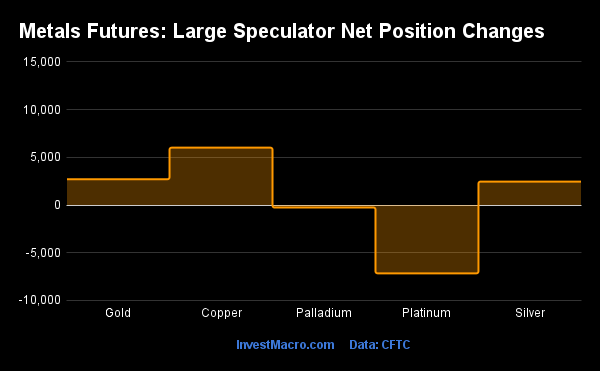
COT Metals Speculators drop Silver bets into small bearish position

By InvestMacro

Here are the latest charts and statistics for the Commitment of Traders (COT) data published by the Commodities Futures Trading Commission (CFTC).

The latest COT data is updated through Tuesday October 25th and shows a quick view of how large traders (for-profit speculators and commercial entities) were positioned in the futures markets.

Copper and Platinum lead Weekly Speculator Changes

The COT precious metals speculator bets were lower this week as two out of the five metals markets we cover had higher positioning this week while three markets had lower contracts.

Leading the gains for the precious metals markets was Copper (3,383 contracts) with Platinum (2,887 contracts) also showing a positive week.

The metals markets leading the declines in speculator bets this week was Gold (-8,924 contracts) with Silver (-1,368 contracts) and Palladium (-536 contracts) also registering lower bets on the week.

Highlighting the COT metals data this week is the decline in the speculators positions for Silver. The large speculators dropped their Silver bets for the third straight week following gains in the previous four weeks. This has brought the overall net position back into a small bearish standing this week (-101 contracts) for the first time in the past five weeks. Previously, the Silver net positioning had spent five weeks from August 23rd to September 20th in bearish territory before seeing speculator positions improve and regain their bullishness on September 27th.

The Silver price, like the other precious metals, remains under pressure and saw a small decline this week. The futures price trades around the $19.15 level and has been in a range between $18 and $20 over the past three weeks.


Data Snapshot of Commodity Market Traders | Columns Legend
Oct-25-2022OIOI-IndexSpec-NetSpec-IndexCom-NetCOM-IndexSmalls-NetSmalls-Index
WTI Crude1,436,9420249,07910-268,0269218,94732
Gold456,072768,0325-80,2139412,18110
Silver139,08512-10114-8,857878,95814
Copper179,34417-16,9192315,907791,01231
Palladium7,3437-1,745142,22887-48313
Platinum56,1171511,38124-14,971773,59016
Natural Gas970,8725-151,76633133,3977318,36924
Brent166,93114-40,3014436,912553,38955
Heating Oil272,6632520,41172-38,2383117,82760
Soybeans651,6851757,38531-35,30176-22,08434
Corn1,445,84225329,78472-273,64533-56,13911
Coffee208,2801811,35137-13,326681,97527
Sugar723,5036111,88859-140,1474328,25943
Wheat324,13716-12,913219,89688-6,98374


Strength Scores led by Platinum and Copper

Strength scores (a measure of the 3-Year range of Speculator positions, from 0 to 100 where above 80 is extreme bullish and below 20 is extreme bearish) show that Platinum (24.4 percent) and Copper (22.9 percent) lead the metals category.

On the downside, Gold (5.3 percent), Palladium (13.6 percent) and Silver (14.0 percent) are at the lowest strength levels currently and all are in extreme bearish positions (below 20 percent).

Strength Statistics:
Gold (5.3 percent) vs Gold previous week (8.2 percent)
Silver (14.0 percent) vs Silver previous week (15.5 percent)
Copper (22.9 percent) vs Copper previous week (20.2 percent)
Platinum (24.4 percent) vs Platinum previous week (20.5 percent)
Palladium (13.6 percent) vs Palladium previous week (16.7 percent)

Platinum leads the Strength Trends

Strength Score Trends (or move index, calculates the 6-week changes in strength scores) show that Platinum (17.8 percent) leads the past six weeks trends for metals this week. Silver (5.0 percent) and Copper (1.6 percent) fill out the other positive movers in the latest trends data.

Gold (-9.7 percent) leads the downside trend scores currently while the next market with lower trend scores was Palladium (-2.8 percent).

Move Statistics:
Gold (-9.7 percent) vs Gold previous week (-8.9 percent)
Silver (5.0 percent) vs Silver previous week (15.5 percent)
Copper (1.6 percent) vs Copper previous week (2.9 percent)
Platinum (17.8 percent) vs Platinum previous week (20.5 percent)
Palladium (-2.8 percent) vs Palladium previous week (2.3 percent)


Individual Markets:

Gold Comex Futures:

Gold Futures COT ChartThe Gold Comex Futures large speculator standing this week reached a net position of 68,032 contracts in the data reported through Tuesday. This was a weekly lowering of -8,924 contracts from the previous week which had a total of 76,956 net contracts.

This week’s current strength score (the trader positioning range over the past three years, measured from 0 to 100) shows the speculators are currently Bearish-Extreme with a score of 5.3 percent. The commercials are Bullish-Extreme with a score of 94.4 percent and the small traders (not shown in chart) are Bearish-Extreme with a score of 10.1 percent.

Gold Futures StatisticsSPECULATORSCOMMERCIALSSMALL TRADERS
– Percent of Open Interest Longs:46.727.08.7
– Percent of Open Interest Shorts:31.844.66.0
– Net Position:68,032-80,21312,181
– Gross Longs:212,853123,08539,637
– Gross Shorts:144,821203,29827,456
– Long to Short Ratio:1.5 to 10.6 to 11.4 to 1
NET POSITION TREND:
– Strength Index Score (3 Year Range Pct):5.394.410.1
– Strength Index Reading (3 Year Range):Bearish-ExtremeBullish-ExtremeBearish-Extreme
NET POSITION MOVEMENT INDEX:
– 6-Week Change in Strength Index:-9.79.5-3.6


Silver Comex Futures:

Silver Futures COT ChartThe Silver Comex Futures large speculator standing this week reached a net position of -101 contracts in the data reported through Tuesday. This was a weekly reduction of -1,368 contracts from the previous week which had a total of 1,267 net contracts.

This week’s current strength score (the trader positioning range over the past three years, measured from 0 to 100) shows the speculators are currently Bearish-Extreme with a score of 14.0 percent. The commercials are Bullish-Extreme with a score of 86.9 percent and the small traders (not shown in chart) are Bearish-Extreme with a score of 13.7 percent.

Silver Futures StatisticsSPECULATORSCOMMERCIALSSMALL TRADERS
– Percent of Open Interest Longs:36.838.116.1
– Percent of Open Interest Shorts:36.944.49.6
– Net Position:-101-8,8578,958
– Gross Longs:51,16352,95222,331
– Gross Shorts:51,26461,80913,373
– Long to Short Ratio:1.0 to 10.9 to 11.7 to 1
NET POSITION TREND:
– Strength Index Score (3 Year Range Pct):14.086.913.7
– Strength Index Reading (3 Year Range):Bearish-ExtremeBullish-ExtremeBearish-Extreme
NET POSITION MOVEMENT INDEX:
– 6-Week Change in Strength Index:5.0-6.08.5


Copper Grade #1 Futures:

Copper Futures COT ChartThe Copper Grade #1 Futures large speculator standing this week reached a net position of -16,919 contracts in the data reported through Tuesday. This was a weekly increase of 3,383 contracts from the previous week which had a total of -20,302 net contracts.

This week’s current strength score (the trader positioning range over the past three years, measured from 0 to 100) shows the speculators are currently Bearish with a score of 22.9 percent. The commercials are Bullish with a score of 79.3 percent and the small traders (not shown in chart) are Bearish with a score of 31.1 percent.

Copper Futures StatisticsSPECULATORSCOMMERCIALSSMALL TRADERS
– Percent of Open Interest Longs:27.944.58.6
– Percent of Open Interest Shorts:37.335.68.0
– Net Position:-16,91915,9071,012
– Gross Longs:50,00079,74215,339
– Gross Shorts:66,91963,83514,327
– Long to Short Ratio:0.7 to 11.2 to 11.1 to 1
NET POSITION TREND:
– Strength Index Score (3 Year Range Pct):22.979.331.1
– Strength Index Reading (3 Year Range):BearishBullishBearish
NET POSITION MOVEMENT INDEX:
– 6-Week Change in Strength Index:1.6-3.614.7


Platinum Futures:

Platinum Futures COT ChartThe Platinum Futures large speculator standing this week reached a net position of 11,381 contracts in the data reported through Tuesday. This was a weekly boost of 2,887 contracts from the previous week which had a total of 8,494 net contracts.

This week’s current strength score (the trader positioning range over the past three years, measured from 0 to 100) shows the speculators are currently Bearish with a score of 24.4 percent. The commercials are Bullish with a score of 77.1 percent and the small traders (not shown in chart) are Bearish-Extreme with a score of 16.3 percent.

Platinum Futures StatisticsSPECULATORSCOMMERCIALSSMALL TRADERS
– Percent of Open Interest Longs:50.733.312.2
– Percent of Open Interest Shorts:30.560.05.8
– Net Position:11,381-14,9713,590
– Gross Longs:28,47118,6866,825
– Gross Shorts:17,09033,6573,235
– Long to Short Ratio:1.7 to 10.6 to 12.1 to 1
NET POSITION TREND:
– Strength Index Score (3 Year Range Pct):24.477.116.3
– Strength Index Reading (3 Year Range):BearishBullishBearish-Extreme
NET POSITION MOVEMENT INDEX:
– 6-Week Change in Strength Index:17.8-16.3-4.5


Palladium Futures:

Palladium Futures COT ChartThe Palladium Futures large speculator standing this week reached a net position of -1,745 contracts in the data reported through Tuesday. This was a weekly reduction of -536 contracts from the previous week which had a total of -1,209 net contracts.

This week’s current strength score (the trader positioning range over the past three years, measured from 0 to 100) shows the speculators are currently Bearish-Extreme with a score of 13.6 percent. The commercials are Bullish-Extreme with a score of 86.8 percent and the small traders (not shown in chart) are Bearish-Extreme with a score of 12.7 percent.

Palladium Futures StatisticsSPECULATORSCOMMERCIALSSMALL TRADERS
– Percent of Open Interest Longs:22.060.014.6
– Percent of Open Interest Shorts:45.829.621.2
– Net Position:-1,7452,228-483
– Gross Longs:1,6184,4031,074
– Gross Shorts:3,3632,1751,557
– Long to Short Ratio:0.5 to 12.0 to 10.7 to 1
NET POSITION TREND:
– Strength Index Score (3 Year Range Pct):13.686.812.7
– Strength Index Reading (3 Year Range):Bearish-ExtremeBullish-ExtremeBearish-Extreme
NET POSITION MOVEMENT INDEX:
– 6-Week Change in Strength Index:-2.84.5-18.1


Article By InvestMacroReceive our weekly COT Newsletter

*COT Report: The COT data, released weekly to the public each Friday, is updated through the most recent Tuesday (data is 3 days old) and shows a quick view of how large speculators or non-commercials (for-profit traders) were positioned in the futures markets.

The CFTC categorizes trader positions according to commercial hedgers (traders who use futures contracts for hedging as part of the business), non-commercials (large traders who speculate to realize trading profits) and nonreportable traders (usually small traders/speculators) as well as their open interest (contracts open in the market at time of reporting). See CFTC criteria here.