Archive for Financial News – Page 54

Week Ahead: US500 faces triple threat – Geopolitics, Powell & PCE

By ForexTime 

  • FXTM’s US500 ↑ 1% MTD, less than 3% away from ATH
  • Trump delays decision on Iran strike by two weeks
  • Powell’s testimony + US PCE = potential breakout?
  • US PCE forecasted to move US500 ↑ 1.3% or ↓ 1.0%
  • Technical levels: 6060, 6000 & 5920 

A cautious sense of relief has spread through markets after President Trump delayed deciding on attacking Iran by two weeks.

However, the ongoing Middle East conflict is set to weigh on investor confidence ahead of another heavy event-packed week. 

Speeches by various policymakers, top-tier economic data including the Fed’s preferred inflation gauge and Powell’s testimony could translate to fresh trading opportunities:

Sunday, 22nd June 

  • USDInd: San Francisco Fed President Mary Daly
  • Tesla: Tentative launch of Robotaxi service in Texas

Monday, 23rd June 

  • GER40: Germany HCOB Manufacturing & Services PMI
  • JPY: Japan au Jibun Bank Manufacturing PMI
  • TWN: Taiwan jobless rate
  • UK100: UK S&P Global Manufacturing & Services PMI
  • RUS2000: US S&P Global Manufacturing & Services PMI, Fed speak

Tuesday, 24th June 

  • CN50: China’s National People’s Congress
  • CAD: Canada CPI
  • GER40: Germany IFO business climate
  • UK100: BOE Governor Andrew Bailey testimony
  • US500: Fed Chair Jerome Powell testimony, New York Fed President John Williams

Wednesday, 25th June

  • AUD: Australia CPI
  • NZD: New Zealand trade
  • JPY: BOJ board member Naoki Tamura speech
  • US500: Fed Chair Jerome Powell testimony

Thursday, 26th June

  • SG20: Singapore industrial production
  • GBP: BOE Governor Andrew Bailey speech
  • US30: US revised GDP, initial jobless claims, Fed speak

Friday, 27th June

  • CN50: China industrial profits
  • CAD: Canada GDP
  • EUR: Eurozone economic confidence, consumer confidence
  • JPY: Japan Tokyo CPI, unemployment, retail sales
  • US30: Fed releases annual bank stress test results
  • US500: US personal income, PCE price index, University of Michigan consumer sentiment, Fed speech

Our attention is drawn to FXTM’s US500, which has been confined within a daily range since the start of June.

Imagen
us500 4

Note: FXTM’s US500 tracks the underlying S&P 500 index

Recently, US equities have been pressured by mounting geopolitical risks, despite the Federal Reserve still penciling in two interest rate cuts for 2025.

Still, US500 is up roughly 1% this month and trading less than 3% away from its all-time high at 6151.3.


Here are 4 factors that could trigger a major breakout:


1) Ongoing Middle East conflict

Israel and Iran have exchanged missile attacks for one week after tensions escalated last Friday.

The conflict between both sides has shown no signs of cooling with investors watching whether the United States will get involved. Although Trump has delayed this decision by two weeks, any hints of potential actions could influence risk sentiment.

  • Any signs of the United States holding off on joining the Israel-Iran conflict may support risk appetite – keeping the US500 buoyed. 
  • Should expectations mount around the US attacking Iran, this may spark fears of a wider conflict. Such development may hit the US500 as risk aversion intensifies. 


2) Fed Chair Powell’s 2-day Testimony

Fed Chair Jerome Powell’s semi-annual testimony before Congress may provide key insight into future policy moves.

During June’s FOMC meeting, Powell stated that the Fed was ‘well-positioned to wait’ before moving further on rates. He also expressed concerns over the effects of tariffs on inflation.

  • Should Powell repeat the same message and strike a hawkish note, this could weigh on the US500.
  • If the Fed Chair sounds more dovish than expected and signals a rate cut in September, the US500 may rise. 


3) US May PCE report

The Fed’s preferred inflation gauge – the Core PCE could influence expectations about when the central bank will cut rates in the second half of 2025.

Markets are forecasting PCE deflators to rise in May with the core figure nudging up 2.6% year-on-year compared to 2.5% seen in the previous month. Ultimately, more signs of rising price pressure may shave bets around lower US interest rates.

Traders are currently pricing in a 68% probability of a 25-basis point cut by September.

Beyond the PCE report, it will be wise to keep an eye on speeches by a host of Fed officials and other US data, including PMI’s which may influence the US500.

US500 is forecasted to move as much as 1.3% or decline 1.0% in a 6-hour window post release.

  • The US500 may slip on signs of rising price pressures in the United States.
  • A cooler-than-expected PCE report could support the US500.


4) Technical forces

The US500 remains trapped within a range with support at 5920 and resistance at 6060.

  • A solid daily close and breakout above 6000 may open a path toward 6060 and 6151.3. 
  • Sustained weakness below 5920 may trigger a selloff toward 5850, the 200-day SMA and 100-day SMA.
Imagen
US500 6

Forex-Time-LogoArticle by ForexTime

ForexTime Ltd (FXTM) is an award winning international online forex broker regulated by CySEC 185/12 www.forextime.com

Gold Falls to One-Week Low: What’s Behind the Drop?

By RoboForex Analytical Department 

The price of gold has dropped below $3,360 per troy ounce, nearing a one-week low and marking its first decline in three weeks. Investors are offloading the precious metal to offset losses in other markets amid escalating tensions in the Middle East.

Geopolitical Tensions Weigh on Gold

Israel and Iran continue to exchange strikes, with Israel intensifying attacks on strategic and government sites in Tehran following reports of an Iranian missile hitting a major Israeli hospital.

Meanwhile, investors are closely monitoring developments in Washington. US President Donald Trump has not ruled out direct military intervention in Iran, and speculation is mounting that a decision could come within the next two weeks. However, the market remains driven by rumours rather than confirmed reports.

Earlier this week, the Federal Reserve held interest rates steady but signalled two potential cuts before year-end. Fed Chair Jerome Powell cautioned, however, that trade tariffs could continue to fuel inflation.

The Fed’s latest projections indicate slower economic growth, rising inflation, and weaker employment prospects in 2025. Persistent inflation concerns may limit the scope for rate cuts, further pressuring gold, which, unlike bonds, offers no coupon income.

Technical Analysis: XAU/USD

H4 Chart:

On the H4 chart, XAU/USD formed a consolidation range around 3,388 before breaking downward. The decline is expected to extend towards 3,323, after which a corrective rebound to 3,388 may follow. This scenario is supported by the MACD indicator, with its signal line below zero and pointing firmly downward.

H1 Chart:

On the H1 chart, the market completed a corrective wave to 3,399 before reversing downward and breaking below the consolidation range. The drop below 3,360 opens the door for further downside, with a target at 3,323. Upon reaching this level, a corrective bounce toward 3,350 could follow. The Stochastic oscillator confirms this scenario, with its signal line below 50 and trending sharply down towards 20.

Conclusion

Gold remains under downward pressure from geopolitical uncertainty, expectations of Fed policy, and technical selling. The key levels to watch are 3,323 (support) and 3,388 (resistance), with potential corrections offering short-term trading opportunities.by technical indicators.


Disclaimer

Any forecasts contained herein are based on the author’s particular opinion. This analysis may not be treated as trading advice. RoboForex bears no responsibility for trading results based on trading recommendations and reviews contained herein.

The SNB reduced the interest rate to 0%. The Norges Bank cut its interest rate for the first time in five years

By JustMarkets 

The US stock indices did not trade yesterday due to a public holiday.

The Mexican peso (MXN) weakened to 19.1 per US dollar, down from a ten-month high of 18.886 reached on June 12, as the US dollar regained strength amid expectations of easing by the Bank of Mexico and renewed geopolitical risks. The US Federal Reserve’s decision to keep rates at 4.25–4.50% and Chairman Powell’s warning that US tariffs could cause inflation boosted demand for dollars. At the same time, markets began to price in an earlier-than-expected rate cut by the Bank of Mexico, even though Mexico’s benchmark rate remains at 8.5%, which negates the carry premium that had been supporting the peso.

European stock markets were mostly down on Thursday. Germany’s DAX (DE40) fell by 1.12%, France’s CAC 40 (FR40) closed down 1.34%, Spain’s IBEX35 (ES35) lost 1.28%, and the British FTSE 100 (UK100) closed down 0.58%.

At its June meeting, the Bank of England (BoE) voted 6-3 to keep the bank rate at 4.25%, focusing on the complex backdrop of heightened global uncertainty and persistent inflationary pressures. Three members of the bank voted to cut the rate by 0.25 percentage points to 4%, although investors had expected the split to be 7–2. The Central Bank noted that consumer price inflation is likely to remain broadly at current levels until the end of the year and return to target next year.

The Swiss National Bank (SNB) lowered its key interest rate by 25 basis points to 0% in June 2025, as expected, setting the cost of borrowing at zero for the first time since the introduction of negative rates at the end of 2022. This decision was made against the backdrop of easing inflationary pressures and a deterioration in the global economic outlook. Consumer prices in Switzerland fell by 0.1% in May, the first decline in four years. The SNB currently expects average inflation of 0.2% in 2025, 0.5% in 2026, and 0.7% in 2027. In the first quarter of 2025, Switzerland’s GDP also showed strong growth, partly driven by exports to the US ahead of the introduction of new tariffs, although the underlying momentum was more modest.

At its meeting in June 2025, Norges Bank lowered its key rate by 25 basis points to 4.25%. This is the first rate cut in five years. Policymakers said that inflation had slowed since the March meeting and that it was appropriate to ease financial conditions and support economic growth. However, the Monetary Policy Committee emphasized that borrowing costs should remain sufficiently tight to prevent a resurgence of inflation. According to the latest expectations, the rate will be around 4% at the end of the year and 3% by 2028.

WTI crude oil prices slowed their growth at the start of Thursday’s session and are trading below $75 per barrel, just slightly below their five-month high, after President Trump’s statement that he would decide on US involvement in the Israeli-Iranian conflict “within two weeks” allayed fears of an immediate supply shock from the Middle East.

Asian markets were in sell-off mode yesterday. Japan’s Nikkei 225 (JP225) fell by 1.02%, China’s FTSE China A50 (CHA50) lost 0.64%, Hong Kong’s Hang Seng (HK50) decreased by 1.99%, and Australia’s ASX 200 (AU200) showed a negative result of 0.09%.

The Philippine Central Bank cut its benchmark interest rate by 25 basis points to 5.25% at its June 2025 policy meeting, the lowest level in two and a half years and in line with market expectations. BSP Governor Eli Remolona said the decision reflected a more moderate inflation outlook and the need to support growth with a more accommodative policy. Annual inflation in May 2025 fell to 1.3% from 1.4% in the previous month, matching market expectations and reaching its lowest level since November 2019. The inflation projections for 2025 was revised downward from 2.4% to 1.6%, reflecting easing price pressures.

S&P 500 (US500) 5,980.87 −1.85 (−0.03%)

Dow Jones (US30) 42,171.66 −44.14 (−0.10%)

DAX (DE40) 23,057.38 −260.43 (−1.12%)

FTSE 100 (UK100) 8,791.80 −51.67 (−0.58%)

USD Index 98.76 −0.14 (−0.14%)

News feed for: 2025.06.20

  • Japan National Core Consumer Price Index at 02:30 (GMT+3);
  • Japan Monetary Policy Meeting Minutes at 02:50 (GMT+3);
  • China PBoC Loan Prime Rate (m/m) at 04:15 (GMT+3);
  • German Producer Price Index (m/m) at 09:00 (GMT+3);
  • UK Retail Sales (m/m) at 09:00 (GMT+3);
  • Japan BOJ Gov Ueda Speaks at 09:40 (GMT+3);
  • Canada Retail Sales (m/m) at 15:30 (GMT+3);
  • US Philadelphia Fed Manufacturing Index (m/m) at 15:30 (GMT+3).

By JustMarkets


This article reflects a personal opinion and should not be interpreted as an investment advice, and/or offer, and/or a persistent request for carrying out financial transactions, and/or a guarantee, and/or a forecast of future events.

The US Federal Reserve left interest rates unchanged. The Riksbank lowered its interest rate by 0.25%

By JustMarkets 

At the end of the trading day, the Dow Jones Index (US30) fell by 0.10%. The S&P 500 Index (US500) fell by 0.03%. The Nasdaq (US100) Technology Index closed higher by 0.01%. Investors reacted to the Federal Reserve’s decision to leave interest rates unchanged and Fed Chairman Powell’s cautious tone amid growing geopolitical and economic uncertainty. Powell emphasized the Fed’s wait-and-see stance, citing uncertainty about the inflationary impact of President Trump’s tariffs and the risk of stagflation. Officials expect two rate cuts in 2025 but lowered growth expectations and raised inflation expectations.

Initial jobless claims in the US fell by 5,000 from the previous week to 245,000 for the week ending June 14, in line with market expectations, but held on to recent gains and were the fifth-highest reading since August 2023. At the same time, the number of applications for unemployment benefits in the previous week was 1,945,000, remaining at a more than three-year high of 1,951,000 recorded in the last week of May. The results reinforced the view that the US labor market is softening after initially resisting the economic uncertainty this year.

Visa, Mastercard, and PayPal each fell more than 4% after Congress passed the stablecoin bill.

In June, the Canadian dollar weakened to 1.37 per US dollar, retreating from its strongest level in eight months of 1.357, recorded on June 16. Expectations of a divergence in monetary policy with the US, weaker commodity prices, and geopolitical safe-haven flows undermined its recent gains. Traders are now pricing in more aggressive easing by the Bank of Canada compared to the Fed, which is narrowing the yield differential and undermining the loonie’s advantage.

European stock markets traded mixed on Wednesday. Germany’s DAX (DE40) fell by 0.50%, France’s CAC 40 (FR40) closed down by 0.36%, the Spanish IBEX35 (ES35) rose by 0.08%, and the British FTSE 100 (UK100) closed positive 0.08%. The annual core inflation rate in the Eurozone, excluding energy, food, alcohol, and tobacco prices, fell to 2.3% in May 2025 from 2.7% in the previous month, which was in line with preliminary estimates and below the market’s initial expectations of 2.5%. Although this figure remained above the 2% target, it was the lowest since October 2021, reinforcing calls from dovish members of the European Central Bank’s Governing Council for monetary policy easing and addressing growth concerns.

Sweden’s Riksbank cut its key interest rate by 25 basis points to 2% in June, in line with expectations, as the country’s economic recovery slows and inflation declines. Recent data points to weak growth and persistently high unemployment. The future course of monetary policy will depend on new data and how it affects inflation and growth expectations.

WTI oil prices fell more than 1% to $73.7 per barrel on Wednesday after rising to $76 at the start of the session, as President Trump hinted at the possibility of dialogue with Iran, easing fears of an inevitable conflict. While tensions remain high amid ongoing Iranian-Israeli military action, Trump refused to confirm plans for a US strike and said Iran had come to the negotiating table, although he called it “very late”.

Asian markets traded without a single trend yesterday. Japan’s Nikkei 225 (JP225) rose by 0.90%, China’s FTSE China A50 (CHA50) added 0.07%, Hong Kong’s Hang Seng (HK50) fell by 1.12%, and Australia’s ASX 200 (AU200) showed a negative result of 0.12%.

On June 19, the Hong Kong Monetary Authority (HKMA) left its base rate unchanged at 4.75%, echoing the US Federal Reserve’s decision to keep its base rate at 4.25–4.50% for the fourth consecutive meeting, despite pressure from President Trump to lower rates. The HKMA’s policy remains in line with that of the Fed due to the Hong Kong dollar’s peg to the US currency.

Bank Indonesia kept its base interest rate unchanged at 5.5% at its June 2025 policy meeting, following a 25 bps cut in May, in line with market expectations. This decision was supported by lower inflation, stability in the rupiah exchange rate, and ongoing efforts to sustain economic growth. In May 2025, annual inflation fell to 1.60% from an eight-month high of 1.95% in April.

The Australian dollar fell to $0.648 on Thursday, reversing the previous session’s significant gains, after labor market data reinforced the Reserve Bank of Australia’s view that monetary policy needs to be eased. Markets now see an 80% chance that the RBA will cut its key interest rate from 3.85% to 3.6% at its July 8 meeting, with two more cuts expected later this year.

S&P 500 (US500) 5,980.87 −1.85 (−0.03%)

Dow Jones (US30) 42,171.66 −44.14 (−0.10%)

DAX (DE40) 23,317.81 −116.84 (−0.50%)

FTSE 100 (UK100) 8,843.47 +9.44 (+0.11%)

USD Index 98.88 +0.06 (+0.06%)

News feed for: 2025.06.19

  • New Zealand QDP (q/q) at 01:45 (GMT+3);
  • Australia Unemployment Rate (m/m) at 04:30 (GMT+3);
  • Switzerland Trade Balance (m/m) at 09:00 (GMT+3);
  • Switzerland SNB Interest Rate Decision at 10:30 (GMT+3);
  • Switzerland SNB Monetary Policy Assessment at 10:30 (GMT+3);
  • Norway Norges Bank Interest Rate Decision (m/m) at 11:00 (GMT+3);
  • Switzerland SNB Press Conference at 11:00 (GMT+3);
  • UK BoE Interest Rate Decision at 14:00 (GMT+3);
  • UK BoE MPC Meeting Minutes at 14:00 (GMT+3).

By JustMarkets


This article reflects a personal opinion and should not be interpreted as an investment advice, and/or offer, and/or a persistent request for carrying out financial transactions, and/or a guarantee, and/or a forecast of future events.

GBP/USD Under Pressure: The Pound Rapidly Loses Strength

By RoboForex Analytical Department 

The GBP/USD pair continues its decline, touching 1.3403 on Thursday, as the pound hovers near a four-week low.

Political uncertainty in the UK and heightened demand for safe-haven assets amid the Israel-Iran conflict have weighed heavily on the sterling.

Today, the Bank of England (BoE) holds its monetary policy meeting, and markets widely expect rates to be kept on hold. Focus will be on the BoE’s forward guidance, particularly amid rising oil prices.

Meanwhile, markets are still pricing in two rate cuts in 2025. Combined with soft UK macroeconomic data and the Federal Reserve’s hawkish stance, this has weighed on the pound’s yield and diminished its relative appeal to investors.

Over the past 24 hours, the broad-based strengthening of the US dollar has further pressured the GBP exchange rate.

Earlier, the pound reacted to inflation figures, which came in line with forecasts. Annual inflation eased to 3.4% in May (from 3.5% in April), while core inflation dipped to 3.5% (from 3.8%). However, the reading remains well above the BoE’s 2% target, indicating that progress is still too limited to prompt a change in the Bank’s cautious stance on rate cuts.

Technical analysis of GBP/USD

H4 Chart:

  • GBP/USD continues its downward trajectory, targeting 1.3360
  • Once this level is reached, a correction towards 1.3496 may follow
  • After the correction, another decline towards 1.3240 could materialise
  • This scenario is supported by the MACD indicator, with its signal line below zero and pointing sharply downward


H1 Chart:

  • The pair is forming the third wave of decline, targeting 1.3373
  • A pullback towards 1.3494 is expected before a potential fifth wave lower to 1.3360
  • The Stochastic oscillator supports this scenario, with its signal line below 50 and trending down towards 20

Conclusion

The GBP/USD remains under downward pressure, with key levels to watch at 1.3360 and 1.3240. A short-term correction may precede further declines, supported by technical indicators.


Disclaimer

Any forecasts contained herein are based on the author’s particular opinion. This analysis may not be treated as trading advice. RoboForex bears no responsibility for trading results based on trading recommendations and reviews contained herein.

The Yen Halts Its Decline, but Domestic Signals Remain Negative

By RoboForex Analytical Department 

The USD/JPY pair stabilised at 145.11 following three consecutive days of gains.

The Japanese yen had previously faced downward pressure due to a combination of factors, including weak macroeconomic data. Japan’s exports declined for the first time in eight months, indicating that the impact of US tariffs is now being felt. Meanwhile, imports fell more sharply than anticipated, heightening concerns over weakening external demand.

Other indicators painted a similarly bleak picture. Machinery orders dropped significantly in April, while industrial sentiment deteriorated in June. These developments suggest that signs of softening domestic demand are increasingly apparent.

The Bank of Japan (BoJ) held a meeting the previous day, leaving interest rates unchanged and reaffirming its cautious approach to reducing balance sheet assets. BoJ Governor Kazuo Ueda emphasised that the central bank is closely monitoring economic conditions and global trade dynamics, leaving open the possibility of future rate hikes.

Additional pressure on the yen came from the lack of progress at the G7 summit in Canada, where Prime Minister Shigeru Ishiba and US President Donald Trump failed to reach an agreement on tariff cooperation.

Technical analysis of USD/JPY

H4 Chart:

The market has completed an upward wave to the upper boundary of the consolidation range at 145.43. Having reached this target, a decline towards 144.00 is now anticipated. A break below this level could open the door for a further drop towards 142.20, with the potential to extend the downtrend to 140.50. Conversely, an upward move would raise the likelihood of a rally towards 146.98. This scenario is supported by the MACD indicator, where the signal line remains above zero and has exited the histogram area. A downward correction with new lows on the indicator is likely to follow.

H1 Chart:

The market is forming a bearish wave structure targeting 144.00, which is likely to be reached today. Following this, a corrective rebound towards 144.80 may occur. Overall, price action continues to develop within a broad consolidation range at these levels. The Stochastic oscillator corroborates this outlook, with its signal line positioned below 20 and pointing sharply downward.

Conclusion

While the yen’s decline has paused, domestic economic signals remain unfavourable. With weak trade data, cautious BoJ policy, and stalled international negotiations, the currency faces ongoing headwinds. Technically, the USD/JPY pair shows potential for further downside, though a corrective rebound cannot be ruled out.


Disclaimer

Any forecasts contained herein are based on the author’s particular opinion. This analysis may not be treated as trading advice. RoboForex bears no responsibility for trading results based on trading recommendations and reviews contained herein.

Environmental Co. Report Uncovers Fertilizer Technology Breakthrough

Source: Streetwise Reports (6/17/25)

Advanced organic waste treatment and resource recovery company Bion Environmental Technologies Inc. (BNET:OTCQB) says it has completed the technology-optimization report for its Ammonia Recover System (ARS) at Fair Oaks Indiana. Find out how the company expects to use its technology in the organic food sector.

Advanced organic waste treatment and resource recovery company Bion Environmental Technologies Inc. (BNET:OTCQB) announced it has completed the technology-optimization report for its Ammonia Recover System (ARS) at Fair Oaks Indiana.

The optimized ARS proved it remains stable and can sustain continuous steady-state functions; it operates reliably; and is scalable. The ARS also displayed its capability to reach ammonia reduction objectives by evaporating one-third less water than was projected and modeled. This results in substantially improved economics, including reduced production costs for the premium nitrogen fertilizers the ammonia is upcycled into.

“As we have indicated for some time, the ARS has exceeded our expectations. This report details by just how much,” said Chief Executive Officer Craig Scott. “We are now sorting through and evaluating dozens of potential projects and partners to find the best fit to fill our initial fertilizer offtake agreements. Our goal is to identify a project (or projects) that will allow us to supply our unique organic nitrogen fertilizer to growers during the 2026 growing season.”

The report outlines over a decade of ARS concept advancement and technology R&D, emphasizing what was accomplished during the optimization phase at Fair Oaks. Bion enlisted Buflovak, a New York engineering company, as its ARS development collaborator, due to their specialized expertise in evaporation, distillation, and separation processes. The Buflovak engineering team participated closely during six years of ARS R&D and testing, including offering guidance during the 18-month optimization phase at Fair Oaks, and a final review of the report. The Buflovak engineering team remains available to discuss the report and its findings.

Economics were not assessed during optimization, but Bion noted in a release that the considerable operational improvements that were achieved, during that phase, directly impact modeled system economics and fertilizer manufacturing expenses.

The Fair Oaks findings indicate operating expenses for a full-scale commercial system will be approximately 25% lower than previously modeled, with a corresponding reduction in fertilizer manufacturing costs. Modeled capital expense, either overall or as a function of fertilizer or treatment capacity, will decrease substantially, as well.

The Most Rapidly Expanding Area of US Agriculture

The organic food sector represents the most rapidly expanding area of U.S. agriculture, based on the U.S. Department of Agriculture. Nevertheless, something commonly referred to as the “organic yield gap” can reduce the productivity of these operations.

An absence of an affordable, organic (but readily-available) nitrogen, similar to the synthetic nitrogen fertilizer utilized in traditional farming, constitutes a major factor why organic agriculture generates fewer pounds per acre. Organic growers can’t afford the organic nitrogen that gives that additional “boost” of late-season development and growth that traditional crops get — that’s why organic fruit and produce tends to be smaller, the company stated. It also results in a greater carbon footprint per pound for organic foods.

Bion’s ARS handles and treats livestock waste flows in order to isolate and capture the ammonia (organic nitrogen) that is also released during biogas production in an anaerobic digester. The ARS is the foundation of the company’s Gen3Tech technology, which generates renewable energy, nutrients, and clean water from livestock waste flows. Instead of that ammonia being lost and polluting the environment, the ARS repurposes it into low-carbon and organic nitrogen fertilizers. By using only the compounds in the waste stream itself, the nitrogen remains organic, giving organic growers the late-season nitrogen they need to enhance yields.

Last summer, Bion revealed its “pure” commercial nitrogen fertilizer, manufactured from livestock waste, was OMRI-listed for use in organic production. Bion’s ammonium bicarbonate fertilizer constitutes a partially-stabilized source of nitrogen, upcycled from reactive ammonia in organic waste streams through a patented process. OMRI operates as an international nonprofit organization that lists products permitted for use in organic production under the USDA’s National Organic Program.

Protecting Surface Waters, Aquifers, the Atmosphere

Bion stated its methodology will diminish the carbon footprint linked with organic systems and “significantly reduce nitrogen runoff and off-gassing to protect surface waters, aquifers, and the atmosphere. It can quickly bring soil microbes in organic systems back to a healthy and productive balance and reduce the yield gap of organic crops as compared to conventional.”

An organic fertilizer, manure is conventionally administered to farmland before planting occurs. The volatile ammonia-nitrogen it holds — approximately 75% of the fertilizer’s nitrogen/nutrient value — typically escapes to pollute the environment. However, Bion stated its patented ARS technology focuses on this volatile and highly mobile ammonia nitrogen, stabilizes it with carbon dioxide also in the waste flow, and transforms it into ammonium bicarbonate, a 100% soluble nitrogen fertilizer that can be easily absorbed by plants and administered to organic crops.

“It is pathogen-free,” the company stated. “So, unlike manure, it can be applied at any time in the plant growth cycle.”

Bion stated it anticipates further economic improvements as the ARS is expanded to full commercial scale. “While engineering challenges are expected, Bion believes those risks are substantially mitigated because the ARS platform and the processes it uses perform better at larger scale,” it stated. Bion also said, “Over the next several months, we intend to evaluate additional modifications to the ARS we believe could dramatically reduce system capital costs and operating expenses.”

Bion stated the engineering report, produced with guidance and review from Bion’s engineering partner, along with the OMRI Listing, should allow it to advance with strategic relationships in the fertilizer industry.

The Catalyst: Europe Ahead of the US

Based on a report from Markets and Markets, the marketplace size for organic fertilizers is valued at US$7.9 billion in 2024 and is projected to expand at a compound annual growth rate (CAGR) of 11.5% through 2029 to reach US$13.6 billion.

“The rising preference for environmentally conscious food fuels the growth of the organic fertilizers industry,” the report said. “This transition underscores a wider dedication to sustainable farming methods and reducing ecological damage.”

Governments worldwide are responding to this transformation by implementing regulations and incentives to promote organic farming, enhancing the demand for organic fertilizers, Markets and Markets stated.

The global marketplace for biogas is projected to expand by US$19.51 billion from 2024-2028 at a CAGR of 6.01%, based on a report by Technavio.

Europe is significantly ahead of America regarding utilizing the technology to handle organic wastes. In a 2022 report by Waste 360, there were approximately 17,500 such facilities in the European Union in 2016 and fewer than 350 in the U.S. A 2024 article by Ecohaz showed there were almost 20,000 biogas plants in Europe at the time of the report. However, America is making moves to catch up.

A February 2025 report by the American Biogas Council reported that 2024 saw record numbers in the sector. The report noted that “In the 12 months ending in December, 125 new biogas projects came online, representing over US$3 billion in new U.S. investments. New projects in 2024 exceeded new projects in 2023 by 17%, while total investment in those projects increased by 40% compared to investment in projects opened in the previous year.” This brought the total of U.S.-based biogas facilities to almost 2,500.

Scott observed that it’s a resource that’s being squandered. “Farmers buy synthetic nitrogen fertilizer all day long to replace what is lost out of the nitrogen cycle. We upcycle what’s already here, and it’s more valuable because it is organic. You’ve got one of two choices: either lose it to atmosphere and runoff, where it becomes pretty nasty air and water pollution, or capture it, harness it, and repurpose it, and add value to your operations,” he said.

Ownership and Share Structure 

According to Refinitiv, about 20% of Bion Environmental is owned by management and insiders.

About 1.24% is with Centerpoint Corp. with 0.70 million shares. Less than 1% is held by institutions.

The rest is with retail.

Bion has a market cap of US$11.34 million. Trading over the past 52 weeks ranged from US$0.04 per share to US$0.57.


Important Disclosures:

  1. As of the date of this article, officers and/or employees of Streetwise Reports LLC (including members of their household) own securities of Bion Environmental Technologies Inc.
  2. Steve Sobek wrote this article for Streetwise Reports LLC and provides services to Streetwise Reports as an employee.
  3. This article does not constitute investment advice and is not a solicitation for any investment. Streetwise Reports does not render general or specific investment advice and the information on Streetwise Reports should not be considered a recommendation to buy or sell any security. Each reader is encouraged to consult with his or her personal financial adviser and perform their own comprehensive investment research. By opening this page, each reader accepts and agrees to Streetwise Reports’ terms of use and full legal disclaimer. Streetwise Reports does not endorse or recommend the business, products, services or securities of any company.

For additional disclosures, please click here.

Escalating tensions in the Middle East continue to put pressure on markets. Silver reaches 13-year high

By JustMarkets

The US stocks fell on Tuesday as investors closely monitored escalating tensions in the Middle East, where the Israeli-Iranian conflict has been ongoing for five days. At the end of the trading day, the Dow Jones (US30) Index fell by 0.70%. The S&P 500 (US500) Index fell by 0.84%. The Nasdaq (US100) Technology Index closed lower by 0.91%. President Trump stepped up his rhetoric, demanding Iran’s “unconditional surrender” and warning of a possible strike against Supreme Leader Khamenei in a series of posts on the Truth social network.

At the same time, disappointing US retail sales data, which fell by 0.9% in May, signaled a slowdown in consumer growth, and that tariffs may have a huge impact on the economy.

Today, Federal Reserve officials will give their views on the future path of interest rates, as well as how tariffs and unrest in the Middle East will affect the economy. Although an immediate change in interest rates seems unlikely, the Fed meeting, which ends on Wednesday, will provide important signals that could still influence the markets. Among the most significant points to watch will be whether Federal Open Market Committee members stick to their previous expectations of two rate cuts this year.

Minutes from the meeting show that earlier this month, senior Bank of Canada officials considered the possibility of lowering interest rates. The main source of uncertainty — and the biggest threat facing the Canadian economy — is the trade conflict initiated by the United States. The Bank of Canada’s next interest rate decision is scheduled for July 30.

Stock markets in Europe were mostly lower on Tuesday. The German DAX (DE40) fell by 1.12%, the French CAC 40 (FR40) closed down 0.76%, the Spanish IBEX35 (ES35) lost 1.41%, and the British FTSE 100 (UK100) closed down 0.46%.

WTI oil prices rose by 4.3% to $74.8 per barrel on Tuesday as escalating tensions between the US and Iran reignited concerns about supplies. US President Donald Trump demanded Iran’s “unconditional surrender” and directly threatened Supreme Leader Ayatollah Ali Khamenei. According to Goldman Sachs, any attempt by Iran to block the Strait of Hormuz, a key point on the global oil supply route, could lead to a sharp rise in prices above $100.

On Wednesday, silver prices rose above $37.20 per ounce, reaching their highest level since 2012, driven by high industrial demand, persistent supply shortages, and increased purchases of the safe-haven metal amid geopolitical uncertainty. The expanding use of this metal in solar energy, electronics, and broader electrification trends now accounts for more than half of global demand, reinforcing its long-term structural importance. On the supply side, the silver market has been in deficit for the fifth consecutive year.

Asian markets traded without a single trend yesterday. Japan’s Nikkei 225 (JP225) rose by 0.59%, China’s FTSE China A50 (CHA50) added 0.01%, Hong Kong’s Hang Seng (HK50) fell by 0.34%, and the Australian ASX 200 (AU200) showed a negative result of 0.08%.

In New Zealand, attention this week is focused on the first quarter GDP report, which will be released on Thursday. Analysts expect the economy to expand by 0.7% on a quarterly basis but contract by 0.8% on an annual basis. On the policy front, the Reserve Bank of New Zealand has already signaled that its aggressive easing campaign is coming to an end, and markets are expecting a final rate cut later this year.

The Australian dollar strengthened to $0.649 on Wednesday, recouping some of the previous session’s losses, as rising oil prices caused by heightened geopolitical tensions supported demand for commodity-linked currencies. Market jitters intensified as the conflict between Israel and Iran entered its sixth day and President Trump demanded Iran’s unconditional surrender and hinted at possible US intervention. In response, oil prices continued to rise, supporting the Australian dollar, as it is strongly correlated with commodity markets.

S&P 500 (US500) 5,982.72 −50.39 (−0.84%)

Dow Jones (US30) 42,215.80 −299.29 (−0.70%)

DAX (DE40) 23,434.65 −264.47 (−1.12%)

FTSE 100 (UK100) 8,834.03 −41.19 (−0.46%)

USD Index 98.82 +0.82 (+0.84%)

News feed for: 2025.06.18

  • Japan Trade Balance (m/m) at 02:50 (GMT+3);
  • UK Consumer Price Index (m/m) at 09:00 (GMT+3);
  • UK Producer Price Index (m/m) at 09:00 (GMT+3);
  • Indonesian IB Interest Rate Decision (m/m) at 10:30 (GMT+3);
  • Sweden Riksbank Rate Decision (m/m) at 10:30 (GMT+3);
  • Eurozone Consumer Price Index (m/m) at 12:00 (GMT+3);
  • US Initial Jobless Claims (w/w) at 15:30 (GMT+3);
  • US Building Permits (m/m) at 15:30 (GMT+3);
  • US Crude Oil Reserves (w/w) at 17:30 (GMT+3);
  • Canada BOC Gov Macklem Speaks at 18:15 (GMT+3);
  • US Natural Gas Storage (w/w) at 19:00 (GMT+3);
  • US Federal Funds Rate at 21:00 (GMT+3);
  • US FOMC Economic Projections at 21:00 (GMT+3);
  • US FOMC Statement at 21:00 (GMT+3);
  • US FOMC Press Conference at 21:30 (GMT+3).

By JustMarkets


This article reflects a personal opinion and should not be interpreted as an investment advice, and/or offer, and/or a persistent request for carrying out financial transactions, and/or a guarantee, and/or a forecast of future events.

Optimism about easing geopolitical tensions boosted investor sentiment

By JustMarkets 

At the end of Monday, the Dow Jones Industrial Average (US30) Index rose by 0.75%. The S&P 500 (US500) Index rose by 0.94%. The Nasdaq (US100) Technology Index closed higher by 1.42%. The US stocks rose on Monday as optimism about easing geopolitical tensions boosted investor sentiment, while attention shifted to the Federal Reserve’s decision on Wednesday, with markets widely expecting rates to remain unchanged. These reports reinforced hopes for an end to the Iran-Israel conflict, which led to lower oil prices and triggered a rise in risk appetite.

The US Federal Reserve will begin a two-day meeting on Tuesday, and interest rates are expected to remain unchanged at around 4.5% following the meeting on Wednesday. However, the main focus will be on whether the Central Bank will signal future rate cuts, especially given falling inflation in the US and signs of an economic slowdown. Until now, the Central Bank has largely maintained that interest rates will remain unchanged in the near term. However, weak inflation data in recent months, combined with signs of a cooling labor market and slowing economic growth, have fueled bets that the Fed may change its tone in the coming months.

The Mexican peso (MXN) strengthened to 18.90 per US dollar, its strongest level since August, amid a broad sell-off of the dollar and hawkish expectations regarding the Bank of Mexico. Domestically, an unexpected rise in core inflation to 4.42% in May prompted Bank of Mexico policymakers to advocate for a pause in the easing cycle, contingent on data, which bolstered support for the peso’s yield.

In June, the Canadian dollar (CAD) strengthened to 1.35 per US dollar, its strongest level in eight months, as a broad sell-off in the US dollar coincided with rising crude oil prices. The rise in oil prices directly increased Canada’s energy export revenues, which provided strong support for the loonie. Investors are also paying attention to the G7 summit, where coordinated measures will be taken to resolve global issues, from the Middle East and Ukraine to trade frictions, as well as a tense week of decisions by central banks.

European stock markets were mostly up on Monday. The German DAX (DE40) rose by 0.78%, the French CAC 40 (FR40) closed up 0.75%, the Spanish IBEX35 (ES35) jumped 1.44%, and the British FTSE 100 (UK100) closed positive 0.28%. European stocks closed with solid gains yesterday, ending five consecutive sessions of losses, as easing concerns that military action between Israel and Iran could disrupt the global economy lifted stocks around the world. Reports indicated that Tehran was ready to resume nuclear talks with the United States to demonstrate its willingness to de-escalate the exchange of blows with Israel, raising hopes that the conflict would not hamper global economic activity and energy prices. Markets also positioned themselves in anticipation of important monetary policy decisions this week, chief among them those of the Bank of England, the SNB, the Riksbank, Norges Bank, as well as the Fed and the Bank of Japan outside Europe.

On Monday, the Swiss government lowered its growth expectations for 2025 and 2026 as the export-oriented economy braces for the fallout from the global trade war. The Swiss economy, traditionally one of the most stable in Europe, is expected to grow by 1.3% in 2025, down from the government’s March expectations of 1.4%.

WTI oil prices fell by 1.7% to $71.80 per barrel on Monday, pausing a sharp 7% rise on Friday as reports emerged that Iran was seeking to ease tensions with Israel and resume nuclear talks. The decline followed an overnight surge to $77.49 after Israeli strikes on Iran’s South Pars gas field and an oil storage facility near Tehran. Despite the flare-up, market sentiment improved on hopes that the conflict would be contained and not cause significant damage to energy infrastructure or key shipping routes. Traffic through the Strait of Hormuz declined only slightly: 111 ships passed through on June 15, compared with 116 on June 12, indicating minimal disruption to oil supplies. Analysts expect the conflict to be short-lived and to help prevent further price spikes.

Asian markets mostly rose yesterday. Japan’s Nikkei 225 (JP225) rose by 1.26%, the Chinese FTSE China A50 (CHA50) gained 0.23%, the Hong Kong Hang Seng (HK50) added 0.70%, and the Australian ASX 200 (AU200) showed a positive result of 0.01%.

At its June meeting, the Bank of Japan left its key short-term interest rate unchanged at 0.5%, keeping it at its highest level since 2008, in line with market expectations. The unanimous decision underscored the Central Bank’s cautious stance amid escalating geopolitical risks and ongoing uncertainty over US tariff policy, which continues to pose a threat to global economic growth. Meanwhile, as part of its gradual policy normalization, the Bank of Japan confirmed its plan to reduce purchases of Japanese government bonds by 400 billion yen each quarter until March 2026.

S&P 500 (US500) 6,033.11 +56.14 (0.94%)

Dow Jones (US30) 42,515.09 +317.30 (0.75%)

DAX (DE40) 23,699.12 +182.89 (0.78%)

FTSE 100 (UK100) 8,875.22 +24.59 (0.28%)

USD Index 98.13 -0.01 (-0.01%)

News feed for: 2025.06.17

  • Japan BoJ Interest Rate Decision at 06:00 (GMT+3);
  • Japan BoJ Rate Statement at 06:00 (GMT+3);
  • Japan BoJ Press Conference at 07:30 (GMT+3);
  • German ZEW Economic Sentiment (m/m) at 12:00 (GMT+3);
  • Eurozone ZEW Economic Sentiment (m/m) at 12:00 (GMT+3);
  • US Retail Sales (m/m) at 15:30 (GMT+3);
  • US Industrial Production (m/m) at 16:15 (GMT+3).

By JustMarkets


This article reflects a personal opinion and should not be interpreted as an investment advice, and/or offer, and/or a persistent request for carrying out financial transactions, and/or a guarantee, and/or a forecast of future events.

EUR/USD rises as the US dollar struggles to hold ground

By RoboForex Analytical Department 

The EUR/USD pair continues its gradual climb, reaching 1.1562 on Tuesday despite local support for the US dollar stemming from renewed geopolitical tensions.

Geopolitics and Fed expectations in focus

The greenback experienced a temporary surge in demand as tensions escalated in the Middle East, prompting a rise in safe-haven assets. This followed US President Donald Trump’s call for the complete evacuation of Tehran and renewed pressure on Iran to accept his nuclear deal proposal.

Meanwhile, market attention has now shifted to the Federal Reserve meeting, which begins today and concludes on Wednesday evening. While the Fed is widely expected to keep interest rates unchanged, investors are seeking fresh forward guidance, especially given the recent softening of expectations for future rate cuts.

Persistent inflation concerns, driven by elevated oil prices and lingering uncertainty in the trade sector, are further shaping sentiment.

Today’s key macroeconomic releases include US retail sales and industrial production figures for May, while in the eurozone, the focus is on the ZEW economic expectations index for June.

Technical analysis of EUR/USD

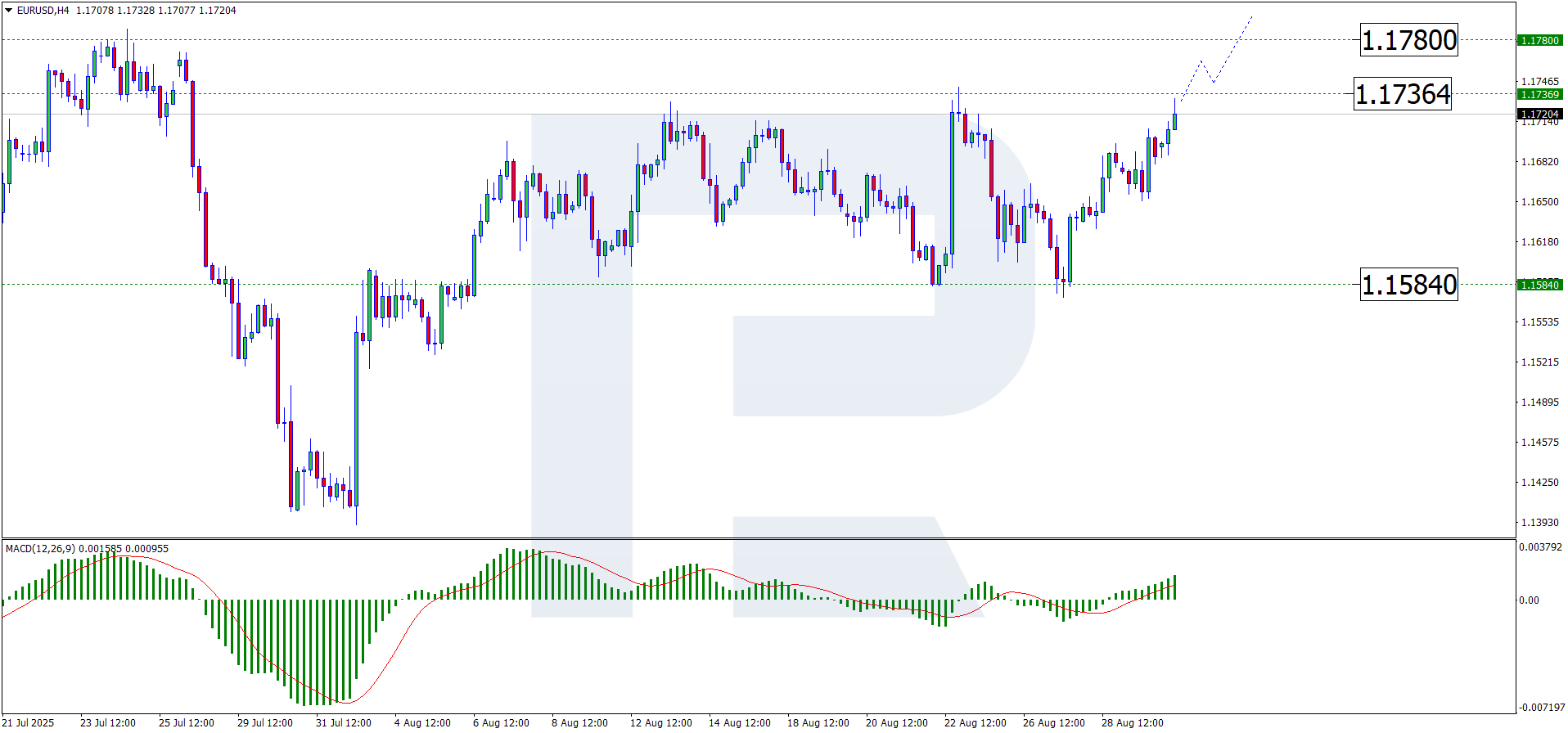
On the H4 chart, EUR/USD is forming a consolidation range at the top of the upward trend. A possible expansion towards 1.1645 cannot be excluded. Subsequently, a decline towards the lower boundary of the range at 1.1490 is anticipated. A break below 1.1490 would open the path for a new downward wave towards 1.1275, which is the first main target. The MACD indicator supports this outlook – its signal line remains above zero but has exited the histogram zone and is expected to descend back to the zero line, confirming a weakening upward impulse.

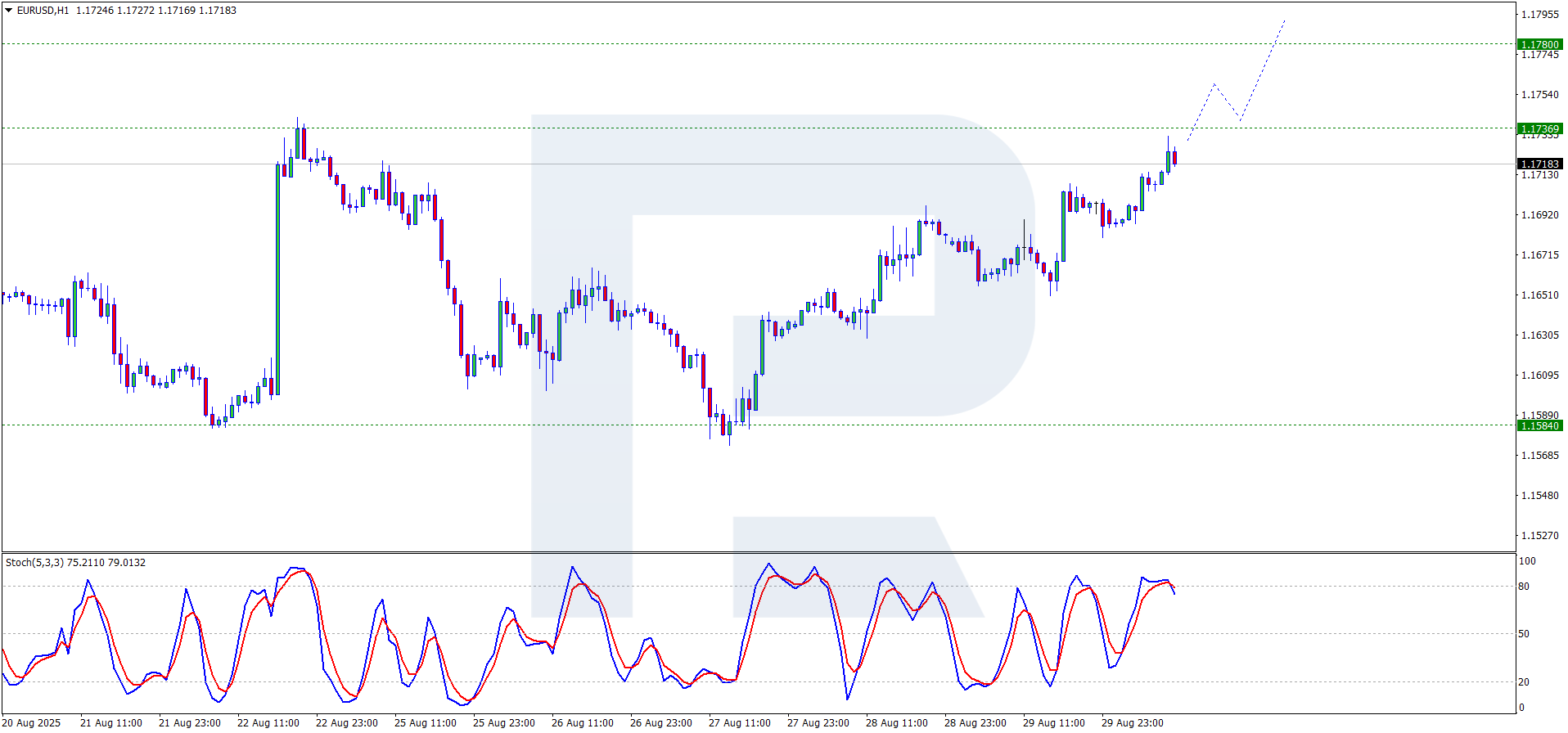
On the H1 chart, the market is consolidating around the 1.1570 level. The local growth target at 1.1614 has already been fulfilled, followed by a technical retest of 1.1542 from above. The next expected move is a growth link to 1.1645. A broad consolidation range around 1.1570 continues to take shape. The main scenario anticipates a decline towards 1.1456 once the growth structure is complete. This view is confirmed by the Stochastic oscillator, with its signal line above 50 and heading sharply towards 80, indicating room for further short-term upside before a reversal.

Conclusion

EUR/USD remains supported in the short term amid geopolitical uncertainty and softening Fed rate expectations, with key resistance at 1.1645 and support at 1.1490 and 1.1456. A sustained break below these levels could trigger a deeper correction towards 1.1275. For now, technical signals indicate a continuation of the consolidation phase, with one more upward impulse likely before a reversal sets in.


Disclaimer

Any forecasts contained herein are based on the author’s particular opinion. This analysis may not be treated as trading advice. RoboForex bears no responsibility for trading results based on trading recommendations and reviews contained herein.