Archive for Financial News – Page 21

Natural gas prices jumped more than 17%. Silver is at an all-time high

By JustMarkets

The US stock indices did not trade yesterday due to a bank holiday.

The Canadian dollar (CAD) strengthened above 1.39 against the US dollar. The currency was supported by a weakening US dollar and a mixed but overall moderately positive interpretation of the latest Canadian inflation data. The headline Consumer Price Index (CPI) unexpectedly rose to 2.4% in December, exceeding market expectations and coming in slightly above the Bank of Canada’s (BoC) short-term projections, which had anticipated inflation fluctuations near the 2% target. At the same time, median core inflation fell to a yearly low of 2.5%, indicating a partial easing of underlying price pressures. However, the combination of higher headline inflation and persistent demand reinforced the case for a more cautious approach by the Bank of Canada regarding the timing and pace of potential interest rate cuts.

European equity markets mostly declined on Monday. The German DAX (DE40) dropped by 1.34%, the French CAC 40 (FR40) closed down 1.78%, the Spanish IBEX 35 (ES35) fell by 0.26%, and the British FTSE 100 (UK100) closed at negative 0.39%. The DAX (DE40) slid to its lowest level since January 6, amid deteriorating sentiment in European markets due to the threat of renewed trade tensions between the US and the EU. The US President Donald Trump announced intentions to impose 10% tariffs starting February 1 on all imports from Denmark, Norway, Sweden, France, Germany, the UK, the Netherlands, and Finland, warning that the rate could be increased to 25% in the absence of an agreement on the “full and final purchase of Greenland.” These statements heightened investor fears of trade escalation, especially following reports that the European Union is considering retaliatory measures, including tariffs on US goods worth up to 93 billion euros or restricting US companies’ access to the European market. Against this backdrop, automaker stocks plummeted: shares of BMW, Volkswagen, Daimler Truck, Porsche, and Mercedes-Benz lost up to 3.7%, reflecting the sector’s vulnerability to trade barriers.

The Swiss franc (CHF) strengthened to around 0.798 per US dollar, holding near 2011 highs as escalating geopolitical rhetoric from the US boosted demand for safe-haven assets. The rally was triggered by President Donald Trump’s statements regarding the intent to impose new tariffs on European goods over the Greenland dispute, which increased global market nervousness and supported haven currencies. Investors are also focused on the upcoming World Economic Forum in Davos, starting January 20. Key global central bankers, including Swiss National Bank Chairman Martin Schlegel, are expected to speak. Markets continue to operate on the assumption that the SNB will maintain its key interest rate at 0% for the foreseeable future.

On Tuesday, silver (XAG) traded near $94.5 per ounce, remaining at record-high levels amid rising demand for safe-haven assets due to escalating tensions between the US and Europe. Additional volatility in the silver market in recent sessions was driven by the Trump administration’s decision to forgo tariffs on essential minerals, including silver, which was added to the US critical minerals list last year due to its key role in green energy technology and electronics.
Platinum prices (XPT) declined to approximately $2,340 per ounce but remained near record levels amid increased demand for precious metals as haven assets due to the worsening tensions between the US and Europe. Analysts note that Europe holds approximately $10 trillion in US bonds and stocks, part of which is held in sovereign wealth funds and could potentially be used as leverage in the new trade confrontation. Additional volatility in the platinum market in recent sessions came from Trump’s decision to temporarily hold off on tariffs for key minerals, including platinum, instead instructing the administration to seek alternative suppliers among international trade partners.

The US natural gas prices jumped more than 17% to $3.65 per MMBtu, sharply rebounding from a 13-week low of $3.10 recorded last week. The surge was driven by an intensifying Arctic cold wave sweeping across much of the country. A sudden shift from mild weather prognoses to a scenario of severe and prolonged cold triggered a rapid market re-evaluation as traders began pricing in significantly higher heating fuel demand.

Asian markets declined yesterday. Japan’s Nikkei 225 (JP225) fell by 0.65%, China’s FTSE China A50 (CHA50) dropped 1.13%, Hong Kong’s Hang Seng (HK50) shed 1.05%, and Australia’s ASX 200 (AU200) posted a negative result of 0.33%.

On Tuesday, the offshore yuan stabilized near the 6.96 level per dollar, remaining close to a 32-month high following the Chinese central bank’s decision to leave loan prime rates unchanged. The People’s Bank of China (PBoC) kept the one-year and five-year benchmark rates at 3.0% and 3.5%, respectively, extending the period of policy stability to eight months and confirming a course of targeted economic support rather than broad-based monetary easing.

S&P 500 (US500) 6,940.01 0 (0%)

Dow Jones (US30) 49,359.33 0 (0%)

DAX (DE40) 25,297.13 −55.26 (−0.22%)

FTSE 100 (UK100) 10,235.29 −3.65 (−0.04%)

USD Index 99.38 +0.05% (+0.05%)

News feed for: 2026.01.20

  • China PBoC Loan Prime Rate at 03:15 (GMT+2); – CHA50, HK50 (MED)
  • UK Average Earnings Index (m/m) at 09:00 (GMT+2); – GBP (MED)
  • UK Claimant Count Change (m/m) at 09:00 (GMT+2); – GBP (MED)
  • UK Unemployment Rate (m/m) at 09:00 (GMT+2); – GBP (MED)
  • UK BOE Gov Bailey Speaks at 11:45 (GMT+2); – GBP (LOW)
  • Eurozone ZEW Economic Sentiment (m/m) at 12:00 (GMT+2); – EUR (LOW)
  • Switzerland SNB Chairman Schlegel Speaks at 18:30 (GMT+2). – CHF (LOW)

By JustMarkets


This article reflects a personal opinion and should not be interpreted as an investment advice, and/or offer, and/or a persistent request for carrying out financial transactions, and/or a guarantee, and/or a forecast of future events.

Gold Hits Record High: Geopolitical Tensions and Market Instability Fuel Growth

By RoboForex Analytical Department

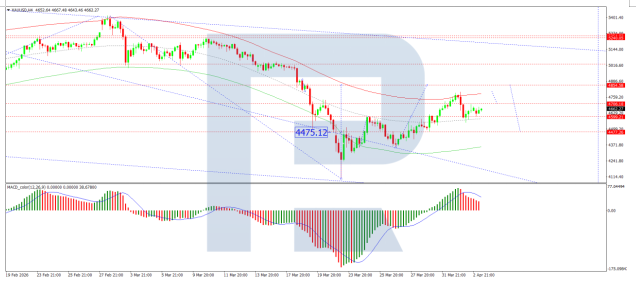
On Tuesday, gold prices surged to around 4670 USD per ounce, reaching a new record. This price movement comes amid rising demand for safe-haven assets, driven by the escalating trade disputes between the US and the EU.

Recent reports indicate that Denmark is bolstering its military presence in Greenland, following US President Donald Trump’s threats to use force to establish control over the island. Additionally, Trump has threatened to impose a 10% import tariff on goods from eight European countries starting 1 February, with the possibility of increasing the rate to 25% by June if the US is not permitted to purchase Greenland. This has raised concerns within the EU, prompting an emergency summit this Thursday to discuss possible countermeasures.

The delayed release of the US Personal Consumption Expenditures (PCE) index this week is also drawing attention, as it could provide further clarity on inflation trends and the future direction of US monetary policy.

Gold’s strong performance this year is further fuelled by inflows into defensive assets amid geopolitical tensions surrounding Venezuela and Iran, as well as ongoing concerns about the US Federal Reserve’s autonomy.

Technical Analysis:

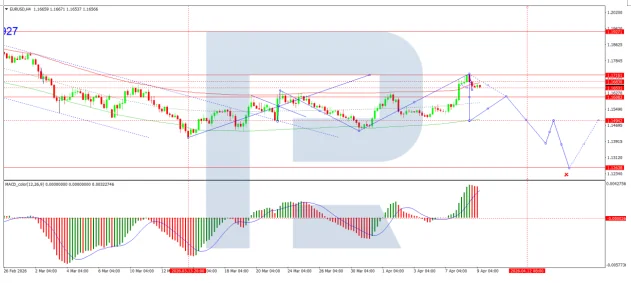
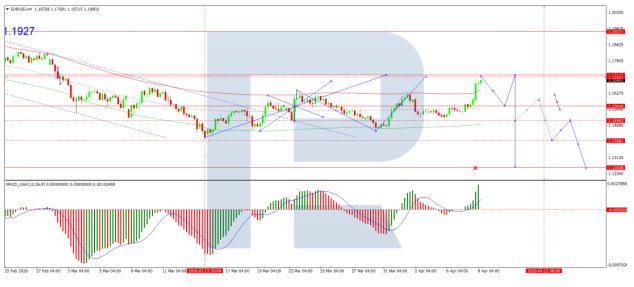
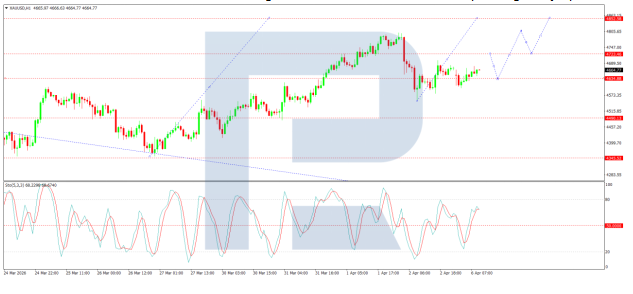
On the H4 XAUUSD chart, gold is pushing through its fifth wave of growth, with the 4,800 level as the next target. After reaching this level, we anticipate a potential pullback towards 4,660. The MACD indicator supports this upward momentum, as its signal line remains at highs, pointing upward.

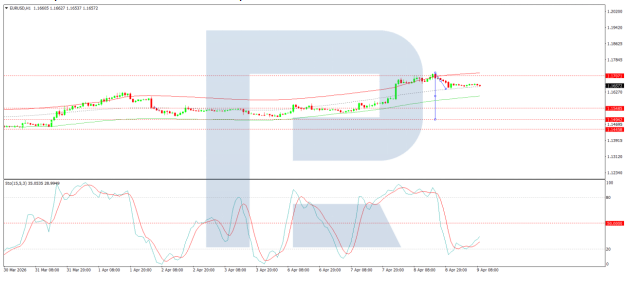
On the H1 chart, the price has broken through the 4,717 level, forming a consolidation range around it. The trend is likely to continue towards 4,800, with the Stochastic oscillator confirming this bullish outlook, as the signal line remains below 20 and under upward pressure.

Conclusion:

Gold continues to hit new highs, driven by geopolitical tensions and market instability. With ongoing risks in trade relations and concerns about US monetary policy, the demand for defensive assets such as gold remains strong. Technically, gold’s momentum is expected to continue upward, potentially reaching 4,800 before any correction.


Disclaimer

Any forecasts contained herein are based on the author’s particular opinion. This analysis may not be treated as trading advice. RoboForex bears no responsibility for trading results based on trading recommendations and reviews contained herein.

Trump escalates trade risks with Europe over Greenland

By JustMarkets

On Friday, US stock markets generally ended the session without a clear direction amid mixed geopolitical signals, uncertainty surrounding future Federal Reserve policy, and the start of the fourth-quarter earnings season. By Friday’s close, the Dow Jones (US30) declined by 0.17% (-0.28% for the week). The S&P 500 (US500) shed 0.06% (-0.06% for the week). The tech-heavy Nasdaq (US100) closed 0.07% lower (-0.34% for the week). Investors also assessed political news: President Donald Trump signaled that he might keep economic advisor Kevin Hassett in his current role rather than nominating him as Fed Chair, fueling speculation that former Fed Governor Kevin Warsh could be the frontrunner for the position.

Equity markets in Europe mostly fell on Friday. Germany’s DAX (DE40) fell by 0.22% (+0.19% for the week), France’s CAC 40 (FR40) closed down 0.65% (-1.00% for the week), Spain’s IBEX 35 (ES35) gained 0.39% (+0.94% for the week), and the UK’s FTSE 100 (UK100) closed at negative 0.04% (+1.09% for the week). Attention was also on macroeconomic data: German inflation in December 2025 was confirmed at 1.8%, dropping from 2.3% in November and falling below the ECB’s 2% target for the first time since September 2024.

European stock markets opened sharply lower on Monday following the escalation of trade risks after US President Donald Trump’s statements regarding potential new tariffs on goods from eight European countries. The measure is viewed as a leverage tool to pressure these nations into supporting the Greenland acquisition plan. According to Trump, NATO allies opposing the plan, including Denmark, Norway, Sweden, Finland, Germany, the UK, France, and the Netherlands, could face 10% tariffs as early as February 1, rising to 25% in June if no agreement is reached. In response, European leaders have begun discussing potential countermeasures, including reviving last year’s initiatives to impose tariffs on American goods, while French President Emmanuel Macron reportedly called for the activation of the EU’s anti-coercion instrument.

On Friday, silver (XAG) fell by more than 4%, dropping below $88.7 per ounce, continuing a sharp decline following high volatility in the previous session as the US decision to refrain from imposing tariffs on critical minerals removed a key market driver. Earlier in the week, threats of potential US import tariffs triggered a rapid rally in commodities: silver and other metals hit record levels as traders rushed to direct shipments to the US before potential restrictions took effect.
WTI crude oil prices traded near $59.3 per barrel on Monday following a fourth consecutive week of gains, as the market entered a consolidation phase amid easing geopolitical tensions surrounding Iran. Supply disruption concerns moderated after US President Donald Trump suggested a potential delay in military action last week, following Tehran’s pledge to halt the execution of protesters. However, renewed trade conflict risks remain a significant source of uncertainty for global energy demand. Over the weekend, the US President announced plans to impose 10% tariffs on goods from eight European countries effective February 1, with the potential to increase the rate to 25% by June, absent an agreement on the “purchase of Greenland.” These developments have intensified fears of a global economic slowdown and subsequent downward pressure on oil demand.

Asian markets traded with mixed results last week. Japan’s Nikkei 225 (JP225) rose by 5.00%, the FTSE China A50 (CHA50) fell by 1.54%, Hong Kong’s Hang Seng (HK50) gained 1.77%, and Australia’s ASX 200 (AU200) showed a 5-day positive result of 1.95%.

On Monday, the offshore yuan strengthened to approximately 6.96 per dollar, reaching a 32-month high supported by the People’s Bank of China (PBoC), which set its strongest daily fixing in over two years. This factor outweighed mixed economic data: China’s Q4 GDP growth slowed to 4.5% from 4.8% in Q3, the weakest pace in nearly three years, yet still exceeded market expectations of 4.4%. For the full year, the economy grew by 5%, meeting the government’s target and matching 2024 growth rates, largely due to a record trade surplus as robust exports to non-US markets offset pressure from American tariffs. Meanwhile, December statistics pointed to weakening domestic consumption and an accelerating decline in investment, while industrial production showed improvement.

S&P 500 (US500) 6,940.01 −4.46 (−0.064%)

Dow Jones (US30) 49,359.33 −83.11 (−0.17%)

DAX (DE40) 25,297.13 −55.26 (−0.22%)

FTSE 100 (UK100) 10,235.29 −3.65 (−0.04%)

USD Index 99.38 +0.05% (+0.05%)

News feed for: 2026.01.19

  • China GDP (m/m) at 04:00 (GMT+2); – CHA50, HK50 (MED)
  • China Industrial Production (m/m) at 04:00 (GMT+2); – CHA50, HK50 (LOW)
  • China Retail Sales (m/m) at 04:00 (GMT+2); – CHA50, HK50 (MED)
  • China Unemployment Rate (m/m) at 04:00 (GMT+2); – CHA50, HK50 (MED)
  • Eurozone Inflation Rate (m/m) at 12:00 (GMT+2); – EUR (MED)
  • Canada Inflation Rate (m/m) at 15:30 (GMT+2); – CAD (HIGH)
  • Canada BoC Business Outlook Survey (m/m) at 17:30 (GMT+2). – CAD (LOW)

By JustMarkets


This article reflects a personal opinion and should not be interpreted as an investment advice, and/or offer, and/or a persistent request for carrying out financial transactions, and/or a guarantee, and/or a forecast of future events.

COT Metals Charts: Weekly Speculator Changes led by Gold

By InvestMacro

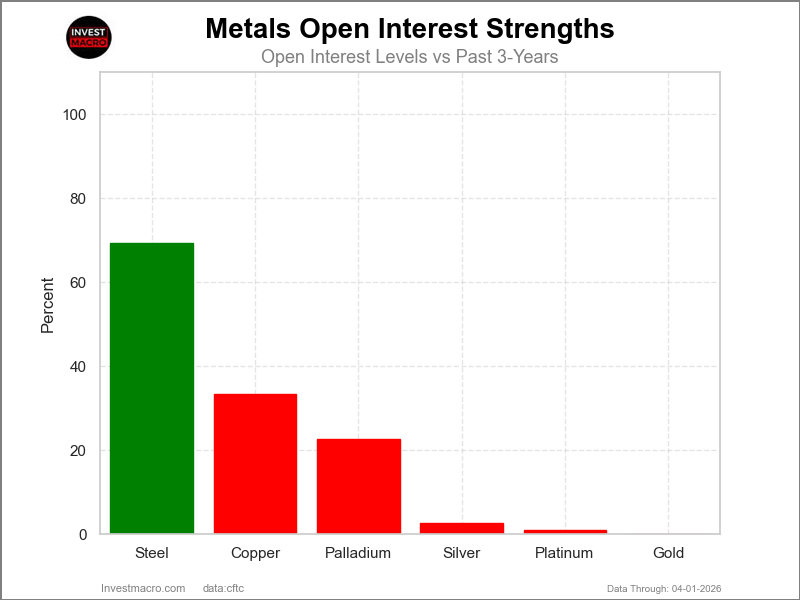
Metals Open Interest COT Chart
Here are the latest charts and statistics for the Commitment of Traders (COT) data published by the Commodities Futures Trading Commission (CFTC).

The latest COT data is updated through Tuesday January 13th and shows a quick view of how large traders (for-profit speculators and commercial entities) were positioned in the futures markets.

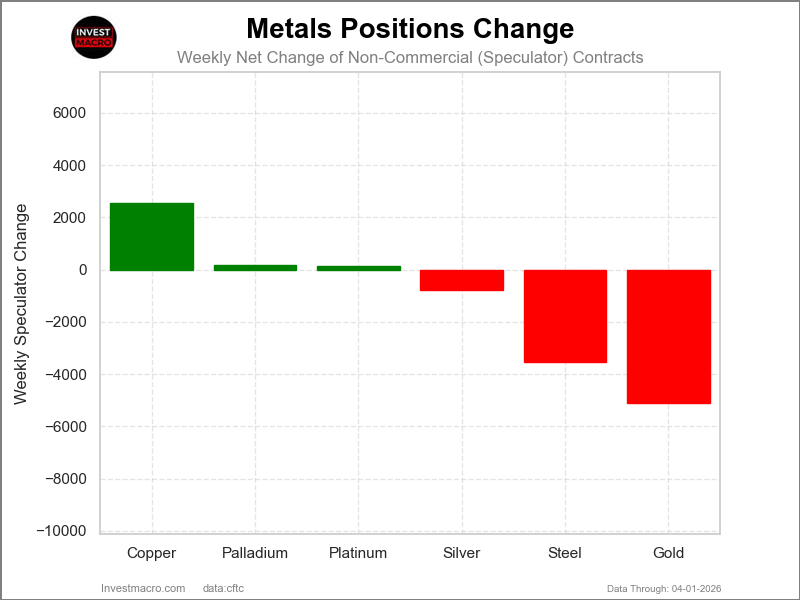
Weekly Speculator Changes led by Gold

Metals Net Positions COT Chart
The COT metals markets speculator bets were overall higher this week as four out of the six metals markets we cover had higher positioning while the other two markets had lower speculator contracts.

Leading the gains for the metals was Gold which had a strong gain by 23,606 contracts with Silver (2,789 contracts), Steel (1,545 contracts) and Palladium (646 contracts) also seeing positive weeks.

The markets with declines in speculator bets for the week were Copper (-4,417 contracts) and with Platinum (-516 contracts) also registering lower bets on the week.

Price Performance led by Silver and Steel

The metals markets saw Silver jump this week by approximately 12% over the past five days. Steel was also up strong by 5.77% over the past five days, while Gold rose by 1.65% and Platinum increased by 1.44%.

On the downside, Copper was lower by -0.64%, and Palladium saw the largest downside this week by -1.78%.

All the metals markets have been higher over the past 30 days and are also higher over the past 90 days. Silver has risen by over 100% in the past 90 days, while Platinum has gained by over 65% in the last 90 days.


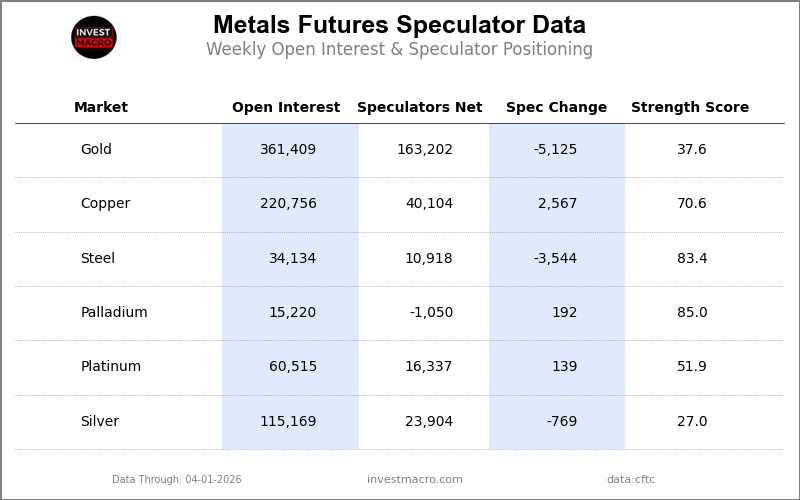
Metals Data:

Metals Table COT Chart
Legend: Weekly Speculators Change | Speculators Current Net Position | Speculators Strength Score compared to last 3-Years (0-100 range)


Strength Scores led by Palladium & Steel

Metals Strength Scores COT Chart
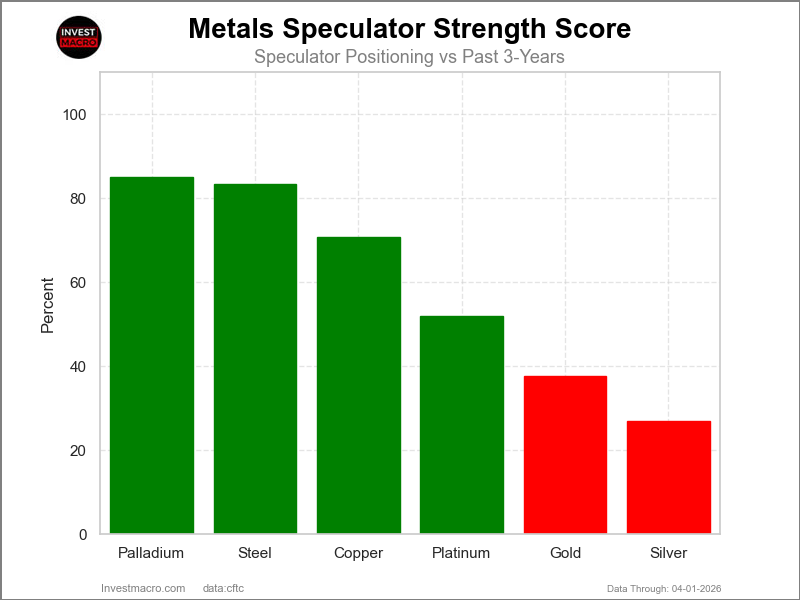
COT Strength Scores (a normalized measure of Speculator positions over a 3-Year range, from 0 to 100 where above 80 is Extreme-Bullish and below 20 is Extreme-Bearish) showed that Palladium (100 percent) and Steel (100 percent) lead the metals markets this week. Copper (83 percent) comes in as the next highest in the weekly strength scores.

On the downside, Silver (53 percent) and Platinum (55 percent) come in at the lowest strength levels currently but remain above the 50 percent midpoint of the past 3-years.

Strength Statistics:
Gold (73.7 percent) vs Gold previous week (64.0 percent)
Silver (53.2 percent) vs Silver previous week (49.4 percent)
Copper (83.0 percent) vs Copper previous week (87.1 percent)
Platinum (55.0 percent) vs Platinum previous week (56.3 percent)
Palladium (100.0 percent) vs Palladium previous week (95.7 percent)
Steel (100.0 percent) vs Steel previous week (91.3 percent)


Steel & Gold top the 6-Week Strength Trends

Metals Trends COT Chart
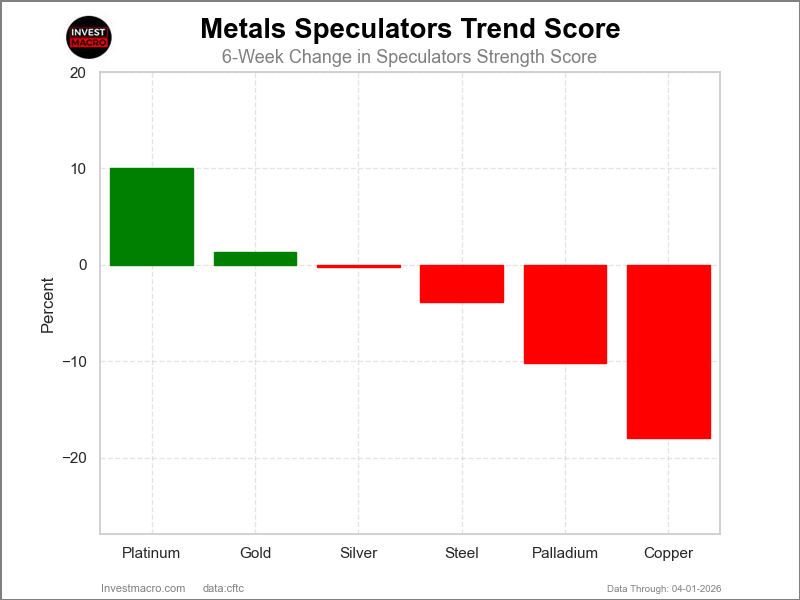
COT Strength Score Trends (or move index, calculates the 6-week changes in strength scores) showed that Steel (28 percent) and Gold (14 percent) lead the past six weeks trends for metals. Palladium (9 percent) and Platinum (4 percent) are the next highest positive movers in the latest trends data.

Silver (-9 percent) leads the downside trend scores currently.

Move Statistics:
Gold (13.8 percent) vs Gold previous week (9.4 percent)
Silver (-8.6 percent) vs Silver previous week (-3.9 percent)
Copper (0.0 percent) vs Copper previous week (13.2 percent)
Platinum (4.0 percent) vs Platinum previous week (5.3 percent)
Palladium (9.4 percent) vs Palladium previous week (7.1 percent)
Steel (28.1 percent) vs Steel previous week (19.9 percent)


Individual Markets:

Gold Comex Futures:

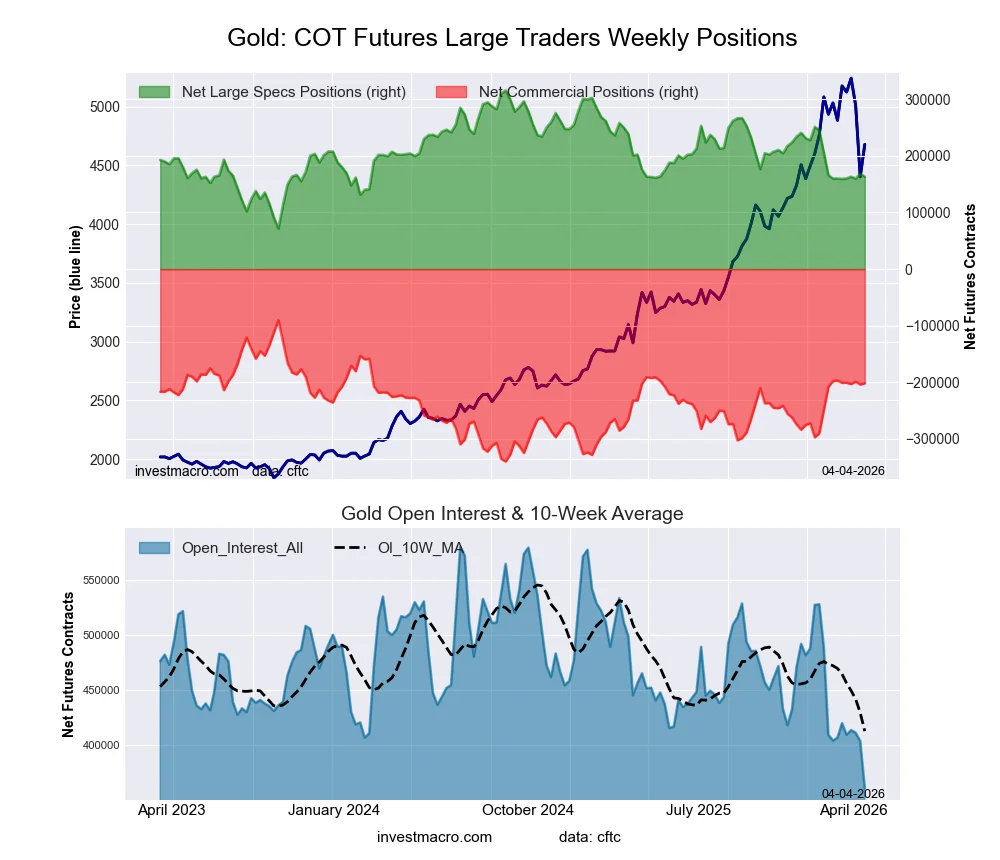
Gold Futures COT ChartThe Gold Comex Futures large speculator standing this week reached a net position of 251,238 contracts in the data reported through Tuesday. This was a weekly rise of 23,606 contracts from the previous week which had a total of 227,632 net contracts.

This week’s current strength score (the trader positioning range over the past three years, measured from 0 to 100) shows the speculators are currently Bullish with a score of 73.7 percent. The commercials are Bearish-Extreme with a score of 17.1 percent and the small traders (not shown in chart) are Bullish-Extreme with a score of 100.0 percent.

Price Trend-Following Model: Strong Uptrend

Our weekly trend-following model classifies the current market price position as: Strong Uptrend.

Gold Futures StatisticsSPECULATORSCOMMERCIALSSMALL TRADERS
– Percent of Open Interest Longs:56.215.812.6
– Percent of Open Interest Shorts:8.572.13.9
– Net Position:251,238-297,10645,868
– Gross Longs:296,18383,38266,220
– Gross Shorts:44,945380,48820,352
– Long to Short Ratio:6.6 to 10.2 to 13.3 to 1
NET POSITION TREND:
– Strength Index Score (3 Year Range Pct):73.717.1100.0
– Strength Index Reading (3 Year Range):BullishBearish-ExtremeBullish-Extreme
NET POSITION MOVEMENT INDEX:
– 6-Week Change in Strength Index:13.8-16.823.6


Silver Comex Futures:

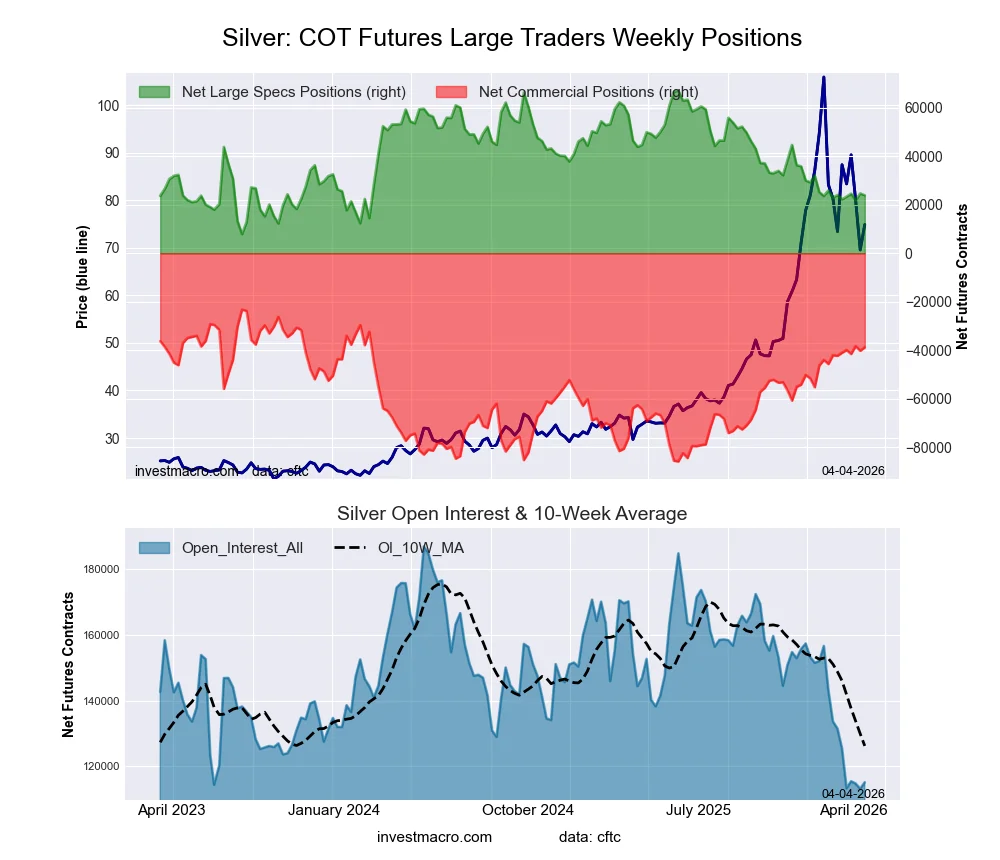
Silver Futures COT ChartThe Silver Comex Futures large speculator standing this week reached a net position of 32,060 contracts in the data reported through Tuesday. This was a weekly increase of 2,789 contracts from the previous week which had a total of 29,271 net contracts.

This week’s current strength score (the trader positioning range over the past three years, measured from 0 to 100) shows the speculators are currently Bullish with a score of 53.2 percent. The commercials are Bearish with a score of 38.2 percent and the small traders (not shown in chart) are Bullish-Extreme with a score of 80.9 percent.

Price Trend-Following Model: Strong Uptrend

Our weekly trend-following model classifies the current market price position as: Strong Uptrend.

Silver Futures StatisticsSPECULATORSCOMMERCIALSSMALL TRADERS
– Percent of Open Interest Longs:31.228.123.4
– Percent of Open Interest Shorts:10.164.68.1
– Net Position:32,060-55,29223,232
– Gross Longs:47,33742,59535,516
– Gross Shorts:15,27797,88712,284
– Long to Short Ratio:3.1 to 10.4 to 12.9 to 1
NET POSITION TREND:
– Strength Index Score (3 Year Range Pct):53.238.280.9
– Strength Index Reading (3 Year Range):BullishBearishBullish-Extreme
NET POSITION MOVEMENT INDEX:
– 6-Week Change in Strength Index:-8.61.728.1


Copper Grade #1 Futures:

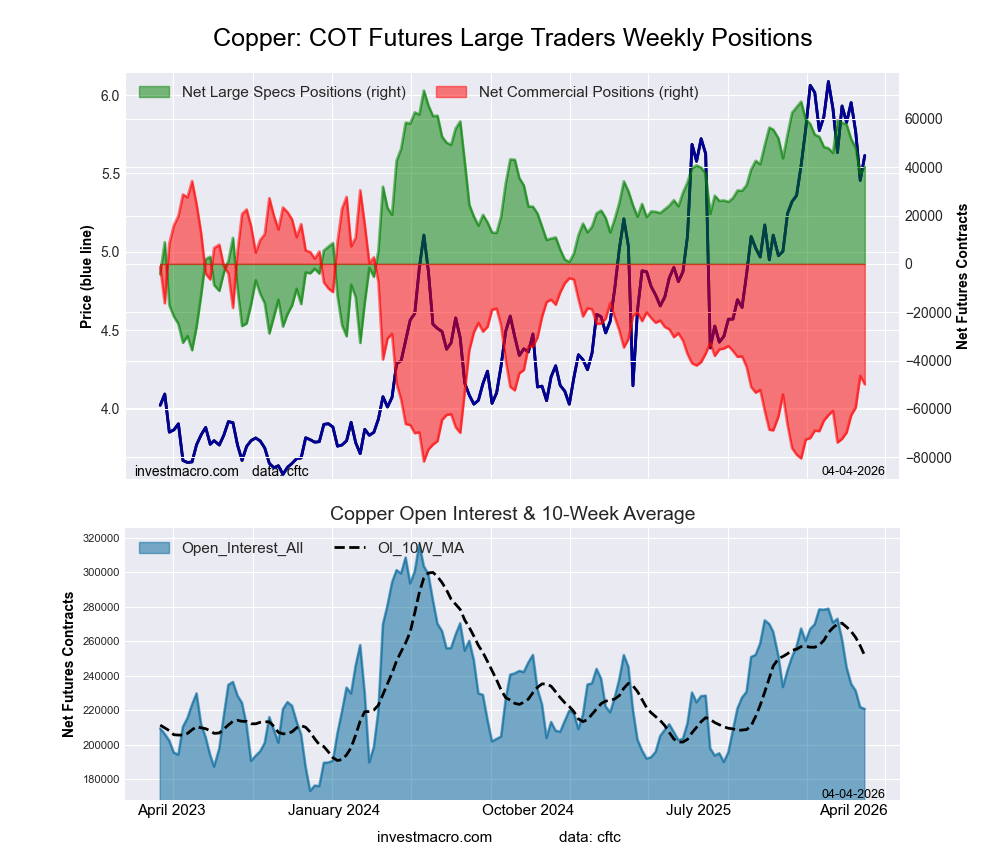
Copper Futures COT ChartThe Copper Grade #1 Futures large speculator standing this week reached a net position of 53,441 contracts in the data reported through Tuesday. This was a weekly decrease of -4,417 contracts from the previous week which had a total of 57,858 net contracts.

This week’s current strength score (the trader positioning range over the past three years, measured from 0 to 100) shows the speculators are currently Bullish-Extreme with a score of 83.0 percent. The commercials are Bearish-Extreme with a score of 11.0 percent and the small traders (not shown in chart) are Bullish-Extreme with a score of 100.0 percent.

Price Trend-Following Model: Strong Uptrend

Our weekly trend-following model classifies the current market price position as: Strong Uptrend.

Copper Futures StatisticsSPECULATORSCOMMERCIALSSMALL TRADERS
– Percent of Open Interest Longs:36.130.59.1
– Percent of Open Interest Shorts:16.356.13.3
– Net Position:53,441-68,96215,521
– Gross Longs:97,41582,37824,507
– Gross Shorts:43,974151,3408,986
– Long to Short Ratio:2.2 to 10.5 to 12.7 to 1
NET POSITION TREND:
– Strength Index Score (3 Year Range Pct):83.011.0100.0
– Strength Index Reading (3 Year Range):Bullish-ExtremeBearish-ExtremeBullish-Extreme
NET POSITION MOVEMENT INDEX:
– 6-Week Change in Strength Index:0.0-2.113.2


Platinum Futures:

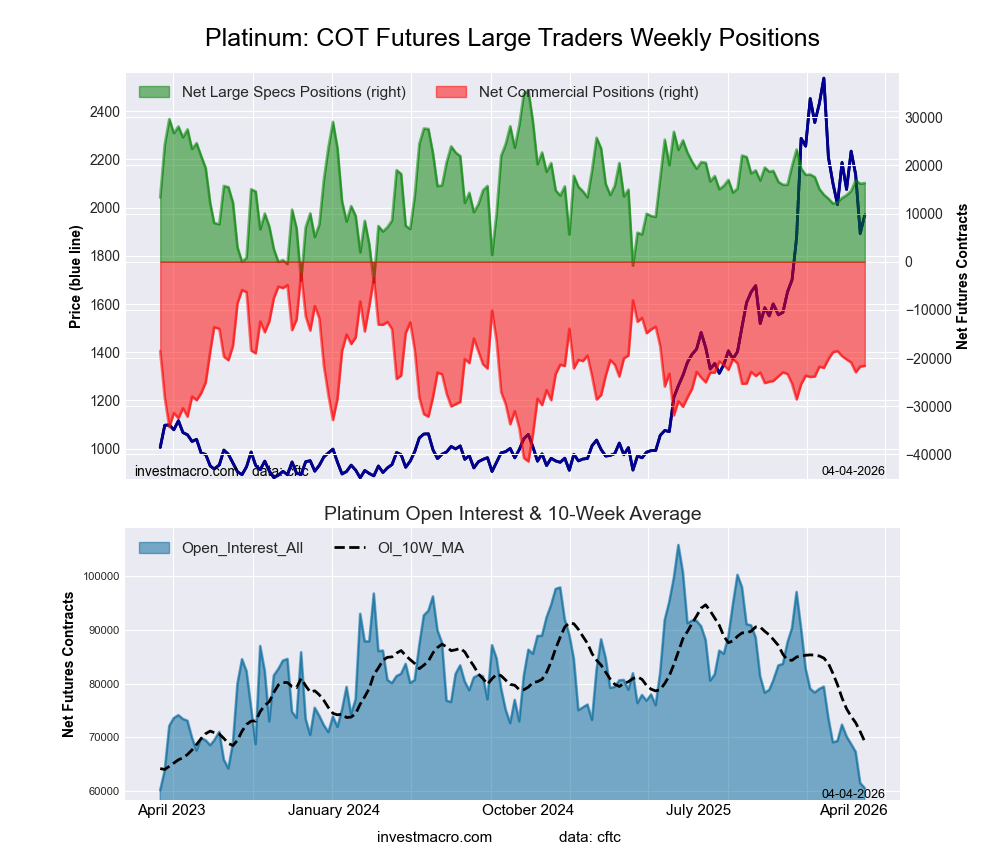
Platinum Futures COT ChartThe Platinum Futures large speculator standing this week reached a net position of 17,594 contracts in the data reported through Tuesday. This was a weekly decline of -516 contracts from the previous week which had a total of 18,110 net contracts.

This week’s current strength score (the trader positioning range over the past three years, measured from 0 to 100) shows the speculators are currently Bullish with a score of 55.0 percent. The commercials are Bearish with a score of 45.1 percent and the small traders (not shown in chart) are Bullish with a score of 70.1 percent.

Price Trend-Following Model: Strong Uptrend

Our weekly trend-following model classifies the current market price position as: Strong Uptrend.

Platinum Futures StatisticsSPECULATORSCOMMERCIALSSMALL TRADERS
– Percent of Open Interest Longs:52.024.313.1
– Percent of Open Interest Shorts:29.554.75.2
– Net Position:17,594-23,8066,212
– Gross Longs:40,74119,04210,264
– Gross Shorts:23,14742,8484,052
– Long to Short Ratio:1.8 to 10.4 to 12.5 to 1
NET POSITION TREND:
– Strength Index Score (3 Year Range Pct):55.045.170.1
– Strength Index Reading (3 Year Range):BullishBearishBullish
NET POSITION MOVEMENT INDEX:
– 6-Week Change in Strength Index:4.0-1.3-12.6


Palladium Futures:

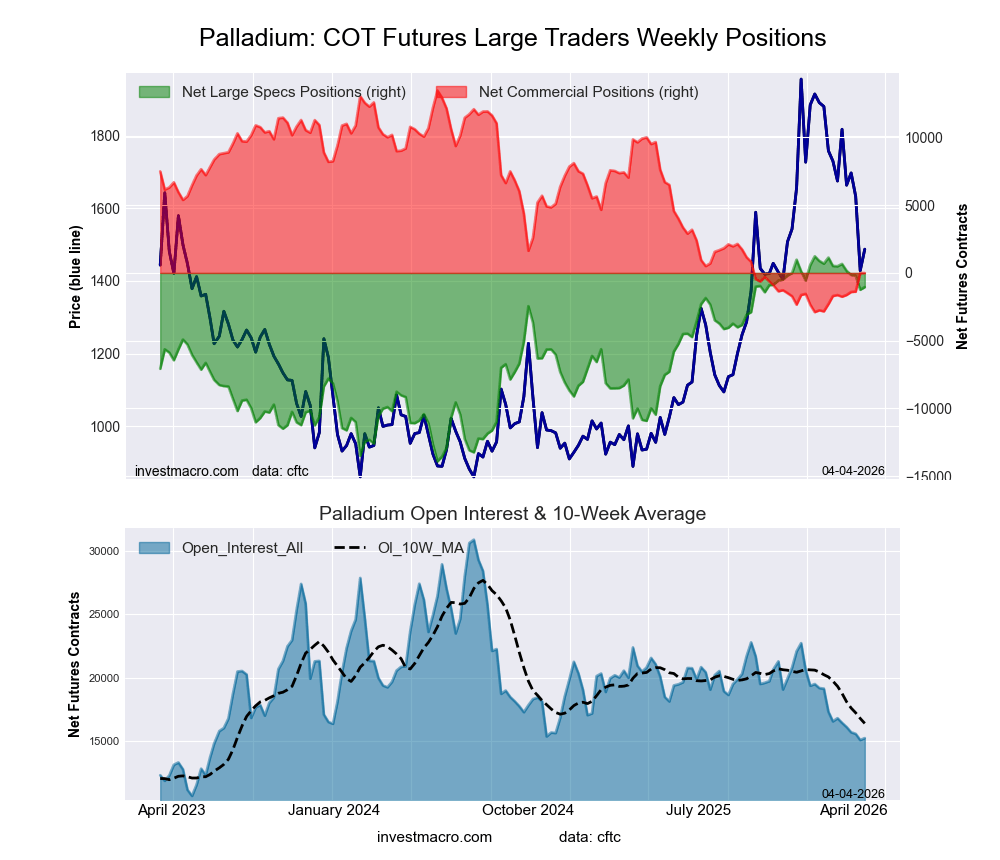
Palladium Futures COT ChartThe Palladium Futures large speculator standing this week reached a net position of 1,225 contracts in the data reported through Tuesday. This was a weekly lift of 646 contracts from the previous week which had a total of 579 net contracts.

This week’s current strength score (the trader positioning range over the past three years, measured from 0 to 100) shows the speculators are currently Bullish-Extreme with a score of 100.0 percent. The commercials are Bearish-Extreme with a score of 0.0 percent and the small traders (not shown in chart) are Bullish with a score of 77.5 percent.

Price Trend-Following Model: Strong Uptrend

Our weekly trend-following model classifies the current market price position as: Strong Uptrend.

Palladium Futures StatisticsSPECULATORSCOMMERCIALSSMALL TRADERS
– Percent of Open Interest Longs:51.128.416.5
– Percent of Open Interest Shorts:44.843.27.9
– Net Position:1,225-2,8901,665
– Gross Longs:9,9495,5363,205
– Gross Shorts:8,7248,4261,540
– Long to Short Ratio:1.1 to 10.7 to 12.1 to 1
NET POSITION TREND:
– Strength Index Score (3 Year Range Pct):100.00.077.5
– Strength Index Reading (3 Year Range):Bullish-ExtremeBearish-ExtremeBullish
NET POSITION MOVEMENT INDEX:
– 6-Week Change in Strength Index:9.4-8.6-0.8


Steel Futures Futures:

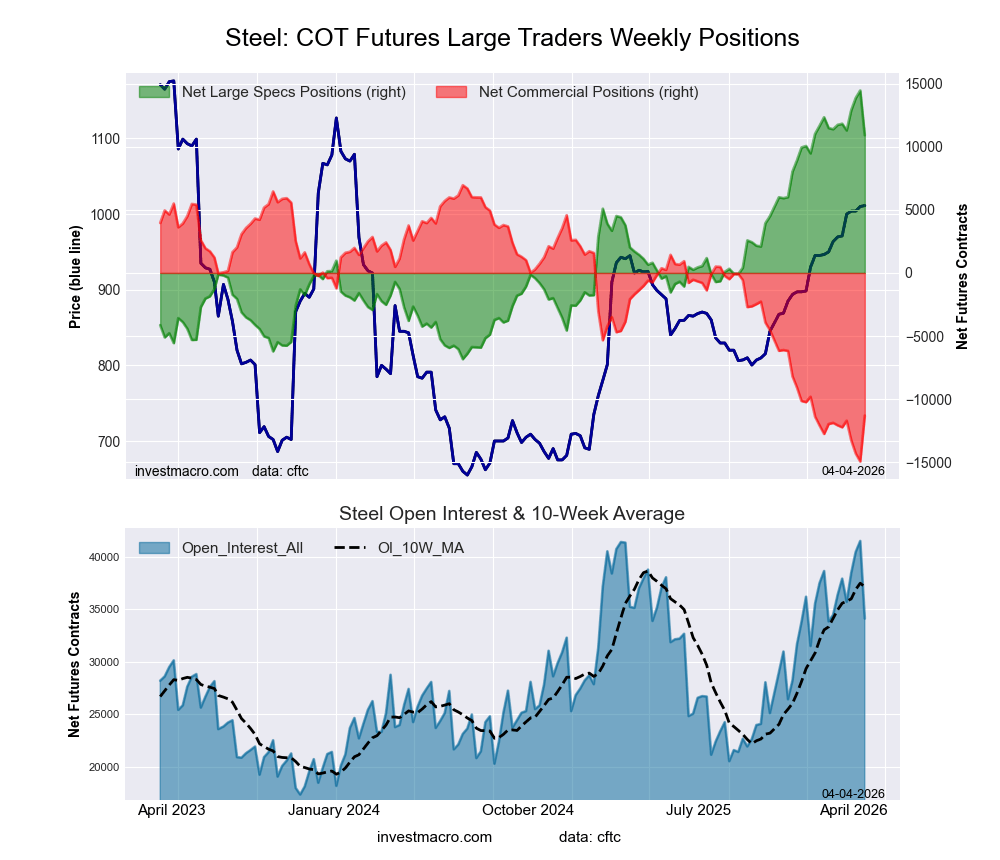
Steel Futures COT ChartThe Steel Futures large speculator standing this week reached a net position of 11,022 contracts in the data reported through Tuesday. This was a weekly increase of 1,545 contracts from the previous week which had a total of 9,477 net contracts.

This week’s current strength score (the trader positioning range over the past three years, measured from 0 to 100) shows the speculators are currently Bullish-Extreme with a score of 100.0 percent. The commercials are Bearish-Extreme with a score of 0.0 percent and the small traders (not shown in chart) are Bullish-Extreme with a score of 82.4 percent.

Price Trend-Following Model: Strong Uptrend

Our weekly trend-following model classifies the current market price position as: Strong Uptrend.

Steel Futures StatisticsSPECULATORSCOMMERCIALSSMALL TRADERS
– Percent of Open Interest Longs:37.857.91.6
– Percent of Open Interest Shorts:6.890.00.6
– Net Position:11,022-11,390368
– Gross Longs:13,43720,592564
– Gross Shorts:2,41531,982196
– Long to Short Ratio:5.6 to 10.6 to 12.9 to 1
NET POSITION TREND:
– Strength Index Score (3 Year Range Pct):100.00.082.4
– Strength Index Reading (3 Year Range):Bullish-ExtremeBearish-ExtremeBullish-Extreme
NET POSITION MOVEMENT INDEX:
– 6-Week Change in Strength Index:28.1-28.424.4


Article By InvestMacroReceive our weekly COT Newsletter

*COT Report: The COT data, released weekly to the public each Friday, is updated through the most recent Tuesday (data is 3 days old) and shows a quick view of how large speculators or non-commercials (for-profit traders) were positioned in the futures markets.

The CFTC categorizes trader positions according to commercial hedgers (traders who use futures contracts for hedging as part of the business), non-commercials (large traders who speculate to realize trading profits) and nonreportable traders (usually small traders/speculators) as well as their open interest (contracts open in the market at time of reporting). See CFTC criteria here.

COT Bonds Charts: Speculator Bets led by 10-Year Bonds & 5-Year Bonds

By InvestMacro

Bonds Market Open Interest Comparison
Here are the latest charts and statistics for the Commitment of Traders (COT) reports data published by the Commodities Futures Trading Commission (CFTC).

The latest COT data is updated through Tuesday January 13th and shows a quick view of how large traders (for-profit speculators and commercial hedgers) were positioned in the futures markets.

Weekly Speculator Changes led by 10-Year Bonds & 5-Year Bonds

Bonds Market Net Speculators Positions
The COT bond market speculator bets were overall higher this week as seven out of the nine bond markets we cover had higher positioning while the other two markets had lower speculator contracts.

Leading the gains for the bond markets was the 10-Year Bonds (45,047 contracts) with the 5-Year Bonds (43,633 contracts), the 2-Year Bonds (41,774 contracts), the SOFR 1-Month (36,024 contracts), the US Treasury Bonds (20,667 contracts), the Ultra 10-Year Bonds (12,726 contracts) and the Ultra Treasury Bonds (10,650 contracts) also showing positive weeks.

The bond markets with declines in speculator bets for the week were the SOFR 3-Months (-179,227 contracts) and the Fed Funds (-100,918 contracts) also registering lower bets on the week.

Bond Price Performance led by small gains in SOFRs

In the bond markets price performance changes, the five-day percent changes were led by the three-month and one-month Secured Overnight Financing Rates (SOFR), which rose by 0.13% and 0.07%, respectively. The Fed Funds (0.02%) were virtually unchanged on the week, while the 2-Year Bond saw a minuscule fall by -0.04%.

The US Treasury Bond was down by -0.14%, the 5-Year Bond fell by -0.22%, and the 10-Year Note was lower by -0.36%.


Bonds Data:

Bonds Market Speculators Data Table
Legend: Open Interest | Speculators Current Net Position | Weekly Specs Change | Specs Strength Score compared to last 3-Years (0-100 range)


Strength Scores led by US Treasury Bonds & Ultra Treasury Bonds
Bonds Market Strength Index Comparison
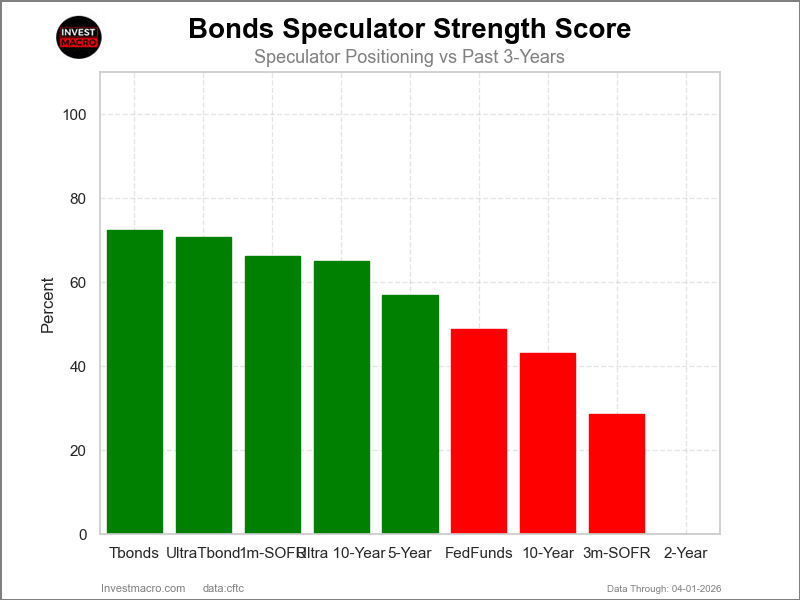
COT Strength Scores (a normalized measure of Speculator positions over a 3-Year range, from 0 to 100 where above 80 is Extreme-Bullish and below 20 is Extreme-Bearish) showed that the US Treasury Bonds (88 percent) and the Ultra Treasury Bonds (83 percent) lead the bond markets this week. The Fed Funds (64 percent) comes in as the next highest in the weekly strength scores.

On the downside, the 2-Year Bond (17.8 percent) and the 5-Year Bonds (19 percent) come in at the lowest strength level currently and are in Extreme-Bearish territory (below 20 percent).

Strength Statistics:
Fed Funds (64.3 percent) vs Fed Funds previous week (78.6 percent)
2-Year Bond (17.8 percent) vs 2-Year Bond previous week (13.7 percent)
5-Year Bond (19.4 percent) vs 5-Year Bond previous week (17.4 percent)
10-Year Bond (32.7 percent) vs 10-Year Bond previous week (27.3 percent)
Ultra 10-Year Bond (42.9 percent) vs Ultra 10-Year Bond previous week (39.5 percent)
US Treasury Bond (88.2 percent) vs US Treasury Bond previous week (81.0 percent)
Ultra US Treasury Bond (83.0 percent) vs Ultra US Treasury Bond previous week (79.0 percent)
SOFR 1-Month (30.1 percent) vs SOFR 1-Month previous week (23.8 percent)
SOFR 3-Months (33.2 percent) vs SOFR 3-Months previous week (42.4 percent)


Ultra 10-Year Bonds & US Treasury Bonds top the 6-Week Strength Trends

Bonds Market Trend Index Comparison
COT Strength Score Trends (or move index, calculates the 6-week changes in strength scores) showed that the Ultra 10-Year Bonds (34 percent) and the US Treasury Bonds (15 percent) lead the past six weeks trends for bonds. The Ultra Treasury Bonds (12 percent) are the next highest positive movers in the latest trends data.

The Fed Funds (-31.9 percent), the 10-Year Bonds (-16 percent) and the SOFR 3-Months (-11 percent) lead the downside trend scores currently.

Strength Trend Statistics:
Fed Funds (-31.9 percent) vs Fed Funds previous week (-8.4 percent)
2-Year Bond (0.0 percent) vs 2-Year Bond previous week (-7.8 percent)
5-Year Bond (8.4 percent) vs 5-Year Bond previous week (-1.0 percent)
10-Year Bond (-16.0 percent) vs 10-Year Bond previous week (-16.0 percent)
Ultra 10-Year Bond (34.5 percent) vs Ultra 10-Year Bond previous week (6.1 percent)
US Treasury Bond (15.0 percent) vs US Treasury Bond previous week (8.6 percent)
Ultra US Treasury Bond (11.5 percent) vs Ultra US Treasury Bond previous week (14.2 percent)
SOFR 1-Month (12.0 percent) vs SOFR 1-Month previous week (0.5 percent)
SOFR 3-Months (-10.6 percent) vs SOFR 3-Months previous week (4.9 percent)


30-Day Federal Funds Futures:
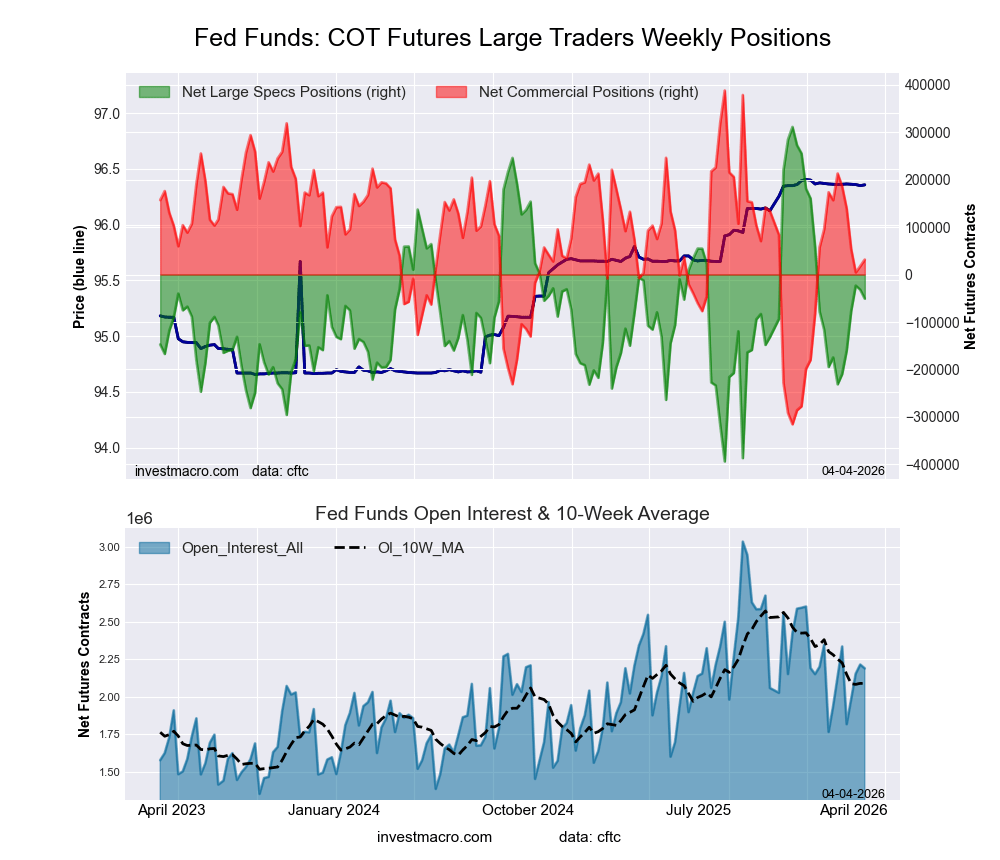
Federal Funds 30-Day Bonds Futures COT ChartThe 30-Day Federal Funds large speculator standing this week resulted in a net position of 59,440 contracts in the data reported through Tuesday. This was a weekly decrease of -100,918 contracts from the previous week which had a total of 160,358 net contracts.

This week’s current strength score (the trader positioning range over the past three years, measured from 0 to 100) shows the speculators are currently Bullish with a score of 64.3 percent. The commercials are Bearish with a score of 33.1 percent and the small traders (not shown in chart) are Bullish-Extreme with a score of 93.4 percent.

Price Trend-Following Model: Uptrend

Our weekly trend-following model classifies the current market price position as: Uptrend.

30-Day Federal Funds StatisticsSPECULATORSCOMMERCIALSSMALL TRADERS
– Percent of Open Interest Longs:23.059.02.6
– Percent of Open Interest Shorts:20.262.91.5
– Net Position:59,440-83,08823,648
– Gross Longs:494,2041,268,84855,093
– Gross Shorts:434,7641,351,93631,445
– Long to Short Ratio:1.1 to 10.9 to 11.8 to 1
NET POSITION TREND:
– Strength Index Score (3 Year Range Pct):64.333.193.4
– Strength Index Reading (3 Year Range):BullishBearishBullish-Extreme
NET POSITION MOVEMENT INDEX:
– 6-Week Change in Strength Index:-31.929.622.1


Secured Overnight Financing Rate (3-Month) Futures:
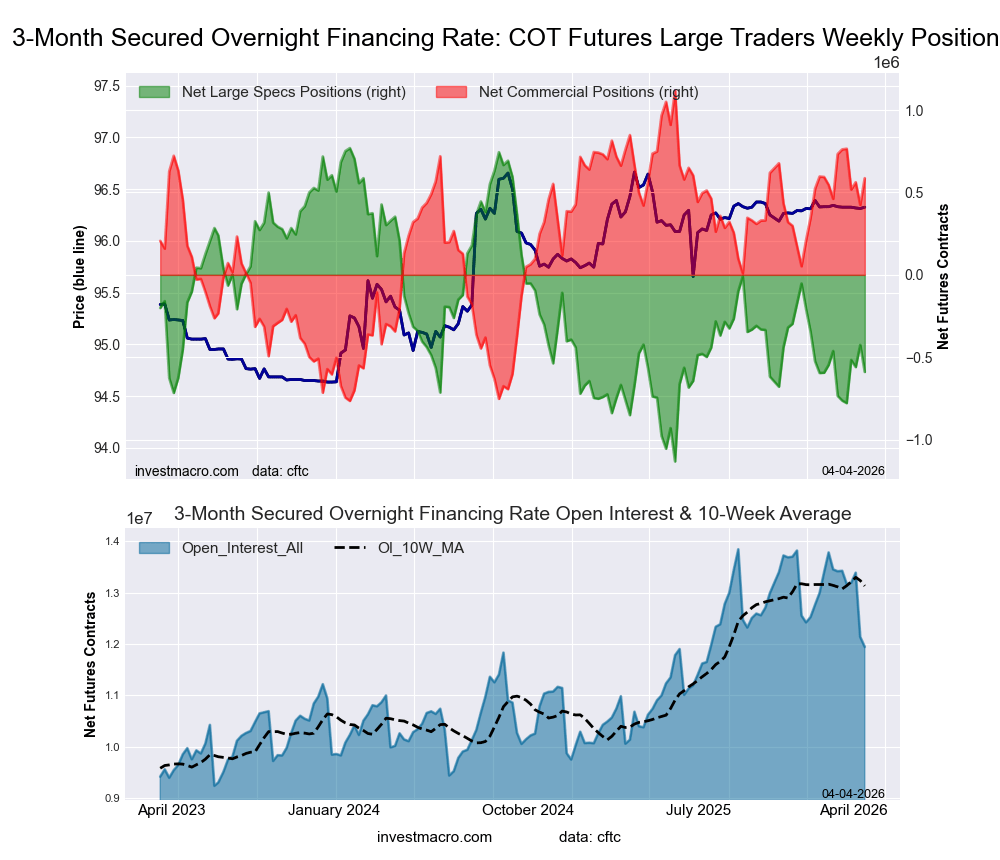
SOFR 3-Months Bonds Futures COT ChartThe Secured Overnight Financing Rate (3-Month) large speculator standing this week resulted in a net position of -524,612 contracts in the data reported through Tuesday. This was a weekly reduction of -179,227 contracts from the previous week which had a total of -345,385 net contracts.

This week’s current strength score (the trader positioning range over the past three years, measured from 0 to 100) shows the speculators are currently Bearish with a score of 33.2 percent. The commercials are Bullish with a score of 66.6 percent and the small traders (not shown in chart) are Bullish with a score of 79.3 percent.

Price Trend-Following Model: Weak Uptrend

Our weekly trend-following model classifies the current market price position as: Weak Uptrend. The current action for the model is considered to be: Hold – Maintain Long Position.

SOFR 3-Months StatisticsSPECULATORSCOMMERCIALSSMALL TRADERS
– Percent of Open Interest Longs:14.256.30.2
– Percent of Open Interest Shorts:18.352.20.1
– Net Position:-524,612522,5622,050
– Gross Longs:1,807,4497,187,93221,089
– Gross Shorts:2,332,0616,665,37019,039
– Long to Short Ratio:0.8 to 11.1 to 11.1 to 1
NET POSITION TREND:
– Strength Index Score (3 Year Range Pct):33.266.679.3
– Strength Index Reading (3 Year Range):BearishBullishBullish
NET POSITION MOVEMENT INDEX:
– 6-Week Change in Strength Index:-10.610.51.1


Individual Bond Markets:

Secured Overnight Financing Rate (1-Month) Futures:
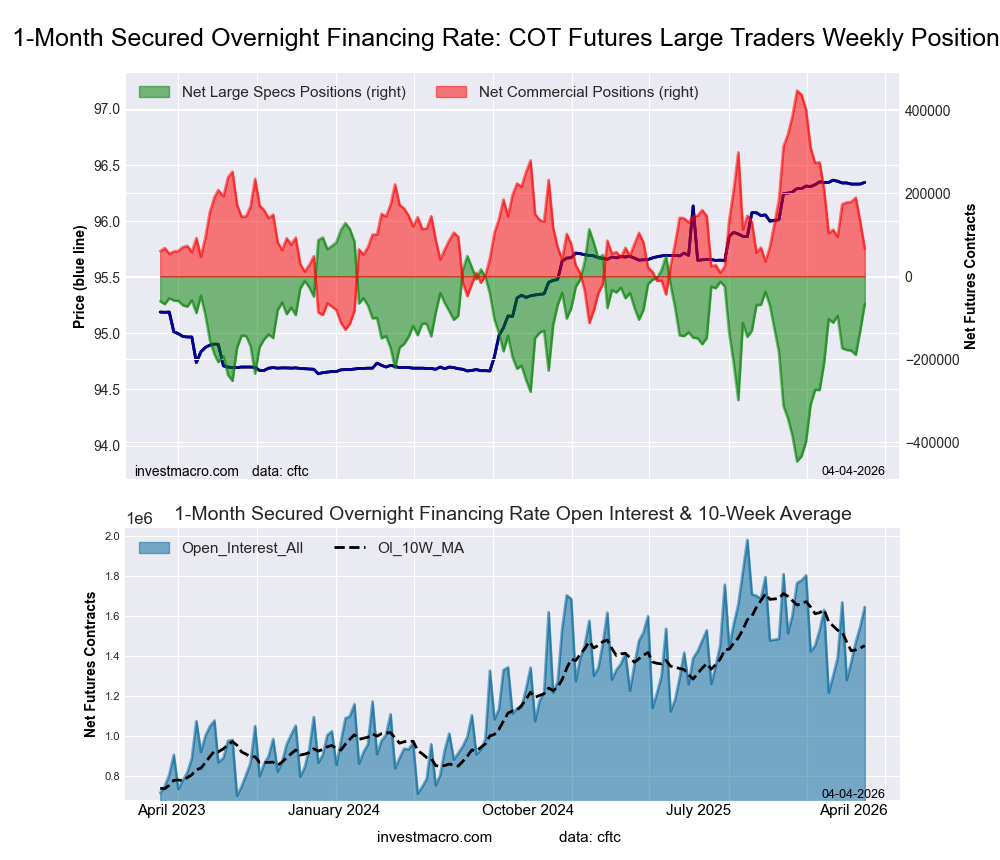
SOFR 1-Month Bonds Futures COT ChartThe Secured Overnight Financing Rate (1-Month) large speculator standing this week resulted in a net position of -273,183 contracts in the data reported through Tuesday. This was a weekly lift of 36,024 contracts from the previous week which had a total of -309,207 net contracts.

This week’s current strength score (the trader positioning range over the past three years, measured from 0 to 100) shows the speculators are currently Bearish with a score of 30.1 percent. The commercials are Bullish with a score of 69.8 percent and the small traders (not shown in chart) are Bullish with a score of 67.5 percent.

Price Trend-Following Model: Uptrend

Our weekly trend-following model classifies the current market price position as: Uptrend.

SOFR 1-Month StatisticsSPECULATORSCOMMERCIALSSMALL TRADERS
– Percent of Open Interest Longs:17.471.30.0
– Percent of Open Interest Shorts:36.252.50.0
– Net Position:-273,183272,850333
– Gross Longs:251,9441,033,988546
– Gross Shorts:525,127761,138213
– Long to Short Ratio:0.5 to 11.4 to 12.6 to 1
NET POSITION TREND:
– Strength Index Score (3 Year Range Pct):30.169.867.5
– Strength Index Reading (3 Year Range):BearishBullishBullish
NET POSITION MOVEMENT INDEX:
– 6-Week Change in Strength Index:12.0-12.00.3


2-Year Treasury Note Futures:

2-Year Treasury Bonds Futures COT ChartThe 2-Year Treasury Note large speculator standing this week resulted in a net position of -1,304,880 contracts in the data reported through Tuesday. This was a weekly increase of 41,774 contracts from the previous week which had a total of -1,346,654 net contracts.

This week’s current strength score (the trader positioning range over the past three years, measured from 0 to 100) shows the speculators are currently Bearish-Extreme with a score of 17.8 percent. The commercials are Bullish-Extreme with a score of 82.2 percent and the small traders (not shown in chart) are Bullish with a score of 52.9 percent.

Price Trend-Following Model: Downtrend

Our weekly trend-following model classifies the current market price position as: Downtrend.

2-Year Treasury Note StatisticsSPECULATORSCOMMERCIALSSMALL TRADERS
– Percent of Open Interest Longs:14.876.15.5
– Percent of Open Interest Shorts:44.049.82.6
– Net Position:-1,304,8801,176,303128,577
– Gross Longs:659,9423,402,936245,623
– Gross Shorts:1,964,8222,226,633117,046
– Long to Short Ratio:0.3 to 11.5 to 12.1 to 1
NET POSITION TREND:
– Strength Index Score (3 Year Range Pct):17.882.252.9
– Strength Index Reading (3 Year Range):Bearish-ExtremeBullish-ExtremeBullish
NET POSITION MOVEMENT INDEX:
– 6-Week Change in Strength Index:0.0-1.87.5


5-Year Treasury Note Futures:

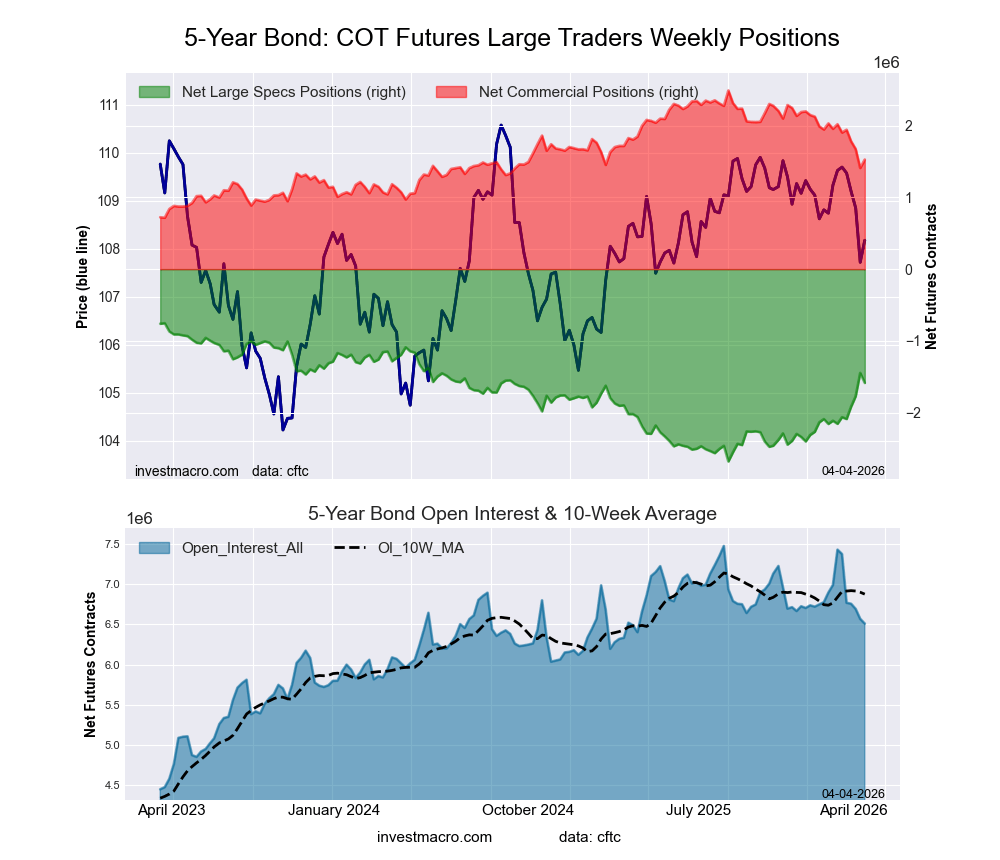
5-Year Treasury Bonds Futures COT ChartThe 5-Year Treasury Note large speculator standing this week resulted in a net position of -2,269,120 contracts in the data reported through Tuesday. This was a weekly rise of 43,633 contracts from the previous week which had a total of -2,312,753 net contracts.

This week’s current strength score (the trader positioning range over the past three years, measured from 0 to 100) shows the speculators are currently Bearish-Extreme with a score of 19.4 percent. The commercials are Bullish-Extreme with a score of 80.9 percent and the small traders (not shown in chart) are Bullish with a score of 67.0 percent.

Price Trend-Following Model: Downtrend

Our weekly trend-following model classifies the current market price position as: Downtrend.

5-Year Treasury Note StatisticsSPECULATORSCOMMERCIALSSMALL TRADERS
– Percent of Open Interest Longs:7.783.36.6
– Percent of Open Interest Shorts:41.451.74.5
– Net Position:-2,269,1202,126,524142,596
– Gross Longs:515,4615,601,486445,017
– Gross Shorts:2,784,5813,474,962302,421
– Long to Short Ratio:0.2 to 11.6 to 11.5 to 1
NET POSITION TREND:
– Strength Index Score (3 Year Range Pct):19.480.967.0
– Strength Index Reading (3 Year Range):Bearish-ExtremeBullish-ExtremeBullish
NET POSITION MOVEMENT INDEX:
– 6-Week Change in Strength Index:8.4-8.4-5.2


10-Year Treasury Note Futures:

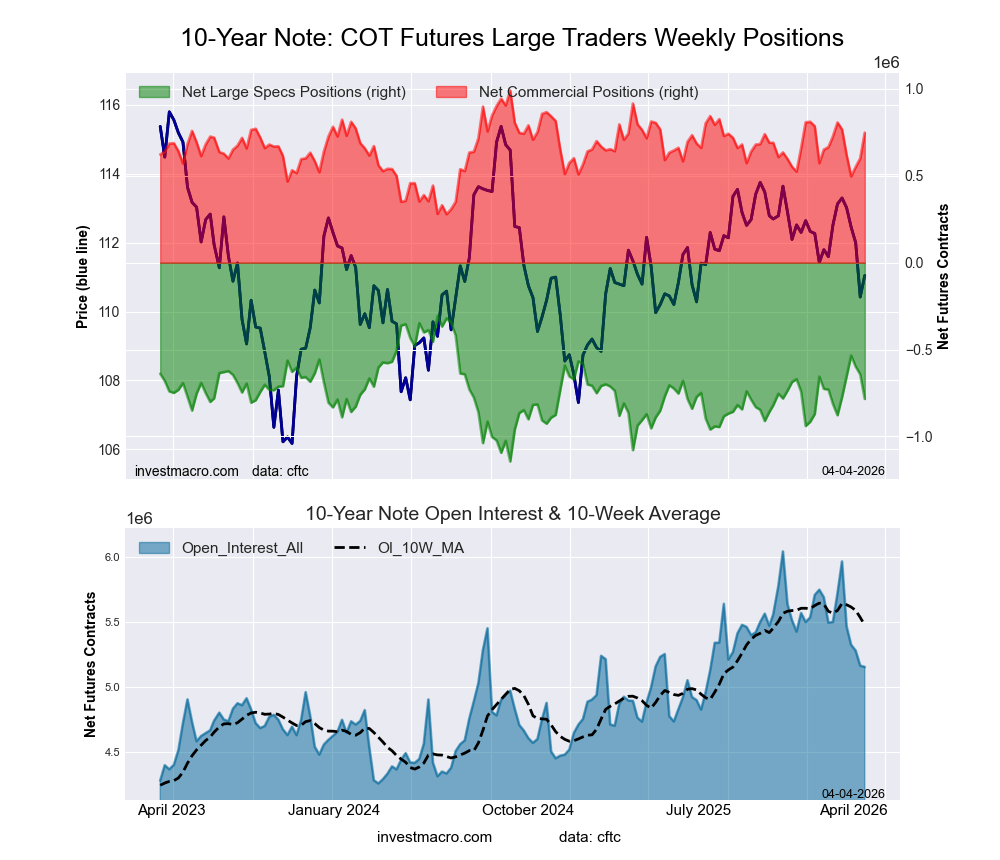
10-Year Treasury Notes Bonds Futures COT ChartThe 10-Year Treasury Note large speculator standing this week resulted in a net position of -870,505 contracts in the data reported through Tuesday. This was a weekly gain of 45,047 contracts from the previous week which had a total of -915,552 net contracts.

This week’s current strength score (the trader positioning range over the past three years, measured from 0 to 100) shows the speculators are currently Bearish with a score of 32.7 percent. The commercials are Bullish with a score of 71.2 percent and the small traders (not shown in chart) are Bullish with a score of 68.4 percent.

Price Trend-Following Model: Downtrend

Our weekly trend-following model classifies the current market price position as: Downtrend.

10-Year Treasury Note StatisticsSPECULATORSCOMMERCIALSSMALL TRADERS
– Percent of Open Interest Longs:12.576.87.6
– Percent of Open Interest Shorts:27.763.06.1
– Net Position:-870,505785,65084,855
– Gross Longs:713,2724,383,326432,679
– Gross Shorts:1,583,7773,597,676347,824
– Long to Short Ratio:0.5 to 11.2 to 11.2 to 1
NET POSITION TREND:
– Strength Index Score (3 Year Range Pct):32.771.268.4
– Strength Index Reading (3 Year Range):BearishBullishBullish
NET POSITION MOVEMENT INDEX:
– 6-Week Change in Strength Index:-16.026.5-18.4


Ultra 10-Year Notes Futures:

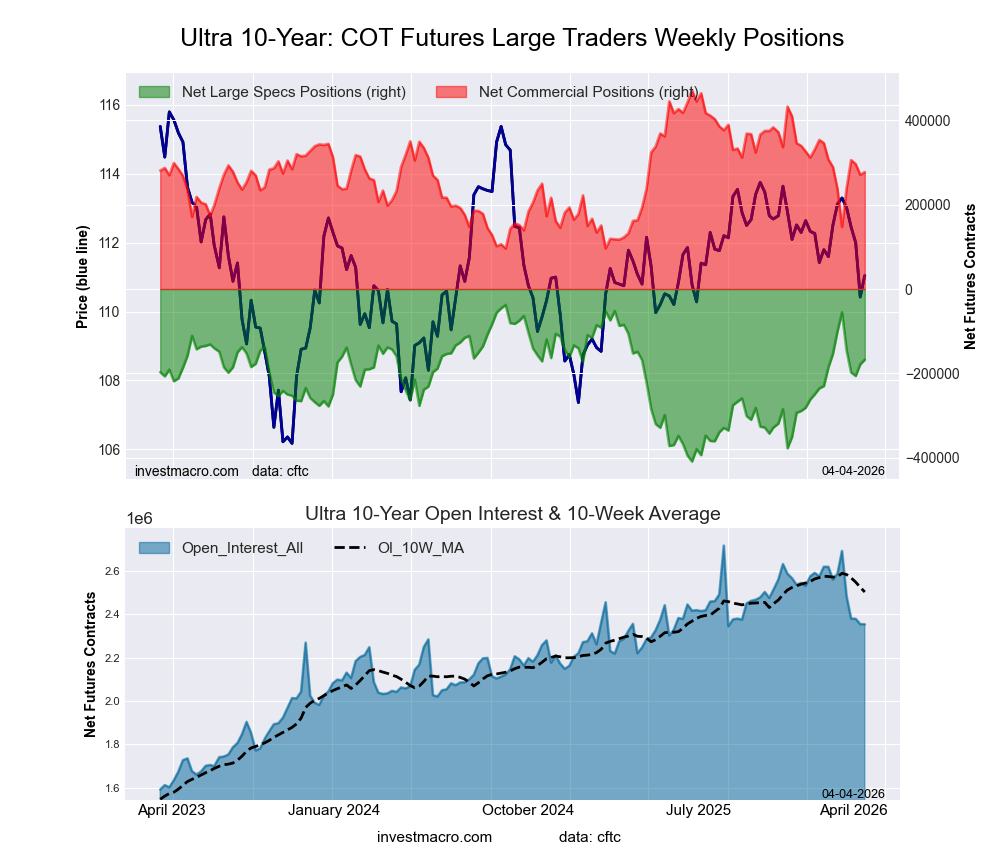
Ultra 10-Year Treasury Notes Bonds Futures COT ChartThe Ultra 10-Year Notes large speculator standing this week resulted in a net position of -249,202 contracts in the data reported through Tuesday. This was a weekly boost of 12,726 contracts from the previous week which had a total of -261,928 net contracts.

This week’s current strength score (the trader positioning range over the past three years, measured from 0 to 100) shows the speculators are currently Bearish with a score of 42.9 percent. The commercials are Bullish with a score of 62.8 percent and the small traders (not shown in chart) are Bearish with a score of 31.7 percent.

Price Trend-Following Model: Downtrend

Our weekly trend-following model classifies the current market price position as: Downtrend.

Ultra 10-Year Notes StatisticsSPECULATORSCOMMERCIALSSMALL TRADERS
– Percent of Open Interest Longs:10.679.58.9
– Percent of Open Interest Shorts:20.366.712.1
– Net Position:-249,202330,563-81,361
– Gross Longs:275,3382,057,956231,470
– Gross Shorts:524,5401,727,393312,831
– Long to Short Ratio:0.5 to 11.2 to 10.7 to 1
NET POSITION TREND:
– Strength Index Score (3 Year Range Pct):42.962.831.7
– Strength Index Reading (3 Year Range):BearishBullishBearish
NET POSITION MOVEMENT INDEX:
– 6-Week Change in Strength Index:34.5-27.1-25.1


US Treasury Bonds Futures:

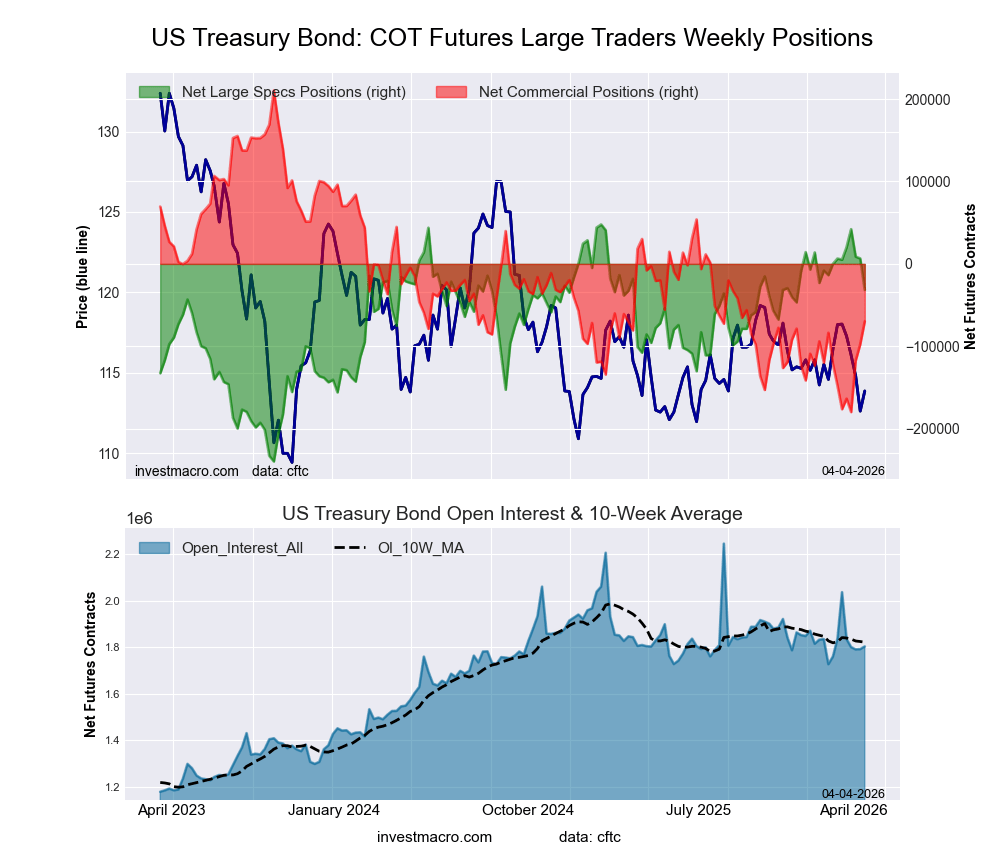
US Year Treasury Notes Long Bonds Futures COT ChartThe US Treasury Bonds large speculator standing this week resulted in a net position of 13,835 contracts in the data reported through Tuesday. This was a weekly increase of 20,667 contracts from the previous week which had a total of -6,832 net contracts.

This week’s current strength score (the trader positioning range over the past three years, measured from 0 to 100) shows the speculators are currently Bullish-Extreme with a score of 88.2 percent. The commercials are Bearish-Extreme with a score of 8.1 percent and the small traders (not shown in chart) are Bullish with a score of 61.8 percent.

Price Trend-Following Model: Strong Downtrend

Our weekly trend-following model classifies the current market price position as: Strong Downtrend.

US Treasury Bonds StatisticsSPECULATORSCOMMERCIALSSMALL TRADERS
– Percent of Open Interest Longs:9.475.513.3
– Percent of Open Interest Shorts:8.682.37.3
– Net Position:13,835-123,423109,588
– Gross Longs:170,4101,370,974241,908
– Gross Shorts:156,5751,494,397132,320
– Long to Short Ratio:1.1 to 10.9 to 11.8 to 1
NET POSITION TREND:
– Strength Index Score (3 Year Range Pct):88.28.161.8
– Strength Index Reading (3 Year Range):Bullish-ExtremeBearish-ExtremeBullish
NET POSITION MOVEMENT INDEX:
– 6-Week Change in Strength Index:15.0-1.2-25.5


Ultra US Treasury Bonds Futures:

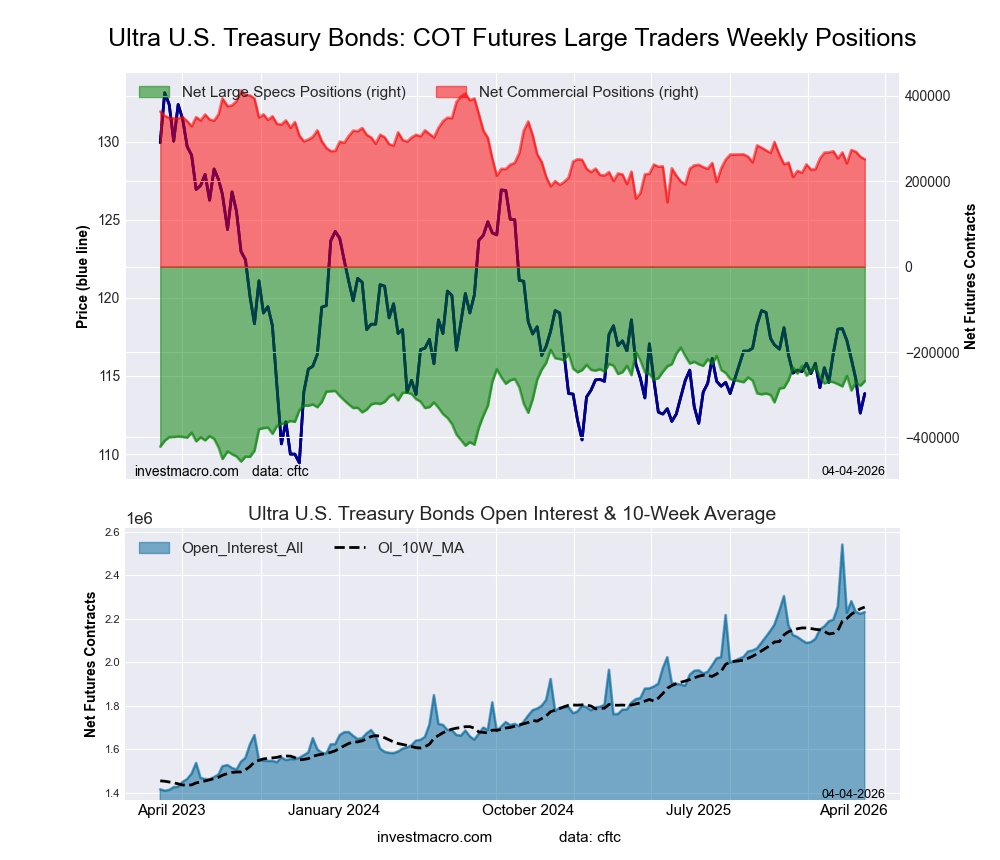
Ultra US Year Treasury Notes Long Bonds Futures COT ChartThe Ultra US Treasury Bonds large speculator standing this week resulted in a net position of -235,097 contracts in the data reported through Tuesday. This was a weekly boost of 10,650 contracts from the previous week which had a total of -245,747 net contracts.

This week’s current strength score (the trader positioning range over the past three years, measured from 0 to 100) shows the speculators are currently Bullish-Extreme with a score of 83.0 percent. The commercials are Bearish with a score of 29.7 percent and the small traders (not shown in chart) are Bearish with a score of 21.8 percent.

Price Trend-Following Model: Strong Downtrend

Our weekly trend-following model classifies the current market price position as: Strong Downtrend.

Ultra US Treasury Bonds StatisticsSPECULATORSCOMMERCIALSSMALL TRADERS
– Percent of Open Interest Longs:7.083.68.6
– Percent of Open Interest Shorts:18.172.78.3
– Net Position:-235,097228,6016,496
– Gross Longs:146,9411,761,337182,270
– Gross Shorts:382,0381,532,736175,774
– Long to Short Ratio:0.4 to 11.1 to 11.0 to 1
NET POSITION TREND:
– Strength Index Score (3 Year Range Pct):83.029.721.8
– Strength Index Reading (3 Year Range):Bullish-ExtremeBearishBearish
NET POSITION MOVEMENT INDEX:
– 6-Week Change in Strength Index:11.5-5.8-16.0


Article By InvestMacroReceive our weekly COT Newsletter

*COT Report: The COT data, released weekly to the public each Friday, is updated through the most recent Tuesday (data is 3 days old) and shows a quick view of how large speculators or non-commercials (for-profit traders) were positioned in the futures markets.

The CFTC categorizes trader positions according to commercial hedgers (traders who use futures contracts for hedging as part of the business), non-commercials (large traders who speculate to realize trading profits) and nonreportable traders (usually small traders/speculators) as well as their open interest (contracts open in the market at time of reporting). See CFTC criteria here.

COT Energy Charts: Speculator Bets led by Bloomberg Commodity Index & WTI Crude Oil

By InvestMacro

Speculators OI Energy Futures COT Chart
Here are the latest charts and statistics for the Commitment of Traders (COT) data published by the Commodities Futures Trading Commission (CFTC).

The latest COT data is updated through Tuesday January 13th and shows a quick view of how large traders (for-profit speculators and commercial entities) were positioned in the futures markets.

Weekly Speculator Changes led by the Bloomberg Commodity Index & WTI Crude Oil

Speculators Nets Energy Futures COT Chart
The COT energy market speculator bets were mixed this week as three out of the six energy markets we cover had higher positioning while the other three markets had lower speculator contracts.

Leading the gains for the energy markets was the Bloomberg Commodity Index (7,989 contracts) with Gasoline (2,569 contracts) and WTI Crude (776 contracts) also having positive weeks.

The markets with declines in speculator bets for the week were Natural Gas (-20,042 contracts), Brent Oil (-6,035 contracts) and with Heating Oil (-4,359 contracts) also seeing lower bets on the week.

Energy Market Price Performance led by Heating Oil

The energy markets saw Heating Oil lead the price performance over the last five days with a gain by 3.7%. Brent Crude Oil was up by 1.79%, while the Bloomberg Commodity Index rose by 1.53% on the week. WTI Crude Oil was also higher by 1.22%, and Gasoline rose by approximately 0.50%.

The only energy market with a down week was Natural Gas, which fell by -0.62%. Natural Gas has been on a strong downtrend and has fallen by 33% in the past 30 days, and by 22% over the past 90 days.


Energy Data:

Speculators Table Energy Futures COT Chart
Legend: Weekly Speculators Change | Speculators Current Net Position | Speculators Strength Score compared to last 3-Years (0-100 range)


Strength Scores led by Bloomberg Index & Gasoline

Speculators Strength Energy Futures COT Chart
COT Strength Scores (a normalized measure of Speculator positions over a 3-Year range, from 0 to 100 where above 80 is Extreme-Bullish and below 20 is Extreme-Bearish) showed that Bloomberg Index (80.5 percent) and Gasoline (67.2 percent) lead the energy markets this week.

On the downside, Natural Gas (0.0 percent) and WTI Crude (5.9 percent) come in at the lowest strength level currently and is in Extreme-Bearish territory (below 20 percent).

Strength Statistics:
WTI Crude Oil (5.9 percent) vs WTI Crude Oil previous week (5.7 percent)
Brent Crude Oil (32.8 percent) vs Brent Crude Oil previous week (41.4 percent)
Natural Gas (0.0 percent) vs Natural Gas previous week (14.9 percent)
Gasoline (67.2 percent) vs Gasoline previous week (64.4 percent)
Heating Oil (62.6 percent) vs Heating Oil previous week (68.3 percent)
Bloomberg Commodity Index (80.5 percent) vs Bloomberg Commodity Index previous week (44.7 percent)


Bloomberg Index & WTI Crude top the 6-Week Strength Trends

Speculators Trend Energy Futures COT Chart
COT Strength Score Trends (or move index, calculates the 6-week changes in strength scores) showed that Bloomberg Index (61.5 percent) and WTI Crude (2.3 percent) lead the past six weeks trends for the energy markets.

Natural Gas (-43.8 percent), Gasoline (-32.8 percent) and Brent Oil (-13.6 percent) lead the downside trend scores currently.

Move Statistics:
WTI Crude Oil (2.3 percent) vs WTI Crude Oil previous week (0.8 percent)
Brent Crude Oil (-13.6 percent) vs Brent Crude Oil previous week (-1.2 percent)
Natural Gas (-43.8 percent) vs Natural Gas previous week (-20.1 percent)
Gasoline (-32.8 percent) vs Gasoline previous week (-23.2 percent)
Heating Oil (-11.9 percent) vs Heating Oil previous week (-0.5 percent)
Bloomberg Commodity Index (61.5 percent) vs Bloomberg Commodity Index previous week (23.5 percent)


Individual COT Market Charts:

WTI Crude Oil Futures:

WTI Crude Oil Futures COT ChartThe WTI Crude Oil Futures large speculator standing this week reached a net position of 58,128 contracts in the data reported through Tuesday. This was a weekly lift of 776 contracts from the previous week which had a total of 57,352 net contracts.

This week’s current strength score (the trader positioning range over the past three years, measured from 0 to 100) shows the speculators are currently Bearish-Extreme with a score of 5.9 percent. The commercials are Bullish-Extreme with a score of 96.8 percent and the small traders (not shown in chart) are Bearish-Extreme with a score of 16.1 percent.

Price Trend-Following Model: Weak Downtrend

Our weekly trend-following model classifies the current market price position as: Weak Downtrend.

WTI Crude Oil Futures StatisticsSPECULATORSCOMMERCIALSSMALL TRADERS
– Percent of Open Interest Longs:14.242.43.2
– Percent of Open Interest Shorts:11.345.62.9
– Net Position:58,128-65,4507,322
– Gross Longs:286,136855,31365,125
– Gross Shorts:228,008920,76357,803
– Long to Short Ratio:1.3 to 10.9 to 11.1 to 1
NET POSITION TREND:
– Strength Index Score (3 Year Range Pct):5.996.816.1
– Strength Index Reading (3 Year Range):Bearish-ExtremeBullish-ExtremeBearish-Extreme
NET POSITION MOVEMENT INDEX:
– 6-Week Change in Strength Index:2.3-1.3-6.0


Brent Crude Oil Futures:

Brent Last Day Crude Oil Futures COT ChartThe Brent Crude Oil Futures large speculator standing this week reached a net position of -33,887 contracts in the data reported through Tuesday. This was a weekly fall of -6,035 contracts from the previous week which had a total of -27,852 net contracts.

This week’s current strength score (the trader positioning range over the past three years, measured from 0 to 100) shows the speculators are currently Bearish with a score of 32.8 percent. The commercials are Bullish with a score of 66.3 percent and the small traders (not shown in chart) are Bullish with a score of 71.7 percent.

Price Trend-Following Model: Weak Downtrend

Our weekly trend-following model classifies the current market price position as: Weak Downtrend.

Brent Crude Oil Futures StatisticsSPECULATORSCOMMERCIALSSMALL TRADERS
– Percent of Open Interest Longs:22.634.53.5
– Percent of Open Interest Shorts:37.221.22.2
– Net Position:-33,88730,7583,129
– Gross Longs:52,27379,9468,124
– Gross Shorts:86,16049,1884,995
– Long to Short Ratio:0.6 to 11.6 to 11.6 to 1
NET POSITION TREND:
– Strength Index Score (3 Year Range Pct):32.866.371.7
– Strength Index Reading (3 Year Range):BearishBullishBullish
NET POSITION MOVEMENT INDEX:
– 6-Week Change in Strength Index:-13.610.829.4


Natural Gas Futures:

Natural Gas Futures COT ChartThe Natural Gas Futures large speculator standing this week reached a net position of -185,601 contracts in the data reported through Tuesday. This was a weekly lowering of -20,042 contracts from the previous week which had a total of -165,559 net contracts.

This week’s current strength score (the trader positioning range over the past three years, measured from 0 to 100) shows the speculators are currently Bearish-Extreme with a score of 0.0 percent. The commercials are Bullish-Extreme with a score of 100.0 percent and the small traders (not shown in chart) are Bearish with a score of 35.0 percent.

Price Trend-Following Model: Strong Downtrend

Our weekly trend-following model classifies the current market price position as: Strong Downtrend.

Natural Gas Futures StatisticsSPECULATORSCOMMERCIALSSMALL TRADERS
– Percent of Open Interest Longs:16.536.83.4
– Percent of Open Interest Shorts:27.926.32.6
– Net Position:-185,601172,84412,757
– Gross Longs:270,263602,29654,985
– Gross Shorts:455,864429,45242,228
– Long to Short Ratio:0.6 to 11.4 to 11.3 to 1
NET POSITION TREND:
– Strength Index Score (3 Year Range Pct):0.0100.035.0
– Strength Index Reading (3 Year Range):Bearish-ExtremeBullish-ExtremeBearish
NET POSITION MOVEMENT INDEX:
– 6-Week Change in Strength Index:-43.842.9-1.6


Gasoline Blendstock Futures:

RBOB Gasoline Energy Futures COT ChartThe Gasoline Blendstock Futures large speculator standing this week reached a net position of 72,527 contracts in the data reported through Tuesday. This was a weekly gain of 2,569 contracts from the previous week which had a total of 69,958 net contracts.

This week’s current strength score (the trader positioning range over the past three years, measured from 0 to 100) shows the speculators are currently Bullish with a score of 67.2 percent. The commercials are Bearish with a score of 32.8 percent and the small traders (not shown in chart) are Bullish with a score of 59.4 percent.

Price Trend-Following Model: Weak Downtrend

Our weekly trend-following model classifies the current market price position as: Weak Downtrend.

Nasdaq Mini Futures StatisticsSPECULATORSCOMMERCIALSSMALL TRADERS
– Percent of Open Interest Longs:24.248.55.8
– Percent of Open Interest Shorts:8.166.04.3
– Net Position:72,527-79,0626,535
– Gross Longs:109,165218,25126,081
– Gross Shorts:36,638297,31319,546
– Long to Short Ratio:3.0 to 10.7 to 11.3 to 1
NET POSITION TREND:
– Strength Index Score (3 Year Range Pct):67.232.859.4
– Strength Index Reading (3 Year Range):BullishBearishBullish
NET POSITION MOVEMENT INDEX:
– 6-Week Change in Strength Index:-32.832.8-17.0


#2 Heating Oil NY-Harbor Futures:

NY Harbor Heating Oil Energy Futures COT ChartThe #2 Heating Oil NY-Harbor Futures large speculator standing this week reached a net position of 14,511 contracts in the data reported through Tuesday. This was a weekly decline of -4,359 contracts from the previous week which had a total of 18,870 net contracts.

This week’s current strength score (the trader positioning range over the past three years, measured from 0 to 100) shows the speculators are currently Bullish with a score of 62.6 percent. The commercials are Bearish with a score of 40.5 percent and the small traders (not shown in chart) are Bullish with a score of 53.2 percent.

Price Trend-Following Model: Weak Downtrend

Our weekly trend-following model classifies the current market price position as: Weak Downtrend.

Heating Oil Futures StatisticsSPECULATORSCOMMERCIALSSMALL TRADERS
– Percent of Open Interest Longs:17.147.612.4
– Percent of Open Interest Shorts:13.255.08.9
– Net Position:14,511-27,33512,824
– Gross Longs:62,981174,86245,706
– Gross Shorts:48,470202,19732,882
– Long to Short Ratio:1.3 to 10.9 to 11.4 to 1
NET POSITION TREND:
– Strength Index Score (3 Year Range Pct):62.640.553.2
– Strength Index Reading (3 Year Range):BullishBearishBullish
NET POSITION MOVEMENT INDEX:
– 6-Week Change in Strength Index:-11.923.6-43.0


Bloomberg Commodity Index Futures:

Bloomberg Commodity Index Futures COT ChartThe Bloomberg Commodity Index Futures large speculator standing this week reached a net position of -5,798 contracts in the data reported through Tuesday. This was a weekly advance of 7,989 contracts from the previous week which had a total of -13,787 net contracts.

This week’s current strength score (the trader positioning range over the past three years, measured from 0 to 100) shows the speculators are currently Bullish-Extreme with a score of 80.5 percent. The commercials are Bearish-Extreme with a score of 16.3 percent and the small traders (not shown in chart) are Bullish with a score of 61.9 percent.

Price Trend-Following Model: Strong Uptrend

Our weekly trend-following model classifies the current market price position as: Strong Uptrend.

Bloomberg Index Futures StatisticsSPECULATORSCOMMERCIALSSMALL TRADERS
– Percent of Open Interest Longs:27.569.60.5
– Percent of Open Interest Shorts:30.567.00.0
– Net Position:-5,7984,845953
– Gross Longs:51,952131,526974
– Gross Shorts:57,750126,68121
– Long to Short Ratio:0.9 to 11.0 to 146.4 to 1
NET POSITION TREND:
– Strength Index Score (3 Year Range Pct):80.516.361.9
– Strength Index Reading (3 Year Range):Bullish-ExtremeBearish-ExtremeBullish
NET POSITION MOVEMENT INDEX:
– 6-Week Change in Strength Index:61.5-63.420.5


Article By InvestMacroReceive our weekly COT Newsletter

*COT Report: The COT data, released weekly to the public each Friday, is updated through the most recent Tuesday (data is 3 days old) and shows a quick view of how large speculators or non-commercials (for-profit traders) were positioned in the futures markets.

The CFTC categorizes trader positions according to commercial hedgers (traders who use futures contracts for hedging as part of the business), non-commercials (large traders who speculate to realize trading profits) and nonreportable traders (usually small traders/speculators) as well as their open interest (contracts open in the market at time of reporting). See CFTC criteria here.

COT Soft Commodities Charts: Speculator Bets led by Soybean Oil & Soybean Meal

By InvestMacro

Speculators OI Softs
Here are the latest charts and statistics for the Commitment of Traders (COT) reports data published by the Commodities Futures Trading Commission (CFTC).

The latest COT data is updated through Tuesday January 13th and shows a quick view of how large traders (for-profit speculators and commercial entities) were positioned in the futures markets.

Weekly Speculator Changes led by Soybean Oil & Soybean Meal

Speculators Nets Softs
The COT soft commodities markets speculator bets were overall higher this week as seven out of the eleven softs markets we cover had higher positioning while the other four markets had lower speculator contracts.

Leading the gains for the softs markets was Soybean Oil (26,028 contracts) with Soybean Meal (13,215 contracts), Live Cattle (5,213 contracts),  Coffee (2,216 contracts), Wheat (2,066 contracts), Cotton (1,489 contracts) and Lean Hogs (90 contracts) also showing positive weeks.

The markets with the declines in speculator bets this week were Corn (-93,535 contracts), Soybeans (-45,823 contracts), Cocoa (-12,726 contracts) and with Sugar (-11,613 contracts) also registering lower bets on the week.

5-Day Price Performance led by Soybean Oil

Soft commodity prices this week saw Soybean Oil lead the past five days’ performance with a gain of 5.33%. Soybean Oil has risen by almost 3% over the past 90 days.

Lean Hogs came in second with a 1.13% gain this week, followed by Cotton, which rose by 0.45%. Sugar (0.10%) and Wheat (0.09%) were marginally higher on the week while Live Cattle was virtually unchanged.

Soybeans fell by just over half a percent (-0.68%), followed by Coffee (-0.81%), which was lower by just under -1%. Cocoa fell by -2.6%, while Corn dropped by over -4%, and Soybean Meal was down by about -5%.


Soft Commodities Data:

Speculators Table Softs
Legend: Weekly Speculators Change | Speculators Current Net Position | Speculators Strength Score compared to last 3-Years (0-100 range)


Strength Scores led by Live Cattle & Soybeans

Speculators Strength Softs
COT Strength Scores (a normalized measure of Speculator positions over a 3-Year range, from 0 to 100 where above 80 is Extreme-Bullish and below 20 is Extreme-Bearish) showed that Live Cattle (63 percent), Soybeans (57 percent), Coffee (56 percent) and Lean Hogs (56 percent) lead the softs markets this week.

On the downside, Cocoa (0 percent) and Sugar (7 percent) come in at the lowest strength levels currently and are in Extreme-Bearish territory (below 20 percent). The next lowest strength scores are the Cotton (23 percent) and the Wheat (28 percent).

Strength Statistics:
Corn (31.7 percent) vs Corn previous week (44.4 percent)
Sugar (7.3 percent) vs Sugar previous week (9.7 percent)
Coffee (56.1 percent) vs Coffee previous week (53.8 percent)
Soybeans (56.8 percent) vs Soybeans previous week (66.9 percent)
Soybean Oil (29.3 percent) vs Soybean Oil previous week (14.2 percent)
Soybean Meal (33.2 percent) vs Soybean Meal previous week (28.2 percent)
Live Cattle (62.6 percent) vs Live Cattle previous week (57.4 percent)
Lean Hogs (55.6 percent) vs Lean Hogs previous week (55.6 percent)
Cotton (22.7 percent) vs Cotton previous week (21.9 percent)
Cocoa (0.0 percent) vs Cocoa previous week (13.0 percent)
Wheat (28.5 percent) vs Wheat previous week (26.6 percent)


Lean Hogs & Live Cattle top the 6-Week Strength Trends

Speculators Trend Softs
COT Strength Score Trends (or move index, calculates the 6-week changes in strength scores) showed that Lean Hogs (13 percent) and Live Cattle (12 percent) lead the past six weeks trends for soft commodities. Cotton (7 percent) and Sugar (4 percent) are the next highest positive movers in the latest trends data.

Wheat (-53 percent) leads the downside trend scores currently with Soybeans (-41 percent), Soybean Oil (-22 percent) and Soybean Meal (-20 percent) following next with lower trend scores.

Strength Trend Statistics:
Corn (-16.4 percent) vs Corn previous week (0.2 percent)
Sugar (4.0 percent) vs Sugar previous week (8.4 percent)
Coffee (-2.6 percent) vs Coffee previous week (-5.5 percent)
Soybeans (-41.3 percent) vs Soybeans previous week (-29.9 percent)
Soybean Oil (-21.8 percent) vs Soybean Oil previous week (-27.9 percent)
Soybean Meal (-20.2 percent) vs Soybean Meal previous week (-27.8 percent)
Live Cattle (12.2 percent) vs Live Cattle previous week (-0.9 percent)
Lean Hogs (12.9 percent) vs Lean Hogs previous week (10.2 percent)
Cotton (6.9 percent) vs Cotton previous week (7.6 percent)
Cocoa (-3.4 percent) vs Cocoa previous week (9.2 percent)
Wheat (-52.9 percent) vs Wheat previous week (-46.8 percent)


Individual Soft Commodities Markets:

CORN Futures:

CORN Futures COT ChartThe CORN large speculator standing this week reached a net position of -33,423 contracts in the data reported through Tuesday. This was a weekly reduction of -93,535 contracts from the previous week which had a total of 60,112 net contracts.

This week’s current strength score (the trader positioning range over the past three years, measured from 0 to 100) shows the speculators are currently Bearish with a score of 31.7 percent. The commercials are Bullish with a score of 64.6 percent and the small traders (not shown in chart) are Bullish-Extreme with a score of 88.6 percent.

Price Trend-Following Model: Downtrend

Our weekly trend-following model classifies the current market price position as: Downtrend.

CORN Futures StatisticsSPECULATORSCOMMERCIALSSMALL TRADERS
– Percent of Open Interest Longs:20.448.18.7
– Percent of Open Interest Shorts:22.445.19.6
– Net Position:-33,42348,923-15,500
– Gross Longs:328,395776,624140,104
– Gross Shorts:361,818727,701155,604
– Long to Short Ratio:0.9 to 11.1 to 10.9 to 1
NET POSITION TREND:
– Strength Index Score (3 Year Range Pct):31.764.688.6
– Strength Index Reading (3 Year Range):BearishBullishBullish-Extreme
NET POSITION MOVEMENT INDEX:
– 6-Week Change in Strength Index:-16.416.314.9


SUGAR Futures:

SUGAR Futures COT ChartThe SUGAR large speculator standing this week reached a net position of -165,711 contracts in the data reported through Tuesday. This was a weekly decline of -11,613 contracts from the previous week which had a total of -154,098 net contracts.

This week’s current strength score (the trader positioning range over the past three years, measured from 0 to 100) shows the speculators are currently Bearish-Extreme with a score of 7.3 percent. The commercials are Bullish-Extreme with a score of 94.1 percent and the small traders (not shown in chart) are Bearish-Extreme with a score of 6.2 percent.

Price Trend-Following Model: Downtrend

Our weekly trend-following model classifies the current market price position as: Downtrend.

SUGAR Futures StatisticsSPECULATORSCOMMERCIALSSMALL TRADERS
– Percent of Open Interest Longs:14.856.27.2
– Percent of Open Interest Shorts:31.938.18.3
– Net Position:-165,711176,273-10,562
– Gross Longs:143,494545,37269,916
– Gross Shorts:309,205369,09980,478
– Long to Short Ratio:0.5 to 11.5 to 10.9 to 1
NET POSITION TREND:
– Strength Index Score (3 Year Range Pct):7.394.16.2
– Strength Index Reading (3 Year Range):Bearish-ExtremeBullish-ExtremeBearish-Extreme
NET POSITION MOVEMENT INDEX:
– 6-Week Change in Strength Index:4.0-2.2-9.7


COFFEE Futures:

COFFEE Futures COT ChartThe COFFEE large speculator standing this week reached a net position of 32,752 contracts in the data reported through Tuesday. This was a weekly increase of 2,216 contracts from the previous week which had a total of 30,536 net contracts.

This week’s current strength score (the trader positioning range over the past three years, measured from 0 to 100) shows the speculators are currently Bullish with a score of 56.1 percent. The commercials are Bearish with a score of 45.1 percent and the small traders (not shown in chart) are Bearish with a score of 41.0 percent.

Price Trend-Following Model: Weak Uptrend

Our weekly trend-following model classifies the current market price position as: Weak Uptrend.

COFFEE Futures StatisticsSPECULATORSCOMMERCIALSSMALL TRADERS
– Percent of Open Interest Longs:33.940.74.6
– Percent of Open Interest Shorts:14.760.73.8
– Net Position:32,752-34,1271,375
– Gross Longs:57,88869,4007,843
– Gross Shorts:25,136103,5276,468
– Long to Short Ratio:2.3 to 10.7 to 11.2 to 1
NET POSITION TREND:
– Strength Index Score (3 Year Range Pct):56.145.141.0
– Strength Index Reading (3 Year Range):BullishBearishBearish
NET POSITION MOVEMENT INDEX:
– 6-Week Change in Strength Index:-2.62.9-7.1


SOYBEANS Futures:

SOYBEANS Futures COT ChartThe SOYBEANS large speculator standing this week reached a net position of 58,947 contracts in the data reported through Tuesday. This was a weekly lowering of -45,823 contracts from the previous week which had a total of 104,770 net contracts.

This week’s current strength score (the trader positioning range over the past three years, measured from 0 to 100) shows the speculators are currently Bullish with a score of 56.8 percent. The commercials are Bearish with a score of 43.6 percent and the small traders (not shown in chart) are Bullish with a score of 61.7 percent.

Price Trend-Following Model: Weak Uptrend

Our weekly trend-following model classifies the current market price position as: Weak Uptrend.

SOYBEANS Futures StatisticsSPECULATORSCOMMERCIALSSMALL TRADERS
– Percent of Open Interest Longs:21.751.56.3
– Percent of Open Interest Shorts:14.456.38.7
– Net Position:58,947-39,485-19,462
– Gross Longs:176,440419,09951,203
– Gross Shorts:117,493458,58470,665
– Long to Short Ratio:1.5 to 10.9 to 10.7 to 1
NET POSITION TREND:
– Strength Index Score (3 Year Range Pct):56.843.661.7
– Strength Index Reading (3 Year Range):BullishBearishBullish
NET POSITION MOVEMENT INDEX:
– 6-Week Change in Strength Index:-41.342.42.6


SOYBEAN OIL Futures:

SOYBEAN OIL Futures COT ChartThe SOYBEAN OIL large speculator standing this week reached a net position of -25,135 contracts in the data reported through Tuesday. This was a weekly lift of 26,028 contracts from the previous week which had a total of -51,163 net contracts.

This week’s current strength score (the trader positioning range over the past three years, measured from 0 to 100) shows the speculators are currently Bearish with a score of 29.3 percent. The commercials are Bullish with a score of 71.9 percent and the small traders (not shown in chart) are Bearish with a score of 30.3 percent.

Price Trend-Following Model: Weak Downtrend

Our weekly trend-following model classifies the current market price position as: Weak Downtrend.

SOYBEAN OIL Futures StatisticsSPECULATORSCOMMERCIALSSMALL TRADERS
– Percent of Open Interest Longs:18.749.94.4
– Percent of Open Interest Shorts:22.646.34.1
– Net Position:-25,13522,7392,396
– Gross Longs:119,861320,24128,550
– Gross Shorts:144,996297,50226,154
– Long to Short Ratio:0.8 to 11.1 to 11.1 to 1
NET POSITION TREND:
– Strength Index Score (3 Year Range Pct):29.371.930.3
– Strength Index Reading (3 Year Range):BearishBullishBearish
NET POSITION MOVEMENT INDEX:
– 6-Week Change in Strength Index:-21.821.5-11.5


SOYBEAN MEAL Futures:

SOYBEAN MEAL Futures COT ChartThe SOYBEAN MEAL large speculator standing this week reached a net position of 757 contracts in the data reported through Tuesday. This was a weekly advance of 13,215 contracts from the previous week which had a total of -12,458 net contracts.

This week’s current strength score (the trader positioning range over the past three years, measured from 0 to 100) shows the speculators are currently Bearish with a score of 33.2 percent. The commercials are Bullish with a score of 70.1 percent and the small traders (not shown in chart) are Bearish-Extreme with a score of 15.8 percent.

Price Trend-Following Model: Weak Uptrend

Our weekly trend-following model classifies the current market price position as: Weak Uptrend.

SOYBEAN MEAL Futures StatisticsSPECULATORSCOMMERCIALSSMALL TRADERS
– Percent of Open Interest Longs:21.952.68.4
– Percent of Open Interest Shorts:21.755.25.9
– Net Position:757-13,48912,732
– Gross Longs:111,971269,49742,916
– Gross Shorts:111,214282,98630,184
– Long to Short Ratio:1.0 to 11.0 to 11.4 to 1
NET POSITION TREND:
– Strength Index Score (3 Year Range Pct):33.270.115.8
– Strength Index Reading (3 Year Range):BearishBullishBearish-Extreme
NET POSITION MOVEMENT INDEX:
– 6-Week Change in Strength Index:-20.220.7-3.6


LIVE CATTLE Futures:

LIVE CATTLE Futures COT ChartThe LIVE CATTLE large speculator standing this week reached a net position of 85,939 contracts in the data reported through Tuesday. This was a weekly gain of 5,213 contracts from the previous week which had a total of 80,726 net contracts.

This week’s current strength score (the trader positioning range over the past three years, measured from 0 to 100) shows the speculators are currently Bullish with a score of 62.6 percent. The commercials are Bearish with a score of 32.1 percent and the small traders (not shown in chart) are Bullish with a score of 56.3 percent.

Price Trend-Following Model: Uptrend

Our weekly trend-following model classifies the current market price position as: Uptrend.

LIVE CATTLE Futures StatisticsSPECULATORSCOMMERCIALSSMALL TRADERS
– Percent of Open Interest Longs:44.633.18.5
– Percent of Open Interest Shorts:18.155.912.2
– Net Position:85,939-73,983-11,956
– Gross Longs:144,736107,43727,580
– Gross Shorts:58,797181,42039,536
– Long to Short Ratio:2.5 to 10.6 to 10.7 to 1
NET POSITION TREND:
– Strength Index Score (3 Year Range Pct):62.632.156.3
– Strength Index Reading (3 Year Range):BullishBearishBullish
NET POSITION MOVEMENT INDEX:
– 6-Week Change in Strength Index:12.2-14.0-2.7


LEAN HOGS Futures:

LEAN HOGS Futures COT ChartThe LEAN HOGS large speculator standing this week reached a net position of 41,478 contracts in the data reported through Tuesday. This was a weekly rise of 90 contracts from the previous week which had a total of 41,388 net contracts.

This week’s current strength score (the trader positioning range over the past three years, measured from 0 to 100) shows the speculators are currently Bullish with a score of 55.6 percent. The commercials are Bearish with a score of 47.0 percent and the small traders (not shown in chart) are Bearish with a score of 39.6 percent.

Price Trend-Following Model: Uptrend

Our weekly trend-following model classifies the current market price position as: Uptrend.

LEAN HOGS Futures StatisticsSPECULATORSCOMMERCIALSSMALL TRADERS
– Percent of Open Interest Longs:38.735.76.8
– Percent of Open Interest Shorts:25.147.28.9
– Net Position:41,478-35,177-6,301
– Gross Longs:117,956108,71220,863
– Gross Shorts:76,478143,88927,164
– Long to Short Ratio:1.5 to 10.8 to 10.8 to 1
NET POSITION TREND:
– Strength Index Score (3 Year Range Pct):55.647.039.6
– Strength Index Reading (3 Year Range):BullishBearishBearish
NET POSITION MOVEMENT INDEX:
– 6-Week Change in Strength Index:12.9-14.46.2


COTTON Futures:

COTTON Futures COT ChartThe COTTON large speculator standing this week reached a net position of -27,431 contracts in the data reported through Tuesday. This was a weekly lift of 1,489 contracts from the previous week which had a total of -28,920 net contracts.

This week’s current strength score (the trader positioning range over the past three years, measured from 0 to 100) shows the speculators are currently Bearish with a score of 22.7 percent. The commercials are Bullish with a score of 75.7 percent and the small traders (not shown in chart) are Bearish with a score of 45.3 percent.

Price Trend-Following Model: Downtrend

Our weekly trend-following model classifies the current market price position as: Downtrend.

COTTON Futures StatisticsSPECULATORSCOMMERCIALSSMALL TRADERS
– Percent of Open Interest Longs:27.145.74.6
– Percent of Open Interest Shorts:35.538.23.7
– Net Position:-27,43124,3163,115
– Gross Longs:88,834149,66515,181
– Gross Shorts:116,265125,34912,066
– Long to Short Ratio:0.8 to 11.2 to 11.3 to 1
NET POSITION TREND:
– Strength Index Score (3 Year Range Pct):22.775.745.3
– Strength Index Reading (3 Year Range):BearishBullishBearish
NET POSITION MOVEMENT INDEX:
– 6-Week Change in Strength Index:6.9-8.629.9


COCOA Futures:

COCOA Futures COT ChartThe COCOA large speculator standing this week reached a net position of -9,496 contracts in the data reported through Tuesday. This was a weekly decline of -12,726 contracts from the previous week which had a total of 3,230 net contracts.

This week’s current strength score (the trader positioning range over the past three years, measured from 0 to 100) shows the speculators are currently Bearish-Extreme with a score of 0.0 percent. The commercials are Bullish-Extreme with a score of 100.0 percent and the small traders (not shown in chart) are Bearish-Extreme with a score of 2.5 percent.

Price Trend-Following Model: Uptrend

Our weekly trend-following model classifies the current market price position as: Uptrend.

COCOA Futures StatisticsSPECULATORSCOMMERCIALSSMALL TRADERS
– Percent of Open Interest Longs:19.547.06.9
– Percent of Open Interest Shorts:26.438.28.8
– Net Position:-9,49612,095-2,599
– Gross Longs:27,01065,0309,528
– Gross Shorts:36,50652,93512,127
– Long to Short Ratio:0.7 to 11.2 to 10.8 to 1
NET POSITION TREND:
– Strength Index Score (3 Year Range Pct):0.0100.02.5
– Strength Index Reading (3 Year Range):Bearish-ExtremeBullish-ExtremeBearish-Extreme
NET POSITION MOVEMENT INDEX:
– 6-Week Change in Strength Index:-3.43.2-0.5


WHEAT Futures:

The WHEAT large speculator standing this week reached a net position of -86,025 contracts in the data reported through Tuesday. This was a weekly rise of 2,066 contracts from the previous week which had a total of -88,091 net contracts.

This week’s current strength score (the trader positioning range over the past three years, measured from 0 to 100) shows the speculators are currently Bearish with a score of 28.5 percent. The commercials are Bullish with a score of 72.6 percent and the small traders (not shown in chart) are Bullish with a score of 60.8 percent.

Price Trend-Following Model: Uptrend

Our weekly trend-following model classifies the current market price position as: Uptrend.

WHEAT Futures StatisticsSPECULATORSCOMMERCIALSSMALL TRADERS
– Percent of Open Interest Longs:24.936.75.9
– Percent of Open Interest Shorts:41.720.25.7
– Net Position:-86,02584,8781,147
– Gross Longs:128,167188,71630,432
– Gross Shorts:214,192103,83829,285
– Long to Short Ratio:0.6 to 11.8 to 11.0 to 1
NET POSITION TREND:
– Strength Index Score (3 Year Range Pct):28.572.660.8
– Strength Index Reading (3 Year Range):BearishBullishBullish
NET POSITION MOVEMENT INDEX:
– 6-Week Change in Strength Index:-52.953.335.4


Article By InvestMacroReceive our weekly COT Newsletter

*COT Report: The COT data, released weekly to the public each Friday, is updated through the most recent Tuesday (data is 3 days old) and shows a quick view of how large speculators or non-commercials (for-profit traders) were positioned in the futures markets.

The CFTC categorizes trader positions according to commercial hedgers (traders who use futures contracts for hedging as part of the business), non-commercials (large traders who speculate to realize trading profits) and nonreportable traders (usually small traders/speculators) as well as their open interest (contracts open in the market at time of reporting). See CFTC criteria here.

USD/JPY Slips as the Yen Reacts to a Wave of Market News

By RoboForex Analytical Department

The USD/JPY pair fell to 158.16 on Friday as the Japanese yen continued its recovery from earlier this week. Market participants are increasingly focused on the upcoming Bank of Japan (BoJ) meeting, hoping for clearer signals regarding the future pace of interest rate hikes.

The regulator is widely expected to keep its policy parameters unchanged at the next meeting. However, investors are already pricing in the next rate hike as early as June. BoJ Governor Kazuo Ueda recently reiterated that the central bank remains ready to tighten policy if economic momentum and inflation dynamics continue to align with official forecasts.

Additional support for the yen came from renewed concerns over possible currency intervention as USD/JPY approached the psychologically important 160 level. Japanese authorities have repeatedly warned against sharp, unilateral exchange rate movements, increasing market sensitivity in this zone.

At the same time, political uncertainty continues to weigh on the yen. Markets are factoring in the possibility of early parliamentary elections. According to media reports, Prime Minister Sanae Takaichi may announce the dissolution of the lower house in an effort to push forward a more active fiscal policy. Further details are expected to be presented to representatives of the ruling coalition on 19 January.

Technical Analysis

On the H4 chart, USD/JPY has corrected to the 157.90 area. For today, it is relevant to consider the potential formation of the initial phase of a renewed upward structure, targeting 159.59, with the prospect of a further move towards 160.00.

This scenario is technically supported by the MACD indicator, whose signal line remains above the zero level and is directed sharply upward, indicating that bullish momentum remains despite the recent correction.

On the H1 chart, USD/JPY is forming a consolidation range around 158.77. The range has currently expanded downward to 157.97.

  • A breakout below this level would likely trigger a decline towards 156.60
  • A breakout to the upside would open the way for a bullish wave towards 159.59

This outlook is supported by the Stochastic Oscillator, whose signal line is positioned above the 50 level and is moving steadily upward towards 80, indicating growing bullish pressure.

Conclusion

USD/JPY remains at a critical juncture, balancing yen support from intervention risks and expectations of BoJ tightening against ongoing pressure from political uncertainty. In the short term, consolidation is likely to persist, but a breakout from the current range will define the next directional move. As long as the pair holds above key support levels, the broader bullish trend towards the 160 area remains technically valid, while a downside breakout would shift focus towards deeper corrective targets.


Disclaimer

Any forecasts contained herein are based on the author’s particular opinion. This analysis may not be treated as trading advice. RoboForex bears no responsibility for trading results based on trading recommendations and reviews contained herein.

Oil tumbles 5%. Tech rally pushes US stocks higher

By JustMarkets 

The US stocks rose firmly on Thursday, driven by a sharp improvement in sentiment within the technology sector and a generally positive flow of macroeconomic data. At the close of Thursday, the Dow Jones Index (US30) gained 0.60%. The S&P 500 (US500) rose by 0.26%. The technology-heavy Nasdaq (US100) finished higher by 0.26%. The key market driver was the earnings report from Taiwan Semiconductor Manufacturing Company (TSMC), which bolstered investor confidence in the long-term AI-related investment cycle. The company reported a 35% increase in fourth-quarter profit and provided a more optimistic revenue prognosis than expected. This triggered a broad rally in semiconductor stocks and related equipment manufacturers, restoring risk appetite across the entire tech sector.

In geopolitics, the tone became less strained following a softening of US President Donald Trump’s rhetoric regarding Iran. However, uncertainty persists due to his statements regarding Greenland.

The Canadian dollar (CAD) weakened to 1.39 against the US dollar, remaining in a tight range near early December lows, as a strengthening US dollar and falling oil prices outweighed relatively stable domestic factors. The easing of President Trump’s rhetoric on Iran led to a reduction in the geopolitical premium in oil, putting pressure on commodity prices and weakening CAD support from trade conditions. Domestically, pressure on the currency persists due to a sluggish labor market: the unemployment rate remains around 6.8%, anchoring the Bank of Canada’s neutral stance and limiting the potential for policy tightening to support the currency.

The Mexican peso (MXN) strengthened to 17.65 per US dollar, its highest level since July 2024, thanks to a renewed influx of capital through carry-trade operations, driven by Mexico’s persistently high real interest rates. Banxico slowed its rate-cutting cycle, holding the benchmark rate at 7% and signaling the need for caution amid persistent core inflation. This maintains one of the widest real yield differentials in emerging markets, supporting capital inflows into peso-denominated fixed-income assets.

European equity markets traded without a unified trend on Thursday. The German DAX (DE40) rose by 0.26%, the French CAC 40 (FR40) closed down 0.21%, the Spanish IBEX 35 (ES35) fell by 0.30%, and the British FTSE 100 (UK100) finished up 0.54%. Investors reacted positively to a combination of encouraging macroeconomic data and corporate news while accounting for the geopolitical backdrop. The market was supported by fresh data indicating that the German economy returned to moderate growth in 2025, expanding by 0.2% after two years of decline. Additional momentum came from the technology sector amid renewed AI optimism following TSMC’s record results, which improved sentiment in the high-tech and industrial segments.

WTI crude oil prices collapsed nearly 5% on Thursday to $59 per barrel, marking the sharpest one-day drop since October as geopolitical risks surrounding Iran receded. The primary trigger was US President Donald Trump’s statement that he had received assurances from the Iranian side regarding the cessation of protester killings. This dampened expectations of immediate US military intervention and sharply reduced fears of disruptions to Iranian production and strategic supply routes. Additionally, Trump noted his belief that Venezuela should remain in OPEC, which markets interpreted as a signal to maintain the status quo on supply rather than pursue sharp cuts.

Asian markets traded without a unified trend yesterday. The Japanese Nikkei 225 (JP225) fell by 0.42%, the Chinese FTSE China A50 (CHA50) dropped 0.51%, Hong Kong’s Hang Seng (HK50) shed 0.28%, while the Australian ASX 200 (AU200) posted a positive result of 0.47%.

The New Zealand dollar (NZD) strengthened to the 0.575 level on Friday and is heading for a weekly gain following a series of positive signals from the real sector. The BusinessNZ Performance of Manufacturing Index (PMI) rose for the sixth consecutive month in December, accelerating to its highest levels in four years. The market has ramped up expectations for policy tightening later this year: the probability of a rate hike in September is estimated at approximately 57%, with such a move almost fully priced in by October. Meanwhile, the Reserve Bank of New Zealand’s (RBNZ) February meeting is still perceived as a non-event, with the rate expected to remain at 2.25%.

The Malaysian economy’s growth, according to preliminary estimates, accelerated to 5.7% year-on-year in Q4 2025, compared to 5.2% in the previous quarter, marking the fastest pace since Q2 2024. The key driver was a recovery in the industrial sector. On a quarterly basis, GDP increased by 3.0% following an upwardly revised 5.4% jump in Q3 – the highest since late 2021. For the full year 2025, the economy grew by 4.9%, slowing only slightly from 5.1% the previous year.

S&P 500 (US500) 6,944.49 +17.89 (+0.26%)

Dow Jones (US30) 49,442.26 +292.63 (+0.60%)

DAX (DE40) 25,352.39 +66.15 (+0.26%)

FTSE 100 (UK100) 10,238.94 +54.59 (+0.54%)

USD Index 99.38 +0.25% (+0.25%)

News feed for: 2026.01.16

  • US Industrial Production (m/m) at 16:15 (GMT+2). – USD (MED)

By JustMarkets


This article reflects a personal opinion and should not be interpreted as an investment advice, and/or offer, and/or a persistent request for carrying out financial transactions, and/or a guarantee, and/or a forecast of future events.

GBP/USD Stable: Sentiment Shifts in Favour of Sterling

By RoboForex Analytical Department

The GBP/USD pair held around 1.3430 USD on Thursday, with the pound strengthening yesterday following better-than-expected UK economic growth data. These figures may shape market expectations for Bank of England policy in the coming months.

Since the start of January, sterling has made limited headway against the US dollar but has strengthened notably against the euro. Dollar sentiment remains cautious due to geopolitical tensions involving Iran and Greenland, as well as renewed comments from President Donald Trump questioning the Federal Reserve’s independence.

Investor sentiment toward the pound has turned more constructive at the start of 2026. According to the US Commodity Futures Trading Commission (CFTC), traders reduced bearish bets on the pound at the fastest pace in five months during the first week of January. The net long dollar position against sterling fell sharply to 2.577 billion USD, down from 6.586 billion USD at the end of December—marking the steepest weekly decline since September 2019.

Inflation in the UK eased faster than expected toward the end of 2025, and markets are currently pricing in two BoE rate cuts this year. However, analysts view this as overly optimistic: persistently weak growth and subdued inflation could ultimately weigh on the currency. Upcoming soft employment and inflation data for December will be key to reassessing the likelihood of a rate cut as early as February, though markets currently assign low odds to such a move.

Next week brings key releases, including consumer prices and labour market data, followed by GDP figures on Thursday. A Reuters poll suggests the UK economy contracted by 0.2% in the three months to November, with annual growth estimated at around 1.1%.

Technical Analysis: GBP/USD

H4 Chart:

On the H4 chart, GBP/USD is forming a broad consolidation range around 1.3455 USD. The range is expected to extend toward 1.3395 USD, followed by a corrective bounce to 1.3415 USD. Once complete, the downtrend may resume toward 1.3290 USD, with further potential to 1.3220 USD. The MACD indicator supports this bearish near-term outlook, with its signal line below zero and pointing firmly downward.

H1 Chart:

On the H1 chart, the pair has established a tight consolidation range around 1.3440 USD. A downward move toward 1.3395 USD is in progress, and a break below this level would open the door to further declines toward 1.3290 USD. The Stochastic oscillator aligns with this view, as its signal line is below 20 and trending lower, indicating sustained selling momentum.

Conclusion

Despite improving sentiment and a sharp reduction in speculative short positions, the pound remains vulnerable to downside risks from domestic data and shifting BoE expectations. Technically, the pair retains a near-term bearish bias, with key support levels at 1.3395 USD and 1.3290 USD. A break below these levels could accelerate declines, while any sustained recovery would likely require stronger-than-expected UK data in the coming week.


Disclaimer:

Any forecasts contained herein are based on the author’s particular opinion. This analysis may not be treated as trading advice. RoboForex bears no responsibility for trading results based on trading recommendations and reviews contained herein.