Archive for Financial News – Page 20

COT Bonds Charts: Speculator Bets led by 10-Year & 5-Year Bonds

By InvestMacro

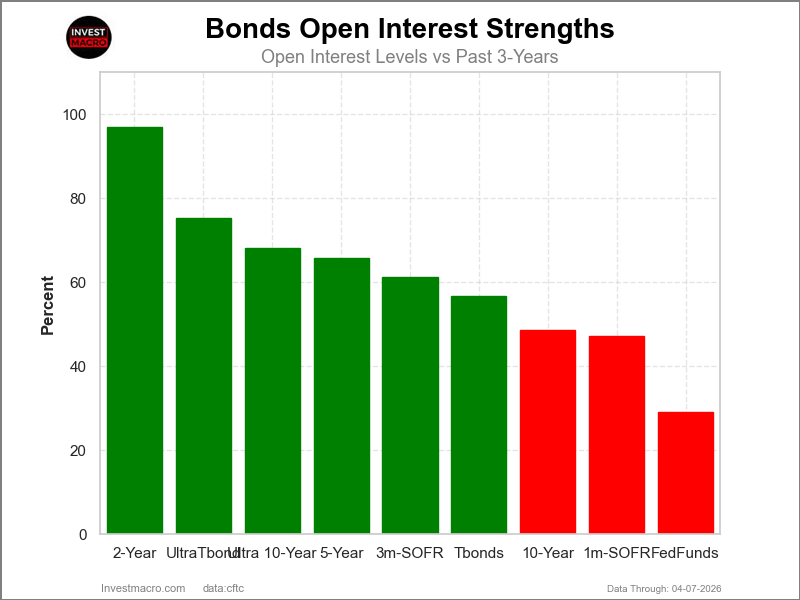
Bonds Market Open Interest Comparison
Here are the latest charts and statistics for the Commitment of Traders (COT) reports data published by the Commodities Futures Trading Commission (CFTC).

The latest COT data is updated through Tuesday January 20th and shows a quick view of how large traders (for-profit speculators and commercial hedgers) were positioned in the futures markets.

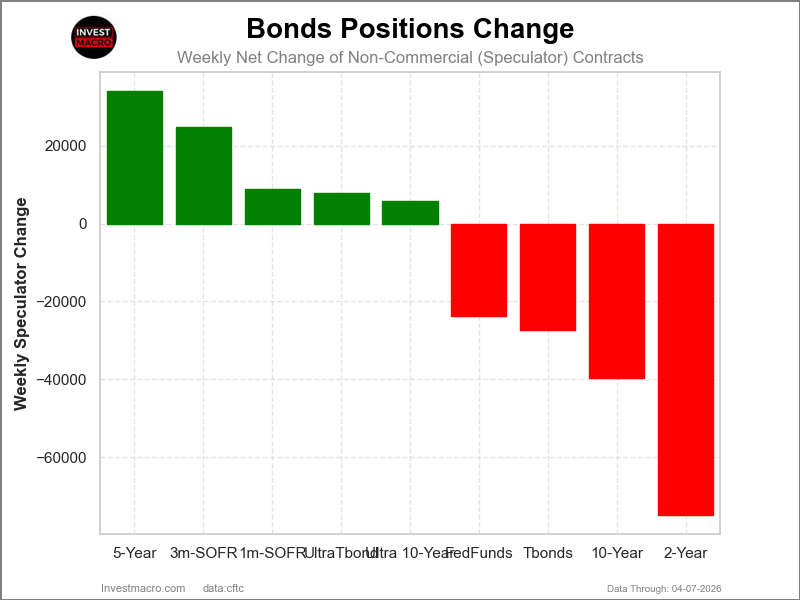
Weekly Speculator Changes led by 10-Year Bonds & 5-Year Bonds

Bonds Market Net Speculators Positions
The COT bond market speculator bets were slightly lower overall this week as four out of the nine bond markets we cover had higher positioning while the other five markets had lower speculator contracts.

Leading the gains for the bond markets was the 10-Year Bonds (214,865 contracts) with the 5-Year Bonds (132,601 contracts), the 2-Year Bonds (79,758 contracts) and the Ultra 10-Year Bonds (13,920 contracts) also recording positive weeks.

The bond markets with declines in speculator bets for the week were the Fed Funds (-137,251 contracts), the SOFR 3-Months (-70,989 contracts), the US Treasury Bonds (-36,905 contracts), the Ultra Treasury Bonds (-23,725 contracts) and with the SOFR 1-Month (-689 contracts) also registering lower bets on the week.

Bond Market Price were relatively unchanged on the week

The bond market price changes this week were relatively muted. The one-month SOFR and the three-month SOFR markets were a bit higher over the past 5 days at 0.06% and 0.04% gains, respectively. The two-year bond also edged up by 0.04%, while the Fed Funds was virtually unchanged.

The five-year bond edged lower at -0.16, followed by the 10-year note, which saw a minor dip of -0.36, and the long US Treasury bond was lower by -0.43. Over the past 30 days, the bond markets have not seen much movement, with no market seeing a move higher or lower by over one percent. Over the past 90 days, the Fed Funds is up by 1.80% while on the downside, the 10-year note is lower by -1.23% and the long US Treasury bond is lower by -2.47%.


Bonds Data:

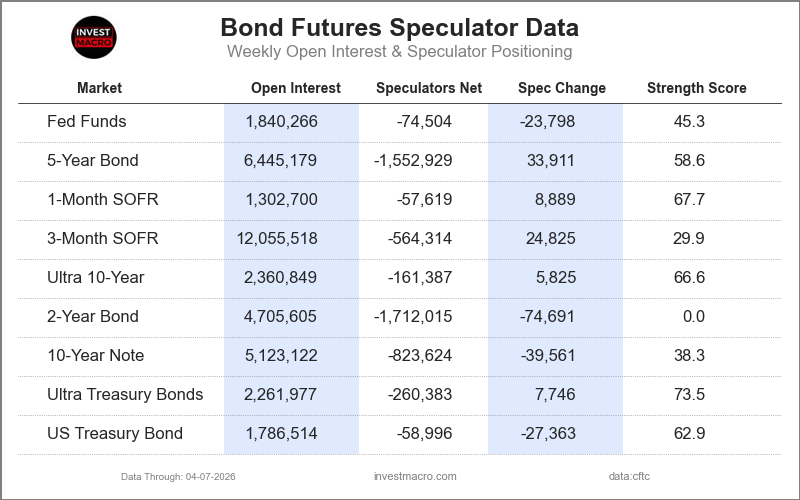
Bonds Market Speculators Data Table
Legend: Open Interest | Speculators Current Net Position | Weekly Specs Change | Specs Strength Score compared to last 3-Years (0-100 range)


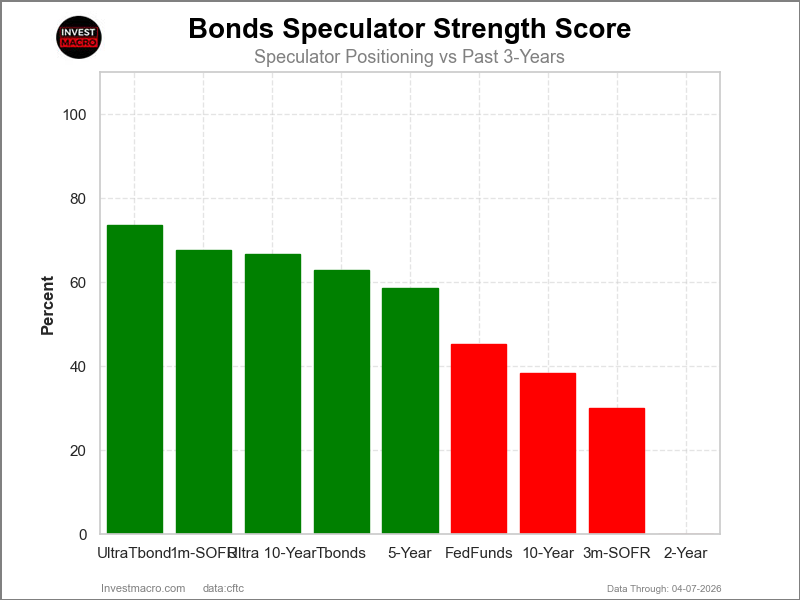
Strength Scores led by US Treasury Bonds & Ultra Treasury Bonds

Bonds Market Strength Index Comparison
COT Strength Scores (a normalized measure of Speculator positions over a 3-Year range, from 0 to 100 where above 80 is Extreme-Bullish and below 20 is Extreme-Bearish) showed that the US Treasury Bonds (75 percent) and the Ultra Treasury Bonds (74 percent) lead the bond markets this week. The 10-Year Bonds (58 percent) comes in as the next highest in the weekly strength scores.

On the downside, the 2-Year Bonds (26 percent), the 5-Year Bond (26 percent), the SOFR 1-Month (30 percent) and the SOFR 3-Months (30 percent) come in at the lowest strength levels currently.

Strength Statistics:
Fed Funds (44.8 percent) vs Fed Funds previous week (64.3 percent)
2-Year Bond (25.6 percent) vs 2-Year Bond previous week (17.8 percent)
5-Year Bond (25.7 percent) vs 5-Year Bond previous week (19.4 percent)
10-Year Bond (58.4 percent) vs 10-Year Bond previous week (32.7 percent)
Ultra 10-Year Bond (46.7 percent) vs Ultra 10-Year Bond previous week (42.9 percent)
US Treasury Bond (75.3 percent) vs US Treasury Bond previous week (88.2 percent)
Ultra US Treasury Bond (74.1 percent) vs Ultra US Treasury Bond previous week (83.0 percent)
SOFR 1-Month (30.0 percent) vs SOFR 1-Month previous week (30.1 percent)
SOFR 3-Months (29.5 percent) vs SOFR 3-Months previous week (33.2 percent)


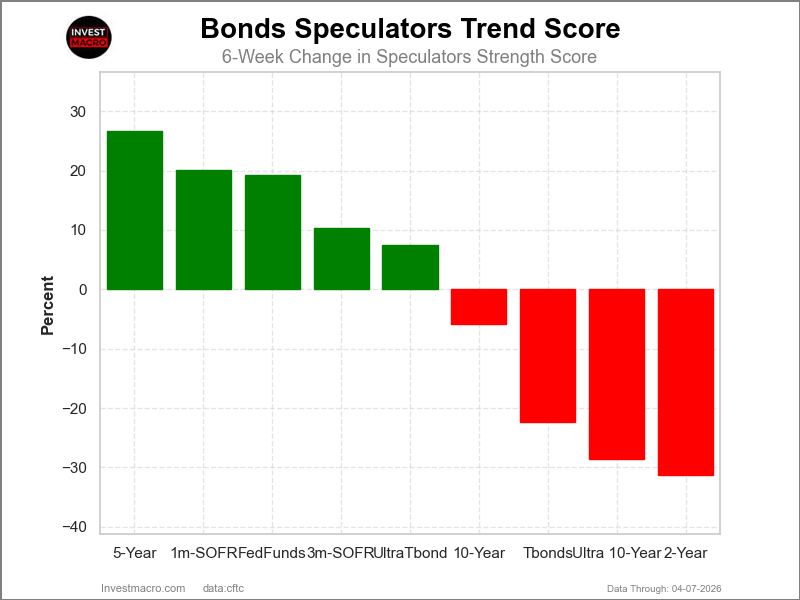
Ultra 10-Year Bonds & SOFR 1-Month top the 6-Week Strength Trends

Bonds Market Trend Index Comparison
COT Strength Score Trends (or move index, calculates the 6-week changes in strength scores) showed that the Ultra 10-Year Bonds (31 percent) and the SOFR 1-Month (19 percent) lead the past six weeks trends for bonds. The 2-Year Bonds (16 percent) are the next highest positive movers in the latest trends data.

The Fed Funds (-55 percent) leads the downside trend scores currently with the SOFR 3-Months (-15 percent) following next with lower trend scores.

Strength Trend Statistics:
Fed Funds (-55.2 percent) vs Fed Funds previous week (-31.9 percent)
2-Year Bond (16.0 percent) vs 2-Year Bond previous week (0.0 percent)
5-Year Bond (12.2 percent) vs 5-Year Bond previous week (8.4 percent)
10-Year Bond (3.7 percent) vs 10-Year Bond previous week (-16.0 percent)
Ultra 10-Year Bond (31.0 percent) vs Ultra 10-Year Bond previous week (34.5 percent)
US Treasury Bond (6.0 percent) vs US Treasury Bond previous week (15.0 percent)
Ultra US Treasury Bond (-8.6 percent) vs Ultra US Treasury Bond previous week (11.5 percent)
SOFR 1-Month (19.3 percent) vs SOFR 1-Month previous week (12.0 percent)
SOFR 3-Months (-15.4 percent) vs SOFR 3-Months previous week (-10.6 percent)


30-Day Federal Funds Futures:

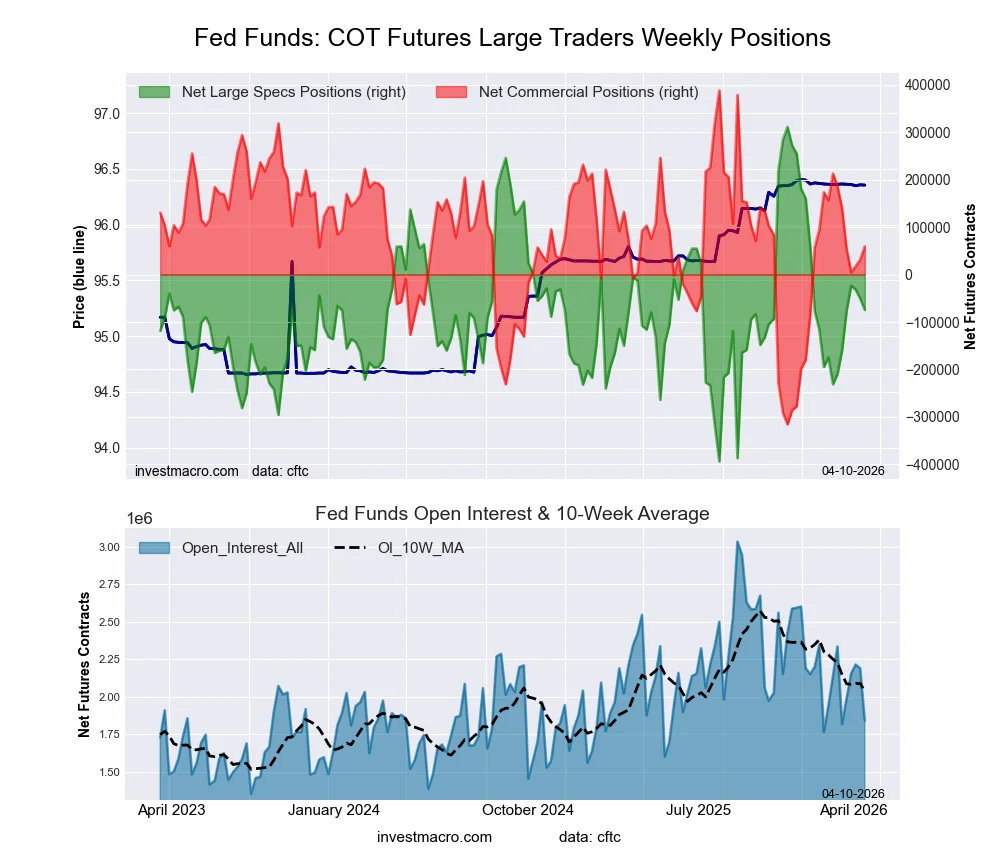
Federal Funds 30-Day Bonds Futures COT ChartThe 30-Day Federal Funds large speculator standing this week equaled a net position of -77,811 contracts in the data reported through Tuesday. This was a weekly reduction of -137,251 contracts from the previous week which had a total of 59,440 net contracts.

This week’s current strength score (the trader positioning range over the past three years, measured from 0 to 100) shows the speculators are currently Bearish with a score of 44.8 percent. The commercials are Bullish with a score of 53.0 percent and the small traders (not shown in chart) are Bullish-Extreme with a score of 89.0 percent.

Price Trend-Following Model: Uptrend

Our weekly trend-following model classifies the current market price position as: Uptrend.

30-Day Federal Funds StatisticsSPECULATORSCOMMERCIALSSMALL TRADERS
– Percent of Open Interest Longs:16.762.22.4
– Percent of Open Interest Shorts:20.359.61.5
– Net Position:-77,81157,42320,388
– Gross Longs:367,7131,368,00953,049
– Gross Shorts:445,5241,310,58632,661
– Long to Short Ratio:0.8 to 11.0 to 11.6 to 1
NET POSITION TREND:
– Strength Index Score (3 Year Range Pct):44.853.089.0
– Strength Index Reading (3 Year Range):BearishBullishBullish-Extreme
NET POSITION MOVEMENT INDEX:
– 6-Week Change in Strength Index:-55.253.021.0


Secured Overnight Financing Rate (3-Month) Futures:

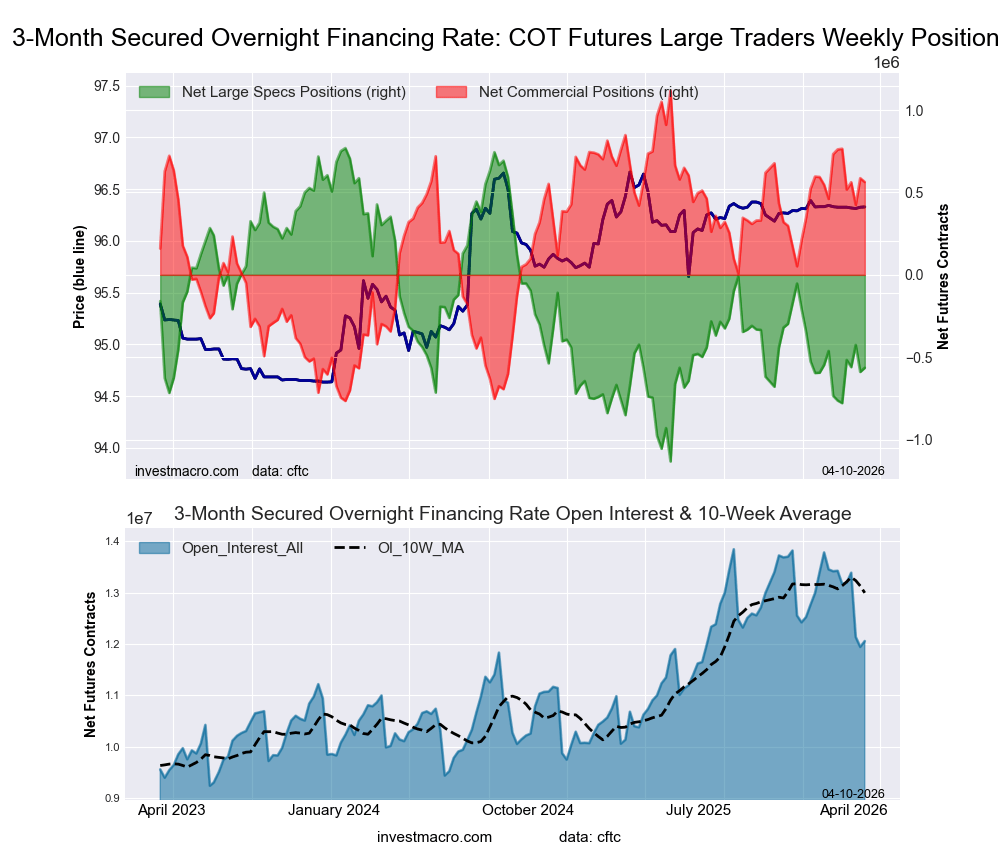
SOFR 3-Months Bonds Futures COT ChartThe Secured Overnight Financing Rate (3-Month) large speculator standing this week equaled a net position of -595,601 contracts in the data reported through Tuesday. This was a weekly decrease of -70,989 contracts from the previous week which had a total of -524,612 net contracts.

This week’s current strength score (the trader positioning range over the past three years, measured from 0 to 100) shows the speculators are currently Bearish with a score of 29.5 percent. The commercials are Bullish with a score of 70.4 percent and the small traders (not shown in chart) are Bullish with a score of 77.8 percent.

Price Trend-Following Model: Weak Uptrend

Our weekly trend-following model classifies the current market price position as: Weak Uptrend.

SOFR 3-Months StatisticsSPECULATORSCOMMERCIALSSMALL TRADERS
– Percent of Open Interest Longs:13.456.80.3
– Percent of Open Interest Shorts:17.952.20.3
– Net Position:-595,601596,564-963
– Gross Longs:1,736,8077,384,52033,194
– Gross Shorts:2,332,4086,787,95634,157
– Long to Short Ratio:0.7 to 11.1 to 11.0 to 1
NET POSITION TREND:
– Strength Index Score (3 Year Range Pct):29.570.477.8
– Strength Index Reading (3 Year Range):BearishBullishBullish
NET POSITION MOVEMENT INDEX:
– 6-Week Change in Strength Index:-15.415.5-0.2


Individual Bond Markets:

Secured Overnight Financing Rate (1-Month) Futures:

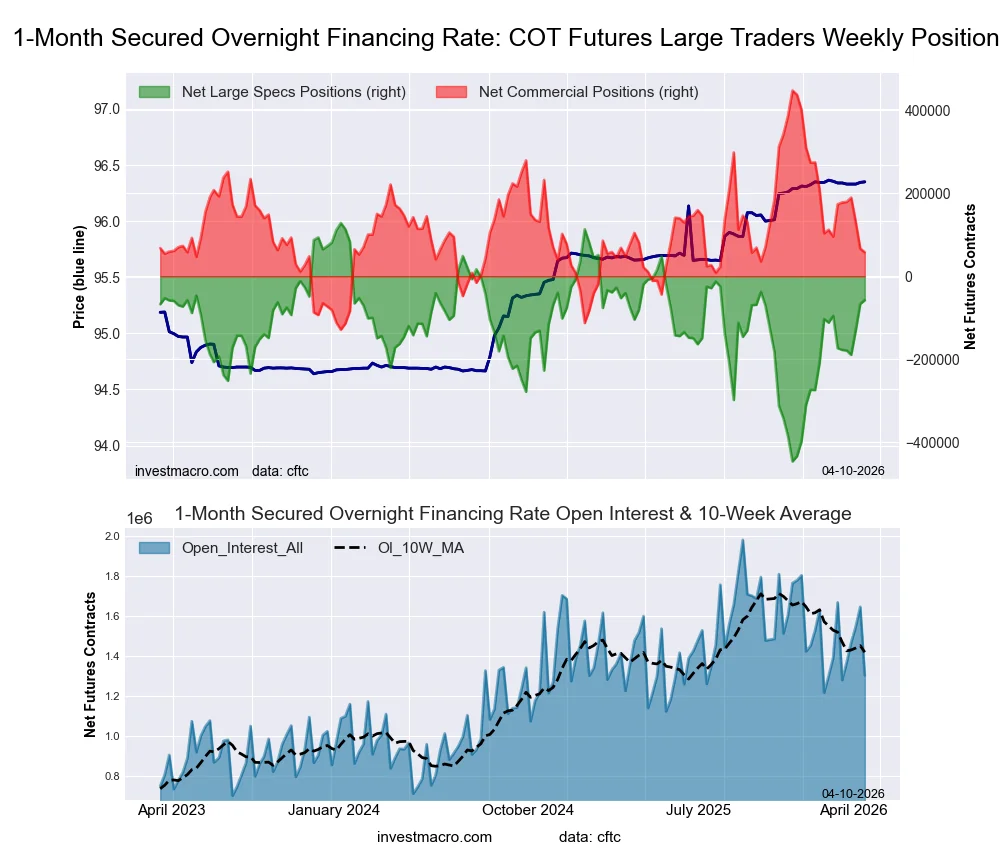
SOFR 1-Month Bonds Futures COT ChartThe Secured Overnight Financing Rate (1-Month) large speculator standing this week equaled a net position of -273,872 contracts in the data reported through Tuesday. This was a weekly lowering of -689 contracts from the previous week which had a total of -273,183 net contracts.

This week’s current strength score (the trader positioning range over the past three years, measured from 0 to 100) shows the speculators are currently Bearish with a score of 30.0 percent. The commercials are Bullish with a score of 70.0 percent and the small traders (not shown in chart) are Bullish with a score of 66.7 percent.

Price Trend-Following Model: Uptrend

Our weekly trend-following model classifies the current market price position as: Uptrend.

SOFR 1-Month StatisticsSPECULATORSCOMMERCIALSSMALL TRADERS
– Percent of Open Interest Longs:16.369.60.0
– Percent of Open Interest Shorts:34.351.70.0
– Net Position:-273,872273,962-90
– Gross Longs:249,4721,063,233174
– Gross Shorts:523,344789,271264
– Long to Short Ratio:0.5 to 11.3 to 10.7 to 1
NET POSITION TREND:
– Strength Index Score (3 Year Range Pct):30.070.066.7
– Strength Index Reading (3 Year Range):BearishBullishBullish
NET POSITION MOVEMENT INDEX:
– 6-Week Change in Strength Index:19.3-19.52.4


2-Year Treasury Note Futures:

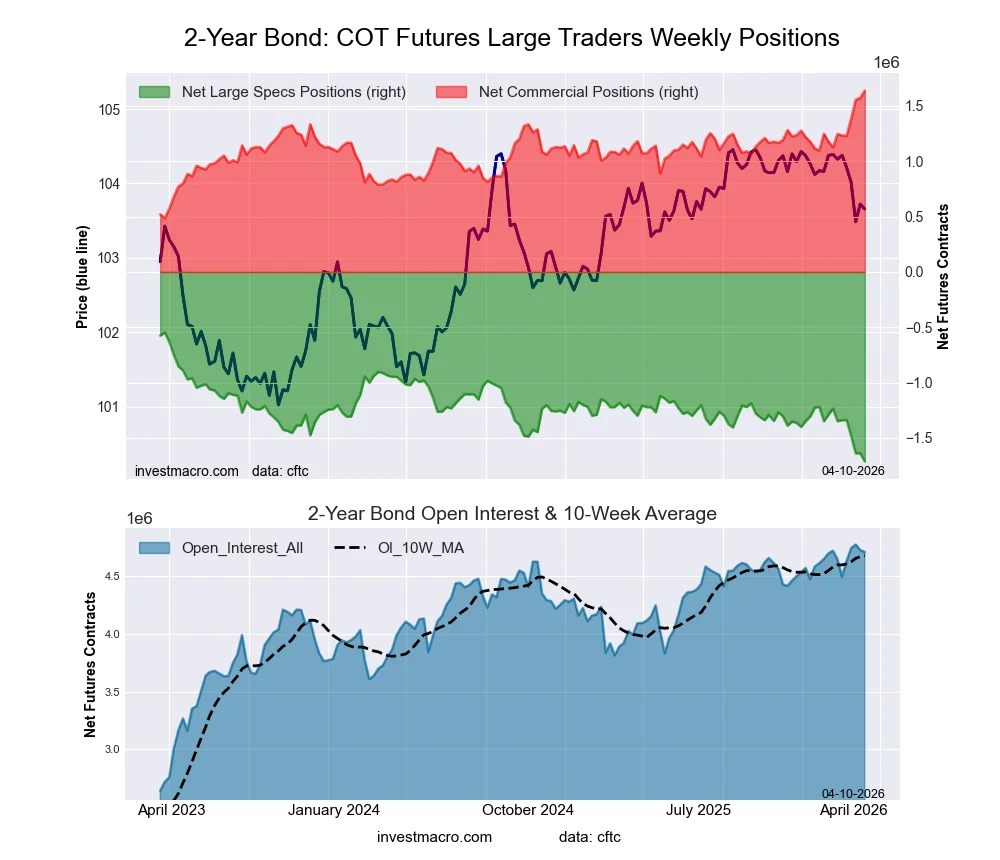
2-Year Treasury Bonds Futures COT ChartThe 2-Year Treasury Note large speculator standing this week equaled a net position of -1,225,122 contracts in the data reported through Tuesday. This was a weekly boost of 79,758 contracts from the previous week which had a total of -1,304,880 net contracts.

This week’s current strength score (the trader positioning range over the past three years, measured from 0 to 100) shows the speculators are currently Bearish with a score of 25.6 percent. The commercials are Bullish with a score of 75.4 percent and the small traders (not shown in chart) are Bearish with a score of 43.9 percent.

Price Trend-Following Model: Weak Downtrend

Our weekly trend-following model classifies the current market price position as: Weak Downtrend.

2-Year Treasury Note StatisticsSPECULATORSCOMMERCIALSSMALL TRADERS
– Percent of Open Interest Longs:16.474.15.4
– Percent of Open Interest Shorts:43.249.83.0
– Net Position:-1,225,1221,115,768109,354
– Gross Longs:752,0843,395,299245,486
– Gross Shorts:1,977,2062,279,531136,132
– Long to Short Ratio:0.4 to 11.5 to 11.8 to 1
NET POSITION TREND:
– Strength Index Score (3 Year Range Pct):25.675.443.9
– Strength Index Reading (3 Year Range):BearishBullishBearish
NET POSITION MOVEMENT INDEX:
– 6-Week Change in Strength Index:16.0-18.60.9


5-Year Treasury Note Futures:

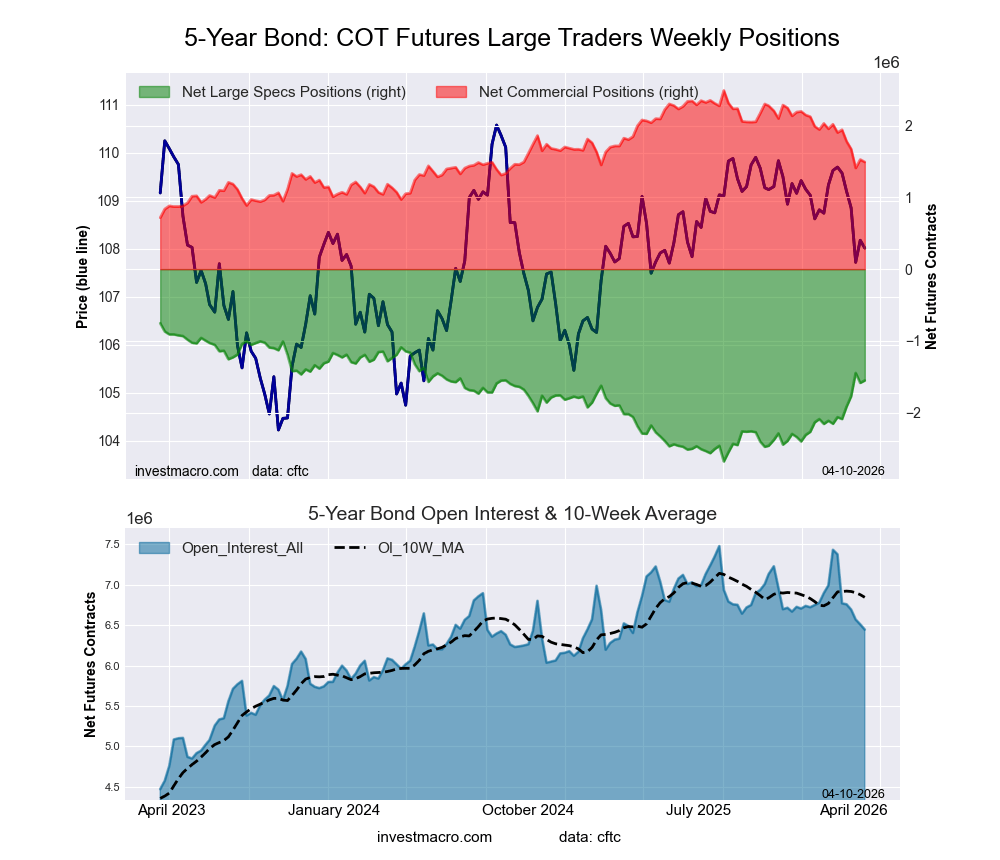
5-Year Treasury Bonds Futures COT ChartThe 5-Year Treasury Note large speculator standing this week equaled a net position of -2,136,519 contracts in the data reported through Tuesday. This was a weekly advance of 132,601 contracts from the previous week which had a total of -2,269,120 net contracts.

This week’s current strength score (the trader positioning range over the past three years, measured from 0 to 100) shows the speculators are currently Bearish with a score of 25.7 percent. The commercials are Bullish with a score of 73.8 percent and the small traders (not shown in chart) are Bullish with a score of 68.0 percent.

Price Trend-Following Model: Strong Downtrend

Our weekly trend-following model classifies the current market price position as: Strong Downtrend.

5-Year Treasury Note StatisticsSPECULATORSCOMMERCIALSSMALL TRADERS
– Percent of Open Interest Longs:8.981.96.5
– Percent of Open Interest Shorts:40.652.44.4
– Net Position:-2,136,5191,990,497146,022
– Gross Longs:603,9755,528,980440,705
– Gross Shorts:2,740,4943,538,483294,683
– Long to Short Ratio:0.2 to 11.6 to 11.5 to 1
NET POSITION TREND:
– Strength Index Score (3 Year Range Pct):25.773.868.0
– Strength Index Reading (3 Year Range):BearishBullishBullish
NET POSITION MOVEMENT INDEX:
– 6-Week Change in Strength Index:12.2-13.5-0.6


10-Year Treasury Note Futures:

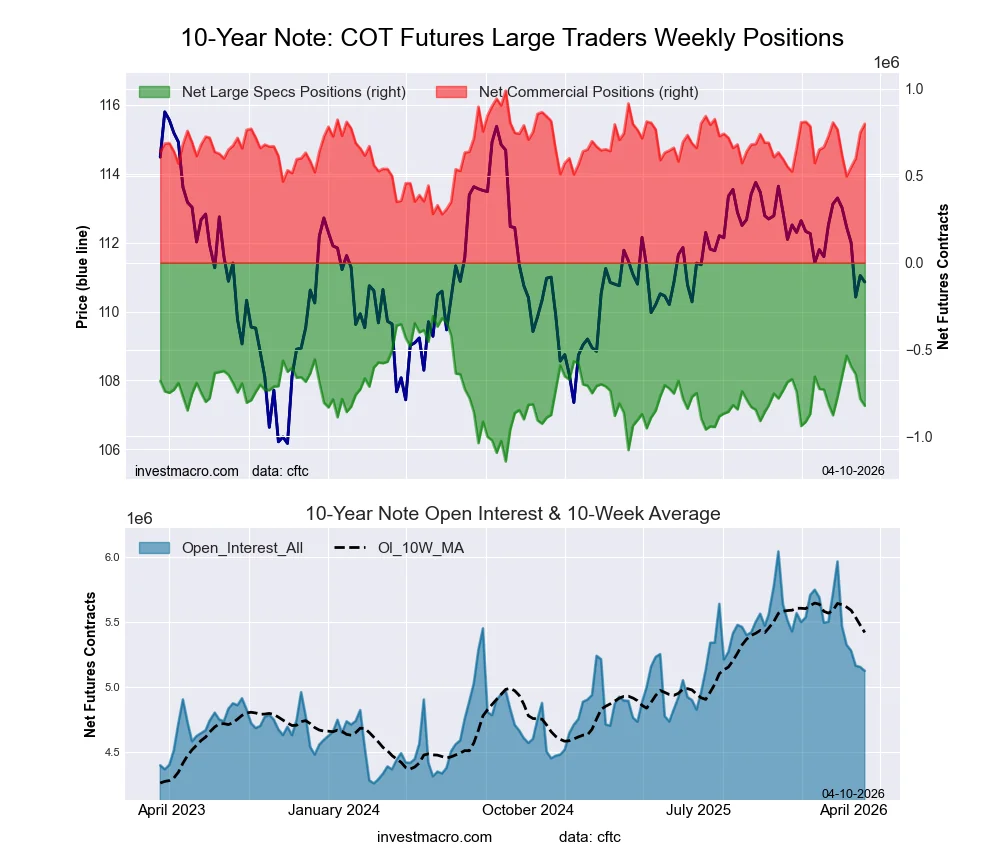
10-Year Treasury Notes Bonds Futures COT ChartThe 10-Year Treasury Note large speculator standing this week equaled a net position of -655,640 contracts in the data reported through Tuesday. This was a weekly advance of 214,865 contracts from the previous week which had a total of -870,505 net contracts.

This week’s current strength score (the trader positioning range over the past three years, measured from 0 to 100) shows the speculators are currently Bullish with a score of 58.4 percent. The commercials are Bearish with a score of 41.3 percent and the small traders (not shown in chart) are Bullish with a score of 67.6 percent.

Price Trend-Following Model: Strong Downtrend

Our weekly trend-following model classifies the current market price position as: Strong Downtrend.

10-Year Treasury Note StatisticsSPECULATORSCOMMERCIALSSMALL TRADERS
– Percent of Open Interest Longs:15.073.97.7
– Percent of Open Interest Shorts:26.463.96.2
– Net Position:-655,640573,09682,544
– Gross Longs:861,2224,248,520441,892
– Gross Shorts:1,516,8623,675,424359,348
– Long to Short Ratio:0.6 to 11.2 to 11.2 to 1
NET POSITION TREND:
– Strength Index Score (3 Year Range Pct):58.441.367.6
– Strength Index Reading (3 Year Range):BullishBearishBullish
NET POSITION MOVEMENT INDEX:
– 6-Week Change in Strength Index:3.73.0-17.4


Ultra 10-Year Notes Futures:

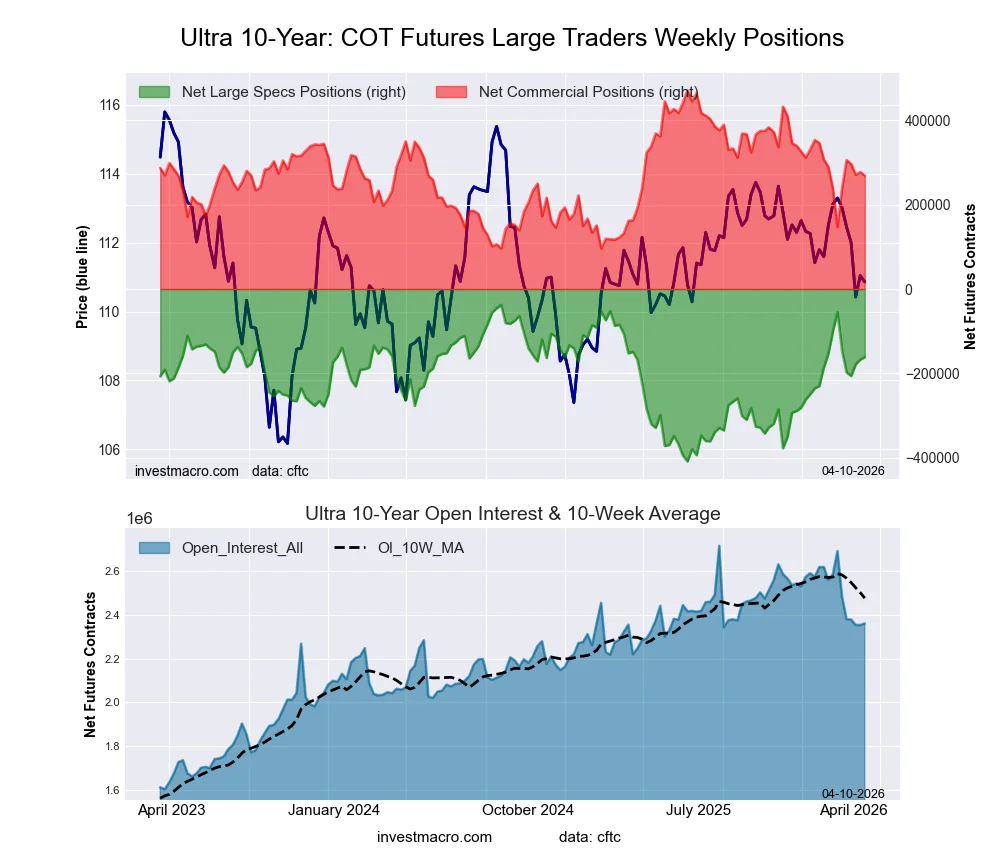
Ultra 10-Year Treasury Notes Bonds Futures COT ChartThe Ultra 10-Year Notes large speculator standing this week equaled a net position of -235,282 contracts in the data reported through Tuesday. This was a weekly boost of 13,920 contracts from the previous week which had a total of -249,202 net contracts.

This week’s current strength score (the trader positioning range over the past three years, measured from 0 to 100) shows the speculators are currently Bearish with a score of 46.7 percent. The commercials are Bullish with a score of 68.7 percent and the small traders (not shown in chart) are Bearish-Extreme with a score of 0.0 percent.

Price Trend-Following Model: Strong Downtrend

Our weekly trend-following model classifies the current market price position as: Strong Downtrend.

Ultra 10-Year Notes StatisticsSPECULATORSCOMMERCIALSSMALL TRADERS
– Percent of Open Interest Longs:12.078.68.5
– Percent of Open Interest Shorts:21.164.813.1
– Net Position:-235,282352,921-117,639
– Gross Longs:308,8302,021,438219,966
– Gross Shorts:544,1121,668,517337,605
– Long to Short Ratio:0.6 to 11.2 to 10.7 to 1
NET POSITION TREND:
– Strength Index Score (3 Year Range Pct):46.768.70.0
– Strength Index Reading (3 Year Range):BearishBullishBearish-Extreme
NET POSITION MOVEMENT INDEX:
– 6-Week Change in Strength Index:31.0-15.0-54.3


US Treasury Bonds Futures:

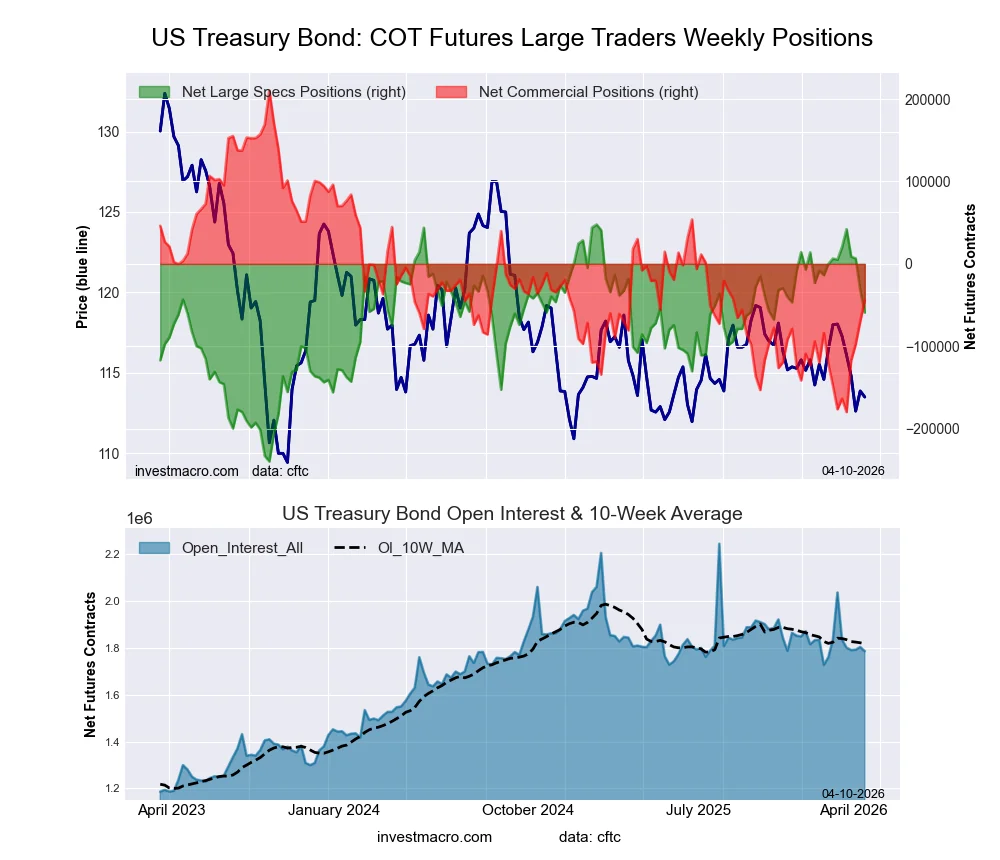
US Year Treasury Notes Long Bonds Futures COT ChartThe US Treasury Bonds large speculator standing this week equaled a net position of -23,070 contracts in the data reported through Tuesday. This was a weekly lowering of -36,905 contracts from the previous week which had a total of 13,835 net contracts.

This week’s current strength score (the trader positioning range over the past three years, measured from 0 to 100) shows the speculators are currently Bullish with a score of 75.3 percent. The commercials are Bearish-Extreme with a score of 16.2 percent and the small traders (not shown in chart) are Bullish with a score of 66.7 percent.

Price Trend-Following Model: Downtrend

Our weekly trend-following model classifies the current market price position as: Downtrend.

US Treasury Bonds StatisticsSPECULATORSCOMMERCIALSSMALL TRADERS
– Percent of Open Interest Longs:9.376.113.5
– Percent of Open Interest Shorts:10.681.37.1
– Net Position:-23,070-93,965117,035
– Gross Longs:170,5631,395,383247,802
– Gross Shorts:193,6331,489,348130,767
– Long to Short Ratio:0.9 to 10.9 to 11.9 to 1
NET POSITION TREND:
– Strength Index Score (3 Year Range Pct):75.316.266.7
– Strength Index Reading (3 Year Range):BullishBearish-ExtremeBullish
NET POSITION MOVEMENT INDEX:
– 6-Week Change in Strength Index:6.0-0.6-9.8


Ultra US Treasury Bonds Futures:

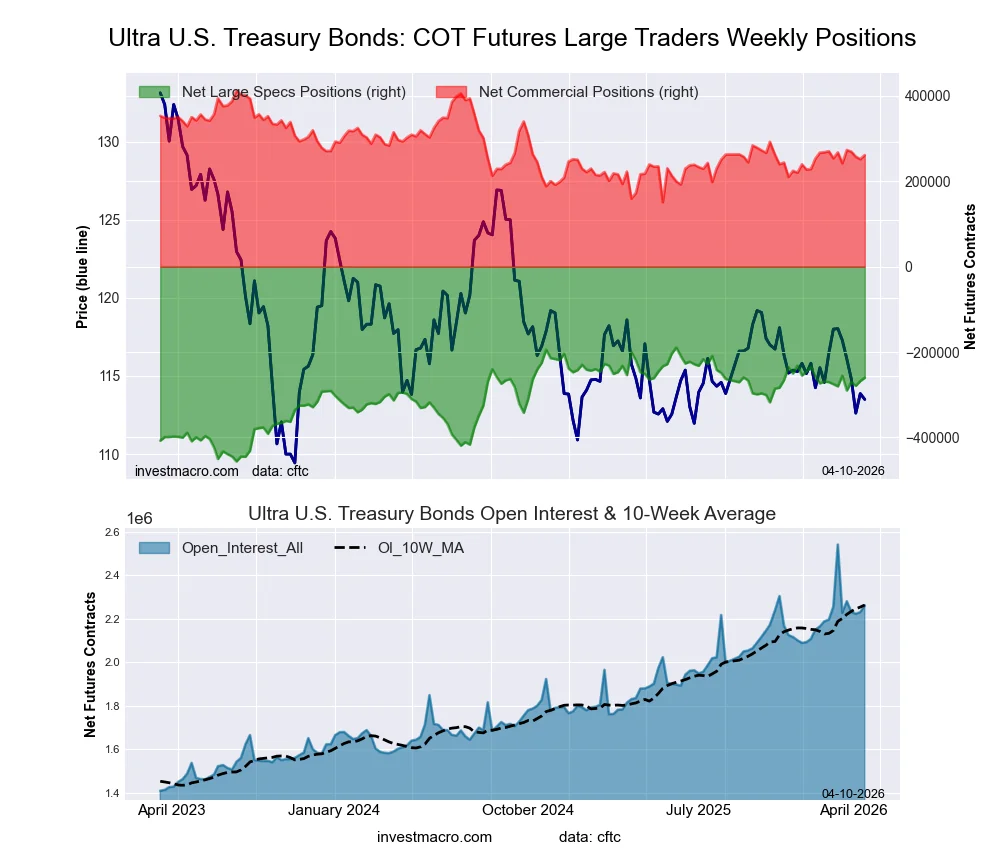
Ultra US Year Treasury Notes Long Bonds Futures COT ChartThe Ultra US Treasury Bonds large speculator standing this week equaled a net position of -258,822 contracts in the data reported through Tuesday. This was a weekly reduction of -23,725 contracts from the previous week which had a total of -235,097 net contracts.

This week’s current strength score (the trader positioning range over the past three years, measured from 0 to 100) shows the speculators are currently Bullish with a score of 74.1 percent. The commercials are Bearish with a score of 39.1 percent and the small traders (not shown in chart) are Bearish with a score of 20.8 percent.

Price Trend-Following Model: Downtrend

Our weekly trend-following model classifies the current market price position as: Downtrend.

Ultra US Treasury Bonds StatisticsSPECULATORSCOMMERCIALSSMALL TRADERS
– Percent of Open Interest Longs:6.983.38.7
– Percent of Open Interest Shorts:19.071.58.4
– Net Position:-258,822253,2695,553
– Gross Longs:149,1361,791,990187,039
– Gross Shorts:407,9581,538,721181,486
– Long to Short Ratio:0.4 to 11.2 to 11.0 to 1
NET POSITION TREND:
– Strength Index Score (3 Year Range Pct):74.139.120.8
– Strength Index Reading (3 Year Range):BullishBearishBearish
NET POSITION MOVEMENT INDEX:
– 6-Week Change in Strength Index:-8.616.4-20.7


Article By InvestMacroReceive our weekly COT Newsletter

*COT Report: The COT data, released weekly to the public each Friday, is updated through the most recent Tuesday (data is 3 days old) and shows a quick view of how large speculators or non-commercials (for-profit traders) were positioned in the futures markets.

The CFTC categorizes trader positions according to commercial hedgers (traders who use futures contracts for hedging as part of the business), non-commercials (large traders who speculate to realize trading profits) and nonreportable traders (usually small traders/speculators) as well as their open interest (contracts open in the market at time of reporting). See CFTC criteria here.

COT Energy Charts: Speculator Bets led by WTI Crude & Heating Oil

By InvestMacro

Speculators OI Energy Futures COT Chart
Here are the latest charts and statistics for the Commitment of Traders (COT) data published by the Commodities Futures Trading Commission (CFTC).

The latest COT data is updated through Tuesday January 20th and shows a quick view of how large traders (for-profit speculators and commercial entities) were positioned in the futures markets.

Weekly Speculator Changes led by WTI Crude & Heating Oil

Speculators Nets Energy Futures COT Chart
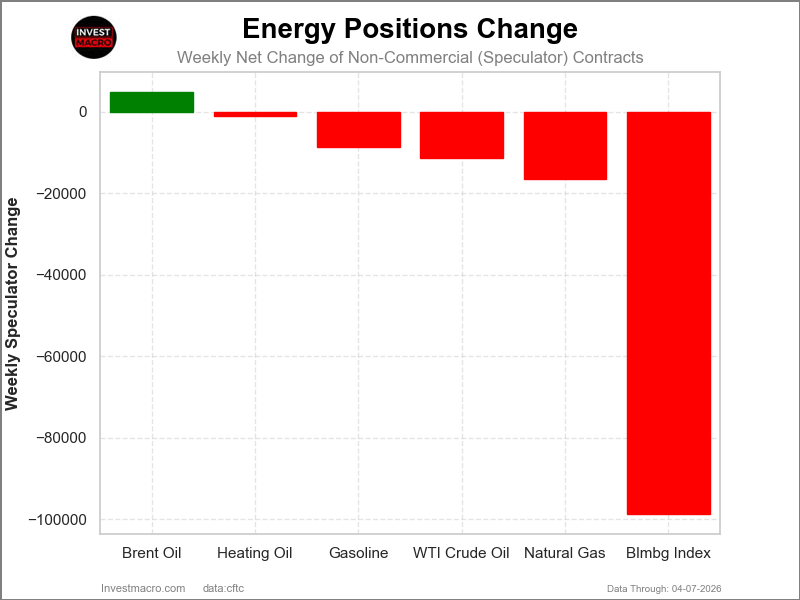
The COT energy market speculator bets were mixed this week as three out of the six energy markets we cover had higher positioning while the other three markets had lower speculator contracts.

Leading the gains for the energy markets was WTI Crude (20,664 contracts) with Heating Oil (1,533 contracts) and the Bloomberg Commodity Index (17 contracts) also having a small positive week.

The markets with declines in speculator bets for the week were Brent Oil (-8,263 contracts), Natural Gas (-7,889 contracts) and with Gasoline (-1,747 contracts) also seeing lower bets on the week.

Natural Gas leads Weekly Energy Price Performances

The energy market price performance was led by the surging Natural Gas price. Natural Gas jumped higher in the past five days by over 35% while the Bloomberg Commodity Index was the next highest, with a 5.96% gain on the week. Heating Oil was up by over 5% while WTI Crude Oil rose by 3.96%, followed by Brent Oil with a 3.75% rise, and then Gasoline which rose by 3.25%.

The Bloomberg Commodity Index has been on a strong uptrend and is the price leader for the past 30 days with an 11% gain. The Bloomberg Commodity Index is the leader over the past 90 days as well with the Index being higher by approximately 18% in that time-frame.


Energy Data:

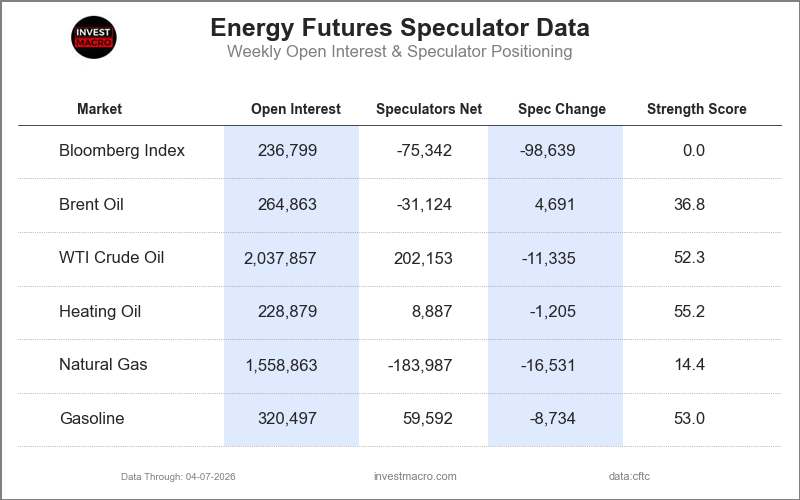
Speculators Table Energy Futures COT Chart
Legend: Weekly Speculators Change | Speculators Current Net Position | Speculators Strength Score compared to last 3-Years (0-100 range)


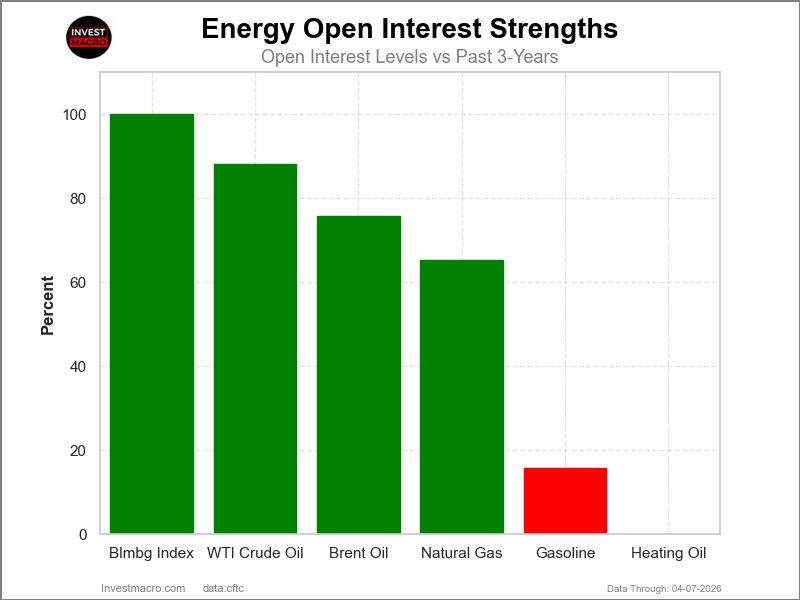
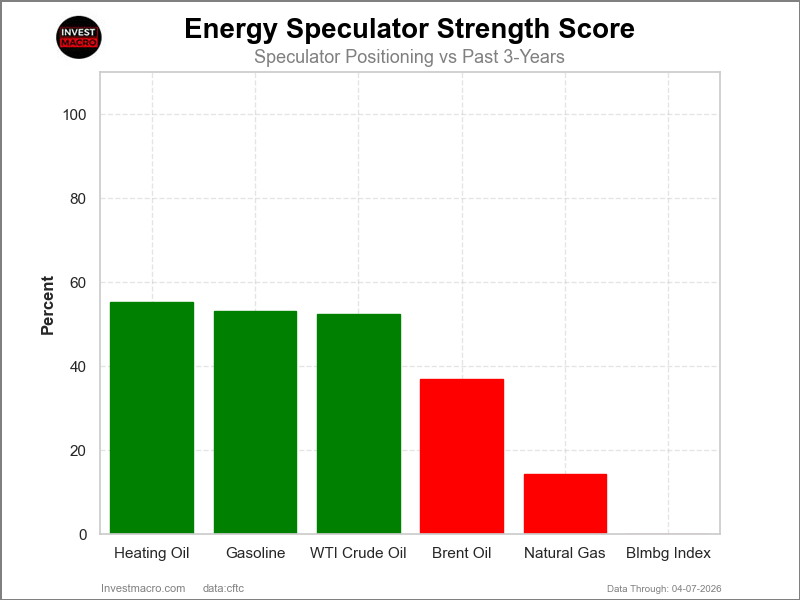
Strength Scores led by Bloomberg Index, Gasoline, & Heating Oil

Speculators Strength Energy Futures COT Chart
COT Strength Scores (a normalized measure of Speculator positions over a 3-Year range, from 0 to 100 where above 80 is Extreme-Bullish and below 20 is Extreme-Bearish) showed that the Bloomberg Index (80.6 percent), Gasoline (65.3 percent) and Heating Oil (64.6 percent) lead the energy markets this week.

On the downside, Natural Gas (0.0 percent) and WTI Crude (12.6 percent) come in at the lowest strength level currently and are in Extreme-Bearish territory (below 20 percent). The next lowest strength score was Brent Oil (21.1 percent).

Strength Statistics:
WTI Crude Oil (12.6 percent) vs WTI Crude Oil previous week (5.9 percent)
Brent Crude Oil (21.1 percent) vs Brent Crude Oil previous week (32.8 percent)
Natural Gas (0.0 percent) vs Natural Gas previous week (5.5 percent)
Gasoline (65.3 percent) vs Gasoline previous week (67.2 percent)
Heating Oil (64.6 percent) vs Heating Oil previous week (62.6 percent)
Bloomberg Commodity Index (80.6 percent) vs Bloomberg Commodity Index previous week (80.5 percent)


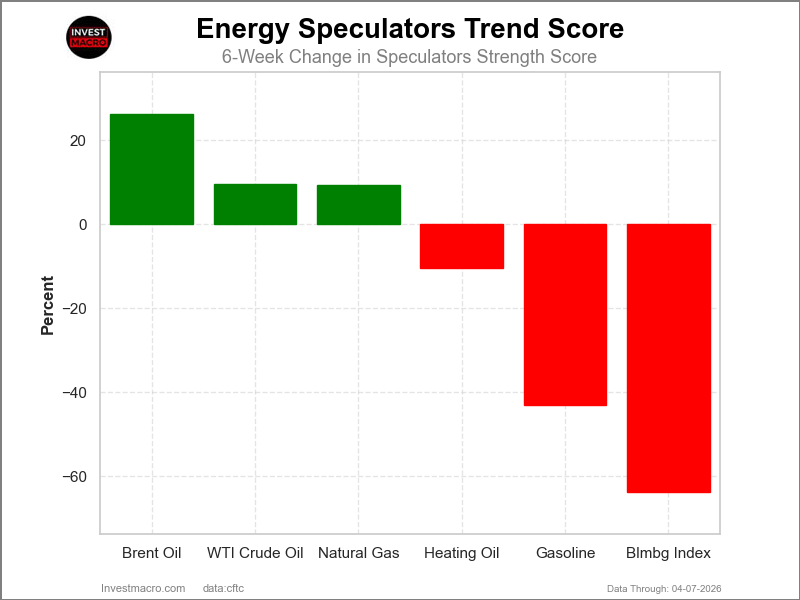
Bloomberg Index & WTI Crude top the 6-Week Strength Trends

Speculators Trend Energy Futures COT Chart
COT Strength Score Trends (or move index, calculates the 6-week changes in strength scores) showed that the Bloomberg Index (70.8 percent) leads the past six weeks trends for the energy markets. WTI Crude (6.6 percent) is the next highest positive mover with a much more modest gain in the latest trends data.

Natural Gas (-60.9 percent), Gasoline (-24.1 percent) and Brent Oil (-13.1 percent) lead the downside trend scores currently.

Move Statistics:
WTI Crude Oil (6.6 percent) vs WTI Crude Oil previous week (2.3 percent)
Brent Crude Oil (-13.1 percent) vs Brent Crude Oil previous week (-13.6 percent)
Natural Gas (-60.9 percent) vs Natural Gas previous week (-41.4 percent)
Gasoline (-24.1 percent) vs Gasoline previous week (-32.8 percent)
Heating Oil (-5.5 percent) vs Heating Oil previous week (-11.9 percent)
Bloomberg Commodity Index (70.8 percent) vs Bloomberg Commodity Index previous week (61.5 percent)


Individual COT Market Charts:

WTI Crude Oil Futures:

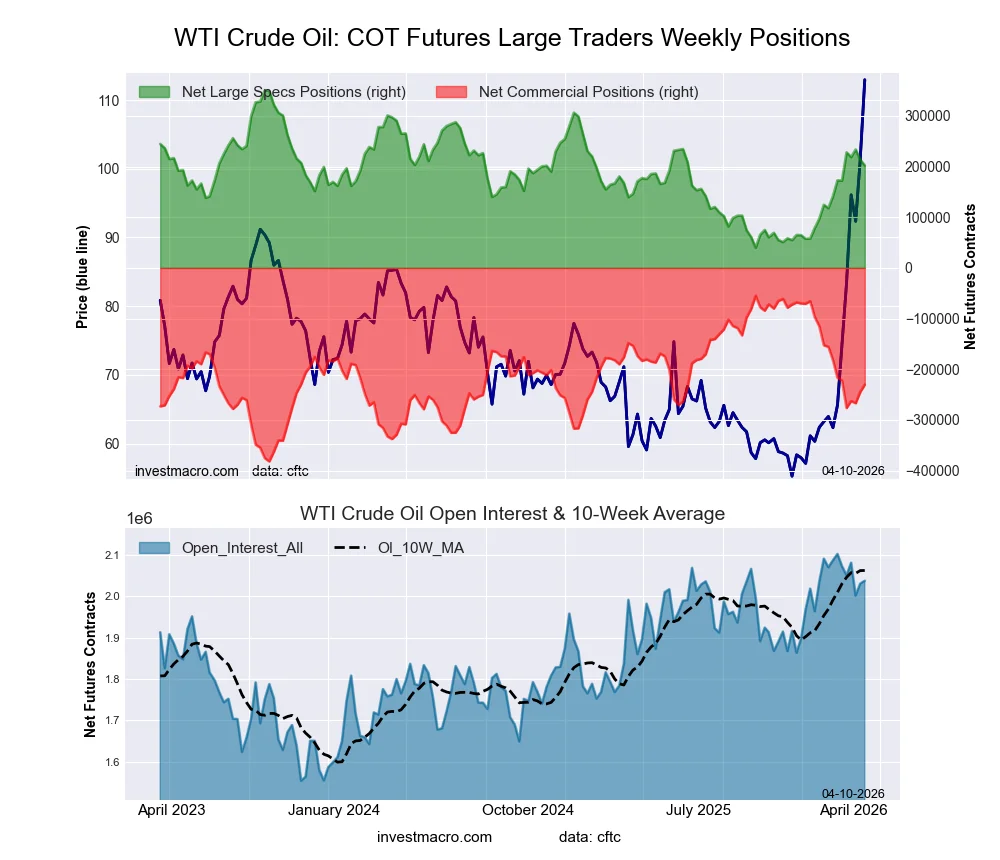
WTI Crude Oil Futures COT ChartThe WTI Crude Oil Futures large speculator standing this week resulted in a net position of 78,792 contracts in the data reported through Tuesday. This was a weekly rise of 20,664 contracts from the previous week which had a total of 58,128 net contracts.

This week’s current strength score (the trader positioning range over the past three years, measured from 0 to 100) shows the speculators are currently Bearish-Extreme with a score of 12.6 percent. The commercials are Bullish-Extreme with a score of 87.2 percent and the small traders (not shown in chart) are Bearish with a score of 38.7 percent.

Price Trend-Following Model: Weak Downtrend

Our weekly trend-following model classifies the current market price position as: Weak Downtrend.

WTI Crude Oil Futures StatisticsSPECULATORSCOMMERCIALSSMALL TRADERS
– Percent of Open Interest Longs:14.541.83.4
– Percent of Open Interest Shorts:10.546.82.5
– Net Position:78,792-97,04718,255
– Gross Longs:284,809821,80367,044
– Gross Shorts:206,017918,85048,789
– Long to Short Ratio:1.4 to 10.9 to 11.4 to 1
NET POSITION TREND:
– Strength Index Score (3 Year Range Pct):12.687.238.7
– Strength Index Reading (3 Year Range):Bearish-ExtremeBullish-ExtremeBearish
NET POSITION MOVEMENT INDEX:
– 6-Week Change in Strength Index:6.6-5.7-3.7


Brent Crude Oil Futures:

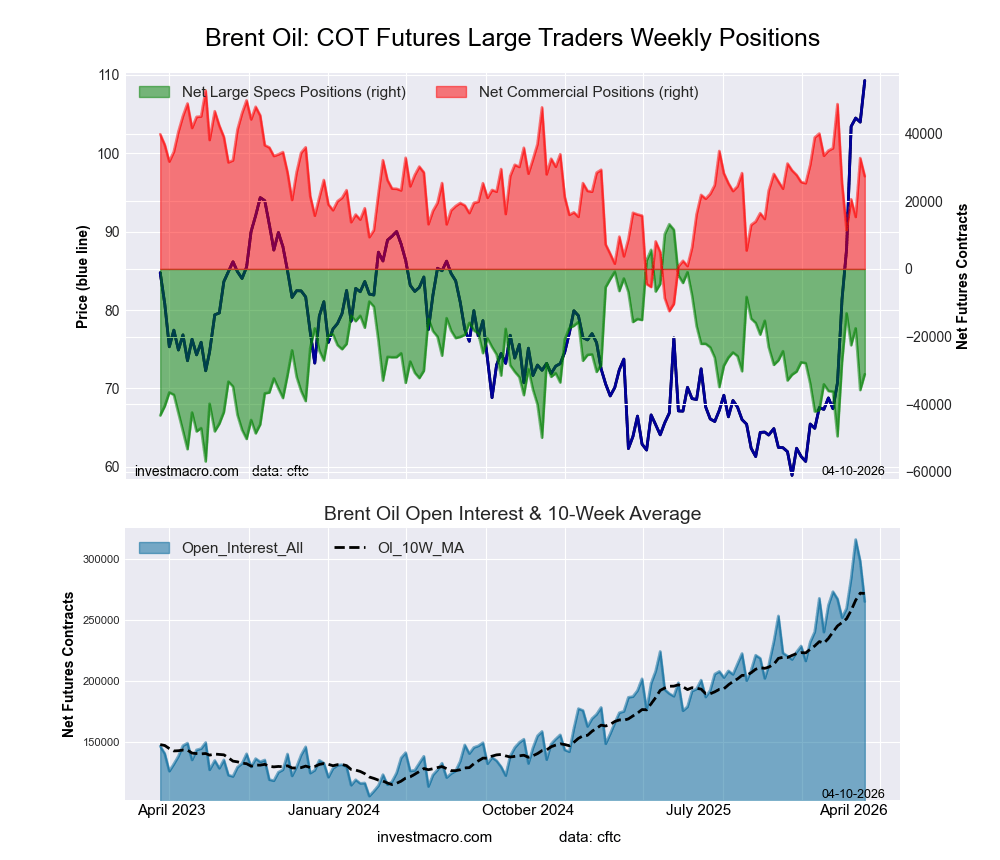
Brent Last Day Crude Oil Futures COT ChartThe Brent Crude Oil Futures large speculator standing this week resulted in a net position of -42,150 contracts in the data reported through Tuesday. This was a weekly fall of -8,263 contracts from the previous week which had a total of -33,887 net contracts.

This week’s current strength score (the trader positioning range over the past three years, measured from 0 to 100) shows the speculators are currently Bearish with a score of 21.1 percent. The commercials are Bullish with a score of 78.7 percent and the small traders (not shown in chart) are Bullish with a score of 73.4 percent.

Price Trend-Following Model: Weak Downtrend

Our weekly trend-following model classifies the current market price position as: Weak Downtrend.

Brent Crude Oil Futures StatisticsSPECULATORSCOMMERCIALSSMALL TRADERS
– Percent of Open Interest Longs:20.137.03.7
– Percent of Open Interest Shorts:37.720.82.3
– Net Position:-42,15038,8753,275
– Gross Longs:48,27888,9108,766
– Gross Shorts:90,42850,0355,491
– Long to Short Ratio:0.5 to 11.8 to 11.6 to 1
NET POSITION TREND:
– Strength Index Score (3 Year Range Pct):21.178.773.4
– Strength Index Reading (3 Year Range):BearishBullishBullish
NET POSITION MOVEMENT INDEX:
– 6-Week Change in Strength Index:-13.111.817.2


Natural Gas Futures:

Natural Gas Futures COT ChartThe Natural Gas Futures large speculator standing this week resulted in a net position of -193,490 contracts in the data reported through Tuesday. This was a weekly decrease of -7,889 contracts from the previous week which had a total of -185,601 net contracts.

This week’s current strength score (the trader positioning range over the past three years, measured from 0 to 100) shows the speculators are currently Bearish-Extreme with a score of 0.0 percent. The commercials are Bullish-Extreme with a score of 100.0 percent and the small traders (not shown in chart) are Bearish with a score of 31.6 percent.

Price Trend-Following Model: Weak Downtrend

Our weekly trend-following model classifies the current market price position as: Weak Downtrend.

Natural Gas Futures StatisticsSPECULATORSCOMMERCIALSSMALL TRADERS
– Percent of Open Interest Longs:14.937.53.7
– Percent of Open Interest Shorts:26.926.23.0
– Net Position:-193,490182,06011,430
– Gross Longs:241,131604,85459,623
– Gross Shorts:434,621422,79448,193
– Long to Short Ratio:0.6 to 11.4 to 11.2 to 1
NET POSITION TREND:
– Strength Index Score (3 Year Range Pct):0.0100.031.6
– Strength Index Reading (3 Year Range):Bearish-ExtremeBullish-ExtremeBearish
NET POSITION MOVEMENT INDEX:
– 6-Week Change in Strength Index:-60.965.5-25.8


Gasoline Blendstock Futures:

RBOB Gasoline Energy Futures COT ChartThe Gasoline Blendstock Futures large speculator standing this week resulted in a net position of 70,780 contracts in the data reported through Tuesday. This was a weekly lowering of -1,747 contracts from the previous week which had a total of 72,527 net contracts.

This week’s current strength score (the trader positioning range over the past three years, measured from 0 to 100) shows the speculators are currently Bullish with a score of 65.3 percent. The commercials are Bearish with a score of 32.6 percent and the small traders (not shown in chart) are Bullish with a score of 70.3 percent.

Price Trend-Following Model: Weak Uptrend

Our weekly trend-following model classifies the current market price position as: Weak Uptrend.

Nasdaq Mini Futures StatisticsSPECULATORSCOMMERCIALSSMALL TRADERS
– Percent of Open Interest Longs:24.048.45.8
– Percent of Open Interest Shorts:8.565.83.9
– Net Position:70,780-79,2058,425
– Gross Longs:109,470220,69726,230
– Gross Shorts:38,690299,90217,805
– Long to Short Ratio:2.8 to 10.7 to 11.5 to 1
NET POSITION TREND:
– Strength Index Score (3 Year Range Pct):65.332.670.3
– Strength Index Reading (3 Year Range):BullishBearishBullish
NET POSITION MOVEMENT INDEX:
– 6-Week Change in Strength Index:-24.123.9-11.4


#2 Heating Oil NY-Harbor Futures:

NY Harbor Heating Oil Energy Futures COT ChartThe #2 Heating Oil NY-Harbor Futures large speculator standing this week resulted in a net position of 16,044 contracts in the data reported through Tuesday. This was a weekly lift of 1,533 contracts from the previous week which had a total of 14,511 net contracts.

This week’s current strength score (the trader positioning range over the past three years, measured from 0 to 100) shows the speculators are currently Bullish with a score of 64.6 percent. The commercials are Bearish with a score of 35.2 percent and the small traders (not shown in chart) are Bullish with a score of 64.3 percent.

Price Trend-Following Model: Weak Downtrend

Our weekly trend-following model classifies the current market price position as: Weak Downtrend.

Heating Oil Futures StatisticsSPECULATORSCOMMERCIALSSMALL TRADERS
– Percent of Open Interest Longs:15.848.912.1
– Percent of Open Interest Shorts:11.857.37.8
– Net Position:16,044-32,93816,894
– Gross Longs:62,563193,34947,815
– Gross Shorts:46,519226,28730,921
– Long to Short Ratio:1.3 to 10.9 to 11.5 to 1
NET POSITION TREND:
– Strength Index Score (3 Year Range Pct):64.635.264.3
– Strength Index Reading (3 Year Range):BullishBearishBullish
NET POSITION MOVEMENT INDEX:
– 6-Week Change in Strength Index:-5.510.2-17.8


Bloomberg Commodity Index Futures:

Bloomberg Commodity Index Futures COT ChartThe Bloomberg Commodity Index Futures large speculator standing this week resulted in a net position of -5,781 contracts in the data reported through Tuesday. This was a weekly lift of 17 contracts from the previous week which had a total of -5,798 net contracts.

This week’s current strength score (the trader positioning range over the past three years, measured from 0 to 100) shows the speculators are currently Bullish-Extreme with a score of 80.6 percent. The commercials are Bearish-Extreme with a score of 17.7 percent and the small traders (not shown in chart) are Bearish with a score of 47.4 percent.

Price Trend-Following Model: Strong Uptrend

Our weekly trend-following model classifies the current market price position as: Strong Uptrend.

Bloomberg Index Futures StatisticsSPECULATORSCOMMERCIALSSMALL TRADERS
– Percent of Open Interest Longs:27.669.60.4
– Percent of Open Interest Shorts:30.666.90.0
– Net Position:-5,7815,143638
– Gross Longs:52,210131,824676
– Gross Shorts:57,991126,68138
– Long to Short Ratio:0.9 to 11.0 to 117.8 to 1
NET POSITION TREND:
– Strength Index Score (3 Year Range Pct):80.617.747.4
– Strength Index Reading (3 Year Range):Bullish-ExtremeBearish-ExtremeBearish
NET POSITION MOVEMENT INDEX:
– 6-Week Change in Strength Index:70.8-70.70.7


Article By InvestMacroReceive our weekly COT Newsletter

*COT Report: The COT data, released weekly to the public each Friday, is updated through the most recent Tuesday (data is 3 days old) and shows a quick view of how large speculators or non-commercials (for-profit traders) were positioned in the futures markets.

The CFTC categorizes trader positions according to commercial hedgers (traders who use futures contracts for hedging as part of the business), non-commercials (large traders who speculate to realize trading profits) and nonreportable traders (usually small traders/speculators) as well as their open interest (contracts open in the market at time of reporting). See CFTC criteria here.

COT Soft Commodities Charts: Speculator Bets led by Soybean Oil & Lean Hogs

By InvestMacro

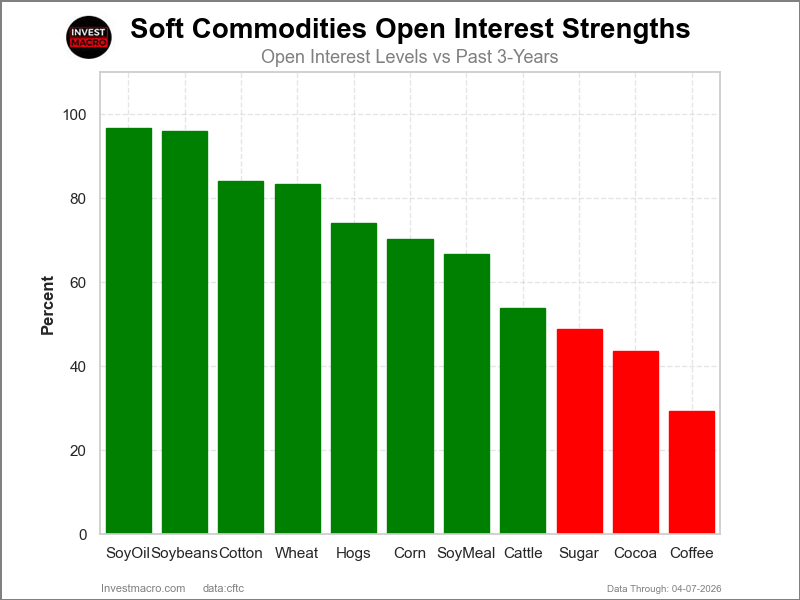
Speculators OI Softs
Here are the latest charts and statistics for the Commitment of Traders (COT) reports data published by the Commodities Futures Trading Commission (CFTC).

The latest COT data is updated through Tuesday January 20th and shows a quick view of how large traders (for-profit speculators and commercial entities) were positioned in the futures markets.

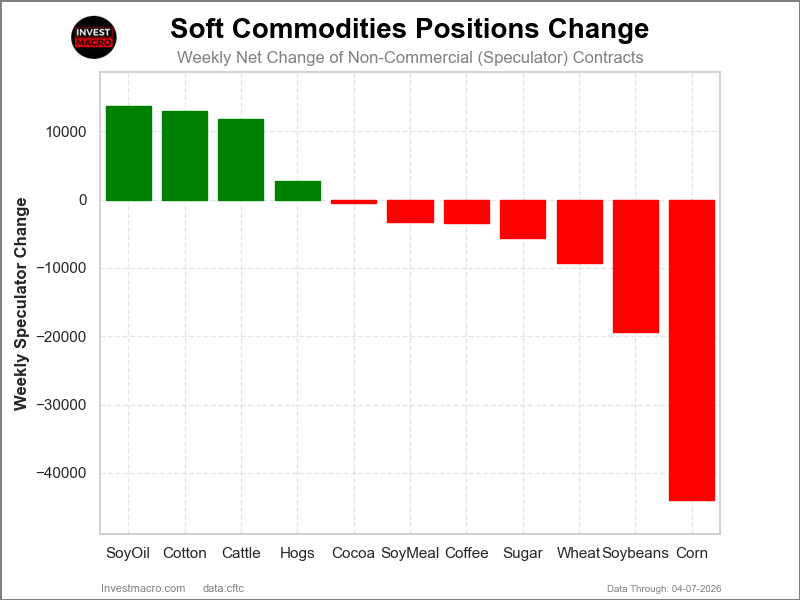
Weekly Speculator Changes led by Soybean Oil & Lean Hogs

Speculators Nets Softs
The COT soft commodities markets speculator bets were overall lower this week as just four out of the eleven softs markets we cover had higher positioning while the other seven markets had lower speculator contracts.

Leading the gains for the softs markets was Soybean Oil (29,678 contracts) with Lean Hogs (14,919 contracts), Live Cattle (3,410 contracts) and Cotton (1,607 contracts) also seeing positive weeks.

The markets with the declines in speculator bets this week were Soybean Meal (-23,547 contracts), Corn (-18,281 contracts), Sugar (-12,637 contracts)  Cocoa (-8,378 contracts), Wheat (-7,705 contracts), Coffee (-2,989 contracts) and with Soybeans (-818 contracts) also having lower bets on the week.

Soft Commodities Price Performance was led this week by Wheat and Soybean Oil

Wheat led the soft commodities price performances of the week with a 3.39% increase over the past five days. Soybean Oil came in a close second with a 3.38% rise over the same period. Lean Hogs had an up week with a 2.19% rise, while Corn was also higher by 2.17%. Soybeans rose by 1.74% on the week, Sugar gained by 0.74%, and Live Cattle rounded out the gainers with a 0.73% increase.

Cocoa saw a dip by -0.78%, followed by Cotton with a decline of -0.90%, and Coffee with a -1.30% decrease. Soybean Meal saw the biggest fall this week with a -4.74% slide.

The price performance leaders over the past 30 days have been Lean Hogs, up by 9.12%, and Soybean Oil, up over 6% in that period. Cocoa is by far the biggest leader over the past 90 days with a 31.44% gain.


Soft Commodities Data:

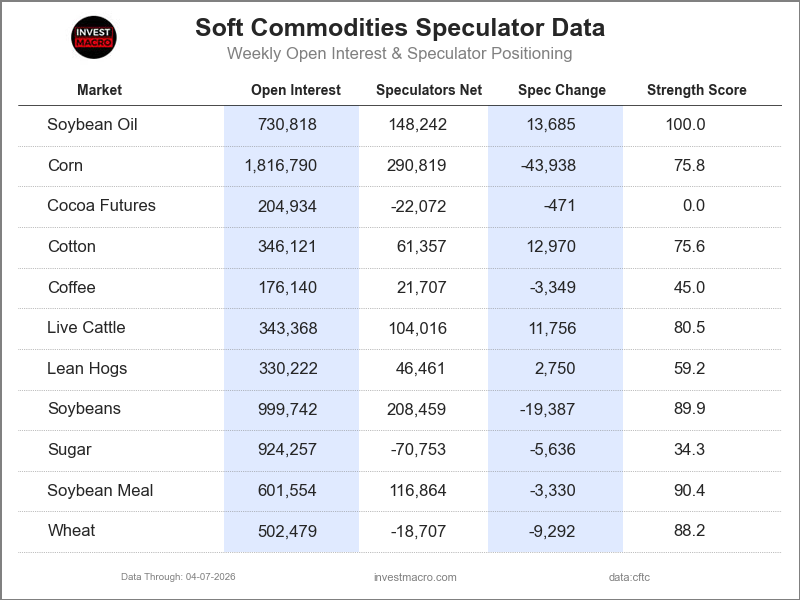
Speculators Table Softs
Legend: Weekly Speculators Change | Speculators Current Net Position | Speculators Strength Score compared to last 3-Years (0-100 range)


Strength Scores led by Live Cattle & Lean Hogs

Speculators Strength Softs
COT Strength Scores (a normalized measure of Speculator positions over a 3-Year range, from 0 to 100 where above 80 is Extreme-Bullish and below 20 is Extreme-Bearish) showed that Live Cattle (66 percent) and Lean Hogs (66 percent) lead the softs markets this week. Soybeans (57 percent) and Coffee (53 percent) come in as the next highest in the weekly strength scores.

On the downside, Cocoa (0 percent) and Sugar (5 percent) come in at the lowest strength levels currently and are in Extreme-Bearish territory (below 20 percent). The next lowest strength scores are the Wheat (22 percent) and the Cotton (24 percent).

Strength Statistics:
Corn (29.2 percent) vs Corn previous week (31.7 percent)
Sugar (4.6 percent) vs Sugar previous week (7.3 percent)
Coffee (53.0 percent) vs Coffee previous week (56.1 percent)
Soybeans (56.6 percent) vs Soybeans previous week (56.8 percent)
Soybean Oil (46.4 percent) vs Soybean Oil previous week (29.3 percent)
Soybean Meal (24.3 percent) vs Soybean Meal previous week (33.2 percent)
Live Cattle (66.0 percent) vs Live Cattle previous week (62.6 percent)
Lean Hogs (66.3 percent) vs Lean Hogs previous week (55.6 percent)
Cotton (23.7 percent) vs Cotton previous week (22.7 percent)
Cocoa (0.0 percent) vs Cocoa previous week (7.9 percent)
Wheat (21.6 percent) vs Wheat previous week (28.5 percent)


Lean Hogs & Live Cattle top the 6-Week Strength Trends

Speculators Trend Softs
COT Strength Score Trends (or move index, calculates the 6-week changes in strength scores) showed that Lean Hogs (24 percent) and Live Cattle (13 percent) lead the past six weeks trends for soft commodities. Cotton (6 percent) and Sugar (1 percent) are the next highest positive movers in the latest trends data.

Wheat (-57 percent) leads the downside trend scores currently with Soybeans (-35 percent), Soybean Meal (-19 percent) and Corn (-16 percent) following next with lower trend scores.

Strength Trend Statistics:
Corn (-16.2 percent) vs Corn previous week (-16.4 percent)
Sugar (0.9 percent) vs Sugar previous week (4.0 percent)
Coffee (-5.0 percent) vs Coffee previous week (-2.6 percent)
Soybeans (-35.0 percent) vs Soybeans previous week (-41.3 percent)
Soybean Oil (-2.5 percent) vs Soybean Oil previous week (-21.8 percent)
Soybean Meal (-18.6 percent) vs Soybean Meal previous week (-20.2 percent)
Live Cattle (13.1 percent) vs Live Cattle previous week (12.2 percent)
Lean Hogs (24.2 percent) vs Lean Hogs previous week (12.9 percent)
Cotton (6.2 percent) vs Cotton previous week (6.9 percent)
Cocoa (-14.3 percent) vs Cocoa previous week (-3.1 percent)
Wheat (-57.4 percent) vs Wheat previous week (-52.9 percent)


Individual Soft Commodities Markets:

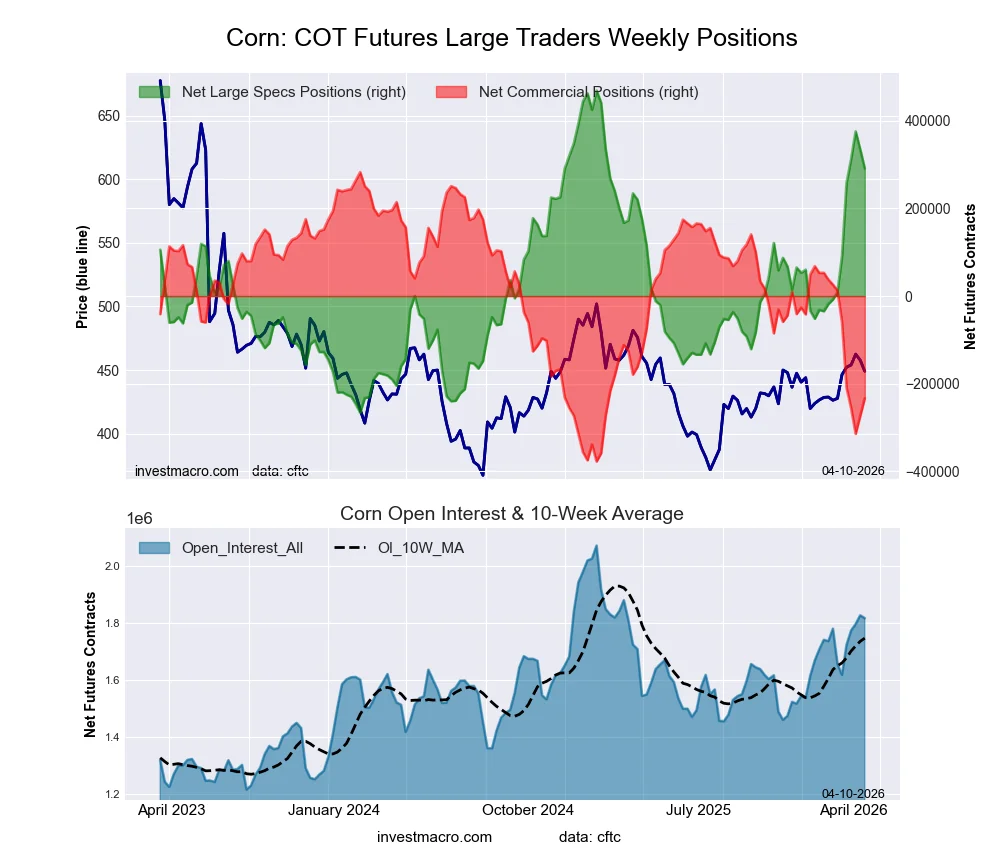
CORN Futures:

CORN Futures COT ChartThe CORN large speculator standing this week resulted in a net position of -51,704 contracts in the data reported through Tuesday. This was a weekly decline of -18,281 contracts from the previous week which had a total of -33,423 net contracts.

This week’s current strength score (the trader positioning range over the past three years, measured from 0 to 100) shows the speculators are currently Bearish with a score of 29.2 percent. The commercials are Bullish with a score of 67.5 percent and the small traders (not shown in chart) are Bullish-Extreme with a score of 87.6 percent.

Price Trend-Following Model: Weak Uptrend

Our weekly trend-following model classifies the current market price position as: Weak Uptrend.

CORN Futures StatisticsSPECULATORSCOMMERCIALSSMALL TRADERS
– Percent of Open Interest Longs:19.847.18.5
– Percent of Open Interest Shorts:22.943.19.5
– Net Position:-51,70468,044-16,340
– Gross Longs:329,434786,229142,160
– Gross Shorts:381,138718,185158,500
– Long to Short Ratio:0.9 to 11.1 to 10.9 to 1
NET POSITION TREND:
– Strength Index Score (3 Year Range Pct):29.267.587.6
– Strength Index Reading (3 Year Range):BearishBullishBullish-Extreme
NET POSITION MOVEMENT INDEX:
– 6-Week Change in Strength Index:-16.217.08.1


SUGAR Futures:

SUGAR Futures COT ChartThe SUGAR large speculator standing this week resulted in a net position of -178,348 contracts in the data reported through Tuesday. This was a weekly decline of -12,637 contracts from the previous week which had a total of -165,711 net contracts.

This week’s current strength score (the trader positioning range over the past three years, measured from 0 to 100) shows the speculators are currently Bearish-Extreme with a score of 4.6 percent. The commercials are Bullish-Extreme with a score of 96.7 percent and the small traders (not shown in chart) are Bearish-Extreme with a score of 4.4 percent.

Price Trend-Following Model: Downtrend

Our weekly trend-following model classifies the current market price position as: Downtrend.

SUGAR Futures StatisticsSPECULATORSCOMMERCIALSSMALL TRADERS
– Percent of Open Interest Longs:14.657.37.0
– Percent of Open Interest Shorts:32.738.08.2
– Net Position:-178,348190,230-11,882
– Gross Longs:143,656564,45769,420
– Gross Shorts:322,004374,22781,302
– Long to Short Ratio:0.4 to 11.5 to 10.9 to 1
NET POSITION TREND:
– Strength Index Score (3 Year Range Pct):4.696.74.4
– Strength Index Reading (3 Year Range):Bearish-ExtremeBullish-ExtremeBearish-Extreme
NET POSITION MOVEMENT INDEX:
– 6-Week Change in Strength Index:0.90.4-8.8


COFFEE Futures:

COFFEE Futures COT ChartThe COFFEE large speculator standing this week resulted in a net position of 29,763 contracts in the data reported through Tuesday. This was a weekly fall of -2,989 contracts from the previous week which had a total of 32,752 net contracts.

This week’s current strength score (the trader positioning range over the past three years, measured from 0 to 100) shows the speculators are currently Bullish with a score of 53.0 percent. The commercials are Bearish with a score of 49.0 percent and the small traders (not shown in chart) are Bearish with a score of 24.3 percent.

Price Trend-Following Model: Strong Downtrend

Our weekly trend-following model classifies the current market price position as: Strong Downtrend.

COFFEE Futures StatisticsSPECULATORSCOMMERCIALSSMALL TRADERS
– Percent of Open Interest Longs:32.940.64.4
– Percent of Open Interest Shorts:15.458.34.1
– Net Position:29,763-30,151388
– Gross Longs:56,00969,2687,449
– Gross Shorts:26,24699,4197,061
– Long to Short Ratio:2.1 to 10.7 to 11.1 to 1
NET POSITION TREND:
– Strength Index Score (3 Year Range Pct):53.049.024.3
– Strength Index Reading (3 Year Range):BullishBearishBearish
NET POSITION MOVEMENT INDEX:
– 6-Week Change in Strength Index:-5.05.9-19.0


SOYBEANS Futures:

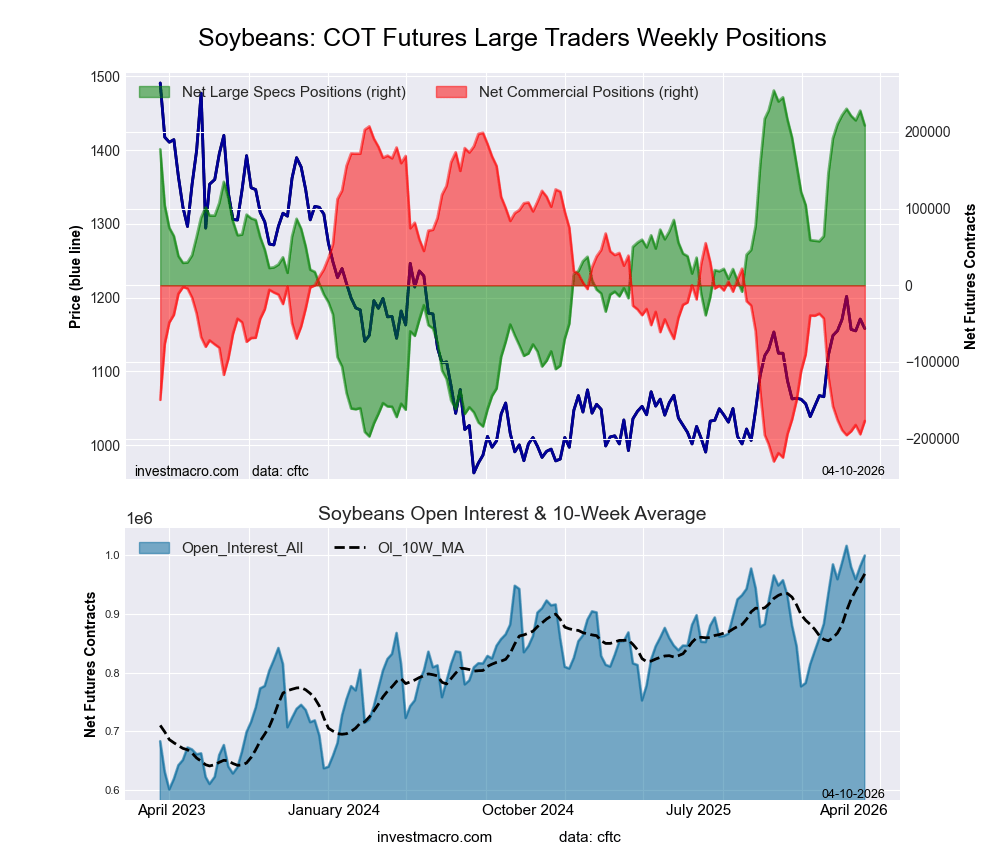
SOYBEANS Futures COT ChartThe SOYBEANS large speculator standing this week resulted in a net position of 58,129 contracts in the data reported through Tuesday. This was a weekly decrease of -818 contracts from the previous week which had a total of 58,947 net contracts.

This week’s current strength score (the trader positioning range over the past three years, measured from 0 to 100) shows the speculators are currently Bullish with a score of 56.6 percent. The commercials are Bearish with a score of 43.5 percent and the small traders (not shown in chart) are Bullish with a score of 64.6 percent.

Price Trend-Following Model: Weak Uptrend

Our weekly trend-following model classifies the current market price position as: Weak Uptrend.

SOYBEANS Futures StatisticsSPECULATORSCOMMERCIALSSMALL TRADERS
– Percent of Open Interest Longs:20.751.46.2
– Percent of Open Interest Shorts:13.756.18.4
– Net Position:58,129-39,788-18,341
– Gross Longs:173,031429,89451,801
– Gross Shorts:114,902469,68270,142
– Long to Short Ratio:1.5 to 10.9 to 10.7 to 1
NET POSITION TREND:
– Strength Index Score (3 Year Range Pct):56.643.564.6
– Strength Index Reading (3 Year Range):BullishBearishBullish
NET POSITION MOVEMENT INDEX:
– 6-Week Change in Strength Index:-35.035.39.3


SOYBEAN OIL Futures:

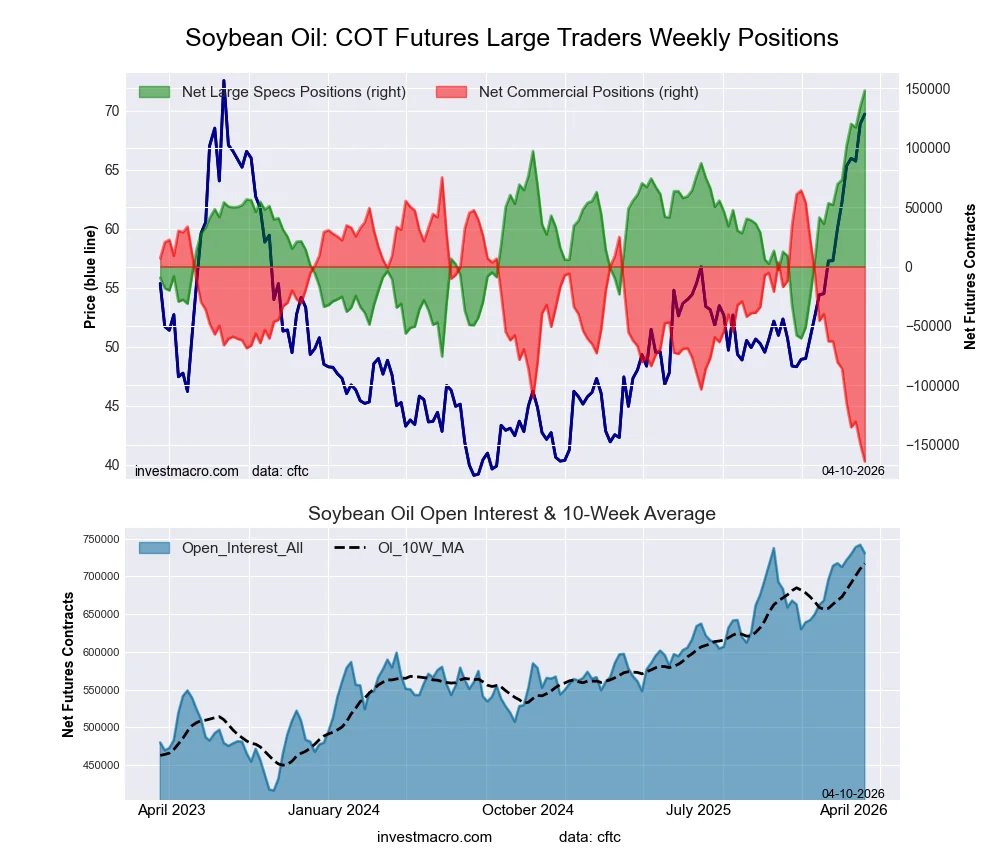
SOYBEAN OIL Futures COT ChartThe SOYBEAN OIL large speculator standing this week resulted in a net position of 4,543 contracts in the data reported through Tuesday. This was a weekly lift of 29,678 contracts from the previous week which had a total of -25,135 net contracts.

This week’s current strength score (the trader positioning range over the past three years, measured from 0 to 100) shows the speculators are currently Bearish with a score of 46.4 percent. The commercials are Bullish with a score of 56.9 percent and the small traders (not shown in chart) are Bearish with a score of 20.9 percent.

Price Trend-Following Model: Weak Downtrend

Our weekly trend-following model classifies the current market price position as: Weak Downtrend.

SOYBEAN OIL Futures StatisticsSPECULATORSCOMMERCIALSSMALL TRADERS
– Percent of Open Interest Longs:19.048.74.6
– Percent of Open Interest Shorts:18.349.54.6
– Net Position:4,543-5,045502
– Gross Longs:123,574316,60130,092
– Gross Shorts:119,031321,64629,590
– Long to Short Ratio:1.0 to 11.0 to 11.0 to 1
NET POSITION TREND:
– Strength Index Score (3 Year Range Pct):46.456.920.9
– Strength Index Reading (3 Year Range):BearishBullishBearish
NET POSITION MOVEMENT INDEX:
– 6-Week Change in Strength Index:-2.53.8-13.8


SOYBEAN MEAL Futures:

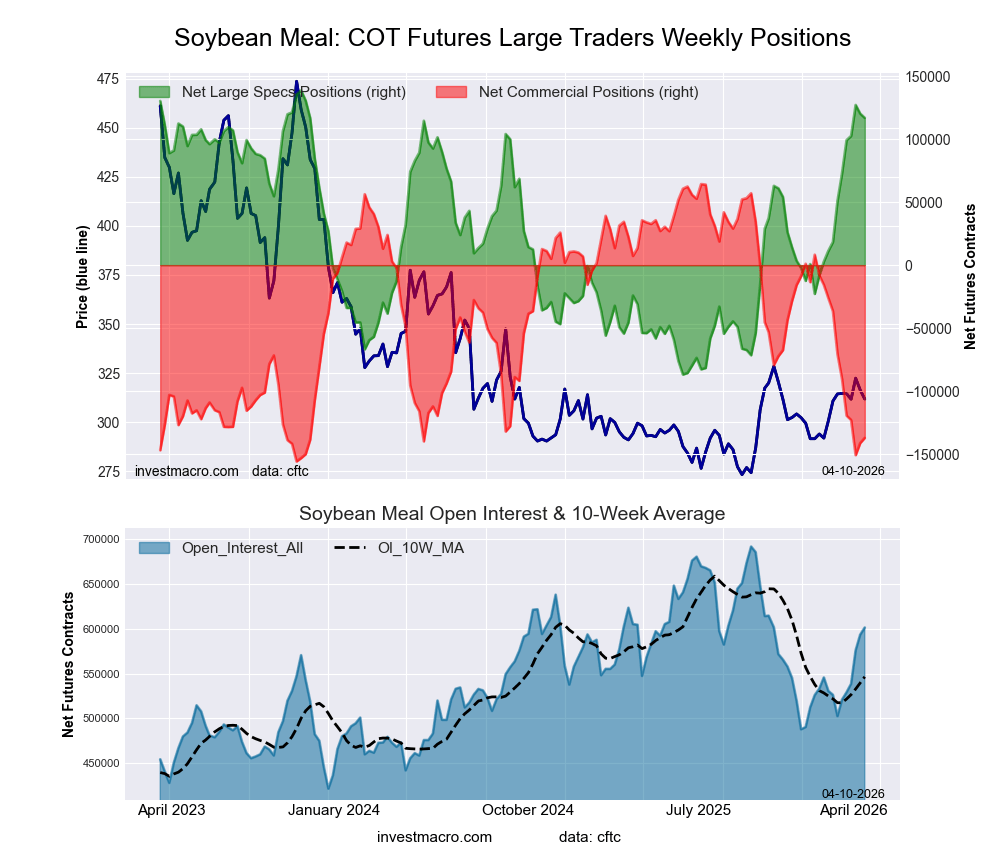
SOYBEAN MEAL Futures COT ChartThe SOYBEAN MEAL large speculator standing this week resulted in a net position of -22,790 contracts in the data reported through Tuesday. This was a weekly decrease of -23,547 contracts from the previous week which had a total of 757 net contracts.

This week’s current strength score (the trader positioning range over the past three years, measured from 0 to 100) shows the speculators are currently Bearish with a score of 24.3 percent. The commercials are Bullish with a score of 78.5 percent and the small traders (not shown in chart) are Bearish with a score of 25.7 percent.

Price Trend-Following Model: Weak Uptrend

Our weekly trend-following model classifies the current market price position as: Weak Uptrend.

SOYBEAN MEAL Futures StatisticsSPECULATORSCOMMERCIALSSMALL TRADERS
– Percent of Open Interest Longs:21.452.18.4
– Percent of Open Interest Shorts:25.750.55.7
– Net Position:-22,7908,26114,529
– Gross Longs:112,415274,05244,344
– Gross Shorts:135,205265,79129,815
– Long to Short Ratio:0.8 to 11.0 to 11.5 to 1
NET POSITION TREND:
– Strength Index Score (3 Year Range Pct):24.378.525.7
– Strength Index Reading (3 Year Range):BearishBullishBearish
NET POSITION MOVEMENT INDEX:
– 6-Week Change in Strength Index:-18.620.0-17.0


LIVE CATTLE Futures:

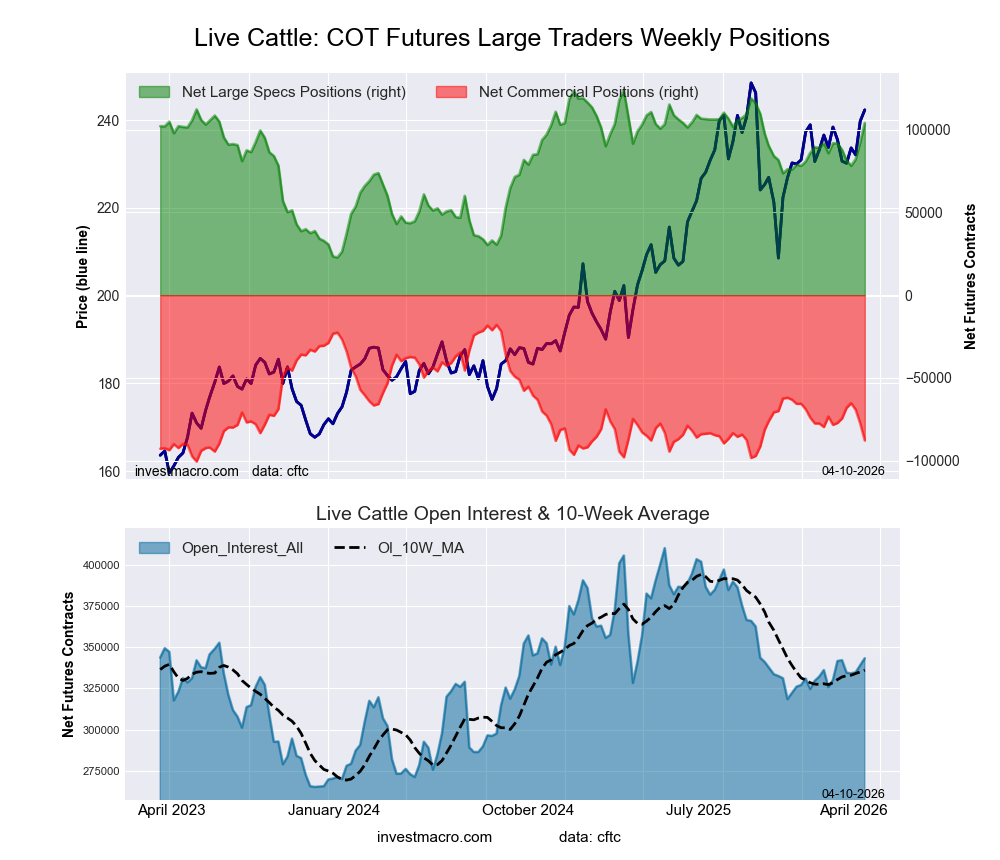
LIVE CATTLE Futures COT ChartThe LIVE CATTLE large speculator standing this week resulted in a net position of 89,349 contracts in the data reported through Tuesday. This was a weekly increase of 3,410 contracts from the previous week which had a total of 85,939 net contracts.

This week’s current strength score (the trader positioning range over the past three years, measured from 0 to 100) shows the speculators are currently Bullish with a score of 66.0 percent. The commercials are Bearish with a score of 27.9 percent and the small traders (not shown in chart) are Bullish with a score of 56.6 percent.

Price Trend-Following Model: Uptrend

Our weekly trend-following model classifies the current market price position as: Uptrend.

LIVE CATTLE Futures StatisticsSPECULATORSCOMMERCIALSSMALL TRADERS
– Percent of Open Interest Longs:44.633.28.7
– Percent of Open Interest Shorts:17.556.712.3
– Net Position:89,349-77,472-11,877
– Gross Longs:147,002109,48428,606
– Gross Shorts:57,653186,95640,483
– Long to Short Ratio:2.5 to 10.6 to 10.7 to 1
NET POSITION TREND:
– Strength Index Score (3 Year Range Pct):66.027.956.6
– Strength Index Reading (3 Year Range):BullishBearishBullish
NET POSITION MOVEMENT INDEX:
– 6-Week Change in Strength Index:13.1-18.87.9


LEAN HOGS Futures:

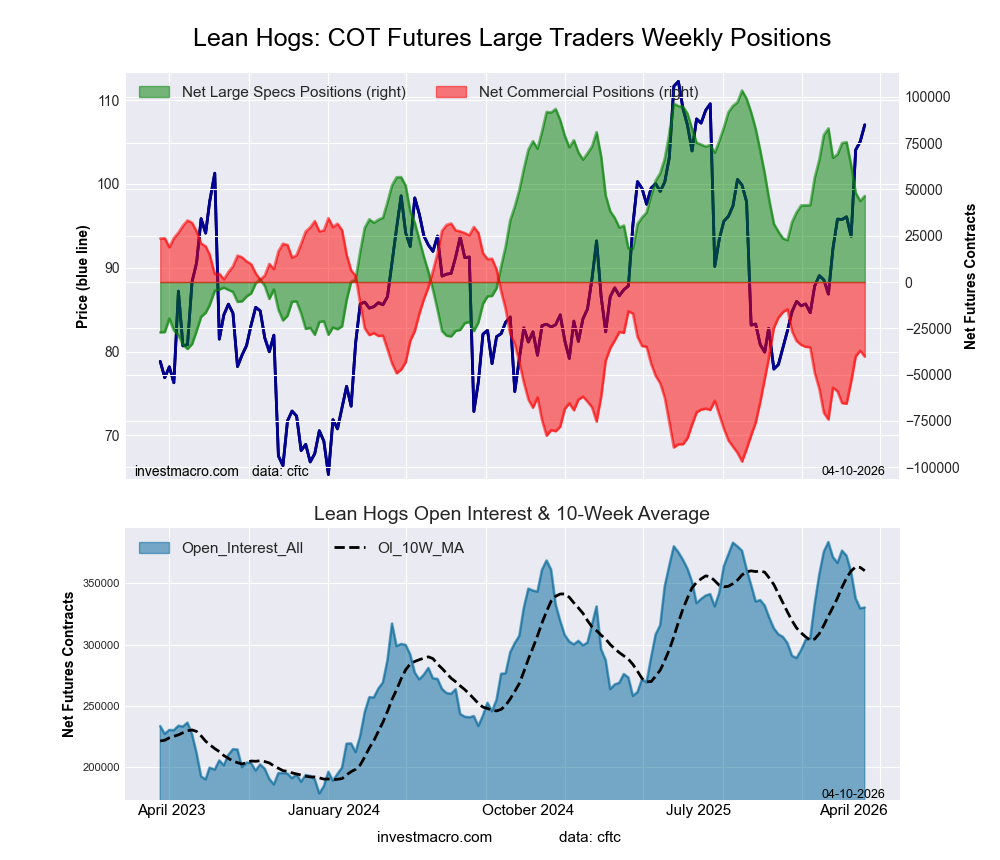
LEAN HOGS Futures COT ChartThe LEAN HOGS large speculator standing this week resulted in a net position of 56,397 contracts in the data reported through Tuesday. This was a weekly increase of 14,919 contracts from the previous week which had a total of 41,478 net contracts.

This week’s current strength score (the trader positioning range over the past three years, measured from 0 to 100) shows the speculators are currently Bullish with a score of 66.3 percent. The commercials are Bearish with a score of 36.4 percent and the small traders (not shown in chart) are Bearish with a score of 33.3 percent.

Price Trend-Following Model: Uptrend

Our weekly trend-following model classifies the current market price position as: Uptrend.

LEAN HOGS Futures StatisticsSPECULATORSCOMMERCIALSSMALL TRADERS
– Percent of Open Interest Longs:40.333.96.5
– Percent of Open Interest Shorts:23.448.78.7
– Net Position:56,397-49,048-7,349
– Gross Longs:134,411113,18121,820
– Gross Shorts:78,014162,22929,169
– Long to Short Ratio:1.7 to 10.7 to 10.7 to 1
NET POSITION TREND:
– Strength Index Score (3 Year Range Pct):66.336.433.3
– Strength Index Reading (3 Year Range):BullishBearishBearish
NET POSITION MOVEMENT INDEX:
– 6-Week Change in Strength Index:24.2-26.13.0


COTTON Futures:

COTTON Futures COT ChartThe COTTON large speculator standing this week resulted in a net position of -25,824 contracts in the data reported through Tuesday. This was a weekly increase of 1,607 contracts from the previous week which had a total of -27,431 net contracts.

This week’s current strength score (the trader positioning range over the past three years, measured from 0 to 100) shows the speculators are currently Bearish with a score of 23.7 percent. The commercials are Bullish with a score of 75.2 percent and the small traders (not shown in chart) are Bearish with a score of 40.1 percent.

Price Trend-Following Model: Downtrend

Our weekly trend-following model classifies the current market price position as: Downtrend.

COTTON Futures StatisticsSPECULATORSCOMMERCIALSSMALL TRADERS
– Percent of Open Interest Longs:27.346.64.4
– Percent of Open Interest Shorts:34.939.73.7
– Net Position:-25,82423,4152,409
– Gross Longs:92,421158,03814,887
– Gross Shorts:118,245134,62312,478
– Long to Short Ratio:0.8 to 11.2 to 11.2 to 1
NET POSITION TREND:
– Strength Index Score (3 Year Range Pct):23.775.240.1
– Strength Index Reading (3 Year Range):BearishBullishBearish
NET POSITION MOVEMENT INDEX:
– 6-Week Change in Strength Index:6.2-7.827.6


COCOA Futures:

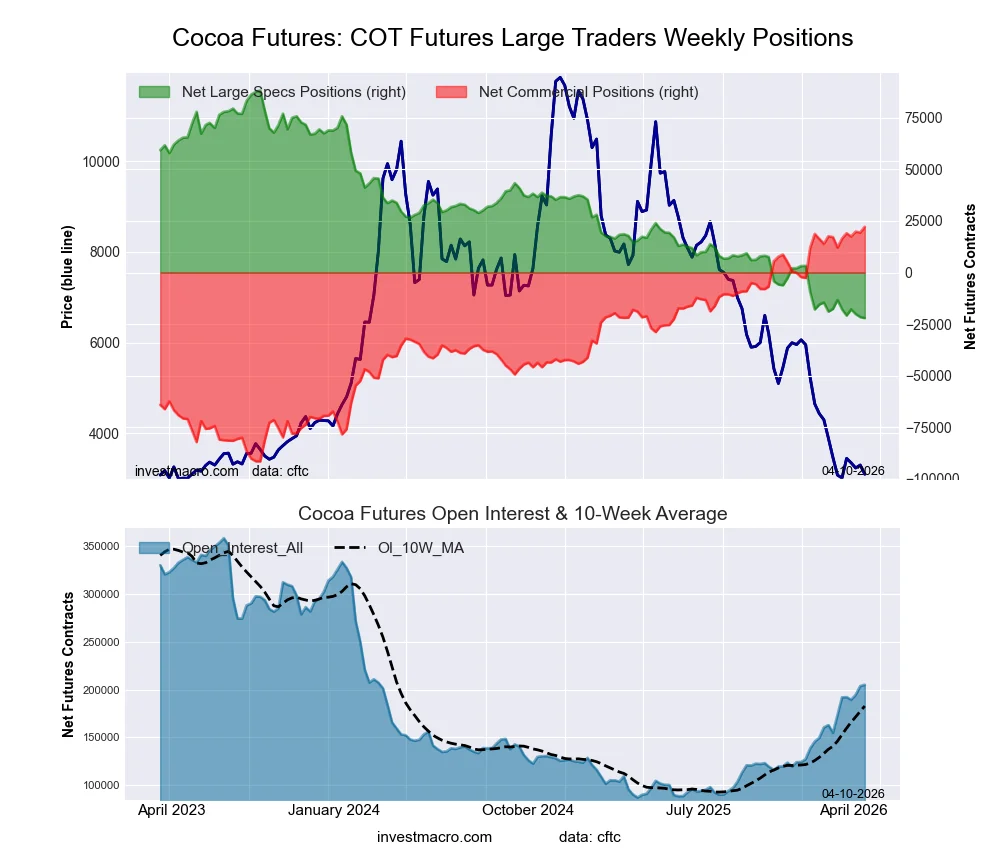
COCOA Futures COT ChartThe COCOA large speculator standing this week resulted in a net position of -17,874 contracts in the data reported through Tuesday. This was a weekly lowering of -8,378 contracts from the previous week which had a total of -9,496 net contracts.

This week’s current strength score (the trader positioning range over the past three years, measured from 0 to 100) shows the speculators are currently Bearish-Extreme with a score of 0.0 percent. The commercials are Bullish-Extreme with a score of 100.0 percent and the small traders (not shown in chart) are Bearish-Extreme with a score of 19.2 percent.

Price Trend-Following Model: Uptrend

Our weekly trend-following model classifies the current market price position as: Uptrend.

COCOA Futures StatisticsSPECULATORSCOMMERCIALSSMALL TRADERS
– Percent of Open Interest Longs:18.048.96.4
– Percent of Open Interest Shorts:30.336.07.0
– Net Position:-17,87418,722-848
– Gross Longs:26,15771,1729,372
– Gross Shorts:44,03152,45010,220
– Long to Short Ratio:0.6 to 11.4 to 10.9 to 1
NET POSITION TREND:
– Strength Index Score (3 Year Range Pct):0.0100.019.2
– Strength Index Reading (3 Year Range):Bearish-ExtremeBullish-ExtremeBearish-Extreme
NET POSITION MOVEMENT INDEX:
– 6-Week Change in Strength Index:-14.312.413.9


WHEAT Futures:

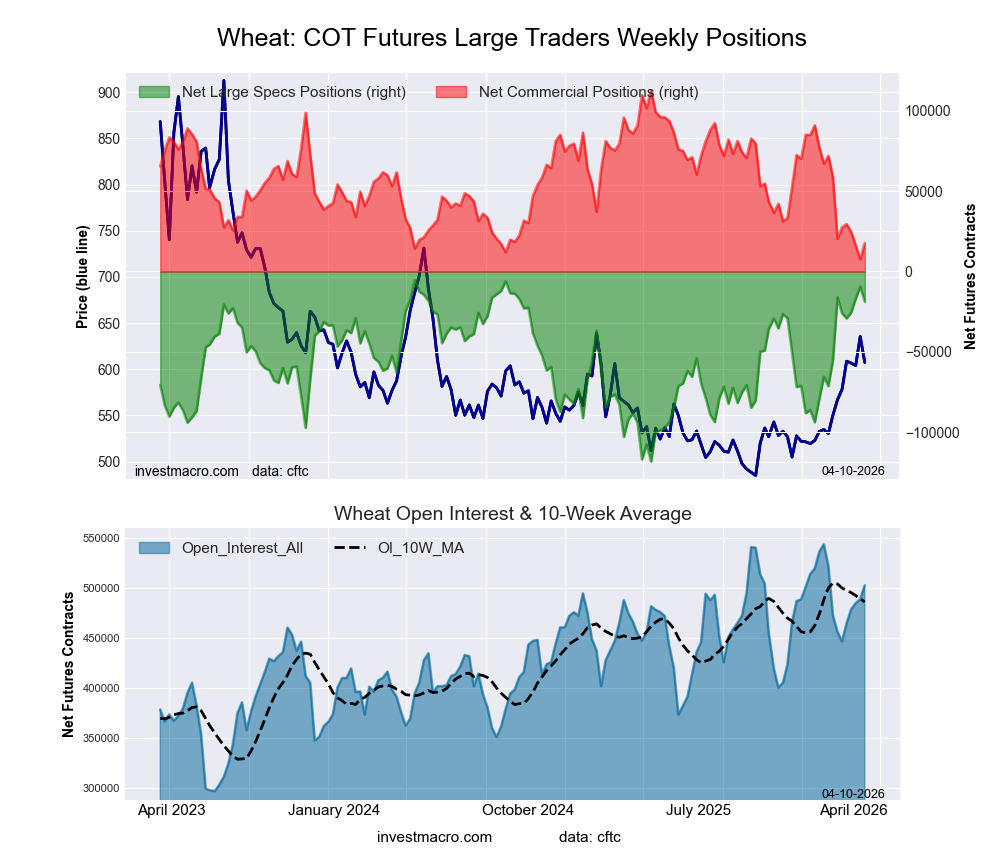
WHEAT Futures COT ChartThe WHEAT large speculator standing this week resulted in a net position of -93,730 contracts in the data reported through Tuesday. This was a weekly decrease of -7,705 contracts from the previous week which had a total of -86,025 net contracts.

This week’s current strength score (the trader positioning range over the past three years, measured from 0 to 100) shows the speculators are currently Bearish with a score of 21.6 percent. The commercials are Bullish with a score of 78.5 percent and the small traders (not shown in chart) are Bullish with a score of 71.0 percent.

Price Trend-Following Model: Weak Downtrend

Our weekly trend-following model classifies the current market price position as: Weak Downtrend.

WHEAT Futures StatisticsSPECULATORSCOMMERCIALSSMALL TRADERS
– Percent of Open Interest Longs:24.037.66.2
– Percent of Open Interest Shorts:42.120.15.6
– Net Position:-93,73090,8442,886
– Gross Longs:124,615195,23632,217
– Gross Shorts:218,345104,39229,331
– Long to Short Ratio:0.6 to 11.9 to 11.1 to 1
NET POSITION TREND:
– Strength Index Score (3 Year Range Pct):21.678.571.0
– Strength Index Reading (3 Year Range):BearishBullishBullish
NET POSITION MOVEMENT INDEX:
– 6-Week Change in Strength Index:-57.457.440.6


Article By InvestMacroReceive our weekly COT Newsletter

*COT Report: The COT data, released weekly to the public each Friday, is updated through the most recent Tuesday (data is 3 days old) and shows a quick view of how large speculators or non-commercials (for-profit traders) were positioned in the futures markets.

The CFTC categorizes trader positions according to commercial hedgers (traders who use futures contracts for hedging as part of the business), non-commercials (large traders who speculate to realize trading profits) and nonreportable traders (usually small traders/speculators) as well as their open interest (contracts open in the market at time of reporting). See CFTC criteria here.

Week Ahead: US500 bulls set to charge 7,000 milestone?

By ForexTime 

  • FXTM’s US500 ↑ 1% YTD
  • Trading less than 1% away from 7,000 milestone
  • Fed decision + big tech earnings = market action?
  • “Mag 7” titans = almost 34% of US500 weight
  • Technical levels: 6800, 6950 and 7000

The final trading week of January could end with a bang thanks to a volley of high-impact events.

Top-level data, central bank decisions and big tech earnings will dominate the week ahead:

Monday, 26th January

  • EUR: Germany Ifo Business Climate (Jan)
  • USD: US Durable Goods Orders (Nov)

Tuesday, 27th January

  • AUD: Australia NAB Business Confidence (Dec)
  • USD: US Conference Board consumer confidence
  • WTI: US API Crude Oil Stocks Change (w/e Jan 23)

Wednesday, 28th January

  • AUD: Australia Inflation Rate (Dec)
  • EUR: Germany GfK Consumer Confidence (Feb)
  • CAD: BoC Interest Rate Decision
  • USD: Fed Interest Rate Decision
  • US500: Meta, Microsoft, Tesla earnings

Thursday, 29th January

  • NZD: New Zealand ANZ Business Confidence (Jan)
  • JPY: Japan Consumer Confidence (Jan)
  • CHF: SNB rate decision
  • EUR: Eurozone Economic Sentiment (Jan)
  • US500: Apple earnings

Friday, 30th January

  • JPY: Tokyo CPI, jobless rate, industrial production, retail sales
  • EUR: Germany GDP (Q4); Germany Inflation Rate (Jan); Eurozone GDP (Q4)
  • TWN: Taiwan GDP
  • CAD: Canada GDP (Nov, Dec)
  • US30: US PPI (Dec), Chevron earnings

Our focus falls on FXTM’s US500, which has gained just over 1% year-to-date.

Equities appear to be on the rebound after easing geopolitical risk surrounding Greenland lifted global sentiment.

Note: Trump has announced a “framework for a future deal” with NATO that will provide the US total and permanent access to Greenland.

With investors redirecting their attention back toward macro forces and tech, further upside could be on the cards ahead of big tech earnings and Fed rate decision.

Examining the charts, FXTM’s US500 remains in a bullish channel with the next key checkpoint at 7,000.

With all the above said, here are 3 factors that could trigger significant price swings:

1) Fed rate decision – Wednesday 28th Jan

The Fed is expected to leave interest rates unchanged in January but any clues on future policy moves may rock the US500.

President Donald Trump is expected to announce his new pick to lead the Federal Reserve by the end of the month. Speculation around who this could be may translate to additional levels of volatility.

According to Polymarket, it may be Kevin Warsh or Rick Rieder.

Traders are currently pricing a 30% chance that the Fed cuts rates by April with this jumping to 75% by June.

  • FXTM’s US500 may jump if the Fed signals that lower rates are down the road.
  • A cautious sounding Fed could cap upside gains on the index.

Note: The US500 is forecast to move 1% higher or 0.3% lower in a six-hour period post-release.

2) Big tech earnings

Four of the so-called “Magnificent” 7 tech giants with a combined market cap of over $10 trillion are set to publish their results in the week ahead.

Quarterly results from Meta, Microsoft, Tesla and Apple could provide fresh insight into how the industry fared last quarter amid concerns over an AI bubble.

Considering that the combined weight of Meta, Microsoft, Tesla and Apple makes up roughly 16% of the US500, the incoming earnings could mean business.

  • A solid set of results and optimistic forward guidance from tech titans may propel the US500 higher.
  • Should results disappoint and concerns be expressed about the earnings outlook, the US500 could fall.

3) Technical force

The US500 has staged a rebound on the daily charts with bulls back in the game. Prices are trading above the 50, 100, and 200-day SMA while the RSI signals further upside momentum.

  • A solid weekly close above the 6950 level may open the doors toward the 7000 milestone and beyond.
  • If prices slip below the 50-day SMA, this could trigger a decline toward 6800 and the 100-day SMA at 6770.


Forex-Time-LogoArticle by ForexTime


ForexTime Ltd (FXTM) is an award winning international online forex broker regulated by CySEC 185/12 www.forextime.com

Silver reached $99 per ounce. Natural gas jumped 70% in a week

By JustMarkets 

On Thursday, the US stock market rose steadily amid easing geopolitical tensions and encouraging macroeconomic data. By the end of the day, the Dow Jones (US30) increased by 0.63%. The S&P 500 (US500) gained 0.55%. The tech-heavy Nasdaq (US100) closed higher by 0.91%. President Donald Trump backed away from new tariff threats against Europe and outlined the framework for a future agreement regarding Greenland. The primary growth drivers were tech giants: Meta shares jumped 5.7%, Microsoft added 1.5%, Amazon 1.3%, Nvidia 0.8%, Alphabet 0.8%, and Apple 0.3%. The macroeconomic backdrop also supported risk appetite. Data showed a revision of US GDP growth for Q3 upward to 4.4%, initial jobless claims remained near 200,000, PCE inflation matched expectations, and consumer spending remained resilient. Collectively, this reduced concerns about the need for immediate monetary policy easing and bolstered investor confidence in the resilience of the US economy.

European equity markets rose yesterday. The German DAX (DE40) rose by 1.20%, the French CAC 40 (FR40) closed up 0.99%, the Spanish IBEX 35 (ES35) gained 1.28%, and the British FTSE 100 (UK100) finished positive 0.12%. The rebound occurred as sentiment improved across European markets after US President Donald Trump suspended tariff threats following a meeting with NATO Secretary General Mark Rutte. According to sources, talks in Davos led to an agreement to resume dialogue between the US and Denmark regarding the 1951 defense agreement related to Greenland, easing fears of further escalation. Major banking companies led the gains: Deutsche Bank, BNP Paribas, UniCredit, and Santander added between 3% and 4%.

The Swiss franc (CHF) traded near 0.79 per US dollar, remaining close to its strongest level since 2011, amid a steady, albeit moderate, inflow into safe-haven assets. After maintaining the key interest rate at 0% for two consecutive meetings, SNB officials signaled that cutting rates below zero carries significant risks. In the near term, markets expect neither easing nor tightening of monetary policy.

On Friday, silver (XAG) jumped nearly 3% to $99 per ounce, reaching new record highs as a weakening dollar provided additional support for precious metal prices. Investors fear that Europe may use its significant assets in the US as a retaliatory measure over the Greenland issue. The surge in silver prices was also driven by a historic short squeeze and active buying by retail investors, as well as tightening export controls from China.

WTI crude oil prices continued to decline on Thursday, dropping toward $59 per barrel amid growing concerns about a global supply glut. The International Energy Agency (IEA) reiterated that oil supply is expected to significantly exceed demand this year, despite a slight upward revision to the consumption growth projections. Additional pressure came from US Energy Information Administration (EIA) data showing a 3.6 million barrel increase in commercial crude inventories for the week ending January 16, significantly exceeding market expectations of a roughly 1 million barrel increase.

Severe freezing weather triggered a historic spike in US natural gas (XNG) prices, which rose above $5.53 per MMBtu, approaching levels last seen in December 2022. The sharp rise in quotes is linked to prognoses of extreme cold, which intensified expectations of a surge in demand while simultaneously increasing the risk of supply disruptions. US natural gas prices are showing a gain of more than 70% for the week, marking the sharpest weekly price jump since 1990.

Asian markets mostly rose yesterday. Japan’s Nikkei 225 (JP225) jumped 1.73%, China’s FTSE China A50 (CHA50) fell 0.28%, Hong Kong’s Hang Seng (HK50) gained 0.17%, and Australia’s ASX 200 (AU200) posted a positive result of 0.75%. The New Zealand dollar (NZD) declined to around $0.592 following higher-than-expected inflation data. In the fourth quarter, annual CPI growth accelerated to 3.1%, exceeding both the 3% prognosis and the Reserve Bank of New Zealand’s (RBNZ) target range, reaching its highest level since Q2 2024. Although the regulator still expects inflation to slow to 2% within the year, the strong figures reinforced the view that the policy easing cycle has concluded and increased the likelihood of interest rate hikes.

S&P 500 (US500) 6,913.35 +37.73 (+0.55%)

Dow Jones (US30) 49,384.01 +306.78 (+0.63%)

DAX (DE40) 24,856.47 +295.49 (+1.20%)

FTSE 100 (UK100) 10,150.05 +11.96 (+0.12%)

USD Index 98.31 -0.45% (-0.45%)

News feed for: 2026.01.23

  • Australia Manufacturing PMI (m/m) at 00:00 (GMT+2); – AUD (MED)
  • Australia Services PMI (m/m) at 00:00 (GMT+2); – AUD (MED)
  • Japan National Core Consumer Price Index (m/m) at 01:30 (GMT+2); – JPY (MED)
  • Japan Manufacturing PMI (m/m) at 02:30 (GMT+2); – JPY (MED)
  • Japan Services PMI (m/m) at 02:30 (GMT+2); – JPY (MED)
  • Japan BOJ Policy Rate at 05:00 (GMT+2); – JPY (HIGH)
  • Japan Monetary Policy Statement at 05:00 (GMT+2); – JPY (HIGH)
  • Japan BOJ Outlook Report at 05:00 (GMT+2); – JPY (HIGH)
  • Singapore Inflation Rate at 07:00 (GMT+2); – SGD (MED)
  • UK Retail Sales (m/m) at 09:00 (GMT+2); – GBP (MED)
  • Eurozone Manufacturing PMI (m/m) at 11:00 (GMT+2); – EUR (MED)
  • Eurozone Services PMI (m/m) at 11:00 (GMT+2); – EUR (MED)
  • UK Manufacturing PMI (m/m) at 11:30 (GMT+2); – GBP (MED)
  • UK Services PMI (m/m) at 11:30 (GMT+2); – GBP (MED)
  • Eurozone ECB President Lagarde Speech at 12:00 (GMT+2); – EUR (LOW)
  • Canada Retail Sales (m/m) at 15:30 (GMT+2); – CAD (MED)
  • US Manufacturing PMI (m/m) at 16:45 (GMT+2); – USD (MED)
  • US Services PMI (m/m) at 16:45 (GMT+2); – USD (MED)
  • US Michigan Inflation Expectations (m/m) at 17:00 (GMT+2). – USD (MED)

By JustMarkets


This article reflects a personal opinion and should not be interpreted as an investment advice, and/or offer, and/or a persistent request for carrying out financial transactions, and/or a guarantee, and/or a forecast of future events.

USD/JPY Continues Its Uptrend as Yen Weakens Further

By RoboForex Analytical Department

USD/JPY rose to 158.61 on Friday, continuing its upward movement as the yen remains under pressure. Investors are adopting a wait-and-see approach ahead of the Bank of Japan’s (BOJ) monetary policy decision.

The BOJ recently kept rates unchanged after a hike to 0.75% in December – ** the highest level in nearly 30 years. Market participants are now focusing on comments from BOJ Governor Kazuo Ueda for clues on the timing of the next rate hike, especially amid the yen’s persistent weakness.

Recent data showed a slowdown in core inflation in December, but it remains above the BOJ’s 2% target. Additionally, fiscal risks have added pressure on the yen, as Prime Minister Sanae Takaichi prepares to dissolve parliament and call early elections, a move aimed at consolidating power and promoting fiscal expansion.

As USD/JPY approaches the psychologically significant 160 level, market expectations of possible currency intervention are growing, leading to increased caution among traders.

Technical Analysis

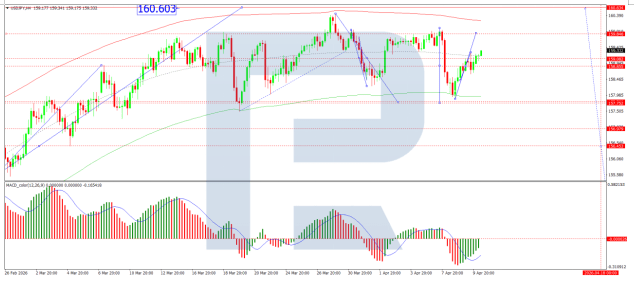
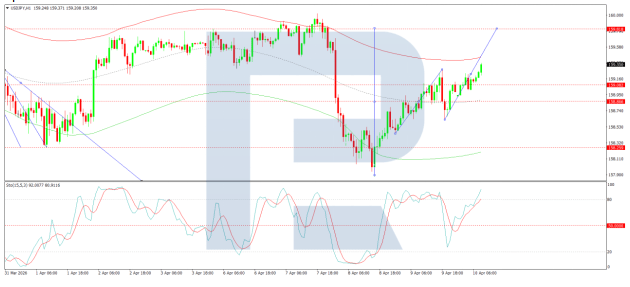
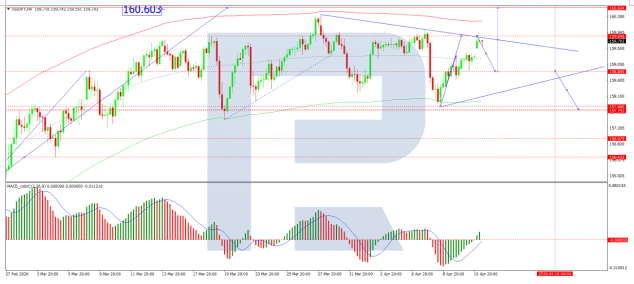
On the H4 chart, USD/JPY has formed a consolidation range around 158.50. The breakout to the upside has opened the potential for a rise to 160.00. After reaching this level, a potential decline to 158.00 may occur. The MACD indicator supports this bullish scenario, with its signal line above zero and pointing upward.

On the H1 chart, a growth wave structure is forming towards 159.30, with a possible correction to 158.70 before continuing the ascent to 160.00. This scenario is confirmed by the Stochastic oscillator, whose signal line is above 50 and pointing towards 80.

Conclusion

USD/JPY continues to rise, driven by the yen’s weakness and market expectations of further BOJ rate hikes. As the pair approaches the 160 level, the potential for currency intervention increases, keeping market participants cautious. Technically, the upward trend remains intact, with key levels to watch at 160.00 and 158.00.


Disclaimer

Any forecasts contained herein are based on the author’s particular opinion. This analysis may not be treated as trading advice. RoboForex bears no responsibility for trading results based on trading recommendations and reviews contained herein.

Trump ruled out the use of military force to acquire Greenland. Natural gas prices jumped 20%

By JustMarkets

The US stocks closed sharply higher on Wednesday, paring some of the previous session’s losses, after markets reacted positively to President Donald Trump’s statement at the World Economic Forum in Davos, where he ruled out the use of military force to acquire Greenland. By the end of the day, the Dow Jones (US30) rose by 1.26%. The S&P 500 (US500) climbed 1.16%. The tech-heavy Nasdaq (US100) closed higher by 1.18%. The technology sector was the primary driver of the growth: shares of AMD, Intel, and Micron jumped between 6% and 12%, while broader market segments also stabilized as fears of a sharp escalation in tensions between the US and Europe eased. However, uncertainty has not entirely vanished, as Trump reaffirmed his commitment to seeking control over Greenland and maintained the threat of economic pressure on European allies.

European equity markets traded with mixed performance yesterday. The German DAX (DE40) fell by 0.58%, the French CAC 40 (FR40) closed up 0.08%, the Spanish IBEX 35 (ES35) rose by 0.06%, and the British FTSE 100 (UK100) closed at positive 0.11%. The US President Donald Trump ruled out the use of military force to acquire Greenland and backed away from previously proposed tariffs on European countries, announcing the achievement of a framework for a future agreement with NATO, the details of which remain uncertain. At the same time, Denmark confirmed it has no intention of discussing the transfer of its territory to the US, and the European Parliament suspended the approval process for the EU-US trade agreement reached in July, maintaining a high level of uncertainty.

On Thursday, platinum (XPT) and silver (XAG) prices fell by more than 3%, retreating from all-time highs amid a general easing of precious metal prices.
WTI crude oil prices partially recovered their losses on Wednesday, rising toward the $60.5 per barrel level. Market sentiment improved following Trump’s comments in Davos, although tensions between the US and the EU persist, and the trade agreement remains frozen after the European Parliament suspended the ratification vote. Prices received additional support from revised expectations by the International Energy Agency, which raised its estimate for global oil demand growth in 2026 and slightly lowered expectations regarding the scale of the supply surplus.

Daily trading volume for US gas futures on the CME exchange broke an all-time record yesterday. On Wednesday, the US natural gas prices jumped more than 20% to $4.7 per MMBtu, continuing a sharp rally following a roughly 26% gain earlier in the week. Weather prognosis has shifted dramatically toward significant cooling. Updated expectations for the long holiday weekend indicate a deep and massive Arctic intrusion that will cover a large part of the country in the coming weeks.

Asian markets were mostly lower yesterday. Japan’s Nikkei 225 (JP225) fell by 0.41%, China’s FTSE China A50 (CHA50) dropped 0.35%, Hong Kong’s Hang Seng (HK50) rose by 0.37%, and Australia’s ASX 200 (AU200) posted a negative result of 0.37%.

On Thursday, the Australian dollar (AUD) strengthened to around $0.679, nearing a sixteen-month high, as easing tensions between the US and Europe improved global risk appetite, and strong labor market data bolstered expectations for policy tightening by the Reserve Bank of Australia (RBA). Statistics showed that employment rose by 65,200 in December, significantly exceeding expectations, while the unemployment rate unexpectedly fell to a seven-month low of 4.1%. Against this backdrop, markets sharply revised rate expectations, increasing the probability of a 25-basis-point hike at the February 3 meeting from 27% to 54%, while such a hike is already fully priced in by May.

The New Zealand dollar (NZD) strengthened to around $0.585, reaching a four-month high, ahead of the release of the fourth-quarter Consumer Price Index report on Friday, which could clarify the monetary policy outlook for the Reserve Bank of New Zealand. Annual inflation is expected to accelerate to 3%, reaching the upper bound of the RBNZ’s 1-3% target range, and any stronger reading could bolster the case for interest rate hikes. Recent macroeconomic data point to a steady economic recovery in the country, strengthening expectations that the regulator could move toward policy tightening later in the year.

S&P 500 (US500) 6,875.62 +78.76 (+1.16%)

Dow Jones (US30) 49,077.23 +588.64 (+1.21%)

DAX (DE40) 24,560.98 −142.14 (−0.58%)

FTSE 100 (UK100) 10,138.09 +11.31 (+0.11%)

USD Index 98.78 +0.14% (+0.14%)

News feed for: 2026.01.22

  • Japan Trade Balance (m/m) at 01:50 (GMT+2); – JPY (LOW)
  • Australia Unemployment Rate (m/m) at 02:30 (GMT+2); – AUD (MED)
  • Hong Kong Inflation Rate (m/m) at 10:30 (GMT+2); – HK50 (MED)
  • Norway Norges Bank Interest Rate Decision at 11:00 (GMT+2); – NOK (HIGH)
  • US GDP (m/m) at 15:30 (GMT+2); – USD (MED)
  • US Initial Jobless Claims (w/w) at 15:30 (GMT+2); – USD (MED)
  • US Core PCE Price Index (m/m) at 17:00 (GMT+2); – USD (HIGH)
  • US Natural Gas Storage (w/w) at 17:30 (GMT+2); – XNG (HIGH)
  • US Crude Oil Reserves (w/w) at 19:00 (GMT+2); – WTI (HIGH)
  • New Zealand Inflation Rate (q/q) at 23:45 (GMT+2). – NZD (HIGH)

By JustMarkets


This article reflects a personal opinion and should not be interpreted as an investment advice, and/or offer, and/or a persistent request for carrying out financial transactions, and/or a guarantee, and/or a forecast of future events.

Gold Hits Record High: Geopolitical Tensions and Market Instability Fuel Growth

By RoboForex Analytical Department

On Tuesday, gold prices surged to around 4670 USD per ounce, reaching a new record. This price movement comes amid rising demand for safe-haven assets, driven by the escalating trade disputes between the US and the EU.

Recent reports indicate that Denmark is bolstering its military presence in Greenland, following US President Donald Trump’s threats to use force to establish control over the island. Additionally, Trump has threatened to impose a 10% import tariff on goods from eight European countries starting 1 February, with the possibility of increasing the rate to 25% by June if the US is not permitted to purchase Greenland. This has raised concerns within the EU, prompting an emergency summit this Thursday to discuss possible countermeasures.

The delayed release of the US Personal Consumption Expenditures (PCE) index this week is also drawing attention, as it could provide further clarity on inflation trends and the future direction of US monetary policy.

Gold’s strong performance this year is further fuelled by inflows into defensive assets amid geopolitical tensions surrounding Venezuela and Iran, as well as ongoing concerns about the US Federal Reserve’s autonomy.

Technical Analysis:

On the H4 XAUUSD chart, gold is pushing through its fifth wave of growth, with the 4,800 level as the next target. After reaching this level, we anticipate a potential pullback towards 4,660. The MACD indicator supports this upward momentum, as its signal line remains at highs, pointing upward.

On the H1 chart, the price has broken through the 4,717 level, forming a consolidation range around it. The trend is likely to continue towards 4,800, with the Stochastic oscillator confirming this bullish outlook, as the signal line remains below 20 and under upward pressure.

Conclusion:

Gold continues to hit new highs, driven by geopolitical tensions and market instability. With ongoing risks in trade relations and concerns about US monetary policy, the demand for defensive assets such as gold remains strong. Technically, gold’s momentum is expected to continue upward, potentially reaching 4,800 before any correction.


Disclaimer

Any forecasts contained herein are based on the author’s particular opinion. This analysis may not be treated as trading advice. RoboForex bears no responsibility for trading results based on trading recommendations and reviews contained herein.

Mid-Week outlook: Gold hits ATH, Trump in Davos, NatGas surges

By ForexTime 

  • Gold hits fresh record above $4885
  • Trump lands in Davos for speech – Greenland in focus
  • Natgas gains over 50% since last Friday
  • Bitcoin under pressure below $90,000

It’s been an intense week marked by geopolitical tensions and extreme market volatility.

Markets seem to be stabilizing ahead of Trump’s speech in Davos, with a rebound in long-dated Japanese bonds lifting risk appetite.

Trump is expected to speak at 1:30 PM GMT about the US economy, the international “Board of Peace”, and most importantly, Greenland negotiations.

Should he strike a more conciliatory tone and retract initial threats, this could lift overall market sentiment.

In the commodities space, gold surged to a fresh all-time high above $4885 – pushing 2026 gains to over 13%.

It’s been a flat week for silver thus far, but it remains a champion in the precious metal space, up over 30% year-to-date.

With geopolitical flashpoints across the globe accelerating the flight to safety, the path of least resistance for gold remains north.

Beyond geopolitics, central bank buying and prospects of lower US rates are likely to keep gold/silver bulls in the game.

Speaking of bulls, natural gas has experienced an explosive rally, surging over 50% since last Friday to reach $4.8/MMBtu – its highest level in five weeks.

This rally was sparked by extreme weather forecasts: NOAA has issued warnings for severe cold and winter storms across the US through late January, which is set to sharply boost heating demand.

Looking at cryptos, Bitcoin remains under pressure with prices trading below $90,000.

Overall market caution has contributed to the recent selloff, with weakness below $87,500 signaling a further decline toward $83,000 and $77,500.


Forex-Time-LogoArticle by ForexTime
 

ForexTime Ltd (FXTM) is an award winning international online forex broker regulated by CySEC 185/12 www.forextime.com

Stock indices are under sell-off pressure due to rising geopolitical risks

By JustMarkets 

The US stock markets closed with a sharp decline: the Dow Jones (US30) fell by 1.76%, the S&P 500 (US500) shed 2.06%, and the tech-heavy Nasdaq (US100) closed lower by 2.39%. The sell-off was triggered by mounting trade risks after President Donald Trump threatened to impose new 10% tariffs on goods from eight European countries starting February 1, which could be hiked to 25% by June, due to their opposition to US control over Greenland. These statements undermined expectations for stable cross-border trade and intensified overall market risk aversion. Stocks were further pressured by rising US Treasury yields, while reports of a Danish pension fund’s plans to reduce its holdings in US Treasuries added to investor anxiety.

The heaviest losses were sustained by major tech companies and semiconductor manufacturers: Nvidia (NVDA) shares dropped 4.4%, Broadcom (AVGO) fell by 5.4%, and Oracle (ORCL) slid 5.8%, as investors actively trimmed positions in high-beta stocks.

The Mexican peso (MXN) weakened to around 17.62 per U.S. dollar, snapping its rally toward July 2024 highs, amid renewed geopolitical and trade frictions that triggered a global flight to safety. New US threats of tariffs on European goods boosted demand for safer, more liquid assets, putting pressure on emerging market currencies, including the peso. Nevertheless, fundamental support for the Mexican currency remains due to attractive domestic asset yields and an increasingly cautious stance from the Bank of Mexico. Mexico manages to maintain one of the highest real yield differentials among emerging markets, supporting capital inflows into peso-denominated fixed-income instruments.

European equity markets mostly declined yesterday. The German DAX (DE40) fell by 1.03%, the French CAC 40 (FR40) closed down 0.61%, the Spanish IBEX 35 (ES35) dropped 1.34%, and the British FTSE 100 (UK100) closed down by 0.67%. The US President Donald Trump ramped up his administration’s efforts to acquire Greenland from Denmark following the imposition of tariffs on key European trading partners, along with a threat to set a 200% tariff on French wines in response to President Emmanuel Macron’s refusal to join Trump’s proposed “Peace Council.” Against this backdrop, banks and insurance companies showed sharp declines, following the global downturn in the financial sector, as rising Japanese government bond yields added pressure to European sovereign debt markets.

WTI crude oil prices rose by more than 1%, climbing toward the $60 per barrel level and recovering from a dip below $59 earlier in the session. The market was supported by reports that Kazakhstan’s largest oil producer temporarily suspended production due to fires at energy facilities. Simultaneously, traders continued to assess the heightened geopolitical tensions between the US and Europe. Ahead of his speech in Davos, President Donald Trump reiterated that the United States must secure control over Greenland. The sharpening rhetoric revived fears of a broader trade conflict between the US and Europe, which could potentially weigh on global economic growth, although the direct impact of these risks on oil prices remains limited for now.
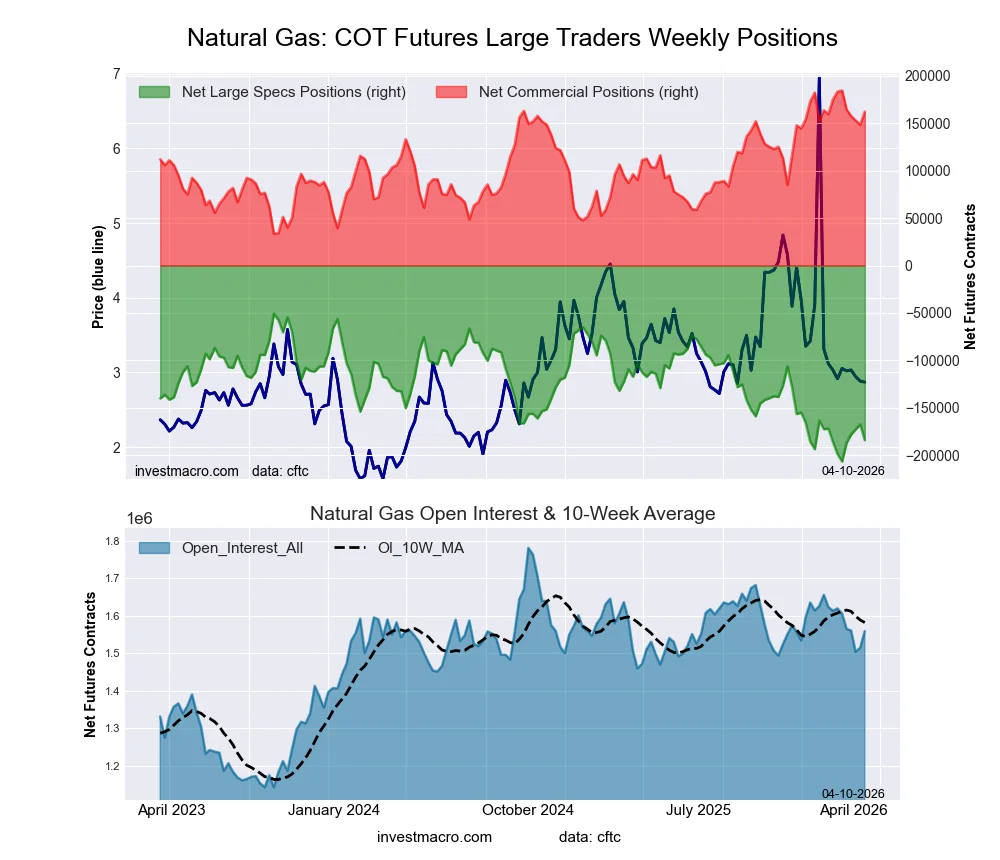
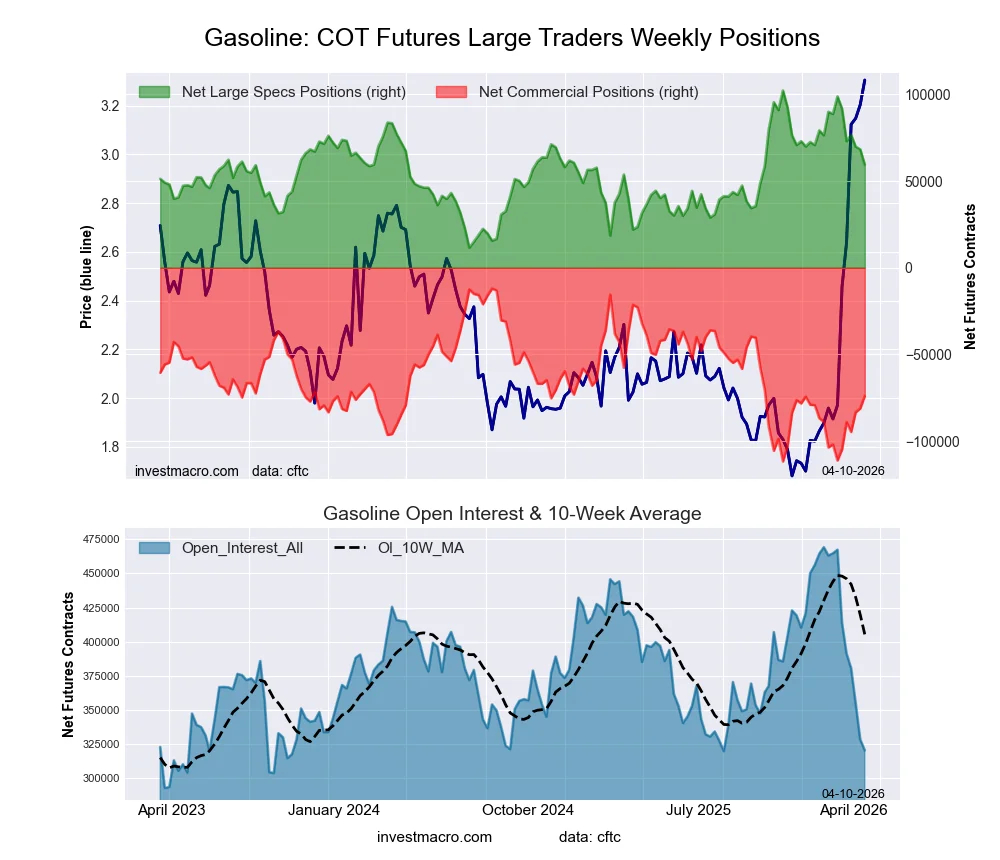
On Tuesday, the US natural gas prices (XNG) surged more than 25% to $3.9 per MMBtu, their highest level in three weeks, as prognoses of a sharp cold snap drove weather-driven price gains. The most severe cold is expected in the final week of January. Meanwhile, gas production remains high, and LNG exports have slightly decreased.

Asian markets declined yesterday. Japan’s Nikkei 225 (JP225) fell by 1.11%, China’s FTSE China A50 (CHA50) dropped 0.90%, Hong Kong’s Hang Seng (HK50) shed 0.29%, and Australia’s ASX 200 (AU200) posted a negative result of 0.66%.
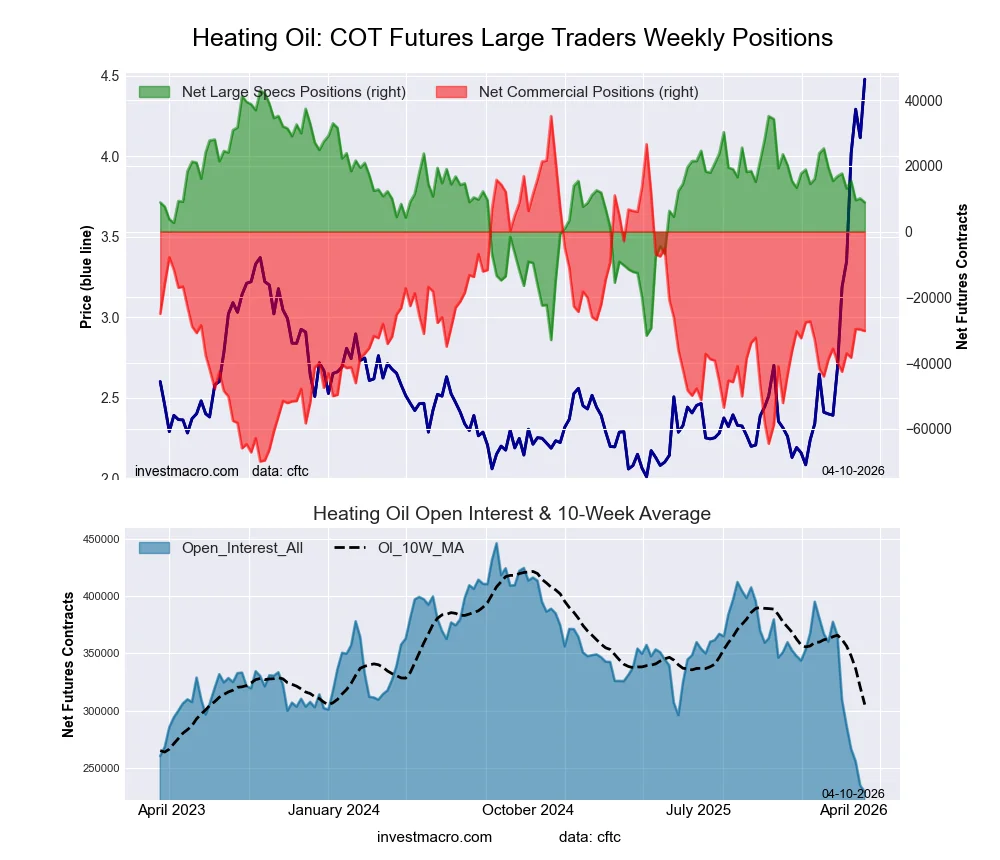
The Australian dollar (AUD) held near a two-week high on Wednesday as the US currency continued to be weighed down by intensifying geopolitical tensions. Investors are also focused on the upcoming release of Australian labor market data, which could influence monetary policy expectations. Projections point to a recovery in employment for December by approximately 30,000 people following an unexpected contraction in November, while the unemployment rate is expected to rise slightly to 4.4%, in line with Reserve Bank of Australia (RBA) estimates. Weaker-than-expected figures would reduce the likelihood of a rate hike in the near term.
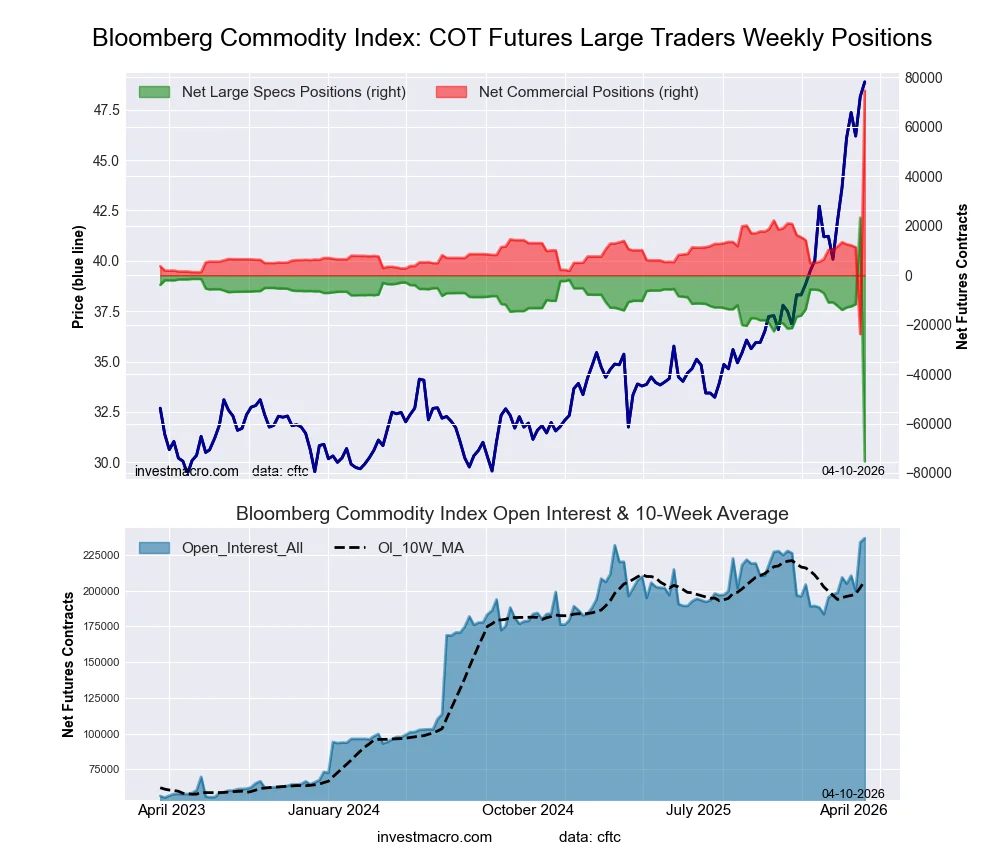
The New Zealand dollar (NZD) traded near $0.583, remaining close to a three-week high amid a weakening US dollar caused by renewed trade tensions between the US and the EU. On the domestic front, a series of encouraging macroeconomic data points toward an accelerating economic recovery in New Zealand, bolstering expectations that the Reserve Bank of New Zealand (RBNZ) will begin tightening monetary policy in the second half of the year. While markets are pricing in almost no change for the February meeting, the probability of a rate hike by July already exceeds 50%.

S&P 500 (US500) 6,796.86 −143.15 (−2.06%)

Dow Jones (US30) 48,488.59 −870.74 (−1.76%)

DAX (DE40) 24,703.12 −255.94 (−1.03%)

FTSE 100 (UK100) 10,126.78 −68.57 (−0.67%)

USD Index 99.58 −0.82% (−0.83%)

News feed for: 2026.01.21

  • UK Inflation Rate (m/m) at 09:00 (GMT+2); – GBP (HIGH)
  • Eurozone ECB President Lagarde Speech at 09:30 (GMT+2); – EUR (LOW)
  • US Pending Home Sales (m/m) at 17:00 (GMT+2). – USD (MED)

By JustMarkets


This article reflects a personal opinion and should not be interpreted as an investment advice, and/or offer, and/or a persistent request for carrying out financial transactions, and/or a guarantee, and/or a forecast of future events.