Archive for Financial News – Page 178

Gold Continues Three-Day Rally Amid Market Uncertainties: A Detailed Analysis

By RoboForex Analytical Department

Gold prices are on a consecutive three-day rise, reaching $1930.00 per Troy ounce as of Monday. The upward trend seems to be fueled by investors seeking a hedge against uncertainties ahead of key events this week.

Investors are keenly awaiting the U.S. Federal Reserve’s decision, which is widely expected to maintain the interest rate at 5.5% per annum. The primary focus will likely be on the Fed’s outlook on the economy and inflation, which should provide valuable insights into the regulator’s future course of action.

Additionally, the Bank of England and the Bank of Japan are set to hold their meetings this week, while the Reserve Bank of Australia (RBA) will release the minutes from its previous meeting.

Another contributing factor to gold’s demand is the sudden depreciation in the yuan exchange rate, making the precious metal more attractive as a safe-haven asset.

Technical Analysis of XAU/USD price chart

On the 4-hour XAU/USD chart, a downward wave has concluded at $1901.00, followed by a corrective rally to $1930.00. A consolidation phase is anticipated below this level. Should the price break below the consolidation range, there’s potential for an extension of the downward wave to $1893.40. The Moving Average Convergence Divergence (MACD) confirms this scenario, with its signal line positioned above zero but appearing to gear up for a downward movement.

On the 1-hour chart, the price has formed a consolidation zone around $1915.85. Breaking out of this range to the upside, it has corrected to $1930.25. A retracement to $1915.00 is anticipated today. If this level is decisively breached, the door may open for a more significant drop to $1893.40. The Stochastic oscillator supports this outlook, showing its signal line above the 80 mark but trending strictly downward.

In summary, gold is experiencing a bullish streak, propelled by market uncertainties and key economic events on the horizon. Technical indicators point towards a possible short-term decline, but overall sentiment appears cautiously optimistic. Investors should closely monitor upcoming central bank meetings and currency fluctuations for further clues on the metal’s future trajectory.

Disclaimer

Any forecasts contained herein are based on the author’s particular opinion. This analysis may not be treated as trading advice. RoboForex bears no responsibility for trading results based on trading recommendations and reviews contained herein.

Dumping All Gold Into This Intraday Bounce

Source: Michael Ballanger  (9/15/23)

Michael Ballanger takes a look at the current state of gold stock and some energy stocks he believes are worth looking into.

Gold

Fourteen days ago, gold moved above its 100-dma around $1,971/ounce, with both MACD and MFI working solid “buy signals.” It appeared that a move to test $2,000/ounce was in the cards, and I took a position on that basis, also noting that gold seasonality favored an October rally.

While seasonally, September is one of the weakest months for gold, I expected that it would, at the very worst, trade sideways to slightly lower until October’s seasonally strong history kicks in, but it has been literally straight down all month, and now has broken the uptrend line drawn off the March and August lows.

From the seasonality chart shown above, you definitely want to be long the gold market going into December, but the question remains: From what level?

If I continue to hold all SPDR Gold Shares ETF (GLD:NYSE) positions while gold heads down to $1,900, I run the risk of a failure at $1,900 (GLD:US $175), and I wind up with a large drawdown on my hands as I await the always-dependable December rally. That rally might only get us back to a breakeven point, which is doubly frustrating.

I am not going to allow the GLD:US trade to deteriorate into another hit, so by the end of trading:

  • Sell all GLD:US and December $175 calls. I will take a breakeven on the calls and a modest gain on the stock and wait for a better entry point sometime later this month or in November.

Western Uranium & Vanadium Corp.

With all of the uranium stocks now catching a bid thanks to a big jump in U3O8 prices at the start of the month, Western Uranium & Vanadium Corp. (WUC:CSE; WSTRF:OTCQX) has once again begun an ascent to higher prices driven by buying from one of the big uranium equity funds south of the border.

First, look at the 7-year chart, which shows the crazy behavior of the uranium market, moving violently in fits and shoves from total disinterest to wild-eyed buy-side mania from out of nowhere and with little advance notice.

The moves in 2018 and 2021 saw bottoms in the early part of those years and peaks in Q4, after which they collapsed back down to earth, where prices drifted sideways month after month.

I did not trade the position because I thought then (and think today) that demand-supply conditions are tilting rapidly in favor for the uranium pricing structure where fifty-seven (57) new nuclear reactors are under construction.

From the chart shown below, you can see that there is a great deal of “room to run” for WUC/WSTRF.

Now, look at the year-to-date chart for the same company, and it tells a somewhat different story.

The stock has blasted off from under CA$0.95 to $1.71 in less than a month, taking RSI to nearly 90 (before pulling back), and both MACD and MFI are now in egregiously “overbought” territories.

Mind you, the run in 2022 saw RSI move above 70 (“overbought”) six times en route to $4.30 from the COVID-19 CRASH low of CA$0.28!

E3 Lithium and Volt Lithium

Due to the stretched RSI and elevated MACD and MFI readings, I would avoid the stock, but once again, I would not try to trade it because it is my only uranium holding in a sector that could easily see new highs for U3O8 above $138 per pound once these new reactors begin taking off all available supply over the next two years.

My theme for the decade is that the electrification movement will place incremental demand-supply pressures on new, clean sources of electricity (nuclear), transmission infrastructure needs (copper), and electricity storage capacity (lithium). Solar and wind are not capable of supplying the grid with enough electricity to satisfy escalating demand, which leaves nuclear energy as the logical heir to the throne.

Uranium producers and developers should do very well in such an environment. However, I have been hearing this for over seven years since I first bought the CA$1.70 placement in WUC:CSE and have twice missed the pops to $3.40 and $4.25. My goal is to take profits at new highs in uranium prices, which has been elusive despite compelling fundamentals.

Trade accordingly.

Last Friday, with E3 Lithium Ltd. (ETL:TSXV;EEMMF:US) trading at $5.00, I put out this chart and got roasted by ETL shareholders from Fairbanks to Boca Raton such that when it hit $5.50 on Tuesday, I was getting emails and DM’s and private messages explaining how I didn’t “get it.”

Here is the updated chart of ETL showing the impact of massively overbought conditions in RSI (above 80), MACD, and MFI, plus chatroom banter talking about a “buyout from Imperial Oil” and “short squeeze to $10 all weekend long.

Volt Lithium Corp. (VLT:TSV;VLTLF:US) is also under pressure, but RSI at 53.83 is now neutral and no longer “overbought.”


Important Disclosures:

  1. Volt Lithium Corp. has a consulting relationship with an affiliate of Streetwise Reports, and pays a monthly consulting fee between US$8,000 and US$20,000.
  2. As of the date of this article, officers and/or employees of Streetwise Reports LLC (including members of their household) own securities of Volt Lithium Corp. and Western Uranium & Vanadium Corp.
  3. Michael Ballanger: I, or members of my immediate household or family, own securities of: All. My company has a financial relationship with Volt. I determined which companies would be included in this article based on my research and understanding of the sector.
  4. Statements and opinions expressed are the opinions of the author and not of Streetwise Reports or its officers. The author is wholly responsible for the validity of the statements. The author was not paid by Streetwise Reports for this article. Streetwise Reports was not paid by the author to publish or syndicate this article. Streetwise Reports requires contributing authors to disclose any shareholdings in, or economic relationships with, companies that they write about. Streetwise Reports relies upon the authors to accurately provide this information and Streetwise Reports has no means of verifying its accuracy.
  5.  This article does not constitute investment advice. Each reader is encouraged to consult with his or her individual financial professional. By opening this page, each reader accepts and agrees to Streetwise Reports’ terms of use and full legal disclaimer. This article is not a solicitation for investment. Streetwise Reports does not render general or specific investment advice and the information on Streetwise Reports should not be considered a recommendation to buy or sell any security. Streetwise Reports does not endorse or recommend the business, products, services or securities of any company.

For additional disclosures, please click here.

Michael Ballanger Disclosures

This letter makes no guarantee or warranty on the accuracy or completeness of the data provided. Nothing contained herein is intended or shall be deemed to be investment advice, implied or otherwise. This letter represents my views and replicates trades that I am making but nothing more than that. Always consult your registered advisor to assist you with your investments. I accept no liability for any loss arising from the use of the data contained on this letter. Options and junior mining stocks contain a high level of risk that may result in the loss of part or all invested capital and therefore are suitable for experienced and professional investors and traders only. One should be familiar with the risks involved in junior mining and options trading and we recommend consulting a financial adviser if you feel you do not understand the risks involved.

China’s economic indicators have started to improve. US stock indices are under pressure from the risk of economic instability

By JustMarkets

As of Friday’s stock market close, the Dow Jones Index (US30) decreased by 0.83% (-0.09% for the week), while the S&P 500 Index (US500) fell by 1.22% (-0.68% for the week). The NASDAQ Technology Index (US100) closed Friday negative by 1.56% (-1.27% for the week).

The US dollar came under pressure on Friday after reports from the University of Michigan on consumer sentiment and inflation expectations fell more than expected, a dovish factor for Fed policy. The University of Michigan’s inflation expectations for September unexpectedly fell to a .5-year low of 3.1%, better than expectations of 3.5%. The University of Michigan’s US Consumer Sentiment Index for September fell by 1.8 to 67.7, weaker than expectations of 69.0. Other data showed that US manufacturing output for August rose by 0.1% m/m, in line with expectations. Industrial production rose by 0.4% m/m in August, stronger than expectations of 0.1% m/m.

The Fed will hold its monetary policy meeting this week. Economists believe that economic instability in the US (as indicated in past FOMC minutes) could go too far and increase the likelihood of a recession. Given this risk, as well as the positive trend in inflation and labor costs, analysts predict that the Fed will hold the rate for several months, and the data flow will gradually weaken the case for a rate hike in November or December. Markets rate the odds of a 25 bps rate hike at the September 20 FOMC meeting at 4% and a 25 bps rate hike at the November 1 FOMC meeting at 33%.

In Canada, the government has begun to tackle the housing crisis. In an effort to boost supply, the Canadian government announced Friday that it will eliminate the federal 5% consumption tax on the construction of new rental apartments and urged cities to be more proactive in addressing the problem.

Equity markets in Europe were mostly up on Friday. Germany’s DAX (DE40) increased by 0.56% (+0.60% for the week), France’s CAC 40 (FR40) gained 0.96% (+1.42% for the week), Spain’s IBEX 35 (ES35) added 0.01% (+1.55% for the week), and the UK’s FTSE 100 (UK100) closed up by 0.50% (+3.12% for the week). The ECB’s hawkish comments on Friday provided a boost for the euro, with European indices also reacting positively. ECB President Lagarde said that the ECB is not discussing cutting interest rates. Meanwhile, ECB Governing Council representative Vasle said that core inflation remains relatively high and did not rule out further interest rate hikes.

Silver (XAGUSD) gained support on Friday after stronger-than-expected reports on Chinese industrial production for August and US industrial production for August were stronger than expected, which is favorable for demand for industrial metals.

A weaker dollar on Friday provided support for energy prices. In addition, stronger-than-expected economic reports from China, the world’s second-largest oil consumer, supported energy demand. Crude oil has been supported since last Tuesday when the International Energy Agency (IEA) and OPEC said the global oil market will be in deficit for the rest of the year. On the bearish side was Friday’s drop in stocks, which undermined confidence in the outlook for the economy and energy demand.

Asian markets were mostly up last week. Japan’s Nikkei 225 (JP225) gained 2.58% for the week, China’s FTSE China A50 (CHA50) fell by 1.33%, Hong Kong’s Hang Seng (HK50) ended the week up by 1.34%, and Australia’s S&P/ASX 200 (AU200) ended the week positive by 1.71%.

The only data to focus on for China this week will be the PBoC’s decision on 1-year and 5-year loans on Wednesday. After commercial banks left the 1-year medium-term lending rate unchanged at 2.50% on Friday following a 25 basis point cut in the commercial banks’ reserve requirement ratio, it is likely that the 1-year and 5-year lending rates will remain unchanged at 3.45% and 4.2%, respectively. China’s economic data has recently started to improve. Retail sales rose by 4.6% y/y in August, beating the consensus forecast of 3% as well as July’s 2.5%, the highest growth rate since May. The August industrial production figure also beat expectations of 3.9% and rose 4.5% y/y, the highest rate since April.

S&P 500 (F)(US500) 4,450.32  −54.78 (−1.22%)

Dow Jones (US30) 34,618.24 −288.87 (−0.83%)

DAX (DE40)  15,893.53 +88.24 (+0.56%)

FTSE 100 (UK100) 7,711.38 +38.30 (+0.50%)

USD Index  105.33 −0.07 (−0.07%)

There are no important events for today.

By JustMarkets


This article reflects a personal opinion and should not be interpreted as an investment advice, and/or offer, and/or a persistent request for carrying out financial transactions, and/or a guarantee, and/or a forecast of future events.

Trade Of The Week: GBPUSD Braces For Fed & BoE Combo

By ForexTime 

  • Fed/BoE combo could trigger GBPUSD volatility
  • Watch out for UK CPI report mid-week
  • Fed widely expected to leave rates unchanged
  • BoE expected to hike rates by 25 basis points
  • GBPUSD could see big moves, keep eye on 1.2430 level

A super central bank combo featuring the Federal Reserve and Bank of England may trigger extreme levels of volatility in the GBPUSD this week.

The past few months have been rocky for Sterling which is down roughly 2.4% in the second half of 2023 thus far.

Pound bears seem to be drawing strength from stagflation fears amid rising unemployment, sticky inflation, and stagnant economic growth.

Buying sentiment towards the currency has also been hit by disappointing economic data, further supporting Governor Andrew Bailey’s comments about the BoE nearing the end of its hiking cycle. Taking a glance at the technicals, the GBPUSD is approaching weekly support at 1.2310 – where the 50-week SMA resides.

The GBPUSD could see big moves this week and here and 3 reasons why…

  1. BoE rate decision

The Bank of England (BoE) monetary policy decision will be on Thursday 21st September.

24 hours before the BoE decision, the latest UK inflation figures will be published with markets forecasting CPI to rise 7.0%, up from the July print of 6.8%. Core inflation is projected to cool 6.8% year-on-year, down from 6.9% in the previous month. This report could influence expectations around what the BoE does beyond September.

Markets widely expect the BoE to raise interest rates by 25 basis points. This would be the 15th straight hike, taking the key rate to 5.5% – its highest level since 2007. The key question is whether this will be the final rate hike as policymakers weigh sticky inflation against growth concerns.

Traders are currently pricing in a 79% probability of a 25 basis point hike on Thursday, with the probability of another 25 basis point hike by December currently standing at 45%.

  • If the BoE raises rates and signals the possibility of another 25 basis point hike before the end of 2023, this could propel the GBPUSD higher.
  • A dovish sounding BoE that hikes interest rates but hints that this could be the final move for the remainder of 2023 may drag the GBPUSD lower.
  1. Fed rate decision

Markets widely expect the Federal Reserve to leave interest rates unchanged at 5.5% at the September 19-20 meeting.

Investors will direct their attention towards the economic projections, dot plots and press conference by Jerome Powell which could offer clues on future rate hikes.

  • The GBPUSD may find itself under renewed pressure if the Fed signals one more interest rate increase in 2023.
  • Should the central bank hint that it could be done with hikes for the rest of 2023, this may weaken the dollar – pushing the GBPUSD higher as a result.
  1. Bearish technical forces

The GBPUSD remains under pressure on the daily timeframe as there have been consistently lower lows and lower highs.

Prices are trading below the 50, 100, and 200-day SMA while the MACD trades below zero. Bears are certainly in a position of power with the recent daily close below the 200-day SMA opening the doors to further downside.

  • Sustained weakness below 1.2430 could encourage a decline towards 1.2310 and 1.2250, respectively.
  • Should prices push back above the 200-day SMA at 1.2430, this could spark a rebound back toward the 1.2540 level and 1.2646 where the 100-day SMA resides.


Forex-Time-LogoArticle by ForexTime

ForexTime Ltd (FXTM) is an award winning international online forex broker regulated by CySEC 185/12 www.forextime.com

“Climbing Oil Prices Bearish for Stocks”? It’s a Myth!

Oil and stocks sometimes trend together. Other times, they don’t.

By Elliott Wave International

There’s a widespread belief that rising oil prices are bearish for the main stock indexes and falling oil prices are bullish for stocks.

That belief is reflected in this Sept. 5 CNBC headline:

Dow closes nearly 200 points lower as rising oil prices drag down stocks …

But wait a minute, the broad stock market rallied in July as the price of crude oil was also climbing.

Getting back to the same financial website, an Aug. 1 headline said (CNBC):

Oil joined the July stocks rally …

Going further back this year, an April 14 Barron’s headline noted:

Oil Prices and Stocks Have Rallied …

These cases here in 2023 are by no means the first time that the behavior of the oil and stock markets have defied conventional wisdom.

Here’s a chart and commentary from Robert Prechter’s landmark book, The Socionomic Theory of Finance:

The July 25, 2006 issue of The Elliott Wave Theorist offered [this chart], showing the preceding three-year market environment. Examine it and see if you can discern any indication whatsoever that lower oil prices make stocks rise or vice versa. As I said at the time, “Oil and stocks have trended mostly in the same direction for more than three years.

And, as you can see from this next chart, stocks and oil also crashed together for much of 2008 going into 2009. And then rose together — again, with crude oil tripling in value as the S&P 500 index doubled in value.

So, maybe rising oil prices do not “make” stocks fall after all (and vice versa.)

Every market has its own investor psychology that drives it. You may want to look to the Elliott wave model for a high-confidence ascertainment of the oil and stock markets independently from each other.

If you want to delve into the details of Elliott wave analysis, an ideal resource is Frost & Prechter’s book, Elliott Wave Principle: Key to Market Behavior. Here’s a quote from this Wall Street classic:

After you have acquired an Elliott “touch,” it will be forever with you, just as a child who learns to ride a bicycle never forgets. Thereafter, catching a turn becomes a fairly common experience and not really too difficult. Furthermore, by giving you a feeling of confidence as to where you are in the progress of the market, a knowledge of Elliott can prepare you psychologically for the fluctuating nature of price movement and free you from sharing the widely practiced analytical error of forever projecting today’s trends linearly into the future. Most important, the Wave Principle often indicates in advance the relative magnitude of the next period of market progress or regress.

Here’s good news: You can access the entire online version of the book for free!

The only requirement for free access is a Club EWI membership — which is also free. Club EWI is the world’s largest Elliott wave educational community with about 500,000 worldwide members.

Club EWI members enjoy complimentary access to a wealth of Elliott wave resources on financial markets, investing and trading — including videos and articles from Elliott Wave International’s analysts.

Get started by following this link: Elliott Wave Principle: Key to Market Behaviorget free and instant access.

This article was syndicated by Elliott Wave International and was originally published under the headline “Climbing Oil Prices Bearish for Stocks”? It’s a Myth!. EWI is the world’s largest market forecasting firm. Its staff of full-time analysts led by Chartered Market Technician Robert Prechter provides 24-hour-a-day market analysis to institutional and private investors around the world.

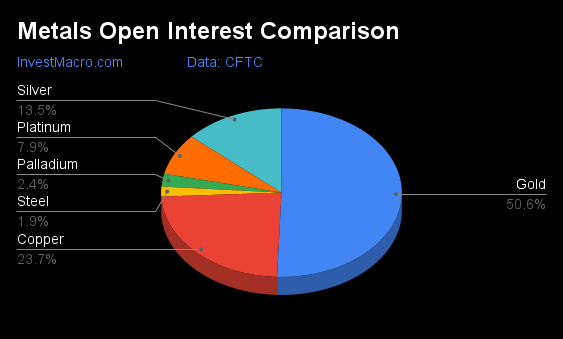
COT Metals Charts: Speculator Bets led lower by Gold, Silver & Platinum

By InvestMacro

Here are the latest charts and statistics for the Commitment of Traders (COT) data published by the Commodities Futures Trading Commission (CFTC).

The latest COT data is updated through Tuesday September 12th and shows a quick view of how large traders (for-profit speculators and commercial entities) were positioned in the futures markets.

Weekly Speculator Bets led lower by Gold, Silver & Platinum

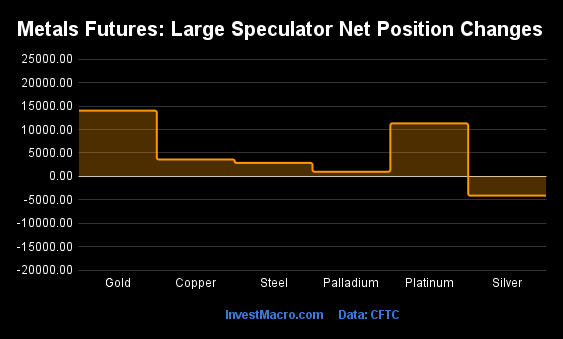
The COT metals markets speculator bets were overall lower this week as just one out of the six metals markets we cover had higher positioning while the other five markets had lower speculator contracts.

Leading the gains for the metals was Palladium (309 contracts) with also showing positive weeks.

The markets with declines in speculator bets for the week were Gold (-14,142 contracts) with Silver (-8,771 contracts), Platinum (-7,881 contracts), Copper (-5,564 contracts) and Steel (-588 contracts) also registering lower bets on the week.


Data Snapshot of Commodity Market Traders | Columns Legend
Sep-12-2023OIOI-IndexSpec-NetSpec-IndexCom-NetCOM-IndexSmalls-NetSmalls-Index
Gold441,2219123,86432-144,8106820,94632
Silver125,2921418,03344-32,0405514,00744
Copper196,19839-12,334209,886802,44834
Palladium17,83882-10,712210,76199-4939
Platinum87,0211006,72131-12,396685,67544


Strength Scores led by Steel & Silver

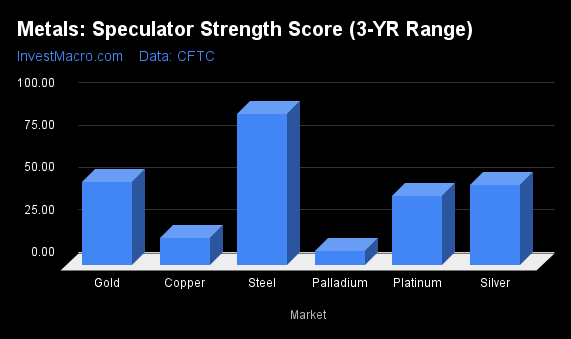
COT Strength Scores (a normalized measure of Speculator positions over a 3-Year range, from 0 to 100 where above 80 is Extreme-Bullish and below 20 is Extreme-Bearish) showed that Steel (61 percent) and Silver (44 percent) lead the metals markets this week. Palladium (2 percent) comes in as the next highest in the weekly strength scores.

On the downside, Copper (20 percent) comes in at the lowest strength level currently and is in Extreme-Bearish territory (below 20 percent). The next lowest strength score was Platinum (31 percent).

Strength Statistics:
Gold (31.6 percent) vs Gold previous week (37.8 percent)
Silver (44.0 percent) vs Silver previous week (56.5 percent)
Copper (20.2 percent) vs Copper previous week (25.0 percent)
Platinum (31.1 percent) vs Platinum previous week (49.3 percent)
Palladium (2.1 percent) vs Palladium previous week (0.0 percent)
Steel (60.6 percent) vs Palladium previous week (62.3 percent)

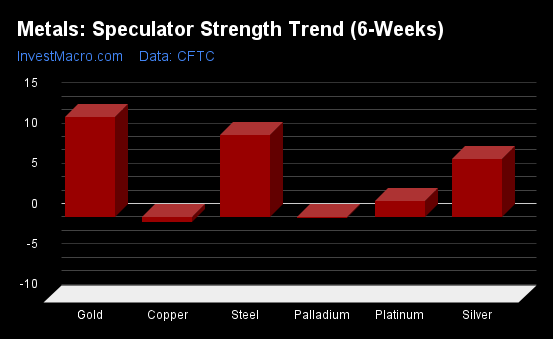
Steel & Palladium top the 6-Week Strength Trends

COT Strength Score Trends (or move index, calculates the 6-week changes in strength scores) showed that Steel (-9 percent) and Palladium (-10 percent) lead the past six weeks trends for metals. Silver (-18 percent) is the next highest positive mover in the latest trends data.

Gold (-18 percent) leads the downside trend scores currently with Copper (-20 percent) as the next market with lower trend scores.

Move Statistics:
Gold (-18.1 percent) vs Gold previous week (-15.7 percent)
Silver (-18.3 percent) vs Silver previous week (-14.4 percent)
Copper (-19.9 percent) vs Copper previous week (-6.9 percent)
Platinum (-12.9 percent) vs Platinum previous week (-2.0 percent)
Palladium (-9.6 percent) vs Palladium previous week (-17.9 percent)
Steel (-8.9 percent) vs Steel previous week (-8.1 percent)


Individual Markets:

Gold Comex Futures:

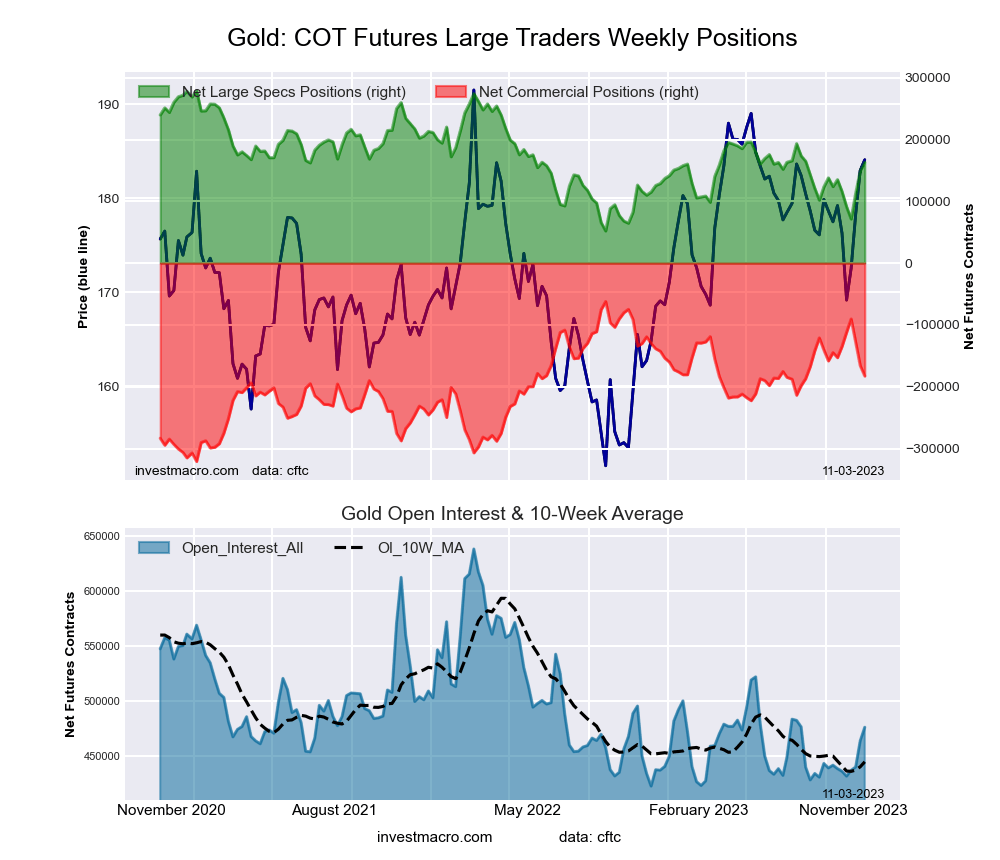
Gold Futures COT ChartThe Gold Comex Futures large speculator standing this week came in at a net position of 123,864 contracts in the data reported through Tuesday. This was a weekly lowering of -14,142 contracts from the previous week which had a total of 138,006 net contracts.

This week’s current strength score (the trader positioning range over the past three years, measured from 0 to 100) shows the speculators are currently Bearish with a score of 31.6 percent. The commercials are Bullish with a score of 68.1 percent and the small traders (not shown in chart) are Bearish with a score of 32.4 percent.

Price Trend-Following Model: Downtrend

Our weekly trend-following model classifies the current market price position as: Downtrend. The current action for the model is considered to be: Hold – Maintain Short Position.

Gold Futures StatisticsSPECULATORSCOMMERCIALSSMALL TRADERS
– Percent of Open Interest Longs:53.425.610.6
– Percent of Open Interest Shorts:25.358.45.8
– Net Position:123,864-144,81020,946
– Gross Longs:235,704113,06246,740
– Gross Shorts:111,840257,87225,794
– Long to Short Ratio:2.1 to 10.4 to 11.8 to 1
NET POSITION TREND:
– Strength Index Score (3 Year Range Pct):31.668.132.4
– Strength Index Reading (3 Year Range):BearishBullishBearish
NET POSITION MOVEMENT INDEX:
– 6-Week Change in Strength Index:-18.116.2-2.5


Silver Comex Futures:

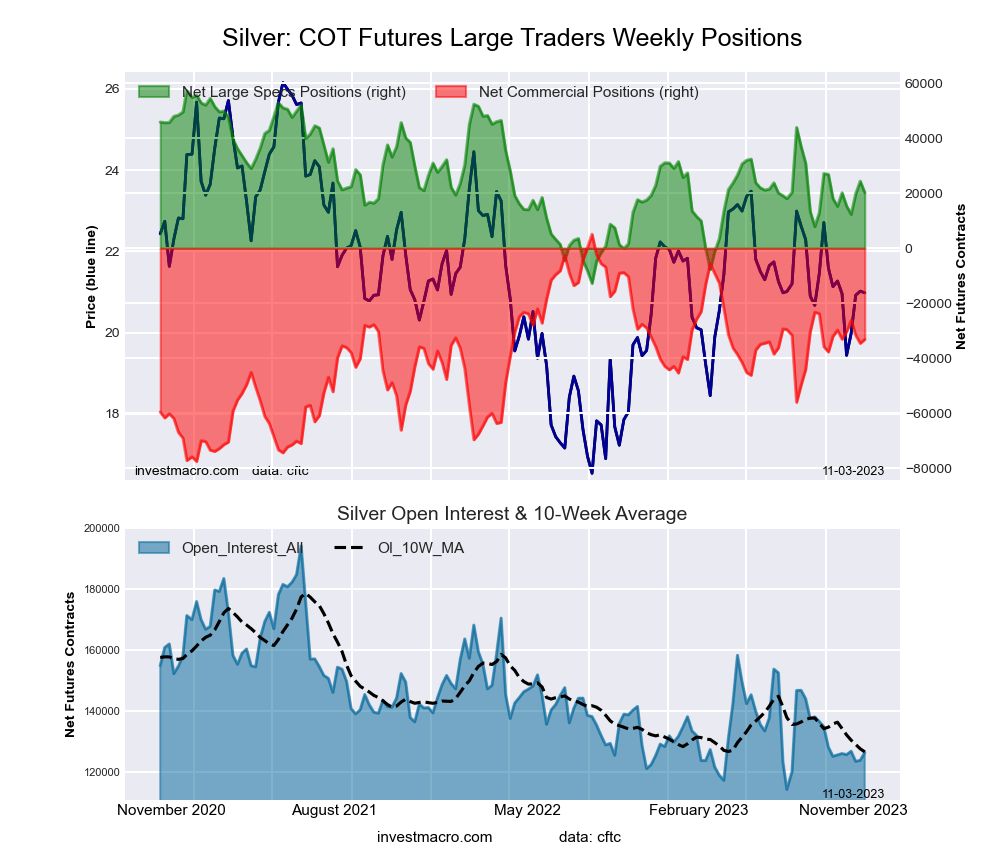
Silver Futures COT ChartThe Silver Comex Futures large speculator standing this week came in at a net position of 18,033 contracts in the data reported through Tuesday. This was a weekly reduction of -8,771 contracts from the previous week which had a total of 26,804 net contracts.

This week’s current strength score (the trader positioning range over the past three years, measured from 0 to 100) shows the speculators are currently Bearish with a score of 44.0 percent. The commercials are Bullish with a score of 55.1 percent and the small traders (not shown in chart) are Bearish with a score of 44.3 percent.

Price Trend-Following Model: Strong Downtrend

Our weekly trend-following model classifies the current market price position as: Strong Downtrend. The current action for the model is considered to be: Hold – Maintain Short Position.

Silver Futures StatisticsSPECULATORSCOMMERCIALSSMALL TRADERS
– Percent of Open Interest Longs:42.331.921.1
– Percent of Open Interest Shorts:27.957.59.9
– Net Position:18,033-32,04014,007
– Gross Longs:52,96340,03026,427
– Gross Shorts:34,93072,07012,420
– Long to Short Ratio:1.5 to 10.6 to 12.1 to 1
NET POSITION TREND:
– Strength Index Score (3 Year Range Pct):44.055.144.3
– Strength Index Reading (3 Year Range):BearishBullishBearish
NET POSITION MOVEMENT INDEX:
– 6-Week Change in Strength Index:-18.314.54.6


Copper Grade #1 Futures:

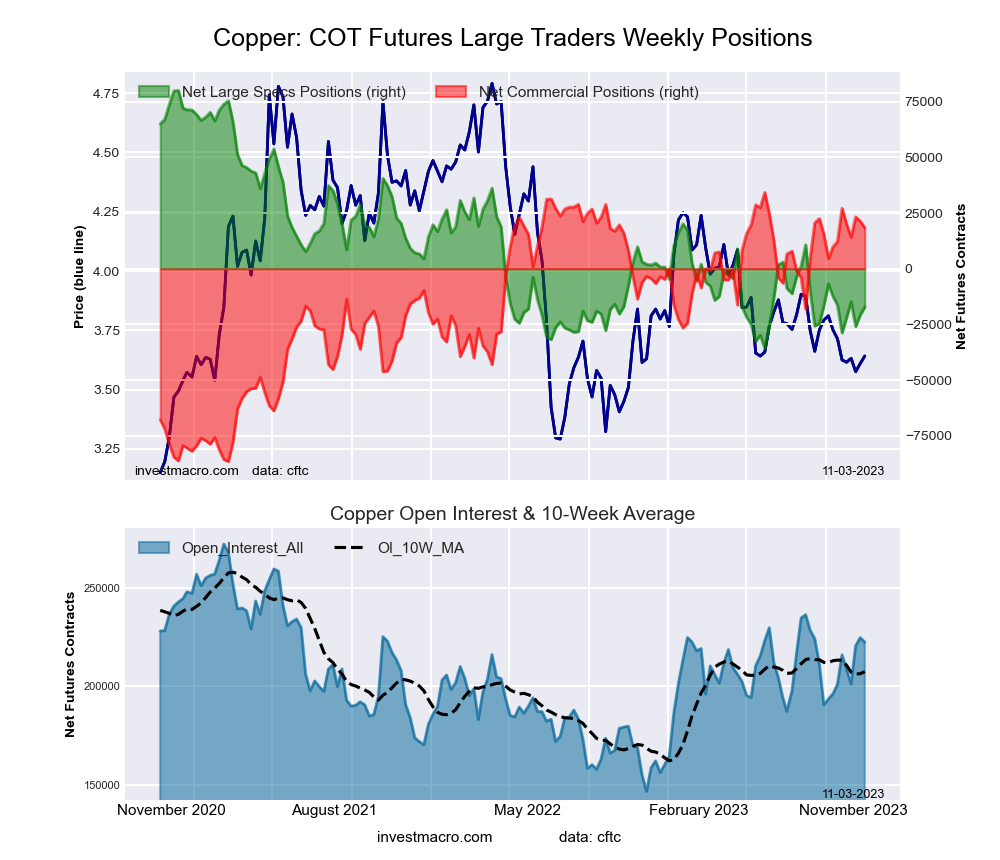
Copper Futures COT ChartThe Copper Grade #1 Futures large speculator standing this week came in at a net position of -12,334 contracts in the data reported through Tuesday. This was a weekly reduction of -5,564 contracts from the previous week which had a total of -6,770 net contracts.

This week’s current strength score (the trader positioning range over the past three years, measured from 0 to 100) shows the speculators are currently Bearish with a score of 20.2 percent. The commercials are Bullish with a score of 79.8 percent and the small traders (not shown in chart) are Bearish with a score of 33.9 percent.

Price Trend-Following Model: Weak Downtrend

Our weekly trend-following model classifies the current market price position as: Weak Downtrend. The current action for the model is considered to be: Hold – Maintain Short Position.

Copper Futures StatisticsSPECULATORSCOMMERCIALSSMALL TRADERS
– Percent of Open Interest Longs:34.339.08.2
– Percent of Open Interest Shorts:40.634.06.9
– Net Position:-12,3349,8862,448
– Gross Longs:67,33376,56116,045
– Gross Shorts:79,66766,67513,597
– Long to Short Ratio:0.8 to 11.1 to 11.2 to 1
NET POSITION TREND:
– Strength Index Score (3 Year Range Pct):20.279.833.9
– Strength Index Reading (3 Year Range):BearishBullishBearish
NET POSITION MOVEMENT INDEX:
– 6-Week Change in Strength Index:-19.923.2-31.3


Platinum Futures:

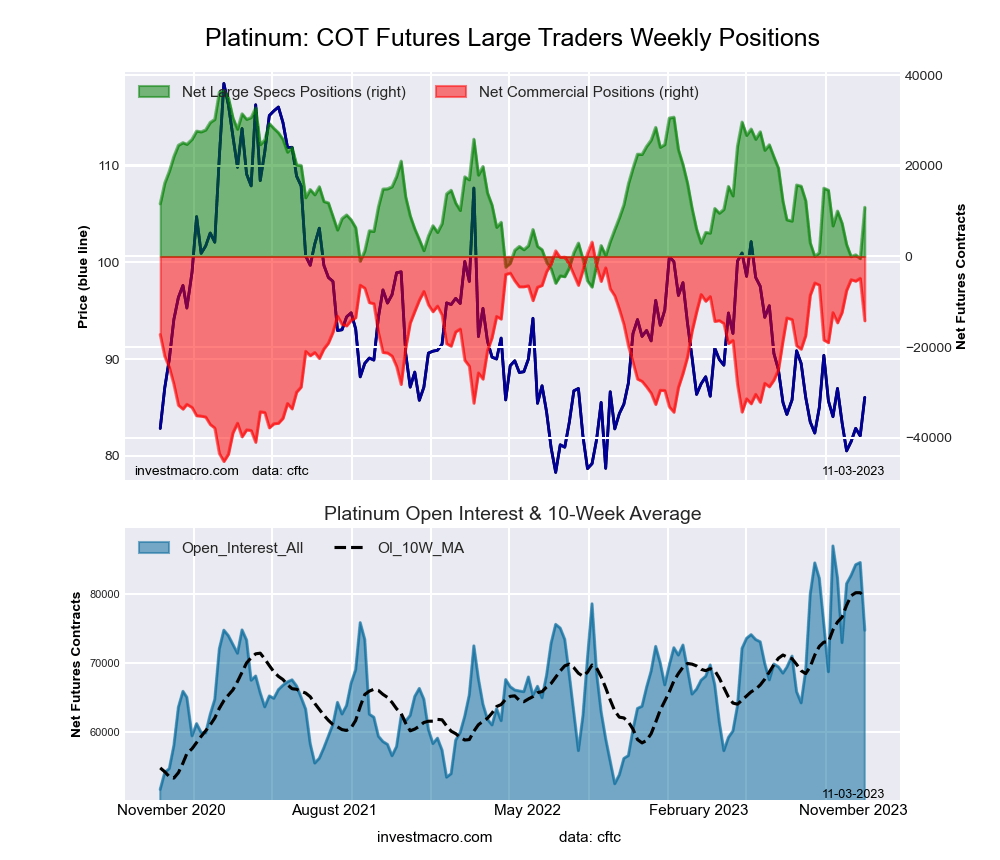
Platinum Futures COT ChartThe Platinum Futures large speculator standing this week came in at a net position of 6,721 contracts in the data reported through Tuesday. This was a weekly decline of -7,881 contracts from the previous week which had a total of 14,602 net contracts.

This week’s current strength score (the trader positioning range over the past three years, measured from 0 to 100) shows the speculators are currently Bearish with a score of 31.1 percent. The commercials are Bullish with a score of 67.9 percent and the small traders (not shown in chart) are Bearish with a score of 44.0 percent.

Price Trend-Following Model: Downtrend

Our weekly trend-following model classifies the current market price position as: Downtrend. The current action for the model is considered to be: Hold – Maintain Short Position.

Platinum Futures StatisticsSPECULATORSCOMMERCIALSSMALL TRADERS
– Percent of Open Interest Longs:50.123.010.4
– Percent of Open Interest Shorts:42.437.23.9
– Net Position:6,721-12,3965,675
– Gross Longs:43,61919,9999,083
– Gross Shorts:36,89832,3953,408
– Long to Short Ratio:1.2 to 10.6 to 12.7 to 1
NET POSITION TREND:
– Strength Index Score (3 Year Range Pct):31.167.944.0
– Strength Index Reading (3 Year Range):BearishBullishBearish
NET POSITION MOVEMENT INDEX:
– 6-Week Change in Strength Index:-12.910.56.7


Palladium Futures:

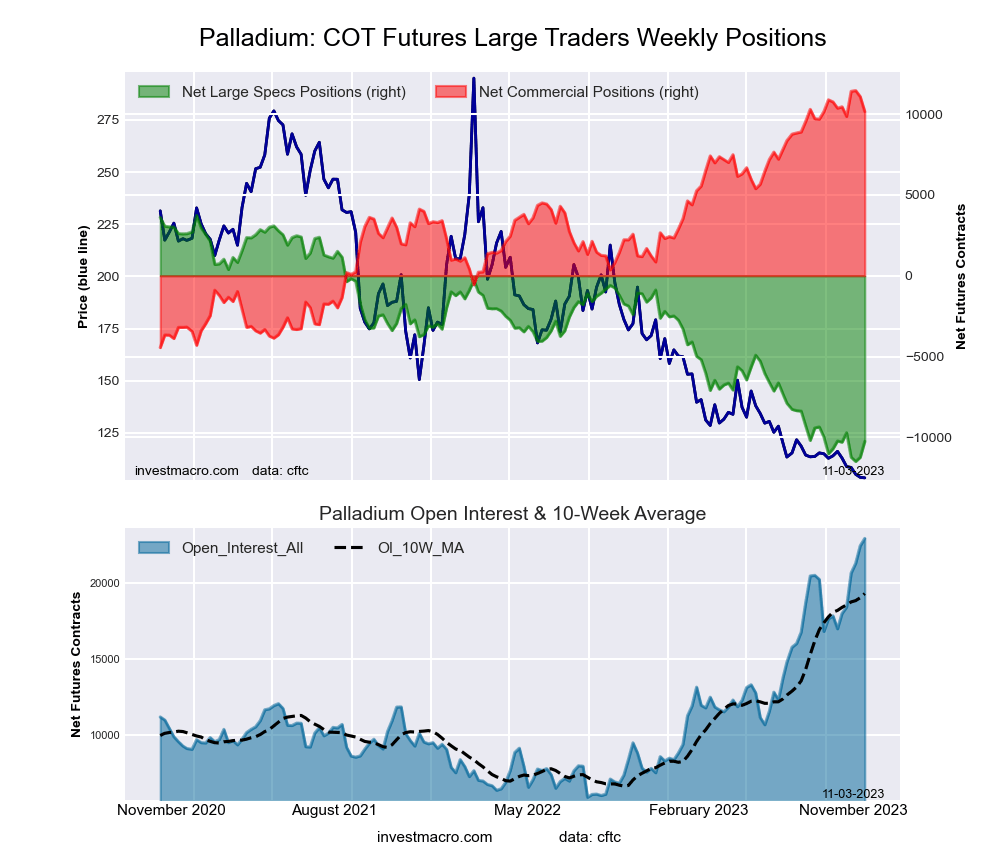
Palladium Futures COT ChartThe Palladium Futures large speculator standing this week came in at a net position of -10,712 contracts in the data reported through Tuesday. This was a weekly gain of 309 contracts from the previous week which had a total of -11,021 net contracts.

This week’s current strength score (the trader positioning range over the past three years, measured from 0 to 100) shows the speculators are currently Bearish-Extreme with a score of 2.1 percent. The commercials are Bullish-Extreme with a score of 99.2 percent and the small traders (not shown in chart) are Bearish with a score of 38.8 percent.

Price Trend-Following Model: Downtrend

Our weekly trend-following model classifies the current market price position as: Downtrend. The current action for the model is considered to be: Hold – Maintain Short Position.

Palladium Futures StatisticsSPECULATORSCOMMERCIALSSMALL TRADERS
– Percent of Open Interest Longs:25.062.99.1
– Percent of Open Interest Shorts:85.02.69.4
– Net Position:-10,71210,761-49
– Gross Longs:4,45211,2171,627
– Gross Shorts:15,1644561,676
– Long to Short Ratio:0.3 to 124.6 to 11.0 to 1
NET POSITION TREND:
– Strength Index Score (3 Year Range Pct):2.199.238.8
– Strength Index Reading (3 Year Range):Bearish-ExtremeBullish-ExtremeBearish
NET POSITION MOVEMENT INDEX:
– 6-Week Change in Strength Index:-9.67.912.6


Steel Futures Futures:

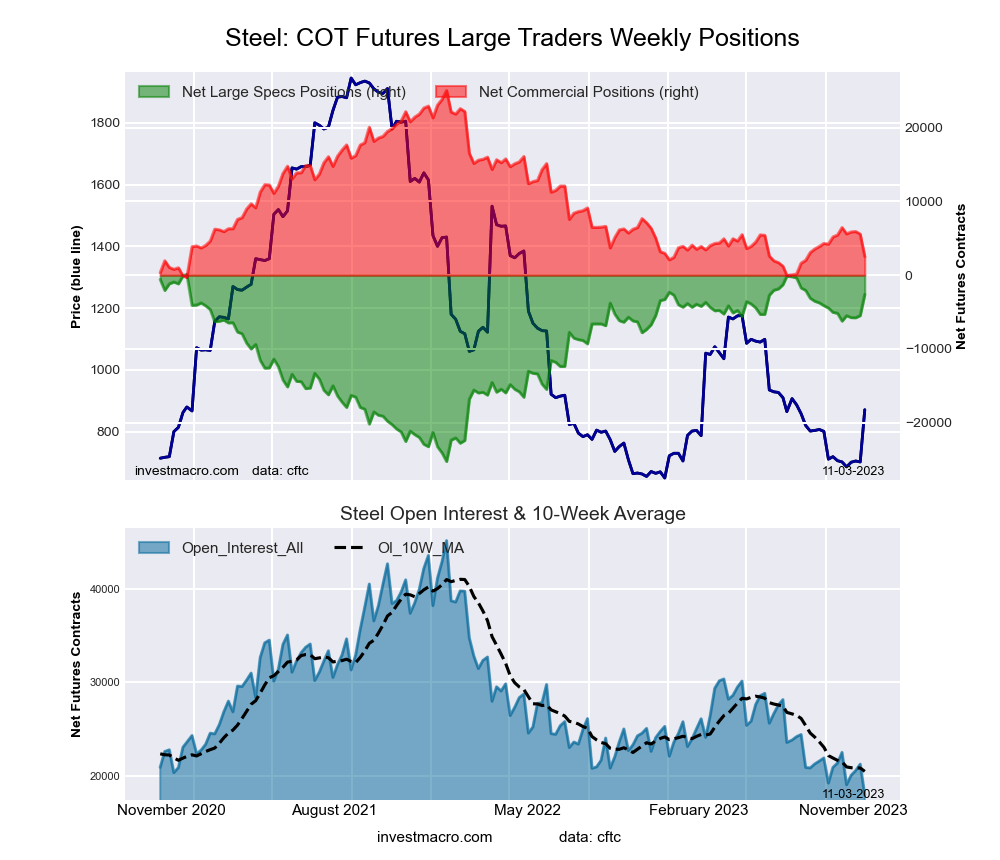
Steel Futures COT ChartThe Steel Futures large speculator standing this week came in at a net position of -5,030 contracts in the data reported through Tuesday. This was a weekly decrease of -588 contracts from the previous week which had a total of -4,442 net contracts.

This week’s current strength score (the trader positioning range over the past three years, measured from 0 to 100) shows the speculators are currently Bullish with a score of 60.6 percent. The commercials are Bearish with a score of 40.0 percent and the small traders (not shown in chart) are Bearish-Extreme with a score of 4.6 percent.

Price Trend-Following Model: Downtrend

Our weekly trend-following model classifies the current market price position as: Downtrend. The current action for the model is considered to be: Hold – Maintain Short Position.

Steel Futures StatisticsSPECULATORSCOMMERCIALSSMALL TRADERS
– Percent of Open Interest Longs:5.588.01.0
– Percent of Open Interest Shorts:29.663.21.8
– Net Position:-5,0305,182-152
– Gross Longs:1,15418,389215
– Gross Shorts:6,18413,207367
– Long to Short Ratio:0.2 to 11.4 to 10.6 to 1
NET POSITION TREND:
– Strength Index Score (3 Year Range Pct):60.640.04.6
– Strength Index Reading (3 Year Range):BullishBearishBearish-Extreme
NET POSITION MOVEMENT INDEX:
– 6-Week Change in Strength Index:-8.99.5-22.9


Article By InvestMacroReceive our weekly COT Newsletter

*COT Report: The COT data, released weekly to the public each Friday, is updated through the most recent Tuesday (data is 3 days old) and shows a quick view of how large speculators or non-commercials (for-profit traders) were positioned in the futures markets.

The CFTC categorizes trader positions according to commercial hedgers (traders who use futures contracts for hedging as part of the business), non-commercials (large traders who speculate to realize trading profits) and nonreportable traders (usually small traders/speculators) as well as their open interest (contracts open in the market at time of reporting). See CFTC criteria here.

COT Bonds Charts: Speculator Bets led by 10-Year Bonds & SOFR 3-Months

By InvestMacro

Here are the latest charts and statistics for the Commitment of Traders (COT) reports data published by the Commodities Futures Trading Commission (CFTC).

The latest COT data is updated through Tuesday September 12th and shows a quick view of how large traders (for-profit speculators and commercial hedgers) were positioned in the futures markets.

Weekly Speculator Changes led by 10-Year Bonds & SOFR 3-Months

The COT bond market speculator bets were higher this week as six out of the eight bond markets we cover had higher positioning while the other two markets had lower speculator contracts.

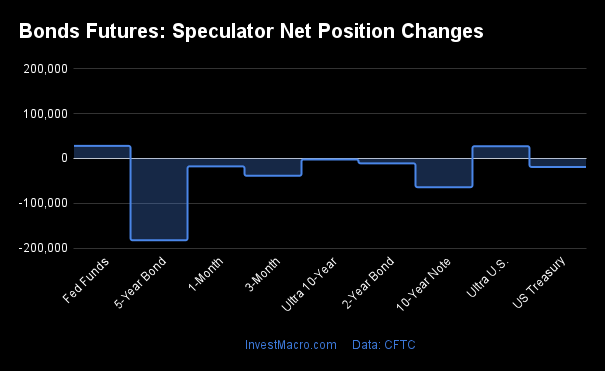
Leading the gains for the bond markets was the 10-Year Bonds (47,233 contracts) with SOFR 3-Months (44,439 contracts), the Ultra 10-Year Bonds (30,615 contracts), the 5-Year Bonds (25,238 contracts), the US Treasury Bonds (5,605 contracts) and the Ultra Treasury Bonds (1,346 contracts) also showing positive weeks.

The bond markets with declines in speculator bets for the week were the Fed Funds with a drop by -38,064 contracts and the 2-Year Bonds with a decline of -21,719 contracts on the week.


Data Snapshot of Bond Market Traders | Columns Legend
Sep-12-2023OIOI-IndexSpec-NetSpec-IndexCom-NetCOM-IndexSmalls-NetSmalls-Index
SOFR-3-Months10,667,873100316,51199-313,4380-3,07386
FedFunds1,458,26143-184,95425195,04075-10,08671
2-Year3,653,52085-1,239,60921,128,53999111,07093
Long T-Bond1,339,67572-192,68722152,6636540,02478
10-Year4,681,03287-744,30210720,2109524,09279
5-Year5,391,83085-1,031,03017954,4447976,58690


Strength Scores led by SOFR 3-Months & Ultra Treasury Bonds

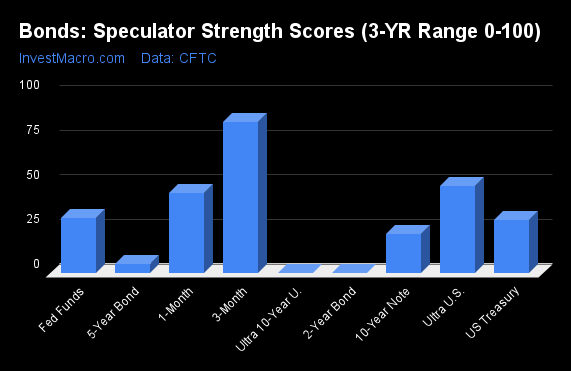
COT Strength Scores (a normalized measure of Speculator positions over a 3-Year range, from 0 to 100 where above 80 is Extreme-Bullish and below 20 is Extreme-Bearish) showed that the SOFR 3-Months (99 percent) leads the bond markets this week. The Ultra Treasury Bonds (32 percent) comes in as the next highest in the weekly strength scores.

On the downside, the 2-Year Bonds (2 percent), the 10-Year Bonds (10 percent), the Ultra 10-Year Bonds (15 percent) and the 5-Year Bonds (17 percent) come in at the lowest strength level currently and are in Extreme-Bearish territory (below 20 percent).

Strength Statistics:
Fed Funds (24.9 percent) vs Fed Funds previous week (31.9 percent)
2-Year Bond (2.3 percent) vs 2-Year Bond previous week (3.9 percent)
5-Year Bond (16.7 percent) vs 5-Year Bond previous week (14.8 percent)
10-Year Bond (10.3 percent) vs 10-Year Bond previous week (5.7 percent)
Ultra 10-Year Bond (14.6 percent) vs Ultra 10-Year Bond previous week (8.4 percent)
US Treasury Bond (21.9 percent) vs US Treasury Bond previous week (20.1 percent)
Ultra US Treasury Bond (32.1 percent) vs Ultra US Treasury Bond previous week (31.6 percent)
SOFR 3-Months (99.4 percent) vs SOFR 3-Months previous week (96.4 percent)


SOFR 3-Months & Ultra Treasury Bonds top the 6-Week Strength Trends

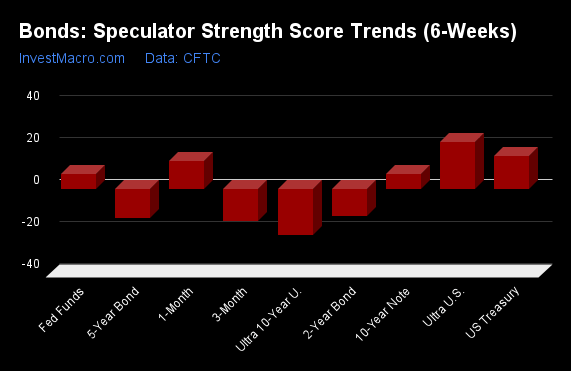
COT Strength Score Trends (or move index, calculates the 6-week changes in strength scores) showed that the SOFR 3-Months (35 percent) and the Ultra Treasury Bonds (32 percent) lead the past six weeks trends for bonds. The 5-Year Bonds (17 percent) and the are the next highest positive movers in the latest trends data.

The 2-Year Bonds (-11 percent), the 10-Year Bonds (-10 percent) and the Fed Funds (-10 percent) lead the downside trend scores currently.

Strength Trend Statistics:
Fed Funds (-9.8 percent) vs Fed Funds previous week (2.2 percent)
2-Year Bond (-10.6 percent) vs 2-Year Bond previous week (-5.3 percent)
5-Year Bond (16.7 percent) vs 5-Year Bond previous week (6.0 percent)
10-Year Bond (-9.6 percent) vs 10-Year Bond previous week (-16.3 percent)
Ultra 10-Year Bond (7.9 percent) vs Ultra 10-Year Bond previous week (4.3 percent)
US Treasury Bond (-2.0 percent) vs US Treasury Bond previous week (-17.1 percent)
Ultra US Treasury Bond (32.1 percent) vs Ultra US Treasury Bond previous week (26.8 percent)
SOFR 3-Months (35.2 percent) vs SOFR 3-Months previous week (18.2 percent)


Secured Overnight Financing Rate (3-Month) Futures:

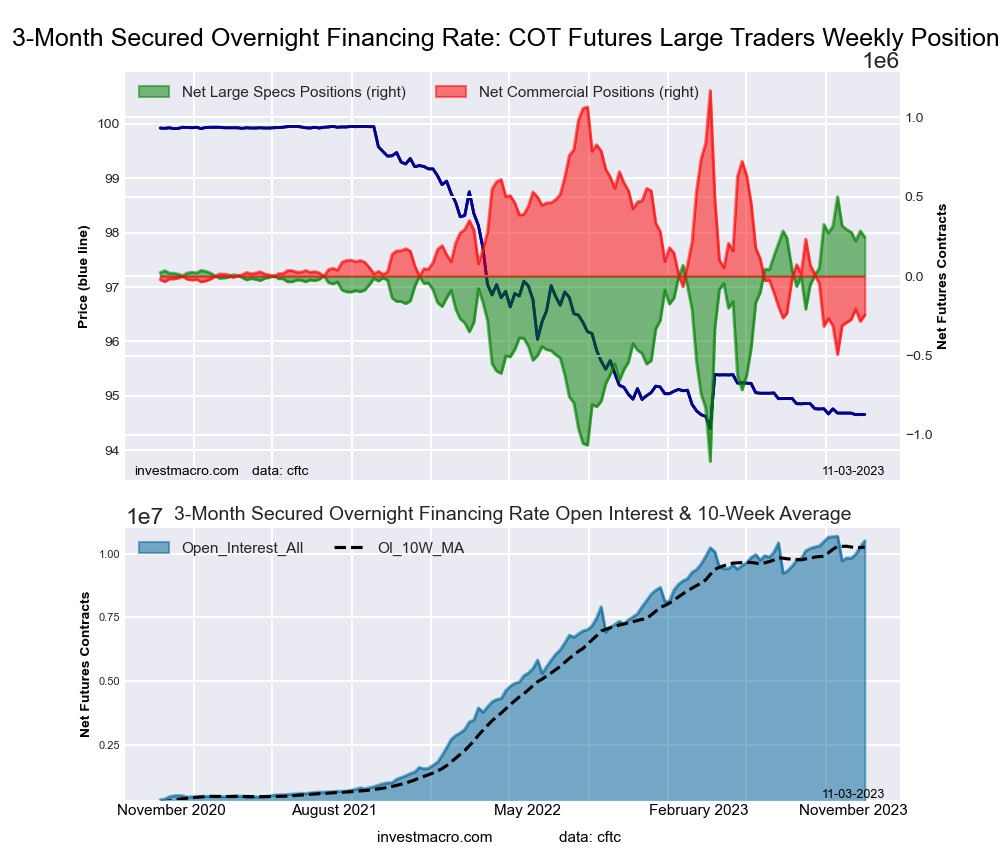
SOFR 3-Months Bonds Futures COT ChartThe Secured Overnight Financing Rate (3-Month) large speculator standing this week equaled a net position of 316,511 contracts in the data reported through Tuesday. This was a weekly boost of 44,439 contracts from the previous week which had a total of 272,072 net contracts.

This week’s current strength score (the trader positioning range over the past three years, measured from 0 to 100) shows the speculators are currently Bullish-Extreme with a score of 99.4 percent. The commercials are Bearish-Extreme with a score of 0.1 percent and the small traders (not shown in chart) are Bullish-Extreme with a score of 86.2 percent.

Price Trend-Following Model: Weak Uptrend

Our weekly trend-following model classifies the current market price position as: Weak Uptrend. The current action for the model is considered to be: Hold – Maintain Long Position.

SOFR 3-Months StatisticsSPECULATORSCOMMERCIALSSMALL TRADERS
– Percent of Open Interest Longs:17.958.20.3
– Percent of Open Interest Shorts:14.961.10.4
– Net Position:316,511-313,438-3,073
– Gross Longs:1,910,7026,204,62637,259
– Gross Shorts:1,594,1916,518,06440,332
– Long to Short Ratio:1.2 to 11.0 to 10.9 to 1
NET POSITION TREND:
– Strength Index Score (3 Year Range Pct):99.40.186.2
– Strength Index Reading (3 Year Range):Bullish-ExtremeBearish-ExtremeBullish-Extreme
NET POSITION MOVEMENT INDEX:
– 6-Week Change in Strength Index:35.2-36.811.6


30-Day Federal Funds Futures:

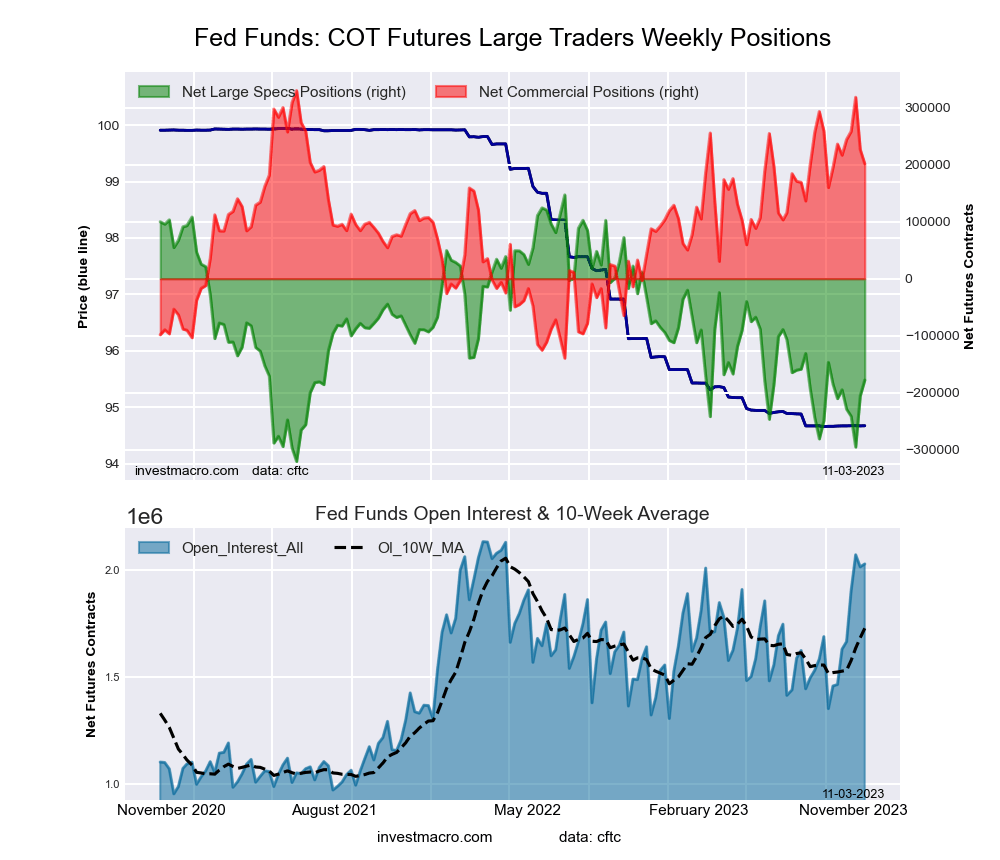
Federal Funds 30-Day Bonds Futures COT ChartThe 30-Day Federal Funds large speculator standing this week equaled a net position of -184,954 contracts in the data reported through Tuesday. This was a weekly reduction of -38,064 contracts from the previous week which had a total of -146,890 net contracts.

This week’s current strength score (the trader positioning range over the past three years, measured from 0 to 100) shows the speculators are currently Bearish with a score of 24.9 percent. The commercials are Bullish with a score of 75.4 percent and the small traders (not shown in chart) are Bullish with a score of 71.2 percent.

Price Trend-Following Model: Downtrend

Our weekly trend-following model classifies the current market price position as: Downtrend. The current action for the model is considered to be: Hold – Maintain Short Position.

30-Day Federal Funds StatisticsSPECULATORSCOMMERCIALSSMALL TRADERS
– Percent of Open Interest Longs:7.274.82.4
– Percent of Open Interest Shorts:19.961.43.1
– Net Position:-184,954195,040-10,086
– Gross Longs:104,5721,091,05435,676
– Gross Shorts:289,526896,01445,762
– Long to Short Ratio:0.4 to 11.2 to 10.8 to 1
NET POSITION TREND:
– Strength Index Score (3 Year Range Pct):24.975.471.2
– Strength Index Reading (3 Year Range):BearishBullishBullish
NET POSITION MOVEMENT INDEX:
– 6-Week Change in Strength Index:-9.810.6-9.4


2-Year Treasury Note Futures:

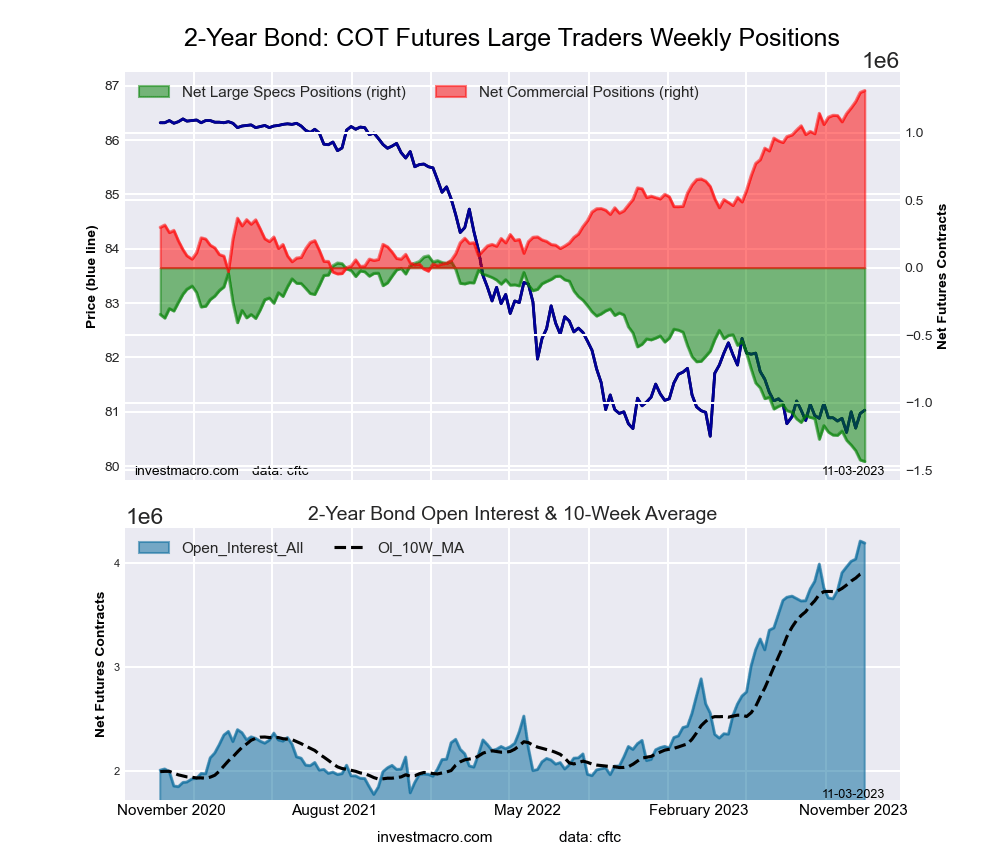
2-Year Treasury Bonds Futures COT ChartThe 2-Year Treasury Note large speculator standing this week equaled a net position of -1,239,609 contracts in the data reported through Tuesday. This was a weekly lowering of -21,719 contracts from the previous week which had a total of -1,217,890 net contracts.

This week’s current strength score (the trader positioning range over the past three years, measured from 0 to 100) shows the speculators are currently Bearish-Extreme with a score of 2.3 percent. The commercials are Bullish-Extreme with a score of 98.8 percent and the small traders (not shown in chart) are Bullish-Extreme with a score of 93.2 percent.

Price Trend-Following Model: Downtrend

Our weekly trend-following model classifies the current market price position as: Downtrend. The current action for the model is considered to be: Hold – Maintain Short Position.

2-Year Treasury Note StatisticsSPECULATORSCOMMERCIALSSMALL TRADERS
– Percent of Open Interest Longs:8.883.07.1
– Percent of Open Interest Shorts:42.752.14.1
– Net Position:-1,239,6091,128,539111,070
– Gross Longs:320,0483,031,053259,610
– Gross Shorts:1,559,6571,902,514148,540
– Long to Short Ratio:0.2 to 11.6 to 11.7 to 1
NET POSITION TREND:
– Strength Index Score (3 Year Range Pct):2.398.893.2
– Strength Index Reading (3 Year Range):Bearish-ExtremeBullish-ExtremeBullish-Extreme
NET POSITION MOVEMENT INDEX:
– 6-Week Change in Strength Index:-10.612.00.6


5-Year Treasury Note Futures:

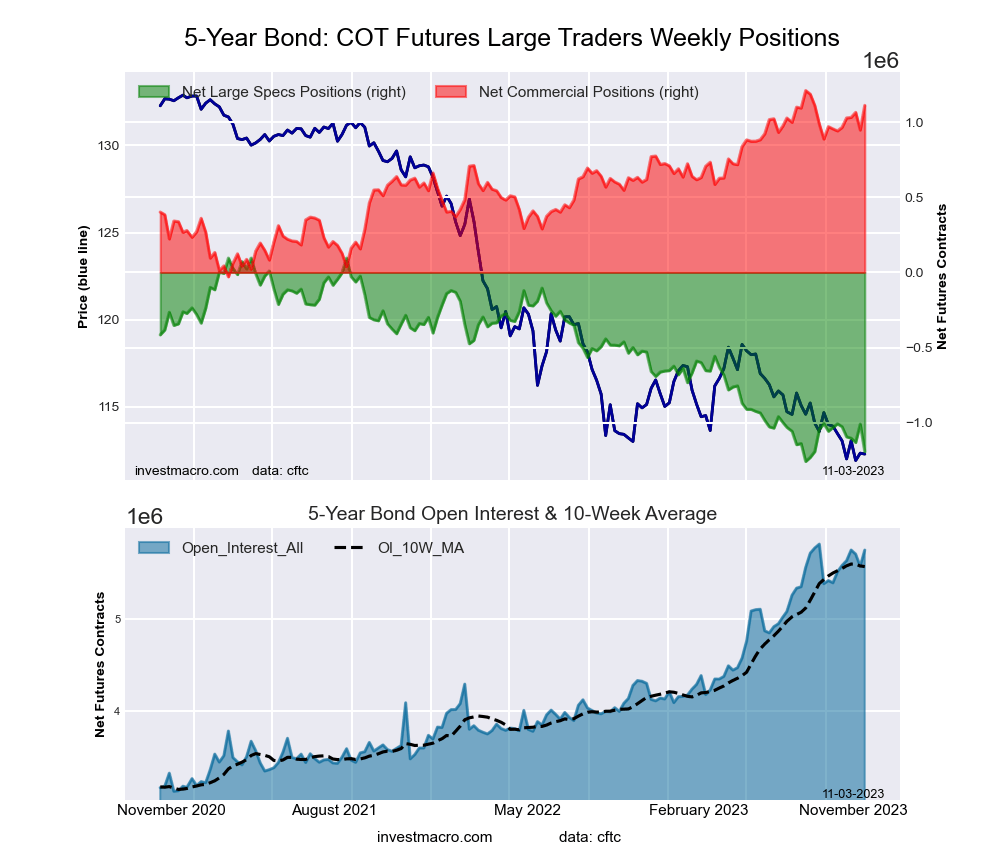
5-Year Treasury Bonds Futures COT ChartThe 5-Year Treasury Note large speculator standing this week equaled a net position of -1,031,030 contracts in the data reported through Tuesday. This was a weekly increase of 25,238 contracts from the previous week which had a total of -1,056,268 net contracts.

This week’s current strength score (the trader positioning range over the past three years, measured from 0 to 100) shows the speculators are currently Bearish-Extreme with a score of 16.7 percent. The commercials are Bullish with a score of 79.4 percent and the small traders (not shown in chart) are Bullish-Extreme with a score of 90.0 percent.

Price Trend-Following Model: Downtrend

Our weekly trend-following model classifies the current market price position as: Downtrend. The current action for the model is considered to be: Hold – Maintain Short Position.

5-Year Treasury Note StatisticsSPECULATORSCOMMERCIALSSMALL TRADERS
– Percent of Open Interest Longs:8.682.87.5
– Percent of Open Interest Shorts:27.865.16.1
– Net Position:-1,031,030954,44476,586
– Gross Longs:465,2794,464,077405,798
– Gross Shorts:1,496,3093,509,633329,212
– Long to Short Ratio:0.3 to 11.3 to 11.2 to 1
NET POSITION TREND:
– Strength Index Score (3 Year Range Pct):16.779.490.0
– Strength Index Reading (3 Year Range):Bearish-ExtremeBullishBullish-Extreme
NET POSITION MOVEMENT INDEX:
– 6-Week Change in Strength Index:16.7-20.67.1


10-Year Treasury Note Futures:

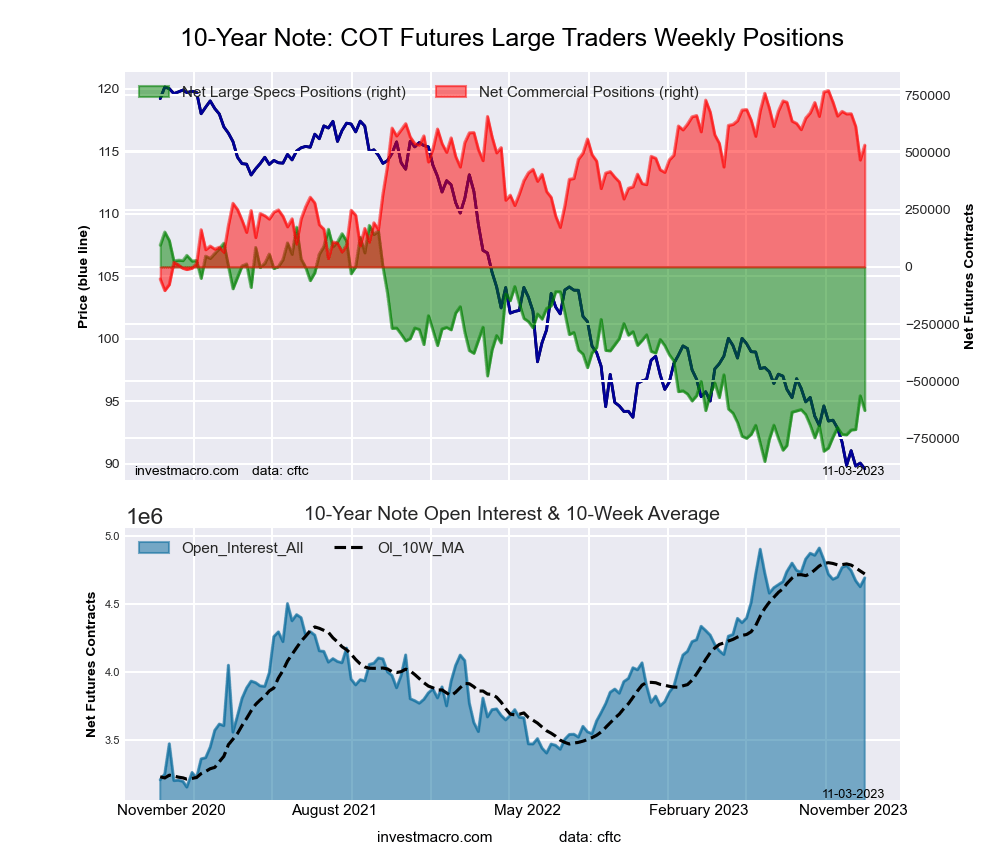
10-Year Treasury Notes Bonds Futures COT ChartThe 10-Year Treasury Note large speculator standing this week equaled a net position of -744,302 contracts in the data reported through Tuesday. This was a weekly rise of 47,233 contracts from the previous week which had a total of -791,535 net contracts.

This week’s current strength score (the trader positioning range over the past three years, measured from 0 to 100) shows the speculators are currently Bearish-Extreme with a score of 10.3 percent. The commercials are Bullish-Extreme with a score of 94.7 percent and the small traders (not shown in chart) are Bullish with a score of 78.8 percent.

Price Trend-Following Model: Downtrend

Our weekly trend-following model classifies the current market price position as: Downtrend. The current action for the model is considered to be: Hold – Maintain Short Position.

10-Year Treasury Note StatisticsSPECULATORSCOMMERCIALSSMALL TRADERS
– Percent of Open Interest Longs:10.079.38.6
– Percent of Open Interest Shorts:25.963.98.1
– Net Position:-744,302720,21024,092
– Gross Longs:467,1143,712,430404,705
– Gross Shorts:1,211,4162,992,220380,613
– Long to Short Ratio:0.4 to 11.2 to 11.1 to 1
NET POSITION TREND:
– Strength Index Score (3 Year Range Pct):10.394.778.8
– Strength Index Reading (3 Year Range):Bearish-ExtremeBullish-ExtremeBullish
NET POSITION MOVEMENT INDEX:
– 6-Week Change in Strength Index:-9.67.36.3


Ultra 10-Year Notes Futures:

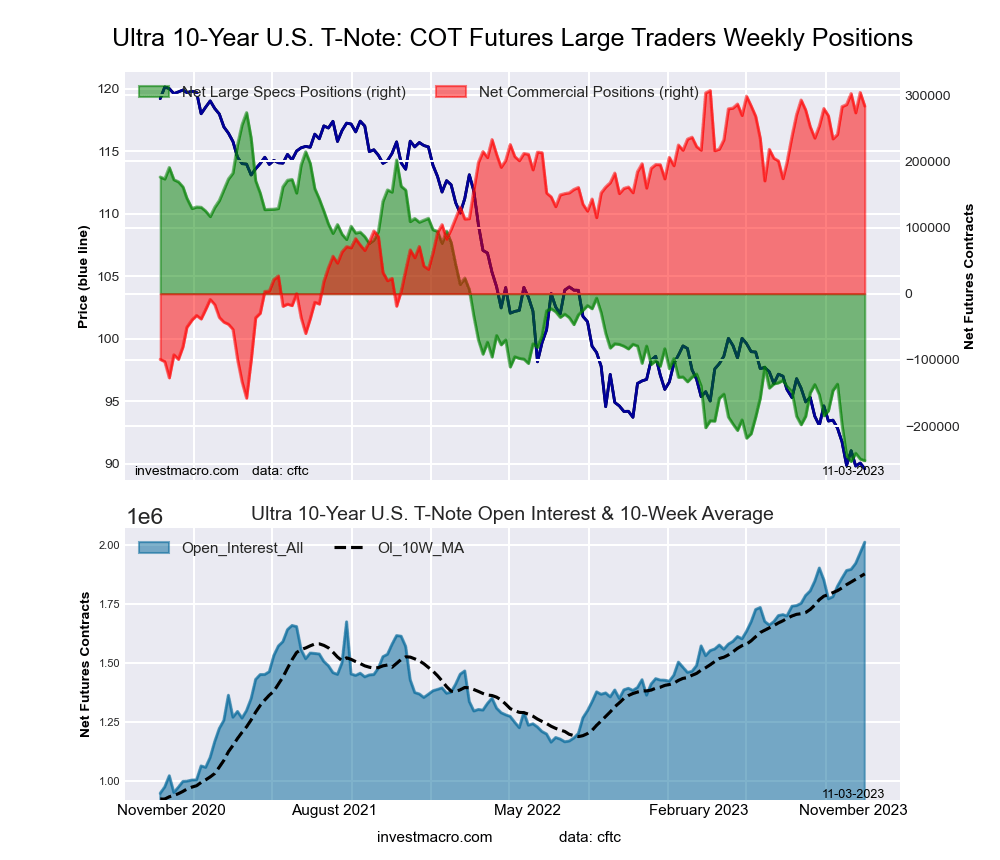
Ultra 10-Year Treasury Notes Bonds Futures COT ChartThe Ultra 10-Year Notes large speculator standing this week equaled a net position of -146,433 contracts in the data reported through Tuesday. This was a weekly lift of 30,615 contracts from the previous week which had a total of -177,048 net contracts.

This week’s current strength score (the trader positioning range over the past three years, measured from 0 to 100) shows the speculators are currently Bearish-Extreme with a score of 14.6 percent. The commercials are Bullish-Extreme with a score of 84.3 percent and the small traders (not shown in chart) are Bullish with a score of 62.0 percent.

Price Trend-Following Model: Weak Uptrend

Our weekly trend-following model classifies the current market price position as: Weak Uptrend. The current action for the model is considered to be: Hold – Maintain Long Position.

Ultra 10-Year Notes StatisticsSPECULATORSCOMMERCIALSSMALL TRADERS
– Percent of Open Interest Longs:12.175.510.7
– Percent of Open Interest Shorts:20.462.315.6
– Net Position:-146,433233,935-87,502
– Gross Longs:216,2511,344,525189,889
– Gross Shorts:362,6841,110,590277,391
– Long to Short Ratio:0.6 to 11.2 to 10.7 to 1
NET POSITION TREND:
– Strength Index Score (3 Year Range Pct):14.684.362.0
– Strength Index Reading (3 Year Range):Bearish-ExtremeBullish-ExtremeBullish
NET POSITION MOVEMENT INDEX:
– 6-Week Change in Strength Index:7.9-9.42.9


US Treasury Bonds Futures:

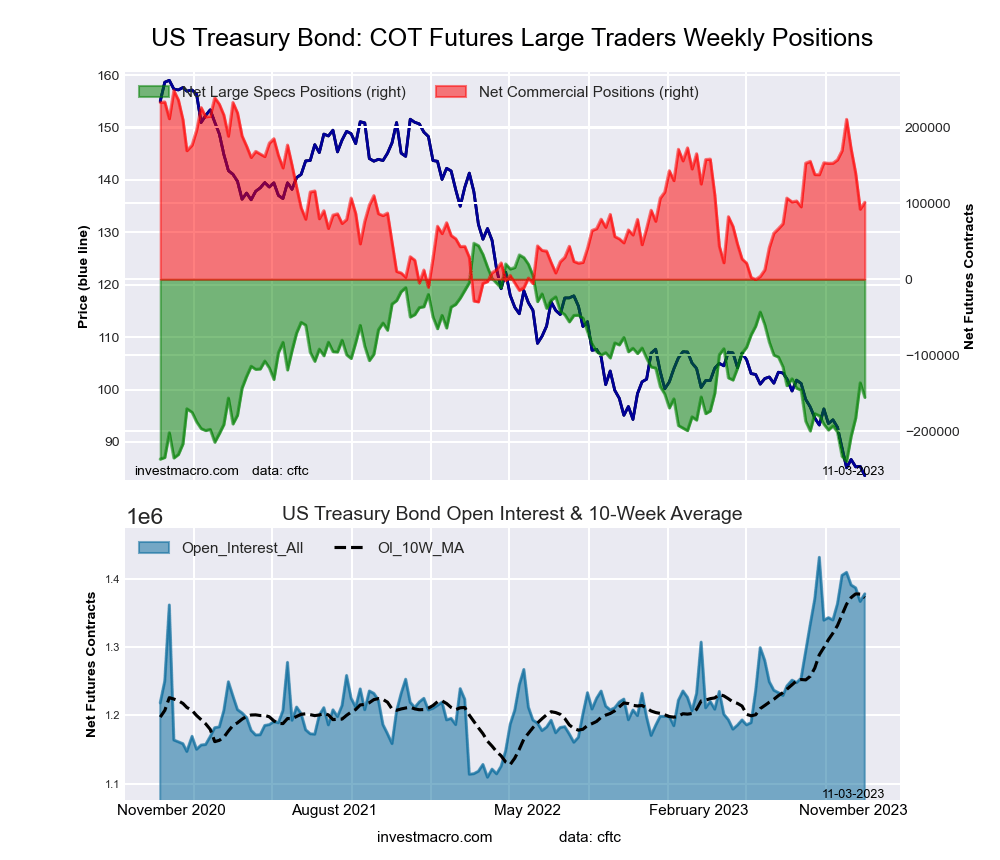
US Year Treasury Notes Long Bonds Futures COT ChartThe US Treasury Bonds large speculator standing this week equaled a net position of -192,687 contracts in the data reported through Tuesday. This was a weekly increase of 5,605 contracts from the previous week which had a total of -198,292 net contracts.

This week’s current strength score (the trader positioning range over the past three years, measured from 0 to 100) shows the speculators are currently Bearish with a score of 21.9 percent. The commercials are Bullish with a score of 65.0 percent and the small traders (not shown in chart) are Bullish with a score of 77.6 percent.

Price Trend-Following Model: Strong Downtrend

Our weekly trend-following model classifies the current market price position as: Strong Downtrend. The current action for the model is considered to be: Hold – Maintain Short Position.

US Treasury Bonds StatisticsSPECULATORSCOMMERCIALSSMALL TRADERS
– Percent of Open Interest Longs:5.978.814.3
– Percent of Open Interest Shorts:20.367.411.3
– Net Position:-192,687152,66340,024
– Gross Longs:79,6561,056,184191,340
– Gross Shorts:272,343903,521151,316
– Long to Short Ratio:0.3 to 11.2 to 11.3 to 1
NET POSITION TREND:
– Strength Index Score (3 Year Range Pct):21.965.077.6
– Strength Index Reading (3 Year Range):BearishBullishBullish
NET POSITION MOVEMENT INDEX:
– 6-Week Change in Strength Index:-2.00.04.3


Ultra US Treasury Bonds Futures:

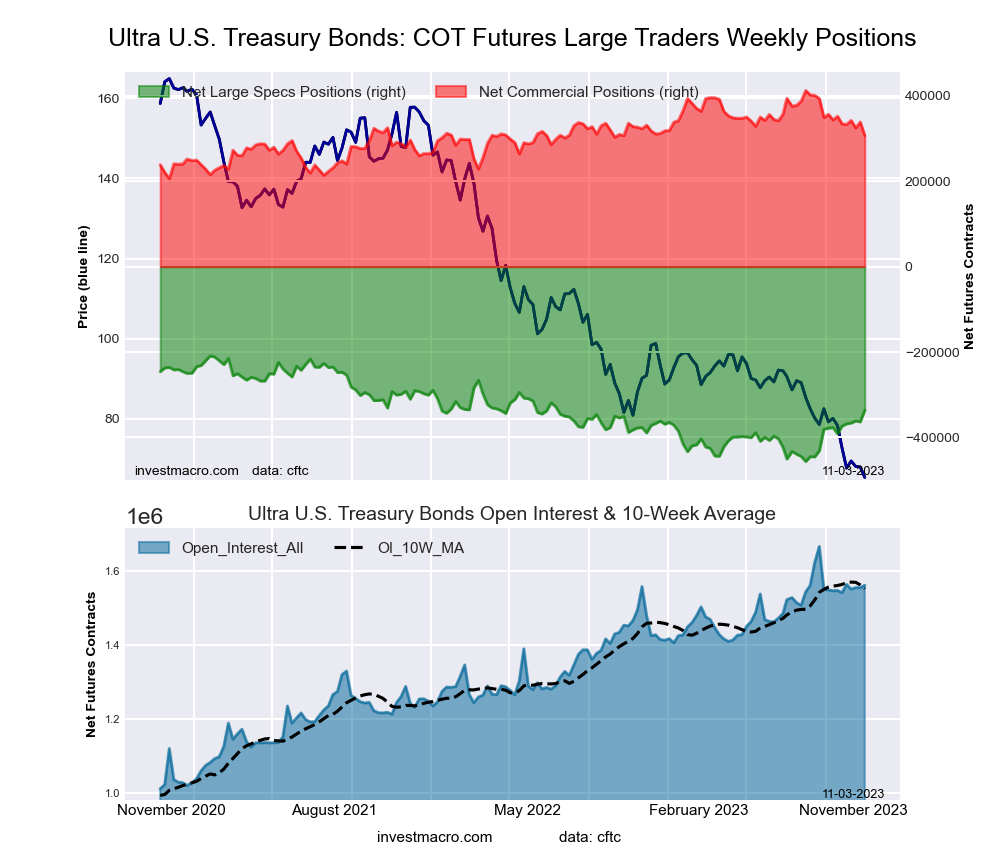
Ultra US Year Treasury Notes Long Bonds Futures COT ChartThe Ultra US Treasury Bonds large speculator standing this week equaled a net position of -376,925 contracts in the data reported through Tuesday. This was a weekly boost of 1,346 contracts from the previous week which had a total of -378,271 net contracts.

This week’s current strength score (the trader positioning range over the past three years, measured from 0 to 100) shows the speculators are currently Bearish with a score of 32.1 percent. The commercials are Bullish with a score of 66.6 percent and the small traders (not shown in chart) are Bullish with a score of 68.5 percent.

Price Trend-Following Model: Strong Downtrend

Our weekly trend-following model classifies the current market price position as: Strong Downtrend. The current action for the model is considered to be: Hold – Maintain Short Position.

Ultra US Treasury Bonds StatisticsSPECULATORSCOMMERCIALSSMALL TRADERS
– Percent of Open Interest Longs:5.482.811.1
– Percent of Open Interest Shorts:29.860.59.0
– Net Position:-376,925343,79933,126
– Gross Longs:83,7391,279,765172,214
– Gross Shorts:460,664935,966139,088
– Long to Short Ratio:0.2 to 11.4 to 11.2 to 1
NET POSITION TREND:
– Strength Index Score (3 Year Range Pct):32.166.668.5
– Strength Index Reading (3 Year Range):BearishBullishBullish
NET POSITION MOVEMENT INDEX:
– 6-Week Change in Strength Index:32.1-33.4-10.1


Article By InvestMacroReceive our weekly COT Newsletter

*COT Report: The COT data, released weekly to the public each Friday, is updated through the most recent Tuesday (data is 3 days old) and shows a quick view of how large speculators or non-commercials (for-profit traders) were positioned in the futures markets.

The CFTC categorizes trader positions according to commercial hedgers (traders who use futures contracts for hedging as part of the business), non-commercials (large traders who speculate to realize trading profits) and nonreportable traders (usually small traders/speculators) as well as their open interest (contracts open in the market at time of reporting). See CFTC criteria here.

COT Soft Commodities Charts: Speculator Bets led by Sugar & Live Cattle

By InvestMacro

Here are the latest charts and statistics for the Commitment of Traders (COT) reports data published by the Commodities Futures Trading Commission (CFTC).

The latest COT data is updated through Tuesday September 12th and shows a quick view of how large traders (for-profit speculators and commercial entities) were positioned in the futures markets.

Weekly Speculator Changes led by Sugar & Live Cattle

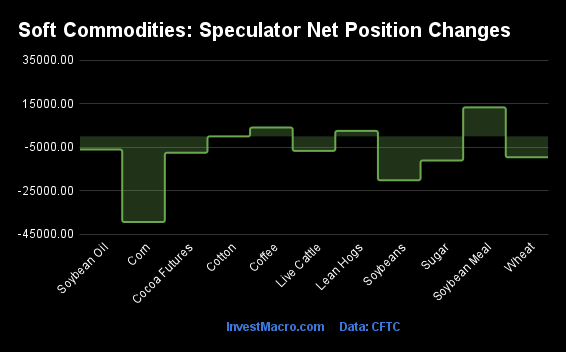
The COT soft commodities markets speculator bets were lower this week as just four out of the eleven softs markets we cover had higher positioning while the other seven markets had lower speculator contracts.

Leading the gains for the softs markets was Sugar (9,014 contracts) with Live Cattle (6,055 contracts), Lean Hogs (5,402 contracts) and Cocoa (1,403 contracts) also having positive weeks.

The markets with the declines in speculator bets this week were Corn (-42,356 contracts) with Coffee (-18,522 contracts), Soybean Oil (-9,933 contracts), Cotton (-5,028 contracts), Soybean Meal (-4,467 contracts), Wheat (-3,209 contracts) and Soybeans (-2,112 contracts) also registering lower bets on the week.


Data Snapshot of Commodity Market Traders | Columns Legend
Sep-12-2023OIOI-IndexSpec-NetSpec-IndexCom-NetCOM-IndexSmalls-NetSmalls-Index
WTI Crude1,791,69635326,87147-348,7135721,84224
Gold441,2219123,86432-144,8106820,94632
Silver125,2921418,03344-32,0405514,00744
Copper196,19839-12,334209,886802,44834
Palladium17,83882-10,712210,76199-4939
Platinum87,0211006,72131-12,396685,67544
Natural Gas1,171,74744-112,0442786,5237425,52141
Brent136,16013-48,6101747,9459066518
Heating Oil334,3955036,92292-62,799725,87788
Soybeans740,0473685,21723-68,44073-16,77764
Corn1,268,17610-87,9880118,836100-30,84890
Coffee180,11838,49536-8,05268-4437
Sugar996,53270244,43577-297,7251953,29072
Wheat391,66961-49,6193246,521663,09882


Strength Scores led by Cocoa & Live Cattle

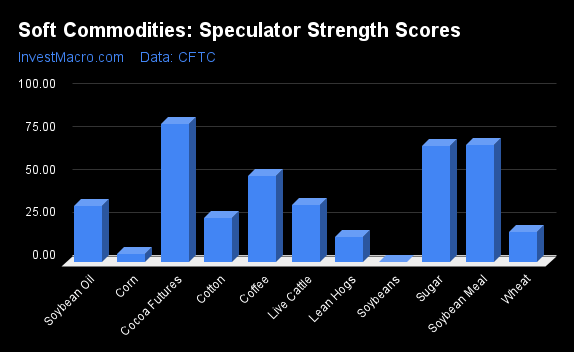
COT Strength Scores (a normalized measure of Speculator positions over a 3-Year range, from 0 to 100 where above 80 is Extreme-Bullish and below 20 is Extreme-Bearish) showed that Cocoa (100 percent) and Live Cattle (79 percent) lead the softs markets this week. Sugar (77 percent), Soybean Meal (51 percent) and Cotton (47 percent) come in as the next highest in the weekly strength scores.

On the downside, Corn (0 percent) comes in at the lowest strength levels currently and is in Extreme-Bearish territory (below 20 percent). The next lowest strength scores are Soybeans (23 percent), Lean Hogs (29 percent) and Wheat (32 percent).

Strength Statistics:
Corn (0.0 percent) vs Corn previous week (6.7 percent)
Sugar (77.3 percent) vs Sugar previous week (74.1 percent)
Coffee (36.1 percent) vs Coffee previous week (61.8 percent)
Soybeans (22.6 percent) vs Soybeans previous week (23.5 percent)
Soybean Oil (44.8 percent) vs Soybean Oil previous week (50.6 percent)
Soybean Meal (50.6 percent) vs Soybean Meal previous week (53.1 percent)
Live Cattle (78.7 percent) vs Live Cattle previous week (72.2 percent)
Lean Hogs (29.1 percent) vs Lean Hogs previous week (24.6 percent)
Cotton (47.4 percent) vs Cotton previous week (51.2 percent)
Cocoa (100.0 percent) vs Cocoa previous week (98.6 percent)
Wheat (31.5 percent) vs Wheat previous week (33.8 percent)


Sugar & Cocoa top the 6-Week Strength Trends

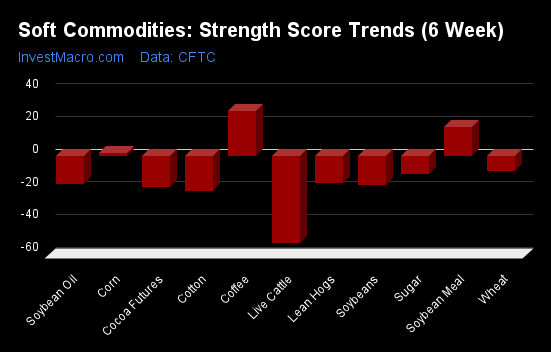
COT Strength Score Trends (or move index, calculates the 6-week changes in strength scores) showed that Sugar (12 percent) and Cocoa (10 percent) lead the past six weeks trends for soft commodities. Cotton (6 percent), Lean Hogs (3 percent) and Live Cattle (2 percent) are the next highest positive movers in the latest trends data.

Corn (-26 percent) leads the downside trend scores currently with Coffee (-23 percent), Wheat (-17 percent) and Soybean Meal (-12 percent) following next with lower trend scores.

Strength Trend Statistics:
Corn (-26.4 percent) vs Corn previous week (-18.3 percent)
Sugar (11.6 percent) vs Sugar previous week (5.5 percent)
Coffee (-23.1 percent) vs Coffee previous week (-0.0 percent)
Soybeans (-11.2 percent) vs Soybeans previous week (-18.7 percent)
Soybean Oil (-2.6 percent) vs Soybean Oil previous week (1.1 percent)
Soybean Meal (-11.8 percent) vs Soybean Meal previous week (-7.6 percent)
Live Cattle (1.7 percent) vs Live Cattle previous week (-9.5 percent)
Lean Hogs (2.9 percent) vs Lean Hogs previous week (-2.6 percent)
Cotton (5.6 percent) vs Cotton previous week (13.9 percent)
Cocoa (9.7 percent) vs Cocoa previous week (8.5 percent)
Wheat (-16.7 percent) vs Wheat previous week (-18.4 percent)


Individual Soft Commodities Markets:

CORN Futures:
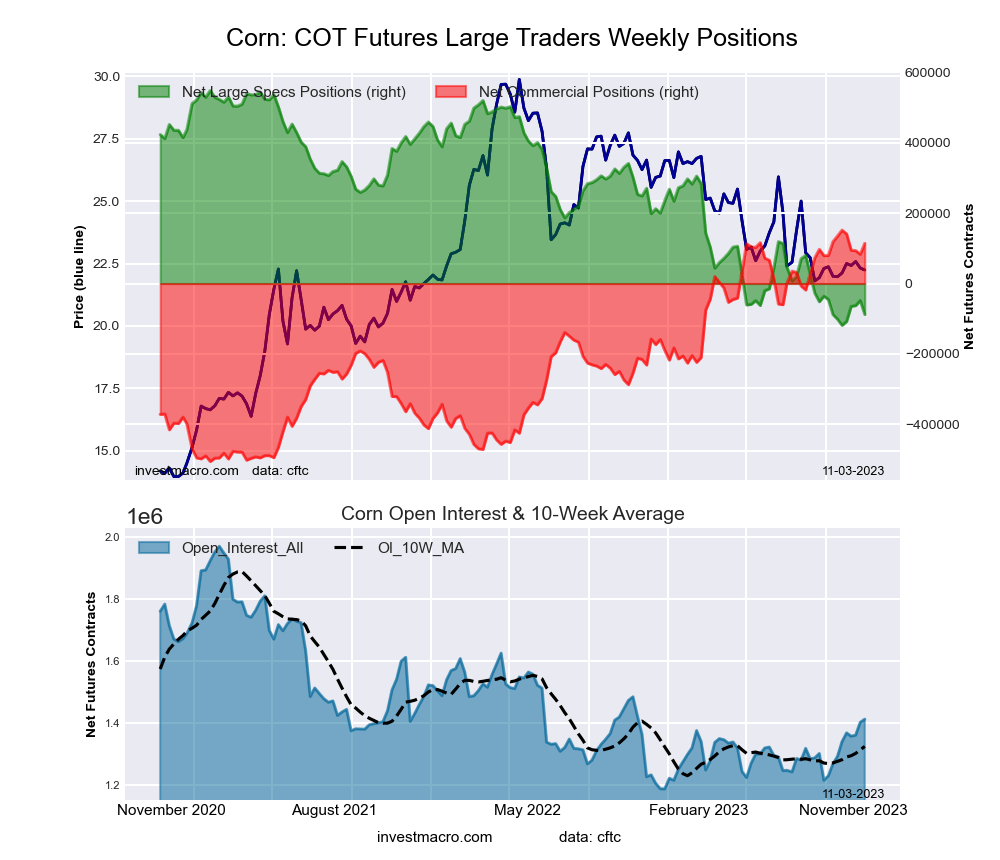
CORN Futures COT ChartThe CORN large speculator standing this week reached a net position of -87,988 contracts in the data reported through Tuesday. This was a weekly decline of -42,356 contracts from the previous week which had a total of -45,632 net contracts.

This week’s current strength score (the trader positioning range over the past three years, measured from 0 to 100) shows the speculators are currently Bearish-Extreme with a score of 0.0 percent. The commercials are Bullish-Extreme with a score of 100.0 percent and the small traders (not shown in chart) are Bullish-Extreme with a score of 89.9 percent.

Price Trend-Following Model: Strong Downtrend

Our weekly trend-following model classifies the current market price position as: Strong Downtrend. The current action for the model is considered to be: Hold – Maintain Short Position.

CORN Futures StatisticsSPECULATORSCOMMERCIALSSMALL TRADERS
– Percent of Open Interest Longs:20.949.510.3
– Percent of Open Interest Shorts:27.840.212.7
– Net Position:-87,988118,836-30,848
– Gross Longs:264,473628,085130,320
– Gross Shorts:352,461509,249161,168
– Long to Short Ratio:0.8 to 11.2 to 10.8 to 1
NET POSITION TREND:
– Strength Index Score (3 Year Range Pct):0.0100.089.9
– Strength Index Reading (3 Year Range):Bearish-ExtremeBullish-ExtremeBullish-Extreme
NET POSITION MOVEMENT INDEX:
– 6-Week Change in Strength Index:-26.422.055.4


SUGAR Futures:

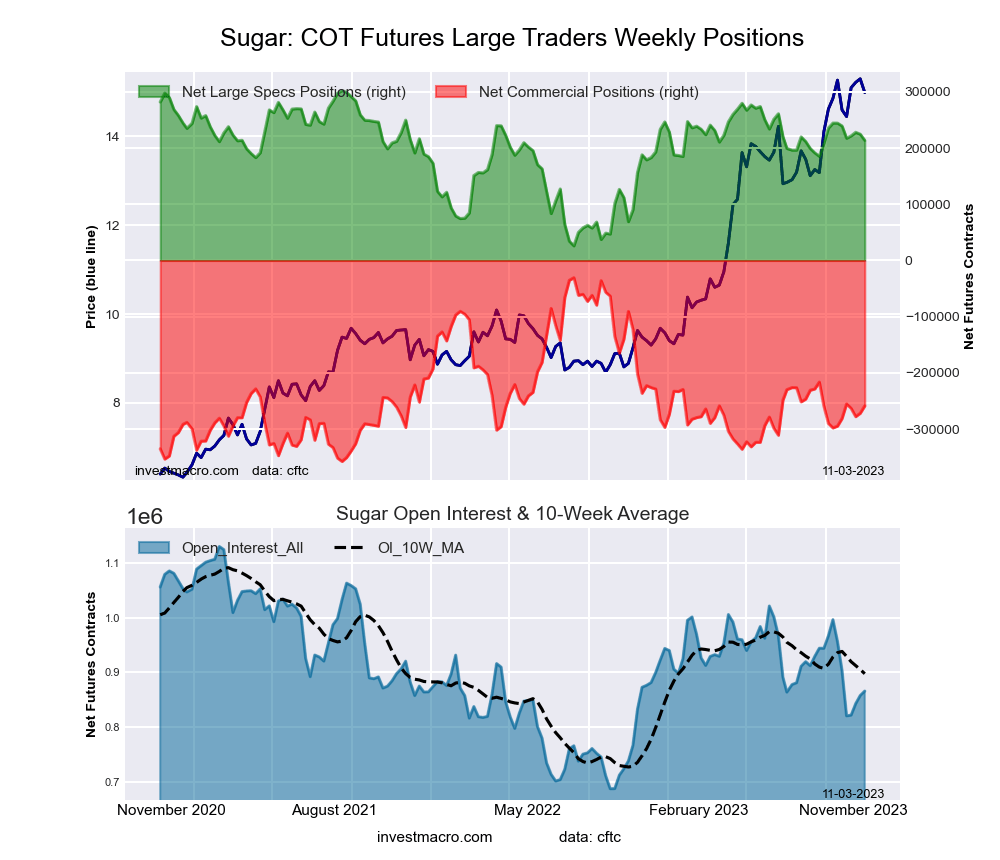
SUGAR Futures COT ChartThe SUGAR large speculator standing this week reached a net position of 244,435 contracts in the data reported through Tuesday. This was a weekly lift of 9,014 contracts from the previous week which had a total of 235,421 net contracts.

This week’s current strength score (the trader positioning range over the past three years, measured from 0 to 100) shows the speculators are currently Bullish with a score of 77.3 percent. The commercials are Bearish-Extreme with a score of 18.8 percent and the small traders (not shown in chart) are Bullish with a score of 72.0 percent.

Price Trend-Following Model: Strong Uptrend

Our weekly trend-following model classifies the current market price position as: Strong Uptrend. The current action for the model is considered to be: Hold – Maintain Long Position.

SUGAR Futures StatisticsSPECULATORSCOMMERCIALSSMALL TRADERS
– Percent of Open Interest Longs:33.044.89.9
– Percent of Open Interest Shorts:8.474.74.6
– Net Position:244,435-297,72553,290
– Gross Longs:328,566446,54298,865
– Gross Shorts:84,131744,26745,575
– Long to Short Ratio:3.9 to 10.6 to 12.2 to 1
NET POSITION TREND:
– Strength Index Score (3 Year Range Pct):77.318.872.0
– Strength Index Reading (3 Year Range):BullishBearish-ExtremeBullish
NET POSITION MOVEMENT INDEX:
– 6-Week Change in Strength Index:11.6-15.624.2


COFFEE Futures:

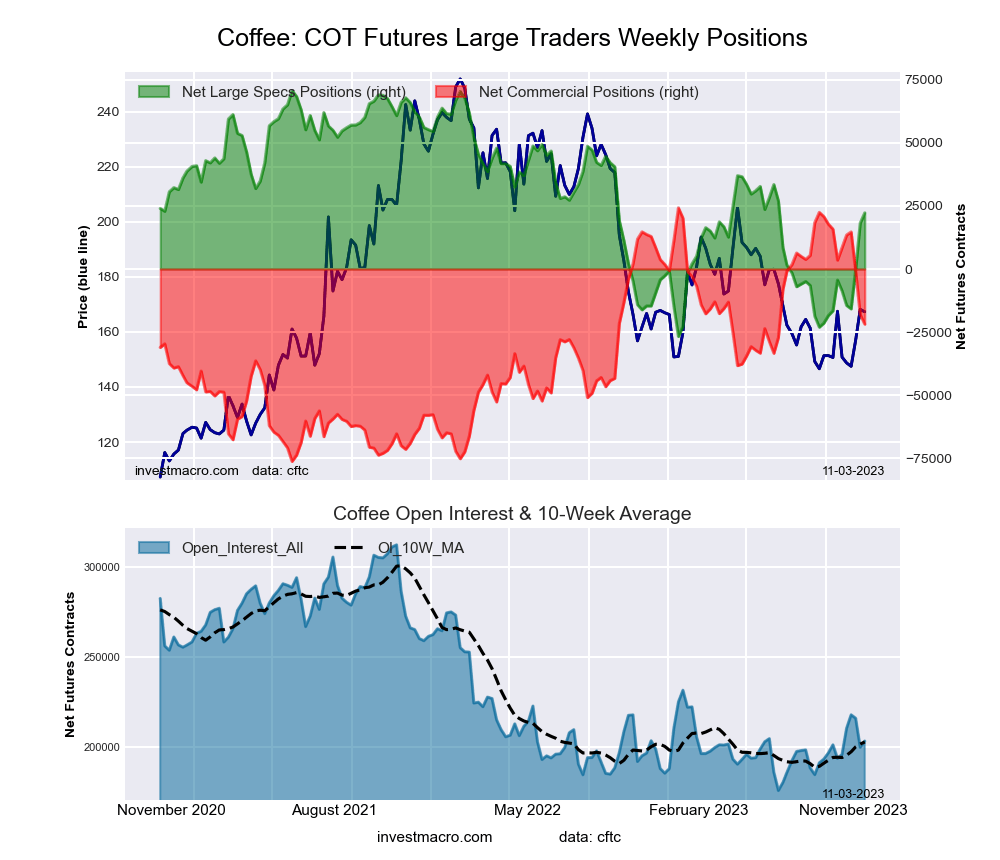
COFFEE Futures COT ChartThe COFFEE large speculator standing this week reached a net position of 8,495 contracts in the data reported through Tuesday. This was a weekly fall of -18,522 contracts from the previous week which had a total of 33,494 net contracts.

This week’s current strength score (the trader positioning range over the past three years, measured from 0 to 100) shows the speculators are currently Bearish with a score of 36.1 percent. The commercials are Bullish with a score of 67.9 percent and the small traders (not shown in chart) are Bearish-Extreme with a score of 7.3 percent.

Price Trend-Following Model: Uptrend

Our weekly trend-following model classifies the current market price position as: Uptrend. The current action for the model is considered to be: Hold – Maintain Long Position.

COFFEE Futures StatisticsSPECULATORSCOMMERCIALSSMALL TRADERS
– Percent of Open Interest Longs:23.447.03.7
– Percent of Open Interest Shorts:18.751.43.9
– Net Position:8,495-8,052-443
– Gross Longs:42,19084,6066,662
– Gross Shorts:33,69592,6587,105
– Long to Short Ratio:1.3 to 10.9 to 10.9 to 1
NET POSITION TREND:
– Strength Index Score (3 Year Range Pct):36.167.97.3
– Strength Index Reading (3 Year Range):BearishBullishBearish-Extreme
NET POSITION MOVEMENT INDEX:
– 6-Week Change in Strength Index:-23.124.0-19.8


SOYBEANS Futures:

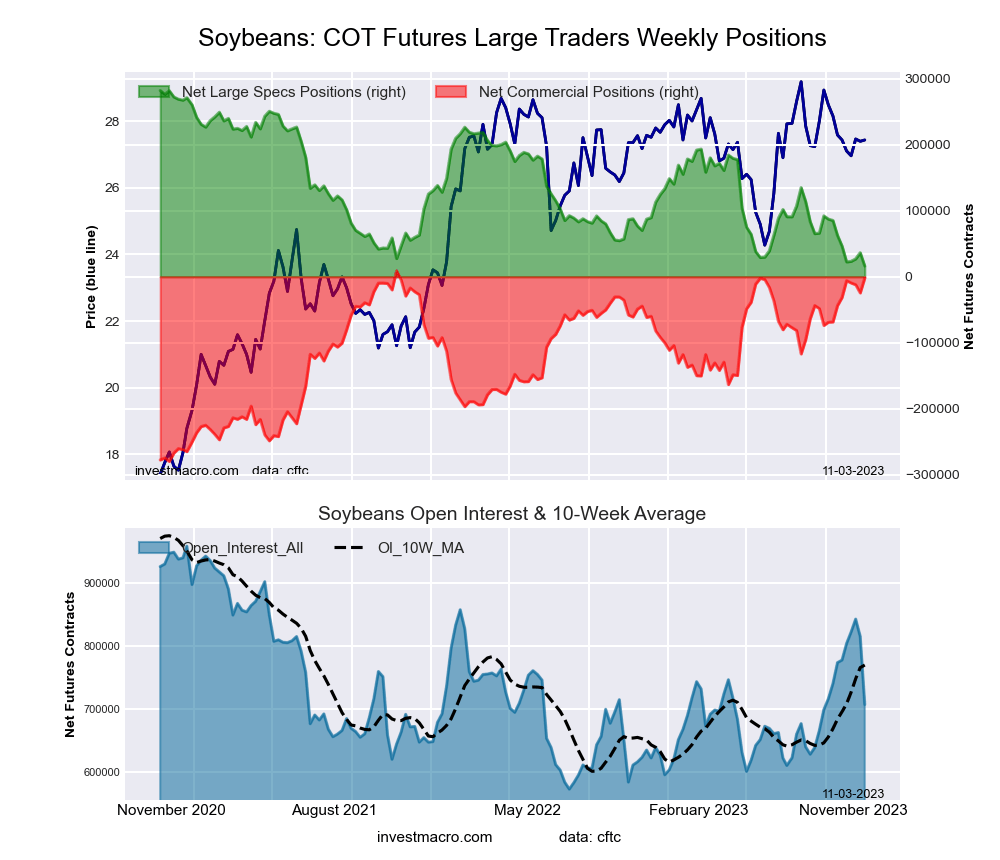
SOYBEANS Futures COT ChartThe SOYBEANS large speculator standing this week reached a net position of 85,217 contracts in the data reported through Tuesday. This was a weekly decline of -2,112 contracts from the previous week which had a total of 87,329 net contracts.

This week’s current strength score (the trader positioning range over the past three years, measured from 0 to 100) shows the speculators are currently Bearish with a score of 22.6 percent. The commercials are Bullish with a score of 73.2 percent and the small traders (not shown in chart) are Bullish with a score of 63.6 percent.

Price Trend-Following Model: Uptrend

Our weekly trend-following model classifies the current market price position as: Uptrend. The current action for the model is considered to be: Hold – Maintain Long Position.

SOYBEANS Futures StatisticsSPECULATORSCOMMERCIALSSMALL TRADERS
– Percent of Open Interest Longs:22.049.56.7
– Percent of Open Interest Shorts:10.558.89.0
– Net Position:85,217-68,440-16,777
– Gross Longs:162,761366,43449,882
– Gross Shorts:77,544434,87466,659
– Long to Short Ratio:2.1 to 10.8 to 10.7 to 1
NET POSITION TREND:
– Strength Index Score (3 Year Range Pct):22.673.263.6
– Strength Index Reading (3 Year Range):BearishBullishBullish
NET POSITION MOVEMENT INDEX:
– 6-Week Change in Strength Index:-11.29.33.9


SOYBEAN OIL Futures:

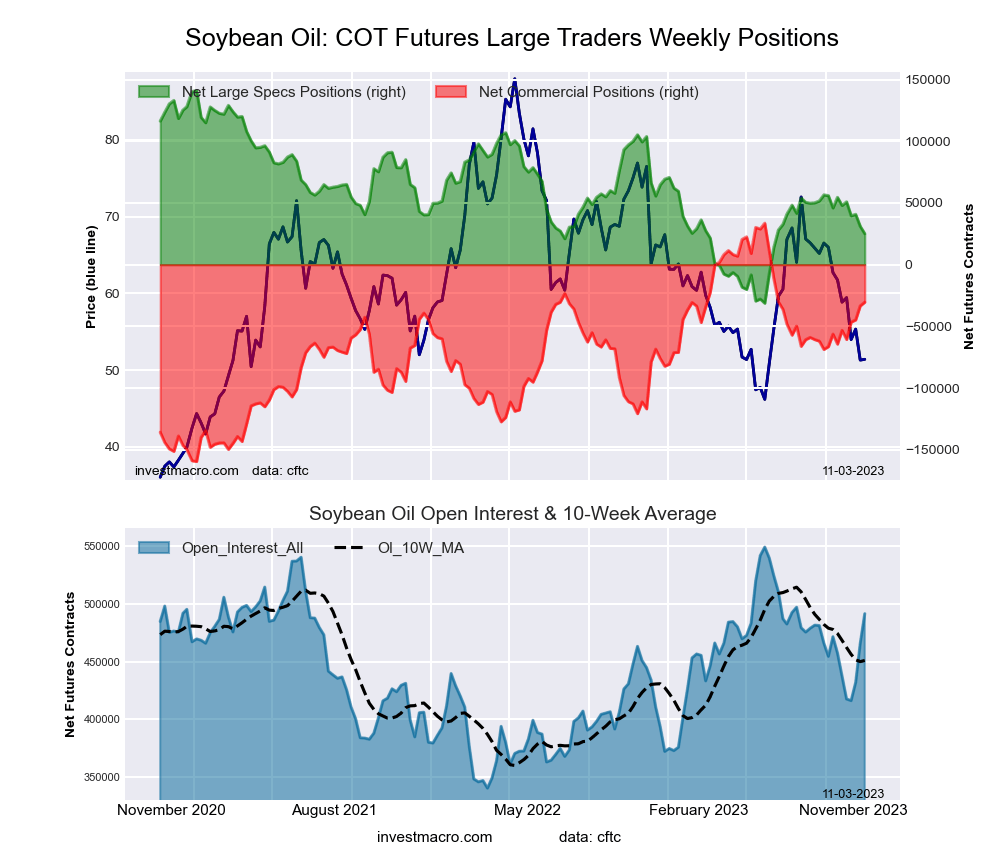
SOYBEAN OIL Futures COT ChartThe SOYBEAN OIL large speculator standing this week reached a net position of 46,002 contracts in the data reported through Tuesday. This was a weekly decrease of -9,933 contracts from the previous week which had a total of 55,935 net contracts.

This week’s current strength score (the trader positioning range over the past three years, measured from 0 to 100) shows the speculators are currently Bearish with a score of 44.8 percent. The commercials are Bullish with a score of 53.4 percent and the small traders (not shown in chart) are Bullish with a score of 52.1 percent.

Price Trend-Following Model: Uptrend

Our weekly trend-following model classifies the current market price position as: Uptrend. The current action for the model is considered to be: Hold – Maintain Long Position.

SOYBEAN OIL Futures StatisticsSPECULATORSCOMMERCIALSSMALL TRADERS
– Percent of Open Interest Longs:20.650.96.7
– Percent of Open Interest Shorts:10.862.94.5
– Net Position:46,002-56,33810,336
– Gross Longs:97,027240,10531,734
– Gross Shorts:51,025296,44321,398
– Long to Short Ratio:1.9 to 10.8 to 11.5 to 1
NET POSITION TREND:
– Strength Index Score (3 Year Range Pct):44.853.452.1
– Strength Index Reading (3 Year Range):BearishBullishBullish
NET POSITION MOVEMENT INDEX:
– 6-Week Change in Strength Index:-2.62.30.1


SOYBEAN MEAL Futures:

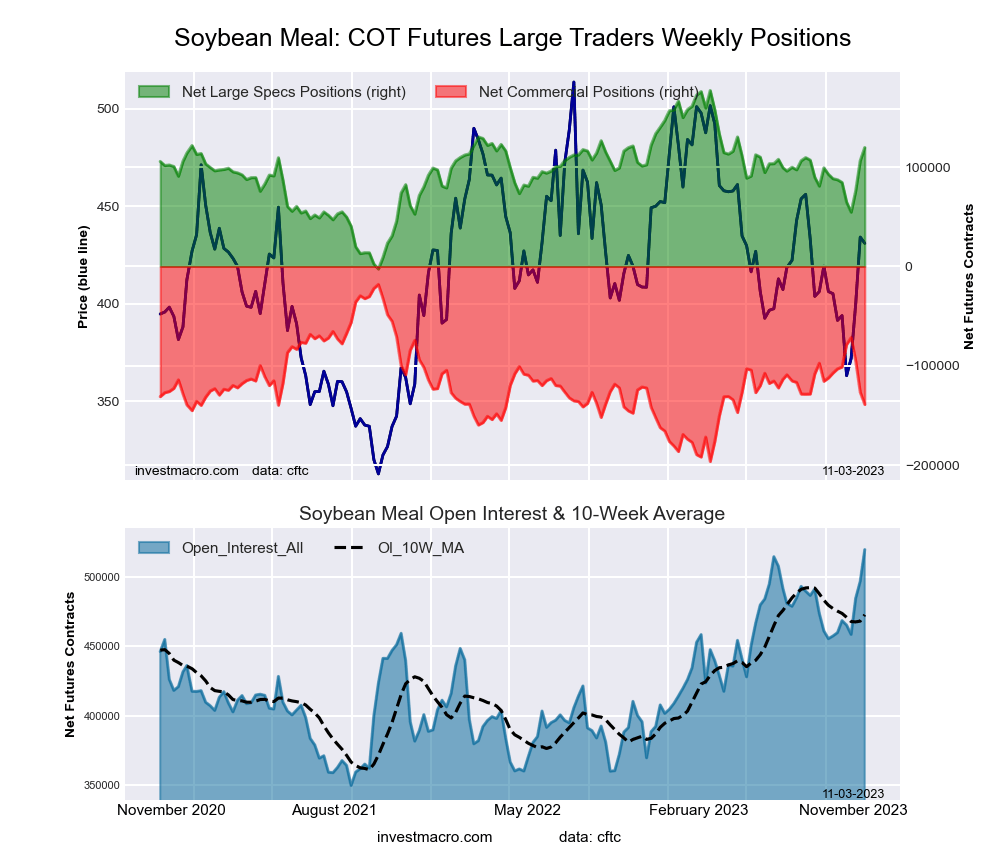
SOYBEAN MEAL Futures COT ChartThe SOYBEAN MEAL large speculator standing this week reached a net position of 88,283 contracts in the data reported through Tuesday. This was a weekly decline of -4,467 contracts from the previous week which had a total of 92,750 net contracts.

This week’s current strength score (the trader positioning range over the past three years, measured from 0 to 100) shows the speculators are currently Bullish with a score of 50.6 percent. The commercials are Bearish with a score of 49.9 percent and the small traders (not shown in chart) are Bearish with a score of 40.6 percent.

Price Trend-Following Model: Weak Uptrend

Our weekly trend-following model classifies the current market price position as: Weak Uptrend. The current action for the model is considered to be: Hold – Maintain Long Position.

SOYBEAN MEAL Futures StatisticsSPECULATORSCOMMERCIALSSMALL TRADERS
– Percent of Open Interest Longs:23.941.49.6
– Percent of Open Interest Shorts:4.664.85.5
– Net Position:88,283-107,25518,972
– Gross Longs:109,513189,17743,929
– Gross Shorts:21,230296,43224,957
– Long to Short Ratio:5.2 to 10.6 to 11.8 to 1
NET POSITION TREND:
– Strength Index Score (3 Year Range Pct):50.649.940.6
– Strength Index Reading (3 Year Range):BullishBearishBearish
NET POSITION MOVEMENT INDEX:
– 6-Week Change in Strength Index:-11.811.90.1


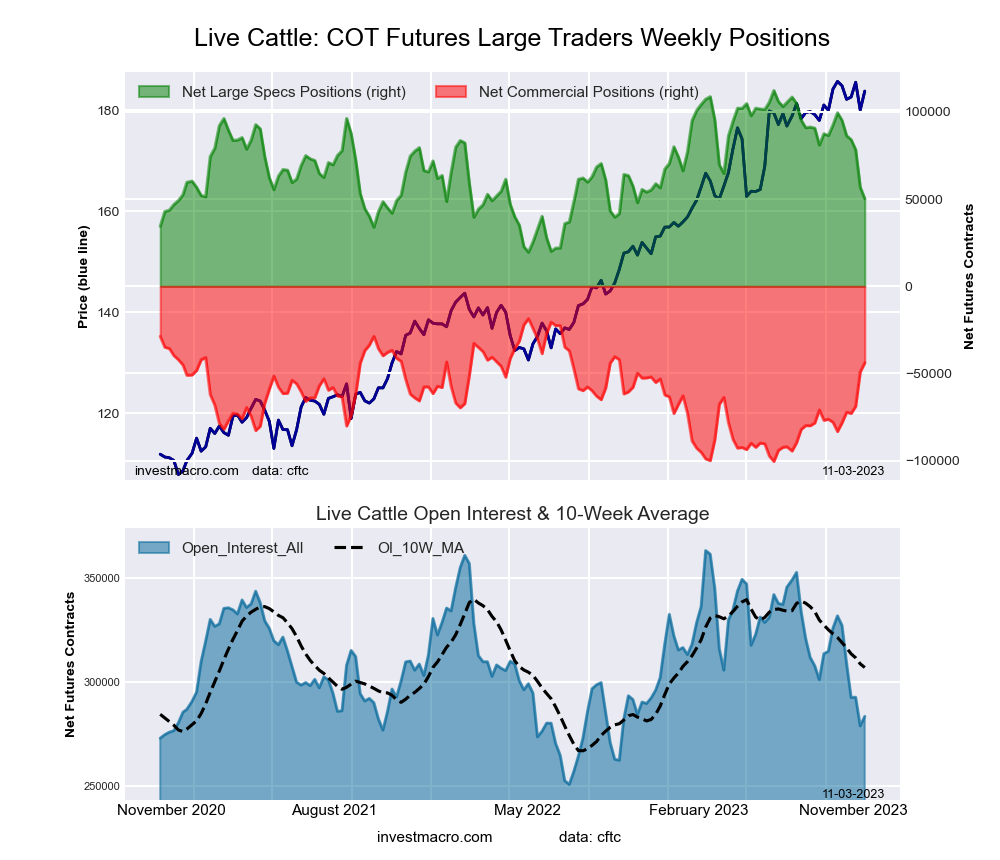
LIVE CATTLE Futures:

LIVE CATTLE Futures COT ChartThe LIVE CATTLE large speculator standing this week reached a net position of 92,544 contracts in the data reported through Tuesday. This was a weekly boost of 6,055 contracts from the previous week which had a total of 86,489 net contracts.

This week’s current strength score (the trader positioning range over the past three years, measured from 0 to 100) shows the speculators are currently Bullish with a score of 78.7 percent. The commercials are Bearish with a score of 27.4 percent and the small traders (not shown in chart) are Bearish-Extreme with a score of 8.5 percent.

Price Trend-Following Model: Strong Uptrend

Our weekly trend-following model classifies the current market price position as: Strong Uptrend. The current action for the model is considered to be: Hold – Maintain Long Position.

LIVE CATTLE Futures StatisticsSPECULATORSCOMMERCIALSSMALL TRADERS
– Percent of Open Interest Longs:44.328.68.6
– Percent of Open Interest Shorts:15.952.613.1
– Net Position:92,544-77,999-14,545
– Gross Longs:144,38393,33328,157
– Gross Shorts:51,839171,33242,702
– Long to Short Ratio:2.8 to 10.5 to 10.7 to 1
NET POSITION TREND:
– Strength Index Score (3 Year Range Pct):78.727.48.5
– Strength Index Reading (3 Year Range):BullishBearishBearish-Extreme
NET POSITION MOVEMENT INDEX:
– 6-Week Change in Strength Index:1.72.3-19.3


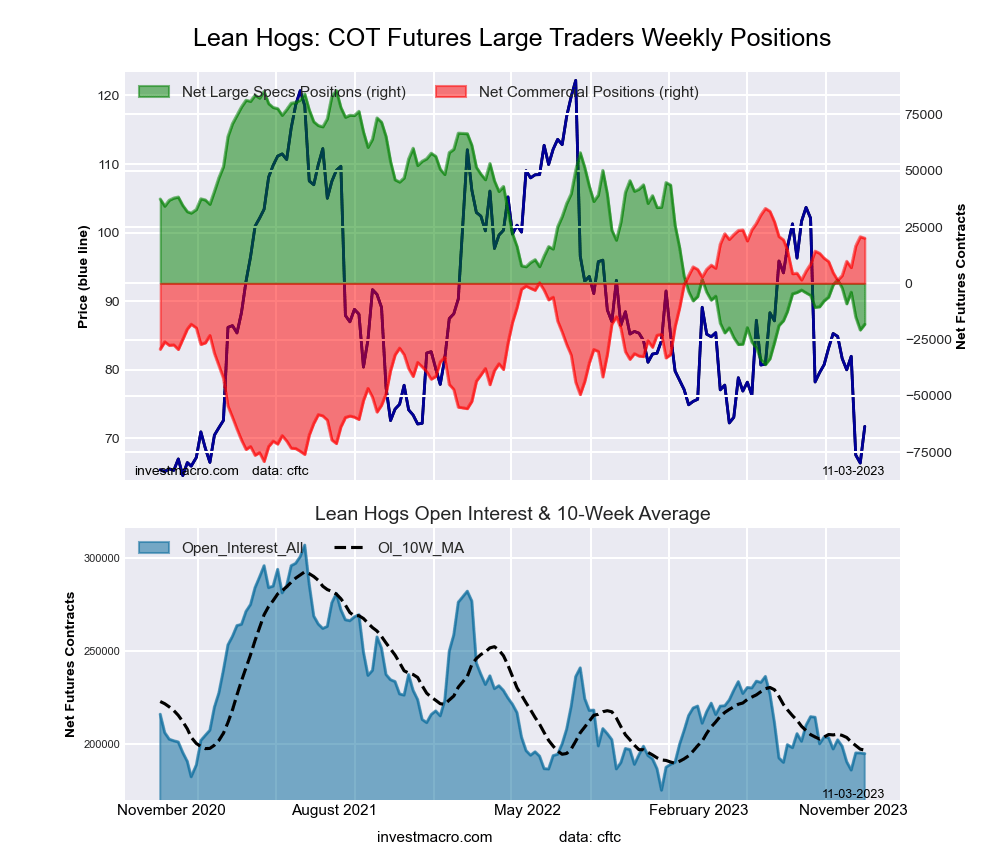
LEAN HOGS Futures:

LEAN HOGS Futures COT ChartThe LEAN HOGS large speculator standing this week reached a net position of -730 contracts in the data reported through Tuesday. This was a weekly advance of 5,402 contracts from the previous week which had a total of -6,132 net contracts.

This week’s current strength score (the trader positioning range over the past three years, measured from 0 to 100) shows the speculators are currently Bearish with a score of 29.1 percent. The commercials are Bullish with a score of 74.6 percent and the small traders (not shown in chart) are Bullish with a score of 65.5 percent.

Price Trend-Following Model: Weak Uptrend

Our weekly trend-following model classifies the current market price position as: Weak Uptrend. The current action for the model is considered to be: Hold – Maintain Long Position.

LEAN HOGS Futures StatisticsSPECULATORSCOMMERCIALSSMALL TRADERS
– Percent of Open Interest Longs:33.737.59.8
– Percent of Open Interest Shorts:34.135.111.8
– Net Position:-7304,709-3,979
– Gross Longs:66,42573,89719,379
– Gross Shorts:67,15569,18823,358
– Long to Short Ratio:1.0 to 11.1 to 10.8 to 1
NET POSITION TREND:
– Strength Index Score (3 Year Range Pct):29.174.665.5
– Strength Index Reading (3 Year Range):BearishBullishBullish
NET POSITION MOVEMENT INDEX:
– 6-Week Change in Strength Index:2.9-0.6-12.7


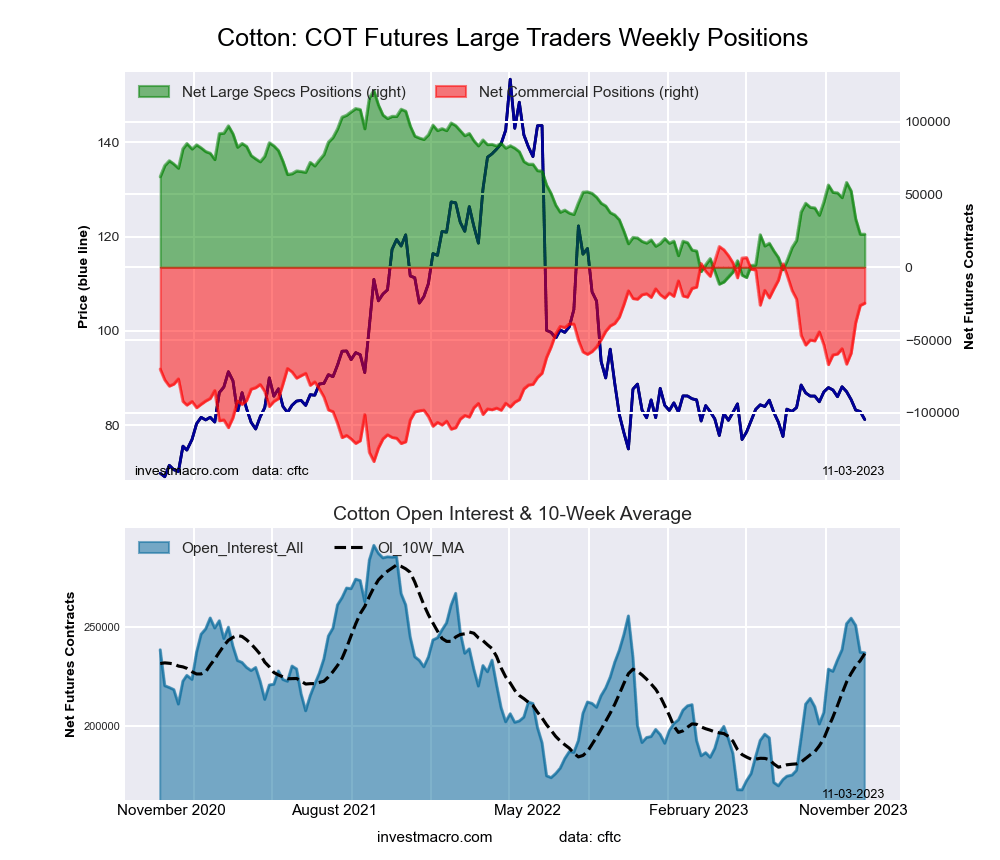
COTTON Futures:

COTTON Futures COT ChartThe COTTON large speculator standing this week reached a net position of 51,382 contracts in the data reported through Tuesday. This was a weekly fall of -5,028 contracts from the previous week which had a total of 56,410 net contracts.

This week’s current strength score (the trader positioning range over the past three years, measured from 0 to 100) shows the speculators are currently Bearish with a score of 47.4 percent. The commercials are Bearish with a score of 49.6 percent and the small traders (not shown in chart) are Bullish with a score of 69.4 percent.

Price Trend-Following Model: Uptrend

Our weekly trend-following model classifies the current market price position as: Uptrend. The current action for the model is considered to be: Hold – Maintain Long Position.

COTTON Futures StatisticsSPECULATORSCOMMERCIALSSMALL TRADERS
– Percent of Open Interest Longs:38.242.67.6
– Percent of Open Interest Shorts:15.669.03.7
– Net Position:51,382-60,1878,805
– Gross Longs:86,92296,89017,240
– Gross Shorts:35,540157,0778,435
– Long to Short Ratio:2.4 to 10.6 to 12.0 to 1
NET POSITION TREND:
– Strength Index Score (3 Year Range Pct):47.449.669.4
– Strength Index Reading (3 Year Range):BearishBearishBullish
NET POSITION MOVEMENT INDEX:
– 6-Week Change in Strength Index:5.6-4.6-4.1


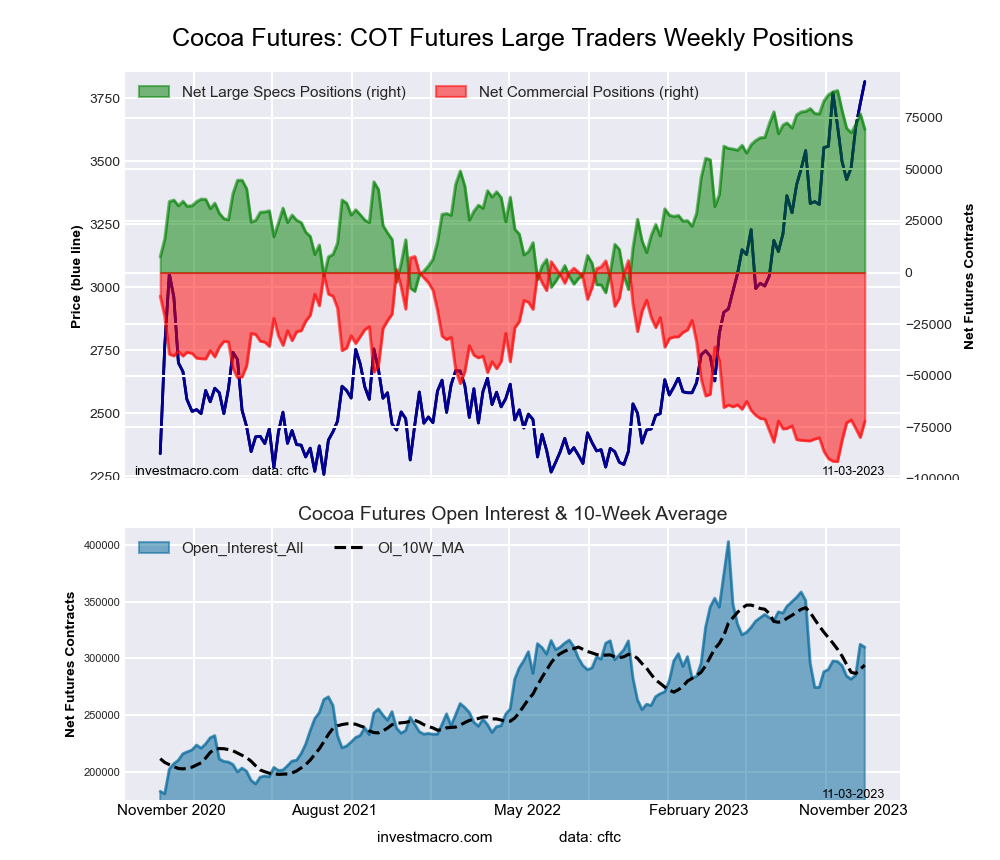
COCOA Futures:

COCOA Futures COT ChartThe COCOA large speculator standing this week reached a net position of 87,623 contracts in the data reported through Tuesday. This was a weekly gain of 1,403 contracts from the previous week which had a total of 86,220 net contracts.

This week’s current strength score (the trader positioning range over the past three years, measured from 0 to 100) shows the speculators are currently Bullish-Extreme with a score of 100.0 percent. The commercials are Bearish-Extreme with a score of 0.0 percent and the small traders (not shown in chart) are Bearish with a score of 35.2 percent.

Price Trend-Following Model: Strong Uptrend

Our weekly trend-following model classifies the current market price position as: Strong Uptrend. The current action for the model is considered to be: Hold – Maintain Long Position.

COCOA Futures StatisticsSPECULATORSCOMMERCIALSSMALL TRADERS
– Percent of Open Interest Longs:47.124.74.4
– Percent of Open Interest Shorts:17.655.43.1
– Net Position:87,623-91,4933,870
– Gross Longs:140,00473,43413,097
– Gross Shorts:52,381164,9279,227
– Long to Short Ratio:2.7 to 10.4 to 11.4 to 1
NET POSITION TREND:
– Strength Index Score (3 Year Range Pct):100.00.035.2
– Strength Index Reading (3 Year Range):Bullish-ExtremeBearish-ExtremeBearish
NET POSITION MOVEMENT INDEX:
– 6-Week Change in Strength Index:9.7-10.15.8


WHEAT Futures:

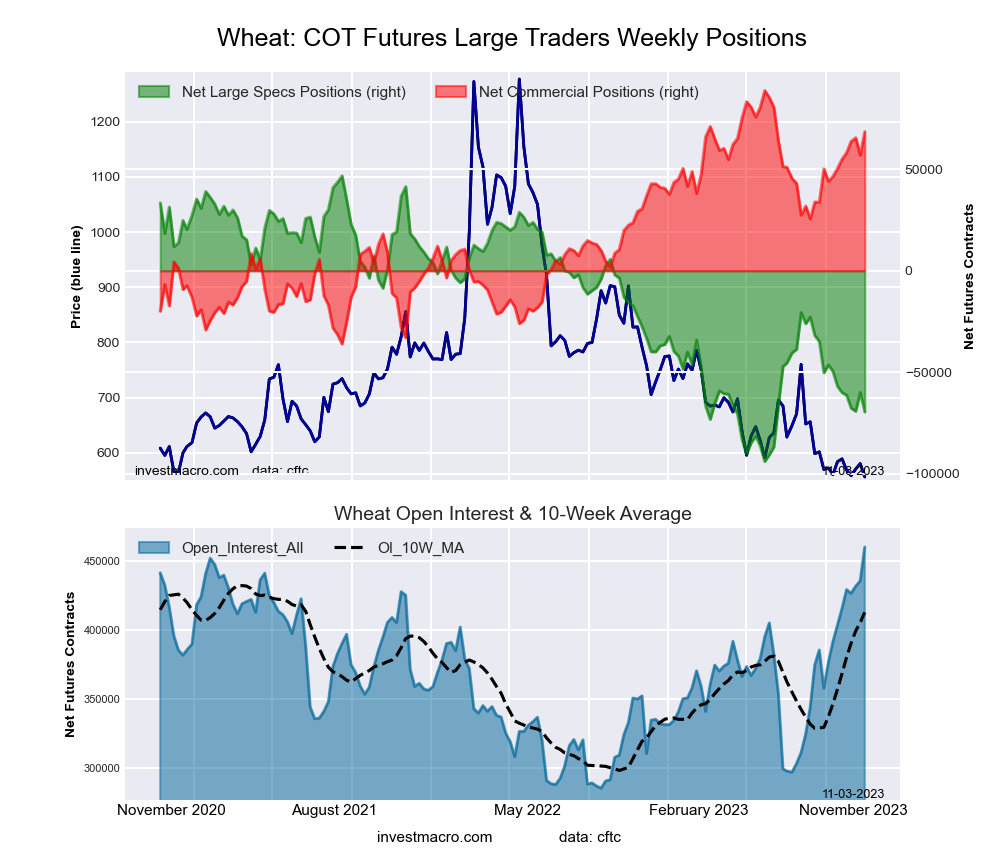
WHEAT Futures COT ChartThe WHEAT large speculator standing this week reached a net position of -49,619 contracts in the data reported through Tuesday. This was a weekly decrease of -3,209 contracts from the previous week which had a total of -46,410 net contracts.

This week’s current strength score (the trader positioning range over the past three years, measured from 0 to 100) shows the speculators are currently Bearish with a score of 31.5 percent. The commercials are Bullish with a score of 66.1 percent and the small traders (not shown in chart) are Bullish-Extreme with a score of 81.6 percent.

Price Trend-Following Model: Strong Downtrend

Our weekly trend-following model classifies the current market price position as: Strong Downtrend. The current action for the model is considered to be: Hold – Maintain Short Position.

WHEAT Futures StatisticsSPECULATORSCOMMERCIALSSMALL TRADERS
– Percent of Open Interest Longs:29.234.010.1
– Percent of Open Interest Shorts:41.822.19.3
– Net Position:-49,61946,5213,098
– Gross Longs:114,277133,15239,447
– Gross Shorts:163,89686,63136,349
– Long to Short Ratio:0.7 to 11.5 to 11.1 to 1
NET POSITION TREND:
– Strength Index Score (3 Year Range Pct):31.566.181.6
– Strength Index Reading (3 Year Range):BearishBullishBullish-Extreme
NET POSITION MOVEMENT INDEX:
– 6-Week Change in Strength Index:-16.711.734.7


Article By InvestMacroReceive our weekly COT Newsletter

*COT Report: The COT data, released weekly to the public each Friday, is updated through the most recent Tuesday (data is 3 days old) and shows a quick view of how large speculators or non-commercials (for-profit traders) were positioned in the futures markets.

The CFTC categorizes trader positions according to commercial hedgers (traders who use futures contracts for hedging as part of the business), non-commercials (large traders who speculate to realize trading profits) and nonreportable traders (usually small traders/speculators) as well as their open interest (contracts open in the market at time of reporting). See CFTC criteria here.

COT Stock Market Charts: Weekly Speculator Bets led by S&P500-Mini & Russell-Mini 

By InvestMacro

Here are the latest charts and statistics for the Commitment of Traders (COT) data published by the Commodities Futures Trading Commission (CFTC).

The latest COT data is updated through Tuesday September 12th and shows a quick view of how large traders (for-profit speculators and commercial entities) were positioned in the futures markets.

Weekly Speculator Changes led by S&P500-Mini & Russell-Mini

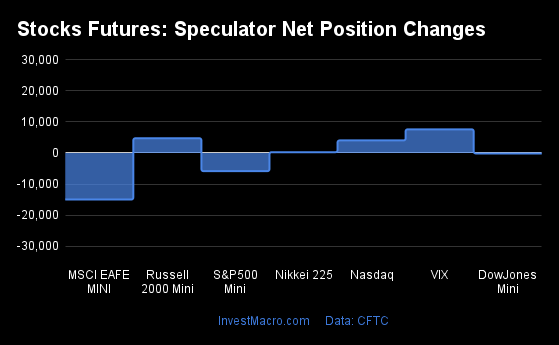
The COT stock markets speculator bets were higher this week as four out of the seven stock markets we cover had higher positioning while the other four markets had lower speculator contracts.

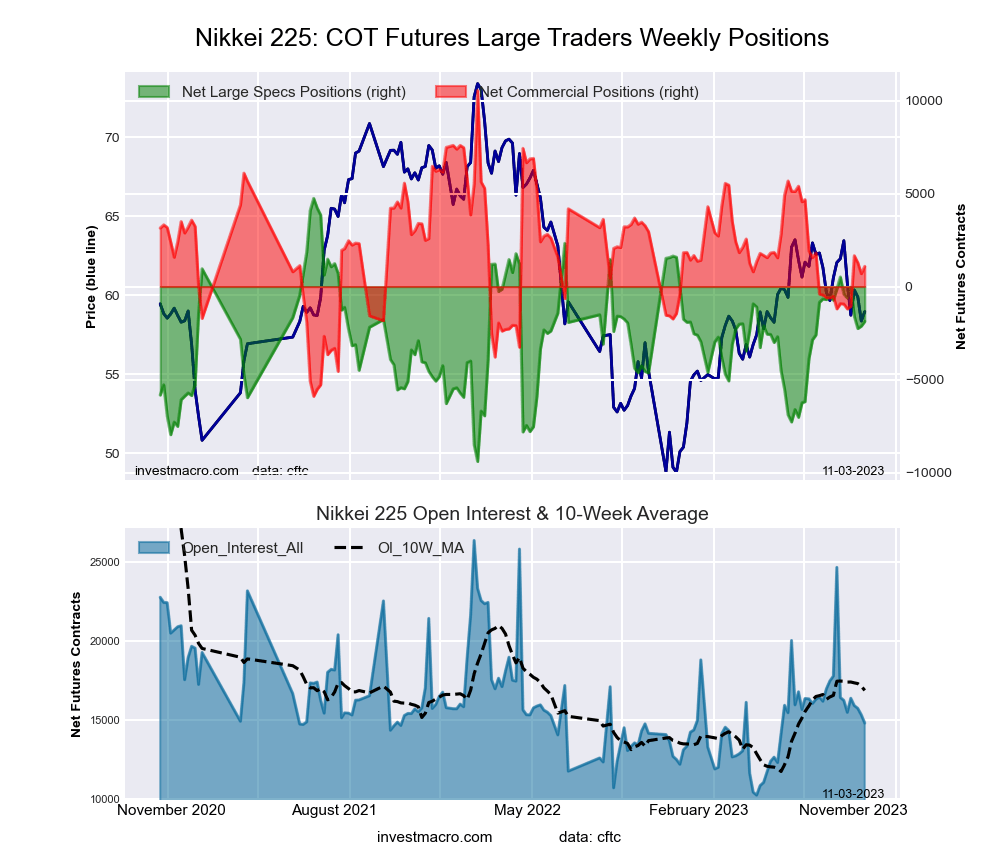
Leading the gains for the stock markets was the S&P500-Mini (27,878 contracts) with the Russell-Mini (8,096 contracts), the Nikkei 225 (656 contracts) and the VIX (3,384 contracts) also showing positive weeks.

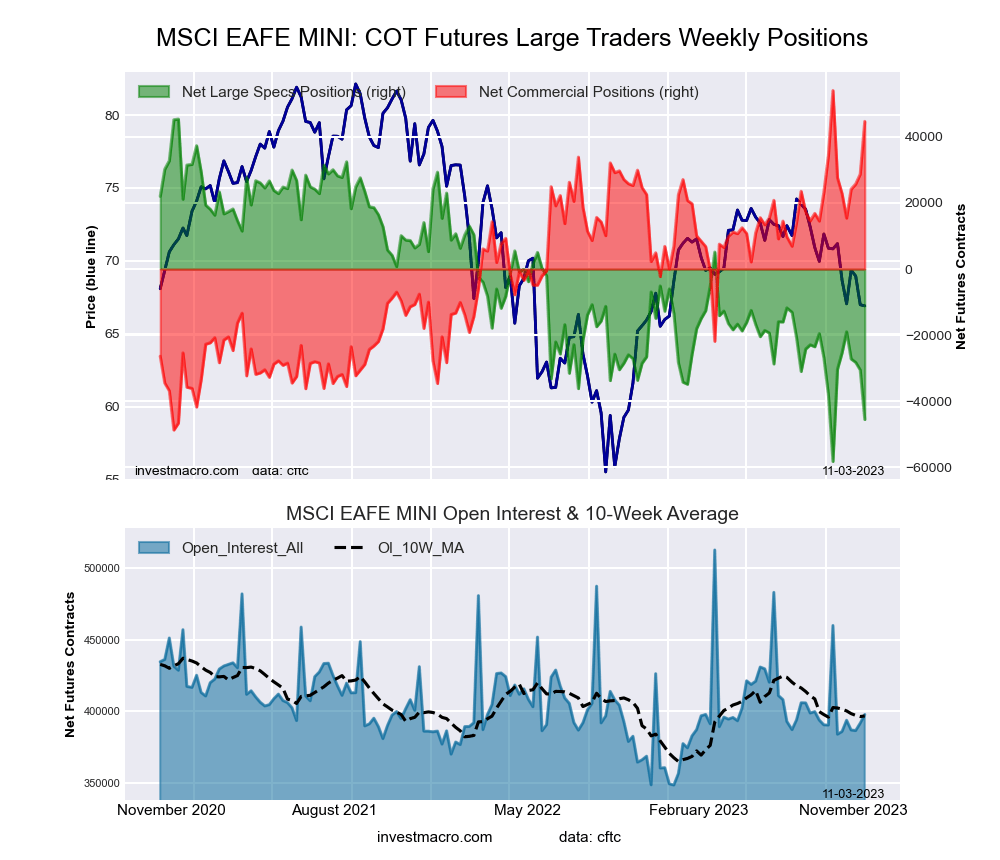
The markets with the declines in speculator bets this week were the MSCI EAFE-Mini (-20,113 contracts) with the Nasdaq-Mini (-4,494 contracts) and the DowJones-Mini (-1,176 contracts) also registering lower bets on the week.


Data Snapshot of Stock Market Traders | Columns Legend
Sep-12-2023OIOI-IndexSpec-NetSpec-IndexCom-NetCOM-IndexSmalls-NetSmalls-Index
S&P500-Mini2,520,16448-116,3334787,0455229,28849
Nikkei 22516,4251751472-9183040433
Nasdaq-Mini303,321779,05682-9,5081745266
DowJones-Mini102,91069-12,9003712,4375946346
VIX418,07281-39,3429040,0996-75792
Nikkei 225 Yen46,463293,889466,64629-10,53573


Strength Scores led by VIX & Nasdaq-Mini

COT Strength Scores (a normalized measure of Speculator positions over a 3-Year range, from 0 to 100 where above 80 is Extreme-Bullish and below 20 is Extreme-Bearish) showed that the VIX (90 percent) and the Nasdaq-Mini (82 percent) lead the stock markets this week. The Nikkei 225 (72 percent) and S&P500-Mini (47 percent) come in as the next highest in the weekly strength scores.

On the downside, the MSCI EAFE-Mini (0 percent) comes in at the lowest strength level currently and is in Extreme-Bearish territory (below 20 percent). The next lowest strength score is the Russell-Mini (34 percent).

Strength Statistics:
VIX (90.3 percent) vs VIX previous week (87.8 percent)
S&P500-Mini (47.4 percent) vs S&P500-Mini previous week (43.2 percent)
DowJones-Mini (37.4 percent) vs DowJones-Mini previous week (40.7 percent)
Nasdaq-Mini (82.4 percent) vs Nasdaq-Mini previous week (85.0 percent)
Russell2000-Mini (33.8 percent) vs Russell2000-Mini previous week (28.9 percent)
Nikkei USD (72.4 percent) vs Nikkei USD previous week (68.2 percent)
EAFE-Mini (0.0 percent) vs EAFE-Mini previous week (19.4 percent)


S&P500-Mini & Nasdaq-Mini top the 6-Week Strength Trends

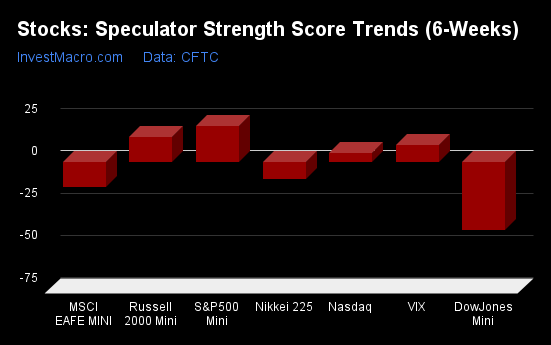
COT Strength Score Trends (or move index, calculates the 6-week changes in strength scores) showed that the S&P500-Mini (13 percent) leads the past six weeks trends for the stock markets. The Nasdaq-Mini (12 percent), the Nikkei 225 (9 percent) and the VIX (2 percent) are the next highest positive movers in the latest trends data.

The DowJones-Mini (-41 percent) leads the downside trend scores currently with the MSCI EAFE-Mini (-33 percent) coming in as the next market with lower trend scores.

Strength Trend Statistics:
VIX (2.1 percent) vs VIX previous week (-0.4 percent)
S&P500-Mini (12.5 percent) vs S&P500-Mini previous week (13.2 percent)
DowJones-Mini (-41.0 percent) vs DowJones-Mini previous week (-37.2 percent)
Nasdaq-Mini (11.8 percent) vs Nasdaq-Mini previous week (13.9 percent)
Russell2000-Mini (1.6 percent) vs Russell2000-Mini previous week (-1.8 percent)
Nikkei USD (8.9 percent) vs Nikkei USD previous week (16.0 percent)
EAFE-Mini (-32.8 percent) vs EAFE-Mini previous week (-6.9 percent)


Individual Stock Market Charts:

VIX Volatility Futures:

VIX Volatility Futures COT ChartThe VIX Volatility large speculator standing this week equaled a net position of -39,342 contracts in the data reported through Tuesday. This was a weekly boost of 3,384 contracts from the previous week which had a total of -42,726 net contracts.

This week’s current strength score (the trader positioning range over the past three years, measured from 0 to 100) shows the speculators are currently Bullish-Extreme with a score of 90.3 percent. The commercials are Bearish-Extreme with a score of 6.2 percent and the small traders (not shown in chart) are Bullish-Extreme with a score of 91.9 percent.

Price Trend-Following Model: Strong Downtrend

Our weekly trend-following model classifies the current market price position as: Strong Downtrend. The current action for the model is considered to be: Hold – Maintain Short Position.

VIX Volatility Futures StatisticsSPECULATORSCOMMERCIALSSMALL TRADERS
– Percent of Open Interest Longs:24.946.06.5
– Percent of Open Interest Shorts:34.336.46.7
– Net Position:-39,34240,099-757
– Gross Longs:104,179192,41927,224
– Gross Shorts:143,521152,32027,981
– Long to Short Ratio:0.7 to 11.3 to 11.0 to 1
NET POSITION TREND:
– Strength Index Score (3 Year Range Pct):90.36.291.9
– Strength Index Reading (3 Year Range):Bullish-ExtremeBearish-ExtremeBullish-Extreme
NET POSITION MOVEMENT INDEX:
– 6-Week Change in Strength Index:2.1-3.06.8


S&P500 Mini Futures:

SP500 Mini Futures COT ChartThe S&P500 Mini large speculator standing this week equaled a net position of -116,333 contracts in the data reported through Tuesday. This was a weekly increase of 27,878 contracts from the previous week which had a total of -144,211 net contracts.

This week’s current strength score (the trader positioning range over the past three years, measured from 0 to 100) shows the speculators are currently Bearish with a score of 47.4 percent. The commercials are Bullish with a score of 51.9 percent and the small traders (not shown in chart) are Bearish with a score of 48.9 percent.

Price Trend-Following Model: Uptrend

Our weekly trend-following model classifies the current market price position as: Uptrend. The current action for the model is considered to be: Hold – Maintain Long Position.

S&P500 Mini Futures StatisticsSPECULATORSCOMMERCIALSSMALL TRADERS
– Percent of Open Interest Longs:11.172.311.4
– Percent of Open Interest Shorts:15.768.810.2
– Net Position:-116,33387,04529,288
– Gross Longs:279,4711,821,412286,894
– Gross Shorts:395,8041,734,367257,606
– Long to Short Ratio:0.7 to 11.1 to 11.1 to 1
NET POSITION TREND:
– Strength Index Score (3 Year Range Pct):47.451.948.9
– Strength Index Reading (3 Year Range):BearishBullishBearish
NET POSITION MOVEMENT INDEX:
– 6-Week Change in Strength Index:12.5-13.65.8


Dow Jones Mini Futures:

Dow Jones Mini Futures COT ChartThe Dow Jones Mini large speculator standing this week equaled a net position of -12,900 contracts in the data reported through Tuesday. This was a weekly fall of -1,176 contracts from the previous week which had a total of -11,724 net contracts.

This week’s current strength score (the trader positioning range over the past three years, measured from 0 to 100) shows the speculators are currently Bearish with a score of 37.4 percent. The commercials are Bullish with a score of 59.1 percent and the small traders (not shown in chart) are Bearish with a score of 46.1 percent.

Price Trend-Following Model: Uptrend

Our weekly trend-following model classifies the current market price position as: Uptrend. The current action for the model is considered to be: Hold – Maintain Long Position.

Dow Jones Mini Futures StatisticsSPECULATORSCOMMERCIALSSMALL TRADERS
– Percent of Open Interest Longs:22.158.914.2
– Percent of Open Interest Shorts:34.746.813.7
– Net Position:-12,90012,437463
– Gross Longs:22,78860,63114,578
– Gross Shorts:35,68848,19414,115
– Long to Short Ratio:0.6 to 11.3 to 11.0 to 1
NET POSITION TREND:
– Strength Index Score (3 Year Range Pct):37.459.146.1
– Strength Index Reading (3 Year Range):BearishBullishBearish
NET POSITION MOVEMENT INDEX:
– 6-Week Change in Strength Index:-41.028.22.9


Nasdaq Mini Futures:

Nasdaq Mini Futures COT ChartThe Nasdaq Mini large speculator standing this week equaled a net position of 9,056 contracts in the data reported through Tuesday. This was a weekly decline of -4,494 contracts from the previous week which had a total of 13,550 net contracts.

This week’s current strength score (the trader positioning range over the past three years, measured from 0 to 100) shows the speculators are currently Bullish-Extreme with a score of 82.4 percent. The commercials are Bearish-Extreme with a score of 16.5 percent and the small traders (not shown in chart) are Bullish with a score of 66.2 percent.

Price Trend-Following Model: Uptrend

Our weekly trend-following model classifies the current market price position as: Uptrend. The current action for the model is considered to be: Hold – Maintain Long Position.

Nasdaq Mini Futures StatisticsSPECULATORSCOMMERCIALSSMALL TRADERS
– Percent of Open Interest Longs:22.656.614.8
– Percent of Open Interest Shorts:19.759.714.7
– Net Position:9,056-9,508452
– Gross Longs:68,674171,57044,891
– Gross Shorts:59,618181,07844,439
– Long to Short Ratio:1.2 to 10.9 to 11.0 to 1
NET POSITION TREND:
– Strength Index Score (3 Year Range Pct):82.416.566.2
– Strength Index Reading (3 Year Range):Bullish-ExtremeBearish-ExtremeBullish
NET POSITION MOVEMENT INDEX:
– 6-Week Change in Strength Index:11.8-13.82.1


Russell 2000 Mini Futures:

Russell 2000 Mini Futures COT ChartThe Russell 2000 Mini large speculator standing this week equaled a net position of -63,615 contracts in the data reported through Tuesday. This was a weekly rise of 8,096 contracts from the previous week which had a total of -71,711 net contracts.

This week’s current strength score (the trader positioning range over the past three years, measured from 0 to 100) shows the speculators are currently Bearish with a score of 33.8 percent. The commercials are Bullish with a score of 63.7 percent and the small traders (not shown in chart) are Bearish with a score of 40.7 percent.

Price Trend-Following Model: Uptrend

Our weekly trend-following model classifies the current market price position as: Uptrend. The current action for the model is considered to be: Hold – Maintain Long Position.

Russell 2000 Mini Futures StatisticsSPECULATORSCOMMERCIALSSMALL TRADERS
– Percent of Open Interest Longs:8.781.95.8
– Percent of Open Interest Shorts:20.571.04.9
– Net Position:-63,61559,0334,582
– Gross Longs:47,088443,19831,308
– Gross Shorts:110,703384,16526,726
– Long to Short Ratio:0.4 to 11.2 to 11.2 to 1
NET POSITION TREND:
– Strength Index Score (3 Year Range Pct):33.863.740.7
– Strength Index Reading (3 Year Range):BearishBullishBearish
NET POSITION MOVEMENT INDEX:
– 6-Week Change in Strength Index:1.6-1.81.8


Nikkei Stock Average (USD) Futures:

Nikkei Stock Average (USD) Futures COT ChartThe Nikkei Stock Average (USD) large speculator standing this week equaled a net position of 514 contracts in the data reported through Tuesday. This was a weekly rise of 656 contracts from the previous week which had a total of -142 net contracts.

This week’s current strength score (the trader positioning range over the past three years, measured from 0 to 100) shows the speculators are currently Bullish with a score of 72.4 percent. The commercials are Bearish with a score of 30.3 percent and the small traders (not shown in chart) are Bearish with a score of 33.4 percent.

Price Trend-Following Model: Strong Uptrend

Our weekly trend-following model classifies the current market price position as: Strong Uptrend. The current action for the model is considered to be: Hold – Maintain Long Position.

Nikkei Stock Average Futures StatisticsSPECULATORSCOMMERCIALSSMALL TRADERS
– Percent of Open Interest Longs:10.968.520.6
– Percent of Open Interest Shorts:7.874.118.1
– Net Position:514-918404
– Gross Longs:1,79311,2493,383
– Gross Shorts:1,27912,1672,979
– Long to Short Ratio:1.4 to 10.9 to 11.1 to 1
NET POSITION TREND:
– Strength Index Score (3 Year Range Pct):72.430.333.4
– Strength Index Reading (3 Year Range):BullishBearishBearish
NET POSITION MOVEMENT INDEX:
– 6-Week Change in Strength Index:8.9-3.1-10.6


MSCI EAFE Mini Futures:

MSCI EAFE Mini Futures COT ChartThe MSCI EAFE Mini large speculator standing this week equaled a net position of -58,192 contracts in the data reported through Tuesday. This was a weekly lowering of -20,113 contracts from the previous week which had a total of -38,079 net contracts.

This week’s current strength score (the trader positioning range over the past three years, measured from 0 to 100) shows the speculators are currently Bearish-Extreme with a score of 0.0 percent. The commercials are Bullish-Extreme with a score of 100.0 percent and the small traders (not shown in chart) are Bearish with a score of 37.9 percent.

Price Trend-Following Model: Downtrend

Our weekly trend-following model classifies the current market price position as: Downtrend. The current action for the model is considered to be: Hold – Maintain Short Position.

MSCI EAFE Mini Futures StatisticsSPECULATORSCOMMERCIALSSMALL TRADERS
– Percent of Open Interest Longs:4.990.32.8
– Percent of Open Interest Shorts:17.678.61.9
– Net Position:-58,19254,0084,184
– Gross Longs:22,550415,41212,927
– Gross Shorts:80,742361,4048,743
– Long to Short Ratio:0.3 to 11.1 to 11.5 to 1
NET POSITION TREND:
– Strength Index Score (3 Year Range Pct):0.0100.037.9
– Strength Index Reading (3 Year Range):Bearish-ExtremeBullish-ExtremeBearish
NET POSITION MOVEMENT INDEX:
– 6-Week Change in Strength Index:-32.835.7-13.4


Article By InvestMacroReceive our weekly COT Newsletter

*COT Report: The COT data, released weekly to the public each Friday, is updated through the most recent Tuesday (data is 3 days old) and shows a quick view of how large speculators or non-commercials (for-profit traders) were positioned in the futures markets.

The CFTC categorizes trader positions according to commercial hedgers (traders who use futures contracts for hedging as part of the business), non-commercials (large traders who speculate to realize trading profits) and nonreportable traders (usually small traders/speculators) as well as their open interest (contracts open in the market at time of reporting). See CFTC criteria here.

Murrey Math Lines 15.09.2023 (Brent, S&P 500)

By RoboForex.com

Brent

Brent crude oil quotes and the RSI on H4 are in their respective overbought areas. In this situation, a downward breakout of 8/8 (93.75) is expected, followed by a decline to the support at 6/8 (90.62). The scenario can be cancelled by an upward breakout of +1/8 (95.31). In this case, the quotes could aim at the resistance at +2/8 (96.88).

Brent_H4
Risk Warning: the result of previous trading operations do not guarantee the same results in the future
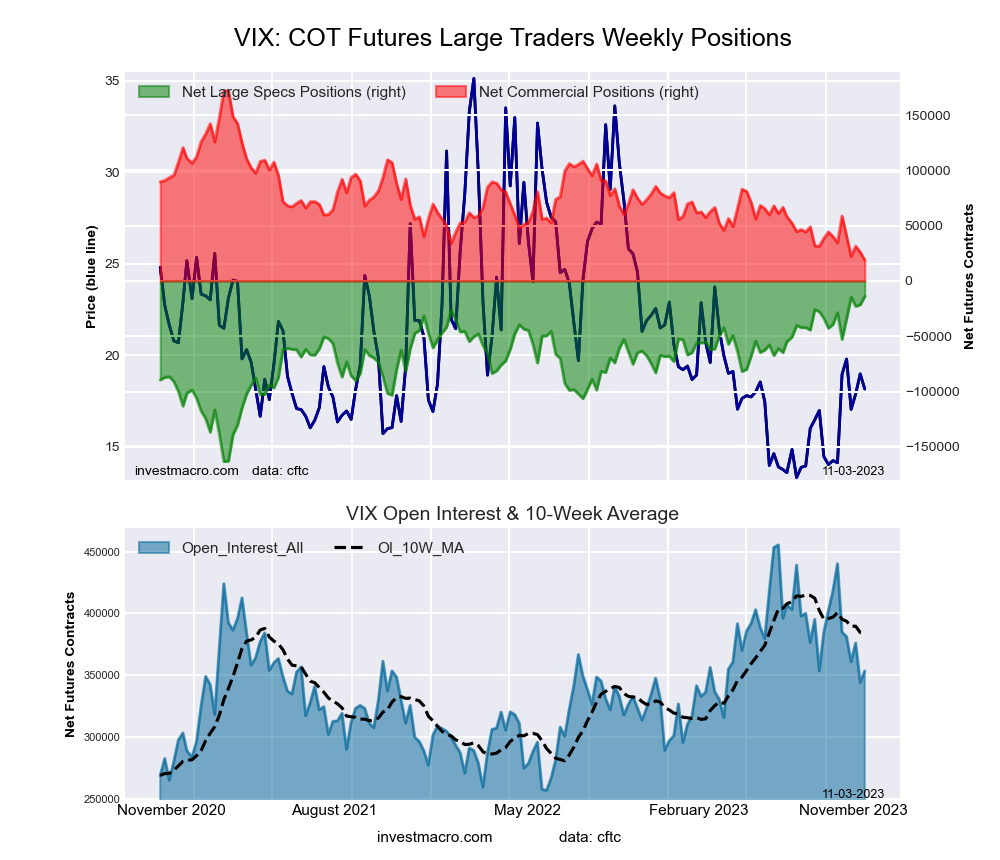
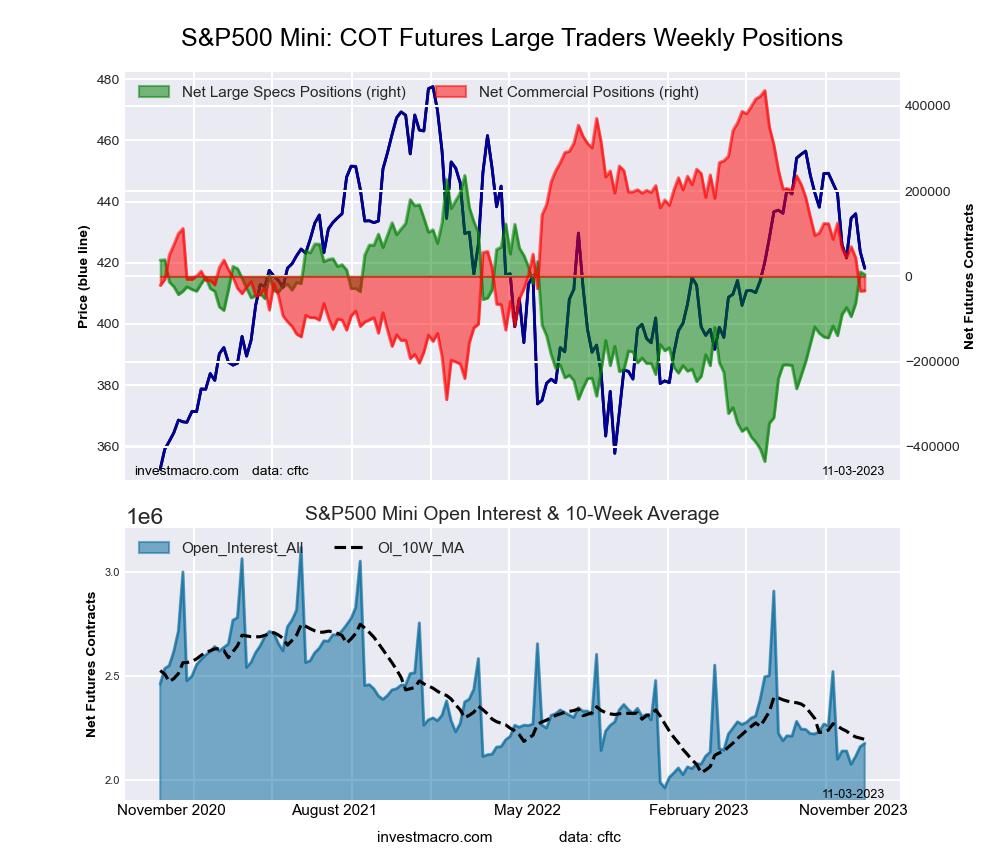
On M15, the lower boundary of the VoltyChannel is too far from the current price, so the decline might only be supported by a downward breakout of 8/8 (93.75) on H4.

Brent_M15
Risk Warning: the result of previous trading operations do not guarantee the same results in the future

S&P 500

On H4, the S&P 500 index quotes are above the 200-day Moving Average, indicating the prevalence of an uptrend. However, the RSI has already reached the overbought area. As a result, in these circumstances, a test of 4/8 (4531.2) is expected, followed by a rebound from this level and a decline to the support at 3/8 (4492.2). The scenario can be cancelled by rising above the resistance level of 4/8 (4453.1). In this case, the S&P 500 could continue growing and reach 5/8 (4570.3).

S&P500_H4
Risk Warning: the result of previous trading operations do not guarantee the same results in the future

On M15, the lower boundary of the VoltyChannel is too far from the current price, so the decline might only be supported by a rebound from 4/8 (4531.2) on H4.

S&P500_M15

Article By RoboForex.com

Attention!
Forecasts presented in this section only reflect the author s private opinion and should not be considered as guidance for trading. RoboForex LP bears no responsibility for trading results based on trading recommendations described in these analytical reviews.