Archive for Financial News – Page 177

The cryptocurrency market digest (BTC, ARK). Overview for 22.09.2023

By RoboForex.com

The BTC exchange rate could not support the growing momentum and slid back to 26,654 USD.

Once again, the same scenario is developing in the digital asset market. The price of the flagship cryptocurrency gradually drops, and the market starts buying vigorously. The value rises by 4-5%, and then just as quickly falls back down within two days.

This will continue until the market has a clear buying driver.

Such a catalyst could be the news about the approval by the US Securities and Exchange Commission (SEC) of applications for bitcoin-ETF licencing. But the information on this matter will only be available in mid-October.

The marks of support levels are relevant again. These include 25,500 USD and 25,150 USD, with resistance at 27,800 USD. Another growth attempt to break through resistance has failed.

The cryptocurrency market capitalisation has dropped to 1.06 trillion USD. The BTC share is still at 49.2%, while the share of ETH has declined to 18.2%.

The value of ARK has fallen sharply

The price of one of the most discussed tokens on the market, ARK, has dropped markedly, with the quotes losing 20% in 24 hours. The capitalisation of the coin decreased to 100 million USD.

Polygon introduces Pokémon NFTs

Polygon blockchain has launched NTF cards featuring legendary anime Pokémon, and they sold out at once. The original cost of these cards increased ten times, with 175 cards being sold within seconds.

Article By RoboForex.com

Attention!
Forecasts presented in this section only reflect the author s private opinion and should not be considered as guidance for trading. RoboForex LP bears no responsibility for trading results based on trading recommendations described in these analytical reviews.

The central banks of Norway and Sweden continue to raise rates. The Swiss National Bank and the Bank of England press on pause

By JustMarkets

At Thursday’s stock market close, the Dow Jones Index (US30) decreased by 1.08%, while the S&P 500 Index (US500) fell by 1.64%. The NASDAQ Technology Index (US100) closed yesterday negative by 1.82%. Stocks and indices extended Wednesday’s losses yesterday as the hawkish tone of Wednesday’s FOMC meeting dampened global risk sentiment. Stock index futures added to their losses after weekly US jobless claims unexpectedly fell to a 7-month low, indicating a strengthening labor market and a hawkish tone for Fed policy.

The Philadelphia Business Outlook Survey of US business activity for September fell from 25.5 to 13.5, weaker than expectations of 1.0. US home sales for August unexpectedly fell by 0.7% m/m to a 7-month low of 4.04 million units, weaker than expectations for a 0.7% m/m increase to 4.10 million units.

Equity markets in Europe were mostly down yesterday. Germany’s DAX (DE40) fell by 1.33%, France’s CAC 40 (FR40) lost 1.59%, Spain’s IBEX 35 (ES35) decreased by 1.03%, and the UK’s FTSE 100 (UK100) closed down by 0.69%.

A representative of the ECB Governing Council and Bundesbank President Nagel said yesterday that it is too early to say that interest rates have reached a plateau, as inflation is still “too high” and forecasts still show only a slow decline towards the ECB’s 2% target. Another ECB official, Central Bank of Ireland Governor Makhlouf, said that an ECB rate hike is still possible in October and that it is too early to plan for a rate cut next March.

The Bank of England (BoE) unexpectedly left the rate unchanged at 5.25% yesterday, although the market expected an increase to 5.5%. However, the margin of votes was only 5 vs. 4. The accompanying statement of the bank stated the following: “If there are signs of more sustained inflationary pressures, further tightening of monetary policy will be required.” Overall, the Bank of England is following the same path as the Fed and ECB – a pause with a possible increase in the future.

The Swiss National Bank (SNB) followed the ECB and the Fed and left the rate unchanged at 1.75%, although the market was expecting a 0.25% increase at the current meeting. By taking a pause, the Central Bank kept the door open for a further increase. At the same time, the Swiss National Bank said it could intervene (in support of the Swiss franc exchange rate) in the foreign exchange market as needed.

The National Bank of Sweden (Riksbank) raised the rate by 25 bps to 4% and may raise it again as “inflationary pressures are too high.” The inflation forecast for 2024 has been raised to 4.6% and will be 8.6% this year after 8.4% in 2022. Meanwhile, the Riksbank said it would start intervening to support the Swedish krona exchange rate to the level of $8 bn and €2 bn (about 1/4 of its foreign exchange reserves) over the next 4-6 months, calling it “hedging foreign exchange reserves.”

Norway’s Central Bank (Norges Bank) on Thursday raised its main deposit rate by 25 basis points to 4.25%, the highest since 2008. The move adds pressure to Norway’s economy, which is currently experiencing a slowdown. The bank also hinted at the possibility of a further rate hike in December. In addition to the rate hike, Norges Bank slightly revised its key rate forecasts, suggesting that it will be around 4.5% until 2024.

Crude oil prices rose yesterday after Russia said it would ban gasoline and diesel exports in an attempt to stabilize domestic fuel prices. The ban will reduce fuel supplies by about 1 million BPD, which is about 3.4% of total global demand (according to Vortexa), and will further squeeze supply in an already tight global market.

Asian markets were mostly down yesterday. Japan’s Nikkei 225 was down by 1.37%, China’s FTSE China A50 (CHA50) lost 1.24%, Hong Kong’s Hang Seng (HK50) decreased by 1.29% on the day, and Australia’s ASX 200 (AU200) was negative by 1.37% on Thursday.

The Bank of Japan (BOJ) left interest rates at negative levels as expected. The BOJ said it will maintain the current yield curve control (YCC) rates, allowing bond yields to fluctuate between minus 0.5% and plus 0.5%, allowing up to 1%. The BOJ also said that amid high uncertainty surrounding the Japanese economy, especially amid slowing growth in countries that are its largest trading partners, it will continue to ease monetary policy and strive to achieve its 2% annualized inflation target. Japanese 10-year bond yields fell nearly 2% after the BOJ statement. Data released earlier on Friday showed Japan’s consumer price index inflation rose more than expected in August amid solid consumer spending, rising oil prices, and a renewed yen depreciation.

S&P 500 (F)(US500) 4,330.00 −72.20 (−1.64%)

Dow Jones (US30) 34,070.42 −370.46 (−1.08%)

DAX (DE40)  15,571.86 −209.73 (−1.33%)

FTSE 100 (UK100) 7,678.62 −53.03 (−0.69%)

USD Index  105.39 +0.19 (+0.18%)

News feed for 2023.09.22:
  • – New Zealand Trade Balance (m/m) at 01:45 (GMT+3);
  • – Australia Manufacturing PMI (m/m) at 02:00 (GMT+3);
  • – Australia Services PMI (m/m) at 02:00 (GMT+3);
  • – Japan National Core Consumer Price Index (m/m) at 02:30 (GMT+3);
  • – Japan BoJ Outlook Report at 06:00 (GMT+3);
  • – Japan BoJ Interest Rate Decision at 06:00 (GMT+3);
  • – Singapore Consumer Price Index (m/m) at 08:00 (GMT+3);
  • – Japan BoJ Press Conference at 09:30 (GMT+3);
  • – UK Retail Sales (m/m) at 09:00 (GMT+3);
  • – Eurozone German Manufacturing PMI (m/m) at 10:30 (GMT+3);
  • – Eurozone German Services PMI (m/m) at 10:30 (GMT+3);
  • – Eurozone Manufacturing PMI (m/m) at 11:00 (GMT+3);
  • – Eurozone Services PMI (m/m) at 11:00 (GMT+3);
  • – UK Manufacturing PMI (m/m) at 11:30 (GMT+3);
  • – UK Services PMI (m/m) at 11:30 (GMT+3);
  • – Canada Retail Sales (m/m) at 15:30 (GMT+3);
  • – US Manufacturing PMI (m/m) at 16:45 (GMT+3);
  • – US Services PMI (m/m) at 16:45 (GMT+3).

By JustMarkets


This article reflects a personal opinion and should not be interpreted as an investment advice, and/or offer, and/or a persistent request for carrying out financial transactions, and/or a guarantee, and/or a forecast of future events.

Fed: all according to plan. Overview for 21.09.2023

By RoboForex.com

The primary currency pair is experiencing pressure on Thursday. The current EURUSD exchange rate stands at 1.0632.

The US Federal Reserve decided to maintain the interest rate unchanged at its September meeting, keeping it within the target range of 5.25-5.50% per annum.

In the Fed’s remarks, it was noted that the decision was unanimous while leaving open the possibility of potentially increasing the rate once more before the end of the year.

This aligns with what the market had been expecting, indicating a potential increase in borrowing costs at the November meeting. The Fed clarified its intention to keep the rate elevated for an extended period.

Jerome Powell, the chair of the Federal Reserve, stated that the economy is expected to experience a so-called soft landing. While not the baseline scenario, it is considered the primary objective.

Overall, Powell was very cautious, enigmatic, and seemed somewhat uncertain.

The US dollar initially declined but swiftly recovered, maintaining a strong position.

Article By RoboForex.com

Attention!
Forecasts presented in this section only reflect the author s private opinion and should not be considered as guidance for trading. RoboForex LP bears no responsibility for trading results based on trading recommendations described in these analytical reviews.

The FOMC plans to hold another rate hike before the end of the year. New Zealand is likely to avoid recession

By JustMarkets

At Wednesday’s stock market close, the Dow Jones Index (US30) decreased by 0.22%, while the S&P 500 Index (US500) lost 0.94%. The NASDAQ Technology Index (US100) closed yesterday negative by 1.46%. Stocks declined after the US Federal Reserve took another pause but signaled that interest rates will still be rising. Policymakers said another 25 bps rate hike is likely this year, and the FOMC dot plot showed that the target for the federal funds rate in 2024 and 2025 will be 50 bps higher than forecast in June. The Fed’s hawkish stance drove the 10-year T bond yield to a 16-year high and sent stocks and stock indexes tumbling.

Yesterday, the FOMC voted unanimously to keep the target range for the federal funds rate unchanged at 5.50%, with 12 of 19 policymakers expecting another 25 bps rate hike this year. At the press conference, Fed Chairman Jerome Powell said the following: “The FOMC is prepared to raise rates further if necessary, and we intend to keep policy at a restrictive level until we are confident that inflation is moving steadily downward toward our objectives.”

The FOMC’s median forecast for US economic growth in 2023 was raised to 2.1% from 1.0% in June. In addition, the unemployment rate forecast for 2023 was lowered to 3.8% from June’s forecast of 4.1%. The core PCE price deflator (the US Federal Reserve’s inflation indicator) for 2023 was lowered to 3.7% from the June forecast of 3.9%. Markets are now pricing in a 31% probability that the FOMC will raise the lending rate by 25 bps at its next meeting on November 1 and a 54% probability that the rate will be raised by 25 bps at the December 13 meeting.

Bank of America raised its year-end price target for the S&P 500 (US500) to 4,600 from a previous forecast of 4,300, saying macrocycle indicators, including valuations and positioning, are giving bullish signals.

Alphabet’s (GOOGL) stock price is down by more than 3% on news that the company has managed to recover only 40% of the mobile traffic it previously received through its mapping service after Apple replaced Google Maps on its iPhones in favor of its own app.

Equity markets in Europe were mostly up yesterday. Germany’s DAX (DE40) increased by 0.75%, France’s CAC 40 (FR40) gained 0.67% yesterday, Spain’s IBEX 35 (ES35) added 1.30%, and the UK’s FTSE 100 (UK100) closed up by 0.93%. European equities were supported yesterday amid signs of slowing price pressures in Europe and the UK after producer prices in Germany fell in August, and consumer prices in the UK showed a sharp decline. In the UK, the overall inflation rate fell from 6.9% to 6.2% y/y, while core inflation (which excludes food and energy prices) fell from 6.8% to 6.7% y/y. The more detailed report also showed a decline in services inflation, which had been a major concern for the MPC amid soaring wage growth.

New car registrations in the Eurozone rose by 21.0% y/y in August to 788,000 units, the largest increase in 5 months. The Eurozone’s construction output rose by 0.8% m/m in July, the largest increase in the last five months.

WTI crude oil prices suffered moderate losses on Wednesday after the US Federal Reserve raised its interest rate forecast for next year, which helped the dollar recover and could curb economic growth and energy demand. Tensions in the oil market are expected to continue as OPEC+ production cuts are extended.

Asian markets were mostly down yesterday. Japan’s Nikkei 225 declined by 0.66%, China’s FTSE China A50 (CHA50) fell by 0.36%, Hong Kong’s Hang Seng (HK50) lost 0.62% on the day, and Australia’s ASX 200 (AU200) was negative by 0.46% on Wednesday.

Japan’s exports declined by 0.8% y/y in August, which was less than expectations of 2.1% y/y. In addition, imports fell by 17.8% y/y in August, the largest decline in three years but less than the expected 20.0% y/y.

New Zealand’s GDP for the quarter grew by 0.9%, better than expectations of 0.4%. Stronger-than-expected economic growth could be a challenge for the RBNZ, which has said it needs to see a slowdown in economic growth to lower inflation and inflation expectations. New Zealand’s central bank forecast in August that the country would enter recession in the third quarter of 2023, while in updated forecasts released last week, the Treasury said it expects the country to avoid recession.

S&P 500 (F)(US500) 4,402.20 −41.75 (−0.94%)

Dow Jones (US30) 34,440.88  −76.85 (−0.22%)

DAX (DE40)  15,781.59 +117.11 (+0.75%)

FTSE 100 (UK100) 7,731.65 +71.45 (+0.93%)

USD Index  105.36 +0.16 (+0.15%)

News feed for 2023.09.19:
  • – New Zealand GDP (q/q) at 01:45 (GMT+3);
  • – Switzerland SNB Monetary Policy Statement at 10:30 (GMT+3);
  • – Switzerland SNB Interest Rate Decision at 10:30 (GMT+3);
  • Switzerland SNB Press Conference at 11:00 (GMT+3);
  • – Norwegian Interest Rate Decision at 11:30 (GMT+3);
  • – UK BoE Interest Rate Decision at 14:00 (GMT+3);
  • – UK BoE MPC Meeting Minutes at 14:00 (GMT+3);
  • – US Initial Jobless Claims (w/w) at 15:30 (GMT+3);
  • – US Philadelphia Fed Manufacturing Index (m/m) at 15:30 (GMT+3);
  • – US Existing Home Sales (m/m) at 17:00 (GMT+3);
  • – Eurozone ECB President Lagarde Speaks (m/m) at 17:00 (GMT+3);
  • – US Natural Gas Storage (w/w) at 17:30 (GMT+3).

By JustMarkets


This article reflects a personal opinion and should not be interpreted as an investment advice, and/or offer, and/or a persistent request for carrying out financial transactions, and/or a guarantee, and/or a forecast of future events.

Fed would make a huge mistake if rates are hiked again this year

By George Prior 

The Federal Reserve has kept interest rates steady but are prepared to raise rates again in November – and this will be “an error of judgement,” predicts the CEO and founder of one of the world’s largest independent financial advisory, asset management and fintech organizations.

The prediction from deVere Group’s Nigel Green comes as the US central bank confirms the lower bound at 5.25% and the upper bound at 5.50%.

He comments: “The Fed has kept interest rates unchanged this time around, as was widely predicted by analysts and which was priced-in by the markets.

“As such, investors were less interested in this decision, but much more so on what Chair Jerome Powell and Fed policymakers hinted at for the future path.”

The deVere CEO continues: “He was, unsurprisingly, keen to stress that the war on inflation isn’t yet won.

“This lack of obvious decisiveness was deliberate to avoid a major market reaction, which would make their task of cooling the world’s largest economy harder.

“The US central bank, still a long way from its 2% target, will be concerned about the resilience of the economy and the markets, despite its efforts to cool them by making borrowing costs more expensive with the most aggressive policy tightening agenda in decades.”

This scenario leads Nigel Green to expect that the Federal Reserve will hike rates again this year.

“We believe the Fed isn’t done yet.

“We expect it will resume its hiking programme in November. But this, we believe, would be an error of judgement and could leave scars on the US economy,” he notes.

“The time lag for monetary policies is incredibly lengthy. It takes around two years for the full effect of rate hikes to make their way into the economy.

“We’re now starting to see the drag effects on the US economy with households and businesses becoming considerably more prudent. In addition, investors are becoming more and more concerned that additional hikes could steer the US economy into a recession.”

Further stifling growth through the cost of capital becoming prohibitive for companies and consumers leads to a decline in capital formation, reduced entrepreneurial activity, investment and innovation. “These effects hinder future growth potential and undermine an economy’s competitiveness on the global stage.”

The deVere CEO concludes: “Should more interest rate hikes further squeeze economic growth, the longer-term consequences will be far worse than higher for a bit longer inflation, which is already coming down – we’re in the end game already.

“The Fed would be making a huge mistake to resume hikes in November.”

About:

deVere Group is one of the world’s largest independent advisors of specialist global financial solutions to international, local mass affluent, and high-net-worth clients.  It has a network of offices across the world, over 80,000 clients and $12bn under advisement.

The cryptocurrency market digest (BTC, USDC). Overview for 20.09.2023

By RoboForex.com

The BTC exchange rate surged to 27,104 USD on Wednesday.

Bitcoin is back in the game. On Monday, the market began aggressive buying, which came to a sudden halt on Tuesday, just as abruptly as it started. Nevertheless, during this time, BTC managed to achieve a three-week high. Since September 12, the market capitalisation of BTC has increased by nearly 10%. The pivotal supporting event here is the upcoming launch of the first Bitcoin ETF.

Recall that important support for the leading cryptocurrency is at the 25,150 USD level. Resistance stands at 27,800 USD, and it is critical for BTC to break through this level.

Today marks the conclusion of the regular meeting of the US Federal Reserve. The interest rate situation is clear: it will remain at 5.5% per annum. However, the major intrigue lies in what the Fed will communicate about its future decisions. News from this front could attract more attention to cryptocurrencies.

The cryptocurrency market capitalisation has risen to USD 1.07 trillion. BTC’s share has increased to 49.2%, while the ETH share has decreased to 18.3%.

Binance and Grayscale are the leading BTC holders

According to publicly available information, currently, the most substantial holders of the flagship cryptocurrency include Satoshi Nakamoto, who may own at least 750 thousand BTC. Binance holds another 643.5 thousand BTC, and Grayscale’s assets are estimated at 627.7 thousand BTC.

Circle launched stablecoin

Circle developers have announced the launch of the USDC stablecoin on Polkadot’s Asset Hub. This token can be employed in other parachains using the XCM protocol.

Article By RoboForex.com

Attention!
Forecasts presented in this section only reflect the author s private opinion and should not be considered as guidance for trading. RoboForex LP bears no responsibility for trading results based on trading recommendations described in these analytical reviews.

China kept key interest rates unchanged. Inflation is accelerating in Canada

By JustMarkets

As of Tuesday’s stock market close, the Dow Jones Index (US30) decreased by 0.40%, while the S&P 500 Index (US500) lost 0.22%. The NASDAQ Technology Index (US100) closed negative 0.23% on Tuesday. Stock indices declined amid a weak US housing report and a rise in 10-year bond yields to a 15-year high. US housing starts fell by 11.3% to 1.283 million units in August, much weaker than expectations of a decline of around 1%. In addition, the likelihood of an expanded UAW union strike and the resumption of student loan payments on October 1 also put downward pressure on stocks. Stocks also traded on a cautious note ahead of the two-day FOMC meeting. Markets fully expect the FOMC to leave the lending rate target unchanged at 5.25/5.50%. However, markets expect the FOMC to maintain its hawkish attitude and leave open the possibility of another rate hike later this year. This would be negative for stock indices.

Canadian inflation accelerated more than expected for the second consecutive month. The Consumer Price Index rose from 3.3% to 4% y/y in August, the fastest pace since April. Core inflation (excluding food and energy prices) rose slightly to 3.3% from 3.2%. The three-month moving average of indicators the Bank of Canada cited as key to its team rose a full percentage point to 4.49% on an annualized basis, according to Bloomberg calculations. Investors raised bets that Canada’s Central Bank will resume policy tightening and hold another rate hike at its October meeting.

Equity markets in Europe were mostly up yesterday. Germany’s DAX (DE40) fell by 0.40%, France’s CAC 40 (FR40) gained 0.08%, Spain’s IBEX 35 (ES35) added 0.40%, and the UK’s FTSE 100 (UK100) closed up by 0.09%. The August Eurozone Consumer Price Index was revised slightly from 5.3% to 5.2% y/y. Core CPI remained unchanged at 5.3% y/y. Lower inflationary pressures are dovish for ECB policy.

OECD economists cut the UK’s economic growth forecast for next year due to pressure on households and businesses from high interest rates. The analysts added that economic activity in the UK has “already weakened” due to the “lagged effect on household incomes from a large energy price shock in 2022.” The think tank forecast economic growth of 0.3% in 2023, which would be the second weakest among G7 countries.

WTI crude oil prices rose to a new 10-month high on Tuesday, extending the rally seen over the past three months, driven by expectations of a strong supply outlook for the rest of the year. However, crude oil prices declined later in the session, pressured by liquidations of long positions and some concerns about the global economy. Yesterday, the OECD lowered its 2024 global GDP forecast to 2.7% from 3.0%.

Asian markets traded yesterday without any unified dynamics. Japanese Nikkei 225 declined yesterday by 0.87%, Chinese FTSE China A50 (CHA50) rose by 0.02%, Hong Kong Hang Seng (HK50) increased by 0.37% on the day, and Australian ASX 200 (AU200) was negative 0.47% on Tuesday.

On Wednesday, the People’s Bank of China kept the one-year LPR rate unchanged at 3.45%, while the five-year LPR rate, which is used to determine mortgage rates, was left unchanged at 4.20%. Both rates are at historic lows after three cuts over the past year. Key comments from the People’s Bank of China (PBOC) official following the meeting:

  • The PBOC will pay more attention to changes in the RMB exchange rate against a basket of currencies;
  • There is a solid basis for keeping the RMB exchange rate basically stable;
  • The PBOC will resolutely correct the unilateral pro-cyclical behavior of the RMB exchange rate;
  • The PBOC will resolutely crack down on market disruption, resolutely guard against the risks of exchange rate overvaluation;
  • China’s monetary policy still has ample room to respond to unexpected challenges and changes.

On Friday, the Bank of Japan will hold its monetary policy meeting. While no changes are expected at this meeting, swap market indicators are now showing stronger expectations for a soon-to-be abandonment of negative interest rates by March 2024 than a further widening of the range around the BoJ’s 10-year bond yield target. Against this backdrop, Bank of Japan Governor Kazuo Ueda is expected to take a somewhat hawkish stance, primarily to manage the yen’s depreciation.

S&P 500 (F)(US500) 4,443.95 −9.58 (−0.22%)

Dow Jones (US30) 34,517.73 −106.57 (−0.31%)

DAX (DE40)  15,664.48 −62.64 (−0.40%)

FTSE 100 (UK100) 7,660.20 +7.26 (+0.095%)

USD Index  105.15 −0.06 (−0.05%)

News feed for 2023.09.19:
  • – Japan Trade Balance (m/m) at 02:50 (GMT+3);
  • – China PBoC Loan Prime Rate (m/m) at 04:15 (GMT+3);
  • – UK Consumer Price Index (m/m) at 09:00 (GMT+3);
  • – UK Producer Price Index (m/m) at 09:00 (GMT+3);
  • – German Producer Price Index (m/m) at 09:00 (GMT+3);
  • – US Crude Oil Reserves (w/w) at 17:30 (GMT+3);
  • – US Fed Interest Rate Decision at 21:00 (GMT+3);
  • – US FOMC Statement at 21:00 (GMT+3);
  • – US FOMC Economic Projections at 21:00 (GMT+3);
  • – US FOMC Press Conference at 21:30 (GMT+3).

By JustMarkets


This article reflects a personal opinion and should not be interpreted as an investment advice, and/or offer, and/or a persistent request for carrying out financial transactions, and/or a guarantee, and/or a forecast of future events.

Japanese Candlesticks Analysis 19.09.2023 (EURUSD, USDJPY, EURGBP)

By RoboForex.com

EURUSD, “Euro vs US Dollar”

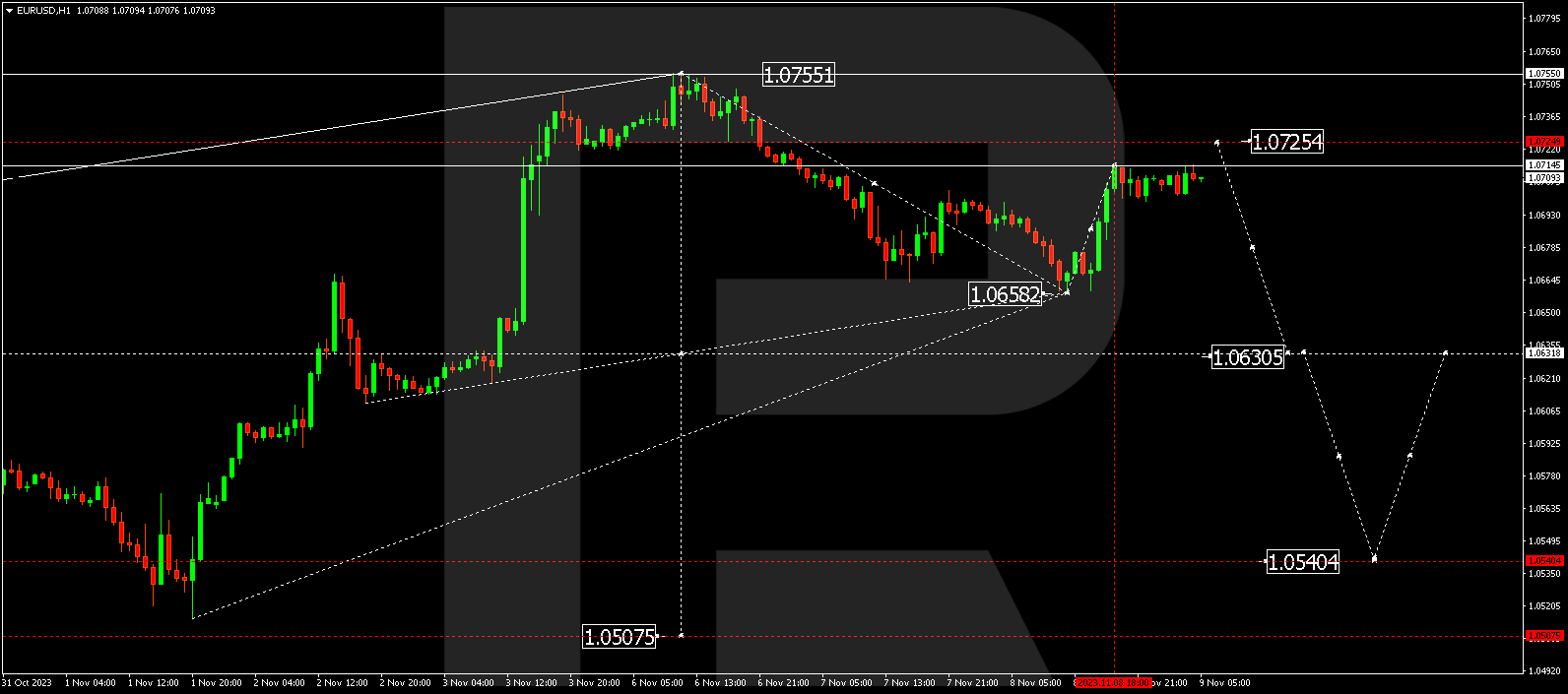
EURUSD has formed a Hammer reversal pattern on H4 near the support level. Currently, the instrument is going by the reversal signal in an ascending wave. The pullback target could be the resistance level of 1.0720. However, the price could drop to 1.0625 and continue the downtrend without testing the resistance.

EURUSD
Risk Warning: the result of previous trading operations do not guarantee the same results in the future

USDJPY, “US Dollar vs Japanese Yen”

USDJPY has formed a Hanging Man reversal pattern on H4. Currently, the instrument is going by the reversal signal in a descending wave. The pullback target might be 147.45. However, the price could rise to 148.50 and continue the uptrend without testing the support.

USDJPY
Risk Warning: the result of previous trading operations do not guarantee the same results in the future

EURGBP, “Euro vs Great Britain Pound”

EURGBP has formed an Inverted Hammer reversal pattern on H4. Currently, the instrument is going by the reversal signal in an ascending wave. The growth target could be 0.8655. Upon testing and breaking this level, the price could continue the uptrend. However, the quotes might correct to 0.8610 before rising.

EURGBP

Article By RoboForex.com

Attention!
Forecasts presented in this section only reflect the author s private opinion and should not be considered as guidance for trading. RoboForex LP bears no responsibility for trading results based on trading recommendations described in these analytical reviews.

Oil’s rally continues. Investors are in no hurry to intensify trading ahead of the Fed meeting

By JustMarkets

At the close of the stock exchange on Monday, the Dow Jones Index (US30) rose by 0.02%, and the S&P 500 Index (US500) increased by 0.07%. The NASDAQ Technology Index (US100) closed Monday at its opening price. Stock indices were down on Monday due to caution ahead of the two-day FOMC meeting on Tuesday and Wednesday. Markets fully expect the FOMC to leave the main rate target unchanged at 5.5% (99% probability) this week. However, the FOMC is expected to maintain a hawkish tone and remain open to one last rate hike, as inflation and the economy have not slowed enough yet.

Markets estimate the probability of the FOMC raising the rate by 25 bps at the November 1 meeting as 31%, and the probability of a 25 bps rate hike at the next meeting on December 13 is 14%. The markets then expect the FOMC to start cutting rates in 2024 in response to an expected slowdown in the US economy.

The NAHB US housing market index published on Monday fell by  5 points to a 5-month low of 45, which was much weaker than expected. The decline in confidence expressed by US homebuilders suggests that home-building activity may weaken in the coming months.

Apple (AAPL) shares jumped by 1.69% on Monday amid optimism about strong pre-orders for the latest iPhone 15 model. PayPal Holdings (PYPL) fell by 1.98% when MoffettNathanson downgraded the company to “downgrade” from “outperform” as analysts expect weak earnings growth due to increased competition.

Equity markets in Europe were mostly down yesterday. Germany’s DAX (DE40) fell by 1.05%, France’s CAC 40 (FR40) lost 1.39%, Spain’s IBEX 35 (ES35) decreased by 0.71%, and the UK’s FTSE 100 (UK100) closed negative 0.76%.

For the Eurozone, the main focus for the week ahead begins today with the inflation report, and another decline could have a negative impact on the euro but a positive impact on European indices. Eurozone and German business PMIs are expected to remain weak, although Friday’s announcement by Fitch that Germany remains under a AAA credit rating suggests a positive and stable outlook for the Eurozone’s largest economy. But overall, the US economy is much stronger right now than the Eurozone economy, and that’s evident in pricing and central bank guidance. This will likely keep the US dollar high against the euro until cracks in the US economy start to appear in the inflationary and labor environment.

WTI crude oil prices rose to a new 11-month high on Monday, extending a rally seen over the past three months on expectations of a tight supply outlook for the rest of the year. Oil company Aramco forecasts record consumption of 103-104 million BPD in the second half of 2023. Oil prices received support from forecasts made last week by the International Energy Agency (IEA) and OPEC that the global oil market will be in deficit until the end of the year. And the bearish factors are not even enough to stop the rally yet.

Asian markets were mostly down. Japan’s Nikkei 225 was not trading yesterday, China’s FTSE China A50 (CHA50) added 0.91%, Hong Kong’s Hang Seng (HK50) decreased by 1.39% on the day, and Australia’s S&P/ASX 200 (AU200) was negative 0.67% on Monday.

The RBA’s Monetary Policy Minutes for August showed that Committee officials believe that inflation is still too high and is expected to remain so for an extended period of time. Committee representatives also noted that the previous month’s payroll data were broadly in line with the Bank’s forecasts: the labor market remains tight, but conditions are easing. The decision to maintain the interest rate at this meeting was due to the fact that interest rates have been raised significantly over a short period of time, and the effect of monetary tightening has not yet been fully realized.

S&P 500 (F)(US500) 4,453.53 +3.21 (+0.07%)

Dow Jones (US30) 34,624.30 +6.06 (+0.02%)

DAX (DE40)  15,727.12 −166.41 (−1.05%)

FTSE 100 (UK100) 7,652.94 −58.44 (−0.76%)

USD Index  105.09 −0.24 (−0.22%)

News feed for 2023.09.19:
  • – Australia RBA Meeting Minutes (m/m) at 04:30 (GMT+3);
  • – Switzerland Trade Balance (m/m) at 09:00 (GMT+3);
  • – Eurozone Consumer Price Index (m/m) at 12:00 (GMT+3);
  • – Canada Consumer Price Index (m/m) at 15:30 (GMT+3);
  • – US Building Permits (m/m) at 15:30 (GMT+3).

By JustMarkets


This article reflects a personal opinion and should not be interpreted as an investment advice, and/or offer, and/or a persistent request for carrying out financial transactions, and/or a guarantee, and/or a forecast of future events.

Coverage Account – Bucketing and Auto Hedging Plugin for MT5 by Your Bourse

Coverage Account – Bucketing and Auto Hedging Plugin for MT5 by Your Bourse

The Coverage Plugin in MT5 is a powerful tool that enables various functions and capabilities within the trading platform. Its primary function is to accumulate opened position volumes from the trading account on the same MT5 server. However, it offers much more than that. In this article, we will explore the features and setup process of the Coverage Plugin, and delve into different scenarios where it can be utilised effectively.

Understanding the Coverage Plugin

The Coverage Plugin in MT5 serves multiple functions, including accumulating position volumes from the trading account on the same server. Additionally, the Your Bourse plugin offers several other capabilities:

  1. Volume Hedging: It enables hedging the volume of lots from the trading accounts to the coverage accounts. The function allows the accumulation of lots from one of the trading accounts to the trading account on the same or different servers.
  2. Symbol Mappings: This capability allows the translation of mapped symbols to core symbols or other mapped symbols. For example, it enables the transfer of volumes from EURUSD.m on the trading account to EURUSD in the coverage account.
  3. Exposure Auto Hedging: This functionality allows for exposure full or partial hedging from B-book to A-book with the possibility to set up a particular volume step increment.
  4. Conditional Hedging: Under certain conditions, such as when the order volume on the B-book exceeds five lots, all customised volume increments can be directed to the A-book coverage account.

Using Coverage Account Auto Hedging Functionality

The Coverage Hedging functionality can be used in various scenarios to suit different trading needs. Here are a few examples:

  1. Common Coverage Scenario: In this scenario, the trades opened or closed will be mirrored in the coverage accounts. This functionality can be enabled in MT5 Administrator.
  2. Mapping Symbols Scenario: This scenario involves transferring orders from mapped symbols in the trading account to core symbols or other mapped symbols on the coverage account. This can be easily configured from the YourBourse portal. When trades are executed on the trading account, corresponding orders will be opened on the coverage account.
  3. Unconditional Hedging Scenario: In this scenario, orders placed in the B-book trading account will be transferred to the B-book coverage account, and an increment value can be configured to be added to the A-book coverage account. The specified increment value will be automatically added to the A-book coverage account for each volume traded on the B-book account.
  4. Conditional Hedging Scenario: In this scenario, orders placed in B-book will be transferred to the B-book coverage account, and, based on specified conditions, a customised increment value will be added to the A-book coverage account. This transfer will occur only if the volume of the order exceeds a predefined unhedged threshold and therefore the position will be hedged.

Setting up Coverage Accounts

The Coverage Plugin consists of several important elements that can be configured on the Your Bourse portal.

To enable coverage hedging functionality, you need to install the coverage plugin, configure the rules on the Your Bourse portal, create trading and coverage accounts, and set up routing rules.

Conclusion

The Coverage Plugin in MT5 provides traders with a range of functionalities and features to enhance their trading experience. By understanding its setup process and various scenarios in which it can be utilised, traders can effectively hedge volumes, map symbols, and customise increments between trading and coverage accounts. The Coverage Plugin offers a versatile tool for risk management and trading strategies on the MT5 platform.

About Your Bourse

Your Bourse offers software solutions for the retail and institutional MT4/MT5 brokers. Including: MT5 gateway & MT4 bridge, multi-asset liquidity aggregation, risk management, client profiling, real-time and historical reporting, MT4/MT5 hosting in all Equinix data centers with 99.999% SLA, plugins for MT4 & MT5 and FIX API connections for the B2B clients.