Archive for Financial News – Page 167

Euro Shows Temporary Stability

By RoboForex Analytical Department

The Euro’s recent stabilization against the US dollar, now hovering around 1.0766, may be short-lived. Market eyes are turning towards the upcoming two-day meeting of the US Federal Reserve, starting Tuesday and concluding late Wednesday. Key attention will be on the interest rate decision, widely anticipated to hold steady at 5.50% annually.

Investor focus is keenly set on the Fed’s potential moves for February and March, with speculation rife about a possible rate reduction by the end of Q1. Any hints or signals in this regard will be crucial for market dynamics.

Monday’s calendar is light, with no major statistics due from either the Eurozone or the US. The real action is expected to start Tuesday.

EUR/USD technical analysis

On the EUR/USD H4 chart, a decline impulse to 1.0804 has been observed. Currently, the market has formed a consolidation range around it. A downward wave to 1.0704 could develop today. This practically implies a breakout from the range downwards, opening the potential for further trend development towards 1.0594. This is the first target. Once the quotes reach it, a correction to 1.0800 might start, followed by a decline to 1.0400. This is a local target. Technically, this scenario is confirmed by the MACD, where its signal line is below zero, pointing strictly downwards.

On the EUR/USD H1 chart, the quotes have rebounded from 1.0805. A structure of a declining wave to 1.0705 is forming. After reaching this level, a correction link to 1.0760 cannot be ruled out (a test from below). Next, a decline to 1.0655 could follow. This is a local target. Technically, this scenario is confirmed by the Stochastic oscillator, with its signal line below 50 and a potential drop to 20.

Disclaimer

Any forecasts contained herein are based on the author’s particular opinion. This analysis may not be treated as trading advice. RoboForex bears no responsibility for trading results based on trading recommendations and reviews contained herein.

COT Metals Charts: Speculator Bets led higher by Gold & Silver

By InvestMacro

Here are the latest charts and statistics for the Commitment of Traders (COT) data published by the Commodities Futures Trading Commission (CFTC).

The latest COT data is updated through Tuesday December 5th and shows a quick view of how large traders (for-profit speculators and commercial entities) were positioned in the futures markets.

Weekly Speculator Changes led by Gold & Silver

The COT metals markets speculator bets were higher this week as four out of the six metals markets we cover had higher positioning while the other two markets had lower speculator contracts.

Leading the gains for the metals was Gold (3,460 contracts) with Silver (2,023 contracts), Copper (1,878 contracts) and Steel (66 contracts) also recording positive weeks.

The markets with declines in speculator bets for the week were Platinum (-4,901 contracts) with Palladium (-1,081 contracts) also seeing lower bets on the week.


Data Snapshot of Commodity Market Traders | Columns Legend
Dec-05-2023OIOI-IndexSpec-NetSpec-IndexCom-NetCOM-IndexSmalls-NetSmalls-Index
Gold487,46930203,54467-226,9453623,40143
Silver139,7533236,30370-52,0143115,71154
Copper176,37324-1,994302,13973-14518
Palladium21,27172-11,252211,27799-2540
Platinum75,508675,13327-9,183744,05022


Strength Scores led by Steel & Silver

COT Strength Scores (a normalized measure of Speculator positions over a 3-Year range, from 0 to 100 where above 80 is Extreme-Bullish and below 20 is Extreme-Bearish) showed that Steel (99 percent) and Silver (70 percent) lead the metals markets this week.  comes in as the next highest in the weekly strength scores.

On the downside, Palladium (2 percent) comes in at the lowest strength level currently and is in Extreme-Bearish territory (below 20 percent). The next lowest strength scores were Platinum (27 percent) and Copper (30 percent).

Strength Statistics:
Gold (66.7 percent) vs Gold previous week (65.1 percent)
Silver (70.1 percent) vs Silver previous week (67.2 percent)
Copper (30.3 percent) vs Copper previous week (28.6 percent)
Platinum (27.4 percent) vs Platinum previous week (38.7 percent)
Palladium (1.6 percent) vs Palladium previous week (8.7 percent)
Steel (98.8 percent) vs Palladium previous week (98.6 percent)

Gold & Steel top the 6-Week Strength Trends

COT Strength Score Trends (or move index, calculates the 6-week changes in strength scores) showed that Gold (24 percent) and Steel (21 percent) lead the past six weeks trends for metals.

Palladium (-0.1 percent) leads the downside trend scores currently with Palladium (0 percent) as the next market with lower trend scores.

Move Statistics:
Gold (23.8 percent) vs Gold previous week (38.4 percent)
Silver (17.1 percent) vs Silver previous week (20.7 percent)
Copper (16.9 percent) vs Copper previous week (19.8 percent)
Platinum (13.0 percent) vs Platinum previous week (22.4 percent)
Palladium (-0.1 percent) vs Palladium previous week (8.7 percent)
Steel (20.9 percent) vs Steel previous week (21.8 percent)


Individual Markets:

Gold Comex Futures:

Gold Futures COT ChartThe Gold Comex Futures large speculator standing this week came in at a net position of 203,544 contracts in the data reported through Tuesday. This was a weekly gain of 3,460 contracts from the previous week which had a total of 200,084 net contracts.

This week’s current strength score (the trader positioning range over the past three years, measured from 0 to 100) shows the speculators are currently Bullish with a score of 66.7 percent. The commercials are Bearish with a score of 36.3 percent and the small traders (not shown in chart) are Bearish with a score of 42.6 percent.

Price Trend-Following Model: Strong Uptrend

Our weekly trend-following model classifies the current market price position as: Strong Uptrend. The current action for the model is considered to be: Hold – Maintain Long Position.

Gold Futures StatisticsSPECULATORSCOMMERCIALSSMALL TRADERS
– Percent of Open Interest Longs:59.321.29.7
– Percent of Open Interest Shorts:17.567.74.9
– Net Position:203,544-226,94523,401
– Gross Longs:288,840103,19347,483
– Gross Shorts:85,296330,13824,082
– Long to Short Ratio:3.4 to 10.3 to 12.0 to 1
NET POSITION TREND:
– Strength Index Score (3 Year Range Pct):66.736.342.6
– Strength Index Reading (3 Year Range):BullishBearishBearish
NET POSITION MOVEMENT INDEX:
– 6-Week Change in Strength Index:23.8-23.619.2


Silver Comex Futures:

Silver Futures COT ChartThe Silver Comex Futures large speculator standing this week came in at a net position of 36,303 contracts in the data reported through Tuesday. This was a weekly lift of 2,023 contracts from the previous week which had a total of 34,280 net contracts.

This week’s current strength score (the trader positioning range over the past three years, measured from 0 to 100) shows the speculators are currently Bullish with a score of 70.1 percent. The commercials are Bearish with a score of 30.9 percent and the small traders (not shown in chart) are Bullish with a score of 53.8 percent.

Price Trend-Following Model: Strong Uptrend

Our weekly trend-following model classifies the current market price position as: Strong Uptrend. The current action for the model is considered to be: New Buy – Long Position.

Silver Futures StatisticsSPECULATORSCOMMERCIALSSMALL TRADERS
– Percent of Open Interest Longs:45.329.318.9
– Percent of Open Interest Shorts:19.366.57.6
– Net Position:36,303-52,01415,711
– Gross Longs:63,24140,97426,387
– Gross Shorts:26,93892,98810,676
– Long to Short Ratio:2.3 to 10.4 to 12.5 to 1
NET POSITION TREND:
– Strength Index Score (3 Year Range Pct):70.130.953.8
– Strength Index Reading (3 Year Range):BullishBearishBullish
NET POSITION MOVEMENT INDEX:
– 6-Week Change in Strength Index:17.1-21.130.6


Copper Grade #1 Futures:

Copper Futures COT ChartThe Copper Grade #1 Futures large speculator standing this week came in at a net position of -1,994 contracts in the data reported through Tuesday. This was a weekly rise of 1,878 contracts from the previous week which had a total of -3,872 net contracts.

This week’s current strength score (the trader positioning range over the past three years, measured from 0 to 100) shows the speculators are currently Bearish with a score of 30.3 percent. The commercials are Bullish with a score of 73.4 percent and the small traders (not shown in chart) are Bearish-Extreme with a score of 17.6 percent.

Price Trend-Following Model: Weak Downtrend (Possible Trend Change)

Our weekly trend-following model classifies the current market price position as: Weak Downtrend. The current action for the model is considered to be: Hold – Maintain Short Position.

Copper Futures StatisticsSPECULATORSCOMMERCIALSSMALL TRADERS
– Percent of Open Interest Longs:35.639.37.6
– Percent of Open Interest Shorts:36.738.17.7
– Net Position:-1,9942,139-145
– Gross Longs:62,78069,40213,390
– Gross Shorts:64,77467,26313,535
– Long to Short Ratio:1.0 to 11.0 to 11.0 to 1
NET POSITION TREND:
– Strength Index Score (3 Year Range Pct):30.373.417.6
– Strength Index Reading (3 Year Range):BearishBullishBearish-Extreme
NET POSITION MOVEMENT INDEX:
– 6-Week Change in Strength Index:16.9-15.93.1


Platinum Futures:

Platinum Futures COT ChartThe Platinum Futures large speculator standing this week came in at a net position of 5,133 contracts in the data reported through Tuesday. This was a weekly lowering of -4,901 contracts from the previous week which had a total of 10,034 net contracts.

This week’s current strength score (the trader positioning range over the past three years, measured from 0 to 100) shows the speculators are currently Bearish with a score of 27.4 percent. The commercials are Bullish with a score of 74.5 percent and the small traders (not shown in chart) are Bearish with a score of 22.4 percent.

Price Trend-Following Model: Downtrend

Our weekly trend-following model classifies the current market price position as: Downtrend. The current action for the model is considered to be: Hold – Maintain Short Position.

Platinum Futures StatisticsSPECULATORSCOMMERCIALSSMALL TRADERS
– Percent of Open Interest Longs:49.529.710.3
– Percent of Open Interest Shorts:42.741.94.9
– Net Position:5,133-9,1834,050
– Gross Longs:37,39522,4487,743
– Gross Shorts:32,26231,6313,693
– Long to Short Ratio:1.2 to 10.7 to 12.1 to 1
NET POSITION TREND:
– Strength Index Score (3 Year Range Pct):27.474.522.4
– Strength Index Reading (3 Year Range):BearishBullishBearish
NET POSITION MOVEMENT INDEX:
– 6-Week Change in Strength Index:13.0-9.0-16.8


Palladium Futures:

Palladium Futures COT ChartThe Palladium Futures large speculator standing this week came in at a net position of -11,252 contracts in the data reported through Tuesday. This was a weekly decrease of -1,081 contracts from the previous week which had a total of -10,171 net contracts.

This week’s current strength score (the trader positioning range over the past three years, measured from 0 to 100) shows the speculators are currently Bearish-Extreme with a score of 1.6 percent. The commercials are Bullish-Extreme with a score of 98.8 percent and the small traders (not shown in chart) are Bearish with a score of 40.2 percent.

Price Trend-Following Model: Strong Downtrend

Our weekly trend-following model classifies the current market price position as: Strong Downtrend. The current action for the model is considered to be: Hold – Maintain Short Position.

Palladium Futures StatisticsSPECULATORSCOMMERCIALSSMALL TRADERS
– Percent of Open Interest Longs:23.160.28.7
– Percent of Open Interest Shorts:76.07.28.9
– Net Position:-11,25211,277-25
– Gross Longs:4,92012,8141,859
– Gross Shorts:16,1721,5371,884
– Long to Short Ratio:0.3 to 18.3 to 11.0 to 1
NET POSITION TREND:
– Strength Index Score (3 Year Range Pct):1.698.840.2
– Strength Index Reading (3 Year Range):Bearish-ExtremeBullish-ExtremeBearish
NET POSITION MOVEMENT INDEX:
– 6-Week Change in Strength Index:-0.11.2-10.8


Steel Futures Futures:

Steel Futures COT ChartThe Steel Futures large speculator standing this week came in at a net position of -167 contracts in the data reported through Tuesday. This was a weekly gain of 66 contracts from the previous week which had a total of -233 net contracts.

This week’s current strength score (the trader positioning range over the past three years, measured from 0 to 100) shows the speculators are currently Bullish-Extreme with a score of 98.8 percent. The commercials are Bearish-Extreme with a score of 0.2 percent and the small traders (not shown in chart) are Bullish with a score of 77.0 percent.

Price Trend-Following Model: Strong Uptrend

Our weekly trend-following model classifies the current market price position as: Strong Uptrend. The current action for the model is considered to be: Hold – Maintain Long Position.

Steel Futures StatisticsSPECULATORSCOMMERCIALSSMALL TRADERS
– Percent of Open Interest Longs:25.568.22.9
– Percent of Open Interest Shorts:26.469.50.7
– Net Position:-167-241408
– Gross Longs:4,70712,586543
– Gross Shorts:4,87412,827135
– Long to Short Ratio:1.0 to 11.0 to 14.0 to 1
NET POSITION TREND:
– Strength Index Score (3 Year Range Pct):98.80.277.0
– Strength Index Reading (3 Year Range):Bullish-ExtremeBearish-ExtremeBullish
NET POSITION MOVEMENT INDEX:
– 6-Week Change in Strength Index:20.9-22.955.8


Article By InvestMacroReceive our weekly COT Newsletter

*COT Report: The COT data, released weekly to the public each Friday, is updated through the most recent Tuesday (data is 3 days old) and shows a quick view of how large speculators or non-commercials (for-profit traders) were positioned in the futures markets.

The CFTC categorizes trader positions according to commercial hedgers (traders who use futures contracts for hedging as part of the business), non-commercials (large traders who speculate to realize trading profits) and nonreportable traders (usually small traders/speculators) as well as their open interest (contracts open in the market at time of reporting). See CFTC criteria here.

COT Bonds Charts: Speculators bets led Fed Funds & 10-Year Bonds

By InvestMacro

Here are the latest charts and statistics for the Commitment of Traders (COT) reports data published by the Commodities Futures Trading Commission (CFTC).

The latest COT data is updated through Tuesday December 5th and shows a quick view of how large traders (for-profit speculators and commercial hedgers) were positioned in the futures markets.

Weekly Speculator Changes led by Fed Funds & 10-Year Bonds

The COT bond market speculator bets were lower this week as three out of the eight bond markets we cover had higher positioning while the other five markets had lower speculator contracts.

Leading the gains for the bond markets was the Fed Funds (50,336 contracts) with the 10-Year Bonds (48,898 contracts) and the Ultra Treasury Bonds (12,603 contracts) also showing positive weeks.

The bond markets with declines in speculator bets for the week were the 5-Year Bonds (-30,927 contracts), the 2-Year Bonds (-187,185 contracts), the US Treasury Bonds (-27,903 contracts), the SOFR 3-Months (-15,457 contracts) and the Ultra 10-Year Bonds (-9,960 contracts) also having lower bets on the week.


Data Snapshot of Bond Market Traders | Columns Legend
Dec-05-2023OIOI-IndexSpec-NetSpec-IndexCom-NetCOM-IndexSmalls-NetSmalls-Index
SOFR-3-Months10,972,383100511,78099-508,6911-3,08986
FedFunds1,482,07244-153,15436165,09765-11,94368
2-Year4,111,53496-1,476,01601,334,625100141,39198
Long T-Bond1,299,43159-130,0793882,8524247,22783
10-Year4,536,41877-636,45621584,1147652,34285
5-Year5,775,24987-1,429,42731,292,57997136,84897


Strength Scores led by SOFR 3-Months & Ultra Treasury Bonds

COT Strength Scores (a normalized measure of Speculator positions over a 3-Year range, from 0 to 100 where above 80 is Extreme-Bullish and below 20 is Extreme-Bearish) showed that the SOFR 3-Months (99 percent) and the Ultra Treasury Bonds (56 percent) were leading the bond markets this week.

On the downside, the Ultra 10-Year Bonds (0 percent), the 2-Year Bonds (0 percent) and the 5-Year Bonds (3 percent) come in at the lowest strength level currently and are in Extreme-Bearish territory (below 20 percent).

Strength Statistics:
Fed Funds (35.8 percent) vs Fed Funds previous week (25.1 percent)
2-Year Bond (0.0 percent) vs 2-Year Bond previous week (12.0 percent)
5-Year Bond (2.5 percent) vs 5-Year Bond previous week (4.5 percent)
10-Year Bond (20.7 percent) vs 10-Year Bond previous week (16.0 percent)
Ultra 10-Year Bond (0.0 percent) vs Ultra 10-Year Bond previous week (1.8 percent)
US Treasury Bond (38.2 percent) vs US Treasury Bond previous week (47.9 percent)
Ultra US Treasury Bond (56.5 percent) vs Ultra US Treasury Bond previous week (51.4 percent)
SOFR 3-Months (99.1 percent) vs SOFR 3-Months previous week (100.0 percent)


Ultra Treasury Bonds & SOFR 3-Months top the 6-Week Strength Trends

COT Strength Score Trends (or move index, calculates the 6-week changes in strength scores) showed that the Ultra Treasury Bonds (19 percent) and the SOFR 3-Months (13 percent) lead the past six weeks trends for bonds.

The 5-Year Bonds (-27 percent) and the 10-Year Bonds (-7 percent) lead the downside trend scores currently with the Ultra 10-Year Bonds (-3 percent) and the 2-Year Bonds (-3 percent) following next with lower trend scores.

Strength Trend Statistics:
Fed Funds (11.3 percent) vs Fed Funds previous week (19.7 percent)
2-Year Bond (-3.3 percent) vs 2-Year Bond previous week (4.2 percent)
5-Year Bond (-26.9 percent) vs 5-Year Bond previous week (-17.1 percent)
10-Year Bond (-7.1 percent) vs 10-Year Bond previous week (2.5 percent)
Ultra 10-Year Bond (-3.3 percent) vs Ultra 10-Year Bond previous week (-3.1 percent)
US Treasury Bond (2.1 percent) vs US Treasury Bond previous week (28.0 percent)
Ultra US Treasury Bond (18.9 percent) vs Ultra US Treasury Bond previous week (13.0 percent)
SOFR 3-Months (13.5 percent) vs SOFR 3-Months previous week (18.1 percent)


Secured Overnight Financing Rate (3-Month) Futures:

SOFR 3-Months Bonds Futures COT ChartThe Secured Overnight Financing Rate (3-Month) large speculator standing this week came in at a net position of 511,780 contracts in the data reported through Tuesday. This was a weekly lowering of -15,457 contracts from the previous week which had a total of 527,237 net contracts.

This week’s current strength score (the trader positioning range over the past three years, measured from 0 to 100) shows the speculators are currently Bullish-Extreme with a score of 99.1 percent. The commercials are Bearish-Extreme with a score of 1.0 percent and the small traders (not shown in chart) are Bullish-Extreme with a score of 86.2 percent.

Price Trend-Following Model: Weak Uptrend (Possible Trend Change)

Our weekly trend-following model classifies the current market price position as: Weak Uptrend. The current action for the model is considered to be: Hold – Maintain Long Position.

SOFR 3-Months StatisticsSPECULATORSCOMMERCIALSSMALL TRADERS
– Percent of Open Interest Longs:20.253.70.7
– Percent of Open Interest Shorts:15.558.30.8
– Net Position:511,780-508,691-3,089
– Gross Longs:2,213,0855,890,36079,464
– Gross Shorts:1,701,3056,399,05182,553
– Long to Short Ratio:1.3 to 10.9 to 11.0 to 1
NET POSITION TREND:
– Strength Index Score (3 Year Range Pct):99.11.086.2
– Strength Index Reading (3 Year Range):Bullish-ExtremeBearish-ExtremeBullish-Extreme
NET POSITION MOVEMENT INDEX:
– 6-Week Change in Strength Index:13.5-13.3-1.8


30-Day Federal Funds Futures:

Federal Funds 30-Day Bonds Futures COT ChartThe 30-Day Federal Funds large speculator standing this week came in at a net position of -153,154 contracts in the data reported through Tuesday. This was a weekly increase of 50,336 contracts from the previous week which had a total of -203,490 net contracts.

This week’s current strength score (the trader positioning range over the past three years, measured from 0 to 100) shows the speculators are currently Bearish with a score of 35.8 percent. The commercials are Bullish with a score of 64.8 percent and the small traders (not shown in chart) are Bullish with a score of 67.6 percent.

Price Trend-Following Model: Downtrend

Our weekly trend-following model classifies the current market price position as: Downtrend. The current action for the model is considered to be: Hold – Maintain Short Position.

30-Day Federal Funds StatisticsSPECULATORSCOMMERCIALSSMALL TRADERS
– Percent of Open Interest Longs:9.474.52.0
– Percent of Open Interest Shorts:19.763.42.8
– Net Position:-153,154165,097-11,943
– Gross Longs:138,7691,104,26030,097
– Gross Shorts:291,923939,16342,040
– Long to Short Ratio:0.5 to 11.2 to 10.7 to 1
NET POSITION TREND:
– Strength Index Score (3 Year Range Pct):35.864.867.6
– Strength Index Reading (3 Year Range):BearishBullishBullish
NET POSITION MOVEMENT INDEX:
– 6-Week Change in Strength Index:11.3-13.218.0


2-Year Treasury Note Futures:

2-Year Treasury Bonds Futures COT ChartThe 2-Year Treasury Note large speculator standing this week came in at a net position of -1,476,016 contracts in the data reported through Tuesday. This was a weekly reduction of -187,185 contracts from the previous week which had a total of -1,288,831 net contracts.

This week’s current strength score (the trader positioning range over the past three years, measured from 0 to 100) shows the speculators are currently Bearish-Extreme with a score of 0.0 percent. The commercials are Bullish-Extreme with a score of 100.0 percent and the small traders (not shown in chart) are Bullish-Extreme with a score of 97.7 percent.

Price Trend-Following Model: Strong Uptrend

Our weekly trend-following model classifies the current market price position as: Strong Uptrend. The current action for the model is considered to be: Hold – Maintain Long Position.

2-Year Treasury Note StatisticsSPECULATORSCOMMERCIALSSMALL TRADERS
– Percent of Open Interest Longs:9.682.46.6
– Percent of Open Interest Shorts:45.549.93.1
– Net Position:-1,476,0161,334,625141,391
– Gross Longs:392,7293,387,065269,898
– Gross Shorts:1,868,7452,052,440128,507
– Long to Short Ratio:0.2 to 11.7 to 12.1 to 1
NET POSITION TREND:
– Strength Index Score (3 Year Range Pct):0.0100.097.7
– Strength Index Reading (3 Year Range):Bearish-ExtremeBullish-ExtremeBullish-Extreme
NET POSITION MOVEMENT INDEX:
– 6-Week Change in Strength Index:-3.32.75.7


5-Year Treasury Note Futures:

5-Year Treasury Bonds Futures COT ChartThe 5-Year Treasury Note large speculator standing this week came in at a net position of -1,429,427 contracts in the data reported through Tuesday. This was a weekly reduction of -30,927 contracts from the previous week which had a total of -1,398,500 net contracts.

This week’s current strength score (the trader positioning range over the past three years, measured from 0 to 100) shows the speculators are currently Bearish-Extreme with a score of 2.5 percent. The commercials are Bullish-Extreme with a score of 96.9 percent and the small traders (not shown in chart) are Bullish-Extreme with a score of 96.8 percent.

Price Trend-Following Model: Weak Downtrend (Possible Trend Change)

Our weekly trend-following model classifies the current market price position as: Weak Downtrend. The current action for the model is considered to be: Hold – Maintain Short Position.

5-Year Treasury Note StatisticsSPECULATORSCOMMERCIALSSMALL TRADERS
– Percent of Open Interest Longs:7.284.27.6
– Percent of Open Interest Shorts:31.961.85.2
– Net Position:-1,429,4271,292,579136,848
– Gross Longs:413,0244,864,463438,764
– Gross Shorts:1,842,4513,571,884301,916
– Long to Short Ratio:0.2 to 11.4 to 11.5 to 1
NET POSITION TREND:
– Strength Index Score (3 Year Range Pct):2.596.996.8
– Strength Index Reading (3 Year Range):Bearish-ExtremeBullish-ExtremeBullish-Extreme
NET POSITION MOVEMENT INDEX:
– 6-Week Change in Strength Index:-26.925.416.7


10-Year Treasury Note Futures:

10-Year Treasury Notes Bonds Futures COT ChartThe 10-Year Treasury Note large speculator standing this week came in at a net position of -636,456 contracts in the data reported through Tuesday. This was a weekly gain of 48,898 contracts from the previous week which had a total of -685,354 net contracts.

This week’s current strength score (the trader positioning range over the past three years, measured from 0 to 100) shows the speculators are currently Bearish with a score of 20.7 percent. The commercials are Bullish with a score of 76.2 percent and the small traders (not shown in chart) are Bullish-Extreme with a score of 84.9 percent.

Price Trend-Following Model: Weak Downtrend (Possible Trend Change)

Our weekly trend-following model classifies the current market price position as: Weak Downtrend. The current action for the model is considered to be: Hold – Maintain Short Position.

10-Year Treasury Note StatisticsSPECULATORSCOMMERCIALSSMALL TRADERS
– Percent of Open Interest Longs:10.678.39.2
– Percent of Open Interest Shorts:24.765.48.0
– Net Position:-636,456584,11452,342
– Gross Longs:482,5553,552,088415,343
– Gross Shorts:1,119,0112,967,974363,001
– Long to Short Ratio:0.4 to 11.2 to 11.1 to 1
NET POSITION TREND:
– Strength Index Score (3 Year Range Pct):20.776.284.9
– Strength Index Reading (3 Year Range):BearishBullishBullish-Extreme
NET POSITION MOVEMENT INDEX:
– 6-Week Change in Strength Index:-7.115.0-9.6


Ultra 10-Year Notes Futures:

Ultra 10-Year Treasury Notes Bonds Futures COT ChartThe Ultra 10-Year Notes large speculator standing this week came in at a net position of -267,855 contracts in the data reported through Tuesday. This was a weekly reduction of -9,960 contracts from the previous week which had a total of -257,895 net contracts.

This week’s current strength score (the trader positioning range over the past three years, measured from 0 to 100) shows the speculators are currently Bearish-Extreme with a score of 0.0 percent. The commercials are Bullish-Extreme with a score of 100.0 percent and the small traders (not shown in chart) are Bullish with a score of 72.3 percent.

Price Trend-Following Model: Weak Uptrend (Possible Trend Change)

Our weekly trend-following model classifies the current market price position as: Weak Uptrend. The current action for the model is considered to be: Hold – Maintain Long Position.

Ultra 10-Year Notes StatisticsSPECULATORSCOMMERCIALSSMALL TRADERS
– Percent of Open Interest Longs:10.578.89.9
– Percent of Open Interest Shorts:24.061.813.4
– Net Position:-267,855338,116-70,261
– Gross Longs:209,3381,569,511196,892
– Gross Shorts:477,1931,231,395267,153
– Long to Short Ratio:0.4 to 11.3 to 10.7 to 1
NET POSITION TREND:
– Strength Index Score (3 Year Range Pct):0.0100.072.3
– Strength Index Reading (3 Year Range):Bearish-ExtremeBullish-ExtremeBullish
NET POSITION MOVEMENT INDEX:
– 6-Week Change in Strength Index:-3.36.9-9.6


US Treasury Bonds Futures:

US Year Treasury Notes Long Bonds Futures COT ChartThe US Treasury Bonds large speculator standing this week came in at a net position of -130,079 contracts in the data reported through Tuesday. This was a weekly reduction of -27,903 contracts from the previous week which had a total of -102,176 net contracts.

This week’s current strength score (the trader positioning range over the past three years, measured from 0 to 100) shows the speculators are currently Bearish with a score of 38.2 percent. The commercials are Bearish with a score of 41.9 percent and the small traders (not shown in chart) are Bullish-Extreme with a score of 82.8 percent.

Price Trend-Following Model: Weak Downtrend (Possible Trend Change)

Our weekly trend-following model classifies the current market price position as: Weak Downtrend. The current action for the model is considered to be: Hold – Maintain Short Position.

US Treasury Bonds StatisticsSPECULATORSCOMMERCIALSSMALL TRADERS
– Percent of Open Interest Longs:8.676.114.8
– Percent of Open Interest Shorts:18.669.711.1
– Net Position:-130,07982,85247,227
– Gross Longs:111,684989,196192,050
– Gross Shorts:241,763906,344144,823
– Long to Short Ratio:0.5 to 11.1 to 11.3 to 1
NET POSITION TREND:
– Strength Index Score (3 Year Range Pct):38.241.982.8
– Strength Index Reading (3 Year Range):BearishBearishBullish-Extreme
NET POSITION MOVEMENT INDEX:
– 6-Week Change in Strength Index:2.1-3.52.3


Ultra US Treasury Bonds Futures:

Ultra US Year Treasury Notes Long Bonds Futures COT ChartThe Ultra US Treasury Bonds large speculator standing this week came in at a net position of -316,662 contracts in the data reported through Tuesday. This was a weekly increase of 12,603 contracts from the previous week which had a total of -329,265 net contracts.

This week’s current strength score (the trader positioning range over the past three years, measured from 0 to 100) shows the speculators are currently Bullish with a score of 56.5 percent. The commercials are Bearish with a score of 40.1 percent and the small traders (not shown in chart) are Bullish with a score of 58.8 percent.

Price Trend-Following Model: Weak Downtrend (Possible Trend Change)

Our weekly trend-following model classifies the current market price position as: Weak Downtrend. The current action for the model is considered to be: Hold – Maintain Short Position.

Ultra US Treasury Bonds StatisticsSPECULATORSCOMMERCIALSSMALL TRADERS
– Percent of Open Interest Longs:6.382.311.0
– Percent of Open Interest Shorts:26.363.89.6
– Net Position:-316,662293,77022,892
– Gross Longs:99,0891,304,089174,300
– Gross Shorts:415,7511,010,319151,408
– Long to Short Ratio:0.2 to 11.3 to 11.2 to 1
NET POSITION TREND:
– Strength Index Score (3 Year Range Pct):56.540.158.8
– Strength Index Reading (3 Year Range):BullishBearishBullish
NET POSITION MOVEMENT INDEX:
– 6-Week Change in Strength Index:18.9-22.7-1.7


Article By InvestMacroReceive our weekly COT Newsletter

*COT Report: The COT data, released weekly to the public each Friday, is updated through the most recent Tuesday (data is 3 days old) and shows a quick view of how large speculators or non-commercials (for-profit traders) were positioned in the futures markets.

The CFTC categorizes trader positions according to commercial hedgers (traders who use futures contracts for hedging as part of the business), non-commercials (large traders who speculate to realize trading profits) and nonreportable traders (usually small traders/speculators) as well as their open interest (contracts open in the market at time of reporting). See CFTC criteria here.

COT Soft Commodities Charts: Speculator Bets led by Corn & Wheat

By InvestMacro

Here are the latest charts and statistics for the Commitment of Traders (COT) reports data published by the Commodities Futures Trading Commission (CFTC).

The latest COT data is updated through Tuesday December 5th and shows a quick view of how large traders (for-profit speculators and commercial entities) were positioned in the futures markets.

Weekly Speculator Changes led by Corn & Wheat

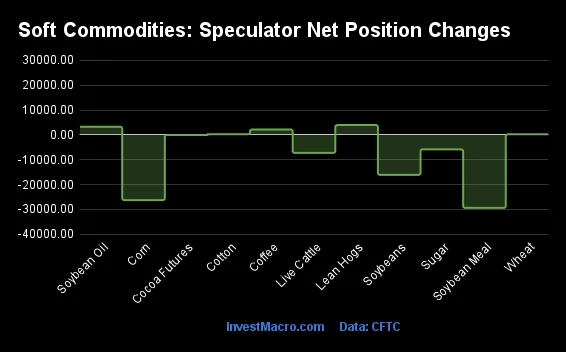
The COT soft commodities markets speculator bets were slightly lower this week as five out of the eleven softs markets we cover had higher positioning while the other six markets had lower speculator contracts.

Leading the gains for the softs markets was Corn (46,709 contracts) with Wheat (30,137 contracts), Coffee (3,702 contracts), Lean Hogs (586 contracts) and Cotton (373 contracts) also showing positive weeks.

The markets with the declines in speculator bets this week were Sugar (-39,607 contracts) with Soybeans (-30,399 contracts), Soybean Meal (-13,977 contracts), Soybean Oil (-12,783 contracts), Cocoa (-4,735 contracts) and Live Cattle (-2,399 contracts) also registering lower bets on the week.


Data Snapshot of Commodity Market Traders | Columns Legend
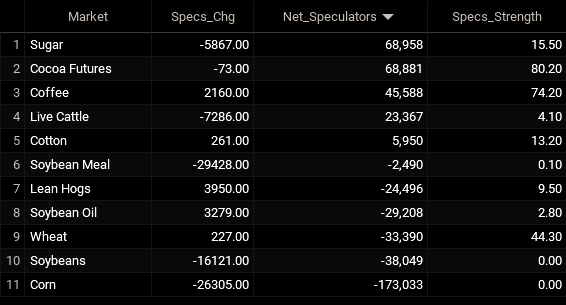
Dec-05-2023OIOI-IndexSpec-NetSpec-IndexCom-NetCOM-IndexSmalls-NetSmalls-Index
WTI Crude1,650,43723168,9908-194,6269325,63632
Gold487,46930203,54467-226,9453623,40143
Silver139,7533236,30370-52,0143115,71154
Copper176,37324-1,994302,13973-14518
Palladium21,27172-11,252211,27799-2540
Platinum75,508675,13327-9,183744,05022
Natural Gas1,339,39276-111,0793289,3507121,72932
Brent124,2945-23,4626721,587361,87538
Heating Oil307,5633932,79582-51,9392719,14460
Soybeans715,6033720,2982-2,96196-17,33762
Corn1,256,2569-110,4397137,75495-27,31585
Coffee208,6862434,26063-35,882401,62233
Sugar853,42838165,46950-188,8215223,35233
Wheat405,30969-67,0672172,57181-5,50443


Strength Scores led by Cocoa & Soybean Meal

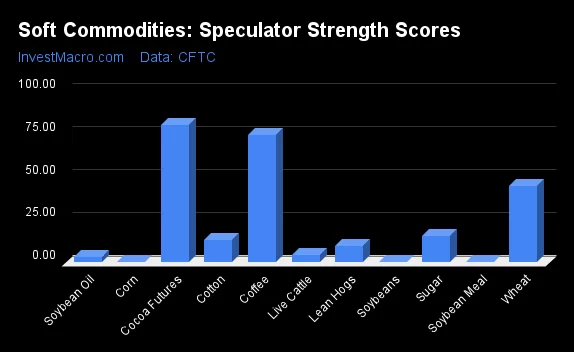
COT Strength Scores (a normalized measure of Speculator positions over a 3-Year range, from 0 to 100 where above 80 is Extreme-Bullish and below 20 is Extreme-Bearish) showed that Cocoa (78 percent) and Soybean Meal (66 percent) lead the softs markets this week. Coffee (63 percent) and Sugar (50 percent) come in as the next highest in the weekly strength scores.

On the downside, Soybeans (2 percent), Corn (7 percent), Lean Hogs (9 percent), Cotton (14 percent), Soybean Oil (19 percent) and Live Cattle (19 percent) come in at the lowest strength levels currently and are in Extreme-Bearish territory (below 20 percent).

Strength Statistics:
Corn (6.6 percent) vs Corn previous week (0.0 percent)
Sugar (50.5 percent) vs Sugar previous week (64.8 percent)
Coffee (62.6 percent) vs Coffee previous week (58.8 percent)
Soybeans (1.6 percent) vs Soybeans previous week (13.5 percent)
Soybean Oil (18.9 percent) vs Soybean Oil previous week (26.3 percent)
Soybean Meal (66.4 percent) vs Soybean Meal previous week (74.2 percent)
Live Cattle (19.3 percent) vs Live Cattle previous week (21.9 percent)
Lean Hogs (9.4 percent) vs Lean Hogs previous week (8.9 percent)
Cotton (13.7 percent) vs Cotton previous week (13.4 percent)
Cocoa (78.2 percent) vs Cocoa previous week (83.0 percent)
Wheat (20.9 percent) vs Wheat previous week (0.0 percent)


Coffee & Soybean Meal top the 6-Week Strength Trends

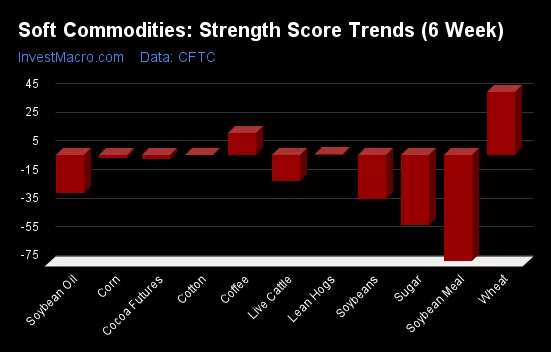
COT Strength Score Trends (or move index, calculates the 6-week changes in strength scores) showed that Coffee (16 percent) and Soybean Meal (6 percent) lead the past six weeks trends for soft commodities.

Live Cattle (-21 percent) leads the downside trend scores currently with Sugar (-21 percent), Soybean Oil (-17 percent) and Cotton (-12 percent) following next with lower trend scores.

Strength Trend Statistics:
Corn (-8.8 percent) vs Corn previous week (-13.4 percent)
Sugar (-21.4 percent) vs Sugar previous week (-8.3 percent)
Coffee (16.5 percent) vs Coffee previous week (31.5 percent)
Soybeans (-6.3 percent) vs Soybeans previous week (9.3 percent)
Soybean Oil (-17.3 percent) vs Soybean Oil previous week (-15.5 percent)
Soybean Meal (5.7 percent) vs Soybean Meal previous week (30.5 percent)
Live Cattle (-20.9 percent) vs Live Cattle previous week (-41.5 percent)
Lean Hogs (-3.3 percent) vs Lean Hogs previous week (-8.5 percent)
Cotton (-12.1 percent) vs Cotton previous week (-20.4 percent)
Cocoa (-10.3 percent) vs Cocoa previous week (0.2 percent)
Wheat (-4.9 percent) vs Wheat previous week (-19.4 percent)


Individual Soft Commodities Markets:

CORN Futures:
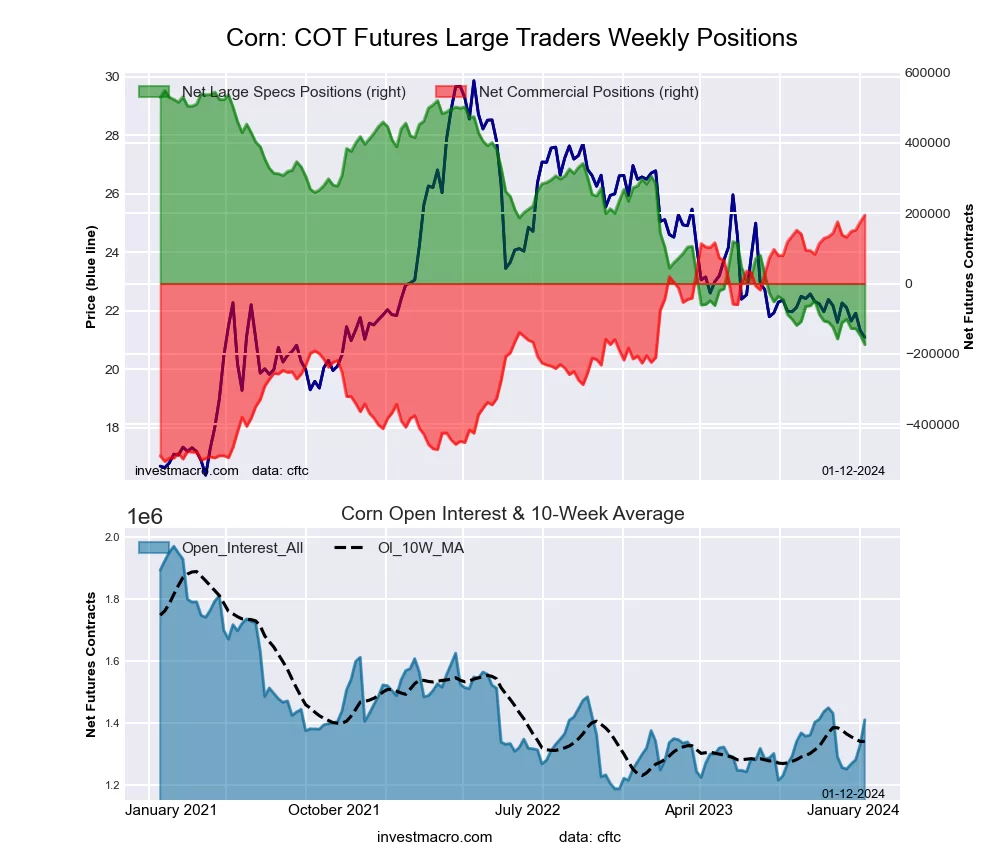
CORN Futures COT ChartThe CORN large speculator standing this week equaled a net position of -110,439 contracts in the data reported through Tuesday. This was a weekly increase of 46,709 contracts from the previous week which had a total of -157,148 net contracts.

This week’s current strength score (the trader positioning range over the past three years, measured from 0 to 100) shows the speculators are currently Bearish-Extreme with a score of 6.6 percent. The commercials are Bullish-Extreme with a score of 94.5 percent and the small traders (not shown in chart) are Bullish-Extreme with a score of 85.3 percent.

Price Trend-Following Model: Downtrend

Our weekly trend-following model classifies the current market price position as: Downtrend. The current action for the model is considered to be: Hold – Maintain Short Position.

CORN Futures StatisticsSPECULATORSCOMMERCIALSSMALL TRADERS
– Percent of Open Interest Longs:21.746.711.0
– Percent of Open Interest Shorts:30.535.713.1
– Net Position:-110,439137,754-27,315
– Gross Longs:272,899586,174137,666
– Gross Shorts:383,338448,420164,981
– Long to Short Ratio:0.7 to 11.3 to 10.8 to 1
NET POSITION TREND:
– Strength Index Score (3 Year Range Pct):6.694.585.3
– Strength Index Reading (3 Year Range):Bearish-ExtremeBullish-ExtremeBullish-Extreme
NET POSITION MOVEMENT INDEX:
– 6-Week Change in Strength Index:-8.88.011.8


SUGAR Futures:

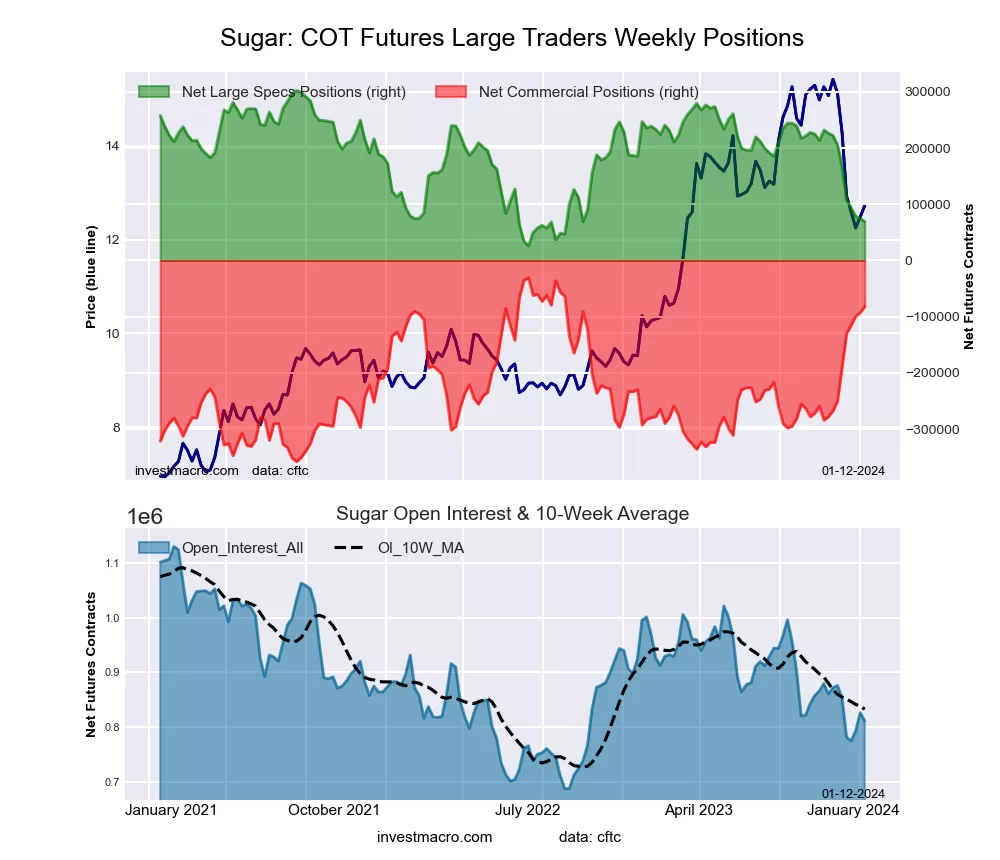
SUGAR Futures COT ChartThe SUGAR large speculator standing this week equaled a net position of 165,469 contracts in the data reported through Tuesday. This was a weekly lowering of -39,607 contracts from the previous week which had a total of 205,076 net contracts.

This week’s current strength score (the trader positioning range over the past three years, measured from 0 to 100) shows the speculators are currently Bullish with a score of 50.5 percent. The commercials are Bullish with a score of 51.6 percent and the small traders (not shown in chart) are Bearish with a score of 32.7 percent.

Price Trend-Following Model: Weak Uptrend (Possible Trend Change)

Our weekly trend-following model classifies the current market price position as: Weak Uptrend. The current action for the model is considered to be: Hold – Maintain Long Position.

SUGAR Futures StatisticsSPECULATORSCOMMERCIALSSMALL TRADERS
– Percent of Open Interest Longs:29.248.48.9
– Percent of Open Interest Shorts:9.870.56.2
– Net Position:165,469-188,82123,352
– Gross Longs:249,241413,19176,231
– Gross Shorts:83,772602,01252,879
– Long to Short Ratio:3.0 to 10.7 to 11.4 to 1
NET POSITION TREND:
– Strength Index Score (3 Year Range Pct):50.551.632.7
– Strength Index Reading (3 Year Range):BullishBullishBearish
NET POSITION MOVEMENT INDEX:
– 6-Week Change in Strength Index:-21.425.4-31.1


COFFEE Futures:

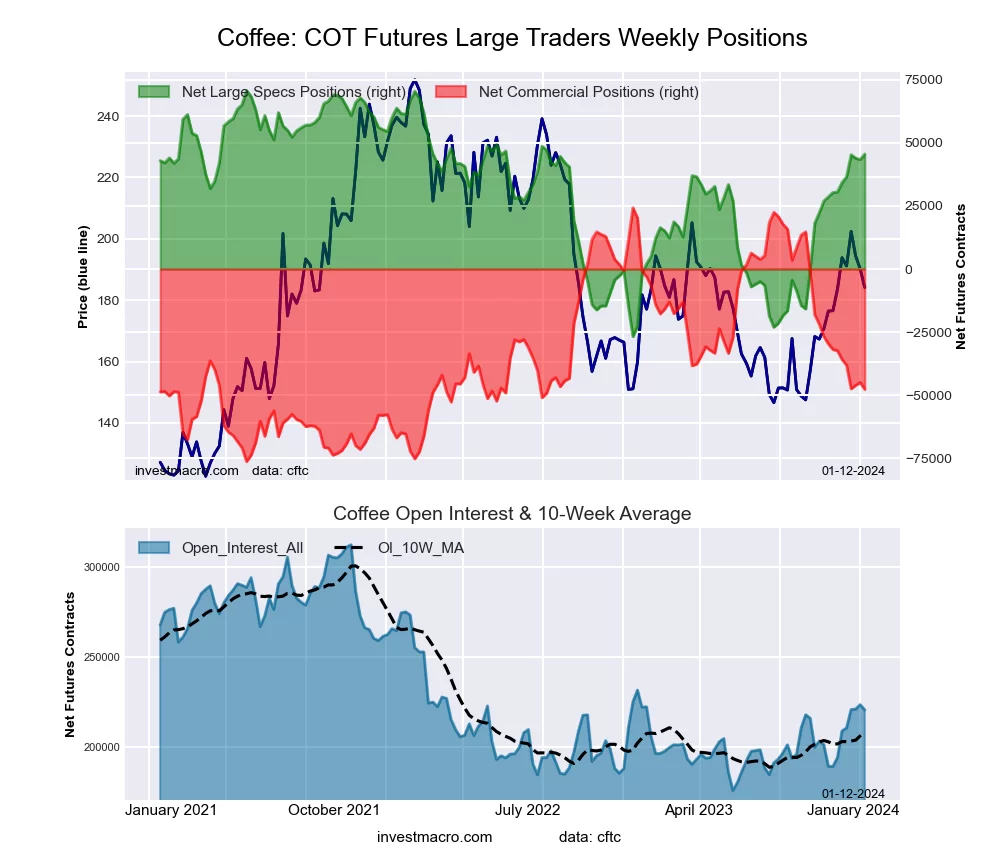
COFFEE Futures COT ChartThe COFFEE large speculator standing this week equaled a net position of 34,260 contracts in the data reported through Tuesday. This was a weekly increase of 3,702 contracts from the previous week which had a total of 30,558 net contracts.

This week’s current strength score (the trader positioning range over the past three years, measured from 0 to 100) shows the speculators are currently Bullish with a score of 62.6 percent. The commercials are Bearish with a score of 40.2 percent and the small traders (not shown in chart) are Bearish with a score of 33.5 percent.

Price Trend-Following Model: Strong Uptrend

Our weekly trend-following model classifies the current market price position as: Strong Uptrend. The current action for the model is considered to be: Hold – Maintain Long Position.

COFFEE Futures StatisticsSPECULATORSCOMMERCIALSSMALL TRADERS
– Percent of Open Interest Longs:32.336.85.6
– Percent of Open Interest Shorts:15.954.04.9
– Net Position:34,260-35,8821,622
– Gross Longs:67,45076,88311,747
– Gross Shorts:33,190112,76510,125
– Long to Short Ratio:2.0 to 10.7 to 11.2 to 1
NET POSITION TREND:
– Strength Index Score (3 Year Range Pct):62.640.233.5
– Strength Index Reading (3 Year Range):BullishBearishBearish
NET POSITION MOVEMENT INDEX:
– 6-Week Change in Strength Index:16.5-17.721.6


SOYBEANS Futures:

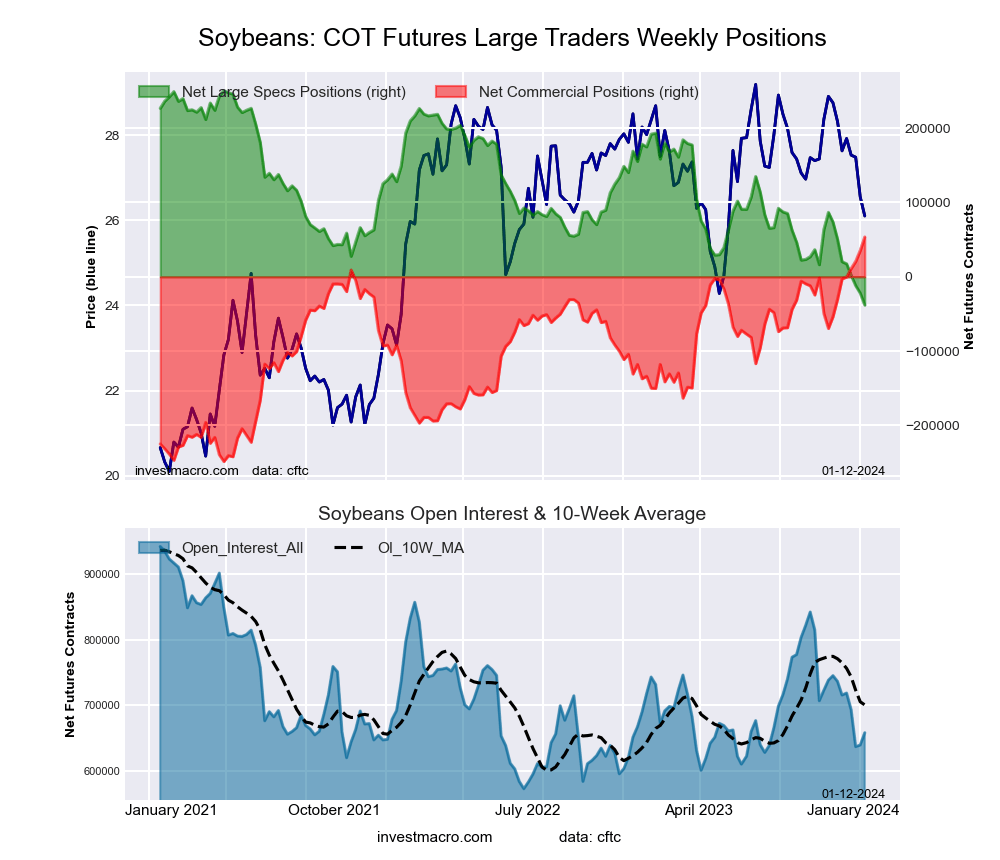
SOYBEANS Futures COT ChartThe SOYBEANS large speculator standing this week equaled a net position of 20,298 contracts in the data reported through Tuesday. This was a weekly decline of -30,399 contracts from the previous week which had a total of 50,697 net contracts.

This week’s current strength score (the trader positioning range over the past three years, measured from 0 to 100) shows the speculators are currently Bearish-Extreme with a score of 1.6 percent. The commercials are Bullish-Extreme with a score of 95.6 percent and the small traders (not shown in chart) are Bullish with a score of 62.3 percent.

Price Trend-Following Model: Downtrend

Our weekly trend-following model classifies the current market price position as: Downtrend. The current action for the model is considered to be: Hold – Maintain Short Position.

SOYBEANS Futures StatisticsSPECULATORSCOMMERCIALSSMALL TRADERS
– Percent of Open Interest Longs:16.355.97.5
– Percent of Open Interest Shorts:13.556.39.9
– Net Position:20,298-2,961-17,337
– Gross Longs:116,761399,90153,751
– Gross Shorts:96,463402,86271,088
– Long to Short Ratio:1.2 to 11.0 to 10.8 to 1
NET POSITION TREND:
– Strength Index Score (3 Year Range Pct):1.695.662.3
– Strength Index Reading (3 Year Range):Bearish-ExtremeBullish-ExtremeBullish
NET POSITION MOVEMENT INDEX:
– 6-Week Change in Strength Index:-6.37.9-13.0


SOYBEAN OIL Futures:

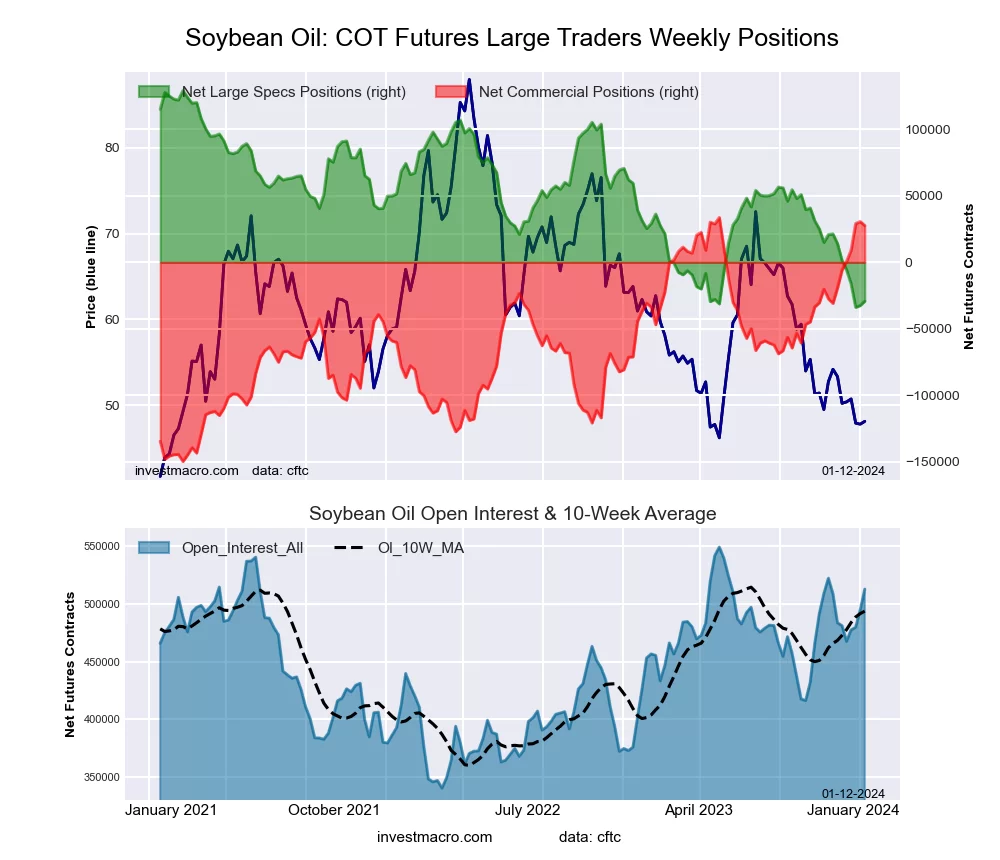
SOYBEAN OIL Futures COT ChartThe SOYBEAN OIL large speculator standing this week equaled a net position of 1,256 contracts in the data reported through Tuesday. This was a weekly fall of -12,783 contracts from the previous week which had a total of 14,039 net contracts.

This week’s current strength score (the trader positioning range over the past three years, measured from 0 to 100) shows the speculators are currently Bearish-Extreme with a score of 18.9 percent. The commercials are Bullish with a score of 79.6 percent and the small traders (not shown in chart) are Bearish with a score of 30.5 percent.

Price Trend-Following Model: Downtrend

Our weekly trend-following model classifies the current market price position as: Downtrend. The current action for the model is considered to be: Hold – Maintain Short Position.

SOYBEAN OIL Futures StatisticsSPECULATORSCOMMERCIALSSMALL TRADERS
– Percent of Open Interest Longs:19.248.86.5
– Percent of Open Interest Shorts:19.050.05.5
– Net Position:1,256-5,7924,536
– Gross Longs:92,474234,61831,193
– Gross Shorts:91,218240,41026,657
– Long to Short Ratio:1.0 to 11.0 to 11.2 to 1
NET POSITION TREND:
– Strength Index Score (3 Year Range Pct):18.979.630.5
– Strength Index Reading (3 Year Range):Bearish-ExtremeBullishBearish
NET POSITION MOVEMENT INDEX:
– 6-Week Change in Strength Index:-17.314.38.2


SOYBEAN MEAL Futures:

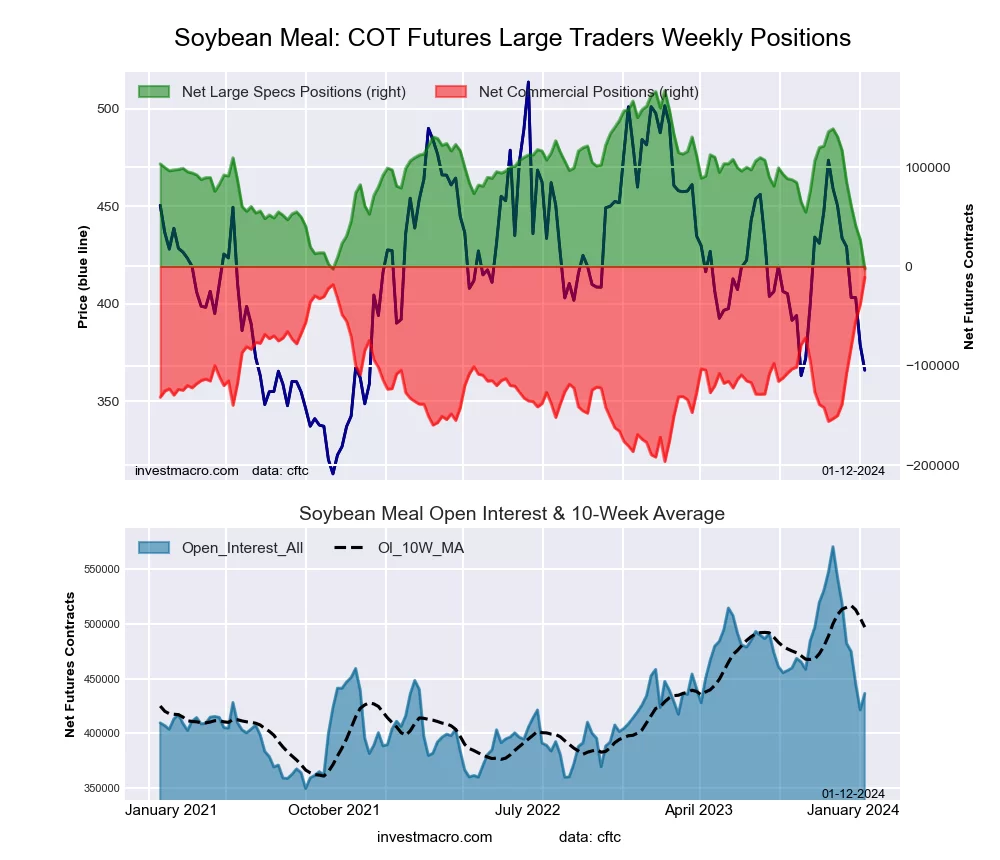
SOYBEAN MEAL Futures COT ChartThe SOYBEAN MEAL large speculator standing this week equaled a net position of 116,651 contracts in the data reported through Tuesday. This was a weekly lowering of -13,977 contracts from the previous week which had a total of 130,628 net contracts.

This week’s current strength score (the trader positioning range over the past three years, measured from 0 to 100) shows the speculators are currently Bullish with a score of 66.4 percent. The commercials are Bearish with a score of 32.4 percent and the small traders (not shown in chart) are Bullish with a score of 53.5 percent.

Price Trend-Following Model: Uptrend

Our weekly trend-following model classifies the current market price position as: Uptrend. The current action for the model is considered to be: Hold – Maintain Long Position.

SOYBEAN MEAL Futures StatisticsSPECULATORSCOMMERCIALSSMALL TRADERS
– Percent of Open Interest Longs:30.835.69.9
– Percent of Open Interest Shorts:8.362.35.7
– Net Position:116,651-138,50721,856
– Gross Longs:159,725184,59751,421
– Gross Shorts:43,074323,10429,565
– Long to Short Ratio:3.7 to 10.6 to 11.7 to 1
NET POSITION TREND:
– Strength Index Score (3 Year Range Pct):66.432.453.5
– Strength Index Reading (3 Year Range):BullishBearishBullish
NET POSITION MOVEMENT INDEX:
– 6-Week Change in Strength Index:5.7-6.87.7


LIVE CATTLE Futures:

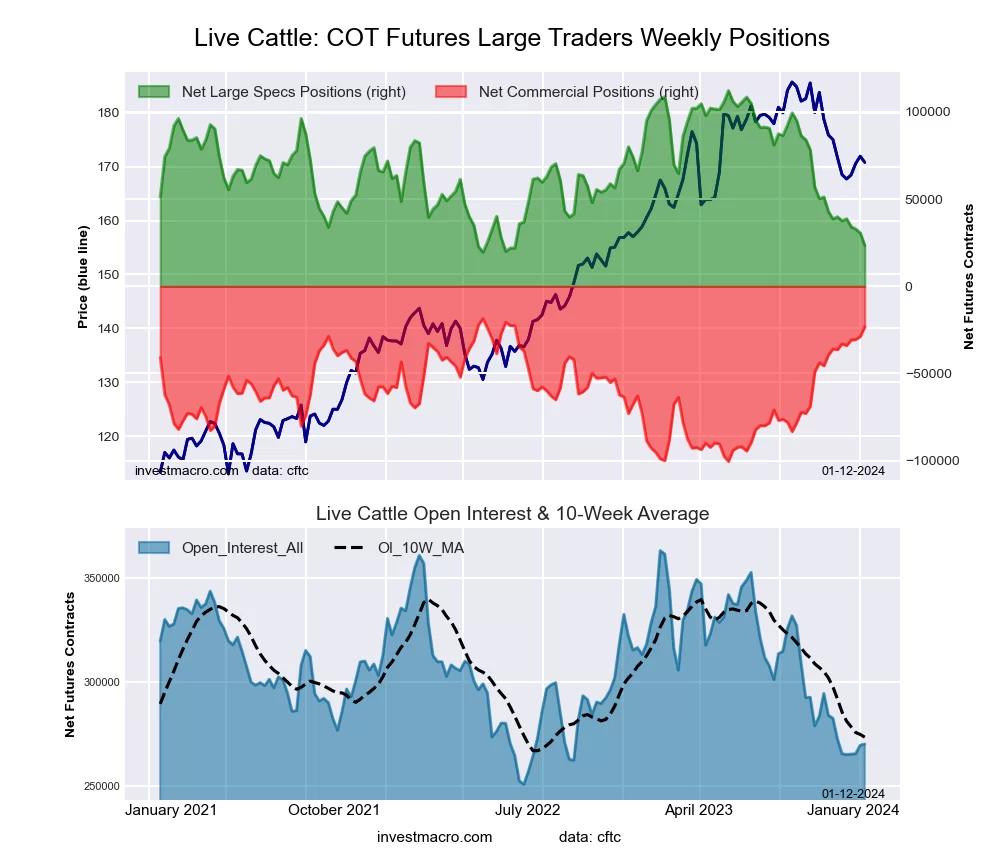
LIVE CATTLE Futures COT ChartThe LIVE CATTLE large speculator standing this week equaled a net position of 37,458 contracts in the data reported through Tuesday. This was a weekly lowering of -2,399 contracts from the previous week which had a total of 39,857 net contracts.

This week’s current strength score (the trader positioning range over the past three years, measured from 0 to 100) shows the speculators are currently Bearish-Extreme with a score of 19.3 percent. The commercials are Bullish-Extreme with a score of 82.4 percent and the small traders (not shown in chart) are Bullish with a score of 65.8 percent.

Price Trend-Following Model: Strong Downtrend

Our weekly trend-following model classifies the current market price position as: Strong Downtrend. The current action for the model is considered to be: Hold – Maintain Short Position.

LIVE CATTLE Futures StatisticsSPECULATORSCOMMERCIALSSMALL TRADERS
– Percent of Open Interest Longs:26.540.311.9
– Percent of Open Interest Shorts:12.452.713.6
– Net Position:37,458-32,960-4,498
– Gross Longs:70,378106,96131,558
– Gross Shorts:32,920139,92136,056
– Long to Short Ratio:2.1 to 10.8 to 10.9 to 1
NET POSITION TREND:
– Strength Index Score (3 Year Range Pct):19.382.465.8
– Strength Index Reading (3 Year Range):Bearish-ExtremeBullish-ExtremeBullish
NET POSITION MOVEMENT INDEX:
– 6-Week Change in Strength Index:-20.919.717.3


LEAN HOGS Futures:

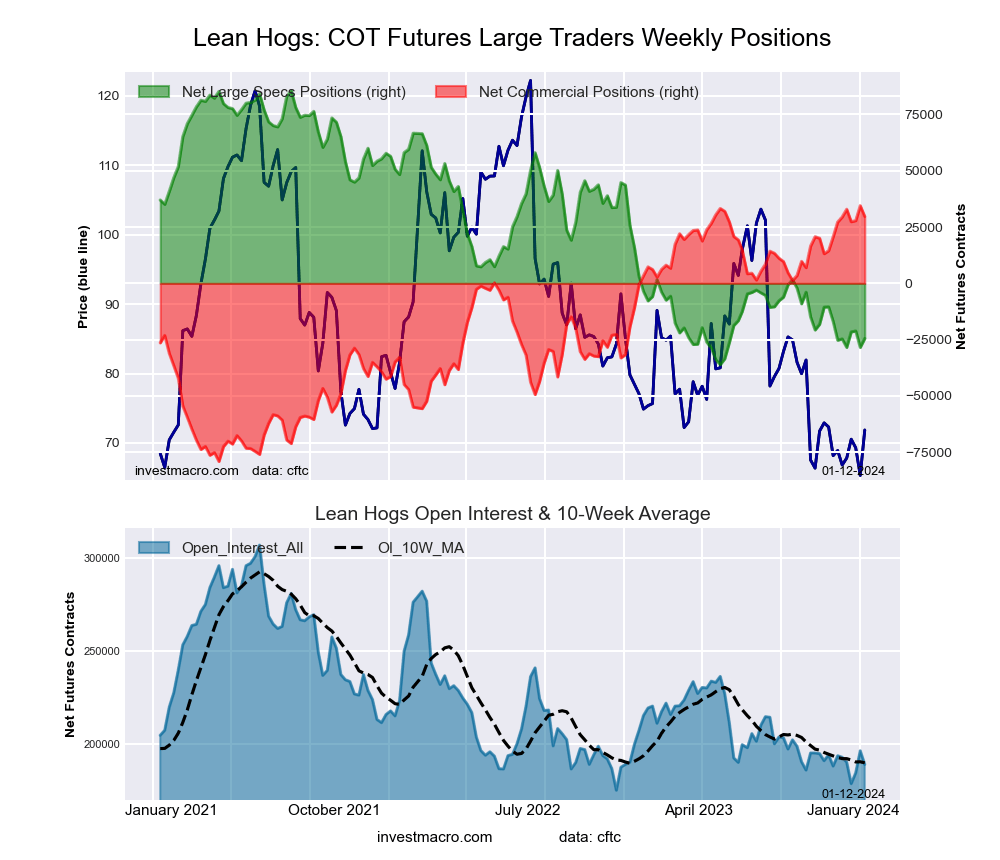
LEAN HOGS Futures COT ChartThe LEAN HOGS large speculator standing this week equaled a net position of -24,690 contracts in the data reported through Tuesday. This was a weekly gain of 586 contracts from the previous week which had a total of -25,276 net contracts.

This week’s current strength score (the trader positioning range over the past three years, measured from 0 to 100) shows the speculators are currently Bearish-Extreme with a score of 9.4 percent. The commercials are Bullish-Extreme with a score of 96.6 percent and the small traders (not shown in chart) are Bullish with a score of 62.0 percent.

Price Trend-Following Model: Downtrend

Our weekly trend-following model classifies the current market price position as: Downtrend. The current action for the model is considered to be: Hold – Maintain Short Position.

LEAN HOGS Futures StatisticsSPECULATORSCOMMERCIALSSMALL TRADERS
– Percent of Open Interest Longs:28.540.28.9
– Percent of Open Interest Shorts:41.324.911.3
– Net Position:-24,69029,445-4,755
– Gross Longs:54,96777,50317,073
– Gross Shorts:79,65748,05821,828
– Long to Short Ratio:0.7 to 11.6 to 10.8 to 1
NET POSITION TREND:
– Strength Index Score (3 Year Range Pct):9.496.662.0
– Strength Index Reading (3 Year Range):Bearish-ExtremeBullish-ExtremeBullish
NET POSITION MOVEMENT INDEX:
– 6-Week Change in Strength Index:-3.37.8-21.5


COTTON Futures:

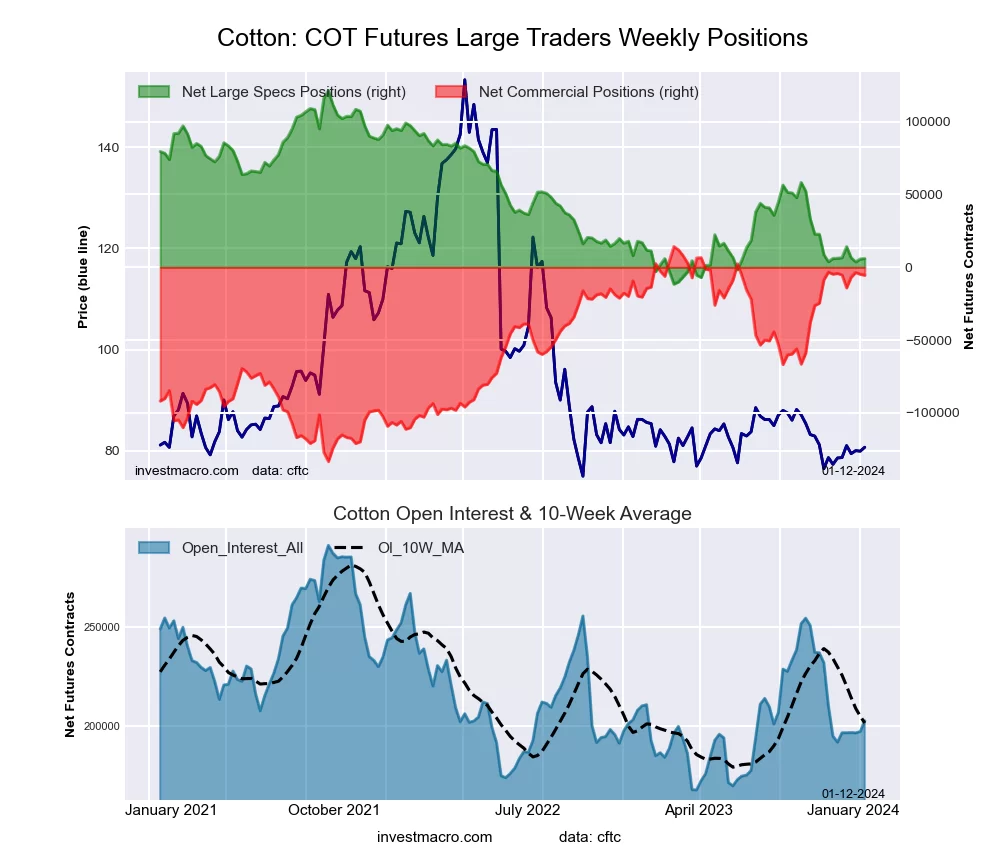
COTTON Futures COT ChartThe COTTON large speculator standing this week equaled a net position of 6,557 contracts in the data reported through Tuesday. This was a weekly rise of 373 contracts from the previous week which had a total of 6,184 net contracts.

This week’s current strength score (the trader positioning range over the past three years, measured from 0 to 100) shows the speculators are currently Bearish-Extreme with a score of 13.7 percent. The commercials are Bullish-Extreme with a score of 86.8 percent and the small traders (not shown in chart) are Bearish-Extreme with a score of 8.4 percent.

Price Trend-Following Model: Downtrend

Our weekly trend-following model classifies the current market price position as: Downtrend. The current action for the model is considered to be: Hold – Maintain Short Position.

COTTON Futures StatisticsSPECULATORSCOMMERCIALSSMALL TRADERS
– Percent of Open Interest Longs:31.945.45.6
– Percent of Open Interest Shorts:28.548.16.2
– Net Position:6,557-5,291-1,266
– Gross Longs:62,70489,38711,020
– Gross Shorts:56,14794,67812,286
– Long to Short Ratio:1.1 to 10.9 to 10.9 to 1
NET POSITION TREND:
– Strength Index Score (3 Year Range Pct):13.786.88.4
– Strength Index Reading (3 Year Range):Bearish-ExtremeBullish-ExtremeBearish-Extreme
NET POSITION MOVEMENT INDEX:
– 6-Week Change in Strength Index:-12.114.2-29.1


COCOA Futures:

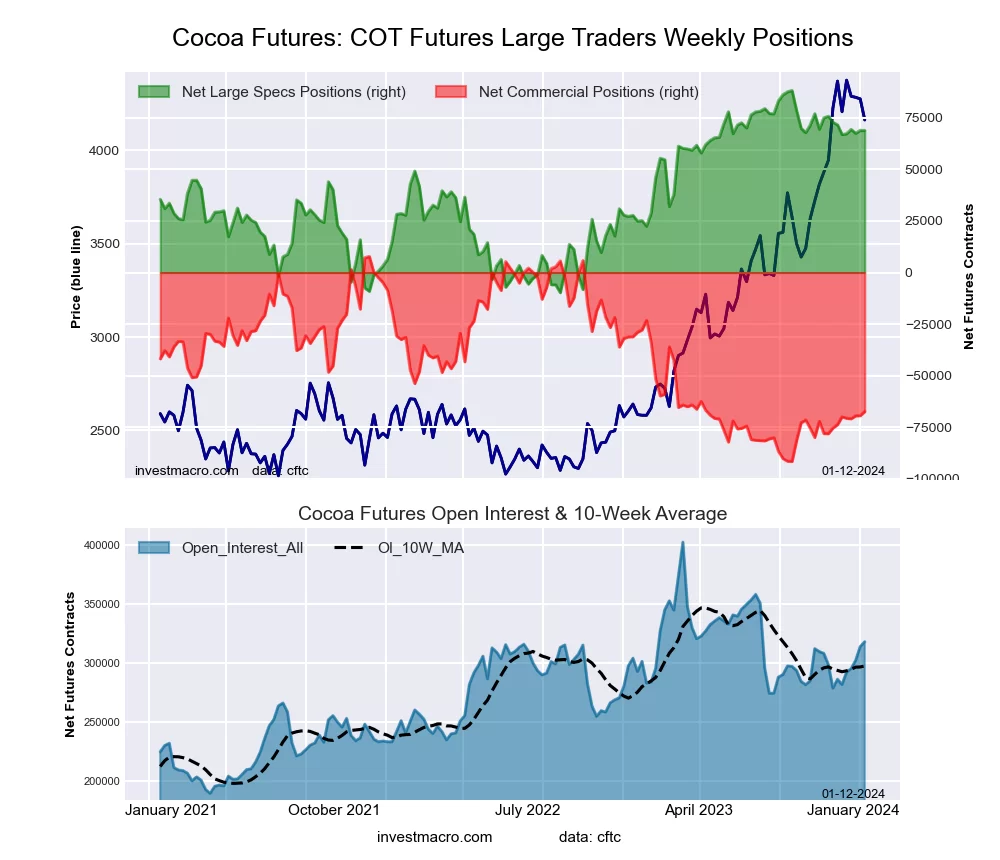
COCOA Futures COT ChartThe COCOA large speculator standing this week equaled a net position of 66,911 contracts in the data reported through Tuesday. This was a weekly decrease of -4,735 contracts from the previous week which had a total of 71,646 net contracts.

This week’s current strength score (the trader positioning range over the past three years, measured from 0 to 100) shows the speculators are currently Bullish with a score of 78.2 percent. The commercials are Bearish with a score of 21.8 percent and the small traders (not shown in chart) are Bearish with a score of 27.3 percent.

Price Trend-Following Model: Strong Uptrend

Our weekly trend-following model classifies the current market price position as: Strong Uptrend. The current action for the model is considered to be: Hold – Maintain Long Position.

COCOA Futures StatisticsSPECULATORSCOMMERCIALSSMALL TRADERS
– Percent of Open Interest Longs:43.426.15.6
– Percent of Open Interest Shorts:19.650.94.5
– Net Position:66,911-69,9933,082
– Gross Longs:122,24673,39015,894
– Gross Shorts:55,335143,38312,812
– Long to Short Ratio:2.2 to 10.5 to 11.2 to 1
NET POSITION TREND:
– Strength Index Score (3 Year Range Pct):78.221.827.3
– Strength Index Reading (3 Year Range):BullishBearishBearish
NET POSITION MOVEMENT INDEX:
– 6-Week Change in Strength Index:-10.310.01.4


WHEAT Futures:

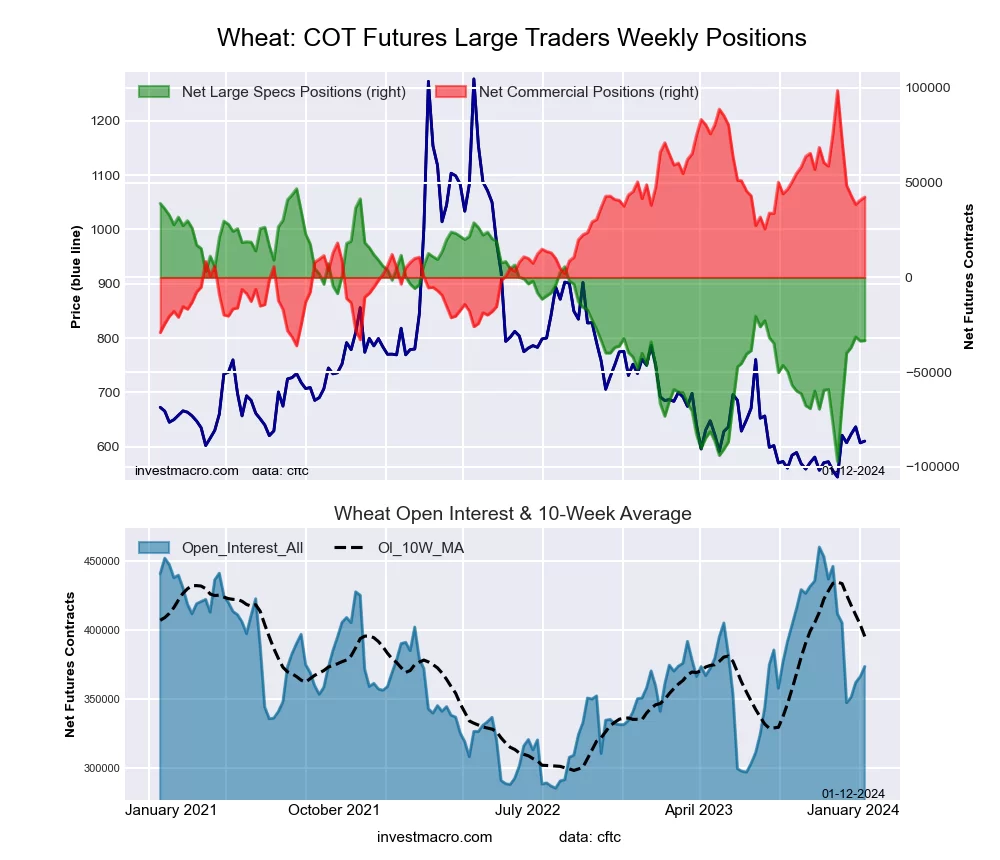
WHEAT Futures COT ChartThe WHEAT large speculator standing this week equaled a net position of -67,067 contracts in the data reported through Tuesday. This was a weekly boost of 30,137 contracts from the previous week which had a total of -97,204 net contracts.

This week’s current strength score (the trader positioning range over the past three years, measured from 0 to 100) shows the speculators are currently Bearish with a score of 20.9 percent. The commercials are Bullish-Extreme with a score of 80.6 percent and the small traders (not shown in chart) are Bearish with a score of 43.1 percent.

Price Trend-Following Model: Weak Downtrend (Possible Trend Change)

Our weekly trend-following model classifies the current market price position as: Weak Downtrend. The current action for the model is considered to be: Hold – Maintain Short Position.

WHEAT Futures StatisticsSPECULATORSCOMMERCIALSSMALL TRADERS
– Percent of Open Interest Longs:29.640.07.4
– Percent of Open Interest Shorts:46.122.18.8
– Net Position:-67,06772,571-5,504
– Gross Longs:119,965162,29029,963
– Gross Shorts:187,03289,71935,467
– Long to Short Ratio:0.6 to 11.8 to 10.8 to 1
NET POSITION TREND:
– Strength Index Score (3 Year Range Pct):20.980.643.1
– Strength Index Reading (3 Year Range):BearishBullish-ExtremeBearish
NET POSITION MOVEMENT INDEX:
– 6-Week Change in Strength Index:-4.911.6-36.2


Article By InvestMacroReceive our weekly COT Newsletter

*COT Report: The COT data, released weekly to the public each Friday, is updated through the most recent Tuesday (data is 3 days old) and shows a quick view of how large speculators or non-commercials (for-profit traders) were positioned in the futures markets.

The CFTC categorizes trader positions according to commercial hedgers (traders who use futures contracts for hedging as part of the business), non-commercials (large traders who speculate to realize trading profits) and nonreportable traders (usually small traders/speculators) as well as their open interest (contracts open in the market at time of reporting). See CFTC criteria here.

COT Stock Market Charts: Speculator Bets led higher by DowJones & S&P500 Minis

By InvestMacro

Here are the latest charts and statistics for the Commitment of Traders (COT) data published by the Commodities Futures Trading Commission (CFTC).

The latest COT data is updated through Tuesday December 5th and shows a quick view of how large traders (for-profit speculators and commercial entities) were positioned in the futures markets.

Weekly Speculator Changes led by DowJones-Mini & S&P500-Mini

The COT stock markets speculator bets were higher this week as six out of the seven stock markets we cover had higher positioning while one market had lower speculator contracts.

Leading the gains for the stock markets was the DowJones-Mini (24,916 contracts) with the S&P500-Mini (17,766 contracts) the MSCI EAFE-Mini (12,174 contracts), the Nikkei 225 Yen (2,394 contracts), the Nasdaq-Mini (1,124 contracts), the Nikkei 225 (670 contracts) and the Russell-Mini (64 contracts),also showing positive weeks.

The only market with a decline in the speculator bets this week was the VIX (-9,241 contracts).


Data Snapshot of Stock Market Traders | Columns Legend
Dec-05-2023OIOI-IndexSpec-NetSpec-IndexCom-NetCOM-IndexSmalls-NetSmalls-Index
S&P500-Mini2,314,40031-47,26158-954047,35656
Nikkei 22519,91460-1,690551,0364265439
Nasdaq-Mini277,746618,40252-13,580275,17885
DowJones-Mini94,87055308812,83333-3,14129
VIX406,71175-56,7777157,87126-1,09491
Nikkei 225 Yen65,6776517,459882,06117-19,52044


Strength Scores led by DowJones-Mini & VIX

COT Strength Scores (a normalized measure of Speculator positions over a 3-Year range, from 0 to 100 where above 80 is Extreme-Bullish and below 20 is Extreme-Bearish) showed that the DowJones-Mini (81 percent) leads the stock markets this week. The VIX (71 percent) and S&P500-Mini (58 percent) come in as the next highest in the weekly strength scores.

On the downside, the MSCI EAFE-Mini (14 percent) comes in at the lowest strength level currently and is in Extreme-Bearish territory (below 20 percent).

Strength Statistics:
VIX (71.3 percent) vs VIX previous week (77.5 percent)
S&P500-Mini (57.7 percent) vs S&P500-Mini previous week (55.0 percent)
DowJones-Mini (80.8 percent) vs DowJones-Mini previous week (26.9 percent)
Nasdaq-Mini (51.9 percent) vs Nasdaq-Mini previous week (50.1 percent)
Russell2000-Mini (42.2 percent) vs Russell2000-Mini previous week (42.1 percent)
Nikkei USD (54.5 percent) vs Nikkei USD previous week (49.8 percent)
EAFE-Mini (14.1 percent) vs EAFE-Mini previous week (2.1 percent)


DowJones-Mini top the 6-Week Strength Trends

COT Strength Score Trends (or move index, calculates the 6-week changes in strength scores) showed that the DowJones-Mini (78 percent) leads the past six weeks trends for the stock markets. The  Nasdaq-Mini (9 percent) and the Nikkei 225 (3 percent) are the next highest positive movers in the latest trends data.

The VIX (-24 percent) leads the downside trend scores currently with the MSCI EAFE-Mini (-19 percent) coming in as the next market with lower trend scores.

Strength Trend Statistics:
VIX (-23.6 percent) vs VIX previous week (-16.5 percent)
S&P500-Mini (-8.6 percent) vs S&P500-Mini previous week (-0.3 percent)
DowJones-Mini (78.4 percent) vs DowJones-Mini previous week (22.9 percent)
Nasdaq-Mini (8.8 percent) vs Nasdaq-Mini previous week (-10.9 percent)
Russell2000-Mini (-7.4 percent) vs Russell2000-Mini previous week (-6.6 percent)
Nikkei USD (3.1 percent) vs Nikkei USD previous week (-0.7 percent)
EAFE-Mini (-19.1 percent) vs EAFE-Mini previous week (-33.3 percent)


Individual Stock Market Charts:

VIX Volatility Futures:

VIX Volatility Futures COT ChartThe VIX Volatility large speculator standing this week reached a net position of -56,777 contracts in the data reported through Tuesday. This was a weekly reduction of -9,241 contracts from the previous week which had a total of -47,536 net contracts.

This week’s current strength score (the trader positioning range over the past three years, measured from 0 to 100) shows the speculators are currently Bullish with a score of 71.3 percent. The commercials are Bearish with a score of 25.5 percent and the small traders (not shown in chart) are Bullish-Extreme with a score of 90.9 percent.

Price Trend-Following Model: Strong Downtrend

Our weekly trend-following model classifies the current market price position as: Strong Downtrend. The current action for the model is considered to be: New Sell – Short Position.

VIX Volatility Futures StatisticsSPECULATORSCOMMERCIALSSMALL TRADERS
– Percent of Open Interest Longs:22.649.96.8
– Percent of Open Interest Shorts:36.635.77.1
– Net Position:-56,77757,871-1,094
– Gross Longs:92,021202,88927,743
– Gross Shorts:148,798145,01828,837
– Long to Short Ratio:0.6 to 11.4 to 11.0 to 1
NET POSITION TREND:
– Strength Index Score (3 Year Range Pct):71.325.590.9
– Strength Index Reading (3 Year Range):BullishBearishBullish-Extreme
NET POSITION MOVEMENT INDEX:
– 6-Week Change in Strength Index:-23.620.717.2


S&P500 Mini Futures:

SP500 Mini Futures COT ChartThe S&P500 Mini large speculator standing this week reached a net position of -47,261 contracts in the data reported through Tuesday. This was a weekly rise of 17,766 contracts from the previous week which had a total of -65,027 net contracts.

This week’s current strength score (the trader positioning range over the past three years, measured from 0 to 100) shows the speculators are currently Bullish with a score of 57.7 percent. The commercials are Bearish with a score of 39.9 percent and the small traders (not shown in chart) are Bullish with a score of 56.0 percent.

Price Trend-Following Model: Weak Downtrend (Possible Trend Change)

Our weekly trend-following model classifies the current market price position as: Weak Downtrend. The current action for the model is considered to be: Hold – Maintain Short Position.

S&P500 Mini Futures StatisticsSPECULATORSCOMMERCIALSSMALL TRADERS
– Percent of Open Interest Longs:11.473.711.3
– Percent of Open Interest Shorts:13.573.79.3
– Net Position:-47,261-9547,356
– Gross Longs:264,2091,706,068261,634
– Gross Shorts:311,4701,706,163214,278
– Long to Short Ratio:0.8 to 11.0 to 11.2 to 1
NET POSITION TREND:
– Strength Index Score (3 Year Range Pct):57.739.956.0
– Strength Index Reading (3 Year Range):BullishBearishBullish
NET POSITION MOVEMENT INDEX:
– 6-Week Change in Strength Index:-8.64.89.0


Dow Jones Mini Futures:

Dow Jones Mini Futures COT ChartThe Dow Jones Mini large speculator standing this week reached a net position of 308 contracts in the data reported through Tuesday. This was a weekly increase of 24,916 contracts from the previous week which had a total of -24,608 net contracts.

This week’s current strength score (the trader positioning range over the past three years, measured from 0 to 100) shows the speculators are currently Bullish-Extreme with a score of 80.8 percent. The commercials are Bearish with a score of 32.9 percent and the small traders (not shown in chart) are Bearish with a score of 28.6 percent.

Price Trend-Following Model: Strong Uptrend

Our weekly trend-following model classifies the current market price position as: Strong Uptrend. The current action for the model is considered to be: New Buy – Long Position.

Dow Jones Mini Futures StatisticsSPECULATORSCOMMERCIALSSMALL TRADERS
– Percent of Open Interest Longs:27.756.413.9
– Percent of Open Interest Shorts:27.353.417.3
– Net Position:3082,833-3,141
– Gross Longs:26,25353,46513,228
– Gross Shorts:25,94550,63216,369
– Long to Short Ratio:1.0 to 11.1 to 10.8 to 1
NET POSITION TREND:
– Strength Index Score (3 Year Range Pct):80.832.928.6
– Strength Index Reading (3 Year Range):Bullish-ExtremeBearishBearish
NET POSITION MOVEMENT INDEX:
– 6-Week Change in Strength Index:78.4-62.12.7


Nasdaq Mini Futures:

Nasdaq Mini Futures COT ChartThe Nasdaq Mini large speculator standing this week reached a net position of 8,402 contracts in the data reported through Tuesday. This was a weekly boost of 1,124 contracts from the previous week which had a total of 7,278 net contracts.

This week’s current strength score (the trader positioning range over the past three years, measured from 0 to 100) shows the speculators are currently Bullish with a score of 51.9 percent. The commercials are Bearish with a score of 27.4 percent and the small traders (not shown in chart) are Bullish-Extreme with a score of 85.3 percent.

Price Trend-Following Model: Strong Uptrend

Our weekly trend-following model classifies the current market price position as: Strong Uptrend. The current action for the model is considered to be: Hold – Maintain Long Position.

Nasdaq Mini Futures StatisticsSPECULATORSCOMMERCIALSSMALL TRADERS
– Percent of Open Interest Longs:27.156.014.9
– Percent of Open Interest Shorts:24.160.813.0
– Net Position:8,402-13,5805,178
– Gross Longs:75,200155,41841,346
– Gross Shorts:66,798168,99836,168
– Long to Short Ratio:1.1 to 10.9 to 11.1 to 1
NET POSITION TREND:
– Strength Index Score (3 Year Range Pct):51.927.485.3
– Strength Index Reading (3 Year Range):BullishBearishBullish-Extreme
NET POSITION MOVEMENT INDEX:
– 6-Week Change in Strength Index:8.8-11.88.9


Russell 2000 Mini Futures:

Russell 2000 Mini Futures COT ChartThe Russell 2000 Mini large speculator standing this week reached a net position of -55,429 contracts in the data reported through Tuesday. This was a weekly lift of 64 contracts from the previous week which had a total of -55,493 net contracts.

This week’s current strength score (the trader positioning range over the past three years, measured from 0 to 100) shows the speculators are currently Bearish with a score of 42.2 percent. The commercials are Bullish with a score of 57.7 percent and the small traders (not shown in chart) are Bearish with a score of 40.6 percent.

Price Trend-Following Model: Weak Downtrend (Possible Trend Change)

Our weekly trend-following model classifies the current market price position as: Weak Downtrend. The current action for the model is considered to be: Hold – Maintain Short Position.

Russell 2000 Mini Futures StatisticsSPECULATORSCOMMERCIALSSMALL TRADERS
– Percent of Open Interest Longs:12.481.84.9
– Percent of Open Interest Shorts:22.372.64.1
– Net Position:-55,42950,9004,529
– Gross Longs:69,069455,71027,535
– Gross Shorts:124,498404,81023,006
– Long to Short Ratio:0.6 to 11.1 to 11.2 to 1
NET POSITION TREND:
– Strength Index Score (3 Year Range Pct):42.257.740.6
– Strength Index Reading (3 Year Range):BearishBullishBearish
NET POSITION MOVEMENT INDEX:
– 6-Week Change in Strength Index:-7.43.715.1


Nikkei Stock Average (USD) Futures:

Nikkei Stock Average (USD) Futures COT ChartThe Nikkei Stock Average (USD) large speculator standing this week reached a net position of -1,690 contracts in the data reported through Tuesday. This was a weekly increase of 670 contracts from the previous week which had a total of -2,360 net contracts.

This week’s current strength score (the trader positioning range over the past three years, measured from 0 to 100) shows the speculators are currently Bullish with a score of 54.5 percent. The commercials are Bearish with a score of 42.2 percent and the small traders (not shown in chart) are Bearish with a score of 39.4 percent.

Price Trend-Following Model: Strong Uptrend

Our weekly trend-following model classifies the current market price position as: Strong Uptrend. The current action for the model is considered to be: New Buy – Long Position.

Nikkei Stock Average Futures StatisticsSPECULATORSCOMMERCIALSSMALL TRADERS
– Percent of Open Interest Longs:10.268.219.9
– Percent of Open Interest Shorts:18.763.016.6
– Net Position:-1,6901,036654
– Gross Longs:2,02913,5873,953
– Gross Shorts:3,71912,5513,299
– Long to Short Ratio:0.5 to 11.1 to 11.2 to 1
NET POSITION TREND:
– Strength Index Score (3 Year Range Pct):54.542.239.4
– Strength Index Reading (3 Year Range):BullishBearishBearish
NET POSITION MOVEMENT INDEX:
– 6-Week Change in Strength Index:3.12.1-10.6


MSCI EAFE Mini Futures:

MSCI EAFE Mini Futures COT ChartThe MSCI EAFE Mini large speculator standing this week reached a net position of -49,858 contracts in the data reported through Tuesday. This was a weekly increase of 12,174 contracts from the previous week which had a total of -62,032 net contracts.

This week’s current strength score (the trader positioning range over the past three years, measured from 0 to 100) shows the speculators are currently Bearish-Extreme with a score of 14.1 percent. The commercials are Bullish-Extreme with a score of 84.0 percent and the small traders (not shown in chart) are Bearish with a score of 41.5 percent.

Price Trend-Following Model: Weak Downtrend (Possible Trend Change)

Our weekly trend-following model classifies the current market price position as: Weak Downtrend. The current action for the model is considered to be: Hold – Maintain Short Position.

MSCI EAFE Mini Futures StatisticsSPECULATORSCOMMERCIALSSMALL TRADERS
– Percent of Open Interest Longs:5.591.02.9
– Percent of Open Interest Shorts:17.879.91.7
– Net Position:-49,85844,9414,917
– Gross Longs:22,286369,01511,661
– Gross Shorts:72,144324,0746,744
– Long to Short Ratio:0.3 to 11.1 to 11.7 to 1
NET POSITION TREND:
– Strength Index Score (3 Year Range Pct):14.184.041.5
– Strength Index Reading (3 Year Range):Bearish-ExtremeBullish-ExtremeBearish
NET POSITION MOVEMENT INDEX:
– 6-Week Change in Strength Index:-19.115.715.5


Article By InvestMacroReceive our weekly COT Newsletter

*COT Report: The COT data, released weekly to the public each Friday, is updated through the most recent Tuesday (data is 3 days old) and shows a quick view of how large speculators or non-commercials (for-profit traders) were positioned in the futures markets.

The CFTC categorizes trader positions according to commercial hedgers (traders who use futures contracts for hedging as part of the business), non-commercials (large traders who speculate to realize trading profits) and nonreportable traders (usually small traders/speculators) as well as their open interest (contracts open in the market at time of reporting). See CFTC criteria here.

The ECB could cut rates as early as April 2024. Today, the focus is on the US labor market data

By JustMarkets

At yesterday’s stock market close, the Dow Jones Index (US30) was up by 0.17%, while the S&P 500 Index (US500) added 0.80%. The NASDAQ Technology Index (US100) closed positive by 1.37% on Thursday.

A positive for stocks yesterday was Alphabet (GOOG) shares rising more than 5% after Google released Gemini, “the largest and most capable artificial intelligence model” the company has ever developed. Additionally, Advanced Micro Devices (AMD) shares are up more than 5% after the company unveiled its new accelerator chip MI300, saying the processor will be able to run artificial intelligence programs faster than competing products.

US weekly initial jobless claims rose by 1k to 220k, matching expectations. Today, the US will release its monthly nonfarm labor market report. The unemployment rate is expected to be 3.9%, and Nonfarm Payrolls are expected to increase by 180k in November compared to 150k in October. A strong (better than expected) report could undermine bets that the Fed will start easing its restrictive monetary policy sooner than expected, which would serve as a headwind for a rally in equities and bring back confidence in the dollar, at least temporarily. On the other hand, a weak Nonfarm report (worse than expected) will increase investor fears that the labor market and economy are cooling. If the data comes out in line with expectations, it is unlikely to do much to shake market expectations for several Fed rate cuts next year, which will only add to market volatility.

Equity markets in Europe were mostly down yesterday. Germany’s DAX (DE40) decreased by 0.16%, France’s CAC 40 (FR40) fell by 0.10%, Spain’s IBEX 35 (ES35) lost 1.09%, and the UK’s FTSE 100 (UK100) closed negative 0.02%. Recent economic data from Germany has heightened fears that the industrial sector will continue to have a negative impact on the Eurozone’s largest economy. Germany’s industrial sector is struggling: industrial production in Germany unexpectedly fell in October, a day after industrial orders in the country’s largest Eurozone economy also unexpectedly fell in the same month.

On Thursday, the euro fell to its lowest level against the Swiss franc in nearly nine years as markets bet on an imminent interest rate cut by the European Central Bank (ECB). Currently, the difference between short rates in the Eurozone and Switzerland is around 225 basis points, but markets expect this to narrow to 150 in the next 12 months. This makes the euro less attractive than the Swiss franc. Analysts at Goldman Sachs believe the ECB will cut interest rates by 25 basis points (bps) at each meeting starting next April. Economists at the brokerage forecast that the ECB’s deposit rate will reach 2.25% by early 2025. BNP Paribas also expects the ECB to make its first interest rate cut in April 2024 and to “gradually reduce rates” over the year, citing weak economic activity and weakening inflation. BNP chief economist Luigi Speranza believes the ECB’s prime rate will be 3.25% by the end of 2024, down from 4% currently.

Crude oil and gasoline prices on Thursday continued Wednesday’s sharp decline. Crude oil fell to a five-month low. Concerns about a global crude oil supply glut continue to weigh on oil prices. In addition, doubts about whether the OPEC+ agreement to cut crude oil production will be honored are weighing on prices.

High inventories caused by carryover balances from the mild winter of 2022/23 and weak heating demand have depressed natural gas prices. As of December 3, natural gas storage in Europe was 94% full, above the 5-year seasonal average of 84% for this time of year.

Asian markets were mostly down yesterday. Japan’s Nikkei 225 (JP225) fell by 1.76%, China’s FTSE China A50 (CHA50) was down by 0.16%, Hong Kong’s Hang Seng (HK50) ended the day down by 0.71%, and Australia’s ASX 200 (AU200) ended Thursday negative 0.07%.

The Nikkei 225 (JP225) fell sharply on Thursday, while the yen rose sharply to hit a 4-month high against the dollar. The yen saw a massive short-covering in the yen on Thursday as comments by Bank of Japan (BoJ) Governor Ueda in the Japanese parliament reinforced speculation that the BoJ would soon exit ultra-easy monetary policy. On Wednesday, Deputy Governor Ryozo Himino discussed the potential impact of an exit from ultra-loose monetary policy on the economy. Their joint comments “fueled the fire.” Japanese five-year bond yields witnessed the most aggressive sell-off in a decade. However, Ueda remained of the view that policy would remain loose in the near term, citing the need to stimulate economic growth. This view was bolstered by Japan’s revised third-quarter gross domestic product data, which showed a bigger decline in economic growth than initially expected.

India’s central bank (RBI) left its key lending rate unchanged at 6.5% on Friday as growth in the world’s fastest-growing economy remains robust and the inflation outlook uncertain. The central bank also raised its economic growth forecast to 7% from 6.5% after stronger-than-expected growth in July-September. RBI forecasts consumer inflation at 5.4% in 2023-24.

S&P 500 (US500) 4,585.59 +36.25 (+0.80%)

Dow Jones (US30) 36,117.38 +62.95 (+0.17%)

DAX (DE40)  16,628.99 −27.45 (−0.16%)

FTSE 100 (UK100) 7,513.72 −1.66 (−0.022%)

USD Index  103.64 −0.51 (−0.49%)

News feed for 2023.12.08:
  • – Japan GDP (q/q) at 01:50 (GMT+2);
  • – German Final Consumer Price Index (m/m) at 09:00 (GMT+2);
  • – US Nonfarm Payrolls (m/m) at 15:30 (GMT+2);
  • – US Unemployment Rate (m/m) at 15:30 (GMT+2);
  • – US Michigan Consumer Sentiment (m/m) at 17:00 (GMT+2).

By JustMarkets


This article reflects a personal opinion and should not be interpreted as an investment advice, and/or offer, and/or a persistent request for carrying out financial transactions, and/or a guarantee, and/or a forecast of future events.

Oil quotations remain under pressure. The US labor market is cooling in the US

By JustMarkets

At yesterday’s stock market close, the Dow Jones Index (US30) was down by 0.22%, while the S&P 500 Index (US500) decreased by 0.06%. The NASDAQ Technology Index (US100) closed positive 0.31% on Tuesday. A decline in bond yields on Tuesday supported technology stocks and the Nasdaq 100. Bond yields fell after the October JOLTS job openings report fell more than expected to a 2-year low, a sign that the labor market is cooling and dovish for Fed policy.

Economic news from the US on Tuesday was mixed. On the bullish side, the ISM Services Business Activity Index for November rose by 0.9 to 52.7, beating expectations of 52.3. In contrast, the October JOLTS Job Openings Index fell by 617,000 to a 2-year low of 8.733 million, indicating a weaker labor market than expectations of 9.300 million.

Procter & Gamble (PG) fell more than 3% and topped the Dow Jones Industrials’ list of losers after it said it expects $2.0 billion to $2.5 billion in restructuring costs for its operations in some corporate markets due to “challenging macroeconomic and financial conditions.” Nvidia (NVDA) stock price rose more than 2% and led the Nasdaq 100 higher after the company said it plans to partner with Japanese research organizations, companies, and startups to build artificial intelligence factories in Japan.

Equity markets in Europe were mostly up yesterday. Germany’s DAX (DE40) rose by 0.78%, France’s CAC 40 (FR40) gained 0.74% on Tuesday, Spain’s IBEX 35 (ES35) jumped by 0.59%, and the UK’s FTSE 100 (UK100) closed negative 0.31%. Economic news for European indices contributed to the gains. The S&P Eurozone Composite PMI for November was revised upward by 0.5 to 47.6 from the previously reported 47.1. The Eurozone Producer Price Index for October rose by 0.2% m/m to 9.4% y/y, matching expectations of 0.2% m/m and 9.5% y/y.

The ECB’s monthly inflation expectations survey showed that expectations for 1-year inflation in October were unchanged from September at 4.0%, above expectations of 3.8%. 3-year inflation expectations were 2.5%, unchanged from September and in line with expectations. ECB Executive Board spokesperson Schnabel said yesterday that another ECB interest rate hike is rather unlikely.

The build-up in US crude oil exports is putting pressure on oil prices. In addition, the rise in the dollar index to a one-week high on Tuesday was a negative factor for oil. In addition, Saudi Arabia’s actions to cut official oil selling prices for Asian buyers for January delivery is a negative factor for oil. Russian Deputy Prime Minister Novak said OPEC+ may take additional measures if last week’s production cuts fail to balance the oil market.

Asian markets were mostly down yesterday. Japan’s Nikkei 225 (JP225) decreased by 1.37%, China’s FTSE China A50 (CHA50) lost 2.55% yesterday, Hong Kong’s Hang Seng (HK50) fell by 1.91% on the day, and Australia’s ASX 200 (AU200) was negative 0.89% on Tuesday.

China’s Shanghai Composite index fell to a 5-week low as Moody’s Investors Service cut its outlook on China’s sovereign debt from stable to negative, weighing on global growth prospects. According to the median forecast of 28 economists surveyed, China’s exports are expected to decline 1.1% in November from a year earlier, following a 6.4% drop in October and continuing a downward trend for the fourth consecutive month.

Australia’s real gross domestic product (GDP) rose by 0.2% in the July-September quarter from the previous quarter, marking the eighth consecutive quarter of growth, albeit the slowest in a year. Australia’s economy barely grew in the third quarter as exports contracted and households suffering from soaring mortgage payments were reluctant to spend, suggesting higher rates are curbing demand.

Ryozo Himino, deputy governor of the Bank of Japan (BoJ), said the central bank should determine the timing and appropriate structure of the exit from ultra-loose monetary policy while closely monitoring developments in wages and prices. He also noted that Japan is making progress in exiting the protracted period when wage and price growth remained stagnant.

S&P 500 (US500) 4,567.18 −2.60 (−0.06%)

Dow Jones (US30) 36,124.56 −79.88 (−0.22%)

DAX (DE40)  16,533.11 +128.35 (+0.78%)

FTSE 100 (UK100) 7,489.84 −23.12 (−0.31%)

USD Index  103.96 +0.25 (+0.24%)

News feed for 2023.12.06:
  • – Australia GDP (q/q) at 02:30 (GMT+2);
  • – UK Construction PMI (m/m) at 11:30 (GMT+2);
  • – UK FPC Meeting Minutes at 12:30 (GMT+2);
  • – UK BoE Financial Stability Report at 12:30 (GMT+2);
  • – UK BoE Gov Bailey Speaks at 13:00 (GMT+2);
  • – US ADP Nonfarm Employment Change (m/m) at 15:15 (GMT+2);
  • – US Trade Balance (m/m) at 15:30 (GMT+2);
  • – Canada Trade Balance (m/m) at 15:30 (GMT+2);
  • – Canada BoC Interest Rate Decision at 17:00 (GMT+2);
  • – Canada BoC Rate Statement at 17:00 (GMT+2);
  • – Canada Ivey PMI (m/m) at 17:00 (GMT+2);
  • – US Crude Oil Reserves (w/w) at 17:30 (GMT+2).

By JustMarkets


This article reflects a personal opinion and should not be interpreted as an investment advice, and/or offer, and/or a persistent request for carrying out financial transactions, and/or a guarantee, and/or a forecast of future events.

ECB likely to start rate cutting in Q1: deVere CEO

By George Prior 

The European Central Bank is likely to cut interest rates next year, which could have far-reaching consequences for investors worldwide, predicts the CEO of one of the world’s largest independent financial advisory asset management and fintech organizations.

Nigel Green of deVere Group’s comments come as ECB Board member, Isabel Schnabel, who has previously been one of the most hawkish of the Board, told Reuters on Tuesday that given a “remarkable” fall in inflation, the central bank can now take rate hikes off the table.

Euro zone inflation fell to 2.4% last month, down from above 10% a year earlier.

He comments: “When the hawks turn dovish, and as inflation falls to within touching distance, it is reasonable to assume that the ECB will start to cut rates.

“We now expect this to begin in the first quarter of 2024.”

If the ECB decides to cut interest rates, European investors are likely to experience both challenges and opportunities.

“On the one hand, lower interest rates can boost economic growth, leading to increased corporate profits and potentially higher stock prices.

“However, on the downside, savers and bond investors could face diminished returns. The repercussions of ECB interest rate cuts extend beyond Europe, influencing global bond markets.

“As the ECB lowers rates, it can be expected to trigger a broader trend of falling yields in bond markets worldwide.

“Fixed-income investors across the globe, seeking higher returns, may shift their attention to riskier assets.”

Another channel through which the ECB’s policy decisions affect global investors is currency markets. A rate cut by the ECB is likely to lead to a depreciation of the euro against other major currencies.

This can impact international investors holding euro-denominated assets, either positively or negatively, depending on their exposure and hedging strategies. For instance, European exporters may benefit from a weaker euro as it makes their goods more competitive in global markets.

Equity markets around the world are, of course, closely interconnected, and changes in one major economy can have ripple effects globally.

“A rate cut by the ECB could be expected to inject liquidity into financial markets, leading to a surge in equity prices. International investors could find opportunities for capital appreciation, especially in sectors that are sensitive to interest rates, such as real estate and utilities.”

Nigel Green concludes: “We now expect that the ECB could be among the first of the major central banks to start cutting interest rates in the first quarter of 2024.

“Investors across the globe will be closely monitoring developments and potentially adjusting their strategies to adapt to the evolving economic landscape.”

About:

deVere Group is one of the world’s largest independent advisors of specialist global financial solutions to international, local mass affluent, and high-net-worth clients.  It has a network of more than 70 offices across the world, over 80,000 clients and $12bn under advisement.

Rising government bond yields put pressure on indices. The RBA kept the rate on hold but left a hawkish bias

By JustMarkets

As of Friday’s stock market close, the Dow Jones Index (US30) decreased by 0.11%, and the S&P 500 Index (US500) was down by 0.54%. The NASDAQ Technology Index (US100) closed negative 0.84% on Monday, hitting a 3-week low. Yesterday’s rise in bond yields pressured technology stocks and lowered the broad market. Bond yields are rising on concerns that markets may be overly optimistic about the Fed’s chances of cutting interest rates by the second quarter of 2024. Markets forecast a 68% probability of a 25 bps rate cut at the March 19-20, 2024, FOMC meeting and a fully discounted (137% probability) probability of a 25 bps rate cut at the April 30-May 1, 2024, FOMC meeting.

This week, markets await JOLTS openings, ADP national employment, and US monthly payrolls reports to gauge the strength of the US labor market and whether additional monetary tightening is appropriate. US factory orders in October fell by 3.6% m/m, weaker than expectations of 3.0% m/m and the biggest decline in 3 years. This indicates weak demand for industrial metals, which put additional pressure on silver.

Nvidia (NVDA) shares fell more than 3% yesterday on signs of insider selling after Washington Service data showed that Nvidia executives sold $180 million worth of stock last month.

Equity markets in Europe traded flat yesterday. Germany’s DAX (DE40) rose by 0.04%, France’s CAC 40 (FR40) fell by 0.18% on Monday, Spain’s IBEX 35 (ES35) jumped by 0.37%, and the UK’s FTSE 100 (UK100) closed negative 0.22%.

ECB Governing Council representative Centeno warned yesterday that the labor market implications of excessive monetary tightening could be swift when the economy turns around. His counterpart, ECB Vice President Guindos, indicated that the ECB cannot yet say that inflation is under control as the ECB sees large wage growth in some parts of the Eurozone, which could lead to additional price pressures. Eurozone Investor Confidence Index for December from Sentix rose by 1.8 to minus 16.8, which was weaker than expectations of minus 15.6. German trade balance data was weaker than expected, with October exports unexpectedly falling by 0.2% m/m, which was weaker than expectations of 1.1% m/m. Imports also fell by 1.2% m/m, weaker than expectations of 0.8% m/m.

Swaps tied to ECB meeting dates estimate a 73% probability that the ECB will cut the benchmark rate by 25 bps at the March 7 meeting and more than estimated (+150%) that rate cut by 25 bps at the April 11 ECB meeting.

The dollar index rally to 1-week highs on Monday was bearish for energy prices. Crude oil was also pressured by the negative impact of last Thursday’s events, when OPEC+ said it would cut oil production levels by 1.0 mln bpd, but did not provide details on how the cut would be implemented. Oil prices were supported by concerns that attacks on oil tankers in the Middle East could disrupt crude supplies. The US Central Command said there were four missile and drone attacks on three separate commercial vessels operating in international waters in the Red Sea on Sunday. Iranian-backed Houthis rebels claimed responsibility for the attacks.

Asian markets were mostly down yesterday. Japan’s Nikkei 225 (JP225) decreased by 0.60%, China’s FTSE China A50 (CHA50) was down by 0.70% yesterday, Hong Kong’s Hang Seng (HK50) lost 1.09% on the day, and Australia’s ASX 200 (AU200) was positive 0.73% on Monday.

Australia’s Central Bank left interest rates unchanged at 4.35% on Tuesday as expected, giving itself more time to assess the economy and decide whether to tighten further next year. RBA chief Bullock maintained the same policy tightening bias, saying the need for further rate hikes will depend on data and a changing risk assessment. Markets expect an early rate cut by the US Federal Reserve and the European Central Bank in 2024, with a drop of more than 100 basis points, while the RBA may just cut the rate by 15 basis points late next year. That would stabilize the Australian currency against the dollar and euro next year.

Core inflation in Japan’s capital slowed in November, confirming the central bank’s view that cost pressures in the world’s third-largest economy will gradually ease. The core consumer price index (CPI), which excludes food prices but includes fuel costs, came in at 2.3% y/y in Tokyo, down from 2.7% y/y in October. Bank of Japan Governor Kazuo Ueda emphasized the need to maintain ultra-loose policy until inflation driven by recent cost increases is replaced by demand-driven price increases backed by strong wage increases. Revised real gross domestic product (GDP) data on Friday is expected to show that Asia’s second-largest economy contracted by 2.0% in the third quarter, which would be negative for the Japanese currency.

S&P 500 (US500) 4,569.78 −24.85 (−0.54%)

Dow Jones (US30) 36,204.44 −41.06 (−0.11%)

DAX (DE40)  16,404.76 +7.24 (+0.044%)

FTSE 100 (UK100) 7,512.96 −16.39 (−0.22%)

USD Index  103.63 +0.36 (+0.35%)

News feed for 2023.12.05:
  • – Japan Tokyo Core CPI (m/m) at 01:30 (GMT+2);
  • – China Caixin Services PMI (m/m) at 04:45 (GMT+2);
  • – Australia RBA Interest Rate Decision at 05:30 (GMT+2);
  • – Australia RBA Rate Statement at 05:30 (GMT+2);
  • – German Services PMI (m/m) at 10:55 (GMT+2);
  • – Eurozone Services PMI (m/m) at 11:00 (GMT+2);
  • – Eurozone Producer Price Index (m/m) at 11:00 (GMT+2);
  • – UK Services PMI (m/m) at 11:30 (GMT+2);
  • – US ISM Services PMI (m/m) at 17:00 (GMT+2);
  • – US JOLTS Job Openings (m/m) at 17:00 (GMT+2).

By JustMarkets


This article reflects a personal opinion and should not be interpreted as an investment advice, and/or offer, and/or a persistent request for carrying out financial transactions, and/or a guarantee, and/or a forecast of future events.

USDJPY bears eye weekly support

By ForexTime 

  • USDJPY under pressure on D1/H4 timeframe
  • Weekly support next key point of interest
  • 4 potential targets identified on the H4 chart

The USDJPY could be on the cusp of creating a new impulse wave in the current downtrend.

Bulls tried to reach the weekly resistance level yesterday but were unable to shake the bearish resolve. Prices seem to be picking up negative momentum and might be heading south to a weekly support level at 144.758.

Looking at the structure of the market on a lower time frame for better timing, the H4 chart proves to give valuable insight. The potential bearish momentum is confirmed by the price being below the 50 Linear Weighted Moving Average with both the Momentum Oscillator and the Moving Average Convergence Divergence (MACD) in bearish terrain.

The weekly resistance level might be re-tested but if it holds and the price reaches the 146.226 level, a short opportunity will be triggered.

Attaching a modified Fibonacci tool to the trigger level just below the last lower bottom at 146.226 and dragging it to just above the last lower top at 147.452, four possible targets can be established:

  • The first potential target is at 145.736 (Target 1). This target will mainly be for risk management.

  • The second price target is likely at 145.490 (Target 2) and now the risk of the overall position should be almost none.

  • The third price target is possible at 145.000 (Target 3), just before the weekly support level.

  • The fourth and last price target is feasible at 144.387 (Target 4) if the bears manage to break through the next weekly support level.

If the price at 147.452 is broken, this scenario is no longer applicable.


Forex-Time-LogoArticle by ForexTime

ForexTime Ltd (FXTM) is an award winning international online forex broker regulated by CySEC 185/12 www.forextime.com