Archive for Financial News – Page 154

New FXTM stock index hits record high!

By ForexTime 

  • FXTM launches 6 new stock indices
  • 11 of FXTM’s 18 total indices hit all-time peaks so far in 2024
  • TW50 index is latest to join the record-high party
  • TW50 historically outperformed many Asian/European peers
  • Less-volatile TW50 may be more suited for risk averse traders


This week, FXTM launched 6 new stock indices.

This now brings FXTM’s tally to 18 different stock indices to choose from.

And the TW50 index made it a debut to remember!

Since launching across FXTM’s trading platforms yesterday …

The TW50 has posted its highest-ever intraday price of 1647.5 today (Tuesday, March 5th)!

This index, which tracks Taiwanese stocks, also appears on course to close the day above 1640 for the first time in its history!

FUN FACT: Of the 18 stock indices currently offered by FXTM, 11 have already hit their respective all-time peaks so far in 2024.


What is a stock index?

Imagine a stock index being a basket of many different stocks.

The index measures the overall performance of those stocks inside that “basket”.


What does the TW50 stock index track?

FXTMs TW50 stock index tracks the performance of the FTSE Taiwan RIC Capped Index.

This index aims to capture the overall performance of 119 different large- and mid-cap stocks in Taiwan.


3 key things to know about the TW50 index:

1) Taiwan Semiconductor Manufacturing is the largest member of the TW50 index!

Taiwan Semiconductor Manufacturing (TSMC), accounts for 21% of the total index.

Hence, with the mania over artificial intelligence in full swing (AI is expected to be a major earnings driver for chipmaking companies), the boost to TSMC’s share prices have helped push the TW50 to a fresh all-time peak.


2) Performs better than many Asian/European counterparts

So far in 2024, the FTSE Taiwan RIC Capped Index has climbed by 5.8%.

Amongst the 6 Asian stock indices offered by FXTM …

TW50 is the second-biggest gainer on a year-to-date basis (at the time of writing).

First place belongs to the JAP225 index (up 20% year-to-date), while the CN50 index is in third place (+4.3% year-to-date).

For a longer historical timeframe, the FTSE Taiwan RIC Capped Index has surged by 64.8% since 16th June 2000.

NOTE: The FTSE Taiwan RIC Capped Index was launched on 29 September 2017. However, historical data is only available from June 2000 onwards.

That has the TW50 index comfortably beating European stock indices such as the EU50, the FRA40, and even the UK100 over the same period (16th June 2000 – present)!


3) Lower Volatility

The creators of this index, FTSE Russell, intended for its FTSE Taiwan RIC Capped Index to have relatively more stability (less volatile).

This is done by more evenly distributing the weights assigned to the stocks on this index across 10 different industries (e.g. tech, financial, industrial, etc).

NOTE: To be clear, tech stocks still account for 60% of the TW50, making it a tech-heavy index.

Since June 2000, this TW50 index has an average 30-day volatility reading of 19.28.

Over the same period, the TW50 has demonstrated less risk of crazy price swings (volatility) on average compared to:

  • NAS100: 23.16
  • JAP225: 21.29
  • HK50: 21.07
  • GER40: 20.49
  • EU50: 20.20
(numbers above are 30-day volatility figures)

Hence, while traders may have less of a chance at stunning gains on outsized upswings, the TW50’s more-stable performance could also lower the risk of jaw-dropping losses from sharp unexpected declines.

In short, given its less-volatile nature, risk-averse traders may find the TW50 index more suited for them.


How much higher can TW50 climb?

Over the next 12 months, Wall Street analysts expect that the FTSE Taiwan RIC Capped Index can add on another 100 index points to reach 1745.8.

If so, that represents a further 6% of potential gains for the TW50.

However, given its stunning, TSMC-fuelled ascent of late, this index could be ripe for a technical pullback in the near future.

After all, its 14-day Relative Strength Index (RSI) is already well above the 70 threshold which marks textbook “overbought” conditions.


Forex-Time-LogoArticle by ForexTime

ForexTime Ltd (FXTM) is an award winning international online forex broker regulated by CySEC 185/12 www.forextime.com

Inflation is falling in Switzerland. Oil declines despite OPEC+ countries extending production cuts

By JustMarkets

At Monday’s stock market close, the Dow Jones Index (US30) was down 0.25%. The S&P 500 Index (US500) decreased by 0.12%. The NASDAQ Technology Index (US100) closed negative 0.41%. Stocks are seeing coverage of previously open positions. Markets await Fed Chairman Powell’s semi-annual testimony before a House committee on Wednesday and a Senate committee on Thursday for clues on future Fed policy. Powell is expected to maintain his hawkish stance and clarify that the Fed is in no hurry to cut interest rates. In addition, Friday will see the release of the monthly US payrolls report, which will provide insight into whether the labor market remains strong and whether wage pressures are contained.

Comments from Atlanta Fed President Bostic expects the Fed’s first interest rate cut in the third quarter to be followed by a pause to assess how the policy change affects the economy. Bostic added that he is concerned that businesses have too much optimism, and after a rate cut, it could spark a surge of new demand that would add to price pressures. Markets rate the odds of a 25 bps rate cut at 2% for the March 19-20 FOMC meeting and 21% for the April 30-May 1 meeting.

Tesla (TSLA) stock price fell more than 7% and topped the list of losers in the S&P 500 (US500) and NASDAQ (US100) after the China Passenger Car Association reported that February shipments of Tesla vehicles in China fell by 15.5% m/m. Apple (AAPL) is down more than 2% after the European Union fined it €1.8 billion ($2 billion) in connection with an investigation that it was shutting out competitors on its platforms. Nvidia (NVDA) shares are up more than 3% to a record high, surpassing Saudi Aramco to become the world’s third most valuable public company behind Apple and Microsoft. Lyft (LYFT) closed higher by more than 4% after RBC Capital Markets upgraded the stock to “optimistic” from “neutral” with a $23 price target.

Equity markets in Europe traded flat on Monday. German DAX (DE40) declined 0.11%, French CAC 40 (FR40) gained 0.28% yesterday, Spanish IBEX 35 (ES35) rose by 0.05% on Monday, and British FTSE 100 (UK100) closed negative 0.55%. European stock exchanges were weak on Monday as investors awaited the European Central Bank’s upcoming interest rate decision. The Central Bank is expected to keep rates unchanged despite weakening inflation.

Swiss inflation fell in February to its lowest level in nearly two and a half years. Consumer prices were 1.2% from a year earlier, down from January’s 1.3%, though slightly above the 1.1% forecast. The SNB met its target from May 2023 despite rising rents, higher sales tax, and energy prices. Lower inflation increases the likelihood that the SNB will cut rates at its next meeting on March 21. The probability that the SNB will cut rates from the current level of 1.75% is estimated by markets at 66%.

WTI crude futures fell to around $78.5 a barrel on Tuesday, declining for a second straight session, as lingering demand concerns overshadowed an extension of supply cuts by OPEC and its allies. Analysts argued that subdued growth in global oil demand is likely to counter OPEC+ production cuts, raising questions about its output policy. Investors also priced in developments at a key policy meeting in China, where the government set its economic growth target 2024 at around 5%, matching expectations.

Asian markets traded flat yesterday. Japan’s Nikkei 225 (JP225) jumped 0.50%, China’s FTSE China A50 (CHA50) declined 0.13%, Hong Kong’s Hang Seng (HK50) gained 0.04% on the day, and Australia’s ASX 200 (AU200) was negative 0.13% on Monday.

China’s Caixin Services PMI fell to 52.5 in February 2024 from 52.7 in January. It was the 14th consecutive month of growth in service sector activity but the slowest pace since November last year amid subdued growth in total new work. The growth rate in new orders changed little and remained below the 2023 average.

Jibun Bank’s Japan Services PMI was revised upward to 52.9 in February 2024 from 52.5 after a four-month high of 53.1 in January. This marked the 18th consecutive month of growth in the services sector, helped by the sharpest rise in new business starts since August last year due to tourism demand and new product launches. However, growth was mainly driven by domestic demand.

Final data showed that the Judo Bank Flash Australian Services PMI business activity index rose to 53.1 in February from 49.1 in the previous month. This was the first rise in service sector activity in five months and the fastest since April 2023, as renewed growth in new orders led to a rebound in business activity. Improving demand conditions boosted activity in the services sector, with improved economic conditions and increased inquiries contributing to another rise in new work. New export orders also returned to growth for the first time since September 2023, supported by new customers and increased interest from customers in Asia.

S&P 500 (US500) 5,130.95 −6.13 (−0.12%)

Dow Jones (US30) 38,989.83 −97.55 (−0.25%)

DAX (DE40)  17,716.17 −18.90 (−0.11%)

FTSE 100 (UK100) 7,640.33 −42.17 (−0.55%)

USD Index 103.83 −0.03 (−0.03%)

Important events today:
  • – Australia Services PMI (m/m) at 00:00 (GMT+2);
  • – Japan Tokyo Core CPI (m/m) at 01:30 (GMT+2);
  • – Japan Services PMI (m/m) at 02:30 (GMT+2);
  • – China Caixin Services PMI (m/m) at 03:45 (GMT+2);
  • – Germany Services PMI (m/m) at 10:55 (GMT+2);
  • – Eurozone Services PMI (m/m) at 11:00 (GMT+2);
  • – UK Services PMI (m/m) at 11:30 (GMT+2);
  • – Eurozone Producer Price Index (m/m) at 12:00 (GMT+2);
  • – US ISM Services PMI (m/m) at 17:00 (GMT+2);
  • – US FOMC Member Barr Speaks (m/m) at 19:00 (GMT+2);
  • – US FOMC Member Barr Speaks (m/m) at 22:30 (GMT+2).

By JustMarkets


This article reflects a personal opinion and should not be interpreted as an investment advice, and/or offer, and/or a persistent request for carrying out financial transactions, and/or a guarantee, and/or a forecast of future events.

COT Metals Charts: Speculator bets led by Copper

By InvestMacro

Here are the latest charts and statistics for the Commitment of Traders (COT) data published by the Commodities Futures Trading Commission (CFTC).

The latest COT data is updated through Tuesday February 27th and shows a quick view of how large traders (for-profit speculators and commercial entities) were positioned in the futures markets.

Weekly Speculator Changes led by Copper

The COT metals markets speculator bets were mixed this week as three out of the six metals markets we cover had higher positioning while the other three markets had lower speculator contracts.

Leading the gains for the metals was Copper (14,339 contracts) with Gold (1,374 contracts) and Palladium (138 contracts) also showing positive weeks.

The markets with declines in speculator bets for the week were Silver (-7,878 contracts), Platinum (-4,894 contracts) and Steel with a dip of -234 contracts.


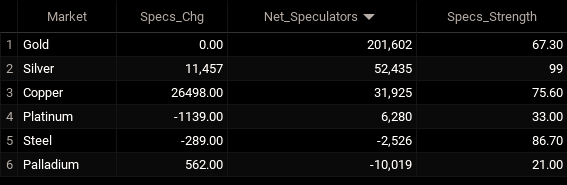
Net Speculators Leaderboard

Legend: Weekly Speculators Change | Speculators Current Net Position | Speculators Strength Score compared to last 3-Years (0-100 range)


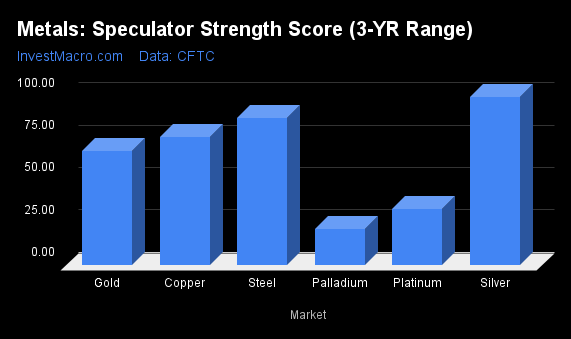
Strength Scores led by Steel

COT Strength Scores (a normalized measure of Speculator positions over a 3-Year range, from 0 to 100 where above 80 is Extreme-Bullish and below 20 is Extreme-Bearish) showed that Steel (85 percent) leads the metals markets this week.

On the downside, Palladium (7 percent) comes in at the lowest strength level currently and is in Extreme-Bearish territory (below 20 percent). The next lowest strength score was Platinum (26 percent) this week.

Strength Statistics:
Gold (40.3 percent) vs Gold previous week (39.7 percent)
Silver (41.6 percent) vs Silver previous week (53.6 percent)
Copper (38.1 percent) vs Copper previous week (22.1 percent)
Platinum (26.2 percent) vs Platinum previous week (38.6 percent)
Palladium (7.2 percent) vs Palladium previous week (6.4 percent)
Steel (85.1 percent) vs Palladium previous week (86.0 percent)


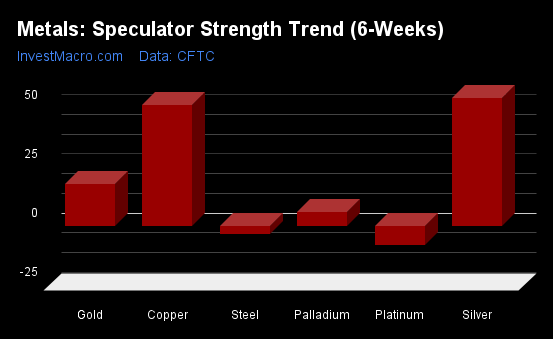
Copper tops the 6-Week Strength Trends

COT Strength Score Trends (or move index, calculates the 6-week changes in strength scores) showed that Copper (26 percent) leads the past six weeks trends for metals and is the only positive mover in the latest data.

Platinum (-23 percent), Gold (-17 percent) and Silver (-17 percent) lead the downside trend scores this week.

Move Statistics:
Gold (-17.2 percent) vs Gold previous week (-21.8 percent)
Silver (-16.9 percent) vs Silver previous week (-6.1 percent)
Copper (26.5 percent) vs Copper previous week (-3.1 percent)
Platinum (-22.7 percent) vs Platinum previous week (-38.1 percent)
Palladium (-5.2 percent) vs Palladium previous week (-18.0 percent)
Steel (-4.4 percent) vs Steel previous week (-4.7 percent)


Individual Markets:

Gold Comex Futures:

Gold Futures COT ChartThe Gold Comex Futures large speculator standing this week reached a net position of 141,636 contracts in the data reported through Tuesday. This was a weekly gain of 1,374 contracts from the previous week which had a total of 140,262 net contracts.

This week’s current strength score (the trader positioning range over the past three years, measured from 0 to 100) shows the speculators are currently Bearish with a score of 40.3 percent. The commercials are Bullish with a score of 60.7 percent and the small traders (not shown in chart) are Bearish with a score of 27.9 percent.

Price Trend-Following Model: Strong Uptrend

Our weekly trend-following model classifies the current market price position as: Strong Uptrend. The current action for the model is considered to be: Hold – Maintain Long Position.

Gold Futures StatisticsSPECULATORSCOMMERCIALSSMALL TRADERS
– Percent of Open Interest Longs:52.326.49.5
– Percent of Open Interest Shorts:17.864.95.4
– Net Position:141,636-158,35216,716
– Gross Longs:214,948108,43238,943
– Gross Shorts:73,312266,78422,227
– Long to Short Ratio:2.9 to 10.4 to 11.8 to 1
NET POSITION TREND:
– Strength Index Score (3 Year Range Pct):40.360.727.9
– Strength Index Reading (3 Year Range):BearishBullishBearish
NET POSITION MOVEMENT INDEX:
– 6-Week Change in Strength Index:-17.220.0-34.7


Silver Comex Futures:

Silver Futures COT ChartThe Silver Comex Futures large speculator standing this week reached a net position of 14,499 contracts in the data reported through Tuesday. This was a weekly fall of -7,878 contracts from the previous week which had a total of 22,377 net contracts.

This week’s current strength score (the trader positioning range over the past three years, measured from 0 to 100) shows the speculators are currently Bearish with a score of 41.6 percent. The commercials are Bullish with a score of 52.8 percent and the small traders (not shown in chart) are Bullish with a score of 66.3 percent.

Price Trend-Following Model: Downtrend

Our weekly trend-following model classifies the current market price position as: Downtrend. The current action for the model is considered to be: Hold – Maintain Short Position.

Silver Futures StatisticsSPECULATORSCOMMERCIALSSMALL TRADERS
– Percent of Open Interest Longs:37.834.021.5
– Percent of Open Interest Shorts:27.756.59.0
– Net Position:14,499-32,44817,949
– Gross Longs:54,54649,11230,987
– Gross Shorts:40,04781,56013,038
– Long to Short Ratio:1.4 to 10.6 to 12.4 to 1
NET POSITION TREND:
– Strength Index Score (3 Year Range Pct):41.652.866.3
– Strength Index Reading (3 Year Range):BearishBullishBullish
NET POSITION MOVEMENT INDEX:
– 6-Week Change in Strength Index:-16.914.2-1.2


Copper Grade #1 Futures:

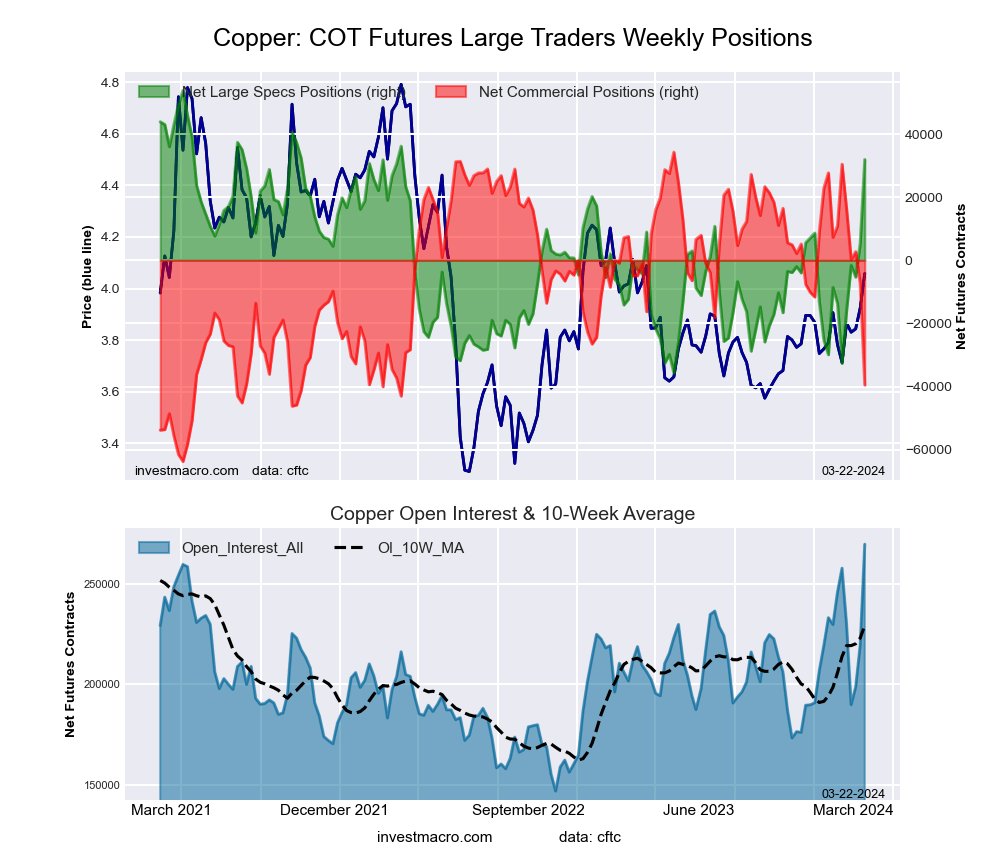
Copper Futures COT ChartThe Copper Grade #1 Futures large speculator standing this week reached a net position of -1,603 contracts in the data reported through Tuesday. This was a weekly boost of 14,339 contracts from the previous week which had a total of -15,942 net contracts.

This week’s current strength score (the trader positioning range over the past three years, measured from 0 to 100) shows the speculators are currently Bearish with a score of 38.1 percent. The commercials are Bullish with a score of 65.3 percent and the small traders (not shown in chart) are Bearish with a score of 26.8 percent.

Price Trend-Following Model: Uptrend

Our weekly trend-following model classifies the current market price position as: Uptrend. The current action for the model is considered to be: Hold – Maintain Long Position.

Copper Futures StatisticsSPECULATORSCOMMERCIALSSMALL TRADERS
– Percent of Open Interest Longs:36.736.78.5
– Percent of Open Interest Shorts:37.636.57.8
– Net Position:-1,6032801,323
– Gross Longs:69,67369,61416,214
– Gross Shorts:71,27669,33414,891
– Long to Short Ratio:1.0 to 11.0 to 11.1 to 1
NET POSITION TREND:
– Strength Index Score (3 Year Range Pct):38.165.326.8
– Strength Index Reading (3 Year Range):BearishBullishBearish
NET POSITION MOVEMENT INDEX:
– 6-Week Change in Strength Index:26.5-23.0-7.1


Platinum Futures:

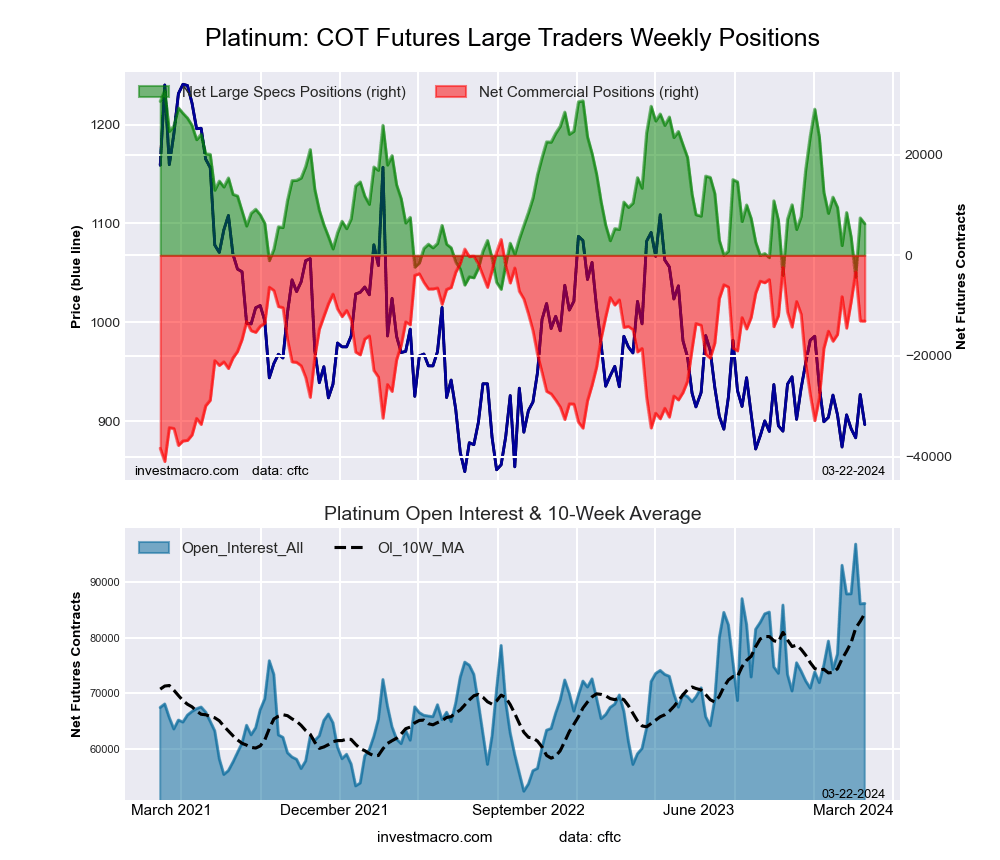
Platinum Futures COT ChartThe Platinum Futures large speculator standing this week reached a net position of 3,601 contracts in the data reported through Tuesday. This was a weekly lowering of -4,894 contracts from the previous week which had a total of 8,495 net contracts.

This week’s current strength score (the trader positioning range over the past three years, measured from 0 to 100) shows the speculators are currently Bearish with a score of 26.2 percent. The commercials are Bullish with a score of 72.0 percent and the small traders (not shown in chart) are Bearish with a score of 43.0 percent.

Price Trend-Following Model: Strong Downtrend

Our weekly trend-following model classifies the current market price position as: Strong Downtrend. The current action for the model is considered to be: New Sell – Short Position.

Platinum Futures StatisticsSPECULATORSCOMMERCIALSSMALL TRADERS
– Percent of Open Interest Longs:56.823.410.8
– Percent of Open Interest Shorts:52.733.94.4
– Net Position:3,601-9,2015,600
– Gross Longs:49,89820,5709,492
– Gross Shorts:46,29729,7713,892
– Long to Short Ratio:1.1 to 10.7 to 12.4 to 1
NET POSITION TREND:
– Strength Index Score (3 Year Range Pct):26.272.043.0
– Strength Index Reading (3 Year Range):BearishBullishBearish
NET POSITION MOVEMENT INDEX:
– 6-Week Change in Strength Index:-22.721.1-4.5


Palladium Futures:

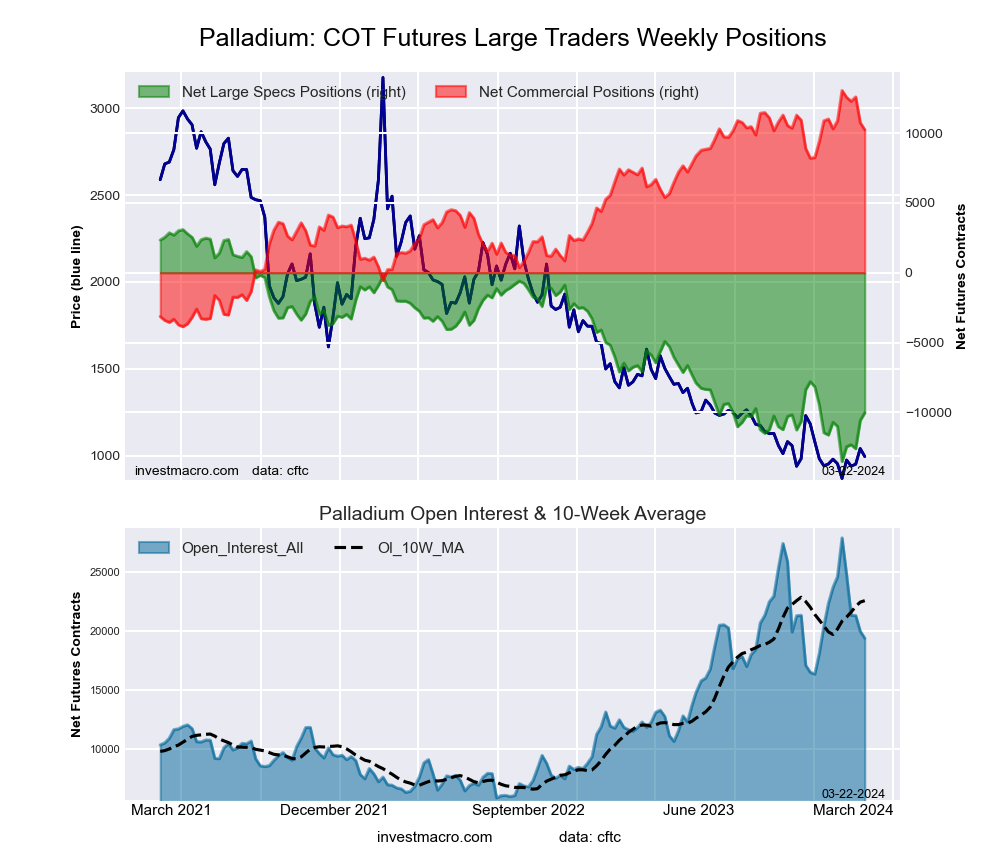
Palladium Futures COT ChartThe Palladium Futures large speculator standing this week reached a net position of -12,315 contracts in the data reported through Tuesday. This was a weekly increase of 138 contracts from the previous week which had a total of -12,453 net contracts.

This week’s current strength score (the trader positioning range over the past three years, measured from 0 to 100) shows the speculators are currently Bearish-Extreme with a score of 7.2 percent. The commercials are Bullish-Extreme with a score of 95.5 percent and the small traders (not shown in chart) are Bearish with a score of 44.2 percent.

Price Trend-Following Model: Downtrend

Our weekly trend-following model classifies the current market price position as: Downtrend. The current action for the model is considered to be: Hold – Maintain Short Position.

Palladium Futures StatisticsSPECULATORSCOMMERCIALSSMALL TRADERS
– Percent of Open Interest Longs:20.762.78.0
– Percent of Open Interest Shorts:78.55.27.8
– Net Position:-12,31512,27342
– Gross Longs:4,41113,3721,708
– Gross Shorts:16,7261,0991,666
– Long to Short Ratio:0.3 to 112.2 to 11.0 to 1
NET POSITION TREND:
– Strength Index Score (3 Year Range Pct):7.295.544.2
– Strength Index Reading (3 Year Range):Bearish-ExtremeBullish-ExtremeBearish
NET POSITION MOVEMENT INDEX:
– 6-Week Change in Strength Index:-5.28.3-32.0


Steel Futures Futures:

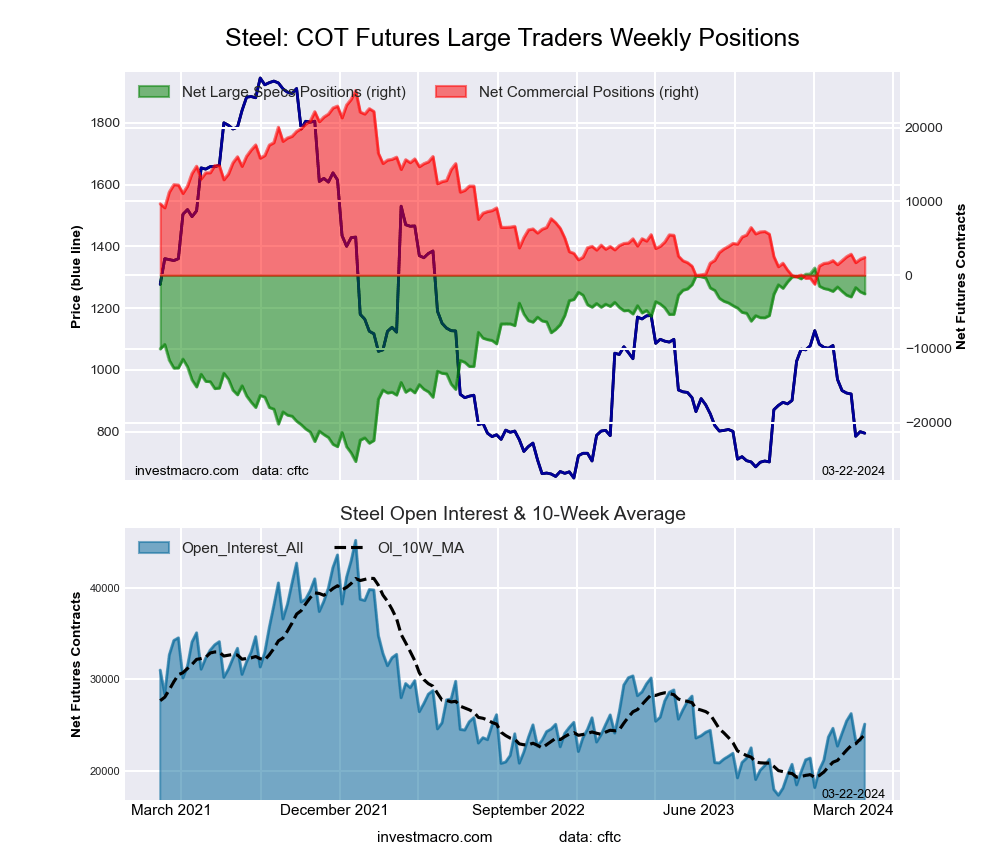
Steel Futures COT ChartThe Steel Futures large speculator standing this week reached a net position of -2,935 contracts in the data reported through Tuesday. This was a weekly fall of -234 contracts from the previous week which had a total of -2,701 net contracts.

This week’s current strength score (the trader positioning range over the past three years, measured from 0 to 100) shows the speculators are currently Bullish-Extreme with a score of 85.1 percent. The commercials are Bearish-Extreme with a score of 15.5 percent and the small traders (not shown in chart) are Bearish with a score of 41.8 percent.

Price Trend-Following Model: Weak Uptrend

Our weekly trend-following model classifies the current market price position as: Weak Uptrend. The current action for the model is considered to be: Hold – Maintain Long Position.

Steel Futures StatisticsSPECULATORSCOMMERCIALSSMALL TRADERS
– Percent of Open Interest Longs:11.282.81.0
– Percent of Open Interest Shorts:22.472.00.7
– Net Position:-2,9352,84986
– Gross Longs:2,93721,733269
– Gross Shorts:5,87218,884183
– Long to Short Ratio:0.5 to 11.2 to 11.5 to 1
NET POSITION TREND:
– Strength Index Score (3 Year Range Pct):85.115.541.8
– Strength Index Reading (3 Year Range):Bullish-ExtremeBearish-ExtremeBearish
NET POSITION MOVEMENT INDEX:
– 6-Week Change in Strength Index:-4.44.8-12.3


Article By InvestMacroReceive our weekly COT Newsletter

*COT Report: The COT data, released weekly to the public each Friday, is updated through the most recent Tuesday (data is 3 days old) and shows a quick view of how large speculators or non-commercials (for-profit traders) were positioned in the futures markets.

The CFTC categorizes trader positions according to commercial hedgers (traders who use futures contracts for hedging as part of the business), non-commercials (large traders who speculate to realize trading profits) and nonreportable traders (usually small traders/speculators) as well as their open interest (contracts open in the market at time of reporting). See CFTC criteria here.

COT Bonds Charts: Speculator bets led by 2-Year Bonds & US Treasury Bonds

By InvestMacro

Here are the latest charts and statistics for the Commitment of Traders (COT) reports data published by the Commodities Futures Trading Commission (CFTC).

The latest COT data is updated through Tuesday February 27th and shows a quick view of how large traders (for-profit speculators and commercial hedgers) were positioned in the futures markets.

Weekly Speculator Changes led by 2-Year Bonds & US Treasury Bonds

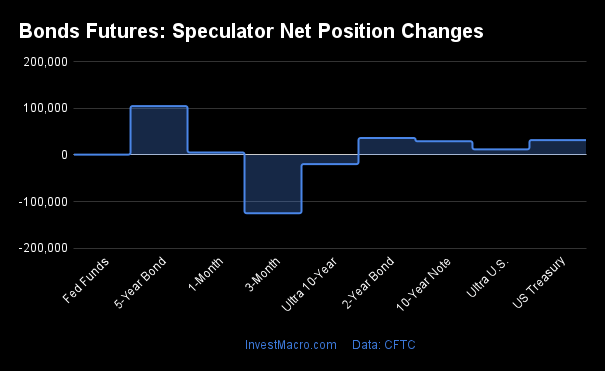
The COT bond market speculator bets were overall higher this week as seven out of the eight bond markets we cover had higher positioning while the other one markets had lower speculator contracts.

Leading the gains for the bond markets was the 2-Year Bonds (165,226 contracts) with the US Treasury Bonds (80,756 contracts), the 10-Year Bonds (63,484 contracts), the 5-Year Bonds (37,907 contracts), the SOFR 3-Months (5,584 contracts), the Ultra Treasury Bonds (2,977 contracts) and the Ultra 10-Year Bonds (1,139 contracts) also having positive weeks.

The only market with a decline was the Fed Funds with a drop by -58,874 contracts for the week.


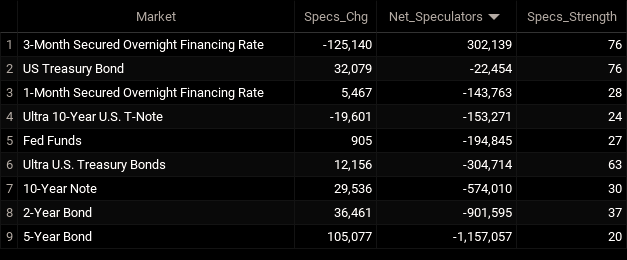
Bonds Net Speculators Leaderboard

Legend: Weekly Speculators Change | Speculators Current Net Position | Speculators Strength Score compared to last 3-Years (0-100 range)


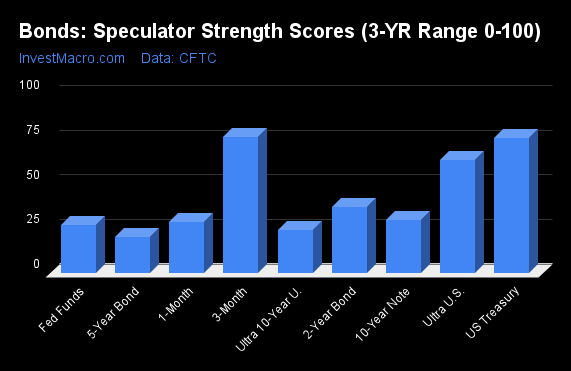
Strength Scores led by SOFR 3-Months & US Treasury Bonds

COT Strength Scores (a normalized measure of Speculator positions over a 3-Year range, from 0 to 100 where above 80 is Extreme-Bullish and below 20 is Extreme-Bearish) showed that the SOFR 3-Months (80 percent) and the US Treasury Bonds (79 percent) lead the bond markets this week. The Ultra Treasury Bonds (57 percent) comes in as the next highest in the weekly strength scores.

On the downside, the Ultra 10-Year Bonds (16 percent) and the 5-Year Bonds (17 percent) come in at the lowest strength level currently and are in Extreme-Bearish territory (below 20 percent). The next lowest strength scores were the 10-Year Bonds (21 percent) and the Fed Funds (21 percent).

Strength Statistics:
Fed Funds (21.3 percent) vs Fed Funds previous week (33.8 percent)
2-Year Bond (34.0 percent) vs 2-Year Bond previous week (23.5 percent)
5-Year Bond (17.5 percent) vs 5-Year Bond previous week (15.0 percent)
10-Year Bond (20.9 percent) vs 10-Year Bond previous week (15.0 percent)
Ultra 10-Year Bond (16.0 percent) vs Ultra 10-Year Bond previous week (15.8 percent)
US Treasury Bond (78.6 percent) vs US Treasury Bond previous week (50.5 percent)
Ultra US Treasury Bond (56.9 percent) vs Ultra US Treasury Bond previous week (55.7 percent)
SOFR 3-Months (79.6 percent) vs SOFR 3-Months previous week (79.3 percent)


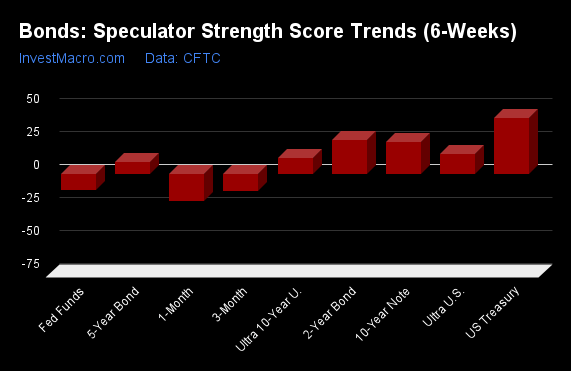
US Treasury Bonds & 10-Year Bonds top the 6-Week Strength Trends

COT Strength Score Trends (or move index, calculates the 6-week changes in strength scores) showed that the US Treasury Bonds (40 percent) and the 10-Year Bonds (21 percent) lead the past six weeks trends for bonds. The 2-Year Bonds (17 percent) are the next highest positive mover in the latest trends data.

The Fed Funds (-33 percent) and the SOFR 3-Months (-19 percent) lead the downside trend scores currently with the Ultra 10-Year Bonds (-5 percent) following next with lower trend scores.

Strength Trend Statistics:
Fed Funds (-33.2 percent) vs Fed Funds previous week (-5.6 percent)
2-Year Bond (16.5 percent) vs 2-Year Bond previous week (8.3 percent)
5-Year Bond (0.1 percent) vs 5-Year Bond previous week (-4.0 percent)
10-Year Bond (20.9 percent) vs 10-Year Bond previous week (5.4 percent)
Ultra 10-Year Bond (-5.4 percent) vs Ultra 10-Year Bond previous week (-3.1 percent)
US Treasury Bond (39.6 percent) vs US Treasury Bond previous week (21.2 percent)
Ultra US Treasury Bond (1.2 percent) vs Ultra US Treasury Bond previous week (-4.0 percent)
SOFR 3-Months (-19.5 percent) vs SOFR 3-Months previous week (-16.4 percent)


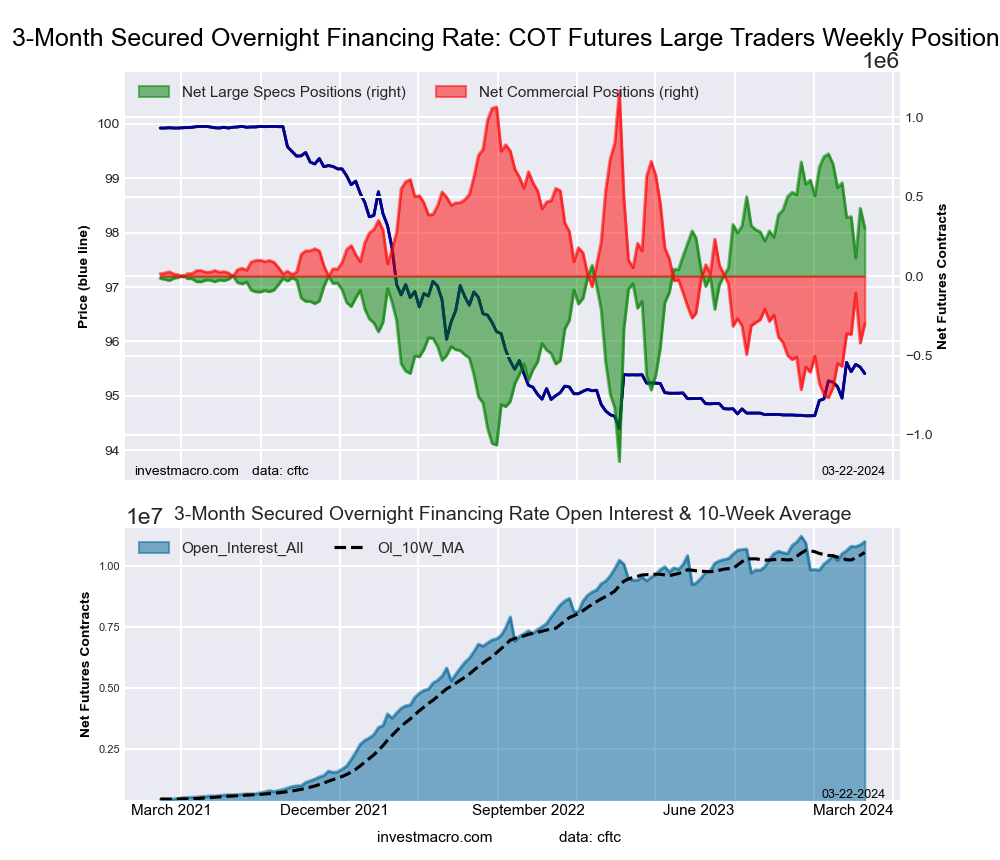
Secured Overnight Financing Rate (3-Month) Futures:

SOFR 3-Months Bonds Futures COT ChartThe Secured Overnight Financing Rate (3-Month) large speculator standing this week resulted in a net position of 373,974 contracts in the data reported through Tuesday. This was a weekly lift of 5,584 contracts from the previous week which had a total of 368,390 net contracts.

This week’s current strength score (the trader positioning range over the past three years, measured from 0 to 100) shows the speculators are currently Bullish with a score of 79.6 percent. The commercials are Bearish with a score of 20.6 percent and the small traders (not shown in chart) are Bullish-Extreme with a score of 84.0 percent.

Price Trend-Following Model: Weak Uptrend

Our weekly trend-following model classifies the current market price position as: Weak Uptrend. The current action for the model is considered to be: Hold – Maintain Long Position.

SOFR 3-Months StatisticsSPECULATORSCOMMERCIALSSMALL TRADERS
– Percent of Open Interest Longs:16.954.70.2
– Percent of Open Interest Shorts:13.458.10.3
– Net Position:373,974-366,966-7,008
– Gross Longs:1,825,9585,914,86126,690
– Gross Shorts:1,451,9846,281,82733,698
– Long to Short Ratio:1.3 to 10.9 to 10.8 to 1
NET POSITION TREND:
– Strength Index Score (3 Year Range Pct):79.620.684.0
– Strength Index Reading (3 Year Range):BullishBearishBullish-Extreme
NET POSITION MOVEMENT INDEX:
– 6-Week Change in Strength Index:-19.519.6-0.4


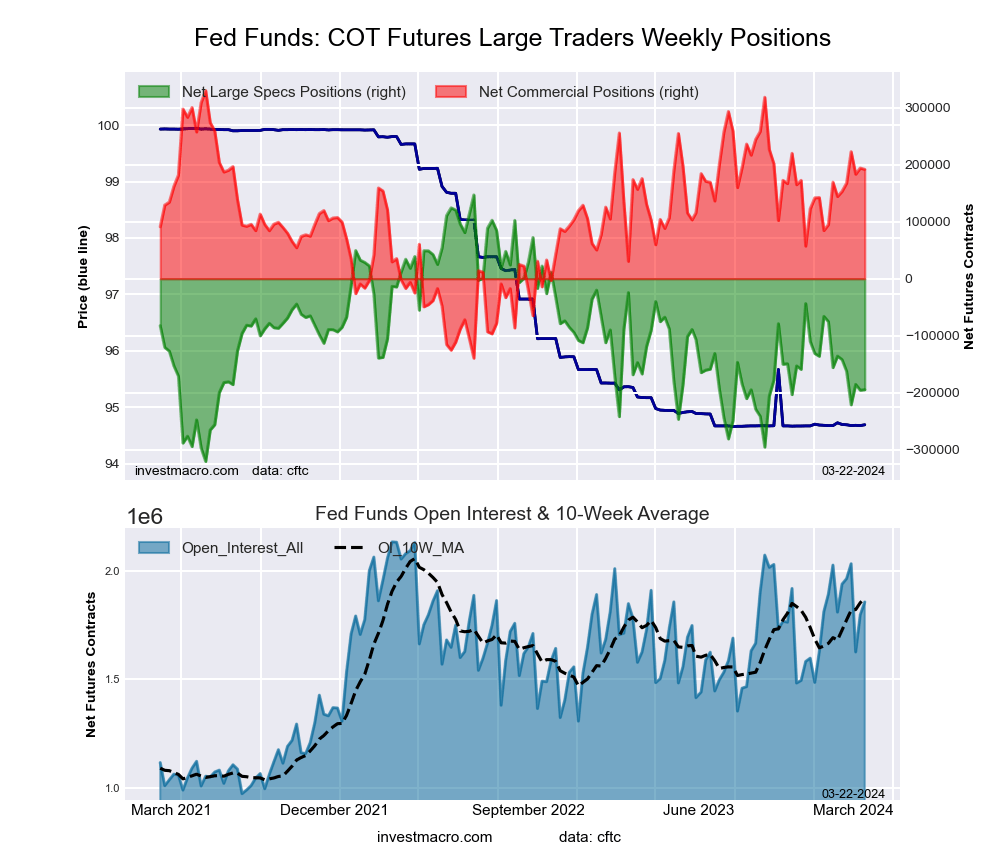
30-Day Federal Funds Futures:

Federal Funds 30-Day Bonds Futures COT ChartThe 30-Day Federal Funds large speculator standing this week resulted in a net position of -221,404 contracts in the data reported through Tuesday. This was a weekly lowering of -58,874 contracts from the previous week which had a total of -162,530 net contracts.

This week’s current strength score (the trader positioning range over the past three years, measured from 0 to 100) shows the speculators are currently Bearish with a score of 21.3 percent. The commercials are Bullish with a score of 77.1 percent and the small traders (not shown in chart) are Bullish-Extreme with a score of 87.7 percent.

Price Trend-Following Model: Downtrend

Our weekly trend-following model classifies the current market price position as: Downtrend. The current action for the model is considered to be: Hold – Maintain Short Position.

30-Day Federal Funds StatisticsSPECULATORSCOMMERCIALSSMALL TRADERS
– Percent of Open Interest Longs:13.070.31.7
– Percent of Open Interest Shorts:23.959.31.8
– Net Position:-221,404223,075-1,671
– Gross Longs:264,2441,427,60934,288
– Gross Shorts:485,6481,204,53435,959
– Long to Short Ratio:0.5 to 11.2 to 11.0 to 1
NET POSITION TREND:
– Strength Index Score (3 Year Range Pct):21.377.187.7
– Strength Index Reading (3 Year Range):BearishBullishBullish-Extreme
NET POSITION MOVEMENT INDEX:
– 6-Week Change in Strength Index:-33.229.433.2


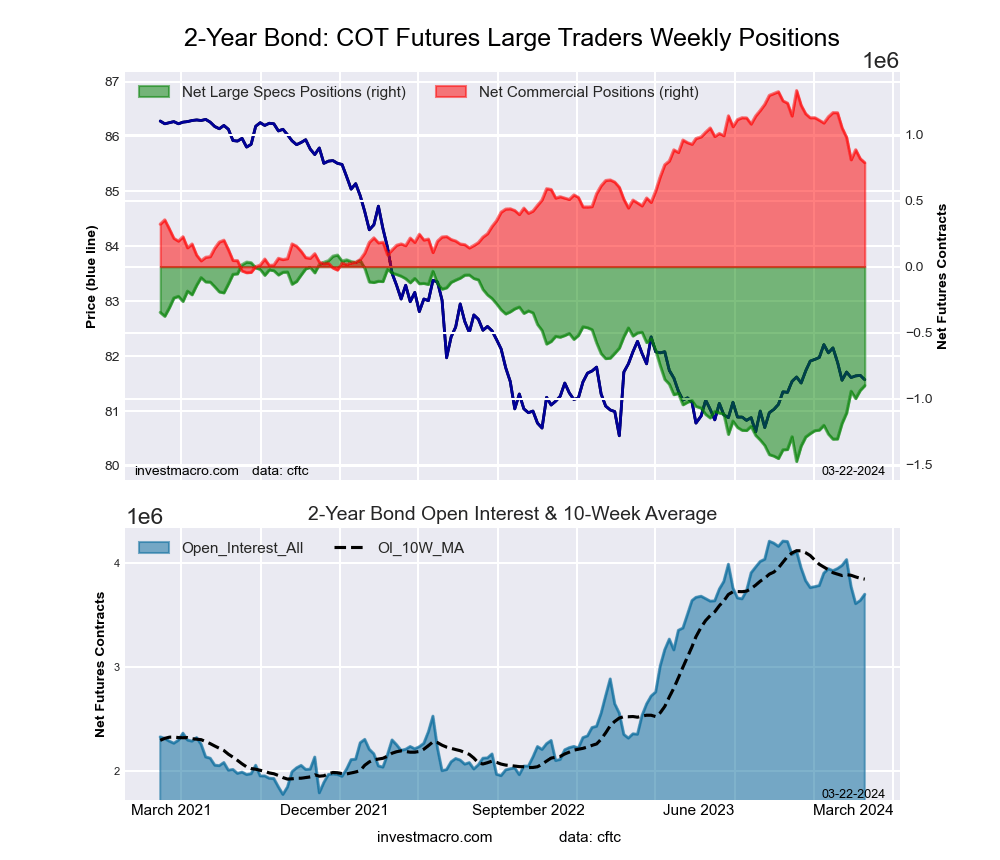
2-Year Treasury Note Futures:

2-Year Treasury Bonds Futures COT ChartThe 2-Year Treasury Note large speculator standing this week resulted in a net position of -943,898 contracts in the data reported through Tuesday. This was a weekly lift of 165,226 contracts from the previous week which had a total of -1,109,124 net contracts.

This week’s current strength score (the trader positioning range over the past three years, measured from 0 to 100) shows the speculators are currently Bearish with a score of 34.0 percent. The commercials are Bullish with a score of 62.0 percent and the small traders (not shown in chart) are Bullish-Extreme with a score of 95.0 percent.

Price Trend-Following Model: Uptrend

Our weekly trend-following model classifies the current market price position as: Uptrend. The current action for the model is considered to be: Hold – Maintain Long Position.

2-Year Treasury Note StatisticsSPECULATORSCOMMERCIALSSMALL TRADERS
– Percent of Open Interest Longs:10.380.47.1
– Percent of Open Interest Shorts:35.358.93.5
– Net Position:-943,898809,780134,118
– Gross Longs:387,1383,030,544267,240
– Gross Shorts:1,331,0362,220,764133,122
– Long to Short Ratio:0.3 to 11.4 to 12.0 to 1
NET POSITION TREND:
– Strength Index Score (3 Year Range Pct):34.062.095.0
– Strength Index Reading (3 Year Range):BearishBullishBullish-Extreme
NET POSITION MOVEMENT INDEX:
– 6-Week Change in Strength Index:16.5-20.27.6


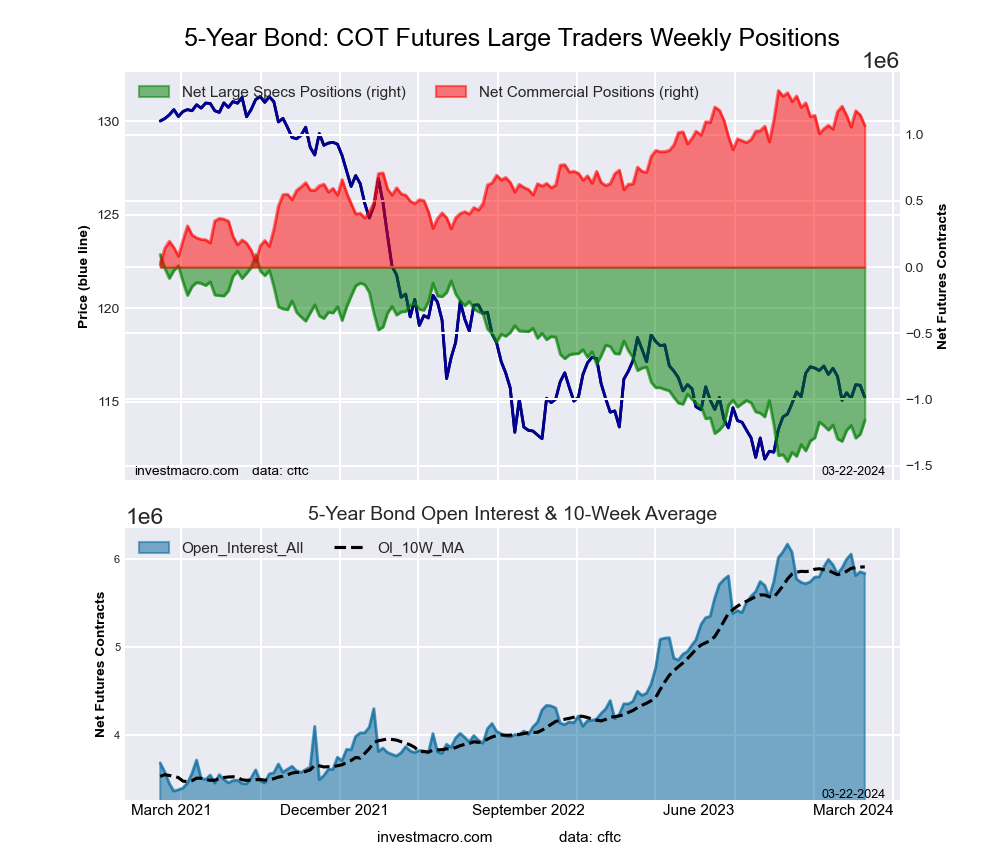
5-Year Treasury Note Futures:

5-Year Treasury Bonds Futures COT ChartThe 5-Year Treasury Note large speculator standing this week resulted in a net position of -1,195,393 contracts in the data reported through Tuesday. This was a weekly advance of 37,907 contracts from the previous week which had a total of -1,233,300 net contracts.

This week’s current strength score (the trader positioning range over the past three years, measured from 0 to 100) shows the speculators are currently Bearish-Extreme with a score of 17.5 percent. The commercials are Bullish with a score of 79.0 percent and the small traders (not shown in chart) are Bullish-Extreme with a score of 91.8 percent.

Price Trend-Following Model: Uptrend

Our weekly trend-following model classifies the current market price position as: Uptrend. The current action for the model is considered to be: Hold – Maintain Long Position.

5-Year Treasury Note StatisticsSPECULATORSCOMMERCIALSSMALL TRADERS
– Percent of Open Interest Longs:6.383.87.1
– Percent of Open Interest Shorts:26.066.34.8
– Net Position:-1,195,3931,058,803136,590
– Gross Longs:382,3965,074,656428,067
– Gross Shorts:1,577,7894,015,853291,477
– Long to Short Ratio:0.2 to 11.3 to 11.5 to 1
NET POSITION TREND:
– Strength Index Score (3 Year Range Pct):17.579.091.8
– Strength Index Reading (3 Year Range):Bearish-ExtremeBullishBullish-Extreme
NET POSITION MOVEMENT INDEX:
– 6-Week Change in Strength Index:0.11.0-3.1


10-Year Treasury Note Futures:

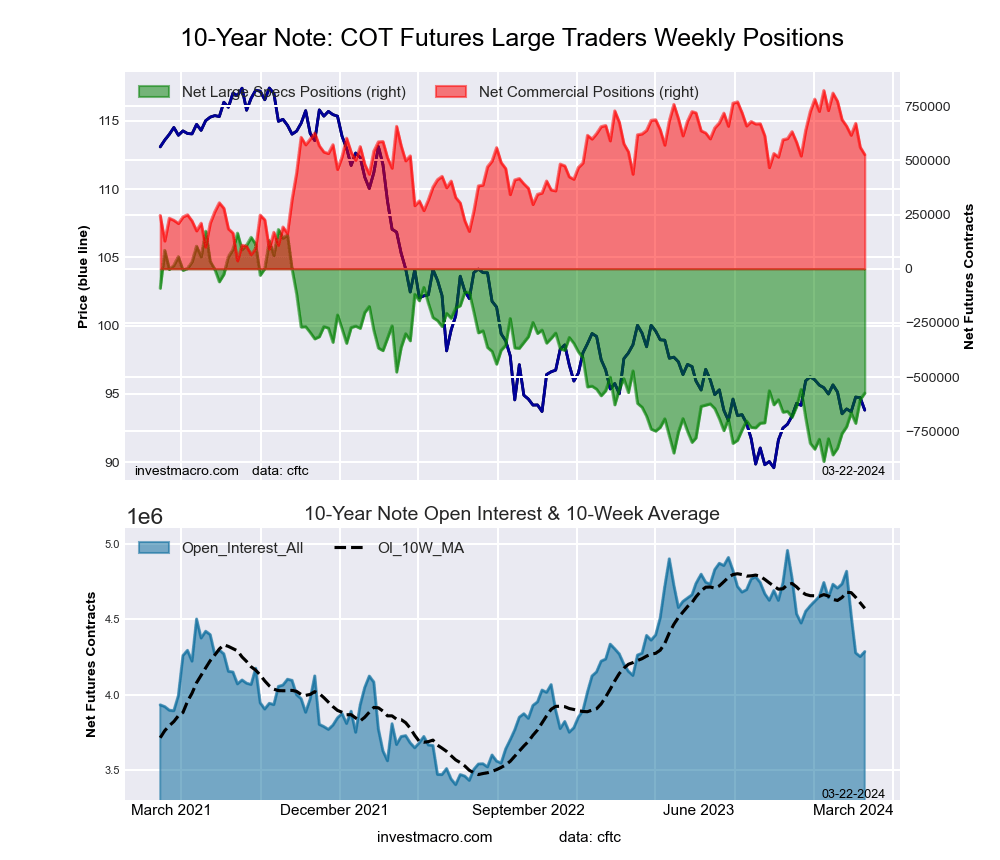
10-Year Treasury Notes Bonds Futures COT ChartThe 10-Year Treasury Note large speculator standing this week resulted in a net position of -665,582 contracts in the data reported through Tuesday. This was a weekly boost of 63,484 contracts from the previous week which had a total of -729,066 net contracts.

This week’s current strength score (the trader positioning range over the past three years, measured from 0 to 100) shows the speculators are currently Bearish with a score of 20.9 percent. The commercials are Bullish with a score of 73.7 percent and the small traders (not shown in chart) are Bullish-Extreme with a score of 84.2 percent.

Price Trend-Following Model: Uptrend

Our weekly trend-following model classifies the current market price position as: Uptrend. The current action for the model is considered to be: Hold – Maintain Long Position.

10-Year Treasury Note StatisticsSPECULATORSCOMMERCIALSSMALL TRADERS
– Percent of Open Interest Longs:10.577.19.5
– Percent of Open Interest Shorts:25.263.58.4
– Net Position:-665,582616,38549,197
– Gross Longs:474,5293,492,870429,894
– Gross Shorts:1,140,1112,876,485380,697
– Long to Short Ratio:0.4 to 11.2 to 11.1 to 1
NET POSITION TREND:
– Strength Index Score (3 Year Range Pct):20.973.784.2
– Strength Index Reading (3 Year Range):BearishBullishBullish-Extreme
NET POSITION MOVEMENT INDEX:
– 6-Week Change in Strength Index:20.9-26.3-3.8


Ultra 10-Year Notes Futures:

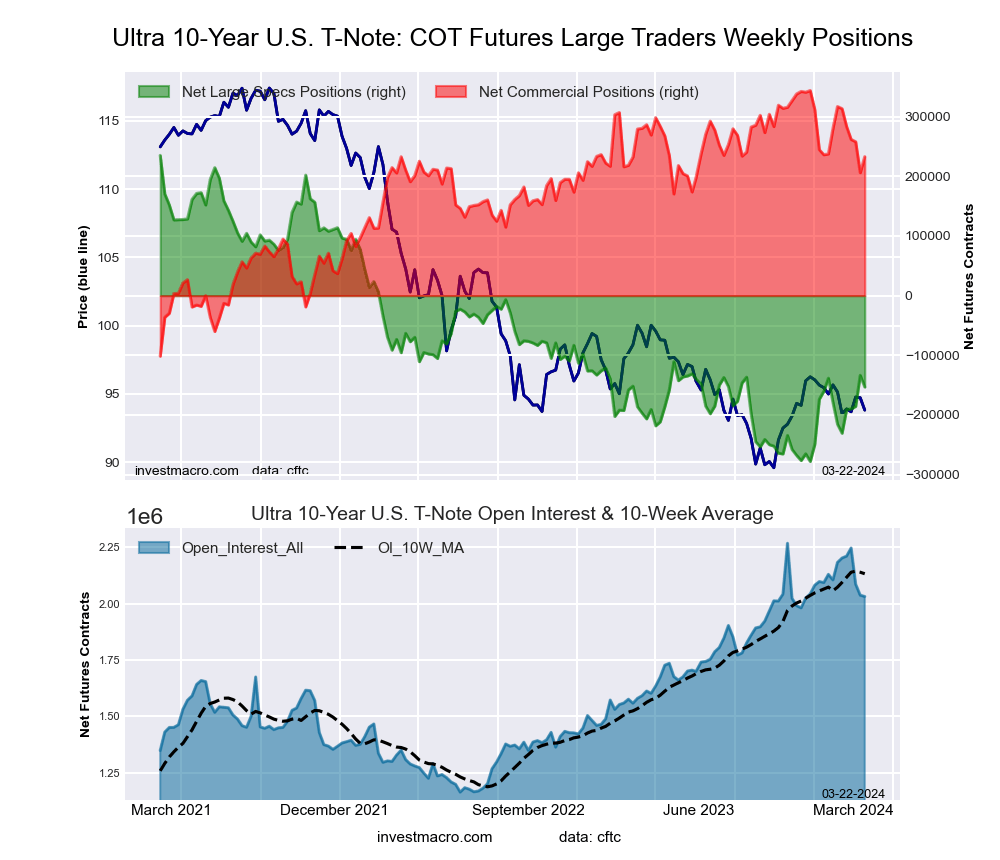
Ultra 10-Year Treasury Notes Bonds Futures COT ChartThe Ultra 10-Year Notes large speculator standing this week resulted in a net position of -189,900 contracts in the data reported through Tuesday. This was a weekly gain of 1,139 contracts from the previous week which had a total of -191,039 net contracts.

This week’s current strength score (the trader positioning range over the past three years, measured from 0 to 100) shows the speculators are currently Bearish-Extreme with a score of 16.0 percent. The commercials are Bullish-Extreme with a score of 83.6 percent and the small traders (not shown in chart) are Bullish with a score of 71.3 percent.

Price Trend-Following Model: Weak Uptrend

Our weekly trend-following model classifies the current market price position as: Weak Uptrend. The current action for the model is considered to be: Hold – Maintain Long Position.

Ultra 10-Year Notes StatisticsSPECULATORSCOMMERCIALSSMALL TRADERS
– Percent of Open Interest Longs:12.575.59.4
– Percent of Open Interest Shorts:21.063.812.6
– Net Position:-189,900261,839-71,939
– Gross Longs:281,6551,696,545210,640
– Gross Shorts:471,5551,434,706282,579
– Long to Short Ratio:0.6 to 11.2 to 10.7 to 1
NET POSITION TREND:
– Strength Index Score (3 Year Range Pct):16.083.671.3
– Strength Index Reading (3 Year Range):Bearish-ExtremeBullish-ExtremeBullish
NET POSITION MOVEMENT INDEX:
– 6-Week Change in Strength Index:-5.45.12.5


US Treasury Bonds Futures:

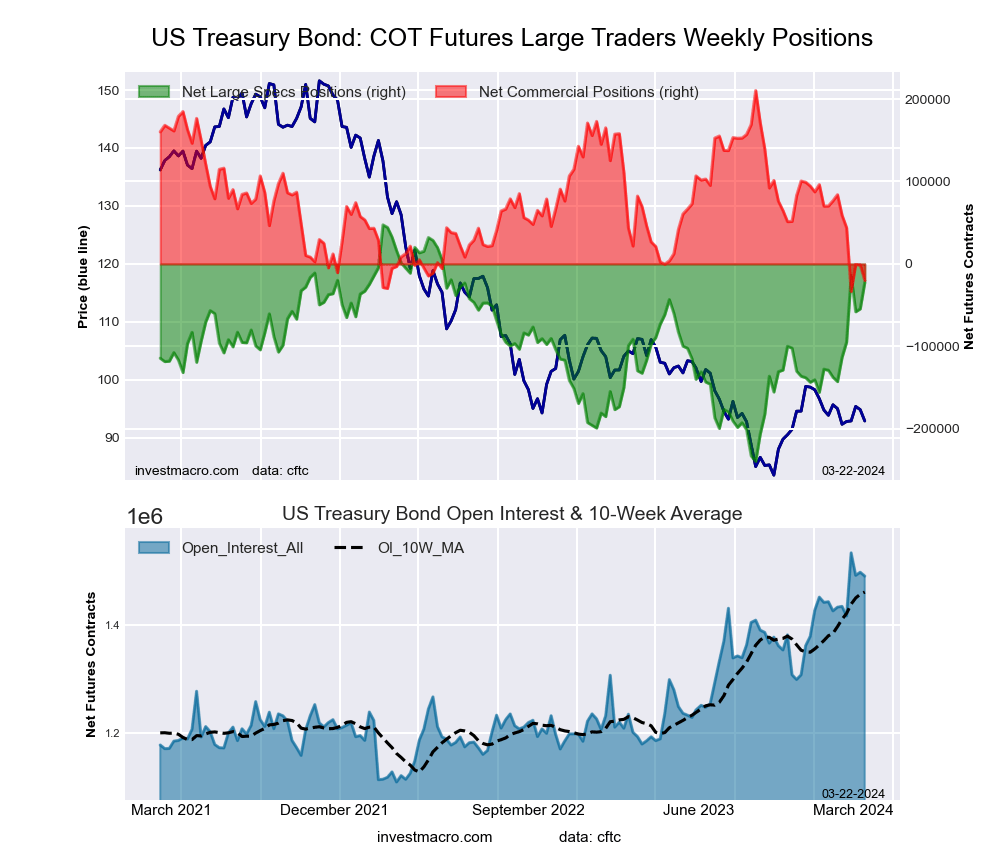
US Year Treasury Notes Long Bonds Futures COT ChartThe US Treasury Bonds large speculator standing this week resulted in a net position of -14,038 contracts in the data reported through Tuesday. This was a weekly gain of 80,756 contracts from the previous week which had a total of -94,794 net contracts.

This week’s current strength score (the trader positioning range over the past three years, measured from 0 to 100) shows the speculators are currently Bullish with a score of 78.6 percent. The commercials are Bearish-Extreme with a score of 0.0 percent and the small traders (not shown in chart) are Bullish-Extreme with a score of 83.0 percent.

Price Trend-Following Model: Uptrend

Our weekly trend-following model classifies the current market price position as: Uptrend. The current action for the model is considered to be: Hold – Maintain Long Position.

US Treasury Bonds StatisticsSPECULATORSCOMMERCIALSSMALL TRADERS
– Percent of Open Interest Longs:15.566.213.1
– Percent of Open Interest Shorts:16.468.410.0
– Net Position:-14,038-33,38247,420
– Gross Longs:237,9781,015,447201,594
– Gross Shorts:252,0161,048,829154,174
– Long to Short Ratio:0.9 to 11.0 to 11.3 to 1
NET POSITION TREND:
– Strength Index Score (3 Year Range Pct):78.60.083.0
– Strength Index Reading (3 Year Range):BullishBearish-ExtremeBullish-Extreme
NET POSITION MOVEMENT INDEX:
– 6-Week Change in Strength Index:39.6-41.0-7.4


Ultra US Treasury Bonds Futures:

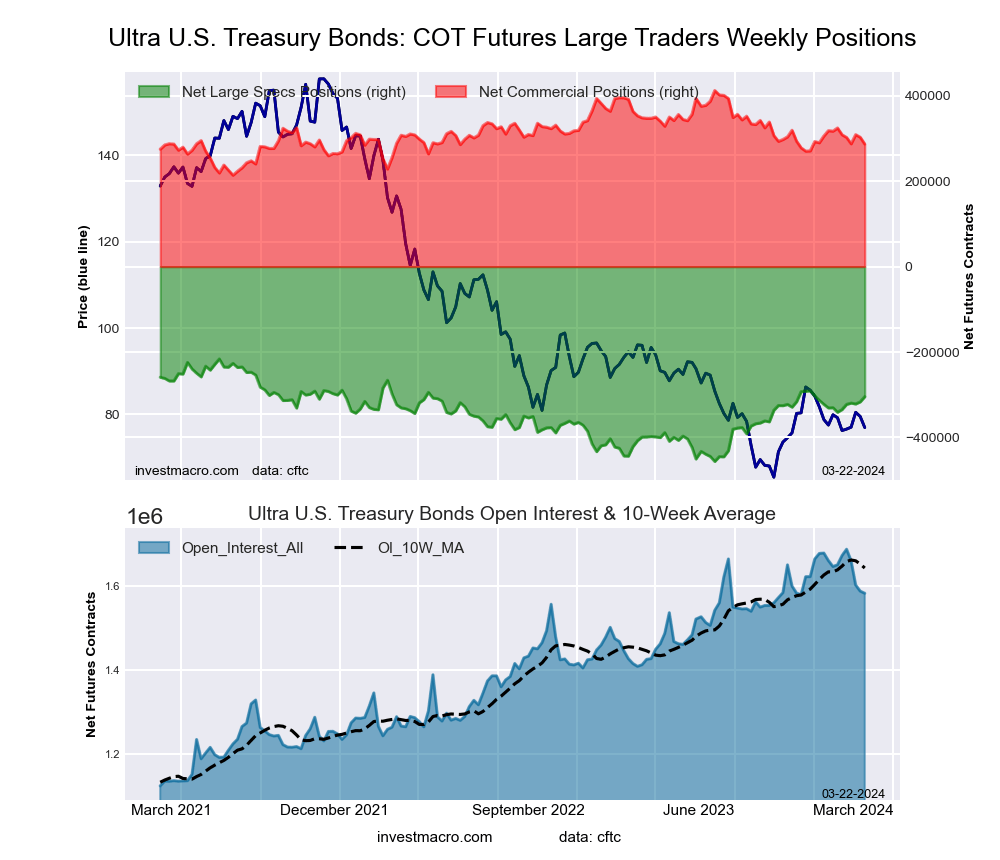
Ultra US Year Treasury Notes Long Bonds Futures COT ChartThe Ultra US Treasury Bonds large speculator standing this week resulted in a net position of -319,783 contracts in the data reported through Tuesday. This was a weekly lift of 2,977 contracts from the previous week which had a total of -322,760 net contracts.

This week’s current strength score (the trader positioning range over the past three years, measured from 0 to 100) shows the speculators are currently Bullish with a score of 56.9 percent. The commercials are Bearish with a score of 37.1 percent and the small traders (not shown in chart) are Bullish with a score of 67.4 percent.

Price Trend-Following Model: Uptrend

Our weekly trend-following model classifies the current market price position as: Uptrend. The current action for the model is considered to be: Hold – Maintain Long Position.

Ultra US Treasury Bonds StatisticsSPECULATORSCOMMERCIALSSMALL TRADERS
– Percent of Open Interest Longs:8.877.510.8
– Percent of Open Interest Shorts:28.160.28.9
– Net Position:-319,783287,81831,965
– Gross Longs:146,3361,287,850179,326
– Gross Shorts:466,1191,000,032147,361
– Long to Short Ratio:0.3 to 11.3 to 11.2 to 1
NET POSITION TREND:
– Strength Index Score (3 Year Range Pct):56.937.167.4
– Strength Index Reading (3 Year Range):BullishBearishBullish
NET POSITION MOVEMENT INDEX:
– 6-Week Change in Strength Index:1.2-9.214.6


Article By InvestMacroReceive our weekly COT Newsletter

*COT Report: The COT data, released weekly to the public each Friday, is updated through the most recent Tuesday (data is 3 days old) and shows a quick view of how large speculators or non-commercials (for-profit traders) were positioned in the futures markets.

The CFTC categorizes trader positions according to commercial hedgers (traders who use futures contracts for hedging as part of the business), non-commercials (large traders who speculate to realize trading profits) and nonreportable traders (usually small traders/speculators) as well as their open interest (contracts open in the market at time of reporting). See CFTC criteria here.

COT Stock Market Charts: Speculator bets led by MSCI EAFE-Mini & Russell-Mini

By InvestMacro

Here are the latest charts and statistics for the Commitment of Traders (COT) data published by the Commodities Futures Trading Commission (CFTC).

The latest COT data is updated through Tuesday February 27th and shows a quick view of how large traders (for-profit speculators and commercial entities) were positioned in the futures markets.

Weekly Speculator Changes led by MSCI EAFE-Mini & Russell-Mini

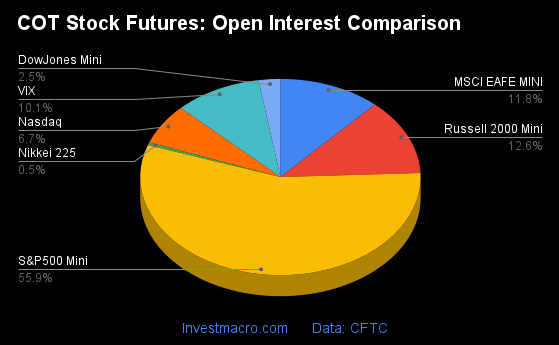
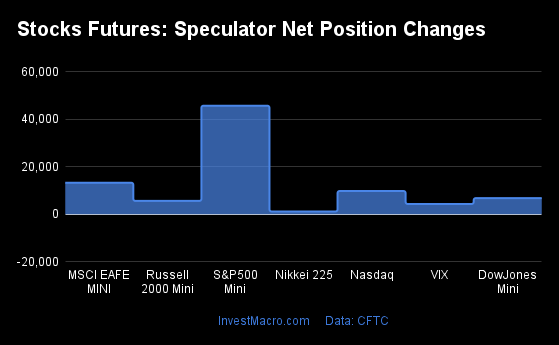
The COT stock markets speculator bets were slightly lower this week as three out of the seven stock markets we cover had higher positioning while the other four markets had lower speculator contracts.

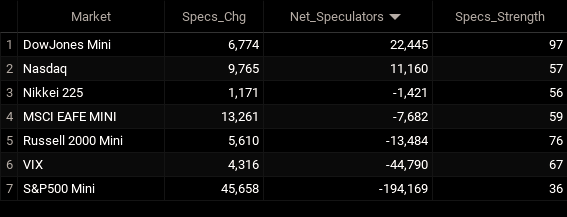
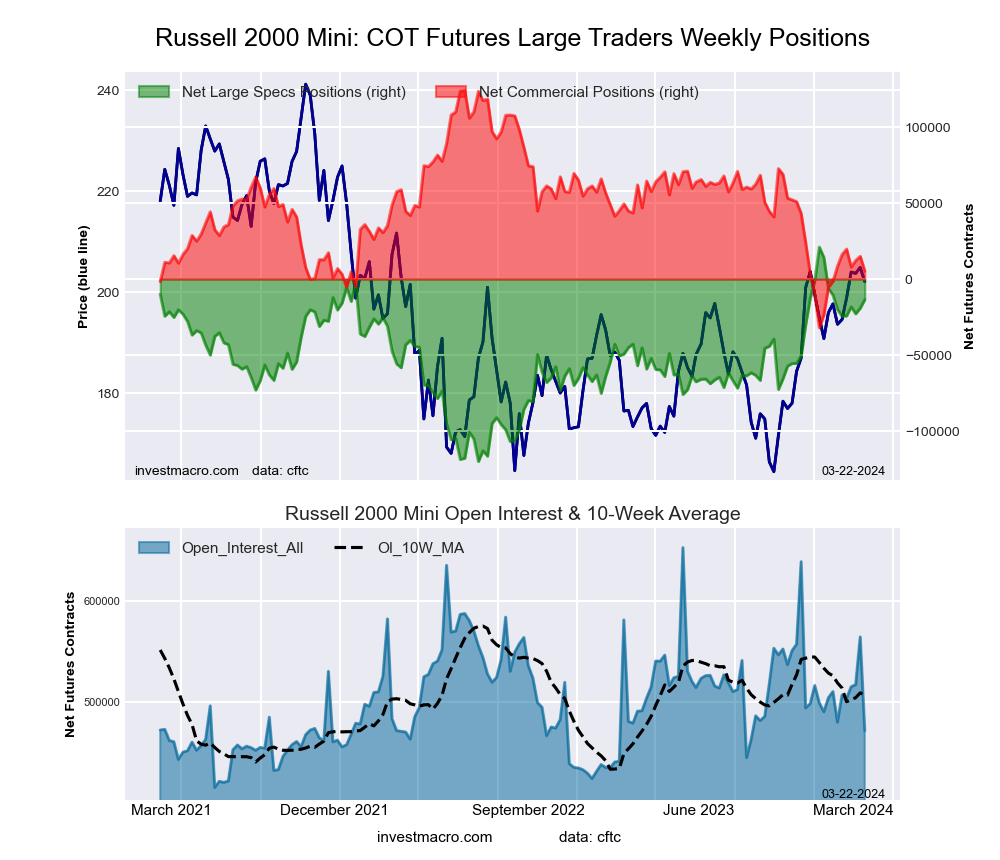
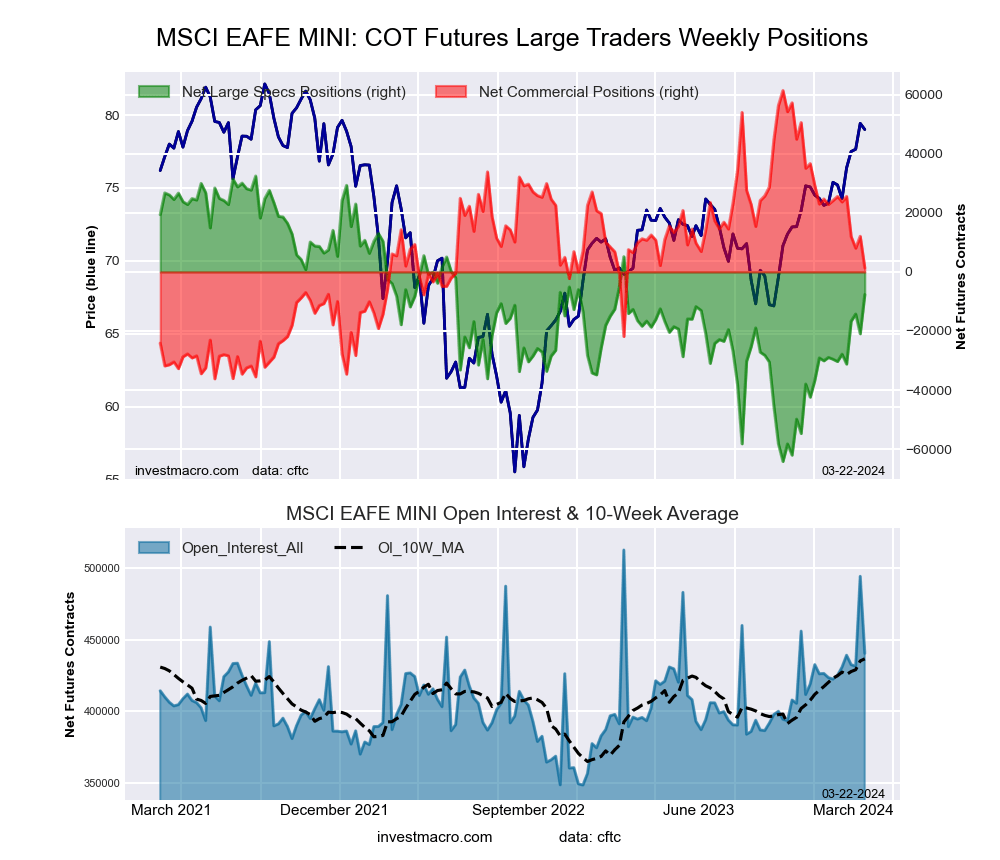
Leading the gains for the stock markets was the MSCI EAFE-Mini (14,518 contracts) with the Russell-Mini (5,977 contracts) and the DowJones-Mini (1,460 contracts) also showing positive weeks.

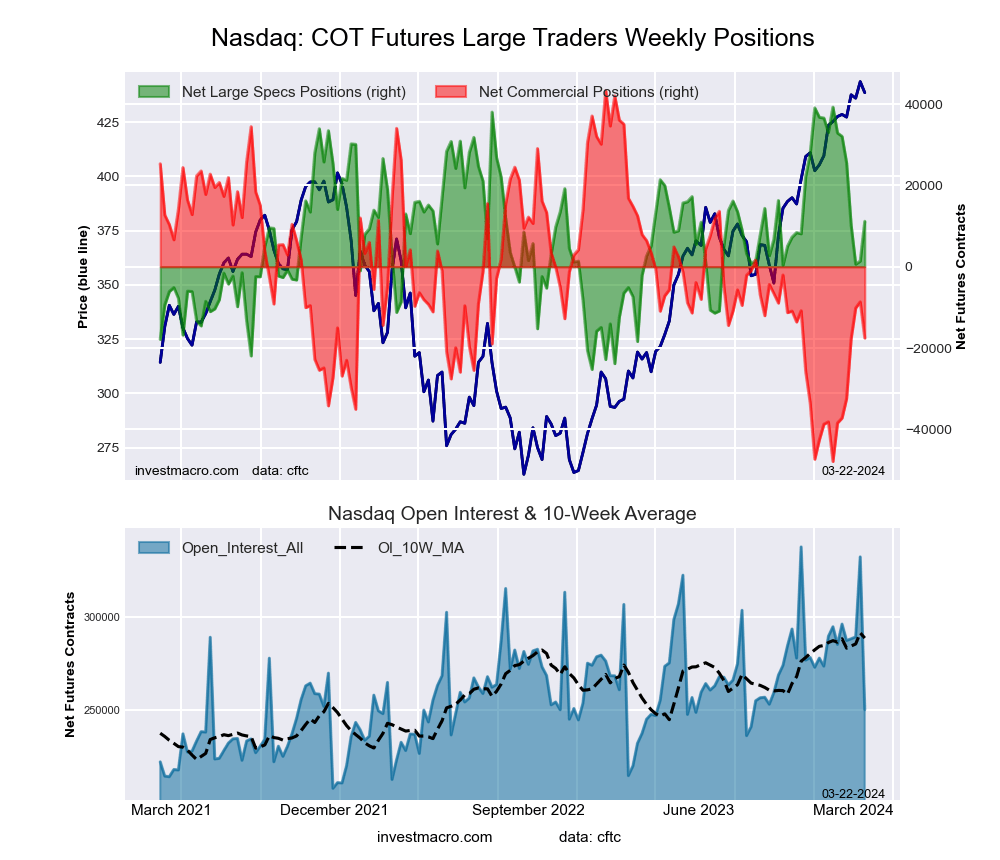
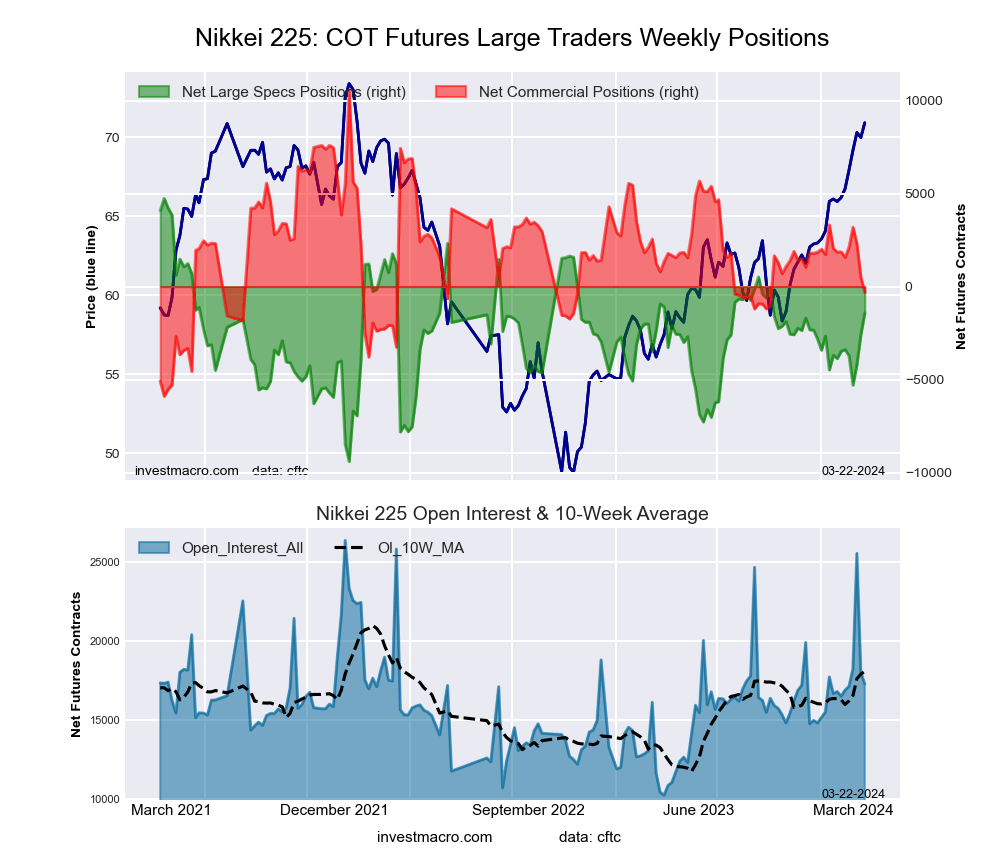
The markets with declines in speculator bets this week were the Nasdaq-Mini (-15,315 contracts), the S&P500-Mini (-5,693 contracts), the Nikkei 225 (-1,574 contracts) and the VIX (-1,633 contracts).


Net Speculators Leaderboard

Legend: Weekly Speculators Change | Speculators Current Net Position | Speculators Strength Score compared to last 3-Years (0-100 range)


Strength Scores led by DowJones-Mini & VIX

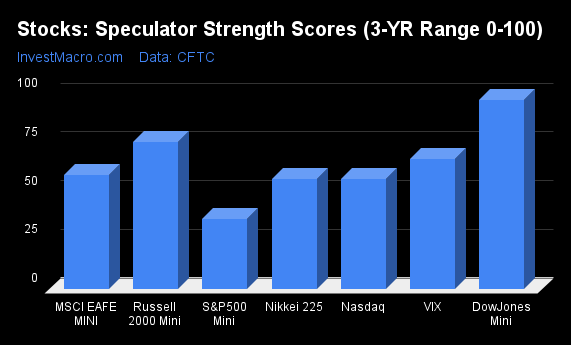
COT Strength Scores (a normalized measure of Speculator positions over a 3-Year range, from 0 to 100 where above 80 is Extreme-Bullish and below 20 is Extreme-Bearish) showed that the DowJones-Mini (90 percent) and the VIX (77 percent) lead the stock markets this week. The Russell-Mini (72 percent) comes in as the next highest in the weekly strength scores.

On the downside, the Nikkei 225 (29 percent) and the S&P500-Mini (31 percent) come in at the lowest strength levels currently.

Strength Statistics:
VIX (77.0 percent) vs VIX previous week (78.4 percent)
S&P500-Mini (31.3 percent) vs S&P500-Mini previous week (32.2 percent)
DowJones-Mini (89.9 percent) vs DowJones-Mini previous week (87.5 percent)
Nasdaq-Mini (55.0 percent) vs Nasdaq-Mini previous week (78.8 percent)
Russell2000-Mini (72.2 percent) vs Russell2000-Mini previous week (67.9 percent)
Nikkei USD (29.0 percent) vs Nikkei USD previous week (40.2 percent)
EAFE-Mini (49.1 percent) vs EAFE-Mini previous week (34.1 percent)


MSCI EAFE-Mini & VIX top the 6-Week Strength Trends

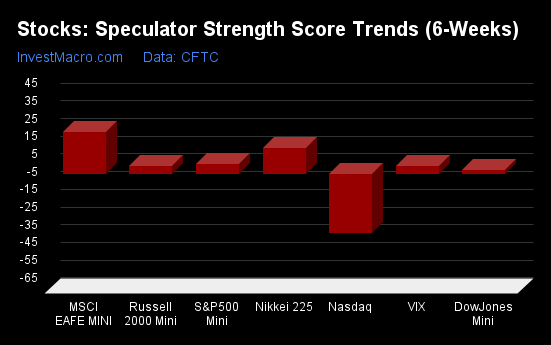
COT Strength Score Trends (or move index, calculates the 6-week changes in strength scores) showed that the MSCI EAFE-Mini (14 percent) leads the past six weeks trends for the stock markets. The VIX (3 percent) and the DowJones-Mini (1 percent) are the other positive movers in the latest trends data.

The Nasdaq-Mini (-41 percent) leads the downside trend scores currently with the Russell-Mini (-23 percent) coming in as the next market with lower trend scores.

Strength Trend Statistics:
VIX (2.6 percent) vs VIX previous week (4.4 percent)
S&P500-Mini (-8.2 percent) vs S&P500-Mini previous week (-15.1 percent)
DowJones-Mini (1.3 percent) vs DowJones-Mini previous week (-12.0 percent)
Nasdaq-Mini (-40.8 percent) vs Nasdaq-Mini previous week (-17.4 percent)
Russell2000-Mini (-23.0 percent) vs Russell2000-Mini previous week (-32.1 percent)
Nikkei USD (-5.8 percent) vs Nikkei USD previous week (-7.5 percent)
EAFE-Mini (13.9 percent) vs EAFE-Mini previous week (-2.1 percent)


Individual Stock Market Charts:

VIX Volatility Futures:

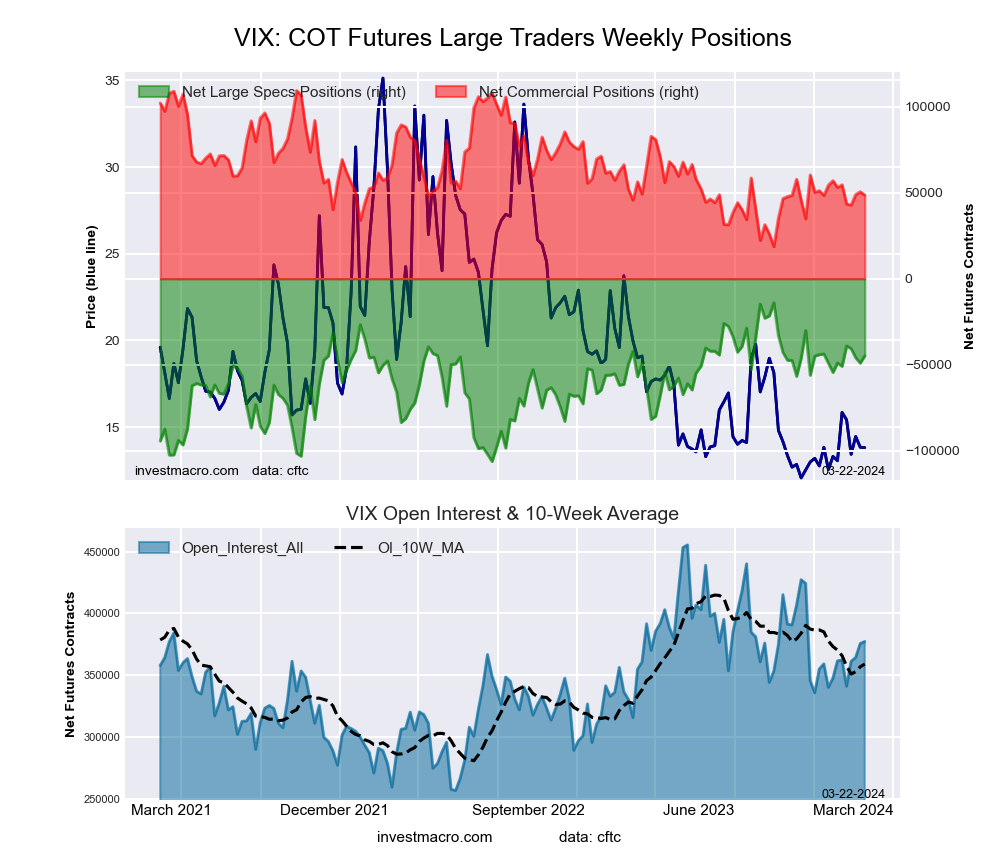
VIX Volatility Futures COT ChartThe VIX Volatility large speculator standing this week recorded a net position of -40,704 contracts in the data reported through Tuesday. This was a weekly fall of -1,633 contracts from the previous week which had a total of -39,071 net contracts.

This week’s current strength score (the trader positioning range over the past three years, measured from 0 to 100) shows the speculators are currently Bullish with a score of 77.0 percent. The commercials are Bearish-Extreme with a score of 19.6 percent and the small traders (not shown in chart) are Bullish-Extreme with a score of 85.1 percent.

Price Trend-Following Model: Downtrend

Our weekly trend-following model classifies the current market price position as: Downtrend. The current action for the model is considered to be: Hold – Maintain Short Position.

VIX Volatility Futures StatisticsSPECULATORSCOMMERCIALSSMALL TRADERS
– Percent of Open Interest Longs:20.644.97.4
– Percent of Open Interest Shorts:31.933.18.0
– Net Position:-40,70442,920-2,216
– Gross Longs:74,471162,35626,855
– Gross Shorts:115,175119,43629,071
– Long to Short Ratio:0.6 to 11.4 to 10.9 to 1
NET POSITION TREND:
– Strength Index Score (3 Year Range Pct):77.019.685.1
– Strength Index Reading (3 Year Range):BullishBearish-ExtremeBullish-Extreme
NET POSITION MOVEMENT INDEX:
– 6-Week Change in Strength Index:2.6-4.512.6


S&P500 Mini Futures:

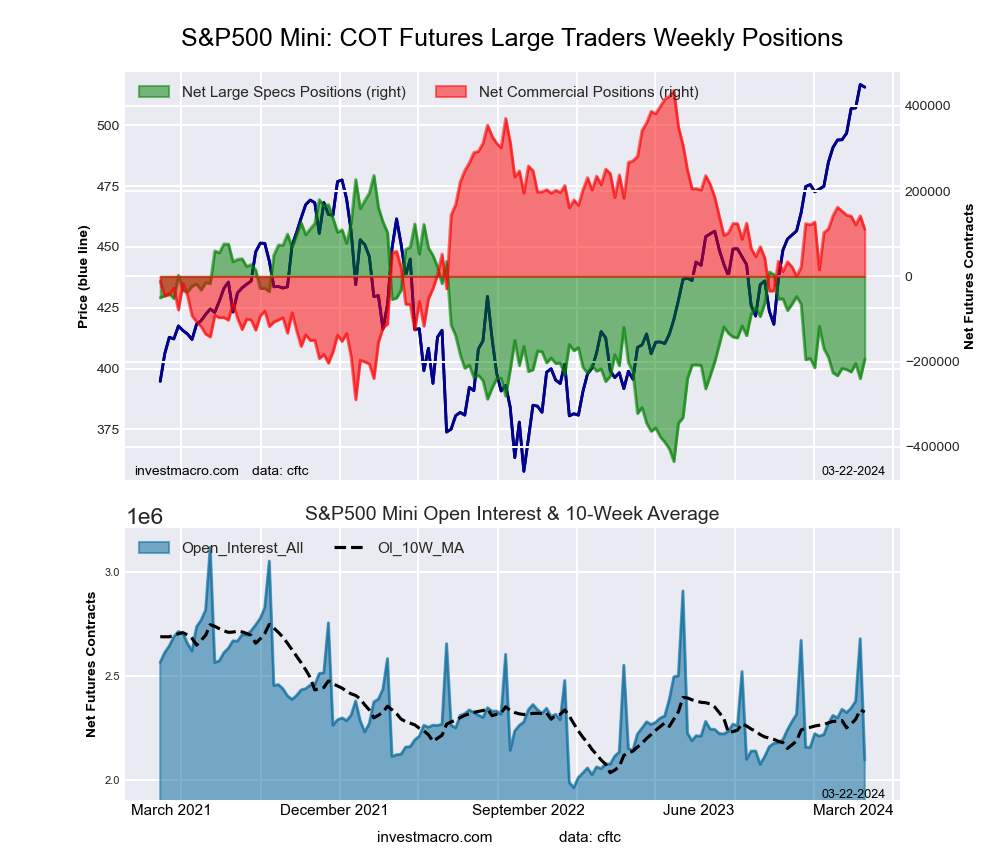
SP500 Mini Futures COT ChartThe S&P500 Mini large speculator standing this week recorded a net position of -224,223 contracts in the data reported through Tuesday. This was a weekly lowering of -5,693 contracts from the previous week which had a total of -218,530 net contracts.

This week’s current strength score (the trader positioning range over the past three years, measured from 0 to 100) shows the speculators are currently Bearish with a score of 31.3 percent. The commercials are Bullish with a score of 59.4 percent and the small traders (not shown in chart) are Bullish with a score of 70.1 percent.

Price Trend-Following Model: Strong Uptrend

Our weekly trend-following model classifies the current market price position as: Strong Uptrend. The current action for the model is considered to be: Hold – Maintain Long Position.

S&P500 Mini Futures StatisticsSPECULATORSCOMMERCIALSSMALL TRADERS
– Percent of Open Interest Longs:12.773.211.2
– Percent of Open Interest Shorts:22.367.27.7
– Net Position:-224,223141,21483,009
– Gross Longs:298,5381,716,692263,456
– Gross Shorts:522,7611,575,478180,447
– Long to Short Ratio:0.6 to 11.1 to 11.5 to 1
NET POSITION TREND:
– Strength Index Score (3 Year Range Pct):31.359.470.1
– Strength Index Reading (3 Year Range):BearishBullishBullish
NET POSITION MOVEMENT INDEX:
– 6-Week Change in Strength Index:-8.25.46.4


Dow Jones Mini Futures:

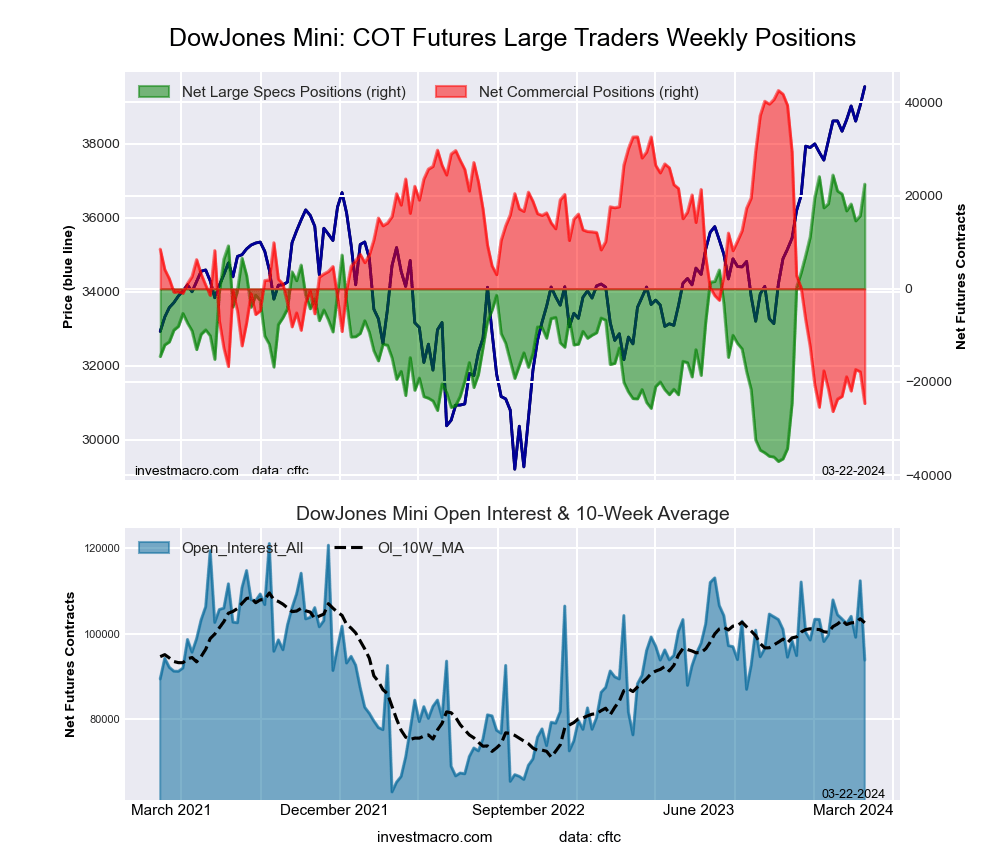
Dow Jones Mini Futures COT ChartThe Dow Jones Mini large speculator standing this week recorded a net position of 18,188 contracts in the data reported through Tuesday. This was a weekly increase of 1,460 contracts from the previous week which had a total of 16,728 net contracts.

This week’s current strength score (the trader positioning range over the past three years, measured from 0 to 100) shows the speculators are currently Bullish-Extreme with a score of 89.9 percent. The commercials are Bearish-Extreme with a score of 6.4 percent and the small traders (not shown in chart) are Bullish with a score of 62.3 percent.

Price Trend-Following Model: Uptrend

Our weekly trend-following model classifies the current market price position as: Uptrend. The current action for the model is considered to be: Hold – Maintain Long Position.

Dow Jones Mini Futures StatisticsSPECULATORSCOMMERCIALSSMALL TRADERS
– Percent of Open Interest Longs:31.551.315.3
– Percent of Open Interest Shorts:14.072.411.6
– Net Position:18,188-21,9573,769
– Gross Longs:32,77953,39915,869
– Gross Shorts:14,59175,35612,100
– Long to Short Ratio:2.2 to 10.7 to 11.3 to 1
NET POSITION TREND:
– Strength Index Score (3 Year Range Pct):89.96.462.3
– Strength Index Reading (3 Year Range):Bullish-ExtremeBearish-ExtremeBullish
NET POSITION MOVEMENT INDEX:
– 6-Week Change in Strength Index:1.3-6.317.3


Nasdaq Mini Futures:

Nasdaq Mini Futures COT ChartThe Nasdaq Mini large speculator standing this week recorded a net position of 10,246 contracts in the data reported through Tuesday. This was a weekly decrease of -15,315 contracts from the previous week which had a total of 25,561 net contracts.

This week’s current strength score (the trader positioning range over the past three years, measured from 0 to 100) shows the speculators are currently Bullish with a score of 55.0 percent. The commercials are Bearish with a score of 33.1 percent and the small traders (not shown in chart) are Bullish-Extreme with a score of 96.8 percent.

Price Trend-Following Model: Strong Uptrend

Our weekly trend-following model classifies the current market price position as: Strong Uptrend. The current action for the model is considered to be: Hold – Maintain Long Position.

Nasdaq Mini Futures StatisticsSPECULATORSCOMMERCIALSSMALL TRADERS
– Percent of Open Interest Longs:31.553.213.7
– Percent of Open Interest Shorts:27.959.411.1
– Net Position:10,246-17,7027,456
– Gross Longs:90,667153,36139,468
– Gross Shorts:80,421171,06332,012
– Long to Short Ratio:1.1 to 10.9 to 11.2 to 1
NET POSITION TREND:
– Strength Index Score (3 Year Range Pct):55.033.196.8
– Strength Index Reading (3 Year Range):BullishBearishBullish-Extreme
NET POSITION MOVEMENT INDEX:
– 6-Week Change in Strength Index:-40.823.114.2


Russell 2000 Mini Futures:

Russell 2000 Mini Futures COT ChartThe Russell 2000 Mini large speculator standing this week recorded a net position of -18,228 contracts in the data reported through Tuesday. This was a weekly advance of 5,977 contracts from the previous week which had a total of -24,205 net contracts.

This week’s current strength score (the trader positioning range over the past three years, measured from 0 to 100) shows the speculators are currently Bullish with a score of 72.2 percent. The commercials are Bearish with a score of 25.6 percent and the small traders (not shown in chart) are Bullish with a score of 63.6 percent.

Price Trend-Following Model: Uptrend

Our weekly trend-following model classifies the current market price position as: Uptrend. The current action for the model is considered to be: Hold – Maintain Long Position.

Russell 2000 Mini Futures StatisticsSPECULATORSCOMMERCIALSSMALL TRADERS
– Percent of Open Interest Longs:12.580.26.1
– Percent of Open Interest Shorts:16.178.74.1
– Net Position:-18,2287,95610,272
– Gross Longs:64,457413,10431,433
– Gross Shorts:82,685405,14821,161
– Long to Short Ratio:0.8 to 11.0 to 11.5 to 1
NET POSITION TREND:
– Strength Index Score (3 Year Range Pct):72.225.663.6
– Strength Index Reading (3 Year Range):BullishBearishBullish
NET POSITION MOVEMENT INDEX:
– 6-Week Change in Strength Index:-23.020.23.5


Nikkei Stock Average (USD) Futures:

Nikkei Stock Average (USD) Futures COT ChartThe Nikkei Stock Average (USD) large speculator standing this week recorded a net position of -5,294 contracts in the data reported through Tuesday. This was a weekly lowering of -1,574 contracts from the previous week which had a total of -3,720 net contracts.

This week’s current strength score (the trader positioning range over the past three years, measured from 0 to 100) shows the speculators are currently Bearish with a score of 29.0 percent. The commercials are Bullish with a score of 55.3 percent and the small traders (not shown in chart) are Bullish with a score of 71.4 percent.

Price Trend-Following Model: Strong Uptrend

Our weekly trend-following model classifies the current market price position as: Strong Uptrend. The current action for the model is considered to be: Hold – Maintain Long Position.

Nikkei Stock Average Futures StatisticsSPECULATORSCOMMERCIALSSMALL TRADERS
– Percent of Open Interest Longs:9.165.625.2
– Percent of Open Interest Shorts:38.248.113.7
– Net Position:-5,2943,1902,104
– Gross Longs:1,66911,9744,600
– Gross Shorts:6,9638,7842,496
– Long to Short Ratio:0.2 to 11.4 to 11.8 to 1
NET POSITION TREND:
– Strength Index Score (3 Year Range Pct):29.055.371.4
– Strength Index Reading (3 Year Range):BearishBullishBullish
NET POSITION MOVEMENT INDEX:
– 6-Week Change in Strength Index:-5.8-0.815.4


MSCI EAFE Mini Futures:

MSCI EAFE Mini Futures COT ChartThe MSCI EAFE Mini large speculator standing this week recorded a net position of -16,684 contracts in the data reported through Tuesday. This was a weekly advance of 14,518 contracts from the previous week which had a total of -31,202 net contracts.

This week’s current strength score (the trader positioning range over the past three years, measured from 0 to 100) shows the speculators are currently Bearish with a score of 49.1 percent. The commercials are Bearish with a score of 49.4 percent and the small traders (not shown in chart) are Bearish with a score of 40.4 percent.

Price Trend-Following Model: Uptrend

Our weekly trend-following model classifies the current market price position as: Uptrend. The current action for the model is considered to be: Hold – Maintain Long Position.

MSCI EAFE Mini Futures StatisticsSPECULATORSCOMMERCIALSSMALL TRADERS
– Percent of Open Interest Longs:9.786.93.1
– Percent of Open Interest Shorts:13.584.12.0
– Net Position:-16,68411,9984,686
– Gross Longs:41,874375,97513,462
– Gross Shorts:58,558363,9778,776
– Long to Short Ratio:0.7 to 11.0 to 11.5 to 1
NET POSITION TREND:
– Strength Index Score (3 Year Range Pct):49.149.440.4
– Strength Index Reading (3 Year Range):BearishBearishBearish
NET POSITION MOVEMENT INDEX:
– 6-Week Change in Strength Index:13.9-13.0-3.6


Article By InvestMacroReceive our weekly COT Newsletter

*COT Report: The COT data, released weekly to the public each Friday, is updated through the most recent Tuesday (data is 3 days old) and shows a quick view of how large speculators or non-commercials (for-profit traders) were positioned in the futures markets.

The CFTC categorizes trader positions according to commercial hedgers (traders who use futures contracts for hedging as part of the business), non-commercials (large traders who speculate to realize trading profits) and nonreportable traders (usually small traders/speculators) as well as their open interest (contracts open in the market at time of reporting). See CFTC criteria here.

COT Soft Commodities Charts: Speculator bets led by Corn & Lean Hogs

By InvestMacro

Here are the latest charts and statistics for the Commitment of Traders (COT) reports data published by the Commodities Futures Trading Commission (CFTC).

The latest COT data is updated through Tuesday February 27th and shows a quick view of how large traders (for-profit speculators and commercial entities) were positioned in the futures markets.

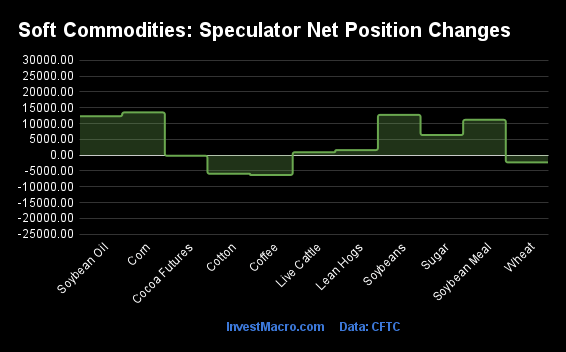
Weekly Speculator Changes led by Corn & Lean Hogs

The COT soft commodities markets speculator bets were a bit higher this week as six out of the eleven softs markets we cover had higher positioning while the other five markets had lower speculator contracts.

Leading the gains for the softs markets was Corn (33,463 contracts) with Lean Hogs (12,790 contracts), Sugar (11,564 contracts), Wheat (7,658 contracts), Cotton (7,212 contracts) and Live Cattle (4,119 contracts) also showing positive weeks.

The markets with the declines in speculator bets this week were Soybean Meal (-21,367 contracts) with Soybeans (-30,944 contracts), Coffee (-4,163 contracts), Soybean Oil (-4,985 contracts) and Cocoa (-6,938 contracts) also registering lower bets on the week.


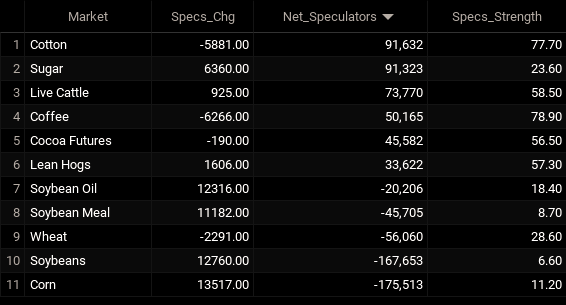
Net Speculators Leaderboard

Legend: Weekly Speculators Change | Speculators Current Net Position | Speculators Strength Score compared to last 3-Years (0-100 range)


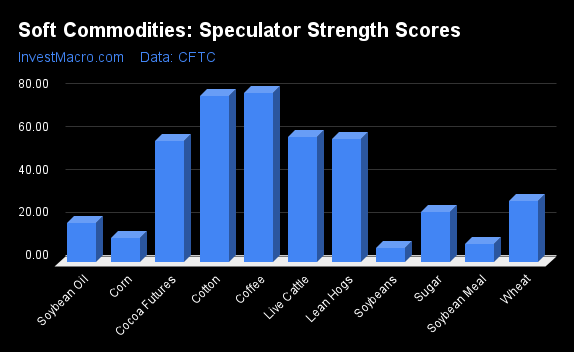
Strength Scores led by Cotton & Coffee

COT Strength Scores (a normalized measure of Speculator positions over a 3-Year range, from 0 to 100 where above 80 is Extreme-Bullish and below 20 is Extreme-Bearish) showed that Cotton (86 percent) and Coffee (80 percent) lead the softs markets this week. Lean Hogs (54 percent), Cocoa (52 percent) and Live Cattle (50 percent) come in as the next highest in the weekly strength scores.

On the downside, Soybean Oil (0 percent), Soybean Meal (0 percent), Soybeans (0 percent) and Corn (4 percent) come in at the lowest strength levels currently and are in Extreme-Bearish territory (below 20 percent).

Strength Statistics:
Corn (4.1 percent) vs Corn previous week (0.0 percent)
Sugar (27.9 percent) vs Sugar previous week (23.8 percent)
Coffee (80.4 percent) vs Coffee previous week (84.7 percent)
Soybeans (0.0 percent) vs Soybeans previous week (7.0 percent)
Soybean Oil (0.0 percent) vs Soybean Oil previous week (3.1 percent)
Soybean Meal (0.0 percent) vs Soybean Meal previous week (8.8 percent)
Live Cattle (50.1 percent) vs Live Cattle previous week (45.7 percent)
Lean Hogs (53.7 percent) vs Lean Hogs previous week (43.2 percent)
Cotton (85.7 percent) vs Cotton previous week (80.3 percent)
Cocoa (52.0 percent) vs Cocoa previous week (59.1 percent)
Wheat (41.8 percent) vs Wheat previous week (36.5 percent)


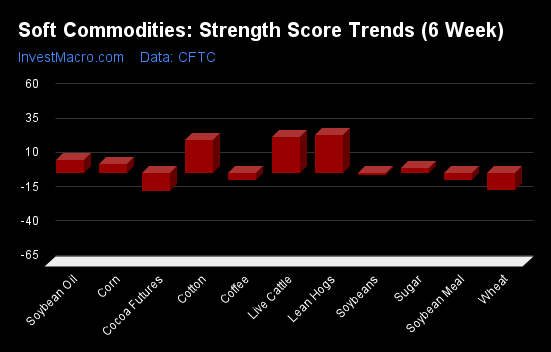
Cotton & Live Cattle top the 6-Week Strength Trends

COT Strength Score Trends (or move index, calculates the 6-week changes in strength scores) showed that Cotton (68 percent) and Live Cattle (47 percent) lead the past six weeks trends for soft commodities. Lean Hogs (45 percent), Sugar (16 percent) and Wheat (7 percent) are the next highest positive movers in the latest trends data.

Cocoa (-30 percent) leads the downside trend scores currently with Soybean Meal (-23 percent), Soybeans (-22 percent) and Soybean Oil (-7 percent) following next with lower trend scores.

Strength Trend Statistics:
Corn (-1.6 percent) vs Corn previous week (-11.5 percent)
Sugar (15.6 percent) vs Sugar previous week (8.2 percent)
Coffee (2.4 percent) vs Coffee previous week (10.5 percent)
Soybeans (-22.1 percent) vs Soybeans previous week (-27.7 percent)
Soybean Oil (-7.1 percent) vs Soybean Oil previous week (-3.0 percent)
Soybean Meal (-22.8 percent) vs Soybean Meal previous week (-17.6 percent)
Live Cattle (46.6 percent) vs Live Cattle previous week (41.5 percent)
Lean Hogs (45.0 percent) vs Lean Hogs previous week (33.7 percent)
Cotton (68.4 percent) vs Cotton previous week (67.1 percent)
Cocoa (-29.6 percent) vs Cocoa previous week (-21.2 percent)
Wheat (6.7 percent) vs Wheat previous week (-7.8 percent)


Individual Soft Commodities Markets:

CORN Futures:
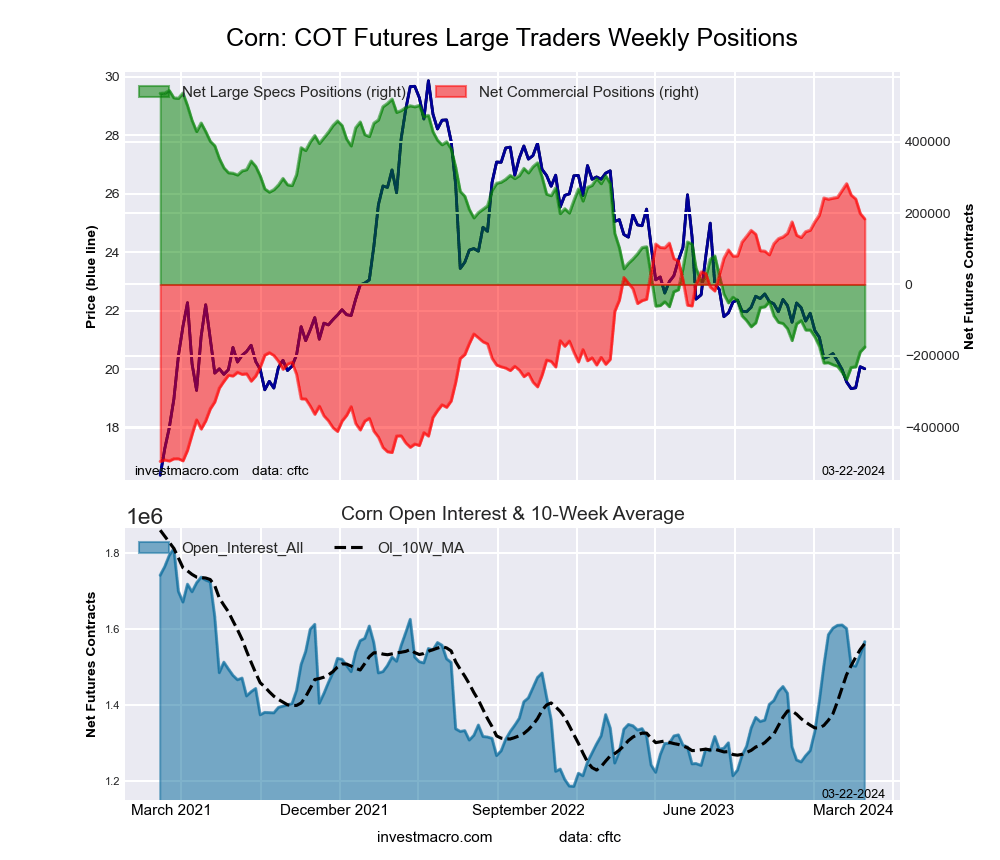
CORN Futures COT ChartThe CORN large speculator standing this week recorded a net position of -232,604 contracts in the data reported through Tuesday. This was a weekly increase of 33,463 contracts from the previous week which had a total of -266,067 net contracts.

This week’s current strength score (the trader positioning range over the past three years, measured from 0 to 100) shows the speculators are currently Bearish-Extreme with a score of 4.1 percent. The commercials are Bullish-Extreme with a score of 95.9 percent and the small traders (not shown in chart) are Bullish-Extreme with a score of 94.8 percent.

Price Trend-Following Model: Strong Downtrend

Our weekly trend-following model classifies the current market price position as: Strong Downtrend. The current action for the model is considered to be: Hold – Maintain Short Position.

CORN Futures StatisticsSPECULATORSCOMMERCIALSSMALL TRADERS
– Percent of Open Interest Longs:19.744.610.0
– Percent of Open Interest Shorts:35.127.911.2
– Net Position:-232,604250,628-18,024
– Gross Longs:295,676670,777151,100
– Gross Shorts:528,280420,149169,124
– Long to Short Ratio:0.6 to 11.6 to 10.9 to 1
NET POSITION TREND:
– Strength Index Score (3 Year Range Pct):4.195.994.8
– Strength Index Reading (3 Year Range):Bearish-ExtremeBullish-ExtremeBullish-Extreme
NET POSITION MOVEMENT INDEX:
– 6-Week Change in Strength Index:-1.61.16.3


SUGAR Futures:

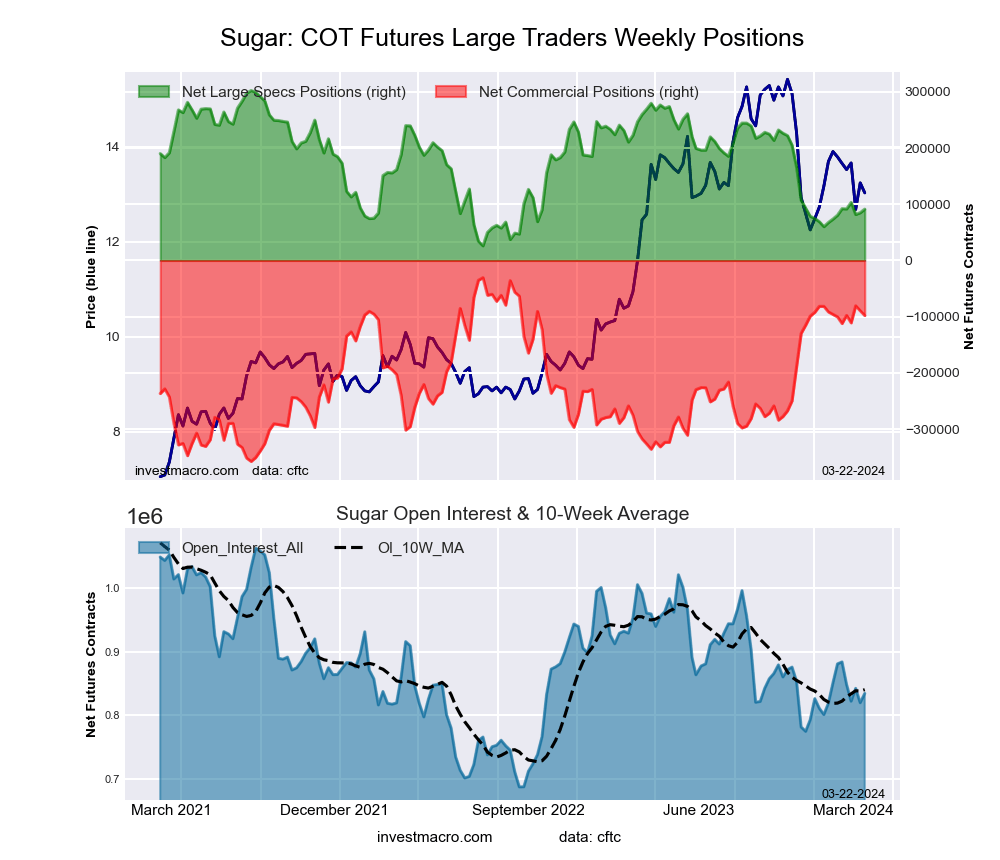
SUGAR Futures COT ChartThe SUGAR large speculator standing this week recorded a net position of 103,254 contracts in the data reported through Tuesday. This was a weekly boost of 11,564 contracts from the previous week which had a total of 91,690 net contracts.

This week’s current strength score (the trader positioning range over the past three years, measured from 0 to 100) shows the speculators are currently Bearish with a score of 27.9 percent. The commercials are Bullish with a score of 75.4 percent and the small traders (not shown in chart) are Bearish-Extreme with a score of 13.5 percent.

Price Trend-Following Model: Downtrend

Our weekly trend-following model classifies the current market price position as: Downtrend. The current action for the model is considered to be: Hold – Maintain Short Position.

SUGAR Futures StatisticsSPECULATORSCOMMERCIALSSMALL TRADERS
– Percent of Open Interest Longs:22.952.58.0
– Percent of Open Interest Shorts:10.365.97.1
– Net Position:103,254-110,9527,698
– Gross Longs:187,869431,22766,010
– Gross Shorts:84,615542,17958,312
– Long to Short Ratio:2.2 to 10.8 to 11.1 to 1
NET POSITION TREND:
– Strength Index Score (3 Year Range Pct):27.975.413.5
– Strength Index Reading (3 Year Range):BearishBullishBearish-Extreme
NET POSITION MOVEMENT INDEX:
– 6-Week Change in Strength Index:15.6-9.0-20.0


COFFEE Futures:

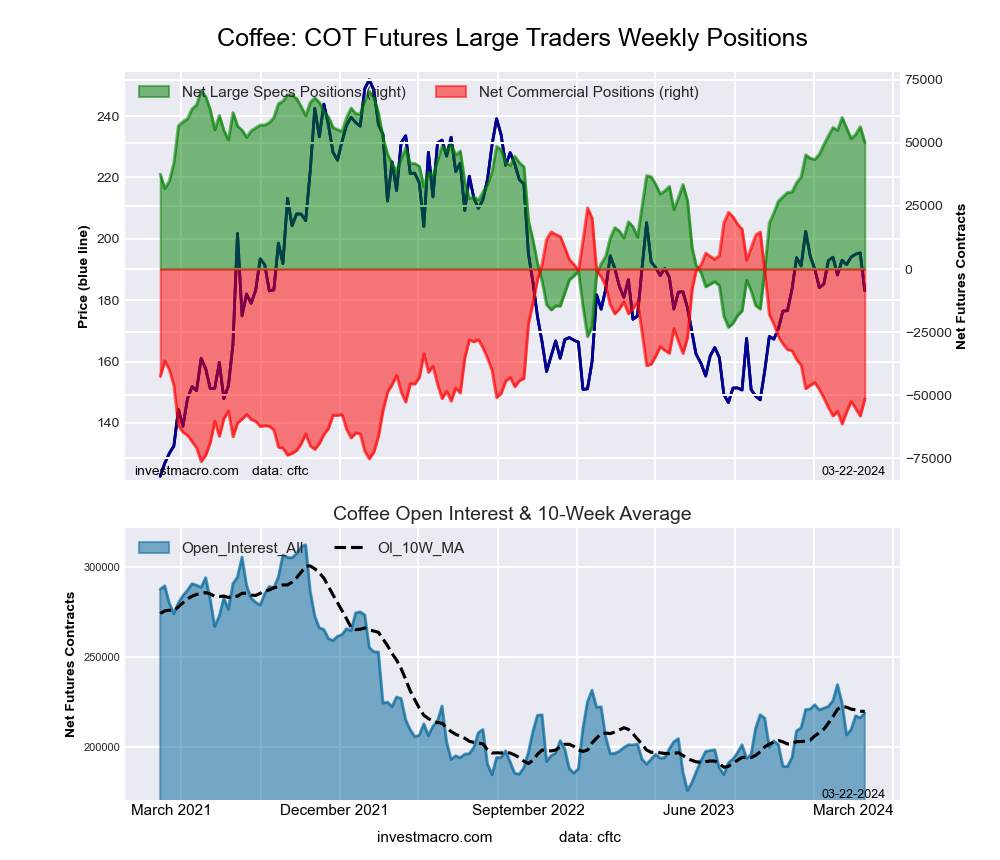
COFFEE Futures COT ChartThe COFFEE large speculator standing this week recorded a net position of 51,700 contracts in the data reported through Tuesday. This was a weekly lowering of -4,163 contracts from the previous week which had a total of 55,863 net contracts.

This week’s current strength score (the trader positioning range over the past three years, measured from 0 to 100) shows the speculators are currently Bullish-Extreme with a score of 80.4 percent. The commercials are Bearish with a score of 23.8 percent and the small traders (not shown in chart) are Bearish with a score of 23.9 percent.

Price Trend-Following Model: Uptrend

Our weekly trend-following model classifies the current market price position as: Uptrend. The current action for the model is considered to be: Hold – Maintain Long Position.

COFFEE Futures StatisticsSPECULATORSCOMMERCIALSSMALL TRADERS
– Percent of Open Interest Longs:36.038.03.5
– Percent of Open Interest Shorts:11.363.13.2
– Net Position:51,700-52,424724
– Gross Longs:75,33079,6907,361
– Gross Shorts:23,630132,1146,637
– Long to Short Ratio:3.2 to 10.6 to 11.1 to 1
NET POSITION TREND:
– Strength Index Score (3 Year Range Pct):80.423.823.9
– Strength Index Reading (3 Year Range):Bullish-ExtremeBearishBearish
NET POSITION MOVEMENT INDEX:
– 6-Week Change in Strength Index:2.4-1.3-14.1


SOYBEANS Futures:

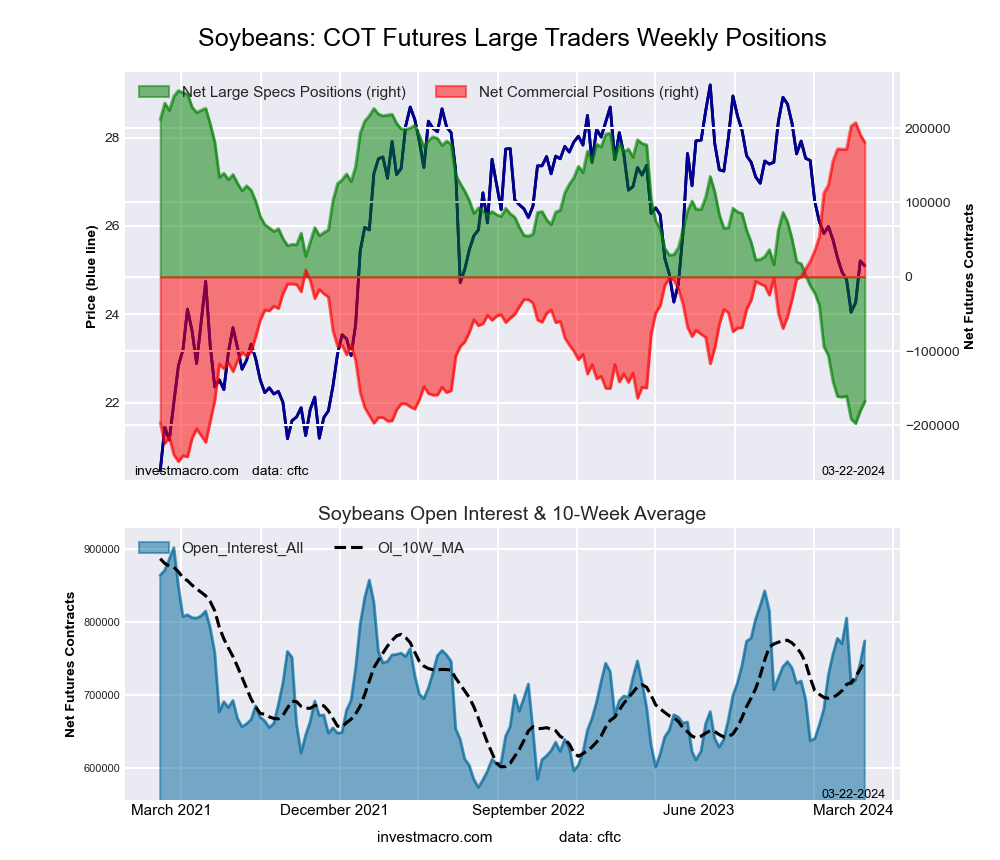
SOYBEANS Futures COT ChartThe SOYBEANS large speculator standing this week recorded a net position of -191,232 contracts in the data reported through Tuesday. This was a weekly reduction of -30,944 contracts from the previous week which had a total of -160,288 net contracts.

This week’s current strength score (the trader positioning range over the past three years, measured from 0 to 100) shows the speculators are currently Bearish-Extreme with a score of 0.0 percent. The commercials are Bullish-Extreme with a score of 100.0 percent and the small traders (not shown in chart) are Bullish with a score of 76.7 percent.

Price Trend-Following Model: Strong Downtrend

Our weekly trend-following model classifies the current market price position as: Strong Downtrend. The current action for the model is considered to be: Hold – Maintain Short Position.

SOYBEANS Futures StatisticsSPECULATORSCOMMERCIALSSMALL TRADERS
– Percent of Open Interest Longs:12.960.57.3
– Percent of Open Interest Shorts:39.732.18.9
– Net Position:-191,232202,950-11,718
– Gross Longs:92,361432,41851,829
– Gross Shorts:283,593229,46863,547
– Long to Short Ratio:0.3 to 11.9 to 10.8 to 1
NET POSITION TREND:
– Strength Index Score (3 Year Range Pct):0.0100.076.7
– Strength Index Reading (3 Year Range):Bearish-ExtremeBullish-ExtremeBullish
NET POSITION MOVEMENT INDEX:
– 6-Week Change in Strength Index:-22.120.117.2


SOYBEAN OIL Futures:

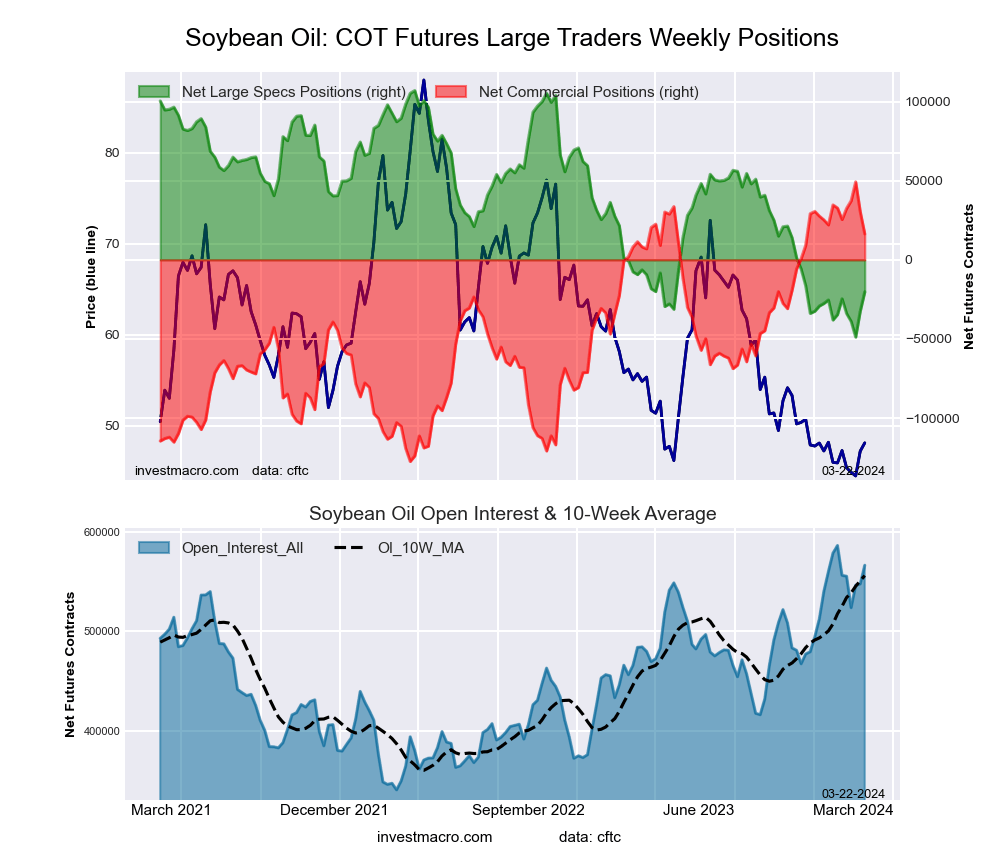
SOYBEAN OIL Futures COT ChartThe SOYBEAN OIL large speculator standing this week recorded a net position of -38,926 contracts in the data reported through Tuesday. This was a weekly decrease of -4,985 contracts from the previous week which had a total of -33,941 net contracts.

This week’s current strength score (the trader positioning range over the past three years, measured from 0 to 100) shows the speculators are currently Bearish-Extreme with a score of 0.0 percent. The commercials are Bullish-Extreme with a score of 100.0 percent and the small traders (not shown in chart) are Bearish-Extreme with a score of 19.7 percent.

Price Trend-Following Model: Downtrend

Our weekly trend-following model classifies the current market price position as: Downtrend. The current action for the model is considered to be: Hold – Maintain Short Position.

SOYBEAN OIL Futures StatisticsSPECULATORSCOMMERCIALSSMALL TRADERS
– Percent of Open Interest Longs:20.648.25.4
– Percent of Open Interest Shorts:28.041.15.1
– Net Position:-38,92637,2891,637
– Gross Longs:107,981252,66028,265
– Gross Shorts:146,907215,37126,628
– Long to Short Ratio:0.7 to 11.2 to 11.1 to 1
NET POSITION TREND:
– Strength Index Score (3 Year Range Pct):0.0100.019.7
– Strength Index Reading (3 Year Range):Bearish-ExtremeBullish-ExtremeBearish-Extreme
NET POSITION MOVEMENT INDEX:
– 6-Week Change in Strength Index:-7.16.7-2.7


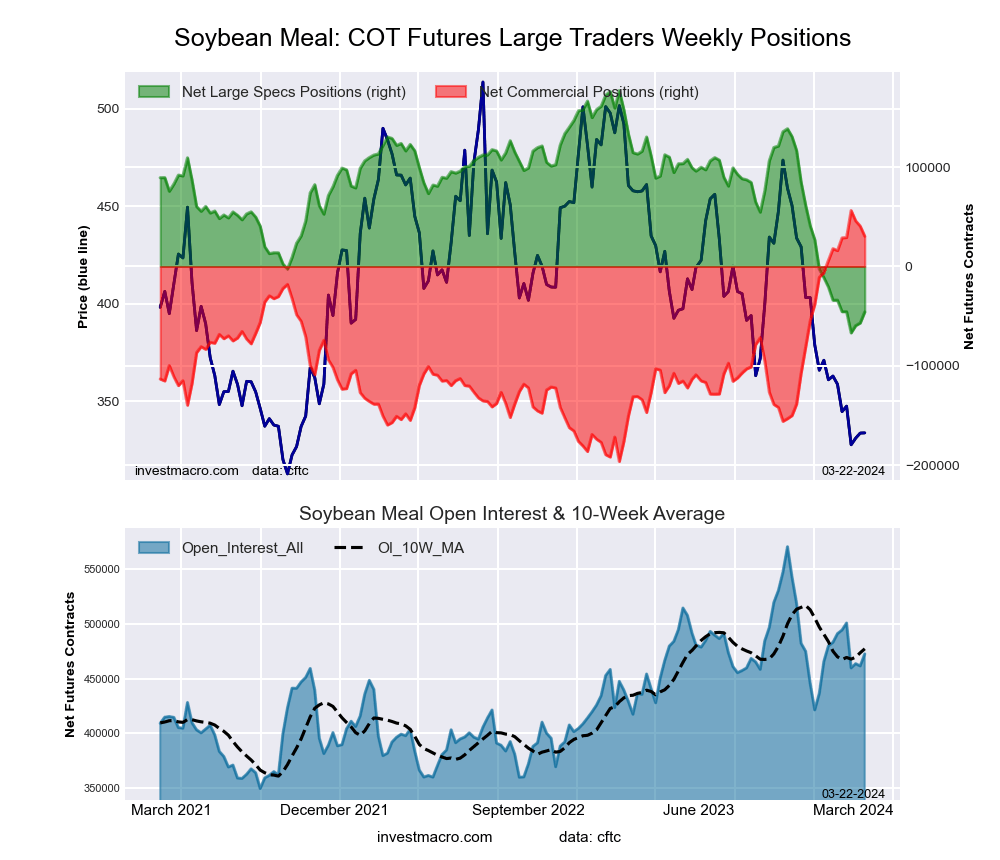
SOYBEAN MEAL Futures:

SOYBEAN MEAL Futures COT ChartThe SOYBEAN MEAL large speculator standing this week recorded a net position of -66,820 contracts in the data reported through Tuesday. This was a weekly fall of -21,367 contracts from the previous week which had a total of -45,453 net contracts.

This week’s current strength score (the trader positioning range over the past three years, measured from 0 to 100) shows the speculators are currently Bearish-Extreme with a score of 0.0 percent. The commercials are Bullish-Extreme with a score of 100.0 percent and the small traders (not shown in chart) are Bearish-Extreme with a score of 3.2 percent.

Price Trend-Following Model: Downtrend

Our weekly trend-following model classifies the current market price position as: Downtrend. The current action for the model is considered to be: Hold – Maintain Short Position.

SOYBEAN MEAL Futures StatisticsSPECULATORSCOMMERCIALSSMALL TRADERS
– Percent of Open Interest Longs:17.652.89.8
– Percent of Open Interest Shorts:32.140.57.5
– Net Position:-66,82056,23810,582
– Gross Longs:80,930242,67444,952
– Gross Shorts:147,750186,43634,370
– Long to Short Ratio:0.5 to 11.3 to 11.3 to 1
NET POSITION TREND:
– Strength Index Score (3 Year Range Pct):0.0100.03.2
– Strength Index Reading (3 Year Range):Bearish-ExtremeBullish-ExtremeBearish-Extreme
NET POSITION MOVEMENT INDEX:
– 6-Week Change in Strength Index:-22.824.7-30.8


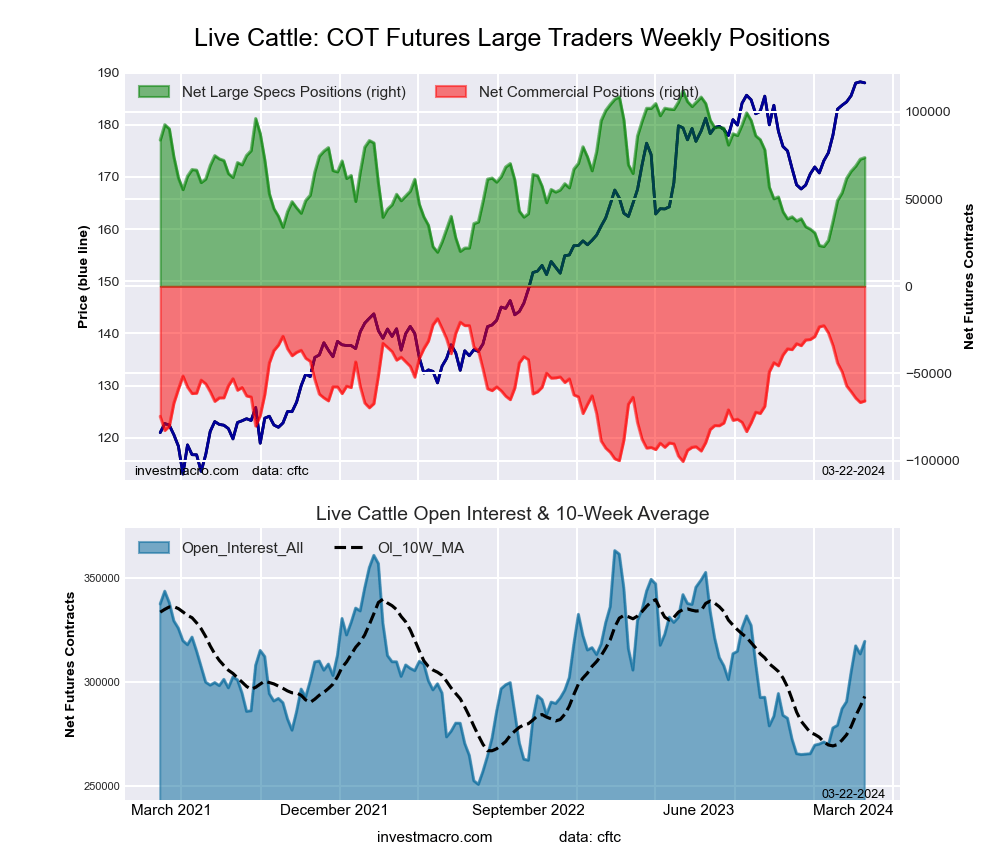
LIVE CATTLE Futures:

LIVE CATTLE Futures COT ChartThe LIVE CATTLE large speculator standing this week recorded a net position of 65,999 contracts in the data reported through Tuesday. This was a weekly boost of 4,119 contracts from the previous week which had a total of 61,880 net contracts.

This week’s current strength score (the trader positioning range over the past three years, measured from 0 to 100) shows the speculators are currently Bullish with a score of 50.1 percent. The commercials are Bearish with a score of 48.8 percent and the small traders (not shown in chart) are Bullish with a score of 60.2 percent.

Price Trend-Following Model: Strong Uptrend

Our weekly trend-following model classifies the current market price position as: Strong Uptrend. The current action for the model is considered to be: New Buy – Long Position.

LIVE CATTLE Futures StatisticsSPECULATORSCOMMERCIALSSMALL TRADERS
– Percent of Open Interest Longs:37.634.710.1
– Percent of Open Interest Shorts:16.054.611.9
– Net Position:65,999-60,465-5,534
– Gross Longs:114,745105,81130,732
– Gross Shorts:48,746166,27636,266
– Long to Short Ratio:2.4 to 10.6 to 10.8 to 1
NET POSITION TREND:
– Strength Index Score (3 Year Range Pct):50.148.860.2
– Strength Index Reading (3 Year Range):BullishBearishBullish
NET POSITION MOVEMENT INDEX:
– 6-Week Change in Strength Index:46.6-46.2-28.5


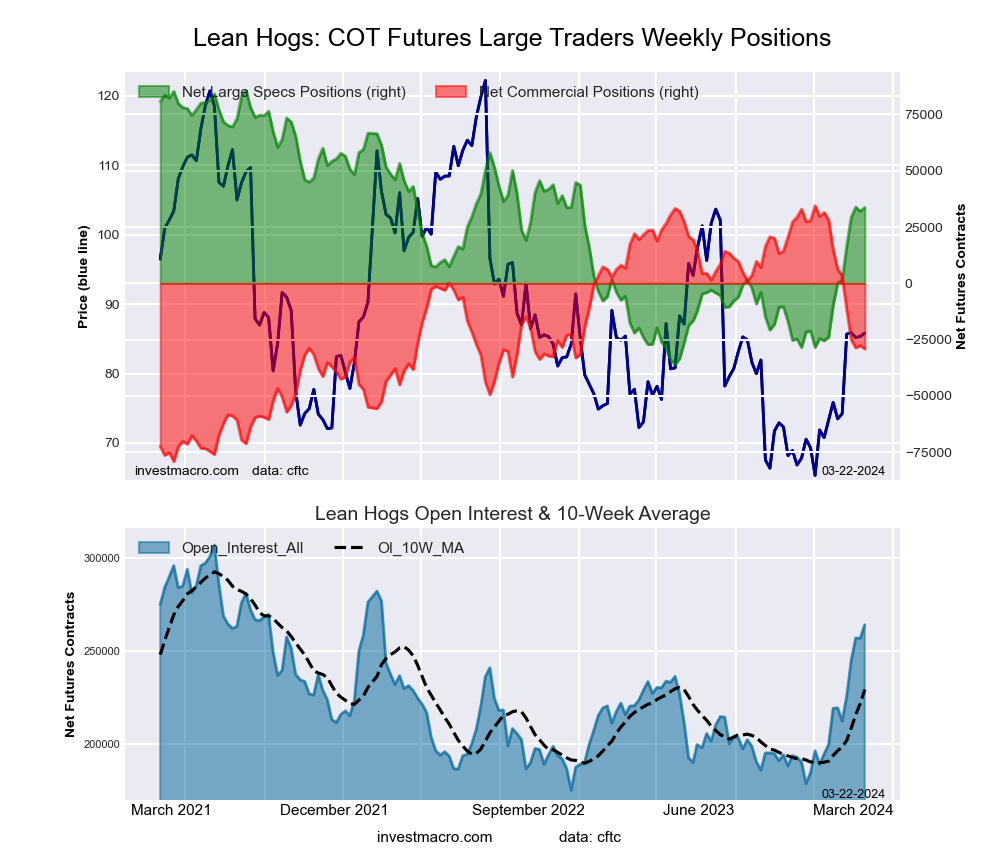
LEAN HOGS Futures:

LEAN HOGS Futures COT ChartThe LEAN HOGS large speculator standing this week recorded a net position of 29,286 contracts in the data reported through Tuesday. This was a weekly advance of 12,790 contracts from the previous week which had a total of 16,496 net contracts.

This week’s current strength score (the trader positioning range over the past three years, measured from 0 to 100) shows the speculators are currently Bullish with a score of 53.7 percent. The commercials are Bearish with a score of 47.6 percent and the small traders (not shown in chart) are Bullish with a score of 64.1 percent.

Price Trend-Following Model: Strong Uptrend

Our weekly trend-following model classifies the current market price position as: Strong Uptrend. The current action for the model is considered to be: Hold – Maintain Long Position.

LEAN HOGS Futures StatisticsSPECULATORSCOMMERCIALSSMALL TRADERS
– Percent of Open Interest Longs:38.433.88.5
– Percent of Open Interest Shorts:26.544.010.2
– Net Position:29,286-24,985-4,301
– Gross Longs:94,03782,65820,760
– Gross Shorts:64,751107,64325,061
– Long to Short Ratio:1.5 to 10.8 to 10.8 to 1
NET POSITION TREND:
– Strength Index Score (3 Year Range Pct):53.747.664.1
– Strength Index Reading (3 Year Range):BullishBearishBullish
NET POSITION MOVEMENT INDEX:
– 6-Week Change in Strength Index:45.0-49.77.5


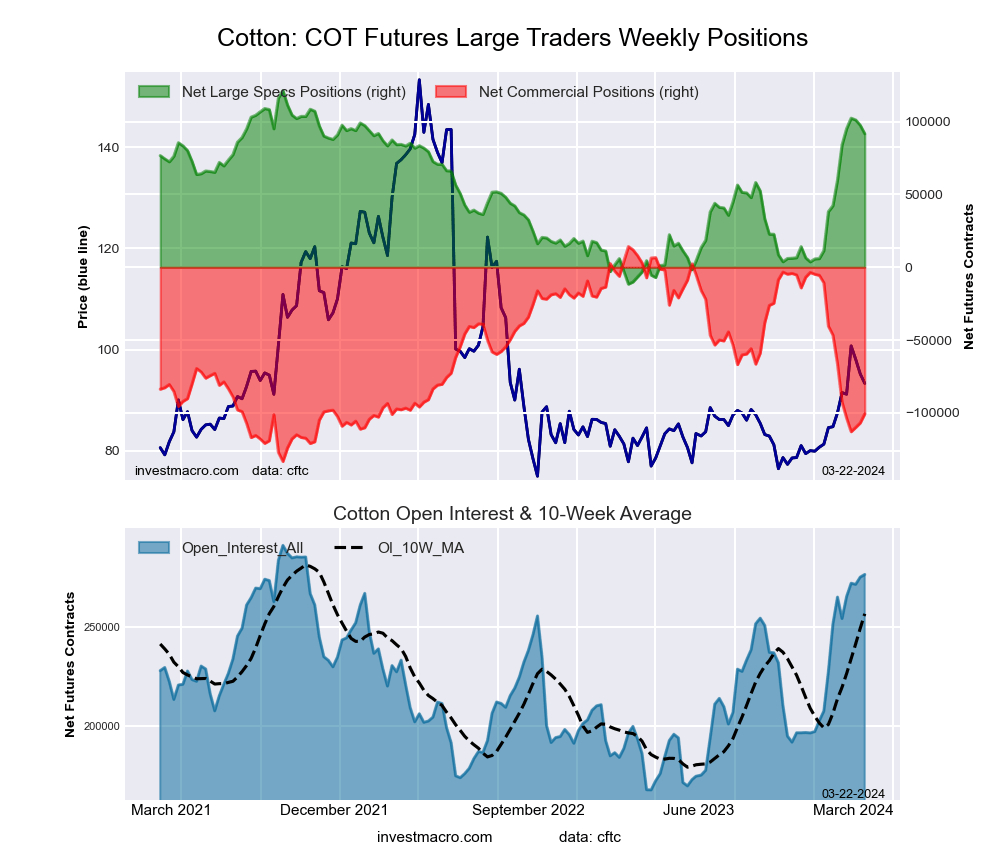
COTTON Futures:

COTTON Futures COT ChartThe COTTON large speculator standing this week recorded a net position of 102,305 contracts in the data reported through Tuesday. This was a weekly boost of 7,212 contracts from the previous week which had a total of 95,093 net contracts.

This week’s current strength score (the trader positioning range over the past three years, measured from 0 to 100) shows the speculators are currently Bullish-Extreme with a score of 85.7 percent. The commercials are Bearish-Extreme with a score of 13.8 percent and the small traders (not shown in chart) are Bullish-Extreme with a score of 80.2 percent.

Price Trend-Following Model: Strong Uptrend

Our weekly trend-following model classifies the current market price position as: Strong Uptrend. The current action for the model is considered to be: Hold – Maintain Long Position.

COTTON Futures StatisticsSPECULATORSCOMMERCIALSSMALL TRADERS
– Percent of Open Interest Longs:47.730.36.7
– Percent of Open Interest Shorts:10.171.82.8
– Net Position:102,305-112,88110,576
– Gross Longs:129,75082,40718,183
– Gross Shorts:27,445195,2887,607
– Long to Short Ratio:4.7 to 10.4 to 12.4 to 1
NET POSITION TREND:
– Strength Index Score (3 Year Range Pct):85.713.880.2
– Strength Index Reading (3 Year Range):Bullish-ExtremeBearish-ExtremeBullish-Extreme
NET POSITION MOVEMENT INDEX:
– 6-Week Change in Strength Index:68.4-69.368.5


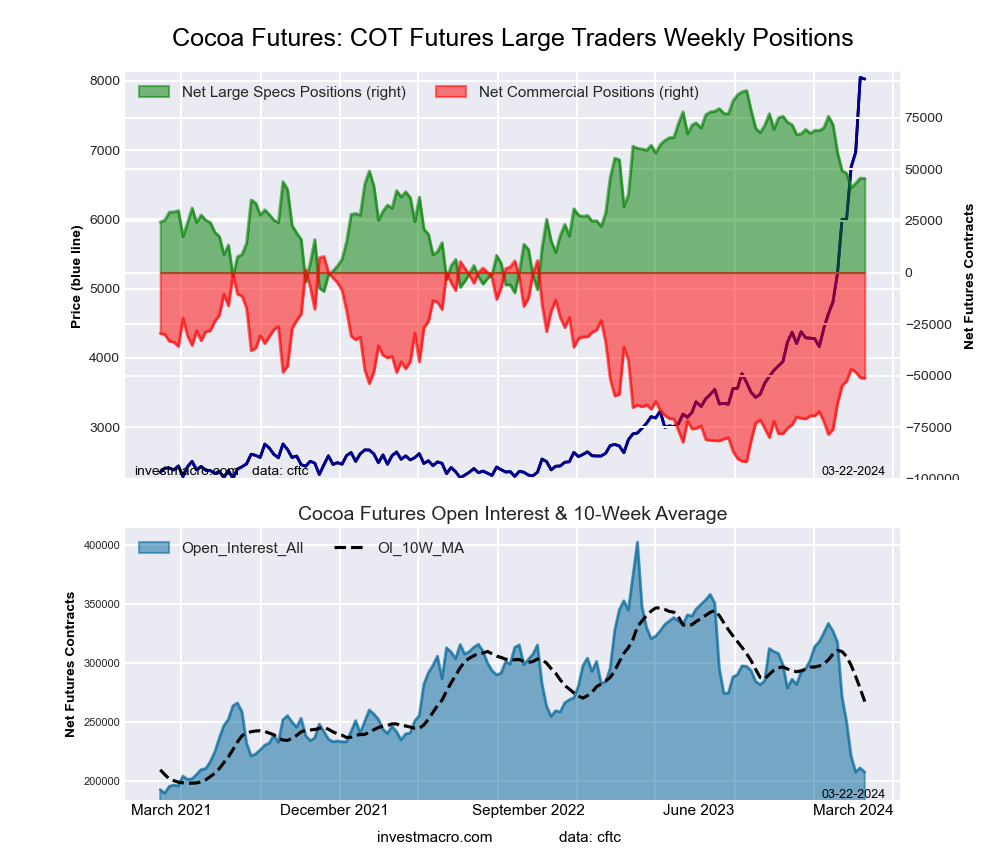
COCOA Futures:

COCOA Futures COT ChartThe COCOA large speculator standing this week recorded a net position of 41,188 contracts in the data reported through Tuesday. This was a weekly reduction of -6,938 contracts from the previous week which had a total of 48,126 net contracts.

This week’s current strength score (the trader positioning range over the past three years, measured from 0 to 100) shows the speculators are currently Bullish with a score of 52.0 percent. The commercials are Bearish with a score of 45.0 percent and the small traders (not shown in chart) are Bullish with a score of 60.6 percent.

Price Trend-Following Model: Strong Uptrend

Our weekly trend-following model classifies the current market price position as: Strong Uptrend. The current action for the model is considered to be: Hold – Maintain Long Position.

COCOA Futures StatisticsSPECULATORSCOMMERCIALSSMALL TRADERS
– Percent of Open Interest Longs:36.931.06.5
– Percent of Open Interest Shorts:18.352.33.9
– Net Position:41,188-46,8715,683
– Gross Longs:81,55268,54414,358
– Gross Shorts:40,364115,4158,675
– Long to Short Ratio:2.0 to 10.6 to 11.7 to 1
NET POSITION TREND:
– Strength Index Score (3 Year Range Pct):52.045.060.6
– Strength Index Reading (3 Year Range):BullishBearishBullish
NET POSITION MOVEMENT INDEX:
– 6-Week Change in Strength Index:-29.625.630.3


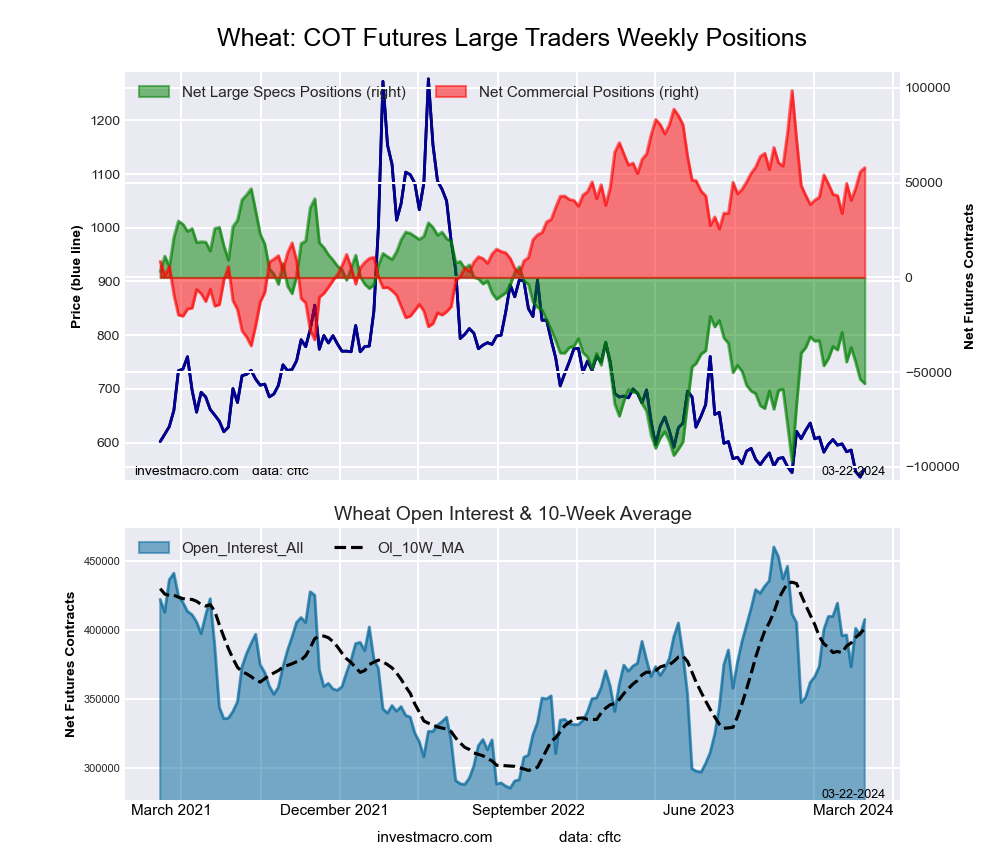
WHEAT Futures:

WHEAT Futures COT ChartThe WHEAT large speculator standing this week recorded a net position of -36,981 contracts in the data reported through Tuesday. This was a weekly rise of 7,658 contracts from the previous week which had a total of -44,639 net contracts.

This week’s current strength score (the trader positioning range over the past three years, measured from 0 to 100) shows the speculators are currently Bearish with a score of 41.8 percent. The commercials are Bullish with a score of 57.0 percent and the small traders (not shown in chart) are Bearish with a score of 49.7 percent.

Price Trend-Following Model: Weak Uptrend

Our weekly trend-following model classifies the current market price position as: Weak Uptrend. The current action for the model is considered to be: Hold – Maintain Long Position.

WHEAT Futures StatisticsSPECULATORSCOMMERCIALSSMALL TRADERS
– Percent of Open Interest Longs:33.036.87.8
– Percent of Open Interest Shorts:42.925.98.8
– Net Position:-36,98140,756-3,775
– Gross Longs:123,166137,34028,974
– Gross Shorts:160,14796,58432,749
– Long to Short Ratio:0.8 to 11.4 to 10.9 to 1
NET POSITION TREND:
– Strength Index Score (3 Year Range Pct):41.857.049.7
– Strength Index Reading (3 Year Range):BearishBullishBearish
NET POSITION MOVEMENT INDEX:
– 6-Week Change in Strength Index:6.7-9.916.0


Article By InvestMacroReceive our weekly COT Newsletter

*COT Report: The COT data, released weekly to the public each Friday, is updated through the most recent Tuesday (data is 3 days old) and shows a quick view of how large speculators or non-commercials (for-profit traders) were positioned in the futures markets.

The CFTC categorizes trader positions according to commercial hedgers (traders who use futures contracts for hedging as part of the business), non-commercials (large traders who speculate to realize trading profits) and nonreportable traders (usually small traders/speculators) as well as their open interest (contracts open in the market at time of reporting). See CFTC criteria here.

GameStop (GME): 88% Shellacking Yet No Lesson Learned

“Every major peak gets cinematic treatment”

By Elliott Wave International

Back in early 2021, the meme stock craze was going strong.

As you’ll recall that craze was all over the news and revolved around favorite stocks promoted by largely novice traders via social media. This January 27, 2021 New York Times news item sums up the frenzy surrounding one of those stocks:

‘Dumb Money’ Is on GameStop, and It’s Beating Wall Street at Its Own Game

GameStop shares have soared 1,700 percent as millions of small investors, egged on by social media, employ a classic Wall Street tactic to put the squeeze — on Wall Street.

A few days later, after GameStop shares had fallen hard, the February 2021 Elliott Wave Financial Forecast, a monthly publication which provides analysis of major U.S. financial markets, offered this warning:

Every major peak gets cinematic treatment and the current one is no exception. … The Wall Street Journal reported, “Netflix, MGM Race to Produce Projects About GameStop Saga.”

After that big decline in Gamestop shares in late January and early February 2021, the share price did bounce back, but has since fallen dramatically. Even so, some traders are not fazed, which is testimony to the high degree of overall optimism toward financial markets.

The recently published February Elliott Wave Financial Forecast provides an update with this chart and commentary:

The sustained public tolerance for falling prices is well illustrated by the resilience of retail demand for GameStop shares. GME is down 88% from its intraday high of $120.75 on January 28, 2021. But the faith in GME as a vehicle for wealth continues. … On January 22, TheStreet’s “meme maven” columnist added a host of “Reasons to Buy GameStop.” There’s just no quenching the demand for GME shares.

Again, this speaks to the high degree of optimism toward the market as a whole and our latest analysis of the main U.S. stock indexes is something you need to see for yourself.

As you might imagine, the main way Elliott Wave International analyzes financial markets is by employing the Elliott wave model.

If you’d like to learn the details of the Wave Principle, read Frost & Prechter’s definitive text on the subject, Elliott Wave Principle: Key to Market Behavior. Here’s a quote from this Wall Street classic book:

In the 1930s, Ralph Nelson Elliott discovered that stock market prices trend and reverse in recognizable patterns. The patterns he discerned are repetitive in form but not necessarily in time or amplitude. Elliott isolated five such patterns, or “waves,” that recur in market price data. He named, defined and illustrated these patterns and their variations. He then described how they link together to form larger versions of themselves, how they in turn link to form the same patterns of the next larger size, and so on, producing a structured progression. He called this phenomenon The Wave Principle.

Would you like to read the entire book for free?

All that’s required for free access to the online version of the book is a Club EWI membership. Club EWI is the world’s largest Elliott wave educational community and is free to join. Members enjoy complimentary access to a wealth of Elliott wave insights regarding financial markets, investing and trading.

Follow this link to read the book for free: Elliott Wave Principle: Key to Market Behavior.

This article was syndicated by Elliott Wave International and was originally published under the headline GameStop (GME): 88% Shellacking Yet No Lesson Learned. EWI is the world’s largest market forecasting firm. Its staff of full-time analysts led by Chartered Market Technician Robert Prechter provides 24-hour-a-day market analysis to institutional and private investors around the world.

Semiconductor stocks continue to rally. The first interest rate cuts by central banks are expected in June

By JustMarkets 

On Thursday, stock indices posted moderate gains on signs that inflationary pressures continue to ease. The Dow Jones Index (US30) was up 0.52% at yesterday’s stock market close. The S&P 500 Index (US500) added 0.12%. The NASDAQ Technology Index (US100) closed the day positively by 0.90%. In addition, other Fed-friendly reports on Thursday on weekly jobless claims, January MNI Chicago PMI, and January home sales data lowered bond yields and supported equities.

The US core PCE deflator for January declined to 2.8% y/y from 2.9% y/y in December, which matched expectations and was the slowest rate of increase in 2 years. US weekly initial jobless claims rose by 13,000 to 215,000, indicating a weak labor market vs. expectations of 210,000. US personal spending in January rose by 0.2% m/m, matching expectations. Personal income for January increased by 1.0% m/m, which was stronger than expectations of 0.4% mom and the largest increase in a year. Chicago PMI for February unexpectedly declined 2.0 to 44.0, which was weaker than expectations for a rise to 48.0 and the sharpest rate of contraction in 7 months. January US home sales unexpectedly fell by 4.9% m/m, which was weaker than expectations for a 1.5% m/m increase and was the steepest decline in the last 5 months.

Atlanta Fed President Bostic said yesterday that if inflation continues to decline as he expects, it will probably be appropriate for the Fed to start easing rates this summer. Currently, markets are pricing in a 25 bps chance of a rate cut of 3% at the March 19-20 FOMC meeting and 21% at the next meeting on April 30-May 1.

Shares of chip companies rose on Thursday after Citigroup said it remains optimistic about semiconductor stocks given solid demand. The artificial intelligence market continues to grow as businesses and organizations actively buy chips for artificial intelligence.

Salesforce (CRM) stock is up more than 3%, leading the Dow Jones Industrials (US30) higher after Raymond James raised its price target on the shares from $300 to $380. HP Inc (HPQ) closed down more than 1% after reporting first-quarter net revenue of $13.19 billion, weaker than the consensus forecast of $13.58 billion.

The Bank of Canada is forecast to cut the overnight interest rate in June. The timing roughly coincides with when the US Federal Reserve and the European Central Bank will cut their first interest rate.

Equity markets in Europe traded yesterday without a single dynamic. The German DAX (DE40) rose by 0.44%, the French CAC 40 (FR40) fell by 0.34% yesterday, the Spanish IBEX 35 (ES35) lost 0.67%, and the British FTSE 100 (UK100) closed positive 0.07%.

German retail sales for January unexpectedly fell by 0.4% m/m, weaker than expectations of 0.5% m/m. German unemployment for February rose by 11,000, showing a weaker labor market than expected 5,000. The unemployment rate for February was unchanged at 5.9%, weaker than expectations of 5.8%. The German Consumer Price Index (EU harmonized) for February declined to 2.7% y/y from 3.1% y/y in January, which was in line with expectations.

ECB Governing Council spokesman Holzmann said yesterday that he sees no significant negotiations on lowering borrowing costs before the ECB’s June meeting. Swaps are pricing in a 25 bps chance of a 25 bps ECB rate cut to 5% at the next meeting on March 7 and 22% at the April 11 meeting.

Crude oil prices rose on Thursday on expectations that OPEC+ will extend next week’s oil production cuts by about 2 million bpd beyond March. In addition, ongoing attacks by Houthi rebels on commercial ships in the Red Sea have disrupted Middle Eastern oil supplies and bolstered US physical oil markets as foreign buyers turn to US crude supplies to avoid transportation problems.

Natural gas prices increased on Thursday after the EIA’s weekly natural gas inventories fell by 96 billion cubic feet, more than the expected 85 billion cubic feet.

Asian markets were mostly up yesterday. Japan’s Nikkei 225 (JP225) gained 0.87%, China’s FTSE China A50 (CHA50) was up 0.70% on Thursday, Hong Kong’s Hang Seng (HK50) was down 0.29% on the day, and Australia’s ASX 200 (AU200) was positive 0.96% on the day. Most Asian stocks extended gains on Friday, following strong overnight gains on Wall Street, with Japanese and Australian markets hitting record highs amid growing hopes of an interest rate cut in 2024. Chinese stocks also rose slightly, even as purchasing managers’ index (PMI) data showed that business activity in China remained sluggish in February. China’s manufacturing sector contracted for the fifth consecutive month, dragging down overall business activity, even though a rise in consumer spending during the New Year holiday period helped non-manufacturing businesses.

Yesterday, Bank of Japan (BoJ) board official Takata said the 2% price target is finally approaching, reinforcing expectations that the Bank of Japan will end its negative interest rate campaign. But earlier today, BoJ Governor Kazuo Ueda said it was too early to conclude that inflation was close to sustainably reaching the 2% inflation target and emphasized the need to scrutinize more data on the wage outlook. The divergent views underscore the difficulties within the Bank.

S&P 500 (US500) 5,096.27 +26.51 (+0.52%)

Dow Jones (US30) 38,996.39 +47.37 (+0.12%)

DAX (DE40)  17,678.19 +76.97 (+0.44%)

FTSE 100 (UK100) 7,630.02 +5.04 (+0.07%)

USD Index  104.12 +0.17 (+0.16%)

Important events today:
  • – Japan Unemployment Rate (m/m) at 01:30 (GMT+2);
  • – New Zealand RBNZ Gov Orr Speaks at 02:05 (GMT+2);
  • – Japan Manufacturing PMI (m/m) at 02:30 (GMT+2);
  • – US FOMC Member Williams Speaks at 03:10 (GMT+2);
  • – China Manufacturing PMI (m/m) at 03:30 (GMT+2);
  • – China Non-Manufacturing PMI (m/m) at 03:30 (GMT+2);
  • – Switzerland Retail Sales (m/m) at 09:30 (GMT+2);
  • – Switzerland Manufacturing PMI (m/m) at 10:30 (GMT+2);
  • – German Manufacturing PMI (m/m) at 10:55 (GMT+2);
  • – Eurozone Manufacturing PMI (m/m) at 11:00 (GMT+2);
  • – UK Manufacturing PMI (m/m) at 11:30 (GMT+2);
  • – Eurozone Flash Consumer Price Index (m/m) at 12:00 (GMT+2);
  • – Canada Manufacturing PMI (m/m) at 16:45 (GMT+2);
  • – US ISM Manufacturing PMI (m/m) at 17:00 (GMT+2);
  • – US Michigan Consumer Sentiment (m/m) at 17:00 (GMT+2);
  • – US FOMC Member Bostic Speaks at 19:15 (GMT+2);
  • – US FOMC Member Daly Speaks at 20:30 (GMT+2).

By JustMarkets


This article reflects a personal opinion and should not be interpreted as an investment advice, and/or offer, and/or a persistent request for carrying out financial transactions, and/or a guarantee, and/or a forecast of future events.

AI, Digital Wallet Firm Picked for Sports Accelerator Program

Source: Streetwise Reports  (2/26/24)

Artificial intelligence (AI) and digital wallet provider firm Fobi AI Inc. announced it is one of ten companies picked from 1,500 applicants for the Comcast NBCUniversal SportsTech Accelerator program. Find out why one technical analyst says this company’s stock is about to break out into a bull market.

Artificial intelligence (AI) and digital wallet provider firm Fobi AI Inc. (FOBI:TSX) announced it is one of ten companies picked from 1,500 applicants for the Comcast NBCUniversal SportsTech Accelerator program.

The six-month program gives company officials opportunities to collaborate with leading sports brands like NBC Sports, NASCAR, the Premier League, the PGA Tour, Sky Sports, Comcast Spectator, and U.S. Olympic sports organizations, Fobi AI said.

Since it started in 2021, alumni of the SportsTech program have achieved 132 pilots, partnerships, and commercial deals with consortium partners.

“It’s an extraordinary opportunity for us to not only enhance our visibility but also establish direct connections within the partner network,” Fobi AI Chief Executive Officer Rob Anson said.

Fobi AI leverages AI, automation, and analytics to deliver data-driven, real-time applications to deliver speed, connectivity, and interoperability, according to its investor presentation. With recent acquisitions, the company is expanding its presence in the rapidly expanding digital wallet market dominated by companies like Apple and Google.

“But you certainly wouldn’t think so to look at its stock price and, like it or not, these wallets look set to be the future and to be introduced rapidly,” wrote Technical analyst Clive Maund on February 20.

“But you certainly wouldn’t think so to look at its stock price and, like it or not, these wallets look set to be the future and to be introduced rapidly,” wrote Technical analyst Clive Maund on February 20.

Over the past year, Fobi AI’s share price has decreased 83% from CA$0.51 on Feb. 24, 2023, to CA$0.085 on February 23, 2024.

However, Maund said that based on its one-year arithmetic chart, “factors have been in play for many weeks, suggesting that a breakout into a new bull market is incubating, and, furthermore, that it is likely to happen soon.”

Allowing Co.’s to Align Solutions With Potential Partners

In the SportsTech Accelerator program, the company will work with SportsTech advisors and learn market strategy, commercial business alignment, and adaptive business modeling.

“Every facet of our decision-making process aims to unlock startups that can become ‘scale-ups’ ready to impact the world of sports,” said Jenna Kurath, vice president of startup partnerships and head of Comcast NBCUniversal SportsTech. “The SportsTech program focuses not only on tackling complex business challenges for a vast cross-section of some of the world’s most recognized sports brands, but it additionally prepares founders to build sustainable businesses.”

The program is set to begin March 4 in Florida with behind-the-scenes looks at Universal Studios Florida, NASCAR’s Daytona International Speedway, and coverage of the PGA Tour and other sporting events.

This will allow the companies “to identify how to align their technology solutions to the business and operational needs of partners,” Comcast NBCUniversal noted in a release.

“The capstone of the program will take place at Rally Innovation in Indianapolis on August 27-28, 2024, where this year’s founders will showcase their tech innovations, putting a spotlight on their scale-up traction during the program to garner new business opportunities across the broader sports industry,” the release noted.

The Catalyst: Growth of Sectors Here to Stay

The AI and mobile wallet sectors are here to stay and are expected to be the focus of big growth. The company’s investor presentation said AI will generate US$15 trillion in revenue by 2030 and increase business efficiency by 40%. Four out of five companies say AI is a top priority in their business strategy.

By 2026, about 5.2 billion mobile wallet passes will be in use, it said. About 85% of wallet passes are never deleted (while 71% of apps are), and four out of five customers abandon transactions that require apps.

The continued emergence of digital credential digital wallet solutions is “at the forefront of everything that we hear about today,” Anson said in Fobi AI’s conference call with the media about its earnings in January.

Anson said the company operates in 150 countries and provides more than 100 million digital wallets.

“We’ve seen tremendous growth, not just in, of course, the scale of the product, but obviously now from international support with our acquisitions that we’ve made to date and the addition of some of our international tech resource team,” Anson said.

Last year, the company acquired the leading Spanish digital wallet agency Wallet-Com and the leading European digital wallet company Passwortks SA.

“This agreement with Wallet-Com not only marks Fobi’s fifth wallet pass acquisition but also the strategic acquisition of a leading digital wallet agency that will help reinforce Fobi’s strength and scale as a global wallet pass leader,” Anson said when the Wallet-Com transaction was announced. “This collaboration not only broadens our global footprint but also opens doors to exciting new prospects and innovative opportunities.”

Analyst: ‘Upside Breakout Soon’

The mobile wallet market was valued at about US$7.42 billion in 2022 and is expected to grow at a compound annual growth rate (CAGR) of 28.3% from 2023 to 2022, Grand View Research said in a report.

The COVID-19 pandemic had a positive effect on the market, researchers said.

“The pandemic pushed digital transactions and mobile payments across the world,” the report said. “It has accelerated the growth of the e-commerce industry toward new customers, firms, and types of products. For instance, according to the Census Bureau’s Annual Retail Trade Survey (ARTS), in the U.S., sales in the e-commerce sector surged by 43% or (US$)244.2 billion in 2020, the first year of the pandemic.”

Maund agreed that the AI and mobile wallet industries were huge growth markets. In the company’s one-year chart, the downtrend of Fobi AI’s stock has “morphed into a bullish Falling Wedge,” and downside momentum has eased during that period, he noted.

The third bullish factor is the buildup in upside volume since the end of 2023.

“This quite aggressive and persistent buying has been draining off the supply at these levels at quite a rapid rate, setting the stage for an upside breakout soon,” Maund wrote.

Streetwise Ownership Overview*

Fobi AI Inc. (FOBI:TSX)

Retail: 80%
Insiders & Management: 20%
80%
20%
*Share Structure as of 2/26/2024


That tilt toward upside volume has also driven the Accumulation line higher, the analyst said.

“These factors together make a strong case for an upside breakout soon,” Maund wrote.

Ownership and Share Structure

According to the company, about 20% is held by insiders, including the CEO Anson, who has 4.35% personally and 15.45% through Fobisuite Technologies Inc. The rest is with retail.

Fobi AI’s market cap is CA$15.9 million, with 176.65 million shares outstanding, and 141.87 million free floating. It trades in a 52-week range of CA$0.58 and CA$0.07.


Important Disclosures:

  1. Fobi AI Inc. has a consulting relationship with an affiliate of Streetwise Reports, and pays a monthly consulting fee between US$8,000 and US$20,000.
  2. As of the date of this article, officers and/or employees of Streetwise Reports LLC (including members of their household) own securities of Fobi AI Inc.
  3. Steve Sobek wrote this article for Streetwise Reports LLC and provides services to Streetwise Reports as an employee.
  4.  This article does not constitute investment advice and is not a solicitation for any investment. Streetwise Reports does not render general or specific investment advice and the information on Streetwise Reports should not be considered a recommendation to buy or sell any security. Each reader is encouraged to consult with his or her personal financial adviser and perform their own comprehensive investment research. By opening this page, each reader accepts and agrees to Streetwise Reports’ terms of use and full legal disclaimer. Streetwise Reports does not endorse or recommend the business, products, services or securities of any company.

For additional disclosures, please click here.
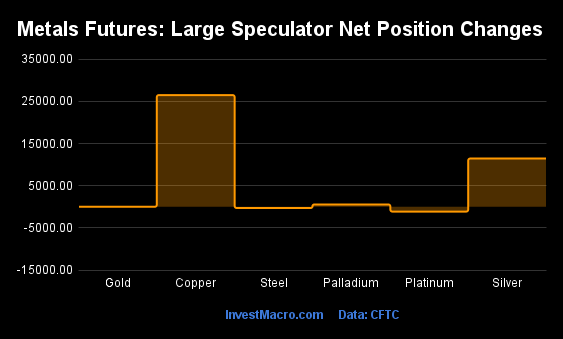
Contributor Disclosures:

  1. Author Certification and Compensation: [Clive Maund of clivemaund.com] is being compensated as an independent contractor by Street Smart, an affiliate of Streetwise Reports, for writing this article. Maund received his UK Technical Analysts’ Diploma in 1989. The recommendations and opinions expressed in this content accurately reflect the personal, independent, and objective views of the author regarding any and all of the designated securities discussed. No part of the compensation received by the author was, is, or will be directly or indirectly related to the specific recommendations or views expressed.
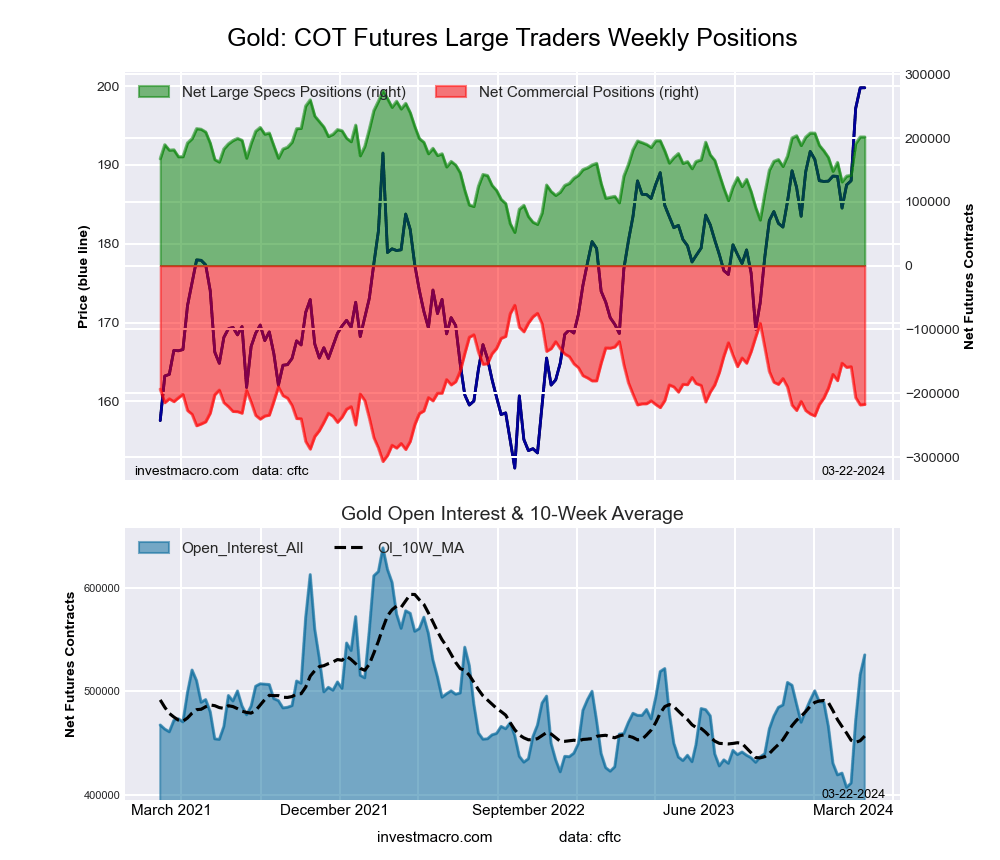
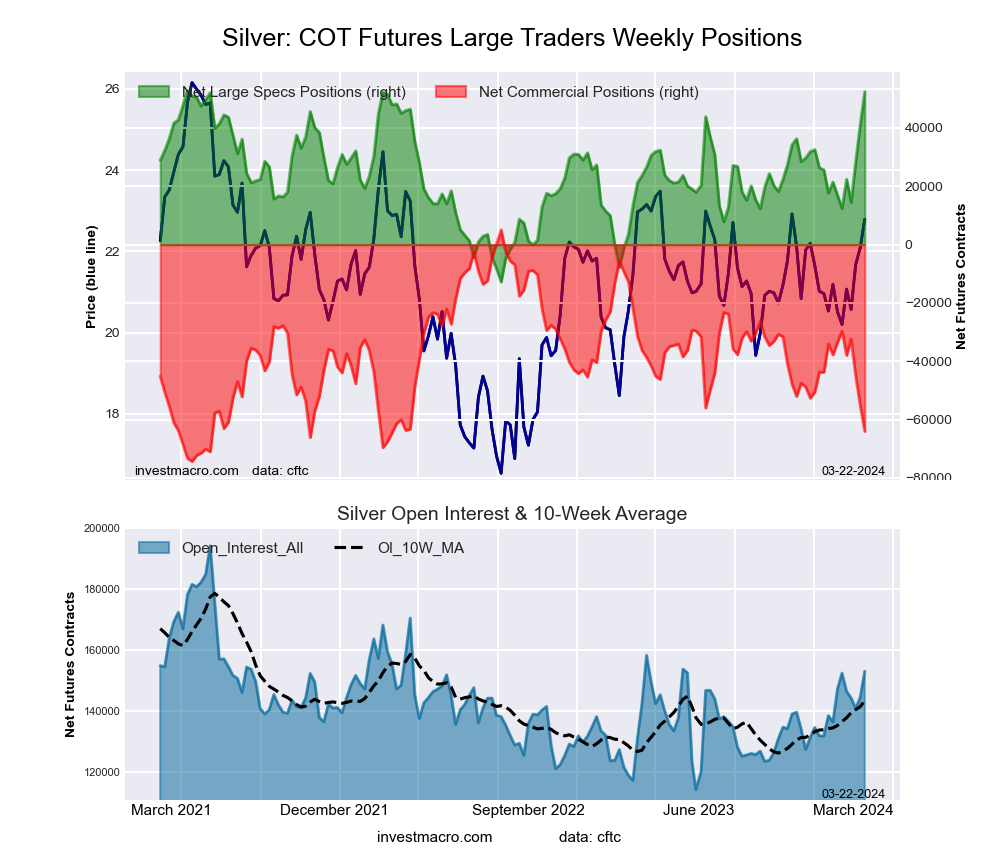
  2. Statements and opinions expressed are the opinions of the author and not of Streetwise Reports, Street Smart, or their officers. The author is wholly responsible for the accuracy of the statements. Streetwise Reports requires contributing authors to disclose any shareholdings in, or economic relationships with, companies that they write about. Any disclosures from the author can be found below. Streetwise Reports relies upon the authors to accurately provide this information and Streetwise Reports has no means of verifying its accuracy.

Clivemaund.com Disclosures

The above represents the opinion and analysis of Mr. Maund, based on data available to him, at the time of writing. Mr. Maund’s opinions are his own, and are not a recommendation or an offer to buy or sell securities. As trading and investing in any financial markets may involve serious risk of loss, Mr. Maund recommends that you consult with a qualified investment advisor, one licensed by appropriate regulatory agencies in your legal jurisdiction and do your own due diligence and research when making any kind of a transaction with financial ramifications. Although a qualified and experienced stock market analyst, Clive Maund is not a Registered Securities Advisor. Therefore Mr. Maund’s opinions on the market and stocks can only be construed as a solicitation to buy and sell securities when they are subject to the prior approval and endorsement of a Registered Securities Advisor operating in accordance with the appropriate regulations in your area of jurisdiction.

The German Index set an all-time high. Bitcoin rate reached 2-year high

By JustMarkets

The US stock indices posted moderate losses on Wednesday. Pressure to liquidate long positions from recent record highs weighed on the stock market ahead of Thursday’s PCE deflator report, the Fed’s preferred inflation gauge. The Dow Jones Index (US30) was down 0.06% at the stock market close yesterday. The S&P 500 Index (US500) lost 0.17%. The NASDAQ Technology Index (US100) closed the day negative 0.55%. On Wednesday, the hawkish comments from Fed members Williams, Bostic, and Collins also hamstrung the indices when they said they favored a wait-and-see stance before cutting interest rates. Markets now expect the US central bank to keep interest rates unchanged in March and May, but there is more than a 50% chance of a rate cut in June.

Wednesday’s Q4 US GDP report was mixed for the dollar, with Q4 GDP revised downward (from 3.3% to 3.2% y-o-y) but still pointing to a robust economy.

The bitcoin exchange rate (BTC/USD) rose more than 6% on Wednesday, hitting a 2-year high following the successful launch of spot bitcoin ETFs in the US. The ETFs have raised more than $6 billion since they began trading on January 11, with some analysts warning of a looming supply shortage as new coins from bitcoin miners fail to keep up with demand. Additional demand has been sparked by the expected April 20 halving of bitcoin issuance. About 80% of the bitcoin supply has not changed hands in the past six months, which could exacerbate the situation and contribute to a further rise in bitcoin prices. Additionally, speculation is growing around the possible approval of spot ETFs, potentially driving higher Ethereum (ETH/USD) prices.

Equity markets in Europe traded flat on Wednesday. Germany’s DAX (DE40) rose by 0.25%, France’s CAC 40 (FR40) gained 0.08% yesterday, Spain’s IBEX 35 (ES35) declined 0.45%, and the UK’s FTSE 100 (UK100) closed negative 0.76%.

On Wednesday, Frankfurt’s DAX (DE40) Index, outperforming European benchmarks on the back of strong corporate earnings, held on to early gains and hit a new record. Puma shares closed by 5% higher after meeting full-year targets and announcing a new brand campaign. Meanwhile, technology stocks came under pressure after Dutch semiconductor equipment maker ASM International reported lower fourth-quarter earnings, sending Infineon down 4% and SAP down 1.5%.

ECB Governing Council representative Kazaks said yesterday that the ECB should not be in a hurry to cut interest rates as there is a risk that tighter measures will be needed later. His colleague, ECB Governing Council representative Kazimir, added that the ECB has no reason to rush interest rate cuts and prefers June as the first rate cut. Swaps estimate the odds of a 25 bps ECB rate cut at 5% at the next meeting on March 7 and 32% at the next meeting on April 11.

The latest EIA report showed a larger-than-expected increase in US crude oil inventories of 4.199 million barrels last week, although much smaller than the 8.428 million reported by the API. The rise in inventories is mainly attributed to a slowdown in processing crude oil into finished products at refineries. Looking ahead, investors are eagerly anticipating the upcoming OPEC+ meeting in March to discuss extending production cuts. Producers will likely stick to voluntary production limits until at least the June ministerial meeting to help stabilize the market. In addition, uncertainty surrounding the ceasefire between Israel and Hamas, as well as ongoing Houthi attacks on ships in the Red Sea, have increased the risk premium in oil prices.

Asian markets were predominantly up yesterday. Japan’s Nikkei 225 (JP225) decreased by 0.08% yesterday, China’s FTSE China A50 (CHA50) was down 0.24% on Wednesday, Hong Kong’s Hang Seng (HK50) fell by 1.51% on the day, and Australia’s ASX 200 (AU200) was negative 0.03% on the day. The Hang Seng Index (HK50) opened higher on Thursday, reversing a decline after removing measures to curb housing demand as part of the 2024 budget, including the complete abolition of housing levies. Wednesday’s GDP report showed the city’s economy grew by 4.3% y/y in Q4 2023, the highest growth in 2 years, on the back of a rebound in inbound tourism and a recovery in private consumption.

Fresh data showed that Australian retail sales rose by 1.1% month-on-month in January 2024, reversing an upwardly revised 2.1% drop in the previous month but falling short of market consensus, which expected a 1.5% rise.

S&P 500 (US500) 5,069.76 −8.42 (−0.17%)

Dow Jones (US30) 38,949.02 −23.39 (−0.06%)

DAX (DE40)  17,601.22 +44.73 (+0.25%)

FTSE 100 (UK100) 7,624.98 −58.04 (−0.76%)

USD Index  103.95 +0.01 (+0.01%)

Important events today:
  • – Japan Industrial Production (m/m) at 01:50 (GMT+2);
  • – Japan Retail Sales (m/m) at 01:50 (GMT+2);
  • –– Australia Retail Sales (m/m) at 02:30 (GMT+2);
  • – Japan Tokyo Core CPI (m/m) at 07:00 (GMT+2);
  • – German Retail Sales (m/m) at 09:00 (GMT+2);
  • – Switzerland KOF Leading Indicators (m/m) at 10:00 (GMT+2);
  • – Switzerland GDP (q/q) at 10:00 (GMT+2);
  • – German Unemployment Rate (m/m) at 10:55 (GMT+2);
  • – German Consumer Price Index (m/m) at 15:00 (GMT+2);
  • – US Initial Jobless Claims (w/w) at 15:30 (GMT+2);
  • – US PCE Price index (m/m) at 15:30 (GMT+2);
  • – Canada GDP (q/q) at 15:30 (GMT+2);
  • – US Chicago PMI (m/m) at 16:45 (GMT+2);
  • – US Pending Home Sales (m/m) at 17:00 (GMT+2);
  • – US Natural Gas Storage (w/w) at 17:30 (GMT+2);
  • – US FOMC Member Bostic Speaks at 17:50 (GMT+2);
  • – US FOMC Member Mester Speaks at 20:15 (GMT+2).

By JustMarkets


This article reflects a personal opinion and should not be interpreted as an investment advice, and/or offer, and/or a persistent request for carrying out financial transactions, and/or a guarantee, and/or a forecast of future events.