Archive for Financial News – Page 147

Solid Capital Returns Give This Texas Oil Co. a Buy Rating

Source: Leo Mariani  (3/6/24)

Solid returns of capital, including dividends and buybacks, higher production growth vs. peers, and discounted valuation vs. Permian peers, are the reasons Permian is rated a Buy, according to a Roth MKM research note. 

Roth MKM analyst Leo Mariani gave Permian Resources Corp. (PR:NYSE) a Buy rating in a March 6 research note.

Of this decision, Mariani stated, “We rate Permian Resource a Buy due to its solid returns of capital, including dividends and buybacks, higher production growth vs. peers, and discounted valuation vs. Permian peers.”

Mariani noted that, all in all, he anticipates that the company will have a more positive outlook than its peers do today. 

Part of this valuation came from the news that Permian said it would be redeeming US$356 million of its Senior Notes (of which it has 6.875%), due in 2027. The company reported that it would be redeeming this on April 5 of this year. 

Payment of the notes will be made by cash the Permian already has as well as borrowing from its credit. 

Mariani commented, “Redeeming the bonds will save PR around US$24.5 million in interest expense once any credit facility borrowings are paid back with free cash flow.”

The analyst also pointed out that Permian’s co-CEOs had previously given up some stock during the last equity deal. The co-CEOs had sold 4 million shares in the deal. However, the co-CEOs stated that they are both dedicated to keeping at least 12 million shares each. Mariani opined that this is close to current ownership levels.

With his Buy rating, Mariani also gave Permian a target price of US$17, stating, “Our US$17 price target for PR is based on a 4.8x multiple of our 2024 DACF estimate, which is based on US$77 WTI oil and US$2.75 HH gas. Impediments to our target include lower-than-expected commodity prices and failure to hit production targets.”


Important Disclosures:

  1. This article does not constitute investment advice and is not a solicitation for any investment. Streetwise Reports does not render general or specific investment advice and the information on Streetwise Reports should not be considered a recommendation to buy or sell any security. Each reader is encouraged to consult with his or her personal financial adviser and perform their own comprehensive investment research. By opening this page, each reader accepts and agrees to Streetwise Reports’ terms of use and full legal disclaimer. Streetwise Reports does not endorse or recommend the business, products, services or securities of any company.

For additional disclosures, please click here.

Disclosures for Roth MKM, Permian Resource Corp., March 6, 2024

Regulation Analyst Certification (“Reg AC”): The research analyst primarily responsible for the content of this report certifies the following under Reg AC: I hereby certify that all views expressed in this report accurately reflect my personal views about the subject company or companies and its or their securities. I also certify that no part of my compensation was, is or will be, directly or indirectly, related to the specific recommendations or views expressed in this report.

Disclosures: The price target and rating history for Permian Resources Corp. prior to February 1, 2023 reflect MKM’s published opinion prior to the acquisition of MKM Partners, LLC by Roth Capital Partners, LLC.

ROTH Capital Partners, LLC expects to receive or intends to seek compensation for investment banking or other business relationships with the covered companies mentioned in this report in the next three months. The material, information and facts discussed in this report other than the information regarding ROTH Capital Partners, LLC and its affiliates, are from sources believed to be reliable, but are in no way guaranteed to be complete or accurate. This report should not be used as a complete analysis of the company, industry or security discussed in the report. Additional information is available upon request. This is not, however, an offer or solicitation of the securities discussed. Any opinions or estimates in this report are subject to change without notice. An investment in the stock may involve risks and uncertainties that could cause actual results to differ materially from the forward-looking statements. Additionally, an investment in the stock may involve a high degree of risk and may not be suitable for all investors. No part of this report may be reproduced in any form without the express written permission of ROTH. Copyright 2024. Member: FINRA/SIPC.

The Bank of Canada kept rates unchanged and maintained its dovish bias. The ECB will also keep all policy settings unchanged today

By JustMarkets

As of Wednesday’s stock market close, the Dow Jones Index (US30) was up 0.20%, the S&P 500 Index (US500) added 0.51%, and the NASDAQ Technology Index (US100) closed positive 0.58%.

Fed Chairman Powell said in front of Congress that it would likely be appropriate to begin reducing borrowing costs at some point this year. Still, the committee does not expect it will be appropriate to reduce the target range for the federal funds rate until it has more confidence that inflation is moving steadily toward 2%.

The latest economic data showed that US job openings for January, according to JOLTS, fell by 26,000 to 8.863 million, indicating a slight cooling in the labor market. Investors now await the main Nonfarm Payrolls report tomorrow.

Palantir (PLTR) closed higher by more than 9% after receiving a $178.4 million contract from the US Army to develop and produce ten prototype ground stations that use artificial intelligence and machine learning to process target information from space, airborne and ground sensors. JD.com (JD) closed higher by more than 16% after reporting fourth-quarter sales of ¥306.1 billion ($42.6 billion), beating the consensus forecast of ¥300 billion, and initiating a $3 billion share repurchase program. Hewlett Packard Enterprise (HPE) closed higher by more than 3% amid strong demand for the company’s artificial intelligence-focused servers. Orders for these servers totaled $3 billion, up $500 million from the last quarter.

At its March meeting, the Bank of Canada (BoC) kept its overnight rate target at 5%. It pledged to continue normalizing the bank’s balance sheet as policymakers remain concerned about risks to the inflation outlook. The bank said it would maintain its quantitative tightening policy until a further weakening in core inflation. The latest data showed that CPI inflation eased to 2.9% in January, but on an annualized and three-month basis, core inflation was from 3% to 3.5%. Policymakers forecast inflation to remain near 3% in the first half of this year and then gradually decline. The bank also noted that GDP growth remains weak and below potential, and employment continues to grow more slowly amid signs that wage pressures may be easing. At the press conference, Bank Governor Macklem said it was too early to consider cutting rates as more time is needed to ensure inflation falls to the 2% target.

Equity markets in Europe rallied yesterday. Germany’s DAX (DE40) rose by 0.10%, France’s CAC 40 (FR40) gained 0.28%, Spain’s IBEX 35 (ES35) increased by 0.79% on Wednesday, and the UK’s FTSE 100 (UK100) closed positive 0.43%.

Eurozone retail sales for January rose by 0.1% m/m, weaker than expectations of 0.2% m/m. German trade data was better than expected: exports for January rose by 6.3% m/m, stronger than expectations of 1.5% m/m and the largest increase in 3-1.5 years. In addition, January imports rose by 3.6% m/m, stronger than expectations of 1.8% m/m and the largest increase in 11 months.

In his pre-election budget statement, Treasury Secretary Jeremy Hunt announced plans for permanent tax cuts in line with slowing inflation to stimulate economic growth and support public services. The Office for Budget Responsibility (OBR) predicts that inflation will fall below the Bank of England’s target in the coming months and will also revise growth forecasts upwards.

The ECB’s monetary policy meeting will take place today. The ECB is forecast to leave the interest rate at 4.5%. In recent weeks, almost all ECB officials have unanimously argued that a premature rate cut could set a dangerous precedent for anchoring inflation. As a result, money markets have pushed back the likelihood of a first-rate cut from April to June. ECB chief Lagarde will likely reiterate that data remains lacking and refrain from giving clearer guidance on policy easing. Such a stance would be a moderately negative scenario for the euro.

WTI crude futures fell slightly to $79.1 a barrel on Wednesday, retreating from a four-month high after EIA data showed a smaller-than-expected rise in weekly US crude inventories. The US crude inventories rose by 1.367 million barrels last week, less than market expectations for a 2.116 million increase. On Tuesday, the API reported a modest 423,000 barrel rise in nationwide inventories.

Asian markets traded flat yesterday. Japan’s Nikkei 225 (JP225) was down 0.02%, China’s FTSE China A50 (CHA50) lost 0.76%, Hong Kong’s Hang Seng (HK50) was up 1.70% on the day, and Australia’s ASX 200 (AU200) was positive 0.12% on Wednesday.

S&P 500 (US500) 5,104.76 +26.11 (+0.51%)

Dow Jones (US30) 38,661.05 +75.86 (+0.20%)

DAX (DE40)  17,716.71 +18.31 (+0.10%)

FTSE 100 (UK100) 7,679.31 +33.15 (+0.43%)

USD Index 103.37 −0.42 (−0.41%)

Important events today:
  • – Australia Trade Balance (m/m) at 02:30 (GMT+2);
  • – China Trade Balance (m/m) at 05:00 (GMT+2);
  • – Switzerland Unemployment Rate (m/m) at 08:45 (GMT+2);
  • – Eurozone ECB Interest Rate Decision at 15:15 (GMT+2);
  • – Eurozone ECB Monetary Policy Statement at 15:15 (GMT+2);
  • – US Initial Jobless Claims (w/w) at 15:30 (GMT+2);
  • – US Trade Balance (m/m) at 15:30 (GMT+2);
  • – Canada Trade Balance (m/m) at 15:30 (GMT+2);
  • – Eurozone ECB Press Conference at 15:45 (GMT+2);
  • – US Fed Chair Jerome Powell Testifies at 17:00 (GMT+2);
  • – Eurozone ECB President Lagarde Speaks at 17:00 (GMT+2);
  • – US Natural Gas Storage (w/w) at 17:30 (GMT+2);
  • – US FOMC Member Mester Speaks (m/m) at 18:30 (GMT+2).

By JustMarkets


This article reflects a personal opinion and should not be interpreted as an investment advice, and/or offer, and/or a persistent request for carrying out financial transactions, and/or a guarantee, and/or a forecast of future events.

Today, the focus of investors’ attention is directed to the Bank of Canada meeting, as well as Jerome Powell’s testifies before Congress

By JustMarkets

As of Tuesday’s stock market close, the Dow Jones Index (US30) decreased by 1.04%. The S&P 500 Index (US500) lost 1.02%. The NASDAQ Technology Index (US100) closed negative at 1.65%. All 3 indices fell off the lows of the week. Weakness in technology stocks impacted the overall market as negative corporate news hamstrung technology stocks. Apple (AAPL) fell more than 2% after Counterpoint Research data showed that iPhone sales in China fell by 24% in the first six weeks of this year. Tesla (TSLA) closed down more than 4%, adding to Monday’s 7% loss after car shipments in China fell. In addition, Advanced Micro Devices (AMD) quotes fell more than 1% after the US government blocked a plan to sell artificial intelligence chips to China.

Today, investors expect Federal Reserve Chairman Jerome Powell to address the US Congress, where he may give clues on the timing and extent of interest rate cuts this year.

The Bank of Canada (BoC) will meet today. The Bank of Canada is forecast to leave the interest rate unchanged at 5%. The highlight of the last Bank of Canada meeting in January was removing the phrase “The Bank remains prepared to raise the policy rate further if needed” from the accompanying statement. History is likely to repeat itself at the current meeting. Recent data showed that Canada’s Q4 GDP was stronger, retail sales were stronger, and the labor market was more robust than expected. The overall CPI fell to 2.9% from 3.4% in December (consensus was 3.3%), and core inflation slowed to 3.3% from 3.6% as expected. According to economists, with such data, the Bank of Canada will not launch its first rate cut until June. The probability of such a scenario is 70%. In the short term, the current meeting is unlikely to change the picture of CAD. Moreover, the decline in CPI may prompt the Bank of Canada to give a more optimistic forecast of disinflation and hint more clearly at the easing of monetary policy. Given the market’s rather conservative assessment of the Bank of Canada’s rate cut, the balance of risks is tilted in favor of a decline in the Canadian dollar.

After hitting an all-time high of $68,970 on Tuesday, bitcoin (BTC/USD) fell more than 7% amid profit-taking by funds. Bitcoin is up more than 63% this year and hit an all-time high on Tuesday thanks to steady inflows into 11 spot bitcoin ETFs that began trading in January and have attracted nearly $8 billion.

Equity markets in Europe were flat yesterday. Germany’s DAX (DE40) was down 0.10%, France’s CAC 40 (FR40) decreased by 0.30%, Spain’s IBEX 35 (ES35) was up 0.47% on Tuesday, and the UK’s FTSE 100 (UK100) closed positive 0.08%.

Silver prices pulled back from a 2-month high to close slightly lower after weaker-than-expected US economic reports on January factory orders. January ISM services were bearish for industrial metals demand.

WTI crude futures are holding near $78 a barrel on Wednesday after losing more than 2% over the past two sessions as weaker demand outweighed an extension of OPEC+ supply cuts. The latest data on factory orders and the US services sector showed signs of a slowdown in US economic activity, adding to fears of weaker energy demand from the world’s largest oil consumer. Analysts also noted a lack of strong stimulus signals from major oil importer China after the country set its growth target for this year at “around 5%”. Meanwhile, major oil producers, including Saudi Arabia, Russia, Iraq, and the UAE, extended voluntary oil production cuts for the second quarter.

Natural gas prices added to Monday’s gains on Tuesday and hit a 1-month high. Natural gas prices have risen since last week after EQT Corp, the largest US natural gas producer, said it would cut net production by 30-40 billion cubic feet through March in response to low prices.

Asian markets were mostly down yesterday. Japan’s Nikkei 225 (JP225) was down 0.55%, China’s FTSE China A50 (CHA50) was up 1.32%, Hong Kong’s Hang Seng (HK50) lost 1.01% for the day, and Australia’s ASX 200 (AU200) was negative 0.25% for Tuesday.

Hong Kong stocks jumped 1.3% in Wednesday morning trading, partially recovering from a sharp drop the previous day as investors awaited new supportive measures from Beijing following the announcement of China’s 2024 economic growth target of around 5.0% during the opening of the annual plenary session on Monday. The Chinese government also unveiled its annual military budget for this year, which will total 1.67 trillion yuan, up 7.2% from 2023. The Hang Seng Index attempted to break a two-week low, helped by widespread growth across all sectors, including basic materials, industrials, and technology.

The Australian economy grew 0.2% QoQ in 4Q 2023, below the upwardly revised 3Q figure and market estimates of 0.3%. This was the ninth consecutive period of quarterly growth but the slowest pace in the last 5 quarters.

S&P 500 (US500) 5,078.65 −52.30 (−1.02%)

Dow Jones (US30) 38,585.19 −404.64 (−1.04%)

DAX (DE40)  17,698.40 −17.77 (−0.10%)

FTSE 100 (UK100) 7,646.16 +5.83 (+0.08%)

USD Index 103.80 −0.03 (−0.03%)

Important events today:
  • – Australia GDP (q/q) at 02:30 (GMT+2);
  • – German Trade Balance (m/m) at 09:00 (GMT+2);
  • – German Retail Sales (m/m) at 09:00 (GMT+2);
  • – UK Construction PMI (m/m) at 11:30 (GMT+2);
  • – Eurozone Retail Sales (m/m) at 12:00 (GMT+2);
  • – UK Spring Forecast Statement at 14:30 (GMT+2);
  • – US ADP Nonfarm Employment Change (m/m) at 15:15 (GMT+2);
  • – Canada BoC Interest Rate Decision at 16:45 (GMT+2);
  • – Canada BoC Rate Statement at 16:45 (GMT+2);
  • – Canada Ivey PMI (m/m) at 17:00 (GMT+2);
  • – US JOLTs Job Openings (m/m) at 17:00 (GMT+2);
  • – US Fed Chair Jerome Powell Testifies at 17:00 (GMT+2);
  • – Canada BoC Press Conference at 17:30 (GMT+2);
  • – US Crude Oil Reserves (w/w) at 17:30 (GMT+2);
  • – US FOMC Member Daly Speaks (m/m) at 19:00 (GMT+2).

By JustMarkets


This article reflects a personal opinion and should not be interpreted as an investment advice, and/or offer, and/or a persistent request for carrying out financial transactions, and/or a guarantee, and/or a forecast of future events.

UK100: Waits on spring budget 2024

By ForexTime

  • UK100 trapped within range
  • UK Spring budget could impact index
  • Prices above 50, 100 and 200-day SMA
  • Double bottom on D1 chart
  • Key weekly resistance at 7689.2

After swinging within a range on the weekly charts, the UK100 which tracks the underlying FTSE100 index could be gearing up for a significant move.

Over the past few months, the index has been influenced by various fundamental forces ranging from the pound’s value to corporate earnings and monetary policy expectations.

Note: The FTSE100 has a strong international focus with 75% of revenues from FTSE100 companies coming from outside the UK.

Looking at the recent price action, a breakout could be on the horizon. This may be triggered by the UK Spring Budget this afternoon, presented by Chancellor of the Exchequer Jeremy Hunt.

  • The budget could provide fresh insight into the country’s economic outlook, finances, public spending, and government’s plan for tax.
  • Given how a UK general election is fast approaching, there is growing speculation around Hunt presenting tax cuts to shift the polls in favour of his own party.
  • Such a development may fuel inflation, which remained unchanged at 4% in January.
  • Ultimately, complicating the Bank of England’s ability to cut interest rates as much as markets expect.

Note: Traders are currently pricing in a 42% probability of a 25-basis point BoE cut by June, with a cut by August fully priced in.

How will this impact the UK100?

When the pound appreciates, it results to lower revenues for FTSE100 companies that acquire sales from overseas, pulling the UK100 lower as a result. The same is true vice versa.

So essentially,

  • The UK100 could see fresh downside pressure if the spring budget confirms tax cuts and strengthens the pound as investors push back BoE cut bets.
  • Should the spring budget omit anything about tax cuts and the pound weakens, this may push the UK100 higher.

Regarding the technical picture…

The FTSE 100 Index (UK100) on the daily time frame made a double bottom and this might signal the end of the current down trend. There is a strong weekly resistance level that will need to be broken though, and this remains to be seen.

On the 4-hour chart an uptrend is in progress with the above-mentioned weekly resistance level at 7689.2 lying right in ahead. Based on projected normal ebb and flow price structures, that means there are two scenarios.

  • Number 1 is that the price bounces off the resistance level and after a possible with a retest, a short opportunity might ensue.
  • Number 2 is that the price breaks through the resistance level, retests the resistance turned support level and then continues upward. In this case a long opportunity.

Both the 50 Exponential Moving Average and the Moving Average Convergence Divergence (MACD) Oscillators confirm that the above-stated scenarios are a possibility.


Forex-Time-LogoArticle by ForexTime

ForexTime Ltd (FXTM) is an award winning international online forex broker regulated by CySEC 185/12 www.forextime.com

EUR/USD Shows Strength Amid Anticipation of Key Events

By RoboForex Analytical Department

The EUR/USD pair is exhibiting resilience, navigating around the 1.0850 mark on Tuesday, following a sequence of rises in the previous two sessions. The current market atmosphere is one of cautious optimism, as participants brace for significant upcoming events, including a speech by Jerome Powell, the head of the US Federal Reserve, and the release of February’s employment sector statistics on Friday. Particularly, the focus will be on the wage growth components for February, which are speculated to have nearly tripled, potentially indicating a diminishing impact of pro-inflationary factors.

The consensus among market observers is leaning towards an expectation that the Federal Reserve may initiate the first interest rate cut of this monetary cycle in June, with possibilities of further reductions occurring up to three times by year-end.

EUR/USD Technical Analysis

On the H4 chart, the EUR/USD pair is currently carving out a consolidation pattern around the 1.0831 level, with a recent extension up to 1.0866. A downward correction to 1.0831, testing the level from above, could materialize today. An upward break from this consolidation could herald the start of a growth wave towards 1.0900, at which point the current growth phase is anticipated to conclude, potentially giving way to a new downtrend with an initial target at 1.0680. This outlook is supported by the MACD indicator, which shows the signal line above zero and a sharply rising histogram, indicating a continuation of the growth trend.

The H1 chart reveals a consolidation phase around the 1.0831 level, with a growth structure targeting 1.0870 currently unfolding. The local target of 1.0866 for this wave has been achieved, with a correction back to 1.0831 anticipated. Following this correction, the focus will shift towards the structure’s growth potential to 1.0870. The Stochastic oscillator, currently below the 50 mark and expected to drop to 20, validates this scenario, suggesting a potential for further fluctuations within this bullish trend.

Disclaimer

Any forecasts contained herein are based on the author’s particular opinion. This analysis may not be treated as trading advice. RoboForex bears no responsibility for trading results based on trading recommendations and reviews contained herein.

New FXTM stock index hits record high!

By ForexTime 

  • FXTM launches 6 new stock indices
  • 11 of FXTM’s 18 total indices hit all-time peaks so far in 2024
  • TW50 index is latest to join the record-high party
  • TW50 historically outperformed many Asian/European peers
  • Less-volatile TW50 may be more suited for risk averse traders


This week, FXTM launched 6 new stock indices.

This now brings FXTM’s tally to 18 different stock indices to choose from.

And the TW50 index made it a debut to remember!

Since launching across FXTM’s trading platforms yesterday …

The TW50 has posted its highest-ever intraday price of 1647.5 today (Tuesday, March 5th)!

This index, which tracks Taiwanese stocks, also appears on course to close the day above 1640 for the first time in its history!

FUN FACT: Of the 18 stock indices currently offered by FXTM, 11 have already hit their respective all-time peaks so far in 2024.


What is a stock index?

Imagine a stock index being a basket of many different stocks.

The index measures the overall performance of those stocks inside that “basket”.


What does the TW50 stock index track?

FXTMs TW50 stock index tracks the performance of the FTSE Taiwan RIC Capped Index.

This index aims to capture the overall performance of 119 different large- and mid-cap stocks in Taiwan.


3 key things to know about the TW50 index:

1) Taiwan Semiconductor Manufacturing is the largest member of the TW50 index!

Taiwan Semiconductor Manufacturing (TSMC), accounts for 21% of the total index.

Hence, with the mania over artificial intelligence in full swing (AI is expected to be a major earnings driver for chipmaking companies), the boost to TSMC’s share prices have helped push the TW50 to a fresh all-time peak.


2) Performs better than many Asian/European counterparts

So far in 2024, the FTSE Taiwan RIC Capped Index has climbed by 5.8%.

Amongst the 6 Asian stock indices offered by FXTM …

TW50 is the second-biggest gainer on a year-to-date basis (at the time of writing).

First place belongs to the JAP225 index (up 20% year-to-date), while the CN50 index is in third place (+4.3% year-to-date).

For a longer historical timeframe, the FTSE Taiwan RIC Capped Index has surged by 64.8% since 16th June 2000.

NOTE: The FTSE Taiwan RIC Capped Index was launched on 29 September 2017. However, historical data is only available from June 2000 onwards.

That has the TW50 index comfortably beating European stock indices such as the EU50, the FRA40, and even the UK100 over the same period (16th June 2000 – present)!


3) Lower Volatility

The creators of this index, FTSE Russell, intended for its FTSE Taiwan RIC Capped Index to have relatively more stability (less volatile).

This is done by more evenly distributing the weights assigned to the stocks on this index across 10 different industries (e.g. tech, financial, industrial, etc).

NOTE: To be clear, tech stocks still account for 60% of the TW50, making it a tech-heavy index.

Since June 2000, this TW50 index has an average 30-day volatility reading of 19.28.

Over the same period, the TW50 has demonstrated less risk of crazy price swings (volatility) on average compared to:

  • NAS100: 23.16
  • JAP225: 21.29
  • HK50: 21.07
  • GER40: 20.49
  • EU50: 20.20
(numbers above are 30-day volatility figures)

Hence, while traders may have less of a chance at stunning gains on outsized upswings, the TW50’s more-stable performance could also lower the risk of jaw-dropping losses from sharp unexpected declines.

In short, given its less-volatile nature, risk-averse traders may find the TW50 index more suited for them.


How much higher can TW50 climb?

Over the next 12 months, Wall Street analysts expect that the FTSE Taiwan RIC Capped Index can add on another 100 index points to reach 1745.8.

If so, that represents a further 6% of potential gains for the TW50.

However, given its stunning, TSMC-fuelled ascent of late, this index could be ripe for a technical pullback in the near future.

After all, its 14-day Relative Strength Index (RSI) is already well above the 70 threshold which marks textbook “overbought” conditions.


Forex-Time-LogoArticle by ForexTime

ForexTime Ltd (FXTM) is an award winning international online forex broker regulated by CySEC 185/12 www.forextime.com

Inflation is falling in Switzerland. Oil declines despite OPEC+ countries extending production cuts

By JustMarkets

At Monday’s stock market close, the Dow Jones Index (US30) was down 0.25%. The S&P 500 Index (US500) decreased by 0.12%. The NASDAQ Technology Index (US100) closed negative 0.41%. Stocks are seeing coverage of previously open positions. Markets await Fed Chairman Powell’s semi-annual testimony before a House committee on Wednesday and a Senate committee on Thursday for clues on future Fed policy. Powell is expected to maintain his hawkish stance and clarify that the Fed is in no hurry to cut interest rates. In addition, Friday will see the release of the monthly US payrolls report, which will provide insight into whether the labor market remains strong and whether wage pressures are contained.

Comments from Atlanta Fed President Bostic expects the Fed’s first interest rate cut in the third quarter to be followed by a pause to assess how the policy change affects the economy. Bostic added that he is concerned that businesses have too much optimism, and after a rate cut, it could spark a surge of new demand that would add to price pressures. Markets rate the odds of a 25 bps rate cut at 2% for the March 19-20 FOMC meeting and 21% for the April 30-May 1 meeting.

Tesla (TSLA) stock price fell more than 7% and topped the list of losers in the S&P 500 (US500) and NASDAQ (US100) after the China Passenger Car Association reported that February shipments of Tesla vehicles in China fell by 15.5% m/m. Apple (AAPL) is down more than 2% after the European Union fined it €1.8 billion ($2 billion) in connection with an investigation that it was shutting out competitors on its platforms. Nvidia (NVDA) shares are up more than 3% to a record high, surpassing Saudi Aramco to become the world’s third most valuable public company behind Apple and Microsoft. Lyft (LYFT) closed higher by more than 4% after RBC Capital Markets upgraded the stock to “optimistic” from “neutral” with a $23 price target.

Equity markets in Europe traded flat on Monday. German DAX (DE40) declined 0.11%, French CAC 40 (FR40) gained 0.28% yesterday, Spanish IBEX 35 (ES35) rose by 0.05% on Monday, and British FTSE 100 (UK100) closed negative 0.55%. European stock exchanges were weak on Monday as investors awaited the European Central Bank’s upcoming interest rate decision. The Central Bank is expected to keep rates unchanged despite weakening inflation.

Swiss inflation fell in February to its lowest level in nearly two and a half years. Consumer prices were 1.2% from a year earlier, down from January’s 1.3%, though slightly above the 1.1% forecast. The SNB met its target from May 2023 despite rising rents, higher sales tax, and energy prices. Lower inflation increases the likelihood that the SNB will cut rates at its next meeting on March 21. The probability that the SNB will cut rates from the current level of 1.75% is estimated by markets at 66%.

WTI crude futures fell to around $78.5 a barrel on Tuesday, declining for a second straight session, as lingering demand concerns overshadowed an extension of supply cuts by OPEC and its allies. Analysts argued that subdued growth in global oil demand is likely to counter OPEC+ production cuts, raising questions about its output policy. Investors also priced in developments at a key policy meeting in China, where the government set its economic growth target 2024 at around 5%, matching expectations.

Asian markets traded flat yesterday. Japan’s Nikkei 225 (JP225) jumped 0.50%, China’s FTSE China A50 (CHA50) declined 0.13%, Hong Kong’s Hang Seng (HK50) gained 0.04% on the day, and Australia’s ASX 200 (AU200) was negative 0.13% on Monday.

China’s Caixin Services PMI fell to 52.5 in February 2024 from 52.7 in January. It was the 14th consecutive month of growth in service sector activity but the slowest pace since November last year amid subdued growth in total new work. The growth rate in new orders changed little and remained below the 2023 average.

Jibun Bank’s Japan Services PMI was revised upward to 52.9 in February 2024 from 52.5 after a four-month high of 53.1 in January. This marked the 18th consecutive month of growth in the services sector, helped by the sharpest rise in new business starts since August last year due to tourism demand and new product launches. However, growth was mainly driven by domestic demand.

Final data showed that the Judo Bank Flash Australian Services PMI business activity index rose to 53.1 in February from 49.1 in the previous month. This was the first rise in service sector activity in five months and the fastest since April 2023, as renewed growth in new orders led to a rebound in business activity. Improving demand conditions boosted activity in the services sector, with improved economic conditions and increased inquiries contributing to another rise in new work. New export orders also returned to growth for the first time since September 2023, supported by new customers and increased interest from customers in Asia.

S&P 500 (US500) 5,130.95 −6.13 (−0.12%)

Dow Jones (US30) 38,989.83 −97.55 (−0.25%)

DAX (DE40)  17,716.17 −18.90 (−0.11%)

FTSE 100 (UK100) 7,640.33 −42.17 (−0.55%)

USD Index 103.83 −0.03 (−0.03%)

Important events today:
  • – Australia Services PMI (m/m) at 00:00 (GMT+2);
  • – Japan Tokyo Core CPI (m/m) at 01:30 (GMT+2);
  • – Japan Services PMI (m/m) at 02:30 (GMT+2);
  • – China Caixin Services PMI (m/m) at 03:45 (GMT+2);
  • – Germany Services PMI (m/m) at 10:55 (GMT+2);
  • – Eurozone Services PMI (m/m) at 11:00 (GMT+2);
  • – UK Services PMI (m/m) at 11:30 (GMT+2);
  • – Eurozone Producer Price Index (m/m) at 12:00 (GMT+2);
  • – US ISM Services PMI (m/m) at 17:00 (GMT+2);
  • – US FOMC Member Barr Speaks (m/m) at 19:00 (GMT+2);
  • – US FOMC Member Barr Speaks (m/m) at 22:30 (GMT+2).

By JustMarkets


This article reflects a personal opinion and should not be interpreted as an investment advice, and/or offer, and/or a persistent request for carrying out financial transactions, and/or a guarantee, and/or a forecast of future events.

COT Metals Charts: Speculator bets led by Copper

By InvestMacro

Here are the latest charts and statistics for the Commitment of Traders (COT) data published by the Commodities Futures Trading Commission (CFTC).

The latest COT data is updated through Tuesday February 27th and shows a quick view of how large traders (for-profit speculators and commercial entities) were positioned in the futures markets.

Weekly Speculator Changes led by Copper
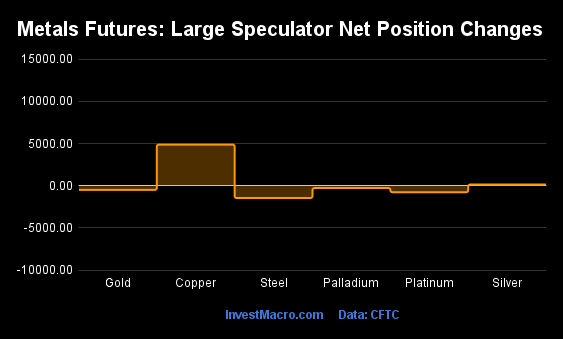
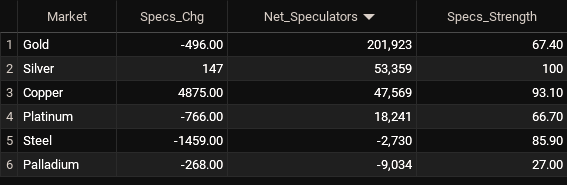
The COT metals markets speculator bets were mixed this week as three out of the six metals markets we cover had higher positioning while the other three markets had lower speculator contracts.

Leading the gains for the metals was Copper (14,339 contracts) with Gold (1,374 contracts) and Palladium (138 contracts) also showing positive weeks.

The markets with declines in speculator bets for the week were Silver (-7,878 contracts), Platinum (-4,894 contracts) and Steel with a dip of -234 contracts.


Net Speculators Leaderboard

Legend: Weekly Speculators Change | Speculators Current Net Position | Speculators Strength Score compared to last 3-Years (0-100 range)


Strength Scores led by Steel

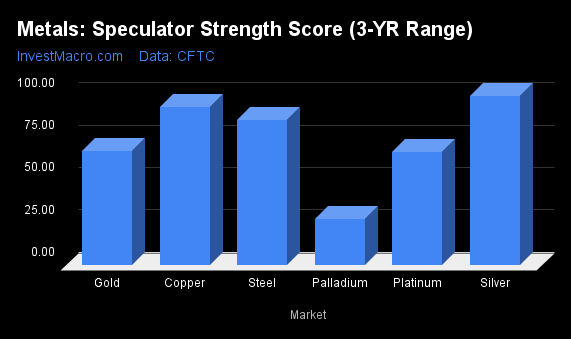
COT Strength Scores (a normalized measure of Speculator positions over a 3-Year range, from 0 to 100 where above 80 is Extreme-Bullish and below 20 is Extreme-Bearish) showed that Steel (85 percent) leads the metals markets this week.

On the downside, Palladium (7 percent) comes in at the lowest strength level currently and is in Extreme-Bearish territory (below 20 percent). The next lowest strength score was Platinum (26 percent) this week.

Strength Statistics:
Gold (40.3 percent) vs Gold previous week (39.7 percent)
Silver (41.6 percent) vs Silver previous week (53.6 percent)
Copper (38.1 percent) vs Copper previous week (22.1 percent)
Platinum (26.2 percent) vs Platinum previous week (38.6 percent)
Palladium (7.2 percent) vs Palladium previous week (6.4 percent)
Steel (85.1 percent) vs Palladium previous week (86.0 percent)


Copper tops the 6-Week Strength Trends

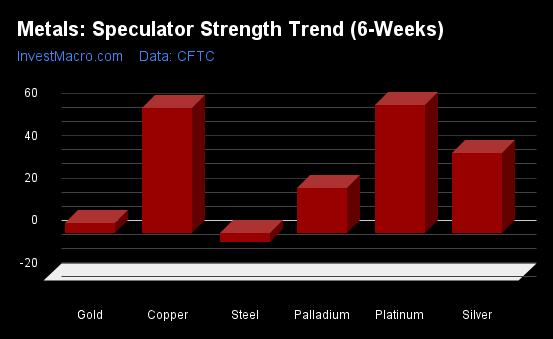
COT Strength Score Trends (or move index, calculates the 6-week changes in strength scores) showed that Copper (26 percent) leads the past six weeks trends for metals and is the only positive mover in the latest data.

Platinum (-23 percent), Gold (-17 percent) and Silver (-17 percent) lead the downside trend scores this week.

Move Statistics:
Gold (-17.2 percent) vs Gold previous week (-21.8 percent)
Silver (-16.9 percent) vs Silver previous week (-6.1 percent)
Copper (26.5 percent) vs Copper previous week (-3.1 percent)
Platinum (-22.7 percent) vs Platinum previous week (-38.1 percent)
Palladium (-5.2 percent) vs Palladium previous week (-18.0 percent)
Steel (-4.4 percent) vs Steel previous week (-4.7 percent)


Individual Markets:

Gold Comex Futures:
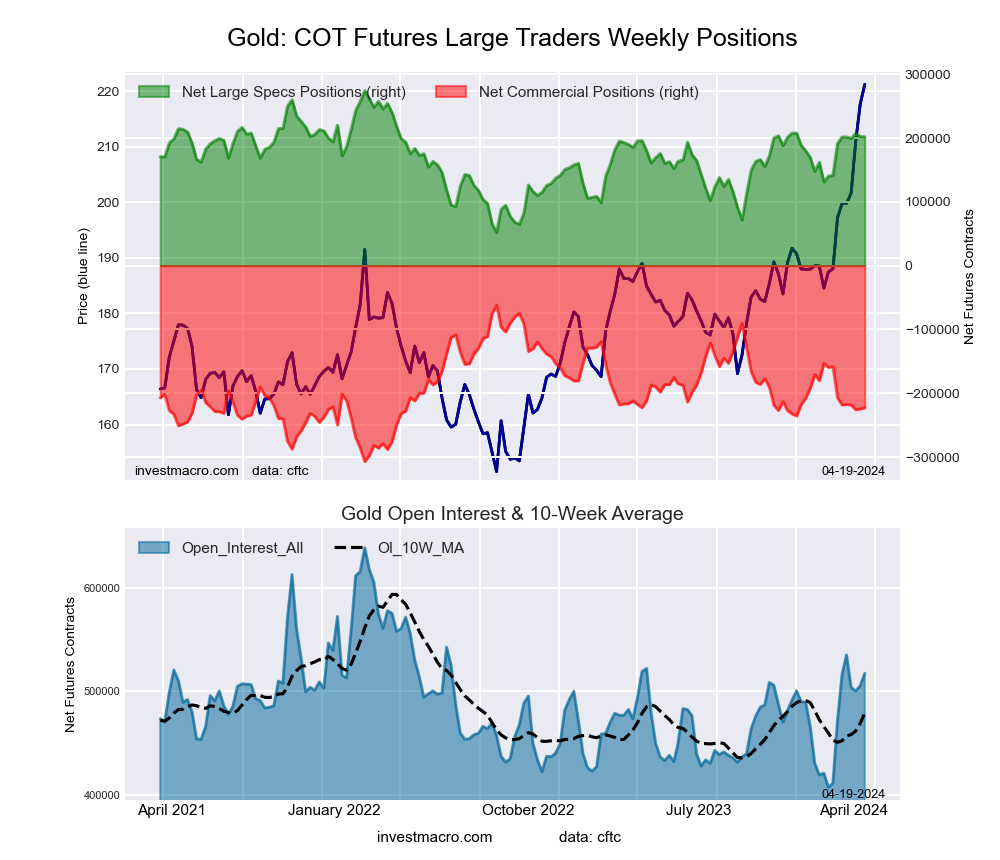
Gold Futures COT ChartThe Gold Comex Futures large speculator standing this week reached a net position of 141,636 contracts in the data reported through Tuesday. This was a weekly gain of 1,374 contracts from the previous week which had a total of 140,262 net contracts.

This week’s current strength score (the trader positioning range over the past three years, measured from 0 to 100) shows the speculators are currently Bearish with a score of 40.3 percent. The commercials are Bullish with a score of 60.7 percent and the small traders (not shown in chart) are Bearish with a score of 27.9 percent.

Price Trend-Following Model: Strong Uptrend

Our weekly trend-following model classifies the current market price position as: Strong Uptrend. The current action for the model is considered to be: Hold – Maintain Long Position.

Gold Futures StatisticsSPECULATORSCOMMERCIALSSMALL TRADERS
– Percent of Open Interest Longs:52.326.49.5
– Percent of Open Interest Shorts:17.864.95.4
– Net Position:141,636-158,35216,716
– Gross Longs:214,948108,43238,943
– Gross Shorts:73,312266,78422,227
– Long to Short Ratio:2.9 to 10.4 to 11.8 to 1
NET POSITION TREND:
– Strength Index Score (3 Year Range Pct):40.360.727.9
– Strength Index Reading (3 Year Range):BearishBullishBearish
NET POSITION MOVEMENT INDEX:
– 6-Week Change in Strength Index:-17.220.0-34.7


Silver Comex Futures:

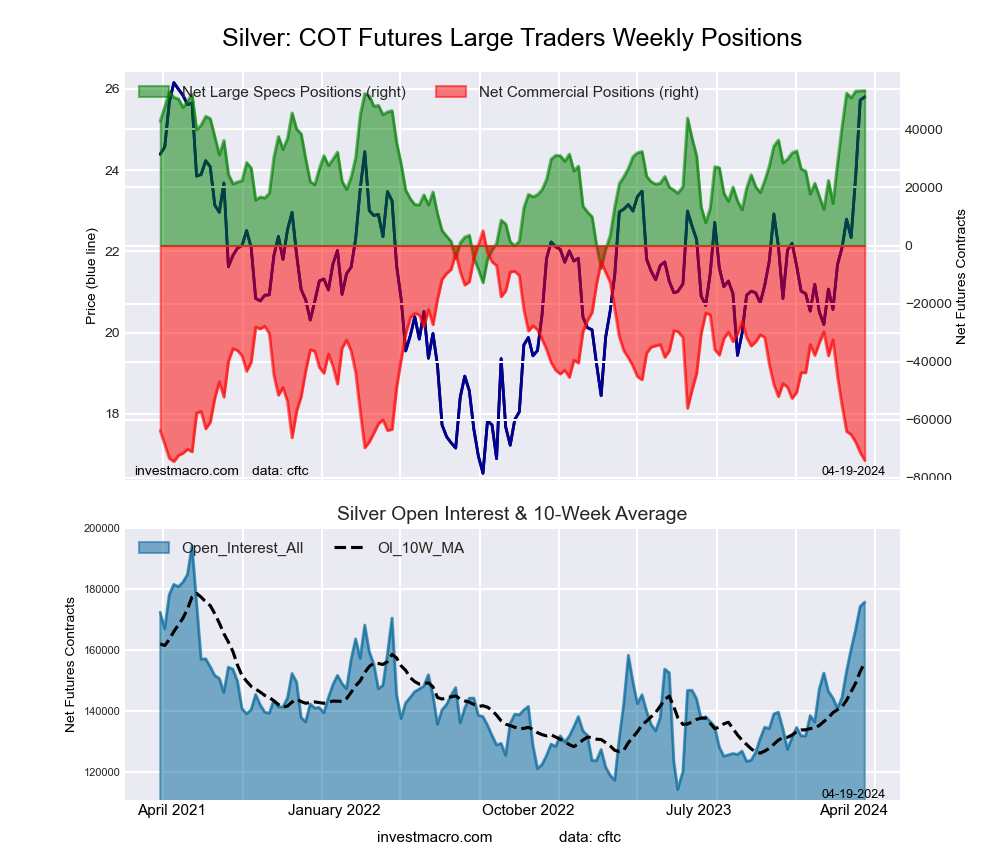
Silver Futures COT ChartThe Silver Comex Futures large speculator standing this week reached a net position of 14,499 contracts in the data reported through Tuesday. This was a weekly fall of -7,878 contracts from the previous week which had a total of 22,377 net contracts.

This week’s current strength score (the trader positioning range over the past three years, measured from 0 to 100) shows the speculators are currently Bearish with a score of 41.6 percent. The commercials are Bullish with a score of 52.8 percent and the small traders (not shown in chart) are Bullish with a score of 66.3 percent.

Price Trend-Following Model: Downtrend

Our weekly trend-following model classifies the current market price position as: Downtrend. The current action for the model is considered to be: Hold – Maintain Short Position.

Silver Futures StatisticsSPECULATORSCOMMERCIALSSMALL TRADERS
– Percent of Open Interest Longs:37.834.021.5
– Percent of Open Interest Shorts:27.756.59.0
– Net Position:14,499-32,44817,949
– Gross Longs:54,54649,11230,987
– Gross Shorts:40,04781,56013,038
– Long to Short Ratio:1.4 to 10.6 to 12.4 to 1
NET POSITION TREND:
– Strength Index Score (3 Year Range Pct):41.652.866.3
– Strength Index Reading (3 Year Range):BearishBullishBullish
NET POSITION MOVEMENT INDEX:
– 6-Week Change in Strength Index:-16.914.2-1.2


Copper Grade #1 Futures:

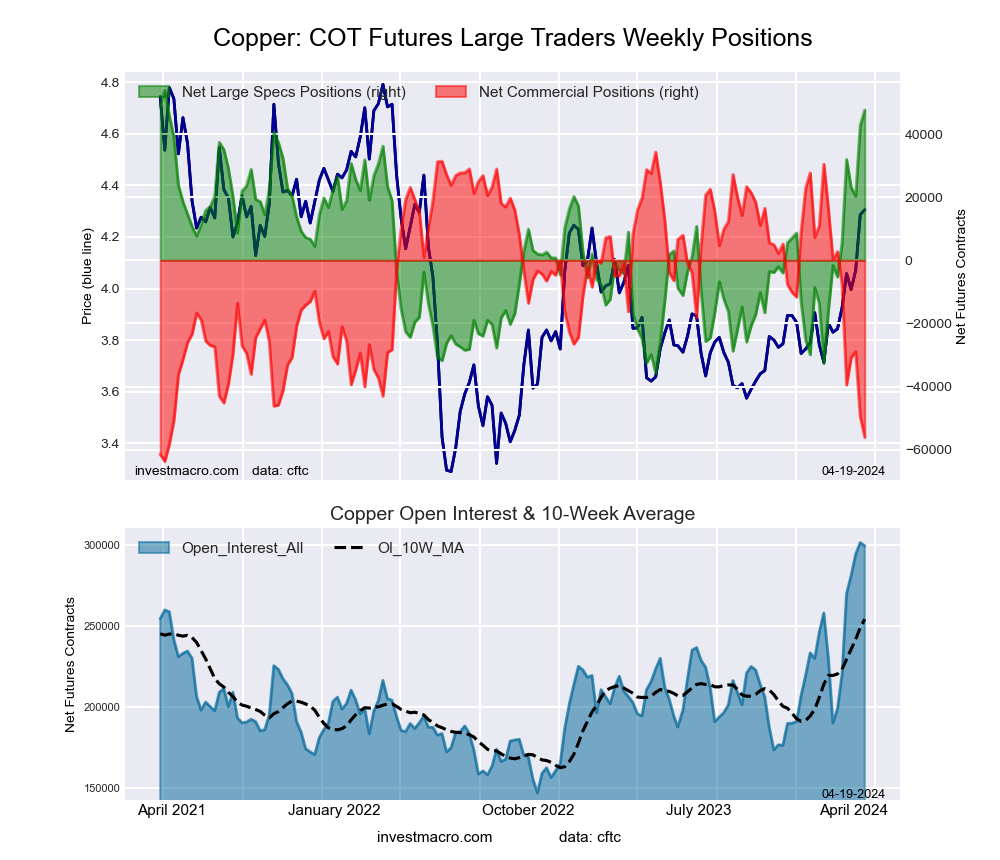
Copper Futures COT ChartThe Copper Grade #1 Futures large speculator standing this week reached a net position of -1,603 contracts in the data reported through Tuesday. This was a weekly boost of 14,339 contracts from the previous week which had a total of -15,942 net contracts.

This week’s current strength score (the trader positioning range over the past three years, measured from 0 to 100) shows the speculators are currently Bearish with a score of 38.1 percent. The commercials are Bullish with a score of 65.3 percent and the small traders (not shown in chart) are Bearish with a score of 26.8 percent.

Price Trend-Following Model: Uptrend

Our weekly trend-following model classifies the current market price position as: Uptrend. The current action for the model is considered to be: Hold – Maintain Long Position.

Copper Futures StatisticsSPECULATORSCOMMERCIALSSMALL TRADERS
– Percent of Open Interest Longs:36.736.78.5
– Percent of Open Interest Shorts:37.636.57.8
– Net Position:-1,6032801,323
– Gross Longs:69,67369,61416,214
– Gross Shorts:71,27669,33414,891
– Long to Short Ratio:1.0 to 11.0 to 11.1 to 1
NET POSITION TREND:
– Strength Index Score (3 Year Range Pct):38.165.326.8
– Strength Index Reading (3 Year Range):BearishBullishBearish
NET POSITION MOVEMENT INDEX:
– 6-Week Change in Strength Index:26.5-23.0-7.1


Platinum Futures:

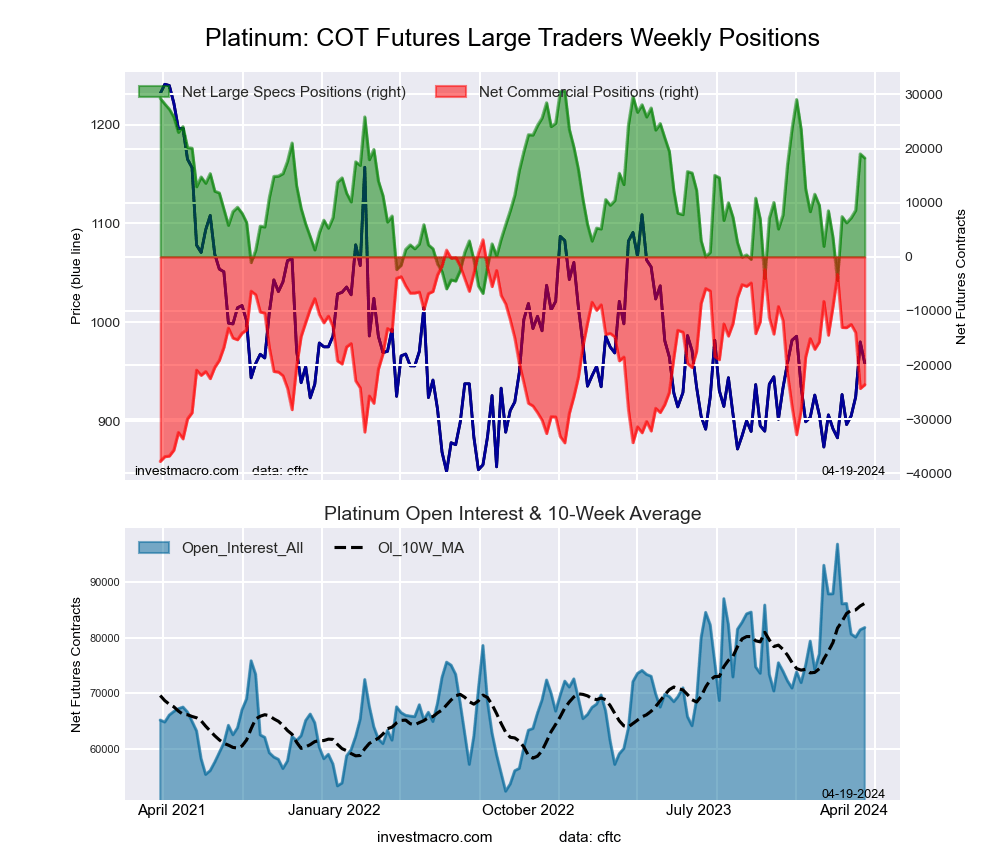
Platinum Futures COT ChartThe Platinum Futures large speculator standing this week reached a net position of 3,601 contracts in the data reported through Tuesday. This was a weekly lowering of -4,894 contracts from the previous week which had a total of 8,495 net contracts.

This week’s current strength score (the trader positioning range over the past three years, measured from 0 to 100) shows the speculators are currently Bearish with a score of 26.2 percent. The commercials are Bullish with a score of 72.0 percent and the small traders (not shown in chart) are Bearish with a score of 43.0 percent.

Price Trend-Following Model: Strong Downtrend

Our weekly trend-following model classifies the current market price position as: Strong Downtrend. The current action for the model is considered to be: New Sell – Short Position.

Platinum Futures StatisticsSPECULATORSCOMMERCIALSSMALL TRADERS
– Percent of Open Interest Longs:56.823.410.8
– Percent of Open Interest Shorts:52.733.94.4
– Net Position:3,601-9,2015,600
– Gross Longs:49,89820,5709,492
– Gross Shorts:46,29729,7713,892
– Long to Short Ratio:1.1 to 10.7 to 12.4 to 1
NET POSITION TREND:
– Strength Index Score (3 Year Range Pct):26.272.043.0
– Strength Index Reading (3 Year Range):BearishBullishBearish
NET POSITION MOVEMENT INDEX:
– 6-Week Change in Strength Index:-22.721.1-4.5


Palladium Futures:

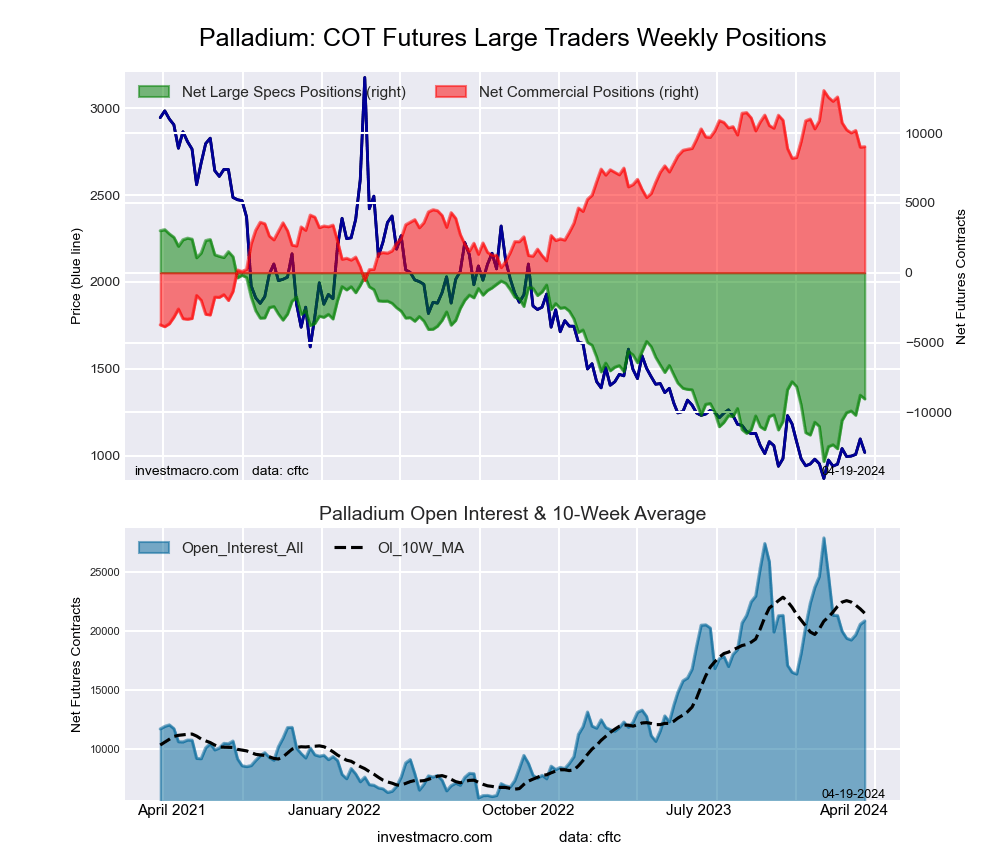
Palladium Futures COT ChartThe Palladium Futures large speculator standing this week reached a net position of -12,315 contracts in the data reported through Tuesday. This was a weekly increase of 138 contracts from the previous week which had a total of -12,453 net contracts.

This week’s current strength score (the trader positioning range over the past three years, measured from 0 to 100) shows the speculators are currently Bearish-Extreme with a score of 7.2 percent. The commercials are Bullish-Extreme with a score of 95.5 percent and the small traders (not shown in chart) are Bearish with a score of 44.2 percent.

Price Trend-Following Model: Downtrend

Our weekly trend-following model classifies the current market price position as: Downtrend. The current action for the model is considered to be: Hold – Maintain Short Position.

Palladium Futures StatisticsSPECULATORSCOMMERCIALSSMALL TRADERS
– Percent of Open Interest Longs:20.762.78.0
– Percent of Open Interest Shorts:78.55.27.8
– Net Position:-12,31512,27342
– Gross Longs:4,41113,3721,708
– Gross Shorts:16,7261,0991,666
– Long to Short Ratio:0.3 to 112.2 to 11.0 to 1
NET POSITION TREND:
– Strength Index Score (3 Year Range Pct):7.295.544.2
– Strength Index Reading (3 Year Range):Bearish-ExtremeBullish-ExtremeBearish
NET POSITION MOVEMENT INDEX:
– 6-Week Change in Strength Index:-5.28.3-32.0


Steel Futures Futures:

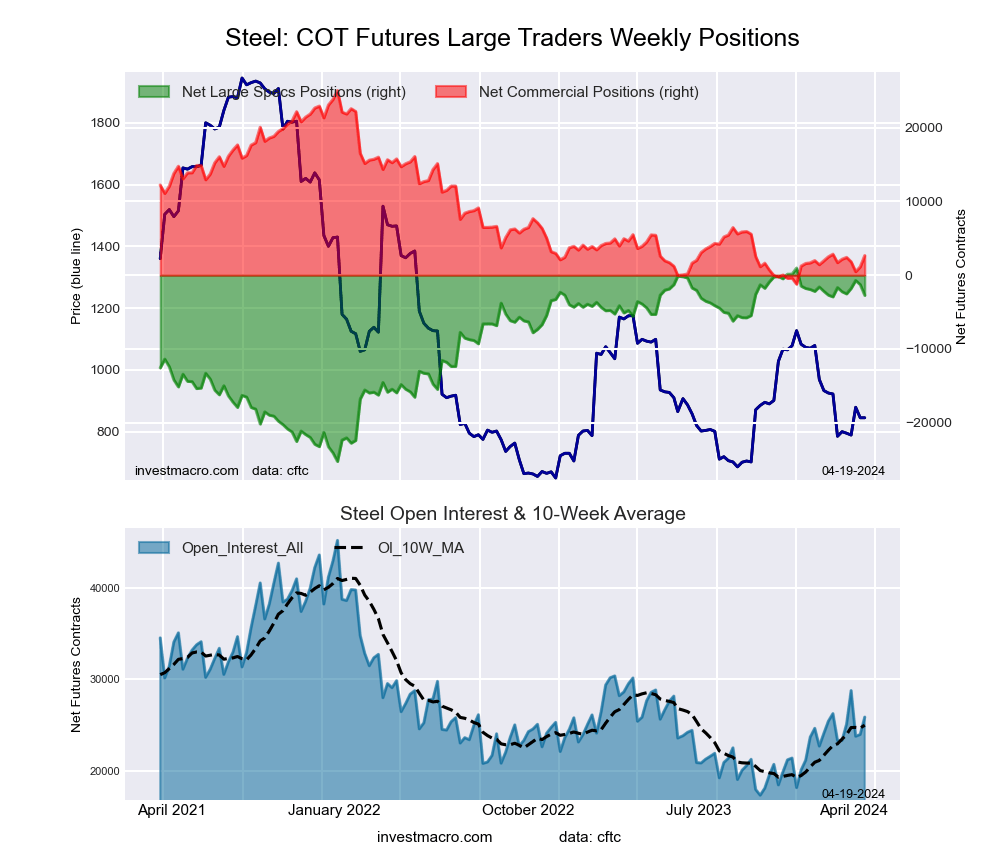
Steel Futures COT ChartThe Steel Futures large speculator standing this week reached a net position of -2,935 contracts in the data reported through Tuesday. This was a weekly fall of -234 contracts from the previous week which had a total of -2,701 net contracts.

This week’s current strength score (the trader positioning range over the past three years, measured from 0 to 100) shows the speculators are currently Bullish-Extreme with a score of 85.1 percent. The commercials are Bearish-Extreme with a score of 15.5 percent and the small traders (not shown in chart) are Bearish with a score of 41.8 percent.

Price Trend-Following Model: Weak Uptrend

Our weekly trend-following model classifies the current market price position as: Weak Uptrend. The current action for the model is considered to be: Hold – Maintain Long Position.

Steel Futures StatisticsSPECULATORSCOMMERCIALSSMALL TRADERS
– Percent of Open Interest Longs:11.282.81.0
– Percent of Open Interest Shorts:22.472.00.7
– Net Position:-2,9352,84986
– Gross Longs:2,93721,733269
– Gross Shorts:5,87218,884183
– Long to Short Ratio:0.5 to 11.2 to 11.5 to 1
NET POSITION TREND:
– Strength Index Score (3 Year Range Pct):85.115.541.8
– Strength Index Reading (3 Year Range):Bullish-ExtremeBearish-ExtremeBearish
NET POSITION MOVEMENT INDEX:
– 6-Week Change in Strength Index:-4.44.8-12.3


Article By InvestMacroReceive our weekly COT Newsletter

*COT Report: The COT data, released weekly to the public each Friday, is updated through the most recent Tuesday (data is 3 days old) and shows a quick view of how large speculators or non-commercials (for-profit traders) were positioned in the futures markets.

The CFTC categorizes trader positions according to commercial hedgers (traders who use futures contracts for hedging as part of the business), non-commercials (large traders who speculate to realize trading profits) and nonreportable traders (usually small traders/speculators) as well as their open interest (contracts open in the market at time of reporting). See CFTC criteria here.

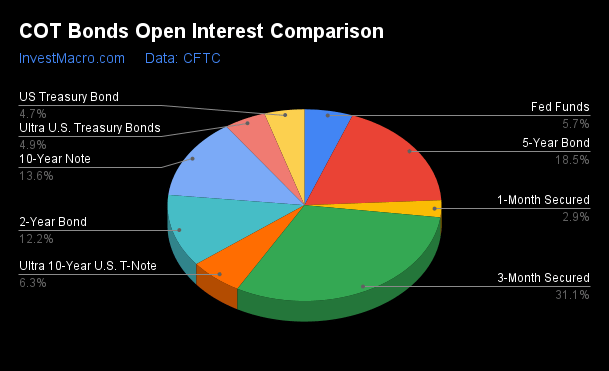
COT Bonds Charts: Speculator bets led by 2-Year Bonds & US Treasury Bonds

By InvestMacro

Here are the latest charts and statistics for the Commitment of Traders (COT) reports data published by the Commodities Futures Trading Commission (CFTC).

The latest COT data is updated through Tuesday February 27th and shows a quick view of how large traders (for-profit speculators and commercial hedgers) were positioned in the futures markets.

Weekly Speculator Changes led by 2-Year Bonds & US Treasury Bonds

The COT bond market speculator bets were overall higher this week as seven out of the eight bond markets we cover had higher positioning while the other one markets had lower speculator contracts.

Leading the gains for the bond markets was the 2-Year Bonds (165,226 contracts) with the US Treasury Bonds (80,756 contracts), the 10-Year Bonds (63,484 contracts), the 5-Year Bonds (37,907 contracts), the SOFR 3-Months (5,584 contracts), the Ultra Treasury Bonds (2,977 contracts) and the Ultra 10-Year Bonds (1,139 contracts) also having positive weeks.

The only market with a decline was the Fed Funds with a drop by -58,874 contracts for the week.


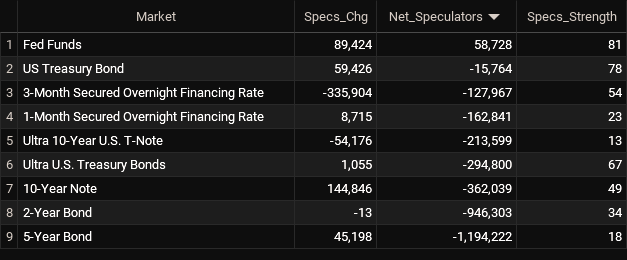
Bonds Net Speculators Leaderboard

Legend: Weekly Speculators Change | Speculators Current Net Position | Speculators Strength Score compared to last 3-Years (0-100 range)


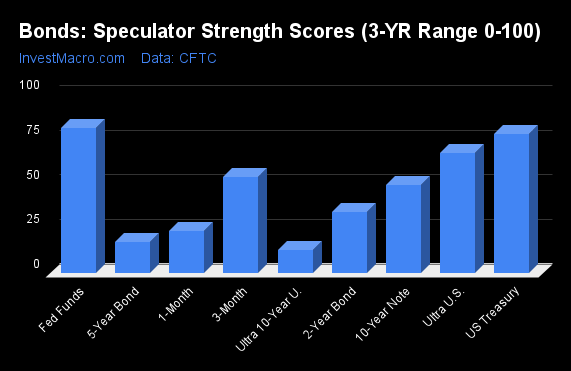
Strength Scores led by SOFR 3-Months & US Treasury Bonds

COT Strength Scores (a normalized measure of Speculator positions over a 3-Year range, from 0 to 100 where above 80 is Extreme-Bullish and below 20 is Extreme-Bearish) showed that the SOFR 3-Months (80 percent) and the US Treasury Bonds (79 percent) lead the bond markets this week. The Ultra Treasury Bonds (57 percent) comes in as the next highest in the weekly strength scores.

On the downside, the Ultra 10-Year Bonds (16 percent) and the 5-Year Bonds (17 percent) come in at the lowest strength level currently and are in Extreme-Bearish territory (below 20 percent). The next lowest strength scores were the 10-Year Bonds (21 percent) and the Fed Funds (21 percent).

Strength Statistics:
Fed Funds (21.3 percent) vs Fed Funds previous week (33.8 percent)
2-Year Bond (34.0 percent) vs 2-Year Bond previous week (23.5 percent)
5-Year Bond (17.5 percent) vs 5-Year Bond previous week (15.0 percent)
10-Year Bond (20.9 percent) vs 10-Year Bond previous week (15.0 percent)
Ultra 10-Year Bond (16.0 percent) vs Ultra 10-Year Bond previous week (15.8 percent)
US Treasury Bond (78.6 percent) vs US Treasury Bond previous week (50.5 percent)
Ultra US Treasury Bond (56.9 percent) vs Ultra US Treasury Bond previous week (55.7 percent)
SOFR 3-Months (79.6 percent) vs SOFR 3-Months previous week (79.3 percent)


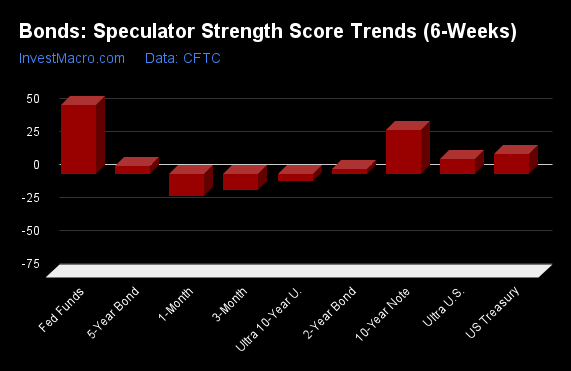
US Treasury Bonds & 10-Year Bonds top the 6-Week Strength Trends

COT Strength Score Trends (or move index, calculates the 6-week changes in strength scores) showed that the US Treasury Bonds (40 percent) and the 10-Year Bonds (21 percent) lead the past six weeks trends for bonds. The 2-Year Bonds (17 percent) are the next highest positive mover in the latest trends data.

The Fed Funds (-33 percent) and the SOFR 3-Months (-19 percent) lead the downside trend scores currently with the Ultra 10-Year Bonds (-5 percent) following next with lower trend scores.

Strength Trend Statistics:
Fed Funds (-33.2 percent) vs Fed Funds previous week (-5.6 percent)
2-Year Bond (16.5 percent) vs 2-Year Bond previous week (8.3 percent)
5-Year Bond (0.1 percent) vs 5-Year Bond previous week (-4.0 percent)
10-Year Bond (20.9 percent) vs 10-Year Bond previous week (5.4 percent)
Ultra 10-Year Bond (-5.4 percent) vs Ultra 10-Year Bond previous week (-3.1 percent)
US Treasury Bond (39.6 percent) vs US Treasury Bond previous week (21.2 percent)
Ultra US Treasury Bond (1.2 percent) vs Ultra US Treasury Bond previous week (-4.0 percent)
SOFR 3-Months (-19.5 percent) vs SOFR 3-Months previous week (-16.4 percent)


Secured Overnight Financing Rate (3-Month) Futures:

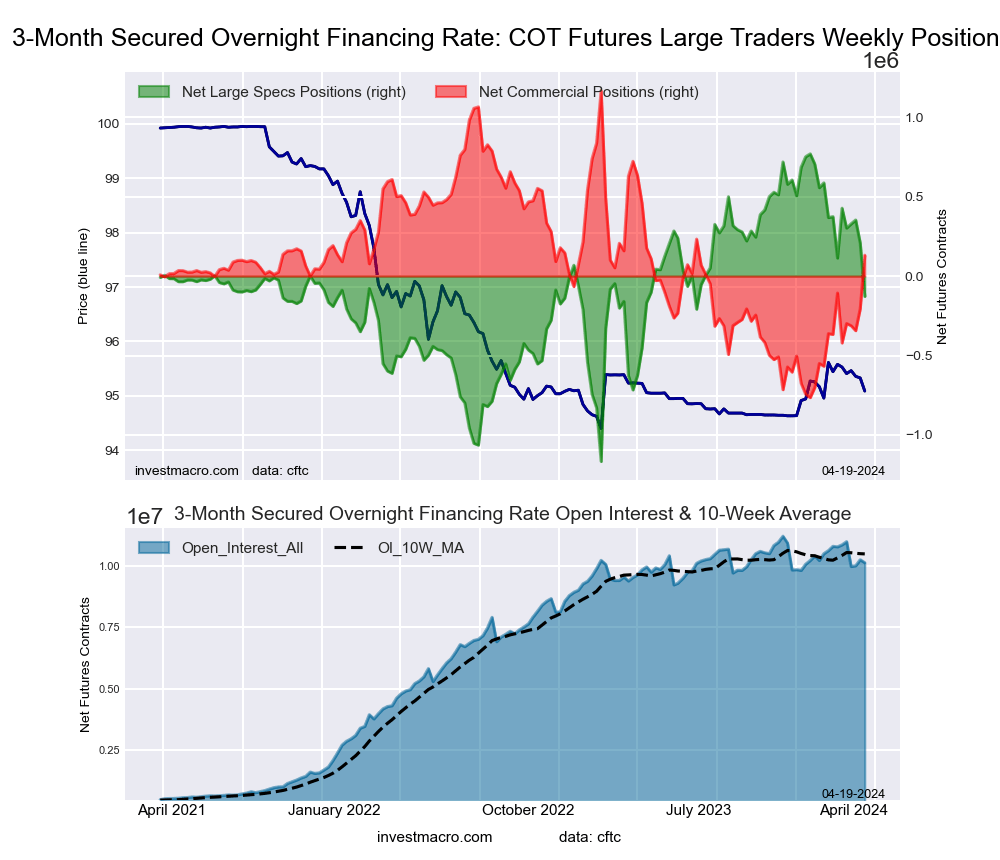
SOFR 3-Months Bonds Futures COT ChartThe Secured Overnight Financing Rate (3-Month) large speculator standing this week resulted in a net position of 373,974 contracts in the data reported through Tuesday. This was a weekly lift of 5,584 contracts from the previous week which had a total of 368,390 net contracts.

This week’s current strength score (the trader positioning range over the past three years, measured from 0 to 100) shows the speculators are currently Bullish with a score of 79.6 percent. The commercials are Bearish with a score of 20.6 percent and the small traders (not shown in chart) are Bullish-Extreme with a score of 84.0 percent.

Price Trend-Following Model: Weak Uptrend

Our weekly trend-following model classifies the current market price position as: Weak Uptrend. The current action for the model is considered to be: Hold – Maintain Long Position.

SOFR 3-Months StatisticsSPECULATORSCOMMERCIALSSMALL TRADERS
– Percent of Open Interest Longs:16.954.70.2
– Percent of Open Interest Shorts:13.458.10.3
– Net Position:373,974-366,966-7,008
– Gross Longs:1,825,9585,914,86126,690
– Gross Shorts:1,451,9846,281,82733,698
– Long to Short Ratio:1.3 to 10.9 to 10.8 to 1
NET POSITION TREND:
– Strength Index Score (3 Year Range Pct):79.620.684.0
– Strength Index Reading (3 Year Range):BullishBearishBullish-Extreme
NET POSITION MOVEMENT INDEX:
– 6-Week Change in Strength Index:-19.519.6-0.4


30-Day Federal Funds Futures:

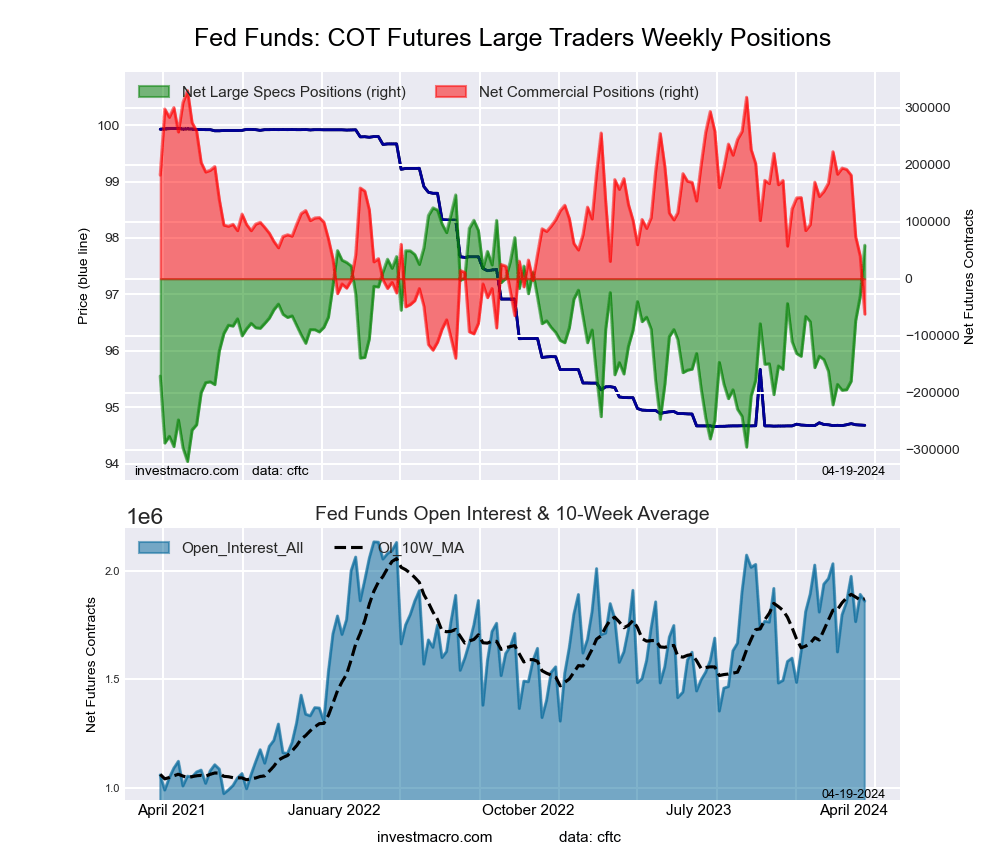
Federal Funds 30-Day Bonds Futures COT ChartThe 30-Day Federal Funds large speculator standing this week resulted in a net position of -221,404 contracts in the data reported through Tuesday. This was a weekly lowering of -58,874 contracts from the previous week which had a total of -162,530 net contracts.

This week’s current strength score (the trader positioning range over the past three years, measured from 0 to 100) shows the speculators are currently Bearish with a score of 21.3 percent. The commercials are Bullish with a score of 77.1 percent and the small traders (not shown in chart) are Bullish-Extreme with a score of 87.7 percent.

Price Trend-Following Model: Downtrend

Our weekly trend-following model classifies the current market price position as: Downtrend. The current action for the model is considered to be: Hold – Maintain Short Position.

30-Day Federal Funds StatisticsSPECULATORSCOMMERCIALSSMALL TRADERS
– Percent of Open Interest Longs:13.070.31.7
– Percent of Open Interest Shorts:23.959.31.8
– Net Position:-221,404223,075-1,671
– Gross Longs:264,2441,427,60934,288
– Gross Shorts:485,6481,204,53435,959
– Long to Short Ratio:0.5 to 11.2 to 11.0 to 1
NET POSITION TREND:
– Strength Index Score (3 Year Range Pct):21.377.187.7
– Strength Index Reading (3 Year Range):BearishBullishBullish-Extreme
NET POSITION MOVEMENT INDEX:
– 6-Week Change in Strength Index:-33.229.433.2


2-Year Treasury Note Futures:

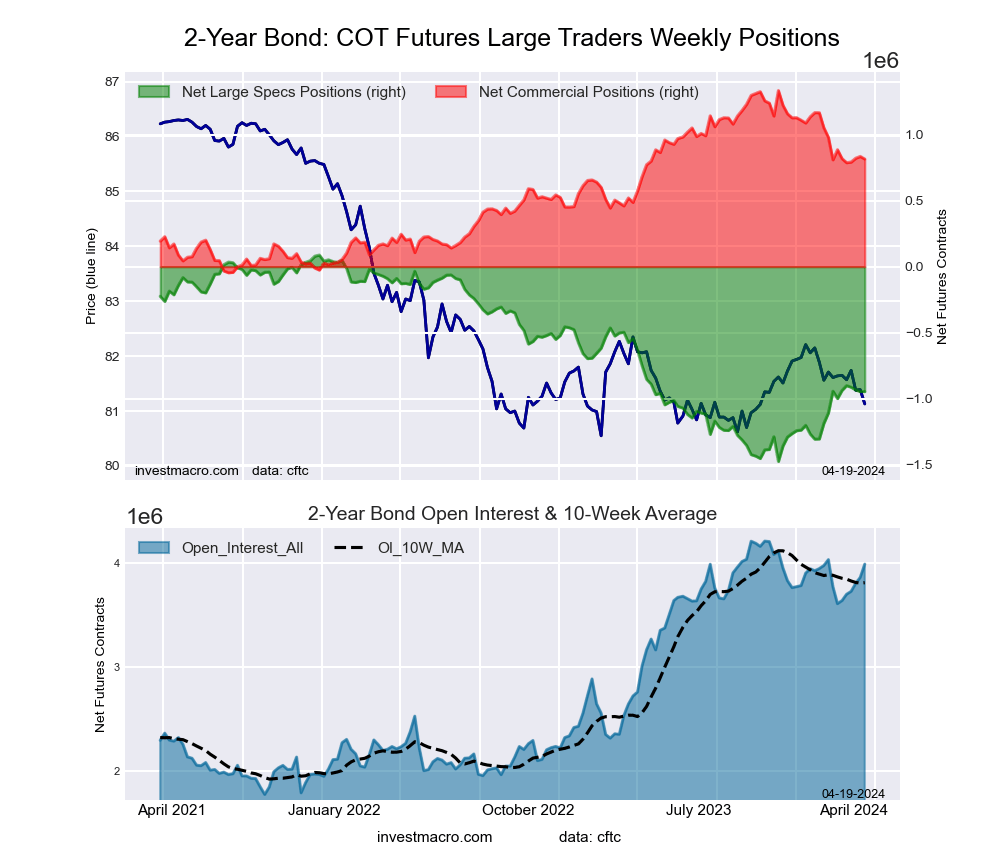
2-Year Treasury Bonds Futures COT ChartThe 2-Year Treasury Note large speculator standing this week resulted in a net position of -943,898 contracts in the data reported through Tuesday. This was a weekly lift of 165,226 contracts from the previous week which had a total of -1,109,124 net contracts.

This week’s current strength score (the trader positioning range over the past three years, measured from 0 to 100) shows the speculators are currently Bearish with a score of 34.0 percent. The commercials are Bullish with a score of 62.0 percent and the small traders (not shown in chart) are Bullish-Extreme with a score of 95.0 percent.

Price Trend-Following Model: Uptrend

Our weekly trend-following model classifies the current market price position as: Uptrend. The current action for the model is considered to be: Hold – Maintain Long Position.

2-Year Treasury Note StatisticsSPECULATORSCOMMERCIALSSMALL TRADERS
– Percent of Open Interest Longs:10.380.47.1
– Percent of Open Interest Shorts:35.358.93.5
– Net Position:-943,898809,780134,118
– Gross Longs:387,1383,030,544267,240
– Gross Shorts:1,331,0362,220,764133,122
– Long to Short Ratio:0.3 to 11.4 to 12.0 to 1
NET POSITION TREND:
– Strength Index Score (3 Year Range Pct):34.062.095.0
– Strength Index Reading (3 Year Range):BearishBullishBullish-Extreme
NET POSITION MOVEMENT INDEX:
– 6-Week Change in Strength Index:16.5-20.27.6


5-Year Treasury Note Futures:

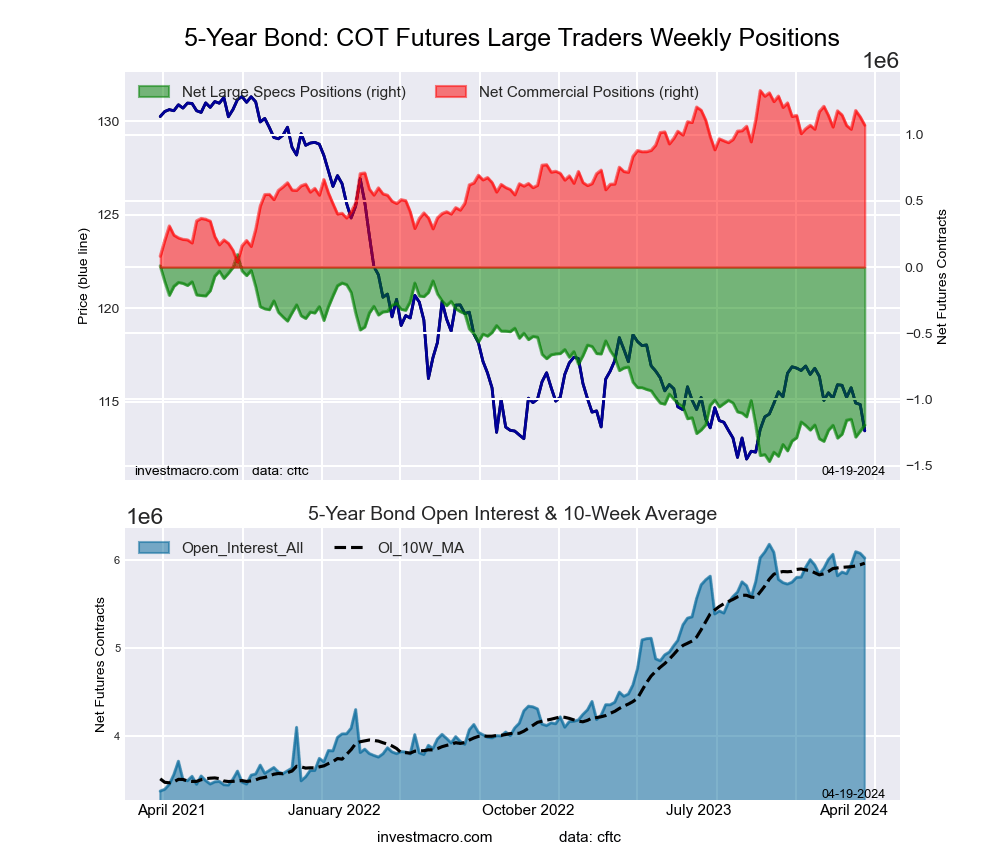
5-Year Treasury Bonds Futures COT ChartThe 5-Year Treasury Note large speculator standing this week resulted in a net position of -1,195,393 contracts in the data reported through Tuesday. This was a weekly advance of 37,907 contracts from the previous week which had a total of -1,233,300 net contracts.

This week’s current strength score (the trader positioning range over the past three years, measured from 0 to 100) shows the speculators are currently Bearish-Extreme with a score of 17.5 percent. The commercials are Bullish with a score of 79.0 percent and the small traders (not shown in chart) are Bullish-Extreme with a score of 91.8 percent.

Price Trend-Following Model: Uptrend

Our weekly trend-following model classifies the current market price position as: Uptrend. The current action for the model is considered to be: Hold – Maintain Long Position.

5-Year Treasury Note StatisticsSPECULATORSCOMMERCIALSSMALL TRADERS
– Percent of Open Interest Longs:6.383.87.1
– Percent of Open Interest Shorts:26.066.34.8
– Net Position:-1,195,3931,058,803136,590
– Gross Longs:382,3965,074,656428,067
– Gross Shorts:1,577,7894,015,853291,477
– Long to Short Ratio:0.2 to 11.3 to 11.5 to 1
NET POSITION TREND:
– Strength Index Score (3 Year Range Pct):17.579.091.8
– Strength Index Reading (3 Year Range):Bearish-ExtremeBullishBullish-Extreme
NET POSITION MOVEMENT INDEX:
– 6-Week Change in Strength Index:0.11.0-3.1


10-Year Treasury Note Futures:

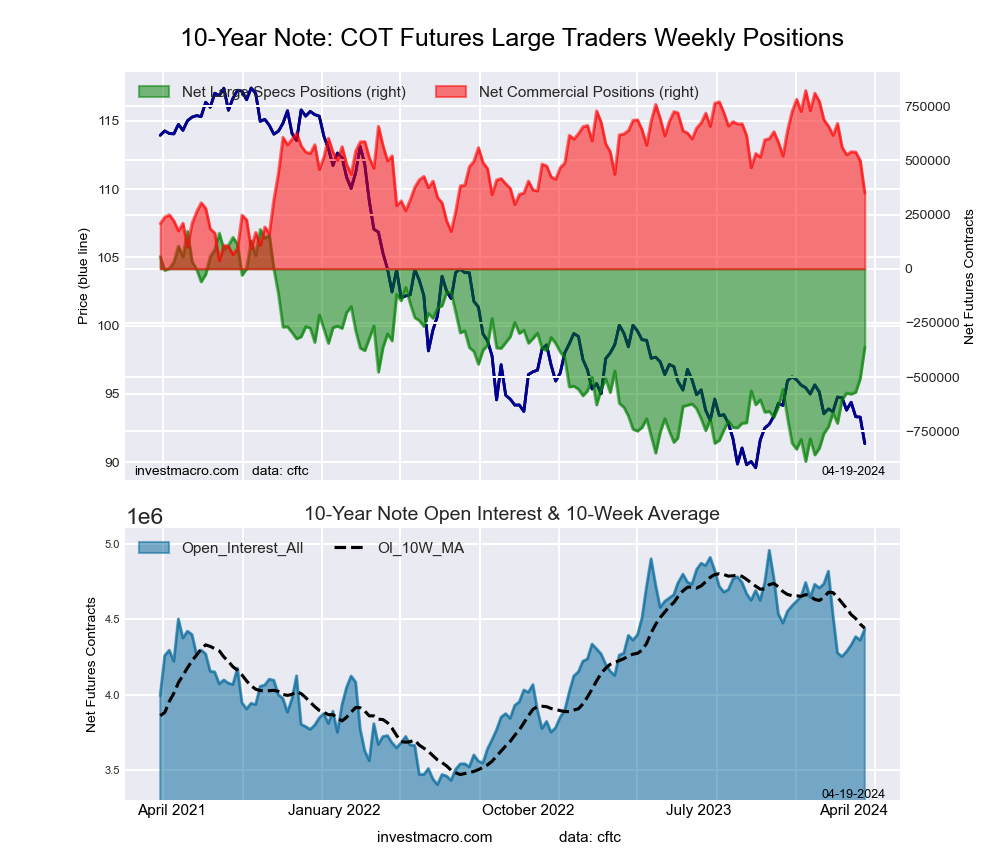
10-Year Treasury Notes Bonds Futures COT ChartThe 10-Year Treasury Note large speculator standing this week resulted in a net position of -665,582 contracts in the data reported through Tuesday. This was a weekly boost of 63,484 contracts from the previous week which had a total of -729,066 net contracts.

This week’s current strength score (the trader positioning range over the past three years, measured from 0 to 100) shows the speculators are currently Bearish with a score of 20.9 percent. The commercials are Bullish with a score of 73.7 percent and the small traders (not shown in chart) are Bullish-Extreme with a score of 84.2 percent.

Price Trend-Following Model: Uptrend

Our weekly trend-following model classifies the current market price position as: Uptrend. The current action for the model is considered to be: Hold – Maintain Long Position.

10-Year Treasury Note StatisticsSPECULATORSCOMMERCIALSSMALL TRADERS
– Percent of Open Interest Longs:10.577.19.5
– Percent of Open Interest Shorts:25.263.58.4
– Net Position:-665,582616,38549,197
– Gross Longs:474,5293,492,870429,894
– Gross Shorts:1,140,1112,876,485380,697
– Long to Short Ratio:0.4 to 11.2 to 11.1 to 1
NET POSITION TREND:
– Strength Index Score (3 Year Range Pct):20.973.784.2
– Strength Index Reading (3 Year Range):BearishBullishBullish-Extreme
NET POSITION MOVEMENT INDEX:
– 6-Week Change in Strength Index:20.9-26.3-3.8


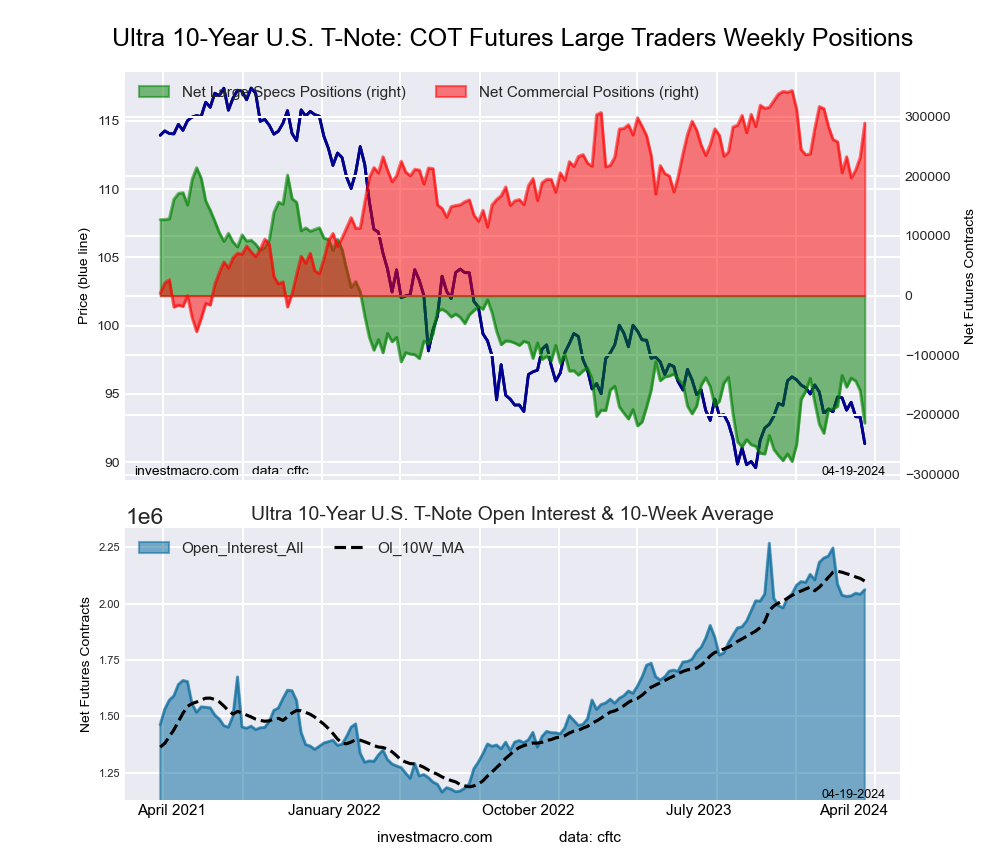
Ultra 10-Year Notes Futures:

Ultra 10-Year Treasury Notes Bonds Futures COT ChartThe Ultra 10-Year Notes large speculator standing this week resulted in a net position of -189,900 contracts in the data reported through Tuesday. This was a weekly gain of 1,139 contracts from the previous week which had a total of -191,039 net contracts.

This week’s current strength score (the trader positioning range over the past three years, measured from 0 to 100) shows the speculators are currently Bearish-Extreme with a score of 16.0 percent. The commercials are Bullish-Extreme with a score of 83.6 percent and the small traders (not shown in chart) are Bullish with a score of 71.3 percent.

Price Trend-Following Model: Weak Uptrend

Our weekly trend-following model classifies the current market price position as: Weak Uptrend. The current action for the model is considered to be: Hold – Maintain Long Position.

Ultra 10-Year Notes StatisticsSPECULATORSCOMMERCIALSSMALL TRADERS
– Percent of Open Interest Longs:12.575.59.4
– Percent of Open Interest Shorts:21.063.812.6
– Net Position:-189,900261,839-71,939
– Gross Longs:281,6551,696,545210,640
– Gross Shorts:471,5551,434,706282,579
– Long to Short Ratio:0.6 to 11.2 to 10.7 to 1
NET POSITION TREND:
– Strength Index Score (3 Year Range Pct):16.083.671.3
– Strength Index Reading (3 Year Range):Bearish-ExtremeBullish-ExtremeBullish
NET POSITION MOVEMENT INDEX:
– 6-Week Change in Strength Index:-5.45.12.5


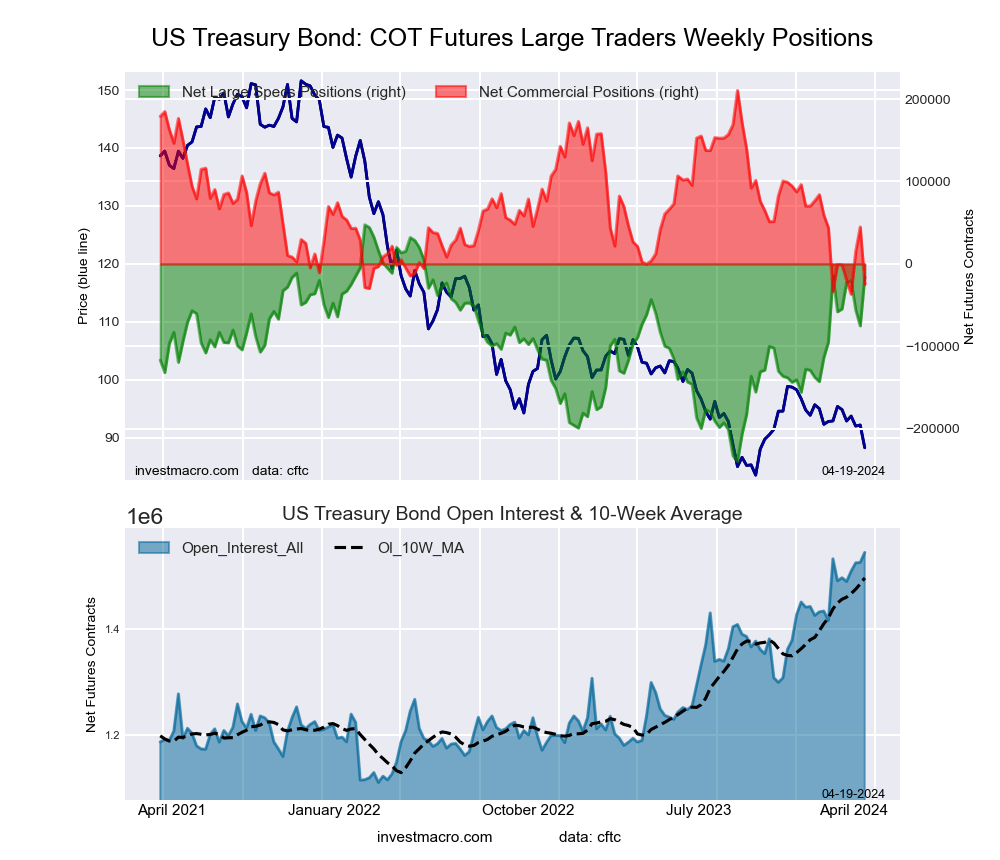
US Treasury Bonds Futures:

US Year Treasury Notes Long Bonds Futures COT ChartThe US Treasury Bonds large speculator standing this week resulted in a net position of -14,038 contracts in the data reported through Tuesday. This was a weekly gain of 80,756 contracts from the previous week which had a total of -94,794 net contracts.

This week’s current strength score (the trader positioning range over the past three years, measured from 0 to 100) shows the speculators are currently Bullish with a score of 78.6 percent. The commercials are Bearish-Extreme with a score of 0.0 percent and the small traders (not shown in chart) are Bullish-Extreme with a score of 83.0 percent.

Price Trend-Following Model: Uptrend

Our weekly trend-following model classifies the current market price position as: Uptrend. The current action for the model is considered to be: Hold – Maintain Long Position.

US Treasury Bonds StatisticsSPECULATORSCOMMERCIALSSMALL TRADERS
– Percent of Open Interest Longs:15.566.213.1
– Percent of Open Interest Shorts:16.468.410.0
– Net Position:-14,038-33,38247,420
– Gross Longs:237,9781,015,447201,594
– Gross Shorts:252,0161,048,829154,174
– Long to Short Ratio:0.9 to 11.0 to 11.3 to 1
NET POSITION TREND:
– Strength Index Score (3 Year Range Pct):78.60.083.0
– Strength Index Reading (3 Year Range):BullishBearish-ExtremeBullish-Extreme
NET POSITION MOVEMENT INDEX:
– 6-Week Change in Strength Index:39.6-41.0-7.4


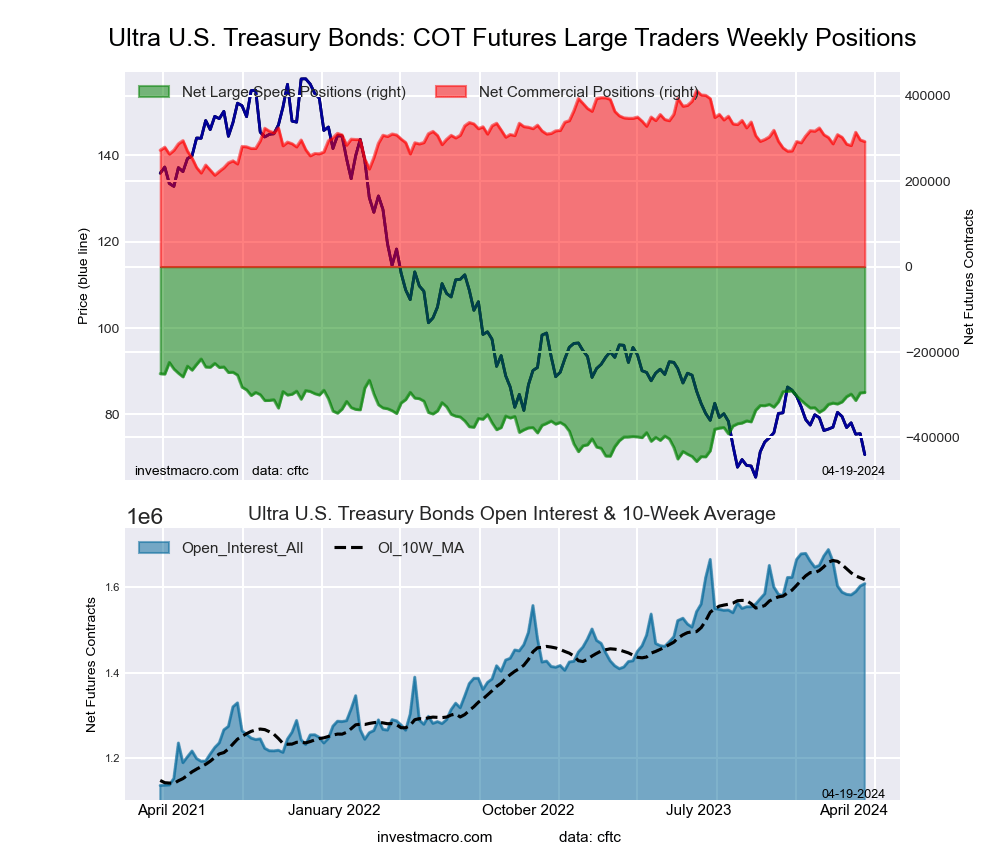
Ultra US Treasury Bonds Futures:

Ultra US Year Treasury Notes Long Bonds Futures COT ChartThe Ultra US Treasury Bonds large speculator standing this week resulted in a net position of -319,783 contracts in the data reported through Tuesday. This was a weekly lift of 2,977 contracts from the previous week which had a total of -322,760 net contracts.

This week’s current strength score (the trader positioning range over the past three years, measured from 0 to 100) shows the speculators are currently Bullish with a score of 56.9 percent. The commercials are Bearish with a score of 37.1 percent and the small traders (not shown in chart) are Bullish with a score of 67.4 percent.

Price Trend-Following Model: Uptrend

Our weekly trend-following model classifies the current market price position as: Uptrend. The current action for the model is considered to be: Hold – Maintain Long Position.

Ultra US Treasury Bonds StatisticsSPECULATORSCOMMERCIALSSMALL TRADERS
– Percent of Open Interest Longs:8.877.510.8
– Percent of Open Interest Shorts:28.160.28.9
– Net Position:-319,783287,81831,965
– Gross Longs:146,3361,287,850179,326
– Gross Shorts:466,1191,000,032147,361
– Long to Short Ratio:0.3 to 11.3 to 11.2 to 1
NET POSITION TREND:
– Strength Index Score (3 Year Range Pct):56.937.167.4
– Strength Index Reading (3 Year Range):BullishBearishBullish
NET POSITION MOVEMENT INDEX:
– 6-Week Change in Strength Index:1.2-9.214.6


Article By InvestMacroReceive our weekly COT Newsletter

*COT Report: The COT data, released weekly to the public each Friday, is updated through the most recent Tuesday (data is 3 days old) and shows a quick view of how large speculators or non-commercials (for-profit traders) were positioned in the futures markets.

The CFTC categorizes trader positions according to commercial hedgers (traders who use futures contracts for hedging as part of the business), non-commercials (large traders who speculate to realize trading profits) and nonreportable traders (usually small traders/speculators) as well as their open interest (contracts open in the market at time of reporting). See CFTC criteria here.
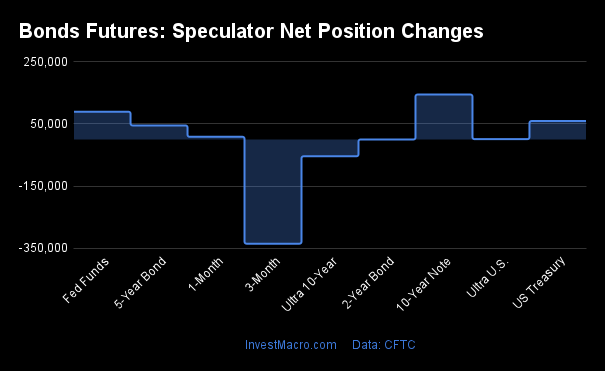
COT Stock Market Charts: Speculator bets led by MSCI EAFE-Mini & Russell-Mini

By InvestMacro

Here are the latest charts and statistics for the Commitment of Traders (COT) data published by the Commodities Futures Trading Commission (CFTC).
The latest COT data is updated through Tuesday February 27th and shows a quick view of how large traders (for-profit speculators and commercial entities) were positioned in the futures markets.

Weekly Speculator Changes led by MSCI EAFE-Mini & Russell-Mini

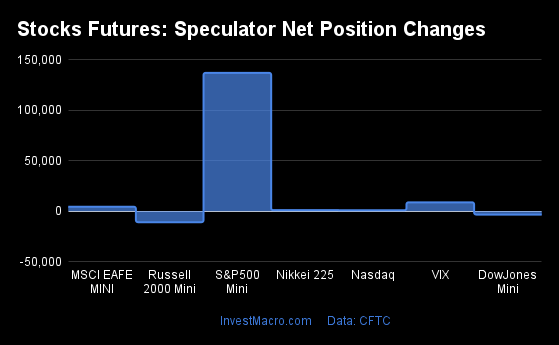
The COT stock markets speculator bets were slightly lower this week as three out of the seven stock markets we cover had higher positioning while the other four markets had lower speculator contracts.

Leading the gains for the stock markets was the MSCI EAFE-Mini (14,518 contracts) with the Russell-Mini (5,977 contracts) and the DowJones-Mini (1,460 contracts) also showing positive weeks.

The markets with declines in speculator bets this week were the Nasdaq-Mini (-15,315 contracts), the S&P500-Mini (-5,693 contracts), the Nikkei 225 (-1,574 contracts) and the VIX (-1,633 contracts).


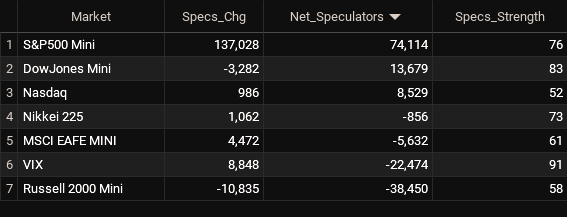
Net Speculators Leaderboard

Legend: Weekly Speculators Change | Speculators Current Net Position | Speculators Strength Score compared to last 3-Years (0-100 range)


Strength Scores led by DowJones-Mini & VIX

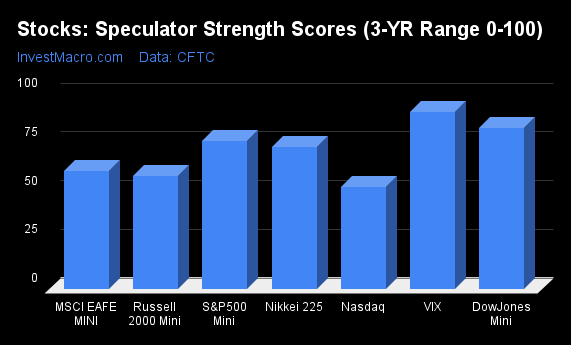
COT Strength Scores (a normalized measure of Speculator positions over a 3-Year range, from 0 to 100 where above 80 is Extreme-Bullish and below 20 is Extreme-Bearish) showed that the DowJones-Mini (90 percent) and the VIX (77 percent) lead the stock markets this week. The Russell-Mini (72 percent) comes in as the next highest in the weekly strength scores.

On the downside, the Nikkei 225 (29 percent) and the S&P500-Mini (31 percent) come in at the lowest strength levels currently.

Strength Statistics:
VIX (77.0 percent) vs VIX previous week (78.4 percent)
S&P500-Mini (31.3 percent) vs S&P500-Mini previous week (32.2 percent)
DowJones-Mini (89.9 percent) vs DowJones-Mini previous week (87.5 percent)
Nasdaq-Mini (55.0 percent) vs Nasdaq-Mini previous week (78.8 percent)
Russell2000-Mini (72.2 percent) vs Russell2000-Mini previous week (67.9 percent)
Nikkei USD (29.0 percent) vs Nikkei USD previous week (40.2 percent)
EAFE-Mini (49.1 percent) vs EAFE-Mini previous week (34.1 percent)


MSCI EAFE-Mini & VIX top the 6-Week Strength Trends

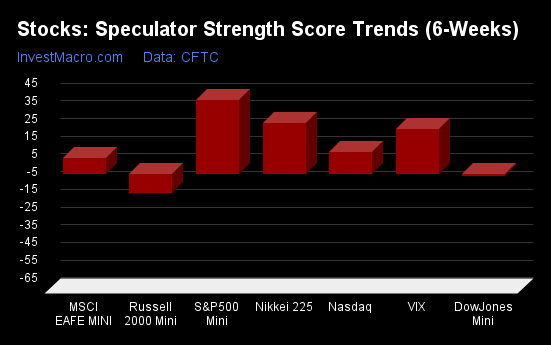
COT Strength Score Trends (or move index, calculates the 6-week changes in strength scores) showed that the MSCI EAFE-Mini (14 percent) leads the past six weeks trends for the stock markets. The VIX (3 percent) and the DowJones-Mini (1 percent) are the other positive movers in the latest trends data.

The Nasdaq-Mini (-41 percent) leads the downside trend scores currently with the Russell-Mini (-23 percent) coming in as the next market with lower trend scores.

Strength Trend Statistics:
VIX (2.6 percent) vs VIX previous week (4.4 percent)
S&P500-Mini (-8.2 percent) vs S&P500-Mini previous week (-15.1 percent)
DowJones-Mini (1.3 percent) vs DowJones-Mini previous week (-12.0 percent)
Nasdaq-Mini (-40.8 percent) vs Nasdaq-Mini previous week (-17.4 percent)
Russell2000-Mini (-23.0 percent) vs Russell2000-Mini previous week (-32.1 percent)
Nikkei USD (-5.8 percent) vs Nikkei USD previous week (-7.5 percent)
EAFE-Mini (13.9 percent) vs EAFE-Mini previous week (-2.1 percent)


Individual Stock Market Charts:

VIX Volatility Futures:

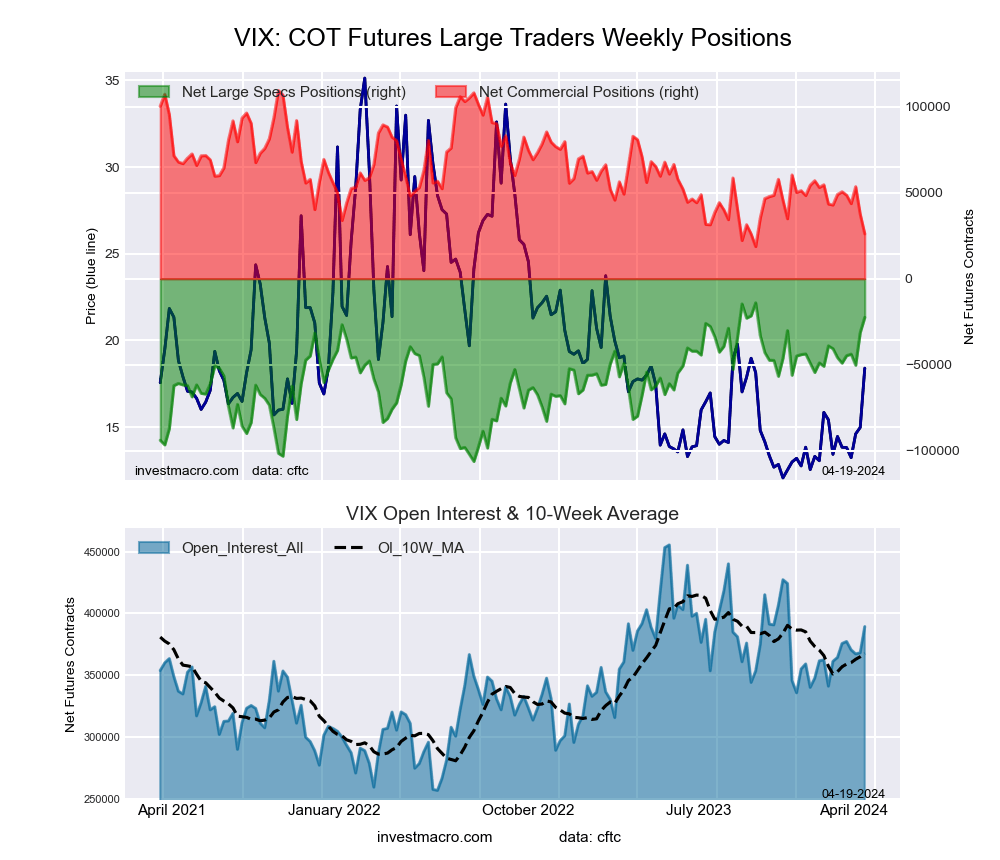
VIX Volatility Futures COT ChartThe VIX Volatility large speculator standing this week recorded a net position of -40,704 contracts in the data reported through Tuesday. This was a weekly fall of -1,633 contracts from the previous week which had a total of -39,071 net contracts.

This week’s current strength score (the trader positioning range over the past three years, measured from 0 to 100) shows the speculators are currently Bullish with a score of 77.0 percent. The commercials are Bearish-Extreme with a score of 19.6 percent and the small traders (not shown in chart) are Bullish-Extreme with a score of 85.1 percent.

Price Trend-Following Model: Downtrend

Our weekly trend-following model classifies the current market price position as: Downtrend. The current action for the model is considered to be: Hold – Maintain Short Position.

VIX Volatility Futures StatisticsSPECULATORSCOMMERCIALSSMALL TRADERS
– Percent of Open Interest Longs:20.644.97.4
– Percent of Open Interest Shorts:31.933.18.0
– Net Position:-40,70442,920-2,216
– Gross Longs:74,471162,35626,855
– Gross Shorts:115,175119,43629,071
– Long to Short Ratio:0.6 to 11.4 to 10.9 to 1
NET POSITION TREND:
– Strength Index Score (3 Year Range Pct):77.019.685.1
– Strength Index Reading (3 Year Range):BullishBearish-ExtremeBullish-Extreme
NET POSITION MOVEMENT INDEX:
– 6-Week Change in Strength Index:2.6-4.512.6


S&P500 Mini Futures:

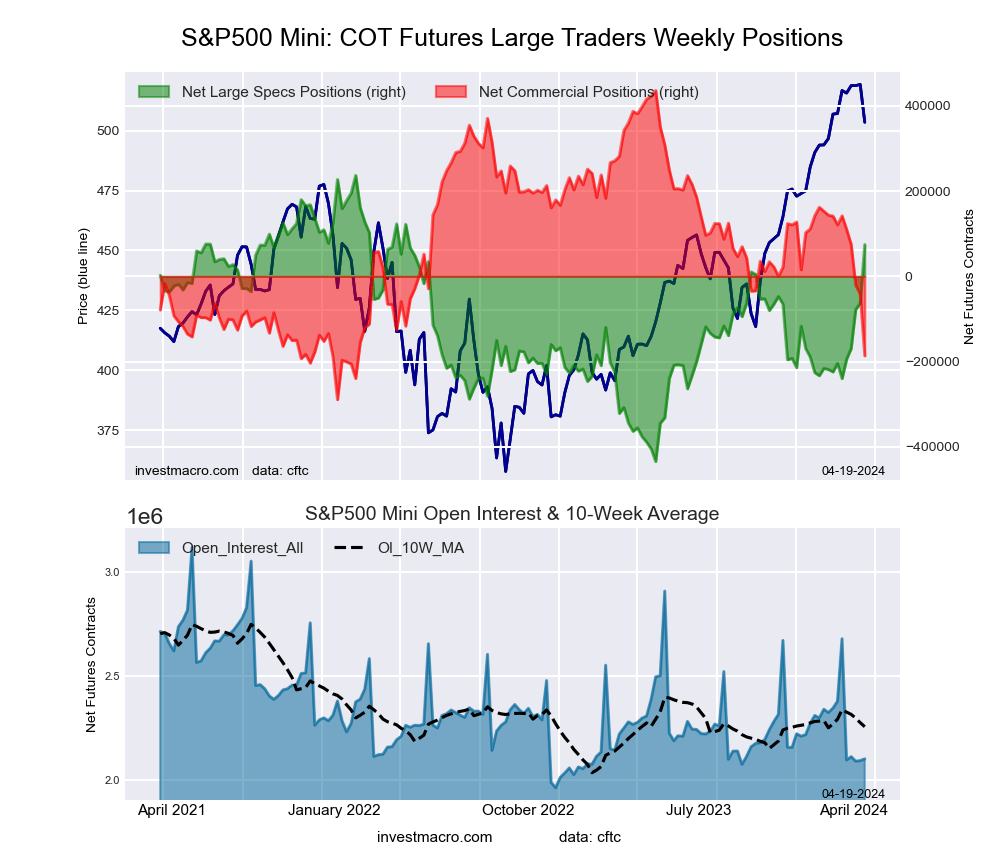
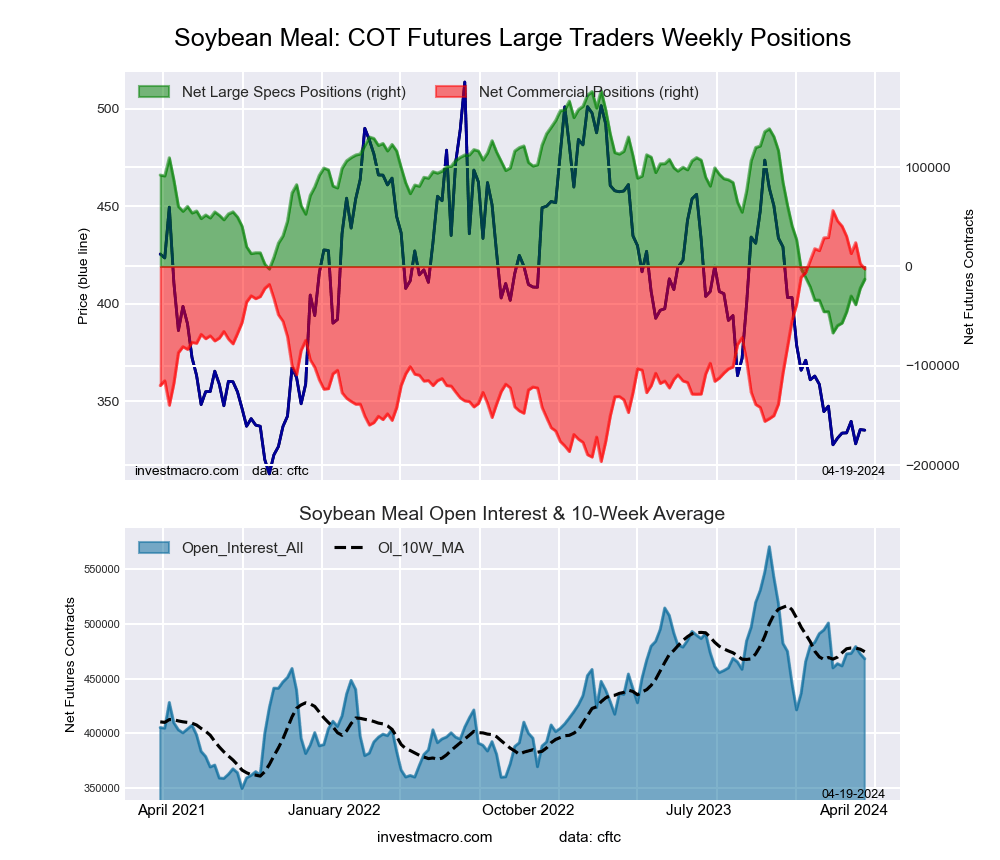
SP500 Mini Futures COT ChartThe S&P500 Mini large speculator standing this week recorded a net position of -224,223 contracts in the data reported through Tuesday. This was a weekly lowering of -5,693 contracts from the previous week which had a total of -218,530 net contracts.

This week’s current strength score (the trader positioning range over the past three years, measured from 0 to 100) shows the speculators are currently Bearish with a score of 31.3 percent. The commercials are Bullish with a score of 59.4 percent and the small traders (not shown in chart) are Bullish with a score of 70.1 percent.

Price Trend-Following Model: Strong Uptrend

Our weekly trend-following model classifies the current market price position as: Strong Uptrend. The current action for the model is considered to be: Hold – Maintain Long Position.

S&P500 Mini Futures StatisticsSPECULATORSCOMMERCIALSSMALL TRADERS
– Percent of Open Interest Longs:12.773.211.2
– Percent of Open Interest Shorts:22.367.27.7
– Net Position:-224,223141,21483,009
– Gross Longs:298,5381,716,692263,456
– Gross Shorts:522,7611,575,478180,447
– Long to Short Ratio:0.6 to 11.1 to 11.5 to 1
NET POSITION TREND:
– Strength Index Score (3 Year Range Pct):31.359.470.1
– Strength Index Reading (3 Year Range):BearishBullishBullish
NET POSITION MOVEMENT INDEX:
– 6-Week Change in Strength Index:-8.25.46.4


Dow Jones Mini Futures:

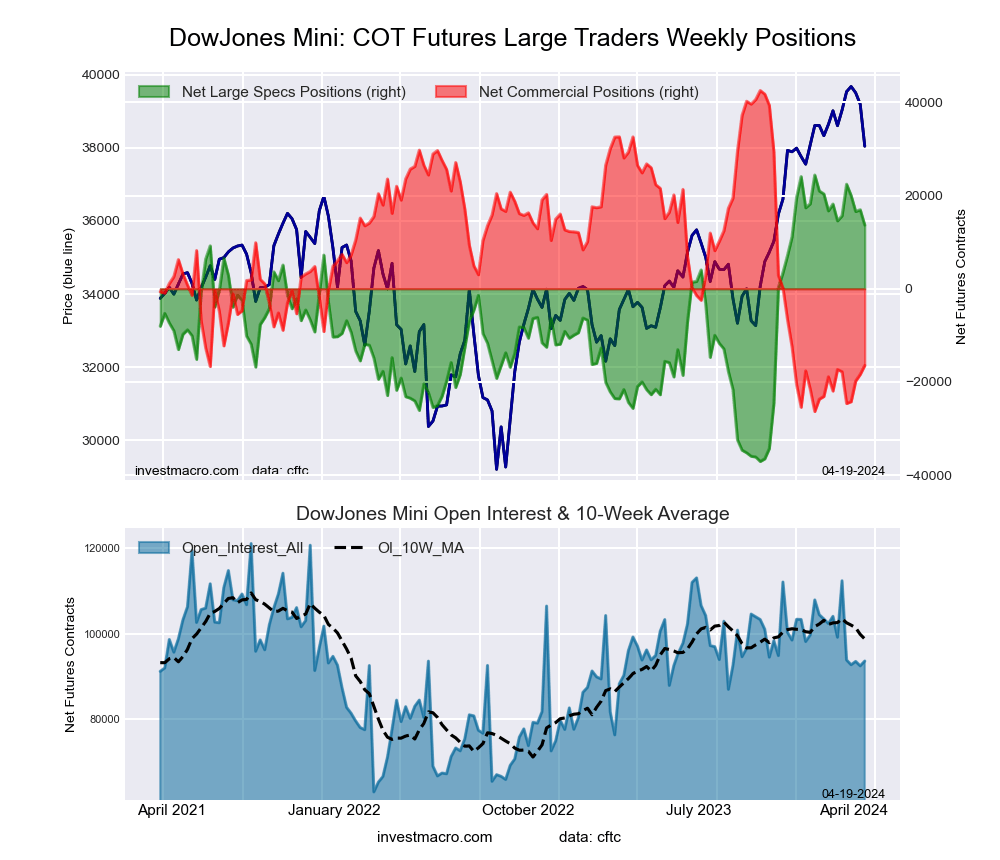
Dow Jones Mini Futures COT ChartThe Dow Jones Mini large speculator standing this week recorded a net position of 18,188 contracts in the data reported through Tuesday. This was a weekly increase of 1,460 contracts from the previous week which had a total of 16,728 net contracts.

This week’s current strength score (the trader positioning range over the past three years, measured from 0 to 100) shows the speculators are currently Bullish-Extreme with a score of 89.9 percent. The commercials are Bearish-Extreme with a score of 6.4 percent and the small traders (not shown in chart) are Bullish with a score of 62.3 percent.

Price Trend-Following Model: Uptrend

Our weekly trend-following model classifies the current market price position as: Uptrend. The current action for the model is considered to be: Hold – Maintain Long Position.

Dow Jones Mini Futures StatisticsSPECULATORSCOMMERCIALSSMALL TRADERS
– Percent of Open Interest Longs:31.551.315.3
– Percent of Open Interest Shorts:14.072.411.6
– Net Position:18,188-21,9573,769
– Gross Longs:32,77953,39915,869
– Gross Shorts:14,59175,35612,100
– Long to Short Ratio:2.2 to 10.7 to 11.3 to 1
NET POSITION TREND:
– Strength Index Score (3 Year Range Pct):89.96.462.3
– Strength Index Reading (3 Year Range):Bullish-ExtremeBearish-ExtremeBullish
NET POSITION MOVEMENT INDEX:
– 6-Week Change in Strength Index:1.3-6.317.3


Nasdaq Mini Futures:

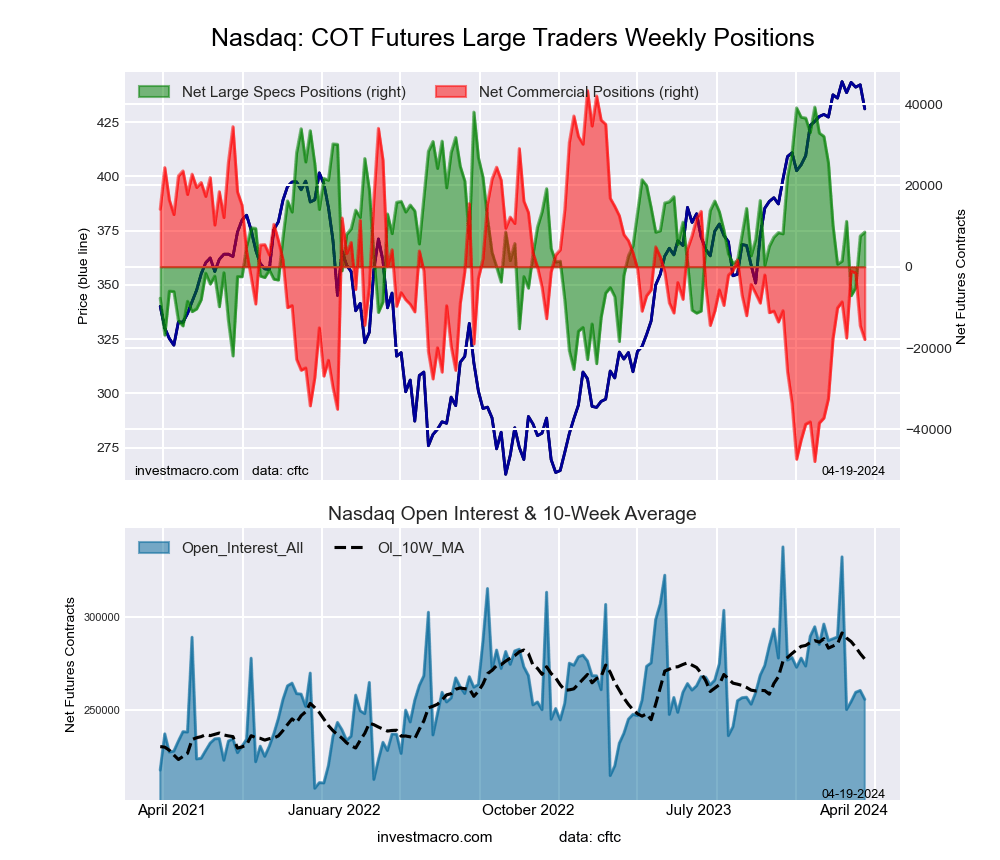
Nasdaq Mini Futures COT ChartThe Nasdaq Mini large speculator standing this week recorded a net position of 10,246 contracts in the data reported through Tuesday. This was a weekly decrease of -15,315 contracts from the previous week which had a total of 25,561 net contracts.

This week’s current strength score (the trader positioning range over the past three years, measured from 0 to 100) shows the speculators are currently Bullish with a score of 55.0 percent. The commercials are Bearish with a score of 33.1 percent and the small traders (not shown in chart) are Bullish-Extreme with a score of 96.8 percent.

Price Trend-Following Model: Strong Uptrend

Our weekly trend-following model classifies the current market price position as: Strong Uptrend. The current action for the model is considered to be: Hold – Maintain Long Position.

Nasdaq Mini Futures StatisticsSPECULATORSCOMMERCIALSSMALL TRADERS
– Percent of Open Interest Longs:31.553.213.7
– Percent of Open Interest Shorts:27.959.411.1
– Net Position:10,246-17,7027,456
– Gross Longs:90,667153,36139,468
– Gross Shorts:80,421171,06332,012
– Long to Short Ratio:1.1 to 10.9 to 11.2 to 1
NET POSITION TREND:
– Strength Index Score (3 Year Range Pct):55.033.196.8
– Strength Index Reading (3 Year Range):BullishBearishBullish-Extreme
NET POSITION MOVEMENT INDEX:
– 6-Week Change in Strength Index:-40.823.114.2


Russell 2000 Mini Futures:

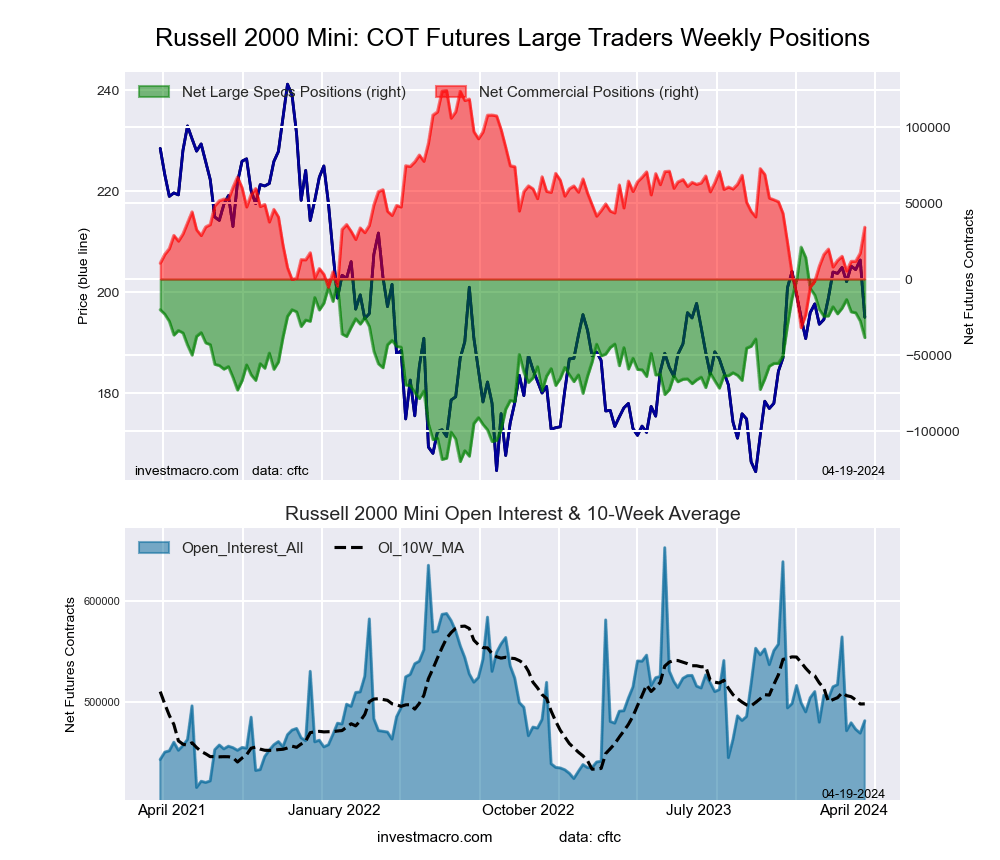
Russell 2000 Mini Futures COT ChartThe Russell 2000 Mini large speculator standing this week recorded a net position of -18,228 contracts in the data reported through Tuesday. This was a weekly advance of 5,977 contracts from the previous week which had a total of -24,205 net contracts.

This week’s current strength score (the trader positioning range over the past three years, measured from 0 to 100) shows the speculators are currently Bullish with a score of 72.2 percent. The commercials are Bearish with a score of 25.6 percent and the small traders (not shown in chart) are Bullish with a score of 63.6 percent.

Price Trend-Following Model: Uptrend

Our weekly trend-following model classifies the current market price position as: Uptrend. The current action for the model is considered to be: Hold – Maintain Long Position.

Russell 2000 Mini Futures StatisticsSPECULATORSCOMMERCIALSSMALL TRADERS
– Percent of Open Interest Longs:12.580.26.1
– Percent of Open Interest Shorts:16.178.74.1
– Net Position:-18,2287,95610,272
– Gross Longs:64,457413,10431,433
– Gross Shorts:82,685405,14821,161
– Long to Short Ratio:0.8 to 11.0 to 11.5 to 1
NET POSITION TREND:
– Strength Index Score (3 Year Range Pct):72.225.663.6
– Strength Index Reading (3 Year Range):BullishBearishBullish
NET POSITION MOVEMENT INDEX:
– 6-Week Change in Strength Index:-23.020.23.5


Nikkei Stock Average (USD) Futures:

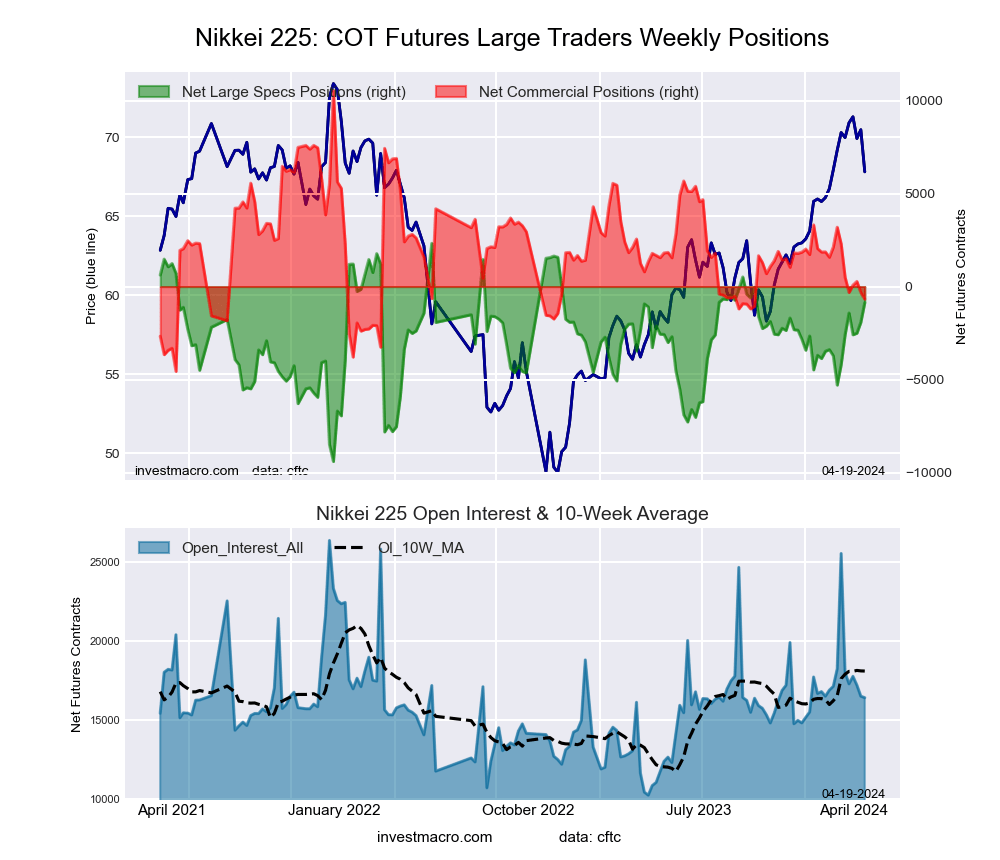
Nikkei Stock Average (USD) Futures COT ChartThe Nikkei Stock Average (USD) large speculator standing this week recorded a net position of -5,294 contracts in the data reported through Tuesday. This was a weekly lowering of -1,574 contracts from the previous week which had a total of -3,720 net contracts.

This week’s current strength score (the trader positioning range over the past three years, measured from 0 to 100) shows the speculators are currently Bearish with a score of 29.0 percent. The commercials are Bullish with a score of 55.3 percent and the small traders (not shown in chart) are Bullish with a score of 71.4 percent.

Price Trend-Following Model: Strong Uptrend

Our weekly trend-following model classifies the current market price position as: Strong Uptrend. The current action for the model is considered to be: Hold – Maintain Long Position.

Nikkei Stock Average Futures StatisticsSPECULATORSCOMMERCIALSSMALL TRADERS
– Percent of Open Interest Longs:9.165.625.2
– Percent of Open Interest Shorts:38.248.113.7
– Net Position:-5,2943,1902,104
– Gross Longs:1,66911,9744,600
– Gross Shorts:6,9638,7842,496
– Long to Short Ratio:0.2 to 11.4 to 11.8 to 1
NET POSITION TREND:
– Strength Index Score (3 Year Range Pct):29.055.371.4
– Strength Index Reading (3 Year Range):BearishBullishBullish
NET POSITION MOVEMENT INDEX:
– 6-Week Change in Strength Index:-5.8-0.815.4


MSCI EAFE Mini Futures:

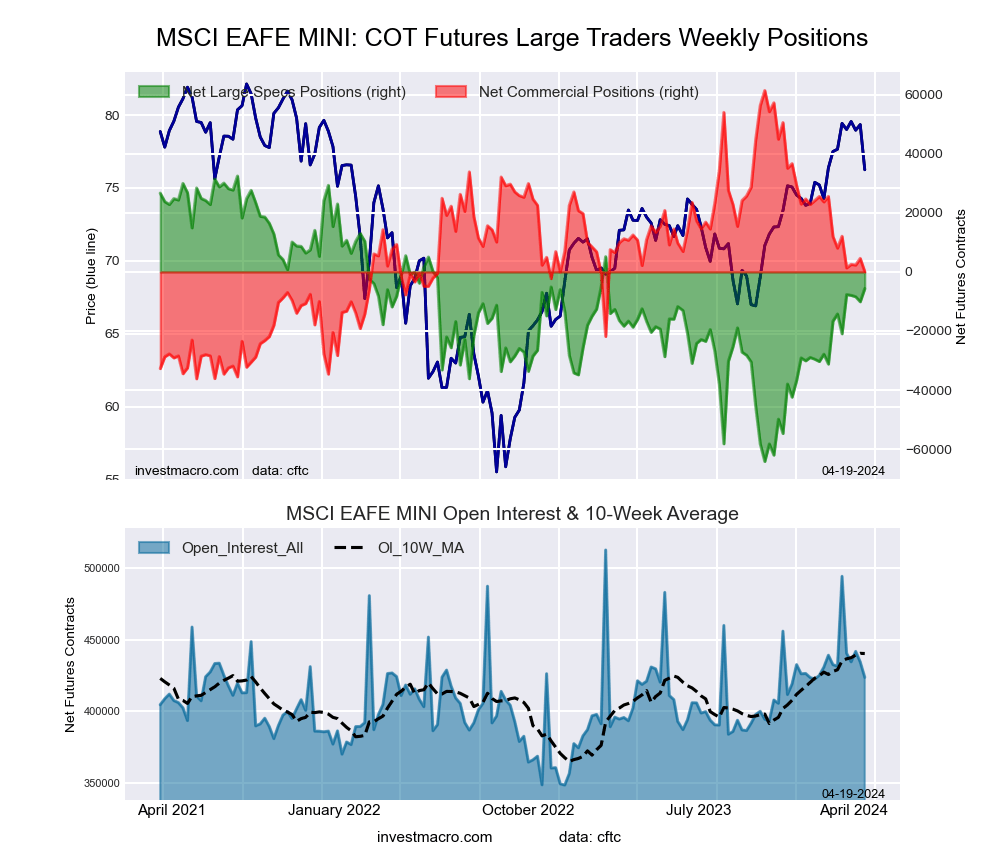
MSCI EAFE Mini Futures COT ChartThe MSCI EAFE Mini large speculator standing this week recorded a net position of -16,684 contracts in the data reported through Tuesday. This was a weekly advance of 14,518 contracts from the previous week which had a total of -31,202 net contracts.

This week’s current strength score (the trader positioning range over the past three years, measured from 0 to 100) shows the speculators are currently Bearish with a score of 49.1 percent. The commercials are Bearish with a score of 49.4 percent and the small traders (not shown in chart) are Bearish with a score of 40.4 percent.

Price Trend-Following Model: Uptrend

Our weekly trend-following model classifies the current market price position as: Uptrend. The current action for the model is considered to be: Hold – Maintain Long Position.

MSCI EAFE Mini Futures StatisticsSPECULATORSCOMMERCIALSSMALL TRADERS
– Percent of Open Interest Longs:9.786.93.1
– Percent of Open Interest Shorts:13.584.12.0
– Net Position:-16,68411,9984,686
– Gross Longs:41,874375,97513,462
– Gross Shorts:58,558363,9778,776
– Long to Short Ratio:0.7 to 11.0 to 11.5 to 1
NET POSITION TREND:
– Strength Index Score (3 Year Range Pct):49.149.440.4
– Strength Index Reading (3 Year Range):BearishBearishBearish
NET POSITION MOVEMENT INDEX:
– 6-Week Change in Strength Index:13.9-13.0-3.6


Article By InvestMacroReceive our weekly COT Newsletter

*COT Report: The COT data, released weekly to the public each Friday, is updated through the most recent Tuesday (data is 3 days old) and shows a quick view of how large speculators or non-commercials (for-profit traders) were positioned in the futures markets.

The CFTC categorizes trader positions according to commercial hedgers (traders who use futures contracts for hedging as part of the business), non-commercials (large traders who speculate to realize trading profits) and nonreportable traders (usually small traders/speculators) as well as their open interest (contracts open in the market at time of reporting). See CFTC criteria here.