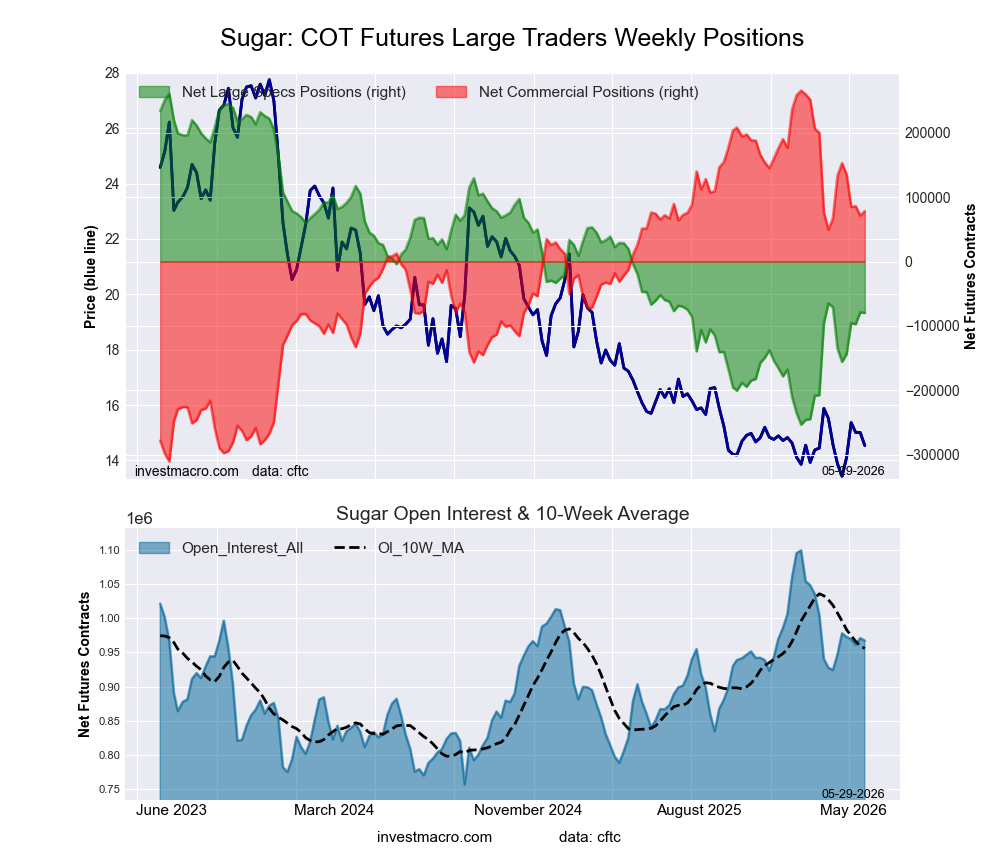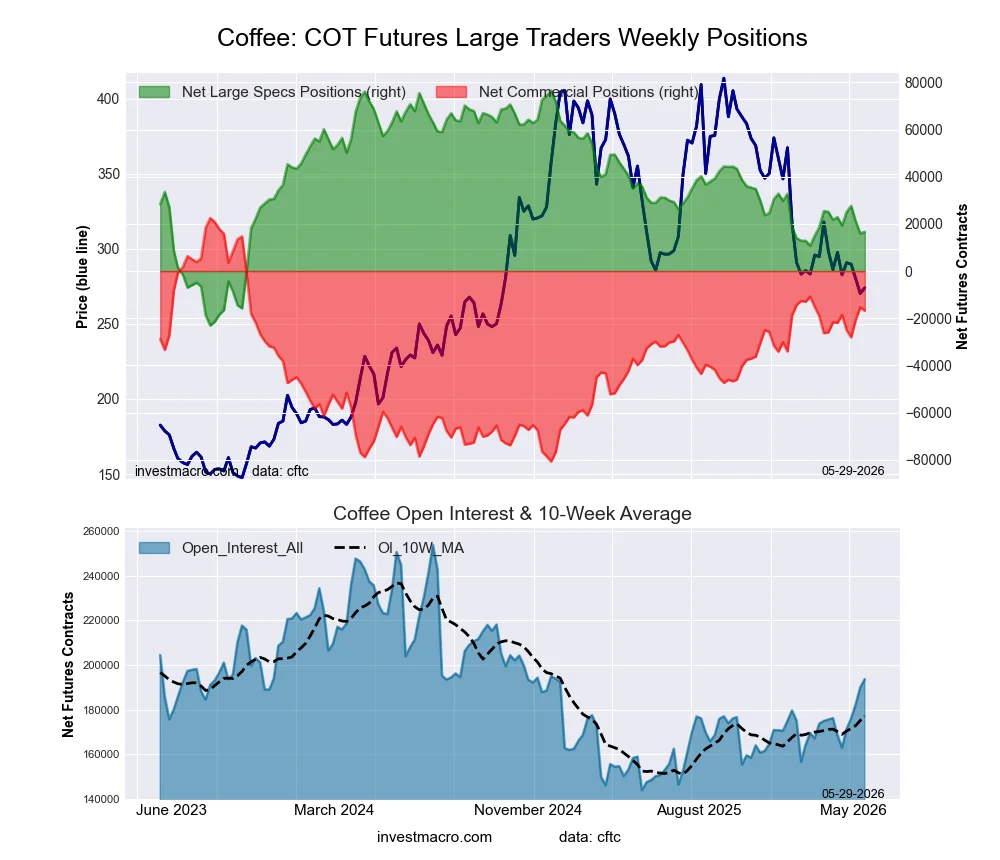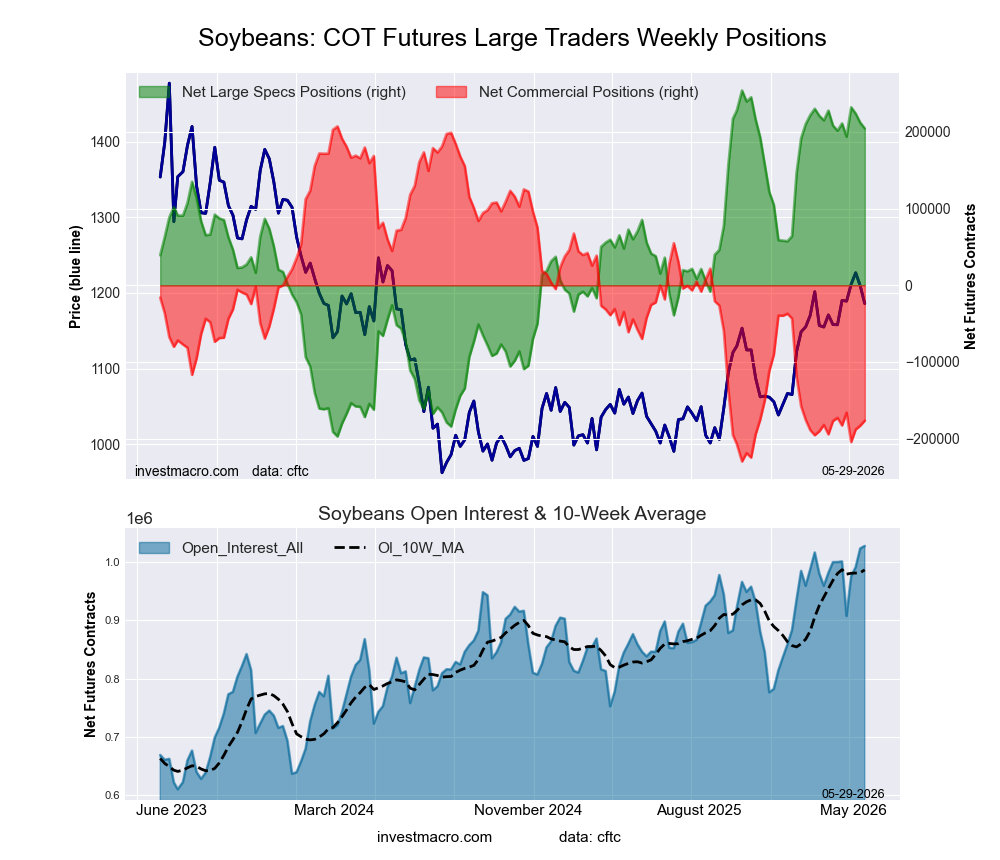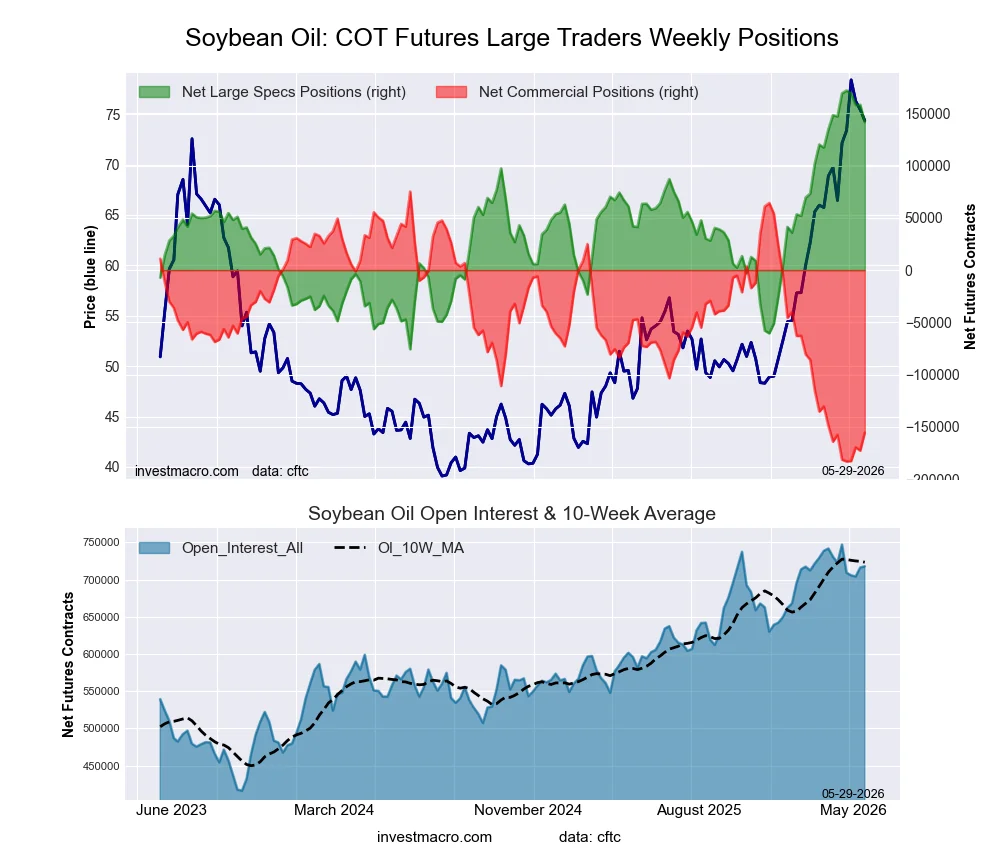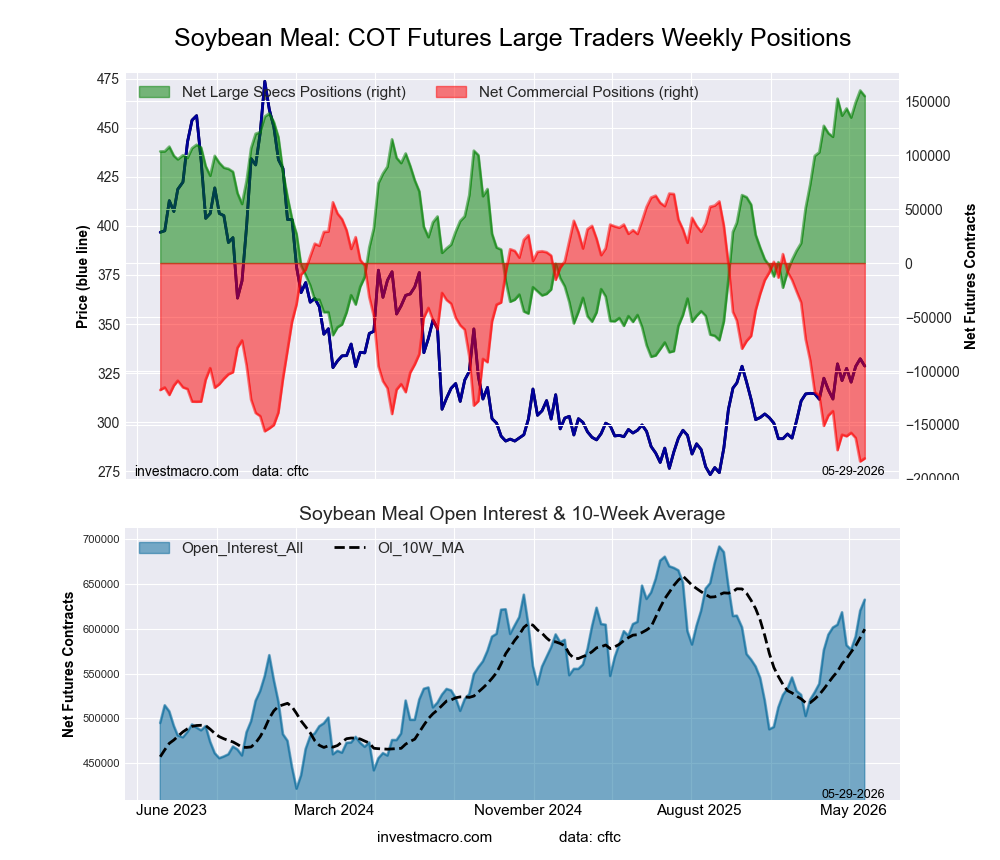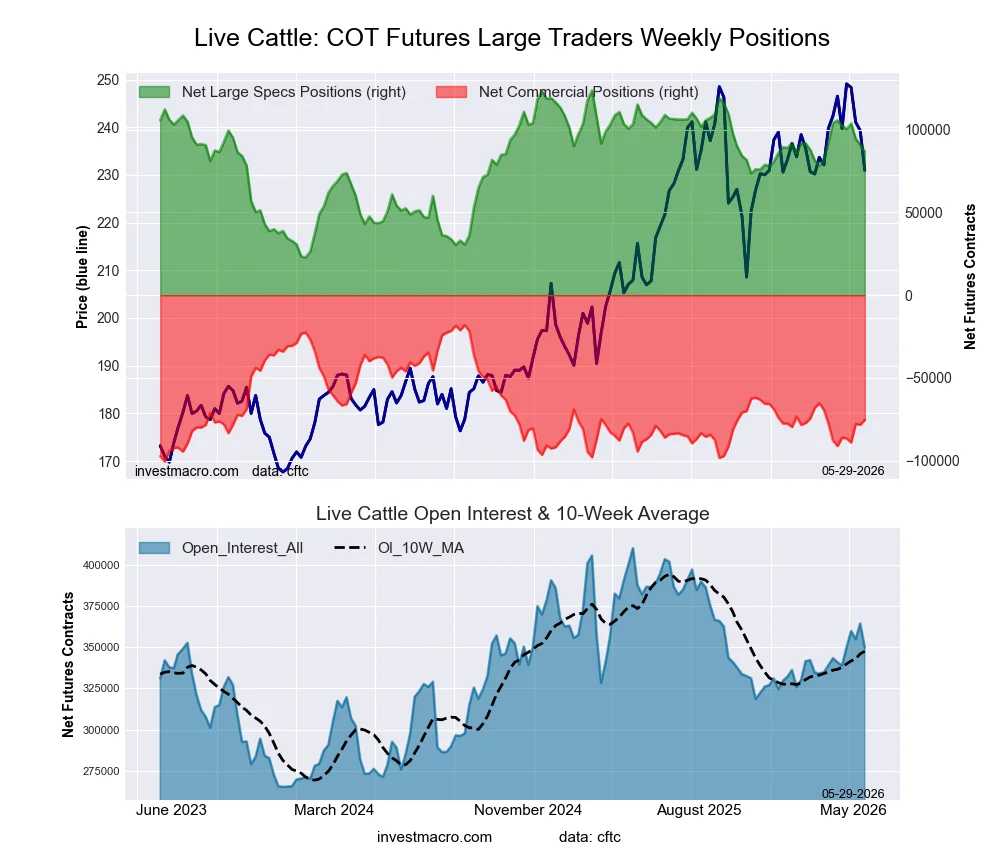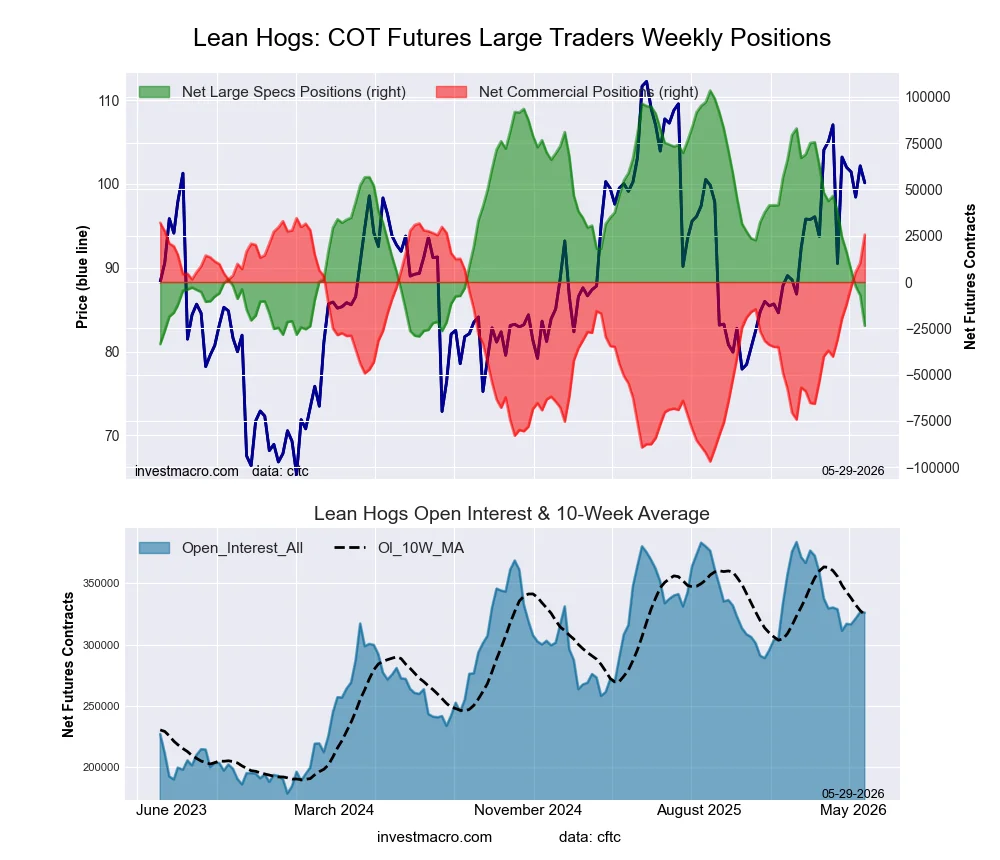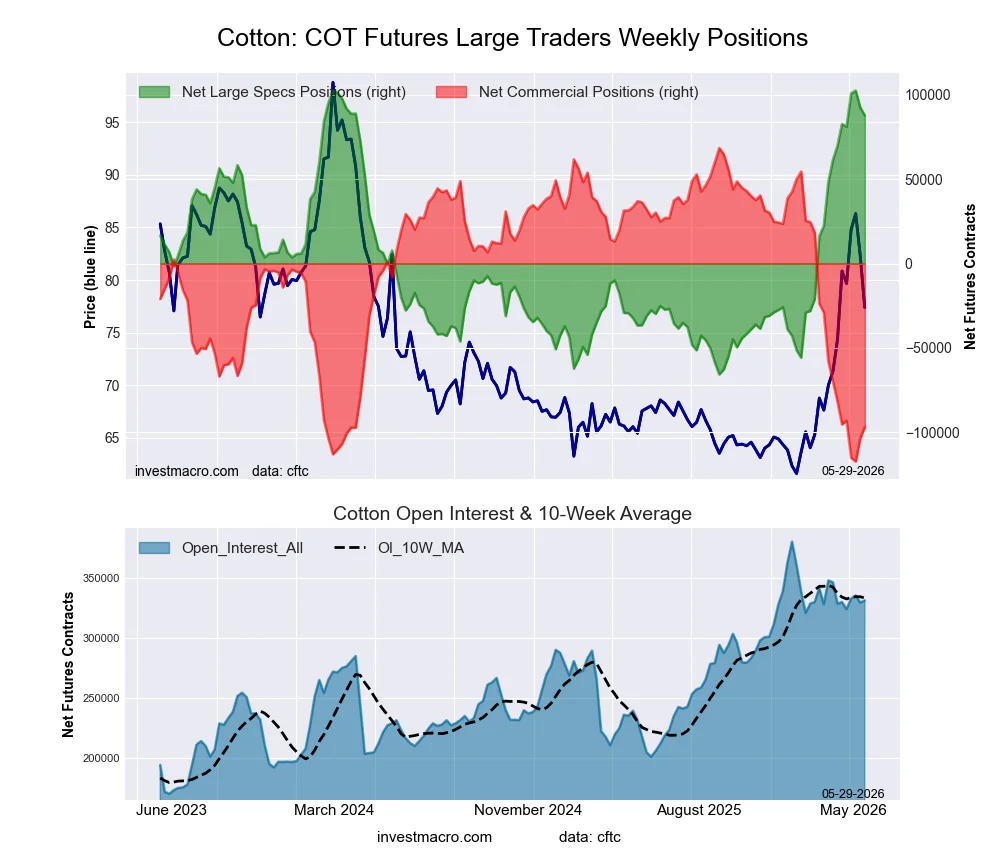
Archive for Financial News – Page 11

Gold Moderately Lower as Market Pressures Intensify

By Analytical Department RoboForex

Gold prices fell below 5,150 USD per ounce on Thursday, marking a second consecutive session of decline. Pressure on the market has intensified amid a sharp rise in oil prices, which heightens inflation risks and reduces the likelihood of imminent interest rate cuts by central banks.

Oil has rallied for a second straight day. The market remains concerned about the prospect of a protracted conflict involving Iran, with these worries outweighing the effect of a coordinated release of strategic oil reserves by major economies.

Despite the International Energy Agency’s decision to execute the largest release in history—400 million barrels—investors considered the move insufficient to stabilise the market.

A strengthening US dollar and rising Treasury yields have added further pressure on gold. Increased inflation expectations have diminished the probability of Federal Reserve easing, with the market now pricing in only one rate cut before year-end.

Data released yesterday showed that core inflation in the United States remains moderate at the start of the year. Meanwhile, the European Union has warned that inflation in the region could exceed 3% in 2026.

Technical Analysis

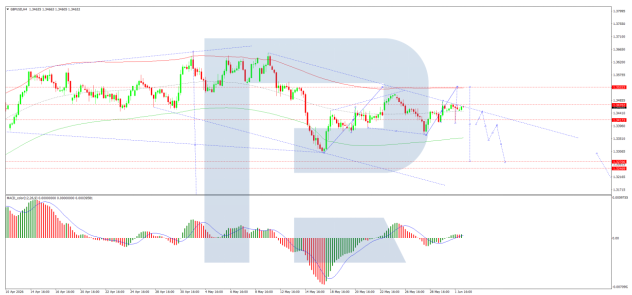
On the H4 XAU/USD chart, the market is forming a consolidation range around the 5,196 USD level. A downside breakout would open potential for a continuation of the correction towards 4,953 USD. Conversely, an upside breakout would suggest the development of a growth wave towards the 5,390 USD level. The MACD indicator confirms the current momentum, with its signal line above zero and pointing upwards.

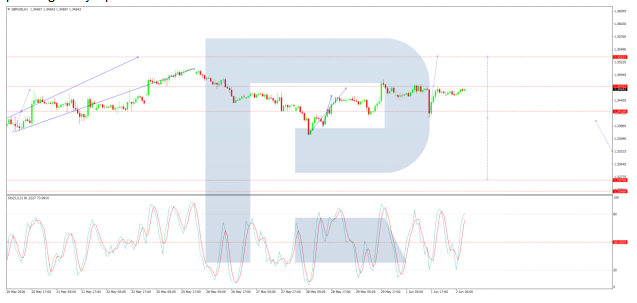
On the H1 chart, the market broke above the 5,135 USD level and completed a growth wave to 5,233 USD, before retracing to 5,140 USD. Looking ahead, the likelihood of a new growth wave developing towards the 5,262 USD level will be considered. The Stochastic oscillator supports this scenario, with its signal line remaining above the 50 level and retaining upside potential towards level 80.

Conclusion

Gold faces mounting headwinds as surging oil prices, driven by geopolitical tensions in the Middle East, reinforce inflation concerns and push central bank rate cut expectations further out. The dollar’s strength and rising yields compound the pressure on the non-yielding asset. While technical indicators suggest potential for a short-term bounce, the broader outlook remains cautious as markets digest the implications of sustained energy price inflation and its impact on monetary policy trajectories.


Disclaimer

Any forecasts contained herein are based on the author’s particular opinion. This analysis may not be treated as trading advice. RoboForex bears no responsibility for trading results based on trading recommendations and reviews contained herein.

IEA deploys strategic reserves to halt soaring oil prices

By JustMarkets 

On Tuesday, the US stock market concluded the session with a slight decline. The Dow Jones (US30) fell by 0.07%, and the S&P 500 (US500) dropped 0.21%, while the tech-heavy NASDAQ (US100) managed a marginal gain of 0.01%. Investors found themselves in a state of uncertainty: the initial optimism sparked by President Trump’s claims of a swift end to the military operation met a harsh reality following clarifications from the White House. Official confirmation that naval escorts for tankers in the Strait of Hormuz have not yet commenced, combined with reports of a potential Iranian mining threat, forced traders to remain cautious and partially rotate into cash.

Market attention has now shifted entirely to the upcoming inflation data. Traders fear that the recent spike in energy prices has already permeated macroeconomic indicators, prompting the Federal Reserve to maintain a restrictive monetary policy for longer than previously anticipated.

European equity markets mostly trended higher. The German DAX (DE40) surged by 2.39%, the French CAC 40 (FR40) closed up 1.79%, the Spanish IBEX 35 (ES35) jumped to 3.05%, and the British FTSE 100 (UK100) finished at 1.59% higher. The primary catalyst for the optimism in Frankfurt was Donald Trump’s rhetoric regarding a potential de-escalation in the Middle East, which led to a retreat in oil prices and eased fears of runaway inflation in the Eurozone.

However, the WTI oil market became an arena for intense informational warfare. After a morning slump to $80 per barrel, triggered by Trump’s “peaceful” tweets, quotes rebounded sharply to close near $87. This reversal followed an official statement from the Islamic Revolutionary Guard Corps (IRGC), which labeled Washington’s claims of an imminent end to the war as “false,” promising to block regional oil exports until US and Israeli strikes cease entirely. The situation intensified as US Defense Secretary Pete Hegseth, overseeing Operation “Epic Fury,” called Tuesday the “most intense day of airstrikes” since the conflict began, signaling a phase of systematic destruction of Iran’s industrial and naval infrastructure. The IEA has proposed a record-breaking release of strategic oil reserves; however, the physical blockade of the Strait of Hormuz has led to a collapse in production from major Middle Eastern producers. This creates a supply deficit that reserves cannot fully offset, driving investors toward silver and other metals as a hedge against stagflation.

Asian markets also rebounded yesterday. The Japanese Nikkei 225 (JP225) rose by 2.88%, the FTSE China A50 (CHA50) jumped 1.06%, the Hang Seng (HK50) climbed 2.17%, and the Australian ASX 200 (AU200) posted a positive result of 1.09%. Drivers for this optimism included strong corporate news and trade statistics from mainland China. China’s trade data for January-February 2026 continues to impress, with exports growing by a record 21.8% and imports by 19.8%. However, these strong figures also breed caution; investors worry that Beijing may view the economy as sufficiently resilient and delay further stimulus measures, especially given the recently announced 4.5-5.0% GDP target – the lowest in decades.

On Wednesday, the Australian dollar (AUD) made an impressive leap to 0.716-0.718 USD, its highest level in nearly four years. This was driven by a sharp revision in interest rate expectations. The market reacted to signals from the RBA: the probability of a rate hike on March 17 skyrocketed from 30% to 75% in just days. RBA Deputy Governor Andrew Hauser confirmed that the spike in fuel prices (with petrol exceeding $2.15 per liter in major cities) poses a significant risk to inflation expectations, which already sit above the 23% target range.

The New Zealand dollar (NZD) stabilized at 0.593-0.594 USD on March 11, 2026, holding weekly highs. This rise reflects a hawkish shift in investor sentiment. While the RBNZ signaled rate stability at 2.25% as recently as February, the March energy shock has forced the market to price in imminent tightening. Leading banks such as Westpac and BNZ have revised their inflation prognosis upward, expecting the CPI to remain within the upper 3.0% target boundary for most of 2026.

S&P 500 (US500) 6,781.48 −14.51 (−0.21%)

Dow Jones (US30) 47,706.51 −34.29 (−0.072%)

DAX (DE40) 23,968.63 +559.26 (2.39%)

FTSE 100 (UK100) 10,412.24 +162.72 (+1.59%)

USD Index 98.94 -0.24% (−0.24%)

News feed for: 2026.03.11

  • Japan Producer Price Index (m/m) at 01:50 (GMT+2); – JPY (MED)
  • German Inflation Rate (m/m) at 09:00 (GMT+2); – EUR (MED)
  • US Consumer Price Index (m/m) at 14:30 (GMT+2); – USD, XAU (HIGH)
  • US Crude Oil Reserves (w/w) at 16:30 (GMT+2). – WTI (HIGH)

By JustMarkets


This article reflects a personal opinion and should not be interpreted as an investment advice, and/or offer, and/or a persistent request for carrying out financial transactions, and/or a guarantee, and/or a forecast of future events.

GBP/USD Managed to Rise, but Pressure Factors Remain in Place

By Analytical Department RoboForex

GBP/USD rose to 1.3450 on Wednesday. Expectations of de-escalation in the Middle East supported the pound, as lower oil prices reduced inflationary risks for the British economy, which is heavily dependent on energy imports.

Despite this localised strengthening, investors continue to monitor the development of the conflict between the United States, Israel and Iran closely. Its consequences could significantly affect the global economy. The situation remains uncertain: US President Donald Trump has suggested the war could end soon, but Iran’s Islamic Revolutionary Guard Corps stated that oil shipments through the Strait of Hormuz will not resume while attacks by the United States and Israel continue.

Amid these external risks, investors are also revising expectations for UK monetary policy. On average, a Bank of England interest rate cut in the second quarter is now considered possible.

Domestic factors continue to weigh on the pound. Weak economic statistics and political uncertainty in the UK maintain downside risks for the currency. An additional source of tension may be the local elections, scheduled to take place in two months.

Technical Analysis

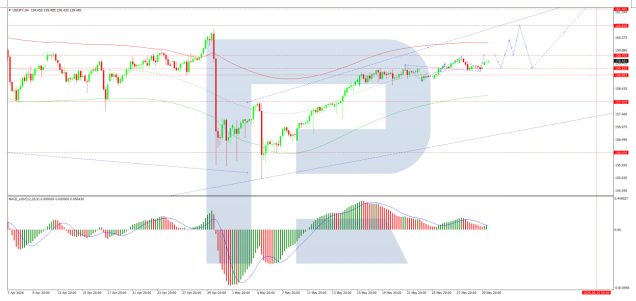
On the H4 GBP/USD chart, the market is forming a wide consolidation range around the 1.3382 level, currently extending up to 1.3474. A decline to 1.3384 is expected in the near term. Following the completion of this correction, the formation of a new consolidation range is likely. An upside breakout would open potential for a continuation wave to 1.3515, while a downside breakout would suggest further movement towards 1.3133. Technically, this scenario is confirmed by the MACD indicator, whose signal line is above the zero level and pointing strictly upwards.

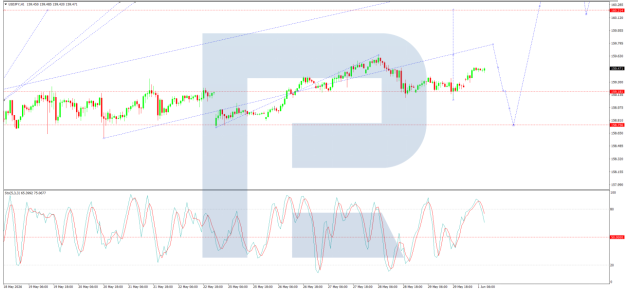
On the H1 chart, the market has formed a compact consolidation range around the 1.3434 level. A downside breakout would initiate a wave structure extending to 1.3382. Should this level be breached, further downside potential towards 1.3125 would open. Conversely, an upside breakout from the range could trigger a growth wave to the 1.3515 level. Technically, this scenario is supported by the Stochastic oscillator, with its signal line above the 50 level and pointing strictly upwards.

Conclusion

GBP/USD has found temporary relief amid hopes for Middle East de-escalation, which has helped moderate oil prices and ease inflationary concerns for the UK. However, the underlying picture remains uncertain, with geopolitical risks, domestic economic weakness, and political tensions continuing to cloud the outlook. While technical indicators suggest potential for further upside in the near term, the broader trend will likely depend on whether geopolitical conditions stabilise and whether the Bank of England signals a clearer policy direction.


Disclaimer

Any forecasts contained herein are based on the author’s particular opinion. This analysis may not be treated as trading advice. RoboForex bears no responsibility for trading results based on trading recommendations and reviews contained herein.

Trump signals de-escalation in the Middle East; China’s trade surplus hits a new record

By JustMarkets

The US stock market concluded Monday’s session with gains. By the end of the trading day, the Dow Jones (US30) rose by 0.50%. The S&P 500 (US500) gained 0.83%, and the tech-heavy NASDAQ (US100) increased by 1.38%. The morning collapse, fueled by fears of stagflation, turned into a rally following statements by Donald Trump that the active phase of the war with Iran is “practically over” and that the Strait of Hormuz is reopening for tankers. This triggered a drop in WTI oil prices to $86 per barrel, removing the short-term threat of an energy collapse. The primary growth driver was the technology sector, where shares of AMD and Broadcom soared over 4.6% amid strong AI chip revenue predictions (Broadcom expects more than $100 billion in 2027). While the banking sector (Wells Fargo, Citigroup) remained under pressure due to private credit default risks, investors actively bought up discounted growth stocks.

On Tuesday, the Mexican peso (MXN) stabilized at 17.8 per dollar, breaking its fall toward seven-week lows. The rebound was sparked by Mexico’s February inflation data, which accelerated to 4.02%, breaching the central bank’s upper target threshold for the first time in a year. Despite local support, the peso remains a hostage to external shocks: the 10% global US tariffs and the war in the Middle East create a toxic backdrop for emerging market currencies. Although expensive oil bolsters Mexico’s budget, the peso’s status as a “proxy” for global risk makes it extremely vulnerable to every new wave of flight to the dollar.

Bitcoin (BTC) recovered the psychological $70,000 mark, gaining about 2% amid a sharp improvement in market sentiment. The upward momentum was provided by Donald Trump’s rhetoric, who described the war with Iran as “practically over” and predicted a swift resolution to the conflict. The digital assets market recovery synchronized with a powerful rally in Asia, where Japan’s Nikkei 225 jumped 2.8% to exceed 54,000 points. Altcoins followed the lead: Ether (ETH) returned to the $2,130 level, while Solana (SOL) stabilized near $91 ahead of the major Alpenglow network update later this month.

European stock markets mostly declined on Monday. The German DAX (DE40) fell by 0.77%, the French CAC 40 (FR40) closed down 0.98%, the Spanish IBEX 35 (ES35) lost 0.86%, and the British FTSE 100 (UK100) finished at 0.34% lower. The primary pressure came from the escalation of US and Israeli strikes on Iranian refineries, which paralyzed the Strait of Hormuz and sparked fears of a new inflationary spiral. Consequently, traders began pricing in ECB rate hikes. The transport and industrial sectors suffered most: Lufthansa shares fell 7.3% due to soaring jet fuel prices, while tire manufacturer Continental fell 4.4%. Automakers (Volkswagen, Porsche) also finished in the red due to global supply chain risks.

Silver (XNG) recouped most of its morning losses, stabilizing at $83.9 per ounce. Earlier in the session, quotes had collapsed nearly 6%, testing key support near $80 due to a sharp strengthening of the dollar and oil prices spiking above $100. The dual nature of the metal, as a safe haven and an industrial commodity, created conflicting flows: while geopolitical tension supported haven demand, the threat of a global recession and reduced industrial consumption (which accounts for 60% of silver demand) exerted powerful downward pressure.

WTI oil prices performed a dizzying turnaround, collapsing nearly 4% by the end of the day to $87 per barrel. This followed an earlier surge to $120 on news of production paralysis in Iraq, Kuwait, and the UAE. The market cooled rapidly thanks to a coordinated statement from G7 Finance Ministers regarding readiness for massive strategic reserve interventions, effectively guaranteeing the replenishment of any short-term supply deficits.

Asian markets were also under a sell-off yesterday. The Japanese Nikkei 225 (JP225) fell by 5.20% during the session, the FTSE China A50 (CHA50) declined 0.47%, the Hang Seng (HK50) shed 1.35%, and the Australian ASX 200 (AU200) closed down at 2.85%.

China’s trade surplus soared to a record $213 billion, with exports growing by 21.8% and imports by 19.8%. These figures significantly exceeded analyst prognosis and confirmed China’s status as a global manufacturing hub capable of scaling volumes even during periods of instability.

The Australian dollar (AUD) corrected to 0.70 against the US dollar on Tuesday, losing about 0.7% following the retreat in oil prices. As a “commodity” currency, the aussie faced pressure as brent fell to $91.37 and WTI to $86. This occurred after Donald Trump announced the military operation against Iran was significantly ahead of schedule, calling it “very complete” and predicting further fuel price declines. Domestic Australian statistics presented a mixed picture: the Westpac Index rose 1.2% to 91.6, while the NAB Business Confidence Index plummeted to 1, its first negative reading since April 2025.

S&P 500 (US500) 6,795.99 +55.97 (+0.83%)

Dow Jones (US30) 47,740.80 +239.25 (+0.50%)

DAX (DE40) 23,409.37 −181.66 (−0.77%)

FTSE 100 (UK100) 10,249.52 −35.23 (−0.34%)

USD Index 98.73 -0.25% (−0.26%)

News feed for: 2026.03.10

  • Australia Westpac Consumer Confidence Index (m/m) at 01:30 (GMT+2); – AUD (MED)
  • Japan GDP (q/q) at 01:50 (GMT+2); – JPY (MED)
  • Australia NAB Business Confidence (m/m) at 02:30 (GMT+2); – AUD (LOW)
  • China Trade Balance (m/m) at 05:00 (GMT+2); – CHA50, HK50 (MED)
  • German Trade Balance (m/m) at 09:00 (GMT+2); – EUR (LOW)
  • Norway Inflation Rate (m/m) at 09:00 (GMT+2); – NOK (MED)
  • US Existing Home Sales (m/m) at 16:00 (GMT+2). – USD (MED)

By JustMarkets


This article reflects a personal opinion and should not be interpreted as an investment advice, and/or offer, and/or a persistent request for carrying out financial transactions, and/or a guarantee, and/or a forecast of future events.

EUR/USD in Turbulence: Market Questions When Conflict Over Iran Will End

By Analytical Department RoboForex

EUR/USD is trading around 1.1608 on Tuesday. The US dollar attempted to recover from a sharp intraday decline the previous day, which had been driven by expectations of a faster resolution to the conflict involving Iran, temporarily reducing demand for the dollar as a safe-haven asset.

US President Donald Trump stated that the military operation in Iran is nearing completion and is progressing faster than initial estimates, which had suggested a duration of four to five weeks. He also announced plans to reduce oil sanctions and deploy US Navy ships to escort tankers through the Strait of Hormuz in an effort to contain rising oil prices.

Previously, the dollar had strengthened significantly due to safe-haven demand. The escalation of the Middle East conflict and rising energy prices had intensified fears of prolonged economic disruption and a fresh wave of inflation.

Investor attention is now shifting to macroeconomic statistics from the United States. The February consumer price index (CPI) is scheduled for release on Wednesday, followed by the January PCE index on Friday. Market participants believe these data points will not yet fully capture the conflict’s impact on inflation expectations.

Technical Analysis

On the H4 chart of EUR/USD, the market is forming a consolidation range around the 1.1588 level. An upward wave is expected, with a continuation towards the 1.1668 level. Thereafter, the beginning of a new downward wave within the broader trend is anticipated, targeting 1.1419 as a local objective. Technically, this scenario is confirmed by the MACD indicator, whose signal line remains below zero and is pointing strictly downwards, reflecting sustained bearish momentum with potential for further downside.

On the H1 chart, the market is forming the structure of the next growth wave towards the 1.1668 level. After reaching this level, a decline to 1.1419 is expected, followed by the initiation of a new growth wave to 1.1650. Technically, this scenario is supported by the Stochastic oscillator, with its signal line below 50 and pointing strictly upwards towards the 80 level.

Conclusion

EUR/USD remains highly sensitive to geopolitical developments, with signals of a potential de-escalation in the Iran conflict temporarily weighing on the dollar’s safe-haven appeal. However, the broader technical picture suggests any upside may be limited, with bearish momentum likely to reassert itself once the current corrective wave completes. Upcoming US inflation data will provide crucial clues about whether recent energy price increases are beginning to filter through to consumer prices, potentially influencing Fed policy expectations.


Disclaimer

Any forecasts contained herein are based on the author’s particular opinion. This analysis may not be treated as trading advice. RoboForex bears no responsibility for trading results based on trading recommendations and reviews contained herein.

Prices push oil above $100 per barrel

By JustMarkets 

  • The Canadian dollar rose above 1.37 against the US dollar, reaching a one-month high and leading performance among G7 currencies.
  • Mexican peso slid to 17.8 per dollar, a seven-week low and its weakest weekly result since summer 2024.
  • Swiss franc trades near historic highs at 0.78 per USD, supported by safe-haven demand amid escalating tensions in the Middle East.
  • Natural gas prices reached $3.4 per MMBtu, the highest in a month, on supply fears linked to Ras Laffan.

Oil prices surge above $100 per barrel

Trading on the US stock market ended lower. By the close of Friday, the Dow Jones (US30) fell by 0.95% (-2.27% for the week). The S&P 500 (US500) shed 1.33% (-1.41% for the week), and the tech-heavy NASDAQ (US100) closed down 1.59% (-0.60% for the week). This unanimous negative trend was driven by a dangerous combination of a geopolitical crisis and weak macroeconomic data, which heightened fears of stagflation. Washington’s ultimatum to Tehran and warnings from Middle Eastern exporters regarding force majeure circumstances propelled WTI oil prices to critical levels. Against this backdrop, the shocking contraction of 92,000 jobs in the US and the jump in the unemployment rate to 4.4% confirmed investor fears that high energy costs have begun to undermine the real economy and consumer activity.

The Canadian dollar (CAD) strengthened to a one-month high above 1.37 against the US dollar, demonstrating the best performance among G7 currencies. The primary driver of the rally was the surge in WTI oil prices above $92 per barrel, which provided a massive influx of foreign exchange earnings into the Canadian economy amid the blockade of the Strait of Hormuz.

The Mexican peso (MXN) weakened to a seven-week low of 17.8 per dollar, showing its worst weekly performance since the summer of 2024. The main trigger for the decline was the shock contraction of US jobs, which amplified fears of an economic cooldown in Mexico’s largest trading partner. Despite a local weakening of the dollar index, the peso fell victim to a mass exodus of investors from risky emerging market assets, triggered by the escalation in the Middle East and the threat of global stagflation.

Equity markets in Europe mostly declined. The German DAX (DE40) fell by 0.94% (-4.80% for the week), the French CAC 40 (FR40) closed down 0.65% (-5.53% for the week), the Spanish IBEX 35 (ES35) lost 0.99% (-4.57% for the week), and the British FTSE 100 (UK100) finished 1.24% lower (-5.33% for the week).

The Swiss franc (CHF) continues to trade near historical highs at 0.78 against the US dollar. Investors view the currency as the primary safe-haven asset amid the catastrophic escalation in the Middle East. However, further strengthening of the franc is limited by the hawkish rhetoric of the SNB. Vice President Antoine Martin confirmed that the regulator is ready for active currency interventions to prevent a deflationary spiral.

Silver prices (XAG) made a sharp move on Friday, consolidating above the $32.5 per ounce level. The main driver was the shocking US labor market report: the loss of 92,000 jobs and the rise in unemployment to 4.4% forced investors to urgently revise their anticipations. While the market had been preparing all week for a “higher-for-longer” interest rate scenario due to oil-driven inflationary pressure, Friday’s data sharply increased the likelihood of early Fed policy easing, reducing the opportunity cost of holding the metal.

WTI oil prices demonstrated historic volatility: after a 31% surge, quotes stabilized above $100 per barrel (+13% for the day). This is the most powerful daily jump since the 2020 pandemic, caused by the paralysis of production in the Persian Gulf. In Iraq, production at southern fields collapsed by 70%, and Kuwait declared force majeure, which, combined with disruptions in Qatar, created a critical supply deficit on the global market. The situation is exacerbated by the risk of technical production halts in the UAE and Saudi Arabia; due to the blockade of the Strait of Hormuz, exports are impossible, and domestic storage facilities are filling up critically fast. Against this background, a power transition occurred in Tehran. Mojtaba Khamenei, the son of the late Ali Khamenei, became the new Supreme Leader of Iran, adding uncertainty regarding further escalation or the possibility of negotiations.

The US natural gas prices (XNG) rose to $3.4 per MMBtu, reaching a one-month high amid critical global supply disruptions. The main factor behind the panic was the production halt at the Qatari giant Ras Laffan following Iranian drone strikes and the declaration of force majeure. Since the Strait of Hormuz is effectively closed to commercial shipping, approximately 20% of global LNG trade has been blocked, sharply increasing demand for American gas as the only stable alternative for Europe and Asia. The situation is further complicated by the war entering its second week: Israel and the US are striking Iranian fuel depots, while Tehran attacks the energy infrastructure of its neighbors.

Asian markets were also under a sell-off last week. The Japanese Nikkei 225 (JP225) fell by 3.70% over the trading week, the FTSE China A50 (CHA50) declined 0.98%, the Hong Kong Hang Seng (HK50) shed 2.23%, and the Australian ASX 200 (AU200) showed a negative result of 2.95% over the 5 days.

On Monday, the Nikkei 225 (JP225) plummeted by 6%, dropping to 32,000 points – its lowest level in two months. The massive sell-off was triggered by the jump in WTI oil prices above $100 per barrel (briefly reaching $119) amid the escalation of the war involving the US, Israel, and Iran. For the tech-oriented Japanese market, this served as a “fire siren,” as investors began pricing in the inevitable rise in production costs and the risk of global stagflation. Japan finds itself in a critical situation due to its unprecedented energy dependency: the country receives about 95% of its oil from the Middle East, with 70% of those supplies physically passing through the now-blocked Strait of Hormuz.

The New Zealand dollar (NZD) fell to $0.587, ending the week in the red amid the escalation in the Middle East and a flight to safe-haven assets. The energy shock and the blockade of supply routes make the New Zealand economy extremely vulnerable, as the country is totally dependent on imported oil. A conflict of expectations is brewing in the market: traders estimate the probability of an RBNZ rate hike in September at 80%, predicting a 40-basis-point tightening, while the regulator itself maintains a much softer rhetoric.

S&P 500 (US500) 6,740.02 −90.69 (−1.33%)

Dow Jones (US30) 47,501.55 −453.19 (−0.95%)

DAX (DE40) 23,591.03 −224.72 (−0.94%)

FTSE 100 (UK100) 10,284.75 −129.19 (−1.24%)

USD Index 98.86 -0.46% (−0.47%)

News feed for: 2026.03.09

  • China Inflation Rate (m/m) at 03:30 (GMT+2); – CHA50, HK50 (MED)
  • German Industrial Production (m/m) at 09:00 (GMT+2); – EUR (MED)
  • Mexico Inflation Rate (m/m) at 14:00 (GMT+2). – MXN (MED)

By JustMarkets


This article reflects a personal opinion and should not be interpreted as an investment advice, and/or offer, and/or a persistent request for carrying out financial transactions, and/or a guarantee, and/or a forecast of future events.

COT Metals Charts: Speculator Bets led by Silver, Gold & Platinum

By InvestMacro

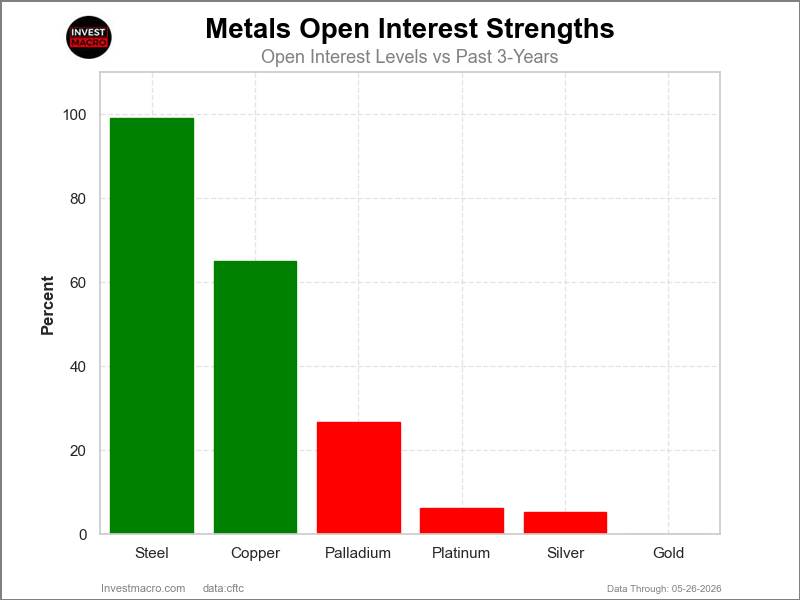
Metals Open Interest COT Chart
Here are the latest charts and statistics for the Commitment of Traders (COT) data published by the Commodities Futures Trading Commission (CFTC).

The latest COT data is updated through Tuesday March 3rd and shows a quick view of how large traders (for-profit speculators and commercial entities) were positioned in the futures markets.

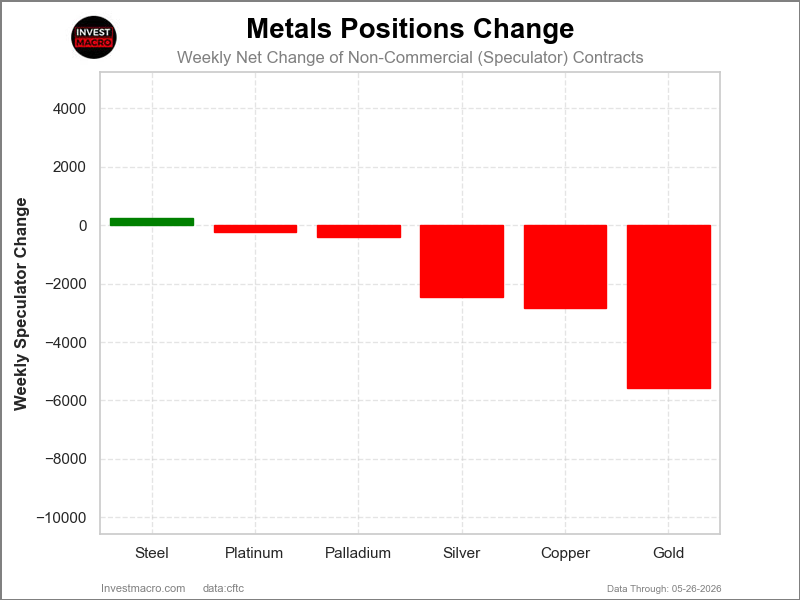
Weekly Speculator Changes led by Silver, Gold & Platinum

Metals Net Positions COT Chart
The COT metals markets speculator bets were mixed this week as three out of the six metals markets we cover had higher positioning while the other three markets had lower speculator contracts.

Leading the gains for the metals was Silver (1,078 contracts) with Gold (968 contracts) and Platinum (592 contracts) also showing modestly positive weeks.

The markets with declines in speculator bets for the week were Copper (-759 contracts), Steel (-526 contracts) and with Palladium (-503 contracts) also registering lower bets on the week.

Steel leads Metal Markets price performance this week

Steel had the highest five-day price change for the Metals Markets this week with a 2.67% gain. Gold was lower by -2.09% and Copper was down by -3.34% over the past five days. Palladium saw a sharp decline by -8.78% and was followed by Platinum which saw a -9.85% drop. The biggest decliner on the week was Silver with a -10.23% shortfall.

The cool-off in the Metals Markets can be seen over the past thirty days returns with only Steel (17.72%) and Gold (4.81%) having higher price returns over the past thirty days while Copper (-0.08%), Palladium( -19.67%), Platinum (-23.28%), and Silver (-12.84%) all have now moved into negative territory over the past thirty days.

Over the past ninety days, all six of our Metal Markets are up by at least 12% with Copper being the lowest gainer with a 12.79% gain over the past ninety days while Silver still leads with a 72.63% rise over the past ninety days. Steel (43.06%), Platinum (33.63%), Gold (25.43%) and Palladium (16.12%) are still seeing strong returns over the past 90-days as well.


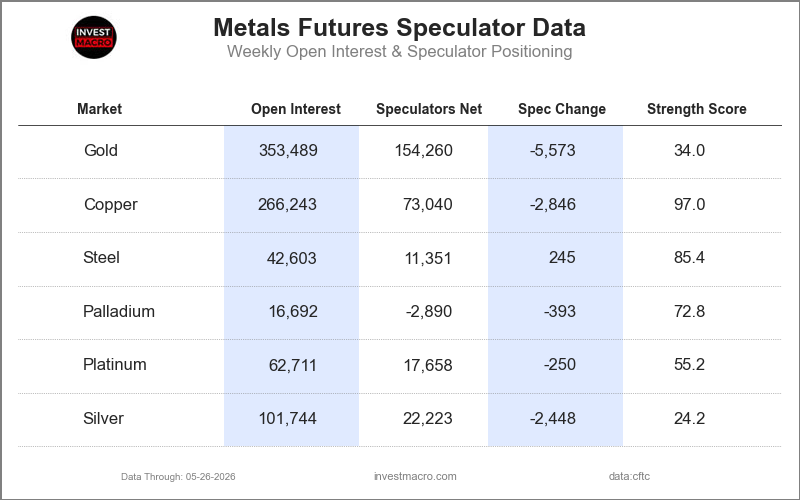
Metals Data:

Metals Table COT Chart
Legend: Weekly Speculators Change | Speculators Current Net Position | Speculators Strength Score compared to last 3-Years (0-100 range)


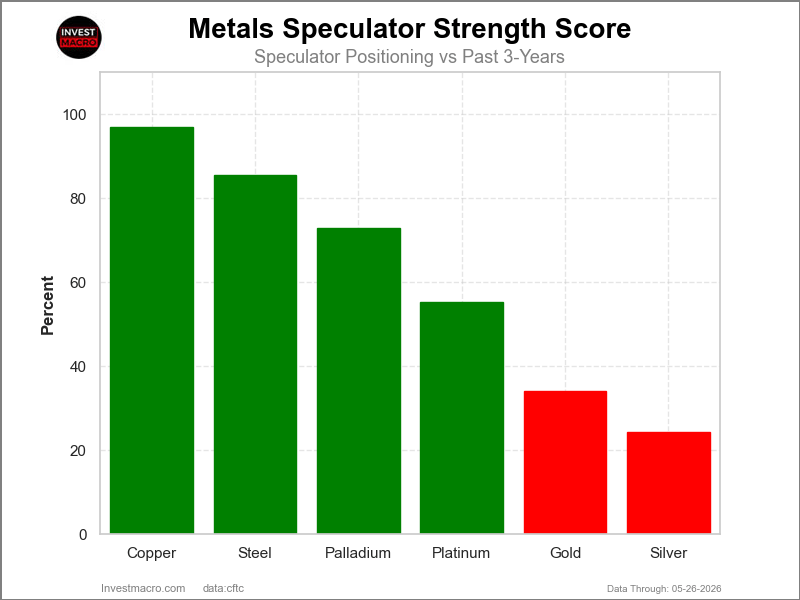
Strength Scores led by Steel, Palladium & Copper

Metals Strength Scores COT Chart
COT Strength Scores (a normalized measure of Speculator positions over a 3-Year range, from 0 to 100 where above 80 is Extreme-Bullish and below 20 is Extreme-Bearish) showed that Steel (95 percent) and Palladium (93 percent) lead the metals markets this week. Copper (87 percent) comes in as the next highest in the weekly strength scores.

On the downside, Silver (36 percent) and Gold (36 percent) come in at the lowest strength levels currently followed by Platinum (46 percent).

Strength Statistics:
Gold (36.4 percent) vs Gold previous week (36.0 percent)
Silver (35.9 percent) vs Silver previous week (34.3 percent)
Copper (87.0 percent) vs Copper previous week (87.7 percent)
Platinum (45.6 percent) vs Platinum previous week (44.1 percent)
Palladium (93.0 percent) vs Palladium previous week (96.3 percent)
Steel (94.6 percent) vs Steel previous week (97.3 percent)


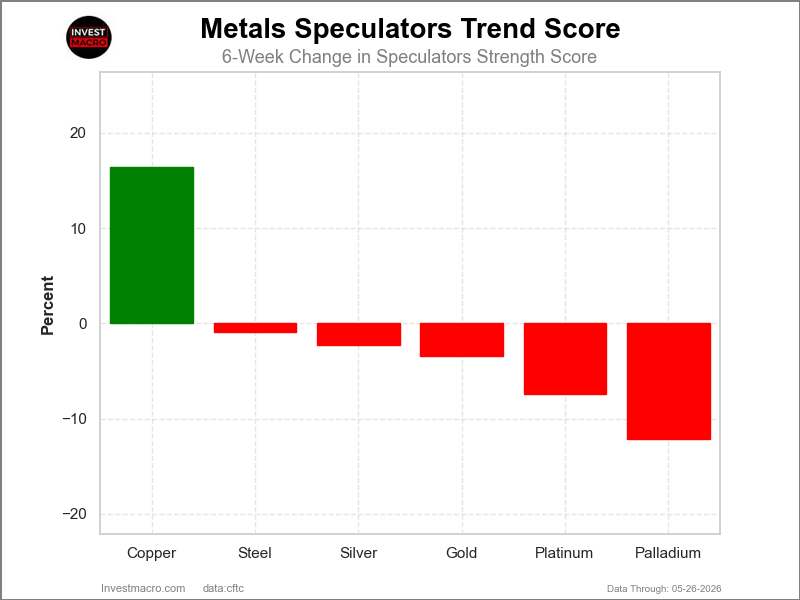
Copper tops the 6-Week Strength Trends

Metals Trends COT Chart
COT Strength Score Trends (or move index, calculates the 6-week changes in strength scores) showed that Copper (5 percent) leads the past six weeks trends for metals.

Gold (-35 percent) leads the downside trend scores currently with Palladium (-5 percent) as the next market with lower trend scores.

Move Statistics:
Gold (-34.7 percent) vs Gold previous week (-37.7 percent)
Silver (-2.7 percent) vs Silver previous week (-14.3 percent)
Copper (4.8 percent) vs Copper previous week (4.7 percent)
Platinum (-3.2 percent) vs Platinum previous week (-10.9 percent)
Palladium (-4.8 percent) vs Palladium previous week (-3.7 percent)
Steel (-1.9 percent) vs Steel previous week (4.2 percent)


Individual Markets:

Gold Comex Futures:

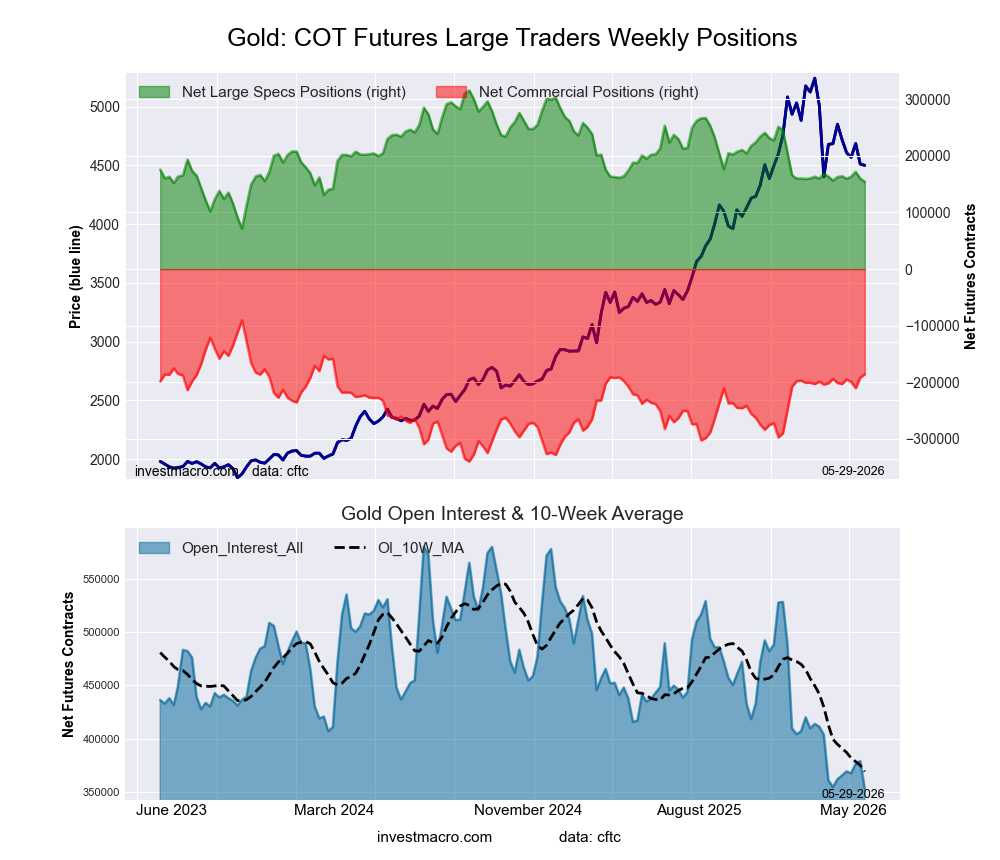
Gold Futures COT ChartThe Gold Comex Futures large speculator standing this week totaled a net position of 160,145 contracts in the data reported through Tuesday. This was a weekly boost of 968 contracts from the previous week which had a total of 159,177 net contracts.

This week’s current strength score (the trader positioning range over the past three years, measured from 0 to 100) shows the speculators are currently Bearish with a score of 36.4 percent. The commercials are Bullish with a score of 55.8 percent and the small traders (not shown in chart) are Bullish-Extreme with a score of 84.1 percent.

Price Trend-Following Model: Uptrend

Our weekly trend-following model classifies the current market price position as: Uptrend.

Gold Futures StatisticsSPECULATORSCOMMERCIALSSMALL TRADERS
– Percent of Open Interest Longs:52.220.713.5
– Percent of Open Interest Shorts:13.169.63.6
– Net Position:160,145-200,58340,438
– Gross Longs:213,75284,83455,126
– Gross Shorts:53,607285,41714,688
– Long to Short Ratio:4.0 to 10.3 to 13.8 to 1
NET POSITION TREND:
– Strength Index Score (3 Year Range Pct):36.455.884.1
– Strength Index Reading (3 Year Range):BearishBullishBullish-Extreme
NET POSITION MOVEMENT INDEX:
– 6-Week Change in Strength Index:-34.735.7-13.1


Silver Comex Futures:

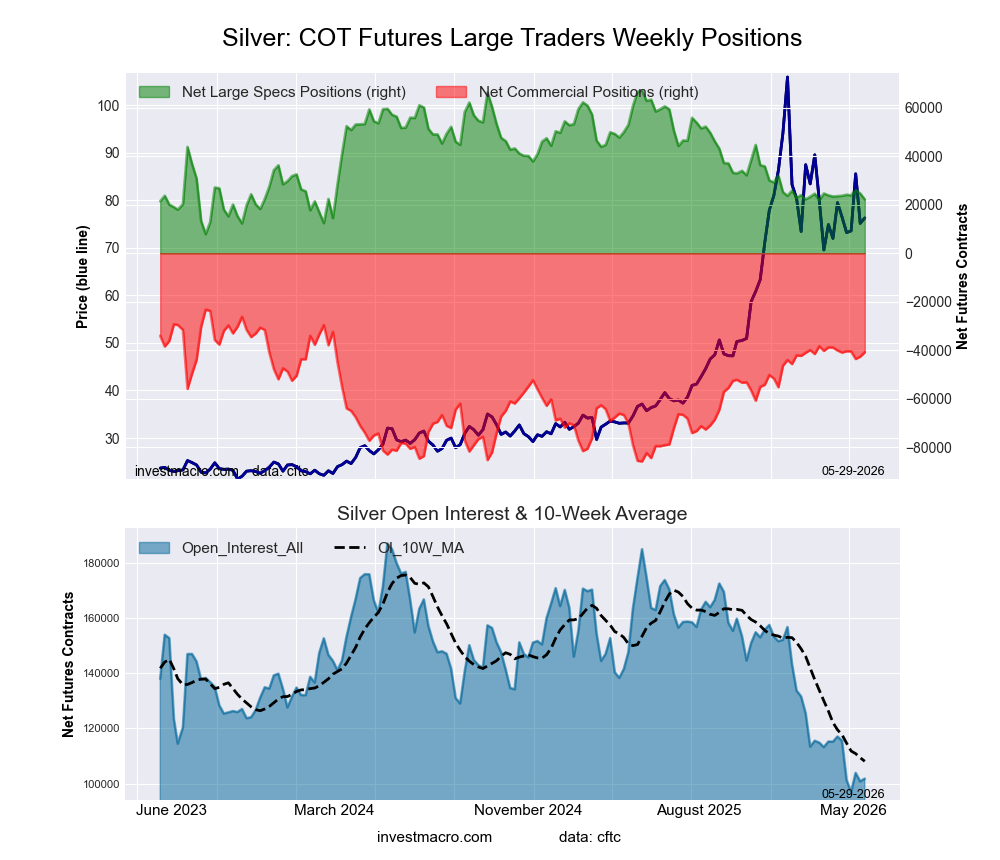
Silver Futures COT ChartThe Silver Comex Futures large speculator standing this week totaled a net position of 23,338 contracts in the data reported through Tuesday. This was a weekly increase of 1,078 contracts from the previous week which had a total of 22,260 net contracts.

This week’s current strength score (the trader positioning range over the past three years, measured from 0 to 100) shows the speculators are currently Bearish with a score of 35.9 percent. The commercials are Bullish with a score of 59.9 percent and the small traders (not shown in chart) are Bearish with a score of 44.6 percent.

Price Trend-Following Model: Uptrend

Our weekly trend-following model classifies the current market price position as: Uptrend.

Silver Futures StatisticsSPECULATORSCOMMERCIALSSMALL TRADERS
– Percent of Open Interest Longs:30.227.323.0
– Percent of Open Interest Shorts:9.662.58.3
– Net Position:23,338-39,96616,628
– Gross Longs:34,22630,89326,079
– Gross Shorts:10,88870,8599,451
– Long to Short Ratio:3.1 to 10.4 to 12.8 to 1
NET POSITION TREND:
– Strength Index Score (3 Year Range Pct):35.959.944.6
– Strength Index Reading (3 Year Range):BearishBullishBearish
NET POSITION MOVEMENT INDEX:
– 6-Week Change in Strength Index:-2.78.4-25.0


Copper Grade #1 Futures:

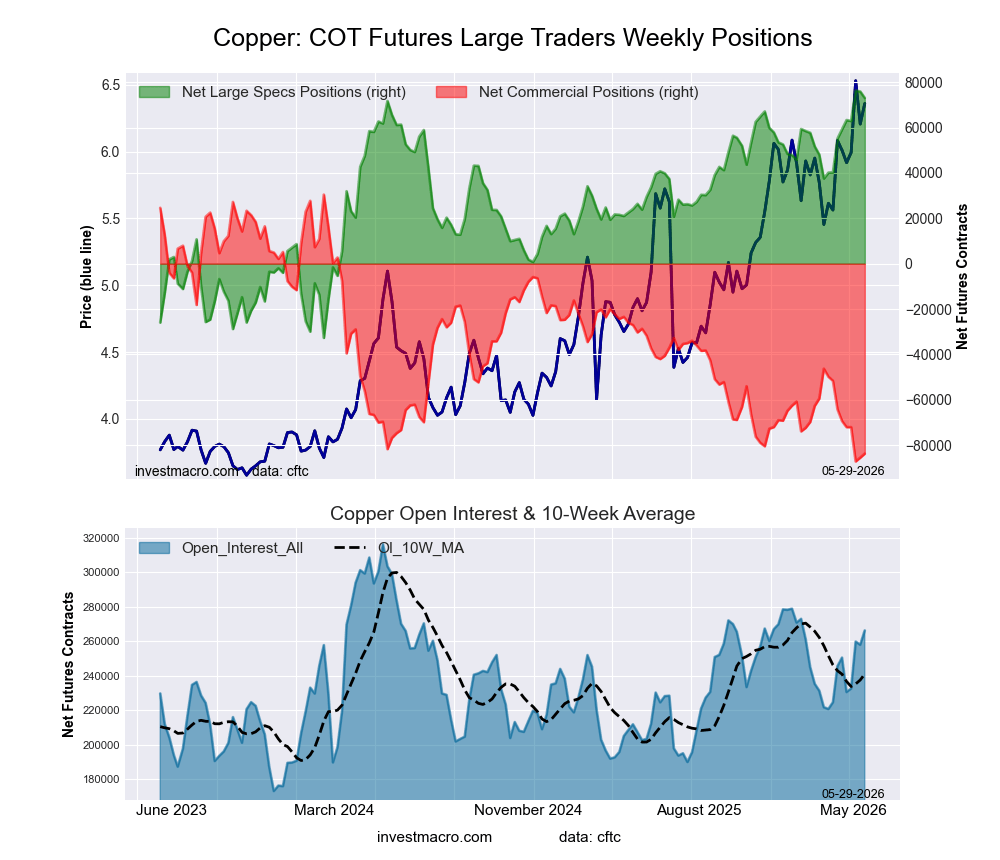
Copper Futures COT ChartThe Copper Grade #1 Futures large speculator standing this week totaled a net position of 57,681 contracts in the data reported through Tuesday. This was a weekly reduction of -759 contracts from the previous week which had a total of 58,440 net contracts.

This week’s current strength score (the trader positioning range over the past three years, measured from 0 to 100) shows the speculators are currently Bullish-Extreme with a score of 87.0 percent. The commercials are Bearish-Extreme with a score of 10.3 percent and the small traders (not shown in chart) are Bullish with a score of 76.6 percent.

Price Trend-Following Model: Uptrend

Our weekly trend-following model classifies the current market price position as: Uptrend.

Copper Futures StatisticsSPECULATORSCOMMERCIALSSMALL TRADERS
– Percent of Open Interest Longs:36.434.98.4
– Percent of Open Interest Shorts:12.863.43.4
– Net Position:57,681-69,74412,063
– Gross Longs:89,10385,48120,481
– Gross Shorts:31,422155,2258,418
– Long to Short Ratio:2.8 to 10.6 to 12.4 to 1
NET POSITION TREND:
– Strength Index Score (3 Year Range Pct):87.010.376.6
– Strength Index Reading (3 Year Range):Bullish-ExtremeBearish-ExtremeBullish
NET POSITION MOVEMENT INDEX:
– 6-Week Change in Strength Index:4.8-0.5-23.4


Platinum Futures:

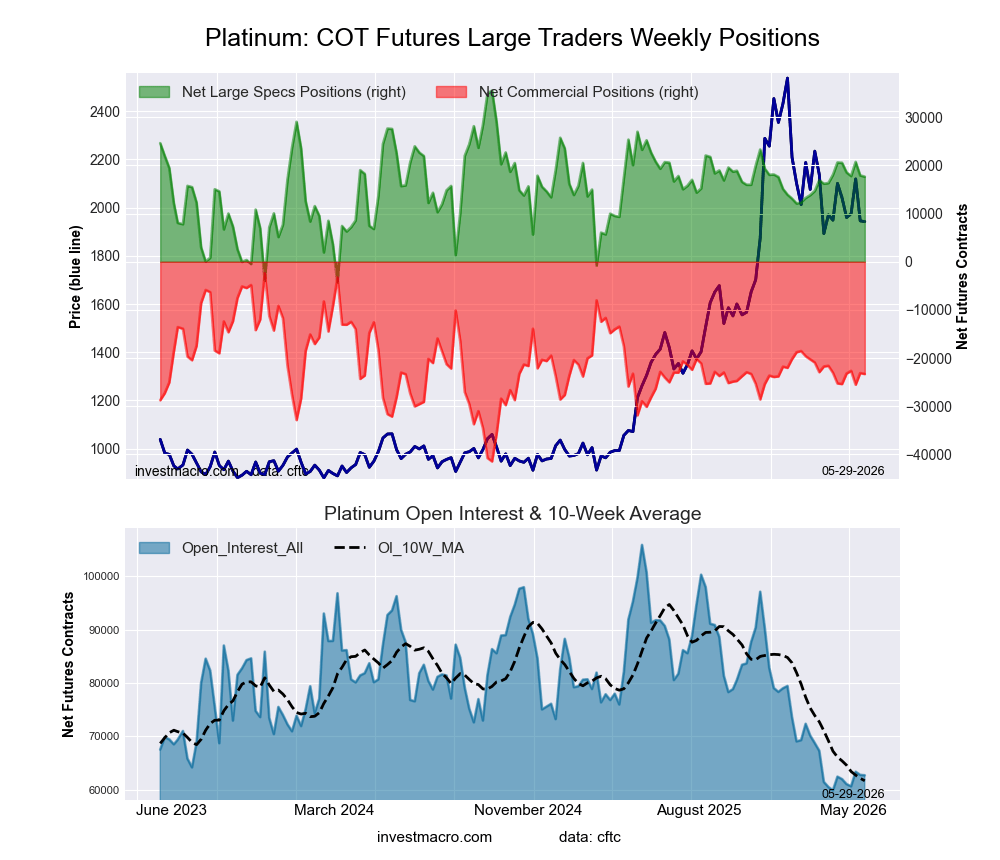
Platinum Futures COT ChartThe Platinum Futures large speculator standing this week totaled a net position of 13,832 contracts in the data reported through Tuesday. This was a weekly advance of 592 contracts from the previous week which had a total of 13,240 net contracts.

This week’s current strength score (the trader positioning range over the past three years, measured from 0 to 100) shows the speculators are currently Bearish with a score of 45.6 percent. The commercials are Bullish with a score of 54.2 percent and the small traders (not shown in chart) are Bullish with a score of 72.7 percent.

Price Trend-Following Model: Uptrend

Our weekly trend-following model classifies the current market price position as: Uptrend.

Platinum Futures StatisticsSPECULATORSCOMMERCIALSSMALL TRADERS
– Percent of Open Interest Longs:45.029.213.2
– Percent of Open Interest Shorts:25.358.04.0
– Net Position:13,832-20,2706,438
– Gross Longs:31,57920,4519,257
– Gross Shorts:17,74740,7212,819
– Long to Short Ratio:1.8 to 10.5 to 13.3 to 1
NET POSITION TREND:
– Strength Index Score (3 Year Range Pct):45.654.272.7
– Strength Index Reading (3 Year Range):BearishBullishBullish
NET POSITION MOVEMENT INDEX:
– 6-Week Change in Strength Index:-3.23.9-2.5


Palladium Futures:

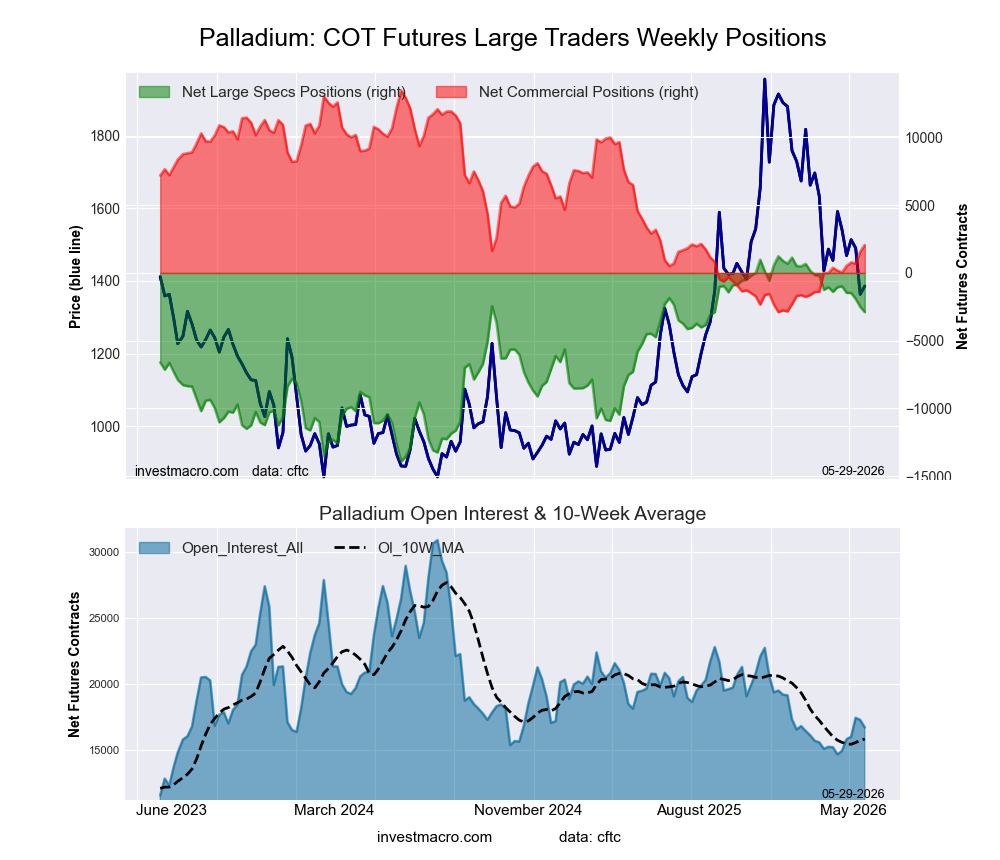
Palladium Futures COT ChartThe Palladium Futures large speculator standing this week totaled a net position of 161 contracts in the data reported through Tuesday. This was a weekly fall of -503 contracts from the previous week which had a total of 664 net contracts.

This week’s current strength score (the trader positioning range over the past three years, measured from 0 to 100) shows the speculators are currently Bullish-Extreme with a score of 93.0 percent. The commercials are Bearish-Extreme with a score of 7.7 percent and the small traders (not shown in chart) are Bullish with a score of 70.8 percent.

Price Trend-Following Model: Weak Uptrend

Our weekly trend-following model classifies the current market price position as: Weak Uptrend.

Palladium Futures StatisticsSPECULATORSCOMMERCIALSSMALL TRADERS
– Percent of Open Interest Longs:48.333.815.7
– Percent of Open Interest Shorts:47.344.06.5
– Net Position:161-1,6311,470
– Gross Longs:7,7685,4462,519
– Gross Shorts:7,6077,0771,049
– Long to Short Ratio:1.0 to 10.8 to 12.4 to 1
NET POSITION TREND:
– Strength Index Score (3 Year Range Pct):93.07.770.8
– Strength Index Reading (3 Year Range):Bullish-ExtremeBearish-ExtremeBullish
NET POSITION MOVEMENT INDEX:
– 6-Week Change in Strength Index:-4.86.9-13.9


Steel Futures Futures:

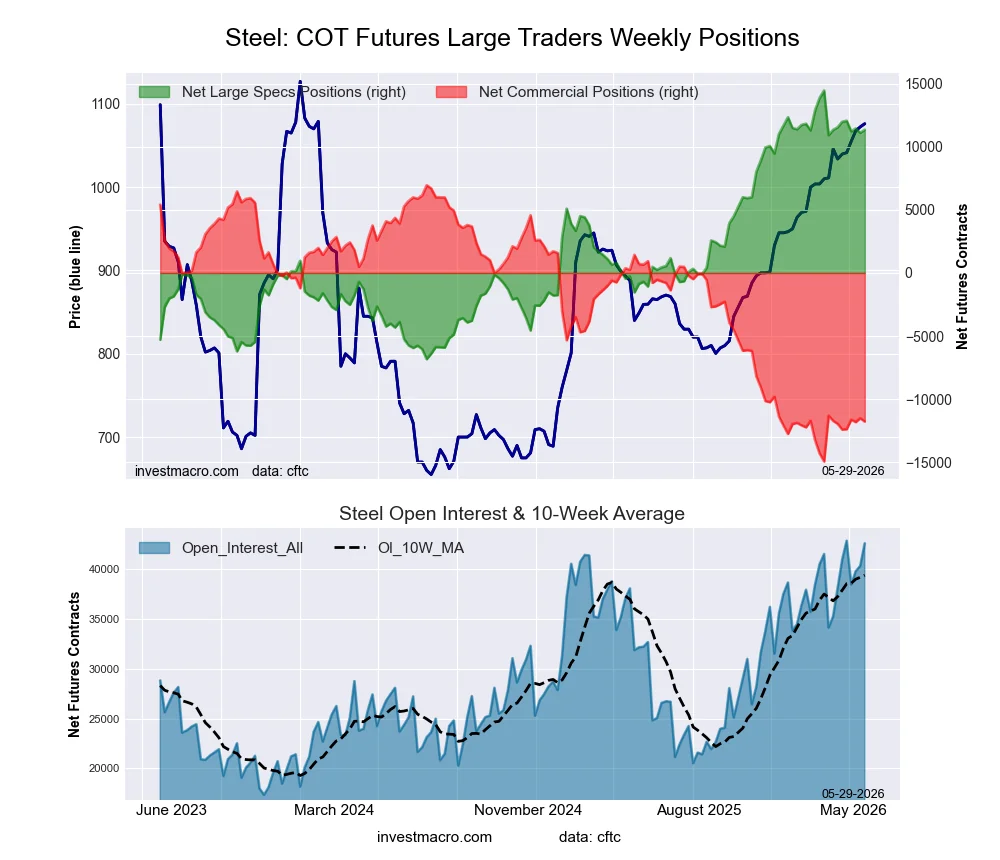
Steel Futures COT ChartThe Steel Futures large speculator standing this week totaled a net position of 11,298 contracts in the data reported through Tuesday. This was a weekly decrease of -526 contracts from the previous week which had a total of 11,824 net contracts.

This week’s current strength score (the trader positioning range over the past three years, measured from 0 to 100) shows the speculators are currently Bullish-Extreme with a score of 94.6 percent. The commercials are Bearish-Extreme with a score of 5.3 percent and the small traders (not shown in chart) are Bullish-Extreme with a score of 88.3 percent.

Price Trend-Following Model: Strong Uptrend

Our weekly trend-following model classifies the current market price position as: Strong Uptrend.

Steel Futures StatisticsSPECULATORSCOMMERCIALSSMALL TRADERS
– Percent of Open Interest Longs:37.359.21.5
– Percent of Open Interest Shorts:5.792.00.3
– Net Position:11,298-11,714416
– Gross Longs:13,32121,158519
– Gross Shorts:2,02332,872103
– Long to Short Ratio:6.6 to 10.6 to 15.0 to 1
NET POSITION TREND:
– Strength Index Score (3 Year Range Pct):94.65.388.3
– Strength Index Reading (3 Year Range):Bullish-ExtremeBearish-ExtremeBullish-Extreme
NET POSITION MOVEMENT INDEX:
– 6-Week Change in Strength Index:-1.91.9-1.4


Article By InvestMacroReceive our weekly COT Newsletter

*COT Report: The COT data, released weekly to the public each Friday, is updated through the most recent Tuesday (data is 3 days old) and shows a quick view of how large speculators or non-commercials (for-profit traders) were positioned in the futures markets.

The CFTC categorizes trader positions according to commercial hedgers (traders who use futures contracts for hedging as part of the business), non-commercials (large traders who speculate to realize trading profits) and nonreportable traders (usually small traders/speculators) as well as their open interest (contracts open in the market at time of reporting). See CFTC criteria here.

COT Bonds Charts: Speculator Bets led by 10-Year Bonds & Fed Funds

By InvestMacro

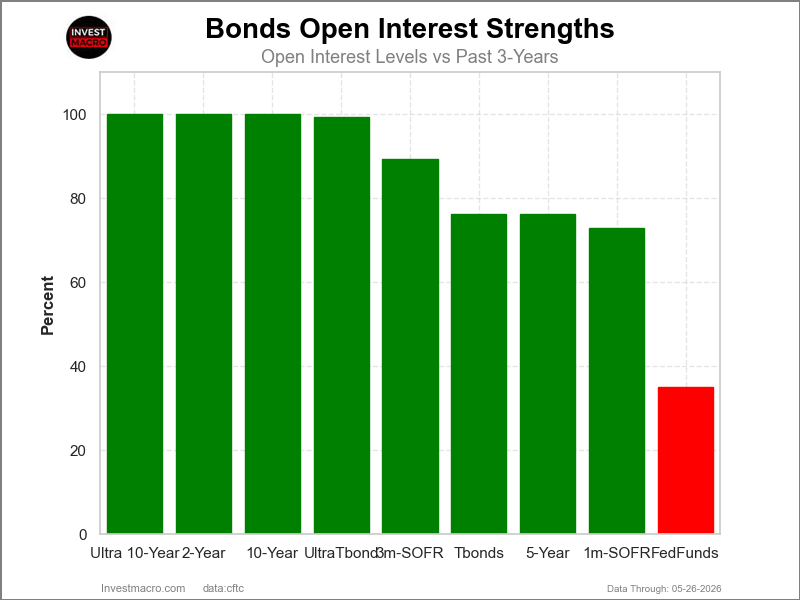
Bonds Market Open Interest Comparison
Here are the latest charts and statistics for the Commitment of Traders (COT) reports data published by the Commodities Futures Trading Commission (CFTC).

The latest COT data is updated through Tuesday March 3rd and shows a quick view of how large traders (for-profit speculators and commercial hedgers) were positioned in the futures markets.

Weekly Speculator Changes led by 10-Year Bonds & Fed Funds

Bonds Market Net Speculators Positions
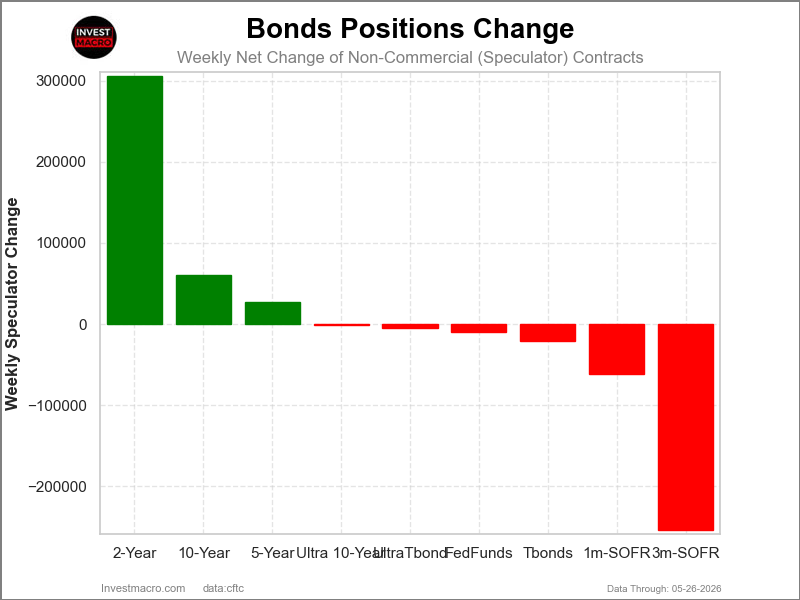
The COT bond market speculator bets were slightly higher this week as five out of the nine bond markets we cover had higher positioning while the other four markets had lower speculator contracts.

Leading the gains for the bond markets was the 10-Year Bonds (119,513 contracts) with the Fed Funds (49,366 contracts), the Ultra Treasury Bonds (24,793 contracts), the US Treasury Bonds (15,191 contracts) and the 2-Year Bonds (9,495 contracts) also showed a positive week.

The bond markets with declines in speculator bets for the week were the Ultra 10-Year Bonds (-89,757 contracts), the 5-Year Bonds (-25,863 contracts), the SOFR 3-Months (-15,481 contracts) and with the SOFR 1-Month (-4,108 contracts) also recording lower bets on the week.

Bond Markets Price Performances were lower across the board this week

The Fed Funds was the only market this week that did not see a dip in price performance as the Fed Funds were approximately unchanged on the week. The one-month Secured Overnight Financing Rate was lower by -0.01%, while the three-month Secured Overnight Financing Rate was also lower by -0.01%.

The 2-Year Bond fell by -0.55% on the week, while the 5-Year Bond was lower by -1.09% and the 10-Year Note was down by -1.58%.  The long US Treasury Bond was the largest decliner on the week with a drop lower by -2.5%.


Bonds Data:

Bonds Market Speculators Data Table
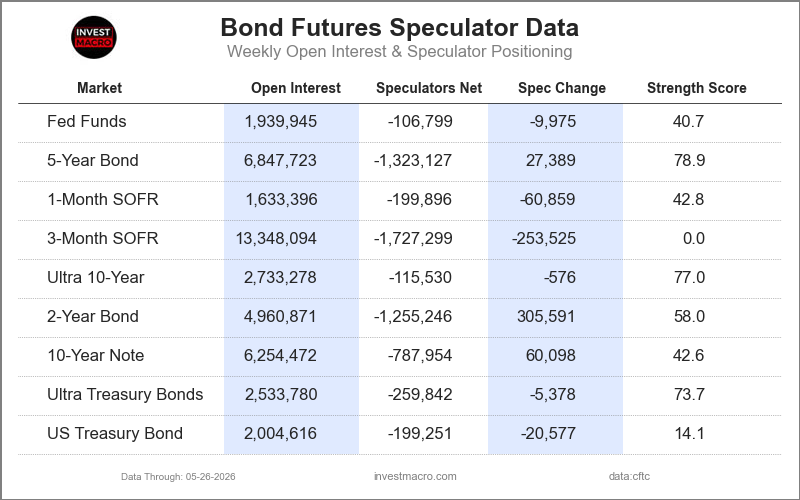
Legend: Open Interest | Speculators Current Net Position | Weekly Specs Change | Specs Strength Score compared to last 3-Years (0-100 range)


Strength Scores led by US Treasury Bonds & Ultra Treasury Bonds

Bonds Market Strength Index Comparison
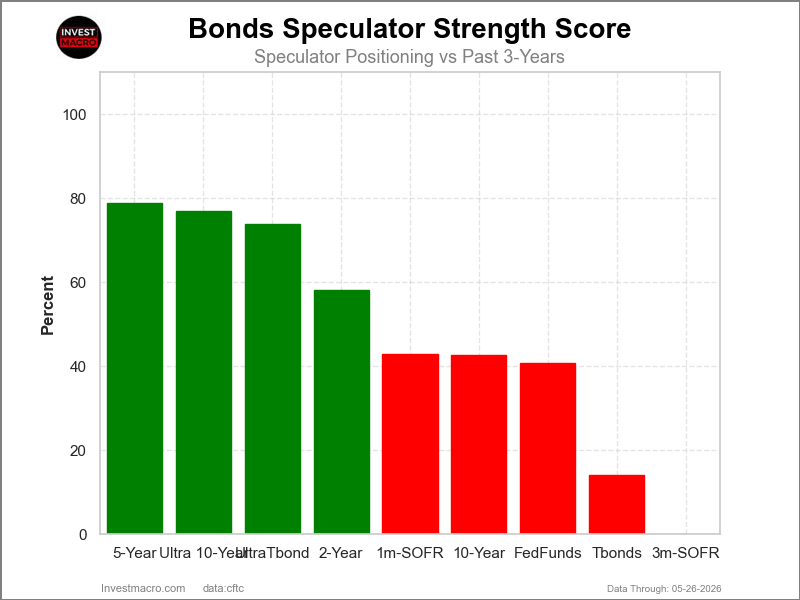
COT Strength Scores (a normalized measure of Speculator positions over a 3-Year range, from 0 to 100 where above 80 is Extreme-Bullish and below 20 is Extreme-Bearish) showed that the US Treasury Bonds (90 percent) and the Ultra Treasury Bonds (75 percent) lead the bond markets this week. The Ultra 10-Year Bonds (71 percent) comes in as the next highest in the weekly strength scores.

On the downside, the 2-Year Bonds (15 percent) and the SOFR 3-Months (19 percent) come in at the lowest strength level currently and are in Extreme-Bearish territory (below 20 percent). The next lowest strength score was the 5-Year Bonds (28 percent).

Strength Statistics:
Fed Funds (33.1 percent) vs Fed Funds previous week (26.1 percent)
2-Year Bond (14.5 percent) vs 2-Year Bond previous week (13.5 percent)
5-Year Bond (27.8 percent) vs 5-Year Bond previous week (29.0 percent)
10-Year Bond (58.5 percent) vs 10-Year Bond previous week (44.2 percent)
Ultra 10-Year Bond (71.0 percent) vs Ultra 10-Year Bond previous week (95.3 percent)
US Treasury Bond (90.4 percent) vs US Treasury Bond previous week (85.1 percent)
Ultra US Treasury Bond (75.3 percent) vs Ultra US Treasury Bond previous week (66.0 percent)
SOFR 1-Month (46.8 percent) vs SOFR 1-Month previous week (47.5 percent)
SOFR 3-Months (18.6 percent) vs SOFR 3-Months previous week (19.4 percent)


Ultra 10-Year Bonds & SOFR 1-Month top the 6-Week Strength Trends

Bonds Market Trend Index Comparison
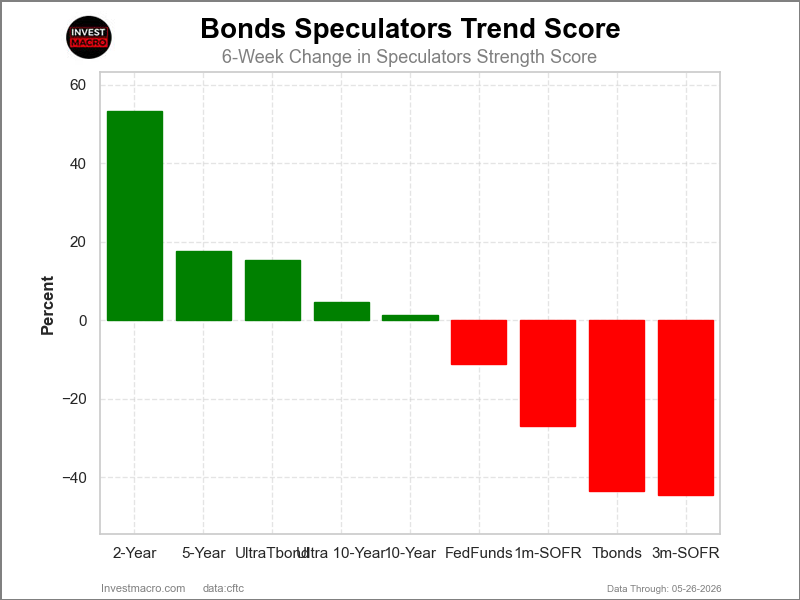
COT Strength Score Trends (or move index, calculates the 6-week changes in strength scores) showed that the Ultra 10-Year Bonds (24 percent) and the SOFR 1-Month (17 percent) lead the past six weeks trends for bonds. The US Treasury Bonds (15 percent) are the next highest positive movers in the latest trends data.

The Fed Funds (-12 percent), the 2-Year Bonds (-11 percent) and the SOFR 3-Months (-10 percent) leads the downside trend scores currently.

Strength Trend Statistics:
Fed Funds (-11.7 percent) vs Fed Funds previous week (-38.2 percent)
2-Year Bond (-11.1 percent) vs 2-Year Bond previous week (-4.2 percent)
5-Year Bond (2.2 percent) vs 5-Year Bond previous week (9.6 percent)
10-Year Bond (0.1 percent) vs 10-Year Bond previous week (11.5 percent)
Ultra 10-Year Bond (24.4 percent) vs Ultra 10-Year Bond previous week (52.3 percent)
US Treasury Bond (15.1 percent) vs US Treasury Bond previous week (-3.0 percent)
Ultra US Treasury Bond (1.2 percent) vs Ultra US Treasury Bond previous week (-17.0 percent)
SOFR 1-Month (16.8 percent) vs SOFR 1-Month previous week (17.4 percent)
SOFR 3-Months (-9.6 percent) vs SOFR 3-Months previous week (-12.5 percent)


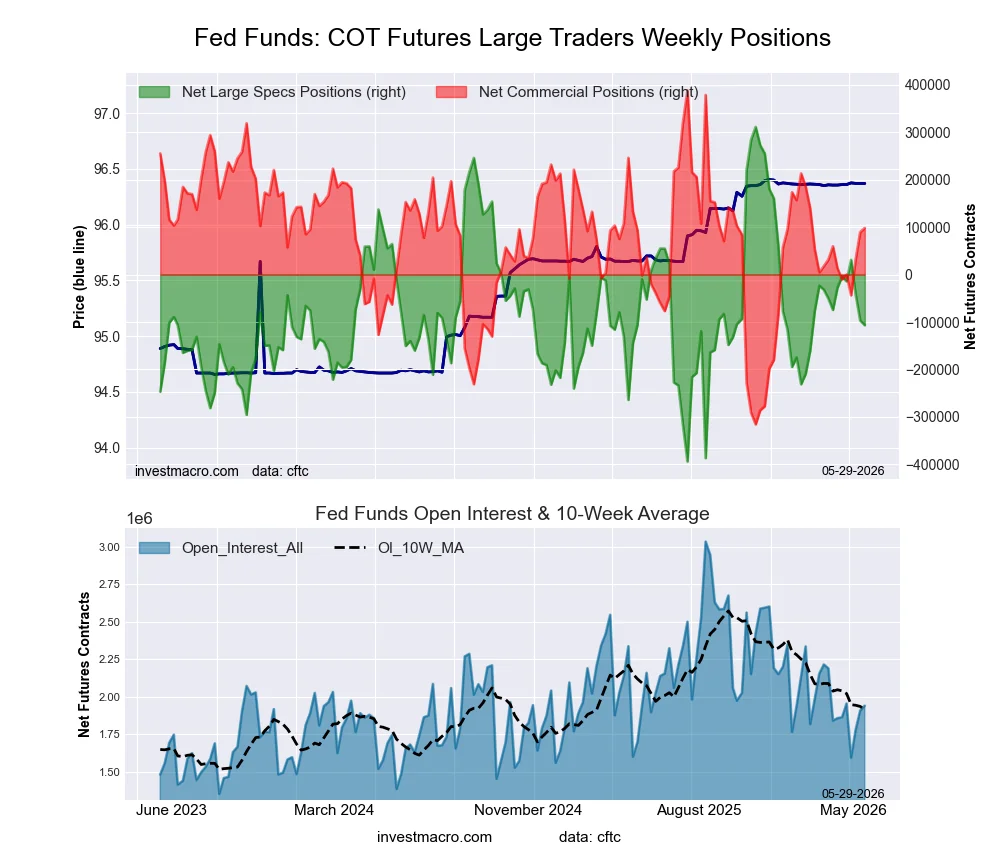
30-Day Federal Funds Futures:

Federal Funds 30-Day Bonds Futures COT ChartThe 30-Day Federal Funds large speculator standing this week totaled a net position of -160,245 contracts in the data reported through Tuesday. This was a weekly boost of 49,366 contracts from the previous week which had a total of -209,611 net contracts.

This week’s current strength score (the trader positioning range over the past three years, measured from 0 to 100) shows the speculators are currently Bearish with a score of 33.1 percent. The commercials are Bullish with a score of 64.7 percent and the small traders (not shown in chart) are Bullish-Extreme with a score of 90.0 percent.

Price Trend-Following Model: Weak Uptrend

Our weekly trend-following model classifies the current market price position as: Weak Uptrend.

30-Day Federal Funds StatisticsSPECULATORSCOMMERCIALSSMALL TRADERS
– Percent of Open Interest Longs:12.567.42.5
– Percent of Open Interest Shorts:21.359.71.3
– Net Position:-160,245139,11521,130
– Gross Longs:227,0081,224,03845,288
– Gross Shorts:387,2531,084,92324,158
– Long to Short Ratio:0.6 to 11.1 to 11.9 to 1
NET POSITION TREND:
– Strength Index Score (3 Year Range Pct):33.164.790.0
– Strength Index Reading (3 Year Range):BearishBullishBullish-Extreme
NET POSITION MOVEMENT INDEX:
– 6-Week Change in Strength Index:-11.711.61.0


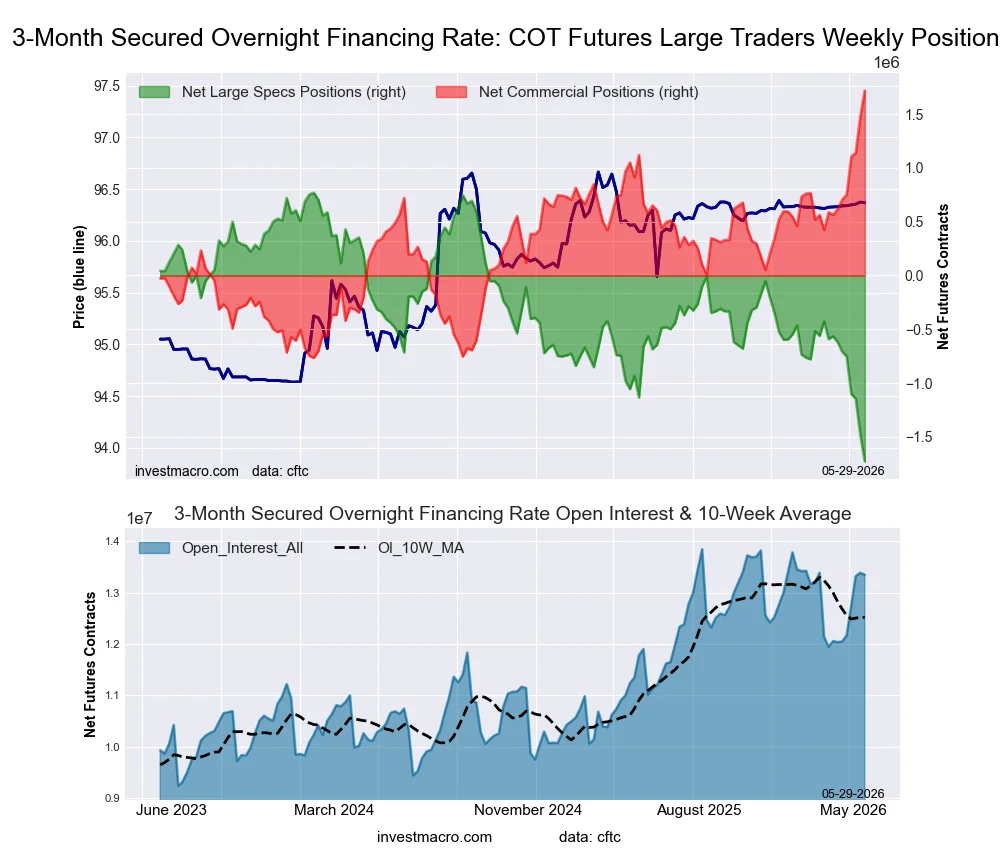
Secured Overnight Financing Rate (3-Month) Futures:

SOFR 3-Months Bonds Futures COT ChartThe Secured Overnight Financing Rate (3-Month) large speculator standing this week totaled a net position of -778,512 contracts in the data reported through Tuesday. This was a weekly decline of -15,481 contracts from the previous week which had a total of -763,031 net contracts.

This week’s current strength score (the trader positioning range over the past three years, measured from 0 to 100) shows the speculators are currently Bearish-Extreme with a score of 18.6 percent. The commercials are Bullish-Extreme with a score of 81.2 percent and the small traders (not shown in chart) are Bullish-Extreme with a score of 84.7 percent.

Price Trend-Following Model: Weak Uptrend

Our weekly trend-following model classifies the current market price position as: Weak Uptrend.

SOFR 3-Months StatisticsSPECULATORSCOMMERCIALSSMALL TRADERS
– Percent of Open Interest Longs:13.157.40.5
– Percent of Open Interest Shorts:19.051.60.4
– Net Position:-778,512765,40413,108
– Gross Longs:1,729,3847,557,16264,763
– Gross Shorts:2,507,8966,791,75851,655
– Long to Short Ratio:0.7 to 11.1 to 11.3 to 1
NET POSITION TREND:
– Strength Index Score (3 Year Range Pct):18.681.284.7
– Strength Index Reading (3 Year Range):Bearish-ExtremeBullish-ExtremeBullish-Extreme
NET POSITION MOVEMENT INDEX:
– 6-Week Change in Strength Index:-9.69.06.9


Individual Bond Markets:

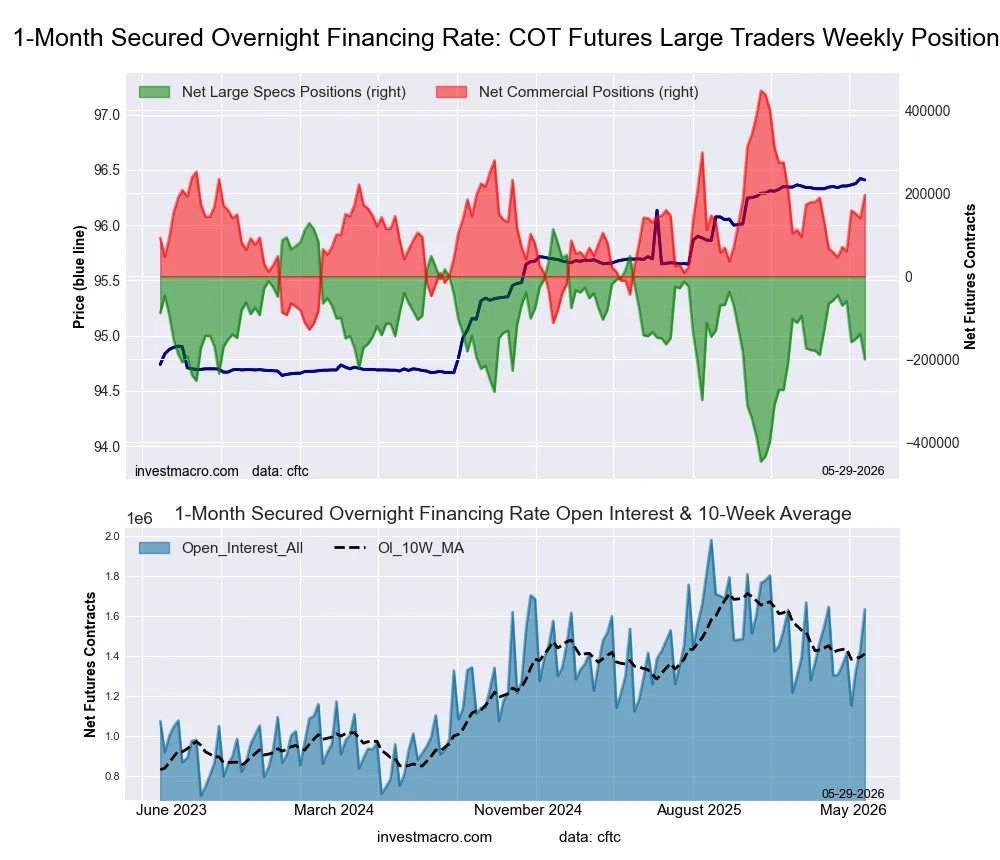
Secured Overnight Financing Rate (1-Month) Futures:

SOFR 1-Month Bonds Futures COT ChartThe Secured Overnight Financing Rate (1-Month) large speculator standing this week totaled a net position of -177,288 contracts in the data reported through Tuesday. This was a weekly reduction of -4,108 contracts from the previous week which had a total of -173,180 net contracts.

This week’s current strength score (the trader positioning range over the past three years, measured from 0 to 100) shows the speculators are currently Bearish with a score of 46.8 percent. The commercials are Bullish with a score of 53.2 percent and the small traders (not shown in chart) are Bullish with a score of 66.5 percent.

Price Trend-Following Model: Weak Uptrend

Our weekly trend-following model classifies the current market price position as: Weak Uptrend.

SOFR 1-Month StatisticsSPECULATORSCOMMERCIALSSMALL TRADERS
– Percent of Open Interest Longs:23.360.00.0
– Percent of Open Interest Shorts:37.246.20.0
– Net Position:-177,288177,472-184
– Gross Longs:298,453767,910160
– Gross Shorts:475,741590,438344
– Long to Short Ratio:0.6 to 11.3 to 10.5 to 1
NET POSITION TREND:
– Strength Index Score (3 Year Range Pct):46.853.266.5
– Strength Index Reading (3 Year Range):BearishBullishBullish
NET POSITION MOVEMENT INDEX:
– 6-Week Change in Strength Index:16.8-16.8-0.2


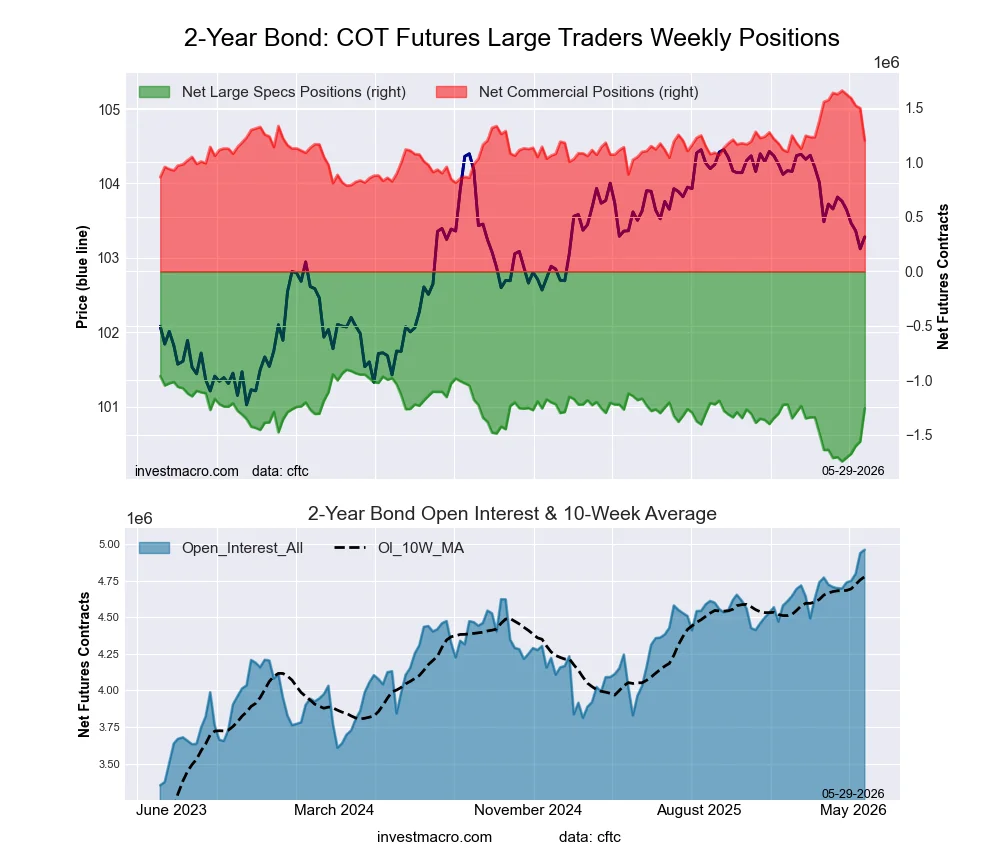
2-Year Treasury Note Futures:

2-Year Treasury Bonds Futures COT ChartThe 2-Year Treasury Note large speculator standing this week totaled a net position of -1,338,541 contracts in the data reported through Tuesday. This was a weekly lift of 9,495 contracts from the previous week which had a total of -1,348,036 net contracts.

This week’s current strength score (the trader positioning range over the past three years, measured from 0 to 100) shows the speculators are currently Bearish-Extreme with a score of 14.5 percent. The commercials are Bullish-Extreme with a score of 88.6 percent and the small traders (not shown in chart) are Bearish with a score of 41.3 percent.

Price Trend-Following Model: Weak Uptrend

Our weekly trend-following model classifies the current market price position as: Weak Uptrend.

2-Year Treasury Note StatisticsSPECULATORSCOMMERCIALSSMALL TRADERS
– Percent of Open Interest Longs:14.875.55.3
– Percent of Open Interest Shorts:44.648.13.0
– Net Position:-1,338,5411,232,909105,632
– Gross Longs:666,3773,393,548238,612
– Gross Shorts:2,004,9182,160,639132,980
– Long to Short Ratio:0.3 to 11.6 to 11.8 to 1
NET POSITION TREND:
– Strength Index Score (3 Year Range Pct):14.588.641.3
– Strength Index Reading (3 Year Range):Bearish-ExtremeBullish-ExtremeBearish
NET POSITION MOVEMENT INDEX:
– 6-Week Change in Strength Index:-11.113.2-1.8


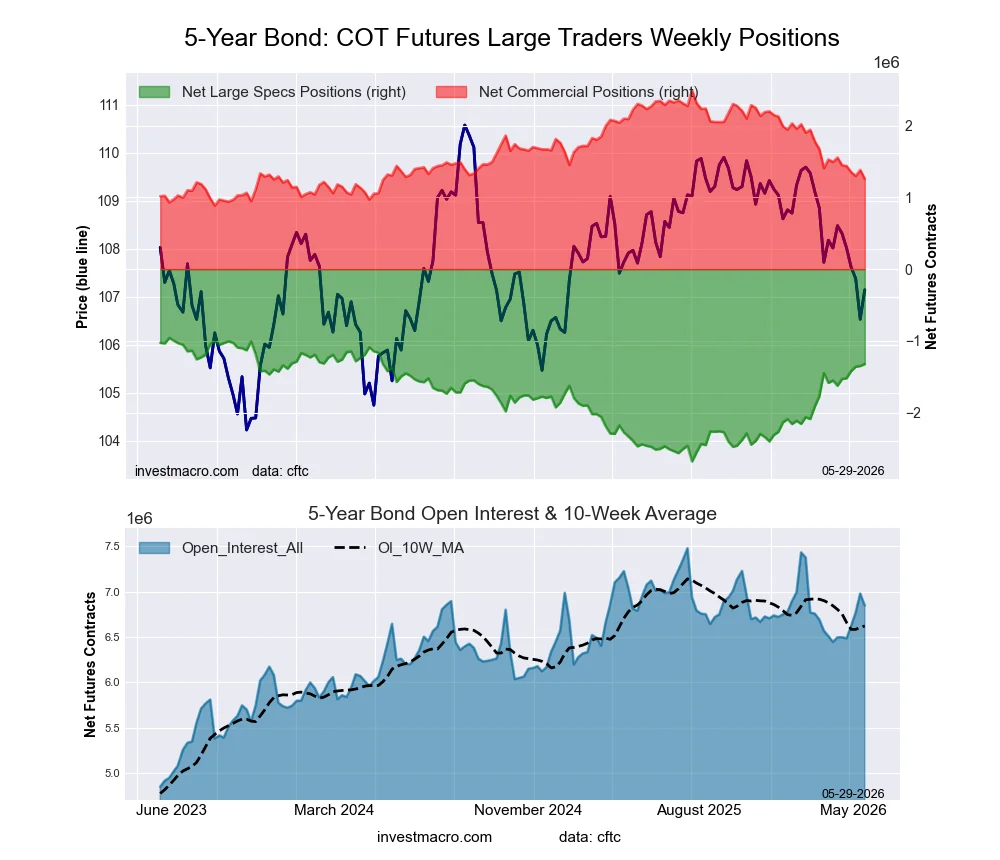
5-Year Treasury Note Futures:

5-Year Treasury Bonds Futures COT ChartThe 5-Year Treasury Note large speculator standing this week totaled a net position of -2,090,794 contracts in the data reported through Tuesday. This was a weekly lowering of -25,863 contracts from the previous week which had a total of -2,064,931 net contracts.

This week’s current strength score (the trader positioning range over the past three years, measured from 0 to 100) shows the speculators are currently Bearish with a score of 27.8 percent. The commercials are Bullish with a score of 71.3 percent and the small traders (not shown in chart) are Bullish with a score of 63.1 percent.

Price Trend-Following Model: Weak Uptrend

Our weekly trend-following model classifies the current market price position as: Weak Uptrend.

5-Year Treasury Note StatisticsSPECULATORSCOMMERCIALSSMALL TRADERS
– Percent of Open Interest Longs:7.581.96.5
– Percent of Open Interest Shorts:38.453.24.3
– Net Position:-2,090,7941,942,942147,852
– Gross Longs:510,6625,547,849438,288
– Gross Shorts:2,601,4563,604,907290,436
– Long to Short Ratio:0.2 to 11.5 to 11.5 to 1
NET POSITION TREND:
– Strength Index Score (3 Year Range Pct):27.871.363.1
– Strength Index Reading (3 Year Range):BearishBullishBullish
NET POSITION MOVEMENT INDEX:
– 6-Week Change in Strength Index:2.2-2.50.7


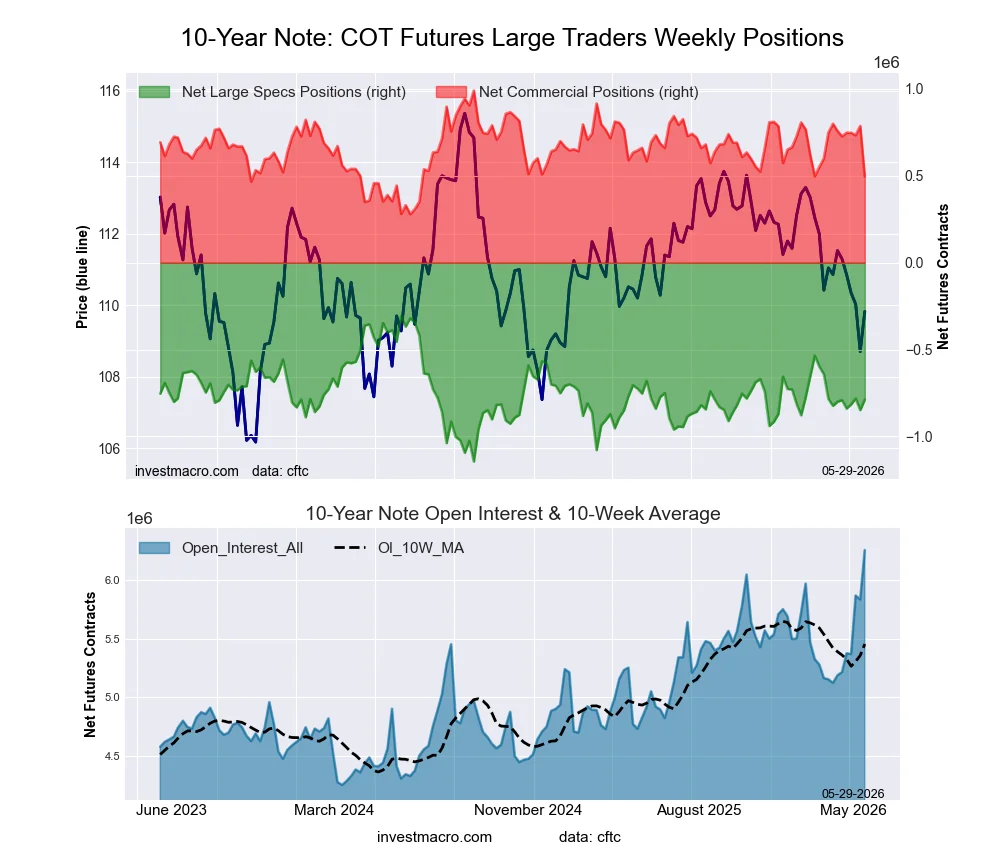
10-Year Treasury Note Futures:

10-Year Treasury Notes Bonds Futures COT ChartThe 10-Year Treasury Note large speculator standing this week totaled a net position of -654,507 contracts in the data reported through Tuesday. This was a weekly advance of 119,513 contracts from the previous week which had a total of -774,020 net contracts.

This week’s current strength score (the trader positioning range over the past three years, measured from 0 to 100) shows the speculators are currently Bullish with a score of 58.5 percent. The commercials are Bearish with a score of 47.9 percent and the small traders (not shown in chart) are Bearish with a score of 41.7 percent.

Price Trend-Following Model: Weak Uptrend

Our weekly trend-following model classifies the current market price position as: Weak Uptrend.

10-Year Treasury Note StatisticsSPECULATORSCOMMERCIALSSMALL TRADERS
– Percent of Open Interest Longs:11.277.77.9
– Percent of Open Interest Shorts:23.266.37.3
– Net Position:-654,507620,30534,202
– Gross Longs:611,9654,244,872431,657
– Gross Shorts:1,266,4723,624,567397,455
– Long to Short Ratio:0.5 to 11.2 to 11.1 to 1
NET POSITION TREND:
– Strength Index Score (3 Year Range Pct):58.547.941.7
– Strength Index Reading (3 Year Range):BullishBearishBearish
NET POSITION MOVEMENT INDEX:
– 6-Week Change in Strength Index:0.16.6-19.4


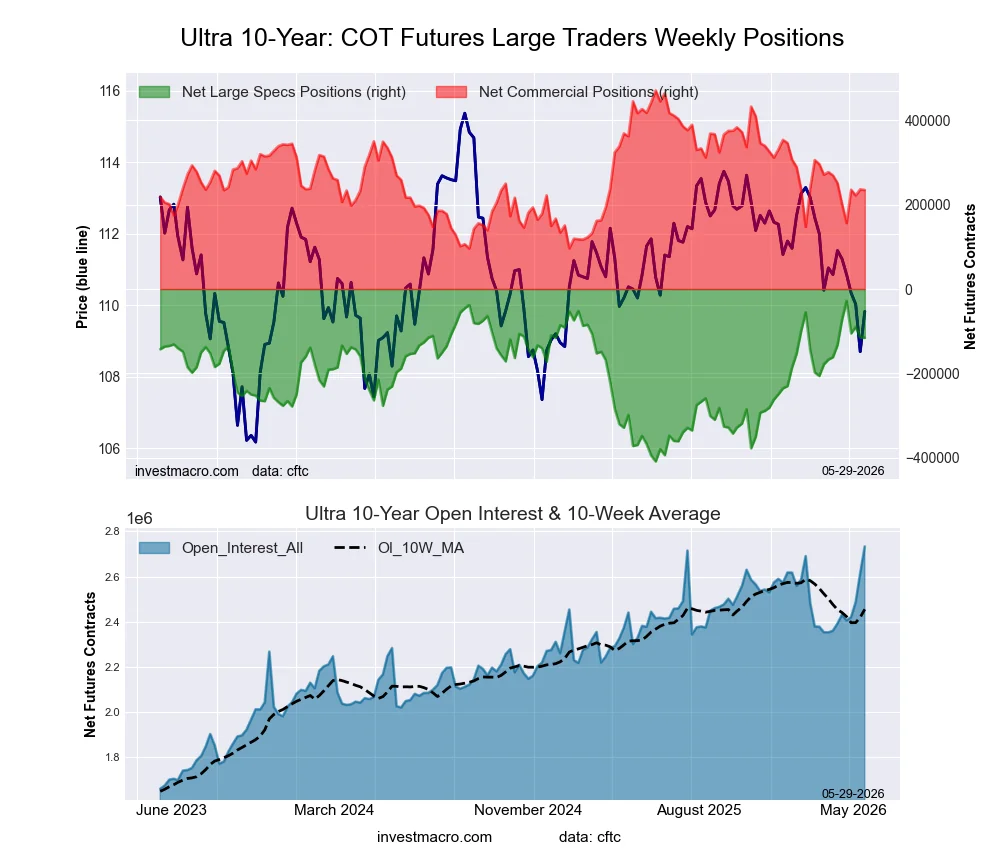
Ultra 10-Year Notes Futures:

Ultra 10-Year Treasury Notes Bonds Futures COT ChartThe Ultra 10-Year Notes large speculator standing this week totaled a net position of -145,020 contracts in the data reported through Tuesday. This was a weekly lowering of -89,757 contracts from the previous week which had a total of -55,263 net contracts.

This week’s current strength score (the trader positioning range over the past three years, measured from 0 to 100) shows the speculators are currently Bullish with a score of 71.0 percent. The commercials are Bearish with a score of 38.1 percent and the small traders (not shown in chart) are Bearish with a score of 34.0 percent.

Price Trend-Following Model: Weak Uptrend

Our weekly trend-following model classifies the current market price position as: Weak Uptrend.

Ultra 10-Year Notes StatisticsSPECULATORSCOMMERCIALSSMALL TRADERS
– Percent of Open Interest Longs:9.878.59.6
– Percent of Open Interest Shorts:15.668.913.3
– Net Position:-145,020238,200-93,180
– Gross Longs:243,4461,948,642237,999
– Gross Shorts:388,4661,710,442331,179
– Long to Short Ratio:0.6 to 11.1 to 10.7 to 1
NET POSITION TREND:
– Strength Index Score (3 Year Range Pct):71.038.134.0
– Strength Index Reading (3 Year Range):BullishBearishBearish
NET POSITION MOVEMENT INDEX:
– 6-Week Change in Strength Index:24.4-30.719.2


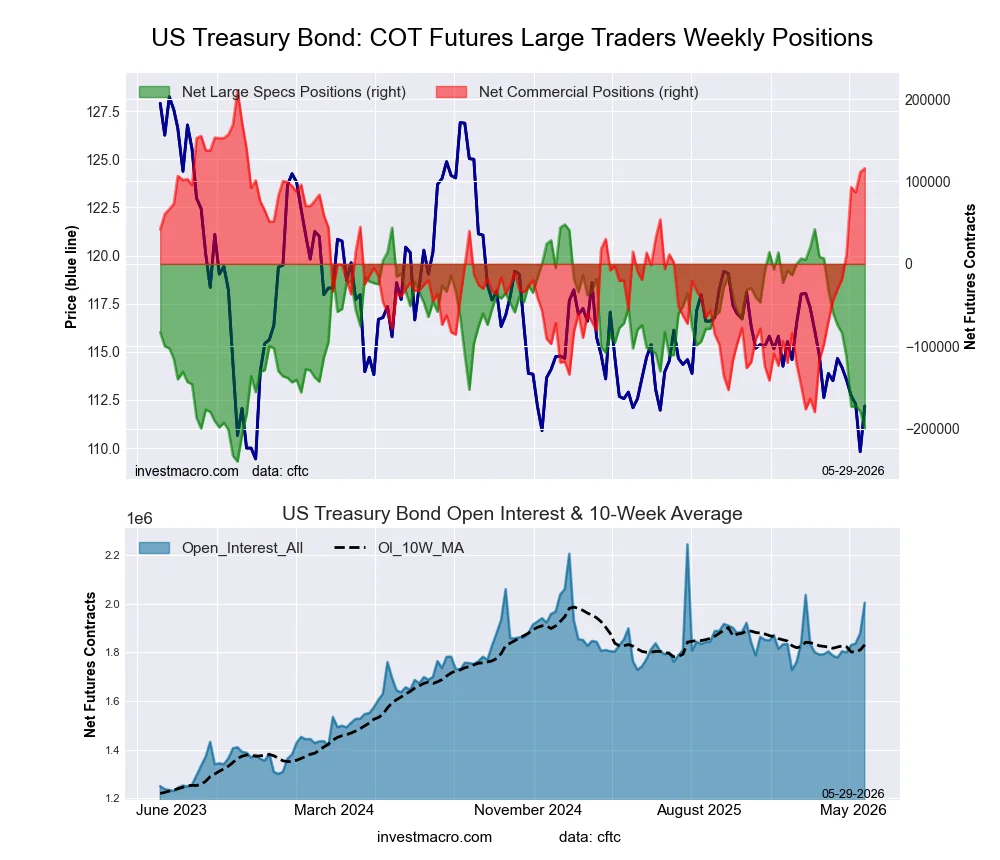
US Treasury Bonds Futures:

US Year Treasury Notes Long Bonds Futures COT ChartThe US Treasury Bonds large speculator standing this week totaled a net position of 20,265 contracts in the data reported through Tuesday. This was a weekly increase of 15,191 contracts from the previous week which had a total of 5,074 net contracts.

This week’s current strength score (the trader positioning range over the past three years, measured from 0 to 100) shows the speculators are currently Bullish-Extreme with a score of 90.4 percent. The commercials are Bearish-Extreme with a score of 3.3 percent and the small traders (not shown in chart) are Bullish-Extreme with a score of 80.5 percent.

Price Trend-Following Model: Downtrend

Our weekly trend-following model classifies the current market price position as: Downtrend.

US Treasury Bonds StatisticsSPECULATORSCOMMERCIALSSMALL TRADERS
– Percent of Open Interest Longs:11.670.313.8
– Percent of Open Interest Shorts:10.579.26.0
– Net Position:20,265-163,455143,190
– Gross Longs:212,3131,289,561253,391
– Gross Shorts:192,0481,453,016110,201
– Long to Short Ratio:1.1 to 10.9 to 12.3 to 1
NET POSITION TREND:
– Strength Index Score (3 Year Range Pct):90.43.380.5
– Strength Index Reading (3 Year Range):Bullish-ExtremeBearish-ExtremeBullish-Extreme
NET POSITION MOVEMENT INDEX:
– 6-Week Change in Strength Index:15.1-18.018.2


Ultra US Treasury Bonds Futures:

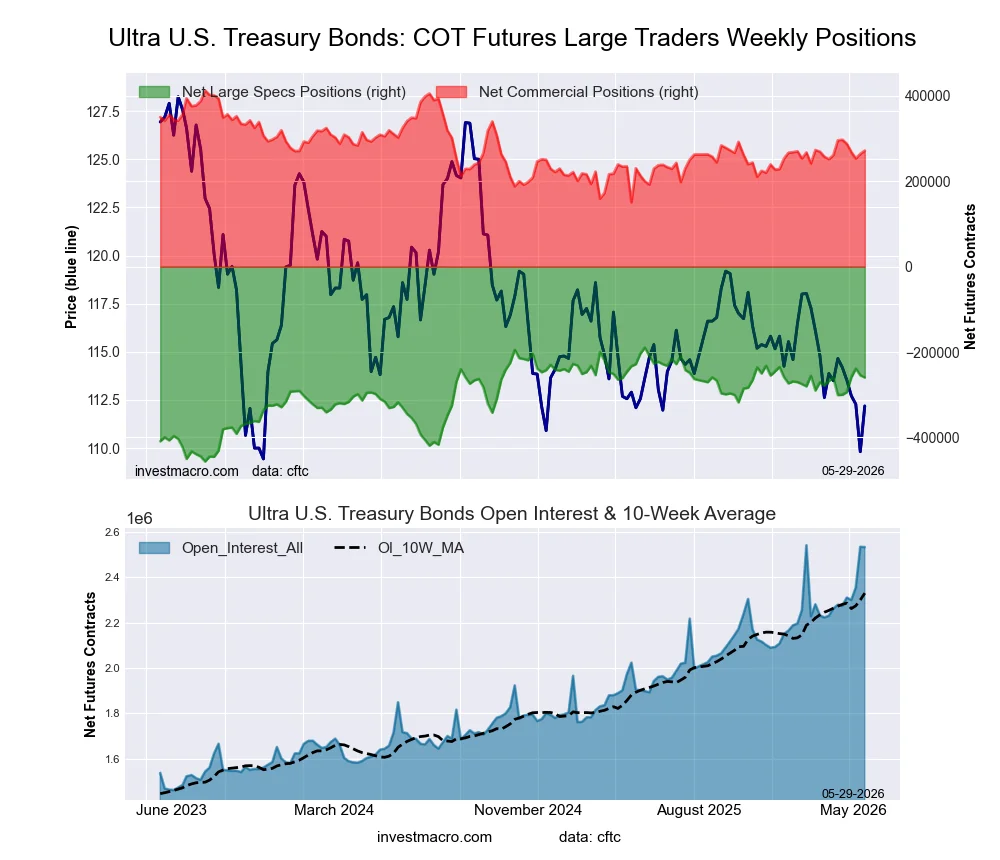
Ultra US Year Treasury Notes Long Bonds Futures COT ChartThe Ultra US Treasury Bonds large speculator standing this week totaled a net position of -255,694 contracts in the data reported through Tuesday. This was a weekly boost of 24,793 contracts from the previous week which had a total of -280,487 net contracts.

This week’s current strength score (the trader positioning range over the past three years, measured from 0 to 100) shows the speculators are currently Bullish with a score of 75.3 percent. The commercials are Bearish with a score of 34.8 percent and the small traders (not shown in chart) are Bearish with a score of 29.2 percent.

Price Trend-Following Model: Downtrend

Our weekly trend-following model classifies the current market price position as: Downtrend.

Ultra US Treasury Bonds StatisticsSPECULATORSCOMMERCIALSSMALL TRADERS
– Percent of Open Interest Longs:6.883.58.4
– Percent of Open Interest Shorts:18.372.67.8
– Net Position:-255,694241,96513,729
– Gross Longs:152,5141,860,020187,508
– Gross Shorts:408,2081,618,055173,779
– Long to Short Ratio:0.4 to 11.1 to 11.1 to 1
NET POSITION TREND:
– Strength Index Score (3 Year Range Pct):75.334.829.2
– Strength Index Reading (3 Year Range):BullishBearishBearish
NET POSITION MOVEMENT INDEX:
– 6-Week Change in Strength Index:1.2-4.38.4


Article By InvestMacroReceive our weekly COT Newsletter

*COT Report: The COT data, released weekly to the public each Friday, is updated through the most recent Tuesday (data is 3 days old) and shows a quick view of how large speculators or non-commercials (for-profit traders) were positioned in the futures markets.

The CFTC categorizes trader positions according to commercial hedgers (traders who use futures contracts for hedging as part of the business), non-commercials (large traders who speculate to realize trading profits) and nonreportable traders (usually small traders/speculators) as well as their open interest (contracts open in the market at time of reporting). See CFTC criteria here.

COT Energy Charts: Speculator Bets led by Brent Oil & Heating Oil 

By InvestMacro

Speculators OI Energy Futures COT Chart
Here are the latest charts and statistics for the Commitment of Traders (COT) data published by the Commodities Futures Trading Commission (CFTC).

The latest COT data is updated through Tuesday March 3rd and shows a quick view of how large traders (for-profit speculators and commercial entities) were positioned in the futures markets.

Weekly Speculator Changes led by Brent Oil & Heating Oil

Speculators Nets Energy Futures COT Chart
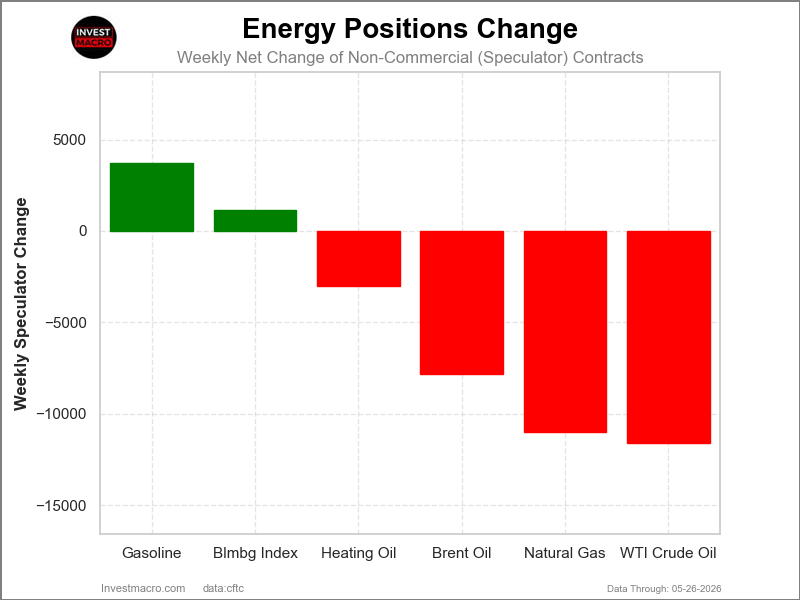
The COT energy market speculator bets were overall lower this week as just two out of the six energy markets we cover had higher positioning while the other four markets had lower speculator contracts.

Leading the gains for the energy markets through Tuesday was Brent Oil (22,025 contracts) with Heating Oil (824 contracts) also having a small positive week.

The markets with declines in speculator bets for the week were Natural Gas (-7,903 contracts), Gasoline (-6,975 contracts), the Bloomberg Index (-1,650 contracts) and with WTI Crude (-562 contracts) also seeing lower bets on the week.

Oil Markets lead Price Performance this week as all 6 Markets saw strong gains on Iran War

Leading the Energy markets this week was WTI Crude Oil, which jumped by approximately 33% over the last five days due to the Iran war. Following next was Heating Oil, which also jumped by over 30%. And Brent Crude Oil was not to be outdone with a gain of 26.17% over that period. Gasoline rose sharply by 20% in the past five days, while Natural Gas was up by 10.73%, and the Bloomberg Commodity Index rose by a strong 8.69%.

These sharp increases in the past week have now pushed all of these six Energy markets higher over the past 30 days and over the past 90 days, with the exception of Natural Gas, which is down by -5.06% in the past 30 days and is also lower by -1.70% in the past 90 days.


Energy Data:

Speculators Table Energy Futures COT Chart
Legend: Weekly Speculators Change | Speculators Current Net Position | Speculators Strength Score compared to last 3-Years (0-100 range)


Strength Scores led by Gasoline & Heating Oil

Speculators Strength Energy Futures COT Chart
COT Strength Scores (a normalized measure of Speculator positions over a 3-Year range, from 0 to 100 where above 80 is Extreme-Bullish and below 20 is Extreme-Bearish) showed that Gasoline (88.5 percent) and Heating Oil (66.7 percent) lead the energy markets this week.

On the downside, Natural Gas (0.0 percent) comes in at the lowest strength level currently and is in Extreme-Bearish territory (below 20 percent). The next lowest strength score was the Bloomberg Commodity Index (40.8 percent).

Strength Statistics:
WTI Crude Oil (42.7 percent) vs WTI Crude Oil previous week (42.8 percent)
Brent Crude Oil (42.0 percent) vs Brent Crude Oil previous week (10.6 percent)
Natural Gas (0.0 percent) vs Natural Gas previous week (5.1 percent)
Gasoline (88.5 percent) vs Gasoline previous week (96.2 percent)
Heating Oil (66.7 percent) vs Heating Oil previous week (65.6 percent)
Bloomberg Commodity Index (40.8 percent) vs Bloomberg Commodity Index previous week (48.6 percent)


WTI Crude & Gasoline top the 6-Week Strength Trends

Speculators Trend Energy Futures COT Chart
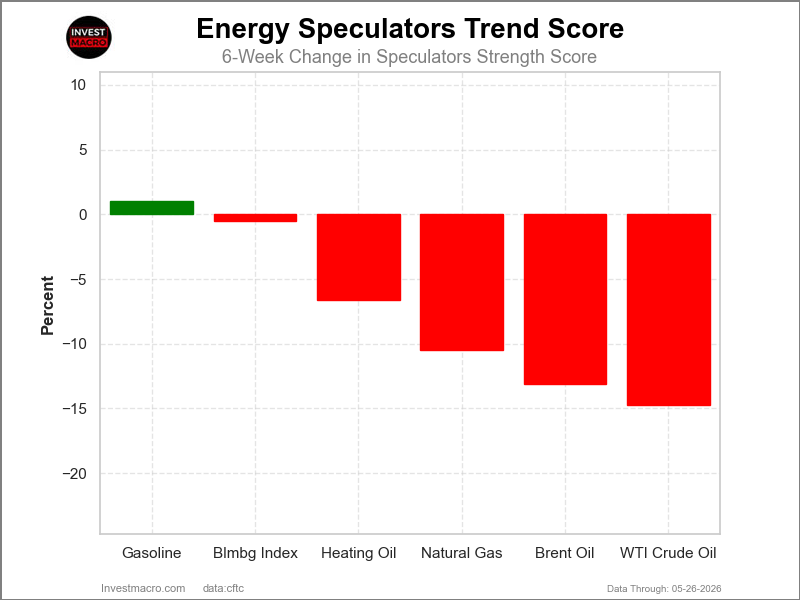
COT Strength Score Trends (or move index, calculates the 6-week changes in strength scores) showed that WTI Crude (30.1 percent) and Gasoline (23.2 percent) lead the past six weeks trends for the energy markets.

The Bloomberg Index (-38.9 percent) leads the downside trend scores currently with Natural Gas (-8.3 percent) as the next market with lower trend scores.

Move Statistics:
WTI Crude Oil (30.1 percent) vs WTI Crude Oil previous week (36.9 percent)
Brent Crude Oil (20.9 percent) vs Brent Crude Oil previous week (-22.3 percent)
Natural Gas (-8.3 percent) vs Natural Gas previous week (-8.3 percent)
Gasoline (23.2 percent) vs Gasoline previous week (29.0 percent)
Heating Oil (2.1 percent) vs Heating Oil previous week (3.1 percent)
Bloomberg Commodity Index (-38.9 percent) vs Bloomberg Commodity Index previous week (-31.0 percent)


Individual COT Market Charts:

WTI Crude Oil Futures:

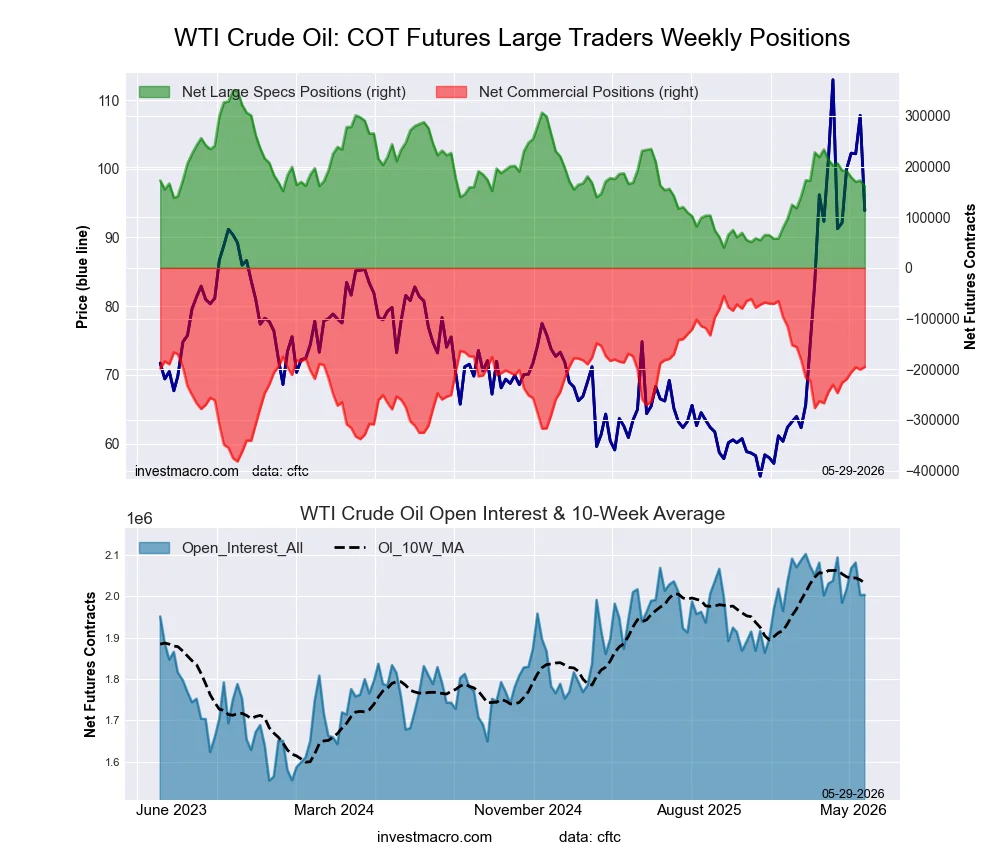
WTI Crude Oil Futures COT ChartThe WTI Crude Oil Futures large speculator standing this week reached a net position of 172,150 contracts in the data reported through Tuesday. This was a weekly decline of -562 contracts from the previous week which had a total of 172,712 net contracts.

This week’s current strength score (the trader positioning range over the past three years, measured from 0 to 100) shows the speculators are currently Bearish with a score of 42.7 percent. The commercials are Bearish with a score of 48.8 percent and the small traders (not shown in chart) are Bullish-Extreme with a score of 100.0 percent.

Price Trend-Following Model: Strong Uptrend

Our weekly trend-following model classifies the current market price position as: Strong Uptrend.

WTI Crude Oil Futures StatisticsSPECULATORSCOMMERCIALSSMALL TRADERS
– Percent of Open Interest Longs:17.140.74.3
– Percent of Open Interest Shorts:8.851.41.9
– Net Position:172,150-222,32750,177
– Gross Longs:355,158842,95789,225
– Gross Shorts:183,0081,065,28439,048
– Long to Short Ratio:1.9 to 10.8 to 12.3 to 1
NET POSITION TREND:
– Strength Index Score (3 Year Range Pct):42.748.8100.0
– Strength Index Reading (3 Year Range):BearishBearishBullish-Extreme
NET POSITION MOVEMENT INDEX:
– 6-Week Change in Strength Index:30.1-38.363.0


Brent Crude Oil Futures:

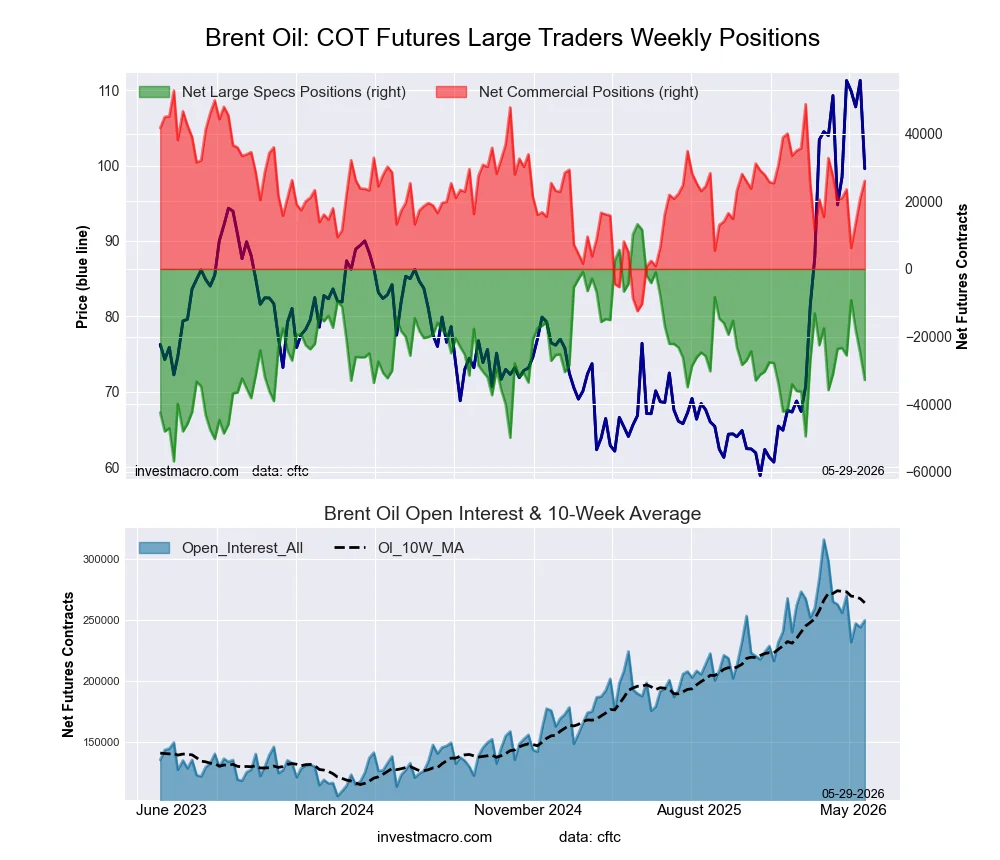
Brent Last Day Crude Oil Futures COT ChartThe Brent Crude Oil Futures large speculator standing this week reached a net position of -27,468 contracts in the data reported through Tuesday. This was a weekly increase of 22,025 contracts from the previous week which had a total of -49,493 net contracts.

This week’s current strength score (the trader positioning range over the past three years, measured from 0 to 100) shows the speculators are currently Bearish with a score of 42.0 percent. The commercials are Bullish with a score of 58.1 percent and the small traders (not shown in chart) are Bullish with a score of 59.3 percent.

Price Trend-Following Model: Strong Uptrend

Our weekly trend-following model classifies the current market price position as: Strong Uptrend.

Brent Crude Oil Futures StatisticsSPECULATORSCOMMERCIALSSMALL TRADERS
– Percent of Open Interest Longs:25.439.53.4
– Percent of Open Interest Shorts:36.429.42.6
– Net Position:-27,46825,4002,068
– Gross Longs:64,04099,3388,498
– Gross Shorts:91,50873,9386,430
– Long to Short Ratio:0.7 to 11.3 to 11.3 to 1
NET POSITION TREND:
– Strength Index Score (3 Year Range Pct):42.058.159.3
– Strength Index Reading (3 Year Range):BearishBullishBullish
NET POSITION MOVEMENT INDEX:
– 6-Week Change in Strength Index:20.9-20.7-14.1


Natural Gas Futures:

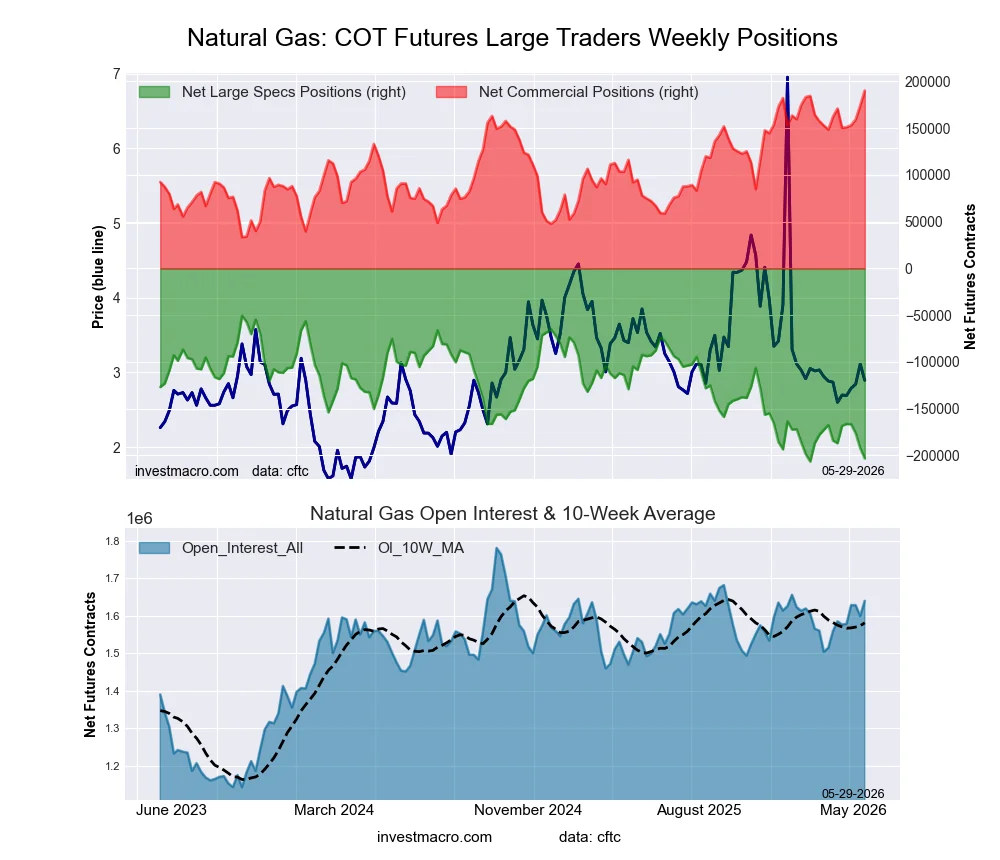
Natural Gas Futures COT ChartThe Natural Gas Futures large speculator standing this week reached a net position of -206,422 contracts in the data reported through Tuesday. This was a weekly decline of -7,903 contracts from the previous week which had a total of -198,519 net contracts.

This week’s current strength score (the trader positioning range over the past three years, measured from 0 to 100) shows the speculators are currently Bearish-Extreme with a score of 0.0 percent. The commercials are Bullish-Extreme with a score of 100.0 percent and the small traders (not shown in chart) are Bullish with a score of 58.9 percent.

Price Trend-Following Model: Downtrend

Our weekly trend-following model classifies the current market price position as: Downtrend.

Natural Gas Futures StatisticsSPECULATORSCOMMERCIALSSMALL TRADERS
– Percent of Open Interest Longs:13.137.83.9
– Percent of Open Interest Shorts:26.026.42.5
– Net Position:-206,422184,36022,062
– Gross Longs:210,477607,90762,972
– Gross Shorts:416,899423,54740,910
– Long to Short Ratio:0.5 to 11.4 to 11.5 to 1
NET POSITION TREND:
– Strength Index Score (3 Year Range Pct):0.0100.058.9
– Strength Index Reading (3 Year Range):Bearish-ExtremeBullish-ExtremeBullish
NET POSITION MOVEMENT INDEX:
– 6-Week Change in Strength Index:-8.31.526.9


Gasoline Blendstock Futures:

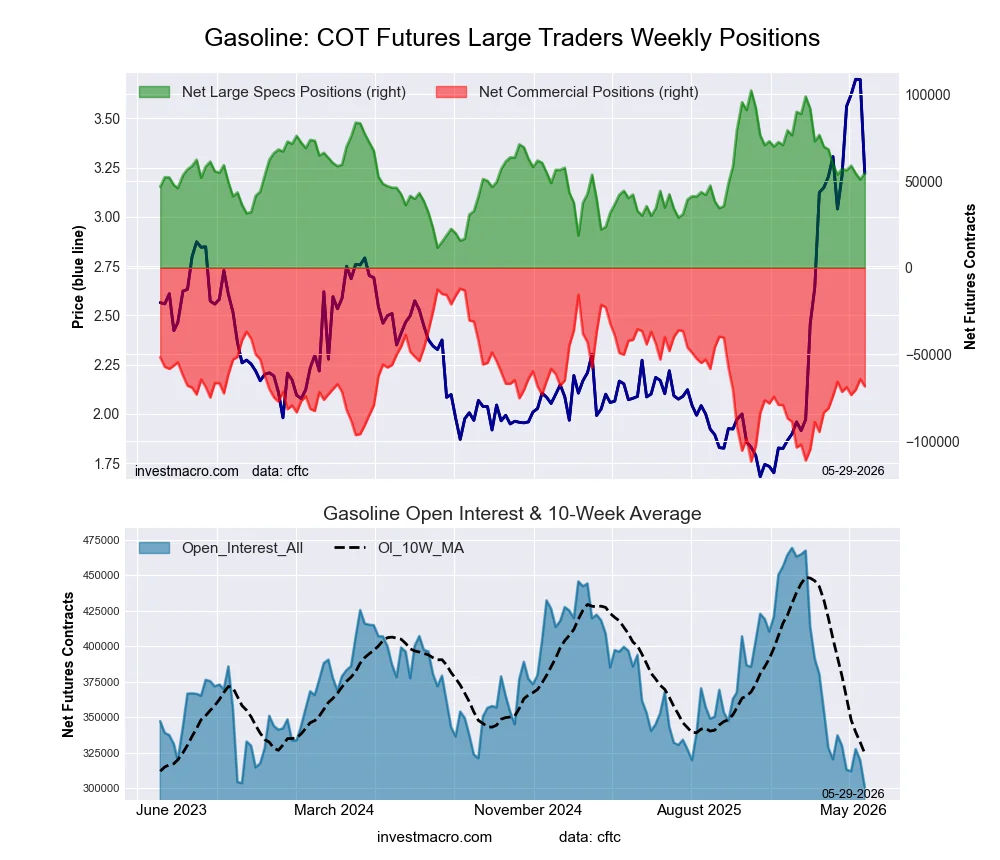
RBOB Gasoline Energy Futures COT ChartThe Gasoline Blendstock Futures large speculator standing this week reached a net position of 91,817 contracts in the data reported through Tuesday. This was a weekly decrease of -6,975 contracts from the previous week which had a total of 98,792 net contracts.

This week’s current strength score (the trader positioning range over the past three years, measured from 0 to 100) shows the speculators are currently Bullish-Extreme with a score of 88.5 percent. The commercials are Bearish-Extreme with a score of 6.9 percent and the small traders (not shown in chart) are Bullish-Extreme with a score of 96.2 percent.

Price Trend-Following Model: Strong Uptrend

Our weekly trend-following model classifies the current market price position as: Strong Uptrend.

Nasdaq Mini Futures StatisticsSPECULATORSCOMMERCIALSSMALL TRADERS
– Percent of Open Interest Longs:26.942.86.1
– Percent of Open Interest Shorts:4.768.22.9
– Net Position:91,817-104,85013,033
– Gross Longs:111,324177,26325,236
– Gross Shorts:19,507282,11312,203
– Long to Short Ratio:5.7 to 10.6 to 12.1 to 1
NET POSITION TREND:
– Strength Index Score (3 Year Range Pct):88.56.996.2
– Strength Index Reading (3 Year Range):Bullish-ExtremeBearish-ExtremeBullish-Extreme
NET POSITION MOVEMENT INDEX:
– 6-Week Change in Strength Index:23.2-25.726.3


#2 Heating Oil NY-Harbor Futures:

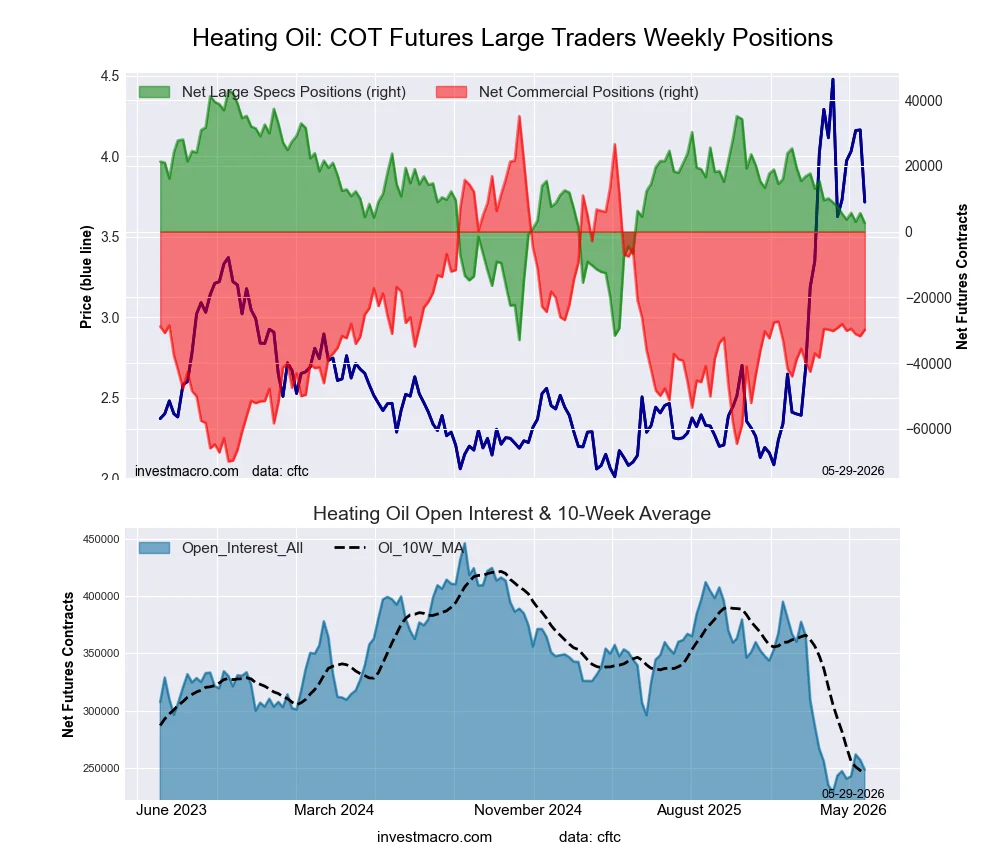
NY Harbor Heating Oil Energy Futures COT ChartThe #2 Heating Oil NY-Harbor Futures large speculator standing this week reached a net position of 17,655 contracts in the data reported through Tuesday. This was a weekly increase of 824 contracts from the previous week which had a total of 16,831 net contracts.

This week’s current strength score (the trader positioning range over the past three years, measured from 0 to 100) shows the speculators are currently Bullish with a score of 66.7 percent. The commercials are Bearish with a score of 26.0 percent and the small traders (not shown in chart) are Bullish-Extreme with a score of 86.3 percent.

Price Trend-Following Model: Strong Uptrend

Our weekly trend-following model classifies the current market price position as: Strong Uptrend.

Heating Oil Futures StatisticsSPECULATORSCOMMERCIALSSMALL TRADERS
– Percent of Open Interest Longs:18.345.415.4
– Percent of Open Interest Shorts:12.659.17.3
– Net Position:17,655-42,60224,947
– Gross Longs:56,514140,46347,560
– Gross Shorts:38,859183,06522,613
– Long to Short Ratio:1.5 to 10.8 to 12.1 to 1
NET POSITION TREND:
– Strength Index Score (3 Year Range Pct):66.726.086.3
– Strength Index Reading (3 Year Range):BullishBearishBullish-Extreme
NET POSITION MOVEMENT INDEX:
– 6-Week Change in Strength Index:2.1-9.222.0


Bloomberg Commodity Index Futures:

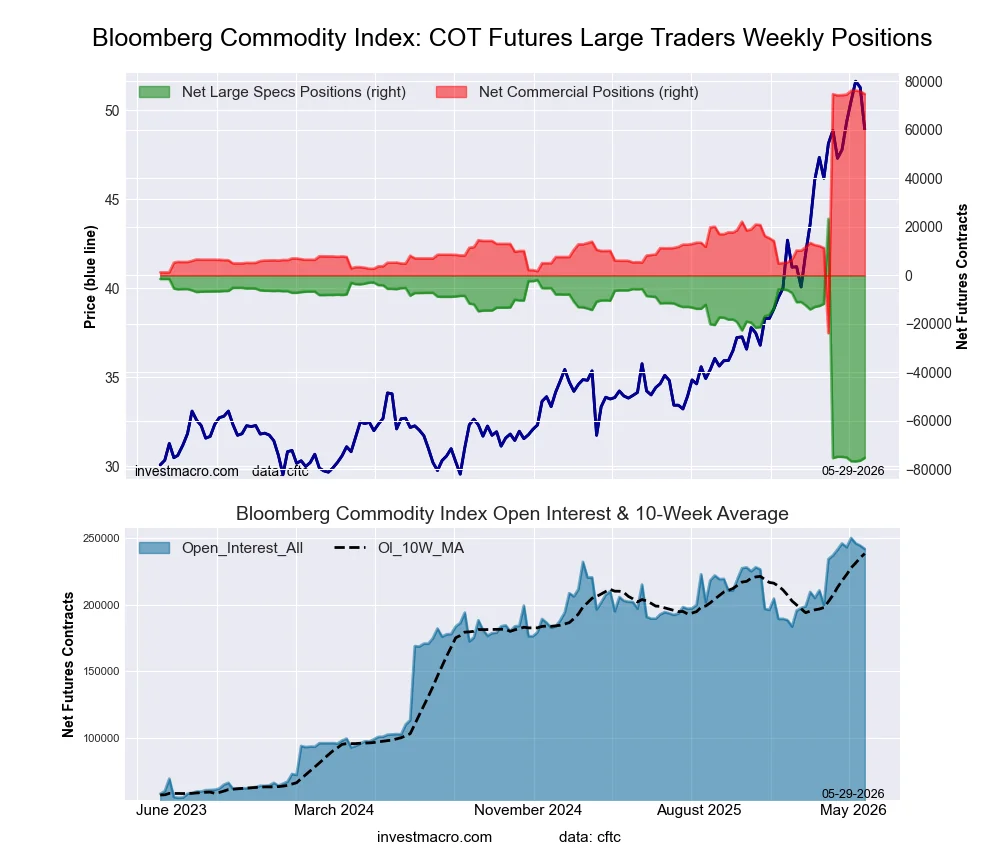
Bloomberg Commodity Index Futures COT ChartThe Bloomberg Commodity Index Futures large speculator standing this week reached a net position of -14,034 contracts in the data reported through Tuesday. This was a weekly reduction of -1,650 contracts from the previous week which had a total of -12,384 net contracts.

This week’s current strength score (the trader positioning range over the past three years, measured from 0 to 100) shows the speculators are currently Bearish with a score of 40.8 percent. The commercials are Bullish with a score of 58.1 percent and the small traders (not shown in chart) are Bearish with a score of 49.9 percent.

Price Trend-Following Model: Strong Uptrend

Our weekly trend-following model classifies the current market price position as: Strong Uptrend.

Bloomberg Index Futures StatisticsSPECULATORSCOMMERCIALSSMALL TRADERS
– Percent of Open Interest Longs:31.666.90.4
– Percent of Open Interest Shorts:38.360.50.0
– Net Position:-14,03413,355679
– Gross Longs:66,250140,036759
– Gross Shorts:80,284126,68180
– Long to Short Ratio:0.8 to 11.1 to 19.5 to 1
NET POSITION TREND:
– Strength Index Score (3 Year Range Pct):40.858.149.9
– Strength Index Reading (3 Year Range):BearishBullishBearish
NET POSITION MOVEMENT INDEX:
– 6-Week Change in Strength Index:-38.939.21.9


Article By InvestMacroReceive our weekly COT Newsletter

*COT Report: The COT data, released weekly to the public each Friday, is updated through the most recent Tuesday (data is 3 days old) and shows a quick view of how large speculators or non-commercials (for-profit traders) were positioned in the futures markets.

The CFTC categorizes trader positions according to commercial hedgers (traders who use futures contracts for hedging as part of the business), non-commercials (large traders who speculate to realize trading profits) and nonreportable traders (usually small traders/speculators) as well as their open interest (contracts open in the market at time of reporting). See CFTC criteria here.

COT Soft Commodities Charts: Speculator Bets led by Corn & Soybean Meal

By InvestMacro

Speculators OI Softs
Here are the latest charts and statistics for the Commitment of Traders (COT) reports data published by the Commodities Futures Trading Commission (CFTC).

The latest COT data is updated through Tuesday March 3rd and shows a quick view of how large traders (for-profit speculators and commercial entities) were positioned in the futures markets.

Weekly Speculator Changes led by Corn & Soybean Meal

Speculators Nets Softs
The COT soft commodities markets speculator bets were overall higher this week as seven out of the eleven softs markets we cover had higher positioning while the other four markets had lower speculator contracts.

Leading the gains for the softs markets was Corn (81,231 contracts) with Soybean Meal (21,920 contracts), Soybeans (11,630 contracts), Lean Hogs (6,052 contracts), Soybean Oil (3,752 contracts), Sugar (1,089 contracts) and Cotton (873 contracts) also showing positive weeks.

The markets with the declines in speculator bets this week were Wheat (-9,920 contracts), Cocoa (-4,550 contracts), Live Cattle (-3,896 contracts) and with Coffee (-2,014 contracts) also registering lower bets on the week.

Soybean Oil leads the Soft Commodities price performance this week

Leading the soft commodities price performance this week was Soybean Oil with a strong 7.13% gain over the past five days. Coffee rose this week by 4.67%, followed by Wheat, which rose by 4.61%. Corn was higher by 3.64%. Soybeans were up by 2.54%, and Sugar was higher by approximately 2% on the week. Live Cattle was up by 1.77%, and Lean Hogs advanced by 0.32%.

On the downside, the biggest loser on the week was Soybean Meal with a -3.78% decline, followed by Cotton, which dipped by -2.28%. And Cocoa was virtually unchanged with a small decline of -0.26%.


Soft Commodities Data:

Speculators Table Softs
Legend: Weekly Speculators Change | Speculators Current Net Position | Speculators Strength Score compared to last 3-Years (0-100 range)


Strength Scores led by Soybeans & Soybean Oil

Speculators Strength Softs
COT Strength Scores (a normalized measure of Speculator positions over a 3-Year range, from 0 to 100 where above 80 is Extreme-Bullish and below 20 is Extreme-Bearish) showed that Soybeans (93 percent) and Soybean Oil (86 percent) lead the softs markets this week. Wheat (82 percent), Lean Hogs (80 percent) and Soybean Meal (65 percent) come in as the next highest in the weekly strength scores.

On the downside, Cocoa (1 percent) and Sugar (2 percent) come in at the lowest strength levels currently and are in Extreme-Bearish territory (below 20 percent). The next lowest strength scores are the Cotton (22 percent) and the Coffee (34 percent).

Strength Statistics:
Corn (48.5 percent) vs Corn previous week (37.4 percent)
Sugar (1.6 percent) vs Sugar previous week (1.4 percent)
Coffee (34.0 percent) vs Coffee previous week (36.0 percent)
Soybeans (92.9 percent) vs Soybeans previous week (90.3 percent)
Soybean Oil (86.1 percent) vs Soybean Oil previous week (83.9 percent)
Soybean Meal (65.3 percent) vs Soybean Meal previous week (56.3 percent)
Live Cattle (64.5 percent) vs Live Cattle previous week (68.4 percent)
Lean Hogs (79.6 percent) vs Lean Hogs previous week (75.3 percent)
Cotton (22.4 percent) vs Cotton previous week (21.8 percent)
Cocoa (1.0 percent) vs Cocoa previous week (5.3 percent)
Wheat (81.7 percent) vs Wheat previous week (90.5 percent)


Wheat & Soybean Oil top the 6-Week Strength Trends

Speculators Trend Softs
COT Strength Score Trends (or move index, calculates the 6-week changes in strength scores) showed that Wheat (60 percent) and Soybean Oil (40 percent) lead the past six weeks trends for soft commodities. Soybean Meal (39 percent), Soybeans (36 percent) and Corn (19 percent) are the next highest positive movers in the latest trends data.

Coffee (-19 percent) leads the downside trend scores currently with Sugar (-13 percent) following next with a lower trend score.

Strength Trend Statistics:
Corn (19.3 percent) vs Corn previous week (5.8 percent)
Sugar (-12.5 percent) vs Sugar previous week (-15.1 percent)
Coffee (-19.0 percent) vs Coffee previous week (-20.0 percent)
Soybeans (36.3 percent) vs Soybeans previous week (33.5 percent)
Soybean Oil (39.7 percent) vs Soybean Oil previous week (54.7 percent)
Soybean Meal (39.1 percent) vs Soybean Meal previous week (20.5 percent)
Live Cattle (-1.5 percent) vs Live Cattle previous week (5.8 percent)
Lean Hogs (13.3 percent) vs Lean Hogs previous week (19.7 percent)
Cotton (-1.4 percent) vs Cotton previous week (-0.9 percent)
Cocoa (0.0 percent) vs Cocoa previous week (-3.5 percent)
Wheat (60.1 percent) vs Wheat previous week (62.1 percent)


Individual Soft Commodities Markets:

CORN Futures:
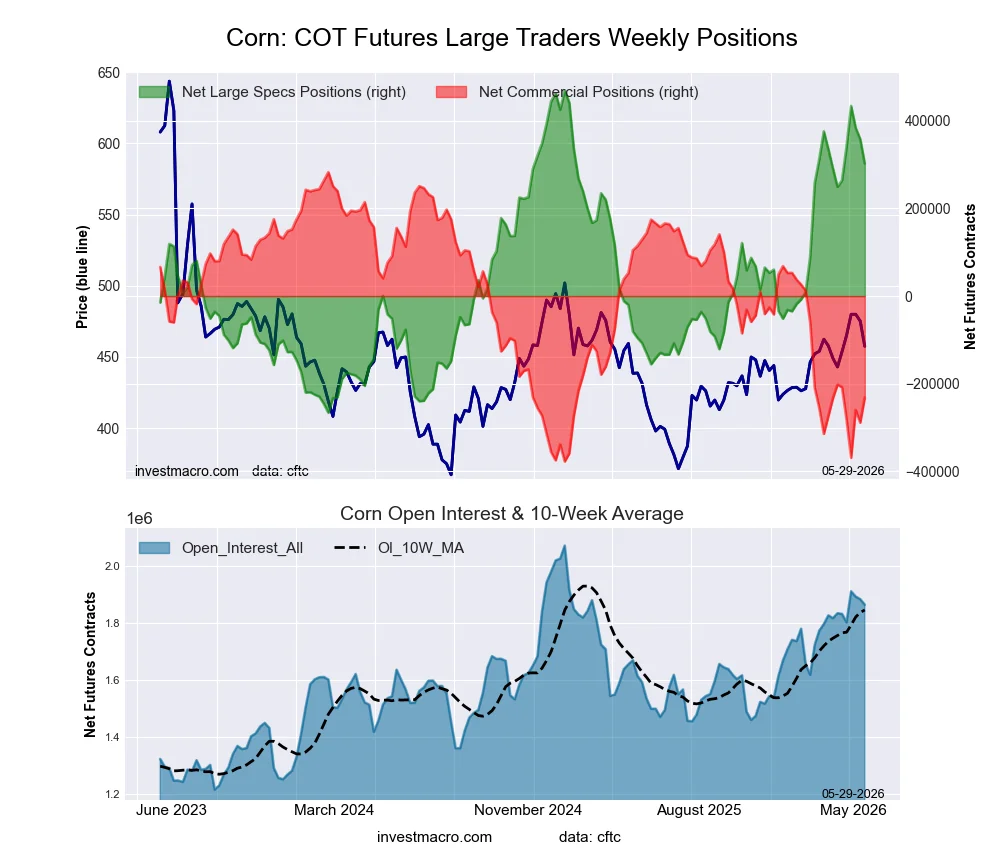
CORN Futures COT ChartThe CORN large speculator standing this week recorded a net position of 90,059 contracts in the data reported through Tuesday. This was a huge weekly increase of 81,231 contracts from the previous week which had a total of 8,828 net contracts.
This week’s current strength score (the trader positioning range over the past three years, measured from 0 to 100) shows the speculators are currently Bearish with a score of 48.5 percent. The commercials are Bearish with a score of 48.1 percent and the small traders (not shown in chart) are Bullish with a score of 71.3 percent.

Price Trend-Following Model: Strong Uptrend

Our weekly trend-following model classifies the current market price position as: Strong Uptrend.

CORN Futures StatisticsSPECULATORSCOMMERCIALSSMALL TRADERS
– Percent of Open Interest Longs:20.845.68.2
– Percent of Open Interest Shorts:15.249.310.1
– Net Position:90,059-59,782-30,277
– Gross Longs:336,624738,095132,844
– Gross Shorts:246,565797,877163,121
– Long to Short Ratio:1.4 to 10.9 to 10.8 to 1
NET POSITION TREND:
– Strength Index Score (3 Year Range Pct):48.548.171.3
– Strength Index Reading (3 Year Range):BearishBearishBullish
NET POSITION MOVEMENT INDEX:
– 6-Week Change in Strength Index:19.3-19.4-16.3


SUGAR Futures:

SUGAR Futures COT ChartThe SUGAR large speculator standing this week recorded a net position of -245,034 contracts in the data reported through Tuesday. This was a weekly increase of 1,089 contracts from the previous week which had a total of -246,123 net contracts.

This week’s current strength score (the trader positioning range over the past three years, measured from 0 to 100) shows the speculators are currently Bearish-Extreme with a score of 1.6 percent. The commercials are Bullish-Extreme with a score of 97.6 percent and the small traders (not shown in chart) are Bearish with a score of 23.4 percent.

Price Trend-Following Model: Downtrend

Our weekly trend-following model classifies the current market price position as: Downtrend.

SUGAR Futures StatisticsSPECULATORSCOMMERCIALSSMALL TRADERS
– Percent of Open Interest Longs:18.453.27.2
– Percent of Open Interest Shorts:41.829.27.8
– Net Position:-245,034251,319-6,285
– Gross Longs:193,313557,89275,220
– Gross Shorts:438,347306,57381,505
– Long to Short Ratio:0.4 to 11.8 to 10.9 to 1
NET POSITION TREND:
– Strength Index Score (3 Year Range Pct):1.697.623.4
– Strength Index Reading (3 Year Range):Bearish-ExtremeBullish-ExtremeBearish
NET POSITION MOVEMENT INDEX:
– 6-Week Change in Strength Index:-12.510.26.7


COFFEE Futures:

COFFEE Futures COT ChartThe COFFEE large speculator standing this week recorded a net position of 10,800 contracts in the data reported through Tuesday. This was a weekly decrease of -2,014 contracts from the previous week which had a total of 12,814 net contracts.

This week’s current strength score (the trader positioning range over the past three years, measured from 0 to 100) shows the speculators are currently Bearish with a score of 34.0 percent. The commercials are Bullish with a score of 67.7 percent and the small traders (not shown in chart) are Bearish-Extreme with a score of 18.4 percent.

Price Trend-Following Model: Strong Downtrend

Our weekly trend-following model classifies the current market price position as: Strong Downtrend.

COFFEE Futures StatisticsSPECULATORSCOMMERCIALSSMALL TRADERS
– Percent of Open Interest Longs:28.242.54.2
– Percent of Open Interest Shorts:21.848.94.1
– Net Position:10,800-10,84040
– Gross Longs:47,70472,0717,071
– Gross Shorts:36,90482,9117,031
– Long to Short Ratio:1.3 to 10.9 to 11.0 to 1
NET POSITION TREND:
– Strength Index Score (3 Year Range Pct):34.067.718.4
– Strength Index Reading (3 Year Range):BearishBullishBearish-Extreme
NET POSITION MOVEMENT INDEX:
– 6-Week Change in Strength Index:-19.018.7-5.9


SOYBEANS Futures:

SOYBEANS Futures COT ChartThe SOYBEANS large speculator standing this week recorded a net position of 221,902 contracts in the data reported through Tuesday. This was a weekly lift of 11,630 contracts from the previous week which had a total of 210,272 net contracts.

This week’s current strength score (the trader positioning range over the past three years, measured from 0 to 100) shows the speculators are currently Bullish-Extreme with a score of 92.9 percent. The commercials are Bearish-Extreme with a score of 9.4 percent and the small traders (not shown in chart) are Bearish-Extreme with a score of 13.6 percent.

Price Trend-Following Model: Strong Uptrend

Our weekly trend-following model classifies the current market price position as: Strong Uptrend.

SOYBEANS Futures StatisticsSPECULATORSCOMMERCIALSSMALL TRADERS
– Percent of Open Interest Longs:30.742.34.9
– Percent of Open Interest Shorts:8.261.58.2
– Net Position:221,902-188,859-33,043
– Gross Longs:303,059418,11948,014
– Gross Shorts:81,157606,97881,057
– Long to Short Ratio:3.7 to 10.7 to 10.6 to 1
NET POSITION TREND:
– Strength Index Score (3 Year Range Pct):92.99.413.6
– Strength Index Reading (3 Year Range):Bullish-ExtremeBearish-ExtremeBearish-Extreme
NET POSITION MOVEMENT INDEX:
– 6-Week Change in Strength Index:36.3-34.1-44.9


SOYBEAN OIL Futures:

SOYBEAN OIL Futures COT ChartThe SOYBEAN OIL large speculator standing this week recorded a net position of 73,189 contracts in the data reported through Tuesday. This was a weekly lift of 3,752 contracts from the previous week which had a total of 69,437 net contracts.

This week’s current strength score (the trader positioning range over the past three years, measured from 0 to 100) shows the speculators are currently Bullish-Extreme with a score of 86.1 percent. The commercials are Bearish-Extreme with a score of 13.5 percent and the small traders (not shown in chart) are Bullish-Extreme with a score of 81.0 percent.

Price Trend-Following Model: Strong Uptrend

Our weekly trend-following model classifies the current market price position as: Strong Uptrend.

SOYBEAN OIL Futures StatisticsSPECULATORSCOMMERCIALSSMALL TRADERS
– Percent of Open Interest Longs:23.846.05.5
– Percent of Open Interest Shorts:13.558.03.7
– Net Position:73,189-85,77912,590
– Gross Longs:169,509327,39039,288
– Gross Shorts:96,320413,16926,698
– Long to Short Ratio:1.8 to 10.8 to 11.5 to 1
NET POSITION TREND:
– Strength Index Score (3 Year Range Pct):86.113.581.0
– Strength Index Reading (3 Year Range):Bullish-ExtremeBearish-ExtremeBullish-Extreme
NET POSITION MOVEMENT INDEX:
– 6-Week Change in Strength Index:39.7-43.460.1


SOYBEAN MEAL Futures:

SOYBEAN MEAL Futures COT ChartThe SOYBEAN MEAL large speculator standing this week recorded a net position of 72,755 contracts in the data reported through Tuesday. This was a weekly advance of 21,920 contracts from the previous week which had a total of 50,835 net contracts.

This week’s current strength score (the trader positioning range over the past three years, measured from 0 to 100) shows the speculators are currently Bullish with a score of 65.3 percent. The commercials are Bearish with a score of 35.7 percent and the small traders (not shown in chart) are Bearish with a score of 42.0 percent.

Price Trend-Following Model: Downtrend

Our weekly trend-following model classifies the current market price position as: Downtrend.

SOYBEAN MEAL Futures StatisticsSPECULATORSCOMMERCIALSSMALL TRADERS
– Percent of Open Interest Longs:27.547.88.7
– Percent of Open Interest Shorts:13.665.25.3
– Net Position:72,755-90,22617,471
– Gross Longs:143,508249,23545,080
– Gross Shorts:70,753339,46127,609
– Long to Short Ratio:2.0 to 10.7 to 11.6 to 1
NET POSITION TREND:
– Strength Index Score (3 Year Range Pct):65.335.742.0
– Strength Index Reading (3 Year Range):BullishBearishBearish
NET POSITION MOVEMENT INDEX:
– 6-Week Change in Strength Index:39.1-41.016.3


LIVE CATTLE Futures:

LIVE CATTLE Futures COT ChartThe LIVE CATTLE large speculator standing this week recorded a net position of 87,850 contracts in the data reported through Tuesday. This was a weekly decline of -3,896 contracts from the previous week which had a total of 91,746 net contracts.

This week’s current strength score (the trader positioning range over the past three years, measured from 0 to 100) shows the speculators are currently Bullish with a score of 64.5 percent. The commercials are Bearish with a score of 31.5 percent and the small traders (not shown in chart) are Bullish with a score of 51.4 percent.

Price Trend-Following Model: Uptrend

Our weekly trend-following model classifies the current market price position as: Uptrend.

LIVE CATTLE Futures StatisticsSPECULATORSCOMMERCIALSSMALL TRADERS
– Percent of Open Interest Longs:42.929.88.1
– Percent of Open Interest Shorts:17.251.612.0
– Net Position:87,850-74,493-13,357
– Gross Longs:146,655102,03327,700
– Gross Shorts:58,805176,52641,057
– Long to Short Ratio:2.5 to 10.6 to 10.7 to 1
NET POSITION TREND:
– Strength Index Score (3 Year Range Pct):64.531.551.4
– Strength Index Reading (3 Year Range):BullishBearishBullish
NET POSITION MOVEMENT INDEX:
– 6-Week Change in Strength Index:-1.53.6-5.2


LEAN HOGS Futures:

LEAN HOGS Futures COT ChartThe LEAN HOGS large speculator standing this week recorded a net position of 74,970 contracts in the data reported through Tuesday. This was a weekly rise of 6,052 contracts from the previous week which had a total of 68,918 net contracts.

This week’s current strength score (the trader positioning range over the past three years, measured from 0 to 100) shows the speculators are currently Bullish with a score of 79.6 percent. The commercials are Bearish with a score of 24.0 percent and the small traders (not shown in chart) are Bearish-Extreme with a score of 19.3 percent.

Price Trend-Following Model: Uptrend

Our weekly trend-following model classifies the current market price position as: Uptrend.

LEAN HOGS Futures StatisticsSPECULATORSCOMMERCIALSSMALL TRADERS
– Percent of Open Interest Longs:40.529.55.4
– Percent of Open Interest Shorts:20.646.98.0
– Net Position:74,970-65,300-9,670
– Gross Longs:152,501111,25320,445
– Gross Shorts:77,531176,55330,115
– Long to Short Ratio:2.0 to 10.6 to 10.7 to 1
NET POSITION TREND:
– Strength Index Score (3 Year Range Pct):79.624.019.3
– Strength Index Reading (3 Year Range):BullishBearishBearish-Extreme
NET POSITION MOVEMENT INDEX:
– 6-Week Change in Strength Index:13.3-12.4-14.0


COTTON Futures:

COTTON Futures COT ChartThe COTTON large speculator standing this week recorded a net position of -28,097 contracts in the data reported through Tuesday. This was a weekly lift of 873 contracts from the previous week which had a total of -28,970 net contracts.

This week’s current strength score (the trader positioning range over the past three years, measured from 0 to 100) shows the speculators are currently Bearish with a score of 22.4 percent. The commercials are Bullish with a score of 75.8 percent and the small traders (not shown in chart) are Bearish with a score of 48.7 percent.

Price Trend-Following Model: Strong Downtrend

Our weekly trend-following model classifies the current market price position as: Strong Downtrend.

COTTON Futures StatisticsSPECULATORSCOMMERCIALSSMALL TRADERS
– Percent of Open Interest Longs:34.242.24.7
– Percent of Open Interest Shorts:42.734.73.6
– Net Position:-28,09724,5233,574
– Gross Longs:112,260138,60515,326
– Gross Shorts:140,357114,08211,752
– Long to Short Ratio:0.8 to 11.2 to 11.3 to 1
NET POSITION TREND:
– Strength Index Score (3 Year Range Pct):22.475.848.7
– Strength Index Reading (3 Year Range):BearishBullishBearish
NET POSITION MOVEMENT INDEX:
– 6-Week Change in Strength Index:-1.40.68.5


COCOA Futures:

COCOA Futures COT ChartThe COCOA large speculator standing this week recorded a net position of -17,830 contracts in the data reported through Tuesday. This was a weekly decline of -4,550 contracts from the previous week which had a total of -13,280 net contracts.

This week’s current strength score (the trader positioning range over the past three years, measured from 0 to 100) shows the speculators are currently Bearish-Extreme with a score of 1.0 percent. The commercials are Bullish-Extreme with a score of 98.0 percent and the small traders (not shown in chart) are Bearish with a score of 40.1 percent.

Price Trend-Following Model: Strong Downtrend

Our weekly trend-following model classifies the current market price position as: Strong Downtrend.

COCOA Futures StatisticsSPECULATORSCOMMERCIALSSMALL TRADERS
– Percent of Open Interest Longs:21.947.15.7
– Percent of Open Interest Shorts:31.238.55.0
– Net Position:-17,83016,4801,350
– Gross Longs:41,97490,28010,890
– Gross Shorts:59,80473,8009,540
– Long to Short Ratio:0.7 to 11.2 to 11.1 to 1
NET POSITION TREND:
– Strength Index Score (3 Year Range Pct):1.098.040.1
– Strength Index Reading (3 Year Range):Bearish-ExtremeBullish-ExtremeBearish
NET POSITION MOVEMENT INDEX:
– 6-Week Change in Strength Index:0.0-2.020.9


WHEAT Futures:

WHEAT Futures COT ChartThe WHEAT large speculator standing this week recorded a net position of -26,008 contracts in the data reported through Tuesday. This was a weekly reduction of -9,920 contracts from the previous week which had a total of -16,088 net contracts.

This week’s current strength score (the trader positioning range over the past three years, measured from 0 to 100) shows the speculators are currently Bullish-Extreme with a score of 81.7 percent. The commercials are Bearish-Extreme with a score of 15.5 percent and the small traders (not shown in chart) are Bearish with a score of 45.5 percent.

Price Trend-Following Model: Strong Uptrend

Our weekly trend-following model classifies the current market price position as: Strong Uptrend.

WHEAT Futures StatisticsSPECULATORSCOMMERCIALSSMALL TRADERS
– Percent of Open Interest Longs:27.232.87.4
– Percent of Open Interest Shorts:33.026.77.7
– Net Position:-26,00827,472-1,464
– Gross Longs:121,504146,56932,849
– Gross Shorts:147,512119,09734,313
– Long to Short Ratio:0.8 to 11.2 to 11.0 to 1
NET POSITION TREND:
– Strength Index Score (3 Year Range Pct):81.715.545.5
– Strength Index Reading (3 Year Range):Bullish-ExtremeBearish-ExtremeBearish
NET POSITION MOVEMENT INDEX:
– 6-Week Change in Strength Index:60.1-63.0-25.5


Article By InvestMacroReceive our weekly COT Newsletter

*COT Report: The COT data, released weekly to the public each Friday, is updated through the most recent Tuesday (data is 3 days old) and shows a quick view of how large speculators or non-commercials (for-profit traders) were positioned in the futures markets.

The CFTC categorizes trader positions according to commercial hedgers (traders who use futures contracts for hedging as part of the business), non-commercials (large traders who speculate to realize trading profits) and nonreportable traders (usually small traders/speculators) as well as their open interest (contracts open in the market at time of reporting). See CFTC criteria here.