Copper: The Technical Breakout Hiding in Plain Sight

Source: John Newell (7/1/25) 

John Newell of John Newell & Associates reviews the copper market and shares some copper stocks he believes are worth keeping an eye on.

For years, copper has quietly built a case for being one of the most strategically important — and structurally underappreciated —  commodities in the global economy.

Today, that case is no longer just about long-term fundamentals.

Technically, copper may be on the verge of a historic breakout, with the gold-to-copper ratio flashing one of the clearest signals in decades.

The Coming Copper Supercycle

The world is entering a period of compounding copper demand across sectors that didn’t even exist a generation ago. Clean energy infrastructure, electric vehicles, artificial intelligence, and data center expansion are all rapidly growing copper consumers. By some estimates, copper demand could double by 2035, from ~25 million tonnes to nearly 50 Mt.

This surge is colliding with mounting supply constraints. Ore grades have declined ~40% since 1991, permitting timelines now average more than 15 years, and only a handful of major discoveries have been made in the last decade. Mine development delays, social license challenges, and geopolitical instability in key regions are adding even more friction.

According to the International Energy Agency, even in its most optimistic scenario, a copper supply deficit of at least 1.6 million tonnes will persist by 2035, and under more aggressive climate targets, this deficit could exceed 10 million tonnes annually. With energy transition goals looming, this shortfall threatens to delay or derail critical electrification projects worldwide.

Meanwhile, new demand centers are emerging. Both India and Vietnam are poised to become major copper consumers, while China continues to dominate refining capacity with a 45% global share. Supply, however, remains concentrated in jurisdictions such as Chile and the Democratic Republic of Congo, increasing geopolitical and logistical risk.

The Gold-to-Copper Ratio: A Hidden Signal

While most headlines focus on copper supply and demand, the gold-to-copper ratio may offer the most striking indicator of what’s coming next.

Historically, this ratio oscillates around a long-term mean, but today, it’s signaling copper is historically cheap relative to gold.

  • At $3,300 gold, the ratio currently implies copper is undervalued at ~$5.00 per lb historically
  • At $3,300 gold, the ratio implies copper should be trading at approximately $8.00/lb to revert to the mean
  • A return to the lower bound of historical undervaluation could imply copper over $15/lb

Technically, the ratio has reached levels not seen since the early 2000s, just before copper launched into a multi-year bull market

This isn’t just a valuation story, it’s a sentiment shift. When gold leads, copper often follows. And gold’s 2024 breakout may be the prelude to a similar move in copper.

Fractal Patterns and Price Projection

Copper’s price chart is showing a clear fractal pattern resembling its 2003–2007 breakout period. Key technical levels have already been tested and held, and copper appears to be forming a bullish base with higher lows.

The breakout above $5.00/lb could confirm a long-term trend reversal.

Using Fibonacci extensions and historical symmetry:

  • A 2x move from the current base projects copper to ~$8.00–$9.00/lb
  • Longer-term targets range up to $12.00–$15.00/lb, particularly if inflation and energy transition tailwinds persist

Fundamental Tailwinds Align

Beyond charts and ratios, the copper bull thesis is grounded in urgent global realities:

Electrification & Renewables: EVs use 3–4x more copper than internal combustion engines. Offshore wind, solar farms, and smart grid infrastructure require unprecedented copper input.

AI and Data Centers: AI infrastructure and high-powered computing require heavy-duty copper wiring and cooling systems. This sector alone could consume 1–2% of global copper demand by 2030.

Falling Ore Grades: As copper grades decline globally, more energy and capital are needed to produce each tonne, raising costs and limiting supply elasticity.

Lack of Discoveries: less than 20 new copper deposits have been discovered in the last decade, compared to over 200 in the prior 23 years.

Capital Intensity and Timelines: New mine development now averages 17+ years, making it nearly impossible to respond quickly to demand shocks.

Recycling Limitations: While helpful, recycling cannot offset primary demand growth in the next two decades.

Strategic Implications for Investors

For investors, the opportunity lies in positioning before the re-rate. Major mining companies are already investing in juniors, particularly in stable jurisdictions like British Columbia, Arizona, Ontario, and Australia.

As copper breaks out technically, capital will chase leverage, and junior explorers offer the highest torque to rising copper prices.

This isn’t about chasing hype. It’s about reading the signals that the market is quietly flashing:

  • Historic undervaluation versus gold
  • Fractal price patterns signaling acceleration
  • Structural supply deficits meeting exponential demand
  • Geopolitical risks realigning the global copper map

New Generation Copper Developers Are Stepping Up

Amid mounting supply pressures and accelerating global demand, a new wave of copper exploration and development companies is emerging to meet the challenge. These juniors are advancing well-positioned projects with strategic advantages, from shorter development timelines to favorable jurisdictions, that could help close the widening copper gap.

As majors increasingly turn to partnerships and acquisitions to secure future supply, these agile explorers and developers are becoming vital players in the next chapter of copper’s story.

McEwen Mining Inc. (MUX:TSX; MUX:NYSE ) is advancing the massive Los Azules copper project in Argentina, one of the largest undeveloped copper projects in the world.

With over 10 billion pounds of contained copper, Los Azules represents a cornerstone asset with tremendous long-term leverage to rising copper prices.

Recent technical work and a defined development plan are moving the project toward pre-feasibility.

The company has also announced progress on infrastructure, permitting, and funding strategy, positioning itself as a potential takeover target or future producer as the copper cycle matures.

NexMetals Mining Corp. (NEXM:TSX.V) is quietly drilling into one of Botswana’s past-producing copper-nickel mines, and the story is picking up speed.

The Selkirk Mine already has a known copper-nickel-PGE footprint, and the company has completed 2,050 meters of new drilling with assays expected shortly.

A second drill rig is now turning, and NexMetals is also resampling historical holes and running metallurgical tests to define recovery parameters.

All this work is feeding into an updated mineral resource estimate, as the company positions Selkirk for a potential copper-Ni-PGE revival at a time when global supply remains tight.

It’s early days, but with the fundamentals behind copper and the right rocks in the right address, this is a name to keep an eye on.

Metallic Minerals Corp. (MMG:TSX.V; MMNGF:OTCQB) is shaping up as a serious copper-silver-gold exploration story, backed by some of the smartest money in the business.

With Newmont (formerly Newcrest) holding a 9.5% stake and Eric Sprott at 12.5%, the company’s flagship La Plata Project in southwest Colorado is drawing comparisons to world-class porphyry systems like Cadia.

The 2023 resource at the Allard deposit shows 1.2 billion lbs of copper and 17.6 million oz of silver, with the next update expected to include gold and PGEs.

What stands out is the scale of the alteration system, over 25 km² with multiple untested targets, including Ridgeway-style zones that could host much higher grades.

With permits in place and Newmont technical input in the field, 2025 could be a breakout year.

Final Thoughts

Copper is no longer just a metal. It’s the backbone of electrification, data, mobility, and decarbonization. The market is beginning to wake up to this. But the technical charts suggest the real move hasn’t even started.

For investors who understand both the fundamental and technical case, copper could represent the most asymmetric opportunity of the next decade.


Important Disclosures:

  1. Metallic Minerals Corp. is a billboard sponsor of Streetwise Reports and pays SWR a monthly sponsorship fee between US$4,000 and US$5,000.
  2. John Newell: I, or members of my immediate household or family, own securities of: [None]. My company has a financial relationship with [None]My company has purchased stocks mentioned in this article for my management clients: [None]. I determined which companies would be included in this article based on my research and understanding of the sector.
  3. Statements and opinions expressed are the opinions of the author and not of Streetwise Reports, Street Smart, or their officers. The author is wholly responsible for the accuracy of the statements. Streetwise Reports was not paid by the author to publish or syndicate this article. Streetwise Reports requires contributing authors to disclose any shareholdings in, or economic relationships with, companies that they write about. Any disclosures from the author can be found  below. Streetwise Reports relies upon the authors to accurately provide this information and Streetwise Reports has no means of verifying its accuracy.
  4.  This article does not constitute investment advice and is not a solicitation for any investment. Streetwise Reports does not render general or specific investment advice and the information on Streetwise Reports should not be considered a recommendation to buy or sell any security. Each reader is encouraged to consult with his or her personal financial adviser and perform their own comprehensive investment research. By opening this page, each reader accepts and agrees to Streetwise Reports’ terms of use and full legal disclaimer. Streetwise Reports does not endorse or recommend the business, products, services or securities of any company.

For additional disclosures, please click here.

John Newell Disclaimer

As always it is important to note that investing in precious metals like silver carries risks, and market conditions can change violently with shock and awe tactics, that we have seen over the past 20 years. Before making any investment decisions, it’s advisable consult with a financial advisor if needed. Also the practice of conducting thorough research and to consider your investment goals and risk tolerance.

Trump threatened Japan with new 35% tariffs. The US administration passed a bill that will increase spending by trillions of dollars

By JustMarkets 

At the end of Tuesday, the Dow Jones Index (US30) rose by 0.91%. The S&P 500 Index (US500) fell by 0.11%. The Nasdaq (US100) Tech Index closed down 0.82%. The US stocks closed mixed on Tuesday after the Senate passed President Trump’s massive budget bill, while investors also kept an eye on trade developments. Enthusiasm about potential economic stimulus was tempered by concerns about the bill’s multi-trillion-dollar cost. The bill is projected to increase the national debt by $3.3 trillion. Tesla fell by 5.3% after Trump escalated his feud with Elon Musk, threatening to strip him of federal subsidies. Fed Chairman Jerome Powell maintained a cautious tone on rate cuts, noting tariff-related inflation risks and emphasizing the need for additional data.

European stock markets were mostly lower on Tuesday. Germany’s DAX (DE40) fell by 0.99%, France’s CAC 40 (FR40) closed down 0.04%, the Spanish IBEX35 (ES35) Index fell by 0.03%, and the British FTSE 100 (UK100) closed positive 0.28%. European stocks fell on Tuesday amid trade uncertainty and doubts that the ECB will continue to cut interest rates. According to reports, the EU is open to a deal that would impose a 10% universal tariff on many types of exports, but is demanding concessions from the US in key sectors such as pharmaceuticals, alcohol, semiconductors, and commercial aircraft. The head of the EU trade department is expected to lead a delegation to Washington this week to try to advance the negotiations. On the data front, preliminary figures showed the Eurozone inflation at 2%, as expected, and in line with the ECB’s target. Meanwhile, ECB chief economist Philip Lane said the recent cycle of Central Bank policy tightening was over.

WTI oil prices are holding steady at around $65 per barrel on Wednesday after rising in the previous session, as investors remain cautious ahead of OPEC+’s production decision. The group intends to increase production by 411,000 barrels per day in August, resulting in a total increase in production in 2025 of 1.78 million barrels per day — more than 1.5% of global demand. This move is seen both as a punishment for overproducers and as an attempt by Saudi Arabia to win market share from US shale fields and other countries.

Asian markets were mostly down yesterday. Japan’s Nikkei 225 (JP225) fell by 1.24%, China’s FTSE China A50 (CHA50) rose by 0.25%, Hong Kong’s Hang Seng (HK50) did not trade yesterday, and Australia’s ASX 200 (AU200) showed a negative result of 0.01%.

The Nikkei 225 (JP225) Index fell by 1.1% on Wednesday, marking the second consecutive day of losses for Japanese stocks. The decline came after US President Donald Trump threatened to impose 35% tariffs on Japanese imports in an attempt to pressure Tokyo into making trade concessions. Trump called negotiations with Japan “very tough,” repeating his criticism of the country’s unwillingness to accept American-made cars and rice. His comments heightened investor concerns, especially after Federal Reserve Chairman Jerome Powell said the Fed would have already cut interest rates if not for the inflationary impact of Trump’s tariffs.

On Wednesday, the New Zealand dollar traded around US$0.609, close to its highest level in more than eight months, helped by the general weakening of the US dollar. Meanwhile, investors are closely watching trade developments as many countries try to reach an agreement with the US before the July 9 deadline. In the domestic market, the Reserve Bank of New Zealand is expected to keep rates at 3.25% next week, with market prices indicating only a small chance of a 25 basis point cut.

The Australian dollar weakened to $0.656 on Wednesday, retreating from the previous session as weaker-than-expected domestic data dampened investor sentiment. The Australian Bureau of Statistics reported that retail sales rose 0.2% in May, higher than the revised April figure but below market expectations of 0.4% growth. The data reinforced expectations that the Reserve Bank of Australia will cut rates by 25 basis points to 3.60%, with markets increasingly pricing in the possibility of further easing in the second half of the year, which could see rates fall to 3.10% or even 2.85%.

S&P 500 (US500) 6,198.01 −6.94 (−0.11%)

Dow Jones (US30) 44,494.94 +400.17 (+0.91%)

DAX (DE40) 23,673.29 −236.32 (−0.99%)

FTSE 100 (UK100) 8,785.33 +24.37 (+0.28%)

USD Index 96.66 −0.21 (−0.22%)

News feed for: 2025.07.02

  • Australia Retail Sales (m/m) at 04:30 (GMT+3);
  • Eurozone Unemployment Rate (m/m) at 12:00 (GMT+3);
  • US ADP Nonfarm Employment Change (m/m) at 15:15 (GMT+3);
  • Canada Manufacturing PMI (m/m) at 16:30 (GMT+3);
  • Eurozone ECB President Lagarde Speaks at 17:15 (GMT+3);
  • US Crude Oil Reserves (w/w) at 17:30 (GMT+3).

By JustMarkets


This article reflects a personal opinion and should not be interpreted as an investment advice, and/or offer, and/or a persistent request for carrying out financial transactions, and/or a guarantee, and/or a forecast of future events.

Why energy markets fluctuate during an international crisis

By Skip York, Rice University 

Global energy markets, such as those for oil, gas and coal, tend to be sensitive to a wide range of world events – especially when there is some sort of crisis. Having worked in the energy industry for over 30 years, I’ve seen how war, political instability, pandemics and economic sanctions can significantly disrupt energy markets and impede them from functioning efficiently.

A look at the basics

First, consider the economic fundamentals of supply and demand. The risk most people imagine in the current crisis between Israel, the U.S. and Iran is that Iran, which is itself a major oil-producing country, might suddenly expand the conflict by threatening the ability of neighboring countries to supply oil to the world.

Oil wells, refineries, pipelines and shipping lanes are the backbone of energy markets. They can be vulnerable during a crisis: Whether there is deliberate sabotage or collateral damage from military action, energy infrastructure often takes a hit.

For instance, after Saddam Hussein invaded Kuwait in August 1990, Iraqi forces placed explosive charges on Kuwaiti oil wells and began detonating them in January 1991. It took months for all the resulting fires to be put out, and millions of barrels of oil and hundreds of millions of cubic meters of natural gas were released into the environment – rather than being sold and used productively somewhere around the world.

Scenes of Kuwaiti life during and after the Gulf War of 1990 and 1991 include images of oil wells burning as a result of Iraqi sabotage.

Logistics can mess markets up too. For instance, closing critical maritime routes like the Strait of Hormuz or the Suez Canal can cause transportation delays.

Whether supply is lost from decreased production or blocked transportation routes, the effect is less oil available to the market, which not only causes prices to rise in general, but it also makes them more volatile – tending to change more frequently and by larger amounts.

On the flip side, demand can also shift radically. During the 1990-1991 Gulf War, demand rose: U.S. forces alone used more than 2 billion gallons of fuel, according to an Army analysis. By contrast, during the COVID-19 pandemic, industries shut down, travel came to a halt and energy demand plummeted.

When crisis looms, countries and companies often start stockpiling oil and other raw materials rather than buying only what they need right now. That creates even more imbalance, resulting in price volatility that leaves everyone, both consumers and producers, with a headache.

Regional considerations

In addition to uncertainties around market fundamentals, it’s important to note that many of the world’s energy reserves are located in regions that have not been models of stability. In the Middle East, wars, revolutions and diplomatic disputes there can raise concerns about supply, demand or both.

Those worries send shock waves through the world’s energy markets. It’s like walking on a tightrope: One wrong move – or even the perception of a misstep – can make the market wobble.

Governments’ economic sanctions, such as those restricting trade with Iran, Russia or Venezuela, can distort production and investment decisions and disrupt trade flows. Sometimes markets react even before sanctions are officially in place: Just the rumor of a possible embargo can cause prices to spike as buyers scramble to secure resources.

In 2008, for example, India and Vietnam imposed rice export bans, and rumors of additional restrictions fueled panic buying and nearly doubled prices in months.

In those scrambles, the role of investor speculation enters the picture. Energy commodities, such as oil and gas, aren’t just physical resources; they’re also traded as financial assets like stocks and bonds. During uncertain times, traders don’t wait around for actual changes in supply and demand. They react to news and forecasts, sometimes in large groups, which can shift the market just with the actions that result from their fears or hopes.

The events on June 22, 2025, are a good example of how this dynamic works. The Iranian parliament passed a resolution authorizing the country’s Supreme Council to close the Strait of Hormuz. Immediately, oil prices started rising, even though the strait was still open, with oil tankers steaming through unimpeded.

The next day, Iran launched a missile strike on Qatar, but coordinated in advance with Qatari officials to minimize damage and casualties. Traders and analysts perceived the action as a de-escalatory signal and anticipated that the Supreme Council was not going to close the strait. So prices started to fall.

It was a price roller coaster, fueled by speculation rather than reality. And computer algorithms and artificial intelligence, which assist in making automated trades, only add to the chaos of price changes.

Shipping activity in the Persian Gulf and the Strait of Hormuz decreased after Israel’s attacks on Iranian nuclear facilities.

A broader look

International crises can also cause wider changes in countries’ economies – or the global economy as a whole – which in turn affect the energy market.

If a crisis sparks a recession, rising inflation or high unemployment, those tend to cause people and businesses to use less energy. When the underlying situation stabilizes, recovery efforts can mean energy consumption resumes. But it’s like a pendulum swinging back and forth, with energy markets caught in the middle.

Renewable energy is not immune to international crisis and chaos. The supply is less affected by market forces: The amount of available sunlight and wind isn’t tied to geopolitical relations. But overall economic conditions still affect demand, and a crisis can disrupt the supply chains for the equipment needed to harness renewable energy, like solar panels and wind turbines.

It’s no wonder energy markets are so jittery during international crises. A mix of imbalances between supply and demand, vulnerable infrastructure, political tensions, corporate worries and speculative trading all weave together into a complex web of volatility.

For policymakers, investors and consumers, understanding these dynamics is key to navigating the ups and downs of energy markets in a crisis-prone world. The solutions aren’t simple, but being informed is the first step toward stability.The Conversation

About the Author:

Skip York, Nonresident Fellow in Energy and Global Oil, Baker Institute for Public Policy, Rice University

This article is republished from The Conversation under a Creative Commons license. Read the original article.

EUR/USD extends rally for ninth consecutive day as dollar remains weak

By RoboForex Analytical Department 

The EUR/USD pair soared to 1.1801 on Wednesday, marking its ninth consecutive day of gains. The US dollar remains under heavy pressure due to expectations of a dovish shift in Federal Reserve policy and growing concerns over President Donald Trump’s fiscal strategy.

Fed maintains cautious stance while fiscal worries mount

On Tuesday, Fed Chair Jerome Powell reiterated that the central bank will maintain a wait-and-see approach, but he did not rule out a potential rate cut at the next meeting. Powell emphasised that future decisions would depend on economic data, adding that the Fed could have already cut rates were it not for inflationary pressures from Trump’s tariffs.

Meanwhile, the US Senate narrowly approved a massive tax and budget package expected to increase the national debt by 3.3 trillion USD. The bill now returns to the House of Representatives for final approval, fuelling further concerns over the US fiscal outlook.

Key data ahead to guide the market

Investors are now awaiting crucial US employment data:

  • Wednesday: ADP report on private sector employment
  • Thursday: June labour market statistics

These releases could provide further clarity on the Fed’s next policy steps.

Technical analysis of EUR/USD

On the H4 chart, EUR/USD has completed a growth wave to 1.1777, with a consolidation range forming around this level. Today, an upward expansion is expected to 1.1848, followed by a decline to 1.1750, marking the range boundaries. An upward breakout could extend the range to 1.1885, while a downward breakout would open the potential for a decline to 1.1430. The MACD indicator confirms this outlook, with its signal line above zero and exiting the histogram zone, suggesting an approaching correction as it nears the zero line.

On the H1 chart, EUR/USD continues forming a consolidation range around 1.1777. Today, an expansion upwards to 1.1848 is likely. However, it is essential to note that the growth potential is nearly exhausted, and the market may soon begin a downward trend towards 1.1660, with the potential to extend to 1.1616. The Stochastic oscillator confirms this scenario, with its signal line below 80 and pointing sharply downward towards 20, indicating the building of bearish momentum.

Conclusion

The EUR/USD maintains its strong rally amid dovish Fed expectations and US fiscal concerns, with resistance levels at 1.1848 and 1.1885. Support lies at 1.1750, 1.1660, and 1.1616. Upcoming employment data will be crucial in determining whether the pair sustains its upward trend or reverses into a corrective phase.


Disclaimer

Any forecasts contained herein are based on the author’s particular opinion. This analysis may not be treated as trading advice. RoboForex bears no responsibility for trading results based on trading recommendations and reviews contained herein.

The Golden Bull Rests

Source: Michael Ballanger (6/30/25) 

Michael Ballanger of GGM Advisory Inc. shares his thoughts on the current state of the market and reviews a financing by one of his favorite copper stocks.

With stocks charging to record highs this week, and with the personal consumption expenditures showing a big drop-off in spending (-0.4% vs. +0.3% est.), the need for hedging one’s bets with a new allocation of gold or gold miners has disappeared. At the least, that was what the CNBC spin doctors were using as the “new narrative” for gold.

The gold miners, as represented by the HUI, are now off 8.1% from the high registered on June 5, but judging from some of the comments from the Twitterverse and YouTube podcasts, one might presume that gold had crashed.

The reality for old goats like me is that gold has been tracing out a top since the moment U.S. President Donald Trump did that “TACO” move (“Trump Aways Chickens Out”)  and decided to pause the tariffs that threatened to derail the U.S. dollar’s reserve currency status while imploding the global bond markets. Fearing an inflationary surge brought on by tariffs, investors the world over spent March and most of April piling into gold in order to protect portfolios from a fate worse than an evening with Mark Carney.

During that period, the relative strength indices for gold from three different time lines — daily, weekly, and monthly — all moved into overbought territory simultaneously, creating one of the most stretched ticker tapes in the past decade.

As one can see from the graphic pinned below, the RSI for daily and weekly readings is now back to neutral for the weekly, while the daily RSI is actually approaching oversold status. Unfortunately, the monthly RSI is still well-ensconced in the overbought domain, which caps the upside potential but does not necessarily imply that we have entered a prolonged bear market. What it does imply is that the gold market is markedly less prone to a sudden downside shock, which a move below $3,000 would certainly create.

Make no mistake; I was lulled into a false sense of security a few weeks ago when the Israelis decided to take out the Irani nuclear sites coercing me to take a shot at some GLD:US calls which promptly reversed forcing me to the sidelines with a 25% haircut and an ample mouthful of crow-filled embarrassment.

However, I came to my senses and reverted back to my bearish stance, which I had been carrying until the Israelis sent me into panic mode. As I said to subscribers this week, “If the recent skirmish between Israel and Iran and then the American bombing of Iranian nuclear facilities failed to light a fuse under gold and silver, then I have to expect that the next move is DOWN. . .”

The high of two weeks ago on the Sunday night session after the Americans sent a number of “bunker busters” into the Iranian mountains was a fleeting moment, as the market is down $180/ounce since then. From an macroeconomic viewpoint, the U.S. appears to be slowing and with that the Q1 narrative of resurging inflation and escalating debt problems being replaced with the Q2 narrative of labor market stability and corporate earnings resiliency followed by the expected Q3 narrative of accelerating growth fueled by lower interest rates and relaxed regulatory environment under the Trump administration.

I strongly resist the expected Q3 narrative because it reeks of the “this time is different” theme that is consistent with every other top since 1980. It is never “different this time” as greed is always followed by fear brought on by the market’s corrective behavior. The momentum-chasing behavior of those that were selling the U.S. to buy Europe and Japan was mirrored by the “sell treasuries and buy gold and silver” strategy that was a reaction to the Trump tariffs but once Trump observed how his actions led by his tweets and verbal impetuousness began to crater the U.S. bond market and the currency, the ensuing about-face marked the top in gold and the bottom in stocks. That event is “transitory” (to coin a phrase), and I believe that fiscal and foreign policy will find itself headlocked by the funding needs of the U.S. Treasury.

Trump will need to go “hat-in-hand” to the international community in order to facilitate the rollover of some $9 trillion in treasury bills that will be coming due in 2025 alone. Just as the bond market forced him to abandon his “America First” agenda, his softened approach has the stock junkies all clamoring behind his pro-growth shift and fleeing the safety of the gold and silver markets which is going to come to an abrupt end very shortly.

Near term, I expect a knee-jerk “flush” of the precious metals in the next two weeks that might take gold back under $3k and silver back under $30 just to scare the living feces out of all the late-comers that piled onto the gold trade in March-April. That, as always, will set up the perfect storm for a lasting bottom in gold that will hopefully be led by silver and the intermediate and junior developers.

After making a little money on the gold hedges in May and losing a little on the long side in early June, I am flat all leveraged gold trades, looking to establish a sizable long position in January calls between now and the middle of July. Stay tuned. The biggest phase of the golden bull is ahead of us, and with the good graces of Lady Luck and U.S. dollar weakness, silver will lead, and the junior explorers and developers will soar.

COT Report

The bullion banks took advantage of the downside action for the week ended Tuesday, June 24, by covering a few of their moderately large net short position.

At 230,560 net shorts, they have reduced exposure markedly from the 325,000 level last seen in May. It is not so much the actual number but more the trend of their activity that I watch. In fact, they are almost always short the gold futures market, and the only time I ever saw them post a net long position was in early December of 2015 at the absolute bottom of the 2011-2015 bear market, around $1,045 per ounce.

I see a Commercial net short position under 200,000 contracts by mid-July, which is bullish.

Stocks

The CNN Fear-Greed Index is sitting at a moderately bearish 65, which places it in the position of <GREED> but nowhere near the extremes of last February when it was solidly in the 85-90 level and in the position of <EXTREME GREED>. Sentiment is not yet in the “LaLaLand” phase as measured by this indicator, but based upon the volume of call buying, which took out records this week, the retail investor is maniacally consumed by the current market action.

The grey-haired professional money gang are waving their fingers and muttering “Tsk-Tsk,” pointing to Warren Buffett’s $300 billion cash position as justification for being “underinvested” in this rally, which is the strongest and most violent equity market rebound in the history of global stock exchanges. In other words, the kiddies that are normally the “suckers at the poker table” are now raking in their obscene profits leaving the older more conservative crowd in their dust.

I am modestly hedged via volatility positions and one “bleeding-from-the-eye-sockets” short via the inverse QQQ ETF (SQQ:US), which I have stubbornly refused to jettison, but only because I had a similar problem last July when I was seriously submerged on a position in the UVIX:US before the early-August “Japan carry-trade” crash rescued me, taking a 30% loss to a 405 win in under two weeks. That is what I expect to transpire in the latter part of July and lasting right through to mid-October, so the $90 million question is “When do I add?” to both volatility and to the SQQQ:US in order to capture the next correction.

Stay tuned.

Copper

After the absurdity of the one-week crash that ended on April 7, with the “Liberation Day” lows in stocks, gold, copper, and nearly everything else that lives and breathes off the Trump tweets, copper has been on a tear to the upside, closing above $5.00/lb, for the first time since late March.

This week, the red metal reclaimed that level on the heels of a report out of the LME that has copper inventories at their lowest level in decades, with a similar condition affecting the Shanghai futures exchange. Also suffering is the mighty COMEX, where everything copper-related is being hoarded as the looming shortages appear not only on the horizon but just ahead of the grill of one’s car.

The world will soon realize that leftist and “woke” policies prohibiting the exploitation of the planet’s mineral wealth ultimately rise up to “bite you in the butt” making the construction of new copper mines prohibitively expensive with prices under US$15,000 m/t (US$6.80/lb.). Those near-sighted policies of the past decade or so have resulted in no new mine supply coming on stream so when combined with the depletion from exhausted, mined-out sources in Chile and Peru and Canada, there is a looming and very real shortage about to materialize that is going to send prices spiraling northward for the balance of the decade.

The folks over at Crux Investor have published a superb article on copper entitled: “How Copper Supply Deficits Are Reshaping the Critical Minerals Landscape,” and I urge all readers to take some time to study it at this link.

I see new highs on the immediate horizon for copper and a robust second half of 2025 for the copper developers, with particular attention to those with new discoveries. Of note this week was the $12 million LIFE financing announced by one of my absolute favorites, Fitzroy Minerals Inc. (FTZ:TSX.V; FTZFF:OTCQB) that has won the affections of a number of the institutional investors including a US$1.8 billion Asian mining fund whose lead order of $5 million was a huge testimonial to the quality of both management and their two exciting projects in Chile, Caballos and Buen Retiro. The deal is expected to close next week, oversubscribed and trading at a premium to the issue price on excellent volume.

It remains my largest holding and top pick for 2025-2026.

Next week is expected to be an uneventful one with the July 4 holiday in the U.S. falling on Friday. I suspect that most of the trading desks will be manned by juniors for most of the week since the end-of-quarter falls on a Monday.

The first two weeks of July are expected to be the strongest of the month with the remainder of the summer typically a challenge. \

We shall see. . .


Important Disclosures:

  1. As of the date of this article, officers and/or employees of Streetwise Reports LLC (including members of their household) own securities of Fitzroy Minerals Inc.
  2. Michael Ballanger: I, or members of my immediate household or family, own securities of: [All]. My company has a financial relationship with [None]. My company has purchased stocks mentioned in this article for my management clients: [None.] I determined which companies would be included in this article based on my research and understanding of the sector.
  3. Statements and opinions expressed are the opinions of the author and not of Streetwise Reports, Street Smart, or their officers. The author is wholly responsible for the accuracy of the statements. Streetwise Reports was not paid by the author to publish or syndicate this article. Streetwise Reports requires contributing authors to disclose any shareholdings in, or economic relationships with, companies that they write about. Any disclosures from the author can be found  below. Streetwise Reports relies upon the authors to accurately provide this information and Streetwise Reports has no means of verifying its accuracy.
  4.  This article does not constitute investment advice and is not a solicitation for any investment. Streetwise Reports does not render general or specific investment advice and the information on Streetwise Reports should not be considered a recommendation to buy or sell any security. Each reader is encouraged to consult with his or her personal financial adviser and perform their own comprehensive investment research. By opening this page, each reader accepts and agrees to Streetwise Reports’ terms of use and full legal disclaimer. Streetwise Reports does not endorse or recommend the business, products, services or securities of any company.

For additional disclosures, please click here.

Michael Ballanger Disclosures

This letter makes no guarantee or warranty on the accuracy or completeness of the data provided. Nothing contained herein is intended or shall be deemed to be investment advice, implied or otherwise. This letter represents my views and replicates trades that I am making but nothing more than that. Always consult your registered advisor to assist you with your investments. I accept no liability for any loss arising from the use of the data contained on this letter. Options and junior mining stocks contain a high level of risk that may result in the loss of part or all invested capital and therefore are suitable for experienced and professional investors and traders only. One should be familiar with the risks involved in junior mining and options trading and we recommend consulting a financial adviser if you feel you do not understand the risks involve

The RBA intends to lower rates next week. The Singapore dollar strengthened to a 10-year high against the US dollar

By JustMarkets 

At the end of Monday, the Dow Jones Index (US30) rose by 0.63%. The S&P 500 Index (US500) added 0.52%. The Nasdaq (US100) Technology Index closed higher by 0.64%. The S&P 500 (US500) and Nasdaq (US100) indices updated their historical highs, helped by strong performance from tech giants such as Microsoft and Meta, which also reached new highs. Optimism increased amid signs of progress in trade negotiations, as evidenced by Canada’s recent decision to cancel a digital services tax targeting US technology companies, which eased tensions that had been weighing on the markets. Investors remain focused on July 9, when President Trump’s tariff reprieve expires, and hope that additional trade deals will help avoid tariff escalation.

European stock markets were mostly down on Monday. The German DAX (DE40) fell by 0.51%, the French CAC 40 (FR 40) closed down 0.33%, the Spanish IBEX35 (ES35) added 0.16%, and the British FTSE 100 (UK100) closed down 0.43%. Inflation in Germany surprised with a decline, falling to 2% year-on-year in June from 2.1% in May and against market expectations of 2.2%. A separate report showed that retail sales fell 1.6% in May after declining 0.6% in the previous month, indicating continued weakness in consumer demand.

WTI crude oil prices fell to $64.7 per barrel on Tuesday, posting a second consecutive day of losses amid concerns about oversupply amid OPEC+ plans to increase production. The group is reportedly planning to increase production by 411,000 barrels per day in August, following similar increases in May, June, and July. If confirmed, the total increase in supply from OPEC+ would be 1.78 million barrels per day this year, equivalent to more than 1.5% of total global demand.

Asian markets were mostly higher yesterday. Japan’s Nikkei 225 (JP225) rose by 0.84%, China’s FTSE China A50 (CHA50) added 0.09%, Hong Kong’s Hang Seng (HK50) fell by 0.87%, and Australia’s ASX 200 (AU200) showed a positive result of 0.33%.

The Australian dollar weakened to $0.656 on Tuesday after reaching seven-month highs in the previous session, as growing expectations of a rate cut at the Reserve Bank of Australia’s (RBA) July 2025 meeting put pressure on the currency. Markets are now pricing in a 95% probability that the Central Bank will cut its cash rate by 25 basis points to 3.60%, even if Wednesday’s retail sales data exceeds expectations. An additional argument in favor of easing monetary policy is the continued low consumer spending figures, which consistently fall short of the RBA’s expectations.

In early July, the Singapore dollar strengthened to around 1.27 per US dollar, its highest level since October 2014, supported by steady domestic policy adjustments, increased risk appetite, and a general weakening of the US dollar. The Monetary Authority of Singapore (MAS) recently took a balanced approach, slightly reducing the slope of the SGD nominal effective exchange rate corridor to reflect the slowdown in economic growth.

Annual inflation in Indonesia accelerated to 1.87% in June 2025 from 1.60% in May, slightly above market expectations of 1.83%, remaining within the Central Bank’s target range of 1.5% to 3.5%. Core inflation, which excludes food prices, fell to a five-month low of 2.37% from 2.4% in May and was below the consensus expectations of 2.44%.

S&P 500 (US500) 6,204.95 +31.88 (+0.52%)

Dow Jones (US30) 44,094.77 +275.50 (+0.63%)

DAX (DE40) 23,909.61 −123.61 (−0.51%)

FTSE 100 (UK100) 8,760.96 −37.95 (−0.43%)

USD Index 96.91 −0.49 (−0.51%)

News feed for: 2025.07.01

  • Japan Tankan Large Manufacturers (m/m) at 02:50 (GMT+3);
  • Japan Tankan Large Non-Manufacturers (m/m) at 02:50 (GMT+3);
  • Japan Manufacturing PMI (m/m) at 03:30 (GMT+3);
  • China Caixin Manufacturing PMI (m/m) at 04:45 (GMT+3);
  • Japan Consumer Confidence (m/m) at 08:00 (GMT+3);
  • Switzerland Retail Sales (m/m) at 09:30 (GMT+3);
  • Switzerland Manufacturing PMI (m/m) at 10:30 (GMT+3);
  • German Manufacturing PMI (m/m) at 10:55 (GMT+3);
  • German Unemployment Rate (m/m) at 10:55 (GMT+3);
  • Eurozone Manufacturing PMI (m/m) at 11:00 (GMT+3);
  • UK Manufacturing PMI (m/m) at 11:30 (GMT+3);
  • Eurozone Inflation Rate (m/m) at 12:00 (GMT+3);
  • Eurozone ECB President Lagarde Speaks at 16:30 (GMT+3);
  • UK BoE Gov Bailey Speech Speaks at 16:30 (GMT+3);
  • Japan BoJ Ueda Lagarde Speaks at 16:30 (GMT+3);
  • US Fed Chair Powell Speech Speaks at 16:30 (GMT+3);
  • US ISM Manufacturing PMI (m/m) at 17:00 (GMT+3);
  • US JOLTS Job Openings (m/m) at 17:00 (GMT+3).

By JustMarkets


This article reflects a personal opinion and should not be interpreted as an investment advice, and/or offer, and/or a persistent request for carrying out financial transactions, and/or a guarantee, and/or a forecast of future events.

US trade threats against Canada are putting pressure on the Canadian dollar. European indices returned to growth amid the postponement of tariffs

By JustMarkets 

On Friday, US stocks closed at record highs, thanks to optimism about upcoming trade agreements and growing expectations of interest rate cuts. At the end of Friday, the Dow Jones Index (US30) rose by 1.00% (+3.89% for the week). The S&P 500 Index (US500) added 0.52% (+3.41% for the week). The Nasdaq (US100) Tech Index closed up 0.39% (+4.17% for the week). Earlier in the day, markets rose on encouraging news of progress in trade with key partners, including a framework agreement with China. Although Trump’s unexpected comments about Canada briefly dampened sentiment, they failed to derail the broader rally.

As for Friday’s data, inflation expectations for the year ahead fell to 5% from 6.6% last month, which is even lower than the preliminary estimate of 5.1%. Long-term inflation expectations were also revised down to 4% from the preliminary 4.1% and compared to 4.2% in May.

The Canadian dollar (CAD) weakened to 1.37 per US dollar as new threats from the US regarding tariffs and trade policy uncertainty offset previous gains. President Trump’s announcement that he was ending all trade talks with Canada over a new digital services tax and his warning of inevitable retaliatory tariffs rattled exporters and undermined confidence in the economy’s imminent growth. Domestically, Canada’s economy contracted by 0.1% per month in April and May, highlighting its vulnerability to US tariffs and worsening the outlook for trade-sensitive sectors.

The Mexican peso (MXN) strengthened to 18.81 per US dollar, reaching ten-month highs amid easing geopolitical tensions, dovish signals from the Fed, and solid domestic fundamentals. Despite unemployment rising to 2.7% in May, the labor market remains historically tight, supporting consumption and incomes even with a slight contraction in GDP in Q1, supporting Banxico’s cautious accommodative stance.

Equity markets in Europe were mostly rising on Friday. The German DAX (DE40) rose by 1.62% (+3.40% for the week), the French CAC 40 (FR40) closed up 1.78% (+1.88% for the week), the Spanish IBEX35 (ES35) rose by 1.11% (+1.43% for the week), and the British FTSE 100 (UK100) closed up 0.72% (+0.28% for the week). The rally was supported by progress on the trade front, including the agreement between the US and China and the potential delay in the introduction of tariffs in Europe. On the corporate front, growth was broad-based, led by automakers. Porsche led the index with a 7.6% gain, followed by Daimler Truck Holding, BMW, Mercedes-Benz Group, Continental, and Volkswagen, with gains ranging from 3.9% to 6.1%.

WTI crude oil prices rose by 0.4% to $65.5 per barrel on Friday but posted their sharpest weekly decline in years amid a decline in geopolitical risk premiums. The market rose above $80 during the Iran-Israel conflict and then weakened after President Trump announced a ceasefire, easing concerns about supply disruptions from the region. The market refocused on fundamentals, including upcoming OPEC+ decisions and signs of strengthening summer demand.

Asian markets were mostly higher last week. Japan’s Nikkei 225 (JP225) rose by 4.94%, China’s FTSE China A50 (CHA50) added 0.62%, Hong Kong’s Hang Seng (HK50) increased by 4.07%, and Australia’s ASX 200 (AU200) showed a positive result of 0.10%.

The official PMI Index for China’s manufacturing sector from NBS rose to 49.7 in June 2025 from 49.5 in May, in line with expectations, but marking the third consecutive month of decline in business activity. The official PMI Index for China’s non-manufacturing sector from the NBS was 50.5 in June 2025, exceeding market consensus and May’s reading of 50.3. This was the highest reading since March, helped by the trade truce with the US and Beijing’s efforts to stimulate domestic demand and contain deflationary pressures.

The Australian dollar rose to $0.653 on Monday, helped by the continued weakening of the US dollar amid the Federal Reserve’s dovish stance and growing budget problems. In the domestic market, the monthly inflation rate calculated by the Melbourne Institute showed moderate growth in June, reversing the previous month’s decline and marking the fourth increase this year.

S&P 500 (US500) 6,173.07 +32.05 (+0.52%)

Dow Jones (US30) 43,819.27 +432.43 (+1.00%)

DAX (DE40) 24,033.22 +383.92 (+1.62%)

FTSE 100 (UK100) 8,798.91 +63.31 (+0.72%)

USD Index 97.25 +0.11 (+0.11%)

News feed for: 2025.06.30

  • Japan Industrial Production (m/m) at 02:50 (GMT+3);
  • China Manufacturing PMI (m/m) at 04:30 (GMT+3);
  • China Non-Manufacturing PMI (m/m) at 04:30 (GMT+3);
  • German Retail Sales (m/m) at 09:00 (GMT+3);
  • UK GDP (q/q) at 09:00 (GMT+3);
  • Switzerland KOF Leading Indicators (m/m) at 10:00 (GMT+3);
  • German Inflation Rate (m/m) at 15:00 (GMT+3);
  • Eurozone ECB President Lagarde Speaks at 20:30 (GMT+3).

By JustMarkets


This article reflects a personal opinion and should not be interpreted as an investment advice, and/or offer, and/or a persistent request for carrying out financial transactions, and/or a guarantee, and/or a forecast of future events.

US Dollar Index Speculators drop their bets to lowest level since 2021

By InvestMacro

Speculators OI FX Futures COT Chart

Here are the latest charts and statistics for the Commitment of Traders (COT) data published by the Commodities Futures Trading Commission (CFTC).

The latest COT data is updated through Tuesday June 24th and shows a quick view of how large market participants (for-profit speculators and commercial traders) were positioned in the futures markets. All currency positions are in direct relation to the US dollar where, for example, a bet for the euro is a bet that the euro will rise versus the dollar while a bet against the euro will be a bet that the euro will decline versus the dollar.

Weekly Speculator Changes led by Canadian Dollar & Euro

Speculators Nets FX Futures COT Chart
The COT currency market speculator bets were overall lower this week as four out of the eleven currency markets we cover had higher positioning while the other seven markets had lower speculator contracts.

Leading the gains for the currency markets was the Canadian Dollar (13,166 contracts) with the EuroFX (9,582 contracts), the New Zealand Dollar (4,043 contracts) and the Japanese Yen (1,400 contracts) also showing positive weeks.

The currencies seeing declines in speculator bets on the week were the British Pound (-8,462 contracts), the Brazilian Real (-6,962 contracts), the Mexican Peso (-6,716 contracts), the Australian Dollar (-3,172 contracts), the US Dollar Index (-3,066 contracts), the Swiss Franc (-888 contracts) and with Bitcoin (-377 contracts) also registering lower bets on the week.

US Dollar Index Speculators drop their bets to lowest level since 2021

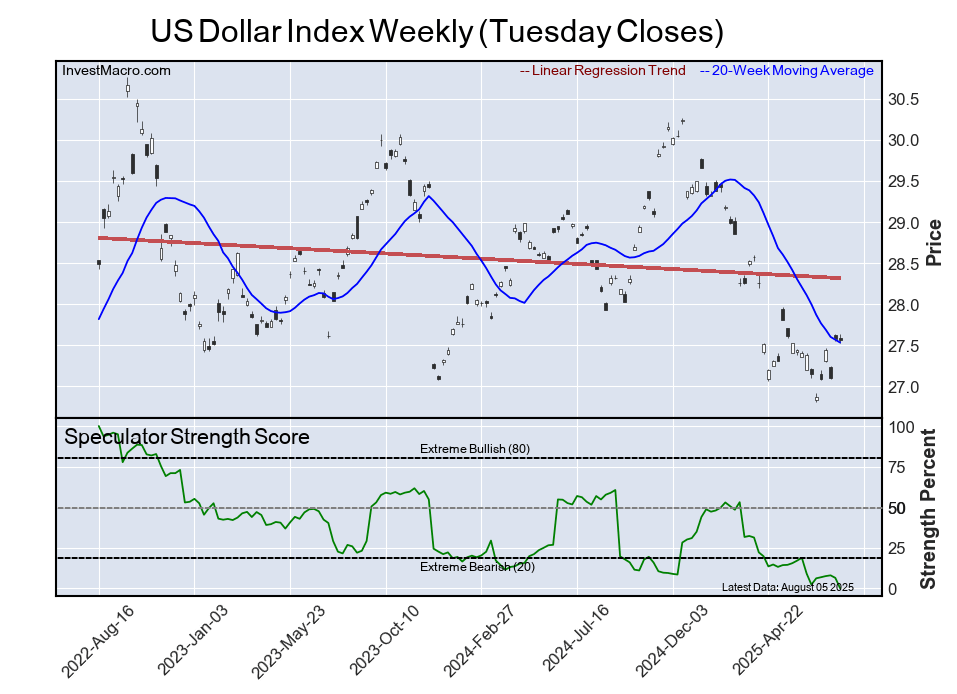
The U.S. dollar index speculator position dropped this week for a second consecutive week and is now at the lowest level in the past 225 weeks. This is the lowest standing dating back to March 9th of 2021 when the speculator positions were negative by over -8,000 contracts.

The U.S. dollar index speculator position has fallen by -7,436 contracts in the last two weeks and by over -22,000 contracts in the last 15 weeks, going from +16,835 contracts on March 11th to -6,034 contracts this week.

Despite geopolitical turmoil over the last few weeks, the dollar index has not experienced safe haven flows and is now trading under the 98.00 exchange rate. This is the lowest level since 2022 when the index was on the rise up and culminated later that year at a high of nearly 115.00 in September 2022. The dollar index is now down about 12% since the beginning of the year after starting the year near the 110.00 exchange rate.

Quick Roundup:

Other Currencies:
– Non-US dollar contracts are improving week to week and month to month.
– Negative contracts at this point are the Swiss franc, the Australian dollar, the Canadian dollar, the US dollar index and Bitcoin.

Euro:
– Speculator positions have risen for five consecutive weeks and by over 36,000 contracts over that period.
– The Euro speculator position is now back over +100,000 contracts for the second consecutive week.
– The Euro positions are now at their highest level since January of 2024.

Japanese Yen:
– Speculator bets have cooled off somewhat after hitting record high in the last few months.
– The currency has been consolidating over the last two months, however it is up about 10% since beginning of the year.

Swiss Franc:
– Continues to have a negative large speculator position but has been steadily improving since the beginning of the year.
– It has halved its negative position to the current level of -20,000 contracts.
– Swiss franc has benefited from safe haven flows, rising approximately 15% against the U.S. dollar since January

Australian Dollar:
– The AUD exchange rate is up about 5% against the U.S. dollar in 2025.
– However, the speculator position is the most bearish out of all the major currencies as the Reserve Bank of Australia cut interest rate in May meeting.


Currencies Data:

Speculators FX Futures COT Data Table
Legend: Open Interest | Speculators Current Net Position | Weekly Specs Change | Specs Strength Score compared to last 3-Years (0-100 range)


Strength Scores led by Japanese Yen & Brazilian Real

Speculators Strength Scores FX Futures COT Chart
COT Strength Scores (a normalized measure of Speculator positions over a 3-Year range, from 0 to 100 where above 80 is Extreme-Bullish and below 20 is Extreme-Bearish) showed that the Japanese Yen (87 percent) and the Brazilian Real (81 percent) lead the currency markets this week. The EuroFX (71 percent), New Zealand Dollar (68 percent) and the Canadian Dollar (64 percent) come in as the next highest in the weekly strength scores.

On the downside, the US Dollar Index (0 percent) and Bitcoin (4 percent) come in at the lowest strength levels currently and are in Extreme-Bearish territory (below 20 percent).

3-Year Strength Statistics:
US Dollar Index (0.0 percent) vs US Dollar Index previous week (6.6 percent)
EuroFX (71.1 percent) vs EuroFX previous week (67.4 percent)
British Pound Sterling (48.7 percent) vs British Pound Sterling previous week (52.8 percent)
Japanese Yen (87.1 percent) vs Japanese Yen previous week (86.7 percent)
Swiss Franc (58.4 percent) vs Swiss Franc previous week (60.2 percent)
Canadian Dollar (64.1 percent) vs Canadian Dollar previous week (58.2 percent)
Australian Dollar (24.8 percent) vs Australian Dollar previous week (27.1 percent)
New Zealand Dollar (67.7 percent) vs New Zealand Dollar previous week (63.0 percent)
Mexican Peso (54.9 percent) vs Mexican Peso previous week (58.3 percent)
Brazilian Real (80.8 percent) vs Brazilian Real previous week (86.5 percent)
Bitcoin (4.1 percent) vs Bitcoin previous week (12.4 percent)


New Zealand Dollar & Canadian Dollar top the 6-Week Strength Trends

Speculators Trends FX Futures COT Chart
COT Strength Score Trends (or move index, calculates the 6-week changes in strength scores) showed that the New Zealand Dollar (29 percent) and the Canadian Dollar (13 percent) lead the past six weeks trends for the currencies. The EuroFX (10 percent), the Swiss Franc (4 percent) and the British Pound (3 percent) are the next highest positive movers in the 3-Year trends data.

Bitcoin (-29 percent) leads the downside trend scores currently with the Australian Dollar (-16 percent), the US Dollar Index (-12 percent) and the Japanese Yen (-11 percent) following next with lower trend scores.

3-Year Strength Trends:
US Dollar Index (-11.6 percent) vs US Dollar Index previous week (-4.0 percent)
EuroFX (10.0 percent) vs EuroFX previous week (9.8 percent)
British Pound Sterling (3.4 percent) vs British Pound Sterling previous week (6.5 percent)
Japanese Yen (-11.0 percent) vs Japanese Yen previous week (-12.7 percent)
Swiss Franc (4.3 percent) vs Swiss Franc previous week (7.1 percent)
Canadian Dollar (13.0 percent) vs Canadian Dollar previous week (1.9 percent)
Australian Dollar (-16.5 percent) vs Australian Dollar previous week (-14.9 percent)
New Zealand Dollar (29.3 percent) vs New Zealand Dollar previous week (25.3 percent)
Mexican Peso (-7.3 percent) vs Mexican Peso previous week (-5.4 percent)
Brazilian Real (1.0 percent) vs Brazilian Real previous week (21.7 percent)
Bitcoin (-29.1 percent) vs Bitcoin previous week (-0.1 percent)


Individual COT Forex Markets:

US Dollar Index Futures:

US Dollar Index Forex Futures COT ChartThe US Dollar Index large speculator standing this week recorded a net position of -6,034 contracts in the data reported through Tuesday. This was a weekly decline of -3,066 contracts from the previous week which had a total of -2,968 net contracts.

This week’s current strength score (the trader positioning range over the past three years, measured from 0 to 100) shows the speculators are currently Bearish-Extreme with a score of 0.0 percent. The commercials are Bullish-Extreme with a score of 100.0 percent and the small traders (not shown in chart) are Bearish with a score of 20.6 percent.

Price Trend-Following Model: Downtrend

Our weekly trend-following model classifies the current market price position as: Downtrend.

US DOLLAR INDEX StatisticsSPECULATORSCOMMERCIALSSMALL TRADERS
– Percent of Open Interest Longs:42.540.49.1
– Percent of Open Interest Shorts:61.918.811.4
– Net Position:-6,0346,748-714
– Gross Longs:13,28312,6172,840
– Gross Shorts:19,3175,8693,554
– Long to Short Ratio:0.7 to 12.1 to 10.8 to 1
NET POSITION TREND:
– Strength Index Score (3 Year Range Pct):0.0100.020.6
– Strength Index Reading (3 Year Range):Bearish-ExtremeBullish-ExtremeBearish
NET POSITION MOVEMENT INDEX:
– 6-Week Change in Strength Index:-11.611.3-3.6


Euro Currency Futures:

Euro Currency Futures COT ChartThe Euro Currency large speculator standing this week recorded a net position of 111,135 contracts in the data reported through Tuesday. This was a weekly lift of 9,582 contracts from the previous week which had a total of 101,553 net contracts.

This week’s current strength score (the trader positioning range over the past three years, measured from 0 to 100) shows the speculators are currently Bullish with a score of 71.1 percent. The commercials are Bearish with a score of 25.2 percent and the small traders (not shown in chart) are Bullish-Extreme with a score of 86.7 percent.

Price Trend-Following Model: Strong Uptrend

Our weekly trend-following model classifies the current market price position as: Strong Uptrend.

EURO Currency StatisticsSPECULATORSCOMMERCIALSSMALL TRADERS
– Percent of Open Interest Longs:29.354.712.4
– Percent of Open Interest Shorts:14.876.35.5
– Net Position:111,135-164,30153,166
– Gross Longs:223,791417,36394,870
– Gross Shorts:112,656581,66441,704
– Long to Short Ratio:2.0 to 10.7 to 12.3 to 1
NET POSITION TREND:
– Strength Index Score (3 Year Range Pct):71.125.286.7
– Strength Index Reading (3 Year Range):BullishBearishBullish-Extreme
NET POSITION MOVEMENT INDEX:
– 6-Week Change in Strength Index:10.0-10.27.7


British Pound Sterling Futures:

British Pound Sterling Futures COT ChartThe British Pound Sterling large speculator standing this week recorded a net position of 34,395 contracts in the data reported through Tuesday. This was a weekly decline of -8,462 contracts from the previous week which had a total of 42,857 net contracts.

This week’s current strength score (the trader positioning range over the past three years, measured from 0 to 100) shows the speculators are currently Bearish with a score of 48.7 percent. The commercials are Bearish with a score of 45.6 percent and the small traders (not shown in chart) are Bullish-Extreme with a score of 82.4 percent.

Price Trend-Following Model: Strong Uptrend

Our weekly trend-following model classifies the current market price position as: Strong Uptrend.

BRITISH POUND StatisticsSPECULATORSCOMMERCIALSSMALL TRADERS
– Percent of Open Interest Longs:55.524.020.0
– Percent of Open Interest Shorts:36.448.514.6
– Net Position:34,395-44,0359,640
– Gross Longs:99,84843,16635,906
– Gross Shorts:65,45387,20126,266
– Long to Short Ratio:1.5 to 10.5 to 11.4 to 1
NET POSITION TREND:
– Strength Index Score (3 Year Range Pct):48.745.682.4
– Strength Index Reading (3 Year Range):BearishBearishBullish-Extreme
NET POSITION MOVEMENT INDEX:
– 6-Week Change in Strength Index:3.4-5.010.1


Japanese Yen Futures:

Japanese Yen Forex Futures COT ChartThe Japanese Yen large speculator standing this week recorded a net position of 132,277 contracts in the data reported through Tuesday. This was a weekly lift of 1,400 contracts from the previous week which had a total of 130,877 net contracts.

This week’s current strength score (the trader positioning range over the past three years, measured from 0 to 100) shows the speculators are currently Bullish-Extreme with a score of 87.1 percent. The commercials are Bearish-Extreme with a score of 13.7 percent and the small traders (not shown in chart) are Bullish with a score of 79.5 percent.

Price Trend-Following Model: Uptrend

Our weekly trend-following model classifies the current market price position as: Uptrend.

JAPANESE YEN StatisticsSPECULATORSCOMMERCIALSSMALL TRADERS
– Percent of Open Interest Longs:56.729.212.9
– Percent of Open Interest Shorts:14.776.28.0
– Net Position:132,277-147,71015,433
– Gross Longs:178,40392,03440,462
– Gross Shorts:46,126239,74425,029
– Long to Short Ratio:3.9 to 10.4 to 11.6 to 1
NET POSITION TREND:
– Strength Index Score (3 Year Range Pct):87.113.779.5
– Strength Index Reading (3 Year Range):Bullish-ExtremeBearish-ExtremeBullish
NET POSITION MOVEMENT INDEX:
– 6-Week Change in Strength Index:-11.09.46.4


Swiss Franc Futures:

Swiss Franc Forex Futures COT ChartThe Swiss Franc large speculator standing this week recorded a net position of -20,944 contracts in the data reported through Tuesday. This was a weekly fall of -888 contracts from the previous week which had a total of -20,056 net contracts.

This week’s current strength score (the trader positioning range over the past three years, measured from 0 to 100) shows the speculators are currently Bullish with a score of 58.4 percent. The commercials are Bearish with a score of 33.4 percent and the small traders (not shown in chart) are Bullish with a score of 79.5 percent.

Price Trend-Following Model: Uptrend

Our weekly trend-following model classifies the current market price position as: Uptrend.

SWISS FRANC StatisticsSPECULATORSCOMMERCIALSSMALL TRADERS
– Percent of Open Interest Longs:11.865.822.2
– Percent of Open Interest Shorts:41.935.922.0
– Net Position:-20,94420,768176
– Gross Longs:8,18445,70215,449
– Gross Shorts:29,12824,93415,273
– Long to Short Ratio:0.3 to 11.8 to 11.0 to 1
NET POSITION TREND:
– Strength Index Score (3 Year Range Pct):58.433.479.5
– Strength Index Reading (3 Year Range):BullishBearishBullish
NET POSITION MOVEMENT INDEX:
– 6-Week Change in Strength Index:4.3-3.60.4


Canadian Dollar Futures:

Canadian Dollar Forex Futures COT ChartThe Canadian Dollar large speculator standing this week recorded a net position of -53,167 contracts in the data reported through Tuesday. This was a weekly boost of 13,166 contracts from the previous week which had a total of -66,333 net contracts.

This week’s current strength score (the trader positioning range over the past three years, measured from 0 to 100) shows the speculators are currently Bullish with a score of 64.1 percent. The commercials are Bearish with a score of 35.0 percent and the small traders (not shown in chart) are Bullish with a score of 51.8 percent.

Price Trend-Following Model: Uptrend

Our weekly trend-following model classifies the current market price position as: Uptrend.

CANADIAN DOLLAR StatisticsSPECULATORSCOMMERCIALSSMALL TRADERS
– Percent of Open Interest Longs:12.667.513.6
– Percent of Open Interest Shorts:39.042.412.3
– Net Position:-53,16750,4302,737
– Gross Longs:25,267135,77627,452
– Gross Shorts:78,43485,34624,715
– Long to Short Ratio:0.3 to 11.6 to 11.1 to 1
NET POSITION TREND:
– Strength Index Score (3 Year Range Pct):64.135.051.8
– Strength Index Reading (3 Year Range):BullishBearishBullish
NET POSITION MOVEMENT INDEX:
– 6-Week Change in Strength Index:13.0-17.635.7


Australian Dollar Futures:

Australian Dollar Forex Futures COT ChartThe Australian Dollar large speculator standing this week recorded a net position of -72,562 contracts in the data reported through Tuesday. This was a weekly decrease of -3,172 contracts from the previous week which had a total of -69,390 net contracts.

This week’s current strength score (the trader positioning range over the past three years, measured from 0 to 100) shows the speculators are currently Bearish with a score of 24.8 percent. The commercials are Bullish with a score of 72.0 percent and the small traders (not shown in chart) are Bullish with a score of 54.6 percent.

Price Trend-Following Model: Strong Uptrend

Our weekly trend-following model classifies the current market price position as: Strong Uptrend.

AUSTRALIAN DOLLAR StatisticsSPECULATORSCOMMERCIALSSMALL TRADERS
– Percent of Open Interest Longs:15.464.915.1
– Percent of Open Interest Shorts:63.418.213.7
– Net Position:-72,56270,4752,087
– Gross Longs:23,24997,99222,820
– Gross Shorts:95,81127,51720,733
– Long to Short Ratio:0.2 to 13.6 to 11.1 to 1
NET POSITION TREND:
– Strength Index Score (3 Year Range Pct):24.872.054.6
– Strength Index Reading (3 Year Range):BearishBullishBullish
NET POSITION MOVEMENT INDEX:
– 6-Week Change in Strength Index:-16.511.79.5


New Zealand Dollar Futures:

New Zealand Dollar Forex Futures COT ChartThe New Zealand Dollar large speculator standing this week recorded a net position of 2,770 contracts in the data reported through Tuesday. This was a weekly advance of 4,043 contracts from the previous week which had a total of -1,273 net contracts.

This week’s current strength score (the trader positioning range over the past three years, measured from 0 to 100) shows the speculators are currently Bullish with a score of 67.7 percent. The commercials are Bearish with a score of 29.8 percent and the small traders (not shown in chart) are Bullish with a score of 67.5 percent.

Price Trend-Following Model: Strong Uptrend

Our weekly trend-following model classifies the current market price position as: Strong Uptrend.

NEW ZEALAND DOLLAR StatisticsSPECULATORSCOMMERCIALSSMALL TRADERS
– Percent of Open Interest Longs:42.138.59.8
– Percent of Open Interest Shorts:35.847.27.3
– Net Position:2,770-3,8771,107
– Gross Longs:18,61917,0044,355
– Gross Shorts:15,84920,8813,248
– Long to Short Ratio:1.2 to 10.8 to 11.3 to 1
NET POSITION TREND:
– Strength Index Score (3 Year Range Pct):67.729.867.5
– Strength Index Reading (3 Year Range):BullishBearishBullish
NET POSITION MOVEMENT INDEX:
– 6-Week Change in Strength Index:29.3-29.27.8


Mexican Peso Futures:

Mexican Peso Futures COT ChartThe Mexican Peso large speculator standing this week recorded a net position of 51,311 contracts in the data reported through Tuesday. This was a weekly decline of -6,716 contracts from the previous week which had a total of 58,027 net contracts.

This week’s current strength score (the trader positioning range over the past three years, measured from 0 to 100) shows the speculators are currently Bullish with a score of 54.9 percent. The commercials are Bearish with a score of 45.5 percent and the small traders (not shown in chart) are Bearish with a score of 47.5 percent.

Price Trend-Following Model: Strong Uptrend

Our weekly trend-following model classifies the current market price position as: Strong Uptrend.

MEXICAN PESO StatisticsSPECULATORSCOMMERCIALSSMALL TRADERS
– Percent of Open Interest Longs:57.037.64.9
– Percent of Open Interest Shorts:22.175.51.8
– Net Position:51,311-55,7804,469
– Gross Longs:83,72955,1557,127
– Gross Shorts:32,418110,9352,658
– Long to Short Ratio:2.6 to 10.5 to 12.7 to 1
NET POSITION TREND:
– Strength Index Score (3 Year Range Pct):54.945.547.5
– Strength Index Reading (3 Year Range):BullishBearishBearish
NET POSITION MOVEMENT INDEX:
– 6-Week Change in Strength Index:-7.37.13.5


Brazilian Real Futures:

Brazil Real Futures COT ChartThe Brazilian Real large speculator standing this week recorded a net position of 44,730 contracts in the data reported through Tuesday. This was a weekly lowering of -6,962 contracts from the previous week which had a total of 51,692 net contracts.

This week’s current strength score (the trader positioning range over the past three years, measured from 0 to 100) shows the speculators are currently Bullish-Extreme with a score of 80.8 percent. The commercials are Bearish-Extreme with a score of 17.9 percent and the small traders (not shown in chart) are Bearish with a score of 40.3 percent.

Price Trend-Following Model: Strong Uptrend

Our weekly trend-following model classifies the current market price position as: Strong Uptrend.

BRAZIL REAL StatisticsSPECULATORSCOMMERCIALSSMALL TRADERS
– Percent of Open Interest Longs:50.133.93.6
– Percent of Open Interest Shorts:16.370.21.0
– Net Position:44,730-48,1823,452
– Gross Longs:66,37444,9524,804
– Gross Shorts:21,64493,1341,352
– Long to Short Ratio:3.1 to 10.5 to 13.6 to 1
NET POSITION TREND:
– Strength Index Score (3 Year Range Pct):80.817.940.3
– Strength Index Reading (3 Year Range):Bullish-ExtremeBearish-ExtremeBearish
NET POSITION MOVEMENT INDEX:
– 6-Week Change in Strength Index:1.0-0.9-0.6


Bitcoin Futures:

Bitcoin Crypto Futures COT ChartThe Bitcoin large speculator standing this week recorded a net position of -2,161 contracts in the data reported through Tuesday. This was a weekly decrease of -377 contracts from the previous week which had a total of -1,784 net contracts.

This week’s current strength score (the trader positioning range over the past three years, measured from 0 to 100) shows the speculators are currently Bearish-Extreme with a score of 4.1 percent. The commercials are Bullish-Extreme with a score of 94.3 percent and the small traders (not shown in chart) are Bullish with a score of 61.6 percent.

Price Trend-Following Model: Strong Uptrend

Our weekly trend-following model classifies the current market price position as: Strong Uptrend.

BITCOIN StatisticsSPECULATORSCOMMERCIALSSMALL TRADERS
– Percent of Open Interest Longs:77.36.94.8
– Percent of Open Interest Shorts:84.21.53.3
– Net Position:-2,1611,692469
– Gross Longs:24,2322,1521,497
– Gross Shorts:26,3934601,028
– Long to Short Ratio:0.9 to 14.7 to 11.5 to 1
NET POSITION TREND:
– Strength Index Score (3 Year Range Pct):4.194.361.6
– Strength Index Reading (3 Year Range):Bearish-ExtremeBullish-ExtremeBullish
NET POSITION MOVEMENT INDEX:
– 6-Week Change in Strength Index:-29.13.261.6


Article By InvestMacroReceive our weekly COT Newsletter

*COT Report: The COT data, released weekly to the public each Friday, is updated through the most recent Tuesday (data is 3 days old) and shows a quick view of how large speculators or non-commercials (for-profit traders) were positioned in the futures markets.

The CFTC categorizes trader positions according to commercial hedgers (traders who use futures contracts for hedging as part of the business), non-commercials (large traders who speculate to realize trading profits) and nonreportable traders (usually small traders/speculators) as well as their open interest (contracts open in the market at time of reporting). See CFTC criteria here.

COT Metals Charts: Speculator Bets mixed, led by Copper & Platinum

By InvestMacro

Metals Open Interest COT Chart
Here are the latest charts and statistics for the Commitment of Traders (COT) data published by the Commodities Futures Trading Commission (CFTC).

The latest COT data is updated through Tuesday June 24th and shows a quick view of how large traders (for-profit speculators and commercial entities) were positioned in the futures markets.

Weekly Speculator Changes led by Copper & Platinum

Metals Net Positions COT Chart
The COT metals markets speculator bets were mixed this week as three out of the six metals markets we cover had higher positioning while the other three markets had lower speculator contracts.

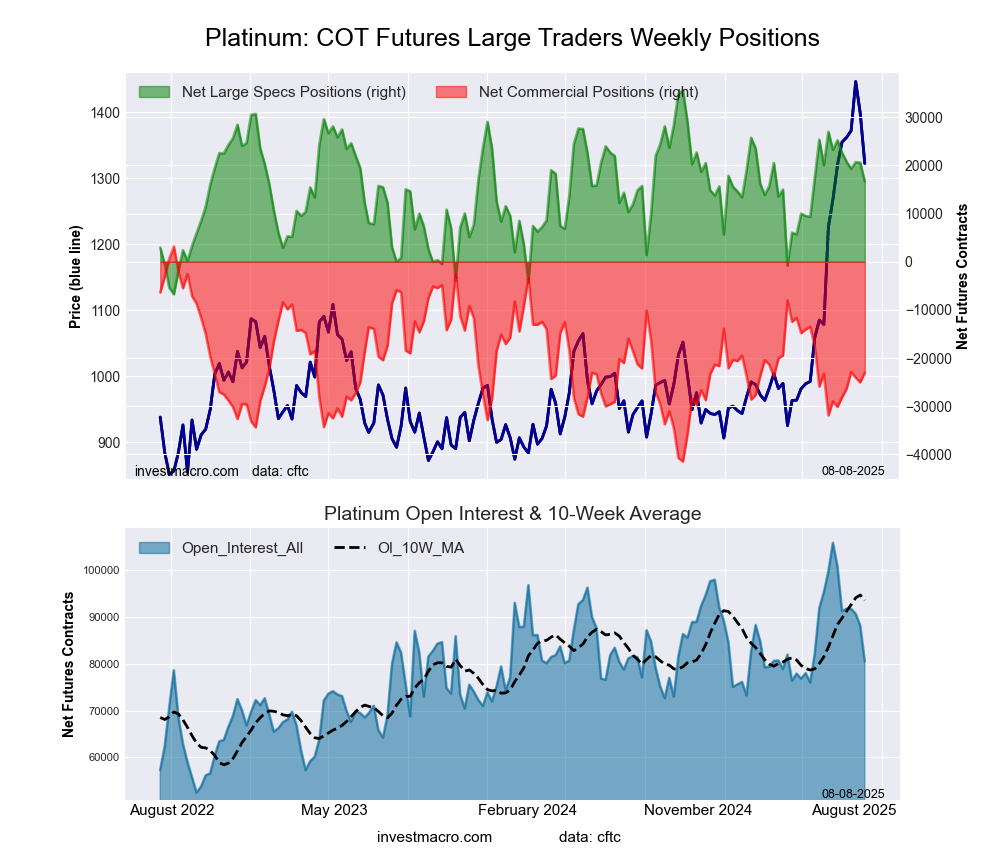
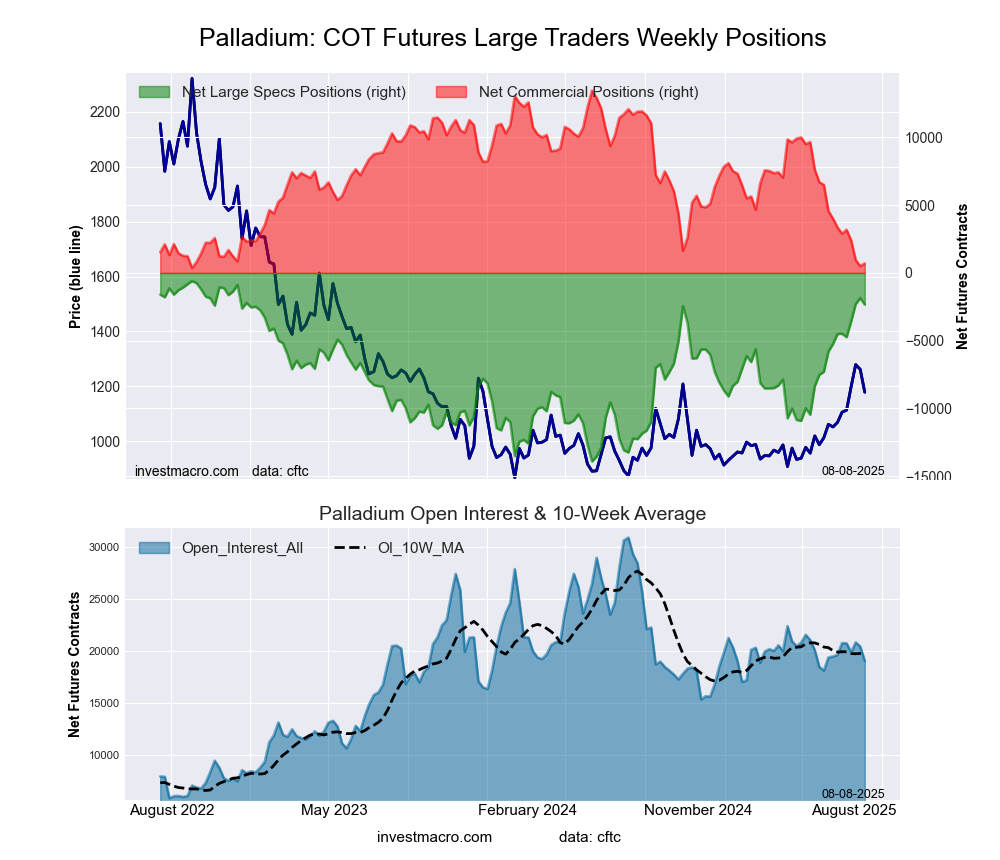
Leading the gains for the metals was Copper (5,633 contracts) with Platinum (1,985 contracts) and Palladium (740 contracts) also showing positive weeks.

The markets with declines in speculator bets for the week were Gold (-5,644 contracts), Silver (-4,227 contracts) and with Steel (-378 contracts) also registering lower bets on the week.


Metals Data:

Metals Table COT Chart
Legend: Weekly Speculators Change | Speculators Current Net Position | Speculators Strength Score compared to last 3-Years (0-100 range)


Strength Scores led by Silver & Platinum

Metals Strength Scores COT Chart
COT Strength Scores (a normalized measure of Speculator positions over a 3-Year range, from 0 to 100 where above 80 is Extreme-Bullish and below 20 is Extreme-Bearish) showed that Silver (95 percent) and Platinum (76 percent) lead the metals markets this week. Palladium (71 percent) comes in as the next highest in the weekly strength scores.

Strength Statistics:
Gold (54.3 percent) vs Gold previous week (56.4 percent)
Silver (94.7 percent) vs Silver previous week (100.0 percent)
Copper (60.6 percent) vs Copper previous week (55.4 percent)
Platinum (75.6 percent) vs Platinum previous week (70.9 percent)
Palladium (70.6 percent) vs Palladium previous week (65.1 percent)
Steel (64.7 percent) vs Palladium previous week (66.9 percent)


Palladium & Platinum top the 6-Week Strength Trends

Metals Trends COT Chart
COT Strength Score Trends (or move index, calculates the 6-week changes in strength scores) showed that Palladium (45 percent) and Platinum (38 percent) lead the past six weeks trends for metals. Silver (19 percent) is the next highest positive mover in the latest trends data.

Steel (-7 percent) leads the downside trend scores currently.

Move Statistics:
Gold (12.8 percent) vs Gold previous week (14.5 percent)
Silver (19.0 percent) vs Silver previous week (22.4 percent)
Copper (7.4 percent) vs Copper previous week (2.0 percent)
Platinum (37.6 percent) vs Platinum previous week (32.4 percent)
Palladium (44.7 percent) vs Palladium previous week (35.6 percent)
Steel (-7.1 percent) vs Steel previous week (-8.6 percent)


Individual Markets:

Gold Comex Futures:

Gold Futures COT ChartThe Gold Comex Futures large speculator standing this week equaled a net position of 195,004 contracts in the data reported through Tuesday. This was a weekly decrease of -5,644 contracts from the previous week which had a total of 200,648 net contracts.

This week’s current strength score (the trader positioning range over the past three years, measured from 0 to 100) shows the speculators are currently Bullish with a score of 54.3 percent. The commercials are Bearish with a score of 39.3 percent and the small traders (not shown in chart) are Bullish-Extreme with a score of 94.8 percent.

Price Trend-Following Model: Uptrend

Our weekly trend-following model classifies the current market price position as: Uptrend.

Gold Futures StatisticsSPECULATORSCOMMERCIALSSMALL TRADERS
– Percent of Open Interest Longs:58.916.912.6
– Percent of Open Interest Shorts:14.069.94.5
– Net Position:195,004-230,56035,556
– Gross Longs:256,07773,32355,009
– Gross Shorts:61,073303,88319,453
– Long to Short Ratio:4.2 to 10.2 to 12.8 to 1
NET POSITION TREND:
– Strength Index Score (3 Year Range Pct):54.339.394.8
– Strength Index Reading (3 Year Range):BullishBearishBullish-Extreme
NET POSITION MOVEMENT INDEX:
– 6-Week Change in Strength Index:12.8-14.219.1


Silver Comex Futures:

Silver Futures COT ChartThe Silver Comex Futures large speculator standing this week equaled a net position of 62,947 contracts in the data reported through Tuesday. This was a weekly reduction of -4,227 contracts from the previous week which had a total of 67,174 net contracts.

This week’s current strength score (the trader positioning range over the past three years, measured from 0 to 100) shows the speculators are currently Bullish-Extreme with a score of 94.7 percent. The commercials are Bearish-Extreme with a score of 3.8 percent and the small traders (not shown in chart) are Bullish with a score of 65.2 percent.

Price Trend-Following Model: Strong Uptrend

Our weekly trend-following model classifies the current market price position as: Strong Uptrend.

Silver Futures StatisticsSPECULATORSCOMMERCIALSSMALL TRADERS
– Percent of Open Interest Longs:48.423.118.8
– Percent of Open Interest Shorts:12.370.47.6
– Net Position:62,947-82,47719,530
– Gross Longs:84,49140,42232,867
– Gross Shorts:21,544122,89913,337
– Long to Short Ratio:3.9 to 10.3 to 12.5 to 1
NET POSITION TREND:
– Strength Index Score (3 Year Range Pct):94.73.865.2
– Strength Index Reading (3 Year Range):Bullish-ExtremeBearish-ExtremeBullish
NET POSITION MOVEMENT INDEX:
– 6-Week Change in Strength Index:19.0-17.95.4


Copper Grade #1 Futures:

Copper Futures COT ChartThe Copper Grade #1 Futures large speculator standing this week equaled a net position of 29,433 contracts in the data reported through Tuesday. This was a weekly boost of 5,633 contracts from the previous week which had a total of 23,800 net contracts.

This week’s current strength score (the trader positioning range over the past three years, measured from 0 to 100) shows the speculators are currently Bullish with a score of 60.6 percent. The commercials are Bearish with a score of 43.1 percent and the small traders (not shown in chart) are Bearish with a score of 31.6 percent.

Price Trend-Following Model: Strong Uptrend

Our weekly trend-following model classifies the current market price position as: Strong Uptrend.

Copper Futures StatisticsSPECULATORSCOMMERCIALSSMALL TRADERS
– Percent of Open Interest Longs:34.830.77.4
– Percent of Open Interest Shorts:20.346.36.3
– Net Position:29,433-31,7192,286
– Gross Longs:70,78162,51115,032
– Gross Shorts:41,34894,23012,746
– Long to Short Ratio:1.7 to 10.7 to 11.2 to 1
NET POSITION TREND:
– Strength Index Score (3 Year Range Pct):60.643.131.6
– Strength Index Reading (3 Year Range):BullishBearishBearish
NET POSITION MOVEMENT INDEX:
– 6-Week Change in Strength Index:7.4-6.4-3.2


Platinum Futures:

Platinum Futures COT ChartThe Platinum Futures large speculator standing this week equaled a net position of 25,212 contracts in the data reported through Tuesday. This was a weekly rise of 1,985 contracts from the previous week which had a total of 23,227 net contracts.

This week’s current strength score (the trader positioning range over the past three years, measured from 0 to 100) shows the speculators are currently Bullish with a score of 75.6 percent. The commercials are Bearish with a score of 25.4 percent and the small traders (not shown in chart) are Bullish with a score of 55.0 percent.

Price Trend-Following Model: Strong Uptrend

Our weekly trend-following model classifies the current market price position as: Strong Uptrend.

Platinum Futures StatisticsSPECULATORSCOMMERCIALSSMALL TRADERS
– Percent of Open Interest Longs:59.718.510.5
– Percent of Open Interest Shorts:34.748.45.6
– Net Position:25,212-30,1134,901
– Gross Longs:60,14318,64010,538
– Gross Shorts:34,93148,7535,637
– Long to Short Ratio:1.7 to 10.4 to 11.9 to 1
NET POSITION TREND:
– Strength Index Score (3 Year Range Pct):75.625.455.0
– Strength Index Reading (3 Year Range):BullishBearishBullish
NET POSITION MOVEMENT INDEX:
– 6-Week Change in Strength Index:37.6-37.38.6


Palladium Futures:

Palladium Futures COT ChartThe Palladium Futures large speculator standing this week equaled a net position of -4,508 contracts in the data reported through Tuesday. This was a weekly rise of 740 contracts from the previous week which had a total of -5,248 net contracts.

This week’s current strength score (the trader positioning range over the past three years, measured from 0 to 100) shows the speculators are currently Bullish with a score of 70.6 percent. The commercials are Bearish with a score of 22.9 percent and the small traders (not shown in chart) are Bullish-Extreme with a score of 83.5 percent.

Price Trend-Following Model: Strong Uptrend

Our weekly trend-following model classifies the current market price position as: Strong Uptrend.

Palladium Futures StatisticsSPECULATORSCOMMERCIALSSMALL TRADERS
– Percent of Open Interest Longs:41.739.013.8
– Percent of Open Interest Shorts:64.721.98.0
– Net Position:-4,5083,3591,149
– Gross Longs:8,1867,6612,714
– Gross Shorts:12,6944,3021,565
– Long to Short Ratio:0.6 to 11.8 to 11.7 to 1
NET POSITION TREND:
– Strength Index Score (3 Year Range Pct):70.622.983.5
– Strength Index Reading (3 Year Range):BullishBearishBullish-Extreme
NET POSITION MOVEMENT INDEX:
– 6-Week Change in Strength Index:44.7-48.115.7


Steel Futures Futures:

Steel Futures COT ChartThe Steel Futures large speculator standing this week equaled a net position of -1,074 contracts in the data reported through Tuesday. This was a weekly reduction of -378 contracts from the previous week which had a total of -696 net contracts.

This week’s current strength score (the trader positioning range over the past three years, measured from 0 to 100) shows the speculators are currently Bullish with a score of 64.7 percent. The commercials are Bearish with a score of 36.0 percent and the small traders (not shown in chart) are Bullish with a score of 54.3 percent.

Price Trend-Following Model: Weak Uptrend

Our weekly trend-following model classifies the current market price position as: Weak Uptrend.

Steel Futures StatisticsSPECULATORSCOMMERCIALSSMALL TRADERS
– Percent of Open Interest Longs:24.968.80.9
– Percent of Open Interest Shorts:28.265.90.5
– Net Position:-1,074932142
– Gross Longs:8,14322,470294
– Gross Shorts:9,21721,538152
– Long to Short Ratio:0.9 to 11.0 to 11.9 to 1
NET POSITION TREND:
– Strength Index Score (3 Year Range Pct):64.736.054.3
– Strength Index Reading (3 Year Range):BullishBearishBullish
NET POSITION MOVEMENT INDEX:
– 6-Week Change in Strength Index:-7.16.319.4


Article By InvestMacroReceive our weekly COT Newsletter

*COT Report: The COT data, released weekly to the public each Friday, is updated through the most recent Tuesday (data is 3 days old) and shows a quick view of how large speculators or non-commercials (for-profit traders) were positioned in the futures markets.

The CFTC categorizes trader positions according to commercial hedgers (traders who use futures contracts for hedging as part of the business), non-commercials (large traders who speculate to realize trading profits) and nonreportable traders (usually small traders/speculators) as well as their open interest (contracts open in the market at time of reporting). See CFTC criteria here.
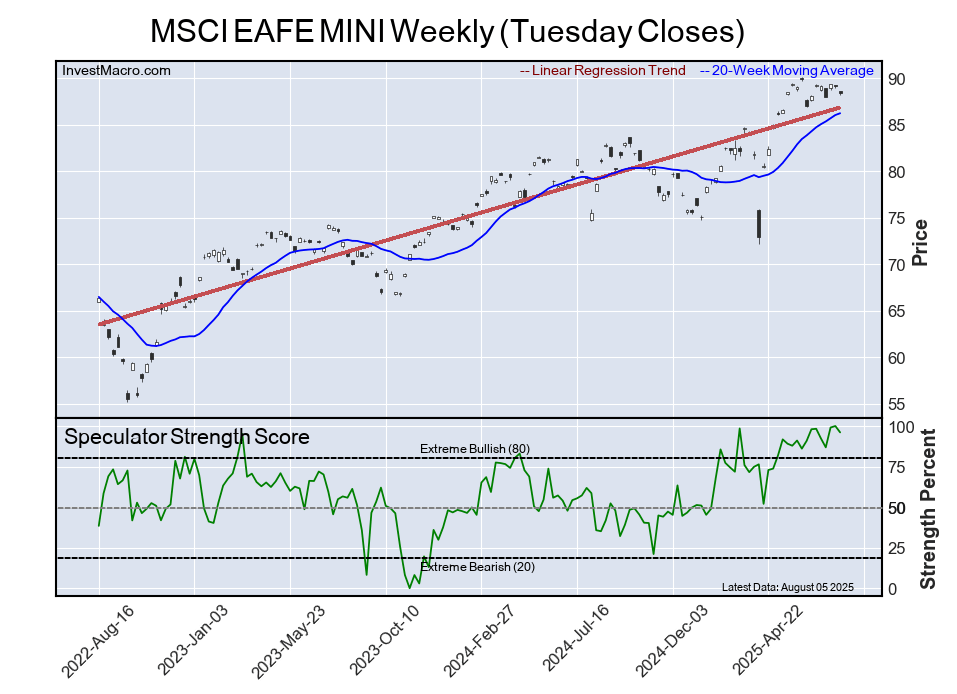
Speculator Extremes: EAFE, Lean Hogs & Silver lead weekly Bullish Positions

By InvestMacro 

The latest update for the weekly Commitment of Traders (COT) report was released by the Commodity Futures Trading Commission (CFTC) on Friday for data ending on June 24th.

This weekly Extreme Positions report highlights the Most Bullish and Most Bearish Positions for the speculator category. Extreme positioning in these markets can foreshadow strong moves in the underlying market.

To signify an extreme position, we use the Strength Index (also known as the COT Index) of each instrument, a common method of measuring COT data. The Strength Index is simply a comparison of current trader positions against the range of positions over the previous 3 years. We use over 80 percent as extremely bullish and under 20 percent as extremely bearish. (Compare Strength Index scores across all markets in the data table or cot leaders table)


Extreme Bullish Speculator Table


Here Are This Week’s Most Bullish Speculator Positions:

MSCI EAFE MINI

Extreme Bullish Leader
The MSCI EAFE MINI speculator position comes in as the most bullish extreme standing this week as the MSCI EAFE-Mini speculator level is at a 99.5 percent score of its 3-year range.

The six-week trend for the percent strength score was a gain of 6 points this week. The speculator position registered 7,260 net contracts this week with a weekly gain of 5,223 contracts in speculator bets.


Speculators or Non-Commercials Notes:

Speculators, classified as non-commercial traders by the CFTC, are made up of large commodity funds, hedge funds and other significant for-profit participants. The Specs are generally regarded as trend-followers in their behavior towards price action – net speculator bets and prices tend to go in the same directions. These traders often look to buy when prices are rising and sell when prices are falling. To illustrate this point, many times speculator contracts can be found at their most extremes (bullish or bearish) when prices are also close to their highest or lowest levels.

These extreme levels can be dangerous for the large speculators as the trade is most crowded, there is less trading ammunition still sitting on the sidelines to push the trend further and prices have moved a significant distance. When the trend becomes exhausted, some speculators take profits while others look to also exit positions when prices fail to continue in the same direction. This process usually plays out over many months to years and can ultimately create a reverse effect where prices start to fall and speculators start a process of selling when prices are falling.


Lean Hogs

Extreme Bullish Leader
The Lean Hogs speculator position comes in as the most bullish extreme standing this week. The Lean Hogs speculator level is currently at a 99 percent score or just below its maximum of the 3-year range.

The six-week trend for the percent strength score totaled a rise by 36 points this week. The overall net speculator position was a total of 94,956 net contracts this week although saw a dip by -1,312 contract in the weekly speculator bets.


Silver

Extreme Bullish Leader
The Silver speculator position comes up number three in the extreme standings this week. The Silver speculator level is at a 95 percent score of its 3-year range.

The six-week trend for the speculator strength score totaled a change of 19 points this week. The overall speculator position was 62,947 net contracts this week with a reduction by -4,227 contracts in the speculator bets.


Ultra U.S. Treasury Bonds

Extreme Bullish Leader
The Ultra U.S. Treasury Bonds speculator position registers number four in this week’s bullish extreme standings. The Ultra Long T-Bond speculator level sits at a 93 percent score of its 3-year range. The six-week trend for the speculator strength score was 19 points this week.

The speculator position was -209,526 net contracts this week with a drop by -19,812 contracts in the weekly speculator bets.


Japanese Yen


The Japanese yen speculator position rounds out the top five in the extreme standings this week. The Japanese yen speculator level is at a 87 percent score of its 3-year range.

The six-week trend for the speculator strength score totaled a decline of -11 points this week. The overall speculator position was 132,277 net contracts this week with an increase by 1,400 contracts in the speculator bets.


Extreme Bearish Speculator Table


This Week’s Most Bearish Speculator Positions:

Sugar

Extreme Bearish Leader
The Sugar speculator position also comes in tied at the top of the most bearish extreme standing of the week. The Sugar speculator level is at a 0 percent or minimum level score of its 3-year range.

The six-week trend for the speculator strength score was a decline by -23 points this week. The overall speculator position was -47,220 net contracts this week with an edge lower by -79 contracts in the speculator bets.


Soybean Meal

Extreme Bearish Leader
The Soybean Meal speculator position comes in tied for the most bearish extreme standing on the week. The Soybean Meal speculator level is at a 0 percent score of its 3-year range.

The six-week trend for the speculator strength score was drop by -10 points this week. The speculator position was -76,064 net contracts this week with a decrease by -16,876 contracts in the weekly speculator bets.


5-Year Bond

Extreme Bearish Leader
The 5-Year Bond speculator position also comes in tied as the most bearish extreme standing this week as the 5-Year speculator level is at a 0 percent or minimum level score of its 3-year range.

The six-week trend for the speculator strength score was -13 points this week. The overall speculator position was -2,463,629 net contracts this week with a decline of -20,348 contracts in the speculator bets.


US Dollar Index

Extreme Bearish Leader
The US Dollar Index speculator position comes in also tied atop as the most bearish extreme standings. The USD Index speculator level is rounded to a 0 percent score of its 3-year range.

The six-week trend for the speculator strength score was a decrease by -12 points this week. The speculator position was -6,034 net contracts this week with a decline of -3,066 contracts in the weekly speculator bets.


Ultra 10-Year U.S. T-Note

Extreme Bearish Leader
Finally, the Ultra 10-Year U.S. T-Note speculator position comes in as the fifth most bearish extreme standing for this week. The Ultra 10-Year speculator level is at just a 1 percent score of its 3-year range.

The six-week trend for the speculator strength score was a reduction by -13 points this week. The speculator position was -367,108 net contracts this week with a dip by -19,423 contracts in the weekly speculator bets.


Article By InvestMacroReceive our weekly COT Newsletter

*COT Report: The COT data, released weekly to the public each Friday, is updated through the most recent Tuesday (data is 3 days old) and shows a quick view of how large speculators or non-commercials (for-profit traders) were positioned in the futures markets.

The CFTC categorizes trader positions according to commercial hedgers (traders who use futures contracts for hedging as part of the business), non-commercials (large traders who speculate to realize trading profits) and nonreportable traders (usually small traders/speculators) as well as their open interest (contracts open in the market at time of reporting). See CFTC criteria here.