Shares of Oceaneering International Inc. traded 16.5% higher yesterday after the diversified offshore engineering services and manufacturing firm reported Q3/22 financial results that included a 20% YoY increase in revenue and improved operating performance and profitability across all its business units.
After U.S. markets closed Wednesday, Oceaneering International Inc. (OII:NYSE), a global provider of engineered products, services, and robotic solutions for the offshore energy, aerospace, defense, and manufacturing industries, announced financial results for the third quarter of 2022 ended September 30, 2022.
The company reported that for Q3/22, it posted total revenue of US$559.7 million, compared to US$466.8 million in Q3/21. The firm provided a breakdown of revenue by business segment and indicated that its subsea robotics unit accounted for US$169.4 million, manufactured products were US$94.0 million, offshore projects group US$153.0 million, integrity management and digital solutions US$58.5 million and aerospace and defense technologies posted US$84.8 million.
Oceaneering International advised that for Q3/22, it recorded a net income of US$18.3 million, or US$0.18 per share, versus a net loss of US$7.4 million, or a net loss of US$0.07 per share in Q3/21.
The company added that adjusted net income for Q3/22 was US$23.7 million, or US$0.23 per share, and noted that the adjustments were the result of US$1.1 million in pre-tax adjustments related to foreign exchange losses and another US$4.4 million in discretionary tax adjustments pertaining to asset valuation and tax allowances.
The company stated that during Q3/22, it generated cash flow from operations of US$85.9 million, had a free cash flow of US$66.6 million, and ended the quarter with US$428 million in cash on its balance sheet.
The firm pointed out further that during Q3/22, its fleet of 250 remotely operated vehicles (ROVs) achieved a utilization rate of 67%, and each, on average, contributed revenue of US$8,468 per day. The company added that as of September 30, 2022, its Manufactured Products division had a backlog of US$365 million.
Oceaneering International’s President and CEO Roderick A. Larson commented, “Our third-quarter results were driven by improved offshore activity and pricing, particularly in the Gulf of Mexico, which ticked up further during the quarter. We produced adjusted consolidated EBITDA of US$77.6 million, which exceeded our guidance and consensus estimates.”
“Offshore activity drove significant operating improvements in our energy businesses, which were led by our Subsea Robotics (SSR) and Offshore Projects Group (OPG) segments. In addition, increased manufacturing throughput led to improved operating margins in our Manufactured Products segment. We also saw a meaningful recovery in our government-focused businesses after experiencing the effects of negative timing during the second quarter of 2022,” Larson added.
The firm stated that it expects that revenues in Q4/22 will decline slightly or be on par with those registered in Q3/22. The company indicated that it estimates that the manufactured products group and ADTech revenues and profitability will be higher but will be offset by slightly lower revenues and operating profitability in its SSR, OPG, and IMDS segments, in part due to seasonality.
Oceaneering indicated that for FY/22, it estimates that adjusted EBITDA will be in the range of US$215-240 million.
The company advised that for FY/23, it anticipates higher levels of activity and improved performance in each of its primary business areas led by its SSR and OPG segments. The firm said that for FY/23, it expects consolidated EBITDA of US$260-310 million and free cash flow of over US$100 million.
The company indicated that going forward, it remains focused on safety, financial discipline, free cash flow generation, debt management, and growth. The firm stated that it will continue to look for opportunities to increase its prices and improve margins to benefit shareholders.
Oceaneering is a global technology firm based in Houston, Texas, that provides underwater, on land, and in space engineered services and products and robotic solutions to the offshore energy, aerospace, defense, entertainment, and manufacturing industries. The company employs more than 10,000 people and has operations in 24 countries.
The firm’s Subsea Robotics business segment offers remotely operated vehicles (ROVs) that are used to support offshore oil and gas drilling and vessel-based services such as subsea surveying, installation, construction, inspection, maintenance, and repair. The company fleet includes approximately 250 work-class ROVs. Its Manufactured Products segment manufactures distribution and connection systems, pipeline connections, and other hardware and repair systems for the energy industry.
Through its Offshore Projects Group, Oceaneering offers subsea installation, intervention, inspection, maintenance, and repair services, including ROV workover control systems and project management and engineering. The firm also provides asset integrity management, software, and analytical solutions for the bulk cargo maritime and energy industries through its Integrity Management & Digital Solutions segment. Lastly, the company’s Aerospace and Defense Technologies segment supports U.S. government agencies with engineering and related manufacturing assistance for use in defense and space exploration efforts.
Oceaneering International started yesterday with a market cap of around US$1.13 billion, with approximately 100.26 million shares outstanding and a short interest of about 4.4%. OII shares opened almost 9% higher yesterday at US$12.22 (+US$0.99, +8.82%) over the previous day’s US$11.23 closing price. The stock traded yesterday between US$12.12 and US$13.92 per share and closed for trading at US$13.08 (+US$1.88, +16.47%).
Disclosures: 1) Stephen Hytha wrote this article for Streetwise Reports LLC and provides services to Streetwise Reports as an independent contractor. He or members of his household own securities of the following companies mentioned in the article: None. He or members of his household are paid by the following companies mentioned in this article: None.
2) The following companies mentioned in this article are billboard sponsors of Streetwise Reports: None. Click here for important disclosures about sponsor fees.
3) Comments and opinions expressed are those of the specific experts and not of Streetwise Reports or its officers. The information provided above is for informational purposes only and is not a recommendation to buy or sell any security.
4) The article does not constitute investment advice. Each reader is encouraged to consult with his or her individual financial professional and any action a reader takes as a result of information presented here is his or her own responsibility. By opening this page, each reader accepts and agrees to Streetwise Reports’ terms of use and full legal disclaimer. This article is not a solicitation for investment. Streetwise Reports does not render general or specific investment advice and the information on Streetwise Reports should not be considered a recommendation to buy or sell any security. Streetwise Reports does not endorse or recommend the business, products, services or securities of any company mentioned on Streetwise Reports.
5) From time to time, Streetwise Reports LLC and its directors, officers, employees or members of their families, as well as persons interviewed for articles and interviews on the site, may have a long or short position in securities mentioned. Directors, officers, employees or members of their immediate families are prohibited from making purchases and/or sales of those securities in the open market or otherwise from the time of the decision to publish an article until three business days after the publication of the article. The foregoing prohibition does not apply to articles that in substance only restate previously published company releases.
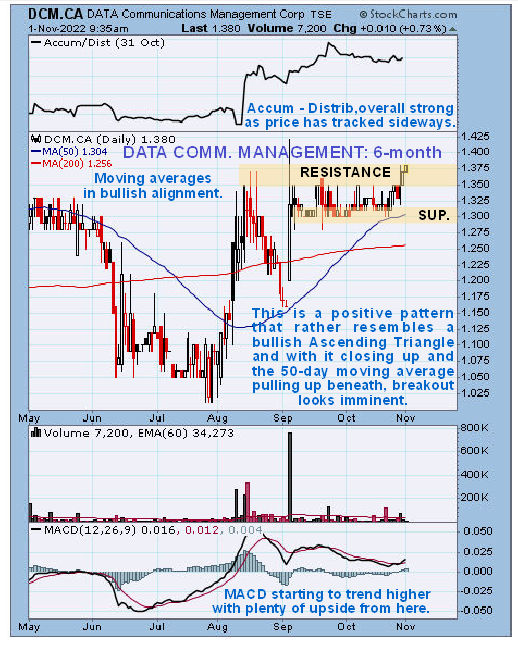
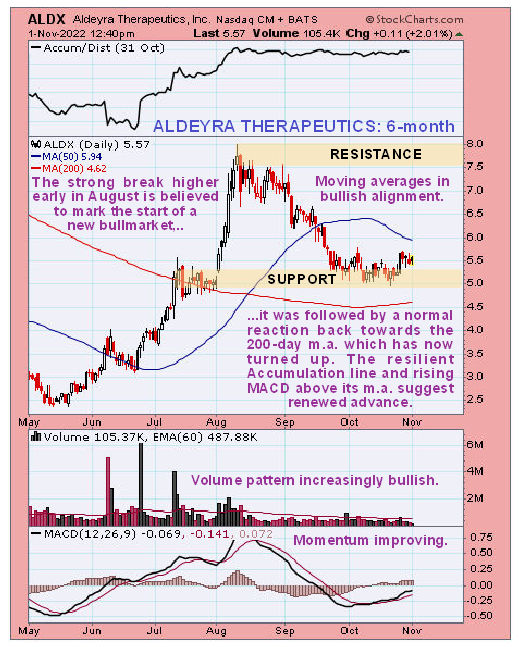
Algernon Pharmaceuticals has entered into a clinical trial agreement with Yale and caught expert Clive Maund’s attention. In light of this, Maund reviews the company’s chart to tell you when he believes you should buy its stock.
The fact that it has only 2 million shares in issue improves its potential for rapid recovery.
Anyone holding should therefore stay long, and it is rated a Buy again here. Those interested should aim to buy it as soon as possible after the open this morning.
Algernon Pharmaceuticals Inc. closed at CA$2.90, $2.09 on October 21, 2022.
CliveMaund.com Disclosures
The above represents the opinion and analysis of Mr. Maund, based on data available to him, at the time of writing. Mr. Maund’s opinions are his own, and are not a recommendation or an offer to buy or sell securities. Mr. Maund is an independent analyst who receives no compensation of any kind from any groups, individuals or corporations mentioned in his reports. As trading and investing in any financial markets may involve serious risk of loss, Mr. Maund recommends that you consult with a qualified investment advisor, one licensed by appropriate regulatory agencies in your legal jurisdiction and do your own due diligence and research when making any kind of a transaction with financial ramifications. Although a qualified and experienced stock market analyst, Clive Maund is not a Registered Securities Advisor. Therefore Mr. Maund’s opinions on the market and stocks can only be construed as a solicitation to buy and sell securities when they are subject to the prior approval and endorsement of a Registered Securities Advisor operating in accordance with the appropriate regulations in your area of jurisdiction.
Disclosures: 1) Clive Maund: I, or members of my immediate household or family, own securities of the following companies mentioned in this article: None. I personally am, or members of my immediate household or family are, paid by the following companies mentioned in this article: None.
2) The following companies mentioned in this article are billboard sponsors of Streetwise Reports:Algernon Pharmaceuticals Inc. Click here for important disclosures about sponsor fees. As of the date of this article, an affiliate of Streetwise Reports has a consulting relationship with Algernon Pharmaceuticals Inc. Please click here for more information.
3) Statements and opinions expressed are the opinions of the author and not of Streetwise Reports or its officers. The author is wholly responsible for the validity of the statements. The author was not paid by Streetwise Reports for this article. Streetwise Reports was not paid by the author to publish or syndicate this article. Streetwise Reports requires contributing authors to disclose any shareholdings in, or economic relationships with, companies that they write about. Streetwise Reports relies upon the authors to accurately provide this information and Streetwise Reports has no means of verifying its accuracy.
4) This article does not constitute investment advice. Each reader is encouraged to consult with his or her individual financial professional and any action a reader takes as a result of information presented here is his or her own responsibility. By opening this page, each reader accepts and agrees to Streetwise Reports’ terms of use and full legal disclaimer. This article is not a solicitation for investment. Streetwise Reports does not render general or specific investment advice and the information on Streetwise Reports should not be considered a recommendation to buy or sell any security. Streetwise Reports does not endorse or recommend the business, products, services or securities of any company mentioned on Streetwise Reports.
5) From time to time, Streetwise Reports LLC and its directors, officers, employees or members of their families, as well as persons interviewed for articles and interviews on the site, may have a long or short position in securities mentioned. Directors, officers, employees or members of their immediate families are prohibited from making purchases and/or sales of those securities in the open market or otherwise from the time of the decision to publish an article until three business days after the publication of the article. The foregoing prohibition does not apply to articles that in substance only restate previously published company releases. As of the date of this article, officers and/or employees of Streetwise Reports LLC (including members of their household) own securities of Algernon Pharmaceuticals Inc., a company mentioned in this article.
6) This article does not constitute medical advice. Officers, employees and contributors to Streetwise Reports are not licensed medical professionals. Readers should always contact their healthcare professionals for medical advice.
With global interest and use of copper rising, copper may not be able to meet demand. Expert Rick Mills of Ahead of the Herd reviews the demand for copper, the push for more infrastructure, and what he believes the future holds for this metal.
Copper is one of the most important metals, with more than 20 million tonnes consumed each year across a variety of industries, including building construction (wiring & piping,) power generation/ transmission, and electronic product manufacturing.
World mined copper production, in thousands of tonnes. Source: US Geological Survey
In recent years, the global transition towards clean energy has stretched the need for the tawny-colored metal even further. More copper will be required to feed our renewable energy infrastructure, such as photovoltaic cells used for solar power and wind turbines.
The metal is also a key component in transportation, and with increasing emphasis on electrification, demand is only going to increase.
According to S&P Global’s report, via Reuters, “Efforts to reach carbon neutrality by 2050 are likely to remain out of reach as copper supply fails to match demand amid the growing use of solar panels, electric vehicles, and other renewable technologies.”
A major rise in copper demand from new “blacktop” infrastructure (think roads, bridges, airports, etc.), combined with high demand for copper from large-scale efforts on behalf of governments to decarbonize and electrify, is not being met with an adequate supply of the industrial metal.
Trillions worth of new projects is thus in danger of falling by the wayside unless much more copper is discovered — more than is currently possible, in my opinion.
My position is supported by a recent report from S&P Global, which predicts the world’s appetite for copper will reach 53 million tonnes, on an annual basis, by mid-century. This is more than double the current global mine production of 21Mt, according to the U.S. Geological Survey.
How are we going to find the copper?
The Green Economy
According to S&P Global’s report via Reuters, “Efforts to reach carbon neutrality by 2050 are likely to remain out of reach as copper supply fails to match demand amid the growing use of solar panels, electric vehicles, and other renewable technologies.”
The continued move towards electric vehicles is a huge copper driver. In EVs, copper is a major component used in the electric motor, batteries, inverters, wiring, and in charging stations. An average electric vehicle contains about four times as much copper as regular vehicles.
Compared with traditional energy systems, renewables contain 12 times more copper. Wind farms use anywhere between 4 to 15 million pounds, while solar photovoltaic farms require 9,000 pounds per megawatt.
The big question is, will there be enough copper for future electrification needs globally? And remember, in addition to electrification, copper will still be required for all the standard uses.
The short answer is no, not without a massive acceleration of copper production worldwide.
According to a joint report from Ernst & Young (EY) and Eurelectric, Europe will have 130 million EVs by 2025. Each takes about 85 kg (187 pounds) of copper.
The report’s projections, cited by Bloomberg, show Europe’s EV fleet growing from its current <5 million to 65 million by 2030, then doubling over the following five years. This number of EVS will require 65 million chargers. Charging stations take 0.7 kg (for a 3.3 kW slow charger) or 8 kg (for a 200 kW fast charger), according to the Copper Alliance.
An EY leader notes it took 10 years to install 400,000 chargers; now, we will need about 500,000 per year until 2030 and 1 million every year between 2030 and 2035.
That would mean an extra million tonnes a year, over and above what we mine now, every year for the next 20 years! The world’s copper miners need to discover the equivalent of one Escondida, the largest copper mine on the planet, each and every year while keeping current production at ~20Mt.
There is also no shift from fossil fuels to green energy without copper, which has no substitutes for its uses in EVs (electric motors and wiring, batteries, inverters, charging stations), wind, and solar energy.
Many countries need to reduce their so-called “infrastructure deficits.” Basic infrastructure, such as roads, bridges, water and sewer systems, has been poorly maintained and requires hefty investments, measured in trillions of dollars, to repair or replace.
China, the world’s biggest commodities consumer, has committed to spend at least US$2.3 trillion this year on major infrastructure projects. They are part of Beijing’s most recent five-year plan that calls for developing “core technologies,” including high-speed rail, power infrastructure, and new energy. More money will be aside in years two to five.
There is also the “Made in China 2025″ initiative, which seeks to end Chinese reliance on foreign technology by investing in a number of key sectors, including IT and robotics, and China’s $900 billion “Belt and Road Initiative,” designed to open channels between China and its neighbors, mostly through infrastructure investments. Dozens of countries have signed up for it, including Russia.
Research commissioned by the International Copper Association, quoted by Mining Technology, found that Belt and Road projects in over 60 Eurasian countries will push the demand for copper to 6.5 million tonnes by 2027.
China’s Belt and Road Initiative
That much copper equates to nearly a third of the 21Mt of copper produced in 2021 — a new copper supply that would need to be either mined from existing operations or discovered.
The U.S. is pursuing its own US$1.2 trillion infrastructure package, to be spent on roads, bridges, power & water systems, transit, rail, electric vehicles, and upgrades to broadband, airports, ports, and waterways, among many other items.
According to S&P Global, Among the metals-intensive funding in the legislation is US$110 billion for roads, bridges, and major projects, US$66 billion for passenger and freight rail, US$39 billion for public transit, and US$7.5 billion for electric vehicles.
Some of the largest copper mines are seeing their reserves dwindle; they are having to slow production due to major capital-intensive projects to move operations from open pit to underground. Examples include the world’s two largest copper mines, Escondida in Chile and Grasberg in Indonesia, along with Chuquicamata, the biggest open-pit mine on Earth.
Without new capital investments, Commodities Research Unit (CRU) predicts global copper mined production will drop from the current 21Mt to below 12Mt, leading to a supply shortfall of more than 15Mt. Over 200 copper mines are expected to run out of ore before 2035, with not enough new mines in the pipeline to take their place.
Graph courtesy of Hamish Sampson, analyst at CRU’s copper team
Bank of America, in a recent report, predicts the copper market will flip into a deficit as early as 2025 following the completion of the current wave of project buildouts, the latest being Ivanhoe Mines’ massive Kamoa-Kakula project in the Democratic Republic of the Congo.
Five years later, analysts at Rystad Energy project that copper demand will outstrip supply by more than 6 million tonnes. That equates to nearly the entire annual production of Chile, the world’s top producer.
By 2040, the supply shortfall grows to 14Mt, according to a BloombergNEF August report, with a “best-case scenario” shortage of >5 million short tons possible by 2040.
In fact, we don’t have to wait to see signs of an emerging copper crisis. Some of the world’s largest copper miners this year have proven unable to produce as much as they said they would. BHP, Rio Tinto, Anglo American, First Quantum Minerals, and Glencore have all pared back production forecasts, blaming higher costs for their lower output figures. (see ‘Cost creep’ below)
Following a 14% drop in copper production in Q1, Glencore cut its 2022 guidance by 3% or 40,000 tonnes.
According to Goldman Sachs, the incentive price to make mining attractive is now 30% higher than in 2018, at roughly US$9,000 a ton (as I write this copper is US$7060.00t).
Some of this has to do with deposits getting mined out. As grades decline, higher amounts of ore need to be processed to yield an equivalent amount of copper.
New deposits are getting trickier and pricier to find and develop. There is a lot of anti-mining sentiment in Canada and the United States, and politicians are beholden to these pressure groups. It can take up to 20 years to build a mine after all the stakeholders have been consulted and the many permitting requirements have been satisfied.
Overall, it is getting harder and taking longer for new projects to be green-lit.
Source: Energy & Capital
According to Goehring & Rozencwajg Associates, the number of new world-class copper discoveries coming online this decade “will decline substantially and depletion problems at existing mines will accelerate.”
According to the Wall Street firm’s model, the industry is “approaching the lower limits of cut-off grades,” and brownfield expansions are no longer a viable solution. “If this is correct, then we are rapidly approaching the point where reserves cannot be grown at all,” the report concluded.
It also shines a light on the importance of making new discoveries in establishing a sustainable copper supply chain.
Over the past 10 years, greenfield additions to copper reserves have slowed dramatically. S&P Global estimates that new discoveries averaged nearly 50Mt annually between 1990 and 2010. Since then, new discoveries have fallen by 80% to only 8Mt per year.
In fact, new copper supply is concentrated in just five mines — Chile’s Escondida, Spence and Quebrada Blanca, Cobre Panama, and the Kamoa-Kakula project in the DRC. Our analysis shows that in four of the five mines where new copper supply is concentrated, there are offtake agreements, either in place or implied, with non-Western buyers.
In the case of Kamoa-Kaukula, 100% of initial production will be split between two Chinese companies, one of which owns 39.6% of the joint venture project. Nearly half of Cobre Panama’s annual production goes to a Korean smelter under a 2017 offtake agreement.
Escondida and Quebrada Blanca are both partially owned by Japanese companies — one can make the assumption that a corresponding percentage of production will be going there.
Companies that diversify into copper now would be well-positioned to benefit from the coming copper shortfall, which should result in a much higher realized copper price.
Barrick Gold Corp. (ABX:TSX; GOLD:NYSE) and Agnico Eagle Mines Ltd. (AEM:TSX; AEM:NYSE) are two recent examples.
Agnico Eagle paid US$580 million for a 50% share in Teck’s San Nicolas copper-zinc mine in Zacatecas, Mexico.
About 20% of Barrick Gold’s production now comes from copper.
Cost Creep
Copper mining has become an especially capital-intensive industry – the average capital intensity for a new copper mine in 2000 was US$4,000-5,000 to build the capacity to produce a tonne of copper; in 2012, capital intensity was US$10,000/t, on average, for new projects.
Today, building a new copper mine can cost up to US$44,000 per tonne of production, an AOTH analysis has found.
Capex costs are escalating because:
Declining copper ore grades means a much larger relative scale of required mining and milling operations.
A growing proportion of mining projects are in remote areas of developing economies where there’s little to no existing infrastructure.
Many inputs necessary for mine-building are getting more expensive as cross-the-board inflation, the highest in 40 years, infiltrates the industry. This includes two of the largest costs, wages and diesel fuel used to run mining equipment.
The bottom line?
It is becoming increasingly costly to bring new copper mines online and run them. According to Goldman Sachs, the incentive price to make mining attractive is now 30% higher than in 2018, at roughly US$9,000 a ton (as I write this, copper is US$7060.00t).
Along with technical issues such as falling grades/deteriorating ore quality, there is also supply pressure from growing resource nationalism.
There is a need to go further afield and dig deeper to find copper at the grades needed to economically produce copper products. This usually means riskier jurisdictions that are often ruled by shaky governments.
In February, Goldman Sachs predicted a “scarcity episode” by the end of 2022 as global stocks of copper fell to dangerously low levels.
Peru and Chile, which together account for more than a third of global copper output, are both seeing a wave of resource nationalism, where governments try to exact a greater share of resource revenues through various means, such as higher royalties and export bans of raw ores.
Chile has attracted substantial mining investment in recent years, including from leading copper producers like BHP and Teck. But long-term, Chile’s declining ore grades present a key downside risk to production forecasts.
The chart below shows Chile’s average copper grades were more than cut in half between 1999 and 2016.
Source: Cochilco
Chile is also producing less copper. According to Cochilco, the country’s state copper commission, in 2000, Chile produced 34.7% of the world’s copper; by 2017, the percentage had fallen to 26.7% (the USGS’s latest figures show Chilean mine production at 26% of the global total).
State-owned copper miner Codelco, which is the largest copper company in the world, is facing challenges linked to the redevelopment of its copper mines, meaning it will produce 1.5 million tonnes of copper this year and next, compared with 1.7 million tonnes in 2021, Reuters said this week.
Making matters worse, after more than a decade of drought, freshwater supplies are becoming a big problem in Chile. Copper mines there require lots of water to process sulfide ores, and the lower the grade, the more water must be used.
Like Chile, the world’s second-largest copper miner has underperformed. Copper production in July totaled 195,234 tonnes, following a respective 9.1% and 14.5% drop in output at the Antamina and Southern Copper mines. The result was a 6.6% year-on-year loss.
While copper production at China-owned Las Bambas recovered in June, following a truce with indigenous communities who oppose the mine, the agreement ended in July, and renewed protests could risk copper supplies, Reuters said.
The Chinese copper market is at its tightest in more than a decade as traders pay massive premiums for immediate supplies.
Peru’s President Pedro Castillo has proposed to raise taxes on the mining sector by at least 3%, which the country’s mining chamber says could cost USD$50 billion in future investments.
In the Democratic Republic of Congo (DRC), weak infrastructure, including a lack of power, is limiting the growth potential for major copper deposits. This past summer, the Congolese government suspended metal exports from Tenke Fungurume, a large copper-cobalt mine owned by China’s CMOC.
The DRC is the world’s top producer of cobalt and Africa’s leading copper-mining country. Tenke Fugurume accounted for more than 10% of global cobalt output in 2021.
Dwindling Inventories
In February, Goldman Sachs predicted a “scarcity episode” by the end of 2022 as global stocks of copper fell to dangerously low levels. That never happened due to the abrupt fall in the copper price, owing to the Federal Reserve’s interest rate increases, the high US dollar, a slowdown in China, and talk of a global recession. Still, Goldman’s warning about a “stock-out” remains well supported.
Goehring & Rozencwajg, the Wall Street firm, published a chart of copper warehouse inventories showing a four-year down-trend from around April 2018 to the present.
These days, there is a puzzling disconnect between the copper price, which has dropped to a five-week low of US$3.54 a pound (at the time of writing), and market tightness.
The latter is aptly demonstrated by what is happening in Shanghai, China, where for the past 15 years, a huge copper stockpile, larger even than the London Metal Exchange, has been used by Chinese companies as collateral for cheap financing.
Now, according to Bloomberg, China’s bonded warehouses are all but empty. The once-frenetic flow of metal into the stockpile has come to a juddering halt as two dominant financiers of Chinese metals, JPMorgan Chase & Co. and ICBC Standard Bank Plc, have halted new business there. Numerous traders and bankers interviewed by Bloomberg said they believe the trade is dead for now, and some predicted the bonded stocks could drop to zero or close to it.
The implications are being felt across the market as the world’s largest copper consumer becomes more reliant on imports to meet its near-term needs at a time when global stocks are already at historically low levels. The Chinese copper market is at its tightest in more than a decade as traders pay massive premiums for immediate supplies.
At their peak in 2011-12, China’s bonded stocks held about a million tons of copper. This month they totaled just 30,000 tons — down nearly 300,000t from earlier this year, the lowest level in decades.
Bloomberg explains that the decline began several years ago, with a massive warehousing fraud in 2014 that soured many banks and traders in the Chinese metals industry. This year, the country’s economic slump, rising interest rates, and several high-profile losses caused more participants to stay away.
The key point is, without the Shanghai buffer of bonded stocks, any pickup in Chinese demand could send copper prices soaring.
In short, says Woodmac, “the global energy transition presents an almost unattainable mine supply challenge, with significant investment and price incentives required.”
It’s not only in China that copper stockpiles are getting depleted. As of this week, CRU Group estimates global stocks are down to just 1.6 weeks of consumption. That’s the lowest ever in the copper consultancy’s data going back to 2001, Bloomberg said.
On October 19, Reuters reported the available copper in London Metal Exchange warehouses halved within eight days.
A squeeze on the Shanghai Futures Exchange (ShFE) has generated a scramble for metal, metals columnist Andy Home explained, adding that, As bonded stocks rapidly deplete to fill on-shore ShFE warehouses, physical premiums are, in turn, rising to attract more metal from the international market.
The Yangshan copper premium, a useful proxy for China’s spot import demand, has soared to $147.50 per tonne over LME cash, its highest trading level since 2013.
Western sanctions on Russian companies due to the war in Ukraine are also factoring into low copper inventories. The LME is reportedly talking about suspending deliveries of Russian metal (aluminum, copper, and nickel), which at the end of September comprised over 60% of the exchange’s copper stocks.
Locking In
Some copper buyers are so worried about the future availability of the metal that they are looking to secure longer-term deals than normal. For example, Bloomberg said that Codelco recently signed contracts with customers in Europe for three to five years versus the traditional annual deals.
“We are prepared to continue to strengthen our long-term relations with customers because we can understand that in their risk matrix, their concern about copper supply is one of their priorities,” Codelco’s Chairman Maximo Pacheco said in an interview.
Pointing to forecasts for strong copper demand growth, he said, “Obviously, they have a question: ‘Where are we going to get this copper from?’.”
Supply-Demand Gap
It’s a good question, we find ourselves asking it repeatedly.
A new report from Wood Mackenzie estimates that 9.7 million tonnes of new copper supply is needed over 10 years to meet the targets set out in the Paris Climate Agreement. As stated earlier, this is the equivalent of putting a new Escondida Mine into production every year.
Source: Wood Mackenzie
Figures from the commodities consultancy show that mining project approval rates have stalled despite historically high copper prices (in Q1).
During the first half of 2022, the volume of committed projects totaled just 260,000 tonnes of production per year (against total annual mine production of around 21 million tonnes).
Source: Wood Mackenzie
“To successfully meet zero-carbon targets, the mining industry needs to deliver new projects at a frequency and consistent level of financing never previously accomplished,” said Nick Pickens, research director of copper markets at Wood Mackenzie.
In short, says Woodmac, “the global energy transition presents an almost unattainable mine supply challenge, with significant investment and price incentives required.”
The firm estimates over US$23 billion a year will be needed over 30 years to deliver new projects under the 1.5 degrees Celsius Paris scenario — a level of investment previously seen only for a limited period from 2012 to 2016, following the China-induced commodity super-cycle.
The copper price needed to meet demand under this scenario is US$4.25 a pound, about 25% higher than currently.
Source: Wood Mackenzie
In an article titled ‘A Great Copper Squeeze Is Coming for the Global Economy,’ Bloomberg reported in September that the recent downturn in copper prices stands to worsen the coming deficit because the slump discourages new copper investments.
A massive copper shortfall that could be visited upon the industry in as short as two years’ time could, says Bloomberg, hold back global growth, stoke inflation by raising manufacturing costs, and throw global climate goals off course. . .
And the latest market downturn stands to exacerbate future supply problems by offering a false sense of security, choking off cash flow, and chilling investments. It takes at least 10 years to develop a new mine and get it running, which means that the decisions producers are making today will help determine supplies for at least a decade. [in North America, the time frame is more like 20 years — Rick]
The coming supply squeeze will be truly breathtaking and deserves more of a numerical explanation.
According to a study from S&P Global, emissions goals commensurate with decarbonization and electrification will double copper demand to 50 million tonnes by 2035. Bloomberg New Energy Finance estimates demand will increase by over 50% from 2022 to 2040.
Supply growth is expected to peak around 2024, the result of very few new projects in the works and as existing mines are depleted. According to S&P’s research, this is setting up a supply deficit of 10 million tons in 2035 — the equivalent of 10 Escondidas.
Goldman Sachs thinks mining companies need to spend about US$150 billion over the next decade to solve an 8Mt deficit. BloombergNEF predicts that by 2040 the mined output gap could reach 14Mt.
Copper Prices
The next question is what this means for copper prices going forward. In 2021, when the copper deficit was 441,000 tons, copper prices jumped about 25%. 441,000t is less than 2% of demand, but in S&P Global’s worst-case scenario, 2035’s shortfall will be the equivalent of about 20% of consumption.
Goldman Sachs is forecasting the LME copper price to more than double its current level to US$15,000 a ton in 2025. Let’s step back here and remember the incentive price to make mining copper attractive is US$9,000.00 a ton copper is trading currently at US$7,000.00t.
Copper will have to rise from its current price of US$3.54 to a minimum of US$4.50lb to incentivize miners to build mines.
Of course, one of the biggest wildcards in all this is China, the world’s largest metals consumer, accounting for about half of global copper demand. If the country’s property sector contracts significantly, it would obviously mean less copper-demanded construction.
Another unknown is the potential for a global recession. Citigroup, via CNBC, sees copper prices in the short-term falling due to an economic slowdown driven by Europe. The bank forecasted copper at US$6,600 a ton in the first quarter of 2023.
Other forecasters, and that includes us at AOTH, believe a recession will only delay demand, which is inevitable due to the trillions of dollars being planned for electrification and infrastructure investments. An August 31 presentation from BloombergNEF states that a recession will not “significantly dent” consumption projections going into 2040.
Bloomberg points out there is already very little wiggle room on the supply side: The physical copper market is already so tight that despite the slump in futures prices, the premiums paid for immediate delivery of the metal have been moving higher.
Richard Adkerson, the CEO of Freeport McMoRan, recently weighed in on the disconnect between supply tightness and the lower copper price, saying during a conference call with analysts, “It’s striking how negative financial markets feel about this market, and yet the physical market is so tight.”
“We’re not seeing customers scaling back orders. Customers are really fighting to get products,” Adkerson said. He added that such a pricing environment will defer new copper projects and mine expansions just when the world’s epic shift to electrification requires a massive amount of the metal.
The copper price rose on Wednesday, October 26, to US$3.54 a pound, the highest since September 16, buoyed by a weaker US dollar. Hope for a rebound has also been strengthened due to recent news out of China.
The country is considering lessening its quarantine period for inbound visitors from 10 to seven days, an indication it is winning its war against the coronavirus pandemic that has resulted in nationwide lockdowns.
Conclusion
The demand pressure about to be exerted on copper producers in the coming years all but guarantees a market imbalance, resulting in copper becoming scarcer and dearer with each infrastructure initiative and with each ambitious green initiative rolled out by governments.
The problem is that existing copper mines are running out of ore, and the capital invested in new mines is far below the needed level.
In sum, the copper industry is in the grips of a structural supply deficit that, combined with inflationary cost pressures and creeping resource nationalism in some of the world’s largest copper producers, is only expected to get worse.
According to S&P Global Market Intelligence research, of 224 sizable copper deposits discovered in the past 30 years, only 16 have been found in the last decade.
It takes seven to 10 years, at minimum, to move a copper mine from discovery to production. In regulation-happy jurisdictions like Canada and the U.S., the time frame is more like 20 years.
The pipeline of copper development projects is the lowest it’s been in decades.
Why can’t we just mine more copper?
Over the past two decades, big mining companies have approached the problem of dwindling reserves by doing exactly that.
Historical Copper Price
Between 2001 and 2014, 80% of new reserves came from re-classifying what was once waste rock into mineable ore, i.e., lowering the cut-off grade.
The problem is that between lowering their cut-off grades and high-grading (removing all the best ore and leaving the rest), the grade of new reserves each year has steadily declined.
In 2001, the new reserves grade was 0.80% copper, but by 2012, it had fallen to 0.26%. The copper industry was still able to replace all the ore used in production with new reserves, but the quality of those reserves, i.e., the grade, had dropped by nearly two-thirds.
The authors of a recent report contend that even with prices above $10,000 per tonne, reserves cannot keep growing, specifically at porphyry deposits, where most copper is mined.
Their analysis also suggests that we are quickly approaching the lower limits of cut-off grades, concluding that we are rapidly approaching the point where reserves cannot be grown at all. In other words, peak copper.
The industry can no longer re-classify itself out of its problem. Billions and billions of dollars need to be invested in the exploration and development of new copper mines.
In sum, the copper industry is in the grips of a structural supply deficit that, combined with inflationary cost pressures and creeping resource nationalism in some of the world’s largest copper producers, is only expected to get worse.
Ahead of the Herd newsletter, aheadoftheherd.com, hereafter known as AOTH.
Please read the entire Disclaimer carefully before you use this website or read the newsletter. If you do not agree to all the AOTH/Richard Mills Disclaimer, do not access/read this website/newsletter/article, or any of its pages. By reading/using this AOTH/Richard Mills website/newsletter/article, and whether you actually read this Disclaimer, you are deemed to have accepted it.
Any AOTH/Richard Mills document is not, and should not be, construed as an offer to sell or the solicitation of an offer to purchase or subscribe for any investment.
Disclosures:
1) Rick Mills: I, or members of my immediate household or family, own securities of the following companies mentioned in this article: None. I personally am, or members of my immediate household or family are, paid by the following companies mentioned in this article: None. I determined which companies would be included in this article based on my research and understanding of the sector.
2) The following companies mentioned in this article are billboard sponsors of Streetwise Reports: None. Click here for important disclosures about sponsor fees. The information provided above is for informational purposes only and is not a recommendation to buy or sell any security.
3) Statements and opinions expressed are the opinions of the author and not of Streetwise Reports or its officers. The author is wholly responsible for the validity of the statements. The author was not paid by Streetwise Reports for this article. Streetwise Reports was not paid by the author to publish or syndicate this article. Streetwise Reports requires contributing authors to disclose any shareholdings in, or economic relationships with, companies that they write about. Streetwise Reports relies upon the authors to accurately provide this information and Streetwise Reports has no means of verifying its accuracy.
4) This article does not constitute investment advice. Each reader is encouraged to consult with his or her individual financial professional and any action a reader takes as a result of information presented here is his or her own responsibility. By opening this page, each reader accepts and agrees to Streetwise Reports’ terms of use and full legal disclaimer. This article is not a solicitation for investment. Streetwise Reports does not render general or specific investment advice and the information on Streetwise Reports should not be considered a recommendation to buy or sell any security. Streetwise Reports does not endorse or recommend the business, products, services, or securities of any company mentioned on Streetwise Reports.
5) From time to time, Streetwise Reports LLC and its directors, officers, employees, or members of their families, as well as persons interviewed for articles and interviews on the site, may have a long or short position in the securities mentioned. Directors, officers, employees, or members of their immediate families are prohibited from making purchases and/or sales of those securities in the open market or otherwise from the time of the decision to publish an article until three business days after the publication of the article. The foregoing prohibition does not apply to articles that in substance only restate previously published company release. As of the date of this article, officers and/or employees of Streetwise Reports LLC (including members of their household) own securities of Agnico Eagle, a company mentioned in this article.
On H4, at a pullback near the support level the a Harami reversal pattern has formed. Currently, the pair can go by the signal in an ascending wave. The goal of growth is 1.0090. However, the quotes may pull back to 0.9915, bounce off the level, and continue the uptrend after the correction.
USDJPY, “US Dollar vs Japanese Yen”
On H4, at the support level the pair has formed a Hammer reversal pattern. The pair is now going by the signal in an ascending wave. The goal of growth is 147.80. However, the quotes may pull back to 145.00 and continue the uptrend after the correction to the support level.
EURGBP, “Euro vs Great Britain Pound”
On H4, the pair has formed an Engulfing reversal pattern. Currently, the pair is going by the signal in an ascending wave. The goal of the growth may be the resistance level of 0.8760. Upon testing and breaking through it, the pair has a chance for continuing the uptrend. However, it may still pull back to 0.8565 before growing to the resistance level.
Attention! Forecasts presented in this section only reflect the author’s private opinion and should not be considered as guidance for trading. RoboForex LP bears no responsibility for trading results based on trading recommendations described in these analytical reviews.
On H4, the quotes have broken through the 200-day Moving Average and are now resting above it, which indicates an uptrend. The RSI is testing the the support level. Currently, we should expect the quotes to rise over 7/8 (96.88) and then grow to the resistance level of 8/8 (100.00). The scenario can be cancelled by a breakaway of 6/8 (93.75) downwards. In this case, the quotes may drop to the support level of 5/8 (90.62).
On M15, the upper line of VoltyChannel is broken, which increases the probability of price growth.
S&P 500
On H4, the quotes are going under the 200-day Moving Average, indicating the prevalence of a downtrend. The RSI bounced off the resistance level. Currently, a breakaway of the support level downwards is expected at 0/8 (3750.0), followed by falling to -1/8 (3593.8). The scenario can be cancelled by a downward breakaway of the resistance level at 1/8 (3906.2). In this case, the quotes may reach 2/8 (4062.5).
On M15, the lower line of VoltyChannel is broken, confirming the downtrend and a high probability of further price falling.
Attention! Forecasts presented in this section only reflect the author’s private opinion and should not be considered as guidance for trading. RoboForex LP bears no responsibility for trading results based on trading recommendations described in these analytical reviews.
The European Central Bank has increased the interest rate by 0.75%. As a result of this step, the refinancing rate reached 2%. This is the most massive rate hike in the history of the ECB. In addition to the expected rate hike, the ECB also announced changes to the target long-term refinancing (TLTRO) operations in terms of the applied interest rate and earlier repayment dates. On the other hand, the balance sheet reduction was postponed until the December meeting.
Trading recommendations
Support levels: 0.9969, 0.9897, 0.9873, 0.9835, 0.9755, 0.9601
Resistance levels: 1.0054, 1.0111, 1.0162, 1.0230
From the technical point of view, the trend on the EUR/USD currency pair on the hourly time frame is bullish. The price began a corrective movement and fell below the moving lines. The MACD indicator is in the negative zone, but sellers’ pressure is weak. Under such market conditions, buy trades should be considered from the support level of 0.9969 or 0.0897, but with additional confirmation in the form of reverse initiative. Sell deals can be considered from the resistance level of 1.0054, but also with confirmation.
Alternative scenario: if the price breaks down through the support level of 0.9834 and fixes below it, the downtrend will likely resume.
News feed for 2022.10.28:
– Eurozone French GDP (m/m) at 08:30 (GMT+3);
– Eurozone French CPI (m/m) at 09:45 (GMT+3);
– Eurozone Spanish GDP (m/m) at 10:00 (GMT+3);
– Eurozone Spanish CPI (m/m) at 10:00 (GMT+3);
– Eurozone Italian CPI (m/m) at 12:00 (GMT+3);
– Eurozone German GDP (m/m) at 11:00 (GMT+3);
– Eurozone German CPI (m/m) at 15:00 (GMT+3);
– US PCE Price index (m/m) at 15:30 (GMT+3);
– US Michigan Consumer Sentiment (m/m) at 17:00 (GMT+3);
– US Pending Home Sales (m/m) at 17:00 (GMT+3).
The GBP/USD currency pair
Technical indicators of the currency pair:
Prev Open: 1.1611
Prev Close: 1.1557
% chg. over the last day: -0.47 %
The British pound is firmer than the euro right now. Investors’ confidence in the “pound” is returning amid serious preparations of the new government to form a new budget and a plan to get out of recession. Most likely, it will be achieved by cutting government spending, which will increase unemployment. However, this step is necessary because otherwise, the British economy will have a lot more problems in the form of further reduction of production, business activity, and the real estate market to recession levels.
Trading recommendations
Support levels: 1.1467, 1.1338, 1.1172, 1.1093, 1.0915, 1.0817
Resistance levels: 1.1698, 1.1816, 1.1901
From the technical point of view, the trend on the GBP/USD currency pair on the hourly time frame is bullish. The price is trading at the level of the moving averages. The MACD indicator has become inactive, and the buyers’ pressure remains, but now the price is correcting. Under such market conditions, buy trades can be considered from the support level of 1.1467 or 1.1337, but better after confirmation. Sell trades are best to look for on intraday time frames. The nearest resistance level is 1.1698, but also better with confirmation in the form of a reverse initiative.
Alternative scenario: if the price breaks down of the 1.1172 support level and fixes below it, the downtrend will likely resume.
There is no news feed for today.
The USD/JPY currency pair
Technical indicators of the currency pair:
Prev Open: 146.32
Prev Close: 146.26
% chg. over the last day: -0.04 %
The Japanese yen hit a 3-week high ahead of the Bank of Japan meeting. Currency intervention and weakness in the dollar helped the yen strengthen temporarily. Nevertheless, the Bank of Japan held another interest rate meeting today and maintained its super soft policy to support the fragile economy. That is the reason why analysts are skeptical about strengthening the yen, as the US Fed is still in a tightening cycle, while the BoJ has left policy unchanged.
From the technical point of view, the medium-term trend on the currency pair USD/JPY has changed to bearish. The price is trading at the level of the moving averages. The MACD indicator has become inactive, and there is a slight buying pressure. Under such market conditions, buy trades can be sought on intraday time frames from the support level of 145.88 or 144.90. Sell deals can be searched from the 147.75 resistance level, but only with additional confirmation. The level of 146.79 has already been tested twice and is likely to be broken by the price.
Alternative scenario: If the price fixes above 150.00, the uptrend will likely resume.
News feed for 2022.10.28:
– Japan Unemployment Rate (m/m) at 02:30 (GMT+3);
– Japan Tokyo Core CPI (m/m) at 02:30 (GMT+3);
– Japan BoJ Interest Rate Decision at 06:00 (GMT+3);
– Japan BoJ Monetary Policy Statement at 06:00 (GMT+3);
– Japan BoJ Outlook Report at 06:00 (GMT+3);
– Japan BoJ Press Conference (Tentative).
The USD/CAD currency pair
Technical indicators of the currency pair:
Prev Open: 1.3559
Prev Close: 1.3565
% chg. over the last day: +0.04 %
The Canadian dollar is a commodity currency and depends not only on the monetary policy of the Bank of Canada but also on the performance of the dollar index and oil prices. The dollar index strengthened yesterday while oil prices also continued to grow. As a result, the Canadian dollar is trading in a narrow range, as it was affected by two opposing factors. Overall, the outlook for oil remains on the upside, while the dollar index is fundamentally close to a reversal. In the medium term, USD/CAD quotes may decline significantly.
From the point of view of technical analysis, the trend on the USD/CAD currency pair is bearish. The price is trading at the level of the moving averages. The MACD indicator is in the negative zone, but there is a divergence, indicating the sellers’ weakness. The best way to sell is to consider the resistance level of 1.3678, but only after additional confirmation in the form of a reverse initiative. Buy trades should be considered on the lower time frames from the support level of 1.3541, but it is better after confirmation.
Alternative scenario: if the price breaks out and consolidates above the resistance level of 1.3855, the uptrend will likely resume.
This article reflects a personal opinion and should not be interpreted as an investment advice, and/or offer, and/or a persistent request for carrying out financial transactions, and/or a guarantee, and/or a forecast of future events.
The US Federal Reserve (Fed) is widely expected to hike its benchmark rates by another 75 basis points (bps) yet again in the new month.
However, how high the US central bank can ultimately raise interest rates would depend on the state of the economy, of which the jobs data is a key indicator.
The upcoming Fed policy meeting, along with the latest US nonfarm payrolls report, will be of utmost importance in the week ahead, also featuring these scheduled data releases and events
Monday, October 31
JPY: Japan September industrial production, retail sales, October consumer confidence
AUD: Australia September retail sales, October inflation
CNH: China October PMIs
EUR: Eurozone 3Q GDP and October inflation, ECB Chief Economist Philip Lane speech, Germany September retail sales
Brent: OPEC releases 2022 World Oil Outlook
Tuesday, November 1
AUD: Reserve Bank of Australia policy decision
CNH: China October Caixin manufacturing PMI
GBP: UK October manufacturing PMI (final)
CAD: Canada October manufacturing PMI (final)
USD: US October manufacturing PMI (final), ISM manufacturing
Wednesday, November 2
NZD: New Zealand 3Q unemployment rate
JPY: Bank of Japan September meeting minutes
EUR: Eurozone October manufacturing PMI (final); Germany September external trade and October unemployment
USD: FOMC rate decision
US crude: EIA weekly oil inventory report
Thursday, November 3
AUD: Australia September external trade, October PMIs (final)
CNH: China October composite and services PMIs
EUR: Eurozone September unemployment, ECB President Christine Lagarde speech
GBP: Bank of England rate decision
USD: US weekly initial jobless claims, October ISM services index
Friday, November 4
EUR: Eurozone September PPI, Germany September factory orders, ECB President Christine Lagarde speech
USD: US October nonfarm payrolls, Boston Fed President Susan Collins speech
CAD: Canada October unemployment rate
With next week’s hike already well-telegraphed, markets are already honing their attentions to what Fed Chair Jerome Powell might say during Wednesday’s press conference about potential policy adjustments to be made at the Fed’s December meetings and beyond.
Assuming we indeed see yet another 75bps hike next week, that would bring the upper bound of the Fed benchmark rates up to 3.75%.
Markets currently believe that such a move (75bps hike next week) would put the largest chunks of the Fed rate hikes behind us.
At present, markets also expect that US interest rates would peak around 4.8% in Q2 2023.
That suggests just another couple of relatively smaller 50bps hikes left in the Fed’s pipeline before this rate-hiking cycle is over (again, assuming that a 75bps hike does indeed materialize next week).
The above essentially comprises the “dovish pivot” narrative that traders and investors have been testing at various intervals since the summer.
This latest iteration of that “dovish pivot” narrative has prompted a softening of the US dollar, with the equally-weighted USD index falling away from its post-pandemic high and bounce off its 50-day simple moving average (SMA) as key support.
Ultimately, how high US interest rates would go could ultimately depend on the incoming economic data.
And the incoming US nonfarm payrolls (NFP) report is expected to remind investors of the resilience evident in the jobs market of the world’s largest economy, potentially paving the way for more Fed rate hikes.
Here’s what economists are predicting for the upcoming US jobs report:
Headline NFP figure: 200,000 jobs added in October; lower than September’s 263k.
Unemployment rate: a slight uptick to 3.6% compared to the 3.5% in the month prior.
A lower-than-expected headline NFP figure, or a higher-than-expected unemployment rate, could bolster the “dovish pivot” narrative.
That should, in turn, prompt the USD Index to unwind more of its year-to-date gains and retest the early-September peak around 1.22 for support, with stronger support set to follow around its 100-day SMA at 1.21.
However, if hiring in the US economy comes in better than expected, being able to withstand the Fed rate hikes that have been ongoing since March, that could restore this USD Index back on a path back closer to its mid-October high above 1.29 as the “dovish pivot” proponents are forced to forego their expectations for a while longer.
And of course, much of the USD Index’s performance in the coming week should rely heavily on the latest policy clues due out of the FOMC policy statement and Fed Chair Jerome Powell’s press conference.
If the Fed signals that it remains hell bent on squashing red-hot US inflation by sending US interest rates past the market-forecasted 4.7% peak, such hawkish policy clues should reinvigorate dollar bulls.
While this Week Ahead article has been rather US-centric, also note that the Bank of England is in action at the onset of November. With central banks on either side of the pond in action in the coming week, that sets up some potential volatility for GBPUSD.
So be sure to check back in on Monday when we publish our regular Trade of the Week article.
The US stock indices traded yesterday without a single trend. At the close of the stock market yesterday, the Dow Jones Index (US30) increased by 0.61%, while the S&P 500 Index (US500) lost 0.61%. The NASDAQ Technology Index (US100) fell by 1.63% on Thursday.
After two consecutive quarters of negative GDP growth, the US economy grew by 2.6% in the third quarter. However, analysts believe the outlook is deteriorating quickly as the cumulative effect of a 300 basis point rate hike is hurting business activity, and the Fed will continue to raise rates through the end of the year to ensure that inflation targets are met. The biggest drop in performance has been in the real estate sector, as home sales have fallen month to month. This component reduced the overall GDP figure by 1.4% in the third quarter, indicating that the housing market is moving from a period of excess demand to a period of moderate oversupply.
The US durable goods orders rose in September, but the data also showed signs that the growth momentum is decreasing. Durable goods orders are reported in nominal terms by the government, so it is difficult to determine the impact of inflation on the data. Economists point out that surveys of the Federal Reserve’s regional district banks point to a decline in business investment, prompting talk of a recession.
Shares of tech giant Amazon (AMZN) fell more than 20% in after-hours trading after the company released its third-quarter earnings report, with revenue and guidance falling short of analysts’ consensus expectations. The company pointed out that Europe is likely to be its hardest-hit region during the holiday season, with Germany and the UK being its biggest markets after the US.
Apple (AAPL) beat analysts’ expectations by posting record revenue and earnings per share. Apple said its active installed device base hit a record high for all major product categories. But despite the good report, the company’s stock declined in the evening session.
Caterpillar (CAT) gave investors optimism by reporting better-than-expected quarterly results. Rising prices and increased sales support the heavy equipment company’s growth.
Equity markets in Europe mostly rallied yesterday. Germany’s DAX (DE30) increased by 0.12%, France’s CAC 40 (FR40) lost 0.51%, Spain’s IBEX 35 (ES35) added 0.64%, and the British FTSE 100 (UK100) closed Thursday in plus 0.25%.
The European Central Bank raised its interest rate by 0.75%. As a result of this step, the refinancing rate reached 2%. This is the biggest rate hike in the history of the ECB. In addition to the expected rate hike, the ECB also announced changes to the current operations of the Targeted Long-Term Refinancing (TLTRO) in terms of the applied interest rate and earlier maturity dates. But the balance sheet reduction was postponed to the December meeting.
According to experts, the gold market is forming conditions for medium-term growth. Firstly, it is connected with the fact that the US Federal Reserve will soon finish the cycle of rate increases, and the pressure on the gold industry will decrease. Secondly, such markers like Gold miners AD Line and GDX to GLD ratio have long stopped falling and are on the reverse point. Third, gold has a strong seasonal factor ahead – December and January have been the best months of the year for the past 10 years.
Oil prices decreased on Friday as China, the world’s biggest oil importer, imposed new Covid blocks in several cities as the number of infections began to rise again.
Asian markets traded flat yesterday. Japan’s Nikkei 225 (JP225) decreased by 0.32% for the day, Hong Kong’s Hang Seng (HK50) ended the day up 0.72%, and Australia’s S&P/ASX 200 (AU200) increased by 0.50%.
The Bank of Japan (BoJ) kept interest rates at record lows as expected on Friday. The central bank kept its short-term interest rate target at negative -0.1% and said in a statement that it would continue to target 10-year bond yields at 0%. But the statement also indicates that inflation is likely to rise in the near term as the Japanese economy struggles with rising commodity costs and supply chain problems. The Сentral Bank expects CPI inflation to be 3% by the end of the year, up from its previous forecast of 2.3%. But inflation is also expected to fall to about 1.5% in 2023 and 2024. Data released a little earlier showed that annual inflation in Tokyo reached a 33-year high of 3.4% in October. Japan is slowly beginning to add up to the conditions for abandoning ultra-low interest rates.
S&P 500 (F) (US500) 3,807.30 −23.30 (−0.61%)
Dow Jones (US30) 32,033.28 +194.17 (+0.61%)
DAX (DE40) 13,211.23 +15.42 (+0.12%)
FTSE 100 (UK100) 7,073.69 +17.62 (+0.25%)
USD Index 110.58 +0.88 (+0.80%)
Important events for today:
– Japan Unemployment Rate (m/m) at 02:30 (GMT+3);
– Japan Tokyo Core CPI (m/m) at 02:30 (GMT+3);
– Japan BoJ Interest Rate Decision at 06:00 (GMT+3);
– Japan BoJ Monetary Policy Statement at 06:00 (GMT+3);
– Japan BoJ Outlook Report at 06:00 (GMT+3);
– Japan BoJ Press Conference (Tentative);
– Eurozone French GDP (m/m) at 08:30 (GMT+3);
– Eurozone French CPI (m/m) at 09:45 (GMT+3);
– Eurozone Spanish GDP (m/m) at 10:00 (GMT+3);
– Eurozone Spanish CPI (m/m) at 10:00 (GMT+3);
– Eurozone Italian CPI (m/m) at 12:00 (GMT+3);
– Eurozone German GDP (m/m) at 11:00 (GMT+3);
– Eurozone German CPI (m/m) at 15:00 (GMT+3);
– US PCE Price index (m/m) at 15:30 (GMT+3);
– Canada GDP (m/m) at 15:30 (GMT+3);
– US Michigan Consumer Sentiment (m/m) at 17:00 (GMT+3);
This article reflects a personal opinion and should not be interpreted as an investment advice, and/or offer, and/or a persistent request for carrying out financial transactions, and/or a guarantee, and/or a forecast of future events.
The Research Brief is a short take about interesting academic work.
The big idea
Building multiple publicly subsidized low-income housing developments in a neighborhood doesn’t lower the value of other homes in the area – and in fact can even increase their worth, according to a new peer-reviewed study I co-authored.
For the study, we looked at 508 developments financed through the federal Low-Income Housing Tax Credit program and built in the Chicago area from 1997 to 2016. We then examined their influence on more than 600,000 nearby residential sales, using data from local property assessments and tax records. We chose Chicago because of its size, well-established neighborhoods, substantial amount of subsidized housing developments, well-documented racial and ethnic segregation, pockets of persistent and concentrated poverty and excellent data coverage. While some readers may have pictures of dilapidated buildings in their minds, the projects we looked at were generally well built and well maintained.
We found that, relative to comparable homes in other neighborhoods, average home prices jumped by 10% within a quarter-mile of the first affordable housing development that was built in a neighborhood and 2% within a quarter-mile over a 15-year period or through 2016. To ensure we were isolating the effect of the low-income housing program, we also looked at preexisting market trends to make sure neighborhoods that showed the faster price growth weren’t already growing at a faster rate before the low-income housing.
What was more striking to us, however, is that additional developments in the same area generally further increased housing prices. Building two more developments increased prices by a total of 3 additional percentage points, on average, within a quarter-mile and 4 percentage points over the next quarter-mile. In other words, a neighborhood within a quarter-mile of all three developments saw gains of 13% on average over the period.
These additional effects are important because low-income housing projects are disproportionately concentrated geographically, especially in lower-income areas.
We also found that these effects occurred regardless of whether it was a low- or high-income neighborhood and no matter its racial composition.
While other studies have previously shown Low-Income Housing Tax Credit developments typically have positive effects on surrounding property values, ours was the first to look at the impact of several projects in one neighborhood.
Why it matters
Homeowners are often worried that the development of publicly subsidized housing in their neighborhoods will lower the value of their homes.
The primary concerns seem to be that such housing developments will lead to higher levels of crime and poverty, as well as requiring wealthier residents to pay higher costs for services and education, according to a 2012 study of “not in my back yard,” or NYMBY, opposition. These concerns are particularly acute when multiple projects are clustered closely together, reminding many Americans of public housing projects that concentrated poverty and crime in the mid-20th century.
But today’s affordable housing developments are different than those of the past, which were often cheaply built and poorly maintained. The Low-Income Housing Tax Credit program supports private developers who have an incentive to build high-quality buildings and implement good property management.
Although local homeowners often oppose these buildings, our results show that they are less cause for concern than people may think.
What still isn’t known
We didn’t measure the effects of the new developments on area rental prices, so we don’t know how the subsidized rental units affected rents in unsubsidized properties nearby. That is a subject for future research. Similarly, while we demonstrated statistically that the developments themselves catalyzed the positive changes in values, we did not examine which particular aspects of the developments were the primary drivers of that change.
What’s next
We’re currently finishing up our follow-up study in Los Angeles – another large city but with very different dynamics from Chicago’s. Our findings, which are currently undergoing peer review, show markedly similar effects, though we found the biggest gains in property values after multiple projects in a neighborhood.
We also are examining whether the observed property value effects differ when factoring in the size of the building, the presence of market-rate units and the type of developer.
Sean Zielenbach, president of SZ Consulting and a co-author of the study, contributed to this article.
RoboForex, a leading global provider of services on financial markets, announces to become an official sponsor of the professional football club Cienciano. Cienciano is a professional football club based in Cusco, Peru that currently plays in the Peruvian Primera División. The contract is for the period 2022-2023.
RoboForex has among its priorities the realization of works with which it can demonstrate social responsibility. Without geographic limits, and without distinction of areas of concern (sports, health, environment, community, education…) this company tries to give back to society all the trust and solidarity that have been granted to it since the beginning of its operations. Recently, a part of this social responsibility has taken shape in Peru.
In this Latin American nation, RoboForex has built a productive and harmonious link with a football team that enjoys well-deserved and traditional popular support. Club Cienciano has to its credit two international trophies that place it on the world football stage. Born in Cusco on July 8, 1901, it is considered one of the oldest football clubs in the country and is called “America’s Dad”. Its stadium is named after a Spanish-Inca writer known as Inca Garcilaso de la Vega.
The outstanding trajectory of this club and its deep-rooted fans are the reasons why RoboForex participates in a sponsorship agreement that favours the training and performance of Cienciano football. Initially, this sponsorship agreement will be in force until 2023. It is expected that RoboForex’s contribution will help the club to increase its potential and win every match and every championship. In addition, it is projected that the city of Cusco and Peru as a whole will obtain important benefits that go beyond sports. RoboForex, in alliance with Club Cienciano, intends to carry out social works that have an impact on the welfare of several communities. Indeed, on September seventeenth of this year, two hundred football balls were donated. This donation benefited schools in Cusco that need support to develop their sports activities.
In the officialization activity the CBO of the RoboForex company in Latin America Sami Otman has expressed, “We have been captivated by Peru, by its people, its culture, its history and by the great club that is Cienciano. Which reaffirms the commitment RoboForex has made to the club and to all of Peru”
The cheers that Peruvians dedicate to their football club will encourage RoboForex’s performance as a financial company with social responsibility.
About RoboForex
RoboForex is a company which delivers brokerage services. The company provides traders who work in financial markets with access to its proprietary trading platforms. RoboForex Ltd has the brokerage licence FSC 000138/333. More detailed information about the Company’s products and activities can be found on the official website at roboforex.com.