The cryptocurrency market digest (BTC, AVAX, PEPE). Overview for 03.05.2023

By RoboForex.com

The BTC on Wednesday is balancing near 28,641 USD. An important support for the leading crypto remains at 26,500 USD. There are no reasons for a steep decline yet.

However, anything may happen today. In the evening, the Federal Reserve System will close its two-days’ meeting and report its interest rate decision. If we suppose that the increase by 25 base points has already been accounted for by the market, we may even count on certain BTC growth at night.

Also, take a look at the Fed’s comments on the US public debt parameters as well.

The capitalisation of the crypto sector has dropped to 1.179 trillion USD. The part of the market taken by the BTC has dropped to 47.0%, and that of the ETH has increased to 19.1%.

Coiniar crypto exchange plans to work in the US market

An Australian digital asset exchange platform Coiniar does not quit its plans to get a place in the US market. The company considers North America to be a promising region for business even though control over crypto companies in the US is growing.

AVAX rose significantly

Over four months, the AVAX token increased by more than 65%. So, over Q1, 2023 the coin recovered from the losses of the second half of last year. These days the AVAX coin takes the 16th place in the rating of the most popular cryptocurrencies.

PEPE had a rally

The PEPE meme coin got on the Top 120 list of tokens and on the 17th line of the trade volumes rating. The market started talking about a new season of memecoins and wondering whether the DOGE and SHIB would catch up.

Gemini launched a new trading platform

Gemini launched a new trading platform for traders outside the US. Investors will be able to use perpetual contracts for the BTC against GUSD pair with leverage. The next contract to launch will be the ETH/GUSD one.

Article By RoboForex.com

Attention!
Forecasts presented in this section only reflect the author’s private opinion and should not be considered as guidance for trading. RoboForex LP bears no responsibility for trading results based on trading recommendations described in these analytical reviews.

The banking crisis in the US is getting worse. Inflationary pressures in Europe persist

By JustMarkets 

The US stock indices fell again Tuesday as the banking crisis continues. The KBW regional banking index fell more than 6% to its lowest level since November 2020. The Dow Jones Index (US30) was down by 1.08%, and the S&P 500 Index (US500) fell by 1.16% at the stock market’s close. The NASDAQ Technology Index (US100) decreased by 1.08% yesterday.

Regional banks fell sharply yesterday as fears of further stress on small lenders persist amid fears that higher interest rates will hurt banks open to long-term assets, including Treasuries and commercial loans.

The US Bureau of Labor Statistics (BLS) showed yesterday that the number of job openings in March fell to 9.590 million, below estimates of 9.775 million, according to the JOLTs report. At the same time, the US Commerce Department reported that manufacturing orders rose by 0.09% from the previous month, exceeding estimates.

Concerns about the economy were exacerbated by new fears that the US could default as early as June 1 if Congress does not raise the debt ceiling. Treasury Secretary Janet Yellen warned Monday that the United States could run out of cash and default on its debt as early as June 1.

Uber (UBER) jumped by 11% after reporting lower-than-expected first-quarter losses and optimistic forecasts.

Equity markets in Europe traded flat on Tuesday. German DAX (DE30) decreased by 1.23%, French CAC 40 (FR40) fell by 1.45% yesterday, Spanish IBEX 35 (ES35) lost 1.72%, British FTSE 100 (UK100) closed on Tuesday down by 1.24%.

The overall inflation rate in the Eurozone rose in April, remaining well above the European Central Bank’s target levels, but the rise in core prices slowed down. The annualized consumer price index rose from 6.9% to 7.0%. Core inflation (which excludes food and energy prices) fell from 5.7% to 5.6%. Instead of providing some clarity as to how much the central bank might raise rates, the latest numbers have only blurred the picture. Market participants are debating whether the ECB will raise rates on Thursday by 50 or 25 basis points. On the one hand, rising overall inflation could prompt hawkish ECB officials to advocate another 0.5% hike. On the other hand, a slowdown in core price growth could shift the balance towards a more dovish stance and lead to a compromise 25 basis point rate hike.

Gold moved back above $2,000 an ounce on Tuesday as talk of a potential US default led investors to look for safe-haven assets. If gold maintains its current upward trend, the spot price could try again to reach an April high of around $2,050 or higher.

Oil fell more than 5% yesterday due to fears of a US default. Now the next step is up to OPEC+. There is a high probability that the cartel will cut its daily production even more. OPEC+ will try by all means to keep oil prices above $80 a barrel.

Asian markets were mostly rising yesterday. Japan’s Nikkei 225 (JP225) gained 0.12%, China’s FTSE China A50 (CHA50) didn’t trade yesterday, Hong Kong’s Hang Seng (HK50) gained 0.20% on the day, India’s NIFTY 50 (IND50) jumped by 0.46%, while Australian S&P/ASX 200 (AU200) showed a negative result of 0.92% decline on Tuesday.

S&P 500 (F) (US500) 4,119.59 −48.28 (−1.16%)

Dow Jones (US30)33,684.53 −367.17 (−1.08%)

DAX (DE40) 15,726.94 −195.44 (−1.23%)

FTSE 100 (UK100) 7,773.03 −97.54 (−1.24%)

USD Index 101.90 −0.25 (−0.25%)

Important events for today:
  • – New Zealand Unemployment Rate at 01:45 (GMT+3);
  • – New Zealand RBNZ Gov Orr Speaks at 02:00 (GMT+3);
  • – Australia Retail Sales (m/m) at 04:30 (GMT+3);
  • – Eurozone Unemployment Rate (m/m) at 12:00 (GMT+3);
  • – US ADP Nonfarm Employment Change (m/m) at 15:15 (GMT+3);
  • – US ISM Services PMI (m/m) at 17:00 (GMT+3);
  • – US Crude Oil Reserves (w/w) at 17:30 (GMT+3);
  • – US FOMC Statement at 21:00 (GMT+3);
  • – US Fed Interest Rate Decision at 21:00 (GMT+3);
  • – US FOMC Press Conference at 21:30 (GMT+3).

By JustMarkets


This article reflects a personal opinion and should not be interpreted as an investment advice, and/or offer, and/or a persistent request for carrying out financial transactions, and/or a guarantee, and/or a forecast of future events.

Mid-Week Technical Outlook: Oil Hammered Ahead Of Fed

By ForexTime 

Oil markets have been plunged into a bloodbath over the past 24 hours.

The global commodity shed almost 3% this morning, extending a 5% drop on Tuesday after disappointing US economic data fuelled fears of a recession. With oil bears drawing ample strength from weak US factory data and renewed concerns about the US banking sector, further downside could be on the cards ahead of the Fed decision later today.

In the meantime, it will be wise to keep a close eye on the pending US ISM numbers and data from the Energy Information Agency (EIA) this afternoon. If the reports reinforce fears around the US economy or the EIA data shows a rise in oil inventories, this could keep bears in the driving seat.

Looking at the technical picture, both WTI and Brent Crude are under intense pressure on the daily charts. WTI extended losses on Wednesday with bears smashing into the $70 level. A strong break and daily close below this point could open a path toward $67 and $64.33 – the lowest level hit this year. Should $70 or $67 prove to be reliable support, prices may experience a technical pullback toward $74 before resuming the downtrend.

It is a similar story for Brent. Prices are trading below the 50, 100, and 200-day SMA while the MACD trades below zero. The bearish trend is healthy with the next key level of interest found at 72.50. Below this point, prices could test $70 and potentially lower.

Since we are discussing commodities, gold secured a daily close above the $2015 resistance as downbeat US economic data and renewed banking fears sparked risk aversion. However, it may take a potent fundamental spark to push prices higher with all eyes on the Fed meeting this evening. Although the central bank is widely expected to hike rates by 25 basis points, investors will be looking for any confirmation that a pause in hikes is on the table. Whatever the outcome, it will certainly impact gold.

The solid breakout above $2015 may open the doors toward $2032 and $2047. Should prices slip back below $2000, this could trigger a decline towards $1970 and $1950, respectively.


Forex-Time-LogoArticle by ForexTime

ForexTime Ltd (FXTM) is an award winning international online forex broker regulated by CySEC 185/12 www.forextime.com

How “Insane Optimism” is at Work in the Stock Market

“Stock investors are so bullish that they are…”

By Elliott Wave International

Many technical indicators are highly useful, yet the price moves of the stock market really boil down to two things: optimism and pessimism.

Major trend turns tend to occur when extremes are reached in either optimism or pessimism.

Most recently, optimism has been in charge. The question is: Has an extreme been reached?

Well, there are at least two signs which strongly point to a “yes” answer.

The first sign to which I’d like to call your attention regards the S&P 500 dividend yield. What you need to know is that stock prices tend to top when dividend yields are low and bottom when they’re high.

Robert Prechter explains how this is related to optimism and pessimism in his recently published April Elliott Wave Theorist, which covers major financial and social trends:

Investors in a positive mood bid up stock prices regardless of dividend yield, and investors in a negative mood adjust stock prices lower regardless of dividend yield. Yield simply follows the waves of optimism and pessimism.

The April Theorist provided more insight with this chart and associated commentary:

[The chart] shows that S&P companies’ dividends today yield only 1.66% annually. Investors are putting up with that low payout despite the virtually riskless 5% yield of Treasury bills, which is three times as much. Stock investors are so bullish that they are certain their capital gains will make dividends irrelevant.

The second sign of insane optimism is revealed in this March 29 Bloomberg news item:

They’ve become a high-speed, high-risk, high-reward tool in turbulent markets: Options with shelf lives so short they expire in less than a day [known as “zero-day-to-expiry’ options].

… Success is far from certain, and even some Wall Street pros don’t fully understand them.

That hasn’t deterred thrill-seeking retail investors from piling into 0DTE options.

As the April Theorist says:

Options Gambling Is Another Symptom of Historic Optimism

Looking beyond sentiment extremes, the April Theorist also shows the stock market’s Elliott wave structure in monthly and hourly charts. The information revealed in these charts is very much worth knowing.

If you’re unfamiliar with Elliott wave analysis, read Frost & Prechter’s Wall Street classic, Elliott Wave Principle: Key to Market Behavior. Here’s a quote:

All waves may be categorized by relative size, or degree. The degree of a wave is determined by its size and position relative to component, adjacent and encompassing waves. Elliott named nine degrees of waves, from the smallest discernible on an hourly chart to the largest wave he could assume existed from the data then available. He chose the following terms for these degrees, from largest to smallest: Grand Supercycle, Supercycle, Cycle, Primary, Intermediate, Minor, Minute, Minuette, Subminuette. Cycle waves subdivide into Primary waves that subdivide into Intermediate waves that in turn subdivide into Minor waves, and so on. The specific terminology is not critical to the identification of degrees, although out of habit, today’s practitioners have become comfortable with Elliott’s nomenclature.

If you’d like to read the entire online version of the book, you may do so for free once you join Club EWI, the world’s largest Elliott wave educational community.

A Club EWI membership is also free.

Get started now by following this link: Elliott Wave Principle: Key to Market Behaviorget free and instant access.

This article was syndicated by Elliott Wave International and was originally published under the headline How “Insane Optimism” is at Work in the Stock Market. EWI is the world’s largest market forecasting firm. Its staff of full-time analysts led by Chartered Market Technician Robert Prechter provides 24-hour-a-day market analysis to institutional and private investors around the world.

US debt ceiling drama underscores case for Bitcoin

By George Prior

As the US hurtles towards a potential high-stakes default on its debt, the compelling case for Bitcoin is further strengthened, asserts the CEO and founder of one of the world’s largest independent financial advisory, asset management and fintech organizations.

The assessment from deVere Group’s Nigel Green follows reports that US President Joe Biden has invited top congressional leaders for a May 9 meeting regarding the debt ceiling after The Treasury Department warned on Monday a default could come sooner than expected – possibly as soon as June 1.

The debt ceiling is the amount of money the US is able to borrow to pay its bills. Since the cost of running the government is far greater than federal tax revenues, the US must raise additional money by selling Treasury bonds – but it cannot do this after hitting the debt ceiling.

If the US is unable to pay its bills, it will default on its debt. This would be the first in US history.

Should this happen, it would “cause irreparable harm to the US economy, the livelihoods of all Americans, and global financial stability,” Janet Yellen, the Treasury Secretary, wrote in a letter to the then new House Speaker Kevin McCarthy.

In a letter to members of Congress on Tuesday, Ms Yellen said that “We have learned from past debt limit impasses that waiting until the last minute to suspend or increase the debt limit can cause serious harm to business and consumer confidence, raise short-term borrowing costs for taxpayers, and negatively impact the credit rating of the United States.”

Her announcement came on the same day as the Congressional Budget Office (CBO) reported that there is a “significantly greater risk that the Treasury will run out of funds in early June.”

Nigel Green says: “The emergency meeting called by Biden is a step in the right direction in a monumentally high-stakes game between lawmakers.

“Democrats have said they would not negotiate with Republicans over extending the debt ceiling, while House Speaker Kevin McCarthy has promised not to extend the limit without cuts to the federal budget.”

While the likelihood of a US default remains “unlikely” at this stage, according to the deVere Group CEO, he affirms the debt ceiling drama “further strengthens the compelling case for Bitcoin” for two main reasons.

“First, this saga underscores that the US dollar’s future trajectory is precarious and lies in the hands of opposing and increasingly divided politicians reaching difficult agreements.

“As the gridlock in Washington DC intensifies over the dollar debt ceiling, it seems inevitable that a growing number of retail and institutional investors will want to circumnavigate the shenanigans and look to alternatives which are outside of political controls, as well as having other advantages such as being digital, global and borderless.
“It’s a huge mess and it’s hitting the dollar’s credibility at a time when it already appears to be losing some of its global dominance – this is bullish for Bitcoin.

He continues: “And second, the debt ceiling is likely to be raised in the end, meaning it can issue more debt to generate more capital. However, the government might find it hard to attract buyers, forcing the Federal Reserve back into Quantitative Easing (QE) – or money printing.

“QE is typically good for riskier assets such as Bitcoin – as we saw during the last stimulus round – and it will also likely further hit the long-term value of the dollar, providing a boost for the cryptocurrency.”

Nigel Green concludes: “The debt ceiling drama underlines the flaws in the current fiat-dominated system.

“It strengthens my long-standing argument that the times ahead are destined to be radically different from what we have all experienced in our lifetimes so far.

“I believe that increasingly, there will be a mixed system. Some will be currencies from governments, including digital and non-digital, and some will be digital and decentralised, such as Bitcoin.”

About:

deVere Group is one of the world’s largest independent advisors of specialist global financial solutions to international, local mass affluent, and high-net-worth clients.  It has a network of more than 70 offices across the world, over 80,000 clients and $12bn under advisement.

The RBA unexpectedly raised the rate by another 0.25%. First Republic Bank was sold to JPMorgan Chase

By JustMarkets 

At the close of the stock exchange on Monday, the Dow Jones Index (US30) decreased by 0.14%, and the S&P 500 (US500) lost 0.04%. NASDAQ Technology Index (US100) fell by 0.11% yesterday.

The US manufacturing activity declined for the sixth straight month in April, the longest period since 2009 and a sign of trouble in the manufacturing sector. Order numbers improved slightly but remained in contractionary territory. The good news is that the numbers show that the manufacturing sector is contracting at a slower pace. At the same time, manufacturers face many challenges, including higher borrowing costs, tighter credit conditions, lower demand for goods and still higher prices. A senior portfolio manager at Northwestern Mutual Wealth Management Co. believes Monday’s PMI data bolstered expectations for a 25 basis point increase in Federal Reserve interest rates in May and the likelihood of a June increase.

First Republic Bank was sold to JPMorgan Chase (JPM), the second-largest bankruptcy in US history. First Republic has been struggling since the March collapse of Silicon Valley Bank and Signature Bank. Yesterday morning, the US regulators seized First Republic Bank and sold all of its deposits and most of its assets to JPMorgan Chase Bank. As of April 13, First Republic had about $229 billion in total assets and $104 billion in total deposits, according to the FDIC. The FDIC estimated that its deposit insurance fund would suffer a $13 billion loss because of the transfer to First Republic.

The World Bank on Monday unveiled a new methodology and improved safeguards for assessing the business climate in 180 countries. The bank retracted its Doing Business rating in September 2021, citing an internal audit and an independent investigation that found that top World Bank officials pressured staff to change the data to favor China. A pilot issue of a new annual series called “Business Ready” will be published in the spring of 2024.

Stock markets in Europe did not trade yesterday due to the holiday. There is no doubt that Europe’s central bank will raise borrowing costs for the seventh consecutive time Thursday as inflation shows resilience. Many analysts are currently betting on a quarter-point hike. But if today’s consumer price data, especially the core indicator, shows signs of growth, the ECB could stay on an aggressive path to raise rates.

Weaker Chinese production data outweighed support for OPEC+ supply cuts, and oil is down again. Typically, from April through fall, oil prices rise because of increased demand during the summer months. But this year, economic conditions are outweighing demand. This could lead to OPEC+ countries having to cut production again to keep prices above $80 a barrel.

Asian markets rose strongly yesterday. Japan’s Nikkei 225 (JP225) gained 0.92% over the day, China’s FTSE China A50 (CHA50) added 0.77% yesterday, Hong Kong’s Hang Seng (HK50) increased by 0.27% over the day, India’s NIFTY 50 (IND50) jumped by 0.84%, and Australia’s S&P/ASX 200 (AU200) closed positive 0.35%.

Japan’s economy is recovering moderately from the downturn caused by COVID-19, but bankruptcies are rising, according to the Japanese government’s monthly economic report. The report echoes the warning of global financial volatility in response to the recent collapse of Western banks.

The Reserve Bank of Australia (RBA) unexpectedly raised its rate by 25 basis points, saying that further monetary tightening is still needed as it takes steps to rein in the country’s stubborn inflation. The RBA said in a statement that recent data showed a welcome decline in inflation, but the main forecast is still that it will be a couple of years before inflation returns to the upper end of the target range.

S&P 500 (F) (US500) 4,167.87 −1.61 (−0.04%)

Dow Jones (US30)34,051.70 −46.46 (−0.14%)

DAX (DE40) 15,922.38 0 (0%)

FTSE 100 (UK100) 7,870.57 0 (0%)

USD Index 102.17 +0.51 (+0.50%)

Important events for today:
  • – Australia RBA Interest Rate Decision (m/m) at 07:30 (GMT+3);
  • – Australia RBA Rate Statement (m/m) at 07:30 (GMT+3);
  • – German Retail Sales (m/m) at 09:00 (GMT+3);
  • – Switzerland Manufacturing PMI (m/m) at 10:30 (GMT+3);
  • – German Manufacturing PMI (m/m) at 10:55 (GMT+3);
  • – Eurozone Manufacturing PMI (m/m) at 11:00 (GMT+3);
  • – UK Manufacturing PMI (m/m) at 11:30 (GMT+3);
  • – Eurozone Consumer Price Index (m/m) at 12:00 (GMT+3);
  • – Australia RBA Gov Lowe Speaks at 14:20 (GMT+3);
  • – US JOLTs Job Openings (m/m) at 17:00 (GMT+3).

By JustMarkets


This article reflects a personal opinion and should not be interpreted as an investment advice, and/or offer, and/or a persistent request for carrying out financial transactions, and/or a guarantee, and/or a forecast of future events.

Trade of the Week: The return of $2k gold?

By ForexTime 

Spot gold has been trapped within a $46 range for the most part since April 17th.

Though finding support around the upper-$1900 levels over the past two weeks, the precious metal can scarcely keep its head above the psychologically-important $2,000 line.


However, this week’s events could go a long way in determining whether we’ll see an upside or downside breakout for spot gold.


Here’s a play-by-play on 4 fundamental events over four days that could greatly influence spot gold this week:

  • Tuesday, May 2nd: Eurozone April inflation

The Eurozone’s CPI (consumer price index), which measures the changes in headline inflation, is forecasted to print at 7%.

If so, that would be an uptick from the 6.9% registered in March.

However, if the official CPI figure drops notably below that 7% mark, suggesting that headline inflation is easing, that would erode expectations for more European Central Bank rate hikes.

And such a notion should weaken the Euro while boosting the US dollar, which in turn may drag spot gold prices lower in USD terms.

Lower-than-expected Eurozone inflation = weaker Euro = stronger US dollar = lower gold


  • Wednesday, May 3rd: Federal Reserve rate decision

The US central bank is likely to raise its benchmark rates by another 25-basis points (bps).

Anything else (no hike/50-bps hike) would be a massive shock to traders and investors worldwide!

However, more importantly, markets are desperate to know whether this week’s Fed rate hike is the final one of a series that began over a year ago.

Confirmation from Fed Chair Jerome Powell that US rates would’ve reached its peak this week could see gold prices resurfacing above the $2k mark.

After all, gold is a zero-yielding asset (investors don’t get paid for holding on to gold) and shudders at the thought of US interest rates moving even higher than expected.

Furthermore, if markets get the sense that Fed rate CUTS are growing likelier in the latter part of 2023, that could give gold further impetus to launch another attempt at a fresh record high!

Fed rate hikes are over/Fed rate cuts later in 2023 = weaker US dollar = a potential return of US$2k gold


  • Thursday, May 4th: European Central Bank rate decision

The ECB is widely expected to hike its own benchmark rates by another 25-bps (same size as the Fed’s rate hike).

However, if the ECB shocks markets with a larger 50-bps hike (11.5% chance of such a shocker), or if ECB President Christine Lagarde presses home policymakers’ intentions to keep hiking rates (especially if Tuesday’s Eurozone CPI greatly exceeds market expectations), then the same formula may be called into action once more:

More hawkish ECB = stronger Euro = weaker US dollar = higher gold prices in USD terms.


  • Friday, May 5th: US jobs report

The US nonfarm payrolls headline number has to greatly defy the market-forecasted 180,000 print in order for gold to drag gold lower.

Further signs of resilient hiring momentum, despite the 475-bps (excluding this week’s expected 25-bps hike) in Fed rate hikes that were intended to destroy demand since Q1 2022, would suggest that the Fed can ill afford to pause its rate-hike cycle after this week.

Also, if April’s unemployment rate stubbornly matches the 3.5% rate set in March, as opposed to ticking higher to 3.6% as per forecasts, would likely add to expectations that the Fed has to stay hawkish (press ahead with more rate hikes).

Stronger-than-expected NFP = more incoming Fed rate hikes = stronger US dollar = weaker gold prices


Key levels for spot gold

SUPPORT:

  • Mid-$1970s: lower bound of recent trading range
  • $1959.66: early-February cycle high
  • $1934 – $1949 range: March-early April support
  • 50-day simple moving average (SMA)

Still, spot gold may not have far to fall, as long as markets refuse to abandon hopes that the Fed will have to start lowering US interest rates later this year.


RESISTANCE:

  • $2,000: psychologically-important mark
  • $2032.14: April 5th intraday high
  • $2048.36: one-year high (since March 2022)


The longer it can stay above that $2k mark, the greater the chances of a fresh record high for spot gold!


At the time of writing, Bloomberg’s model points to a 72% chance that spot gold will trade within the $1938.57 – $2031.73 range over the next one-week period.

The pivotal events due in the days ahead may also have a great influence on how gold performs in the weeks and months ahead.


Forex-Time-LogoArticle by ForexTime

ForexTime Ltd (FXTM) is an award winning international online forex broker regulated by CySEC 185/12 www.forextime.com

Generative AI is forcing people to rethink what it means to be authentic

By Victor R. Lee, Stanford University 

It turns out that pop stars Drake and The Weeknd didn’t suddenly drop a new track that went viral on TikTok and YouTube in April 2023. The photograph that won an international photography competition that same month wasn’t a real photograph. And the image of Pope Francis sporting a Balenciaga jacket that appeared in March 2023? That was also a fake.

All were made with the help of generative AI, the new technology that can generate humanlike text, audio and images on demand through programs such as ChatGPT, Midjourney and Bard, among others.

There’s certainly something unsettling about the ease with which people can be duped by these fakes, and I see it as a harbinger of an authenticity crisis that raises some difficult questions.

How will voters know whether a video of a political candidate saying something offensive was real or generated by AI? Will people be willing to pay artists for their work when AI can create something visually stunning? Why follow certain authors when stories in their writing style will be freely circulating on the internet?

I’ve been seeing the anxiety play out all around me at Stanford University, where I’m a professor and also lead a large generative AI and education initiative.

With text, image, audio and video all becoming easier for anyone to produce through new generative AI tools, I believe people are going to need to reexamine and recalibrate how authenticity is judged in the first place.

Fortunately, social science offers some guidance.

The many faces of authenticity

Long before generative AI and ChatGPT rose to the fore, people had been probing what makes something feel authentic.

When a real estate agent is gushing over a property they are trying to sell you, are they being authentic or just trying to close the deal? Is that stylish acquaintance wearing authentic designer fashion or a mass-produced knock-off? As you mature, how do you discover your authentic self?

These are not just philosophical exercises. Neuroscience research has shown that believing a piece of art is authentic will activate the brain’s reward centers in ways that viewing something you’ve been told is a forgery won’t.

Authenticity also matters because it is a social glue that reinforces trust. Take the social media misinformation crisis, in which fake news has been inadvertently spread and authentic news decreed fake.

In short, authenticity matters, for both individuals and society as a whole.

But what actually makes something feel authentic?

Psychologist George Newman has explored this question in a series of studies. He found that there are three major dimensions of authenticity.

One of those is historical authenticity, or whether an object is truly from the time, place and person someone claims it to be. An actual painting made by Rembrandt would have historical authenticity; a modern forgery would not.

A second dimension of authenticity is the kind that plays out when, say, a restaurant in Japan offers exceptional and authentic Neapolitan pizza. Their pizza was not made in Naples or imported from Italy. The chef who prepared it may not have a drop of Italian blood in their veins. But the ingredients, appearance and taste may match really well with what tourists would expect to find at a great restaurant in Naples. Newman calls that categorical authenticity.

And finally, there is the authenticity that comes from our values and beliefs. This is the kind that many voters find wanting in politicians and elected leaders who say one thing but do another. It is what admissions officers look for in college essays.

In my own research, I’ve also seen that authenticity can relate to our expectations about what tools and activities are involved in creating things.

For example, when you see a piece of custom furniture that claims to be handmade, you probably assume that it wasn’t literally made by hand – that all sorts of modern tools were nonetheless used to cut, shape and attach each piece. Similarly, if an architect uses computer software to help draw up building plans, you still probably think of the product as legitimate and original. This is because there’s a general understanding that those tools are part of what it takes to make those products.

In most of your quick judgments of authenticity, you don’t think much about these dimensions. But with generative AI, you will need to.

That’s because back when it took a lot of time to produce original new content, there was a general assumption that it required skill to create – that it only could have been made by skilled individuals putting in a lot of effort and acting with the best of intentions.

These are not safe assumptions anymore.

How to deal with the looming authenticity crisis

Generative AI thrives on exploiting people’s reliance on categorical authenticity by producing material that looks like “the real thing.”

So it’ll be important to disentangle historical and categorical authenticity in your own thinking. Just because a recording sounds exactly like Drake – that is, it fits the category expectations for Drake’s music – it does not mean that Drake actually recorded it. The great essay that was turned in for a college writing class assignment may not actually be from a student laboring to craft sentences for hours on a word processor.

If it looks like a duck, walks like a duck and quacks like a duck, everyone will need to consider that it may not have actually hatched from an egg.

Also, it’ll be important for everyone to get up to speed on what these new generative AI tools really can and can’t do. I think this will involve ensuring that people learn about AI in schools and in the workplace, and having open conversations about how creative processes will change with AI being broadly available.

Writing papers for school in the future will not necessarily mean that students have to meticulously form each and every sentence; there are now tools that can help them think of ways to phrase their ideas. And creating an amazing picture won’t require exceptional hand-eye coordination or mastery of Adobe Photoshop and Adobe Illustrator.

Finally, in a world where AI operates as a tool, society is going to have to consider how to establish guardrails. These could take the form of regulations, or the creation of norms within certain fields for disclosing how and when AI has been used.

Does AI get credited as a co-author on writing? Is it disallowed on certain types of documents or for certain grade levels in school? Does entering a piece of art into a competition require a signed statement that the artist did not use AI to create their submission? Or does there need to be new, separate competitions that expressly invite AI-generated work?

These questions are tricky. It may be tempting to simply deem generative AI an unacceptable aid, in the same way that calculators are forbidden in some math classes.

However, sequestering new technology risks imposing arbitrary limits on human creative potential. Would the expressive power of images be what it is now if photography had been deemed an unfair use of technology? What if Pixar films were deemed ineligible for the Academy Awards because people thought computer animation tools undermined their authenticity?

The capabilities of generative AI have surprised many and will challenge everyone to think differently. But I believe humans can use AI to expand the boundaries of what is possible and create interesting, worthwhile – and, yes, authentic – works of art, writing and design.The Conversation

About the Author:

Victor R. Lee, Associate Professor of Learning Sciences and Technology Design in Education, Stanford University

This article is republished from The Conversation under a Creative Commons license. Read the original article.

The ECB and the US Federal Reserve are planning to raise rates this week

By JustMarkets

At the closing of the stock market on Friday, the Dow Jones (US30) gained 0.80% (+0.87% for the week), and S&P 500 (US500) increased by 0.83% (+0.91% for the week). The NASDAQ Technology Index (US100) gained 0.69% (+1.44% for the week).

The Personal Consumption Price (PCE) Index, excluding food and energy, the Fed’s preferred measure of core inflation, was up 0.3% in March from the previous month. The PCE price data, especially with rising labor costs, support projections that Fed policymakers will raise the benchmark interest rate by another quarter percentage point at this week’s meeting. Fed officials and markets remain at odds over the future trajectory of interest rates, with the Central Bank expecting interest rates to remain at current levels through 2023, while investors are betting on lower rates by the end of the year. Given renewed signs of stress in the banking sector in recent days, as well as problems at First Republic Bank (FRC), Fed officials may signal a pause in June.

Equity markets in Europe traded flat on Friday. German DAX (DE30) gained 0.74% (+0.44% for the week), French CAC 40 (FR40) added 0.10% (-0.72% for the week), Spanish IBEX 35 (ES35) decreased by 0.79% (-1.52% for the week), British FTSE 100 (UK100) closed on Friday in the plus 0.50% (-0.55% for the week).

According to current prices, there is a 78% chance the ECB will raise interest rates by 25 bps this week. But much will depend on the inflation data coming out on Tuesday (CPI) and Wednesday (PPI). The main focus is on core CPI inflation. If this indicator shows signs of growth, the ECB might go back to the 0.5% step at the May meeting. But it should be noted that Eurozone GDP fell by 0.1% for the last quarter, indicating that high-interest rates are already starting to slow economic growth.

On Friday, the International Monetary Fund urged the ECB to keep raising interest rates until mid-2024 and European Union finance ministers to tighten fiscal policy as part of a concerted effort to reduce high inflation.

The Swiss National Bank (SNB) is demanding an overhaul of banking regulations after the collapse of Credit Suisse. Future regulations will force banks to hold sufficient assets that can be pledged as collateral so that existing liquidity facilities can be used. This would allow the central bank to provide the necessary liquidity without having to pass emergency legislation.

The World Bank yesterday published its latest Commodity Market Outlook report for 2023. Energy prices are projected to average $84 per barrel this year. Also, over the weekend, it became known that OPEC+ countries plan to reduce production levels further ahead of the summer to support black gold prices.

Asian markets traded flat last week. Japan’s Nikkei 225 (JP225) gained 0.78% over the week, China’s FTSE China A50 (CHA50) gained 2.22%, Hong Kong’s Hang Seng (HK50) ended the week down by 0.77%, India’s NIFTY 50 (IND50) jumped by 2.31%, and Australia’s S&P/ASX 200 (AU200) decreased by 0.73%.

The Bank of Japan forecasts a slowdown in inflation to 1.6% in fiscal year 2025 and said the risks to that price outlook have been shifted downward. The Bank of Japan (BOJ) kept interest rates ultra-low on Friday but announced a plan to review its past monetary policy moves.

China’s manufacturing activity unexpectedly declined in April, adding to problems for the economy in the midst of a mixed recovery from COVID-19 with sluggish global demand and a still fragile domestic real estate sector. The official manufacturing purchasing managers’ index (PMI) was 49.2, down from 51.9 in March. Taiwan’s economy plunged into recession after contracting at its fastest pace since the global financial crisis. The 3.02% drop is the sharpest since the end of the quarter in June 2009, highlighting the difficult outlook for the trade-dependent economy. Singapore’s core inflation, a key indicator tracked by the central bank, slowed for the first time since October.

In the commodities market, futures on sugar (+8.34%) and natural gas (+7.39%) showed the biggest gains last week. Futures on palladium (-6.49%), wheat (-5.87%), corn (-5.04%), platinum (-4.41%), lumber (-4.04%), and coffee (-2.98%) showed the biggest drops.

S&P 500 (F) (US500) 4,169.48 +34.13 (+0.83%)

Dow Jones (US30)34,098.16 +272.00 (+0.80%)

DAX (DE40) 15,922.38  +121.93 (+0.77%)

FTSE 100 (UK100) 7,870.57 +38.99 (+0.50%)

USD Index 101.67 +0.17 +0.17%

Important events for today:
  • – Japan Manufacturing PMI (m/m) at 01:00 (GMT+3);
  • – Canada Manufacturing PMI (m/m) at 16:30 (GMT+3);
  • – US ISM Manufacturing PMI (m/m) at 17:00 (GMT+3).

By JustMarkets


This article reflects a personal opinion and should not be interpreted as an investment advice, and/or offer, and/or a persistent request for carrying out financial transactions, and/or a guarantee, and/or a forecast of future events.

Euro Currency Speculators boost their bullish bets to 133-week high

By InvestMacro

Here are the latest charts and statistics for the Commitment of Traders (COT) data published by the Commodities Futures Trading Commission (CFTC).

The latest COT data is updated through Tuesday April 25th and shows a quick view of how large market participants (for-profit speculators and commercial traders) were positioned in the futures markets. All currency positions are in direct relation to the US dollar where, for example, a bet for the euro is a bet that the euro will rise versus the dollar while a bet against the euro will be a bet that the euro will decline versus the dollar.

Weekly Speculator Changes led by EuroFX & British Pound

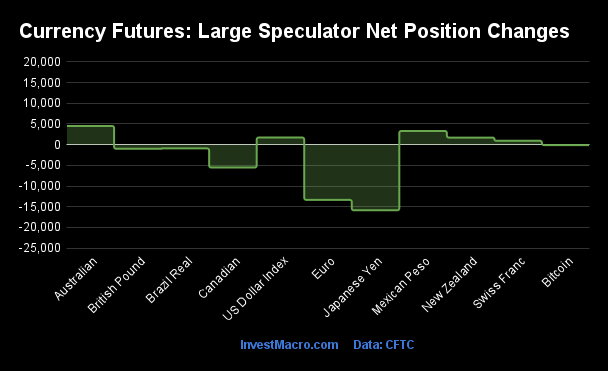
The COT currency market speculator bets were higher this week as nine out of the eleven currency markets we cover had higher positioning while the other two markets had lower speculator contracts.

Leading the gains for the currency markets was the EuroFX (5,039 contracts), British Pound (4,537 contracts), Brazilian Real (3,223 contracts), the Australian Dollar (2,894 contracts), the Canadian Dollar (2,442 contracts), the US Dollar Index (226 contracts), Swiss Franc (1,064 contracts), Bitcoin (196 contracts) and the New Zealand Dollar (652 contracts) also recording positive weeks.

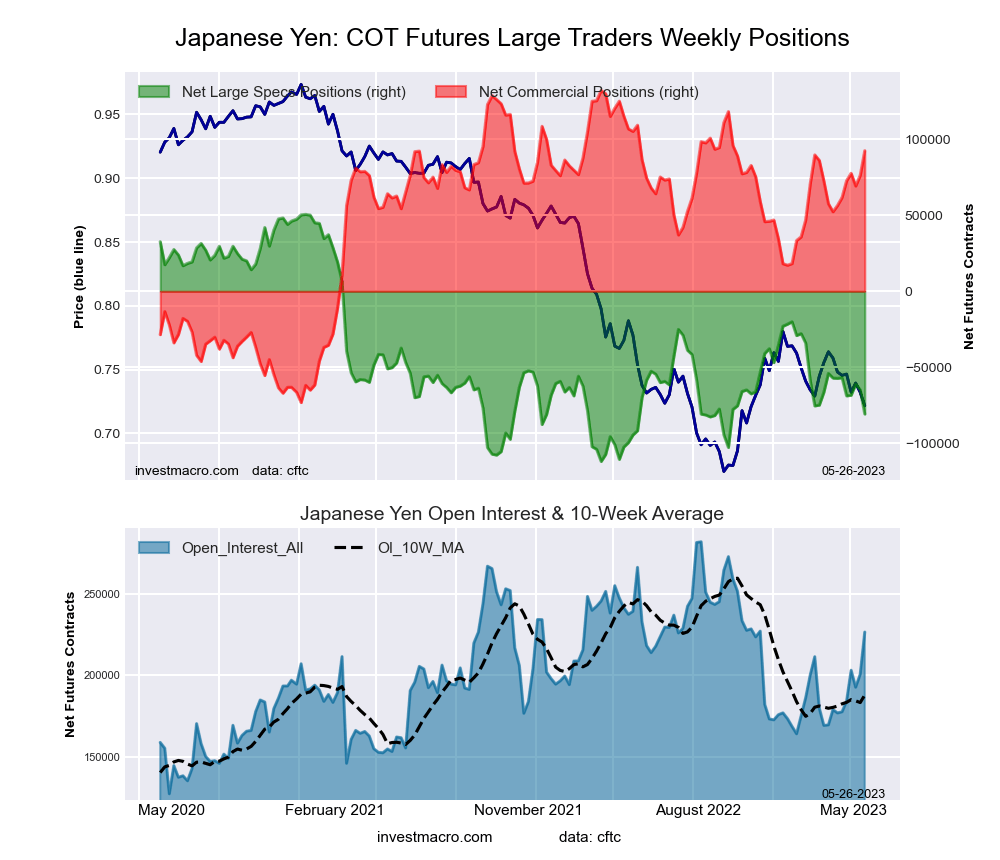
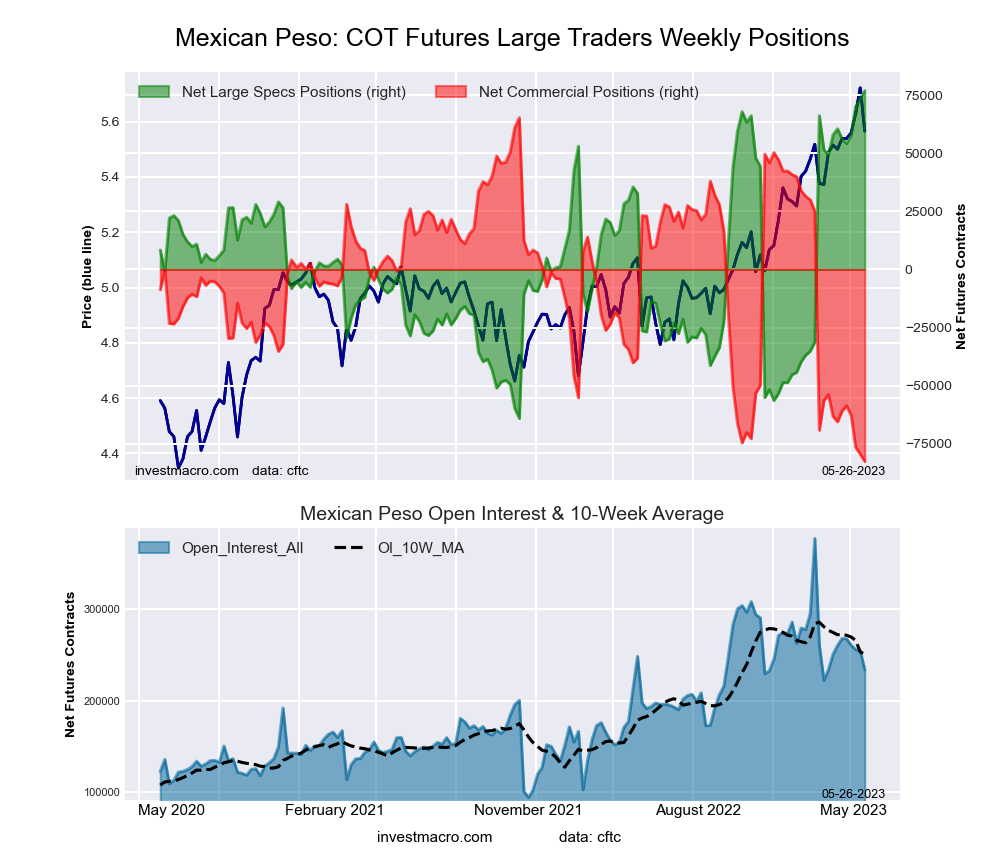
The currencies seeing declines in speculator bets on the week were the Japanese Yen (-11,875 contracts) and the Mexican Peso (-2,043 contracts) seeing lower bets on the week.

Euro Speculators boost their bullish bets to 133-week high

Highlighting the COT currency’s data this week is the rising bullishness of the speculator’s positioning in the Euro Currency. Euro speculator bets turned from bearish to bullish on September 20th of 2022 and have steadily increased in positive sentiment. The Euro positions have now been above the +100,000 contract threshold for 26 straight weeks, the best streak since 2021.

This week, the large speculative Euro positions went higher for a third consecutive week and for the fifth time in the past six weeks. Euro weekly positions have now increased by a total of +29,444 contracts over these past six weeks. This positive sentiment has pushed the overall bullish standing to the highest level in 133-weeks, dating back to October 6th of 2020.

The Euro exchange rate against the US Dollar has also been on the rise and this week hit it’s highest level since March of 2022 above the 1.11 exchange level. Since late-February, the Euro has had higher weekly closes in seven out of the past nine weeks and is now higher by over 15 percent since it’s multi-decade low of 0.9592 in September.


Data Snapshot of Forex Market Traders | Columns Legend
Apr-25-2023OIOI-IndexSpec-NetSpec-IndexCom-NetCOM-IndexSmalls-NetSmalls-Index
USD Index34,4413310,73943-12,711561,97238
EUR772,88283169,40084-224,4371555,03767
GBP231,666565,83974-10,530274,69167
JPY184,04137-68,7442772,62571-3,88146
CHF41,73641-3,656452,7014995561
CAD151,78631-43,7911445,87887-2,08718
AUD178,75772-39,4624853,74659-14,28418
NZD36,60325-3,252453,92856-67644
MXN267,2766154,12890-58,607114,47984
RUB20,93047,54331-7,15069-39324
BRL78,7487816,81957-16,34345-47640
Bitcoin14,06464-29372-296058926


Strength Scores led by Mexican Peso & EuroFX

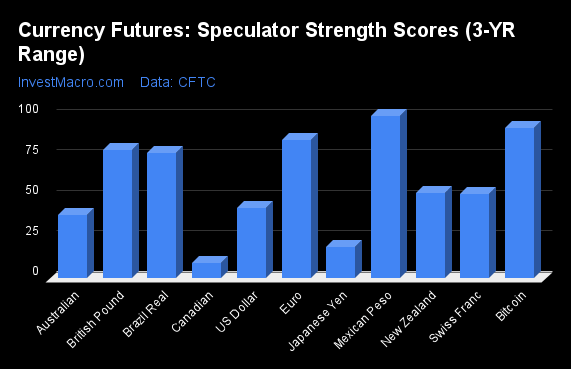
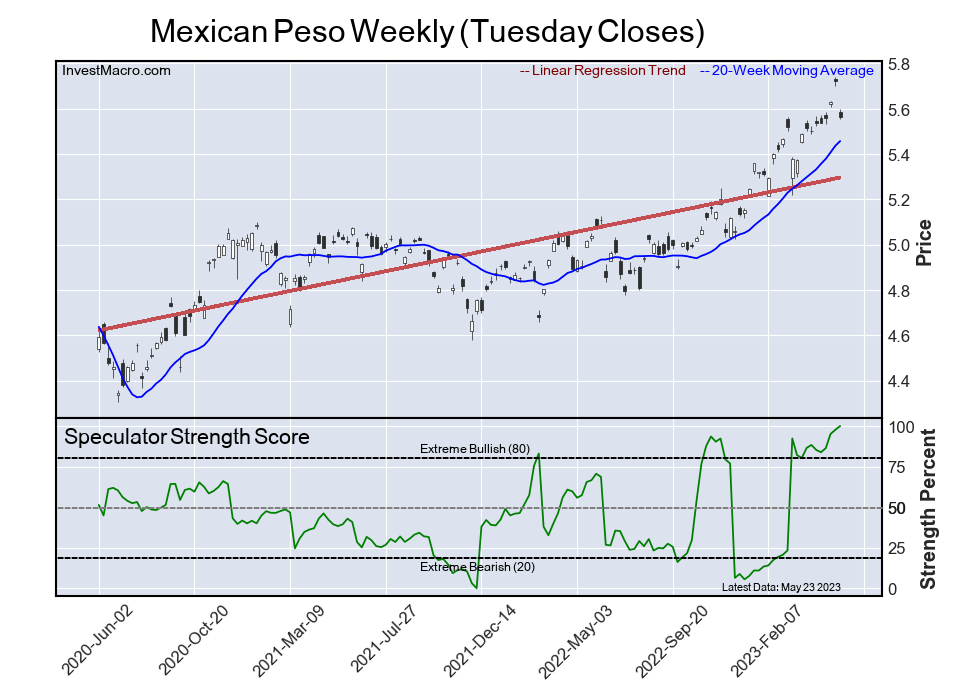
COT Strength Scores (a normalized measure of Speculator positions over a 3-Year range, from 0 to 100 where above 80 is Extreme-Bullish and below 20 is Extreme-Bearish) showed that the Mexican Peso (90 percent) and the EuroFX (84 percent) lead the currency markets this week. The British Pound (74 percent), Bitcoin (72 percent) and the Brazilian Real (57 percent) come in as the next highest in the weekly strength scores.

On the downside, the Canadian Dollar (14 percent) comes in at the lowest strength levels currently and is in Extreme-Bearish territory (below 20 percent). The next lowest strength scores are the Japanese Yen (27 percent), the US Dollar Index (43 percent) and the New Zealand Dollar (45 percent).

Strength Statistics:
US Dollar Index (42.8 percent) vs US Dollar Index previous week (42.5 percent)
EuroFX (83.7 percent) vs EuroFX previous week (81.7 percent)
British Pound Sterling (74.0 percent) vs British Pound Sterling previous week (70.1 percent)
Japanese Yen (26.5 percent) vs Japanese Yen previous week (33.9 percent)
Swiss Franc (44.9 percent) vs Swiss Franc previous week (42.1 percent)
Canadian Dollar (13.7 percent) vs Canadian Dollar previous week (11.4 percent)
Australian Dollar (48.2 percent) vs Australian Dollar previous week (45.6 percent)
New Zealand Dollar (44.8 percent) vs New Zealand Dollar previous week (43.0 percent)
Mexican Peso (89.6 percent) vs Mexican Peso previous week (91.1 percent)
Brazilian Real (57.2 percent) vs Brazilian Real previous week (53.1 percent)
Bitcoin (71.8 percent) vs Bitcoin previous week (68.4 percent)


British Pound & Swiss Franc top the 6-Week Strength Trends

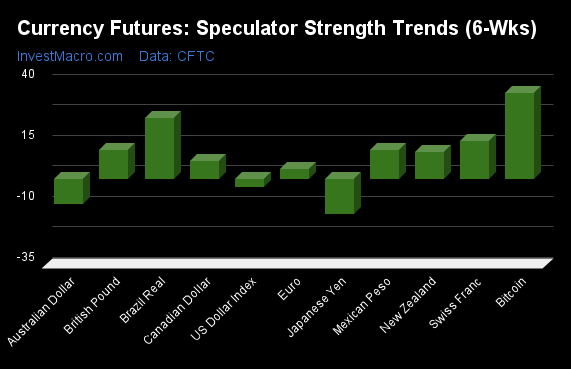
COT Strength Score Trends (or move index, calculates the 6-week changes in strength scores) showed that the British Pound (20 percent) and the Swiss Franc (17 percent) lead the past six weeks trends for the currencies. The EuroFX (11 percent), the Japanese Yen (4 percent) and the New Zealand Dollar (4 percent) are the next highest positive movers in the latest trends data.

The Brazilian Real (-15 percent) leads the downside trend scores currently with the Canadian Dollar (-11 percent), Mexican Peso (-9 percent) and the US Dollar Index (-5 percent) following next with lower trend scores.

Strength Trend Statistics:
US Dollar Index (-5.0 percent) vs US Dollar Index previous week (-3.4 percent)
EuroFX (11.3 percent) vs EuroFX previous week (6.1 percent)
British Pound Sterling (19.9 percent) vs British Pound Sterling previous week (16.1 percent)
Japanese Yen (3.7 percent) vs Japanese Yen previous week (11.4 percent)
Swiss Franc (16.7 percent) vs Swiss Franc previous week (-2.0 percent)
Canadian Dollar (-11.3 percent) vs Canadian Dollar previous week (-15.9 percent)
Australian Dollar (0.6 percent) vs Australian Dollar previous week (-16.3 percent)
New Zealand Dollar (4.0 percent) vs New Zealand Dollar previous week (-25.8 percent)
Mexican Peso (-9.1 percent) vs Mexican Peso previous week (66.2 percent)
Brazilian Real (-14.6 percent) vs Brazilian Real previous week (-21.0 percent)
Bitcoin (-3.3 percent) vs Bitcoin previous week (-9.2 percent)


Individual COT Forex Markets:

US Dollar Index Futures:
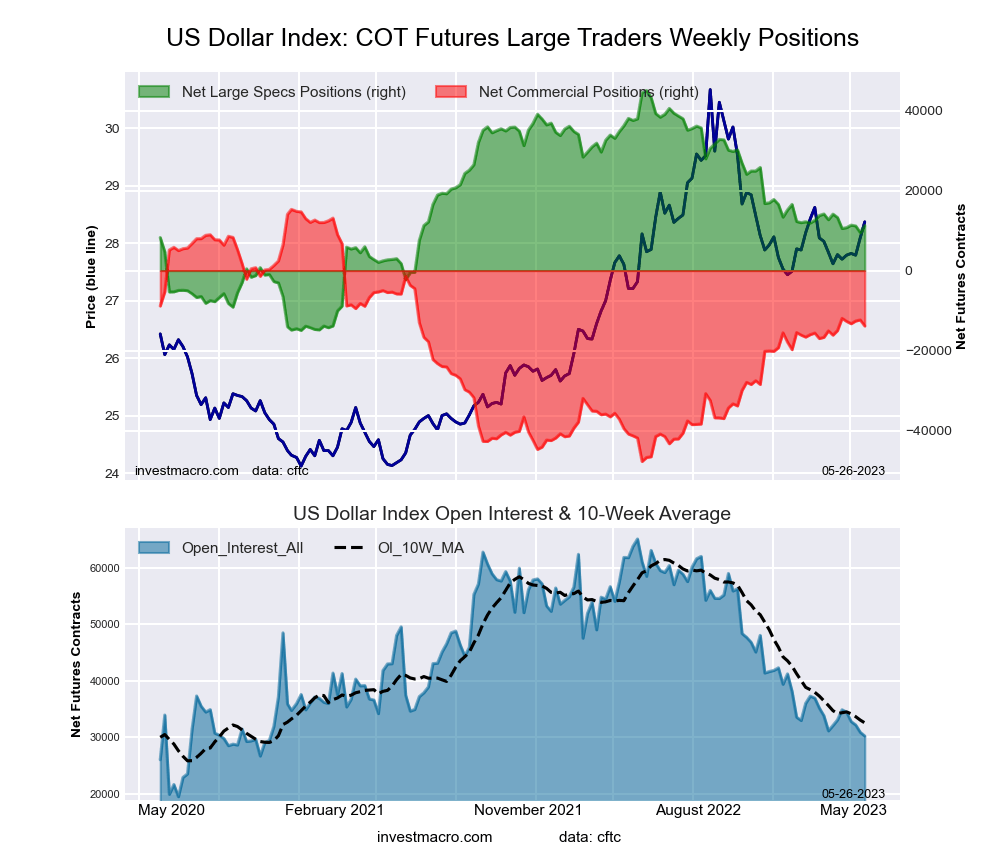
US Dollar Index Forex Futures COT ChartThe US Dollar Index large speculator standing this week came in at a net position of 10,739 contracts in the data reported through Tuesday. This was a weekly gain of 226 contracts from the previous week which had a total of 10,513 net contracts.
This week’s current strength score (the trader positioning range over the past three years, measured from 0 to 100) shows the speculators are currently Bearish with a score of 42.8 percent. The commercials are Bullish with a score of 55.6 percent and the small traders (not shown in chart) are Bearish with a score of 38.1 percent.

US DOLLAR INDEX StatisticsSPECULATORSCOMMERCIALSSMALL TRADERS
– Percent of Open Interest Longs:70.110.015.2
– Percent of Open Interest Shorts:38.946.99.4
– Net Position:10,739-12,7111,972
– Gross Longs:24,1493,4325,219
– Gross Shorts:13,41016,1433,247
– Long to Short Ratio:1.8 to 10.2 to 11.6 to 1
NET POSITION TREND:
– Strength Index Score (3 Year Range Pct):42.855.638.1
– Strength Index Reading (3 Year Range):BearishBullishBearish
NET POSITION MOVEMENT INDEX:
– 6-Week Change in Strength Index:-5.06.8-13.9


Euro Currency Futures:

Euro Currency Futures COT ChartThe Euro Currency large speculator standing this week came in at a net position of 169,400 contracts in the data reported through Tuesday. This was a weekly increase of 5,039 contracts from the previous week which had a total of 164,361 net contracts.

This week’s current strength score (the trader positioning range over the past three years, measured from 0 to 100) shows the speculators are currently Bullish-Extreme with a score of 83.7 percent. The commercials are Bearish-Extreme with a score of 14.7 percent and the small traders (not shown in chart) are Bullish with a score of 66.8 percent.

EURO Currency StatisticsSPECULATORSCOMMERCIALSSMALL TRADERS
– Percent of Open Interest Longs:31.554.212.3
– Percent of Open Interest Shorts:9.683.25.1
– Net Position:169,400-224,43755,037
– Gross Longs:243,516418,84294,777
– Gross Shorts:74,116643,27939,740
– Long to Short Ratio:3.3 to 10.7 to 12.4 to 1
NET POSITION TREND:
– Strength Index Score (3 Year Range Pct):83.714.766.8
– Strength Index Reading (3 Year Range):Bullish-ExtremeBearish-ExtremeBullish
NET POSITION MOVEMENT INDEX:
– 6-Week Change in Strength Index:11.3-12.713.0


British Pound Sterling Futures:

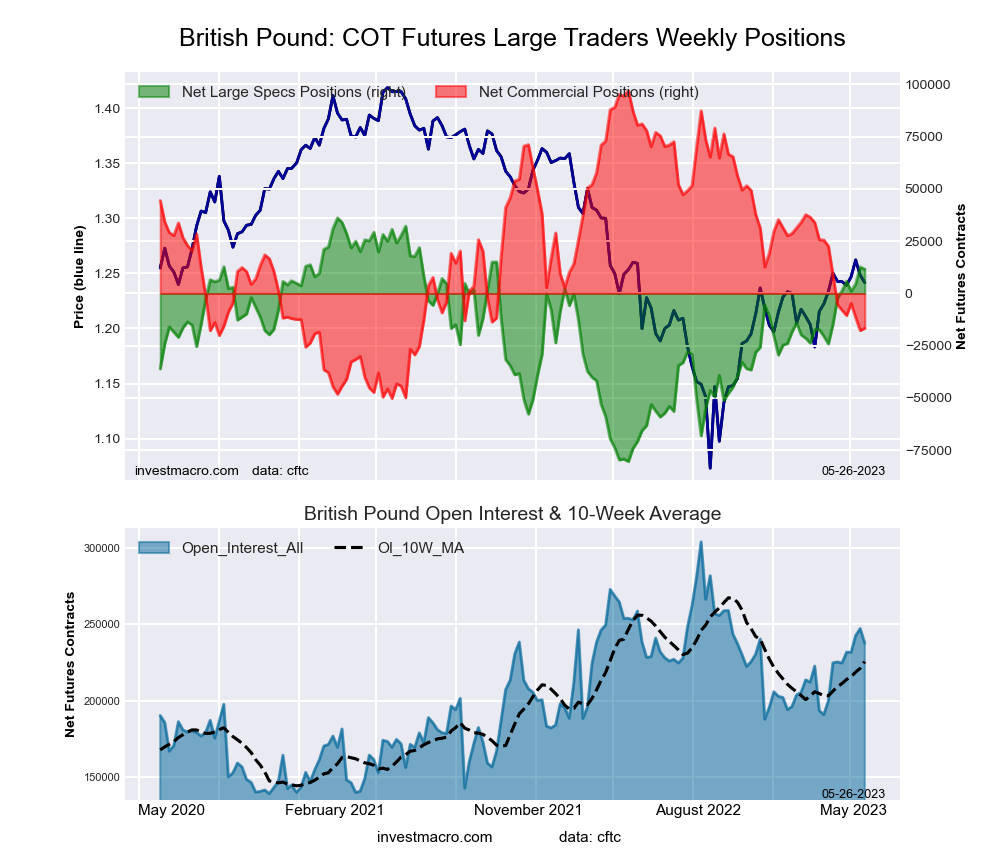
British Pound Sterling Futures COT ChartThe British Pound Sterling large speculator standing this week came in at a net position of 5,839 contracts in the data reported through Tuesday. This was a weekly increase of 4,537 contracts from the previous week which had a total of 1,302 net contracts.

This week’s current strength score (the trader positioning range over the past three years, measured from 0 to 100) shows the speculators are currently Bullish with a score of 74.0 percent. The commercials are Bearish with a score of 26.9 percent and the small traders (not shown in chart) are Bullish with a score of 67.2 percent.

BRITISH POUND StatisticsSPECULATORSCOMMERCIALSSMALL TRADERS
– Percent of Open Interest Longs:25.655.013.5
– Percent of Open Interest Shorts:23.159.511.5
– Net Position:5,839-10,5304,691
– Gross Longs:59,405127,30631,336
– Gross Shorts:53,566137,83626,645
– Long to Short Ratio:1.1 to 10.9 to 11.2 to 1
NET POSITION TREND:
– Strength Index Score (3 Year Range Pct):74.026.967.2
– Strength Index Reading (3 Year Range):BullishBearishBullish
NET POSITION MOVEMENT INDEX:
– 6-Week Change in Strength Index:19.9-24.625.7


Japanese Yen Futures:

Japanese Yen Forex Futures COT ChartThe Japanese Yen large speculator standing this week came in at a net position of -68,744 contracts in the data reported through Tuesday. This was a weekly fall of -11,875 contracts from the previous week which had a total of -56,869 net contracts.

This week’s current strength score (the trader positioning range over the past three years, measured from 0 to 100) shows the speculators are currently Bearish with a score of 26.5 percent. The commercials are Bullish with a score of 71.1 percent and the small traders (not shown in chart) are Bearish with a score of 45.6 percent.

JAPANESE YEN StatisticsSPECULATORSCOMMERCIALSSMALL TRADERS
– Percent of Open Interest Longs:7.473.516.5
– Percent of Open Interest Shorts:44.834.118.6
– Net Position:-68,74472,625-3,881
– Gross Longs:13,680135,33030,358
– Gross Shorts:82,42462,70534,239
– Long to Short Ratio:0.2 to 12.2 to 10.9 to 1
NET POSITION TREND:
– Strength Index Score (3 Year Range Pct):26.571.145.6
– Strength Index Reading (3 Year Range):BearishBullishBearish
NET POSITION MOVEMENT INDEX:
– 6-Week Change in Strength Index:3.7-6.514.9


Swiss Franc Futures:

Swiss Franc Forex Futures COT ChartThe Swiss Franc large speculator standing this week came in at a net position of -3,656 contracts in the data reported through Tuesday. This was a weekly rise of 1,064 contracts from the previous week which had a total of -4,720 net contracts.

This week’s current strength score (the trader positioning range over the past three years, measured from 0 to 100) shows the speculators are currently Bearish with a score of 44.9 percent. The commercials are Bearish with a score of 49.4 percent and the small traders (not shown in chart) are Bullish with a score of 60.8 percent.

SWISS FRANC StatisticsSPECULATORSCOMMERCIALSSMALL TRADERS
– Percent of Open Interest Longs:15.744.036.4
– Percent of Open Interest Shorts:24.537.634.2
– Net Position:-3,6562,701955
– Gross Longs:6,55618,37415,210
– Gross Shorts:10,21215,67314,255
– Long to Short Ratio:0.6 to 11.2 to 11.1 to 1
NET POSITION TREND:
– Strength Index Score (3 Year Range Pct):44.949.460.8
– Strength Index Reading (3 Year Range):BearishBearishBullish
NET POSITION MOVEMENT INDEX:
– 6-Week Change in Strength Index:16.7-17.514.6


Canadian Dollar Futures:

Canadian Dollar Forex Futures COT ChartThe Canadian Dollar large speculator standing this week came in at a net position of -43,791 contracts in the data reported through Tuesday. This was a weekly lift of 2,442 contracts from the previous week which had a total of -46,233 net contracts.

This week’s current strength score (the trader positioning range over the past three years, measured from 0 to 100) shows the speculators are currently Bearish-Extreme with a score of 13.7 percent. The commercials are Bullish-Extreme with a score of 87.4 percent and the small traders (not shown in chart) are Bearish-Extreme with a score of 18.2 percent.

CANADIAN DOLLAR StatisticsSPECULATORSCOMMERCIALSSMALL TRADERS
– Percent of Open Interest Longs:16.061.819.8
– Percent of Open Interest Shorts:44.931.621.1
– Net Position:-43,79145,878-2,087
– Gross Longs:24,29593,78429,997
– Gross Shorts:68,08647,90632,084
– Long to Short Ratio:0.4 to 12.0 to 10.9 to 1
NET POSITION TREND:
– Strength Index Score (3 Year Range Pct):13.787.418.2
– Strength Index Reading (3 Year Range):Bearish-ExtremeBullish-ExtremeBearish-Extreme
NET POSITION MOVEMENT INDEX:
– 6-Week Change in Strength Index:-11.36.55.7


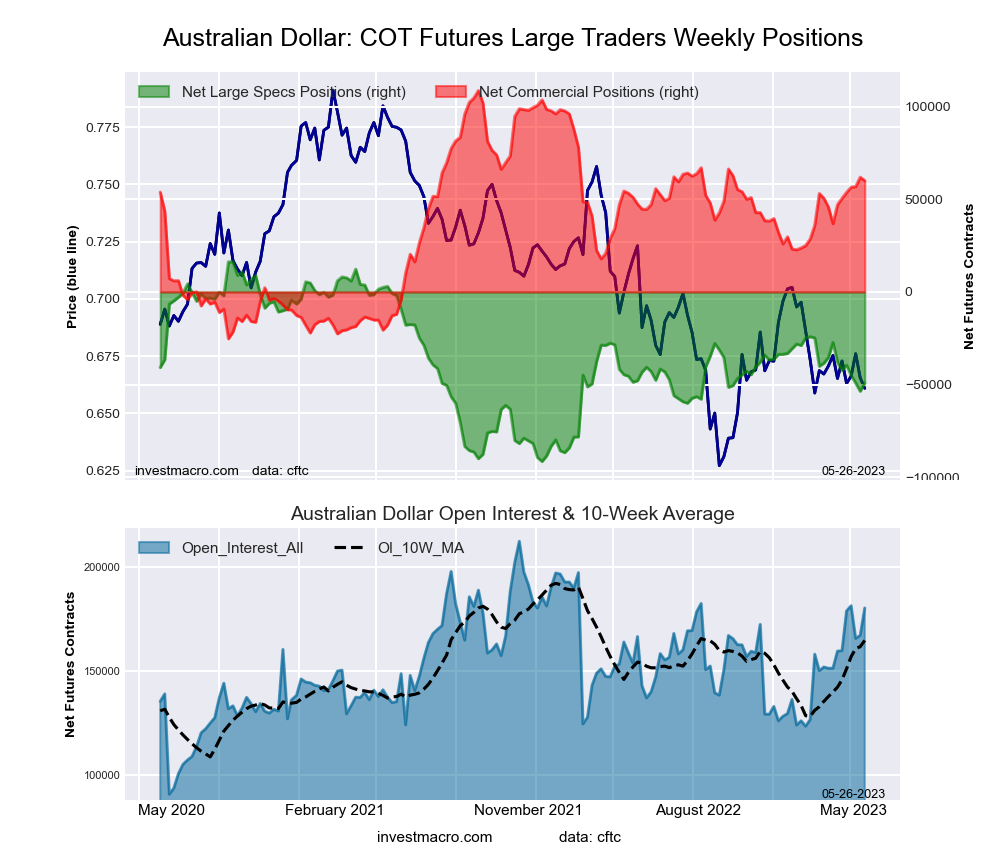
Australian Dollar Futures:

Australian Dollar Forex Futures COT ChartThe Australian Dollar large speculator standing this week came in at a net position of -39,462 contracts in the data reported through Tuesday. This was a weekly rise of 2,894 contracts from the previous week which had a total of -42,356 net contracts.

This week’s current strength score (the trader positioning range over the past three years, measured from 0 to 100) shows the speculators are currently Bearish with a score of 48.2 percent. The commercials are Bullish with a score of 59.0 percent and the small traders (not shown in chart) are Bearish-Extreme with a score of 17.6 percent.

AUSTRALIAN DOLLAR StatisticsSPECULATORSCOMMERCIALSSMALL TRADERS
– Percent of Open Interest Longs:30.355.310.6
– Percent of Open Interest Shorts:52.425.318.6
– Net Position:-39,46253,746-14,284
– Gross Longs:54,24198,90018,987
– Gross Shorts:93,70345,15433,271
– Long to Short Ratio:0.6 to 12.2 to 10.6 to 1
NET POSITION TREND:
– Strength Index Score (3 Year Range Pct):48.259.017.6
– Strength Index Reading (3 Year Range):BearishBullishBearish-Extreme
NET POSITION MOVEMENT INDEX:
– 6-Week Change in Strength Index:0.60.5-3.0


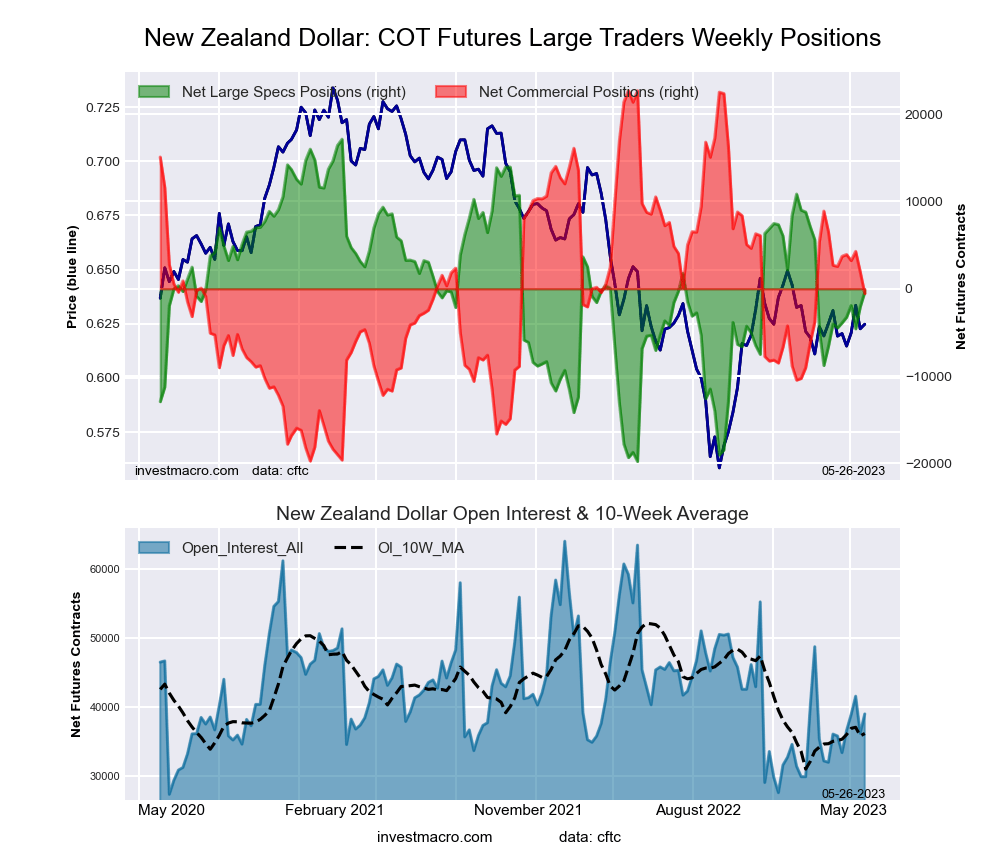
New Zealand Dollar Futures:

New Zealand Dollar Forex Futures COT ChartThe New Zealand Dollar large speculator standing this week came in at a net position of -3,252 contracts in the data reported through Tuesday. This was a weekly lift of 652 contracts from the previous week which had a total of -3,904 net contracts.

This week’s current strength score (the trader positioning range over the past three years, measured from 0 to 100) shows the speculators are currently Bearish with a score of 44.8 percent. The commercials are Bullish with a score of 55.7 percent and the small traders (not shown in chart) are Bearish with a score of 43.9 percent.

NEW ZEALAND DOLLAR StatisticsSPECULATORSCOMMERCIALSSMALL TRADERS
– Percent of Open Interest Longs:35.752.89.5
– Percent of Open Interest Shorts:44.642.111.3
– Net Position:-3,2523,928-676
– Gross Longs:13,07019,3343,465
– Gross Shorts:16,32215,4064,141
– Long to Short Ratio:0.8 to 11.3 to 10.8 to 1
NET POSITION TREND:
– Strength Index Score (3 Year Range Pct):44.855.743.9
– Strength Index Reading (3 Year Range):BearishBullishBearish
NET POSITION MOVEMENT INDEX:
– 6-Week Change in Strength Index:4.0-3.4-0.5


Mexican Peso Futures:

Mexican Peso Futures COT ChartThe Mexican Peso large speculator standing this week came in at a net position of 54,128 contracts in the data reported through Tuesday. This was a weekly decline of -2,043 contracts from the previous week which had a total of 56,171 net contracts.

This week’s current strength score (the trader positioning range over the past three years, measured from 0 to 100) shows the speculators are currently Bullish-Extreme with a score of 89.6 percent. The commercials are Bearish-Extreme with a score of 11.4 percent and the small traders (not shown in chart) are Bullish-Extreme with a score of 84.1 percent.

MEXICAN PESO StatisticsSPECULATORSCOMMERCIALSSMALL TRADERS
– Percent of Open Interest Longs:49.847.22.8
– Percent of Open Interest Shorts:29.569.11.1
– Net Position:54,128-58,6074,479
– Gross Longs:133,098126,0717,451
– Gross Shorts:78,970184,6782,972
– Long to Short Ratio:1.7 to 10.7 to 12.5 to 1
NET POSITION TREND:
– Strength Index Score (3 Year Range Pct):89.611.484.1
– Strength Index Reading (3 Year Range):Bullish-ExtremeBearish-ExtremeBullish-Extreme
NET POSITION MOVEMENT INDEX:
– 6-Week Change in Strength Index:-9.17.68.2


Brazilian Real Futures:

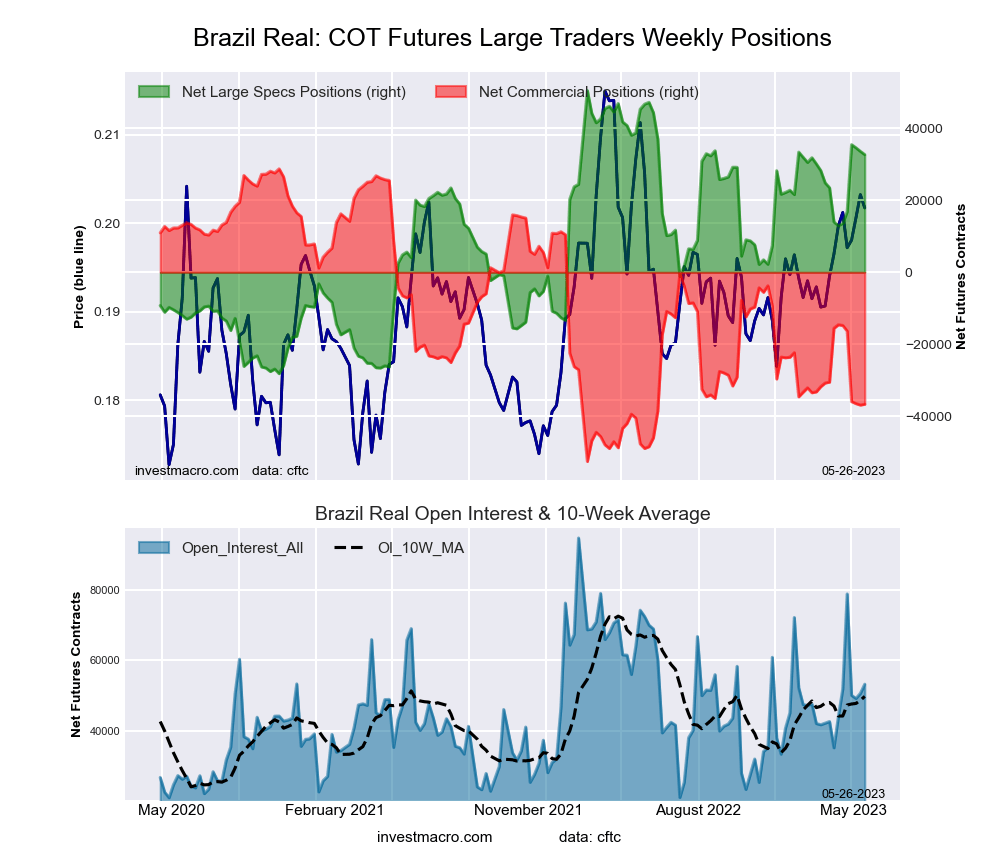
Brazil Real Futures COT ChartThe Brazilian Real large speculator standing this week came in at a net position of 16,819 contracts in the data reported through Tuesday. This was a weekly rise of 3,223 contracts from the previous week which had a total of 13,596 net contracts.

This week’s current strength score (the trader positioning range over the past three years, measured from 0 to 100) shows the speculators are currently Bullish with a score of 57.2 percent. The commercials are Bearish with a score of 44.6 percent and the small traders (not shown in chart) are Bearish with a score of 40.2 percent.

BRAZIL REAL StatisticsSPECULATORSCOMMERCIALSSMALL TRADERS
– Percent of Open Interest Longs:50.444.45.0
– Percent of Open Interest Shorts:29.065.25.6
– Net Position:16,819-16,343-476
– Gross Longs:39,66834,9863,942
– Gross Shorts:22,84951,3294,418
– Long to Short Ratio:1.7 to 10.7 to 10.9 to 1
NET POSITION TREND:
– Strength Index Score (3 Year Range Pct):57.244.640.2
– Strength Index Reading (3 Year Range):BullishBearishBearish
NET POSITION MOVEMENT INDEX:
– 6-Week Change in Strength Index:-14.619.0-31.8


Bitcoin Futures:

Bitcoin Crypto Futures COT ChartThe Bitcoin large speculator standing this week came in at a net position of -293 contracts in the data reported through Tuesday. This was a weekly rise of 196 contracts from the previous week which had a total of -489 net contracts.

This week’s current strength score (the trader positioning range over the past three years, measured from 0 to 100) shows the speculators are currently Bullish with a score of 71.8 percent. The commercials are Bearish with a score of 45.9 percent and the small traders (not shown in chart) are Bearish with a score of 26.3 percent.

BITCOIN StatisticsSPECULATORSCOMMERCIALSSMALL TRADERS
– Percent of Open Interest Longs:68.02.99.7
– Percent of Open Interest Shorts:70.15.05.5
– Net Position:-293-296589
– Gross Longs:9,5664101,364
– Gross Shorts:9,859706775
– Long to Short Ratio:1.0 to 10.6 to 11.8 to 1
NET POSITION TREND:
– Strength Index Score (3 Year Range Pct):71.845.926.3
– Strength Index Reading (3 Year Range):BullishBearishBearish
NET POSITION MOVEMENT INDEX:
– 6-Week Change in Strength Index:-3.3-0.64.6


Article By InvestMacroReceive our weekly COT Newsletter

*COT Report: The COT data, released weekly to the public each Friday, is updated through the most recent Tuesday (data is 3 days old) and shows a quick view of how large speculators or non-commercials (for-profit traders) were positioned in the futures markets.

The CFTC categorizes trader positions according to commercial hedgers (traders who use futures contracts for hedging as part of the business), non-commercials (large traders who speculate to realize trading profits) and nonreportable traders (usually small traders/speculators) as well as their open interest (contracts open in the market at time of reporting). See CFTC criteria here.