California is wrestling with electricity prices – here’s how to design a system that covers the cost of fixing the grid while keeping prices fair

By Yihsu Chen, University of California, Santa Cruz and Andrew L. Liu, Purdue University 

Small-scale solar power, also known as rooftop or distributed solar, has grown considerably in the U.S. over the past decade. It provides electricity without emitting air pollutants or climate-warming greenhouse gases, and it meets local energy demand without requiring costly investments in transmission and distribution systems.

However, its expansion is making it harder for electric utilities and power grid managers to design fair and efficient retail electricity rates – the prices that households pay.

Under traditional electricity pricing, customers pay one charge per kilowatt-hour of electricity consumption that covers both the energy they use and the fixed costs of maintaining the grid. As more people adopt rooftop solar, they buy less energy from the grid. Fewer customers are left to shoulder utilities’ fixed costs, potentially making power more expensive for everyone.

This trend can drive more customers to leave the system and raise prices further – a scenario known as the utility death spiral. One 2018 study calculated that two-thirds of recent electricity distribution cost increases at California’s three investor-owned utilities were associated with the growth of residential solar.

With abundant sun and solar-friendly policies, California has 36% of U.S. small-scale solar capacity, much more than any other state. And the state is engaged in a heated debate over pricing electricity in ways designed to make energy less expensive for low-income households.

We study energy markets and public policy affecting energy and the environment, and have analyzed various retail electricity rate structures and their economic impacts on power producers and consumers. Our key finding is that an income-based, fixed-charge rate structure of the type that California is currently considering offers the most efficient and equitable solution – if it is designed correctly.

The California Legislature approved fixed-rate electricity charges, based on income, in 2022. Now, state utility regulators are weighing a proposal that would formalize them.

Two-part power bills

The debate over fixed charges began in 2022, when the California Legislature enacted an energy bill that ordered state regulators to study income-based fixed charges and decide whether to adopt them by July 1, 2024. Then the state’s three largest utilities – Southern California Edison, Pacific Gas and Electric, and San Diego Gas & Electric – submitted a proposal to the state Public Utilities Commission in mid-2023 that would separate retail bills into two parts: a fixed charge and a variable charge.

The fixed charge would be a preset monthly fee, independent of energy usage but tied to income levels, so wealthier customers would pay a larger share of grid maintenance costs. The variable charge would be based on the amount of electricity consumed and would cover the actual costs of electricity production and delivery.

Historically, these actual costs have typically ranged between 4 to 6 cents per kilowatt-hour. Today, the average residential rate in California often exceeds 30 cents per kilowatt-hour because it covers fixed costs as well as electricity use.

Who benefits?

A two-part billing system that separates fixed costs from variable usage charges offers potential benefits for both consumers and utilities.

For utilities, the fixed charge offers a stable revenue stream. The companies know how many households they serve, and they can plan on the fixed amounts that those households will pay each month. Households that go solar would still pay the fixed charge, since most of them draw electricity from the grid when the sun doesn’t shine.

This approach provides financial stability for the utility and access to the grid for all. Consumers would benefit because with a certain amount of income guaranteed, utilities could charge significantly less per kilowatt-hour for the actual electricity that households use.

One significant concern is that if electricity costs less, people may use more of it, which could undermine efforts toward energy conservation and lead to an increase in emissions. In our view, the way to address this risk is by fine-tuning the two-part billing structure so that it covers only a portion of the utilities’ costs through fixed charges and incorporates the rest into the variable usage rates.

Put another way, combining a lower fixed charge with a higher variable charge would ensure that utilities can still cover their fixed costs effectively, while encouraging mindful energy use among consumers. Ensuring affordable electricity for consumers, fair cost recovery for utilities and overall fairness and efficiency in the energy market requires striking a delicate balance.

Another argument from critics, often labeled “energy socialism,” asserts that higher-income households might end up subsidizing excessive electricity use by lower-income households under the income-based rate structure. In our view, this perception is inaccurate.

Wealthy households would pay more to maintain the grid, via larger fixed charges, than poorer households, but would not subsidize lower-income households’ energy use. All income groups would pay the same rate for each additional kilowatt-hour of electricity that they use. Decisions on energy use would remain economically driven, regardless of consumers’ income level.

Fixed fees are too big

While our research supports California utilities’ approach in principle, we believe their proposal has shortcomings – notably in the proposed income brackets.

As currently framed, households with annual incomes between US$28,000 and $69,000 would pay a fixed fee of $20 to $34 per month. Households earning between $69,000 and $180,000 would pay $51 to $73 per month, and those earning more than $180,000 would pay $85 to $128.

The middle-income bracket starts just above California’s median household income. Consequently, nearly half of all California households could find themselves paying a substantial monthly fee – $51 to $73 – regardless of their actual electricity usage.

It could be hard to convince consumers to pay significant fixed fees for intangible services, especially middle-income residents who have either gone solar or may do so. Not surprisingly, the proposal has encountered considerable pushback from the solar industry.

Finding the sweet spot

In response to public outcry, California lawmakers recently introduced Assembly Bill 1999, which would replace the income-graduated fixed-charge requirement with fixed charges of $5 per month for low-income customers and up to $10 per month for others. In our view, this reaction goes too far in the other direction.

Capping fixed charges at such low levels would force utilities to hike their energy use rates to cover fixed costs – again, risking the death spiral scenario. Our research indicates that there is a range for the fixed charge that would cover a reasonable share of utilities’ fixed costs, but is not high enough to burden consumers.

Without utility cost data, we can’t pinpoint this range precisely. However, based on estimates of utilities’ costs, we believe the caps proposed in AB 1999 are too low and could end up unfairly burdening those the bill aims to protect.

In our research, based on a hypothetical case study, we found a sweet spot in which fixed charges cover about 40% of utilities’ fixed costs. Charges at this level provide maximum benefit to consumers, although they reduce energy producers’ profits.

Our findings are similar to an alternative proposal jointly presented by The Utility Reform Network, a nonprofit consumer advocacy organization, and the Natural Resources Defense Council, an environmental advocacy group. This plan suggests a two-part rate structure with an average fixed charge of about $36 per month. Low-income households would pay $5 per month, and those earning over $150,000 yearly would pay about $62.

We believe this proposal moves in the right direction by ensuring fair contributions to grid costs, while also encouraging efficient energy use and investment in clean energy infrastructure. It could act as a guide for other U.S. states searching for methods to balance utility fixed-cost recovery with fair pricing and continued growth of small-scale solar power.

This article has been updated to remove unsubstantiated information about the 2019 Saddleridge wildfire in California provided by AP in a photo caption.The Conversation

About the Author:

Yihsu Chen, Professor of Technology Management in Sustainability, University of California, Santa Cruz and Andrew L. Liu, Associate Professor of Industrial Engineering, Purdue University

This article is republished from The Conversation under a Creative Commons license. Read the original article.


Trade restrictions between the US and China are intensifying. Japan’s currency diplomats talk about possible intervention to support the yen

By JustMarkets

The Dow Jones Index (US30) decreased by 0.41% as of Monday’s stock market close. The S&P 500 Index (US500) was down 0.31%. The NASDAQ Technology Index (US100) closed negative 0.27%. Stock indices declined moderately on Monday as some hawkish comments from the Federal Reserve pushed T-note yields up and stocks lower. Atlanta Fed President Bostic said that if the economy performs as expected, the Fed can be patient with interest rates, and he expects only one 25 bps rate cut this year. Bostic’s prediction is less than the three 25 bps rate cuts the FOMC has scheduled for this year. Fed spokeswoman Cook said yesterday that a cautious approach to monetary easing may be needed to restore price stability and that cutting interest rates too quickly could risk entrenching inflation. Markets rate the odds of a 25 bps rate cut at 13% for the next FOMC meeting on May 1 and 79% for the June 12 meeting.

Take-Two Interactive Software closed down more than 6% after gaming publication Kotaku reported that Grand Theft Auto VI production has begun to be delayed, and the game may not be released in 2025. Shares of United Airlines Holdings (UAL) fell more than 3% after a report that the US Federal Aviation Administration is considering imposing temporary sanctions on the company, including a ban on adding new routes, following a series of safety incidents. In addition, Intel (INTC) and Advanced Micro Devices (AMD) shares fell after the Financial Times reported that China is seeking to restrict US-made microprocessors and servers in government computers.

Equity markets in Europe mostly went up yesterday. Germany’s DAX (DE40) rose by 0.30%, France’s CAC 40 (FR40) closed Monday at its opening price, Spain’s IBEX 35 (ES35) added 0.08%, and the UK’s FTSE 100 (UK100) closed negative 0.17%. Frankfurt’s DAX (DE40) reached another record high of 18,268, gaining from the previous week and benefitting from dovish cues from major central banks. Increasing sentiment that policymakers are leaning towards rate cuts has led money markets to price in nearly a whole percentage point of ECB rate cuts this year ahead of the ECB meeting in early April. Automakers’ trading in Frankfurt rose sharply, with BMW and Volkswagen adding 2% and 1%, respectively, while Mercedes and Continental ended in the green territory. In addition, Allianz added more than 1%, leading to a positive session for the financial sector.

WTI crude oil prices rose above $82 per barrel on Tuesday, extending gains from the previous session, as various supply concerns supported oil prices. The Russian government ordered oil companies to cut production in the second quarter to meet OPEC’s target of 9 million bpd after output of around 9.5 million bpd in February. Ukrainian attacks on Russian refineries have also affected about 12% of the country’s refining capacity. In the Middle East, the UN Security Council passed a resolution calling for a ceasefire between Israel and Hamas. However, analysts doubt this will stop Houthi attacks on ships in the Red Sea disrupting supply routes.

Asian markets were mostly down yesterday. Japan’s Nikkei 225 (JP225) decreased by 1.16%, China’s FTSE China A50 (CHA50) lost 1.03%, Hong Kong’s Hang Seng (HK50) was down 0.93% at the end of Monday, while Australia’s ASX 200 (AU200) was positive 0.53%.

Japan’s annual business services inflation was unchanged at 2.1% in February, suggesting that companies continue to pass on rising labor costs to consumers thanks to the prospect of sustained wage growth. The annual increase in the service producer price index, which measures how much companies charge each other for services, was unchanged from January, data from the Bank of Japan (BoJ) showed Tuesday. Japan’s Finance Minister Shun’ichi Suzuki said he did not rule out taking any measures to curb yen weakness, adding that excessive volatility increases uncertainty for business operations and the broader economy. The remarks came a day after the country’s top currency diplomat, Masato Kanda, said the weakening yen did not reflect fundamentals and called recent moves speculative.

S&P 500 (US500) 5,218.19 −15.99 (−0.31%)

Dow Jones (US30) 39,313.64 −162.26 (−0.41%)

DAX (DE40) 18,261.31 +55.37 (+0.30%)

FTSE 100 (UK100) 7,917.57 −13.35 (−0.17%)

USD Index 104.23 −0.20 (−0.19%)

Important events today:
  • – Eurozone GfK German Consumer Climate (m/m) at 09:00 (GMT+2);
  • – US Durable Goods Orders (m/m) at 14:30 (GMT+2);
  • – US CB Consumer Confidence (m/m) at 16:00 (GMT+2).

By JustMarkets


This article reflects a personal opinion and should not be interpreted as an investment advice, and/or offer, and/or a persistent request for carrying out financial transactions, and/or a guarantee, and/or a forecast of future events.

Japanese Yen Awaits Intervention Amid Weakness

By RoboForex Analytical Department

The USD/JPY pair stabilised around 151.35 by Tuesday, not far from its recent peaks, as the weakness of the Japanese yen has prompted verbal interventions from Japanese authorities.

Japan’s Finance Minister, Shunichi Suzuki, mentioned that measures to normalise the yen are quite likely. He cited excessive volatility as increasing uncertainty for the country’s trading partners and creating adverse conditions for business operations.

Monetary policy official Masato Kanda remarked that the yen’s current weakness does not reflect fundamental factors, labelling recent depreciation waves as speculative. Kanda stated that authorities are closely monitoring currency movements and feel the need to “keep a finger on the pulse” of the market. Japan is ready to respond to yen volatility appropriately, though decisions are yet to be made.

The yen’s decline gained momentum last week when the Bank of Japan raised its interest rate for the first time in 17 years, ending eight years of negative interest rates. The capital market was prepared for this move, as the BoJ had meticulously laid the groundwork for such a step.

The Bank of Japan intends to maintain an accommodative monetary policy for an extended period, which acts against the yen’s value.

Technical analysis of USD/JPY

On the H4 chart of USD/JPY, a growth wave to 151.85 has been completed. This target is local and estimated. The market is currently forming a consolidation range below this level. With a downward breakout from this range, a correction to 149.12 is possible, after which a new growth wave to 152.70 is anticipated. The MACD oscillator supports this scenario, with its signal line directed downwards towards the zero line.

On the H1 chart of USD/JPY, a narrow consolidation range has formed around 151.31. A downward breakout and continuation of the correction to 150.75 are expected. Breaking through this level would open potential towards reaching 149.20, followed by an increase to 151.85. The Stochastic oscillator confirms this scenario, with its signal line below 80 and preparing for a decline to 20.

Disclaimer

Any forecasts contained herein are based on the author’s particular opinion. This analysis may not be treated as trading advice. RoboForex bears no responsibility for trading results based on trading recommendations and reviews contained herein.

NETH25 index chasing new record highs!

By ForexTime 

  • FXTM launches 6 new stock indices
  • NETH25 gaining more than Gold, US stock indices so far in 2024
  • NETH25 tracks 25 largest and most-traded Dutch stocks
  • NETH25 index includes ASML – Europe’s most-valuable tech company
  • Experts predict this stock index could rise another 8.6% in 12 months


FXTM’s new NETH25 stock index has been on an unrelenting search for new record highs!

The current ATH (all-time high) for this stock index stands at 879.3, posted yesterday (Monday, March 25th).

NOTE: 11 of the 18 different stock indices offered across FXTM’s platforms have posted record highs respectively so far in 2024!


Although the uptrend is on a pause at the time of writing,

the NETH25 index is still up by about 11.5% so far this year!

The NETH25’s index’s year-to-date gains have outperformed those of other popular assets:

  • NAS100 stock index: +8.6%
  • Gold: +5.3%
  • US Dollar index: +2.8%


What is a stock index?

Imagine a stock index being a basket of many different stocks.

The index measures the overall performance of those stocks inside that “basket”.


What does the NETH25 stock index track?

FXTMs NETH25 stock index tracks the performance of the AEX index – the Amsterdam Exchange index.

The AEX index measures the overall performance of the 25 biggest and most actively traded shares on Euronext Amsterdam.

The AEX index includes well-known companies such as ASML, Shell, Unilever, ING, Universal Music Group, and Heineken, among others.

FUN FACT: The Amsterdam Stock Exchange is generally considered to be the oldest stock exchange in the world, established in 1602.


3 key things to know about the NETH25 index:


1) NETH25 is a tech-heavy stock index

Tech stocks account for over 25% of the AEX index, led by ASML – Europe’s most-valuable tech company.

Note how tech companies leading the charge upwards for many stock markets around the world, from Nvidia in the US, to Taiwan Semiconductor Manufacturing in Taiwan.

In similar fashion, the NETH25 index is also soaring upwards thanks to the ongoing AI-mania which is bolstering demand for semiconductors.


2) NETH25 battling for 2nd-best performing FXTM stock index so far in 2024

Here are the top-5 biggest gainers of the 18 stock indices offered across FXTM’s platforms:

  1. JAP225: +20.7%
  2. EU50: 11.6%
  3. NETH25: 11.5%
  4. TWN: +9.7%
  5. US500: 9.4%

9 of the AEX Index’s 25 member stocks have already posted double-digit year-to-date gains, which is helping the NETH25 keep pace with the overall surge in global stock indices.


3) NETH25 index forecasted to climb another 8.6% over next 12 months

Over the next 12 months, the AEX index is expected by expert financial analysts to cross over the 950 level.

If so, that marks 8.6% in potential gains, with a further upside of 76 index points.

Of course, markets hardly ever move in a straight line, and there are bound to be twists and turns along the way, presenting trading opportunities for both buyers and sellers.


Still, over the longer-term horizon, as long as a AI-mania can keep chugging along, bolstered further by a rosier outlook for the European economy, thanks to incoming rate cuts by the European Central Bank 

that should enable the NETH25 index to post multiple new record highs along the way.


Forex-Time-LogoArticle by ForexTime

ForexTime Ltd (FXTM) is an award winning international online forex broker regulated by CySEC 185/12 www.forextime.com

Stocks: What to Make of All This Insider Selling

Here are details of “The Great Cash-Out”

By Elliott Wave International

Corporate insiders may sell the shares of their company for any number of reasons but one of them is not because they think the price is going up.

In other words, insider selling can serve as a warning.

For example, the January 2022 Elliott Wave Financial Forecast, a monthly publication which covers major U.S. financial markets, noted:

Only one group is selling. … Corporate insiders sold a record $64.5 billion of their firms’ shares through November [2021]. As the December [2021] Theorist noted, insiders “know what their companies are worth,” and “they’ve been selling their heads off.”

This commentary was published within days of the January 2022 highs in the Dow Industrials and S&P 500.

What does all this have to do with today?

You guessed it, insiders are in a selling mood again.

Here are just a few prominent examples:

In the last two months of 2023, Mark Zuckerberg, the executive chairman of Meta Platforms (Facebook), sold $400 million worth of Meta stock. He then sold another $661 million between January 31 and February 21.

Around this time, on Jan. 20, Bloomberg noted:

… a total of 1,000 insiders sold their own stock and 128 bought shares, leaving the sell-to-buy ratio poised for the highest monthly reading in data going back to 1988.

Then, on Feb. 27, we had this headline from Fortune:

The Great Cash-Out: Jeff Bezos, Leon Black, Jamie Dimon, and the Walton family have now sold a combined $11 billion in company stock this month …

JPMorgan CEO Jamie Dimon and Apollo Global Management co-founder Leon Black sold shares in their companies for the first time ever.

The Walton family unloaded $1.5 billion of Walmart shares and Jeff Bezos sold $8.5 billion of Amazon stock.

Also of note are the stock market activities of another very rich person — or shall I say the lack of activities.

Warren Buffet of Berkshire Hathaway is holding onto a record high stockpile of cash: $167.7 billion. The Oracle of Omaha says he sees “no candidates for capital deployment.”

Of course, major corporate insider selling is by no means the only indicator investors should watch.

Market participants may also want to monitor the repetitive patterns of investor psychology — which show up as Elliott waves on price charts.

If you’d like to delve into the details of Elliott wave analysis, read Frost & Prechter’s definitive text on the subject — Elliott Wave Principle: Key to Market Behavior. Here’s a quote from this Wall Street classic:

It is a thrilling experience to pinpoint a turn, and the Wave Principle is the only approach that can occasionally provide the opportunity to do so.

The ability to identify such junctures is remarkable enough, but the Wave Principle is the only method of analysis that also provides guidelines for forecasting. Many of these guidelines are specific and can occasionally yield stunningly precise results.

Get more insights into the Wave Principle by reading the entire online version of the book for free.

Just follow the link and you can have the Wall Street bestseller on your computer screen in moments: Elliott Wave Principle: Key to Market Behavior — get free and instant access.

This article was syndicated by Elliott Wave International and was originally published under the headline Stocks: What to Make of All This Insider Selling. EWI is the world’s largest market forecasting firm. Its staff of full-time analysts led by Chartered Market Technician Robert Prechter provides 24-hour-a-day market analysis to institutional and private investors around the world.

Inflationary pressures are rising in Singapore and Malaysia. Japan’s currency policymakers are again talking about intervention

By JustMarkets

At Friday’s stock market close, the Dow Jones Index (US30) was down 0.77% (for the week +1.67%). The S&P 500 Index (US500) decreased by 0.14% (for the week +1.54%). The NASDAQ Technology Index (US100) closed positive 0.16% (for the week +1.70%).

Lululemon Athletica shares closed down more than 15% on Friday after warning of a slowdown in US store visits and forecasting 2025 net revenue below consensus. Nike (NKE) also closed down more than 6% after warning of low single-digit sales declines in the first half of the fiscal year. Additionally, Tesla’s shares (TSLA) fell more than 1% after Bloomberg reported that the company cut vehicle production at a plant in China. FedEx (FDX) shares are up more than 7% after the company reported third-quarter adjusted earnings per share above consensus and announced a $5 billion share repurchase plan. Additionally, shares of Nvidia (NVSA) are up more than 3% after UBS raised its price target on the company’s stock to $1,100 from $800.

Equity markets in Europe were mostly up on Friday. Germany’s DAX (DE40) rose by 0.15% (for the week +1.50%), France’s CAC 40 (FR40) fell by 0.34% on Friday (for the week -0.29%), Spain’s IBEX 35 (ES35) added 0.70% (for the week +3.27%), and the UK’s FTSE 100 (UK100) closed positive 0.61% (for the week +2.63%).

The IFO German business climate survey for March rose by 2.1 to a 9-month high of 87.8, stronger than expectations of 86.0. Nagel, a spokesman for the ECB’s governing council and president of the Bundesbank, said the likelihood that the ECB would cut interest rates for the first time “before the summer break” in August is growing. Still, investors should not conclude that the same will happen at every subsequent meeting.

On Friday, silver prices were pressured by the negative impact of copper prices falling to 1-week lows amid signs of weakness in Chinese industrial metals demand, as demand for metals during the peak of China’s construction season falls short of expectations.

Asian markets traded flat yesterday. Japanese Nikkei 225 (JP225) gained 6.07%, Chinese FTSE China A50 (CHA50) added 0.05% in 5 trading days, Hong Kong Hang Seng (HK50) lost 1.14% last week, and Australian ASX 200 (AU200) closed positive for the week 1.31%. Japan’s Nikkei 225 Index (JP225) opened lower on Monday as investors booked profits after the benchmark recently hit record highs. A senior Japanese finance official expressed doubts about the US dollar’s recent appreciation against the Japanese yen, fueling speculation of possible market intervention. The yen fell sharply last week even after the Bank of Japan (BoJ) raised interest rates for the first time in 17 years and ended eight years of negative rates in what was seen by markets as a well-crafted decision. The central bank also abandoned its yield curve adjustment policy, stopped buying ETFs and J-REITs, and reduced bond purchases. Meanwhile, BoJ Governor Kazuo Ueda said the central bank will maintain an accommodative stance for some time, keeping rates at 0%.

Chinese stocks have been rising since the market opened on Monday. Chinese Premier Li Keqiang said on Sunday that Beijing will step up policy measures to support the economic recovery. He also cited China’s relatively low consumer prices and the central government’s manageable debt levels as opportunities to expand macroeconomic policies.

The historic end of ultra-easy monetary policy in Japan and a surprise rate hike in Taiwan have boosted the yuan’s appeal as a funding currency for global trading of emerging market currencies. The yuan has become a more affordable funding option as the People’s Bank of China (PBoC) is in easing mode. While the yen remains the lowest-yielding currency in the world despite the Bank of Japan’s rejection of negative rates, heightened expectations of its rise and volatility could deter borrowers. The Chinese yuan currently compares more favorably to the Taiwan dollar on these metrics and is more attractive than the US dollar in terms of both implied yield and volatility.

Singapore’s annual inflation rate for February 2024 rose to 3.4% from a more than two-year low of 2.9% in the previous month, compared with market forecasts of 3.3%, mainly due to faster growth in housing and food prices. Core inflation rose to a seven-month high of 3.6% in February from January’s 23-month low of 3.1%, beating forecasts for a 3.4% increase. On a month-on-month basis, consumer prices rose by 1.0% in February, the highest in 15 months. The Ministry of Commerce and the Monetary Authority of Singapore (MAS) predict core and core inflation to average between 2.5% and 3.5% in 2024.

Malaysia’s annual inflation rate unexpectedly rose to 1.8% in February 2024 from 1.5% in the previous month, beating market predictions of 1.4%. This was the highest rate since October last year. Core consumer prices, excluding volatile fresh food prices and administrative costs, rose to 1.8% y/y, in line with the pace of growth in January.

S&P 500 (US500) 5,234.18 −7.35 (−0.14%)

Dow Jones (US30) 39,475.90 −305.47 (−0.77%)

DAX (DE40) 18,205.94 +26.69 (+0.15%)

FTSE 100 (UK100) 7,930.92 +48.37 (+0.61%)

USD Index 104.43 +1.00 (+0.96%)

Important events today:
  • – Japan Monetary Policy Meeting Minutes at 01:50 (GMT+2);
  • – Singapore Consumer Price Index (m/m) at 07:00 (GMT+2);
  • – Eurozone ECB President Lagarde Speaks at 12:00 (GMT+2).
  • – US FOMC Member Bostic Speaks at 14:25 (GMT+2);
  • – US New Home Sales (m/m) at 16:00 (GMT+2);
  • – US FOMC Member Cook Speaks at 17:20 (GMT+2).

By JustMarkets


This article reflects a personal opinion and should not be interpreted as an investment advice, and/or offer, and/or a persistent request for carrying out financial transactions, and/or a guarantee, and/or a forecast of future events.

Trade Of The Week: CN50 flirts with critical resistance

By ForexTime 

  • CN50 up over 5% YTD
  • Prices bullish on D1 charts
  • Watch out for Big China bank earnings
  • Key level of interest at 12250
  • Major breakout on horizon?

If you are seeking fresh market opportunities, then look no further!

FXTM’s CN50 index, which tracks the benchmark FTSE China A50, is flirting around key weekly resistance ahead of an event-heavy week…

That’s right, various Chinese companies listed in the CN50 are due to report their latest quarterly earnings throughout the week. This will be complemented with China’s latest industrial profits which could provide insight into the health of the world’s second largest economy.

Before we discuss what to keep an eye on this week, here are some fun facts about the CN50:

  • The index recently hit a fresh 2024 high.

  • It’s up over 5% year-to-date.

  • Rebounded roughly 15% from the mid-January low

CN50 bulls have drawn strength from government stimulus hopes with prices now knocking on critical resistance. Taking a quick look at the technical picture, prices are respecting a bullish channel on the daily charts.

With all the above said, here are 3 forces that could move the CN50 this week:

    1) China industrial profits

The main data release from China will be the industrial profits published on Wednesday.

Profits at large Chinese industrial companies are forecast to rise 9.0% in the first two months of 2024, after falling 2.3% in December 2023.

  • A figure that exceeds the 9% forecast could boost sentiment towards the Chinese economy, supporting the CN50 index as a result.
  • Should China’s industrial profits print below expectations, the CN50 could weaken amid growing concerns over the world’s second-largest economy.


    2) Big China bank earnings

Quarterly earnings from four of the biggest Chinese banks – Industrial and Commercial Bank of China, Bank of China, China Construction Bank, and Agricultural Bank of China among many others will be in focus. 

Note: Chinese banks have been under much stress due to consumers missing loan payments, especially in the real estate sector.

The latest quarterly earnings may provide some insight into where the property crises may be heading.

Given how banks make up just over 20% of the CN50’s weighting, the market response to the earnings could influence the index.

Note: Speaking of property crises, watch out for earnings from Country Garden and China Vanke published on Thursday. Although they are not part of the CN50 Index, they are heavyweights in the property industry with their results influencing sentiment towards the Chinese economy.

  • A positive set of earnings from Chinese big banks and the largest property companies could boost confidence in China’s economy, supporting the CN50 index.
  • Should overall earnings from banks and biggest property developers disappoint, CN50 bears may jump back into the scene.


    3) Technical forces 

The CN50 remains in an uptrend on the daily charts with prices trading above the 50, 100, and 200-day SMA. A breakout could be on the horizon with support found at 12000 and resistance at 12250.

  • A solid breakout and daily close above 12250 may encourage a move towards 12450.
  • Should prices secure a daily close back under 12000, this may inspire bears to target 11700.


Forex-Time-LogoArticle by ForexTime

ForexTime Ltd (FXTM) is an award winning international online forex broker regulated by CySEC 185/12 www.forextime.com

Gold’s Prospects Look Promising

By RoboForex Analytical Department

Gold prices have stabilized around $2170.00 per troy ounce after two days of decline. Investors are taking a pause ahead of an important US inflation indicator report due this week, which could provide insights into the future direction of the Federal Reserve’s monetary policy.

The Core PCE index data, an inflation measure closely watched by the Federal Reserve, will be released this Friday. This week, several Federal Reserve officials, including Chair Jerome Powell, will speak at various events, potentially influencing market reactions. Additionally, most markets in Catholic countries will be closed on Good Friday at the week’s end, possibly delaying market reactions.

Strategically, gold has gained solid support after the Federal Reserve’s March meeting outlined three interest rate cuts for the current year. Support also came from the Swiss National Bank, which unexpectedly reduced its lending rate, sparking discussions that other major central banks might ease monetary policy sooner than expected – even before the Fed. For gold, this is a positive signal: lower interest rates reduce the opportunity cost of holding bullion.

The probability of the Fed starting to cut rates in June is estimated at 74%.

COMEX data shows that net long positions in gold have decreased by 2,093 contracts to 157,467 contracts, which is not critical for the precious metal’s trend.

Technical analysis of XAU/USD

On the H4 chart, XAU/USD reached a local target of 2222.77. A correction to the level of 2157.05 has been executed today. Currently, the market is forming a consolidation range around 2168.40. A downward breakout is expected, followed by a continuation of the correction to 2114.60. After completing this correction, a growth wave to 2251.33 is anticipated. This scenario is supported by the MACD indicator, with its signal line above zero and sharply directed downwards.

On the H1 chart, XAU/USD has formed a consolidation range around 2168.40. An upward exit from this range could lead to a correction towards 2188.77. After reaching this level, a decline to 2146.66 will be considered, followed by the possibility of rising back to 2168.40 (testing from below) and then a decline to 2114.60. This scenario is confirmed by the Stochastic oscillator, with its signal line below 80 and heading straight down to 20.

Disclaimer

Any forecasts contained herein are based on the author’s particular opinion. This analysis may not be treated as trading advice. RoboForex bears no responsibility for trading results based on trading recommendations and reviews contained herein.

FX Speculators drop Australian Dollar bets to new record low

By InvestMacro

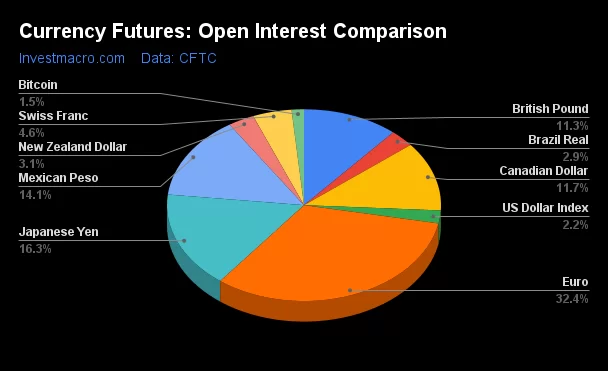
Here are the latest charts and statistics for the Commitment of Traders (COT) data published by the Commodities Futures Trading Commission (CFTC).

The latest COT data is updated through Tuesday March 19th and shows a quick view of how large market participants (for-profit speculators and commercial traders) were positioned in the futures markets. All currency positions are in direct relation to the US dollar where, for example, a bet for the euro is a bet that the euro will rise versus the dollar while a bet against the euro will be a bet that the euro will decline versus the dollar.

Weekly Speculator Changes led by Mexican Peso & Brazilian Real

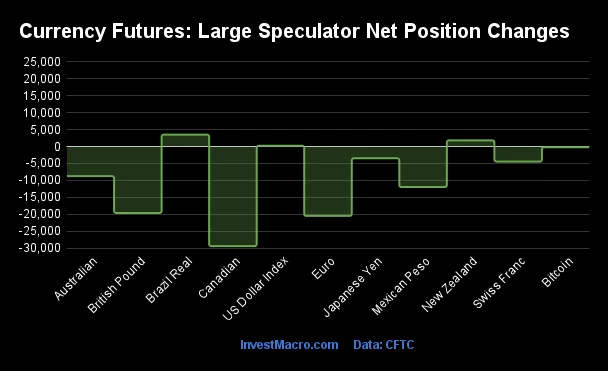
The COT currency market speculator bets were sharply lower this week as just two out of the eleven currency markets we cover had higher positioning while the other nine markets had lower speculator contracts.

Leading the gains for the currency markets was the Mexican Peso (24,378 contracts) with the Brazilian Real (1,627 contracts) also showing a positive week.

The currencies seeing declines in speculator bets on the week were the EuroFX (-26,065 contracts) with the British Pound (-17,251 contracts), the Australian Dollar (-16,698 contracts), the Japanese Yen (-13,690 contracts), the Canadian Dollar (-6,274 contracts), the US Dollar Index (-5,507 contracts), the Swiss Franc (-2,630 contracts), the New Zealand Dollar (-2,654 contracts) and Bitcoin (-1,102 contracts) also registering lower bets on the week.

Speculators drop their Australian Dollar bets to new record low

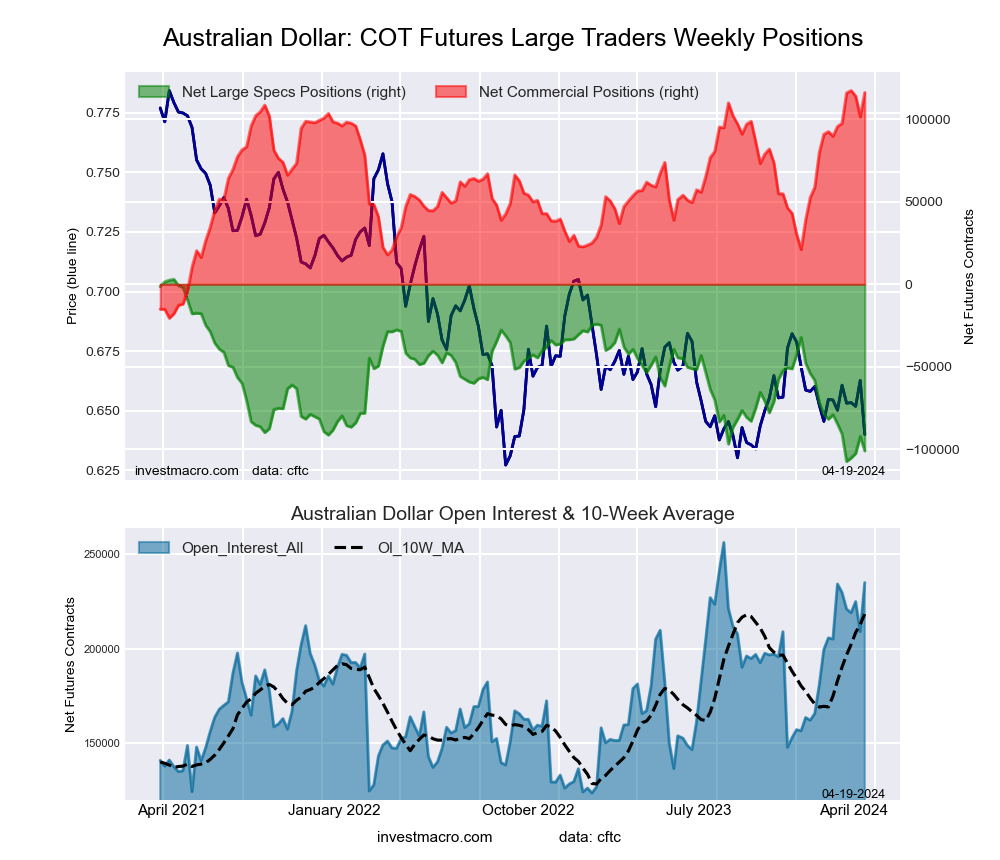
Highlighting the COT currency’s data this week is the renewed bearishness in the speculator’s positioning for the Australian dollar. Large speculative Aussie currency positions dropped this week by over -16,000 net contracts, the largest weekly decline in twenty-six weeks and the third straight weekly fall. The AUD speculator positions have decreased in nine out of the past ten weeks as well with an overall drop by -75,264 net contracts in that ten-week period.

This rise in bearishness has pushed the speculators bets to the most bearish level on record at a total of -107,538 net contracts. This surpasses the previous record of -96,946 contracts that was hit on September 19th of 2023. The overall Aussie speculator positioning has now been in bearish territory since dropping from a net bullish position to a net bearish position on May 25th of 2021 and this week marks the 148th consecutive week of continuous bearish speculator levels.

Denting the sentiment for the Aussie Dollar was a recent interest rate hold by the Reserve Bank of Australia (RBA) on March 19th. The RBA left its cash rate at 4.35 percent as inflation continues to decrease and with many market watchers feeling this was a dovish meeting and statement.

The Australian dollar is in a downtrend, according to our trend following model, with the Aussie closing out the week against the US Dollar at 0.6531. The AUD/USD currency pair opened the 2024 trading year at the 0.6823 exchange rate and has been trending lower since hitting a multi-year high of approximately 0.8000 in February of 2021.


Currencies Net Speculators Leaderboard
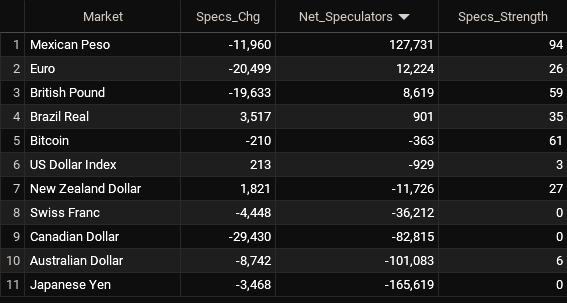
Legend: Weekly Speculators Change | Speculators Current Net Position | Speculators Strength Score compared to last 3-Years (0-100 range)


Strength Scores led by Mexican Peso & British Pound

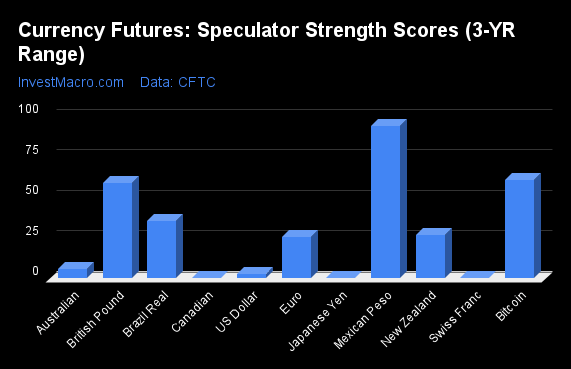
COT Strength Scores (a normalized measure of Speculator positions over a 3-Year range, from 0 to 100 where above 80 is Extreme-Bullish and below 20 is Extreme-Bearish) showed that the Mexican Peso (100 percent) and the British Pound (89 percent) lead the currency markets this week. The New Zealand Dollar (60 percent) comes in as the next highest in the weekly strength scores.

On the downside, the Australian Dollar (0 percent), the Swiss Franc (0 percent), the US Dollar Index (6 percent) and the Japanese Yen (15 percent) come in at the lowest strength levels currently and are in Extreme-Bearish territory (below 20 percent).

Strength Statistics:
US Dollar Index (6.3 percent) vs US Dollar Index previous week (17.9 percent)
EuroFX (40.9 percent) vs EuroFX previous week (52.0 percent)
British Pound Sterling (88.6 percent) vs British Pound Sterling previous week (100.0 percent)
Japanese Yen (14.8 percent) vs Japanese Yen previous week (27.0 percent)
Swiss Franc (0.4 percent) vs Swiss Franc previous week (8.1 percent)
Canadian Dollar (27.9 percent) vs Canadian Dollar previous week (33.2 percent)
Australian Dollar (0.0 percent) vs Australian Dollar previous week (13.9 percent)
New Zealand Dollar (59.8 percent) vs New Zealand Dollar previous week (67.4 percent)
Mexican Peso (100.0 percent) vs Mexican Peso previous week (87.4 percent)
Brazilian Real (47.9 percent) vs Brazilian Real previous week (45.8 percent)
Bitcoin (34.9 percent) vs Bitcoin previous week (51.4 percent)


Mexican Peso & British Pound top the 6-Week Strength Trends

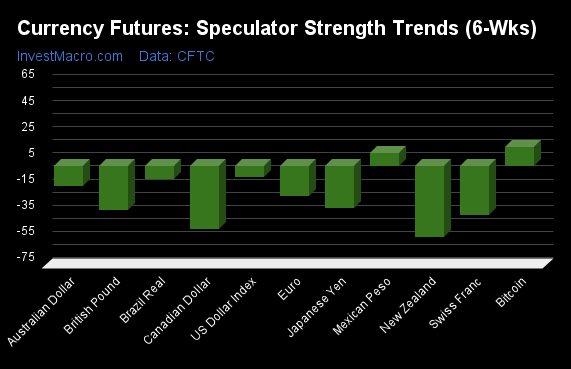
COT Strength Score Trends (or move index, calculates the 6-week changes in strength scores) showed that the Mexican Peso (22 percent) and the British Pound (12 percent) lead the past six weeks trends for the currencies and are the only markets with positive scores.

The Swiss Franc (-44 percent) leads the downside trend scores currently with the Australian Dollar (-30 percent), Japanese Yen (-28 percent) and the Canadian Dollar (-25 percent) following next with lower trend scores.

Strength Trend Statistics:
US Dollar Index (-1.8 percent) vs US Dollar Index previous week (12.3 percent)
EuroFX (-5.9 percent) vs EuroFX previous week (-6.1 percent)
British Pound Sterling (12.4 percent) vs British Pound Sterling previous week (24.1 percent)
Japanese Yen (-28.2 percent) vs Japanese Yen previous week (-19.4 percent)
Swiss Franc (-43.7 percent) vs Swiss Franc previous week (-40.8 percent)
Canadian Dollar (-24.7 percent) vs Canadian Dollar previous week (-23.9 percent)
Australian Dollar (-29.8 percent) vs Australian Dollar previous week (-27.2 percent)
New Zealand Dollar (-2.9 percent) vs New Zealand Dollar previous week (9.9 percent)
Mexican Peso (21.7 percent) vs Mexican Peso previous week (12.4 percent)
Brazilian Real (-12.1 percent) vs Brazilian Real previous week (-12.5 percent)
Bitcoin (-8.6 percent) vs Bitcoin previous week (12.1 percent)


Individual COT Forex Markets:

US Dollar Index Futures:
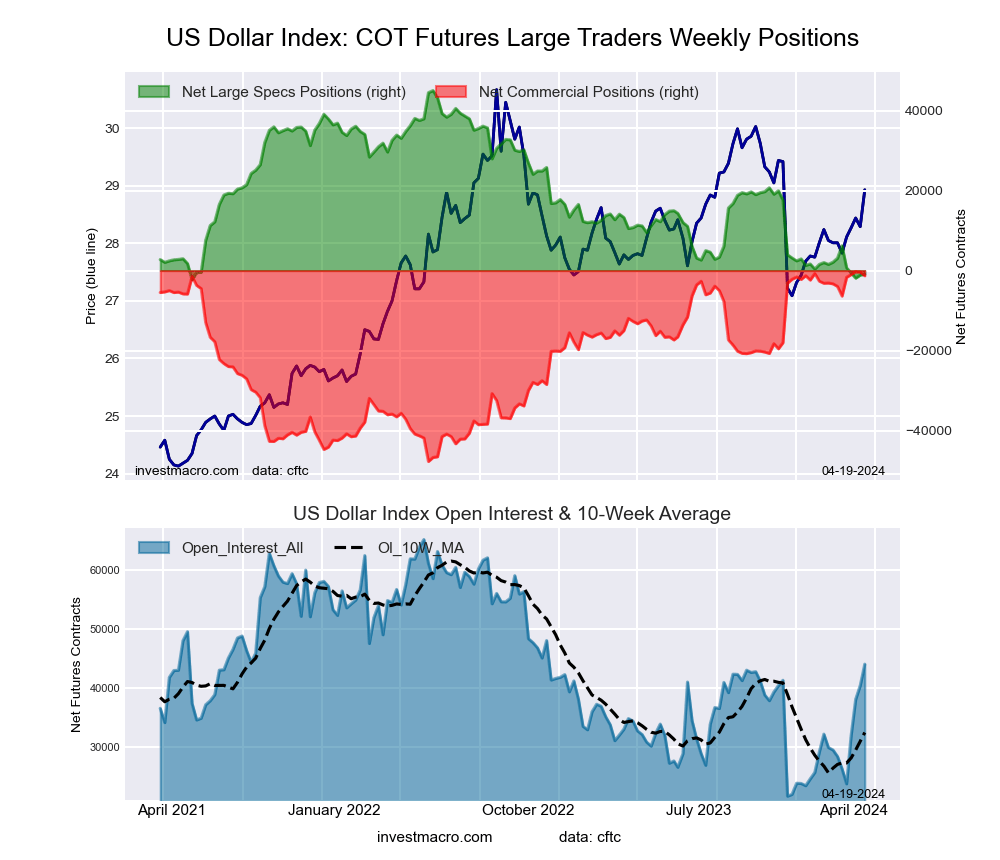
US Dollar Index Forex Futures COT ChartThe US Dollar Index large speculator standing this week totaled a net position of 679 contracts in the data reported through Tuesday. This was a weekly fall of -5,507 contracts from the previous week which had a total of 6,186 net contracts.

This week’s current strength score (the trader positioning range over the past three years, measured from 0 to 100) shows the speculators are currently Bearish-Extreme with a score of 6.3 percent. The commercials are Bullish-Extreme with a score of 98.0 percent and the small traders (not shown in chart) are Bearish with a score of 22.9 percent.

Price Trend-Following Model: Weak Downtrend

Our weekly trend-following model classifies the current market price position as: Weak Downtrend. The current action for the model is considered to be: Hold – Maintain Short Position.

US DOLLAR INDEX StatisticsSPECULATORSCOMMERCIALSSMALL TRADERS
– Percent of Open Interest Longs:65.416.213.0
– Percent of Open Interest Shorts:62.523.38.7
– Net Position:679-1,6911,012
– Gross Longs:15,5733,8613,091
– Gross Shorts:14,8945,5522,079
– Long to Short Ratio:1.0 to 10.7 to 11.5 to 1
NET POSITION TREND:
– Strength Index Score (3 Year Range Pct):6.398.022.9
– Strength Index Reading (3 Year Range):Bearish-ExtremeBullish-ExtremeBearish
NET POSITION MOVEMENT INDEX:
– 6-Week Change in Strength Index:-1.82.0-1.2


Euro Currency Futures:

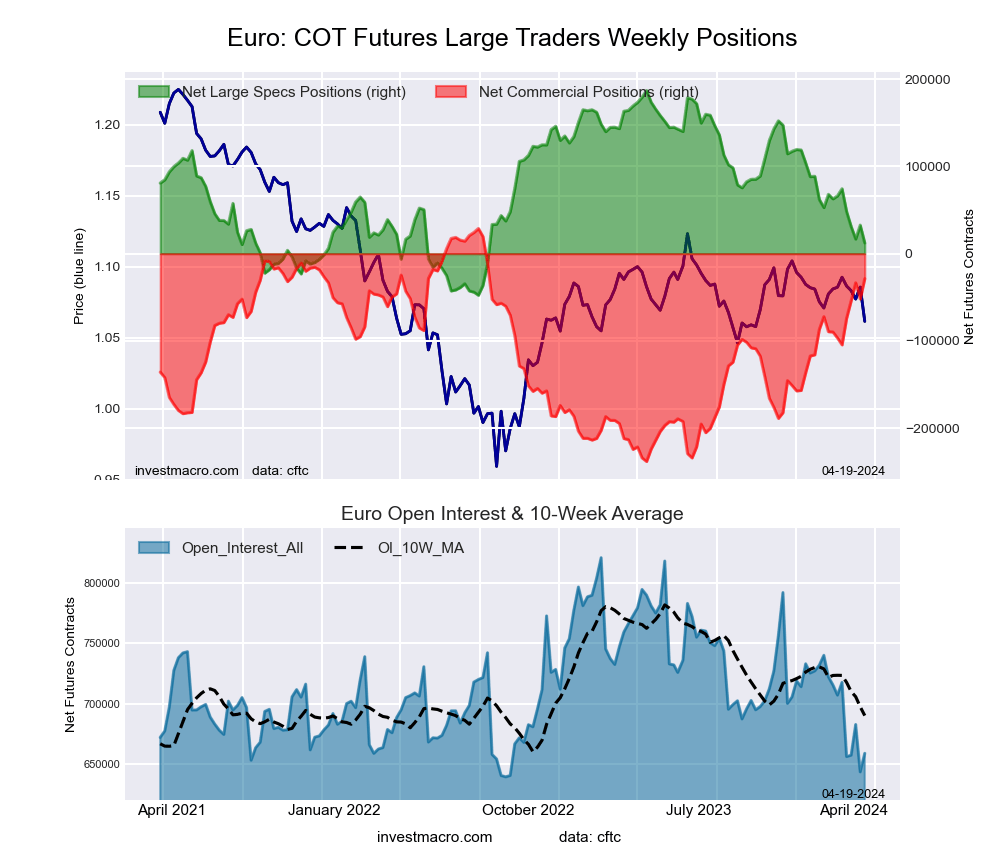
Euro Currency Futures COT ChartThe Euro Currency large speculator standing this week totaled a net position of 48,342 contracts in the data reported through Tuesday. This was a weekly fall of -26,065 contracts from the previous week which had a total of 74,407 net contracts.

This week’s current strength score (the trader positioning range over the past three years, measured from 0 to 100) shows the speculators are currently Bearish with a score of 40.9 percent. The commercials are Bullish with a score of 61.5 percent and the small traders (not shown in chart) are Bearish with a score of 20.1 percent.

Price Trend-Following Model: Strong Downtrend

Our weekly trend-following model classifies the current market price position as: Strong Downtrend. The current action for the model is considered to be: New Sell – Short Position.

EURO Currency StatisticsSPECULATORSCOMMERCIALSSMALL TRADERS
– Percent of Open Interest Longs:27.859.311.6
– Percent of Open Interest Shorts:20.470.67.6
– Net Position:48,342-74,13025,788
– Gross Longs:182,382388,83975,816
– Gross Shorts:134,040462,96950,028
– Long to Short Ratio:1.4 to 10.8 to 11.5 to 1
NET POSITION TREND:
– Strength Index Score (3 Year Range Pct):40.961.520.1
– Strength Index Reading (3 Year Range):BearishBullishBearish
NET POSITION MOVEMENT INDEX:
– 6-Week Change in Strength Index:-5.94.81.7


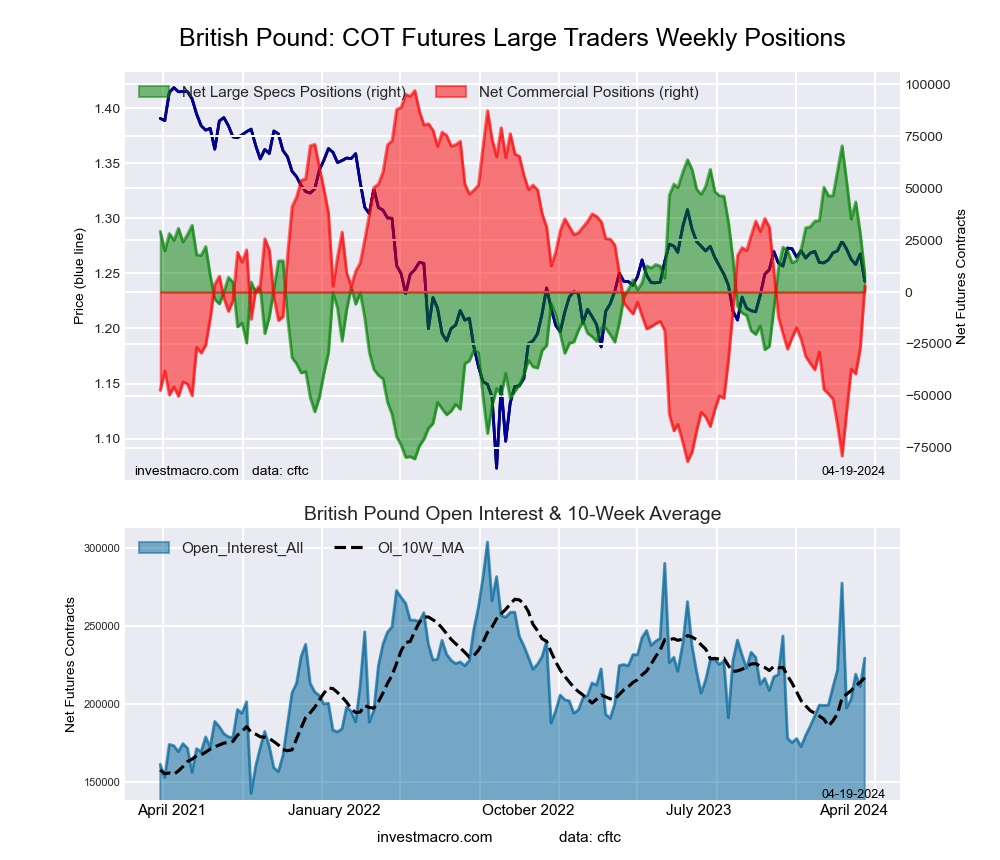
British Pound Sterling Futures:

British Pound Sterling Futures COT ChartThe British Pound Sterling large speculator standing this week totaled a net position of 53,200 contracts in the data reported through Tuesday. This was a weekly fall of -17,251 contracts from the previous week which had a total of 70,451 net contracts.

This week’s current strength score (the trader positioning range over the past three years, measured from 0 to 100) shows the speculators are currently Bullish-Extreme with a score of 88.6 percent. The commercials are Bearish-Extreme with a score of 13.4 percent and the small traders (not shown in chart) are Bullish with a score of 66.7 percent.

Price Trend-Following Model: Weak Uptrend

Our weekly trend-following model classifies the current market price position as: Weak Uptrend. The current action for the model is considered to be: Hold – Maintain Long Position.

BRITISH POUND StatisticsSPECULATORSCOMMERCIALSSMALL TRADERS
– Percent of Open Interest Longs:52.029.315.6
– Percent of Open Interest Shorts:25.058.513.3
– Net Position:53,200-57,6174,417
– Gross Longs:102,60557,89830,742
– Gross Shorts:49,405115,51526,325
– Long to Short Ratio:2.1 to 10.5 to 11.2 to 1
NET POSITION TREND:
– Strength Index Score (3 Year Range Pct):88.613.466.7
– Strength Index Reading (3 Year Range):Bullish-ExtremeBearish-ExtremeBullish
NET POSITION MOVEMENT INDEX:
– 6-Week Change in Strength Index:12.4-16.119.7


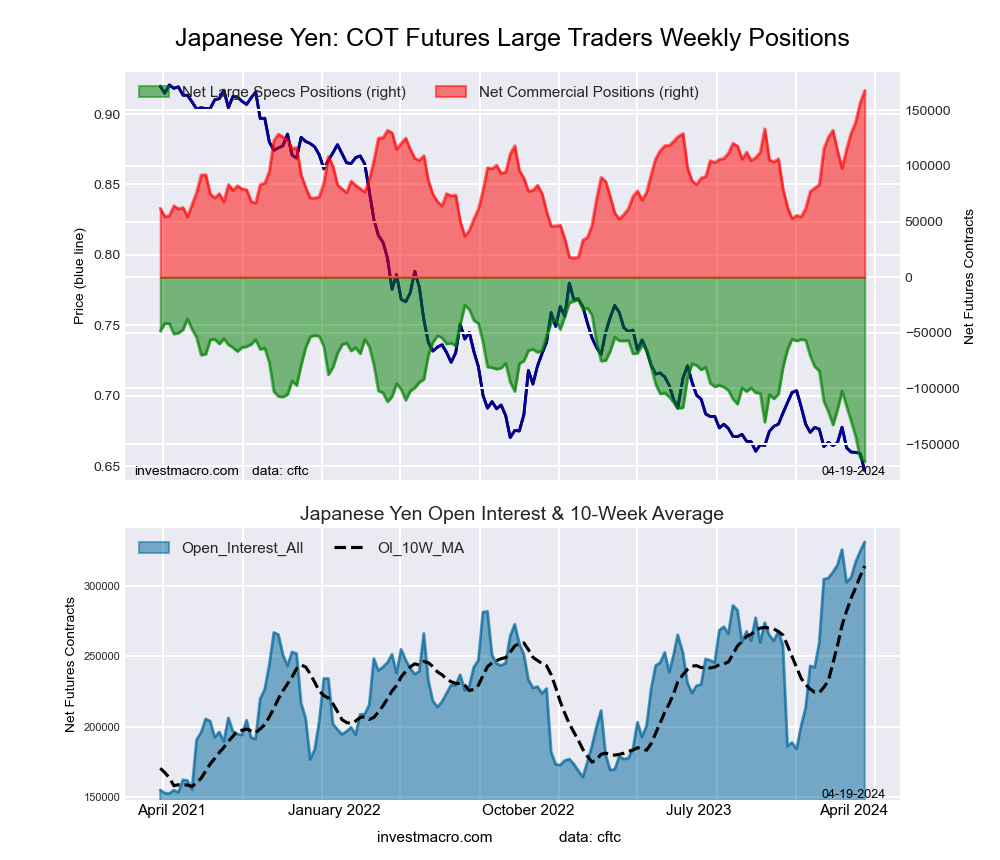
Japanese Yen Futures:

Japanese Yen Forex Futures COT ChartThe Japanese Yen large speculator standing this week totaled a net position of -116,012 contracts in the data reported through Tuesday. This was a weekly lowering of -13,690 contracts from the previous week which had a total of -102,322 net contracts.

This week’s current strength score (the trader positioning range over the past three years, measured from 0 to 100) shows the speculators are currently Bearish-Extreme with a score of 14.8 percent. The commercials are Bullish-Extreme with a score of 84.4 percent and the small traders (not shown in chart) are Bullish-Extreme with a score of 85.4 percent.

Price Trend-Following Model: Strong Downtrend

Our weekly trend-following model classifies the current market price position as: Strong Downtrend. The current action for the model is considered to be: Hold – Maintain Short Position.

JAPANESE YEN StatisticsSPECULATORSCOMMERCIALSSMALL TRADERS
– Percent of Open Interest Longs:21.960.315.5
– Percent of Open Interest Shorts:60.322.215.2
– Net Position:-116,012115,119893
– Gross Longs:66,274182,29946,762
– Gross Shorts:182,28667,18045,869
– Long to Short Ratio:0.4 to 12.7 to 11.0 to 1
NET POSITION TREND:
– Strength Index Score (3 Year Range Pct):14.884.485.4
– Strength Index Reading (3 Year Range):Bearish-ExtremeBullish-ExtremeBullish-Extreme
NET POSITION MOVEMENT INDEX:
– 6-Week Change in Strength Index:-28.227.7-1.1


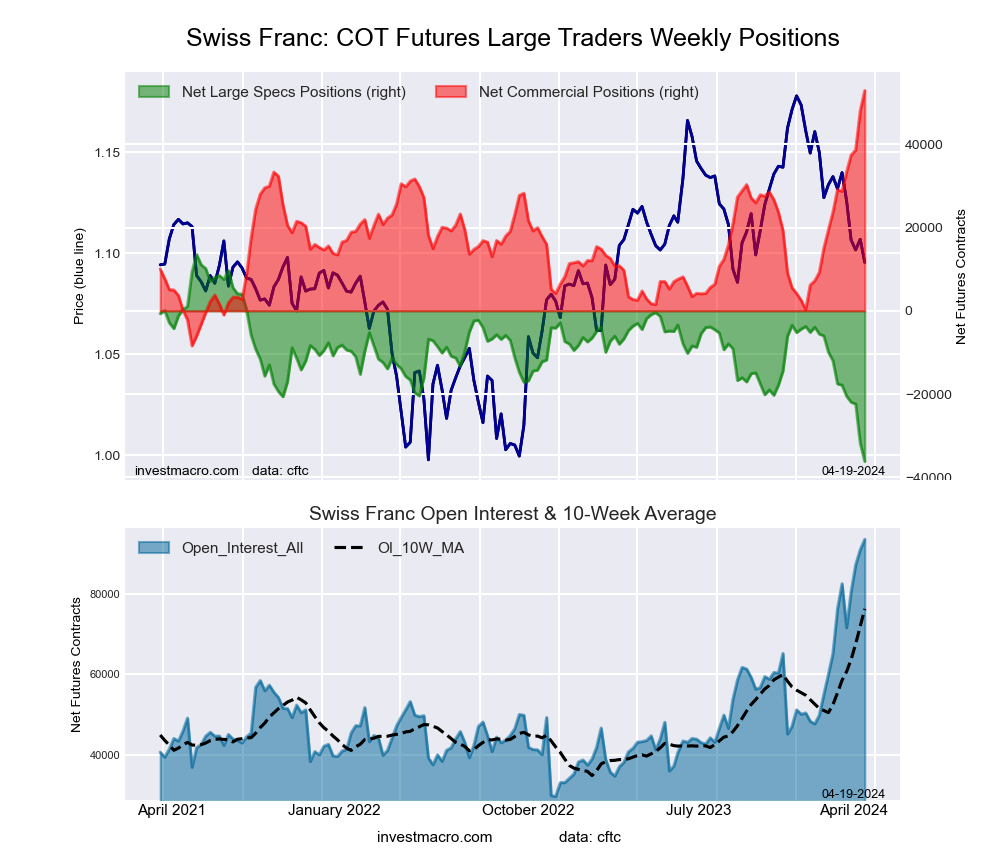
Swiss Franc Futures:

Swiss Franc Forex Futures COT ChartThe Swiss Franc large speculator standing this week totaled a net position of -20,500 contracts in the data reported through Tuesday. This was a weekly fall of -2,630 contracts from the previous week which had a total of -17,870 net contracts.

This week’s current strength score (the trader positioning range over the past three years, measured from 0 to 100) shows the speculators are currently Bearish-Extreme with a score of 0.4 percent. The commercials are Bullish-Extreme with a score of 100.0 percent and the small traders (not shown in chart) are Bearish-Extreme with a score of 18.6 percent.

Price Trend-Following Model: Strong Downtrend

Our weekly trend-following model classifies the current market price position as: Strong Downtrend. The current action for the model is considered to be: New Sell – Short Position.

SWISS FRANC StatisticsSPECULATORSCOMMERCIALSSMALL TRADERS
– Percent of Open Interest Longs:18.268.213.5
– Percent of Open Interest Shorts:46.821.631.5
– Net Position:-20,50033,392-12,892
– Gross Longs:13,00348,8259,665
– Gross Shorts:33,50315,43322,557
– Long to Short Ratio:0.4 to 13.2 to 10.4 to 1
NET POSITION TREND:
– Strength Index Score (3 Year Range Pct):0.4100.018.6
– Strength Index Reading (3 Year Range):Bearish-ExtremeBullish-ExtremeBearish-Extreme
NET POSITION MOVEMENT INDEX:
– 6-Week Change in Strength Index:-43.757.7-41.8


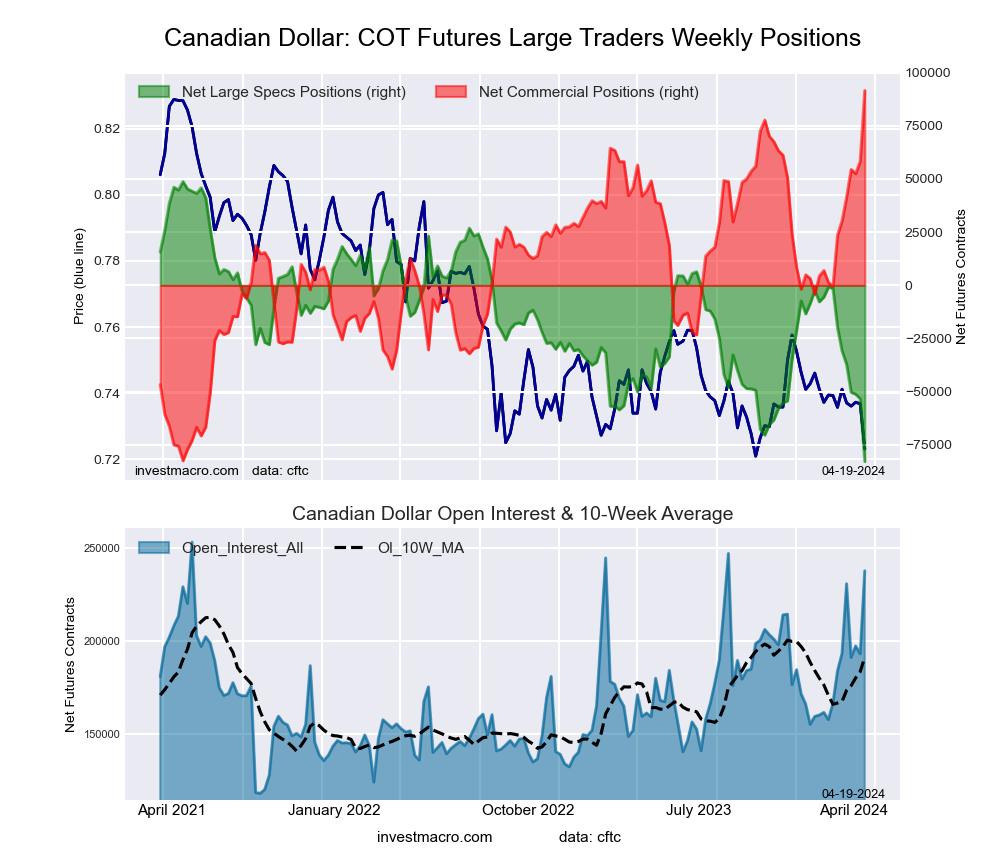
Canadian Dollar Futures:

Canadian Dollar Forex Futures COT ChartThe Canadian Dollar large speculator standing this week totaled a net position of -37,148 contracts in the data reported through Tuesday. This was a weekly lowering of -6,274 contracts from the previous week which had a total of -30,874 net contracts.

This week’s current strength score (the trader positioning range over the past three years, measured from 0 to 100) shows the speculators are currently Bearish with a score of 27.9 percent. The commercials are Bullish with a score of 77.4 percent and the small traders (not shown in chart) are Bearish-Extreme with a score of 13.3 percent.

Price Trend-Following Model: Weak Uptrend

Our weekly trend-following model classifies the current market price position as: Weak Uptrend. The current action for the model is considered to be: Hold – Maintain Long Position.

CANADIAN DOLLAR StatisticsSPECULATORSCOMMERCIALSSMALL TRADERS
– Percent of Open Interest Longs:19.866.511.7
– Percent of Open Interest Shorts:36.048.613.6
– Net Position:-37,14841,437-4,289
– Gross Longs:45,761153,40727,007
– Gross Shorts:82,909111,97031,296
– Long to Short Ratio:0.6 to 11.4 to 10.9 to 1
NET POSITION TREND:
– Strength Index Score (3 Year Range Pct):27.977.413.3
– Strength Index Reading (3 Year Range):BearishBullishBearish-Extreme
NET POSITION MOVEMENT INDEX:
– 6-Week Change in Strength Index:-24.723.1-16.9


Australian Dollar Futures:

Australian Dollar Forex Futures COT ChartThe Australian Dollar large speculator standing this week totaled a net position of -107,538 contracts in the data reported through Tuesday. This was a weekly lowering of -16,698 contracts from the previous week which had a total of -90,840 net contracts.

This week’s current strength score (the trader positioning range over the past three years, measured from 0 to 100) shows the speculators are currently Bearish-Extreme with a score of 0.0 percent. The commercials are Bullish-Extreme with a score of 100.0 percent and the small traders (not shown in chart) are Bearish with a score of 32.7 percent.

Price Trend-Following Model: Strong Downtrend

Our weekly trend-following model classifies the current market price position as: Strong Downtrend. The current action for the model is considered to be: New Sell – Short Position.

AUSTRALIAN DOLLAR StatisticsSPECULATORSCOMMERCIALSSMALL TRADERS
– Percent of Open Interest Longs:17.371.98.6
– Percent of Open Interest Shorts:66.019.412.5
– Net Position:-107,538116,062-8,524
– Gross Longs:38,207158,91919,035
– Gross Shorts:145,74542,85727,559
– Long to Short Ratio:0.3 to 13.7 to 10.7 to 1
NET POSITION TREND:
– Strength Index Score (3 Year Range Pct):0.0100.032.7
– Strength Index Reading (3 Year Range):Bearish-ExtremeBullish-ExtremeBearish
NET POSITION MOVEMENT INDEX:
– 6-Week Change in Strength Index:-29.826.4-0.8


New Zealand Dollar Futures:

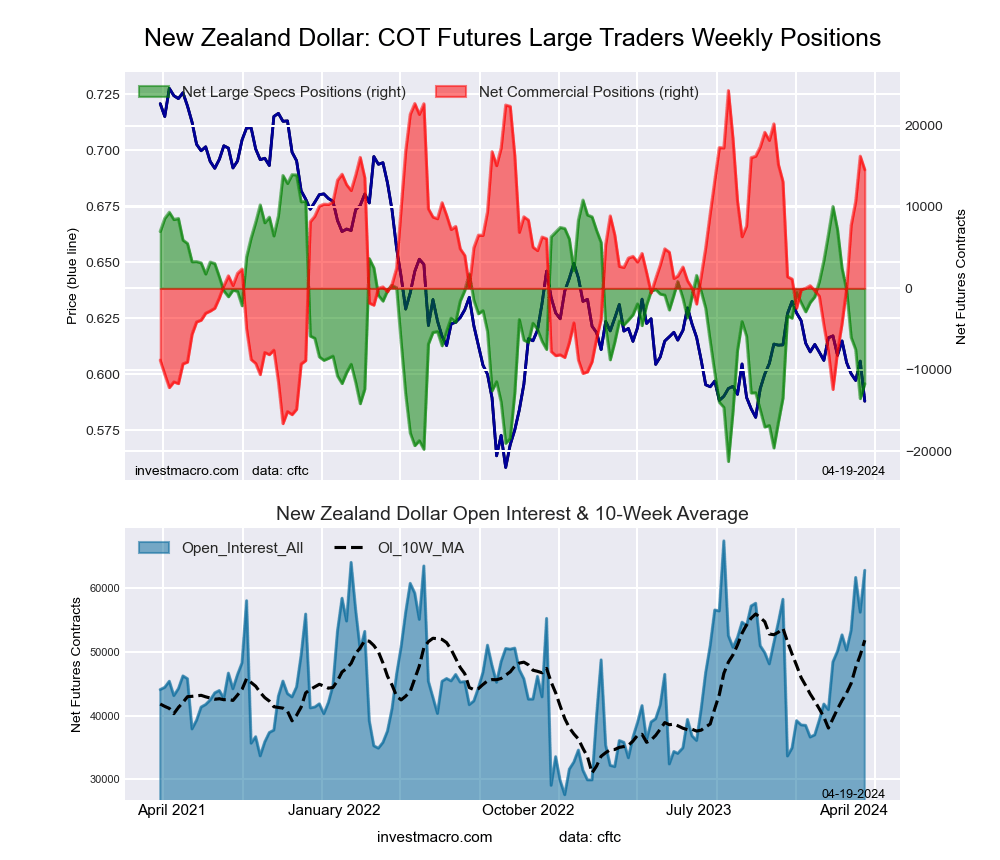
New Zealand Dollar Forex Futures COT ChartThe New Zealand Dollar large speculator standing this week totaled a net position of -189 contracts in the data reported through Tuesday. This was a weekly decrease of -2,654 contracts from the previous week which had a total of 2,465 net contracts.

This week’s current strength score (the trader positioning range over the past three years, measured from 0 to 100) shows the speculators are currently Bullish with a score of 59.8 percent. The commercials are Bearish with a score of 40.6 percent and the small traders (not shown in chart) are Bullish with a score of 56.7 percent.

Price Trend-Following Model: Weak Uptrend

Our weekly trend-following model classifies the current market price position as: Weak Uptrend. The current action for the model is considered to be: Hold – Maintain Long Position.

NEW ZEALAND DOLLAR StatisticsSPECULATORSCOMMERCIALSSMALL TRADERS
– Percent of Open Interest Longs:37.951.98.5
– Percent of Open Interest Shorts:38.351.98.1
– Net Position:-189-7196
– Gross Longs:19,06426,1184,278
– Gross Shorts:19,25326,1254,082
– Long to Short Ratio:1.0 to 11.0 to 11.0 to 1
NET POSITION TREND:
– Strength Index Score (3 Year Range Pct):59.840.656.7
– Strength Index Reading (3 Year Range):BullishBearishBullish
NET POSITION MOVEMENT INDEX:
– 6-Week Change in Strength Index:-2.92.40.7


Mexican Peso Futures:

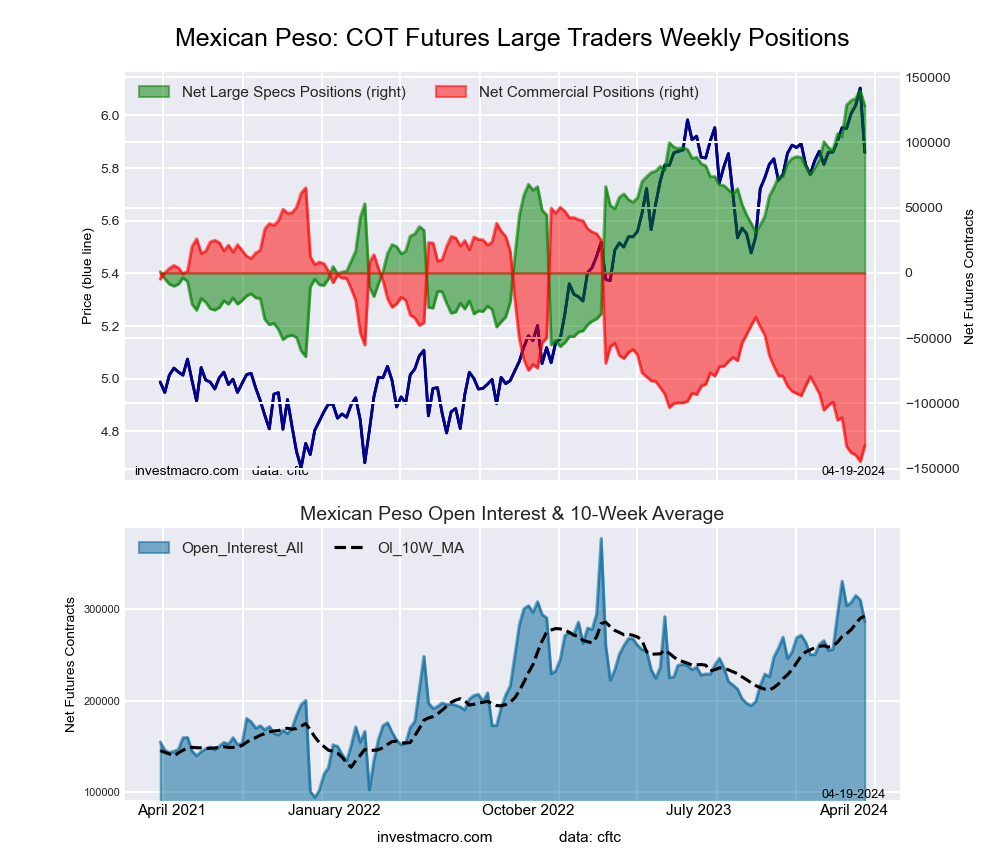
Mexican Peso Futures COT ChartThe Mexican Peso large speculator standing this week totaled a net position of 128,670 contracts in the data reported through Tuesday. This was a weekly lift of 24,378 contracts from the previous week which had a total of 104,292 net contracts.

This week’s current strength score (the trader positioning range over the past three years, measured from 0 to 100) shows the speculators are currently Bullish-Extreme with a score of 100.0 percent. The commercials are Bearish-Extreme with a score of 0.0 percent and the small traders (not shown in chart) are Bearish with a score of 38.7 percent.

Price Trend-Following Model: Strong Uptrend

Our weekly trend-following model classifies the current market price position as: Strong Uptrend. The current action for the model is considered to be: Hold – Maintain Long Position.

MEXICAN PESO StatisticsSPECULATORSCOMMERCIALSSMALL TRADERS
– Percent of Open Interest Longs:60.437.02.5
– Percent of Open Interest Shorts:18.080.81.1
– Net Position:128,670-132,9844,314
– Gross Longs:183,182112,1327,548
– Gross Shorts:54,512245,1163,234
– Long to Short Ratio:3.4 to 10.5 to 12.3 to 1
NET POSITION TREND:
– Strength Index Score (3 Year Range Pct):100.00.038.7
– Strength Index Reading (3 Year Range):Bullish-ExtremeBearish-ExtremeBearish
NET POSITION MOVEMENT INDEX:
– 6-Week Change in Strength Index:21.7-20.5-7.5


Brazilian Real Futures:

Brazil Real Futures COT ChartThe Brazilian Real large speculator standing this week totaled a net position of 10,314 contracts in the data reported through Tuesday. This was a weekly rise of 1,627 contracts from the previous week which had a total of 8,687 net contracts.

This week’s current strength score (the trader positioning range over the past three years, measured from 0 to 100) shows the speculators are currently Bearish with a score of 47.9 percent. The commercials are Bullish with a score of 50.4 percent and the small traders (not shown in chart) are Bullish with a score of 55.0 percent.

Price Trend-Following Model: Strong Downtrend

Our weekly trend-following model classifies the current market price position as: Strong Downtrend. The current action for the model is considered to be: Hold – Maintain Short Position.

BRAZIL REAL StatisticsSPECULATORSCOMMERCIALSSMALL TRADERS
– Percent of Open Interest Longs:63.331.05.7
– Percent of Open Interest Shorts:46.751.12.1
– Net Position:10,314-12,5262,212
– Gross Longs:39,44419,3473,551
– Gross Shorts:29,13031,8731,339
– Long to Short Ratio:1.4 to 10.6 to 12.7 to 1
NET POSITION TREND:
– Strength Index Score (3 Year Range Pct):47.950.455.0
– Strength Index Reading (3 Year Range):BearishBullishBullish
NET POSITION MOVEMENT INDEX:
– 6-Week Change in Strength Index:-12.111.42.5


Bitcoin Futures:

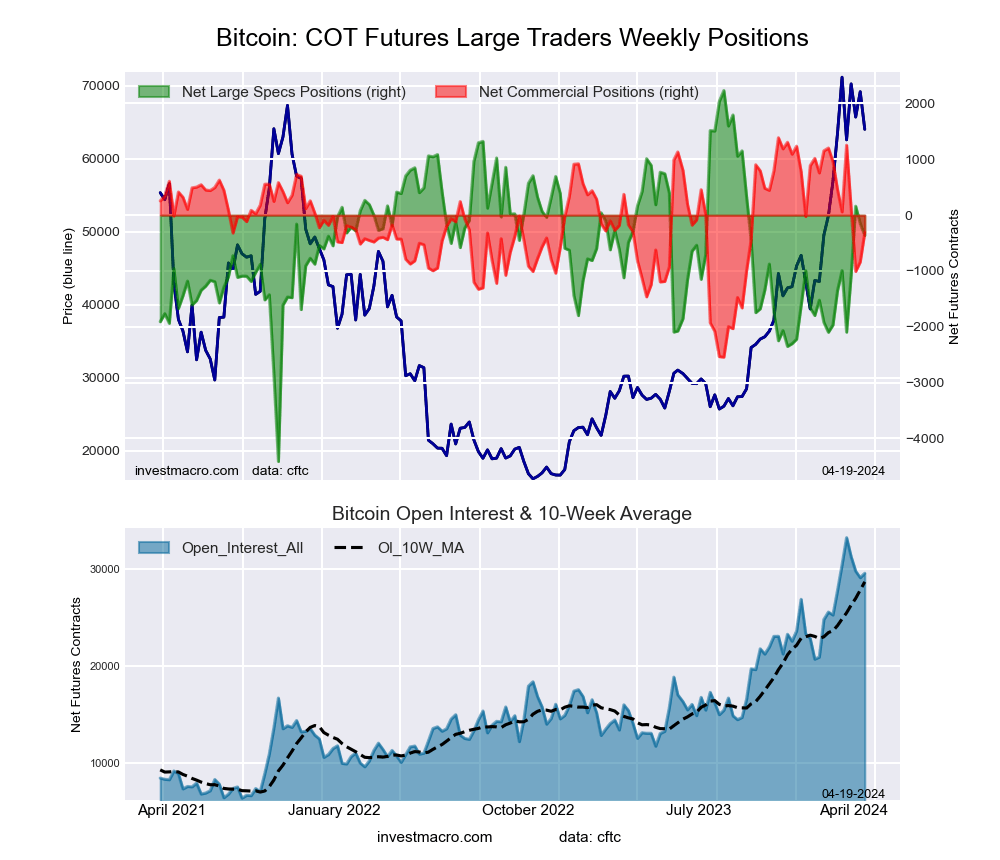
Bitcoin Crypto Futures COT ChartThe Bitcoin large speculator standing this week totaled a net position of -2,096 contracts in the data reported through Tuesday. This was a weekly decrease of -1,102 contracts from the previous week which had a total of -994 net contracts.

This week’s current strength score (the trader positioning range over the past three years, measured from 0 to 100) shows the speculators are currently Bearish with a score of 34.9 percent. The commercials are Bullish-Extreme with a score of 96.6 percent and the small traders (not shown in chart) are Bearish with a score of 32.1 percent.

Price Trend-Following Model: Strong Uptrend

Our weekly trend-following model classifies the current market price position as: Strong Uptrend. The current action for the model is considered to be: Hold – Maintain Long Position.

BITCOIN StatisticsSPECULATORSCOMMERCIALSSMALL TRADERS
– Percent of Open Interest Longs:74.47.85.0
– Percent of Open Interest Shorts:80.74.02.5
– Net Position:-2,0961,253843
– Gross Longs:24,6832,5801,663
– Gross Shorts:26,7791,327820
– Long to Short Ratio:0.9 to 11.9 to 12.0 to 1
NET POSITION TREND:
– Strength Index Score (3 Year Range Pct):34.996.632.1
– Strength Index Reading (3 Year Range):BearishBullish-ExtremeBearish
NET POSITION MOVEMENT INDEX:
– 6-Week Change in Strength Index:-8.612.61.8


Article By InvestMacroReceive our weekly COT Newsletter

*COT Report: The COT data, released weekly to the public each Friday, is updated through the most recent Tuesday (data is 3 days old) and shows a quick view of how large speculators or non-commercials (for-profit traders) were positioned in the futures markets.

The CFTC categorizes trader positions according to commercial hedgers (traders who use futures contracts for hedging as part of the business), non-commercials (large traders who speculate to realize trading profits) and nonreportable traders (usually small traders/speculators) as well as their open interest (contracts open in the market at time of reporting). See CFTC criteria here.

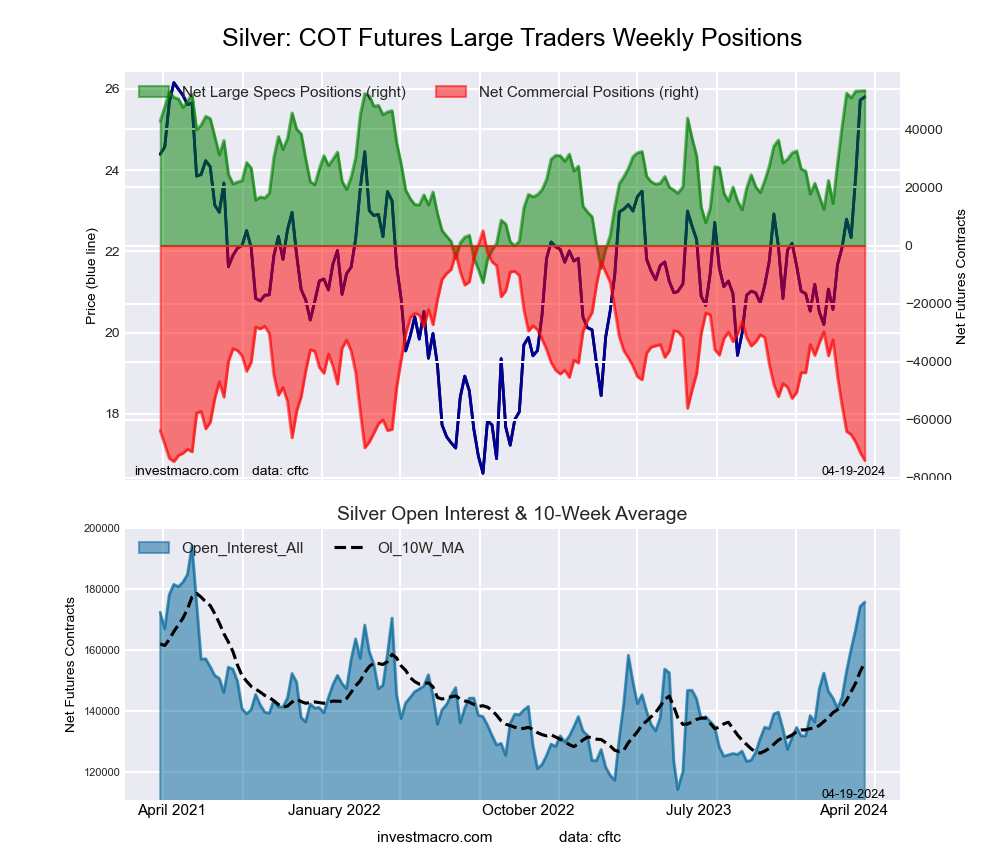
COT Bonds Charts: Speculator Bets led by 5-Year Bonds & 2-Year Bonds

By InvestMacro

Here are the latest charts and statistics for the Commitment of Traders (COT) reports data published by the Commodities Futures Trading Commission (CFTC).
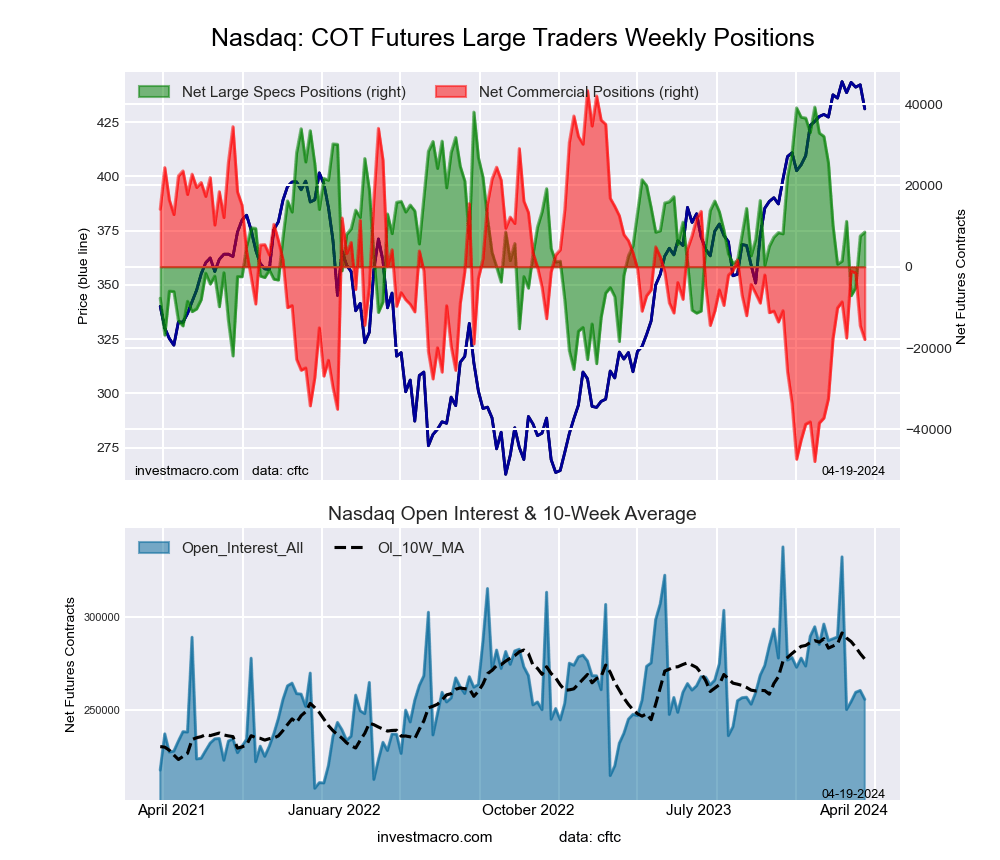
The latest COT data is updated through Tuesday March 19th and shows a quick view of how large traders (for-profit speculators and commercial hedgers) were positioned in the futures markets.

Weekly Speculator Changes led by 5-Year Bonds & 2-Year Bonds

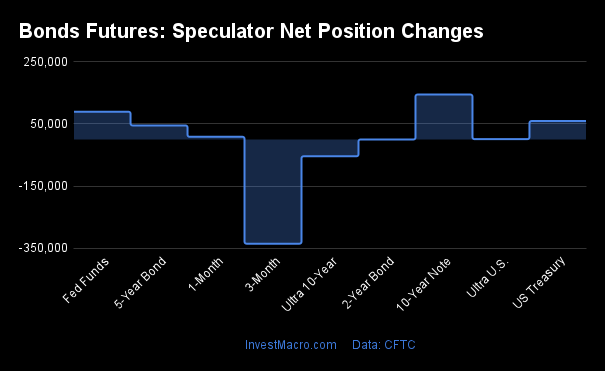
The COT bond market speculator bets were higher this week as six out of the eight bond markets we cover had higher positioning while the other two markets had lower speculator contracts.

Leading the gains for the bond markets was the 5-Year Bonds (105,077 contracts), the 2-Year Bonds (36,461 contracts), the US Treasury Bonds (32,079 contracts), the 10-Year Bonds (29,536 contracts), the Ultra Treasury Bonds (12,156 contracts) and the Fed Funds (905 contracts) also showing positive weeks.

The bond markets with declines in speculator bets for the week were the SOFR 3-Months (-125,140 contracts) and the Ultra 10-Year Bonds (-19,601 contracts).


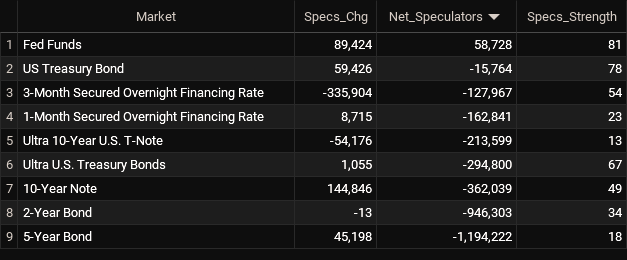
Net Speculators Leaderboard

Legend: Weekly Speculators Change | Speculators Current Net Position | Speculators Strength Score compared to last 3-Years (0-100 range)


Strength Scores led by US Treasury Bonds & SOFR 3-Months

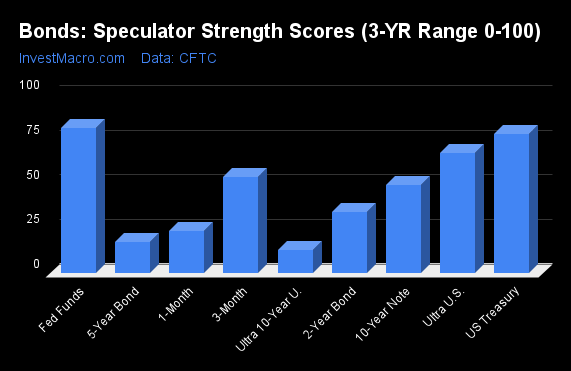
COT Strength Scores (a normalized measure of Speculator positions over a 3-Year range, from 0 to 100 where above 80 is Extreme-Bullish and below 20 is Extreme-Bearish) showed that the US Treasury Bonds (76 percent) and the SOFR 3-Months (76 percent) lead the bond markets this week. The Ultra Treasury Bonds (63 percent) comes in as the next highest in the weekly strength scores.

On the downside, the 5-Year Bonds (20 percent) and the Ultra 10-Year Bonds (24 percent) come in at the lowest strength level currently. The next lowest strength scores were the Fed Funds (27 percent) and the 10-Year Bonds (29 percent).

Strength Statistics:
Fed Funds (26.9 percent) vs Fed Funds previous week (26.7 percent)
2-Year Bond (36.7 percent) vs 2-Year Bond previous week (34.4 percent)
5-Year Bond (19.9 percent) vs 5-Year Bond previous week (13.2 percent)
10-Year Bond (29.5 percent) vs 10-Year Bond previous week (26.7 percent)
Ultra 10-Year Bond (24.3 percent) vs Ultra 10-Year Bond previous week (28.1 percent)
US Treasury Bond (75.7 percent) vs US Treasury Bond previous week (64.5 percent)
Ultra US Treasury Bond (63.2 percent) vs Ultra US Treasury Bond previous week (58.1 percent)
SOFR 3-Months (75.9 percent) vs SOFR 3-Months previous week (82.3 percent)


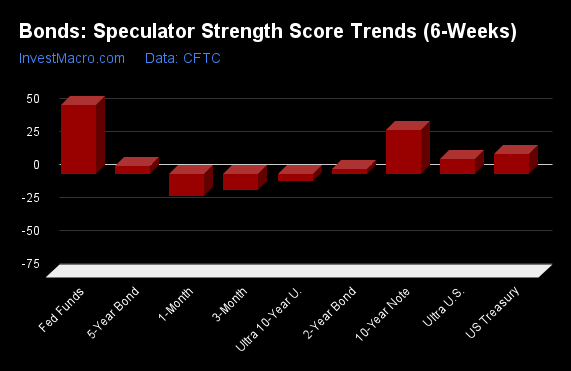
US Treasury Bonds & 2-Year Bonds top the 6-Week Strength Trends

COT Strength Score Trends (or move index, calculates the 6-week changes in strength scores) showed that the US Treasury Bonds (42 percent) and the 2-Year Bonds (26 percent) lead the past six weeks trends for bonds. The 10-Year Bonds (24 percent) are the next highest positive movers in the latest trends data.

The SOFR 3-Months (-13 percent) and the Fed Funds (-13 percent) leads the downside currently with negative trend scores.

Strength Trend Statistics:
Fed Funds (-12.6 percent) vs Fed Funds previous week (-8.5 percent)
2-Year Bond (25.8 percent) vs 2-Year Bond previous week (23.6 percent)
5-Year Bond (9.0 percent) vs 5-Year Bond previous week (-4.4 percent)
10-Year Bond (23.8 percent) vs 10-Year Bond previous week (23.9 percent)
Ultra 10-Year Bond (12.2 percent) vs Ultra 10-Year Bond previous week (8.9 percent)
US Treasury Bond (41.9 percent) vs US Treasury Bond previous week (28.9 percent)
Ultra US Treasury Bond (15.2 percent) vs Ultra US Treasury Bond previous week (5.7 percent)
SOFR 3-Months (-13.1 percent) vs SOFR 3-Months previous week (-14.4 percent)


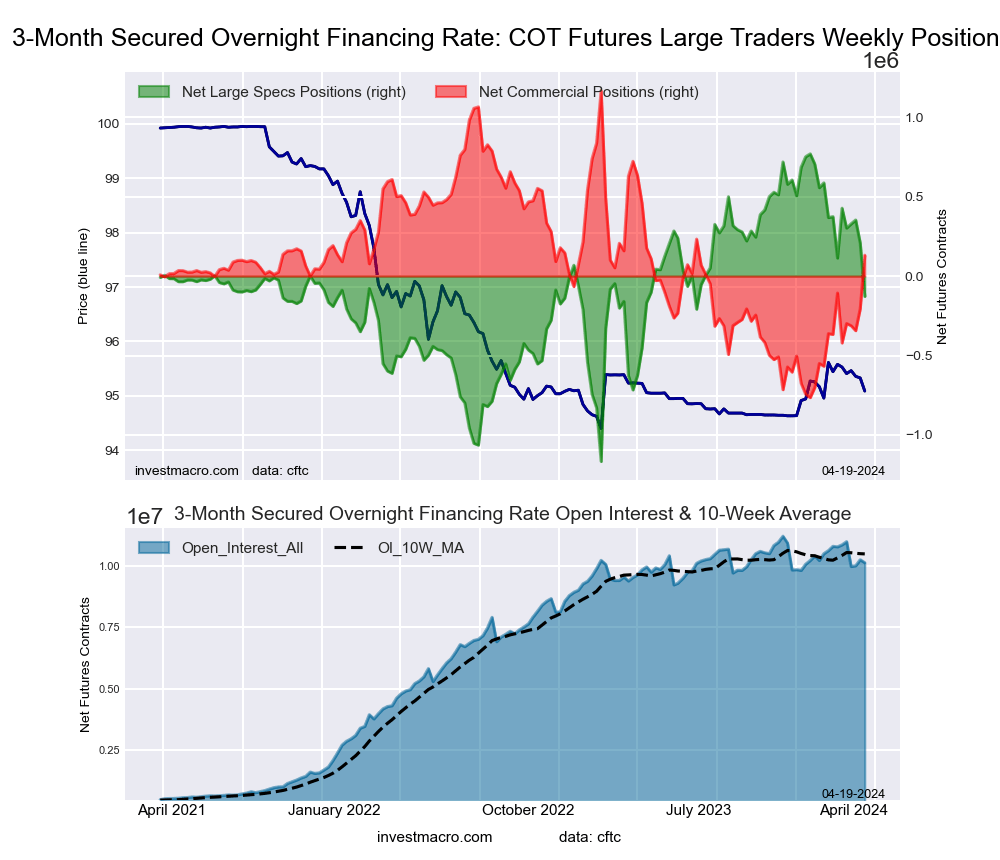
Secured Overnight Financing Rate (3-Month) Futures:

SOFR 3-Months Bonds Futures COT ChartThe Secured Overnight Financing Rate (3-Month) large speculator standing this week equaled a net position of 302,139 contracts in the data reported through Tuesday. This was a weekly decline of -125,140 contracts from the previous week which had a total of 427,279 net contracts.

This week’s current strength score (the trader positioning range over the past three years, measured from 0 to 100) shows the speculators are currently Bullish with a score of 75.9 percent. The commercials are Bearish with a score of 24.1 percent and the small traders (not shown in chart) are Bullish-Extreme with a score of 85.9 percent.

Price Trend-Following Model: Weak Uptrend

Our weekly trend-following model classifies the current market price position as: Weak Uptrend. The current action for the model is considered to be: Hold – Maintain Long Position.

SOFR 3-Months StatisticsSPECULATORSCOMMERCIALSSMALL TRADERS
– Percent of Open Interest Longs:17.356.30.3
– Percent of Open Interest Shorts:14.559.10.3
– Net Position:302,139-298,573-3,566
– Gross Longs:1,899,1236,195,53128,551
– Gross Shorts:1,596,9846,494,10432,117
– Long to Short Ratio:1.2 to 11.0 to 10.9 to 1
NET POSITION TREND:
– Strength Index Score (3 Year Range Pct):75.924.185.9
– Strength Index Reading (3 Year Range):BullishBearishBullish-Extreme
NET POSITION MOVEMENT INDEX:
– 6-Week Change in Strength Index:-13.113.01.6


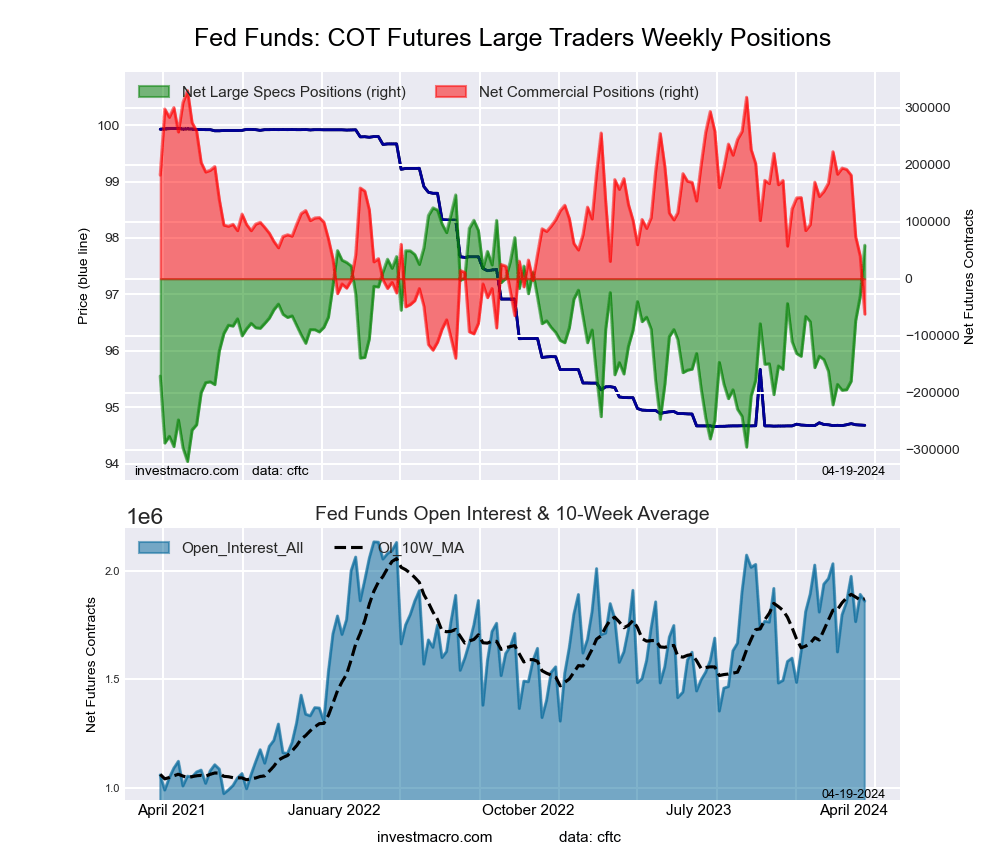
30-Day Federal Funds Futures:

Federal Funds 30-Day Bonds Futures COT ChartThe 30-Day Federal Funds large speculator standing this week equaled a net position of -194,845 contracts in the data reported through Tuesday. This was a weekly advance of 905 contracts from the previous week which had a total of -195,750 net contracts.

This week’s current strength score (the trader positioning range over the past three years, measured from 0 to 100) shows the speculators are currently Bearish with a score of 26.9 percent. The commercials are Bullish with a score of 70.5 percent and the small traders (not shown in chart) are Bullish-Extreme with a score of 96.5 percent.

Price Trend-Following Model: Downtrend

Our weekly trend-following model classifies the current market price position as: Downtrend. The current action for the model is considered to be: Hold – Maintain Short Position.

30-Day Federal Funds StatisticsSPECULATORSCOMMERCIALSSMALL TRADERS
– Percent of Open Interest Longs:8.172.92.1
– Percent of Open Interest Shorts:18.662.52.0
– Net Position:-194,845192,0592,786
– Gross Longs:151,0041,352,22739,137
– Gross Shorts:345,8491,160,16836,351
– Long to Short Ratio:0.4 to 11.2 to 11.1 to 1
NET POSITION TREND:
– Strength Index Score (3 Year Range Pct):26.970.596.5
– Strength Index Reading (3 Year Range):BearishBullishBullish-Extreme
NET POSITION MOVEMENT INDEX:
– 6-Week Change in Strength Index:-12.610.122.0


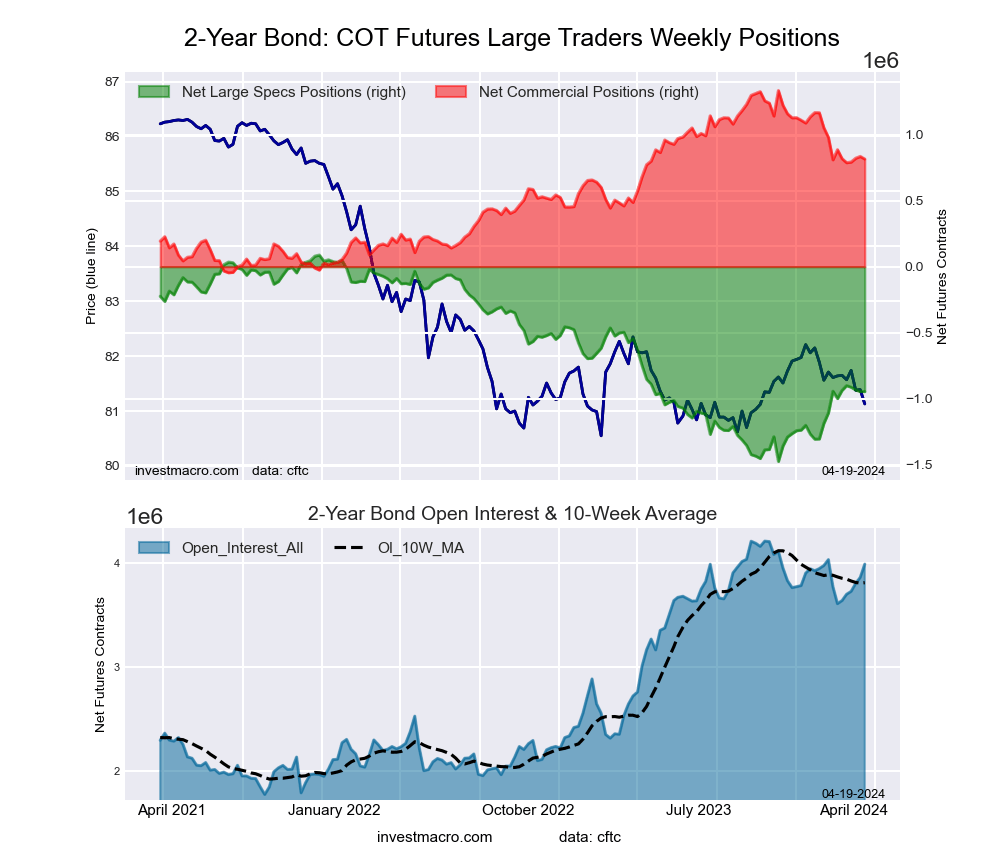
2-Year Treasury Note Futures:

2-Year Treasury Bonds Futures COT ChartThe 2-Year Treasury Note large speculator standing this week equaled a net position of -901,595 contracts in the data reported through Tuesday. This was a weekly advance of 36,461 contracts from the previous week which had a total of -938,056 net contracts.

This week’s current strength score (the trader positioning range over the past three years, measured from 0 to 100) shows the speculators are currently Bearish with a score of 36.7 percent. The commercials are Bullish with a score of 60.4 percent and the small traders (not shown in chart) are Bullish-Extreme with a score of 87.2 percent.

Price Trend-Following Model: Uptrend

Our weekly trend-following model classifies the current market price position as: Uptrend. The current action for the model is considered to be: Hold – Maintain Long Position.

2-Year Treasury Note StatisticsSPECULATORSCOMMERCIALSSMALL TRADERS
– Percent of Open Interest Longs:11.480.36.6
– Percent of Open Interest Shorts:35.859.03.6
– Net Position:-901,595787,910113,685
– Gross Longs:422,5972,969,326245,616
– Gross Shorts:1,324,1922,181,416131,931
– Long to Short Ratio:0.3 to 11.4 to 11.9 to 1
NET POSITION TREND:
– Strength Index Score (3 Year Range Pct):36.760.487.2
– Strength Index Reading (3 Year Range):BearishBullishBullish-Extreme
NET POSITION MOVEMENT INDEX:
– 6-Week Change in Strength Index:25.8-27.4-9.6


5-Year Treasury Note Futures:

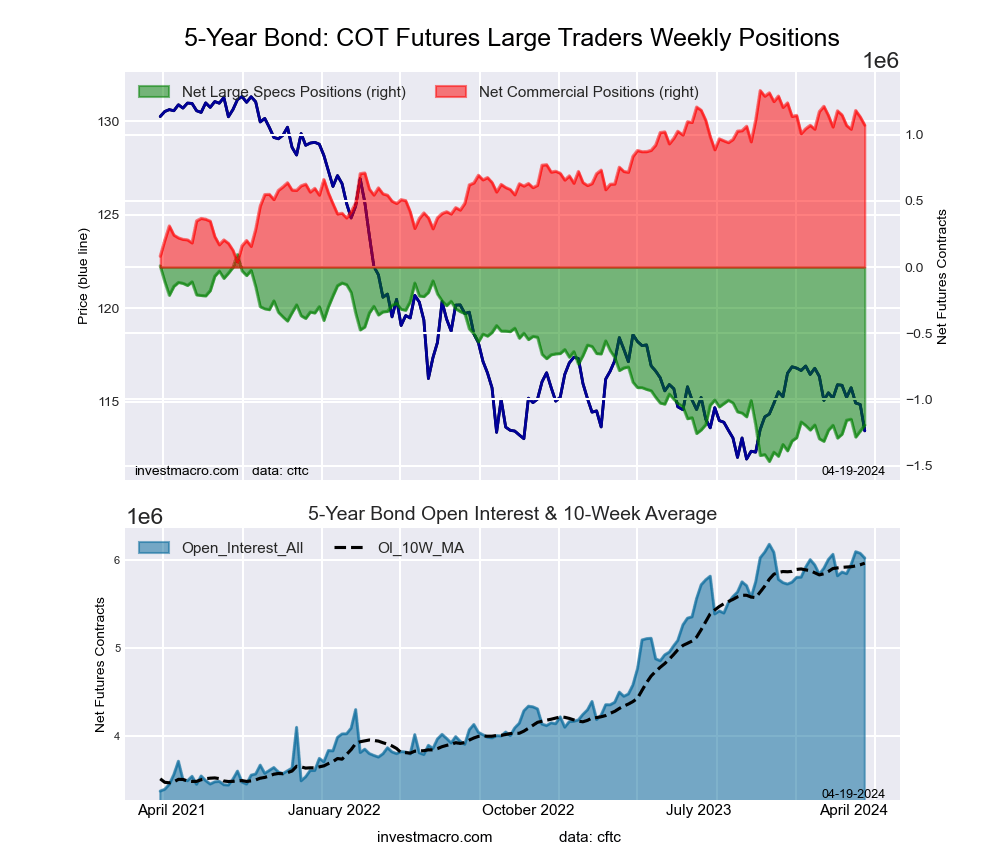
5-Year Treasury Bonds Futures COT ChartThe 5-Year Treasury Note large speculator standing this week equaled a net position of -1,157,057 contracts in the data reported through Tuesday. This was a weekly boost of 105,077 contracts from the previous week which had a total of -1,262,134 net contracts.

This week’s current strength score (the trader positioning range over the past three years, measured from 0 to 100) shows the speculators are currently Bearish-Extreme with a score of 19.9 percent. The commercials are Bullish with a score of 79.9 percent and the small traders (not shown in chart) are Bullish-Extreme with a score of 81.3 percent.

Price Trend-Following Model: Uptrend

Our weekly trend-following model classifies the current market price position as: Uptrend. The current action for the model is considered to be: Hold – Maintain Long Position.

5-Year Treasury Note StatisticsSPECULATORSCOMMERCIALSSMALL TRADERS
– Percent of Open Interest Longs:6.884.07.0
– Percent of Open Interest Shorts:26.665.75.5
– Net Position:-1,157,0571,069,93987,118
– Gross Longs:395,1944,907,528406,591
– Gross Shorts:1,552,2513,837,589319,473
– Long to Short Ratio:0.3 to 11.3 to 11.3 to 1
NET POSITION TREND:
– Strength Index Score (3 Year Range Pct):19.979.981.3
– Strength Index Reading (3 Year Range):Bearish-ExtremeBullishBullish-Extreme
NET POSITION MOVEMENT INDEX:
– 6-Week Change in Strength Index:9.0-8.0-7.4


10-Year Treasury Note Futures:

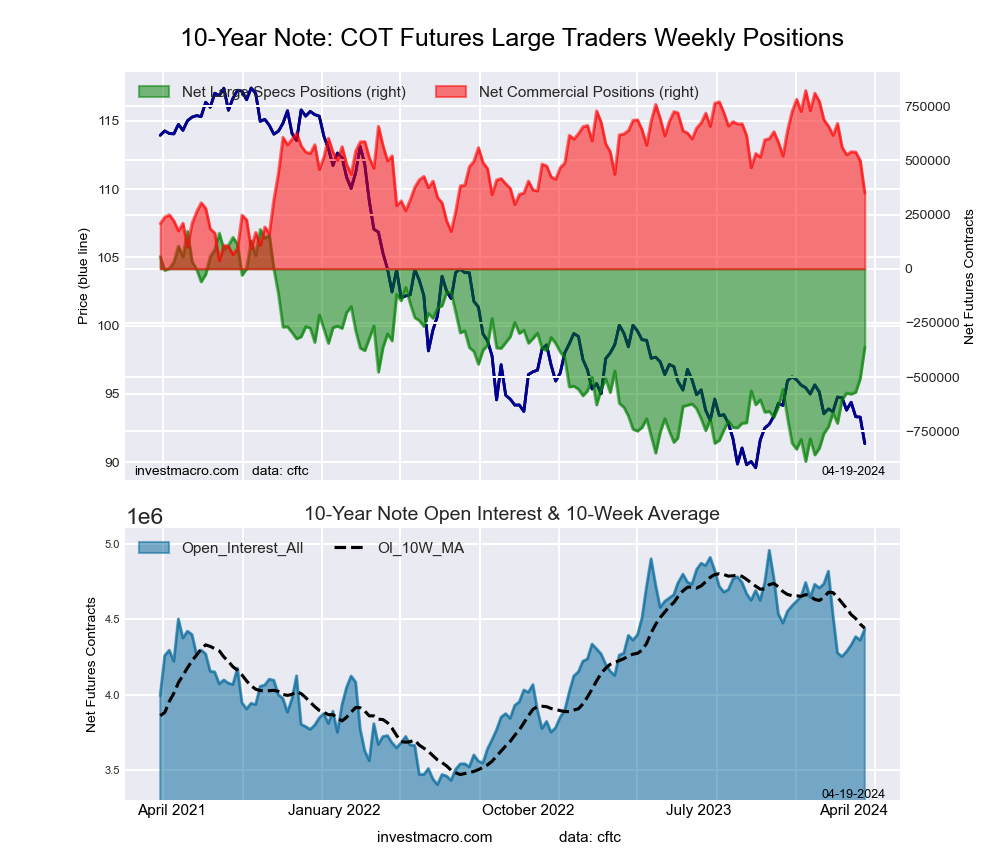
10-Year Treasury Notes Bonds Futures COT ChartThe 10-Year Treasury Note large speculator standing this week equaled a net position of -574,010 contracts in the data reported through Tuesday. This was a weekly rise of 29,536 contracts from the previous week which had a total of -603,546 net contracts.

This week’s current strength score (the trader positioning range over the past three years, measured from 0 to 100) shows the speculators are currently Bearish with a score of 29.5 percent. The commercials are Bullish with a score of 62.3 percent and the small traders (not shown in chart) are Bullish-Extreme with a score of 83.8 percent.

Price Trend-Following Model: Weak Uptrend

Our weekly trend-following model classifies the current market price position as: Weak Uptrend. The current action for the model is considered to be: Hold – Maintain Long Position.

10-Year Treasury Note StatisticsSPECULATORSCOMMERCIALSSMALL TRADERS
– Percent of Open Interest Longs:10.877.69.7
– Percent of Open Interest Shorts:24.165.38.6
– Net Position:-574,010526,78147,229
– Gross Longs:461,0663,327,859414,071
– Gross Shorts:1,035,0762,801,078366,842
– Long to Short Ratio:0.4 to 11.2 to 11.1 to 1
NET POSITION TREND:
– Strength Index Score (3 Year Range Pct):29.562.383.8
– Strength Index Reading (3 Year Range):BearishBullishBullish-Extreme
NET POSITION MOVEMENT INDEX:
– 6-Week Change in Strength Index:23.8-31.3-1.8


Ultra 10-Year Notes Futures:

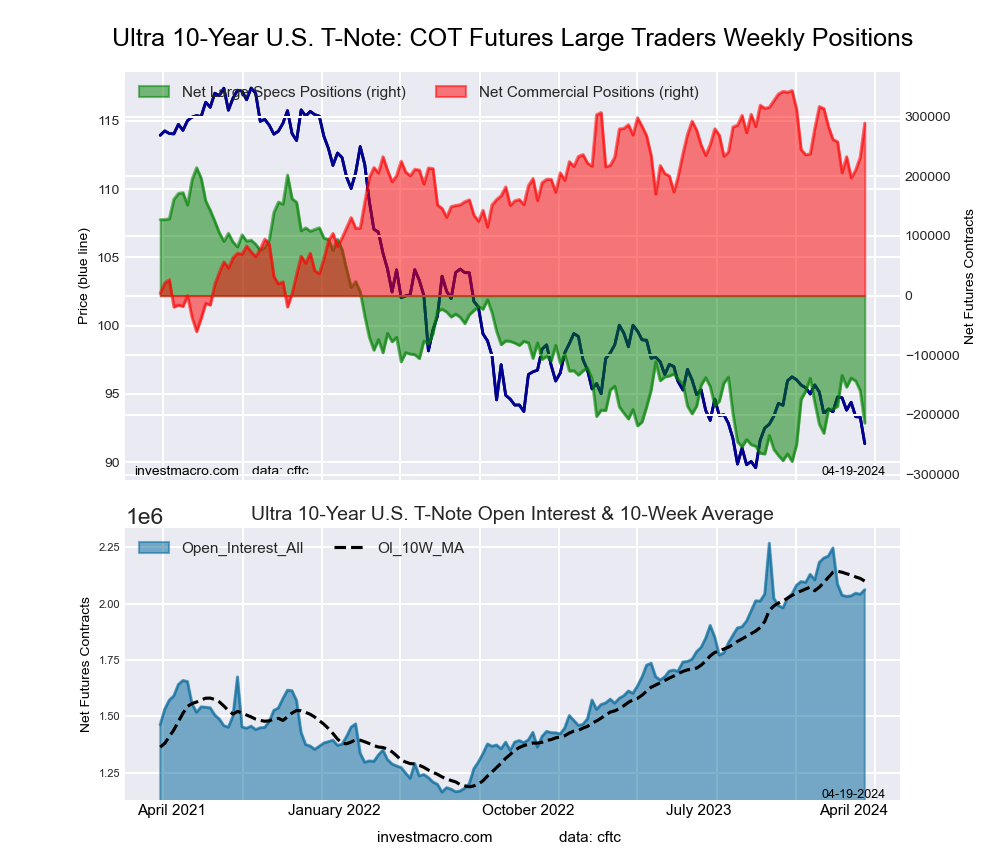
Ultra 10-Year Treasury Notes Bonds Futures COT ChartThe Ultra 10-Year Notes large speculator standing this week equaled a net position of -153,271 contracts in the data reported through Tuesday. This was a weekly decline of -19,601 contracts from the previous week which had a total of -133,670 net contracts.

This week’s current strength score (the trader positioning range over the past three years, measured from 0 to 100) shows the speculators are currently Bearish with a score of 24.3 percent. The commercials are Bullish with a score of 75.1 percent and the small traders (not shown in chart) are Bullish with a score of 66.6 percent.

Price Trend-Following Model: Weak Uptrend

Our weekly trend-following model classifies the current market price position as: Weak Uptrend. The current action for the model is considered to be: Hold – Maintain Long Position.

Ultra 10-Year Notes StatisticsSPECULATORSCOMMERCIALSSMALL TRADERS
– Percent of Open Interest Longs:14.573.710.0
– Percent of Open Interest Shorts:22.062.213.9
– Net Position:-153,271233,014-79,743
– Gross Longs:294,8091,497,187203,561
– Gross Shorts:448,0801,264,173283,304
– Long to Short Ratio:0.7 to 11.2 to 10.7 to 1
NET POSITION TREND:
– Strength Index Score (3 Year Range Pct):24.375.166.6
– Strength Index Reading (3 Year Range):BearishBullishBullish
NET POSITION MOVEMENT INDEX:
– 6-Week Change in Strength Index:12.2-18.912.8


US Treasury Bonds Futures:

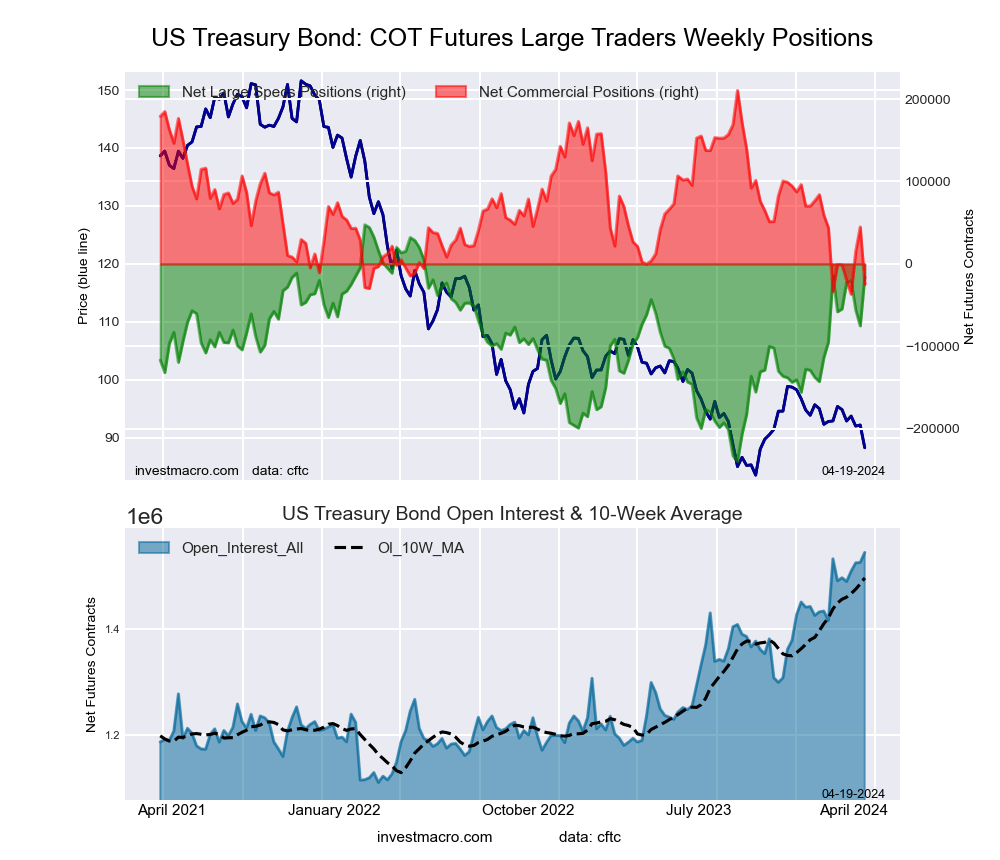
US Year Treasury Notes Long Bonds Futures COT ChartThe US Treasury Bonds large speculator standing this week equaled a net position of -22,454 contracts in the data reported through Tuesday. This was a weekly increase of 32,079 contracts from the previous week which had a total of -54,533 net contracts.

This week’s current strength score (the trader positioning range over the past three years, measured from 0 to 100) shows the speculators are currently Bullish with a score of 75.7 percent. The commercials are Bearish-Extreme with a score of 5.5 percent and the small traders (not shown in chart) are Bullish with a score of 79.3 percent.

Price Trend-Following Model: Weak Uptrend

Our weekly trend-following model classifies the current market price position as: Weak Uptrend. The current action for the model is considered to be: Hold – Maintain Long Position.

US Treasury Bonds StatisticsSPECULATORSCOMMERCIALSSMALL TRADERS
– Percent of Open Interest Longs:16.269.412.9
– Percent of Open Interest Shorts:17.770.710.0
– Net Position:-22,454-19,97142,425
– Gross Longs:242,0861,034,162191,844
– Gross Shorts:264,5401,054,133149,419
– Long to Short Ratio:0.9 to 11.0 to 11.3 to 1
NET POSITION TREND:
– Strength Index Score (3 Year Range Pct):75.75.579.3
– Strength Index Reading (3 Year Range):BullishBearish-ExtremeBullish
NET POSITION MOVEMENT INDEX:
– 6-Week Change in Strength Index:41.9-42.7-12.0


Ultra US Treasury Bonds Futures:

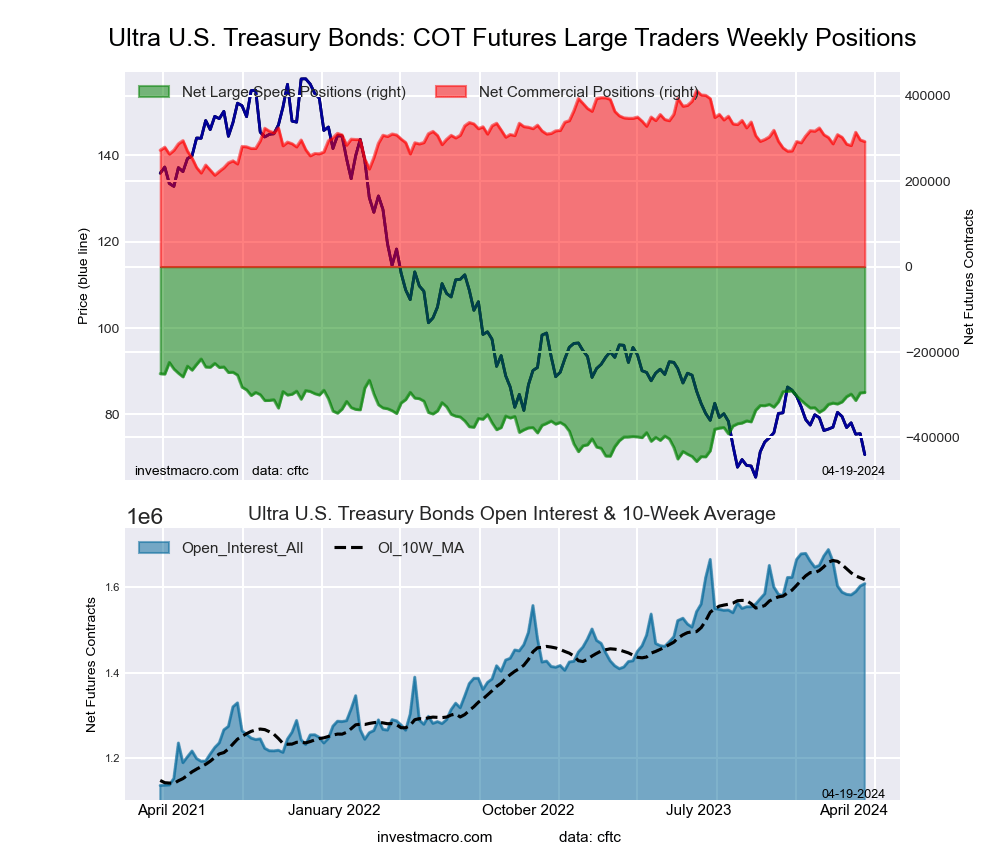
Ultra US Year Treasury Notes Long Bonds Futures COT ChartThe Ultra US Treasury Bonds large speculator standing this week equaled a net position of -304,714 contracts in the data reported through Tuesday. This was a weekly lift of 12,156 contracts from the previous week which had a total of -316,870 net contracts.

This week’s current strength score (the trader positioning range over the past three years, measured from 0 to 100) shows the speculators are currently Bullish with a score of 63.2 percent. The commercials are Bearish with a score of 36.7 percent and the small traders (not shown in chart) are Bullish with a score of 53.8 percent.

Price Trend-Following Model: Weak Uptrend

Our weekly trend-following model classifies the current market price position as: Weak Uptrend. The current action for the model is considered to be: Hold – Maintain Long Position.

Ultra US Treasury Bonds StatisticsSPECULATORSCOMMERCIALSSMALL TRADERS
– Percent of Open Interest Longs:8.879.811.1
– Percent of Open Interest Shorts:28.061.610.0
– Net Position:-304,714287,08117,633
– Gross Longs:139,2441,263,105175,999
– Gross Shorts:443,958976,024158,366
– Long to Short Ratio:0.3 to 11.3 to 11.1 to 1
NET POSITION TREND:
– Strength Index Score (3 Year Range Pct):63.236.753.8
– Strength Index Reading (3 Year Range):BullishBearishBullish
NET POSITION MOVEMENT INDEX:
– 6-Week Change in Strength Index:15.2-19.01.2


Article By InvestMacroReceive our weekly COT Newsletter

*COT Report: The COT data, released weekly to the public each Friday, is updated through the most recent Tuesday (data is 3 days old) and shows a quick view of how large speculators or non-commercials (for-profit traders) were positioned in the futures markets.

The CFTC categorizes trader positions according to commercial hedgers (traders who use futures contracts for hedging as part of the business), non-commercials (large traders who speculate to realize trading profits) and nonreportable traders (usually small traders/speculators) as well as their open interest (contracts open in the market at time of reporting). See CFTC criteria here.