COT Stock Market Charts: Speculator bets led by S&P500 & VIX

By InvestMacro

Here are the latest charts and statistics for the Commitment of Traders (COT) data published by the Commodities Futures Trading Commission (CFTC).

The latest COT data is updated through Tuesday May 28th and shows a quick view of how large traders (for-profit speculators and commercial entities) were positioned in the futures markets.

Weekly Speculator Changes led by S&P500 & VIX

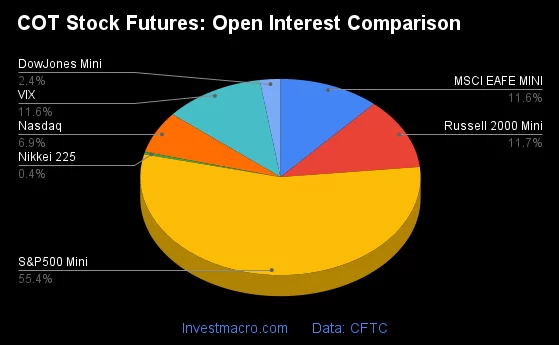
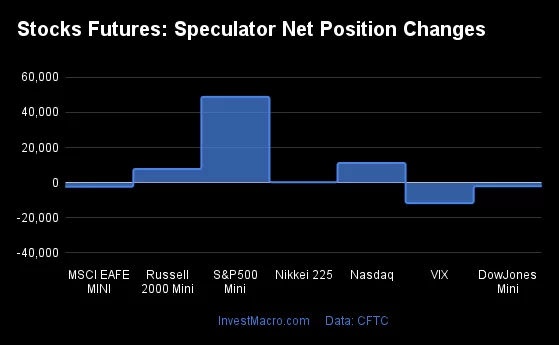
The COT stock markets speculator bets were higher this week as five out of the seven stock markets we cover had higher positioning while the other two markets had lower speculator contracts.

Leading the gains for the stock markets was with the S&P500-Mini (20,566 contracts), the VIX (8,648 contracts), the MSCI EAFE-Mini (5,188 contracts), the Russell-Mini (3,739 contracts) and the Nikkei 225 (609 contracts) also showing a positive week.

The markets with the declines in speculator bets this week were the Nasdaq-Mini (-8,444 contracts) with the DowJones-Mini (-6,965 contracts) also registering lower bets on the week.


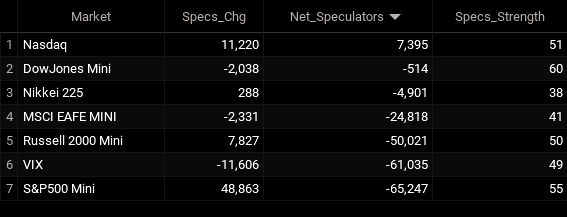
Stock Market Net Speculators Leaderboard

Legend: Weekly Speculators Change | Speculators Current Net Position | Speculators Strength Score compared to last 3-Years (0-100 range)


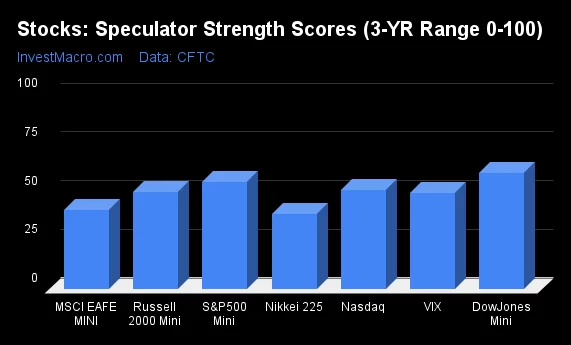
Strength Scores led by DowJones-Mini

COT Strength Scores (a normalized measure of Speculator positions over a 3-Year range, from 0 to 100 where above 80 is Extreme-Bullish and below 20 is Extreme-Bearish) showed that the DowJones-Mini (82 percent) leads the stock markets this week. The VIX (69 percent) and Nikkei 225 (66 percent) came in as the next highest in the weekly strength scores.

On the downside, the Nasdaq-Mini (33 percent) comes in at the lowest strength level currently while the next lowest strength score is the MSCI EAFE-Mini (41 percent).

Strength Statistics:
VIX (68.9 percent) vs VIX previous week (59.5 percent)
S&P500-Mini (64.4 percent) vs S&P500-Mini previous week (61.3 percent)
DowJones-Mini (81.7 percent) vs DowJones-Mini previous week (93.0 percent)
Nasdaq-Mini (33.4 percent) vs Nasdaq-Mini previous week (46.5 percent)
Russell2000-Mini (61.1 percent) vs Russell2000-Mini previous week (58.4 percent)
Nikkei USD (66.2 percent) vs Nikkei USD previous week (61.0 percent)
EAFE-Mini (41.2 percent) vs EAFE-Mini previous week (35.8 percent)


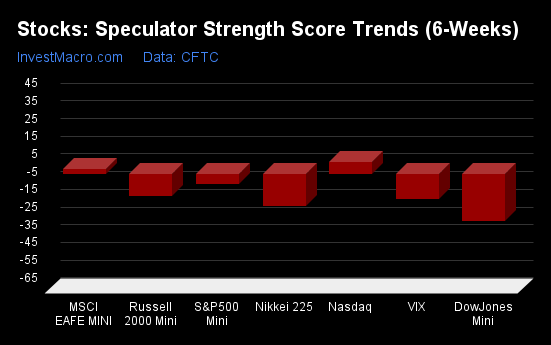
Russell-Mini top the 6-Week Strength Trends

COT Strength Score Trends (or move index, calculates the 6-week changes in strength scores) showed that the Russell-Mini (3 percent) leads the past six weeks trends for the stock markets.

The VIX (-22 percent) leads the downside trend scores currently with the MSCI EAFE-Mini (-19 percent) coming in as the next market with lower trend scores.

Strength Trend Statistics:
VIX (-21.9 percent) vs VIX previous week (-21.7 percent)
S&P500-Mini (-11.4 percent) vs S&P500-Mini previous week (6.0 percent)
DowJones-Mini (-0.9 percent) vs DowJones-Mini previous week (5.1 percent)
Nasdaq-Mini (-19.0 percent) vs Nasdaq-Mini previous week (-4.4 percent)
Russell2000-Mini (3.3 percent) vs Russell2000-Mini previous week (-7.1 percent)
Nikkei USD (-6.7 percent) vs Nikkei USD previous week (-2.8 percent)
EAFE-Mini (-19.4 percent) vs EAFE-Mini previous week (-20.1 percent)


Individual Stock Market Charts:

VIX Volatility Futures:

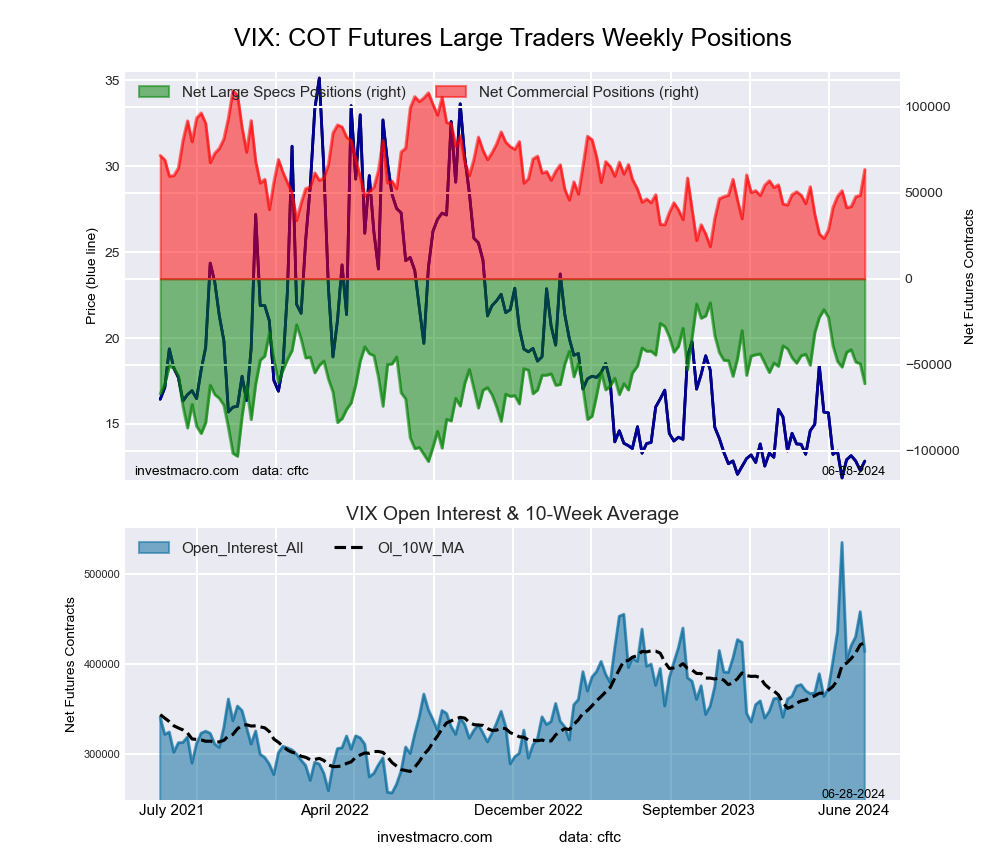
VIX Volatility Futures COT ChartThe VIX Volatility large speculator standing this week reached a net position of -42,744 contracts in the data reported through Tuesday. This was a weekly lift of 8,648 contracts from the previous week which had a total of -51,392 net contracts.

This week’s current strength score (the trader positioning range over the past three years, measured from 0 to 100) shows the speculators are currently Bullish with a score of 68.9 percent. The commercials are Bearish with a score of 25.0 percent and the small traders (not shown in chart) are Bullish-Extreme with a score of 100.0 percent.

Price Trend-Following Model: Strong Uptrend

Our weekly trend-following model classifies the current market price position as: Strong Uptrend. The current action for the model is considered to be: Hold – Maintain Long Position.

VIX Volatility Futures StatisticsSPECULATORSCOMMERCIALSSMALL TRADERS
– Percent of Open Interest Longs:20.540.87.5
– Percent of Open Interest Shorts:31.030.57.1
– Net Position:-42,74441,3981,346
– Gross Longs:82,966165,14330,267
– Gross Shorts:125,710123,74528,921
– Long to Short Ratio:0.7 to 11.3 to 11.0 to 1
NET POSITION TREND:
– Strength Index Score (3 Year Range Pct):68.925.0100.0
– Strength Index Reading (3 Year Range):BullishBearishBullish-Extreme
NET POSITION MOVEMENT INDEX:
– 6-Week Change in Strength Index:-21.916.824.6


S&P500 Mini Futures:

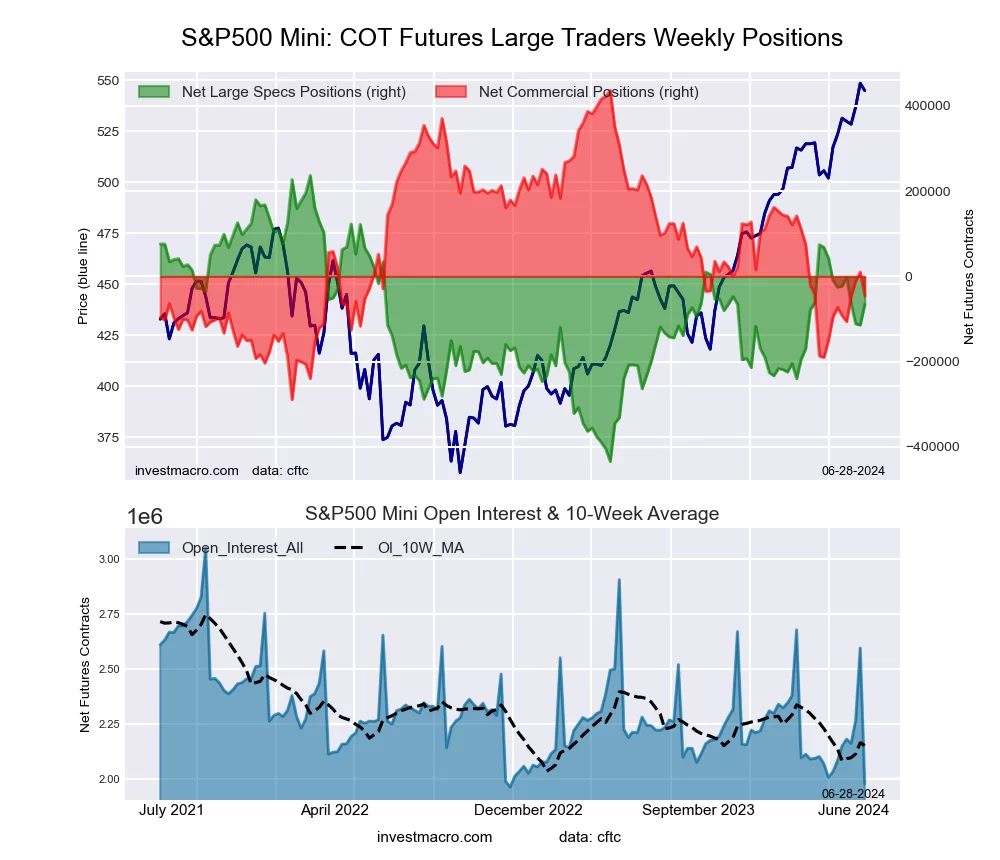
SP500 Mini Futures COT ChartThe S&P500 Mini large speculator standing this week reached a net position of -2,208 contracts in the data reported through Tuesday. This was a weekly advance of 20,566 contracts from the previous week which had a total of -22,774 net contracts.

This week’s current strength score (the trader positioning range over the past three years, measured from 0 to 100) shows the speculators are currently Bullish with a score of 64.4 percent. The commercials are Bearish with a score of 25.3 percent and the small traders (not shown in chart) are Bullish-Extreme with a score of 80.0 percent.

Price Trend-Following Model: Uptrend

Our weekly trend-following model classifies the current market price position as: Uptrend. The current action for the model is considered to be: Hold – Maintain Long Position.

S&P500 Mini Futures StatisticsSPECULATORSCOMMERCIALSSMALL TRADERS
– Percent of Open Interest Longs:15.269.013.3
– Percent of Open Interest Shorts:15.373.88.3
– Net Position:-2,208-105,944108,152
– Gross Longs:330,9371,503,708289,071
– Gross Shorts:333,1451,609,652180,919
– Long to Short Ratio:1.0 to 10.9 to 11.6 to 1
NET POSITION TREND:
– Strength Index Score (3 Year Range Pct):64.425.380.0
– Strength Index Reading (3 Year Range):BullishBearishBullish-Extreme
NET POSITION MOVEMENT INDEX:
– 6-Week Change in Strength Index:-11.411.1-1.6


Dow Jones Mini Futures:

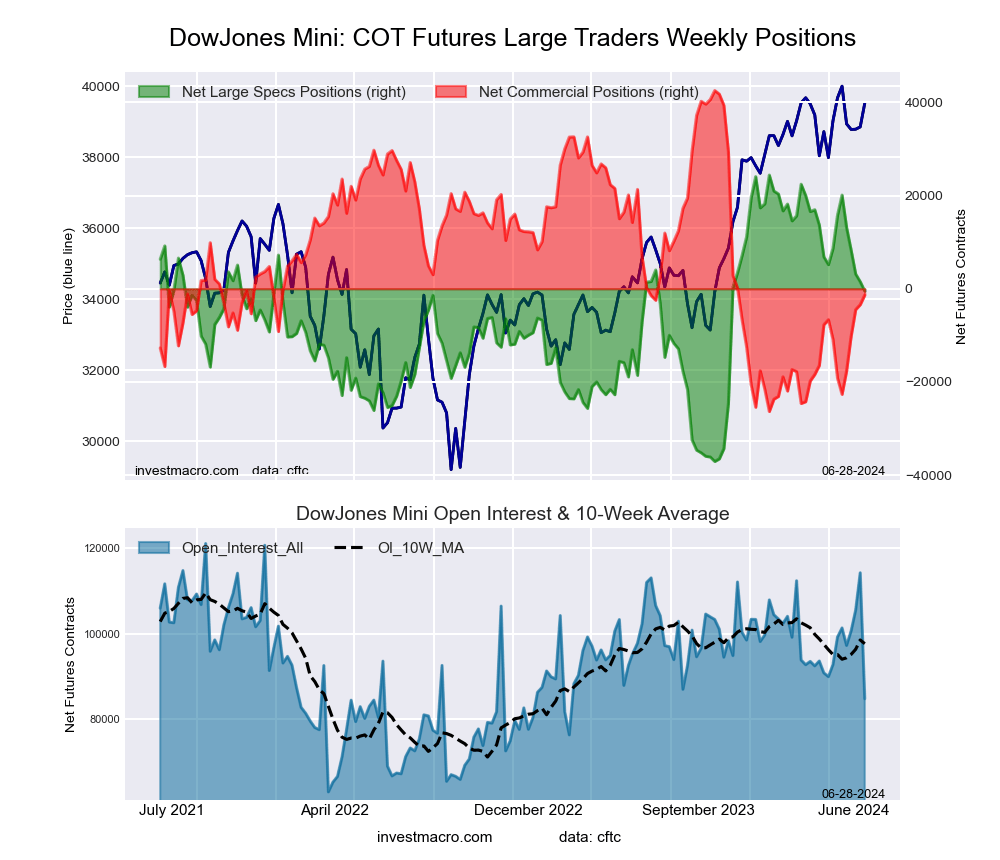
Dow Jones Mini Futures COT ChartThe Dow Jones Mini large speculator standing this week reached a net position of 13,144 contracts in the data reported through Tuesday. This was a weekly decrease of -6,965 contracts from the previous week which had a total of 20,109 net contracts.

This week’s current strength score (the trader positioning range over the past three years, measured from 0 to 100) shows the speculators are currently Bullish-Extreme with a score of 81.7 percent. The commercials are Bearish-Extreme with a score of 12.6 percent and the small traders (not shown in chart) are Bullish with a score of 65.9 percent.

Price Trend-Following Model: Weak Uptrend

Our weekly trend-following model classifies the current market price position as: Weak Uptrend. The current action for the model is considered to be: Hold – Maintain Long Position.

Dow Jones Mini Futures StatisticsSPECULATORSCOMMERCIALSSMALL TRADERS
– Percent of Open Interest Longs:22.954.915.9
– Percent of Open Interest Shorts:9.473.111.3
– Net Position:13,144-17,6544,510
– Gross Longs:22,28553,40115,471
– Gross Shorts:9,14171,05510,961
– Long to Short Ratio:2.4 to 10.8 to 11.4 to 1
NET POSITION TREND:
– Strength Index Score (3 Year Range Pct):81.712.665.9
– Strength Index Reading (3 Year Range):Bullish-ExtremeBearish-ExtremeBullish
NET POSITION MOVEMENT INDEX:
– 6-Week Change in Strength Index:-0.9-1.78.4


Nasdaq Mini Futures:

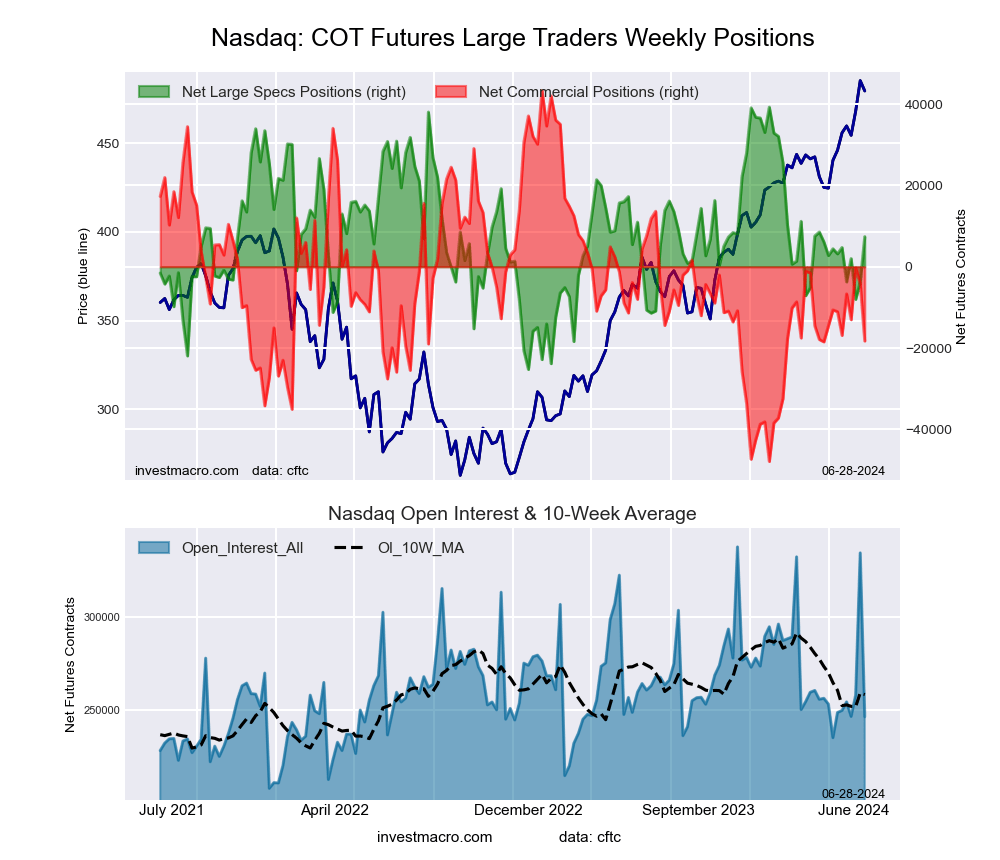
Nasdaq Mini Futures COT ChartThe Nasdaq Mini large speculator standing this week reached a net position of -3,726 contracts in the data reported through Tuesday. This was a weekly lowering of -8,444 contracts from the previous week which had a total of 4,718 net contracts.

This week’s current strength score (the trader positioning range over the past three years, measured from 0 to 100) shows the speculators are currently Bearish with a score of 33.4 percent. The commercials are Bearish with a score of 45.2 percent and the small traders (not shown in chart) are Bullish-Extreme with a score of 95.3 percent.

Price Trend-Following Model: Uptrend

Our weekly trend-following model classifies the current market price position as: Uptrend. The current action for the model is considered to be: Hold – Maintain Long Position.

Nasdaq Mini Futures StatisticsSPECULATORSCOMMERCIALSSMALL TRADERS
– Percent of Open Interest Longs:26.954.417.3
– Percent of Open Interest Shorts:28.457.013.2
– Net Position:-3,726-6,68310,409
– Gross Longs:68,402138,38743,934
– Gross Shorts:72,128145,07033,525
– Long to Short Ratio:0.9 to 11.0 to 11.3 to 1
NET POSITION TREND:
– Strength Index Score (3 Year Range Pct):33.445.295.3
– Strength Index Reading (3 Year Range):BearishBearishBullish-Extreme
NET POSITION MOVEMENT INDEX:
– 6-Week Change in Strength Index:-19.012.32.6


Russell 2000 Mini Futures:

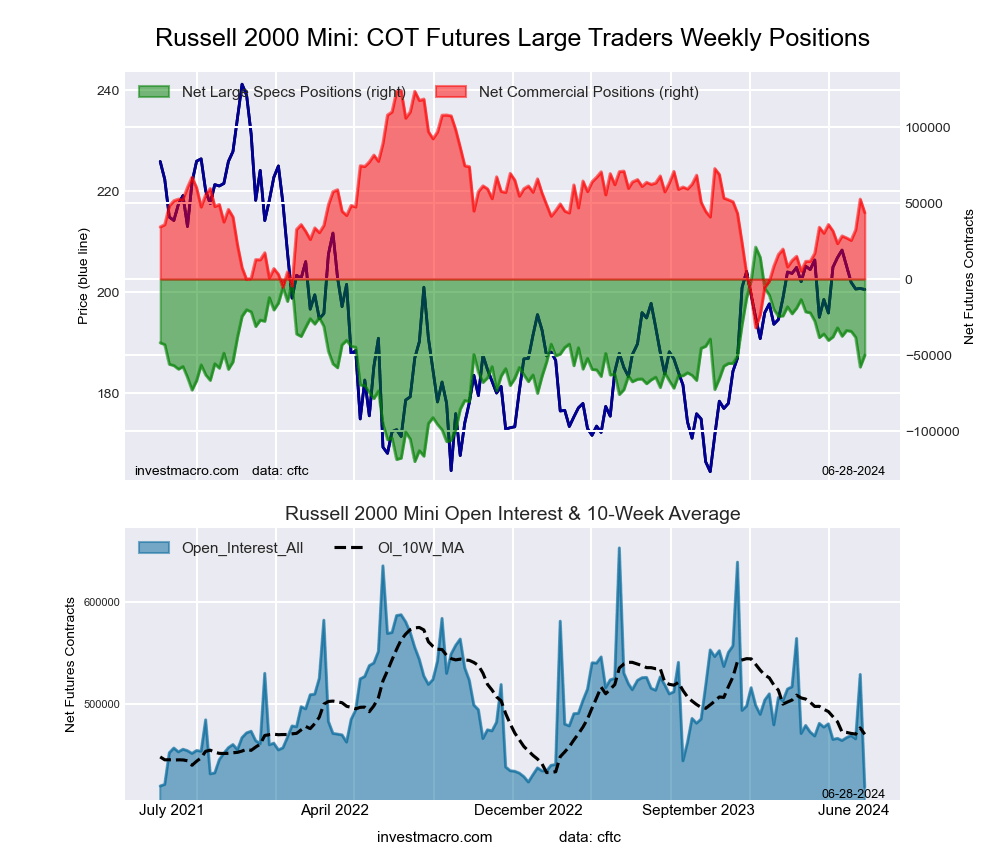
Russell 2000 Mini Futures COT ChartThe Russell 2000 Mini large speculator standing this week reached a net position of -33,845 contracts in the data reported through Tuesday. This was a weekly advance of 3,739 contracts from the previous week which had a total of -37,584 net contracts.

This week’s current strength score (the trader positioning range over the past three years, measured from 0 to 100) shows the speculators are currently Bullish with a score of 61.1 percent. The commercials are Bearish with a score of 37.8 percent and the small traders (not shown in chart) are Bullish with a score of 51.9 percent.

Price Trend-Following Model: Uptrend

Our weekly trend-following model classifies the current market price position as: Uptrend. The current action for the model is considered to be: Hold – Maintain Long Position.

Russell 2000 Mini Futures StatisticsSPECULATORSCOMMERCIALSSMALL TRADERS
– Percent of Open Interest Longs:17.773.55.9
– Percent of Open Interest Shorts:25.067.74.5
– Net Position:-33,84527,0366,809
– Gross Longs:82,901343,51427,628
– Gross Shorts:116,746316,47820,819
– Long to Short Ratio:0.7 to 11.1 to 11.3 to 1
NET POSITION TREND:
– Strength Index Score (3 Year Range Pct):61.137.851.9
– Strength Index Reading (3 Year Range):BullishBearishBullish
NET POSITION MOVEMENT INDEX:
– 6-Week Change in Strength Index:3.3-4.58.2


Nikkei Stock Average (USD) Futures:

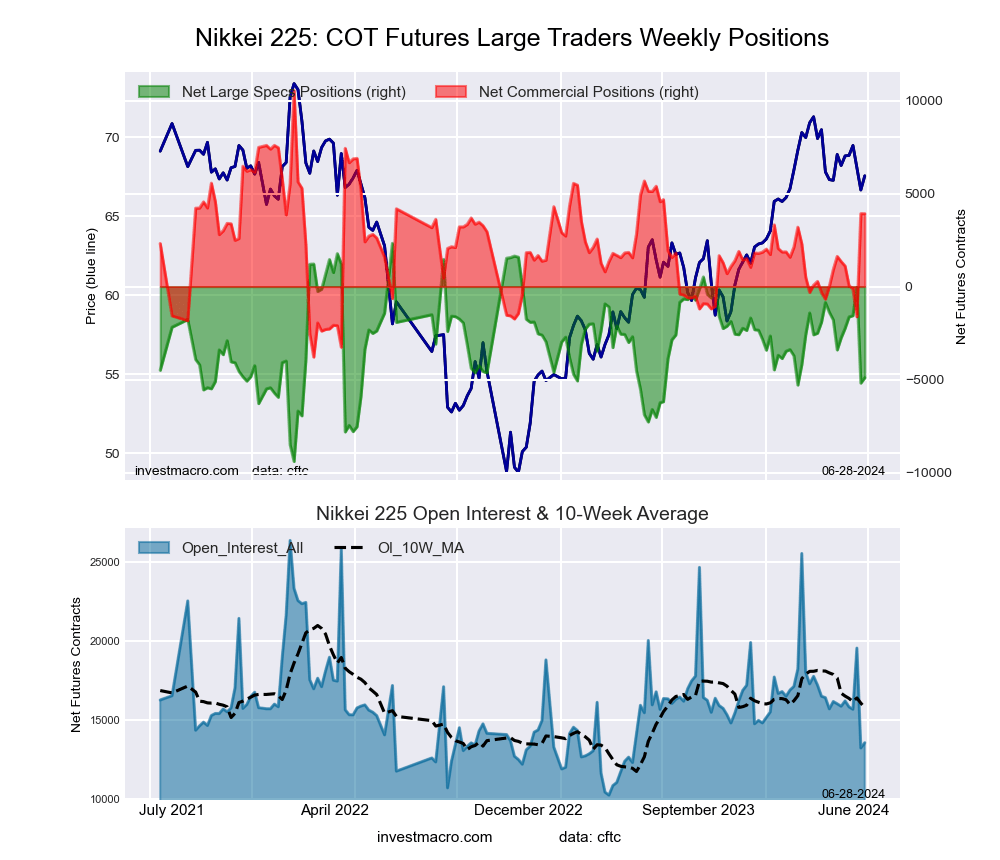
Nikkei Stock Average (USD) Futures COT ChartThe Nikkei Stock Average (USD) large speculator standing this week reached a net position of -1,636 contracts in the data reported through Tuesday. This was a weekly gain of 609 contracts from the previous week which had a total of -2,245 net contracts.

This week’s current strength score (the trader positioning range over the past three years, measured from 0 to 100) shows the speculators are currently Bullish with a score of 66.2 percent. The commercials are Bearish with a score of 26.8 percent and the small traders (not shown in chart) are Bullish with a score of 63.9 percent.

Price Trend-Following Model: Uptrend

Our weekly trend-following model classifies the current market price position as: Uptrend. The current action for the model is considered to be: Hold – Maintain Long Position.

Nikkei Stock Average Futures StatisticsSPECULATORSCOMMERCIALSSMALL TRADERS
– Percent of Open Interest Longs:11.561.525.5
– Percent of Open Interest Shorts:21.961.215.5
– Net Position:-1,636491,587
– Gross Longs:1,8239,7394,033
– Gross Shorts:3,4599,6902,446
– Long to Short Ratio:0.5 to 11.0 to 11.6 to 1
NET POSITION TREND:
– Strength Index Score (3 Year Range Pct):66.226.863.9
– Strength Index Reading (3 Year Range):BullishBearishBullish
NET POSITION MOVEMENT INDEX:
– 6-Week Change in Strength Index:-6.75.10.9


MSCI EAFE Mini Futures:

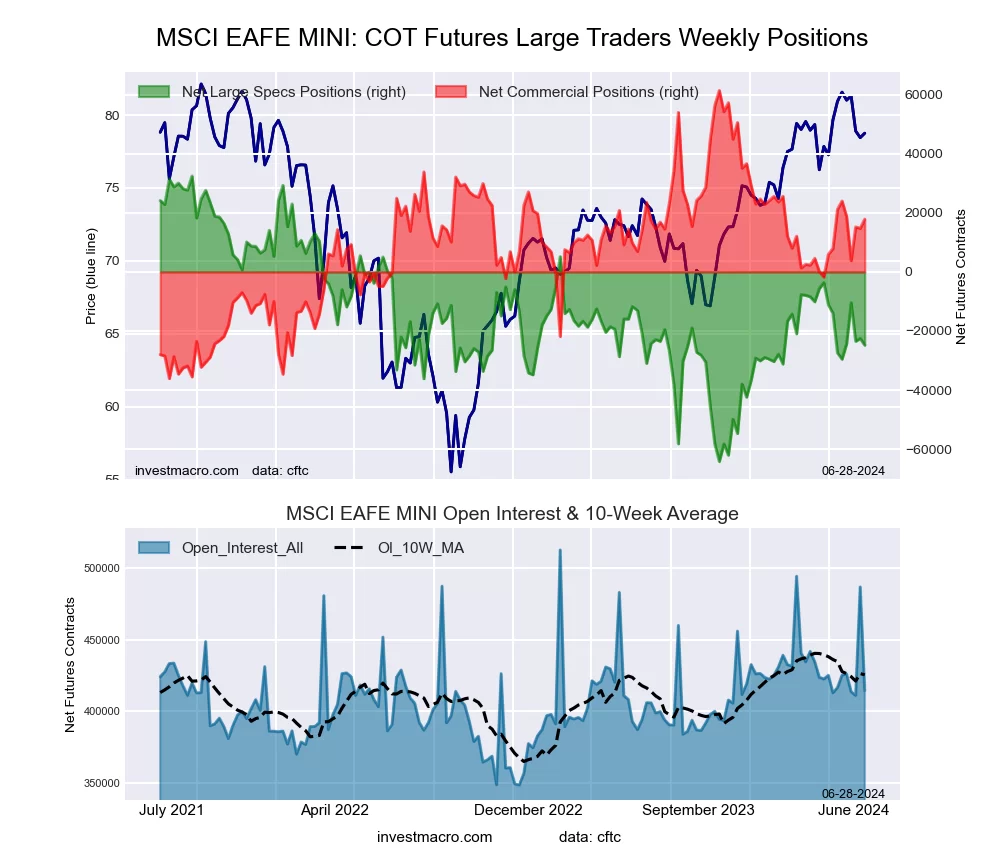
MSCI EAFE Mini Futures COT ChartThe MSCI EAFE Mini large speculator standing this week reached a net position of -24,369 contracts in the data reported through Tuesday. This was a weekly gain of 5,188 contracts from the previous week which had a total of -29,557 net contracts.

This week’s current strength score (the trader positioning range over the past three years, measured from 0 to 100) shows the speculators are currently Bearish with a score of 41.2 percent. The commercials are Bullish with a score of 56.3 percent and the small traders (not shown in chart) are Bearish with a score of 45.1 percent.

Price Trend-Following Model: Uptrend

Our weekly trend-following model classifies the current market price position as: Uptrend. The current action for the model is considered to be: Hold – Maintain Long Position.

MSCI EAFE Mini Futures StatisticsSPECULATORSCOMMERCIALSSMALL TRADERS
– Percent of Open Interest Longs:7.089.62.9
– Percent of Open Interest Shorts:12.785.21.6
– Net Position:-24,36918,7425,627
– Gross Longs:29,861381,75612,467
– Gross Shorts:54,230363,0146,840
– Long to Short Ratio:0.6 to 11.1 to 11.8 to 1
NET POSITION TREND:
– Strength Index Score (3 Year Range Pct):41.256.345.1
– Strength Index Reading (3 Year Range):BearishBullishBearish
NET POSITION MOVEMENT INDEX:
– 6-Week Change in Strength Index:-19.419.10.5


Article By InvestMacroReceive our weekly COT Newsletter

*COT Report: The COT data, released weekly to the public each Friday, is updated through the most recent Tuesday (data is 3 days old) and shows a quick view of how large speculators or non-commercials (for-profit traders) were positioned in the futures markets.

The CFTC categorizes trader positions according to commercial hedgers (traders who use futures contracts for hedging as part of the business), non-commercials (large traders who speculate to realize trading profits) and nonreportable traders (usually small traders/speculators) as well as their open interest (contracts open in the market at time of reporting). See CFTC criteria here.

What New York City’s Art Auctions Tell You About the Stock Market — and Social Mood

By Peter Kendall | Chief Analyst for U.S. Markets and Cultural Trends

The fall and spring auctions in New York City are the art market’s bellwether sales events. And according to The New York Times, the results from the City’s spring art auction season “tell a story of a masterpiece market come down to earth.” The article notes that the spring sales at Christie’s, Sotheby’s and Phillips delivered $1.4 billion — a 22 percent decrease from total earnings of $1.8 billion in 2023.

While auction experts called it a “respectable finish,” the general art market nervousness is a bad sign for the next major auction season in November. It’s “a momentum-based market,” said one expert about the art industry. “There can be a little bit of a herd mentality.”

We agree wholeheartedly, save for the “a little bit” part. The art scene, like any speculative, freely-traded market, is very much driven by herd mentality. And as such, it often closely tracks the stock market, because both are driven — higher or lower — by waves of social mood. Positive social mood impels demand for fine art and stocks, whereas negative social mood decreases demand.

Signs of weakness in the art market were apparent before this spring auction season. The message of last November’s bidding was decidedly mixed. “While the figures from the fortnight of sales looked impressive, there were still several significant indicators of an art market in flux,” reported Artsy.com. “Each auction house held a sale that cumulatively fell beneath their low estimates,” and there were lots of withdrawals. Sotheby’s modern evening sale, for instance, was reduced to 33 lots from an original 40.

Pablo Picasso

“A notable clutch of works by blue chip artists failed to achieve their low estimates. Works by Jeff Koons, Andy Warhol, Pablo Picasso, and Salvador Dali all hammered below their low targets.”

“Despite a Sagging Art Market,” The New York Times reported that this Picasso from August 1932 did bring a winning bid of $139.4 million, the highest price paid for a work of art in 2023.

“The sale of ‘Femme a’ la montre’ not only cements its status as a masterpiece, but also underscores the enduring fascination and value of Picasso’s work.”

Interestingly, Picasso started the painting at the bottom of a massive decline in the Dow Jones Industrial Average and the start of a multi-decade rally.

With the painting’s record price aligning closely with what we believe is the end of a long upward wave in the stock market, we suspect that the sale will mark a peak for Picasso and many other artists and artworks of “enduring fascination.” The fascination should yield to bafflement at the artistry as well as the prices that were paid for it.

Follow along via our free EWI newsletter and I’ll send you occasional updates like this.

This article was syndicated by Elliott Wave International and was originally published under the headline What New York City’s Art Auctions Tell You About the Stock Market — and Social Mood. EWI is the world’s largest market forecasting firm. Its staff of full-time analysts led by Chartered Market Technician Robert Prechter provides 24-hour-a-day market analysis to institutional and private investors around the world.

Week Ahead: Brent waits on OPEC+ meeting

By ForexTime 

  • Brent ↑ 6% year-to-date
  • Headed for biggest monthly ↓ in 2024
  • OPEC+ decision, EIA data & NFP in focus
  • Over past year NFP triggered moves of 1% ↑ or
  • Technical levels – $84.50 & $81.00

Key central bank decisions and top-tier economic data could rock markets in the week ahead:

Sunday, 2nd June

  • OIL: OPEC+ virtual meeting

Monday, 3rd June

  • CN50: China Caixin manufacturing PMI
  • EU50: Eurozone/Germany manufacturing PMI
  • JPY: Japan capital spending
  • UK100: UK manufacturing PMI
  • US500: ISM manufacturing

Tuesday, 4th June

  • GER40: Germany unemployment
  • ZAR: South Africa GDP
  • RUS2000: US factory orders, JOLTS

Wednesday, 5th June

  • CN50: China Caixin services PMI
  • AU200: Australia GDP
  • EU50: Eurozone services PMI, PPI
  • CAD: Canada rate decision
  • US30: US ISM services
  • OIL: EIA weekly report

Thursday, 6th June  

  • AU200: Australia trade balance
  • EUR: ECB rate decision, retail sales
  • GER40: Germany factory orders
  • TWN: Taiwan CPI

Friday, 7th June

  • CNH: China trade, forex reserves
  • CAD: Canada unemployment
  • EU50: Eurozone GDP (final), Germany industrial production
  • TWN: Taiwan trade
  • USDInd: US May nonfarm payrolls (NFP)

The spotlight shines on oil benchmarks thanks to the OPEC+ decision over the weekend.

Brent has shed almost 5% this month but is still up roughly 6% since the start of 2024.

In the first quarter of 2024, oil prices were initially supported by geopolitical risks and hopes around OPEC+ supply cuts tightening global markets. But gains have been capped in Q2 amid uncertainty over China’s demand and rising US crude inventories.

Still, oil benchmarks could kick off the first week of June with a bang! Here are 4 reasons why:

    1) OPEC+ virtual meeting.

Over the weekend, OPEC+ is expected to extend current production cuts – possibly to the end of this year.

Considering that the cartel accounts for roughly 40% of total global oil supply, any decisions are likely to impact oil prices.

Note: Back in November 2023, OPEC+ agreed to voluntarily cut production by 2.2 million barrels per day through the first quarter of 2024. In March, these were extended through the end of June 2024.

  • Oil prices could respond positively if the cartel extends production cuts.
  • Any surprises in the form of deeper cuts may trigger a stronger bullish reaction.
  • If OPEC+ fails to extend production cuts, this could send oil prices lower.


    2) US Energy Information Agency (EIA) report

With the spotlight on oil markets, attention will be directed toward the next EIA report published on Wednesday 5th June.

Interestingly, crude oil inventories decreased by 4.2 million barrels in the week ended May 24. However, US oil stockpiles have been climbing since the final quarter of 2023.

  • A decline in US crude inventories could spark optimism around demand, pushing the global commodity higher as a result.
  • Oil prices may slip if a build in US crude inventories hits the demand outlook.

Fun fact: Over the past year, the US EIA report has triggered upside moves of as much as 0.9% or declines of 1.3% in the 6 hours post-release.


    3) US May nonfarm payrolls (NFP)

The US economy is expected to have created 180k jobs in May, while the unemployment rate to remain steady at 3.9%.

Considering how the NFP directly impacts interest rate expectations, it could influence oil prices.

Note: Lower interest rates could stimulate economic growth, translating to increased demand for oil. This may also weaken the dollar – supporting oil which is priced in dollars.

  • A solid jobs report that supports the case for “higher for longer rates” could send oil lower.
  • Oil could jump if a disappointing report weakens the dollar and fuels rate cut bets.

Fun fact: Over the past 12 months, the US jobs report has sparked upside moves of as much as 1% or declines of 1% in the 6 hours post-release.


    4) Technical forces

Brent is trapped within a range on the daily charts with support at $81.00 and resistance at $84.50. However, prices are trading below the 50, 100 and 200-day SMA while the MACD trades below zero.

  • A solid breakdown below $81.00 may open a path toward $80.00 and $77.50.
  • Should prices push back the 100-day SMA, this could open a path toward $84.50. and the 50-day SMA.

Note: Oil prices may be influenced by the incoming US PCE data later today.


Forex-Time-LogoArticle by ForexTime

ForexTime Ltd (FXTM) is an award winning international online forex broker regulated by CySEC 185/12 www.forextime.com

Investors’ focus today is on the PCE Price Index data. Conditions for inflation growth are forming in Japan

By JustMarkets

At the end of Thursday, the Dow Jones Index (US30) decreased by 0.86%. The S&P 500 Index (US500) is down 0.60%. The NASDAQ Technology Index (US100) closed negative 1.08%. Meanwhile, the S&P 500 (US500) fell to a 2-week low, the Dow Jones (US30) fell to a 4-week low, and the NASDAQ (US100) fell to a 1-week low. Stocks came under pressure due to concerns that the Federal Reserve will keep interest rates on hold longer, leading to a decline in risk sentiment in asset markets. The US weekly initial jobless claims rose by 3,000 to 219,000, indicating a slightly weaker labor market than expected at 217,000. The US Q1 GDP was revised downward to 1.3% (q/q annualized) from 1.6%, which aligned with expectations. Today, markets await Friday’s PCE deflator data for April, the Fed’s preferred inflation gauge, for clues on when the Fed might start cutting interest rates. The core PCE deflator for April is expected to be unchanged from March at 2.8% y/y.

Salesforce (CRM) is down more than 19%. It tops the list of losers in the S&P 500 and Dow Jones Industrials after reporting first-quarter revenue of $9.13 billion, below the consensus of $9.15 billion, and estimating 2025 revenue of $37.7 billion to $38.0 billion, weaker than the consensus of $38.01 billion. Nvidia (NVDA) closed down more than 3% after Bloomberg reported that the US is slowing licenses to chipmakers for large-scale shipments of artificial intelligence gas pedals to the Middle East. At the same time, officials conduct a national security review of AI development in the region. HP Inc (HPQ) stock price rose more than 16% and topped the list of top gainers in the S&P 500 after the company reported second-quarter net revenue of $12.80 billion, beating the consensus prognosis of $12.60 billion. Shares of PayPal Holdings (PYPL) rose more than 2% and topped the Nasdaq 100 leaderboard after Mizuho Securities upgraded the stock to “buy” from “neutral” with a $90 price target.

Equity markets in Europe mostly went up yesterday. Germany’s DAX (DE40) rose by 0.13%, France’s CAC 40 (FR40) closed up 0.55%, Spain’s IBEX 35 (ES35) gained 1.73%, and the UK’s FTSE 100 (UK100) closed positive 0.59%.

The Eurozone unemployment rate for April unexpectedly fell by 0.1 to a record low of 6.4%, indicating a stronger labor market than expectations of no change at 6.5%. Spain’s May CPI (EU harmonized) rose to 3.8% y/y, exceeding expectations of 3.7% y/y and the largest increase in 13 months. May Eurozone economic confidence rose by 0.4 to 96.0, slightly weaker than expectations of 96.1. Strong Eurozone economic data, along with rising inflationary pressures, may force the ECB to become more hawkish after the first rate cut in June.

WTI crude futures fell to $77.5 a barrel on Friday, declining for the third consecutive session, as uncertainty over demand weighs on oil markets. Revised data on Thursday showed the US economy grew at an annualized rate of 1.3% in the first quarter, down from preliminary estimates of 1.6%. A Federal Reserve official also said she remained concerned about upside risks to inflation and urged caution in policy adjustments, another blow to hopes of lower US interest rates. Meanwhile, EIA data showed that US crude oil inventories fell by 4.2 million barrels last week, compared with expectations of a 1.9 million barrel decline. Investors now await the OPEC+ meeting on Sunday, which is expected to extend supply cuts through 2025.

Asian markets were mostly down on Monday. Japan’s Nikkei 225 (JP225) was down 1.30% for the day, China’s FTSE China A50 (CHA50) lost 0.88%, Hong Kong’s Hang Seng (HK50) decreased by 1.34%, and Australia’s ASX 200 (AU200) was negative 0.49%.

The offshore yuan stabilized at 7.25 per dollar after falling to its lowest level in more than a month in the previous session, reacting to weaker-than-expected Chinese PMI data and recent developments in the US. The latest data showed that China’s manufacturing activity unexpectedly fell to 49.5 in May 2024 from April’s 50.4, falling short of the market’s prognosis of 50.5. The contraction, the first since February, raised concerns about the health of China’s economy and prompted new stimulus measures.

Retail sales in Japan rose by 2.4% year-on-year in April 2024, accelerating after a downwardly revised 1.1% increase in the previous month, which was the lowest in two years. The data exceeded market estimates of 1.9%, marking the 26th consecutive month of retail sales growth. Preliminary data showed that Japan’s industrial production fell by 0.1% month-on-month in April 2024, missing market prognoses for a 0.9% rise and bouncing back from a 4.4% increase, the sharpest increase since June 2022. Japan’s unemployment rate stood at 2.6% in April 2024, unchanged for the third month and in line with market estimates. It is the highest unemployment rate since September last year. The core Consumer Price Index in Tokyo, Japan, rose to 1.9% year-on-year in May 2024, accelerating from a two-year low of 1.6% in April, which aligns with expectations. The Tokyo inflation data is a leading indicator of price developments across the country, as national CPI data will be released in about three weeks.

S&P 500 (US500) 5,235.48 −31.47 (−0.60%)

Dow Jones (US30) 38,111.48 −330.06 (−0.86%)

DAX (DE40) 18,496.79 +23.50 (+0.13%)

FTSE 100 (UK100) 8,231.05 +47.98 (+0.59%)

USD Index 104.75 +0.14 (+0.13%)

Important events today:
  • – Japan Tokyo Core CPI (m/m) at 02:30 (GMT+3);
  • – Japan Unemployment Rate (m/m) at 02:30 (GMT+3);
  • – Japan Retail Sales (m/m) at 02:50 (GMT+3);
  • – Japan Industrial Production (m/m) at 02:50 (GMT+3);
  • – China Manufacturing PMI (m/m) at 04:30 (GMT+3);
  • – China non-Manufacturing PMI (m/m) at 04:30 (GMT+3);
  • – New Zealand Annual Budget Release at 05:00 (GMT+3);
  • – German Retail Sales (m/m) at 09:00 (GMT+3);
  • – Switzerland Retail Sales (m/m) at 09:30 (GMT+3);
  • – Eurozone Consumer Price Index (m/m) at 12:00 (GMT+3);
  • – US Core PCE Index (m/m) at 15:30 (GMT+3);
  • – Canada GDP (m/m) at 15:30 (GMT+3);
  • – US Chicago PMI (m/m) at 16:45 (GMT+3).

By JustMarkets


This article reflects a personal opinion and should not be interpreted as an investment advice, and/or offer, and/or a persistent request for carrying out financial transactions, and/or a guarantee, and/or a forecast of future events.

New Zealand Dollar gains for second day against US Dollar

By RoboForex Analytical Department

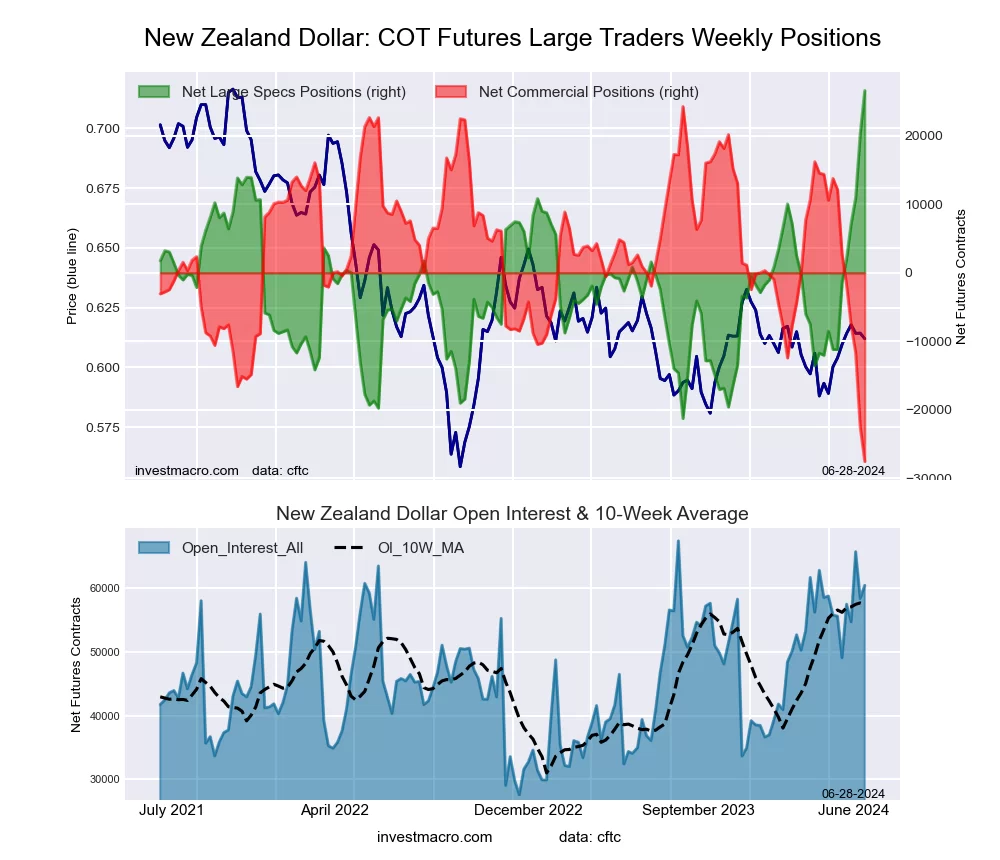
The New Zealand dollar continues its ascent for the second consecutive session against the US dollar, resulting in the NZD/USD pair climbing to 0.6125. This increase is attributed to recent US economic data indicating slower-than-expected growth in Q1, suggesting the possibility of an interest rate cut by the end of the year.

The market is now focused on the upcoming release of the US Core Personal Consumption Expenditures (Core PCE) report, a pivotal inflation measure for the Federal Reserve. The report’s outcome could offer further insights into the Fed’s future actions.

Meanwhile, the New Zealand government has unveiled its annual budget report, which includes modest tax relief and spending cuts due to subdued economic growth. Other concerns for the economy include rising unemployment and a weak trade balance.

Today’s speech by the Reserve Bank of New Zealand (RBNZ) Governor is highly anticipated, particularly following the central bank’s recent policy meeting.

Technical analysis of NZD/USD

The NZD/USD pair is developing within a wide consolidation range around 0.6136. A downward impulse to 0.6088 has been observed. Today, the market might see a corrective move to 0.6137 (testing from below). Following this correction, a new decline to 0.6070 is anticipated, with a potential breakdown of this level leading to a further decrease to 0.6002. The bearish scenario is technically supported by the MACD indicator, whose signal line is below zero and directed downwards. Notably, there is a significant divergence between the peaks on the chart and the indicator, which traders should monitor closely.

On the H1 chart, after forming a downward impulse to 0.6088, a correction to 0.6137 may occur today. Upon its completion, a new downward wave to 0.6075 is expected, with a potential continuation to 0.6000. This target is the first one in the expected downward trend. The technical setup is confirmed by the Stochastic oscillator, whose signal line is currently above 80 but is pointing sharply downwards, indicating the potential for a decline.

Summary

The NZD/USD pair’s upward movement directly reflects recent US economic data and the market’s expectations of potential Fed policy adjustments. Technical indicators suggest possible short-term corrections followed by further declines, providing critical levels for traders to watch as market conditions evolve. Today’s speech by the RBNZ Governor could introduce volatility to the trading session, further impacting the currency’s movement.


Disclaimer

Any forecasts contained herein are based on the author’s particular opinion. This analysis may not be treated as trading advice. RoboForex bears no responsibility for trading results based on trading recommendations and reviews contained herein.

Why Nvidia’s Stock Surge Could Translate to Higher Dividends

By The Ino.com Team

With a $2.35 trillion market cap, NVIDIA Corporation (NVDA) has had an exceptional year so far. Following a stellar 2023, NVDA’s stock has already surged nearly 92% since January. Moreover, the stock has gained over 200% in the past year.

This surge in NVIDIA has been fueled by its explosive growth in the AI and data center markets, making it one of the most talked-about and desirable stocks. With a high of just under $955 in yesterday’s session, expectations are mounting for the stock to hit four digits soon.

Ahead of Nvidia’s earnings, Stifel analyst Ruben Roy increased his price target on the stock from $910 to $1,085, citing that he expects Nvidia to again surpass expectations on the top and bottom lines and raise its guidance for the next quarter.

The company’s results have been bolstered by solid demand for its chips from hyperscalers, including Amazon (AMZN), Alphabet Inc. (GOOGL), Meta Platforms, Inc. (META), Microsoft Corporation (MSFT), and others. As a result, the first-quarter earnings report will serve as a crucial gauge of the industry’s appetite for further AI investment.

Also, Bank of America analyst Vivek Arya raised his price target on NVDA stock from $925 to $1100 while maintaining a “Buy” rating.

Let’s analyze how Nvidia’s stock price appreciation could lead to higher dividend payouts.

Dominance in AI and Data Center Markets

The U.S., led by NVIDIA, dominates the generative AI (GenAI) tech market. With the launch of ChatGPT in November 2022, the rise of GenAI gained substantial momentum.

From consumer-facing applications, foundational technology such as large language models (LLMs), cloud infrastructure, and semiconductors crucial for operations, U.S. companies hold a market share ranging from 70% to an impressive 90% across several segments of the generative AI landscape.

According to Statista, the global generative AI market is expected to reach $36.06 billion in 2024. Further, the market is projected to grow at a CAGR of 46.5%, resulting in a market volume of $356.10 billion by 2030. In global comparison, the U.S. is estimated to have the largest market share, totaling $11.66 billion this year.

Moreover, NVDA, a leading tech player, commands a market share of around 92% in the data center GPU market for GenAI applications.

Nvidia’s success extends beyond its cutting-edge semiconductor performance, owing to its software capabilities. The widely adopted CUDA development platform, introduced in 2006, has become a fundamental tool for AI development, amassing a user base of more than 4 million developers.

The company’s chips are essential in powering technology like Google’s Gemini and OpenAI’s ChatGPT. Also, META has placed a sizable order of 350,000 H100 GPU graphics cards from Nvidia. In line, MSFT has spent billions of dollars buying chips from the chipmaker.

Unveiled New Generation AI Graphics Processors

In March 2024, NVDA announced its next-generation chip architecture named Blackwell and related products, including its latest AI chip, B200. The latest GPUs are expected to dramatically boost developers’ ability to build advanced AI models.

The new GPU platform succeeds the company’s Hopper architecture, which was launched two years earlier and helped send NVDA’s business and stock surging.

Blackwell GPUs, containing 208 billion transistors, can enable AI models to scale up to 10 trillion parameters. It will be incorporated in Nvidia’s GB200 Grace Blackwell Superchip, which connects two B200 Blackwell GPUs to a Grace CPU.

The new AI chips are expected to ship later this year.

“Generative AI is the defining technology of our time,” said Nvidia CEO Jensen Huang during a keynote address at the company’s developers conference in San Jose, California. “Blackwell GPUs are the engine to power this new industrial revolution. Working with the most dynamic companies in the world, we will realize the promise of AI for every industry.”

With Blackwell’s superior performance, the chipmaker aims to solidify its dominance in the data center GPU market.

Outstanding Fourth-Quarter Financials

For the fourth quarter that ended January 28, 2024, NVDA’s revenue increased 265.3% year-over-year to $22.10 billion. That exceeded analysts’ expectations of $20.55 billion. It reported a record revenue from the Data Center segment of $18.40 billion, up 409% from the prior year’s period.

“Accelerated computing and generative AI have hit the tipping point. Demand is surging worldwide across companies, industries and nations,” said Jensen Huang.

He added, “Our Data Center platform is powered by increasingly diverse drivers — demand for data processing, training and inference from large cloud-service providers and GPU-specialized ones, as well as from enterprise software and consumer internet companies. Vertical industries — led by auto, financial services and healthcare — are now at a multibillion-dollar level.

The chipmaker’s gross profit was $16.79 billion, an increase of 338.1% year-over-year. Its non-GAAP operating income rose 563.2% year-over-year to $14.75 billion. Its non-GAAP net income grew 490.6% from the previous year’s quarter to $12.84 billion.

Also, Nvidia posted non-GAAP earnings per share of $5.16, compared to the analysts’ estimate of $4.63, and up 486% year-over-year.

NVDA’s non-GAAP free cash flow was $11.22 billion, up 546.1% from the previous year’s period. The company’s total current assets were $44.35 billion as of January 28, 2024, compared to $23.07 billion as of January 29, 2023.

“Fundamentally, the conditions are excellent for continued growth” in 2025 and beyond, Huang told analysts. He noted that the robust demand for the company’s GPUs is expected to persist, fueled by the adoption of generative AI and an industry-wide shift from central processors to Nvidia’s accelerators.

Further, NVIDIA predicts revenue of $24 billion for the first quarter of fiscal 2025. The company’s non-GAAP gross margin is anticipated to be 77%.

Potential for Increased Dividend Payouts

As Nvidia’s revenue and profits soar significantly, the company will likely consider increasing its dividend payouts, benefiting long-term investors. NVIDIA paid its quarterly cash dividend of $0.04 per share on March 27 to shareholders of record on March 6. The company’s annual dividend of $0.16 translates to a yield of 0.02% at the current share price.

Currently, Nvidia’s dividend yield is modest compared to its tech peers, but its substantial cash flow and strong balance sheet provide ample room for growth. By increasing dividends, the company can attract a broader base of income-focused investors, further supporting its stock price.

Bottom Line

NVDA’s remarkable rise so far this year can be attributed to its dominance in the AI and data center markets, fueled by the growing demand for its chips from tech giants such as Amazon, Google, Meta, Microsoft, and more.
Moreover, Nvidia’s recent announcement of its next-generation chip architecture, Blackwell, and related products demonstrates its commitment to innovation and maintaining its competitive edge. With Blackwell’s superior performance, Nvidia aims to consolidate its dominance in the data center GPU market.
Analysts are highly optimistic about the chipmaker’s prospects. Analysts expect NVDA’s revenue and EPS for the fiscal 2025 first quarter (ended April 2024) to increase 242% and 411.9%year-over-year to $24.59 billion and $5.58, respectively. Also, the company topped consensus revenue and EPS estimates in all four trailing quarters, which is impressive.

As NVDA continues to expand its market share and generate higher revenue and profit, the company naturally accumulates more cash reserves. With ample cash in hand, it can increase its dividend payouts without compromising its ability to fund ongoing operations or invest in future growth opportunities.

Increased dividends will be a positive signal to the market, reflecting Nvidia’s confidence in its long-term prospects and its commitment to returning value to shareholders. This move can also enhance investor sentiment, particularly among those looking for stable income streams in addition to capital appreciation.

In conclusion, NVDA stands at the forefront of the tech industry, driving innovation and shaping the future of AI. Given its outstanding financial performance, technological leadership, and potential for dividend growth, Nvidia is an attractive investment opportunity for long-term investors.

By The Ino.com Team – See our Trader Blog, INO TV Free & Market Analysis Alerts

Source: Why Nvidia’s Stock Surge Could Translate to Higher Dividends

Colorado takes a new – and likely more effective – approach to the housing crisis

By Brian J. Connolly, University of Michigan 

In recent years, Colorado has been a poster child for the U.S. housing crisis. Previously a relatively affordable state, it has seen home prices increase nearly sixfold over the past three decades, outstripping even Florida and California.

Once a problem confined to coastal cities, unaffordable housing has increasingly become an issue in the nation’s heartland.

Like elsewhere, there’s no single reason why real estate has become so expensive in Colorado. Instead, there are several: Demand is rising among millennials, seniors are remaining in their houses longer, investors are buying second homes and short-term rentals, and housing construction has failed to keep up. Then there are supply-chain disruptions and labor shortages.

The result? Colorado has been experiencing declining population growth, increasing homelessness and hiring challenges for employers.

But new legislation may change that.

This year, Colorado’s General Assembly passed several laws that, from my perspective as an expert on real estate and land use, will make Colorado a national leader in expanding housing affordability.

On May 13, 2024, Colorado Gov. Jared Polis signed a bill requiring local governments to plan and zone for more apartments and condominiums near transit stations. On the same day, the governor signed a law allowing accessory dwelling unitssmall apartments located on the same lot as a single-family house – to be constructed in large cities and towns. These bills followed others that eliminated minimum vehicle parking requirements for apartments and preempted local rules prohibiting people from living with roommates. These changes will make housing more affordable by allowing developers to build more – and more diverse – housing at a lower cost.

Even more legislation, including a bill that would give local governments a right to purchase existing homes in order to preserve affordability, will soon reach the governor’s desk. Each of these actions aims to hold down housing costs for developers and home seekers.

Restricting new housing causes problems

To end the housing crisis, governments need to get rid of rules that prevent developers from building new homes.

For decades, economists have observed that restrictive zoning laws in some of the nation’s wealthiest cities are a major factor blocking new development.

Under the law of supply and demand, limiting housing supply increases housing prices.

That doesn’t just mean it’s hard to buy a home in Boulder or Vail. Unaffordable housing in prosperous U.S. cities has far-reaching effects. It increases the household wealth gap between existing, higher-income homeowners and renters. It reduces workforce dynamism, as workers can’t afford to move to places where they might find better-paying, more productive jobs. This, in turn, hurts national economic growth. Unaffordable housing also aggravates racial inequity and accelerates gentrification and displacement in lower-income neighborhoods.

The housing affordability crisis even makes climate change worse. As people seek cheaper housing farther from employment centers, their commutes produce more greenhouse gas emissions.

Colorado is addressing issues head-on

Colorado’s transit-oriented housing law is intended to address these issues. And, as my forthcoming research suggests, it may prove more effective than other states’ interventions to make housing more affordable.

Beginning with Oregon in 2019, several states attacked single-family zoning by overruling local zoning laws that only allow one detached home per parcel. Many cities have passed similar changes.

Advocates herald these reforms, but eliminating single-family zoning has produced little new housing.

Bolstered by my experience as a land-use lawyer, my research demonstrates some of the issues with well-intentioned single-family zoning reforms: It is too expensive and difficult to finance projects that add just one or two additional units to properties sporadically. What’s more, small projects like these don’t attract experienced developers.

Allowing higher-density housing, reducing development fees and speeding up permitting time frames will result in more homes being built more quickly, my research shows.

Colorado’s legislation does a better job of harnessing market forces. The state’s new transit-oriented development law requires 31 cities to plan and zone for housing at an average density of 40 dwelling units per acre within a half-mile of a fixed-rail transit station or high-frequency bus corridor. That’s roughly equivalent to a three- or four-story apartment building.

It’s impossible to predict exactly how many new housing units this law will create. But the Denver region’s transit agency has 77 light-rail stations, and the law will force local governments to plan and zone for approximately 60,000 housing units around those stations alone. That number of units would help to close Colorado’s 101,000-unit housing shortage. And that’s not counting the units that will be allowed to be built along bus lines.

The new law builds on experiments in Massachusetts and California, where state governments have begun to require towns to zone for and eliminate red tape on moderate-density housing near transit. However, Colorado’s law goes further by allowing much denser development, mirroring locally adopted and highly effective transit-oriented development laws in Minneapolis and Los Angeles.

Colorado’s law hits a sweet spot for developers. Mid-rise projects are the most profitable type of new multi-family housing construction, according to the University of California Berkeley’s Terner Center for Housing Innovation. That’s because they can be built with inexpensive materials such as wood and don’t require specialized building-safety components that go into high-rise construction.

Developers can spread costs in these projects across more units than in, say, a duplex or triplex. Under proper market conditions or with modest incentives, larger projects make it more feasible for developers to set aside affordable units for below-market-rate affordable prices if local governments require it.

By design, residents of these new homes will have easy access to public transit, which should ease Colorado’s air-quality issues and reduce its carbon footprint. As a result, a broad coalition of housing, transportation and environmental advocates supported the bill.

Colorado’s transit-oriented law also addresses a common argument against state intervention in land-use regulation. Opponents argue that state laws governing land use eat away at local communities’ right to govern themselves.

Local control is political, if not legal, dogma in many states. Honoring Colorado’s strong home rule tradition, the transit-oriented development bill allows cities to determine where in their transit areas to permit multi-family housing. A town could spread the required units throughout its transit areas, for example, or concentrate them in a particular location. But they can’t opt out from building them in the first place.The Conversation

About the Author:

Brian J. Connolly, Assistant Professor of Business Law, Ross School of Business, University of Michigan

This article is republished from The Conversation under a Creative Commons license. Read the original article.

Why the US government is trying to break up Live Nation Entertainment – a music industry scholar explains

By David Arditi, University of Texas at Arlington 

The U.S. Justice Department, along with 29 states and the District of Columbia, have filed an antitrust lawsuit against Live Nation Entertainment, the parent company of Ticketmaster.

The lawsuit alleges that Live Nation “engaged in a variety of tactics to eliminate competition and monopolize markets,” which, according to U.S. Attorney General Merrick Garland, has allowed the entertainment giant to “suffocate the competition” through its control of ticket prices, venues and concert promotion.

In response, Live Nation said that the antitrust suit “ignores everything that is actually responsible for higher ticket prices, from increasing production costs to artist popularity, to 24/7 online ticket scalping that reveals the public’s willingness to pay far more than primary tickets cost.”

The Conversation U.S. asked David Arditi, a University of Texas at Arlington sociologist and former professional drummer who has researched the livelihoods of musicians, to explain what’s behind the government’s decision to intervene in the ticket-selling business.

What is the government accusing the company of doing?

The government alleges that Live Nation Entertainment’s sprawling business model is choking off competition and that the company is punishing venues that rely on other ticketing services.

Live Nation, the country’s largest concert promoter, and Ticketmaster, the nation’s biggest ticket seller, had long been major players in the music industry. After the Justice Department approved a merger in 2010 between the two enterprises, the new company, Live Nation Entertainment, became far more powerful.

Live Nation Entertainment now controls many of the functions associated with putting on a concert: It owns venues, promotes concerts, books acts, produces shows, manages artists, sells tickets, and more.

Why is the Biden administration doing this?

After winning the 2020 presidential election, President Joe Biden promised to use the Justice Department’s antitrust division to break up monopolies, and that’s exactly what the government is trying to do with Live Nation Entertainment.

The government has been investigating Live Nation Entertainment for decades. But after a botched Ticketmaster presale for Taylor Swift’s Eras Tour in late 2022 – which made it nearly impossible for fans to buy tickets at face value – government scrutiny intensified.

After that fiasco, fans started contacting their lawmakers, and the U.S. Senate even held a hearing on the issue. In May 2024, the governor of Minnesota, Tim Walz, signed a bill into law that will require all ticket sellers in the state to disclose their fees up front.

How did Ticketmaster change the ticket-buying experience?

For much of the 20th century, buying tickets to a show or sporting event required traveling to the venue’s box office.

In 1976, Albert Leffler, who worked at Arizona State University’s performing arts center, and Peter Gadwa, an IT staffer on the same campus, founded Ticketmaster with businessman Gordon Gunn III. The enterprise began to sell tickets a year later. As the company developed, it incorporated new technology to facilitate ticket sales at a growing list of locations outside of the venue where a show would be performed.

Ticketmaster ultimately acquired Ticketron, its predecessor and rival.

As a teen in the 1990s, I remember waiting in line at a local grocery store in Williamsburg, Virginia, to buy tickets to a Dave Matthews Band show at the Virginia Beach Amphitheater. I had to be at the grocery store at 9 a.m. to purchase the tickets, but because it was a local Ticketmaster vendor, it saved me an hourlong trip to the venue.

A couple of years later, Ticketmaster introduced the technology required to give concertgoers the opportunity to purchase tickets online. In 2008, the company permitted paperless entry.

However, that convenience comes with hidden fees. Suddenly, the cost of your US$25 ticket can balloon to $40, with that extra $15 relatively opaque until checkout. These fees used to be a matter of convenience; there wasn’t a fee when you went to the venue to buy a ticket.

Now, the fees are unavoidable and multiplying: There can be a service fee, an order processing charge, a facility charge and a delivery fee.

How has Live Nation affected artists’ ability to make a living?

In my research and my personal experience, I’ve observed a sea change in the roles that live music and recorded music are playing.

From the 1970s to the 1990s, recording artists with medium-sized and large fan bases toured to promote their albums. During that time, these musicians assumed that they would take a loss on their tours; the payoff would come from their ability to sell more albums. Less prominent musicians, meanwhile, have always relied on playing at small venues to earn any income at all.

With the advent of file-sharing services, which later gave way to streaming, recording artists began to rely more on touring revenue to supplement their income, as money earned from album sales fell.

With even the most popular musicians increasingly relying on income from touring, they count more on making sure they earn what is owed to them. Fans feel like they have a close relationship with their favorite musicians and are willing to support them financially.

But when Live Nation Entertainment adds fees or pressures musicians to take a smaller cut of concert revenue, it becomes apparent to fans that they and their favorite musicians are getting a raw deal.

What will happen moving forward?

The government will seek a jury trial to determine if Live Nation Entertainment is a monopoly. If the company is found to be violating the Sherman Anti-Trust Act, Live Nation Entertainment would be forced to restructure, or even split into two or more separate companies.

Of course, lawsuits take time to resolve, even if the parties settle before entering a courtroom. And any potential ruling could have to go through an appeals process. I believe it’s likely that this dispute won’t be resolved for several years.

Aside from the lawsuit, the Biden administration is working on banning so-called “junk fees.” Eliminating exorbitant or hidden fees on concert tickets would address some of these problems.

Unfortunately, no matter what happens to Live Nation Entertainment, the music industry as a whole – whether it’s the record labels, streaming services, music publishers or music venues – is trending toward more consolidation and monopolistic behavior.The Conversation

About the Author:

David Arditi, Associate Professor of Sociology, University of Texas at Arlington

This article is republished from The Conversation under a Creative Commons license. Read the original article.

Brent crude oil declines again

By RoboForex Analytical Department

The commodity market, struggling to maintain its upward momentum, frequently slips into sell-offs. On Thursday, the price of Brent crude oil fell to 83.60 USD per barrel.

On Wednesday evening, Brent lost almost 1% of its value due to expectations regarding lending costs. Market discussions revolved around the possibility that the Federal Reserve’s interest rates could remain high for an extended period. This outlook is detrimental to the demand prospects for energy resources.

The yield on US government bonds increased on Wednesday, dragging the USD along and exerting significant pressure on the entire spectrum of commodity assets, including oil. This development raises concerns as commodities become less attractive to investors who pay in US dollars. Market participants speculated on the consequences if the Federal Reserve postpones the beginning of the easing cycle or decides not to lower rates at all this year.

According to the API, fresh statistics showed that crude oil inventories in the US fell by 6.490 million barrels for the week. Gasoline stocks decreased by 0.452 million barrels, while distillate reserves rose by 2.045 million.

With June approaching, concerns grow regarding the upcoming OPEC meeting this Sunday.

Brent technical analysis

On the H4 chart, Brent made its first upward impulse towards 84.66. Today, a corrective wave is developing towards 82.55, with an anticipated formation of a consolidation range above this level. An upward breakout from this range is expected to initiate a new growth wave towards 84.70. Breaking through this level could extend the trend to 86.50, representing a short-term target. Technically, this scenario is confirmed by the MACD indicator. Its signal line is above zero and is pointing strictly upwards.

On the H1 chart, Brent completed a growth impulse structure to 84.66. It is currently correcting to 83.60. A consolidation range has formed below this level. An upward breakout from this range will signal the start of a growth wave towards 85.00 while breaking downwards will open up the potential for a correction to 82.55. After this correction, a new growth wave towards 85.00 could develop. Technically, this scenario is confirmed by the Stochastic oscillator. Its signal line is above the 20 mark. A new growth structure to the 80 mark is expected.


Disclaimer

Any forecasts contained herein are based on the author’s particular opinion. This analysis may not be treated as trading advice. RoboForex bears no responsibility for trading results based on trading recommendations and reviews contained herein.

Traders further lowered their expectations for a Fed interest rate cut this year

By JustMarkets

At Tuesday’s close, the Dow Jones Index (US30) decreased by 1.06% and fell to a 3-week low. The S&P 500 index (US500) was down 1.06%. The NASDAQ Technology Index (US100) closed negative 0.58%. Stocks declined amid rising bond yields driven by hawkish remarks from Fed officials. On Wednesday, Atlanta Fed President Bostic said that the path to 2% inflation is not guaranteed and that the scope for price increases is still significant. This came from recent comments from Minneapolis FRB President Kashkari, who said the US Central Bank should hold off on cutting rates until inflation improves significantly. Markets are pricing in a 25 bps chance of a rate cut to 0% at the June 12 FOMC meeting and 10% at the next meeting on July 31.

The Richmond Fed’s May survey of the US manufacturing outlook rose 7 to a 7-month high, beating expectations of no change at negative 7. The Fed’s Beige Book was neutral for stocks, showing that the US economy has grown at a “slight to moderate” pace in most regions since early April. Employment grew at a modest pace, with eight of twelve counties reporting “slight to moderate job growth,” and prices rose at a “moderate pace,” with business officials noting that consumers are resisting additional price increases.

Equity markets in Europe mostly fell yesterday. Germany’s DAX (DE40) fell by 1.10%, France’s CAC 40 (FR40) closed down 1.52%, Spain’s IBEX 35 (ES35) lost 1.16%, and the UK’s FTSE 100 (UK100) closed negative 0.86%.

The German GfK Consumer Confidence Index for June rose by 3.1 to a 2-year high of negative 20.9, which was stronger than expectations of negative 22.5. May German CPI (EU harmonized) rose to 2.8% y/y, beating expectations of 2.7% y/y and the largest increase in 4 months. ECB Governing Council spokesman Kazaks said the ECB should not go on “autopilot” when cutting interest rates after the expected rate cut next week.

WTI crude oil prices held near $79 a barrel on Thursday after losing nearly 1% in the previous session, weakened by growing expectations that borrowing costs could remain high for longer, dampening the demand outlook. Commodities and other risk assets sold off on Wednesday, and bond yields rose as traders bet that the US Federal Reserve may delay the start of its easing cycle or even decide not to cut rates at all this year. Today, the EIA will release last week’s crude oil inventories report. A decline of 1.6m barrels is expected, which may support oil prices.

Asian markets were mostly rising on Monday. Japan’s Nikkei 225 (JP225) was down 0.77%, China’s FTSE China A50 (CHA50) added 0.20%, Hong Kong’s Hang Seng (HK50) was down 1.83% for the day, and Australia’s ASX 200 (AU200) was negative 1.30%. In Asia, investors are awaiting the release of China’s PMI data for May on Friday to gauge the state of the world’s second-largest economy. On Wednesday, Chinese stocks rose after the IMF raised its growth prognoses to 5% from 4.6% this year thanks to strong first-quarter data and supportive policy measures.

The Australian dollar slid to $0.66, hitting its lowest level in two weeks, amid pressure from a strong US dollar and Treasury yields. Investors await the US PCE Price Index report later this week. Risk-sensitive currencies also followed broad declines in commodity prices and other risk assets.

S&P 500 (US500) 5,266.95 −39.09 (−0.74%)

Dow Jones (US30) 38,441.54 −411.32 (−1.06%)

DAX (DE40) 18,473.29 −204.58 (−1.10%)

FTSE 100 (UK100) 8,183.07 −71.11 (−0.86%)

USD Index 105.14 +0.52 (+0.50%)

Important events today:
  • – US FOMC Member Bostic Speaks at 02:00 (GMT+3);
  • – Switzerland GDP (q/q) at 10:00 (GMT+3);
  • – Switzerland KOF Leading Indicators (m/m) at 10:00 (GMT+3);
  • – Eurozone Unemployment Rate (m/m) at 12:00 (GMT+3);
  • – US Initial Jobless Claims (w/w) at 15:30 (GMT+3);
  • – US GDP (q/q) at 15:30 (GMT+3);
  • – US Pending Home Sales (m/m) at 17:00 (GMT+3);
  • – US Natural Gas Storage (w/w) at 17:30 (GMT+3);
  • – US Crude Oil Reserves (w/w) at 18:00 (GMT+3);
  • – US FOMC Member Williams Speaks at 19:05 (GMT+3).

By JustMarkets


This article reflects a personal opinion and should not be interpreted as an investment advice, and/or offer, and/or a persistent request for carrying out financial transactions, and/or a guarantee, and/or a forecast of future events.