Avocados are a ‘green gold’ export for Mexico, but growing them is harming forests and waters

BY Viridiana Hernández Fernández, University of Iowa 

Consumers’ love for avocados in the United States seems to know no bounds. From 2001 through 2020, consumption of this fruit laden with healthy fats tripled nationwide, rising to over 8 pounds per person yearly.

On average, 90% of those avocados are grown in the southwest Mexican state of Michoacán. As with other foods that have become trendy, such as acai berries, or widely used, such as palm oil, intensive avocado production is causing significant environmental damage.

My research on 20th-century Latin American environmental history examines how the transnational movement of people, foods and agricultural technologies has changed rural landscapes in Latin America. Currently, I’m writing a book on the development of a global avocado industry centered in Michoacán, the world’s largest avocado-growing region.

Map of Mexico with the state of Michoacán highlighted
Michoacán has a large Indigenous population and an economy based on agriculture, fishing and ranching.
CrazyPhunk/Wikimedia, CC BY-SA

My research shows that raising avocados is economically beneficial in the short term for farmers, which in Latin America typically means medium-sized operators and agribusinesses. It also helps growers – people in rural areas who grow subsistence crops. Over time, though, every serving of avocado toast takes a toll on Michoacán’s land, forests and water supply. Rural growers, who lack the resources of large-scale farmers, feel those impacts most keenly.

The environmental effects of monoculture

Michoacán is the only place on earth that grows avocados year-round, thanks to its temperate climate, abundant rainfall and deep, porous volcanic soils that are rich in potassium, a vital plant nutrient. Even under favorable conditions, however, monocultures are never environmentally sustainable.

Introducing homogeneous, high-yielding plant varieties leads growers to abandon native crops. This makes the local ecosystem more vulnerable to threats such as pest infestations and reduces food options. It also erodes fertile soils and increases use of agrochemicals.

Monoculture also can drive deforestation. Mexican officials estimate that avocado production spurred the clearance of 2,900 to 24,700 acres of forests per year from 2010 through 2020. And it’s resource intensive: Avocado trees consume four to five times more water than Michoacán’s native pines, jeopardizing water resources for human consumption.

Avocados generate billions of dollars in export revenue for Mexico, but growing them imposes heavy costs at home.

Bred in California

Avocados have been a part of the Mexican diet since ancient Mesoamerica, but the Hass – the most popular variety worldwide today – was bred in modern California.

In the late 19th century, scientists from the U.S. Department of Agriculture embarked on a mission to collect and send home samples of food plants from around the world. The goal was to adapt and grow these plants in the United States, reducing the need for food imports.

Collecting plant genetic material from Latin America and imposing quarantines on avocados from Mexico starting in 1914 provided vital support for the development of a U.S. avocado industry. Farmers in California and Florida bred multiple strains from the material that USDA explorers collected. But U.S. consumers in the early 1900s weren’t familiar with this new food and hesitated to buy avocados of various textures, sizes and colors.

In response, farmers began selecting plants that grew avocados with small seeds, abundant flesh, hard skin, a creamy texture – and, most importantly, high yields. According to industry lore, Rudolph Hass, a postman and amateur horticulturalist in Southern California, stumbled on a new variety in the late 1920s while trying to propagate a variety called Rideout.

Within several decades, the Hass became the dominant avocado grown in California. By the 1950s, Mexican farmers who had connections with U.S. brokers had introduced the Hass south of the border.

How the Hass changed Michoacán

In the early 1960s, Michoacano cantaloupe farmers acquired lands to expand their production by growing avocados. Soon they focused on exclusively producing the Hass.

Many local Indigenous Purhépecha people, along with non-Indigenous campesinos, or country farmers, rented or sold land to the emerging avocado farmer class. In the 1980s, campesinos began to grow the fruit too. This was an expensive, long-term undertaking: It took four years for the trees to produce marketable avocados, but growers had to buy the trees, clear land for them and provide water, fertilizer and pesticides to help them grow.

Cantaloupe farmers could afford to invest capital for four years with no cash return. Campesinos had to rely on loans or remittances from family members abroad to develop avocado orchards.

As production expanded, agrochemical distributors, tree nurseries and packing houses sprouted on Purhépecha lands, clearing native pine trees and eroding the fertile soils. Mexico passed a law in 2003 that prohibited clearing forests for commercial agriculture, but by this time campesinos in Michoacán were already growing Hass avocados on a large scale.

The guacamole wars: NAFTA and avocados

After the adoption of the North American Free Trade Agreement in 1994, California avocado farmers lobbied to maintain a quarantine that the USDA had imposed on Mexican avocado trees in 1914 because of an alleged plague. After three years of drought in California and testing of Michoacán orchards for pests, Mexico began shipping Hass avocados to the U.S. in 1997.

However, the only region the USDA certified to send avocados to the United States was Michoacán. Mexico had to allow the USDA to station agents in Michoacán to verify that certified orchards fulfilled agreed conditions to minimize the risks of plant diseases.

Companies such as Calavo, a California-based produce distributor, began to buy, pack and ship avocados grown in Michoacán to U.S. customers. In the process, they became major competitors for California avocado farmers.

Beyond monoculture

Today, avocados are one of the most-regulated exports from Mexico. However, these rules do little to address the industry’s environmental impacts.

Farmers in Michoacán continue to clear woodlands, spray agrochemicals, exhaust aquifers and buy Purhépecha communal property, converting it to smaller, privately owned lots. Rising profits have spurred violence and corruption as some local authorities collude with organized crime groups to expand the market.

In 2022, the U.S. briefly suspended Mexican avocado imports after a U.S. plant safety inspector in Michoacán received a threatening phone call.

Visiting Michoacán on Feb. 26, 2024, U.S. Ambassador to Mexico Ken Salazar pledged that the U.S. would modify its protocol to block imports of avocados grown in illegal orchards. However, this won’t restore local ecosystems.

As I see it, expecting small-scale growers to protect the environment, after the ecology and economy of Michoacán has been radically altered in the name of free markets and development, puts responsibility in the wrong place. And boycotting Mexican avocados likely would simply lead growers to look for other markets.

Diversifying agriculture in the region and reforesting Michoacán could help to restore the Sierra Purhepecha’s ecology and protect the rural economy. One Indigenous community there is successfully growing peaches and lemons for the domestic market and avocados for the international market, while also planting native pines on their communal lands. This is a potential model for other farmers, although it would be hard to replicate without state support.

In my view, importing avocados from different areas of Mexico and the world to reduce the Hass market share may be the most effective environmental protection strategy. In 2022, the USDA approved imports of avocados grown in the Mexican state of Jalisco. This is a start, but Jalisco will follow Michoacán’s trajectory unless the U.S. finds more sources and promotes more avocado types.

As U.S. eaters’ tastes become more adventurous, sampling avocados of different sizes, shapes, textures, tastes and origins could become a decision that’s both epicurean and environmentally conscious.The Conversation

About the Author:

Viridiana Hernández Fernández, Assistant Professor of Latin American Environmental History, University of Iowa

This article is republished from The Conversation under a Creative Commons license. Read the original article.

Target Thursday: Cotton, EURCHF & UK100 hit targets

By ForexTime 

  • Cotton bulls bag 80 points
  • EURCHF secures all 4 bearish targets
  • UK100 slams into 3rd bullish level

Anticipation was the theme this week as investors braced for the incoming US PCE data.

It felt like a typical “calm before the storm” across markets ahead of this key risk event.

Still, here are how these discussed instruments performed this week:

    1) Cotton plays the range..

  • Where and when was Target Price (TP) published?

This technical scenario (COTTON) is based on the FXTM Signals that are released once a day before the opening of the U.S. trading session.

These signals are designed around a trading instrument’s most influential factor – PRICE – making them a powerful asset to your trading strategy.

It can be found in the MyFXTM profile under Trading Services… FXTM Trading Signals.


  • What happened since TP was published?

Although it was a week of consolidation for FXTM’s Cotton, a major rebound could still be pending.

Still, prices pushed higher this morning – triggering a bullish setup on the M30 timeframe.


  • How much in potential profits?

Cotton has hit all its bullish profit targets.

Traders who entered at 79.81 and exited at the final target level of 80.62 would have caught roughly 80 points.


    2) EURCHF slides to 2-week low.

  • Where and when was Target Price (TP) published?

This technical scenario (EURCHF) is based on the FXTM Signals that are released once a day before the opening of the U.S. trading session.

These signals are designed around a trading instrument’s most influential factor – PRICE – making them a powerful asset to your trading strategy.

It can be found in the MyFXTM profile under Trading Services… FXTM Trading Signals.


  • What happened since TP was published?

The EURCHF extended declines on Thursday as the Swiss Franc (CHF) appreciated across the board.  

The CHF was boosted by stronger than expected Q1 GDP figures out of Switzerland which cooled bets around the SNB’s next rate cut for 2024.


  • How much in potential profits?

EURCHF has hit all 4 bearish targets.

Traders who entered at 0.98590 and exited at the final target level of 0.98428 would have gained roughly 16 pips.


    3) UK100 hits 3rd bullish profit target

  • Where and when was Target Price (TP) published?

This technical scenario (UK100) is based on the FXTM Signals that are released once a day before the opening of the U.S. trading session.

These signals are designed around a trading instrument’s most influential factor – PRICE – making them a powerful asset to your trading strategy.

It can be found in the MyFXTM profile under Trading Services… FXTM Trading Signals.


  • What happened since TP was published?

After initially tumbling in the previous session on inflation fears, prices stabilized this morning ahead of the PCE data on Friday.


  • How much in potential profits?

UK100 has hit 3 out of 4 bullish targets on the M30 timeframe,

320 points for traders  who jumped in at 8179.2 and closed out at 8211.2.


Feel like you missed out on these profits?

You can keep following our “Daily Market Analysis” for fresh trading ideas and opportunities across global financial markets.


Forex-Time-LogoArticle by ForexTime

ForexTime Ltd (FXTM) is an award winning international online forex broker regulated by CySEC 185/12 www.forextime.com

Australian dollar hits 0.6650 amid mixed economic signals

By RoboForex Analytical Department

The AUD/USD pair rose to 0.6650 on Wednesday following the release of Australian economic data. Australia’s consumer price index (CPI) accelerated to 3.6% year-on-year in April, up from 3.5% in March. This slight increase in inflation could prompt questions about the Reserve Bank of Australia’s (RBA) future interest rate decisions.

Despite the uptick in inflation, it is unlikely to impact the RBA’s interest rate plans significantly. According to official forecasts, the RBA does not anticipate cutting rates before May of next year. The minutes from the latest RBA meeting indicated that while the Board was considering the possibility of a rate hike in May, it ultimately decided to maintain a stable monetary policy.

The RBA has expressed concerns that recent statistical data might sustain inflation above the target level for an extended period. However, the central bank’s current stance is to wait and see, suggesting that no immediate changes to its policy are planned in response to the latest inflation figures.

Moreover, recent retail sales data showed a marginal improvement of 0.1% month-on-month in April from a decline of 0.4% in March. Despite this positive change, the figures fell short of the anticipated 0.3% increase, disappointing the economic outlook.

Technical analysis of AUD/USD

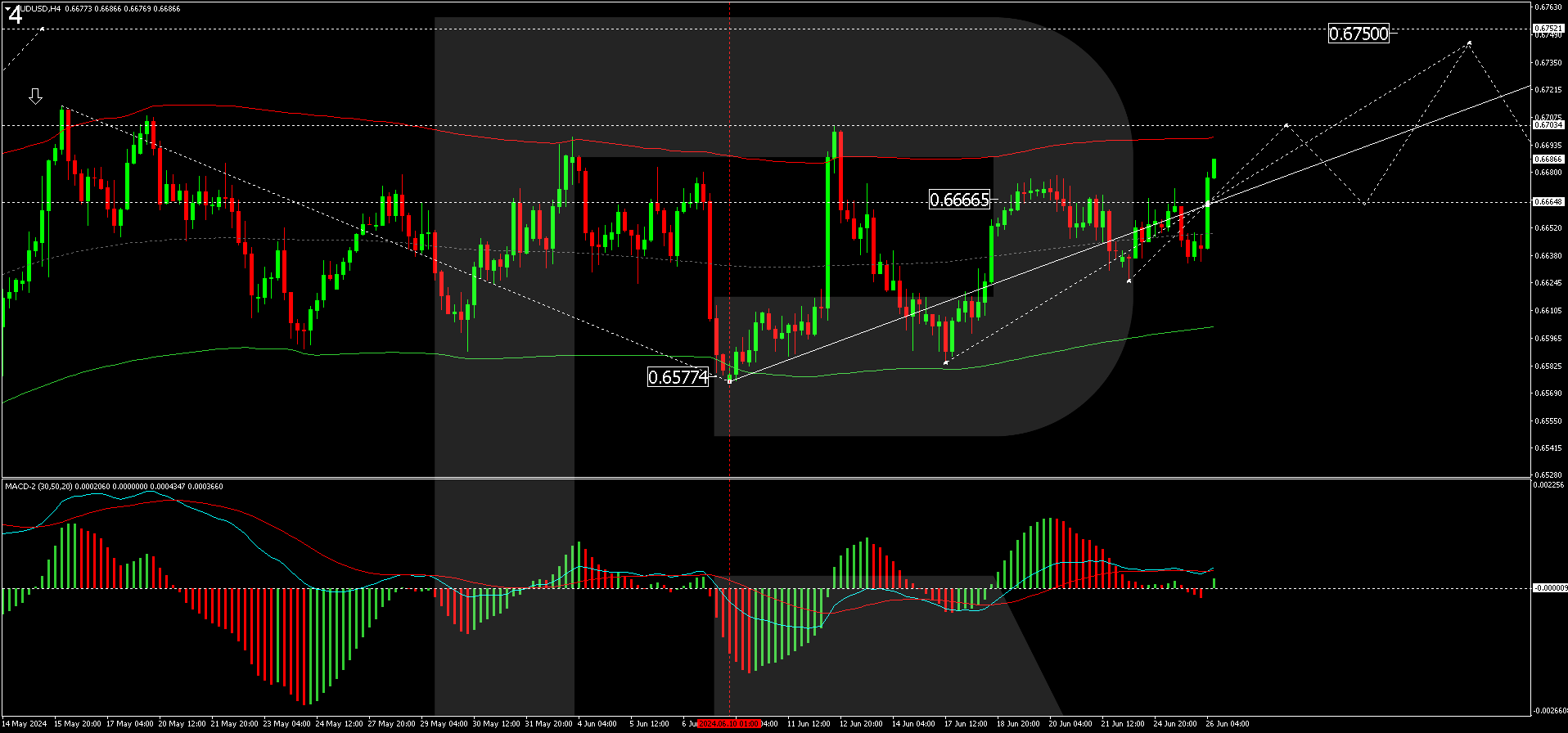
On the H4 chart, the AUD/USD has completed a correction and is forming a new wave of decline towards the level of 0.6620. The formation of a consolidation range is expected once this level is reached. A downward exit from this range could lead to a further decline to 0.6580, the local target. A corrective move to 0.6626 (testing from below) may follow, then a decline to 0.6547. The downward trend target is the first one. The bearish indicator technically supports this MACD scenario, with its signal line above zero but directed downwards.

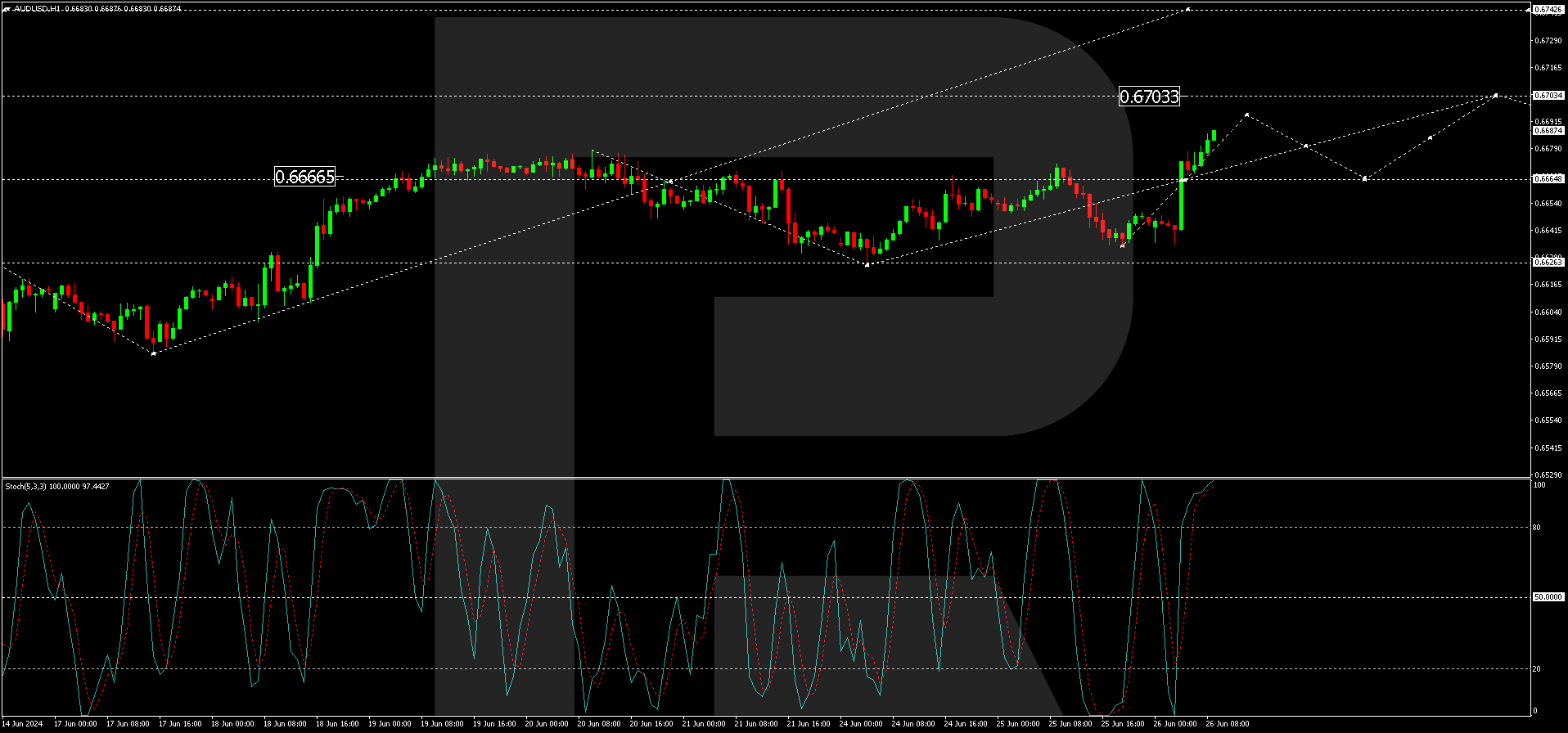
On the H1 chart, the AUD/USD is forming a decline structure to 0.6627. After reaching this level, a potential rise to 0.6650 could occur. Further decline to 0.6620 is also possible, and a breakdown below this level could open the potential for a decline to 0.6608, with the possibility of extending the trend to 0.6580. This scenario is technically confirmed by the Stochastic oscillator, with its signal line currently above 50 but expected to drop to 20, indicating a possible continuation of the downward trend.

Summary

Despite mixed economic indicators, the rise of the Australian dollar highlights the complex dynamics affecting the currency. The RBA’s cautious stance appears to be a significant factor in stabilising the AUD, even as inflation slightly increases. Technical analyses suggest a bearish short-term outlook, with the possibility of corrective movements. It is crucial for investors and traders to closely monitor these levels and stay abreast of global economic developments so they can adjust their strategies accordingly.


Disclaimer

Any forecasts contained herein are based on the author’s particular opinion. This analysis may not be treated as trading advice. RoboForex bears no responsibility for trading results based on trading recommendations and reviews contained herein.

Oil rises amid increasing geopolitical tensions in the Middle East. Inflation is rising in Australia

By JustMarkets

The Dow Jones Index (US30) fell by 0.55% to a two-week low on Tuesday, while the S&P 500 Index (US500) gained 0.03%. The NASDAQ Technology Index (US100) closed positive 0.59%. Minneapolis Fed President Kashkari’s comments were somewhat hawkish for Fed policy and negative for stocks when he said the US economy remains “remarkably resilient” and the Fed should monitor whether inflation is slowing enough to justify an interest rate cut.

This Friday, markets await the PCE deflator data for April, the Fed’s preferred inflation gauge, to see if and when the Fed will start cutting interest rates. The core PCE deflator for April is expected to be unchanged from March at 2.8% y/y.

Nvidia (NVDA) shares are up more than 4%, leading the Nasdaq 100 stock as it continues its rally from last Thursday when the company reported better-than-expected first-quarter earnings and projected better-than-expected second-quarter earnings. Shares of Dell Technologies (DELL) are up over 3%, complementing last Thursday’s and last Friday’s 7% gain after Aletheia Capital Limited initiated coverage on the stock with a “buy” recommendation and a $240 price target. Airbnb (ABNB) shares are up over 2% after Wedbush upgraded their rating to “Outperform” from “Neutral” with a $165 price target.

Equity markets in Europe were mostly down yesterday. Germany’s DAX (DE40) fell by 0.52%, France’s CAC 40 (FR40) closed down 0.92%, Spain’s IBEX 35 (ES35) lost 0.44%, and the UK’s FTSE 100 (UK100) closed negative 0.76%.

ECB Governing Council spokesman Holzmann said he would support an ECB interest rate cut next week but would not automatically support moves after the June rate cut. ECB Governing Council spokesman Knot said the ECB is increasingly confident that consumer price growth will return to 2% next year and may gradually ease its “historically tight” monetary policy.

WTI crude oil prices held above $80 a barrel on Wednesday, near their highest levels in four weeks, amid expectations that OPEC+ countries will extend voluntary production cuts of around 2.2 million barrels daily for the third quarter at a meeting this weekend. Geopolitical concerns in the Middle East also continued to support oil prices as fighting in the Gaza Strip intensified and another ship was attacked in the Red Sea.

Asian markets were mostly up on Monday. Japan’s Nikkei 225 (JP225) was down 0.11% for the day, China’s FTSE China A50 (CHA50) decreased by 0.45%, Hong Kong’s Hang Seng (HK50) was down 0.03% and Australia’s ASX 200 (AU200) was negative 0.28%.

The yuan fell to 7.2487 per dollar as the People’s Bank of China (PBoC) gradually cut its daily discount rate for the managed currency to levels not seen in four months. The PBoC is constantly struggling to find the optimal rate of yuan depreciation to help the economy grow without causing market panic and capital outflows. The Central Bank has held the currency steady for most of the year, but pressure has been building due to rising capital outflows and weak domestic growth.

The Australian dollar stabilized near $0.665 as investors digested stronger-than-expected inflation data. The data showed that Australia’s monthly inflation rate accelerated to 3.6% year-on-year in April from 3.5% in March. This also defeated market expectations of a slowdown to 3.4% and was the highest reading since November. Markets are now betting that the Reserve Bank of Australia (RBA) will keep rates on hold for longer, with a rate cut not fully anticipated until May next year. The latest RBA meeting minutes showed that the board considered raising rates in May but ultimately decided to keep policy steady.

Vietnam’s annual inflation rate rose to 4.44% in May 2024 from 4.4% in the previous month. This is the highest inflation rate since January 2023 as prices rose for food and beverages (4.47% vs. 4.32% in April), transportation (4.58% vs. 4.24%), and culture, entertainment, and tourism (2.01% vs. 1.94%).

S&P 500 (US500) 5,306.04 +1.32 (+0.03%)

Dow Jones (US30) 38,852.86 −216.73 (−0.55%)

DAX (DE40) 18,677.87 −96.84 (−0.52%)

FTSE 100 (UK100) 8,254.18 −63.41 (−0.76%)

USD Index 104.60 0 (0%)

Important events today:
  • – Australia Consumer Price Index (m/m) at 04:30 (GMT+3);
  • – German GfK Consumer Climate (m/m) at 09:00 (GMT+3);
  • – German Consumer Price Index (m/m) at 15:00 (GMT+3);
  • – US FOMC Member Williams Speaks at 20:45 (GMT+3).

By JustMarkets


This article reflects a personal opinion and should not be interpreted as an investment advice, and/or offer, and/or a persistent request for carrying out financial transactions, and/or a guarantee, and/or a forecast of future events.

Bitcoin: Shaky ahead of PCE inflation data

By ForexTime 

  • Bitcoin ↑ 14 month-to-date
  • Could be rocked by US inflation data
  • Over past year PCE triggered moves of ↑ 1% & ↓ 2.3%
  • Technical levels –  $70,000 & $67,000
  • Keep eye on Ethereum, Solana & Litecoin among others

The past few days have been volatile for the world’s largest cryptocurrency.

Bitcoin initially rallied above $70,000 last week due to market optimism around the prospect of spot Ethereum ETFs. However, prices crashed below $67,000 just hours before the SEC’s actual approval. Although bulls returned to the scene, upside gains were capped by fresh developments concerning the failed Mt. Gox exchange.

Still, Bitcoin could be in store for another wild ride this week thanks to the incoming US PCE inflation data.

All eyes will be on the Fed’s preferred inflation gauge – the core personal consumption expenditure index which could impact bets around when the Fed will cut interest rates.

As of writing, traders are currently pricing in a 74% probability of a 25 basis point Fed cut in November with a move fully priced in by December.

Note: In general, cryptocurrencies are indirectly affected by interest rates because of their high risk.

So essentially, high interest rates may sap appetite for riskier investments like crypto, and vice versa.

Fun fact: Over the past year, the US PCE report has sparked upside moves of as much as 1% or declines of 2.3% in a 6-hour window post-release.

Just like Bitcoin, here is how these other cryptos have reacted post-release…

Ethereum: ↑ 1% or ↓ 2%

Solana: ↑ 2.4 % or ↓ 2.8%

Ripple: ↑ 1.3 % or ↓ 2%

Dogecoin: ↑ 1.5 % or ↓ 2.7%

Litecoin: ↑ 3.6 % or ↓ 3.5%

Note: Past price movements do not guarantee future results but can be used to highlight how cryptos have reacted to the US PCE deflators.

Looking at the bigger picture, Bitcoin is up roughly 14% this month and still boasting year-to-date gains over 60%.

Prices remain trapped within a range on the weekly charts with support at $60,000 and resistance at $72,000.

Despite the choppiness on the daily charts, prices are still respecting a bullish channel with technical indicators signalling further upside. The candlesticks are trading above the 50, 100 and 200-day SMA while the MACD points above zero but bears seem to be eyeing $67,000.

  • A solid breakout above $70,000 may open a path toward $72,000.

  • Should prices slip below $67,000 this could open a path toward $65,000.


Forex-Time-LogoArticle by ForexTime

ForexTime Ltd (FXTM) is an award winning international online forex broker regulated by CySEC 185/12 www.forextime.com

Gold prices edge towards $2351 amid weakening US Dollar

By RoboForex Analytical Department

Gold prices are on an upward trajectory, moving towards 2351.00 USD per troy ounce on Tuesday. This marks a significant rise after days of sideways movement, highlighting the metal’s renewed appeal among investors.

This surge in gold prices can be attributed to a localised weakness in the US dollar, which has investors keenly anticipating the release of critical US inflation data later this week. The focus is particularly on the Core PCE indicator set for release on Friday, which is expected to provide further insights into the Federal Reserve’s potential interest rate adjustments.

The market’s reaction to the upcoming data could be pivotal, as strong movements in gold prices are likely once the Fed’s intentions on rates become clearer. To date, discussions on rate adjustments have been vague, leaving investors craving more definitive guidance.

Despite the Fed’s recent minutes suggesting a possibility of rate hikes due to persistent inflation, the market sentiment is tilted towards an eventual easing of the Fed’s stance, as indicated by the positive direction of short-term futures contracts on gold.

Technical analysis of XAU/USD

On the H4 chart of XAU/USD, a second downward impulse to the 2340.00 level has been formed. Today, a correction to 2358.50 has been executed. A downside movement to 2341.44 is expected, where a consolidation range may form. If the price breaks upwards from this range, a further correction towards 2384.80 could be considered. Conversely, a downward breakout could open the potential for a decline to 2318.80, the first target of the decline wave. This scenario is technically supported by the MACD indicator, with its signal line below zero and pointing strictly downwards towards new lows.

On the H1 chart, a decline to 2325.40 has been executed, followed by the formation of a growth structure to 2342.31. A consolidation range has formed around this level, with a correction wave to 2358.50, starting with an upward exit. Today, a decrease to 2342.31 (testing from above) has been executed. The new consolidation range is practically outlined. A downward breakout from this range could lead to another downward impulse to 2318.85. Further development towards 2384.50 is possible if the price breaks upwards, continuing the correction to 2384.85. Afterwards, a decline along the trend to 2318.85 is likely. This scenario is technically confirmed by the Stochastic oscillator, with its signal line having broken through 50 and continuing its decline to 20.

Summary

Gold prices are rising due to a weaker US dollar and anticipation of key US inflation data. Technical indicators suggest potential corrections and further declines, with significant support and resistance levels to monitor. Investors should closely follow the upcoming data and Fed communications for additional market direction.


Disclaimer

Any forecasts contained herein are based on the author’s particular opinion. This analysis may not be treated as trading advice. RoboForex bears no responsibility for trading results based on trading recommendations and reviews contained herein.

Oil rises moderately ahead of OPEC+ meeting. ECB plans to cut interest rates next week

By JustMarkets

US stock indices were not traded yesterday due to the Memorial Day holiday.

Equity markets in Europe mostly went up yesterday. The German DAX (DE40) rose by 0.44%, the French CAC 40 (FR40) closed with a 0.46% gain, the Spanish IBEX 35 (ES35) added 0.71%, the British FTSE 100 (UK100) was not traded.

On Monday, European stocks closed with solid gains, cutting the previous week’s losses as expectations of monetary easing in the Eurozone gained momentum. Traders are awaiting German and Eurozone inflation data this week, which could bolster expectations that the European Central Bank will start cutting rates next week. The ECB is expected to cut interest rates next week, and disinflation confidence from the Governing Council has raised equity investors’ hopes that the ECB will continue to cut interest rates in the third quarter. Also in favor of the dovish outlook was Ifo’s German Business Climate Indicator, which came in below expectations and halted three months of growth.

WTI crude oil prices rose to $79 a barrel on Tuesday, pushing back from three-month lows amid expectations that OPEC+ will extend a voluntary production cut of 2.2 million barrels daily in the year’s second half at a June 2 meeting. On the demand side, markets await the release of the key US inflation data this week to gauge the Fed’s future monetary policy actions. A lower-than-expected PCE Price Index reading in the US could lead to higher bets on lower interest rates, supporting the outlook for economic growth and energy demand.

Asian markets were mostly up on Monday. Japan’s Nikkei 225 (JP225) was up 0.66%, China’s FTSE China A50 (CHA50) decreased by 0.50%, Hong Kong’s Hang Seng (HK50) was up 1.17%, and Australia’s ASX 200 (AU200) was positive 0.79%. Beijing’s bold move to launch US $47.5 billion worth of chip investment funds continued to support sentiment as China seeks to cement its position as a technology country.

Australian retail sales rose by 0.1% month-on-month in April 2024 versus the market consensus of 0.2%. This was a bounce-back from a 0.4% drop in March amid earlier Easter celebrations and different school vacation timings across the country.

S&P 500 (US500) 5,304.72 0 (0%)

Dow Jones (US30) 39,069.59 0 (0%)

DAX (DE40) 18,774.71 +81.34 (+0.44%)

FTSE 100 (UK100) 8,317.59 0 (0%)

USD Index 104.59 −0.13 (−0.13%)

Important events today:
  • – Australia Retail Sales (m/m) at 04:30 (GMT+3);
  • – US FOMC Member Bowman Speaks at 07:55 (GMT+3);
  • – US FOMC Member Mester Speaks at 07:55 (GMT+3);
  • – Switzerland SNB Board Jordan Speaks at 07:55 (GMT+3);
  • – US CB Consumer Confidence (m/m) at 17:00 (GMT+3).

By JustMarkets


This article reflects a personal opinion and should not be interpreted as an investment advice, and/or offer, and/or a persistent request for carrying out financial transactions, and/or a guarantee, and/or a forecast of future events.

FXTM’s Cotton: Set for a major rebound?

By ForexTime 

  • Cotton ↑ 7% month-to-date
  • Headed for first ↑ month since Feb
  • Over 20% away from 2024 high
  • H4 prices bullish but RSI overbought
  • Technical levels – 83.90, 81.50, 79.50

FXTM’s new Cotton commodity could be set for a major rebound after ending last week on a firmly positive note.

Prices have recently hit a fresh multi-week high at 81.50 cents as bulls and bears wait for a fresh directional spark.

Note: Cotton is priced per pound.

Before we take a deep dive into the fundamentals, did you know that…

  • Cotton is an ancient non-food crop
  • China is the biggest producer & consumer
  • Has been grown on the moon
  • Most banknotes are made using cotton
  • Hit an all-time high in 2011 at $2.27


What is Cotton?

Cotton is a soft and fluffy natural fiber made up from the seeds of a cotton plant.

It can be made into clothing, used for industrial products, and even fuel.

What does FXTM’s Cotton track

FXTM’s Cotton tracks the ICE Group’s Cotton No.2 futures, the benchmark for the global cotton trading community.

The lowdown

After trading within a narrow range for 16 months, cotton prices rallied in February 2024.

The commodity ended the month over 17% higher amid supply concerns in the United States.

However, prices later slipped in March with the selloff gaining momentum in April as slow demand and increased stocks dampened the market outlook.

The bigger picture

Due to conflicting fundamental forces, 2024 has been a rollercoaster year for cotton prices.

Still, prices seem to be stabilizing near one-month highs due to supply-related concerns and signs of strong demand from China.

Weather-related issues in Texas and flooding in Brazil are expected to affect the planting of cotton among other crops.

What does this mean?

Cotton prices may push higher if supply-related issues persist and global demand continues to improve.

According to the United States Department of Agriculture (USDA), U.S. cotton demand is projected to increase in 2024/2025 but global production is also projected to rise 5% above the 2023/2024 estimate.

Technical outlook…

Prices are bullish on the D1/H4 timeframe with the upside gaining momentum above 79.50.

However, the Relative Strength Index (RSI) has touched 70 – indicating that prices are overbought on the H4 timeframe.

  • A solid breakout above 81.50 could encourage a move towards 83.90.
  • Should prices slip back under 79.50, this may open a path towards 77.50 and the 50 SMA.


Forex-Time-LogoArticle by ForexTime

ForexTime Ltd (FXTM) is an award winning international online forex broker regulated by CySEC 185/12 www.forextime.com

Strong economic reports fuel the dollar and harm indices

By JustMarkets

The US stock indices closed lower on Thursday. At the end of the day, the Dow Jones Index (US30) was down 1.53% (the worst day in a year), while the S&P 500 Index (US500) lost 0.74%. The NASDAQ Technology Index (US100) closed negative 0.39%. Stock indices initially increased, with the S&P 500 (US500) and NASDAQ (US100) setting new record highs. But then the market began to sell off, sending the S&P 500 (US500) to a 1-week low and the Dow Jones (US30) to a 2-week low. The fall in the indices was mainly due to an acceleration in business activity, which reinforced the view of US officials that the Fed will conduct only one rate cut this year instead of the planned three. Markets are pricing in a 25 bps chance of a rate cut at 0% at the June 12 FOMC meeting and 10% at the next meeting on July 31.

The US weekly initial jobless claims fell by 800 to 215,000, indicating a strengthening labor market compared to expectations of 220,000. The S&P Manufacturing PMI for May unexpectedly rose by 0.9 to 50.9, stronger than expectations for a decline to 49.9.

Boeing (BA) closed down more than 7%, topping the Dow Jones Industrials’ list of losers, after CFO West said the company’s second-quarter cash burn would be the same or worse than the first quarter when the company spent nearly $4 billion to rebuild operations. Shares of Dell Technologies (DELL) are up more than 4% after Evercore ISI added it to its list of tactical outperformers with a $165 price target.

Equity markets in Europe were mostly flat yesterday. Germany’s DAX (DE40) rose by 0.06%, France’s CAC 40 (FR40) closed higher by 0.13%, Spain’s IBEX 35 (ES35) fell by 0.16%, and the UK’s FTSE 100 (UK100) closed negative 0.37%.

Yesterday, the ECB reported that Eurozone wages rose to 4.7% y/y in Q1 compared to 4.5% y/y in Q4, a record. The May S&P Eurozone Manufacturing PMI rose by 1.7 to a 15-month high of 47.4, beating expectations of 46.1. The May Services PMI rose by 0.6 to 52.3, beating expectations of 52.0 and the fastest pace of growth in a year. The latest data points to a recovery in the Eurozone economy.

GfK’s UK Consumer Confidence Indicator rose to 17 in May 2024 from 19 in April, the highest reading since December 2021 and better than prognoses of 18. Four of the survey’s five components measuring the state of the economy and personal finances improved in May, with only the index of large purchases showing a decline.

WTI crude oil prices stabilized near $77 per barrel on Friday, but this week’s losses are roughly 3% as stronger-than-expected US PMI data lowered bets on a Federal Reserve interest rate cut this year, dampening the outlook for the US economy and energy demand.

The US natural gas (XNG) prices fell more than 5% to below $2.7 on Thursday, slipping from a six-month peak due to higher daily production and rising storage inventories reported by the EIA. The US utilities added 78 billion cubic feet (bcf) of gas to storage last week, while the market had expected an increase of 84 bcf. The report also showed that gas inventories are 28.8% above the 5-year average.

Asian markets were mostly down on Thursday. Japan’s Nikkei 225 (JP225) was up 1.26%, China’s FTSE China A50 (CHA50) decreased by 0.78%, Hong Kong’s Hang Seng (HK50) lost 1.70% and Australia’s ASX 200 (AU200) was negative 0.46%.

A wave of negative sentiment hit China this week as the trade war with the US escalated. The People’s Liberation Army was also seen conducting military exercises near Taiwan, indicating heightened regional tensions. Hong Kong’s Hang Seng Index suffered huge losses due to a prolonged slump in heavy technology stocks. The index fell by 1.5% on Friday, adding to a 1.7% drop on Thursday. Shares of Alibaba Group (BABA) fell another 1% after falling 5.2% in the previous session after the company said it was issuing $5 billion in convertible bonds to spur growth. The tech giant’s losses drove down quotes of its peers Baidu Inc (BIDU) and Tencent Holdings Ltd, while investors booked profits in real estate stocks as they awaited more details on Beijing’s stimulus measures.

Japanese inflation fell for a second month but remained above the Bank of Japan’s (BoJ) target level. The yen’s recent depreciation raises concerns that cost-driven inflationary pressures could persist. Consumer prices excluding fresh food totaled 2.2% in April, down from a year ago. Despite the decline in inflation, economists note the risk of a rate hike soon as the yen remains near a 34-year low.

S&P 500 (US500) 5,267.84 −39.17 (−0.74%)

Dow Jones (US30) 39,065.26 −605.78 (−1.53%)

DAX (DE40) 18,691.32 +11.12 (+0.06%)

FTSE 100 (UK100) 8,339.23 −31.10 (−0.37%)

USD Index 105.04 +0.11 (+0.10%)

Important events today:
  • – New Zealand Trade Balance (q/q) at 01:45 (GMT+3);
  • – Japan National Core CPI (m/m) at 02:30 (GMT+3);
  • – UK Retail Sales (m/m) at 09:00 (GMT+3);
  • – German GDP (m/m) at 09:00 (GMT+3);
  • – Switzerland Unemployment Rate (m/m) at 09:30 (GMT+3);
  • – Switzerland SNB Chairman Thomas Jordan speaks at 10:45 (GMT+3);
  • – US Core Durable Goods Orders (m/m) at 15:30 (GMT+3);
  • – Canada Retail Sales (m/m) at 15:30 (GMT+3);
  • – US Michigan Consumer Sentiment (m/m) at 17:00 (GMT+3).

By JustMarkets


This article reflects a personal opinion and should not be interpreted as an investment advice, and/or offer, and/or a persistent request for carrying out financial transactions, and/or a guarantee, and/or a forecast of future events.

Week Ahead: USDJPY waits for fundamental spark

By ForexTime 

  • Tokyo CPI & US PCE in focus
  • USDJPY 2% away from multi-decade top
  • Prices bullish but RSI near overbought
  • Bloomberg FX model – 77% USDJPY – (155.21 – 158.45)

Despite the holiday-shortened week ahead for the UK and US, markets could remain volatile due to top-tier data across the globe:

Monday, 27th May

  • UK and US markets closed
  • CN50: China industrial production
  • GER40: Germany IFO business climate
  • EU50: ECB chief economist Philip Lane speech

Tuesday, 28th May

  • AU200: Australia retail sales
  • US30: US Conference Board consumer confidence, Fed speech

Wednesday, 29th May

  • GER40: Germany CPI
  • ZAR: South African election
  • US500: Fed Beige Book, New York Fed President John Williams speech

Thursday, 30th May

  • EU50: Eurozone economic confidence, unemployment
  • ZAR: South Africa rate decision
  • SEK: Sweden GDP
  • CHF: Switzerland GDP
  • TWN: Taiwan GDP
  • US500: US initial jobless claims, GDP (Second Est), Fed speech

Friday, 31st May

  • CAD: Canada quarterly GDP
  • CN50: China official PMI’s
  • EUR: Eurozone CPI
  • JPY: Japan unemployment, Tokyo CPI, industrial production, retail sales
  • USDInd: US May PCE report, Atlanta Fed President Raphael Bostic speech

A few weeks ago, the yen was a hot talking point after staging a dramatic reversal against the dollar. This development fueled speculation about possible intervention by Japanese authorities after the currency weakened to a 34-year low.

Fast forward to today, the yen has given back most of its gains and is currently trading 2% away from its multi-decade top. Could another intervention be on the horizon if prices retest the 160.22 level?

The USDJPY could end May with a bang, and here are 3 reasons why:

    1) Japan data dump

Incoming data from Japan could inject the yen with fresh volatility.

Much focus will be directed towards the latest CPI figures from Tokyo, unemployment, industrial production, and retail sales for insight into the health of Japan’s economy. This data dump may also influence expectations around when the Bank of Japan will proceed with another rate hike.

Traders are currently pricing in only a 27% probability of a 10-basis point hike by June with this jumping to 88% by July.

  • Should overall data support expectations around the BoJ hiking rates further, this could boost the yen.
  • A disappointing set of data that tempers bets around higher rates in Japan could weaken the yen.


    2) US April PCE report

The Fed’s preferred inflation gauge – the Core Personal Consumption Expenditure is likely to influence rate cut expectations.

Recent data from the United States have eroded bets around the Fed cutting rates anytime soon.

Traders are pricing in a 60% probability of a 25-basis point cut by September with this jumping to 87% by November.

The PCE core deflator is forecast to remain unchanged at 0.3% month-over-month, with the same expected for its year-on-year print at 2.8%.

  • More signs of cooling price pressures may rekindle Fed cut bets, dragging the USDJPY lower as a result.
  • If the PCE report prints above market forecasts, this could support the “higher for longer” narrative – pushing the USDJPY higher as a result.

Note: Looking beyond the US PCE report, it will be wise to keep an eye on speeches by numerous Fed officials and other key US data points that may influence the dollar.


    3) Technical forces 

The USDJPY is trending higher on the daily timeframe as there have been consistently higher highs and higher lows. However, the Relative Strength Index is slowly approaching 70 – indicating that prices may be nearing overbought conditions.

– A solid breakout and daily close above 157.00 may open a path back towards 158.45. 

– Should 157.00 prove to be reliable resistance, this may encourage a decline back towards 155.00.

Bloomberg’s FX model points to a 77% chance that USDJPY will trade within the 155.21 – 158.45 range over the next one-week period.


Forex-Time-LogoArticle by ForexTime

ForexTime Ltd (FXTM) is an award winning international online forex broker regulated by CySEC 185/12 www.forextime.com