Happy 50th birthday to the UPC barcode – no one expected you would revolutionize global commerce

By Jordan Frith, Clemson University 

The first modern barcode was scanned 50 years ago this summer – on a 10-pack of chewing gum in a grocery store in Troy, Ohio.

Fifty is ancient for most technologies, but barcodes are still going strong. More than 10 billion barcodes are scanned every day around the world. And newer types of barcode symbols, such as QR codes, have created even more uses for the technology.

I would have been like most people, never giving a second thought to the humble barcode, if my research as a media scholar at Clemson University hadn’t taken a few strange turns. Instead, I spent a year of my life digging through the archives and old newspaper articles to learn about the barcode’s origins – and eventually went on to write a book about the cultural history of the barcode.

While the barcode didn’t herald the end times, as conspiracy theorists once fretted, it did usher in a new age in global commerce.

Barcodes were a grocery-industry invention

While the world has changed a lot since the mid-1970s, the Universal Product Code (UPC) – what most people think of when they hear the word “barcode” – hasn’t. The code first scanned on a package of gum on June 26, 1974, is basically identical to the billions of barcodes scanned in stores all over the world today.

When that first UPC code was scanned, it was the culmination of years of planning by the U.S. grocery industry. In the late 1960s, labor costs were rising rapidly in grocery stores and inventory was becoming increasingly difficult to track. Grocery executives hoped the barcode could help them solve both of those problems, and they ended up being right.

In the early 1970s, the industry created a committee that developed the UPC data standard and chose the IBM barcode symbol over a half-dozen alternative designs. Both the data standard and the IBM barcode symbol are still used today.

Based on meeting notes I found in Stony Brook University’s Goldberg Archive, the people who developed the UPC system felt they were doing important work. However, they had no idea they were creating something that would long outlive most of them.

Even the grocery industry’s optimistic estimates predicted fewer than 10,000 companies would ever use barcodes. As a result, the scanning of the first UPC barcode received little attention at the time.

A few newspapers published short articles about the launch event, but it wasn’t exactly front-page news. Its importance was only apparent years later, as barcodes became one of the most successful digital data infrastructures ever.

Barcodes created a shelf-space revolution

Barcodes didn’t just change the shopping experience at checkout. By making products machine-readable, they enabled vast improvements to inventory tracking. That meant items that sold well could be restocked quickly when the data indicated, requiring less shelf space to be devoted to any individual product.

As barcode expert Stephen A. Brown has written, that reduced need for shelf space allowed for a rapid proliferation of new products. You can blame barcodes for the fact that your grocery store sells 15 types of almost indistinguishable toothpaste.

Similarly, today’s huge grocery stores and superstores likely couldn’t exist without the massive amount of inventory data that barcode systems produce. As MIT professor Sanjay Sharma put it, “If barcodes hadn’t been invented, the entire layout and architecture of commerce would have been different.”

Other industries quickly got on board

The modern barcode was born in the grocery industry, but it wasn’t confined to the grocery aisles for long. By the mid-1980s, the success of the UPC system encouraged other industries to adopt barcodes. For example, within a span of three years, Walmart, the Defense Department and the U.S. automotive industry all began using barcodes to track objects in supply chains.

Private shipping companies also adopted barcodes to capture identification data. FedEx and UPS even created their own barcode symbols.

As the sociologist Nigel Thrift explained, by the end of the 1990s, barcodes had become “a crucial element in the history of the new way of the world.” They helped enable rapid globalization in ways that would be difficult to imagine if barcodes didn’t exist.

Black and white and unnoticed all over

As someone who became so interested in this history that I got a tattoo of my latest book’s International Standard Book Number barcode on my arm, the quiet passing of the barcode’s 50th anniversary feels almost poetic.

I grew up in a world where barcodes were everywhere. They were on all the products I bought, the concert tickets I scanned, the packages I received.
Like most people, I rarely thought about them, despite — or maybe because of — their ubiquity. It wasn’t until I began research for my book that I realized how a barcode on a package of gum set in motion a chain of events that transformed the world.

The barcode of the author’s 2023 book, ‘Barcode,’ tattooed on his arm.
Stevie Edwards

For decades, barcodes have been a workhorse operating in the background of our lives. Modern humans scan them countless times every day, but we rarely think about them because they’re not flashy and just work — most of the time, anyway.

As barcodes keep chugging along in their old age, they’re a reminder that the seemingly boring technologies are often far more interesting and consequential than most people realize.The Conversation

About the Author:

Jordan Frith, Pearce Professor of Professional Communication, Clemson University

This article is republished from The Conversation under a Creative Commons license. Read the original article.

NZD/USD Sinks to Three-Month Minimum, Driven by Rate Speculation and Strengthening USD

By RoboForex Analytical Department

The NZD/USD pair plummeted to 0.5892, marking a significant three-month low. The New Zealand dollar remains under pressure as the US dollar gains strength due to the start of the Federal Reserve’s two-day meeting.

The Fed is expected to leave the interest rate in the target range of 5.25-5.50% this time. At the same time, the market eagerly anticipates clear signals regarding the September meeting, when borrowing costs are expected to be lowered.

A week earlier, the NZD fell by almost 2% against the USD due to overly large-scale risk aversion in the global market, reduced carry trade positions with JPY, and China’s relatively sluggish macroeconomic background.

Expectations regarding the Reserve Bank of New Zealand’s future steps also exert fundamental pressure on the NZD. The main forecast assumes that the RBNZ will lower the interest rate soon. At the moment, investors take a rate cut at the August meeting with a 44% probability, which is quite a lot, given all the inputs.

Technical Analysis of NZD/USD

On the H4 chart of NZD/USD, the market executed a wave of decline to the level of 0.5858. Today, the market is correcting this wave of decline. We expect a growth link to the level of 0.5903. If this level is breached upwards, the correction continuing to 0.5987 (test from below) is possible. After the correction is completed, we will consider the beginning of a new wave of decline to the level of 0.5840 with the prospect of trend continuation to the level of 0.5822. Technically, this scenario is confirmed by the MACD indicator. Its signal line is under the zero mark and is directed strictly upwards.

On the H1 chart of NZD/USD, the market is forming a growth structure towards the level of 0.5903. After working off this level, we will consider the probability of a decline to the level of 0.5884 (test from above). Then, we will consider the likelihood of another growth structure to the level of 0.5986. Technically, this scenario is confirmed by the Stochastic oscillator. Its signal line is above the 80 mark. We expect a decline to the level of 50 and further to the level of 20.


Disclaimer

Any forecasts contained herein are based on the author’s particular opinion. This analysis may not be treated as trading advice. RoboForex bears no responsibility for trading results based on trading recommendations and reviews contained herein.

AUD/USD Gains Amid Anticipation for Key Economic Data

By RoboForex Analytical Department

The AUD/USD pair is climbing towards 0.6552 on Monday. The Australian dollar is bouncing back from a 12-week low as investors await Australian inflation data.

In the past two weeks, the AUD, in the currency pair with the USD, has fallen more than 3%. This happened amid a global sell-off in risky assets and also due to weak reports from China.

This week, the release of crucial price statistics will significantly influence the Reserve Bank of Australia’s future course of action. Inflation is expected to have accelerated slightly in Australia in Q2 2024. For example, for April-June, inflation could have risen by 1.0% QoQ, the same as before. In annualised terms, it could accelerate to 3.8% from 3.6% previously. The data will be released on Wednesday.

This week, Australia’s macroeconomic calendar will be particularly active. The release of reports on last quarter’s retail sales, trade balance, exports and imports, and the producer price index will provide crucial insights into the economy. The stronger the data, the better – especially amid China’s economic weakness, Australia’s main economic partner. In this context, it is essential to remain resilient.

Currently, the market estimates the probability of the RBA interest rate hike in August to be 20%.

AUD/USD technical analysis

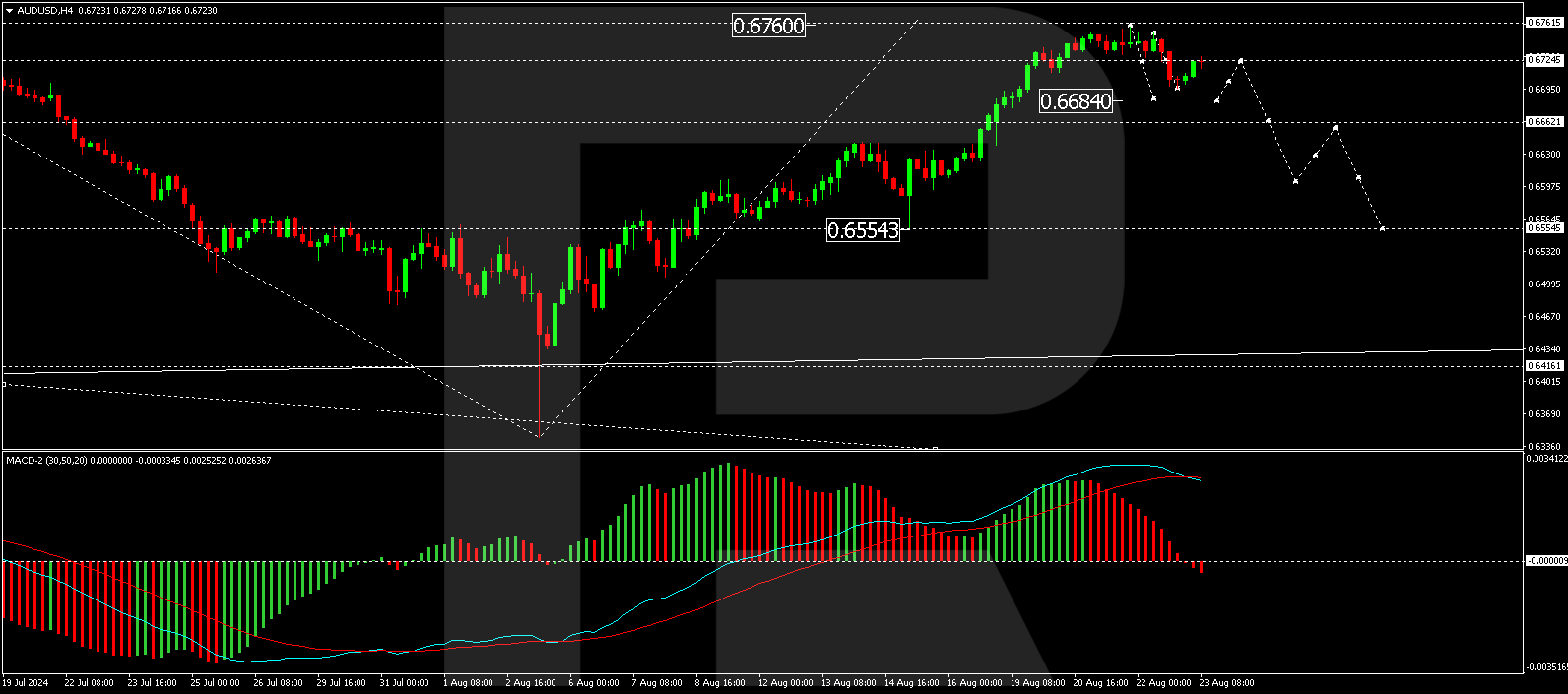
On the H4 chart of AUD/USD, the market performed a wave of decline to 0.6513. Today, it is relevant to consider the probability of correction development to the level of 0.6609. After the correction is completed, we will consider the likelihood of trend continuation to the level of 0.6468 with the prospect of trend continuation to the level of 0.6420. Technically, such a scenario is confirmed by the MACD indicator. Its signal line is under the zero mark and is directed strictly downwards.

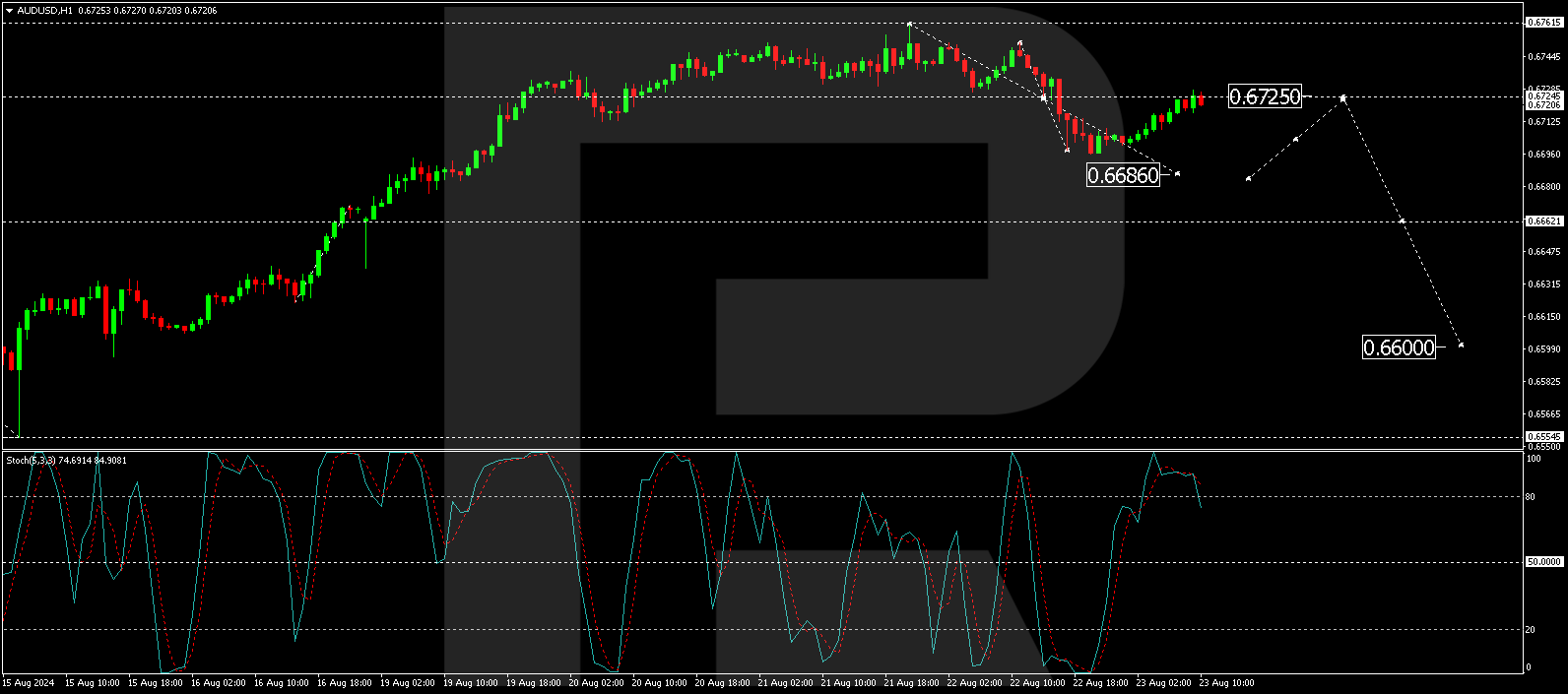
On the H1 AUD/USD chart, the market is forming a consolidation range around the level of 0.6561. In case of an upside exit, the potential of a wave to the level of 0.6609 will open. In case of a downward exit, we will consider the continuation of the wave to the level of 0.6468. The target is local. Technically, this scenario is confirmed by the Stochastic oscillator. Its signal line is under 50 and is directed strictly downwards to 20.


Disclaimer

Any forecasts contained herein are based on the author’s particular opinion. This analysis may not be treated as trading advice. RoboForex bears no responsibility for trading results based on trading recommendations and reviews contained herein.

Oil rises in price amid rising geopolitical tensions in the Middle East. Bitcoin has reached the $70,000 mark

By JustMarkets

On Friday, the Dow Jones (US30) Index gained 1.64% (for the week +0.43%), while the S&P 500 (US500) Index gained 1.11% (for the week -1.54%). The NASDAQ Technology Index (US100) closed positive at 1.03% (for the week -3.16%). Market sentiment was fueled by new data showing weakening inflation, which heightened expectations of a potential interest rate cut in September. The PCE, the Federal Reserve’s preferred measure of inflation, matched expectations, although the core rate rose 0.2%, slightly above the 0.1% forecast. All sectors showed gains, led by industrials.

Bitcoin climbed toward the $70,000 mark on Monday, reaching the key level for the first time in six weeks after US presidential candidate Donald Trump doubled down on his support for cryptocurrencies in a keynote speech at the Bitcoin 2024 conference in Nashville over the weekend. Trump said he would make the US the “crypto capital of the world” and promised to maintain the country’s current level of bitcoin ownership. Moreover, Republican Senator Cynthia Lummis has introduced a legislative proposal to create an official US strategic reserve of 1 million BTC over the next five years, representing nearly 5% of total BTC.

Equity markets in Europe were mostly up on Friday. The German DAX (DE40) rose by 0.65% (for the week +3.82%), the French CAC 40 (FR40) closed 1.22% higher (for the week -0.74%), the Spanish IBEX 35 (ES35) added 0.18% (for the week +0.15%), and the British FTSE 100 (UK100) closed positive 1.21% (for the week +1.59%) on Friday. European equity markets were set for gains on Monday amid hopes that the US Federal Reserve and the Bank of England will open the door to monetary easing.

WTI crude oil prices rose to $77.5 a barrel on Monday, cutting more than 1% of the previous session’s drop on fears of a possible full-scale war in the Middle East. Israel vowed a strong response to Hezbollah on Sunday, accusing the Iranian-backed group of killing 12 children and teenagers in a rocket attack on a soccer field in the Golan Heights. Hezbollah, however, “strongly denies” its involvement in the strike. Escalating tensions in the Middle East are creating supply risks and increasing oil prices.

Asian markets were mostly down last week. Japan’s Nikkei 225 (JP225) fell by 5.71%, China’s FTSE China A50 (CHA50) declined by 3.07%, Hong Kong’s Hang Seng (HK50) lost 2.54% over five trading days, and Australia’s ASX 200 (AU200) was negative -0.63%.

Vietnam’s annual inflation rate rose to 4.36% in July 2024 from a three-month low of 4.34% in the previous month. Prices rose mainly for medical services (8.13% vs. 8.04% in June) and transportation (4.4% vs. 3.03%), while the cost of postal and telecommunication services fell at a slower pace (-1.06% vs. -1.18%). Meanwhile, annual core inflation, which excludes volatile goods, was 2.61%, remaining at its lowest level in nearly two years.

The offshore yuan stabilized at 7.26 per dollar after hitting a two-month high last week. Traders took a cautious stance ahead of a key Politburo meeting, which was expected to indicate near-term policy measures following the Third Plenum reforms. China recently surprised markets by lowering key interest rates and conducting a surprise credit operation, indicating that the central bank intends to provide stronger monetary stimulus to support the economy.

The debate over whether Australia’s central bank needs to tighten policy at the end of the cycle will likely be resolved with quarterly inflation data release this week. The RBA has raised rates by a smaller amount than other countries to hold down job growth while worrying about the ability of heavily indebted households to cope. If the RBA fails to meet its goal of returning price growth to its 2%-3% target late next year, further rate hikes are likely to be needed – and that’s a big risk of plunging the weak economy into recession.

S&P 500 (US500) 5,459.10 +59.88 (+1.11%)

Dow Jones (US30) 40,589.34 +654.27 (+1.64%)

DAX (DE40) 18,417.55 +118.83 (+0.65%)

FTSE 100 (UK100) 8,285.71 +99.36 (+1.21%)

USD Index 104.32 -0.04 (-0.04%)

There are no important events today.

By JustMarkets


This article reflects a personal opinion and should not be interpreted as an investment advice, and/or offer, and/or a persistent request for carrying out financial transactions, and/or a guarantee, and/or a forecast of future events.

Week Ahead: Trillion Dollar Titans In Focus

By ForexTime 

  • 4 of the so-called “Magnificent 7” set to publish earnings
  • Combined market cap of 4 tech giants over $9 trillion
  • Beyond earnings, key focus remains on AI initiatives
  • Meta could move almost 10% ↑ or ↓ post-earnings
  • Apple biggest company in the world reports results Friday

An exceptional list of key risk events could present fresh trading opportunities in the week ahead.

Rate decisions my major central banks to the US monthly jobs report and corporate earnings from the most valuable companies in the world will be in focus:

Monday, 29th July

  • US30: McDonald’s earnings
  • NETH25: Heineken earnings
  • NAS100: Nvidia & Meta fireside chat

Tuesday, 30th July

  • EU50: Eurozone economic/consumer confidence, GDP
  • GER40: Germany CPI, GDP
  • JP225: Japan unemployment
  • USDInd: US consumer confidence
  • NAS100: Microsoft earnings

Wednesday, 31st July

  • AU200: Australia CPI, retail sales
  • CN50: China PMI’s
  • EU50: Eurozone CPI, Germany unemployment
  • JP225: BoJ rate decision, industrial production, retail sales
  • TWN: Taiwan GDP
  • US500: Meta Platform earnings, Fed rate decision

Thursday, 1st August  

  • CN50: China Caixin manufacturing PMI
  • EU50: Eurozone/Germany manufacturing PMI
  • UK100: BoE rate decision, manufacturing PMI
  • USDInd: initial jobless claims, ISM manufacturing
  • NAS100: Apple, Amazon earnings

Friday, 2nd August

  • US500: US June NFP report

Our attention falls on earnings from the trillion-dollar club after disappointing results from Alphabet and Tesla fanned fears over the A.I. frenzy being overblown.

As of writing, US equities are heading for a second week of declines after recording their worst day since 2020 on Wednesday.

Four of the so-called “Magnificent” 7 tech giants with a combined market cap of over $9 trillion are set to publish their results in the week ahead. This is what you need to know:

    1) Microsoft

Microsoft reports its fiscal fourth quarter earnings on Tuesday 30th after US markets close.

Despite shedding over 6% this month, its shares are still up roughly 10% year-to-date thanks to the A.I. frenzy. The bar has been set quite high with investors looking for solid results to support its whooping $3.1 trillion market valuation. Much focus will be on Microsoft’s Azure cloud platform business which fueled the tech giant’s earnings beat in previous quarters and any fresh updates on its AI initiatives.

Markets are forecasting a 4.9% move, either Up or Down, for Microsoft stocks post earnings.

Micro


    2) Meta Platforms

Meta is set to report second-quarter earnings after US market close on Wednesday 31st July.

Its shares are up almost 30% this year amid the excitement around AI translating to big profit in the tech arena. While the company is expected to report year-over-year revenue and earnings growth, it’s all about the strength of its advertising business. Any new insight on AI opportunities especially after the launch of Llama 3.1 could be welcomed by investors.

Markets are forecasting a 9% move, either Up or Down, for Meta stocks post earnings.

Meta


    3) Amazon

On Thursday 1st of August after US markets close, Amazon will publish its second quarter earnings.

Quarterly revenues are seen rising to $148.8 billion from $134.4 billion in the prior year, equating to a near 11% increase. Still, much focus will be on Amazons cloud computing and advertising business in addition to any updates on AI to gauge its business outlook.

Markets are forecasting a 7% move, either Up or Down, for Amazon stocks post earnings.

Amazon


    4) Apple

The most valuable company in the entire world with a market cap of $3.3 trillion reports its third quarter earnings on Thursday 1st after US markets close.

The titan is expected to report year-over-year revenue and earnings growth. However, attention will be on the performance of iPhone sales – especially due to the challenges in China. Beyond the earnings investors will be looking for any fresh updates on its new AI generative software or possible guidance for the upcoming quarter.

Still, Apple shares are up 13% this year with markets projecting a 4% move, either Up or Down, for Apple stocks post earnings.

Apple


Forex-Time-LogoArticle by ForexTime

ForexTime Ltd (FXTM) is an award winning international online forex broker regulated by CySEC 185/12 www.forextime.com

MAS has maintained a monetary policy. Japan’s inflation is on the rise

By JustMarkets

At Thursday’s close, the Dow Jones Index (US30) added 0.20%, while the S&P 500 Index (US500) was down 0.51%. The NASDAQ Technology Index (US100) closed negative 0.93%. Stocks continued to decline on Thursday amid weakness in chip stocks and selloffs in several individual stocks driven by negative earnings surprises. In addition, the market continues to worry about weakening economic growth despite Thursday’s slightly stronger-than-expected US economic reports.

The US real GDP grew 2.8% (annualized) in the second quarter, beating expectations of 2.0% and up from the 1.4% growth in the first quarter. The GDP report helped ease market fears of lower consumer spending and a slowing economy. Looking ahead, markets expect US GDP to decline to 2.0% in Q3 and 1.6% in Q4. In addition, personal consumption rose 2.3% in Q3, exceeding expectations of 2.0% and up from Q1’s 1.5% increase. The US weekly initial jobless claims declined by 8,000 to 235,000, indicating a modest strengthening of the labor market compared to expectations of a decline to 238,000. June durable goods orders excluding defense and aviation, an indicator of corporate capital spending in the US, rose 1.0%, stronger than expectations of 0.2%.

Equity markets in Europe were declining yesterday. Germany’s DAX (DE40) fell by 0.48%, France’s CAC 40 (FR40) closed down 1.15%, Spain’s IBEX 35 (ES35) lost 0.58%, and the UK’s FTSE 100 (UK100) closed positive 0.40%. European equities closed sharply lower on Thursday, extending the sell-off from the previous session amid weak corporate results. ASML shares continued their bearish momentum and closed 4% lower, representing a 20% decline over the past two weeks

WTI crude oil prices recovered from earlier losses to reach $78.28 per barrel on Thursday, helped by stronger-than-expected economic growth in the US and lower crude inventories. Despite these factors, oil prices remain near six-week lows due to concerns over lower oil imports and refinery activity in China amid sluggish economic growth.

The US natural gas (XNGUSD) prices fell to $2.05/MMBtu after the EIA reported a larger-than-expected increase in storage inventories. The US utilities added 22 billion cubic feet (Bcf) of gas to storage last week, beating market expectations of a 15 Bcf increase. Gas storage levels are now 16.4% above the 5-year average. Natural gas prices are set to decline for a second week due to higher production.

Asian markets were mostly down yesterday. Japan’s Nikkei 225 (JP225) fell by 3.28%, China’s FTSE China A50 (CHA50) was down 0.74%, Hong Kong’s Hang Seng (HK50) lost 1.77%, and Australia’s ASX 200 (AU200) was negative 1.29%.

The offshore yuan weakened to 7.25 per dollar after hitting a more than two-month high in the previous session, likely due to a technical correction. Earlier, the yuan’s appreciation was attributed to state bank intervention, which took advantage of the weakening US dollar by aggressively selling the dollar and buying yuan in offshore and domestic markets to support its appreciation.

The Monetary Authority of Singapore (MAS) left monetary policy on hold for July 2024, extending the pause for the 5th consecutive time amid moderate imported inflation. The Central Bank said it will maintain the prevailing pace of appreciation of the SGD nominal effective exchange rate (S$NEER), with no change to its breadth and the level at which it is pegged. MAS noted that the city-state’s core inflation, the Consumer Price Index for all goods, declined to 2.8% y/y in Q2 2024 from 3.0% in Q1. At the same time, it maintained estimates for core inflation at 2.5–3.5% this year, noting a further slowdown in Q4 to around 2% in 2025.

Tokyo Japan’s core consumer price index rose to 2.2% year-on-year in July 2024, accelerating for the third straight month to the highest level since March, confirming the need for the central bank to normalize policy. The latest data also matched market expectations and followed a 2.1% rise in June. Next week’s BoJ meeting is expected to discuss the need to raise interest rates to defend the yen and combat inflationary pressures. Tokyo’s inflation data is widely seen as a leading indicator of nationwide price trends.

S&P 500 (US500) 5,399.22 −27.91 (−0.51%)

Dow Jones (US30) 39,935.07 +81.20 (+0.20%)

DAX (DE40) 18,298.72 −88.74 (−0.48%)

FTSE 100 (UK100) 8,186.35 +32.66 (+0.40%)

USD Index 104.39 0 (0%)

Important events today:
  • – Japan Tokyo Core CPI (m/m) at 02:30 (GMT+3);
  • – US PCE Price index (m/m) at 15:30 (GMT+3);
  • – US Michigan Consumer Sentiment (m/m) at 17:00 (GMT+3).

By JustMarkets


This article reflects a personal opinion and should not be interpreted as an investment advice, and/or offer, and/or a persistent request for carrying out financial transactions, and/or a guarantee, and/or a forecast of future events.

USD/CAD Rally Pauses: Awaiting Next Correction

By RoboForex Analytical Department

The USD/CAD pair ended its continuous upward trend on Friday, 26 June 2024, settling around 1.3813, signalling a potential shift towards correction.

The Bank of Canada decided to lower the interest rate from 4.75% p.a. to 4.50% p.a. at its meeting this week. Overall, the tone of the Canadian regulator’s remarks has changed. The Bank of Canada expects the economy to grow by 1.2% this year versus the previous forecast of 1.5%. Expectations for 2025 and 2026 were adjusted to 2.1% and 2.4% from 2.2% and 1.9%.

Inflation forecasts were also changed. By the end of 2024, the overall consumer price index is expected to fall to 2.6%. Inflation will be 2.4% in 2025 and 2.0% in 2026.

The Bank of Canada is confident that the state of the economy is well positioned for inflation to return to target even if economic activity improves slightly in the second half of this year.

Since 11 July, the CAD has been falling almost nonstop in tandem with the USD. It has only started to correct now that it has reached a three-month low.

USD/CAD technical analysis

On the H4 chart of USD/CAD, the market has formed a consolidation range around 1.3740 and worked off the local target of the growth wave at 1.3847 in an upward movement. Today, we expect a new consolidation range to form at the current highs. In case of a downside exit, we will consider the probability of correction to 1.3740 (test from above). In case of an upward exit, we will consider the likelihood of the trend’s continuation to 1.3892. Technically, this scenario is confirmed by the MACD indicator. Its signal line is at the maximum and is preparing for a decline.

On the USD/CAD H1 chart, the market made a downward impulse to the level of 1.3795 and a correction to the level of 1.3825. The market has practically marked the boundaries of the consolidation range. We expect the exit from this range down to the level of 1.3790. If this level is breached, we will consider the correction wave development to continue to 1.3763. The target is local. Technically, this scenario is confirmed by the Stochastic oscillator. Its signal line is under the mark of 50 and is directed strictly downwards to the level of 20.


Disclaimer

Any forecasts contained herein are based on the author’s particular opinion. This analysis may not be treated as trading advice. RoboForex bears no responsibility for trading results based on trading recommendations and reviews contained herein.

Broadcom (AVGO) and Micron (MU): Top Picks for Data Center Investment Surge

By The Ino.com Team

The expected record spending on infrastructure by cloud computing leaders such as Microsoft Corporation (MSFT) and Amazon.com, Inc. (AMZN) this year highlights the escalating investments in artificial intelligence (AI) data centers, a trend likely to benefit chipmakers significantly.

Bank of America (BofA) analysts forecast that cloud service provider capital expenditures will reach $121 billion in the second half of 2024, bringing the total to a record $227 billion in 2024. This figure marks a 39% increase compared to the previous year.

c, Microsoft, and Meta Platforms, Inc. (META) are predicted to more than double their spending compared to 2020 levels, while Oracle Corporation (ORCL) is expected to increase its capital expenditure nearly sixfold. The proportion of this spending allocated to data centers is already around 55% and is anticipated to rise further, reflecting the critical role of data centers in supporting advanced AI applications.

While NVIDIA Corporation (NVDA) stands out as the dominant player in the AI GPU market, BofA analysts have highlighted Broadcom Inc. (AVGO) and Micron Technology, Inc. (MU) as compelling alternatives for investors seeking to benefit from this trend.

In this article, we will delve into why Broadcom and Micron are well-positioned to capitalize on growing investments by cloud service providers in AI data centers, evaluate their financial health and recent performance, and explore the potential headwinds and tailwinds they may encounter in the near future.

Broadcom Inc. (AVGO)

Valued at a $732.45 billion market cap, Broadcom Inc. (AVGO) is a global tech leader that designs, develops, and supplies semiconductor and infrastructure software solutions. Broadcom’s extensive portfolio of semiconductor solutions, including networking chips, storage adapters, and advanced optical components, makes it a critical supplier for data centers.

Moreover, Broadcom’s leadership in networking solutions, exemplified by its Tomahawk and Trident series of Ethernet switches, positions it as a critical beneficiary of increased AI data center spending.

In May, AVGO revolutionized the data center ecosystem with its latest portfolio of highly scalable, high-performing, low-power 400G PCIe Gen 5.0 Ethernet adapters. The latest products provide an improved, open, standards-based Ethernet NIC and switching solution to address connectivity bottlenecks caused by the rapid growth in XPU bandwidth and cluster sizes in AI data centers.

Further, Broadcom’s strategic acquisitions, such as the recent purchase of VMware, Inc., enhance its data center and cloud computing capabilities. With this acquisition, AVGO will bring together its engineering-first, innovation-centric teams as it takes another significant step forward in building the world’s leading infrastructure technology company.

Broadcom’s solid second-quarter performance was primarily driven by AI demand and VMware. AVGO’s net revenue increased 43% year-over-year to $12.49 billion in the quarter that ended May 5, 2024. That exceeded the consensus revenue estimate of $12.01 billion. Revenue from its AI products hit a record of $3.10 billion for the quarter.

AVGO reported triple-digit revenue growth in the Infrastructure Software segment to $5.29 billion as enterprises increasingly adopted the VMware software stack to build their private clouds. Its gross margin rose 27.2% year-over-year to $7.78 billion. Its non-GAAP operating income grew 32% from the year-ago value to $7.15 billion. Its adjusted EBITDA was $7.43 billion, up 30.6% year-over-year.

Further, the company’s non-GAAP net income was $5.39 billion or $10.96 per share, up 20.2% and 6.2% from the prior year’s quarter, respectively. Cash from operations of $4.58 billion for the quarter, less capital expenditures of $132 million, resulted in free cash flow of $4.45 billion, or 36% of revenue.

When it posted solid earnings for its second quarter, Broadcom announced a ten-for-one stock split, which took effect on July 12, making stock ownership more affordable and accessible to investors.

Moreover, AVGO raised its fiscal year 2024 guidance. The tech company expects full-year revenue of nearly $51 billion. Broadcom anticipates $10 billion in revenue from chips related to AI this year. Its adjusted EBITDA is expected to be approximately 61% of projected revenue.

Analysts expect AVGO’s revenue for the third quarter (ending July 2024) to grow 45.9% year-over-year to $12.95 billion. The consensus EPS estimate of $1.20 for the ongoing quarter indicates a 14% year-over-year increase. Also, the company has surpassed the consensus revenue and EPS estimates in each of the trailing four quarters.

In addition, the company’s revenue and EPS for the fiscal year ending October 2024 are expected to increase 43.6% and 12.4% from the previous year to $51.44 billion and $4.75, respectively.

AVGO’s shares have gained more than 29% over the past six months and around 74% over the past year. Moreover, the stock is up nearly 40% year-to-date.

Micron Technology, Inc. (MU)

Another chipmaker that is well-poised to benefit from significant data center spending among enterprises is Micron Technology, Inc. (MU). With a $126.70 billion market cap, MU provides cutting-edge memory and storage products globally. The company operates through four segments: Compute and Networking Business Unit; Mobile Business Unit; Embedded Business Unit; and Storage Business Unit.

Micron’s role as a leading provider of DRAM and NAND flash memory positions it to capitalize on the surging demand for high-performance memory solutions. The need for advanced memory products grows as data centers expand to support AI and machine learning workloads. The company’s innovation in memory technologies, such as the HBM2E, aligns well with the performance requirements of modern data centers.

Also, recently, MU announced sampling its next-generation GDDR7 graphics memory with the industry’s highest bit density. The best-in-class capabilities of Micro GDDR7 will optimize AI, gaming, and high-performance computing workloads. Notably, Micron reached an industry milestone as the first to validate and ship 128GB DDR5 32Gb server DRAM to address the increasing demands for rigorous speed and capacity of memory-intensive Gen AI applications.

Further, MU’s strategic partnerships with leading tech companies like Nvidia and Intel Corporation (INTC) position the chipmaker at the forefront of technology advancements. In February, Micron started mass production of its HBM2E solution for use in Nvidia’s latest AI chip. Micron’s 24GB 8H HBM3E will be part of NVIDIA H200 Tensor Core GPUs, expected to begin shipping in the second quarter.

For the third quarter, which ended May 30, 2024, MU posted revenue of $6.81 billion, surpassing analysts’ expectations of $6.67 billion. That compared to $5.82 billion in the prior quarter and $3.75 billion for the same period last year. Moreover, AI demand drove 50% sequential data center revenue growth and record-high data center revenue mix.

MU’s non-GAAP gross margin was $1.92 billion, versus $1.16 million in the prior quarter and negative $603 million for the previous year’s quarter. Its non-GAAP operating income came in at $941 million, compared to $204 million in the prior quarter and negative $1.47 billion for the same period in 2023.

Additionally, the chip company reported non-GAAP net income and earnings per share of $702 million and $0.62 for the third quarter, compared to non-GAAP net loss and loss per share of $1.57 billion and $1.43 a year ago, respectively. Its EPS beat the consensus estimate of $0.53. Its adjusted free cash flow was $425 million during the quarter, compared to a negative $1.36 billion in the prior year’s quarter.

For the fourth quarter of fiscal 2024, Micron expects non-GAAP revenue of $7.60 million ± $200 million, and its gross margin is anticipated to be 34.5% ± 1%. Also, the company expects its non-GAAP earnings per share to be $1.08 ± 0.08.

Analysts expect AVGO’s revenue for the fourth quarter (ending August 2024) to increase 91.4% year-over-year to $7.68 billion. The company is expected to report an EPS of $1.14 for the current quarter, compared to a loss per share of $1.07 in the prior year’s quarter. Further, the company has surpassed the consensus revenue and EPS estimates in each of the trailing four quarters.

MU’s shares have surged over 30% over the past six months and approximately 75% over the past year.

Bottom Line

The substantial surge in capital expenditures by cloud computing giants like Microsoft, Amazon, and Alphabet highlights the importance of AI and data centers in the tech industry’s landscape. Broadcom and Micron emerge as two of the most promising chip stocks for investors seeking to benefit from this trend. Both companies offer solid financial health, significant market positions, and exposure to the expanding data center and AI markets.

While Broadcom’s diverse semiconductor solutions and Micron’s leadership in memory technology make them attractive investment opportunities, investors must remain mindful of potential headwinds, including market competition and geopolitical risks. By evaluating these factors and understanding the growth potential of these companies, investors can make informed decisions in the rapidly evolving technology sector.


By Ino.com – See our Trader Blog, INO TV Free & Market Analysis Alerts

Source: Broadcom (AVGO) and Micron (MU): Top Picks for Data Center Investment Surge

GBP/USD Faces Downward Pressure Amid US Dollar Strength

By RoboForex Analytical Department

GBP/USD pair is down to 1.2892 on Thursday. Selling intensified on the 18th of July. Since then, GBP has remained under pressure, although it is making attempts to stabilise.

Statistics released earlier showed that UK private sector activity improved in July. PMI data indicated that activity in the services sector expanded slightly, while in the industrial segment, it was the highest since February 2022.

The data aligned with forecasts and confirmed the positive sentiment in industrial production after Labour’s convincing election victory.

The market is watching the situation with the Bank of England interest rate. The probability of a rate reduction at the August meeting is at most 40%. The UK regulator holds a neutral view of the monetary policy structure and is unlikely to make decisions that could have a mixed effect.

Overall, GBP remains under pressure from the US Dollar, which is receiving support from various sides.

GBP/USD Technical Analysis

On the H4 chart of GBP/USD, the market has formed a consolidation range around the 1.2911 level. Today, the market broke out of this range downwards. The potential for a downside wave to 1.2777 is almost open. The target is the first one. After reaching this level, we will consider the probability of correction to 1.2911 (test from below). Technically, this scenario is confirmed by the MACD indicator. Its signal line is above the zero mark and is directed strictly downwards.

On the H1 chart of GBP/USD, a correction wave to the level of 1.2937 is performed. Today, the structure of decrease to the level of 1.2858 is formed. After working off this level, we will consider the probability of a growth link to the level of 1.2897. At this point, the correction potential will be exhausted. After the correction is over, we will consider the beginning of a new wave of decline to 1.2824 with the prospect of trend continuation to the level of 1.2777. Technically, this scenario is confirmed by the Stochastic oscillator. Its signal line is under the level of 50 and continues to decline to the level of 20.


Disclaimer

Any forecasts contained herein are based on the author’s particular opinion. This analysis may not be treated as trading advice. RoboForex bears no responsibility for trading results based on trading recommendations and reviews contained herein.

The Bank of Canada lowered the rate for the second time. The People’s Bank of China unexpectedly cut its one-year lending rate

By JustMarkets

At the end of Tuesday, the Dow Jones Index (US30) decreased by 1.25%, while the S&P 500 Index (US500) was down 2.31%. The NASDAQ Technology Index (US100) closed negative 3.64%. Stocks fell yesterday amid disappointing earnings from Tesla and Google and weakness in chip maker stocks. Next week, companies such as Microsoft (MSFT) will report on Tuesday, Meta (META) on Wednesday, and Apple (AAPL) and Amazon (AMZN) on Thursday. Nvidia (NVDA) is expected to report earnings on August 28. The stock market is also concerned about the outlook for corporate earnings after the election. Vice President Kamala Harris performs better than President Biden and appears to have a better chance of defeating Donald Trump.

The market consensus expects second-quarter earnings for S&P 500 companies to rise 9% YoY. About a quarter of the companies in the S&P 500 have already reported, and most of them beat earnings forecasts.

The US economic reports released on Wednesday were weak and negative for the US economy, although they were at least dovish for Fed policy. S&P’s preliminary US manufacturing PMI for July fell 2.1 points to 49.5, much weaker than expectations of an unchanged 51.6. The US manufacturing PMI fell below the 50.0 level for the first time since December 2023, indicating weakness in the US manufacturing sector.

As some of the markets expected, the Bank of Canada (BoC) cut its key interest rate by 25 bps to 4.5% at its July 2024 meeting, extending the 25 bps rate cut from the June meeting. The Bank of Canada’s Board of Governors noted that oversupply in the Canadian economy has helped slow inflation in recent months, justifying a looser monetary policy. The central bank also noted that, combined with indicators suggesting excess supply, lower interest rates could help slow mortgage and housing cost growth, contributing most to inflation.

Equity markets in Europe were declining yesterday. Germany’s DAX (DE40) fell 0.92%, France’s CAC 40 (FR40) closed down 1.12%, Spain’s IBEX 35 (ES35) lost 0.02%, and the UK’s FTSE 100 (UK100) closed negative 0.17% on Wednesday. European equity markets opened lower on Thursday, following a global equity sell-off as disappointing earnings reports from mega-large tech companies in the US triggered massive sell-offs. On the corporate front, earnings are expected from Nestle, Roche, AstraZeneca, Sanofi, and Stellantis, among others.

The preliminary Eurozone manufacturing PMI for July fell 0.2 points to 45.6, weaker than expectations for a 0.3 point increase to 46.1. The preliminary Eurozone Services PMI for July fell 0.9 points to 51.9, weaker than expectations for a 0.1 point increase to 52.9.

WTI crude oil prices fell to $77 per barrel on Thursday, hitting their lowest since early June, as the prevailing negative sentiment in global stock markets put pressure on risk assets. In addition, the prospects of an impending ceasefire agreement between Israel and Hamas brokered by Egypt, Qatar, and the US put downward pressure on oil prices. Meanwhile, EIA data showed a 3.74 million barrel decline in inventories last week, the fourth consecutive decline, exceeding forecasts for a 2.05 million barrel drop.

Asian markets were predominantly down yesterday. Japan’s Nikkei 225 (JP225) fell 1.11%, China’s FTSE China A50 (CHA50) declined 0.32%, Hong Kong’s Hang Seng (HK50) lost 0.91%, and Australia’s ASX 200 (AU200) was negative 0.09%. Asian equity markets fell sharply on Thursday, following losses on Wall Street overnight, as disappointing earnings from mega-large companies triggered a sell-off in technology and artificial intelligence stocks. Japanese stocks led the decline in regional markets, which were also pressured by a rising yen amid bets of a Bank of Japan rate hike next week.

The People’s Bank of China (PBOC) unexpectedly cut its one-year lending rate, known as the medium-term lending facility (MLF), by 20 bps to 2.3% from 2.5% on July 25. It was the first cut in almost a year and the biggest since April 2020. The central bank stepped up support for the weakening economy following the Third Plenum in mid-July, weaker-than-expected second-quarter GDP data, and mixed economic data in June just days after cutting the key short-term rate.

S&P 500 (US500) 5,427.13 −128.61 (−2.31%)

Dow Jones (US30) 39,853.87 −504.22 (−1.25%)

DAX (DE40) 18,387.46 −170.24 (−0.92%)

FTSE 100 (UK100) 8,153.69 −13.68 (−0.17%)

USD Index 104.33 -0.12 (-0.12%)

Important events today:
  • – German Ifo Business Climate (m/m) at 11:00 (GMT+3);
  • – US Core Durable Goods Orders (m/m) at 15:30 (GMT+3);
  • – US GDP (q/q) at 15:30 (GMT+3);
  • – US Initial Jobless Claims (w/w) at 15:30 (GMT+3);
  • – US Natural Gas Storage (w/w) at 17:30 (GMT+3);
  • – Eurozone ECB President Lagarde Speaks at 18:00 (GMT+3).

By JustMarkets


This article reflects a personal opinion and should not be interpreted as an investment advice, and/or offer, and/or a persistent request for carrying out financial transactions, and/or a guarantee, and/or a forecast of future events.