Speculator Extremes: Russell2000, VIX, Silver, Yen, Gold top Bullish Positions

By InvestMacro

The latest update for the weekly Commitment of Traders (COT) report was released by the Commodity Futures Trading Commission (CFTC) on Friday for data ending on September 24th.

This weekly Extreme Positions report highlights the Most Bullish and Most Bearish Positions for the speculator category. Extreme positioning in these markets can foreshadow strong moves in the underlying market.

To signify an extreme position, we use the Strength Index (also known as the COT Index) of each instrument, a common method of measuring COT data. The Strength Index is simply a comparison of current trader positions against the range of positions over the previous 3 years. We use over 80 percent as extremely bullish and under 20 percent as extremely bearish. (Compare Strength Index scores across all markets in the data table or cot leaders table)


Here Are This Week’s Most Bullish Speculator Positions:

Russell 2000 Mini


The Russell 2000 Mini speculator position comes in as the most bullish extreme standing this week. The Russell 2000 Mini speculator level is currently at a 100.0 percent score of its 3-year range.

The six-week trend for the percent strength score totaled 24.8 this week. The overall net speculator position was a total of 21,907 net contracts this week with a gain of 18,921 contract in the weekly speculator bets.


Speculators or Non-Commercials Notes:

Speculators, classified as non-commercial traders by the CFTC, are made up of large commodity funds, hedge funds and other significant for-profit participants. The Specs are generally regarded as trend-followers in their behavior towards price action – net speculator bets and prices tend to go in the same directions. These traders often look to buy when prices are rising and sell when prices are falling. To illustrate this point, many times speculator contracts can be found at their most extremes (bullish or bearish) when prices are also close to their highest or lowest levels.

These extreme levels can be dangerous for the large speculators as the trade is most crowded, there is less trading ammunition still sitting on the sidelines to push the trend further and prices have moved a significant distance. When the trend becomes exhausted, some speculators take profits while others look to also exit positions when prices fail to continue in the same direction. This process usually plays out over many months to years and can ultimately create a reverse effect where prices start to fall and speculators start a process of selling when prices are falling.


VIX


The VIX speculator position comes at the top as well in the extreme standings this week. The VIX speculator level is now at a 100.0 percent score of its 3-year range.

The six-week trend for the percent strength score was 15.0 this week. The speculator position registered -5,067 net contracts this week with a weekly rise of 1,446 contracts in speculator bets.


Silver


The Silver speculator position comes in with a maximum score this week in the extreme standings. The Silver speculator level resides at a 100.0 percent score of its 3-year range.

The six-week trend for the speculator strength score came in at 22.6 this week. The overall speculator position was 62,198 net contracts this week with an increase by 3,900 contracts in the weekly speculator bets.


Japanese Yen


The Japanese Yen speculator position remains at the top of the extreme standings this week for multiple weeks in a row. The Japanese Yen speculator level is at a 100.0 percent score of its 3-year range.

The six-week trend for the speculator strength score totaled a change of 17.1 this week. The overall speculator position was 66,011 net contracts this week with an addition of 9,171 contracts in the speculator bets.


Gold


The Gold speculator position also is at the top in this week’s bullish extreme standings. The Gold speculator level sits at a 100.0 percent score of its 3-year range. The six-week trend for the speculator strength score was 18.3 this week.

The speculator position was 315,390 net contracts this week with an increase of 5,324 contracts in the weekly speculator bets.


This Week’s Most Bearish Speculator Positions:

Heating Oil


The Heating Oil speculator position comes in as the most bearish extreme standing this week. The Heating Oil speculator level is at a 0.0 percent or minimum position score of its 3-year range.

The six-week trend for the speculator strength score was -43.7 this week. The overall speculator position was -14,807 net contracts this week with a dip of -1,422 contracts in the speculator bets.


10-Year Note


The 10-Year Note speculator position comes in next for the most bearish extreme standing on the week. The 10-Year Note speculator level is at a 5.5 percent score of its 3-year range.

The six-week trend for the speculator strength score was -13.2 this week. The speculator position was -1,025,278 net contracts this week with a boost of 68,748 contracts in the weekly speculator bets.


US Dollar Index


The US Dollar Index speculator position comes in as third most bearish extreme standing of the week. The US Dollar Index speculator level resides at a 6.1 percent score of its 3-year range.

The six-week trend for the speculator strength score was -37.5 this week. The overall speculator position was 959 net contracts this week with a reduction by -839 contracts in the speculator bets.


WTI Crude Oil


The WTI Crude Oil speculator position comes in as this week’s fourth most bearish extreme standing. The WTI Crude Oil speculator level is at a 6.9 percent score of its 3-year range.

The six-week trend for the speculator strength score was -25.0 this week. The speculator position was 158,597 net contracts this week with a rise of 13,269 contracts in the weekly speculator bets.


5-Year Bond


Finally, the 5-Year Bond speculator position comes in as the fifth most bearish extreme standing for this week. The 5-Year Bond speculator level is at a 11.2 percent score of its 3-year range.

The six-week trend for the speculator strength score was 8.6 this week. The speculator position was -1,554,432 net contracts this week with a gain of 39,428 contracts in the weekly speculator bets.


Article By InvestMacroReceive our weekly COT Newsletter

*COT Report: The COT data, released weekly to the public each Friday, is updated through the most recent Tuesday (data is 3 days old) and shows a quick view of how large speculators or non-commercials (for-profit traders) were positioned in the futures markets.

The CFTC categorizes trader positions according to commercial hedgers (traders who use futures contracts for hedging as part of the business), non-commercials (large traders who speculate to realize trading profits) and nonreportable traders (usually small traders/speculators) as well as their open interest (contracts open in the market at time of reporting). See CFTC criteria here.

Rising electricity demand could bring Three Mile Island and other prematurely shuttered nuclear plants back to life

By Todd Allen, University of Michigan 

Constellation, an energy company that provides electricity and natural gas to customers in 16 states and Washington, announced on Sept. 20, 2024, that it plans to restore and restart Unit 1 at Three Mile Island, a nuclear plant near Middletown, Pennsylvania, that was shut down in 2019. Microsoft has signed a 20-year agreement to purchase electricity generated by the plant to offset power demand from its data centers in the mid-Atlantic region.

Three Mile Island was the site in 1979 of a partial meltdown at the plant’s Unit 2 reactor. The Nuclear Regulatory Commission calls this event “the most serious accident in U.S. commercial nuclear power plant operating history,” although only small amounts of radiation were released, and no health effects on plant workers or the public were detected. Unit 1 was not affected by the accident. University of Michigan nuclear engineering professor Todd Allen explains what restarting Unit 1 will involve, and why some other shuttered nuclear plants may also get new leases on life.

What is the history of TMI-1?

Three Mile Island Unit 1 is a large nuclear power station with the capacity to generate 837 megawatts of electricity – enough to power about 800,000 homes. It started commercial operations in 1974 and ran until September 2019.

After the accident at Unit 2 in 1979, Unit 1 was shut down for six years, until the operator at the time, Metropolitan Edison, demonstrated to the Nuclear Regulatory Commission that it could operate the reactor safely.

Constellation closed Unit 1 down in 2019, even though the plant’s operating license had been extended through 2034 and it had no operational or safety problems. TMI-1 could not compete economically at that point with natural gas-fueled power plants because gas had become extremely cheap.

Pennsylvania also had a policy preference for increasing electricity generation from solar and wind power. The state legislature chose not to reclassify the plant as a carbon-free electricity source, which would have qualified it for state support.

The 1979 accident at Three Mile Island had broad, lasting effects on nuclear power regulation.

What is the reactor’s current condition?

Since the shutdown in 2019, the plant has sat idle. The NRC calls this status safe storage, or SAFSTOR. The plant is shut down, uranium fuel is removed from the reactor, and the facility is maintained in a safe, stable condition. Irradiated fuel is stored in large steel and concrete casks on a physically secured portion of the site, known as an Independent Spent Fuel Storage Installation.

In addition to the fuel, other materials in the plant are radioactive, such as structural channels that direct the cooling water during operation and the large vessel in which the reactor is housed. Radioactive decay occurs during the SAFSTOR period, reducing the plant’s radioactivity and making it easier to dismantle the plant later.

A half-dozen large cylindrical casks on a concrete pad.
The United States does not have a licensed long-term disposal site for spent nuclear fuel, so it is stored in large dry casks on-site at operating and closed reactors.
U.S. Nuclear Regulatory Commission, CC BY

What will Constellation need to do to prepare the reactor to restart?

Constellation will need to ensure that it has enough fuel and sufficiently trained personnel. It also will have to ensure that the reactor’s components are still in a condition that allows for safe operation.

This will require detailed inspections and mandatory maintenance actions to ensure that all components are running correctly. In some cases, the company may need to install new equipment.

The exact work will depend on the results of inspections but could include upgrading or replacing the reactor’s major components, such as the turbine and associated electricity generator; large transformers that move the electricity from the reactor out to the grid; equipment used to cool the reactor during operation; and systems for controlling the plant during startup, shutdown and power generation.

As an analogy, imagine that you move to a city and stop driving your car for five years. When you decide to resume driving, you’d need to ensure you have gas, that your driver’s license is still valid and that all of the car’s components still operate correctly. It would probably need new oil, air in the tires, new filters and other replacement parts to run well.

A nuclear plant is much more complicated than a car, so the number of checks and verifications will take longer and cost more. Constellation expects to bring the restored plant online in 2028 at a projected cost of US$1.6 billion.

What will the NRC consider as it decides whether to relicense the reactor?

The agency needs to independently confirm Constellation has enough fuel and trained personnel, and that the plant can run safely. These checks must be approved by the commission before the plant can operate.

In my view, Constellation will need to show that the plant is in a condition to operate at the same levels of safety that existed there in September 2019 when the company terminated operations.

Do you expect other utilities to try this type of restoration at closed reactors?

Constellation is not the only utility considering restarting a nuclear plant. Holtec International, an energy technology company, bought the closed Palisades nuclear plant in southwest Michigan in 2022 with the intent to decommission it, but then the company decided to restore and reopen the plant.

That work is underway now. Recently, in its first major inspection at the plant, the NRC found a number of components that it said required more testing and repair work.

Wolverine Power Cooperative, a not-for-profit energy provider to rural communities across Michigan, plans to purchase electricity from the restored Palisades plant, with support from the U.S. Department of Agriculture’s Empowering Rural America program. Holtec is receiving support for restoring Palisades from the U.S. Department of Energy and the state of Michigan.

A third company, NextEra Energy, is considering restarting its Duane Arnold nuclear plant in Palo, Iowa. And others could follow. In the past decade, a dozen nuclear plants closed before the end of their licensed operating lives because they were having trouble competing economically. But with electricity demand rising, especially to power data centers and electric vehicles, some of those plants could also become candidates for reopening.The Conversation

About the Author:

Todd Allen, Professor of Nuclear Engineering & Radiological Sciences, University of Michigan

This article is republished from The Conversation under a Creative Commons license. Read the original article.

 

Week Ahead: All that glitters isn’t always gold…

By ForexTime 

  • Silver ↑ 33% since start of 2024
  • 83% correlation with gold over past 5 years
  • Supported by Fed cut & industrial demand
  • Over past year US NFP triggered moves of ↑ 2.2% & ↓ 2.6%
  • Bloomberg FX model – 70% – ($30.14 – $33.41)

The week ahead is stacked with key data and speeches by numerous policymakers!

But all eyes will be on the incoming US jobs report which could rock silver prices.

Monday, 30th September

  • CN50: China Official & Caixin PMIs
  • EU50: Germany CPI, ECB President Christine Lagarde speech
  • JP225: Japan industrial production, retail sales
  • ZAR: South Africa trade balance
  • UK100: UK Q2 GDP (final)
  • USDInd: Fed Chair Jerome speech

Tuesday, 1st October  

  • EU50: Eurozone Manufacturing PMI, CPI, Germany Manufacturing PMI
  • JP225: Japan unemployment, Tankan index, Manufacturing PMI
  • UK100: S&P Global Manufacturing PMI
  • US500: US job openings, ISM Manufacturing
  • USDInd: Speeches by Atlanta Fed President Raphael Bostic, Fed Governor Lisa Cook, Richmond Fed President Thomas Barkin and Boston Fed President Susan Collins
  • US30: Nike earnings

Wednesday, 2nd October

  • EU50: Eurozone unemployment
  • US500: Speeches by Richmond’s Thomas Barkin, Cleveland’s Beth Hammack, St. Louis’s Alberto Musalem and Fed Governor Michelle Bowman.
  • UK100: BoE meeting minutes

Thursday, 3rd October

  • AU200: Australia trade
  • EU50: Eurozone Services PMI, PPI
  • USDInd: US ISM services, initial jobless claims,
  • RUS200 index: Speeches by Minneapolis Fed President Neel Kashkari, Atlanta Fed President Raphael Bostic.

Friday, 4th October

  • SG20: Singapore retail sales
  • XAGUSD: US September jobs report

Why cover silver when gold recently touched another all-time high?

Well, the white metal has been trending higher –  touching its highest level since 2012.

silver

It has also outperformed gold on a week-to-date (wtd), month-to-date (mtd) and year-to-date (ytd) basis:

  • XAGUSD: ↑ 1.9% wtd / 10% mtd / 33% ytd
  • XAUUSD: ↑ 1.6% wtd / 6% mtd / 29% ytd

Investor appetite for precious metals jumped after the Federal Reserve cut interest rates for the first time in 4 years.

But silver is also drawing strength from the possibility of increased industrial use after China unleashed a wave of stimulus to revive its economy.

These fundamental forces point to further gains for silver which has moved in tandem with gold 83% of the time in any given 5-day period over the past 5 years.

Still, the incoming NFP report could shape the white metal’s outlook for October.

What are the market forecasts for the September NFP report?

  • 140,000 jobs added in September (lower than the 142,000 added in August)
  • Unemployment rate to remain unchanged at 4.2%
  • Average hourly earnings to slip to 0.3% month-on-month (0.4% in August)
  • Average hourly earnings to slip 3.7% year-on-year (3.8% in August)

Traders are currently pricing in a 49% probability of a 50 bp Fed cut by November with a 90% probability that 75 bp worth of cuts will be achieved by the end of 2024.

  • Silver prices could push higher if a soft NFP report weakens the dollar and supports the case for deeper US rate cuts in Q4.
  • A stronger-than-expected jobs report could weaken silver, especially if this results in a stronger dollar and reduced expectations over lower US rates.

It will be wise to keep a close eye on speeches by numerous Fed officials which may provide insight into future Fed moves – resulting in potential volatility for precious metals including silver.

Golden nugget: Over the past year, the US jobs report has triggered upside moves of as much as 2.2% or declines of 2.6% in a 6-hour window post-release.


Technical outlook:

Silver is trending higher on the daily charts with prices above the 50, 100 and 200-day SMA. However, the Relative Strength Index (RSI) is close to 70 – indicating that prices are near overbought territory.

  • A solid breakout above $32.70 may open doors to the next level of interest at $34.00.
  • Sustained weakness below $32.70 may encourage a decline toward $31.20 and $29.60 – where the 100-day SMA resides.

silver  2

According to Bloomberg’s FX forecast model, there’s a 70% chance that XAGUSD will trade within the $30.14 – $33.41 range over the next one week.


Forex-Time-LogoArticle by ForexTime

ForexTime Ltd (FXTM) is an award winning international online forex broker regulated by CySEC 185/12 www.forextime.com

China continued to stimulate the economy. SNB cut the rate by 0.25% and plans further cuts

By JustMarkets

On Thursday, the Dow Jones Index (US30) gained 0.62%, and the S&P 500 Index (US500) rose by 0.40% and reached a new all-time high. The NASDAQ Technology Index (US100) closed positive 0.60%. Rising shares of chip companies drove the overall market higher. Micron Technology, the largest US maker of computer memory chips, closed higher by more than 14% after reporting unexpectedly strong sales and earnings forecasts, helped by demand for artificial intelligence equipment. The stock held its ground amid strong economic reports.

The US weekly initial jobless claims unexpectedly fell by 4,000 to a 4-month low of 218,000, indicating a stronger labor market than expectations of a rise to 223,000. 2Q US GDP was unchanged at 3.0% (QoQ annualized), stronger than expectations of a downward revision to 2.9%. US new capital goods orders for August rose by 0.1% m/m, matching expectations. Home Sales for August rose by +0.6% mom, weaker than expectations of 1.0% m/m. Markets rate the probability of a 25 bps rate cut at the November 6-7 FOMC meeting as 100%, while the probability of a 50 bps rate cut at this meeting is 51%.

The Mexican peso (USD/MXN) weakened to 19.65 per dollar, retreating from a four-week high of 19.12 hit on September 17, as investors digested the Bank of Mexico’s rate cut decision. The central bank lowered the benchmark rate by 25 bps to 10.50%, citing improving inflationary trends. Core inflation fell to 4.66% in mid-September 2024, and core inflation fell to 3.95%, the lowest since February 2021.

Equity markets in Europe traded flat on Wednesday. Germany’s DAX (DE40) rose by 1.69%, France’s CAC 40 (FR40) closed 2.33% higher, Spain’s IBEX 35 (ES35) gained 1.36%, and the UK’s FTSE 100 (UK100) closed yesterday up 0.20%. European equity markets opened higher on Friday, extending the previous session’s rally as China continued implementing measures to support economic growth, boosting global sentiment.

The GfK German Consumer Confidence Index for October unexpectedly rose by 0.7 to 21.2, stronger than expectations of a decline to 22.5. Swaps discount the odds of a 25 bps ECB rate cut at the October 17 meeting by 61% and a 25 bps rate cut at the December 12 meeting by 100%.

The Swiss National Bank (SNB) cut its key rate by 25 bps to 1% in September 2024, the third consecutive cut and bringing borrowing costs to their lowest level since early 2023, in line with market expectations. Policymakers added that they remain willing to be active in the FX market as needed, and further interest rate cuts may be necessary in the coming quarters to ensure price stability in the medium term.

Silver (XAG/USD) hit $32.5 per ounce, the highest in 12 years, following the performance of other assets amid expectations of an upcoming rate cut by the Federal Reserve. Silver received support from new announcements of aggressive fiscal and monetary stimulus measures to support the world’s second-largest economy. Rising prices coincided with increased industrial metals prices, boosting the outlook for silver-intensive manufacturing processes, including electrification technologies and solar panels.

WTI crude oil prices fell toward $67 a barrel on Friday, declining for the third consecutive session as prospects of oversupply put pressure on the market. Reports emerged on Thursday that Saudi Arabia, the world’s biggest exporter, is ready to abandon its unofficial $100 a barrel price target and increase production in December, even if it leads to a sustained price decline. This would follow an expected increase in supply from OPEC+, with the production hike starting in December after a two-month delay.

Asian markets traded flat yesterday. Japan’s Nikkei 225 (JP225) is up 2.79%, China’s FTSE China A50 (CHA50) increased by 4.41%, Hong Kong’s Hang Seng (HK50) jumped by 4.16%, and Australia’s ASX 200 (AU200) was positive 0.95%. Chinese indices rose for the third consecutive day. China continued implementing policy announcements made earlier this week to support economic growth. The People’s Bank of China (PBoC) cut the 7-day reverse repo rate by 20 bps to 1.5%, the second cut in three months. The central bank also cut banks’ reserve requirement ratio by 50 bps, the second cut this year, which is expected to free up 1 trillion yuan of capital. Markets now expect Beijing to signal more support for fiscal policy, which investors say is necessary for a more sustainable economic recovery.

S&P 500 (US500) 5,745.37 +23.11 (+0.40%)

Dow Jones (US30) 42,175.11 +260.36 (+0.62%)

DAX (DE40) 19,238.36 +319.86 (+1.69%)

FTSE 100 (UK100) 8,284.91 +16.21 (+0.20%)

USD index 100.81 +0.28 (+0.28%)

News feed for: 2024.09.27

  • Japan Tokyo Core CPI (m/m) at 02:30 (GMT+3);
  • German Unemployment Rate (m/m) at 10:55 (GMT+3);
  • Canada GDP (m/m) at 15:30 (GMT+3);
  • US PCE Price index (m/m) at 15:30 (GMT+3);
  • US Michigan Consumer Sentiment (m/m) at 17:00 (GMT+3).

By JustMarkets


This article reflects a personal opinion and should not be interpreted as an investment advice, and/or offer, and/or a persistent request for carrying out financial transactions, and/or a guarantee, and/or a forecast of future events.

SNB will cut rates today. China plans to inject an additional 1 trillion yuan into the economy

By JustMarkets

At Wednesday’s close, the Dow Jones (US30) was down 0.70%, while the S&P 500 (US500) was down 0.19%. The NASDAQ Technology Index (US100) closed positive 0.14%. Rising shares of chip and artificial intelligence infrastructure companies boosted technology stocks and supported the NASDAQ (US100) Index.

The US new home sales for August fell by 4.7% m/m to 716,000, below expectations of 700,000. Markets await inflation news on Friday when the Fed’s preferred inflation gauge, the US core PCe Price Index, is released. Consensus expects the core PCE Price Index to come in at 0.2% m/m and 2.7% y/y in August, with the year-over-year figure rising slightly. Investors now await final US GDP data, weekly jobless claims, and speeches from key Federal Reserve officials later during the day to gain more insight into the US Central Bank’s monetary policy stance.

Equity markets in Europe were mostly up on Wednesday. Germany’s DAX (DE40) rose by 1.28%, France’s CAC 40 (FR40) closed 1.72% higher, Spain’s IBEX 35 (ES35) Index gained 1.27%, and the UK’s FTSE 100 (UK100) closed up 0.41%.

The GfK Consumer Climate Indicator for Germany rose to 21.2 in October 2024 from a marginally revised 21.9 in the prior period. Consumer sentiment remains fragile due to several unfavorable factors, such as high inflation, rising unemployment, increasing corporate bankruptcies, and potential job cuts at many companies.

The Swiss National Bank (SNB) will hold a monetary policy meeting today. With a probability of almost 60%, the SNB is expected to cut the rate by 0.25%. With a probability of 40%, the SNB is expected to cut the rate by 0.5 %. Expectations of a larger rate cut have increased since early August when the Swiss franc rose sharply against the US dollar and the euro. This has become a problem for Swiss exporters. It should be noted that although the country’s inflation rate is now at 1.1%, recent data shows a slow and gradual rise in consumer prices. In addition, the country’s GDP is also in positive territory. Therefore, it does not make sense for the SNB to rush into a sharp rate cut, especially since the swaps market is predicting a rate cut of almost another 50 bps over the next 12 months. Nevertheless, a 25bp rate cut on Thursday could put pressure on the Swiss franc.

Brent crude oil prices fell to $71 per barrel on Thursday, extending a decline of more than 2% from the previous session. The drop followed news that top exporter Saudi Arabia is lowering its oil price target as it prepares to increase production. In addition, Libya’s rival factions agreed on the process of appointing a Central Bank governor, which could ease the oil revenue crisis and restore exports.

Asian markets traded flat yesterday. Japan’s Nikkei 225 (JP225) was down 0.19%, China’s FTSE China A50 (CHA50) was up 1.55%, Hong Kong’s Hang Seng (HK50) added 0.68%, and Australia’s ASX 200 (AU200) was negative 0.19%.

The offshore yuan exchange rate rose to 7.01 per dollar thanks to positive investor sentiment following reports that more stimulus measures may be introduced to combat slowing economic growth in China, the world’s second-largest economy. China is reportedly considering injecting up to 1 trillion yuan into its largest state-owned banks to boost their ability to support economic activity, which would be the first such injection.

S&P 500 (US500) 5,722.26 −10.67 (−0.19%)

Dow Jones (US30) 41,914.75 −293.47 (−0.70%)

DAX (DE40) 18,918.50 −78.13 (−0.41%)

FTSE 100 (UK100) 8,268.70 −14.06 (−0.17%)

USD Index 100.93 +0.46 (+0.46%)

News feed for: 2024.09.26

  • Japan Monetary Policy Meeting Minutes (m/m) at 02:50 (GMT+3);
  • Switzerland SNB  Policy Rate at 10:30 (GMT+3);
  • Switzerland SNB Monetary Policy Assessment at 10:30 (GMT+3);
  • US GDP (q/q) at 15:30 (GMT+3);
  • US Initial Jobless Claims (w/w) at 15:30 (GMT+3);
  • US Durable Goods Orders (m/m) at 15:30 (GMT+3);
  • US FOMC Member Collins Speaks at 16:10 (GMT+3);
  • US FOMC Member Bowman Speaks at 16:15 (GMT+3);
  • US Fed Chair Powell Speaks at 16:20 (GMT+3);
  • US FOMC Member Williams Speaks at 16:25 (GMT+3);
  • Eurozone ECB President Lagarde Speaks at 16:30 (GMT+3);
  • US Pending Home Sales (m/m) at 17:00 (GMT+3)
  • US FOMC Member Barr at 17:30 (GMT+3);
  • US FOMC Member Cook at 17:30 (GMT+3);
  • US Natural Gas Storage (w/w) at 17:30 (GMT+3);
  • US FOMC Member Kashkari Speaks at 20:00 (GMT+3).

By JustMarkets


This article reflects a personal opinion and should not be interpreted as an investment advice, and/or offer, and/or a persistent request for carrying out financial transactions, and/or a guarantee, and/or a forecast of future events.

Bitcoin: Tests 200-day SMA ahead of Powell & US data

By ForexTime 

  • Bitcoin ↑ 6% since Fed cut last week
  • Fundamental spark could trigger price swings
  • Powell’s pre-recorded speech & US data in focus
  • Tough resistance at 200-day SMA
  • Technical levels – $68,250, $64,000 & $60,000

Bitcoin has struggled for direction since the Federal Reserve announced its 50-basis point rate cut last week.

Despite rising roughly 6% post-Fed decision, bulls failed to conquer the 200-day SMA at $64,000.

Note: Lower US interest rates may boost appetite for riskier assets such as cryptocurrencies.

Looking at the daily charts, prices seem to be trending higher but the Relative Strength Index (RSI) is near overbought territory – signalling a potential throwback.

bITCOIN1

Still, the world’s largest cryptocurrency could experience big price swings with the right fundamental drivers. This may come in the form of a pre-recorded speech by Powell and key US data including the jobless claims in addition to the personal consumption expenditure gauge.

The biggest takeaways from the Fed decision last week were:

  • Dot plot projections showed two more 25 bp cuts expected.
  • Future rate cuts would be data-dependent.
  • Markets currently expect 75 bp of cuts by the end of 2024.

So, investors are likely to closely scrutinize Powell’s pre-recorded speech and US data for additional clues on the Fed’s next move in Q4.

Traders are currently pricing in a 60% probability of a 50 bp Fed cut by November with 75 bp worth of cuts priced in by the end of 2024.

Taking a deeper dive, the initial jobless claims is expected to rise 223k in the week ended September 21st. A figure that exceeds market forecasts could fuel fears over the health of the US labour market – supporting the argument for deeper rate cuts.


Golden nugget: Over the past 12 months, the initial jobless claims have triggered upside moves as much as 1.5% or declines of 2% in a 6-hour window post- release.


Note: It will be worth keeping an eye on the second quarter GDP data (final print) which is expected to confirm that the US economy expanded 3%.

On Friday, Fed speeches and the US August PCE report will be in focus. Ultimately, further signs of cooling price pressures may reinforce bets around the Fed cutting rates by 75 bp by the end of 2024.


Golden nugget: Over the past 12 months, the PCE report has triggered upside moves as much as 0.7% or declines of 2% in a 6-hour window post- release.

Looking at the technical picture…

Bitcoin is on breakout watch with prices lingering around the 200-day SMA.

  • A solid breakout and daily close above $64,000 may open a path toward $68,250.
  • Should $64,000 prove to be reliable resistance, this could trigger a selloff back towards the 100-day at $61,000 and $60,000 – where the 50-day SMA resides.

bITCOIN2


Forex-Time-LogoArticle by ForexTime

ForexTime Ltd (FXTM) is an award winning international online forex broker regulated by CySEC 185/12 www.forextime.com

Long Live the Fed

Source: Michael Ballanger (9/23/24)

Michael Ballanger Michael Ballanger of GGM Advisory Inc. shares his thought on the Fed rate cut and where the gold market is headed.

When I was a child, one of the first school lessons in rote memory training was to memorize two songs and a prayer. Given that Upper Canada (specifically Ontario) was an Anglo-Saxon society, elementary school children were made to learn “The Lord’s Prayer”, “O Canada”, and “God Save the Queen”.

On the front wall of every classroom, usually just above the clock and public address speaker was a portrait of Queen Elizabeth II, and shortly after the bell sounded calling all of us to class, you would hear this lilting refrain:

“God Save our Gracious Queen

Long live our noble Queen

God save the Queen

Send her Victorious

Happy and Glorious

Long to Reign over us,

God Save the Queen.”

As a former British colony, whenever the Queen and Prince Philip visited Canada, there would be huge crowds lining both sides of Airport Road in northwest Toronto as their limousine swept them away into the heart of the downtown where several floors of the mighty King Edward Hotel would be reserved for their entourage of manservants.

What always puzzled me was how Canadians could be so mesmerized by people from a nation 3,500 miles away whose sole task was to maintain the traditional as opposed to functional role as leaders of the British Empire. Sure, Canada was (and is) a member of the British Commonwealth and is beholden to the Crown, but as of July 1, 1867, and the passage of the British North America Act, all legislation pertaining to Canadian law passed into the hands of Canadians. 157 years later, Canadian politicians still faun and faint over the presence of “The Royals,” and it absolutely baffles me.

On Wall Street, investment bankers are also lectured in the art of rote memory, but this time, it is not the smiling face of a monarch that adorns the walls of the boardrooms right next to the public address speakers and the song they all stand and sing goes something like this:

“God save our gracious Fed

Long live our noble Fed,

God save the Fed.

Send them victorious

Happy and Glorious

Long to reign over us,

God Save the Fed.”

Like Canadians in the presence of the monarchy, Wall Street looks upon the members of the U.S. Federal Reserve as an “American Monarchy.” They lay out red carpets and fill speaking halls whenever one of these economic geeks opens their mouth. The news cycle is one massive competition between the White House and 2051 Constitution St., Washington, D.C., otherwise known as the Eccles Building, and also the home of the U.S. Federal Reserve.

The major difference between the primary inhabitants of the White House and those of the Eccles Building is that one is elected while the other is appointed. One is the titular head of the executive arm of the U.S. government, while the other has an appointed Chairman whose job has nothing to do with government. We keep hearing about their dual mandates of “price stability” and “maximum full employment,” but in the end, their real job is to maintain the integrity of the global financial system, which is kept in check through the use of the world reserve currency, the U.S. dollar. This entails always keeping the U.S. government from running out of money while always protecting the member banks that own the Fed.

This past week, Jerome Powell introduced a new word to the fray — “recalibrate” —  as in “recalibrating a rifle scope,” where minor adjustments are made to an operation or machinery designed to either improve performance or better fit an altered policy. For example, Ronald Reagan was forced to “recalibrate” the way they were treating the Sandinistas in Nicaragua in the 1980s by replacing “covert ops” with “blatant force” through the creation of the “Contras,” an army of counter-revolutionary, ex-National Guard troops assembled with money and advisors from the U.S.

Here in 2024, Fed Chairman Jerome Powell has now seen a need to “recalibrate” fiscal policy by claiming that the American economy is “fine” but totally contradicting that statement by slashing interest rates by a full half percent (0.50%) despite nearly full employment (4% unemployment rate), growth near 3%, and housing near at or near record highs. His actions resemble those of a man caught in the throes of panic but constantly repeating just how “awesome” everything is, particularly the American equity markets where stocks are at or near record highs as well.

I have read a great deal of distinguished commentary since Wednesday’s Fed move and while the bulls are giddy with delight, those in the cynical camp are smelling something foul in the air. The best performers in the past month have been the defensive stocks like utilities, consumer staples and health care. Bonds did not scream higher; they sold off with yields rising instead of joining the lovefest. The one commodity watched like a Divining Rod is gold which used little subtlety by rocketing to all-time highs. Given that the Fed use gold as a barometer of inflationary expectations, they must be cursing silently for such a brazen act of rejection of the Fed’s description of a “fine” economy.

The last time Fed policy reversed on a dime was in 2008 when Ben Bernanke slashed rates the same amount while calling the sub-prime dilemma “contained.” By the March of 2009, the financial system was in full lockdown as those revered member banks did their utmost to blow up the financial system which in fact they did while stock price slid some 65% from the prior highs. Only a generous Congress had the power of a runaway and out-of-control printing press to conjure up enough fresh cash to save them and save them they did, not only on Wall Street but in every other banking centre across the planet. So, Ben Bernanke said that subprime was “contained,” and Jerome Powell said the U.S. economy was “fine.” I would submit that based on the Fed’s track record, the outcome of 16 years ago will be eerily similar to the outcome of Jerome’s current rosy assessment.

The latest economic data as interpreted by the likes of highly-respected economists like Stephanie Pomboy (MacroMavens) and David Rosenberg (Rosenberg Research) provided ample expectations of a big rate cut as both are looking at the latest employment figures where the U.S. lost over 400,000 full-time jobs but gained over 550,000 of part-time jobs. The ISM reports, and the University of Michigan sentiment surveys have all pointed to a “slowdown,” so the major issue I have while staring at myself in the mirror is whether or not corporate earnings will get a boost from lower funding costs. They certainly did not get pounded by the record pace of rate increases from March 2022 until July 2023 so why should the reverse occur into an easing cycle?

The bulls are now talking about a “new dawn” in fiscal policy that will unlock the small caps from a life in no-growth purgatory as the advance-decline line explodes to new highs as money-market cash on the sidelines to avoid a hostile Fed moves aggressively back into stocks embracing the Fed “recalibration” with open arms (and wallets). I reject that because of my contention that the Fed has seen something that rattled them and last week’s 50 b.p. cut was their getting ahead of the oncoming freight train called “global recession.”

If I am right, then earnings forecasts are going to get slashed and unless stocks correct to adjust for lower earnings, P/E’s are going into the rafters from a level that already resembles the high-diving board for armchair stock technicians. The action in markets was disappointing Wednesday, euphoric on Thursday and again disappointing on Friday. Until November 5, markets are going to look tentatively at the polls and start to reallocate risk the closer we get to that date and with one candidate threatening to increase the capital gains tax and the other threatening to impose massive tariffs, I see an increase in “risk-off” after the euphoria of last Thursday wears off.

The Gold Market

Discussing the gold market is a lot easier than discussing most other markets as it powers higher, dragging the bears into emotional agony and the sidelined bulls off the fence. The committed bulls like me, who have stayed long-term bullish despite some unfortunate forays into near-term hedging endeavours, are more than pleased with gold and now that many of the juniors have started to react to a December gold price at $2,647.10, I have the distinct impression that a new wave of retail participation is beginning and with that, a brand new wave of trading opportunities. With that, I see the financing environment picking up for companies that purposely put their drill rigs into dry-dock until markets started to actually reward them for positive drill results.

Gold is doing exactly what it should; it is responding to changes in the narrative. The anti-gold narrative has been led by the Fed’s adherence to the one mandate that is actually an oxymoron of sorts — price stability. For an entity to execute interest rate increases 11 times between March of 2022 and July of 2023, the Fed’s actions did very little to impact gold prices, which held up remarkably well during that 15-month period. Prices were anything but “stable” during a period that saw inflation rates drop from over 9% to the current 3% but the level of prices remains massively elevated from levels seen a mere five years ago.

Only the rate of price increases has been moderated while the real cost of feeding and housing and educating a family remains incredibly unmanageable for most. How can the Fed take victory laps over a 50-point rate cut when the average young married couple can’t even dream of owning a home?

Gold is a very solemn detector of geopolitical problems and I believe it has been totally ignoring that oh-so “fine” American economy while paying more than cursory attention to China’s economic woes and eastern Europe and Gaza and the biggest elephant in the room — the U.S. national debt monster — that is threatening to derail everything. Gold could care less whether the QQQ’s are up or down or whether the NASDAQ is “off the lows” on any given day. It looks so far beyond the NYSE that only traders with blinders affixed to their sight lines dare utter doubts about gold’s “staying power.”

As for the gold shares, the HUI at 328 is still some 30 points below the post-pandemic high of 357.68, which was reached on August 7, 2020, with gold at $2,070. I think that the HUI is a testament to just how abysmally the gold producers performed in the period 2002-2011 and just how much shareholders’ equity was destroyed. The reputations of the gold producers are still so mired in the memories of 2011 that investors have a very difficult time believing that they have learned the error of their tawdry ways and have rebuilt themselves into very profitable companies with Gibraltar-type balance sheets. The HUI topped at over 600 back in 2011 which was a little over thirteen years ago with gold pressing $1,900 per ounce. That is a lot of catching up to do with gold at $2,647.

The VanEck Gold Miners ETF (GDX:NYSEARCA) topped at over $42 in August 2020 with gold at $2,070 and closed Friday at $40.51. With an RSI at 63.51, it still has room to move higher so with the SPDR Gold Shares ETF (GLD:NYSE) about to move into overbought territory, perhaps the catch-up trade is to buy the seniors looking for a break-out above the 202 high.

As far as the junior explorer/developers are concerned, they are still locked in a low-liquidity nightmare, although the sentiment levels feel improved over this time last year. As represented by the TSX Venture Exchange, it looks as though the current level of 584.91 has only minor resistance levels to overcome before it becomes “clear sailing.”

The July peak at 602 and the May peak at 624 are all that remains before the TSXV achieves “escape velocity” and takes a run at the August 2020 peak above 1,000. Again, to put this into perspective, the TSXV topped in 2007 at 3,341. Just as a dead fish rots from the head first, the dismal action in the senior gold producers relative to gold prices spilled over into the junior explorer/developers leaving them drastically undervalued relative to both gold and the seniors and to equity markets in general, a condition now over thirteen years in the making.

We are long overdue for a trend reversal.


Important Disclosures:

  1. Statements and opinions expressed are the opinions of the author and not of Streetwise Reports, Street Smart, or their officers. The author is wholly responsible for the accuracy of the statements. Streetwise Reports was not paid by the author to publish or syndicate this article. Streetwise Reports requires contributing authors to disclose any shareholdings in, or economic relationships with, companies that they write about. Any disclosures from the author can be found  below. Streetwise Reports relies upon the authors to accurately provide this information and Streetwise Reports has no means of verifying its accuracy.
  2. This article does not constitute investment advice and is not a solicitation for any investment. Streetwise Reports does not render general or specific investment advice and the information on Streetwise Reports should not be considered a recommendation to buy or sell any security. Each reader is encouraged to consult with his or her personal financial adviser and perform their own comprehensive investment research. By opening this page, each reader accepts and agrees to Streetwise Reports’ terms of use and full legal disclaimer. Streetwise Reports does not endorse or recommend the business, products, services or securities of any company.

For additional disclosures, please click here.

Michael Ballanger Disclosures

This letter makes no guarantee or warranty on the accuracy or completeness of the data provided. Nothing contained herein is intended or shall be deemed to be investment advice, implied or otherwise. This letter represents my views and replicates trades that I am making but nothing more than that. Always consult your registered advisor to assist you with your investments. I accept no liability for any loss arising from the use of the data contained on this letter. Options and junior mining stocks contain a high level of risk that may result in the loss of part or all invested capital and therefore are suitable for experienced and professional investors and traders only. One should be familiar with the risks involved in junior mining and options trading and we recommend consulting a financial adviser if you feel you do not understand the risks involved.

Is Gold Ready To Outshine Stocks?

Source: John Newell (9/24/24)

John Newell of John Newell & Associates explains how you can decode the Dow Gold ratio to understand better which asset, stock, or gold is outperforming the other.

The Dow Gold ratio is one of the most insightful tools for understanding the relationship between stock markets and gold, particularly in times of financial upheaval.

By comparing the price of the Dow Jones Industrial Average to the price of gold, this ratio helps investors gauge which asset, stock, or gold (which has historically been considered money) is outperforming the other.

Today, the ratio is calculated by dividing the Dow at ~42,000 by the gold price at ~ $2,600, equating to approximately 16.15 ounces of gold to buy one Dow share.

A high ratio indicates that stocks are expensive relative to gold, while a low ratio suggests that gold is more highly valued compared to stocks. Throughout history, this ratio has fluctuated dramatically, marking pivotal moments in the global financial landscape.

Key Moments in the Dow Gold Ratio

1971: 25:1

  • At the beginning of 1971, it took roughly 25 ounces of gold to purchase a single share of the Dow. This was a period when stocks had outpaced the performance of gold for years, reflecting a broad belief in the strength of financial markets and economic growth. However, the U.S. was on the verge of significant changes in monetary policy.

1974: 3:1

  • Just a few years later, by 1974, the ratio plummeted to 3 ounces of gold for each Dow share. The rapid devaluation of stocks relative to gold occurred as inflation surged and economic uncertainty took hold, particularly after the U.S. abandoned the gold standard in 1971. Investors flocked to gold as a hedge against inflation, causing gold’s value to soar.

Late 1970s: 10:1

  • Following this sharp decline, the Dow Gold ratio staged a partial recovery, rallying to 10:1 in the late 1970s. However, inflationary pressures and economic instability persisted, preventing a full recovery and keeping gold as a preferred asset for wealth preservation.

1980: 1:1

  • By 1980, the ratio dropped to its lowest point in history — 1:1. This meant that one ounce of gold could buy one Dow share. This dramatic shift came at the peak of economic uncertainty, runaway inflation, and soaring interest rates. Gold had become the ultimate safe haven, while stocks were seen as highly volatile and risky.

2000: ~45:1

  • The long bull market in stocks that began in the 1980s pushed the Dow Gold ratio to an astonishing 45:1 by the year 2000. This period was marked by technological innovation, economic growth, and low inflation, driving stocks to outperform gold significantly. Gold was out of favor, seen as a relic in a time of booming stock markets and rapid technological advancements.

2011: 6:1

  • After the financial crisis of 2008, gold surged once again as investors sought safety amidst economic turmoil. By 2011, the ratio had corrected back to 6:1, reflecting a significant loss of confidence in the global financial system, while gold regained its stature as a store of value.

Today: ~16:1

  • Currently, the Dow Gold ratio sits at approximately 16:1. The market has rebounded significantly since the lows of 2011, but we believe that these markets could be entering another period where gold starts to outpace stocks.

What’s Next? Could We See a Return to 6:1 or Even 1:1?

As the saying goes, “History doesn’t repeat, but it often rhymes.”

Looking at past cycles, it’s clear that the Dow Gold ratio tends to revert toward certain key levels during times of economic stress and uncertainty. If “past is prologue,” the charts suggest that we may be heading back toward a 6:1 ratio and possibly even another ~ 1:1 scenario, as we saw in 1933 and 1980

Several factors support this thesis:

  1. Global Inflation and Monetary Policy: Inflation is again a significant concern for investors, with central banks worldwide continuing to grapple with rising prices. Historically, periods of high inflation have favored gold over stocks as investors seek to preserve their purchasing power.
  2. Geopolitical Instability: The ongoing geopolitical tensions, trade wars, and economic uncertainty are causing shifts in global financial markets. Gold traditionally performs well in these environments, as it is seen as a safe-haven asset.
  3. Debasement of Fiat Currencies: With massive debt levels and aggressive monetary stimulus measures, fiat currencies are losing value relative to hard assets like gold. As more central banks move toward looser monetary policies, gold’s relative strength is likely to increase, pushing the Dow Gold ratio lower.
  4. Investor Sentiment: While stocks have performed well over the last decade, there are growing concerns about valuations, especially in tech-heavy indices like the Dow. A correction or a prolonged period of stagnation in stock markets could further tilt the ratio in gold’s favor.

The Big Picture Dow / Gold Ratio Chart

Conclusion: The Dow Gold Ratio and the Case for Gold

The Dow Gold ratio has been a reliable barometer of market sentiment and economic conditions for decades. It tells a story of booms, busts, and the cyclical nature of markets.

If history is any indication, we may be on the cusp of another significant move in favor of gold. The current ratio of 16:1 is far from the extremes we’ve seen in the past, and we believe that a return to 6:1 is possible in the near future.

In more extreme cases, we could even see a return to the historic 1:1 ratio, as the chart shows is possible, because it happened before in 1933 and 1980.

For investors seeking protection against economic uncertainty and inflation, the Dow Gold ratio offers a compelling case for gold as a valuable part of any diversified portfolio.


Important Disclosures:

  1. Statements and opinions expressed are the opinions of the author and not of Streetwise Reports, Street Smart, or their officers. The author is wholly responsible for the accuracy of the statements. Streetwise Reports was not paid by the author to publish or syndicate this article. Streetwise Reports requires contributing authors to disclose any shareholdings in, or economic relationships with, companies that they write about. Any disclosures from the author can be found  below. Streetwise Reports relies upon the authors to accurately provide this information and Streetwise Reports has no means of verifying its accuracy.
  2. This article does not constitute investment advice and is not a solicitation for any investment. Streetwise Reports does not render general or specific investment advice and the information on Streetwise Reports should not be considered a recommendation to buy or sell any security. Each reader is encouraged to consult with his or her personal financial adviser and perform their own comprehensive investment research. By opening this page, each reader accepts and agrees to Streetwise Reports’ terms of use and full legal disclaimer. Streetwise Reports does not endorse or recommend the business, products, services or securities of any company.

For additional disclosures, please click here.

John Newell Disclaimer

As always it is important to note that investing in precious metals like silver carries risks, and market conditions can change violently with shock and awe tactics, that we have seen over the past 20 years. Before making any investment decisions, it’s advisable consult with a financial advisor if needed. Also the practice of conducting thorough research and to consider your investment goals and risk tolerance.

USD/JPY Stabilises Amid Bank of Japan’s Cautious Signals

By RoboForex Analytical Department

The USD/JPY pair has found a stable footing around 143.22 as investors carefully analyse the recent comments from Bank of Japan Governor Kazuo Ueda. His remarks suggest that the BoJ is taking a measured approach to monetary policy adjustments, signalling a possible delay in interest rate hikes.

Governor Ueda emphasised the need to thoroughly analyse market and economic conditions before making policy decisions, indicating that immediate rate hikes are unlikely. He also highlighted external risks, including financial market volatility and uncertainties surrounding the US economy, which are critical considerations for Japan’s monetary policy.

At its September meeting, the BoJ maintained the interest rate at 0.25% per annum, aligning with market expectations. Speculation suggests that the October meeting may not change the Monetary Policy Committee’s structure. Still, by December, the BoJ might gather sufficient evidence to justify a rate increase.

The recent dip in the US dollar, spurred by weak consumer confidence figures in the US, has incidentally strengthened the yen. This shift has heightened expectations for further rate cuts by the Federal Reserve.

Technical Analysis of USD/JPY

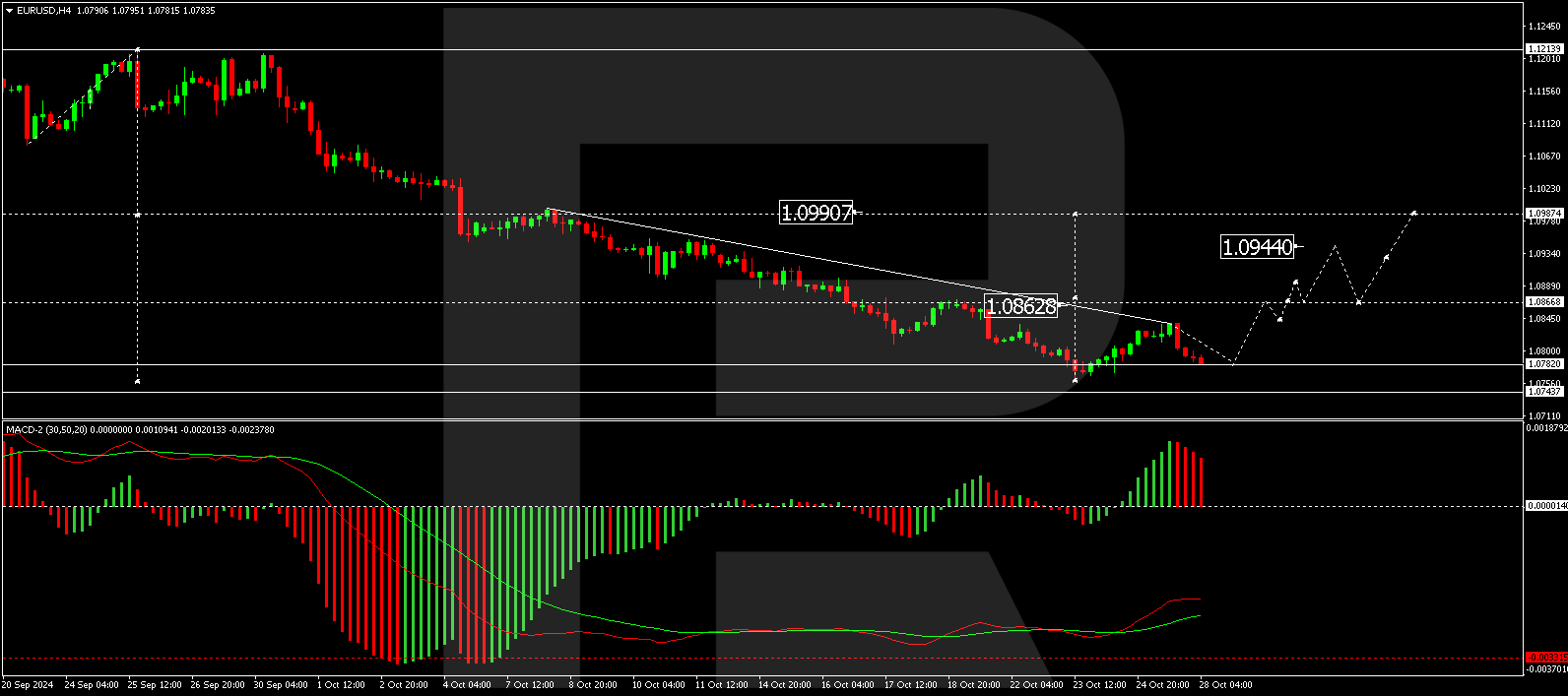
The USD/JPY is currently in a broad consolidation range centred around 143.43, extending to 144.66. The market has initiated a downward movement towards 142.55, testing this level from above. Subsequently, we anticipate a rebound to the upper boundary of this range. A breach above 144.70 could pave the way for a rise to 145.77, potentially extending to 146.66. Conversely, a decline to 142.00 and a subsequent breakdown could signal a trend continuation towards 137.77. The MACD indicator supports this bullish scenario, with its signal line positioned above zero and pointing upwards.

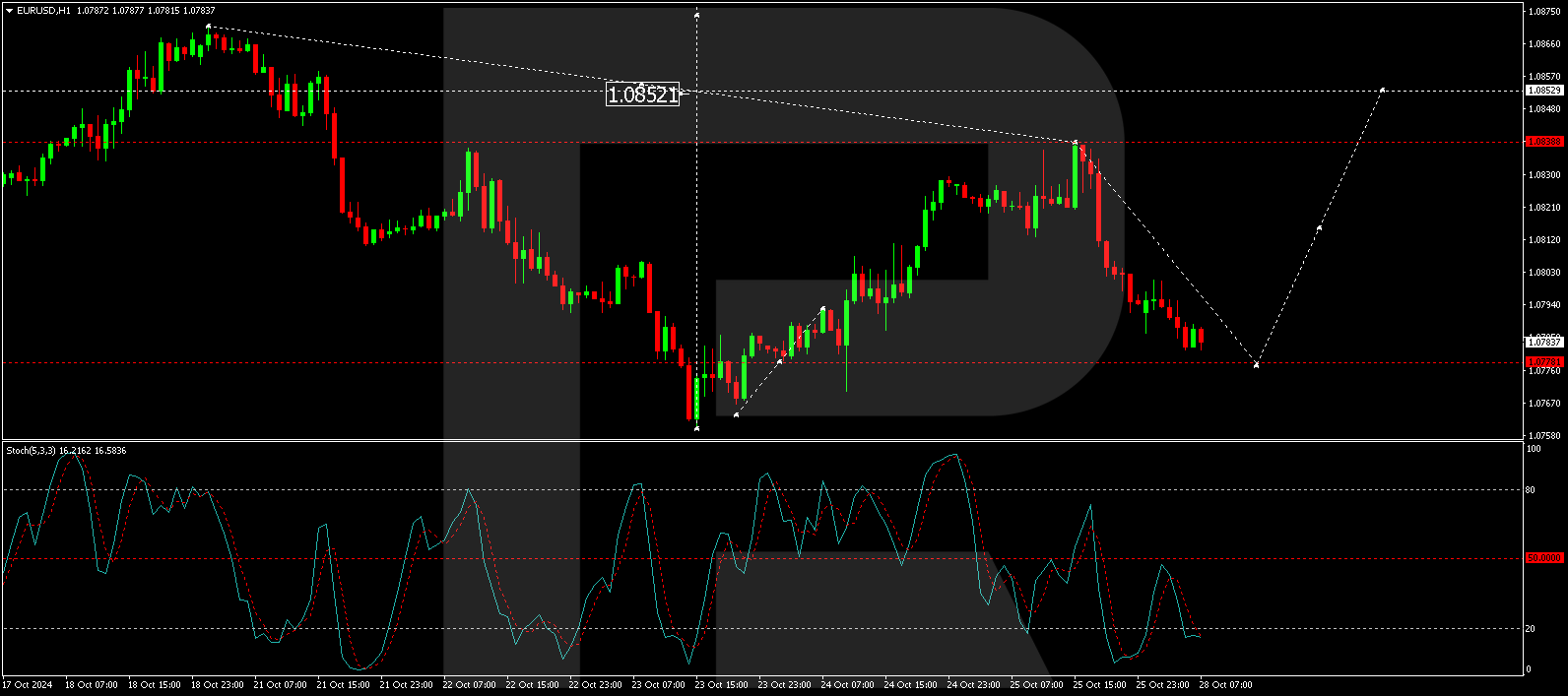
On the H1 chart, USD/JPY has crafted a consolidation range around 143.60, achieving the 142.90 local downside target. The pair is now moving upward towards 143.60, testing this level from below. The current setup suggests a retest of 143.60 could be followed by a new decline towards 142.55. The Stochastic oscillator, with its signal line above 50 and pointing upwards, corroborates this potential for a brief uptick followed by a continued downward trajectory.


Disclaimer

Any forecasts contained herein are based on the author’s particular opinion. This analysis may not be treated as trading advice. RoboForex bears no responsibility for trading results based on trading recommendations and reviews contained herein.

Chinese indices rise on PBoC stimulus. In Australia, inflationary pressures are easing

By JustMarkets

At Tuesday’s close, the Dow Jones Index (US30) was up 0.20%, while the S&P 500 Index (US500) added 0.25%. The NASDAQ Technology Index (US100) closed positive 0.56%.

Hawkish comments from Fed Chair Bowman, the only dissenter to last week’s 50 bps cut in the Fed Funds rate, put some pressure on stocks on Tuesday when she said the Fed should cut interest rates at a “moderate” pace as inflation risks persist and the labor market is not showing much weakening. The Conference Board’s Consumer Confidence Index for September unexpectedly fell by 6.9 to 98.7 against expectations for a rise to 104.0. The Richmond Fed survey for September unexpectedly fell 2 to a 4–1/3 year low of 21, weaker than expectations of a rise to 12. Markets await inflation news on Friday when the core PCE Price Index, the Fed’s preferred gauge of inflation, is released. Consensus expects the PCE Price Index to rise 0.2% m/m in August and increase 2.7% y/y from 2.6% y/y in July.

Equity markets in Europe were mostly up on Tuesday. Germany’s DAX (DE40) rose by 0.80%, France’s CAC 40 (FR40) closed 1.28% higher, Spain’s IBEX 35 (ES35) gained 0.33%, and the UK’s FTSE 100 (UK100) closed up 0.28%. Weak economic data reinforced expectations that the ECB would ease monetary policy to support the struggling European economy. The latest data showed that business morale in Germany fell more than expected to an 8-month low.

Sweden’s Riksbank cut its key rate by 25 basis points to 3.25% at its September 2024 meeting, following a similar move in August and in line with market expectations. In addition, policymakers have signaled further rate cuts at the two remaining monetary policy meetings this year if the outlook for inflation and economic activity remains unchanged, with one of those meetings potentially cutting the rate by 50 basis points.

WTI crude oil prices hovered near $71.4 a barrel on Wednesday, trying to extend the previous session’s gains as markets continued to assess China’s economic intervention. On Tuesday, China’s central bank announced the largest economic stimulus in four years and growth targets, improving the outlook for demand from the world’s top oil importer. At the same time, fears of supply disruptions in the Middle East are growing as risks of a wider conflict escalate.

Asian markets were mostly up yesterday. Japan’s Nikkei 225 (JP225) decreased by 1.08%, China’s FTSE China A50 (CHA50) was up 6.04%, Hong Kong’s Hang Seng (HK50) added 4.06%, and Australia’s ASX 200 (AU200) was positive 0.28%. Chinese indices rose for a second day and held firmly at their highest level in four months as all sectors made further strong gains. Aggressive stimulus measures adopted by China’s Central Bank on Tuesday to support the ailing economy continued to boost sentiment.

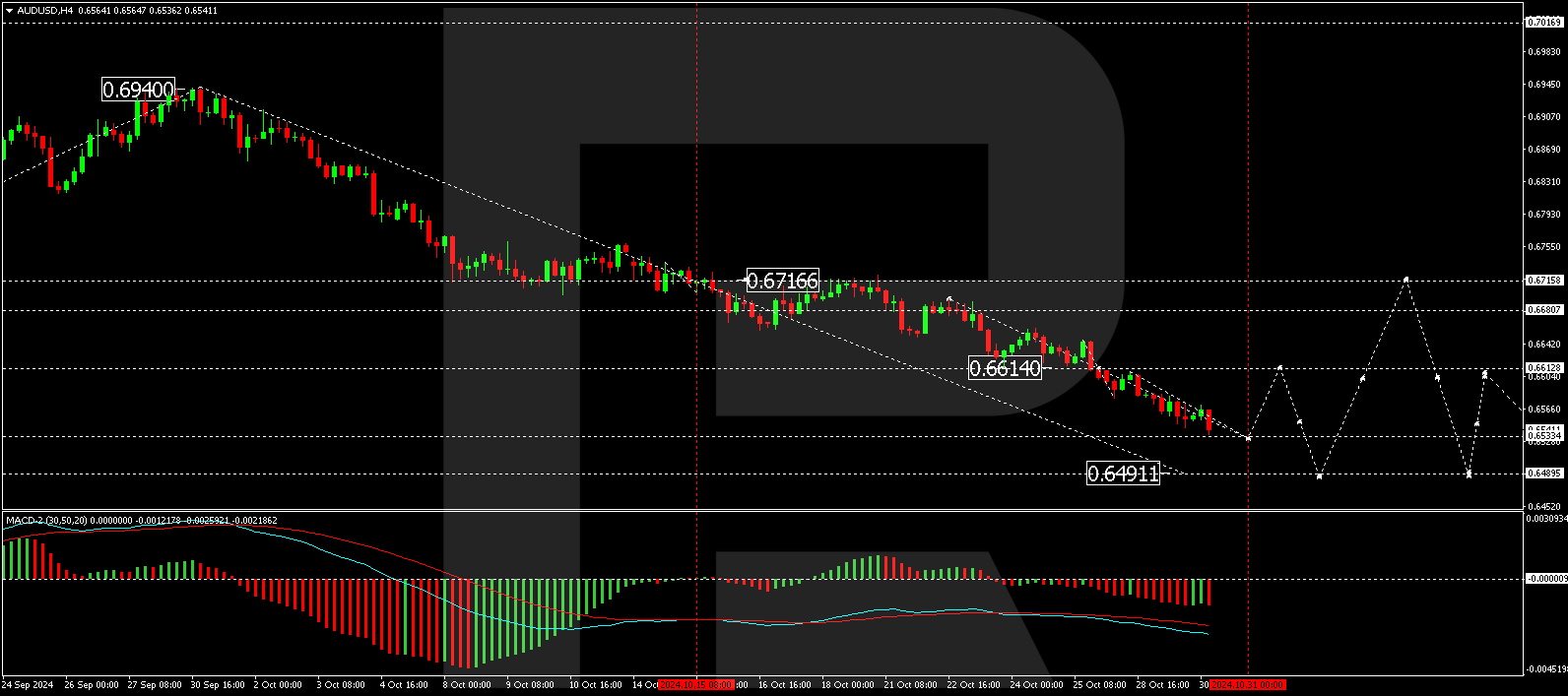
The Australian dollar climbed to $0.69, ending at its highest level since February 2023, as investors reacted to the latest inflation report. The data showed Australia’s monthly Consumer Price Index fell to a three-year low of 2.7% in August, back within the Central Bank’s target range of 2–3%, although the drop was mainly due to temporary government energy rebates. The Australian dollar also rose thanks to China’s latest stimulus package, which could support demand in Australia’s biggest export market.

S&P 500 (US500) 5,732.93 +14.36 (+0.25%)

Dow Jones (US30) 42,208.22 +83.57 (+0.20%)

DAX (DE40) 18,996.63 +149.84 (+0.80%)

FTSE 100 (UK100) 8,282.76 +23.05 (+0.28%)

USD Index 100.28 -0.19 (-0.19%)

News feed for: 2024.09.25

  • Australia Consumer Price Index (m/m) at 04:30 (GMT+3);
  • Singapore Consumer Price Index (m/m) at 08:00 (GMT+3);
  • Switzerland KOF Leading Indicators (m/m) at 10:00 (GMT+3);
  • Sweden Riksbank Interest Rate Decision  (m/m) at 10:30 (GMT+3);
  • US Building Permits (m/m) at 15:30 (GMT+3);
  • US New Home Sales (m/m) at 17:00 (GMT+3);
  • US Crude Oil Reserves (w/w) at 17:30 (GMT+3).

By JustMarkets


This article reflects a personal opinion and should not be interpreted as an investment advice, and/or offer, and/or a persistent request for carrying out financial transactions, and/or a guarantee, and/or a forecast of future events.