AUD/USD Rises Following Strong Australian Employment Data

By RoboForex Analytical Department 

AUD/USD rebounded on Thursday after three consecutive days of declines. This was supported by robust employment data from Australia, which bolstered the hawkish outlook on the Reserve Bank of Australia’s (RBA) monetary policy.

Key Employment Data Highlights:

  • Job creation: the Australian economy added 64.1k jobs in September, significantly surpassing the expected 25.0k. This marked improvement suggests strong economic momentum
  • Unemployment rate: the rate held steady at 4.1%, aligning with expectations and underscoring the labour market’s resilience
  • Labour force participation: the participation rate rose to a record 67.2% in September from 67.1% in August, beating the forecast of 67.1%. This increase reflects a growing workforce, which could sustain consumer spending and economic activity

These indicators of labour market strength make it less likely that the RBA will opt for rate cuts in the near term. Additionally, RBA Deputy Governor Sarah Hunter emphasised the central bank’s commitment to controlling inflation, which continues to be a concern amid sustained price increases. Analysts now suggest that the RBA is unlikely to cut rates until at least the first half of the next year, considering the tight labour market conditions.

Technical analysis of AUD/USD

The AUD/USD pair is extending its downward movement towards a target of 0.6645. After testing the resistance at 0.6700 from below, it continues its decline. Once the 0.6645 level is reached, a new consolidation range is expected to form above this level. A breakout above this range could initiate a corrective phase towards 0.6790. This bearish trend is supported by the MACD indicator, which remains below zero and points downwards, indicating sustained downward momentum.

On the hourly chart, AUD/USD has completed a downward wave to 0.6660, followed by a corrective rise to 0.6700. The pair is expected to continue its decline to the 0.6645 level. After this target is met, a potential reversal could push the price towards 0.6710. The Stochastic oscillator supports this outlook, with its signal line below 50 and heading towards 20, suggesting that there may be further downside before any significant recovery.


Disclaimer

Any forecasts contained herein are based on the author’s particular opinion. This analysis may not be treated as trading advice. RoboForex bears no responsibility for trading results based on trading recommendations and reviews contained herein.

Inflationary pressures continue to ease in the UK and New Zealand

By JustMarkets

On Tuesday, the Dow Jones (US30) Index was down 0.75%. The S&P 500 Index (US500) decreased by 0.78%. The NASDAQ Technology Index (US100) closed negative 1.37%.

The Biden administration is discussing imposing country-specific restrictions on sales of advanced artificial intelligence chips. This hurt the stocks of chip and chip companies. ASML shares fell by 16.5% after lowering its projection, which put pressure on other chip makers, including Nvidia (-4.5%), Broadcom (-3.5%), AMD (-5.2%), and Intel (-3.3%). In addition, shares of energy companies, namely Exxon Mobil (-2.2%) and Chevron (-1.4%), were under pressure amid a sharp decline in oil prices.

Boeing (BA) shares rose more than 2%. They led the Dow Jones Industrials after receiving a $10 billion credit line from lenders and after filing a $25 billion financing request to counter a prolonged strike that shut down a Seattle manufacturing center for a month. Apple (AAPL) is up more than 1% and set a record high after unveiling a powerful new iPad mini equipped with Apple Intelligence artificial intelligence features.

Canada’s latest CPI report revived bets that the Bank of Canada may cut rates by 50 bps next week. The annual inflation rate fell to 1.6% in September, the lowest since February 2021, and is now below the Central Bank’s 2% target. Meanwhile, the annualized CPI Median and CPI Trimmed-Mean, which are the Central Bank’s two preferred measures of core inflation, were unchanged at 2.3% and 2.4%, respectively. The Bank of Canada will decide on monetary policy on October 23. Last month, Bank Governor Tiff Macklem opened the door for more rate cuts if inflation and the economy slow faster than expected.

Equity markets in Europe were declining Tuesday. Germany’s DAX (DE40) fell by 0.11%, France’s CAC 40 (FR40) closed down 1.05%, Spain’s IBEX 35 (ES35) gained 0.67%, and the UK’s FTSE 100 (UK100) closed down 0.52%. Eurozone industrial production rose by 1.8% m/m in August, matching expectations and the largest increase in 1 year. German economic growth expectations for October in the ZEW survey rose by 9.5 to 13.1, beating expectations of 10.0. Swaps estimate the odds of a 25bp ECB rate cut at Thursday’s meeting at 97%.

The UK annual core inflation rate fell to 3.2% in September 2024 from 3.6% in previous months, the lowest since September 2021. The data was below market estimates of 3.4%, with the annualized CPI services rate falling (4.9% vs. 5.6% in August) and the annualized CPI goods rate falling further (-1.4% vs. -0.9%).

WTI crude oil prices fell by 4.4% to $70.6 per barrel on Tuesday following reports that Israel may avoid strikes on Iran’s oil infrastructure, easing fears of major supply disruptions in the region. The IEA also cut demand growth estimates, citing near-record spare capacity in OPEC+ and slowing demand in major markets such as China, where consumption fell by 500,000 bpd in August for the fourth straight month. Global oil demand is estimated to grow by just under 900,000 bpd in 2024 and 1 million bpd in 2025, a slowdown from the 2 million bpd seen since the pandemic.

Asian markets traded flat yesterday. Japan’s Nikkei 225 (JP225) was up 0.77%, China’s FTSE China A50 (CHA50) fell by 2.78%, Hong Kong’s Hang Seng (HK50) was down 3.67%, and Australia’s ASX 200 (AU200) was positive 0.79%.

New Zealand’s annual inflation fell to 2.2% in the third quarter from 3.3% in the previous quarter, the lowest since March 2021. Inflation is within the Reserve Bank’s target range of 1–3%, paving the way for significant interest rate cuts in the coming months. The Central Bank has cut the official money rate by 75 basis points since August and is expected to continue cutting rates over the next year to stimulate the economy. Markets are now pricing in a high probability of another 50 basis point rate cut by the RBNZ at the last meeting of the year in November.

S&P 500 (US500) 5,815.26 −44.59 (−0.76%)

Dow Jones (US30) 42,740.42 −324.80 (−0.75%)

DAX (DE40) 19,486.19 −22.10 (−0.11%)

FTSE 100 (UK100) 8,249.28 −43.38 (−0.52%)

USD Index 103.21 −0.09 (−0.09%)

News feed for: 2024.10.16

  • New Zealand Consumer Price Index (q/q) at 00:45 (GMT+3);
  • UK Consumer Price Index (m/m) at 09:00 (GMT+3);
  • UK Producer Price Index (m/m) at 09:00 (GMT+3);
  • Eurozone ECB President Lagarde Speaks at 21:40 (GMT+3).

By JustMarkets


This article reflects a personal opinion and should not be interpreted as an investment advice, and/or offer, and/or a persistent request for carrying out financial transactions, and/or a guarantee, and/or a forecast of future events.

Netflix earnings preview: Set for fresh all-time highs?

By ForexTime 

  • Netflix ↑ 45% year-to-date
  • Shares could move 7.6% % ↑ or ↓ post-earnings
  • Subscription numbers & live sports offering in focus
  • Technical levels – $735 & $700

Netflix is probably one of the first providers you think about regarding TV streaming services.

And it remains the biggest player in this space, boasting almost 280 million subscribers worldwide!

The company shares have been edging higher, hitting a fresh all-time high at $734.92 last Friday.

Despite the recent selloff, Netflix stocks are still up 45% year-to-date.

Prices could push higher or lower depending on how investors react to the latest earnings report.

  • When will earnings be published?

Netflix will report its earnings for the third quarter after US markets close on Thursday 17th October.

  • Market expectations:

The company is expected to post earnings per share of $5.12 compared to $3.73 a year ago.

Quarterly revenues are seen rising $9.8 billion from $8.5 billion in the prior year – equating to a 15.3% increase.

  • Why is this important?

As the biggest streaming service in the world, Netflix’s results could provide key insights into consumer spending habits and the health of the streaming industry.

  • Key metrics…

When publishing its earnings for Q2 back in July, Netflix reported just under 278 million subscribers.

So, it will be interesting to see what impacts the crackdown on password sharing have on this number.

According to analyst expectations, the streaming giant is expected to report around 286 million active subscribers for Q3 – further solidifying its grip on the throne.

Investors will be looking for more information on live sports offerings, especially when considering how the NFL will see its first games on Netflix on Christmas Day.

  • Potential challenges

In such a competitive industry filled with the likes of Amazon Prime, Disney+, Hulu and Apple TV among others, investors will be keen to see how Netflix fared.

Consumers are spoilt for choice for quality streaming services, and this has the potential to impact the company’s overall results.

  • How will Netflix react to earnings?

Markets are forecasting a 7.6% move, either Up or Down, for Netflix stocks on Thursday post earnings.

  • What does this mean for prices?

A 7.6% move up from $704.56 (current price) will take Netflix shares to a fresh all-time high at $758.

While a 7.6% move down will send prices back toward $651.

  • Technical picture

Although prices have been trending higher on the daily charts, a range can be identified with support at $700 and resistance at $734.92. The incoming earnings report could push the scales of power in favour of bulls or bears.

  • A solid set of earnings could push prices back above the all-time high at $734.92 with $750 acting as a point of interest.
  • If the earnings disappoint, prices could slip below $700 – opening a path back toward the 100-day SMA at $670 and $650.

netflix


Forex-Time-LogoArticle by ForexTime

ForexTime Ltd (FXTM) is an award winning international online forex broker regulated by CySEC 185/12 www.forextime.com

EUR/USD Continues Downward Amid Economic Uncertainties

By RoboForex Analytical Department 

EUR/USD has sustained its position below the EMA-200 line, indicating a potential shift into a more defined downtrend. Recent comments from Raphael Bostic, head of the Atlanta Federal Reserve, have influenced this movement. Bostic suggests a modest 25-basis-point cut in interest rates this year – contrary to earlier predictions of a more aggressive 50-point reduction. Federal Reserve officials have underscored that any policy easing would be contingent on upcoming economic data.

The dollar’s strength is further bolstered by the Empire Manufacturing Index for New York State, which sharply declined to -11.9 in October, a significant drop from 11.5 in September, marking the lowest level since May. This unexpected downturn, which contrasts with analyst expectations for a slight positive reading of 3.8, highlights a deterioration in regional manufacturing activity. While this data suggests potential headwinds for the US economy, it could paradoxically support the USD if it fuels speculation about a less aggressive rate-cutting strategy by the Fed.

Market participants eagerly anticipate further economic reports, including data on retail sales, industrial production, and the upcoming manufacturing data from FRB Philadelphia. These indicators will be crucial in painting a more comprehensive picture of the US consumer sector and overall industrial conditions, potentially guiding the next moves for EUR/USD.

Technical analysis of EUR/USD

EUR/USD is entrenched downward, aiming for the 1.0777 target level. The currency pair is currently consolidating around 1.0888. A break below this consolidation to 1.0860 could further propel the pair towards 1.0777. Upon reaching this level, a corrective phase towards 1.0996 might be anticipated. The MACD indicator, positioned below zero and poised to reach new lows, supports this bearish outlook.

On the hourly chart, EUR/USD has formed a consolidation range just above 1.0888. A downward break from this range is expected, which could extend the decline towards 1.0857 and potentially continue the downtrend to 1.0777. This scenario is reinforced by the Stochastic oscillator, whose signal line is below 50 and trending downwards towards 20, indicating the likelihood of continued bearish momentum.


Disclaimer

Any forecasts contained herein are based on the author’s particular opinion. This analysis may not be treated as trading advice. RoboForex bears no responsibility for trading results based on trading recommendations and reviews contained herein.

India is experiencing a surge in inflation. US stock indices are once again updating historical highs.

By JustMarkets

On Monday, the Dow Jones Index (US30) rose by 0.47%. The S&P 500 index (US500) gained 0.77%. The NASDAQ Technology Index (US100) closed positive 0.87%. The S&P 500 and Dow Jones Industrials indices hit new all-time highs, and the Nasdaq 100 Index hit a 2-month high. Optimism about corporate earnings for the third quarter helped boost stock prices after bank stocks rose last Friday on strong earnings results from JPMorgan Chase and Wells Fargo. According to data compiled by Bloomberg Intelligence, companies in the S&P 500, on average, are expected to report a 4.3% increase in quarterly earnings in Q3 from a year earlier, down from the 7.9% increase estimate in July. In addition, gains in chipmakers stocks on Monday helped boost the overall market.

Trading volumes were below average as trading in the Treasury cash market was closed due to the Columbus Day holiday. Fed comments signaled support for the gradual pace of interest rate cuts. Minneapolis Fed President Kashkari said a “further moderate reduction” in the federal funds rate would likely be appropriate in the coming quarters.

Mexico’s Consumer Confidence Index fell to 47.1 in September from 47.6 in August, the highest reading since February 2019. The decline reflects worsening sentiment about household finances and the country’s economic outlook, as well as a decrease in consumers’ willingness to make significant purchases. The minutes of the Bank of Mexico meeting emphasize the need for a less tight monetary policy in light of slowing economic growth and easing price pressures. The Central Bank is expected to cut rates by 50 basis points to 10% by the end of 2024.

Equity markets in Europe rose steadily on Monday. Germany’s DAX (DE40) rose by 0.69%, France’s CAC 40 (FR40) closed higher by 0.32%, Spain’s IBEX 35 (ES35) added 1.12%, and the UK’s FTSE 100 (UK100) closed up 0.47%.

The UK unemployment rate fell to 4.0% between June and August 2024, down from 4.1% in the previous three-month period and in line with market estimates. At the same time, the number of people in employment rose by 373,000 to 33.37 million, the highest on record, mainly due to growth in both full-time and part-time workers.

WTI crude oil prices fell by 2% to $74 a barrel on Monday amid concerns about China’s weakening economy. Markets were disappointed by China’s Finance Ministry briefing on Saturday, which lacked major new fiscal stimulus despite promises of support for the real estate sector and a potential increase in borrowing. China’s inflation also fell in September, raising concerns about weakening fuel demand in the world’s biggest oil importer.

Asian markets traded flat yesterday. Japan’s Nikkei 225 (JP225) was up 0.57%, China’s FTSE China A50 (CHA50) was up 1.66%, Hong Kong’s Hang Seng (HK50) was 0.75% cheaper, and Australia’s ASX 200 (AU200) was positive 0.47%.

India’s annual inflation rate for September 2024 rose to 5.49% from 3.65% in the previous month, well above market estimates of 5%. It was the highest inflation rate since the beginning of the year, surpassing the RBI’s 4% target after falling below the threshold in the first two months of the September quarter, jeopardizing earlier expectations of the Central Bank soon starting to cut rates.

S&P 500 (US500) 5,859.85 +44.82 (+0.77%)

Dow Jones (US30) 43,065.22 +201.36 (+0.47%)

DAX (DE40) 19,508.29 +134.46 (+0.69%)

FTSE 100 (UK100) 8,292.66 +39.01 (+0.47%)

USD Index 103.20 +0.31 (+0.30%)

News feed for: 2024.10.15

  • UK Unemployment Rate (m/m) at 09:00 (GMT+3);
  • German ZEW Economic Sentiment (m/m) at 12:00 (GMT+3);
  • Eurozone ZEW Economic Sentiment (m/m) at 12:00 (GMT+3);
  • Eurozone Industrial Production (m/m) at 12:00 (GMT+3);
  • Canada Consumer Price Index (m/m) at 15:30 (GMT+3);
  • US NY Empire State Manufacturing Index (m/m) at 15:30 (GMT+3);
  • US FOMC Member Daly Speaks (m/m) at 18:30 (GMT+3).

By JustMarkets


This article reflects a personal opinion and should not be interpreted as an investment advice, and/or offer, and/or a persistent request for carrying out financial transactions, and/or a guarantee, and/or a forecast of future events.

Brent: Slumps on easing Middle East fears

By ForexTime 

  • Brent ↓ 6% this week
  • Fundamentals swing in favour of bears
  • Watch out for US/China data and EIA report
  • Technical levels: $77.90, $75 & $73

Oil benchmarks have been hammered this week, shedding over 6% thanks to potent fundamental forces.

  • The global commodity stumbled into Monday’s session after China’s highly anticipated Finance Ministry briefing failed to impress investors.
  • OPEC’s monthly oil market report rubbed salt into the wound as the cartel cut its demand forecast this year for the third time in a row.  
  • But the knockout blow for oil was delivered on Tuesday morning following reports that Israel may avoid striking Iran’s crude infrastructure.

With this development easing concerns over wider conflict and major supply disruptions, oil was left under the mercy of bears this week:

  • WTI: -6.6%
  • Brent: – 6.1%

Despite these heavy losses, oil prices are still up month-to-date and may see more volatility this week due to ongoing developments in China and US rate expectations.

This brings our attention to key US and China data scheduled near the end of the week.

  • Thursday, October 17th: US retail sales, initial jobless claims, EIA data
  • Friday, October 18th: China GDP, retail sales, industrial production, home prices

Over the past few weeks, confidence has improved in the US economic outlook thanks to better-than-expected data. If this translates to improving oil demand, the global commodity could receive a boost.

Still, US crude inventories have been rising over the past two weeks raising questions about demand. The latest EIA data on Thursday has the potential to move oil prices.

But it’s all about the data dump from China on Friday which could provide fresh insight into the health of the world’s largest energy consumers. Ultimately, a strong set of figures from China may boost optimism over the demand outlook – supporting oil prices as a result.

Looking at the technicals…

Prices are under intense pressure on the daily charts with Brent respecting a bearish channel.

There have been consistently lower lows and lower highs while the MACD trades to the downside. However, daily support can be seen around the $75.00 level.

  • Sustained weakness $75,00 could send prices back toward $73,00, $70.80 and $68.80.
  • Should $73.00 prove reliable support, this could trigger a rebound toward the 21-day SMA at $75.00 and $77.90.

Brent 3


Forex-Time-LogoArticle by ForexTime

ForexTime Ltd (FXTM) is an award winning international online forex broker regulated by CySEC 185/12 www.forextime.com

USD/JPY Faces Resistance Amid Geopolitical and Economic Uncertainties

By RoboForex Analytical Department 

USD/JPY has been struggling to break past the resistance level at 149.55 despite repeated attempts over the past five trading sessions. The Japanese yen remains under pressure as the Federal Reserve signals a more moderate approach to interest rate cuts in its upcoming meetings, contrasting with the broader expectations of more aggressive rate reductions.

Further complicating the currency dynamics, recent fiscal stimulus announcements from China have yet to manage to bolster market confidence. Over the weekend, China’s Finance Minister Lan Fo’an detailed plans for additional capital injections into state-owned banks and measures to support the property market. However, the lack of specific details regarding the spending amount and the precise nature of these measures left investors feeling uncertain about the effectiveness and scale of the proposed stimulus.

In Japan, dovish comments from Bank of Japan Governor Kazuo Ueda and opposition from new Prime Minister Shigeru Ishiba against further rate hikes have added to the pressure on the yen. Earlier this month, Ishiba expressed concerns that the current economic conditions do not warrant additional rate increases. However, other senior officials later softened this stance, indicating some internal conflict or reassessment within the Japanese government regarding monetary policy.

Technical analysis of USD/JPY

The USD/JPY pair is currently within a broad consolidation range around 149.22. The range has expanded to 149.96, and the market is now forming a downward movement towards 149.22, testing this level from above. If the market rebounds from here, we might see an ascent towards 150.22. A break above this level could signal a continuation towards 153.22. Conversely, a drop below 148.88 could lead to a further correction down to 147.47. The MACD indicator supports this view, with the signal line high above zero but starting to descend towards it, suggesting a potential shift in momentum.

On the hourly chart, USD/JPY has completed a growth wave to 149.96 and is undergoing a correction to 149.22. Following this corrective phase, the market is expected to resume its upward trajectory towards 150.22. This movement aligns with the Stochastic oscillator’s current trajectory, which shows the signal line moving upwards from 50 towards 80, indicating potential for further gains in the short term.


Disclaimer

Any forecasts contained herein are based on the author’s particular opinion. This analysis may not be treated as trading advice. RoboForex bears no responsibility for trading results based on trading recommendations and reviews contained herein.

US Dollar Index Speculator bets fall for 4th straight week to 6-month low

By InvestMacro

Here are the latest charts and statistics for the Commitment of Traders (COT) data published by the Commodities Futures Trading Commission (CFTC).

The latest COT data is updated through Tuesday October 8th and shows a quick view of how large market participants (for-profit speculators and commercial traders) were positioned in the futures markets. All currency positions are in direct relation to the US dollar where, for example, a bet for the euro is a bet that the euro will rise versus the dollar while a bet against the euro will be a bet that the euro will decline versus the dollar.

Weekly Speculator Changes led by Brazilian Real & Australian Dollar

The COT currency market speculator bets were slightly lower overall this week as five out of the eleven currency markets we cover had higher positioning while the other six markets had lower speculator contracts.

Leading the gains for the currency markets was the Brazilian Real (28,276 contracts) with the Australian Dollar (18,894 contracts), the Mexican Peso (2,894 contracts), Bitcoin (402 contracts) and the Swiss Franc (395 contracts) also showing positive weeks.

The currencies seeing declines in speculator bets on the week were the Japanese Yen (-20,244 contracts), the Canadian Dollar (-19,148 contracts), the EuroFX (-16,229 contracts), the US Dollar Index (-2,043 contracts), the New Zealand Dollar (-689 contracts) and the British Pound (-630 contracts) also registering lower bets on the week.

US Dollar Index Speculator bets fall for 4th straight week to 6-month low

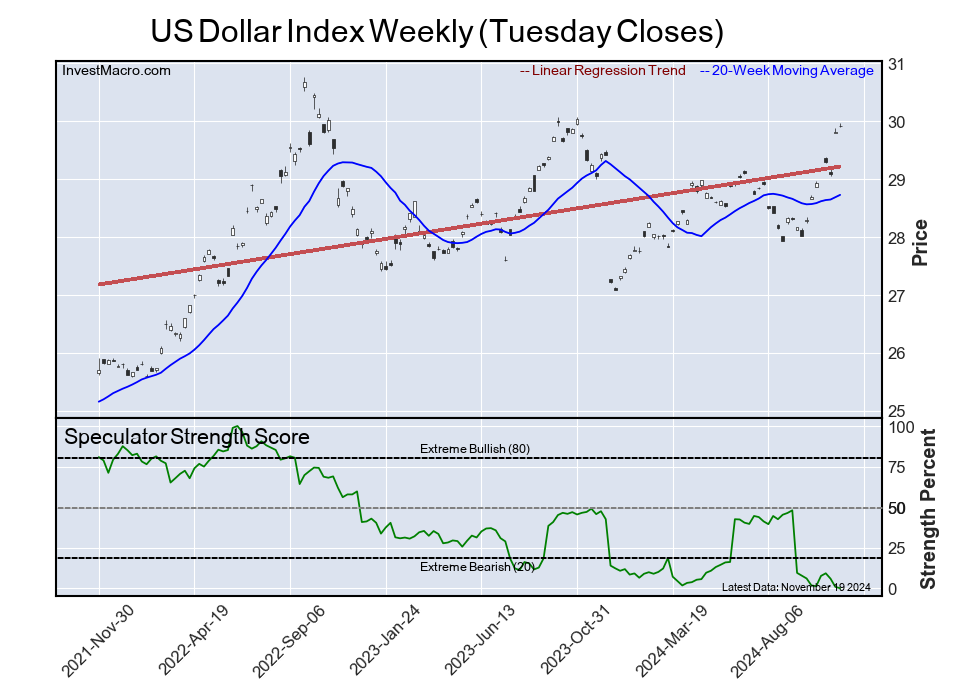
Highlighting the COT currency’s data this week is the decrease in the speculator’s positioning in the US Dollar Index. The large speculative US Dollar Index positions declined for a fourth straight week and have now dipped by a total of -22,099 net contracts over this 4-week period. This recent weakness has pushed the US Dollar Index speculator net position into an overall bearish position at a total of -1,889 contracts. The current speculator standing now resides at the lowest level since April 2nd, a span of 27 weeks.

The Dollar Index sentiment has been feeling the pressure over the past few months with US inflation steadily coming down since the highs of 2022 and with the government interest rates already in a cutting cycle. The US Federal Reserve reduced the benchmark interest rate by 50 basis points at the last central bank meeting and brought the current rate down to a range of 4.75-5.00 percent.

There was an expectation of another jumbo rate cut coming up but a recent strong jobs report combined with a recent sticky inflation report puts a higher probability now for a smaller rate cut or even the possibility of a Fed hold. The CME Fedwatch tool shows at the current time, there is a 89.5 percent probability outlook that the Fed will cut the rate by another 25 basis points at the November 7th meeting while there is also 10.5 percent probability outlook that the Fed will hold the rate steady next month.

Despite the recent sentiment deficit, the US Dollar Index price has had a strong couple of weeks after falling to and rebounding off the 100.15 level on September 27th. Including September 30th, the Dollar Index has risen in nine out of the past ten days and closed this week right below 103.00 at a close of 102.91. We will see if this strength in the USD continues and whether the Dollar Index can get over the 103.00 support/resistance barrier or perhaps, head back lower toward 100.


Currencies Net Speculators Leaderboard

Legend: Weekly Speculators Change | Speculators Current Net Position | Speculators Strength Score compared to last 3-Years (0-100 range)


Strength Scores led by Australian Dollar & Japanese Yen

COT Strength Scores (a normalized measure of Speculator positions over a 3-Year range, from 0 to 100 where above 80 is Extreme-Bullish and below 20 is Extreme-Bearish) showed that the Australian Dollar (100 percent) and the Japanese Yen (88 percent) lead the currency markets this week. The British Pound (78 percent) and the Swiss Franc (55 percent) come in as the next highest in the weekly strength scores.

On the downside, the US Dollar Index (0 percent) comes in at the lowest strength levels currently and is in Extreme-Bearish territory (below 20 percent). The next lowest strength scores are the EuroFX (37 percent), the Brazilian Real (43 percent) and the New Zealand Dollar (43 percent).

3-Year Strength Statistics:
US Dollar Index (0.0 percent) vs US Dollar Index previous week (4.4 percent)
EuroFX (37.0 percent) vs EuroFX previous week (43.9 percent)
British Pound Sterling (78.0 percent) vs British Pound Sterling previous week (78.2 percent)
Japanese Yen (88.2 percent) vs Japanese Yen previous week (96.3 percent)
Swiss Franc (55.4 percent) vs Swiss Franc previous week (54.6 percent)
Canadian Dollar (48.0 percent) vs Canadian Dollar previous week (56.6 percent)
Australian Dollar (100.0 percent) vs Australian Dollar previous week (86.6 percent)
New Zealand Dollar (43.4 percent) vs New Zealand Dollar previous week (44.7 percent)
Mexican Peso (45.8 percent) vs Mexican Peso previous week (44.4 percent)
Brazilian Real (42.6 percent) vs Brazilian Real previous week (15.8 percent)
Bitcoin (47.1 percent) vs Bitcoin previous week (41.1 percent)


Brazilian Real & Australian Dollar top the 6-Week Strength Trends

COT Strength Score Trends (or move index, calculates the 6-week changes in strength scores) showed that the Brazilian Real (41 percent) and the Australian Dollar (37 percent) lead the past six weeks trends for the currencies. The New Zealand Dollar (18 percent), the Canadian Dollar (9 percent) and the Japanese Yen (4 percent) are the next highest positive movers in the 3-Year trends data.

The US Dollar Index (-44 percent) leads the downside trend scores currently with the EuroFX (-23 percent), Bitcoin (-17 percent) and the Mexican Peso (-1 percent) following next with lower trend scores.

3-Year Strength Trends:
US Dollar Index (-44.3 percent) vs US Dollar Index previous week (-37.2 percent)
EuroFX (-22.9 percent) vs EuroFX previous week (-0.3 percent)
British Pound Sterling (1.4 percent) vs British Pound Sterling previous week (11.8 percent)
Japanese Yen (4.3 percent) vs Japanese Yen previous week (13.3 percent)
Swiss Franc (4.4 percent) vs Swiss Franc previous week (5.8 percent)
Canadian Dollar (9.3 percent) vs Canadian Dollar previous week (42.3 percent)
Australian Dollar (37.3 percent) vs Australian Dollar previous week (37.9 percent)
New Zealand Dollar (18.5 percent) vs New Zealand Dollar previous week (30.3 percent)
Mexican Peso (-0.7 percent) vs Mexican Peso previous week (-4.1 percent)
Brazilian Real (40.8 percent) vs Brazilian Real previous week (12.1 percent)
Bitcoin (-16.8 percent) vs Bitcoin previous week (-21.7 percent)


Individual COT Forex Markets:

US Dollar Index Futures:

US Dollar Index Forex Futures COT ChartThe US Dollar Index large speculator standing this week equaled a net position of -1,889 contracts in the data reported through Tuesday. This was a weekly decrease of -2,043 contracts from the previous week which had a total of 154 net contracts.

This week’s current strength score (the trader positioning range over the past three years, measured from 0 to 100) shows the speculators are currently Bearish-Extreme with a score of 0.0 percent. The commercials are Bullish-Extreme with a score of 100.0 percent and the small traders (not shown in chart) are Bearish-Extreme with a score of 16.2 percent.

Price Trend-Following Model: Weak Downtrend

Our weekly trend-following model classifies the current market price position as: Weak Downtrend.

US DOLLAR INDEX StatisticsSPECULATORSCOMMERCIALSSMALL TRADERS
– Percent of Open Interest Longs:58.623.511.2
– Percent of Open Interest Shorts:65.913.613.7
– Net Position:-1,8892,542-653
– Gross Longs:15,0166,0162,869
– Gross Shorts:16,9053,4743,522
– Long to Short Ratio:0.9 to 11.7 to 10.8 to 1
NET POSITION TREND:
– Strength Index Score (3 Year Range Pct):0.0100.016.2
– Strength Index Reading (3 Year Range):Bearish-ExtremeBullish-ExtremeBearish-Extreme
NET POSITION MOVEMENT INDEX:
– 6-Week Change in Strength Index:-44.340.07.3


Euro Currency Futures:

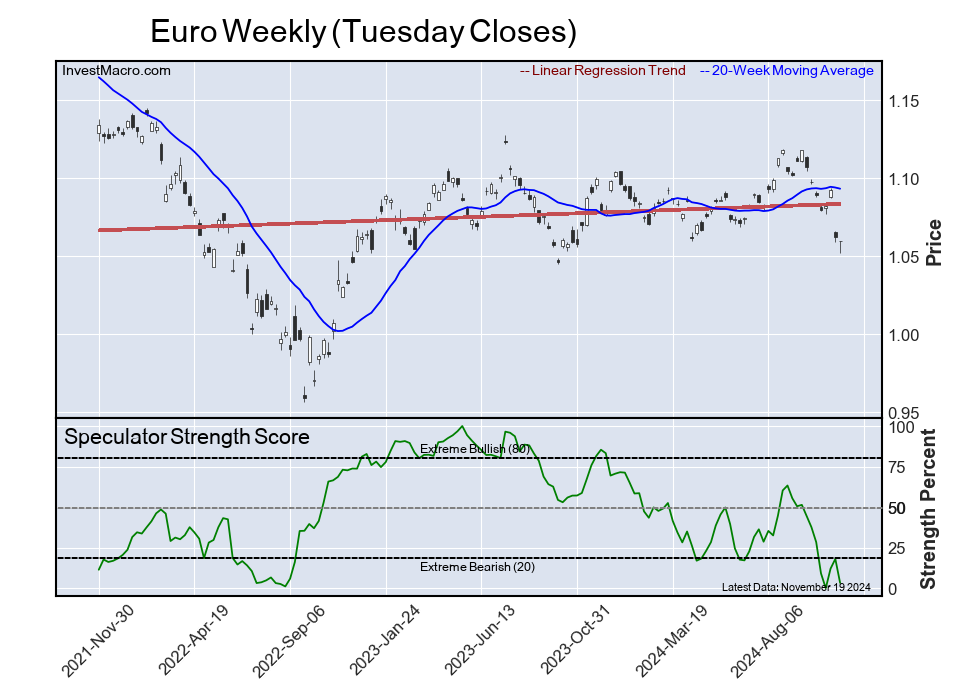
Euro Currency Futures COT ChartThe Euro Currency large speculator standing this week equaled a net position of 39,098 contracts in the data reported through Tuesday. This was a weekly decrease of -16,229 contracts from the previous week which had a total of 55,327 net contracts.

This week’s current strength score (the trader positioning range over the past three years, measured from 0 to 100) shows the speculators are currently Bearish with a score of 37.0 percent. The commercials are Bullish with a score of 61.2 percent and the small traders (not shown in chart) are Bullish with a score of 51.6 percent.

Price Trend-Following Model: Weak Uptrend

Our weekly trend-following model classifies the current market price position as: Weak Uptrend.

EURO Currency StatisticsSPECULATORSCOMMERCIALSSMALL TRADERS
– Percent of Open Interest Longs:26.057.512.6
– Percent of Open Interest Shorts:20.168.77.2
– Net Position:39,098-74,89535,797
– Gross Longs:173,866384,95484,183
– Gross Shorts:134,768459,84948,386
– Long to Short Ratio:1.3 to 10.8 to 11.7 to 1
NET POSITION TREND:
– Strength Index Score (3 Year Range Pct):37.061.251.6
– Strength Index Reading (3 Year Range):BearishBullishBullish
NET POSITION MOVEMENT INDEX:
– 6-Week Change in Strength Index:-22.922.7-15.7


British Pound Sterling Futures:

British Pound Sterling Futures COT ChartThe British Pound Sterling large speculator standing this week equaled a net position of 93,135 contracts in the data reported through Tuesday. This was a weekly lowering of -630 contracts from the previous week which had a total of 93,765 net contracts.

This week’s current strength score (the trader positioning range over the past three years, measured from 0 to 100) shows the speculators are currently Bullish with a score of 78.0 percent. The commercials are Bearish-Extreme with a score of 18.4 percent and the small traders (not shown in chart) are Bullish-Extreme with a score of 93.4 percent.

Price Trend-Following Model: Uptrend

Our weekly trend-following model classifies the current market price position as: Uptrend.

BRITISH POUND StatisticsSPECULATORSCOMMERCIALSSMALL TRADERS
– Percent of Open Interest Longs:61.621.214.9
– Percent of Open Interest Shorts:25.263.49.1
– Net Position:93,135-108,00814,873
– Gross Longs:157,66654,32938,166
– Gross Shorts:64,531162,33723,293
– Long to Short Ratio:2.4 to 10.3 to 11.6 to 1
NET POSITION TREND:
– Strength Index Score (3 Year Range Pct):78.018.493.4
– Strength Index Reading (3 Year Range):BullishBearish-ExtremeBullish-Extreme
NET POSITION MOVEMENT INDEX:
– 6-Week Change in Strength Index:1.4-1.1-0.9


Japanese Yen Futures:

Japanese Yen Forex Futures COT ChartThe Japanese Yen large speculator standing this week equaled a net position of 36,528 contracts in the data reported through Tuesday. This was a weekly lowering of -20,244 contracts from the previous week which had a total of 56,772 net contracts.

This week’s current strength score (the trader positioning range over the past three years, measured from 0 to 100) shows the speculators are currently Bullish-Extreme with a score of 88.2 percent. The commercials are Bearish-Extreme with a score of 14.6 percent and the small traders (not shown in chart) are Bullish with a score of 66.4 percent.

Price Trend-Following Model: Uptrend

Our weekly trend-following model classifies the current market price position as: Uptrend.

JAPANESE YEN StatisticsSPECULATORSCOMMERCIALSSMALL TRADERS
– Percent of Open Interest Longs:42.537.418.2
– Percent of Open Interest Shorts:24.056.617.6
– Net Position:36,528-37,6591,131
– Gross Longs:83,67973,62635,746
– Gross Shorts:47,151111,28534,615
– Long to Short Ratio:1.8 to 10.7 to 11.0 to 1
NET POSITION TREND:
– Strength Index Score (3 Year Range Pct):88.214.666.4
– Strength Index Reading (3 Year Range):Bullish-ExtremeBearish-ExtremeBullish
NET POSITION MOVEMENT INDEX:
– 6-Week Change in Strength Index:4.3-2.3-10.8


Swiss Franc Futures:

Swiss Franc Forex Futures COT ChartThe Swiss Franc large speculator standing this week equaled a net position of -22,459 contracts in the data reported through Tuesday. This was a weekly lift of 395 contracts from the previous week which had a total of -22,854 net contracts.

This week’s current strength score (the trader positioning range over the past three years, measured from 0 to 100) shows the speculators are currently Bullish with a score of 55.4 percent. The commercials are Bearish with a score of 43.8 percent and the small traders (not shown in chart) are Bullish with a score of 55.4 percent.

Price Trend-Following Model: Uptrend

Our weekly trend-following model classifies the current market price position as: Uptrend.

SWISS FRANC StatisticsSPECULATORSCOMMERCIALSSMALL TRADERS
– Percent of Open Interest Longs:11.969.717.4
– Percent of Open Interest Shorts:47.127.124.8
– Net Position:-22,45927,158-4,699
– Gross Longs:7,61944,47311,109
– Gross Shorts:30,07817,31515,808
– Long to Short Ratio:0.3 to 12.6 to 10.7 to 1
NET POSITION TREND:
– Strength Index Score (3 Year Range Pct):55.443.855.4
– Strength Index Reading (3 Year Range):BullishBearishBullish
NET POSITION MOVEMENT INDEX:
– 6-Week Change in Strength Index:4.4-0.5-8.6


Canadian Dollar Futures:

Canadian Dollar Forex Futures COT ChartThe Canadian Dollar large speculator standing this week equaled a net position of -89,151 contracts in the data reported through Tuesday. This was a weekly lowering of -19,148 contracts from the previous week which had a total of -70,003 net contracts.

This week’s current strength score (the trader positioning range over the past three years, measured from 0 to 100) shows the speculators are currently Bearish with a score of 48.0 percent. The commercials are Bullish with a score of 51.6 percent and the small traders (not shown in chart) are Bearish with a score of 39.4 percent.

Price Trend-Following Model: Weak Uptrend

Our weekly trend-following model classifies the current market price position as: Weak Uptrend.

CANADIAN DOLLAR StatisticsSPECULATORSCOMMERCIALSSMALL TRADERS
– Percent of Open Interest Longs:9.675.213.5
– Percent of Open Interest Shorts:49.336.812.2
– Net Position:-89,15186,2302,921
– Gross Longs:21,643168,98330,344
– Gross Shorts:110,79482,75327,423
– Long to Short Ratio:0.2 to 12.0 to 11.1 to 1
NET POSITION TREND:
– Strength Index Score (3 Year Range Pct):48.051.639.4
– Strength Index Reading (3 Year Range):BearishBullishBearish
NET POSITION MOVEMENT INDEX:
– 6-Week Change in Strength Index:9.3-8.2-2.8


Australian Dollar Futures:

Australian Dollar Forex Futures COT ChartThe Australian Dollar large speculator standing this week equaled a net position of 33,422 contracts in the data reported through Tuesday. This was a weekly boost of 18,894 contracts from the previous week which had a total of 14,528 net contracts.

This week’s current strength score (the trader positioning range over the past three years, measured from 0 to 100) shows the speculators are currently Bullish-Extreme with a score of 100.0 percent. The commercials are Bearish-Extreme with a score of 0.0 percent and the small traders (not shown in chart) are Bullish-Extreme with a score of 93.6 percent.

Price Trend-Following Model: Uptrend

Our weekly trend-following model classifies the current market price position as: Uptrend.

AUSTRALIAN DOLLAR StatisticsSPECULATORSCOMMERCIALSSMALL TRADERS
– Percent of Open Interest Longs:54.228.715.9
– Percent of Open Interest Shorts:38.053.17.7
– Net Position:33,422-50,25316,831
– Gross Longs:111,56159,05732,659
– Gross Shorts:78,139109,31015,828
– Long to Short Ratio:1.4 to 10.5 to 12.1 to 1
NET POSITION TREND:
– Strength Index Score (3 Year Range Pct):100.00.093.6
– Strength Index Reading (3 Year Range):Bullish-ExtremeBearish-ExtremeBullish-Extreme
NET POSITION MOVEMENT INDEX:
– 6-Week Change in Strength Index:37.3-34.312.6


New Zealand Dollar Futures:

New Zealand Dollar Forex Futures COT ChartThe New Zealand Dollar large speculator standing this week equaled a net position of 1,281 contracts in the data reported through Tuesday. This was a weekly decline of -689 contracts from the previous week which had a total of 1,970 net contracts.

This week’s current strength score (the trader positioning range over the past three years, measured from 0 to 100) shows the speculators are currently Bearish with a score of 43.4 percent. The commercials are Bearish with a score of 49.2 percent and the small traders (not shown in chart) are Bullish-Extreme with a score of 81.7 percent.

Price Trend-Following Model: Weak Uptrend

Our weekly trend-following model classifies the current market price position as: Weak Uptrend.

NEW ZEALAND DOLLAR StatisticsSPECULATORSCOMMERCIALSSMALL TRADERS
– Percent of Open Interest Longs:46.144.09.5
– Percent of Open Interest Shorts:43.850.15.6
– Net Position:1,281-3,5032,222
– Gross Longs:26,28725,0885,417
– Gross Shorts:25,00628,5913,195
– Long to Short Ratio:1.1 to 10.9 to 11.7 to 1
NET POSITION TREND:
– Strength Index Score (3 Year Range Pct):43.449.281.7
– Strength Index Reading (3 Year Range):BearishBearishBullish-Extreme
NET POSITION MOVEMENT INDEX:
– 6-Week Change in Strength Index:18.5-20.419.9


Mexican Peso Futures:

Mexican Peso Futures COT ChartThe Mexican Peso large speculator standing this week equaled a net position of 29,193 contracts in the data reported through Tuesday. This was a weekly advance of 2,894 contracts from the previous week which had a total of 26,299 net contracts.

This week’s current strength score (the trader positioning range over the past three years, measured from 0 to 100) shows the speculators are currently Bearish with a score of 45.8 percent. The commercials are Bullish with a score of 55.6 percent and the small traders (not shown in chart) are Bearish-Extreme with a score of 9.1 percent.

Price Trend-Following Model: Downtrend

Our weekly trend-following model classifies the current market price position as: Downtrend.

MEXICAN PESO StatisticsSPECULATORSCOMMERCIALSSMALL TRADERS
– Percent of Open Interest Longs:40.753.83.2
– Percent of Open Interest Shorts:19.274.34.2
– Net Position:29,193-27,901-1,292
– Gross Longs:55,32773,0354,374
– Gross Shorts:26,134100,9365,666
– Long to Short Ratio:2.1 to 10.7 to 10.8 to 1
NET POSITION TREND:
– Strength Index Score (3 Year Range Pct):45.855.69.1
– Strength Index Reading (3 Year Range):BearishBullishBearish-Extreme
NET POSITION MOVEMENT INDEX:
– 6-Week Change in Strength Index:-0.70.70.7


Brazilian Real Futures:

Brazil Real Futures COT ChartThe Brazilian Real large speculator standing this week equaled a net position of -9,979 contracts in the data reported through Tuesday. This was a weekly boost of 28,276 contracts from the previous week which had a total of -38,255 net contracts.

This week’s current strength score (the trader positioning range over the past three years, measured from 0 to 100) shows the speculators are currently Bearish with a score of 42.6 percent. The commercials are Bullish with a score of 58.3 percent and the small traders (not shown in chart) are Bearish with a score of 22.8 percent.

Price Trend-Following Model: Strong Downtrend

Our weekly trend-following model classifies the current market price position as: Strong Downtrend.

BRAZIL REAL StatisticsSPECULATORSCOMMERCIALSSMALL TRADERS
– Percent of Open Interest Longs:43.750.04.5
– Percent of Open Interest Shorts:61.133.33.9
– Net Position:-9,9799,637342
– Gross Longs:25,20128,8042,598
– Gross Shorts:35,18019,1672,256
– Long to Short Ratio:0.7 to 11.5 to 11.2 to 1
NET POSITION TREND:
– Strength Index Score (3 Year Range Pct):42.658.322.8
– Strength Index Reading (3 Year Range):BearishBullishBearish
NET POSITION MOVEMENT INDEX:
– 6-Week Change in Strength Index:40.8-40.51.2


Bitcoin Futures:

Bitcoin Crypto Futures COT ChartThe Bitcoin large speculator standing this week equaled a net position of -1,282 contracts in the data reported through Tuesday. This was a weekly gain of 402 contracts from the previous week which had a total of -1,684 net contracts.

This week’s current strength score (the trader positioning range over the past three years, measured from 0 to 100) shows the speculators are currently Bearish with a score of 47.1 percent. The commercials are Bullish-Extreme with a score of 85.5 percent and the small traders (not shown in chart) are Bearish with a score of 22.3 percent.

Price Trend-Following Model: Weak Downtrend

Our weekly trend-following model classifies the current market price position as: Weak Downtrend.

BITCOIN StatisticsSPECULATORSCOMMERCIALSSMALL TRADERS
– Percent of Open Interest Longs:82.56.24.3
– Percent of Open Interest Shorts:86.83.32.9
– Net Position:-1,282872410
– Gross Longs:24,2331,8271,250
– Gross Shorts:25,515955840
– Long to Short Ratio:0.9 to 11.9 to 11.5 to 1
NET POSITION TREND:
– Strength Index Score (3 Year Range Pct):47.185.522.3
– Strength Index Reading (3 Year Range):BearishBullish-ExtremeBearish
NET POSITION MOVEMENT INDEX:
– 6-Week Change in Strength Index:-16.825.12.5


Article By InvestMacroReceive our weekly COT Newsletter

*COT Report: The COT data, released weekly to the public each Friday, is updated through the most recent Tuesday (data is 3 days old) and shows a quick view of how large speculators or non-commercials (for-profit traders) were positioned in the futures markets.

The CFTC categorizes trader positions according to commercial hedgers (traders who use futures contracts for hedging as part of the business), non-commercials (large traders who speculate to realize trading profits) and nonreportable traders (usually small traders/speculators) as well as their open interest (contracts open in the market at time of reporting). See CFTC criteria here.
Speculator Extremes: Australian Dollar & VIX lead weekly Bullish Positions

By InvestMacro

The latest update for the weekly Commitment of Traders (COT) report was released by the Commodity Futures Trading Commission (CFTC) on Friday for data ending on October 8th.

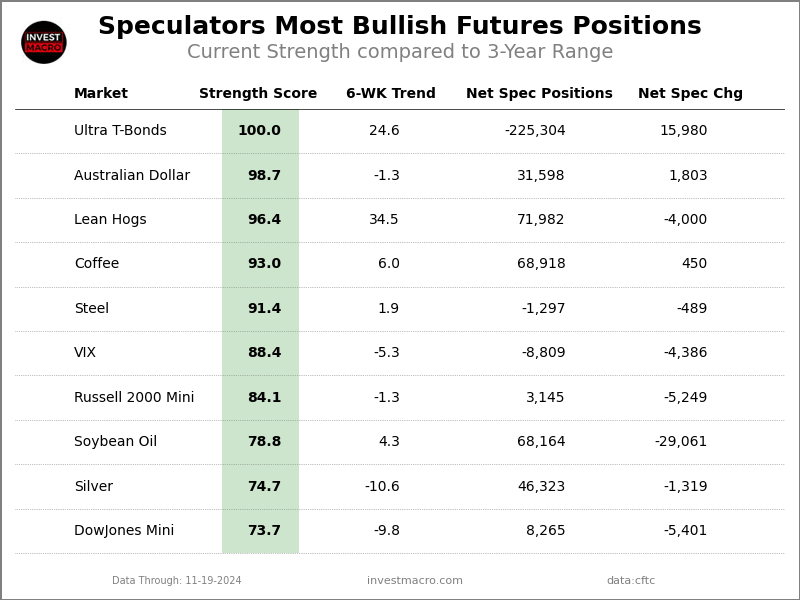
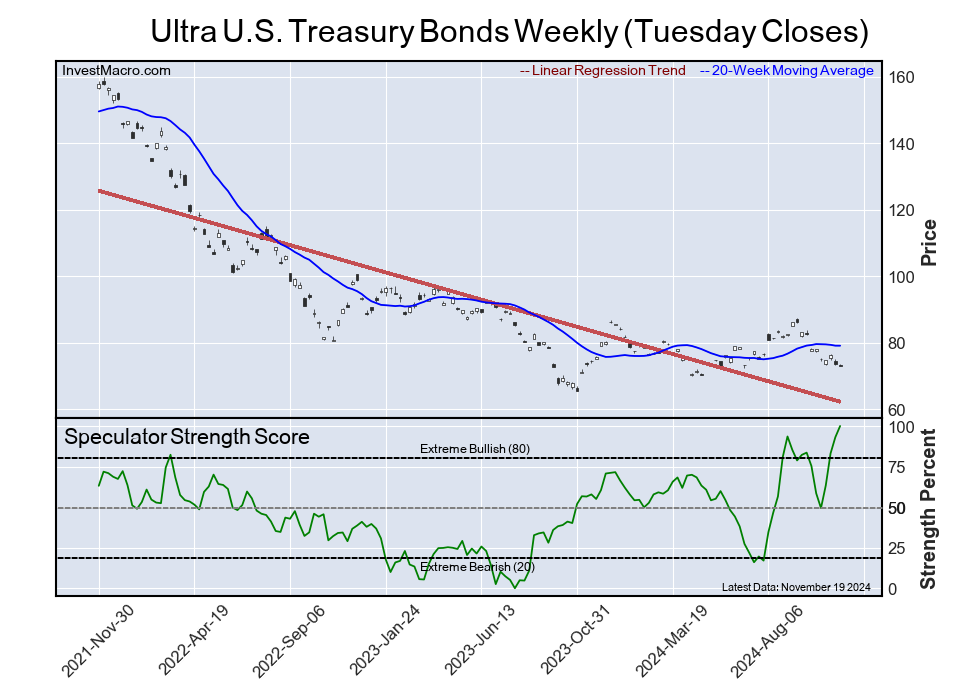
This weekly Extreme Positions report highlights the Most Bullish and Most Bearish Positions for the speculator category. Extreme positioning in these markets can foreshadow strong moves in the underlying market.

To signify an extreme position, we use the Strength Index (also known as the COT Index) of each instrument, a common method of measuring COT data. The Strength Index is simply a comparison of current trader positions against the range of positions over the previous 3 years. We use over 80 percent as extremely bullish and under 20 percent as extremely bearish. (Compare Strength Index scores across all markets in the data table or cot leaders table)


Here Are This Week’s Most Bullish Speculator Positions:

Australian Dollar


The Australian Dollar speculator position comes in as the most bullish extreme standing this week. The Australian Dollar speculator level is currently at a 100.0 percent maximum score of its 3-year range.

The six-week trend for the percent strength score totaled 37.3 this week. The overall net speculator position was a total of 33,422 net contracts this week with a boost of 18,894 contract in the weekly speculator bets.


Speculators or Non-Commercials Notes:

Speculators, classified as non-commercial traders by the CFTC, are made up of large commodity funds, hedge funds and other significant for-profit participants. The Specs are generally regarded as trend-followers in their behavior towards price action – net speculator bets and prices tend to go in the same directions. These traders often look to buy when prices are rising and sell when prices are falling. To illustrate this point, many times speculator contracts can be found at their most extremes (bullish or bearish) when prices are also close to their highest or lowest levels.

These extreme levels can be dangerous for the large speculators as the trade is most crowded, there is less trading ammunition still sitting on the sidelines to push the trend further and prices have moved a significant distance. When the trend becomes exhausted, some speculators take profits while others look to also exit positions when prices fail to continue in the same direction. This process usually plays out over many months to years and can ultimately create a reverse effect where prices start to fall and speculators start a process of selling when prices are falling.


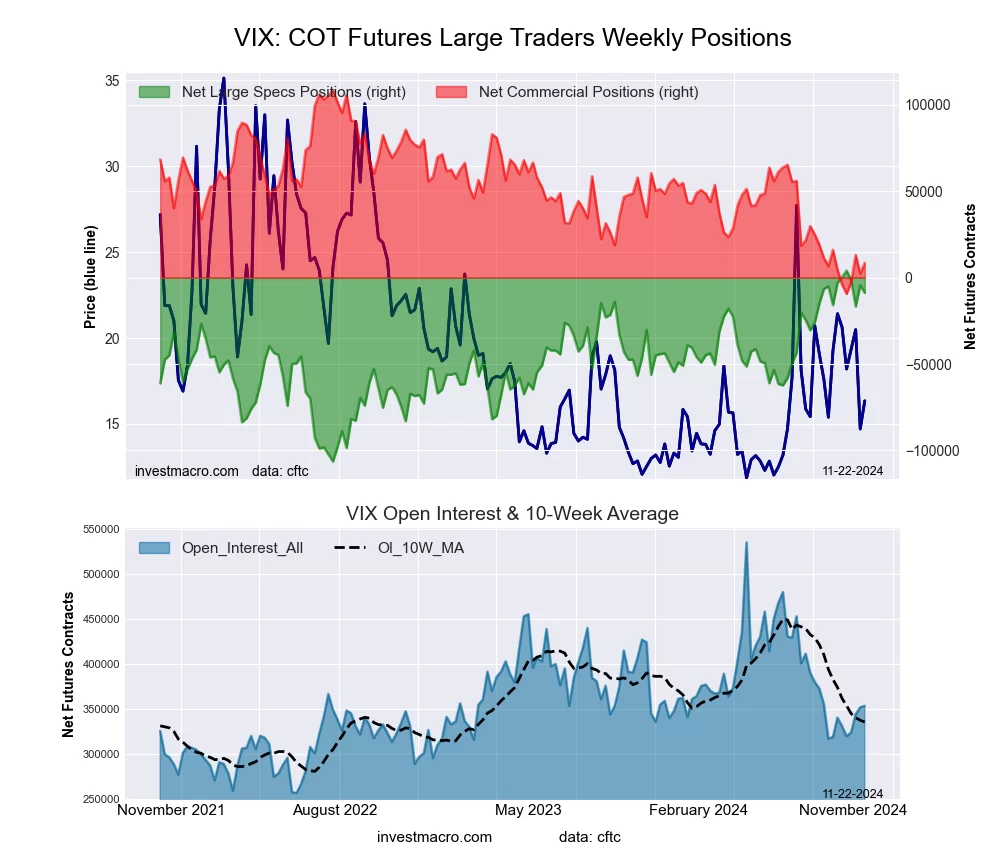
VIX


The VIX speculator position comes next in the extreme standings this week. The VIX speculator level is also at a 100.0 percent score of its 3-year range.

The six-week trend for the percent strength score was 26.6 this week. The speculator position registered -3,008 net contracts this week with a weekly gain of 12,869 contracts in speculator bets.


Silver


The Silver speculator position comes in third this week in the extreme standings. The Silver speculator level resides at a 90.0 percent score of its 3-year range.

The six-week trend for the speculator strength score came in at 3.4 this week. The overall speculator position was 54,715 net contracts this week with a decline by -2,209 contracts in the weekly speculator bets.


Fed Funds


The Fed Funds speculator position comes up number four in the extreme standings this week. The Fed Funds speculator level is at a 90.0 percent score of its 3-year range.

The six-week trend for the speculator strength score totaled a change of 69.8 this week. The overall speculator position was 191,471 net contracts this week despite a drop of -54,222 contracts in the speculator bets.


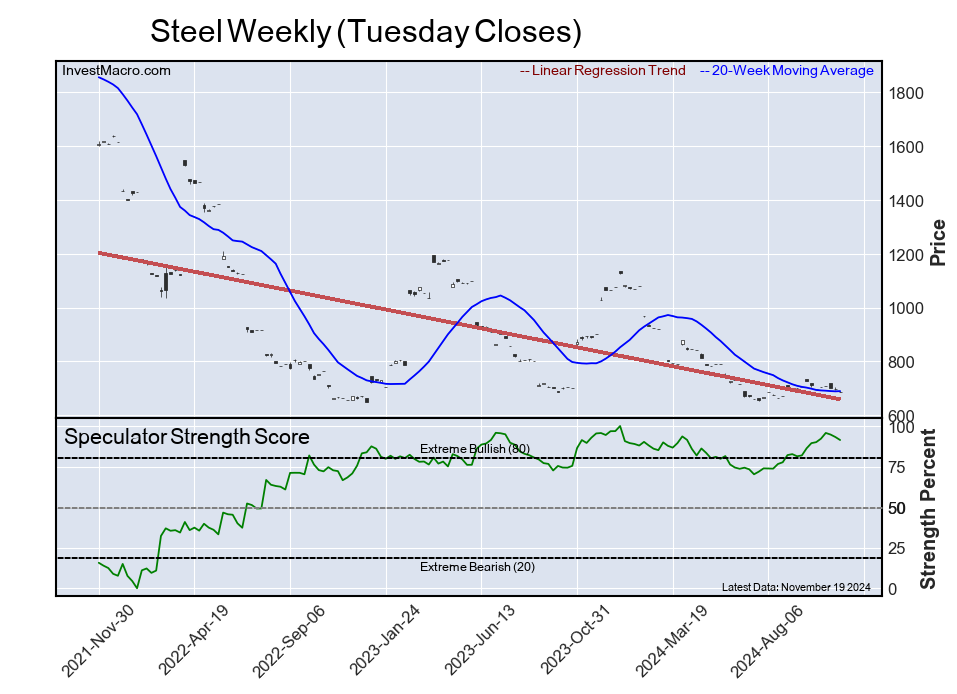
Steel


The Steel speculator position rounds out the top five in this week’s bullish extreme standings. The Steel speculator level sits at a 89.4 percent score of its 3-year range. The six-week trend for the speculator strength score was 11.8 this week.

The speculator position was -1,801 net contracts this week following an increase by 830 contracts in the weekly speculator bets.


This Week’s Most Bearish Speculator Positions:

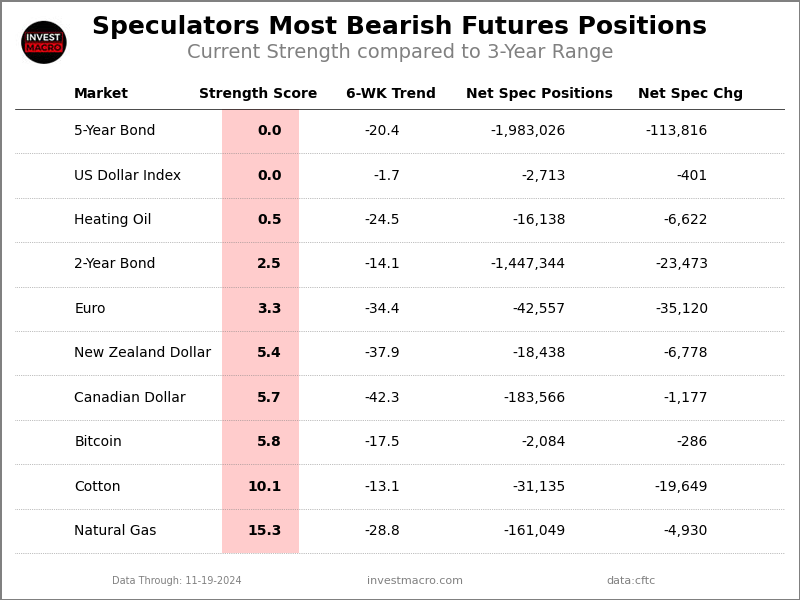
US Dollar Index


The US Dollar Index speculator position comes in as the most bearish extreme standing this week. The US Dollar Index speculator level is at a 0.0 percent score of its 3-year range.

The six-week trend for the speculator strength score was -44.3 this week. The overall speculator position was -1,889 net contracts this week and had a change of -2,043 contracts in the speculator bets.


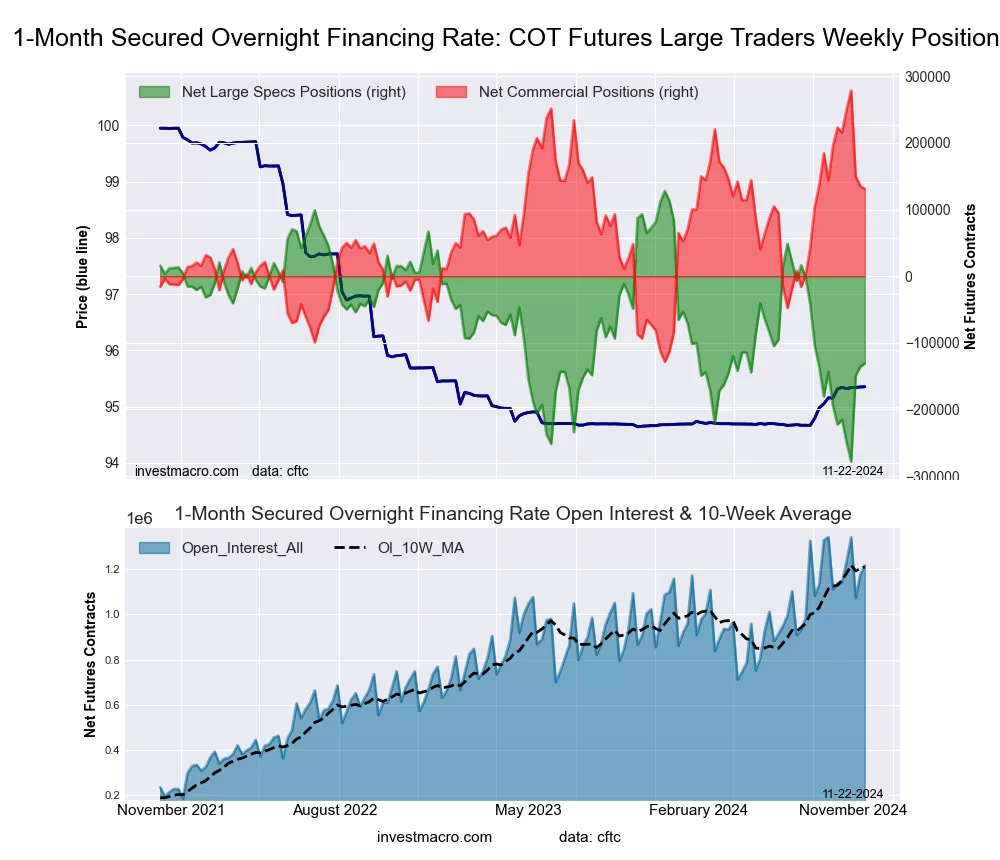
1-Month Secured Overnight Financing Rate


The 1-Month Secured Overnight Financing Rate speculator position comes in next for the most bearish extreme standing on the week. The 1-Month Secured Overnight Financing Rate speculator level is at a 7.7 percent score of its 3-year range.

The six-week trend for the speculator strength score was -47.6 this week. The speculator position was -222,460 net contracts this week with a decline of -27,938 contracts in the weekly speculator bets.


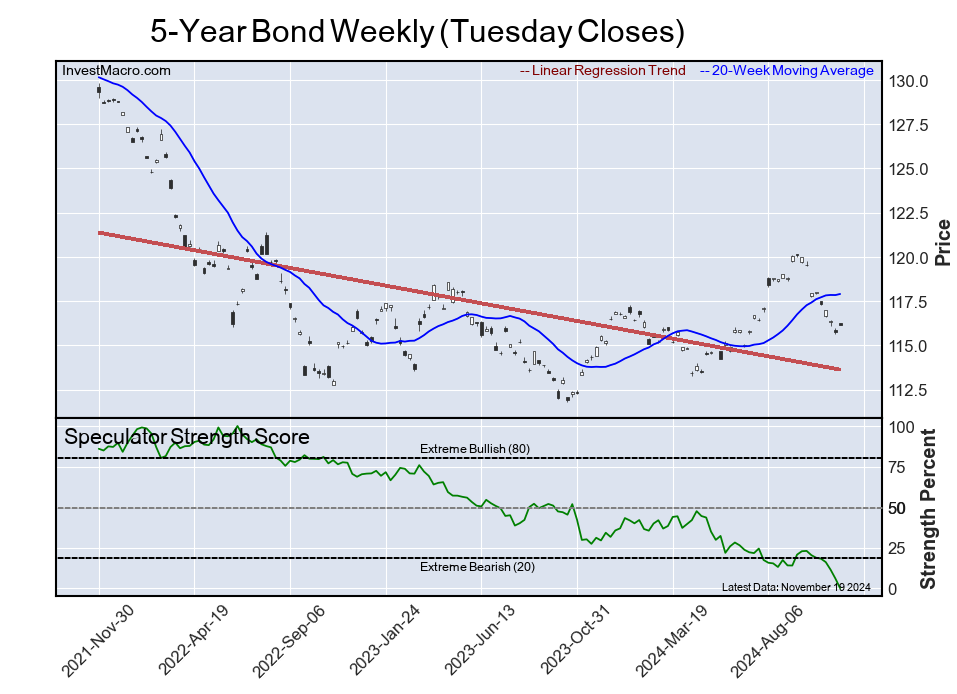
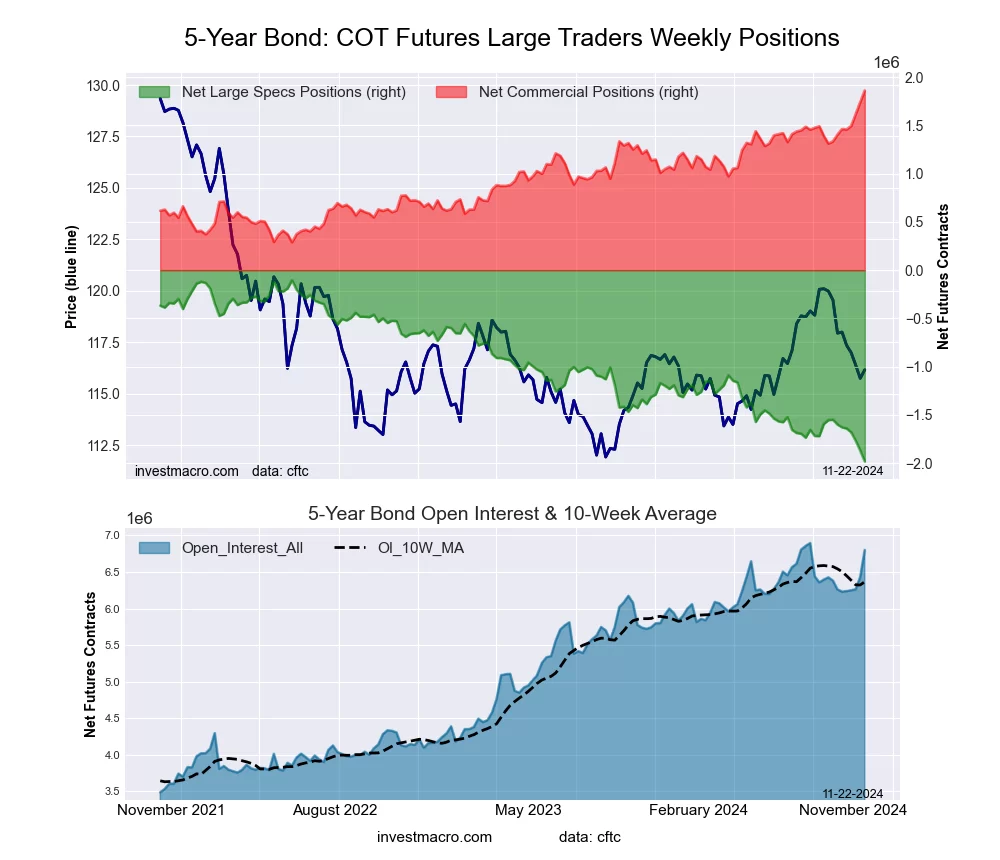
5-Year Bond


The 5-Year Bond speculator position comes in as third most bearish extreme standing of the week. The 5-Year Bond speculator level resides at a 8.4 percent score of its 3-year range.

The six-week trend for the speculator strength score was 3.4 this week. The overall speculator position was -1,600,325 net contracts this week with a drop of -49,535 contracts in the speculator bets.


E-mini SP MidCap400

The E-mini SP MidCap400 speculator position comes in as this week’s fourth most bearish extreme standing. The E-mini SP MidCap400 speculator level is at just a 12.6 percent score of its 3-year range.

The six-week trend for the speculator strength score was -4.4 this week. The speculator position was 98 net contracts this week following a change of -898 contracts in the weekly speculator bets.


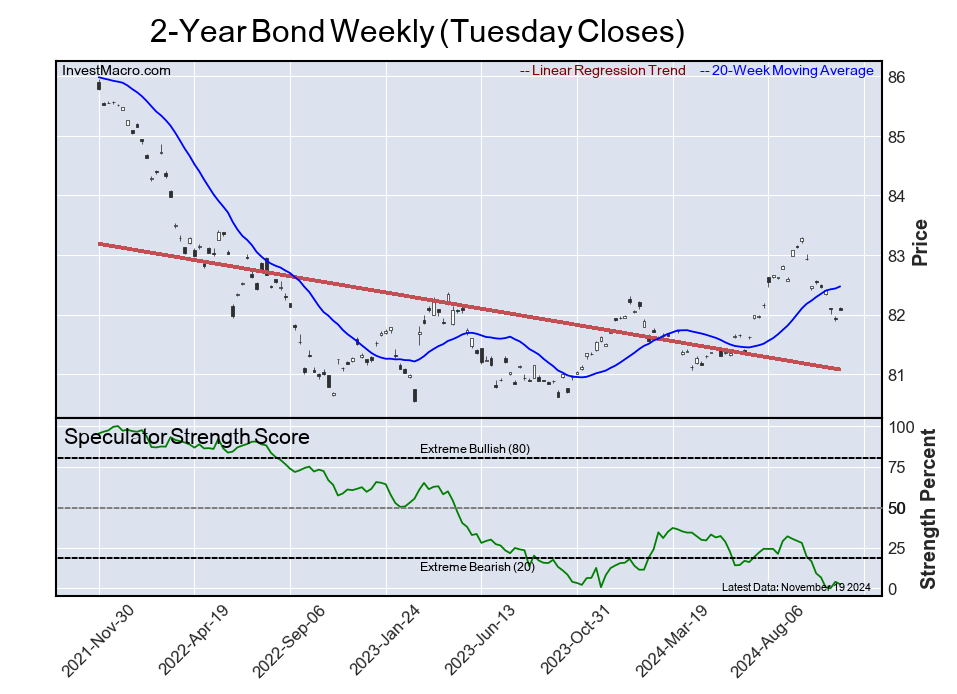
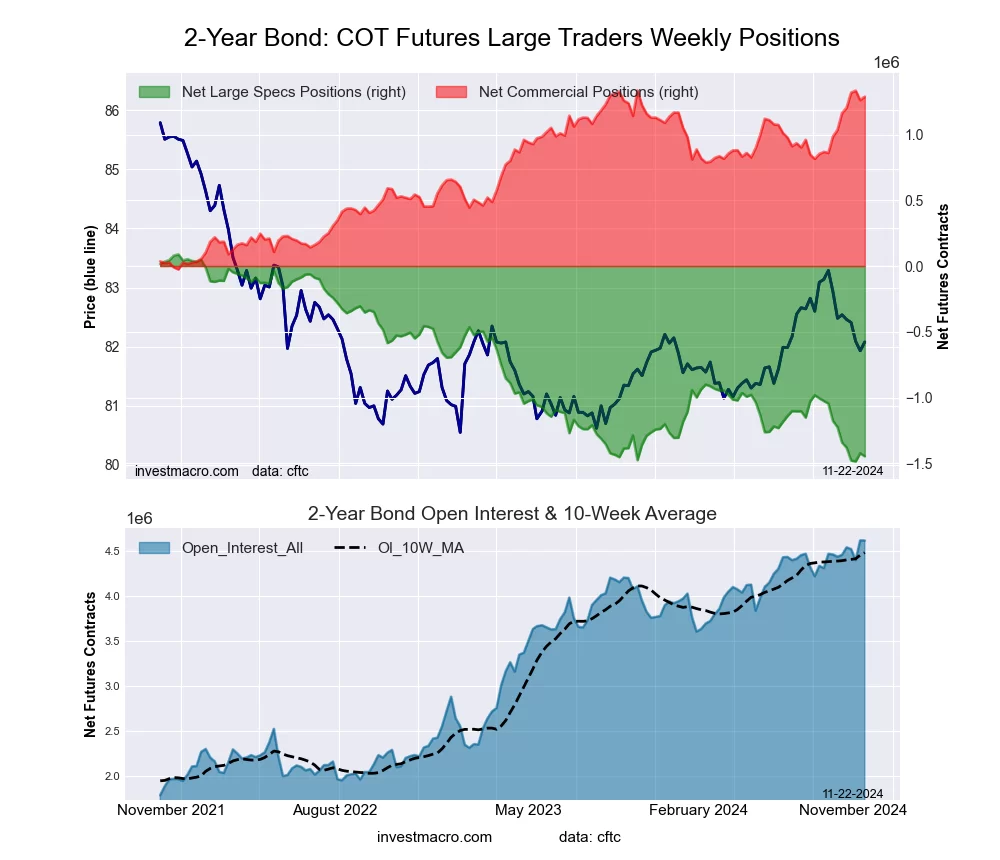
2-Year Bond


Finally, the 2-Year Bond speculator position comes in as the fifth most bearish extreme standing for this week. The 2-Year Bond speculator level is at a 16.0 percent score of its 3-year range.

The six-week trend for the speculator strength score was -12.5 this week. The speculator position was -1,225,036 net contracts this week with a decrease by -46,817 contracts in the weekly speculator bets.


Article By InvestMacroReceive our weekly COT Newsletter

*COT Report: The COT data, released weekly to the public each Friday, is updated through the most recent Tuesday (data is 3 days old) and shows a quick view of how large speculators or non-commercials (for-profit traders) were positioned in the futures markets.

The CFTC categorizes trader positions according to commercial hedgers (traders who use futures contracts for hedging as part of the business), non-commercials (large traders who speculate to realize trading profits) and nonreportable traders (usually small traders/speculators) as well as their open interest (contracts open in the market at time of reporting). See CFTC criteria here.
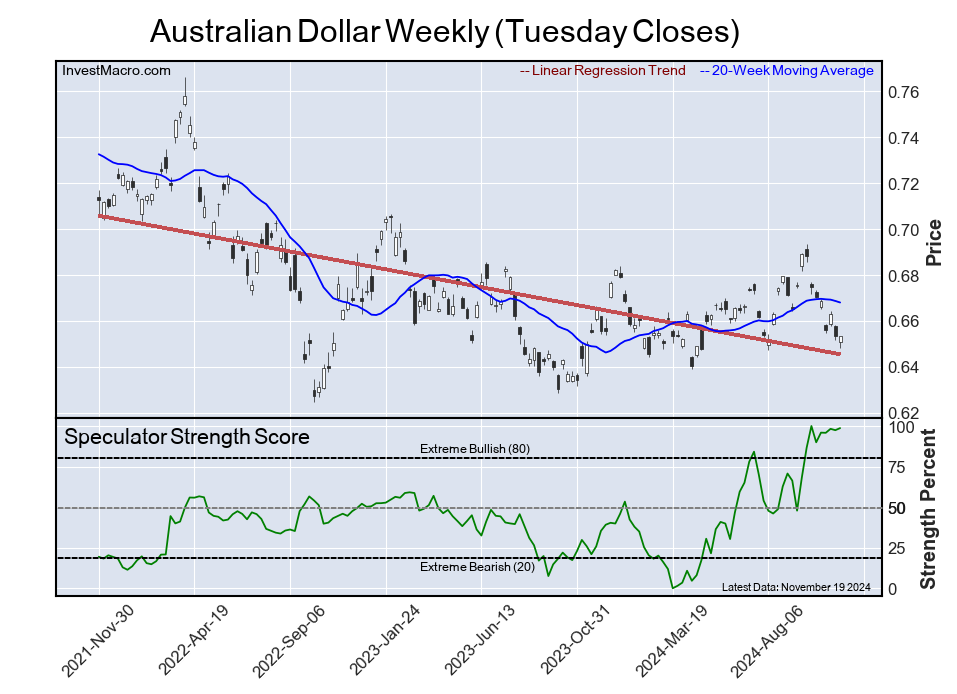
COT Metals Charts: Speculator Bets led by Steel & Palladium

By InvestMacro

Here are the latest charts and statistics for the Commitment of Traders (COT) data published by the Commodities Futures Trading Commission (CFTC).
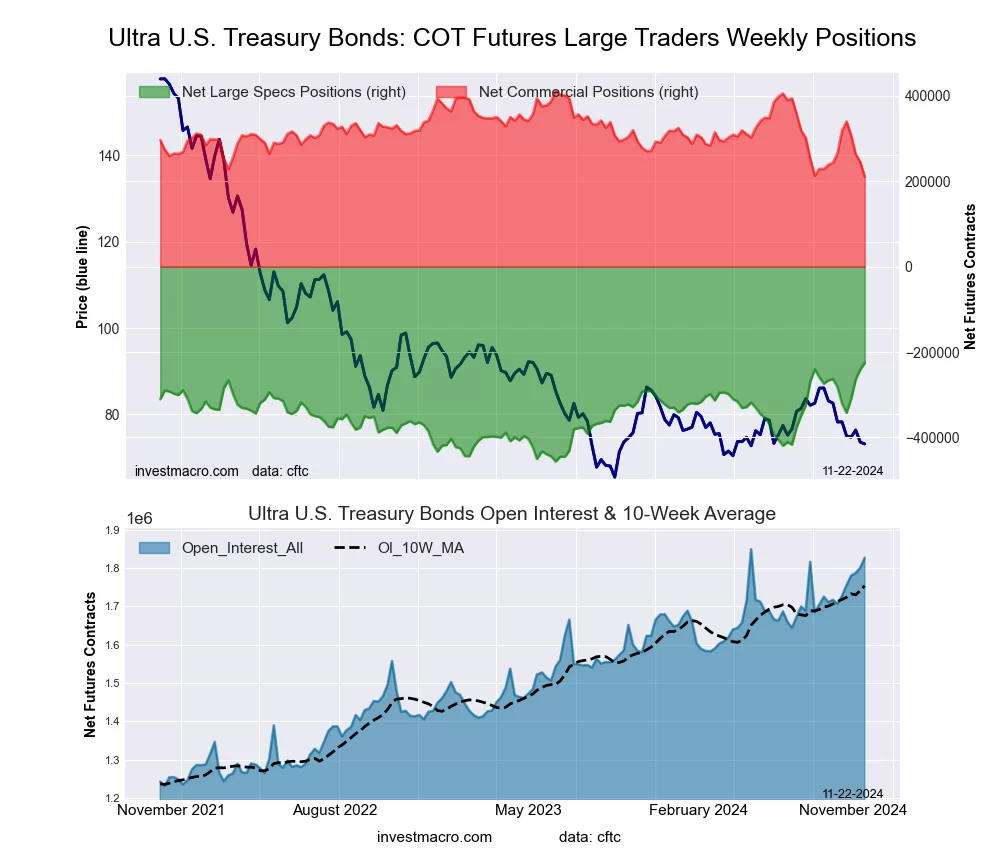
The latest COT data is updated through Tuesday October 8th and shows a quick view of how large traders (for-profit speculators and commercial entities) were positioned in the futures markets.

Weekly Speculator Changes led by Steel & Palladium

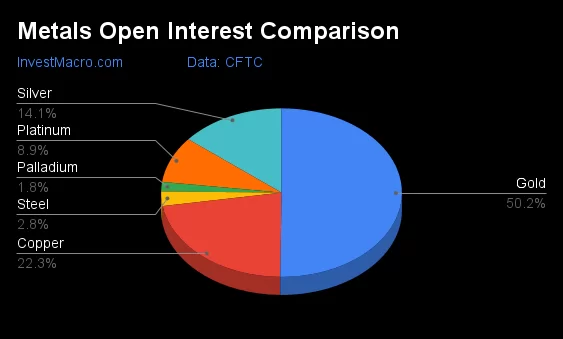
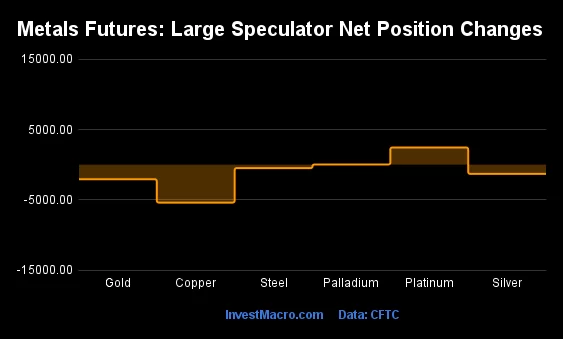
The COT metals markets speculator bets were overall lower this week as just two out of the six metals markets we cover had higher positioning while the other four markets had lower speculator contracts.

Leading the gains for the metals was small gains for Steel (830 contracts) with Palladium (546 contracts) also showing a rising week.

The markets with declines in speculator bets for the week were Gold (-21,751 contracts), Platinum (-4,475 contracts), Silver (-2,209 contracts) and with Copper (-96 contracts) also registering a small decrease in bets on the week.


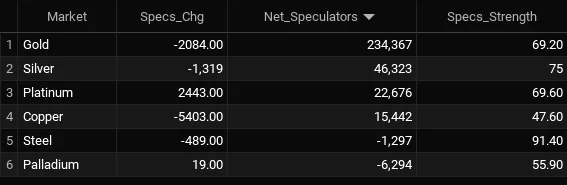
Metals Net Speculators Leaderboard

Legend: Weekly Speculators Change | Speculators Current Net Position | Speculators Strength Score compared to last 3-Years (0-100 range)


Strength Scores led by Silver & Steel

COT Strength Scores (a normalized measure of Speculator positions over a 3-Year range, from 0 to 100 where above 80 is Extreme-Bullish and below 20 is Extreme-Bearish) showed that Silver (90 percent) and Steel (89 percent) remain near the top of their 3-Year ranges and lead the metals markets this week. Gold (86 percent) comes in as the next highest in the weekly strength scores.

On the downside, Palladium (48 percent) comes in at the lowest strength level currently but is close to the midpoint (50 percent) for the past 3-Years.

Strength Statistics:
Gold (85.9 percent) vs Gold previous week (94.1 percent)
Silver (90.0 percent) vs Silver previous week (93.0 percent)
Copper (73.4 percent) vs Copper previous week (73.5 percent)
Platinum (81.2 percent) vs Platinum previous week (93.1 percent)
Palladium (48.4 percent) vs Palladium previous week (44.4 percent)
Steel (89.4 percent) vs Palladium previous week (86.3 percent)


Palladium & Copper top the 6-Week Strength Trends

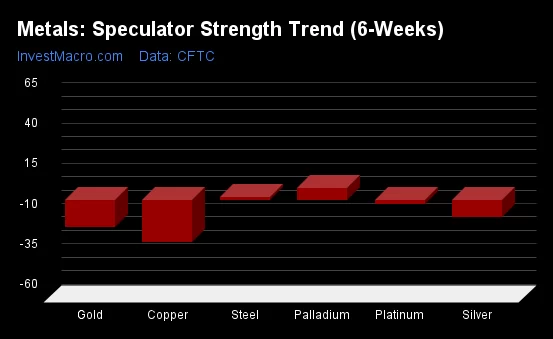
COT Strength Score Trends (or move index, calculates the 6-week changes in strength scores) showed that Palladium (33 percent) and Copper (24 percent) lead the past six weeks trends for metals. Platinum (21 percent) is the next highest positive mover in the latest trends data.

Gold (-6 percent) leads the downside trend scores currently and is the only market with a negative trend.

Move Statistics:
Gold (-6.2 percent) vs Gold previous week (3.3 percent)
Silver (3.4 percent) vs Silver previous week (10.1 percent)
Copper (24.2 percent) vs Copper previous week (21.3 percent)
Platinum (21.2 percent) vs Platinum previous week (35.5 percent)
Palladium (33.3 percent) vs Palladium previous week (32.3 percent)
Steel (11.8 percent) vs Steel previous week (9.7 percent)


Individual Markets:

Gold Comex Futures:

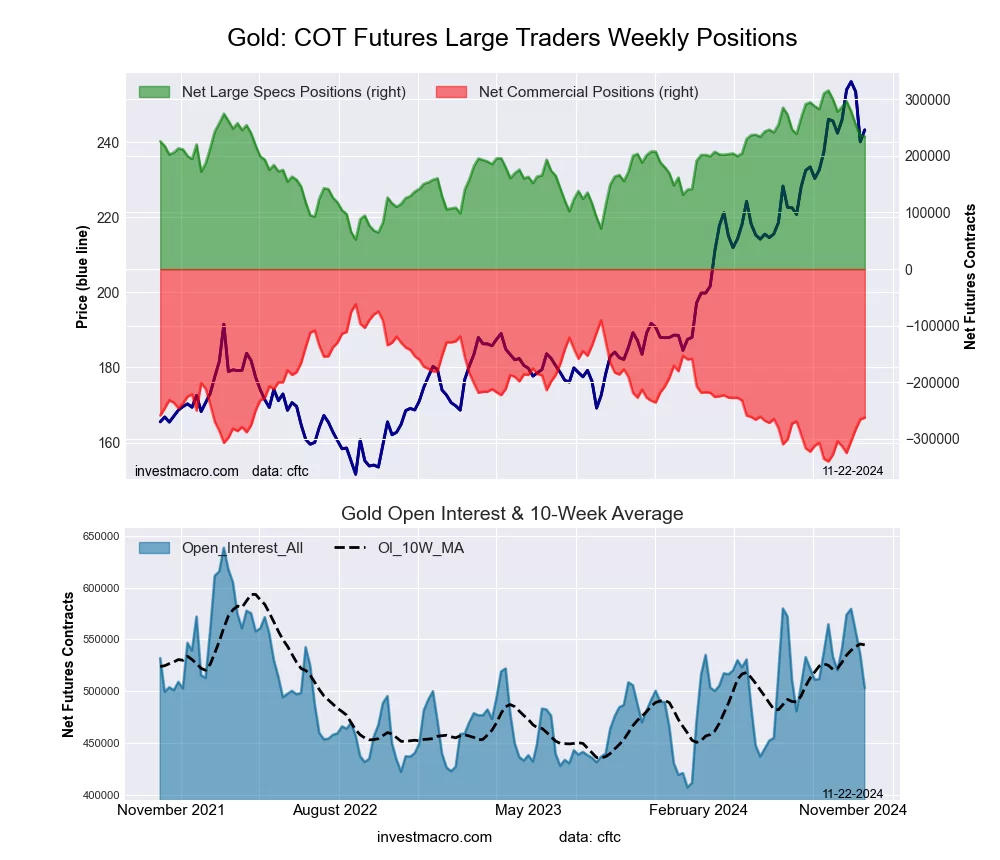
Gold Futures COT ChartThe Gold Comex Futures large speculator standing this week resulted in a net position of 278,180 contracts in the data reported through Tuesday. This was a weekly lowering of -21,751 contracts from the previous week which had a total of 299,931 net contracts.

This week’s current strength score (the trader positioning range over the past three years, measured from 0 to 100) shows the speculators are currently Bullish-Extreme with a score of 85.9 percent. The commercials are Bearish-Extreme with a score of 12.9 percent and the small traders (not shown in chart) are Bullish with a score of 64.0 percent.

Price Trend-Following Model: Strong Uptrend

Our weekly trend-following model classifies the current market price position as: Strong Uptrend.

Gold Futures StatisticsSPECULATORSCOMMERCIALSSMALL TRADERS
– Percent of Open Interest Longs:67.113.39.9
– Percent of Open Interest Shorts:13.671.74.9
– Net Position:278,180-303,97625,796
– Gross Longs:348,89168,95751,440
– Gross Shorts:70,711372,93325,644
– Long to Short Ratio:4.9 to 10.2 to 12.0 to 1
NET POSITION TREND:
– Strength Index Score (3 Year Range Pct):85.912.964.0
– Strength Index Reading (3 Year Range):Bullish-ExtremeBearish-ExtremeBullish
NET POSITION MOVEMENT INDEX:
– 6-Week Change in Strength Index:-6.26.6-7.5


Silver Comex Futures:

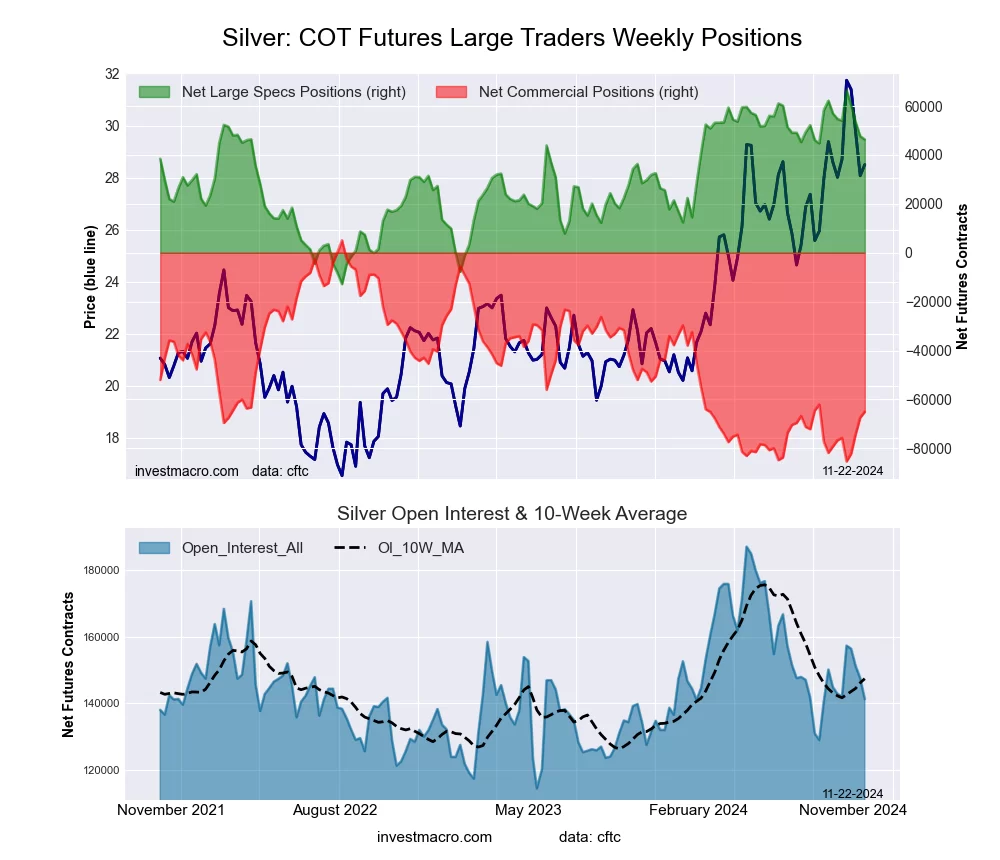
Silver Futures COT ChartThe Silver Comex Futures large speculator standing this week resulted in a net position of 54,715 contracts in the data reported through Tuesday. This was a weekly lowering of -2,209 contracts from the previous week which had a total of 56,924 net contracts.

This week’s current strength score (the trader positioning range over the past three years, measured from 0 to 100) shows the speculators are currently Bullish-Extreme with a score of 90.0 percent. The commercials are Bearish-Extreme with a score of 9.0 percent and the small traders (not shown in chart) are Bullish with a score of 77.2 percent.

Price Trend-Following Model: Strong Uptrend

Our weekly trend-following model classifies the current market price position as: Strong Uptrend.

Silver Futures StatisticsSPECULATORSCOMMERCIALSSMALL TRADERS
– Percent of Open Interest Longs:50.520.821.9
– Percent of Open Interest Shorts:12.274.56.5
– Net Position:54,715-76,71522,000
– Gross Longs:72,11329,71731,279
– Gross Shorts:17,398106,4329,279
– Long to Short Ratio:4.1 to 10.3 to 13.4 to 1
NET POSITION TREND:
– Strength Index Score (3 Year Range Pct):90.09.077.2
– Strength Index Reading (3 Year Range):Bullish-ExtremeBearish-ExtremeBullish
NET POSITION MOVEMENT INDEX:
– 6-Week Change in Strength Index:3.4-5.19.9


Copper Grade #1 Futures:

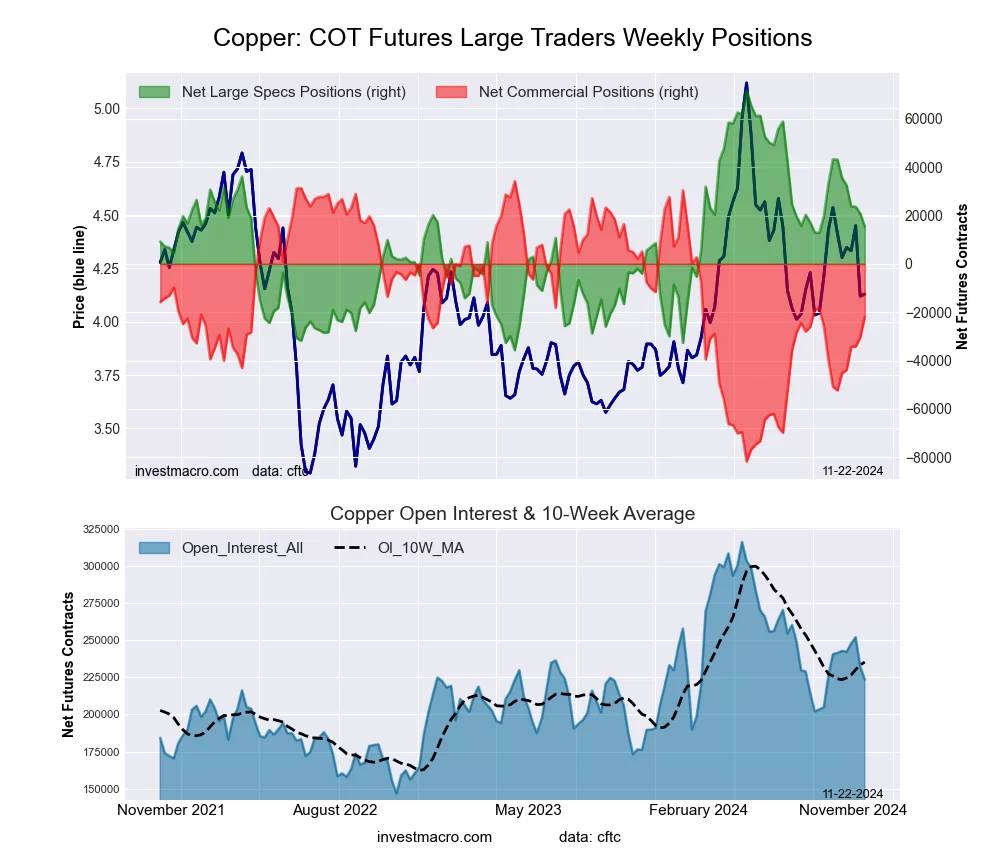
Copper Futures COT ChartThe Copper Grade #1 Futures large speculator standing this week resulted in a net position of 43,096 contracts in the data reported through Tuesday. This was a weekly fall of -96 contracts from the previous week which had a total of 43,192 net contracts.

This week’s current strength score (the trader positioning range over the past three years, measured from 0 to 100) shows the speculators are currently Bullish with a score of 73.4 percent. The commercials are Bearish with a score of 25.4 percent and the small traders (not shown in chart) are Bullish with a score of 73.5 percent.

Price Trend-Following Model: Weak Downtrend

Our weekly trend-following model classifies the current market price position as: Weak Downtrend.

Copper Futures StatisticsSPECULATORSCOMMERCIALSSMALL TRADERS
– Percent of Open Interest Longs:43.628.48.4
– Percent of Open Interest Shorts:25.850.14.5
– Net Position:43,096-52,3049,208
– Gross Longs:105,25268,58220,178
– Gross Shorts:62,156120,88610,970
– Long to Short Ratio:1.7 to 10.6 to 11.8 to 1
NET POSITION TREND:
– Strength Index Score (3 Year Range Pct):73.425.473.5
– Strength Index Reading (3 Year Range):BullishBearishBullish
NET POSITION MOVEMENT INDEX:
– 6-Week Change in Strength Index:24.2-22.72.1


Platinum Futures:

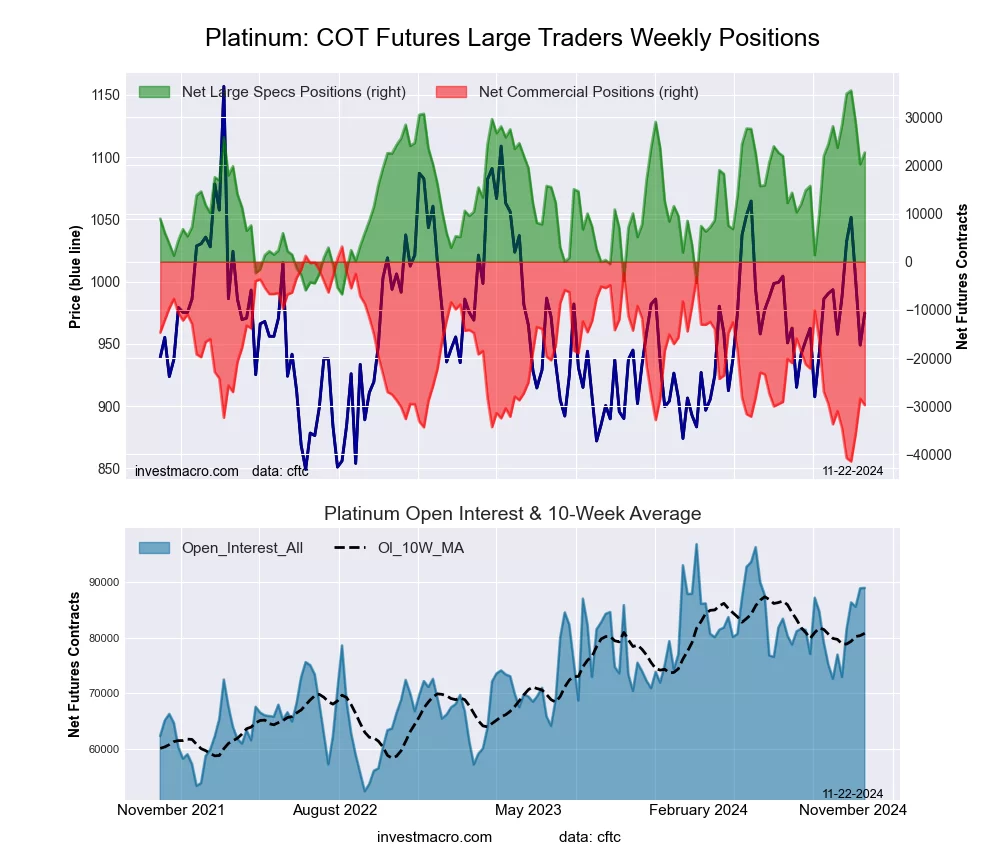
Platinum Futures COT ChartThe Platinum Futures large speculator standing this week resulted in a net position of 23,657 contracts in the data reported through Tuesday. This was a weekly fall of -4,475 contracts from the previous week which had a total of 28,132 net contracts.

This week’s current strength score (the trader positioning range over the past three years, measured from 0 to 100) shows the speculators are currently Bullish-Extreme with a score of 81.2 percent. The commercials are Bearish-Extreme with a score of 8.9 percent and the small traders (not shown in chart) are Bullish with a score of 78.1 percent.

Price Trend-Following Model: Weak Downtrend

Our weekly trend-following model classifies the current market price position as: Weak Downtrend.

Platinum Futures StatisticsSPECULATORSCOMMERCIALSSMALL TRADERS
– Percent of Open Interest Longs:60.220.013.5
– Percent of Open Interest Shorts:29.560.34.0
– Net Position:23,657-31,0097,352
– Gross Longs:46,33915,42410,408
– Gross Shorts:22,68246,4333,056
– Long to Short Ratio:2.0 to 10.3 to 13.4 to 1
NET POSITION TREND:
– Strength Index Score (3 Year Range Pct):81.28.978.1
– Strength Index Reading (3 Year Range):Bullish-ExtremeBearish-ExtremeBullish
NET POSITION MOVEMENT INDEX:
– 6-Week Change in Strength Index:21.2-23.614.5


Palladium Futures:

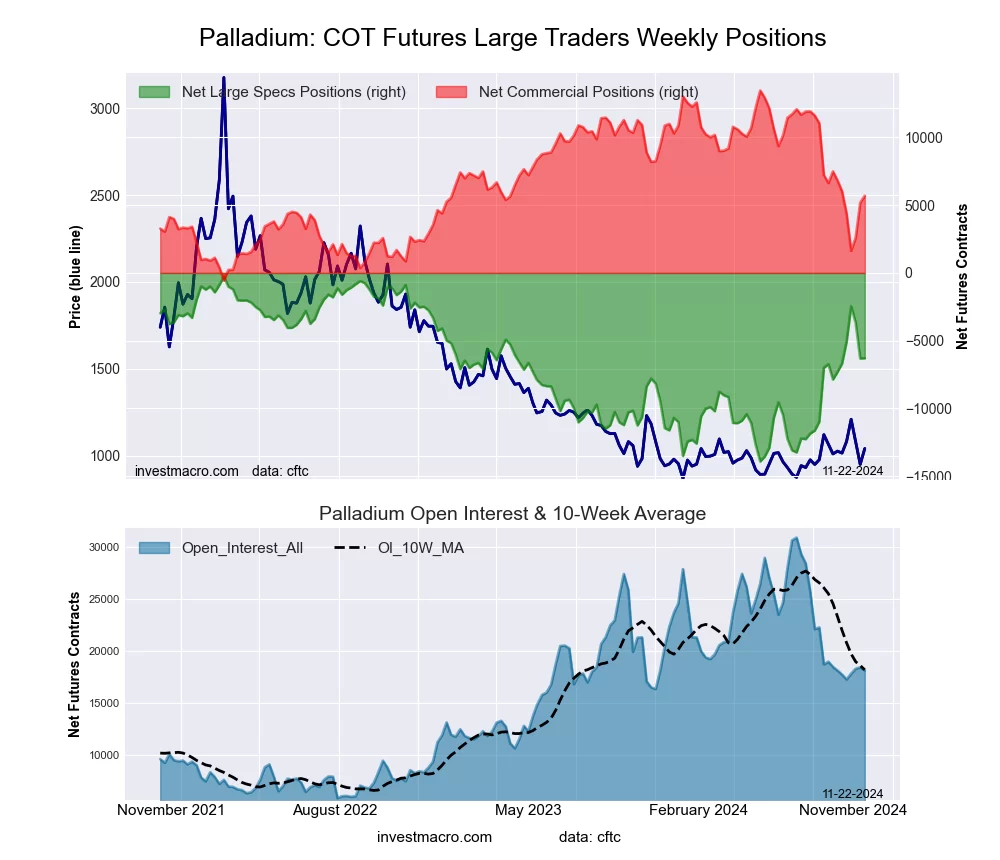
Palladium Futures COT ChartThe Palladium Futures large speculator standing this week resulted in a net position of -7,317 contracts in the data reported through Tuesday. This was a weekly rise of 546 contracts from the previous week which had a total of -7,863 net contracts.

This week’s current strength score (the trader positioning range over the past three years, measured from 0 to 100) shows the speculators are currently Bearish with a score of 48.4 percent. The commercials are Bullish with a score of 52.7 percent and the small traders (not shown in chart) are Bullish with a score of 57.0 percent.

Price Trend-Following Model: Strong Uptrend

Our weekly trend-following model classifies the current market price position as: Strong Uptrend.

Palladium Futures StatisticsSPECULATORSCOMMERCIALSSMALL TRADERS
– Percent of Open Interest Longs:26.958.210.5
– Percent of Open Interest Shorts:67.320.57.8
– Net Position:-7,3176,829488
– Gross Longs:4,88210,5491,906
– Gross Shorts:12,1993,7201,418
– Long to Short Ratio:0.4 to 12.8 to 11.3 to 1
NET POSITION TREND:
– Strength Index Score (3 Year Range Pct):48.452.757.0
– Strength Index Reading (3 Year Range):BearishBullishBullish
NET POSITION MOVEMENT INDEX:
– 6-Week Change in Strength Index:33.3-36.326.5


Steel Futures Futures:

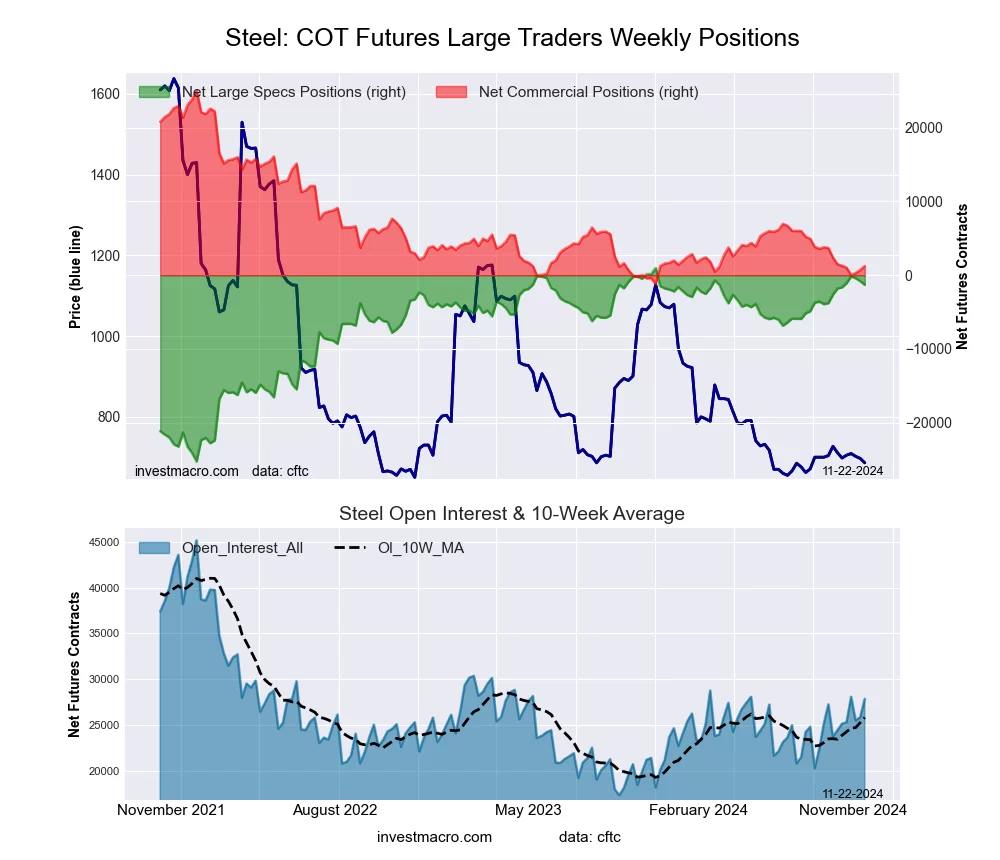
Steel Futures COT ChartThe Steel Futures large speculator standing this week resulted in a net position of -1,801 contracts in the data reported through Tuesday. This was a weekly lift of 830 contracts from the previous week which had a total of -2,631 net contracts.

This week’s current strength score (the trader positioning range over the past three years, measured from 0 to 100) shows the speculators are currently Bullish-Extreme with a score of 89.4 percent. The commercials are Bearish-Extreme with a score of 10.3 percent and the small traders (not shown in chart) are Bullish with a score of 67.6 percent.

Price Trend-Following Model: Weak Downtrend

Our weekly trend-following model classifies the current market price position as: Weak Downtrend.

Steel Futures StatisticsSPECULATORSCOMMERCIALSSMALL TRADERS
– Percent of Open Interest Longs:22.469.71.9
– Percent of Open Interest Shorts:29.863.70.6
– Net Position:-1,8011,479322
– Gross Longs:5,47317,032470
– Gross Shorts:7,27415,553148
– Long to Short Ratio:0.8 to 11.1 to 13.2 to 1
NET POSITION TREND:
– Strength Index Score (3 Year Range Pct):89.410.367.6
– Strength Index Reading (3 Year Range):Bullish-ExtremeBearish-ExtremeBullish
NET POSITION MOVEMENT INDEX:
– 6-Week Change in Strength Index:11.8-13.240.7


Article By InvestMacroReceive our weekly COT Newsletter

*COT Report: The COT data, released weekly to the public each Friday, is updated through the most recent Tuesday (data is 3 days old) and shows a quick view of how large speculators or non-commercials (for-profit traders) were positioned in the futures markets.

The CFTC categorizes trader positions according to commercial hedgers (traders who use futures contracts for hedging as part of the business), non-commercials (large traders who speculate to realize trading profits) and nonreportable traders (usually small traders/speculators) as well as their open interest (contracts open in the market at time of reporting). See CFTC criteria here.