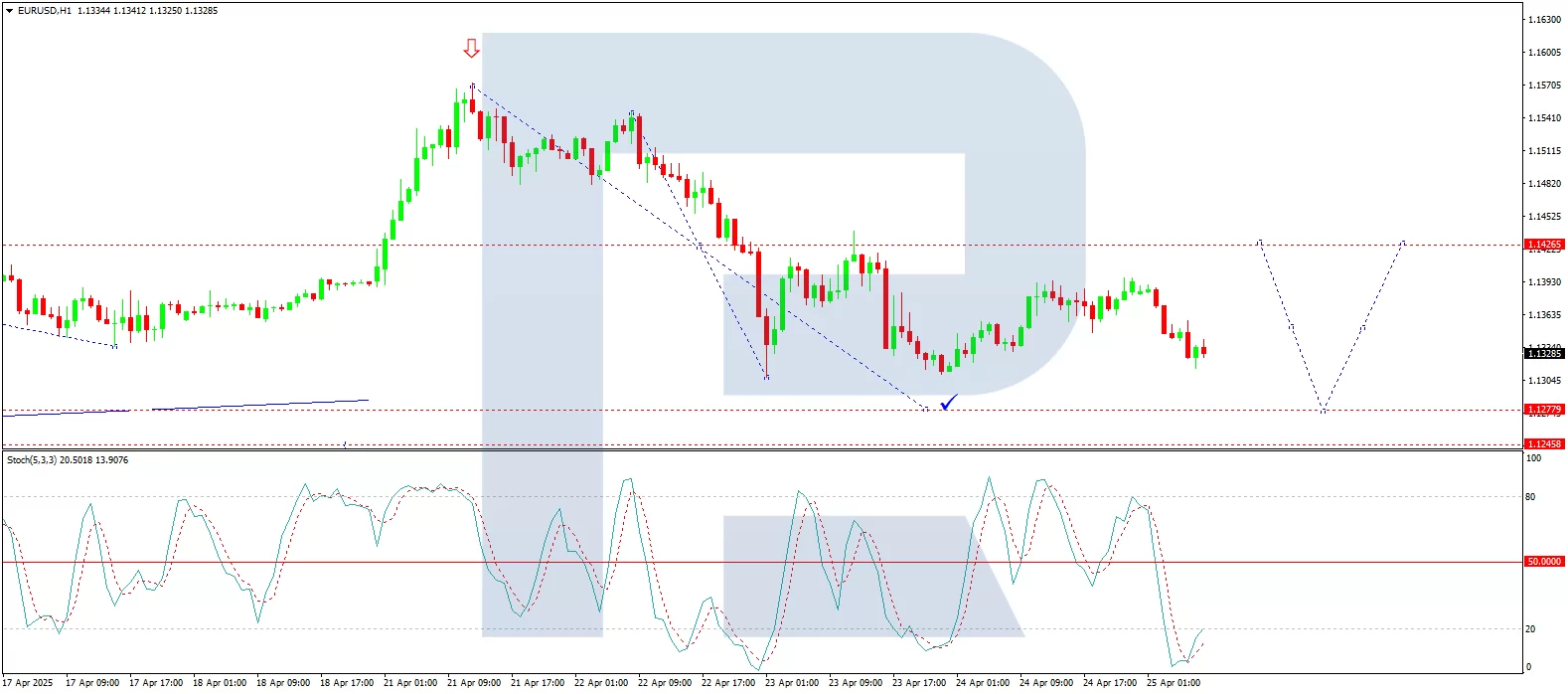
Week Ahead: USDJPY set for Wednesday showdown

By ForexTime 

  • Yen expected to be one of the most volatile in G10 space vs USD
  • BoJ and Fed seen holding rates, but policy hints could spark volatility
  • Over past year BoJ triggered moves of ↑ 1.4% & ↓ 1.5%
  • Over past year Fed triggered moves of ↑ 0.7% & ↓ 1.2%
  • Bloomberg FX model: USDJPY has 72% of trading within 146.26 – 151.17 over 1-week period

A flurry of major central bank meetings could present fresh trading opportunities.

The Japanese Yen is expected to be one of the most volatile G10 currencies versus the USD over the next one-week.

This could be based on the Bank of Japan and the Federal Reserve holding policy meetings on the same day!

Beyond central banks, top-tier economic data and global trade developments will be in focus:

Monday, 17th March 

  • CN50: China property prices, retail sales, industrial production
  • CAD: Canada housing starts, existing home sales
  • US500: US retail sales, Empire manufacturing
  • OECD report – prospects for global economy

Tuesday, 18th March

  • CAD: Canada CPI
  • GER40: Germany ZEW survey expectations
  • JP225: Japan tertiary index
  • USDInd: US housing starts, industrial production

Wednesday, 19th March 

  • CHINAH: Tencent earnings
  • EU50: Eurozone CPI
  • ZAR: South Africa retail sales, CPI
  • JPY: BoJ rate decision, industrial production, trade
  • USDInd: Fed rate decision

Thursday, 20th March 

  • AUD: Australia unemployment
  • CN50: China loan prime rates
  • ZAR: SARB rate decision
  • SEK: Riksbank rate decision 
  • CHF: SNB rate decision
  • GBP: BoE rate decision, jobless claims, unemployment
  • RUS2000: US Philadelphia Fed factory index, jobless claims

Friday, 21st  March 

  • CAD: Canada retail sales
  • EUR: Eurozone consumer confidence
  • JPY: Japan CPI
  • NZD: New Zealand trade

At the time of writing, the  Yen depreciated across the board despite Japan’s largest labour union – Rengo securing a 5.46% average gain, its largest pay hike since 1991. This could be a “sell the news” scenario with prices stabilizing down the line.

Nevertheless, the Yen is the 3rd best performing G10 currency versus the dollar year-to-date. These gains are on the back of global trade fears and growing bets around the BoJ hiking rates sooner rather than later.

Looking at the weekly charts, the USDJPY is respecting a bearish channel – but support can be seen at 146.50. 

With all the above said, here is why the USDJPY is set for a big week:

    1 – Trump’s trade war

President Donald Trump’s aggressive stance on trade has roiled markets, sending investors rushing toward safe-haven assets.

Trump recently threatened a 200% tariff on European alcohol after the EU imposed tariffs on US-produced whiskey. 

  • Escalating trade tensions could boost the Japanese Yen – dragging the USDJPY lower. 
  • Signs of easing trade tensions may lift the market mood – pushing the USDJPY higher as the Yen weakens.


    2- BoJ rate decision

Markets widely expect the BoJ to leave interest rates unchanged at its meeting on Wednesday 19th March. 

But if the BoJ hints at a potential hike as soon as May or in the first half of 2025 in the face of higher wages, this could move the Yen.

To be clear, traders are currently pricing in a 16% probability of a 25-basis point hike by May with this jumping to 48% by June. 

Over the past 12 months, the BoJ decision has triggered upside moves as much as 1.4% or declines of 1.5% in a 6-hour window post-release.

Note: Beyond the BoJ decision, Japan’s latest inflation print later in the week could influence BoJ hike bets – moving the Yen as a result.

  • The USDJPY could tumble if the BoJ hints that rates will be hiked in May or June.
  • Should the BoJ strike a dovish tone, this could push the USDJPY higher as the Yen weakens.


    3 – Fed rate decision

The Federal Reserve is seen leaving interest rates unchanged at its meeting on Wednesday, 19th March.

So, all eyes will be on Fed Chair Jerome Powell’s press conference for clues on future policy moves. Last Friday, Powell stated that the US economy was in a good place despite the elevated levels of uncertainty. However, investors remain fearful of Trump’s trade war hitting the US economy.

Traders are currently pricing in a 35% probability of a 25-basis point cut by May with a move fully priced in by June. 

Over the past 12 months, the Fed decision has triggered upside moves as much as 0.7% or declines of 1.2% in a 6-hour window post-release.

  • If Powell strikes a cautious tone towards rate hikes, the USDJPY may slip.
  • Should Powell signal higher rates down the road, this could push the USDJPY higher.


    4 – Technical forces

The USDJPY has shed over 1% month-to-date with prices trading below the 50, 100 and 200-day SMA.

  • A breakout and daily close above 149.00 may signal a move toward 150.80 and 151.17 – the upper limit of the Bloomberg FX model.
  • Sustained weakness below 149.00 could trigger a selloff back toward 146.50 and 146.26 – the lower limit of the Bloomberg FX model.

Bloomberg’s FX model forecasts a 73% chance that USDJPY will trade within the 146.26 – 151.17 range, using current levels as a base, over the next one-week period.


Forex-Time-LogoArticle by ForexTime

ForexTime Ltd (FXTM) is an award winning international online forex broker regulated by CySEC 185/12 www.forextime.com

The Bank of Canada cut the interest rate as expected. The EU and Canada imposed retaliatory tariffs on the US.

By JustMarkets 

At the end of Wednesday, the Dow Jones (US30) fell by 0.20%. The S&P 500 Index (US500) was up 0.49%. The Nasdaq Technology Index (US100) added 1.13%. Stock indices mostly rose on Wednesday, although the Dow Jones Industrials Index fell to a 6-month low. Stocks found support on Wednesday amid easing price pressures after the February US Consumer Price Index rose less than expected. The February US CPI rose by 0.2% m/m and 2.8% y/y, which was weaker than expectations of 0.3% m/m and 2.9% y/y. February CPI excluding food and energy rose by 0.2% m/m and 3.1% y/y, weaker than expectations of 0.3% m/m and 3.2% y/y. Stock gains were limited by escalating trade tensions. On Wednesday, the European Union imposed tariffs on up to $28.3 billion worth of goods from the US, including soybeans, beef, and poultry, in response to US tariffs on steel and aluminum imports.

The Canadian dollar is holding near 1.44 per dollar, near a one-month low of 1.45 hit on March 3, as Canada imposed retaliatory tariffs of 25 percent on $21 billion worth of US goods after Trump’s duties on steel and aluminum took effect. The move raises costs for US manufacturers and increases trade uncertainty. Meanwhile, the Bank of Canada cut rates by 25 bps to 2.75%, marking a 225 bps easing from June 2024 to counter an expected slowdown in the economy. The Bank of Canada warned that the change in US tariff policy is eroding confidence in the economy and dampening domestic demand, and companies are already struggling to borrow as a weaker loonie drives up the cost of imports. Markets are predicting another rate cut before the end of the year.

Equity markets in Europe were mostly up yesterday. Germany’s DAX (DE40) rose by 1.56%, France’s CAC 40 (FR40) closed higher by 0.59%, Spain’s IBEX 35 (ES35) fell by 0.57%, and the UK’s FTSE 100 (UK100) closed positive 0.53%. The US imposed 25% tariffs on European steel and aluminum, prompting the EU to announce retaliatory tariffs on US goods, resulting in the EU announcing retaliatory duties on €26 billion worth of US goods in April. Market sentiment improved on optimism about a possible ceasefire in Ukraine after Kyiv said it was willing to accept a US-brokered proposal, and after Washington restored military aid and resumed intelligence sharing with Ukraine.

WTI crude oil prices rose more than 2% to above $67.7 a barrel on Wednesday, extending gains for a second session as US data showing strong domestic demand and easing inflation boosted market sentiment. US consumer prices rose at the slowest pace in four months, raising hopes for a more patient Federal Reserve. Crude oil inventories rose by a smaller-than-expected 1.5 million barrels, according to government data.

Asian markets traded flat yesterday. Japan’s Nikkei 225 (JP225) rose by 0.07%, China’s FTSE China A50 (CHA50) gained 0.25%, Hong Kong’s Hang Seng (HK50) fell by 0.76% and Australia’s ASX 200 (AU200) was negative 1.32%.

Caution prevailed in China after the end of the ‘two sessions’, with economists warning that the 5% growth target would be difficult to achieve due to intensifying domestic and external factors, as well as Beijing’s modest pledges to boost consumption and reduce overcapacity.

Australia’s Prime Minister said Australia will not impose retaliatory tariffs against the US. Instead, the government will continue to seek an exemption, warning that retaliatory measures could increase consumer spending and lead to higher inflation. Meanwhile, Australia’s consumer inflation expectations for the next 12 months fell to 3.6% in March from 4.6% in February, indicating that price pressures in the economy are easing.

S&P 500 (US500) 5,599.30 +27.23 (+0.49%)

Dow Jones (US30) 41,350.93 −82.55 (−0.20%)

DAX (DE40) 22,676.41 +347.64 (+1.56%)

FTSE 100 (UK100) 8,540.97 +44.98 (+0.53%)

USD Index 103.58 +0.17 (+0.16%)

News feed for: 2025.03.13

  • Sweden Inflation Rate (m/m) at 09:00 (GMT+2);
  • Switzerland Producer Price Index (m/m) at 09:30 (GMT+2);
  • Eurozone Industrial Production (m/m) at 12:00 (GMT+2);
  • US Producer Price Index (m/m) at 14:30 (GMT+2);
  • US Initial Jobless Claims (w/w) at 14:30 (GMT+2);
  • US Natural Gas Storage (w/w) at 16:30 (GMT+2).

By JustMarkets


This article reflects a personal opinion and should not be interpreted as an investment advice, and/or offer, and/or a persistent request for carrying out financial transactions, and/or a guarantee, and/or a forecast of future events.

EUR/USD holds onto hopes of further growth as investors assess the risks

By RoboForex Analytical Department 

The EUR/USD pair is trading near 1.0887 on Thursday as investors cautiously evaluate the impact of escalating global trade tensions on the economy and consumer behaviour. Despite the uncertainty, the currency pair shows resilience, with market participants closely monitoring key developments.

Key market factors affecting EUR/USD

The primary focus remains on the ongoing global trade war, which has intensified following recent announcements by US President Donald Trump. Trump has pledged to impose additional tariffs on trading partners in response to the EU and Canada’s retaliatory measures triggered by earlier US tariffs on steel and aluminium imports.

Further adding to the uncertainty, Trump reaffirmed his commitment to imposing additional retaliatory duties scheduled for April. This has intensified concerns about potential spillover effects on global markets and economic stability.

On the economic data front, US consumer inflation figures for February relieved the currency market. The Consumer Price Index (CPI) rose by 0.2% month-on-month, falling short of the expected 0.3% increase. Year-over-year, inflation eased to 2.8%, down from 3.0% in January. However, the full impact of recent tariffs is yet to materialise, leaving markets cautious about potential inflationary pressures in the coming months.

Investors are now focusing on the Federal Reserve’s upcoming policy meeting next week. Market consensus suggests that the Fed will hold interest rates steady, but all eyes will be on the updated economic forecasts and any signals regarding future monetary policy. The decision could play a pivotal role in shaping the near-term trajectory of the EUR/USD pair.

Technical analysis of EUR/USD

On the H4 chart, the EUR/USD pair recently completed a growth wave, reaching a high of 1.0944. Currently, the market is consolidating near the top of this wave. A downward breakout from this range is anticipated, potentially initiating the first wave of decline toward the 1.0533 level. Following this, a corrective rebound to 1.0740 could occur. This scenario is supported by the MACD indicator, whose signal line remains above zero but is trending downward, signalling weakening momentum.

On the H1 chart, the pair is forming a consolidation range around 1.0830, extending up to 1.0944. A decline towards the lower boundary of this range is expected, potentially leading to a breakout and a drop to 1.0750. A subsequent retest of 1.0830 (from below) may follow before a further decline to 1.0533. The Stochastic oscillator reinforces this bearish outlook, with its signal line below the 50 mark and trending downward toward 20.


Conclusion

The EUR/USD pair remains precarious as investors navigate the dual challenges of escalating trade tensions and impending central bank decisions. While technical indicators point to a bearish near-term outlook, market sentiment remains highly sensitive to trade negotiations and macroeconomic data developments. Traders should remain alert to potential volatility and be prepared to adapt their strategies as new information emerges.


Disclaimer

Any forecasts contained herein are based on the author’s particular opinion. This analysis may not be treated as trading advice. RoboForex bears no responsibility for trading results based on trading recommendations and reviews contained herein.

The uncertainty of the new US administration’s tariff policy negatively affects investor sentiment

By JustMarkets

At the end of Tuesday, the Dow Jones Index (US30) fell by 1.14%. The S&P 500 Index (US500) was down 0.76%. The Nasdaq Technology Index (US100) lost 0.28%. On Tuesday, stocks came under pressure after President Trump announced he would raise tariffs on steel and aluminum imports from Canada to 50% from 25% starting Wednesday in response to Ontario’s imposition of a 25% export tariff on US-sourced electricity. However, stocks partially recovered when Ontario Premier Ford said he would suspend the 25 percent tariff on electricity to the US when US Commerce Secretary Lutnick agreed to meet with him in Washington on Thursday. President Trump has also said he is considering eliminating the 50 percent tariffs he initially imposed on Canada.

Tuesday’s economic news in the US showed strength in the labor market, lending support to stocks after the January JOLTS Job Openings Index rose 232,000 to 7.74 million, beating expectations of no change at 7.60 million.

The Mexican peso remained stable at 20.35 in March. The peso was supported by high interest rates in Mexico, which support carry trade flows, as well as a solid external balance, including a trade surplus and strong remittances. However, weak domestic data, including a drop in consumer confidence and a 0.6% contraction in Q4 2024 GDP — the sharpest since 2021 — has reinforced expectations of a rate cut by the Bank of Mexico on March 27, which could undermine the peso’s attractiveness from a yield perspective.

Bitcoin (BTC/USD) rose more than 4% on Tuesday, recovering more than half of Monday’s losses on disappointment that President Trump’s new digital assets’ reserve will only be replenished with digital assets already owned by the government, rather than new digital assets acquired through seizures.

Equity markets in Europe were mostly down yesterday. Germany’s DAX (DE40) fell by 1.29%, France’s CAC 40 (FR40) closed down 1.31%, Spain’s IBEX 35 (ES35) lost 1.57%, and the UK’s FTSE 100 (UK100) closed down 1.21%. European stocks lost ground on Tuesday, extending their decline from the previous session to a one-month low, as the impact of a slowing US economy outweighed support from increased public spending by Eurozone governments. Companies more exposed to global discretionary demand suffered losses, with Inditex, Ferrari, and L’Oreal falling 1-2%. On the other hand, industrial giants continued to rise on the back of government promises to increase infrastructure and military investment. Schneider, Safran, Airbus added more than 0.6%, while Rheinmetall and Leonardo rose more than 4%, extending momentum for defense contractors. Automakers were also in focus, with Volkswagen shares rising 2% despite aggressive profit cuts and an uncertain future due to US tariffs as investors showed less pessimism than expected.

Asian markets traded flat yesterday. Japan’s Nikkei 225 (JP225) fell 0.64%, China’s FTSE China A50 (CHA50) rose by 0.47%, Hong Kong’s Hang Seng (HK50) lost 0.01% and Australia’s ASX 200 (AU200) was negative 0.91%.

Japan’s largest companies have agreed to significant wage increases for the third consecutive year to help workers cope with rising inflation and ease labor shortages. Labor union group Rengo is pushing for a 6.09% average wage increase this year, the highest demand in 32 years. Broad wage growth is needed for the Bank of Japan to further raise interest rates from 0.5% and for the government to stimulate consumer spending amid stagnant inflation-adjusted wages.

China kept its economic growth target at “around 5%” while setting a record-high fiscal deficit of 4% of GDP. It also lowered its consumer inflation target to 2% and set a target to keep urban unemployment at 5.5%. The 2025 budget signals an increase in public spending to support economic growth.

S&P 500 (US500) 5,572.07 −42.49 (−0.76%)

Dow Jones (US30) 41,433.48 −478.23 (−1.14%)

DAX (DE40) 22,328.77 −292.18 (−1.29%)

FTSE 100 (UK100) 8,495.99 −104.23 (−1.21%)

USD Index 103.42 −0.42 (−0.40%)

News feed for: 2025.03.12

  • Japan Producer Price Index (m/m) at 01:50 (GMT+2);
  • Eurozone ECB President Lagarde Speaks at 10:45 (GMT+2);
  • Indian Inflation Rate (m/m) at 12:30 (GMT+2);
  • US Consumer Price Index (m/m) at 14:30 (GMT+2);
  • Canada BoC Interest Rate Decision at 15:45 (GMT+2);
  • Canada BoC Rate Statement at 15:45 (GMT+2);
  • Canada BoC Press Conference at 16:30 (GMT+2);
  • US Crude Oil Reserves (w/w) at 16:30 (GMT+2).

By JustMarkets


This article reflects a personal opinion and should not be interpreted as an investment advice, and/or offer, and/or a persistent request for carrying out financial transactions, and/or a guarantee, and/or a forecast of future events.

Japanese yen declines: temporary pause amid strong long-term outlook

By RoboForex Analytical Department 

USD/JPY climbed to 148.19 on Wednesday, marking its second consecutive session of gains after touching a low of 146.53, its weakest level since 4 October 2024. While this movement partly resembles a technical rebound, broader market conditions appear to shift, influencing the yen’s trajectory.

Key market factors affecting USD/JPY

Bank of Japan (BoJ) Governor Kazuo Ueda stated that it is natural for bond yields to reflect market expectations regarding short-term interest rates. He downplayed the significance of any divergence between the BoJ’s stance and market sentiment.

Despite this, financial markets continue to bet on the BoJ sticking to its interest rate hike strategy for 2025. Japan’s latest inflation data further strengthens this view.

The Consumer Price Index (CPI) for January 2025 surged to 4.0%, the highest since January 2023. The primary driver was food prices, which spiked 7.8% y/y, while rising electricity and gas prices also contributed to overall inflation. Meanwhile, core inflation hit a 19-month high at 3.2%.

Given this inflationary environment, the BoJ remains pressured to maintain its tightening cycle, a strong supporting factor for the yen over the longer term.

Technical analysis of USD/JPY

On the H4 chart, USD/JPY is developing a growth wave targeting 148.38. After reaching this level, a correction towards 147.34 may follow, outlining the consolidation range at the recent lows. If the price breaks upwards, the pair could extend gains towards 150.20, the next key resistance level. A correction to 148.38 could then occur. The MACD indicator supports this outlook, with its signal line below zero but pointing strictly upwards, indicating bullish momentum.

On the H1 chart, the pair is forming a growth wave towards 148.38, marking the first key target. A potential pullback to 147.34 may follow before a renewed push higher towards 149.40, the next local target. The Stochastic oscillator confirms this scenario, with its signal line above 50 and trending upwards, suggesting continued buying pressure.

Conclusion


USD/JPY is experiencing a short-term rebound, with market sentiment driving the pair higher amid shifting rate expectations. However, the BoJ’s stance and Japan’s strong inflation figures provide longer-term support for the yen, keeping the broader outlook mixed.

In the near term, 148.38 remains a key resistance level, with the potential for further gains towards 150.20 if bullish momentum persists. A corrective pullback to 147.34 could provide a buying opportunity before the next upward wave towards 149.40. Market participants will closely watch economic developments and BoJ policy signals to determine the yen’s next move.


Disclaimer

Any forecasts contained herein are based on the author’s particular opinion. This analysis may not be treated as trading advice. RoboForex bears no responsibility for trading results based on trading recommendations and reviews contained herein.

Hedge funds have significantly reduced their holdings in equities. Oil fell to $66 per barrel

By JustMarkets

At the end of Monday, the Dow Jones Index (US30) fell by 2.08%. The S&P 500 Index (US500) was down 2.70%. The Nasdaq Technology Index (US100) decreased by 4.00%. The US market had its worst day of the year yesterday as fears that President Donald Trump’s tariff policies could lead the US economy into recession dampened investor sentiment. Sentiment deteriorated further after President Trump did not rule out the possibility of a US recession this year and noted short-term economic shocks associated with his trade and fiscal agenda in an interview Sunday Morning Futures on Fox News Channel. Trump imposed 25% tariffs on Mexico and Canada last week, but then exempted most goods for a month, creating uncertainty around his trade policy. The US president also raised tariffs on Chinese goods, prompting retaliatory duties from China. He is set to impose retaliatory tariffs globally from April 2, which could further undermine sentiment in the markets. Shares of major technology companies including Tesla (-15.4%), Nvidia (-5%), and Meta (-4.4%) were among the hardest hit, contributing to the broader market’s decline. Tariffs imposed by the Trump administration have raised fears that inflation could rise and make it harder for the Federal Reserve to cut interest rates.

The Goldman Sachs note provides insight into the recent behavior of hedge funds in the stock market, indicating a significant reduction in their exposure to equities. Hedge funds significantly reduced their holdings in stocks last Friday, the largest such move in two years. The size of the moves made by some hedge funds on Friday can be compared to those seen in March 2020, during the first COVID pandemic outbreak, and January 2021. During those periods, hedge funds were forced to wind down their short positions in stocks favored by retail investors.

The Canadian dollar weakened to US $1.44, nearing a one-month low amid sharp policy changes, escalating tariff threats from the US, and disappointing economic data. In a landmark election, former Central Bank official Mark Carney became Canada’s new Prime Minister, taking a hard-line stance and promising to maintain tariffs on US goods until “Americans show us respect,” which, combined with his relative inexperience, increased uncertainty about future trade negotiations and domestic policy direction. In addition, the February jobs report showed that the Canadian economy only added about 1,000 positions versus the expected 20,000, adding to concerns about the economy’s momentum. Given current economic concerns, including trade tensions and a weakening labor market, the Bank of Canada is expected to cut interest rates from 3.00% to 2.75% at its March 12 meeting.

Equity markets in Europe were mostly down yesterday. Germany’s DAX (DE40) fell by 1.69%, France’s CAC 40 (FR 40) closed down 0.90%, Spain’s IBEX 35 (ES35) fell 1.32%, and the UK’s FTSE 100 (UK100) closed down 0.92%. In Europe, traders overlooked a stronger-than-expected recovery in German industrial production in January.

WTI crude oil prices fell to $66 a barrel on Monday amid expectations of weaker demand and ample supply. US President Donald Trump and Treasury Secretary Scott Bessent have signaled that the US could face economic difficulties in the medium term due to trade wars with Canada, China, and Mexico, in addition to promises of aggressive government spending cuts. In China, fresh data showed that consumer and producer prices fell more than expected in February, raising concerns that goods consumption is not being affected by credit growth. This increased the impact of the OPEC+ agreement to raise oil production as early as April after the organization’s members struggled to meet their commitments to cut output.

Asian markets were flat yesterday. Japan’s Nikkei 225 (JP225) rose by 0.38%, China’s FTSE China A50 (CHA50) declined 0.53%, Hong Kong’s Hang Seng (HK50) fell by 1.85%, and Australia’s ASX 200 (AU200) was positive 0.18%. Traders continue to sell stocks amid persistent deflationary pressures in China in February, driven by weakening seasonal demand and cautious household spending due to job and income concerns. In addition, the US is set to inspect China-made chip models used in consumer electronics, which could lead to the imposition of additional tariffs on Chinese products. Meanwhile, China will conclude two sessions today and some traders expect new measures to stimulate the sluggish economy.

Australian consumer sentiment rose to a three-year high in March, helped by the Reserve Bank of Australia’s interest rate cut in February and easing cost-of-living pressures. However, business confidence readings turned negative in February, indicating continued economic concerns. The Australian dollar hovered at $0.627 on Tuesday after three consecutive sessions of declines, hurt by widespread risk aversion in financial markets amid growing fears of a US recession. The Aussie was also hampered by lingering economic uncertainty and lingering deflationary pressures in China, its biggest trading partner, as traders awaited policy announcements after a key meeting in Beijing.

S&P 500 (US500) 5,614.56 −155.64 (−2.70%)

Dow Jones (US30) 41,911.71 −890.01 (−2.08%)

DAX (DE40) 22,620.95 −387.99 (−1.69%)

FTSE 100 (UK100) 8,600.22 −79.66 (−0.92%)

USD Index 103.95 +0.12 (+0.11%)

News feed for: 2025.03.11

  • Australia Westpac Consumer Confidence Index (m/m) at 01:30 (GMT+2);
  • Japan GDP (q/q) at 01:50 (GMT+2);
  • US JOLTS Job Openings (m/m) at 16:00 (GMT+2).

By JustMarkets


This article reflects a personal opinion and should not be interpreted as an investment advice, and/or offer, and/or a persistent request for carrying out financial transactions, and/or a guarantee, and/or a forecast of future events.

Gold remains in consolidation amid ongoing market uncertainty

By RoboForex Analytical Department

On Tuesday, Gold prices hovered near 2,900 USD per troy ounce, holding steady as the US dollar weakened and demand for safe-haven assets rose. Concerns about the US economic outlook and escalating trade tensions continue to support Gold’s consolidation.

Key market drivers for Gold

Fears of an economic downturn intensified after President Donald Trump referred to the current situation as a “period of transition” in an interview with Fox News, implying that current policies may lead to a recession.

Meanwhile, trade tensions remain elevated. The US had recently delayed imposing a 25% tariff on select Canadian and Mexican goods for a month while Canada maintained its retaliatory measures. China imposed additional tariffs on some American agricultural products in response to the US tariff hikes.

Federal Reserve Chair Jerome Powell acknowledged increasing economic uncertainty but refrained from signalling an imminent interest rate cut.

This week, US inflation data will be in focus, as it may shape the Fed’s future policy outlook. The next Federal Reserve meeting is scheduled for 19 March.

Technical analysis of XAU/USD

On the H4 chart, Gold recently formed a growth wave to 2,931 USD, followed by a correction to 2,880 USD. An upward move towards 2,906 USD is forming a consolidation range around this level. A breakout to the upside could trigger a further rise towards 2,980 USD, the local target. After reaching this level, a correction back to 2,900 USD is likely. If the price moves downward from the consolidation range, a correction to 2,860 USD is possible. This scenario is supported by the MACD indicator, with its signal line positioned above zero and pointing sharply upward.

On the H1 chart, Gold completed a correction wave to 2,880 USD, and the market is now forming a new growth wave towards 2,906 USD, which is expected to be reached today. A subsequent potential pullback to 2,891 USD may occur, forming a consolidation range around this level. If Gold breaks downward from this range, a correction to 2,860 USD is possible before a renewed upward move. However, an upward breakout would open the path towards 2,980 USD. The Stochastic oscillator confirms this scenario, with its signal line above 80 and pointing firmly upward.

Conclusion

Gold remains in consolidation, balancing between a weakening US dollar and ongoing economic uncertainties. Technical indicators suggest a likely upward move towards 2,980 USD, though short-term corrections to 2,900 USD or 2,860 USD could occur before further gains. Market sentiment largely depends on upcoming US inflation data and its potential impact on Federal Reserve policy expectations.

Disclaimer

Any forecasts contained herein are based on the author’s particular opinion. This analysis may not be treated as trading advice. RoboForex bears no responsibility for trading results based on trading recommendations and reviews contained herein.

China’s consumer prices fell the most in 13 months. Canada has chosen a new prime minister

By JustMarkets

The US market showed the worst week since September. On Friday, the Dow Jones (US30) rose 0.52% (-2.50% for the week). The S&P 500 Index (US500) gained 0.55% (-3.32% for the week). The Nasdaq Technology Index (US100) gained 0.74% (-3.76% for the week). The US stock markets saw a volatile day on Friday, as Wall Street recovered from earlier losses amid continued uncertainty over President Trump’s trade policies. Stocks recovered losses after Fed Chairman Powell said the Central Bank was in no rush to cut interest rates, but the overall economic outlook remains clouded by trade tensions and political uncertainty. Still, economic data showed mixed results as a weaker-than-expected employment report showed non-farm payroll employment rose by 151k in February, while the unemployment rate rose to 4.1%.

Former Canadian Central Bank official Mark Carney has won the race to become leader of Canada’s ruling Liberal Party and will succeed Justin Trudeau as prime minister. During the campaign, Carney said he supported retaliatory tariffs against the US in dollar terms and a coordinated strategy to increase investment. He has repeatedly complained that Canada’s growth under Trudeau has not been good enough. There is a risk that the new prime minister will seek a snap election to get a popular mandate.

Equity markets in Europe were mostly down on Friday. Germany’s DAX (DE40) fell by 1.75% (week-to-date +1.44%), France’s CAC 40 (FR40) closed down 0.94% (week-to-date -0.23%), Spain’s IBEX 35 (ES35) gained 0.17% (week-to-date -0.64%), and the UK’s FTSE 100 (UK100) closed negative 0.03% (week-to-date -1.47%) on Friday. In Europe, European Union leaders reaffirmed their commitment to Ukraine and pledged increased military support during an emergency meeting on Thursday.

WTI crude oil rose 1% to $67 a barrel on Friday after US President Donald Trump threatened sanctions against Russia if it fails to reach a ceasefire with Ukraine. Trump mentioned he was “strongly considering” sanctions against Russian banks and tariffs on Russian goods due to the ongoing attacks.

Asian markets were mostly down last week. Japan’s Nikkei 225 (JP225) was down 1.72%, China’s FTSE China A50 (CHA50) added 0.29%, Hong Kong’s Hang Seng (HK50) increased by 4.71%, and Australia’s ASX 200 (AU200) was negative 3.36%.

China’s consumer prices fell the most in 13 months. Chinese consumer prices fell to 0.7% y/y in February 2025, exceeding market projections that expected a 0.5% decline and reversing the 0.5% rise in the previous month. This marked the first consumer deflation since January 2024 amid weakening seasonal demand following the Spring Festival in late January. On a month-on-month basis, CPI fell by 0.2%, shifting from January’s 11-month high of 0.7%, the first decline since last November. Meanwhile, producer prices fell to 2.2% y/y, marking the 29th consecutive month of decline. The offshore yuan depreciated to around 7.25 per dollar as investors reacted to weaker-than-expected Chinese inflation data that underscored lingering risks of deflation.

Japan’s index of leading economic indicators, which gauges the economic outlook for the coming months based on data such as job offers and consumer sentiment, rose to 108.0 in January 2025 from a downwardly revised 107.9 in December 2024, the highest since last October. Meanwhile, consumer sentiment weakened to its lowest level since March 2023.

S&P 500 (US500) 5,770.20 +31.68 (+0.55%)

Dow Jones (US30) 42,801.72 +222.64 (+0.52%)

DAX (DE40) 23,008.94 −410.54 (−1.75%)

FTSE 100 (UK100) 8,679.88 −2.96 (−0.034%)

USD Index 103.70 −0.14 (−0.13%)

News feed for: 2025.03.10

  • German Industrial Production (m/m) at 09:00 (GMT+2);
  • German Trade Balance (m/m) at 09:00 (GMT+2);
  • Norway Inflation Rate (m/m) at 09:00 (GMT+2).

By JustMarkets


This article reflects a personal opinion and should not be interpreted as an investment advice, and/or offer, and/or a persistent request for carrying out financial transactions, and/or a guarantee, and/or a forecast of future events.

Brazilian Real Speculator bets jump, Yen bets hit new record high & Euro bets gain

By InvestMacro

Here are the latest charts and statistics for the Commitment of Traders (COT) data published by the Commodities Futures Trading Commission (CFTC).

The latest COT data is updated through Tuesday March 4th and shows a quick view of how large market participants (for-profit speculators and commercial traders) were positioned in the futures markets. All currency positions are in direct relation to the US dollar where, for example, a bet for the euro is a bet that the euro will rise versus the dollar while a bet against the euro will be a bet that the euro will decline versus the dollar.

Weekly Speculator Changes led by Brazilian Real & Japanese Yen

The COT currency market speculator bets were higher this week as six out of the eleven currency markets we cover had higher positioning while the other five markets had lower speculator contracts.

Leading the gains for the currency markets was the Brazilian Real (40,789 contracts) with the Japanese Yen (37,671 contracts), the EuroFX (15,319 contracts), the British Pound (14,111 contracts), the Swiss Franc (1,685 contracts) and Bitcoin (410 contracts) also showing positive weeks.

The currencies seeing declines in speculator bets on the week were the Mexican Peso (-9,274 contracts), the Canadian Dollar (-5,864 contracts), the Australian Dollar (-2,653 contracts), the New Zealand Dollar (-2,056 contracts) and with the US Dollar Index (-994 contracts) also registering lower bets on the week.

FX Roundup: Brazilian Real bets jump, Japanese Yen bets hit new record high, Euro bets rise

Highlighting the COT currency’s data this week is the sharp gains in some of the major currencies versus the US Dollar.

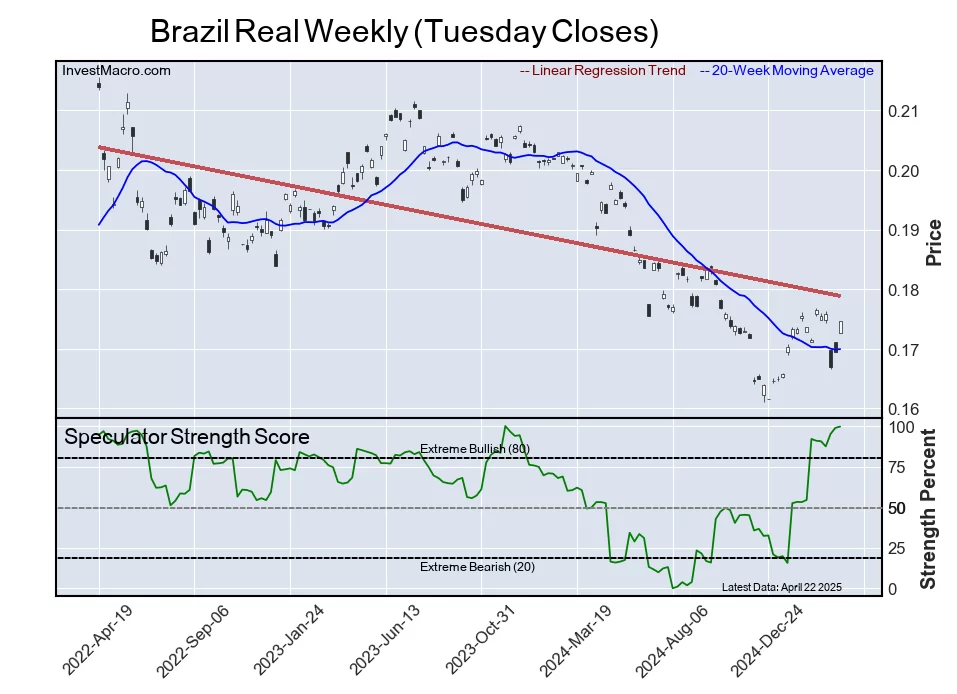
Brazilian Real: The Brazilian currency positioning saw a huge jump by over +40,000 net contracts this week. The net speculator position has now risen in four out of the past five weeks and is in bullish territory after a 39-week streak in bearish territory from May 2024 until January 28th 2025.

The BRL exchange rate remains near the lowest levels on record versus the US Dollar that were reached in December but there has been recent momentum as the BRL has gained in eight out of the past ten weeks.

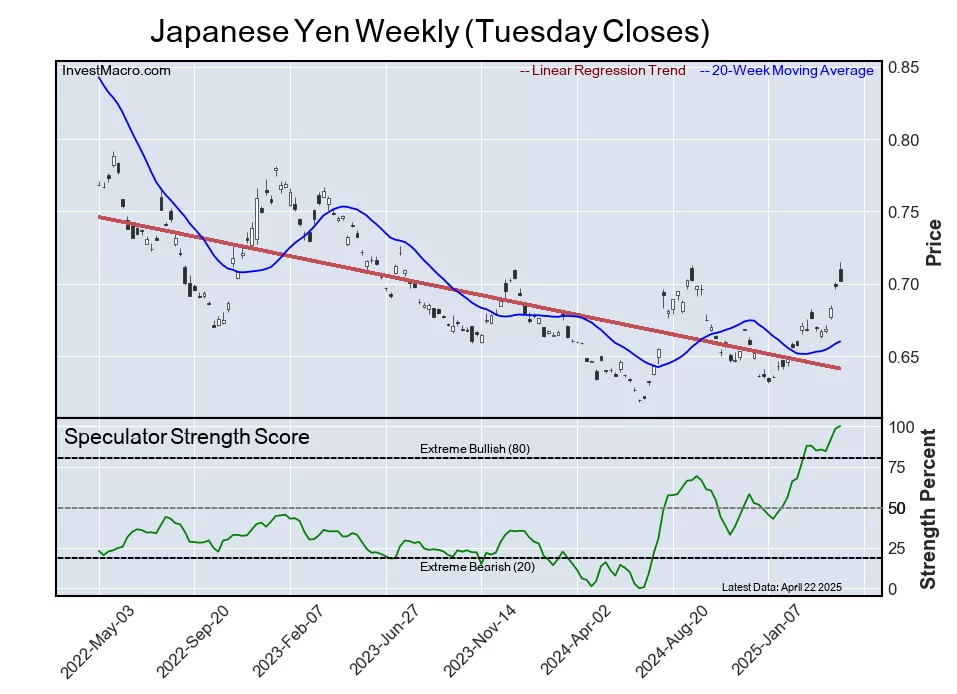
Japanese Yen: The Japanese yen speculator positions rose sharply again this week with a second consecutive weekly gain by more than +35,000 contracts. Overall, the yen speculator bets have surged higher for seven straight weeks and by a total of +163,062 contracts in that time-frame. This has pushed the current net position to a new all-time record high level of +133,651 contracts this week and breaking last week’s record.

The JPY exchange rate continues to see positive movement as the futures price climbs and the USDJPY broke down through the 150 barrier on its way towards 145.00. The USDJPY is currently trading at 147.55 and has JPY improvement in six out the past eight weeks.

Euro: The Euro speculator position has steadily improved over the past few months and has increased for three straight weeks. The Euro bets have gained by a total of +59,458 contracts over the past nine weeks and brings the current net position to a total of -10,106 contracts. This is the lowest bearish position since November and contracts could go positive in the upcoming week as the Euro has been back in favor due to dollar weakness and policy announcements.

The EUR exchange rate had a huge week with a jump by almost 5 percent. The EURUSD was trading at 1.0200 in the middle of January and with the recent surges, the EUR closed out the week over the 1.0830 exchange level.


Currencies Net Speculators Leaderboard

Legend: Weekly Speculators Change | Speculators Current Net Position | Speculators Strength Score compared to last 3-Years (0-100 range)


Strength Scores led by Japanese Yen & Brazilian Real

COT Strength Scores (a normalized measure of Speculator positions over a 3-Year range, from 0 to 100 where above 80 is Extreme-Bullish and below 20 is Extreme-Bearish) showed that the Japanese Yen (100 percent), the Brazilian Real (93 percent) and Bitcoin (65 percent) lead the currency markets this week. The British Pound (44 percent) and the Australian Dollar (42 percent) come in as the next highest in the weekly strength scores.

On the downside, the New Zealand Dollar (0 percent) comes in at the lowest strength levels currently and are in Extreme-Bearish territory (below 20 percent). The next lowest strength scores are the Canadian Dollar (24 percent), the Swiss Franc (24 percent) and the EuroFX (25 percent).

3-Year Strength Statistics:
US Dollar Index (37.2 percent) vs US Dollar Index previous week (39.3 percent)
EuroFX (24.9 percent) vs EuroFX previous week (19.1 percent)
British Pound Sterling (44.5 percent) vs British Pound Sterling previous week (38.1 percent)
Japanese Yen (100.0 percent) vs Japanese Yen previous week (88.1 percent)
Swiss Franc (24.3 percent) vs Swiss Franc previous week (20.9 percent)
Canadian Dollar (23.5 percent) vs Canadian Dollar previous week (26.2 percent)
Australian Dollar (42.1 percent) vs Australian Dollar previous week (44.0 percent)
New Zealand Dollar (0.0 percent) vs New Zealand Dollar previous week (2.4 percent)
Mexican Peso (38.7 percent) vs Mexican Peso previous week (43.4 percent)
Brazilian Real (93.3 percent) vs Brazilian Real previous week (54.5 percent)
Bitcoin (64.7 percent) vs Bitcoin previous week (55.7 percent)


Japanese Yen & Brazilian Real top the 6-Week Strength Trends

COT Strength Score Trends (or move index, calculates the 6-week changes in strength scores) showed that the Brazilian Real (74 percent) and the Japanese Yen (47 percent) lead the past six weeks trends for the currencies. The EuroFX (20 percent), the Australian Dollar (16 percent) and the British Pound Sterling (12 percent) are the next highest positive movers in the 3-Year trends data.

The New Zealand Dollar (-5 percent) leads the downside trend scores currently with Bitcoin (-3 percent) following next with lower trend scores.

3-Year Strength Trends:
US Dollar Index (-0.3 percent) vs US Dollar Index previous week (6.2 percent)
EuroFX (19.9 percent) vs EuroFX previous week (13.3 percent)
British Pound Sterling (12.1 percent) vs British Pound Sterling previous week (1.8 percent)
Japanese Yen (46.7 percent) vs Japanese Yen previous week (39.4 percent)
Swiss Franc (8.2 percent) vs Swiss Franc previous week (-1.5 percent)
Canadian Dollar (3.1 percent) vs Canadian Dollar previous week (13.1 percent)
Australian Dollar (16.4 percent) vs Australian Dollar previous week (22.7 percent)
New Zealand Dollar (-5.3 percent) vs New Zealand Dollar previous week (-1.9 percent)
Mexican Peso (10.7 percent) vs Mexican Peso previous week (11.6 percent)
Brazilian Real (73.5 percent) vs Brazilian Real previous week (35.4 percent)
Bitcoin (-2.7 percent) vs Bitcoin previous week (-24.7 percent)


Individual COT Forex Markets:

US Dollar Index Futures:

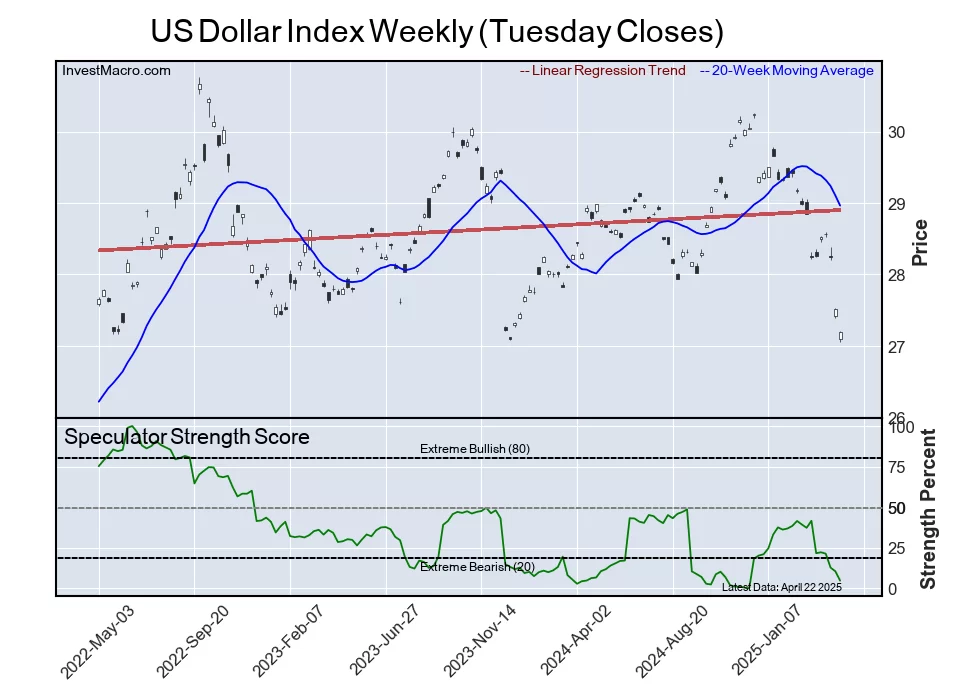
US Dollar Index Forex Futures COT ChartThe US Dollar Index large speculator standing this week resulted in a net position of 14,738 contracts in the data reported through Tuesday. This was a weekly decline of -994 contracts from the previous week which had a total of 15,732 net contracts.

This week’s current strength score (the trader positioning range over the past three years, measured from 0 to 100) shows the speculators are currently Bearish with a score of 37.2 percent. The commercials are Bullish with a score of 64.4 percent and the small traders (not shown in chart) are Bearish with a score of 29.4 percent.

Price Trend-Following Model: Strong Downtrend

Our weekly trend-following model classifies the current market price position as: Strong Downtrend.

US DOLLAR INDEX StatisticsSPECULATORSCOMMERCIALSSMALL TRADERS
– Percent of Open Interest Longs:71.117.17.4
– Percent of Open Interest Shorts:33.455.66.6
– Net Position:14,738-15,048310
– Gross Longs:27,7856,6752,886
– Gross Shorts:13,04721,7232,576
– Long to Short Ratio:2.1 to 10.3 to 11.1 to 1
NET POSITION TREND:
– Strength Index Score (3 Year Range Pct):37.264.429.4
– Strength Index Reading (3 Year Range):BearishBullishBearish
NET POSITION MOVEMENT INDEX:
– 6-Week Change in Strength Index:-0.32.9-15.5


Euro Currency Futures:

Euro Currency Futures COT ChartThe Euro Currency large speculator standing this week resulted in a net position of -10,106 contracts in the data reported through Tuesday. This was a weekly increase of 15,319 contracts from the previous week which had a total of -25,425 net contracts.

This week’s current strength score (the trader positioning range over the past three years, measured from 0 to 100) shows the speculators are currently Bearish with a score of 24.9 percent. The commercials are Bullish with a score of 74.7 percent and the small traders (not shown in chart) are Bearish with a score of 38.5 percent.

Price Trend-Following Model: Weak Downtrend

Our weekly trend-following model classifies the current market price position as: Weak Downtrend.

EURO Currency StatisticsSPECULATORSCOMMERCIALSSMALL TRADERS
– Percent of Open Interest Longs:27.155.112.2
– Percent of Open Interest Shorts:28.657.97.9
– Net Position:-10,106-19,25929,365
– Gross Longs:185,223376,93083,321
– Gross Shorts:195,329396,18953,956
– Long to Short Ratio:0.9 to 11.0 to 11.5 to 1
NET POSITION TREND:
– Strength Index Score (3 Year Range Pct):24.974.738.5
– Strength Index Reading (3 Year Range):BearishBullishBearish
NET POSITION MOVEMENT INDEX:
– 6-Week Change in Strength Index:19.9-21.724.8


British Pound Sterling Futures:

British Pound Sterling Futures COT ChartThe British Pound Sterling large speculator standing this week resulted in a net position of 18,574 contracts in the data reported through Tuesday. This was a weekly lift of 14,111 contracts from the previous week which had a total of 4,463 net contracts.

This week’s current strength score (the trader positioning range over the past three years, measured from 0 to 100) shows the speculators are currently Bearish with a score of 44.5 percent. The commercials are Bullish with a score of 55.9 percent and the small traders (not shown in chart) are Bullish with a score of 52.0 percent.

Price Trend-Following Model: Weak Downtrend

Our weekly trend-following model classifies the current market price position as: Weak Downtrend.

BRITISH POUND StatisticsSPECULATORSCOMMERCIALSSMALL TRADERS
– Percent of Open Interest Longs:40.840.613.8
– Percent of Open Interest Shorts:31.547.416.2
– Net Position:18,574-13,710-4,864
– Gross Longs:81,86681,41027,706
– Gross Shorts:63,29295,12032,570
– Long to Short Ratio:1.3 to 10.9 to 10.9 to 1
NET POSITION TREND:
– Strength Index Score (3 Year Range Pct):44.555.952.0
– Strength Index Reading (3 Year Range):BearishBullishBullish
NET POSITION MOVEMENT INDEX:
– 6-Week Change in Strength Index:12.1-16.932.9


Japanese Yen Futures:

Japanese Yen Forex Futures COT ChartThe Japanese Yen large speculator standing this week resulted in a net position of 133,651 contracts in the data reported through Tuesday. This was a weekly increase of 37,671 contracts from the previous week which had a total of 95,980 net contracts.

This week’s current strength score (the trader positioning range over the past three years, measured from 0 to 100) shows the speculators are currently Bullish-Extreme with a score of 100.0 percent. The commercials are Bearish-Extreme with a score of 0.0 percent and the small traders (not shown in chart) are Bullish-Extreme with a score of 93.4 percent.

Price Trend-Following Model: Strong Uptrend

Our weekly trend-following model classifies the current market price position as: Strong Uptrend.

JAPANESE YEN StatisticsSPECULATORSCOMMERCIALSSMALL TRADERS
– Percent of Open Interest Longs:51.928.812.7
– Percent of Open Interest Shorts:14.270.09.3
– Net Position:133,651-145,91912,268
– Gross Longs:183,955102,08145,054
– Gross Shorts:50,304248,00032,786
– Long to Short Ratio:3.7 to 10.4 to 11.4 to 1
NET POSITION TREND:
– Strength Index Score (3 Year Range Pct):100.00.093.4
– Strength Index Reading (3 Year Range):Bullish-ExtremeBearish-ExtremeBullish-Extreme
NET POSITION MOVEMENT INDEX:
– 6-Week Change in Strength Index:46.7-45.515.6


Swiss Franc Futures:

Swiss Franc Forex Futures COT ChartThe Swiss Franc large speculator standing this week resulted in a net position of -37,775 contracts in the data reported through Tuesday. This was a weekly boost of 1,685 contracts from the previous week which had a total of -39,460 net contracts.

This week’s current strength score (the trader positioning range over the past three years, measured from 0 to 100) shows the speculators are currently Bearish with a score of 24.3 percent. The commercials are Bullish with a score of 77.8 percent and the small traders (not shown in chart) are Bearish with a score of 35.1 percent.

Price Trend-Following Model: Weak Downtrend

Our weekly trend-following model classifies the current market price position as: Weak Downtrend.

SWISS FRANC StatisticsSPECULATORSCOMMERCIALSSMALL TRADERS
– Percent of Open Interest Longs:5.781.012.3
– Percent of Open Interest Shorts:44.731.522.9
– Net Position:-37,77548,071-10,296
– Gross Longs:5,57278,61711,964
– Gross Shorts:43,34730,54622,260
– Long to Short Ratio:0.1 to 12.6 to 10.5 to 1
NET POSITION TREND:
– Strength Index Score (3 Year Range Pct):24.377.835.1
– Strength Index Reading (3 Year Range):BearishBullishBearish
NET POSITION MOVEMENT INDEX:
– 6-Week Change in Strength Index:8.2-15.823.8


Canadian Dollar Futures:

Canadian Dollar Forex Futures COT ChartThe Canadian Dollar large speculator standing this week resulted in a net position of -143,770 contracts in the data reported through Tuesday. This was a weekly decrease of -5,864 contracts from the previous week which had a total of -137,906 net contracts.

This week’s current strength score (the trader positioning range over the past three years, measured from 0 to 100) shows the speculators are currently Bearish with a score of 23.5 percent. The commercials are Bullish with a score of 79.9 percent and the small traders (not shown in chart) are Bearish-Extreme with a score of 10.7 percent.

Price Trend-Following Model: Downtrend

Our weekly trend-following model classifies the current market price position as: Downtrend.

CANADIAN DOLLAR StatisticsSPECULATORSCOMMERCIALSSMALL TRADERS
– Percent of Open Interest Longs:6.579.57.2
– Percent of Open Interest Shorts:48.833.910.5
– Net Position:-143,770154,980-11,210
– Gross Longs:22,175270,39124,406
– Gross Shorts:165,945115,41135,616
– Long to Short Ratio:0.1 to 12.3 to 10.7 to 1
NET POSITION TREND:
– Strength Index Score (3 Year Range Pct):23.579.910.7
– Strength Index Reading (3 Year Range):BearishBullishBearish-Extreme
NET POSITION MOVEMENT INDEX:
– 6-Week Change in Strength Index:3.1-3.32.8


Australian Dollar Futures:

Australian Dollar Forex Futures COT ChartThe Australian Dollar large speculator standing this week resulted in a net position of -48,233 contracts in the data reported through Tuesday. This was a weekly decline of -2,653 contracts from the previous week which had a total of -45,580 net contracts.

This week’s current strength score (the trader positioning range over the past three years, measured from 0 to 100) shows the speculators are currently Bearish with a score of 42.1 percent. The commercials are Bullish with a score of 63.9 percent and the small traders (not shown in chart) are Bearish with a score of 25.9 percent.

Price Trend-Following Model: Downtrend

Our weekly trend-following model classifies the current market price position as: Downtrend.

AUSTRALIAN DOLLAR StatisticsSPECULATORSCOMMERCIALSSMALL TRADERS
– Percent of Open Interest Longs:27.355.212.2
– Percent of Open Interest Shorts:51.127.016.5
– Net Position:-48,23357,029-8,796
– Gross Longs:55,151111,64424,680
– Gross Shorts:103,38454,61533,476
– Long to Short Ratio:0.5 to 12.0 to 10.7 to 1
NET POSITION TREND:
– Strength Index Score (3 Year Range Pct):42.163.925.9
– Strength Index Reading (3 Year Range):BearishBullishBearish
NET POSITION MOVEMENT INDEX:
– 6-Week Change in Strength Index:16.4-13.6-0.8


New Zealand Dollar Futures:

New Zealand Dollar Forex Futures COT ChartThe New Zealand Dollar large speculator standing this week resulted in a net position of -55,765 contracts in the data reported through Tuesday. This was a weekly lowering of -2,056 contracts from the previous week which had a total of -53,709 net contracts.

This week’s current strength score (the trader positioning range over the past three years, measured from 0 to 100) shows the speculators are currently Bearish-Extreme with a score of 0.0 percent. The commercials are Bullish-Extreme with a score of 100.0 percent and the small traders (not shown in chart) are Bearish-Extreme with a score of 17.3 percent.

Price Trend-Following Model: Downtrend

Our weekly trend-following model classifies the current market price position as: Downtrend.

NEW ZEALAND DOLLAR StatisticsSPECULATORSCOMMERCIALSSMALL TRADERS
– Percent of Open Interest Longs:17.978.03.3
– Percent of Open Interest Shorts:74.019.06.2
– Net Position:-55,76558,610-2,845
– Gross Longs:17,84377,5503,282
– Gross Shorts:73,60818,9406,127
– Long to Short Ratio:0.2 to 14.1 to 10.5 to 1
NET POSITION TREND:
– Strength Index Score (3 Year Range Pct):0.0100.017.3
– Strength Index Reading (3 Year Range):Bearish-ExtremeBullish-ExtremeBearish-Extreme
NET POSITION MOVEMENT INDEX:
– 6-Week Change in Strength Index:-5.35.4-2.9


Mexican Peso Futures:

Mexican Peso Futures COT ChartThe Mexican Peso large speculator standing this week resulted in a net position of 19,456 contracts in the data reported through Tuesday. This was a weekly decrease of -9,274 contracts from the previous week which had a total of 28,730 net contracts.

This week’s current strength score (the trader positioning range over the past three years, measured from 0 to 100) shows the speculators are currently Bearish with a score of 38.7 percent. The commercials are Bullish with a score of 65.3 percent and the small traders (not shown in chart) are Bearish-Extreme with a score of 10.8 percent.

Price Trend-Following Model: Weak Downtrend

Our weekly trend-following model classifies the current market price position as: Weak Downtrend.

MEXICAN PESO StatisticsSPECULATORSCOMMERCIALSSMALL TRADERS
– Percent of Open Interest Longs:45.349.72.4
– Percent of Open Interest Shorts:31.961.63.9
– Net Position:19,456-17,305-2,151
– Gross Longs:65,67972,1023,500
– Gross Shorts:46,22389,4075,651
– Long to Short Ratio:1.4 to 10.8 to 10.6 to 1
NET POSITION TREND:
– Strength Index Score (3 Year Range Pct):38.765.310.8
– Strength Index Reading (3 Year Range):BearishBullishBearish-Extreme
NET POSITION MOVEMENT INDEX:
– 6-Week Change in Strength Index:10.7-10.1-7.1


Brazilian Real Futures:


The Brazilian Real large speculator standing this week was a net position of 43,167 contracts in the data reported through Tuesday. This was a weekly gain of 40,789 contracts from the previous week which had a total of 2,378 net contracts.

This week’s current strength score (the trader positioning range over the past three years, measured from 0 to 100) shows the speculators are currently Bullish-Extreme with a score of 93.3 percent. The commercials are Bearish-Extreme with a score of 7.8 percent and the small traders (not shown in chart) are Bearish with a score of 24.5 percent.

Price Trend-Following Model: Weak Downtrend

Our weekly trend-following model classifies the current market price position as: Weak Downtrend.

BRAZIL REAL StatisticsSPECULATORSCOMMERCIALSSMALL TRADERS
– Percent of Open Interest Longs:69.827.22.7
– Percent of Open Interest Shorts:29.068.62.1
– Net Position:43,167-43,814647
– Gross Longs:73,93328,8662,899
– Gross Shorts:30,76672,6802,252
– Long to Short Ratio:2.4 to 10.4 to 11.3 to 1
NET POSITION TREND:
– Strength Index Score (3 Year Range Pct):93.37.824.5
– Strength Index Reading (3 Year Range):Bullish-ExtremeBearish-ExtremeBearish
NET POSITION MOVEMENT INDEX:
– 6-Week Change in Strength Index:73.5-74.410.2


Bitcoin Futures:

Bitcoin Crypto Futures COT ChartThe Bitcoin large speculator standing this week resulted in a net position of 614 contracts in the data reported through Tuesday. This was a weekly boost of 410 contracts from the previous week which had a total of 204 net contracts.

This week’s current strength score (the trader positioning range over the past three years, measured from 0 to 100) shows the speculators are currently Bullish with a score of 64.7 percent. The commercials are Bullish with a score of 50.6 percent and the small traders (not shown in chart) are Bearish-Extreme with a score of 3.0 percent.

Price Trend-Following Model: Weak Uptrend

Our weekly trend-following model classifies the current market price position as: Weak Uptrend.

BITCOIN StatisticsSPECULATORSCOMMERCIALSSMALL TRADERS
– Percent of Open Interest Longs:86.73.34.2
– Percent of Open Interest Shorts:84.65.24.6
– Net Position:614-516-98
– Gross Longs:24,4699371,186
– Gross Shorts:23,8551,4531,284
– Long to Short Ratio:1.0 to 10.6 to 10.9 to 1
NET POSITION TREND:
– Strength Index Score (3 Year Range Pct):64.750.63.0
– Strength Index Reading (3 Year Range):BullishBullishBearish-Extreme
NET POSITION MOVEMENT INDEX:
– 6-Week Change in Strength Index:-2.712.2-27.2


Article By InvestMacroReceive our weekly COT Newsletter

*COT Report: The COT data, released weekly to the public each Friday, is updated through the most recent Tuesday (data is 3 days old) and shows a quick view of how large speculators or non-commercials (for-profit traders) were positioned in the futures markets.

The CFTC categorizes trader positions according to commercial hedgers (traders who use futures contracts for hedging as part of the business), non-commercials (large traders who speculate to realize trading profits) and nonreportable traders (usually small traders/speculators) as well as their open interest (contracts open in the market at time of reporting). See CFTC criteria here.

Speculator Extremes: Japanese Yen, Brent, NZ Dollar & Cotton lead Bullish & Bearish Positions

By InvestMacro

The latest update for the weekly Commitment of Traders (COT) report was released by the Commodity Futures Trading Commission (CFTC) on Friday for data ending on March 4th.

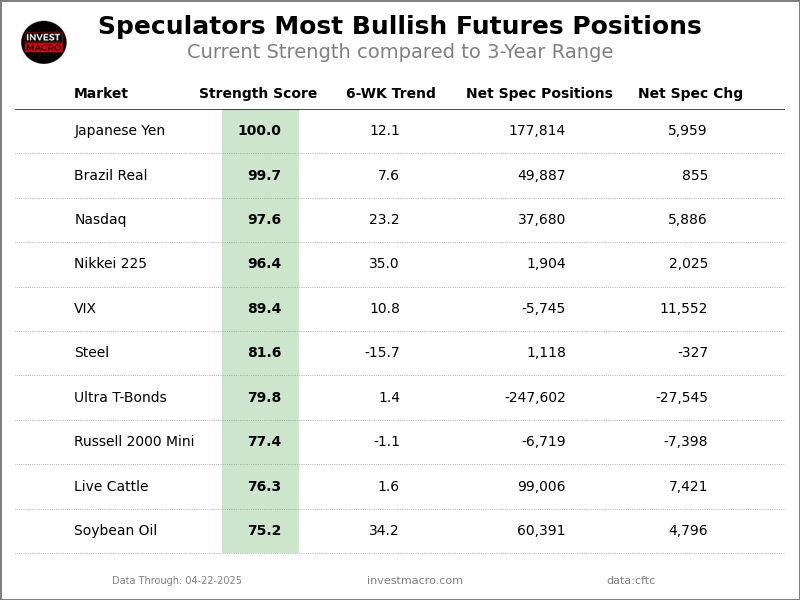
This weekly Extreme Positions report highlights the Most Bullish and Most Bearish Positions for the speculator category. Extreme positioning in these markets can foreshadow strong moves in the underlying market.

To signify an extreme position, we use the Strength Index (also known as the COT Index) of each instrument, a common method of measuring COT data. The Strength Index is simply a comparison of current trader positions against the range of positions over the previous 3 years. We use over 80 percent as extremely bullish and under 20 percent as extremely bearish. (Compare Strength Index scores across all markets in the data table or cot leaders table)


Here Are This Week’s Most Bullish Speculator Positions:

Japanese Yen


The Japanese Yen speculator position comes in as the most bullish extreme standing this week as sentiment has shifted significantly for the yen in a quick period of time. The Japanese Yen speculator level is currently at a 100.0 percent or a maximum score of its 3-year range.
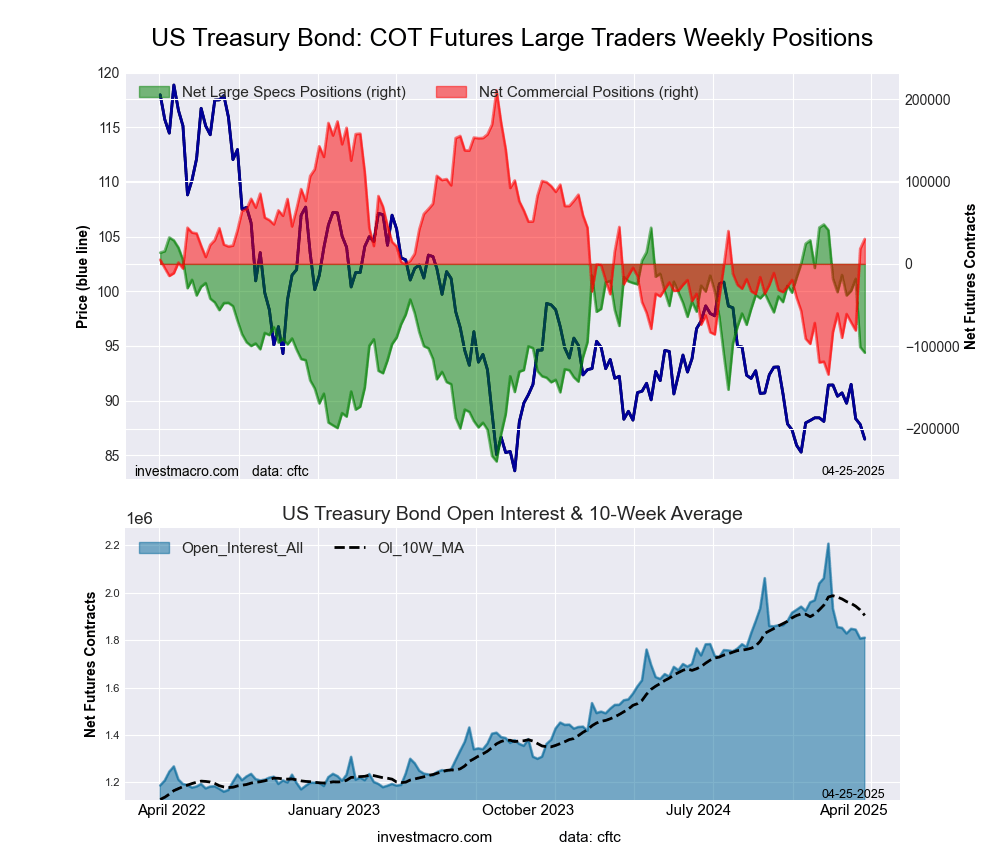
The six-week trend for the percent strength change in score totaled 46.7 this week. The overall net speculator position was a total of 133,651 net contracts this week (a new record high) with a huge boost of 37,671 contract in the weekly speculator bets.


Speculators or Non-Commercials Notes:

Speculators, classified as non-commercial traders by the CFTC, are made up of large commodity funds, hedge funds and other significant for-profit participants. The Specs are generally regarded as trend-followers in their behavior towards price action – net speculator bets and prices tend to go in the same directions. These traders often look to buy when prices are rising and sell when prices are falling. To illustrate this point, many times speculator contracts can be found at their most extremes (bullish or bearish) when prices are also close to their highest or lowest levels.

These extreme levels can be dangerous for the large speculators as the trade is most crowded, there is less trading ammunition still sitting on the sidelines to push the trend further and prices have moved a significant distance. When the trend becomes exhausted, some speculators take profits while others look to also exit positions when prices fail to continue in the same direction. This process usually plays out over many months to years and can ultimately create a reverse effect where prices start to fall and speculators start a process of selling when prices are falling.


Brent Oil

The Brent Oil speculator position comes next in the extreme standings this week. The Brent Oil speculator level is now at a 100.0 percent score of its 3-year range.

The six-week trend for the percent strength score was 20.0 this week. The speculator position registered -5,400 net contracts this week with a weekly jump by 23,056 contracts in speculator bets.


Brazil Real

The Brazil Real speculator position comes in third this week in the extreme standings. The Brazil Real speculator level now resides at a 93.3 percent score of its 3-year range.

The six-week trend for the speculator strength score came in at 73.5 this week. The overall speculator position was 43,167 net contracts this week with a giant gain of 40,789 contracts in the weekly speculator bets.


Steel

The Steel speculator position comes up number four in the extreme standings this week. The Steel speculator level is at a 91.9 percent score of its 3-year range.

The six-week trend for the speculator strength score totaled a change of 22.5 this week. The overall speculator position was 3,340 net contracts this week despite a change of -557 contracts in the speculator bets.


Ultra U.S. Treasury Bonds

The Ultra U.S. Treasury Bonds speculator position rounds out the top five in this week’s bullish extreme standings. The Ultra U.S. Treasury Bonds speculator level sits at a 85.8 percent score of its 3-year range. The six-week trend for the speculator strength score was -0.7 this week.

The speculator position was -231,904 net contracts this week with a dip of -4,169 contracts in the weekly speculator bets.


This Week’s Most Bearish Speculator Positions:

New Zealand Dollar

The New Zealand Dollar speculator position comes in as the most bearish extreme standing this week. The New Zealand Dollar speculator level is at a 0.0 percent or at the minimum score of its 3-year range.

The six-week trend for the speculator strength score was -5.3 this week. The overall speculator position was -55,765 net contracts this week with a decline of -2,056 contracts in the speculator bets.


Cotton

The Cotton speculator position comes in next for the most bearish extreme standing on the week. The Cotton speculator level is at a 0.0 percent score of its 3-year range.

The six-week trend for the speculator strength score was -13.5 this week. The speculator position was -62,137 net contracts this week with a drop of -18,651 contracts in the weekly speculator bets.


Soybean Meal

The Soybean Meal speculator position comes in as third most bearish extreme standing of the week. The Soybean Meal speculator level resides at a 4.5 percent score of its 3-year range.

The six-week trend for the speculator strength score was -11.2 this week. The overall speculator position was -55,904 net contracts this week with a decrease by -19,792 contracts in the speculator bets.


WTI Crude Oil

The WTI Crude Oil speculator position comes in as this week’s fourth most bearish extreme standing. The WTI Crude Oil speculator level is at a 7.8 percent score of its 3-year range.

The six-week trend for the speculator strength score was -68.0 this week. The speculator position was 154,841 net contracts this week with a reduction of -16,357 contracts in the weekly speculator bets.


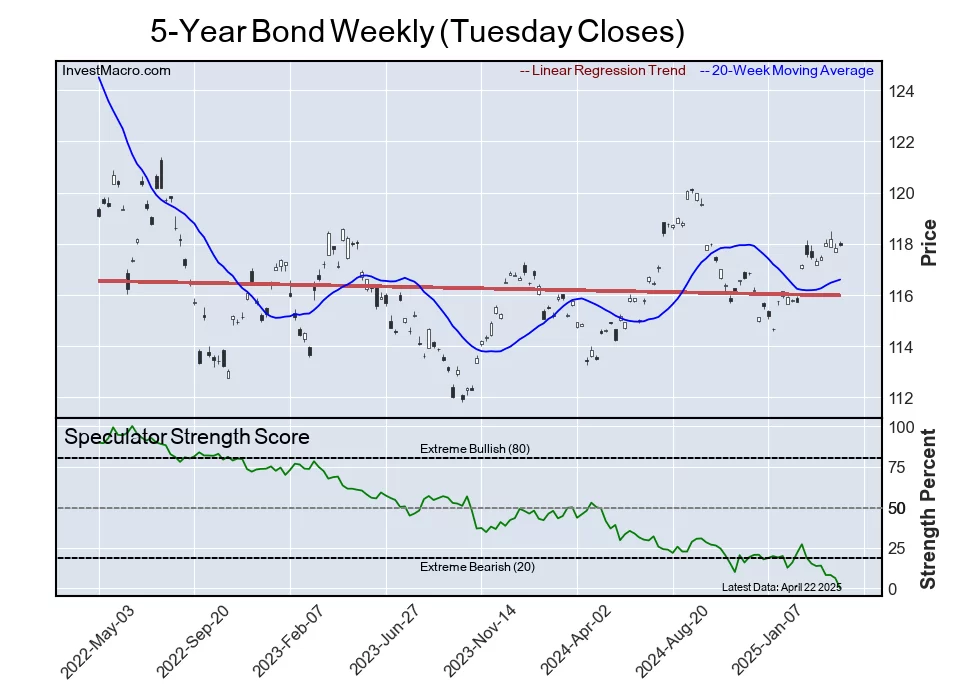
5-Year Bond

Finally, the 5-Year Bond speculator position comes in as the fifth most bearish extreme standing for this week. The 5-Year Bond speculator level is at a 9.8 percent score of its 3-year range.

The six-week trend for the speculator strength score was -0.1 this week. The speculator position was -1,798,361 net contracts this week with a decline by -172,588 contracts in the weekly speculator bets.


Article By InvestMacroReceive our weekly COT Newsletter

*COT Report: The COT data, released weekly to the public each Friday, is updated through the most recent Tuesday (data is 3 days old) and shows a quick view of how large speculators or non-commercials (for-profit traders) were positioned in the futures markets.

The CFTC categorizes trader positions according to commercial hedgers (traders who use futures contracts for hedging as part of the business), non-commercials (large traders who speculate to realize trading profits) and nonreportable traders (usually small traders/speculators) as well as their open interest (contracts open in the market at time of reporting). See CFTC criteria here.