Archive for Opinions – Page 81

2023 Predictions: Mid-year Scorecard

By ForexTime 

What an eventful first half it’s been.

Coming into 2023, no one would’ve expected a banking crisis on either side of the Atlantic (recall how SVB and Credit Suisse collapsed), nor being a whisker away from a civil war in Russia.

But traders and investors have taken things in stride, weathering bouts of volatility and uncertainty.


Back on January 4th, I wrote this article: “3 potential winners in 2023”.

Here’s a mid-year report card on those 3 assets:


1) Gold to hit $2000?

Yes. $2k target hit on March 20th.

Of course, spot gold needed the help of an unexpected banking crisis in the US and Europe to send investors scurrying towards the safe haven asset.

But after coming to within 0.57% or about $12 away from its record high ($2074.87 on 7th August 2020), gold has crumbled since May.

Why has gold fallen since May?

This is because markets have pushed back expectations for a Fed rate CUT.

  • Back in early May, markets had expected the Fed to LOWER its benchmark rates by September 2023.
  • However, US inflation has since proven stubborn and the Fed appears willing to trigger more rate hikes than previously expected.
  • Today (June 29th), markets expect a 70% chance that the Fed will CUT rates only in May 2024!

Hence, given that investors are not paid to hold on to gold (a zero-yielding asset), markets have since dumped the precious metal in favour of other asset classes.

As written back in January, the “What could go wrong” section on gold has indeed been playing out in recent months.


Though to be clear, despite recent declines …

Gold remains the second best-performing traditional asset class so far this year.

(excluding cryptos such as Bitcoin which has soared by more than 85% over the same period).
  • First place in 1H23 goes to global stocks (measured by MSCI ACWI Index) which climbed by 11.4%.
  • Second-placed bullion has a year-to-date gain of about 4.4% at the time of writing.


2) USDJPY back down to 125?

No, but it came close.

USDJPY initially appeared destined to claim the 125 target, reaching as low as 127.224 by mid-January.

Since then, USDJPY broke out of its downtrend to recently form a golden cross (when 50-day moving average crosses above 200-day moving average – a technical signal that often implies further gains ahead).

This major FX pair is now trading around its highest levels since November 2022.

What went wrong?

As stated in the USDJPY section of my January 4th article:

Still-dovish BoJ: the incoming BoJ Governor keeps Japan’s benchmark rate mired in negative territory on signs that inflation is not as sticky as hoped.

This scenario would be made worse if the Fed stays hawkish and keeps sending US interest rates much higher than the currently forecasted peak of around 5%.

The “wrong” scenario cited above has instead been the case so far this year.

The Bank of Japan (BoJ) apparently isn’t yet budging from its negative interest rates regime, while the Fed now projects US rates to peak around 5.6%.

Hence, Yen bulls (those hoping the Yen will strengthen) have given up for now.

However, note that markets are still predicting a greater-than-even chance (55%) of a BoJ rate hike by Dec 2023.

Should those odds firm up, that may yet restore hope for a Yen recovery and a lower USDJPY eventually.


3) FTSE China A50 Index back above 14,000?

Yes. 14k line was breached on January 14th.

To be honest, when I saw that the psychologically-important 14,000 mark had been surpassed a mere 10 days after my January 4th article, I initially chided myself, thinking I should have been more bullish in my predictions.

Instead, this turned out to be a rather PRUDENT forecast.

Since peaking at 14,420 in late January, which was a further 3% beyond the 14k mark, this stocks index (which tracks the 50 largest A-share Chinese companies) has embarked on a downtrend (a series of lower highs and lower lows).

In other words …

The 14k mark was just about as good as it got for the CHNA50_m index so far in 2023.

This is because China’s much-hyped recovery has fizzled out.

The economic momentum has clearly struggled post lockdowns, to the point that the People’s Bank of China (PBOC – China’s central bank) has pivoted to a supportive policy stance.

The PBOC’s support policy stance is in stark contrast to that at other major central banks (Fed, ECB, BOE, etc.) who are still busy hiking interest rates.

Until China’s economic recovery can find a more solid footing, Chinese assets ranging from its stock markets to the Yuan are set to find it difficult to stage a meaningful recovery.

Same goes for other assets that are reliant on the Chinese economy, including the likes of the Australian dollar (AUDUSD) as well as oil prices.


So there you have it.

Surely, it has been an eventful first half.

If the 2nd half of 2023 proves to be as eventful, that may herald more trading opportunities across global financial markets.

And we’ll be keeping you up-to-date via our Daily Market Analysis.


And in case you missed it …

Here are our top-5 most-read articles (out of the 128 articles, excluding this one) that have been published on the FXTM website so far this year:

  1. (MAY 1st) Trade of the Week: The return of $2k gold?
  2. (JUNE 5th) Trade Of The Week: Time For USDCAD To Breakout?
  3. (APRIL 3rd) Trade Of The Week: More Volatility For AUDNZD After OPEC+ Shocker?
  4. (JANUARY 3rd) 2023 Outlook: Is the worst behind us?
  5. (MARCH 3rd) Week Ahead: Watch these 3 major FX pairs

NOTE:

  • FXTM’s “Trade of the Week” articles are published on the website and emailed every Monday (except holidays)
  • FXTM’s “Week Ahead” articles are published on the website and emailed to clients every Friday (except holidays)


Forex-Time-LogoArticle by ForexTime

ForexTime Ltd (FXTM) is an award winning international online forex broker regulated by CySEC 185/12 www.forextime.com

Almost no one uses Bitcoin as currency, new data proves. It’s actually more like gambling

By John Hawkins, University of Canberra 

Bitcoin boosters like to claim Bitcoin, and other cryptocurrencies, are becoming mainstream. There’s a good reason to want people to believe this.

The only way the average punter will profit from crypto is to sell it for more than they bought it. So it’s important to talk up the prospects to build a “fear of missing out”.

There are loose claims that a large proportion of the population – generally in the range of 10% to 20% – now hold crypto. Sometimes these numbers are based on counting crypto wallets, or on surveying wealthy people.

But the hard data on Bitcoin use shows it is rarely bought for the purpose it ostensibly exists: to buy things.

Little use for payments

The whole point of Bitcoin, as its creator “Satoshi Nakamoto” stated in the opening sentence of the 2008 white paper outlining the concept, was that:

A purely peer-to-peer version of electronic cash would allow online
payments to be sent directly from one party to another without going through a
financial institution.

The latest data demolishing this idea comes from Australia’s central bank.

Every three years the Reserve Bank of Australia surveys a representative sample of 1,000 adults about how they pay for things. As the following graph shows, cryptocurrency is making almost no impression as a payments instrument, being used by no more than 2% of adults.


Payment methods being used by Australians

Alternative payment methods, share of all respondents, 2022
Reserve Bank calculations of Australians’ awareness vs use of different payment methods, based on Ipsos data.

By contrast more recent innovations, such as “buy now, pay later” services and PayID, are being used by around a third of consumers.

These findings confirm 2022 data from the US Federal Reserve, showing just 2% of the adult US population made a payment using a cryptocurrrency, and Sweden’s Riksbank, showing less than 1% of Swedes made payments using crypto.

The problem of price volatility

One reason for this, and why prices for goods and services are virtually never expressed in crypto, is that most fluctuate wildly in value. A shop or cafe with price labels or a blackboard list of their prices set in Bitcoin could be having to change them every hour.

The following graph from the Bank of International Settlements shows changes in the exchange rate of ten major cryptocurrencies against the US dollar, compared with the Euro and Japan’s Yen, over the past five years. Such volatility negates cryptocurrency’s value as a currency.


Cryptocurrency’s volatile ways

90-day rolling standard deviation of daily returns for major cryptocurrencies compared with the Euro and Yen.
The Crypto Multiplier, BIS Working Papers, No. 1104, CC BY

There have been attempts to solve this problem with so-called “stablecoins”. These promise to maintain steady value (usually against the US dollar).

But the spectacular collapse of one of these ventures, Terra, once one of the largest cryptocurrencies, showed the vulnerability of their mechanisms. Even a company with the enormous resources of Facebook owner Meta has given up on its stablecoin venture, Libra/Diem.

This helps explain the failed experiments with making Bitcoin legal tender in the two countries that have tried it: El Salvador and the Central African Republic. The Central African Republic has already revoked Bitcoin’s status. In El Salvador only a fifth of firms accept Bitcoin, despite the law saying they must, and only 5% of sales are paid in it.

Storing value, hedging against inflation

If Bitcoin’s isn’t used for payments, what use does it have?

The major attraction – one endorsed by mainstream financial publications – is as a store of value, particularly in times of inflation, because Bitcoin has a hard cap on the number of coins that will ever be “mined”.

As Forbes writers argued a few weeks ago:

In terms of quantity, there are only 21 million Bitcoins released as specified by the ASCII computer file. Therefore, because of an increase in demand, the value will rise which might keep up with the market and prevent inflation in the long run.

The only problem with this argument is recent history. Over the course of 2022 the purchasing power of major currencies (US, the euro and the pound) dropped by about 7-10%. The purchasing power of a Bitcoin dropped by about 65%.

Speculation or gambling?

Bitcoin’s price has always been volatile, and always will be. If its price were to stabilise somehow, those holding it as a speculative punt would soon sell it, which would drive down the price.

But most people buying Bitcoin essentially as a speculative token, hoping its price will go up, are likely to be disappointed. A BIS study has found the majority of Bitcoin buyers globally between August 2015 and December 2022 have made losses.

The “market value” of all cryptocurrencies peaked at US$3 trillion in November 2021. It is now about US$1 trillion.

Bitcoins’s highest price in 2021 was about US$60,000; in 2022 US$40,000 and so far in 2023 only US$30,000. Google searches show that public interest in Bitcoin also peaked in 2021. In the US, the proportion of adults with internet access holding cryptocurrencies fell from 11% in 2021 to 8% in 2022.

UK government research published in 2022 found that 52% of British crypto holders owned it as a “fun investment”, which sounds like a euphemism for gambling. Another 8% explicitly said it was for gambling.

The UK parliament’s Treasury Committee, a group of MPs who examine economics and financial issues, has strongly recommended regulating cryptocurrency as form of gambling rather than as a financial product. They argue that continuing to treat “unbacked crypto assets as a financial service will create a ‘halo’ effect that leads consumers to believe that this activity is safer than it is, or protected when it is not”.

Whatever the merits of this proposal, the UK committtee’s underlying point is solid. Buying crypto does have more in common with gambling than investing. Proceed at your own risk, and and don’t “invest” what you can’t afford to lose.The Conversation

About the Author:

John Hawkins, Senior Lecturer, Canberra School of Politics, Economics and Society, University of Canberra

This article is republished from The Conversation under a Creative Commons license. Read the original article.


Gold Is Seasonally Weak, Its Time To Pick up Bargains

Source: Barry Dawes  (6/26/23)

Barry Dawes of Martin Place Securities reviews the current state of the gold market to tell you where he believes it is headed. 

Take advantage of June tax loss selling and pick up bargains of a decade.

Bond brinkmanship resolved.

  • Yields falling.
  • Fed to follow!

Big bond rally to come.

Key Points

  • Gold
    • Marking time for US$ gold
      • But gold in Yen, Euros, and Sterling still looking strong
    • Seasonally slow in May-June but stronger into July and beyond
  • Gold Stocks
    • Sentiment falling away
    • Bargains on offer
    • Once in a decade opportunity here in smaller ASX Gold Stocks
  • Bonds
  • A major rally coming
  • Fed will follow market

Gold

We have seen good volatility in gold as we reached the end of the June quarter. Gold is seasonally weak at this time, and so should be bottoming soon before rising in the September quarter.

There’s certainly a lot going on in U.S. politics, but it is becoming clear that the Biden criminal syndicate is now out in the open and seen for what it is. The criminal acts of the FBI and the DOJ extend into so many other federal and state administrations, and we are seeing that America is saying enough is enough.

Diversions from Russia and Ukraine shenanigans and undersea disasters won’t be enough to head this off.

A climax is coming soon, and it will be seen in the bond market, the currency, and the stock market. And, of course, the net effect will be a return to a gold standard to stop all these budget deficits caused by politicians buying votes.

Gold will be a major beneficiary.

Emerging market economies were big buyers of gold in 2022, and the first quarter of 2023 was an all-time record for central bank buying in a March Qtr. At the time of the end of the Bretton Woods Agreement in 1971, the reserves of central banks were made up of about 40% in gold, with the rest being the debt securities of various currencies but mostly US$.

Central banks currently have about 16% in gold and over 50% in US$ debt securities. It’s hard to imagine central banks being happy holding Euro debt securities which would have been financial disasters over the past couple of years. And none would enjoy holding Yen.

And then what else to hold?

As noted here before, a move to 40% gold for central bank reserves (currently around 38,000t) would require the purchase of another 4.000 tonnes gold priced around US$7,000/oz. It is coming and with a strong US$.

You saw the comment on the Yen last week. Euro next.

Gold is declining into this seasonal low which, on average, is only two weeks away.

Gold in US$ has been very constructive in this declining wedge formation, so it will be very interesting to see how the seasonal aspects come into play here.

That intraday rally on Friday added to the appeal of this declining wedge which is probably now over three months old.

The longer the period, the more powerful the breakout.

Longer term position for gold still is as powerful as ever.

We know with central bank buying and a pickup in interest in ETF gold that, the underlying demand for gold is strong.

It is only the banksters trying to hold it back.

Gold Stocks

The XAU is back at important support around 118, and whilst the uptrend might be wonky, this has not been your typical unfettered technical market.

Sentiment for gold stocks is falling away toward the end of the Qtr.

So it is buying time.

ASX Gold Stocks

  • And it is buying time here
  • Tax loss selling provides bargains
  • This index is currently down 64% from its high in August 2020
  • It is wedging nicely
  • The break upwards when it comes will be very strong

And these developers are down 66% against AU$ gold.

And down 50% against the ASX Gold Index.

All these are wedging with a strong uptrend, and a heavy downtrend suggests the bottom is close and the upturn will be very strong.

Oh, and did I mention that the Euro is next to fall over?

Timing is everything.

Heed the markets, not the commentators.


Important Disclosures:

  1. Statements and opinions expressed are the opinions of the author and not of Streetwise Reports or its officers. The author is wholly responsible for the validity of the statements. The author was not paid by Streetwise Reports for this article. Streetwise Reports was not paid by the author to publish or syndicate this article. Streetwise Reports requires contributing authors to disclose any shareholdings in, or economic relationships with, companies that they write about. Streetwise Reports relies upon the authors to accurately provide this information and Streetwise Reports has no means of verifying its accuracy.
  2. This article does not constitute investment advice. Each reader is encouraged to consult with his or her individual financial professional and any action a reader takes as a result of information presented here is his or her own responsibility. By opening this page, each reader accepts and agrees to Streetwise Reports’ terms of use and full legal disclaimer. This article is not a solicitation for investment. Streetwise Reports does not render general or specific investment advice and the information on Streetwise Reports should not be considered a recommendation to buy or sell any security. Streetwise Reports does not endorse or recommend the business, products, services or securities of any company mentioned on Streetwise Reports.

For additional disclosures, please click here.

Generational Revulsion

Source: Michael Ballanger  (6/26/23) 

Michael Ballanger of GGM Advisory Inc. looks at how newer generations are affecting the gold market, as well as new developments in the economy and TSX exchange.

As I begin to write this week’s missive, gold bullion prices are ahead US$17.50. After trading down to a low of US$1,919.85, which is a couple of dollars above the 61.8% Fibonacci retracement level, gold has since recovered nearly US$50/ounce, which has the Twitter gold bugs aflutter in expectation of US$10,000 gold and US$400 silver. (Surely, he jests!)

In earlier times, I would also be one of those afluttering at the sharp price jump with the absolute certainty that the “powers that be” had finally seen the light and were finally embracing gold for its rightful role as “protector of savings” from the ravages of government waste and corruption. The duty of all governments should be to protect the purchasing power of people’s savings through responsible stewardship of sovereign finances. Still, over the past fifty years, re-election to the office by spending taxpayer money on prospective voters has replaced fiscal prudence, and that led to massive, global currency debasement.

With gold up US$17.50 an ounce, is it not proof positive that global attitudes have finally shifted? (Surely, he jests again!)

The Younger Generations and Gold

We, old people, tend to look at this younger breed of investors as if they are clueless, uneducated, ADHD-afflicted videogame junkies that are far more sheep than shepherds and prone to mass mania susceptibility due to their obsessions with social media trends.

Nothing could be farther from the truth. From what I have learned in recent weeks delving into the world of Millennials and Generation X-ers’ investment trends, these two demographics are distinctly more pragmatic than their predecessor generation — the Baby Boomer Generation — and as such, take a “Buy what’s working” attitude to investing as opposed to “Buy what isn’t working now but will work when the world wakes up” investment style.

History would prove that the North American investor has been riding a wave of bullish enthusiasm that began post-WII and which stalled in the 1970s just as the children of the recently-returned soldiers were reaching young adulthood.

The Baby Boomer Generation stopped the Viet Nam war through protests in the 1970s, and once they put away their bell-bottomed jeans and love beads for pin-striped suits and Brooks Brothers shoes, markets have not looked back.

The maturation of the largest generation of people ever created in the history of mankind brought about an ever-increasing demand for new products and new technology.

And it was largely to thank for a growth era that went largely uninterrupted for almost twenty years.

The problems started to creep up when the internet bubble imploded in 2001.

Ever since, the incessant demands of the boomers created an unhealthy creep of political malfeasance and fiscal compromise.

The boomers sucked the air out of any room they entered, and it did not go unnoticed by the younger generations, the largest of which is now the Millennials and will be joined by the Generation-Xer’s by the end of the decade.

I find it fascinating that these younger, more pragmatic souls refuse to enter into intelligent speculations on precious metals but move hog-wild on cryptocurrencies as the replacement for fiat currencies despite growing regulatory scrutiny and a distinctly hostile disposition by government regulators.

Boomers such as this author have long been enraged by similar interference in the metals markets through coordinated interventions in the paper markets like the Chicago Board of Trade or the Crimex.

And yet we still invest in gold and silver thinking (perhaps erroneously) that 5,000 years of safe haven replacements for hoarding cash representing the “full faith and credit of government” is sufficient justification for ownership, not to mention amassing, hoarding, and shameless stacking.

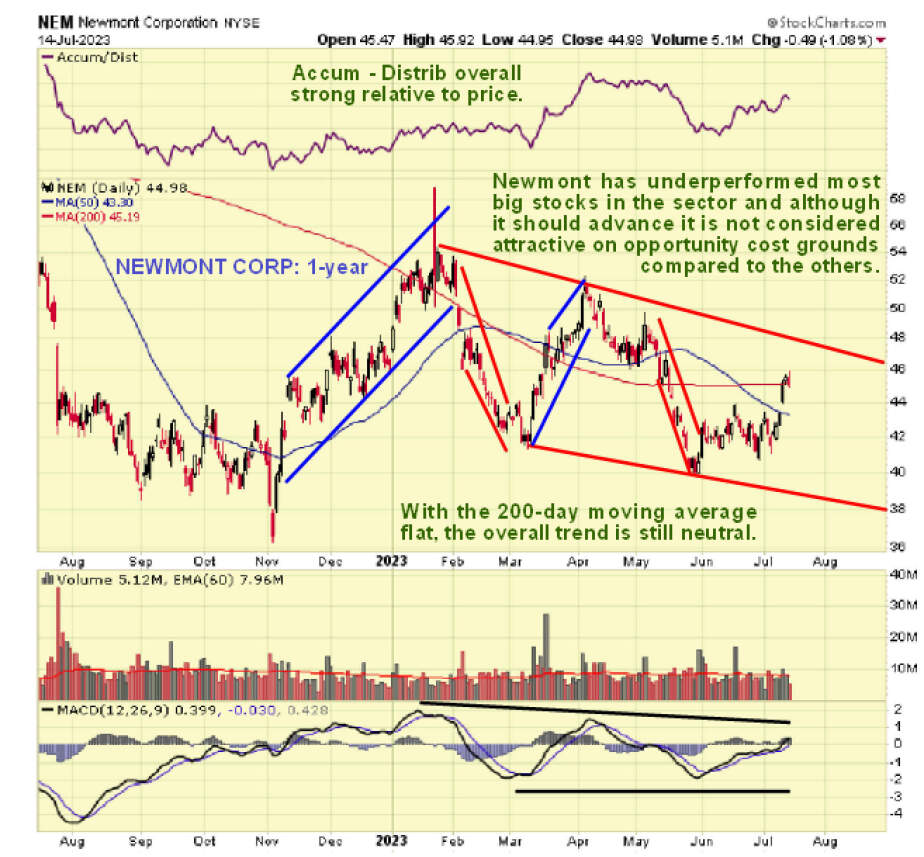
The “kiddies” (as I love to call them), many of which are now in their 40s and certainly not babies anymore, have learned over time that to own “what is working” means that they can buy Bitcoin (circa 2018) and a few tech stocks (through the QQQ’s) and let Zayde and Bubbe (Yiddish for Grandpa and Grandma) buy “what is NOT working (and hasn’t been since August/2020) like Newmont Gold and Foofoo Mines. The result shown above might be considered unfair because it excludes 2022 when crypto and tech got slaughtered, but then again, gold and silver did nothing then either.

I have been writing about gold and silver since the 1980s. Still, rather than evolving into a card-carrying gold bug complete with a megaphone, tinfoil hat, and multiple crying towels, I evolved into a pragmatist that has been able to sidestep the PMs from time to time in favor of other resource plays.

From what I have learned in recent weeks delving into the world of Millennials and Generation X-ers’ investment trends, these two demographics are distinctly more pragmatic than their predecessor generation — the Baby Boomer Generation — and as such, take a “Buy what’s working” attitude to investing as opposed to “Buy what isn’t working now but will work when the world wakes up” investment style.

Unfortunately, I was too incredibly smart to see that the electrification movement was going to benefit lithium over copper as the lithium stocks, despite correcting since 2022, continue to be the darlings of the resource stock universe.

If there is one significant takeaway from my musings this morning, it is that I wish I could find that memory-erasing gadget from Men in Black where Tommy Lee Jones can make entire crowds forget that a giant cockroach just emerged from the body of a tow-truck driver.

I would stand in front of a full-length mirror and ZAP! myself into forgetting I ever owned Consolidated Stikine, a junior gold explorer that went from CA$0.15 in early 1988 to over CA$70 per share by 1989 after discovering the massive Eskay Creek gold-silver deposit.

Then, I would conger up recollections of the mighty Voisey’s Bay discovery in NE Labrador in 1993, stare into the mirror, and ZAP! erase all vestiges of the move in Diamondfield Resources from pennies to over US$42.50 (after a 4:1 split). Then, and only then, could I return to uncluttered investing where I can buy “what’s working” — you know — hop in the shower and lather up on Nvidia or Tesla or into the hot tub with a tankard full of Microsoft ale or Bitcoin Beer.

Take out my cell phone and get up-to-the-microsecond updates on which pink sheet meme stock is about to be taken up by the flock of Millennials in charge of the pump.

If you all detect a trace of sarcasm in the preceding paragraph, please forgive me. I am a victim of my own success and a prisoner of my sexagenarian memory. As was phrased by one of my all-time favorite comedians of the old Borsht Belt circuit, Rodney Dangerfield, “It ain’t easy bein’ me!” (No jest intended.)

Recession

The decade of the 1980s started off with a stock market that bottomed with the Dow Jones Industrials just under 800 and after a two-year recession brought on by the inflation-fighting antics of Paul (I Hate Gold) Volcker, jump-started one of the truly great growth stock revivals in modern history. Technology stocks included IBM and Digital Electric and were about as exciting in 1985 as Barrick Gold in 2023. It was only in the mid-80s, when Japan’s Sony developed the Nintendo videogame console, that technology exploded.

With the arrival of technology came the downfall of leisure time reading or listening to the phonograph or stereo to the serene incantations of David Gilmour’s guitar in Pink Floyd’s Dark Side of the Moon album, which demanded a “record player” rather than ear buds and a cellphone. “Eliminating bosses” at various levels of RPGs (role-playing games) replaced sandlot games of “workup’s baseball” or road hockey as preadolescent youth embarked on a journey of a cerebral rather than sensual nature of experimentation and discovery.

If every major hedge fund in New York and Connecticut owns Nvidia at 1,100-times sales, then we all better own it before the month-end report goes out to unitholders when all of the career-ending comparisons will be drawn.

When I was in the investment business in the 1980s, a site visit involved going 300 meters down into an old gold mine that had just been de-watered, seeing an old Toronto Telegram front page from 1966 lying beside an older snub-nosed coke bottle at the end of a mine “drift” was quite the experience.

Today, there are no site visits because insurance companies would never allow it. The kids that now run the operations would never allow prospective investors to cross the line of yellow tape as their grampas did. “Turning a blind eye” was commonplace because pragmatism had to supersede policy in order to advance the course of good business.

The art of due diligence is conducted somewhat differently today as the term “liquidity” is now seen as the main driver of stock prices in contrast to “fundamentals” like earnings or debt-to-equity ratios or competition. If every major hedge fund in New York and Connecticut owns Nvidia at 1,100 times sales, then we all better own it before the month-end report goes out to unitholders when all of the career-ending comparisons will be drawn. Same with the QQQ’s or the Russell 2000 (small-caps) as investors scramble to be invested in the “safety-in-numbers” pool rather than in the “out-and-without” pool of “big fat loser” ignonimity.

I look at the current 2-and-10-year yield curve, and I have only one thought: RECESSION.

At least from the point of view of historians/economists (like my colleague David Chapman @Davcha12 who has forgotten more than I will ever know about markets), it is certainly noteworthy that this recent spike in the 2-year and 10-year yield spread (the “yield curve”) came on the heels of the 50 basis-point hike by the BOE.

Spreads like this have in the past been a dyed-in-the-wool omen of impending economic recession but, like the current foo-fah-fah over the sudden and unexpected arrival of an “official bull” with the SPX recently printing a 20% advance off the October lows, they are simply “noteworthy,” just as the arrival of the inverted yield curve back in July/22 was screaming recession, here we are nearly a year later and still no signs of a recession. Maybe the recent highs in the SPX confirmed that the “official bull” should be treated as a “sell signal,” just as the arrival of the “official bear” was a near-perfect “buy signal” back on October 14.

The TSX Venture Exchange did the unthinkable this week and closed below the psychological 600 level, once again making it the laughing stock of the global exchanges.

I am today confronted with the dilemma of whether or not to trust the historical predictive powers of the inverted yield curve (where short rates yield more than long rates) because if we are NOT going to see a weaker economy and softer earnings, then stocks are cheap.

However, if the reverse is true and darker times are on the way, then I do not wish to be an owner of stocks or commodities in H2/2023.

In fact, I will be kicking myself for not trusting the fact that the “weighted” SPX is dismally underperforming the “unweighted” SPX, which is a classic case of horrid market breadth which used to be a stalwart in determining whether markets that appeared strong were actually internally weak which always leads to a selloff.

With the inverted yield curve at minus .97 and now approaching the extreme negative 2-10 spread at minus 1.02 from last March, the stage is set for a rollover of the tech sector, and I base that on the “Best Six Months” seasonality for the NASDAQ which typically ends in June and with the MACD Indicator issuing a “sell signal” today, we could be entering not a “summer rally” but rather a “summer correction” that will clip the underpinnings from all of this bullish sentiment that is urging everyone to disregard the Fed as being “no longer relevant.”

Well, they are truly “relevant” when they are cutting rates and buying MBS by the billions in order to resurrect stocks, but only when they are hostile do Wall Street and CNBC enjoy calling them “irrelevant.”

With the NASDAQ now officially rolling over, the QQQ’s are right behind, and since I am short the QQQ via a limited-risk position in the July put options, a 10% correction in these bubbly AI stock would certainly torpedo the summer rejoicing for more than a few of the Muskoka or Hamptons “flock.” However, it makes sense to expect and to benefit from a period of overdue profit-taking (and pain) without disturbing the longer-term positive trend confirmed by the bullish results of the January Barometer.

After all, there was a time not so long ago when 10% corrections were welcomed without hedge fund managers and CNBC anchors breaking into tears while demanding that the Fed “DOES SOMETHING!”

TSX Exchange Does the Unthinkable

The TSX Venture Exchange did the unthinkable this week and closed below the psychological 600 level, once again making it the laughing stock of the global exchanges. The only comparable exchange against which to measure performance is the U.S. Russell 2000, a small-cap index of non-earning corporate “hopefuls” that are in the same speculative category as the resource-based TSXV.

Surprisingly, while AI stocks and the NASDAQ have been dominating the narrative in a positive manner, the majority of higher-risk U.S. stocks have not fared as well as the TSX Venture Exchange. The TSXV is up 5.55% YTD, while the Russell 2000 is up only 3.85% YTD.

Both are pathetically underperforming relative to the NASDAQ, up 30.79% YTD, and the QQQ’s, up 20.93% YTD. Within the latter two vehicles, the bulk of the gains are narrow and concentrated in AI-related companies. So, for those of you that are feeling left behind by the “big U.S. tech rally,” the Russell 2000 and the blue-chip Dow Jones Industrials are neck-and-neck in performance, with the Russell nose ahead of the Dow, up a paltry 3.47% YTD thus illustrating just how bifurcated the investment landscape has become and how difficult it is to show consistent returns.

From where I sit, all the TSXV needs is a declining U.S. dollar leading to a commodity rally, the source of which can only happen if the trend of “real” interest rates (10-year yield minus CPI) trends negatively. In recent months, rising rates and moderating inflation has the yield on the UST 2-year at 4.71%, with the core CPI now down to 4.1%. In other words, “real” interest rates are trending positively at 0.61%, and if the Fed continues to hike and the U.S. economy continues to slow, the outcome favorable to commodities will be elusive.

You have heard me use the expression, “Never underestimate the replacement power of stocks within an inflationary spiral,” and the reason that works lies in the collateral that underpins the Fed’s beloved banking system.

You have heard me use the expression, “Never underestimate the replacement power of stocks within an inflationary spiral,” and the reason that works lies in the collateral that underpins the Fed’s beloved banking system.

Most of the suspect loans on the banks’ books have commercial real estate as collateral, and with office occupancy rates forcing commercial borrowers to throw back the keys, banks are going to need the replacement value of those empty skyscrapers to get an adrenalin injection from Grandpa Fed, and they are needing it now.

This is why stocks hate “deflation” and why banks are the purveyors of most of the inflation that is needed to shore up collateral and sanitize their loan books. Gold works in a deflationary environment because it has no master; its value is determined outside of the banking system. For this reason, if gold gets a sniff of a Fed initiative to lower interest rates or if it sees a pickup in the CPI without Fed opposition, it will scream to new highs before one can yell “transitory!”

So, given the state of commercial real estate and those dastardly loan books, my money is on an accident in one of the big U.S. cities related to defaults that lead to panic at the Fed that, in turn, leads to a series of emergency rate cuts that flips the interest rate regime from positive back to negative with precious metals the initial beneficiaries, just as they were in the months immediately after the 2008 bank bailouts and after the COVID crash triggered that unprecedented display of fiscal and monetary insanity that has caused the current inflationary mess upon which we are currently impaled.

My list of junior resource stocks is again forcing me to ignore my doctor’s orders and reach for the finely-aged bottle of single malt that, I am told, might kill me if taken to excess, given my age and temperament. However, I had to explain to him that stress is just as lethal as booze, and because I am holding all of these highly-promising junior resource deals as a means of ensuring that his bill will be paid, I might as well down a few belts of Glenfiddick each night to fight off the stress associated with these $%^%$$% juniors. Either that or sell the juniors.

Hmmm, I hadn’t thought of that. . .


Important Disclosures:

  1. Statements and opinions expressed are the opinions of the author and not of Streetwise Reports or its officers. The author is wholly responsible for the validity of the statements. The author was not paid by Streetwise Reports for this article. Streetwise Reports was not paid by the author to publish or syndicate this article. Streetwise Reports requires contributing authors to disclose any shareholdings in, or economic relationships with, companies that they write about. Streetwise Reports relies upon the authors to accurately provide this information and Streetwise Reports has no means of verifying its accuracy.
  2. This article does not constitute investment advice. Each reader is encouraged to consult with his or her individual financial professional and any action a reader takes as a result of information presented here is his or her own responsibility. By opening this page, each reader accepts and agrees to Streetwise Reports’ terms of use and full legal disclaimer. This article is not a solicitation for investment. Streetwise Reports does not render general or specific investment advice and the information on Streetwise Reports should not be considered a recommendation to buy or sell any security. Streetwise Reports does not endorse or recommend the business, products, services or securities of any company mentioned on Streetwise Reports.

For additional disclosures, please click here.

Michael Ballanger Disclosures

This letter makes no guarantee or warranty on the accuracy or completeness of the data provided. Nothing contained herein is intended or shall be deemed to be investment advice, implied or otherwise. This letter represents my views and replicates trades that I am making but nothing more than that. Always consult your registered advisor to assist you with your investments. I accept no liability for any loss arising from the use of the data contained on this letter. Options and junior mining stocks contain a high level of risk that may result in the loss of part or all invested capital and therefore are suitable for experienced and professional investors and traders only. One should be familiar with the risks involved in junior mining and options trading and we recommend consulting a financial adviser if you feel you do not understand the risks involved.


Fed’s stress test to mess with WSt30_m?

By ForexTime 

  • Fed to release bank stress test results after US markets close today
  • 2023’s test comes after several US banks, including SVB, collapsed in March
  • WSt30_m index may be dragged lower on weaknesses uncovered/tighter capital rules for US banks


Investors and traders in US banking stocks are awaiting key news that could rock share prices over the coming days.

The Federal Reserve (US central bank) will unveil the results of its latest annual bank stress test later today.


What is this stress test?

The Fed has conducted this yearly test publicly since 2009, following the Global Financial Crisis – the worst since the Great Depression (1929-1941).

The aim is to find out if the US banking system can withstand hypothetical economic crises.

23 banks will undergo 2023’s stress test, fewer than the 34 banks tested in 2022.


Why is this important?

This stress test is an important part of the Fed’s key objective in promoting “a safe, sound and efficient banking system”.

This year’s test results also bear greater significance in light of the US banking crisis (three US banks collapsed, including Silicon Valley bank) in March 2023.

The bank failures earlier this year occurred despite all the tests in years past.

Hence, markets may be more sensitive to the latest stress test results, with the Fed also set to be more stringent in ensuring that US banks are more resilient following this year’s banking turmoil.


What’s being tested this year specifically?

The Fed’s stress test will want to check how well US banks will hold up under a hypothetical “severe recession” scenario, including:

  • US jobless rates peaking at 10% (latest data: US unemployment rate at 3.7% in May 2023).
  • US house prices plummeting by 38%/commercial properties see 40% drop
  • Recessions in the euro area, UK, developing Asia, and Japan
  • US dollar soars against all currencies, except for the Japanese Yen

And for the first time ever …

The Fed has added a “global market shock component”, aimed at testing global systemically important banks (G-SIBs) against more intense inflation and further rate hikes.

These G-SIBs include Wall Street giants such as Goldman Sachs and JPMorgan Chase.


When will the Fed release the results?

The Fed is set to announce the results of its latest stress test at 20:30hrs GMT on Wednesday, June 28th.

Then, two days later (perhaps Friday afternoon), the Fed is expected to unveil what each bank must specifically do/change in terms of its capital (how much money it has to set side to weather economic turbulence).


How are US banks expected to perform?

Overall, the big banks are expected to pass the Fed’s test.

However, markets are bracing for the Fed still requiring additional capital buffers out of some of the biggest US banks.

Note that, just last week, Fed Chair Jerome Powell told the US senate Banking Committee that the largest US banks may have to set aside 20% more capital as precaution.

That could mean less money that can be used for share buybacks or dividend payouts.

Investors in banking stocks are not going to like the sound of that.


What does all this mean for WSt30_m index?

Our WSt30_m index mirrors the benchmark Dow Jones index, which feature 30 industry leaders in the US economy.

Among that list of 30 include: Goldman Sachs and JPMorgan Chase, which together account for about 8.8% of the WSt30_m index.

In other words, how Goldman Sachs/JPM share prices react to the Fed’s stress test results is set to have large influence over the WSt30_m index.

NOTE: US banking stocks account for just under 3% of the S&P 500, which is tracked by the SPX500_m index.
Unless the bank stress test results permeate across stock markets, the SPX500_m is set to see a smaller impact from the stress test, rather than the WSt30-M.


Potential Scenarios:

  • WSt30_m index could be dragged lower if the stress test reveals bigger cracks in the banking system/requires larger capital buffers.
  • WSt30_m index may see some gains if the stress test proves that the March US banking crisis episode was an anomaly, with risks now mitigated and the US banking sector now in a healthy and robust state to weather any further economic/financial turbulence.

    However, noting that recession fears still abound across global stock markets, immediate upside for the WSt30_m may prove limited and temporary.


Key levels:

POTENTIAL SUPPORT:

  • 50-day simple moving average (SMA) (same area as the 78.6% Fibonacci level from WSt30_m’s October-December 2022 ascent.
  • 33,254 – 33,265 region
  • 33,200: upward lower trendline since March


POTENTIAL RESISTANCE:

  • 34,288: May 2023 cycle high
  • 34,399 – 34,530: Jan – Feb cycle highs
  • 34,614: latest cycle high


Forex-Time-LogoArticle by ForexTime

ForexTime Ltd (FXTM) is an award winning international online forex broker regulated by CySEC 185/12 www.forextime.com

British Pound Speculators sharply boosted bullish bets on BOE rate hike

By InvestMacro

Here are the latest charts and statistics for the Commitment of Traders (COT) data published by the Commodities Futures Trading Commission (CFTC).

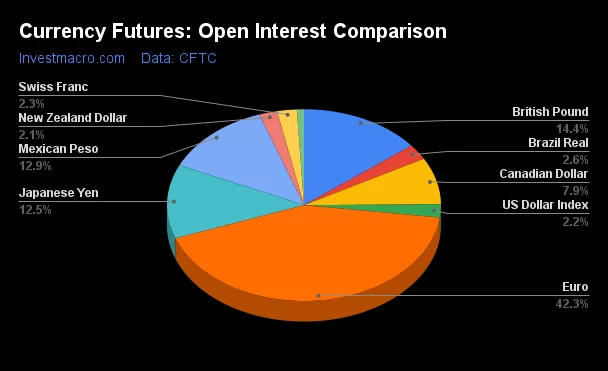
The latest COT data is updated through Tuesday June 20th and shows a quick view of how large market participants (for-profit speculators and commercial traders) were positioned in the futures markets. All currency positions are in direct relation to the US dollar where, for example, a bet for the euro is a bet that the euro will rise versus the dollar while a bet against the euro will be a bet that the euro will decline versus the dollar.

Weekly Speculator Changes led by British Pound & Mexican Peso

The COT currency market speculator bets were higher this week as six out of the eleven currency markets we cover had higher positioning while the other five markets had lower speculator contracts.

Leading the gains for the currency markets was the British Pound (39,873 contracts) with the Mexican Peso (20,883 contracts), the Australian Dollar (12,129 contracts), Canadian Dollar (3,125 contracts), Swiss Franc (192 contracts) and the US Dollar Index (863 contracts) also showing positive weeks.

The currencies seeing declines in speculator bets on the week were the EuroFX (-7,173 contracts) with the Japanese Yen (-3,680 contracts), the New Zealand Dollar (-1,828 contracts), the Brazilian Real (-254 contracts) and Bitcoin (-346 contracts) also registering lower bets on the week.

British Pound Speculators sharply boosted bullish bets on BOE rate hike

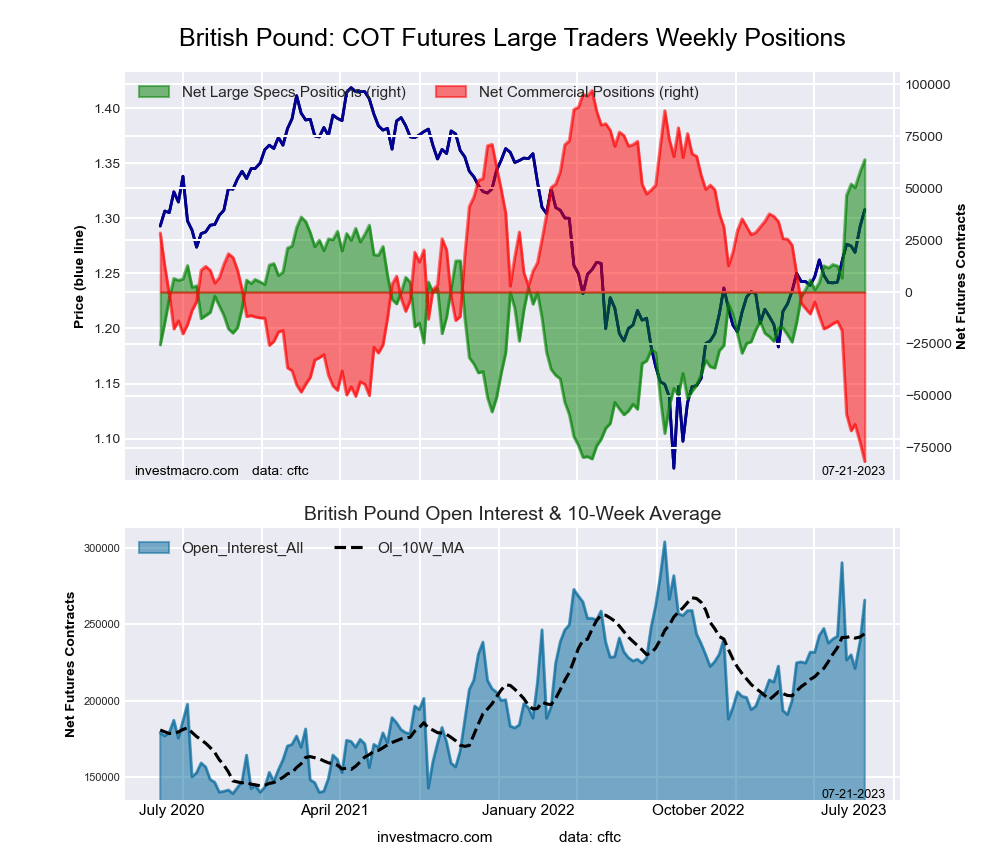
Highlighting the COT currency’s data this week was this week’s sharp boost in the speculator’s positioning of the British Pound Sterling. Large speculative Pound positions jumped by over +39,000 contracts this week and halted a two-week streak of declines.

The Pound weekly positions rise was the largest one-week increase on record, according to the CFTC data that goes back to 1988. The gain has pushed the overall net position now to over +46,608 contracts and the highest standing since April 17th of 2018, a span of 270 weeks.

The Pound’s positioning was helped out by the anticipation of the Bank of England’s latest interest rate increase that was by 50 basis points on Thursday. This brought the bank rate to 5 percent and its highest sitting in the past 15 years.

The Pound Sterling exchange rate against the US Dollar reacted strongly and touched it’s highest level (1.2874) since April of 2022 after the interest rate announcement. However, the Pound closed out Thursday and Friday lower with the weekly close at the 1.2714 exchange rate.


Data Snapshot of Forex Market Traders | Columns Legend
Jun-20-2023OIOI-IndexSpec-NetSpec-IndexCom-NetCOM-IndexSmalls-NetSmalls-Index
USD Index27,3061714,86150-16,574491,71335
EUR732,97964144,64974-192,7232548,07456
GBP226,5055346,608100-59,003012,39582
JPY238,55671-107,6563118,27293-10,61632
CHF36,12822-4,851425,23654-38556
CAD184,10651-33,5432318,7586914,78556
AUD149,89844-49,6163950,98657-1,37049
NZD32,40113-2,659464,44157-1,78229
MXN224,8974699,718100-103,04003,32232
RUB20,93047,54331-7,15069-39324
BRL52,9914325,90269-23,41836-2,48424
Bitcoin15,6877839784-927053025


Strength Scores led by British Pound & Mexican Peso

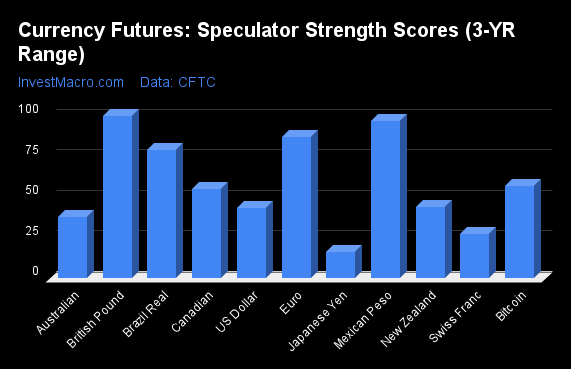
COT Strength Scores (a normalized measure of Speculator positions over a 3-Year range, from 0 to 100 where above 80 is Extreme-Bullish and below 20 is Extreme-Bearish) showed that the British Pound (100 percent) and the Mexican Peso (100 percent) lead the currency markets this week. Bitcoin (84 percent), EuroFX (74 percent) and the Brazilian Real (69 percent) come in as the next highest in the weekly strength scores.

On the downside, the Japanese Yen (3 percent) and the comes in at the lowest strength level currently and is in Extreme-Bearish territory (below 20 percent). The next lowest strength scores are the Canadian Dollar (23 percent), Australian Dollar (39 percent) and the Swiss Franc (42 percent).

Strength Statistics:
US Dollar Index (49.7 percent) vs US Dollar Index previous week (48.3 percent)
EuroFX (74.1 percent) vs EuroFX previous week (76.9 percent)
British Pound Sterling (100.0 percent) vs British Pound Sterling previous week (68.6 percent)
Japanese Yen (2.6 percent) vs Japanese Yen previous week (4.8 percent)
Swiss Franc (41.8 percent) vs Swiss Franc previous week (41.3 percent)
Canadian Dollar (23.3 percent) vs Canadian Dollar previous week (20.4 percent)
Australian Dollar (38.8 percent) vs Australian Dollar previous week (27.6 percent)
New Zealand Dollar (46.4 percent) vs New Zealand Dollar previous week (51.3 percent)
Mexican Peso (100.0 percent) vs Mexican Peso previous week (87.3 percent)
Brazilian Real (68.7 percent) vs Brazilian Real previous week (69.1 percent)
Bitcoin (83.9 percent) vs Bitcoin previous week (89.9 percent)


British Pound & Mexican Peso top the 6-Week Strength Trends

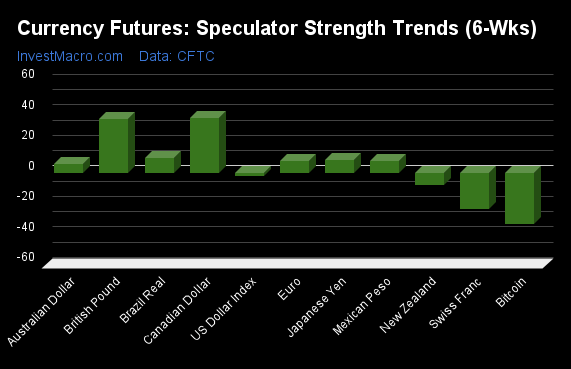
COT Strength Score Trends (or move index, calculates the 6-week changes in strength scores) showed that the British Pound (33 percent) and the Mexican Peso (18 percent) lead the past six weeks trends for the currencies. The Canadian Dollar (8 percent), the US Dollar Index (6 percent) and the New Zealand Dollar (5 percent) are the next highest positive movers in the latest trends data.

The Japanese Yen (-29 percent) leads the downside trend scores currently with the EuroFX (-13 percent) and the Brazilian Real (-11 percent) following next with lower trend scores.

Strength Trend Statistics:
US Dollar Index (6.2 percent) vs US Dollar Index previous week (4.4 percent)
EuroFX (-13.4 percent) vs EuroFX previous week (-8.4 percent)
British Pound Sterling (33.1 percent) vs British Pound Sterling previous week (4.5 percent)
Japanese Yen (-28.7 percent) vs Japanese Yen previous week (-22.0 percent)
Swiss Franc (-1.0 percent) vs Swiss Franc previous week (-5.4 percent)
Canadian Dollar (8.1 percent) vs Canadian Dollar previous week (12.5 percent)
Australian Dollar (-0.4 percent) vs Australian Dollar previous week (-15.5 percent)
New Zealand Dollar (5.2 percent) vs New Zealand Dollar previous week (2.9 percent)
Mexican Peso (18.1 percent) vs Mexican Peso previous week (12.9 percent)
Brazilian Real (-11.1 percent) vs Brazilian Real previous week (-11.8 percent)
Bitcoin (-0.5 percent) vs Bitcoin previous week (10.0 percent)


Individual COT Forex Markets:

US Dollar Index Futures:

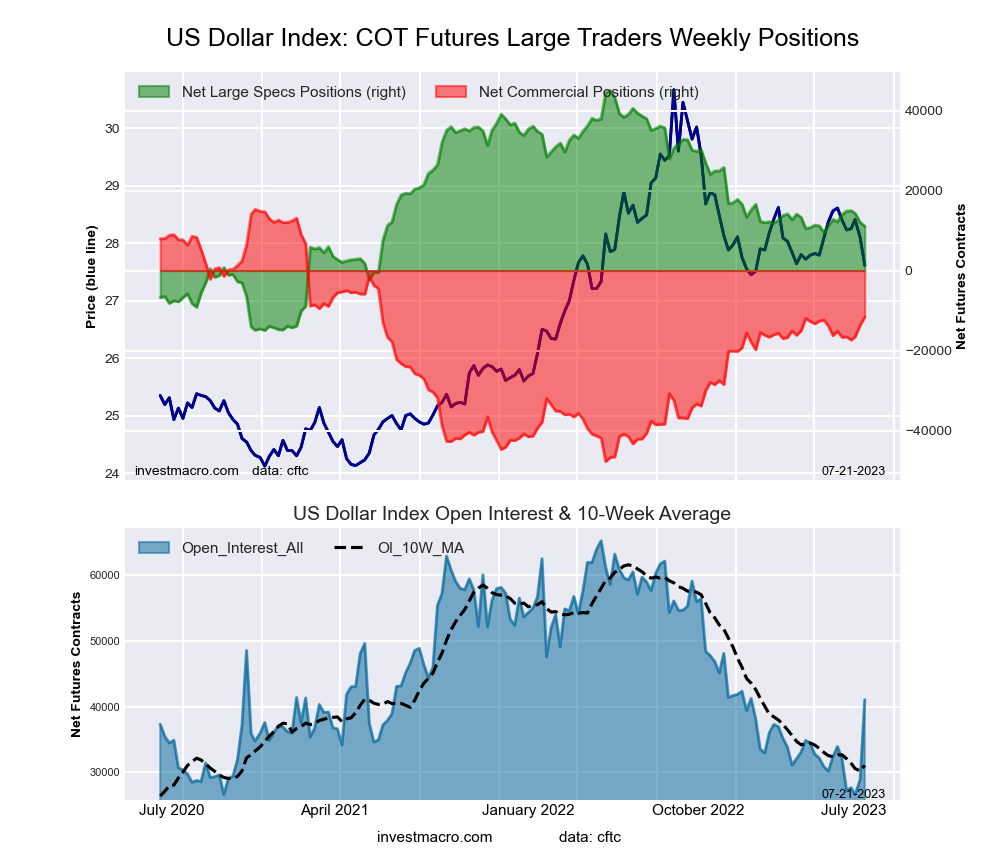
US Dollar Index Forex Futures COT ChartThe US Dollar Index large speculator standing this week resulted in a net position of 14,861 contracts in the data reported through Tuesday. This was a weekly lift of 863 contracts from the previous week which had a total of 13,998 net contracts.

This week’s current strength score (the trader positioning range over the past three years, measured from 0 to 100) shows the speculators are currently Bearish with a score of 49.7 percent. The commercials are Bearish with a score of 49.4 percent and the small traders (not shown in chart) are Bearish with a score of 35.3 percent.

Price Trend-Following Model: Uptrend

Our weekly trend-following model classifies the current market price position as: Uptrend. The current action for the model is considered to be: Hold – Maintain Long Position.

US DOLLAR INDEX StatisticsSPECULATORSCOMMERCIALSSMALL TRADERS
– Percent of Open Interest Longs:76.83.115.8
– Percent of Open Interest Shorts:22.463.89.5
– Net Position:14,861-16,5741,713
– Gross Longs:20,9728354,318
– Gross Shorts:6,11117,4092,605
– Long to Short Ratio:3.4 to 10.0 to 11.7 to 1
NET POSITION TREND:
– Strength Index Score (3 Year Range Pct):49.749.435.3
– Strength Index Reading (3 Year Range):BearishBearishBearish
NET POSITION MOVEMENT INDEX:
– 6-Week Change in Strength Index:6.2-6.32.7


Euro Currency Futures:

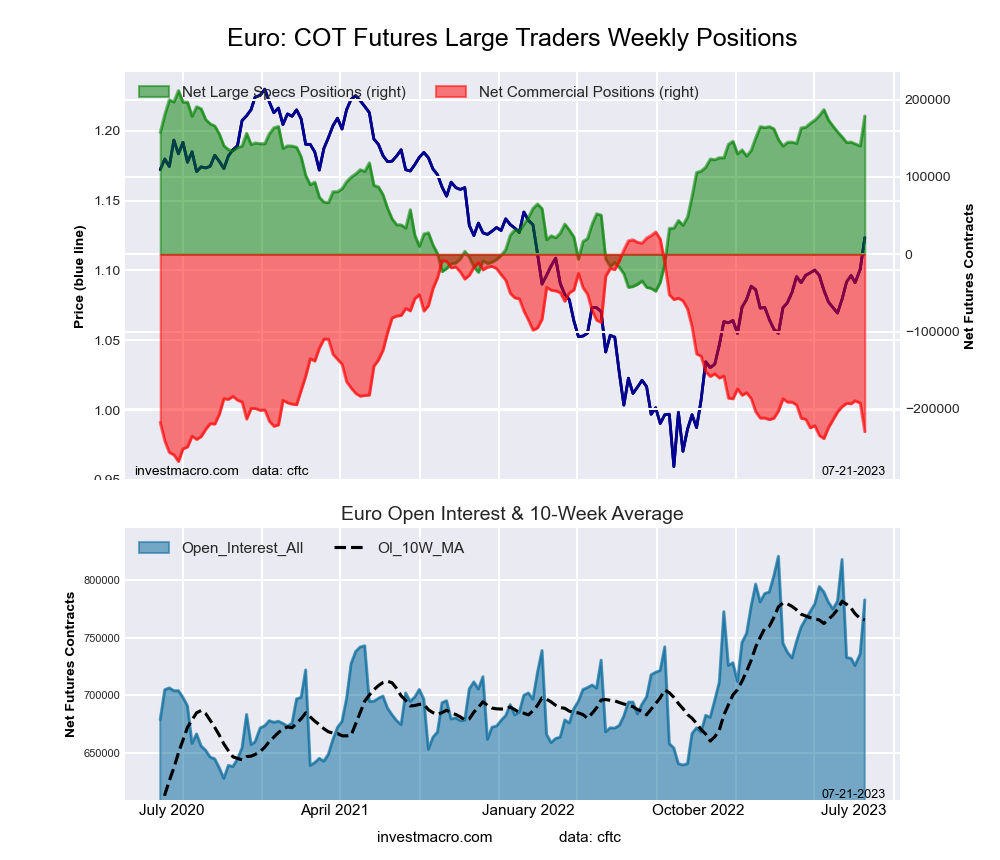
Euro Currency Futures COT ChartThe Euro Currency large speculator standing this week resulted in a net position of 144,649 contracts in the data reported through Tuesday. This was a weekly reduction of -7,173 contracts from the previous week which had a total of 151,822 net contracts.

This week’s current strength score (the trader positioning range over the past three years, measured from 0 to 100) shows the speculators are currently Bullish with a score of 74.1 percent. The commercials are Bearish with a score of 25.4 percent and the small traders (not shown in chart) are Bullish with a score of 55.7 percent.

Price Trend-Following Model: Uptrend

Our weekly trend-following model classifies the current market price position as: Uptrend. The current action for the model is considered to be: Hold – Maintain Long Position.

EURO Currency StatisticsSPECULATORSCOMMERCIALSSMALL TRADERS
– Percent of Open Interest Longs:31.354.412.7
– Percent of Open Interest Shorts:11.680.76.1
– Net Position:144,649-192,72348,074
– Gross Longs:229,399398,64692,826
– Gross Shorts:84,750591,36944,752
– Long to Short Ratio:2.7 to 10.7 to 12.1 to 1
NET POSITION TREND:
– Strength Index Score (3 Year Range Pct):74.125.455.7
– Strength Index Reading (3 Year Range):BullishBearishBullish
NET POSITION MOVEMENT INDEX:
– 6-Week Change in Strength Index:-13.414.0-10.8


British Pound Sterling Futures:

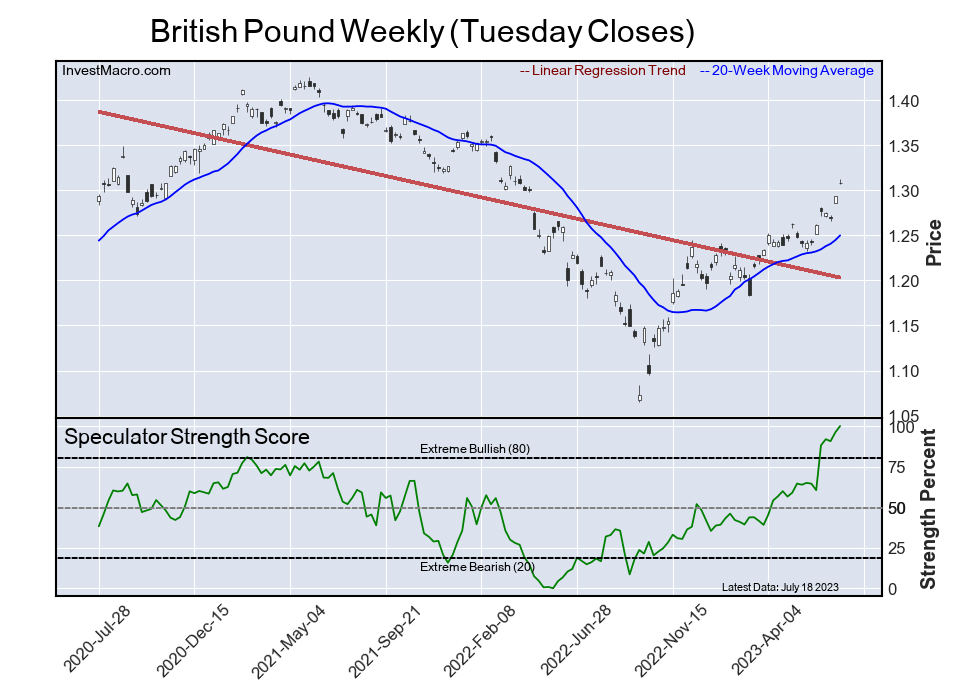
British Pound Sterling Futures COT ChartThe British Pound Sterling large speculator standing this week resulted in a net position of 46,608 contracts in the data reported through Tuesday. This was a weekly lift of 39,873 contracts from the previous week which had a total of 6,735 net contracts.

This week’s current strength score (the trader positioning range over the past three years, measured from 0 to 100) shows the speculators are currently Bullish-Extreme with a score of 100.0 percent. The commercials are Bearish-Extreme with a score of 0.0 percent and the small traders (not shown in chart) are Bullish-Extreme with a score of 82.3 percent.

Price Trend-Following Model: Strong Uptrend

Our weekly trend-following model classifies the current market price position as: Strong Uptrend. The current action for the model is considered to be: Hold – Maintain Long Position.

BRITISH POUND StatisticsSPECULATORSCOMMERCIALSSMALL TRADERS
– Percent of Open Interest Longs:44.832.516.3
– Percent of Open Interest Shorts:24.358.610.8
– Net Position:46,608-59,00312,395
– Gross Longs:101,56773,69236,837
– Gross Shorts:54,959132,69524,442
– Long to Short Ratio:1.8 to 10.6 to 11.5 to 1
NET POSITION TREND:
– Strength Index Score (3 Year Range Pct):100.00.082.3
– Strength Index Reading (3 Year Range):Bullish-ExtremeBearish-ExtremeBullish-Extreme
NET POSITION MOVEMENT INDEX:
– 6-Week Change in Strength Index:33.1-30.410.6


Japanese Yen Futures:

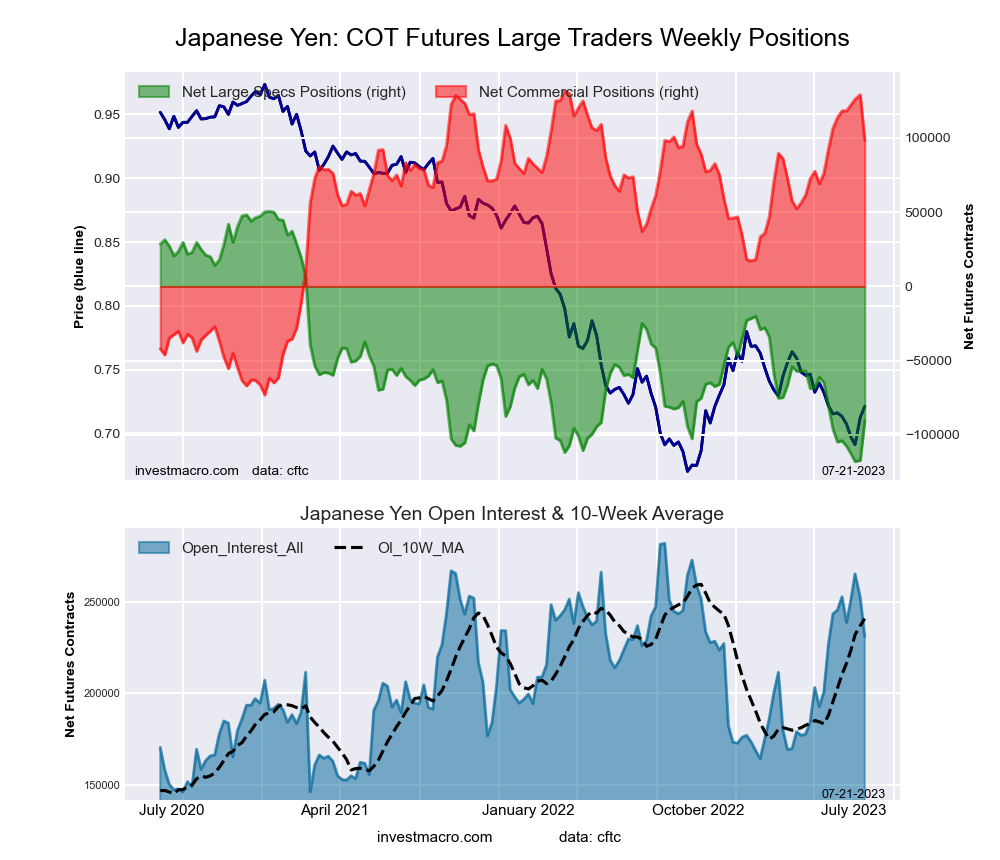
Japanese Yen Forex Futures COT ChartThe Japanese Yen large speculator standing this week resulted in a net position of -107,656 contracts in the data reported through Tuesday. This was a weekly fall of -3,680 contracts from the previous week which had a total of -103,976 net contracts.

This week’s current strength score (the trader positioning range over the past three years, measured from 0 to 100) shows the speculators are currently Bearish-Extreme with a score of 2.6 percent. The commercials are Bullish-Extreme with a score of 93.4 percent and the small traders (not shown in chart) are Bearish with a score of 31.9 percent.

Price Trend-Following Model: Strong Downtrend

Our weekly trend-following model classifies the current market price position as: Strong Downtrend. The current action for the model is considered to be: Hold – Maintain Short Position.

JAPANESE YEN StatisticsSPECULATORSCOMMERCIALSSMALL TRADERS
– Percent of Open Interest Longs:13.573.411.7
– Percent of Open Interest Shorts:58.623.916.2
– Net Position:-107,656118,272-10,616
– Gross Longs:32,244175,20127,983
– Gross Shorts:139,90056,92938,599
– Long to Short Ratio:0.2 to 13.1 to 10.7 to 1
NET POSITION TREND:
– Strength Index Score (3 Year Range Pct):2.693.431.9
– Strength Index Reading (3 Year Range):Bearish-ExtremeBullish-ExtremeBearish
NET POSITION MOVEMENT INDEX:
– 6-Week Change in Strength Index:-28.724.0-5.0


Swiss Franc Futures:

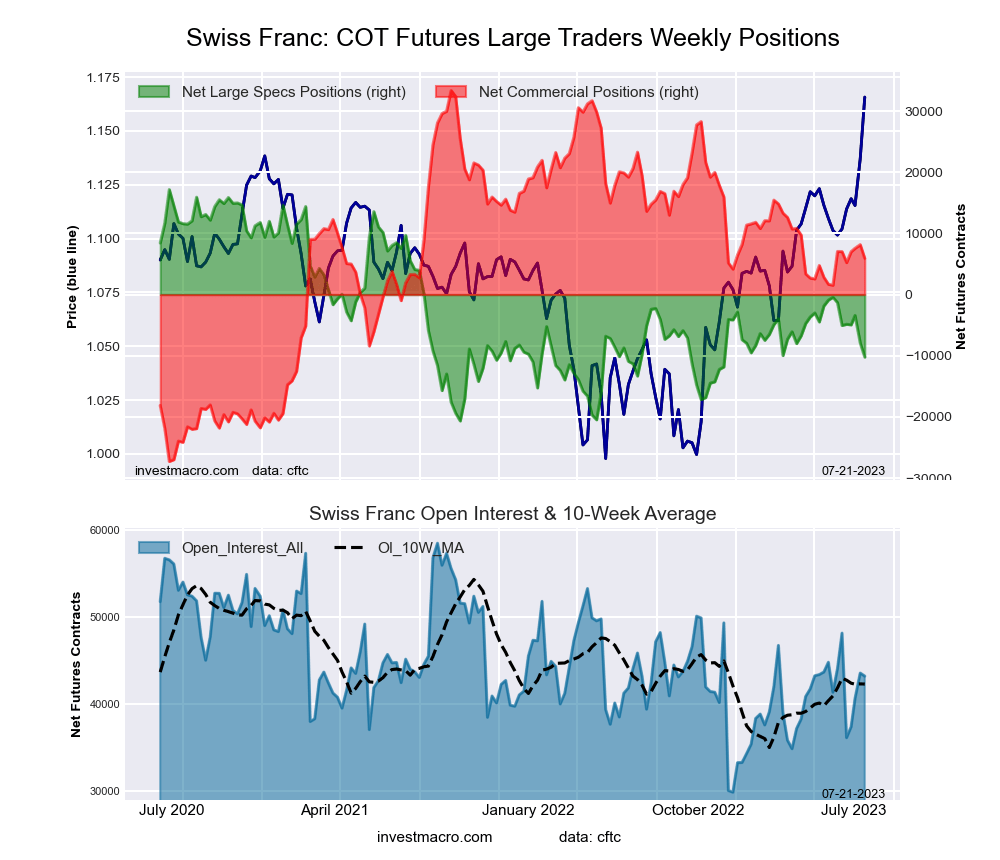
Swiss Franc Forex Futures COT ChartThe Swiss Franc large speculator standing this week resulted in a net position of -4,851 contracts in the data reported through Tuesday. This was a weekly rise of 192 contracts from the previous week which had a total of -5,043 net contracts.

This week’s current strength score (the trader positioning range over the past three years, measured from 0 to 100) shows the speculators are currently Bearish with a score of 41.8 percent. The commercials are Bullish with a score of 53.6 percent and the small traders (not shown in chart) are Bullish with a score of 56.2 percent.

Price Trend-Following Model: Uptrend

Our weekly trend-following model classifies the current market price position as: Uptrend. The current action for the model is considered to be: Hold – Maintain Long Position.

SWISS FRANC StatisticsSPECULATORSCOMMERCIALSSMALL TRADERS
– Percent of Open Interest Longs:23.043.133.7
– Percent of Open Interest Shorts:36.528.634.8
– Net Position:-4,8515,236-385
– Gross Longs:8,32215,58512,170
– Gross Shorts:13,17310,34912,555
– Long to Short Ratio:0.6 to 11.5 to 11.0 to 1
NET POSITION TREND:
– Strength Index Score (3 Year Range Pct):41.853.656.2
– Strength Index Reading (3 Year Range):BearishBullishBullish
NET POSITION MOVEMENT INDEX:
– 6-Week Change in Strength Index:-1.00.8-0.3


Canadian Dollar Futures:

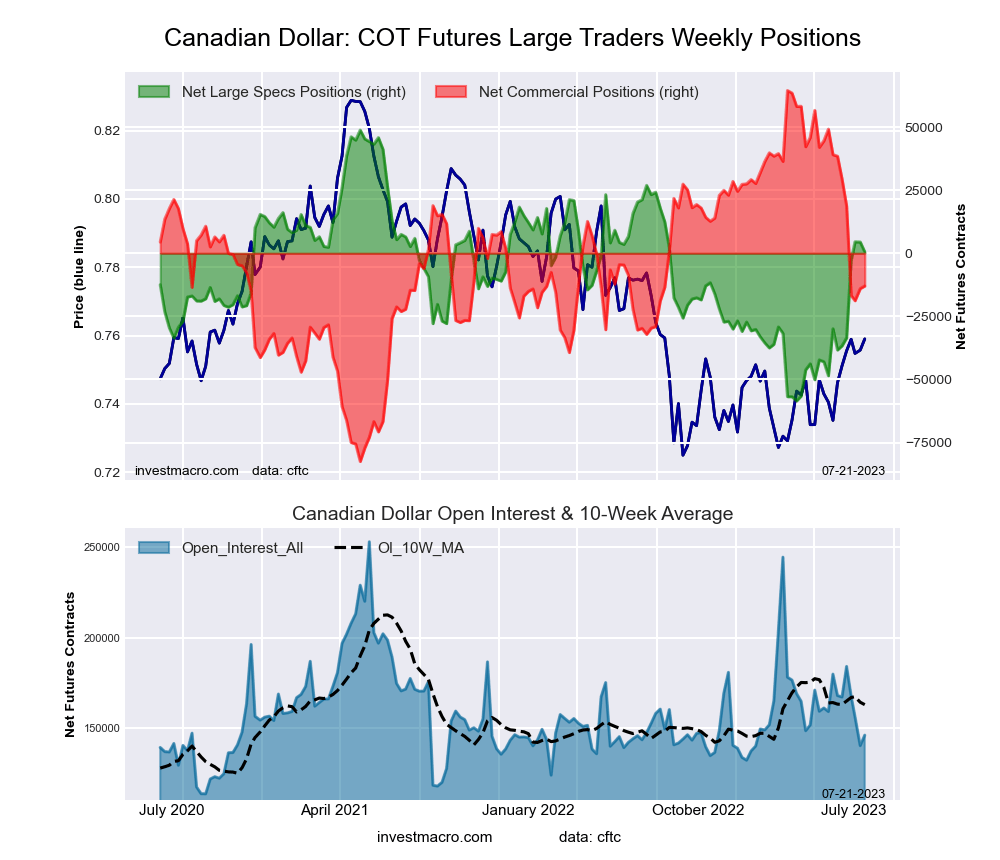
Canadian Dollar Forex Futures COT ChartThe Canadian Dollar large speculator standing this week resulted in a net position of -33,543 contracts in the data reported through Tuesday. This was a weekly lift of 3,125 contracts from the previous week which had a total of -36,668 net contracts.

This week’s current strength score (the trader positioning range over the past three years, measured from 0 to 100) shows the speculators are currently Bearish with a score of 23.3 percent. The commercials are Bullish with a score of 68.9 percent and the small traders (not shown in chart) are Bullish with a score of 55.6 percent.

Price Trend-Following Model: Strong Uptrend

Our weekly trend-following model classifies the current market price position as: Strong Uptrend. The current action for the model is considered to be: Hold – Maintain Long Position.

CANADIAN DOLLAR StatisticsSPECULATORSCOMMERCIALSSMALL TRADERS
– Percent of Open Interest Longs:15.362.420.9
– Percent of Open Interest Shorts:33.552.212.8
– Net Position:-33,54318,75814,785
– Gross Longs:28,187114,92538,400
– Gross Shorts:61,73096,16723,615
– Long to Short Ratio:0.5 to 11.2 to 11.6 to 1
NET POSITION TREND:
– Strength Index Score (3 Year Range Pct):23.368.955.6
– Strength Index Reading (3 Year Range):BearishBullishBullish
NET POSITION MOVEMENT INDEX:
– 6-Week Change in Strength Index:8.1-15.832.2


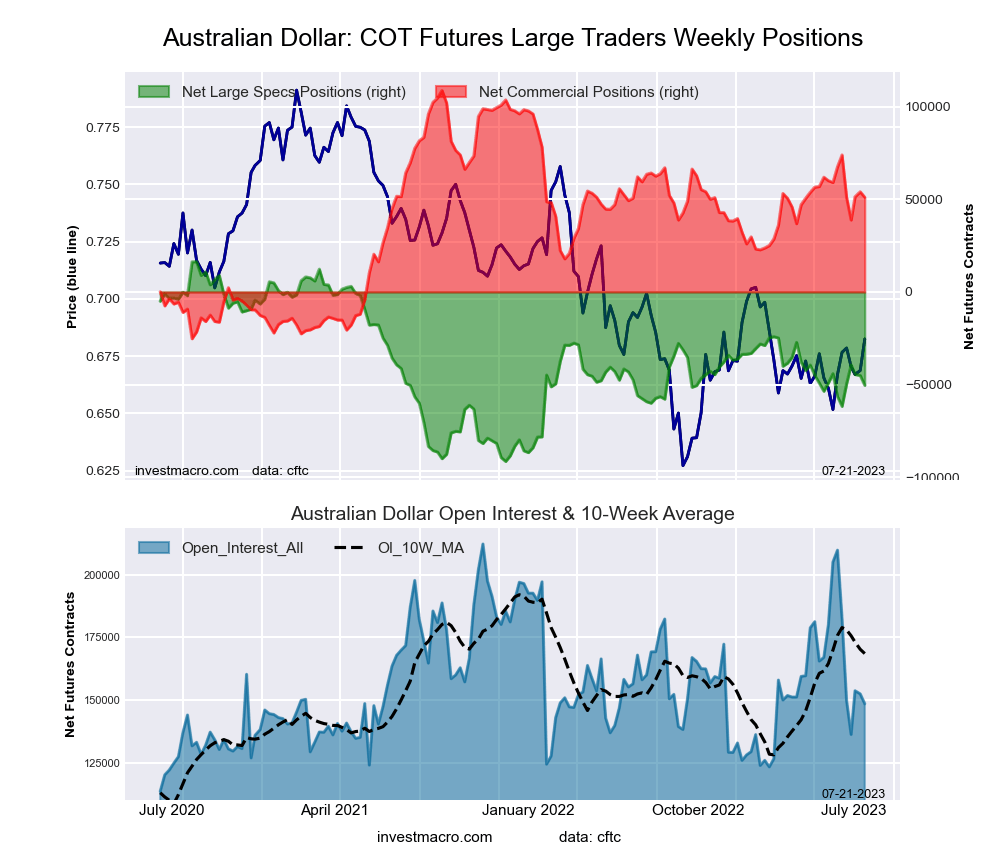
Australian Dollar Futures:

Australian Dollar Forex Futures COT ChartThe Australian Dollar large speculator standing this week resulted in a net position of -49,616 contracts in the data reported through Tuesday. This was a weekly lift of 12,129 contracts from the previous week which had a total of -61,745 net contracts.

This week’s current strength score (the trader positioning range over the past three years, measured from 0 to 100) shows the speculators are currently Bearish with a score of 38.8 percent. The commercials are Bullish with a score of 56.9 percent and the small traders (not shown in chart) are Bearish with a score of 49.1 percent.

Price Trend-Following Model: Downtrend

Our weekly trend-following model classifies the current market price position as: Downtrend. The current action for the model is considered to be: Hold – Maintain Short Position.

AUSTRALIAN DOLLAR StatisticsSPECULATORSCOMMERCIALSSMALL TRADERS
– Percent of Open Interest Longs:30.552.914.3
– Percent of Open Interest Shorts:63.618.915.2
– Net Position:-49,61650,986-1,370
– Gross Longs:45,74379,30021,444
– Gross Shorts:95,35928,31422,814
– Long to Short Ratio:0.5 to 12.8 to 10.9 to 1
NET POSITION TREND:
– Strength Index Score (3 Year Range Pct):38.856.949.1
– Strength Index Reading (3 Year Range):BearishBullishBearish
NET POSITION MOVEMENT INDEX:
– 6-Week Change in Strength Index:-0.4-4.415.4


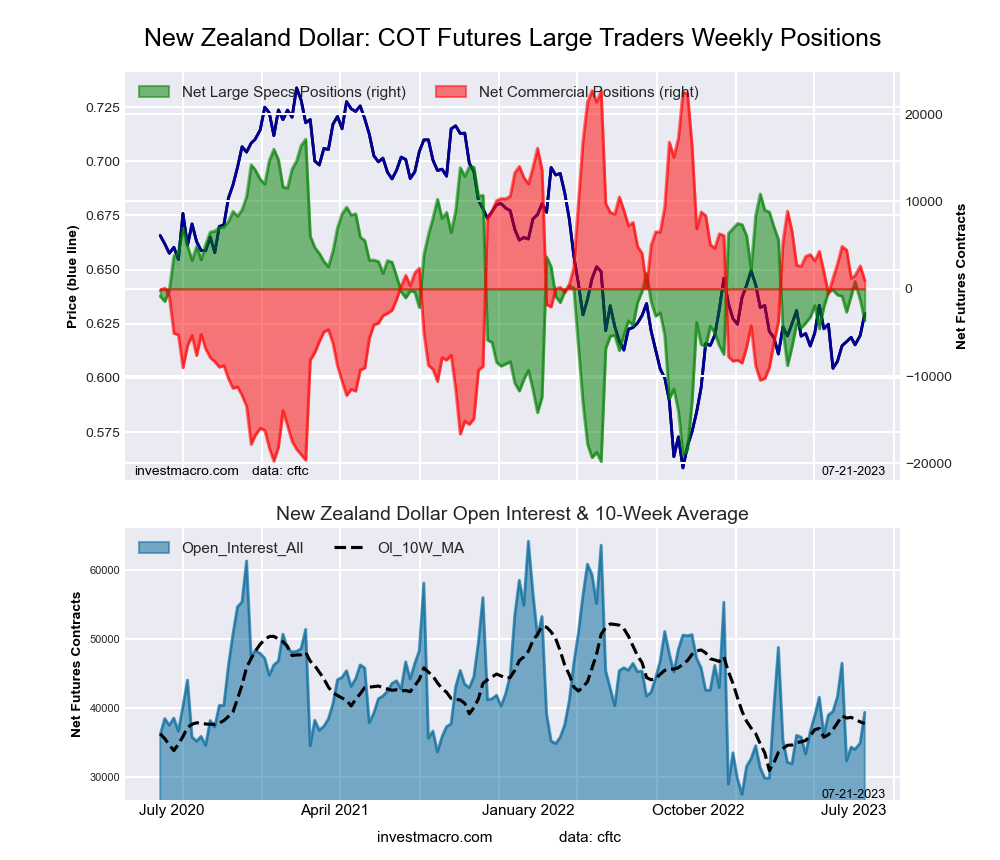
New Zealand Dollar Futures:

New Zealand Dollar Forex Futures COT ChartThe New Zealand Dollar large speculator standing this week resulted in a net position of -2,659 contracts in the data reported through Tuesday. This was a weekly fall of -1,828 contracts from the previous week which had a total of -831 net contracts.

This week’s current strength score (the trader positioning range over the past three years, measured from 0 to 100) shows the speculators are currently Bearish with a score of 46.4 percent. The commercials are Bullish with a score of 57.0 percent and the small traders (not shown in chart) are Bearish with a score of 28.8 percent.

Price Trend-Following Model: Strong Downtrend

Our weekly trend-following model classifies the current market price position as: Strong Downtrend. The current action for the model is considered to be: Hold – Maintain Short Position.

NEW ZEALAND DOLLAR StatisticsSPECULATORSCOMMERCIALSSMALL TRADERS
– Percent of Open Interest Longs:33.557.38.6
– Percent of Open Interest Shorts:41.743.614.1
– Net Position:-2,6594,441-1,782
– Gross Longs:10,86718,5732,794
– Gross Shorts:13,52614,1324,576
– Long to Short Ratio:0.8 to 11.3 to 10.6 to 1
NET POSITION TREND:
– Strength Index Score (3 Year Range Pct):46.457.028.8
– Strength Index Reading (3 Year Range):BearishBullishBearish
NET POSITION MOVEMENT INDEX:
– 6-Week Change in Strength Index:5.20.4-24.7


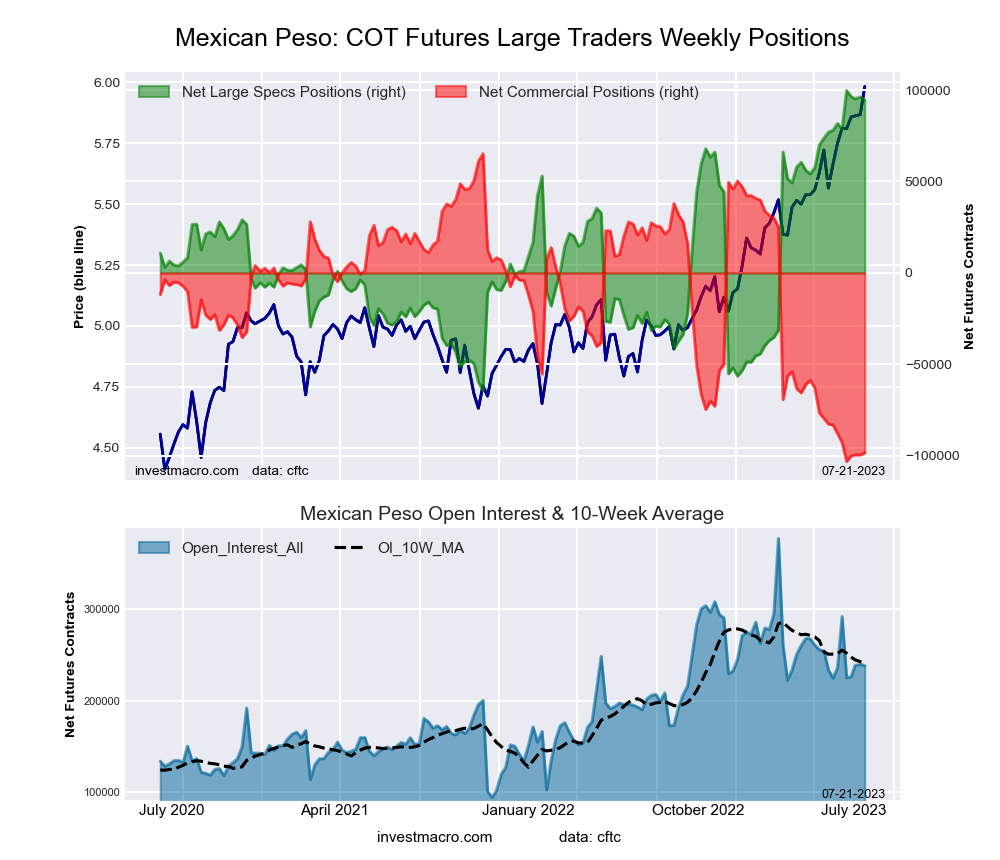
Mexican Peso Futures:

Mexican Peso Futures COT ChartThe Mexican Peso large speculator standing this week resulted in a net position of 99,718 contracts in the data reported through Tuesday. This was a weekly lift of 20,883 contracts from the previous week which had a total of 78,835 net contracts.

This week’s current strength score (the trader positioning range over the past three years, measured from 0 to 100) shows the speculators are currently Bullish-Extreme with a score of 100.0 percent. The commercials are Bearish-Extreme with a score of 0.0 percent and the small traders (not shown in chart) are Bearish with a score of 32.4 percent.

Price Trend-Following Model: Strong Uptrend

Our weekly trend-following model classifies the current market price position as: Strong Uptrend. The current action for the model is considered to be: Hold – Maintain Long Position.

MEXICAN PESO StatisticsSPECULATORSCOMMERCIALSSMALL TRADERS
– Percent of Open Interest Longs:53.842.13.7
– Percent of Open Interest Shorts:9.587.92.2
– Net Position:99,718-103,0403,322
– Gross Longs:121,00594,7338,262
– Gross Shorts:21,287197,7734,940
– Long to Short Ratio:5.7 to 10.5 to 11.7 to 1
NET POSITION TREND:
– Strength Index Score (3 Year Range Pct):100.00.032.4
– Strength Index Reading (3 Year Range):Bullish-ExtremeBearish-ExtremeBearish
NET POSITION MOVEMENT INDEX:
– 6-Week Change in Strength Index:18.1-15.8-20.3


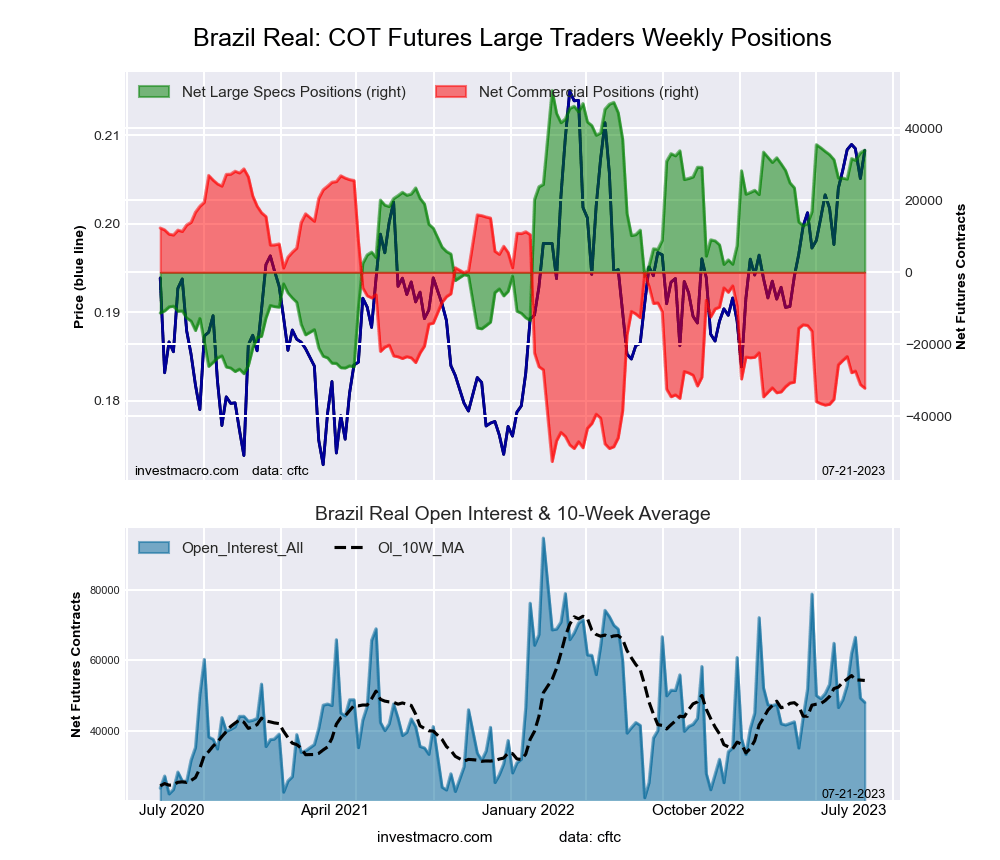
Brazilian Real Futures:

Brazil Real Futures COT ChartThe Brazilian Real large speculator standing this week resulted in a net position of 25,902 contracts in the data reported through Tuesday. This was a weekly decline of -254 contracts from the previous week which had a total of 26,156 net contracts.

This week’s current strength score (the trader positioning range over the past three years, measured from 0 to 100) shows the speculators are currently Bullish with a score of 68.7 percent. The commercials are Bearish with a score of 35.9 percent and the small traders (not shown in chart) are Bearish with a score of 24.2 percent.

Price Trend-Following Model: Strong Uptrend

Our weekly trend-following model classifies the current market price position as: Strong Uptrend. The current action for the model is considered to be: Hold – Maintain Long Position.

BRAZIL REAL StatisticsSPECULATORSCOMMERCIALSSMALL TRADERS
– Percent of Open Interest Longs:68.920.210.6
– Percent of Open Interest Shorts:20.164.415.3
– Net Position:25,902-23,418-2,484
– Gross Longs:36,53510,6855,625
– Gross Shorts:10,63334,1038,109
– Long to Short Ratio:3.4 to 10.3 to 10.7 to 1
NET POSITION TREND:
– Strength Index Score (3 Year Range Pct):68.735.924.2
– Strength Index Reading (3 Year Range):BullishBearishBearish
NET POSITION MOVEMENT INDEX:
– 6-Week Change in Strength Index:-11.116.1-35.0


Bitcoin Futures:

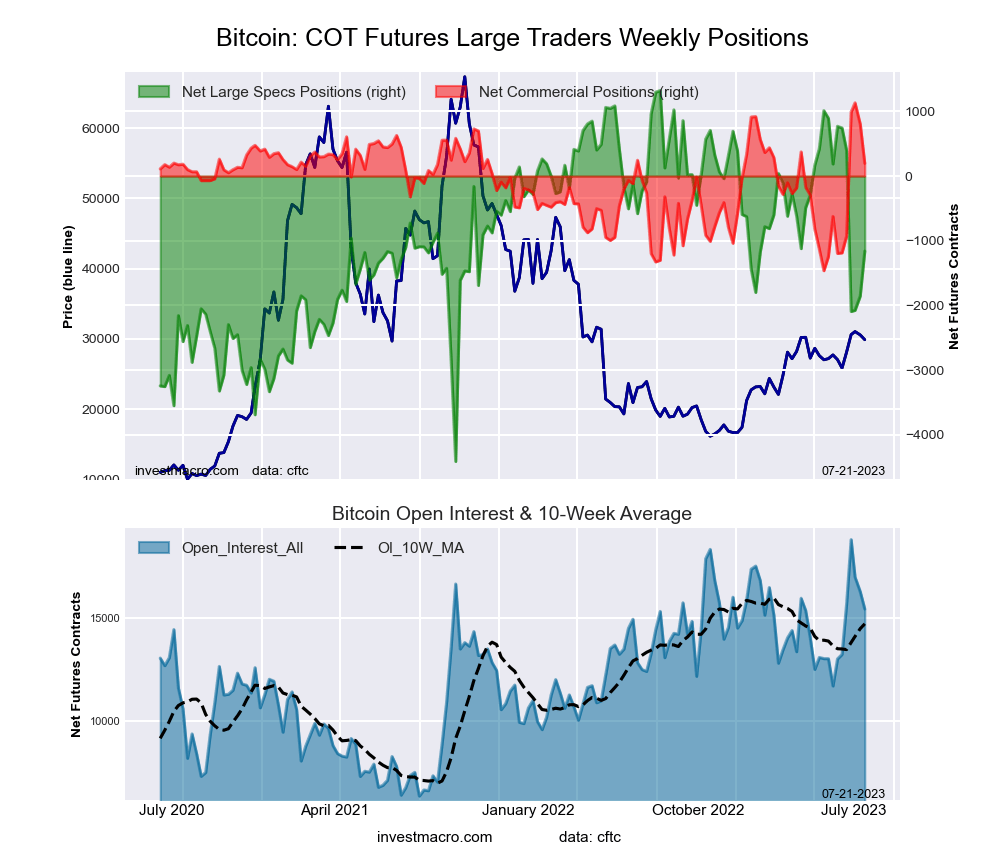
Bitcoin Crypto Futures COT ChartThe Bitcoin large speculator standing this week resulted in a net position of 397 contracts in the data reported through Tuesday. This was a weekly decrease of -346 contracts from the previous week which had a total of 743 net contracts.

This week’s current strength score (the trader positioning range over the past three years, measured from 0 to 100) shows the speculators are currently Bullish-Extreme with a score of 83.9 percent. The commercials are Bearish with a score of 22.5 percent and the small traders (not shown in chart) are Bearish with a score of 25.0 percent.

Price Trend-Following Model: Strong Uptrend

Our weekly trend-following model classifies the current market price position as: Strong Uptrend. The current action for the model is considered to be: Hold – Maintain Long Position.

BITCOIN StatisticsSPECULATORSCOMMERCIALSSMALL TRADERS
– Percent of Open Interest Longs:76.11.68.0
– Percent of Open Interest Shorts:73.57.54.6
– Net Position:397-927530
– Gross Longs:11,9322501,259
– Gross Shorts:11,5351,177729
– Long to Short Ratio:1.0 to 10.2 to 11.7 to 1
NET POSITION TREND:
– Strength Index Score (3 Year Range Pct):83.922.525.0
– Strength Index Reading (3 Year Range):Bullish-ExtremeBearishBearish
NET POSITION MOVEMENT INDEX:
– 6-Week Change in Strength Index:-0.58.6-4.0


Article By InvestMacroReceive our weekly COT Newsletter

*COT Report: The COT data, released weekly to the public each Friday, is updated through the most recent Tuesday (data is 3 days old) and shows a quick view of how large speculators or non-commercials (for-profit traders) were positioned in the futures markets.

The CFTC categorizes trader positions according to commercial hedgers (traders who use futures contracts for hedging as part of the business), non-commercials (large traders who speculate to realize trading profits) and nonreportable traders (usually small traders/speculators) as well as their open interest (contracts open in the market at time of reporting). See CFTC criteria here.

Copper Speculators raise their bets into first bullish position in 9 weeks

By InvestMacro

Here are the latest charts and statistics for the Commitment of Traders (COT) data published by the Commodities Futures Trading Commission (CFTC).

The latest COT data is updated through Tuesday June 20th and shows a quick view of how large traders (for-profit speculators and commercial entities) were positioned in the futures markets.

Weekly Speculator Changes led by Palladium & Gold

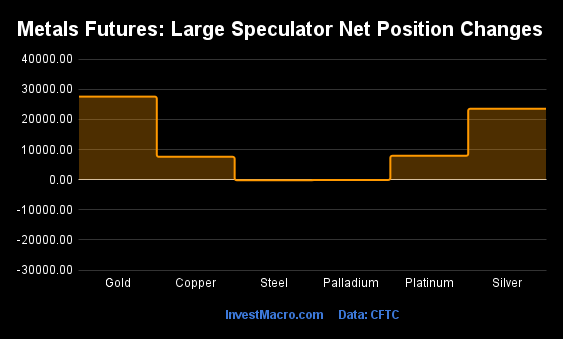
The COT metals markets speculator bets were higher this week as four out of the six metals markets we cover had higher positioning while the other two markets had lower speculator contracts.

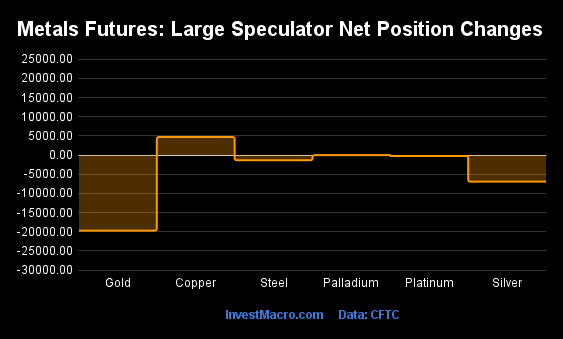
Leading the gains for the metals was Copper (14,794 contracts) with Gold (2,766 contracts), Palladium (501 contracts) and Steel (175 contracts) also showing positive weeks.

The markets with declines in speculator bets for the week were Silver (-3,678 contracts) and Platinum (-2,500 contracts) having lower bets on the week.

Copper Speculators raise their bets into first bullish position in 9 weeks

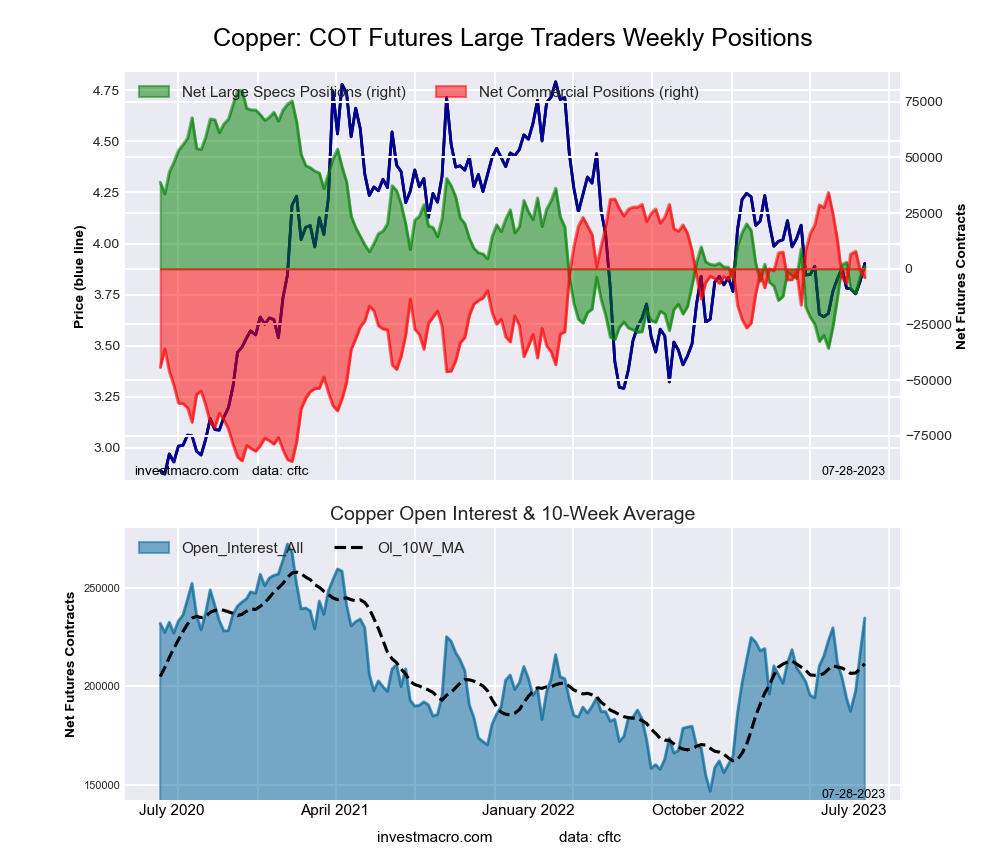
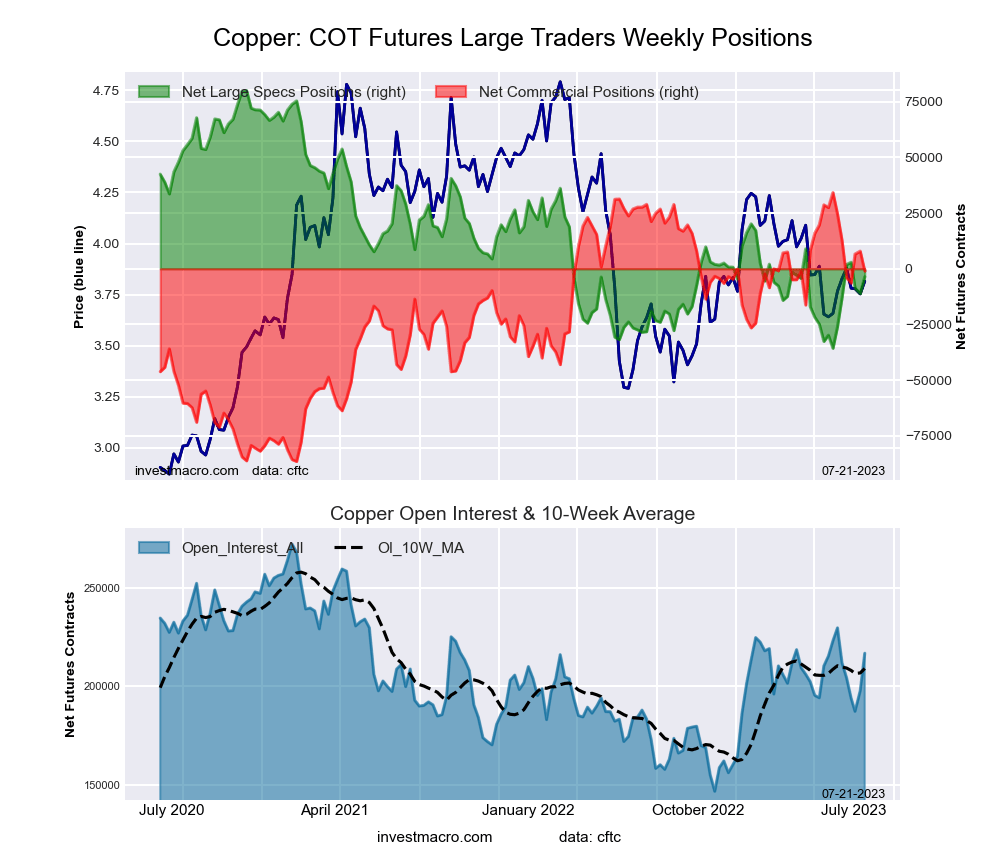
Highlighting the COT metals data this week is the gains for the Copper speculative positions. The large speculator position in Copper futures rose by +14,794 contracts this week following a gain by +13,050 contracts last week. The speculator position has now risen by over +37,590 contracts in total over the past three weeks.

This renewed positive sentiment has brought the net position standing back into a small bullish level after spending the past eight weeks in bearish territory.

Despite the bullish return of speculators, Copper prices closed out the week lower following three straight weeks of gains. The futures price touched a six-week high on Thursday at 3.967 before turning lower and finishing the week at 3.8035.


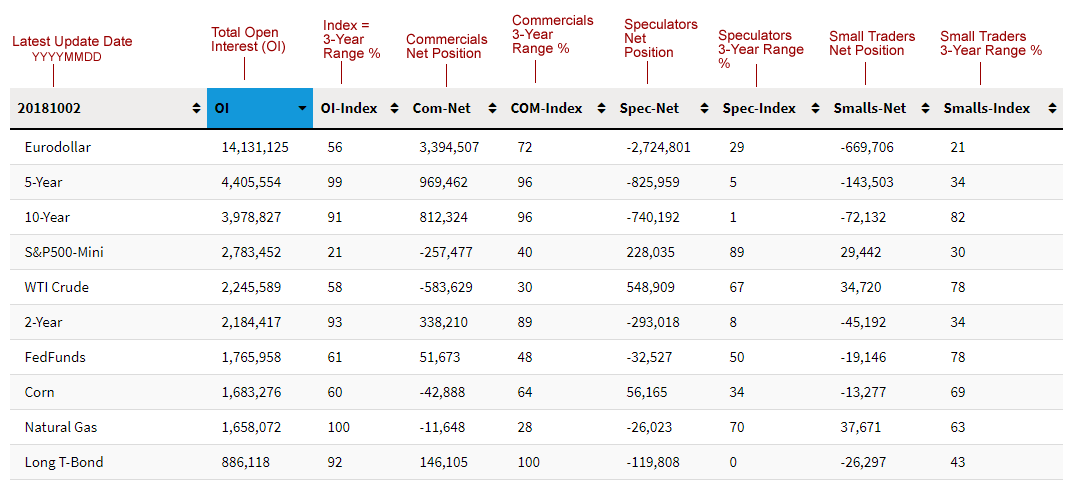
Data Snapshot of Commodity Market Traders | Columns Legend
Jun-20-2023OIOI-IndexSpec-NetSpec-IndexCom-NetCOM-IndexSmalls-NetSmalls-Index
Gold438,0377162,97549-186,5375223,56239
Silver152,6334020,05847-36,2105016,15256
Copper204,399461,88832-4,003682,11532
Palladium12,30487-6,63557,21496-5797
Platinum69,4367019,47261-25,052425,58043


Strength Scores led by Steel & Platinum

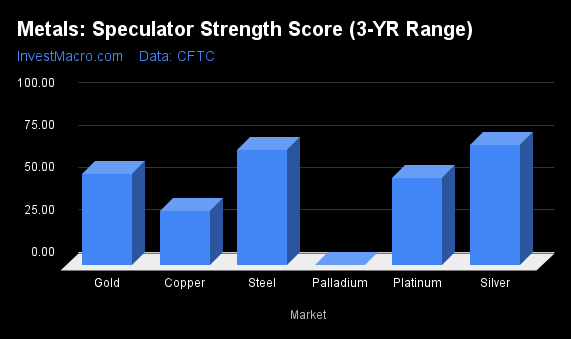
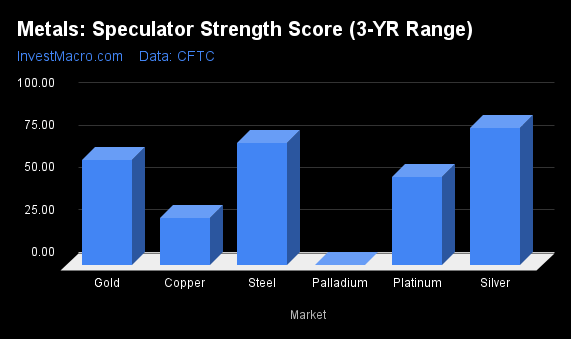
COT Strength Scores (a normalized measure of Speculator positions over a 3-Year range, from 0 to 100 where above 80 is Extreme-Bullish and below 20 is Extreme-Bearish) showed that Steel (68 percent) and Platinum (61 percent) lead the metals markets this week.

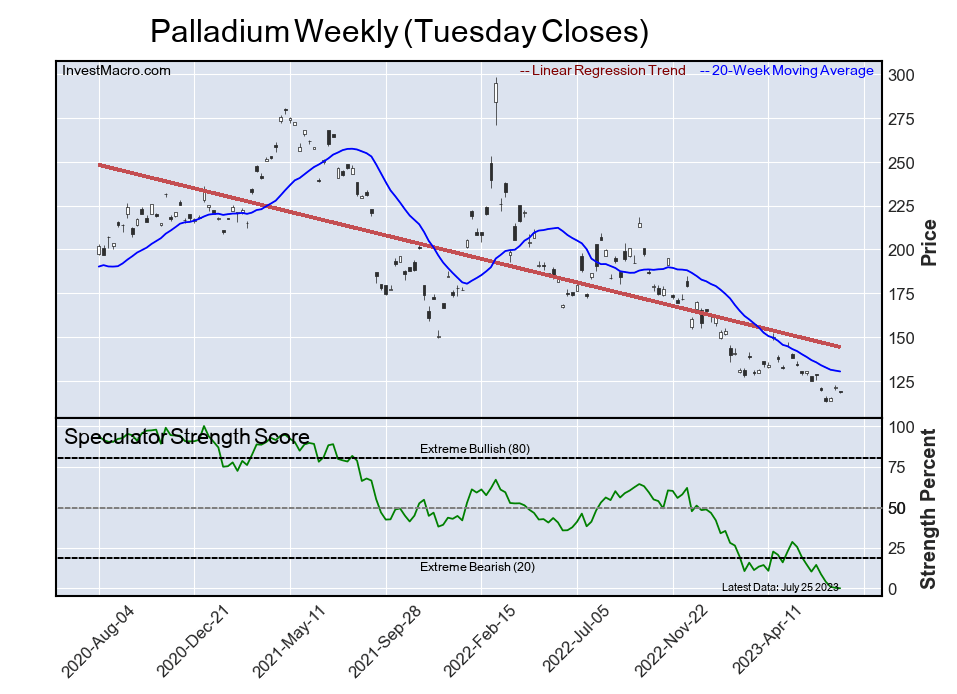
On the downside, Palladium (5 percent) comes in at the lowest strength level currently and is in Extreme-Bearish territory (below 20 percent).

Strength Statistics:
Gold (48.8 percent) vs Gold previous week (47.6 percent)
Silver (46.9 percent) vs Silver previous week (52.1 percent)
Copper (32.5 percent) vs Copper previous week (19.7 percent)
Platinum (60.5 percent) vs Platinum previous week (66.3 percent)
Palladium (4.6 percent) vs Palladium previous week (0.0 percent)
Steel (67.8 percent) vs Palladium previous week (67.3 percent)

Copper & Steel top the 6-Week Strength Trends

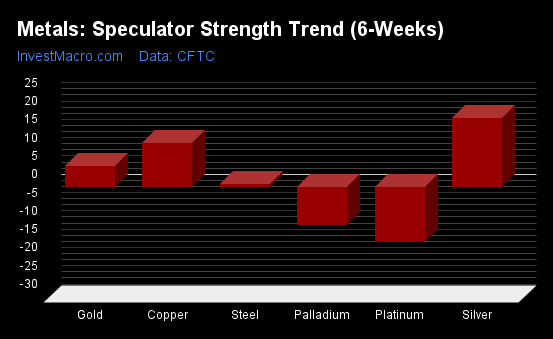
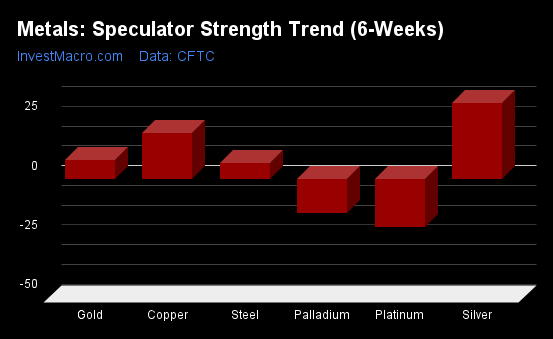
COT Strength Score Trends (or move index, calculates the 6-week changes in strength scores) showed that Copper (23 percent) and Steel (6 percent) lead the past six weeks trends for metals.

Platinum (-20 percent), Silver (-18 percent) and Gold (-14 percent) lead the downside trend scores currently.

Move Statistics:
Gold (-14.5 percent) vs Gold previous week (-15.6 percent)
Silver (-17.6 percent) vs Silver previous week (-11.7 percent)
Copper (23.1 percent) vs Copper previous week (7.6 percent)
Platinum (-19.9 percent) vs Platinum previous week (-10.9 percent)
Palladium (-9.1 percent) vs Palladium previous week (-6.4 percent)
Steel (5.9 percent) vs Steel previous week (4.5 percent)


Individual Markets:

Gold Comex Futures:
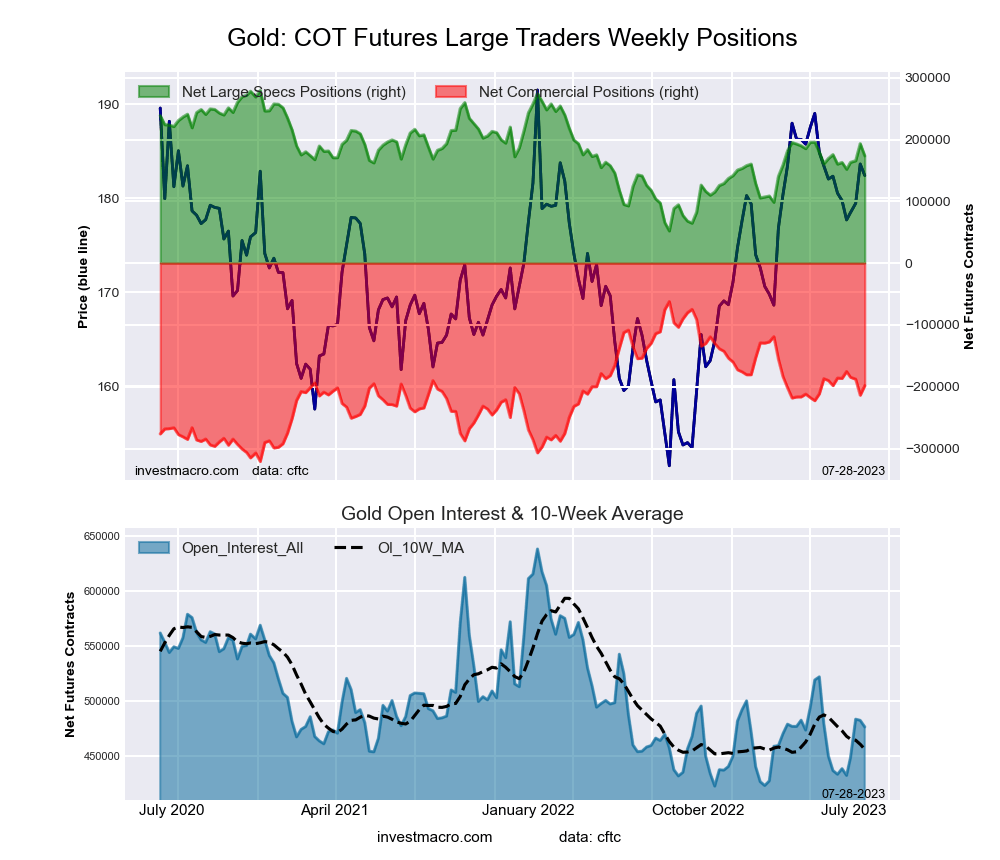
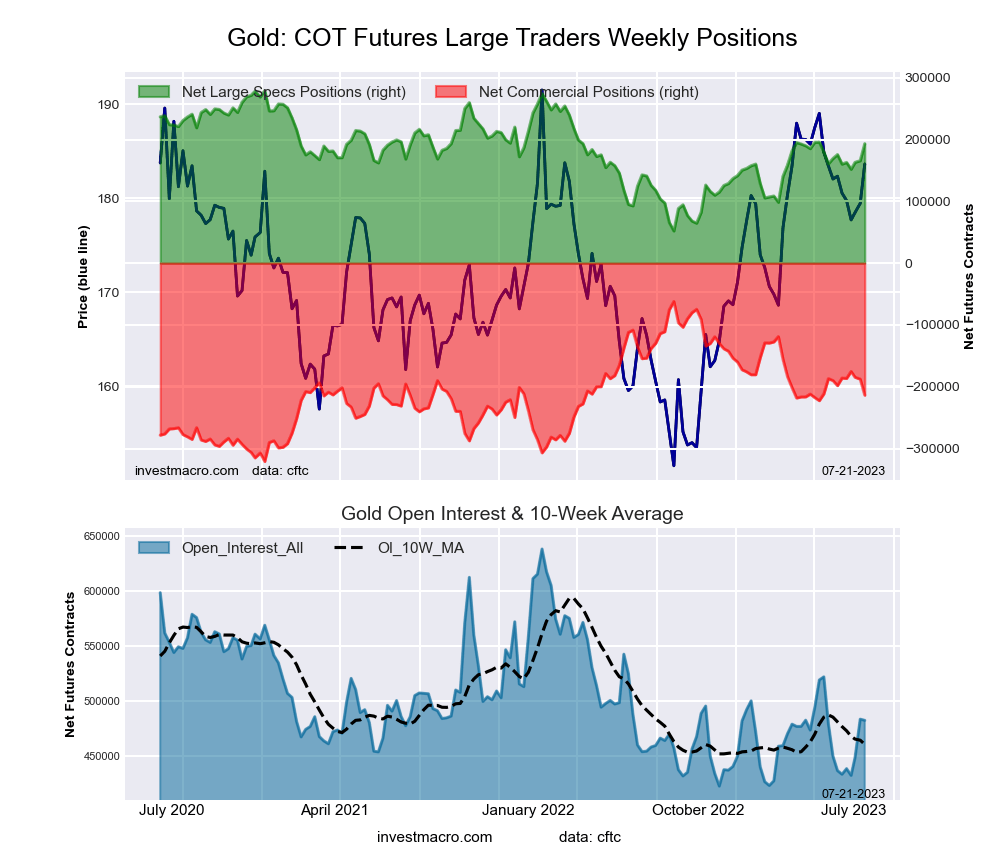
Gold Futures COT ChartThe Gold Comex Futures large speculator standing this week resulted in a net position of 162,975 contracts in the data reported through Tuesday. This was a weekly lift of 2,766 contracts from the previous week which had a total of 160,209 net contracts.

This week’s current strength score (the trader positioning range over the past three years, measured from 0 to 100) shows the speculators are currently Bearish with a score of 48.8 percent. The commercials are Bullish with a score of 51.9 percent and the small traders (not shown in chart) are Bearish with a score of 39.0 percent.

Price Trend-Following Model: Weak Uptrend

Our weekly trend-following model classifies the current market price position as: Weak Uptrend. The current action for the model is considered to be: Hold – Maintain Long Position.

Gold Futures StatisticsSPECULATORSCOMMERCIALSSMALL TRADERS
– Percent of Open Interest Longs:52.327.710.8
– Percent of Open Interest Shorts:15.170.35.4
– Net Position:162,975-186,53723,562
– Gross Longs:229,308121,41947,402
– Gross Shorts:66,333307,95623,840
– Long to Short Ratio:3.5 to 10.4 to 12.0 to 1
NET POSITION TREND:
– Strength Index Score (3 Year Range Pct):48.851.939.0
– Strength Index Reading (3 Year Range):BearishBullishBearish
NET POSITION MOVEMENT INDEX:
– 6-Week Change in Strength Index:-14.513.9-7.9


Silver Comex Futures:

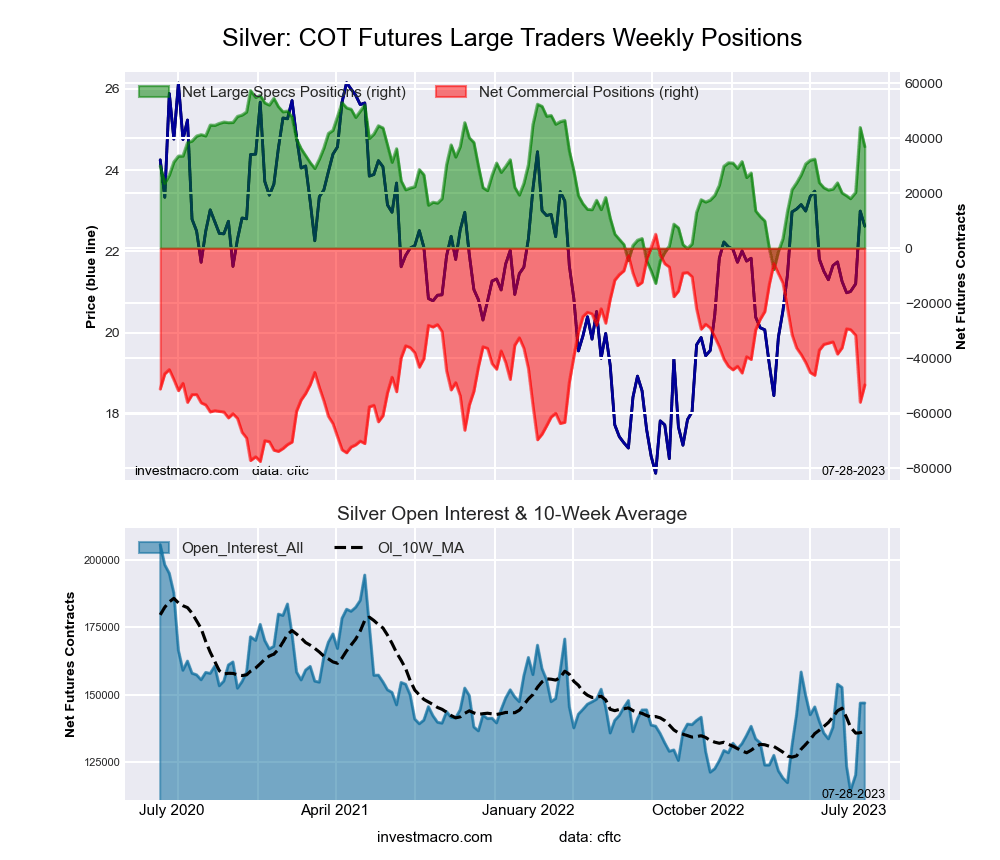
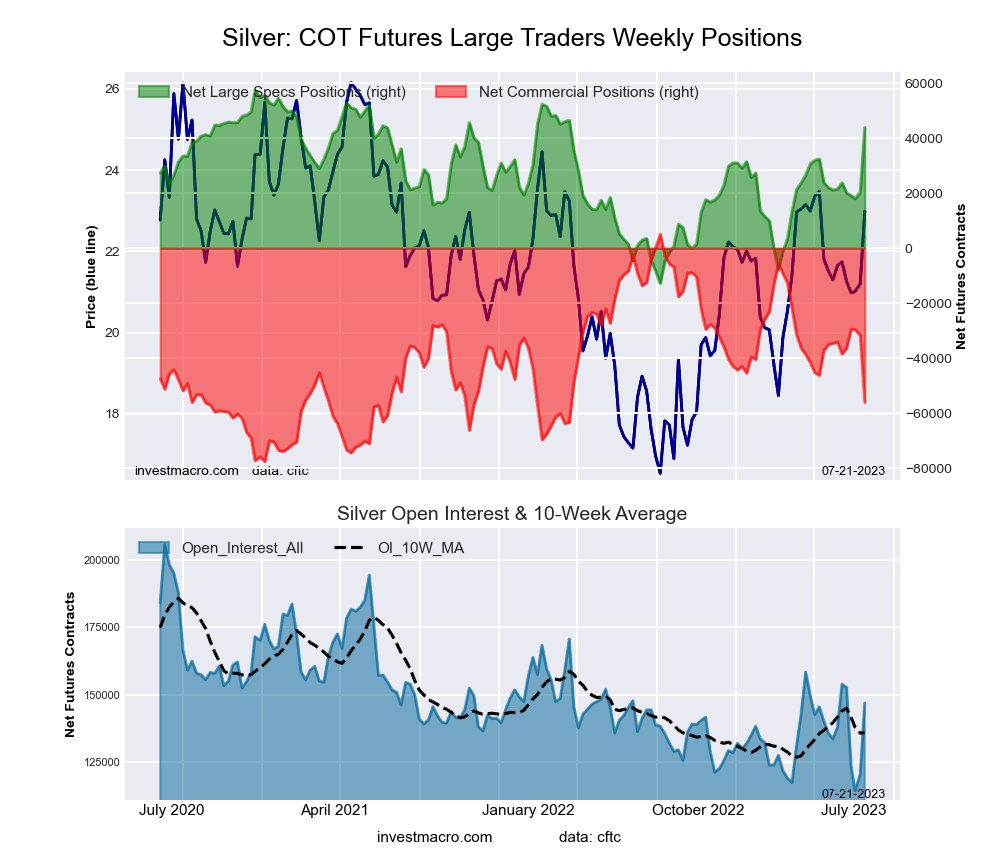
Silver Futures COT ChartThe Silver Comex Futures large speculator standing this week resulted in a net position of 20,058 contracts in the data reported through Tuesday. This was a weekly lowering of -3,678 contracts from the previous week which had a total of 23,736 net contracts.

This week’s current strength score (the trader positioning range over the past three years, measured from 0 to 100) shows the speculators are currently Bearish with a score of 46.9 percent. The commercials are Bullish with a score of 50.0 percent and the small traders (not shown in chart) are Bullish with a score of 56.3 percent.

Price Trend-Following Model: Weak Uptrend

Our weekly trend-following model classifies the current market price position as: Weak Uptrend. The current action for the model is considered to be: Hold – Maintain Long Position.

Silver Futures StatisticsSPECULATORSCOMMERCIALSSMALL TRADERS
– Percent of Open Interest Longs:34.430.118.5
– Percent of Open Interest Shorts:21.353.87.9
– Net Position:20,058-36,21016,152
– Gross Longs:52,54745,94128,208
– Gross Shorts:32,48982,15112,056
– Long to Short Ratio:1.6 to 10.6 to 12.3 to 1
NET POSITION TREND:
– Strength Index Score (3 Year Range Pct):46.950.056.3
– Strength Index Reading (3 Year Range):BearishBullishBullish
NET POSITION MOVEMENT INDEX:
– 6-Week Change in Strength Index:-17.612.113.0


Copper Grade #1 Futures:

Copper Futures COT ChartThe Copper Grade #1 Futures large speculator standing this week resulted in a net position of 1,888 contracts in the data reported through Tuesday. This was a weekly rise of 14,794 contracts from the previous week which had a total of -12,906 net contracts.

This week’s current strength score (the trader positioning range over the past three years, measured from 0 to 100) shows the speculators are currently Bearish with a score of 32.5 percent. The commercials are Bullish with a score of 68.3 percent and the small traders (not shown in chart) are Bearish with a score of 31.8 percent.

Price Trend-Following Model: Downtrend

Our weekly trend-following model classifies the current market price position as: Downtrend. The current action for the model is considered to be: Hold – Maintain Short Position.

Copper Futures StatisticsSPECULATORSCOMMERCIALSSMALL TRADERS
– Percent of Open Interest Longs:31.742.48.2
– Percent of Open Interest Shorts:30.744.47.2
– Net Position:1,888-4,0032,115
– Gross Longs:64,74086,76116,759
– Gross Shorts:62,85290,76414,644
– Long to Short Ratio:1.0 to 11.0 to 11.1 to 1
NET POSITION TREND:
– Strength Index Score (3 Year Range Pct):32.568.331.8
– Strength Index Reading (3 Year Range):BearishBullishBearish
NET POSITION MOVEMENT INDEX:
– 6-Week Change in Strength Index:23.1-19.7-19.0


Platinum Futures:

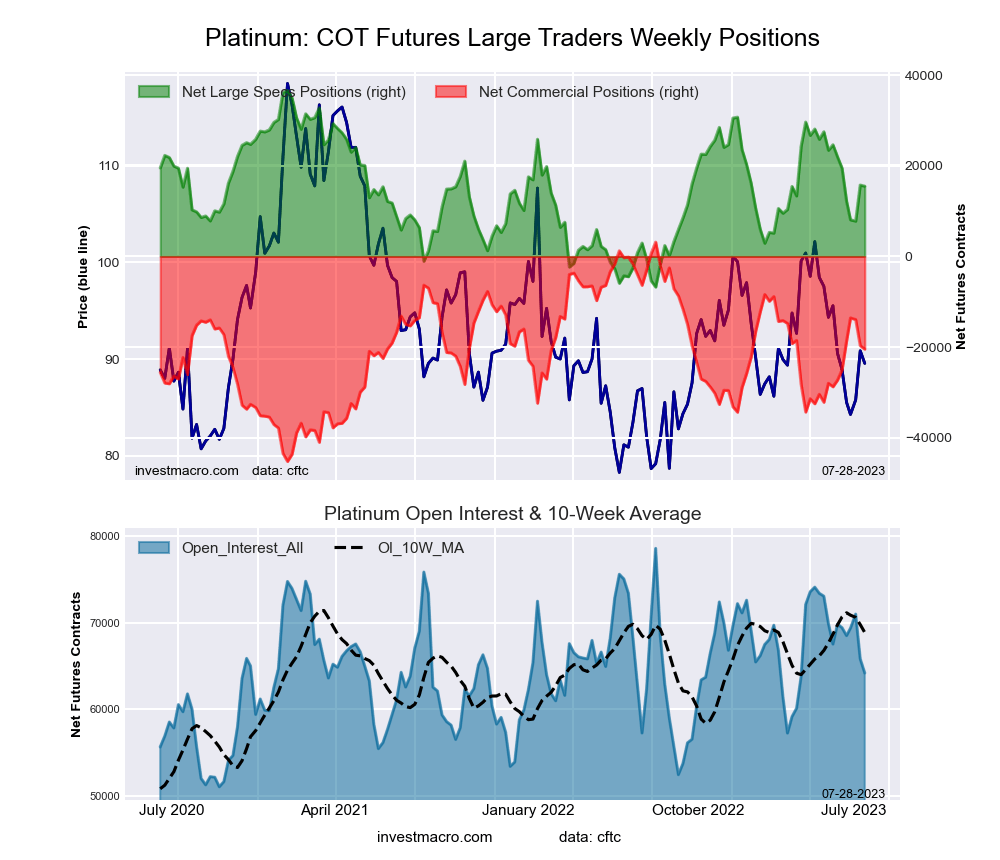
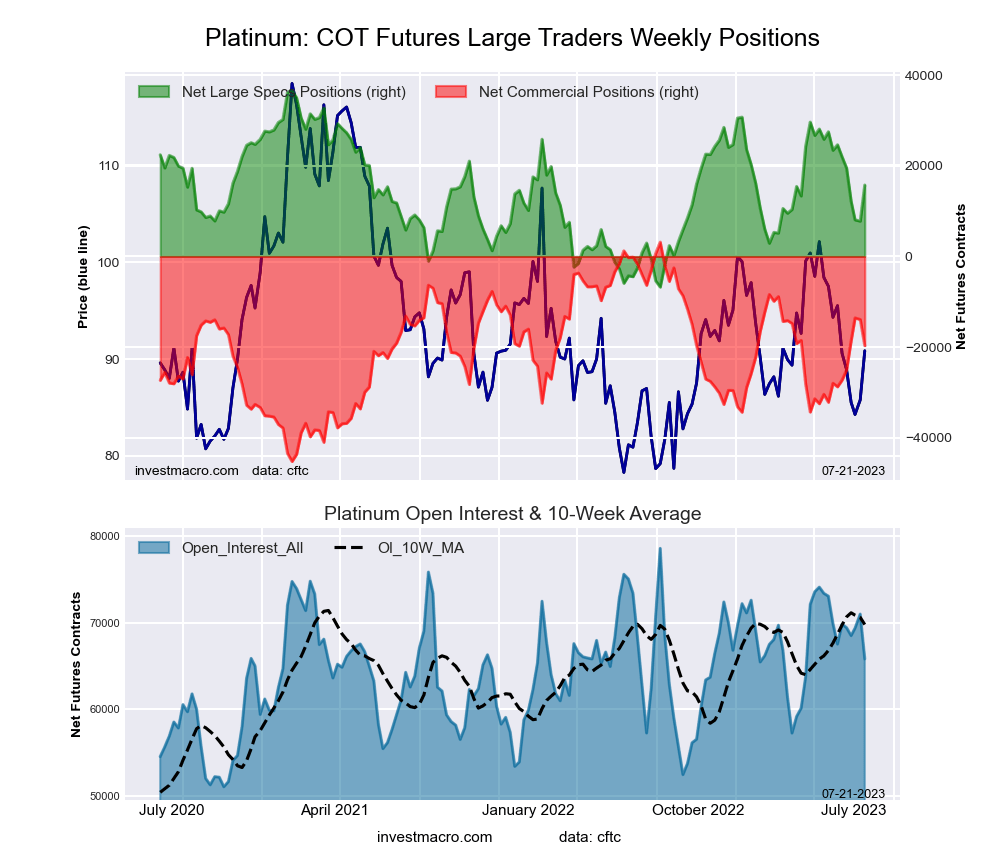
Platinum Futures COT ChartThe Platinum Futures large speculator standing this week resulted in a net position of 19,472 contracts in the data reported through Tuesday. This was a weekly reduction of -2,500 contracts from the previous week which had a total of 21,972 net contracts.

This week’s current strength score (the trader positioning range over the past three years, measured from 0 to 100) shows the speculators are currently Bullish with a score of 60.5 percent. The commercials are Bearish with a score of 41.7 percent and the small traders (not shown in chart) are Bearish with a score of 42.8 percent.

Price Trend-Following Model: Weak Uptrend

Our weekly trend-following model classifies the current market price position as: Weak Uptrend. The current action for the model is considered to be: Hold – Maintain Long Position.

Platinum Futures StatisticsSPECULATORSCOMMERCIALSSMALL TRADERS
– Percent of Open Interest Longs:49.128.312.9
– Percent of Open Interest Shorts:21.064.44.8
– Net Position:19,472-25,0525,580
– Gross Longs:34,05919,6828,936
– Gross Shorts:14,58744,7343,356
– Long to Short Ratio:2.3 to 10.4 to 12.7 to 1
NET POSITION TREND:
– Strength Index Score (3 Year Range Pct):60.541.742.8
– Strength Index Reading (3 Year Range):BullishBearishBearish
NET POSITION MOVEMENT INDEX:
– 6-Week Change in Strength Index:-19.915.415.7


Palladium Futures:

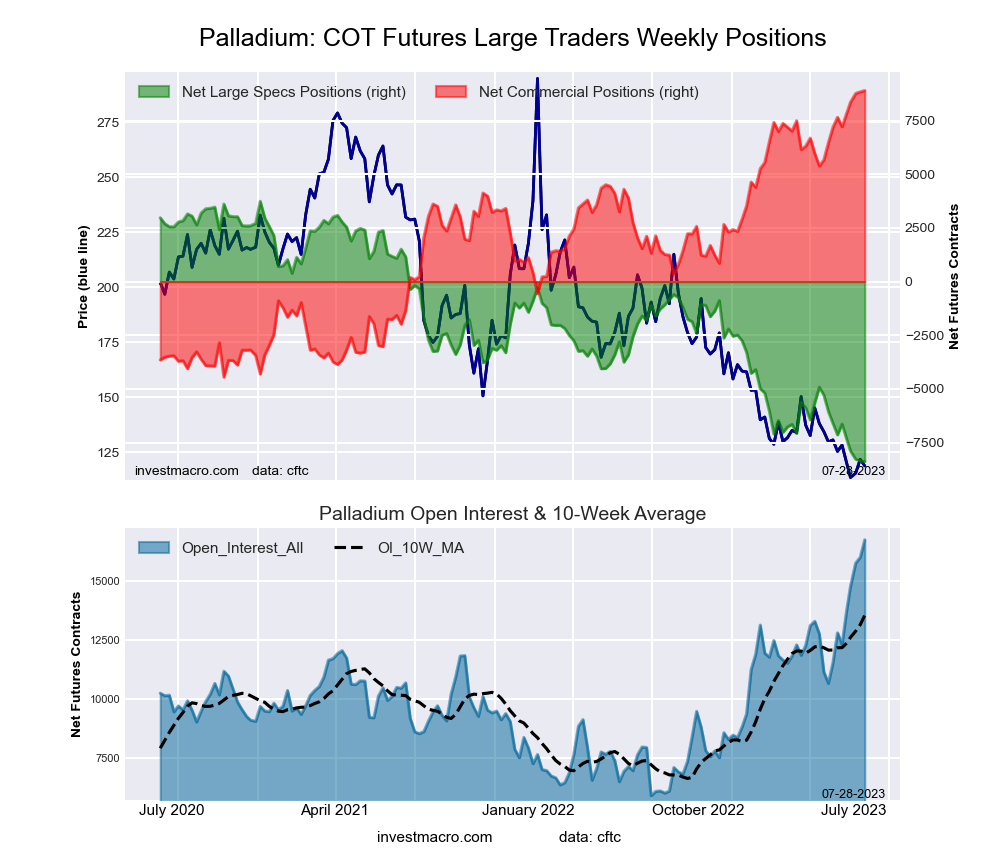
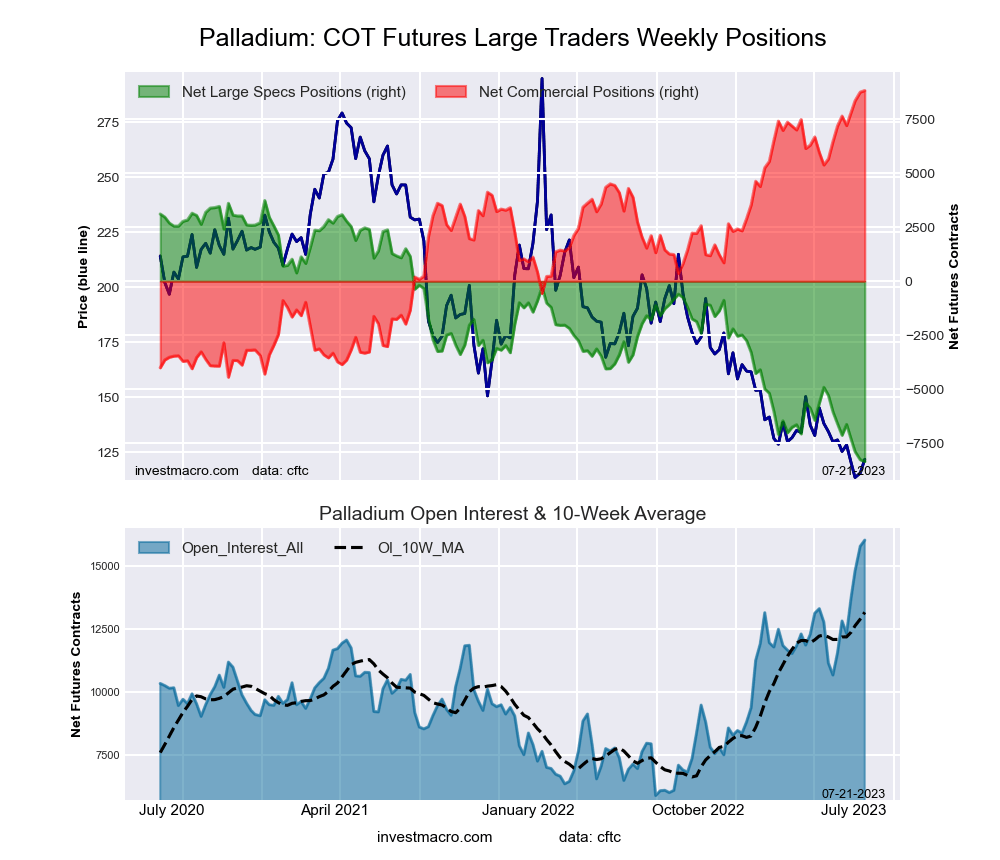
Palladium Futures COT ChartThe Palladium Futures large speculator standing this week resulted in a net position of -6,635 contracts in the data reported through Tuesday. This was a weekly gain of 501 contracts from the previous week which had a total of -7,136 net contracts.

This week’s current strength score (the trader positioning range over the past three years, measured from 0 to 100) shows the speculators are currently Bearish-Extreme with a score of 4.6 percent. The commercials are Bullish-Extreme with a score of 96.4 percent and the small traders (not shown in chart) are Bearish-Extreme with a score of 6.9 percent.

Price Trend-Following Model: Strong Downtrend

Our weekly trend-following model classifies the current market price position as: Strong Downtrend. The current action for the model is considered to be: Hold – Maintain Short Position.

Palladium Futures StatisticsSPECULATORSCOMMERCIALSSMALL TRADERS
– Percent of Open Interest Longs:20.567.29.6
– Percent of Open Interest Shorts:74.48.614.3
– Net Position:-6,6357,214-579
– Gross Longs:2,5258,2681,182
– Gross Shorts:9,1601,0541,761
– Long to Short Ratio:0.3 to 17.8 to 10.7 to 1
NET POSITION TREND:
– Strength Index Score (3 Year Range Pct):4.696.46.9
– Strength Index Reading (3 Year Range):Bearish-ExtremeBullish-ExtremeBearish-Extreme
NET POSITION MOVEMENT INDEX:
– 6-Week Change in Strength Index:-9.110.3-15.7


Steel Futures Futures:

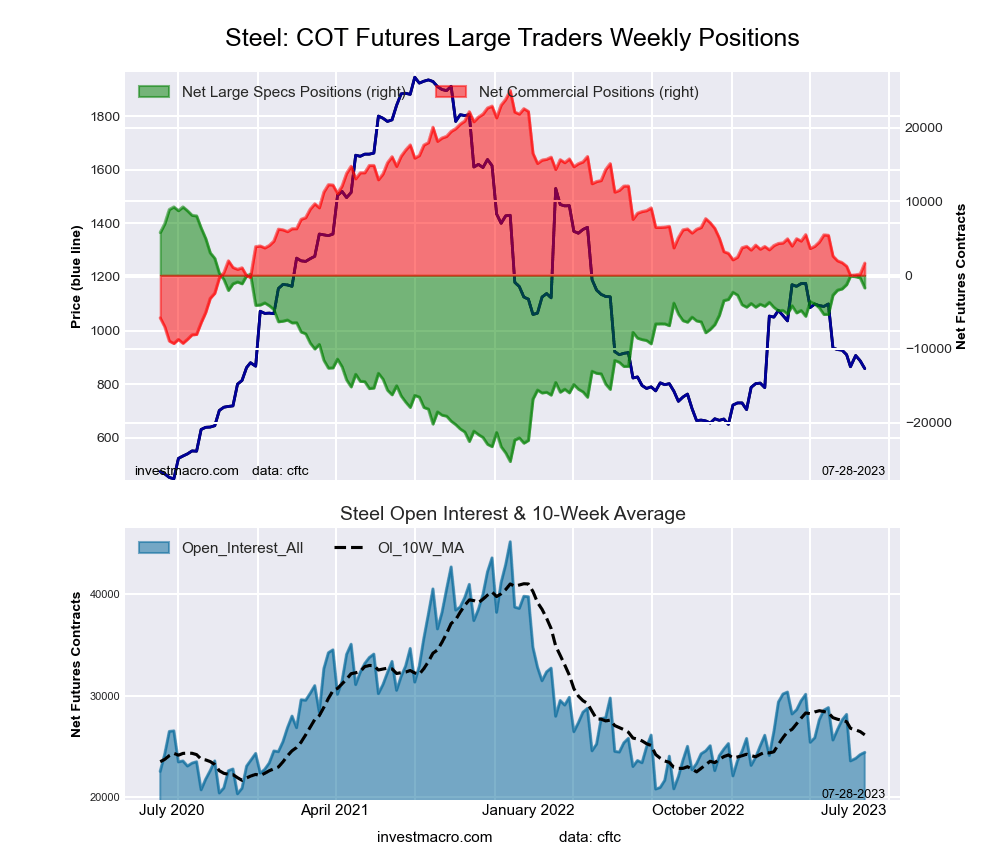
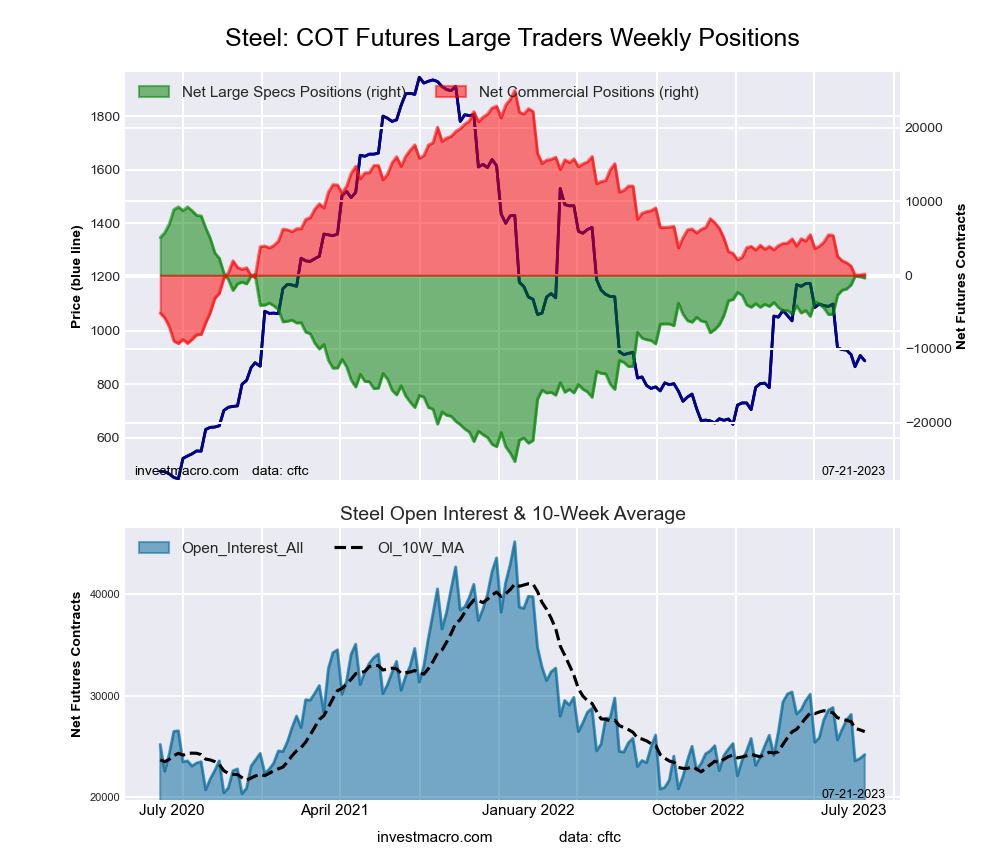
Steel Futures COT ChartThe Steel Futures large speculator standing this week resulted in a net position of -1,855 contracts in the data reported through Tuesday. This was a weekly advance of 175 contracts from the previous week which had a total of -2,030 net contracts.

This week’s current strength score (the trader positioning range over the past three years, measured from 0 to 100) shows the speculators are currently Bullish with a score of 67.8 percent. The commercials are Bearish with a score of 32.0 percent and the small traders (not shown in chart) are Bearish with a score of 38.9 percent.

Price Trend-Following Model: Weak Uptrend

Our weekly trend-following model classifies the current market price position as: Weak Uptrend. The current action for the model is considered to be: Hold – Maintain Long Position.

Steel Futures StatisticsSPECULATORSCOMMERCIALSSMALL TRADERS
– Percent of Open Interest Longs:14.878.01.0
– Percent of Open Interest Shorts:21.571.80.4
– Net Position:-1,8551,710145
– Gross Longs:4,08521,522264
– Gross Shorts:5,94019,812119
– Long to Short Ratio:0.7 to 11.1 to 12.2 to 1
NET POSITION TREND:
– Strength Index Score (3 Year Range Pct):67.832.038.9
– Strength Index Reading (3 Year Range):BullishBearishBearish
NET POSITION MOVEMENT INDEX:
– 6-Week Change in Strength Index:5.9-6.422.1


Article By InvestMacroReceive our weekly COT Newsletter

*COT Report: The COT data, released weekly to the public each Friday, is updated through the most recent Tuesday (data is 3 days old) and shows a quick view of how large speculators or non-commercials (for-profit traders) were positioned in the futures markets.

The CFTC categorizes trader positions according to commercial hedgers (traders who use futures contracts for hedging as part of the business), non-commercials (large traders who speculate to realize trading profits) and nonreportable traders (usually small traders/speculators) as well as their open interest (contracts open in the market at time of reporting). See CFTC criteria here.
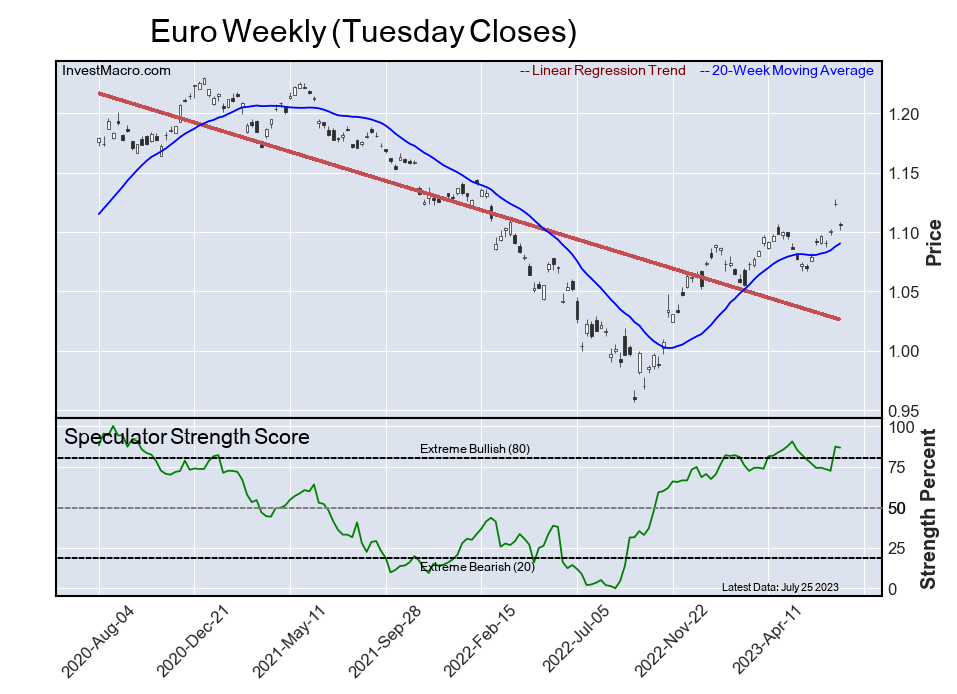
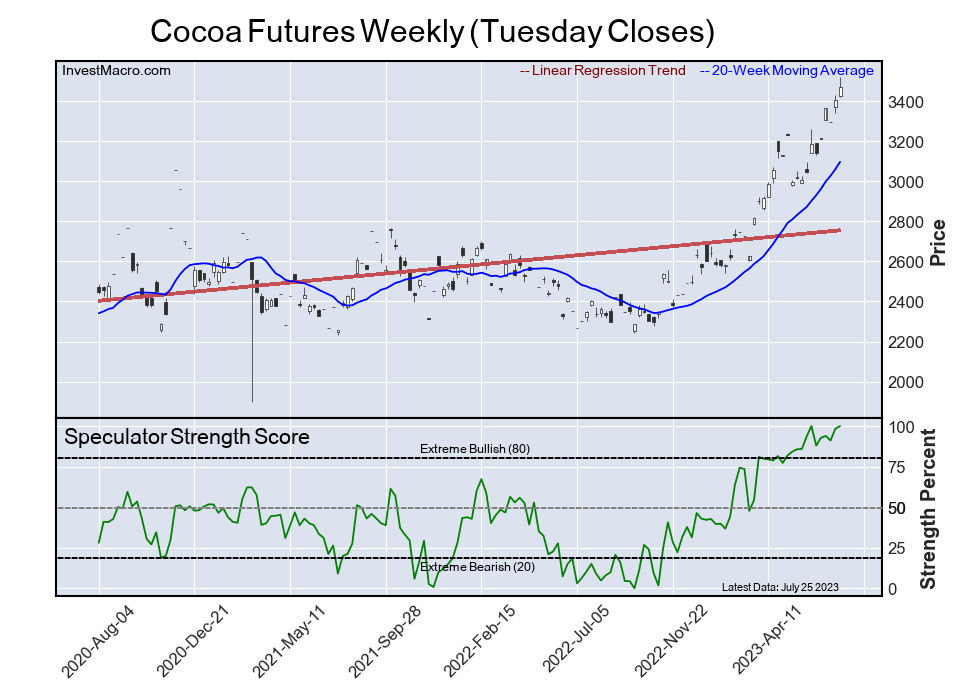
Speculator Extremes: British Pound, Peso & Live Cattle lead Bullish & Bearish Positions

By InvestMacro

The latest update for the weekly Commitment of Traders (COT) report was released by the Commodity Futures Trading Commission (CFTC) on Friday for data ending on June 20th.

This weekly Extreme Positions report highlights the Most Bullish and Most Bearish Positions for the speculator category. Extreme positioning in these markets can foreshadow strong moves in the underlying market.

To signify an extreme position, we use the Strength Index (also known as the COT Index) of each instrument, a common method of measuring COT data. The Strength Index is simply a comparison of current trader positions against the range of positions over the previous 3 years. We use over 80 percent as extremely bullish and under 20 percent as extremely bearish. (Compare Strength Index scores across all markets in the data table or cot leaders table)


Here Are This Week’s Most Bullish Speculator Positions:

British Pound


The British Pound speculator position comes in as the most bullish extreme standing this week. The British Pound speculator level is currently at a 100.0 percent score of its 3-year range.

The six-week trend for the percent strength score totaled 33.1 this week. The overall net speculator position was a total of 46,608 net contracts this week with a change of 39,873 contract in the weekly speculator bets.


Mexican Peso


The Mexican Peso speculator position comes next in the extreme standings this week. The Mexican Peso speculator level is now at a 100.0 percent score of its 3-year range.

The six-week trend for the percent strength score was 18.1 this week. The speculator position registered 99,718 net contracts this week with a weekly change of 20,883 contracts in speculator bets.


3-Month Secured Overnight Financing Rate


The 3-Month Secured Overnight Financing Rate speculator position comes in third this week in the extreme standings. The 3-Month Secured Overnight Financing Rate speculator level resides at a 100.0 percent score of its 3-year range.

The six-week trend for the speculator strength score came in at 47.9 this week. The overall speculator position was 204,698 net contracts this week with a change of 78,952 contracts in the weekly speculator bets.


Bloomberg Commodity Index


The Bloomberg Commodity Index speculator position comes up number four in the extreme standings this week. The Bloomberg Commodity Index speculator level is at a 99.8 percent score of its 3-year range.

The six-week trend for the speculator strength score totaled a change of 2.2 this week. The overall speculator position was -1,510 net contracts this week with a change of -48 contracts in the speculator bets.


Live Cattle


The Live Cattle speculator position rounds out the top five in this week’s bullish extreme standings. The Live Cattle speculator level sits at a 93.2 percent score of its 3-year range. The six-week trend for the speculator strength score was 8.7 this week.

The speculator position was 105,936 net contracts this week with a change of -6,313 contracts in the weekly speculator bets.


This Week’s Most Bearish Speculator Positions:

1-Month Secured Overnight Financing Rate

The 1-Month Secured Overnight Financing Rate speculator position comes in as the most bearish extreme standing this week. The 1-Month Secured Overnight Financing Rate speculator level is at a 0.0 percent score of its 3-year range.

The six-week trend for the speculator strength score was -32.9 this week. The overall speculator position was -154,369 net contracts this week with a change of -61,298 contracts in the speculator bets.


2-Year Bond


The 2-Year Bond speculator position comes in next for the most bearish extreme standing on the week. The 2-Year Bond speculator level is at a 1.7 percent score of its 3-year range.

The six-week trend for the speculator strength score was -24.5 this week. The speculator position was -1,027,276 net contracts this week with a change of 19,169 contracts in the weekly speculator bets.


Japanese Yen


The Japanese Yen speculator position comes in as third most bearish extreme standing of the week. The Japanese Yen speculator level resides at a 2.6 percent score of its 3-year range.

The six-week trend for the speculator strength score was -28.7 this week. The overall speculator position was -107,656 net contracts this week with a change of -3,680 contracts in the speculator bets.


WTI Crude Oil


The WTI Crude Oil speculator position comes in as this week’s fourth most bearish extreme standing. The WTI Crude Oil speculator level is at a 3.1 percent score of its 3-year range.

The six-week trend for the speculator strength score was -12.7 this week. The speculator position was 166,477 net contracts this week with a change of 11,403 contracts in the weekly speculator bets.


Palladium


Finally, the Palladium speculator position comes in as the fifth most bearish extreme standing for this week. The Palladium speculator level is at a 4.6 percent score of its 3-year range.

The six-week trend for the speculator strength score was -9.1 this week. The speculator position was -6,635 net contracts this week with a change of 501 contracts in the weekly speculator bets.


Article By InvestMacroReceive our weekly COT Newsletter

Speculators or Non-Commercials Notes:

Speculators, classified as non-commercial traders by the CFTC, are made up of large commodity funds, hedge funds and other significant for-profit participants. The Specs are generally regarded as trend-followers in their behavior towards price action – net speculator bets and prices tend to go in the same directions. These traders often look to buy when prices are rising and sell when prices are falling. To illustrate this point, many times speculator contracts can be found at their most extremes (bullish or bearish) when prices are also close to their highest or lowest levels.

These extreme levels can be dangerous for the large speculators as the trade is most crowded, there is less trading ammunition still sitting on the sidelines to push the trend further and prices have moved a significant distance. When the trend becomes exhausted, some speculators take profits while others look to also exit positions when prices fail to continue in the same direction. This process usually plays out over many months to years and can ultimately create a reverse effect where prices start to fall and speculators start a process of selling when prices are falling.


*COT Report: The COT data, released weekly to the public each Friday, is updated through the most recent Tuesday (data is 3 days old) and shows a quick view of how large speculators or non-commercials (for-profit traders) were positioned in the futures markets.

The CFTC categorizes trader positions according to commercial hedgers (traders who use futures contracts for hedging as part of the business), non-commercials (large traders who speculate to realize trading profits) and nonreportable traders (usually small traders/speculators) as well as their open interest (contracts open in the market at time of reporting). See CFTC criteria here.
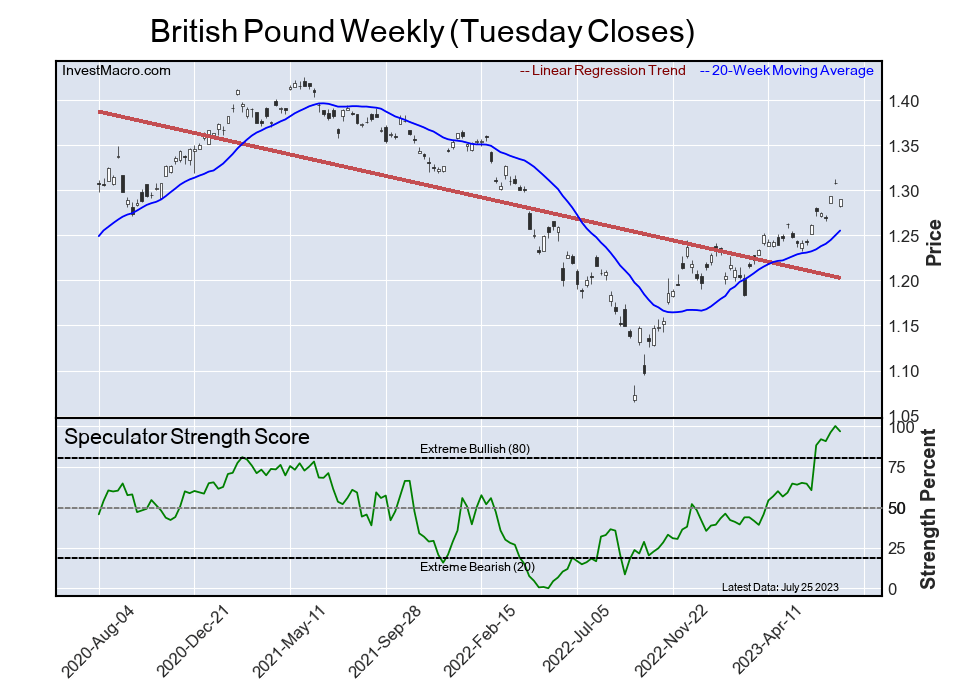
Corn Speculators push their bullish bets sharply higher on drought

By InvestMacro

Here are the latest charts and statistics for the Commitment of Traders (COT) reports data published by the Commodities Futures Trading Commission (CFTC).

The latest COT data is updated through Tuesday June 20th and shows a quick view of how large traders (for-profit speculators and commercial entities) were positioned in the futures markets.

Weekly Speculator Changes led by Sugar & Corn

The COT soft commodities markets speculator bets were higher this week as eight out of the eleven softs markets we cover had higher positioning while the other three markets had lower speculator contracts.

Leading the gains for the softs markets was Corn (73,681 contracts) with Soybeans (25,583 contracts), Wheat (20,463 contracts), Soybean Oil (13,962 contracts), Sugar (9,741 contracts), Lean Hogs (7,704 contracts), Coffee (5,163 contracts) and Soybean Meal (4,314 contracts) also showing positive weeks.

The markets with the declines in speculator bets this week were Cocoa (-10,597 contracts) with Cotton (-4,552 contracts) and Live Cattle (-6,313 contracts) also registering lower bets on the week.

Corn Speculators push their bullish bets sharply higher on drought

Highlighting the COT soft commodities data this week is the renewed bullish appetite of the Corn’s speculator’s positioning. The speculator positioning sharply jumped this week by over +73,681 contracts following a gain of +59,863 contracts last week. The Corn speculative bets have risen in four straight weeks and for six out of the past seven weeks.

The grains markets have been starting to see higher prices coming back over the past month due to a drought in the US Midwest that has been stated as the worst since 2012. Speculators have been reacting to the changes in the weather and have now pushed their overall net standing for Corn back into a bullish position last week after spending the previous six weeks in bearish territory.

Corn’s futures price had been on a rise for three out of the previous four weeks and touched a nine-week high this week above 672.0 but ended up closing the week lower at the 630.6 price level.


Data Snapshot of Commodity Market Traders | Columns Legend
Jun-20-2023OIOI-IndexSpec-NetSpec-IndexCom-NetCOM-IndexSmalls-NetSmalls-Index
WTI Crude1,846,81640166,4773-189,9189723,44126
Gold438,0377162,97549-186,5375223,56239
Silver152,6334020,05847-36,2105016,15256
Copper204,399461,88832-4,003682,11532
Palladium12,30487-6,63557,21496-5797
Platinum69,4367019,47261-25,052425,58043
Natural Gas1,303,55869-109,3152879,7357129,58050
Brent144,34817-47,0561345,090911,96636
Heating Oil310,2974016,10057-28,4966112,39641
Soybeans662,4691988,53224-67,63473-20,89847
Corn1,290,34813118,77339-58,03067-60,74328
Coffee185,800733,49462-33,42643-6812
Sugar967,11363261,00183-310,7621549,76167
Wheat353,86539-66,3642063,862802,50282


Strength Scores led by Live Cattle & Cocoa

COT Strength Scores (a normalized measure of Speculator positions over a 3-Year range, from 0 to 100 where above 80 is Extreme-Bullish and below 20 is Extreme-Bearish) showed that Live Cattle (93 percent), Cocoa (89 percent) and Sugar (83 percent) lead the softs markets this week.

On the downside, Lean Hogs (14 percent) and Cotton (14 percent) come in at the lowest strength levels currently and are in Extreme-Bearish territory (below 20 percent).

Strength Statistics:
Corn (39.2 percent) vs Corn previous week (28.7 percent)
Sugar (83.2 percent) vs Sugar previous week (79.7 percent)
Coffee (61.8 percent) vs Coffee previous week (56.5 percent)
Soybeans (23.9 percent) vs Soybeans previous week (13.9 percent)
Soybean Oil (34.4 percent) vs Soybean Oil previous week (26.3 percent)
Soybean Meal (63.9 percent) vs Soybean Meal previous week (61.6 percent)
Live Cattle (93.2 percent) vs Live Cattle previous week (100.0 percent)
Lean Hogs (14.3 percent) vs Lean Hogs previous week (8.0 percent)
Cotton (13.7 percent) vs Cotton previous week (17.2 percent)
Cocoa (88.8 percent) vs Cocoa previous week (100.0 percent)
Wheat (19.6 percent) vs Wheat previous week (5.1 percent)


Corn & Soybean Oil top the 6-Week Strength Trends

COT Strength Score Trends (or move index, calculates the 6-week changes in strength scores) showed that Corn (25 percent) and Soybean Oil (21 percent) lead the past six weeks trends for soft commodities. Wheat (13 percent), Soybeans (10 percent) and Soybean Meal (9 percent) are the next highest positive movers in the latest trends data.

Sugar (-6 percent) leads the downside trend scores currently with Coffee (0 percent), Cotton (4 percent) and Lean Hogs (6 percent) following next with lower trend scores.

Strength Trend Statistics:
Corn (25.2 percent) vs Corn previous week (15.0 percent)
Sugar (-5.5 percent) vs Sugar previous week (-5.7 percent)
Coffee (-0.0 percent) vs Coffee previous week (-8.5 percent)
Soybeans (9.5 percent) vs Soybeans previous week (-4.8 percent)
Soybean Oil (21.1 percent) vs Soybean Oil previous week (19.8 percent)
Soybean Meal (8.7 percent) vs Soybean Meal previous week (7.6 percent)
Live Cattle (8.7 percent) vs Live Cattle previous week (8.0 percent)
Lean Hogs (6.0 percent) vs Lean Hogs previous week (-5.5 percent)
Cotton (4.1 percent) vs Cotton previous week (13.7 percent)
Cocoa (5.6 percent) vs Cocoa previous week (21.0 percent)
Wheat (13.1 percent) vs Wheat previous week (2.4 percent)


Individual Soft Commodities Markets:

CORN Futures:

CORN Futures COT ChartThe CORN large speculator standing this week totaled a net position of 118,773 contracts in the data reported through Tuesday. This was a weekly gain of 73,681 contracts from the previous week which had a total of 45,092 net contracts.

This week’s current strength score (the trader positioning range over the past three years, measured from 0 to 100) shows the speculators are currently Bearish with a score of 39.2 percent. The commercials are Bullish with a score of 66.6 percent and the small traders (not shown in chart) are Bearish with a score of 27.7 percent.

Price Trend-Following Model: Weak Downtrend

Our weekly trend-following model classifies the current market price position as: Weak Downtrend. The current action for the model is considered to be: Hold – Maintain Short Position.

CORN Futures StatisticsSPECULATORSCOMMERCIALSSMALL TRADERS
– Percent of Open Interest Longs:26.548.39.4
– Percent of Open Interest Shorts:17.352.814.1
– Net Position:118,773-58,030-60,743
– Gross Longs:342,125623,477121,205
– Gross Shorts:223,352681,507181,948
– Long to Short Ratio:1.5 to 10.9 to 10.7 to 1
NET POSITION TREND:
– Strength Index Score (3 Year Range Pct):39.266.627.7
– Strength Index Reading (3 Year Range):BearishBullishBearish
NET POSITION MOVEMENT INDEX:
– 6-Week Change in Strength Index:25.2-24.1-22.0


SUGAR Futures:

SUGAR Futures COT ChartThe SUGAR large speculator standing this week totaled a net position of 261,001 contracts in the data reported through Tuesday. This was a weekly rise of 9,741 contracts from the previous week which had a total of 251,260 net contracts.

This week’s current strength score (the trader positioning range over the past three years, measured from 0 to 100) shows the speculators are currently Bullish-Extreme with a score of 83.2 percent. The commercials are Bearish-Extreme with a score of 14.8 percent and the small traders (not shown in chart) are Bullish with a score of 67.4 percent.

Price Trend-Following Model: Uptrend

Our weekly trend-following model classifies the current market price position as: Uptrend. The current action for the model is considered to be: Hold – Maintain Long Position.

SUGAR Futures StatisticsSPECULATORSCOMMERCIALSSMALL TRADERS
– Percent of Open Interest Longs:35.440.99.6
– Percent of Open Interest Shorts:8.473.04.5
– Net Position:261,001-310,76249,761
– Gross Longs:342,320395,11693,065
– Gross Shorts:81,319705,87843,304
– Long to Short Ratio:4.2 to 10.6 to 12.1 to 1
NET POSITION TREND:
– Strength Index Score (3 Year Range Pct):83.214.867.4
– Strength Index Reading (3 Year Range):Bullish-ExtremeBearish-ExtremeBullish
NET POSITION MOVEMENT INDEX:
– 6-Week Change in Strength Index:-5.56.3-6.6


COFFEE Futures:

COFFEE Futures COT ChartThe COFFEE large speculator standing this week totaled a net position of 33,494 contracts in the data reported through Tuesday. This was a weekly boost of 5,163 contracts from the previous week which had a total of 28,331 net contracts.

This week’s current strength score (the trader positioning range over the past three years, measured from 0 to 100) shows the speculators are currently Bullish with a score of 61.8 percent. The commercials are Bearish with a score of 42.6 percent and the small traders (not shown in chart) are Bearish-Extreme with a score of 11.8 percent.

Price Trend-Following Model: Uptrend

Our weekly trend-following model classifies the current market price position as: Uptrend. The current action for the model is considered to be: Hold – Maintain Long Position.

COFFEE Futures StatisticsSPECULATORSCOMMERCIALSSMALL TRADERS
– Percent of Open Interest Longs:27.841.33.8
– Percent of Open Interest Shorts:9.859.33.8
– Net Position:33,494-33,426-68
– Gross Longs:51,67676,7677,058
– Gross Shorts:18,182110,1937,126
– Long to Short Ratio:2.8 to 10.7 to 11.0 to 1
NET POSITION TREND:
– Strength Index Score (3 Year Range Pct):61.842.611.8
– Strength Index Reading (3 Year Range):BullishBearishBearish-Extreme
NET POSITION MOVEMENT INDEX:
– 6-Week Change in Strength Index:-0.01.1-12.4


SOYBEANS Futures:

SOYBEANS Futures COT ChartThe SOYBEANS large speculator standing this week totaled a net position of 88,532 contracts in the data reported through Tuesday. This was a weekly gain of 25,583 contracts from the previous week which had a total of 62,949 net contracts.

This week’s current strength score (the trader positioning range over the past three years, measured from 0 to 100) shows the speculators are currently Bearish with a score of 23.9 percent. The commercials are Bullish with a score of 73.4 percent and the small traders (not shown in chart) are Bearish with a score of 46.7 percent.

Price Trend-Following Model: Weak Downtrend

Our weekly trend-following model classifies the current market price position as: Weak Downtrend. The current action for the model is considered to be: Hold – Maintain Short Position.

SOYBEANS Futures StatisticsSPECULATORSCOMMERCIALSSMALL TRADERS
– Percent of Open Interest Longs:24.453.36.9
– Percent of Open Interest Shorts:11.163.510.0
– Net Position:88,532-67,634-20,898
– Gross Longs:161,793353,06245,676
– Gross Shorts:73,261420,69666,574
– Long to Short Ratio:2.2 to 10.8 to 10.7 to 1
NET POSITION TREND:
– Strength Index Score (3 Year Range Pct):23.973.446.7
– Strength Index Reading (3 Year Range):BearishBullishBearish
NET POSITION MOVEMENT INDEX:
– 6-Week Change in Strength Index:9.5-10.110.1


SOYBEAN OIL Futures:

SOYBEAN OIL Futures COT ChartThe SOYBEAN OIL large speculator standing this week totaled a net position of 28,127 contracts in the data reported through Tuesday. This was a weekly increase of 13,962 contracts from the previous week which had a total of 14,165 net contracts.

This week’s current strength score (the trader positioning range over the past three years, measured from 0 to 100) shows the speculators are currently Bearish with a score of 34.4 percent. The commercials are Bullish with a score of 67.0 percent and the small traders (not shown in chart) are Bearish with a score of 21.1 percent.

Price Trend-Following Model: Weak Downtrend

Our weekly trend-following model classifies the current market price position as: Weak Downtrend. The current action for the model is considered to be: Hold – Maintain Short Position.

SOYBEAN OIL Futures StatisticsSPECULATORSCOMMERCIALSSMALL TRADERS
– Percent of Open Interest Longs:15.059.25.7
– Percent of Open Interest Shorts:9.565.15.3
– Net Position:28,127-30,1382,011
– Gross Longs:76,705301,79229,161
– Gross Shorts:48,578331,93027,150
– Long to Short Ratio:1.6 to 10.9 to 11.1 to 1
NET POSITION TREND:
– Strength Index Score (3 Year Range Pct):34.467.021.1
– Strength Index Reading (3 Year Range):BearishBullishBearish
NET POSITION MOVEMENT INDEX:
– 6-Week Change in Strength Index:21.1-20.310.7


SOYBEAN MEAL Futures:

SOYBEAN MEAL Futures COT ChartThe SOYBEAN MEAL large speculator standing this week totaled a net position of 107,750 contracts in the data reported through Tuesday. This was a weekly increase of 4,314 contracts from the previous week which had a total of 103,436 net contracts.

This week’s current strength score (the trader positioning range over the past three years, measured from 0 to 100) shows the speculators are currently Bullish with a score of 63.9 percent. The commercials are Bearish with a score of 38.8 percent and the small traders (not shown in chart) are Bearish with a score of 20.4 percent.

Price Trend-Following Model: Downtrend

Our weekly trend-following model classifies the current market price position as: Downtrend. The current action for the model is considered to be: Hold – Maintain Short Position.

SOYBEAN MEAL Futures StatisticsSPECULATORSCOMMERCIALSSMALL TRADERS
– Percent of Open Interest Longs:25.738.69.2
– Percent of Open Interest Shorts:4.562.76.3
– Net Position:107,750-122,18914,439
– Gross Longs:130,518195,98646,491
– Gross Shorts:22,768318,17532,052
– Long to Short Ratio:5.7 to 10.6 to 11.5 to 1
NET POSITION TREND:
– Strength Index Score (3 Year Range Pct):63.938.820.4
– Strength Index Reading (3 Year Range):BullishBearishBearish
NET POSITION MOVEMENT INDEX:
– 6-Week Change in Strength Index:8.7-9.45.2


LIVE CATTLE Futures:

LIVE CATTLE Futures COT ChartThe LIVE CATTLE large speculator standing this week totaled a net position of 105,936 contracts in the data reported through Tuesday. This was a weekly reduction of -6,313 contracts from the previous week which had a total of 112,249 net contracts.

This week’s current strength score (the trader positioning range over the past three years, measured from 0 to 100) shows the speculators are currently Bullish-Extreme with a score of 93.2 percent. The commercials are Bearish-Extreme with a score of 7.7 percent and the small traders (not shown in chart) are Bearish with a score of 23.3 percent.

Price Trend-Following Model: Uptrend

Our weekly trend-following model classifies the current market price position as: Uptrend. The current action for the model is considered to be: Hold – Maintain Long Position.

LIVE CATTLE Futures StatisticsSPECULATORSCOMMERCIALSSMALL TRADERS
– Percent of Open Interest Longs:46.127.58.6
– Percent of Open Interest Shorts:14.755.312.1
– Net Position:105,936-94,062-11,874
– Gross Longs:155,74492,89229,165
– Gross Shorts:49,808186,95441,039
– Long to Short Ratio:3.1 to 10.5 to 10.7 to 1
NET POSITION TREND:
– Strength Index Score (3 Year Range Pct):93.27.723.3
– Strength Index Reading (3 Year Range):Bullish-ExtremeBearish-ExtremeBearish
NET POSITION MOVEMENT INDEX:
– 6-Week Change in Strength Index:8.7-4.9-22.3


LEAN HOGS Futures:

LEAN HOGS Futures COT ChartThe LEAN HOGS large speculator standing this week totaled a net position of -18,727 contracts in the data reported through Tuesday. This was a weekly gain of 7,704 contracts from the previous week which had a total of -26,431 net contracts.

This week’s current strength score (the trader positioning range over the past three years, measured from 0 to 100) shows the speculators are currently Bearish-Extreme with a score of 14.3 percent. The commercials are Bullish-Extreme with a score of 88.9 percent and the small traders (not shown in chart) are Bullish with a score of 74.2 percent.

Price Trend-Following Model: Strong Uptrend

Our weekly trend-following model classifies the current market price position as: Strong Uptrend. The current action for the model is considered to be: Hold – Maintain Long Position.

LEAN HOGS Futures StatisticsSPECULATORSCOMMERCIALSSMALL TRADERS
– Percent of Open Interest Longs:29.440.39.1
– Percent of Open Interest Shorts:39.129.510.2
– Net Position:-18,72720,759-2,032
– Gross Longs:56,56277,52217,534
– Gross Shorts:75,28956,76319,566
– Long to Short Ratio:0.8 to 11.4 to 10.9 to 1
NET POSITION TREND:
– Strength Index Score (3 Year Range Pct):14.388.974.2
– Strength Index Reading (3 Year Range):Bearish-ExtremeBullish-ExtremeBullish
NET POSITION MOVEMENT INDEX:
– 6-Week Change in Strength Index:6.0-2.7-19.6


COTTON Futures:

COTTON Futures COT ChartThe COTTON large speculator standing this week totaled a net position of 6,658 contracts in the data reported through Tuesday. This was a weekly reduction of -4,552 contracts from the previous week which had a total of 11,210 net contracts.

This week’s current strength score (the trader positioning range over the past three years, measured from 0 to 100) shows the speculators are currently Bearish-Extreme with a score of 13.7 percent. The commercials are Bullish-Extreme with a score of 84.3 percent and the small traders (not shown in chart) are Bearish with a score of 29.4 percent.

Price Trend-Following Model: Uptrend

Our weekly trend-following model classifies the current market price position as: Uptrend. The current action for the model is considered to be: Hold – Maintain Long Position.

COTTON Futures StatisticsSPECULATORSCOMMERCIALSSMALL TRADERS
– Percent of Open Interest Longs:30.851.07.8
– Percent of Open Interest Shorts:26.956.26.5
– Net Position:6,658-8,8682,210
– Gross Longs:52,44586,86913,339
– Gross Shorts:45,78795,73711,129
– Long to Short Ratio:1.1 to 10.9 to 11.2 to 1
NET POSITION TREND:
– Strength Index Score (3 Year Range Pct):13.784.329.4
– Strength Index Reading (3 Year Range):Bearish-ExtremeBullish-ExtremeBearish
NET POSITION MOVEMENT INDEX:
– 6-Week Change in Strength Index:4.1-5.112.4


COCOA Futures:

COCOA Futures COT ChartThe COCOA large speculator standing this week totaled a net position of 67,342 contracts in the data reported through Tuesday. This was a weekly lowering of -10,597 contracts from the previous week which had a total of 77,939 net contracts.

This week’s current strength score (the trader positioning range over the past three years, measured from 0 to 100) shows the speculators are currently Bullish-Extreme with a score of 88.8 percent. The commercials are Bearish-Extreme with a score of 10.8 percent and the small traders (not shown in chart) are Bearish with a score of 42.8 percent.

Price Trend-Following Model: Uptrend

Our weekly trend-following model classifies the current market price position as: Uptrend. The current action for the model is considered to be: Hold – Maintain Long Position.

COCOA Futures StatisticsSPECULATORSCOMMERCIALSSMALL TRADERS
– Percent of Open Interest Longs:44.727.94.3
– Percent of Open Interest Shorts:24.949.03.0
– Net Position:67,342-71,9684,626
– Gross Longs:152,23995,15114,724
– Gross Shorts:84,897167,11910,098
– Long to Short Ratio:1.8 to 10.6 to 11.5 to 1
NET POSITION TREND:
– Strength Index Score (3 Year Range Pct):88.810.842.8
– Strength Index Reading (3 Year Range):Bullish-ExtremeBearish-ExtremeBearish
NET POSITION MOVEMENT INDEX:
– 6-Week Change in Strength Index:5.6-5.4-1.5


WHEAT Futures:

WHEAT Futures COT ChartThe WHEAT large speculator standing this week totaled a net position of -66,364 contracts in the data reported through Tuesday. This was a weekly lift of 20,463 contracts from the previous week which had a total of -86,827 net contracts.

This week’s current strength score (the trader positioning range over the past three years, measured from 0 to 100) shows the speculators are currently Bearish-Extreme with a score of 19.6 percent. The commercials are Bullish-Extreme with a score of 80.0 percent and the small traders (not shown in chart) are Bullish-Extreme with a score of 81.7 percent.

Price Trend-Following Model: Weak Downtrend

Our weekly trend-following model classifies the current market price position as: Weak Downtrend. The current action for the model is considered to be: Hold – Maintain Short Position.

WHEAT Futures StatisticsSPECULATORSCOMMERCIALSSMALL TRADERS
– Percent of Open Interest Longs:27.738.610.0
– Percent of Open Interest Shorts:46.520.59.3
– Net Position:-66,36463,8622,502
– Gross Longs:98,146136,41635,384
– Gross Shorts:164,51072,55432,882
– Long to Short Ratio:0.6 to 11.9 to 11.1 to 1
NET POSITION TREND:
– Strength Index Score (3 Year Range Pct):19.680.081.7
– Strength Index Reading (3 Year Range):Bearish-ExtremeBullish-ExtremeBullish-Extreme
NET POSITION MOVEMENT INDEX:
– 6-Week Change in Strength Index:13.1-13.4-5.7


Article By InvestMacroReceive our weekly COT Newsletter

*COT Report: The COT data, released weekly to the public each Friday, is updated through the most recent Tuesday (data is 3 days old) and shows a quick view of how large speculators or non-commercials (for-profit traders) were positioned in the futures markets.

The CFTC categorizes trader positions according to commercial hedgers (traders who use futures contracts for hedging as part of the business), non-commercials (large traders who speculate to realize trading profits) and nonreportable traders (usually small traders/speculators) as well as their open interest (contracts open in the market at time of reporting). See CFTC criteria here.
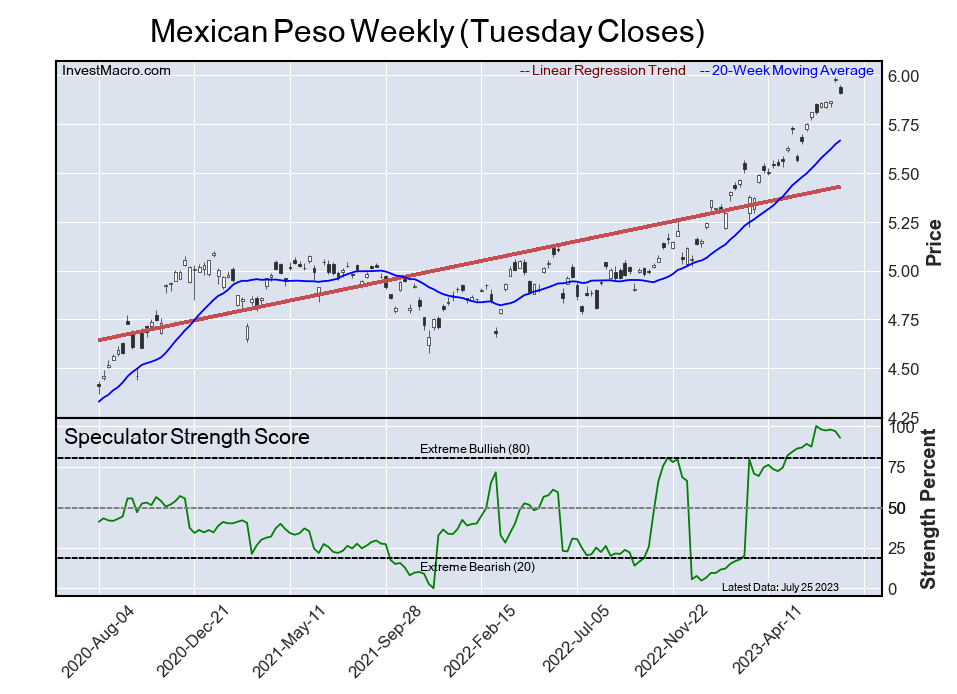
Week Ahead: ECB Forum & Inflation data in focus

By ForexTime

Watch this space because financial markets could end the first half of 2023 with a bang!

Investors will be served another platter of top-tier reports from major economies and key risk events. However, the main focus may be the European Central Bank’s three-day forum in Portugal’s Sintra which kicks off on Monday.

Here is a list of key economic releases and events for the coming week:

Sunday, June 25

  • USD: New York Fed President John Williams speech in Switzerland

Monday, June 26

  • ECB forum in Sintra, Portugal
  • EUR: Germany IFO business climate

Tuesday, June 27

  • The World Economic Forum in China, Tianjin
  • CAD: Canada CPI
  • EUR: ECB President Christine Lagarde speech in Sintra
  • USD: US new home sales, Conference Board consumer confidence

Wednesday, June 28

  • AUD: Australia monthly CPI
  • CNH: China industrial profits
  • Fed annual banking stress test results
  • Panel discussion with ECB, Fed, BoJ & BoE heads in Sintra

Thursday, June 29

  • AUD: Australia retail sales
  • EUR: Eurozone economic and consumer confidence
  • JPY: Japan retail sales
  • USD: GDP QoQ, initial jobless claims, Atlanta Fed President Rafael Bostic speech

Friday, June 30

  • CNH: China manufacturing and non-manufacturing PMI
  • JPY: Tokyo CPI, unemployment, industrial production
  • EUR: Eurozone CPI, unemployment
  • US: US May PCE report, University of Michigan consumer sentiment  

Global sentiment remains shaky as central banks worldwide continue to battle stubborn inflation with high interest rates. In June, the Bank of England raised rates more than expected, the Federal Reserve paused but signalled more rate hikes ahead while the ECB stated that a July hike was ‘very likely’. Ultimately, this has fuelled recession fears as central banks ramp up their ammunition to bring down rising prices.

Investors need fresh clarity over what to expect next amid the uncertainty. This could be offered during Wednesday’s panel discussion featuring ECB’s Christine Lagarde, Fed Chair Jerome Powell, BOJ’s Kazuo Ueda, and BOE’s Andrew Bailey. Given how the chosen words of central bankers continue to influence markets, this mashup of financial heavyweights could trigger volatility across the board.

Markets could see more action thanks to inflation readings from the United States, Euro Area, Japan, and Australia. More signs of sticky inflation could fuel speculation around central banks keeping interest rates higher for longer – ultimately fanning recession fears and hitting risk sentiment.

With all the above discussed, here are 3 FX pairs on our radar:

  • EURUSD rollercoaster ride?

The EURUSD could transform into a fierce battleground for bulls and bears in the week ahead due to comments from top policymakers and inflation data.

Fed Chair Jerome Powell reiterated the need for more rate hikes during his testimony at Congress while ECB Christine Lagarde signalled another rate hike in July at the ECB meeting in mid-July. Should both central bank heads convey a similar message during the ECB forum, this could spark volatility.

On Friday, both the euro-area inflation and the May US PCE report will be published. The preliminary reading for euro-are inflation for June is forecast to fall 5.6% year-on-year from 6.1% in May. Regarding the PCE deflator, it is forecast to rise 3.8% year-on-year from 4.4% in the previous month, while the core PCE deflator is projected to stay unchanged at 4.7%. Signs of sticky inflation could jolt the currency pair as investors weigh the impacts of higher interest rates on economic growth.

Looking at the technical picture, the EURUSD remains under pressure below the 1.0900 level. Sustained weakness below this point could open the doors back towards 1.0760 and lower. If prices push back above 1.0900, prices could test 1.1032 and 1.1090.

  • Further upside for USDJPY?

The widening interest rate differentials between the Federal Reserve and Bank of Japan continue to fuel the USDJPY’s upside gains.

In June, the Bank of Japan maintained its ultra-easy monetary policy despite stronger-than-expected inflation. Investors will be keeping a close eye on comments from Bank of Japan’s Kazuo Ueda during the ECB forum for clues on future monetary policy. Focus will also fall on the latest Tokyo CPI figures released on Friday.

Talking technicals, the USDJPY remains firmly bullish on the daily charts. The recent breakout and daily close above 142.30 may open a path toward 145.50 and 146.70. Should prices slip back below 142.30, bears may target 141.00 and 138.80.

  • What next for AUDUSD?

The past few days have been rough for the Australian dollar thanks to ‘dovish’ minutes from the Reserve Bank of Australia’s (RBA) early June meeting and China growth fears. More weakness could be on the horizon due to a stronger dollar and the overall risk-off sentiment.

Much attention will be directed towards Australia’s latest monthly inflation report published on Wednesday. Consumer prices are forecast to cool 6.1% year-on-year in May compared to the 6.8% witnessed in the prior month. Signs of cooling inflationary pressures may rekindle expectations around the RBA nearing the end of its hiking campaign. As of writing, traders are currently pricing in a 94% probability of a 25-basis point RBA hike by August 2023.

Regarding the technical outlook, the AUDUSD is under pressure on the daily charts. A solid breakdown below 0.6680 may open a path toward 0.6630 and 0.6570, respectively. Should prices push back above 0.6760, this could trigger an incline towards 0.6800 and 0.6880.


Forex-Time-LogoArticle by ForexTime
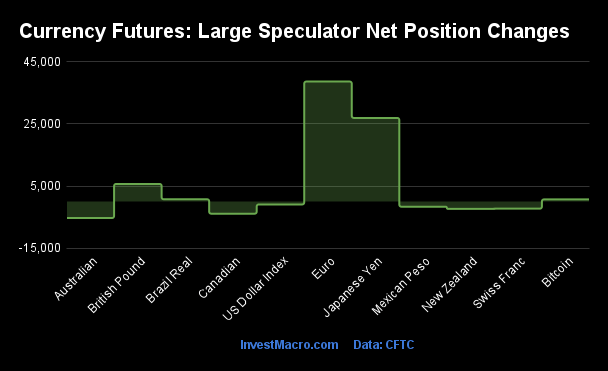
ForexTime Ltd (FXTM) is an award winning international online forex broker regulated by CySEC 185/12 www.forextime.com