Archive for Opinions – Page 76

The Coming BRICS Currency Diversification

By Dan Steinbock

The pressure toward the diversification of world currency reserves is longstanding. It intensified after 2008, but has escalated since 2022. It is a prime topic in the next BRICS Summit that’s likely to further intensify the trend.

In 2016, US Treasury Secretary Jack Lew cautioned that “the more we condition the use of the dollar and our financial system on adherence to US foreign policy, the more the risk of migration to other currencies and other financial systems in the medium-term grows.”

Both the Trump and Biden administrations have ignored Lew’s warning. One consequence has been the Global South’s rising interest in the BRICS, which will have its next, highly-anticipated summit in South Africa in late August.

A key topic in Johannesburg will be the BRICS quest to develop alternative payment systems to US dollar.

Risks of dollar monopoly   

In May – oddly, amid the US banking crisis – economist Paul Krugman attributed the “de-dollarization” brouhaha to crypto-cultists and Putin’s sympathizers, as if the trend was nothing but a misguided anti-patriotic melee.

However, as Krugman noted, much of world trade remains invoiced and settled in U.S. dollars; many banks based outside the United States nonetheless offer dollar-denominated deposits; many non-U.S. corporations borrow in dollars; central banks hold a large share of their reserves in dollar assets; and so on. The assumption was that, a bit like diamond, US dollar is forever. In reality, no dominant reserve currency has had an indefinite life-span.

What Krugman failed to understand is that it is precisely the current coercive monopoly of the US dollar – the world’s disproportionate dependency on US dollar in trade invoicing and settlement, and the dollar reliance by non-US corporate and financial giants, and dollar’s high share in central banks’ reserves – that increasingly worries not just the Global South, but an increasing number of major economies in the West.

When the dollar is weaponized by the US foreign policy in the name of international community but without the broad support of international consensus, it puts trade invoicing and settlement, foreign corporates, financials and central bank reserves at risk.

True, recently US Secretary of Treasury Janet Yellen said there’s still no alternative to the dollar-based monetary system. Then again, not so long ago, she also warned about a catastrophic scenario if Washington failed to agree on a (still another) new debt limit. Similarly, the British, too, touted the blessings of their sterling pound until 1914. But that primacy ended with the overstretch of the UK economy after 1945.

The early 21st century has its unique characteristics, but it won’t be that different.

Advantages of diversification

How is the BRICS contributing to diversification? Thanks to its organizational flexibility, the bloc makes possible unilateral, bilateral and multilateral measures. Analytically, these range from gradual reforms to more unilateral individual measures. These, in turn, are driven by the original BRICS founder economies (Brazil, Russia, India and China), the new aspiring members and the coalition partners who share its vision and are considering membership as well.

Some 22 countries have formally applied to join the group, while an equal number of states “have been informally asking about becoming BRICS members,” according to Anil Sooklal, South Africa’s ambassador-at-large responsible for ties with Asia and the BRICS. Reportedly, countries looking to join the bloc include Argentina, Iran, Saudi Arabia, and the United Arab Emirates.

Indeed, the rising number of populous and large emerging economies make possible the kind of “network effects” and “positive spillovers” that will be critical to launch the new critical infrastructure for the proposed alternative global financial system.

However, what the BRICS offer is not simple de-dollarization. The goal is not to eliminate the dollar, which is typically the depiction by the critics and political adversaries of the BRICS, particularly in the West. At the eve of the Ukraine conflict, Atlantic Council characterized Russia and China as “partners in de-dollarization.” That, in turn, was portrayed as “an alternative to the US-dominated SWIFT” [the currently dominant payment system]. Touted widely in the West, the cooperation of Russia and China is understood as a de jure alliance, and de-dollarization as a ploy for dollar substitution.

The realities are a bit less scandalous and more nuanced. The BRICS have little to do with rogue states seeking covertly to subvert international order. Rather, like asset managers who seek to maintain appropriate diversification in their portfolios, the BRICS’ strategic objective is diversify and recalibrate rather than simple de-dollarization.

From Keynes’s Bancor to the BRICS’ currency diversification

The skeptics say that the dollar has been buried many times before. Why should it die this time? But who says it would have to die. The more, the merrier. Most BRICS economies still rely significantly on the US dollar, whereas those that have been sanctioned by the US and/or its allies have significantly reduced their dollar reserves, often opting for gold instead.

What the major BRIC economies seek for is a more diversified global currency regime. The present path is untenable. If it is not remedied gradually and over time, it will change through a major world crisis, disruptively. The BRICS goal is not to replace the dollar. Rather, it is to diversify the monetary system so that it would better reflect today’s world economy.

In historical view, it’s far from a new idea. John Maynard Keynes made a similar argument for the proposed supra-national currency bancor (the name was inspired by the French banque, “bank gold”) in Bretton Woods in 1944. But the idea was torpedoed by the U.S. negotiators, who wanted to replace the UK pound with the dollar as the world’s major reserve currency. However, Keynes cautioned that the dollar primacy would result in great uncertainty and volatility following the reconstruction and recovery of Western Europe and other major economies.

That’s what ensued in 1971, when President Nixon ended unilaterally the convertibility of the dollar to gold. Though introduced as a temporary measure, it made U.S. dollar a permanently floating fiat money. As gold no longer offered a yardstick for value, the perception of value replaced value itself. The consequent price shock reverberated across the world. With the twin oil crises, it was followed by the quadrupling of oil prices, then runaway inflation and stagflation, and eventually record-high US interest rates and massive rearmament drives.

Rise of complementary institutions

In geopolitics, the U.S. has continued to lean on major Western economies and Japan, but in international economy it refused to renounce the exorbitant privilege. As a net consequence, the dollar monopoly contributed to asset bubbles in the 1980s, early ‘90s, early 2000s and finally in 2008. Amid the Great Recession, China’s central bank governor Zhou Xiaochuan revived the idea and urged major Western economies to “reform the international monetary system.”

Great pledges were made in Brussels, Washington and Tokyo, but nothing much happened. Hence, the efforts at complementary development institutions and critical infrastructure, including the BRICS New Development Bank (NBD), the Asian Infrastructure Investment Bank (AIIB), the Bridge and Road Initiative (BRICS), and the quest for new currency arrangements.

The BRICS do not want to subvert the world order. Rather, they seek to foster one vis-à-vis diversification. Nonetheless, global currency arrangements must not just the interests of Americans who account for 4.1 percent of the world population. It must also reflect the aspirations of the multipolar world economy in which global growth prospects are driven by the large emerging economies.

About the Author:

Dr. Dan Steinbock is an internationally recognized strategist of the multipolar world and the founder of Difference Group. He has served at India, China and America Institute (US), Shanghai Institutes for International Studies (China) and the EU Center (Singapore). For more, see https://www.differencegroup.net/


The original commentary was released by China-US Focus on Aug. 4, 2023. See also Dr Steinbock’s interview by Berliner Zeitung “Wollen die Brics den Dollar ersetzen? Das sagt ein Wirtschaftsexperte dazu” on July 27, 2023. Berliner Zeitung is one of the leading German dailies.

UK interest rates: crashing the economy is no way to bring down inflation

By David Spencer, University of Leeds and Muhammad Ali Nasir, University of Leeds 

The Bank of England (BoE) has raised interest rates once again to 5.25%, mirroring similar moves by the Federal Reserve and the European Central Bank. The fact that the UK is still suffering from high inflation – higher than either the US or eurozone – made another rate rise appear inevitable.

Yet there are reasons to doubt the merits and effectiveness of this approach. The UK’s efforts to bring down inflation quickly could be risking the health of the economy.

It is important to understand how monetary policy “works”. In effect, the BoE is seeking to make households in particular poorer so they spend less. The idea is you dampen down demand to bring it into line with supply, so that upward pressure on prices can be curbed.

The other effect of raising rates is to reduce the wage demands of workers by creating unemployment. This is not the publicly stated goal, but it lies behind the rhetoric of wage restraint that the BoE continually espouses – despite nominal wage growth only recently matching inflation.

The current approach to monetary policy accepts a recession as a price worth paying, while implying a belief that higher unemployment leads to lower inflation. This can be disputed on economic grounds – in the UK in the recent past, low inflation was achieved with low unemployment, so the idea that there is a necessary trade-off between inflation and unemployment can be refuted historically.

There are also moral objections to current monetary policy. It can be argued that the BoE should have a responsibility to protect living standards, not harm them. Its mandate of achieving a 2% inflation target should not be at any cost. Creating unemployment will impose misery on many workers and have scarring effects on the economy, from lost skills to reduced industrial capacity, which may be difficult to heal.

The economic reality

The current inflation is also not a classic case of “too much money chasing too few goods”. There are pressures from higher food and energy prices linked to factors like Brexit and the Ukraine war that cannot be controlled by raising interest rates.

There are also structural problems in the UK, such as labour shortages due to increases in economic inactivity – the result of more over-50s leaving the workforce and rises in ill health. These problems are seen to have put upward pressure on wages, and require responses beyond raising interest rates if they are to be fully addressed.

For example, they require new investment in the health sector to help alleviate hospital waiting lists. A better-funded NHS would create a healthier workforce, overcoming current limits on labour supply due to poor health that are seen to be creating inflationary pressures.

In any case, inflation is set to come down – the BoE’s own forecasts show this. Monetary tightening at this stage is therefore short-sighted and probably counterproductive – especially when the BoE thinks deflation is distinctly possible in the next couple of years. A more cautious approach to monetary policy seems in order.

Other countries have followed different policies with different effects. Spain, for instance, has used mechanisms such as price controls on things like rents and energy to help curb inflation (the UK did also cap energy bills, though not as aggressively). This has helped to reduce inflation while keeping employment high. It shows that crashing the economy is not the only route to low inflation.

In short, the BoE is simply compounding problems rather than solving them through its actions. It is time it learnt the limits of its own policies, while the government needs to play a role too.

In the short term, attention should be given to controlling prices (including energy) and making businesses show restraint in their pricing behaviour. Longer term, greater investment in skills, health and productive capacity is needed to create an economy that allows for rising real living standards with full employment.The Conversation

About the Author:

David Spencer, Professor of Economics and Political Economy, University of Leeds and Muhammad Ali Nasir, Associate Professor in Economics, University of Leeds

This article is republished from The Conversation under a Creative Commons license. Read the original article.

China deflation risks could hit investors worldwide

By George Prior

As China grapples with a serious deflation threat, investors worldwide must prepare for the fallout and adjust their strategies accordingly, warns the CEO of one of the world’s largest independent financial advisory, asset management and fintech organizations.

The warning from deVere Group’s Nigel Green comes as China reports July inflation on Wednesday, with markets looking for further signs of deflation.

The government has been actively playing down fears about deflation, with officials from the People’s Bank of China and National Bureau of Statistics, among other agencies, repeatedly saying there is no basis for long-term price declines.

Talking about the threat publicly is also off the agenda for many China-based analysts and economists, according to media reports.

Nigel Green comments: “China’s economic trajectory has been a focal point of global attention for decades, with its staggering growth and transformation capturing the world’s imagination.

“But the recent emergence of serious deflationary pressures in the world’s second-largest economy is triggering concerns that extend well beyond its borders.

“This economic phenomenon has the potential to set off a chain reaction of global repercussions that could reshape financial markets, trade dynamics and even international relations.”

Deflation – a persistent decline in prices of goods and services – can be as detrimental as rampant inflation, “if not more so”, states the deVere CEO.

In China’s case, the underlying factors driving deflation are complex and interconnected; rooted in weak consumer demand, declining exports and a highly subdued – but critical – property sector.

“China is a critical trade partner for many nations. As its exports become cheaper due to deflation, other economies might face increased competition, forcing them to lower their own prices or risk losing market share,” explains Green.

“Also, reduced demand for raw materials and commodities due to its economic slowdown is likely to lead to a decrease in global commodity prices. Those countries heavily reliant on commodity exports would then experience economic hardships as their revenues decline.

“The deflationary environment can put pressure on central banks to implement aggressive monetary policies, such as lowering interest rates or engaging in quantitative easing. This could distort global financial markets, affecting asset prices and investment strategies.”

This scenario is “worsened by the lack of transparency” as some leading academics, analysts and economists are reportedly being censored by Beijing, which is fearful of creating a doom cycle with negative news.

The interconnected nature of the global economy means that China’s deflation doesn’t remain confined within its borders.

As such, investors around the world should adopt strategies that “promote diversification, consider more defensive investments, and remain adaptable to changing economic conditions,” suggest the deVere boss.

“By staying informed and understanding the nuances of China’s deflation, investors can better position themselves to mitigate risks to their long-term wealth and capitalise on the significant opportunities that we expect to emerge amid the turmoil.”

About:

deVere Group is one of the world’s largest independent advisors of specialist global financial solutions to international, local mass affluent, and high-net-worth clients.  It has a network of offices across the world, over 80,000 clients and $12bn under advisement.

Trade of the Week: USDCHF to see 55% more volatility?

By ForexTime 

Here are some Swiss Franc facts that may surprise you:

  1. CHF is best-performing G10 currency vs. USD so far this year
  2. SNB uses Swiss Franc to help achieve inflation target
  3. Swiss Franc is a safe haven currency
  4. USDCHF sees 55% larger-than-average moves on US CPI days so far in 2023
  5. Blomberg FX model: USDCHF to trade within 0.8645 – 0.8865 this week


1) CHF is the best-performing G10 currency so far in 2023

USDCHF has a year-to-date decline of more than 5% at the time of writing (stronger CHF + weaker USD = lower USDCHF).

The Swiss Franc (CHF) has overtaken the British Pound for the current title, after battling it out for most of July, with the former also boasting of an advance against all of its G10 peers for the year-to-date period:


2) The Swiss National Bank (SNB) has been allowing CHF to strengthen

This central bank uses the CHF exchange rate as a major tool for controlling inflation.

A stronger CHF means cheaper imports, and also more receipts from its exports, hence Switzerland’s consistent trade surplus.

Fun fact: Switzerland’s watch exports have grown by double-digits year-on-year (>10%) in 4 out of the first six months of 2023.

After over a decade of limiting the Swiss Franc’s strength, the SNB finally signalled in November 2022 that it’s ready to sell foreign currencies and let the CHF strengthen.

NOTE: The SNB exchanges foreign currencies back into Swiss Francs, which in turn drives up the value of the latter.

Furthermore, the SNB has maintained its willingness to keep hiking rates.

Such hawkish rhetoric comes despite inflation already falling within the central bank’s 0% – 2% CPI target range (Switzerland’s July CPI = 1.6%).

However, the SNB appears concerned that inflation may make a comeback later this year, hence expectations for another rate hike.

At the time of writing, overnight index swaps are pointing to a 60% chance that the SNB could hike by a further 25-basis points before 2023 ends.

NOTE: SNB only makes a rate decision once every quarter. Its next rate decision is due on September 21st.

Recall that, a currency tends to strengthen as markets continue to expect interest rates in that country to climb higher.

Hence, such expectations have aided the Swiss Franc to reach its strongest level against the US dollar in about 8 years.

Back in mid-July 2023, USDCHF dipped below 0.8600 for the first time since the SNB lifted the Swiss Franc’s cap against the euro back in 2015 which saw CHF skyrocketing (and USDCHF plummeting).


3) Swiss Franc is a safe haven currency

A safe haven is an asset that investors buy up with hopes of preserving their wealth in times of heightened fear and great uncertainty.

Consider how the Swiss Franc gained by 2.86% versus the US dollar for the month of March 2023, amid the banking turmoil in the United States as well as Switzerland.

Currently, with markets fearing a recession, that has also helped drive up the value of the safe haven Swiss Franc.


4) USDCHF sees 55% bigger one-day move on day of US inflation data release

So far in 2023, USDCHF tends to move by about 56 pips (between its highest to its lowest intraday price) on average within a single trading day.

However, that average intraday move soars up to 87 pips on the days that the US consumer price index (CPI) is released.

That’s a 55% increase in volatility!

Hence, brace for heightened volatility when the US CPI due is released this Thursday, August 10th! ​​


Currently, economists are forecasting the following numbers for the upcoming US CPI report:

  • CPI month-on-month (July 2023 vs. June 2023) = 0.2%
  • Core CPI (excluding more volatile food and energy prices) month-on-month = 0.2%
  • CPI year-on-year (July 2023 vs. July 2022) = 3.3% (a slight uptick from June’s 3% year-on-year increase)
  • Core CPI year-on-year = 4.8% (matching June’s core CPI y/y number of 4.8%)


Potential scenarios:

  • A set of CPI numbers that show US inflation is moderating further, which in turn allows the Fed to back away from a September rate hike, may drag USDCHF lower on the weaker US follar.
  • Higher-than-expected CPI readings, which stoke fears of a resurgence in inflation that forces the Fed into yet another rate hike next month, may translate into a stronger US dollar and a higher USDCHF.


BONUS FACTS:

  • At the lower-than-expected US CPI release on July 12th, USDCHF registered an intraday move of 139 pips!
  • That was its biggest one-day DROP in % terms so far in 2023, and also its 3rd largest single-day move (both up and down) in percentage terms of the year so far.

In other words, if recent history is to be a guide, brace for a volatile USDCHF on US CPI release day.


5) USDCHF likeliest to trade within 0.8645 – 0.8865 this week.

According to Bloomberg’s FX model, there’s a 72% chance that USDCHF trades within the above-mentioned range over the next one-week period.

Here are some further key levels of interest for the immediate term:


POTENTIAL SUPPORT:

  • 21-day simple moving average
  • 0.864 – 0.866 region = lower bound of Bloomberg FX model forecast / area for choppy July price action
  • 0.8600 = psychologically-important level


POTENTIAL RESISTANCE:

  • 0.8800 = psychologically-important number
  • 0.8820 = early-May low
  • 0.886 region = upper limit of Bloomberg FX model forecast / 50-day simple moving average / upper bound of USDCHF downtrend since November 2022
  • 0.89014 = June 2023 low

Forex-Time-LogoArticle by ForexTime

ForexTime Ltd (FXTM) is an award winning international online forex broker regulated by CySEC 185/12 www.forextime.com

Week Ahead: US CPI Data To Shape Gold Outlook

By ForexTime 

As the countdown draws closer to the key US jobs report later today (Friday, August 4), investors may already be keeping a close eye on what’s to come in the week ahead.

All eyes will be on the incoming US inflation data, speeches from some Fed officials as well as earnings announcements that could spark volatility across the board.

Monday, August 7

  • CNH: China forex reserves
  • EUR: Germany industrial production
  • USD: Atlanta Fed President Raphael Bostic, Fed Governor Michelle Bowman speech

Tuesday, August 8

  • AUD: Australia Westpac consumer confidence, NAB business confidence
  • CNH: China trade
  • EUR: Germany CPI
  • USD: Philadelphia Fed President Patrick Harker speech, US trade

Wednesday, August 9

  • CNH: China CPI, PPI, money supply, new yuan loans
  • SPX500_m: Walt Disney earnings

Thursday, August 10

  • JPY: Japan PPI
  • USD: July CPI, initial jobless claims, Atlanta Fed President Raphael Bostic speech

Friday, August 11

  • GBP: UK industrial production, GDP
  • USD: US University of Michigan consumer sentiment, PPI

The July US Consumer price index (CPI) report published on Thursday, August 10 will most likely act as a key piece of information that determines whether the Fed raises rates one final time in 2023 or not.

When factoring in the Federal Reserve’s shift to data dependence, markets are likely to show increased sensitivity to US economic releases moving forward, including the pending NFP release this afternoon.

Market expectations for US July CPI:

  • CPI year-on-year (July 2023 vs. July 2022) to rise 3.3% from 3.0% in the prior month.
  • Core CPI year-on-year to remain unchanged at 4.8% from 4.8% seen in June.
  • CPI month-on-month (July 2023 vs June 2023) to remain unchanged at 0.2% from 0.2% in the prior month.
  • Core CPI month-on-month to remain unchanged at 0.2% from 0.2% seen in June.

There has certainly been proof of inflationary pressures cooling the US economy with annual inflation slowing to 3% back in June – the lowest since March 2021. Despite CPI forecasted to rise in July, the core inflation print is expected to remain unchanged which could support optimism around the Fed being one step closer to taming the inflation beast. Should July’s CPI report print cooler than expected, this could support the argument around the Fed being finished with rate hikes this year.

How might the US CPI data impact gold?

Gold prices could see heightened volatility due to the incoming US inflation report.

After gaining 2.4% in June, the precious metal has already kicked off the new month on a negative note, shedding 1.6% month-to-date (as of writing). The pending US NFP report in a few hours will most likely impact the precious metal’s outlook ahead of the US inflation print. Given gold’s zero-yielding nature and an inverse relationship with the dollar, it may be set for a wild ride in the week ahead.

  • Gold prices could shine if the inflation numbers print below market forecast, as signs of slowing inflation strengthen the argument around the Fed being done with hikes in 2023.
  • Should the inflation figures exceed market forecasts, gold prices are likely to tumble as speculation rises around the Fed hiking rates one more time this year.

 Technical outlook: Bears in control?

Gold prices are under pressure on the daily charts with prices trading below the 50 and 100, day SMA. The recent breakdown below the $1940 support could signal further downside towards $1900 and $1871, respectively. Should prices push back above $1955, this could open a path towards $1985 and $2000.


Forex-Time-LogoArticle by ForexTime

ForexTime Ltd (FXTM) is an award winning international online forex broker regulated by CySEC 185/12 www.forextime.com

To fight financial illiteracy, we mapped our money system as waterworks

By Martijn Jeroen van der Linden, Hague University of Applied Sciences 

Over the past decade, the super-rich and large corporations have been able to borrow at record low interest rates. This influx of easy money has shored up markets for yacht-backed-loans and securities, dividends, share buy-backs, and merger and acquisition deals.

Meanwhile, those not deemed “creditworthy” find themselves barred from credit, the powerless witnesses of ever surging rents and living costs. Time and again, the financial sector has flooded certain parts of the economy while other parts remained parched. The question is: Why is it so hard to fix the money system?

Two parts of financial literacy

Lack of financial literacy among most citizens is at least one of the causes – though there are competing definitions of the latter. On 7 June, the European Commission (EC) lamented that “levels of financial literacy in the EU are too low”, posing a threat to “personal and financial well-being, households and society more broadly.”

However, here the institution takes a rather narrow view of financial education, limited to personal finance – i.e., teaching people how to manage budgets, achieve saving goals, and understand different financial products. Earlier in March, Sigrid Kaag, the Dutch Minister of Finance, echoed a similarly minimalist view of financial literacy: “By practising how to save, plan and make choices from a young age onwards, children learn how to make sound financial decisions.”

The other view of financial literacy, which we support, entails a far more ambitious understanding of the money system. We call it systemic financial literacy. “In the age of the CDS and CDO, most of us are financial illiterates”, wrote US financial journalist Matt Taibbi in 2009, referring to the complex financial products that triggered the Great Recession. Fast forward fourteen years later, and most of us remain unfamiliar with the jargon of economists, bankers and tax experts. As in 2009, today’s democracies continue to be divided into what Taibbi describes as a “two-tiered state, one with plugged-in financial bureaucrats above and clueless customers below.”

With this in mind, we believe any project seeking to boost financial literacy ought to educate us on the roles of a central bank, but also payment infrastructure, the tax regime, and the investment of our pension savings. A number of questions ought to be raised, too, to this end: What do we consider public utilities? Which financial services can better be assigned to private companies? Who gets the power to create and allocate new money – and for what purposes? To answer these big questions requires not only a deeper understanding of the structures of finance, but continuous political engagement.

The waterworks

Together with cartographer Carlijn Kingma and investigative financial journalist Thomas Bollen, we sought to create a project that would inspire such questions and demystify the world of finance. For two and half years, we developed the “waterworks of money”, an architectural visualisation of our money system that bypasses the economic jargon.

Kingma spent 2,300 hours drawing this map by hand, based on in-depth research and interviews with more than 100 experts – from central bank governors and board members of pension funds and banks to politicians and monetary activists. In an animated video, we walk you through a metaphorical representation of our money system, its hidden power made manifest.

What do we water?

The metaphor of water was critical to the design of our map. Indeed, the financial sector is to the economy what an irrigation system is for farming lands. Just as irrigation helps crops grow, money allows the economy to flourish.

The architecture of our financial irrigation system and the way the sluices and floodgates are operated impacts us all. “What do we water, and what goes dry?” Kaag asked economists, bankers and reporters in June 2022. “Choices made by the financial sector determine what grows and what dies off. That’s where banks, pension funds, asset managers, and insurance firms can make a difference,” she said.

‘The Waterworks of Money’, an architectural map of the money system drawn by cartographer Carlijn Kingma.
Fourni par l’auteur

In our map, the long and complex process of financial irrigation starts at the top of the so-called tower of society, where big money keeps their reservoirs. The world’s largest companies, including big oil, big pharma and big retail, are lodged there. Open the floodgates and money flows downstream, setting the wheels of industry in motion. Salaries make their way through the waterworks, and trickle down into employee piggy banks. In return, everyone goes to work.

Money eventually seeps down into the lowest ranks of society, where the conveyor belt is always running, products are assembled and raw materials, mined. People then spend the wages they’ve earned, often in shops and businesses. Sale revenues get pumped up to the reservoir at the top, and the cycle starts all over again. Or at least, that is the idea.

In reality, trickle-down economics popularised by US president Ronald Reagan and UK prime minister Margaret Thatcher, does not take place. Money circulates mainly between the top of the tower and the financial sector. Moreover, the huge growth of the financial sector over the last decades has dug the gap between the haves and have-nots deeper. The growing quantity of money is driving up share prices, house prices and management fees, but most of the money does not reach the everyday economy in the tower of society – where it can be used for productive investments, generates income and add social value.

The structure of our money system is not a natural phenomenon. The way the waterworks are put together is a political choice. In democracies, higher levels of systemic financial literacy are a prerequisite to change this architecture and make the financial sector serve society better.


This article was co-written with investigative financial journalist Thomas Bollen and cartographer Carlijn Kingma.The Conversation

Martijn Jeroen van der Linden, Professor of Practice in New Finance, Hague University of Applied Sciences

This article is republished from The Conversation under a Creative Commons license. Read the original article.

Rate hikes may have slowed inflation in the US – but they have also heightened the risk of financial crises for lower-income nations

By Cristina Bodea, Michigan State University 

The campaign to fight U.S. inflation by upping interest rates has been going on for a year and a half – and its impacts are being felt around the world.

On July 26, 2023, the Federal Reserve announced another quarter-point hike. That means U.S. rates have now gone up 5.25 percentage points over the past 18 months. While inflation is now coming down in the U.S., the aggressive monetary policy may also be having significant longer-term impact on countries across the world, especially in developing countries. And that isn’t good.

I study how economic phenomena such as banking crises, periods of high inflation and soaring rates affect countries around the world and believe this prolonged period of higher U.S. interest rates has increased the risk of economic and social instability, especially in lower-income nations.

Ripples around the world

Monetary policy decisions in the U.S., such as raising interest rates, have a ripple effect in low-income countries – not least because of the central role of the dollar in the global economy. Many emerging economies rely on the dollar for trade, and most borrow in the U.S. dollar – all at rates influenced by the Federal Reserve. And when U.S. interest rates go up, many countries – and especially developing ones – tend to follow suit.

This is largely out of concern for currency depreciation. Raising U.S. interest rates has the effect of making American government and corporate bonds look more attractive to investors. The result is footloose foreign capital flows out of emerging markets that are deemed riskier. This pushes down the currencies of those nations and prompts governments in lower-income nations to scramble to mirror U.S. Federal Reserve policy. The problem is, many of these countries already have high interest rates, and further hikes limit how much governments can lend to expand their own economies – heightening the risk of recession.

Then there is the impact that raising rates in the U.S. has had on countries with large debts. When rates were lower, a lot of lower-income nations took on high levels of international debt to offset the financial impact of the COVID-19 pandemic and then later the effect of higher prices caused by war in Ukraine. But the rising cost of borrowing makes it more difficult for governments to cover repayments that are coming due now. This condition, called “debt distress,” is affecting an increasing number of countries. Writing in May 2023, when he was still president of the World Bank, David Malpass estimated that some 60% of lower-income countries are in or high risk of entering debt distress.

More broadly, any attempt to slow down growth to lower inflation in the U.S. – which is the intended aim of raising interest rates – will have a knock-on effect on the economies of smaller nations. As borrowing costs in the U.S. increase, businesses and consumers will find themselves with less cheap money for all goods – domestic or international. Meanwhile, any fears that the Fed has pulled on the brakes too quickly and is risking recession will suppress consumer spending further.

The risk of spillover

This isn’t just theory – history has shown that in practice it is true.

When then-Fed Chair Paul Volcker fought domestic inflation in the late 1970s and early 1980s, he did so with aggressive interest rate hikes that pushed up the cost of borrowing around the world. It contributed to debt crises for 16 Latin American countries and led to what became known in the region as the “lost decade” – a period of economic stagnation and soaring poverty.

The current rate increases are not of the same order as those of the early 1980s, when rates rose to nearly 20%. But rates are high enough to prompt fears among economists. The World Bank’s most recent Global Economic Prospects report included a whole section on the spillover from U.S. interest rates to developing nations. It noted: “The rapid rise in interest rates in the United States poses a significant challenge to [emerging markets and developing economies],” adding that the result was “higher likelihood” of financial crises among vulnerable economies.

Widening the wealth gap

Research I conducted with others suggests that the kind of financial crises hinted at by the World Bank – currency depreciation and debt distress – can rip the social fabric of developing countries by increasing poverty and income inequality.

Income inequality is at an all-time high – both within individual countries and between the richer and developing countries. The 2022 World Inequality Report notes that, currently, the richest 10% of individuals globally take home 52% of all global income, while the poorest half of the global population receives a mere 8.5%. And such a wealth gap is deeply corrosive for societies: Inequality of income and wealth has been shown to both harm democracy and reduce popular support for democratic institutions. It has also been linked to political violence and corruption.

Financial crises – such as the kind that higher interest rates in the U.S. may spark – increase the chance of economic slowdowns or even recessions. Worryingly, the World Bank has warned that developing nations face a “multi-year period of slow growth” that will only increase rates of poverty. And history has shown that the impact of such economic conditions fall hardest on lower-skilled low-income people.

These effects are compounded by government policies, such as cuts in spending and government services, which, again, disproportionately hit the less well-off. And if a country is struggling to pay back sovereign debt as a result of higher global interest rates, then it also has less cash to help its poorest citizens.

So in a very real sense, a period of higher interest rates in the U.S. can have a detrimental effect on the economic, political and social well-being of developing nations.

There is a caveat, however. With inflation in the U.S. slowing, further interest rate increases may be limited. It could be the case that regardless of whether Fed policy has threaded the needle of slowing the U.S. economy but not by too much, it has nonetheless sown the seeds of more potentially severe economic – and social – woes in poorer nations.The Conversation

About the Author:

Cristina Bodea, Professor of Political Science, Michigan State University

This article is republished from The Conversation under a Creative Commons license. Read the original article.


New US credit rating downgrade further fuels fears of long-term dollar decline

By George Prior 

The surprise US credit rating downgrade will trigger short-term volatility for the dollar – but more importantly, will speed-up the long-term decline of the US and global reserve currency, warns the CEO of one of the world’s largest independent financial advisory and asset management companies.

The warning from Nigel Green of deVere Group comes as rating agency Fitch downgraded the US government’s top credit rating on Tuesday to AA+ from AAA.

Fitch cited fiscal deterioration over the next three years and repeated down-the-wire debt ceiling negotiations that puts at risk the government’s ability to pay its bills.

The deVere CEO says: “Many US analysts are predicting that this surprise downgrade of the world’s largest economy’s credit rating will only trigger short term volatility for the dollar – and the US and global reserve currency wobbled on the news, as should have been expected.

“However, as this is the second major rating agency (after Standard & Poor’s) to strip the US of its triple-A rating, there are serious, legitimate questions to be asked about the long-term trajectory of the dollar.”

He continues: “No one can predict the future, but history unequivocally teaches us that nothing lasts forever. Global reserve currencies have come and gone before.  It will happen again.

“Indeed, I believe that we are witnessing in real-time the world beginning to shift away from a dollar-dominated financial system.

“Among other reasons, this is because astronomic levels of debt, and the enormous amount of desperate money printing to monetise these debts, have caused the considerable drop in the long-term value of the currency.”

Earlier this year, Nigel Green was one of the first voices to flag the threat to the US dollar’s dominance as Russia and Saudi Arabia eye the Chinese yuan for oil trades.

He said one of the most significant, but under-reported, outcomes of a three-day summit between Russia’s Vladimir Putin and China’s Xi Jinping was that Putin said Russia is now in favour of using the Chinese yuan for oil settlements.

Separately, two deals, announced a week earlier, will see Saudi Arabia’s Aramco supplying two Chinese companies with a combined 690,000 barrels a day of crude oil, bolstering its rank as China’s top provider of the commodity. It was reported that Saudi Arabia was also in talks with Beijing to settle with the yuan instead of the dollar.

“It appears US rivals, led by China, are forming a new major economic bloc. If Saudi Arabia – home to massive oil reserves, which are estimated to be the largest in the world – does move to the yuan, that would lead to an enormous shift in the global economic system.

“Oil is one of the most important and widely traded commodities in the world, and it has traditionally been priced and traded in US dollars. This has given the US dollar a dominant role in global financial markets, as countries that want to purchase oil must first acquire US dollars in order to do so.

“If oil trading were to shift away from the US dollar, it would dramatically reduce the demand for US dollars, which would lead to a decrease in the value of the US currency.”

This could have a number of ripple effects throughout the global economy, including hugely increased inflation in the United States and potentially destabilising effects on financial markets.

Investors should begin to consider hedging against a declining dollar. Diversification across different currencies, investing in non-US assets, using derivatives, and investing in commodities and real estate are all considered effective ways to hedge against potential USD volatility.

The deVere CEO concludes: “While the latest report from Fitch will have a minimal impact, two major credit downgrades, industrial-scale money printing to monetise astronomic debts, and rivals like China and their allies looking to take the financial crown from the US, can be expected to speed-up the long-term decline of the dollar.”

About:

deVere Group is one of the world’s largest independent advisors of specialist global financial solutions to international, local mass affluent, and high-net-worth clients.  It has a network of more than 70 offices across the world, over 80,000 clients and $12bn under advisement.

US Dollar Speculators reduce their bullish bets to 2-Year low

By InvestMacro

Here are the latest charts and statistics for the Commitment of Traders (COT) data published by the Commodities Futures Trading Commission (CFTC).

The latest COT data is updated through Tuesday July 25th and shows a quick view of how large market participants (for-profit speculators and commercial traders) were positioned in the futures markets. All currency positions are in direct relation to the US dollar where, for example, a bet for the euro is a bet that the euro will rise versus the dollar while a bet against the euro will be a bet that the euro will decline versus the dollar.

Weekly Speculator Changes led by Japanese Yen & Canadian Dollar

The COT currency market speculator bets were lower this week as five out of the eleven currency markets we cover had higher positioning while the other six markets had lower speculator contracts.

Leading the gains for the currency markets was the Japanese Yen (12,487 contracts) with the Canadian Dollar (5,009 contracts), New Zealand Dollar (2,677 contracts), Swiss Franc (1,780 contracts) and Bitcoin (516 contracts) also showing positive weeks.

The currencies seeing declines in speculator bets on the week were the Mexican Peso (-6,651 contracts) with the US Dollar Index (-5,013 contracts), the British Pound (-4,734 contracts), EuroFX (-1,602 contracts), the Brazilian Real (-1,962 contracts) and the Australian Dollar (-800 contracts)also registering lower bets on the week.

US Dollar Index Bullish Bets fall to 2-Year Low

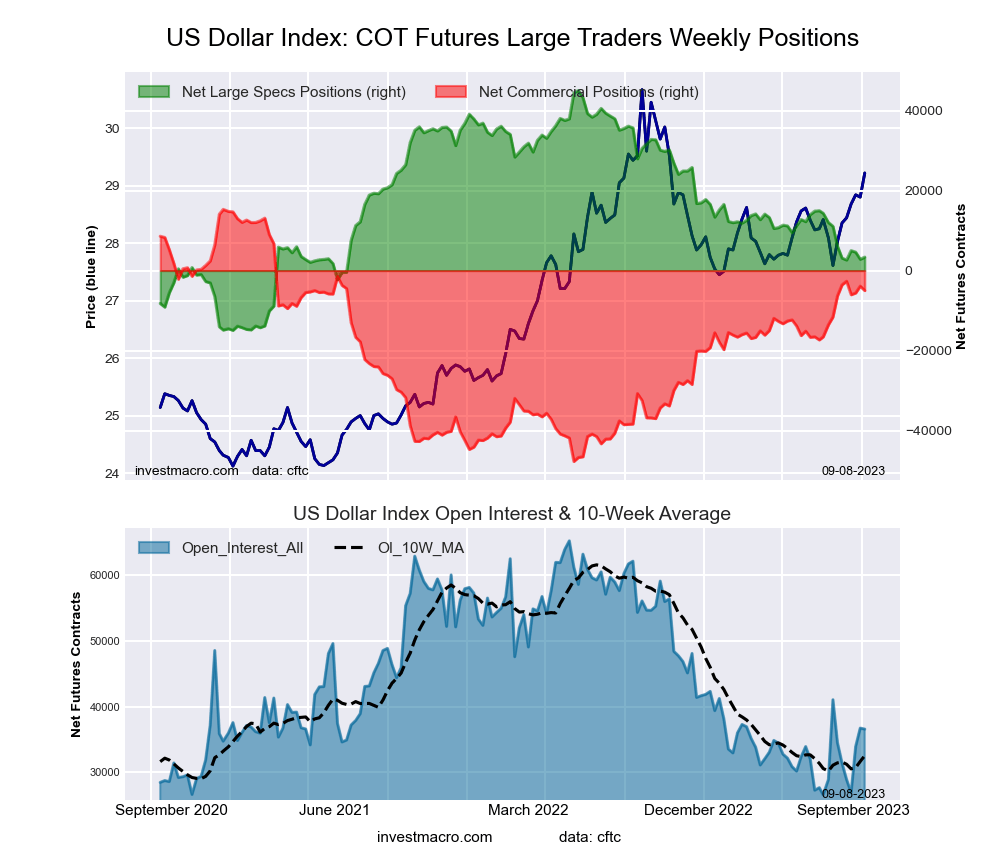
Highlighting the COT currency’s data this week is the decline of the speculator’s positioning in the US Dollar Index. The large speculative US Dollar Index positions decreased for a fourth consecutive week this week and the speculators have now subtracted a total of -8,914 net contracts from the overall position in just the last four weeks.

This week’s reduction by -5,013 contracts marked the largest one-week shortfall since December 20th of 2022 (which recorded a decline by -9,021 contracts). This bearishness has dropped the US Dollar Index speculator net position (currently at +6,054 contracts) to its lowest level of the past 108 weeks, dating back to June 29th of 2021.

Overall, the US Dollar speculator position has been weakening since hitting a cycle high on June 21st of 2022 with a total of +45,010 contracts. Since then, the steady and slow erosion of bullish bets has brought the net position to under the +10,000 contract level for just the second time in the past two years. This latest data is through Tuesday and before the US Federal Reserve’s latest rate increase by 25 basis points that took place on Wednesday. Speculators and market watchers are eyeing the end of the Fed’s interest rate hiking campaign as inflation has been falling across most measures in the US economy.

The US Dollar Index futures price closed higher this week for a second straight week and ended the week right around the 101.40 level. The USD Index had ascended to a multi-decade high of 114.74 in September 2022 and has been on the downtrend since with a current decline (from top to latest price) of approximately 12 percent. The USD Index price fell to a 14-month low on July 18th at 99.22 before staging a comeback over the past two weeks and making it back over the 100 level.


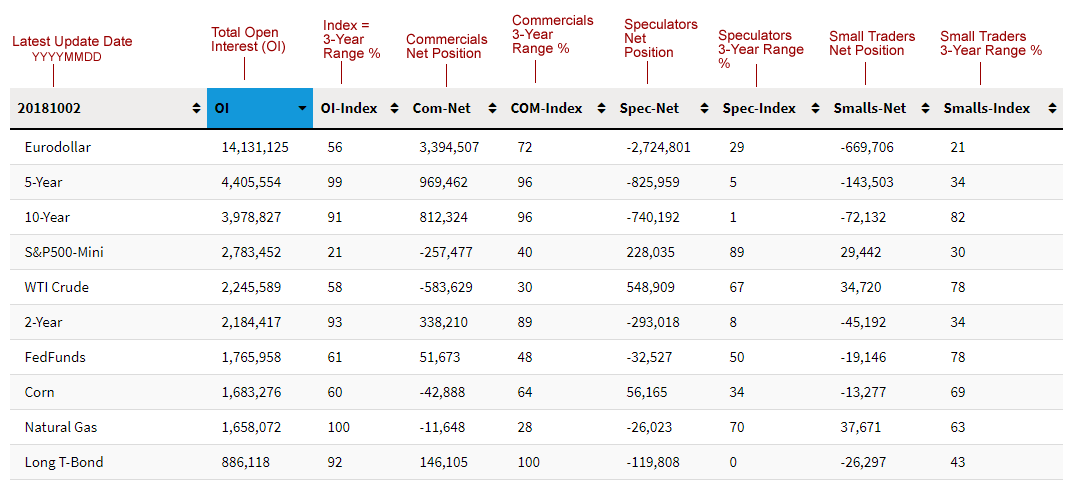
Data Snapshot of Forex Market Traders | Columns Legend
Jul-25-2023OIOI-IndexSpec-NetSpec-IndexCom-NetCOM-IndexSmalls-NetSmalls-Index
USD Index34,514206,05435-6,3396628520
EUR772,40875177,23087-234,2691157,03970
GBP237,3406058,99597-76,984317,98993
JPY223,76057-77,7522486,55578-8,80336
CHF44,18050-8,431323,421515,01074
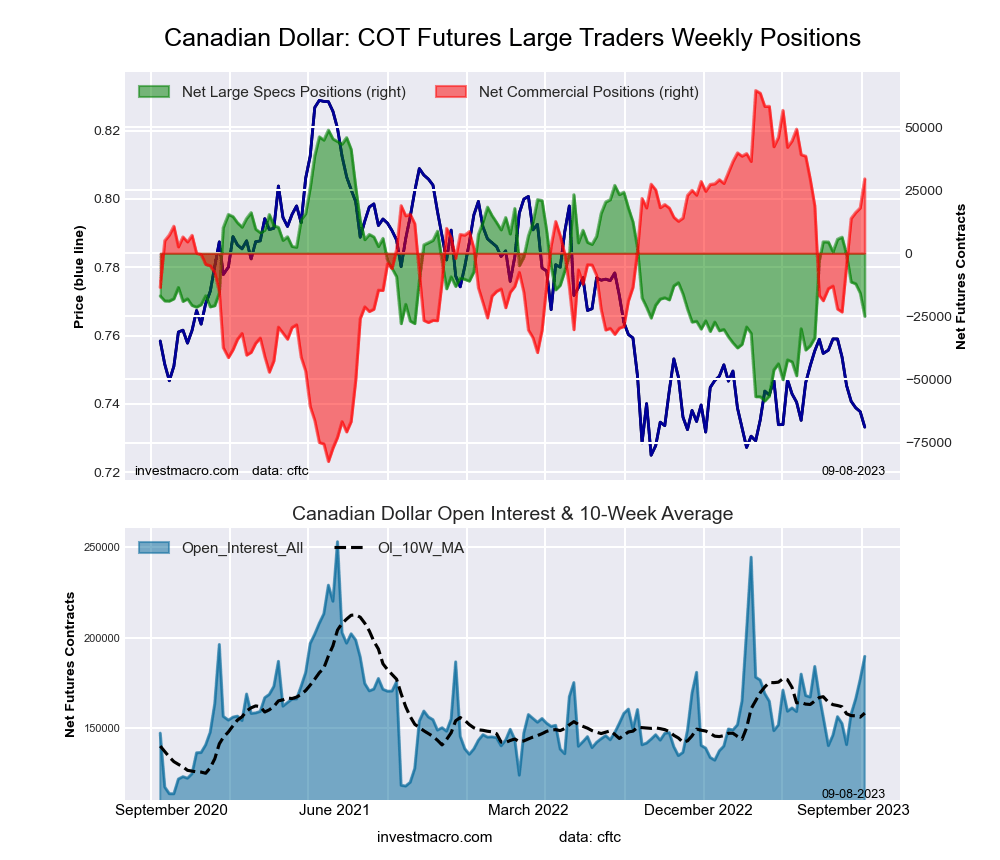
CAD156,395315,53060-22,0964116,56660
AUD146,42328-51,2013749,561561,64056
NZD36,82025-94951324791761
MXN233,5494987,84193-92,05874,21738
RUB20,93047,54331-7,15069-39324
BRL53,4434431,97176-31,95725-1444
Bitcoin16,01777-64566-178082332


Strength Scores led by British Pound & Mexican Peso

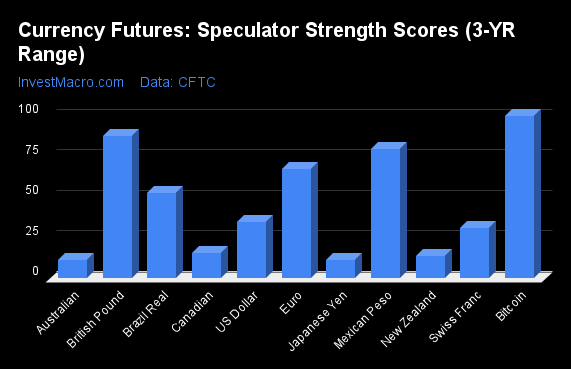
COT Strength Scores (a normalized measure of Speculator positions over a 3-Year range, from 0 to 100 where above 80 is Extreme-Bullish and below 20 is Extreme-Bearish) showed that the British Pound (97 percent) and the Mexican Peso (93 percent) lead the currency markets this week. The EuroFX (87 percent), Brazilian Real (76 percent) and the Bitcoin (66 percent) come in as the next highest in the weekly strength scores.

On the downside, the Japanese Yen (24 percent) and the Swiss Franc (32 percent) come in at the lowest strength levels currently. The next lowest strength scores are the US Dollar Index (35 percent) and the Australian Dollar (37 percent).

Strength Statistics:
US Dollar Index (35.0 percent) vs US Dollar Index previous week (43.4 percent)
EuroFX (86.7 percent) vs EuroFX previous week (87.3 percent)
British Pound Sterling (96.7 percent) vs British Pound Sterling previous week (100.0 percent)
Japanese Yen (23.8 percent) vs Japanese Yen previous week (16.4 percent)
Swiss Franc (32.3 percent) vs Swiss Franc previous week (27.6 percent)
Canadian Dollar (59.7 percent) vs Canadian Dollar previous week (55.0 percent)
Australian Dollar (37.4 percent) vs Australian Dollar previous week (38.1 percent)
New Zealand Dollar (51.0 percent) vs New Zealand Dollar previous week (43.8 percent)
Mexican Peso (92.8 percent) vs Mexican Peso previous week (96.8 percent)
Brazilian Real (76.4 percent) vs Brazilian Real previous week (78.9 percent)
Bitcoin (65.7 percent) vs Bitcoin previous week (56.7 percent)


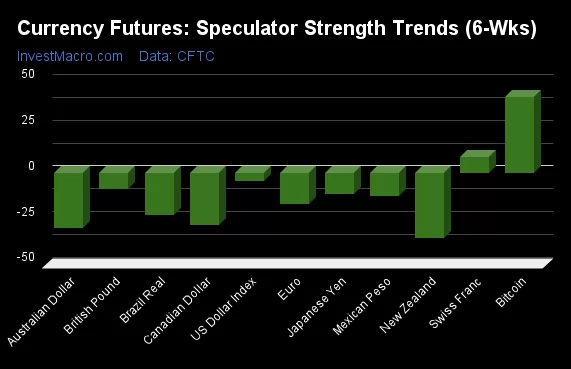
Canadian Dollar & British Pound top the 6-Week Strength Trends

COT Strength Score Trends (or move index, calculates the 6-week changes in strength scores) showed that the Canadian Dollar (39 percent) and the British Pound (36 percent) lead the past six weeks trends for the currencies. The Japanese Yen (16 percent), the EuroFX (10 percent) and the Australian Dollar (10 percent) are the next highest positive movers in the latest trends data.

The Bitcoin (-24 percent) leads the downside trend scores currently with the US Dollar Index (-13 percent), Swiss Franc (-9 percent) and the New Zealand Dollar (0 percent) following next with lower trend scores.

Strength Trend Statistics:
US Dollar Index (-13.2 percent) vs US Dollar Index previous week (-1.9 percent)
EuroFX (9.8 percent) vs EuroFX previous week (7.9 percent)
British Pound Sterling (36.3 percent) vs British Pound Sterling previous week (35.6 percent)
Japanese Yen (15.6 percent) vs Japanese Yen previous week (8.7 percent)
Swiss Franc (-9.0 percent) vs Swiss Franc previous week (-23.5 percent)
Canadian Dollar (39.3 percent) vs Canadian Dollar previous week (36.2 percent)
Australian Dollar (9.8 percent) vs Australian Dollar previous week (5.6 percent)
New Zealand Dollar (-0.3 percent) vs New Zealand Dollar previous week (-7.9 percent)
Mexican Peso (5.5 percent) vs Mexican Peso previous week (7.8 percent)
Brazilian Real (7.4 percent) vs Brazilian Real previous week (9.9 percent)
Bitcoin (-24.2 percent) vs Bitcoin previous week (-33.7 percent)


Individual COT Forex Markets:

US Dollar Index Futures:
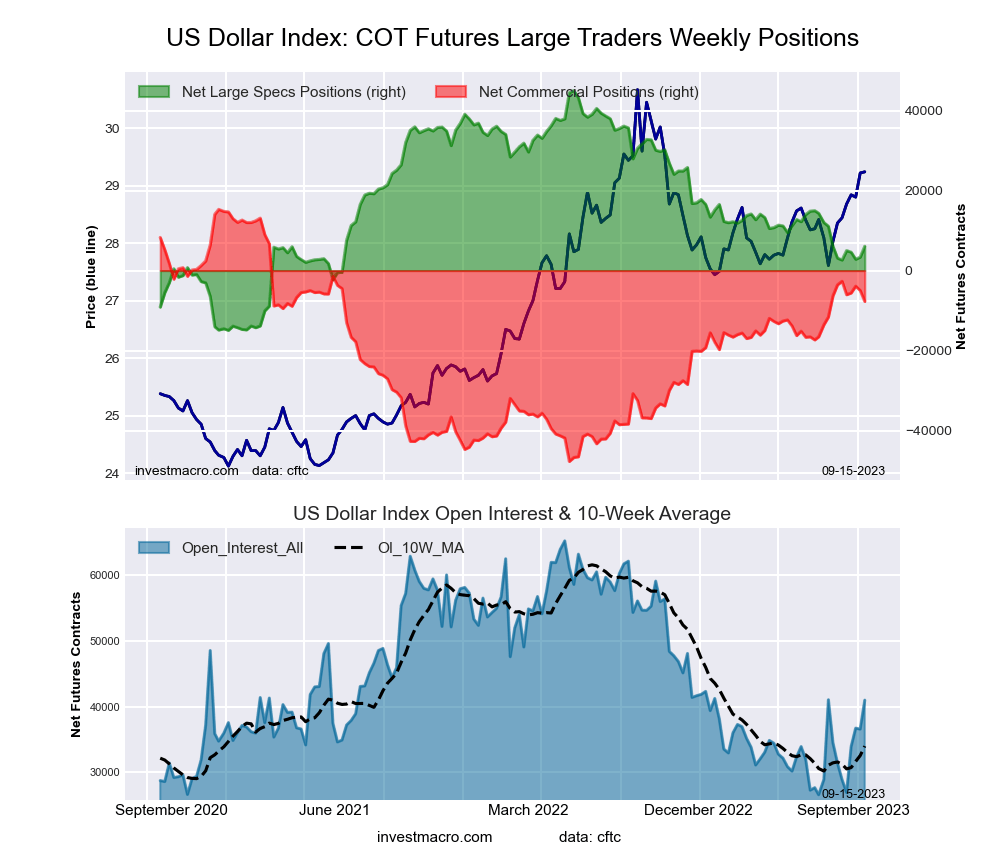
US Dollar Index Forex Futures COT ChartThe US Dollar Index large speculator standing this week totaled a net position of 6,054 contracts in the data reported through Tuesday. This was a weekly decrease of -5,013 contracts from the previous week which had a total of 11,067 net contracts.

This week’s current strength score (the trader positioning range over the past three years, measured from 0 to 100) shows the speculators are currently Bearish with a score of 35.0 percent. The commercials are Bullish with a score of 65.7 percent and the small traders (not shown in chart) are Bearish-Extreme with a score of 19.6 percent.

Price Trend-Following Model: Weak Uptrend

Our weekly trend-following model classifies the current market price position as: Weak Uptrend. The current action for the model is considered to be: Hold – Maintain Long Position.

US DOLLAR INDEX StatisticsSPECULATORSCOMMERCIALSSMALL TRADERS
– Percent of Open Interest Longs:61.622.610.8
– Percent of Open Interest Shorts:44.141.010.0
– Net Position:6,054-6,339285
– Gross Longs:21,2587,7963,735
– Gross Shorts:15,20414,1353,450
– Long to Short Ratio:1.4 to 10.6 to 11.1 to 1
NET POSITION TREND:
– Strength Index Score (3 Year Range Pct):35.065.719.6
– Strength Index Reading (3 Year Range):BearishBullishBearish-Extreme
NET POSITION MOVEMENT INDEX:
– 6-Week Change in Strength Index:-13.216.4-26.3


Euro Currency Futures:

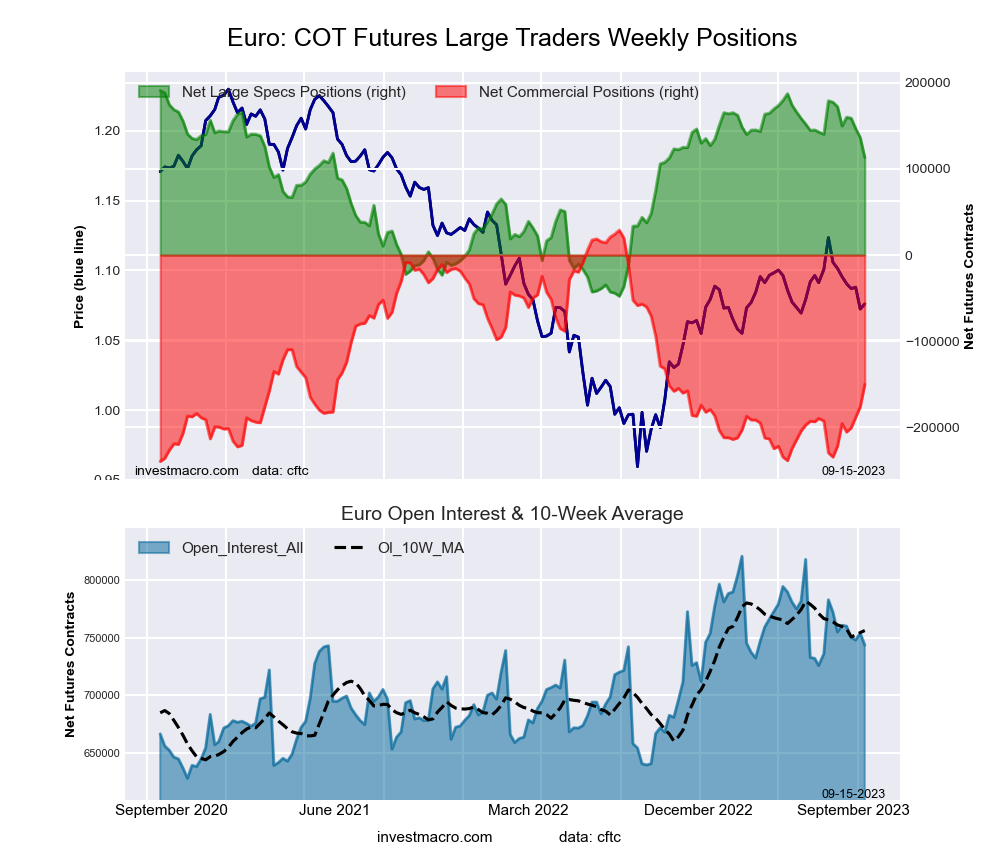
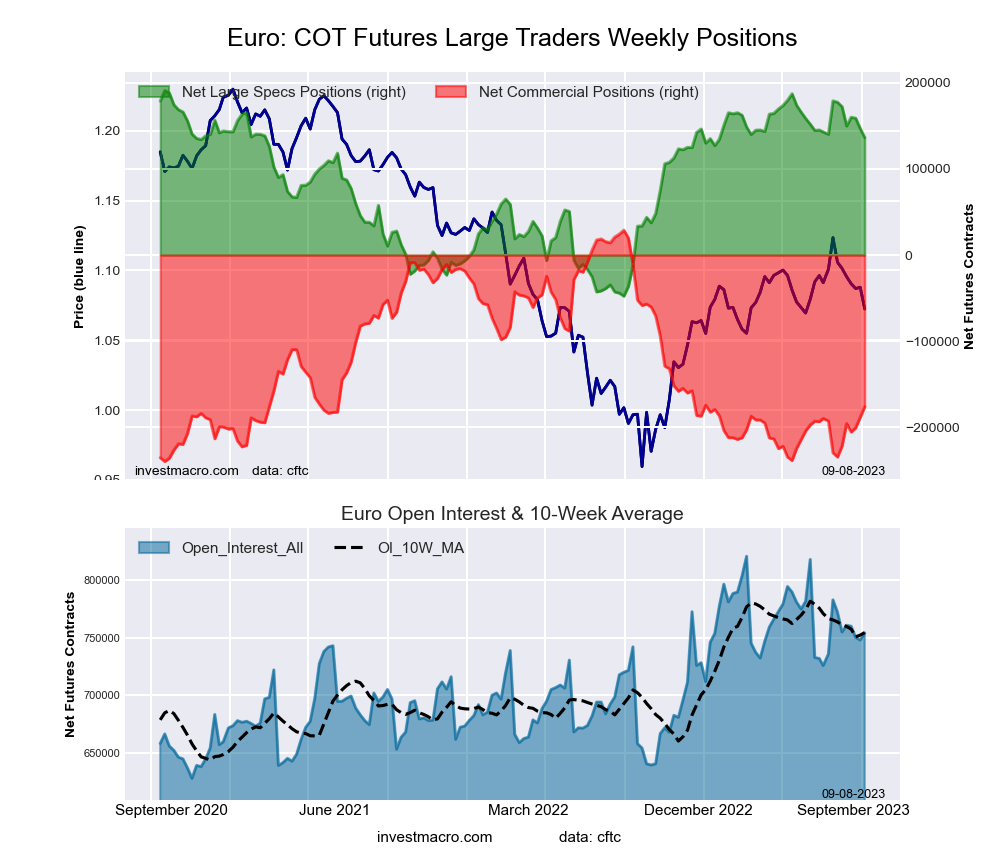
Euro Currency Futures COT ChartThe Euro Currency large speculator standing this week totaled a net position of 177,230 contracts in the data reported through Tuesday. This was a weekly lowering of -1,602 contracts from the previous week which had a total of 178,832 net contracts.

This week’s current strength score (the trader positioning range over the past three years, measured from 0 to 100) shows the speculators are currently Bullish-Extreme with a score of 86.7 percent. The commercials are Bearish-Extreme with a score of 11.4 percent and the small traders (not shown in chart) are Bullish with a score of 70.0 percent.

Price Trend-Following Model: Uptrend

Our weekly trend-following model classifies the current market price position as: Uptrend. The current action for the model is considered to be: Hold – Maintain Long Position.

EURO Currency StatisticsSPECULATORSCOMMERCIALSSMALL TRADERS
– Percent of Open Interest Longs:32.552.112.6
– Percent of Open Interest Shorts:9.582.55.2
– Net Position:177,230-234,26957,039
– Gross Longs:250,647402,62697,545
– Gross Shorts:73,417636,89540,506
– Long to Short Ratio:3.4 to 10.6 to 12.4 to 1
NET POSITION TREND:
– Strength Index Score (3 Year Range Pct):86.711.470.0
– Strength Index Reading (3 Year Range):Bullish-ExtremeBearish-ExtremeBullish
NET POSITION MOVEMENT INDEX:
– 6-Week Change in Strength Index:9.8-12.518.8


British Pound Sterling Futures:

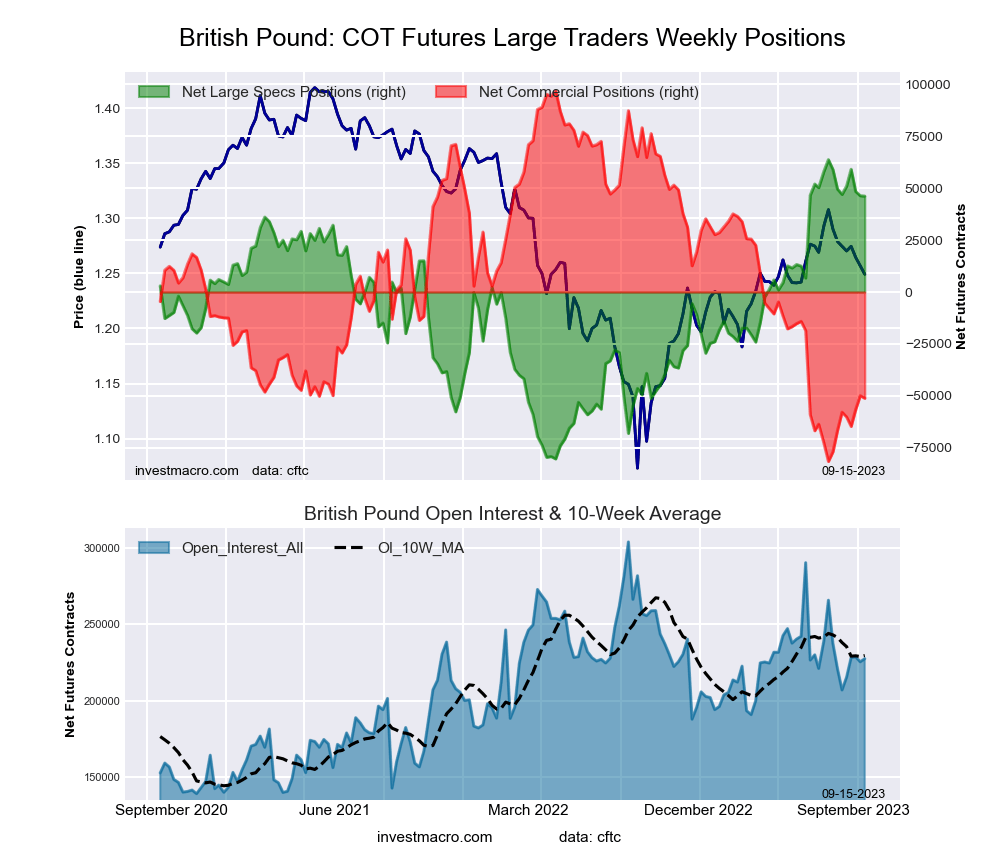
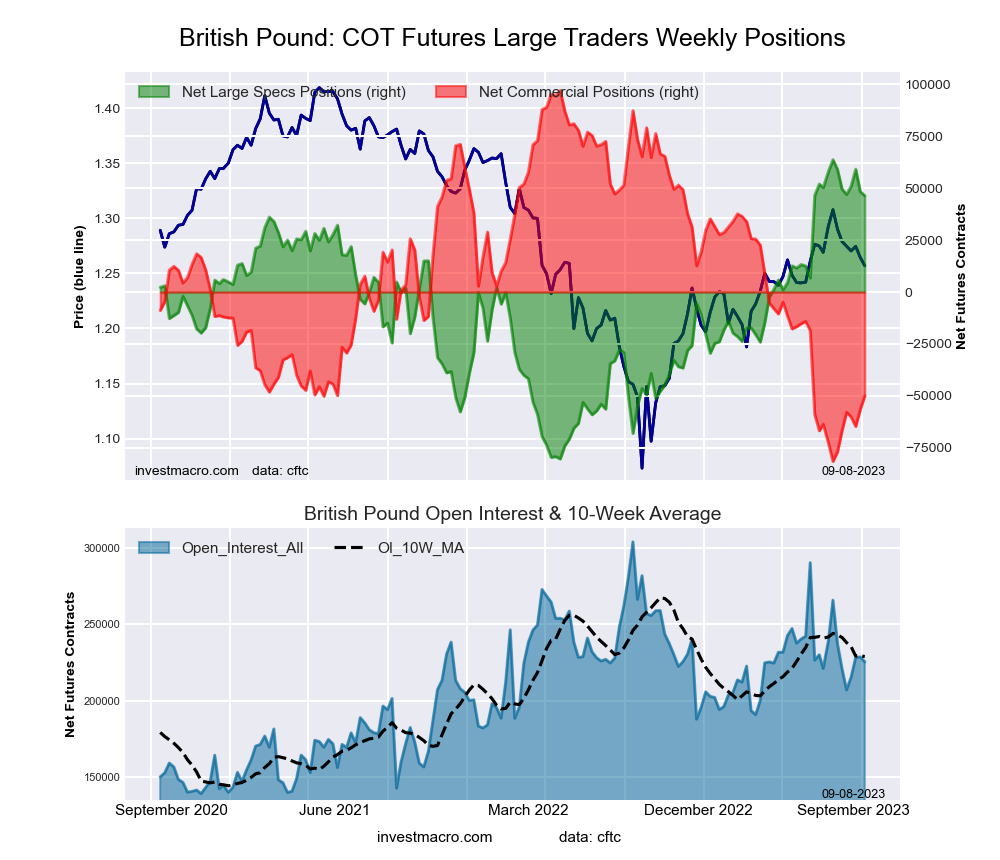
British Pound Sterling Futures COT ChartThe British Pound Sterling large speculator standing this week totaled a net position of 58,995 contracts in the data reported through Tuesday. This was a weekly decrease of -4,734 contracts from the previous week which had a total of 63,729 net contracts.

This week’s current strength score (the trader positioning range over the past three years, measured from 0 to 100) shows the speculators are currently Bullish-Extreme with a score of 96.7 percent. The commercials are Bearish-Extreme with a score of 2.6 percent and the small traders (not shown in chart) are Bullish-Extreme with a score of 93.3 percent.

Price Trend-Following Model: Uptrend

Our weekly trend-following model classifies the current market price position as: Uptrend. The current action for the model is considered to be: Hold – Maintain Long Position.

BRITISH POUND StatisticsSPECULATORSCOMMERCIALSSMALL TRADERS
– Percent of Open Interest Longs:44.531.917.6
– Percent of Open Interest Shorts:19.664.310.0
– Net Position:58,995-76,98417,989
– Gross Longs:105,49875,73741,762
– Gross Shorts:46,503152,72123,773
– Long to Short Ratio:2.3 to 10.5 to 11.8 to 1
NET POSITION TREND:
– Strength Index Score (3 Year Range Pct):96.72.693.3
– Strength Index Reading (3 Year Range):Bullish-ExtremeBearish-ExtremeBullish-Extreme
NET POSITION MOVEMENT INDEX:
– 6-Week Change in Strength Index:36.3-32.712.0


Japanese Yen Futures:

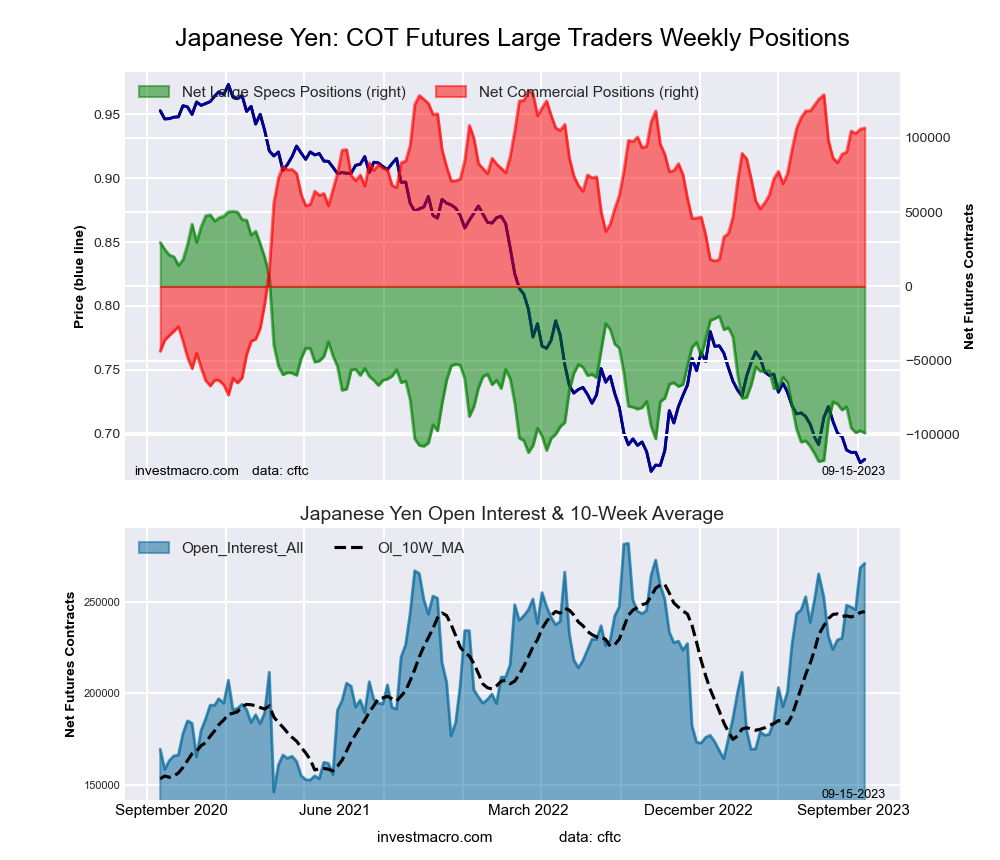
Japanese Yen Forex Futures COT ChartThe Japanese Yen large speculator standing this week totaled a net position of -77,752 contracts in the data reported through Tuesday. This was a weekly increase of 12,487 contracts from the previous week which had a total of -90,239 net contracts.

This week’s current strength score (the trader positioning range over the past three years, measured from 0 to 100) shows the speculators are currently Bearish with a score of 23.8 percent. The commercials are Bullish with a score of 77.9 percent and the small traders (not shown in chart) are Bearish with a score of 35.6 percent.

Price Trend-Following Model: Downtrend

Our weekly trend-following model classifies the current market price position as: Downtrend. The current action for the model is considered to be: Hold – Maintain Short Position.

JAPANESE YEN StatisticsSPECULATORSCOMMERCIALSSMALL TRADERS
– Percent of Open Interest Longs:13.672.013.4
– Percent of Open Interest Shorts:48.333.317.4
– Net Position:-77,75286,555-8,803
– Gross Longs:30,358161,16630,040
– Gross Shorts:108,11074,61138,843
– Long to Short Ratio:0.3 to 12.2 to 10.8 to 1
NET POSITION TREND:
– Strength Index Score (3 Year Range Pct):23.877.935.6
– Strength Index Reading (3 Year Range):BearishBullishBearish
NET POSITION MOVEMENT INDEX:
– 6-Week Change in Strength Index:15.6-15.411.0


Swiss Franc Futures:

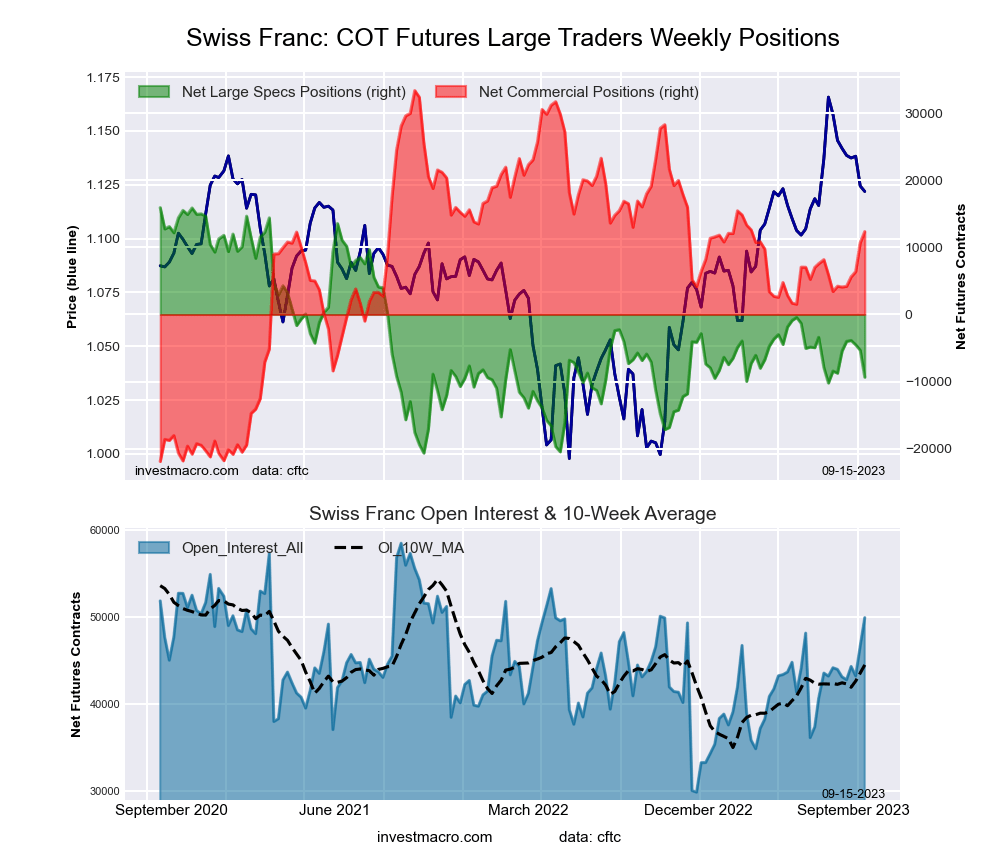
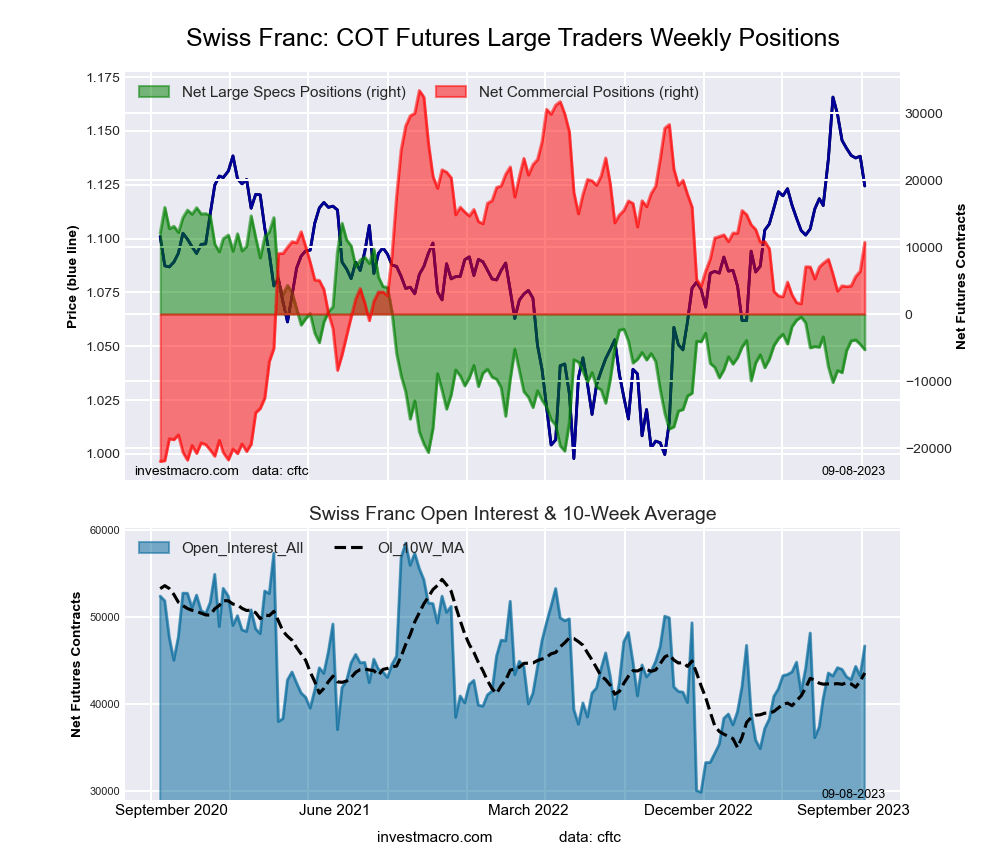
Swiss Franc Forex Futures COT ChartThe Swiss Franc large speculator standing this week totaled a net position of -8,431 contracts in the data reported through Tuesday. This was a weekly gain of 1,780 contracts from the previous week which had a total of -10,211 net contracts.

This week’s current strength score (the trader positioning range over the past three years, measured from 0 to 100) shows the speculators are currently Bearish with a score of 32.3 percent. The commercials are Bullish with a score of 50.6 percent and the small traders (not shown in chart) are Bullish with a score of 74.5 percent.

Price Trend-Following Model: Strong Uptrend

Our weekly trend-following model classifies the current market price position as: Strong Uptrend. The current action for the model is considered to be: Hold – Maintain Long Position.

SWISS FRANC StatisticsSPECULATORSCOMMERCIALSSMALL TRADERS
– Percent of Open Interest Longs:17.738.043.1
– Percent of Open Interest Shorts:36.730.331.8
– Net Position:-8,4313,4215,010
– Gross Longs:7,80416,78719,044
– Gross Shorts:16,23513,36614,034
– Long to Short Ratio:0.5 to 11.3 to 11.4 to 1
NET POSITION TREND:
– Strength Index Score (3 Year Range Pct):32.350.674.5
– Strength Index Reading (3 Year Range):BearishBullishBullish
NET POSITION MOVEMENT INDEX:
– 6-Week Change in Strength Index:-9.0-6.023.7


Canadian Dollar Futures:

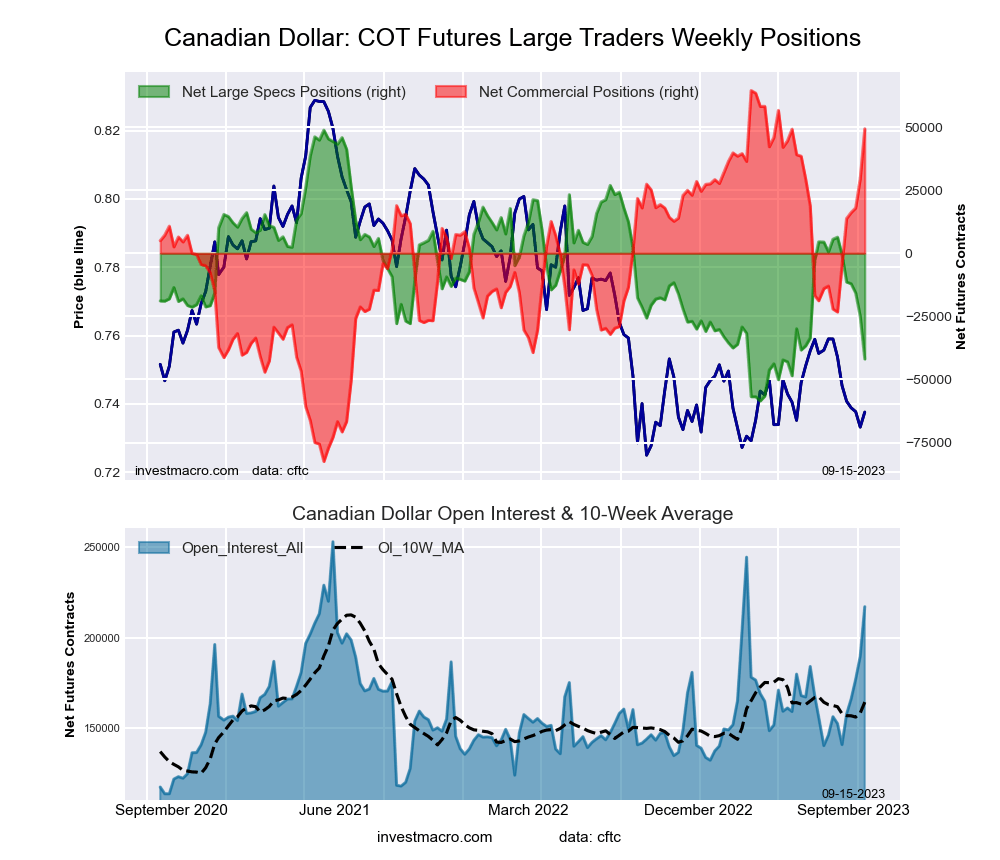
Canadian Dollar Forex Futures COT ChartThe Canadian Dollar large speculator standing this week totaled a net position of 5,530 contracts in the data reported through Tuesday. This was a weekly rise of 5,009 contracts from the previous week which had a total of 521 net contracts.

This week’s current strength score (the trader positioning range over the past three years, measured from 0 to 100) shows the speculators are currently Bullish with a score of 59.7 percent. The commercials are Bearish with a score of 41.1 percent and the small traders (not shown in chart) are Bullish with a score of 59.6 percent.

Price Trend-Following Model: Uptrend

Our weekly trend-following model classifies the current market price position as: Uptrend. The current action for the model is considered to be: Hold – Maintain Long Position.

CANADIAN DOLLAR StatisticsSPECULATORSCOMMERCIALSSMALL TRADERS
– Percent of Open Interest Longs:27.347.025.2
– Percent of Open Interest Shorts:23.861.114.6
– Net Position:5,530-22,09616,566
– Gross Longs:42,75973,53939,413
– Gross Shorts:37,22995,63522,847
– Long to Short Ratio:1.1 to 10.8 to 11.7 to 1
NET POSITION TREND:
– Strength Index Score (3 Year Range Pct):59.741.159.6
– Strength Index Reading (3 Year Range):BullishBearishBullish
NET POSITION MOVEMENT INDEX:
– 6-Week Change in Strength Index:39.3-35.020.6


Australian Dollar Futures:

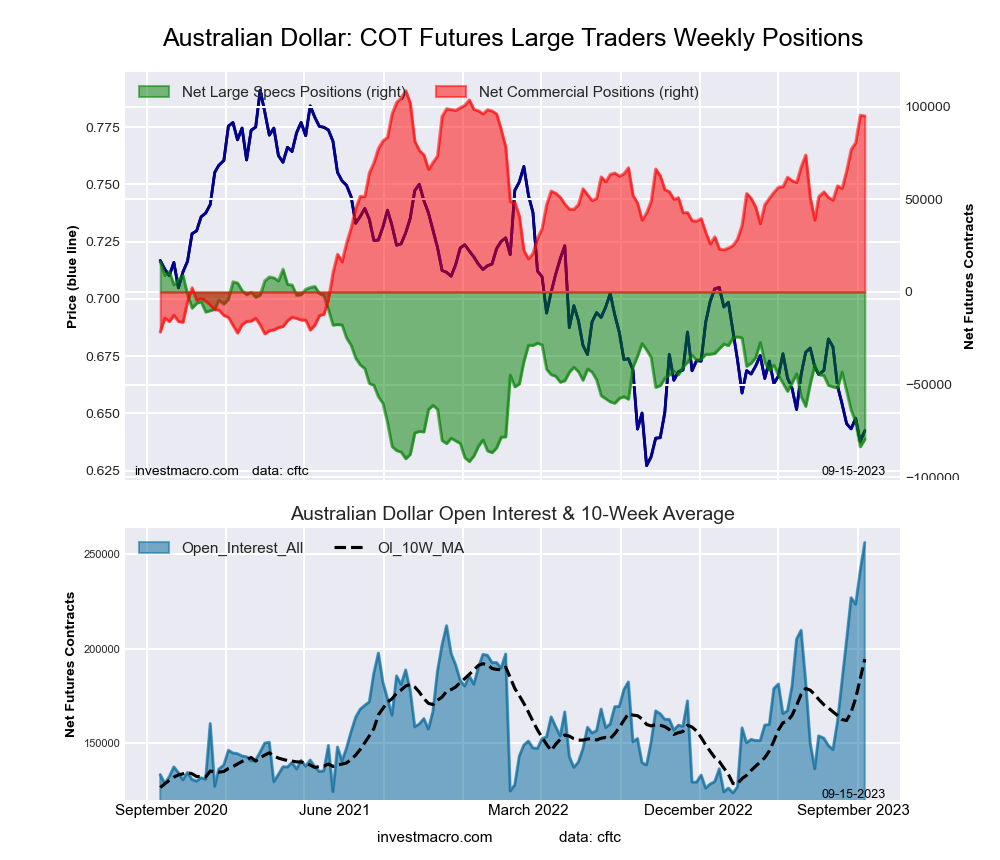
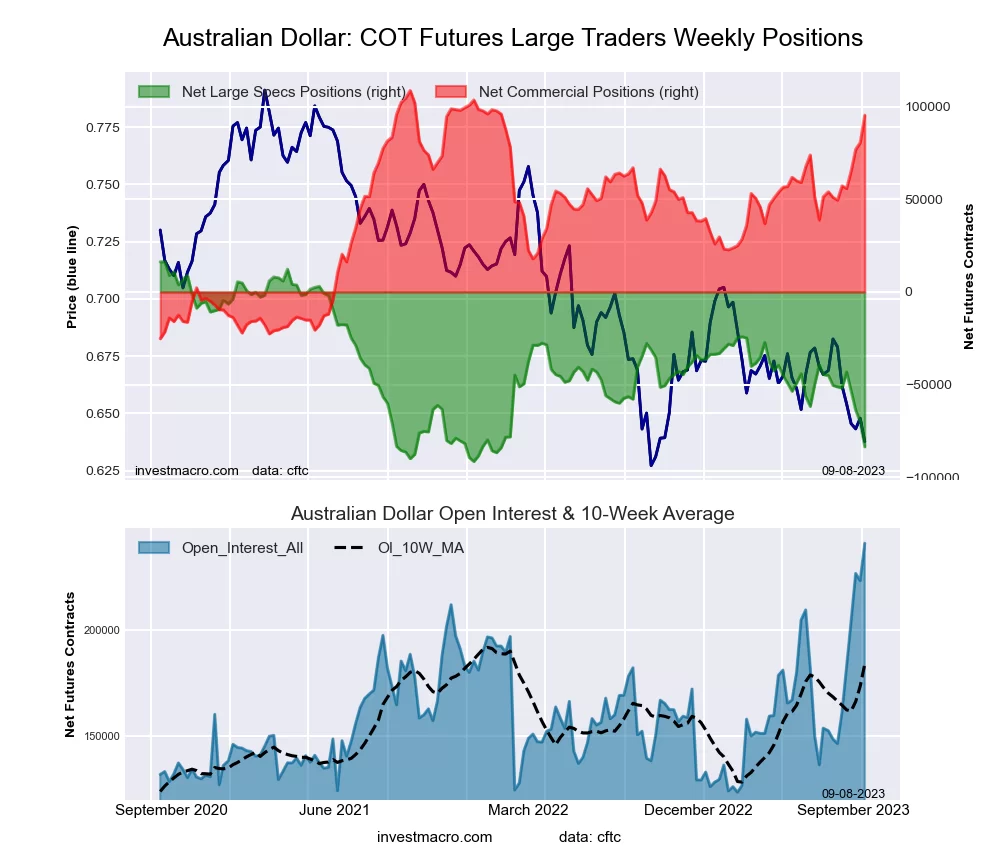
Australian Dollar Forex Futures COT ChartThe Australian Dollar large speculator standing this week totaled a net position of -51,201 contracts in the data reported through Tuesday. This was a weekly reduction of -800 contracts from the previous week which had a total of -50,401 net contracts.

This week’s current strength score (the trader positioning range over the past three years, measured from 0 to 100) shows the speculators are currently Bearish with a score of 37.4 percent. The commercials are Bullish with a score of 55.9 percent and the small traders (not shown in chart) are Bullish with a score of 56.4 percent.

Price Trend-Following Model: Uptrend

Our weekly trend-following model classifies the current market price position as: Uptrend. The current action for the model is considered to be: Hold – Maintain Long Position.

AUSTRALIAN DOLLAR StatisticsSPECULATORSCOMMERCIALSSMALL TRADERS
– Percent of Open Interest Longs:26.754.816.2
– Percent of Open Interest Shorts:61.721.015.1
– Net Position:-51,20149,5611,640
– Gross Longs:39,10880,23723,735
– Gross Shorts:90,30930,67622,095
– Long to Short Ratio:0.4 to 12.6 to 11.1 to 1
NET POSITION TREND:
– Strength Index Score (3 Year Range Pct):37.455.956.4
– Strength Index Reading (3 Year Range):BearishBullishBullish
NET POSITION MOVEMENT INDEX:
– 6-Week Change in Strength Index:9.8-18.233.7


New Zealand Dollar Futures:

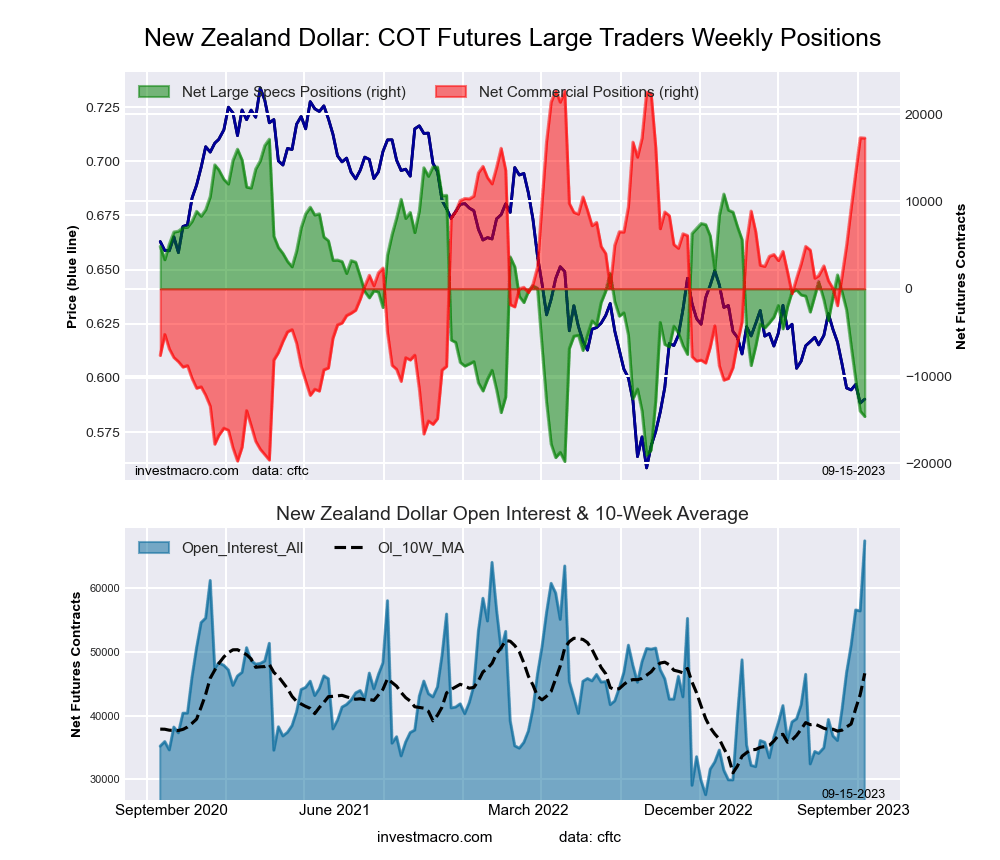
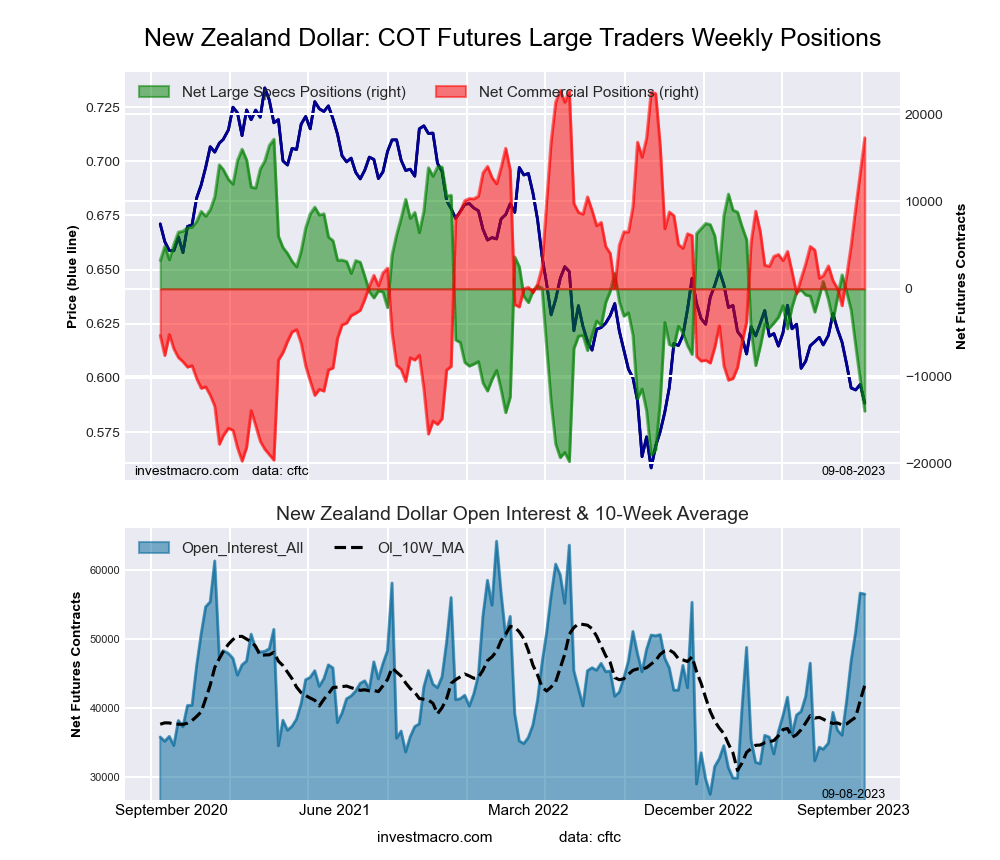
New Zealand Dollar Forex Futures COT ChartThe New Zealand Dollar large speculator standing this week totaled a net position of -949 contracts in the data reported through Tuesday. This was a weekly boost of 2,677 contracts from the previous week which had a total of -3,626 net contracts.

This week’s current strength score (the trader positioning range over the past three years, measured from 0 to 100) shows the speculators are currently Bullish with a score of 51.0 percent. The commercials are Bearish with a score of 46.6 percent and the small traders (not shown in chart) are Bullish with a score of 60.9 percent.

Price Trend-Following Model: Downtrend

Our weekly trend-following model classifies the current market price position as: Downtrend. The current action for the model is considered to be: Hold – Maintain Short Position.

NEW ZEALAND DOLLAR StatisticsSPECULATORSCOMMERCIALSSMALL TRADERS
– Percent of Open Interest Longs:35.153.411.1
– Percent of Open Interest Shorts:37.753.38.6
– Net Position:-94932917
– Gross Longs:12,93319,6644,080
– Gross Shorts:13,88219,6323,163
– Long to Short Ratio:0.9 to 11.0 to 11.3 to 1
NET POSITION TREND:
– Strength Index Score (3 Year Range Pct):51.046.660.9
– Strength Index Reading (3 Year Range):BullishBearishBullish
NET POSITION MOVEMENT INDEX:
– 6-Week Change in Strength Index:-0.3-11.458.8


Mexican Peso Futures:

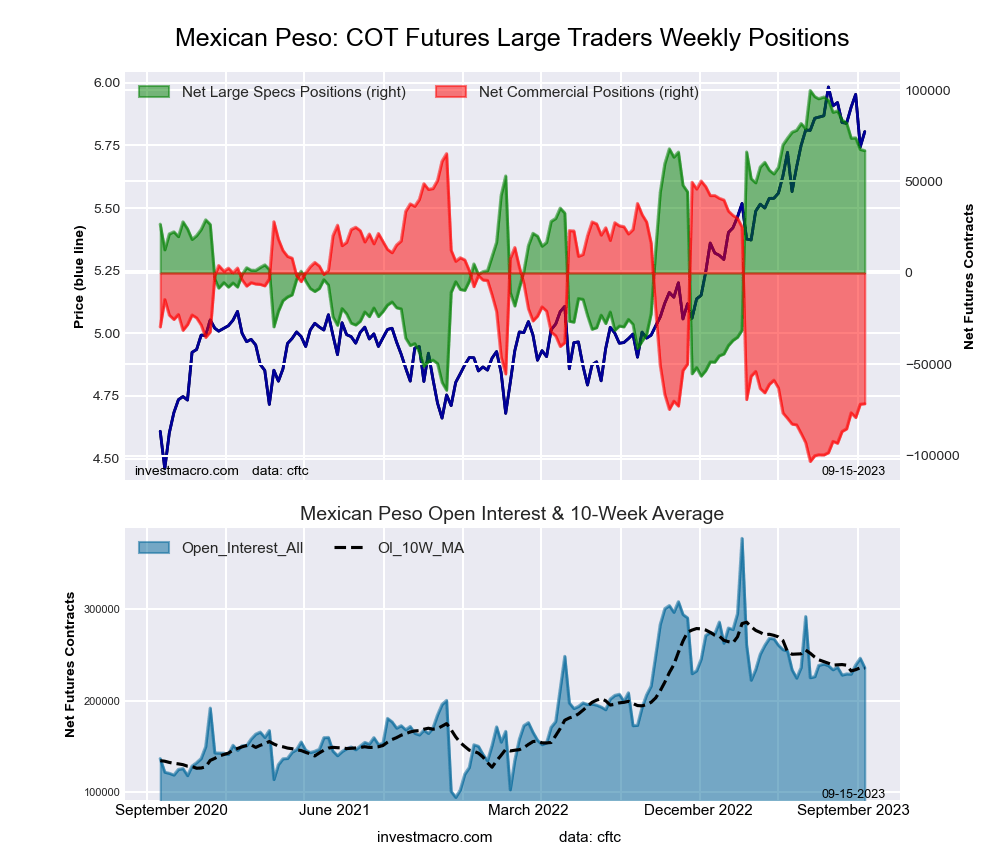
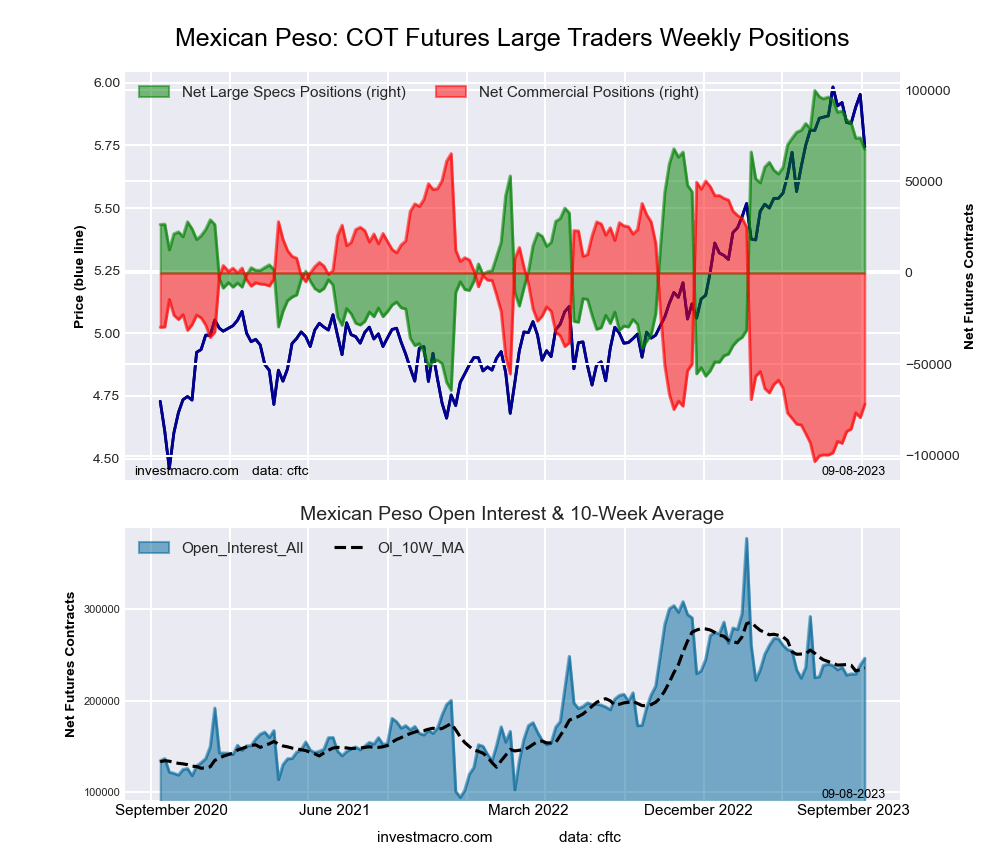
Mexican Peso Futures COT ChartThe Mexican Peso large speculator standing this week totaled a net position of 87,841 contracts in the data reported through Tuesday. This was a weekly decrease of -6,651 contracts from the previous week which had a total of 94,492 net contracts.

This week’s current strength score (the trader positioning range over the past three years, measured from 0 to 100) shows the speculators are currently Bullish-Extreme with a score of 92.8 percent. The commercials are Bearish-Extreme with a score of 6.5 percent and the small traders (not shown in chart) are Bearish with a score of 38.1 percent.

Price Trend-Following Model: Uptrend

Our weekly trend-following model classifies the current market price position as: Uptrend. The current action for the model is considered to be: Hold – Maintain Long Position.

MEXICAN PESO StatisticsSPECULATORSCOMMERCIALSSMALL TRADERS
– Percent of Open Interest Longs:50.445.43.7
– Percent of Open Interest Shorts:12.884.81.9
– Net Position:87,841-92,0584,217
– Gross Longs:117,732106,0618,608
– Gross Shorts:29,891198,1194,391
– Long to Short Ratio:3.9 to 10.5 to 12.0 to 1
NET POSITION TREND:
– Strength Index Score (3 Year Range Pct):92.86.538.1
– Strength Index Reading (3 Year Range):Bullish-ExtremeBearish-ExtremeBearish
NET POSITION MOVEMENT INDEX:
– 6-Week Change in Strength Index:5.50.4-61.9


Brazilian Real Futures:

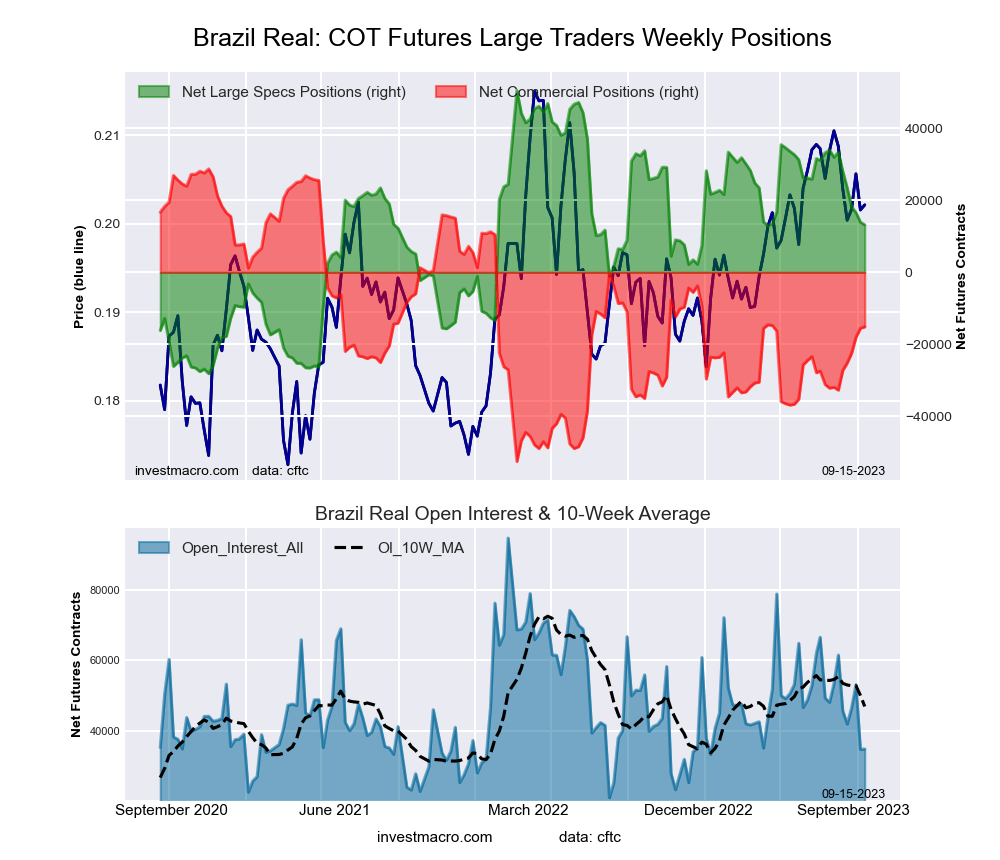
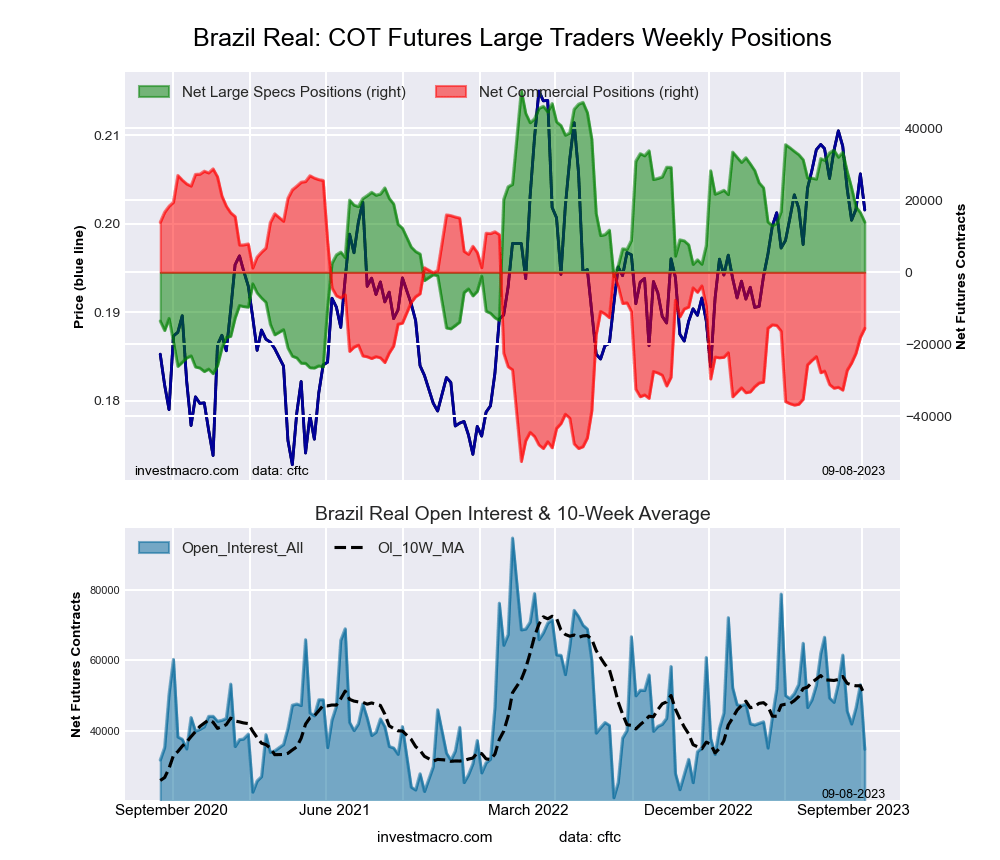
Brazil Real Futures COT ChartThe Brazilian Real large speculator standing this week totaled a net position of 31,971 contracts in the data reported through Tuesday. This was a weekly reduction of -1,962 contracts from the previous week which had a total of 33,933 net contracts.

This week’s current strength score (the trader positioning range over the past three years, measured from 0 to 100) shows the speculators are currently Bullish with a score of 76.4 percent. The commercials are Bearish with a score of 25.3 percent and the small traders (not shown in chart) are Bearish with a score of 43.9 percent.

Price Trend-Following Model: Strong Uptrend

Our weekly trend-following model classifies the current market price position as: Strong Uptrend. The current action for the model is considered to be: Hold – Maintain Long Position.

BRAZIL REAL StatisticsSPECULATORSCOMMERCIALSSMALL TRADERS
– Percent of Open Interest Longs:68.020.79.5
– Percent of Open Interest Shorts:8.280.59.5
– Net Position:31,971-31,957-14
– Gross Longs:36,34511,0735,084
– Gross Shorts:4,37443,0305,098
– Long to Short Ratio:8.3 to 10.3 to 11.0 to 1
NET POSITION TREND:
– Strength Index Score (3 Year Range Pct):76.425.343.9
– Strength Index Reading (3 Year Range):BullishBearishBearish
NET POSITION MOVEMENT INDEX:
– 6-Week Change in Strength Index:7.4-9.213.2


Bitcoin Futures:

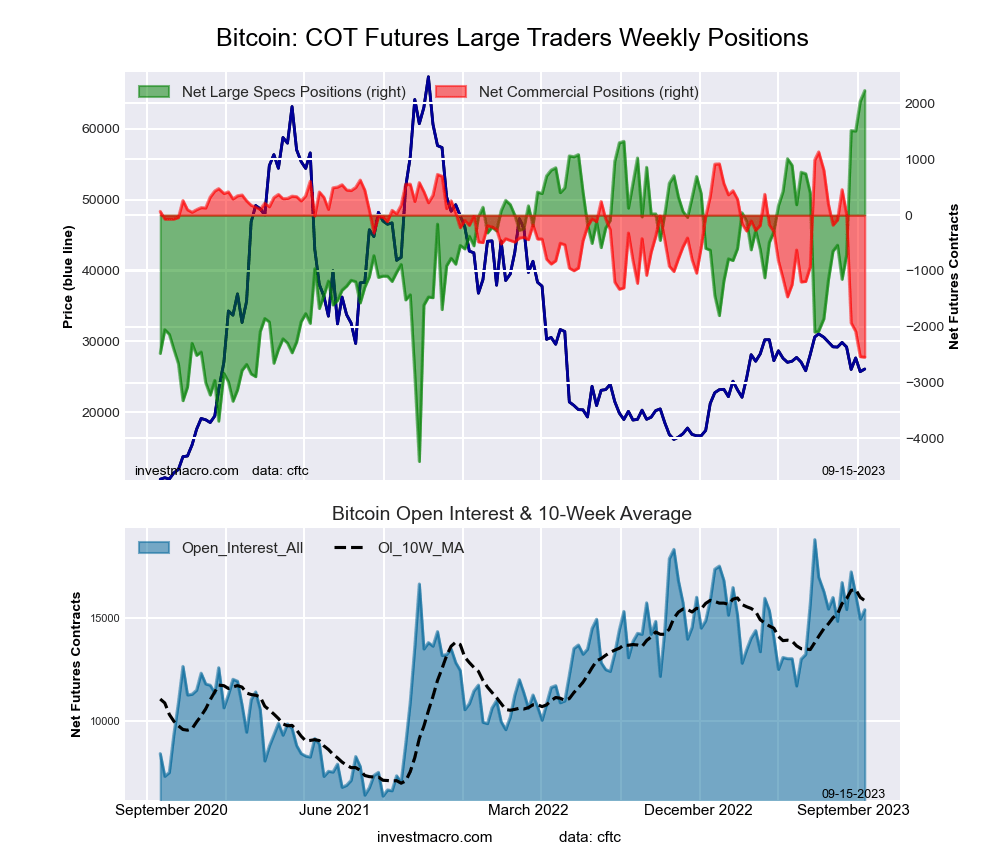
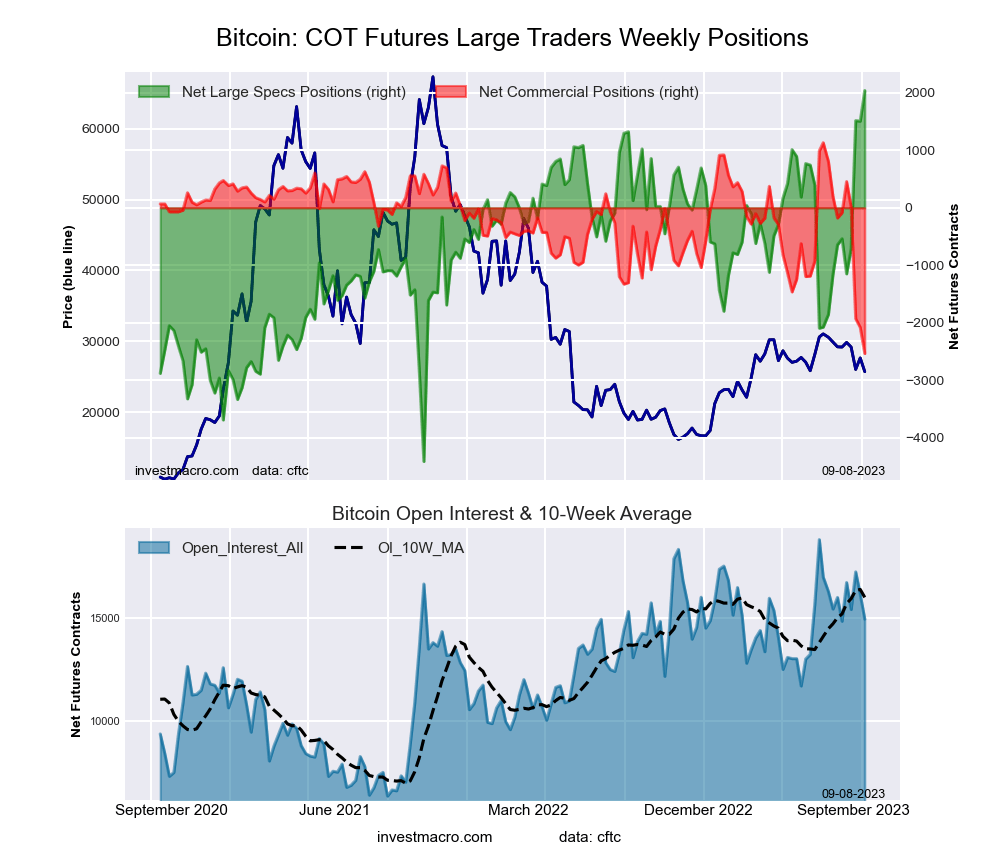
Bitcoin Crypto Futures COT ChartThe Bitcoin large speculator standing this week totaled a net position of -645 contracts in the data reported through Tuesday. This was a weekly rise of 516 contracts from the previous week which had a total of -1,161 net contracts.

This week’s current strength score (the trader positioning range over the past three years, measured from 0 to 100) shows the speculators are currently Bullish with a score of 65.7 percent. The commercials are Bearish with a score of 49.5 percent and the small traders (not shown in chart) are Bearish with a score of 31.7 percent.

Price Trend-Following Model: Uptrend

Our weekly trend-following model classifies the current market price position as: Uptrend. The current action for the model is considered to be: Hold – Maintain Long Position.

BITCOIN StatisticsSPECULATORSCOMMERCIALSSMALL TRADERS
– Percent of Open Interest Longs:74.62.69.4
– Percent of Open Interest Shorts:78.63.74.2
– Net Position:-645-178823
– Gross Longs:11,9414221,503
– Gross Shorts:12,586600680
– Long to Short Ratio:0.9 to 10.7 to 12.2 to 1
NET POSITION TREND:
– Strength Index Score (3 Year Range Pct):65.749.531.7
– Strength Index Reading (3 Year Range):BullishBearishBearish
NET POSITION MOVEMENT INDEX:
– 6-Week Change in Strength Index:-24.238.98.6


Article By InvestMacroReceive our weekly COT Newsletter

*COT Report: The COT data, released weekly to the public each Friday, is updated through the most recent Tuesday (data is 3 days old) and shows a quick view of how large speculators or non-commercials (for-profit traders) were positioned in the futures markets.

The CFTC categorizes trader positions according to commercial hedgers (traders who use futures contracts for hedging as part of the business), non-commercials (large traders who speculate to realize trading profits) and nonreportable traders (usually small traders/speculators) as well as their open interest (contracts open in the market at time of reporting). See CFTC criteria here.

COT Metals Charts: Weekly Speculator Bets led by Copper

By InvestMacro

Here are the latest charts and statistics for the Commitment of Traders (COT) data published by the Commodities Futures Trading Commission (CFTC).

The latest COT data is updated through Tuesday July 25th and shows a quick view of how large traders (for-profit speculators and commercial entities) were positioned in the futures markets.
Weekly Speculator Changes led by Copper

The COT metals markets speculator bets were lower this week as one out of the six metals markets we cover had higher positioning while the other five markets had lower speculator contracts.

Leading the gains for the metals was just Copper with a weekly rise of 4,709 contracts.

The markets with declines in speculator bets for the week were Gold (-19,709 contracts), Silver (-6,937 contracts), Steel (-1,356 contracts), Platinum (-249 contracts) and Palladium (-27 contracts) also registering lower bets on the week.


Data Snapshot of Commodity Market Traders | Columns Legend
Jul-25-2023OIOI-IndexSpec-NetSpec-IndexCom-NetCOM-IndexSmalls-NetSmalls-Index
Gold476,17625173,63953-198,2104724,57142
Silver146,8983636,92571-49,7183412,79337
Copper234,713701,15932-3,904682,74536
Palladium16,760100-8,37708,899100-52210
Platinum64,1974815,48751-20,441514,95434


Strength Scores led by Silver & Steel

COT Strength Scores (a normalized measure of Speculator positions over a 3-Year range, from 0 to 100 where above 80 is Extreme-Bullish and below 20 is Extreme-Bearish) showed that Silver (71 percent) and Steel (68 percent) lead the metals markets this week.

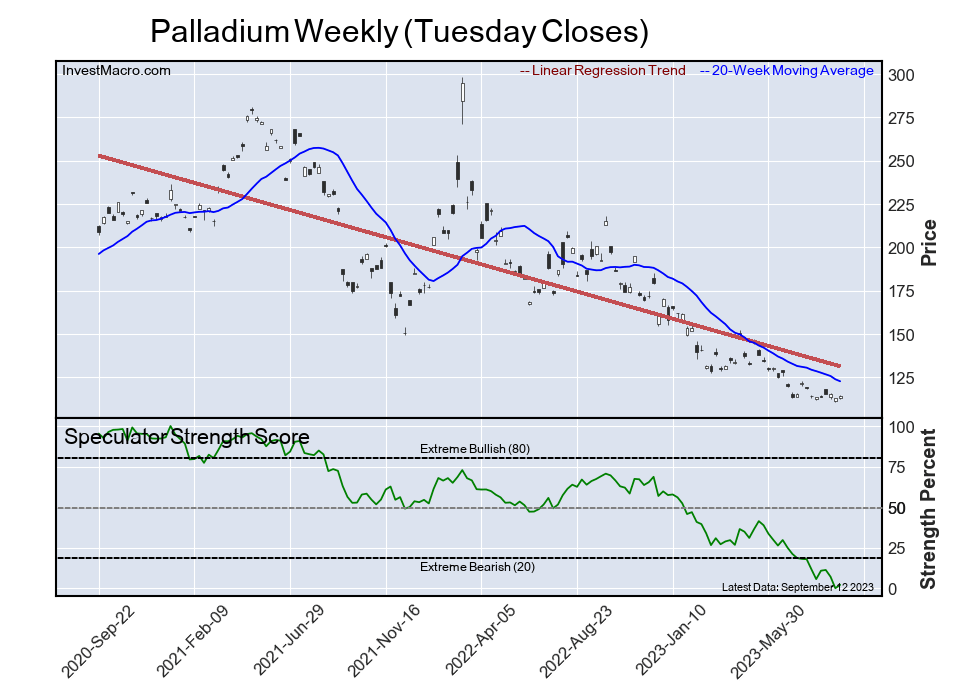
On the downside, Palladium (0 percent) comes in at the lowest strength level currently and is in Extreme-Bearish territory (below 20 percent).

Strength Statistics:
Gold (53.5 percent) vs Gold previous week (62.2 percent)
Silver (70.9 percent) vs Silver previous week (80.8 percent)
Copper (31.8 percent) vs Copper previous week (27.8 percent)
Platinum (51.3 percent) vs Platinum previous week (51.9 percent)
Palladium (0.0 percent) vs Palladium previous week (0.2 percent)
Steel (68.2 percent) vs Palladium previous week (72.1 percent)

Silver & Copper top the 6-Week Strength Trends

COT Strength Score Trends (or move index, calculates the 6-week changes in strength scores) showed that Silver (19 percent) and Copper (12 percent) lead the past six weeks trends for metals.

Platinum (-15 percent) leads the downside trend scores currently with Palladium (-10 percent) as the next market with lower trend scores.

Move Statistics:
Gold (5.9 percent) vs Gold previous week (7.8 percent)
Silver (18.8 percent) vs Silver previous week (31.9 percent)
Copper (12.2 percent) vs Copper previous week (19.4 percent)
Platinum (-15.0 percent) vs Platinum previous week (-20.5 percent)
Palladium (-10.2 percent) vs Palladium previous week (-14.4 percent)
Steel (0.9 percent) vs Steel previous week (6.8 percent)


Individual Markets:

Gold Comex Futures:

Gold Futures COT ChartThe Gold Comex Futures large speculator standing this week came in at a net position of 173,639 contracts in the data reported through Tuesday. This was a weekly fall of -19,709 contracts from the previous week which had a total of 193,348 net contracts.

This week’s current strength score (the trader positioning range over the past three years, measured from 0 to 100) shows the speculators are currently Bullish with a score of 53.5 percent. The commercials are Bearish with a score of 47.4 percent and the small traders (not shown in chart) are Bearish with a score of 41.5 percent.

Price Trend-Following Model: Weak Downtrend

Our weekly trend-following model classifies the current market price position as: Weak Downtrend. The current action for the model is considered to be: Hold – Maintain Short Position.

Gold Futures StatisticsSPECULATORSCOMMERCIALSSMALL TRADERS
– Percent of Open Interest Longs:52.126.49.9
– Percent of Open Interest Shorts:15.768.04.8
– Net Position:173,639-198,21024,571
– Gross Longs:248,229125,49147,300
– Gross Shorts:74,590323,70122,729
– Long to Short Ratio:3.3 to 10.4 to 12.1 to 1
NET POSITION TREND:
– Strength Index Score (3 Year Range Pct):53.547.441.5
– Strength Index Reading (3 Year Range):BullishBearishBearish
NET POSITION MOVEMENT INDEX:
– 6-Week Change in Strength Index:5.9-4.7-3.2


Silver Comex Futures:

Silver Futures COT ChartThe Silver Comex Futures large speculator standing this week came in at a net position of 36,925 contracts in the data reported through Tuesday. This was a weekly decrease of -6,937 contracts from the previous week which had a total of 43,862 net contracts.

This week’s current strength score (the trader positioning range over the past three years, measured from 0 to 100) shows the speculators are currently Bullish with a score of 70.9 percent. The commercials are Bearish with a score of 33.7 percent and the small traders (not shown in chart) are Bearish with a score of 37.5 percent.

Price Trend-Following Model: Strong Uptrend

Our weekly trend-following model classifies the current market price position as: Strong Uptrend. The current action for the model is considered to be: Hold – Maintain Long Position.

Silver Futures StatisticsSPECULATORSCOMMERCIALSSMALL TRADERS
– Percent of Open Interest Longs:49.526.716.7
– Percent of Open Interest Shorts:24.460.58.0
– Net Position:36,925-49,71812,793
– Gross Longs:72,78639,19724,478
– Gross Shorts:35,86188,91511,685
– Long to Short Ratio:2.0 to 10.4 to 12.1 to 1
NET POSITION TREND:
– Strength Index Score (3 Year Range Pct):70.933.737.5
– Strength Index Reading (3 Year Range):BullishBearishBearish
NET POSITION MOVEMENT INDEX:
– 6-Week Change in Strength Index:18.8-13.6-10.9


Copper Grade #1 Futures:

Copper Futures COT ChartThe Copper Grade #1 Futures large speculator standing this week came in at a net position of 1,159 contracts in the data reported through Tuesday. This was a weekly gain of 4,709 contracts from the previous week which had a total of -3,550 net contracts.

This week’s current strength score (the trader positioning range over the past three years, measured from 0 to 100) shows the speculators are currently Bearish with a score of 31.8 percent. The commercials are Bullish with a score of 68.4 percent and the small traders (not shown in chart) are Bearish with a score of 35.8 percent.

Price Trend-Following Model: Weak Downtrend

Our weekly trend-following model classifies the current market price position as: Weak Downtrend. The current action for the model is considered to be: Hold – Maintain Short Position.

Copper Futures StatisticsSPECULATORSCOMMERCIALSSMALL TRADERS
– Percent of Open Interest Longs:31.440.56.9
– Percent of Open Interest Shorts:30.942.25.7
– Net Position:1,159-3,9042,745
– Gross Longs:73,74395,14016,173
– Gross Shorts:72,58499,04413,428
– Long to Short Ratio:1.0 to 11.0 to 11.2 to 1
NET POSITION TREND:
– Strength Index Score (3 Year Range Pct):31.868.435.8
– Strength Index Reading (3 Year Range):BearishBullishBearish
NET POSITION MOVEMENT INDEX:
– 6-Week Change in Strength Index:12.2-13.715.8


Platinum Futures:

Platinum Futures COT ChartThe Platinum Futures large speculator standing this week came in at a net position of 15,487 contracts in the data reported through Tuesday. This was a weekly lowering of -249 contracts from the previous week which had a total of 15,736 net contracts.

This week’s current strength score (the trader positioning range over the past three years, measured from 0 to 100) shows the speculators are currently Bullish with a score of 51.3 percent. The commercials are Bullish with a score of 51.2 percent and the small traders (not shown in chart) are Bearish with a score of 34.5 percent.

Price Trend-Following Model: Downtrend

Our weekly trend-following model classifies the current market price position as: Downtrend. The current action for the model is considered to be: Hold – Maintain Short Position.

Platinum Futures StatisticsSPECULATORSCOMMERCIALSSMALL TRADERS
– Percent of Open Interest Longs:56.825.712.1
– Percent of Open Interest Shorts:32.757.64.3
– Net Position:15,487-20,4414,954
– Gross Longs:36,48916,5067,742
– Gross Shorts:21,00236,9472,788
– Long to Short Ratio:1.7 to 10.4 to 12.8 to 1
NET POSITION TREND:
– Strength Index Score (3 Year Range Pct):51.351.234.5
– Strength Index Reading (3 Year Range):BullishBullishBearish
NET POSITION MOVEMENT INDEX:
– 6-Week Change in Strength Index:-15.014.2-4.8


Palladium Futures:

Palladium Futures COT ChartThe Palladium Futures large speculator standing this week came in at a net position of -8,377 contracts in the data reported through Tuesday. This was a weekly reduction of -27 contracts from the previous week which had a total of -8,350 net contracts.

This week’s current strength score (the trader positioning range over the past three years, measured from 0 to 100) shows the speculators are currently Bearish-Extreme with a score of 0.0 percent. The commercials are Bullish-Extreme with a score of 100.0 percent and the small traders (not shown in chart) are Bearish-Extreme with a score of 10.3 percent.

Price Trend-Following Model: Strong Downtrend

Our weekly trend-following model classifies the current market price position as: Strong Downtrend. The current action for the model is considered to be: Hold – Maintain Short Position.

Palladium Futures StatisticsSPECULATORSCOMMERCIALSSMALL TRADERS
– Percent of Open Interest Longs:22.461.78.5
– Percent of Open Interest Shorts:72.48.611.6
– Net Position:-8,3778,899-522
– Gross Longs:3,75210,3461,417
– Gross Shorts:12,1291,4471,939
– Long to Short Ratio:0.3 to 17.1 to 10.7 to 1
NET POSITION TREND:
– Strength Index Score (3 Year Range Pct):0.0100.010.3
– Strength Index Reading (3 Year Range):Bearish-ExtremeBullish-ExtremeBearish-Extreme
NET POSITION MOVEMENT INDEX:
– 6-Week Change in Strength Index:-10.29.3-0.4


Steel Futures Futures:

Steel Futures COT ChartThe Steel Futures large speculator standing this week came in at a net position of -1,726 contracts in the data reported through Tuesday. This was a weekly decline of -1,356 contracts from the previous week which had a total of -370 net contracts.

This week’s current strength score (the trader positioning range over the past three years, measured from 0 to 100) shows the speculators are currently Bullish with a score of 68.2 percent. The commercials are Bearish with a score of 31.8 percent and the small traders (not shown in chart) are Bearish with a score of 31.1 percent.

Price Trend-Following Model: Strong Downtrend

Our weekly trend-following model classifies the current market price position as: Strong Downtrend. The current action for the model is considered to be: Hold – Maintain Short Position.

Steel Futures StatisticsSPECULATORSCOMMERCIALSSMALL TRADERS
– Percent of Open Interest Longs:13.379.21.1
– Percent of Open Interest Shorts:20.372.50.8
– Net Position:-1,7261,64185
– Gross Longs:3,24219,348276
– Gross Shorts:4,96817,707191
– Long to Short Ratio:0.7 to 11.1 to 11.4 to 1
NET POSITION TREND:
– Strength Index Score (3 Year Range Pct):68.231.831.1
– Strength Index Reading (3 Year Range):BullishBearishBearish
NET POSITION MOVEMENT INDEX:
– 6-Week Change in Strength Index:0.9-0.91.4


Article By InvestMacroReceive our weekly COT Newsletter

*COT Report: The COT data, released weekly to the public each Friday, is updated through the most recent Tuesday (data is 3 days old) and shows a quick view of how large speculators or non-commercials (for-profit traders) were positioned in the futures markets.

The CFTC categorizes trader positions according to commercial hedgers (traders who use futures contracts for hedging as part of the business), non-commercials (large traders who speculate to realize trading profits) and nonreportable traders (usually small traders/speculators) as well as their open interest (contracts open in the market at time of reporting). See CFTC criteria here.