Archive for Opinions – Page 71

Cycle of rate hikes is over – are your investments aligned?

By George Prior 

Investors need now to ensure their investment portfolios are ready for “a new era” as central banks become seemingly convinced that no further interest rate rises will be needed in this monetary cycle.

This assessment from Nigel Green of deVere Group, one of the world’s largest independent financial advisory, asset management and fintech organizations, comes as policymakers in the US, UK, Japan and Switzerland all decided to keep rates steady last week.

He comments: “We’re in a transition period ahead of a new monetary era as most of the world’s most influential central banks are now anticipated to cut interest rates in the next quarter of 2024, rather than raise them.

“This is because we’re heading into a stage of lower growth and lower inflation.”

With central banks, it appears, having reached a consensus that no further interest rate hikes are likely to be needed, investors must recalibrate their strategies.

Diversification remains a foundational strategy in managing investment risk. Investors should consider allocating their assets across various classes, including equities, fixed income, real estate, and alternatives.

Amid economic deceleration, it’s prudent to emphasize defensive stocks in your portfolio.

“These are companies that tend to exhibit resilience during downturns due to the essential nature of their products or services. Sectors like healthcare, utilities, and consumer staples often fall into this category. Companies in these sectors can continue to generate revenue even when consumer spending weakens,” says the deVere CEO.

“While economic growth may slow, technological advancements and innovation continue to shape the future. Investing in companies at the forefront of technology and innovation can be a smart move. This includes sectors like tech, biotech, and green energy, which may experience sustained growth as society seeks solutions to pressing global challenges.”

He goes on to add: “Also, consider investments with a fixed income component to match your risk tolerance and income needs.”

In addition, emerging markets, notes Nigel Green, can present attractive opportunities during periods of global economic slowdown. These markets often exhibit higher growth potential compared to mature economies. “However, they also come with higher volatility and risks, so thorough research and a long-term investment horizon are essential.”

Navigating the complexities of investing during economic slowdowns requires careful planning and expertise. Seeking advice from a financial advisor can provide you with a tailored investment strategy based on your unique financial goals, risk tolerance, and time horizon.

“The world is about to shift into a new era and your investments should be aligned accordingly if you’re serious about creating, growing and safeguarding your money,” says Nigel Green.

About:

deVere Group is one of the world’s largest independent advisors of specialist global financial solutions to international, local mass affluent, and high-net-worth clients.  It has a network of offices across the world, over 80,000 clients and $12bn under advisement.

Trade Of The Week: Is the USDJPY a ticking timebomb?

By ForexTime 

The USDJPY has kicked off the new trading week by touching its highest level since November 2022.

Yen bears are clearly in power, with the Japanese yen currently the worst performing G10 currency year-to-date, shedding roughly 11.8% against the dollar.

Last Friday, the Bank of Japan (BoJ) left its ultra-loose monetary policy unchanged and kept its dovish stance despite high inflation. While the policy divergence between the Fed and BoJ remains a key driving force behind the USDJPY’s upside, the threat of government intervention could frighten bulls down the road.

Taking a trip down memory lane, the BoJ intervened back in September 2022 when the yen weakened to 145.90. Two more interventions followed in October after the Yen fell below 150.

Given how the currency is weaker than last year when Japan acted, investors remain on high alert with much chatter around 150 acting as a key level that could trigger government intervention.

It is worth keeping in mind that a weakening Yen results in higher import prices. This is transferred to producers, boosting expectations for higher inflation with consumers feeling the pain. Such a development could be a headache for policymakers, especially when factoring in how Japan’s headline and core inflation remain above the BOJ’s 2% target.

With all the above said, the threat of government intervention has made the USDJPY a ticking timebomb that could explode at any moment…

Here are 3 factors that could impact the currency pair this week:

  1. Fed speeches + US August PCE report

A host of Fed officials, including Fed Chair Jerome Powell will be under the spotlight this week.

Last week’s FOMC meeting concluded with Powell indicating that rates will remain “higher for longer”. Should policymakers strike a hawkish tone and reinforce last week’s messaging, the USDJPY could push higher as expectations rise around the Fed hiking rates once more hike in 2023.

Regarding the August PCE report, markets expect the August PCE report to show headline prices accelerated 0.5% month-over-month after July’s 0.2% increase while the core PCE deflator is forecast to rise 0.2%, same as July. The core personal consumption expenditures price index for projected to rise 3.9% year-over-year in August, down from the 4.2% seen in July.

Ultimately, more signs of cooling inflationary pressures may counteract the argument around the Fed “keeping rates higher for longer”, weakening the USDJPY as a result.

  1. Japan data dump

Investors will be dished out some key economic reports from Japan on Friday.

All eyes will be on the Tokyo inflation data for September, jobless rate, industrial production, and retail sales figures for August which could provide insight into the health of Japan’s economy.

  • Should the overall economic data from Japan print above market expectations, this may boost sentiment towards the Japanese economy – pulling the USDJPY lower as the yen strengthens.
  • If overall economic data disappoints, sentiment toward the Japanese economy could take a hit – pushing the USDJPY higher as the yen weakens.
  1. Technical forces

The USDJPY is firmly bullish on the daily timeframe as there have been consistently higher highs and higher lows. However, prices are slowly approaching overbought conditions while bulls displaying slight hesitation due to key fundamental forces.

  • The current upside could take prices towards the 150.00 psychological level. Beyond this point, the next key level of interest is the 2022 high at 151.94.
  • Should bulls get cold amid intervention fears, prices could slip back below 147.50, 146.70, and 144.90, respectively.


Forex-Time-LogoArticle by ForexTime

ForexTime Ltd (FXTM) is an award winning international online forex broker regulated by CySEC 185/12 www.forextime.com

Amazon’s AI move – why you need AI investments as race speeds up

By George Prior

Amazon’s $4bn investment into a ChatGPT rival reinforces why almost all investors should have some artificial intelligence (AI) exposure in their investment mix, says the CEO of one of the world’s largest independent financial advisory, asset management and fintech organizations.

The comments from Nigel Green of deVere Group comes as e-commerce giant Amazon said on Monday it will invest $4 billion in Anthropic and take a minority ownership position.  Anthropic was founded by former OpenAI (the company behind ChatGPT) executives, and recently debuted its new AI chatbot named Claude 2.

He says: “This move highlights how the big tech titan is stepping up its rivalry with other giants Microsoft, Google and Nvidia in the AI space.

“The AI Race is on, with the big tech firms racing to lead in the development, deployment, and utilisation of artificial intelligence technologies.

“AI is going to reshape whole industries and fuel innovation – and this makes it crucial for investors to pay attention and why almost all investors need exposure to AI investments in their portfolios.”

While it seems that the AI hype is everywhere now, we are still very early in the AI era.  Investors, says the deVere CEO, should act now to have the ‘early advantage’.

“Getting in early allows investors to establish a competitive advantage over latecomers. They can secure favourable entry points and lower purchase prices, maximizing their potential profits.

“This tech has the potential to disrupt existing industries or create entirely new ones. Early investors are likely to benefit from the exponential growth that often accompanies the adoption of such technologies. As these innovations gain traction, their valuations could skyrocket, resulting in significant returns on investment,” he notes.

While AI is The Big Story currently, investors should, as always, remain diversified across asset classes, sectors and regions in order to maximise returns per unit of risk (volatility) incurred.

Diversification remains investors’ best tool for long-term financial success. As a strategy it has been proven to reduce risk, smooth-out volatility, exploit differing market conditions, maximise long-term returns and protect against unforeseen external events.

Of the latest Amazon investment, Nigel Green concludes: “AI is not just another technology trend; it is a game-changer. Investors need to pay attention and include it as part of their mix.”

About:

deVere Group is one of the world’s largest independent advisors of specialist global financial solutions to international, local mass affluent, and high-net-worth clients.  It has a network of offices across the world, over 80,000 clients and $12bn under advisement.

The Federal Reserve held off hiking interest rates – it may still be too early to start popping the corks

By D. Brian Blank, Mississippi State University 

Federal Reserve officials held interest rates steady at their monthly policy meeting on Sept. 20, 2023 – only the second time they have done so since embarking on a rate-raising campaign a year and a half ago. But it is what they hinted at rather than what they did that caught many economists’ attention: Fed officials indicated that they don’t expect rates to end 2023 higher than they predicted in June – when they last issued their projections.

Since the hiking cycle began, observers have worried about whether increased rates could push the U.S. economy into a downturn. Some have even speculated that a recession had already begun. However, the economy has been more resilient than many expected, and now many economists are wondering whether the seemingly impossible soft landing – that is, a slowdown that avoids crashing the economy – has become a reality.

As a finance professor, I think it’s premature to start celebrating. Inflation is still almost double the Federal Reserve’s target of 2%, and it is expected to come in at around 4% for September. What’s more, the economy is still growing quite fast, with consensus forecasts showing gross domestic product will rise by nearly 3% this quarter. Some early data suggests that could be a low estimate.

What’s next for interest rates?

Fed watchers are parsing every word from the central bank to determine whether another hike is coming this year or next, or if the cycle is truly over. To understand that decision, it helps to consider the bigger picture.

While the U.S. economy has certainly avoided a downturn for longer than many expected, the inflation battle is a long way from finished. In fact, this wouldn’t be the first time the economy looked like it would avoid a soft landing. For the next several months, the economy is not likely to implode without a major spark.

However, inflation may not continue to fall as quickly in the coming year, which means the Fed may still raise rates more than some expect. If rising oil prices continue to boost transportation costs, other goods could also get more expensive, which may mean higher interest rates for longer.

Is this really the end?

Though Federal Reserve Chair Jerome Powell seemed to indicate that the committee is approaching the end of the hiking cycle, only 10% of economists expect that it is over at this point – not that economists’ track record of forecasting rates is great either. This is largely because Powell has been clear that the Fed is basing its decisions on economic data, which has been strong so far and hopefully will continue in that direction.

So while everyone is watching the Fed this week, they should also keep an eye on broader economic conditions. With luck, the reported data will continue to be strong enough to avoid a downturn, but not so strong that inflation picks back up.The Conversation

About the Author:

D. Brian Blank, Assistant Professor of Finance, Mississippi State University

This article is republished from The Conversation under a Creative Commons license. Read the original article.


Week Ahead: Will EURUSD hit new 6-month low?

By ForexTime 

  • Final week of Q3 2023 may prove relatively less hectic for markets
  • EURUSD still set to uncover trading opportunities
  • Eurozone data may point to even-darker economic outlook
  • US dollar could be boosted by PCE Deflators, hawkish Fed speak
  • Bloomberg model: 74% chance EURUSD trades within 1.0542 – 1.0770


Managed to catch your breath yet after such a hectic week in the markets?

At least the coming ahead may prove to be less eventful in comparison, providing a relative breather before we enter the final quarter of 2023.


Still, EURUSD traders are bound to discover fresh trading opportunities in the week ahead.

Key data releases from either side of the Atlantic should move the world’s most-traded FX pair.


But first, here’s a quick list of major events and data releases due in the final week of September:

Monday, September 25

  • EUR: Germany IFO business climate (Sept)
  • USD: Speech by Minneapolis Fed President Neel Kashkari

Tuesday, September 26

  • EUR: Speeches by ECB’s Robert Holzmann, Philip Lane
  • USD: US consumer confidence (Sept)

Wednesday, September 27

  • JPY: Bank of Japan meeting minutes
  • CNH: China industrial profits (Aug)
  • EUR: Germany consumer confidence (Oct)

Thursday, September 28

  • AUD: Australia retail sales (Aug)
  • EUR: Germany CPI (Sept); Eurozone economic and consumer confidence (Sept)
  • USD: US weekly initial jobless claims; 3Q GDP (3rd estimate)
  • USD: Speeches by Fed Chair Jerome Powell, Richmond Fed President Tom Barkin; Chicago Fed President Austan Goolsbee
  • Nike quarterly earnings

Friday, September 29

  • JPY: Tokyo CPI (Sept); jobless rate, industrial production, and retail sales (Aug)
  • GBP: UK 2Q GDP (final)
  • EUR: Eurozone CPI (Sept); Germany unemployment (Sept)
  • USD: US PCE deflator, consumer spending (Aug); speech by New York Fed President John Williams


Data to show still-gloomy Eurozone economy?

Markets have of late been growing more concerned about the Eurozone’s economic prospects.

After all, Germany, the largest economy in the bloc, is widely expected to see its economy shrink for 2023.

And that’s according to economists, the OECD, and even the Bundesbank – Germany’s own central bank.

Amid such a darkening economic outlook, comes also the fact that the Eurozone’s consumer price index (CPI) – which measures headline inflation – remains more than twice the European Central Bank’s 2% target.

The above combo (economic woes + stick inflation) is set to bind the hands of ECB hawks (policymakers who want to send interest rates higher) from triggering yet another rate hike.

At the time of writing, markets are pricing in a mere 24% chance that the ECB can trigger one final 25-basis point hike by January 2024.

To oversimplify …

Greater economic woes = ECB unable to hike, despite sticky inflation = lower EURUSD


Then, on the USD side of the equation …

Fed speak, US data to offer clues on last Fed rate hike

Several Fed officials, including Fed Chair Jerome Powell, are due to make public speeches in the week ahead.

Such commentary comes hot on the heels after this week’s FOMC meeting (Sept 19-20th), which concluded with Chair Powell pressing home the “higher-for-longer” message.

That is to say, the US central bank is expecting to:

  • hike by another 25-basis points before end-2023 (markets are predicting a 53% chance for one more Fed rate hike by December)
  • keep US interest rates at their peak above 5% for a longer-than-previously expected length of time
  • lower their benchmark rates by “only” 50 basis points in 2024, which is half of the 100-bps in rate cuts previously forecasted by FOMC officials (via their “dot plot) back in June.

Set against such expectations, Powell and co. may be looking to further impress their hawkish messaging onto traders and investors worldwide in this final week of September.

As things stand, existing expectations for the Fed’s policy settings have already lifted the benchmark US dollar index to its highest levels since March.

NOTE: The Euro accounts for 57.6% of this US dollar index, which measures how the greenback performs against a basket of major peers, including the Japanese Yen, British Pound, Canadian Dollar, Swedish Krona, and Swiss Franc.


Also look out for Friday’s release (Sept 29th) of the Fed’s preferred measure of inflation, the PCE Deflator.

That set of data is expected to show a mixed picture, based on current forecasts by economists:

  • PCE Deflator month-on-month (Aug 2023 vs. July 2023): 0.5% estimate.
    If so, that would be higher than July’s 0.2% month-on-month number
  • PCE Deflator year-on-year (Aug 2023 vs. Aug 2022): 3.5% estimate.
    If so, that would be higher than July’s 3.3% year-on-year number
  • PCE Core Deflator month-on-month: 0.2% estimate.
    If so, that would match July’s 0.2% month-on-month number
  • PCE Core Deflator year-on-year: 3.9% estimate.
    If so, that would be lower than July’s 4.2% year-on-year number


POTENTIAL SCENARIOS

  • EURUSD may be dragged to a fresh 6-month low if the coming week’s data out of Germany/Eurozone further sours the bloc’s economic outlook and narrows the ECB’s chances at one last rate hike in this cycle, while the US PCE Deflators and Fed speak strengthen the case for one final Fed rate hike in this cycle.
  • EURUSD may be offered relief and move back higher on better-than-expected economic data out of the Eurozone/Germany, while the US PCE Deflators come in below forecasts which dilute the case for one final Fed rate hike in this cycle.


Key levels

At the time of writing, Bloomberg’s FX model points to a 74% chance that EURUSD will trade within the 1.0542 – 1.0770 range over the next one-week period.

Here are some notable price levels within that range for further consideration:
POTENTIAL RESISTANCE

  • 1.06800: support turned resistance level since Dec 2022
  • 1.07369: intraday high on Sept 20th, also around 21-day simple moving average (SMA)
  • 1.07700: upper bound of Bloomberg’s FX model

POTENTIAL SUPPORT

  • 1.06170: intraday low on Sept 21st
  • 1.06000: psychologically-important level
  • 1.05160 – 1.0542: price region between Q1 2023 intraday low and lower bound of Bloomberg model forecasted range

Forex-Time-LogoArticle by ForexTime
ForexTime Ltd (FXTM) is an award winning international online forex broker regulated by CySEC 185/12 www.forextime.com

Is the Current Oil Uptrend a Head Fake?

Technical Analyst Clive Maund shares his view on the current state of the oil market. 

Source: Clive Maund  (9/20/23) 

Although the last Oil Market update posted on May 3 has been proven wrong, since the giant Head-and-Shoulders top in oil that we observed back then has seemingly aborted, with the price of crude in recent weeks breaking above the Shoulders of the suspected H&S top, the pattern may continue to have bearish implications because if the broad market drops like a rock soon, as is looking increasingly likely, then oil and the oil sector will turn tail and plunge too, which means that the rally of recent weeks may turn out to be a sucker rally or “head fake.”

We’ll start by looking at the 4-year chart for Light Crude because this enables us to see this seemingly aborted H&S top to advantage, the rally of recent weeks having risen above the highs of the Shoulders of the pattern. The pattern still looks overall bearish, so this rally is anomalous. On the face of it, having broken above the resistance at the Shoulders of the H&S and with its Accumulation line strong (not always reliable) and momentum trending higher, oil looks set fair to continue advancing, but it looks a lot different if we factor in that the broad stockmarket may soon plunge as part of a pan selloff that takes most everything down.

As we know, low oil prices benefit the common man and business generally since many products use oil, and low oil prices mean lower transportation costs. However, the powerful elite transnational cartels that control oil do not want low oil prices — they want high oil prices because that means bigger profits for them. There isn’t much they can do about the demand side of the equation, which is relatively constant, apart, of course, from major economic depressions that drastically reduce demand for oil and thus the price, but they can and do manipulate the supply side of the equation on a grand scale.

This is a reason why one of the first things that the Biden administration did was attack the U.S. oil industry, which was vibrant and producing a surplus by the end of the Trump presidency, by closing down pipelines and curbing exploration, etc., another reason being to make electric vehicles more attractive. They also, when it suits them, use cruder methods to support the oil price, such as setting fire to oil refineries and blowing up oil tankers, etc. We have seen a lot of this going on in the recent past, and even though they have succeeded in jacking up the oil price in recent weeks, it will be to no avail if the stock market crashes soon as part of a pan-selloff.

You will remember what happened to oil in the Spring of 2020. For a while, you couldn’t give it away. Now, we have another crash in the prospect that will be triggered by a tidal wave of bank failures and possibly new lockdowns in pursuit of the WEF’s Agenda 2030. The point is that although oil has succeeded in aborting the H&S top that we had earlier observed and is seemingly on its way higher, it could soon have the rug pulled from under it by a market crash.

Moving on, we see on the 6-month chart for Light Crude that although oil remains in a quite strong uptrend that began early in July with a bullish moving average cross having occurred, it is now overbought and appears to be spluttering at a provisional inner trendline that if valid will turn the uptrend into a bearish Rising Wedge, putting it at risk of suddenly turning lower and dropping hard to break down from the uptrend, which would quickly lead in the event of a broad market meltdown to a brutal plunge.

Now, we’ll look at the 20-year chart for Light Crude to get a big-picture perspective. Here, we see that oil’s recent advance followed its dropping back last year and early this year to a zone of quite strong support.

We can also see that oil is still way below its all-time highs achieved way back in 2008, and if we factor in inflation since then, it is even further below those highs in real terms.

Now, we’ll look at oil stocks by means of charts for the XOI oil index, using the same timeframes as the oil charts to enable direct comparison.

Beginning again with a 4-year chart for the XOI oil index, we see that oil stocks began a powerful uptrend late in 2020 that resulted in this index more than tripling in price, which is certainly very impressive. However, the index started to break down from this uptrend in the Spring, and despite the rally of recent weeks having taken it to new highs, it is suspected that a large rounding top pattern is forming, mindful that the broad stockmarket may soon tank, oil stocks could be at their final high here.

An important point worth observing on this chart is that, despite oil itself having fallen back hard from its mid-2022 highs above $120 to about $70 in the Spring of this year, oil stocks remained buoyant during this period, only dropping back relatively modestly, but as mentioned above it now looks like a top area is forming.

Turning to the 6-month chart for the oil index, we can see the quite steep uptrend that began in July in detail.

Superficially, it looks like there is “no stopping it” with the uptrend very much in force and a bullish cross of the moving averages having occurred, but on closer inspection, we can also see that the latest upleg has not — yet, at least — been confirmed by momentum and also that the choppy action of recent days suggests that it might be topping out short-term here, which will mean that the uptrend is converging, making it a bearish Rising Wedge.

If so, and it breaks down below its lower boundary, as could happen if the broad market crashes or drops hard, then a severe decline would be in prospect.

When we zoom out and look at the long-term 20-year chart for the XOI index, we can at once see why it might be at the final top right now, for it has arrived at a major trendline target at a long-term cyclical high.

Everyone is raving bullish on the oil sector now, which is exactly what you would expect at the top, meaning that this might be the perfect place to defy the crowd and short it. As the old British SAS motto says, “Who dares wins,” which we will only qualify by adding “or dies trying.”

Originally posted at Clivemaund.com at 11.00 am EDT on September 17, 2023


Important Disclosures:

  1. Statements and opinions expressed are the opinions of the author and not of Streetwise Reports or its officers. The author is wholly responsible for the validity of the statements. The author was not paid by Streetwise Reports for this article. Streetwise Reports was not paid by the author to publish or syndicate this article. Streetwise Reports requires contributing authors to disclose any shareholdings in, or economic relationships with, companies that they write about. Streetwise Reports relies upon the authors to accurately provide this information and Streetwise Reports has no means of verifying its accuracy.
  2. This article does not constitute investment advice. Each reader is encouraged to consult with his or her individual financial professional and any action a reader takes as a result of information presented here is his or her own responsibility. By opening this page, each reader accepts and agrees to Streetwise Reports’ terms of use and full legal disclaimer. This article is not a solicitation for investment. Streetwise Reports does not render general or specific investment advice and the information on Streetwise Reports should not be considered a recommendation to buy or sell any security. Streetwise Reports does not endorse or recommend the business, products, services or securities of any company mentioned on Streetwise Reports.

For additional disclosures, please click here.

Clivemaund.com Disclosures

The above represents the opinion and analysis of Mr. Maund, based on data available to him, at the time of writing. Mr. Maund’s opinions are his own, and are not a recommendation or an offer to buy or sell securities. Mr. Maund is an independent analyst who receives no compensation of any kind from any groups, individuals or corporations mentioned in his reports. As trading and investing in any financial markets may involve serious risk of loss, Mr. Maund recommends that you consult with a qualified investment advisor, one licensed by appropriate regulatory agencies in your legal jurisdiction and do your own due diligence and research when making any kind of a transaction with financial ramifications. Although a qualified and experienced stock market analyst, Clive Maund is not a Registered Securities Advisor. Therefore Mr. Maund’s opinions on the market and stocks can only be construed as a solicitation to buy and sell securities when they are subject to the prior approval and endorsement of a Registered Securities Advisor operating in accordance with the appropriate regulations in your area of jurisdiction.

The Bank of England must STOP not just PAUSE rate hikes

By George Prior 

The Bank of England’s recent decision to pause interest rate hikes has been met with relief, but it should go further and stop hikes altogether – and clearly communicate this, warns the CEO of one of the world’s largest independent financial advisory, asset management and fintech organizations.

The warning from Nigel Green, chief executive of deVere Group comes as the UK’s central bank kept rates steady at 5.25% on Thursday. It’s the first time in 15 meetings it has not raised rates.

He says: “We champion the Bank of England’s move to hold interest rates steady, but the central bank policymakers should go further and commit to stopping the hiking agenda, rather than just pausing it.

“The battle against inflation is gradually being won. Further squeezing already weak economic growth through making borrowing costs for consumers and companies down the line could leave long-term scars on the UK economy.

“Further stifling economic growth by resuming rate rises next time around will lead to yet more decline in investment, entrepreneurial activity, development, innovation – and therefore jobs and a decline in overall economic well-being.

As such, this is now the time for the BoE to stop – not pause – interest rate hikes.

“The time lag for monetary policies is notoriously long. It typically takes about 2 years to two years for the full effect of rate hikes to filter fully into the economy – and this is where we are.

“We’re now beginning to see the drag effects on the economy with households and businesses becoming considerably more cautious.

“The case for stopping rate hikes from now is compelling.”

Moreover, clarity in communication about the policymakers’ future intentions is “paramount to instil confidence and predictability in the financial markets and the broader economy.”

Nigel Green says: “While a pause can provide a breather, it doesn’t remove the uncertainty surrounding future rate hikes. Businesses and consumers need stability and predictability to make long-term decisions, and the constant threat of rate hikes can deter investments and spending.

“The Bank of England’s communication regarding its interest rate policy has been somewhat opaque in recent times. This lack of clarity has created confusion in the financial markets and among the public.

“It’s imperative that the central bank provides clear and transparent guidance on its future plans, whether it intends to hold them steady or go back to hiking.”

The deVere CEO concludes: “The UK central bank must consider stopping this current rate hike cycle altogether and provide clear and transparent communication about its future plans.

“Clarity in monetary policy is not only essential for financial markets but also for businesses and consumers who rely on stable economic conditions to plan for the future.”

About:

deVere Group is one of the world’s largest independent advisors of specialist global financial solutions to international, local mass affluent, and high-net-worth clients.  It has a network of offices across the world, over 80,000 clients and $12bn under advisement.

Granville-ian Gurus

Michael Ballanger takes a look at current movements in the gold, silver, copper, and lithium market. 

Source: Michael Ballanger  (9/18/23) 

In the late 1970s, there arose from the morass of stock market analysts and commodity prognosticators a character that challenged all of the hallowed myths behind Wall Street in a manner that was, at the time, incorrigible. His name was Joseph Granville.

After years as the technical analyst for E.F. Hutton, “Smokin’ Joe” (not the heavyweight boxer) set out on his own in 1963 launching the Granville Market Letter that totally dominated water-cooler meetings and coffee-room get-togethers, both of which were in the late-1970’s the only real source of market gossip one could obtain long before you could use your phone to chat with three million faceless souls with the press of a button.

Whenever Joe got a sell signal, the title of his letter would be “SELL EVERYTHING!” after which thousands of subscribers (and tens of thousands more that got a faxed copy of the note) would call their brokers/traders and SELL every share of stock that they owned. Many times, it was the Granville Market Letter that caused huge drops in the Dow Jones, which in those days was a two-digit drop from a level somewhere under 800.

As his letter grew due to some uncanny market calls (like the January 1981 top in the Dow above 1,000), his popularity (and ego) grew exponentially to the point where his public appearances became circus shows. Once, in Vegas, he had the technicians lay a sheet of plate glass one inch below the surface of the swimming pool such that when he was introduced, he walked across the pool to the awe and amazement of the wildly cheering audience.

In his letter, he would refer to bank trust officers who controlled private wealth as “monkeys” or “chimps” and often trotted real ones out on stage, dressed in three-piece, pin-striped suits to mimic the Wall Street gang. At one conference, he wore phony angel wings as an invisible wire lowered him onto the stage. There are dozens if not hundreds of stories about the highly eccentric technical analyst, and while not all are exactly funny, Joe Granville was a one-of-a-kind character in an industry normally reserved for stodgy, Warren-Buffett types that are about as entertaining as a can of Cherry coke.

Joe enjoyed the limelight month after month during the 1981-1982 bear market until August of 1982 when Paul Volcker suddenly and abruptly slashed interest rates, sending bond yields and other important interest rate measures plummetting but rather than stepping out of the way of the approaching freight train of short-covering and bond-stock allocation switches, Joe ignored his famous “on-balance-volume” indicator and stayed short the market, ridiculing the Wall Street gang relentlessly such that after one particularly nasty correction, he “crossed the line” (as they say) with a headline note that read: “SUE YOUR BROKER!” in reference to the allegedly poor investment advice they had been doling out all through the ’81-’82 downturn. The problem was that he was urging this in the first few months of what was the greatest bull market move in history – the 1982-2001 bull – that saw the Dow Jones advance from 785 to over 11,000 by 2001.

Sadly, when Granville stayed glued to his technical system of tracking “UP” volume versus “DOWN” volume on multi-time-period fronts, his market timing was impeccable. When the footlights of investment stardom lit up his tuxedo-clad visage along with the easily-inflated ego, he abandoned his core system and wound up crashing and on fire with zero subscribers, zero speaking engagements, and zero friends left on Wall Street.

Luckily, I was not a follower at the time, but I was totally fascinated with his rise and his fall because while there are more than enough clowns trotted out today by CNBC telling viewers to “BUY! BUY! BUY!” there will never again be an entertainer like Joe Granville.

The reason I decided to talk about Granville in this weekly missive is the sheer number of emails I have been receiving pumping the tires of this guru and that guru with “proprietary trading systems” and “foolproof money-making algorithms,” but at the end of the day, the question that must be asked is “If the systems are that good, why not just keep it secret and trade it?

Of all people who should know about the difficulty in calling the market week after week, it is yours truly who has been at it since 1978 and seen the thrill of victory vanquished numerous times by the agony of defeat. The gold and silver newsletters are notoriously-obvious in their self-promotional antics. One look at a chart of the mining stocks versus the technology stocks since the start of 2020, and one wonders how they can attract anyone to their services.

If they are not giving bombastic, self-laudatory speeches while being interviewed by some kiddie podcaster who stares at them goggle-eyed as they talk eloquently of how much money they scammed made in the last uranium bull or the last gold bull or the last coal bull, failing to mention the dozens of deals that blew up that are conveniently omitted from the discussion.

I like bear markets because I can buy low!” they shrill for all to hear, failing to mention that they never told anyone to that they were sellers at the top while pumping their books to all that would listen. The mining promoters are the masters of promotion, all living by the mantra of “I never met a bid I didn’t LOVE!” while taking full advantage of the same by doing the honorable thing — providing an offer to every one of those lovable bids.

In my next life, I want to publish an investment newsletter called the “Mattress Advisor,” where all of your excess savings one stuffs into a mattress, and the only time it comes out is when markets crash, as in the 2008 Great Financial Bailout Crisis, or March 2020 global flu-bug shutdown.

Special offerings like a vaccine-provider start-up would be offered, knowing full well that government mandates would force the public to buy the vaccine at enormous taxpayer expense and user vulnerability. In this manner, the fees that one would save by avoiding the banks and huge, government-insulated prime brokerage firms would allow you a stress-free retirement fund without the need for a “wealth advisor” clipping you for 2% for three meetings a year while he/she has your money in an index fund.

I follow perhaps two dozen market players, and each one of them has had moments in their careers where they have stood out for an outstanding market call or stock pick or sports prediction, but as talented and as smart and as experienced as they all may be, they have all blown up at least once or twice. In over forty-five years of trading markets (stocks, bonds, commodities futures, options), I can tell you that nobody gets it right all the time. Furthermore, the ones I avoid are those who constantly boast about their wins until I want to take a ball-and-chain hammer to their big, phony, condescending smiles that are designed to infer that they are SO much smarter and SO much richer than you are. Oh, and by the way, for $5,000 per year (cash, cheque, or money order), you can join the thousands of happy customers that are enrolled in their super-duper newsletter, where the disclaimer is so small that it takes an electron microscope to decipher it.

Gold and Silver

At this point of the weekly missive, I usually throw up a few charts and try to make rhyme and/or reason of the price action in gold and silver. Today, I shall refrain.

I am now flat all trading positions in both gold and silver, breaking even on the SPDR Gold Shares ETF (GLD:NYSE) trade and getting clipped for a small hit on the iShares Silver Trust (ETF) (SLV:NYSE). The reason I went flat is quite simple: Both gold and silver are not acting “right.”

I am at the point in my life where I expect that all of the courses and all of the academic degrees (not to mention that getting a margin call on a 5-car holding in pork bellies futures on the Chicago Board of Trade is worth five Harvard Business School degrees) should have me adequately prepared for any and all developments in the precious metals sector but I must confess that gold and silver have me completely stymied, dumbfounded, and, quite frankly, ticked off.

My friend, Ben, and I were talking the other day, and as he is a voracious student of the precious metals markets (and global conspiracies including the WEF and other nefarious outfits), I asked him this question: “If I told you back in 2003 that in the next twenty years, we would have a banking bailout (2008), massive currency creation on a global scale (2008-2011), a global pandemic and economic shutdown (2020-2022), a Russian invasion of the Ukraine, an escalation in U.S. National Debt from $25 trillion to $33 trillion from 2020-2023, and yet another banking bailout (March 2023), where would you put the price of gold?”

His reply was, “Don’t get me started.”

I have younger subscribers, friends, family, and fishing buddies who all ask me where they should put their money, and whereas in prior years, I could make a compelling case for precious metals as a protection against all of those events mentioned above, I cannot look them straight in the face and say “gold and silver.”

The kiddies look at me and ask me if I caught any of the Bitcoin moves in 2014, to which I reply: “HUH?”

We septuagenarians suffer from a combination of recency bias, hubris, and narcissism (our good points), followed by intransigence and mild senility when dealing with the more youthful members of the investment world. That leads to rigidity of attitude and inflexibility of investment posturing, which is why my eyes glaze over when asked that question.

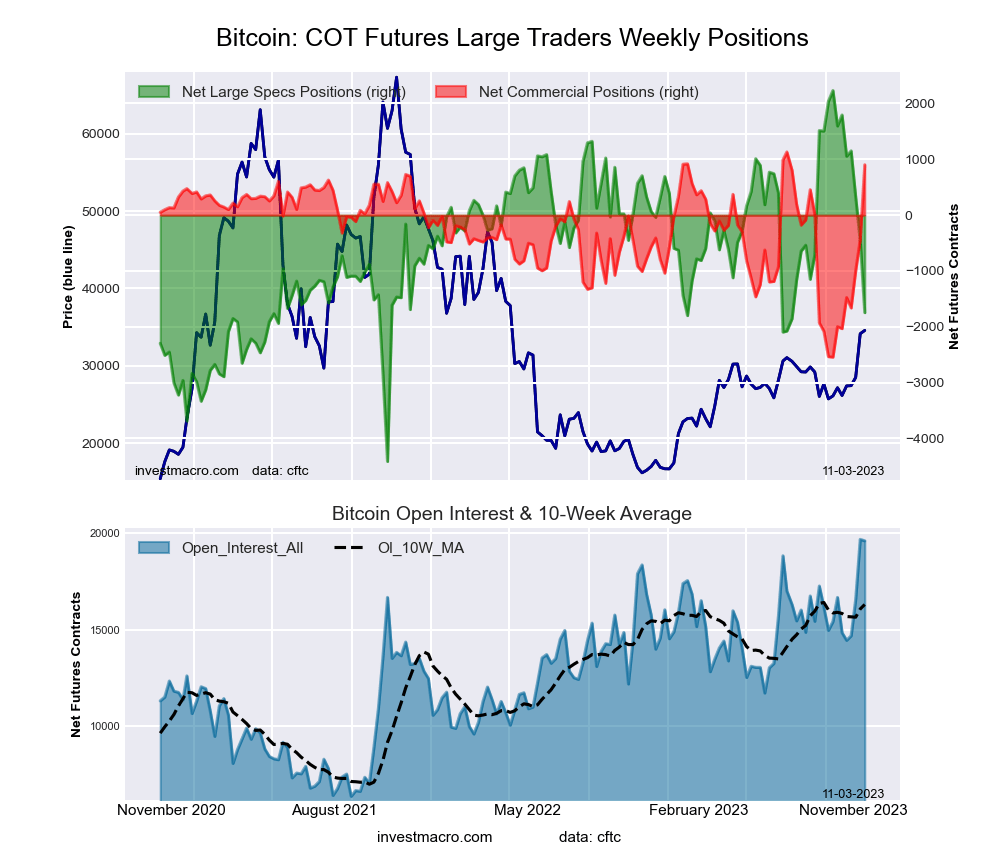
I could never understand the investment case for Bitcoin from Day One because, in my quasi-atrophied mind, it was a duplication of the attributes of gold and silver, stalwart defenders of the purchasing power of savings for five thousand years. As true as that may be, look at that chart. The kiddies were absolutely right because they saw the shenanigans in the gold and silver markets (all completely dominated by the big banks in London and N.Y.), and they said “No thanks” and decided to create their own defense against the government and central bank currency debasement and guess what? It worked.

I do not own Bitcoin. I have never owned cryptocurrencies of any type, form, or semblance, but I will tell you this: “I wish I had.”

I wish I had treated Bitcoin as “just another trade” when I received my first “pitch” on it in 2015. I wish I had stuffed my sexagenarian ego into that old steamer trunk in the attic and grabbed “a few yards of the s*it” simply “as a trade.” It represents all of the virtuous qualities that were taught to me about gold and silver back when I was a “kiddie” while my Bay Street bosses were lecturing me on the wonderment of “government bonds.”

The point I make here is this: as long as the U.S. government views gold as a “Public Enemy,” it is never going to outperform the S&P or copper or zinc or lithium because it is the anti-Christ to the U.S. dollar — period. The U.S. Feds have the U.S. dollar gold price on a leash of sorts. They allow “manageable volatility,” but they will never allow it to replace the dollar as a substitute for “reserve currency” status.

All of that being said, I continue to hold an inordinate amount of physical gold and silver and an embarrassing number of junior gold and silver stocks, all under the assumption that everything I just typed is utter nonsense. After all, that is why we all own gold and silver. Right?

The QQQ’s

The U.S. technology stock steamroller that has sent shorts to the infirmary and the odd mortuary since the banking bailout last March appears to have hit a speed bump, with NASDAQ Composite registering lower highs in choppy trade since it hit its peak at 14,398 back in mid-July. The S&P 500 hit its peak a week later at 4,607 and is also trading more or less sideways as investors try to figure out when and where the much-heralded recession will surface. Every single macro analyst on the planet is scratching their collective heads because the economic data — at least the drivel we are fed — is defying all logic while the lead indicators are screaming, “Economic Cliff-Dive Dead Ahead!”.

What macro analysts forget is that the slash-and-burn artists in the S&P trading pits thrive on liquidity. The quote contained in this graphic of Jerome Powell “manning the printing press” is the precise reason why stocks have enjoyed such a stellar 2023 (thus far). The macro mavens of Wall Street underestimated the amount of new credit that was created firstly in 2008-2011 to bail out the banks and then in 2020-2022 to bail out industry and the consumer. Eight trillion dollars is a great deal of liquidity, and knowing the thieves on Wall Street as I do, they are masters at “gathering assets.”

That behemoth of counterfeit currency created out of thin air to help “the average citizen” weather the pandemic storm in 2020-2022 has found its way into the margin accounts of the “asset gatherers” on Wall Street. The stimmy cheque that was supposed to help a young family of four to “get by” is now trading EOD options and calls on the Invesco QQQ ETF’s (QQQ:NASDAQ) because that is what Wall Street does! Jerome Powell is not manning a device that is spitting out $100 bills to the needy; it is aimed directly at the customers of the big banks that are more than happy to pay fees to play in the financial services sandbox.

So, when I saw the QQQ’s on their way to 300 back in mid-August after breaking the 50-dma, I had visions of Jerome Powell sending firehoses of fresh-ink cash out into the urban landscapes where the “gatherers” sat in wait. I covered my shorts and went long because there was just too much liquidity in the hands of the trading demons to allow a major crash to occur.

That said, the QQQ’s have broken below the 50-dma at 372.97, and since there is a seasonal tendency for stocks to retrench in the latter half of September, remember that those in control of money flow are enjoying a big year with a 20% gain on several trillion dollars of “assets” which means they have a mountain of loan value to use as we head into the final quarter. Trading from a short position between now and October 1 might work out well, and it might work out really well for the VIX traders, and QQQ put buyers if there is an exogenous event that sends chills down the back alleys of Wall Street, but the fourth quarter is usually a strong one, especially after a nine-month disco dance upon which markets have boogied with absolute vigor.

The window of weakness is a short two weeks during which the QQQ could check back to the 100-dma at around 358 but failing a breakdown of that level; odds are in the bulls’ favor looking out to year-end. If one can think of any event that could drain liquidity from the Wall Street punchbowl between now and January, send me a smoke signal.

Lithium, Uranium, and Copper

To repeat a theme that I will maintain for most of the next seven years (the decade), three components of the electrification movement will need to grow exponentially in order to meet the demand associated with this transition: More clean energy (nuclear); more transmission infrastructure (copper), and increased electrical storage capacity (lithium).

The lithium sector has been the savior of resource brokers and fund managers for most of the past three years. Using the chart of hard rock miner Patriot Battery Metals Inc. (PMET:CA), it appears as though the summer correction that hammered the bulk of the lithium miners has ended. I cannot tell whether it is going to last for very long, but short-term, the runway looks clear.

The lithium “briners,” which have been a completely different story this summer, had a much-needed correction last week as the lead “briner,” E3 Lithium Ltd. (ETL:TSXV;EEMMF:US) lost a third of its value in three trading sessions after peaking at a CA$400m market cap at $5.72.

That dragged my top pick for 2023, Volt Lithium Corp. (VLT:TSV;VLTLF:US), down as well from a recovery high at CA$.395 to close out the week at $.315.

Despite the setback, the “briners” will achieve free cash flow objectives a lot sooner than will the “miners,” but with all of the automotive money flooding into “miner projects,” I cannot see any of the lithium space players being left out of the demand-led rally that should last until at least 2030. I am inclined to invest heavily in the ones with the lowest current market cap, where management has demonstrated the ability to execute. The market caps of the three mentioned here are:

  • Patriot Battery Metals: CA$1.3 billion
  • E3 Lithium Ltd. CA$274 million
  • Volt Lithium Corp. CA$31 million

Uranium prices tapped US$62/pound this week, which sent most of the companies friendly to nuclear power on a tear. The Sprott Uranium Miners ETF (URNM::NYSE ARCA) is now up over 40% YTD, versus the NASDAQ up 30% and the S&P up 16%.

Cameco Corp. (CCO:TSX; CCJ:NYSE), the world’s biggest uranium miner, is up 77% YTD, while my personal holding Western Uranium & Vanadium Corp. (WUC:CSE; WSTRF:OTCQX) closed at $1.62, ahead 37% YTD and still well below the peaks in 2018 (CAD $3.40) and 2021 ($4.25).

With lithium and uranium now solidly ahead for the year, one has to wonder when the last component of the “electrification trilogy” — copper — will catch the attention of the big multinational trading houses.

With most of the large copper deposits around the globe now on descending production slopes and with few new discoveries coming onstream, even finite copper demand over the balance of the decade will be enough to affect price in a huge way. However, copper demand is not going to be “finite”; it is going through the roof, and that is with or without China.

The copper bears cite “weak China growth” as a reason for anemic copper prices, but one thing is certain: if you fire up fifty-seven new nuclear reactors around the world, creating several hundred million new megawatts of electricity, you are going to need a much larger transmission infrastructure which means wires and unless they find a way to transmit current more efficiently using a substance other than copper wiring, then copper is going to move into “shortage” at some point and when that point arrives, prices will explode.

The Copper Miners ETF (COPX:US) has come a long way off the COVID-19 CRASH lows, but tops in the US$42-43 range have not been revisited because of the waffling copper price. If I own uranium and lithium stocks, which I do because I am a fervent believer in the electrification movement, then I cannot construct a portfolio without copper.

Now, copper is seen by many as a boring, unexciting sector with very few junior copper deals commanding much (if any) attention. It may be that copper mining is seen as environmentally hostile to the spirit and soul of the electrification movement and thus shunned by the “woke” community of newbie investors.

I would answer that by pointing to the Energy ETF (XLE:US), up over 27% YTD with many of the components carrying P/E’s of around 8. As socially and politically “uncool” as oil and gas extraction is, money has found the sector, and investors are being rewarded. I think the same result holds true for copper, so outside of owning a few call options on the COPX:US, I am actively seeking out a cheap junior with an advanced exploration or development project that I can get behind before the rest of the world wakes up.

Lithium has soared; uranium is now soaring; the last of the electrification trilogy is about to soar.

BUY COPPER.


Important Disclosures:

  1. Volt Lithium Corp. has a consulting relationship with an affiliate of Streetwise Reports, and pays a monthly consulting fee between US$8,000 and US$20,000.
  2. As of the date of this article, officers and/or employees of Streetwise Reports LLC (including members of their household) own securities of Volt Lithium Corp. and Western Uranium & Vanadium Corp.
  3. Michael Ballanger: I, or members of my immediate household or family, own securities of: All. My company has a financial relationship with: Volt Lithium Corp. I determined which companies would be included in this article based on my research and understanding of the sector.
  4. Statements and opinions expressed are the opinions of the author and not of Streetwise Reports or its officers. The author is wholly responsible for the validity of the statements. The author was not paid by Streetwise Reports for this article. Streetwise Reports was not paid by the author to publish or syndicate this article. Streetwise Reports requires contributing authors to disclose any shareholdings in, or economic relationships with, companies that they write about. Streetwise Reports relies upon the authors to accurately provide this information and Streetwise Reports has no means of verifying its accuracy.
  5.  This article does not constitute investment advice. Each reader is encouraged to consult with his or her individual financial professional. By opening this page, each reader accepts and agrees to Streetwise Reports’ terms of use and full legal disclaimer. This article is not a solicitation for investment. Streetwise Reports does not render general or specific investment advice and the information on Streetwise Reports should not be considered a recommendation to buy or sell any security. Streetwise Reports does not endorse or recommend the business, products, services or securities of any company.

For additional disclosures, please click here.

Michael Ballanger Disclosures

This letter makes no guarantee or warranty on the accuracy or completeness of the data provided. Nothing contained herein is intended or shall be deemed to be investment advice, implied or otherwise. This letter represents my views and replicates trades that I am making but nothing more than that. Always consult your registered advisor to assist you with your investments. I accept no liability for any loss arising from the use of the data contained on this letter. Options and junior mining stocks contain a high level of risk that may result in the loss of part or all invested capital and therefore are suitable for experienced and professional investors and traders only. One should be familiar with the risks involved in junior mining and options trading and we recommend consulting a financial adviser if you feel you do not understand the risks involved.

Mid-Week Technical Outlook: precious metals & commodities

By ForexTime 

  • Precious metals & commodities in focus ahead of Fed
  • Gold waits for fresh fundamental spark
  • Silver trapped within range
  • Brent slips from 10-month high
  • Natural Gas tests 200-day SMA

Global equities were mixed on Wednesday as investors braced for the outcome of the Federal Reserve rate decision.

There was some optimism in the air despite the overall caution after UK inflation data eased more than expected in August. This offered some support to European markets while weakening the pound as investors raised bets around the BoE nearing the end of its hiking cycle. The dollar has entered standby mode, oil is under pressure, and gold seems to be waiting for a fresh directional catalyst.

The Fed interest rate decision this evening could trigger explosive levels of volatility, resulting in fresh opportunities across the board. Our focus today falls on precious metals and commodities with the tool of choice technical analysis.

Gold waits on Fed decision

Gold is likely to trade within a tight range until the Fed’s decision this evening.

While the central bank is widely expected to leave rates unchanged, much focus will be on the economic projections, dot plots, and messaging for clues on future hikes. Gold is back within a choppy range on the daily charts with prices recently pushing above the 200-day and 50-day SMA. A breakout may be on the horizon with the Fed decision acting as the directional spark.

  • A strong breakout above $1937 may open a path toward $1953.
  • Should prices slip below the 200-day SMA at $1924, this could see a decline towards $1906 and $1900, respectively.

Silver trapped within range

Silver prices have been trapped within a range on the daily timeframe since early May 2023.

The metal continues to be influenced by the dollar, Fed hike expectations, and the outlook for industrial demand. Despite the recent rebound from the $22.10 support level, prices are still trading below the 50,100 and 200-day SMA while the MACD trades below zero.

  • Sustained weakness below $23.70 could encourage a decline back towards $22.10.
  • Should bulls break above the $23.70 level, this could open the doors toward the $25.20 resistance.

Brent slips from 10-month high

After hitting a fresh 10-month high yesterday, Brent has found itself under noticeable pressure with the daily bearish pin bar signalling further losses.

Prices remain firmly bullish on the daily charts as there have been consistently higher highs and higher lows while the MACD trades above zero. Given the strong upside momentum, Brent may be experiencing a technical throwback before bulls attempt to push the commodity beyond $96.10.

  • However, a strong breakdown and daily close below $89.70 could signal the return of bears, with the next key level back at the 50-day SMA.

WTI bulls take a breather

It is a similar story for Crude which has shed roughly 1% this morning. Although prices are firmly bullish on the daily charts, the daily bearish pin bar could be an invitation for bears.

  • Nevertheless, bulls remain in a position of power above the $88.40 dynamic support level.
  • Should prices slip below this point and hit $86.40, this could invalidate the current uptrend with bears targeting lower levels, starting from $84.50 and 50-day SMA.

Natural Gas tests 200-day SMA

Natural gas prices remain in a weak bullish channel on the daily timeframe. However, prices are currently testing the 200-day SMA which may act as a formidable resistance level.

  • A strong breakout above this point could encourage an incline towards $3.0 and $3.3 before bulls aim for $4.2.
  • If the 200-day SMA proves to be a tough resistance to crack, this could encourage a decline back towards $2.4 and $2.1, respectively.


Forex-Time-LogoArticle by ForexTime

ForexTime Ltd (FXTM) is an award winning international online forex broker regulated by CySEC 185/12 www.forextime.com

Stagflation is not the danger, it’s crushing long-term growth: deVere CEO

By George Prior 

Crushing economic growth, and not stagflation, is “the real danger” and should now be the focus of the European Central Bank and the Bank of England, warns the CEO of one of the world’s largest independent financial advisory, asset management and fintech organizations.

Nigel Green of deVere Group is speaking out after economist Nouriel Roubini, who has earned the moniker Dr Doom, told Bloomberg that the two central banks need to keep raising rates to ward off stagflation, which occurs when stagnant growth and high inflation happen simultaneously.

The European Central Bank raised interest rates to a record high last week.

Meanwhile, the Bank of England is expected to raise interest rates by another quarter point at its meeting on Thursday, taking the cost of borrowing to 5.5%, its highest level since early 2008.

The deVere CEO comments: “Crushing already slowing global economic growth through the blunt instrument of monetary policy will be significantly more detrimental to an economy than short-term stagnation.

“While neither extreme is ideal, hindering longer-term economic growth is the real danger, not short-term stagflation, and it should be the focus for policymakers.”

Like a growing number of analysts, Nigel Green also points to the warning signs of a possible looming recession in the US in the form of the inverted Treasury yield curve.

The inverted yield curve in the US suggests a recession is looming because it’s a sign of a tight credit market and weak economic growth.

The inversion of the yield curve has preceded most US recessions since 1950. Of course, the knock-on effect of a downturn in the world’s largest economy would have far-reaching, serious effects globally.

He continues: “Stifling growth through the cost of capital becoming prohibitive for businesses and individuals leads to a decline in capital formation, reduced entrepreneurial activity, and a slowdown in economic development.

“It leads to a slowdown of innovation and development and a reduction of overall investment. These effects hinder future growth potential and undermine an economy’s competitiveness on the global stage.

“Killing off growth will naturally create job losses and a stagnant labor market. A lack of job opportunities can have a cascading effect, leading to increased unemployment rates, reduced consumer spending, and a decline in overall economic well-being.

The deVere CEO says the wounds of stifling growth could also manifest through increased income inequality and decreased government revenue.

“Economic growth typically brings increased prosperity for all segments of society. When growth is crushed, income inequality tends to worsen, which could trigger social unrest and decreased social cohesion.

“Also a growing economy generates more tax revenue for governments, allowing them to fund essential services like healthcare, education, and infrastructure development.

“Stagnation may lead to a budget crunch, but stifling growth can be even more detrimental, potentially requiring austerity measures that hurt households and public services.”

He concludes: “If additional interest rate hikes further hinder economic growth, the longer-term consequences will be far worse than a bout of stagflation.”

About:

deVere Group is one of the world’s largest independent advisors of specialist global financial solutions to international, local mass affluent, and high-net-worth clients.  It has a network of offices across the world, over 80,000 clients and $12bn under advisement.