Archive for Opinions – Page 72

Currency Speculators drop their Euro Bets to 43-Week Low on ECB Rates

By InvestMacro

Here are the latest charts and statistics for the Commitment of Traders (COT) data published by the Commodities Futures Trading Commission (CFTC).

The latest COT data is updated through Tuesday September 12th and shows a quick view of how large market participants (for-profit speculators and commercial traders) were positioned in the futures markets. All currency positions are in direct relation to the US dollar where, for example, a bet for the euro is a bet that the euro will rise versus the dollar while a bet against the euro will be a bet that the euro will decline versus the dollar.

Weekly Speculator Changes led by Australian Dollar & US Dollar Index

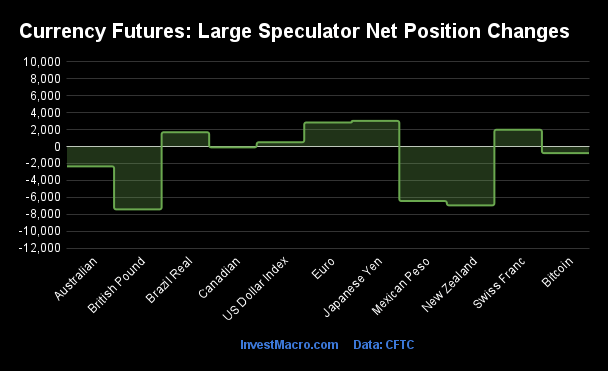
The COT currency market speculator bets were overall lower this week as just three out of the eleven currency markets we cover had higher positioning while the other eight markets had lower speculator contracts.

Leading the gains for the currency markets was the Australian Dollar (4,004 contracts) with the US Dollar Index (2,712 contracts) and Bitcoin (193 contracts) also showing positive weeks.

The currencies seeing declines in speculator bets on the week were the EuroFX (-23,151 contracts) with the Canadian Dollar (-16,920 contracts), the Swiss Franc (-4,013 contracts), the Japanese Yen (-1,577 contracts), the Brazilian Real (-756 contracts), Mexican Peso (-650 contracts), the New Zealand Dollar (-620 contracts) and the British Pound (-210 contracts) also registering lower bets on the week.

Currency Traders drop their Euro Bets to 43-Week Low on ECB Rates

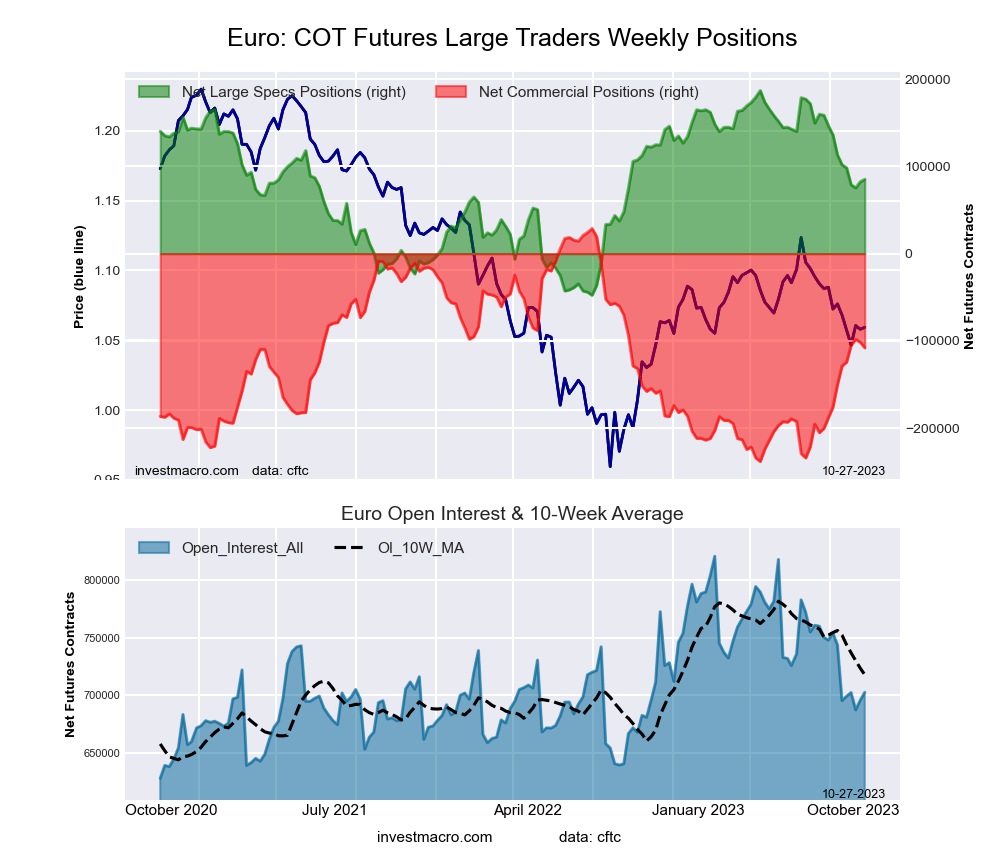
Highlighting the COT currency’s data this week is the dropping speculator positioning for the Euro Currency. Large speculative Euro positions dropped sharply this week by over -23,000 contracts and declined for a fourth consecutive week. Euro weekly positions have now decreased for the seventh time in the past eight weeks as well as in nine out of the past eleven weeks.

The Euro speculative standing still remains in a highly bullish level with the net position at a total of +113,080 contracts currently. However, the net position has now fallen by a total of -46,783 contracts in just the past four weeks and by a total of -65,752 contracts over the past eight weeks.

Overall, the Euro net speculator level has been above the +100,000 contract level for forty-six straight weeks and ascended to a 137-week high with a total net position of +187,089 contracts on May 16th – the most bullish point since a total of 188,116 contracts was reached on September 29th of 2020.

The European Central Bank has helped dampen the sentiment for the Euro currency as the bank raised its rate by 25 basis points to 4 percent on Thursday but signaled that there may be no more rate hikes on the docket. The ECB also revised their economic growth projections lower with the bank seeing just 0.7 percent growth in 2023. Following the announcement, many participants are expecting not to see further rate rises and even possible rate cuts if the economy continues to deteriorate.

The Euro currency spot price (versus the US Dollar) has been retreating mightily and this week declined for a ninth consecutive week. The EUR/USD exchange rate closed at 1.0735 on Friday with the low of the week hitting the lowest level since March. The EUR/USD had been as high as 1.1310 on July 18th before starting on its current nine-week downtrend.


Data Snapshot of Forex Market Traders | Columns Legend
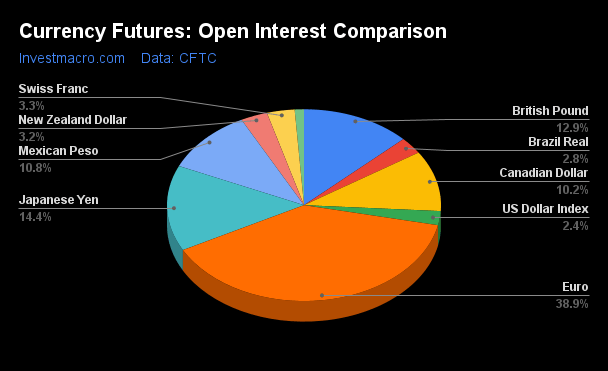
Sep-12-2023OIOI-IndexSpec-NetSpec-IndexCom-NetCOM-IndexSmalls-NetSmalls-Index
USD Index40,982376,07135-7,727631,65626
EUR743,75960113,08067-149,9813336,90138
GBP227,4375446,17488-51,168174,99468
JPY270,85492-98,71311106,64488-7,93137
CHF49,94570-9,3383112,35162-3,01350
CAD217,08074-41,8831549,27590-7,3926
AUD256,219100-79,5331194,99090-15,45715
NZD67,487100-14,6201417,25787-2,63719
MXN235,7205066,87180-71,492194,62141
RUB20,93047,54331-7,15069-39324
BRL34,9691913,17753-15,160461,98353
Bitcoin15,423732,232100-2,543031120


Strength Scores led by Bitcoin & British Pound

COT Strength Scores (a normalized measure of Speculator positions over a 3-Year range, from 0 to 100 where above 80 is Extreme-Bullish and below 20 is Extreme-Bearish) showed that the Bitcoin (100 percent) and the British Pound (88 percent) lead the currency markets this week. The Mexican Peso (80 percent), EuroFX (67 percent) and the Brazilian Real (53 percent) come in as the next highest in the weekly strength scores.

On the downside, the Australian Dollar (11 percent), the Japanese Yen (11 percent), the New Zealand Dollar (14 percent) and the Canadian Dollar (15 percent) come in at the lowest strength levels currently and are in Extreme-Bearish territory (below 20 percent).

Strength Statistics:
US Dollar Index (35.1 percent) vs US Dollar Index previous week (30.5 percent)
EuroFX (67.4 percent) vs EuroFX previous week (77.1 percent)
British Pound Sterling (87.8 percent) vs British Pound Sterling previous week (88.0 percent)
Japanese Yen (11.4 percent) vs Japanese Yen previous week (12.3 percent)
Swiss Franc (30.9 percent) vs Swiss Franc previous week (41.9 percent)
Canadian Dollar (15.5 percent) vs Canadian Dollar previous week (31.3 percent)
Australian Dollar (11.1 percent) vs Australian Dollar previous week (7.4 percent)
New Zealand Dollar (14.0 percent) vs New Zealand Dollar previous week (15.6 percent)
Mexican Peso (80.0 percent) vs Mexican Peso previous week (80.3 percent)
Brazilian Real (52.6 percent) vs Brazilian Real previous week (53.5 percent)
Bitcoin (100.0 percent) vs Bitcoin previous week (97.1 percent)


Bitcoin & US Dollar Index top the 6-Week Strength Trends

COT Strength Score Trends (or move index, calculates the 6-week changes in strength scores) showed that the Bitcoin (42 percent) and the US Dollar Index (5 percent) lead the past six weeks trends for the currencies.

The Canadian Dollar (-45 percent) leads the downside trend scores currently with the New Zealand Dollar (-44 percent), Brazilian Real (-26 percent) and the Australian Dollar (-26 percent) following next with lower trend scores.

Strength Trend Statistics:
US Dollar Index (4.9 percent) vs US Dollar Index previous week (-4.5 percent)
EuroFX (-24.7 percent) vs EuroFX previous week (-17.2 percent)
British Pound Sterling (-2.4 percent) vs British Pound Sterling previous week (-8.8 percent)
Japanese Yen (-11.6 percent) vs Japanese Yen previous week (-11.5 percent)
Swiss Franc (-1.6 percent) vs Swiss Franc previous week (8.5 percent)
Canadian Dollar (-45.0 percent) vs Canadian Dollar previous week (-28.4 percent)
Australian Dollar (-25.7 percent) vs Australian Dollar previous week (-30.0 percent)
New Zealand Dollar (-43.9 percent) vs New Zealand Dollar previous week (-35.4 percent)
Mexican Peso (-13.2 percent) vs Mexican Peso previous week (-12.4 percent)
Brazilian Real (-25.6 percent) vs Brazilian Real previous week (-22.9 percent)
Bitcoin (41.7 percent) vs Bitcoin previous week (40.4 percent)


Individual COT Forex Markets:

US Dollar Index Futures:
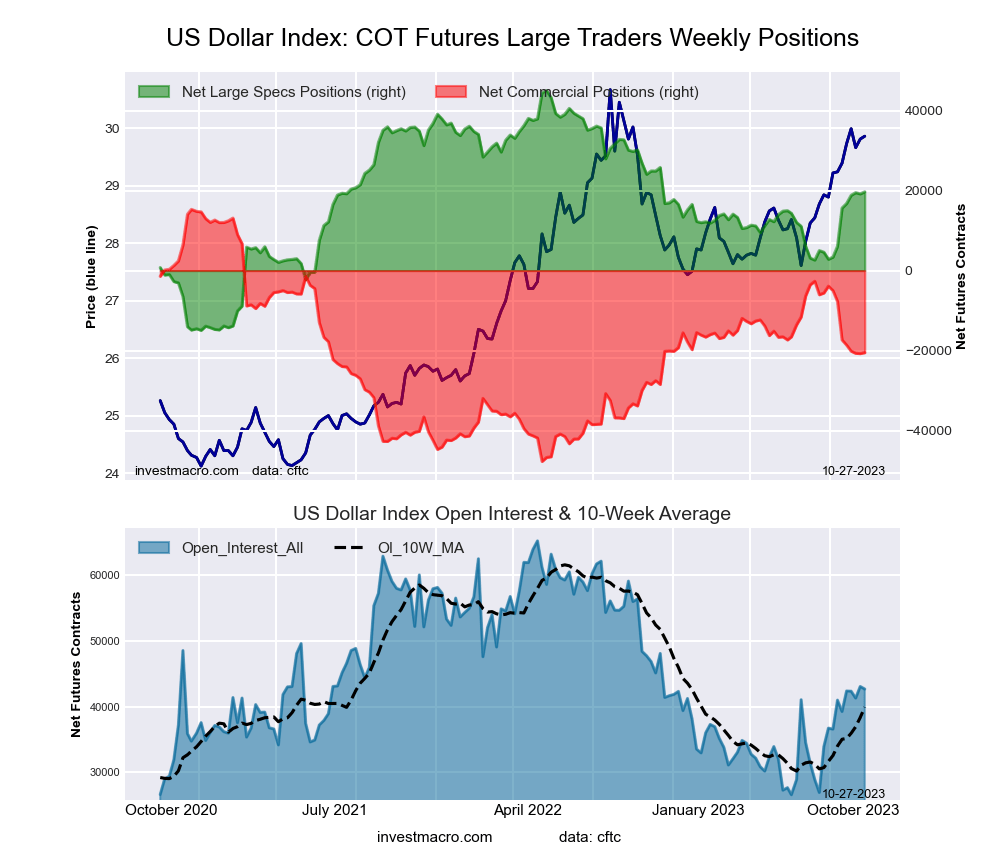
US Dollar Index Forex Futures COT ChartThe US Dollar Index large speculator standing this week totaled a net position of 6,071 contracts in the data reported through Tuesday. This was a weekly advance of 2,712 contracts from the previous week which had a total of 3,359 net contracts.

This week’s current strength score (the trader positioning range over the past three years, measured from 0 to 100) shows the speculators are currently Bearish with a score of 35.1 percent. The commercials are Bullish with a score of 63.5 percent and the small traders (not shown in chart) are Bearish with a score of 25.8 percent.

Price Trend-Following Model: Strong Uptrend

Our weekly trend-following model classifies the current market price position as: Strong Uptrend. The current action for the model is considered to be: Hold – Maintain Long Position.

US DOLLAR INDEX StatisticsSPECULATORSCOMMERCIALSSMALL TRADERS
– Percent of Open Interest Longs:61.419.311.0
– Percent of Open Interest Shorts:46.538.17.0
– Net Position:6,071-7,7271,656
– Gross Longs:25,1457,9064,510
– Gross Shorts:19,07415,6332,854
– Long to Short Ratio:1.3 to 10.5 to 11.6 to 1
NET POSITION TREND:
– Strength Index Score (3 Year Range Pct):35.163.525.8
– Strength Index Reading (3 Year Range):BearishBullishBearish
NET POSITION MOVEMENT INDEX:
– 6-Week Change in Strength Index:4.9-6.614.7


Euro Currency Futures:

Euro Currency Futures COT ChartThe Euro Currency large speculator standing this week totaled a net position of 113,080 contracts in the data reported through Tuesday. This was a weekly lowering of -23,151 contracts from the previous week which had a total of 136,231 net contracts.

This week’s current strength score (the trader positioning range over the past three years, measured from 0 to 100) shows the speculators are currently Bullish with a score of 67.4 percent. The commercials are Bearish with a score of 33.3 percent and the small traders (not shown in chart) are Bearish with a score of 37.9 percent.

Price Trend-Following Model: Strong Downtrend

Our weekly trend-following model classifies the current market price position as: Strong Downtrend. The current action for the model is considered to be: Hold – Maintain Short Position.

EURO Currency StatisticsSPECULATORSCOMMERCIALSSMALL TRADERS
– Percent of Open Interest Longs:28.655.512.5
– Percent of Open Interest Shorts:13.475.77.5
– Net Position:113,080-149,98136,901
– Gross Longs:212,376412,96792,784
– Gross Shorts:99,296562,94855,883
– Long to Short Ratio:2.1 to 10.7 to 11.7 to 1
NET POSITION TREND:
– Strength Index Score (3 Year Range Pct):67.433.337.9
– Strength Index Reading (3 Year Range):BullishBearishBearish
NET POSITION MOVEMENT INDEX:
– 6-Week Change in Strength Index:-24.726.7-20.1


British Pound Sterling Futures:

British Pound Sterling Futures COT ChartThe British Pound Sterling large speculator standing this week totaled a net position of 46,174 contracts in the data reported through Tuesday. This was a weekly reduction of -210 contracts from the previous week which had a total of 46,384 net contracts.

This week’s current strength score (the trader positioning range over the past three years, measured from 0 to 100) shows the speculators are currently Bullish-Extreme with a score of 87.8 percent. The commercials are Bearish-Extreme with a score of 17.0 percent and the small traders (not shown in chart) are Bullish with a score of 67.8 percent.

Price Trend-Following Model: Weak Uptrend

Our weekly trend-following model classifies the current market price position as: Weak Uptrend. The current action for the model is considered to be: Hold – Maintain Long Position.

BRITISH POUND StatisticsSPECULATORSCOMMERCIALSSMALL TRADERS
– Percent of Open Interest Longs:42.835.414.1
– Percent of Open Interest Shorts:22.557.911.9
– Net Position:46,174-51,1684,994
– Gross Longs:97,36580,44132,133
– Gross Shorts:51,191131,60927,139
– Long to Short Ratio:1.9 to 10.6 to 11.2 to 1
NET POSITION TREND:
– Strength Index Score (3 Year Range Pct):87.817.067.8
– Strength Index Reading (3 Year Range):Bullish-ExtremeBearish-ExtremeBullish
NET POSITION MOVEMENT INDEX:
– 6-Week Change in Strength Index:-2.48.7-23.9


Japanese Yen Futures:

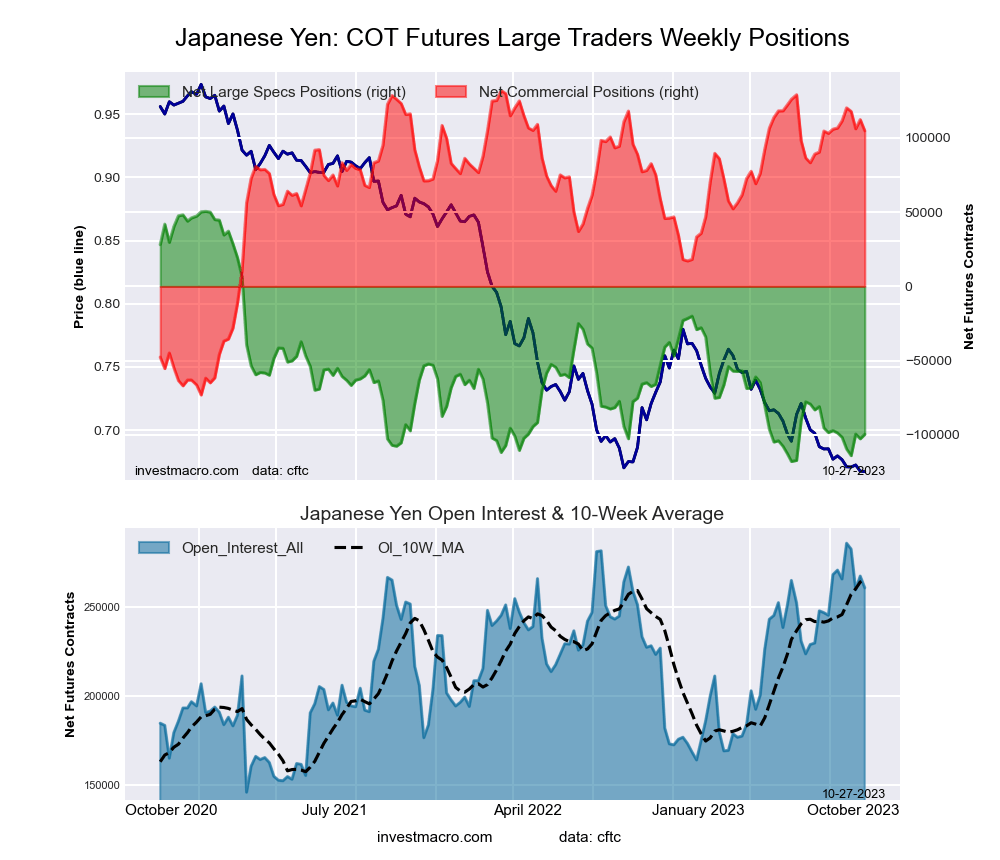
Japanese Yen Forex Futures COT ChartThe Japanese Yen large speculator standing this week totaled a net position of -98,713 contracts in the data reported through Tuesday. This was a weekly reduction of -1,577 contracts from the previous week which had a total of -97,136 net contracts.

This week’s current strength score (the trader positioning range over the past three years, measured from 0 to 100) shows the speculators are currently Bearish-Extreme with a score of 11.4 percent. The commercials are Bullish-Extreme with a score of 87.7 percent and the small traders (not shown in chart) are Bearish with a score of 37.3 percent.

Price Trend-Following Model: Strong Downtrend

Our weekly trend-following model classifies the current market price position as: Strong Downtrend. The current action for the model is considered to be: Hold – Maintain Short Position.

JAPANESE YEN StatisticsSPECULATORSCOMMERCIALSSMALL TRADERS
– Percent of Open Interest Longs:14.167.813.3
– Percent of Open Interest Shorts:50.628.416.2
– Net Position:-98,713106,644-7,931
– Gross Longs:38,247183,58936,043
– Gross Shorts:136,96076,94543,974
– Long to Short Ratio:0.3 to 12.4 to 10.8 to 1
NET POSITION TREND:
– Strength Index Score (3 Year Range Pct):11.487.737.3
– Strength Index Reading (3 Year Range):Bearish-ExtremeBullish-ExtremeBearish
NET POSITION MOVEMENT INDEX:
– 6-Week Change in Strength Index:-11.611.4-7.8


Swiss Franc Futures:

Swiss Franc Forex Futures COT ChartThe Swiss Franc large speculator standing this week totaled a net position of -9,338 contracts in the data reported through Tuesday. This was a weekly fall of -4,013 contracts from the previous week which had a total of -5,325 net contracts.

This week’s current strength score (the trader positioning range over the past three years, measured from 0 to 100) shows the speculators are currently Bearish with a score of 30.9 percent. The commercials are Bullish with a score of 62.0 percent and the small traders (not shown in chart) are Bullish with a score of 50.3 percent.

Price Trend-Following Model: Weak Uptrend

Our weekly trend-following model classifies the current market price position as: Weak Uptrend. The current action for the model is considered to be: Hold – Maintain Long Position.

SWISS FRANC StatisticsSPECULATORSCOMMERCIALSSMALL TRADERS
– Percent of Open Interest Longs:18.052.127.6
– Percent of Open Interest Shorts:36.727.433.6
– Net Position:-9,33812,351-3,013
– Gross Longs:9,00926,01713,771
– Gross Shorts:18,34713,66616,784
– Long to Short Ratio:0.5 to 11.9 to 10.8 to 1
NET POSITION TREND:
– Strength Index Score (3 Year Range Pct):30.962.050.3
– Strength Index Reading (3 Year Range):BearishBullishBullish
NET POSITION MOVEMENT INDEX:
– 6-Week Change in Strength Index:-1.614.7-27.2


Canadian Dollar Futures:

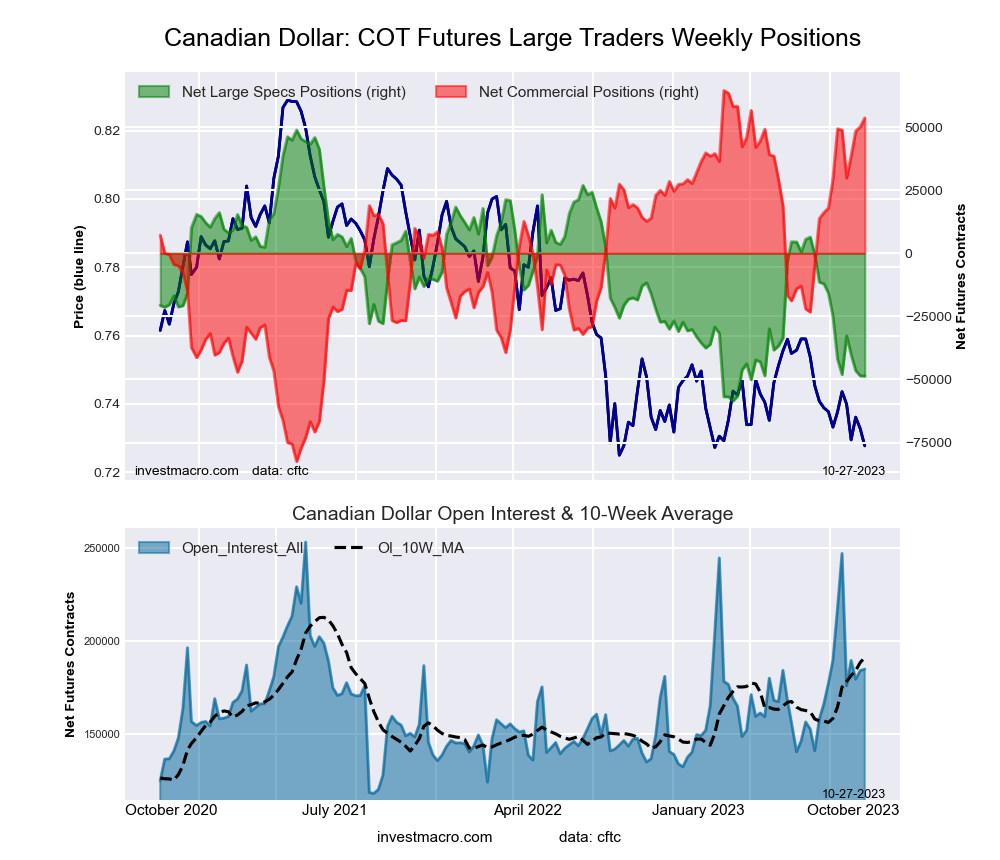
Canadian Dollar Forex Futures COT ChartThe Canadian Dollar large speculator standing this week totaled a net position of -41,883 contracts in the data reported through Tuesday. This was a weekly reduction of -16,920 contracts from the previous week which had a total of -24,963 net contracts.

This week’s current strength score (the trader positioning range over the past three years, measured from 0 to 100) shows the speculators are currently Bearish-Extreme with a score of 15.5 percent. The commercials are Bullish-Extreme with a score of 89.7 percent and the small traders (not shown in chart) are Bearish-Extreme with a score of 6.4 percent.

Price Trend-Following Model: Strong Downtrend

Our weekly trend-following model classifies the current market price position as: Strong Downtrend. The current action for the model is considered to be: Hold – Maintain Short Position.

CANADIAN DOLLAR StatisticsSPECULATORSCOMMERCIALSSMALL TRADERS
– Percent of Open Interest Longs:18.660.814.6
– Percent of Open Interest Shorts:37.938.118.0
– Net Position:-41,88349,275-7,392
– Gross Longs:40,298131,97631,767
– Gross Shorts:82,18182,70139,159
– Long to Short Ratio:0.5 to 11.6 to 10.8 to 1
NET POSITION TREND:
– Strength Index Score (3 Year Range Pct):15.589.76.4
– Strength Index Reading (3 Year Range):Bearish-ExtremeBullish-ExtremeBearish-Extreme
NET POSITION MOVEMENT INDEX:
– 6-Week Change in Strength Index:-45.049.4-54.0


Australian Dollar Futures:

Australian Dollar Forex Futures COT ChartThe Australian Dollar large speculator standing this week totaled a net position of -79,533 contracts in the data reported through Tuesday. This was a weekly advance of 4,004 contracts from the previous week which had a total of -83,537 net contracts.

This week’s current strength score (the trader positioning range over the past three years, measured from 0 to 100) shows the speculators are currently Bearish-Extreme with a score of 11.1 percent. The commercials are Bullish-Extreme with a score of 89.6 percent and the small traders (not shown in chart) are Bearish-Extreme with a score of 14.7 percent.

Price Trend-Following Model: Strong Downtrend

Our weekly trend-following model classifies the current market price position as: Strong Downtrend. The current action for the model is considered to be: Hold – Maintain Short Position.

AUSTRALIAN DOLLAR StatisticsSPECULATORSCOMMERCIALSSMALL TRADERS
– Percent of Open Interest Longs:18.564.48.7
– Percent of Open Interest Shorts:49.527.314.7
– Net Position:-79,53394,990-15,457
– Gross Longs:47,309164,96122,273
– Gross Shorts:126,84269,97137,730
– Long to Short Ratio:0.4 to 12.4 to 10.6 to 1
NET POSITION TREND:
– Strength Index Score (3 Year Range Pct):11.189.614.7
– Strength Index Reading (3 Year Range):Bearish-ExtremeBullish-ExtremeBearish-Extreme
NET POSITION MOVEMENT INDEX:
– 6-Week Change in Strength Index:-25.728.7-24.3


New Zealand Dollar Futures:

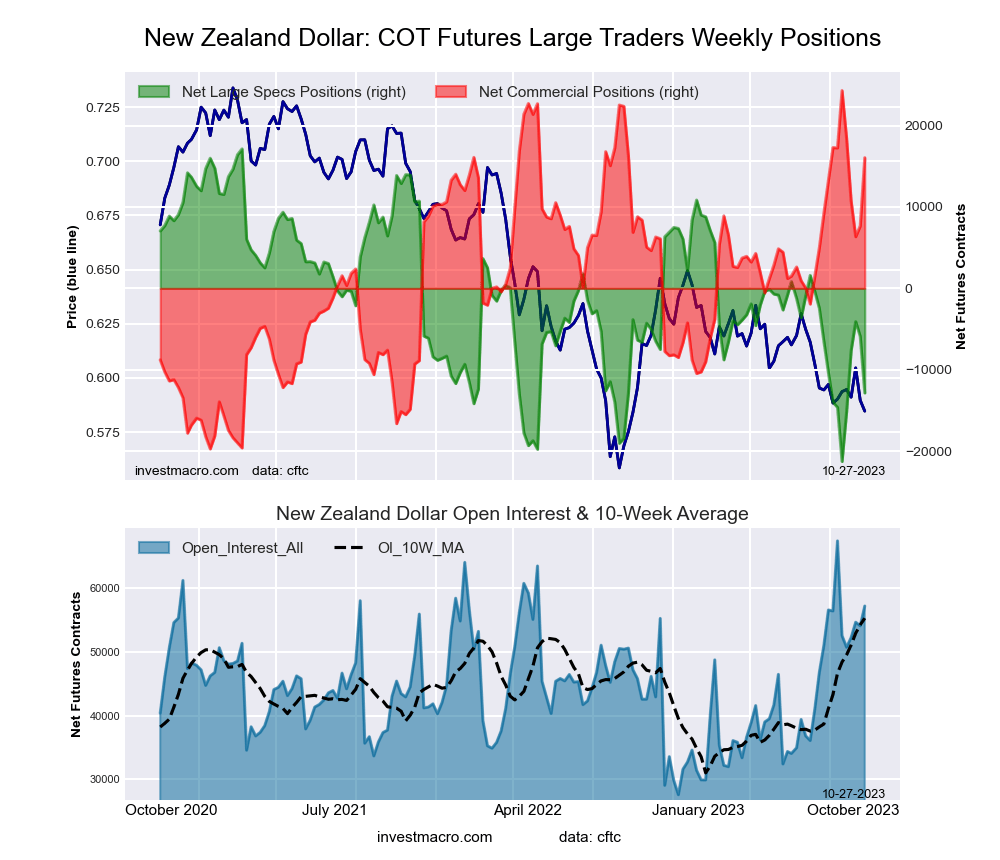
New Zealand Dollar Forex Futures COT ChartThe New Zealand Dollar large speculator standing this week totaled a net position of -14,620 contracts in the data reported through Tuesday. This was a weekly lowering of -620 contracts from the previous week which had a total of -14,000 net contracts.

This week’s current strength score (the trader positioning range over the past three years, measured from 0 to 100) shows the speculators are currently Bearish-Extreme with a score of 14.0 percent. The commercials are Bullish-Extreme with a score of 87.2 percent and the small traders (not shown in chart) are Bearish-Extreme with a score of 18.6 percent.

Price Trend-Following Model: Strong Downtrend

Our weekly trend-following model classifies the current market price position as: Strong Downtrend. The current action for the model is considered to be: Hold – Maintain Short Position.

NEW ZEALAND DOLLAR StatisticsSPECULATORSCOMMERCIALSSMALL TRADERS
– Percent of Open Interest Longs:21.962.85.1
– Percent of Open Interest Shorts:43.637.29.0
– Net Position:-14,62017,257-2,637
– Gross Longs:14,79742,3953,420
– Gross Shorts:29,41725,1386,057
– Long to Short Ratio:0.5 to 11.7 to 10.6 to 1
NET POSITION TREND:
– Strength Index Score (3 Year Range Pct):14.087.218.6
– Strength Index Reading (3 Year Range):Bearish-ExtremeBullish-ExtremeBearish-Extreme
NET POSITION MOVEMENT INDEX:
– 6-Week Change in Strength Index:-43.945.2-35.5


Mexican Peso Futures:

Mexican Peso Futures COT ChartThe Mexican Peso large speculator standing this week totaled a net position of 66,871 contracts in the data reported through Tuesday. This was a weekly fall of -650 contracts from the previous week which had a total of 67,521 net contracts.

This week’s current strength score (the trader positioning range over the past three years, measured from 0 to 100) shows the speculators are currently Bullish with a score of 80.0 percent. The commercials are Bearish-Extreme with a score of 18.7 percent and the small traders (not shown in chart) are Bearish with a score of 40.7 percent.

Price Trend-Following Model: Uptrend

Our weekly trend-following model classifies the current market price position as: Uptrend. The current action for the model is considered to be: Hold – Maintain Long Position.

MEXICAN PESO StatisticsSPECULATORSCOMMERCIALSSMALL TRADERS
– Percent of Open Interest Longs:39.552.43.1
– Percent of Open Interest Shorts:11.182.81.1
– Net Position:66,871-71,4924,621
– Gross Longs:93,022123,5757,268
– Gross Shorts:26,151195,0672,647
– Long to Short Ratio:3.6 to 10.6 to 12.7 to 1
NET POSITION TREND:
– Strength Index Score (3 Year Range Pct):80.018.740.7
– Strength Index Reading (3 Year Range):BullishBearish-ExtremeBearish
NET POSITION MOVEMENT INDEX:
– 6-Week Change in Strength Index:-13.212.80.5


Brazilian Real Futures:

Brazil Real Futures COT ChartThe Brazilian Real large speculator standing this week totaled a net position of 13,177 contracts in the data reported through Tuesday. This was a weekly decline of -756 contracts from the previous week which had a total of 13,933 net contracts.

This week’s current strength score (the trader positioning range over the past three years, measured from 0 to 100) shows the speculators are currently Bullish with a score of 52.6 percent. The commercials are Bearish with a score of 46.0 percent and the small traders (not shown in chart) are Bullish with a score of 52.9 percent.

Price Trend-Following Model: Uptrend

Our weekly trend-following model classifies the current market price position as: Uptrend. The current action for the model is considered to be: Hold – Maintain Long Position.

BRAZIL REAL StatisticsSPECULATORSCOMMERCIALSSMALL TRADERS
– Percent of Open Interest Longs:56.333.19.5
– Percent of Open Interest Shorts:18.676.43.8
– Net Position:13,177-15,1601,983
– Gross Longs:19,69611,5683,305
– Gross Shorts:6,51926,7281,322
– Long to Short Ratio:3.0 to 10.4 to 12.5 to 1
NET POSITION TREND:
– Strength Index Score (3 Year Range Pct):52.646.052.9
– Strength Index Reading (3 Year Range):BullishBearishBullish
NET POSITION MOVEMENT INDEX:
– 6-Week Change in Strength Index:-25.621.624.1


Bitcoin Futures:

Bitcoin Crypto Futures COT ChartThe Bitcoin large speculator standing this week totaled a net position of 2,232 contracts in the data reported through Tuesday. This was a weekly rise of 193 contracts from the previous week which had a total of 2,039 net contracts.

This week’s current strength score (the trader positioning range over the past three years, measured from 0 to 100) shows the speculators are currently Bullish-Extreme with a score of 100.0 percent. The commercials are Bearish-Extreme with a score of 0.0 percent and the small traders (not shown in chart) are Bearish with a score of 20.0 percent.

Price Trend-Following Model: Strong Downtrend

Our weekly trend-following model classifies the current market price position as: Strong Downtrend. The current action for the model is considered to be: Hold – Maintain Short Position.

BITCOIN StatisticsSPECULATORSCOMMERCIALSSMALL TRADERS
– Percent of Open Interest Longs:77.10.87.4
– Percent of Open Interest Shorts:62.617.25.3
– Net Position:2,232-2,543311
– Gross Longs:11,8931171,134
– Gross Shorts:9,6612,660823
– Long to Short Ratio:1.2 to 10.0 to 11.4 to 1
NET POSITION TREND:
– Strength Index Score (3 Year Range Pct):100.00.020.0
– Strength Index Reading (3 Year Range):Bullish-ExtremeBearish-ExtremeBearish
NET POSITION MOVEMENT INDEX:
– 6-Week Change in Strength Index:41.7-66.9-7.1


Article By InvestMacroReceive our weekly COT Newsletter

*COT Report: The COT data, released weekly to the public each Friday, is updated through the most recent Tuesday (data is 3 days old) and shows a quick view of how large speculators or non-commercials (for-profit traders) were positioned in the futures markets.

The CFTC categorizes trader positions according to commercial hedgers (traders who use futures contracts for hedging as part of the business), non-commercials (large traders who speculate to realize trading profits) and nonreportable traders (usually small traders/speculators) as well as their open interest (contracts open in the market at time of reporting). See CFTC criteria here.

Speculator Extremes: Cocoa, Bitcoin, EAFE & Corn lead Bullish & Bearish Positions

By InvestMacro

The latest update for the weekly Commitment of Traders (COT) report was released by the Commodity Futures Trading Commission (CFTC) on Friday for data ending on September 12th.

This weekly Extreme Positions report highlights the Most Bullish and Most Bearish Positions for the speculator category. Extreme positioning in these markets can foreshadow strong moves in the underlying market.

To signify an extreme position, we use the Strength Index (also known as the COT Index) of each instrument, a common method of measuring COT data. The Strength Index is simply a comparison of current trader positions against the range of positions over the previous 3 years. We use over 80 percent as extremely bullish and under 20 percent as extremely bearish. (Compare Strength Index scores across all markets in the data table or cot leaders table)


Speculators or Non-Commercials Notes:

Speculators, classified as non-commercial traders by the CFTC, are made up of large commodity funds, hedge funds and other significant for-profit participants. The Specs are generally regarded as trend-followers in their behavior towards price action – net speculator bets and prices tend to go in the same directions. These traders often look to buy when prices are rising and sell when prices are falling. To illustrate this point, many times speculator contracts can be found at their most extremes (bullish or bearish) when prices are also close to their highest or lowest levels.

These extreme levels can be dangerous for the large speculators as the trade is most crowded, there is less trading ammunition still sitting on the sidelines to push the trend further and prices have moved a significant distance. When the trend becomes exhausted, some speculators take profits while others look to also exit positions when prices fail to continue in the same direction. This process usually plays out over many months to years and can ultimately create a reverse effect where prices start to fall and speculators start a process of selling when prices are falling.


Here Are This Week’s Most Bullish Speculator Positions:

Cocoa Futures


The Cocoa Futures speculator position comes in as the most bullish extreme standing this week. The Cocoa Futures speculator level is currently at a 100.0 percent score of its 3-year range.

The six-week trend for the percent strength score totaled 9.7 this week. The overall net speculator position was a total of 87,623 net contracts this week with a change of 1,403 contract in the weekly speculator bets.


Bitcoin


The Bitcoin speculator position comes next in the extreme standings this week. The Bitcoin speculator level is now at a 100.0 percent score of its 3-year range.

The six-week trend for the percent strength score was 41.7 this week. The speculator position registered 2,232 net contracts this week with a weekly change of 193 contracts in speculator bets.


3-Month Secured Overnight Financing Rate


The 3-Month Secured Overnight Financing Rate speculator position comes in third this week in the extreme standings. The 3-Month Secured Overnight Financing Rate speculator level resides at a 99.4 percent score of its 3-year range.

The six-week trend for the speculator strength score came in at 35.2 this week. The overall speculator position was 316,511 net contracts this week with a change of 44,439 contracts in the weekly speculator bets.


Heating Oil


The Heating Oil speculator position comes up number four in the extreme standings this week. The Heating Oil speculator level is at a 92.3 percent score of its 3-year range.

The six-week trend for the speculator strength score totaled a change of 23.3 this week. The overall speculator position was 36,922 net contracts this week with a change of -1,815 contracts in the speculator bets.


VIX


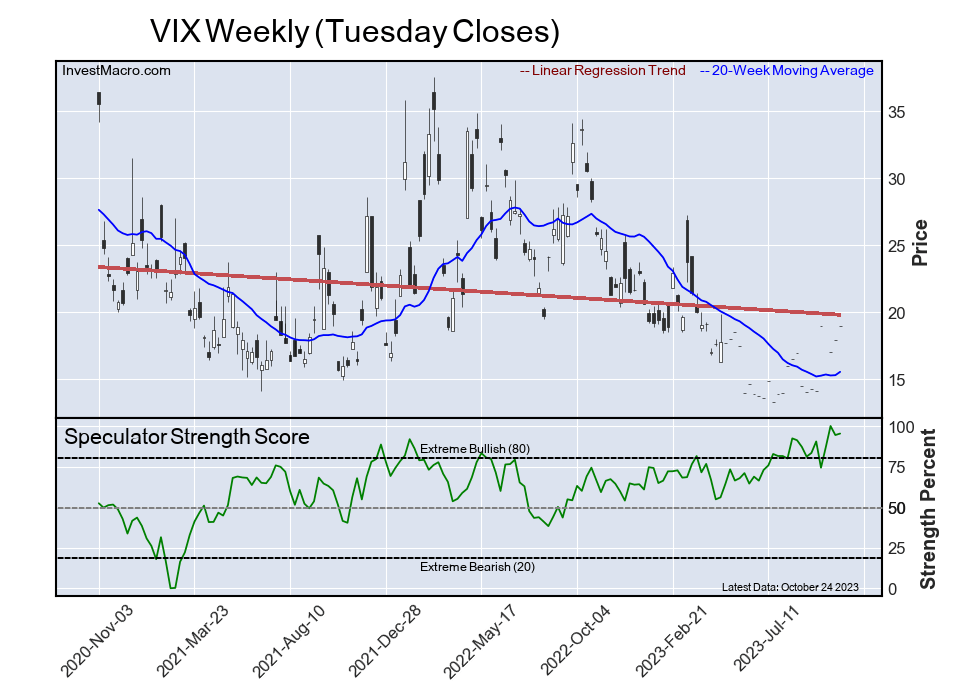
The VIX speculator position rounds out the top five in this week’s bullish extreme standings. The VIX speculator level sits at a 90.3 percent score of its 3-year range. The six-week trend for the speculator strength score was 2.1 this week.

The speculator position was -39,342 net contracts this week with a change of 3,384 contracts in the weekly speculator bets.


This Week’s Most Bearish Speculator Positions:

MSCI EAFE MINI


The MSCI EAFE MINI speculator position comes in as the most bearish extreme standing this week. The MSCI EAFE MINI speculator level is at a 0.0 percent score of its 3-year range.

The six-week trend for the speculator strength score was -32.8 this week. The overall speculator position was -58,192 net contracts this week with a change of -20,113 contracts in the speculator bets.


Corn


The Corn speculator position comes in next for the most bearish extreme standing on the week. The Corn speculator level is at a 0.0 percent score of its 3-year range.

The six-week trend for the speculator strength score was -26.4 this week. The speculator position was -87,988 net contracts this week with a change of -42,356 contracts in the weekly speculator bets.


Palladium


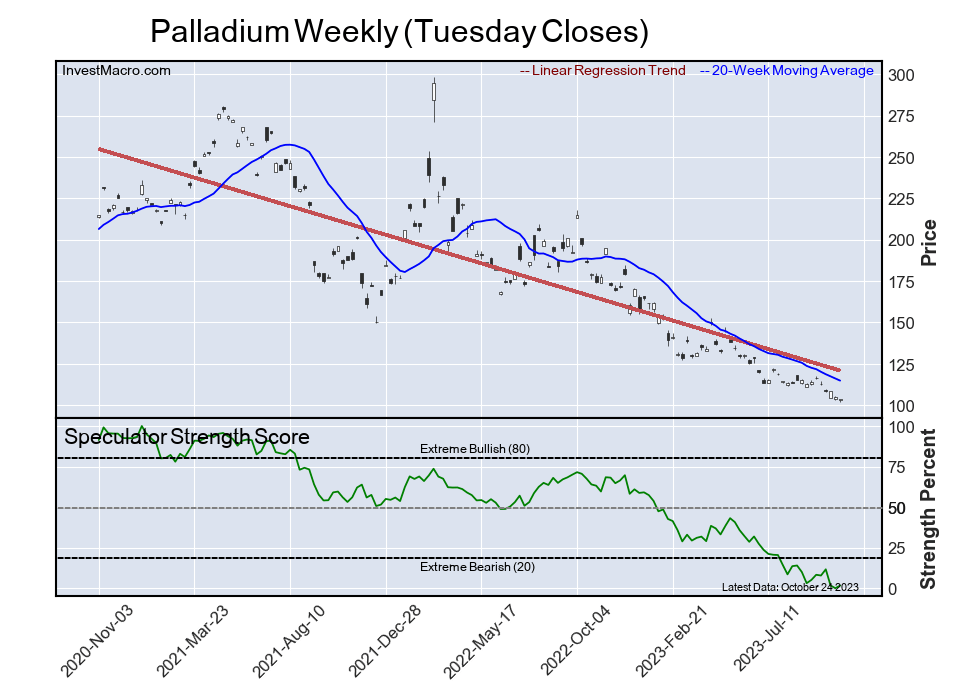
The Palladium speculator position comes in as third most bearish extreme standing of the week. The Palladium speculator level resides at a 2.1 percent score of its 3-year range.

The six-week trend for the speculator strength score was -9.6 this week. The overall speculator position was -10,712 net contracts this week with a change of 309 contracts in the speculator bets.


2-Year Bond


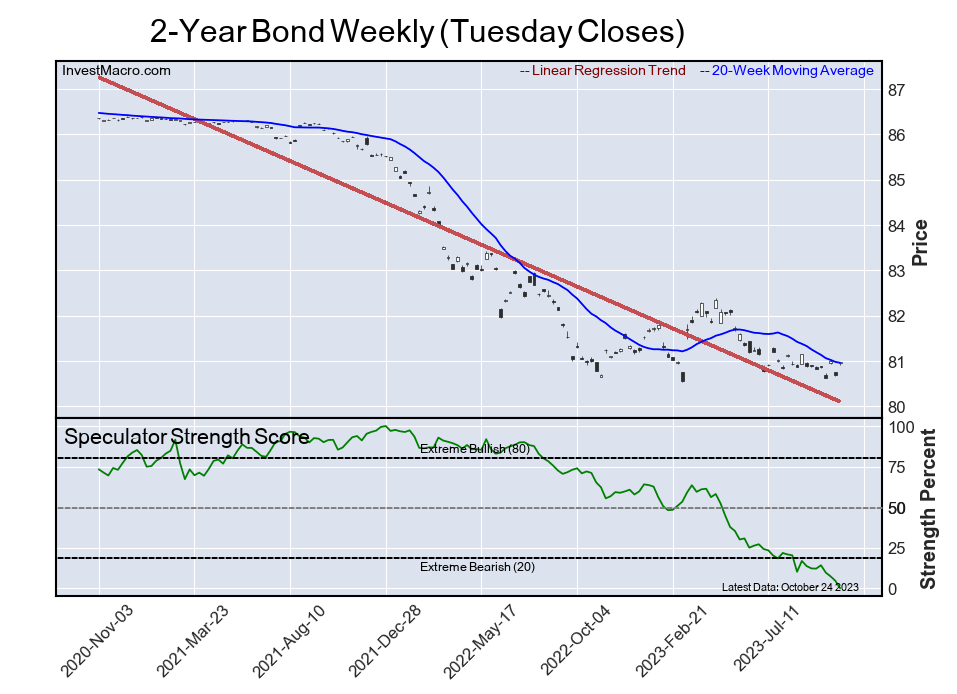
The 2-Year Bond speculator position comes in as this week’s fourth most bearish extreme standing. The 2-Year Bond speculator level is at a 2.3 percent score of its 3-year range.

The six-week trend for the speculator strength score was -10.6 this week. The speculator position was -1,239,609 net contracts this week with a change of -21,719 contracts in the weekly speculator bets.


10-Year Note


Finally, the 10-Year Note speculator position comes in as the fifth most bearish extreme standing for this week. The 10-Year Note speculator level is at a 10.3 percent score of its 3-year range.

The six-week trend for the speculator strength score was -9.6 this week. The speculator position was -744,302 net contracts this week with a change of 47,233 contracts in the weekly speculator bets.


Article By InvestMacroReceive our weekly COT Newsletter

*COT Report: The COT data, released weekly to the public each Friday, is updated through the most recent Tuesday (data is 3 days old) and shows a quick view of how large speculators or non-commercials (for-profit traders) were positioned in the futures markets.

The CFTC categorizes trader positions according to commercial hedgers (traders who use futures contracts for hedging as part of the business), non-commercials (large traders who speculate to realize trading profits) and nonreportable traders (usually small traders/speculators) as well as their open interest (contracts open in the market at time of reporting). See CFTC criteria here.

US CPI: Fed likely to prepare for another interest rate hike

By George Prior 

The Federal Reserve will hold interest rates steady in September, before hiking them again next time, predicts the CEO and founder of one of the world’s largest independent financial advisory, asset management and fintech organizations.

The prediction from Nigel Green of deVere Group comes as the Consumer Price Index (CPI) in the US jumped 3.7% year on year in August, up from the 3.2% increase recorded in July.

The Core CPI figure was 4.3% in the same period, down from a 4.7% growth in July.

He says: “Inflation heated up again last month in the world’s largest economy, driven mainly by rising oil costs. The core measure, which strips away volatile food and energy prices, cooled on an annual basis.

“This latest US CPI data is unlikely to move the needle on the Fed’s highly anticipated move to hold rates steady at their meeting next week – which has already been priced-in by financial markets.

“But the uptick in inflation gives the US central bank extra reason to be hawkish moving forward. As such, we also expect the Fed will start to prepare the market for a rate increase at its November meeting.”

The deVere CEO goes on to add that he believes this is the time for the Fed to stop, not pause, rate hikes.

“The time lag for monetary policies is incredibly lengthy. It takes around 18 months for the full effect of rate hikes to make their way into the economy.

“We’re now starting to see the drag effects on the US economy with households and businesses becoming considerably more prudent. In addition, investors are becoming more and more concerned that additional hikes could steer the US economy into a recession.”

He concludes: “The battle against inflation is being won – but battles like this are never won in a totally straight line – they go up and down incrementally, but the trajectory is clearly favorable, and the case for stopping rate hikes is compelling.

“The effects of previous Fed actions haven’t come through fully, but they will, and an increase could cause years of damage.”

About:

deVere Group is one of the world’s largest independent advisors of specialist global financial solutions to international, local mass affluent, and high-net-worth clients.  It has a network of offices across the world, over 80,000 clients and $12bn under advisement.

Mid-Week Technical Outlook: Cryptocurrencies

By ForexTime 

  • Tension grips markets ahead of US CPI report
  • Bitcoin forms ‘Death Cross’ technical pattern
  • Ethereum flirts near oversold levels
  • Cardano gets no love
  • Dogecoin approaches key support

A sense of tension gripped financial markets on Wednesday as investors braced for the latest U.S. inflation data published later today.

Asian stocks were painted red this morning after a selloff in technology stocks dragged Wall Street lower overnight. European stocks opened lower amid the negative sentiment, with market players adopting a cautious stance towards riskier assets. There seems to be little action in the currency space with the dollar drawing some strength from the risk-off mood. Interestingly, gold has secured a daily close below $1915 as discussed in the (Trade of the Week).

With markets likely to remain on standby mode ahead of the US CPI, our focus falls on the cryptocurrency space – especially after Bitcoin triggered a ‘death cross’ technical pattern!

More pain ahead for Bitcoin?

The past few weeks have been choppy for Bitcoin amid fears around FTX liquidations and its potential impact on the crypto market. Bitcoin has shed roughly 15% in the second half of 2023 with prices recently triggering a “death cross” pattern on the daily timeframe.

A death cross happens when an asset’s 50-day simple moving average (SMA) cross moves below its 200-day SMA. This technical signal is widely viewed as a sign that prices may continue to decline further in the medium to longer term.

  • So essentially, Bitcoin prices have the potential to sink even further on the daily timeframe with a solid breakout and daily close below $25,000 opening a path towards $24,200 and $23,000 respectively.
  • Should $25,000 prove to be reliable support, prices may rebound towards resistance at $26,400 before potentially heading towards $28,000.

Ethereum flirts near oversold levels

Ethereum remains under pressure on the daily charts as there have been consistently lower lows and lower highs with prices trading below the 50, 100, and 200-day SMA. However, the Relative Strength Index (RSI) on the daily charts recently dipped below 30, indicating that it may be oversold. This could provide an opportunity for bulls to strike, especially if $1500 proves to be a reliable support level.

  • A rebound from $1500 could inspire a move back towards $1665 and $1750, just above the 50-day SMA.
  • Should prices slip below $1500, this may open a path to levels not seen since January around $1300.

Cardano gets no love

Cardano prices are trading near their lowest levels in 2023, falling below $0.25 as bears switch into higher gear. Funny enough, the cryptocurrency is back to where it started the year with technical indicators showing mixed signals. Although prices are respecting a bearish channel and remain well below the 50,100 and 200-day SMA, the RSI recently dipped below 30, indicating that it may be oversold.

  • If prices can push back above 0.2500, this may open a path back towards the 50-day SMA at 0.2760.
  • Sustained weakness below 0.2500 could send Cardano towards 0.2300.

Dogecoin approaches key support

The past few days have been choppy for Dogecoin with prices slowly approaching key support at 0.0550. Even though the cryptocurrency is respecting a bearish channel, there seems to be some indecision on the daily charts.

  • Key levels of interest can be found at 0.5500 and 0.0680 where the 100-day SMA resides. A breakout could be on the horizon, but this may need a fresh directional catalyst.


Forex-Time-LogoArticle by ForexTime

ForexTime Ltd (FXTM) is an award winning international online forex broker regulated by CySEC 185/12 www.forextime.com

Silicon Valley investors want to create a new city – is ‘California Forever’ a utopian dream or just smart business?

By Iain White, University of Waikato 

He was, said George Bernard Shaw, “one of those heroic simpletons who do big things whilst our prominent worldlings are explaining why they are Utopian and impossible”.

The celebrated playwright was referring to the ideas of Ebenezer Howard, the creative force behind the idea of “garden cities” in the late 19th and early 20th centuries; new urban centres that Howard argued would have the best of town and country, but without the problems.

There’s a reminder of that somewhat backhanded compliment in the recent news of a Silicon Valley consortium named Flannery Associates buying land with a view to creating a new city in northern California’s Solano County. The controversial project is named after the investment vehicle’s parent company, California Forever.

The parallels between contemporary utopian thinking and Howard’s ideas from more than a century ago are readily apparent. The notion of something like California Forever may appear cutting edge, but it is part of the historical foundations of current planning systems.

Indeed, the science-fiction writer H.G. Wells – a futurist whose own ideas would resonate with many in Silicon Valley – was so attracted to Howard’s ideas that he joined the Garden City Association to support their creation.

Garden city visions

Any kind of new city model tends to reflect the politics of its founders. The vision and plans stretch beyond the built form to picture a preferred lifestyle, and interactions with nature and each other.

The artist’s renderings accompanying the California Forever project depict an attractive, harmonious landscape familiar to utopian thinking: plentiful parks, open spaces and sustainable energy.

It encapsulates a politics of urban living that also emphasises the need to recast our relationships with nature. As such, these ideas also involve a large dose of social engineering. They are not just about creating a new built environment, they envision a new kind of society that’s better than the current one.

But the garden cities that were eventually developed were a far cry from Howard’s initial vision. In fact, his ideas from over a hundred years ago make those from Silicon Valley look distinctly dated.

For Howard, it was as much about social reform and organisation as city planning. He advocated for local production and relatively self-contained settlements to reduce the need to travel, as well as innovative ways of treating waste that echo current circular economy thinking.

Planning and profit

Even less like the investment logic behind California Forever, Howard also imagined a city that could challenge some of the precepts of capitalism.

Given the significant deprivation and social divide between haves and have-nots, he advocated that land in garden cities could be organised cooperatively to share wealth and reduce poverty.

The need to attract investors was one of the reasons Howard’s ambitious politics eroded. To purchase land on that scale requires significant capital, and the providers of that capital would no doubt be looking for a return.

Ebenezer Howard.
Wikimedia Commons, CC BY-NC

Should California Forever materialise, history would caution us that there may be a similar gap between rhetoric and reality. While Howard’s ideas were partially implemented in places like Letchworth, the focus was more on the built environment than social justice or sustainability.

Howard moved into the new city, but his influence was marginalised by the need to accommodate shareholder interests.

While we don’t know how California Forever has been pitched to investors, it’s a fair assumption it is also shaped by the profit motive: buying cheaper agricultural land, rezoning for housing and development, drawing in state funding for infrastructure, and seeing the land rise in value.

While the images appear sustainable, long-distance commuting may be a problem given the nature of the labour market in California, as might expectations of genuine community involvement in the project. Utopian schemes have long been critiqued for their tendency towards authoritarianism – a charge not unfamiliar to the tech sector in recent times.

Howard’s ideas were also criticised as anti-urban. Shouldn’t we seek to improve existing cities rather than abandon and start anew, possibly to create a gentrified enclave?

For the tech sector, too, there is a recurring utopian trend that seeks to escape – whether to moon colonies or new cities – rather than use its vast wealth and influence to address current urban problems.

Progress and planning

But, ultimately, it’s encouraging to see groups like the Silicon Valley investors advocate for the benefits of good urban planning and what it can provide future generations. The bigger problem is that current planning systems aren’t anything like as progressive.

In many countries, similarly powerful investors routinely criticise urban planning as creating “red tape”, increasing the costs of development, or stopping markets from acting “efficiently”.

Yet the kind of city building represented by California Forever requires greater regulatory power and the kind of political ambition that was more common a century ago. And it raises the question of whether projects like this should be left to the private sector.

At the very least, perhaps, such initiatives provide an opportunity to reassess the potential of urban planning and cast a light on current societal problems. Howard’s utopian vision was designed to solve the problems of his time: exploitative landlords, slums, polluted cities and extreme disparities of wealth.

Whether or not California Forever is built, the reasons behind the idea demonstrate that while history may not repeat, it does sometimes rhyme.The Conversation

About the Author:

Iain White, Professor of Environmental Planning, University of Waikato

This article is republished from The Conversation under a Creative Commons license. Read the original article.

Yen keeps posting flags through ascent

By ForexTime 

  • USDJPY busy forming second flag since August, amidst year-to-date uptrend
  • JPY surged Monday after BoJ Governor Ueda offered hawkish policy clues
  • Yen bulls unable to build on Monday’s intraday low of 145.904.
  • USDJPY may look to close Monday’s gap down
  • Tomorrow’s US CPI to decide USDJPY’s immediate fate

USDJPY gapped down on Monday, September 11th’s market open.

The Yen surged at the onset of the trading week after Bank of Japan governor Kazuo Ueda hinted at the possibility of a first rate hike in Japan since 2007!

The stronger Yen resulted in an intraday low of 145.904 for USDJPY.

This FX pair closed Monday at a zone which could serve as a demand zone-base for a possible second flag, in its ascent from the lows of 141.53 printed on August 7th, 2023.

This close is also below the significant 261.8 Fibonacci level when drawn from 134.772,  January 6th  high to the lows of 16th January 2023 at 127.224 on the weekly chart.


Attentions turn to the USD side of USDJPY, with the pivotal US consumer price index due to be released tomorrow (Wednesday, September 13th).

Both bears and bulls will be looking for price action around key levels for pointers to the next impulse direction for the USDJPY.


Bulls will be looking to close Monday’s open gap as they climb to the flag’s resistance around 147.769

They will however have to contend with the psychologically important Fibonacci level at 261.8 at 146.985.


A bullish flag breakout could see a test of the 148.850 region which had resisted USDJPY bulls back in late-October/early-November 2022.

Further north, lies the potential resistance zone of the upward sloping channel drawn from January 5th, 2023.


USDJPY bears on the other hand will be looking for a strong close below the current bullish flag’s support, and also below the psychologically-important 146.00 line.

Such price action may indicate a reversion to its 50-EMA which is below and more than  2600 points away from the current price at the time of writing.


Ultimately, much of USDJPY’s immediate fate should rest on tomorrow’s US inflation data release.

  • A higher-than-expected CPI (consumer price index) that ramps up bets of one further Fed rate hike by end-2023 should bolster the US dollar and potentially send USDJPY higher.
  • However, a lower-than-expected CPI that solidifies hopes that the Fed is truly done with its rate hikes should soften the US dollar and potentially drag USDJPY lower.

Forex-Time-LogoArticle by ForexTime

ForexTime Ltd (FXTM) is an award winning international online forex broker regulated by CySEC 185/12 www.forextime.com

Currency Speculators drop Australian Dollar bets for 9th time in 10 weeks

By InvestMacro

Here are the latest charts and statistics for the Commitment of Traders (COT) data published by the Commodities Futures Trading Commission (CFTC).

The latest COT data is updated through Tuesday September 5th and shows a quick view of how large market participants (for-profit speculators and commercial traders) were positioned in the futures markets. All currency positions are in direct relation to the US dollar where, for example, a bet for the euro is a bet that the euro will rise versus the dollar while a bet against the euro will be a bet that the euro will decline versus the dollar.

Weekly Speculator Changes led by US Dollar Index & Bitcoin

The COT currency market speculator bets were lower this week as three out of the eleven currency markets we cover had higher positioning while the other eight markets had lower speculator contracts.

Leading the gains for the currency markets was the Japanese Yen (1,337 contracts) with the US Dollar Index (536 contracts) and Bitcoin (532 contracts) also showing positive weeks.

The currencies seeing declines in speculator bets on the week were the Australian Dollar (-13,352 contracts), EuroFX (-10,448 contracts), Canadian Dollar (-9,202 contracts), the Mexican Peso (-6,342 contracts), the New Zealand Dollar (-3,624 contracts), Brazilian Real (-2,655 contracts), the British Pound (-2,017 contracts) and the Swiss Franc (-807 contracts) also registering lower bets on the week.

Large Currency Speculators drop Australian Dollar bets for 9th time in 10 weeks

Highlighting the COT currency’s data this week is the continued weakness of the speculator’s positioning for the Australian dollar. Large speculative currency positions for the Aussie dropped this week by over -13,000 net contracts and fell for the fourth consecutive week as well as for the ninth time out of the past ten weeks.

The AUD positioning has now shed a total of -40,345 contracts over these past four weeks and this has brought the overall net speculator standing (currently at -83,352 contracts) to the lowest level in the past eighty weeks, dating back to February 2nd of 2022 when the net position was -84,080 contracts. The 3-Year Strength Index is showing a 7.4 percent score for the AUD, marking an extreme bearish reading for speculators this week.

The Australian dollar has been in a downtrend over the course in 2023 after opening the year at approximately the 0.6815 exchange rate and this week touched the lowest level since November of 2022 at a low of 0.6360.

Hurting the AUD’s exchange against the US Dollar is the interest rate disparity and the possible future divergence of the central banks with the US Federal Reserve possibly continuing to raise its benchmark rate (currently at 5.25-5.50%) while the Reserve Bank of Australia is assumed to be finished boosting its rate (currently at 4.10%).


Data Snapshot of Forex Market Traders | Columns Legend
Sep-05-2023OIOI-IndexSpec-NetSpec-IndexCom-NetCOM-IndexSmalls-NetSmalls-Index
USD Index36,579263,35931-5,005681,64626
EUR754,26365136,23177-175,8542439,62342
GBP225,4045246,38488-49,955183,57165
JPY268,34490-97,13612105,86787-8,73136
CHF46,67059-5,3254210,68759-5,36242
CAD189,66055-24,9633129,46176-4,49813
AUD241,201100-83,537795,36690-11,82924
NZD56,46279-14,0001617,29187-3,29111
MXN246,0615467,52180-71,732194,21138
RUB20,93047,54331-7,15069-39324
BRL34,8711913,93354-15,569461,63650
Bitcoin14,962692,039100-2,534049524


Strength Scores led by Bitcoin & British Pound

COT Strength Scores (a normalized measure of Speculator positions over a 3-Year range, from 0 to 100 where above 80 is Extreme-Bullish and below 20 is Extreme-Bearish) showed that the Bitcoin (100 percent) and the British Pound (88 percent) lead the currency markets this week. The Mexican Peso (80 percent), EuroFX (77 percent) and the Brazilian Real (54 percent) come in as the next highest in the weekly strength scores.

On the downside, the Australian Dollar (7 percent), the Japanese Yen (12 percent) and the New Zealand Dollar (16 percent) come in at the lowest strength levels currently and are in Extreme-Bearish territory (below 20 percent).

Strength Statistics:
US Dollar Index (30.5 percent) vs US Dollar Index previous week (29.6 percent)
EuroFX (77.1 percent) vs EuroFX previous week (81.5 percent)
British Pound Sterling (88.0 percent) vs British Pound Sterling previous week (89.4 percent)
Japanese Yen (12.3 percent) vs Japanese Yen previous week (11.5 percent)
Swiss Franc (41.9 percent) vs Swiss Franc previous week (44.1 percent)
Canadian Dollar (31.3 percent) vs Canadian Dollar previous week (39.8 percent)
Australian Dollar (7.4 percent) vs Australian Dollar previous week (19.8 percent)
New Zealand Dollar (15.6 percent) vs New Zealand Dollar previous week (25.5 percent)
Mexican Peso (80.3 percent) vs Mexican Peso previous week (84.2 percent)
Brazilian Real (53.5 percent) vs Brazilian Real previous week (56.9 percent)
Bitcoin (100.0 percent) vs Bitcoin previous week (91.8 percent)


Bitcoin & Swiss Franc top the 6-Week Strength Trends

COT Strength Score Trends (or move index, calculates the 6-week changes in strength scores) showed that the Bitcoin (42 percent) and the Swiss Franc (8 percent) lead the past six weeks trends for the currencies.

The New Zealand Dollar (-35 percent) leads the downside trend scores currently with the Australian Dollar (-30 percent), the Canadian Dollar (-28 percent) and the Brazilian Real (-23 percent) following next with lower trend scores.

Strength Trend Statistics:
US Dollar Index (-4.5 percent) vs US Dollar Index previous week (-13.7 percent)
EuroFX (-17.2 percent) vs EuroFX previous week (-13.5 percent)
British Pound Sterling (-8.8 percent) vs British Pound Sterling previous week (-10.6 percent)
Japanese Yen (-11.5 percent) vs Japanese Yen previous week (-4.9 percent)
Swiss Franc (8.5 percent) vs Swiss Franc previous week (15.6 percent)
Canadian Dollar (-28.4 percent) vs Canadian Dollar previous week (-15.2 percent)
Australian Dollar (-30.0 percent) vs Australian Dollar previous week (-18.3 percent)
New Zealand Dollar (-35.4 percent) vs New Zealand Dollar previous week (-18.3 percent)
Mexican Peso (-12.4 percent) vs Mexican Peso previous week (-12.6 percent)
Brazilian Real (-22.9 percent) vs Brazilian Real previous week (-22.1 percent)
Bitcoin (41.6 percent) vs Bitcoin previous week (41.4 percent)


Individual COT Forex Markets:

US Dollar Index Futures:

US Dollar Index Forex Futures COT ChartThe US Dollar Index large speculator standing this week came in at a net position of 3,359 contracts in the data reported through Tuesday. This was a weekly increase of 536 contracts from the previous week which had a total of 2,823 net contracts.

This week’s current strength score (the trader positioning range over the past three years, measured from 0 to 100) shows the speculators are currently Bearish with a score of 30.5 percent. The commercials are Bullish with a score of 67.8 percent and the small traders (not shown in chart) are Bearish with a score of 25.6 percent.

Price Trend-Following Model: Strong Uptrend

Our weekly trend-following model classifies the current market price position as: Strong Uptrend. The current action for the model is considered to be: Hold – Maintain Long Position.

US DOLLAR INDEX StatisticsSPECULATORSCOMMERCIALSSMALL TRADERS
– Percent of Open Interest Longs:62.620.412.5
– Percent of Open Interest Shorts:53.434.08.0
– Net Position:3,359-5,0051,646
– Gross Longs:22,8817,4484,587
– Gross Shorts:19,52212,4532,941
– Long to Short Ratio:1.2 to 10.6 to 11.6 to 1
NET POSITION TREND:
– Strength Index Score (3 Year Range Pct):30.567.825.6
– Strength Index Reading (3 Year Range):BearishBullishBearish
NET POSITION MOVEMENT INDEX:
– 6-Week Change in Strength Index:-4.52.116.9


Euro Currency Futures:

Euro Currency Futures COT ChartThe Euro Currency large speculator standing this week came in at a net position of 136,231 contracts in the data reported through Tuesday. This was a weekly decline of -10,448 contracts from the previous week which had a total of 146,679 net contracts.

This week’s current strength score (the trader positioning range over the past three years, measured from 0 to 100) shows the speculators are currently Bullish with a score of 77.1 percent. The commercials are Bearish with a score of 23.7 percent and the small traders (not shown in chart) are Bearish with a score of 42.2 percent.

Price Trend-Following Model: Strong Downtrend

Our weekly trend-following model classifies the current market price position as: Strong Downtrend. The current action for the model is considered to be: New Sell – Short Position.

EURO Currency StatisticsSPECULATORSCOMMERCIALSSMALL TRADERS
– Percent of Open Interest Longs:31.353.911.9
– Percent of Open Interest Shorts:13.277.26.7
– Net Position:136,231-175,85439,623
– Gross Longs:235,732406,48590,003
– Gross Shorts:99,501582,33950,380
– Long to Short Ratio:2.4 to 10.7 to 11.8 to 1
NET POSITION TREND:
– Strength Index Score (3 Year Range Pct):77.123.742.2
– Strength Index Reading (3 Year Range):BullishBearishBearish
NET POSITION MOVEMENT INDEX:
– 6-Week Change in Strength Index:-17.221.8-27.8


British Pound Sterling Futures:

British Pound Sterling Futures COT ChartThe British Pound Sterling large speculator standing this week came in at a net position of 46,384 contracts in the data reported through Tuesday. This was a weekly reduction of -2,017 contracts from the previous week which had a total of 48,401 net contracts.

This week’s current strength score (the trader positioning range over the past three years, measured from 0 to 100) shows the speculators are currently Bullish-Extreme with a score of 88.0 percent. The commercials are Bearish-Extreme with a score of 17.7 percent and the small traders (not shown in chart) are Bullish with a score of 65.0 percent.

Price Trend-Following Model: Weak Uptrend

Our weekly trend-following model classifies the current market price position as: Weak Uptrend. The current action for the model is considered to be: Hold – Maintain Long Position.

BRITISH POUND StatisticsSPECULATORSCOMMERCIALSSMALL TRADERS
– Percent of Open Interest Longs:41.137.315.0
– Percent of Open Interest Shorts:20.559.513.4
– Net Position:46,384-49,9553,571
– Gross Longs:92,64584,12933,867
– Gross Shorts:46,261134,08430,296
– Long to Short Ratio:2.0 to 10.6 to 11.1 to 1
NET POSITION TREND:
– Strength Index Score (3 Year Range Pct):88.017.765.0
– Strength Index Reading (3 Year Range):Bullish-ExtremeBearish-ExtremeBullish
NET POSITION MOVEMENT INDEX:
– 6-Week Change in Strength Index:-8.815.1-28.3


Japanese Yen Futures:

Japanese Yen Forex Futures COT ChartThe Japanese Yen large speculator standing this week came in at a net position of -97,136 contracts in the data reported through Tuesday. This was a weekly lift of 1,337 contracts from the previous week which had a total of -98,473 net contracts.

This week’s current strength score (the trader positioning range over the past three years, measured from 0 to 100) shows the speculators are currently Bearish-Extreme with a score of 12.3 percent. The commercials are Bullish-Extreme with a score of 87.3 percent and the small traders (not shown in chart) are Bearish with a score of 35.7 percent.

Price Trend-Following Model: Strong Downtrend

Our weekly trend-following model classifies the current market price position as: Strong Downtrend. The current action for the model is considered to be: Hold – Maintain Short Position.

JAPANESE YEN StatisticsSPECULATORSCOMMERCIALSSMALL TRADERS
– Percent of Open Interest Longs:13.871.113.0
– Percent of Open Interest Shorts:50.031.716.3
– Net Position:-97,136105,867-8,731
– Gross Longs:37,014190,80434,930
– Gross Shorts:134,15084,93743,661
– Long to Short Ratio:0.3 to 12.2 to 10.8 to 1
NET POSITION TREND:
– Strength Index Score (3 Year Range Pct):12.387.335.7
– Strength Index Reading (3 Year Range):Bearish-ExtremeBullish-ExtremeBearish
NET POSITION MOVEMENT INDEX:
– 6-Week Change in Strength Index:-11.59.40.1


Swiss Franc Futures:

Swiss Franc Forex Futures COT ChartThe Swiss Franc large speculator standing this week came in at a net position of -5,325 contracts in the data reported through Tuesday. This was a weekly decrease of -807 contracts from the previous week which had a total of -4,518 net contracts.

This week’s current strength score (the trader positioning range over the past three years, measured from 0 to 100) shows the speculators are currently Bearish with a score of 41.9 percent. The commercials are Bullish with a score of 59.1 percent and the small traders (not shown in chart) are Bearish with a score of 41.9 percent.

Price Trend-Following Model: Weak Uptrend

Our weekly trend-following model classifies the current market price position as: Weak Uptrend. The current action for the model is considered to be: Hold – Maintain Long Position.

SWISS FRANC StatisticsSPECULATORSCOMMERCIALSSMALL TRADERS
– Percent of Open Interest Longs:24.648.226.1
– Percent of Open Interest Shorts:36.025.337.6
– Net Position:-5,32510,687-5,362
– Gross Longs:11,49422,50812,168
– Gross Shorts:16,81911,82117,530
– Long to Short Ratio:0.7 to 11.9 to 10.7 to 1
NET POSITION TREND:
– Strength Index Score (3 Year Range Pct):41.959.141.9
– Strength Index Reading (3 Year Range):BearishBullishBearish
NET POSITION MOVEMENT INDEX:
– 6-Week Change in Strength Index:8.513.1-37.3


Canadian Dollar Futures:

Canadian Dollar Forex Futures COT ChartThe Canadian Dollar large speculator standing this week came in at a net position of -24,963 contracts in the data reported through Tuesday. This was a weekly fall of -9,202 contracts from the previous week which had a total of -15,761 net contracts.

This week’s current strength score (the trader positioning range over the past three years, measured from 0 to 100) shows the speculators are currently Bearish with a score of 31.3 percent. The commercials are Bullish with a score of 76.2 percent and the small traders (not shown in chart) are Bearish-Extreme with a score of 12.8 percent.

Price Trend-Following Model: Strong Downtrend

Our weekly trend-following model classifies the current market price position as: Strong Downtrend. The current action for the model is considered to be: New Sell – Short Position.

CANADIAN DOLLAR StatisticsSPECULATORSCOMMERCIALSSMALL TRADERS
– Percent of Open Interest Longs:24.154.817.1
– Percent of Open Interest Shorts:37.339.319.5
– Net Position:-24,96329,461-4,498
– Gross Longs:45,761103,95932,462
– Gross Shorts:70,72474,49836,960
– Long to Short Ratio:0.6 to 11.4 to 10.9 to 1
NET POSITION TREND:
– Strength Index Score (3 Year Range Pct):31.376.212.8
– Strength Index Reading (3 Year Range):BearishBullishBearish-Extreme
NET POSITION MOVEMENT INDEX:
– 6-Week Change in Strength Index:-28.435.1-46.8


Australian Dollar Futures:

Australian Dollar Forex Futures COT ChartThe Australian Dollar large speculator standing this week came in at a net position of -83,537 contracts in the data reported through Tuesday. This was a weekly decline of -13,352 contracts from the previous week which had a total of -70,185 net contracts.

This week’s current strength score (the trader positioning range over the past three years, measured from 0 to 100) shows the speculators are currently Bearish-Extreme with a score of 7.4 percent. The commercials are Bullish-Extreme with a score of 90.1 percent and the small traders (not shown in chart) are Bearish with a score of 23.6 percent.

Price Trend-Following Model: Strong Downtrend

Our weekly trend-following model classifies the current market price position as: Strong Downtrend. The current action for the model is considered to be: Hold – Maintain Short Position.

AUSTRALIAN DOLLAR StatisticsSPECULATORSCOMMERCIALSSMALL TRADERS
– Percent of Open Interest Longs:22.460.610.0
– Percent of Open Interest Shorts:57.021.114.9
– Net Position:-83,53795,366-11,829
– Gross Longs:54,032146,17624,035
– Gross Shorts:137,56950,81035,864
– Long to Short Ratio:0.4 to 12.9 to 10.7 to 1
NET POSITION TREND:
– Strength Index Score (3 Year Range Pct):7.490.123.6
– Strength Index Reading (3 Year Range):Bearish-ExtremeBullish-ExtremeBearish
NET POSITION MOVEMENT INDEX:
– 6-Week Change in Strength Index:-30.034.2-32.8


New Zealand Dollar Futures:

New Zealand Dollar Forex Futures COT ChartThe New Zealand Dollar large speculator standing this week came in at a net position of -14,000 contracts in the data reported through Tuesday. This was a weekly fall of -3,624 contracts from the previous week which had a total of -10,376 net contracts.

This week’s current strength score (the trader positioning range over the past three years, measured from 0 to 100) shows the speculators are currently Bearish-Extreme with a score of 15.6 percent. The commercials are Bullish-Extreme with a score of 87.2 percent and the small traders (not shown in chart) are Bearish-Extreme with a score of 10.8 percent.

Price Trend-Following Model: Strong Downtrend

Our weekly trend-following model classifies the current market price position as: Strong Downtrend. The current action for the model is considered to be: Hold – Maintain Short Position.

NEW ZEALAND DOLLAR StatisticsSPECULATORSCOMMERCIALSSMALL TRADERS
– Percent of Open Interest Longs:29.860.35.2
– Percent of Open Interest Shorts:54.629.711.0
– Net Position:-14,00017,291-3,291
– Gross Longs:16,84734,0682,947
– Gross Shorts:30,84716,7776,238
– Long to Short Ratio:0.5 to 12.0 to 10.5 to 1
NET POSITION TREND:
– Strength Index Score (3 Year Range Pct):15.687.210.8
– Strength Index Reading (3 Year Range):Bearish-ExtremeBullish-ExtremeBearish-Extreme
NET POSITION MOVEMENT INDEX:
– 6-Week Change in Strength Index:-35.440.7-50.0


Mexican Peso Futures:

Mexican Peso Futures COT ChartThe Mexican Peso large speculator standing this week came in at a net position of 67,521 contracts in the data reported through Tuesday. This was a weekly lowering of -6,342 contracts from the previous week which had a total of 73,863 net contracts.

This week’s current strength score (the trader positioning range over the past three years, measured from 0 to 100) shows the speculators are currently Bullish-Extreme with a score of 80.3 percent. The commercials are Bearish-Extreme with a score of 18.6 percent and the small traders (not shown in chart) are Bearish with a score of 38.0 percent.

Price Trend-Following Model: Weak Uptrend

Our weekly trend-following model classifies the current market price position as: Weak Uptrend. The current action for the model is considered to be: Hold – Maintain Long Position.

MEXICAN PESO StatisticsSPECULATORSCOMMERCIALSSMALL TRADERS
– Percent of Open Interest Longs:40.851.82.9
– Percent of Open Interest Shorts:13.380.91.2
– Net Position:67,521-71,7324,211
– Gross Longs:100,298127,3727,084
– Gross Shorts:32,777199,1042,873
– Long to Short Ratio:3.1 to 10.6 to 12.5 to 1
NET POSITION TREND:
– Strength Index Score (3 Year Range Pct):80.318.638.0
– Strength Index Reading (3 Year Range):Bullish-ExtremeBearish-ExtremeBearish
NET POSITION MOVEMENT INDEX:
– 6-Week Change in Strength Index:-12.412.1-0.0


Brazilian Real Futures:

Brazil Real Futures COT ChartThe Brazilian Real large speculator standing this week came in at a net position of 13,933 contracts in the data reported through Tuesday. This was a weekly decrease of -2,655 contracts from the previous week which had a total of 16,588 net contracts.

This week’s current strength score (the trader positioning range over the past three years, measured from 0 to 100) shows the speculators are currently Bullish with a score of 53.5 percent. The commercials are Bearish with a score of 45.5 percent and the small traders (not shown in chart) are Bearish with a score of 49.7 percent.

Price Trend-Following Model: Weak Uptrend

Our weekly trend-following model classifies the current market price position as: Weak Uptrend. The current action for the model is considered to be: Hold – Maintain Long Position.

BRAZIL REAL StatisticsSPECULATORSCOMMERCIALSSMALL TRADERS
– Percent of Open Interest Longs:58.730.69.5
– Percent of Open Interest Shorts:18.875.34.8
– Net Position:13,933-15,5691,636
– Gross Longs:20,47310,6813,318
– Gross Shorts:6,54026,2501,682
– Long to Short Ratio:3.1 to 10.4 to 12.0 to 1
NET POSITION TREND:
– Strength Index Score (3 Year Range Pct):53.545.549.7
– Strength Index Reading (3 Year Range):BullishBearishBearish
NET POSITION MOVEMENT INDEX:
– 6-Week Change in Strength Index:-22.920.215.4


Bitcoin Futures:

Bitcoin Crypto Futures COT ChartThe Bitcoin large speculator standing this week came in at a net position of 2,039 contracts in the data reported through Tuesday. This was a weekly increase of 532 contracts from the previous week which had a total of 1,507 net contracts.

This week’s current strength score (the trader positioning range over the past three years, measured from 0 to 100) shows the speculators are currently Bullish-Extreme with a score of 100.0 percent. The commercials are Bearish-Extreme with a score of 0.0 percent and the small traders (not shown in chart) are Bearish with a score of 24.2 percent.

Price Trend-Following Model: Strong Downtrend

Our weekly trend-following model classifies the current market price position as: Strong Downtrend. The current action for the model is considered to be: Hold – Maintain Short Position.

BITCOIN StatisticsSPECULATORSCOMMERCIALSSMALL TRADERS
– Percent of Open Interest Longs:79.80.78.1
– Percent of Open Interest Shorts:66.117.64.8
– Net Position:2,039-2,534495
– Gross Longs:11,9331051,218
– Gross Shorts:9,8942,639723
– Long to Short Ratio:1.2 to 10.0 to 11.7 to 1
NET POSITION TREND:
– Strength Index Score (3 Year Range Pct):100.00.024.2
– Strength Index Reading (3 Year Range):Bullish-ExtremeBearish-ExtremeBearish
NET POSITION MOVEMENT INDEX:
– 6-Week Change in Strength Index:41.6-64.3-7.5


Article By InvestMacroReceive our weekly COT Newsletter

*COT Report: The COT data, released weekly to the public each Friday, is updated through the most recent Tuesday (data is 3 days old) and shows a quick view of how large speculators or non-commercials (for-profit traders) were positioned in the futures markets.

The CFTC categorizes trader positions according to commercial hedgers (traders who use futures contracts for hedging as part of the business), non-commercials (large traders who speculate to realize trading profits) and nonreportable traders (usually small traders/speculators) as well as their open interest (contracts open in the market at time of reporting). See CFTC criteria here.

Speculator Extremes: Bitcoin, Cocoa, MSCI EAFE lead Bullish & Bearish Bets

By InvestMacro
The latest update for the weekly Commitment of Traders (COT) report was released by the Commodity Futures Trading Commission (CFTC) on Friday for data ending on September 5th.

This weekly Extreme Positions report highlights the Most Bullish and Most Bearish Positions for the speculator category. Extreme positioning in these markets can foreshadow strong moves in the underlying market.

To signify an extreme position, we use the Strength Index (also known as the COT Index) of each instrument, a common method of measuring COT data. The Strength Index is simply a comparison of current trader positions against the range of positions over the previous 3 years. We use over 80 percent as extremely bullish and under 20 percent as extremely bearish. (Compare Strength Index scores across all markets in the data table or cot leaders table)


Here Are This Week’s Most Bullish Speculator Positions:

Bitcoin


The Bitcoin speculator position comes in as the most bullish extreme standing this week. The Bitcoin speculator level is currently at a 100.0 percent score of its 3-year range.

The six-week trend for the percent strength score totaled 41.6 this week. The overall net speculator position was a total of 2,039 net contracts this week with a change of 532 contract in the weekly speculator bets.


Cocoa Futures


The Cocoa Futures speculator position comes next in the extreme standings this week. The Cocoa Futures speculator level is now at a 100.0 percent score of its 3-year range.

The six-week trend for the percent strength score was 8.7 this week. The speculator position registered 86,220 net contracts this week with a weekly change of 2,999 contracts in speculator bets.


Speculators or Non-Commercials Notes:

Speculators, classified as non-commercial traders by the CFTC, are made up of large commodity funds, hedge funds and other significant for-profit participants. The Specs are generally regarded as trend-followers in their behavior towards price action – net speculator bets and prices tend to go in the same directions. These traders often look to buy when prices are rising and sell when prices are falling. To illustrate this point, many times speculator contracts can be found at their most extremes (bullish or bearish) when prices are also close to their highest or lowest levels.

These extreme levels can be dangerous for the large speculators as the trade is most crowded, there is less trading ammunition still sitting on the sidelines to push the trend further and prices have moved a significant distance. When the trend becomes exhausted, some speculators take profits while others look to also exit positions when prices fail to continue in the same direction. This process usually plays out over many months to years and can ultimately create a reverse effect where prices start to fall and speculators start a process of selling when prices are falling.


3-Month Secured Overnight Financing Rate


The 3-Month Secured Overnight Financing Rate speculator position comes in third this week in the extreme standings. The 3-Month Secured Overnight Financing Rate speculator level resides at a 96.4 percent score of its 3-year range.

The six-week trend for the speculator strength score came in at 18.2 this week. The overall speculator position was 272,072 net contracts this week with a change of -53,150 contracts in the weekly speculator bets.


Heating Oil


The Heating Oil speculator position comes up number four in the extreme standings this week. The Heating Oil speculator level is at a 95.6 percent score of its 3-year range.

The six-week trend for the speculator strength score totaled a change of 25.9 this week. The overall speculator position was 38,737 net contracts this week with a change of -715 contracts in the speculator bets.


British Pound


The British Pound speculator position rounds out the top five in this week’s bullish extreme standings. The British Pound speculator level sits at a 88.0 percent score of its 3-year range. The six-week trend for the speculator strength score was -8.8 this week.

The speculator position was 46,384 net contracts this week with a change of -2,017 contracts in the weekly speculator bets.


This Week’s Most Bearish Speculator Positions:

MSCI EAFE MINI


The MSCI EAFE MINI speculator position comes in as the most bearish extreme standing this week. The MSCI EAFE MINI speculator level is at a 0.0 percent score of its 3-year range.

The six-week trend for the speculator strength score was -8.5 this week. The overall speculator position was -38,079 net contracts this week with a change of -11,282 contracts in the speculator bets.


Palladium


The Palladium speculator position comes in next for the most bearish extreme standing on the week. The Palladium speculator level is at a 0.0 percent score of its 3-year range.

The six-week trend for the speculator strength score was -17.9 this week. The speculator position was -11,021 net contracts this week with a change of -1,045 contracts in the weekly speculator bets.


Corn


The Corn speculator position comes in as third most bearish extreme standing of the week. The Corn speculator level resides at a 2.7 percent score of its 3-year range.

The six-week trend for the speculator strength score was -19.0 this week. The overall speculator position was -45,632 net contracts this week with a change of -9,819 contracts in the speculator bets.


2-Year Bond


The 2-Year Bond speculator position comes in as this week’s fourth most bearish extreme standing. The 2-Year Bond speculator level is at a 3.9 percent score of its 3-year range.

The six-week trend for the speculator strength score was -5.3 this week. The speculator position was -1,217,890 net contracts this week with a change of -48,034 contracts in the weekly speculator bets.


10-Year Note


Finally, the 10-Year Note speculator position comes in as the fifth most bearish extreme standing for this week. The 10-Year Note speculator level is at a 5.7 percent score of its 3-year range.

The six-week trend for the speculator strength score was -16.3 this week. The speculator position was -791,535 net contracts this week with a change of 14,018 contracts in the weekly speculator bets.


Article By InvestMacroReceive our weekly COT Newsletter

*COT Report: The COT data, released weekly to the public each Friday, is updated through the most recent Tuesday (data is 3 days old) and shows a quick view of how large speculators or non-commercials (for-profit traders) were positioned in the futures markets.

The CFTC categorizes trader positions according to commercial hedgers (traders who use futures contracts for hedging as part of the business), non-commercials (large traders who speculate to realize trading profits) and nonreportable traders (usually small traders/speculators) as well as their open interest (contracts open in the market at time of reporting). See CFTC criteria here.

Week Ahead: Will EURUSD slip below 1.0670?

By ForexTime 

Get ready for another wild week for global financial markets thanks to key economic data releases and high-risk events!

Inflation data from the largest economy in the world will be in focus along with a rate decision from the ECB.

But before we identify what asset to keep an eye on, here’s a rundown of the scheduled data and events for the upcoming week:

Monday, September 11

  • CNH: China aggregate financing
  • EUR: EU releases updated economic forecasts
  • GBP: Bank of England chief economist Huw Pill speech

Tuesday, September 12

  • AUD: Australia consumer confidence
  • EUR: Germany ZEW survey expectations
  • GBP: UK jobless claims, unemployment

Wednesday, September 13

  • EUR: Eurozone industrial production
  • JPY: Japan PPI
  • GBP: UK industrial production
  • USD: US August CPI

Thursday, September 14

  • AUD: Australia unemployment
  • EUR: ECB rate decision
  • JPY: Japan machinery orders, industrial production
  • USD: US retail sales, PPI, initial jobless claims

Friday, September 15

  • CNH: China property prices, retail sales, industrial production
  • CAD: Canada existing home sales
  • USD: Industrial production, University of Michigan consumer sentiment

We could see some thrilling trading opportunities as high-risk events unfold across financial markets. However, all eyes will be on the world’s most popular traded currency which is primed to be heavily influenced by the ECB rate decision and key US reports.

Before we dissect the factors that could trigger a significant move in the EURUSD, it’s worth noting that prices remain heavily bearish on the H4 charts. The euro has shed over 1% against the dollar since the start of September with prices approaching key support at 1.0670. The events in the upcoming week may dictate whether prices experience a breakdown or rebound.

Here are 3 reasons why the EURUSD has our attention:

  1. ECB meeting

The ECB rate decision on Thursday, September 14 is expected to be a close call.

Markets seem to be betting against the European Central Bank raising interest rates by 25 basis points next week with traders currently pricing in a 35% probability. This jumps to 58% by October and 70% by December.

Although inflation remains sticky, economic data across the region continues to disappoint which has raised questions around how much headroom the ECB has left to keep raising rates. However, ECB policymakers have warned investors that the decision to hike rates was still up in the air. Given how this meeting will be complemented with fresh projections for inflation and GDP, the EURUSD could be thrown on a rollercoaster ride.

  • The euro could push higher if the ECB moves ahead with a rate hike, but gains may be capped if the central bank signals that this will be the final one in 2023.
  • A cautious-sounding ECB that leaves rates unchanged and provides little detail over what its next steps will be may send the euro tumbling.
  • We could see a mixed reaction on the euro if the ECB leaves rates unchanged but signals a possible hike at its next meeting.
  1. Top-tier US data dump

Throughout the week, investors will be dished out key US economic reports which could impact the EURUSD.

But it will be wise to keep a close eye on the latest US inflation and retail sales figures which could impact Fed hike expectations.

August’s CPI report will be published on Wednesday, September 13th, and is expected to illustrate a mixed picture. While the headline print is forecast to rise, the core CPI is seen moderating month-on-month and even falling to 4.3% year-on-year versus the 4.7% prior. Regarding US retail sales, this is projected to rise 0.1% versus the prior 0.7%. Ultimately, more signs of cooling inflationary pressures and disappointing economic data may support the argument that the Fed has already ended its hiking cycle.

  • Should the US inflation report and overall US economic data print below market expectations, this may weaken the dollar – pushing the EURUSD higher.
  • If the incoming US inflation prints above market forecasts and overall US economic data prints above expectations, the dollar could receive a boost – dragging the EURUSD lower.
  1. Bearish technical forces

Since conquering the 1.0800 support level, euro bears have stepped into higher gear with prices slowly approaching the 1.0670 support level.

The EURUSD is heavily bearish on the daily charts with the candlesticks trading below the 50,100 and 200-day SMA. However, the Relative Strength Index (RSI) is signaling that prices are oversold on the daily timeframe.

  • A breakdown could be on the horizon with a solid close below 1.0670 opening a path towards levels not seen since March 2023 at 1.0520.
  • Should 1.0670 prove to be reliable support, the EURUSD may rebound back towards 1.0800 – a level below the 200-day SMA.

Zooming out on the weekly charts, we see a similar picture with bears eyeing the 1.0670 level. A solid weekly close below this point may see prices test 1.0520 and 1.0310, respectively. If bulls can bounce back, prices may re-test 1.0900 and 1.1180, respectively.


Forex-Time-LogoArticle by ForexTime

ForexTime Ltd (FXTM) is an award winning international online forex broker regulated by CySEC 185/12 www.forextime.com

Is the US banking crisis over?

By George Kladakis, Edinburgh Napier University and Alexandros Skouralis, City, University of London 

The US banking crisis triggered worries about the global banking system earlier in the year. Three mid-sized US banks, Silicon Valley Bank, Silvergate and Signature, fell in quick succession, driving down bank share-prices across the world.

America’s central bank, the Federal Reserve, made significant amounts of cash available to the failed banks and created a lending facility for other struggling institutions. This calmed investors and prevented immediate contagion, with only one more US regional bank, First Republic, collapsing a few weeks later.

Yet it’s far from clear whether the crisis is really over. As traders return from their summer holidays to a period commonly associated with upheaval in the markets, how are things likely to play out?

Tight margins and dwindling deposits

Central banks have continued to increase interest rates to counter sustained inflation in recent months. In July, the Fed raised its key interest rate to as much as 5.5%, the highest in 20 years. The rate was near zero as recently as February 2022.

Though the increases have slowed this year, such a sudden change can be very harmful for banks – particularly as part of the sort of U-shaped movement in rates that we have seen since the global financial crisis of 2007-09.

US benchmark interest rate, 2007-23

Graph showing US benchmark interest rates over the past 15 years
St Louis Federal Reserve

Raising rates reduces the value of banks’ assets, increases what they have to pay to borrow, limits their profitability and generally increases their vulnerability to adverse events. Especially in the first half of 2023, banks have had to cope with low loan growth and high deposit costs, meaning the amount they have to pay out in relation to customers’ deposits.

This increased cost is partly because lots of customers have been withdrawing their money and putting it into places where they can make more interest, such as money market funds. It forced banks to borrow more from the Fed to ensure they have enough money, and at rates much higher than they used to be.

This was one of the reasons for the banking collapses in the spring, destabilising them at a time when the value of the debt on their balance sheets had also fallen sharply. This saw more customers at other banks withdrawing deposits for fear that their money wasn’t safe either. In sum, US banks saw deposits declining between June 2022 and June 2023 by almost 4%. Together with higher interest rates, this is generally bad news for the banking sector.

You can see the effect on banks’ profitability by looking at overall net interest margins (NIMs). These are a measure of what banks receive in interest income minus what they pay out to depositors and other funders.

US banks’ net interest margins (%)

Graph showing US banks' net interest margins
Based on 641 banks.
S&P Capital IQ

Credit rating downgrades

The ratings agencies have added further pressure. In early August, Fitch downgraded its rating of US government debt to AA+ from AAA. It cited a likely deterioration in the public finances over the next three years and the endless politicking around the debt ceiling, which is the maximum level that the government can borrow.

Sovereign downgrades often reflect problems in the wider economy. This can destabilise banks by making them seem less creditworthy, leading their credit ratings to be downgraded too. That can make it harder for them to borrow money from the markets or potentially even from the Fed. This can then have knock-on effects in reducing banks’ lending capacity, capital buffers for coping with bad debts, overall profitability and share prices.

US banks’ share prices 2023

Graph showing US banks' share prices in 2023
Bank of America = blue; Citigroup = orange; Goldman Sachs = pale blue; JP Morgan = yellow; Morgan Stanley = indigo; Regional banks = purple.
Trading View

Sure enough, a week after the Fitch announcement, Moody’s downgraded the credit ratings of ten US mid-sized banks, citing growing financial risks and strains that could erode their profitability. It also warned that larger banks including Bank of New York Mellon and State Street were at risk of a future downgrade.

The other major ratings agency, S&P Global Ratings, has since followed suit, while Fitch is threatening to do likewise. Our research suggests bank downgrades are associated with making them riskier and more unstable, particularly when accompanied by a sovereign downgrade.

Having said all that, there are positives for US banks. Both interest rates and bank deposits are at least projected to stabilise in the coming months, which should help the sector. Despite the overall decline in banks’ profitability, bigger banks are reporting improved margins from charging higher interest on loans. Some of these banks also expect a boost from things like increased deal-making later in the year. Signs like those could help to bring more stability across the board.

In Europe, banks have seen reduced deposits and net interest margins in recent years, which helps to explain why Credit Suisse needed to be rescued by fellow Swiss bank UBS in March. Yet European deposits and profit margins have been recovering in the most recent couple of quarters. At the same time, the European Banking Authority’s recent stress tests concluded that large EU banks are robust.

UK banks appear to be in a slightly worse condition than EU banks. They remain resilient on their balance sheets, but their deposits have not recovered to quite the same extent as in Europe. They have also been adjusting down their profit forecasts in anticipation of further rate hikes by the Bank of England.

Regulatory intervention

To strengthen the US sector, the regulators are planning to further increase the minimum levels of capital that must be held by large US banks (with assets worth more than US$100 billion (£79 billion)).

These plans to increase banks’ capacity to absorb losses are encouraging, though will take more than four years to fully implement. The Basel II international banking rules were introduced to a similar end in 2004, but were not implemented in time to prevent the global financial crisis.

For the moment, the US banking system remains vulnerable both to shocks within the financial system and more general calamities. It will still be a few months before we can say with confidence that the worst is over.The Conversation

About the Author:

George Kladakis, Lecturer in Financial Services, Edinburgh Napier University and Alexandros Skouralis, Research Assistant, Bayes Business School, City, University of London

This article is republished from The Conversation under a Creative Commons license. Read the original article.