Archive for Opinions – Page 66

Analysts: Apple Stock Still Has Room To Grow

Source: Streetwise Reports  (11/17/23)

Some analysts say the stock of tech giant Apple Inc., the world’s most valuable company with a US$2.95 trillion market cap, still has room to grow.

Tech giant Apple Inc. (AAPL:NASDAQ), the world’s most valuable company with a US$2.95 trillion market cap, met some Wall Street expectations with its recent fourth-quarter results but missed others. However, some analysts agree there is still room to grow with the stock.

AAPL earlier this month posted revenue of US$89.5 billion for the fourth quarter ending Sept. 30, down 1% over the same quarter in 2022, and quarterly earnings per diluted share of US$1.46, up 13% YoY.

While Apple’s revenue has slipped in the last few quarters compared with 2022, its gross margins are expanding, Bernstein analyst Toni Sacconaghi wrote, according to Barrons.

“Fundamentally, it has been an improvement in product gross margins, which have grown an average of ~170 bps per year since 2020, vs. declining ~140 bps per year between 2015 and 2020,” wrote Sacconaghi about basis points, or hundredths of a percentage point.

The analyst has a Market Perform rating on Apple’s stock with a target of US$195 per share.

The company’s Q4 FY2023 iPhone revenue went up 3% to US$43.8 billion YoY, which is in line with Wall Street predictions.

The Catalyst: Services Growth Beats Estimates

While the revenue for some of Apple’s product categories declined — wearables were down 3%, iPad revenue was down 10%, and Mac revenue was down 33% — some analysts pointed to the strong performance of the company’s Services segment as a bright spot. The division includes the App Store, AppleCare, iCloud data storage, Apple Pay, Apple Music, and Apple TV+.

“Fundamentally, it has been an improvement in product gross margins, which have grown an average of ~170 bps per year since 2020, vs. declining ~140 bps per year between 2015 and 2020,” wrote Sacconaghi.

That segment was up 16% YoY to US$22.3 billion and beat analysts’ estimates.

“Underlying iPhone and Services growth looks relatively healthy in the holiday quarter and generally in line with whisper numbers,” wrote Wedbush analyst Dan Ives, according to Benzinga. Ives rated the stock Outperform with a price target of US$240 per share.

Goldman Sachs analyst Michael Ng, who has a Buy rating with a price target of US$227 per share on AAPL, agreed.

“iPhone installed base continues to compound, with the iPhone active installed base reaching a record F4Q23 and benefitting from a record number of switchers in F2023 driven in part by expansion into emerging markets and a growing installed base in Apple Watch, Mac, and iPad,” Ng said.

Personal Computer Pioneer

Apple started in 1976, and its Apple II became one of the first mass-produced microcomputers. Its Macintosh computer, released in 1984, pioneered a graphical-user interface that directly influenced how we use our computers even now.

Goldman Sachs analyst Michael Ng, who has a Buy rating with a price target of US$227 per share on AAPL, agreed.

The company’s software now provides a connected ecosystem across several platforms – Macs, iPhones, iPads, Apple Watches, and Apple TVs. In 2018, it became the first publicly traded U.S. company to be valued at more than US$1 trillion, and its market capitalization rose to over US$3 trillion earlier this year. Its other products include AirPods wireless headphones and HomePod Mini smart speakers.

This year, Apple introduced its much-anticipated new virtual reality headset, Vision Pro, which is scheduled for availability early next year at US$3,499.

“Apple is pleased to report a September quarter revenue record for iPhone and an all-time revenue record in Services,” Apple Chief Executive Office Tim Cook said on the release of the figures. “We now have our strongest lineup of products ever heading into the holiday season, including the iPhone 15 lineup and our first carbon-neutral Apple Watch models, a major milestone in our efforts to make all Apple products carbon neutral by 2030.”

China Fears ‘Overblown,’ Analysts Say

Some analysts also agreed that fears of Apple losing iPhone market share in China could be overstated. Oppenheimer analyst Martin Yang rates Apple Outperform with a US$200 per share price target.

“Fears of iPhone’s share loss in Mainland China to Huawei seem overblown when iPhone likely gained share in F4Q,” Yang wrote, according to Benzinga. “We expect investor concerns over China share loss to mostly dissolve heading into FY24.”

Yang said Apple’s financial results were solid given a “very tough macro backdrop,” Barrons reported.

Oppenheimer analyst Martin Yang rates Apple Outperform with a US$200 per share price target.

“We continue to favor its long-term growth potential and unchallenged market positioning,” Yang wrote.

Wedbush analyst Ives said iPhone 15 demand in China was a highlight of Apple’s results.

“While overall, China revenues missed the Street in the September quarter, this was due to softer Mac/iPad sales, which marks the underlying growth the Street is truly focused on,” Ives said.

Apple’s numbers should cause analysts to “breathe a sea of relief,” he said.

“Underlying iPhone and Services growth looks relatively healthy in the holiday quarter and generally in line with whisper numbers,” he said, adding that iPhone China demand concerns were “a great fictional story by the bears.”

Heading Into the Holiday Season

Bernstein’s Sacconaghi said, Apple’s “guided below consensus revenues for the December quarter, (are) largely driven by a weak iPhone cycle. The December quarter typically sets the tone for the year.”

The analyst said he sees the stock’s quality as holding, but encourages investors to “‘be like Buffett’ and buy on dips.”

Raymond James analyst Srini Pajjuri agreed with Sacconaghi that Apple is seeing higher margins, the China numbers were encouraging.

“iPhone was in line and more importantly, China was an area of strength, which should help allay recent slowdown concerns,” Pajjuri said.

Pajjuri rates APPL Outperform with a price target of US$200 to US$195.

Apple recently filled in its holiday lineup with the new iPhone 15 and Apple Watch Series 9 smartwatches, plus new MacBook Pro and iMac computers that run on the company’s new M3 family of chips, which are based on a smaller and more efficient 3-nanometer process.

Services: Next Big Growth Driver?

Writing for Investor’s Business Daily, Patrick Seitz also noted that the Services division may be

AAPL’s next big growth driver.

“On Oct. 25, Apple raised prices for multiple subscription services, including Apple TV+ and its Apple One bundles,” Seitz wrote.

Investor’s Business Daily gave AAPL a Composite Rating of 90 out of 99. The rating combines “five separate proprietary ratings of fundamental and technical performance,” with the best growth stocks having a rating of 90 or better. It also gave the stock a Relative Strength Rating, looking at how the stock performs against others in the last year, of 90 out of 99.

“Wall Street sees the iPhone maker returning to growth in the December quarter,” Seitz wrote.

Streetwise Ownership Overview*

Apple Inc. (AAPL:NASDAQ)

Institutional: 54%
Retail: 45%
Insiders & Management: 0%
54%
46%
*Share Structure as of 11/16/2023


The company’s next earnings report is due in late January and could be a catalyst for the stock, he said.

Ownership and Share Structure

About 54% of Apple is owned by institutions and about 0.06% by insiders, according to Yahoo! Finance. The rest, about 46%, is in retail.

Top shareholders include The Vanguard Group Inc. with 8.32% or 1.32 billion shares, Berkshire Hathaway Inc. with 5.89% or 916 million shares, BlackRock Institutional Trust Co. with 4.32% or 672 million shares, State Street Global Advisors (US) with 3.66% or 569 million shares, and Geode Capital Management LLC with 1.9% or 296 million shares.

Top individual shareholders include Arthur D. Levinson with 0.03% or 4.59 million shares, CEO Cook with 0.02% or 3.28 million shares, Jeffrey E. Williams with 0% 560,000 shares, and former Vice President Al Gore with 0% or 470,000 shares.

Apple’s market cap is US$2.95 trillion, with 15.55 billion shares outstanding, 15.54 of them free-floating. It trades in a 52-week range of US$198.23 and US$124.17.


Important Disclosures:

  1. As of the date of this article, officers and/or employees of Streetwise Reports LLC (including members of their household) own securities of Apple Inc.
  2. Steve Sobek wrote this article for Streetwise Reports LLC and provides services to Streetwise Reports as an employee.
  3. The article does not constitute investment advice. Each reader is encouraged to consult with his or her individual financial professional. By opening this page, each reader accepts and agrees to Streetwise Reports’ terms of use and full legal disclaimer. This article is not a solicitation for investment. Streetwise Reports does not render general or specific investment advice and the information on Streetwise Reports should not be considered a recommendation to buy or sell any security. Streetwise Reports does not endorse or recommend the business, products, services or securities of any company mentioned on Streetwise Reports.

For additional disclosures, please click here.

Is capitalism dead? Yanis Varoufakis thinks it is – and he knows who killed it

By Christopher Pollard, Deakin University 

Yanis Varoufakis grew up during the Greek dictatorship of 1967-1974. He later became an economics professor and was briefly Greek finance minister in 2015.

His late father, a chemical engineer in a steel plant, instilled in his son a critical appreciation of how technology drives social change. He also instilled him with a belief that capitalism and genuine freedom were antithetical – a leftist politics that made his father a political prisoner for several years during the “junta”, as they called it.

In 1993, when he first got the internet, Varoufakis’s father posed a “killer question” to his son: “now computers speak to each other, will this network make capitalism impossible to overthrow? Or might it finally reveal its Achilles heel?”

Varoufakis has been mulling it over ever since.

Though, sadly, it is now too late to explain to his father in person, Varoufakis’s new book Technofeudalism: What Killed Capitalism answers the question in the form of an extended reflection addressed to his father.

“Achilles heel” was on the right track. In his striking response, Varoufakis argues that we no longer live in a capitalist society; capitalism has morphed into a “technologically advanced form of feudalism”.


Review: Technofeudalism: What Killed Capitalism – Yanis Varoufakis (Bodley Head)


Rent over profit

Traditional capitalists are people who can use capital – defined as “anything that can be used to produce saleable goods” (such as factories, machinery, raw materials, money) – to coerce workers and generate income in the form of profits. Such capitalists are clearly still flourishing, but Varoufakis argues they are not driving the economy in the way they used to.

“In the early 19th century,” he writes,

many feudal relations remained intact, but capitalist relations had begun to dominate. Today, capitalist relations remain intact, but techno-feudalist relations have begun to overtake them.

Traditional capitalists, he proposes, have become “vassal capitalists”. They are subordinate and dependent on a new breed of “lords” – the Big Tech companies – who generate enormous wealth via new digital platforms. A new form of algorithmic capital has evolved – what Varoufakis calls “cloud capital” – and it has displaced “capitalism’s two pillars: markets and profits”.

Markets have been “replaced by digital trading platforms which look like, but are not, markets”. The moment you enter amazon.com “you exit capitalism” and enter something that resembles a “feudal fief”: a digital world belonging to one man and his algorithm, which determines what products you will see and what products you won’t see.

If you are a seller, the platform will determine how you can sell and which customers you can approach. The terms in which you interact, share information and trade are dictated by an “algo” that “works for [Jeff Bezos’] bottom line”.

The capitalists who rely on this mode of selling are granted access to the digital estate by its virtual landowners, the Big Tech companies. And if “vassal capitalists” don’t abide by the laws of the estate, they are kicked out – removed from Apple’s App Store or Google’s search index – with disastrous consequences for their business.

Access to the “digital fief” comes at the cost of exorbitant rents. Varoufakis notes that many third-party developers on the Apple store, for example, pay 30% “on all their revenues”, while Amazon charges its sellers “35% of revenues”. This, he argues, is like a medieval feudal lord sending round the sheriff to collect a large chunk of his serfs’ produce because he owns the estate and everything within it.

This is not extracting profit through the production or provision of goods and services, as these platforms are not a “service” in the sense in which the term is used in economics. They are extracting rents in the form of the huge cuts they take from the capitalists on their platforms.

There is “no disinterested invisible hand of the market” here. The Big Tech platforms are exempted from free-market competition. Their owners – “cloudalists” – increase their wealth and power at a dizzying pace with each click, exploiting a new form of rent-seeking made possible by the new algorithmically structured digital platforms. Parasitic on capitalist production, they are now dominating it.

Cloud serfs

But something even more transformative has happened, Varoufakis argues.

Even though most of us are regularly interacting with capitalists and earning wages via our labour, now, for the first time in history, all of us contribute to “the wealth and power of the new ruling class” through our “unpaid labour”.

Every time we use our cloud-linked devices – smartphones, laptops, Alexa, Google Assistant, Siri – we replenish the capital of the Big Tech cloudalists. This in turn increases their capacity to generate more wealth. How? We train their algorithms, which train us, to train them, and so on, in a feedback loop whose goal is to shape our desires and behaviour. They are “selling things to us while selling our attention to others”.

This interaction, Varoufakis insists, is not taking place as any kind of market exchange, such as wages being paid by a capitalist to a group of workers. In this interaction, we are all high-tech “cloud serfs”.

The new advertising men of the postwar world, portrayed in the series Mad Men (Yanis is clearly a fan), thought television was amazing because of its power to deliver audiences to advertisers. They could innovate “attention-grabbing” ways of “manufacturing” consumer desires – and it was delivered free-to-air!

But, Varoufakis emphasises, the ad men of the previous century could never have imagined the development of something like Amazon’s Alexa: a digital network learning “at lightning speed”, via the input of millions of people, how to train us. It is shaping our desires and behaviours in a process of perpetual reinforcement. Our experience and reality are increasingly algorithmically curated. And due to the incredible ease and utility, the information is all freely given.

So the “cloud capital” we are generating for them all the time increases their capacity to generate yet more wealth, and thus increases their power – something we have only begun to realise. Approximately 80% of the income of traditional capitalist conglomerates go to salaries and wages, according to Varoufakis, while Big Tech’s workers, in contrast, collect “less than 1% of their firms’ revenues”.

Quantitative easing

So how did this dystopian turn happen without us really noticing the change? Varoufakis’s story is detailed, but he emphasises two main drivers.

First, the “internet commons” of Web 1.0 transformed into Web 2.0, privatised by American and Chinese Big Tech.

Second, the colossal sums of central bank money that were supposed to refloat our economies in the aftermath of the 2008 Global Financial Crisis (GFC) – a process known as “quantitative easing” – were lent out to big business. Coupled with “austerity” economics for the many, this “murder[ed] investment” and led to what Varoufakis calls “gilded stagnation”.

Much of the central bank money, particularly following another round of quantitative easing during the COVID pandemic, made its way to the Big Tech companies. Their share prices soared to astronomical levels.

The “world of money” was decoupled from the “real economy” where most of us live and work. In an environment where profit became “optional”, loss-making Big Tech companies run by “intrepid and talented entrepreneurs” chose to build up their cloud capital.

So along with markets being steadily replaced by digital platforms, central bank money displaced private profits as the fuel that “fire[s] the global economy’s engine”. Intended by G7 central bankers and their presidents and prime ministers to “save capitalism”, it has unintentionally helped finance the emergence of a new form of capital (cloud capital) and a “new ruling class”.

The ‘world of finance’, argues Yanis Varoufakis, has decoupled from the ‘real economy’
Markus Spiske/Unsplash

GFC: the turning point

So why was the GFC such a pivotal point? Varoufakis has a lot to say. Here’s a brief sketch. (Bear with me!)

Crucial changes had taken place in our economies since the rise of large corporations in industry and banking, which grew ever bigger over the course of the 20th century, eventually becoming global in scale.

The Bretton Woods international financial system – designed to prevent the “greed-fuelled recklessness” that led to the 1929 crash, the Great Depression and a world war – was abolished in 1971. From the 1970s, economies were progressively deregulated and free-market policies were increasingly enthusiastically practised, leading to a new “financialised” version of capitalism.

This was facilitated by the suppression of workers’ wages and bargaining power. The weakened state was progressively captured by lobbyists for the interests of big business. And the hegemony of the US dollar in the global system led to a “tsunami” of dollars pouring back into US markets from Europe, Japan, and later China, “[enriching] America’s ruling class, despite its [large trade] deficit”.

By the new millennium, this had led to an orgy of speculation and, by 2007, the financiers, using “computer-generated complexity” to obscure the “gargantuan risks”, had “placed bets worth ten times more than humanity’s total income”.

The new version of capitalism was failing. But it had grown to such scale and in such a complex, integrated “globalised” way that the banks and insurance companies were “too big to fail”. Their collapse in 2008 would have taken down the US banking system, and the rest of the world with it. Their hubris was thus “rewarded with massive state bailouts”.

What could have happened, as in Sweden in the 1990s, was to “kick out” the bankers, nationalise the banks, appoint new directors and, years later, sell them to new owners – thus saving the banks, but not the bankers.

What happened instead was that bankers, handed large bailouts, did not direct the money to where it was most needed. Neither punished nor chastened, they sent it straight to Wall Street. And there it stayed. Combined with the profits sent to Wall Street from the rest of the world, it eventually caused an “everything rally” that went on for over a decade.

This ultimately helped fuel the development of the cloud capital that has overtaken capitalism. And every time we use our devices, we contribute to its value. The more we transact via platforms, the further we move away from an economic system primarily driven by markets and profits, and the more power concentrates “in the hands of even fewer individuals” – a “tiny band of multi-billionaires residing mostly in California or Shanghai”.

A tech-driven economic revolution

Varoufakis suggests his theory helps us better understand extreme wealth inequalities, the “atrophied democracies” and “poisoned politics” of the West, geopolitics (he interprets the United States and China as two rival “super cloud fiefs”), the stalling of the green energy revolution, and more.

For Varoufakis, we are not just living through a tech revolution, but a tech-driven economic revolution. He challenges us to come to terms with just what has happened to our economies – and our societies – in the era of Big Tech and Big Finance.

The first decades of the 21st century have brought challenges that we are still struggling to come to grips with. One thing is for sure – we have no hope of improving things without properly understanding our predicament.

This book is a welcome contribution towards that task. A technofeudalist age, Varoufakis argues, is not inevitable. Despite the difficulties we face, we have the agency to reject “techno dystopia” and structure our institutions in ways that more meaningfully embody freedom and democracy.

Towards the end of Technofeudalism, Varoufakis canvasses some proposals, drawn from his earlier book Another Now (2020), for how to address these issues. These include ending the cloudalists faux “free service” model and replacing it with a universal micro-payment model, instituting a Bill of Digital Rights, and using digital technology to “democratise companies” (with decisions being taken collectively by “employee-shareholders”).

Varoufakis also proposes to “democratise money”. This plan would involve central banks issuing digital wallets, a universal basic income, reconfiguring “the central bank’s ledger” in the direction of a “common payment and savings system”, and abolishing the current capacity of private banks to “create money”.

The proposals are pretty radical, but I think Varoukais would say they are as radical as the times require them to be.The Conversation

About the Author:

Christopher Pollard, Tutor in Sociology and Philosophy, Deakin University

This article is republished from The Conversation under a Creative Commons license. Read the original article.

Colleges face gambling addiction among students as sports betting spreads

By Jason W. Osborne, Miami University 

Three out of four college students have gambled in the past year, whether legally or illegally, according to the National Council on Problem Gambling.

An estimated 2% to 3% of U.S. adults have a gambling problem. The portion of college students with a problem, however, is potentially twice that number – up to 6%.

As an educational psychologist who follows gambling in America, I foresee the potential for gambling on campus to become an even bigger problem. Sports betting continues to expand, including on college campuses, since a 2018 Supreme Court ruling allowing states to make it legal.

As a faculty fellow at an institute that promotes responsible gaming, I know that colleges can take steps to curtail problem gambling among students. It is all the more urgent given that adolescents in general, including college students, are often uniquely susceptible to gambling problems, both because of their exposure to video games – which often have hallmarks of gambling behavior – and the stress and anxiety of college life, which can lead to using gambling as a coping strategy.

The spread of legal sports betting

As of November 2023, sports betting is legal in some form in 38 states and Washington, D.C. Further, 26 states allow sports betting online. Bills have been introduced – and some recently passed – in more states. These states include Vermont, Missouri and North Carolina. Thanks to technology, sports betting is now accessible beyond casinos. Anyone can access it online and on their smartphone.

More than US$268 billion has been gambled legally on sports betting between June 2018 and November 2023. Revenue in all U.S. gaming sectors has increased significantly, with sports betting growing the fastest, at an estimated 75% annually. It has generated about $3.9 billion in tax revenue to date.

Sports betting is also becoming more accessible on college campuses. A New York Times investigation found that sports betting companies and universities have essentially “Caesarized” college life. That is to say, they’ve made campuses resemble elements of the world famous casinos by introducing online gambling to students.

College betting scandals shine light on campus wagering.

These profits have driven increased advertising. Some estimate that total advertising through all media channels could approach $3 billion annually. This includes social media platforms like TikTok, where young adults are more likely to see ads for gambling. A study in the United Kingdom found that 72% of 18- to 24-year-olds have seen gambling ads through social media.

While advertisers reportedly focus on young adults of legal age, research suggests that children under 18 are also being exposed to advertising related to gambling. The intensity of advertising activity on social media has raised concerns and brought scrutiny. Earlier this year, for example, prosecutors in the Massachusetts attorney general’s office expressed concern that sports betting and other gambling might spread quickly through college campuses as a result of advertising.

Why college students are at greater risk of gambling addiction

Gambling addiction affects people from all backgrounds and across all ages, but it is an even bigger threat to college students. Adolescents of college age are uniquely likely to engage in impulsive or risky behaviors because of a variety of developmental factors, leaving them more susceptible to take bigger risks and experience adverse consequences.

It’s no secret that drinking alcohol is prevalent on college campuses, and this can increase the likelihood of other risk-taking behaviors such as gambling. Like other addictive behaviors, gambling can stimulate the reward centers of the brain, which makes it more difficult to stop even if someone is building up losses.

What colleges and universities can do to help

If you’re worried a student in your life might have a gambling problem, the Mayo Clinic describes signs to look for. These include restlessness or irritability when attempting to stop or reduce gambling, gambling more when feeling distressed, and lying to hide gambling or financial losses from it. Gamblers Anonymous provides a 20-question, self-diagnostic questionnaire to help people identify problems or compulsive gambling.

For more resources, organizations like the Gateway Foundation offer information and support to help someone with a gambling problem. Immediate help is available at the national problem gambling helpline, 1-800-GAMBLER. The National Council on Problem Gaming has lists of resources within each state that can provide more local support and assistance.

At the Miami University Institute for Responsible Gaming, Lottery and Sport, my colleagues and I are working to ensure that the recent dramatic expansion of legalized gaming is matched by effective guidance for policymakers and leaders within higher education. Many institutions, like the University of Oregon, have begun to acknowledge that widespread legalized sports betting and gambling can affect their students. A comprehensive and coordinated approach is required to protect them from harm.

There are resources available to help institutions, such as the “get set before you bet” initiative adopted by the University of Colorado, Boulder and others. This gives students practical tips to follow if they are going to gamble, such as setting time and money limits before they start.

Colleges and universities could do even more. According to the International Center for Responsible Gaming, institutions can address gambling risks to students by:

  • Ensuring there are clear policies on gambling and making sure they align with alcohol policies. United Educators provides examples of how institutions can create effective policies and support student wellness, like Arizona State’s policy. Theirs prohibits legal and illegal gambling at any event related to ASU and reinforces that alcohol possession, consumption or inebriation is illegal for all students under 21.
  • Promoting awareness of addiction as a mental health disorder and making resources for getting help available to students.
  • Ensuring those who work in campus counseling and health services are familiar with gambling addiction and prepared to support students struggling with addiction or problem behavior. Providers should also be aware that multiple addictions can be present, enhancing the challenges to management and recovery.
  • Surveying student attitudes toward gambling to track changes in attitudes, behaviors and norms.

With various sports championships, including in baseball, football and college basketball, taking place throughout the academic year, there’s no shortage of occasions for universities to check in with students about sports betting on campus. Gambling addiction is treatable, but preventing it from the start is the best solution.The Conversation

About the Author:

Jason W. Osborne, Professor of Statistics, Miami University

This article is republished from The Conversation under a Creative Commons license. Read the original article.


Currency Speculators raised Japanese Yen bearish bets to 6-year high

By InvestMacro

Here are the latest charts and statistics for the Commitment of Traders (COT) data published by the Commodities Futures Trading Commission (CFTC).

The latest COT data is updated through Tuesday November 14th and shows a quick view of how large market participants (for-profit speculators and commercial traders) were positioned in the futures markets. All currency positions are in direct relation to the US dollar where, for example, a bet for the euro is a bet that the euro will rise versus the dollar while a bet against the euro will be a bet that the euro will decline versus the dollar.

Weekly Speculator Bets led by EuroFX & Mexican Peso

The COT currency market speculator bets were slightly lower this week as five out of the eleven currency markets we cover had higher positioning while the other six markets had lower speculator contracts.

Leading the gains for the currency markets was the EuroFX (19,851 contracts) with the Mexican Peso (6,642 contracts), the Brazilian Real (5,100 contracts), Bitcoin (333 contracts) and the US Dollar Index (263 contracts) also recording positive weeks.

The currencies seeing declines in speculator bets on the week were the Japanese Yen (-26,209 contracts), the British Pound (-11,478 contracts), the Australian Dollar (-5,393 contracts), the New Zealand Dollar (-2,094 contracts), Canadian Dollar (-2,682 contracts) and the Swiss Franc (-2,589 contracts) also seeing lower bets on the week.

Japanese Yen Speculator bets decline to 6-year high

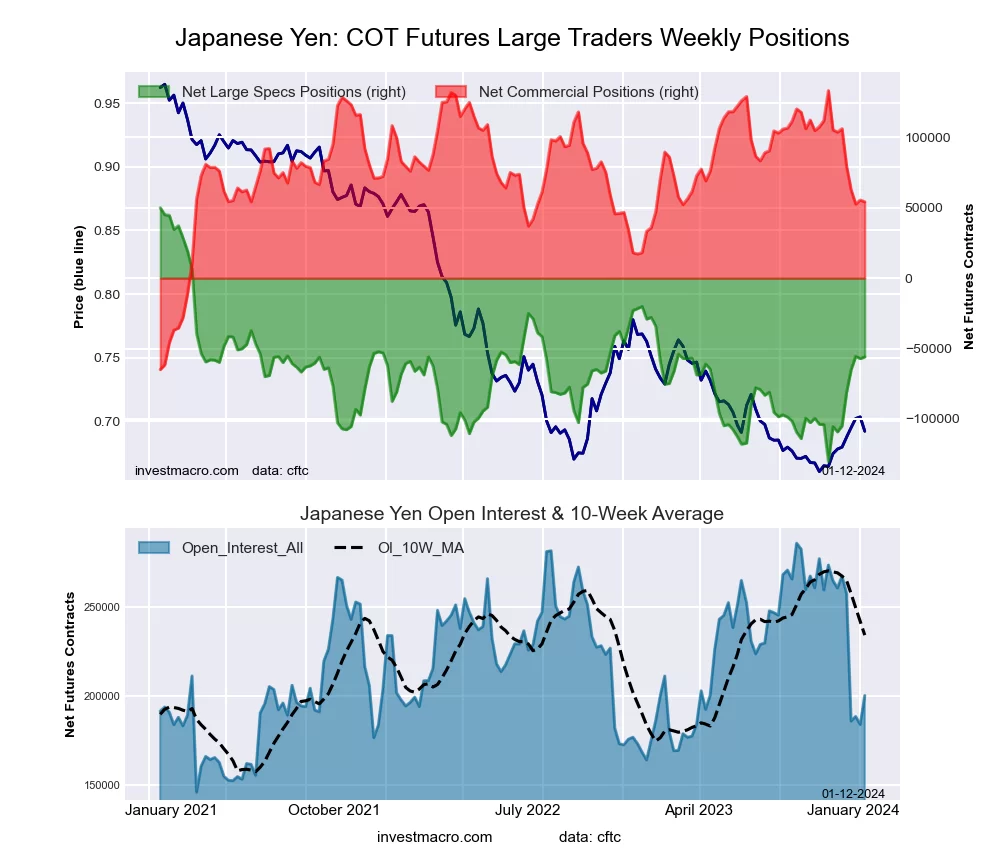
Highlighting the COT currency’s data this week was the renewed boost in the weakness of the Japanese yen speculator positioning. Large speculative yen positions fell sharply this week by -26,209 net contracts and dropped for the third straight week. Over the past sixteen weeks, the yen speculator bets have decreased in twelve of those weeks and a total of -52,497 contracts have been added to the current bearish standing.

This week’s yen net position of -130,249 contracts marks the most bearish level of the past 313 weeks, dating all the way back to November 14th of 2017 (exactly six years to the date) when the net position had fallen to -135,999 contracts.

The Bank of Japan (BOJ) has continued with an ultra-loose monetary policy regime in contrast to most major economies that have been aggressively raising interest rates to combat inflationary pressures over the past year. The BOJ recently kept its interest rate unchanged (currently at -0.1 percent) but changed the upper level for the 10-year interest rate to 1 percent and cited an expectation of higher inflation going forward. Market watchers are speculating that the BOJ could end its negative interest rates as early as January. Depending on the path and the many variables going forward, a normalization of policy could be a benefit for the Japanese yen which has been at weakest levels in three decades.

This week, the yen exchange rate against the US Dollar was stronger and managed to close the week at the 149.50 level. This was a turnaround at the end of the week after the USDJPY currency pair touched the 151.90 exchange level on Monday (a higher USDJPY exchange rate means dollar strength & yen weakness) which was the highest point for the currency pair since October of 2022 when the pair reached a high of 151.94.


Data Snapshot of Forex Market Traders | Columns Legend
Nov-14-2023OIOI-IndexSpec-NetSpec-IndexCom-NetCOM-IndexSmalls-NetSmalls-Index
USD Index38,8423219,73458-20,3784364413
EUR702,46335108,90767-140,9873632,08030
GBP216,41147-27,7303735,43966-7,70943
JPY273,76391-130,2490133,272100-3,02347
CHF59,46493-20,151127,54389-7,39235
CAD206,04665-70,403077,698100-7,2957
AUD197,46956-70,9562479,05777-8,10133
NZD49,90656-17,0341119,17088-2,13625
MXN228,8094843,38266-47,568334,18638
RUB20,93047,54331-7,15069-39324
BRL68,0306431,65176-33,408241,75751
Bitcoin21,20396-1,34446481086333


Strength Scores led by Brazilian Real & EuroFX

COT Strength Scores (a normalized measure of Speculator positions over a 3-Year range, from 0 to 100 where above 80 is Extreme-Bullish and below 20 is Extreme-Bearish) showed that the Brazilian Real (76 percent) and the EuroFX (67 percent) lead the currency markets this week. The Mexican Peso (66 percent) and the US Dollar Index (58 percent) come in as the next highest in the weekly strength scores.

On the downside, the Canadian Dollar (0 percent), the Japanese Yen (0 percent), the Swiss Franc (1 percent) and the New Zealand Dollar (11 percent) come in at the lowest strength levels currently and are in Extreme-Bearish territory (below 20 percent).

Strength Statistics:
US Dollar Index (57.8 percent) vs US Dollar Index previous week (57.4 percent)
EuroFX (66.7 percent) vs EuroFX previous week (58.2 percent)
British Pound Sterling (36.5 percent) vs British Pound Sterling previous week (44.5 percent)
Japanese Yen (0.0 percent) vs Japanese Yen previous week (14.5 percent)
Swiss Franc (1.4 percent) vs Swiss Franc previous week (8.7 percent)
Canadian Dollar (0.0 percent) vs Canadian Dollar previous week (2.3 percent)
Australian Dollar (23.8 percent) vs Australian Dollar previous week (28.7 percent)
New Zealand Dollar (11.0 percent) vs New Zealand Dollar previous week (16.5 percent)
Mexican Peso (65.6 percent) vs Mexican Peso previous week (61.6 percent)
Brazilian Real (75.6 percent) vs Brazilian Real previous week (68.9 percent)
Bitcoin (46.2 percent) vs Bitcoin previous week (41.2 percent)


Brazilian Real & EuroFX top the 6-Week Strength Trends

COT Strength Score Trends (or move index, calculates the 6-week changes in strength scores) showed that the Brazilian Real (19 percent) and the EuroFX (13 percent) lead the past six weeks trends for the currencies. The Australian Dollar (10 percent) and the US Dollar Index (2 percent) represent the next highest positive movers in the trends data.

The Bitcoin (-36 percent) leads the downside trend scores currently with the Canadian Dollar (-25 percent), New Zealand Dollar (-24 percent) and the British Pound (-15 percent) following next with lower trend scores.

Strength Trend Statistics:
US Dollar Index (1.5 percent) vs US Dollar Index previous week (4.5 percent)
EuroFX (12.8 percent) vs EuroFX previous week (-4.0 percent)
British Pound Sterling (-14.6 percent) vs British Pound Sterling previous week (-22.2 percent)
Japanese Yen (-9.0 percent) vs Japanese Yen previous week (3.0 percent)
Swiss Franc (-9.6 percent) vs Swiss Franc previous week (-23.7 percent)
Canadian Dollar (-25.4 percent) vs Canadian Dollar previous week (-29.4 percent)
Australian Dollar (10.1 percent) vs Australian Dollar previous week (19.5 percent)
New Zealand Dollar (-24.4 percent) vs New Zealand Dollar previous week (0.6 percent)
Mexican Peso (-12.9 percent) vs Mexican Peso previous week (-14.6 percent)
Brazilian Real (19.5 percent) vs Brazilian Real previous week (14.3 percent)
Bitcoin (-36.1 percent) vs Bitcoin previous week (-52.2 percent)


Individual COT Forex Markets:

US Dollar Index Futures:
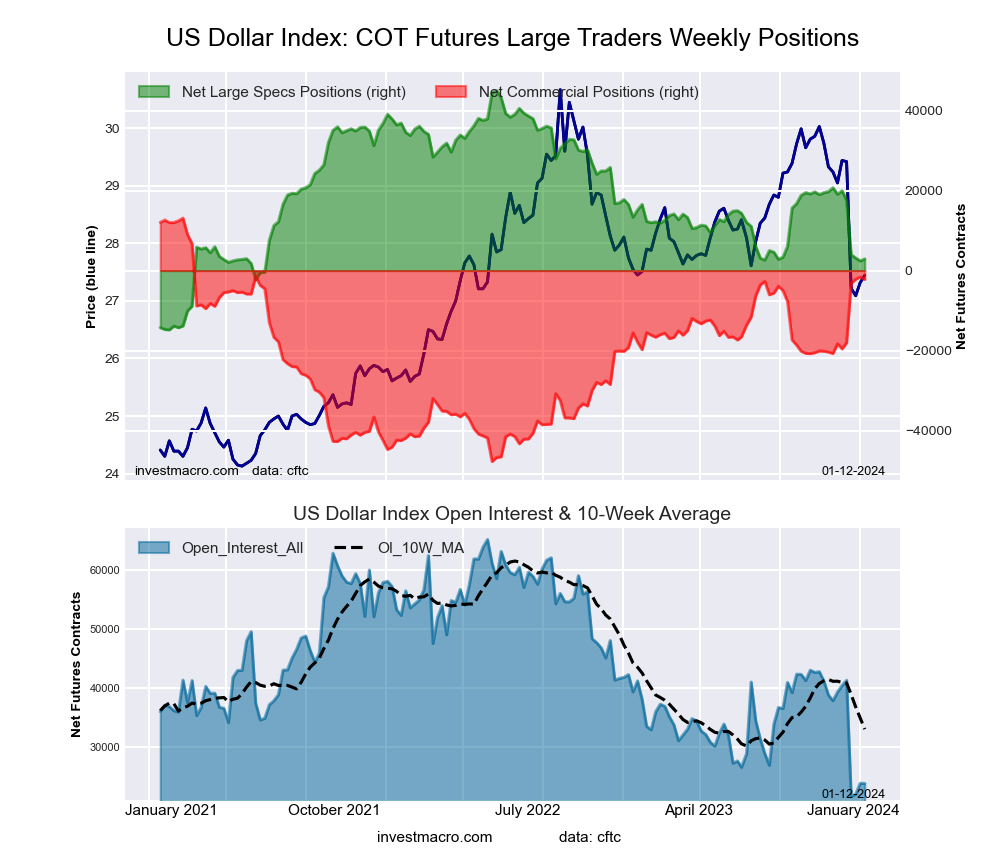
US Dollar Index Forex Futures COT ChartThe US Dollar Index large speculator standing this week was a net position of 19,734 contracts in the data reported through Tuesday. This was a weekly advance of 263 contracts from the previous week which had a total of 19,471 net contracts.

This week’s current strength score (the trader positioning range over the past three years, measured from 0 to 100) shows the speculators are currently Bullish with a score of 57.8 percent. The commercials are Bearish with a score of 43.4 percent and the small traders (not shown in chart) are Bearish-Extreme with a score of 13.2 percent.

Price Trend-Following Model: Uptrend

Our weekly trend-following model classifies the current market price position as: Uptrend. The current action for the model is considered to be: Hold – Maintain Long Position.

US DOLLAR INDEX StatisticsSPECULATORSCOMMERCIALSSMALL TRADERS
– Percent of Open Interest Longs:70.217.89.3
– Percent of Open Interest Shorts:19.470.37.6
– Net Position:19,734-20,378644
– Gross Longs:27,2716,9173,615
– Gross Shorts:7,53727,2952,971
– Long to Short Ratio:3.6 to 10.3 to 11.2 to 1
NET POSITION TREND:
– Strength Index Score (3 Year Range Pct):57.843.413.2
– Strength Index Reading (3 Year Range):BullishBearishBearish-Extreme
NET POSITION MOVEMENT INDEX:
– 6-Week Change in Strength Index:1.5-0.3-8.8


Euro Currency Futures:

Euro Currency Futures COT ChartThe Euro Currency large speculator standing this week was a net position of 108,907 contracts in the data reported through Tuesday. This was a weekly rise of 19,851 contracts from the previous week which had a total of 89,056 net contracts.

This week’s current strength score (the trader positioning range over the past three years, measured from 0 to 100) shows the speculators are currently Bullish with a score of 66.7 percent. The commercials are Bearish with a score of 36.4 percent and the small traders (not shown in chart) are Bearish with a score of 30.2 percent.

Price Trend-Following Model: Weak Downtrend (Possible Trend Change)

Our weekly trend-following model classifies the current market price position as: Weak Downtrend. The current action for the model is considered to be: Hold – Maintain Short Position.

EURO Currency StatisticsSPECULATORSCOMMERCIALSSMALL TRADERS
– Percent of Open Interest Longs:31.554.311.9
– Percent of Open Interest Shorts:16.074.47.4
– Net Position:108,907-140,98732,080
– Gross Longs:221,190381,76583,714
– Gross Shorts:112,283522,75251,634
– Long to Short Ratio:2.0 to 10.7 to 11.6 to 1
NET POSITION TREND:
– Strength Index Score (3 Year Range Pct):66.736.430.2
– Strength Index Reading (3 Year Range):BullishBearishBearish
NET POSITION MOVEMENT INDEX:
– 6-Week Change in Strength Index:12.8-13.610.0


British Pound Sterling Futures:

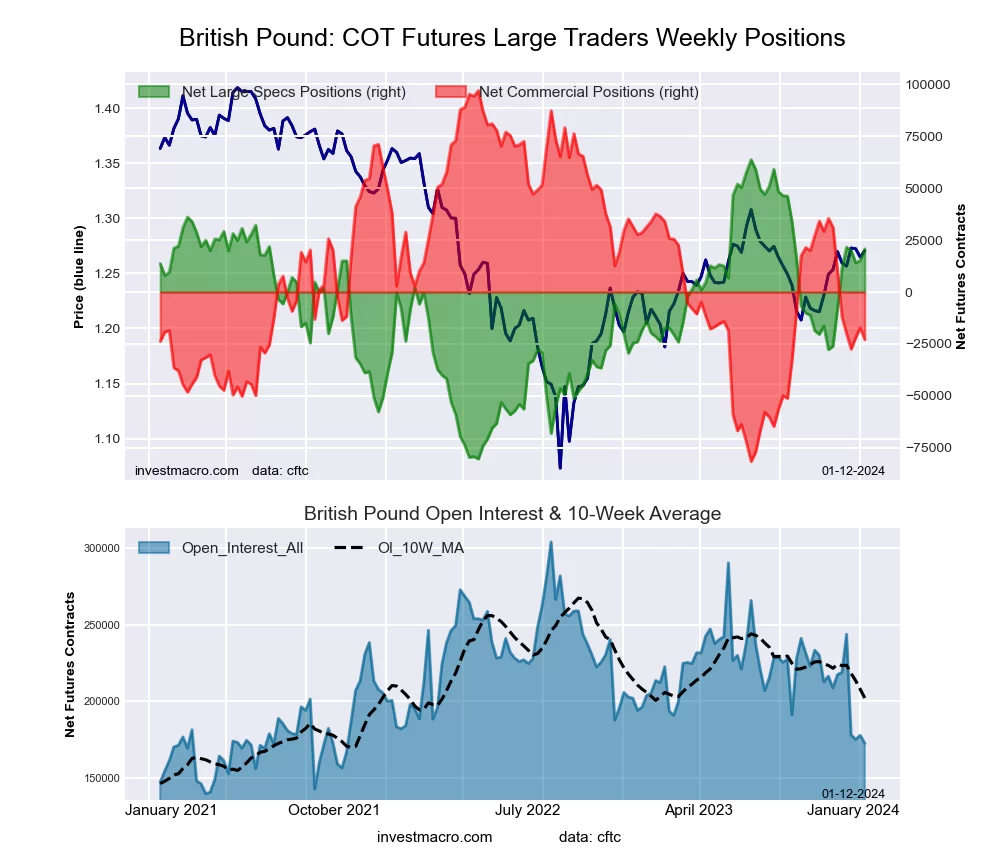
British Pound Sterling Futures COT ChartThe British Pound Sterling large speculator standing this week was a net position of -27,730 contracts in the data reported through Tuesday. This was a weekly fall of -11,478 contracts from the previous week which had a total of -16,252 net contracts.

This week’s current strength score (the trader positioning range over the past three years, measured from 0 to 100) shows the speculators are currently Bearish with a score of 36.5 percent. The commercials are Bullish with a score of 65.5 percent and the small traders (not shown in chart) are Bearish with a score of 42.9 percent.

Price Trend-Following Model: Downtrend

Our weekly trend-following model classifies the current market price position as: Downtrend. The current action for the model is considered to be: Hold – Maintain Short Position.

BRITISH POUND StatisticsSPECULATORSCOMMERCIALSSMALL TRADERS
– Percent of Open Interest Longs:24.460.112.2
– Percent of Open Interest Shorts:37.243.715.8
– Net Position:-27,73035,439-7,709
– Gross Longs:52,797130,00426,403
– Gross Shorts:80,52794,56534,112
– Long to Short Ratio:0.7 to 11.4 to 10.8 to 1
NET POSITION TREND:
– Strength Index Score (3 Year Range Pct):36.565.542.9
– Strength Index Reading (3 Year Range):BearishBullishBearish
NET POSITION MOVEMENT INDEX:
– 6-Week Change in Strength Index:-14.610.06.2


Japanese Yen Futures:

Japanese Yen Forex Futures COT ChartThe Japanese Yen large speculator standing this week was a net position of -130,249 contracts in the data reported through Tuesday. This was a weekly reduction of -26,209 contracts from the previous week which had a total of -104,040 net contracts.

This week’s current strength score (the trader positioning range over the past three years, measured from 0 to 100) shows the speculators are currently Bearish-Extreme with a score of 0.0 percent. The commercials are Bullish-Extreme with a score of 100.0 percent and the small traders (not shown in chart) are Bearish with a score of 47.3 percent.

Price Trend-Following Model: Downtrend

Our weekly trend-following model classifies the current market price position as: Downtrend. The current action for the model is considered to be: Hold – Maintain Short Position.

JAPANESE YEN StatisticsSPECULATORSCOMMERCIALSSMALL TRADERS
– Percent of Open Interest Longs:10.173.015.4
– Percent of Open Interest Shorts:57.724.316.5
– Net Position:-130,249133,272-3,023
– Gross Longs:27,772199,89042,074
– Gross Shorts:158,02166,61845,097
– Long to Short Ratio:0.2 to 13.0 to 10.9 to 1
NET POSITION TREND:
– Strength Index Score (3 Year Range Pct):0.0100.047.3
– Strength Index Reading (3 Year Range):Bearish-ExtremeBullish-ExtremeBearish
NET POSITION MOVEMENT INDEX:
– 6-Week Change in Strength Index:-9.07.51.7


Swiss Franc Futures:

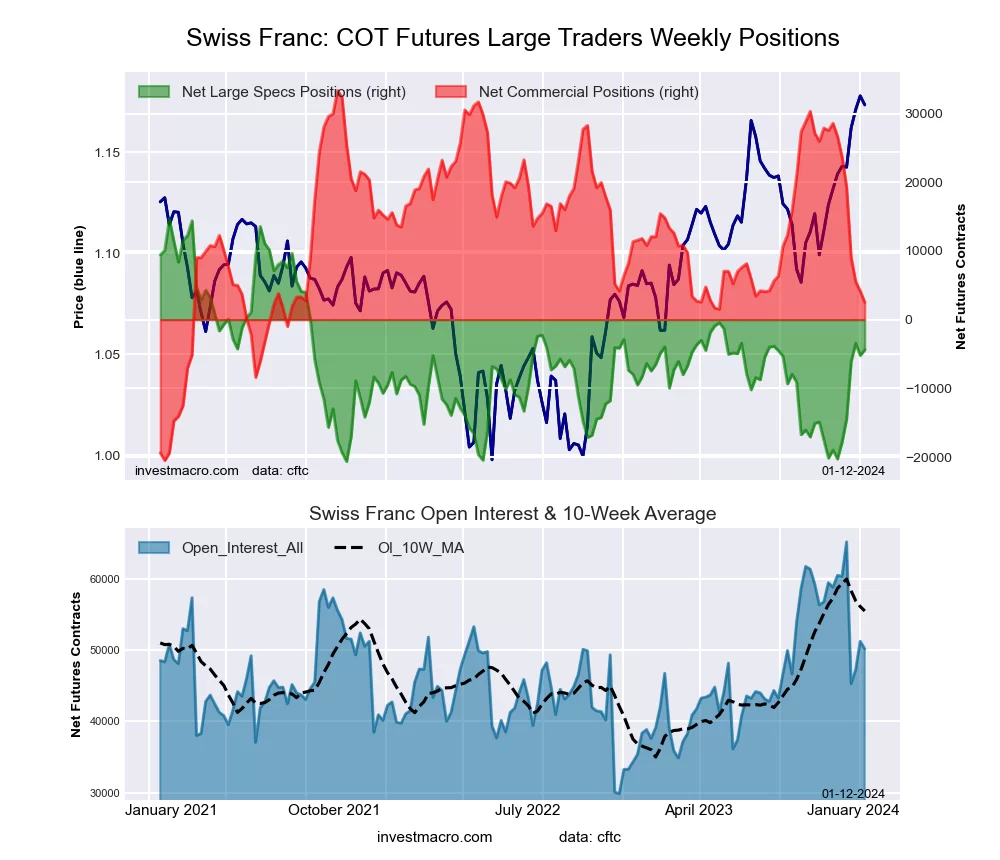
Swiss Franc Forex Futures COT ChartThe Swiss Franc large speculator standing this week was a net position of -20,151 contracts in the data reported through Tuesday. This was a weekly decrease of -2,589 contracts from the previous week which had a total of -17,562 net contracts.

This week’s current strength score (the trader positioning range over the past three years, measured from 0 to 100) shows the speculators are currently Bearish-Extreme with a score of 1.4 percent. The commercials are Bullish-Extreme with a score of 89.5 percent and the small traders (not shown in chart) are Bearish with a score of 34.6 percent.

Price Trend-Following Model: Weak Downtrend (Possible Trend Change)

Our weekly trend-following model classifies the current market price position as: Weak Downtrend. The current action for the model is considered to be: Hold – Maintain Short Position.

SWISS FRANC StatisticsSPECULATORSCOMMERCIALSSMALL TRADERS
– Percent of Open Interest Longs:9.371.019.5
– Percent of Open Interest Shorts:43.224.732.0
– Net Position:-20,15127,543-7,392
– Gross Longs:5,51542,24011,612
– Gross Shorts:25,66614,69719,004
– Long to Short Ratio:0.2 to 12.9 to 10.6 to 1
NET POSITION TREND:
– Strength Index Score (3 Year Range Pct):1.489.534.6
– Strength Index Reading (3 Year Range):Bearish-ExtremeBullish-ExtremeBearish
NET POSITION MOVEMENT INDEX:
– 6-Week Change in Strength Index:-9.60.311.6


Canadian Dollar Futures:

Canadian Dollar Forex Futures COT ChartThe Canadian Dollar large speculator standing this week was a net position of -70,403 contracts in the data reported through Tuesday. This was a weekly lowering of -2,682 contracts from the previous week which had a total of -67,721 net contracts.

This week’s current strength score (the trader positioning range over the past three years, measured from 0 to 100) shows the speculators are currently Bearish-Extreme with a score of 0.0 percent. The commercials are Bullish-Extreme with a score of 100.0 percent and the small traders (not shown in chart) are Bearish-Extreme with a score of 6.6 percent.

Price Trend-Following Model: Downtrend

Our weekly trend-following model classifies the current market price position as: Downtrend. The current action for the model is considered to be: Hold – Maintain Short Position.

CANADIAN DOLLAR StatisticsSPECULATORSCOMMERCIALSSMALL TRADERS
– Percent of Open Interest Longs:9.173.814.2
– Percent of Open Interest Shorts:43.236.117.7
– Net Position:-70,40377,698-7,295
– Gross Longs:18,678152,04329,204
– Gross Shorts:89,08174,34536,499
– Long to Short Ratio:0.2 to 12.0 to 10.8 to 1
NET POSITION TREND:
– Strength Index Score (3 Year Range Pct):0.0100.06.6
– Strength Index Reading (3 Year Range):Bearish-ExtremeBullish-ExtremeBearish-Extreme
NET POSITION MOVEMENT INDEX:
– 6-Week Change in Strength Index:-25.424.4-19.7


Australian Dollar Futures:

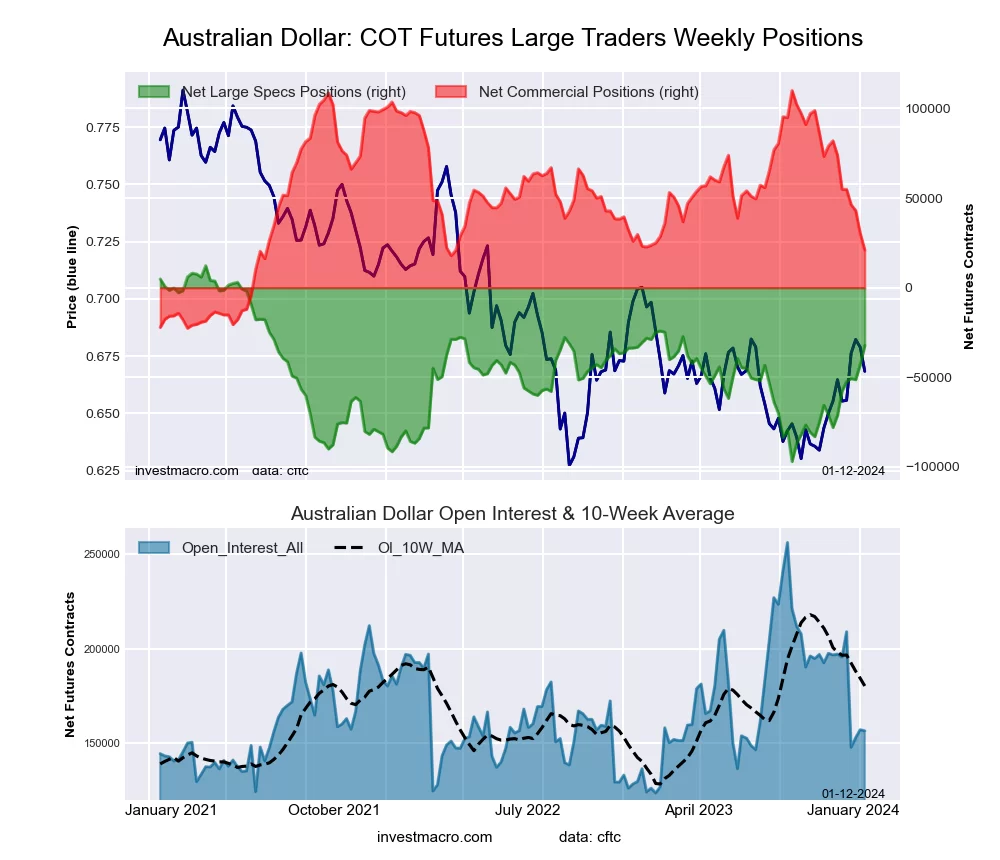
Australian Dollar Forex Futures COT ChartThe Australian Dollar large speculator standing this week was a net position of -70,956 contracts in the data reported through Tuesday. This was a weekly decline of -5,393 contracts from the previous week which had a total of -65,563 net contracts.

This week’s current strength score (the trader positioning range over the past three years, measured from 0 to 100) shows the speculators are currently Bearish with a score of 23.8 percent. The commercials are Bullish with a score of 76.7 percent and the small traders (not shown in chart) are Bearish with a score of 32.7 percent.

Price Trend-Following Model: Weak Downtrend (Possible Trend Change)

Our weekly trend-following model classifies the current market price position as: Weak Downtrend. The current action for the model is considered to be: Hold – Maintain Short Position.

AUSTRALIAN DOLLAR StatisticsSPECULATORSCOMMERCIALSSMALL TRADERS
– Percent of Open Interest Longs:16.667.211.0
– Percent of Open Interest Shorts:52.527.115.2
– Net Position:-70,95679,057-8,101
– Gross Longs:32,728132,63921,818
– Gross Shorts:103,68453,58229,919
– Long to Short Ratio:0.3 to 12.5 to 10.7 to 1
NET POSITION TREND:
– Strength Index Score (3 Year Range Pct):23.876.732.7
– Strength Index Reading (3 Year Range):BearishBullishBearish
NET POSITION MOVEMENT INDEX:
– 6-Week Change in Strength Index:10.1-13.717.5


New Zealand Dollar Futures:

New Zealand Dollar Forex Futures COT ChartThe New Zealand Dollar large speculator standing this week was a net position of -17,034 contracts in the data reported through Tuesday. This was a weekly decline of -2,094 contracts from the previous week which had a total of -14,940 net contracts.

This week’s current strength score (the trader positioning range over the past three years, measured from 0 to 100) shows the speculators are currently Bearish-Extreme with a score of 11.0 percent. The commercials are Bullish-Extreme with a score of 88.3 percent and the small traders (not shown in chart) are Bearish with a score of 24.6 percent.

Price Trend-Following Model: Downtrend

Our weekly trend-following model classifies the current market price position as: Downtrend. The current action for the model is considered to be: Hold – Maintain Short Position.

NEW ZEALAND DOLLAR StatisticsSPECULATORSCOMMERCIALSSMALL TRADERS
– Percent of Open Interest Longs:17.773.86.2
– Percent of Open Interest Shorts:51.835.410.5
– Net Position:-17,03419,170-2,136
– Gross Longs:8,81836,8173,107
– Gross Shorts:25,85217,6475,243
– Long to Short Ratio:0.3 to 12.1 to 10.6 to 1
NET POSITION TREND:
– Strength Index Score (3 Year Range Pct):11.088.324.6
– Strength Index Reading (3 Year Range):Bearish-ExtremeBullish-ExtremeBearish
NET POSITION MOVEMENT INDEX:
– 6-Week Change in Strength Index:-24.419.211.1


Mexican Peso Futures:

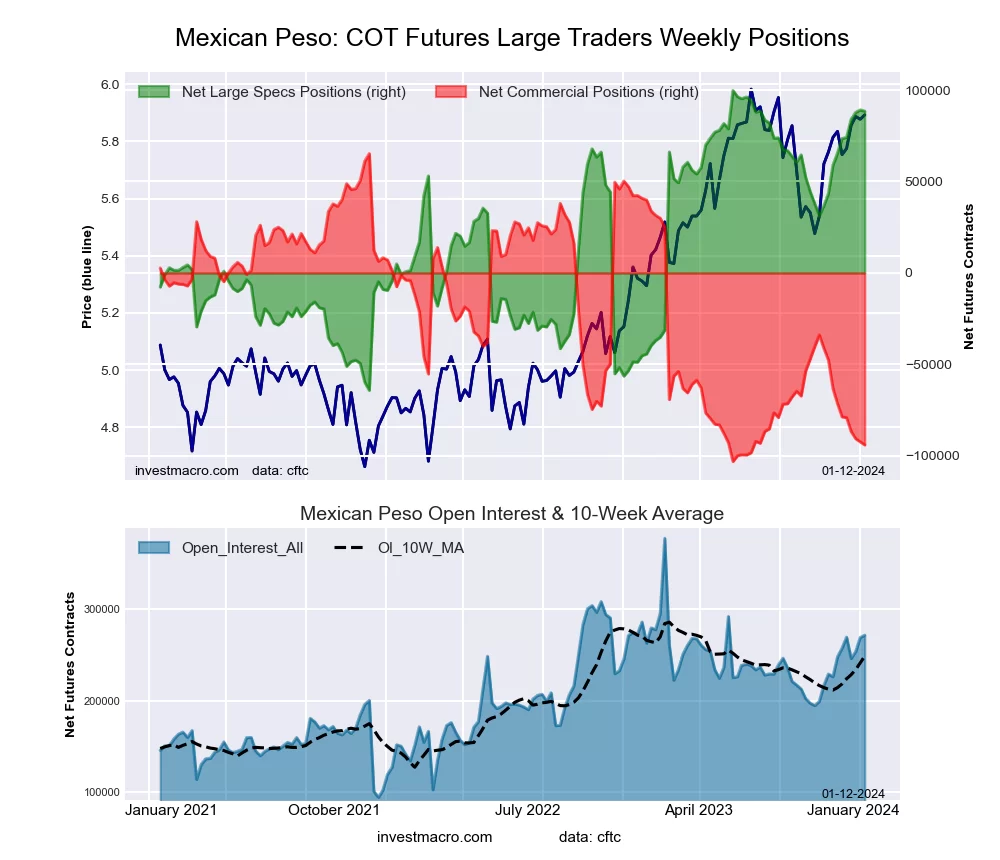
Mexican Peso Futures COT ChartThe Mexican Peso large speculator standing this week was a net position of 43,382 contracts in the data reported through Tuesday. This was a weekly rise of 6,642 contracts from the previous week which had a total of 36,740 net contracts.

This week’s current strength score (the trader positioning range over the past three years, measured from 0 to 100) shows the speculators are currently Bullish with a score of 65.6 percent. The commercials are Bearish with a score of 33.0 percent and the small traders (not shown in chart) are Bearish with a score of 37.9 percent.

Price Trend-Following Model: Weak Downtrend (Possible Trend Change)

Our weekly trend-following model classifies the current market price position as: Weak Downtrend. The current action for the model is considered to be: Hold – Maintain Short Position.

MEXICAN PESO StatisticsSPECULATORSCOMMERCIALSSMALL TRADERS
– Percent of Open Interest Longs:34.660.63.0
– Percent of Open Interest Shorts:15.681.41.2
– Net Position:43,382-47,5684,186
– Gross Longs:79,162138,7166,874
– Gross Shorts:35,780186,2842,688
– Long to Short Ratio:2.2 to 10.7 to 12.6 to 1
NET POSITION TREND:
– Strength Index Score (3 Year Range Pct):65.633.037.9
– Strength Index Reading (3 Year Range):BullishBearishBearish
NET POSITION MOVEMENT INDEX:
– 6-Week Change in Strength Index:-12.911.79.3


Brazilian Real Futures:

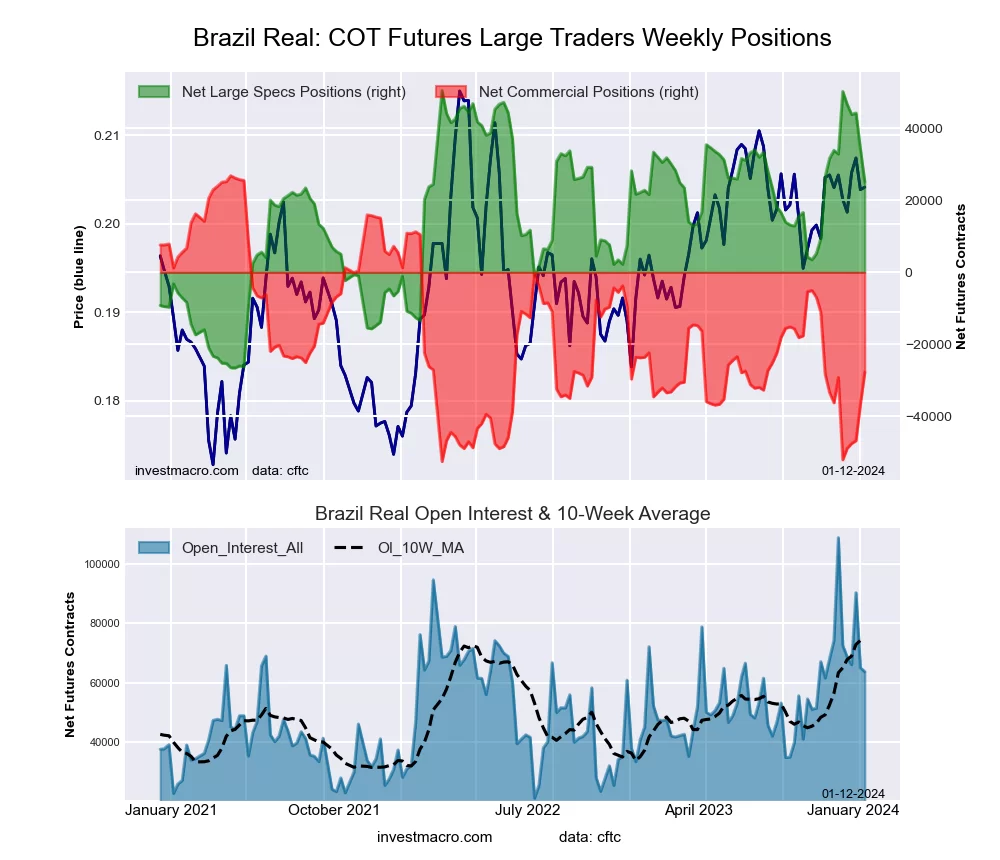
Brazil Real Futures COT ChartThe Brazilian Real large speculator standing this week was a net position of 31,651 contracts in the data reported through Tuesday. This was a weekly lift of 5,100 contracts from the previous week which had a total of 26,551 net contracts.

This week’s current strength score (the trader positioning range over the past three years, measured from 0 to 100) shows the speculators are currently Bullish with a score of 75.6 percent. The commercials are Bearish with a score of 24.1 percent and the small traders (not shown in chart) are Bullish with a score of 50.8 percent.

Price Trend-Following Model: Weak Downtrend (Possible Trend Change)

Our weekly trend-following model classifies the current market price position as: Weak Downtrend. The current action for the model is considered to be: Hold – Maintain Short Position.

BRAZIL REAL StatisticsSPECULATORSCOMMERCIALSSMALL TRADERS
– Percent of Open Interest Longs:72.821.75.1
– Percent of Open Interest Shorts:26.370.82.5
– Net Position:31,651-33,4081,757
– Gross Longs:49,53714,7673,478
– Gross Shorts:17,88648,1751,721
– Long to Short Ratio:2.8 to 10.3 to 12.0 to 1
NET POSITION TREND:
– Strength Index Score (3 Year Range Pct):75.624.150.8
– Strength Index Reading (3 Year Range):BullishBearishBullish
NET POSITION MOVEMENT INDEX:
– 6-Week Change in Strength Index:19.5-19.97.0


Bitcoin Futures:

Bitcoin Crypto Futures COT ChartThe Bitcoin large speculator standing this week was a net position of -1,344 contracts in the data reported through Tuesday. This was a weekly rise of 333 contracts from the previous week which had a total of -1,677 net contracts.

This week’s current strength score (the trader positioning range over the past three years, measured from 0 to 100) shows the speculators are currently Bearish with a score of 46.2 percent. The commercials are Bullish-Extreme with a score of 82.3 percent and the small traders (not shown in chart) are Bearish with a score of 32.6 percent.

Price Trend-Following Model: Strong Uptrend

Our weekly trend-following model classifies the current market price position as: Strong Uptrend. The current action for the model is considered to be: Hold – Maintain Long Position.

BITCOIN StatisticsSPECULATORSCOMMERCIALSSMALL TRADERS
– Percent of Open Interest Longs:75.25.27.6
– Percent of Open Interest Shorts:81.52.93.5
– Net Position:-1,344481863
– Gross Longs:15,9391,1051,609
– Gross Shorts:17,283624746
– Long to Short Ratio:0.9 to 11.8 to 12.2 to 1
NET POSITION TREND:
– Strength Index Score (3 Year Range Pct):46.282.332.6
– Strength Index Reading (3 Year Range):BearishBullish-ExtremeBearish
NET POSITION MOVEMENT INDEX:
– 6-Week Change in Strength Index:-36.153.210.1


Article By InvestMacroReceive our weekly COT Newsletter

*COT Report: The COT data, released weekly to the public each Friday, is updated through the most recent Tuesday (data is 3 days old) and shows a quick view of how large speculators or non-commercials (for-profit traders) were positioned in the futures markets.

The CFTC categorizes trader positions according to commercial hedgers (traders who use futures contracts for hedging as part of the business), non-commercials (large traders who speculate to realize trading profits) and nonreportable traders (usually small traders/speculators) as well as their open interest (contracts open in the market at time of reporting). See CFTC criteria here.

Speculator Extremes: 3M SOFR, Steel, Yen & Ultra 10-Year lead Bullish & Bearish Positions

By InvestMacro

The latest update for the weekly Commitment of Traders (COT) report was released by the Commodity Futures Trading Commission (CFTC) on Friday for data ending on November 14th.

This weekly Extreme Positions report highlights the Most Bullish and Most Bearish Positions for the speculator category. Extreme positioning in these markets can foreshadow strong moves in the underlying market.

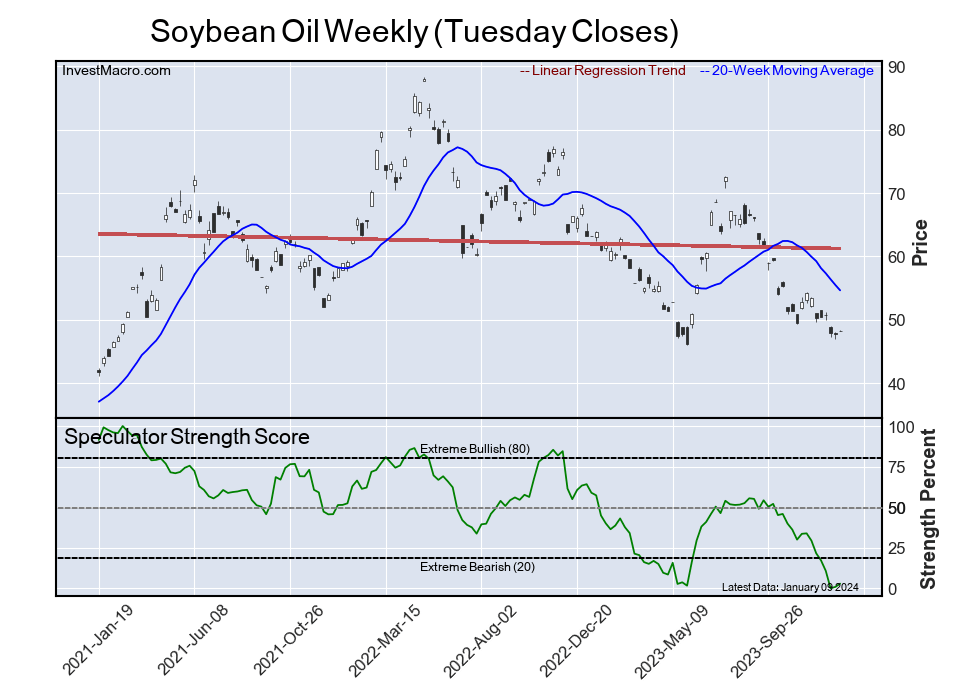
To signify an extreme position, we use the Strength Index (also known as the COT Index) of each instrument, a common method of measuring COT data. The Strength Index is simply a comparison of current trader positions against the range of positions over the previous 3 years. We use over 80 percent as extremely bullish and under 20 percent as extremely bearish. (Compare Strength Index scores across all markets in the data table or cot leaders table)


Here Are This Week’s Most Bullish Speculator Positions:

3-Month Secured Overnight Financing Rate


The 3-Month Secured Overnight Financing Rate speculator position comes in as the most bullish extreme standing this week. The 3-Month Secured Overnight Financing Rate speculator level is currently at a 95.0 percent score of its 3-year range.

The six-week trend for the percent strength score totaled 7.5 this week. The overall net speculator position was a total of 416,726 net contracts this week with a net gain of 30,097 contract in the weekly speculator bets.


Speculators or Non-Commercials Notes:

Speculators, classified as non-commercial traders by the CFTC, are made up of large commodity funds, hedge funds and other significant for-profit participants. The Specs are generally regarded as trend-followers in their behavior towards price action – net speculator bets and prices tend to go in the same directions. These traders often look to buy when prices are rising and sell when prices are falling. To illustrate this point, many times speculator contracts can be found at their most extremes (bullish or bearish) when prices are also close to their highest or lowest levels.

These extreme levels can be dangerous for the large speculators as the trade is most crowded, there is less trading ammunition still sitting on the sidelines to push the trend further and prices have moved a significant distance. When the trend becomes exhausted, some speculators take profits while others look to also exit positions when prices fail to continue in the same direction. This process usually plays out over many months to years and can ultimately create a reverse effect where prices start to fall and speculators start a process of selling when prices are falling.


Steel


The Steel speculator position comes next in the extreme standings this week. The Steel speculator level is now at a 92.5 percent score of its 3-year range.

The six-week trend for the percent strength score was 14.7 this week. The speculator position registered -1,768 net contracts this week with a weekly dip of -465 contracts in speculator bets.


Cocoa Futures


The Cocoa Futures speculator position comes in third this week in the extreme standings. The Cocoa Futures speculator level resides at a 87.3 percent score of its 3-year range.

The six-week trend for the speculator strength score came in at 6.0 this week. The overall speculator position was 75,784 net contracts this week with a small gain of 757 contracts in the weekly speculator bets.


Heating Oil


The Heating Oil speculator position comes up number four in the extreme standings this week. The Heating Oil speculator level is at a 81.8 percent score of its 3-year range.

The six-week trend for the speculator strength score totaled a change of -11.2 this week. The overall speculator position was 32,569 net contracts this week with a boost of 3,571 contracts in the speculator bets.


Bloomberg Commodity Index


The Bloomberg Commodity Index speculator position rounds out the top five in this week’s bullish extreme standings. The Bloomberg Commodity Index speculator level sits at a 81.7 percent score of its 3-year range. The six-week trend for the speculator strength score was -4.5 this week.

The speculator position was -6,334 net contracts this week with a shortfall of -172 contracts in the weekly speculator bets.


This Week’s Most Bearish Speculator Positions:

Ultra 10-Year U.S. T-Note


The Ultra 10-Year U.S. T-Note speculator position comes in as the most bearish extreme standing this week. The Ultra 10-Year U.S. T-Note speculator level is at a 0.0 percent score of its 3-year range.

The six-week trend for the speculator strength score was -3.8 this week. The overall speculator position was -265,436 net contracts this week with a small decline of -1,256 contracts in the speculator bets.


Japanese Yen


The Japanese Yen speculator position comes in next for the most bearish extreme standing on the week. The Japanese Yen speculator level is at a 0.0 percent score of its 3-year range.

The six-week trend for the speculator strength score was -9.0 this week. The speculator position was -130,249 net contracts this week with a drop of -26,209 contracts in the weekly speculator bets.


Canadian Dollar


The Canadian Dollar speculator position comes in as third most bearish extreme standing of the week. The Canadian Dollar speculator level resides at a 0.0 percent score of its 3-year range.

The six-week trend for the speculator strength score was -25.4 this week. The overall speculator position was -70,403 net contracts this week with a decrease of -2,682 contracts in the speculator bets.


MSCI EAFE MINI


The MSCI EAFE MINI speculator position comes in as this week’s fourth most bearish extreme standing. The MSCI EAFE MINI speculator level is at a 0.0 percent score of its 3-year range.

The six-week trend for the speculator strength score was -41.3 this week. The speculator position was -64,174 net contracts this week with a drop of -5,972 contracts in the weekly speculator bets.


5-Year Bond


Finally, the 5-Year Bond speculator position comes in as the fifth most bearish extreme standing for this week. The 5-Year Bond speculator level is at a 0.5 percent score of its 3-year range.

The six-week trend for the speculator strength score was -21.3 this week. The speculator position was -1,416,240 net contracts this week with an increase of 7,144 contracts in the weekly speculator bets.


Article By InvestMacroReceive our weekly COT Newsletter

*COT Report: The COT data, released weekly to the public each Friday, is updated through the most recent Tuesday (data is 3 days old) and shows a quick view of how large speculators or non-commercials (for-profit traders) were positioned in the futures markets.

The CFTC categorizes trader positions according to commercial hedgers (traders who use futures contracts for hedging as part of the business), non-commercials (large traders who speculate to realize trading profits) and nonreportable traders (usually small traders/speculators) as well as their open interest (contracts open in the market at time of reporting). See CFTC criteria here.

Week Ahead: More pain ahead for oil?

By ForexTime 

  • Oil tumbles into bear market on demand fears
  • Keep eye on incoming EIA report and US data
  • Oil slump throws OPEC+ into spotlight
  • Bears in power but RSI oversold
  • Key levels of interest at $75.30, $72.50 and $70

Despite the holiday-shortened week ahead in the United States, financial markets could see some action thanks to top-tier economic releases across the globe.

Monday, 20th November   

  • CNH: China loan prime rates
  • GBP: Bank of England Governor Andrew Bailey
  • USD: Conference Board leading index

Tuesday, 21st November 

  • CAD: Canada CPI
  • EUR: Eurozone new car registrations
  • NZD: New Zealand trade
  • USD: US FOMC minutes, existing home sales
  • NQ100_m: Nvidia earnings

Wednesday, 22nd November

  • EUR: Eurozone consumer confidence
  • GBP: UK government’s Autumn Statement
  • USD: US initial jobless claims, University of Michigan consumer sentiment

Thursday, 23rd November  

  • EUR: Eurozone/Germany S&P Global PMIs
  • GBP: UK S&P Global /CIPS Manufacturing PMI
  • US Markets closed – Thanksgiving holiday

Friday, 24th November

  • CAD: Canada retail sales
  • EUR: Germany IFO business climate, GDP
  • JPY: Japan CPI
  • USD: S&P Global manufacturing PMI
  • US markets close early – 1:00 pm ET

Sunday, 26th November

  • OPEC+ meeting

Our focus falls on crude oil which has collapsed into a bear market. 

The global commodity is under intense pressure, heading for its fourth straight week of declines.

Note: A bear market happens when an instrument drops by 20% or more from its most recent high.

The pain started mid-week as swelling US inventories fuelled demand-side fears with disappointing economic data from the largest economy in the world exciting oil bears further.

Before the hefty 4.7% selloff this week, oil prices were already being pressured by weak data from China and easing fears over the Israel-Hamas conflict disrupting supply from the region.

With the path of least resistance for oil pointing south, further losses could be on the cards.

Here are 4 key factors that may influence oil in the week ahead:

  1. US Energy Information Agency (EIA) report

It is worth noting that markets received 2 weeks of data from the EIA due to a planned system upgrade.

Crude oil inventories expanded for a fourth week, rising by 3.6 million barrels in the week ended November 10. This was followed by a huge 13.9 million-barrel build in the previous period.

The next EIA report published on Wednesday 22nd November may shape oil’s short to medium-term outlook.

  • Another build in US crude inventories may further darken the demand outlook, dragging the global commodity lower as a result.
  • A decline in US inventories could soothe fears around waning oil demand, potentially limiting downside pressures on crude.
  1. FOMC minutes + US data 

Much has changed since the Federal Reserve policy meeting on the 1st of November with the soft US inflation report extinguishing any remaining bets around the Fed hiking rates.

Nevertheless, the Fed minutes could offer additional insight into what Fed officials thought about the US economic outlook. On the data front, there will be some key economic releases including the US initial jobless claims, university of Michigan consumer sentiment, and manufacturing PMI which could trigger dollar volatility.

  • Should the minutes strike a cautious note and overall US economic data disappoint, this could feed fears around waning demand – dragging oil prices lower.
  • While a positive set of US economic data may quell fears around the demand outlook and supporting oil – a stronger dollar could limit upside gains.
  1. Anticipation ahead of OPEC+ meeting 

Note: the full impacts of what is decided during the OPEC+ meeting will not be reflected until Monday 27th November. However, the growing anticipation could influence oil prices ahead of this major event.

Oil prices are trading at their lowest levels since July ahead of the OPEC+ meeting on Sunday 26th November.

The latest selloff in oil prices has added more focus to the upcoming meeting, opening the doors for greater supply cuts as the cartel continues its quest to rebalance markets. It is worth keeping in mind that OPEC+ has been cutting production since late 2022 with a broader deal to limit supply throughout 2024.

Markets already expect the extension of production cuts by Saudi Arabia and Russia into the early parts of 2024. So, the cartel may need to offer something new to revive oil bulls.

  • Oil prices could be thrown a lifeline if the cartel moves ahead with deeper supply cuts.
  1. Technical forces 

Prices are under intense pressure on the daily charts with crude respecting a bearish channel. There have been consistently lower lows and lower highs while the MACD trades to the downside. However, the Relative Strength Index (RSI) is flirting near 30, indicating that crude may be oversold. While this has the potential to trigger a technical rebound, the scales of power remain in favour of bears.

  • A solid daily close below $74 could send prices back towards $72.50 and $70, respectively.
  • Should prices push back above $75.30, this could open the doors towards the 200-day SMA at $78 and $79.80.


Forex-Time-LogoArticle by ForexTime

ForexTime Ltd (FXTM) is an award winning international online forex broker regulated by CySEC 185/12 www.forextime.com

Fresh water is a hidden challenge − and opportunity − for global supply chains

By Dustin Cole, Auburn University 

Reports of lengthy shipping delays for vessels traveling through the Panama Canal this year have highlighted the critical but often overlooked role that fresh water plays across global supply chains. Drier than normal conditions in Panama, brought on by El Niño, have left the region drought-stricken and water levels in the locks that feed the canal lower than normal. This has led to fewer ships being able to pass through the canal each day: only 31 ships currently, compared with 36 to 38 under normal conditions. This means longer waits to move products through the canal and onto store shelves.

The slowdown at the Panama Canal shows how access to fresh water is key to the way goods are made and shipped, affecting everything from the price of groceries to retail forecasts for the upcoming holiday shopping season. As a professor of supply chain management, I think businesses would be wise to pay closer attention to this issue.

But first, you might ask: What does fresh water have to do with ocean freight? Plenty, it turns out.

Water, water everywhere, and not enough to share

The Panama Canal is a freshwater connection between two oceans – not a saltwater link, as one might assume. A series of locks on each side of the canal raise cargo freighters nearly 100 feet to human-made lakes that extend across Panama’s isthmus and lower them down to sea level on the other side.

Each crossing by a ship requires 52 million gallons of fresh water from lakes, rivers and streams across this small country. This creates a trade-off between preserving water for local needs and using it to allow ships to traverse the canal. Less water allocated to the canal means fewer ships can pass through.

This isn’t an isolated phenomenon. Periodic low water levels in the Mississippi River and the Rhine River in Germany have impeded barge traffic for years, disrupting supply chains while stoking debate about how to divide limited amounts of fresh water. Recent plans by communities in northern Colorado to build their own reservoirs on tributaries of the Colorado River highlight questions about who owns access to local waterways and how this resource is governed.

An ancient challenge

The need to manage water resources isn’t new, with complex water management systems dating back to the Roman Empire and even earlier. Humankind has made great progress on water management over the centuries, but in recent years the issue has often taken a back seat to other pressing environmental concerns such as global warming.

Water management is complicated by the fact that businesses and communities sometimes find themselves in conflict: Businesses want to use water for their operations, while communities want to preserve water supplies to ensure that residents’ basic needs are met. At the same time, communities also need the jobs and services that businesses provide. Examples such as the Panama Canal highlight this tension.

Balancing these seemingly contrary needs calls for a deeper look into how much water is used in the making of products people buy and use every day.

As my colleagues and I show in a recent journal article, water is an important component of almost everything people buy. For example, roughly 2,600 gallons of water goes into making the fabric for a single pair of jeans. From growing cotton for the fibers needed to manufacturing the denim and getting those jeans onto shelves at The Gap, more and more water is embedded into each pair as it moves through the supply chain.

Essentially, businesses use water to transport water embedded in virtually all products they sell. This is why businesses have more than purely altruistic reasons to address water-related problems: It isn’t just good for society but also their own operations. A lack of water can hamper production and disrupt the supply chains that businesses rely on.

Inside the world’s largest cargo shipping bottleneck. | WSJ.

Solutions for businesses

There are a number of ways in which businesses can improve their water management to reduce their own consumption – and costs – while limiting their exposure to water risks.

First, companies should realize that not everything requires clean water. Wastewater from one process can be used for another that doesn’t require clean water. Similarly, not every process pollutes water, so reuse is easy for wastewater resulting from those processes, such as water used for cooling.

Second, firms can share wastewater between facilities for reuse, a concept called industrial ecology. For example, nutrient-rich water from food production can be used for farm irrigation rather than being discharged.

And third, since water is an excellent medium for heat transfer, rather than trying to cool one area and heat another, companies can connect the systems. For example, global aluminum giant Novelis is deploying hot water used in the casting process at one of its plants in Europe to heat a neighboring building.

Opportunities abound for improving management of fresh water – one of our most precious resources. While stronger government regulations and expanded reporting requirements will help, decisions by businesses themselves can move that needle even more.

For those who do, their standing in the communities in which they operate will surely benefit – as will their bottom lines.The Conversation

About the Author:

Dustin Cole, Assistant Professor of Supply Chain Management, Auburn University

This article is republished from The Conversation under a Creative Commons license. Read the original article.

US CPI surprisingly cool boosting end of year market rally – what investors should do

By George Prior 

US inflation (CPI) comes in cooler than expected but investors still need to adjust to a ‘higher-for-longer’ interest rate environments, warns CEO of one of the world’s largest independent financial advisory, asset management and fintech organizations.

The warning from Nigel Green of deVere Group comes as the October consumer price index was flat month on month, and up 0.2% when excluding food and energy for the core CPI reading.

He notes: “The surprisingly cool CPI solidifies our expectations that the Federal Reserve is done with hiking rates this year and will hold them steady in December.

“However, we believe there will be a sustained period of slower progress than we’ve seen up to this point against inflation in the flight to get it back to the 2% target. The process is going to be more gradual moving forward.

“Therefore, we except one more hike from the Fed next year to boost that progress a little.”

Furthermore, the deVere CEO also says the US CPI readings support his anticipation of a year-end market rally in 2023.

At the end of October he told the media: “We’re about to see a year-end rally, which investors would not want to miss out on as markets turn bullish on the Fed likely holding rates steady.”

As interest rates are anticipated to remain elevated for an extended period and a year-end market rally is expected, investors must adopt a prudent approach to navigate these evolving financial landscapes.

They should strategically consider sectors that exhibit resilience and potential for sustained growth.

“One such sector to contemplate is tech, given its capacity for continuous innovation and the increasing reliance on digitalization across industries. Technology companies often have robust fundamentals and can adapt to changing economic conditions, making them appealing in a rising interest rate scenario,” says Nigel Green

“Additionally, healthcare is another sector worth attention, as demographic trends, an aging population, and ongoing medical advancements contribute to the sector’s long-term stability. The demand for healthcare services tends to persist regardless of economic cycles, providing a defensive quality for investors.

“Furthermore, the financial sector may benefit from higher interest rates, as it can enhance profit margins for banks and financial institutions. As interest rates rise, these entities often experience improved net interest income, which can positively impact their overall performance.

“Most importantly, as ever, maintaining a diversified portfolio remains crucial.” Reassess your investment goals, risk tolerance, and time horizon to ensure your portfolio aligns with your financial objectives.

He concludes: “We’re in a new investment era. Your investment mix needs to reflect this to build your wealth.”

About:

deVere Group is one of the world’s largest independent advisors of specialist global financial solutions to international, local mass affluent, and high-net-worth clients.  It has a network of more than 70 offices across the world, over 80,000 clients and $12bn under advisement.

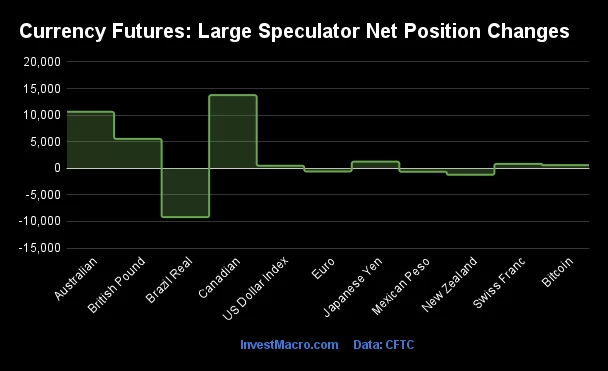
Currency Speculators raised Brazilian Real & Australian Dollar bets last week

COT Release delayed to Monday due to CFTC Holiday Schedule

By InvestMacro

Here are the latest charts and statistics for the Commitment of Traders (COT) data published by the Commodities Futures Trading Commission (CFTC) on Monday (delayed due to holiday release).

The latest COT data is updated through Tuesday November 7th and shows a quick view of how large market participants (for-profit speculators and commercial traders) were positioned in the futures markets. All currency positions are in direct relation to the US dollar where, for example, a bet for the euro is a bet that the euro will rise versus the dollar while a bet against the euro will be a bet that the euro will decline versus the dollar.

Weekly Speculator Changes led by Brazilian Real & Australian Dollar

The COT currency market speculator bets were higher last week as seven out of the eleven currency markets we cover had higher positioning while the other four markets had lower speculator contracts.

Leading the gains for the currency markets was the Brazilian Real (17,205 contracts) with the Australian Dollar (9,547 contracts), the Mexican Peso (5,443 contracts), the British Pound (4,119 contracts), the EuroFX (3,667 contracts), the US Dollar Index (486 contracts) and with Bitcoin (69 contracts) also showing positive weeks.

The currencies seeing declines in speculator bets on the week were the Canadian Dollar (-18,389 contracts), the Swiss Franc (-2,652 contracts), the New Zealand Dollar (-2,123 contracts) and the Japanese Yen (-192 contracts) also registering lower bets on the week.


Data Snapshot of Forex Market Traders | Columns Legend
Nov-07-2023OIOI-IndexSpec-NetSpec-IndexCom-NetCOM-IndexSmalls-NetSmalls-Index
USD Index41,2243819,47157-20,1614469014
EUR697,6243389,05658-117,5154528,45924
GBP212,73045-16,2524429,16662-12,91433
JPY259,69881-104,0408111,95790-7,91737
CHF56,75684-17,562927,89290-10,33024
CAD200,36461-67,721072,568100-4,84712
AUD192,49652-65,5632973,26772-7,70434
NZD51,00159-14,9401617,37384-2,43321
MXN216,5344336,74062-41,220374,48040
RUB20,93047,54331-7,15069-39324
BRL61,5945526,55169-28,276311,72551
Bitcoin21,749100-1,67741794088333


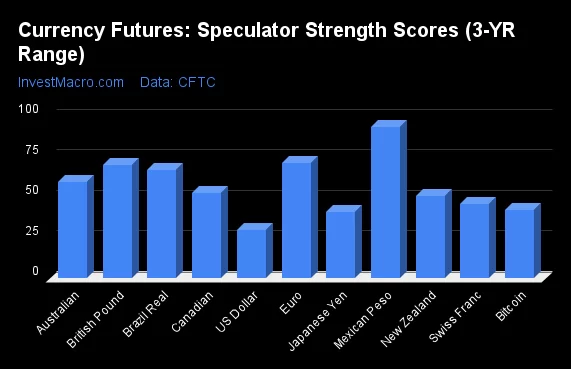
Strength Scores led by Brazilian Real & Mexican Peso

COT Strength Scores (a normalized measure of Speculator positions over a 3-Year range, from 0 to 100 where above 80 is Extreme-Bullish and below 20 is Extreme-Bearish) showed that the Brazilian Real (69 percent) and the Mexican Peso (62 percent) led the currency markets. The EuroFX (58 percent), US Dollar Index (57 percent) and the British Pound (44 percent) come in as the next highest in the weekly strength scores.

On the downside, the Canadian Dollar (0 percent), the Japanese Yen (8 percent), the Swiss Franc (9 percent) and the New Zealand Dollar (16 percent) came in at the lowest strength levels and are in Extreme-Bearish territory (below 20 percent).

Strength Statistics:
US Dollar Index (57.4 percent) vs US Dollar Index previous week (56.6 percent)
EuroFX (58.2 percent) vs EuroFX previous week (56.7 percent)
British Pound Sterling (44.5 percent) vs British Pound Sterling previous week (41.6 percent)
Japanese Yen (8.2 percent) vs Japanese Yen previous week (8.4 percent)
Swiss Franc (8.7 percent) vs Swiss Franc previous week (16.1 percent)
Canadian Dollar (0.0 percent) vs Canadian Dollar previous week (15.8 percent)
Australian Dollar (28.7 percent) vs Australian Dollar previous week (20.0 percent)
New Zealand Dollar (16.5 percent) vs New Zealand Dollar previous week (22.0 percent)
Mexican Peso (61.6 percent) vs Mexican Peso previous week (58.2 percent)
Brazilian Real (68.9 percent) vs Brazilian Real previous week (46.6 percent)
Bitcoin (41.2 percent) vs Bitcoin previous week (40.1 percent)


Australian Dollar & Brazilian Real top the 6-Week Strength Trends

COT Strength Score Trends (or move index, calculates the 6-week changes in strength scores) showed that the Australian Dollar (19 percent) and the Brazilian Real (14 percent) lead the past six weeks trends for the currencies. The US Dollar Index (5 percent) and the Japanese Yen (3 percent) were the next highest positive movers in the latest trends data.

Bitcoin (-52 percent) leads the downside trend scores currently with the Canadian Dollar (-30 percent), Swiss Franc (-24 percent) and the British Pound (-22 percent) following next with lower trend scores.

Strength Trend Statistics:
US Dollar Index (4.5 percent) vs US Dollar Index previous week (5.6 percent)
EuroFX (-4.0 percent) vs EuroFX previous week (-7.1 percent)
British Pound Sterling (-22.2 percent) vs British Pound Sterling previous week (-37.5 percent)
Japanese Yen (3.2 percent) vs Japanese Yen previous week (-1.3 percent)
Swiss Franc (-23.7 percent) vs Swiss Franc previous week (-19.6 percent)
Canadian Dollar (-30.1 percent) vs Canadian Dollar previous week (-1.1 percent)
Australian Dollar (19.5 percent) vs Australian Dollar previous week (20.0 percent)
New Zealand Dollar (0.6 percent) vs New Zealand Dollar previous week (22.0 percent)
Mexican Peso (-14.6 percent) vs Mexican Peso previous week (-19.7 percent)
Brazilian Real (14.3 percent) vs Brazilian Real previous week (-4.5 percent)
Bitcoin (-52.2 percent) vs Bitcoin previous week (-50.3 percent)


Individual COT Forex Markets:

US Dollar Index Futures:

US Dollar Index Forex Futures COT ChartThe US Dollar Index large speculator standing this week reached a net position of 19,471 contracts in the data reported through Tuesday. This was a weekly increase of 486 contracts from the previous week which had a total of 18,985 net contracts.

This week’s current strength score (the trader positioning range over the past three years, measured from 0 to 100) shows the speculators are currently Bullish with a score of 57.4 percent. The commercials are Bearish with a score of 43.8 percent and the small traders (not shown in chart) are Bearish-Extreme with a score of 13.8 percent.

Price Trend-Following Model: Uptrend

Our weekly trend-following model classifies the current market price position as: Uptrend. The current action for the model is considered to be: Hold – Maintain Long Position.

US DOLLAR INDEX StatisticsSPECULATORSCOMMERCIALSSMALL TRADERS
– Percent of Open Interest Longs:67.619.49.5
– Percent of Open Interest Shorts:20.468.37.8
– Net Position:19,471-20,161690
– Gross Longs:27,8668,0003,903
– Gross Shorts:8,39528,1613,213
– Long to Short Ratio:3.3 to 10.3 to 11.2 to 1
NET POSITION TREND:
– Strength Index Score (3 Year Range Pct):57.443.813.8
– Strength Index Reading (3 Year Range):BullishBearishBearish-Extreme
NET POSITION MOVEMENT INDEX:
– 6-Week Change in Strength Index:4.5-2.4-14.8


Euro Currency Futures:

Euro Currency Futures COT ChartThe Euro Currency large speculator standing this week reached a net position of 89,056 contracts in the data reported through Tuesday. This was a weekly boost of 3,667 contracts from the previous week which had a total of 85,389 net contracts.

This week’s current strength score (the trader positioning range over the past three years, measured from 0 to 100) shows the speculators are currently Bullish with a score of 58.2 percent. The commercials are Bearish with a score of 45.2 percent and the small traders (not shown in chart) are Bearish with a score of 24.4 percent.

Price Trend-Following Model: Downtrend

Our weekly trend-following model classifies the current market price position as: Downtrend. The current action for the model is considered to be: Hold – Maintain Short Position.

EURO Currency StatisticsSPECULATORSCOMMERCIALSSMALL TRADERS
– Percent of Open Interest Longs:30.556.011.8
– Percent of Open Interest Shorts:17.772.87.7
– Net Position:89,056-117,51528,459
– Gross Longs:212,483390,33682,294
– Gross Shorts:123,427507,85153,835
– Long to Short Ratio:1.7 to 10.8 to 11.5 to 1
NET POSITION TREND:
– Strength Index Score (3 Year Range Pct):58.245.224.4
– Strength Index Reading (3 Year Range):BullishBearishBearish
NET POSITION MOVEMENT INDEX:
– 6-Week Change in Strength Index:-4.02.63.9


British Pound Sterling Futures:

British Pound Sterling Futures COT ChartThe British Pound Sterling large speculator standing this week reached a net position of -16,252 contracts in the data reported through Tuesday. This was a weekly gain of 4,119 contracts from the previous week which had a total of -20,371 net contracts.

This week’s current strength score (the trader positioning range over the past three years, measured from 0 to 100) shows the speculators are currently Bearish with a score of 44.5 percent. The commercials are Bullish with a score of 62.0 percent and the small traders (not shown in chart) are Bearish with a score of 32.7 percent.

Price Trend-Following Model: Downtrend

Our weekly trend-following model classifies the current market price position as: Downtrend. The current action for the model is considered to be: Hold – Maintain Short Position.

BRITISH POUND StatisticsSPECULATORSCOMMERCIALSSMALL TRADERS
– Percent of Open Interest Longs:27.059.110.4
– Percent of Open Interest Shorts:34.745.416.4
– Net Position:-16,25229,166-12,914
– Gross Longs:57,532125,78122,020
– Gross Shorts:73,78496,61534,934
– Long to Short Ratio:0.8 to 11.3 to 10.6 to 1
NET POSITION TREND:
– Strength Index Score (3 Year Range Pct):44.562.032.7
– Strength Index Reading (3 Year Range):BearishBullishBearish
NET POSITION MOVEMENT INDEX:
– 6-Week Change in Strength Index:-22.221.2-11.6


Japanese Yen Futures:

Japanese Yen Forex Futures COT ChartThe Japanese Yen large speculator standing this week reached a net position of -104,040 contracts in the data reported through Tuesday. This was a weekly lowering of -192 contracts from the previous week which had a total of -103,848 net contracts.

This week’s current strength score (the trader positioning range over the past three years, measured from 0 to 100) shows the speculators are currently Bearish-Extreme with a score of 8.2 percent. The commercials are Bullish-Extreme with a score of 90.3 percent and the small traders (not shown in chart) are Bearish with a score of 37.4 percent.

Price Trend-Following Model: Downtrend

Our weekly trend-following model classifies the current market price position as: Downtrend. The current action for the model is considered to be: Hold – Maintain Short Position.

JAPANESE YEN StatisticsSPECULATORSCOMMERCIALSSMALL TRADERS
– Percent of Open Interest Longs:10.573.114.8
– Percent of Open Interest Shorts:50.630.017.9
– Net Position:-104,040111,957-7,917
– Gross Longs:27,238189,95138,560
– Gross Shorts:131,27877,99446,477
– Long to Short Ratio:0.2 to 12.4 to 10.8 to 1
NET POSITION TREND:
– Strength Index Score (3 Year Range Pct):8.290.337.4
– Strength Index Reading (3 Year Range):Bearish-ExtremeBullish-ExtremeBearish
NET POSITION MOVEMENT INDEX:
– 6-Week Change in Strength Index:3.2-4.05.7


Swiss Franc Futures:

Swiss Franc Forex Futures COT ChartThe Swiss Franc large speculator standing this week reached a net position of -17,562 contracts in the data reported through Tuesday. This was a weekly lowering of -2,652 contracts from the previous week which had a total of -14,910 net contracts.

This week’s current strength score (the trader positioning range over the past three years, measured from 0 to 100) shows the speculators are currently Bearish-Extreme with a score of 8.7 percent. The commercials are Bullish-Extreme with a score of 90.1 percent and the small traders (not shown in chart) are Bearish with a score of 24.0 percent.

Price Trend-Following Model: Downtrend

Our weekly trend-following model classifies the current market price position as: Downtrend. The current action for the model is considered to be: Hold – Maintain Short Position.

SWISS FRANC StatisticsSPECULATORSCOMMERCIALSSMALL TRADERS
– Percent of Open Interest Longs:14.269.116.5
– Percent of Open Interest Shorts:45.120.034.7
– Net Position:-17,56227,892-10,330
– Gross Longs:8,05439,2289,391
– Gross Shorts:25,61611,33619,721
– Long to Short Ratio:0.3 to 13.5 to 10.5 to 1
NET POSITION TREND:
– Strength Index Score (3 Year Range Pct):8.790.124.0
– Strength Index Reading (3 Year Range):Bearish-ExtremeBullish-ExtremeBearish
NET POSITION MOVEMENT INDEX:
– 6-Week Change in Strength Index:-23.712.75.3


Canadian Dollar Futures:

Canadian Dollar Forex Futures COT ChartThe Canadian Dollar large speculator standing this week reached a net position of -67,721 contracts in the data reported through Tuesday. This was a weekly fall of -18,389 contracts from the previous week which had a total of -49,332 net contracts.

This week’s current strength score (the trader positioning range over the past three years, measured from 0 to 100) shows the speculators are currently Bearish-Extreme with a score of 0.0 percent. The commercials are Bullish-Extreme with a score of 100.0 percent and the small traders (not shown in chart) are Bearish-Extreme with a score of 12.0 percent.

Price Trend-Following Model: Downtrend

Our weekly trend-following model classifies the current market price position as: Downtrend. The current action for the model is considered to be: Hold – Maintain Short Position.

CANADIAN DOLLAR StatisticsSPECULATORSCOMMERCIALSSMALL TRADERS
– Percent of Open Interest Longs:8.672.515.8
– Percent of Open Interest Shorts:42.436.318.2
– Net Position:-67,72172,568-4,847
– Gross Longs:17,171145,27231,585
– Gross Shorts:84,89272,70436,432
– Long to Short Ratio:0.2 to 12.0 to 10.9 to 1
NET POSITION TREND:
– Strength Index Score (3 Year Range Pct):0.0100.012.0
– Strength Index Reading (3 Year Range):Bearish-ExtremeBullish-ExtremeBearish-Extreme
NET POSITION MOVEMENT INDEX:
– 6-Week Change in Strength Index:-30.127.6-17.2


Australian Dollar Futures:

Australian Dollar Forex Futures COT ChartThe Australian Dollar large speculator standing this week reached a net position of -65,563 contracts in the data reported through Tuesday. This was a weekly boost of 9,547 contracts from the previous week which had a total of -75,110 net contracts.

This week’s current strength score (the trader positioning range over the past three years, measured from 0 to 100) shows the speculators are currently Bearish with a score of 28.7 percent. The commercials are Bullish with a score of 72.3 percent and the small traders (not shown in chart) are Bearish with a score of 33.6 percent.

Price Trend-Following Model: Downtrend

Our weekly trend-following model classifies the current market price position as: Downtrend. The current action for the model is considered to be: Hold – Maintain Short Position.

AUSTRALIAN DOLLAR StatisticsSPECULATORSCOMMERCIALSSMALL TRADERS
– Percent of Open Interest Longs:17.765.911.3
– Percent of Open Interest Shorts:51.727.815.3
– Net Position:-65,56373,267-7,704
– Gross Longs:34,049126,86921,769
– Gross Shorts:99,61253,60229,473
– Long to Short Ratio:0.3 to 12.4 to 10.7 to 1
NET POSITION TREND:
– Strength Index Score (3 Year Range Pct):28.772.333.6
– Strength Index Reading (3 Year Range):BearishBullishBearish
NET POSITION MOVEMENT INDEX:
– 6-Week Change in Strength Index:19.5-21.918.9


New Zealand Dollar Futures:

New Zealand Dollar Forex Futures COT ChartThe New Zealand Dollar large speculator standing this week reached a net position of -14,940 contracts in the data reported through Tuesday. This was a weekly decline of -2,123 contracts from the previous week which had a total of -12,817 net contracts.

This week’s current strength score (the trader positioning range over the past three years, measured from 0 to 100) shows the speculators are currently Bearish-Extreme with a score of 16.5 percent. The commercials are Bullish-Extreme with a score of 84.3 percent and the small traders (not shown in chart) are Bearish with a score of 21.0 percent.

Price Trend-Following Model: Downtrend

Our weekly trend-following model classifies the current market price position as: Downtrend. The current action for the model is considered to be: Hold – Maintain Short Position.

NEW ZEALAND DOLLAR StatisticsSPECULATORSCOMMERCIALSSMALL TRADERS
– Percent of Open Interest Longs:18.473.46.0
– Percent of Open Interest Shorts:47.739.310.7
– Net Position:-14,94017,373-2,433
– Gross Longs:9,39937,4323,047
– Gross Shorts:24,33920,0595,480
– Long to Short Ratio:0.4 to 11.9 to 10.6 to 1
NET POSITION TREND:
– Strength Index Score (3 Year Range Pct):16.584.321.0
– Strength Index Reading (3 Year Range):Bearish-ExtremeBullish-ExtremeBearish
NET POSITION MOVEMENT INDEX:
– 6-Week Change in Strength Index:0.6-2.49.6


Mexican Peso Futures:

Mexican Peso Futures COT ChartThe Mexican Peso large speculator standing this week reached a net position of 36,740 contracts in the data reported through Tuesday. This was a weekly advance of 5,443 contracts from the previous week which had a total of 31,297 net contracts.

This week’s current strength score (the trader positioning range over the past three years, measured from 0 to 100) shows the speculators are currently Bullish with a score of 61.6 percent. The commercials are Bearish with a score of 36.7 percent and the small traders (not shown in chart) are Bearish with a score of 39.8 percent.

Price Trend-Following Model: Weak Downtrend

Our weekly trend-following model classifies the current market price position as: Weak Downtrend. The current action for the model is considered to be: Hold – Maintain Short Position.

MEXICAN PESO StatisticsSPECULATORSCOMMERCIALSSMALL TRADERS
– Percent of Open Interest Longs:33.163.53.2
– Percent of Open Interest Shorts:16.182.51.1
– Net Position:36,740-41,2204,480
– Gross Longs:71,644137,4366,939
– Gross Shorts:34,904178,6562,459
– Long to Short Ratio:2.1 to 10.8 to 12.8 to 1
NET POSITION TREND:
– Strength Index Score (3 Year Range Pct):61.636.739.8
– Strength Index Reading (3 Year Range):BullishBearishBearish
NET POSITION MOVEMENT INDEX:
– 6-Week Change in Strength Index:-14.613.93.1


Brazilian Real Futures:

Brazil Real Futures COT ChartThe Brazilian Real large speculator standing this week reached a net position of 26,551 contracts in the data reported through Tuesday. This was a weekly gain of 17,205 contracts from the previous week which had a total of 9,346 net contracts.

This week’s current strength score (the trader positioning range over the past three years, measured from 0 to 100) shows the speculators are currently Bullish with a score of 68.9 percent. The commercials are Bearish with a score of 30.6 percent and the small traders (not shown in chart) are Bullish with a score of 50.5 percent.

Price Trend-Following Model: Weak Downtrend

Our weekly trend-following model classifies the current market price position as: Weak Downtrend. The current action for the model is considered to be: Hold – Maintain Short Position.

BRAZIL REAL StatisticsSPECULATORSCOMMERCIALSSMALL TRADERS
– Percent of Open Interest Longs:71.822.55.4
– Percent of Open Interest Shorts:28.768.42.6
– Net Position:26,551-28,2761,725
– Gross Longs:44,24413,8353,350
– Gross Shorts:17,69342,1111,625
– Long to Short Ratio:2.5 to 10.3 to 12.1 to 1
NET POSITION TREND:
– Strength Index Score (3 Year Range Pct):68.930.650.5
– Strength Index Reading (3 Year Range):BullishBearishBullish
NET POSITION MOVEMENT INDEX:
– 6-Week Change in Strength Index:14.3-12.8-8.0


Bitcoin Futures:

Bitcoin Crypto Futures COT ChartThe Bitcoin large speculator standing this week reached a net position of -1,677 contracts in the data reported through Tuesday. This was a weekly increase of 69 contracts from the previous week which had a total of -1,746 net contracts.

This week’s current strength score (the trader positioning range over the past three years, measured from 0 to 100) shows the speculators are currently Bearish with a score of 41.2 percent. The commercials are Bullish-Extreme with a score of 90.8 percent and the small traders (not shown in chart) are Bearish with a score of 33.0 percent.

Price Trend-Following Model: Strong Uptrend

Our weekly trend-following model classifies the current market price position as: Strong Uptrend. The current action for the model is considered to be: Hold – Maintain Long Position.

BITCOIN StatisticsSPECULATORSCOMMERCIALSSMALL TRADERS
– Percent of Open Interest Longs:79.36.67.3
– Percent of Open Interest Shorts:87.02.93.2
– Net Position:-1,677794883
– Gross Longs:17,2531,4311,580
– Gross Shorts:18,930637697
– Long to Short Ratio:0.9 to 12.2 to 12.3 to 1
NET POSITION TREND:
– Strength Index Score (3 Year Range Pct):41.290.833.0
– Strength Index Reading (3 Year Range):BearishBullish-ExtremeBearish
NET POSITION MOVEMENT INDEX:
– 6-Week Change in Strength Index:-52.276.914.6


Article By InvestMacroReceive our weekly COT Newsletter

*COT Report: The COT data, released weekly to the public each Friday, is updated through the most recent Tuesday (data is 3 days old) and shows a quick view of how large speculators or non-commercials (for-profit traders) were positioned in the futures markets.

The CFTC categorizes trader positions according to commercial hedgers (traders who use futures contracts for hedging as part of the business), non-commercials (large traders who speculate to realize trading profits) and nonreportable traders (usually small traders/speculators) as well as their open interest (contracts open in the market at time of reporting). See CFTC criteria here.
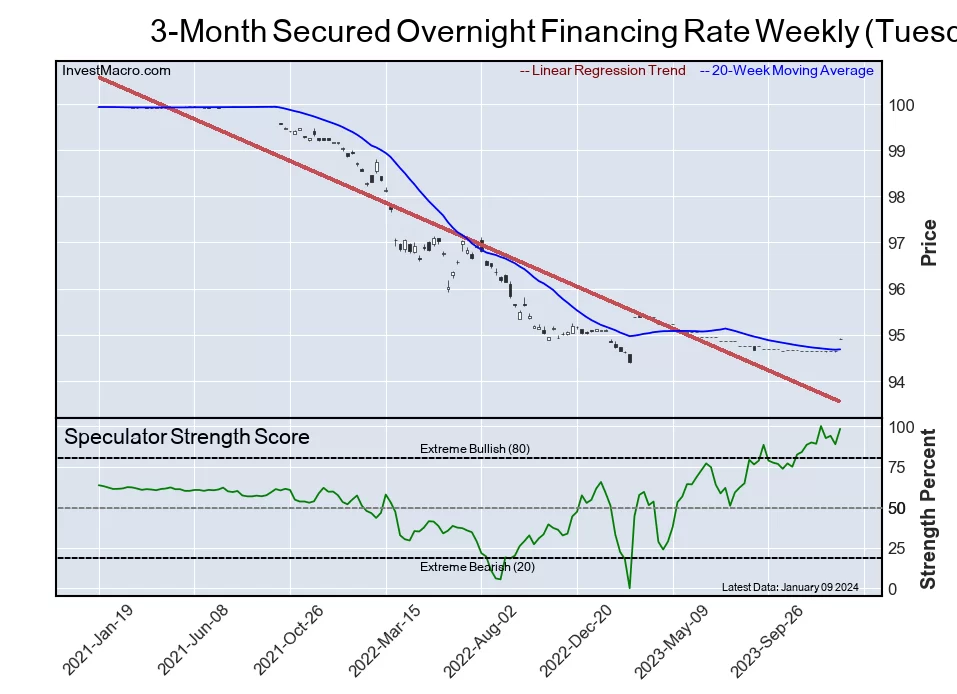
Speculator Extremes: Steel, 3M SOFR, DowJones & CAD lead Bullish & Bearish Positions

By InvestMacro

The latest update for the weekly Commitment of Traders (COT) report was released by the Commodity Futures Trading Commission (CFTC) on Monday (due to holiday delay) for data ending on November 7th.

This weekly Extreme Positions report highlights the Most Bullish and Most Bearish Positions for the speculator category. Extreme positioning in these markets can foreshadow strong moves in the underlying market.

To signify an extreme position, we use the Strength Index (also known as the COT Index) of each instrument, a common method of measuring COT data. The Strength Index is simply a comparison of current trader positions against the range of positions over the previous 3 years. We use over 80 percent as extremely bullish and under 20 percent as extremely bearish. (Compare Strength Index scores across all markets in the data table or cot leaders table)


Here Are This Week’s Most Bullish Speculator Positions:

Steel


The Steel speculator position comes in as the most bullish extreme standing this week. The Steel speculator level is currently at a 94.4 percent score of its 3-year range.

The six-week trend for the percent strength score totaled 19.4 this week. The overall net speculator position was a total of -1,303 net contracts this week with a gain of 1,297 contract in the weekly speculator bets.


Speculators or Non-Commercials Notes:

Speculators, classified as non-commercial traders by the CFTC, are made up of large commodity funds, hedge funds and other significant for-profit participants. The Specs are generally regarded as trend-followers in their behavior towards price action – net speculator bets and prices tend to go in the same directions. These traders often look to buy when prices are rising and sell when prices are falling. To illustrate this point, many times speculator contracts can be found at their most extremes (bullish or bearish) when prices are also close to their highest or lowest levels.

These extreme levels can be dangerous for the large speculators as the trade is most crowded, there is less trading ammunition still sitting on the sidelines to push the trend further and prices have moved a significant distance. When the trend becomes exhausted, some speculators take profits while others look to also exit positions when prices fail to continue in the same direction. This process usually plays out over many months to years and can ultimately create a reverse effect where prices start to fall and speculators start a process of selling when prices are falling.


3-Month Secured Overnight Financing Rate


The 3-Month Secured Overnight Financing Rate speculator position comes next in the extreme standings this week. The 3-Month Secured Overnight Financing Rate speculator level is now at a 93.2 percent score of its 3-year range.

The six-week trend for the percent strength score was 4.2 this week. The speculator position registered 386,629 net contracts this week with a weekly boost of 141,657 contracts in speculator bets.


VIX


The VIX speculator position comes in third this week in the extreme standings. The VIX speculator level resides at a 87.2 percent score of its 3-year range.

The six-week trend for the speculator strength score came in at 13.3 this week. The overall speculator position was -33,049 net contracts this week with a decline of -19,070 contracts in the weekly speculator bets.


Cocoa Futures


The Cocoa Futures speculator position comes up number four in the extreme standings this week. The Cocoa Futures speculator level is at a 86.5 percent score of its 3-year range.

The six-week trend for the speculator strength score totaled a change of -3.6 this week. The overall speculator position was 75,027 net contracts this week with a rise of 5,550 contracts in the speculator bets.


Bloomberg Commodity Index


The Bloomberg Commodity Index speculator position rounds out the top five in this week’s bullish extreme standings. The Bloomberg Commodity Index speculator level sits at a 82.4 percent score of its 3-year range. The six-week trend for the speculator strength score was -3.8 this week.

The speculator position was -6,162 net contracts this week with a dip of -697 contracts in the weekly speculator bets.


This Week’s Most Bearish Speculator Positions:

DowJones Mini


The DowJones Mini speculator position comes in as the most bearish extreme standing this week. The DowJones Mini speculator level is at a 0.0 percent score of its 3-year range.

The six-week trend for the speculator strength score was -33.4 this week. The overall speculator position was -37,076 net contracts this week with a decline of -965 contracts in the speculator bets.


Canadian Dollar


The Canadian Dollar speculator position comes in next for the most bearish extreme standing on the week. The Canadian Dollar speculator level is at a 0.0 percent score of its 3-year range.

The six-week trend for the speculator strength score was -30.1 this week. The speculator position was -67,721 net contracts this week with a drop of -18,389 contracts in the weekly speculator bets.


MSCI EAFE MINI


The MSCI EAFE MINI speculator position comes in as third most bearish extreme standing of the week. The MSCI EAFE MINI speculator level resides at a 0.0 percent score of its 3-year range.

The six-week trend for the speculator strength score was -31.7 this week. The overall speculator position was -58,202 net contracts this week with a change of -12,717 contracts in the speculator bets.


5-Year Bond


The 5-Year Bond speculator position comes in as this week’s fourth most bearish extreme standing. The 5-Year Bond speculator level is at a 0.0 percent score of its 3-year range.

The six-week trend for the speculator strength score was -26.2 this week. The speculator position was -1,423,384 net contracts this week with a decline of -231,795 contracts in the weekly speculator bets.


2-Year Bond


Finally, the 2-Year Bond speculator position comes in as the fifth most bearish extreme standing for this week. The 2-Year Bond speculator level is at a 0.0 percent score of its 3-year range.

The six-week trend for the speculator strength score was -15.8 this week. The speculator position was -1,453,706 net contracts this week with a shortfall of -18,258 contracts in the weekly speculator bets.


Article By InvestMacroReceive our weekly COT Newsletter

*COT Report: The COT data, released weekly to the public each Friday, is updated through the most recent Tuesday (data is 3 days old) and shows a quick view of how large speculators or non-commercials (for-profit traders) were positioned in the futures markets.

The CFTC categorizes trader positions according to commercial hedgers (traders who use futures contracts for hedging as part of the business), non-commercials (large traders who speculate to realize trading profits) and nonreportable traders (usually small traders/speculators) as well as their open interest (contracts open in the market at time of reporting). See CFTC criteria here.