Archive for Opinions – Page 67

Trade of the Week: GBPUSD capped below 200-day SMA?

By ForexTime 

  • GBPUSD bulls rejected by 200-day SMA
  • Big week for currency pair due to key UK data
  • Watch out for potential dollar volatility amid high-risk events
  • Prices back within wide range on daily charts
  • Bears could mean business below 1.2320 level

GBPUSD bears could mean business after dragging prices back below a key resistance level.

Despite punching above the 1.2320 level earlier this month, bulls were halted below the 200-day SMA which saw prices slip back within a wide range on the daily charts.

The GBPUSD has been stuck within this range since late September with key support at 1.2080.

Given the barrage of economic reports from the United Kingdom and various events that could rock the dollar – a significant move could be on the horizon for the GBPUSD.

Here are 3 factors to watch out for this week:

  1. Key UK data 

The string of key UK economic data this week could offer fresh insight into the health of the economy and influence expectations around the BoE’s next policy move.

On Tuesday, all eyes will be on the latest employment report and speech by Bank of England chief economist Huw Pill speech. The jobs data is likely to offer more clarity on the health of the labour force with wage growth in sharp focus. Wednesday sees the highly anticipated inflation data for October which is expected to see a sharp drop amid lower energy prices. This is topped off with retail sales on Friday and a speech by Bank of England Deputy Governor Dave Ramsden.

As of writing, traders are currently pricing in a 1 in 10 chance of a 25-basis point BoE hike in December.

  • Sterling is likely to weaken towards the 1.2080 support as more signs of a slowing jobs market and cooler-than-expected inflation data reinforces expectations around the BoE being finished with hikes.
  • The pound could receive a boost towards the 1.2320 level if higher than expected UK economic data including inflation revives bets around another BoE hike beyond 2023.
  1. Dollar volatility 

As highlighted in our week ahead report, the dollar could experience heightened volatility this week.

It is set to be influenced by not only the incoming US inflation data on Tuesday but a string of significant reports throughout the week and speeches by numerous Fed officials. On top of this, the threat of a potential US government shutdown on Friday may add to the expected volatility, placing the dollar on a rollercoaster ride.

  • The dollar could receive a boost if the US inflation data beats forecasts, overall economic data is encouraging, and the US government strikes a deal before the deadline. This development may drag the GBPUSD lower.
  • Should the US CPI report print softer than expected, economic data disappoint and the US government experiences a shutdown, the dollar could be in the firing line. A weaker dollar has the potential to push the GBPUSD higher.
  1. Technical forces 

On the weekly charts, the close back below 1.2320 has placed bears in a position of power with prices trading below the 50, 100, and 200-week SMA.

Zooming back into the daily, we see a breakout/down opportunity with prices touching the 50-day SMA as of writing.

  • A solid daily close above 1.2320 may encourage a move back toward the 200-day SMA at 1.2430 

  • Should prices fail to push back above 1.2320, bears could drag the currency pair toward the next key support at 1.2080 and 1.1930 – a level not seen since February 2023.

According to Bloomberg’s FX forecast model, there’s a 73% chance that GBPUSD trades within the 1.2109 – 1.2396 range this week.


Forex-Time-LogoArticle by ForexTime

ForexTime Ltd (FXTM) is an award winning international online forex broker regulated by CySEC 185/12 www.forextime.com

Biden – Xi meeting: Global markets will be cheered by better ties

By George Prior 

Despite low expectations for “a long list of outcomes,” global markets will welcome US President Joe Biden’s highly anticipated meeting with Chinese President Xi Jinping on Wednesday in the San Francisco Bay Area.

This is the bullish assessment from Nigel Green, CEO of deVere Group, one of the world’s largest independent financial advisory asset management and fintech organizations.

It comes ahead of the first meeting between the two world leaders in a year – and the first time Xi has been in the US since 2017 – as ties between the superpower rivals are at their most tense point in decades.

Of the meeting a senior Wite House official told reporters: “We’re not talking about a long list of outcomes or deliverables…The goals here really are about managing the competition, preventing the downside risk of conflict and ensuring channels of communication are open.”

Nigel Green comments: “This meeting is mostly about symbolism, rather than deliverables. But this high-stake symbolism is important for global markets.

“Improved diplomatic relations, clearing up misperceptions and circumnavigating surprises between the two economic powerhouses will contribute to enhanced market stability.

“The China-US trade tensions that have characterized recent years have often resulted in market fluctuations and increased uncertainty.”

Investors, sensitive to geopolitical risks, tend to react nervously to trade disputes and political tensions between major economies. “A more amicable relationship can only mitigate these risks, creating an environment where markets operate with greater predictability.”

Furthermore, a positive turn in China-US ties is likely to open new avenues for collaboration and economic partnerships.

“Both countries possess immense economic influence, and their cooperation can drive global economic growth. Increased trade opportunities, reduced tariffs, and a more open economic dialogue will stimulate cross-border investments and facilitate the flow of capital between the two nations,” says the deVere CEO.

This collaborative approach should act as a catalyst for global financial markets, promoting economic interconnectedness and diversification.

The potential for eased trade tensions also bodes well for multinational corporations operating in both China and the United States.

Nigel Green notes: “A more harmonious relationship will translate into a friendlier business environment, with reduced regulatory uncertainties and fewer trade barriers. This, in turn, can positively impact corporate earnings, driving investor confidence and stock market performance on a global scale.”

Moreover, an improved relationship can contribute to the stabilisation of global supply chains. The trade tensions of recent years have prompted companies to reconsider their supply chain strategies, often leading to disruptions and increased costs.

A more cooperative stance between China and the United States would alleviate these concerns, providing a conducive environment for businesses to optimize their supply chains and operate more efficiently. This, in turn, can have a “cascading effect on the financial markets” as companies benefit from improved operational efficiency and cost-effectiveness.

The deVere CEO concludes: “As the world eagerly watches the diplomatic developments unfold between Biden and Xi this week, financial markets will be buoyed from signs of a more cooperative and connected global economic landscape.”

About:

deVere Group is one of the world’s largest independent advisors of specialist global financial solutions to international, local mass affluent, and high-net-worth clients.  It has a network of offices across the world, over 80,000 clients and $12bn under advisement.

Week Ahead: US dollar gears up for big move

By ForexTime 

  • Big week ahead for USD thanks to key risk events
  • Watch out for top US data including CPI & Fed speeches
  • Looming US government shutdown also on radar
  • USDInd back within wide range with support at 105.50 and resistance at 107.20
  • Another major breakout on the horizon?

The incoming US inflation data, speeches from Fed officials and threat of a potential US government shutdown could rock the dollar next week.

Monday, November 13th  

  • JPY: Japan PPI
  • GBP: UK Prime Minister Rishi Sunak speech

Tuesday, November 14th  

  • NZD: New Zealand food prices
  • EUR: Germany ZEW survey expectations
  • GBP: UK jobless claims, Bank of England chief economist Huw Pill speech
  • USD: US October CPI, Fed Vice Chair Philip Jefferson, Chicago Fed President Austan Goolsbee speech
  • SPX500_m: Home Depot earnings

Wednesday, November 15th

  • CNH: China retail sales, industrial production
  • JPY: Japan GDP, industrial production
  • EUR: EU’s autumn economic forecast
  • GBP: UK CPI
  • USD: US retail sales, business inventories, PPI, Empire manufacturing

Thursday, November 16th  

  • AUD: Australia unemployment
  • JPY: Japan tertiary index, core machine order, trade
  • USD: US initial jobless claims, industrial production, Fed speak
  • SPX500_m: Walmart earnings
  • APEC leaders summit – US President and Chinese President speech

Friday, November 17th

  • EUR: ECB President Christine Lagarde speech
  • GBP: Bank of England Deputy Governor Dave Ramsden speech
  • USD: Fed speak – Chicago Fed President Austan Goolsbee, Boston Fed President Susan, San Francisco Fed President Mary Daly
  • Deadline for avoiding US government shutdown

Dollar bull returned to the scene this week thanks to hawkish remarks from Fed officials including Jerome Powell.

Looking at the charts, prices are back above the 105.50 level – testing the 50-day SMA as of writing.

A big move may be brewing for the USDIndex and here are 4 reasons why:

  1. US October CPI Report

The October US Consumer Price Index (CPI) report published on Tuesday; November 14 is likely to influence expectations around what the Fed does beyond 2023.

Markets are forecasting: 

  • CPI year-on-year (October 2023 vs. October 2022) to cool 3.3% from 3.7% in the prior month.
  • Core CPI year-on-year to remain unchanged at 4.1%.
  • CPI month-on-month (October 2023 vs September 2023) to cool 0.1% from 0.4% in the prior month.
  • Core CPI month-on-month to remain unchanged at 0.3%.

Headline inflation is expected to have cooled due to falling global energy prices, will the annual core inflation unchanged at 4.1% – its lowest level since September 2021. Ultimately, further evidence of cooling inflationary pressures may reinforce the argument around the Fed being done with hikes despite recent hawkish remarks from central bank officials. 

  • A softer-than-expected US CPI report is likely to send the USDInd lower.
  • Should the inflation report exceed market forecasts, the USDInd could rise towards the 107.2 resistance.
  1. US data + Fed speeches 

A string of key US economic data and speeches by numerous Fed officials could inject the dollar with more volatility.

Investors will direct their attention towards the latest US retail sales report, Producer Prices Index (PPI), and initial jobless claims among other data releases to gauge the health of the US economy. Speeches from various Fed officials are also likely to be closely combed through for more clues and clarity on the Fed’s next move.

  • Should overall US economic data paint an encouraging picture and Fed speakers strike a hawkish tone, this could keep rate hike hopes alive – boosting the USDInd as a result.
  • If US economic data disappoints and Fed officials adopt a dovish stance, the USDInd may weaken as bets increase on a Fed pause.
  1. Possible US Government shutdown 

Once again, the United States is facing another government shutdown deadline set to expire on November 17th. The last time this happened was back in September when a last-minute deal was secured before the October 1st deadline.

Should this become reality, sentiment towards the US economy could take a hit with an extended shutdown fuelling US recession fears – impacting Fed hike expectations as a result.

  • A government shutdown may weigh heavily on the dollar, pulling the USDInd lower.
  • Should the government strike a deal, this could offer some support to the USDInd.
  1. Technical forces

The USDInd is back within a wide range on the daily charts with support at 105.50 and resistance at 107.20. Prices are trading above the 100 and 200-day SMA but the MACD trades below zero.

  • Sustained weakness below the 50-day SMA (106.0 level) may encourage a decline back towards 105.50 and 104.90.
  • A solid breakout above the 50-day SMA could trigger a move towards 106.60 and 107.20.


Forex-Time-LogoArticle by ForexTime

ForexTime Ltd (FXTM) is an award winning international online forex broker regulated by CySEC 185/12 www.forextime.com

Bitcoin shoots past $36k on ETF excitement

By ForexTime 

  • Bitcoin hits highest level in 18 months ​​​​​​
  • Cryptocurrency boosted by ETF excitement
  • Bullish flag seen on H4 chart
  • Weekly resistance level might act as catalyst

Bitcoin jumped to a fresh 18-month high on Thursday as excitement returned over simultaneous approvals of spot Bitcoin ETFs.

Starting from today, the SEC has an eight-day window to potentially approve all pending spot Bitcoin ETF fillings – including the world’s largest bitcoin fund called the Grayscale Bitcoin Trust. This is a welcome development for the cryptocurrency space given the growing ETF hype, injecting Bitcoin bulls with renewed strength.

As highlighted in the past, a spot bitcoin ETF would provide investors easier and greater access to the world’s largest cryptocurrency without having to own it – potentially attracting new investors as a result.

Focusing on the technical picture, bitcoin is currently ruled by bulls and a solid uptrend can be seen on the daily charts.

Prices are fast approaching weekly resistance at 37,448 and this level might act as a catalyst for either bulls or bears. For bulls, it will be a continuation of the current impulse wave and for bears it will be the start of a possible correction wave.

On the H4 chart a huge bullish flag is visible with the price just having broken out and heading for the weekly resistance level. Both the 50 Exponential Moving Average and the Moving Average Convergence Divergence (MACD) confirm the upward momentum.

If prices reach the weekly resistance level at 37,448.98, two scenarios become possible.

  • Allowing the market structure to confirm, a possible bounce and then a retest to the downside will act as a bearish trigger for a daily correction wave to start.

  • On the other hand, a break though the weekly resistance level and then a retest will be a bullish trigger for a continuation of an impulse wave in the daily uptrend.

For both scenarios, good risk management is paramount since wild swings are often seen on this volatile instrument.


Forex-Time-LogoArticle by ForexTime

ForexTime Ltd (FXTM) is an award winning international online forex broker regulated by CySEC 185/12 www.forextime.com

Mid-Week Technical Outlook: Oil closes below 200-day SMA

By ForexTime 

  • Crude dives over 4% in previous session
  • Prices secure daily close below 200-day SMA
  • Monthly and weekly timeframe signal further downside
  • Bears in control on D1 charts but RSI near oversold territory
  • Key levels of interest at $82, $78 and $74

Oil struggled on Wednesday after sliding more than 4% in the previous session to levels not seen since July.

The global commodity was hammered by demand concerns which provided a platform for bears to drag prices below the 200-day Simple Moving Average (SMA) for the first time in over three months.

It is worth noting that technical indicators were already in favour of bears before yesterday’s steep selloff. Oil was already respecting a negative channel on the daily charts, creating lower lows and lower highs. The daily close below the 200-day SMA may open doors to lower price levels in the short to medium term.

Zooming out to the weekly charts, we see a similar bearish picture with crude on the path to securing its third negative trading week. Prices have broken through the $80 weekly support with the next key level of interest on the W1 timeframe around $73 and $68.

Peeking at the monthly charts, the bearish candlestick created in October further supports the bearish case, signaling the possibility of lower prices to come with key monthly support found at $66.50.

Redirecting our attention back to the daily timeframe, bears are certainly in control and may use the current momentum to drag crude toward the next daily support at $74. However, the Relative Strength Index (RSI) is flirting near 30, indicating that crude may be oversold. While this could trigger a technical rebound down the road, the path of least resistance remains south.

  • Sustained weakness below the 200-day SMA may send prices towards $74 and $72.50.

  • Should prices push back above the 200-day SMA, this could spark a move back towards $82


Forex-Time-LogoArticle by ForexTime

ForexTime Ltd (FXTM) is an award winning international online forex broker regulated by CySEC 185/12 www.forextime.com

Currency Speculators push Australian Dollar bets higher as RBA possibly to raise rate

By InvestMacro

Here are the latest charts and statistics for the Commitment of Traders (COT) data published by the Commodities Futures Trading Commission (CFTC).

The latest COT data is updated through Tuesday October 31st and shows a quick view of how large market participants (for-profit speculators and commercial traders) were positioned in the futures markets. All currency positions are in direct relation to the US dollar where, for example, a bet for the euro is a bet that the euro will rise versus the dollar while a bet against the euro will be a bet that the euro will decline versus the dollar.

Weekly Speculator Changes led by Australian Dollar & Brazilian Real

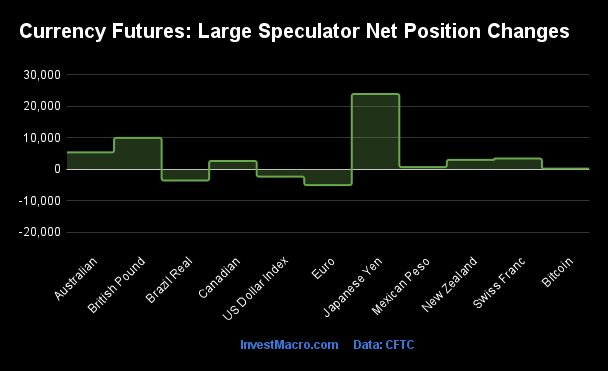
The COT currency market speculator bets were lower this week as five out of the eleven currency markets we cover had higher positioning while the other six markets had lower speculator contracts.

Leading the gains for the currency markets was the Australian Dollar (7,971 contracts) with the Brazilian Real (4,161 contracts), Swiss Franc (185 contracts), the Euro (136 contracts) and the New Zealand Dollar (34 contracts) also showing positive weeks.

The currencies seeing declines in speculator bets on the week were the Mexican Peso (-6,564 contracts), the Japanese Yen (-4,219 contracts), the British Pound (-1,735 contracts), Bitcoin (-1,292 contracts), the Canadian Dollar (-693 contracts) the US Dollar Index (-686 contracts) also registering lower bets on the week.

Speculators push Australian Dollar bets higher as RBA possibly to raise rate

Highlighting the COT currency’s data this week is the boost in the speculator’s positioning for the Australian dollar. Large speculative Aussie currency positions gained this week by almost +8,000 net contracts, the largest weekly gain in six weeks. This improved sentiment has pushed the speculators bets higher for the fourth time out of the past six weeks.

The overall Aussie speculator positioning has been consistently bearish since dropping from a net bullish position to a net bearish position on May 25th of 2021. This week marks the 128th consecutive week of bearish speculator positions with the most bearish level being seen on September 19th at a total of -96,946 contracts.

There is a chance that the worst of the positioning for the AUD has been seen because of a possible divergence in central bank interest rate moves. The Reserve Bank of Australia (RBA) is widely expected to raise their benchmark rate (currently at 4.15 percent) in the next policy meeting on November 7th to combat stubborn inflation that has surpassed expectations of a faster decline.

The US Federal Reserve, meanwhile, held its own rate policy steady at the most recent meeting and the current market expectation (95 percent in CME FedWatch Tool) is for the Fed to hold again at the December 13th meeting.

The Australian dollar (versus the US Dollar) saw a strong rise this week and just got over the 0.6500 psychological level to close out the week. The AUD has been in a long downtrend since reaching a high in 2021 near 0.80 exchange rate and has a long ways to go for a turnaround but so far, the currency has seen strong support at 0.6300 and has been able to avoid dropping to the 2022 lows.


Data Snapshot of Forex Market Traders | Columns Legend
Oct-31-2023OIOI-IndexSpec-NetSpec-IndexCom-NetCOM-IndexSmalls-NetSmalls-Index
USD Index42,8034218,98557-20,096441,11119
EUR694,9623185,38957-109,0314823,64217
GBP229,99155-20,3714234,15465-13,78331
JPY277,27294-103,8488107,56688-3,71846
CHF56,35383-14,9101625,96787-11,05721
CAD198,52860-49,332956,05294-6,7208
AUD196,86655-75,1102086,43282-11,32225
NZD57,67675-12,8172216,23682-3,4199
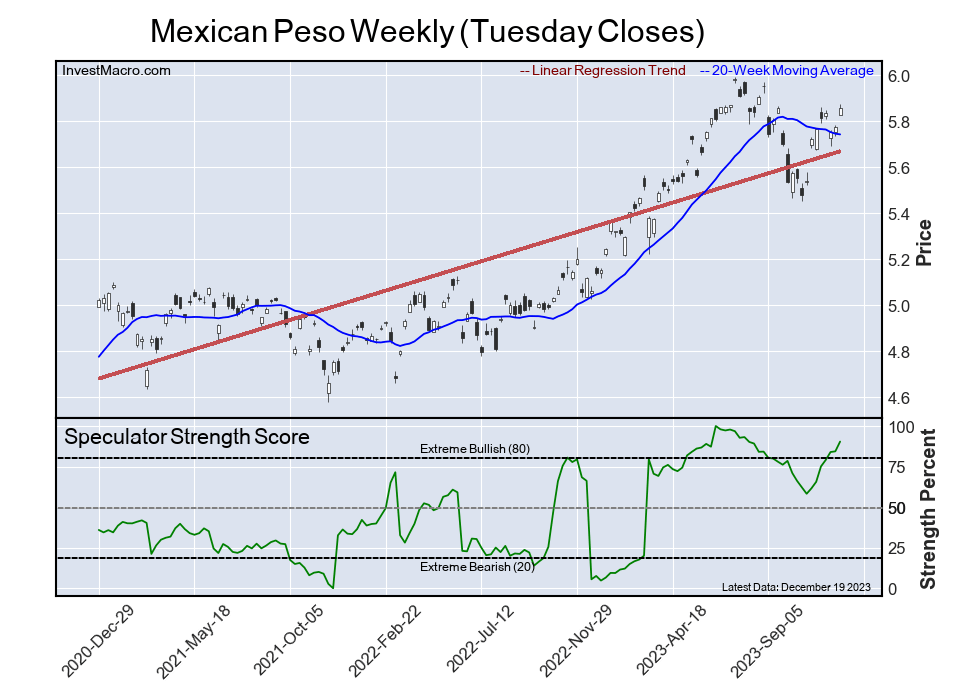
MXN199,0783731,29758-33,883412,58628
RUB20,93047,54331-7,15069-39324
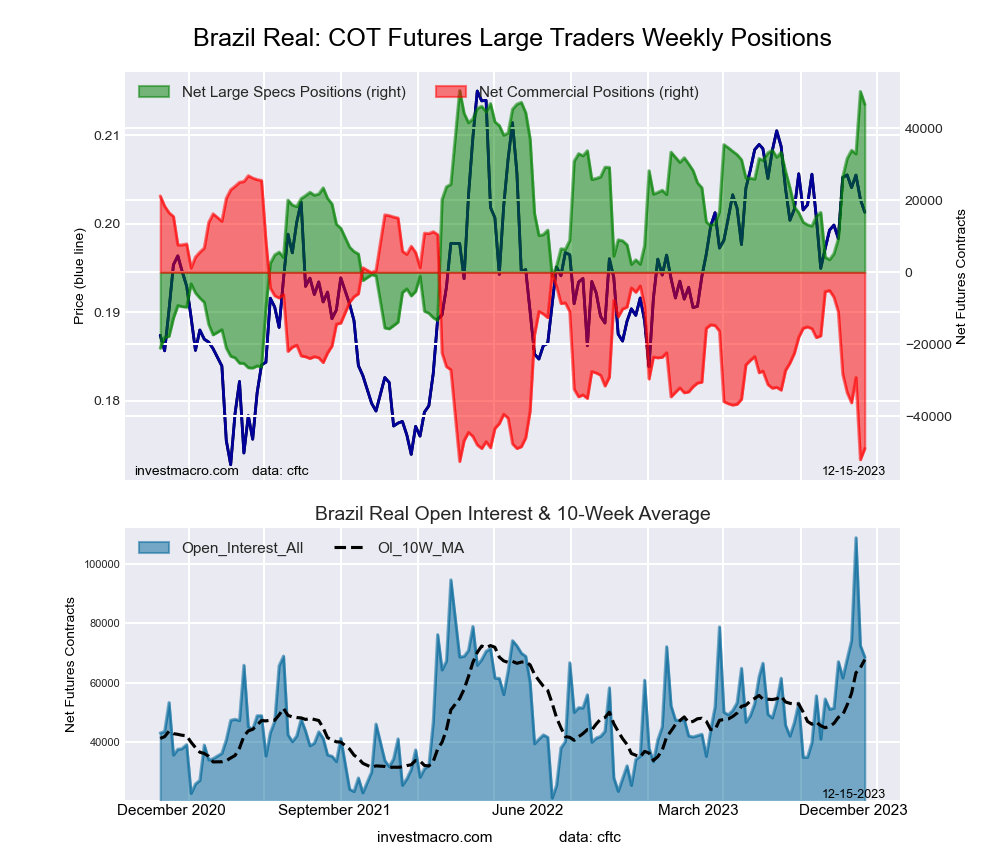
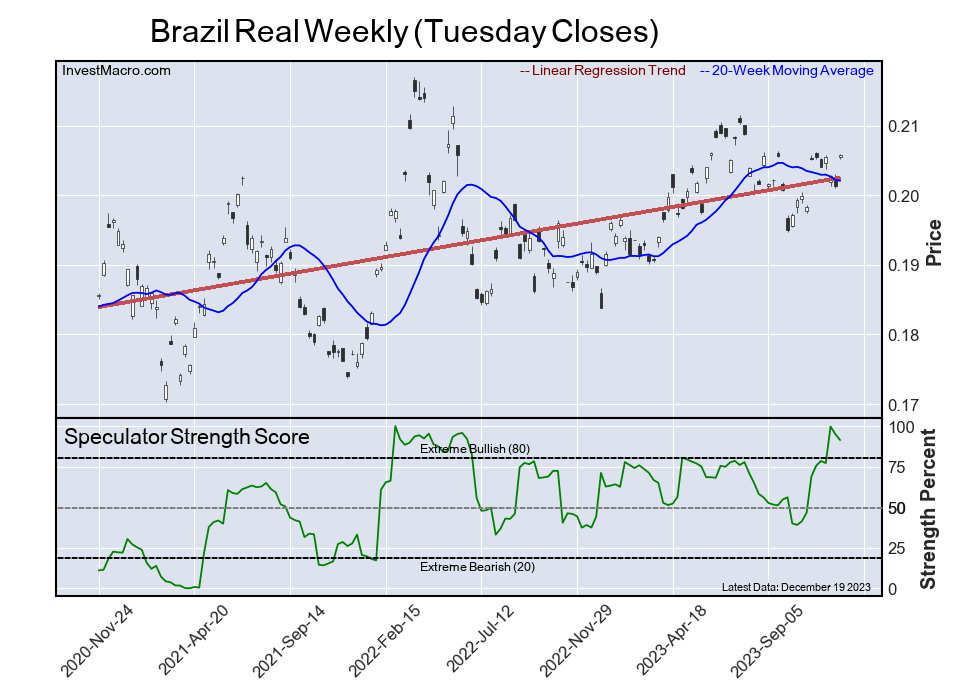
BRL67,068639,34647-11,022521,67650
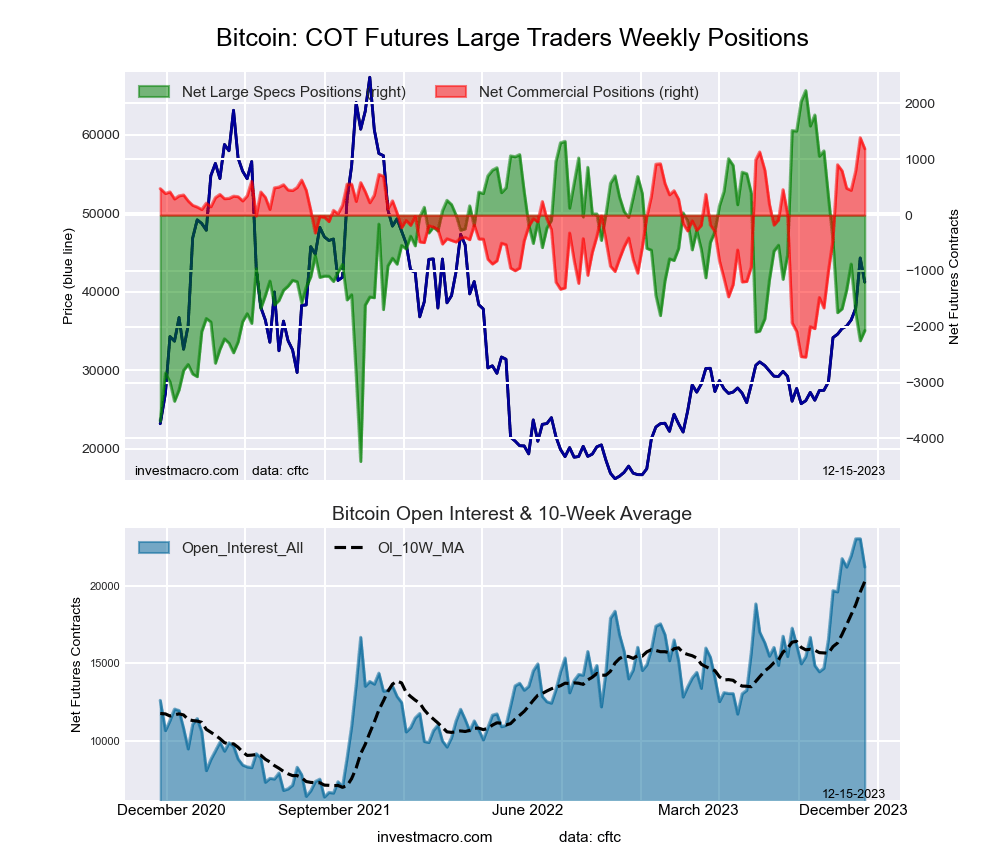
Bitcoin19,60399-1,74640903084332


Strength Scores led by Mexican Peso, Euro & US Dollar Index

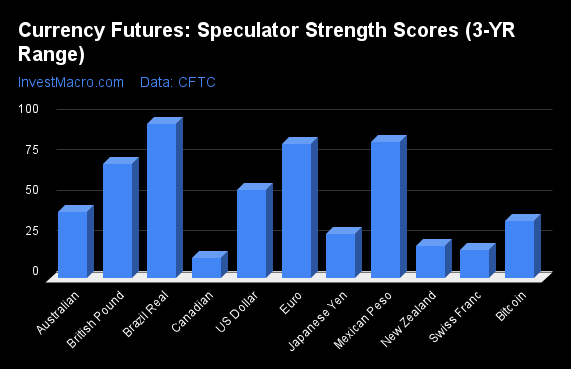
COT Strength Scores (a normalized measure of Speculator positions over a 3-Year range, from 0 to 100 where above 80 is Extreme-Bullish and below 20 is Extreme-Bearish) showed that the Mexican Peso (58 percent), the Euro (57 percent) and the US Dollar Index (57 percent) lead the currency markets this week.

On the downside, the Japanese Yen (8 percent), the Canadian Dollar (9 percent) and the Swiss Franc (16 percent) come in at the lowest strength levels currently and are in Extreme-Bearish territory (below 20 percent).

Strength Statistics:
US Dollar Index (56.6 percent) vs US Dollar Index previous week (57.7 percent)
EuroFX (56.7 percent) vs EuroFX previous week (56.6 percent)
British Pound Sterling (41.6 percent) vs British Pound Sterling previous week (42.8 percent)
Japanese Yen (8.4 percent) vs Japanese Yen previous week (10.9 percent)
Swiss Franc (15.7 percent) vs Swiss Franc previous week (15.2 percent)
Canadian Dollar (8.6 percent) vs Canadian Dollar previous week (9.2 percent)
Australian Dollar (20.0 percent) vs Australian Dollar previous week (12.7 percent)
New Zealand Dollar (22.0 percent) vs New Zealand Dollar previous week (21.9 percent)
Mexican Peso (58.2 percent) vs Mexican Peso previous week (62.2 percent)
Brazilian Real (46.6 percent) vs Brazilian Real previous week (41.2 percent)
Bitcoin (40.1 percent) vs Bitcoin previous week (59.6 percent)


New Zealand Dollar & Australian Dollar top the 6-Week Strength Trends

COT Strength Score Trends (or move index, calculates the 6-week changes in strength scores) showed that the New Zealand Dollar (22 percent) and the Australian Dollar (20 percent) lead the past six weeks trends for the currencies. The US Dollar Index (6 percent) is the next highest positive mover in the latest trends data.

Bitcoin (-50 percent) leads the downside trend scores currently with the British Pound (-38 percent), the Mexican Peso (-20 percent) and the Swiss Franc (-19 percent) following next with lower trend scores.

Strength Trend Statistics:
US Dollar Index (5.6 percent) vs US Dollar Index previous week (22.7 percent)
EuroFX (-7.1 percent) vs EuroFX previous week (-11.9 percent)
British Pound Sterling (-37.5 percent) vs British Pound Sterling previous week (-45.0 percent)
Japanese Yen (-1.3 percent) vs Japanese Yen previous week (-0.5 percent)
Swiss Franc (-19.1 percent) vs Swiss Franc previous week (-15.8 percent)
Canadian Dollar (-1.2 percent) vs Canadian Dollar previous week (-6.3 percent)
Australian Dollar (20.0 percent) vs Australian Dollar previous week (-3.2 percent)
New Zealand Dollar (22.0 percent) vs New Zealand Dollar previous week (4.6 percent)
Mexican Peso (-19.7 percent) vs Mexican Peso previous week (-17.7 percent)
Brazilian Real (-4.5 percent) vs Brazilian Real previous week (-10.4 percent)
Bitcoin (-50.3 percent) vs Bitcoin previous week (-40.4 percent)


Individual COT Forex Markets:

US Dollar Index Futures:
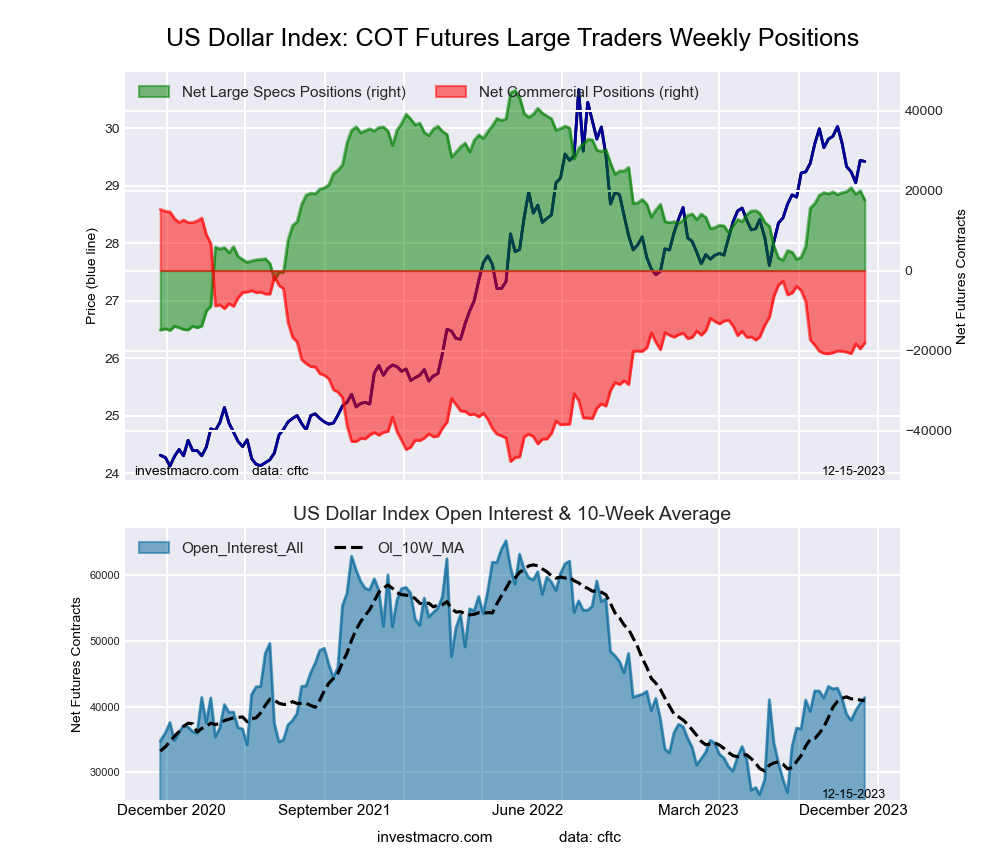
US Dollar Index Forex Futures COT ChartThe US Dollar Index large speculator standing this week totaled a net position of 18,985 contracts in the data reported through Tuesday. This was a weekly fall of -686 contracts from the previous week which had a total of 19,671 net contracts.

This week’s current strength score (the trader positioning range over the past three years, measured from 0 to 100) shows the speculators are currently Bullish with a score of 56.6 percent. The commercials are Bearish with a score of 43.9 percent and the small traders (not shown in chart) are Bearish-Extreme with a score of 19.0 percent.

Price Trend-Following Model: Uptrend

Our weekly trend-following model classifies the current market price position as: Uptrend. The current action for the model is considered to be: Hold – Maintain Long Position.

US DOLLAR INDEX StatisticsSPECULATORSCOMMERCIALSSMALL TRADERS
– Percent of Open Interest Longs:64.422.610.4
– Percent of Open Interest Shorts:20.169.57.8
– Net Position:18,985-20,0961,111
– Gross Longs:27,5719,6714,441
– Gross Shorts:8,58629,7673,330
– Long to Short Ratio:3.2 to 10.3 to 11.3 to 1
NET POSITION TREND:
– Strength Index Score (3 Year Range Pct):56.643.919.0
– Strength Index Reading (3 Year Range):BullishBearishBearish-Extreme
NET POSITION MOVEMENT INDEX:
– 6-Week Change in Strength Index:5.6-4.4-7.5


Euro Currency Futures:

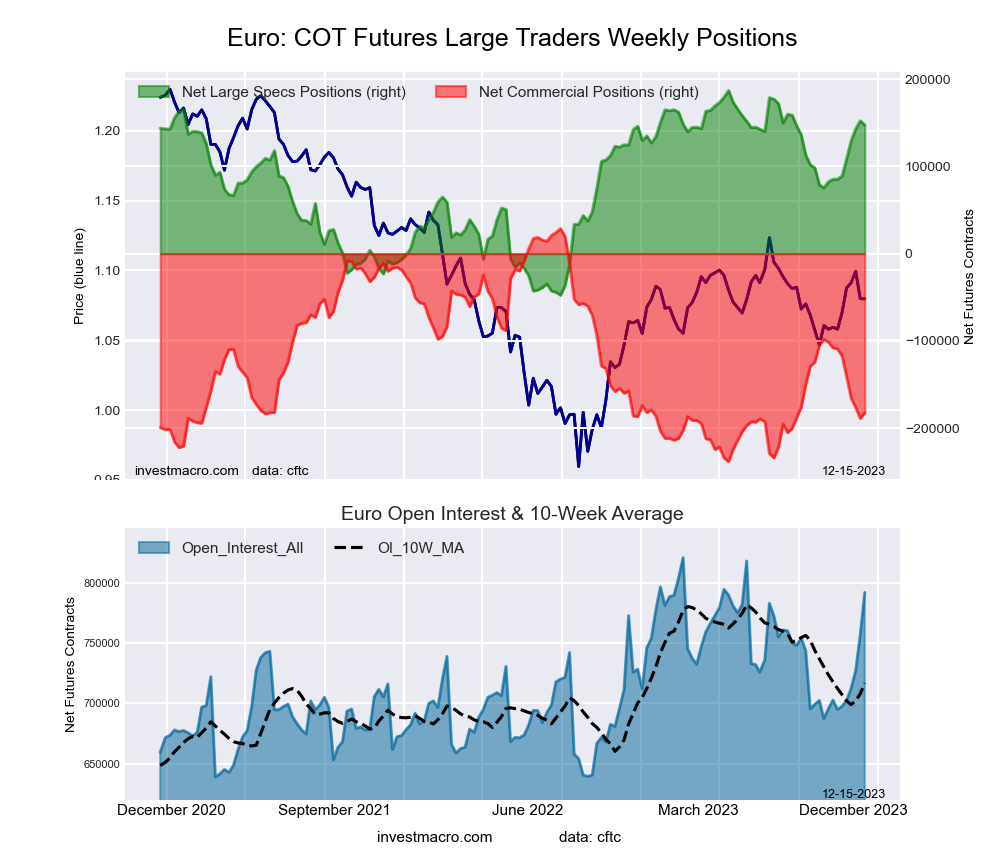
Euro Currency Futures COT ChartThe Euro Currency large speculator standing this week totaled a net position of 85,389 contracts in the data reported through Tuesday. This was a weekly gain of 136 contracts from the previous week which had a total of 85,253 net contracts.

This week’s current strength score (the trader positioning range over the past three years, measured from 0 to 100) shows the speculators are currently Bullish with a score of 56.7 percent. The commercials are Bearish with a score of 48.4 percent and the small traders (not shown in chart) are Bearish-Extreme with a score of 16.7 percent.

Price Trend-Following Model: Downtrend

Our weekly trend-following model classifies the current market price position as: Downtrend. The current action for the model is considered to be: Hold – Maintain Short Position.

EURO Currency StatisticsSPECULATORSCOMMERCIALSSMALL TRADERS
– Percent of Open Interest Longs:30.356.611.4
– Percent of Open Interest Shorts:18.172.38.0
– Net Position:85,389-109,03123,642
– Gross Longs:210,834393,34879,333
– Gross Shorts:125,445502,37955,691
– Long to Short Ratio:1.7 to 10.8 to 11.4 to 1
NET POSITION TREND:
– Strength Index Score (3 Year Range Pct):56.748.416.7
– Strength Index Reading (3 Year Range):BullishBearishBearish-Extreme
NET POSITION MOVEMENT INDEX:
– 6-Week Change in Strength Index:-7.17.4-5.0


British Pound Sterling Futures:

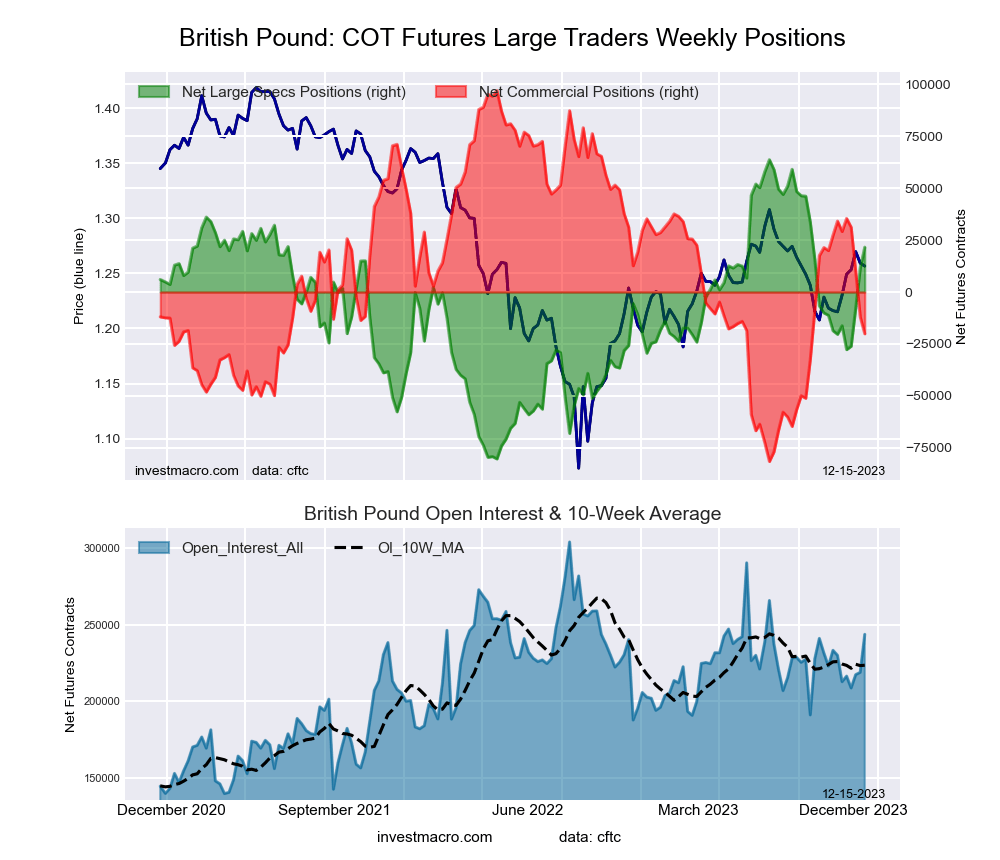
British Pound Sterling Futures COT ChartThe British Pound Sterling large speculator standing this week totaled a net position of -20,371 contracts in the data reported through Tuesday. This was a weekly fall of -1,735 contracts from the previous week which had a total of -18,636 net contracts.

This week’s current strength score (the trader positioning range over the past three years, measured from 0 to 100) shows the speculators are currently Bearish with a score of 41.6 percent. The commercials are Bullish with a score of 64.8 percent and the small traders (not shown in chart) are Bearish with a score of 31.0 percent.

Price Trend-Following Model: Downtrend

Our weekly trend-following model classifies the current market price position as: Downtrend. The current action for the model is considered to be: Hold – Maintain Short Position.

BRITISH POUND StatisticsSPECULATORSCOMMERCIALSSMALL TRADERS
– Percent of Open Interest Longs:27.759.59.7
– Percent of Open Interest Shorts:36.644.715.7
– Net Position:-20,37134,154-13,783
– Gross Longs:63,712136,88822,325
– Gross Shorts:84,083102,73436,108
– Long to Short Ratio:0.8 to 11.3 to 10.6 to 1
NET POSITION TREND:
– Strength Index Score (3 Year Range Pct):41.664.831.0
– Strength Index Reading (3 Year Range):BearishBullishBearish
NET POSITION MOVEMENT INDEX:
– 6-Week Change in Strength Index:-37.537.4-24.9


Japanese Yen Futures:

Japanese Yen Forex Futures COT ChartThe Japanese Yen large speculator standing this week totaled a net position of -103,848 contracts in the data reported through Tuesday. This was a weekly decline of -4,219 contracts from the previous week which had a total of -99,629 net contracts.

This week’s current strength score (the trader positioning range over the past three years, measured from 0 to 100) shows the speculators are currently Bearish-Extreme with a score of 8.4 percent. The commercials are Bullish-Extreme with a score of 88.1 percent and the small traders (not shown in chart) are Bearish with a score of 45.9 percent.

Price Trend-Following Model: Downtrend

Our weekly trend-following model classifies the current market price position as: Downtrend. The current action for the model is considered to be: Hold – Maintain Short Position.

JAPANESE YEN StatisticsSPECULATORSCOMMERCIALSSMALL TRADERS
– Percent of Open Interest Longs:13.669.815.1
– Percent of Open Interest Shorts:51.031.016.4
– Net Position:-103,848107,566-3,718
– Gross Longs:37,641193,46041,836
– Gross Shorts:141,48985,89445,554
– Long to Short Ratio:0.3 to 12.3 to 10.9 to 1
NET POSITION TREND:
– Strength Index Score (3 Year Range Pct):8.488.145.9
– Strength Index Reading (3 Year Range):Bearish-ExtremeBullish-ExtremeBearish
NET POSITION MOVEMENT INDEX:
– 6-Week Change in Strength Index:-1.3-1.912.4


Swiss Franc Futures:

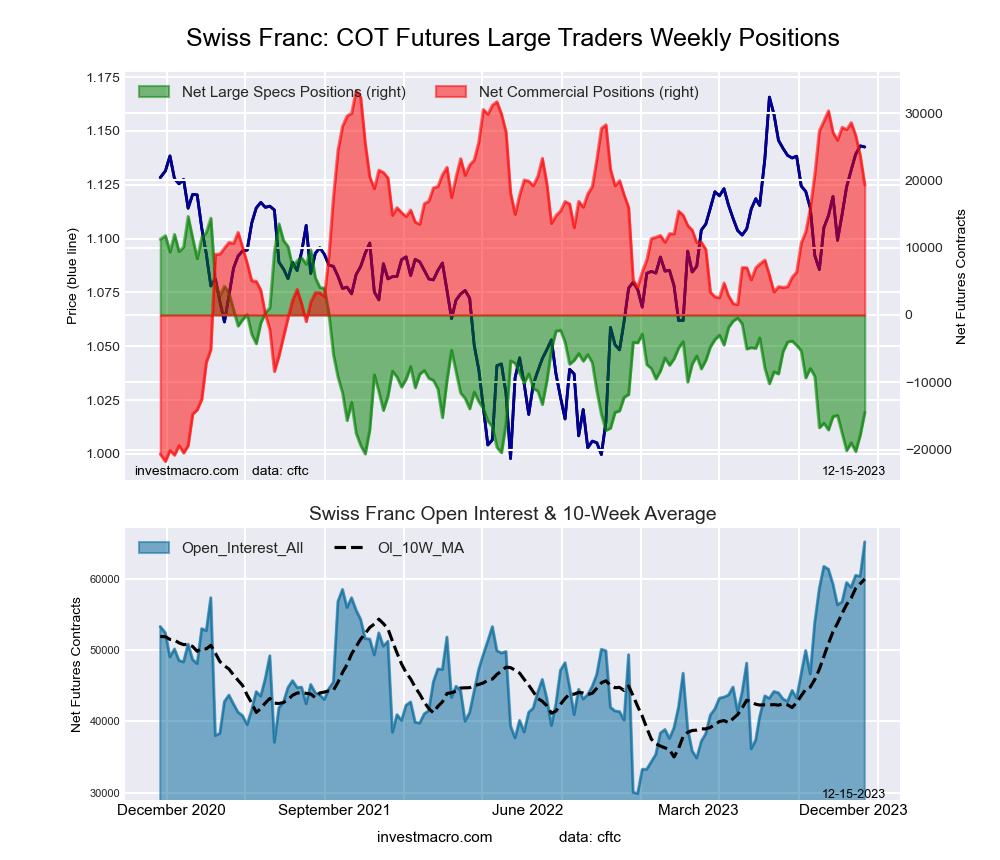
Swiss Franc Forex Futures COT ChartThe Swiss Franc large speculator standing this week totaled a net position of -14,910 contracts in the data reported through Tuesday. This was a weekly boost of 185 contracts from the previous week which had a total of -15,095 net contracts.

This week’s current strength score (the trader positioning range over the past three years, measured from 0 to 100) shows the speculators are currently Bearish-Extreme with a score of 15.7 percent. The commercials are Bullish-Extreme with a score of 86.6 percent and the small traders (not shown in chart) are Bearish with a score of 21.4 percent.

Price Trend-Following Model: Downtrend

Our weekly trend-following model classifies the current market price position as: Downtrend. The current action for the model is considered to be: Hold – Maintain Short Position.

SWISS FRANC StatisticsSPECULATORSCOMMERCIALSSMALL TRADERS
– Percent of Open Interest Longs:15.867.816.3
– Percent of Open Interest Shorts:42.221.735.9
– Net Position:-14,91025,967-11,057
– Gross Longs:8,88838,2019,178
– Gross Shorts:23,79812,23420,235
– Long to Short Ratio:0.4 to 13.1 to 10.5 to 1
NET POSITION TREND:
– Strength Index Score (3 Year Range Pct):15.786.621.4
– Strength Index Reading (3 Year Range):Bearish-ExtremeBullish-ExtremeBearish
NET POSITION MOVEMENT INDEX:
– 6-Week Change in Strength Index:-19.118.4-11.3


Canadian Dollar Futures:

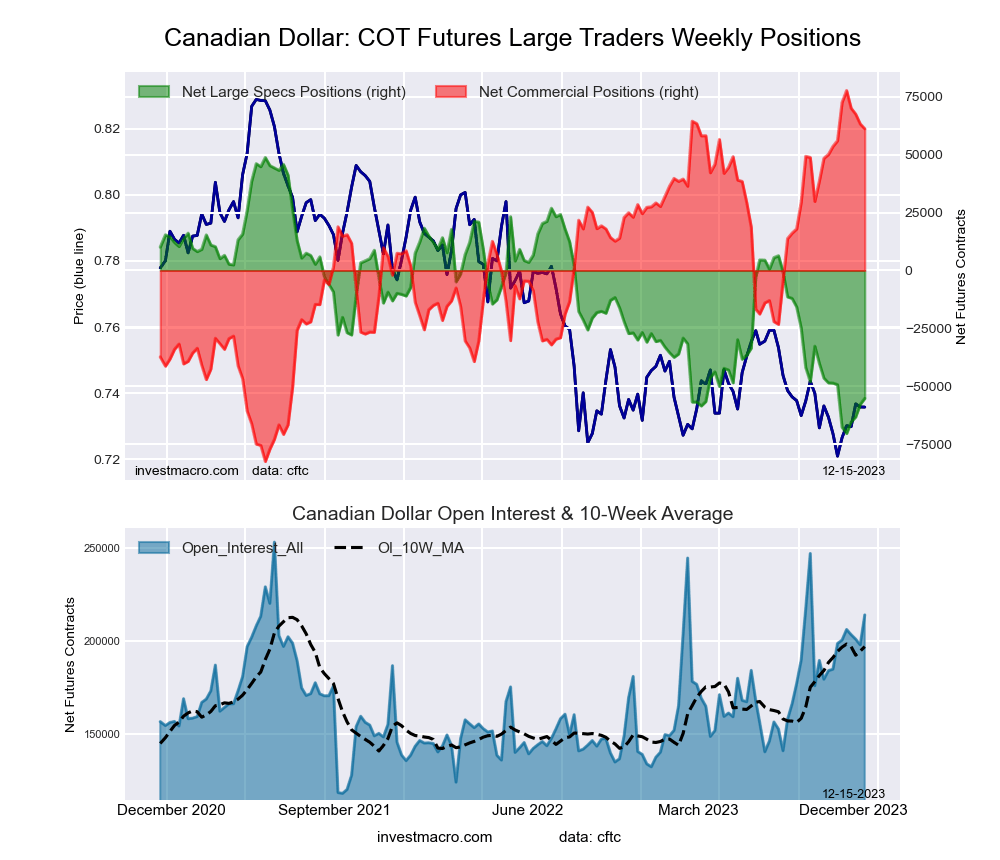
Canadian Dollar Forex Futures COT ChartThe Canadian Dollar large speculator standing this week totaled a net position of -49,332 contracts in the data reported through Tuesday. This was a weekly lowering of -693 contracts from the previous week which had a total of -48,639 net contracts.

This week’s current strength score (the trader positioning range over the past three years, measured from 0 to 100) shows the speculators are currently Bearish-Extreme with a score of 8.6 percent. The commercials are Bullish-Extreme with a score of 94.3 percent and the small traders (not shown in chart) are Bearish-Extreme with a score of 7.9 percent.

Price Trend-Following Model: Downtrend

Our weekly trend-following model classifies the current market price position as: Downtrend. The current action for the model is considered to be: Hold – Maintain Short Position.

CANADIAN DOLLAR StatisticsSPECULATORSCOMMERCIALSSMALL TRADERS
– Percent of Open Interest Longs:12.867.217.1
– Percent of Open Interest Shorts:37.739.020.5
– Net Position:-49,33256,052-6,720
– Gross Longs:25,418133,43333,889
– Gross Shorts:74,75077,38140,609
– Long to Short Ratio:0.3 to 11.7 to 10.8 to 1
NET POSITION TREND:
– Strength Index Score (3 Year Range Pct):8.694.37.9
– Strength Index Reading (3 Year Range):Bearish-ExtremeBullish-ExtremeBearish-Extreme
NET POSITION MOVEMENT INDEX:
– 6-Week Change in Strength Index:-1.24.9-13.2


Australian Dollar Futures:

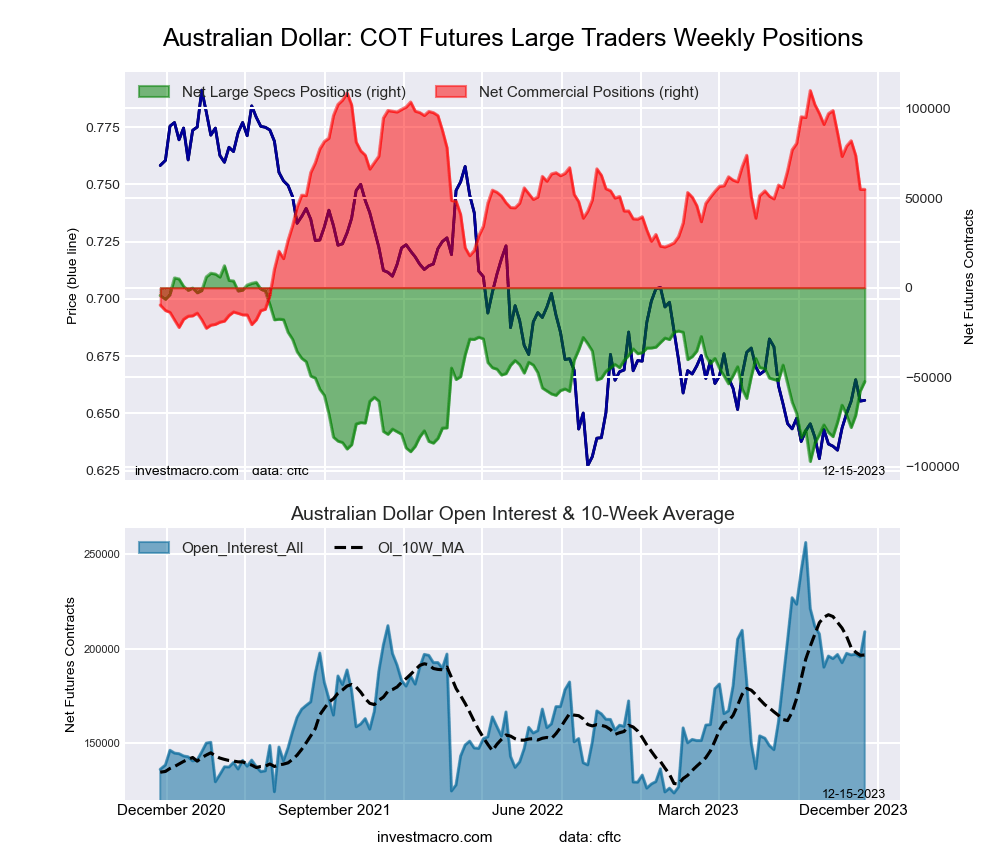
Australian Dollar Forex Futures COT ChartThe Australian Dollar large speculator standing this week totaled a net position of -75,110 contracts in the data reported through Tuesday. This was a weekly rise of 7,971 contracts from the previous week which had a total of -83,081 net contracts.

This week’s current strength score (the trader positioning range over the past three years, measured from 0 to 100) shows the speculators are currently Bearish-Extreme with a score of 20.0 percent. The commercials are Bullish-Extreme with a score of 82.2 percent and the small traders (not shown in chart) are Bearish with a score of 24.8 percent.

Price Trend-Following Model: Weak Downtrend

Our weekly trend-following model classifies the current market price position as: Weak Downtrend. The current action for the model is considered to be: Hold – Maintain Short Position.

AUSTRALIAN DOLLAR StatisticsSPECULATORSCOMMERCIALSSMALL TRADERS
– Percent of Open Interest Longs:16.768.911.5
– Percent of Open Interest Shorts:54.825.017.2
– Net Position:-75,11086,432-11,322
– Gross Longs:32,805135,55322,592
– Gross Shorts:107,91549,12133,914
– Long to Short Ratio:0.3 to 12.8 to 10.7 to 1
NET POSITION TREND:
– Strength Index Score (3 Year Range Pct):20.082.224.8
– Strength Index Reading (3 Year Range):Bearish-ExtremeBullish-ExtremeBearish
NET POSITION MOVEMENT INDEX:
– 6-Week Change in Strength Index:20.0-17.84.3


New Zealand Dollar Futures:

New Zealand Dollar Forex Futures COT ChartThe New Zealand Dollar large speculator standing this week totaled a net position of -12,817 contracts in the data reported through Tuesday. This was a weekly increase of 34 contracts from the previous week which had a total of -12,851 net contracts.

This week’s current strength score (the trader positioning range over the past three years, measured from 0 to 100) shows the speculators are currently Bearish with a score of 22.0 percent. The commercials are Bullish-Extreme with a score of 81.7 percent and the small traders (not shown in chart) are Bearish-Extreme with a score of 9.3 percent.

Price Trend-Following Model: Downtrend

Our weekly trend-following model classifies the current market price position as: Downtrend. The current action for the model is considered to be: Hold – Maintain Short Position.

NEW ZEALAND DOLLAR StatisticsSPECULATORSCOMMERCIALSSMALL TRADERS
– Percent of Open Interest Longs:24.868.55.0
– Percent of Open Interest Shorts:47.140.411.0
– Net Position:-12,81716,236-3,419
– Gross Longs:14,33239,5092,907
– Gross Shorts:27,14923,2736,326
– Long to Short Ratio:0.5 to 11.7 to 10.5 to 1
NET POSITION TREND:
– Strength Index Score (3 Year Range Pct):22.081.79.3
– Strength Index Reading (3 Year Range):BearishBullish-ExtremeBearish-Extreme
NET POSITION MOVEMENT INDEX:
– 6-Week Change in Strength Index:22.0-18.3-4.6


Mexican Peso Futures:

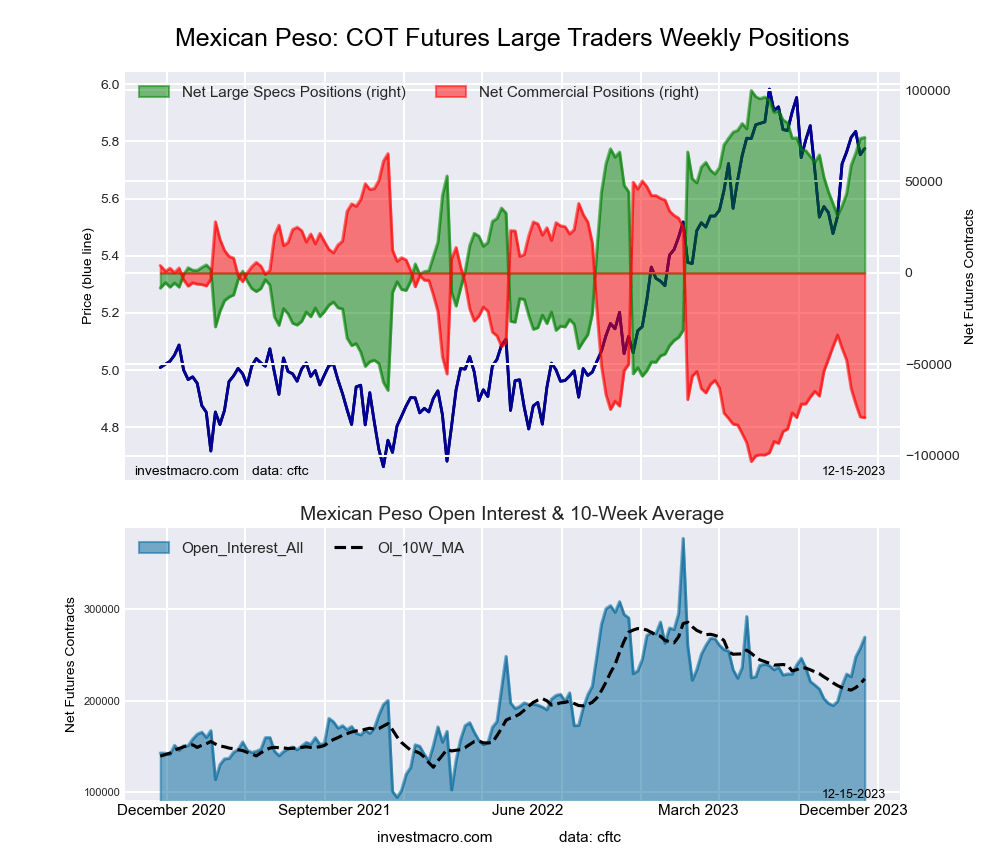
Mexican Peso Futures COT ChartThe Mexican Peso large speculator standing this week totaled a net position of 31,297 contracts in the data reported through Tuesday. This was a weekly decrease of -6,564 contracts from the previous week which had a total of 37,861 net contracts.

This week’s current strength score (the trader positioning range over the past three years, measured from 0 to 100) shows the speculators are currently Bullish with a score of 58.2 percent. The commercials are Bearish with a score of 41.1 percent and the small traders (not shown in chart) are Bearish with a score of 27.7 percent.

Price Trend-Following Model: Downtrend

Our weekly trend-following model classifies the current market price position as: Downtrend. The current action for the model is considered to be: Hold – Maintain Short Position.

MEXICAN PESO StatisticsSPECULATORSCOMMERCIALSSMALL TRADERS
– Percent of Open Interest Longs:28.968.02.9
– Percent of Open Interest Shorts:13.185.01.6
– Net Position:31,297-33,8832,586
– Gross Longs:57,470135,2875,745
– Gross Shorts:26,173169,1703,159
– Long to Short Ratio:2.2 to 10.8 to 11.8 to 1
NET POSITION TREND:
– Strength Index Score (3 Year Range Pct):58.241.127.7
– Strength Index Reading (3 Year Range):BullishBearishBearish
NET POSITION MOVEMENT INDEX:
– 6-Week Change in Strength Index:-19.720.1-9.6


Brazilian Real Futures:

Brazil Real Futures COT ChartThe Brazilian Real large speculator standing this week totaled a net position of 9,346 contracts in the data reported through Tuesday. This was a weekly increase of 4,161 contracts from the previous week which had a total of 5,185 net contracts.

This week’s current strength score (the trader positioning range over the past three years, measured from 0 to 100) shows the speculators are currently Bearish with a score of 46.6 percent. The commercials are Bullish with a score of 52.3 percent and the small traders (not shown in chart) are Bullish with a score of 50.1 percent.

Price Trend-Following Model: Weak Downtrend

Our weekly trend-following model classifies the current market price position as: Weak Downtrend. The current action for the model is considered to be: Hold – Maintain Short Position.

BRAZIL REAL StatisticsSPECULATORSCOMMERCIALSSMALL TRADERS
– Percent of Open Interest Longs:44.446.94.9
– Percent of Open Interest Shorts:30.563.32.4
– Net Position:9,346-11,0221,676
– Gross Longs:29,78131,4493,265
– Gross Shorts:20,43542,4711,589
– Long to Short Ratio:1.5 to 10.7 to 12.1 to 1
NET POSITION TREND:
– Strength Index Score (3 Year Range Pct):46.652.350.1
– Strength Index Reading (3 Year Range):BearishBullishBullish
NET POSITION MOVEMENT INDEX:
– 6-Week Change in Strength Index:-4.55.9-10.6


Bitcoin Futures:

Bitcoin Crypto Futures COT ChartThe Bitcoin large speculator standing this week totaled a net position of -1,746 contracts in the data reported through Tuesday. This was a weekly fall of -1,292 contracts from the previous week which had a total of -454 net contracts.

This week’s current strength score (the trader positioning range over the past three years, measured from 0 to 100) shows the speculators are currently Bearish with a score of 40.1 percent. The commercials are Bullish-Extreme with a score of 93.8 percent and the small traders (not shown in chart) are Bearish with a score of 32.1 percent.

Price Trend-Following Model: Strong Uptrend

Our weekly trend-following model classifies the current market price position as: Strong Uptrend. The current action for the model is considered to be: New Buy – Long Position.

BITCOIN StatisticsSPECULATORSCOMMERCIALSSMALL TRADERS
– Percent of Open Interest Longs:79.08.27.5
– Percent of Open Interest Shorts:88.03.63.2
– Net Position:-1,746903843
– Gross Longs:15,4951,5991,468
– Gross Shorts:17,241696625
– Long to Short Ratio:0.9 to 12.3 to 12.3 to 1
NET POSITION TREND:
– Strength Index Score (3 Year Range Pct):40.193.832.1
– Strength Index Reading (3 Year Range):BearishBullish-ExtremeBearish
NET POSITION MOVEMENT INDEX:
– 6-Week Change in Strength Index:-50.378.910.1


Article By InvestMacroReceive our weekly COT Newsletter

*COT Report: The COT data, released weekly to the public each Friday, is updated through the most recent Tuesday (data is 3 days old) and shows a quick view of how large speculators or non-commercials (for-profit traders) were positioned in the futures markets.

The CFTC categorizes trader positions according to commercial hedgers (traders who use futures contracts for hedging as part of the business), non-commercials (large traders who speculate to realize trading profits) and nonreportable traders (usually small traders/speculators) as well as their open interest (contracts open in the market at time of reporting). See CFTC criteria here.

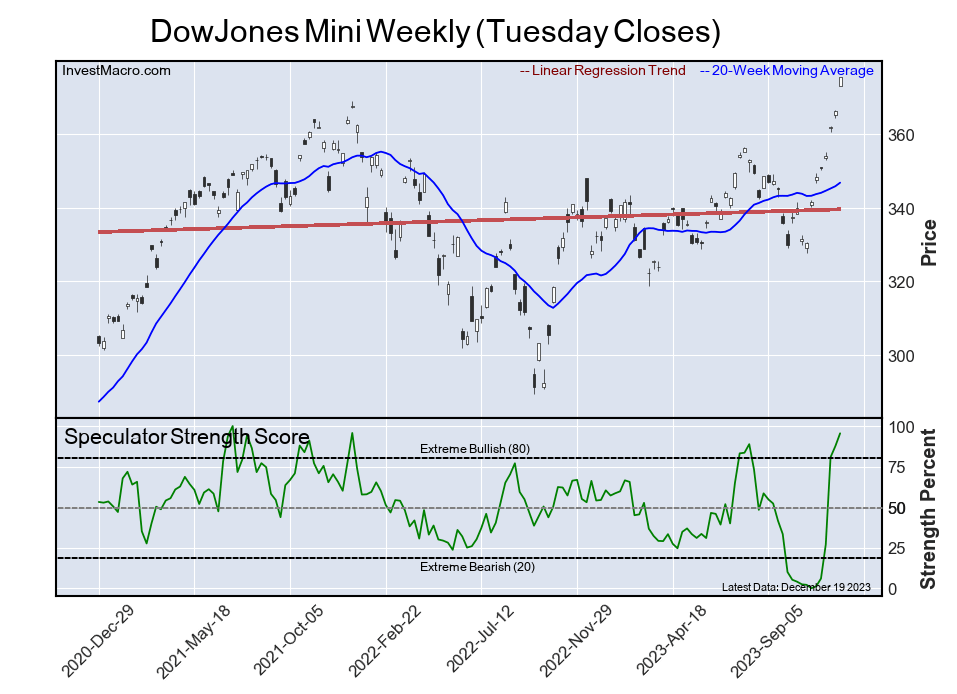
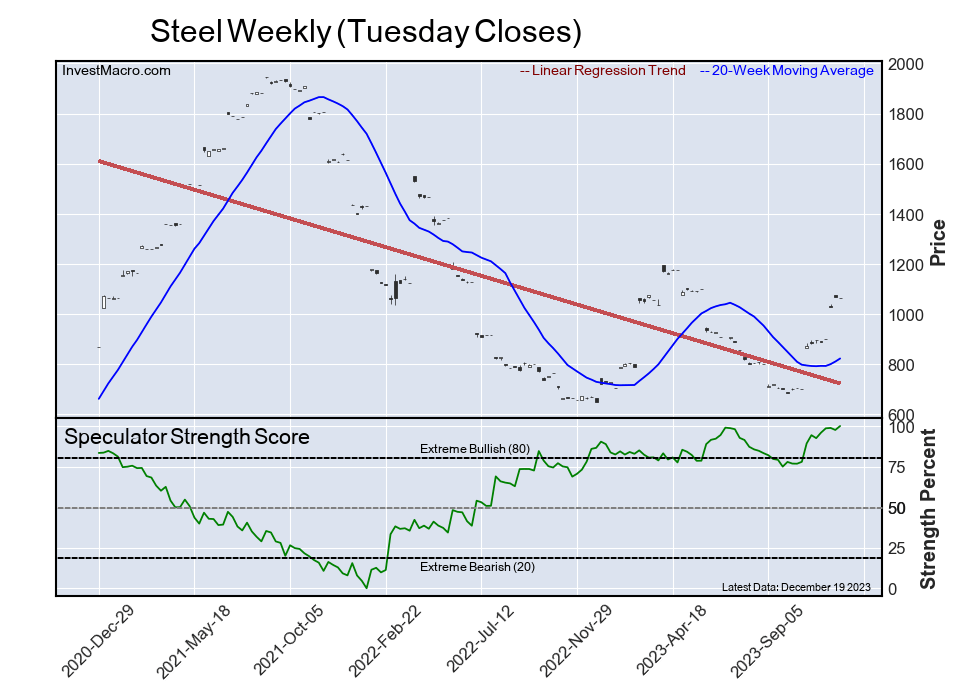
Speculator Extremes: VIX, Steel, DowJones & Soybeans lead Bullish & Bearish Positions

By InvestMacro 

The latest update for the weekly Commitment of Traders (COT) report was released by the Commodity Futures Trading Commission (CFTC) on Friday for data ending on October 31st.

This weekly Extreme Positions report highlights the Most Bullish and Most Bearish Positions for the speculator category. Extreme positioning in these markets can foreshadow strong moves in the underlying market.

To signify an extreme position, we use the Strength Index (also known as the COT Index) of each instrument, a common method of measuring COT data. The Strength Index is simply a comparison of current trader positions against the range of positions over the previous 3 years. We use over 80 percent as extremely bullish and under 20 percent as extremely bearish. (Compare Strength Index scores across all markets in the data table or cot leaders table)


Here Are This Week’s Most Bullish Speculator Positions:

VIX


The VIX speculator position comes in as the most bullish extreme standing this week. The VIX speculator level is currently at a 100.0 percent score of its 3-year range.

The six-week trend for the percent strength score totaled 9.9 this week. The overall net speculator position was a total of -13,979 net contracts this week with a gain of 7,615 contract in the weekly speculator bets.


Speculators or Non-Commercials Notes:

Speculators, classified as non-commercial traders by the CFTC, are made up of large commodity funds, hedge funds and other significant for-profit participants. The Specs are generally regarded as trend-followers in their behavior towards price action – net speculator bets and prices tend to go in the same directions. These traders often look to buy when prices are rising and sell when prices are falling. To illustrate this point, many times speculator contracts can be found at their most extremes (bullish or bearish) when prices are also close to their highest or lowest levels.

These extreme levels can be dangerous for the large speculators as the trade is most crowded, there is less trading ammunition still sitting on the sidelines to push the trend further and prices have moved a significant distance. When the trend becomes exhausted, some speculators take profits while others look to also exit positions when prices fail to continue in the same direction. This process usually plays out over many months to years and can ultimately create a reverse effect where prices start to fall and speculators start a process of selling when prices are falling.


Steel


The Steel speculator position comes next in the extreme standings this week. The Steel speculator level is now at a 89.3 percent score of its 3-year range.

The six-week trend for the percent strength score was 10.1 this week. The speculator position registered -2,600 net contracts this week with a weekly increase of 2,869 contracts in speculator bets.


Bloomberg Commodity Index


The Bloomberg Commodity Index speculator position comes in third this week in the extreme standings. The Bloomberg Commodity Index speculator level resides at a 85.0 percent score of its 3-year range.

The six-week trend for the speculator strength score came in at 3.6 this week. The overall speculator position was -5,465 net contracts this week with a dip of -112 contracts in the weekly speculator bets.


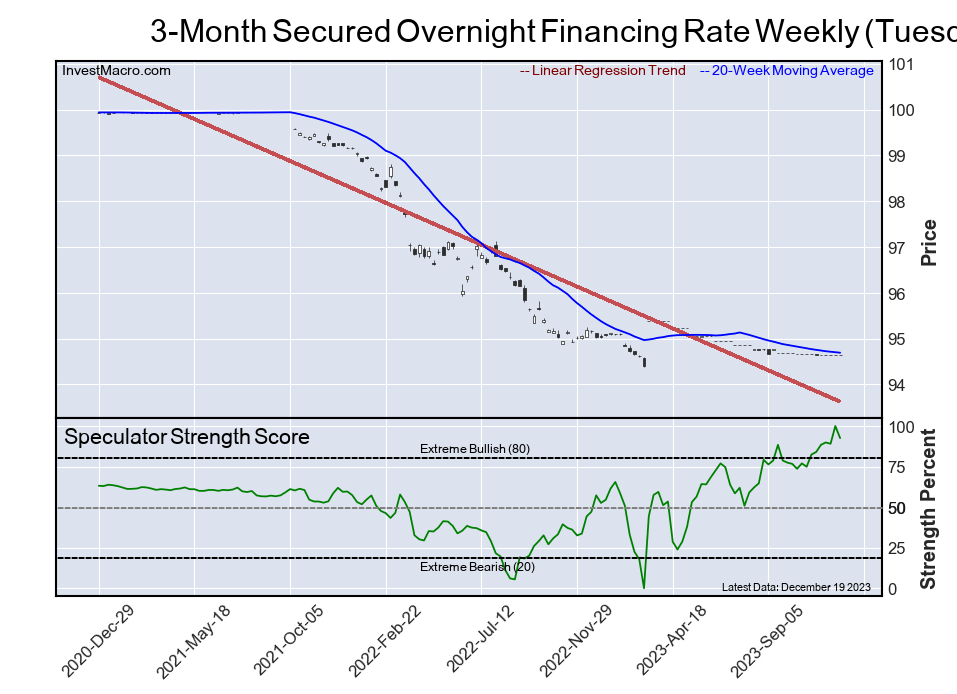
3-Month Secured Overnight Financing Rate


The 3-Month Secured Overnight Financing Rate speculator position comes up number four in the extreme standings this week. The 3-Month Secured Overnight Financing Rate speculator level is at a 84.7 percent score of its 3-year range.

The six-week trend for the speculator strength score totaled a change of -15.3 this week. The overall speculator position was 244,972 net contracts this week with a drop of -38,841 contracts in the speculator bets.


Cocoa Futures


The Cocoa Futures speculator position rounds out the top five in this week’s bullish extreme standings. The Cocoa Futures speculator level sits at a 80.8 percent score of its 3-year range. The six-week trend for the speculator strength score was -19.2 this week.

The speculator position was 69,477 net contracts this week with a decline of -7,543 contracts in the weekly speculator bets.


This Week’s Most Bearish Speculator Positions:

DowJones Mini


The DowJones Mini speculator position comes in as the most bearish extreme standing this week. The DowJones Mini speculator level is at a 0.0 percent score of its 3-year range.

The six-week trend for the speculator strength score was -40.5 this week. The overall speculator position was -36,111 net contracts this week with a small dip of -151 contracts in the speculator bets.


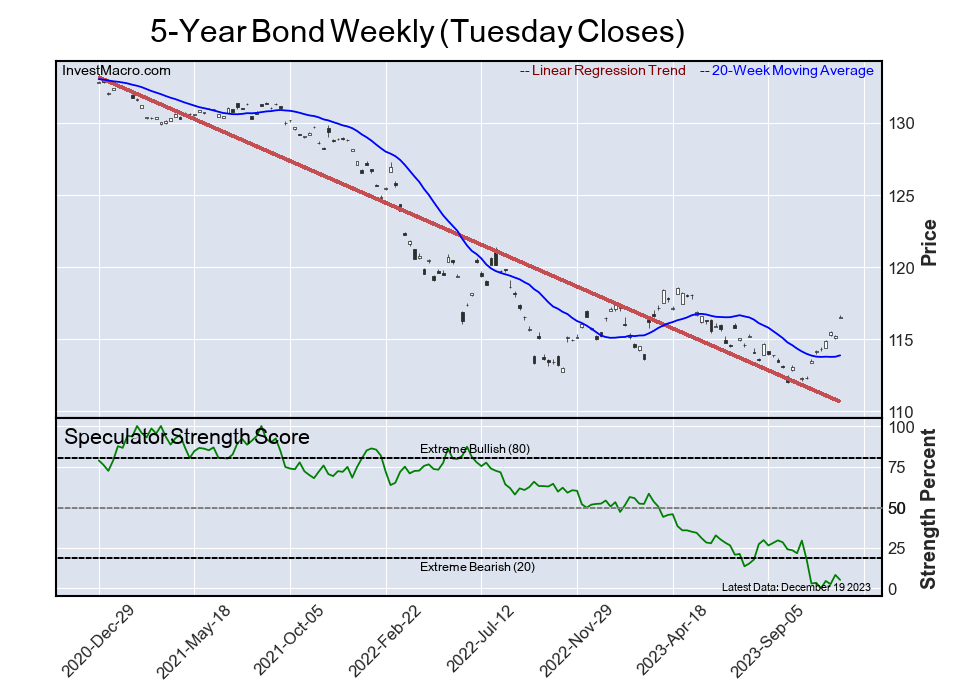
2-Year Bond


The 2-Year Bond speculator position comes in next for the most bearish extreme standing on the week. The 2-Year Bond speculator level is at a 0.0 percent score of its 3-year range.

The six-week trend for the speculator strength score was -12.7 this week. The speculator position was -1,435,448 net contracts this week with a decline of -11,136 contracts in the weekly speculator bets.


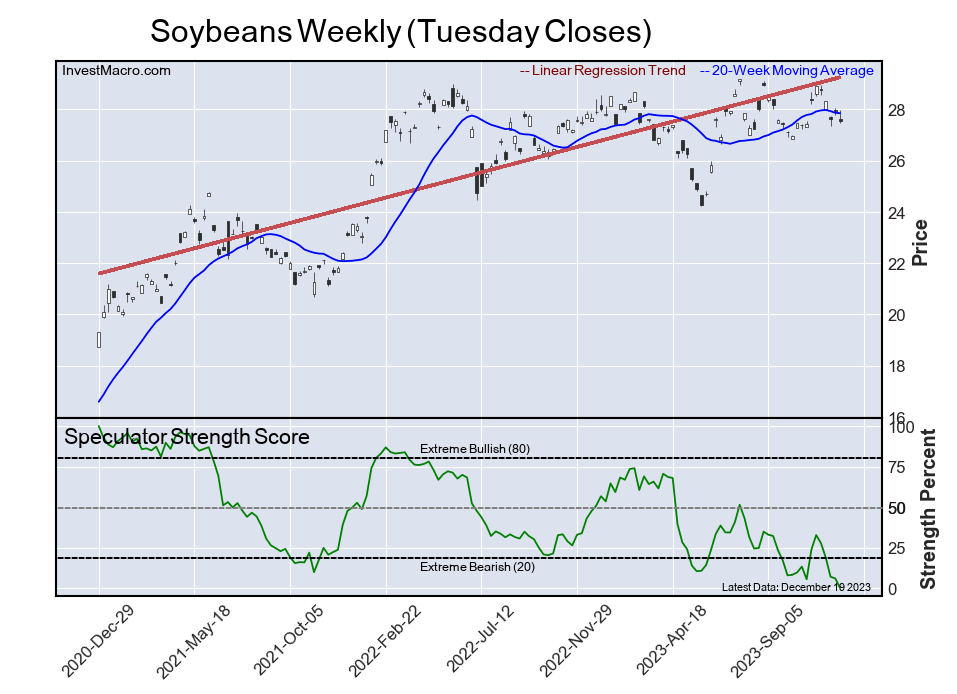
Soybeans


The Soybeans speculator position comes in as third most bearish extreme standing of the week. The Soybeans speculator level resides at a 0.0 percent score of its 3-year range.

The six-week trend for the speculator strength score was -17.5 this week. The overall speculator position was 16,260 net contracts this week with a drop of -20,194 contracts in the speculator bets.


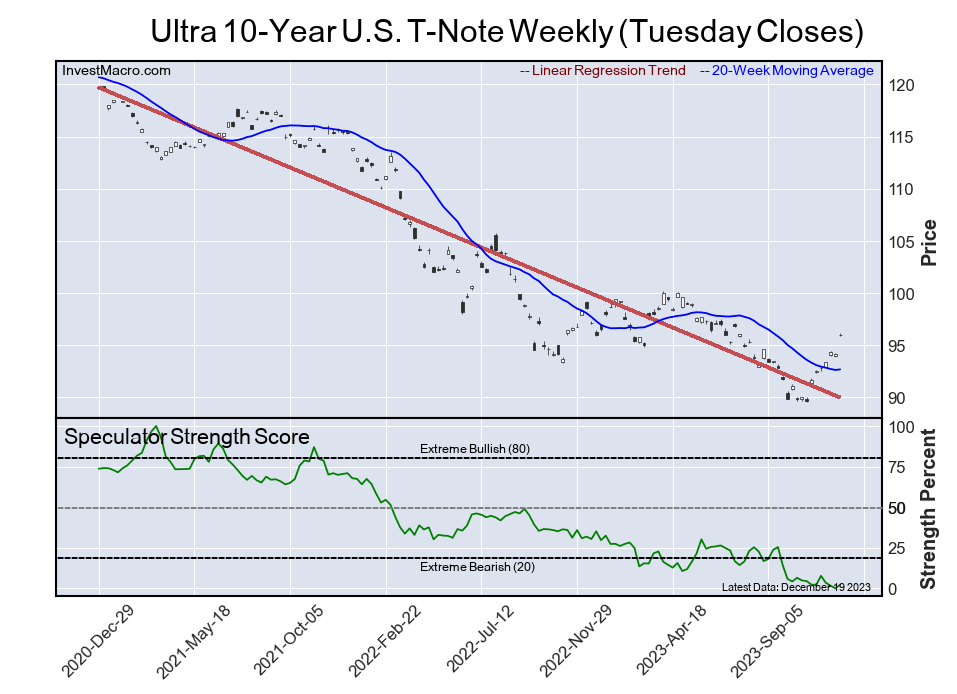
Ultra 10-Year U.S. T-Note


The Ultra 10-Year U.S. T-Note speculator position comes in as this week’s fourth most bearish extreme standing. The Ultra 10-Year U.S. T-Note speculator level is at a 0.2 percent score of its 3-year range.

The six-week trend for the speculator strength score was -21.9 this week. The speculator position was -252,307 net contracts this week with a decrease of -2,438 contracts in the weekly speculator bets.


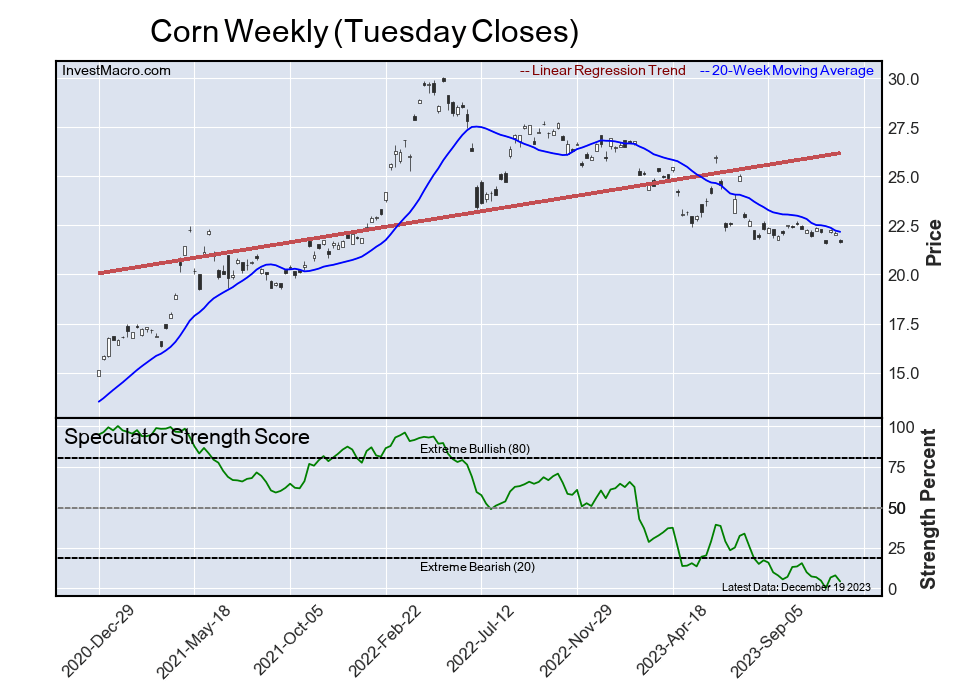
Corn


Finally, the Corn speculator position comes in as the fifth most bearish extreme standing for this week. The Corn speculator level is at a 4.6 percent score of its 3-year range.

The six-week trend for the speculator strength score was 2.0 this week. The speculator position was -87,696 net contracts this week with a slide of -39,416 contracts in the weekly speculator bets.


Article By InvestMacroReceive our weekly COT Newsletter

*COT Report: The COT data, released weekly to the public each Friday, is updated through the most recent Tuesday (data is 3 days old) and shows a quick view of how large speculators or non-commercials (for-profit traders) were positioned in the futures markets.

The CFTC categorizes trader positions according to commercial hedgers (traders who use futures contracts for hedging as part of the business), non-commercials (large traders who speculate to realize trading profits) and nonreportable traders (usually small traders/speculators) as well as their open interest (contracts open in the market at time of reporting). See CFTC criteria here.

New class of recyclable polymer materials could one day help reduce single-use plastic waste

By Katherine Harry, Colorado State University and Emma Rettner, Colorado State University 

Hundreds of millions of tons of single-use plastic ends up in landfills every year, and even the small percentage of plastic that gets recycled can’t last forever. But our group of materials scientists has developed a new method for creating and deconstructing polymers that could lead to more easily recycled plastics – ones that don’t require you to carefully sort out all your recycling on trash day.

In the century since their conception, people have come to understand the enormous impacts – beneficial as well as detrimental – plastics have on human lives and the environment. As a group of polymer scientists dedicated to inventing sustainable solutions for real-world problems, we set out to tackle this issue by rethinking the way polymers are designed and making plastics with recyclability built right in.

Why use plastics, anyway?

Everyday items including milk jugs, grocery bags, takeout containers and even ropes are made from a class of polymers called polyolefins. Polyolefins make up around half of the plastics produced and disposed of every year.

These polymers are used in plastics commonly labeled as HDPE, LLDPE or PP, or by their recycling codes #2, #4 and #5, respectively. These plastics are incredibly durable because the chemical bonds that make them up are extremely stable. But in a world set up for single-use consumption, this is no longer a design feature but rather a design flaw.

Imagine if half of the plastics used today were recyclable by twice as many processes as they are now. While that wouldn’t get the recycling rate to 100%, a jump from single digits – currently around 9% – to double digits would make a big dent in the plastics produced, the plastics accumulated in the environment and their capacity for recycling and reuse.

Recycling methods we already have

Even the plastics that make it to a recycling facility can’t be reused in exactly the same way they were used before – the recycling process degrades the material, so it loses utility and value. Instead of making a plastic cup that is downgraded each time it gets recycled, manufacturers could potentially make plastics once, collect them and reuse them on and on.

Conventional recycling requires careful sorting of all the collected materials, which can be hard with so many different plastics. Here in the U.S., collection happens mainly through single stream recycling – everything from metal cans, glass bottles, cardboard boxes and plastic cups end up in the same bin. Separating paper from metal doesn’t require complex technology, but sorting a polypropylene container from a polyethylene milk jug is hard to do without the occasional mistake.

When two different plastics are mixed together during recycling, their useful properties are hugely reduced – to the point of making them useless.

But say you can recycle one of these plastics by a different method, so it doesn’t end up contaminating the recycling stream. When we mixed samples of polypropylene with a polymer we made, we were still able to depolymerize – or break down the material – and regain our building blocks without chemically affecting the polypropylene. This indicated that a contaminated waste stream could still recover its value, and the material in it could go on to be recycled, either mechanically or chemically.

Plastics we need − but more recyclable

In a study published in October 2023, our team developed a series of polymers with only two simple building blocks – one soft polymer and one hard polymer – that mimicked polyolefins but could also be chemically recycled.

Connecting two different polymers together multiple times until they form a single, long molecule creates what’s called a multiblock polymer. Just by adjusting how much of each polymer type goes into the multiblock polymer, our team created a wide range of materials with properties that spanned across polyolefin types. But creating these multiblock polymers is easier said than done.

To link these hard and soft polymers, we adapted a technique that had previously been used only on very small molecules. This method is improved relative to traditional methods of making polymers in a step-by-step fashion, developed in the 1920s, where the reactive groups on the end of the molecules need to be exactly matched.

In our method, the reactive groups are now the same as each other, meaning we didn’t have to worry about pairing the ends of each building block to make polymers that can compete with the polyolefins we already use. Using the same strategy, applied in reverse by adding hydrogen, we could disconnect the polymers back into their building blocks and easily separate them to use again.

A graph showing a steady increase in single-use plastic use across all plastic types shown, from X to projected in 2050.
Realized and predicted production of commodity plastics through 2050.
International Energy Agency

With an almost twofold increase in annual plastic use projected through 2050, the complexity and quantity of plastic recycling will only increase. It’s an important consideration when designing new materials and products.

Using just two building blocks to make plastics that have a huge variety of properties can go a long way toward reducing and streamlining the number of different plastics used to make the products we need. Instead of needing one plastic to make something pliable, another for something stiff, and a third, fourth and fifth for properties in between, we could control the behavior of plastics by just changing how much of each building block is there.

Although we’re still in the process of answering some big questions about these polymers, we believe this work is a step in the right direction toward more sustainable plastics.

We were able to create materials that mimic the properties of plastics the world relies on, and our sights are now set on creating plastic compositions that you couldn’t with existing methods.The Conversation

About the Authors:

Katherine Harry, PhD Student in Chemistry, Colorado State University and Emma Rettner, PhD Candidate in Materials Science and Engineering, Colorado State University

This article is republished from The Conversation under a Creative Commons license. Read the original article.

What is a virtual power plant? An energy expert explains

By Daniel Cohan, Rice University 

After nearly two decades of stagnation, U.S. electricity demand is surging, driven by growing numbers of electric cars, data centers and air conditioners in a warming climate. But traditional power plants that generate electricity from coal, natural gas or nuclear energy are retiring faster than new ones are being built in this country. Most new supply is coming from wind and solar farms, whose output varies with the weather.

That’s left power companies seeking new ways to balance supply and demand. One option they’re turning to is virtual power plants.

These aren’t massive facilities generating electricity at a single site. Rather, they are aggregations of electricity producers, consumers and storers – collectively known as distributed energy resources – that grid managers can call on as needed.

Some of these sources, such as batteries, may deliver stored electric power. Others may be big electricity consumers, such as factories, whose owners have agreed to cut back their power use when demand is high, freeing up energy for other customers. Virtual power sources typically are quicker to site and build, and can be cleaner and cheaper to operate, than new power plants.

Virtual power plants are more resilient against service outages than large, centralized generating stations because they distribute energy resources across large areas.

A growing resource

Virtual power plants aren’t new. The U.S. Department of Energy estimates that there are already 30 to 60 gigawatts of them in operation today. A gigawatt is 1 billion watts – roughly the output of 2.5 million solar photovoltaic panels or one large nuclear reactor.

Most of these virtual power plants are industrial customers that have agreed to reduce demand when conditions are tight. But as growing numbers of homes and small businesses add rooftop solar panels, batteries and electric cars, these energy customers can become not only consumers but also suppliers of power to the grid.

For example, homeowners can charge up their batteries with rooftop solar when it’s sunny, and discharge power back to the grid in the evening when demand is high and prices sometimes spike.

As smart thermostats and water heaters, rooftop solar panels and batteries enable more customers to participate in them, DOE estimates that virtual power plants could triple in scale by 2030. That could cover roughly half of the new capacity that the U.S. will need to cover growing demand and replace retiring older power plants. This growth would help to limit the cost of building new wind and solar farms and gas plants.

And because virtual power plants are located where electricity is consumed, they’ll ease the burden on aging transmission systems that have struggled to add new lines.

New roles for power customers

Virtual power plants scramble the roles of electricity producers and consumers. Traditional power plants generate electricity at central locations and transmit it along power lines to consumers. For the grid to function, supply and demand must be precisely balanced at all times.

Customer demand is typically assumed to be a given that fluctuates with the weather but follows a fairly predictable pattern over the course of a day. To satisfy it, grid operators dispatch a mix of baseload sources that operate continuously, such as coal and nuclear plants, and more flexible sources such as gas and hydropower that can modulate their output quickly as needed.

Output from wind and solar farms rises and falls during the day, so other sources must operate more flexibly to keep supply and demand balanced. Still, the basic idea is that massive facilities produce power for millions of passive consumers.

Virtual power plants upend this model by embracing the fact that consumers can control their electricity demand. Industrial consumers have long found ways to flex their operations, limiting demand when power supplies are tight in return for incentives or discounted rates.

Now, thermostats and water heaters that communicate with the grid can let households modulate their demand too. For example, smart electric water heaters can heat water mostly when power is abundant and cheap, and limit demand when power is scarce.

In Vermont, Green Mountain Power is offering its customers incentives to install batteries that will provide power back to the grid when it’s needed most. In Texas, where I live, deadly blackouts in 2021 highlighted the importance of bolstering our isolated power grid. Now, utilities here are using Tesla Powerwalls to help turn homes into virtual power sources. South Australia aims to connect 50,000 homes with solar and batteries to build that country’s largest virtual power plant.

Virtual power, real challenges

Virtual power plants aren’t a panacea. Many customers are reluctant to give up even temporary control of their thermostats, or have a delay when charging their electric car. Some consumers are also concerned about the security and privacy of smart meters. It remains to be seen how many customers will sign up for these emerging programs and how effectively their operators will modulate supply and demand.

There also are challenges at the business end. It’s a lot harder to manage millions of consumers than dozens of power plants. Virtual power plant operators can overcome that challenge by rewarding customers for allowing them to flex their supply and demand in a coordinated fashion.

As electricity demand rises to meet the needs of growing economies and replace fossil fuel-burning cars and furnaces, and reliance on renewable resources increases, grid managers will need all the flexibility they can get to balance the variable output of wind and solar generation. Virtual power plants could help reshape electric power into an industry that’s more nimble, efficient and responsive to changing conditions and customers’ needs.The Conversation

About the Author:

Daniel Cohan, Associate Professor of Civil and Environmental Engineering, Rice University

This article is republished from The Conversation under a Creative Commons license. Read the original article.

Quantum dots − a new Nobel laureate describes the development of these nanoparticles from basic research to industry application

By Louis Brus, Columbia University 

The Nobel Prize in chemistry for 2023 goes to three scientists “for the discovery and synthesis of quantum dots.” The Conversation Weekly podcast caught up with one of this trio, physical chemist Louis Brus, who did foundational work figuring out that the properties of these nanoparticles depend on their size. Brus’ phone was off when the Nobel reps called to inform him of the good news, but now plenty of people have gotten through with congratulations and advice. Below are edited excerpts from the podcast.

When you were working at Bell Labs in the 1980s and discovered quantum dots, it was something of an accident. You were studying solutions of semiconductor particles. And when you aimed lasers at these solutions, called colloids, you noticed that the colors they emitted were not constant.

On the first day we made the colloid, sometimes the spectrum was different. Second and third day, it was normal. There certainly was a surprise when I first saw this change in the spectrum. And so, I began to try to figure out what the heck was going on with that.

I noticed that the property of the particle itself began to change at a very small size.

What you’d found was a quantum dot: a type of nanoparticle that absorbs light and emits it at another wavelength. Crucially, the color of these particles changes depending on the actual size of the particle. How do you even see a quantum dot crystal, since one is just a few hundred thousandths the width of a human hair?

Well, you can’t see them with an optical microscope because they’re smaller than the wavelength of light. There are ways to see them too, using other types of specialist microscopes, such as an electron microscope. And a common way of demonstrating them is to line up a row of brightly colored glass flasks each with a solution of different sized quantum dots inside it.

diagram of a molecule next to a soccer ball next to a planet
A quantum dot is a crystal that often consists of just a few thousand atoms. In terms of size, it has the same relationship to a soccer ball as a soccer ball has to the size of the Earth.
Johan Jarnestad/The Royal Swedish Academy of Sciences, CC BY-ND

One of your fellow laureates, Alexei Ekimov, was a Russian scientist, and he’d actually observed quantum dots in colored glass, but you weren’t aware of his findings at the time?

Yes, that’s right. The Cold War was going on at that time, and he published in the Russian literature, in Russian. And he wasn’t allowed to travel to the West to talk about his work.

I asked around among all the physicists, was there any work on small particles? I was trying to make a model of the quantum size effects. And they told me no, nobody’s really working on this. Nobody had seen his articles, basically.

I was part of the U.S. chemistry community, doing synthetic chemistry in the laboratory. He was in the glass industry in the Soviet Union, working on industrial technology.

When I eventually found his articles in the technological literature, I wrote a letter to the Soviet Union, with my papers, just to say hello to Ekimov and his colleagues. When the letter came, the KGB came to talk to the Russian scientists, trying to figure out why they had any contact with anybody in the West. But in fact they had never talked to me or anyone in the West when my letter arrived in the mail.

Have you met him since?

Yes, they were able to come out of the Soviet Union during Glasnost, this would be the late 1980s. There’s Ekimov, and then there is his theoretical collaborator Sasha Efros, who now works at the U.S. Naval Research Lab. I met them as soon as they came to the U.S.


Listen to the interview with Louis Brus on The Conversation Weekly podcast. Each week, academic experts tell us about the fascinating discoveries they’re making to understand the world and the big questions they’re still trying to answer.


One of the issues with quantum dots, when you first observed them, was how to actually produce them and keep them stable. Then, in the 1990s, your fellow laureate, Moungi Bawendi, figured this out. What do you think is the most striking thing that you’ve seen quantum dots used in so far?

Usually when a new material is invented, it takes a long time to figure out what it’s really good for. Research scientists, they have ideas, you might use it for this, you might use it for that. But then, if you talk to people in the actual industry, who deal every day with manufacturing problems, these ideas are often not very good.

But the knowledge that we gained, the scientific principles, could be used to help to design new devices.

As far as first applications, people began to try to use them in biological imaging. Biochemists attach quantum dots to other molecules to help map cells and organs. They’ve even been used to detect tumors, and to help guide surgeons during operations.

And as scientists kept working to synthesize quantum dots, the quality of the particles kept improving. They were emitting pure colors, rather than distributions of light – like maybe red with a little bit of green, or maybe red with some pink. When you got a better particle, it would be just pure red, for instance.

So then people made the connection to the display industry – computer displays and television displays. In this application, you want to convert electricity into three colors: red, green and blue. You can make up any kind of image, starting with just those three colors in different proportions.

It takes a lot of courage. You have to invest a lot of money to develop the technology, and maybe at the end of it, it’s not good enough, and it will not replace what you already have. And there’s a lot of credit due to the Samsung Corporation in Japan. Hundreds of billions of dollars were invested in the technology of these particles to get them to the point where they could begin to manufacture displays and flat-panel TVs using quantum dots.

Your work is an example of the importance of basic research, of being curious, trying to solve mysteries without a particular endpoint or industrial application in sight. What message would you have for a young chemist starting out today working on such basic research?

The world is a huge place, and you could do basic research in a huge number of different areas. You want to pick a problem where, if you are spectacularly successful and you actually discover something really interesting, it might have some application in the world.

For better or for worse, you have to make a choice in the beginning, and it takes some intuition.

A good way to do it is you pick a subject that you know is important to technology, but there’s no understanding of the science at the present time. It’s a complete black box. Nobody understands the basic principles. That kind of problem, you can begin to take it apart and look to see what the basic steps are.

What changes for you now that you’ve won the Nobel Prize?

Well, this Nobel Prize, for better or for worse, has a special meaning in people’s minds all over the world. Yesterday when the mailman came I happened to be at the front door and he recognized me because my face was in the local newspaper. And he said, “I’ve never shaken the hand of a Nobel laureate before.”

For better or for worse, this is where I am right now, in a special category whether I like it or not. I still have my office in the university, but I don’t have a research group. I’m trying to leave that to the younger people. So this recognition probably means less for my research than it would if I was 40 years old.

I have received congratulations by email from a number of people who won the prize in past years. Their main recommendation is you must learn to say no. People will ask you to do all kinds of crazy things, and your time will be entirely taken up with these honorific university visits and giving little speeches. In order to have a real life and to be productive, you have to say no to all of these extraneous invitations.

And they also told me to have fun in Sweden! It’s an extremely elaborate schedule of events for that week in December when this award ceremony is. Extremely fancy. American culture, physics culture is different – if you win a prize from the American Physical Society, it’s a very low-key event. You just show up in an auditorium. It’s not even necessary to wear a suit.

So I will take my family, my grandchildren to Sweden and we’ll try to enjoy this as a great vacation.The Conversation

About the Author:

Louis Brus, Professor Emeritus of Chemistry, Columbia University

This article is republished from The Conversation under a Creative Commons license. Read the original article.