Archive for Opinions – Page 65

Currency Speculators push British Pound and Euro bets higher

By InvestMacro

Here are the latest charts and statistics for the Commitment of Traders (COT) data published by the Commodities Futures Trading Commission (CFTC).

The latest COT data is updated through Tuesday November 28th and shows a quick view of how large market participants (for-profit speculators and commercial traders) were positioned in the futures markets. All currency positions are in direct relation to the US dollar where, for example, a bet for the euro is a bet that the euro will rise versus the dollar while a bet against the euro will be a bet that the euro will decline versus the dollar.

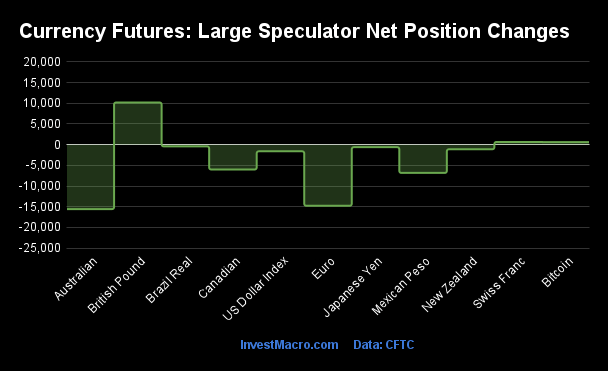
Weekly Speculator Changes led by British Pound & EuroFX

The COT currency market speculator bets were slightly lower this week as five out of the eleven currency markets we cover had higher positioning while the other six markets had lower speculator contracts.

Leading the weekly gains for the currency markets was the British Pound (18,203 contracts) with the EuroFX (13,511 contracts) also rising by more than 10,000 contracts followed by the Australian Dollar (6,751 contracts), Mexican Peso (6,554 contracts) and the Canadian Dollar (2,198 contracts).

The currencies seeing declines in speculator bets on the week were the Japanese Yen (-3,783 contracts), US Dollar Index (-1,610 contracts), Brazilian Real (-1,001 contracts), New Zealand Dollar (-2,755 contracts), Swiss Franc (-1,295 contracts) and Bitcoin (-869 contracts) also registering lower bets on the week.

Currency Speculators push British Pound and Euro bets higher

Highlighting the COT currency’s data is this week’s boost in the speculator positioning for the British Pound Sterling and the Euro. Both of these currencies saw speculator positions rise by over +10,000 weekly contracts. Helping out both the Sterling and the Euro positioning has been a dent in the outlook for the US Dollar.

The US inflation numbers continue to moderate and market watchers are expecting the US Federal Reserve to hold their interest rates steady. According to the Fed Watch tool, expectations are currently 98 percent for a rate hold at the December meeting and when looking out over the next year, investors are starting to expect rate decreases in 2024.

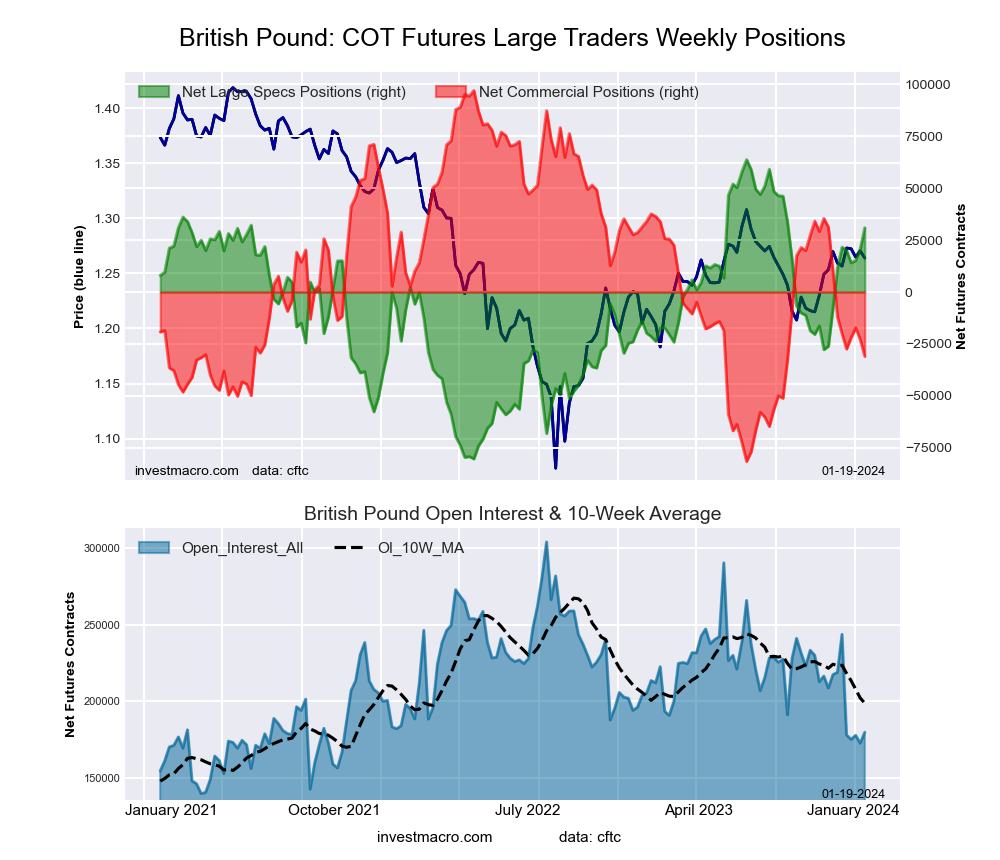
The Pound Sterling speculative positioning rose this week by over +18,000 contracts and has gained in three out of the past four weeks. The GBP speculative level has now improved to the least bearish level of the past eight weeks at a total of -7,895 contracts. The GBPUSD exchange rate has been following suit with a price close this week at the highest level since August. The GBPUSD has bounced off the 1.2100 major support in recent months and has accelerated higher (+5% in November) with a close over the 1.2700 to end the week.

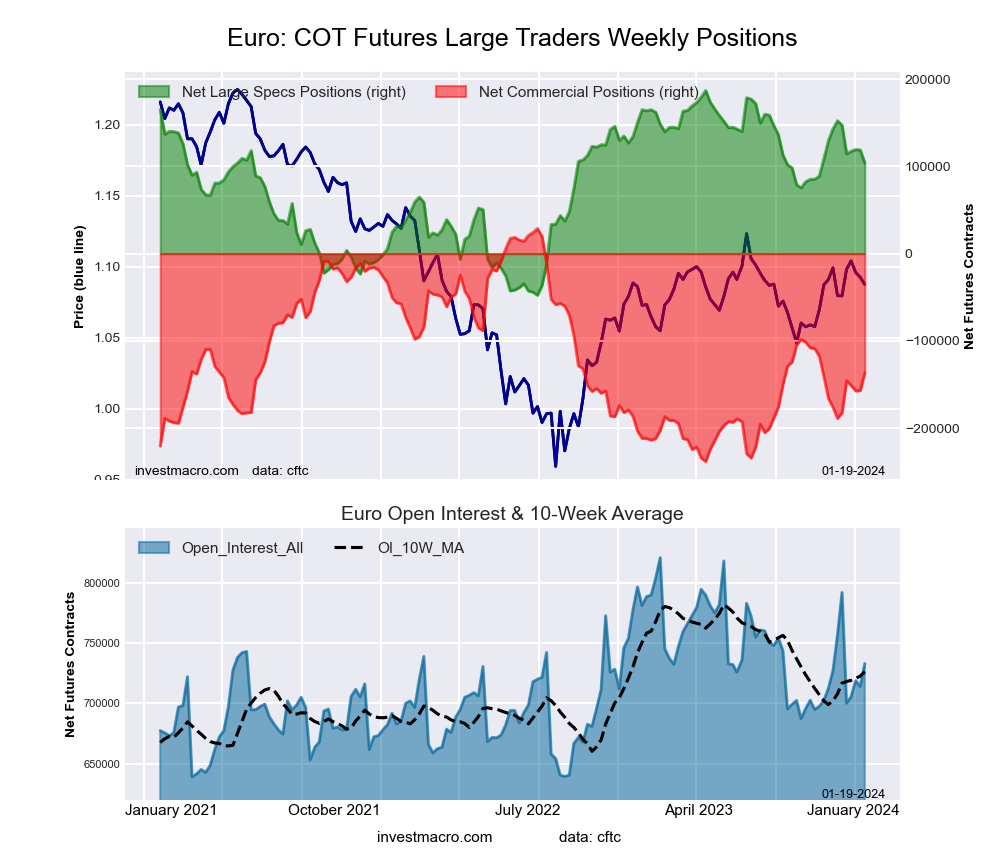
The Euro speculator position, meanwhile, jumped by over +13,000 contracts this week as well and has now risen for seven consecutive weeks. The Euro position has gained by a total of +67,633 contracts over this past 7-week period to reach a 13-week high point at +143,165 contracts. The Euro (EURUSD) exchange rate to the US Dollar has also had a strong couple of months with the EURUSD currency pair bouncing off the 1.5500 major support to challenge the 1.1000 level. This week the EURUSD was rejected at the 1.1000 level and closed at 1.0879.


Data Snapshot of Forex Market Traders | Columns Legend
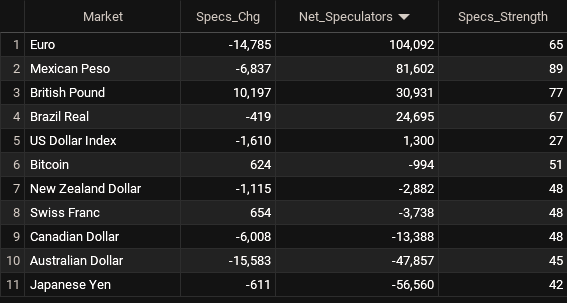
Nov-28-2023OIOI-IndexSpec-NetSpec-IndexCom-NetCOM-IndexSmalls-NetSmalls-Index
USD Index39,3593319,08757-18,29247-7950
EUR727,13848143,16581-176,3152333,15032
GBP217,37247-7,8955010,06451-2,16954
JPY260,78182-109,23712103,692865,54565
CHF60,47996-20,289126,69188-6,40238
CAD200,86461-63,242667,53794-4,29513
AUD197,05355-71,2192473,78973-2,57046
NZD51,46060-19,609420,20891-59943
MXN247,5035465,48579-71,441195,95649
RUB20,93047,54331-7,15069-39324
BRL108,74910032,88177-29,23029-3,6510
Bitcoin23,027100-1,74540792095335


Strength Scores led by EuroFX & Mexican Peso

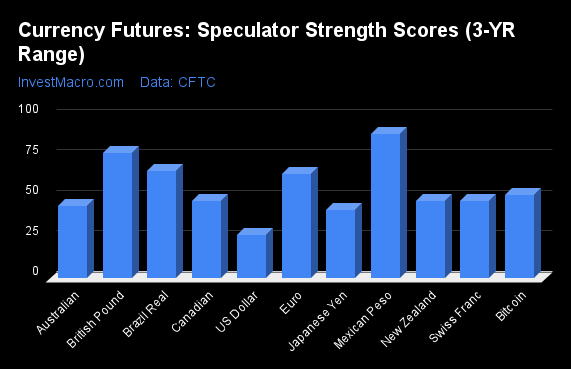
COT Strength Scores (a normalized measure of Speculator positions over a 3-Year range, from 0 to 100 where above 80 is Extreme-Bullish and below 20 is Extreme-Bearish) showed that the EuroFX (81 percent) and the Mexican Peso (79 percent) were leading the currency markets this week. The Brazilian Real (77 percent), US Dollar Index (57 percent) and the British Pound (50 percent) come in as the next highest in the weekly strength scores.

On the downside, the Swiss Franc (1 percent), the New Zealand Dollar (4 percent), the Canadian Dollar (6 percent) and the Japanese Yen (12 percent) come in at the lowest strength levels currently and are all in Extreme-Bearish territory (below 20 percent).

Strength Statistics:
US Dollar Index (56.8 percent) vs US Dollar Index previous week (59.5 percent)
EuroFX (81.3 percent) vs EuroFX previous week (75.5 percent)
British Pound Sterling (50.3 percent) vs British Pound Sterling previous week (37.7 percent)
Japanese Yen (11.6 percent) vs Japanese Yen previous week (13.7 percent)
Swiss Franc (1.0 percent) vs Swiss Franc previous week (4.7 percent)
Canadian Dollar (6.0 percent) vs Canadian Dollar previous week (4.2 percent)
Australian Dollar (23.6 percent) vs Australian Dollar previous week (17.4 percent)
New Zealand Dollar (4.3 percent) vs New Zealand Dollar previous week (11.5 percent)
Mexican Peso (79.1 percent) vs Mexican Peso previous week (75.1 percent)
Brazilian Real (77.1 percent) vs Brazilian Real previous week (78.4 percent)
Bitcoin (40.1 percent) vs Bitcoin previous week (53.2 percent)


Brazilian Real & EuroFX top the 6-Week Strength Trends

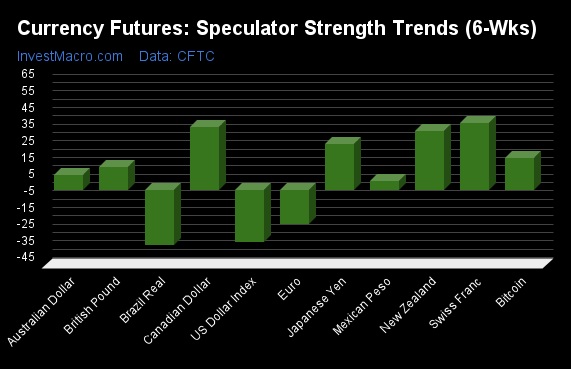
COT Strength Score Trends (or move index, calculates the 6-week changes in strength scores) showed that the Brazilian Real (38 percent) and the EuroFX (26 percent) lead the past six weeks trends for the currencies. The Mexican Peso (13 percent), the Australian Dollar (9 percent) and the British Pound (2 percent) are the next highest positive movers in the latest trends data.

The New Zealand Dollar (-36 percent) leads the downside trend scores currently with Bitcoin (-31 percent), the Canadian Dollar (-12 percent) and the Swiss Franc (-9 percent) following next with lower trend scores.

Strength Trend Statistics:
US Dollar Index (-0.1 percent) vs US Dollar Index previous week (2.0 percent)
EuroFX (25.9 percent) vs EuroFX previous week (23.1 percent)
British Pound Sterling (2.3 percent) vs British Pound Sterling previous week (-11.1 percent)
Japanese Yen (-3.6 percent) vs Japanese Yen previous week (-3.3 percent)
Swiss Franc (-9.1 percent) vs Swiss Franc previous week (-8.3 percent)
Canadian Dollar (-12.3 percent) vs Canadian Dollar previous week (-15.9 percent)
Australian Dollar (8.7 percent) vs Australian Dollar previous week (-1.3 percent)
New Zealand Dollar (-35.7 percent) vs New Zealand Dollar previous week (-33.2 percent)
Mexican Peso (12.9 percent) vs Mexican Peso previous week (4.1 percent)
Brazilian Real (38.1 percent) vs Brazilian Real previous week (38.5 percent)
Bitcoin (-31.2 percent) vs Bitcoin previous week (-30.5 percent)


Individual COT Forex Markets:

US Dollar Index Futures:
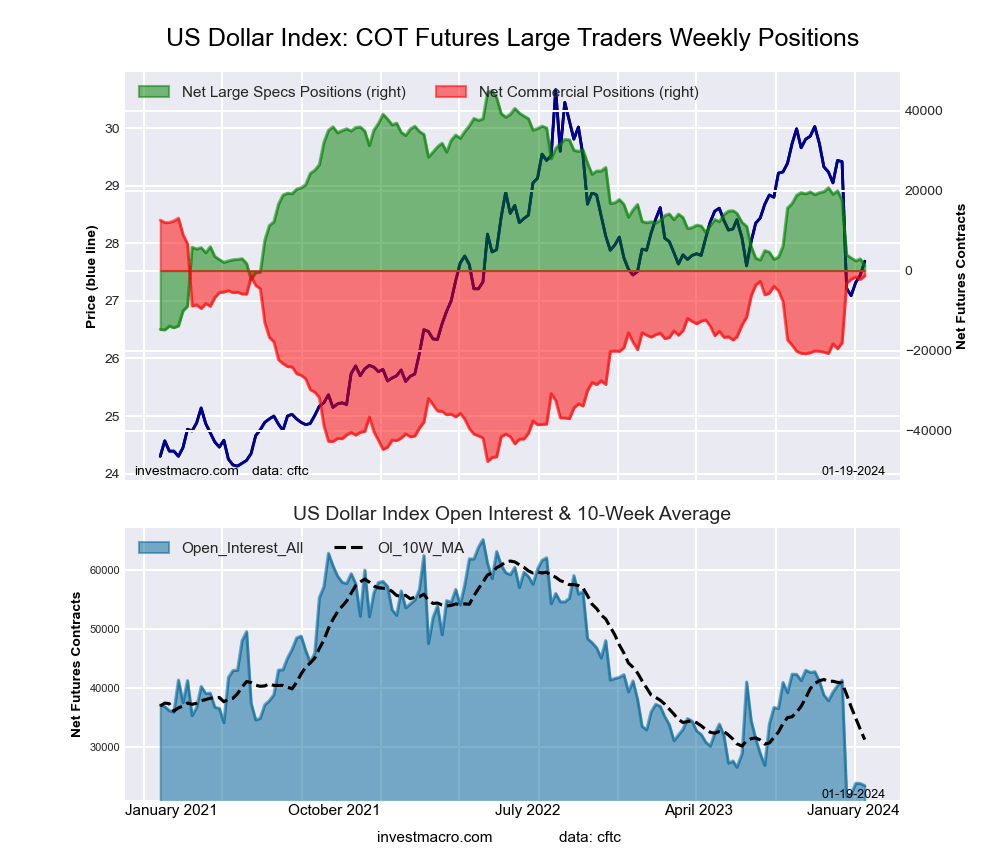
US Dollar Index Forex Futures COT ChartThe US Dollar Index large speculator standing this week came in at a net position of 19,087 contracts in the data reported through Tuesday. This was a weekly fall of -1,610 contracts from the previous week which had a total of 20,697 net contracts.

This week’s current strength score (the trader positioning range over the past three years, measured from 0 to 100) shows the speculators are currently Bullish with a score of 56.8 percent. The commercials are Bearish with a score of 46.7 percent and the small traders (not shown in chart) are Bearish-Extreme with a score of 0.0 percent.

Price Trend-Following Model: Uptrend

Our weekly trend-following model classifies the current market price position as: Uptrend. The current action for the model is considered to be: Hold – Maintain Long Position.

US DOLLAR INDEX StatisticsSPECULATORSCOMMERCIALSSMALL TRADERS
– Percent of Open Interest Longs:73.217.16.9
– Percent of Open Interest Shorts:24.763.69.0
– Net Position:19,087-18,292-795
– Gross Longs:28,7986,7462,735
– Gross Shorts:9,71125,0383,530
– Long to Short Ratio:3.0 to 10.3 to 10.8 to 1
NET POSITION TREND:
– Strength Index Score (3 Year Range Pct):56.846.70.0
– Strength Index Reading (3 Year Range):BullishBearishBearish-Extreme
NET POSITION MOVEMENT INDEX:
– 6-Week Change in Strength Index:-0.13.9-28.5


Euro Currency Futures:

Euro Currency Futures COT ChartThe Euro Currency large speculator standing this week came in at a net position of 143,165 contracts in the data reported through Tuesday. This was a weekly gain of 13,511 contracts from the previous week which had a total of 129,654 net contracts.

This week’s current strength score (the trader positioning range over the past three years, measured from 0 to 100) shows the speculators are currently Bullish-Extreme with a score of 81.3 percent. The commercials are Bearish with a score of 23.2 percent and the small traders (not shown in chart) are Bearish with a score of 31.9 percent.

Price Trend-Following Model: Weak Downtrend (Possible Trend Change)

Our weekly trend-following model classifies the current market price position as: Weak Downtrend. The current action for the model is considered to be: Hold – Maintain Short Position.

EURO Currency StatisticsSPECULATORSCOMMERCIALSSMALL TRADERS
– Percent of Open Interest Longs:32.153.511.4
– Percent of Open Interest Shorts:12.477.76.8
– Net Position:143,165-176,31533,150
– Gross Longs:233,454388,78482,613
– Gross Shorts:90,289565,09949,463
– Long to Short Ratio:2.6 to 10.7 to 11.7 to 1
NET POSITION TREND:
– Strength Index Score (3 Year Range Pct):81.323.231.9
– Strength Index Reading (3 Year Range):Bullish-ExtremeBearishBearish
NET POSITION MOVEMENT INDEX:
– 6-Week Change in Strength Index:25.9-28.022.2


British Pound Sterling Futures:

British Pound Sterling Futures COT ChartThe British Pound Sterling large speculator standing this week came in at a net position of -7,895 contracts in the data reported through Tuesday. This was a weekly advance of 18,203 contracts from the previous week which had a total of -26,098 net contracts.

This week’s current strength score (the trader positioning range over the past three years, measured from 0 to 100) shows the speculators are currently Bullish with a score of 50.3 percent. The commercials are Bullish with a score of 51.3 percent and the small traders (not shown in chart) are Bullish with a score of 53.8 percent.

Price Trend-Following Model: Weak Downtrend (Possible Trend Change)

Our weekly trend-following model classifies the current market price position as: Weak Downtrend. The current action for the model is considered to be: Hold – Maintain Short Position.

BRITISH POUND StatisticsSPECULATORSCOMMERCIALSSMALL TRADERS
– Percent of Open Interest Longs:28.254.412.0
– Percent of Open Interest Shorts:31.849.813.0
– Net Position:-7,89510,064-2,169
– Gross Longs:61,296118,25326,067
– Gross Shorts:69,191108,18928,236
– Long to Short Ratio:0.9 to 11.1 to 10.9 to 1
NET POSITION TREND:
– Strength Index Score (3 Year Range Pct):50.351.353.8
– Strength Index Reading (3 Year Range):BullishBullishBullish
NET POSITION MOVEMENT INDEX:
– 6-Week Change in Strength Index:2.3-5.512.9


Japanese Yen Futures:

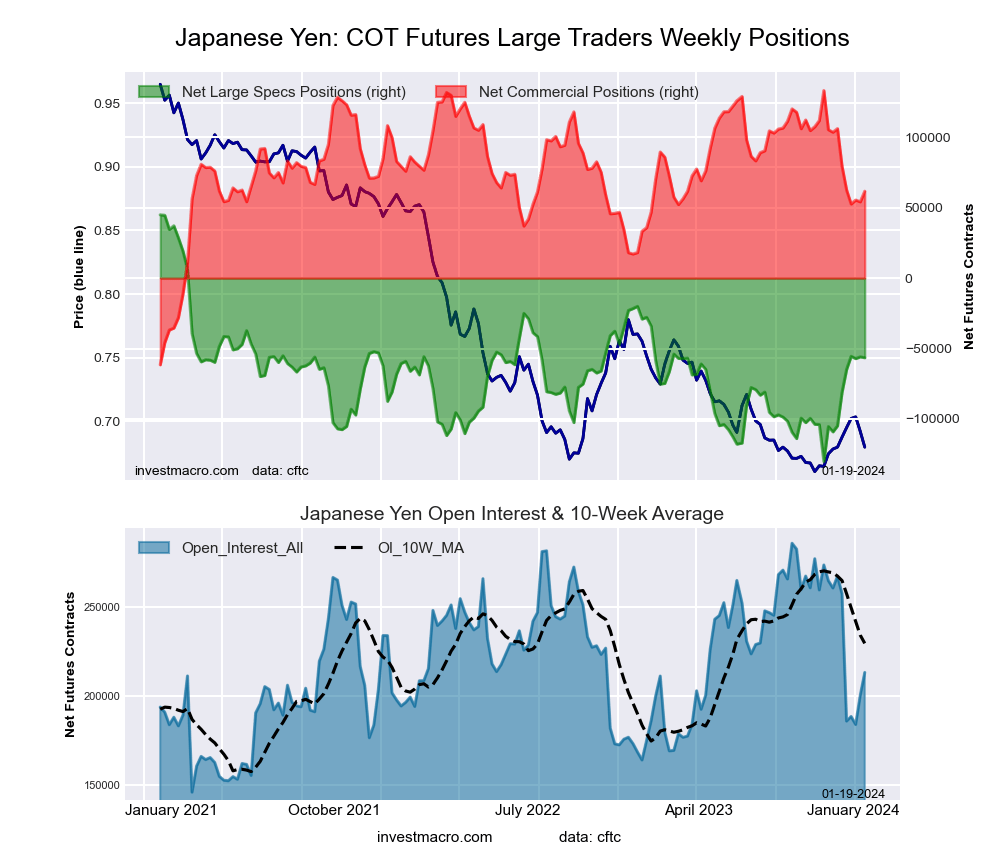
Japanese Yen Forex Futures COT ChartThe Japanese Yen large speculator standing this week came in at a net position of -109,237 contracts in the data reported through Tuesday. This was a weekly reduction of -3,783 contracts from the previous week which had a total of -105,454 net contracts.

This week’s current strength score (the trader positioning range over the past three years, measured from 0 to 100) shows the speculators are currently Bearish-Extreme with a score of 11.6 percent. The commercials are Bullish-Extreme with a score of 85.7 percent and the small traders (not shown in chart) are Bullish with a score of 64.7 percent.

Price Trend-Following Model: Weak Downtrend (Possible Trend Change)

Our weekly trend-following model classifies the current market price position as: Weak Downtrend. The current action for the model is considered to be: Hold – Maintain Short Position.

JAPANESE YEN StatisticsSPECULATORSCOMMERCIALSSMALL TRADERS
– Percent of Open Interest Longs:11.769.117.0
– Percent of Open Interest Shorts:53.629.314.9
– Net Position:-109,237103,6925,545
– Gross Longs:30,461180,13444,382
– Gross Shorts:139,69876,44238,837
– Long to Short Ratio:0.2 to 12.4 to 11.1 to 1
NET POSITION TREND:
– Strength Index Score (3 Year Range Pct):11.685.764.7
– Strength Index Reading (3 Year Range):Bearish-ExtremeBullish-ExtremeBullish
NET POSITION MOVEMENT INDEX:
– 6-Week Change in Strength Index:-3.6-4.231.0


Swiss Franc Futures:

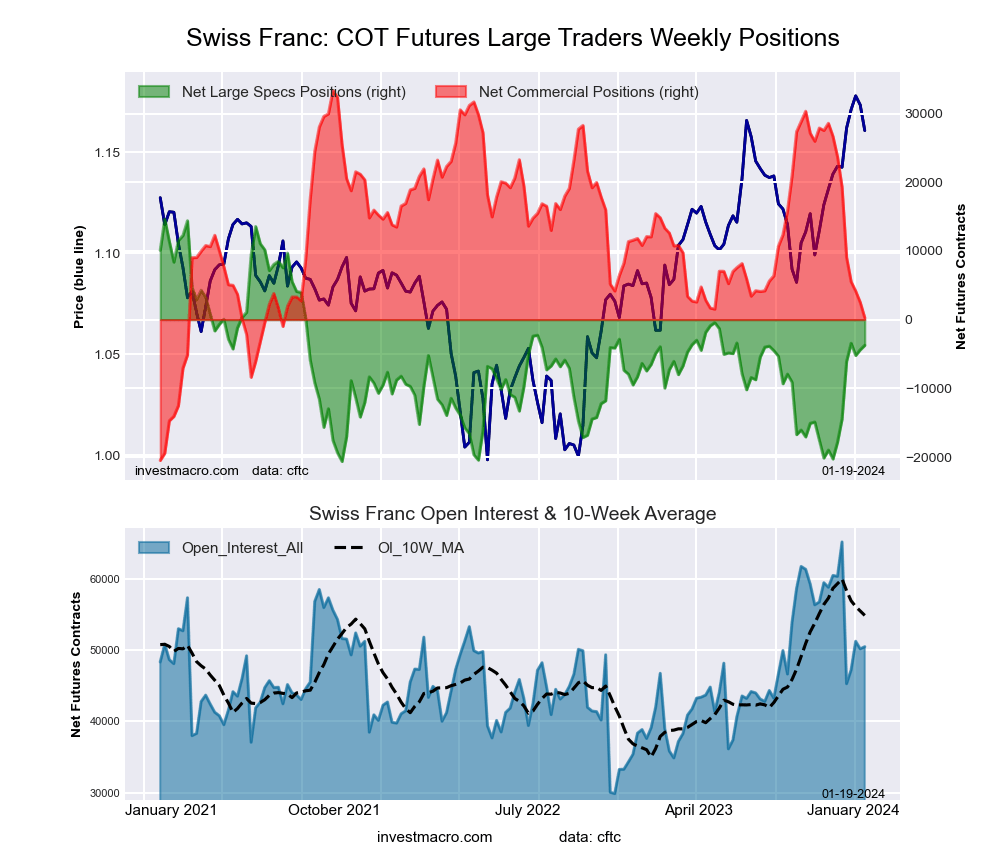
Swiss Franc Forex Futures COT ChartThe Swiss Franc large speculator standing this week came in at a net position of -20,289 contracts in the data reported through Tuesday. This was a weekly lowering of -1,295 contracts from the previous week which had a total of -18,994 net contracts.

This week’s current strength score (the trader positioning range over the past three years, measured from 0 to 100) shows the speculators are currently Bearish-Extreme with a score of 1.0 percent. The commercials are Bullish-Extreme with a score of 87.9 percent and the small traders (not shown in chart) are Bearish with a score of 38.1 percent.

Price Trend-Following Model: Weak Downtrend (Possible Trend Change)

Our weekly trend-following model classifies the current market price position as: Weak Downtrend. The current action for the model is considered to be: Hold – Maintain Short Position.

SWISS FRANC StatisticsSPECULATORSCOMMERCIALSSMALL TRADERS
– Percent of Open Interest Longs:7.173.019.4
– Percent of Open Interest Shorts:40.728.930.0
– Net Position:-20,28926,691-6,402
– Gross Longs:4,30044,14511,754
– Gross Shorts:24,58917,45418,156
– Long to Short Ratio:0.2 to 12.5 to 10.6 to 1
NET POSITION TREND:
– Strength Index Score (3 Year Range Pct):1.087.938.1
– Strength Index Reading (3 Year Range):Bearish-ExtremeBullish-ExtremeBearish
NET POSITION MOVEMENT INDEX:
– 6-Week Change in Strength Index:-9.1-6.624.7


Canadian Dollar Futures:

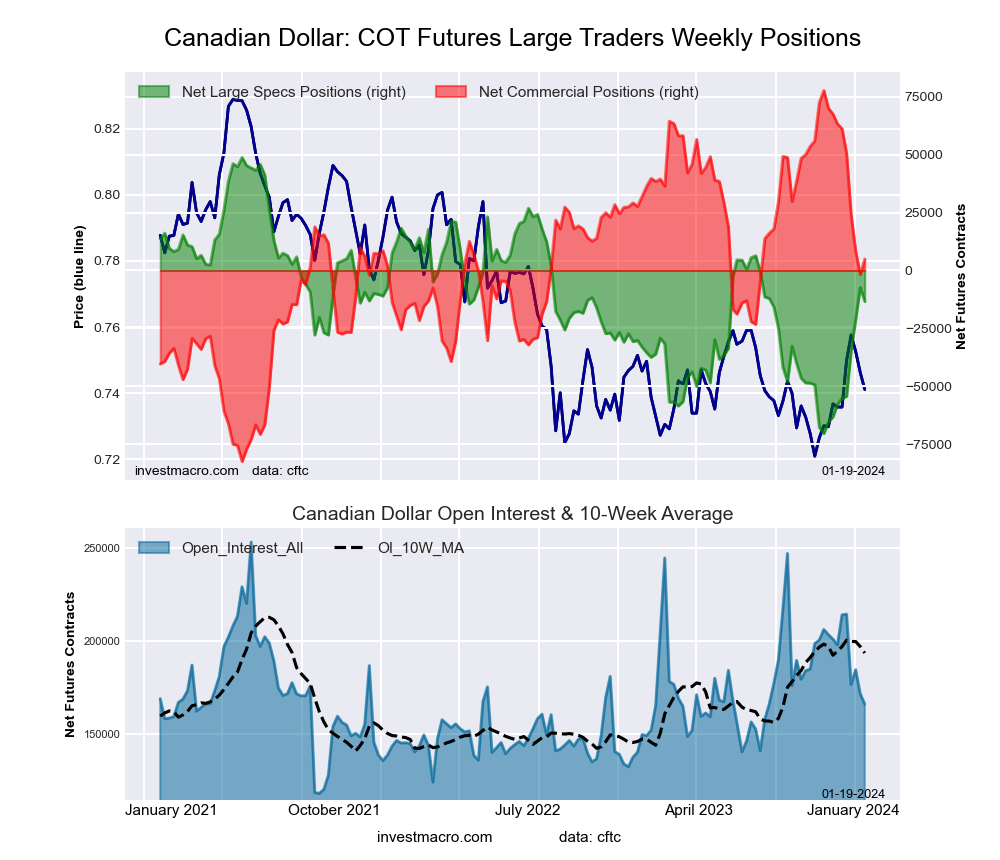
Canadian Dollar Forex Futures COT ChartThe Canadian Dollar large speculator standing this week came in at a net position of -63,242 contracts in the data reported through Tuesday. This was a weekly boost of 2,198 contracts from the previous week which had a total of -65,440 net contracts.

This week’s current strength score (the trader positioning range over the past three years, measured from 0 to 100) shows the speculators are currently Bearish-Extreme with a score of 6.0 percent. The commercials are Bullish-Extreme with a score of 93.7 percent and the small traders (not shown in chart) are Bearish-Extreme with a score of 13.3 percent.

Price Trend-Following Model: Weak Downtrend (Possible Trend Change)

Our weekly trend-following model classifies the current market price position as: Weak Downtrend. The current action for the model is considered to be: Hold – Maintain Short Position.

CANADIAN DOLLAR StatisticsSPECULATORSCOMMERCIALSSMALL TRADERS
– Percent of Open Interest Longs:9.571.415.2
– Percent of Open Interest Shorts:40.937.817.3
– Net Position:-63,24267,537-4,295
– Gross Longs:18,991143,46430,505
– Gross Shorts:82,23375,92734,800
– Long to Short Ratio:0.2 to 11.9 to 10.9 to 1
NET POSITION TREND:
– Strength Index Score (3 Year Range Pct):6.093.713.3
– Strength Index Reading (3 Year Range):Bearish-ExtremeBullish-ExtremeBearish-Extreme
NET POSITION MOVEMENT INDEX:
– 6-Week Change in Strength Index:-12.310.9-6.1


Australian Dollar Futures:

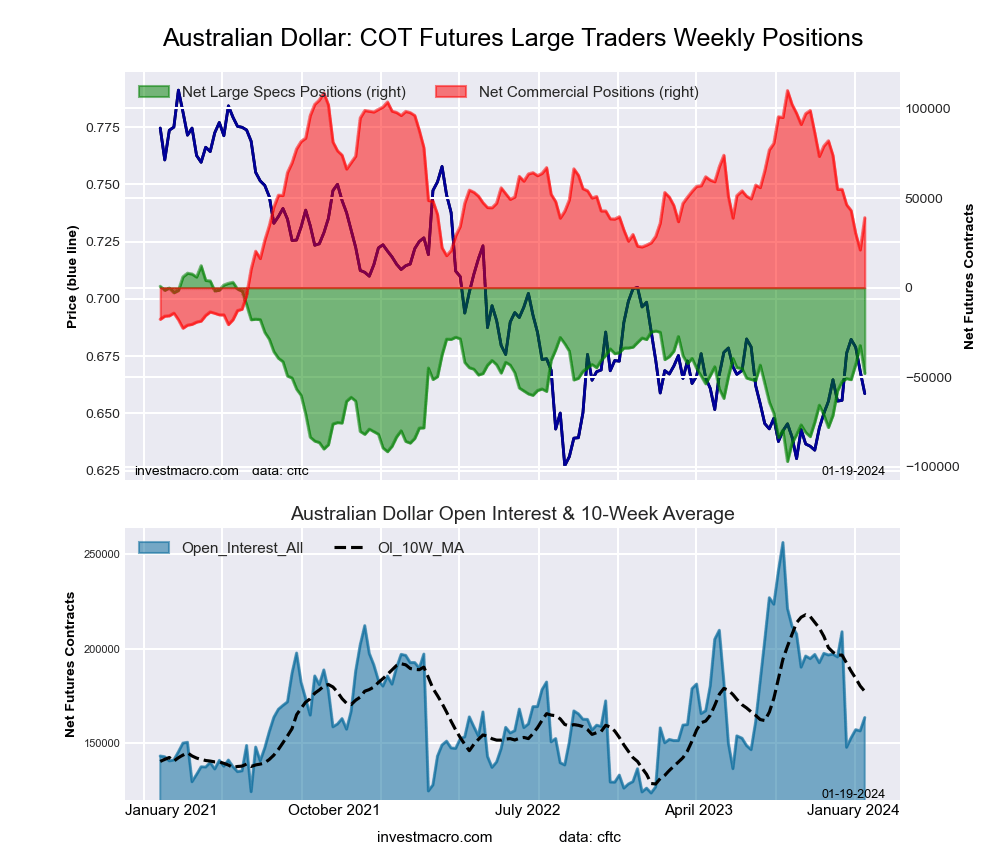
Australian Dollar Forex Futures COT ChartThe Australian Dollar large speculator standing this week came in at a net position of -71,219 contracts in the data reported through Tuesday. This was a weekly advance of 6,751 contracts from the previous week which had a total of -77,970 net contracts.

This week’s current strength score (the trader positioning range over the past three years, measured from 0 to 100) shows the speculators are currently Bearish with a score of 23.6 percent. The commercials are Bullish with a score of 72.7 percent and the small traders (not shown in chart) are Bearish with a score of 46.2 percent.

Price Trend-Following Model: Weak Downtrend (Possible Trend Change)

Our weekly trend-following model classifies the current market price position as: Weak Downtrend. The current action for the model is considered to be: Hold – Maintain Short Position.

AUSTRALIAN DOLLAR StatisticsSPECULATORSCOMMERCIALSSMALL TRADERS
– Percent of Open Interest Longs:14.866.612.4
– Percent of Open Interest Shorts:51.029.113.7
– Net Position:-71,21973,789-2,570
– Gross Longs:29,203131,21324,361
– Gross Shorts:100,42257,42426,931
– Long to Short Ratio:0.3 to 12.3 to 10.9 to 1
NET POSITION TREND:
– Strength Index Score (3 Year Range Pct):23.672.746.2
– Strength Index Reading (3 Year Range):BearishBullishBearish
NET POSITION MOVEMENT INDEX:
– 6-Week Change in Strength Index:8.7-17.633.7


New Zealand Dollar Futures:

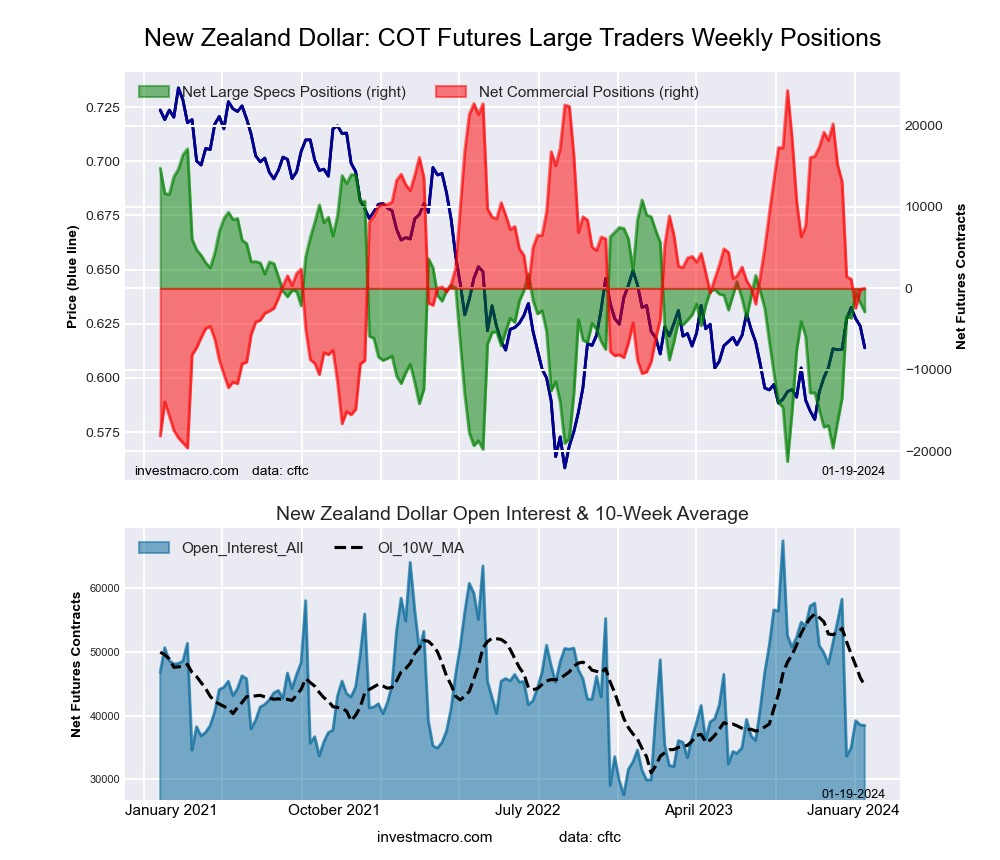
New Zealand Dollar Forex Futures COT ChartThe New Zealand Dollar large speculator standing this week came in at a net position of -19,609 contracts in the data reported through Tuesday. This was a weekly fall of -2,755 contracts from the previous week which had a total of -16,854 net contracts.

This week’s current strength score (the trader positioning range over the past three years, measured from 0 to 100) shows the speculators are currently Bearish-Extreme with a score of 4.3 percent. The commercials are Bullish-Extreme with a score of 90.7 percent and the small traders (not shown in chart) are Bearish with a score of 42.9 percent.

Price Trend-Following Model: Weak Downtrend (Possible Trend Change)

Our weekly trend-following model classifies the current market price position as: Weak Downtrend. The current action for the model is considered to be: Hold – Maintain Short Position.

NEW ZEALAND DOLLAR StatisticsSPECULATORSCOMMERCIALSSMALL TRADERS
– Percent of Open Interest Longs:19.671.77.2
– Percent of Open Interest Shorts:57.732.48.4
– Net Position:-19,60920,208-599
– Gross Longs:10,10436,8983,703
– Gross Shorts:29,71316,6904,302
– Long to Short Ratio:0.3 to 12.2 to 10.9 to 1
NET POSITION TREND:
– Strength Index Score (3 Year Range Pct):4.390.742.9
– Strength Index Reading (3 Year Range):Bearish-ExtremeBullish-ExtremeBearish
NET POSITION MOVEMENT INDEX:
– 6-Week Change in Strength Index:-35.728.513.8


Mexican Peso Futures:

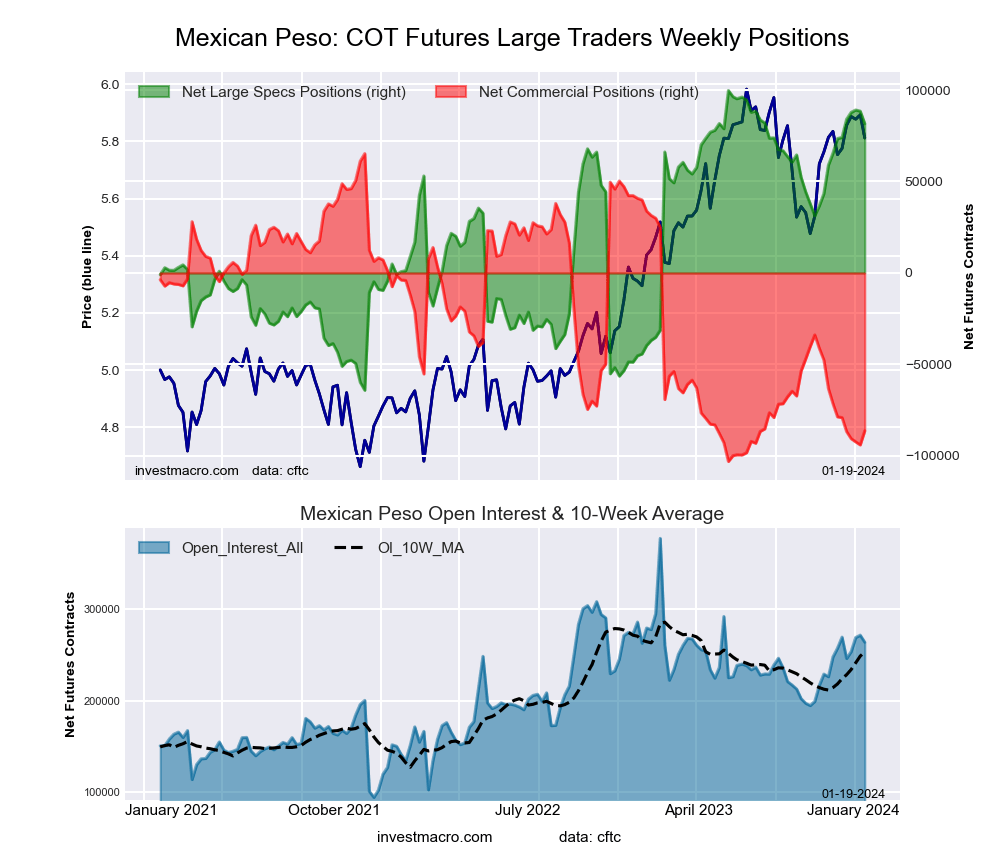
Mexican Peso Futures COT ChartThe Mexican Peso large speculator standing this week came in at a net position of 65,485 contracts in the data reported through Tuesday. This was a weekly boost of 6,554 contracts from the previous week which had a total of 58,931 net contracts.

This week’s current strength score (the trader positioning range over the past three years, measured from 0 to 100) shows the speculators are currently Bullish with a score of 79.1 percent. The commercials are Bearish-Extreme with a score of 18.8 percent and the small traders (not shown in chart) are Bearish with a score of 49.2 percent.

Price Trend-Following Model: Weak Downtrend (Possible Trend Change)

Our weekly trend-following model classifies the current market price position as: Weak Downtrend. The current action for the model is considered to be: Hold – Maintain Short Position.

MEXICAN PESO StatisticsSPECULATORSCOMMERCIALSSMALL TRADERS
– Percent of Open Interest Longs:42.853.13.2
– Percent of Open Interest Shorts:16.382.00.8
– Net Position:65,485-71,4415,956
– Gross Longs:105,838131,5437,840
– Gross Shorts:40,353202,9841,884
– Long to Short Ratio:2.6 to 10.6 to 14.2 to 1
NET POSITION TREND:
– Strength Index Score (3 Year Range Pct):79.118.849.2
– Strength Index Reading (3 Year Range):BullishBearish-ExtremeBearish
NET POSITION MOVEMENT INDEX:
– 6-Week Change in Strength Index:12.9-14.520.8


Brazilian Real Futures:

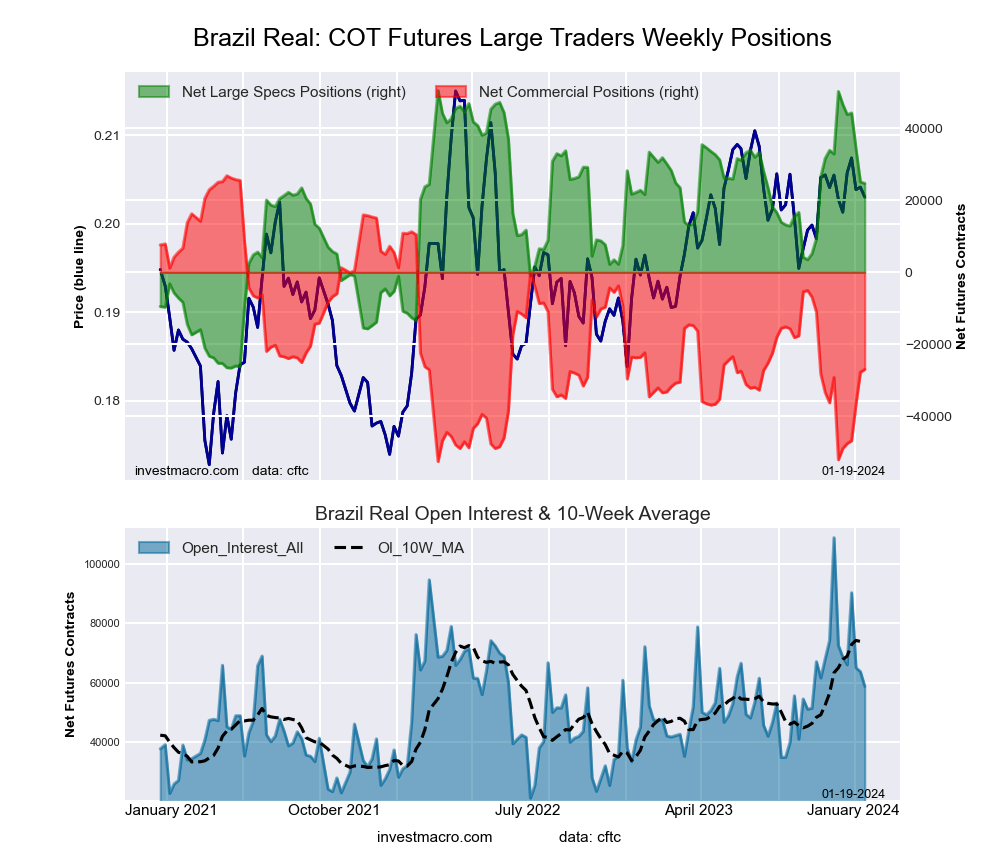
Brazil Real Futures COT ChartThe Brazilian Real large speculator standing this week came in at a net position of 32,881 contracts in the data reported through Tuesday. This was a weekly reduction of -1,001 contracts from the previous week which had a total of 33,882 net contracts.

This week’s current strength score (the trader positioning range over the past three years, measured from 0 to 100) shows the speculators are currently Bullish with a score of 77.1 percent. The commercials are Bearish with a score of 29.4 percent and the small traders (not shown in chart) are Bearish-Extreme with a score of 0.4 percent.

Price Trend-Following Model: Weak Downtrend (Possible Trend Change)

Our weekly trend-following model classifies the current market price position as: Weak Downtrend. The current action for the model is considered to be: Hold – Maintain Short Position.

BRAZIL REAL StatisticsSPECULATORSCOMMERCIALSSMALL TRADERS
– Percent of Open Interest Longs:48.145.73.6
– Percent of Open Interest Shorts:17.872.57.0
– Net Position:32,881-29,230-3,651
– Gross Longs:52,26049,6643,934
– Gross Shorts:19,37978,8947,585
– Long to Short Ratio:2.7 to 10.6 to 10.5 to 1
NET POSITION TREND:
– Strength Index Score (3 Year Range Pct):77.129.40.4
– Strength Index Reading (3 Year Range):BullishBearishBearish-Extreme
NET POSITION MOVEMENT INDEX:
– 6-Week Change in Strength Index:38.1-30.4-48.6


Bitcoin Futures:

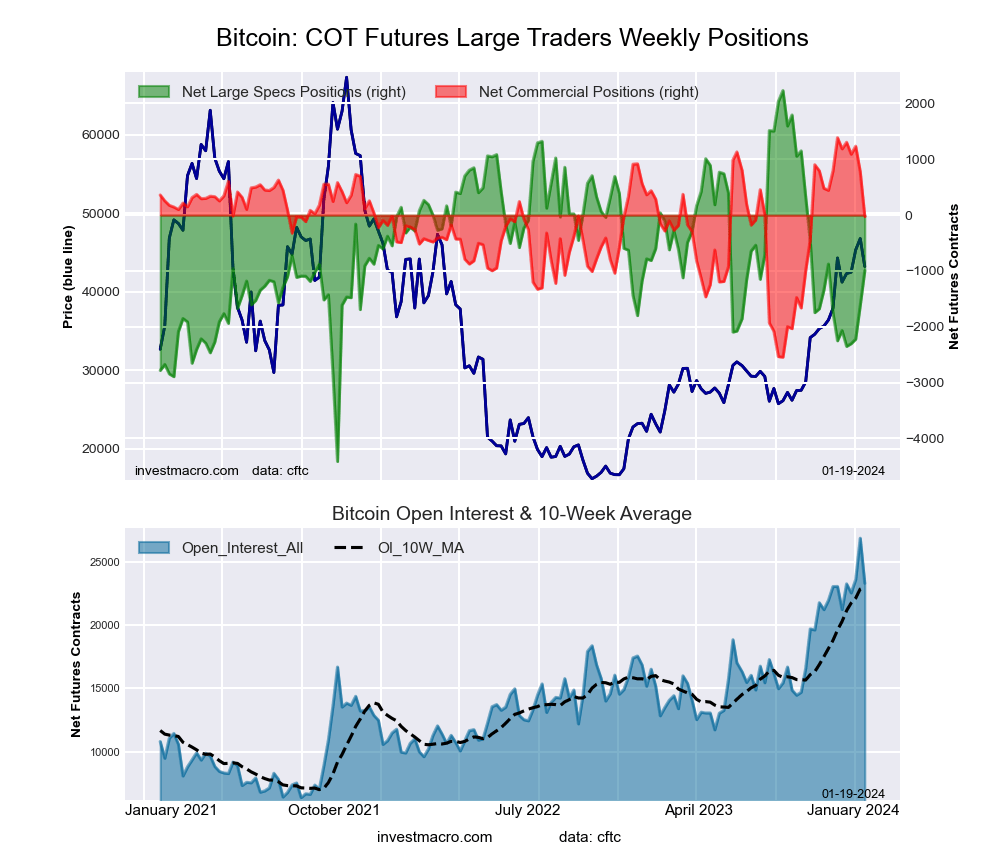
Bitcoin Crypto Futures COT ChartThe Bitcoin large speculator standing this week came in at a net position of -1,745 contracts in the data reported through Tuesday. This was a weekly fall of -869 contracts from the previous week which had a total of -876 net contracts.

This week’s current strength score (the trader positioning range over the past three years, measured from 0 to 100) shows the speculators are currently Bearish with a score of 40.1 percent. The commercials are Bullish-Extreme with a score of 90.7 percent and the small traders (not shown in chart) are Bearish with a score of 34.6 percent.

Price Trend-Following Model: Strong Uptrend

Our weekly trend-following model classifies the current market price position as: Strong Uptrend. The current action for the model is considered to be: Hold – Maintain Long Position.

BITCOIN StatisticsSPECULATORSCOMMERCIALSSMALL TRADERS
– Percent of Open Interest Longs:82.45.87.3
– Percent of Open Interest Shorts:90.02.43.2
– Net Position:-1,745792953
– Gross Longs:18,9791,3441,688
– Gross Shorts:20,724552735
– Long to Short Ratio:0.9 to 12.4 to 12.3 to 1
NET POSITION TREND:
– Strength Index Score (3 Year Range Pct):40.190.734.6
– Strength Index Reading (3 Year Range):BearishBullish-ExtremeBearish
NET POSITION MOVEMENT INDEX:
– 6-Week Change in Strength Index:-31.248.66.5


Article By InvestMacroReceive our weekly COT Newsletter

*COT Report: The COT data, released weekly to the public each Friday, is updated through the most recent Tuesday (data is 3 days old) and shows a quick view of how large speculators or non-commercials (for-profit traders) were positioned in the futures markets.

The CFTC categorizes trader positions according to commercial hedgers (traders who use futures contracts for hedging as part of the business), non-commercials (large traders who speculate to realize trading profits) and nonreportable traders (usually small traders/speculators) as well as their open interest (contracts open in the market at time of reporting). See CFTC criteria here.

Speculator Extremes: SOFR-3M, Steel, Corn & Wheat lead Bullish & Bearish Positions

By InvestMacro 

The latest update for the weekly Commitment of Traders (COT) report was released by the Commodity Futures Trading Commission (CFTC) on Friday for data ending on November 28th.

This weekly Extreme Positions report highlights the Most Bullish and Most Bearish Positions for the speculator category. Extreme positioning in these markets can foreshadow strong moves in the underlying market.

To signify an extreme position, we use the Strength Index (also known as the COT Index) of each instrument, a common method of measuring COT data. The Strength Index is simply a comparison of current trader positions against the range of positions over the previous 3 years. We use over 80 percent as extremely bullish and under 20 percent as extremely bearish. (Compare Strength Index scores across all markets in the data table or cot leaders table)


Here Are This Week’s Most Bullish Speculator Positions:

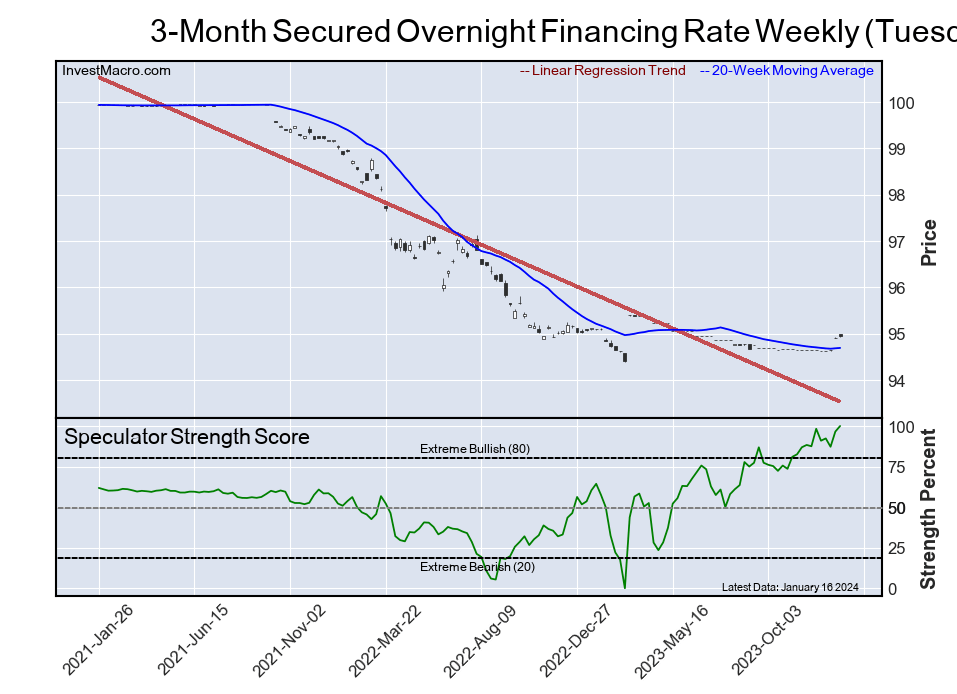
3-Month Secured Overnight Financing Rate


The 3-Month Secured Overnight Financing Rate speculator position comes in as the most bullish extreme standing this week. The 3-Month Secured Overnight Financing Rate speculator level is currently at a 100.0 percent score of its 3-year range.

The six-week trend for the percent strength score totaled 18.1 this week. The overall net speculator position was a total of 527,237 net contracts this week with a rise of 27,337 contract in the weekly speculator bets.


Speculators or Non-Commercials Notes:

Speculators, classified as non-commercial traders by the CFTC, are made up of large commodity funds, hedge funds and other significant for-profit participants. The Specs are generally regarded as trend-followers in their behavior towards price action – net speculator bets and prices tend to go in the same directions. These traders often look to buy when prices are rising and sell when prices are falling. To illustrate this point, many times speculator contracts can be found at their most extremes (bullish or bearish) when prices are also close to their highest or lowest levels.

These extreme levels can be dangerous for the large speculators as the trade is most crowded, there is less trading ammunition still sitting on the sidelines to push the trend further and prices have moved a significant distance. When the trend becomes exhausted, some speculators take profits while others look to also exit positions when prices fail to continue in the same direction. This process usually plays out over many months to years and can ultimately create a reverse effect where prices start to fall and speculators start a process of selling when prices are falling.


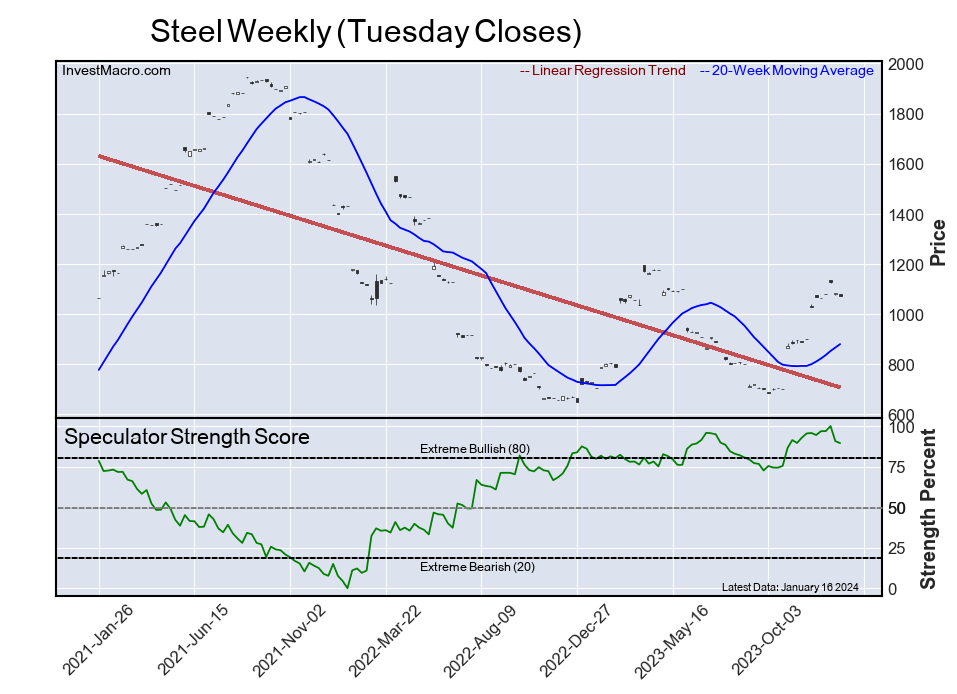
Steel


The Steel speculator position comes next in the extreme standings this week. The Steel speculator level is now at a 98.6 percent score of its 3-year range.

The six-week trend for the percent strength score was 21.8 this week. The speculator position registered -233 net contracts this week with a weekly gain of 682 contracts in speculator bets.


Heating Oil


The Heating Oil speculator position comes in third this week in the extreme standings. The Heating Oil speculator level resides at a 90.2 percent score of its 3-year range.

The six-week trend for the speculator strength score came in at 3.8 this week. The overall speculator position was 37,349 net contracts this week with a boost of 7,447 contracts in the weekly speculator bets.


Cocoa Futures


The Cocoa Futures speculator position comes up number four in the extreme standings this week. The Cocoa Futures speculator level is at a 83.0 percent score of its 3-year range.

The six-week trend for the speculator strength score totaled a change of 0.2 this week. The overall speculator position was 71,646 net contracts this week with a dip of -1,193 contracts in the speculator bets.


Bloomberg Commodity Index


The Bloomberg Commodity Index speculator position rounds out the top five in this week’s bullish extreme standings. The Bloomberg Commodity Index speculator level sits at a 81.3 percent score of its 3-year range. The six-week trend for the speculator strength score was -3.9 this week.

The speculator position was -6,452 net contracts this week with an edge lower by -94 contracts in the weekly speculator bets.


This Week’s Most Bearish Speculator Positions:

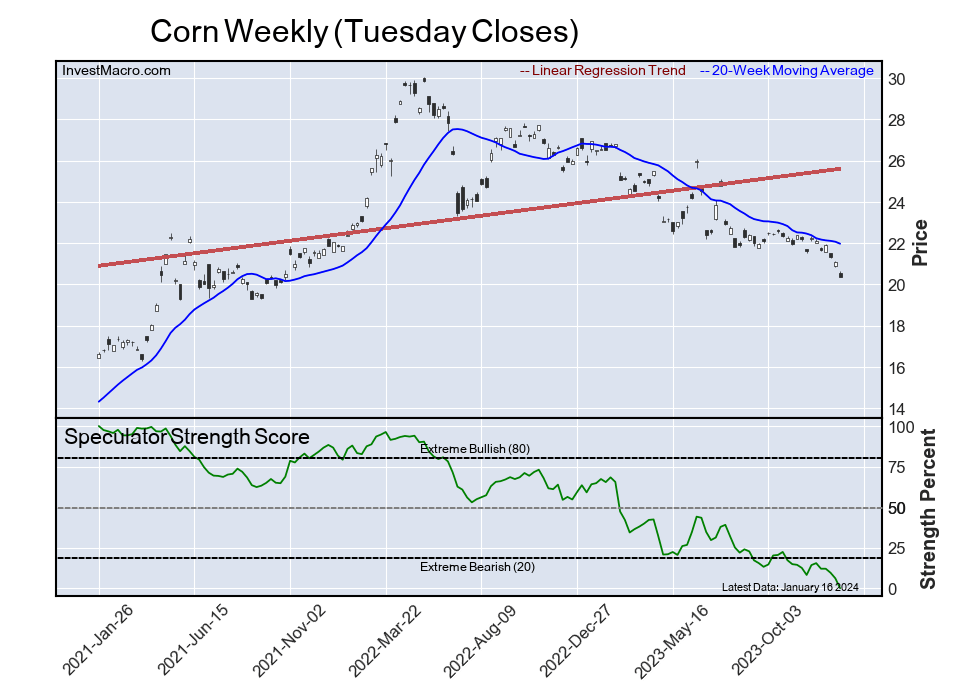
Corn


The Corn speculator position comes in as the most bearish extreme standing this week. The Corn speculator level is at a 0.0 percent score of its 3-year range.

The six-week trend for the speculator strength score was -13.4 this week. The overall speculator position was -157,148 net contracts this week with a drop of -33,142 contracts in the speculator bets.


Wheat


The Wheat speculator position comes in next for the most bearish extreme standing on the week. The Wheat speculator level is at a 0.0 percent score of its 3-year range.

The six-week trend for the speculator strength score was -19.4 this week. The speculator position was -97,204 net contracts this week with a decline of -19,673 contracts in the weekly speculator bets.


E-mini SP MidCap400

The E-mini SP MidCap400 speculator position comes in as third most bearish extreme standing of the week. The E-mini SP MidCap400 speculator level resides at a 0.0 percent score of its 3-year range.

The six-week trend for the speculator strength score was -48.4 this week. The overall speculator position was -1,486 net contracts this week with a slide of -616 contracts in the speculator bets.


Swiss Franc


The Swiss Franc speculator position comes in as this week’s fourth most bearish extreme standing. The Swiss Franc speculator level is at a 1.0 percent score of its 3-year range.

The six-week trend for the speculator strength score was -9.1 this week. The speculator position was -20,289 net contracts this week with a decrease of -1,295 contracts in the weekly speculator bets.


Ultra 10-Year U.S. T-Note


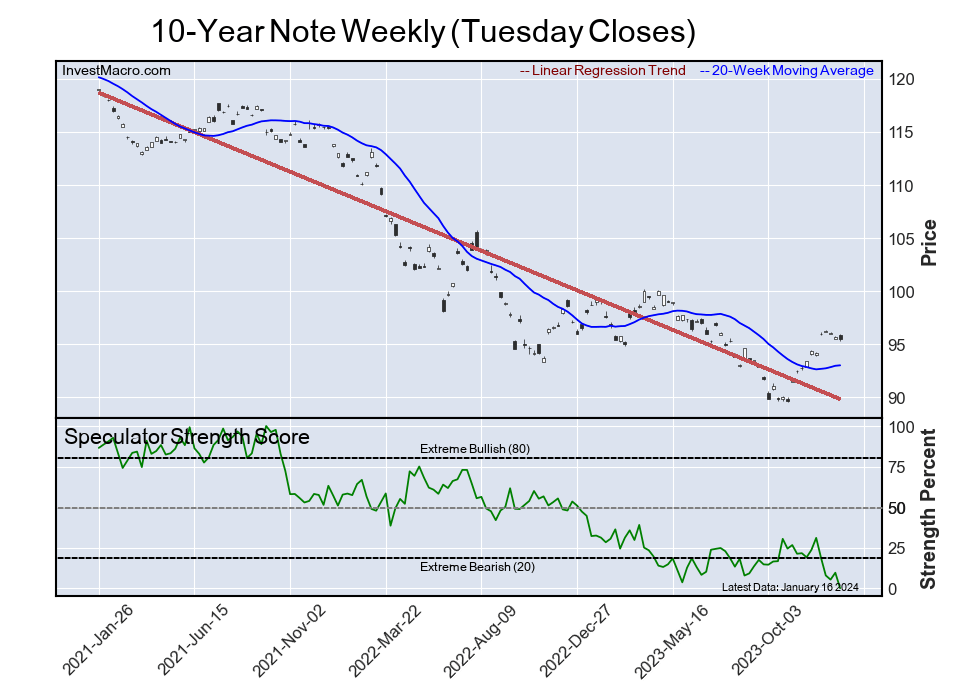
Finally, the Ultra 10-Year U.S. T-Note speculator position comes in as the fifth most bearish extreme standing for this week. The Ultra 10-Year U.S. T-Note speculator level is at a 1.4 percent score of its 3-year range.

The six-week trend for the speculator strength score was -3.1 this week. The speculator position was -257,895 net contracts this week with a decrease of -23,489 contracts in the weekly speculator bets.


Article By InvestMacroReceive our weekly COT Newsletter

*COT Report: The COT data, released weekly to the public each Friday, is updated through the most recent Tuesday (data is 3 days old) and shows a quick view of how large speculators or non-commercials (for-profit traders) were positioned in the futures markets.

The CFTC categorizes trader positions according to commercial hedgers (traders who use futures contracts for hedging as part of the business), non-commercials (large traders who speculate to realize trading profits) and nonreportable traders (usually small traders/speculators) as well as their open interest (contracts open in the market at time of reporting). See CFTC criteria here.

Week Ahead: SPX500_m poised for a ‘Santa Rally’?

By ForexTime 

  • S&P 500 gains 8.9% in November
  • December historically good month for stocks
  • Keep eye on US jobs report and ‘Santa Rally’ chatter
  • Prices trending higher but RSI signals overbought
  • Can SPX500_m bulls maintain hunger for gains?

Christmas may have come early for investors after the S&P 500 ended November 8.9% higher!

This was not only its biggest monthly gain since July 2022 but also its fourth-best month in 10 years.

As we enter December, the stock index could see heightened volatility thanks to key US economic data and growing chatter about a ‘Santa Claus Rally’.

Monday, 4th December

  • USD: US factory orders, durable goods

Tuesday, 5th December

  • CNH: China Caixin services PMI
  • AUD: Reserve Bank of Australia rate decision
  • EUR: Eurozone S&P Global Services PMI, PPI
  • JPY: Japan Tokyo CPI
  • USD: US ISM Services, Job openings

Wednesday, 6th December

  • AUD: Australia GDP
  • CAD: Bank of Canada rate decision
  • EUR: Eurozone retail sales, Germany factory orders
  • GBP: Bank of England biannual stability report
  • USD: US trade

Thursday, 7th December

  • CNH: China trade, forex reserves
  • AUD: Australia trade balance
  • EUR: Eurozone GDP, Germany industrial production
  • USD: US initial jobless claims

Friday, 8th December

  • JPY: Japan household spending, GDP
  • EUR: Germany CPI
  • USD: US jobs report, University of Michigan consumer sentiment

US equity bulls remain supported by cooling inflation, positive US economic data, and growing speculation around the Fed cutting interest rates in 2024. This is reflected in the SPX500_m which has created consistently higher highs and higher lows on the daily timeframe.

Note: SPX500_m tracks the S&P 500 index (the benchmark used to measure the stock performance of the 500 largest listed US companies)

With exactly one month left until the end of 2023, the question is whether SPX500_m bulls can maintain their hunger for gains.

Here are 3 factors to keep an eye on in the week ahead:

  1. ‘Santa Rally’ chatter 

With Christmas just around the corner, discussion around a potential ‘Santa Clause Rally’ is likely to be widely discussed across the board.

This financial phenomenon is where stocks generally rise in the last week of December and the first two trading days of the new year. 

It is not fully clear whether it’s purely psychological or triggered by some underlying financial forces, but history has shown that this is a recurring seasonal pattern.

Indeed, December has been a historically positive month for the S&P500 which has produced positive returns 75% of the time since 1994.

Markets seem to be in good spirits with chatter about a ‘Santa Rally’ possibly influencing the index over the next few weeks.

  1. US November jobs report 

On the data front, the US non-farm payrolls could offer fresh clues about what action the Federal Reserve will take beyond 2023.

The US economy is expected to have created 200,000 jobs in November, a noticeable pickup from the 150,000 jobs in October. The unemployment rate is forecast to remain unchanged at 3.9% while average hourly earnings are expected to tick lower to 4.0% year-on-year.

Given how tech stocks account for roughly 29% of the S&P 500 weighting, the incoming jobs report could spark volatility.

Note: Tech stocks influenced by interest rates because their value is based on earnings forecasted in the future.

Traders are currently pricing in a 60% probability of a 25-basis point cut by March 2024, with a cut by May 2024 fully priced, according to Fed Funds futures.

  • The SPX500_m is likely to trade lower if the US jobs report meets or exceeds forecasts and investors re-evaluate when the Fed will cut rates in 2024.
  • Should the US jobs report market expectations, this could reinforce bets around the Fed cutting rates – supporting the SPX500_m as a result.
  1. Technical forces

The SPX500_m remains in a bullish channel on the daily charts with prices trading above the 50, 100, and 200-day SMA. Although the path of least resistance points north, the Relative Strength Index (RSI) remains around 70 – suggesting that prices are heavily overbought. A technical rebound could be a possibility before bulls return to the driving seat.

  • The support at 4525 could provide bulls the foundation to attack the 2023 high at 4611 and 4660 – a level not seen since January 2022.
  • Should prices slip back under 4525, this may open a path back towards 4500 and 4470, respectively.


Forex-Time-LogoArticle by ForexTime

ForexTime Ltd (FXTM) is an award winning international online forex broker regulated by CySEC 185/12 www.forextime.com

Why the Fed should treat climate change’s $150B economic toll like other national crises it’s helped fight

By Jennie C. Stephens, Northeastern University and Martin Sokol, Trinity College Dublin 

Climate disasters are now costing the United States US$150 billion per year, and the economic harm is rising.

The real estate market has been disrupted, as home insurance rates skyrocket as wildfire and flood risks rise with the warming climate. Food prices have gone up with disruptions in agriculture. Health care costs have increased as heat takes a toll. Marginalized and already vulnerable communities that are least financially equipped to recover are being hit the hardest.

Despite this growing source of economic volatility, the Federal Reserve – the U.S. central bank that is charged with maintaining economic stability – is not considering the instability of climate change in its monetary policy.

Earlier this year, Fed Chair Jerome Powell declared unequivocally: “We are not, and we will not become, a climate policymaker.”

Powell’s rationale is that to maintain the Fed’s independence from politics and political cycles, it should use its tools narrowly to focus on its core mission of economic stability. That includes price stability, meaning keeping inflation low and maximizing employment. In Powell’s view, the Fed should stay away from social and environmental concerns that are not tightly linked to its statutory goals.

However, it is getting increasingly difficult for central banks to ensure stability if they do not integrate climate instability into their monetary policies.

As researchers with expertise in climate justice and central banks, we recently published a paper reviewing the monetary policy tools available to central banks around the world that could help slow climate change and reduce climate vulnerabilities.

With the new U.S. National Climate Assessment and other research making clear that U.S. policies and actions are insufficient to minimize climate instability and manage the growing economic costs, we believe it’s time to reconsider the role of central banks in responding to the climate crisis.

Rethinking interest rates

One thing central banks could do is set lower interest rates for renewable energy development. The Bank of Japan has used this strategy.

The Fed’s aggressive increases in interest rates in response to rising inflation have slowed the transformation toward a more sustainable society by supporting fossil fuels and making investments in renewable energy infrastructure more expensive. Offshore wind power has been particularly hard hit, with multiple multibillion-dollar projects canceled as higher interest rates raised the projects’ costs.

One way to introduce differentiated rates would be to create a special lending facility under which commercial banks could borrow money from the central bank at preferential interest rates if used for renewable energy deployment or other climate-friendly investments. Whether the Fed already has authorization to do that depends on interpretation of its current mandate.

While the U.S. Federal Reserve has not done it before, China’s central bank has used similar tools to incentivize renewable energy, and the Bank of Japan’s lending facility offers zero-interest loans for green investments.

Nudging banks to rethink investments

Despite the Fed’s proclaimed efforts not to pick winners and losers, its monetary policies have taken steps that favor established industries and companies, including the fossil fuel industry.

For example, the Fed supported the financial sector unconditionally during the COVID-19 pandemic to keep credit available to limit economic harm. Its massive purchases of corporate bonds resulted in subsidies to the fossil fuel sector.

Our analysis suggests two ways to help manage climate change now: The Fed can reinterpret its current statutory duties and start viewing climate action as a critical part of its role in maintaining economic stability within its existing mandate, as the European Central Bank has done, or the mandate of the Fed can be changed by Congress to explicitly include “green” transformation objectives, similar to the U.K.‘s mandate for the Bank of England.

Either of these options could empower the Fed to address climate change and support the government, businesses, banks, households and communities in financing climate mitigation and adaptation efforts.

Two maps showing extreme heat days rising almost everywhere and extreme precipitation increasingly common, particularly in the Eastern U.S.
Rising temperatures exacerbate climate risks, including droughts, wildfires and extreme storms. Global temperatures have already warmed by more than 1 degree Celsius (1.8 Fahrenheit) compared to preindustrial times. The projected changes with 2 C (3.6 F) of warming, which the world is on pace to exceed this century, are relative to the 1991-2020 average.
Fifth National Climate Assessment

The Fed could also discourage banks and investors from investing in assets that ultimately harm the economy – for instance, by setting collateral requirements for banks that would reduce the attractiveness of holding carbon-intensive assets. The European Central Bank recently announced that it would tilt purchases of corporate bonds toward “green” assets.

The Fed has recently taken steps to push large financial institutions to monitor climate-related risks in their portfolios, drawing the ire of Republicans, who claimed the bank had no authority to consider climate change. Whether this risk management approach will pressure banks to change their lending patterns is not yet clear.

The Fed and other central banks could go further and mandate energy transition planning with an eye toward economic stability. The European Union developed a whole new sustainable finance framework designed to discourage investment in economic activities that do not support an energy transition along the lines of the European Green Deal, which aims to turn Europe into a climate-neutral continent with no one left behind. The European Central Bank is obligated to support EU economic policies, including the green transition.

The Fed has used creative tools before

Many times in its 110-year history, the Fed has provided financial support to the U.S. government during major crises, such as wars and recessions, by offering direct lines of credit or by directly purchasing Treasury bonds. During the pandemic, it took extraordinary steps to keep U.S. businesses running.

Now that the U.S. is facing rising costs from the climate crisis, we believe the Fed should treat climate change with the same urgency and importance.

In our analysis of the tools available to central banks, we took a climate justice perspective, looking beyond greenhouse gas emission reductions to incorporate social justice and economic equity. Instead of focusing on supporting corporate interests and the financial sector in the short term to stabilize markets, we believe central banks could prioritize longer-term stability by funneling investments toward vulnerable communities and people.

The Bank of England, the European Central Bank and other central banks are already implementing some pro-climate measures. At the Fed, Powell seems more concerned with political backlash than the economic damage to the U.S. economy outlined in the latest climate assessment.

We believe it is past time that the Fed consider climate destabilization as a major economic crisis and use more of the tools in the central bank toolbox to tackle it.The Conversation

About the Author:

Jennie C. Stephens, Dean’s Professor of Sustainability Science & Policy, Northeastern University and Martin Sokol, Associate Professor of Economic Geography, Trinity College Dublin

This article is republished from The Conversation under a Creative Commons license. Read the original article.


Mid-Week Technical Outlook: SPX500_m eyes 2023 high

By ForexTime 

  • SPX500_m up roughly 9% in November
  • Key US data and Powell speech may rock index
  • Prices trending higher with bulls eyeing 2023 high
  • Watch out for RSI which remains in overbought territory

The SPX500_m is on track for its biggest monthly gain since July 2022 and fourth-best month in the last 10 years!

November has been a stellar month for the stock index which is currently up roughly 9% as of writing.

Equity bulls remain empowered by growing speculation around the Fed cutting interest rates in 2024. With the upside momentum in full swing after prices blasted through a previous resistance level, the next key level of interest may be the 2023 high.

Should economic data and dovish remarks from Fed officials reinforce bets around Fed cuts next year, this could keep SPX500_m bulls in a position of power.

Taking a look at the technical picture, prices are firmly bullish on the daily charts. There have been consistently higher highs and higher lows while prices are trading above the 50, 100 and 200-day SMA.

It is a similar story on the weekly timeframe with prices approaching the 4600 resistance level. Beyond this point, the next key level of interest can be found at 4820 – a level not seen since January 2022.

One key thing that stands out in the daily timeframe is the Relative Strength Index (RSI) which remains around 70. With prices deep in overbought territory, a technical throwback could be around the corner before prices push higher.

  • Bulls remain in control above the 4525 level with the next key point of interest at 4611.

  • Should prices slip back under 4525, this may trigger a decline toward 4500 and 4470, respectively.


Forex-Time-LogoArticle by ForexTime

ForexTime Ltd (FXTM) is an award winning international online forex broker regulated by CySEC 185/12 www.forextime.com

56% of investors plan to increase ESG investments in 2024

By George Prior 

More than half of investors plan to increase their ESG-orientated investments in 2024, reveals a new global survey from deVere Group, one of the world’s largest independent financial advisory, asset management and fintech organizations.

The 800+ clients polled from deVere Group, which writes business in more than 70 countries globally, illuminate a strong trend in the investment landscape: 56% of investors are gearing up to increase their allocations to Environmental, Social, and Governance (ESG) investments next year.

The findings are published as more than 70,000 political and business leaders, diplomats, financiers, and activists are flying to Dubai to talk about ways to avoid environmental disaster due to climate change at COP28, the annual international climate summit convened by the United Nations.

Of the survey, deVere Group CEO and Founder Nigel Green comments: “The surge in ESG-oriented investments is not just a statistical blip; it mirrors a fundamental shift in investor mindset.

“People are increasingly drawn to ESG investments for a multitude of reasons, spanning ethical considerations to financial prudence.”

“Investors are increasingly aware that their capital can be a force for positive change. ESG investments allow them to channel funds towards companies that actively contribute to a sustainable and socially responsible future.

“Far from being a sacrifice for moral high ground, ESG investments are proving to be financially astute.

“Numerous studies suggest that companies with high ESG scores tend to outperform the market; and Reuters has reported that ESG positive funds outperformed globally over 5 years.”

Not only are companies with high ESG ratings often better positioned to weather market volatility and capitalise on emerging opportunities, ESG factors are increasingly recognized as critical elements in risk assessment.

“Companies with robust environmental, social, and governance practices are better equipped to navigate regulatory changes, reputational risks, and operational challenges. Investors are, therefore, drawn to ESG investments as a means of fortifying their portfolios against unforeseen risks,” notes the deVere CEO.

Governments and regulatory bodies worldwide are also embracing sustainability measures.

“Unsurprisingly, investors are keen on future-proofing their portfolios by aligning with these shifting regulatory requirements. ESG investments position portfolios to thrive in a world where sustainable practices are not just a preference but a regulatory imperative.”

The deVere Group poll highlighting that in 2024 more than half of investors plan to increase their ESG-focused holdings bucks the trend since over the last year.

For four consecutive quarters, the market has seen outflows from ESG funds in both the US and Europe, and elsewhere, amid rising energy prices and political backlash.

“Awareness among investors about ESG has been increasing in recent years.  But we should work harder to ensure it is consistently at the heart of investment decision-making,” says Nigel Green.

“Climate change is a key defining issue of our time. It will be a critical determinant in long-term financial returns, and the highest net economic benefit is reducing the impact of climate change.”

He concludes: “This survey reflects a broader shift in investor consciousness – a realization that investing in a sustainable future is not only ethical, but also a savvy financial strategy.

“As we navigate the complexities of the contemporary investment landscape and an intensifying climate crisis, ESG-focused investments emerge not only as a path to profitability but as a commitment to building a better world.”

About:

deVere Group is one of the world’s largest independent advisors of specialist global financial solutions to international, local mass affluent, and high-net-worth clients.  It has a network of more than 70 offices across the world, over 80,000 clients and $12bn under advisement.

Trade Of The Week: EURUSD bulls back in town?

By ForexTime 

  • EURUSD climbs roughly 500 pips from October low
  • Data from both sides of the Atlantic could rock currency pair
  • Euro bulls in position of power but RSI signals overbought
  • Prices are testing resistance level at 1.0950
  • Another big move around the corner for EURUSD?

The world’s most traded FX pair has climbed roughly 500 pips from its October low!

Over the past few weeks, EURUSD bulls have been putting in the work with prices back above the 200-day Simple Moving Average. 

Fundamentally, a weaker dollar has powered the EURUSD’s upside. Dollar weakness was a major theme this month, especially after the softer-than-expected US inflation data solidified bets over the Fed being done with rate hikes.

Given how the currency pair is testing a significant resistance level ahead of a data-packed week from both sides of the Atlantic, another big move could be around the corner.

Here are three main factors to look out for this week:

  1. Key EU data

It’s a data-heavy week for the euro with the latest inflation figures and PMI’s among other reports in focus.

Wednesday sees the Eurozone economic and consumer confidence report coupled with CPI figures from Germany which could offer fresh clues about what actions the ECB may take beyond 2023. Germany’s month-on-month inflation figures are expected to post a negative 0.1% print in November while the year-on-year is forecast to hit 3.5% – lower than the 3.8% in the previous month. On Thursday, attention will be on the Eurozone CPI and Germany unemployment figures which will be topped off with the Eurozone/Germany S&P Global Manufacturing PMI’s on Friday.

Traders are currently pricing in a 61% probability of an ECB 25 basis point rate cut by April 2024.

  • The EURUSD could weaken on further evidence of cooling price pressures and disappointing economic data from the eurozone/Germany.
  • A surprise uptick in inflation and better-than-expected economic data could support the euro, pushing the EURUSD higher as a result.
  1. Dollar volatility

The cocktail of US economic data coupled with speeches from a host of Fed officials including Jerome Powell could trigger dollar volatility this week.

Data such as third-quarter US GDP (second estimate), consumer confidence, the latest PCE report and PMI’s among others may offer fresh clues about the Fed’s 2024 policy outlook. On Friday, Powell will be under the spotlight with his comments heavily scrutinized by investors for more clarity on the Fed’s thinking beyond 2023.

  • The dollar is likely to strengthen if economic data beats forecasts and Powell downplays expectations around US rate cuts next year. A stronger dollar may drag the EURUSD’s lower.
  • Should US economic data disappoint and Powell along with other Fed officials strike a dovish tone, the EURUSD may venture higher amid a weaker dollar.
  1. Technical forces

The EURUSD remains in a healthy uptrend on the daily charts as there have been consistently higher highs and higher lows. Although euro bulls are in a position of power above the 200-day SMA, the Relative Strength Index (RSI) has touched 70 – indicating that prices may be overbought. A strong breakout or technical rebound could be on the horizon, with 1.0950 acting as a key level of interest.

  • Should prices secure a strong breakout and daily close above 1.0950, this could open the doors towards 1.1030 and 1.1080 – a level not seen since late July. 
  • Should the EURUSD remain capped below 1.0950, this could trigger a decline back towards 1.0850 and the 200-day SMA at 1.0813. 

According to Bloomberg’s FX model, there is a 76% chance that the EURUSD trades within the 1.0854 – 1.1062 range this week.


Forex-Time-LogoArticle by ForexTime

ForexTime Ltd (FXTM) is an award winning international online forex broker regulated by CySEC 185/12 www.forextime.com

Dollar to dive in 2024 as investors bet on Fed cuts

By George Prior 

The US dollar is likely to “consistently weaken” throughout 2024 as the US Federal Reserve winds up its aggressive interest rate hiking agenda, predicts the CEO and founder of one of the world’s largest independent financial advisory, asset management and fintech organizations.

The bearish forecast from deVere Group chief executive Nigel Green comes as it is reported that asset managers are selling the currency at the fastest pace in a year.

He comments: “The Big Dollar Sell-Off is on.

“We expect this trend to increase in momentum throughout 2024 as investors increasingly believe that the Federal Reserve’s most aggressive interest rate hiking campaign in a generation is winding down.

“The dollar traditionally performs well at the start of the year, but it is likely that it will consistently weaken during the course of next year as the Fed moves to ease its grip on rates.

“With the battle against inflation being won, it can be expected that the central bank will roll out multiple rate cuts in 2024, prompting investors to think that holding so many dollars is not as necessary.”

The expectation is that lower interest rates will reduce the attractiveness of dollar-denominated assets. As interest rates in the US decline, the interest rate differential between the dollar and other currencies narrows, diminishing the yield advantage that has historically drawn investors to the greenback.

Furthermore, the possibility of multiple rate cuts by the Fed is prompting investors to seek higher-yielding assets elsewhere, contributing to the accelerated exit from the dollar.

“Alternative investments in currencies from regions with more favourable interest rate outlooks become increasingly appealing as the interest rate differentials shift in their favor.”

The reverberations of this dollar sell-off extend beyond the borders of the United States.

“A weakened dollar has implications for global trade, as a depreciating currency can boost US exports but may also lead to tensions with trading partners,” says the deVere Group CEO.

“In addition, emerging market economies, which often carry significant levels of dollar-denominated debt, will experience relief as the burden of servicing this debt is alleviated with a weaker dollar.”

He concludes: “As investors bet big on the Fed cutting rates, 2024 could be dubbed ‘the year of the dollar dive’.”

About:

deVere Group is one of the world’s largest independent advisors of specialist global financial solutions to international, local mass affluent, and high-net-worth clients.  It has a network of more than 70 offices across the world, over 80,000 clients and $12bn under advisement.

Pooling multiple models during COVID-19 pandemic provided more reliable projections about an uncertain future

By Emily Howerton, Penn State; Cecile Viboud, National Institutes of Health, and Justin Lessler, University of North Carolina at Chapel Hill 

How can anyone decide on the best course of action in a world full of unknowns?

There are few better examples of this challenge than the COVID-19 pandemic, when officials fervently compared potential outcomes as they weighed options like whether to implement lockdowns or require masks in schools. The main tools they used to compare these futures were epidemic models.

But often, models included numerous unstated assumptions and considered only one scenario – for instance, that lockdowns would continue. Chosen scenarios were rarely consistent across models. All this variability made it difficult to compare models, because it’s unclear whether the differences between them were due to different starting assumptions or scientific disagreement.

In response, we came together with colleagues to found the U.S. COVID-19 Scenario Modeling Hub in December 2020. We provide real-time, long-term projections in the U.S. for use by federal agencies such as the Centers for Disease Control and Prevention, local health authorities and the public. We work directly with public health officials to identify which possible futures, or scenarios, would be most helpful to consider as they set policy, and we convene multiple independent modeling teams to make projections of public health outcomes for each scenario. Crucially, having multiple teams address the same question allows us to better envision what could possibly happen in the future.

Since its inception, the Scenario Modeling Hub has generated 17 rounds of projections of COVID-19 cases, hospitalizations and deaths in the U.S. across varying stages of the pandemic. In a recent study published in the journal Nature Communications, we looked back at all these projections and evaluated how well they matched the reality that unfolded. This work provided insights about when and what kinds of model projections are most trustworthy – and most importantly supported our strategy of combining multiple models into one ensemble.

line graph that ends in multiple colored options on the right
Collecting projections from multiple independent models provides a fuller picture of possible futures − as in this graph of potential hospitalizations − and allows researchers to generate an ensemble.
COVID-19 Scenario Modeling Hub, CC BY-ND

Multiple models are better than just one

A founding principle of our Scenario Modeling Hub is that multiple models are more reliable than one.

From tomorrow’s temperature on your weather app to predictions of interest rates in the next few months, you likely use the combined results of multiple models all the time. Especially in times like the COVID-19 pandemic when uncertainty abounds, combining projections from multiple models into an ensemble provides a fuller picture of what could happen in the future. Ensembles have become ubiquitous in many fields, primarily because they work.

Our analysis of this approach with COVID-19 models resoundingly showed the strong performance of the Scenario Modeling Hub ensemble. Not only did the ensemble give us more accurate predictions of what could happen in the future overall, it was substantially more consistent than any individual model throughout the different stages of the pandemic. When one model failed, another performed well, and by taking into account results from all of these varying models, the ensemble emerged as more accurate and more reliable.

Researchers have previously shown performance benefits of ensembles for short-term forecasts of influenza, dengue and SARS-CoV-2. But our recent study is one of the first times researchers have tested this effect for long-term projections of alternative scenarios.

A ‘hub’ makes multimodel projections possible

While scientists know combining multiple models into an ensemble improves predictions, it can be tricky to put an ensemble together. For example, in order for an ensemble to be meaningful, model outputs and key assumptions need to be standardized. If one model assumes a new COVID-19 variant will gain steam and another model does not, they will come up with vastly different results. Likewise, a model that projects cases and one that projects hospitalizations would not provide comparable results.

people seated around an open conference table with whiteboards
Meeting frequently helps multiple modeling teams stay on the same page.
Matteo Chinazzi, CC BY-ND

Many of these challenges are overcome by convening as a “hub.” Our modeling teams meet weekly to make sure we’re all on the same page about the scenarios we model. This way, any differences in what individual models project are the result of things researchers truly do not know. Retaining this scientific disagreement is essential; the success of the Scenario Modeling Hub ensemble arises because each modeling team takes a different approach.

At our hub we work together to design our scenarios strategically and in close collaboration with public health officials. By projecting outcomes under specific scenarios, we can estimate the impact of particular interventions, like vaccination.

For example, a scenario with higher vaccine uptake can be compared with a scenario with current vaccination rates to understand how many lives could potentially be saved. Our projections have informed recommendations of COVID-19 vaccines for children and bivalent boosters for all age groups, both in 2022 and 2023.

In other cases, we design scenarios to explore the effects of important unknowns, such as the impact of a new variant – known or hypothetical. These types of scenarios can help individuals and institutions know what they might be up against in the future and plan accordingly.

Although the hub process requires substantial time and resources, our results showed that the effort has clear payoffs: The information we generate together is more reliable than the information we could generate alone.

The sum is greater than the parts when researchers build an ensemble from multiple coordinated but independent models.
Matteo Chinazzi, CC BY-ND

Past reliability, confidence for future

Because Scenario Modeling Hub projections can inform real public health decisions, it is essential that we provide the best possible information. Holding ourselves accountable in retrospective evaluations not only allows us to identify places where the models and the scenarios can be improved, but also helps us build trust with the people who rely on our projections.

Our hub has expanded to produce scenario projections for influenza, and we are introducing projections of respiratory syncytial virus, or RSV. And encouragingly, other groups abroad, particularly in the EU, are replicating our setup.

Scientists around the world can take the hub-based approach that we’ve shown improves reliability during the COVID-19 pandemic and use it to support a comprehensive public health response to important pathogen threats.The Conversation

About the Authors:

Emily Howerton, Postdoctoral Scholar in Biology, Penn State; Cecile Viboud, Senior Research Scientist, National Institutes of Health, and Justin Lessler, Professor of Epidemiology, University of North Carolina at Chapel Hill

This article is republished from The Conversation under a Creative Commons license. Read the original article.

Burgeoning Downtrend in Us Dollar Could Ease Difficulties Facing Emerging Market Economies

Source: McAlinden Research  (11/17/23)

 McAlinden Research Partners McAlinden Research shares thoughts on the current state of the U.S. dollar and how this may impact the market.

The U.S. Dollar Index (DXY) fell to a 2-month low earlier this week on consumer price inflation data that was softer than expected. A gradual pace of disinflation has taken hold and appears to indicate the Federal Reserve has wrangled inflation for the moment. The slowing pace of growth in the CPI was compounded by outright deflation in producer prices, as well as import and export price data.

These data points have increased the likelihood that the Fed has concluded its spate of rate hikes, reaching a terminal Fed Funds rate of 5.5%. If so, that would fall one hike short of what Fed policymakers projected for 2023 in September’s dot plot. Fed Funds futures contracts traded on the Chicago Mercantile Exchange (CME) indicate that traders see no further hikes going forward into 2024.

When interest rates rise in the U.S., the higher yields can attract investment capital from investors abroad who exchange assets in non-USD currencies for Dollar-denominated investments. This demand, in turn, raises the value of the Dollar compared to other currencies. In a similar way, if rates are to hold steady or even begin to fall, that can cut the appeal of the Dollar. CME’s FedWatch tool suggests a cut is actually more likely than any further hikes going forward — particularly from May 2024 and beyond.

It was all the way back in our August 2022 Viewpoint, The FX Timebomb , that MRP noted the Dollar was likely on the verge of a downturn, as the Fed was rapidly approaching what we termed “peak hawkishness;” the point at which rate hikes reached their maximum size and frequency. We wagered that, from that point on, the central bank’s rate hike regime would gradually reduce the size of rate hikes from 75bps at their largest to 50bps and then, eventually, just 25bps. Further, these hikes would become less frequent until they ceased altogether — likely the state of affairs we have now reached with just one hike in the past four FOMC meetings. The DXY hit a more than 20-year high north of 114.0 that September, prior to retreating. Though we did witness a rebound in the Dollar from lows under 100.00 earlier this year, it has not gotten anywhere near its 2022 high.

If Dollar strength is indeed set to subside further, that could provide a boon to emerging market (EM) economies. Per a 2023 IMF analysis, a 10.0% USD appreciation, linked to global financial market forces, decreases economic output in emerging economies by -1.9% after one year’s time, and this drag lingers for two and a half years. The international impact of material USD appreciation is felt disproportionately in EM economies, as growth in developed economies only experiences an immediate decline of -0.6% in the wake of 10.0% USD appreciation, and that dent dissipates in a year’s time.

The strong USD battered nearly all international currencies — particularly those in emerging markets — but subsiding rate pressure from the Fed is bolstering expectations for non-USD currencies in the year ahead. A majority of analysts in a November Reuters poll indicated that they expect the Dollar to trade lower by year-end. The rebound in EM currencies is expected to be gradual, but several EM currencies, like the Indian Rupee, Thai Baht, and South Korean Won, were projected to recoup recent losses sustained against the US Dollar by late 2024.

Shares of many publicly traded EM firms could be bolstered by a favorable currency translation effect if the Dollar continues to soften relative to local currencies. An October 2023 outlook report from Lazard Asset Management notes that current earnings growth forecasts show EM earnings growth of 19% in 2024, nearly doubling expectations for developed markets earnings growth at just 10%. Earnings in the U.S. are only expected to expand by 12%, signifying a 7% positive earnings growth spread in favor of EM over U.S. equities.

The most significant impact of a weakening Dollar on emerging markets may be the impact on their debt loads. As of 2019, about two-thirds of external debt in EM economies was denominated in USD. By October 2022, Bank for International Settlements (BIS) data showed that non-financial dollar-denominated debt in emerging economies stood at $4.2 trillion. When the Dollar appreciates in value compared to local currencies in emerging markets, the servicing of USD-denominated debt becomes more costly on a relative basis. However, the opposite case could now take place, with EM debt loads becoming more manageable.

Investors can gain exposure to emerging markets via the iShares MSCI Emerging Markets ETF (EEM), as well as EM currencies via the WisdomTree Emerging Currency Strategy Fund (CEW). Additionally, exposure to the U.S. Dollar can be gained with either the Invesco DB U.S. Dollar Index Bullish Fund (UUP) or Invesco’s DB U.S. Dollar Index Bearish Fund (UDN).

Charts


Important Disclosures:

  1. Statements and opinions expressed are the opinions of the author and not of Streetwise Reports or its officers. The author is wholly responsible for the validity of the statements. The author was not paid by Streetwise Reports for this article. Streetwise Reports was not paid by the author to publish or syndicate this article. Streetwise Reports requires contributing authors to disclose any shareholdings in, or economic relationships with, companies that they write about. Streetwise Reports relies upon the authors to accurately provide this information and Streetwise Reports has no means of verifying its accuracy.
  2. This article does not constitute investment advice. Each reader is encouraged to consult with his or her individual financial professional and any action a reader takes as a result of information presented here is his or her own responsibility. By opening this page, each reader accepts and agrees to Streetwise Reports’ terms of use and full legal disclaimer. This article is not a solicitation for investment. Streetwise Reports does not render general or specific investment advice and the information on Streetwise Reports should not be considered a recommendation to buy or sell any security. Streetwise Reports does not endorse or recommend the business, products, services or securities of any company mentioned on Streetwise Reports.

For additional disclosures, please click here.

McAlinden Research Partners Disclosures
This report has been prepared solely for informational purposes and is not an offer to buy/sell/endorse or a solicitation of an offer to buy/sell/endorse Interests or any other security or instrument or to participate in any trading or investment strategy. No representation or warranty (express or implied) is made or can be given with respect to the sequence, accuracy, completeness, or timeliness of the information in this Report. Unless otherwise noted, all information is sourced from public data.
McAlinden Research Partners is a division of Catalpa Capital Advisors, LLC (CCA), a Registered Investment Advisor. References to specific securities, asset classes and financial markets discussed herein are for illustrative purposes only and should not be interpreted as recommendations to purchase or sell such securities. CCA, MRP, employees and direct affiliates of the firm may or may not own any of the securities mentioned in the report at the time of publication.