Archive for Opinions – Page 64

Copper Shortages Are Looming and Four Stocks to Benefit

Source: Ron Struthers  (12/12/23)

Investment in copper mining is very low at a time when it should be at record highs to accommodate electrification of world economies. Ron Struthers of Struthers Resource Stock Report looks into three promising copper exploration plays and a pure producer, Capstone. 

For a long time, copper has been described with a PhD in economics. It is tied so much to all industries that its demand cycles can mirror economic cycles.

As most of the world seeks to reach net-zero targets and transition to cleaner, renewable forms of energy, copper is a big requirement. However, the amount of copper needed to successfully facilitate the energy transition is staggering. Nearly 70% of all copper produced is used in electrical applications, which is why it’s so important to the energy transition.

While the average internal combustion engine vehicle contains approximately 48 pounds of copper, a typical EV contains nearly four times that amount. Solar Technology uses about 5.5 tons copper/MW of electricity and wind about 4 tons/MW onshore and 10 tons/MW offshore.

Jerome Leroy, vice president of the Canadian business unit of cable supplier Nexans, worries that copper mines won’t be able to keep up. This concern partly stems from the fact it takes many years to secure regulatory approvals for new mines. Moreover, ore grades at existing mines have long been in decline. (Production is concentrated in Chile, Peru, and China.) Mr. Leroy points to forecasts suggesting production capacity will grow to 27 million tonnes a year by the end of this decade, whereas demand could rise as high as 35 million tonnes. A shortfall could materialize as soon as next year, he warns.

“I start to see it happening at the power utility level,” he said. “People are requesting more and more cable. The likes of BC Hydro and Hydro-Québec, and others, say that probably they will need at least 5% more cable every year starting from now.”

Blair DeBruyne, the director of operations, inventory, and fleet services at SaskPower, points out that copper is a major ingredient in transformer coils and almost every power line. But he’s worried about all mined materials because order lead times are being pushed out.

Last year, IHS Markit (a market research firm owned by S&P Global) projected that copper demand could double in little more than a decade — from 25 million tonnes today to 50 million by 2035.

“The chronic gap between worldwide copper supply and demand projected to begin in the middle of this decade will have serious consequences across the global economy,” an IHS report warned, “and will affect the timing of net-zero emissions by 2050.”

Demand for copper in energy transition applications is expected to climb about 8.2% over the next decade, outstripping a projected 2.9% increase in copper demand in that period for traditional uses such as construction, infrastructure, machinery, and transportation, said Mohsen Bonakdarpour, executive director of economics & country risk for Market Intelligence.

My take — I am not as bullish as many on the speed to electrification and EVs, but if demand even grows at half of the projections, there will be shortages. You see, the problem is really on the supply side, mainly because of years of underinvestment in mining. The chart below on copper production shows that growth has been flat since 2016.

The global copper industry needs to spend more than $100 billion to build mines able to close what could be an annual supply deficit of 4.7 million tonnes by 2030, Erik Heimlich, head of base metals supply at CRU, said in 2022.

The supply gap for the next decade is estimated at six million tonnes per year as the clean energy and electric vehicles sectors ramp up. This means the world would need to build eight projects the size of BHP’s (ASX: BHP) Escondido in Chile, the world’s largest copper mine, over the next eight years.

Such task, Heimlich said, seems questionable.

“Many of the projects currently developed have been in the making for almost three decades, and with exploration activity relatively limited in recent years, supply increases may fade from 2025,” experts at BoA said.

Global development and expansion capital for primary copper mines peaked in 2013 at $26.13 billion, almost halved in subsequent years, and has not recovered since.

Capital spending on copper projects is estimated to have been only $14.42 billion in 2022, based on Mine Economics’ universe of coverage. A further decrease of 18.7% is projected for 2023. This chart is just the top 10 companies.

Mine expansion activities rose in 2021, with some major announcements in Chile, Indonesia, and Mongolia that will add 3 million tonnes (mt) over the next four years. Most miners continue to allocate a major portion of the budget to the expansion of existing mines, while the root share was 34% in 2021.

Over the last decade, there have been 19 major grass root discoveries, but only three in the past five years, adding just 5.6mt to the total production. Latin America (LatAm) remains the top region in terms of total discoveries; however, over the past decade, new supplies have come more from Africa and Asia. In particular, between 2012 and 2021, around 56% of the top 10 discovered deposits were added by the Kamoa-Kakula deposit in the Democratic Republic of the Congo in 2014 and the Onto deposit in Indonesia in 2013.

Catch 22 — The Climate Activists Want to Electrify and Go Green but Don’t Want New Copper Mines — Dah!

The changes in LatAm royalty taxes add to the regulatory uncertainty prevailing in the region. The Chilean government is considering a modified version of a 2021 bill to impose a 1% sales tax for copper companies producing less than 200 kilotonnes per annum (ktpa) and up to 3% for companies with output exceeding 200ktpa.

However, companies producing under 50ktpa are exempted from this tax. Similarly, tax changes and local community protests in Peru have impacted production from major mines in the region. This is likely to impact the new project pipeline over the coming years.

Freshwater usage is another major concern for copper mines, especially in Chile, Peru, and the southwest United States. Peru has been rocked by protests since former President Pedro Castillo was ousted in December 2022 in an impeachment trial. The South American nation accounts for 10% of the global copper supply.

Shares in First Quantum Minerals Ltd. (FM:TSX; FQM:LSE) have dropped a whopping 2/3rds (66%) since opposition to a mining contract on their massive copper mine went viral in Panama.

The mine is about 1/2 their copper production, so the stock might be getting oversold.

Let’s see where it bottoms.

Their contract deal gave the company the right to mine the site for at least the next two decades in exchange for US$375 million a year to the government. It has become a flashpoint for local protesters. That opposition has escalated into broader anti-government protests that officials say are costing Panama US$80 million a day.

The mine faces legal and constitutional challenges from the country’s top court, and citizens may get a chance to vote on the contract extension in a referendum next month. Because of the blockade, Quantum announced on November 23 that they suspended production at the mine.

No Way Supply Will Meet Demand

There is no way that supply will ramp up enough to meet rising demand, even if demand increases are half of what is expected. Bringing new mines on stream is becoming more difficult with regulation and climate activists.

The major mining companies are mostly focused on expanding and improving profits at their existing mines. The two main results are higher copper prices, which will likely go to new highs, and a huge focus on junior copper explorers. Not by investors yet, but the majors who are watching these like hawks will be jumping on discoveries and promising projects.

First, a long-term chart on copper. Prices have not gone crazy, but the 2011 highs were tested in 2021 and 2022. Since then, a wedge pattern has developed. A breakout will occur, and I would bet to the upside.

Next chart, short term on the next page, the recent move up and then back was a test of resistance and support levels.

There are virtually no pure copper producer plays, but perhaps one and the big copper producers also produce other base metals, so they are nowhere near a pure copper investment. One option is the junior copper explorers, and I will highlight three of my favorites before I touch on the best pure producer play.

Midnight Sun Mining Corp. (MMA:TSX.V; MDNGF:OTCQB)

Recent Price: $0.20

Midnight Sun has done a lot of exploration work on their Solwezi mineral exploration licenses in Zambia that are located directly adjacent to the largest copper mine in Africa — Once again, First Quantum Minerals’ Kansanshi copper/gold mine.

Midnight Sun has a copper discovery there and needs further work to prove it.

With Midnight Sun, it is all about location.

The Zambian-Congo copper belt is host to some of the world’s richest mines, with operators that include Barrick, Rio Tinto, Glencore, Ivanhoe Mines, and First Quantum and a lot of them surround MMA.

This graphic shows a better closeup.

MMA has four main targets: Dumbwa, Kazhiba Dome, Mitu Trend, and Crunch Zone.

Dumbwa is a continuous high-grade copper-in-soil anomaly for over 20 km along strike and about 1 km wide with peak values up to 0.728% copper.

Kazhiba Dome has multiple high-grade hits in the 22 zones, with the discovery hole running 11.3 meters and grading 5.71% copper. Other intercepts include 21 meters of 3.26% copper and 6.4 meters of 5.08% copper.

The Mitu Trend shows a similar style of mineralization as the Sentinel Mine with associated cobalt and nickel. Drill hits include 11.6 meters of 3.44% copper and 11.5 meters of 1.41% copper.

The Crunch Zone has a newly identified structural target with a largely untested VTEM conductive anomaly. It occurs on the same stratigraphy as First Quanum’s Kanasanshi Mine.

MMA has a large 506 sq km property and already has two high grade discoveries. They are in the right place and have caught the attention of the major miners. I expect we will see some type of JV deal on one or more of their target areas and/or some more great results in the next drill program.

They have 118 million shares out, and at $0.20, the market cap is just around CA$24 million, which is quite cheap for their location and discovery. The company is run by CEO Al Fabbro, whom I have known for many years and who made good returns on his last deal, RoxGold.

The stock bottomed in 2022 with the correction in copper prices. Since then, it recovered but has been stuck in a range between $0.20 and $0.32. It is a good buy here at the bottom of this range.

Zonte Metals Inc. (ZON:TSX.V)

Recent Price: $0.08

Zonte is in a great location as well, miner-friendly NFLD Canada. Year-round road access, high voltage power at the one end of the property, and near tidewater at the other end.

There has been a gold rush there with New Found Gold Corp.’s (NFG:TSX.V; NFGC:NYSE.American) high-grade discovery at their Queensway project.

There has not been much copper exploration, although NFLD was the world’s 4th largest copper producer back in the WW2 era. However, I think this will soon change as Zonte has discovered a grassroots new copper district, an Iron Oxide Copper Gold (IOCG) system.

These can produce huge mines, and Zonte has done a lot of tedious work over the past several years and has discovered 12 priority targets so far. I expect multiple mines could be discovered.

Zonte did some drilling, testing magnetic and gravity highs, and from this, learned that potential deposits are likely adjacent to these anomaly highs. Their soil sampling and rock sampling in the last two years appear to confirm this.

They did make one high-grade hit at their Dunns Mountain target, but it was narrow. It was 0.43 meters with 14% copper, 15 g/t gold and 352 g/t silver. With their new exploration approach, they are currently drilling the K6 target.

In the graphic, you can see that the copper soil anomaly sits adjacent to the gravity and magnetic highs. It is also proven with copper in rocks. Zonte has drilled four holes there so far, and I expect results in the New Year.

The stock just bottomed at historic lows in October but needs to break the downtrend channel. There is only mild resistance, around $0.08, with stronger resistance, around $0.13.

I did an 18-minute interview with CEO Terry Christopher, and we went over, in detail, the exploration of the K6 target. It is well worth watching at this YouTube link.

Zonte also has a gold project in the Yukon that is adjacent to Victoria Gold’s mine. Victoria Gold has been advancing a second discovery there and has been conducting sampling and drilling right up to Zonte’s property boundary. I have little doubt that it extends onto Zonte’s property. Zonte also had a drill discovery on this property in 2015 that is on trend. Zonte has about 70 M shares outstanding and, at current prices, has a market cap of just over $5 million.

Element 29 Resources Inc. (ECU:TSX.V; EMTRF:OTC)

Recent Price: $0.15

Element 29 is advancing two new, high-quality copper projects in Peru — Flor de Cobre & Elida — each with excellent potential for resource growth and development.

They have 100% ownership in these projects and are at a favorable lower elevation < 2,700 meters and with good infrastructure.

ECU’s Elida project is in an advanced stage, but things have been quiet with the company. However, they just closed a $2.8 million financing in the middle of September, so I expect they will soon announce a new exploration and drill program. ECU has 106 M shares outstanding, so at $0.16, it has a market cap of about $16 million.

Explorers Ripe for Deals and Buyouts

All three of these junior explorers are ripe for either a JV deal or a buyout from a major. Of the three juniors, Zonte is the cheapest with a market cap of $5 million compared to the $16M (ECU) and $24M (MMA ) of the other two and has an active drill program, so additional catalysts to move the stock.

I suggest owning all three stocks with a focus first on Zonte if you don’t own any because they will have drill results in early 2024. For a copper producer, I think the best play is:

Capstone Copper Mining Corp. (CS:TSX)

Recent Price: $6.05

52-week trading range: $4.40 to $7.25

Shares outstanding: 695 million

Capstone is a pure copper producer with four producing mines: one in Arizona, one in Mexico, and two in Chile. And 97% of its revenues are derived from copper sales.

An expansion of their Mantoverde Mine in Chile is going to significantly increase copper production in 2024 and lower costs. Here are the operating results of the four mines in Q3 2023.

All operations performed a bit lower in Q3 and are temporary in nature.

Pinto Valley Mine, Arizona U.S.A.

Copper production of 13,600 tonnes in Q3 2023 was 3% lower than in Q3 2022, mainly on lower mill throughput during the quarter (Q3 2023 — 47,426 tonnes per day (tpd) versus Q3 2022 — 48,143 tpd), resulting from unplanned eight-day downtime related to the secondary crusher jack shaft replacement and counter shaft repairs. The grade was consistent quarter-over-quarter (Q3 2023 — 0.34% versus Q3 2022 — 0.34%). Recoveries were lower compared with the same period last year (Q3 2023 — 87.4% versus Q3 2022 — 89.1%).

Mantos Blancos Mine, Chile

Q3 2023 production was 12,200 tonnes, composed of 9,100 tonnes from sulfide operations and 3,000 tonnes of cathode from oxide operations, 11% lower than the 13,600 tonnes produced in Q3 2022. The lower production was driven primarily by lower dump throughput, grade, and recoveries impacting cathode production. The mill throughput of 14,176 tpd in Q3 2023 was impacted by mill downtime caused by planned repair and maintenance of the concentrator plant that lasted six days (liners and major components change). Recoveries were lower in Q3 2023 compared with the same period last year (76.3% in Q3 2023 versus 79.3 % in Q3 2022), mainly driven by ore characteristics in the upper areas of the mine. A plan to address the plant stability during the second half of 2023 is underway which includes improved maintenance and optimization of the concentrator and the tailings system.

Cozamin Mine, Mexico

Q3 2023 copper production of 5,900 tonnes was lower than the same period the prior year, mainly due to lower mill throughput (3,567 tpd in Q3 2023 versus 3,829 tpd in Q3 2022). Recoveries and grades were consistent quarter-over-quarter.

Mantoverde Mine, Chile

Q3 2023 copper production of 8,600 tonnes was 26 % lower compared with 11,600 tonnes in Q3 2022. Heap operations grade was lower as a result of mine sequence (0.32 % in Q3 2023 versus 0.45 % in Q3 2022), and recoveries were lower (66.5 % in Q3 2023 versus 86.7 % in Q3 2022) due to lower solubility ratio of the processed mineral and lower grades, all of which was partially offset by higher heap throughput (2.7 million tonnes in Q3 2023 versus 2.5 million tonnes in Q3 2022). Throughput from dump operations was lower compared with the same period last year due to a temporary sulphuric acid supply shortfall in September, and grades were consistent with the same period last year.

Mantoverde development project’s overall progress is at 93 % and remains on schedule. Construction is progressing well in all key areas of the project. Total project spending since inception was $763 million at the end of September 2023, compared with $706 million in June 2023.

The project is on target for construction completion by year-end 2023. As the project nears completion, the updated total project cost is estimated at $870 million, which is a 5% increase and includes approximately $20 million in project improvements.

Financial

Total available liquidity of $424.5 million as of September 30, 2023, composed of $129.5 million of cash and short-term investments, and $295 million of undrawn amounts on the corporate revolving credit facility. Capstone is in strong financial shape to get the Mantoverde on stream, and from that, revenues and cash flows will see significant increases.

Conclusion

Q3 2023 copper production totaled 40,300 tonnes at C1 cash costs of $2.88 per payable pound of copper produced. Copper production in the third quarter was impacted by an unplanned eight days of cumulative downtime at Pinto Valley related to the secondary crusher jack shaft replacement and counter shaft repairs, plus planned maintenance downtime at Mantos Blancos. Lower production levels and maintenance expenses were the key drivers related to higher consolidated cash costs in the quarter.

The company reaffirms its H2 copper production guidance of 83,000 tonnes to 93,000 t. C1 cash costs are trending toward the upper end of the H2 guidance range of $2.55/lb to $2.75/lb due to additional unplanned maintenance expenditures noted above.

John MacKenzie, CEO of Capstone, commented in the Q3 results: “I am encouraged by the progress we made during the third quarter in executing on our plan to improve operational reliability and expand margins across our portfolio. As construction at our flagship Mantoverde development project (MVDP) approaches completion by year-end, we look forward to a transformational year in 2024. Our excitement follows many years of dedicated effort by our mine build team in Chile. MVDP will drive a significant reduction in our consolidated unit costs and provide a pathway to record operating cash flow generation for Capstone Copper.”

This graphic is from their presentation and highlights the strong growth in 2024 with the MVDP ramp-up. Future growth is expected with their Santo Domingo project in Chile. It is an IOCG system with a targeted 200,000 tonnes per year of low-cost copper with cobalt. An updated feasibility is planned for 2024.

With Capstone, you get the leverage to copper prices and exposure to strong production growth. The stock dipped with the overall market weakness in September/October and has recovered.

The drop in the stock in 2022 was when copper prices had some substantial weakness, see copper charts above.

The stock has strong resistance above $7.00 and will probably take higher copper prices or when their increased production and revenue come on stream in 2024.

The stock has seen a very good rally, and I would look for some weakness or pull back to around $5.50 to buy.


Important Disclosures:

  1. As of the date of this article, officers and/or employees of Streetwise Reports LLC (including members of their household) own securities of [Midnight Sun Mining Corp.].
  2. [Ron Struthers]: I, or members of my immediate household or family, own securities of: [Zonte Metals and Midnight Sun]. I determined which companies would be included in this article based on my research and understanding of the sector.
  3. Statements and opinions expressed are the opinions of the author and not of Streetwise Reports or its officers. The author is wholly responsible for the validity of the statements. The author was not paid by Streetwise Reports for this article. Streetwise Reports was not paid by the author to publish or syndicate this article. Streetwise Reports requires contributing authors to disclose any shareholdings in, or economic relationships with, companies that they write about. Streetwise Reports relies upon the authors to accurately provide this information and Streetwise Reports has no means of verifying its accuracy.
  4.  This article does not constitute investment advice. Each reader is encouraged to consult with his or her individual financial professional. By opening this page, each reader accepts and agrees to Streetwise Reports’ terms of use and full legal disclaimer. This article is not a solicitation for investment. Streetwise Reports does not render general or specific investment advice and the information on Streetwise Reports should not be considered a recommendation to buy or sell any security. Streetwise Reports does not endorse or recommend the business, products, services or securities of any company.

For additional disclosures, please click here.

Uganda will soon be exporting oil: an energy economist outlines 3 keys to success

By Micah Lucy Abigaba, Makerere University 

Uganda entered into agreements in 2012 with two foreign oil entities to exploit its oil resources. Total Energies holds 56.67% of the joint venture partnership and China National Oil Offshore Company (CNOOC) has 28.33%. Through Uganda National Oil Company, the government owns the remaining 15%.

Production is due to start in 2025. As part of the production sharing agreement, the production licences are valid for 25 years upon extracting the first oil.

To secure the best possible outcome for Uganda, the government needs to focus on three issues: the production sharing agreement, completion of the development stage, and export timing. My co-authors and I identified these areas of crucial concern in a paper based on my PhD thesis: Four essays on oil price uncertainty, optimal investment strategies and cost transmission of an oil price shock.

The context

Uganda joined the list of prospective oil-producing countries in 2006, with six billion barrels of proven oil reserves in the Albertine Graben, part of the western arm of the east African rift valley. Out of this discovery, 1.4 billion barrels are economically viable for extraction. The peak production is projected to be between 200,000 and 250,000 barrels of oil per day, and the extraction is expected to last 25 years.

The cost of extracting oil over this period will amount to about US$19 billion in capital expenditures and operating expenses. Before this production stage, the development of infrastructure, operation facilities, and production wells will cost around US$12.5 billion to US$15 billion.

The annual revenues from oil production are expected to be US$1.5 billion to US$2 billion. The oil revenues have the potential to stimulate Uganda’s economic growth and real household incomes.

But, like many resource-rich sub-Saharan countries, Uganda has limited capacity to solely finance and operate immense complex oil projects. Hence the current production-sharing agreement.

Production sharing agreement

The interests and strategic investment decisions of foreign companies are bound to be in conflict with Uganda’s. That’s why they need an effective agreement.

Uganda’s final investment decision was initially expected in 2015, but was delayed for another seven years. The reasons included tax disputes, negotiations among contract partners, the compensation and relocation of communities affected by the oil project, and oil price volatility.

An effective production sharing agreement is one that maximises returns for both the government and the companies. In my PhD thesis, I examined the implications of the agreement, given the risk factors that influence the project.

The agreement sets out how the government and the foreign companies will share risks and revenues throughout the project’s lifespan.

  • The foreign companies carry the cost of exploration, development of the oil fields and crude oil pipeline, and oil production.
  • The government supplies other infrastructure for the oil project, including roads and the Hoima International Airport.
  • The foreign companies are allowed to claim up to 60% of their net field revenues as cost. Whatever remains after royalties and cost recovery is the “profit oil” shared between the foreign companies and the government.
  • The foreign companies pay royalties to the government based on the daily production. They also pay corporate income tax on their share of the profit oil. So Uganda earns revenues from royalties, profit oil and income tax.

The roadmap to the first oil production

Being a landlocked country, Uganda has to get its crude oil to a regional seaport. It needs a pipeline through Tanzania or Kenya.

In February 2022, Total Energies and CNOOC signed the decision to develop the oil fields and construct the East Africa crude oil export pipeline. The pipeline, costing an estimated US$3.5 billion to US$5 billion, is scheduled to be completed in time for oil production in 2025. It will take the oil to the port of Tanga in Tanzania.

A pipeline company with shareholding from the Uganda National Oil Company (15%), the Tanzania Petroleum Development Corporation (15%), Total Energies (62%) and CNOOC (8%) operates the East African pipeline project.

Exports timing

It is important that Uganda’s oil gets to the global market at profitable terms. The slump in oil prices between 2014 and 2016 resulted in the foreign companies drastically trimming their local workforce and cutting their investment budgets by 20% to 30%. The drop in oil prices due to the COVID-19 pandemic and the ensuing lock-downs in Uganda also created uncertainty about when the oil would be ready to sell.

The uncertainties about the completion of the development stage and crude oil price volatility still prevail. This has raised concerns about whether the project can generate returns for the government and foreign companies.

In my PhD thesis, I focused on estimating the influence of these uncertainties on the value of Uganda’s oil project, taking into account the design of the production sharing agreement. I found that:

  • For the development stage to start, the global crude oil price must be equal to or higher than US$63 a barrel. The crude prices, which fell below US$25 per barrel in 2020, have recovered to sell above US$80 now.
  • The required prices to start oil production differed among the parties. It was US$18 for the government and US$42 for the foreign companies. This suggests conflicting interests. I further found that when crude oil prices are highly volatile, the government prefers to delay production. The foreign companies prefer the opposite.
  • I found that as the oil price rises and the project becomes profitable, the government’s revenue share rises faster than that of the foreign companies. But the oil price volatility exposes the government to revenue losses when the prices fall.

What next

The development of the oil fields and pipeline has resumed in Uganda after the COVID period lull. The government needs to design production sharing agreements to allow for options that encourage investments by foreign companies while stabilising government revenues from the oil sector. One option could be delaying investment until oil prices are favourable.

My results indicate that the government’s revenue share is more sensitive to oil price shocks than the foreign companies’ share. These shocks may translate into fluctuations in government oil revenues and, ultimately, macroeconomic instability. The government must consider these shocks when designing and negotiating oil agreements.

Uganda also needs to manage its petroleum fund effectively. It could learn a lesson from how Norway manages its oil fund. Some share of its oil revenues should be put aside for the period when oil earnings begin to decline. This would counteract the macroeconomic instability arising from sudden government oil revenue changes.The Conversation

About the Author:

Micah Lucy Abigaba, Energy Economics Lecturer, Makerere University

This article is republished from The Conversation under a Creative Commons license. Read the original article.


Mid-Week Technical Outlook: NQ100_m waits on Fed rate decision

By ForexTime 

  • NQ100_m hits fresh 2023 high yesterday
  • Index could be rocked by looming Fed decision
  • Bulls in control but RSI overbought on D1 chart
  • Levels of interest at 16770.6, 16100 & 15800

The NQ100_m jumped to a fresh 2023 high in the previous session after signs of slowing inflation supported hopes around the Fed cutting interest rates next year.

November’s inflation report painted a mixed picture with annual consumer prices slipping to 3.1%, down from 3.2% in October. The annual core figure, which strips out volatile energy and food prices rose by 4% in line with the prior month. However, the monthly core figure rose 0.3%, slightly faster than 0.2% in the previous month.

While traders are still pricing in a 25-basis point cut by May 2024, this could be influenced by the Fed decision later today.

As highlighted in our week ahead report, the central bank is widely expected to leave rates unchanged, so focus will be on the updated economic projections, “dot plot” and Powell’s press conference.

Whatever the outcome of the Fed meeting, it could rock the NQ100_m which is filled with tech stocks that remain sensitive to interest rates.

Redirecting our attention back to the technicals…

The NQ100_m is respecting a bullish channel on the weekly charts with the next key level at the all-time high of 16770.6 created back in November 2021.

It is a similar story on the daily charts with bulls clearly in a position of power. There have been consistently higher highs and higher lows while prices are trading well above the 50, 100, and 200-day SMA. However, the Relative Strength Index (RSI) is trading above 70, signalling that prices are heavily overbought, suggesting a potential throwback down the road.

  • Should 16100 prove to be reliable support, this may provide a foundation for bulls to charge towards 16770.6

  • A move back below 16100 could trigger a selloff towards 15800 and 15540.


Forex-Time-LogoArticle by ForexTime

ForexTime Ltd (FXTM) is an award winning international online forex broker regulated by CySEC 185/12 www.forextime.com

US CPI: markets are overly confident of Fed pivot

By George Prior 

Markets appear to be overly confident of a policy pivot by the Federal Reserve, warns the CEO of one of the world’s largest independent financial advisory, asset management and fintech organizations.

The warning from Nigel Green of deVere Group comes as the inflation in the US is published by the US Bureau of Labor Statistics.

He says: “Inflation remains sticky. The Fed will not want to take the risk of pivoting on policy too soon by cutting rates.

“We believe that the data is still not strong enough for the central bank of the world’s largest economy to commit to reversing its most aggressive tightening campaign in decades – yet the markets seem read to confidently and heavily price-in rate cuts.

“Therefore, we could see a market rally as the year ends, but we think this could be overly optimistic.

“It can be expected that the Fed will leave the US interest rate unchanged at the 5.25%-5.5% range tomorrow (Wednesday) following the last monetary policy meeting of the year.

“But, so far, there’s no pivot in sight.”

The deVere CEO continues: “Inflation is still turning out to be stickier than expected. We expect that markets are pricing-in cuts too quickly. It will be next year before we really know.

“Certainly, some stock surges – such as those which are AI-orientated – are reasonable. Yet many others are getting ahead of themselves.”

The deVere CEO goes on to add that investors should diversify across asset classes to spread risk and capture opportunities arising from different market conditions; and to consider alternative investments that may provide returns less correlated with traditional asset classes.

He concludes: “Will the Fed really pivot with inflation stubborn? We think not.

“Yet markets seem to be getting carried away that the Fed and its peers of major central banks are ready to pivot.

“Significant opportunities remain, but investors should avoid complacency.”

About:

deVere Group is one of the world’s largest independent advisors of specialist global financial solutions to international, local mass affluent, and high-net-worth clients.  It has a network of more than 70 offices across the world, over 80,000 clients and $12bn under advisement.

AI’s impact on 3 key industries will pique investors’ interest in 2024

By George Prior 

Investors should strategically position their portfolios in 2024 to capitalize on the opportunities offered by AI for certain sectors, says the CEO and founder of one of the world’s largest financial advisory and asset management organizations.

deVere Group’s Nigel Green is speaking out after what has been a pivotal year in the AI space, characterized by major company moves from tech titans, pioneering initiatives, groundbreaking product launches, huge investments and strategic acquisitions.

He says: “AI stands at the forefront of technological innovation, poised to catalyze a profound transformation across industries. The potential for a significant boost in productivity is particularly evident in sectors such as financials, airlines, and healthcare.

“The financial industry is experiencing a paradigm shift with the integration of AI technologies. Machine learning algorithms, natural language processing, and predictive analytics are revolutionising processes, from risk management to customer service.

“AI-driven insights enable financial institutions to make data-driven decisions, enhance fraud detection, and streamline operations. Investors should consider seizing potential opportunities in this sector by looking at investments in fintech companies and financial institutions embracing AI to gain a competitive edge.

He continues: “AI-powered algorithms can analyze vast datasets and execute trades with speed and precision, providing a potential boost to investment returns – as such, investors could consider exposure to funds or companies specializing in algorithmic trading strategies.

“Also, as AI enhances risk assessment by analyzing complex patterns and identifying potential threats, investors may find opportunities in companies developing innovative risk management solutions for financial institutions.”

The aviation industry is ripe for AI-driven productivity enhancements, from optimizing flight routes to enhancing customer experience. AI’s potential impact on airlines extends to fuel efficiency, predictive maintenance, and personalised services.

Algorithms can analyse historical data, weather patterns, and other variables to optimize flight routes, reducing fuel consumption and operational costs. In addition, chatbots and virtual assistants powered by AI can streamline customer interactions, providing real-time support and personalized services.

“Savvy investors are likely to explore opportunities in airlines adopting AI for route optimization; and companies investing in AI-driven customer service solutions may present attractive investment opportunities.”

Moving onto healthcare, AI is becoming a transformative force, contributing to improved diagnostics, personalized treatment plans, and operational efficiencies. As the industry embraces AI-driven innovations, investors can position their portfolios to benefit from the growth potential.

AI algorithms can analyze medical images and data to enhance diagnostic accuracy. It can also accelerate the drug discovery process by studying biological data and identifying potential drug candidates.

“Companies developing AI-powered diagnostic tools and technologies may present investment opportunities in the healthcare sector, and investors may consider pharma companies leveraging AI for drug development.”

The deVere CEO says there are three main reasons why investors should position their portfolios accordingly.

First, innovation potential. “Industries integrating AI are likely to experience unprecedented innovation, creating opportunities for investors to capitalise on the growth of forward-thinking companies at the forefront of technological advancement.

Second, competitive advantage: “Companies embracing AI technologies gain a competitive edge by improving efficiency, reducing costs, and enhancing decision-making processes. Investors positioning their portfolios in such companies could benefit from their ability to outperform industry peers.”

Third long-term growth: “AI’s transformative impact is not a fleeting trend; it represents a long-term paradigm shift. As such, investors with a strategic focus on AI-driven sectors could position their portfolios for sustained growth over the coming years.

Nigel Green concludes: “Artificial Intelligence’s potential to boost productivity in industries like financials, airlines, and healthcare is a compelling narrative for investors.

“By strategically positioning portfolios to capture opportunities in companies at the forefront of AI adoption, investors can align themselves with the transformative forces shaping the future of these industries.”

About:

deVere Group is one of the world’s largest independent advisors of specialist global financial solutions to international, local mass affluent, and high-net-worth clients.  It has a network of more than 70 offices across the world, over 80,000 clients and $12bn under advisement.


Currency Speculators raised their British Pound bets into bullish level

By InvestMacro

Here are the latest charts and statistics for the Commitment of Traders (COT) data published by the Commodities Futures Trading Commission (CFTC).

The latest COT data is updated through Tuesday December 5th and shows a quick view of how large market participants (for-profit speculators and commercial traders) were positioned in the futures markets. All currency positions are in direct relation to the US dollar where, for example, a bet for the euro is a bet that the euro will rise versus the dollar while a bet against the euro will be a bet that the euro will decline versus the dollar.

Weekly Speculator Changes led by British Pound & Brazilian Real

The COT currency market speculator bets were higher this week as ten out of the eleven currency markets we cover had higher positioning while the other one markets had lower speculator contracts.

Leading the gains for the currency markets was the British Pound (19,560 contracts) with the Brazilian Real (17,363 contracts), the Australian Dollar (13,538 contracts), the EuroFX (9,195 contracts), the Mexican Peso (7,971 contracts), the Canadian Dollar (5,394 contracts), the Japanese Yen (4,281 contracts), the New Zealand Dollar (3,159 contracts), the Swiss Franc (2,437 contracts) and the US Dollar Index (857 contracts) also experiencing positive weeks.

The only currency (cryptocurrency) seeing a decline in speculator bets on the week was the Bitcoin with a dip by -505 contracts.

Currency Speculators raise their British Pound bets into bullish level

Highlighting the COT currency’s data is the continued gains in the speculator positioning for the British Pound Sterling. The Pound Sterling speculative positioning rose this week by almost +20,000 contracts, following up on last week’s gain by +18,203 contracts. The GBP speculator position has now risen in four out of the past five weeks and by a total of +32,036 contracts over that period.

This bullishness has brought the net speculator standing (currently at +11,665 contracts) back into an overall bullish level for the first time since September 26th.

The British Pound Sterling’s exchange rate with the US Dollar took a breather this week after gaining for three consecutive weeks and touching over the 1.2700 level. The Sterling’s exchange descended this week to the major psychological support level of 1.2500 but managed to bounce from that major support back up to 1.2551 to close out the week.


Data Snapshot of Forex Market Traders | Columns Legend
Dec-05-2023OIOI-IndexSpec-NetSpec-IndexCom-NetCOM-IndexSmalls-NetSmalls-Index
USD Index40,4513619,94458-19,56145-3835
EUR756,61565152,36085-188,9291836,56937
GBP218,8734811,66564-11,9833931859
JPY267,48287-104,95614106,21887-1,26251
CHF60,35696-17,852823,71383-5,86140
CAD197,79159-57,8481163,29091-5,44211
AUD195,56954-57,6813654,899582,78259
NZD54,73268-16,4501315,215791,23565
MXN257,0535873,45684-78,636155,18044
RUB20,93047,54331-7,15069-39324
BRL72,4875950,244100-52,08911,84552
Bitcoin23,035100-2,250331,387086333


Strength Scores led by Brazilian Real & EuroFX

COT Strength Scores (a normalized measure of Speculator positions over a 3-Year range, from 0 to 100 where above 80 is Extreme-Bullish and below 20 is Extreme-Bearish) showed that the Brazilian Real (100 percent) and the EuroFX (85 percent) lead the currency markets this week. The Mexican Peso (84 percent), British Pound (64 percent) and the US Dollar Index (58 percent) come in as the next highest in the weekly strength scores.

On the downside, the Swiss Franc (8 percent),  the Canadian Dollar (11 percent), the New Zealand Dollar (13 percent) and the Japanese Yen (14 percent) come in at the lowest strength levels currently and are in Extreme-Bearish territory (below 20 percent).

Strength Statistics:
US Dollar Index (58.2 percent) vs US Dollar Index previous week (56.8 percent)
EuroFX (85.2 percent) vs EuroFX previous week (81.3 percent)
British Pound Sterling (63.9 percent) vs British Pound Sterling previous week (50.3 percent)
Japanese Yen (14.0 percent) vs Japanese Yen previous week (11.6 percent)
Swiss Franc (7.9 percent) vs Swiss Franc previous week (1.0 percent)
Canadian Dollar (10.5 percent) vs Canadian Dollar previous week (6.0 percent)
Australian Dollar (36.0 percent) vs Australian Dollar previous week (23.6 percent)
New Zealand Dollar (12.6 percent) vs New Zealand Dollar previous week (4.3 percent)
Mexican Peso (84.0 percent) vs Mexican Peso previous week (79.1 percent)
Brazilian Real (99.7 percent) vs Brazilian Real previous week (77.1 percent)
Bitcoin (32.5 percent) vs Bitcoin previous week (40.1 percent)


Brazilian Real & EuroFX top the 6-Week Strength Trends

COT Strength Score Trends (or move index, calculates the 6-week changes in strength scores) showed that the Brazilian Real (58 percent) and the EuroFX (29 percent) lead the past six weeks trends for the currencies. The Australian Dollar (23 percent), the Mexican Peso (22 percent) and the British Pound (21 percent) are the next highest positive movers in the latest trends data.

The Bitcoin (-27 percent) leads the downside trend scores currently with the New Zealand Dollar (-9 percent), Canadian Dollar (-8 percent) and the Swiss Franc (-8 percent) following next with lower trend scores.

Strength Trend Statistics:
US Dollar Index (0.5 percent) vs US Dollar Index previous week (-0.1 percent)
EuroFX (28.6 percent) vs EuroFX previous week (25.9 percent)
British Pound Sterling (21.0 percent) vs British Pound Sterling previous week (2.3 percent)
Japanese Yen (-2.9 percent) vs Japanese Yen previous week (-3.6 percent)
Swiss Franc (-7.8 percent) vs Swiss Franc previous week (-9.1 percent)
Canadian Dollar (-7.7 percent) vs Canadian Dollar previous week (-12.3 percent)
Australian Dollar (23.3 percent) vs Australian Dollar previous week (8.7 percent)
New Zealand Dollar (-9.4 percent) vs New Zealand Dollar previous week (-35.7 percent)
Mexican Peso (21.7 percent) vs Mexican Peso previous week (12.9 percent)
Brazilian Real (58.5 percent) vs Brazilian Real previous week (38.1 percent)
Bitcoin (-27.0 percent) vs Bitcoin previous week (-31.2 percent)


Individual COT Forex Markets:

US Dollar Index Futures:

US Dollar Index Forex Futures COT ChartThe US Dollar Index large speculator standing this week totaled a net position of 19,944 contracts in the data reported through Tuesday. This was a weekly gain of 857 contracts from the previous week which had a total of 19,087 net contracts.

This week’s current strength score (the trader positioning range over the past three years, measured from 0 to 100) shows the speculators are currently Bullish with a score of 58.2 percent. The commercials are Bearish with a score of 44.7 percent and the small traders (not shown in chart) are Bearish-Extreme with a score of 4.9 percent.

Price Trend-Following Model: Uptrend

Our weekly trend-following model classifies the current market price position as: Uptrend. The current action for the model is considered to be: Hold – Maintain Long Position.

US DOLLAR INDEX StatisticsSPECULATORSCOMMERCIALSSMALL TRADERS
– Percent of Open Interest Longs:69.717.37.1
– Percent of Open Interest Shorts:20.465.78.1
– Net Position:19,944-19,561-383
– Gross Longs:28,1997,0092,891
– Gross Shorts:8,25526,5703,274
– Long to Short Ratio:3.4 to 10.3 to 10.9 to 1
NET POSITION TREND:
– Strength Index Score (3 Year Range Pct):58.244.74.9
– Strength Index Reading (3 Year Range):BullishBearishBearish-Extreme
NET POSITION MOVEMENT INDEX:
– 6-Week Change in Strength Index:0.51.5-14.8


Euro Currency Futures:

Euro Currency Futures COT ChartThe Euro Currency large speculator standing this week totaled a net position of 152,360 contracts in the data reported through Tuesday. This was a weekly advance of 9,195 contracts from the previous week which had a total of 143,165 net contracts.

This week’s current strength score (the trader positioning range over the past three years, measured from 0 to 100) shows the speculators are currently Bullish-Extreme with a score of 85.2 percent. The commercials are Bearish-Extreme with a score of 18.5 percent and the small traders (not shown in chart) are Bearish with a score of 37.3 percent.

Price Trend-Following Model: Downtrend

Our weekly trend-following model classifies the current market price position as: Downtrend. The current action for the model is considered to be: Hold – Maintain Short Position.

EURO Currency StatisticsSPECULATORSCOMMERCIALSSMALL TRADERS
– Percent of Open Interest Longs:31.153.511.4
– Percent of Open Interest Shorts:11.078.46.5
– Net Position:152,360-188,92936,569
– Gross Longs:235,684404,55085,929
– Gross Shorts:83,324593,47949,360
– Long to Short Ratio:2.8 to 10.7 to 11.7 to 1
NET POSITION TREND:
– Strength Index Score (3 Year Range Pct):85.218.537.3
– Strength Index Reading (3 Year Range):Bullish-ExtremeBearish-ExtremeBearish
NET POSITION MOVEMENT INDEX:
– 6-Week Change in Strength Index:28.6-30.322.1


British Pound Sterling Futures:

British Pound Sterling Futures COT ChartThe British Pound Sterling large speculator standing this week totaled a net position of 11,665 contracts in the data reported through Tuesday. This was a weekly gain of 19,560 contracts from the previous week which had a total of -7,895 net contracts.

This week’s current strength score (the trader positioning range over the past three years, measured from 0 to 100) shows the speculators are currently Bullish with a score of 63.9 percent. The commercials are Bearish with a score of 39.0 percent and the small traders (not shown in chart) are Bullish with a score of 58.6 percent.

Price Trend-Following Model: Weak Downtrend (Possible Trend Change)

Our weekly trend-following model classifies the current market price position as: Weak Downtrend. The current action for the model is considered to be: Hold – Maintain Short Position.

BRITISH POUND StatisticsSPECULATORSCOMMERCIALSSMALL TRADERS
– Percent of Open Interest Longs:30.349.913.1
– Percent of Open Interest Shorts:25.055.312.9
– Net Position:11,665-11,983318
– Gross Longs:66,359109,11228,621
– Gross Shorts:54,694121,09528,303
– Long to Short Ratio:1.2 to 10.9 to 11.0 to 1
NET POSITION TREND:
– Strength Index Score (3 Year Range Pct):63.939.058.6
– Strength Index Reading (3 Year Range):BullishBearishBullish
NET POSITION MOVEMENT INDEX:
– 6-Week Change in Strength Index:21.0-22.017.7


Japanese Yen Futures:

Japanese Yen Forex Futures COT ChartThe Japanese Yen large speculator standing this week totaled a net position of -104,956 contracts in the data reported through Tuesday. This was a weekly gain of 4,281 contracts from the previous week which had a total of -109,237 net contracts.

This week’s current strength score (the trader positioning range over the past three years, measured from 0 to 100) shows the speculators are currently Bearish-Extreme with a score of 14.0 percent. The commercials are Bullish-Extreme with a score of 86.9 percent and the small traders (not shown in chart) are Bullish with a score of 50.9 percent.

Price Trend-Following Model: Weak Downtrend (Possible Trend Change)

Our weekly trend-following model classifies the current market price position as: Weak Downtrend. The current action for the model is considered to be: Hold – Maintain Short Position.

JAPANESE YEN StatisticsSPECULATORSCOMMERCIALSSMALL TRADERS
– Percent of Open Interest Longs:10.668.815.7
– Percent of Open Interest Shorts:49.829.116.1
– Net Position:-104,956106,218-1,262
– Gross Longs:28,266184,15641,899
– Gross Shorts:133,22277,93843,161
– Long to Short Ratio:0.2 to 12.4 to 11.0 to 1
NET POSITION TREND:
– Strength Index Score (3 Year Range Pct):14.086.950.9
– Strength Index Reading (3 Year Range):Bearish-ExtremeBullish-ExtremeBullish
NET POSITION MOVEMENT INDEX:
– 6-Week Change in Strength Index:-2.90.78.0


Swiss Franc Futures:

Swiss Franc Forex Futures COT ChartThe Swiss Franc large speculator standing this week totaled a net position of -17,852 contracts in the data reported through Tuesday. This was a weekly increase of 2,437 contracts from the previous week which had a total of -20,289 net contracts.

This week’s current strength score (the trader positioning range over the past three years, measured from 0 to 100) shows the speculators are currently Bearish-Extreme with a score of 7.9 percent. The commercials are Bullish-Extreme with a score of 82.5 percent and the small traders (not shown in chart) are Bearish with a score of 40.1 percent.

Price Trend-Following Model: Weak Downtrend (Possible Trend Change)

Our weekly trend-following model classifies the current market price position as: Weak Downtrend. The current action for the model is considered to be: Hold – Maintain Short Position.

SWISS FRANC StatisticsSPECULATORSCOMMERCIALSSMALL TRADERS
– Percent of Open Interest Longs:6.269.921.0
– Percent of Open Interest Shorts:35.830.630.7
– Net Position:-17,85223,713-5,861
– Gross Longs:3,73242,16412,655
– Gross Shorts:21,58418,45118,516
– Long to Short Ratio:0.2 to 12.3 to 10.7 to 1
NET POSITION TREND:
– Strength Index Score (3 Year Range Pct):7.982.540.1
– Strength Index Reading (3 Year Range):Bearish-ExtremeBullish-ExtremeBearish
NET POSITION MOVEMENT INDEX:
– 6-Week Change in Strength Index:-7.8-6.222.3


Canadian Dollar Futures:

Canadian Dollar Forex Futures COT ChartThe Canadian Dollar large speculator standing this week totaled a net position of -57,848 contracts in the data reported through Tuesday. This was a weekly boost of 5,394 contracts from the previous week which had a total of -63,242 net contracts.

This week’s current strength score (the trader positioning range over the past three years, measured from 0 to 100) shows the speculators are currently Bearish-Extreme with a score of 10.5 percent. The commercials are Bullish-Extreme with a score of 91.0 percent and the small traders (not shown in chart) are Bearish-Extreme with a score of 10.7 percent.

Price Trend-Following Model: Weak Downtrend (Possible Trend Change)

Our weekly trend-following model classifies the current market price position as: Weak Downtrend. The current action for the model is considered to be: Hold – Maintain Short Position.

CANADIAN DOLLAR StatisticsSPECULATORSCOMMERCIALSSMALL TRADERS
– Percent of Open Interest Longs:10.071.414.7
– Percent of Open Interest Shorts:39.239.417.4
– Net Position:-57,84863,290-5,442
– Gross Longs:19,753141,25929,036
– Gross Shorts:77,60177,96934,478
– Long to Short Ratio:0.3 to 11.8 to 10.8 to 1
NET POSITION TREND:
– Strength Index Score (3 Year Range Pct):10.591.010.7
– Strength Index Reading (3 Year Range):Bearish-ExtremeBullish-ExtremeBearish-Extreme
NET POSITION MOVEMENT INDEX:
– 6-Week Change in Strength Index:-7.76.0-1.1


Australian Dollar Futures:

Australian Dollar Forex Futures COT ChartThe Australian Dollar large speculator standing this week totaled a net position of -57,681 contracts in the data reported through Tuesday. This was a weekly increase of 13,538 contracts from the previous week which had a total of -71,219 net contracts.

This week’s current strength score (the trader positioning range over the past three years, measured from 0 to 100) shows the speculators are currently Bearish with a score of 36.0 percent. The commercials are Bullish with a score of 58.4 percent and the small traders (not shown in chart) are Bullish with a score of 59.2 percent.

Price Trend-Following Model: Weak Downtrend (Possible Trend Change)

Our weekly trend-following model classifies the current market price position as: Weak Downtrend. The current action for the model is considered to be: Hold – Maintain Short Position.

AUSTRALIAN DOLLAR StatisticsSPECULATORSCOMMERCIALSSMALL TRADERS
– Percent of Open Interest Longs:16.863.613.6
– Percent of Open Interest Shorts:46.335.512.2
– Net Position:-57,68154,8992,782
– Gross Longs:32,886124,38826,639
– Gross Shorts:90,56769,48923,857
– Long to Short Ratio:0.4 to 11.8 to 11.1 to 1
NET POSITION TREND:
– Strength Index Score (3 Year Range Pct):36.058.459.2
– Strength Index Reading (3 Year Range):BearishBullishBullish
NET POSITION MOVEMENT INDEX:
– 6-Week Change in Strength Index:23.3-33.145.2


New Zealand Dollar Futures:

New Zealand Dollar Forex Futures COT ChartThe New Zealand Dollar large speculator standing this week totaled a net position of -16,450 contracts in the data reported through Tuesday. This was a weekly advance of 3,159 contracts from the previous week which had a total of -19,609 net contracts.

This week’s current strength score (the trader positioning range over the past three years, measured from 0 to 100) shows the speculators are currently Bearish-Extreme with a score of 12.6 percent. The commercials are Bullish with a score of 79.4 percent and the small traders (not shown in chart) are Bullish with a score of 64.7 percent.

Price Trend-Following Model: Weak Downtrend (Possible Trend Change)

Our weekly trend-following model classifies the current market price position as: Weak Downtrend. The current action for the model is considered to be: Hold – Maintain Short Position.

NEW ZEALAND DOLLAR StatisticsSPECULATORSCOMMERCIALSSMALL TRADERS
– Percent of Open Interest Longs:21.666.49.0
– Percent of Open Interest Shorts:51.638.66.7
– Net Position:-16,45015,2151,235
– Gross Longs:11,79636,3584,902
– Gross Shorts:28,24621,1433,667
– Long to Short Ratio:0.4 to 11.7 to 11.3 to 1
NET POSITION TREND:
– Strength Index Score (3 Year Range Pct):12.679.464.7
– Strength Index Reading (3 Year Range):Bearish-ExtremeBullishBullish
NET POSITION MOVEMENT INDEX:
– 6-Week Change in Strength Index:-9.4-1.952.7


Mexican Peso Futures:

Mexican Peso Futures COT ChartThe Mexican Peso large speculator standing this week totaled a net position of 73,456 contracts in the data reported through Tuesday. This was a weekly increase of 7,971 contracts from the previous week which had a total of 65,485 net contracts.

This week’s current strength score (the trader positioning range over the past three years, measured from 0 to 100) shows the speculators are currently Bullish-Extreme with a score of 84.0 percent. The commercials are Bearish-Extreme with a score of 14.5 percent and the small traders (not shown in chart) are Bearish with a score of 44.2 percent.

Price Trend-Following Model: Downtrend

Our weekly trend-following model classifies the current market price position as: Downtrend. The current action for the model is considered to be: Hold – Maintain Short Position.

MEXICAN PESO StatisticsSPECULATORSCOMMERCIALSSMALL TRADERS
– Percent of Open Interest Longs:42.451.82.7
– Percent of Open Interest Shorts:13.882.40.7
– Net Position:73,456-78,6365,180
– Gross Longs:108,921133,0636,872
– Gross Shorts:35,465211,6991,692
– Long to Short Ratio:3.1 to 10.6 to 14.1 to 1
NET POSITION TREND:
– Strength Index Score (3 Year Range Pct):84.014.544.2
– Strength Index Reading (3 Year Range):Bullish-ExtremeBearish-ExtremeBearish
NET POSITION MOVEMENT INDEX:
– 6-Week Change in Strength Index:21.7-22.818.2


Brazilian Real Futures:

Brazil Real Futures COT ChartThe Brazilian Real large speculator standing this week totaled a net position of 50,244 contracts in the data reported through Tuesday. This was a weekly boost of 17,363 contracts from the previous week which had a total of 32,881 net contracts.

This week’s current strength score (the trader positioning range over the past three years, measured from 0 to 100) shows the speculators are currently Bullish-Extreme with a score of 99.7 percent. The commercials are Bearish-Extreme with a score of 0.6 percent and the small traders (not shown in chart) are Bullish with a score of 51.6 percent.

Price Trend-Following Model: Weak Downtrend (Possible Trend Change)

Our weekly trend-following model classifies the current market price position as: Weak Downtrend. The current action for the model is considered to be: Hold – Maintain Short Position.

BRAZIL REAL StatisticsSPECULATORSCOMMERCIALSSMALL TRADERS
– Percent of Open Interest Longs:74.021.24.7
– Percent of Open Interest Shorts:4.793.12.2
– Net Position:50,244-52,0891,845
– Gross Longs:53,67415,3683,437
– Gross Shorts:3,43067,4571,592
– Long to Short Ratio:15.6 to 10.2 to 12.2 to 1
NET POSITION TREND:
– Strength Index Score (3 Year Range Pct):99.70.651.6
– Strength Index Reading (3 Year Range):Bullish-ExtremeBearish-ExtremeBullish
NET POSITION MOVEMENT INDEX:
– 6-Week Change in Strength Index:58.5-56.91.2


Bitcoin Futures:

Bitcoin Crypto Futures COT ChartThe Bitcoin large speculator standing this week totaled a net position of -2,250 contracts in the data reported through Tuesday. This was a weekly fall of -505 contracts from the previous week which had a total of -1,745 net contracts.

This week’s current strength score (the trader positioning range over the past three years, measured from 0 to 100) shows the speculators are currently Bearish with a score of 32.5 percent. The commercials are Bullish-Extreme with a score of 100.0 percent and the small traders (not shown in chart) are Bearish with a score of 32.6 percent.

Price Trend-Following Model: Strong Uptrend

Our weekly trend-following model classifies the current market price position as: Strong Uptrend. The current action for the model is considered to be: Hold – Maintain Long Position.

BITCOIN StatisticsSPECULATORSCOMMERCIALSSMALL TRADERS
– Percent of Open Interest Longs:77.78.27.1
– Percent of Open Interest Shorts:87.52.23.4
– Net Position:-2,2501,387863
– Gross Longs:17,9071,8951,641
– Gross Shorts:20,157508778
– Long to Short Ratio:0.9 to 13.7 to 12.1 to 1
NET POSITION TREND:
– Strength Index Score (3 Year Range Pct):32.5100.032.6
– Strength Index Reading (3 Year Range):BearishBullish-ExtremeBearish
NET POSITION MOVEMENT INDEX:
– 6-Week Change in Strength Index:-27.046.4-0.7


Article By InvestMacroReceive our weekly COT Newsletter

*COT Report: The COT data, released weekly to the public each Friday, is updated through the most recent Tuesday (data is 3 days old) and shows a quick view of how large speculators or non-commercials (for-profit traders) were positioned in the futures markets.

The CFTC categorizes trader positions according to commercial hedgers (traders who use futures contracts for hedging as part of the business), non-commercials (large traders who speculate to realize trading profits) and nonreportable traders (usually small traders/speculators) as well as their open interest (contracts open in the market at time of reporting). See CFTC criteria here.

Speculator Extremes: Brazil Real & 2-Year Bond lead Bullish & Bearish Positions

By InvestMacro

The latest update for the weekly Commitment of Traders (COT) report was released by the Commodity Futures Trading Commission (CFTC) on Friday for data ending on December 5th.

This weekly Extreme Positions report highlights the Most Bullish and Most Bearish Positions for the speculator category. Extreme positioning in these markets can foreshadow strong moves in the underlying market.

To signify an extreme position, we use the Strength Index (also known as the COT Index) of each instrument, a common method of measuring COT data. The Strength Index is simply a comparison of current trader positions against the range of positions over the previous 3 years. We use over 80 percent as extremely bullish and under 20 percent as extremely bearish. (Compare Strength Index scores across all markets in the data table or cot leaders table)


Here Are This Week’s Most Bullish Speculator Positions:

Brazil Real


The Brazil Real speculator position comes in as the most bullish extreme standing this week. The Brazil Real speculator level is currently at a 99.7 percent score of its 3-year range.

The six-week trend for the percent strength score totaled 58.5 this week. The overall net speculator position was a total of 50,244 net contracts this week with a gain of 17,363 contract in the weekly speculator bets.


Speculators or Non-Commercials Notes:

Speculators, classified as non-commercial traders by the CFTC, are made up of large commodity funds, hedge funds and other significant for-profit participants. The Specs are generally regarded as trend-followers in their behavior towards price action – net speculator bets and prices tend to go in the same directions. These traders often look to buy when prices are rising and sell when prices are falling. To illustrate this point, many times speculator contracts can be found at their most extremes (bullish or bearish) when prices are also close to their highest or lowest levels.

These extreme levels can be dangerous for the large speculators as the trade is most crowded, there is less trading ammunition still sitting on the sidelines to push the trend further and prices have moved a significant distance. When the trend becomes exhausted, some speculators take profits while others look to also exit positions when prices fail to continue in the same direction. This process usually plays out over many months to years and can ultimately create a reverse effect where prices start to fall and speculators start a process of selling when prices are falling.


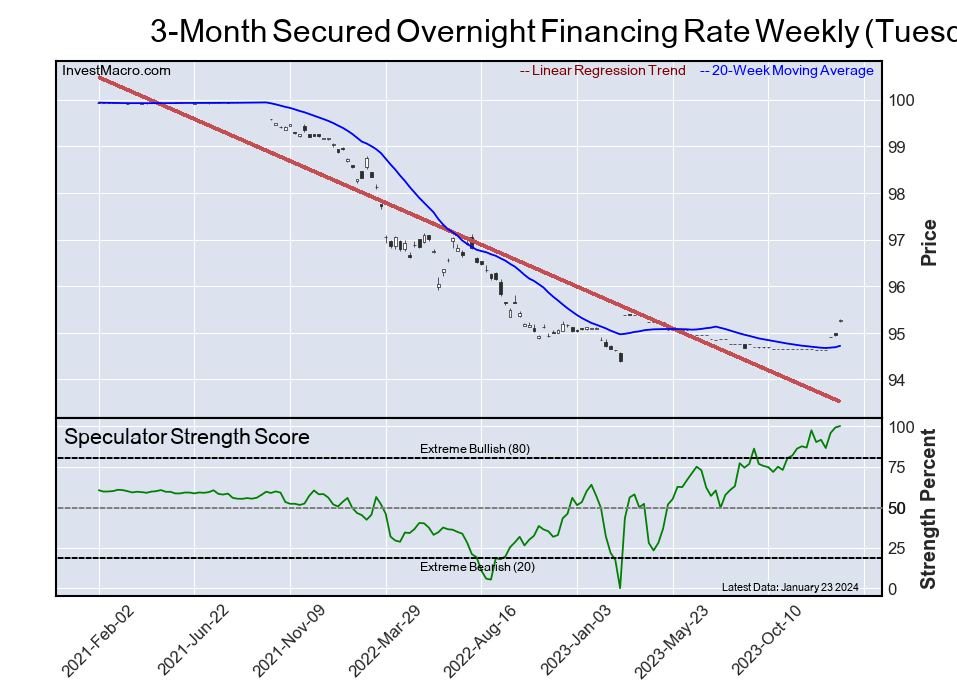
3-Month Secured Overnight Financing Rate
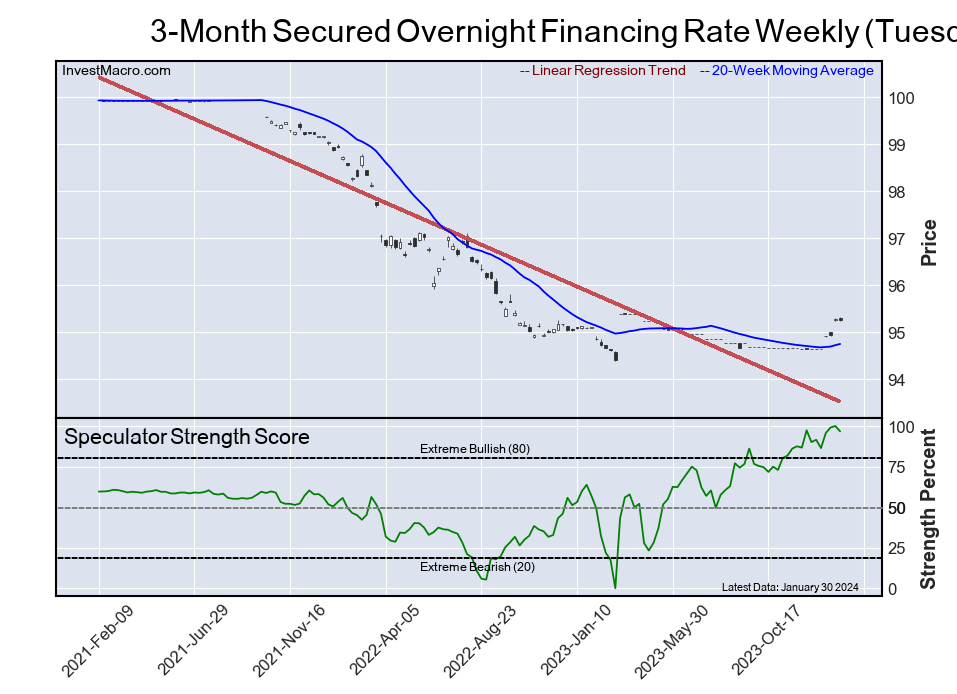

The 3-Month Secured Overnight Financing Rate speculator position comes next in the extreme standings this week. The 3-Month Secured Overnight Financing Rate speculator level is now at a 99.1 percent score of its 3-year range.

The six-week trend for the percent strength score was 13.5 this week. The speculator position registered 511,780 net contracts this week with a weekly decline of -15,457 contracts in speculator bets.


Steel


The Steel speculator position comes in third this week in the extreme standings. The Steel speculator level resides at a 98.8 percent score of its 3-year range.

The six-week trend for the speculator strength score came in at 20.9 this week. The overall speculator position was -167 net contracts this week with an edge higher by 66 contracts in the weekly speculator bets.


1-Month Secured Overnight Financing Rate

The 1-Month Secured Overnight Financing Rate speculator position comes up number four in the extreme standings this week. The 1-Month Secured Overnight Financing Rate speculator level is at a 95.6 percent score of its 3-year range.

The six-week trend for the speculator strength score totaled a change of 45.9 this week. The overall speculator position was 86,967 net contracts this week with a boost of 135,716 contracts in the speculator bets.


Nikkei 225 Yen


The Nikkei 225 Yen speculator position rounds out the top five in this week’s bullish extreme standings. The Nikkei 225 Yen speculator level sits at a 88.1 percent score of its 3-year range. The six-week trend for the speculator strength score was 31.6 this week.

The speculator position was 17,459 net contracts this week with an increase of 2,394 contracts in the weekly speculator bets.


This Week’s Most Bearish Speculator Positions:

2-Year Bond


The 2-Year Bond speculator position comes in as the most bearish extreme standing this week. The 2-Year Bond speculator level is at a 0.0 percent score of its 3-year range.

The six-week trend for the speculator strength score was -3.3 this week. The overall speculator position was -1,476,016 net contracts this week with a drop of -187,185 contracts in the speculator bets.


Ultra 10-Year U.S. T-Note


The Ultra 10-Year U.S. T-Note speculator position comes in next for the most bearish extreme standing on the week. The Ultra 10-Year U.S. T-Note speculator level is at a 0.0 percent score of its 3-year range.

The six-week trend for the speculator strength score was -3.3 this week. The speculator position was -267,855 net contracts this week with a downfall of -9,960 contracts in the weekly speculator bets.


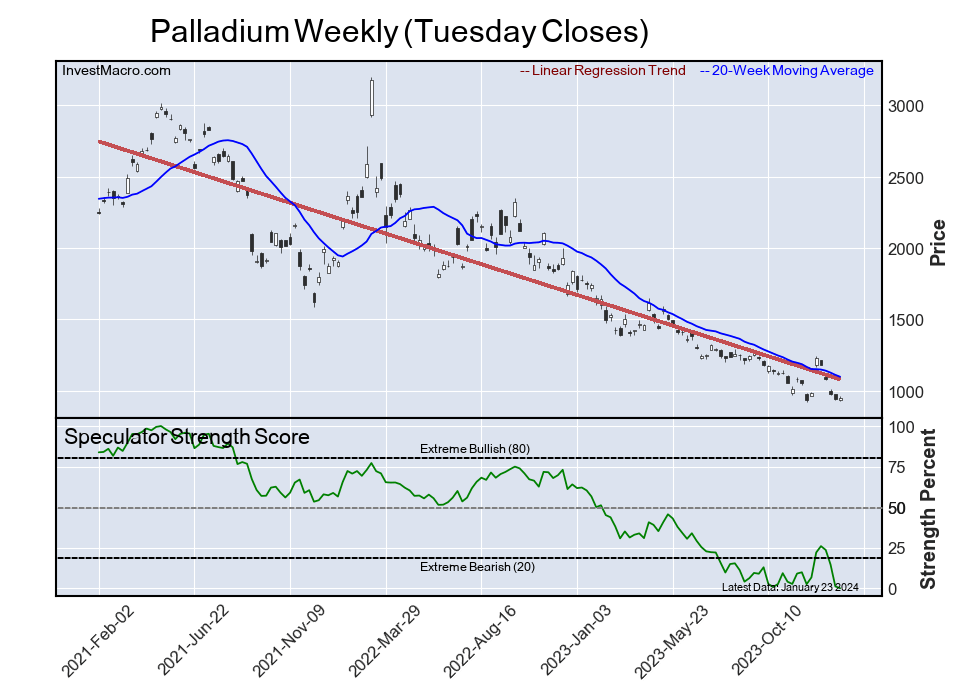
Palladium


The Palladium speculator position comes in as third most bearish extreme standing of the week. The Palladium speculator level resides at a 1.6 percent score of its 3-year range.

The six-week trend for the speculator strength score was -0.1 this week. The overall speculator position was -11,252 net contracts this week with a dip of -1,081 contracts in the speculator bets.


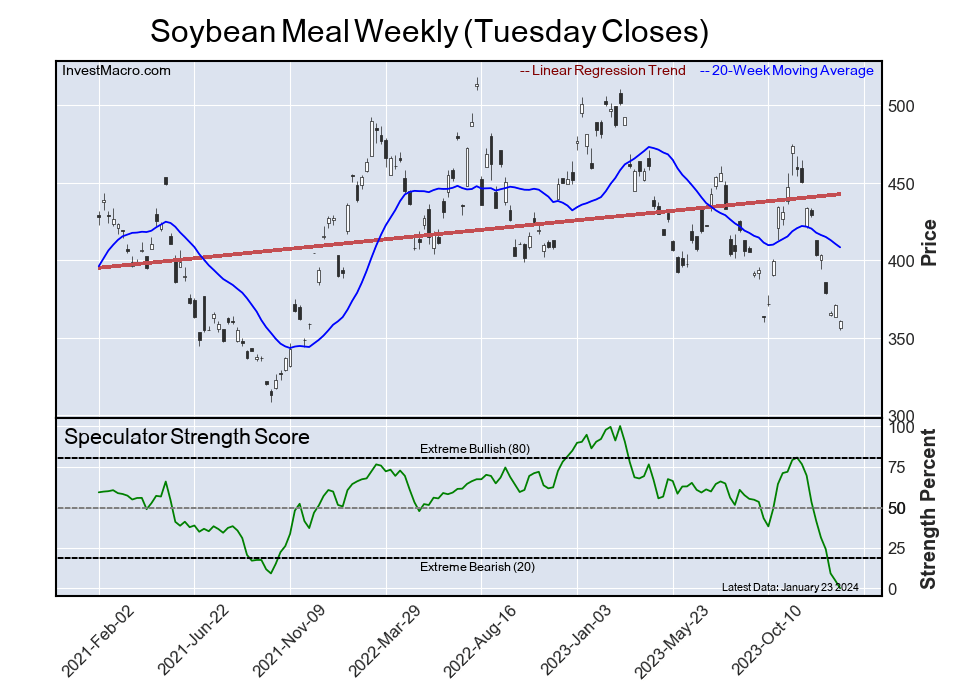
Soybeans


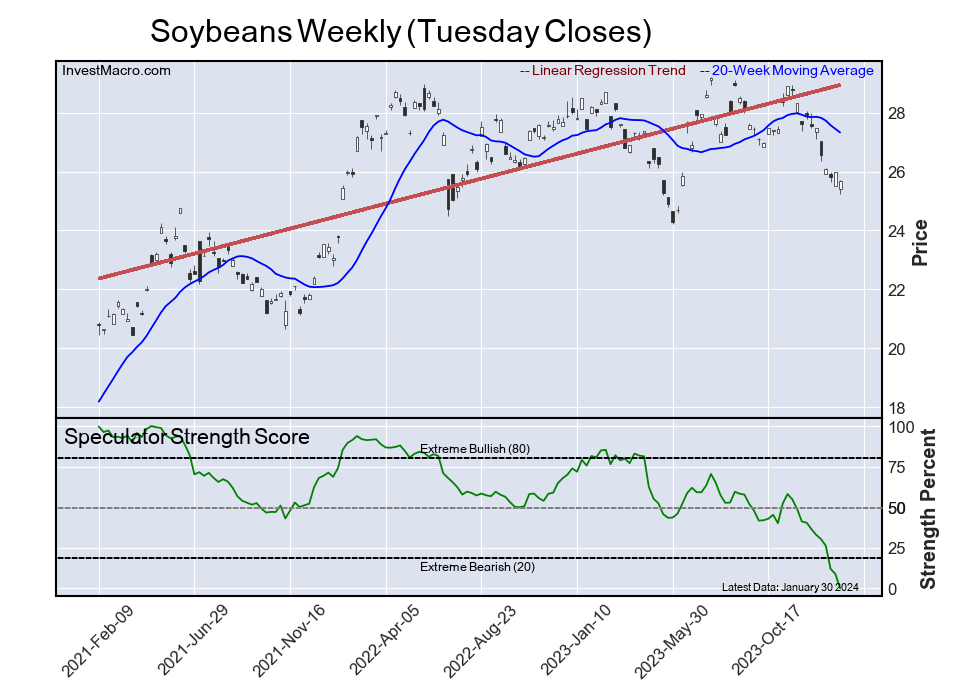
The Soybeans speculator position comes in as this week’s fourth most bearish extreme standing. The Soybeans speculator level is at a 1.6 percent score of its 3-year range.

The six-week trend for the speculator strength score was -6.3 this week. The speculator position was 20,298 net contracts this week with a decline by -30,399 contracts in the weekly speculator bets.


5-Year Bond


Finally, the 5-Year Bond speculator position comes in as the fifth most bearish extreme standing for this week. The 5-Year Bond speculator level is at a 2.5 percent score of its 3-year range.

The six-week trend for the speculator strength score was -26.9 this week. The speculator position was -1,429,427 net contracts this week with a drop by -30,927 contracts in the weekly speculator bets.


Article By InvestMacroReceive our weekly COT Newsletter

*COT Report: The COT data, released weekly to the public each Friday, is updated through the most recent Tuesday (data is 3 days old) and shows a quick view of how large speculators or non-commercials (for-profit traders) were positioned in the futures markets.

The CFTC categorizes trader positions according to commercial hedgers (traders who use futures contracts for hedging as part of the business), non-commercials (large traders who speculate to realize trading profits) and nonreportable traders (usually small traders/speculators) as well as their open interest (contracts open in the market at time of reporting). See CFTC criteria here.
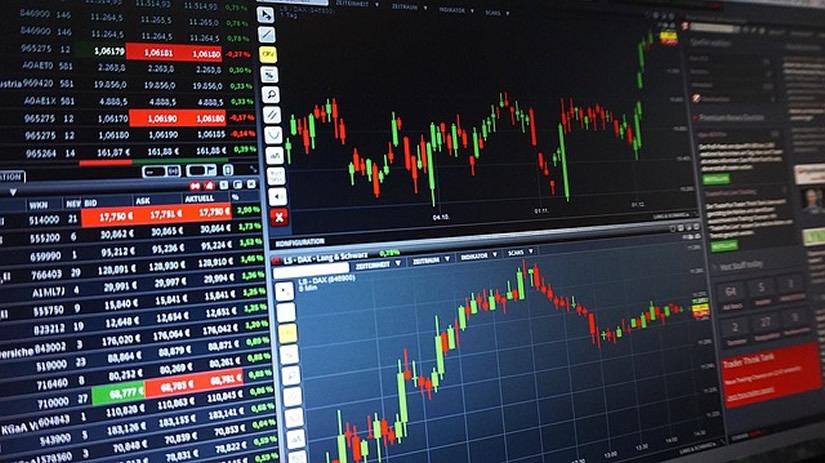
Week Ahead: US dollar set for explosive week?

By ForexTime 

  • Big week ahead for USD due to CPI and Fed decision
  • Fed set to hold rates but economic projections in focus
  • USDInd under pressure despite recent rebound
  • Key levels of interest at 105.30, 104.26 & 102.45
  • Breakout/down on the horizon?

Even as the clock ticks down to the key US jobs report this afternoon (Friday 8th December), traders are mindful of the flurry of high-risk events in the week ahead.

Some of the world’s largest central banks are set to make their final rate decisions for 2023 while top-tier economic data from major economies will be in focus. Given how this will be topped off with ‘Triple witching day’ for US markets, it may be wise to fasten your seatbelts for a wild ride!

Monday, 11th December

  • JPY: Japan M2 money stock
  • NZD: New Zealand home sales
  • GBP: CBI publishes latest economic forecast

Tuesday, 12th December

  • AUD: Australia consumer confidence
  • EUR: Germany ZEW survey expectations
  • JPY: Japan PPI
  • GBP: UK jobless claims, unemployment
  • USD: US CPI report

Wednesday, 13th December

  • NZD: New Zealand food prices
  • EUR: Eurozone industrial production
  • GBP: UK industrial production
  • USD: Fed rate decision, US PPI

Thursday, 14th December

  • JPY: Japan machinery orders, industrial production
  • CHF: SNB rate decision
  • EUR: ECB rate decision
  • GBP: BOE rate decision
  • USD: US initial jobless claims, retail sales, business inventories

Friday, 15th December

  • CNH: China retail sales, industrial production, jobless rate
  • EUR: Eurozone/Germany S&P Global PMI’s
  • GBP: UK S&P Global/CIPS Manufacturing PMI
  • USD: US industrial production, Empire manufacturing
  • SPX500: ‘Triple witching day’ for US markets

The scheduled data releases and events may present fresh opportunities across markets. However, our focus falls on the USD Index due to the US CPI report and Fed rate decision.

The USD Index tracks how the dollar is performing against a basket of six different G10 currencies, including the Euro, British Pound, Japanese Yen, and Canadian dollar.

The USD Index could be gearing up for a significant move. Here are 3 reasons why:

  1. US November CPI report

The November US Consumer Price Index (CPI) report published on Tuesday will be the final data point before the Fed rate decision.

Markets are forecasting: 

  • CPI year-on-year (November 2023 vs. November 2022) to cool 3.1% from 3.2% in the prior month.
  • Core CPI year-on-year to remain unchanged at 4.0%.
  • CPI month-on-month (November 2023 vs October 2023) to remain unchanged at 0%
  • Core CPI month-on-month to rise 0.3% from 0.2% in the prior month.

Headline inflation is expected to have cooled further thanks to falling energy prices, while the annual core inflation unchanged at 4.0% – its lowest level in over two years. Further evidence of cooling prices may bolster speculation around the Federal Reserve cutting interest rates in 2024.

  • A softer-than-expected US CPI report has the potential to drag the USDInd lower.
  • Should the CPI report beat market forecasts, the USDInd could push higher ahead of the Fed decision.
  1. Fed rate decision

The Fed is widely expected to leave interest rates unchanged at its final policy meeting for 2023.

However, the main attraction will be the updated economic projections and dot plot which were last provided on September 20th. Together with Jerome Powell’s post meeting conference may help investors gauge what to expect from the Fed in 2024.

As of writing, traders are pricing in a 64% probability of a 25-basis point Fed cut by March 2024.

  • The USDInd could find itself under pressure if the Fed strikes a dovish and signals that rate cuts are on the cards from 2024.
  • Should the central bank push back on rate cut bets and signal that rates will remain higher for longer, this may give the USDInd a boost.
  1. Technical forces

Despite pushing back above the 200-day SMA in recent days, the USDInd remains under pressure on the daily charts. Prices are respecting a bearish channel and trading below the 50 and 100-day SMA.

  • Should the USDInd slip back below the 200-day SMA, this may open the doors towards 102.45 and 101.80, respectively.
  • A solid breakout and daily close above 104.26 could push prices toward the 50-day SMA at 105.30 and 106.00, respectively.


Forex-Time-LogoArticle by ForexTime

ForexTime Ltd (FXTM) is an award winning international online forex broker regulated by CySEC 185/12 www.forextime.com

Mid-Week Technical Outlook: EURUSD closes below 200-day SMA

By ForexTime 

  • EURUSD closes below 200-day SMA
  • Bearish momentum building on D1 chart​​​​​​​
  • Data heavy week could rock currency pair
  • Key levels of interest at 1.0850, 1.0770 and 1.0700

The EURUSD entered standby mode on Wednesday after closing below the 200-day Simple Moving Average (SMA) for the first time in three months.

Euro bears seem to be making a return after dragging prices from a multi-month high at 1.1016 with the recent breakdown below the 1.0830 level supporting the bearish case.

Zooming out on the weekly charts, the negative momentum could pick up after bulls failed to conquer the 1.0960 level which has acted as significant resistance in the past.

On the monthly charts, it’s still the same old story for the EURUSD with major support at 1.0500 and resistance at 1.1060.

The real action is back on the daily charts, especially after the daily close below 1.0830. Although prices are no longer trading within the bullish channel, some support can be seen around the 100-day SMA.

A potential breakout opportunity could be on the horizon with the right fundamental spark. Given how this is a data-heavy week for both Europe and the United States, this could translate to increased volatility on the EURUSD – especially on Friday when the NFP is released.

  • Should prices secure a strong daily close below 1.0770, this could open a path towards the 50-day SMA at 1.0700 and 1.0550.

  • A move back above the 200-day that pushes prices beyond 1.0850 could spark a move toward 1.0950 and 1.1030, respectively.


Forex-Time-LogoArticle by ForexTime

ForexTime Ltd (FXTM) is an award winning international online forex broker regulated by CySEC 185/12 www.forextime.com

Investors urged to be vigilant to possibility of surging oil prices

By George Prior 

Oil prices are increasingly likely to rise towards the end of the year and into 2024, which could hit your investment portfolio, warns the CEO of one of the world’s largest independent financial advisory, asset management and fintech organizations.

deVere Group’s chief executive, Nigel Green, is speaking out after Saudi Arabia says that oil production cuts can “absolutely” continue past the first quarter of 2024 if necessary, and amid growing tensions in the Red Sea.

He comments: “The OPEC+ reductions to oil production announced last week of more than 2 million barrels a day – half of which come from Saudi Arabi – could run past the first quarter, according to the country’s Energy Minister.

“Although the cuts have had little impact on prices so far, it could be reasonably expected that as the cuts continue, they will begin to fuel price rises – especially as there’s no obvious sign that the Saudis are in a rush to remove the reductions to the oil they send to the rest of the world.”

The deVere CEO continues: “Another factor is the potential disruption to oil supplies, with reports saying that attacks on commercial shipping routes in the Red Sea are on the rise.

“The oil market has to date seemingly brushed off the increasing fears of soaring disruption, but the Red Sea is critical – all oil from the Middle East to Europe goes through it – and there are heightening issues in the region.”

The Pentagon on Sunday said a US warship and three commercial vessels had come under attack off the coast of Yemen.

This is driving concerns that Houthi rebels and their backers in Iran were intensifying their agenda as a result of the war in Gaza.

As a critical component of industrial production, transportation, and energy generation, oil plays a pivotal role in shaping global financial markets.

“Rising oil prices often lead to increased production costs across various industries. As businesses face higher expenses for transportation and raw materials, these costs are frequently passed on to consumers, contributing to inflationary pressures,” notes Nigel Green.

“Also, oil is priced in US dollars, and as oil prices rise, countries that are net importers of oil experience an increase in their trade deficits.

“This can lead to depreciation in the value of their currencies, affecting foreign exchange markets. Investors holding assets denominated in these currencies could experience declines in the value of their portfolios.

“Companies operating in energy-intensive sectors, such as transportation, manufacturing, and agriculture, may witness a decline in profitability as input costs rise. This, in turn, affects corporate earnings and can lead to changes in stock prices.”

He concludes: “We see a growing likelihood for oil prices to rise over the next six months due to the possibility of the extension of production cuts and increasing geopolitical tensions.

“The intricate relationship between oil and global financial markets underscores the need for investors to stay vigilant and possibly adapt their strategies and portfolios accordingly.”

About:

deVere Group is one of the world’s largest independent advisors of specialist global financial solutions to international, local mass affluent, and high-net-worth clients.  It has a network of more than 70 offices across the world, over 80,000 clients and $12bn under advisement.