Archive for Opinions – Page 61

Target Thursdays: SPX500_m, EURUSD & XAGUSD hit target prices

By ForexTime 

Check out these potential profits that you may have missed from our Daily Market Analysis.

  1. SPX500_m bulls deliver

Back on Monday, we covered the SPX500_m in our trade of the week. Prices were firmly bullish, especially after surging to record highs last Friday.

  • TP hit: YES, the SPX500_m hit the 4900 level
  • Why: Investor optimism for strong corporate earnings, rising tech stocks
  • Technicals: Intraday breakout above 4870 fuelled upside

  1. EURUSD hits resistance ahead of ECB

It has been a choppy week for the EURUSD as anticipation mounts ahead of the ECB meeting. Nevertheless, prices have hit some of our targets before this big event.

  • TP hit: YES, the EURUSD hit 21-Day EMA and 50% Fib level
  • Why: Mixed Eurozone data dampened ECB cut bets, weak US dollar
  • Technicals: Prices in a range waiting for significant breakout

  1. XAGUSD eyes 4th target level

Silver bulls have been busy this morning, cutting through the bullish price targets like a hot knife through butter.

  • TP hit: YES, 3 out of the 4 profit targets have been hit his morning.
  • Why: A weaker dollar could be offering support to the precious metal
  • Technicals: Prices are respecting an uptrend on the 15-minute timeframe

The above scenario (XAGUSD) is based on the FXTM Signals that are posted twice a day (before the London and New York sessions) for all FXTM clients to follow. This can found in the MyFXTM profile under Trading Services… FXTM Trading Signals.


Forex-Time-LogoArticle by ForexTime

ForexTime Ltd (FXTM) is an award winning international online forex broker regulated by CySEC 185/12 www.forextime.com

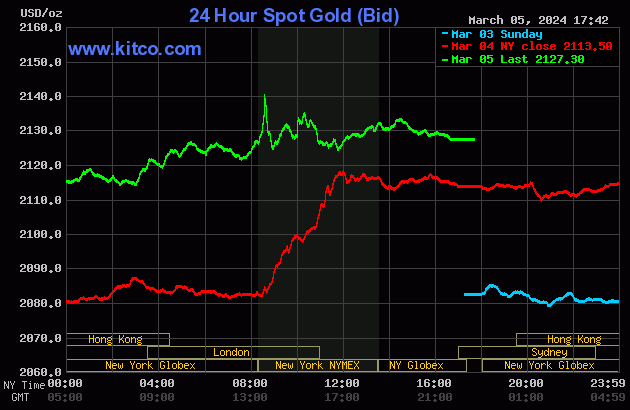
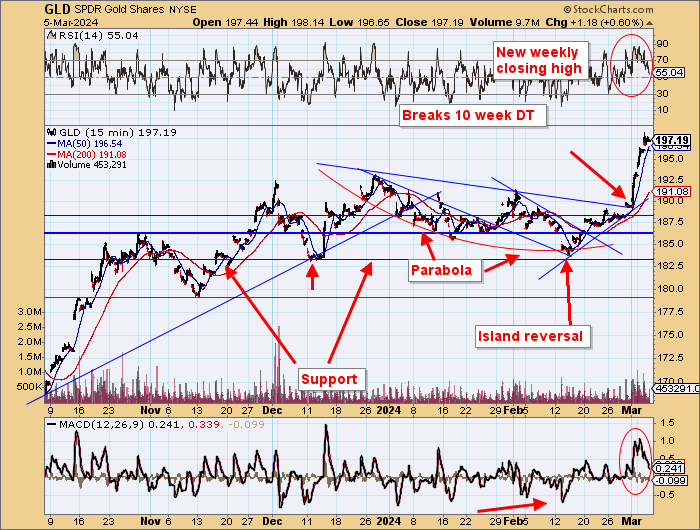
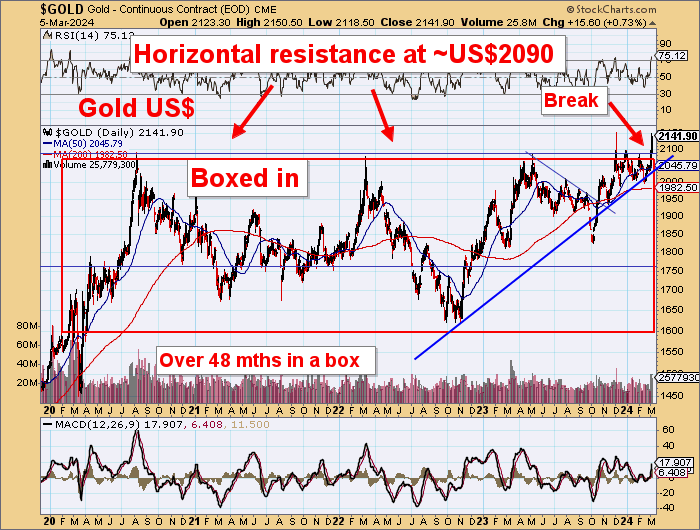
Gold seeks fresh momentum

By ForexTime 

  • Gold trading between key weekly levels
  • Incoming US data could move precious metal
  • H4 charts show possible bullish presence
  • Four potential targets identified
  • H4 bullish scenario invalidated below 2001.68

Gold struggled for direction on Wednesday as markets remained cautious ahead of key US data that may impact bets on Fed rate cuts.

After swinging within a wide range since the start of the year, a significant move could be in the works due to fresh fundamental forces. It would be wise to keep an eye on the final quarter US GDP report on Thursday and PCE report on Friday which could rock the precious metal ahead of next week’s Fed meeting.

Redirecting our focus back to the technicals…

Gold has been oscillating between a weekly support level around 2005.49 and a weekly resistance level around 2060.49. The price is approaching the middle band again and although the current market structure shows a down trend, the momentum can easily shift to the upside. If the price goes higher than the last top, this will result in an early stage of a new uptrend in process.    

A look at the 4-hour time frame can provide more precision.

On the 4-hour chart the price has been oscillating around the 50 Linear Weighted Moving Average with the Momentum and the Moving Average Convergence Divergence (MACD) oscillators both confirming a possible build up to the demand side.

If the price reaches the 2039.50 level, a long opportunity becomes feasible.

Attaching a modified Fibonacci tool to the trigger level at 2039.50 and dragging it to the last bottom at 2001.68, four possible targets can be determined:

  • The first target is possible at 2054.63 (Target 1).

  • The second price target is probable at 2062.19 (Target 2).

  • The third price target is likely at 2077.32 (Target 2).

  • The fourth and last price target is feasible at 2096.23 (Target 4).

If the price breaks past the 2001.68 level, this scenario is no longer applicable, and a short option becomes viable.


Forex-Time-LogoArticle by ForexTime

ForexTime Ltd (FXTM) is an award winning international online forex broker regulated by CySEC 185/12 www.forextime.com

Currency Speculators drop their US Dollar Index bets to 133-week low

By InvestMacro

Here are the latest charts and statistics for the Commitment of Traders (COT) data published by the Commodities Futures Trading Commission (CFTC).

The latest COT data is updated through Tuesday January 16th and shows a quick view of how large market participants (for-profit speculators and commercial traders) were positioned in the futures markets. All currency positions are in direct relation to the US dollar where, for example, a bet for the euro is a bet that the euro will rise versus the dollar while a bet against the euro will be a bet that the euro will decline versus the dollar.

Weekly Speculator Changes led by British Pound Sterling & Swiss Franc

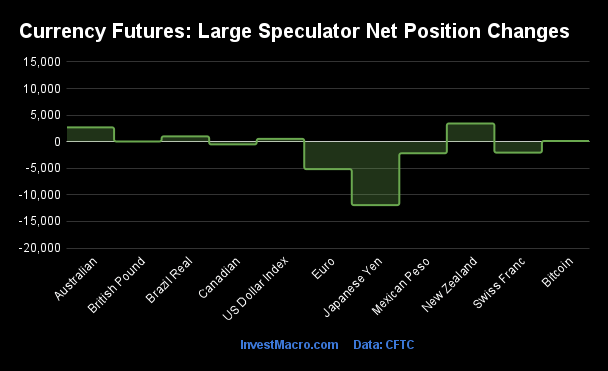
The COT currency market speculator bets were lower this week as three out of the eleven currency markets we cover had higher positioning while the other eight markets had lower speculator contracts.

Leading the gains for the currency markets was the British Pound (10,197 contracts) with the Swiss Franc (654 contracts) and Bitcoin (624 contracts) also recording positive weeks.

The currencies seeing declines in speculator bets on the week were the Australian Dollar (-15,583 contracts), the Euro (-14,785 contracts), the Mexican Peso (-6,837 contracts), the Canadian Dollar (-6,008 contracts), the US Dollar Index (-1,610 contracts), the New Zealand Dollar (-1,115 contracts), the Japanese Yen (-611 contracts) and with the Brazilian Real (-419 contracts) also seeing lower bets on the week.

Speculators drop their US Dollar Index bets to 133-week low

Highlighting the COT currency’s data this week is the continued decline of the speculator’s positioning in the US Dollar Index. The large speculative US Dollar Index positions fell this week for a fifth time out of the past six weeks. The speculator position has now seen an overall decrease by a total of -18,644 net contracts over this last six-week span.

This recent weakness has brought the US Dollar Index speculator net position (currently at a total of +1,300 contracts) to a 133-week low, dating back to June 29th of 2021 when the net position saw it’s last bearish reading at -448 contracts.

The Dollar Index is starting off 2024 on much weaker footing than the previous two years as expectations of peak interest rates in the US have weighed on the currency’s outlook. The Dollar Index’s speculator positioning started 2023 with a total of +17,761 contracts in the first week of trading and the average weekly speculator position over the whole of 2023 was +12,782 contracts. The first week of 2022 started even stronger with a net position of +39,078 contracts in the first week and the weekly average speculator position over the course of 2022 was +33,606 contracts.

The US Dollar Index price, despite the recent setback in speculator bets, has risen for two out of the past three weeks with an approximate gain by 1 percent this week. Since October, the USD Index has been on a downtrend and declined from an October high of 107.05 to the most recent low at 100.32 in late December. The USD Index price has come off that 100.00 support level and has now climbed back to the 103.07 level to close out this week.


Major Currencies – Speculators Leaderboard


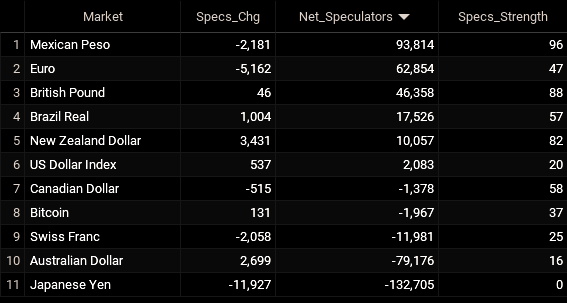
Legend: Weekly Speculators Change | Speculators Current Net Position | Speculators Strength Score compared to last 3-Years (0-100 range)


Strength Scores led by Mexican Peso & British Pound
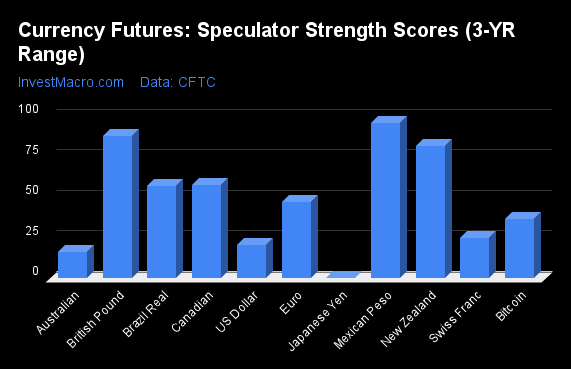
COT Strength Scores (a normalized measure of Speculator positions over a 3-Year range, from 0 to 100 where above 80 is Extreme-Bullish and below 20 is Extreme-Bearish) showed that the Mexican Peso (89 percent) and the British Pound (77 percent) lead the currency markets this week. The Brazilian Real (67 percent), EuroFX (65 percent) and Bitcoin (51 percent) come in as the next highest in the weekly strength scores.

On the downside, the US Dollar Index (27 percent) and the Japanese Yen (42 percent) come in at the lowest strength levels currently.

Strength Statistics:
US Dollar Index (27.0 percent) vs US Dollar Index previous week (29.6 percent)
EuroFX (64.6 percent) vs EuroFX previous week (70.9 percent)
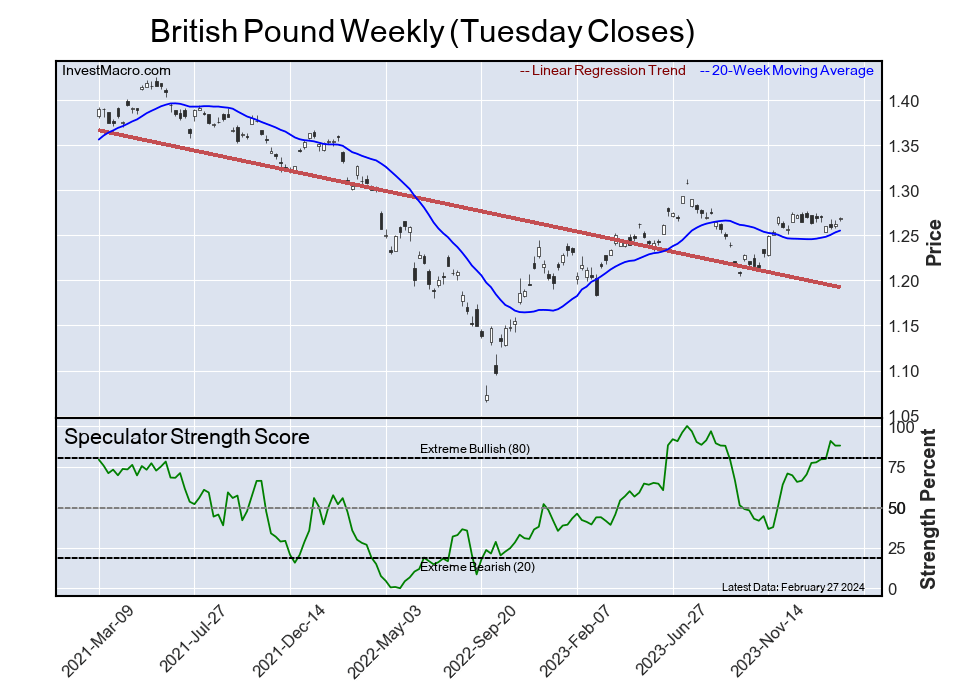
British Pound Sterling (77.2 percent) vs British Pound Sterling previous week (70.2 percent)
Japanese Yen (42.1 percent) vs Japanese Yen previous week (42.4 percent)
Swiss Franc (47.9 percent) vs Swiss Franc previous week (46.1 percent)
Canadian Dollar (47.8 percent) vs Canadian Dollar previous week (52.9 percent)
Australian Dollar (44.9 percent) vs Australian Dollar previous week (59.2 percent)
New Zealand Dollar (47.9 percent) vs New Zealand Dollar previous week (50.8 percent)
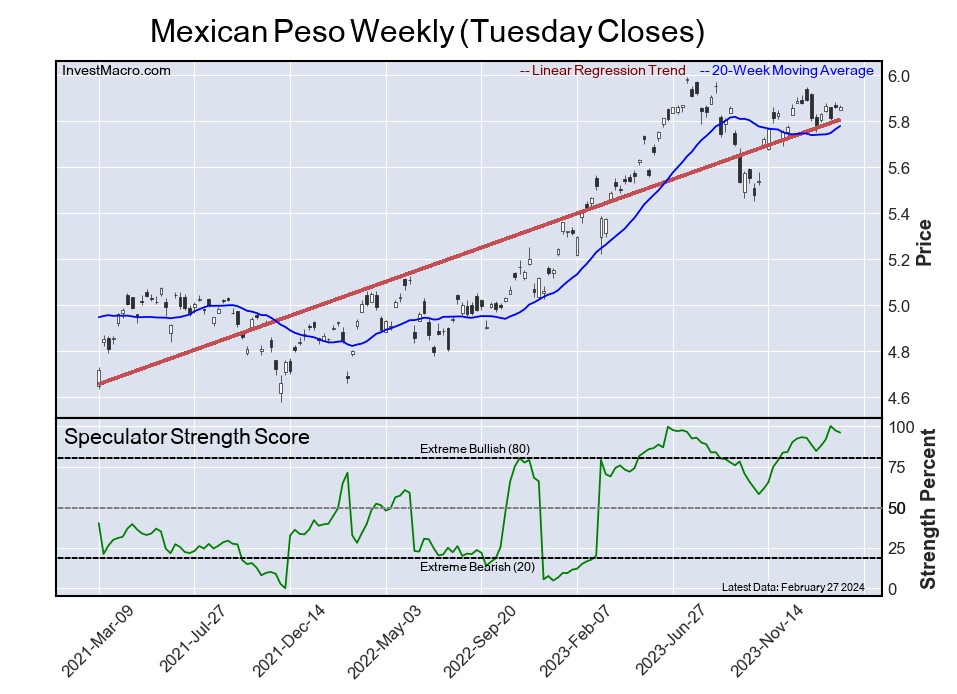
Mexican Peso (88.9 percent) vs Mexican Peso previous week (93.1 percent)
Brazilian Real (66.5 percent) vs Brazilian Real previous week (67.1 percent)
Bitcoin (51.4 percent) vs Bitcoin previous week (42.1 percent)


Swiss Franc & Canadian Dollar top the 6-Week Strength Trends

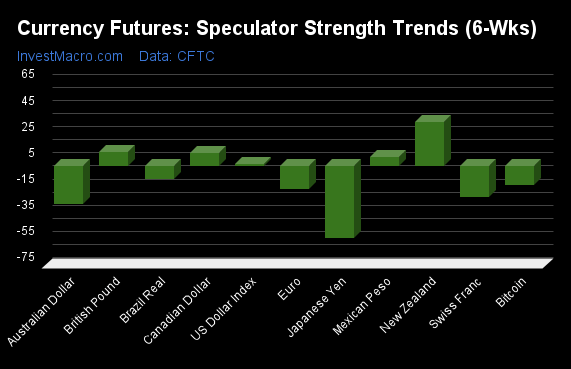
COT Strength Score Trends (or move index, calculates the 6-week changes in strength scores) showed that the Swiss Franc (40 percent) and the Canadian Dollar (37 percent) lead the past six weeks trends for the currencies. The New Zealand Dollar (35 percent), the Japanese Yen (28 percent) and Bitcoin (19 percent) are the next highest positive movers in the latest trends data.

The Brazilian Real (-33 percent) leads the downside trend scores currently with the US Dollar Index (-31 percent) and the EuroFX (-21 percent) following next with lower trend scores.

Strength Trend Statistics:
US Dollar Index (-31.2 percent) vs US Dollar Index previous week (-27.0 percent)
EuroFX (-20.6 percent) vs EuroFX previous week (-10.3 percent)
British Pound Sterling (13.4 percent) vs British Pound Sterling previous week (19.9 percent)
Japanese Yen (27.6 percent) vs Japanese Yen previous week (30.4 percent)
Swiss Franc (40.0 percent) vs Swiss Franc previous week (45.0 percent)
Canadian Dollar (37.3 percent) vs Canadian Dollar previous week (46.9 percent)
Australian Dollar (9.0 percent) vs Australian Dollar previous week (35.7 percent)
New Zealand Dollar (35.3 percent) vs New Zealand Dollar previous week (46.5 percent)
Mexican Peso (5.0 percent) vs Mexican Peso previous week (14.0 percent)
Brazilian Real (-33.1 percent) vs Brazilian Real previous week (-10.1 percent)
Bitcoin (18.9 percent) vs Bitcoin previous week (1.9 percent)


Individual COT Forex Markets:

US Dollar Index Futures:
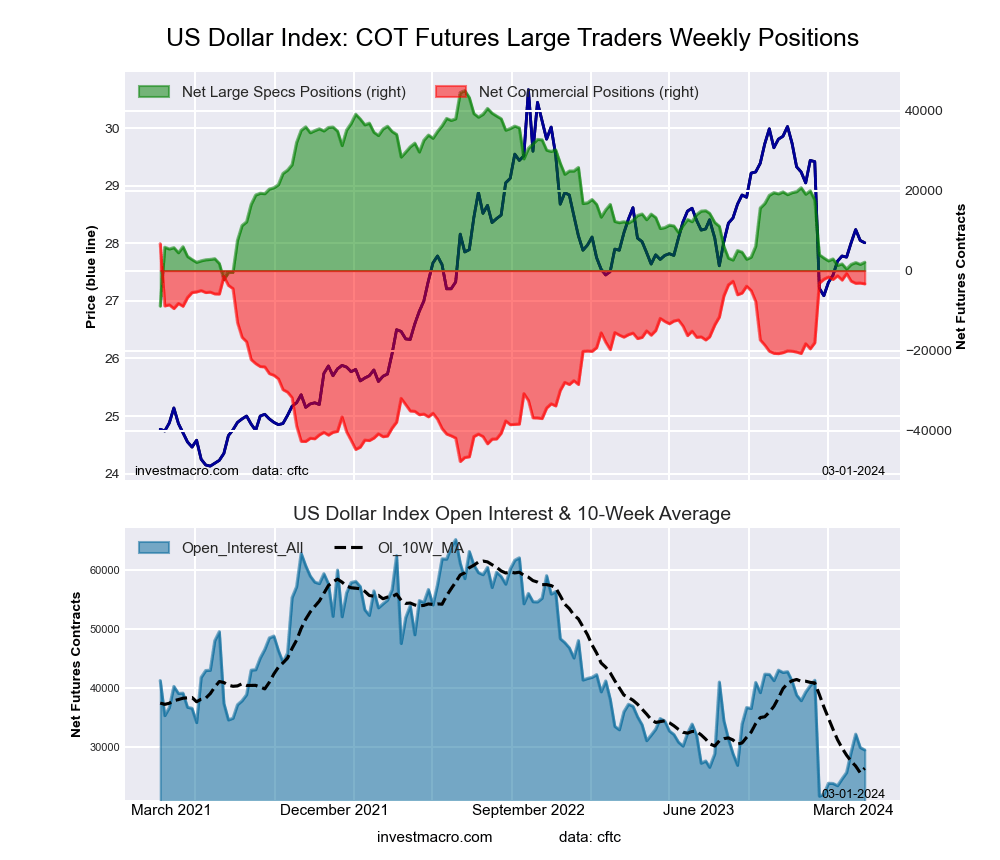
US Dollar Index Forex Futures COT ChartThe US Dollar Index large speculator standing this week came in at a net position of 1,300 contracts in the data reported through Tuesday. This was a weekly lowering of -1,610 contracts from the previous week which had a total of 2,910 net contracts.

This week’s current strength score (the trader positioning range over the past three years, measured from 0 to 100) shows the speculators are currently Bearish with a score of 27.0 percent. The commercials are Bullish with a score of 76.3 percent and the small traders (not shown in chart) are Bearish-Extreme with a score of 11.1 percent.

Price Trend-Following Model: Strong Downtrend

Our weekly trend-following model classifies the current market price position as: Strong Downtrend. The current action for the model is considered to be: Hold – Maintain Short Position.

US DOLLAR INDEX StatisticsSPECULATORSCOMMERCIALSSMALL TRADERS
– Percent of Open Interest Longs:64.216.711.8
– Percent of Open Interest Shorts:58.622.211.9
– Net Position:1,300-1,292-8
– Gross Longs:15,0773,9182,781
– Gross Shorts:13,7775,2102,789
– Long to Short Ratio:1.1 to 10.8 to 11.0 to 1
NET POSITION TREND:
– Strength Index Score (3 Year Range Pct):27.076.311.1
– Strength Index Reading (3 Year Range):BearishBullishBearish-Extreme
NET POSITION MOVEMENT INDEX:
– 6-Week Change in Strength Index:-31.230.04.4


Euro Currency Futures:

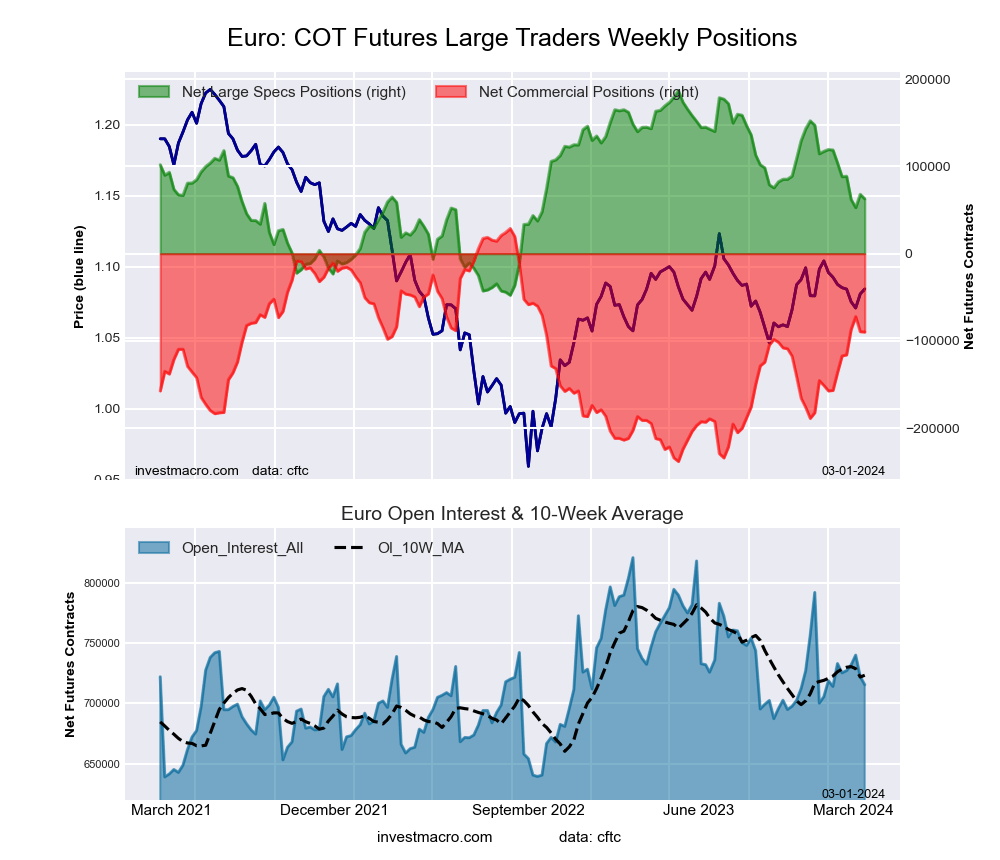
Euro Currency Futures COT ChartThe Euro Currency large speculator standing this week came in at a net position of 104,092 contracts in the data reported through Tuesday. This was a weekly lowering of -14,785 contracts from the previous week which had a total of 118,877 net contracts.

This week’s current strength score (the trader positioning range over the past three years, measured from 0 to 100) shows the speculators are currently Bullish with a score of 64.6 percent. The commercials are Bearish with a score of 38.1 percent and the small traders (not shown in chart) are Bearish with a score of 30.7 percent.

Price Trend-Following Model: Uptrend

Our weekly trend-following model classifies the current market price position as: Uptrend. The current action for the model is considered to be: Hold – Maintain Long Position.

EURO Currency StatisticsSPECULATORSCOMMERCIALSSMALL TRADERS
– Percent of Open Interest Longs:27.959.111.1
– Percent of Open Interest Shorts:13.777.86.6
– Net Position:104,092-136,51332,421
– Gross Longs:204,294433,57781,115
– Gross Shorts:100,202570,09048,694
– Long to Short Ratio:2.0 to 10.8 to 11.7 to 1
NET POSITION TREND:
– Strength Index Score (3 Year Range Pct):64.638.130.7
– Strength Index Reading (3 Year Range):BullishBearishBearish
NET POSITION MOVEMENT INDEX:
– 6-Week Change in Strength Index:-20.619.6-6.6


British Pound Sterling Futures:

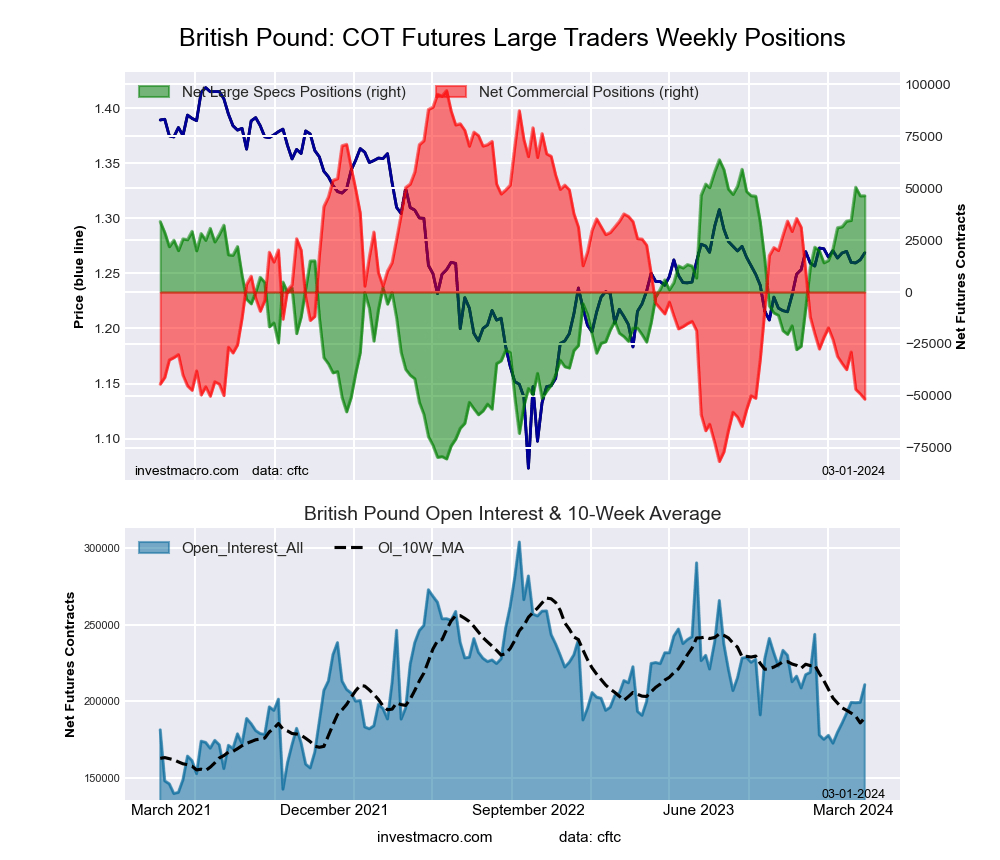
British Pound Sterling Futures COT ChartThe British Pound Sterling large speculator standing this week came in at a net position of 30,931 contracts in the data reported through Tuesday. This was a weekly rise of 10,197 contracts from the previous week which had a total of 20,734 net contracts.

This week’s current strength score (the trader positioning range over the past three years, measured from 0 to 100) shows the speculators are currently Bullish with a score of 77.2 percent. The commercials are Bearish with a score of 28.3 percent and the small traders (not shown in chart) are Bullish with a score of 58.1 percent.

Price Trend-Following Model: Uptrend

Our weekly trend-following model classifies the current market price position as: Uptrend. The current action for the model is considered to be: Hold – Maintain Long Position.

BRITISH POUND StatisticsSPECULATORSCOMMERCIALSSMALL TRADERS
– Percent of Open Interest Longs:36.841.416.5
– Percent of Open Interest Shorts:19.658.616.4
– Net Position:30,931-30,98049
– Gross Longs:66,23074,43829,608
– Gross Shorts:35,299105,41829,559
– Long to Short Ratio:1.9 to 10.7 to 11.0 to 1
NET POSITION TREND:
– Strength Index Score (3 Year Range Pct):77.228.358.1
– Strength Index Reading (3 Year Range):BullishBearishBullish
NET POSITION MOVEMENT INDEX:
– 6-Week Change in Strength Index:13.4-10.6-0.5


Japanese Yen Futures:

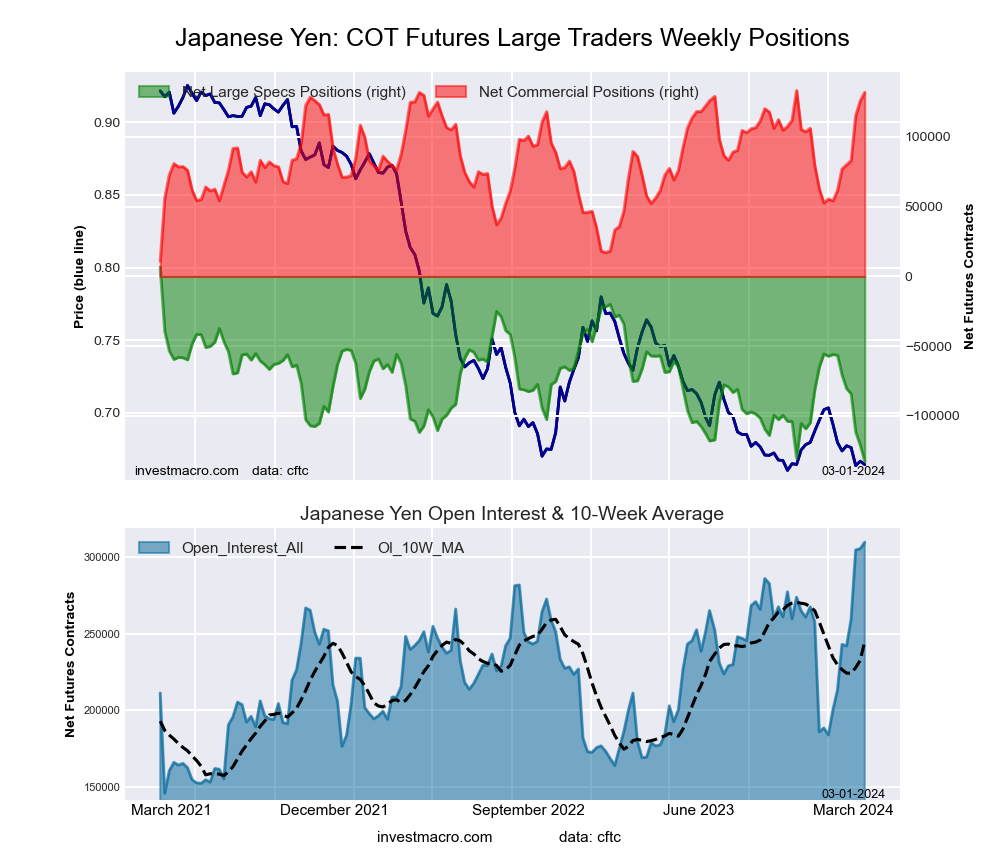
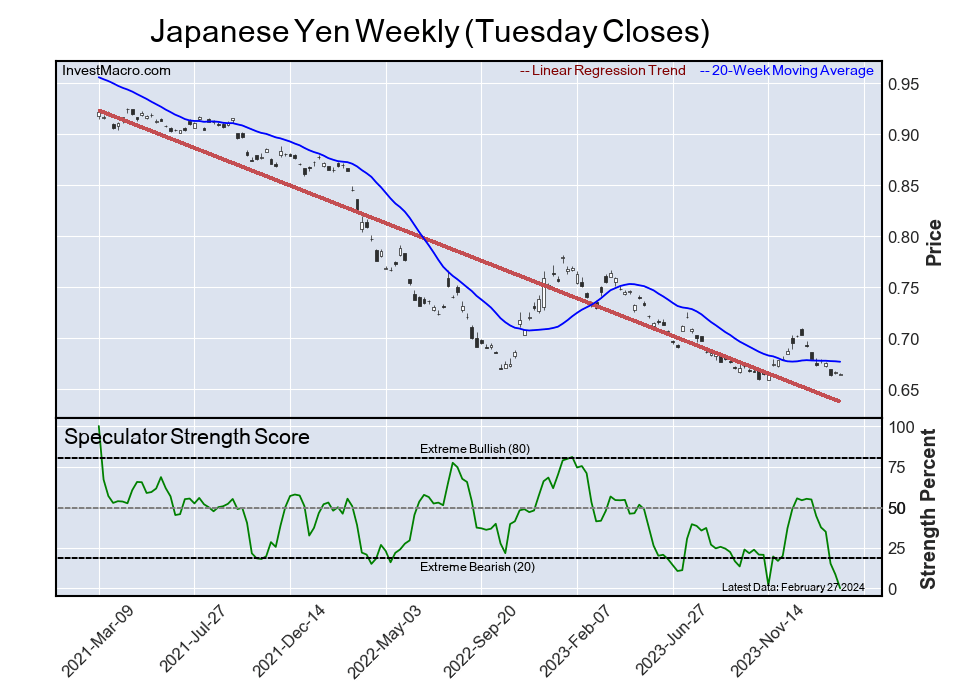
Japanese Yen Forex Futures COT ChartThe Japanese Yen large speculator standing this week came in at a net position of -56,560 contracts in the data reported through Tuesday. This was a weekly lowering of -611 contracts from the previous week which had a total of -55,949 net contracts.

This week’s current strength score (the trader positioning range over the past three years, measured from 0 to 100) shows the speculators are currently Bearish with a score of 42.1 percent. The commercials are Bullish with a score of 63.3 percent and the small traders (not shown in chart) are Bearish with a score of 49.3 percent.

Price Trend-Following Model: Weak Uptrend

Our weekly trend-following model classifies the current market price position as: Weak Uptrend. The current action for the model is considered to be: Hold – Maintain Long Position.

JAPANESE YEN StatisticsSPECULATORSCOMMERCIALSSMALL TRADERS
– Percent of Open Interest Longs:20.758.618.0
– Percent of Open Interest Shorts:47.229.720.4
– Net Position:-56,56061,724-5,164
– Gross Longs:44,180125,04838,443
– Gross Shorts:100,74063,32443,607
– Long to Short Ratio:0.4 to 12.0 to 10.9 to 1
NET POSITION TREND:
– Strength Index Score (3 Year Range Pct):42.163.349.3
– Strength Index Reading (3 Year Range):BearishBullishBearish
NET POSITION MOVEMENT INDEX:
– 6-Week Change in Strength Index:27.6-22.8-9.1


Swiss Franc Futures:

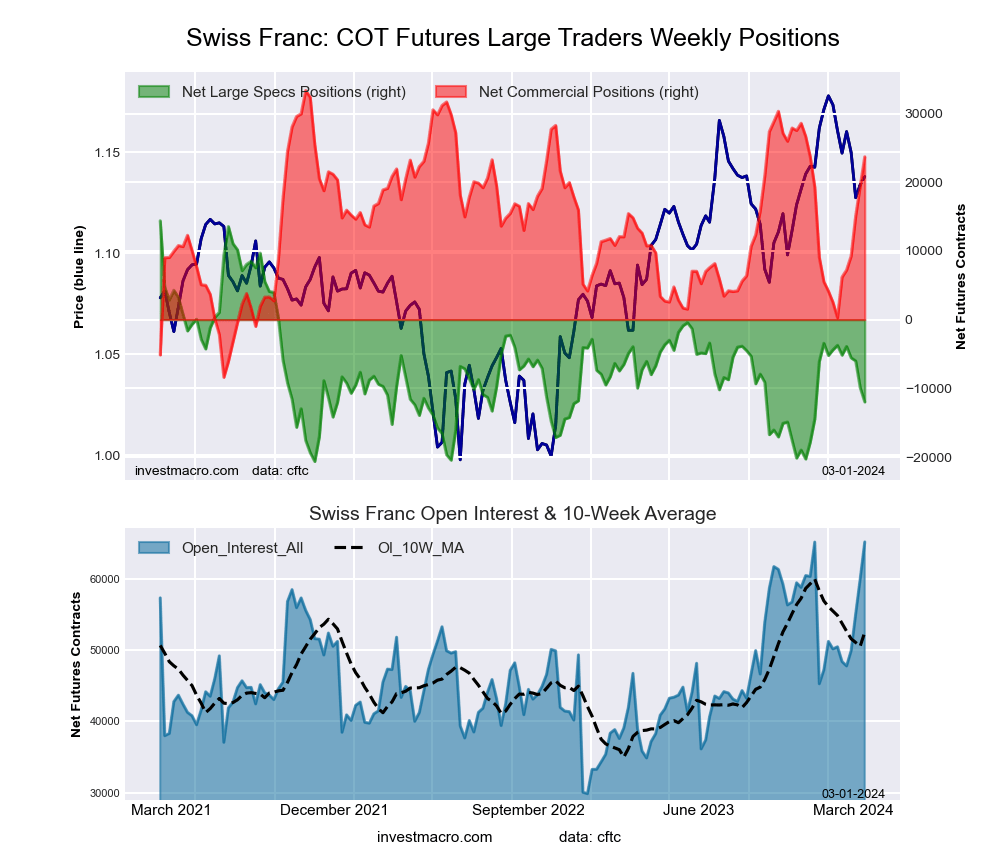
Swiss Franc Forex Futures COT ChartThe Swiss Franc large speculator standing this week came in at a net position of -3,738 contracts in the data reported through Tuesday. This was a weekly lift of 654 contracts from the previous week which had a total of -4,392 net contracts.

This week’s current strength score (the trader positioning range over the past three years, measured from 0 to 100) shows the speculators are currently Bearish with a score of 47.9 percent. The commercials are Bearish with a score of 38.6 percent and the small traders (not shown in chart) are Bullish with a score of 74.6 percent.

Price Trend-Following Model: Uptrend

Our weekly trend-following model classifies the current market price position as: Uptrend. The current action for the model is considered to be: Hold – Maintain Long Position.

SWISS FRANC StatisticsSPECULATORSCOMMERCIALSSMALL TRADERS
– Percent of Open Interest Longs:21.144.533.9
– Percent of Open Interest Shorts:28.543.927.0
– Net Position:-3,7382733,465
– Gross Longs:10,62722,45017,114
– Gross Shorts:14,36522,17713,649
– Long to Short Ratio:0.7 to 11.0 to 11.3 to 1
NET POSITION TREND:
– Strength Index Score (3 Year Range Pct):47.938.674.6
– Strength Index Reading (3 Year Range):BearishBearishBullish
NET POSITION MOVEMENT INDEX:
– 6-Week Change in Strength Index:40.0-43.534.0


Canadian Dollar Futures:

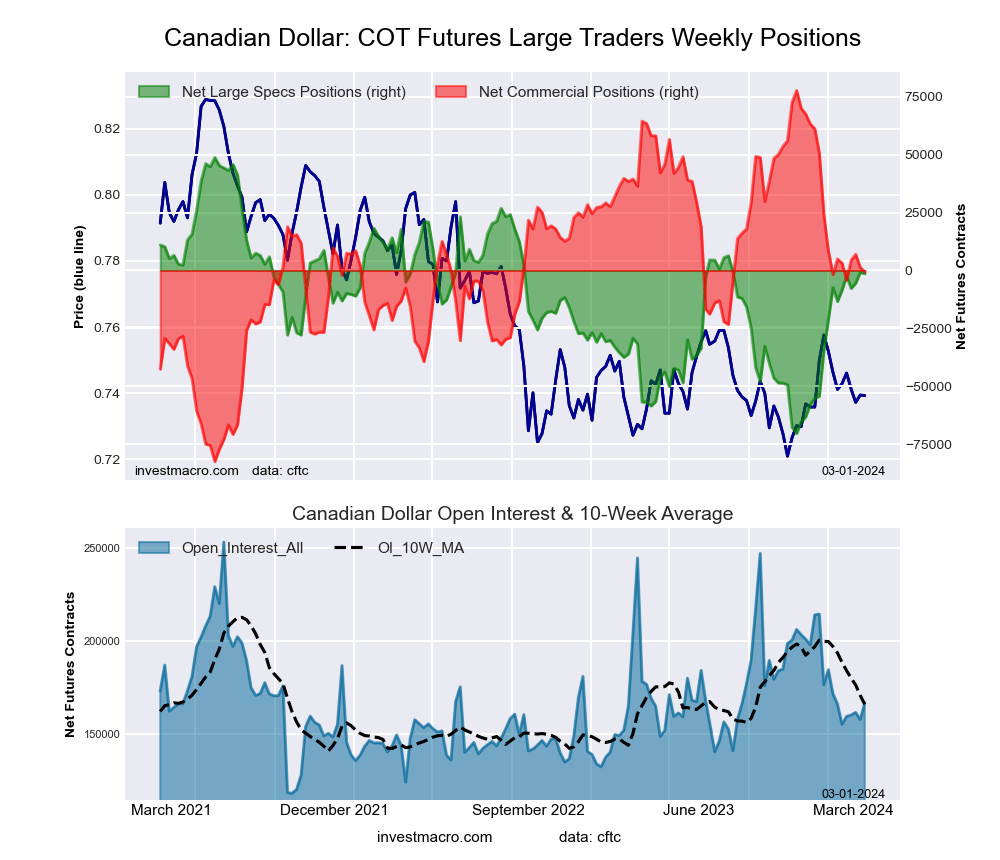
Canadian Dollar Forex Futures COT ChartThe Canadian Dollar large speculator standing this week came in at a net position of -13,388 contracts in the data reported through Tuesday. This was a weekly lowering of -6,008 contracts from the previous week which had a total of -7,380 net contracts.

This week’s current strength score (the trader positioning range over the past three years, measured from 0 to 100) shows the speculators are currently Bearish with a score of 47.8 percent. The commercials are Bullish with a score of 54.6 percent and the small traders (not shown in chart) are Bearish with a score of 41.6 percent.

Price Trend-Following Model: Uptrend

Our weekly trend-following model classifies the current market price position as: Uptrend. The current action for the model is considered to be: Hold – Maintain Long Position.

CANADIAN DOLLAR StatisticsSPECULATORSCOMMERCIALSSMALL TRADERS
– Percent of Open Interest Longs:23.355.319.8
– Percent of Open Interest Shorts:31.452.314.7
– Net Position:-13,3884,9288,460
– Gross Longs:38,73891,78332,870
– Gross Shorts:52,12686,85524,410
– Long to Short Ratio:0.7 to 11.1 to 11.3 to 1
NET POSITION TREND:
– Strength Index Score (3 Year Range Pct):47.854.641.6
– Strength Index Reading (3 Year Range):BearishBullishBearish
NET POSITION MOVEMENT INDEX:
– 6-Week Change in Strength Index:37.3-36.430.9


Australian Dollar Futures:

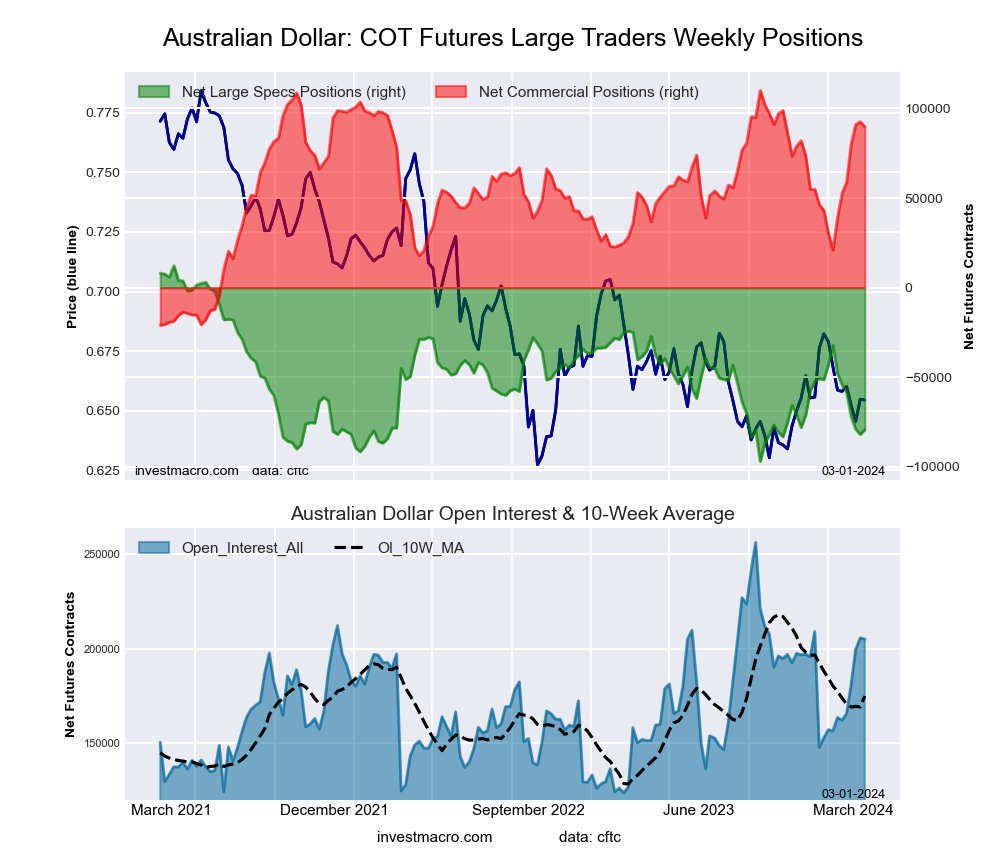
Australian Dollar Forex Futures COT ChartThe Australian Dollar large speculator standing this week came in at a net position of -47,857 contracts in the data reported through Tuesday. This was a weekly decline of -15,583 contracts from the previous week which had a total of -32,274 net contracts.

This week’s current strength score (the trader positioning range over the past three years, measured from 0 to 100) shows the speculators are currently Bearish with a score of 44.9 percent. The commercials are Bearish with a score of 46.5 percent and the small traders (not shown in chart) are Bullish with a score of 73.9 percent.

Price Trend-Following Model: Uptrend

Our weekly trend-following model classifies the current market price position as: Uptrend. The current action for the model is considered to be: Hold – Maintain Long Position.

AUSTRALIAN DOLLAR StatisticsSPECULATORSCOMMERCIALSSMALL TRADERS
– Percent of Open Interest Longs:28.051.316.5
– Percent of Open Interest Shorts:57.327.511.1
– Net Position:-47,85739,0448,813
– Gross Longs:45,81283,91126,937
– Gross Shorts:93,66944,86718,124
– Long to Short Ratio:0.5 to 11.9 to 11.5 to 1
NET POSITION TREND:
– Strength Index Score (3 Year Range Pct):44.946.573.9
– Strength Index Reading (3 Year Range):BearishBearishBullish
NET POSITION MOVEMENT INDEX:
– 6-Week Change in Strength Index:9.0-12.014.7


New Zealand Dollar Futures:

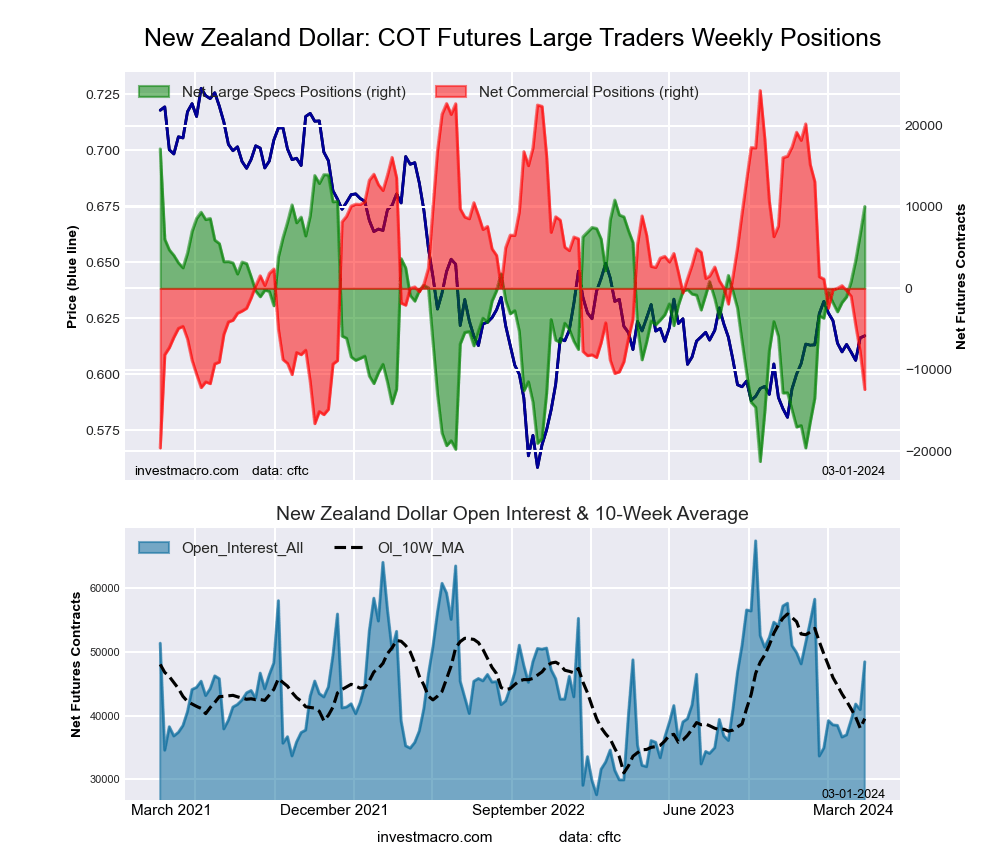
New Zealand Dollar Forex Futures COT ChartThe New Zealand Dollar large speculator standing this week came in at a net position of -2,882 contracts in the data reported through Tuesday. This was a weekly fall of -1,115 contracts from the previous week which had a total of -1,767 net contracts.

This week’s current strength score (the trader positioning range over the past three years, measured from 0 to 100) shows the speculators are currently Bearish with a score of 47.9 percent. The commercials are Bearish with a score of 44.7 percent and the small traders (not shown in chart) are Bullish-Extreme with a score of 85.1 percent.

Price Trend-Following Model: Uptrend

Our weekly trend-following model classifies the current market price position as: Uptrend. The current action for the model is considered to be: Hold – Maintain Long Position.

NEW ZEALAND DOLLAR StatisticsSPECULATORSCOMMERCIALSSMALL TRADERS
– Percent of Open Interest Longs:37.942.115.8
– Percent of Open Interest Shorts:45.442.18.3
– Net Position:-2,882-12,883
– Gross Longs:14,59216,2036,094
– Gross Shorts:17,47416,2043,211
– Long to Short Ratio:0.8 to 11.0 to 11.9 to 1
NET POSITION TREND:
– Strength Index Score (3 Year Range Pct):47.944.785.1
– Strength Index Reading (3 Year Range):BearishBearishBullish-Extreme
NET POSITION MOVEMENT INDEX:
– 6-Week Change in Strength Index:35.3-34.719.8


Mexican Peso Futures:

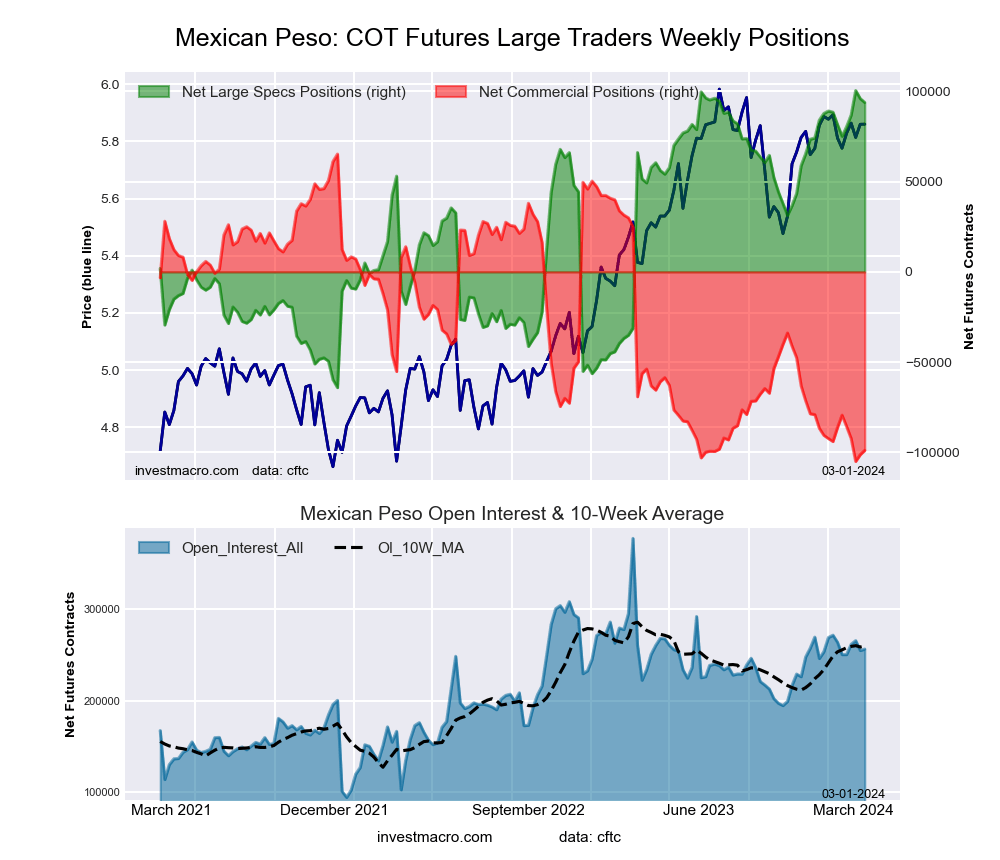
Mexican Peso Futures COT ChartThe Mexican Peso large speculator standing this week came in at a net position of 81,602 contracts in the data reported through Tuesday. This was a weekly decrease of -6,837 contracts from the previous week which had a total of 88,439 net contracts.

This week’s current strength score (the trader positioning range over the past three years, measured from 0 to 100) shows the speculators are currently Bullish-Extreme with a score of 88.9 percent. The commercials are Bearish-Extreme with a score of 10.0 percent and the small traders (not shown in chart) are Bearish with a score of 41.0 percent.

Price Trend-Following Model: Uptrend

Our weekly trend-following model classifies the current market price position as: Uptrend. The current action for the model is considered to be: Hold – Maintain Long Position.

MEXICAN PESO StatisticsSPECULATORSCOMMERCIALSSMALL TRADERS
– Percent of Open Interest Longs:50.743.72.9
– Percent of Open Interest Shorts:19.876.41.1
– Net Position:81,602-86,2714,669
– Gross Longs:133,691115,0507,623
– Gross Shorts:52,089201,3212,954
– Long to Short Ratio:2.6 to 10.6 to 12.6 to 1
NET POSITION TREND:
– Strength Index Score (3 Year Range Pct):88.910.041.0
– Strength Index Reading (3 Year Range):Bullish-ExtremeBearish-ExtremeBearish
NET POSITION MOVEMENT INDEX:
– 6-Week Change in Strength Index:5.0-4.5-3.3


Brazilian Real Futures:

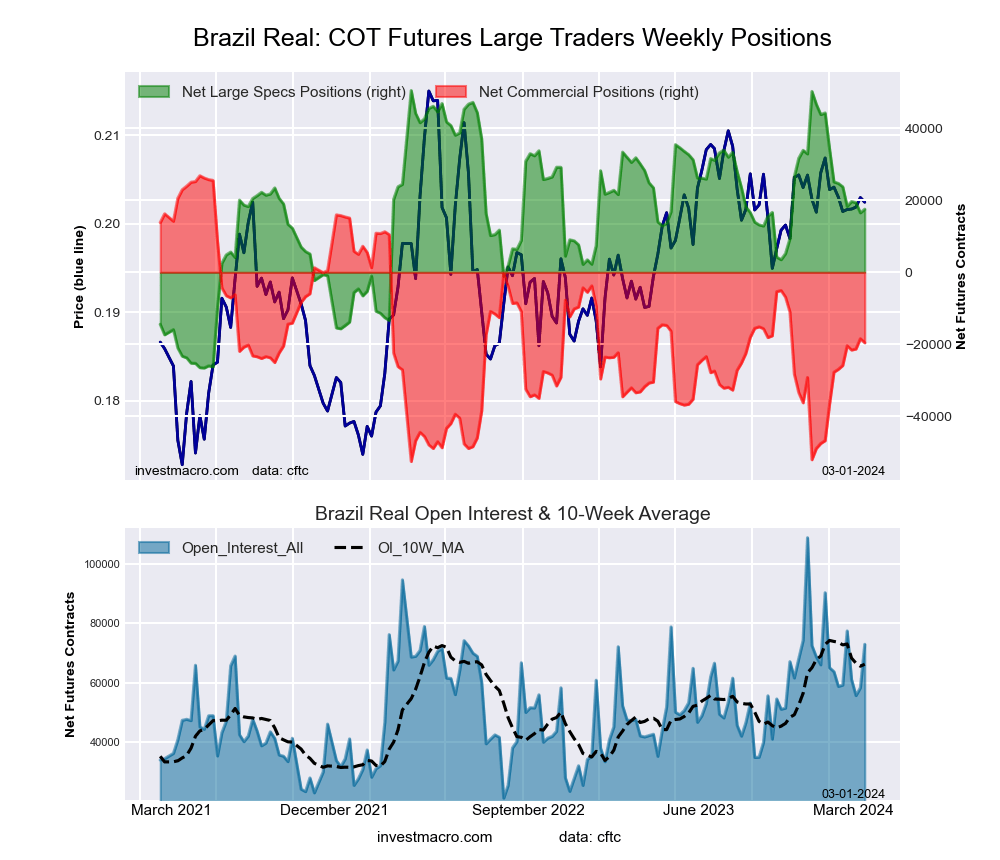
Brazil Real Futures COT ChartThe Brazilian Real large speculator standing this week came in at a net position of 24,695 contracts in the data reported through Tuesday. This was a weekly lowering of -419 contracts from the previous week which had a total of 25,114 net contracts.

This week’s current strength score (the trader positioning range over the past three years, measured from 0 to 100) shows the speculators are currently Bullish with a score of 66.5 percent. The commercials are Bearish with a score of 32.2 percent and the small traders (not shown in chart) are Bullish with a score of 55.7 percent.

Price Trend-Following Model: Uptrend

Our weekly trend-following model classifies the current market price position as: Uptrend. The current action for the model is considered to be: Hold – Maintain Long Position.

BRAZIL REAL StatisticsSPECULATORSCOMMERCIALSSMALL TRADERS
– Percent of Open Interest Longs:67.124.96.3
– Percent of Open Interest Shorts:25.170.82.5
– Net Position:24,695-26,9772,282
– Gross Longs:39,44114,6223,731
– Gross Shorts:14,74641,5991,449
– Long to Short Ratio:2.7 to 10.4 to 12.6 to 1
NET POSITION TREND:
– Strength Index Score (3 Year Range Pct):66.532.255.7
– Strength Index Reading (3 Year Range):BullishBearishBullish
NET POSITION MOVEMENT INDEX:
– 6-Week Change in Strength Index:-33.131.64.1


Bitcoin Futures:

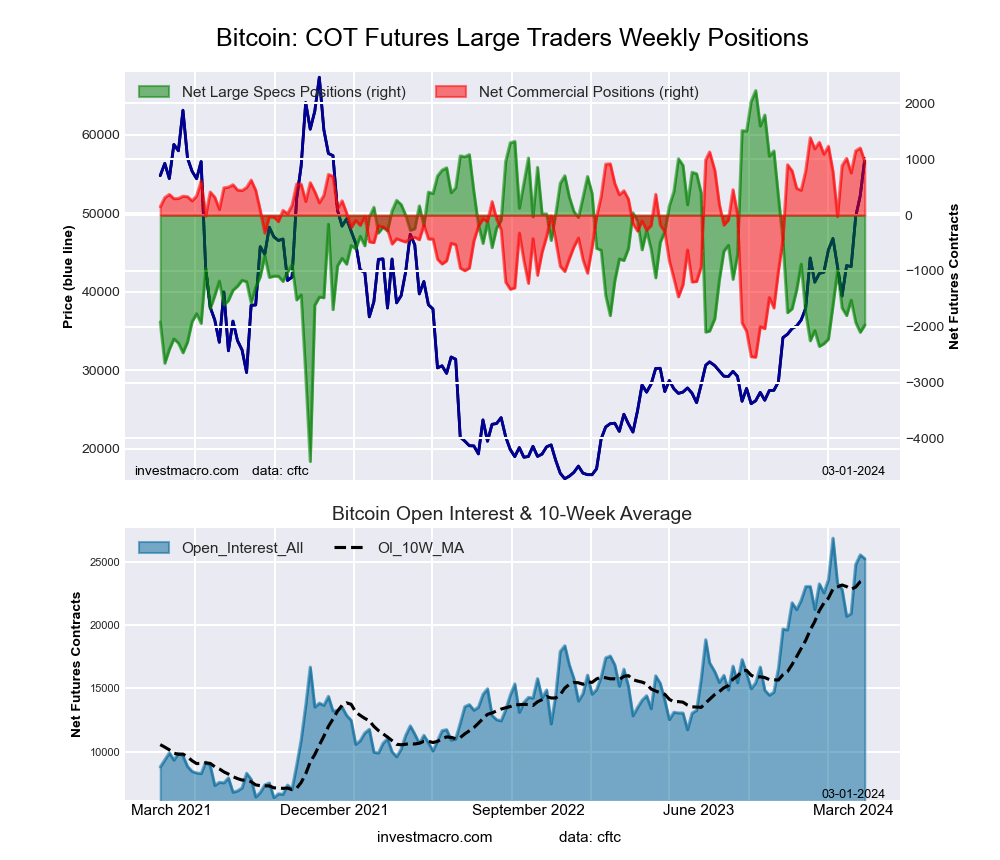
Bitcoin Crypto Futures COT ChartThe Bitcoin large speculator standing this week came in at a net position of -994 contracts in the data reported through Tuesday. This was a weekly advance of 624 contracts from the previous week which had a total of -1,618 net contracts.

This week’s current strength score (the trader positioning range over the past three years, measured from 0 to 100) shows the speculators are currently Bullish with a score of 51.4 percent. The commercials are Bullish with a score of 64.1 percent and the small traders (not shown in chart) are Bearish with a score of 36.1 percent.

Price Trend-Following Model: Uptrend

Our weekly trend-following model classifies the current market price position as: Uptrend. The current action for the model is considered to be: Hold – Maintain Long Position.

BITCOIN StatisticsSPECULATORSCOMMERCIALSSMALL TRADERS
– Percent of Open Interest Longs:75.55.87.5
– Percent of Open Interest Shorts:79.86.03.1
– Net Position:-994-251,019
– Gross Longs:17,5771,3611,747
– Gross Shorts:18,5711,386728
– Long to Short Ratio:0.9 to 11.0 to 12.4 to 1
NET POSITION TREND:
– Strength Index Score (3 Year Range Pct):51.464.136.1
– Strength Index Reading (3 Year Range):BullishBullishBearish
NET POSITION MOVEMENT INDEX:
– 6-Week Change in Strength Index:18.9-35.93.5


Article By InvestMacroReceive our weekly COT Newsletter

*COT Report: The COT data, released weekly to the public each Friday, is updated through the most recent Tuesday (data is 3 days old) and shows a quick view of how large speculators or non-commercials (for-profit traders) were positioned in the futures markets.

The CFTC categorizes trader positions according to commercial hedgers (traders who use futures contracts for hedging as part of the business), non-commercials (large traders who speculate to realize trading profits) and nonreportable traders (usually small traders/speculators) as well as their open interest (contracts open in the market at time of reporting). See CFTC criteria here.

Speculator Extremes: SOFR-3M, Nasdaq, Corn & Soybeans lead Bullish & Bearish Positions

By InvestMacro 

The latest update for the weekly Commitment of Traders (COT) report was released by the Commodity Futures Trading Commission (CFTC) on Friday for data ending on January 16th.

This weekly Extreme Positions report highlights the Most Bullish and Most Bearish Positions for the speculator category. Extreme positioning in these markets can foreshadow strong moves in the underlying market.

To signify an extreme position, we use the Strength Index (also known as the COT Index) of each instrument, a common method of measuring COT data. The Strength Index is simply a comparison of current trader positions against the range of positions over the previous 3 years. We use over 80 percent as extremely bullish and under 20 percent as extremely bearish. (Compare Strength Index scores across all markets in the data table or cot leaders table)


Here Are This Week’s Most Bullish Speculator Positions:

3-Month Secured Overnight Financing Rate


The 3-Month Secured Overnight Financing Rate speculator position comes in as the most bullish extreme standing this week. The 3-Month Secured Overnight Financing Rate speculator level is currently at a 100.0 percent score of its 3-year range.

The six-week trend for the percent strength score totaled 12.5 this week. The overall net speculator position was a total of 751,218 net contracts this week with a gain of 65,855 contract in the weekly speculator bets.


Speculators or Non-Commercials Notes:

Speculators, classified as non-commercial traders by the CFTC, are made up of large commodity funds, hedge funds and other significant for-profit participants. The Specs are generally regarded as trend-followers in their behavior towards price action – net speculator bets and prices tend to go in the same directions. These traders often look to buy when prices are rising and sell when prices are falling. To illustrate this point, many times speculator contracts can be found at their most extremes (bullish or bearish) when prices are also close to their highest or lowest levels.

These extreme levels can be dangerous for the large speculators as the trade is most crowded, there is less trading ammunition still sitting on the sidelines to push the trend further and prices have moved a significant distance. When the trend becomes exhausted, some speculators take profits while others look to also exit positions when prices fail to continue in the same direction. This process usually plays out over many months to years and can ultimately create a reverse effect where prices start to fall and speculators start a process of selling when prices are falling.


1-Month Secured Overnight Financing Rate

The 1-Month Secured Overnight Financing Rate speculator position comes next in the extreme standings this week. The 1-Month Secured Overnight Financing Rate speculator level is now at a 100.0 percent score of its 3-year range.

The six-week trend for the percent strength score was 10.8 this week. The speculator position registered 127,917 net contracts this week with a weekly change of 16,634 contracts in speculator bets.


Nasdaq


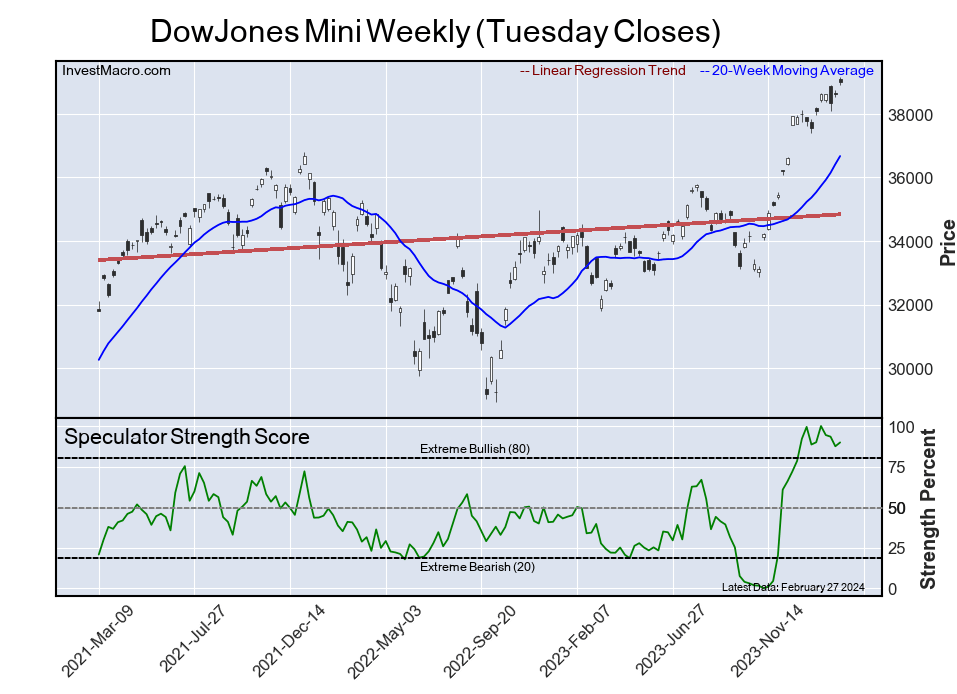
The Nasdaq speculator position comes in third this week in the extreme standings. The Nasdaq speculator level resides at a 95.2 percent score of its 3-year range.

The six-week trend for the speculator strength score came in at 43.4 this week. The overall speculator position was 36,571 net contracts this week with an edge lower by -205 contracts in the weekly speculator bets.


Russell 2000 Mini


The Russell 2000 Mini speculator position comes up number four in the extreme standings this week. The Russell 2000 Mini speculator level is at a 95.2 percent score of its 3-year range.

The six-week trend for the speculator strength score totaled a change of 49.4 this week. The overall speculator position was 14,245 net contracts this week with a retreat by -6,767 contracts in the speculator bets.


Steel


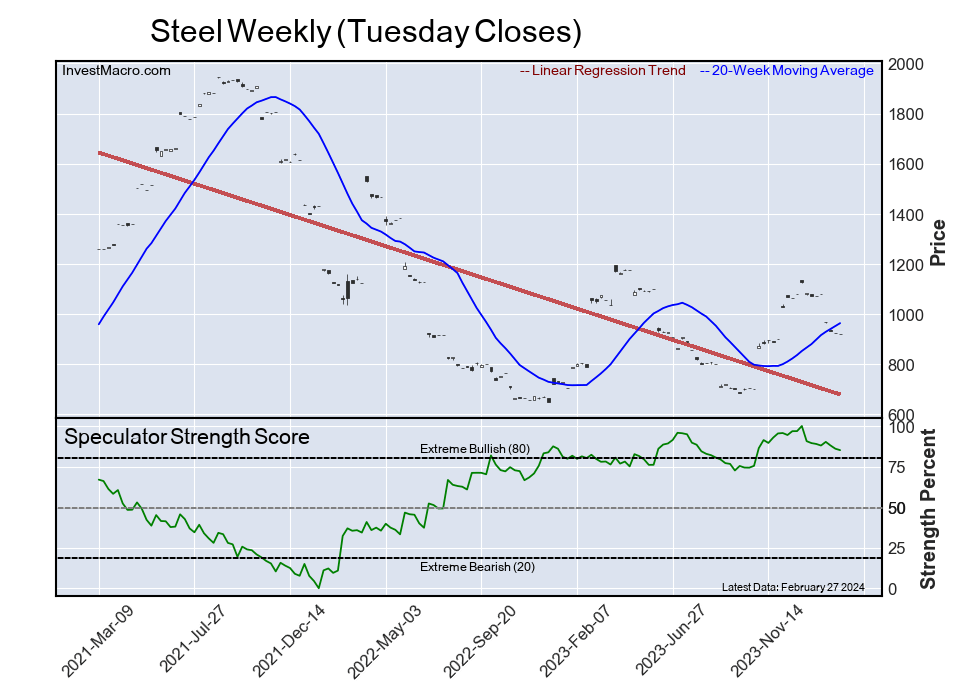
The Steel speculator position rounds out the top five in this week’s bullish extreme standings. The Steel speculator level sits at a 89.5 percent score of its 3-year range. The six-week trend for the speculator strength score was -6.2 this week.

The speculator position was -1,793 net contracts this week with a dip of -316 contracts in the weekly speculator bets.


This Week’s Most Bearish Speculator Positions:

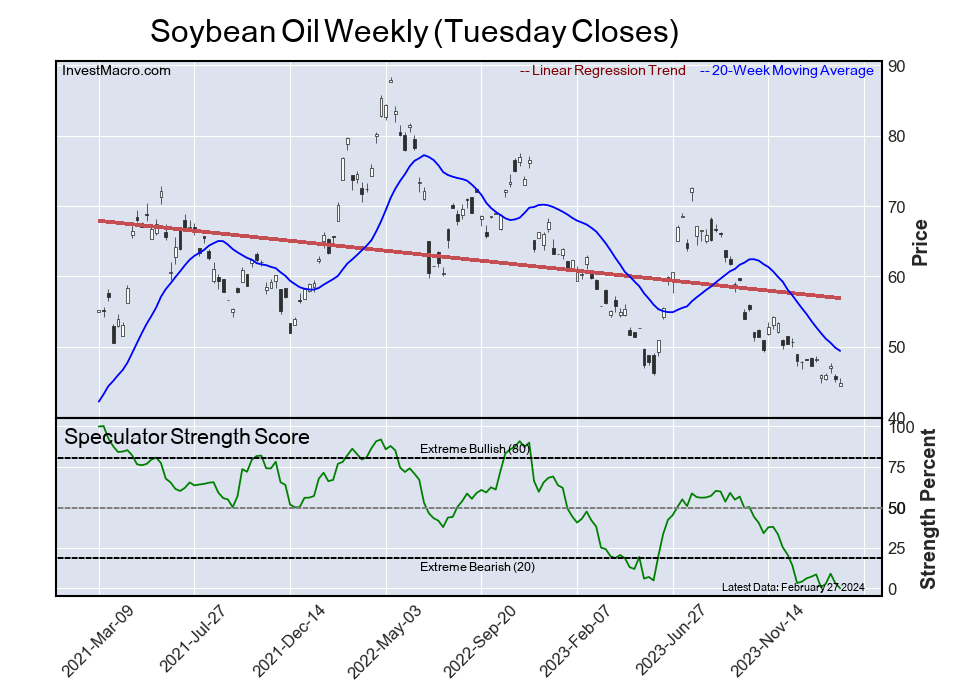
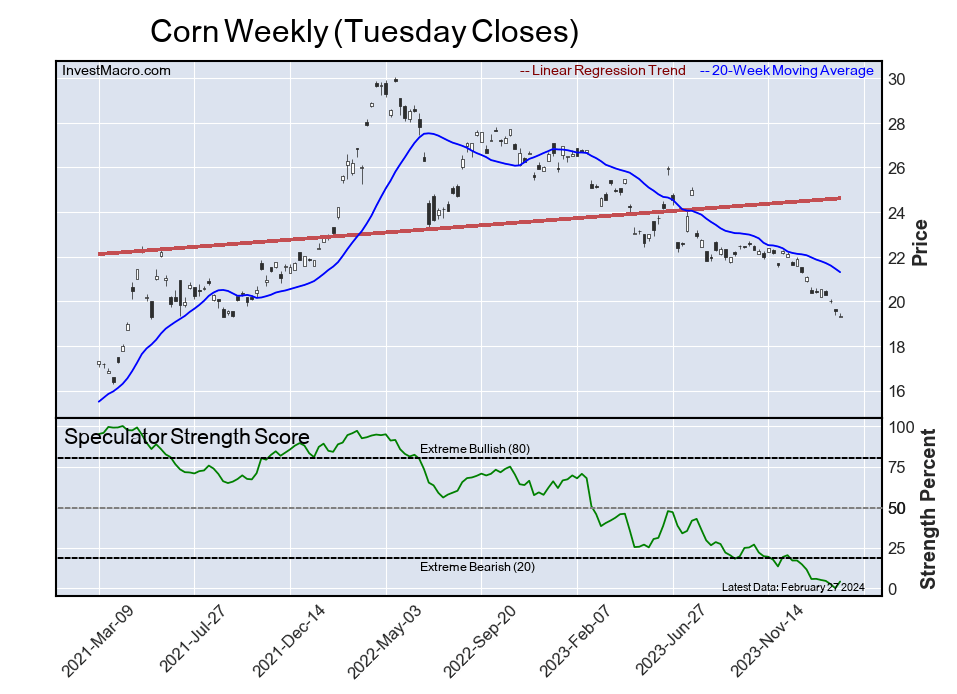
Corn


The Corn speculator position comes in as the most bearish extreme standing this week. The Corn speculator level is at a 0.0 percent score of its 3-year range.

The six-week trend for the speculator strength score was -14.3 this week. The overall speculator position was -219,968 net contracts this week with a fall by -46,935 contracts in the speculator bets.


Soybeans


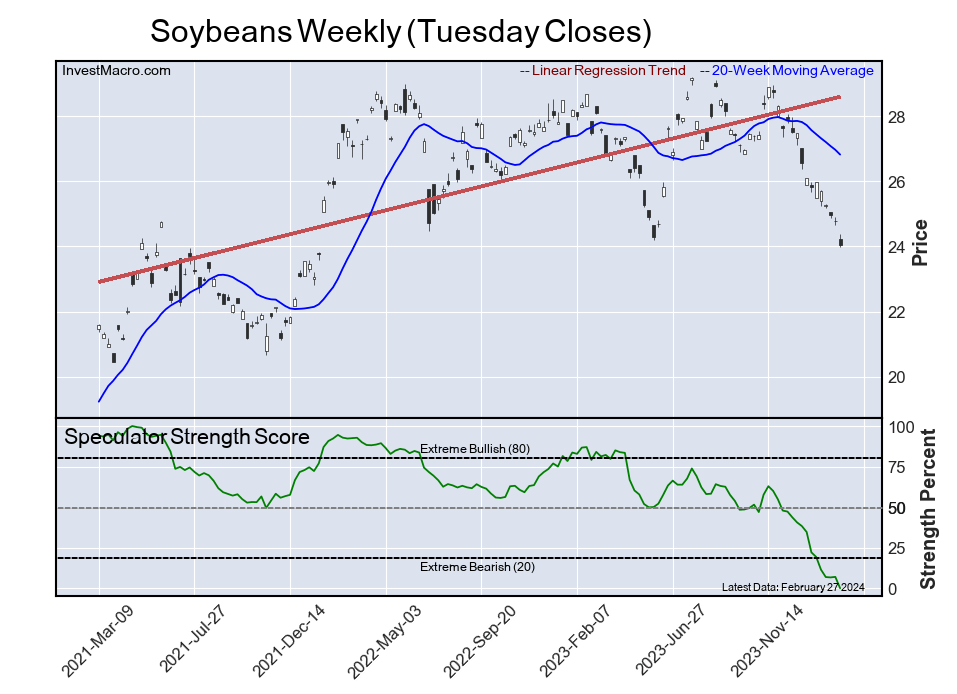
The Soybeans speculator position comes in next for the most bearish extreme standing on the week. The Soybeans speculator level is at a 0.0 percent score of its 3-year range.

The six-week trend for the speculator strength score was -33.1 this week. The speculator position was -93,668 net contracts this week with a decrease of -55,619 contracts in the weekly speculator bets.


10-Year Note


The 10-Year Note speculator position comes in as third most bearish extreme standing of the week. The 10-Year Note speculator level resides at a 0.0 percent score of its 3-year range.

The six-week trend for the speculator strength score was -23.6 this week. The overall speculator position was -889,385 net contracts this week with a drop of -102,365 contracts in the speculator bets.


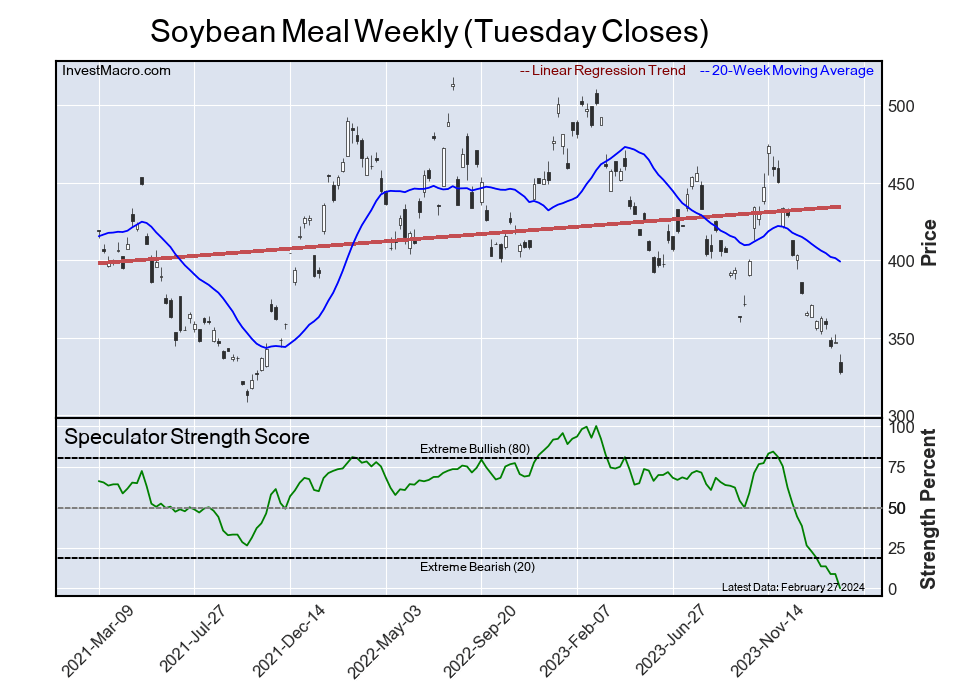
Soybean Meal


The Soybean Meal speculator position comes in as this week’s fourth most bearish extreme standing. The Soybean Meal speculator level is at a 0.0 percent score of its 3-year range.

The six-week trend for the speculator strength score was -67.9 this week. The speculator position was -11,242 net contracts this week with a decline of -8,752 contracts in the weekly speculator bets.


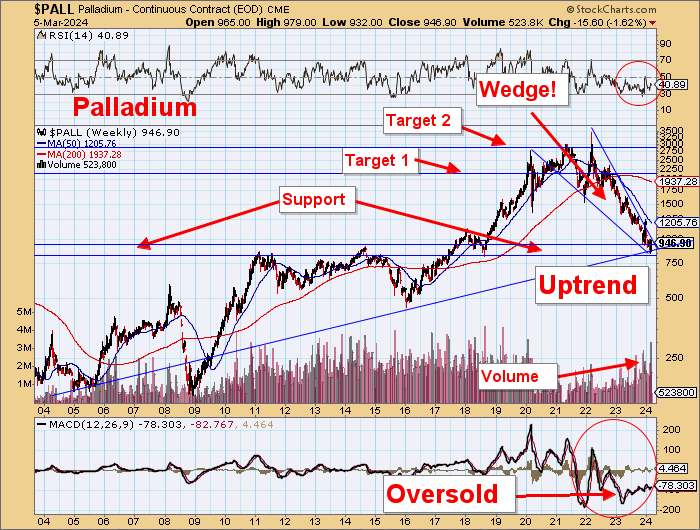
Palladium


Finally, the Palladium speculator position comes in as the fifth most bearish extreme standing for this week. The Palladium speculator level is at a 0.3 percent score of its 3-year range.

The six-week trend for the speculator strength score was -1.4 this week. The speculator position was -11,449 net contracts this week with a drop of -1,977 contracts in the weekly speculator bets.


Article By InvestMacroReceive our weekly COT Newsletter

*COT Report: The COT data, released weekly to the public each Friday, is updated through the most recent Tuesday (data is 3 days old) and shows a quick view of how large speculators or non-commercials (for-profit traders) were positioned in the futures markets.

The CFTC categorizes trader positions according to commercial hedgers (traders who use futures contracts for hedging as part of the business), non-commercials (large traders who speculate to realize trading profits) and nonreportable traders (usually small traders/speculators) as well as their open interest (contracts open in the market at time of reporting). See CFTC criteria here.

Week Ahead: USDJPY set to extend uptrend?

By ForexTime 

  • Yen down against G10 majors YTD
  • Watch out for BoJ policy meeting
  • Big US data likely to rock USD
  • USDJPY bullish but RSI signals overbought
  • Key level of interest at 148.50

Monetary policy will take centre stage in the week ahead as major central banks kick off their first meetings of 2024.

Also watch out for top-tier economic data and corporate earnings announcements from the largest companies in the world:

Monday, 22nd January

  • CNH: China loan prime rates
  • USD: US Conference Board leading index

Tuesday, 23rd January

  • EUR: Eurozone consumer confidence
  • JPY: BoJ rate decision
  • NQ100_m: Netflix earnings

Wednesday, 24th January

  • CAD: BoC rate decision
  • EUR: Eurozone/Germany S&P Global PMI
  • GBP: UK S&P Global/CIPS Manufacturing PMI
  • USD: S&P Global Services & Manufacturing PMI
  • S&P500_m: Tesla earnings

Thursday, 25th January

  • EUR: ECB rate decision, Germany IFO business climate
  • USD: Q4 GDP, initial jobless claims

Friday, 26th January

  • JPY: Japan Tokyo CPI, BoJ meeting minutes
  • USD: US December PCE report

Our focus falls on the Japanese Yen which has been on a back foot since December as bets fizzed out around a hawkish pivot by the Bank of Japan (BoJ) from negative rates. This supported the USDJPY with the upside fuelled by stronger than expected US data which dampened expectations around the Fed cutting rates in March.

The widening interest rate differentials between the US and Japan over the recent weeks has propelled the USDJPY. Prices are testing resistance around 148.50 as of writing.

Here are 3 factors that may move the USDJPY next week.

  1. BOJ policy meeting

The BoJ is widely expected to keep its yield-curve control and short-term interest rates unchanged at -0.1%.

Slowing inflation coupled with the devastating earthquake Japan experienced in early January have most likely reduced pressure on the BoJ to raise interest rates anytime soon. Nevertheless, much attention will be directed to the policy statement and updated quarterly outlook for fresh clues on rate hike timings.

As of writing, traders are currently pricing in an 83% probability of the BoJ hiking rates by June 2024.

Looking beyond the rate decision, the incoming Japan Tokyo CPI report on Friday may impact the Yen and rate hike expectations.

  • The Yen may extend losses if the BoJ maintains a dovish stance and offers zero clues on future rate hikes.
  • Any clues offered on future hikes in the policy statement or updated quarterly outlook could support the Yen. 
  1. Big US data

A week packed with top-tier US data is likely to shape expectations around the Fed’s next move.

The potential market shakers will be the final quarter GDP figures and December PCE report. Markets expect the US economy to have expanded 1.9% in Q4, down from the 4.9% in the prior quarter. Regarding the Fed’s preferred inflation gauge – the Core Personal Consumption Expenditure, it is forecast to rise 0.2% month-over-month compared to 0.1% in November. However, the year-over-year is expected to cool 3% vs 3.2% in the prior month.

  • Should overall US economic data disappoint, and inflation numbers print below forecasts, this may weaken the dollar – pulling the USDJPY lower as a result.
  • A set of strong economic reports and hotter-than-expected PCE report have the potential to boost the USD – pushing the USDJPY higher.
  1. Technical forces

The USDJPY is respecting an ascending channel on the daily timeframe with prices trading above the 50, 100 and 200-day SMA. However, the Relative Strength Index (RSI) is approaching 70, indicating that prices are overbought. In addition, key resistance levels can be found at 148.50 and the psychological 150.00 level.

  • A strong breakout and daily close above 148.50 may open the doors towards 150.00 – a level not seen since mid-November 2023 and beyond.
  • Should prices fail to conquer 148.50, this could trigger a decline back towards the 50-day SMA at 146.15 and 200-day SMA at 143.90.


Forex-Time-LogoArticle by ForexTime

ForexTime Ltd (FXTM) is an award winning international online forex broker regulated by CySEC 185/12 www.forextime.com

What the Red Sea crisis could mean for the electric vehicle industry and the planet

By Tom Stacey, Anglia Ruskin University 

Automotive giants Tesla and Volvo have announced pauses to the production of their electric vehicles (EVs) in Europe. Electric vehicles are seeing record sales and demand worldwide, but a lack of parts means that factories cannot sustain their production.

The reasons for this are complex. Parts are taking longer to deliver as attacks by Houthi rebels force ships to avoid the Red Sea. And there are also issues around the monopoly that Chinese factories hold on many EV components, including crucial lithium batteries.

These factors have made it harder (and more expensive) to move parts across the globe to support EV production in Europe.

Modern global supply chains are tightly orchestrated. Moving goods to factories (and away from them to customers) is heavily demand driven. Forecasting this demand has become a huge industry, valued at over US$27 billion (£21.3 billion).

But even with all this intelligence, political tensions, pandemics and even stuck ships can turn this industry on its head overnight. This is particularly the case where the supply side is constrained, as it is with EV batteries from China.

In 2021, a container ship called the Ever Given ran aground in the Suez Canal, blocking this vital shipping route from the far east to Europe for the best part of a week. The blockage prevented goods from passing through the canal, so had the knock-on effect of raising container shipping prices.

Even though the Suez canal has been open for two years, the recent attacks on commercial ships in the Red Sea have caused shipping companies to divert their ships to less direct routes – adding significant costs and time.

What does this mean for consumers and the planet? And are there ways for EV manufacturers to circumvent these risks?

Supply chains are fickle things

If manufacturers cannot produce due to shortages, then factories that make a single product such as Tesla’s gigafactory near Berlin (which produces the best-selling Model Y SUV) have one option – to idle the lines. Hourly-paid workers are sent home and where possible, salaried staff will continue in other roles such as safety checking and testing.

Tesla and Volvo have other factories and other product lines that can keep running. But even finished vehicles travelling from plants in China for sale in Europe are affected by the need to avoid the Red Sea. Vehicle manufacturer, Geely, who also produce Volvo vehicles in China, has warned of delays to European consumers expecting their new cars in early 2024.

Delays are not the only issue associated with shipping parts and vehicles around Africa to avoid the Red Sea. The 3,000 extra miles travelled by ships means they burn more fuel – a lot more fuel.

Peter Sand, a shipping analyst at ocean and air freight analytics platform, Xeneta, has estimated conservatively that each ship taking this route produces 2,700 extra tons of CO₂. If the international shipping industry were a country, it would already be among the world’s top carbon-emitting nations. And greenhouse gas emissions from ships are projected to increase by up to 50% by 2050.

EVs are undoubtedly better for the environment than their combustion engine counterparts. However, when supply is constrained, buyers often have little choice but to delay making the switch. Sales figures from 2023 show that private buyers still did not purchase as many EVs in the historically buoyant month of September as they did in the year before due to uncertainty in the market.

Fleet demand remains strong. But the market can only grow as fast as manufacturers can make cars. And pausing production is not going to help the transition.

Can manufacturers square this circle?

Clearly, these pinch points in the global supply chain have huge repercussions for manufacturers and consumers. Tesla’s factory in Germany is tight-lipped about actual production figures, but reports claim it makes around 4,000 units per week. Each car makes around US$8,000 profit, so this shut down could, in raw terms, lead to a loss of US$64 million in profit.

How do they prevent this? Supply chains do have some element of elasticity, but supply chain managers are always keen to reduce the potential of something known as the “bullwhip effect”. This is where marked differences in order quantities lead to even more shortages down the line. Managing expectations and reassuring buyers will thus help to smooth any issues with supply.

Making supply chains more resilient is also a huge area of research. Rerouting ships to prevent lost components is an example of this concept being put into practice.

If the parts were lost to rebel forces or pirates by taking the Red Sea route, then the revenue loss would be even larger. So although diverting routes is worse for the planet and arguably bad press, it would seem to be the lesser of two evils.

Multinational automotive manufacturer Stellantis has announced that it is instead bypassing the Red Sea by air-freighting parts to its EU factories. But, while this is faster than shipping parts around Africa, it’s not good for either CO₂ emissions or cost.

Keeping the global economy running

To reduce the disruptive potential of geopolitical tensions, Tesla and other automakers are attempting to produce their product closer to the consumer. The strategy is to put factories on each continent or geographical area where their products are sold.

However, as China still produces many of the core EV parts, manufacturers will have to invest heavily in their suppliers and put them closer to their factories.

Ultimately, this will require investment in skills and more factories. But with dropping profit margins, Chinese manufacturing dominance and inflationary pressures, it will continue to be a headache to implement.


Imagine weekly climate newsletter

Don’t have time to read about climate change as much as you’d like?

Get a weekly roundup in your inbox instead. Every Wednesday, The Conversation’s environment editor writes Imagine, a short email that goes a little deeper into just one climate issue. Join the 30,000+ readers who’ve subscribed so far.The Conversation


Tom Stacey, Senior Lecturer in Operations and Supply Chain Management, Anglia Ruskin University

This article is republished from The Conversation under a Creative Commons license. Read the original article.

Mid-Week Technical Outlook: NQ100_m wobbles above support

By ForexTime 

  • NQ100_m wobble above support
  • Prices trapped within range
  • Weekly RSI near overbought levels
  • Incoming US data could trigger breakout
  • Key levels of interest at 16900 & 16630

After swinging within a range on the daily charts, the NQ100_m could be preparing for a breakout.

The first half of January was a rollercoaster ride for the index thanks to fundamental forces. A string of stronger-than-expected US economic data cooled Fed cut bets, impacting the tech filled NQ100_m index.

Prices are currently trapped within a narrow range near all-time highs, with bulls and bears waiting for a fresh directional catalyst. A significant move could be around the corner, especially when factoring in the incoming US data this week which could influence the NQ100_m which is filled with tech stocks.

Starting on the weekly charts, the NQ100_m is respecting an ascending weekly channel while prices are trading above the 50, 100 and 200-week SMA. However, the Relative Strength Index is hovering near 70, indicating that prices could be heavily overbought. In addition, potential resistance may be found at 17,000 just above the current all-time high.

We see a similar bullish picture on the monthly charts as prices create higher highs and higher lows. The MACD is also trading above zero. It will be worth keeping an eye on how prices behave at the 16995 all-time high. Support can be found around 14,200 – near the most recent higher low.


Placing our attention back to the daily timeframe, it may be wise to keep a close eye on how prices react to support at 16630 and resistance at 16900.

  • A strong breakdown and daily close below 16,630 could see a decline towards the 50-day SMA at 16,250

  • Should prices push above 16,900, this may open the doors back to the all-time high at 16,995 and beyond.


Forex-Time-LogoArticle by ForexTime

ForexTime Ltd (FXTM) is an award winning international online forex broker regulated by CySEC 185/12 www.forextime.com
Data brokers know everything about you – what FTC case against ad tech giant Kochava reveals

By Anne Toomey McKenna, University of Richmond 

Kochava, the self-proclaimed industry leader in mobile app data analytics, is locked in a legal battle with the Federal Trade Commission in a case that could lead to big changes in the global data marketplace and in Congress’ approach to artificial intelligence and data privacy.

The stakes are high because Kochava’s secretive data acquisition and AI-aided analytics practices are commonplace in the global location data market. In addition to numerous lesser-known data brokers, the mobile data market includes larger players like Foursquare and data market exchanges like Amazon’s AWS Data Exchange. The FTC’s recently unsealed amended complaint against Kochava makes clear that there’s truth to what Kochava advertises: it can provide data for “Any Channel, Any Device, Any Audience,” and buyers can “Measure Everything with Kochava.”

Separately, the FTC is touting a settlement it just reached with data broker Outlogic, in what it calls the “first-ever ban on the use and sale of sensitive location data.” Outlogic has to destroy the location data it has and is barred from collecting or using such information to determine who comes and goes from sensitive locations, like health care centers, homeless and domestic abuse shelters, and religious places.

According to the FTC and proposed class-action lawsuits against Kochava on behalf of adults and children, the company secretly collects, without notice or consent, and otherwise obtains vast amounts of consumer location and personal data. It then analyzes that data using AI, which allows it to predict and influence consumer behavior in an impressively varied and alarmingly invasive number of ways, and serves it up for sale.

Kochava has denied the FTC’s allegations.

The FTC says Kochava sells a “360-degree perspective” on individuals and advertises it can “connect precise geolocation data with email, demographics, devices, households, and channels.” In other words, Kochava takes location data, aggregates it with other data and links it to consumer identities. The data it sells reveals precise information about a person, such as visits to hospitals, “reproductive health clinics, places of worship, homeless and domestic violence shelters, and addiction recovery facilities.” Moreover, by selling such detailed data about people, the FTC says “Kochava is enabling others to identify individuals and exposing them to threats of stigma, stalking, discrimination, job loss, and even physical violence.”

I’m a lawyer and law professor practicing, teaching and researching about AI, data privacy and evidence. These complaints underscore for me that U.S. law has not kept pace with regulation of commercially available data or governance of AI.

Most data privacy regulations in the U.S. were conceived in the pre-generative AI era, and there is no overarching federal law that addresses AI-driven data processing. There are Congressional efforts to regulate the use of AI in decision making, like hiring and sentencing. There are also efforts to provide public transparency around AI’s use. But Congress has yet to pass legislation.

The Federal Trade Commission’s suit against Kochava is set against a backdrop of minimal regulation of data brokers.

What litigation documents reveal

According to the FTC, Kochava secretly collects and then sells its “Kochava Collective” data, which includes precise geolocation data, comprehensive profiles of individual consumers, consumers’ mobile app use details and Kochava’s “audience segments.”

The FTC says Kochava’s audience segments can be based on “behaviors” and sensitive information such as gender identity, political and religious affiliation, race, visits to hospitals and abortion clinics, and people’s medical information, like menstruation and ovulation, and even cancer treatments. By selecting certain audience segments, Kochava customers can identify and target extremely specific groups. For example, this could include people who gender identify as “other,” or all the pregnant females who are African American and Muslim. The FTC says selected audience segments can be narrowed to a specific geographical area or, conceivably, even down to a specific building.

By identify, the FTC explains that Kochava customers are able to obtain the name, home address, email address, economic status and stability, and much more data about people within selected groups. This data is purchased by organizations like advertisers, insurers and political campaigns that seek to narrowly classify and target people. The FTC also says it can be purchased by people who want to harm others.

How Kochava acquires such sensitive data

The FTC says Kochava acquires consumer data in two ways: through Kochava’s software development kits that it provides to app developers, and directly from other data brokers. The FTC says those Kochava-supplied software development kits are installed in over 10,000 apps globally. Kochava’s kits, embedded with Kochava’s coding, collect hordes of data and send it back to Kochava without the consumer being told or consenting to the data collection.

Another lawsuit against Kochava in California alleges similar charges of surreptitious data collection and analysis, and that Kochava sells customized data feeds based on extremely sensitive and private information precisely tailored to its clients’ needs.

The data broker marketplace has been tracking you for years, thanks to mobile phones and web browser cookies.

AI pierces your privacy

The FTC’s complaint also illustrates how advancing AI tools are enabling a new phase in data analysis. Generative AI’s ability to process vast amounts of data is reshaping what can be done with and learned from mobile data in ways that invade privacy. This includes inferring and disclosing sensitive or otherwise legally protected information, like medical records and images.

AI provides the ability both to know and predict just about anything about individuals and groups, even very sensitive behavior. It also makes it possible to manipulate individual and group behavior, inducing decisions in favor of the specific users of the AI tool.

This type of “AI coordinated manipulation” can supplant your decision-making ability without your knowledge.

Privacy in the balance

The FTC enforces laws against unfair and deceptive business practices, and it informed Kochava in 2022 that the company was in violation. Both sides have had some wins and losses in the ongoing case. Senior U.S. District Judge B. Lynn Winmill, who is overseeing the case, dismissed the FTC’s first complaint and required more facts from the FTC. The commission filed an amended complaint that provided much more specific allegations.

Winmill has not yet ruled on another Kochava motion to dismiss the FTC’s case, but as of a Jan. 3, 2024 filing in the case, the parties are proceeding with discovery. A 2025 trial date is expected, but the date has not yet been set.

For now, companies, privacy advocates and policymakers are likely keeping an eye on this case. Its outcome, combined with proposed legislation and the FTC’s focus on generative AI, data and privacy, could spell big changes for how companies acquire data, the ways that AI tools can be used to analyze data, and what data can lawfully be used in machine- and human-based data analytics.

About the Author:The Conversation

Anne Toomey McKenna, Visiting Professor of Law, University of Richmond

This article is republished from The Conversation under a Creative Commons license. Read the original article.

Curious Kids: how much money is there in the world?

By Renaud Foucart, Lancaster University 

How much money is there in the world? – Tsubamé, aged ten, London

If we want to add up how much money there is in the world, a good place to start would be counting all the notes and coins out there – in people’s wallets and money boxes and in cash machines.

Let’s start with pounds. There is about £84 billion (or 84,000,000,000) of British money out there in coins and notes. There’s also US$2,236 billion in US money, €1,578 billion in the money of the European Union and ¥9,616 billion in Chinese money – plus money in many other currencies.

As money is not the same in every country, summing up all the coins and notes in the world means that you need to measure how much a US dollar, an Indian rupee, or a Chinese yuan is worth in Great British pounds. If this is done with the latest available data, then added up, you will find a total of £6,113 billion.


Curious Kids is a series by The Conversation that gives children the chance to have their questions about the world answered by experts. If you have a question you’d like an expert to answer, send it to [email protected] and make sure you include the asker’s first name, age and town or city. We won’t be able to answer every question, but we’ll do our very best.


This amount could change very quickly and is probably already outdated at the moment you read this article.

This is partly because countries print more money all the time. But it’s also because the exchange rate – how much a British pound, say, is worth in another currency, like US dollars – is not always the same. Today, £1 is worth around US$1.30 – one dollar and 30 cents in US money. Ten years ago, it was much more: one dollar and 70 cents.

How many US dollars you get for a pound depends on how much people want to use British money. That’s why when some people decide to create their own money, such as cryptocurrencies like bitcoin, they spend so much time trying to convince others to use it.

But counting coins and notes does not tell us everything about how much money there is in the world. For instance, people have money in their bank accounts that do not correspond to any specific coin. In the UK, around 96% of money exists only in electronic form. When you include that, the total is not £84 billion but £2,223 billion. If you add up again the figures available for the entire world – money in coins and notes, plus electronic money in bank accounts – you get roughly £46,557 billion.

Wealth – but not money

What’s more, many things that are worth a lot are not money itself. Very rich people keep only a little part of their fortune in cash. They prefer to also own things like businesses that are likely to make them even richer.

Perhaps a better way to count how much money there is in the world is to look at the value of the things we buy and sell. That is a tricky thing to do, because you don’t want to double count anything. If farmers sell the milk of their cows to a cheese maker, who then sells cheese to a shop, which sells it to people, all the value – the milk, the cheese and the people selling it, is contained in what you pay at the shop: the final sale.

When you sum up all these final sales, you will find that last year, in the entire world, there was around £79,437 billion worth of value created.

But there are also a lot of things that have value and are not exchanged. If you own a bag of diamonds and keep it in your bedroom, you are rich. But this is not money. And you are not exchanging it either. So it does not count in any of the numbers I have given you so far.

And sometimes, things that have value cannot easily be turned into money. Imagine that you own a beautiful forest, with a nice clean river to swim in during the summer, and some very rare birds and old trees. And underneath that forest, there is a lot of oil.

By owning this forest, you are very wealthy. Like the diamonds in your bedroom, owning the land and the forest and the oil makes you rich. But once you decide to turn your wealth into a lot of money, you will need to destroy the forest: cut down the trees for wood to sell, and drill into the earth to get the oil out.

People might have enjoyed spending time with friends walking in the forest, or paddling in the rivers. This has value, and it is lost when the forest is gone. And the wealth you held by owning the forest is gone too.

If we want the money we use to still be worth something in the future, we sometimes need to restrain from destroying what we own to get cash today.The Conversation

About the Author:

Renaud Foucart, Senior Lecturer in Economics, Lancaster University Management School, Lancaster University

This article is republished from The Conversation under a Creative Commons license. Read the original article.

Currency Speculators push British Pound bets to highest since September

By InvestMacro

Here are the latest charts and statistics for the Commitment of Traders (COT) data published by the Commodities Futures Trading Commission (CFTC).

The latest COT data is updated through Tuesday January 9th and shows a quick view of how large market participants (for-profit speculators and commercial traders) were positioned in the futures markets. All currency positions are in direct relation to the US dollar where, for example, a bet for the euro is a bet that the euro will rise versus the dollar while a bet against the euro will be a bet that the euro will decline versus the dollar.

Weekly Speculator Changes led by Swiss Franc & Bitcoin

The COT currency market speculator bets were higher this week as seven out of the eleven currency markets we cover had higher positioning while the other four markets had lower speculator contracts.

Leading the gains for the currency markets was the Canadian Dollar (13,751 contracts) with the Australian Dollar (10,619 contracts), the British Pound (5,529 contracts), the Japanese Yen (1,246 contracts), the Swiss Franc (823 contracts), Bitcoin (603 contracts) and the US Dollar Index (487 contracts) also showing positive weeks.

The currencies seeing declines in speculator bets on the week were the Brazilian Real (-9,193 contracts), the New Zealand Dollar (-1,221 contracts), the EuroFX (-599 contracts) and the Mexican Peso (-659 contracts) also having lower bets.

Currency Speculators continue to raise their British Pound bets to highest since September

Highlighting the COT currency’s data is the recent gains in the speculator positioning for the British Pound Sterling. The Pound Sterling speculative positioning increased this week for a second straight week and for the seventh time over the past ten weeks.

The GBP speculator position has now been in an overall bullish position for the past six weeks following a run of nine weeks in bearish territory from the beginning of October to the end of November.

This renewed bullishness has brought the net speculator standing (currently at +20,734 contracts) to the highest level in the past sixteen weeks, dating back to September 19th.

The British Pound Sterling’s exchange rate with the US Dollar has been on the move higher as well after finding a major support level at 1.2100 for a period of weeks in October and November. Since then, the GBPUSD currency pair has trended up with gains in seven out of the past nine weeks to a close this week at the 1.2753 threshold and just below the 200-week moving average at 1.2844.


Major Currencies – Speculators Leaderboard


Legend: Weekly Speculators Change | Speculators Current Net Position | Speculators Strength Score compared to last 3-Years (0-100 range)


Strength Scores led by Mexican Peso & EuroFX

COT Strength Scores (a normalized measure of Speculator positions over a 3-Year range, from 0 to 100 where above 80 is Extreme-Bullish and below 20 is Extreme-Bearish) showed that the Mexican Peso (93 percent) and the EuroFX (71 percent) lead the currency markets this week. The British Pound (70 percent), Brazilian Real (67 percent) and the Australian Dollar (59 percent) come in as the next highest in the weekly strength scores.

On the downside, the US Dollar Index (30 percent) and the Japanese Yen (41 percent) come in at the lowest strength levels currently. The next lowest strength scores are the Bitcoin (42 percent) and the Swiss Franc (46 percent).

Strength Statistics:
US Dollar Index (29.6 percent) vs US Dollar Index previous week (28.8 percent)
EuroFX (70.9 percent) vs EuroFX previous week (71.2 percent)
British Pound Sterling (70.2 percent) vs British Pound Sterling previous week (66.3 percent)
Japanese Yen (41.2 percent) vs Japanese Yen previous week (40.5 percent)
Swiss Franc (46.1 percent) vs Swiss Franc previous week (43.7 percent)
Canadian Dollar (52.9 percent) vs Canadian Dollar previous week (41.3 percent)
Australian Dollar (59.2 percent) vs Australian Dollar previous week (49.5 percent)
New Zealand Dollar (50.8 percent) vs New Zealand Dollar previous week (54.0 percent)
Mexican Peso (93.1 percent) vs Mexican Peso previous week (93.5 percent)
Brazilian Real (67.1 percent) vs Brazilian Real previous week (79.0 percent)
Bitcoin (42.1 percent) vs Bitcoin previous week (33.0 percent)


Canadian Dollar & New Zealand Dollar top the 6-Week Strength Trends

COT Strength Score Trends (or move index, calculates the 6-week changes in strength scores) showed that the Canadian Dollar (47 percent) and the New Zealand Dollar (46 percent) lead the past six weeks trends for the currencies. The Swiss Franc (45 percent), the Australian Dollar (36 percent) and the Japanese Yen (30 percent) are the next highest positive movers in the latest trends data.

The US Dollar Index (-27 percent) leads the downside trend scores currently with the EuroFX (-10 percent) and the Brazilian Real (-10 percent) following next with lower trend scores.

Strength Trend Statistics:
US Dollar Index (-27.0 percent) vs US Dollar Index previous week (-30.5 percent)
EuroFX (-10.3 percent) vs EuroFX previous week (-4.3 percent)
British Pound Sterling (19.9 percent) vs British Pound Sterling previous week (28.7 percent)
Japanese Yen (29.6 percent) vs Japanese Yen previous week (26.8 percent)
Swiss Franc (45.0 percent) vs Swiss Franc previous week (39.0 percent)
Canadian Dollar (46.9 percent) vs Canadian Dollar previous week (37.2 percent)
Australian Dollar (35.7 percent) vs Australian Dollar previous week (32.1 percent)
New Zealand Dollar (46.5 percent) vs New Zealand Dollar previous week (42.5 percent)
Mexican Peso (14.0 percent) vs Mexican Peso previous week (18.4 percent)
Brazilian Real (-10.1 percent) vs Brazilian Real previous week (0.6 percent)
Bitcoin (1.9 percent) vs Bitcoin previous week (-20.2 percent)


Individual COT Forex Markets:

US Dollar Index Futures:

US Dollar Index Forex Futures COT ChartThe US Dollar Index large speculator standing this week equaled a net position of 2,910 contracts in the data reported through Tuesday. This was a weekly gain of 487 contracts from the previous week which had a total of 2,423 net contracts.

This week’s current strength score (the trader positioning range over the past three years, measured from 0 to 100) shows the speculators are currently Bearish with a score of 29.6 percent. The commercials are Bullish with a score of 74.8 percent and the small traders (not shown in chart) are Bearish-Extreme with a score of 3.0 percent.

Price Trend-Following Model: Strong Downtrend

Our weekly trend-following model classifies the current market price position as: Strong Downtrend. The current action for the model is considered to be: Hold – Maintain Short Position.

US DOLLAR INDEX StatisticsSPECULATORSCOMMERCIALSSMALL TRADERS
– Percent of Open Interest Longs:67.215.110.3
– Percent of Open Interest Shorts:55.024.313.2
– Net Position:2,910-2,210-700
– Gross Longs:16,0413,5982,450
– Gross Shorts:13,1315,8083,150
– Long to Short Ratio:1.2 to 10.6 to 10.8 to 1
NET POSITION TREND:
– Strength Index Score (3 Year Range Pct):29.674.83.0
– Strength Index Reading (3 Year Range):BearishBullishBearish-Extreme
NET POSITION MOVEMENT INDEX:
– 6-Week Change in Strength Index:-27.026.41.1


Euro Currency Futures:

Euro Currency Futures COT ChartThe Euro Currency large speculator standing this week equaled a net position of 118,877 contracts in the data reported through Tuesday. This was a weekly decrease of -599 contracts from the previous week which had a total of 119,476 net contracts.

This week’s current strength score (the trader positioning range over the past three years, measured from 0 to 100) shows the speculators are currently Bullish with a score of 70.9 percent. The commercials are Bearish with a score of 30.5 percent and the small traders (not shown in chart) are Bearish with a score of 39.6 percent.

Price Trend-Following Model: Strong Uptrend

Our weekly trend-following model classifies the current market price position as: Strong Uptrend. The current action for the model is considered to be: Hold – Maintain Long Position.

EURO Currency StatisticsSPECULATORSCOMMERCIALSSMALL TRADERS
– Percent of Open Interest Longs:29.257.411.5
– Percent of Open Interest Shorts:12.579.46.2
– Net Position:118,877-156,88738,010
– Gross Longs:208,473409,73882,429
– Gross Shorts:89,596566,62544,419
– Long to Short Ratio:2.3 to 10.7 to 11.9 to 1
NET POSITION TREND:
– Strength Index Score (3 Year Range Pct):70.930.539.6
– Strength Index Reading (3 Year Range):BullishBearishBearish
NET POSITION MOVEMENT INDEX:
– 6-Week Change in Strength Index:-10.37.37.8


British Pound Sterling Futures:

British Pound Sterling Futures COT ChartThe British Pound Sterling large speculator standing this week equaled a net position of 20,734 contracts in the data reported through Tuesday. This was a weekly boost of 5,529 contracts from the previous week which had a total of 15,205 net contracts.

This week’s current strength score (the trader positioning range over the past three years, measured from 0 to 100) shows the speculators are currently Bullish with a score of 70.2 percent. The commercials are Bearish with a score of 32.9 percent and the small traders (not shown in chart) are Bullish with a score of 62.2 percent.

Price Trend-Following Model: Strong Uptrend

Our weekly trend-following model classifies the current market price position as: Strong Uptrend. The current action for the model is considered to be: Hold – Maintain Long Position.

BRITISH POUND StatisticsSPECULATORSCOMMERCIALSSMALL TRADERS
– Percent of Open Interest Longs:35.244.016.2
– Percent of Open Interest Shorts:23.157.315.0
– Net Position:20,734-22,8752,141
– Gross Longs:60,68475,97227,973
– Gross Shorts:39,95098,84725,832
– Long to Short Ratio:1.5 to 10.8 to 11.1 to 1
NET POSITION TREND:
– Strength Index Score (3 Year Range Pct):70.232.962.2
– Strength Index Reading (3 Year Range):BullishBearishBullish
NET POSITION MOVEMENT INDEX:
– 6-Week Change in Strength Index:19.9-18.48.5


Japanese Yen Futures:

Japanese Yen Forex Futures COT ChartThe Japanese Yen large speculator standing this week equaled a net position of -55,949 contracts in the data reported through Tuesday. This was a weekly boost of 1,246 contracts from the previous week which had a total of -57,195 net contracts.

This week’s current strength score (the trader positioning range over the past three years, measured from 0 to 100) shows the speculators are currently Bearish with a score of 41.2 percent. The commercials are Bullish with a score of 60.1 percent and the small traders (not shown in chart) are Bullish with a score of 65.5 percent.

Price Trend-Following Model: Uptrend

Our weekly trend-following model classifies the current market price position as: Uptrend. The current action for the model is considered to be: Hold – Maintain Long Position.

JAPANESE YEN StatisticsSPECULATORSCOMMERCIALSSMALL TRADERS
– Percent of Open Interest Longs:20.756.920.4
– Percent of Open Interest Shorts:48.629.819.6
– Net Position:-55,94954,1911,758
– Gross Longs:41,364113,87640,937
– Gross Shorts:97,31359,68539,179
– Long to Short Ratio:0.4 to 11.9 to 11.0 to 1
NET POSITION TREND:
– Strength Index Score (3 Year Range Pct):41.260.165.5
– Strength Index Reading (3 Year Range):BearishBullishBullish
NET POSITION MOVEMENT INDEX:
– 6-Week Change in Strength Index:29.6-25.0-8.8


Swiss Franc Futures:

Swiss Franc Forex Futures COT ChartThe Swiss Franc large speculator standing this week equaled a net position of -4,392 contracts in the data reported through Tuesday. This was a weekly gain of 823 contracts from the previous week which had a total of -5,215 net contracts.

This week’s current strength score (the trader positioning range over the past three years, measured from 0 to 100) shows the speculators are currently Bearish with a score of 46.1 percent. The commercials are Bearish with a score of 42.8 percent and the small traders (not shown in chart) are Bullish with a score of 68.8 percent.

Price Trend-Following Model: Strong Uptrend

Our weekly trend-following model classifies the current market price position as: Strong Uptrend. The current action for the model is considered to be: Hold – Maintain Long Position.

SWISS FRANC StatisticsSPECULATORSCOMMERCIALSSMALL TRADERS
– Percent of Open Interest Longs:22.046.131.5
– Percent of Open Interest Shorts:30.841.127.8
– Net Position:-4,3922,5241,868
– Gross Longs:11,04423,14015,792
– Gross Shorts:15,43620,61613,924
– Long to Short Ratio:0.7 to 11.1 to 11.1 to 1
NET POSITION TREND:
– Strength Index Score (3 Year Range Pct):46.142.868.8
– Strength Index Reading (3 Year Range):BearishBearishBullish
NET POSITION MOVEMENT INDEX:
– 6-Week Change in Strength Index:45.0-44.930.2


Canadian Dollar Futures:

Canadian Dollar Forex Futures COT ChartThe Canadian Dollar large speculator standing this week equaled a net position of -7,380 contracts in the data reported through Tuesday. This was a weekly boost of 13,751 contracts from the previous week which had a total of -21,131 net contracts.

This week’s current strength score (the trader positioning range over the past three years, measured from 0 to 100) shows the speculators are currently Bullish with a score of 52.9 percent. The commercials are Bullish with a score of 50.4 percent and the small traders (not shown in chart) are Bearish with a score of 43.2 percent.

Price Trend-Following Model: Strong Uptrend

Our weekly trend-following model classifies the current market price position as: Strong Uptrend. The current action for the model is considered to be: Hold – Maintain Long Position.

CANADIAN DOLLAR StatisticsSPECULATORSCOMMERCIALSSMALL TRADERS
– Percent of Open Interest Longs:24.654.719.4
– Percent of Open Interest Shorts:29.055.714.1
– Net Position:-7,380-1,7879,167
– Gross Longs:42,28693,84233,353
– Gross Shorts:49,66695,62924,186
– Long to Short Ratio:0.9 to 11.0 to 11.4 to 1
NET POSITION TREND:
– Strength Index Score (3 Year Range Pct):52.950.443.2
– Strength Index Reading (3 Year Range):BullishBullishBearish
NET POSITION MOVEMENT INDEX:
– 6-Week Change in Strength Index:46.9-43.329.9


Australian Dollar Futures:

Australian Dollar Forex Futures COT ChartThe Australian Dollar large speculator standing this week equaled a net position of -32,274 contracts in the data reported through Tuesday. This was a weekly boost of 10,619 contracts from the previous week which had a total of -42,893 net contracts.

This week’s current strength score (the trader positioning range over the past three years, measured from 0 to 100) shows the speculators are currently Bullish with a score of 59.2 percent. The commercials are Bearish with a score of 32.9 percent and the small traders (not shown in chart) are Bullish with a score of 79.8 percent.

Price Trend-Following Model: Uptrend

Our weekly trend-following model classifies the current market price position as: Uptrend. The current action for the model is considered to be: Hold – Maintain Long Position.

AUSTRALIAN DOLLAR StatisticsSPECULATORSCOMMERCIALSSMALL TRADERS
– Percent of Open Interest Longs:30.349.518.0
– Percent of Open Interest Shorts:50.936.010.9
– Net Position:-32,27421,07011,204
– Gross Longs:47,32677,37428,218
– Gross Shorts:79,60056,30417,014
– Long to Short Ratio:0.6 to 11.4 to 11.7 to 1
NET POSITION TREND:
– Strength Index Score (3 Year Range Pct):59.232.979.8
– Strength Index Reading (3 Year Range):BullishBearishBullish
NET POSITION MOVEMENT INDEX:
– 6-Week Change in Strength Index:35.7-39.833.6


New Zealand Dollar Futures:

New Zealand Dollar Forex Futures COT ChartThe New Zealand Dollar large speculator standing this week equaled a net position of -1,767 contracts in the data reported through Tuesday. This was a weekly reduction of -1,221 contracts from the previous week which had a total of -546 net contracts.

This week’s current strength score (the trader positioning range over the past three years, measured from 0 to 100) shows the speculators are currently Bullish with a score of 50.8 percent. The commercials are Bearish with a score of 44.3 percent and the small traders (not shown in chart) are Bullish with a score of 74.1 percent.

Price Trend-Following Model: Uptrend

Our weekly trend-following model classifies the current market price position as: Uptrend. The current action for the model is considered to be: Hold – Maintain Long Position.

NEW ZEALAND DOLLAR StatisticsSPECULATORSCOMMERCIALSSMALL TRADERS
– Percent of Open Interest Longs:42.141.013.4
– Percent of Open Interest Shorts:46.741.58.3
– Net Position:-1,767-2021,969
– Gross Longs:16,22115,7915,164
– Gross Shorts:17,98815,9933,195
– Long to Short Ratio:0.9 to 11.0 to 11.6 to 1
NET POSITION TREND:
– Strength Index Score (3 Year Range Pct):50.844.374.1
– Strength Index Reading (3 Year Range):BullishBearishBullish
NET POSITION MOVEMENT INDEX:
– 6-Week Change in Strength Index:46.5-46.430.8


Mexican Peso Futures:

Mexican Peso Futures COT ChartThe Mexican Peso large speculator standing this week equaled a net position of 88,439 contracts in the data reported through Tuesday. This was a weekly decrease of -659 contracts from the previous week which had a total of 89,098 net contracts.

This week’s current strength score (the trader positioning range over the past three years, measured from 0 to 100) shows the speculators are currently Bullish-Extreme with a score of 93.1 percent. The commercials are Bearish-Extreme with a score of 5.4 percent and the small traders (not shown in chart) are Bearish with a score of 46.7 percent.

Price Trend-Following Model: Strong Uptrend

Our weekly trend-following model classifies the current market price position as: Strong Uptrend. The current action for the model is considered to be: Hold – Maintain Long Position.

MEXICAN PESO StatisticsSPECULATORSCOMMERCIALSSMALL TRADERS
– Percent of Open Interest Longs:52.942.73.0
– Percent of Open Interest Shorts:20.377.41.0
– Net Position:88,439-94,0065,567
– Gross Longs:143,436115,9408,184
– Gross Shorts:54,997209,9462,617
– Long to Short Ratio:2.6 to 10.6 to 13.1 to 1
NET POSITION TREND:
– Strength Index Score (3 Year Range Pct):93.15.446.7
– Strength Index Reading (3 Year Range):Bullish-ExtremeBearish-ExtremeBearish
NET POSITION MOVEMENT INDEX:
– 6-Week Change in Strength Index:14.0-13.4-2.5


Brazilian Real Futures:

Brazil Real Futures COT ChartThe Brazilian Real large speculator standing this week equaled a net position of 25,114 contracts in the data reported through Tuesday. This was a weekly lowering of -9,193 contracts from the previous week which had a total of 34,307 net contracts.

This week’s current strength score (the trader positioning range over the past three years, measured from 0 to 100) shows the speculators are currently Bullish with a score of 67.1 percent. The commercials are Bearish with a score of 31.3 percent and the small traders (not shown in chart) are Bullish with a score of 59.0 percent.

Price Trend-Following Model: Strong Uptrend

Our weekly trend-following model classifies the current market price position as: Strong Uptrend. The current action for the model is considered to be: Hold – Maintain Long Position.

BRAZIL REAL StatisticsSPECULATORSCOMMERCIALSSMALL TRADERS
– Percent of Open Interest Longs:69.224.36.1
– Percent of Open Interest Shorts:29.867.92.0
– Net Position:25,114-27,7562,642
– Gross Longs:44,10015,4783,888
– Gross Shorts:18,98643,2341,246
– Long to Short Ratio:2.3 to 10.4 to 13.1 to 1
NET POSITION TREND:
– Strength Index Score (3 Year Range Pct):67.131.359.0
– Strength Index Reading (3 Year Range):BullishBearishBullish
NET POSITION MOVEMENT INDEX:
– 6-Week Change in Strength Index:-10.11.958.6


Bitcoin Futures:

Bitcoin Crypto Futures COT ChartThe Bitcoin large speculator standing this week equaled a net position of -1,618 contracts in the data reported through Tuesday. This was a weekly increase of 603 contracts from the previous week which had a total of -2,221 net contracts.

This week’s current strength score (the trader positioning range over the past three years, measured from 0 to 100) shows the speculators are currently Bearish with a score of 42.1 percent. The commercials are Bullish-Extreme with a score of 84.5 percent and the small traders (not shown in chart) are Bearish with a score of 32.0 percent.

Price Trend-Following Model: Uptrend

Our weekly trend-following model classifies the current market price position as: Uptrend. The current action for the model is considered to be: Hold – Maintain Long Position.

BITCOIN StatisticsSPECULATORSCOMMERCIALSSMALL TRADERS
– Percent of Open Interest Longs:76.96.25.8
– Percent of Open Interest Shorts:83.03.32.7
– Net Position:-1,618779839
– Gross Longs:20,6541,6541,561
– Gross Shorts:22,272875722
– Long to Short Ratio:0.9 to 11.9 to 12.2 to 1
NET POSITION TREND:
– Strength Index Score (3 Year Range Pct):42.184.532.0
– Strength Index Reading (3 Year Range):BearishBullish-ExtremeBearish
NET POSITION MOVEMENT INDEX:
– 6-Week Change in Strength Index:1.9-0.3-2.6


Article By InvestMacroReceive our weekly COT Newsletter

*COT Report: The COT data, released weekly to the public each Friday, is updated through the most recent Tuesday (data is 3 days old) and shows a quick view of how large speculators or non-commercials (for-profit traders) were positioned in the futures markets.

The CFTC categorizes trader positions according to commercial hedgers (traders who use futures contracts for hedging as part of the business), non-commercials (large traders who speculate to realize trading profits) and nonreportable traders (usually small traders/speculators) as well as their open interest (contracts open in the market at time of reporting). See CFTC criteria here.