Archive for Opinions – Page 60

African countries are struggling with high debt, demands to spend more and collapsing currencies: the policy fixes that could help

By Jonathan Munemo, Salisbury University 

Highly indebted African countries are facing stark trade-offs between servicing expensive debt, supporting high and growing development needs, and stabilising domestic currencies.

Government debt has risen in at least 40 African countries over the past decade. As a result, some are experiencing a bad combination of high debt, elevated development spending needs amid budget shortfalls, and unfavourable exchange rate pressures.

These issues have become more pressing since 2022, when persistently high inflation prompted major central banks around the world to embark on the most aggressive monetary tightening campaign in decades. Monetary policy tightens when central banks raise interest rates.

Since then, global interest rates have climbed even higher, triggering a jump in repayments on external loans and adding to debt burdens accumulated over the last decade. In addition, some countries with worsening debt situations have endured large exchange rate depreciations and struggled to stabilise the value of their domestic currencies.

My perspective, shaped by years of researching Africa’s development challenges, is that this presents many countries with a triple set of dilemmas that’s not easy to navigate. Tackling any of one of these issues imperils the others.

Here are some examples:

  • stemming the rise in public debt and containing exchange rate decreases would make it more difficult to meet bigger public spending needs
  • pushing for lower public debt while supporting extra spending risks putting more strain on domestic currencies
  • prioritising higher spending needs and easing currency strains runs the risk of inviting extra government debt.

Steps can be taken to expand the policy space to tackle these challenges while easing difficult trade-offs. These steps include prioritising public spending measures that raise growth, fixing the revenue collection problem facing all African countries, and restructuring unsustainable government debt.

Rising government debt and policy dilemmas

The triple dilemma unfolded as government debts rose substantially over the last decade. As shown in Figure 1, median government debt has more than doubled since 2012 and amounted to 61% of GDP as of 2023.

At first, historically low global interest rates in the decade after the global financial crisis in 2008 contributed powerfully to burgeoning debt by making it easy to borrow large amounts of cheap money.

The debt trends of countries have worsened sharply since then. Factors have included the COVID-19 pandemic, which triggered a cost-of-living crisis, and Russia’s invasion of Ukraine, which contributed to a rapid rise in global interest rates.

In Africa, the pain from higher borrowing costs is particularly acute for governments, given that public debt represented nearly 60% of the region’s total external debt in 2022 (Figure 1). Nineteen countries, including Ghana and Zambia, are already in debt distress (meaning they are unable to meet financial obligations) or at high risk of debt distress.

Ghana’s public debt has more than doubled since 2012 and amounts to 85% of GDP. Zambia’s went up much higher and stood at 98% as of 2022.

Both Ghana and Zambia, along with Ethiopia, have defaulted on their foreign debt, sparking fears about a broader sovereign debt crisis on the continent if more countries fall into debt distress.

Others face high risk of debt distress. Kenya is on the edge of financial distress after its debt increased steadily to 70% of GDP. South Africa also faces elevated public debt, which has almost doubled over the last decade and currently stands at 74% of GDP.

And yet trimming high debts won’t be easy. Development needs are high after coffers were drained by higher spending tied to the pandemic and fallout from Ukraine.

The International Monetary Fund estimates that the median sub-Saharan African country needs to increase spending by at least 20% of GDP to meet sustainable development goals on health, education and infrastructure by 2030. Climate change adaptation is expected to add billions of dollars each year for the continent.

Coffers are also being depleted by more money being spent repaying expensive loans. This has the additional effect of depleting foreign exchange reserves, which means countries overburdened by debt also have to contend with weakening currencies.

Kenya’s debt interest payment as a share of revenue rose from 11% in 2014 to more than 20% after 2020. This depleted its reserves as a share of external debt from 47% to less than 20% over the same period. This has pressured the Kenyan shilling, which lost more than 19% against the US dollar last year.

In the cases of Ghana and Zambia, debt interest payments climbed even higher. For Ghana they were around 45% of revenue. For Zambia, around 39%. By 2022 reserves had dwindled to 22% in Ghana and to 10% in Zambia.

This precipitated large depreciations of Ghana’s cedi and Zambia’s kwacha.

South Africa’s debt interest payments increased at a relatively slower pace to about 15% of revenue after 2021 and it kept a higher reserve share of about 35%. This was why the decline in the rand was not as steep as in the other three countries.

Weakening currencies also make foreign debt servicing costlier. Consequently, reasonable debt can quickly turn into unmanageable debt.

Lower government revenue collection has also intensified debt risks.

In 2023, revenue collected was 16% of GDP in Ghana, 17% in Kenya and 21% in Zambia. This is significantly below the 27% median level seen in other developing economies. Although this median level is matched by South Africa, rising costs of social transfers including welfare grants and subsidies to state-owned enterprises such as the power utility Eskom and transport utility Transnet have added upward pressure on public debt amid slowing growth.

What can be done

A number of steps can be taken to alleviate the trade-offs countries are having to make.

Firstly, governments should prioritise public spending measures that raise growth.

These include critical spending on education, health, infrastructure and other high-quality growth enhancing investments. As economic growth picks up, it is likely to generate more government revenue to pay down the debt.

It also means allocating more spending on first generation reforms. These are structural reforms that alleviate major growth constraints. For example, long-standing reforms in governance remain critical in African countries which generally lag behind countries in other regions on various measures of governance quality such as rule of law, control of corruption and government accountability.

Secondly, countries need to fix their revenue collection problems. While growth leads to a larger economy that generates additional revenue, low levels of domestic revenue collection constrain the ability of governments to pay down debt and fund vital social and growth sectors.

Across Africa, several countries, including South Africa, Nigeria, Ghana, Zambia, Kenya and Ethiopia, have mobilised efforts to spur gains in revenue collection. These include new levies, higher taxes, registering more shops on the tax roll, broadening tax bases, strengthening tax administration and other revenue enhancing measures.

Lastly, governments need to restructure their debt portfolios. When a debt crisis cannot be avoided, restructuring debt can reduce the amount owed to creditors by revising the amount and timing of future principal and interest payments. Chad reached an agreement to restructure its external debt under the G20 Common Framework for Debt Treatment in 2022. This is an initiative designed to support low income developing countries with unsustainable debt. Since then, Ghana and Zambia have also launched debt restructuring negotiations under the G20 Common Framework.

Other highly indebted countries struggling to service their liabilities may have to do the same amid rising concerns about slow progress of the Common Framework.The Conversation

About the Author:

Jonathan Munemo, Professor of Economics, Salisbury University

This article is republished from The Conversation under a Creative Commons license. Read the original article.

Week Ahead: Gold set for potentially volatile week

By ForexTime 

  • Big week ahead for gold due to risk-events
  • Watch out for geopolitical developments
  • Real shaker could be US CPI revisions
  • Bulls back in action D1 chart
  • Bloomberg model: 74% chance XAUUSD trades within the $2019.23 – $2095.58

Even as anticipation mounts ahead of the US jobs report this afternoon (Friday 2nd February), mindful investors may be keeping tab on what’s to come in the week ahead.

Key economic reports from across the world and speeches by Fed officials will be in focus. However, the real shaker could be the revised US CPI figures which have the potential to make or break expectations around rate cuts.

Monday, 5th February

  • CNH: China Caixin PMI’s
  • AUD: Australia MI inflation, PPI
  • JPY: Japan Jibun Bank PMI’s
  • EUR: Eurozone S&P Global Services PMI, PPI
  • USD: US S&P Global Services PMIs, ISM

Tuesday, 6th February

  • AUD: RBA rate decision
  • EUR: Eurozone retail sales, Germany factory orders
  • USD:  Cleveland Fed President Loretta Mester, Philadelphia Fed President Patrick Harker speech

Wednesday, 7th February

  • CNH: China forex reserves
  • EUR: Germany industrial production
  • US30: Walt Disney earnings
  • USD: Fed Governor Adriana Kugler, Richmond Fed President Tom Barkin speech

Thursday, 8th February

  • CNH: China PPI, CPI
  • USD: US initial jobless claims, Treasury Secretary Janet Yellen speech

Friday, 9th February

  • CNH: China money supply, new yuan loans
  • CAD: Canada unemployment
  • EUR: Germany CPI
  • USD: Revisions: CPI
  • Lunar New Year’s Eve celebrations

After shedding just over 1% in January, gold prices could be ready to shine in the new month due to various fundamental forces.

Despite initially weakening on the Fed’s hawkish remarks, the precious metal bounced back thanks to falling Treasury yields and heightened geopolitical risks concerning the developments in Jordan.

Note: The incoming US jobs report this afternoon could result in heightened volatility for gold prices.

With bulls making their presence known and pressing against resistance, a potential breakout could be on the horizon.

Here are 3 factors that may rock gold:

  1. US CPI revisions

Top-tier US economic data and Fed speeches are likely to influence gold prices throughout the week.

However, the gamechanger may be the US CPI revisions published on Friday.

The CPI revisions are released once every year with seasonally adjusted factors recalculated to reflect price movements from the just-completed calendar year (2023). It does not end here; this routine annual recalculation also looks at inflation for the previous 5 years. So essentially, investors will see revised figures for the period January 2019 through December 2023.

Why is this a big deal?

One of the major themes influencing financial markets last year was signs of falling inflation!

This fuelled speculation around central banks cutting interest, supporting equity markets along with gold prices as a result.

So essentially, any major revisions to the CPI could heavily influence expectations around Fed rate cuts.

  • Gold prices could push higher if the CPI revisions confirm that inflation has been trending downwards.
  • Any major revisions that show CPI was higher than expected, could hit gold as investors re-evaluate expectations around Fed cuts.
  1. Geopolitical tensions

The negative developments concerning the United States and Iran could keep markets on edge.

Geopolitical tensions are likely to influence gold prices as investors brace for the US response to attacks on US troops in Jordon. Concerns are likely to rise over any retaliation escalating US-Iran tensions even further. This growing uncertainty and unease may stimulate appetite for safe-haven assets like gold

  1. Technical forces

Gold seems to be turning bullish on the daily charts with prices trading above the 50, 100 and 200-day SMA.

  • A solid breakout and daily close above $2060 may open a path to the 2024 high at $2079 and $2085.
  • Should prices fail to break above $2060, this could trigger a selloff towards the 50-day SMA at $2032 and support around $2020.

Bloomberg’s FX model points to a 74% chance that XAUUSD will trade within the $2019.23 – $2095.58 range over the next one-week period.


Forex-Time-LogoArticle by ForexTime

ForexTime Ltd (FXTM) is an award winning international online forex broker regulated by CySEC 185/12 www.forextime.com

Is This Rare Earth Stock Undervalued?

Source: Clive Maund  (1/29/24) 

Technical Analyst Clive Maund takes a look at Defense Metals Corp.’s 5-year, 15-month, 4-month, and 2-month charts to explain why he believes it is an Immediate Speculative Buy.

Given the excellent and improving fundamentals for Defense Metals Corp. (DEFN:TSX.V; DFMTF:OTCQB; 35D:FSE), it is rather surprising that its stock is not already a lot higher than it is. The core of the story is that the company is advancing a major Rare Earth Metals resource that is situated in North America toward production at a time when demand looks set to ramp up due to increasing demand from the defense industry due to the proliferation of various military conflicts around the world as supplies from the world’s biggest producer of Rare Earth Metals — China — are at risk of being choked off and possibly halted completely.

On its 5-year chart, we see that, apart from a dramatic spike early in 2021 that was completely reversed, the price has essentially been rangebound throughout this period, but even on this long-term chart, we can see that there is something different about the recent rally which kicked off with a large gap move out of the preceding downtrend that was accompanied by the strongest upside volume for at least 5 years, driving the Accumulation line strongly higher.

This action implies that it is going to do more — probably a lot more — than simply rally up to the resistance level shown at the upper boundary of the broad trading range.

Zooming in via a 15-month chart that allows us to see the preceding downtrend in its entirety, we can see the powerful breakout last month. This move was on a very heavy volume and accompanied by a large gap, which, taken together, have strongly bullish long-term implications and portend that the stock will eventually head much higher.

This advance took the price up quickly to hit the resistance level in an overbought state, which is why it has since stopped to consolidate.

On the 4-month chart, we can examine recent action in much more detail, and on this chart it can be discerned that all of the action leading into the recent low and that has followed comprises a rather odd-shaped Cup & Handle base and it is clear that, following the move that broke the price out of the downtrend in December, it has been consolidating to form the Handle of this base pattern, with this period of consolidation allowing time for the earlier overbought condition to ease and for the rising 50-day moving average to pull up closer to the price, the better to propel the next upleg that will break the price out above the resistance at the top of the Handle of the pattern and quickly lead to a bullish cross of the moving averages. Interestingly and unusually, the Handle of this pattern itself contains a lower order Cup & Handle continuation pattern rather in the manner of “Russian dolls” that we will now look at on a 2-month chart.

The 2-month chart “opens out” the action following the sharp December breakout move, enabling us to see the fine small Cup & Handle pattern that has formed, which, unlike the larger order Cup & Handle pattern, is not classed as a base, because it has nothing to reverse, and it is therefore instead classed as Cup & Handle continuation pattern, rather like the Head-and-Shoulders continuation patterns that we sometimes see.

The most important point to observe on this chart, apart from the price action, is the strongly bullish volume pattern, with the gap breakout move being on heavy volume that has since progressively died back, especially as the Handle of this little pattern has formed, with the Accumulation line holding up well all the while.

With the Handle of this pattern looking complete and the Handle of the larger order pattern shown on the 4-month chart also looking complete, and volume now very light, the right conditions exist for another upleg to start soon.

Defense Metals is therefore rated an Immediate Strong Buy for all timeframes, and it is not regarded as being an unduly speculative investment.

Defense Metals’ website.

Defense Metals Corp. closed at CA$0.24, $0.18 on January 26, 2024.


Important Disclosures:

  1. [Defense Metals Corp.] is a billboard sponsor of Streetwise Reports and pays SWR a monthly sponsorship fee between US$4,000 and US$5,000.
  2. As of the date of this article, officers and/or employees of Streetwise Reports LLC (including members of their household) own securities of [Defense Metals Corp.].
  3. Street Smart, an affiliate of Streetwise Reports, has compensated [Clive Maund], for writing this article. However, the views, opinions, analyses, and any recommendations in [Maund]‘s article are solely their own personal views, opinions, analyses, and recommendations, and are expressly not those of Street Smart or Streetwise Reports. The content created by [Maund] is about companies they believe in based on their personal investment opinions and analyses, and their opinions and analyses are not influenced or dictated by Streetwise Reports or its affiliates or as a result of compensation provided by Street Smart.
  4. Statements and opinions expressed are the opinions of the author and not of Streetwise Reports, Street Smart, or their officers. The author is wholly responsible for the accuracy of the statements. Streetwise Reports was not paid by the author to publish or syndicate this article. Streetwise Reports requires contributing authors to disclose any shareholdings in, or economic relationships with, companies that they write about. Any disclosures from the author can be found  below. Streetwise Reports relies upon the authors to accurately provide this information and Streetwise Reports has no means of verifying its accuracy.
  5.  This article does not constitute investment advice and is not a solicitation for any investment. Streetwise Reports does not render general or specific investment advice and the information on Streetwise Reports should not be considered a recommendation to buy or sell any security. Each reader is encouraged to consult with his or her personal financial adviser and perform their own comprehensive investment research. By opening this page, each reader accepts and agrees to Streetwise Reports’ terms of use and full legal disclaimer. Streetwise Reports does not endorse or recommend the business, products, services or securities of any company.

For additional disclosures, please click here.

Clivemaund.com Disclosures

The above represents the opinion and analysis of Mr. Maund, based on data available to him, at the time of writing. Mr. Maund’s opinions are his own, and are not a recommendation or an offer to buy or sell securities. As trading and investing in any financial markets may involve serious risk of loss, Mr. Maund recommends that you consult with a qualified investment advisor, one licensed by appropriate regulatory agencies in your legal jurisdiction and do your own due diligence and research when making any kind of a transaction with financial ramifications. Although a qualified and experienced stock market analyst, Clive Maund is not a Registered Securities Advisor. Therefore Mr. Maund’s opinions on the market and stocks can only be construed as a solicitation to buy and sell securities when they are subject to the prior approval and endorsement of a Registered Securities Advisor operating in accordance with the appropriate regulations in your area of jurisdiction.

How to protect your data privacy: A digital media expert provides steps you can take and explains why you can’t go it alone

By Nathan Schneider, University of Colorado Boulder 

Perfect safety is no more possible online than it is when driving on a crowded road with strangers or walking alone through a city at night. Like roads and cities, the internet’s dangers arise from choices society has made. To enjoy the freedom of cars comes with the risk of accidents; to have the pleasures of a city full of unexpected encounters means some of those encounters can harm you. To have an open internet means people can always find ways to hurt each other.

But some highways and cities are safer than others. Together, people can make their online lives safer, too.

I’m a media scholar who researches the online world. For decades now, I have experimented on myself and my devices to explore what it might take to live a digital life on my own terms. But in the process, I’ve learned that my privacy cannot come from just my choices and my devices.

This is a guide for getting started, with the people around you, on the way toward a safer and healthier online life.

The threats

The dangers you face online take very different forms, and they require different kinds of responses. The kind of threat you hear about most in the news is the straightforwardly criminal sort of hackers and scammers. The perpetrators typically want to steal victims’ identities or money, or both. These attacks take advantage of varying legal and cultural norms around the world. Businesses and governments often offer to defend people from these kinds of threats, without mentioning that they can pose threats of their own.

A second kind of threat comes from businesses that lurk in the cracks of the online economy. Lax protections allow them to scoop up vast quantities of data about people and sell it to abusive advertisers, police forces and others willing to pay. Private data brokers most people have never heard of gather data from apps, transactions and more, and they sell what they learn about you without needing your approval.

How the data economy works.

A third kind of threat comes from established institutions themselves, such as the large tech companies and government agencies. These institutions promise a kind of safety if people trust them – protection from everyone but themselves, as they liberally collect your data. Google, for instance, provides tools with high security standards, but its business model is built on selling ads based on what people do with those tools. Many people feel they have to accept this deal, because everyone around them already has.

The stakes are high. Feminist and critical race scholars have demonstrated that surveillance has long been the basis of unjust discrimination and exclusion. As African American studies scholar Ruha Benjamin puts it, online surveillance has become a “new Jim Code,” excluding people from jobs, fair pricing and other opportunities based on how computers are trained to watch and categorize them.

Once again, there is no formula for safety. When you make choices about your technology, individually or collectively, you are really making choices about whom and how you trust – shifting your trust from one place to another. But those choices can make a real difference.

Phase 1: Basic data privacy hygiene

To get started with digital privacy, there are a few things you can do fairly easily on your own. First, use a password manager like Bitwarden or Proton Pass, and make all your passwords unique and complex. If you can remember a password easily, it’s probably not keeping you safe. Also, enable two-factor authentication, which typically involves receiving a code in a text message, wherever you can.

As you browse the web, use a browser like Firefox or Brave with a strong commitment to privacy, and add to that a good ad blocker like uBlock Origin. Get in the habit of using a search engine like DuckDuckGo or Brave Search that doesn’t profile you based on your past queries.

On your phone, download only the apps you need. It can help to wipe and reset everything periodically to make sure you keep only what you really use. Beware especially of apps that track your location and access your files. For Android users, F-Droid is an alternative app store with more privacy-preserving tools. The Consumer Reports app Permission Slip can help you manage how other apps use your data.

Here are more details on how to reduce your exposure to data collection online.

Phase 2: Shifting away

Next, you can start shifting your trust away from companies that make their money from surveillance. But this works best if you can get your community involved; if they are using Gmail, and you email them, Google gets your email whether you use Gmail yourself or not. Try an email provider like Proton Mail that doesn’t rely on targeted ads, and see if your friends will try it, too. For mobile chat, Signal makes encrypted messages easy, but only if others are using it with you.

You can also try using privacy-preserving operating systems for your devices. GrapheneOS and /e/OS are versions of Android that avoid sending your phone’s data to Google. For your computer, Pop!_OS is a friendly version of Linux. Find more ideas for shifting away at science and technology scholar Janet Vertesi’s Opt-Out Project website.

Phase 3: New foundations

If you are ready to go even further, rethink how your community or workplace collaborates. In my university lab, we run our own servers to manage our tools, including Nextcloud for file sharing and Matrix for chat.

This kind of shift, however, requires a collective commitment in how organizations spend money on technology, away from big companies and toward investing in the ability to manage your tools. It can take extra work to build what I call “governable stacks” – tools that people manage and control together – but the result can be a more satisfying, empowering relationship with technology.

Protecting each other

Too often, people are told that being safe online is a job for individuals, and it is your fault if you’re not doing it right. But I think this is a kind of victim blaming. In my view, the biggest source of danger online is the lack of public policy and collective power to prevent surveillance from being the basic business model for the internet.

For years, people have organized “cryptoparties” where they can come together and learn how to use privacy tools. You can also support organizations like the Electronic Frontier Foundation that advocate for privacy-protecting public policy. If people assume that privacy is just an individual responsibility, we have already lost.The Conversation

About the Author:

Nathan Schneider, Assistant Professor of Media Studies, University of Colorado Boulder

This article is republished from The Conversation under a Creative Commons license. Read the original article.


Lithium Tech Stock on the Verge of an Imminent Break Out

Source: Clive Maund  (1/26/24)

Technical Analyst Clive Maund takes a look at Lithos Energy Ltd.’s 1-year and 6-month charts to explain why he believes it is a Strong Buy. 

Lithos Group Ltd. (LITS:CBOE.CA;LITSF:OTCQB) looks set to commence a major bull market as it is on the point of breaking out upside following a long period of consolidation.

The 1-year arithmetic chart gives us an overview of the stock’s history from when it started trading last February following a restructuring or reorganization of the company. On this chart, we see that immediately after it started trading early in February, it went into a small Pennant consolidation that led to a significant advance for about two weeks, but after that, it ran off into a long period of consolidation that, apart from a rally into early September that was completely reversed, has continued right up to the present.

Throughout this consolidation, the Accumulation line has been trending steadily higher, which is a strong positive divergence suggesting that a new bull market phase is incubating. The downtrend from the ephemeral early September peak gradually eased with the price finding support and stabilizing at the strong support level in the CA$0.52 – CA$0.54 zone, which marks the lower boundary of the trading range.

Now, we will proceed to look at recent actions in more detail on a 6-month logarithmic chart, which makes it easier to see what is going on.

On the 6-month chart, we see that the decelerating downtrend from the early September peak has taken the form of a 3-arc Fan Correction. While you can have more than 3 arcs, generally, once the price breaks above the third fanline, especially if there is marked diminution in downside momentum, which the MACD indicator climbing back to the 0 line shows to be the case, it normally marks the completion of a reversal and the start of a new bullmarket — and the price is now close to breaking above the third fanline.

The probability of Lithos Group breaking out into a new bull market soon and probably very soon is greatly enhanced by the strongly bullish volume pattern, especially recently — we can see the persistent heavy upside volume so far this month that is driving the Accumulation line to new highs as the price approaches the completion of a bull Flag or Pennant that has formed in the vicinity of the 50-day moving average which is now turning up.

So a very important breakout looks imminent, and it will be very important because it will involve a breakout from the Pennant, a breakout above the third fanline of the Fan correction, and a breakout above the nearby quite strong resistance level shown all at about the same time. It will thus have great technical significance and should mark the start of a major bull market in the stock.

Lithos Group is therefore rated a Strong Buy for all timeframes.

Lithos’ website.

Lithos Group Ltd. closed at CA$0.61 on January 19, 2024.


Important Disclosures:

  1. [Lithos Group Ltd.] is a billboard sponsor of Streetwise Reports and pays SWR a monthly sponsorship fee between US$4,000 and US$5,000.
  2. As of the date of this article, officers and/or employees of Streetwise Reports LLC (including members of their household) own securities of Lithos Group Ltd.
  3. Street Smart, an affiliate of Streetwise Reports, has compensated Clive Maund, sole proprietor of clivemaund.com, for writing this article. However, the views, opinions, analyses, and any recommendations in Maund’s article are solely his own personal views, opinions, analyses, and recommendations, and are expressly not those of Street Smart or Streetwise Reports. The content created by Maund are about companies he believes in based on his personal investment opinions and analyses, and his opinions and analyses are not influenced or dictated by Streetwise Reports or its affiliates or as a result of compensation provided by Street Smart.
  4. Statements and opinions expressed are the opinions of the author and not of Streetwise Reports, Street Smart, or their officers. The author is wholly responsible for the accuracy of the statements. Streetwise Reports was not paid by the author to publish or syndicate this article. Streetwise Reports requires contributing authors to disclose any shareholdings in, or economic relationships with, companies that they write about. Any disclosures from the author can be found below. Streetwise Reports relies upon the authors to accurately provide this information and Streetwise Reports has no means of verifying its accuracy.
  5. This article does not constitute investment advice and is not a solicitation for any investment. Streetwise Reports does not render general or specific investment advice and the information on Streetwise Reports should not be considered a recommendation to buy or sell any security. Each reader is encouraged to consult with his or her personal financial adviser and perform their own comprehensive investment research. By opening this page, each reader accepts and agrees to Streetwise Reports’ terms of use and full legal disclaimer. Streetwise Reports does not endorse or recommend the business, products, services or securities of any company.

For additional disclosures, please click here.

Clivemaund.com Disclosures

The above represents the opinion and analysis of Mr. Maund, based on data available to him, at the time of writing. Mr. Maund’s opinions are his own, and are not a recommendation or an offer to buy or sell securities. As trading and investing in any financial markets may involve serious risk of loss, Mr. Maund recommends that you consult with a qualified investment advisor, one licensed by appropriate regulatory agencies in your legal jurisdiction and do your own due diligence and research when making any kind of a transaction with financial ramifications. Although a qualified and experienced stock market analyst, Clive Maund is not a Registered Securities Advisor. Therefore Mr. Maund’s opinions on the market and stocks can only be construed as a solicitation to buy and sell securities when they are subject to the prior approval and endorsement of a Registered Securities Advisor operating in accordance with the appropriate regulations in your area of jurisdiction.

Why AI can’t replace air traffic controllers

By Amy Pritchett, Penn State 

After hours of routine operations, an air traffic controller gets a radio call from a small aircraft whose cockpit indicators can’t confirm that the plane’s landing gear is extended for landing. The controller arranges for the pilot to fly low by the tower so the controller can visually check the plane’s landing gear. All appears well. “It looks like your gear is down,” the controller tells the pilot.

The controller calls for the airport fire trucks to be ready just in case, and the aircraft circles back to land safely. Scenarios like this play out regularly. In the air traffic control system, everything must meet the highest levels of safety, but not everything goes according to plan.

Contrast this with the still science-fiction vision of future artificial intelligence “pilots” flying autonomous aircraft, complete with an autonomous air traffic control system handling aircraft as easily as routers shuttling data packets on the internet.

I’m an aerospace engineer who led a National Academies study ordered by Congress about air traffic controller staffing. Researchers are continually working on new technologies that automate elements of the air traffic control system, but technology can execute only those functions that are planned for during its design and so can’t modify standard procedures. As the scenario above illustrates, humans are likely to remain a necessary central component of air traffic control for a long time to come.

What air traffic controllers do

The Federal Aviation Administration’s fundamental guidance for the responsibility of air traffic controllers states: “The primary purpose of the air traffic control system is to prevent a collision involving aircraft.” Air traffic controllers are also charged with providing “a safe, orderly and expeditious flow of air traffic” and other services supporting safety, such as helping pilots avoid mountains and other hazardous terrain and hazardous weather, to the extent they can.

Air traffic controllers’ jobs vary. Tower controllers provide the local control that clears aircraft to take off and land, making sure that they are spaced safely apart. They also provide ground control, directing aircraft to taxi and notifying pilots of flight plans and potential safety concerns on that day before flight. Tower controllers are aided by some displays but mostly look outside from the towers and talk with pilots via radio. At larger airports staffed by FAA controllers, surface surveillance displays show controllers the aircraft and other vehicles on the ground on the airfield.

This FAA animation explains the three basic components of the U.S. air traffic control system.

Approach and en route controllers, on the other hand, sit in front of large displays in dark and quiet rooms. They communicate with pilots via radio. Their displays show aircraft locations on a map view with key features of the airspace boundaries and routes.

The 21 en route control centers in the U.S. manage traffic that is between and above airports and thus typically flying at higher speeds and altitudes.

Controllers at approach control facilities transition departing aircraft from local control after takeoff up and into en route airspace. They similarly take arriving aircraft from en route airspace, line them up with the landing approach and hand them off to tower controllers.

A controller at each display manages all the traffic within a sector. Sectors can vary in size from a few cubic miles, focused on sequencing aircraft landing at a busy airport, to en route sectors spanning more than 30,000 cubic miles (125,045 cubic km) where and when there are few aircraft flying. If a sector gets busy, a second and even third controller might assist, or the sector might be split into two, with another display and controller team managing the second.

How technology can help

Air traffic controllers have a stressful job and are subject to fatigue and information overload. Public concern about a growing number of close calls have put a spotlight on aging technology and staffing shortages that have led to air traffic controllers working mandatory overtime. New technologies can help alleviate those issues.

The air traffic control system is incorporating new technologies in several ways. The FAA’s NextGen air transportation system initiative is providing controllers with more – and more accurate – information.

Controllers’ displays originally showed only radar tracking. They now can tap into all the data known about each flight within the en route automation modernization system. This system integrates radar, automatic position reports from aircraft via automatic dependent surveillance-broadcast, weather reports, flight plans and flight histories.

Systems help alert controllers to potential conflicts between aircraft, or aircraft that are too close to high ground or structures, and provide suggestions to controllers to sequence aircraft into smooth traffic flows. In testimony to the U.S. Senate on Nov. 9, 2023, about airport safety, FAA Chief Operating Officer Timothy Arel said that the administration is developing or improving several air traffic control systems.

Researchers are using machine learning to analyze and predict aspects of air traffic and air traffic control, including air traffic flow between cities and air traffic controller behavior.

How technology can complicate matters

New technology can also cause profound changes to air traffic control in the form of new types of aircraft. For example, current regulations mostly limit uncrewed aircraft to fly lower than 400 feet (122 meters) above ground and away from airports. These are drones used by first responders, news organizations, surveyors, delivery services and hobbyists.

NASA and the FAA are leading the development of a traffic control system for drones and other uncrewed aircraft.

However, some emerging uncrewed aircraft companies are proposing to fly in controlled airspace. Some plan to have their aircraft fly regular flight routes and interact normally with air traffic controllers via voice radio. These include Reliable Robotics and Xwing, which are separately working to automate the Cessna Caravan, a small cargo airplane.

Others are targeting new business models, such as advanced air mobility, the concept of small, highly automated electric aircraft – electric air taxis, for example. These would require dramatically different routes and procedures for handling air traffic.

Expect the unexpected

An air traffic controller’s routine can be disrupted by an aircraft that requires special handling. This could range from an emergency to priority handling of medical flights or Air Force One. Controllers are given the responsibility and the flexibility to adapt how they manage their airspace.

The requirements for the front line of air traffic control are a poor match for AI’s capabilities. People expect air traffic to continue to be the safest complex, high-technology system ever. It achieves this standard by adhering to procedures when practical, which is something AI can do, and by adapting and exercising good judgment whenever something unplanned occurs or a new operation is implemented – a notable weakness of today’s AI.

Indeed, it is when conditions are the worst – when controllers figure out how to handle aircraft with severe problems, airport crises or widespread airspace closures due to security concerns or infrastructure failures – that controllers’ contributions to safety are the greatest.

Also, controllers don’t fly the aircraft. They communicate and interact with others to guide the aircraft, and so their responsibility is fundamentally to serve as part of a team – another notable weakness of AI.

As an engineer and designer, I’m most excited about the potential for AI to analyze the big data records of past air traffic operations in pursuit of, for example, more efficient routes of flight. However, as a pilot, I’m glad to hear a controller’s calm voice on the radio helping me land quickly and safely should I have a problem.The Conversation

About the Author:

Amy Pritchett, Professor of Aerospace Engineering, Penn State

This article is republished from The Conversation under a Creative Commons license. Read the original article.


Trade Of The Week: GBPUSD on cusp of major breakout?

By ForexTime 

  • High-risk events could move GBPUSD
  • Fed/BoE combo + NFP in focus
  • GBPUSD bound within symmetrical triangle
  • Key levels of interest at 1.2800 & 1.2600
  • Who will win tug of war?

After swinging within a 200-pip range since mid-December, the GBPUSD could be on the verge of a big move.

This may be triggered by a selection of high-risk events featuring central bank decisions and key economic data. In addition, the symmetrical triangle pattern on the daily charts has the potential to intensify the direction of any breakout/down opportunity.

In the G10 space, Sterling has held its ground against the dollar year-to-date thanks to the BoE’s relatively hawkish tone amid stubborn inflation.

Nevertheless, the GBP and USD remain trapped in a fierce tug of war with a fresh catalyst needed to shift the scales of power in one direction.

Here are 3 factors that could trigger a breakout in the GBPUSD:

  1. BoE rate decision

On Thursday 1st February, the Bank of England (BoE) will meet for the first time this year to decide on interest rates. This will be accompanied by the minutes of the meeting, the quarterly Monetary Policy Report (MPR), and MPC press conference.

Markets widely expect the BoE to leave interest rates unchanged at 5.25% for a fourth straight meeting. Although there has been evidence of disinflation, hawks remain in the building with the central bank not expected to kick off its easing cycle until Summer.

Traders are currently pricing in a 60% probability of a 25-basis point cut by May 2024, with a cut by June 2024 fully priced in. 

  • If the BoE sounds hawkish and pushes back on rate-cut bets, this could boost GBPUSD.
  • A dovish-sounding BoE that hints at potential cuts down the road could weaken GBPUSD.
  1. Fed rate decision + NFP

Over the United States, the Federal Reserve meeting and US jobs data could rock the dollar.

The Fed is expected to leave interest rates unchanged this week but the odd of a March rate cut has now moved to roughly 50% according to Fed Fund futures. Regarding the NFP report, the US economy is expected to have created 180,000 jobs in December compared to 216,000 in the previous month. Ultimately, this combo of heavy-hitting events could translate to increased volatility for the USD – influencing the GBPUSD as a result. 

  • Should the Fed meeting and jobs data support the dollar, this may pull the GBPUSD lower. 
  • A dovish-sounding Fed and soft data is dollar bearish, providing support for GBPUSD.
  1. Technical forces

The GBPUSD has entered standby mode with prices bound within a symmetrical triangle pattern.

Bulls and bears remain entangled in a fierce battle despite prices trading above the 50, 100, and 200-day SMA. Major resistance can be found at 1.2800 and support at 1.2600. 

  • A decisive breakout above 1.2760 may open the doors towards 1.2800 and levels not seen since July 2023 at 1.2850. 
  • Should prices drop below the 50-day SMA at 1.2666, bears may be inspired to attack 1.2600 and the 200-day SMA at 1.2557. 


Forex-Time-LogoArticle by ForexTime

ForexTime Ltd (FXTM) is an award winning international online forex broker regulated by CySEC 185/12 www.forextime.com

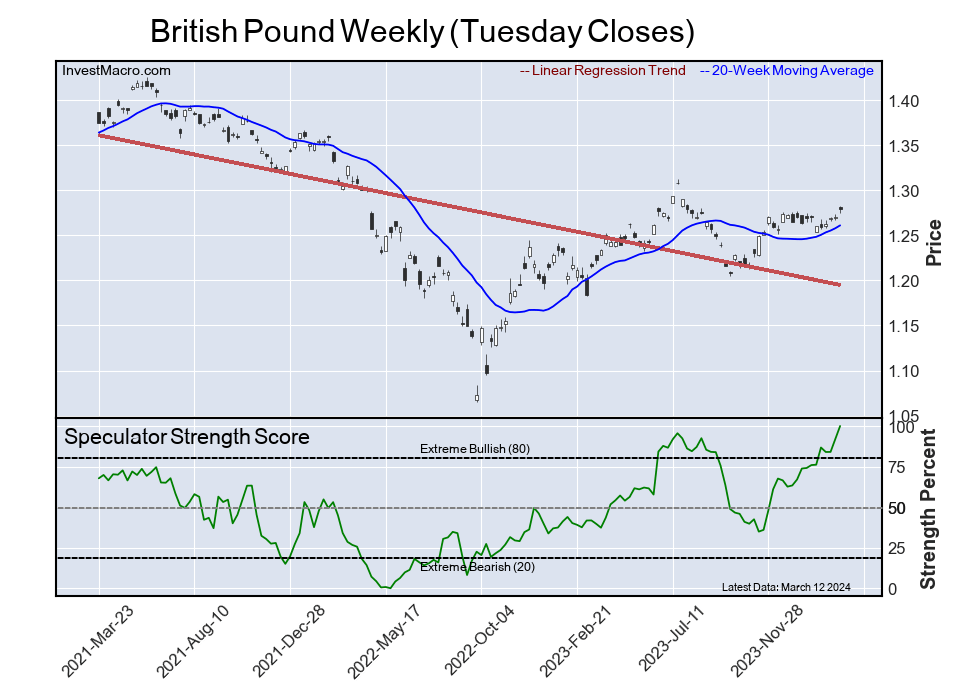
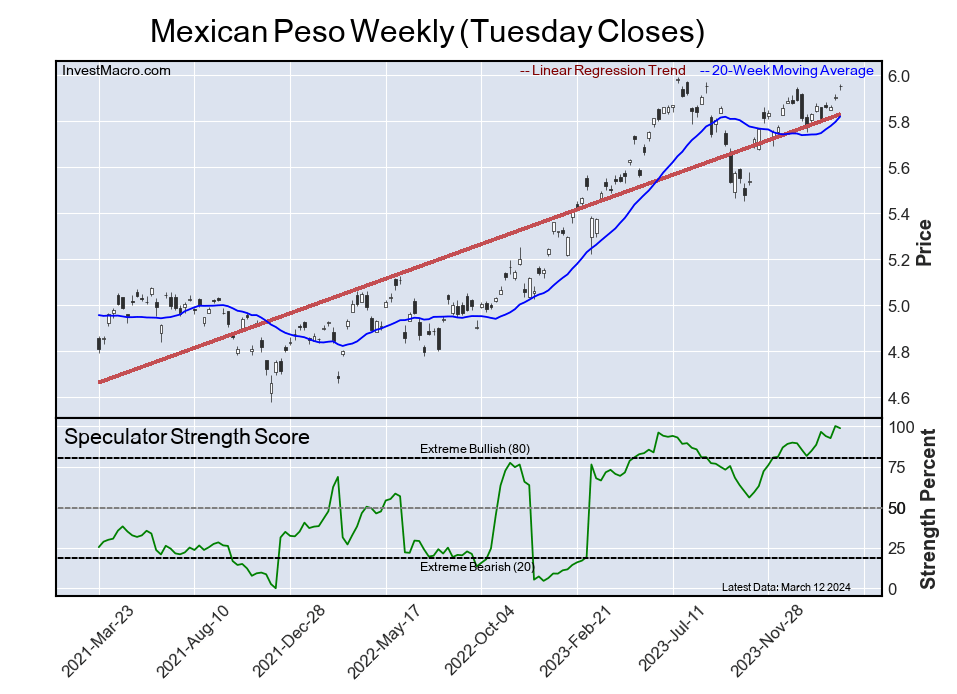
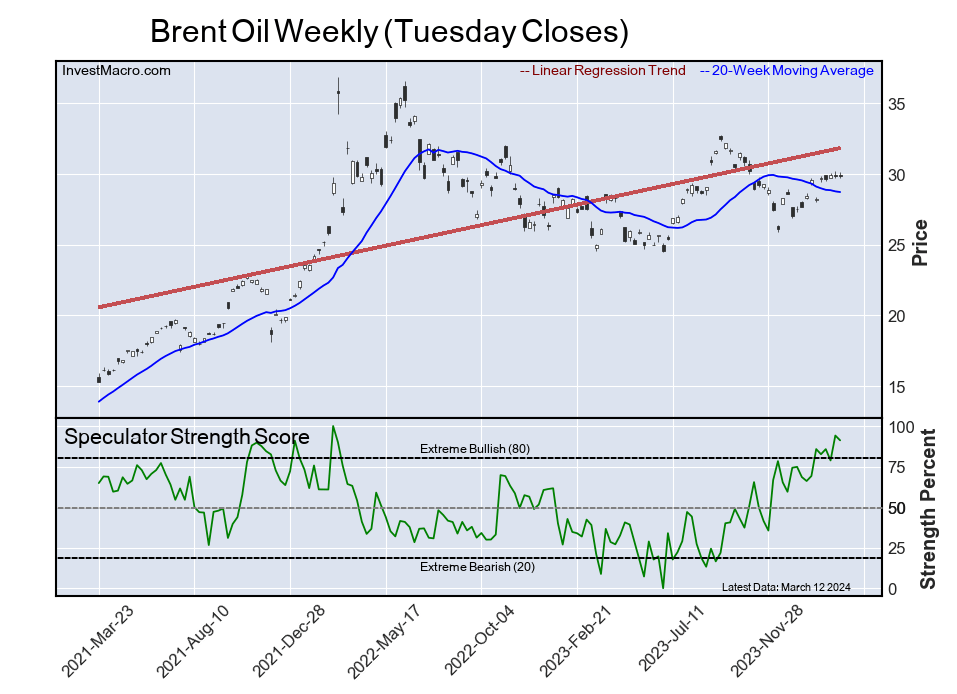
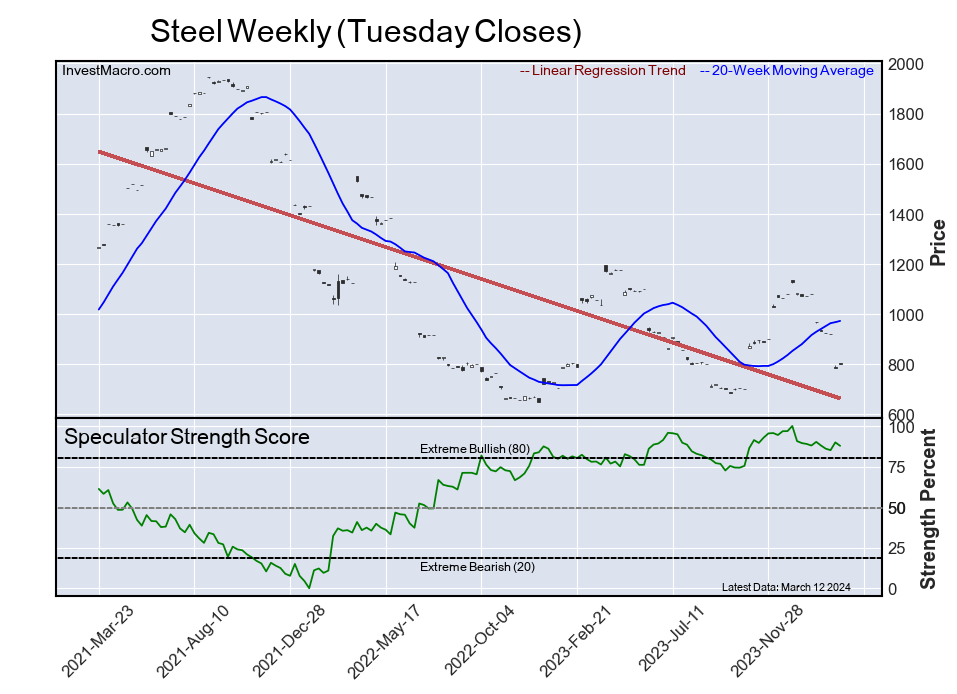
Speculator Extremes: SOFR-3M, Gasoline & Nasdaq lead Bullish Positions

By InvestMacro

The latest update for the weekly Commitment of Traders (COT) report was released by the Commodity Futures Trading Commission (CFTC) on Friday for data ending on January 23rd.

This weekly Extreme Positions report highlights the Most Bullish and Most Bearish Positions for the speculator category. Extreme positioning in these markets can foreshadow strong moves in the underlying market.

To signify an extreme position, we use the Strength Index (also known as the COT Index) of each instrument, a common method of measuring COT data. The Strength Index is simply a comparison of current trader positions against the range of positions over the previous 3 years. We use over 80 percent as extremely bullish and under 20 percent as extremely bearish. (Compare Strength Index scores across all markets in the data table or cot leaders table)


Here Are This Week’s Most Bullish Speculator Positions:

3-Month Secured Overnight Financing Rate


The 3-Month Secured Overnight Financing Rate speculator position comes in as the most bullish extreme standing this week. The 3-Month Secured Overnight Financing Rate speculator level is currently at a 100.0 percent score of its 3-year range.

The six-week trend for the percent strength score totaled 2.6 this week. The overall net speculator position was a total of 769,187 net contracts this week with a rise of 17,969 contract in the weekly speculator bets.


Speculators or Non-Commercials Notes:

Speculators, classified as non-commercial traders by the CFTC, are made up of large commodity funds, hedge funds and other significant for-profit participants. The Specs are generally regarded as trend-followers in their behavior towards price action – net speculator bets and prices tend to go in the same directions. These traders often look to buy when prices are rising and sell when prices are falling. To illustrate this point, many times speculator contracts can be found at their most extremes (bullish or bearish) when prices are also close to their highest or lowest levels.

These extreme levels can be dangerous for the large speculators as the trade is most crowded, there is less trading ammunition still sitting on the sidelines to push the trend further and prices have moved a significant distance. When the trend becomes exhausted, some speculators take profits while others look to also exit positions when prices fail to continue in the same direction. This process usually plays out over many months to years and can ultimately create a reverse effect where prices start to fall and speculators start a process of selling when prices are falling.


1-Month Secured Overnight Financing Rate

The 1-Month Secured Overnight Financing Rate speculator position comes next in the extreme standings this week. The 1-Month Secured Overnight Financing Rate speculator level is now at a 96.1 percent score of its 3-year range.

The six-week trend for the percent strength score was 5.3 this week. The speculator position registered 113,224 net contracts this week with a weekly dip of -14,693 contracts in speculator bets.


Gasoline


The Gasoline speculator position comes in third this week in the extreme standings. The Gasoline speculator level resides at a 95.0 percent score of its 3-year range.

The six-week trend for the speculator strength score came in at 13.9 this week. The overall speculator position was 73,741 net contracts this week with an increase by 4,664 contracts in the weekly speculator bets.


Nasdaq


The Nasdaq speculator position comes up number four in the extreme standings this week. The Nasdaq speculator level is at a 90.6 percent score of its 3-year range.

The six-week trend for the speculator strength score totaled a change of 38.8 this week. The overall speculator position was 33,042 net contracts this week with a decline of -3,529 contracts in the speculator bets.


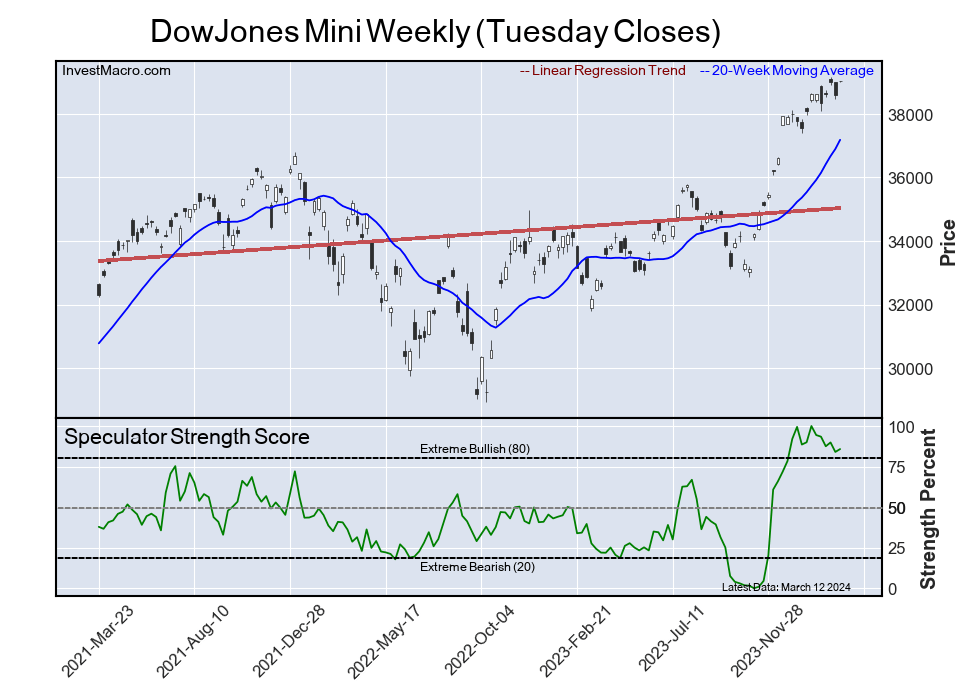
DowJones Mini


The DowJones Mini speculator position rounds out the top five in this week’s bullish extreme standings. The DowJones Mini speculator level sits at a 90.5 percent score of its 3-year range. The six-week trend for the speculator strength score was 24.2 this week.

The speculator position was 18,248 net contracts this week with a decrease of 861 contracts in the weekly speculator bets.


This Week’s Most Bearish Speculator Positions:

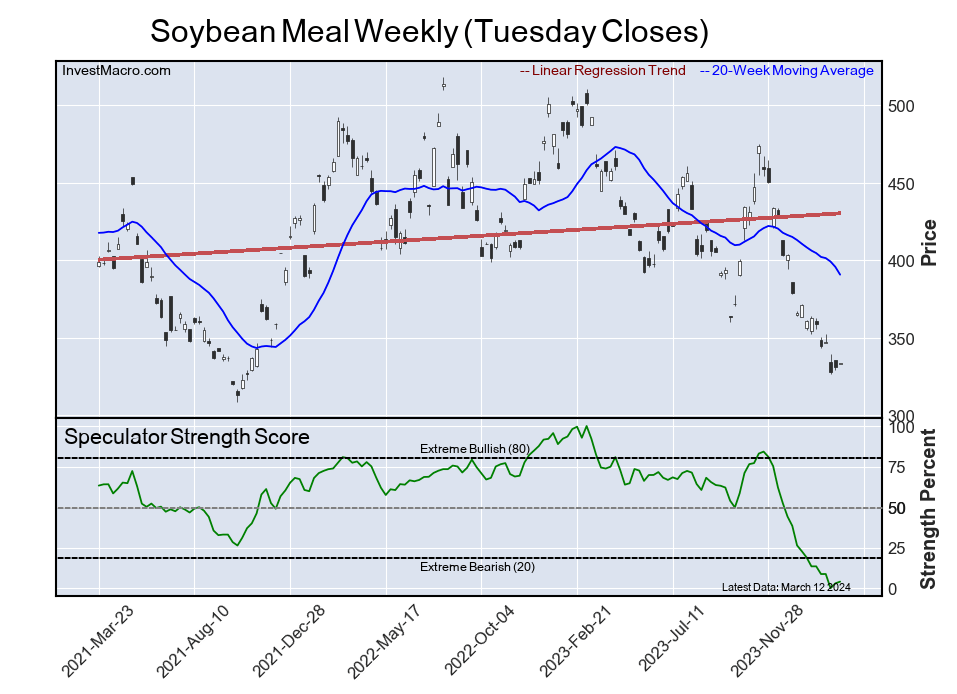
Soybean Meal


The Soybean Meal speculator position comes in as the most bearish extreme standing this week. The Soybean Meal speculator level is at a 0.0 percent score of its 3-year range.

The six-week trend for the speculator strength score was -53.3 this week. The overall speculator position was -20,616 net contracts this week with a drop of -9,374 contracts in the speculator bets.


Palladium


The Palladium speculator position comes in next for the most bearish extreme standing on the week. The Palladium speculator level is at a 0.0 percent score of its 3-year range.

The six-week trend for the speculator strength score was -6.7 this week. The speculator position was -11,617 net contracts this week with an edge down by -168 contracts in the weekly speculator bets.


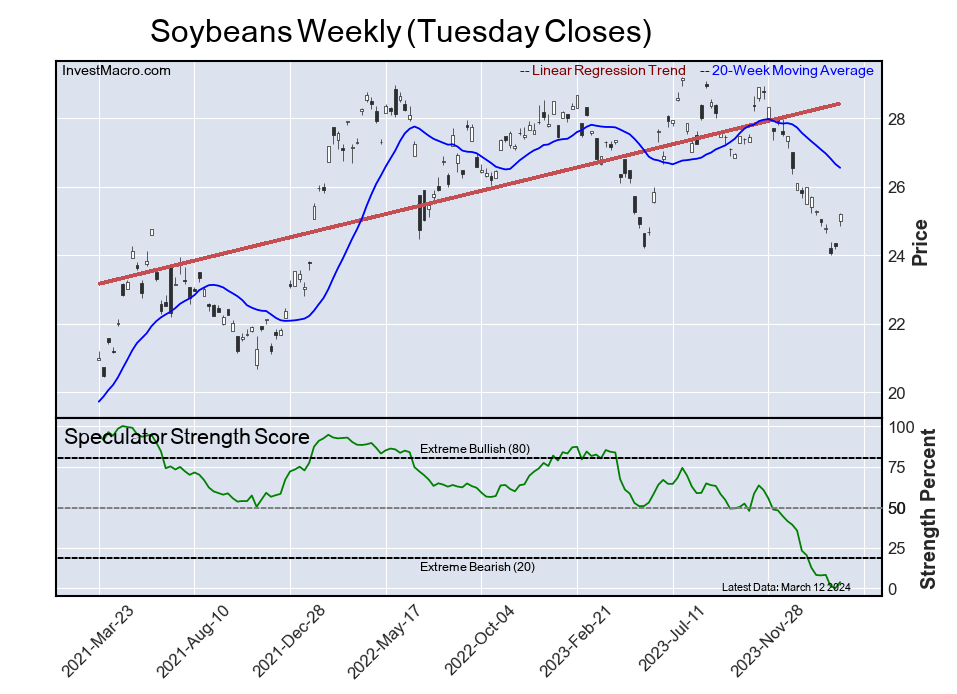
Soybeans


The Soybeans speculator position comes in as third most bearish extreme standing of the week. The Soybeans speculator level resides at a 0.0 percent score of its 3-year range.

The six-week trend for the speculator strength score was -34.6 this week. The overall speculator position was -105,994 net contracts this week with a decline of -12,326 contracts in the speculator bets.


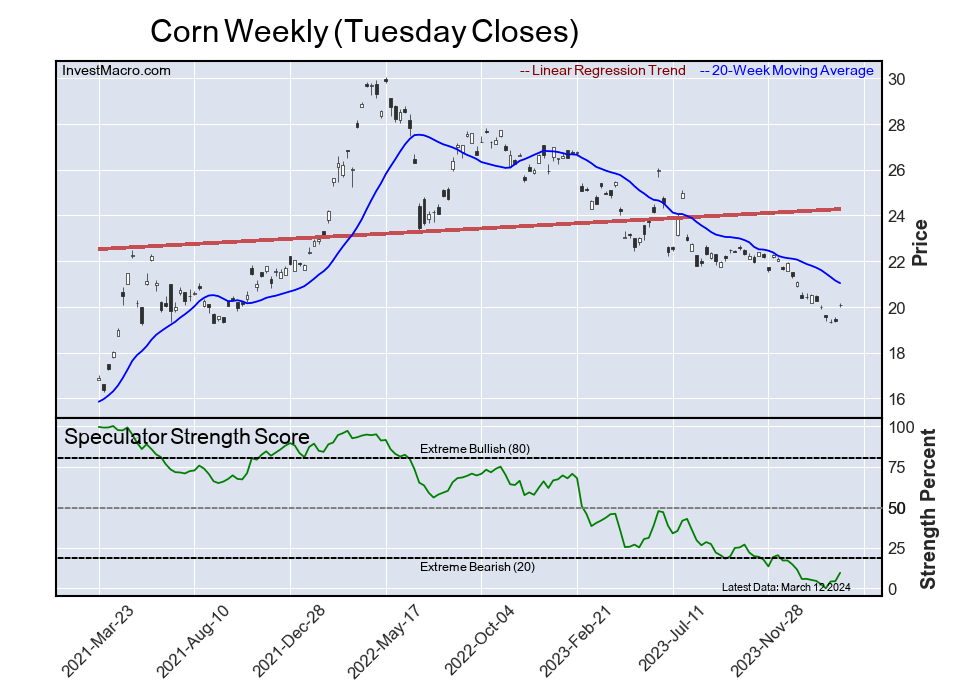
Corn


The Corn speculator position comes in as this week’s fourth most bearish extreme standing. The Corn speculator level is at a 0.1 percent score of its 3-year range.

The six-week trend for the speculator strength score was -15.5 this week. The speculator position was -219,200 net contracts this week with a small gain of 768 contracts in the weekly speculator bets.


Soybean Oil


Finally, the Soybean Oil speculator position comes in as the fifth most bearish extreme standing for this week. The Soybean Oil speculator level is at a 5.2 percent score of its 3-year range.

The six-week trend for the speculator strength score was -12.0 this week. The speculator position was -25,358 net contracts this week with an increase of 2,229 contracts in the weekly speculator bets.


Article By InvestMacroReceive our weekly COT Newsletter

*COT Report: The COT data, released weekly to the public each Friday, is updated through the most recent Tuesday (data is 3 days old) and shows a quick view of how large speculators or non-commercials (for-profit traders) were positioned in the futures markets.

The CFTC categorizes trader positions according to commercial hedgers (traders who use futures contracts for hedging as part of the business), non-commercials (large traders who speculate to realize trading profits) and nonreportable traders (usually small traders/speculators) as well as their open interest (contracts open in the market at time of reporting). See CFTC criteria here.

Combining two types of molecular boron nitride could create a hybrid material used in faster, more powerful electronics

By Pulickel Ajayan, Rice University and Abhijit Biswas, Rice University 

In chemistry, structure is everything. Compounds with the same chemical formula can have different properties depending on the arrangement of the molecules they’re made of. And compounds with a different chemical formula but a similar molecular arrangement can have similar properties.

Graphene and a form of boron nitride called hexagonal boron nitride fall into the latter group. Graphene is made up of carbon atoms. Boron nitride, BN, is composed of boron and nitrogen atoms. While their chemical formulas differ, they have a similar structure – so similar that many chemists call hexagonal boron nitride “white graphene.”

Carbon-based graphene has lots of useful properties. It’s thin but strong, and it conducts heat and electricity very well, making it ideal for use in electronics.

Similarly, hexagonal boron nitride has a host of properties similar to graphene that could improve biomedical imaging and drug delivery, as well as computers, smartphones and LEDs. Researchers have studied this type of boron nitride for many years.

But, hexagonal boron nitride isn’t the only useful form this compound comes in.

As materials engineers, our research team has been investigating another type of boron nitride called cubic boron nitride. We want to know if combining the properties of hexagonal boron nitride with cubic boron nitride could open the door to even more useful applications.

Molecular structures of molecules, with atoms represented as blue spheres and bonds represented by gray lines connecting them. The left structure is in the shape of the cube, the right in flat sheets of hexagons.
Cubic boron nitride, shown on the left, and hexagonal boron nitride, shown on the right.
Oddball/Wikimedia Commons, CC BY-NC-SA

Hexagonal versus cubic

Hexagonal boron nitride is, as you might guess, boron nitride molecules arranged in the shape of a flat hexagon. It looks honeycomb-shaped, like graphene. Cubic boron nitride has a three-dimensional lattice structure and looks like a diamond at the molecular level.

H-BN is thin, soft and used in cosmetics to give them a silky texture. It doesn’t melt or degrade even under extreme heat, which also makes it useful in electronics and other applications. Some scientists predict it could be used to build a radiation shield for spacecraft.

C-BN is hard and resistant. It’s used in manufacturing to make cutting tools and drills, and it can keep its sharp edge even at high temperatures. It can also help dissipate heat in electronics.

Even though h-BN and c-BN might seem different, when put together, our research has found they hold even more potential than either on its own.

Two white powders, the top labeled 'hexagonal boron nitride' and the bottom labeled 'cubic boron nitride' with a circle between them labeled 'mixed phase boron nitride.' The bottom powder is slightly more brown and more clumpy.
The two forms of boron nitride have some similarities and some differences, but when combined, they can create a substance with a variety of scientific applications.
Abhijit Biswas

Both types of boron nitride conduct heat and can provide electrical insulation, but one, h-BN, is soft, and the other, c-BN, is hard. So, we wanted to see if they could be used together to create materials with interesting properties.

For example, combining their different behaviors could make a coating material effective for high temperature structural applications. C-BN could provide strong adhesion to a surface, while h-BN’s lubricating properties could resist wear and tear. Both together would keep the material from overheating.

Making boron nitride

This class of materials doesn’t occur naturally, so scientists must make it in the lab. In general, high-quality c-BN has been difficult to synthesize, whereas h-BN is relatively easier to make as high-quality films, using what are called vapor phase deposition methods.

In vapor phase deposition, we heat up boron and nitrogen-containing materials until they evaporate. The evaporated molecules then get deposited onto a surface, cool down, bond together and form a thin film of BN.

Our research team has worked on combining h-BN and c-BN using similar processes to vapor phase deposition, but we can also mix powders of the two together. The idea is to build a material with the right mix of h-BN and c-BN for thermal, mechanical and electronic properties that we can fine-tune.

Our team has found the composite substance made from combining both forms of BN together has a variety of potential applications. When you point a laser beam at the substance, it flashes brightly. Researchers could use this property to create display screens and improve radiation therapies in the medical field.

We’ve also found we can tailor how heat-conductive the composite material is. This means engineers could use this BN composite in machines that manage heat. The next step is trying to manufacture large plates made of a h-BN and c-BN composite. If done precisely, we can tailor the mechanical, thermal and optical properties to specific applications.

In electronics, h-BN could act as a dielectric – or insulator – alongside graphene in certain, low-power electronics. As a dielectric, h-BN would help electronics operate efficiently and keep their charge.

C-BN could work alongside diamond to create ultrawide band gap materials that allow electronic devices to work at a much higher power. Diamond and c-BN both conduct heat well, and together they could help cool down these high-power devices, which generate lots of extra heat.

H-BN and c-BN separately could lead to electronics that perform exceptionally well in different contexts – together, they have a host of potential applications, as well.

Our BN composite could improve heat spreaders and insulators, and it could work in energy storage machines like supercapacitors, which are fast-charging energy storage devices, and rechargeable batteries.

We’ll continue studying BN’s properties, and how we can use it in lubricants, coatings and wear-resistant surfaces. Developing ways to scale up production will be key for exploring its applications, from materials science to electronics and even environmental science.The Conversation

About the Author:

Pulickel Ajayan, Professor of Materials Science and NanoEngineering, Rice University and Abhijit Biswas, Research Scientist in Materials Science and Nanoengineering, Rice University

This article is republished from The Conversation under a Creative Commons license. Read the original article.


Week Ahead: USDInd braced for heavy hitters

By ForexTime 

  • High impact events could rock markets
  • Central bank decisions, earnings & data in focus
  • 4 key factors could move USDInd
  • USDInd waiting for potent catalyst
  • Keep eye on 50, 100 and 200-day SMA

A flurry of high impact events could rattle financial markets in the week ahead.

Rate decisions by major central banks, heavy hitting economic reports and corporate earnings from the largest companies in the world will be in focus.

Monday, 29th January  

  • NZD: New Zealand trade

Tuesday, 30th January

  • AUD: Australia retail sales
  • JPY: Japan unemployment
  • EUR: Eurozone/Germany GDP
  • NQ100_m: Microsoft, Alphabet earnings
  • SPX500_m: Starbucks, Pfizer earnings

Wednesday, 31st January  

  • CNH: China non-manufacturing & manufacturing PMI’s
  • EUR: Germany CPI, unemployment
  • USD: Fed rate decision, US Treasury quarterly refunding
  • WSt30_m: Boeing earnings
  • SPX500_m: Mastercard earnings

Thursday, 1st February

  • EUR: Eurozone S&P manufacturing PMI, CPI, unemployment
  • CHF: SNB rate decision
  • GBP: BoE rate decision
  • USD: ISM manufacturing, initial jobless claims
  • NQ100_m: Apple, Amazon, Meta earnings

Friday, 2nd February

  • USD: US jobs report
  • Wst30_m: Chevron earnings
  • SPX500_m: Exxon Mobil earnings

Markets may experience heightened levels of volatility due to the scheduled releases and high-risk events. Our focus falls on the USDInd which seems to be waiting for a potent fundamental spark.

The USD Index tracks how the dollar is performing against a basket of six different G10 currencies, including the Euro, British Pound, Japanese Yen, and Canadian dollar.

Interestingly, the dollar has appreciated against almost all G10 currencies year-to-date.

Dollar bulls has been supported by cooling bets around the Fed cutting rates in Q1 amid strong US economic data.

With all the above said, the USD Index could see a significant move due to these 4 key factors:

  1. Fed Decision

According to markets, the March meeting could be a close call with traders currently pricing in a 50% probability of a US rate cut – according to Fed Fund futures.

Note: The incoming PCE report this afternoon could impact these odds.

Initial expectations around the Fed cutting rates earlier than expected were cooled by stronger-than-expected US economic data over the past few weeks. With this said, much attention will be directed towards Powell’s press conference for any clues on future rate moves.

Even if the Fed holds back on cutting rates in March, this meeting may set the stage for a cut in May.

  • The USDInd could strengthen if the Fed pushes back on rate cut bets and offers little insight on future moves.
  • Should the central bank sound strike a dovish tone, decide to cut rates or signal a rate cut in May, this may weaken the USDInd.
  1. US Treasury quarterly refunding

This is when the US government announces its plans for debt auctions for the quarter ahead.

It is worth noting that this event has sparked volatility in the US bond markets in the past, impacting the dollar as a result.

Note: Falling Bond Prices –> Rising Yields –> Appreciating Dollar (vice versa)

In the last quarterly refinancing on the 1st of November, the Treasury announced a lower-than-expected refunding estimate. This along with other factors sparked a selloff on the benchmark 10-year Treasury yield, dragging yields below 4% by the end of 2023 – coinciding with the selloff on the USDInd.

Note: There were other forces at play weakening the dollar, primarily the Fed’s dovish pivot.

  • Should the announcement from the Treasury push US yields higher, this could provide the USDInd a boost.
  • An announcement that results in a selloff in US yields has the potential to stimulate dollar bears, hitting the USDInd as a result.
  1. US December nonfarm payrolls (NFP)

Markets expect the US economy to have created 185,000 jobs in December, compared with the 216,000 in the previous month. The unemployment rate is forecast to remain unchanged at 3.7% while average earnings are forecast to rise 0.3% MoM compared with 0.4% in the prior month.

  • A stronger-than-expected US jobs report could cool rate cut bets, pushing the USDInd higher as a result.
  • However, evidence of a cooling US jobs market could reinforce expectations around lower US rates – pulling the USDInd lower.
  1. Technical forces

The USDInd has been trapped within multiple ranges on the daily charts with prices entangled by the 200 and 50-day SMA. It looks like the index needs a potent fundamental or technical spark to get the engines running.

  • A solid breakout and daily close above 103.70 could trigger an incline towards the 100-day SMA at 104.40 and 105.00.
  • Should prices break below the 50-day SMA at 103.00, bears could be encouraged to target 102.10 and 101.35.


Forex-Time-LogoArticle by ForexTime

ForexTime Ltd (FXTM) is an award winning international online forex broker regulated by CySEC 185/12 www.forextime.com