Archive for Opinions – Page 59

FX Speculators push British Pound bullish bets to 25-week high

By InvestMacro

Here are the latest charts and statistics for the Commitment of Traders (COT) data published by the Commodities Futures Trading Commission (CFTC).

The latest COT data is updated through Tuesday February 13th and shows a quick view of how large market participants (for-profit speculators and commercial traders) were positioned in the futures markets. All currency positions are in direct relation to the US dollar where, for example, a bet for the euro is a bet that the euro will rise versus the dollar while a bet against the euro will be a bet that the euro will decline versus the dollar.

Weekly Speculator Changes led by British Pound Sterling & Mexican Peso

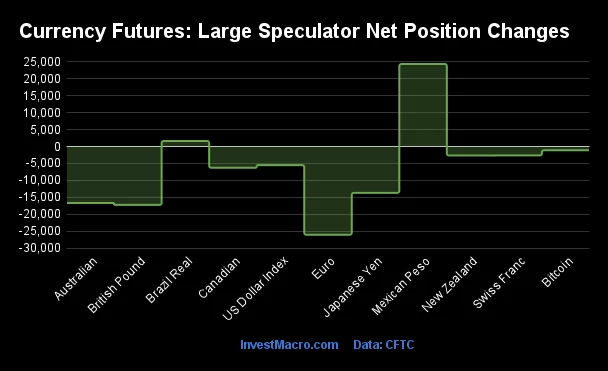
The COT currency market speculator bets were slightly lower this week as five out of the eleven currency markets we cover had higher positioning while the other six markets had lower speculator contracts.

Leading the gains for the currency markets was the British Pound (15,997 contracts) with the Mexican Peso (13,615 contracts), the New Zealand Dollar (2,577 contracts), Canadian Dollar (2,254 contracts) and the US Dollar Index (463 contracts) also having positive weeks.

The currencies seeing declines in speculator bets on the week were the Japanese Yen (-27,306 contracts), the EuroFX (-9,315 contracts), the Australian Dollar (-7,163 contracts), the Swiss Franc (-447 contracts), the Brazilian Real (-314 contracts) and Bitcoin (-398 contracts) also registering lower bets on the week.

FX Speculators push British Pound bullish bets to 25-week high

Highlighting the COT currency’s data is the continued rise in the speculator’s positioning of the British Pound Sterling.

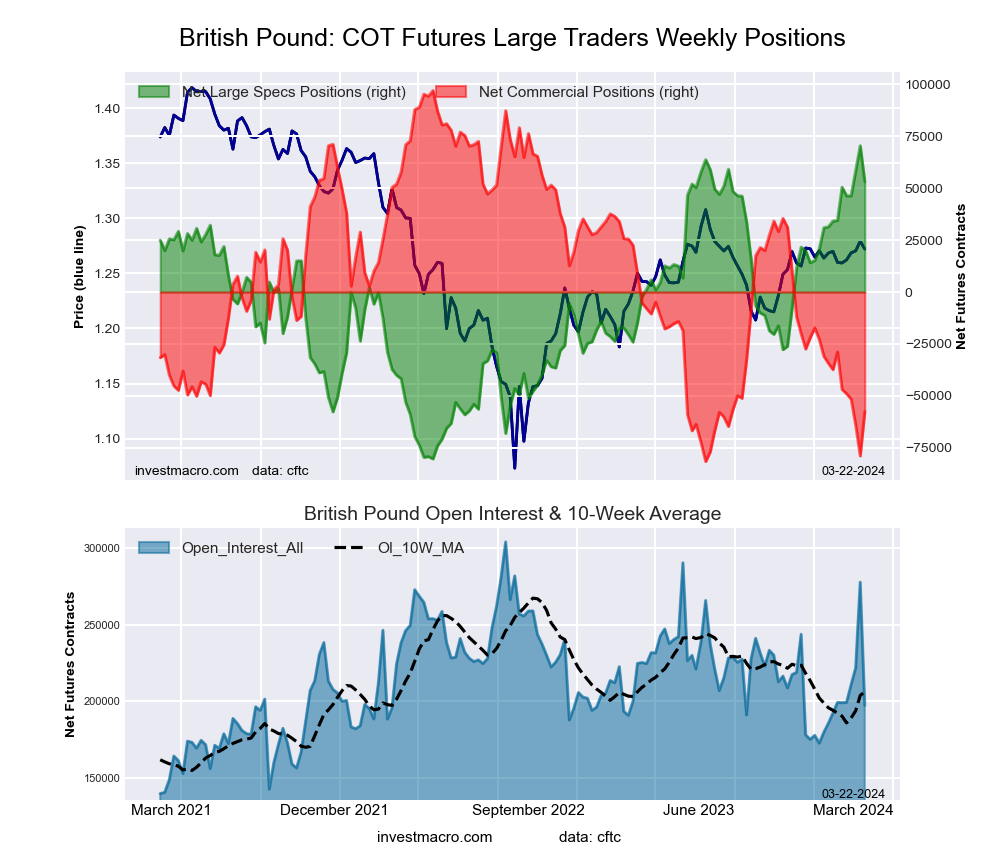
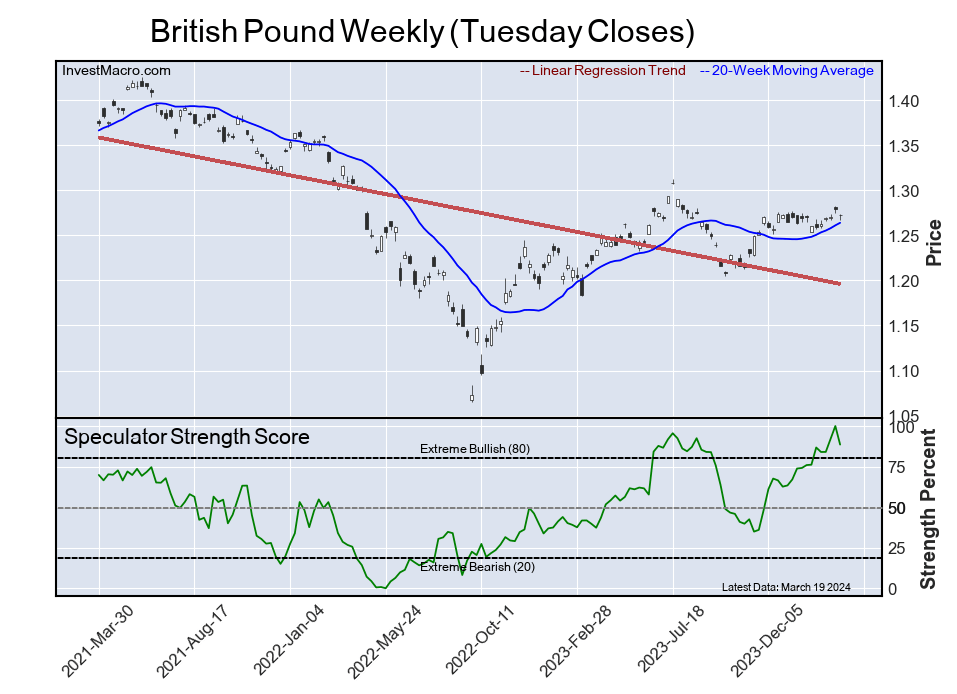
Large speculative Sterling positions rose this week by almost +16,000 contracts and have gained in seven consecutive weeks. The Sterling speculative level has added a total of +36,380 contracts to the net position over these last seven weeks and has brought the net level from a total of +14,092 contracts on December 26th to this week’s currently standing of +50,472 contracts. This marks the most bullish position for the GBP speculators since August 22nd, a span of twenty-five weeks.

The Pound Sterling exchange rate (GBPUSD currency pair) against the US Dollar has been oscillating around the 1.2500 exchange level over the past week despite recent downbeat economic news. The UK economy has recently dipped into a technical recession with declining GDP in both the 3rd and 4th quarters of 2023. However, with inflation still high, traders and market watchers still see the Bank of England holding their interest rates at high levels which could provide support for the UK currency.

The Pound exchange continues to be in a weekly uptrend since a recent dive in October when prices were falling and dipped as low as 1.2050. The currency has also come down from the most recent high levels of the current uptrend (topping out around 1.2800) and has now settled in right above the 200-day moving average with this week’s close trading at 1.2609.


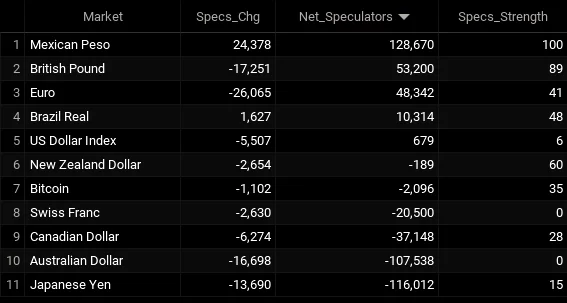
Speculators Leaderboard

Legend: Weekly Speculators Change | Speculators Current Net Position | Speculators Strength Score compared to last 3-Years (0-100 range)


Strength Scores led by Mexican Peso & British Pound
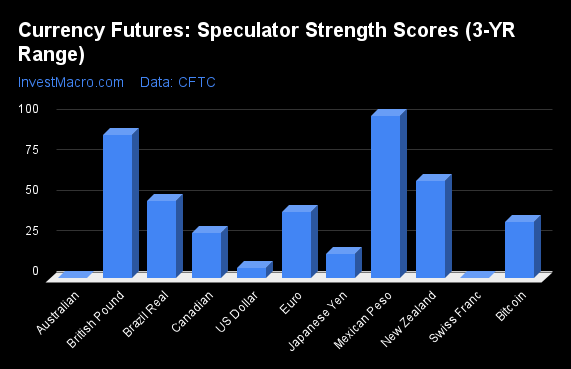
COT Strength Scores (a normalized measure of Speculator positions over a 3-Year range, from 0 to 100 where above 80 is Extreme-Bullish and below 20 is Extreme-Bearish) showed that the Mexican Peso (100 percent) and the British Pound (91 percent) lead the currency markets this week. The New Zealand Dollar (64 percent), Brazilian Real (60 percent) and the Canadian Dollar (54 percent) come in as the next highest in the weekly strength scores.

On the downside, the Japanese Yen (12 percent) and the Australian Dollar (16 percent) come in at the lowest strength levels currently and are in Extreme-Bearish territory (below 20 percent). The next lowest strength scores are the US Dollar Index (27 percent) and Bitcoin (37 percent).

Strength Statistics:
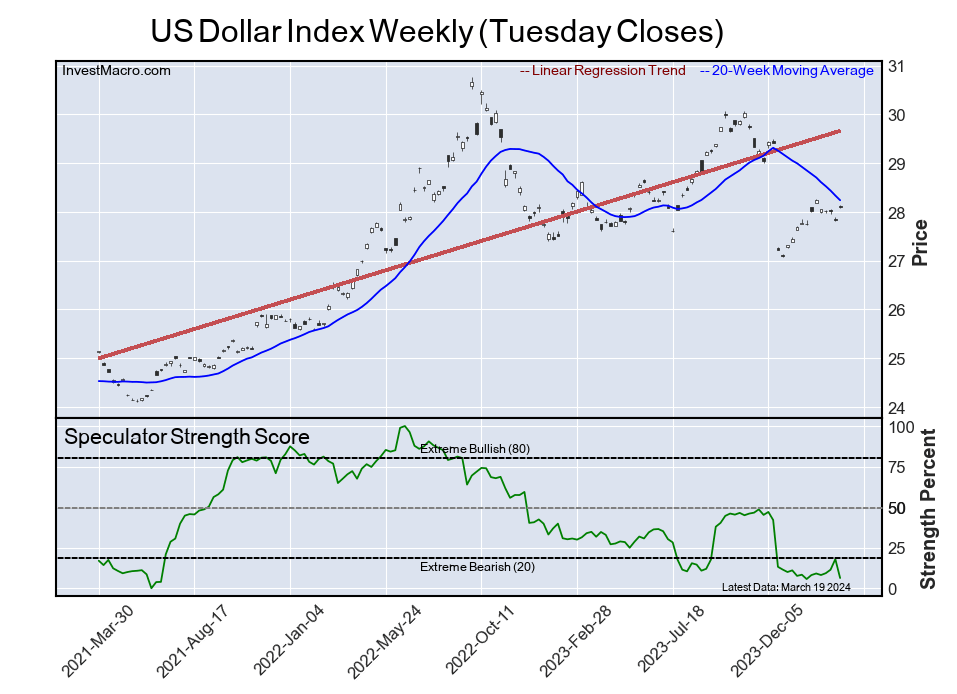
US Dollar Index (26.9 percent) vs US Dollar Index previous week (26.1 percent)
EuroFX (42.8 percent) vs EuroFX previous week (46.8 percent)
British Pound Sterling (90.8 percent) vs British Pound Sterling previous week (79.7 percent)
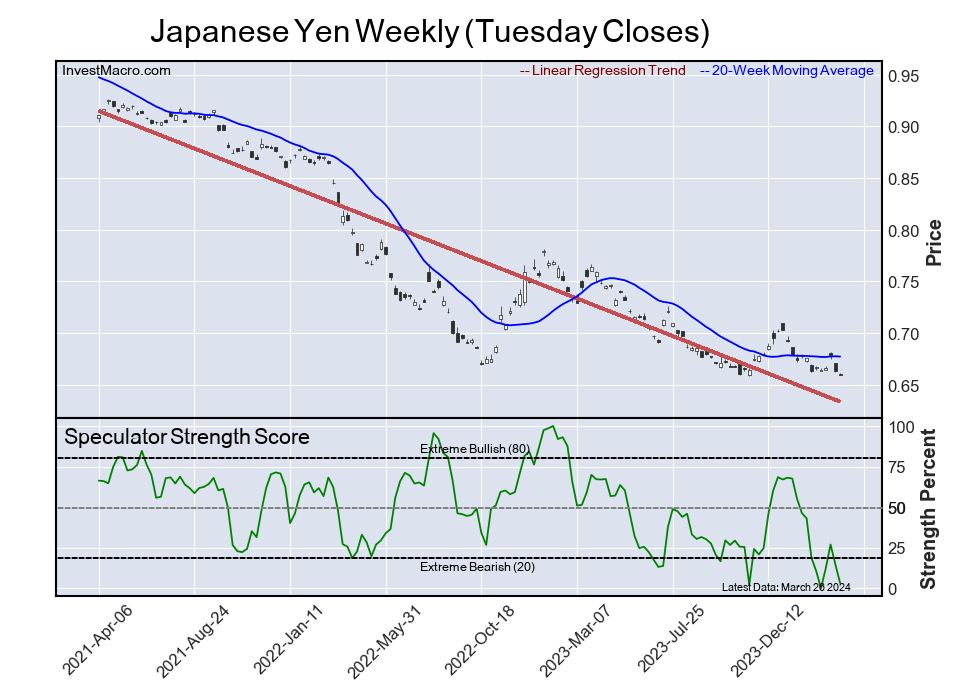
Japanese Yen (11.8 percent) vs Japanese Yen previous week (29.0 percent)
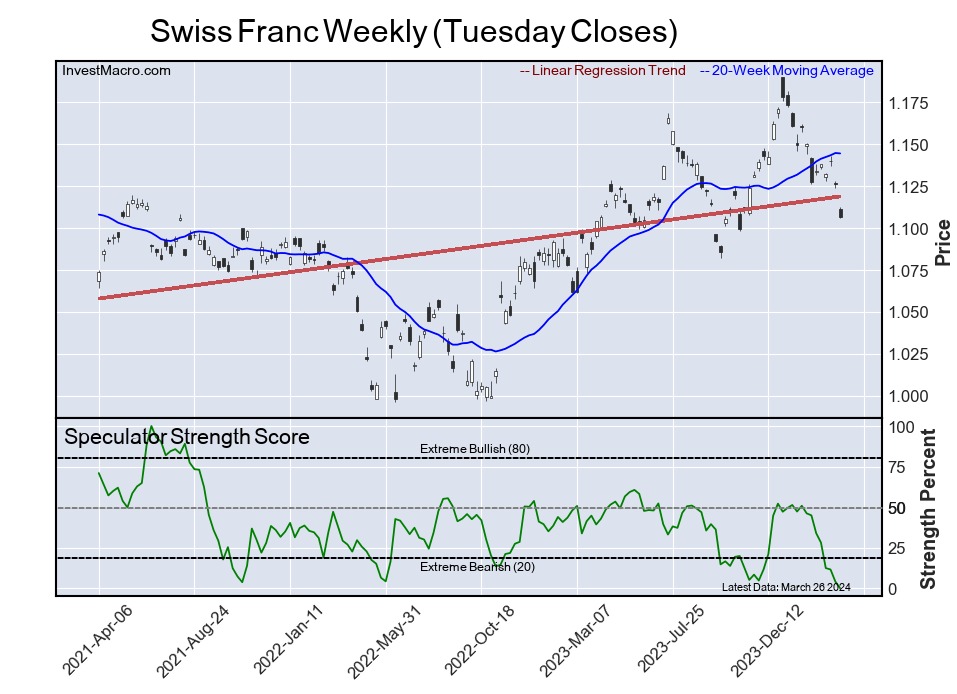
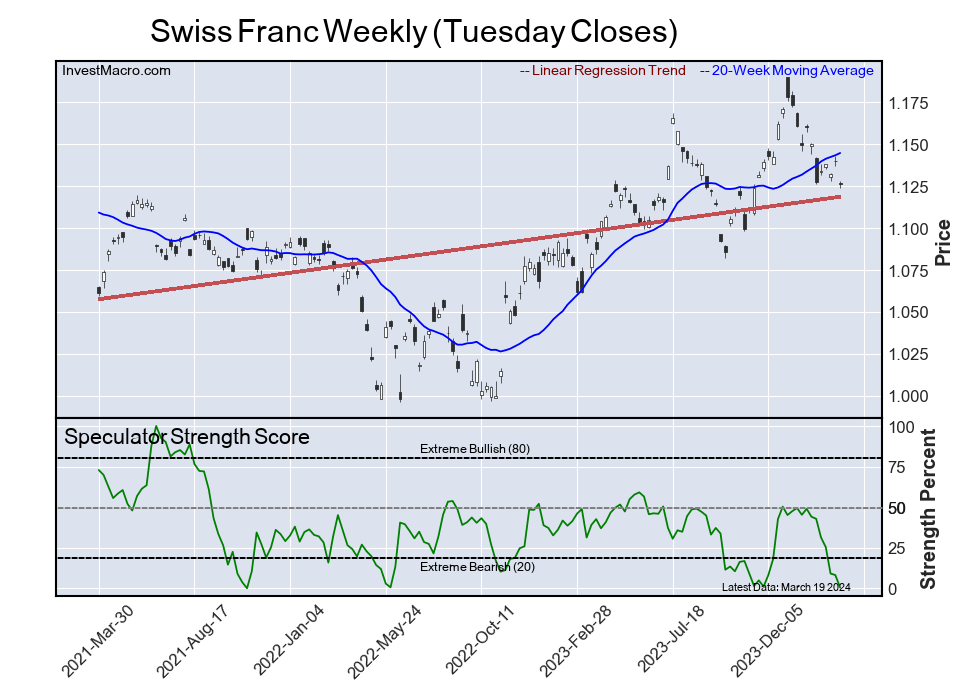
Swiss Franc (41.8 percent) vs Swiss Franc previous week (43.0 percent)
Canadian Dollar (54.5 percent) vs Canadian Dollar previous week (52.6 percent)
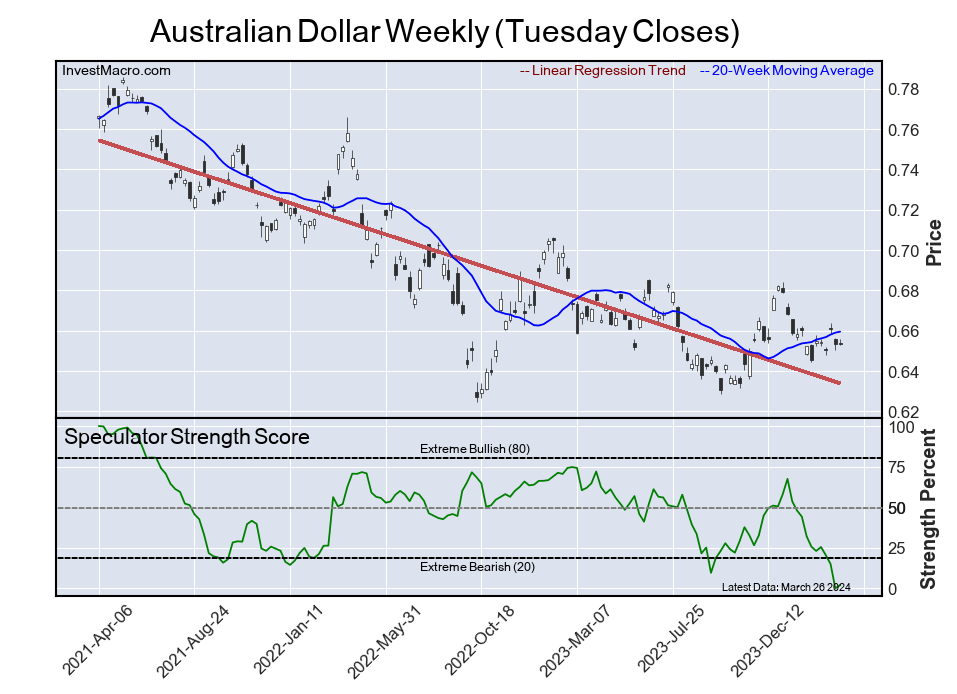
Australian Dollar (16.5 percent) vs Australian Dollar previous week (23.0 percent)
New Zealand Dollar (64.3 percent) vs New Zealand Dollar previous week (57.6 percent)
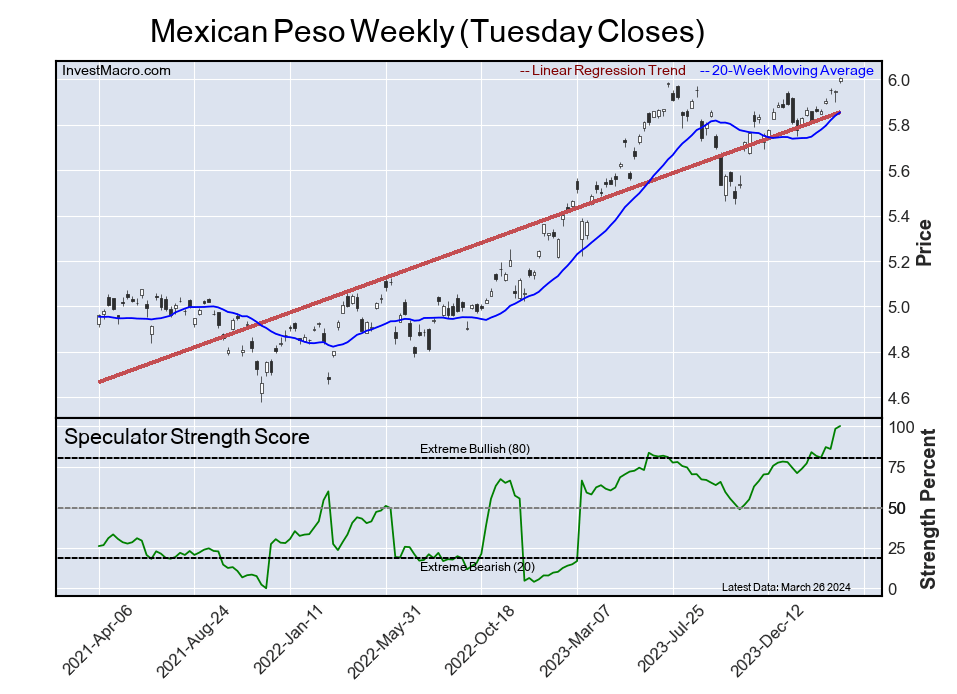
Mexican Peso (100.0 percent) vs Mexican Peso previous week (91.7 percent)
Brazilian Real (59.6 percent) vs Brazilian Real previous week (60.0 percent)
Bitcoin (37.5 percent) vs Bitcoin previous week (43.5 percent)


British Pound & Canadian Dollar top the 6-Week Strength Trends

COT Strength Score Trends (or move index, calculates the 6-week changes in strength scores) showed that the British Pound (24 percent) and the Canadian Dollar (13 percent) lead the past six weeks trends for the currencies. The New Zealand Dollar (10 percent), the Mexican Peso (7 percent) and the Bitcoin (5 percent) are the next highest positive movers in the latest trends data.

The Japanese Yen (-34 percent) leads the downside trend scores currently with the Australian Dollar (-33 percent), the EuroFX (-28 percent) and the Brazilian Real (-19 percent) following next with lower trend scores.

Strength Trend Statistics:
US Dollar Index (-0.7 percent) vs US Dollar Index previous week (-2.7 percent)
EuroFX (-28.4 percent) vs EuroFX previous week (-23.5 percent)
British Pound Sterling (24.5 percent) vs British Pound Sterling previous week (14.1 percent)
Japanese Yen (-34.2 percent) vs Japanese Yen previous week (-18.0 percent)
Swiss Franc (-2.3 percent) vs Swiss Franc previous week (-6.1 percent)
Canadian Dollar (13.1 percent) vs Canadian Dollar previous week (22.6 percent)
Australian Dollar (-33.0 percent) vs Australian Dollar previous week (-18.8 percent)
New Zealand Dollar (10.3 percent) vs New Zealand Dollar previous week (11.7 percent)
Mexican Peso (6.9 percent) vs Mexican Peso previous week (-0.6 percent)
Brazilian Real (-19.4 percent) vs Brazilian Real previous week (-31.9 percent)
Bitcoin (4.5 percent) vs Bitcoin previous week (11.7 percent)


Individual COT Forex Markets:

US Dollar Index Futures:

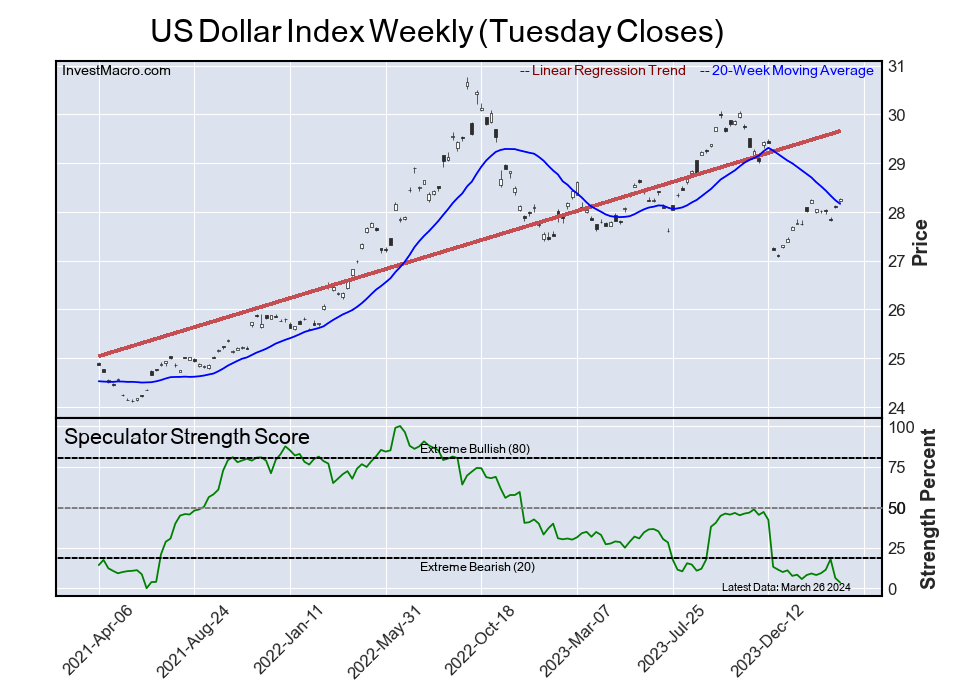
US Dollar Index Forex Futures COT ChartThe US Dollar Index large speculator standing this week totaled a net position of 2,002 contracts in the data reported through Tuesday. This was a weekly boost of 463 contracts from the previous week which had a total of 1,539 net contracts.

This week’s current strength score (the trader positioning range over the past three years, measured from 0 to 100) shows the speculators are currently Bearish with a score of 26.9 percent. The commercials are Bullish with a score of 73.2 percent and the small traders (not shown in chart) are Bearish with a score of 24.9 percent.

Price Trend-Following Model: Downtrend

Our weekly trend-following model classifies the current market price position as: Downtrend. The current action for the model is considered to be: Hold – Maintain Short Position.

US DOLLAR INDEX StatisticsSPECULATORSCOMMERCIALSSMALL TRADERS
– Percent of Open Interest Longs:65.515.311.4
– Percent of Open Interest Shorts:59.225.17.8
– Net Position:2,002-3,1791,177
– Gross Longs:21,0964,9163,675
– Gross Shorts:19,0948,0952,498
– Long to Short Ratio:1.1 to 10.6 to 11.5 to 1
NET POSITION TREND:
– Strength Index Score (3 Year Range Pct):26.973.224.9
– Strength Index Reading (3 Year Range):BearishBullishBearish
NET POSITION MOVEMENT INDEX:
– 6-Week Change in Strength Index:-0.7-2.623.1


Euro Currency Futures:

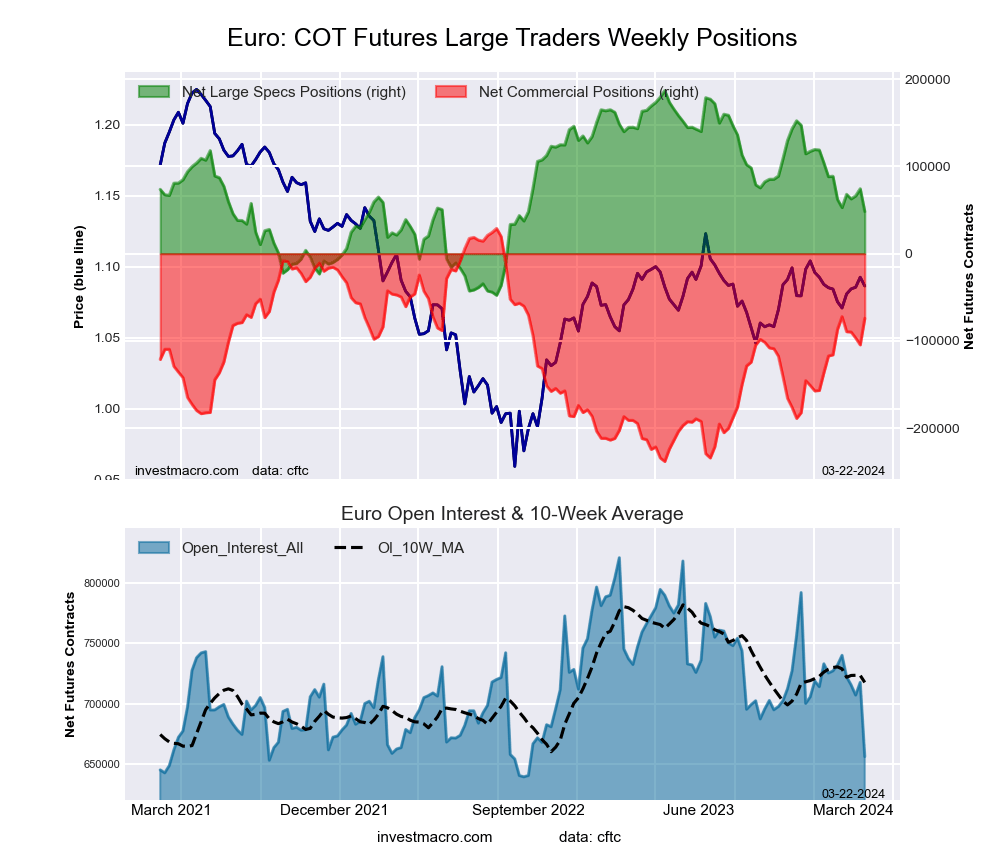
Euro Currency Futures COT ChartThe Euro Currency large speculator standing this week totaled a net position of 52,838 contracts in the data reported through Tuesday. This was a weekly lowering of -9,315 contracts from the previous week which had a total of 62,153 net contracts.

This week’s current strength score (the trader positioning range over the past three years, measured from 0 to 100) shows the speculators are currently Bearish with a score of 42.8 percent. The commercials are Bullish with a score of 62.2 percent and the small traders (not shown in chart) are Bearish-Extreme with a score of 10.0 percent.

Price Trend-Following Model: Weak Uptrend

Our weekly trend-following model classifies the current market price position as: Weak Uptrend. The current action for the model is considered to be: Hold – Maintain Long Position.

EURO Currency StatisticsSPECULATORSCOMMERCIALSSMALL TRADERS
– Percent of Open Interest Longs:28.559.110.4
– Percent of Open Interest Shorts:21.368.87.8
– Net Position:52,838-72,26419,426
– Gross Longs:210,848437,26676,997
– Gross Shorts:158,010509,53057,571
– Long to Short Ratio:1.3 to 10.9 to 11.3 to 1
NET POSITION TREND:
– Strength Index Score (3 Year Range Pct):42.862.210.0
– Strength Index Reading (3 Year Range):BearishBullishBearish-Extreme
NET POSITION MOVEMENT INDEX:
– 6-Week Change in Strength Index:-28.431.9-29.5


British Pound Sterling Futures:

British Pound Sterling Futures COT ChartThe British Pound Sterling large speculator standing this week totaled a net position of 50,472 contracts in the data reported through Tuesday. This was a weekly increase of 15,997 contracts from the previous week which had a total of 34,475 net contracts.

This week’s current strength score (the trader positioning range over the past three years, measured from 0 to 100) shows the speculators are currently Bullish-Extreme with a score of 90.8 percent. The commercials are Bearish-Extreme with a score of 19.4 percent and the small traders (not shown in chart) are Bullish with a score of 51.0 percent.

Price Trend-Following Model: Uptrend

Our weekly trend-following model classifies the current market price position as: Uptrend. The current action for the model is considered to be: Hold – Maintain Long Position.

BRITISH POUND StatisticsSPECULATORSCOMMERCIALSSMALL TRADERS
– Percent of Open Interest Longs:45.536.312.6
– Percent of Open Interest Shorts:20.159.914.4
– Net Position:50,472-46,883-3,589
– Gross Longs:90,54572,28925,127
– Gross Shorts:40,073119,17228,716
– Long to Short Ratio:2.3 to 10.6 to 10.9 to 1
NET POSITION TREND:
– Strength Index Score (3 Year Range Pct):90.819.451.0
– Strength Index Reading (3 Year Range):Bullish-ExtremeBearish-ExtremeBullish
NET POSITION MOVEMENT INDEX:
– 6-Week Change in Strength Index:24.5-16.6-11.1


Japanese Yen Futures:

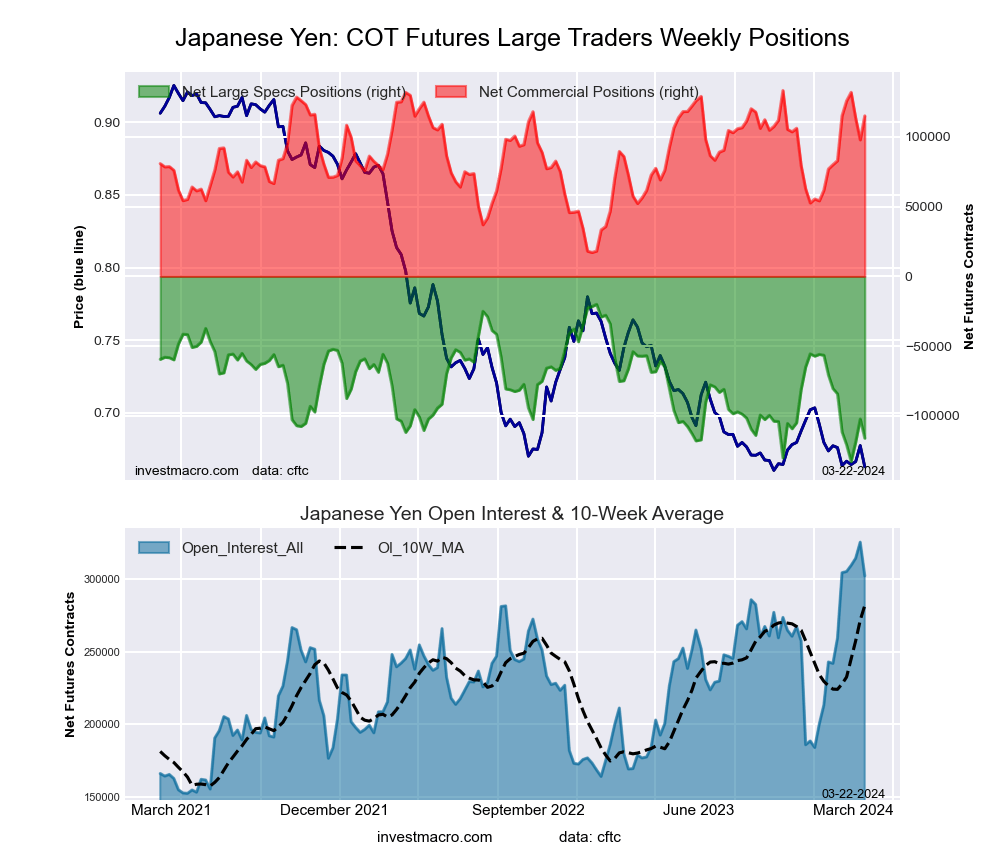
Japanese Yen Forex Futures COT ChartThe Japanese Yen large speculator standing this week totaled a net position of -111,536 contracts in the data reported through Tuesday. This was a weekly lowering of -27,306 contracts from the previous week which had a total of -84,230 net contracts.

This week’s current strength score (the trader positioning range over the past three years, measured from 0 to 100) shows the speculators are currently Bearish-Extreme with a score of 11.8 percent. The commercials are Bullish-Extreme with a score of 88.8 percent and the small traders (not shown in chart) are Bullish with a score of 71.2 percent.

Price Trend-Following Model: Weak Uptrend

Our weekly trend-following model classifies the current market price position as: Weak Uptrend. The current action for the model is considered to be: Hold – Maintain Long Position.

JAPANESE YEN StatisticsSPECULATORSCOMMERCIALSSMALL TRADERS
– Percent of Open Interest Longs:19.263.714.2
– Percent of Open Interest Shorts:55.825.915.4
– Net Position:-111,536115,172-3,636
– Gross Longs:58,554194,06743,189
– Gross Shorts:170,09078,89546,825
– Long to Short Ratio:0.3 to 12.5 to 10.9 to 1
NET POSITION TREND:
– Strength Index Score (3 Year Range Pct):11.888.871.2
– Strength Index Reading (3 Year Range):Bearish-ExtremeBullish-ExtremeBullish
NET POSITION MOVEMENT INDEX:
– 6-Week Change in Strength Index:-34.237.0-16.8


Swiss Franc Futures:

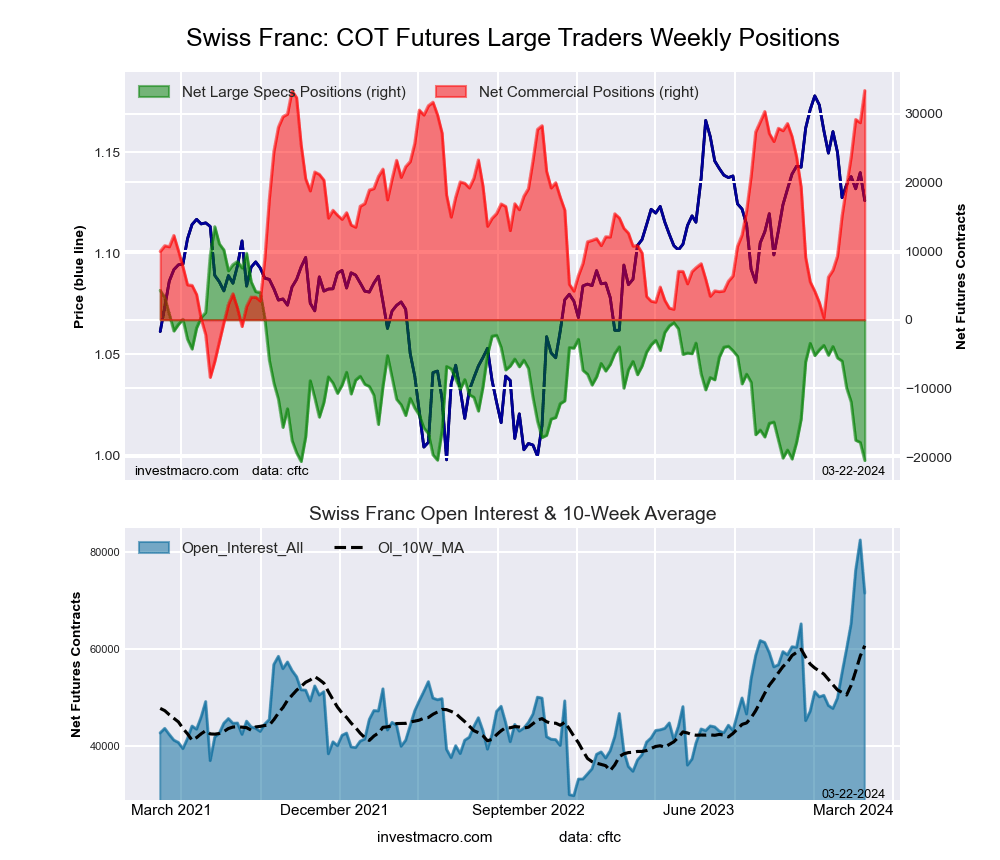
Swiss Franc Forex Futures COT ChartThe Swiss Franc large speculator standing this week totaled a net position of -6,014 contracts in the data reported through Tuesday. This was a weekly decline of -447 contracts from the previous week which had a total of -5,567 net contracts.

This week’s current strength score (the trader positioning range over the past three years, measured from 0 to 100) shows the speculators are currently Bearish with a score of 41.8 percent. The commercials are Bullish with a score of 60.2 percent and the small traders (not shown in chart) are Bearish with a score of 36.0 percent.

Price Trend-Following Model: Weak Uptrend

Our weekly trend-following model classifies the current market price position as: Weak Uptrend. The current action for the model is considered to be: Hold – Maintain Long Position.

SWISS FRANC StatisticsSPECULATORSCOMMERCIALSSMALL TRADERS
– Percent of Open Interest Longs:23.058.418.3
– Percent of Open Interest Shorts:34.031.034.8
– Net Position:-6,01415,080-9,066
– Gross Longs:12,68932,14810,071
– Gross Shorts:18,70317,06819,137
– Long to Short Ratio:0.7 to 11.9 to 10.5 to 1
NET POSITION TREND:
– Strength Index Score (3 Year Range Pct):41.860.236.0
– Strength Index Reading (3 Year Range):BearishBullishBearish
NET POSITION MOVEMENT INDEX:
– 6-Week Change in Strength Index:-2.323.8-46.0


Canadian Dollar Futures:

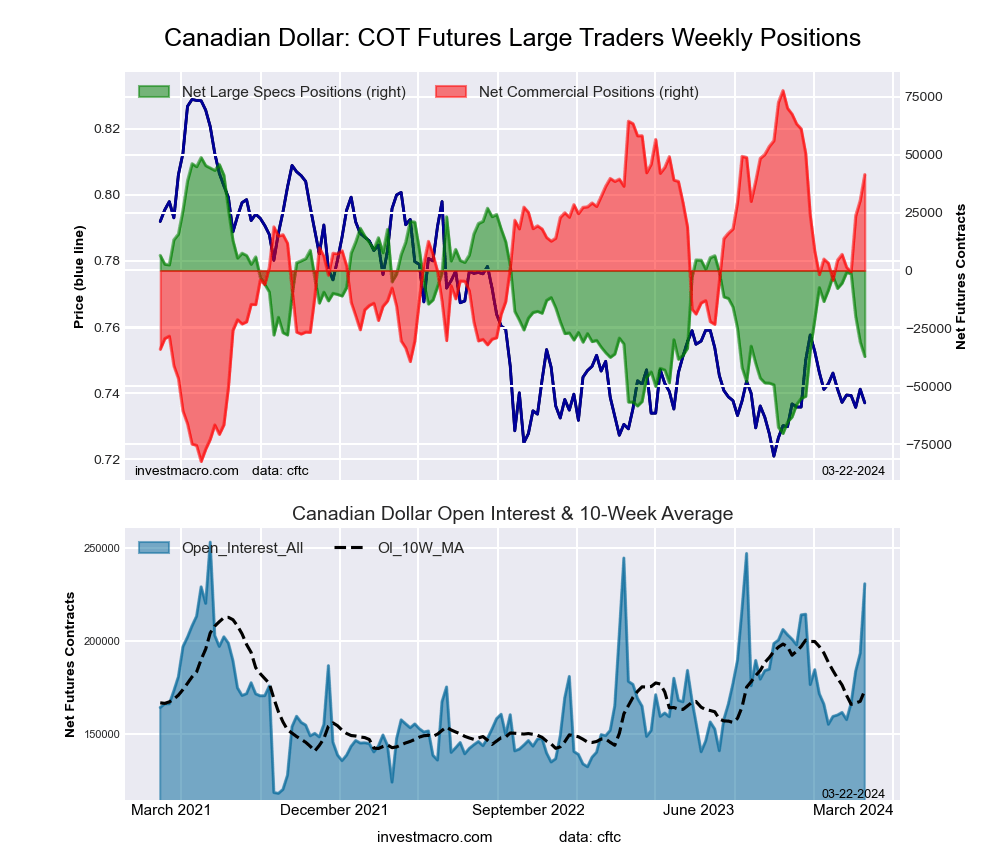
Canadian Dollar Forex Futures COT ChartThe Canadian Dollar large speculator standing this week totaled a net position of -5,482 contracts in the data reported through Tuesday. This was a weekly increase of 2,254 contracts from the previous week which had a total of -7,736 net contracts.

This week’s current strength score (the trader positioning range over the past three years, measured from 0 to 100) shows the speculators are currently Bullish with a score of 54.5 percent. The commercials are Bullish with a score of 55.8 percent and the small traders (not shown in chart) are Bearish-Extreme with a score of 19.5 percent.

Price Trend-Following Model: Uptrend

Our weekly trend-following model classifies the current market price position as: Uptrend. The current action for the model is considered to be: Hold – Maintain Long Position.

CANADIAN DOLLAR StatisticsSPECULATORSCOMMERCIALSSMALL TRADERS
– Percent of Open Interest Longs:22.157.118.7
– Percent of Open Interest Shorts:25.552.819.6
– Net Position:-5,4826,958-1,476
– Gross Longs:35,69892,18830,243
– Gross Shorts:41,18085,23031,719
– Long to Short Ratio:0.9 to 11.1 to 11.0 to 1
NET POSITION TREND:
– Strength Index Score (3 Year Range Pct):54.555.819.5
– Strength Index Reading (3 Year Range):BullishBullishBearish-Extreme
NET POSITION MOVEMENT INDEX:
– 6-Week Change in Strength Index:13.1-0.9-31.7


Australian Dollar Futures:

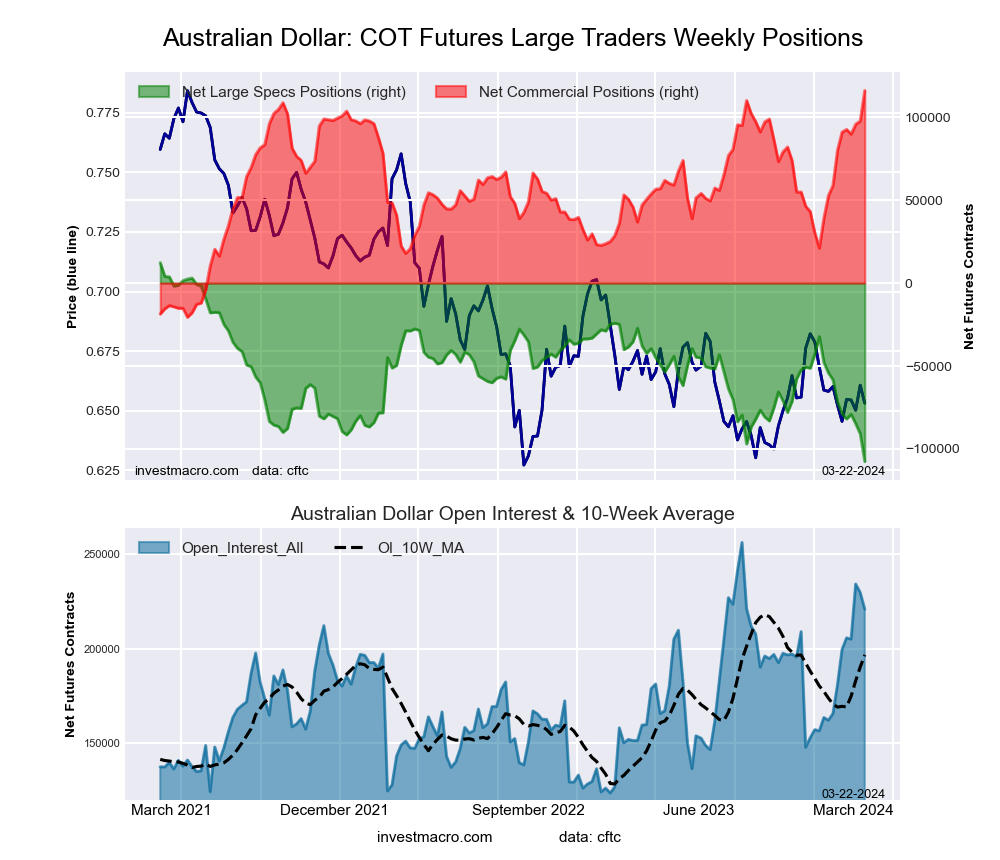
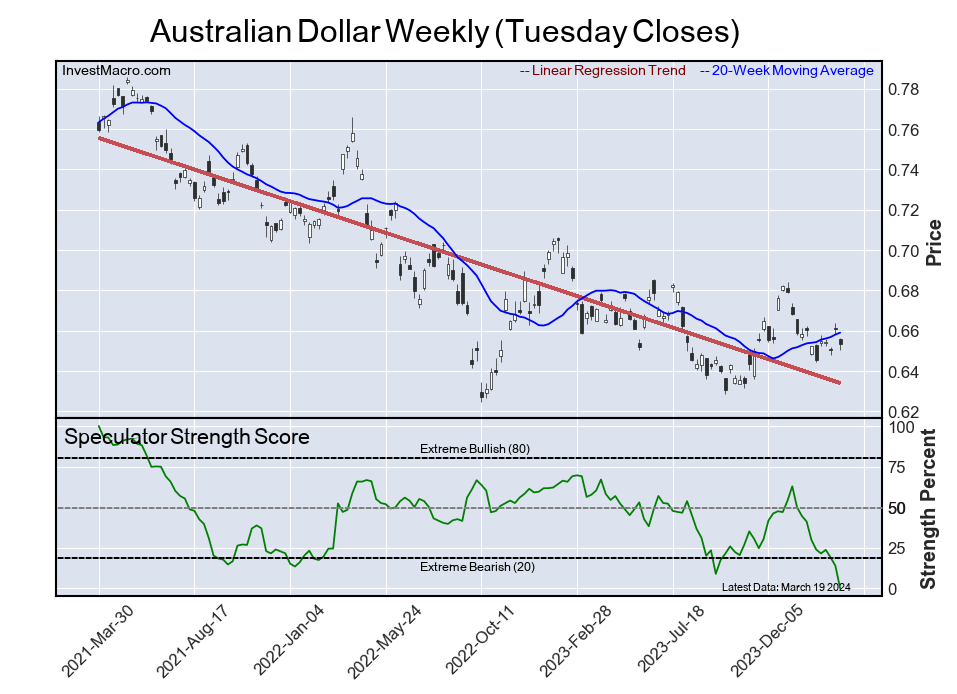
Australian Dollar Forex Futures COT ChartThe Australian Dollar large speculator standing this week totaled a net position of -78,976 contracts in the data reported through Tuesday. This was a weekly lowering of -7,163 contracts from the previous week which had a total of -71,813 net contracts.

This week’s current strength score (the trader positioning range over the past three years, measured from 0 to 100) shows the speculators are currently Bearish-Extreme with a score of 16.5 percent. The commercials are Bullish-Extreme with a score of 85.7 percent and the small traders (not shown in chart) are Bearish with a score of 23.2 percent.

Price Trend-Following Model: Weak Uptrend

Our weekly trend-following model classifies the current market price position as: Weak Uptrend. The current action for the model is considered to be: Hold – Maintain Long Position.

AUSTRALIAN DOLLAR StatisticsSPECULATORSCOMMERCIALSSMALL TRADERS
– Percent of Open Interest Longs:23.864.49.2
– Percent of Open Interest Shorts:63.418.815.2
– Net Position:-78,97690,985-12,009
– Gross Longs:47,405128,46518,320
– Gross Shorts:126,38137,48030,329
– Long to Short Ratio:0.4 to 13.4 to 10.6 to 1
NET POSITION TREND:
– Strength Index Score (3 Year Range Pct):16.585.723.2
– Strength Index Reading (3 Year Range):Bearish-ExtremeBullish-ExtremeBearish
NET POSITION MOVEMENT INDEX:
– 6-Week Change in Strength Index:-33.045.8-60.0


New Zealand Dollar Futures:

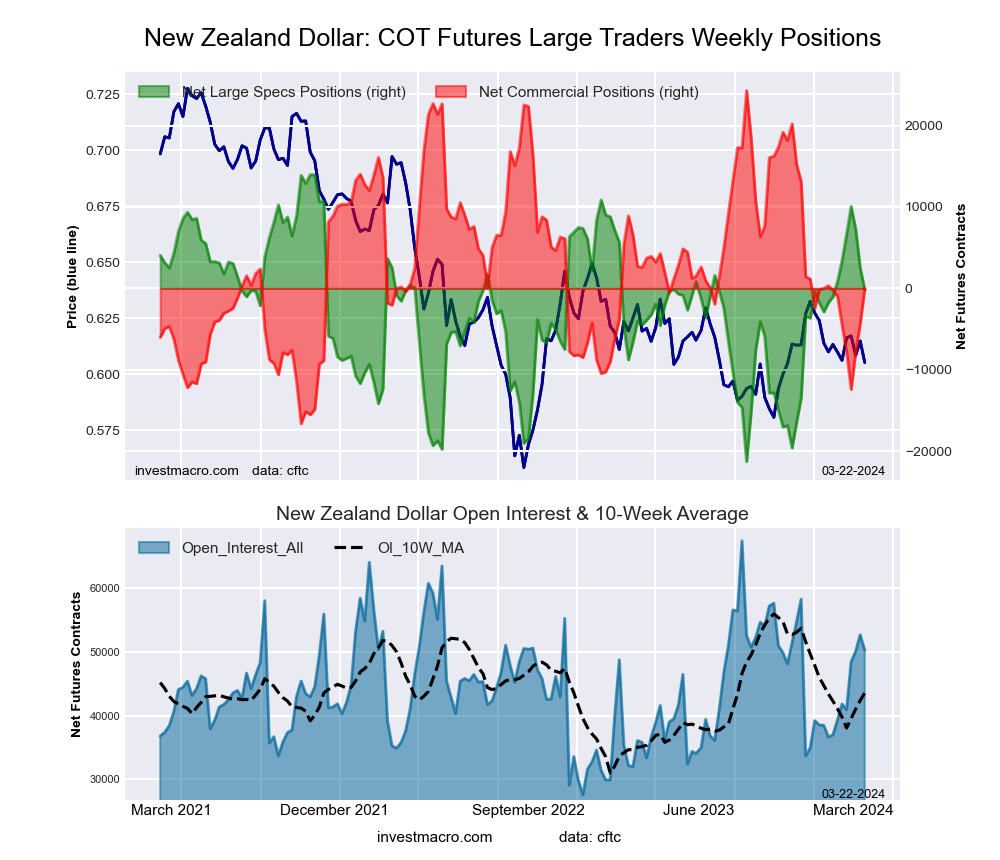
New Zealand Dollar Forex Futures COT ChartThe New Zealand Dollar large speculator standing this week totaled a net position of 3,407 contracts in the data reported through Tuesday. This was a weekly increase of 2,577 contracts from the previous week which had a total of 830 net contracts.

This week’s current strength score (the trader positioning range over the past three years, measured from 0 to 100) shows the speculators are currently Bullish with a score of 64.3 percent. The commercials are Bearish with a score of 34.4 percent and the small traders (not shown in chart) are Bullish with a score of 66.9 percent.

Price Trend-Following Model: Uptrend

Our weekly trend-following model classifies the current market price position as: Uptrend. The current action for the model is considered to be: Hold – Maintain Long Position.

NEW ZEALAND DOLLAR StatisticsSPECULATORSCOMMERCIALSSMALL TRADERS
– Percent of Open Interest Longs:46.937.511.5
– Percent of Open Interest Shorts:38.848.28.9
– Net Position:3,407-4,5051,098
– Gross Longs:19,63215,6684,819
– Gross Shorts:16,22520,1733,721
– Long to Short Ratio:1.2 to 10.8 to 11.3 to 1
NET POSITION TREND:
– Strength Index Score (3 Year Range Pct):64.334.466.9
– Strength Index Reading (3 Year Range):BullishBearishBullish
NET POSITION MOVEMENT INDEX:
– 6-Week Change in Strength Index:10.3-4.7-23.8


Mexican Peso Futures:

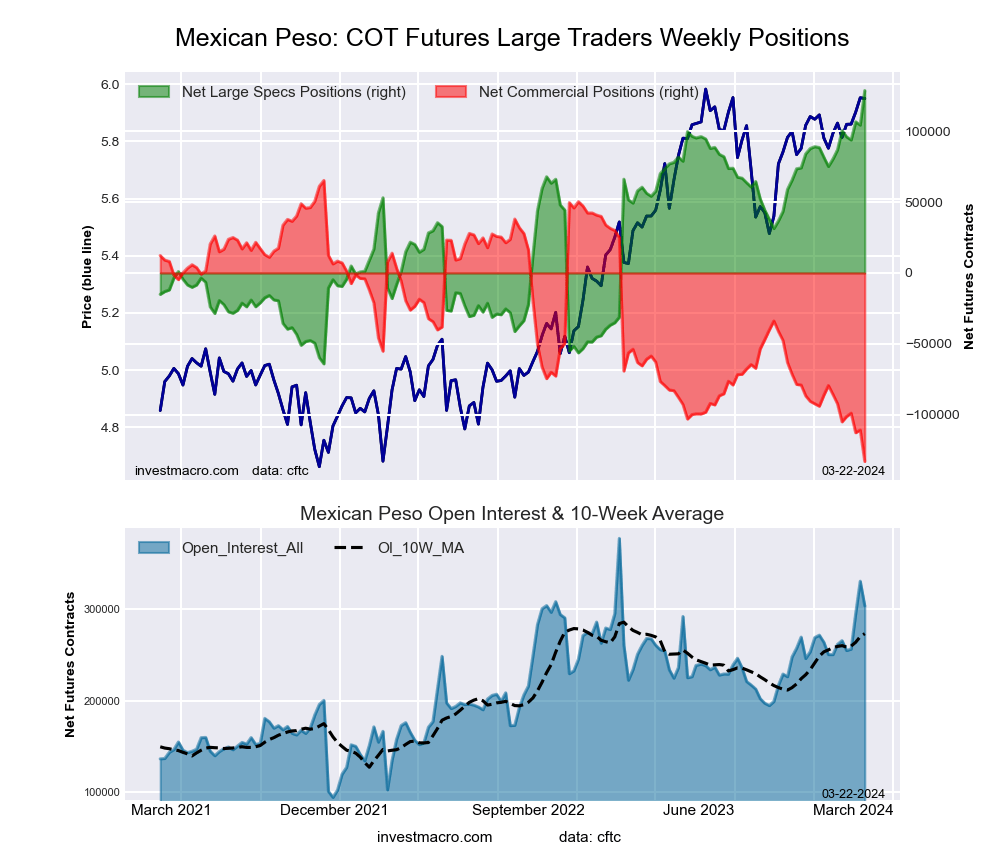
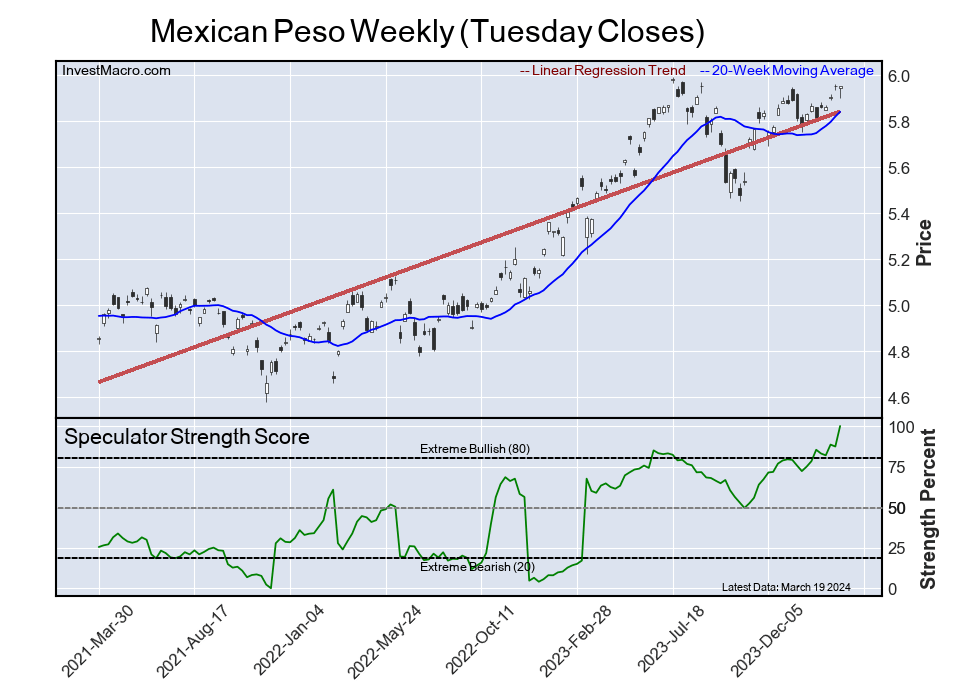
Mexican Peso Futures COT ChartThe Mexican Peso large speculator standing this week totaled a net position of 100,444 contracts in the data reported through Tuesday. This was a weekly rise of 13,615 contracts from the previous week which had a total of 86,829 net contracts.

This week’s current strength score (the trader positioning range over the past three years, measured from 0 to 100) shows the speculators are currently Bullish-Extreme with a score of 100.0 percent. The commercials are Bearish-Extreme with a score of 0.0 percent and the small traders (not shown in chart) are Bearish with a score of 40.5 percent.

Price Trend-Following Model: Uptrend

Our weekly trend-following model classifies the current market price position as: Uptrend. The current action for the model is considered to be: Hold – Maintain Long Position.

MEXICAN PESO StatisticsSPECULATORSCOMMERCIALSSMALL TRADERS
– Percent of Open Interest Longs:55.538.72.8
– Percent of Open Interest Shorts:17.678.31.1
– Net Position:100,444-105,0424,598
– Gross Longs:147,176102,6327,407
– Gross Shorts:46,732207,6742,809
– Long to Short Ratio:3.1 to 10.5 to 12.6 to 1
NET POSITION TREND:
– Strength Index Score (3 Year Range Pct):100.00.040.5
– Strength Index Reading (3 Year Range):Bullish-ExtremeBearish-ExtremeBearish
NET POSITION MOVEMENT INDEX:
– 6-Week Change in Strength Index:6.9-7.58.7


Brazilian Real Futures:

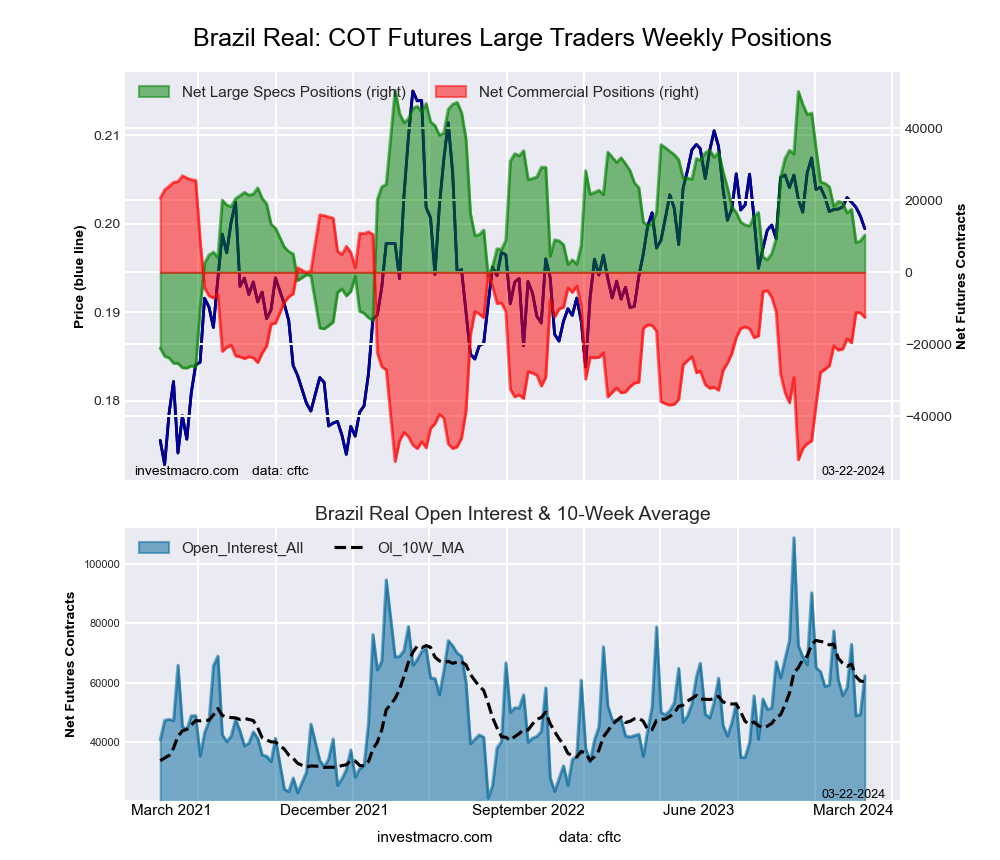
Brazil Real Futures COT ChartThe Brazilian Real large speculator standing this week totaled a net position of 19,348 contracts in the data reported through Tuesday. This was a weekly fall of -314 contracts from the previous week which had a total of 19,662 net contracts.

This week’s current strength score (the trader positioning range over the past three years, measured from 0 to 100) shows the speculators are currently Bullish with a score of 59.6 percent. The commercials are Bearish with a score of 39.4 percent and the small traders (not shown in chart) are Bullish with a score of 52.8 percent.

Price Trend-Following Model: Weak Uptrend

Our weekly trend-following model classifies the current market price position as: Weak Uptrend. The current action for the model is considered to be: Hold – Maintain Long Position.

BRAZIL REAL StatisticsSPECULATORSCOMMERCIALSSMALL TRADERS
– Percent of Open Interest Longs:58.635.45.8
– Percent of Open Interest Shorts:23.873.72.2
– Net Position:19,348-21,3211,973
– Gross Longs:32,62119,6933,211
– Gross Shorts:13,27341,0141,238
– Long to Short Ratio:2.5 to 10.5 to 12.6 to 1
NET POSITION TREND:
– Strength Index Score (3 Year Range Pct):59.639.452.8
– Strength Index Reading (3 Year Range):BullishBearishBullish
NET POSITION MOVEMENT INDEX:
– 6-Week Change in Strength Index:-19.419.4-3.7


Bitcoin Futures:

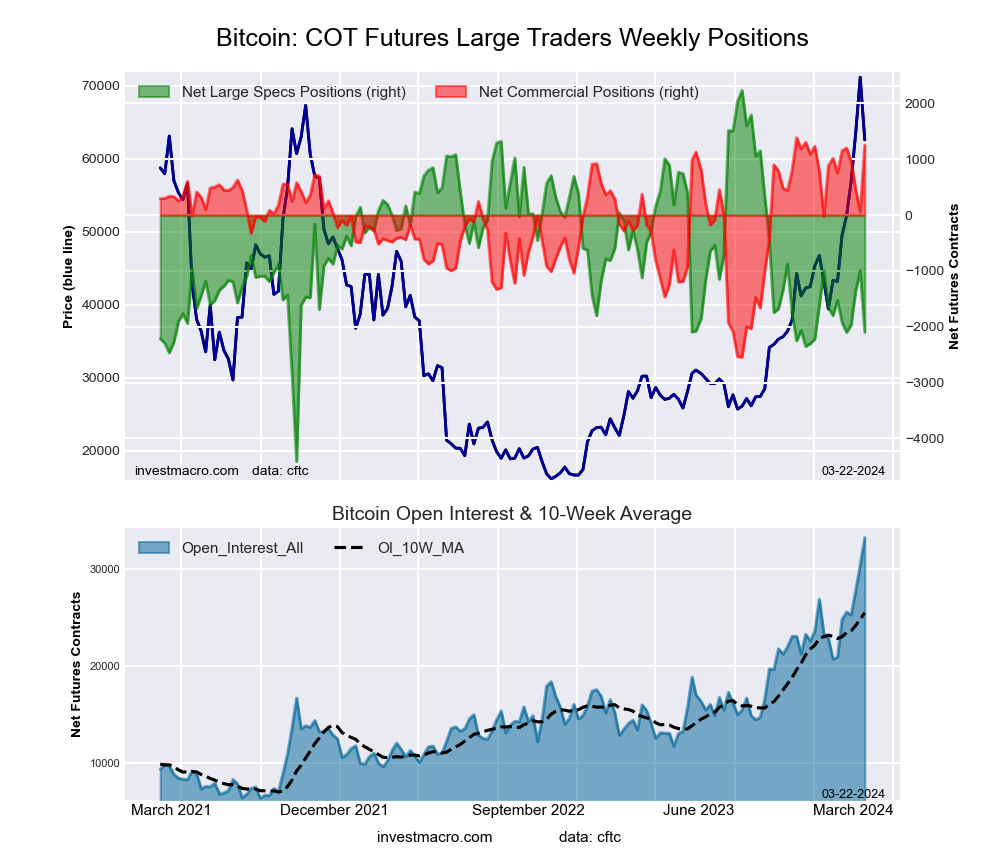
Bitcoin Crypto Futures COT ChartThe Bitcoin large speculator standing this week totaled a net position of -1,921 contracts in the data reported through Tuesday. This was a weekly lowering of -398 contracts from the previous week which had a total of -1,523 net contracts.

This week’s current strength score (the trader positioning range over the past three years, measured from 0 to 100) shows the speculators are currently Bearish with a score of 37.5 percent. The commercials are Bullish-Extreme with a score of 94.0 percent and the small traders (not shown in chart) are Bearish with a score of 30.4 percent.

Price Trend-Following Model: Strong Uptrend

Our weekly trend-following model classifies the current market price position as: Strong Uptrend. The current action for the model is considered to be: Hold – Maintain Long Position.

BITCOIN StatisticsSPECULATORSCOMMERCIALSSMALL TRADERS
– Percent of Open Interest Longs:77.36.17.0
– Percent of Open Interest Shorts:85.11.53.9
– Net Position:-1,9211,152769
– Gross Longs:19,1471,5141,725
– Gross Shorts:21,068362956
– Long to Short Ratio:0.9 to 14.2 to 11.8 to 1
NET POSITION TREND:
– Strength Index Score (3 Year Range Pct):37.594.030.4
– Strength Index Reading (3 Year Range):BearishBullish-ExtremeBearish
NET POSITION MOVEMENT INDEX:
– 6-Week Change in Strength Index:4.5-2.1-5.0


Article By InvestMacroReceive our weekly COT Newsletter

*COT Report: The COT data, released weekly to the public each Friday, is updated through the most recent Tuesday (data is 3 days old) and shows a quick view of how large speculators or non-commercials (for-profit traders) were positioned in the futures markets.

The CFTC categorizes trader positions according to commercial hedgers (traders who use futures contracts for hedging as part of the business), non-commercials (large traders who speculate to realize trading profits) and nonreportable traders (usually small traders/speculators) as well as their open interest (contracts open in the market at time of reporting). See CFTC criteria here.

Speculator Extremes: Mexican Peso, Dow, Corn & Palladium lead Bullish & Bearish Positions

By InvestMacro 

The latest update for the weekly Commitment of Traders (COT) report was released by the Commodity Futures Trading Commission (CFTC) on Friday for data ending on February 13th.

This weekly Extreme Positions report highlights the Most Bullish and Most Bearish Positions for the speculator category. Extreme positioning in these markets can foreshadow strong moves in the underlying market.

To signify an extreme position, we use the Strength Index (also known as the COT Index) of each instrument, a common method of measuring COT data. The Strength Index is simply a comparison of current trader positions against the range of positions over the previous 3 years. We use over 80 percent as extremely bullish and under 20 percent as extremely bearish. (Compare Strength Index scores across all markets in the data table or cot leaders table)


Here Are This Week’s Most Bullish Speculator Positions:

Mexican Peso


The Mexican Peso speculator position comes in as the most bullish extreme standing this week. The Mexican Peso speculator level is currently at a 100.0 percent score of its 3-year range.

The six-week trend for the percent strength score totaled 6.9 this week. The overall net speculator position was a total of 100,444 net contracts this week with a gain of 13,615 contract in the weekly speculator bets.


Speculators or Non-Commercials Notes:

Speculators, classified as non-commercial traders by the CFTC, are made up of large commodity funds, hedge funds and other significant for-profit participants. The Specs are generally regarded as trend-followers in their behavior towards price action – net speculator bets and prices tend to go in the same directions. These traders often look to buy when prices are rising and sell when prices are falling. To illustrate this point, many times speculator contracts can be found at their most extremes (bullish or bearish) when prices are also close to their highest or lowest levels.

These extreme levels can be dangerous for the large speculators as the trade is most crowded, there is less trading ammunition still sitting on the sidelines to push the trend further and prices have moved a significant distance. When the trend becomes exhausted, some speculators take profits while others look to also exit positions when prices fail to continue in the same direction. This process usually plays out over many months to years and can ultimately create a reverse effect where prices start to fall and speculators start a process of selling when prices are falling.


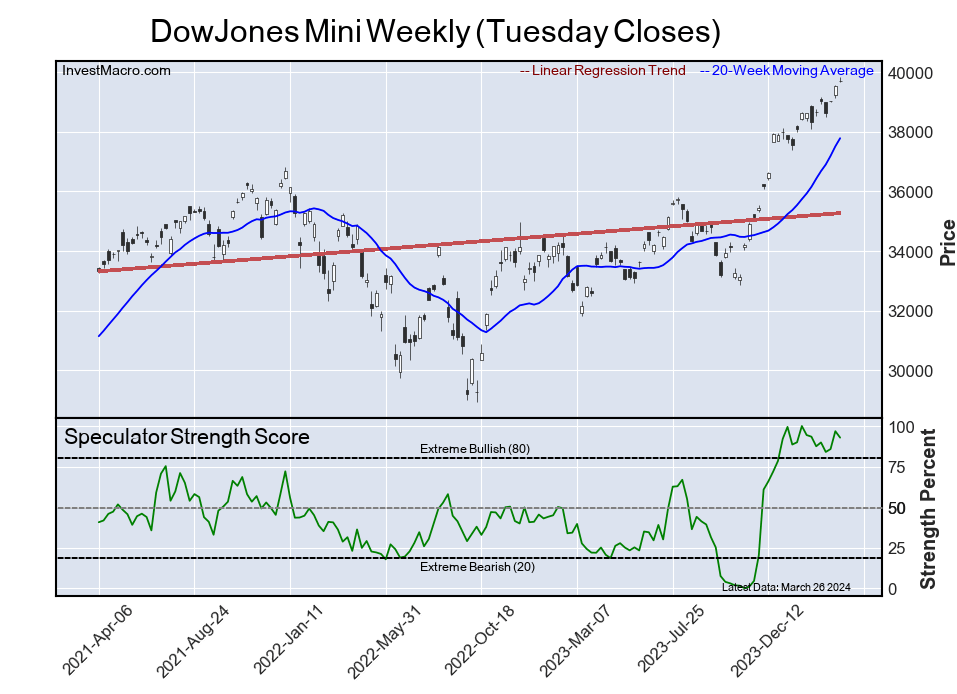
DowJones Mini


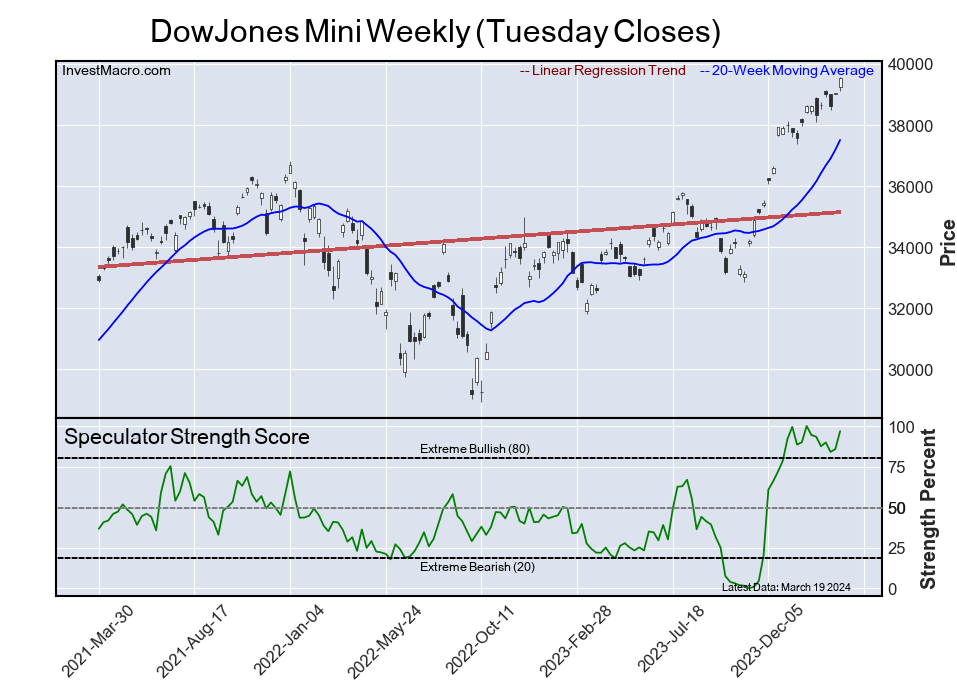
The DowJones Mini speculator position comes next in the extreme standings this week. The DowJones Mini speculator level is now at a 93.4 percent score of its 3-year range.

The six-week trend for the percent strength score was 1.3 this week. The speculator position registered 20,369 net contracts this week with a weekly dip of -616 contracts in speculator bets.


British Pound


The British Pound speculator position comes in third this week in the extreme standings. The British Pound speculator level resides at a 90.8 percent score of its 3-year range.

The six-week trend for the speculator strength score came in at 24.5 this week. The overall speculator position was 50,472 net contracts this week with a jump of 15,997 contracts in the weekly speculator bets.


3-Month Secured Overnight Financing Rate


The 3-Month Secured Overnight Financing Rate speculator position comes up number four in the extreme standings this week. The 3-Month Secured Overnight Financing Rate speculator level is at a 90.6 percent score of its 3-year range.

The six-week trend for the speculator strength score totaled a change of 4.2 this week. The overall speculator position was 586,542 net contracts this week with an increase by 30,099 contracts in the speculator bets.


Coffee


The Coffee speculator position rounds out the top five in this week’s bullish extreme standings. The Coffee speculator level sits at a 89.0 percent score of its 3-year range. The six-week trend for the speculator strength score was 17.1 this week.

The speculator position was 60,084 net contracts this week with a gain of 5,101 contracts in the weekly speculator bets.


This Week’s Most Bearish Speculator Positions:

Corn


The Corn speculator position comes in as the most bearish extreme standing this week. The Corn speculator level is at a 0.0 percent score of its 3-year range.

The six-week trend for the speculator strength score was -12.6 this week. The overall speculator position was -245,939 net contracts this week with a decline of -16,517 contracts in the speculator bets.


Palladium


The Palladium speculator position comes in next for the most bearish extreme standing on the week. The Palladium speculator level is at a 0.0 percent score of its 3-year range.

The six-week trend for the speculator strength score was -32.3 this week. The speculator position was -13,511 net contracts this week with a reduction of -2,509 contracts in the weekly speculator bets.


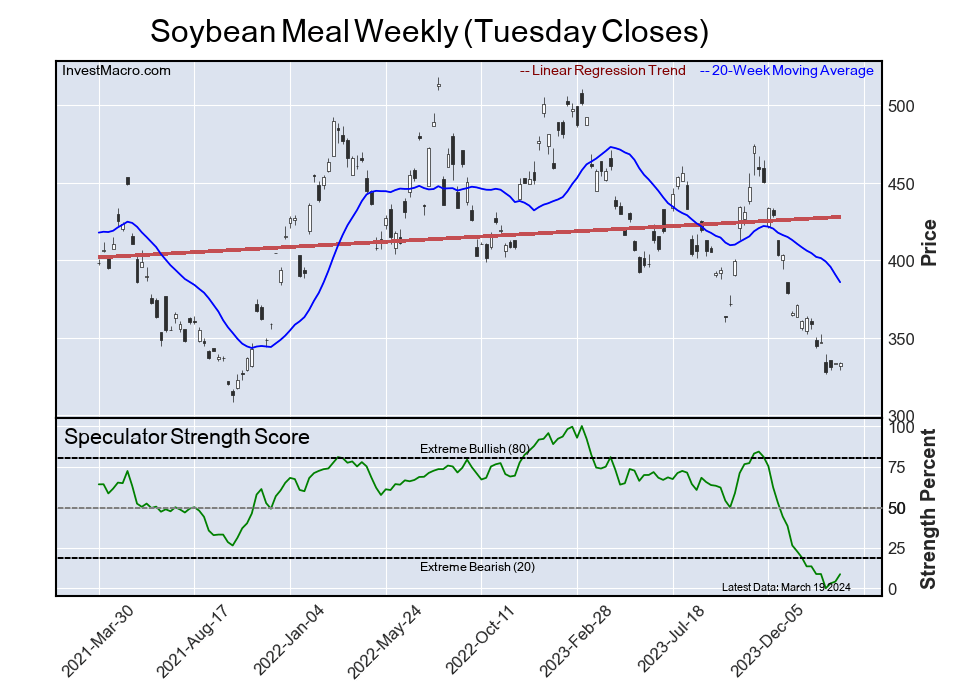
Soybean Meal


The Soybean Meal speculator position comes in as third most bearish extreme standing of the week. The Soybean Meal speculator level resides at a 0.0 percent score of its 3-year range.

The six-week trend for the speculator strength score was -32.5 this week. The overall speculator position was -45,467 net contracts this week with a drop of -11,545 contracts in the speculator bets.


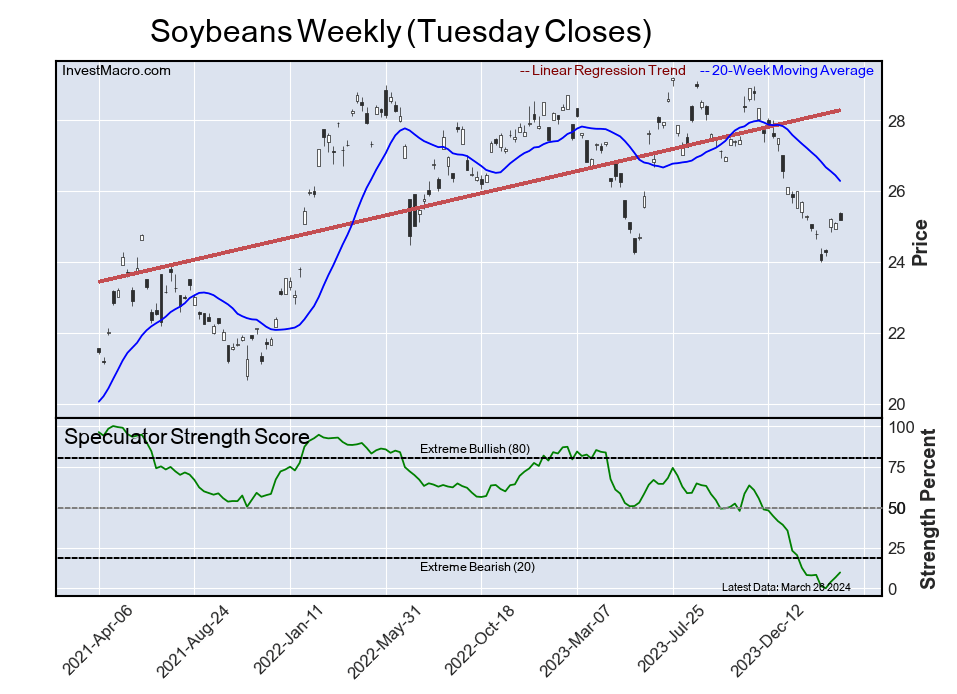
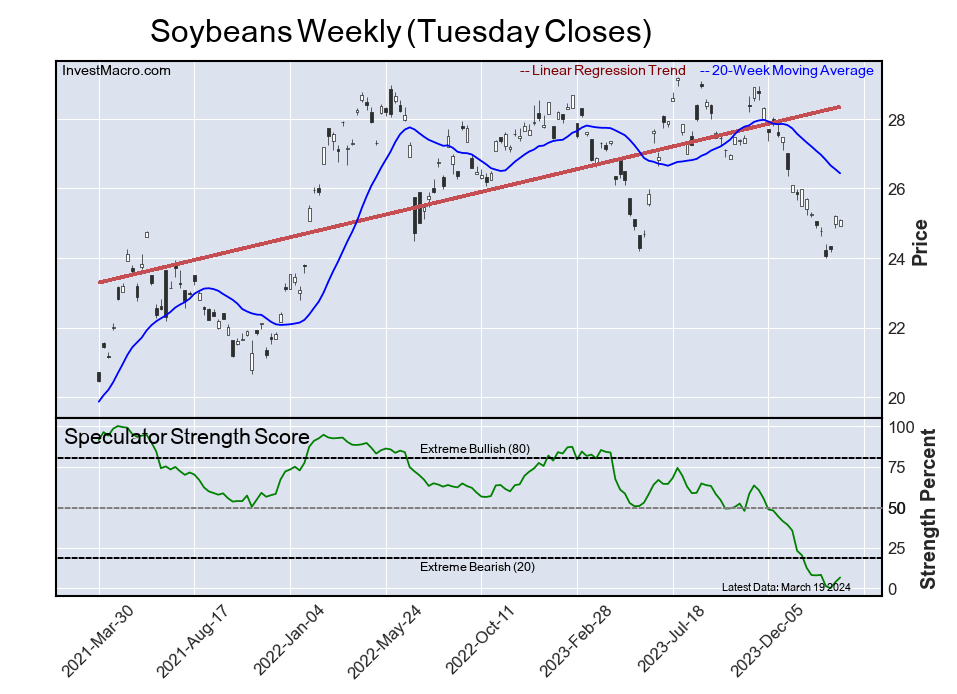
Soybeans


The Soybeans speculator position comes in as this week’s fourth most bearish extreme standing. The Soybeans speculator level is at a 0.0 percent score of its 3-year range.

The six-week trend for the speculator strength score was -33.9 this week. The speculator position was -161,751 net contracts this week with an edge lower by -934 contracts in the weekly speculator bets.


Copper


Finally, the Copper speculator position comes in as the fifth most bearish extreme standing for this week. The Copper speculator level is at a 2.7 percent score of its 3-year range.

The six-week trend for the speculator strength score was -37.2 this week. The speculator position was -32,697 net contracts this week with a drop of -18,987 contracts in the weekly speculator bets.


Article By InvestMacroReceive our weekly COT Newsletter

*COT Report: The COT data, released weekly to the public each Friday, is updated through the most recent Tuesday (data is 3 days old) and shows a quick view of how large speculators or non-commercials (for-profit traders) were positioned in the futures markets.

The CFTC categorizes trader positions according to commercial hedgers (traders who use futures contracts for hedging as part of the business), non-commercials (large traders who speculate to realize trading profits) and nonreportable traders (usually small traders/speculators) as well as their open interest (contracts open in the market at time of reporting). See CFTC criteria here.

Zero-Emission Hydrogen Vehicle Starts Trials in Wales

Source: Streetwise Reports  (2/8/24)

First Hydrogen Corp. announced it has started month-long trials of its hydrogen fuel-cell-powered light commercial vehicle (FCEV) with a utility company in Wales.

First Hydrogen Corp. (FHYD:TSX; FHYDF:OTC; FIT:FSE) announced it has started month-long trials of its hydrogen fuel-cell-powered light commercial vehicle (FCEV) with a utility company in Wales.

Wales & West Utilities (WWU) operates 24 hours a day year-round to deliver gas network services serving more than 7.5 million customers across Wales and Southwest England. The company is particularly interested in hydrogen power and has put forward a proposal for a hydrogen pipeline.

The trials are taking place during winter, WWU’s busiest period for callouts, First Hydrogen noted.

“Typically, cold temperatures can reduce the range for battery electric vehicles (BEVs), affecting fleet operators’ reliability,” First Hydrogen said in a release. “The trials could also generate data to indicate the FCEV’s advantage over BEVs in lower temperatures depending on the weather over the next month.”

First Hydrogen plans to demonstrate that its FCEVs have a greater range, towing power, and refueling capability than those conventional electric vehicles.

“Our FCEV has clear benefits for utility businesses such as WWU, and we’re keen to generate performance data during the trial that will further demonstrate how our vehicles can help decarbonize similar fleets while meeting everyday operational demands,” said First Hydrogen Executive Director Steve Gill. “This trial also pilots a hydrogen-as-a-service model to show operators how practically we can support the transition to FCEV fleets.”

Fuel Cell Emits Water Vapor, Warm Air

The most abundant molecule in the universe, hydrogen has the “potential for near-zero greenhouse gas emissions,” the U.S. Department of Energy has said.

“Hydrogen generates electrical power in a fuel cell, emitting only water vapor and warm air,” the agency wrote. “It holds promise for growth in both the stationary and transportation energy sectors.”

The world will need more hydrogen technology and projects to meet a net-zero emission scenario by 2050, according to the International Energy Agency.

Technical Analyst Clive Maund has rated First Hydrogen as a “Buy.”

“Faster action is required on creating demand for low-emission hydrogen and unlocking investment that can accelerate production scale-up and deployment of infrastructure,” the agency wrote.

It’s also a “uniquely versatile energy carrier,” according to a report by the Hydrogen Council. “It can be produced using different energy inputs and different production technologies. It can also be converted to different forms and distributed through different routes — from compressed gas hydrogen in pipelines through liquid hydrogen on ships, trains or trucks, to synthesized fuel routes.”

Global Market Insights estimates that the market size for hydrogen vehicles will grow by 28% annually from approximately US$2.8 billion in 2022 to US$33.2 billion in 2032. The report identified government initiatives to transition away from fossil fuels, as well as the general public’s desire for green transportation, as major drivers of the market.

Solution ‘Will Meet Our Fleet’s Future Needs’

WWU’s trials of the FCEV started with training for the drivers on the operation of the vehicle. Drivers performed maneuvers and even completed a callout to a customer’s residence.

“The drivers also practiced refueling the vehicle with green hydrogen, supplied by Protium Green Solutions, at Hyppo Hydrogen Solutions’ refueling unit,” First Hydrogen noted. “Both organizations have helped to develop a hydrogen ecosystem to support First Hydrogen’s trial with WWU.”

Newsletter writer Ron Struthers said there was support for hydrogen technology from governments across North America and Europe, which can be a major catalyst for the company.

Current light commercial electric vehicles on the market don’t offer full solutions for WWU and smaller businesses, WWU noted.

“Current battery electric vehicles do not provide the range, fast recharging time, payload capacity, and towing ability we require,” said WWU transport manager Stephen Offley. “They are also unsuitable for the installation of on-board power to power tools and equipment on site, which is critical for the operation of our network. Lack of suitable recharging infrastructure also poses a challenge. We see hydrogen-powered vehicles, such as First Hydrogen’s FCEV, as the potential zero-emission solution that will meet our fleet’s future needs.”

Hyppo Hydrogen Solutions Chief Executive Officer Chris Foxall said the trial is “demonstrating the readiness level of the hydrogen technology available today, but also how we’re leveraging so many companies to deliver a bespoke solution which can be scaled and repeated.”

Support From Governments Could Be Major Catalyst

Technical Analyst Clive Maund has rated First Hydrogen as a “Buy.”

“There has been some determined heavy buying in recent days, and with the 50-day moving average turning higher, it looks like it is starting to break out of the latest bull Flag shown into another upleg,” Maund wrote last July. He also commented that a short drop has made the company’s stock more accessible to new investors on the American market.

Newsletter writer Ron Struthers said there was support for hydrogen technology from governments across North America and Europe, which can be a major catalyst for the company.

“First Hydrogen is at the very beginning of its growth cycle,” Struthers said. “It will have revenues from selling FCEVs that have now reached acceptance, and I expect it will soon see major purchase orders.”

Retail: 92.52%
Management and Insiders: 7.47%
Institutions: 0.01%
92.5%
7.5%
*Share Structure as of 2/8/2024


The company’s investor presentation reports a number of catalysts, including the rollout of its first generation of vehicles expected in 2026 and its next generation of large vehicles expected in 2028.

Ownership and Share Structure

Refinitiv provided a breakdown of the company’s ownership and share structure, where management and insiders own approximately 7.47% of the company. According to Refinitiv, Head of Strategy Nicholas Wrigley owns 6.04% of the company with 3 million shares and Chairman and Chief Executive Officer Balraj S. Mann owns 1.43% of the company with 0.71 million shares.

Refinitiv reports one institutional investor, Fuchs & Associés Finance, with 0.01% with 0.01 million shares.

There are 70.92 million shares outstanding with 67.11 million free float traded shares. The company has a market cap of CA$113.5million and trades in a 52-week range of CA$1.40 and CA$4.20.


Important Disclosures:

  1. First Hydrogen Corp. has a consulting relationship with an affiliate of Streetwise Reports, and pays a monthly consulting fee between US$8,000 and US$20,000.
  2. As of the date of this article, officers and/or employees of Streetwise Reports LLC (including members of their household) own securities of First Hydrogen Corp.
  3. Steve Sobek wrote this article for Streetwise Reports LLC and provides services to Streetwise Reports as an employee.
  4.  This article does not constitute investment advice and is not a solicitation for any investment. Streetwise Reports does not render general or specific investment advice and the information on Streetwise Reports should not be considered a recommendation to buy or sell any security. Each reader is encouraged to consult with his or her personal financial adviser and perform their own comprehensive investment research. By opening this page, each reader accepts and agrees to Streetwise Reports’ terms of use and full legal disclaimer. Streetwise Reports does not endorse or recommend the business, products, services or securities of any company.

For additional disclosures, please click here.

Could Market Bubble Lead To a New Gold Bull Market?

Source: Streetwise Reports  (2/12/24)

Could another bubble burst like the “Dotcom Bubble,” which helped usher in a decade-long gold bull market with extraordinary gains, be on its way? Surprisingly, some analysts and experts say there are similarities between then and now.

Could another bubble burst like the “Dotcom Bubble,” which helped usher in a decade-long gold bull market with extraordinary gains, be on its way?

Hussman Investment Trust President John Hussman, who predicted the Dotcom Bubble break and the market downturn in 2008, is warning that another fallout is coming soon.

“We estimate that current market conditions now ‘cluster’ among the worst 0.1% instances in history — more similar to major market peaks and dissimilar to major market lows than 99.9% of all post-war periods,” Business Insider quoted Hussman as saying in a recent note.

Hussman said other such instances, including the Dotcom Bubble, are usually followed by an “abrupt” drop in the stock market.

For the savvy gold investor, that may be a big opportunity — like the big growth gold saw in the 2000s after the Dotcom Bubble burst.

“The Fed started to cut the federal funds rate in the response, gold started its impressive rally,” according to GoldPriceForecast.com. “Many people did not want to invest in the stock market anymore, and they switched into the housing market (developing another speculative mania) and into . . . the precious metals market. The low-interest rates, weak greenback, and unsound U.S. fiscal policy made gold shine.”

A team of J.P. Morgan analysts led by Khuram Chaudhry noted, “Rising concentration in the U.S. stock market has become an important risk that investors should be aware of in 2024.”

On his website, Addicted to Profits, David Skarica also saw similarities with earlier gold markets and predicted the metal will rise in value “sometime this year.”

Chaudhry and his team said there are differences between the Dotcom Bubble era and now, but the two are “more similar than one might initially expect.”

“When viewed in a historical context, parallels to the ‘Dotcom Bubble’ era are often dismissed due to the ‘irrational exuberance’ that characterized this period. In this note, we demonstrate that there are a plethora of similarities between these two periods,” said the note, reported on by MarketWatch.

And when it happens, investors should be ready, noted wealth advisor Ross Goldstein, who wrote that gold breaking records is a “rare and remarkable occurrence, given its historical long-term stability over thousands of years. The last time such groundbreaking price movements occurred was in the 1970s and the 2000s . . . The second gold bull market from 2000 to 2011 (after the Dotcom Bubble) exhibited almost an 8X rise.”

According to Katusa Research, heightened uncertainty and decreased appetite for risk could send investors to gold. Also, a hard landing for the economy would justify more Fed rate cuts, “fanning the flames for higher gold prices.”

“You need to be prepared,” the site said. “If a roaring bull market sends the gold price above (US)$2,200 for any period of time, look out.”

From Tulips to Blue Chips

According to Investopedia, an asset bubble happens “when the price of a financial asset or commodity rises to levels that are well above either historical norms, the asset’s intrinsic value, or both.”

Global analyst Adrian Day, writing for Streetwise Reports last month, said gold’s “time has come.”

Such bubbles are not new. One of the earliest recorded happened in Holland during the 1630s, when “Tulipmania” hit the country. Speculation drove the value of tulip bulbs to extremes.

“At the market’s peak, the rarest tulip bulbs traded for as much as six times the average person’s annual salary,” Investopedia said.

By the end of 1637, the tulip bubble burst when buyers could not pay the high prices, and the market fell apart.

There were other bubbles in the 1700s (over a company formed to trade with South American Spanish colonies) and the 1980s (fueled by “overly stimulative monetary policy).

The Dotcom Bubble

However, for increased scale and size, few matched the Dotcom Bubble.

“The increasing popularity of the Internet triggered a massive wave of speculation in ‘new economy’ businesses,” Investopedia said. “As a result, hundreds of dot-com companies achieved multi-billion dollar valuations as soon as they went public.”

The NASDAQ soared from about 750 in 1990 to a peak of more than 5,000 in March 2000. The index then crashed by 78% by October 2002, not reaching a new high until 2015.

Investors asked, “Do you have a ‘.com’ suffix in your name? If yes, we will invest in you,” according to GoldPriceForecast.com. “No matter that, you never made any money. You have to gain in value, anyway!”

Stock values grew, but capital dried up.

“In the years preceding the bubble, record-low interest rates, the adoption of the Internet, and interest in technology companies allowed capital to flow freely, especially to startup companies that had no track record of success,” Investopedia said. “Valuations rose, and money eventually dried up. This led companies, many of which didn’t even have a business plan or product, to collapse, causing the market to crash.”

The Golden Years

However, the bear markets that come after such falls “are exactly what precious metals investors are prepared for,” noted RME Gold.

“In a bear market, stockholders tend to sell off their stocks as values are declining, so they don’t lose more money,” the site said. “At this time, to balance their portfolios, they’ll turn to gold and silver as safe assets for protection. Historically, when the market goes down, the price of gold goes up. This ‘see-saw’ effect is evident in the surge in gold prices when the economy was deep in recession after the subprime mortgage crisis of 2008. Even in a bear market for stocks and indexes, gold and silver may experience an increase in value.”

Not only did the Dotcom Bubble burst, but America suffered one of the largest terrorist attacks in history on Sept. 11, 2001, and the price of gold rose steadily. The global economic crisis that shook the markets in 2008 also boosted the price.

From August 1999 to August 2011, gold rose from US$394 an ounce to US$2,066 an ounce, an increase of more than 425% over 145 months (in terms adjusted for inflation), Tavex reported.

How High Will It Go?

Investors often turn to precious metals as a hedge against inflation or during geopolitical instability and market uncertainty. Russ Koesterich, writing for BlackRock, said gold is “an imperfect hedge, but still a Buy.”

“Even under a good outcome, investors are looking at a prolonged period of uncertainty” right now, he wrote. “This scenario, combined with negative real rates, should keep gold moving higher.”

In a research note reported by CNBC, UBS noted that when it comes, the “power of the [Federal Reserve’s] policy pivot should not be underestimated.”

Still, UBS forecasted a rise to US$2,250 per ounce for gold by the end of the year. It was US$2.024.20 Friday afternoon.

In the longer term, a model by Incrementum assigning probabilities to future gold prices “currently shows a 75% chance of (US)$3,000+ by 2030,” John Rubino of John Rubino’s Substack noted.

Gold’s ‘Time Has Come’

Chaudry and his team at J.P. Morgan have determined that the number of sectors in the top 10 most valuable companies is actually less diverse than during the Dotcom Bubble, MarketWatch reported.

“Back then, there were six sectors represented among the Top 10 stocks, compared with just four today,” MarketWatch noted. “What’s more, they found that during both periods, information-technology companies represented the biggest share of the group’s total market capitalization.”

The analysts said the overall share of earnings-per-share growth contributed to the ten largest stocks was actually higher during the Dotcom Bubble, rebutting the conventional wisdom that stocks at the time had become completely disconnected from fundamentals.

“While we would be hesitant to refer to the current levels of the Top 10 as a bubble, it would certainly appear that the Top 10 in the Dotcom era was backed by superior earnings developments,” the J.P. Morgan team said.

Hussman, who predicted the 2000 and 2008 market slumps, stands by his belief that another downturn is coming and “could be even steeper this time.”

“Without making forecasts, it’s fair to say that we would not be surprised by a near-term market loss on the order of 10% or more in the S&P 500, nor would we be surprised by a full-cycle market loss on the order to 50-65%, nor a US recession that the consensus seems to have ruled out,” Hussman said.

On his website, Addicted to Profits, David Skarica also saw similarities with earlier gold markets and predicted the metal will rise in value “sometime this year.”

“The closer we inch to seeing those rate cuts finally happen, the gold can finally see that breakout,” he said.

Global analyst Adrian Day, writing for Streetwise Reports last month, said gold’s “time has come.”

“For nearly two years, we have been saying that gold will take off when the market believes that the Fed will change course on tightening before inflation is vanquished,” he wrote. “We are at that point now. The Fed’s pivot comes with the Fed’s own preferred inflation measure at 60% above its own target. It is monetary factors, not geo-political, that will see a sustained move higher in gold.”


Important Disclosures:

  1. Steve Sobek wrote this article for Streetwise Reports LLC and provides services to Streetwise Reports as an employee.
  2.  This article does not constitute investment advice and is not a solicitation for any investment. Streetwise Reports does not render general or specific investment advice and the information on Streetwise Reports should not be considered a recommendation to buy or sell any security. Each reader is encouraged to consult with his or her personal financial adviser and perform their own comprehensive investment research. By opening this page, each reader accepts and agrees to Streetwise Reports’ terms of use and full legal disclaimer. Streetwise Reports does not endorse or recommend the business, products, services or securities of any company.

For additional disclosures, please click here.

Driving the best possible bargain now isn’t the best long-term strategy, according to game theory

By Kate Vitasek, University of Tennessee 

Conventional wisdom says that you should never leave money on the table when negotiating. But research in my field suggests this could be exactly the wrong approach.

There’s mounting evidence that a short-term win at the bargaining table can mean a loss in terms of overall trust and cooperation. That can leave everyone – including the “winner” – worse off.

As a former executive, I’ve managed large contracts as both a buyer and a seller. Now, as a business professor, I study these trading partner relationships, exploring what works in practice. My work supports what economic theorists and social scientists have been arguing for years: The best results come when people collaborate to create long-term value instead of fighting for short-term wins.

What game are you playing?

Research into art, science and practice of collaborative approaches dates back to the 1940s when the mathematician John von Neumann and economist Oskar Morgenstern used mathematical analysis to model competition and cooperation in living things.

Interest in collaborative approaches grew when researchers John Nash, John C. Harsanyi and Reinhard Selten won a Nobel Memorial Prize in Economic Sciences in 1994. Their work inspired academics around the world to delve deeper into what’s known as game theory.

Game theory is the study of the outcome of strategic interactions among decision makers. By using rigorous statistical methods, researchers can model what happens when people choose to cooperate or choose to take an aggressive, power-based approach to negotiation.

Many business leaders are taught strategies focusing on using their power and playing to win – often at the other party’s expense. In game theory, this is known as a zero-sum game, and it’s an easy trap to fall into.

Kate Vitasek lays out five rules for developing a value creation strategy.

But not every game has a clear winner or loser. In economics, a win-win game is called a nonzero-sum game. In this sort of situation, people aren’t fighting over whose slice of a pie will be larger. They’re working to grow the pie for everyone.

A second dimension of game theory is whether people are playing a one-shot or a repeated game. Think of a one-shot game as like going to the flea market: You probably won’t see your trading partner again, so if you’re a jerk to them, the risk of facing the consequences is low.

An interesting twist uncovered by studying repeated games is that when one party uses their power in a negotiation, it creates the urge for the other party to retaliate.

The University of Michigan’s Robert Axelrod, a mathematician turned game theorist, coined this a “tit-for-tat” strategy. His research, perhaps best known in the book “The Evolution of Cooperation,” uses statistics to show that when individuals cooperate, they come out better than when they don’t.

The case for leaving money on the table

Another Nobel laureate, American economist Oliver Williamson, has offered negotiating advice that most would call a paradigm shift – and some, a heresy.

That advice? Always leave money on the table – especially when you’ll be returning to the same “game” again. Why? According to Williamson, it sends a powerful signal of trustworthiness and credibility to one’s negotiating partner when someone consciously chooses to cooperate and build trust.

The opposite approach leads to lost trust and what the Nobel laureate economist Oliver Hart calls “shading.” This is a retaliatory behavior that happens when a party isn’t getting the outcome it expected from a deal and feels the other party is to blame.

Simply put, noncollaborative approaches cause distrust and create friction, which adds transaction costs and inefficiencies.

The million-dollar question is whether collaborative approaches work in practice. And from my vantage point as a scholar, the answer is yes. In fields as diverse as health care to high-tech, I see growing real-world evidence backing up the insights of game theory.

The lessons are simple yet profound: Playing a game together to achieve mutual interests is better than playing exclusively with self-interest in mind.The Conversation

About the Author:

Kate Vitasek, Professor of supply chain management, University of Tennessee

This article is republished from The Conversation under a Creative Commons license. Read the original article.

Self-extinguishing batteries could reduce the risk of deadly and costly battery fires

By Apparao Rao, Clemson University and Bingan Lu, Hunan University 

In a newly published study, we describe our design for a self-extinguishing rechargeable battery. It replaces the most commonly used electrolyte, which is highly combustible – a medium composed of a lithium salt and an organic solvent – with materials found in a commercial fire extinguisher.

An electrolyte allows lithium ions that carry an electric charge to move across a separator between the positive and negative terminals of a lithium-ion battery. By modifying affordable commercial coolants to function as battery electrolytes, we were able to produce a battery that puts out its own fire.

Cutaway view of a Nissan Leaf electric vehicle showing part of its battery array (silver boxes).
Tennen-gas/Wikipedia, CC BY-SA

Our electrolyte worked well across a wide temperature range, from about minus 100 to 175 degrees Fahrenheit (minus 75 to 80 degrees Celsius). Batteries that we produced in the lab with this electrolyte transferred heat away from the battery very well, and extinguished internal fires effectively.

We subjected these batteries to the nail penetration test, a common method for assessing lithium-ion battery safety. Driving a stainless steel nail through a charged battery simulates an internal short circuit; if the battery catches fire, it fails the test. When we drove a nail through our charged batteries, they withstood the impact without catching fire.

Infographic showing the parts of lithium-ion battery
When a lithium-ion battery delivers energy to a device, lithium ions – atoms that carry an electrical charge – move from the anode to the cathode. The ions move in reverse when recharging.
Argonne National Laboratory/Flickr, CC BY-NC-SA

Why it matters

By nature, a battery’s temperature changes as it charges and discharges, due to internal resistance – opposition within the battery to the flow of lithium ions. High outdoor temperatures or uneven temperatures within a battery pack seriously threaten batteries’ safety and durability.

Energy-dense batteries, such as the lithium-ion versions that are widely used in electronics and electric vehicles, contain an electrolyte formulation dominated by organic molecules that are highly flammable. This worsens the risk of thermal runaway – an uncontrollable process in which excess heat inside a battery speeds up unwanted chemical reactions that release more heat, triggering further reactions. Temperatures inside the battery can rise by hundreds of degrees in a second, causing a fire or explosion.

Another safety concern arises when lithium-ion batteries are charged too quickly. This can cause chemical reactions that produce very sharp lithium needles called dendrites on the battery’s anode – the electrode with a negative charge. Eventually, the needles penetrate the separator and reach the other electrode, short-circuiting the battery internally and leading to overheating.

As scientists studying energy generation, storage and conversion, we have a strong interest in developing energy-dense and safe batteries. Replacing flammable electrolytes with a flame-retardant electrolyte has the potential to make lithium-ion batteries safer, and can buy time for longer-term improvements that reduce inherent risks of overheating and thermal runaway.

Lithium-ion battery fires in vehicles have become a major concern for firefighters because the batteries burn at very high temperatures for long periods.

How we did our work

We wanted to develop an electrolyte that was nonflammable, would readily transfer heat away from the battery pack, could function over a wide temperature range, was very durable, and would be compatible with any battery chemistry. However, most known nonflammable organic solvents contain fluorine and phosphorus, which are expensive and can have harmful effects on the environment.

Instead, we focused on adapting affordable commercial coolants that already were widely used in fire extinguishers, electronic testing and cleaning applications, so that they could function as battery electrolytes.

We focused on a mature, safe and affordable commercial fluid called Novec 7300, which has low toxicity, is nonflammable and does not contribute to global warming. By combining this fluid with several other chemicals that added durability, we were able to produce an electrolyte that had the features we sought and would enable a battery to charge and discharge over a full year without losing significant capacity.

Standard lithium-ion batteries failing the nail penetration test.

What still isn’t known

Because lithium – an alkali metal – is scarce in our Earth’s crust, it is important to investigate how well batteries that use other, more abundant alkali metal ions, such as potassium or sodium, fare in comparison. For this reason, our study focused predominantly on self-extinguishing potassium-ion batteries, although it also showed that our electrolyte works well for making self-extinguishing lithium-ion batteries.

It remains to be seen whether our electrolyte can work equally well for other types of batteries that are in development, such as sodium-ion, aluminum-ion and zinc-ion batteries. Our goal is to develop practical, environmentally friendly, sustainable batteries regardless of their ion type.

For now, however, since our alternative electrolyte has similar physical properties to currently used electrolytes, it can be readily integrated with current battery production lines. If the industry embraces it, we expect that companies will be able to manufacture nonflammable batteries using their existing lithium-ion battery facilities.

The Research Brief is a short take on interesting academic work.The Conversation

About the Author:

Apparao Rao, Professor of Physics, Clemson University and Bingan Lu, Associate Professor of Physics and Electronics, Hunan University

This article is republished from The Conversation under a Creative Commons license. Read the original article.


Trade Of The Week: GBPUSD bears ready to strike?

By ForexTime 

  • Data heavy week for GBPUSD
  • UK data dump set to influence Pound
  • Dollar volatility also on the cards
  • Significant move on horizon
  • Key levels of interest at 50 SMA and 200 SMA

This could be an eventful week for the GBPUSD due to key economic reports from both the UK and the US.

Although prices have edged higher over the past few days, a massive range can be observed on the weekly charts.

There is a similar theme on the daily charts with resistance at the 50 SMA and support at the 200-day SMA.

After the aggressive US NFP-induced selloff witnessed earlier this month, the GBPUSD could resume its decline with the right fundamental forces.

Here are 3 factors to keep a close eye on:

  1. UK data dump 

The mid-month data dump featuring employment, inflation, and GDP among other key releases could offer fresh insight into the health of the UK economy.

  • Tuesday, February 13: UK January unemployment report

The unemployment rate is expected to rise to 4.0% in Q4 from Q3.

  • Wednesday, February 14: UK January CPI report 

The latest inflation report could rock Sterling, especially if it could offer more clues on the outlook for Bank of England (BoE) rates in 2024. Inflation is forecast to rise 4.1% year on year, up from 4% in December while the core is also forecast to hit 5.2%, up from 5.1%.

  • Thursday, February 15: UK industrial production & Q4 GDP 

Another major release will be the fourth quarter GDP report which is expected to show a second consecutive drop of 0.1% – confirming that the UK slipped into a technical recession at the end of 2023.

  • Friday, February 16: UK January retail sales

UK retail sales are forecast to fall -1.8% year-on-year in January compared to -2.4% in the previous month.

Potential GBP scenarios:

  • Sterling could appreciate if UK data including CPI exceed market forecasts – forcing investors to push back BoE cut bets.
  • Should overall data disappoint with UK inflation printing below forecasts, this may bolster BoE cut expectations – weakening the pound as a result.
  1. Key US data 

Dollar volatility could be a key theme due to a string of top-tier data and Fed speeches. It may be wise to keep a very close eye on the US CPI report and retail sales figures. 

  • Tuesday, February 13: US January CPI report 

US inflation is forecast to cool to 2.9% from 3.4% on an annual basis. The core which strips out food and energy prices is forecast to cool 3.7% from 3.9% in the prior month.

  • Thursday, February 15: US January Retail sales

US retail sales are forecast to slip -0.1% in January MoM compared to 0.6% in the prior month.

Potential USD scenarios:

  • Dollar bulls may receive a boost if strong economic data and hot inflation figures prompt investors to claw back bets for aggressive Fed cuts.
  • Dollar bears have the potential to jump back into the scene on weak US data and further signs of cooling price pressures.
  1. Technical forces 

The GBPUSD seems to be gearing up for a breakout on the daily charts with resistance at the 50-day SMA and support at the 200-day SMA. 

  • A solid breakdown below the 200-day SMA at 1.2560 could open a path towards 1.2485.
  • Should prices push beyond the 50-day SMA at 1.2670, bulls may target the next resistance around 1.2750.

Bloomberg’s FX model points to a 75% chance that GBPUSD will trade within the 1.2487 – 1.2752 range over the next one-week period.


Forex-Time-LogoArticle by ForexTime

ForexTime Ltd (FXTM) is an award winning international online forex broker regulated by CySEC 185/12 www.forextime.com

Understanding Meta’s 0.4% Yield and Its Growth Potential

By Ino.com |  Source: Understanding Meta’s 0.4% Yield and Its Growth Potential

Dividend-loving investors worldwide woke up with exciting news on Friday, as Facebook parent Meta Platforms, Inc. (META) announced its first-ever quarterly dividend and authorized a $50 billion share buyback program.

The company will pay a cash dividend of 50 cents per share on March 26 to shareholders of record as of February 22, joining other peers, including Apple Inc. (AAPL), Microsoft Corporation (MSFT), and Oracle Corporation (ORCL), which have regular payouts. META’s board intends to issue a cash dividend on a quarterly basis.

“Introducing a dividend just gives us a more balanced capital return program and some added flexibility in how we return capital in the future,” Meta’s Chief Financial Officer Susan Li told analysts on its earnings call.

META’s annual dividend of $2 translates to a yield of 0.4% at the prevailing share price. The stock finished nearly 20% higher to $474.99 on Friday after reporting better-than-expected fourth-quarter and full-year 2023 earnings.

The average yield for a dividend-paying stock in the S&P 500 is nearly 2%. Meta’s dividend payout is lower than that rate; however, companies generally start small. Now, investors can look forward to its dividend growth and stock gains.

Looking at Microsoft, the company initiated its cash dividend on January 16, 2003. Its annual dividend was $0.08 per share, which resulted in a yield of about 0.3%. A year following the dividend declaration, MSFT’s stock was up 10%, and the annual dividend for 2024 was raised to $0.16. Currently, the company pays a quarterly dividend of $0.75.

Talking about Apple, it stopped paying cash dividends in 1995 but then declared again in January 2013. Adjusting for all the splits, cash dividends in 2013 translated to an annualized yield of nearly 1.4%. A year after the dividend restart, AAPL’s stock was approximately 24% up as the company continued payouts. Since the restart, Apple has paid a total of around $34 per share.

Dividends are typically welcomed by shareholders and signal management’s confidence about the company’s future growth. Moreover, initial dividend payouts open up to investors who only hold stock in dividend payers.

Further, Meta’s recently released report marked the fourth quarter of the company’s self-described “year of efficiency,” which founder and CEO Mark Zuckerberg announced in February 2023. The company’s turnaround strategy involved layoffs and other cuts to spending, which in turn ended up being a successful effort to reverse the previous year’s revenue declines and share price weakness.

Outstanding Last Reported Financials

For the fourth quarter that ended December 31, 2023, META reported revenue of $39.17 billion, an increase of 24.7% year-over-year. The revenue surpassed analysts’ estimate of $40.11 billion. The company’s revenue from the Advertising segment grew 23.8% year-over-year, and its revenue from the Family of Apps segment rose 24.2%.

Meanwhile, META’s total costs and expenses reduced by 7.9% year-over-year to $23.73 billion. Its operating margin more than doubled to 41%, a clear sign that several cost-cutting measures are boosting profitability.

Facebook parent Meta’s income from operations rose 156% from the prior year’s period to $16.38 billion. Its net income increased 201.3% from the year-ago value to $14.02 billion. The company posted earnings per share attributable to Class A and Class B common stockholders of $5.33, compared to the consensus estimate of $1.76, and up 202.8% year-over-year.

As of December 31, 2023, META’s cash and cash equivalents stood at $41.86 billion, compared to $14.68 billion as of December 31, 2022. The company’s total assets were $229.62 billion versus $185.73 billion as of December 31, 2022.

Family daily active people (DAP) came in at 3.19 billion on average for December 2023, up 8% year-over-year. Family monthly activity people (MAP) was 3.98 billion as of December 31, 2023, an increase of 6% year-over-year.

Also, Facebook daily active users (DAUs) and Facebook monthly active users (MAUs) were 2.11 billion on average and 3.07 billion as of December 31, 2023, up 6% and 3% year-over-year, respectively.

As of December 31, 2023, the tech giant completed the data center initiatives and the employee layoffs, along with the facilities consolidation initiatives. META’s headcount was 67,317 at the end of the year 2023, a decline of 22% year-over-year.

“We had a good quarter as our community and business continue to grow,” said CEO Zuckerberg. “We’ve made a lot of progress on our vision for advancing AI and the metaverse.”

Fiscal 2024 Outlook

For the first quarter of 2024, META expects total revenue to be in the range of $34.50-37 billion. For the full year 2024, the management expects total expenses to be in the range of $94-99 billion, unchanged from the previous outlook.

The company anticipates full-year capital expenditures to be in the range of $30-37 billion, an increase of $2 billion in the high end of its prior range. Meta expects growth to be driven by investments in servers, including AI and non-AI hardware and data centers, and it plans to ramp up construction on sites with its previously announced new data center architecture.

META’s updated outlook reflects its evolving understanding of its AI capacity demands as the company anticipates what will be needed for the next generations of foundational research and product development.

Ramping up Efforts in AI and Metaverse

Meta is making consistent efforts to secure its place in the increasing AI arms race. Last month, CEO Mark Zuckerberg announced that META plans to build its own artificial general intelligence, known as AGI, which is artificial intelligence that meets or exceeds human intelligence in almost every area. He added that the company further plans to open it up to developers.

In a video posted to Meta’s social network Threads, Zuckerberg said building the best AI for chatbots, creators, and businesses requires enhanced advancement in AI across the board. “Our long term vision is to build general intelligence, open source it responsibly, and make it widely available so everyone can benefit,” he said in a post on Threads.

The tech giant announced building out its infrastructure to accommodate this push to get AI into products, and it planned to have about 350,000 H100 GPUs (graphics processing units) from chip designer NVIDIA Corporation (NVDA) by the end of this year. In combination with equivalent chips from other suppliers, Meta will have around 600,000 total GPUs by the end of the year, Zuckerberg said.

He added that the company plans to grow and bring its two major AI research groups – FAIR and GenAI – together to accelerate its work. He further said he believes that Meta’s vision for AI and the AR/VR-driven metaverse are connected.

“By the end of the decade, I think lots of people will talk to AIs frequently throughout the day using smart glasses like what we’re building with Ray Ban Meta.”

Mark Zuckerberg’s recent announcement is one of the company’s biggest pledges to double down on AI. Earlier last year, after the viral success of OpenAI’s ChatGPT, Zuckerberg announced that Meta is creating a new “top-level product group” to “turbocharge” the company’s work on AI tools.

Since then, Meta has introduced tools and information aimed at assisting users understand how AI influences what they see on its apps. The company has launched a commercial version of its Llama large language model (LLM), ad tools that can generate image backgrounds from text prompts, and a “Meta AI” chatbot that can be accessed directly via its Ray-Ban smart glasses.

In his posts last month, Meta CEO said the company is currently training a third version of the Liama model.

Impressive Historical Growth

Over the past three years, META’s revenue and EBITDA grew at CAGRs of 16.2% and 15%, respectively. The company’s net income and EPS rose at respective CAGRs of 10.3% and 13.8% over the same timeframe. Its levered free cash flow improved at 25.6% CAGR over the same period.

Moreover, the social networking company’s total assets increased at a CAGR of 13% over the same timeframe.

Favorable Analyst Estimates

Analysts expect META’s revenue for the first quarter (ending March 2024) to grow 25.3% year-over-year to $35.88 billion. The consensus EPS estimate of $4.25 for the ongoing quarter indicates a 93.3% year-over-year increase. Moreover, Meta has topped consensus revenue and EPS estimates in each of the trailing four quarters, which is remarkable.

Furthermore, Street expects Meta’s revenue and EPS for the fiscal year (ending December 2024) to grow 17.3% and 32.4% year-over-year to $158.20 billion and $19.69, respectively. For the fiscal year 2025, the company’s revenue and EPS are expected to increase 11.2% and 15.3% from the previous year to $175.98 billion and $22.70, respectively.

Solid Profitability

META’s trailing-12-month gross profit margin of 80.72% is 64.5% higher than the 49.07% industry average. Likewise, the stock’s trailing-12-month EBIT margin and net income margin of 36.33% and 28.98% are considerably higher than the industry averages of 8.47% and 3.50%, respectively.

In addition, the stock’s trailing-12-month ROCE, ROTC, and ROTA of 28.04%, 17.84% and 17.03% favorably compared to the respective industry averages of 4.09%, 3.52%, and 1.43%. Also, its trailing-12-month levered FCF margin of 23.52% is 202.7% higher than the industry average of 7.77%.

Bottom Line

Facebook parent META recently reported a big beat on earnings and revenue for the fourth quarter of fiscal 2023. The company, which owns Facebook, Instagram, and WhatsApp, also announced its first-ever dividend of $0.50 per share and authorized a $50 billion share buyback program. Dividends generally signal management’s confidence about the company’s future growth.

Moreover, Meta’s market capitalization last month surpassed $1 trillion. The company last exceeded this mark in the market cap in 2021, when it was still known as Facebook.

Meta’s “year of efficiency” and several cost-cutting measures paid off in a significant way and offered a sweetener for investors, sending its shares higher. The stock is up nearly 38% over the past month and has gained more than 150% over the past year.

2023 was a pivotal year for the social networking giant, where it raised its operating discipline, delivered solid execution across its product priorities, and significantly improved ad performance for the businesses that rely on its services. In 2024, the company further seems well-positioned to build on its progress in each of these areas while advancing its ambitious efforts in AI and Reality Labs.

Given META’s robust financials, accelerating profitability, dividend initiation, and solid growth outlook, primarily as it seeks to strengthen its position in AI, it could be wise to invest in this stock now.

By Ino.com – See our Trader Blog, INO TV Free & Market Analysis Alerts


Japanese Yen Speculators add to their bearish bets as yen falls

By InvestMacro

Here are the latest charts and statistics for the Commitment of Traders (COT) data published by the Commodities Futures Trading Commission (CFTC).

The latest COT data is updated through Tuesday January 30th and shows a quick view of how large market participants (for-profit speculators and commercial traders) were positioned in the futures markets. All currency positions are in direct relation to the US dollar where, for example, a bet for the euro is a bet that the euro will rise versus the dollar while a bet against the euro will be a bet that the euro will decline versus the dollar.

Weekly Speculator Changes led by New Zealand Dollar & Canadian Dollar

The COT currency market speculator bets were higher this week as six out of the eleven currency markets we cover had higher positioning while the other five markets had lower speculator contracts.

Leading the gains for the currency markets was the Canadian Dollar (6,063 contracts) with the Mexican Peso (5,294 contracts), British Pound (2,716 contracts), the Swiss Franc (1,267 contracts), the New Zealand Dollar (703 contracts) and the EuroFX (447 contracts) also showing positive weeks.

The currencies seeing declines in speculator bets on the week were the Japanese Yen (-9,810 contracts) the Brazilian Real (-5,452 contracts), the Australian Dollar (-4,175 contracts), the US Dollar Index (-1,275 contracts) and Bitcoin (-137 contracts) also recording lower bets on the week.

Japanese Yen Speculators add to their bearish bets as yen falls

Highlighting the COT currency’s data this week is recent the drop in sentiment for the Japanese yen speculators. Large speculative yen positions dropped for a third straight week this week and for the fourth time out of the past five weeks. The decline over the last three weeks is a total of -24,506 contracts that has taken the speculative level from -55,949 net contracts on January 9th to this week’s total at -80,455 net contracts. The current level is now at the most bearish standing since December 12th.

The yen had seen a respite from the negative speculative bets in December and January (going from -104,956 contracts on December 5th to -55,949 on January 9th) as market watchers had been expecting the Bank of Japan (BOJ) will eventually look to end its negative interest rate policy. However, the BOJ has largely maintained their interest rate policy and thrown cold water onto the yen bulls (possibly) premature hopes.

The yen exchange rate (versus the US Dollar) has been on the back-foot now for four out of the past five weeks after having made gains through November and December. The US Dollar had fallen versus the yen and brought the USDJPY currency pair to the 140.25 mark in late December which was the best level for the yen since July. Since starting the new year, the yen has been declining and this week the USDJPY closed at approximately the 148.30 level – an almost 6 percent gain for the USD versus the yen since January 1st.


Major Currencies – Speculators Leaderboard

Legend: Weekly Speculators Change | Speculators Current Net Position | Speculators Strength Score compared to last 3-Years (0-100 range)


Strength Scores led by Mexican Peso & British Pound

COT Strength Scores (a normalized measure of Speculator positions over a 3-Year range, from 0 to 100 where above 80 is Extreme-Bullish and below 20 is Extreme-Bearish) showed that the Mexican Peso (88 percent) and the British Pound (79 percent) lead the currency markets this week. The EuroFX (58 percent), the Brazilian Real (58 percent) and the Canadian Dollar (57 percent) come in as the next highest in the weekly strength scores.

On the downside, the US Dollar Index (25 percent) and the Japanese Yen (30 percent) come in at the lowest strength levels currently. The next lowest strength scores are the Australian Dollar (35 percent) and the Bitcoin (39 percent).

Strength Statistics:
US Dollar Index (24.7 percent) vs US Dollar Index previous week (26.9 percent)
EuroFX (58.1 percent) vs EuroFX previous week (57.9 percent)
British Pound Sterling (79.5 percent) vs British Pound Sterling previous week (77.6 percent)
Japanese Yen (29.7 percent) vs Japanese Yen previous week (35.6 percent)
Swiss Franc (47.8 percent) vs Swiss Franc previous week (44.2 percent)
Canadian Dollar (57.1 percent) vs Canadian Dollar previous week (52.0 percent)
Australian Dollar (35.4 percent) vs Australian Dollar previous week (39.2 percent)
New Zealand Dollar (52.7 percent) vs New Zealand Dollar previous week (50.9 percent)
Mexican Peso (88.2 percent) vs Mexican Peso previous week (85.0 percent)
Brazilian Real (58.2 percent) vs Brazilian Real previous week (65.3 percent)
Bitcoin (39.3 percent) vs Bitcoin previous week (41.4 percent)


Canadian Dollar & British Pound top the 6-Week Strength Trends
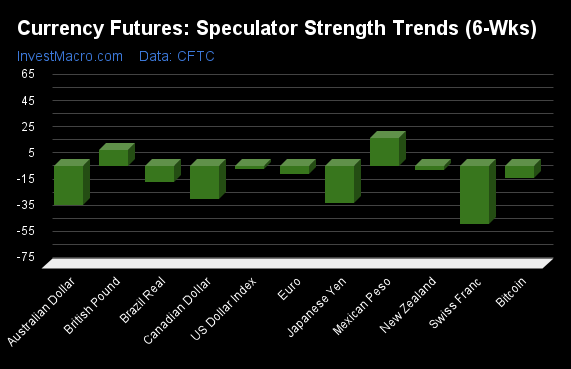
COT Strength Score Trends (or move index, calculates the 6-week changes in strength scores) showed that the Canadian Dollar (44 percent) and the British Pound (10 percent) lead the past six weeks trends for the currencies. Bitcoin (8 percent), the Swiss Franc (6 percent) and the New Zealand Dollar (6 percent) are the next highest positive movers in the latest trends data.

The Brazilian Real (-33 percent) leads the downside trend scores currently with the EuroFX (-11 percent), Japanese Yen (-9 percent) and the Australian Dollar (-7 percent) following next with lower trend scores.

Strength Trend Statistics:
US Dollar Index (-6.0 percent) vs US Dollar Index previous week (-26.9 percent)
EuroFX (-11.0 percent) vs EuroFX previous week (-25.1 percent)
British Pound Sterling (9.9 percent) vs British Pound Sterling previous week (6.8 percent)
Japanese Yen (-9.3 percent) vs Japanese Yen previous week (6.3 percent)
Swiss Franc (6.2 percent) vs Swiss Franc previous week (26.5 percent)
Canadian Dollar (43.6 percent) vs Canadian Dollar previous week (39.3 percent)
Australian Dollar (-7.0 percent) vs Australian Dollar previous week (-1.6 percent)
New Zealand Dollar (6.1 percent) vs New Zealand Dollar previous week (30.6 percent)
Mexican Peso (-2.2 percent) vs Mexican Peso previous week (0.6 percent)
Brazilian Real (-33.1 percent) vs Brazilian Real previous week (-29.7 percent)
Bitcoin (8.3 percent) vs Bitcoin previous week (6.1 percent)


Individual COT Forex Markets:

US Dollar Index Futures:
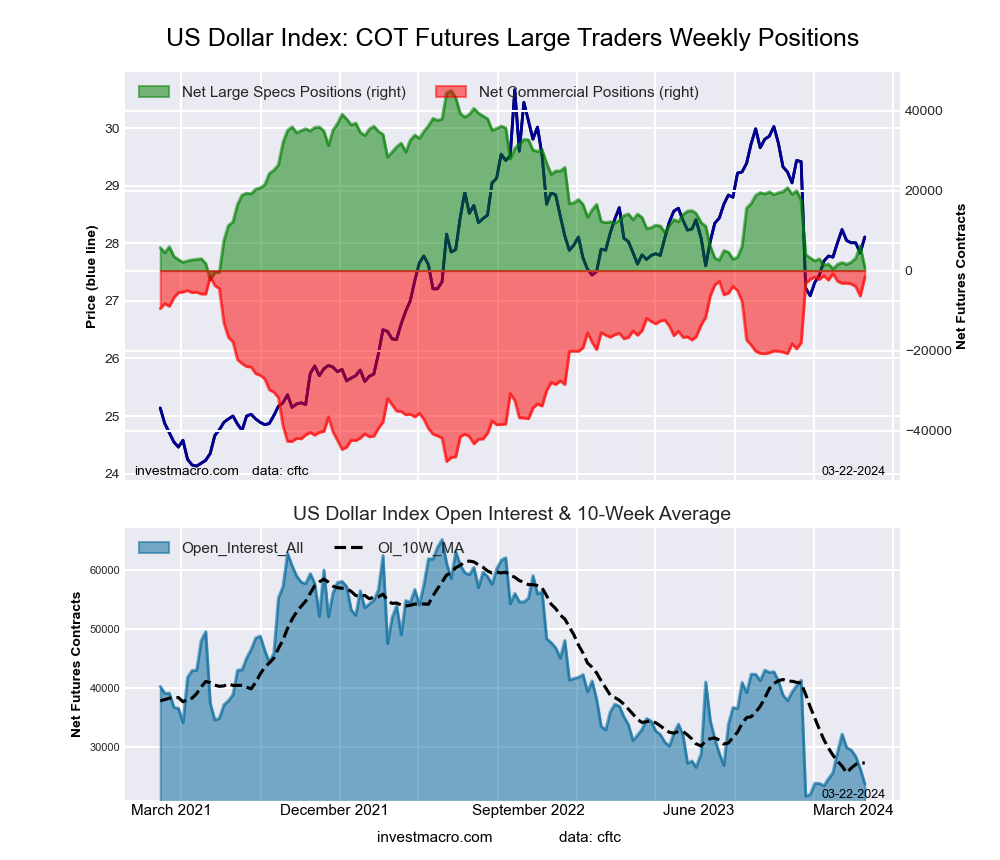
US Dollar Index Forex Futures COT ChartThe US Dollar Index large speculator standing this week came in at a net position of 372 contracts in the data reported through Tuesday. This was a weekly decline of -1,275 contracts from the previous week which had a total of 1,647 net contracts.

This week’s current strength score (the trader positioning range over the past three years, measured from 0 to 100) shows the speculators are currently Bearish with a score of 24.7 percent. The commercials are Bullish with a score of 77.2 percent and the small traders (not shown in chart) are Bearish-Extreme with a score of 15.4 percent.

Price Trend-Following Model: Downtrend

Our weekly trend-following model classifies the current market price position as: Downtrend. The current action for the model is considered to be: Hold – Maintain Short Position.

US DOLLAR INDEX StatisticsSPECULATORSCOMMERCIALSSMALL TRADERS
– Percent of Open Interest Longs:67.015.411.2
– Percent of Open Interest Shorts:65.518.39.8
– Net Position:372-739367
– Gross Longs:17,2383,9642,878
– Gross Shorts:16,8664,7032,511
– Long to Short Ratio:1.0 to 10.8 to 11.1 to 1
NET POSITION TREND:
– Strength Index Score (3 Year Range Pct):24.777.215.4
– Strength Index Reading (3 Year Range):BearishBullishBearish-Extreme
NET POSITION MOVEMENT INDEX:
– 6-Week Change in Strength Index:-6.04.013.5


Euro Currency Futures:

Euro Currency Futures COT ChartThe Euro Currency large speculator standing this week came in at a net position of 88,771 contracts in the data reported through Tuesday. This was a weekly boost of 447 contracts from the previous week which had a total of 88,324 net contracts.

This week’s current strength score (the trader positioning range over the past three years, measured from 0 to 100) shows the speculators are currently Bullish with a score of 58.1 percent. The commercials are Bearish with a score of 45.8 percent and the small traders (not shown in chart) are Bearish with a score of 22.4 percent.

Price Trend-Following Model: Uptrend

Our weekly trend-following model classifies the current market price position as: Uptrend. The current action for the model is considered to be: Hold – Maintain Long Position.

EURO Currency StatisticsSPECULATORSCOMMERCIALSSMALL TRADERS
– Percent of Open Interest Longs:27.659.410.8
– Percent of Open Interest Shorts:15.375.47.1
– Net Position:88,771-116,00627,235
– Gross Longs:200,360432,31178,589
– Gross Shorts:111,589548,31751,354
– Long to Short Ratio:1.8 to 10.8 to 11.5 to 1
NET POSITION TREND:
– Strength Index Score (3 Year Range Pct):58.145.822.4
– Strength Index Reading (3 Year Range):BullishBearishBearish
NET POSITION MOVEMENT INDEX:
– 6-Week Change in Strength Index:-11.011.1-6.1


British Pound Sterling Futures:

British Pound Sterling Futures COT ChartThe British Pound Sterling large speculator standing this week came in at a net position of 34,153 contracts in the data reported through Tuesday. This was a weekly lift of 2,716 contracts from the previous week which had a total of 31,437 net contracts.

This week’s current strength score (the trader positioning range over the past three years, measured from 0 to 100) shows the speculators are currently Bullish with a score of 79.5 percent. The commercials are Bearish with a score of 24.8 percent and the small traders (not shown in chart) are Bullish with a score of 64.4 percent.

Price Trend-Following Model: Uptrend

Our weekly trend-following model classifies the current market price position as: Uptrend. The current action for the model is considered to be: Hold – Maintain Long Position.

BRITISH POUND StatisticsSPECULATORSCOMMERCIALSSMALL TRADERS
– Percent of Open Interest Longs:40.337.715.4
– Percent of Open Interest Shorts:22.557.213.7
– Net Position:34,153-37,3803,227
– Gross Longs:77,49972,53229,604
– Gross Shorts:43,346109,91226,377
– Long to Short Ratio:1.8 to 10.7 to 11.1 to 1
NET POSITION TREND:
– Strength Index Score (3 Year Range Pct):79.524.864.4
– Strength Index Reading (3 Year Range):BullishBearishBullish
NET POSITION MOVEMENT INDEX:
– 6-Week Change in Strength Index:9.9-5.6-8.4


Japanese Yen Futures:

Japanese Yen Forex Futures COT ChartThe Japanese Yen large speculator standing this week came in at a net position of -80,455 contracts in the data reported through Tuesday. This was a weekly decline of -9,810 contracts from the previous week which had a total of -70,645 net contracts.

This week’s current strength score (the trader positioning range over the past three years, measured from 0 to 100) shows the speculators are currently Bearish with a score of 29.7 percent. The commercials are Bullish with a score of 68.8 percent and the small traders (not shown in chart) are Bullish-Extreme with a score of 83.6 percent.

Price Trend-Following Model: Weak Uptrend

Our weekly trend-following model classifies the current market price position as: Weak Uptrend. The current action for the model is considered to be: Hold – Maintain Long Position.

JAPANESE YEN StatisticsSPECULATORSCOMMERCIALSSMALL TRADERS
– Percent of Open Interest Longs:18.661.617.3
– Percent of Open Interest Shorts:51.828.417.2
– Net Position:-80,45580,134321
– Gross Longs:44,918148,97241,873
– Gross Shorts:125,37368,83841,552
– Long to Short Ratio:0.4 to 12.2 to 11.0 to 1
NET POSITION TREND:
– Strength Index Score (3 Year Range Pct):29.768.883.6
– Strength Index Reading (3 Year Range):BearishBullishBullish-Extreme
NET POSITION MOVEMENT INDEX:
– 6-Week Change in Strength Index:-9.310.3-5.9


Swiss Franc Futures:

Swiss Franc Forex Futures COT ChartThe Swiss Franc large speculator standing this week came in at a net position of -3,904 contracts in the data reported through Tuesday. This was a weekly rise of 1,267 contracts from the previous week which had a total of -5,171 net contracts.

This week’s current strength score (the trader positioning range over the past three years, measured from 0 to 100) shows the speculators are currently Bearish with a score of 47.8 percent. The commercials are Bearish with a score of 45.7 percent and the small traders (not shown in chart) are Bullish with a score of 60.2 percent.

Price Trend-Following Model: Uptrend

Our weekly trend-following model classifies the current market price position as: Uptrend. The current action for the model is considered to be: Hold – Maintain Long Position.

SWISS FRANC StatisticsSPECULATORSCOMMERCIALSSMALL TRADERS
– Percent of Open Interest Longs:21.252.825.9
– Percent of Open Interest Shorts:29.437.732.8
– Net Position:-3,9047,222-3,318
– Gross Longs:10,13725,24512,368
– Gross Shorts:14,04118,02315,686
– Long to Short Ratio:0.7 to 11.4 to 10.8 to 1
NET POSITION TREND:
– Strength Index Score (3 Year Range Pct):47.845.760.2
– Strength Index Reading (3 Year Range):BearishBearishBullish
NET POSITION MOVEMENT INDEX:
– 6-Week Change in Strength Index:6.2-3.9-1.5


Canadian Dollar Futures:

Canadian Dollar Forex Futures COT ChartThe Canadian Dollar large speculator standing this week came in at a net position of -2,388 contracts in the data reported through Tuesday. This was a weekly lift of 6,063 contracts from the previous week which had a total of -8,451 net contracts.

This week’s current strength score (the trader positioning range over the past three years, measured from 0 to 100) shows the speculators are currently Bullish with a score of 57.1 percent. The commercials are Bearish with a score of 48.9 percent and the small traders (not shown in chart) are Bearish with a score of 37.4 percent.

Price Trend-Following Model: Uptrend

Our weekly trend-following model classifies the current market price position as: Uptrend. The current action for the model is considered to be: Hold – Maintain Long Position.

CANADIAN DOLLAR StatisticsSPECULATORSCOMMERCIALSSMALL TRADERS
– Percent of Open Interest Longs:24.554.420.1
– Percent of Open Interest Shorts:26.057.116.0
– Net Position:-2,388-4,2006,588
– Gross Longs:39,10186,76332,032
– Gross Shorts:41,48990,96325,444
– Long to Short Ratio:0.9 to 11.0 to 11.3 to 1
NET POSITION TREND:
– Strength Index Score (3 Year Range Pct):57.148.937.4
– Strength Index Reading (3 Year Range):BullishBearishBearish
NET POSITION MOVEMENT INDEX:
– 6-Week Change in Strength Index:43.6-34.26.3


Australian Dollar Futures:

Australian Dollar Forex Futures COT ChartThe Australian Dollar large speculator standing this week came in at a net position of -58,295 contracts in the data reported through Tuesday. This was a weekly decrease of -4,175 contracts from the previous week which had a total of -54,120 net contracts.

This week’s current strength score (the trader positioning range over the past three years, measured from 0 to 100) shows the speculators are currently Bearish with a score of 35.4 percent. The commercials are Bullish with a score of 61.4 percent and the small traders (not shown in chart) are Bullish with a score of 51.1 percent.

Price Trend-Following Model: Weak Uptrend

Our weekly trend-following model classifies the current market price position as: Weak Uptrend. The current action for the model is considered to be: Hold – Maintain Long Position.

AUSTRALIAN DOLLAR StatisticsSPECULATORSCOMMERCIALSSMALL TRADERS
– Percent of Open Interest Longs:22.359.113.2
– Percent of Open Interest Shorts:57.523.613.6
– Net Position:-58,29558,847-552
– Gross Longs:36,95697,88821,902
– Gross Shorts:95,25139,04122,454
– Long to Short Ratio:0.4 to 12.5 to 11.0 to 1
NET POSITION TREND:
– Strength Index Score (3 Year Range Pct):35.461.451.1
– Strength Index Reading (3 Year Range):BearishBullishBullish
NET POSITION MOVEMENT INDEX:
– 6-Week Change in Strength Index:-7.09.5-12.0


New Zealand Dollar Futures:

New Zealand Dollar Forex Futures COT ChartThe New Zealand Dollar large speculator standing this week came in at a net position of -1,040 contracts in the data reported through Tuesday. This was a weekly gain of 703 contracts from the previous week which had a total of -1,743 net contracts.

This week’s current strength score (the trader positioning range over the past three years, measured from 0 to 100) shows the speculators are currently Bullish with a score of 52.7 percent. The commercials are Bearish with a score of 44.0 percent and the small traders (not shown in chart) are Bullish with a score of 66.4 percent.

Price Trend-Following Model: Uptrend

Our weekly trend-following model classifies the current market price position as: Uptrend. The current action for the model is considered to be: Hold – Maintain Long Position.

NEW ZEALAND DOLLAR StatisticsSPECULATORSCOMMERCIALSSMALL TRADERS
– Percent of Open Interest Longs:38.245.112.4
– Percent of Open Interest Shorts:41.045.98.8
– Net Position:-1,040-2891,329
– Gross Longs:14,11416,6824,588
– Gross Shorts:15,15416,9713,259
– Long to Short Ratio:0.9 to 11.0 to 11.4 to 1
NET POSITION TREND:
– Strength Index Score (3 Year Range Pct):52.744.066.4
– Strength Index Reading (3 Year Range):BullishBearishBullish
NET POSITION MOVEMENT INDEX:
– 6-Week Change in Strength Index:6.1-3.9-7.7


Mexican Peso Futures:

Mexican Peso Futures COT ChartThe Mexican Peso large speculator standing this week came in at a net position of 80,393 contracts in the data reported through Tuesday. This was a weekly gain of 5,294 contracts from the previous week which had a total of 75,099 net contracts.

This week’s current strength score (the trader positioning range over the past three years, measured from 0 to 100) shows the speculators are currently Bullish-Extreme with a score of 88.2 percent. The commercials are Bearish-Extreme with a score of 10.3 percent and the small traders (not shown in chart) are Bearish with a score of 45.1 percent.

Price Trend-Following Model: Uptrend

Our weekly trend-following model classifies the current market price position as: Uptrend. The current action for the model is considered to be: Hold – Maintain Long Position.

MEXICAN PESO StatisticsSPECULATORSCOMMERCIALSSMALL TRADERS
– Percent of Open Interest Longs:53.141.63.1
– Percent of Open Interest Shorts:21.075.81.0
– Net Position:80,393-85,7175,324
– Gross Longs:132,808103,9317,803
– Gross Shorts:52,415189,6482,479
– Long to Short Ratio:2.5 to 10.5 to 13.1 to 1
NET POSITION TREND:
– Strength Index Score (3 Year Range Pct):88.210.345.1
– Strength Index Reading (3 Year Range):Bullish-ExtremeBearish-ExtremeBearish
NET POSITION MOVEMENT INDEX:
– 6-Week Change in Strength Index:-2.20.616.9


Brazilian Real Futures:

Brazil Real Futures COT ChartThe Brazilian Real large speculator standing this week came in at a net position of 18,298 contracts in the data reported through Tuesday. This was a weekly decline of -5,452 contracts from the previous week which had a total of 23,750 net contracts.

This week’s current strength score (the trader positioning range over the past three years, measured from 0 to 100) shows the speculators are currently Bullish with a score of 58.2 percent. The commercials are Bearish with a score of 40.5 percent and the small traders (not shown in chart) are Bullish with a score of 54.2 percent.

Price Trend-Following Model: Weak Uptrend

Our weekly trend-following model classifies the current market price position as: Weak Uptrend. The current action for the model is considered to be: Hold – Maintain Long Position.

BRAZIL REAL StatisticsSPECULATORSCOMMERCIALSSMALL TRADERS
– Percent of Open Interest Longs:48.138.14.4
– Percent of Open Interest Shorts:24.564.41.6
– Net Position:18,298-20,4242,126
– Gross Longs:37,24829,4543,388
– Gross Shorts:18,95049,8781,262
– Long to Short Ratio:2.0 to 10.6 to 12.7 to 1
NET POSITION TREND:
– Strength Index Score (3 Year Range Pct):58.240.554.2
– Strength Index Reading (3 Year Range):BullishBearishBullish
NET POSITION MOVEMENT INDEX:
– 6-Week Change in Strength Index:-33.134.2-15.1


Bitcoin Futures:

Bitcoin Crypto Futures COT ChartThe Bitcoin large speculator standing this week came in at a net position of -1,798 contracts in the data reported through Tuesday. This was a weekly decline of -137 contracts from the previous week which had a total of -1,661 net contracts.

This week’s current strength score (the trader positioning range over the past three years, measured from 0 to 100) shows the speculators are currently Bearish with a score of 39.3 percent. The commercials are Bullish-Extreme with a score of 90.6 percent and the small traders (not shown in chart) are Bearish with a score of 30.7 percent.

Price Trend-Following Model: Uptrend

Our weekly trend-following model classifies the current market price position as: Uptrend. The current action for the model is considered to be: Hold – Maintain Long Position.

BITCOIN StatisticsSPECULATORSCOMMERCIALSSMALL TRADERS
– Percent of Open Interest Longs:79.96.16.9
– Percent of Open Interest Shorts:88.61.13.2
– Net Position:-1,7981,017781
– Gross Longs:16,5191,2531,435
– Gross Shorts:18,317236654
– Long to Short Ratio:0.9 to 15.3 to 12.2 to 1
NET POSITION TREND:
– Strength Index Score (3 Year Range Pct):39.390.630.7
– Strength Index Reading (3 Year Range):BearishBullish-ExtremeBearish
NET POSITION MOVEMENT INDEX:
– 6-Week Change in Strength Index:8.3-7.3-6.0


Article By InvestMacroReceive our weekly COT Newsletter

*COT Report: The COT data, released weekly to the public each Friday, is updated through the most recent Tuesday (data is 3 days old) and shows a quick view of how large speculators or non-commercials (for-profit traders) were positioned in the futures markets.

The CFTC categorizes trader positions according to commercial hedgers (traders who use futures contracts for hedging as part of the business), non-commercials (large traders who speculate to realize trading profits) and nonreportable traders (usually small traders/speculators) as well as their open interest (contracts open in the market at time of reporting). See CFTC criteria here.

Speculator Extremes: DowJones, Nasdaq, Soybeans & Corn lead Bullish & Bearish Positions

By InvestMacro 

The latest update for the weekly Commitment of Traders (COT) report was released by the Commodity Futures Trading Commission (CFTC) on Friday for data ending on January 30th.

This weekly Extreme Positions report highlights the Most Bullish and Most Bearish Positions for the speculator category. Extreme positioning in these markets can foreshadow strong moves in the underlying market.

To signify an extreme position, we use the Strength Index (also known as the COT Index) of each instrument, a common method of measuring COT data. The Strength Index is simply a comparison of current trader positions against the range of positions over the previous 3 years. We use over 80 percent as extremely bullish and under 20 percent as extremely bearish. (Compare Strength Index scores across all markets in the data table or cot leaders table)


Here Are This Week’s Most Bullish Speculator Positions:

DowJones Mini

The DowJones Mini speculator position comes in as the most bullish extreme standing this week. The DowJones Mini speculator level is currently at a 100.0 percent score of its 3-year range.

The six-week trend for the percent strength score totaled 28.1 this week. The overall net speculator position was a total of 24,410 net contracts this week with a rise of 6,162 contract in the weekly speculator bets.


Speculators or Non-Commercials Notes:

Speculators, classified as non-commercial traders by the CFTC, are made up of large commodity funds, hedge funds and other significant for-profit participants. The Specs are generally regarded as trend-followers in their behavior towards price action – net speculator bets and prices tend to go in the same directions. These traders often look to buy when prices are rising and sell when prices are falling. To illustrate this point, many times speculator contracts can be found at their most extremes (bullish or bearish) when prices are also close to their highest or lowest levels.

These extreme levels can be dangerous for the large speculators as the trade is most crowded, there is less trading ammunition still sitting on the sidelines to push the trend further and prices have moved a significant distance. When the trend becomes exhausted, some speculators take profits while others look to also exit positions when prices fail to continue in the same direction. This process usually plays out over many months to years and can ultimately create a reverse effect where prices start to fall and speculators start a process of selling when prices are falling.


Nasdaq


The Nasdaq speculator position comes next in the extreme standings this week. The Nasdaq speculator level is now at a 100.0 percent score of its 3-year range.

The six-week trend for the percent strength score was 26.5 this week. The speculator position registered 39,251 net contracts this week with a weekly increase of 6,209 contracts in speculator bets.


3-Month Secured Overnight Financing Rate


The 3-Month Secured Overnight Financing Rate speculator position comes in third this week in the extreme standings. The 3-Month Secured Overnight Financing Rate speculator level resides at a 96.7 percent score of its 3-year range.

The six-week trend for the speculator strength score came in at 6.6 this week. The overall speculator position was 705,145 net contracts this week with a decline of -64,042 contracts in the weekly speculator bets.


Gasoline


The Gasoline speculator position comes up number four in the extreme standings this week. The Gasoline speculator level is at a 94.0 percent score of its 3-year range.

The six-week trend for the speculator strength score totaled a change of 1.0 this week. The overall speculator position was 73,270 net contracts this week with a dip of -471 contracts in the speculator bets.


Mexican Peso


The Mexican Peso speculator position rounds out the top five in this week’s bullish extreme standings. The Mexican Peso speculator level sits at a 88.2 percent score of its 3-year range. The six-week trend for the speculator strength score was -2.2 this week.

The speculator position was 80,393 net contracts this week with an increase of 5,294 contracts in the weekly speculator bets.


This Week’s Most Bearish Speculator Positions:

Soybean Oil


The Soybean Oil speculator position comes in as the most bearish extreme standing this week. The Soybean Oil speculator level is at a 0.0 percent score of its 3-year range.

The six-week trend for the speculator strength score was -13.0 this week. The overall speculator position was -38,035 net contracts this week with a drop of -12,677 contracts in the speculator bets.


Corn


The Corn speculator position comes in next for the most bearish extreme standing on the week. The Corn speculator level is at a 0.0 percent score of its 3-year range.

The six-week trend for the speculator strength score was -12.7 this week. The speculator position was -224,832 net contracts this week with a decline of -5,632 contracts in the weekly speculator bets.


Soybeans


The Soybeans speculator position comes in as third most bearish extreme standing of the week. The Soybeans speculator level resides at a 0.0 percent score of its 3-year range.

The six-week trend for the speculator strength score was -36.4 this week. The overall speculator position was -140,577 net contracts this week with a reduction of -34,583 contracts in the speculator bets.


Soybean Meal


The Soybean Meal speculator position comes in as this week’s fourth most bearish extreme standing. The Soybean Meal speculator level is at a 0.0 percent score of its 3-year range.

The six-week trend for the speculator strength score was -45.2 this week. The speculator position was -33,932 net contracts this week with a shortfall of -13,316 contracts in the weekly speculator bets.


10-Year Note


Finally, the 10-Year Note speculator position comes in as the fifth most bearish extreme standing for this week. The 10-Year Note speculator level is at a 2.8 percent score of its 3-year range.

The six-week trend for the speculator strength score was -16.0 this week. The speculator position was -859,015 net contracts this week with a decline of -74,337 contracts in the weekly speculator bets.


Article By InvestMacroReceive our weekly COT Newsletter

*COT Report: The COT data, released weekly to the public each Friday, is updated through the most recent Tuesday (data is 3 days old) and shows a quick view of how large speculators or non-commercials (for-profit traders) were positioned in the futures markets.

The CFTC categorizes trader positions according to commercial hedgers (traders who use futures contracts for hedging as part of the business), non-commercials (large traders who speculate to realize trading profits) and nonreportable traders (usually small traders/speculators) as well as their open interest (contracts open in the market at time of reporting). See CFTC criteria here.