Archive for Opinions – Page 19

Mag 7 Earnings Preview: Wall Street Faces $11 Trillion Test

By ForexTime 

  • 4 of “Magnificent 7” set to publish earnings
  • Combined market cap of 4 tech titans over $11 trillion 
  • Beyond earnings, key focus on tariff impact & AI spending  
  • Meta could move almost 6% ↑ or ↓ post earnings
  • Apple shares ↓ over 15% year-to-date

Four of the “Magnificent 7” tech giants with a combined market capitalization of over $11 trillion are set to publish their results this week.

And this could be pivotal for markets given the ongoing uncertainty around Trump’s tariff drama. Investors will be eager to learn from these titans how global trade developments have affected their businesses.

Note: A volley of country-specific tariffs will take effect on August 1st, with the United States only securing six trade deals as of writing. There could be a potential extension of a tariff pause between the US and China.

Fresh updates from Mag 7 companies Microsoft, Meta, Amazon and Apple will be in focus. 

Here is what you need to know:


1) Microsoft

Microsoft reports on its fiscal Q4 2025 earnings on Wednesday 30th July after US markets close. 

Shares of the tech giant have gained over 20% year-to-date, with Wall Street analysts expecting Microsoft to post revenue and income growth amid growing AI demand. Quarterly revenues are projected to jump by 14% to $73.9 billion, while earnings per share are forecast to increase to $3.37 from $2.95 the same time a year ago.

Beyond revenue growth, updates on the Azure cloud service and AI initiatives will be in focus. 

Markets are forecasting a 3.9% move, either up or down, for Microsoft shares post earnings.

Imagen
Microsoft cfd


2) Meta

Meta is set to report second-quarter earnings after US markets close on Wednesday 30th July.

Shares of this tech titan are up almost 20% since the start of 2025, powered by the hunger for AI. Quarterly revenues are forecast to rise $44.8 billion – marking a 15% jump from a year earlier while EPS are seen jumping to $5.89 from $5.16. 

Markets are forecasting a 5.8% move, either up or down, for Meta shares post earnings.

Imagen
Meta cfd


3) Amazon

Amazon is scheduled to report second quarter earnings after US markets close on Thursday 31st July.

The tech giant is expected to report a nearly 10% jump in revenues to $162.1 billion while earnings per share are projected to increase to $1.32 from $1.26 the same time a year ago. Amazon Web Services has shown dominance in the cloud computing space, so the AWS and advertising business will be in focus.

Markets are forecasting a 5% move, either up or down, for Amazon stocks post earnings.

Imagen
amazon cfd


4) Apple

Apple reports its quarterly results after the closing bell on Thursday 31st July. 

It has been a rough year for Apple thus far with its share down over 15% year-to-date. 

The iPhone maker is expected to report 4% revenue growth amid improving services revenue and iPhone sales. Still, investors will be looking for updates on investment in Apple Intelligence and sales in China.

Markets are forecasting a 3.5% move, either up or down, for Apple shares post earnings.

Imagen
Apple cfd

Forex-Time-LogoArticle by ForexTime

ForexTime Ltd (FXTM) is an award winning international online forex broker regulated by CySEC 185/12 www.forextime.com

Currency Speculators cut their British Pound Bets to 22-Week Low

By InvestMacro

Speculators OI FX Futures COT Chart

Here are the latest charts and statistics for the Commitment of Traders (COT) data published by the Commodities Futures Trading Commission (CFTC).

The latest COT data is updated through Tuesday July 22nd and shows a quick view of how large market participants (for-profit speculators and commercial traders) were positioned in the futures markets. All currency positions are in direct relation to the US dollar where, for example, a bet for the euro is a bet that the euro will rise versus the dollar while a bet against the euro will be a bet that the euro will decline versus the dollar.

Weekly Speculator Bets led by Mexican Peso, Canadian Dollar & Japanese Yen

Speculators Nets FX Futures COT Chart
The COT currency market speculator bets were overall higher this week as six out of the eleven currency markets we cover had higher positioning while the other five markets had lower speculator contracts.

Leading the gains for the currency markets was the Mexican Peso (5,942 contracts) with the Canadian Dollar (3,751 contracts), the Japanese Yen (3,063 contracts), the Brazilian Real (1,685 contracts), Bitcoin (634 contracts) and the US Dollar Index (214 contracts) also recording positive weeks.

The currencies seeing declines in speculator bets on the week were  the British Pound (-28,621 contracts), the New Zealand Dollar (-6,797 contracts), the Australian Dollar (-6,336 contracts), the Swiss Franc (-3,428 contracts) and with the EuroFX (-2,706 contracts) also having lower bets on the week.

British Pound Speculator Bets fall to 22-Week Low

Highlighting this week’s currency speculators data is the sharp drop in the British Pound Sterling speculator bets.

The GBP speculator positions fell this week by -28,621 contracts and dropped for the second straight week. This was also the fifth time over the last six weeks that speculators have reduced their positioning for a 6-week drop by -51,064 contracts. This week’s decline marked the largest one-week drop in just about a year and takes the current speculator standing (+570 contracts) to the lowest level since February 18th, a span of 22 weeks.

Helping dent the speculator position for the British Pound Sterling is the outlook that the Bank of England could be reducing their benchmark interest rates. According to Reuters, traders see around an 80% chance of an interest rate reduction as early as August.

Despite the negative sentiment this week for the British Pound Sterling, the currency’s exchange rate continues to be near the highest levels since 2022 against the US dollar. This week, the GBP currency closed just below the 1.3500 level and saw a modest gain for the week.

Elsewhere in currency market prices:
– The Euro led the major market prices with an increase of over 1% against the US Dollar this week.
– The Mexican Peso, the New Zealand Dollar, the Australian Dollar, the Swiss Franc, and the Japanese Yen all saw higher exchange rates against the USD, varying from 0.75% to 1% gains.
– The US Dollar Index was the leading loser on the week with a decline of -0.84%.
– Bitcoin also saw a very modest small decline after recent all-time highs.


Currencies Data:

Speculators FX Futures COT Data Table
Legend: Open Interest | Speculators Current Net Position | Weekly Specs Change | Specs Strength Score compared to last 3-Years (0-100 range)


Strength Scores led by Japanese Yen & EuroFX

Speculators Strength Scores FX Futures COT Chart
COT Strength Scores (a normalized measure of Speculator positions over a 3-Year range, from 0 to 100 where above 80 is Extreme-Bullish and below 20 is Extreme-Bearish) showed that the Japanese Yen (80 percent) and the EuroFX (77 percent) lead the currency markets this week. The Brazilian Real (66 percent), New Zealand Dollar (61 percent) and the Mexican Peso (57 percent) come in as the next highest in the weekly strength scores.

On the downside, the US Dollar Index (6 percent), Bitcoin (13 percent) and the Australian Dollar (19 percent) come in at the lowest strength levels currently and are in Extreme-Bearish territory (below 20 percent).

3-Year Strength Statistics:
US Dollar Index (5.7 percent) vs US Dollar Index previous week (5.2 percent)
EuroFX (76.6 percent) vs EuroFX previous week (77.6 percent)
British Pound Sterling (32.7 percent) vs British Pound Sterling previous week (46.3 percent)
Japanese Yen (80.0 percent) vs Japanese Yen previous week (79.2 percent)
Swiss Franc (48.1 percent) vs Swiss Franc previous week (55.0 percent)
Canadian Dollar (56.4 percent) vs Canadian Dollar previous week (54.8 percent)
Australian Dollar (18.6 percent) vs Australian Dollar previous week (23.1 percent)
New Zealand Dollar (60.8 percent) vs New Zealand Dollar previous week (68.7 percent)
Mexican Peso (57.3 percent) vs Mexican Peso previous week (54.3 percent)
Brazilian Real (65.5 percent) vs Brazilian Real previous week (64.2 percent)
Bitcoin (13.4 percent) vs Bitcoin previous week (0.0 percent)


New Zealand Dollar & EuroFX top the 6-Week Strength Trends

Speculators Trends FX Futures COT Chart
COT Strength Score Trends (or move index, calculates the 6-week changes in strength scores) showed that the New Zealand Dollar (21 percent) and the EuroFX (12 percent) lead the past six weeks trends for the currencies. The Canadian Dollar (10 percent) and Bitcoin (3 percent) are the next highest positive movers in the 3-Year trends data.

The British Pound (-24 percent) leads the downside trend scores currently with the Brazilian Real (-11 percent), the US Dollar Index (-11 percent) and the Swiss Franc (-10 percent) following next with lower trend scores.

3-Year Strength Trends:
US Dollar Index (-10.7 percent) vs US Dollar Index previous week (-9.4 percent)
EuroFX (12.4 percent) vs EuroFX previous week (17.3 percent)
British Pound Sterling (-24.3 percent) vs British Pound Sterling previous week (-2.9 percent)
Japanese Yen (-10.4 percent) vs Japanese Yen previous week (-13.1 percent)
Swiss Franc (-9.7 percent) vs Swiss Franc previous week (6.9 percent)
Canadian Dollar (10.2 percent) vs Canadian Dollar previous week (15.4 percent)
Australian Dollar (-8.0 percent) vs Australian Dollar previous week (-8.3 percent)
New Zealand Dollar (20.9 percent) vs New Zealand Dollar previous week (31.6 percent)
Mexican Peso (-3.4 percent) vs Mexican Peso previous week (-7.3 percent)
Brazilian Real (-10.9 percent) vs Brazilian Real previous week (-5.4 percent)
Bitcoin (3.3 percent) vs Bitcoin previous week (-3.7 percent)


Individual COT Forex Markets:

US Dollar Index Futures:

US Dollar Index Forex Futures COT ChartThe US Dollar Index large speculator standing this week equaled a net position of -3,451 contracts in the data reported through Tuesday. This was a weekly gain of 214 contracts from the previous week which had a total of -3,665 net contracts.

This week’s current strength score (the trader positioning range over the past three years, measured from 0 to 100) shows the speculators are currently Bearish-Extreme with a score of 5.7 percent. The commercials are Bullish-Extreme with a score of 94.4 percent and the small traders (not shown in chart) are Bearish with a score of 23.0 percent.

Price Trend-Following Model: Downtrend

Our weekly trend-following model classifies the current market price position as: Downtrend.

US DOLLAR INDEX StatisticsSPECULATORSCOMMERCIALSSMALL TRADERS
– Percent of Open Interest Longs:47.437.08.2
– Percent of Open Interest Shorts:57.025.99.7
– Net Position:-3,4513,988-537
– Gross Longs:16,92513,2342,946
– Gross Shorts:20,3769,2463,483
– Long to Short Ratio:0.8 to 11.4 to 10.8 to 1
NET POSITION TREND:
– Strength Index Score (3 Year Range Pct):5.794.423.0
– Strength Index Reading (3 Year Range):Bearish-ExtremeBullish-ExtremeBearish
NET POSITION MOVEMENT INDEX:
– 6-Week Change in Strength Index:-10.78.211.3


Euro Currency Futures:

Euro Currency Futures COT ChartThe Euro Currency large speculator standing this week equaled a net position of 125,515 contracts in the data reported through Tuesday. This was a weekly reduction of -2,706 contracts from the previous week which had a total of 128,221 net contracts.

This week’s current strength score (the trader positioning range over the past three years, measured from 0 to 100) shows the speculators are currently Bullish with a score of 76.6 percent. The commercials are Bearish with a score of 20.7 percent and the small traders (not shown in chart) are Bullish-Extreme with a score of 84.7 percent.

Price Trend-Following Model: Uptrend

Our weekly trend-following model classifies the current market price position as: Uptrend.

EURO Currency StatisticsSPECULATORSCOMMERCIALSSMALL TRADERS
– Percent of Open Interest Longs:29.455.611.4
– Percent of Open Interest Shorts:14.676.75.2
– Net Position:125,515-177,71352,198
– Gross Longs:248,380469,10096,216
– Gross Shorts:122,865646,81344,018
– Long to Short Ratio:2.0 to 10.7 to 12.2 to 1
NET POSITION TREND:
– Strength Index Score (3 Year Range Pct):76.620.784.7
– Strength Index Reading (3 Year Range):BullishBearishBullish-Extreme
NET POSITION MOVEMENT INDEX:
– 6-Week Change in Strength Index:12.4-9.0-12.7


British Pound Sterling Futures:

British Pound Sterling Futures COT ChartThe British Pound Sterling large speculator standing this week equaled a net position of 570 contracts in the data reported through Tuesday. This was a weekly lowering of -28,621 contracts from the previous week which had a total of 29,191 net contracts.

This week’s current strength score (the trader positioning range over the past three years, measured from 0 to 100) shows the speculators are currently Bearish with a score of 32.7 percent. The commercials are Bullish with a score of 61.5 percent and the small traders (not shown in chart) are Bullish with a score of 73.0 percent.

Price Trend-Following Model: Uptrend

Our weekly trend-following model classifies the current market price position as: Uptrend.

BRITISH POUND StatisticsSPECULATORSCOMMERCIALSSMALL TRADERS
– Percent of Open Interest Longs:48.034.816.5
– Percent of Open Interest Shorts:47.737.713.8
– Net Position:570-5,7395,169
– Gross Longs:93,76067,92832,179
– Gross Shorts:93,19073,66727,010
– Long to Short Ratio:1.0 to 10.9 to 11.2 to 1
NET POSITION TREND:
– Strength Index Score (3 Year Range Pct):32.761.573.0
– Strength Index Reading (3 Year Range):BearishBullishBullish
NET POSITION MOVEMENT INDEX:
– 6-Week Change in Strength Index:-24.322.7-7.9


Japanese Yen Futures:

Japanese Yen Forex Futures COT ChartThe Japanese Yen large speculator standing this week equaled a net position of 106,645 contracts in the data reported through Tuesday. This was a weekly advance of 3,063 contracts from the previous week which had a total of 103,582 net contracts.

This week’s current strength score (the trader positioning range over the past three years, measured from 0 to 100) shows the speculators are currently Bullish-Extreme with a score of 80.0 percent. The commercials are Bearish with a score of 21.3 percent and the small traders (not shown in chart) are Bullish with a score of 68.9 percent.

Price Trend-Following Model: Weak Uptrend

Our weekly trend-following model classifies the current market price position as: Weak Uptrend.

JAPANESE YEN StatisticsSPECULATORSCOMMERCIALSSMALL TRADERS
– Percent of Open Interest Longs:52.532.414.0
– Percent of Open Interest Shorts:18.569.910.5
– Net Position:106,645-117,36010,715
– Gross Longs:164,411101,53243,676
– Gross Shorts:57,766218,89232,961
– Long to Short Ratio:2.8 to 10.5 to 11.3 to 1
NET POSITION TREND:
– Strength Index Score (3 Year Range Pct):80.021.368.9
– Strength Index Reading (3 Year Range):Bullish-ExtremeBearishBullish
NET POSITION MOVEMENT INDEX:
– 6-Week Change in Strength Index:-10.413.0-31.1


Swiss Franc Futures:

Swiss Franc Forex Futures COT ChartThe Swiss Franc large speculator standing this week equaled a net position of -26,065 contracts in the data reported through Tuesday. This was a weekly fall of -3,428 contracts from the previous week which had a total of -22,637 net contracts.

This week’s current strength score (the trader positioning range over the past three years, measured from 0 to 100) shows the speculators are currently Bearish with a score of 48.1 percent. The commercials are Bearish with a score of 42.6 percent and the small traders (not shown in chart) are Bullish with a score of 77.2 percent.

Price Trend-Following Model: Uptrend

Our weekly trend-following model classifies the current market price position as: Uptrend.

SWISS FRANC StatisticsSPECULATORSCOMMERCIALSSMALL TRADERS
– Percent of Open Interest Longs:10.769.020.2
– Percent of Open Interest Shorts:45.134.020.7
– Net Position:-26,06526,431-366
– Gross Longs:8,08752,18415,305
– Gross Shorts:34,15225,75315,671
– Long to Short Ratio:0.2 to 12.0 to 11.0 to 1
NET POSITION TREND:
– Strength Index Score (3 Year Range Pct):48.142.677.2
– Strength Index Reading (3 Year Range):BearishBearishBullish
NET POSITION MOVEMENT INDEX:
– 6-Week Change in Strength Index:-9.710.7-7.6


Canadian Dollar Futures:

Canadian Dollar Forex Futures COT ChartThe Canadian Dollar large speculator standing this week equaled a net position of -70,343 contracts in the data reported through Tuesday. This was a weekly rise of 3,751 contracts from the previous week which had a total of -74,094 net contracts.

This week’s current strength score (the trader positioning range over the past three years, measured from 0 to 100) shows the speculators are currently Bullish with a score of 56.4 percent. The commercials are Bearish with a score of 43.9 percent and the small traders (not shown in chart) are Bearish with a score of 40.6 percent.

Price Trend-Following Model: Uptrend

Our weekly trend-following model classifies the current market price position as: Uptrend.

CANADIAN DOLLAR StatisticsSPECULATORSCOMMERCIALSSMALL TRADERS
– Percent of Open Interest Longs:11.570.111.8
– Percent of Open Interest Shorts:46.534.512.4
– Net Position:-70,34371,510-1,167
– Gross Longs:23,086140,76023,647
– Gross Shorts:93,42969,25024,814
– Long to Short Ratio:0.2 to 12.0 to 11.0 to 1
NET POSITION TREND:
– Strength Index Score (3 Year Range Pct):56.443.940.6
– Strength Index Reading (3 Year Range):BullishBearishBearish
NET POSITION MOVEMENT INDEX:
– 6-Week Change in Strength Index:10.2-8.3-8.9


Australian Dollar Futures:

Australian Dollar Forex Futures COT ChartThe Australian Dollar large speculator standing this week equaled a net position of -81,255 contracts in the data reported through Tuesday. This was a weekly fall of -6,336 contracts from the previous week which had a total of -74,919 net contracts.

This week’s current strength score (the trader positioning range over the past three years, measured from 0 to 100) shows the speculators are currently Bearish-Extreme with a score of 18.6 percent. The commercials are Bullish with a score of 76.0 percent and the small traders (not shown in chart) are Bullish with a score of 59.4 percent.

Price Trend-Following Model: Uptrend

Our weekly trend-following model classifies the current market price position as: Uptrend.

AUSTRALIAN DOLLAR StatisticsSPECULATORSCOMMERCIALSSMALL TRADERS
– Percent of Open Interest Longs:15.565.114.5
– Percent of Open Interest Shorts:65.917.212.0
– Net Position:-81,25577,3413,914
– Gross Longs:25,066105,14223,352
– Gross Shorts:106,32127,80119,438
– Long to Short Ratio:0.2 to 13.8 to 11.2 to 1
NET POSITION TREND:
– Strength Index Score (3 Year Range Pct):18.676.059.4
– Strength Index Reading (3 Year Range):Bearish-ExtremeBullishBullish
NET POSITION MOVEMENT INDEX:
– 6-Week Change in Strength Index:-8.08.1-6.0


New Zealand Dollar Futures:

New Zealand Dollar Forex Futures COT ChartThe New Zealand Dollar large speculator standing this week equaled a net position of -3,162 contracts in the data reported through Tuesday. This was a weekly lowering of -6,797 contracts from the previous week which had a total of 3,635 net contracts.

This week’s current strength score (the trader positioning range over the past three years, measured from 0 to 100) shows the speculators are currently Bullish with a score of 60.8 percent. The commercials are Bearish with a score of 37.8 percent and the small traders (not shown in chart) are Bullish with a score of 51.8 percent.

Price Trend-Following Model: Uptrend

Our weekly trend-following model classifies the current market price position as: Uptrend.

NEW ZEALAND DOLLAR StatisticsSPECULATORSCOMMERCIALSSMALL TRADERS
– Percent of Open Interest Longs:27.151.49.7
– Percent of Open Interest Shorts:34.343.910.0
– Net Position:-3,1623,291-129
– Gross Longs:11,95522,6564,276
– Gross Shorts:15,11719,3654,405
– Long to Short Ratio:0.8 to 11.2 to 11.0 to 1
NET POSITION TREND:
– Strength Index Score (3 Year Range Pct):60.837.851.8
– Strength Index Reading (3 Year Range):BullishBearishBullish
NET POSITION MOVEMENT INDEX:
– 6-Week Change in Strength Index:20.9-19.7-7.4


Mexican Peso Futures:

Mexican Peso Futures COT ChartThe Mexican Peso large speculator standing this week equaled a net position of 56,064 contracts in the data reported through Tuesday. This was a weekly advance of 5,942 contracts from the previous week which had a total of 50,122 net contracts.

This week’s current strength score (the trader positioning range over the past three years, measured from 0 to 100) shows the speculators are currently Bullish with a score of 57.3 percent. The commercials are Bearish with a score of 43.2 percent and the small traders (not shown in chart) are Bearish with a score of 46.5 percent.

Price Trend-Following Model: Uptrend

Our weekly trend-following model classifies the current market price position as: Uptrend.

MEXICAN PESO StatisticsSPECULATORSCOMMERCIALSSMALL TRADERS
– Percent of Open Interest Longs:57.537.64.2
– Percent of Open Interest Shorts:25.072.61.7
– Net Position:56,064-60,3404,276
– Gross Longs:99,08164,7667,251
– Gross Shorts:43,017125,1062,975
– Long to Short Ratio:2.3 to 10.5 to 12.4 to 1
NET POSITION TREND:
– Strength Index Score (3 Year Range Pct):57.343.246.5
– Strength Index Reading (3 Year Range):BullishBearishBearish
NET POSITION MOVEMENT INDEX:
– 6-Week Change in Strength Index:-3.42.96.1


Brazilian Real Futures:

Brazil Real Futures COT ChartThe Brazilian Real large speculator standing this week equaled a net position of 25,857 contracts in the data reported through Tuesday. This was a weekly rise of 1,685 contracts from the previous week which had a total of 24,172 net contracts.

This week’s current strength score (the trader positioning range over the past three years, measured from 0 to 100) shows the speculators are currently Bullish with a score of 65.5 percent. The commercials are Bearish with a score of 33.0 percent and the small traders (not shown in chart) are Bearish with a score of 40.8 percent.

Price Trend-Following Model: Uptrend

Our weekly trend-following model classifies the current market price position as: Uptrend.

BRAZIL REAL StatisticsSPECULATORSCOMMERCIALSSMALL TRADERS
– Percent of Open Interest Longs:62.331.64.9
– Percent of Open Interest Shorts:34.663.01.1
– Net Position:25,857-29,3883,531
– Gross Longs:58,20229,4844,575
– Gross Shorts:32,34558,8721,044
– Long to Short Ratio:1.8 to 10.5 to 14.4 to 1
NET POSITION TREND:
– Strength Index Score (3 Year Range Pct):65.533.040.8
– Strength Index Reading (3 Year Range):BullishBearishBearish
NET POSITION MOVEMENT INDEX:
– 6-Week Change in Strength Index:-10.910.8-0.2


Bitcoin Futures:

Bitcoin Crypto Futures COT ChartThe Bitcoin large speculator standing this week equaled a net position of -1,852 contracts in the data reported through Tuesday. This was a weekly boost of 634 contracts from the previous week which had a total of -2,486 net contracts.

This week’s current strength score (the trader positioning range over the past three years, measured from 0 to 100) shows the speculators are currently Bearish-Extreme with a score of 13.4 percent. The commercials are Bullish-Extreme with a score of 84.4 percent and the small traders (not shown in chart) are Bullish with a score of 68.7 percent.

Price Trend-Following Model: Uptrend

Our weekly trend-following model classifies the current market price position as: Uptrend.

BITCOIN StatisticsSPECULATORSCOMMERCIALSSMALL TRADERS
– Percent of Open Interest Longs:79.45.45.6
– Percent of Open Interest Shorts:85.41.33.6
– Net Position:-1,8521,247605
– Gross Longs:24,4471,6591,710
– Gross Shorts:26,2994121,105
– Long to Short Ratio:0.9 to 14.0 to 11.5 to 1
NET POSITION TREND:
– Strength Index Score (3 Year Range Pct):13.484.468.7
– Strength Index Reading (3 Year Range):Bearish-ExtremeBullish-ExtremeBullish
NET POSITION MOVEMENT INDEX:
– 6-Week Change in Strength Index:3.3-11.017.5


Article By InvestMacroReceive our weekly COT Newsletter

*COT Report: The COT data, released weekly to the public each Friday, is updated through the most recent Tuesday (data is 3 days old) and shows a quick view of how large speculators or non-commercials (for-profit traders) were positioned in the futures markets.

The CFTC categorizes trader positions according to commercial hedgers (traders who use futures contracts for hedging as part of the business), non-commercials (large traders who speculate to realize trading profits) and nonreportable traders (usually small traders/speculators) as well as their open interest (contracts open in the market at time of reporting). See CFTC criteria here.

Speculator Extremes: EAFE, Silver, Sugar & 5-Year top Bullish & Bearish Positions

By InvestMacro 

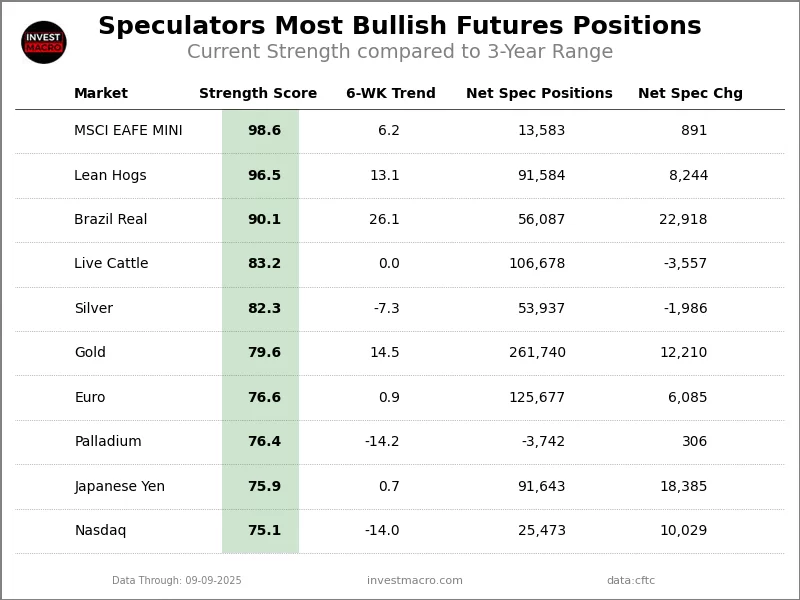
The latest update for the weekly Commitment of Traders (COT) report was released by the Commodity Futures Trading Commission (CFTC) on Friday for data ending on July 22nd.

This weekly Extreme Positions report highlights the Most Bullish and Most Bearish Positions for the speculator category. Extreme positioning in these markets can foreshadow strong moves in the underlying market.

To signify an extreme position, we use the Strength Index (also known as the COT Index) of each instrument, a common method of measuring COT data. The Strength Index is simply a comparison of current trader positions against the range of positions over the previous 3 years. We use over 80 percent as extremely bullish and under 20 percent as extremely bearish. (Compare Strength Index scores across all markets in the data table or cot leaders table)


Extreme Bullish Speculator Table


Here Are This Week’s Most Bullish Speculator Positions:

MSCI EAFE MINI

Extreme Bullish Leader
The MSCI EAFE MINI speculator position comes in as the most bullish extreme standing this week as the MSCI EAFE-Mini speculator level is currently at a maximum 100 percent score of its 3-year range.

The six-week trend for the percent strength score totaled a gain by 13 this week. The overall net speculator position was a total of 8,032 net contracts this week with a boost of 8,905 contract in the weekly speculator bets.


Speculators or Non-Commercials Notes:

Speculators, classified as non-commercial traders by the CFTC, are made up of large commodity funds, hedge funds and other significant for-profit participants. The Specs are generally regarded as trend-followers in their behavior towards price action – net speculator bets and prices tend to go in the same directions. These traders often look to buy when prices are rising and sell when prices are falling. To illustrate this point, many times speculator contracts can be found at their most extremes (bullish or bearish) when prices are also close to their highest or lowest levels.

These extreme levels can be dangerous for the large speculators as the trade is most crowded, there is less trading ammunition still sitting on the sidelines to push the trend further and prices have moved a significant distance. When the trend becomes exhausted, some speculators take profits while others look to also exit positions when prices fail to continue in the same direction. This process usually plays out over many months to years and can ultimately create a reverse effect where prices start to fall and speculators start a process of selling when prices are falling.


Silver

Extreme Bullish Leader
The Silver speculator position comes in second this week in the extreme standings. The Silver speculator level resides at a 92 percent score of its 3-year range.

The six-week trend for the speculator strength score came in at a dip by -8 percentage points this week. The overall speculator position was 60,620 net contracts this week with a slight uptick by 1,172 contracts in the weekly speculator bets.


Nasdaq

Extreme Bullish Leader
The Nasdaq speculator position comes up next in the extreme standings this week with the Nasdaq-Mini speculator level at a 87 percent score of its 3-year range.

The six-week trend for the speculator strength score totaled a rise by 20 percentage points this week. The overall speculator position was 30,728 net contracts this week with a decline of -4,164 contracts in the speculator bets.


Palladium

Extreme Bullish Leader
The Palladium speculator position is next in this week’s bullish extreme standings as the Palladium speculator level sits at a 87 percent score of its 3-year range. The six-week trend for the speculator strength score was a boost by 26 percentage points this week.

The speculator position was -2,300 net contracts this week with a gain of 1,281 contracts in the weekly speculator bets.


Live Cattle


The Live Cattle speculator position rounds out the top five in this week’s bullish extreme standings. The Live Cattle speculator level sits at a 85 percent score of its 3-year range. The six-week trend for the speculator strength score was a decline by -6 percentage points this week.

The speculator position was 108,858 net contracts this week with a rise of 4,413 contracts in the weekly speculator bets.


Extreme Bearish Speculator Table


This Week’s Most Bearish Speculator Positions:

5-Year Bond

Extreme Bearish Leader
The 5-Year Bond speculator position comes in as the most bearish extreme standing this week with the 5-Year speculator level at a 2 percent score of its 3-year range.

The six-week trend for the speculator strength score showed no change this week. The overall speculator position was -2,469,924 net contracts this week with an increase by 35,604 contracts in the speculator bets.


Sugar

Extreme Bearish Leader
The Sugar speculator position comes in tied for the most bearish extreme standing on the week. The Sugar speculator level is at a 2 percent score of its 3-year range.

The six-week trend for the speculator strength score was a drop by -12 percentage points this week. The speculator position was -59,729 net contracts this week with a change of -7,630 contracts in the weekly speculator bets.


Ultra 10-Year

Extreme Bearish Leader
The Ultra 10-Year speculator position comes in as third most bearish extreme standing of the week as the Ultra 10-Year speculator level resides at a 4 percent score of its 3-year range.

The six-week trend for the speculator strength score was  a dip by -6 percentage points this week. The overall speculator position was -393,327 net contracts this week with a decrease of -14,211 contracts in the speculator bets.


Soybean Meal

Extreme Bearish Leader
The Soybean Meal speculator position comes in as this week’s fourth most bearish extreme standing. The Soybean Meal speculator level is at a 5 percent score of its 3-year range.

The six-week trend for the speculator strength score was a decline by -10 percentage points this week. The speculator position was -73,578 net contracts this week with a gain of 6,164 contracts in the weekly speculator bets.


US Dollar Index

Extreme Bearish Leader
Next, the US Dollar Index speculator position comes in as the fifth most bearish extreme standing for this week as the USD Index speculator level sits at a 6 percent score of its 3-year range.

The six-week trend for the speculator strength score was a reduction by -11 percentage points this week. The speculator position was -3,451 net contracts this week with a edge higher by 214 contracts in the weekly speculator bets.


Article By InvestMacroReceive our weekly COT Newsletter

*COT Report: The COT data, released weekly to the public each Friday, is updated through the most recent Tuesday (data is 3 days old) and shows a quick view of how large speculators or non-commercials (for-profit traders) were positioned in the futures markets.

The CFTC categorizes trader positions according to commercial hedgers (traders who use futures contracts for hedging as part of the business), non-commercials (large traders who speculate to realize trading profits) and nonreportable traders (usually small traders/speculators) as well as their open interest (contracts open in the market at time of reporting). See CFTC criteria here.

Week Ahead: Heavy hitter line up to rock US500?

By ForexTime 

  • US500 ↑ over 8% YTD, recently touching ATH 
  • Microsoft, Meta, Amazon and Apple = nearly 20% of US500 weight
  • US GDP, PCE & NFP could influence Fed cut bets
  • Trump’s tariff deadline = Liberation Day 2.0? 
  • Technical levels: 6400, 6350 and 6300

If you thought the last few days were eventful, just wait until you see the calendar for the week ahead…

Rate decisions by major central banks, top-tier economic reports, corporate earnings from tech titans, and Trump’s tariff deadline will be in focus:

Sunday, 27th July 

  • CN50: China industrial profits

Monday, 28th July 

  • US-China trade talks in Stockholm

Tuesday, 29th July

  • AUD: Austria UniCredit Bank Austria manufacturing PMI
  • EUR: Eurozone consumers’ inflation expectations
  • SPN35: Spain GDP, retail sales
  • UK100: Barclays earnings.
  • US500: Conference Board, consumer confidence, job openings

Wednesday, 30th July

  • AUD: Australia CPI
  • CAD: Canada rate decision
  • EU50: Eurozone GDP, consumer confidence
  • GER40: Germany GDP
  • US500: US Fed rate decision, GDP, ADP employment, US Treasury quarterly refunding, Microsoft, Meta earnings

Thursday, 31st July

  • AUD: Australia retail sales
  • CAD: Canada GDP
  • CN50: China manufacturing PMI, non-manufacturing PMI
  • GER40: Germany CPI, unemployment
  • JP225: Japan rate decision, industrial production, retail sales
  • ZAR: South Africa rate decision, trade
  • US500: US consumer income/spending, PCE price index, jobless claims, Apple, Amazon earnings

Friday, 1st August 

  • AU200: Austria CPI
  • CN50: China S&P Global manufacturing PMI
  • EU50: Eurozone CPI, Germany HCOB manufacturing PMI
  • JPY: Japan unemployment, S&P Global manufacturing PMI
  • GBP: UK trade, S&P Global manufacturing PMI
  • US500: US NFP, S&P Global manufacturing PMI, ISM manufacturing, University of Michigan consumer sentiment
  • Trump-imposed deadline for the US tariff pause ends

The spotlight shines on FXTM’s US500, which has gained over 8% year-to-date. 

Imagen
US5002

Note: FXTM’s US500 tracks the underlying S&P 500 index

US equities have been pushing higher with the US500 recently touching fresh all-time highs amid optimism about trade deals.


Here are 4 factors that could trigger significant moves:


1) Fed rate decision

The Federal Reserve is widely expected to leave interest rates unchanged in July, but any clues about future moves may shape the US500’s outlook. 

Note: The latest US CPI report increased to 2.7% in June. 

  • The US500 could rise if the Fed strikes a dovish tone and signals lower rates down the road.
  • Should Powell strike a hawkish note and suggest that rates may remain steady, it could drag the US500.

US500 is forecasted to move 1.5% up or down 1.4% in a 6-hour window after the Fed rate decision. 


2) US data dump: Q2 GDP, PCE, ISM & NFP

A string of high-impact US data releases may influence Fed cut bets for the second half of 2025, impacting the US500 as a result.

Wednesday 30th July – Q2 GDP, ADP employment

  • Note: US500 is forecasted to move 0.5% up or down 0.8% in a 6-hour window after the US GDP report.

Thursday 31st July – US PCE price index, jobless claims

  • Note: US500 is forecasted to move 1.3% up or down 1.0% in a 6-hour window after the US PCE report.

Friday 1st August– US June NFP, ISM manufacturing

  • Note: US500 is forecasted to move 0.7% up or down 1.6% in a 6-hour window after the US NFP report.

Traders are currently pricing in one Fed rate cut in 2025 with the odds of a second cut by December at 70%. 

Any significant shifts in these bets may impact the US500.

  • A set of figures that support the argument around lower rates may boost the US500.
  • Should data cool bets around lower rates, this may weigh on the US500. 


3) Big tech set for big moves?

Four of the “Magnificent” 7 tech titans with a combined market cap of over $11 trillion are set to publish their latest results.

Quarterly results from Microsoft, Meta, Amazon and Apple could offer key insight into how the tech industry fared last quarter.

It is worth noting that the combined weight of Meta, Microsoft, Amazon and Apple makes up just under 20% of the US500!

  • A solid set of results and optimistic forward guidance from tech titans may push the US500 higher.
  • Should results disappoint and concerns be expressed about the business outlook, the US500 could fall.


4) Trump’s tariff deadline

A barrage of country-specific tariffs will take effect on Friday, August 1st, unless targeted partners reach a deal with the United States.

So far, a deal has been struck with the UK, Vietnam, Japan, Philippines, and Indonesia, while there is optimism around a US-EU trade deal. Talks are still ongoing with China, with the third round of negotiations kicking off on Monday 28th.

The US government has only secured 5 trade deals, well below what was pledged on “Liberation Day” back in April. So, the question is whether markets could be headed for “Liberation Day 2.0” as time runs out.

  • If risk aversion returns with a vengeance, this may drag the US500 lower. 


5) Technical forces

The US500 remains firmly bullish with prices closing above the 6350 psychological level. However, the Relative Strength Index (RSI) is signaling that prices are heavily overbought.

  • Should 6350 prove reliable support, this may push prices toward 6400 and 6450.
  • Weakness below 6350 may drag prices back toward 6300 and 6220. 
Imagen
US5007

Forex-Time-LogoArticle by ForexTime

ForexTime Ltd (FXTM) is an award winning international online forex broker regulated by CySEC 185/12 www.forextime.com

EUR/USD Under Pressure Despite Weaker US Dollar

By RoboForex Analytical Department

The EUR/USD pair dipped to 1.1738 on Friday as the US dollar staged a modest recovery, though it remains on track for a weekly decline. Investors continue to weigh developments in trade negotiations while awaiting next week’s Federal Reserve meeting.

Recent reports suggest the US and EU are nearing a trade agreement, which would impose tariffs of 15% on most European goods, mirroring the recent deal struck with Japan.

Amid this backdrop, monetary policy is coming into sharper focus. Markets expect the Fed to keep rates on hold at its upcoming meeting, as policymakers monitor the potential inflationary impact of new tariffs.

Meanwhile, President Donald Trump has softened his tone towards Fed Chair Jerome Powell following a historic visit to the central bank’s headquarters. Trump reiterated that he has no intention of removing Powell, despite earlier speculation.

Interest rate futures currently reflect expectations of a rate cut totalling 43 basis points by the end of 2025, with the consensus forecast anticipating one cut in September and another in December.

Technical Analysis: EUR/USD

H4 Chart:

The EUR/USD has completed an upward wave towards 1.1788 on the H4 chart. Today, we expect a downward impulse to 1.1723, followed by a potential rebound to 1.1755. The pair is likely to enter a consolidation range near the peak of this upward wave, with a possible breakout to the downside towards 1.1670 as the primary target. This scenario is supported by the MACD indicator, where the signal line remains above zero but is trending sharply downward.

H1 Chart:

On the H1 timeframe, the pair is forming the initial structure of a downward wave targeting 1.1723. The first local target at 1.1733 has already been met. A corrective rise to 1.1755 may follow before another decline towards 1.1723. The Stochastic oscillator corroborates this outlook, with its signal line below 50 and pointing firmly downward towards 20.

Conclusion

The EUR/USD faces near-term pressure, but broader dollar weakness persists. Traders should monitor developments in trade policy and forthcoming Fed communications for directional cues, while technicals suggest further consolidation with a bearish bias.


Disclaimer

Any forecasts contained herein are based on the author’s particular opinion. This analysis may not be treated as trading advice. RoboForex bears no responsibility for trading results based on trading recommendations and reviews contained herein.

Zimbabwe’s lithium is in demand for making batteries: how to make sure benefits flow to the local economy

By Jabulani Shaba, University of Groningen 

Zimbabwe has the largest lithium reserves on the African continent. Lithium has been mined since the colonial period in the 1950s. It’s a critical part of rechargeable lithium-ion batteries that are essential for the electric vehicle industry. Globally, the lithium-ion battery market is worth US$78.9 billion and is likely to amount to US$349.6 billion by 2034.

In 2021, there was a new lithium rush in Zimbabwe because of increased global demand for the mineral. Today, most of Zimbabwe’s lithium mines are owned by Chinese mining companies like Sinomine, Zhejiang Huayo Cobalt, Chengxin Lithium, Yahua and Canmax.

Lithium-ion batteries aren’t made in Zimbabwe. Instead, the country exports the mineral as a raw resource. Much of the value of Zimbabwe’s lithium – 480,000 metric tonnes mined since 2015 – is reaped by companies in China which make the raw lithium into batteries and other goods.

During the lithium rush, artisanal miners were involved in the lithium industry. They mined and sold raw ore. But their participation has recently slowed down because artisanal lithium mining is largely illegal. For this reason, official data reports haven’t been able to record how much lithium has been mined this way.

In 2022, the Zimbabwean government banned the export of raw lithium ore in an attempt to regulate the industry and curb artisanal lithium mining and illicit exports.

However, it was still permitted to export lithium concentrate (a powdered version of the raw mineral). But the government recently decided to ban the export of lithium concentrate from January 2027. It says the ban will improve the country’s efforts towards building facilities that add value to lithium, such as lithium refineries and battery production plants.

I research resource extraction and environmental change caused by mining in southern Africa.

If properly implemented and regulated, the new ban on exporting lithium concentrate could increase Zimbabwe’s self-sufficiency in lithium processing. It could even help the country achieve the middle-income economy it has set out in its Vision 2030, in which it aims to have a mining industry that generates US$12 billion a year in revenue. Zimbabwe has the world’s second largest reserves of platinum and huge supplies of chrome. Making goods locally from lithium would expand the mineral export revenue in addition to platinum and chrome.

However, becoming a middle-income nation is currently hampered by mining revenue leaking away – through losses from smuggling, tax evasion and others.

Also, environmental justice groups estimate that about 3,000 tonnes of raw lithium leaves the country daily. Between now and the time the 2027 ban on exporting lithium concentrate comes into effect, about 1.6 million additional tonnes of raw lithium could have been extracted and sent overseas. This means the government should not wait for 2027, but should implement the ban on lithium concentrate exports now.

The ban also doesn’t seem to be aimed at uplifting the livelihoods of communities who live near lithium mines. I describe these communities as living in sacrifice zones: they bear the brunt of lithium mining pollution and land grabs for mines. These vulnerable groups include women, children and artisanal lithium miners who have been disempowered by the just transition.

To use its lithium reserves to uplift the country, the government of Zimbabwe needs to establish local plans that place community development and improved livelihood of mining communities at the centre of mining. This could be done through pro-poor development policies that will create employment opportunities for local people in lithium mining frontiers. It could also include compelling mines to purchase locally made goods and fresh produce. Bringing artisanal miners into local value chains in gold, diamond and chrome mining would also help these informal miners become part of the formal mining economy.

The politics of lithium mining in Zimbabwe

Zimbabwe is one of the 10 biggest global lithium exporters (Chile, Argentina and Australia are others). In the first nine months of 2023 alone, it is estimated that about US$209 million worth of Zimbabwean lithium was sold.

The potential of lithium to stimulate economic development and attract international investments is unquestionable. The problem, however, over the last few years seems to be that the market isn’t regulated enough. Lithium mining has not created many jobs, and for the few that are employed, there’ve been gross human rights abuses, wage cuts, and a lack of investment in road infrastructure.

The politics of lithium mining are also shaped by networks of political elites. They are known as the lithium barons: people who engage in corrupt deals and smuggling.

Another problem has been the misplaced focus on artisanal miners. For example, the 2022 lithium ban mainly targeted artisanal lithium miners who were on the margins of the industry. It did not affect large-scale mining companies to the same extent. When the lithium ban was introduced, the market for processed lithium expanded and the demand for unprocessed lithium drastically shrank. This left artisanal miners with raw lithium and a shrinking market price.

What needs to happen next

Between now and 2027, lithium mining companies in Zimbabwe will try to extract as much lithium as possible before the ban comes into effect. This could deplete the lithium reserves in the country. Mining investors might look elsewhere.

The Zimbabwean government should take these steps to solve the problem:

1) The Zimbabwe government must ensure total monopoly of its lithium reserves. The over-reliance on Chinese investments in the lithium industry has set a bad precedent for what might happen with other minerals in future. It will take time for the government to undo this and set up its own monopoly. This resource sovereignty will be vital.

2) The government must consider how to govern minerals in a people-centred way. So far, lithium has not benefited ordinary Zimbabweans.

3) The resource communities where extraction deals are taking place must be consulted and brought into the conversation about how Zimbabwe can benefit from its lithium reserves. Communities in Zimbabwe like Buhera, Bikita, Mberengwa and Goromonzi have endured years of lithium mining pollution.

This includes their freshwater sources being contaminated by mines, toxic dust from blasting, mineworkers being exposed to hazardous and unsafe working conditions, displacement, and above all gross human rights abuses from multinational lithium mining companies.

4) The ban on the exports of lithium concentrates is crucial for stimulating local beneficiation and value addition. The government should implement this ban immediately rather than waiting for the 2027 timeline.The Conversation

About the Author:

Jabulani Shaba, Postdoctoral researcher, University of Groningen

This article is republished from The Conversation under a Creative Commons license. Read the original article.

Taiwan Looks to Drones to Fight China

Source: Streetwise Reports (7/22/25)

Like with this island in East Asia, militaries around the world are increasingly using drones, a staple in their arsenal, in conflict or training. This trend could benefit companies in the sector, including New Horizon Aircraft Ltd. (HOVR:NASDAQ), AIRO Group Holdings Inc. (AIRO:NASDAQ), AML3D Ltd. (AL3:ASX), and Firestorm Labs Inc.

The constant threat that China will invade Taiwan at any moment has the island continuing to prepare for war against the powerful country.

“Beijing’s Chinese Communist Party government claims Taiwan as its territory, though it has never ruled the island, and China’s rapid military buildup and coercive actions in the Taiwan Strait have led its neighbor to boost defense spending and order a series of high-profile weapons systems from the U.S.,” wrote Newsweek on July 15.

Last month Taiwan tested a first person-view kamikaze sea drone called Overkill, according to Firstpost. The government aims to build up to 25,000 of these units, equipped with artificial intelligence-enabled targeting and a precision camera.

Also, Taiwan just completed the largest version ever of its annual Han Kuan military exercise, reported Business Insider on July 14. The dual focus was on countering a Chinese invasion and, for the possibility such an event is successful, carrying out contingency plans.

“This comes as Taipei’s current government, known for resisting Beijing, grows increasingly concerned about emerging hostilities with mainland China,” the article explained. “Chinese leader Xi Jinping has pledged to reunify the island under Beijing’s control, and said his country would never renounce its right to use force to reach that goal.”

Other countries in the Asia-Pacific are preparing for an eventual China-Taiwan conflict, too. The Philippines, for example, is advancing a US$35 billion military modernization program, noted Newsweek. One of its several goals is to integrate into ground operations command and control systems, drones, and intelligence, surveillance, reconnaissance (ISR) tools, noted Inquirer.net.

As with the China-Taiwan tensions and other recent geopolitical conflicts around the globe, drones are increasingly taking center stage. For example, in the ongoing Myanmar conflict, both sides are now using drones, and so much so, the country ranks third, after Ukraine and Russia, for the number of drone events, according to Armed Conflict Location & Event Data in a July 1 article.

“This isn’t a tactical shift — but rather the start of a military revolution, tearing apart the old rules of war,” wrote Antonio Salinas and Jason P. LeVay, U.S. military analysts, in a May article. “What was once ‘no man’s land’ between trenches is now a drone kill zone, patrolled by flying munitions that loiter, observe, and strike with terrifying accuracy.”

All armed forces must adapt to this new reality, the authors asserted, or suffer total defeat in war.

Companies that could stand to benefit from drones dominating the battlefield, as well as increasing conflicts around the globe, include:

New Horizon Aircraft

Based in Ontario, Canada, New Horizon Aircraft Ltd. (HOVR:NASDAQ) is an advanced aerospace engineering company doing business as Horizon Aircraft and developing hybrid electric vertical takeoff and landing, or eVTOL, aircraft, according to its website.

Its prototype, the Cavorite X7, can take off vertically, but once in flight, its wing system reverts to that of a conventional airplane, providing the same speed, range, and operational utility. This hybrid eVTOL prototype is designed to fly in bad weather, including icy conditions, and it emits 30% less hydrocarbons than a traditional plane. Currently, the prototype is in a flight-testing phase. After completing this, Horizon intends to obtain certification of the Cavorite X7 and then scale production to meet demand from customers, including the military.

Recently, Horizon and ZeroAvia, a global hydrogen-electric powertrain company, announced their plan to collaboratively develop regional hydrogen-electric VTOL air travel, noted a news release.

Richard Ryan, analyst at Oak Ridge Financial Research, noted in his June 16 research report that in mid-May, Horizon achieved a full wing transition flight of Cavorite X7. A U.S. Executive Order signed subsequently intends to accelerate the safe commercialization of drone and other emerging technologies, such as eVTOL aircraft.

In light of these internal and external developments, Oak Ridge increased its target price on New Horizon by 45%. The new target implies a 44% return from HOVR’s share price at the close on July 18. Oak Ridge rates the company Buy.

D. Boral Capital Analyst Jesse Sobelson has a Buy rating on New Horizon and a target price suggesting 16.3% uplift, as noted in his June 9 research report. The consensus target price, according to Refinitiv, reflects 11.6% upside.

Refinitiv also reports that 14 strategic entities own 46.59% of New Horizon. The Top 3 are Canso Group with 16.23%, Robinson Family Ventures Inc. with 7.63% and William Brumder with 7.29%. Six institutional investors hold 0.34%. The rest is in retail.

New Horizon has 31.39 million (31.39M) outstanding shares and 16.76M free float traded shares. Its market cap is US$53.98 million (US$53.98M). Its 52-week range is US$0.24–2.52 per share.

AIRO Group 

AIRO Group Holdings Inc. (AIRO:NASDAQ) is an aerospace and defense company headquartered in Albuquerque, N.M., whose four divisions are drones, avionics, electric air mobility and training, notes the website. The drones segment develops, manufactures and sells drones. Military drones are sold through the Sky-Watch brand.

In recent news, AIRO concluded a highly specialized 90-day training support mission for Naval Special Warfare, “building on strong revenue growth in 2024 and H1/25 in its military training division,” as announced in a news release. The company provides elite training solutions to the U.S. Navy and U.S. Marine Corps’ Joint Terminal Attack Controller program.

According to Refinitiv, the consensus target price on AIRO suggests 8% return from the company’s share price at the end of trading on July 18. TipRanks reports that three analysts cover AIRO, and all of them rate it Buy.

As for ownership, Refinitiv reports that nine strategic investors own 64.71% of AIRO. The Top 3 are AIRO Executive Chairman Dr. Chirinjeev Kathuria with 19.46%, New Generation Aerospace LLC with 15.37% and Carter Aviation Technologies LLC with 11.1%. The rest is in retail.

AIRO has 26.17M outstanding shares and 9.24M free float traded shares. Its market cap is US$688.13M. its 52-week range is US$12.90–38.07 per share.

AML3D Ltd. 

AML3D Ltd. (AL3:ASX; AMLDF:OTCPK), based in Australia, specializes in large-scale metal three-dimensional (3D) printing using its patented wire additive manufacturing process that combines welding science, robotics automation, materials engineering, and proprietary software, the company’s website explains. The company manufactures and sells industrial metal 3D printers under the ARCEMY brand as well as large, high-performance metal components and structures, to defense, aerospace, maritime, manufacturing, mining, and oil and gas customers.

Earlier this month, AML3D received a letter of intent (LOI) from the U.S. Navy to collaborate on several key additive manufacturing initiatives. “The LOI focuses on AML3D’s ability to support materials characterization, parts manufacturing and supply of large scale ARCEMY metal 3D printing systems,” the news release noted.

Daniel Laing, Bell Potter analyst, and Abraham Akra, Shaw and Partners analyst, both cover AML3D. In a July 20 flash note, Bell Potter analyst Daniel Laing gave the company a Buy rating an US$0.35 valuation.

According to Refinitiv, 17 strategic entities own 16.58% of AML3D. The insider with the largest share is Andrew Sales, AML3D’s executive director and chief technology officer, with 4.84%.

Two institutions hold 10.76%. They are Netwealth Investments Ltd. with 5.78% and Regal Funds Management Pty. Ltd. with 4.97%. The rest is in retail.

AML3D has 542.14M outstanding shares and 451.77M free float traded shares. Its market cap is AU$112.54M. Its 52-week range is AU$0.105–0.325 per share.

Firestorm Labs Inc.

Firestorm Labs, a private company headquartered in San Diego, Calif., develops modular, open-architecture drones for rapid deployment in combat and expeditionary environments, according to its website. Its products integrate ISR, electronic warfare/signals intelligence and kinetic payload capabilities. Firestorm’s drones are mission adaptable and can be built any time, anywhere.

“Our unique ability to 3D print modular airframes on site dramatically reduces production timelines, costs and logistical constraints, giving the U.S. and allied forces the adaptive technology they urgently need in complex and contested operational environments,” Dan Magy, Firestorm chief executive officer, said in a July 16 news release.

This release announced that Firestorm secured US$47M in Series A funding. Lockheed Martin Ventures, Decisive Point, Washington Harbour Partners, Booz Allen Ventures, and other defense-focused investors participated in the round led by New Enterprise Associates.

Firestorm will use the capital to advance its additive-manufacturing platform, accelerate in-theater drone production, and scale xCell. xCell produces UAS systems and any 3d printed assets as required, but it’s primary purpose is not to house the above. It serves as a modular micro factory.


Important Disclosures:

  1. As of the date of this article, officers and/or employees of Streetwise Reports LLC (including members of their household) own securities of Firestorm.
  2. Doresa Banning wrote this article for Streetwise Reports LLC and provides services to Streetwise Reports as an independent contractor.
  3.  This article does not constitute investment advice and is not a solicitation for any investment. Streetwise Reports does not render general or specific investment advice and the information on Streetwise Reports should not be considered a recommendation to buy or sell any security. Each reader is encouraged to consult with his or her personal financial adviser and perform their own comprehensive investment research. By opening this page, each reader accepts and agrees to Streetwise Reports’ terms of use and full legal disclaimer. Streetwise Reports does not endorse or recommend the business, products, services or securities of any company.

For additional disclosures, please click here.

Mining Stock ETFs & Miners

Source: Stewart Thomson (7/23/25)

Newsletter writer Stewart Thomson addresses the question: Should investors own mining stock ETFs and some exciting individual miners?

As governments around the world race to implement fresh stagflationary tariff taxes, more spending, and debt, central banks and sovereign wealth funds are moving away from fiat currencies and government bonds.

They are moving into gold.

Here’s a look at the daily chart:

A symmetrical triangle pattern breakout appears imminent, and the target of this pattern is about $3800.

Silver tends to lag gold when deflation is in play and lead it when the big theme is inflation. In recent months, silver has taken the lead baton from gold, and I’ve suggested it could continue to lead until the year 2026 or even 2027.

Here’s a look at the chart:

Silver is making a beeline to the $44 zone, and even some mainstream money managers are taking notice.

In this environment, gold and silver stocks have begun to surge, but they are still so undervalued that senior miners could rise hundreds of percent before they hit “fair value.”

Junior miners could rise thousands of percent, and in some cases tens of thousands of percent. The current state of undervaluation of miners versus metal is truly surreal.

Here’s a look at the weekly GDXJ ETF chart:

There are numerous bull flags on the chart, and a fresh upside breakout is occurring from one of those flags now.

Silver stocks? They look even better!

Here’s a look at the SILJ chart:

Note the gargantuan volume that has accompanied the inverse H&S pattern breakout. It’s almost surreal!

I’ve talked about a “seasonal inversion,” where instead of swooning from July to October, the miners stage a mighty surge higher.

Well, that surge appears to be getting underway now, and the biggest price action of all appears to be occurring in junior miners that are in the CDNX

Here’s a look at the weekly CDNX chart:

A short-term pullback would be a “gift” for investors, but it may not occur.

Charts that are as bullish as this one tend to feature only very short pullbacks that don’t last long.

There are several individual miners that look very good this week. One of them is Big Ridge Gold Corp. (BRAU:TSXV; ALVLF:OTCQB).

They are reinvigorating a past producing property in Newfoundland.

What’s interesting is that gold was stuck in a rough $300-$500 range during the previous operation.

So, a lot of additional gold could be there . . .  gold that wasn’t worth mining at the time.

Here’s the Big Ridge chart:

I have a $2 target price for this stock, and if it’s hit, the CDNX may only be in the 1000 area at that point, which is the neckline zone of its massive H&S base pattern.

The bottom junior mining stocks line: What looks like a high price or “overbought” situation needs to be taken in the context of a very large 40-year inflation cycle that is only in year 5 of the cycle. Arguably, the junior miners offer the greatest value in the modern history of markets, and the word that best sums it all up could be: Enjoy!

Special Offer for Streetwise Readers: Please send me an Email to [email protected] and I’ll send you my free “Copper, Gold, & Rare Earths Too!” report. I highlight key junior resource stocks that are trading under $1/share and ready to soar! Key buy and sell tactics are included in this report. I write my junior resource stocks newsletter 2-3 times a week, and at just $199/12mths it’s an investor favorite. I’m doing a special pricing this week of $169 for 14mths.  Click this link or send me an email if you want the offer and I’ll get you onboard. Thank-you.


Important Disclosures:

  1. Stewart Thomson: I, or members of my immediate household or family, own securities of: None. My company has a financial relationship with: None. My company has purchased stocks mentioned in this article for my management clients: None. I determined which companies would be included in this article based on my research and understanding of the sector.
  2. Statements and opinions expressed are the opinions of the author and not of Streetwise Reports, Street Smart, or their officers. The author is wholly responsible for the accuracy of the statements. Streetwise Reports was not paid by the author to publish or syndicate this article. Streetwise Reports requires contributing authors to disclose any shareholdings in, or economic relationships with, companies that they write about. Any disclosures from the author can be found  below. Streetwise Reports relies upon the authors to accurately provide this information and Streetwise Reports has no means of verifying its accuracy.
  3.  This article does not constitute investment advice and is not a solicitation for any investment. Streetwise Reports does not render general or specific investment advice and the information on Streetwise Reports should not be considered a recommendation to buy or sell any security. Each reader is encouraged to consult with his or her personal financial adviser and perform their own comprehensive investment research. By opening this page, each reader accepts and agrees to Streetwise Reports’ terms of use and full legal disclaimer. Streetwise Reports does not endorse or recommend the business, products, services or securities of any company.

For additional disclosures, please click here.

Stewart Thomson Disclosures

Stewart Thomson is no longer an investment advisor. The information provided by Stewart and Graceland Updates is for general information purposes only. Before taking any action on any investment, it is imperative that you consult with multiple properly licensed, experienced and qualified investment advisors and get numerous opinions before taking any action. Your minimum risk on any investment in the world is: 100% loss of all your money. You may be taking or preparing to take leveraged positions in investments and not know it, exposing yourself to unlimited risks. This is highly concerning if you are an investor in any derivatives products. There is an approx $700 trillion OTC Derivatives Iceberg with a tiny portion written off officially. The bottom line:

Are You Prepared?

FXTM’s JP225 soars on US-Japan trade deal

By ForexTime 

  • FXTM’s JP225 ↑ over 4% on trade deal, hits 12 month high
  • US to impose 15% tariffs on Japanese imports, lower than threatened 25%
  • Yen gains capped by political risk, despite trade ‘massive’ deal.
  • Japan PM Ishiba denies reports of stepping down
  • New FXTM JPC crosses tumble as JP225 surges

Japanese shares surged on Wednesday after President Donald Trump announced a ‘massive’ trade deal with Japan after eight rounds of negotiations!

FXTM’s JP225 which tracks the underlying Nikkei 225 index jumped more than 4% – hitting its highest level since July 2024. 

Imagen
jp225 - 33

More gains could be on the cards given how this removes uncertainty around trade and boosts sentiment toward the Japanese economy.


What are the details on the ‘massive’ deal?

  • US to impose 15% tariffs on all Japanese imports, including automobiles – lower than threatened 25% rate set to take effect August 1st.
  • Japan to also create US$550 billion fund for US-bound investments.
  • Japan to buy 100 Boeing aircrafts, increase rice purchases by 75%, buy US$8 billion of agricultural products.
  • Japan to spend US$17 billion per year on American defense firms – up from $ 8 billion annually.
  • Japan to be guaranteed lowest US tariffs on semiconductors and pharmaceuticals.


How did the Japanese Yen react?

The USDJPY dipped to its lowest level since July 11th on the positive trade news, as it raised the odds of a potential BoJ hike in 2025. 

Imagen
USDJPY 56

However, gains were surrendered following reports that Japanese Prime Minister Shigeru Ishiba intended to step down next month. Ishiba later denied these reports, which offered some support to the Yen.

Traders are currently pricing an 80% probability of a BoJ rate hike by the end of 2025. 

Watch out for political risk…

Last Sunday, Japan’s ruling coalition failed to gain a majority in the upper house elections as widely expected. It is worth noting that nine months ago, the coalition lost a majority in the more powerful lower chamber of parliament.

This will be the first time that the governing LDP has lost a majority in both chambers since its inception in 1955. 

Such a development may pressure Prime Minister Shigeru Ishiba to step down, resulting in fresh political uncertainty.


By the way… FXTM has launched 4 new JPC crosses!

And they are buzzing with activity following Trump’s ‘massive’ trade deal. 

The rally on the JP225 (Nikkei 225) has dragged these JPC crosses lower today: 

  • CHCJPC (CN50 vs JP225): ↓3.8%
  • DJCJPC (US30 vs JP225): ↓4.2%
  • NACJPC (NAS100 vs JP225): ↓3.7%
  • SPCJPC (US500 vs JP225): ↓3.7%

JPC crosses could experience steeper declines if the JP225 continues to surge on trade optimism. 

However, political risk down the road may limit the downside and spark a potential rebound.


Forex-Time-LogoArticle by ForexTime

ForexTime Ltd (FXTM) is an award winning international online forex broker regulated by CySEC 185/12 www.forextime.com

India’s Economic Surge: A New Era of Trade and Growth

Source: Streetwise Reports (7/18/25)

Could the next major powerhouse in world trading be India? Experts talk about the Asian country and its similarities to China before its economy exploded.

The federal debt relative to the U.S. economy has reached heights unseen since World War II, according to a report by Wendy Edelberg, Ben Harris, and Louise Sheiner for Brookings in February.

Without adjustments to tax and spending policies, it is expected to rise continuously. The existing tax structure is insufficient to meet the escalating costs associated with retirement and health benefits for an aging demographic, according to the report. To date, the U.S. has managed to borrow trillions annually. However, analysts caution that the mounting national debt is bound to precipitate a financial crisis.

In an interview with Lisa Abramowicz at the Bloomberg Global Credit Forum in Los Angeles that was posted June 11 on YouTube, DoubleLine Group Chief Executive Officer Jeffrey Gundlach said one of the “most-bankable” long-term themes to look at is investing in India, now the world’s most populous country with 1.46 billion people in 2025. As much as 40% of that population is under 25, giving the country a young demographic profile, as well.

“Because India has a similar profile today to where China was 35 years ago, when they had tremendous population, labor force, visibility of labor force growth, tremendous problems, a gummed-up legal system, (and) corruption all over the place,” Gundlach said. “But those are things that can be fixed. And you see, China went from 1/12th of the U. S. GDP to 70-80% of U. S. GDP.”

He continued, “India has the same demographic outlook as China did then,” and has the benefit of being “very technological.”

A Trade Agreement Enhancing Exports?

A substantial trade agreement between New Delhi and Washington could significantly enhance India’s exports and manufacturing sector, leading to prolonged economic growth, as per Bloomberg Economics, reported Ruchi Bhatia for Bloomberg on July 5.

Such a deal could potentially double India’s exports of goods to the U.S. — its largest international market, which constitutes 19.3% of its total exports — over the next decade, and boost its gross domestic product by 0.6%, according to a report by economists Abhishek Gupta and Eleonora Mavroeidi, Bhatia reported.

Including services, total exports to the U.S. are projected to increase by 64%, the report added.

The majority of these export gains are expected to come from textiles and light manufacturing goods, such as furniture, toys, and other consumer products. The economists noted that the trade agreement would represent a significant turning point for India’s domestic manufacturing sector.

Nikita Yadav reported for the BBC on July 17 that “Washington and Delhi are ‘very close’ to finalizing a trade deal” as high-level talks between the sides continue.

“We’re very close to a deal with India where they open it [the market] up,” Trump told reporters at the White House on Wednesday, Yadav reported.

With the Trump administration imposing substantial tariffs on China and Vietnam, a trade deal that sets tariffs at 10% for India could position the country as an attractive option for businesses looking to relocate or diversify their supply chains, the economists explained.

Should the trade deal not materialize and India faces higher reciprocal tariffs of 26%, the country could lose more than a third of its direct exports to the U.S., and its GDP could suffer a 0.7% decline, according to the report.

India was one of the first countries to start trade negotiations with the U.S. this year, with Prime Minister Narendra Modi making significant concessions to satisfy the White House. However, in recent weeks, both parties have adopted firmer positions on sectors such as agriculture.

India Starting to Look Safer, Researcher Says

According to Investing.com, Indian stocks closed higher on July 16, with gains in the Real Estate, Technology, and Public Sector Undertakings sectors driving the shares upward. At the close on the NSE, the Nifty 50 was up by 0.06%, while the BSE Sensex 30 index increased by 0.08%.

India’s stock market is poised to reach new heights by the end of 2025 and is expected to continue its ascent into the following year, according to a Reuters survey of equity analysts. Despite some concerns about high valuations and the potential for a correction in the next three months, the outlook remains optimistic. After a period of selling, foreign investors became net purchasers in April for the first time in four months. Meanwhile, the blue-chip Nifty 50 index has surged nearly 15% from a 10-month low in early April, although it remains below its all-time peak of 26,277.35 reached in late September, Vivek Mishra reported for Reuters.

The BSE Sensex is projected to rise to 86,100 by the end of 2025, reaching 89,000 by mid-2026 and 95,000 by the end of 2026, according to the poll.

“India is starting to look like a safer bet since there aren’t many growth alternatives,” Yogesh Kalinge, associate director of research at A.K. Capital Services, told Reuters. “Trump’s policy is not leading to the usual outflows toward the U.S. safe haven and is in fact making emerging markets look better . . .  (But) if you look at valuations, they do look stretched.”

With an average price-to-earnings ratio of 23.52, the Indian stock market is among the most expensive globally, trailing only the U.S. at 25.41 and significantly above China’s 12.00. Of the analysts who responded to an additional question, 15 out of 28 indicated that a correction — typically defined as a decline of 10% or more — was very likely or likely. The remaining 13 viewed it as unlikely or very unlikely.

“I expect a correction in the short term . . .  because of the inability of large caps to grow as expected. Large-cap index revenue growth is below India’s nominal economic growth, which is worrisome,” stated Sreeram Ramdas, vice president at Green Portfolio PMS.

A substantial majority, 23 out of 29 analysts, anticipate that corporate earnings growth in 2025 will be marginally higher, with four predicting significantly higher growth, the Reuters piece reported. Six analysts expect earnings to be marginally or significantly lower.

Profit growth for Nifty 50 companies remained subdued in the December quarter, with most companies missing estimates. However, this was an improvement after three notably weaker quarters.

“Earnings growth moderated due to a slower recovery in private sector investment. While some of these pressures have started to ease, the recovery has been insufficient to offset the overall slowdown in corporate performance,” explained Ajit Mishra, senior vice president of research at Religare Broking.

Seeking Alpha ranked Indian stocks according to its “quantamental” analysis, which grades stocks based on collective value, growth, profitability, earnings per share revisions, and price momentum metrics.

The site said William Blair & Co. analysts attribute India’s superior performance to robust economic fundamentals, advantageous demographics, and an expanding middle class. In their Emerging Markets 2025 report, the analysts noted, “The current valuation premium…should prompt investors to adopt a cautious, quality-focused approach in the present climate.”

They further added, “As India progresses along its growth path, it has the capacity to mirror China’s swift economic rise that began in the early 1990s, though potentially with a more balanced and sustainable approach to growth.”

Here are three stocks listed by the site as offering exposure to markets in this this emerging trade powerhouse.

MakeMyTrip Ltd.

MakeMyTrip Ltd. (MMYT:NASDAQ), based in Gurugram, scored 3.18 out of 5 on Sthat scale. It manages prominent online travel brands such as MakeMyTrip, Goibibo, and redBus. Through the company’s main websites, www.makemytrip.com, www.goibibo.com, www.redbus.in, and mobile applications, travelers can explore, plan, and book a broad array of travel services and products both within India and internationally, the company said on its site.

Streetwise Ownership Overview*

MakeMyTrip Ltd. (MMYT:NASDAQ)

Institutions: 75%
Strategic Corporate Entities: 15%
Retail: 7%
Insiders and Management: 3%
75%
15%
7%
3%
*Share Structure as of 7/16/2025


Offerings include air ticketing, bookings for hotels and alternative accommodations, vacation planning and packages, bus and rail ticketing, car rentals, and other travel necessities like third-party travel insurance, foreign exchange services, and visa processing.

MakeMyTrip said it offers customers comprehensive access to all major domestic full-service and budget airlines in India, as well as major international airlines flying to and from India. Additionally, the company said it provides a vast selection of domestic lodging options in India and numerous accommodation choices abroad, connections to Indian Railways, and all principal bus operators in India.

According to Seeking Alpha, in the last 90 days, seven Wall Street analysts have rated the stock a Strong Buy and three have rated it a Buy.

MakeMyTrip closed the Tuesday trading session at US$93.01, marking a +2.25% increase from the previous day’s close, according to a report by Zacks Equity Research published by Yahoo! Finance. This performance outpaced the S&P 500, which saw a decline of 0.4% on the same day. Conversely, the Dow fell by 0.98%, while the tech-heavy Nasdaq saw a modest rise of 0.18%.

Over the past month, shares of the online travel company have declined by 9.83%, underperforming the Computer and Technology sector, which gained 6.34%, and the S&P 500, which rose by 4.97%.

Investors are keenly anticipating MakeMyTrip’s performance in its forthcoming earnings announcement, the Zacks report noted. The company is scheduled to release its earnings report on July 22, 2025. It is expected to post earnings per share (EPS) of US$0.45, reflecting a 15.38% increase from the same quarter last year. Additionally, the latest consensus estimate projects the company’s revenue to hit US$277.12 million, up 8.88% from the same quarter of the previous year.

MakeMyTrip recently launched a significant primary offering that included 14 million shares, with an additional 2.1 million shares available through a greenshoe option; and a 0% convertible senior note valued at US$1.25 billion due in 2030, with a greenshoe option of US$187.5 million, Manik Taneja of Axis Capital wrote in an updated research note on June 17. The analyst set a rating of ADD with a target price of US$120 per share.

This move aims to purchase a substantial portion of Class B shares from its majority shareholder, Trip.com, reducing their stake from approximately 45% to around 20% following the transaction. Our preliminary estimates (see Exhibit 1 below) indicate that the earnings impact should be minimal, as the change in the number of shares is relatively slight compared to our forecasts. The recent market correction presents an opportunity to invest in a consistent performer, especially considering the positive demand trends in the Indian Travel tech sector.

According to a July 14 research note by Ambit Institutional Equities Analyst Ashwin Mehta, some keys to look for from the company include “growth outlook, especially recovery in domestic air ticketing, outbound air and hotel momentum, and any impact of macro uncertainties (that) led pullback on travel spends.

Mehta rated the stock a Buy with a US$117 per share target price.

Refinitiv notes that about 3% of the company is owned by insiders, about 15% by strategic corporate entities, and 75% by institutions. The rest is retail.

Top shareholders include Trip.com Group Ltd. with 11.99%, GIC Private Ltd. with 7.64%, Baillie Gifford & Co. with 5.74%, Fidelity Management & Research Co. with 4.35%, and Travogue Electronic Travel Private Ltd. with 2.62%.

Its market cap is US$8.85 billion 95.15 million shares outstanding. It trades in a 52-week range of US$76.95 and $123.

Infosys Ltd.

Infosys Ltd. (INFY:NYSE), headquartered in Bengaluru, provides next-generation digital services and consulting. With a workforce of over 320,000, the company said it strives to enhance human potential and forge new opportunities for individuals, businesses, and communities worldwide.

Streetwise Ownership Overview*

Infosys Ltd. (INFY:NYSE)

Retail: 86%
Institutions: 14%
86%
14%
*Share Structure as of 7/16/2025


Infosys, which scored 3.09 on Seeking Alpha’s scale, said it assists clients across more than 59 countries on their journey through digital transformation, powered by cloud and artificial intelligence (AI) technologies.

On Wednesday, the company unveiled the Infosys Enterprise Innovation Lab for SAP Solutions at its Düsseldorf, Germany location. This initiative, emerging from a collaboration between Infosys and SAP, is crafted to empower enterprises to delve into the expansive potential of AI and data, develop bespoke solutions for their unique business challenges, and expedite the adoption of advanced Infosys and SAP technologies.

The lab is designed to facilitate the creation of solutions that boost financial performance, enhance operational efficiency, improve risk management, and support decision-making through real-time data insights, while also elevating compliance and security standards. Innovations developed in the Düsseldorf lab will be accessible globally through Infosys’ network of over 12 Living Labs.

“Enterprises looking to adopt new SAP solutions will find that the Infosys Enterprise Innovation Lab for SAP Solutions significantly smoothens their transformation journey,” said Infosys Executive Vice President and Chief Delivery Officer Dines Rao. “Located in our Düsseldorf office, this collaborative space is designed to develop customized solutions. Leveraging Infosys Topaz and Infosys Cobalt, we aim to enable businesses to fully utilize cloud, data, and AI technologies, achieving substantial business benefits such as improved efficiency, better decision-making, cost reductions, and preparedness for the future.”

A June 11 research note by Daniel Alvarez and Scott White for Yaru Investments titled “India’s Artificial Intelligence Supercycle” noted that Infosys was one of India’s “IT leaders.”

Infosys is renowned for its comprehensive approach to integrating enterprise AI. The Topaz platform consolidates generative AI, machine learning, and automation into industry-specific modules applicable to sectors like banking, manufacturing, and healthcare. Through significant partnerships with major platforms such as Microsoft Azure and AWS, Infosys collaborates to create customized LLM-based solutions for its global clientele.

“Infosys stands out for its end-to-end approach to enterprise AI integration,” the analysts noted. “Its Topaz platform brings together generative AI, machine learning, and automation into deployable modules tailored for industries such as banking, manufacturing, and healthcare. With major partnerships (including with Microsoft Azure and AWS), Infosys co-develops customized LLM-based solutions for global clients.”

The company’s commitment to reskilling its workforce, particularly in areas like prompt engineering and AI ethics, establishes Infosys as a preferred partner for organizations looking to implement GenAI on a large scale, they wrote. Crucially, Infosys has successfully transitioned AI from experimental phases to a source of revenue generation, with discussions with clients increasingly focused on the productivity improvements and cost efficiencies driven by AI.

According to Refinitiv, about 14% of the company is owned by institutions, and the rest is retail.

Top shareholders include First Trust Advisors LP with 0.97%, Robeco Institutional Asset Management with 0.66%, Acadian Asset Management LLC with 0.64%, State Street Global Advisors (US) with 0.41%, and Goldman Sachs Asset Management LP with 0.4%

Its market cap is US$77.52 billion with 4.14 billion shares outstanding. It trades in a 52-week range of US$15.82 and US$23.63.

ICICI Bank Ltd.

ICICI Bank Ltd. (IBN:NYSE) scored the highest on Seeking Alpha’s rankings with 4.86 out of 5 points. The company continues to stand out as a structural compounder, boasting an industry-leading return profile and consistently outperforming its major peers in terms of growth, according to a research note by Axis Capital’s Jayant Kharote on June 18.

Streetwise Ownership Overview*

ICICI Bank Ltd. (IBN:NYSE)

Retail: 80%
Institutions: 19%
Strategic Corporate Entities: 1%
80%
19%
*Share Structure as of 7/17/2025


Its robust foothold in the mortgage and unsecured segments, along with an expanding SME/BB franchise, is expected to propel credit growth recovery to around 15%, the analyst noted. While the impact on Net Interest Margin (NIM) might be slightly more pronounced compared to its peers, a recovery is anticipated by Q4FY26/Q1FY27E.

The bank’s dominant retail franchise provides an additional lever for fee growth, helping to mitigate near-term pressures on earnings per share (EPS). Over the medium term, ICICI Bank is poised to maintain its leadership in growth and return ratios among the large private banks.

However, its rich valuation suggests limited upside potential, leading the firm to maintain its ADD rating on the stock.

Should there be a delay in systemic recovery, ICICI Bank is better positioned compared to its peers, offering a more secure investment option in the context of a credit growth revival, Kharote wrote.

“ICICI Bank continues to exhibit best-in-class asset quality metrics,” the analyst wrote.

On April 19, the company released a performance review for the quarter ending March 31.

It noted that profit before tax, excluding treasury activities, increased by 13.2% year-on-year to 16,534 crore (US$1.9 billion), and core operating profit rose by 13.7% year-on-year to 17,425 crore (US$2.0 billion). Profit after tax saw an 18% year-on-year increase to 12,630 crore (US$1.5 billion) in that quarter.

For the fiscal year ending March 31, profit before tax, excluding treasury, grew by 11.4% year-on-year to 60,713 crore (US$7.1 billion), and core operating profit for FY2025 increased by 12.5% year-on-year to 65,396 crore (US$7.6 billion), ICICI said in a release.

“The Board has recommended a dividend of 11 rupees per share for FY2025,” the company said. “The declaration and payment of dividend is subject to requisite approvals.”

Refinitiv noted that less than 1% of the company is owned by strategic corporate entities and about 19% by institutions. The rest is retail.

Top shareholders include GQG Partners LLC with 2.17%, WCM Investment Management with 1.5%, Morgan Stanley Investment Management with 0.99%, Temasek Holdings Pte. Ltd. with 0.76%, and Capital International Investors with 0.56%.

Its market cap is US$117.85 billion with 3.6 billion shares outstanding. It trades in a 52-week range of US$27.26 and US$34.50.


Important Disclosures:

  1. Steve Sobek wrote this article for Streetwise Reports LLC and provides services to Streetwise Reports as an employee.
  2. This article does not constitute investment advice and is not a solicitation for any investment. Streetwise Reports does not render general or specific investment advice and the information on Streetwise Reports should not be considered a recommendation to buy or sell any security. Each reader is encouraged to consult with his or her personal financial adviser and perform their own comprehensive investment research. By opening this page, each reader accepts and agrees to Streetwise Reports’ terms of use and full legal disclaimer. Streetwise Reports does not endorse or recommend the business, products, services or securities of any company.

For additional disclosures, please click here.