Archive for Opinions – Page 120

Computer chips: while US and EU invest to challenge Asia, the UK industry is in mortal danger

By Andrew Johnston, Coventry University and Robert Huggins, Cardiff University 

US semiconductor giant Micron is to invest US$40 billion (£33 billion) during the 2020s in chip manufacturing in America, creating 40,000 jobs. This is on the back of incentives in the recent US Chips Act, which has also unlocked major investments from fellow US players Intel and Qualcomm.

The EU is also making moves to boost computer-chip manufacturing at home, having similarly decided to try and take share from Asia following the severe global semiconductor shortages over the past couple of years. Over 70% of chips are currently made in Asia, with precarious Taiwan particularly important, making around 90% of the world’s most advanced chips.

In the UK, however, successive governments have overlooked the importance of having a home-grown industry for this vital component, which underpins not only computers and smartphones, but also things like cars, planes, satellites and smart devices. There is a clear absence of any strategic plan, and no way of riding on the coattails of the EU following Brexit. So what needs to be done?

The new race for chips

Micron’s decision to announce such a large investment in the US is directly related to the Chips Act. The act provides US$200 billion to build and modernise American manufacturing facilities, as well as promoting research and development in semiconductor technologies, and promoting education in STEM subjects to develop the next generation of chip designers.

The US continues to control the majority of IP in semiconductors, but Asia’s dominant manufacturing capacity is rapidly growing on the back of investments from the likes of Taiwan’s TSMC and Foxconn, and South Korea-based Samsung. There is also a need to compete with China, which recently surprised the industry by demonstrating world-beating technology.

Semiconductor manufacturing and ownership by country (%)

Data is from 2019.
Semiconductor Industry Association

Earlier this year, the EU set out the scope of its own legislation to boost its share of production from 10% to 20% of the world total by 2030. It aims to promote “digital sovereignty” by supporting the development of new production facilities, supporting start-ups, developing skills and building partnerships. In total, the upcoming act should result in between €15 billion (£13 billion) and €43 billion (£36 billion) being invested in the sector.

The UK perspective

The UK once led the world in semiconductor manufacturing, with highly internationally innovative companies such as Plessey, Inmos, Acorn, Imagination Technologies and Cambridge Silicon Radio. There remain pockets of excellence and world-leading innovation, particularly in the design of semiconductors. Clusters in south Wales, the south west of England and east of England, for example, have a critical mass of activity. But they have lacked the necessary finance to upscale, and all the major investments elsewhere are putting the industry in an increasingly vulnerable position.

It’s not only the UK’s position in semiconductors that is under threat. A lack of capacity creates risks for the whole electronics supply chain, which could weaken the economy overall. For example UK car production has been severely curtailed by the recent chip shortages.

To avoid such problems, the UK needs to pass a Chips Act of its own. This would aim to kick-start the industry by incentivising investment in manufacturing facilities, called “fabs”. Some commentators have argued against this move, mainly due to the huge costs involved. But it would be money well spent to achieve digital sovereignty.

A UK act should incentivise investment both directly and indirectly. Direct funding would ensure increased manufacturing capacity by building new fabs or expanding and upgrading existing facilities, especially for chips related to sensors, power, consumer electronics and communication devices. The government could then also support the industry indirectly through policies such as tax credits for investing firms, land provision and support infrastructure.

Another priority should be to strengthen existing national competitive advantages around designing smaller chips with more efficient circuits and greater computing power. This would involve both improving the current generation of chips and developing new approaches such as “beyond CMOS” technologies, which promise faster and more dense chips but crucially with a lower energy requirement. Providing R&D grants or guaranteeing loans to explore, test and consolidate new designs would help to return the UK to the forefront of developments in the sector.

University funding

Finally, the UK needs to harness the knowledge and research expertise around design and manufacturing within its universities. This is spread around various institutions, including the universities of Cardiff and Swansea in Wales; Strathclyde and Edinburgh in Scotland; Queen’s University Belfast in Northern Ireland, which has its own foundry; and the University of Sheffield in England.

The UK government has funded over £1 billion of university research into semiconductors since 2006, but the US and EU chips acts highlight just how much more is required. There is also a need to focus university funding on commercial outcomes that will translate into sales and increase the UK’s market share. Brexit has limited funding opportunities by raising uncertainties about the UK’s future involvement in the European “Horizon” scheme, which is the EU’s main R&D funding programme. It may therefore require a national replacement.

Clearly, the national outlay to deal with COVID and the current cost of living crisis will constrain potential government investments in the coming years. But the recent semiconductor shortages have also made clear that a degree of self-sufficiency in this key enabling technology will be vital to ensuring economic resiliency in a highly volatile and unpredictable world.The Conversation

About the Author:

Andrew Johnston, Professor of Innovation and Entrepreneurship, Coventry University and Robert Huggins, Professor of Economic Geography, Cardiff University

This article is republished from The Conversation under a Creative Commons license. Read the original article.


Energy crisis: why French households are largely protected from soaring costs while British families struggle

By Renaud Foucart, Lancaster University 

British households are bracing for a winter of massive energy price increases. The average annual bill is forecast to rise above £4,000, which is more than three times what Britons were paying just 12 months ago.

French households, meanwhile, will barely see their costs increase. Their government has frozen gas prices and limited the increase of the regulated price of electricity to an annual 4%. The total impact of the cost of living squeeze from higher energy prices this year will remain well below 5% of consumption for all French households. For the poorest 20% of UK households, it could be more than 15%.

The difference between two neighbouring countries with interconnected electricity grids is staggering. As part of my ongoing research into market regulation and the systems used to allocate commodities such as electricity, I look at how economic models can help us to understand policy problems. Most recently, I’ve been researching the French power market and comparing it to other models such as those of the UK.

By reflecting the actual market price of electricity generation, the Great Britain’s model (Northern Ireland operates on a different system) forces consumers to reduce consumption and encourages investment in production. In contrast, the French approach uses a mixture of subsidies by the government and a public energy company, which costs taxpayers billions and postpones big decisions on energy efficiency and investment in future production.

But while the GB power market is certainly more efficient when it comes to energy consumption and production, the upcoming crisis shows it is far from perfect. To ensure all homes are heated this winter, the government faces a bold choice: sending billions in cash to households or learning some lessons from the neighbouring French market – even if it means sacrificing some efficiency.

Great Britain: free market, marginal pricing

UK energy regulator Ofgem determines the maximum price an energy provider can charge households for the gas and electricity they use. This price cap, designed to protect consumers from unfair rises, should also enable suppliers to buy energy on the wholesale market at cheaper prices to satisfy contracts with consumers and still make a profit.

Indeed, the wholesale price of energy is the main factor Ofgem uses to calculate the cap. This price varies depending on the type of power being purchased.

Under what’s called a marginal price model, cheaper sources such as renewables and nuclear are used to satisfy demand first. More expensive forms of power such as natural gas are brought in as demand increases, but demand is nearly always high enough to encourage gas generation.

And in free markets such as this, the most expensive unit consumed determines the price everyone pays. Since Russia invaded Ukraine in February 2022, the price of gas in the GB market has soared to more than six times prices a year ago.

Unfortunately, the price cap model has meant that recent soaring wholesale gas prices have affected both consumers and suppliers. While oil and gas producers report record profits due to rapidly rising prices, dozens of suppliers have gone bust paying these prices.

To reduce the risk of further supplier bankruptcies, Ofgem will now update the cap on a quarterly basis to enable suppliers to raise retail prices more in line with wholesale prices.

But recent rises have affected consumers. In the past, retail rates could be fixed well below the cap, but increased gas costs have pushed power prices up so much that these deals have disappeared.

Average annual fuel bills, 2012-2022

Line graph showing different types of energy bills increasing to meet the UK price cap set by Ofgem
The gap between GB energy bills and the price cap has narrowed in 2022.
Ofgem Retail Market Indicators, House of Commons research briefing, August 2022

Capping wholesale prices is not a solution. To avoid blackouts, energy companies must either produce or import every single unit demanded by their consumers. If producers cannot recoup the cost of production of the most expensive unit of energy, they will simply not deliver it.

High energy prices and the hope of future profits encourage investment in production. The UK, for instance, is consistently ranked as one of the most attractive countries for renewable energy development. Even so, the neighbouring French market is currently doing much better to protect its consumers.

France: nationalised production, price subsidies

On paper, the French system is also market-based: energy producers sell electricity to the firms that directly supply consumers, limited by a price cap. The big difference from Britain is that the French government forces majority state-owned monopoly producer EDF to offer more than a quarter of its production to suppliers at a huge discount on the current wholesale price.

Historically, this cheap energy comes from an ageing fleet of nuclear power plants. But recent issues have forced EDF to buy back some of the electricity it had already sold into the market at more expensive wholesale prices to resell to energy suppliers for less to satisfy its contracts with them.

Last January, the French government also asked EDF to increase the quantity of discounted electricity it offers to help French households cope with rising energy prices. Together with cuts in fuel taxes, this will ensure the French regulated price barely increases this year.

The French system is far from perfect, however. The significant cost to taxpayers is not transparent and electricity prices do not reflect the cost of the most expensive unit. The absence of market incentives has also prompted the government to re-nationalise EDF to ensure future investment in renewables and next generation nuclear power plants.

As a shorter-term measure to protect consumers, the country has also introduced restrictions on energy use, particularly since it expects wholesale prices way above what GB will pay due to nuclear production uncertainty. But at least French families know their houses will be warm enough this winter.

To ensure the same for its households, the British might consider becoming a little more French by subsidising electricity. Both of the Conservative Party leadership contenders have hinted they are willing to move in that direction by cutting VAT and green levies, but the price impact would be small. Much more subsidies would be needed to protect consumers.

Up until now, an alternative strategy has been to offer unconditional cash transfers, such as rebates on council tax and energy bills. Pursuing this strategy over the winter would preserve the efficiency of the GB market, but would be politically difficult and expensive. The IMF estimates the cash needed to compensate the 40% poorer household to be around 1.5% of GDP or more than £30 billion.

The GB power market is generally an ideal way to allocate consumption and production of electricity. But efficiency is not everything. A rich country that cannot warm its homes has failed its citizens and so further action is needed to ensure this does not happen this winter.The Conversation

About the Author:

Renaud Foucart, Senior Lecturer in Economics, Lancaster University Management School, Lancaster University

This article is republished from The Conversation under a Creative Commons license. Read the original article.


Trade Of The Week: Are Dollar Bulls Running On Empty Fumes?

By ForexTime 

– Dollar bulls dominated the FX space during the first half of 2022, trampling any obstacles that came their way. G10 currencies were practically flattened by the greenback’s might with the pound shedding 10% and yen over 15%.

But the scales of power seem to be veering in favour of bears in Q3 as the fundamental drivers shift. This can be reflected in the currency’s mixed performance since the start of July.

After reaching its highest level since mid-2002 back in July, the Dollar Index (DXY) has found itself vulnerable to losses thanks to profit-taking. Reduced bets over how aggressive the Fed will be on rate hikes and signs of easing inflationary pressures also capped upside gains.

Taking a quick look at the equally weighted dollar index, prices staged a rebound this morning as disappointing data from China fuelled global recession fears. Nevertheless, the trend still favours bears due to the consistently lower lows and lower highs.

With inflation cooling in the largest economy in the world and investors cutting rate hike bets, USD bulls may be in trouble. However, recession fears and geopolitical risks could send investors rushing toward the dollar which acts as a beacon of safety in times of uncertainty.

So, are dollar bulls are running on empty fumes or taking a break before switching to higher gear? While we may not get the answer this week, the pending FOMC meeting minutes, US economic data, and speeches from Fed officials could offer fresh insight.

The low down…

There were three major drivers behind the dollar’s appreciation this year.

  1. Interest rates
  2. Strength of the US economy
  3. Dollar’s safe-haven status

The Fed’s aggressive approach towards rising interest rates in the face of soaring inflation sent the dollar rallying as rate differentials widened against other currencies. As investors looked at the strength of the US economy, relative to others this also boosted appetite for the greenback. Lastly, geopolitical risks, global growth concerns, and overall uncertainty sent market players rushing toward the world’s reserve currency.

Fast forward to today, signs of easing inflationary pressures have prompted investors to cut bets on how aggressive the Fed will be in raising interest rates. The latest CPI figures revealed inflation cooled 8.5% in July compared to the 8.7% expected and a significant drop from the 9.1% increase in June. In regards to the US economy, it contracted for the second straight quarter in Q2, signalling an unofficial start of recession, further dampening appetite for the dollar. Given the unfavourable macroeconomic environment and geopolitics at play, investors remain cautious and this could result in increased appetite for the safe-haven dollar. All in all, when considering how 2/3 of the major drivers powering the dollar have weakened, this could encourage bears to pounce.

The week ahead…

It could be a volatile week for the dollar thanks to the pending US reports and speeches from Fed officials.

However, all eyes will be on the Federal Reserve meeting minutes on Wednesday. This will be closely scrutinized by investors for any fresh clues and insight into what policymakers were thinking when rates were hiked by 75 basis points for a second straight meeting. If the minutes sound hawkish, this could offer the dollar some support. On the flip side, any hint of doves may encourage some fresh dollar weakness. It will be wise to keep an eye on the US retail sales report for July published mid-week and speeches by Kansas City Fed President Esther George and Minneapolis Fed President Neel Kashkari on Thursday.

Dollar to resume decline?

After breaking out of the weekly bearish channel, the equally weighted dollar index could be gearing for steeper declines.

Prices turned bearish after securing a solid weekly close below 1.1700. Sustained weakness under this level could trigger a selloff towards 1.1380.

Should 1.1700 prove to be reliable support, a move back towards 1.1900 could be on the cards.

On the daily charts, prices punched higher this morning thanks to fundamental forces but the technical picture still favours bears. A move back below 1.1700 could suggest a decline towards 1.1630 and 1.1450. Should 1.1700 prove to be reliable support, prices may test the 50-day Simple Moving Average and 1.1950, respectively.


Forex-Time-LogoArticle by ForexTime

ForexTime Ltd (FXTM) is an award winning international online forex broker regulated by CySEC 185/12 www.forextime.com


Currency Speculators further pared back on Japanese Yen & British Pound bearish bets

By InvestMacro | COT | Data Tables | COT Leaders | Downloads | COT Newsletter

Here are the latest charts and statistics for the Commitment of Traders (COT) data published by the Commodities Futures Trading Commission (CFTC).

The latest COT data is updated through Tuesday August 9th and shows a quick view of how large traders (for-profit speculators and commercial entities) were positioned in the futures markets. All currency positions are in direct relation to the US dollar where, for example, a bet for the euro is a bet that the euro will rise versus the dollar while a bet against the euro will be a bet that the euro will decline versus the dollar.

Weekly Speculator Changes

The COT currency market speculator bets were higher this week as eight out of the eleven currency markets we cover had higher positioning while the other three markets had lower speculator contracts.

Leading the gains for the currency markets was British pound sterling (21,941 contracts) and the Japanese yen (17,721 contracts) with the Euro (4,275 contracts), Swiss franc (3,526 contracts), Brazil real (2,863 contracts), New Zealand dollar (1,297 contracts), Canadian dollar (946 contracts) and Bitcoin (351 contracts) also recording positive weeks.

The currencies leading the declines in speculator bets this week were the Mexican peso (-4,568 contracts) with the Australian dollar (-1,638 contracts) and the US Dollar Index (-710 contracts) also registering lower bets on the week.


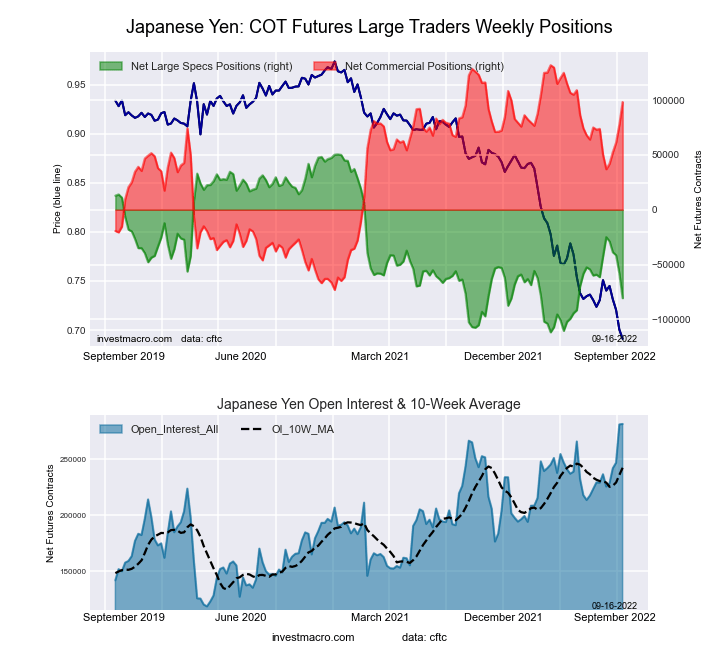
Highlighting the COT currency changes this week is the continued rebound in the Japanese yen speculator positions. The yen positioning has been in net bearish territory for seventy-four consecutive weeks (dating back to March 9th of 2021) but has started to see a strong decrease in its bearish levels lately. Speculators have improved their yen standing in three out of the past four weeks and by a total of +36,449 contracts in the past two weeks alone. This recent positive sentiment has brought the overall yen speculative standing (currently at -25,032 contracts) to the least bearish level of the past seventy-four weeks or since the position turned bearish last year. The yen price has rebounded a bit over the past month as the USDJPY currency pair has cooled off after reaching 20-year highs above 139.35 exchange rate in July. Currently, the USDJPY is trading around the 133.50 exchange rate and has come out of overbought territory on the weekly RSI Indicator (Relative Strength Index).

British pound sterling speculators also sharply cut their bearish positions this week as speculator positioning have now risen in three out of the past four weeks as well as in eight out of the previous eleven weeks. Speculative positions recorded a large improvement by +21,941 contracts this week which is the best weekly gain for GBP bets since the middle of January. This positive development has dropped the overall bearish position to the best level (or the least bearish level) since March 15th, a span of twenty-one weeks. The British pound price has been in a deep and consistent downtrend against the US Dollar since ascending over the 1.4200 exchange rate in May of 2021 and touched a recent low below 1.1800 in July (for an approximate -17.5 percent drop over that period). However, on the positive side, the pound has managed to rise in three out of the past four weeks, closing out the week at the 1.2136 exchange rate and, notably, a bullish divergence recently appeared on the weekly RSI Indicator following the July low.


Data Snapshot of Forex Market Traders | Columns Legend
Aug-09-2022OIOI-IndexSpec-NetSpec-IndexCom-NetCOM-IndexSmalls-NetSmalls-Index
USD Index59,6398838,63789-42,09993,46254
EUR692,39879-34,5362414,4028020,1348
GBP224,58159-34,4684552,05062-17,58219
JPY225,83472-25,0325336,99454-11,96229
CHF43,20227-9,7823219,46475-9,68225
CAD143,6462621,22363-29,743448,52047
AUD158,10051-57,5883159,44163-1,85348
NZD45,35035-276714,04437-3,7688
MXN189,98845-27,6211624,722832,89955
RUB20,93047,54331-7,15069-39324
BRL25,48171,73352-3,884472,15190
Bitcoin12,51070-23076-71030120


Strength Scores

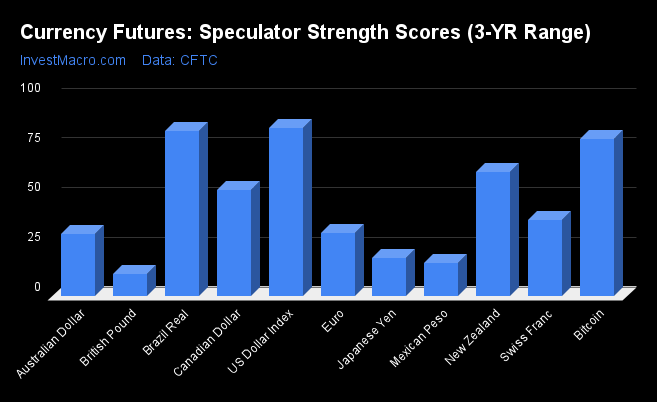
Strength Scores (a normalized measure of Speculator positions over a 3-Year range, from 0 to 100 where above 80 is extreme bullish and below 20 is extreme bearish) showed that the US Dollar Index (89.4 percent) leads the currency markets scores currently and is in a bullish extreme position (above 80 percent). Bitcoin (76.1 percent) comes in as the next highest in the currency markets in strength scores followed by the New Zealand Dollar (70.8 percent) and then the Canadian Dollar (63.2 percent). On the downside, the Mexican Peso (15.6 percent) continues to be the only currency in an extreme bearish level (below 20 percent). The next lowest strength scores are the EuroFX (24.4 percent), Australian Dollar (31.4 percent) and the Swiss Franc (31.7 percent).


Strength Statistics:
US Dollar Index (89.4 percent) vs US Dollar Index previous week (90.6 percent)
EuroFX (24.4 percent) vs EuroFX previous week (23.1 percent)
British Pound Sterling (45.1 percent) vs British Pound Sterling previous week (28.0 percent)
Japanese Yen (53.5 percent) vs Japanese Yen previous week (42.5 percent)
Swiss Franc (31.7 percent) vs Swiss Franc previous week (22.8 percent)
Canadian Dollar (63.2 percent) vs Canadian Dollar previous week (62.1 percent)
Australian Dollar (31.4 percent) vs Australian Dollar previous week (33.0 percent)
New Zealand Dollar (70.8 percent) vs New Zealand Dollar previous week (68.6 percent)
Mexican Peso (15.6 percent) vs Mexican Peso previous week (17.5 percent)
Brazil Real (52.1 percent) vs Brazil Real previous week (49.3 percent)
Bitcoin (76.1 percent) vs Bitcoin previous week (69.7 percent)

Strength Trends

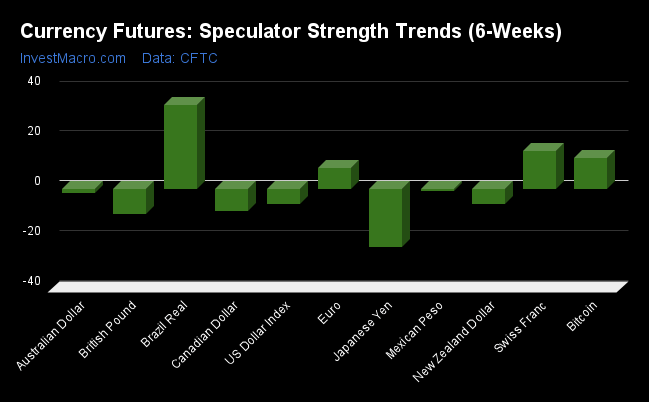
Strength Score Trends (or move index, calculates the 6-week changes in strength scores) showed that the Japanese Yen (17.0 percent) and the British Pound Sterling (14.5 percent) lead the past six weeks trends for the currency markets this week. The Canadian Dollar (13.6 percent) and the New Zealand Dollar (8.4 percent) fill out the only other positive movers in the latest trends data. The Brazil Real (-34.7 percent) leads the downside trend scores currently while the next market with lower trend scores were Bitcoin (-23.9 percent) followed by the Australian Dollar (-13.5 percent).


Strength Trend Statistics:
US Dollar Index (-7.7 percent) vs US Dollar Index previous week (-9.4 percent)
EuroFX (-7.3 percent) vs EuroFX previous week (-7.1 percent)
British Pound Sterling (14.5 percent) vs British Pound Sterling previous week (5.3 percent)
Japanese Yen (17.0 percent) vs Japanese Yen previous week (9.7 percent)
Swiss Franc (-3.0 percent) vs Swiss Franc previous week (-15.6 percent)
Canadian Dollar (13.6 percent) vs Canadian Dollar previous week (18.2 percent)
Australian Dollar (-13.5 percent) vs Australian Dollar previous week (-14.2 percent)
New Zealand Dollar (8.4 percent) vs New Zealand Dollar previous week (6.5 percent)
Mexican Peso (-5.8 percent) vs Mexican Peso previous week (1.6 percent)
Brazil Real (-34.7 percent) vs Brazil Real previous week (-44.7 percent)
Bitcoin (-23.9 percent) vs Bitcoin previous week (-29.6 percent)


Individual Markets:

US Dollar Index Futures:
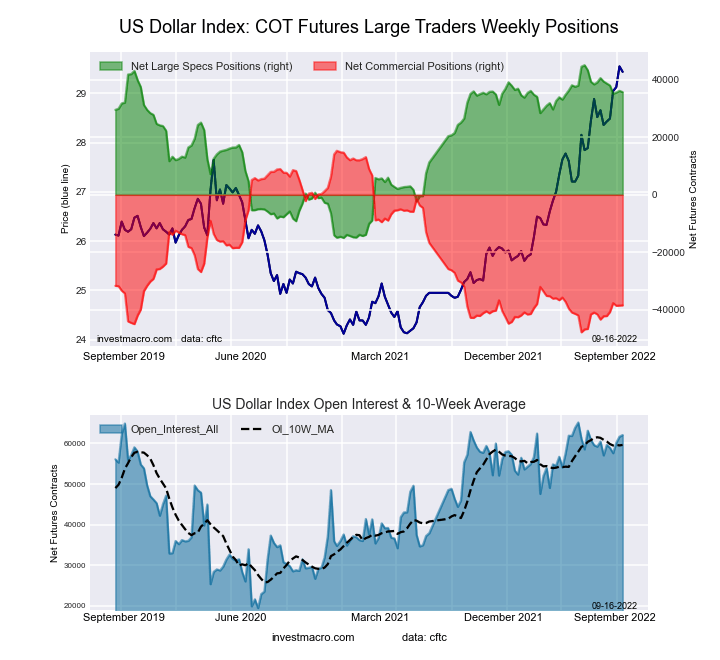
US Dollar Index Forex Futures COT ChartThe US Dollar Index large speculator standing this week resulted in a net position of 38,637 contracts in the data reported through Tuesday. This was a weekly decline of -710 contracts from the previous week which had a total of 39,347 net contracts.

This week’s current strength score (the trader positioning range over the past three years, measured from 0 to 100) shows the speculators are currently Bullish-Extreme with a score of 89.4 percent. The commercials are Bearish-Extreme with a score of 8.9 percent and the small traders (not shown in chart) are Bullish with a score of 54.4 percent.

US DOLLAR INDEX StatisticsSPECULATORSCOMMERCIALSSMALL TRADERS
– Percent of Open Interest Longs:85.13.59.2
– Percent of Open Interest Shorts:20.374.13.4
– Net Position:38,637-42,0993,462
– Gross Longs:50,7382,0795,481
– Gross Shorts:12,10144,1782,019
– Long to Short Ratio:4.2 to 10.0 to 12.7 to 1
NET POSITION TREND:
– Strength Index Score (3 Year Range Pct):89.48.954.4
– Strength Index Reading (3 Year Range):Bullish-ExtremeBearish-ExtremeBullish
NET POSITION MOVEMENT INDEX:
– 6-Week Change in Strength Index:-7.77.11.5


Euro Currency Futures:

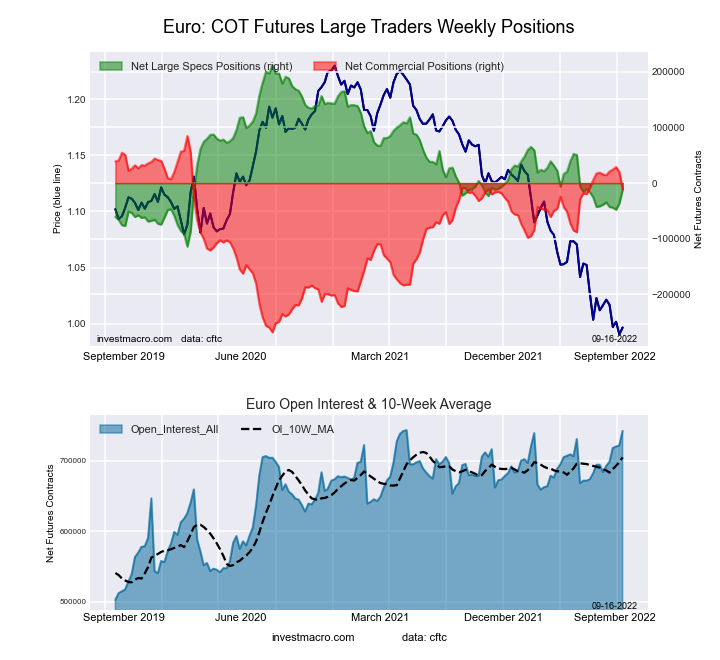
Euro Currency Futures COT ChartThe Euro Currency large speculator standing this week resulted in a net position of -34,536 contracts in the data reported through Tuesday. This was a weekly increase of 4,275 contracts from the previous week which had a total of -38,811 net contracts.

This week’s current strength score (the trader positioning range over the past three years, measured from 0 to 100) shows the speculators are currently Bearish with a score of 24.4 percent. The commercials are Bullish-Extreme with a score of 80.1 percent and the small traders (not shown in chart) are Bearish-Extreme with a score of 7.8 percent.

EURO Currency StatisticsSPECULATORSCOMMERCIALSSMALL TRADERS
– Percent of Open Interest Longs:28.957.011.4
– Percent of Open Interest Shorts:33.954.98.5
– Net Position:-34,53614,40220,134
– Gross Longs:200,088394,54378,944
– Gross Shorts:234,624380,14158,810
– Long to Short Ratio:0.9 to 11.0 to 11.3 to 1
NET POSITION TREND:
– Strength Index Score (3 Year Range Pct):24.480.17.8
– Strength Index Reading (3 Year Range):BearishBullish-ExtremeBearish-Extreme
NET POSITION MOVEMENT INDEX:
– 6-Week Change in Strength Index:-7.39.7-17.0


British Pound Sterling Futures:

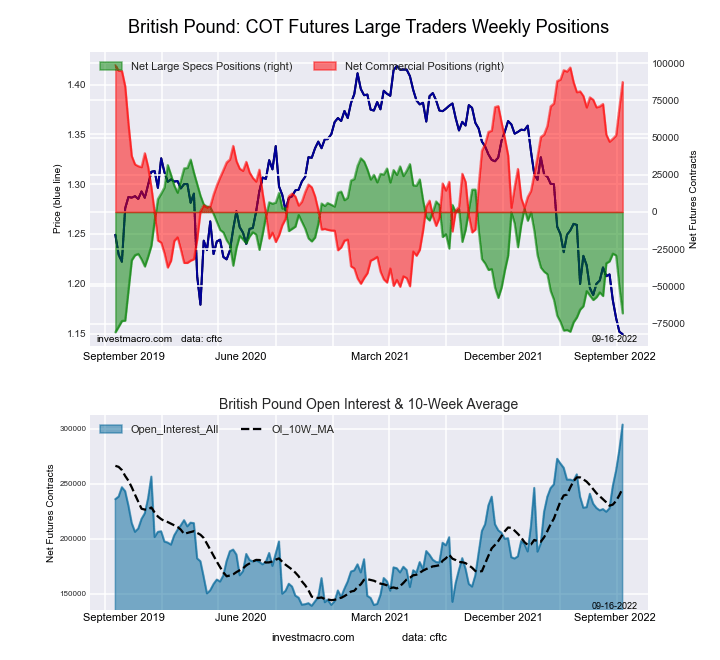
British Pound Sterling Futures COT ChartThe British Pound Sterling large speculator standing this week resulted in a net position of -34,468 contracts in the data reported through Tuesday. This was a weekly gain of 21,941 contracts from the previous week which had a total of -56,409 net contracts.

This week’s current strength score (the trader positioning range over the past three years, measured from 0 to 100) shows the speculators are currently Bearish with a score of 45.1 percent. The commercials are Bullish with a score of 61.6 percent and the small traders (not shown in chart) are Bearish-Extreme with a score of 19.2 percent.

BRITISH POUND StatisticsSPECULATORSCOMMERCIALSSMALL TRADERS
– Percent of Open Interest Longs:18.869.68.6
– Percent of Open Interest Shorts:34.146.416.4
– Net Position:-34,46852,050-17,582
– Gross Longs:42,219156,28219,243
– Gross Shorts:76,687104,23236,825
– Long to Short Ratio:0.6 to 11.5 to 10.5 to 1
NET POSITION TREND:
– Strength Index Score (3 Year Range Pct):45.161.619.2
– Strength Index Reading (3 Year Range):BearishBullishBearish-Extreme
NET POSITION MOVEMENT INDEX:
– 6-Week Change in Strength Index:14.5-10.9-1.0


Japanese Yen Futures:

Japanese Yen Forex Futures COT ChartThe Japanese Yen large speculator standing this week resulted in a net position of -25,032 contracts in the data reported through Tuesday. This was a weekly advance of 17,721 contracts from the previous week which had a total of -42,753 net contracts.

This week’s current strength score (the trader positioning range over the past three years, measured from 0 to 100) shows the speculators are currently Bullish with a score of 53.5 percent. The commercials are Bullish with a score of 53.7 percent and the small traders (not shown in chart) are Bearish with a score of 29.1 percent.

JAPANESE YEN StatisticsSPECULATORSCOMMERCIALSSMALL TRADERS
– Percent of Open Interest Longs:23.265.89.3
– Percent of Open Interest Shorts:34.349.414.6
– Net Position:-25,03236,994-11,962
– Gross Longs:52,333148,62820,978
– Gross Shorts:77,365111,63432,940
– Long to Short Ratio:0.7 to 11.3 to 10.6 to 1
NET POSITION TREND:
– Strength Index Score (3 Year Range Pct):53.553.729.1
– Strength Index Reading (3 Year Range):BullishBullishBearish
NET POSITION MOVEMENT INDEX:
– 6-Week Change in Strength Index:17.0-15.16.8


Swiss Franc Futures:

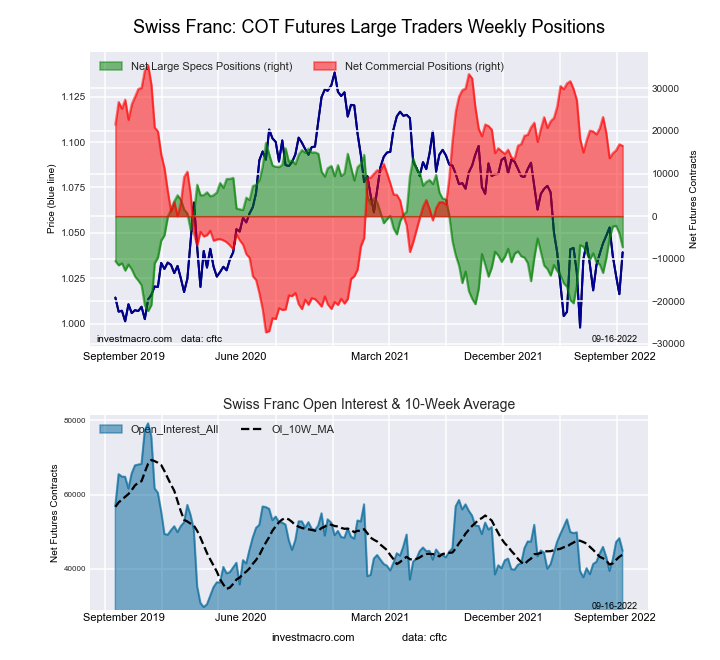
Swiss Franc Forex Futures COT ChartThe Swiss Franc large speculator standing this week resulted in a net position of -9,782 contracts in the data reported through Tuesday. This was a weekly gain of 3,526 contracts from the previous week which had a total of -13,308 net contracts.

This week’s current strength score (the trader positioning range over the past three years, measured from 0 to 100) shows the speculators are currently Bearish with a score of 31.7 percent. The commercials are Bullish with a score of 74.5 percent and the small traders (not shown in chart) are Bearish with a score of 24.7 percent.

SWISS FRANC StatisticsSPECULATORSCOMMERCIALSSMALL TRADERS
– Percent of Open Interest Longs:20.058.121.8
– Percent of Open Interest Shorts:42.613.044.2
– Net Position:-9,78219,464-9,682
– Gross Longs:8,63525,0849,414
– Gross Shorts:18,4175,62019,096
– Long to Short Ratio:0.5 to 14.5 to 10.5 to 1
NET POSITION TREND:
– Strength Index Score (3 Year Range Pct):31.774.524.7
– Strength Index Reading (3 Year Range):BearishBullishBearish
NET POSITION MOVEMENT INDEX:
– 6-Week Change in Strength Index:-3.02.6-1.4


Canadian Dollar Futures:

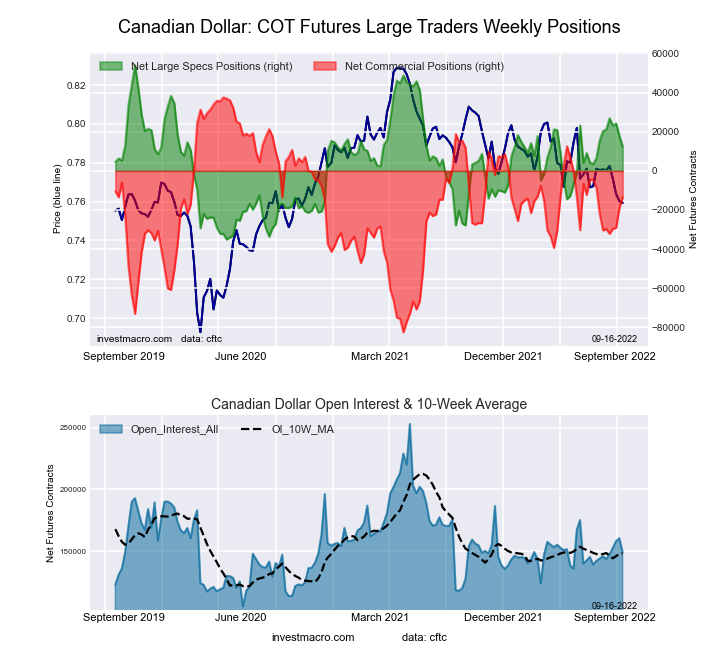
Canadian Dollar Forex Futures COT ChartThe Canadian Dollar large speculator standing this week resulted in a net position of 21,223 contracts in the data reported through Tuesday. This was a weekly increase of 946 contracts from the previous week which had a total of 20,277 net contracts.

This week’s current strength score (the trader positioning range over the past three years, measured from 0 to 100) shows the speculators are currently Bullish with a score of 63.2 percent. The commercials are Bearish with a score of 43.9 percent and the small traders (not shown in chart) are Bearish with a score of 47.2 percent.

CANADIAN DOLLAR StatisticsSPECULATORSCOMMERCIALSSMALL TRADERS
– Percent of Open Interest Longs:32.641.623.5
– Percent of Open Interest Shorts:17.962.317.6
– Net Position:21,223-29,7438,520
– Gross Longs:46,89859,79833,808
– Gross Shorts:25,67589,54125,288
– Long to Short Ratio:1.8 to 10.7 to 11.3 to 1
NET POSITION TREND:
– Strength Index Score (3 Year Range Pct):63.243.947.2
– Strength Index Reading (3 Year Range):BullishBearishBearish
NET POSITION MOVEMENT INDEX:
– 6-Week Change in Strength Index:13.6-14.610.8


Australian Dollar Futures:

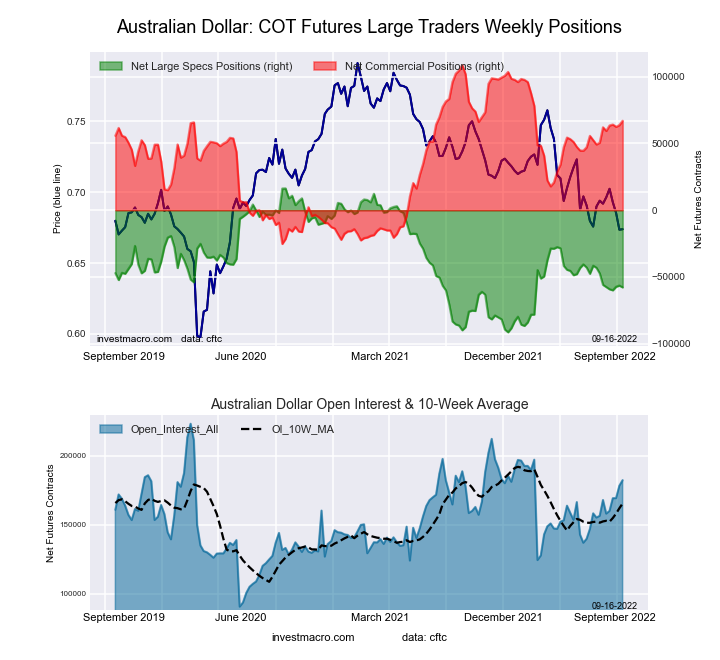
Australian Dollar Forex Futures COT ChartThe Australian Dollar large speculator standing this week resulted in a net position of -57,588 contracts in the data reported through Tuesday. This was a weekly decline of -1,638 contracts from the previous week which had a total of -55,950 net contracts.

This week’s current strength score (the trader positioning range over the past three years, measured from 0 to 100) shows the speculators are currently Bearish with a score of 31.4 percent. The commercials are Bullish with a score of 63.2 percent and the small traders (not shown in chart) are Bearish with a score of 47.9 percent.

AUSTRALIAN DOLLAR StatisticsSPECULATORSCOMMERCIALSSMALL TRADERS
– Percent of Open Interest Longs:16.269.312.3
– Percent of Open Interest Shorts:52.631.713.4
– Net Position:-57,58859,441-1,853
– Gross Longs:25,644109,59319,378
– Gross Shorts:83,23250,15221,231
– Long to Short Ratio:0.3 to 12.2 to 10.9 to 1
NET POSITION TREND:
– Strength Index Score (3 Year Range Pct):31.463.247.9
– Strength Index Reading (3 Year Range):BearishBullishBearish
NET POSITION MOVEMENT INDEX:
– 6-Week Change in Strength Index:-13.59.25.7


New Zealand Dollar Futures:

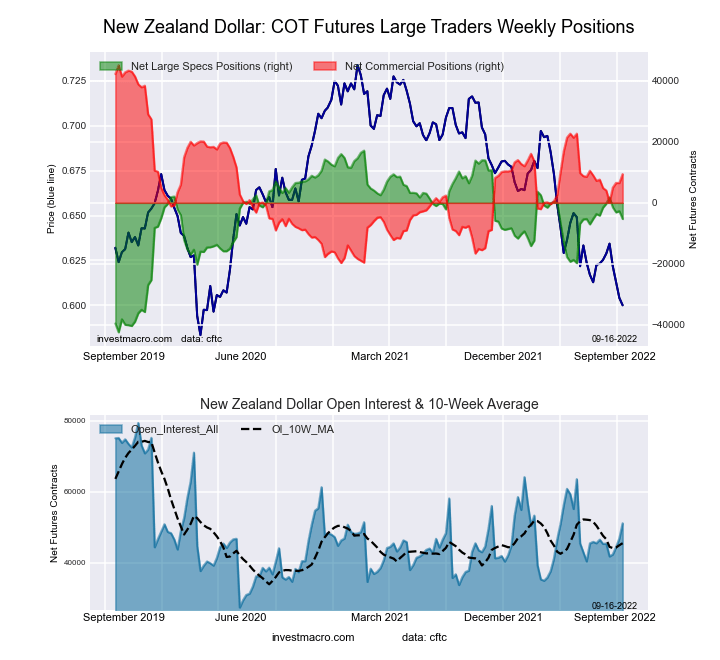
New Zealand Dollar Forex Futures COT ChartThe New Zealand Dollar large speculator standing this week resulted in a net position of -276 contracts in the data reported through Tuesday. This was a weekly advance of 1,297 contracts from the previous week which had a total of -1,573 net contracts.

This week’s current strength score (the trader positioning range over the past three years, measured from 0 to 100) shows the speculators are currently Bullish with a score of 70.8 percent. The commercials are Bearish with a score of 36.6 percent and the small traders (not shown in chart) are Bearish-Extreme with a score of 8.3 percent.

NEW ZEALAND DOLLAR StatisticsSPECULATORSCOMMERCIALSSMALL TRADERS
– Percent of Open Interest Longs:40.254.54.9
– Percent of Open Interest Shorts:40.845.513.2
– Net Position:-2764,044-3,768
– Gross Longs:18,22424,7002,239
– Gross Shorts:18,50020,6566,007
– Long to Short Ratio:1.0 to 11.2 to 10.4 to 1
NET POSITION TREND:
– Strength Index Score (3 Year Range Pct):70.836.68.3
– Strength Index Reading (3 Year Range):BullishBearishBearish-Extreme
NET POSITION MOVEMENT INDEX:
– 6-Week Change in Strength Index:8.4-6.9-6.1


Mexican Peso Futures:

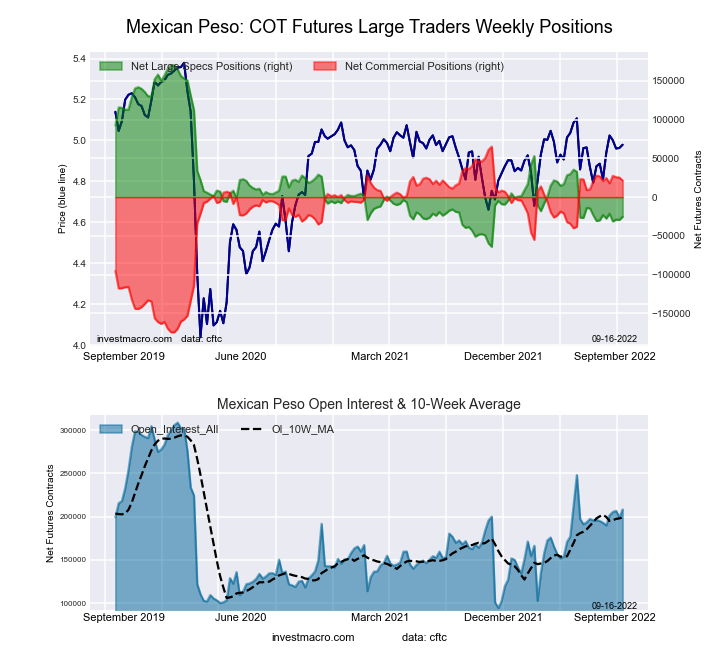
Mexican Peso Futures COT ChartThe Mexican Peso large speculator standing this week resulted in a net position of -27,621 contracts in the data reported through Tuesday. This was a weekly decline of -4,568 contracts from the previous week which had a total of -23,053 net contracts.

This week’s current strength score (the trader positioning range over the past three years, measured from 0 to 100) shows the speculators are currently Bearish-Extreme with a score of 15.6 percent. The commercials are Bullish-Extreme with a score of 83.1 percent and the small traders (not shown in chart) are Bullish with a score of 55.3 percent.

MEXICAN PESO StatisticsSPECULATORSCOMMERCIALSSMALL TRADERS
– Percent of Open Interest Longs:50.346.33.2
– Percent of Open Interest Shorts:64.833.31.6
– Net Position:-27,62124,7222,899
– Gross Longs:95,57288,0365,991
– Gross Shorts:123,19363,3143,092
– Long to Short Ratio:0.8 to 11.4 to 11.9 to 1
NET POSITION TREND:
– Strength Index Score (3 Year Range Pct):15.683.155.3
– Strength Index Reading (3 Year Range):Bearish-ExtremeBullish-ExtremeBullish
NET POSITION MOVEMENT INDEX:
– 6-Week Change in Strength Index:-5.86.5-8.4


Brazilian Real Futures:

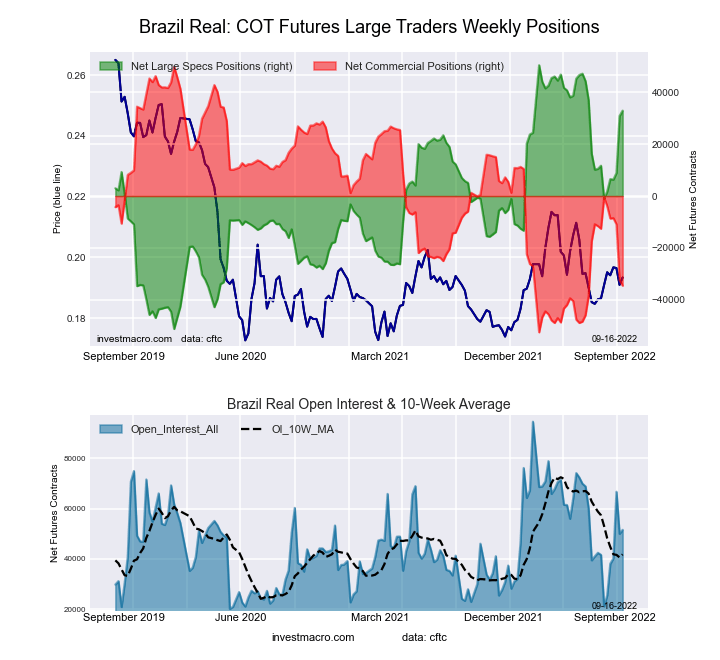
Brazil Real Futures COT ChartThe Brazilian Real large speculator standing this week resulted in a net position of 1,733 contracts in the data reported through Tuesday. This was a weekly rise of 2,863 contracts from the previous week which had a total of -1,130 net contracts.

This week’s current strength score (the trader positioning range over the past three years, measured from 0 to 100) shows the speculators are currently Bullish with a score of 52.1 percent. The commercials are Bearish with a score of 47.5 percent and the small traders (not shown in chart) are Bullish-Extreme with a score of 90.0 percent.

BRAZIL REAL StatisticsSPECULATORSCOMMERCIALSSMALL TRADERS
– Percent of Open Interest Longs:53.533.113.4
– Percent of Open Interest Shorts:46.748.44.9
– Net Position:1,733-3,8842,151
– Gross Longs:13,6358,4403,405
– Gross Shorts:11,90212,3241,254
– Long to Short Ratio:1.1 to 10.7 to 12.7 to 1
NET POSITION TREND:
– Strength Index Score (3 Year Range Pct):52.147.590.0
– Strength Index Reading (3 Year Range):BullishBearishBullish-Extreme
NET POSITION MOVEMENT INDEX:
– 6-Week Change in Strength Index:-34.733.87.6


Bitcoin Futures:

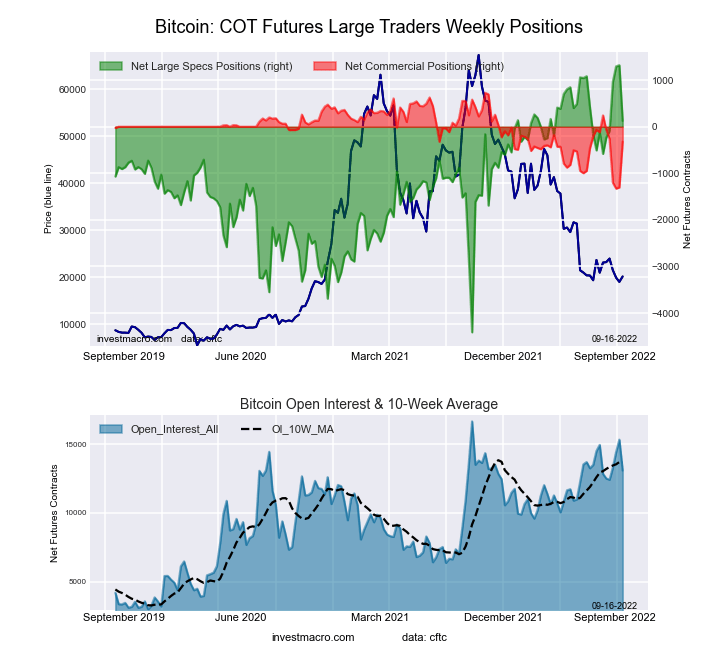
Bitcoin Crypto Futures COT ChartThe Bitcoin large speculator standing this week resulted in a net position of -230 contracts in the data reported through Tuesday. This was a weekly lift of 351 contracts from the previous week which had a total of -581 net contracts.

This week’s current strength score (the trader positioning range over the past three years, measured from 0 to 100) shows the speculators are currently Bullish with a score of 76.1 percent. The commercials are Bullish with a score of 53.6 percent and the small traders (not shown in chart) are Bearish-Extreme with a score of 19.8 percent.

BITCOIN StatisticsSPECULATORSCOMMERCIALSSMALL TRADERS
– Percent of Open Interest Longs:74.33.58.3
– Percent of Open Interest Shorts:76.14.15.9
– Net Position:-230-71301
– Gross Longs:9,2944391,034
– Gross Shorts:9,524510733
– Long to Short Ratio:1.0 to 10.9 to 11.4 to 1
NET POSITION TREND:
– Strength Index Score (3 Year Range Pct):76.153.619.8
– Strength Index Reading (3 Year Range):BullishBullishBearish-Extreme
NET POSITION MOVEMENT INDEX:
– 6-Week Change in Strength Index:-23.950.810.0


Article By InvestMacroReceive our weekly COT Reports by Email

*COT Report: The COT data, released weekly to the public each Friday, is updated through the most recent Tuesday (data is 3 days old) and shows a quick view of how large speculators or non-commercials (for-profit traders) were positioned in the futures markets.

The CFTC categorizes trader positions according to commercial hedgers (traders who use futures contracts for hedging as part of the business), non-commercials (large traders who speculate to realize trading profits) and nonreportable traders (usually small traders/speculators) as well as their open interest (contracts open in the market at time of reporting).See CFTC criteria here.

Gold & Silver Large Speculator bets continue to gain after falling to multi-year lows

By InvestMacro | COT | Data Tables | COT Leaders | Downloads | COT Newsletter

Here are the latest charts and statistics for the Commitment of Traders (COT) data published by the Commodities Futures Trading Commission (CFTC).

The latest COT data is updated through Tuesday August 9th and shows a quick view of how large traders (for-profit speculators and commercial entities) were positioned in the futures markets.

Weekly Speculator Changes

COT precious metals speculator bets were higher again this week as five out of the five metals markets we cover had higher positioning this week while just one market had lower weekly contracts.

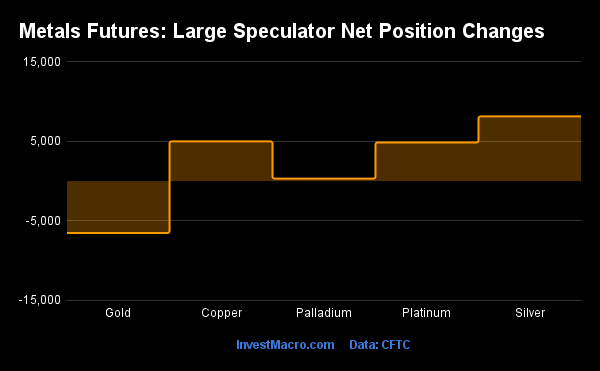
Leading the gains for the precious metals markets was Gold (18,525 contracts) with Platinum (3,387 contracts), Silver (1,905 contracts) and Palladium (590 contracts) also showing positive weeks.

The only metals markets with a decline in speculator bets this week was Copper with a decrease of -1,071 contracts.

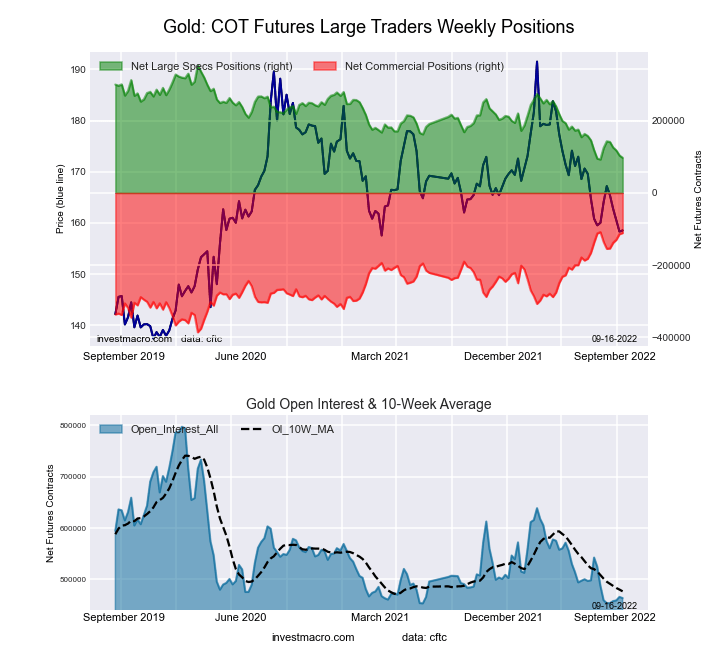
Highlighting the COT metals changes this week is the strong rebound in Gold speculator bets over the past two weeks. This week’s +18,525 contract rise followed last week’s +31,636 contract jump for a two-week gain of approximately +50,000 contracts. This positive speculator sentiment has pushed the Gold bullish level to the highest of the past five weeks. Previously on July 26th, the Gold speculator level had fallen to the lowest level in one hundred and sixty-five weeks, dating back to May 28th of 2019 and near the height of the COVID-19 pandemic panic when most markets were going haywire. The Gold futures price has been on the rebound as well after hitting a recent low near $1,678.50 on July 21st. The Gold price has had four straight positive weeks and closed out this week near the $1,815.50 level.

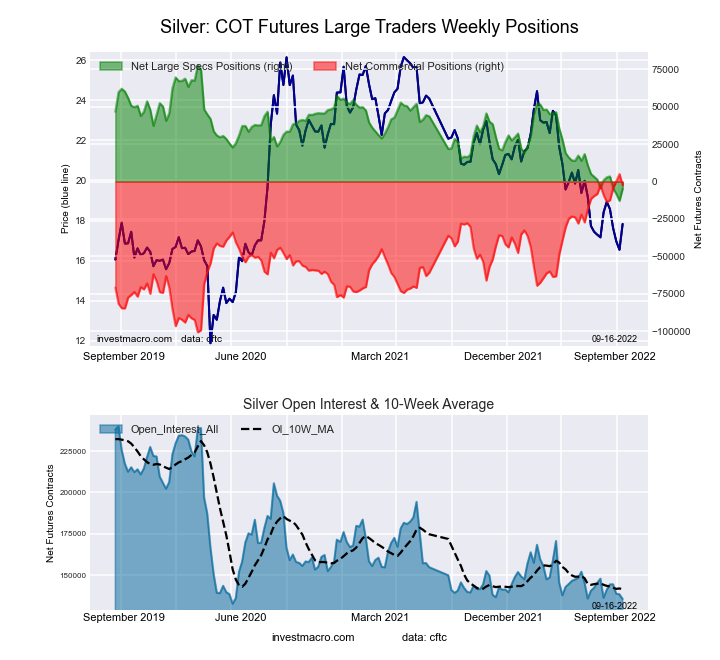
Silver speculator contracts rose this week for a second consecutive week and rose a little further away from bearish territory. The Silver speculator positions had previously dropped into bearish territory on July 26th, a rare occurrence and the first time it has happened since June 4th of 2019 (a span of 164 weeks). Silver bets have seen a modest rebound over the past two weeks while the Silver futures price has risen in two out of the past three weeks. Silver is back above the $20 threshold after bouncing off the $18 level for a few weeks in July.


Data Snapshot of Commodity Market Traders | Columns Legend
Aug-09-2022OIOI-IndexSpec-NetSpec-IndexCom-NetCOM-IndexSmalls-NetSmalls-Index
WTI Crude1,570,1310210,6510-238,07310027,42253
Gold453,5400142,85119-154,5548311,7031
Silver141,09382,8799-13,5748910,69521
Copper187,98821-28,4772227,7007877730
Palladium7,6196-1,970122,04486-7440
Platinum62,782268469-4,055933,2097
Natural Gas969,5823-125,4194186,7345838,68572
Brent175,89621-34,2115432,411471,80034
Heating Oil283,7492924,46478-36,4723212,00840
Soybeans583,208288,90141-62,97165-25,93027
Corn1,317,9131210,78657-160,65449-50,13214
Coffee209,4461330,45365-31,268418157
Sugar765,6691226,06542-30,608624,54313
Wheat320,76714-3,426159,93974-6,51377


Strength Scores

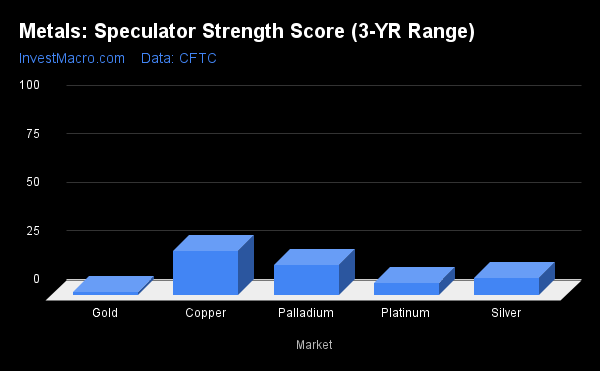
Strength scores (a measure of the 3-Year range of Speculator positions, from 0 to 100 where above 80 is extreme bullish and below 20 is extreme bearish) showed that Copper (21.9 percent) continues to be the leader in strength scores but is at a very low level. The rest of the metals all remain in a bearish extreme position (below 20 percent) and have been there for many consecutive weeks. Despite the persistent weak sentiment, all metals except Copper have started seeing improvements week-over-week with Gold rising by 7.1 percent this week.

Strength Statistics:
Gold (19.2 percent) vs Gold previous week (12.1 percent)
Silver (9.0 percent) vs Silver previous week (6.6 percent)
Copper (21.9 percent) vs Copper previous week (22.6 percent)
Platinum (9.2 percent) vs Platinum previous week (4.6 percent)
Palladium (11.7 percent) vs Palladium previous week (8.4 percent)

Strength Trends

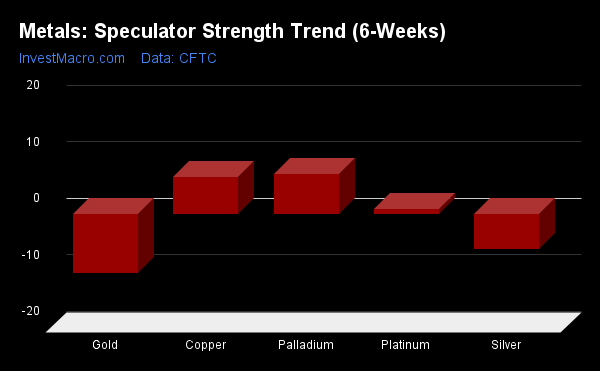
Strength Score Trends (or move index, calculates the 6-week changes in strength scores) showed that the Palladium (10.4 percent) leads the past six weeks trends for metals this week. Platinum (2.9 percent) and Copper (1.6 percent) fill out the other positive movers in the latest trends data. Silver (-9.7 percent) leads the downside trend scores currently but is improving compared to last week’s -21.2 percent trend. Gold is at -5.7 percent this week and also has improved compared to last week’s -14.9 percent trend score.


Strength Trends Statistics:
Gold (-5.7 percent) vs Gold previous week (-14.9 percent)
Silver (-9.7 percent) vs Silver previous week (-21.2 percent)
Copper (1.6 percent) vs Copper previous week (-4.7 percent)
Platinum (2.9 percent) vs Platinum previous week (-5.5 percent)
Palladium (10.4 percent) vs Palladium previous week (8.4 percent)


Individual Markets:

Gold Comex Futures:

Gold Futures COT ChartThe Gold Comex Futures large speculator standing this week resulted in a net position of 142,851 contracts in the data reported through Tuesday. This was a weekly advance of 18,525 contracts from the previous week which had a total of 124,326 net contracts.

This week’s current strength score (the trader positioning range over the past three years, measured from 0 to 100) shows the speculators are currently Bearish-Extreme with a score of 19.2 percent. The commercials are Bullish-Extreme with a score of 83.4 percent and the small traders (not shown in chart) are Bearish-Extreme with a score of 1.3 percent.

Gold Futures StatisticsSPECULATORSCOMMERCIALSSMALL TRADERS
– Percent of Open Interest Longs:53.626.98.4
– Percent of Open Interest Shorts:22.161.05.8
– Net Position:142,851-154,55411,703
– Gross Longs:242,906121,98037,927
– Gross Shorts:100,055276,53426,224
– Long to Short Ratio:2.4 to 10.4 to 11.4 to 1
NET POSITION TREND:
– Strength Index Score (3 Year Range Pct):19.283.41.3
– Strength Index Reading (3 Year Range):Bearish-ExtremeBullish-ExtremeBearish-Extreme
NET POSITION MOVEMENT INDEX:
– 6-Week Change in Strength Index:-5.79.9-34.5


Silver Comex Futures:

Silver Futures COT ChartThe Silver Comex Futures large speculator standing this week resulted in a net position of 2,879 contracts in the data reported through Tuesday. This was a weekly advance of 1,905 contracts from the previous week which had a total of 974 net contracts.

This week’s current strength score (the trader positioning range over the past three years, measured from 0 to 100) shows the speculators are currently Bearish-Extreme with a score of 9.0 percent. The commercials are Bullish-Extreme with a score of 88.9 percent and the small traders (not shown in chart) are Bearish with a score of 20.8 percent.

Silver Futures StatisticsSPECULATORSCOMMERCIALSSMALL TRADERS
– Percent of Open Interest Longs:34.640.317.1
– Percent of Open Interest Shorts:32.649.99.5
– Net Position:2,879-13,57410,695
– Gross Longs:48,86456,87624,122
– Gross Shorts:45,98570,45013,427
– Long to Short Ratio:1.1 to 10.8 to 11.8 to 1
NET POSITION TREND:
– Strength Index Score (3 Year Range Pct):9.088.920.8
– Strength Index Reading (3 Year Range):Bearish-ExtremeBullish-ExtremeBearish
NET POSITION MOVEMENT INDEX:
– 6-Week Change in Strength Index:-9.75.015.1


Copper Grade #1 Futures:

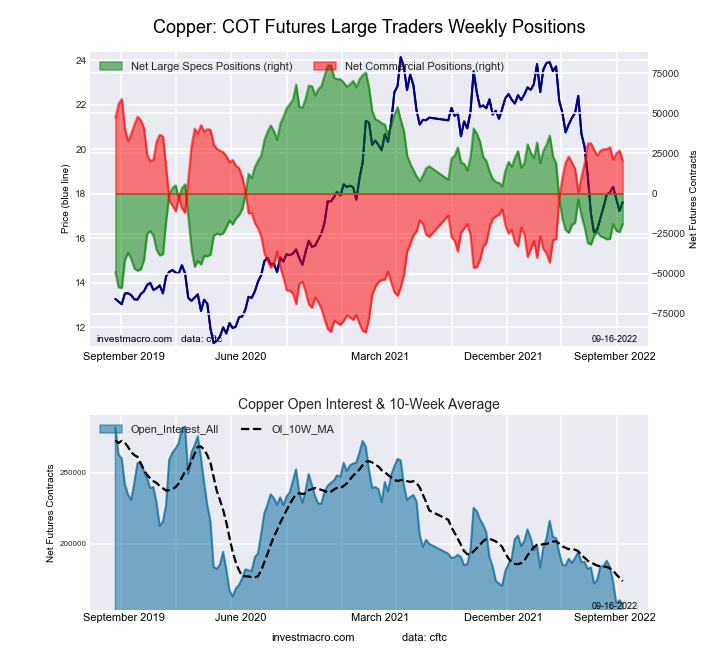
Copper Futures COT ChartThe Copper Grade #1 Futures large speculator standing this week resulted in a net position of -28,477 contracts in the data reported through Tuesday. This was a weekly reduction of -1,071 contracts from the previous week which had a total of -27,406 net contracts.

This week’s current strength score (the trader positioning range over the past three years, measured from 0 to 100) shows the speculators are currently Bearish with a score of 21.9 percent. The commercials are Bullish with a score of 78.5 percent and the small traders (not shown in chart) are Bearish with a score of 29.8 percent.

Copper Futures StatisticsSPECULATORSCOMMERCIALSSMALL TRADERS
– Percent of Open Interest Longs:26.345.37.9
– Percent of Open Interest Shorts:41.530.57.5
– Net Position:-28,47727,700777
– Gross Longs:49,47785,08514,822
– Gross Shorts:77,95457,38514,045
– Long to Short Ratio:0.6 to 11.5 to 11.1 to 1
NET POSITION TREND:
– Strength Index Score (3 Year Range Pct):21.978.529.8
– Strength Index Reading (3 Year Range):BearishBullishBearish
NET POSITION MOVEMENT INDEX:
– 6-Week Change in Strength Index:1.6-2.47.4


Platinum Futures:

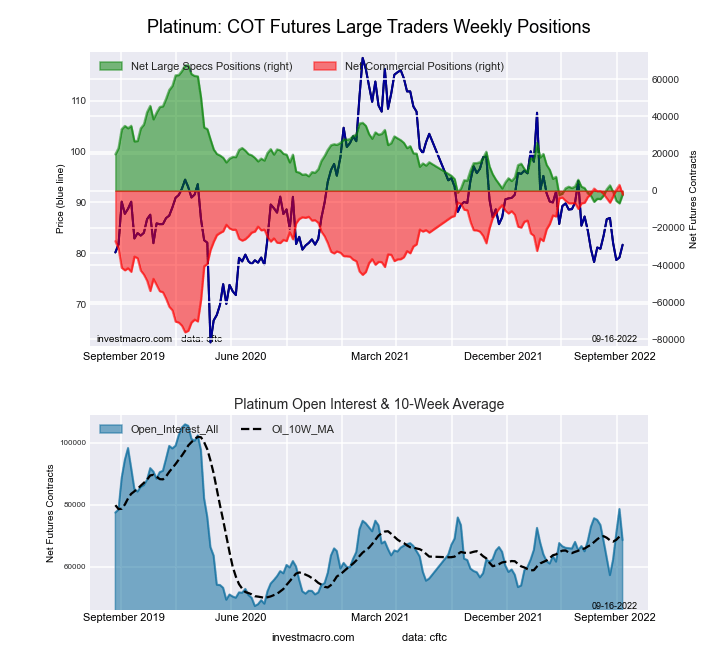
Platinum Futures COT ChartThe Platinum Futures large speculator standing this week resulted in a net position of 846 contracts in the data reported through Tuesday. This was a weekly increase of 3,387 contracts from the previous week which had a total of -2,541 net contracts.

This week’s current strength score (the trader positioning range over the past three years, measured from 0 to 100) shows the speculators are currently Bearish-Extreme with a score of 9.2 percent. The commercials are Bullish-Extreme with a score of 93.2 percent and the small traders (not shown in chart) are Bearish-Extreme with a score of 6.7 percent.

Platinum Futures StatisticsSPECULATORSCOMMERCIALSSMALL TRADERS
– Percent of Open Interest Longs:44.238.910.8
– Percent of Open Interest Shorts:42.945.45.7
– Net Position:846-4,0553,209
– Gross Longs:27,75424,4506,803
– Gross Shorts:26,90828,5053,594
– Long to Short Ratio:1.0 to 10.9 to 11.9 to 1
NET POSITION TREND:
– Strength Index Score (3 Year Range Pct):9.293.26.7
– Strength Index Reading (3 Year Range):Bearish-ExtremeBullish-ExtremeBearish-Extreme
NET POSITION MOVEMENT INDEX:
– 6-Week Change in Strength Index:2.9-0.9-20.7


Palladium Futures:

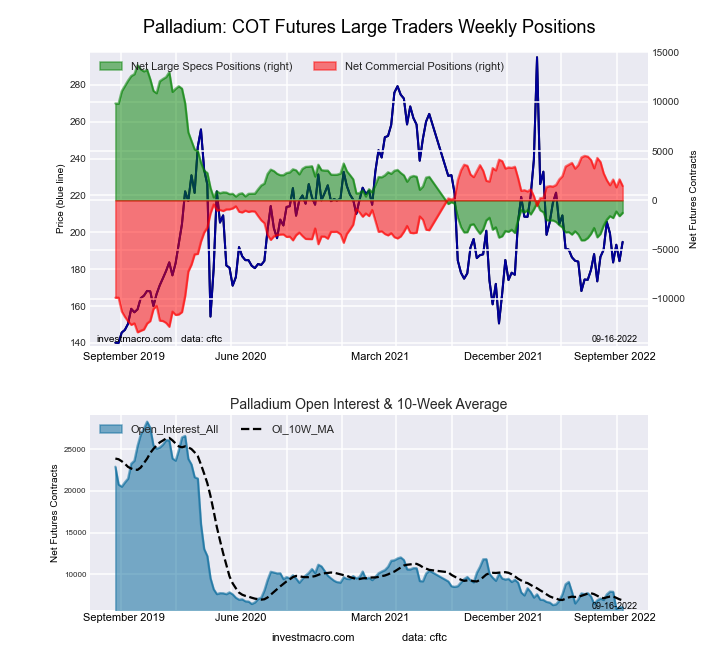
Palladium Futures COT ChartThe Palladium Futures large speculator standing this week resulted in a net position of -1,970 contracts in the data reported through Tuesday. This was a weekly lift of 590 contracts from the previous week which had a total of -2,560 net contracts.

This week’s current strength score (the trader positioning range over the past three years, measured from 0 to 100) shows the speculators are currently Bearish-Extreme with a score of 11.7 percent. The commercials are Bullish-Extreme with a score of 86.2 percent and the small traders (not shown in chart) are Bearish with a score of 39.6 percent.

Palladium Futures StatisticsSPECULATORSCOMMERCIALSSMALL TRADERS
– Percent of Open Interest Longs:17.558.815.6
– Percent of Open Interest Shorts:43.332.016.6
– Net Position:-1,9702,044-74
– Gross Longs:1,3314,4821,191
– Gross Shorts:3,3012,4381,265
– Long to Short Ratio:0.4 to 11.8 to 10.9 to 1
NET POSITION TREND:
– Strength Index Score (3 Year Range Pct):11.786.239.6
– Strength Index Reading (3 Year Range):Bearish-ExtremeBullish-ExtremeBearish
NET POSITION MOVEMENT INDEX:
– 6-Week Change in Strength Index:10.4-13.431.4


Article By InvestMacroReceive our weekly COT Reports by Email

*COT Report: The COT data, released weekly to the public each Friday, is updated through the most recent Tuesday (data is 3 days old) and shows a quick view of how large speculators or non-commercials (for-profit traders) were positioned in the futures markets.

The CFTC categorizes trader positions according to commercial hedgers (traders who use futures contracts for hedging as part of the business), non-commercials (large traders who speculate to realize trading profits) and nonreportable traders (usually small traders/speculators) as well as their open interest (contracts open in the market at time of reporting).See CFTC criteria here.


Women are better at statistics than they think

By Jonathan B. Santo, University of Nebraska Omaha and Kelly Rhea MacArthur, University of Nebraska Omaha 

The Research Brief is a short take about interesting academic work.

The big idea

Women in statistics classes do better academically than men over a semester despite having more negative attitudes regarding their own abilities, according to our recent study in the Journal of Statistics and Data Science Education.

Using data from more than 100 male and female students from multiple statistics classes, my colleague and I assessed gender differences in grades over the course of a semester. As part of the study, students also answered surveys at the start and end of the semester that measured six different things: their fear of statistics teachers in general; their thoughts about the usefulness of statistics; their perceptions of their own mathematical ability; their anxiety in taking tests; their anxiety in interpreting statistics; and their fear of asking for help.

Overall, we found that students with more negative perceptions of their own mathematical ability had lower grades over the course of the semester. What’s even more interesting are the gender differences that emerged.

Even though men and women scored similarly on exams at the start of the semester, women finished the semester with almost 10% higher final exam grades. This was the case even though women had significantly worse attitudes about their mathematical abilities at the start of the semester than their male counterparts.

At the beginning of the semester specifically, women were more likely to rate their mathematical abilities as lower than men in the class and report more anxiety toward exams and toward interpreting statistical findings. However, each of these self-assessments improved over the course of the semester such that women’s attitudes didn’t differ from men’s by the end.

Meanwhile, the grades of male students who reported fear of statistics teachers or fear of asking for help decreased more sharply over the course of the semester. For men whose attitudes improved during the semester, grades also improved – though not as much as women’s grades improved.

line graph showing association of fear of asking for help and grades among men and women over the course of a semester
Figure reflecting the effect of fear of asking for help and its change over time among women and men. Average grades decreased overall across the semester, likely because of coursework getting more challenging over time.
Jonathan Santo, Author provided

Why it matters

A number of studies have shown that from an early age, boys and girls learn math equally well.

However, girls are less likely to be called on in math classes than boys, even when they raise their hands as much as boys do. Moreover, some teachers unconsciously grade girls’ math tests more harshly than boys’. By middle school, gender differences in math scores emerge. These factors may contribute to adult women’s being more likely to rate themselves as less mathematically skilled than men. As a result, women are also less likely to pursue STEM – science, technology, engineering and math – occupations.

The results from our study, in line with others, bolster the notion that women have the potential to do as well as men, and even better, in STEM fields, such as statistics. We contend that women would benefit from additional mentoring to encourage them as they begin pursuing STEM-related education.

Undergraduate students at the University of Nebraska Omaha collaborate on a group assignment for a STEM course.
Derrick Nero, University of Nebraska Omaha, CC BY-NC-ND

What still isn’t known

The evidence above provides hints at some of the causes of the gender discrepancy in perceived ability. However, there is much we still don’t know.

For example, why did the attitudes of the women in our study improve over time? Was it based on their confidence in their abilities as their grades improved, or did their statistics teachers influence their perception of their own abilities over time?

More research is needed to understand exactly how women differed from men in their attitudes over the course of the school semester, among other questions. In particular, we’d like to disentangle exactly which classroom or instructor factors can lead to better attitudes among students, ultimately translating to better grades.The Conversation

About the Author:

Jonathan B. Santo, Professor of Psychology, University of Nebraska Omaha and Kelly Rhea MacArthur, Associate Professor of Sociology, University of Nebraska Omaha

This article is republished from The Conversation under a Creative Commons license. Read the original article.


China-US tensions: how global trade began splitting into two blocs

By ManMohan S Sodhi, City, University of London and Christopher S. Tang, University of California, Los Angeles 

Speaker Nancy Pelosi’s visit to Taiwan has elicited a strong response from China: three days of simulated attack on Taiwan with further drills announced, plus a withdrawal from critical ongoing conversations with the US on climate change and the military.

This strong reaction was predictable. President Xi had earlier warned President Biden not “to play with fire”. Of course, if Pelosi’s visit hadn’t gone ahead, the Biden administration would have faced a strong reaction from both parties in Congress for not standing up to China’s threat to Taiwan or human rights issues regarding Tibet and Xinjiang, not to mention Hong Kong.

So where does it leave trade between the world’s two leading powers?

How business trumped ideology

Consider the not-too-distant past. The US supported the Republic of China against Japan in the Pacific war of 1941-45. When the Chinese leadership fled to Taiwan in 1949 following the victory of Mao Zedong’s communists in the Chinese civil war, Washington continued to recognise the exiled regime as China’s legitimate government, blocking the People’s Republic of China (PRC) from joining the United Nations.

This shifted in 1972 following President Nixon’s historic visit to China (in a move to isolate the Soviets). The US now recognised the PRC as China’s sole government and accepted its One China policy. It downgraded its Taiwan relations to merely informal, while affirming a peaceful settlement to the mainland communists’ claim that this was a breakaway province that had to be assimilated.

Mao Zedong shakes hands with a smiling Richard Nixon.
President Richard Nixon meeting Chairman Mao Zedong in Peking (Beijing) in 1972.
manhhai, CC BY-SA

This opened US-China trade, ending a US trade embargo in place since the 1940s. Economic ties proliferated in the 1980s under Mao’s eventual successor, Deng Xiaoping, helping the Chinese economy to multiply while the US enjoyed lower consumer prices and a stronger stock market.

Western manufacturing firms either outsourced to Chinese firms or set up operations themselves. They benefited from cheaper production and – for those outsourcing – not having to own factories or deal with labour issues. In turn, the Chinese gained tremendous manufacturing capability.

As China’s middle class grew wealthier, the country became a major target consumer market for US firms such as Apple and GM. The Chinese authorities insisted this was done through local partner firms, transferring technology in the process and further enhancing the nation’s manufacturing know-how.

The growing Chinese threat

China and the US captured more than half the growth in GDP across the world from 1980 to 2020. US GDP grew nearly five times from US$4.4 trillion (£3.6 trillion) to US$20.9 trillion (£17.3 trillion) in today’s money, while China’s grew from US$310 billion to US$14.7 trillion.

China is now the second largest economy, although the IMF, World Bank and CIA consider it the largest once purchasing power is taken into account (see chart below). The US is still well ahead on per capita income (US$69,231 vs US$12,359 in 2021), though China’s is now that of a “developed” country, having lifted 800 million people out of poverty in the process.

The US has become increasingly concerned about China’s faster economic growth and the fact that the US buys much more from its rival than the other way around. This drove the big decline in US domestic manufacturing that famously helped Donald Trump to win the US presidency.

Chinese and US GDP based on purchasing power parity 1990-2021

Graph showing Chinese and US GDP on a PPP basis.
World Bank

Equally, the rivalry has extended to other areas as China has sought a leading role on the world stage. Both nations are nuclear powers, although the Chinese military has only 350 nuclear warheads to America’s 5,500.

China has a larger navy, with some 360 battle force ships compared to the US 297, although China’s are mostly smaller – only three aircraft carriers compared to America’s 11, for example. The two countries are also competing in space to bring astronauts to the Moon and establish the first lunar base.

All this has threatened American dominance, while President Xi has also been much more forthright both domestically and internationally than any Chinese leader since Mao. The US has gradually become more hostile, starting with President Obama’s pivot towards other Asian nations in 2016 and then President Trump’s public complaints and eventual sanctioning of China’s “unfair” trade practices.

Trump imposed extra tariffs on goods imported from China in 2018 and restricted China’s access to various semiconductor manufacturing technologies in 2020, while the Chinese responded with countermeasures along the way.

When President Biden took office in 2021, he began highlighting long-simmering complaints about human rights issues in Xinjiang and the threat to Taiwan (while still endorsing the One China Policy). He also imposed sanctions on certain Chinese companies of a kind not been seen since the Mao-era trade embargo.

US trade in goods to China 2011-21

Graph showing US trade in goods to China
Note the US trade in services to China is about one-tenth that of goods. In 2020 the US exported US$40 billion in services to China and imported US$16 billion.
Statista

Biden also banned goods from China’s Xinjiang region on the grounds of forced labour in 2022, affecting the purchasing of goods by many western companies. China reportedly moved workers to other parts of the country to enable western companies to keep purchasing.

Bipolarity is back

COVID-19 further increased the distance between the two countries. After China’s zero COVID policy helped to disrupt supply chains and cause product shortages, the Biden administration began calling for reduced dependency on its rival.

US firms have duly been restructuring their supply chains. In June, Apple moved some iPad production from China to Vietnam, albeit also because of growing demand in south-east Asia.

Near-shoring to Mexico is gaining momentum. Apple manufacturers Foxconn and Pegatron are considering producing iPhones for North America in Mexico rather than China to take advantage of lower labour costs and the free-trade agreement between the US and Mexico.

Two global blocs are increasingly emerging, with US treasury secretary Janet Yellen in April calling for “friend-shoring” with trusted partners, dividing countries into friends or foes. The Biden administration announced at the June G7 meeting a new “Partnership for Global Infrastructure and Investment”. Aiming to mobilise US$600 billion in investments over five years, this is an overture to various developing countries already being courted by China under its similar Belt and Road Initiative.

Days earlier, China had hosted the annual BRICS summit, which includes Brazil, Russia, India and South Africa. It welcomed leaders from 13 other countries: Algeria, Argentina, Egypt, Indonesia, Iran, Kazakhstan, Senegal, Uzbekistan, Cambodia, Ethiopia, Fiji, Malaysia and Thailand. Xi urged the summit to build a “global community of security” based on multilateral cooperation. Iran and Argentina have since applied to join the bloc.

We are already seeing what bipolarity will mean for vital components and commodities. In nanochips, the US is leading a “chips 4” pact with Japan, Taiwan and possible South Korea to develop next-generation technologies and manufacturing capacity. China is investing US$1.4 trillion between 2020 and 2025 in a bid to become self-reliant in this technology.

Another big issue is cobalt, which is essential for making lithium batteries for electric vehicles. To secure supply from the Democratic Republic of the Congo, which produces 70% of world reserves, China has navigated Congolese politics, lobbying powerful politicians in mining regions. By 2020, Chinese firms owned or had a stake in 15 of the DRC’s 19 cobalt-producing mines.

As China hoards cobalt supplies, the US seeks alternatives. GM is developing its Ultium battery cell, which needs 70% less cobalt than today’s batteries, while Oak Ridge National Laboratory is developing a battery that doesn’t need the metal at all.

Silver linings

As US-China relations have moved from building bridges in 1972 to building walls in 2022, countries will increasingly be forced to choose sides and companies will have to plan supply chains accordingly. Those seeking to trade in both blocs will need to “divisionalise”, running parallel operations.

American companies wanting to serve Chinese consumers will still need to manufacture in China or other nations within that bloc, while Chinese companies will need to do the same in reverse. Interestingly, Chinese companies have been rapidly buying farmland and agriculture-based companies in the US and elsewhere.

Yet though the new supply chains will almost certainly increase costs for western consumers and dampen China’s growth, there will be benefits. Supply chains should be more resilient to future crises and also more transparent, while reduced transportation (and reliance on Chinese coal) should cut carbon emissions. This should help to meet the UN Sustainable Development Goals on environmental and social sustainability.

The cobalt and nanochips examples also show how the US-China rivalry is catalysing innovation. And importantly, global trade will continue growing as countries depend on each other, even as trade links change.

It will certainly take time to find an equilibrium. It took years for the USSR and US to figure out how to co-exist without getting into direct military conflict. Hillary Clinton wrote in 2011 as Secretary of State that “there is no handbook for the evolving US-China relationship”, and that remains the case today.

At any rate, the businesses that thrive in this new environment will likely be those that plan for a divided world with divisional supply chains. The recent Taiwan row will probably not lead to direct military conflict; rather it will reinforce a trend that has been gathering momentum for a decade or more.The Conversation

About the Author:

ManMohan S Sodhi, Professor of Operations and Supply Chain Management, City, University of London and Christopher S. Tang, Professor of Supply Chain Management, University of California, Los Angeles

This article is republished from The Conversation under a Creative Commons license. Read the original article.


What is a semiconductor? An electrical engineer explains how these critical electronic components work and how they are made

By Trevor Thornton, Arizona State University 

Semiconductors are a critical part of almost every modern electronic device, and the vast majority of semiconductors are made in Tawain. Increasing concerns over the reliance on Taiwain for semiconductors – especially given the tenuous relationship between Taiwan and China – led the U.S. Congress to pass the CHIPS and Science act in late July 2022. The act provides more than US$50 billion in subsidies to boost U.S. semiconductor production and has been widely covered in the news. Trevor Thornton, an electrical engineer who studies semiconductors, explains what these devices are and how they are made.

Two shiny black discs.
Thin, round slices of silicon crystals, called wafers, are the starting point for most semiconductor chips.
Hebbe/Wikimedia Commons

1. What is a semiconductor?

Generally speaking, the term semiconductor refers to a material – like silicon – that can conduct electricity much better than an insulator such as glass, but not as well as metals like copper or aluminum. But when people are talking about semiconductors today, they are usually referring to semiconductor chips.

These chips are typically made from thin slices of silicon with complex components laid out on them in specific patterns. These patterns control the flow of current using electrical switches – called transistors – in much the same way you control the electrical current in your home by flipping a switch to turn on a light.

The difference between your house and a semiconductor chip is that semiconductor switches are entirely electrical – no mechanical components to flip – and the chips contain tens of billions of switches in an area not much larger than the size of a fingernail.

A silicon disc, or ‘wafer,’ yields dozens of semiconductor chips.
Steve Jurvetson/Wikimedia Commons, CC BY

2. What do semiconductors do?

Semiconductors are how electronic devices process, store and receive information. For instance, memory chips store data and software as binary code, digital chips manipulate the data based on the software instructions, and wireless chips receive data from high-frequency radio transmitters and convert them into electrical signals. These different chips work together under the control of software. Different software applications perform very different tasks, but they all work by switching the transistors that control the current.

A diagram showing more than a dozen layers of material.
This schematic of a semiconductor chip shows many different materials in different colors and the complicated layering involved in producing a modern chip.
Cepheiden/Wikimedia Commons, CC BY

3. How do you build a semiconductor chip?

The starting point for the vast majority of semiconductors is a thin slice of silicon called a wafer. Today’s wafers are the size of dinner plates and are cut from single silicon crystals. Manufacturers add elements like phosphorus and boron in a thin layer at the surface of the silicon to increase the chip’s conductivity. It is in this surface layer where the transistor switches are made.

The transistors are built by adding thin layers of conductive metals, insulators and more silicon to the entire wafer, sketching out patterns on these layers using a complicated process called lithography and then selectively removing these layers using computer-controlled plasmas of highly reactive gases to leave specific patterns and structures. Because the transistors are so small, it is much easier to add materials in layers and then carefully remove unwanted material than it is to place microscopically thin lines of metal or insulators directly onto the chip. By depositing, patterning and etching layers of different materials dozens of times, semiconductor manufacturers can create chips with tens of billions of transistors per square inch.

4. How are chips today different from the early chips?

There are many differences, but the most important is probably the increase in the number of transistors per chip.

Among the earliest commercial applications for semiconductor chips were pocket calculators, which became widely available in the 1970s. These early chips contained a few thousand transistors. In 1989 Intel introduced the the first semiconductors to exceed a million transistors on a single chip. Today, the largest chips contain more than 50 billion transistors. This trend is described by what is known as Moore’s law, which says that the number of transistors on a chip will double approximately every 18 months.

Moore’s law has held up for five decades. But in recent years, the semiconductor industry has had to overcome major challenges – mainly, how to continue shrinking the size of transistors – to continue this pace of advancement.

One solution was to switch from flat, two-dimensional layers to three-dimensional layering with fin-shaped ridges of silicon projecting up above the surface. These 3D chips significantly increased the number of transistors on a chip and are now in widespread use, but they’re also much more difficult to manfacture.

5. Do more complicated chips require more sophisticated factories?

Simply put, yes, the more complicated the chip, the more complicated – and more costly – the factory.

There was a time when almost every U.S. semiconductor company built and maintained its own factories. But today, a new foundry can cost more than $10 billion to build. Only the largest companies can afford that kind of investment. Instead, the majority of semiconductor companies send their designs to independent foundries for manufacturing. Taiwan Semiconductor Manufacturing Co. and GlobalFoundries, headquartered in New York, are two examples of multinational foundries that build chips for other companies. They have the expertise and economies of scale to invest in the hugely expensive technology required to produce next-generation semiconductors.

Ironically, while the transistor and semiconductor chip were invented in the U.S., no state-of-the-art semiconductor foundries are currently on American soil. The U.S. has been here before in the 1980s when there were concerns that Japan would dominate the global memory business. But with the newly passed CHIPS act, Congress has provided the incentives and opportunities for next-generation semiconductors to be manufactured in the U.S.

Perhaps the chips in your next iPhone will be “designed by Apple in California, built in the USA.”The Conversation

About the Author:

Trevor Thornton, Professor of Electrical Engineering, Arizona State University

This article is republished from The Conversation under a Creative Commons license. Read the original article.


Mid-Week Technical Outlook: Breakouts

By ForexTime 

– A sense of anticipation has gripped financial markets as investors brace for the latest US inflation report this afternoon.

Inflation is expected to cool 8.7% in July compared with 9.1% in June. As highlighted on multiple occasions this week, the pending report could spark explosive levels of volatility given the market obsession with rising prices.

Before the report is published at 1:30 pm London time, there are a couple of technical setups to keep a close eye on.

Dollar wobbles above 106.00

It has been a shaky week for the dollar thus far. Prices are wobbling above 106.00 as of writing. A hot inflation report could inject bulls with enough confidence to retest 106.70 and 107.30. Alternatively, one that meets or prints below expectations could drag the DXY back towards 105.00.

EURUSD trapped in a range

The EURUSD is clearly waiting for a fresh fundamental spark to breakout of the current range. Support can be found at 1.0100 and resistance at 1.0270. This afternoon’s US CPI report could trigger a breakout with a move above 1.0270 opening doors towards 1.0350. If 1.0100 is breached, bears may target parity.

GBPUSD breakdown pending?

The subtitle says it all. Prices are struggling to keep above the 1.2060 support level. A breakdown could be on the horizon which opens the doors towards 1.1900. If 1.2060 proves to be reliable support, prices could rebound back towards the 50-day SMA and 1.2260.

Same old story for AUDUSD

Since punching back above 0.6850 back in mid-July, the AUDUSD has been trapped within a range. Support can be found at 0.6850 and resistance at 0.7050. Given how prices are trading above the 50-day SMA and the MACD is above zero, bulls have a platform to push prices higher. However, the currency pair could be waiting for a fundamental catalyst to experience a breakout/down.

USDJPY presses against 135

After staging a sharp bounce from the 100-day SMA at the start of August, the USDJPY is trading around 135.0 as of writing. A strong breakout above this level could open a path towards 137.00 and 139.380. Sustained weakness below 135.00 may trigger a selloff towards 131.34.

NZDUSD waits for catalyst

Prices remain in a range with support at 0.6220 and resistance at 0.6375. A strong breakout above 0.6375 could trigger a move towards 0.6450 and 0.6570. If prices slip back towards 0.6220, we could see a selloff back towards 0.6100.

EURJPY breakout on horizon?

The EURJPY has the potential to push higher if a strong breakout above 138.00 is secured. This may open a path towards 139.00 and 141.50. Sustained weakness below 138.00 may open the doors back towards 136.70 and 134.500.


Forex-Time-LogoArticle by ForexTime
ForexTime Ltd (FXTM) is an award winning international online forex broker regulated by CySEC 185/12 www.forextime.com


Rise of precision agriculture exposes food system to new threats

By George Grispos, University of Nebraska Omaha and Austin C. Doctor, University of Nebraska Omaha 

Farmers are adopting precision agriculture, using data collected by GPS, satellite imagery, internet-connected sensors and other technologies to farm more efficiently. While these practices could help increase crop yields and reduce costs, the technology behind the practices is creating opportunities for extremists, terrorists and adversarial governments to attack farming machinery, with the aim of disrupting food production.

Food producers around the world have been under increasing pressure, a problem exacerbated by the war in Ukraine and rising fuel and fertilizer costs. Farmers are trying to produce more food but with fewer resources, pushing the food production system toward its breaking point.

In this environment, it’s understandable that many U.S. farmers are turning to modern information technologies to support decision-making and operations in managing crop production. These precision agriculture practices lead to more efficient use of land, water, fuel, fertilizer and pesticides so that farmers can grow more, reduce costs and minimize their impact on the environment.

rows of plants growing out of black plastic bags, some with metal poles and wires holding white plastic devices attached to the plants
Precision agriculture can include sensors that monitor crops, such as these avocado plants.
Simple loquat/Wikimedia

As researchers in cybersecurity and national security at the National Counterterrorism Innovation, Technology, and Education Center, we see cause for concern. The advent of precision farming comes at a time of significant upheaval in the global supply chain and as the number of foreign and domestic hackers with the ability to exploit this technology continues to grow.

New opportunities for exploitation

Cyberattacks against agricultural targets are not some far-off threat; they are already happening. For example, in 2021 a ransomware attack forced a fifth of the beef processing plants in the U.S. to shut down, with one company paying nearly $11 million to cybercriminals. REvil, a Russia-based group, claimed responsibility for the attack.
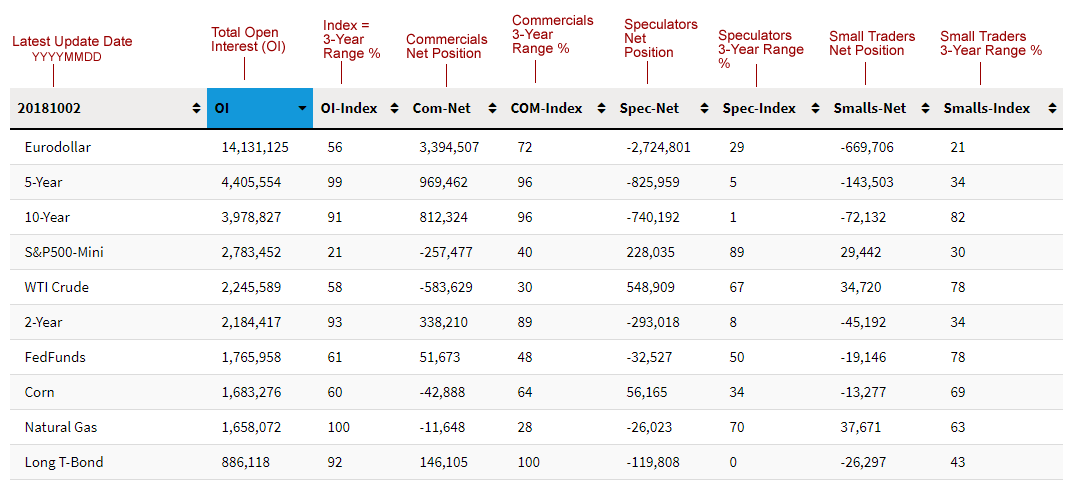
Similarly, a grain storage cooperative in Iowa was targeted by a Russian-speaking group called BlackMatter, who claimed that they had stolen data from the cooperative. While previous attacks have targeted larger companies and cooperatives and aimed to extort the victims for money, individual farms could be at risk, too.

three squat cylindrical structures with conical tops connected by a pipe stand in a row perpendicular to a cluster of narrower, taller vertical cylindrical structures topped by a catwalk
This grain storage facility is run by New Cooperative, a farm cooperative in Iowa that was hit by a ransomware attack in 2021.
Jstuby/Wikimedia

The integration of technologies into farm equipment, from GPS-guided tractors to artificial intelligence, potentially increases the ability of hackers to attack this equipment. And though farmers might not be ideal targets for ransomware attacks, farms could be tempting targets for hackers with other motives, including terrorists.

For example, an attacker could look to exploit vulnerabilities within fertilizer application technologies, which could result in a farmer unwittingly applying too much or too little nitrogen fertilizer to a particular crop. A farmer could then end up with either a below-expected harvest, or a field that has been over fertilized, resulting in waste and long-term environmental ramifications.

Agriculture is becoming increasingly dependent on technology.
U.S. Department of Agriculture Photo by Lance Cheung

Slow to appreciate the threat

Disruption to sensitive industries and infrastructure gives attackers higher returns for their efforts. This means that the increasing stress on the global food supply raises the stakes and creates a stronger motivation to disrupt the U.S. agriculture sector.

Unlike other critical industries such as finance and health care, the farming industry has been slow to recognize cybersecurity risks and take steps to mitigate them. There are several possible reasons for this sluggishness.

One is that many farmers and agricultural providers haven’t viewed cybersecurity as a significant enough problem compared with other risks they face such as floods, fires and hail. A 2018 Department of Homeland Security report that surveyed precision agriculture farmers throughout the U.S. found that many did not fully understand the cyberthreats introduced by precision agriculture, nor did they take these cyber-risks seriously enough.

This lack of preparedness leads to another reason: limited oversight and regulation from government. In 2010, the U.S. Department of Agriculture classified cybersecurity as a low priority. While this classification was upgraded in 2015, the farming sector is likely to be playing catch-up for years. While other critical infrastructure industries have developed and published numerous countermeasures and best practices for cybersecurity, the same cannot be said for the farming sector.

The Biden administration has indicated that it is willing to help farmers take steps to protect their cyber infrastructure, but as of this writing it has not released public guidelines to assist with this effort.

All-hands approach

In addition to the pressing need for policy guidance and resources from federal, state and local governments to prevent this type of cyberattack, there is room for academia and industry to step up.

From an academic research perspective, multidisciplinary efforts that bring together researchers from precision agriculture, robotics, cybersecurity and political science can help identify potential solutions. To this end, we and researchers at the University of Nebraska-Lincoln have launched the Security Testbed for Agricultural Vehicles and Environments.

Farming equipment manufacturers and other industry organizations can help by designing and engineering equipment to account for cybersecurity considerations. This would lead to the manufacture of farming equipment that not only maximizes food production yields but also minimizes exposure to cyberattacks.The Conversation

About the Author:

George Grispos, Assistant Professor of Cybersecurity, University of Nebraska Omaha and Austin C. Doctor, Assistant Professor of Political Science, University of Nebraska Omaha

This article is republished from The Conversation under a Creative Commons license. Read the original article.