Archive for Opinions – Page 121

Trade Of The Week: What Next For Gold As Focus Shifts To US CPI?

By ForexTime 

– Gold kicked off the week on a steady note despite last Friday’s blowout jobs report cooling recession fears and reinforcing expectations for more aggressive Federal Reserve interest rate hikes.

An appreciating dollar and jump in Treasury yields initially dragged the precious metal from a one-month peak. However, prices seem to be making their way back towards this point ahead of another big week and potentially volatile week for gold.

In July, the US economy created 528,000 jobs, well above the forecast of 250,000 while the unemployment rate fell to 3.5% as the labour market condition tightened. With the strong jobs report boosting the dollar and supporting the case for another jumbo Fed rate hike, this could spell more trouble for zero-yielding gold.

It is worth keeping in mind that before the NFP upside surprise, gold drew ample support from geopolitics risks, recession fears, reduced Fed hike bets, and a weaker dollar. In fact, the precious metal has rallied for the last three weeks on these themes with geopolitical tensions and global growth concerns offering an opportunity for the precious metal to shine.

Taking a quick look at the technicals, gold remains in a bullish trend on the daily charts. The current upside momentum could take prices towards $1809. However, if the fundamentals start to empower bears – then things could get ugly for gold. We are likely to see the precious metal display high levels of sensitivity to the pending US inflation data.

All eyes on US inflation report

Inflation in the United States accelerated 9.1% in June, its highest level in 40 years!

According to Bloomberg, July’s inflation data is expected to show annual inflation cooling to 8.7%. Should expectations become reality, this will be a welcome development for markets and may fuel speculation around inflation peaking. Now when factoring the market obsession and reactivity to anything relating to rising prices, it may be wise to fasten your seatbelts!

Another jump in US consumer price inflation may solidify expectations around the Federal Reserve hiking rates by another 75 basis points in September. Traders are currently pricing in a 78% probability the Fed continues the pace of jumbo rate hikes for its decision in September. Given gold’s zero-yielding nature, this is certainly bad news and could result in steep downside losses.

However, if the inflation report meets or misses expectations – this could raise hopes over consumer prices plateauing. Such a development could encourage the Fed to dial back on its aggressive approach toward rates. If the dollar weakens and Treasury yields fall on such a development, gold could be given more room to fight back.

Gold speeding into a brick wall?

Gold bulls remain in the driving seat with their feet on the accelerator, clawing back losses from Friday’s selloff. Prices are trading around the $1785 level which is just below the 50-day Simple Moving Average. A strong breakout above this point could encourage an incline towards $1809 and potentially $1840 – a level below the 100 and 200-day SMA. However, if 1809 proves to be a tough nut to crack – prices may slip back towards $1785 and $1752, respectively.

Zooming in on the weekly charts, prices remain in a bearish channel. However, bulls are making a presence and have been in control for the past 3 weeks. The upside momentum could take prices towards $1830 and $1875, respectively. A decline below $1740 is seen triggering a selloff towards $1685 – a level just above the 200-week Simple Moving Average.


Forex-Time-LogoArticle by ForexTime

ForexTime Ltd (FXTM) is an award winning international online forex broker regulated by CySEC 185/12 www.forextime.com


Currency Speculators trim Japanese Yen bearish bets while Brazilian Real bets fall into bearish level

By InvestMacro | COT | Data Tables | COT Leaders | Downloads | COT Newsletter

Here are the latest charts and statistics for the Commitment of Traders (COT) data published by the Commodities Futures Trading Commission (CFTC).

The latest COT data is updated through Tuesday August 2nd and shows a quick view of how large traders (for-profit speculators and commercial entities) were positioned in the futures markets. All currency positions are in direct relation to the US dollar where, for example, a bet for the euro is a bet that the euro will rise versus the dollar while a bet against the euro will be a bet that the euro will decline versus the dollar.

Weekly Speculator Changes

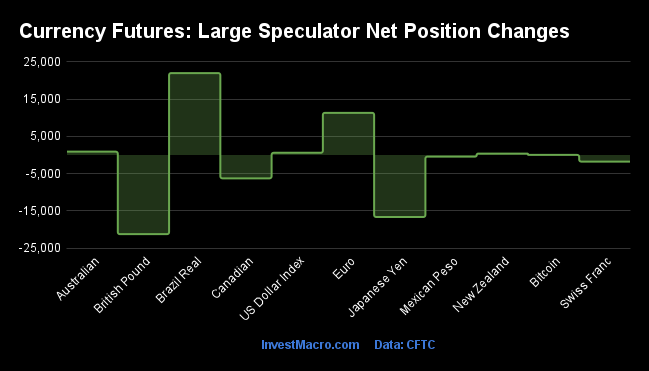
COT currency market speculator bets were slightly  lower this week as five out of the eleven currency markets we cover had higher positioning while the other six markets recorded lower speculator contracts.

Leading the gains for the currency markets was Japanese yen (18,728 contracts) with the Mexican peso (6,845 contracts), the Canadian dollar (4,508 contracts), the Euro (2,773 contracts) and the New Zealand dollar (2,613 contracts) also making gains on the week.

The currencies leading the declines in speculator bets this week were the Brazilian real (-12,842 contracts) and Australian dollar (-8,565 contracts) with the British pound sterling (-2,419 contracts), the Swiss franc (-2,009 contracts), the US Dollar Index (-1,188 contracts) and Bitcoin (-460 contracts) also seeing lower bets on the week.

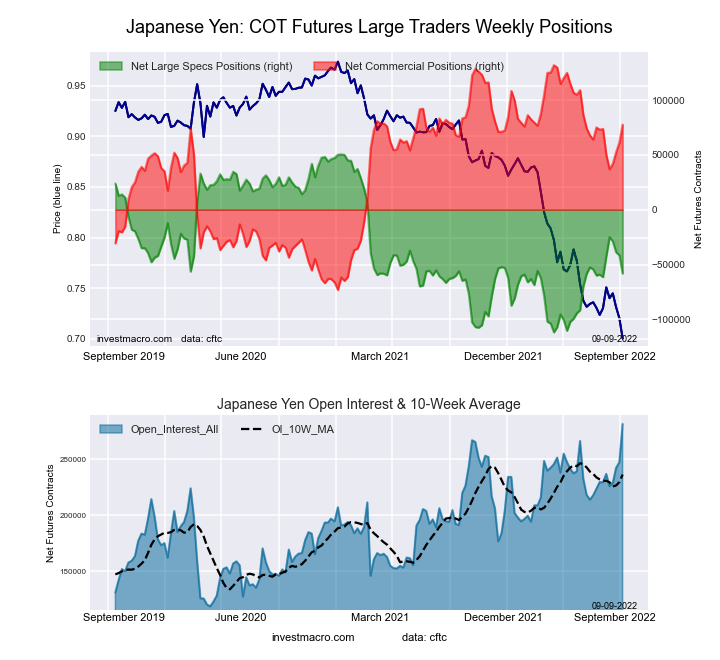
Highlighting the currency markets data this week was the rebound in the Japanese yen speculator bets. Yen bets jumped by +18,728 contracts this week which marks the highest positive change of the past seven weeks. The yen bets have been in an overall bearish level since March of 2021 with a recent bearish high on April 12th at a total of -111,827 contracts and were as high as -102,309 contracts on May 17th before speculators started to pare their bearish bets. Since May, the speculator positioning has improved by approximately 60,000 net contracts and has pushed the overall speculator position to the least bearish level since June 8th of 2021, a span of sixty weeks.

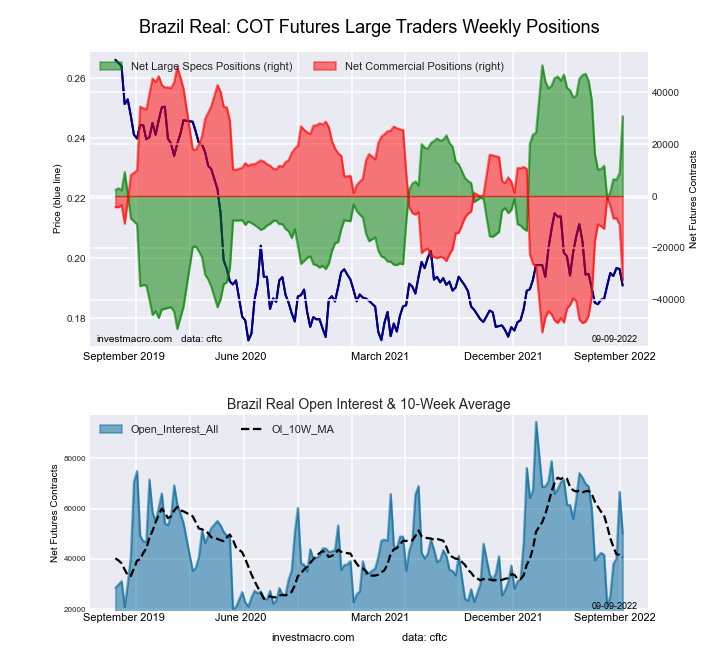
Brazilian Real speculator bets declined this week by over -12,000 contracts and the overall positioning dropped into a new bearish level at -1,130 contracts. This is the first bearish net position since February 1st, a span of the past twenty-six weeks. The decline in Real positions has happened fast and furious as speculator positions hit record high bullish levels in early March above +50,000 contracts and were as high as +44,345 contracts on June 21st. Since June 14th, speculator bets have fallen in five out of the past seven weeks for a total decline of -48,343 contracts over that time and erasing the bullish spec position.


Data Snapshot of Forex Market Traders | Columns Legend
Aug-02-2022OIOI-IndexSpec-NetSpec-IndexCom-NetCOM-IndexSmalls-NetSmalls-Index
USD Index57,0548239,34791-42,15992,81247
EUR683,88375-38,8112315,5208023,29113
GBP226,98761-56,4093072,57774-16,16822
JPY236,73780-42,7534350,25460-7,50138
CHF45,87433-13,3082323,27981-9,97124
CAD145,9142720,27762-30,4074310,13050
AUD167,93158-55,9503362,12465-6,17437
NZD45,27434-1,573694,85838-3,28514
MXN192,97146-23,0531820,696812,35753
RUB20,93047,54331-7,15069-39324
BRL21,1941-1,13049-561511,69185
Bitcoin12,84972-58170244033721


Strength Scores

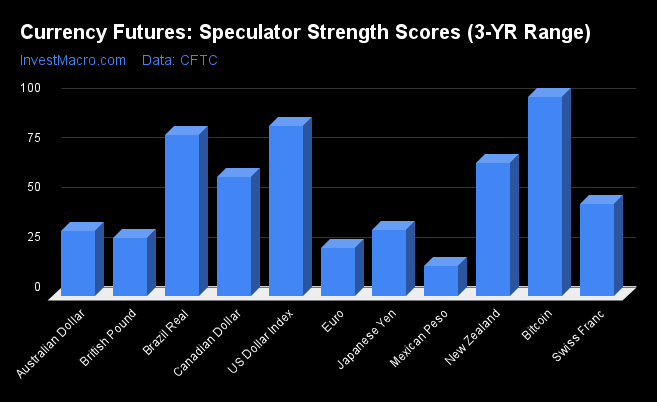
Strength Scores (a normalized measure of Speculator positions over a 3-Year range, from 0 to 100 where above 80 is extreme bullish and below 20 is extreme bearish) showed that the US Dollar Index (90.6 percent) continued to lead the strength scores although it came down a bit from last week (92.5 percent) but still remains in a bullish extreme level. Bitcoin (69.7 percent), the New Zealand Dollar (68.6 percent) and the Canadian Dollar (62.1 percent) come in as the next highest in the currency markets for strength scores. On the downside, the Mexican Peso (17.5 percent) comes in at the lowest strength level currently and is in a bearish extreme level (below 20 percent). The Swiss Franc (22.8 percent), the Euro (23.1 percent) and the British Pound Sterling (29.9 percent) round out the next weakest strength scores this week.

Strength Statistics:
US Dollar Index (90.6 percent) vs US Dollar Index previous week (92.5 percent)
EuroFX (23.1 percent) vs EuroFX previous week (22.2 percent)
British Pound Sterling (29.9 percent) vs British Pound Sterling previous week (31.7 percent)
Japanese Yen (42.5 percent) vs Japanese Yen previous week (31.0 percent)
Swiss Franc (22.8 percent) vs Swiss Franc previous week (27.9 percent)
Canadian Dollar (62.1 percent) vs Canadian Dollar previous week (57.1 percent)
Australian Dollar (33.0 percent) vs Australian Dollar previous week (40.9 percent)
New Zealand Dollar (68.6 percent) vs New Zealand Dollar previous week (64.2 percent)
Mexican Peso (17.5 percent) vs Mexican Peso previous week (14.6 percent)
Brazil Real (49.3 percent) vs Brazil Real previous week (61.9 percent)
Bitcoin (69.7 percent) vs Bitcoin previous week (78.1 percent)

Strength Trends

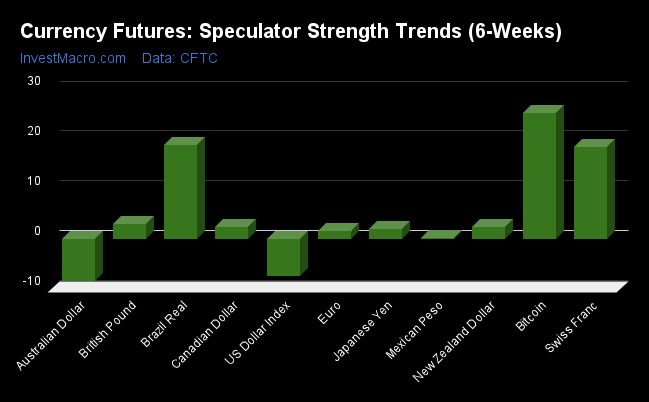
Strength Score Trends (or move index, calculates the 6-week changes in strength scores) show that the Canadian Dollar (18.2 percent) leads the past six weeks trends for the currency markets this week. The Japanese Yen (9.7 percent), the New Zealand Dollar (6.5 percent) and the British Pound Sterling (5.2 percent) fill out the top movers in the latest trends data. The Brazil Real (-44.7 percent) leads the downside trend scores currently while the next market with lower trend scores were Bitcoin (-29.6 percent), the Swiss Franc (-15.6 percent) and the Australian Dollar (-14.2 percent) followed by the US Dollar Index (-9.4 percent).

Strength Trend Statistics:
US Dollar Index (-9.4 percent) vs US Dollar Index previous week (-6.6 percent)
EuroFX (-7.1 percent) vs EuroFX previous week (-10.9 percent)
British Pound Sterling (5.2 percent) vs British Pound Sterling previous week (8.8 percent)
Japanese Yen (9.7 percent) vs Japanese Yen previous week (5.1 percent)
Swiss Franc (-15.6 percent) vs Swiss Franc previous week (-11.4 percent)
Canadian Dollar (18.2 percent) vs Canadian Dollar previous week (-8.3 percent)
Australian Dollar (-14.2 percent) vs Australian Dollar previous week (-3.8 percent)
New Zealand Dollar (6.5 percent) vs New Zealand Dollar previous week (4.4 percent)
Mexican Peso (1.6 percent) vs Mexican Peso previous week (-1.5 percent)
Brazil Real (-44.7 percent) vs Brazil Real previous week (-34.9 percent)
Bitcoin (-29.6 percent) vs Bitcoin previous week (-21.5 percent)


Individual Markets:

US Dollar Index Futures:
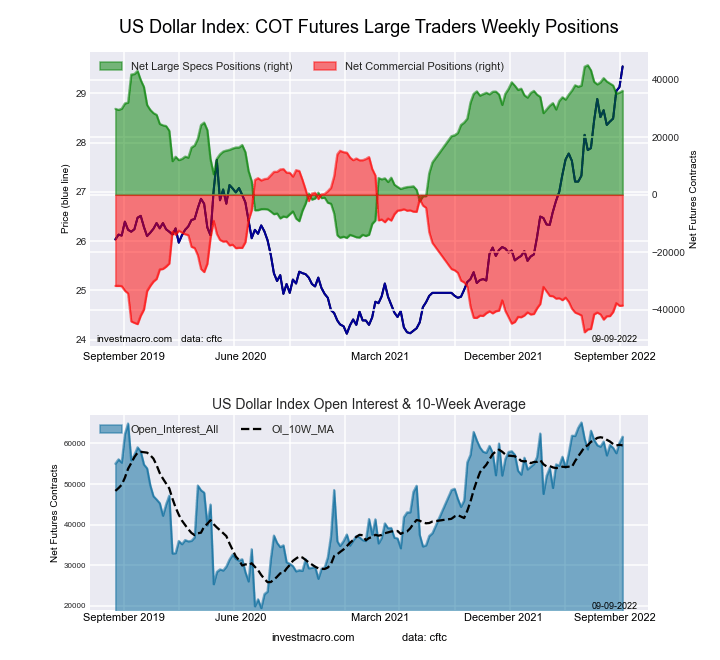
US Dollar Index Forex Futures COT ChartThe US Dollar Index large speculator standing this week equaled a net position of 39,347 contracts in the data reported through Tuesday. This was a weekly reduction of -1,188 contracts from the previous week which had a total of 40,535 net contracts.

This week’s current strength score (the trader positioning range over the past three years, measured from 0 to 100) shows the speculators are currently Bullish-Extreme with a score of 90.6 percent. The commercials are Bearish-Extreme with a score of 8.8 percent and the small traders (not shown in chart) are Bearish with a score of 47.3 percent.

US DOLLAR INDEX StatisticsSPECULATORSCOMMERCIALSSMALL TRADERS
– Percent of Open Interest Longs:84.04.99.0
– Percent of Open Interest Shorts:15.078.84.1
– Net Position:39,347-42,1592,812
– Gross Longs:47,9182,8075,128
– Gross Shorts:8,57144,9662,316
– Long to Short Ratio:5.6 to 10.1 to 12.2 to 1
NET POSITION TREND:
– Strength Index Score (3 Year Range Pct):90.68.847.3
– Strength Index Reading (3 Year Range):Bullish-ExtremeBearish-ExtremeBearish
NET POSITION MOVEMENT INDEX:
– 6-Week Change in Strength Index:-9.47.311.8


Euro Currency Futures:

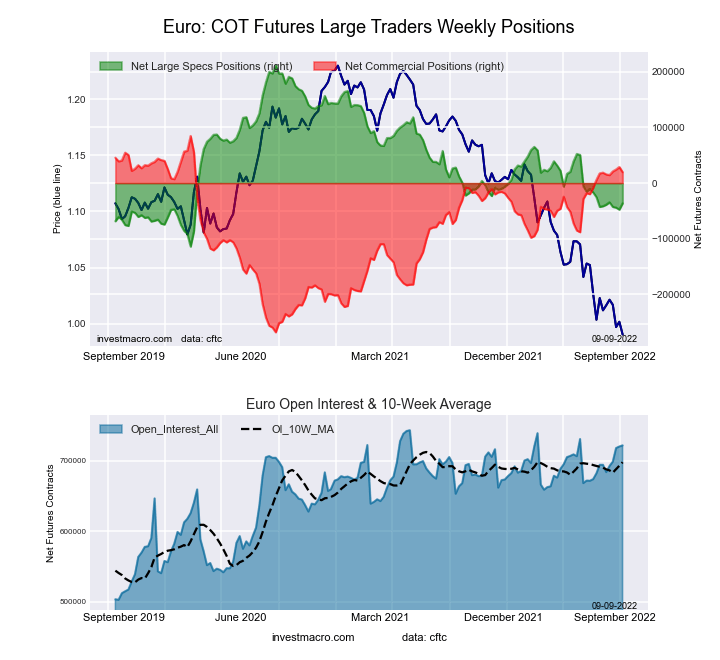
Euro Currency Futures COT ChartThe Euro Currency large speculator standing this week equaled a net position of -38,811 contracts in the data reported through Tuesday. This was a weekly lift of 2,773 contracts from the previous week which had a total of -41,584 net contracts.

This week’s current strength score (the trader positioning range over the past three years, measured from 0 to 100) shows the speculators are currently Bearish with a score of 23.1 percent. The commercials are Bullish-Extreme with a score of 80.4 percent and the small traders (not shown in chart) are Bearish-Extreme with a score of 13.0 percent.

EURO Currency StatisticsSPECULATORSCOMMERCIALSSMALL TRADERS
– Percent of Open Interest Longs:28.057.312.1
– Percent of Open Interest Shorts:33.755.08.7
– Net Position:-38,81115,52023,291
– Gross Longs:191,692391,84182,466
– Gross Shorts:230,503376,32159,175
– Long to Short Ratio:0.8 to 11.0 to 11.4 to 1
NET POSITION TREND:
– Strength Index Score (3 Year Range Pct):23.180.413.0
– Strength Index Reading (3 Year Range):BearishBullish-ExtremeBearish-Extreme
NET POSITION MOVEMENT INDEX:
– 6-Week Change in Strength Index:-7.19.6-17.4


British Pound Sterling Futures:

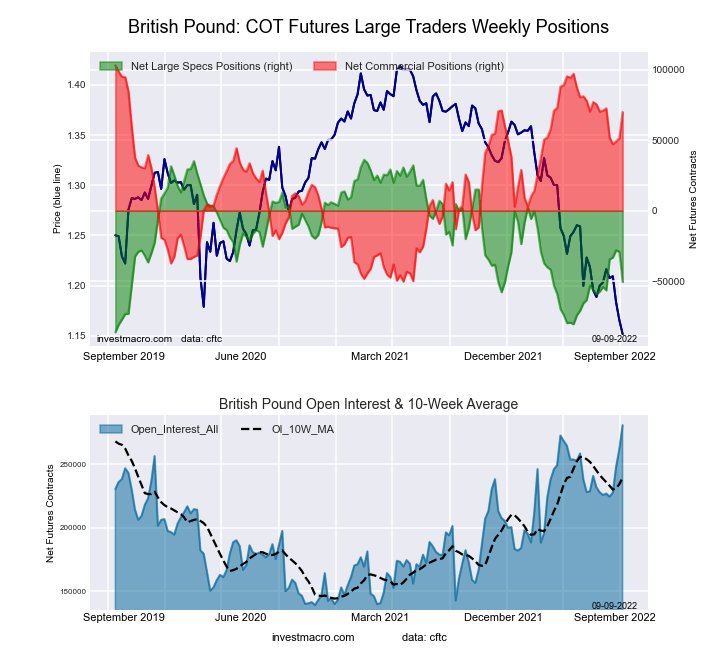
British Pound Sterling Futures COT ChartThe British Pound Sterling large speculator standing this week equaled a net position of -56,409 contracts in the data reported through Tuesday. This was a weekly reduction of -2,419 contracts from the previous week which had a total of -53,990 net contracts.

This week’s current strength score (the trader positioning range over the past three years, measured from 0 to 100) shows the speculators are currently Bearish with a score of 29.9 percent. The commercials are Bullish with a score of 73.9 percent and the small traders (not shown in chart) are Bearish with a score of 22.1 percent.

BRITISH POUND StatisticsSPECULATORSCOMMERCIALSSMALL TRADERS
– Percent of Open Interest Longs:12.975.88.5
– Percent of Open Interest Shorts:37.843.815.6
– Net Position:-56,40972,577-16,168
– Gross Longs:29,305171,96619,191
– Gross Shorts:85,71499,38935,359
– Long to Short Ratio:0.3 to 11.7 to 10.5 to 1
NET POSITION TREND:
– Strength Index Score (3 Year Range Pct):29.973.922.1
– Strength Index Reading (3 Year Range):BearishBullishBearish
NET POSITION MOVEMENT INDEX:
– 6-Week Change in Strength Index:5.2-3.2-3.1


Japanese Yen Futures:

Japanese Yen Forex Futures COT ChartThe Japanese Yen large speculator standing this week equaled a net position of -42,753 contracts in the data reported through Tuesday. This was a weekly increase of 18,728 contracts from the previous week which had a total of -61,481 net contracts.

This week’s current strength score (the trader positioning range over the past three years, measured from 0 to 100) shows the speculators are currently Bearish with a score of 42.5 percent. The commercials are Bullish with a score of 60.2 percent and the small traders (not shown in chart) are Bearish with a score of 38.2 percent.

JAPANESE YEN StatisticsSPECULATORSCOMMERCIALSSMALL TRADERS
– Percent of Open Interest Longs:21.366.510.7
– Percent of Open Interest Shorts:39.445.213.9
– Net Position:-42,75350,254-7,501
– Gross Longs:50,433157,33325,358
– Gross Shorts:93,186107,07932,859
– Long to Short Ratio:0.5 to 11.5 to 10.8 to 1
NET POSITION TREND:
– Strength Index Score (3 Year Range Pct):42.560.238.2
– Strength Index Reading (3 Year Range):BearishBullishBearish
NET POSITION MOVEMENT INDEX:
– 6-Week Change in Strength Index:9.7-11.817.0


Swiss Franc Futures:

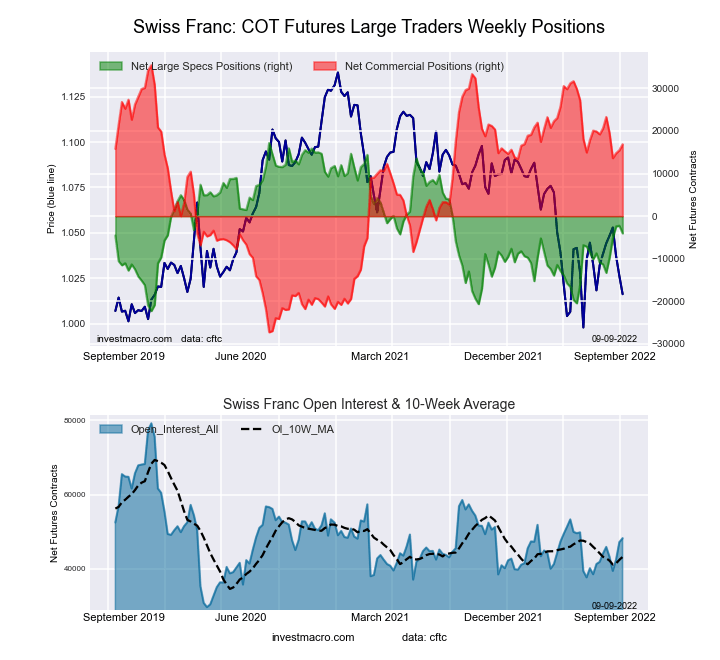
Swiss Franc Forex Futures COT ChartThe Swiss Franc large speculator standing this week equaled a net position of -13,308 contracts in the data reported through Tuesday. This was a weekly decrease of -2,009 contracts from the previous week which had a total of -11,299 net contracts.

This week’s current strength score (the trader positioning range over the past three years, measured from 0 to 100) shows the speculators are currently Bearish with a score of 22.8 percent. The commercials are Bullish-Extreme with a score of 80.6 percent and the small traders (not shown in chart) are Bearish with a score of 23.8 percent.

SWISS FRANC StatisticsSPECULATORSCOMMERCIALSSMALL TRADERS
– Percent of Open Interest Longs:17.863.418.4
– Percent of Open Interest Shorts:46.812.640.2
– Net Position:-13,30823,279-9,971
– Gross Longs:8,17029,0758,457
– Gross Shorts:21,4785,79618,428
– Long to Short Ratio:0.4 to 15.0 to 10.5 to 1
NET POSITION TREND:
– Strength Index Score (3 Year Range Pct):22.880.623.8
– Strength Index Reading (3 Year Range):BearishBullish-ExtremeBearish
NET POSITION MOVEMENT INDEX:
– 6-Week Change in Strength Index:-15.613.3-7.3


Canadian Dollar Futures:

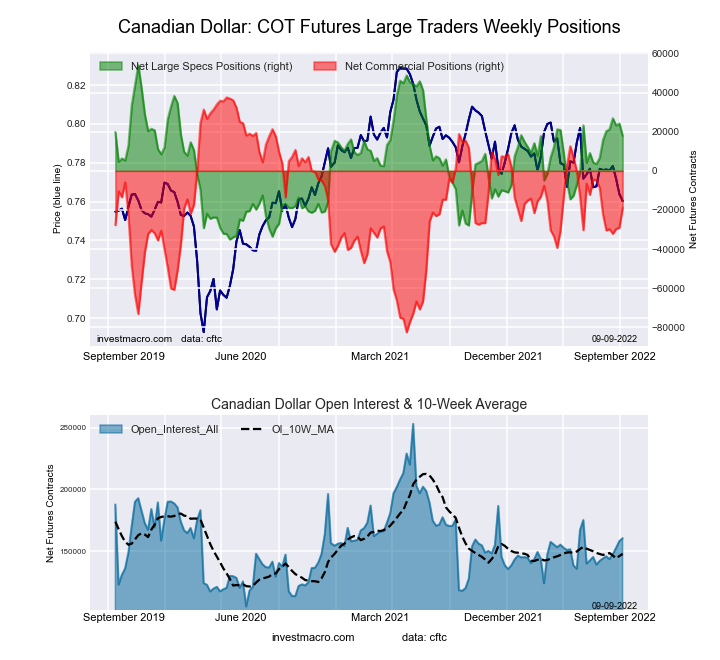
Canadian Dollar Forex Futures COT ChartThe Canadian Dollar large speculator standing this week equaled a net position of 20,277 contracts in the data reported through Tuesday. This was a weekly gain of 4,508 contracts from the previous week which had a total of 15,769 net contracts.

This week’s current strength score (the trader positioning range over the past three years, measured from 0 to 100) shows the speculators are currently Bullish with a score of 62.1 percent. The commercials are Bearish with a score of 43.4 percent and the small traders (not shown in chart) are Bullish with a score of 50.5 percent.

CANADIAN DOLLAR StatisticsSPECULATORSCOMMERCIALSSMALL TRADERS
– Percent of Open Interest Longs:33.140.724.3
– Percent of Open Interest Shorts:19.261.517.3
– Net Position:20,277-30,40710,130
– Gross Longs:48,34259,35535,393
– Gross Shorts:28,06589,76225,263
– Long to Short Ratio:1.7 to 10.7 to 11.4 to 1
NET POSITION TREND:
– Strength Index Score (3 Year Range Pct):62.143.450.5
– Strength Index Reading (3 Year Range):BullishBearishBullish
NET POSITION MOVEMENT INDEX:
– 6-Week Change in Strength Index:18.2-19.915.4


Australian Dollar Futures:

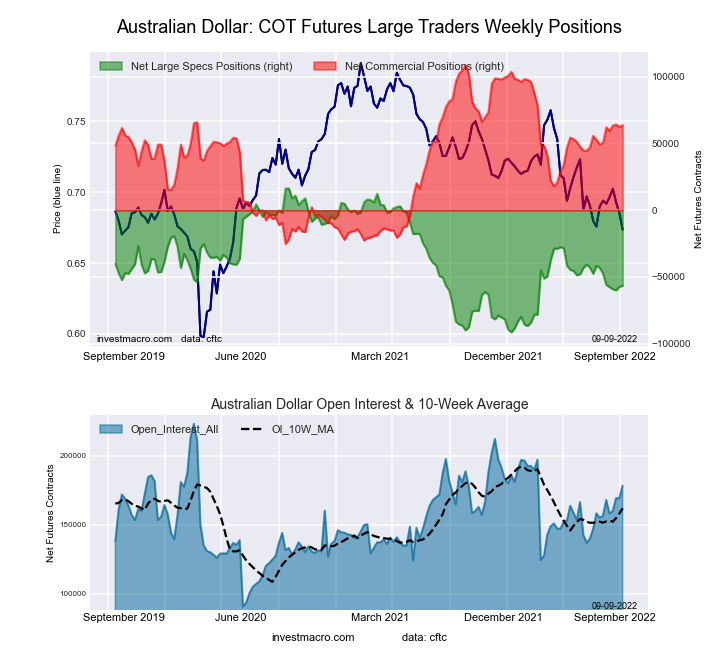
Australian Dollar Forex Futures COT ChartThe Australian Dollar large speculator standing this week equaled a net position of -55,950 contracts in the data reported through Tuesday. This was a weekly lowering of -8,565 contracts from the previous week which had a total of -47,385 net contracts.

This week’s current strength score (the trader positioning range over the past three years, measured from 0 to 100) shows the speculators are currently Bearish with a score of 33.0 percent. The commercials are Bullish with a score of 65.2 percent and the small traders (not shown in chart) are Bearish with a score of 37.4 percent.

AUSTRALIAN DOLLAR StatisticsSPECULATORSCOMMERCIALSSMALL TRADERS
– Percent of Open Interest Longs:18.468.610.6
– Percent of Open Interest Shorts:51.731.614.3
– Net Position:-55,95062,124-6,174
– Gross Longs:30,835115,14117,863
– Gross Shorts:86,78553,01724,037
– Long to Short Ratio:0.4 to 12.2 to 10.7 to 1
NET POSITION TREND:
– Strength Index Score (3 Year Range Pct):33.065.237.4
– Strength Index Reading (3 Year Range):BearishBullishBearish
NET POSITION MOVEMENT INDEX:
– 6-Week Change in Strength Index:-14.213.1-5.3


New Zealand Dollar Futures:

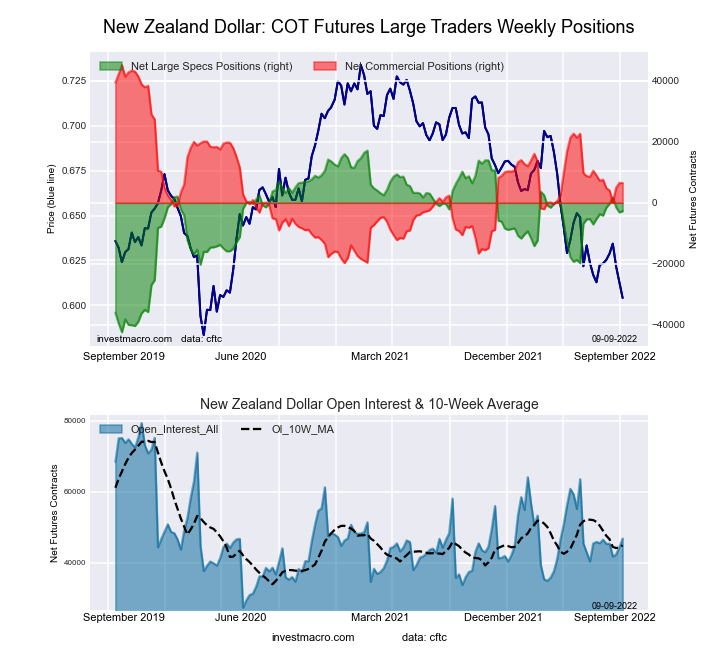
New Zealand Dollar Forex Futures COT ChartThe New Zealand Dollar large speculator standing this week equaled a net position of -1,573 contracts in the data reported through Tuesday. This was a weekly advance of 2,613 contracts from the previous week which had a total of -4,186 net contracts.

This week’s current strength score (the trader positioning range over the past three years, measured from 0 to 100) shows the speculators are currently Bullish with a score of 68.6 percent. The commercials are Bearish with a score of 37.9 percent and the small traders (not shown in chart) are Bearish-Extreme with a score of 13.9 percent.

NEW ZEALAND DOLLAR StatisticsSPECULATORSCOMMERCIALSSMALL TRADERS
– Percent of Open Interest Longs:36.556.15.8
– Percent of Open Interest Shorts:40.045.413.0
– Net Position:-1,5734,858-3,285
– Gross Longs:16,52125,4202,620
– Gross Shorts:18,09420,5625,905
– Long to Short Ratio:0.9 to 11.2 to 10.4 to 1
NET POSITION TREND:
– Strength Index Score (3 Year Range Pct):68.637.913.9
– Strength Index Reading (3 Year Range):BullishBearishBearish-Extreme
NET POSITION MOVEMENT INDEX:
– 6-Week Change in Strength Index:6.5-6.00.6


Mexican Peso Futures:

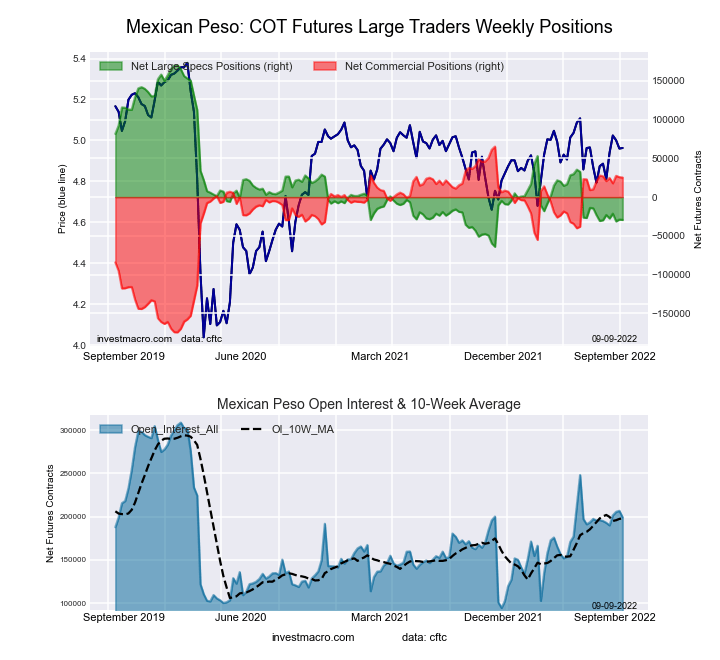
Mexican Peso Futures COT ChartThe Mexican Peso large speculator standing this week equaled a net position of -23,053 contracts in the data reported through Tuesday. This was a weekly boost of 6,845 contracts from the previous week which had a total of -29,898 net contracts.

This week’s current strength score (the trader positioning range over the past three years, measured from 0 to 100) shows the speculators are currently Bearish-Extreme with a score of 17.5 percent. The commercials are Bullish-Extreme with a score of 81.4 percent and the small traders (not shown in chart) are Bullish with a score of 53.0 percent.

MEXICAN PESO StatisticsSPECULATORSCOMMERCIALSSMALL TRADERS
– Percent of Open Interest Longs:52.644.03.0
– Percent of Open Interest Shorts:64.533.31.8
– Net Position:-23,05320,6962,357
– Gross Longs:101,41584,8845,777
– Gross Shorts:124,46864,1883,420
– Long to Short Ratio:0.8 to 11.3 to 11.7 to 1
NET POSITION TREND:
– Strength Index Score (3 Year Range Pct):17.581.453.0
– Strength Index Reading (3 Year Range):Bearish-ExtremeBullish-ExtremeBullish
NET POSITION MOVEMENT INDEX:
– 6-Week Change in Strength Index:1.6-1.0-6.5


Brazilian Real Futures:

Brazil Real Futures COT ChartThe Brazilian Real large speculator standing this week equaled a net position of -1,130 contracts in the data reported through Tuesday. This was a weekly fall of -12,842 contracts from the previous week which had a total of 11,712 net contracts.

This week’s current strength score (the trader positioning range over the past three years, measured from 0 to 100) shows the speculators are currently Bearish with a score of 49.3 percent. The commercials are Bullish with a score of 50.7 percent and the small traders (not shown in chart) are Bullish-Extreme with a score of 84.6 percent.

BRAZIL REAL StatisticsSPECULATORSCOMMERCIALSSMALL TRADERS
– Percent of Open Interest Longs:49.835.414.7
– Percent of Open Interest Shorts:55.238.06.7
– Net Position:-1,130-5611,691
– Gross Longs:10,5627,5003,115
– Gross Shorts:11,6928,0611,424
– Long to Short Ratio:0.9 to 10.9 to 12.2 to 1
NET POSITION TREND:
– Strength Index Score (3 Year Range Pct):49.350.784.6
– Strength Index Reading (3 Year Range):BearishBullishBullish-Extreme
NET POSITION MOVEMENT INDEX:
– 6-Week Change in Strength Index:-44.744.30.5


Bitcoin Futures:

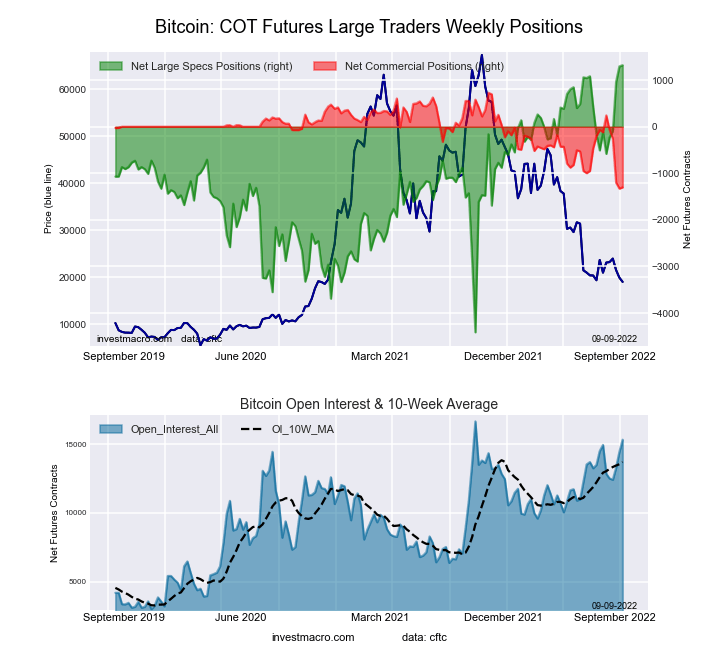
Bitcoin Crypto Futures COT ChartThe Bitcoin large speculator standing this week equaled a net position of -581 contracts in the data reported through Tuesday. This was a weekly decrease of -460 contracts from the previous week which had a total of -121 net contracts.

This week’s current strength score (the trader positioning range over the past three years, measured from 0 to 100) shows the speculators are currently Bullish with a score of 69.7 percent. The commercials are Bullish with a score of 71.9 percent and the small traders (not shown in chart) are Bearish with a score of 20.6 percent.

BITCOIN StatisticsSPECULATORSCOMMERCIALSSMALL TRADERS
– Percent of Open Interest Longs:75.85.98.4
– Percent of Open Interest Shorts:80.34.05.8
– Net Position:-581244337
– Gross Longs:9,7407541,085
– Gross Shorts:10,321510748
– Long to Short Ratio:0.9 to 11.5 to 11.5 to 1
NET POSITION TREND:
– Strength Index Score (3 Year Range Pct):69.771.920.6
– Strength Index Reading (3 Year Range):BullishBullishBearish
NET POSITION MOVEMENT INDEX:
– 6-Week Change in Strength Index:-29.671.98.8


Article By InvestMacroReceive our weekly COT Reports by Email

*COT Report: The COT data, released weekly to the public each Friday, is updated through the most recent Tuesday (data is 3 days old) and shows a quick view of how large speculators or non-commercials (for-profit traders) were positioned in the futures markets.

The CFTC categorizes trader positions according to commercial hedgers (traders who use futures contracts for hedging as part of the business), non-commercials (large traders who speculate to realize trading profits) and nonreportable traders (usually small traders/speculators) as well as their open interest (contracts open in the market at time of reporting).See CFTC criteria here.

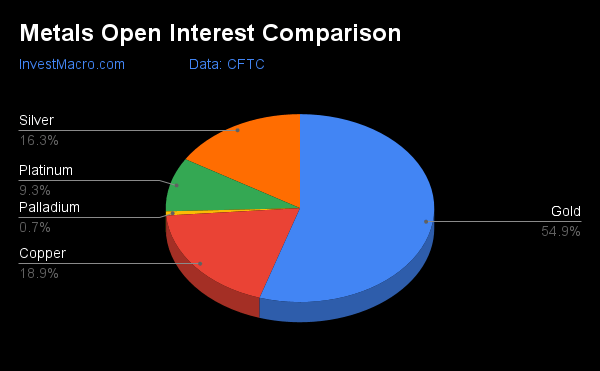
Precious Metals Speculator bets gain as Gold & Silver positions rebound from multi-year lows

By InvestMacro | COT | Data Tables | COT Leaders | Downloads | COT Newsletter

Here are the latest charts and statistics for the Commitment of Traders (COT) data published by the Commodities Futures Trading Commission (CFTC).

The latest COT data is updated through Tuesday August 2nd and shows a quick view of how large traders (for-profit speculators and commercial entities) were positioned in the futures markets.

Weekly Speculator Changes: COT Week 31

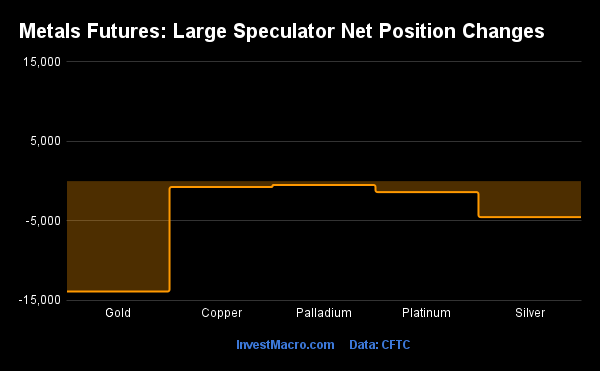
COT precious metals speculator bets were higher this week as four out of the five metals markets we cover had higher positioning this week while only one market recorded lower contracts.

Leading the gains for the precious metals markets was Gold (31,636 contracts) with Silver (5,474 contracts), Platinum (1,927 contracts) and Palladium (848 contracts) also having positive weeks.

The only metals markets with a weekly decline in speculator bets this week was Copper with a shortfall of -844 contracts.

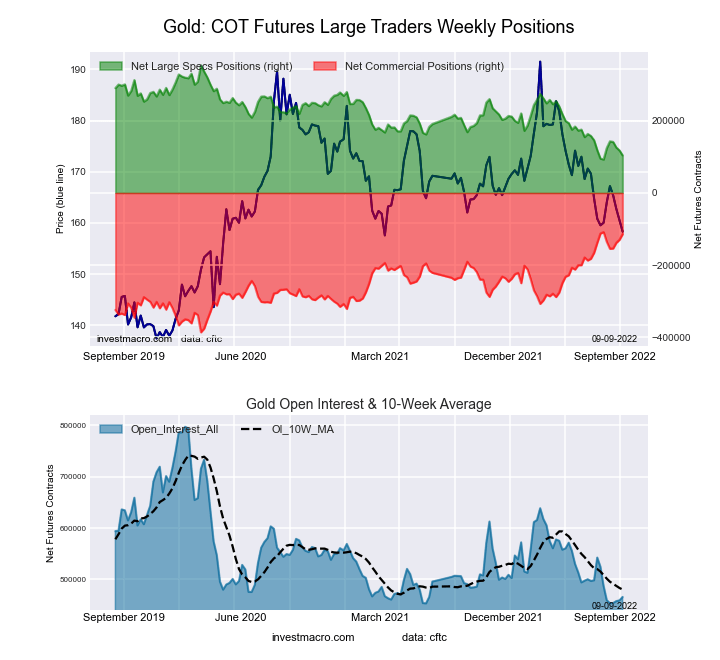
Highlighting the metals markets data this week was a rebound in the Gold speculator bets. The speculative position for Gold Futures jumped this week by over +30,000 contracts and halted a streak of five straight weeks of declines. Speculator bets had dropped by a total of -70,597 contracts over the previous five weeks and those declines had brought the overall bullish position to a total of just +92,690 contracts. This marked the lowest overall speculator standing in the past one hundred and sixty-five weeks, dating back to May 28th of 2019 at the height of the COVID-19 pandemic panic. This week’s rebound brings the overall total back above the +120,000 contract level for the first time in four weeks. Gold futures prices have risen back around the $1,800 level after dropping to approximately $1,680 on July 21st.

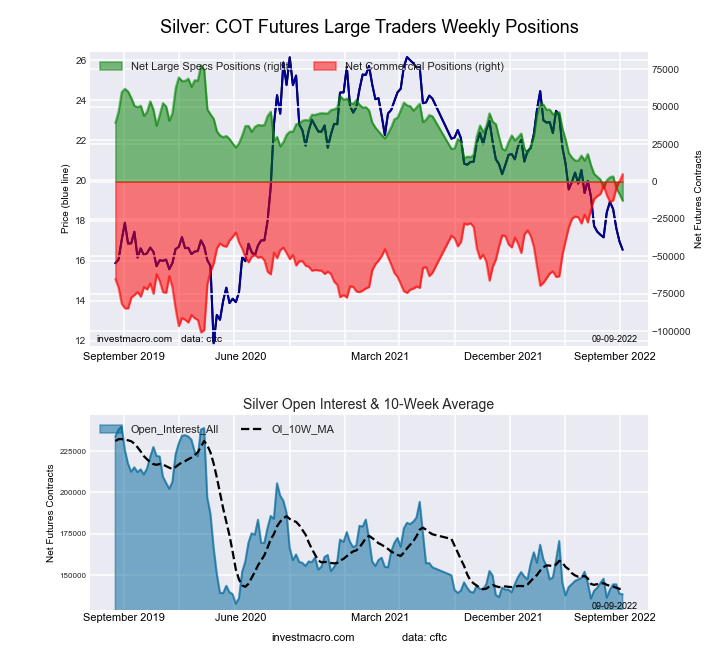
Silver bets also had a rebound this week by over +5,000 contracts and put a stop to a five-week slide in speculator bets (total decline of -22,919 contracts). Silver’s positioning has been extremely weak in recent months and had fallen in thirteen out of the previous fourteen weeks through last week. This week’s rebound brought the overall Silver position out of a net bearish level after falling into a bearish position for the first time since June 4th of 2019, a span of 164 weeks. Silver futures prices, meanwhile, ended the week just below the important psychological $20 level after spending a few weeks falling hitting lows down near the $18 level.


Data Snapshot of Commodity Market Traders | Columns Legend
Aug-02-2022OIOI-IndexSpec-NetSpec-IndexCom-NetCOM-IndexSmalls-NetSmalls-Index
WTI Crude1,606,9103253,7520-272,86610019,11442
Gold459,6492124,32612-135,5659011,2390
Silver136,26739747-9,064938,0908
Copper184,44116-27,4062327,67278-26624
Palladium6,9453-2,56082,74390-18333
Platinum68,26636-2,5415-1,708964,24921
Natural Gas984,5705-124,9734187,5965837,37769
Brent171,75117-32,7825631,8354694722
Heating Oil276,5202622,06875-35,3893413,32144
Soybeans572,925092,52742-65,63264-26,89526
Corn1,347,8946201,35556-149,43451-51,92113
Coffee207,7401227,28462-27,968446846
Sugar760,0931134,43844-35,229617919
Wheat316,24412-7251810,88875-10,16358


Strength Scores

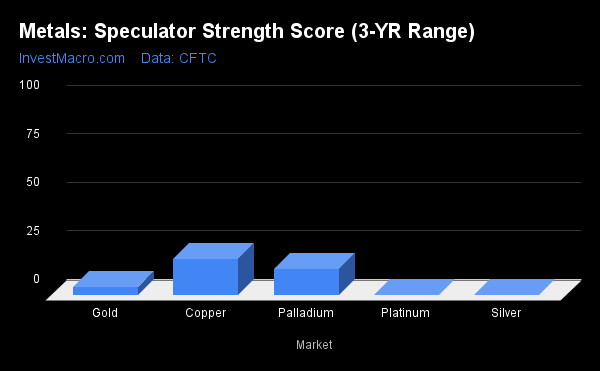
Strength scores (a measure of the 3-Year range of Speculator positions, from 0 to 100 where above 80 is extreme bullish and below 20 is extreme bearish) showed that the Copper (22.6 percent) continues to lead the metals although with a low score that is just outside an extreme bearish position (below 20 percent). Gold (12.1 percent), Palladium (8.4 percent), Silver (6.6 percent) and Platinum (4.6 percent) all have strength scores that remain in bearish extreme levels (below 20 percent) but all of these markets have improving scores compared to last week.

Strength Statistics:
Gold (12.1 percent) vs Gold previous week (0.0 percent)
Silver (6.6 percent) vs Silver previous week (0.0 percent)
Copper (22.6 percent) vs Copper previous week (23.2 percent)
Platinum (4.6 percent) vs Platinum previous week (2.0 percent)
Palladium (8.4 percent) vs Palladium previous week (3.7 percent)

Strength Trends

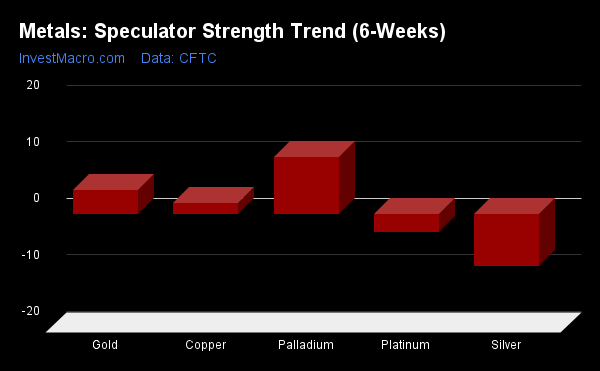
Strength Score Trends (or move index, calculates the 6-week changes in strength scores) showed that the Palladium (8.4 percent) leads the past six weeks trends for metals this week and is the only market currently with a positive six-week trend score. Silver (-21.2 percent) and Gold (-14.9 percent) lead the downside trend scores currently followed by Platinum (-5.5 percent) and Copper (-4.7 percent).


Move Statistics:
Gold (-14.9 percent) vs Gold previous week (-23.7 percent)
Silver (-21.2 percent) vs Silver previous week (-22.5 percent)
Copper (-4.7 percent) vs Copper previous week (-9.2 percent)
Platinum (-5.5 percent) vs Platinum previous week (-9.1 percent)
Palladium (8.4 percent) vs Palladium previous week (3.7 percent)


Individual Markets:

Gold Comex Futures:

Gold Futures COT ChartThe Gold Comex Futures large speculator standing this week was a net position of 124,326 contracts in the data reported through Tuesday. This was a weekly boost of 31,636 contracts from the previous week which had a total of 92,690 net contracts.

This week’s current strength score (the trader positioning range over the past three years, measured from 0 to 100) shows the speculators are currently Bearish-Extreme with a score of 12.1 percent. The commercials are Bullish-Extreme with a score of 90.2 percent and the small traders (not shown in chart) are Bearish-Extreme with a score of 0.0 percent.

Gold Futures StatisticsSPECULATORSCOMMERCIALSSMALL TRADERS
– Percent of Open Interest Longs:52.727.88.2
– Percent of Open Interest Shorts:25.657.35.7
– Net Position:124,326-135,56511,239
– Gross Longs:242,128127,70037,481
– Gross Shorts:117,802263,26526,242
– Long to Short Ratio:2.1 to 10.5 to 11.4 to 1
NET POSITION TREND:
– Strength Index Score (3 Year Range Pct):12.190.20.0
– Strength Index Reading (3 Year Range):Bearish-ExtremeBullish-ExtremeBearish-Extreme
NET POSITION MOVEMENT INDEX:
– 6-Week Change in Strength Index:-14.918.5-33.9


Silver Comex Futures:

Silver Futures COT ChartThe Silver Comex Futures large speculator standing this week was a net position of 974 contracts in the data reported through Tuesday. This was a weekly lift of 5,474 contracts from the previous week which had a total of -4,500 net contracts.

This week’s current strength score (the trader positioning range over the past three years, measured from 0 to 100) shows the speculators are currently Bearish-Extreme with a score of 6.6 percent. The commercials are Bullish-Extreme with a score of 93.5 percent and the small traders (not shown in chart) are Bearish-Extreme with a score of 8.2 percent.

Silver Futures StatisticsSPECULATORSCOMMERCIALSSMALL TRADERS
– Percent of Open Interest Longs:36.140.816.3
– Percent of Open Interest Shorts:35.447.410.4
– Net Position:974-9,0648,090
– Gross Longs:49,22055,53622,198
– Gross Shorts:48,24664,60014,108
– Long to Short Ratio:1.0 to 10.9 to 11.6 to 1
NET POSITION TREND:
– Strength Index Score (3 Year Range Pct):6.693.58.2
– Strength Index Reading (3 Year Range):Bearish-ExtremeBullish-ExtremeBearish-Extreme
NET POSITION MOVEMENT INDEX:
– 6-Week Change in Strength Index:-21.218.5-3.6


Copper Grade #1 Futures:

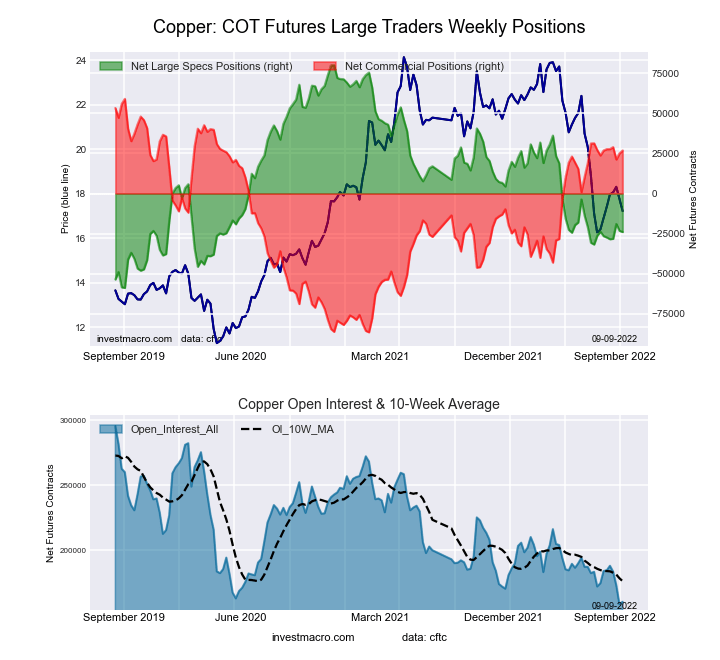
Copper Futures COT ChartThe Copper Grade #1 Futures large speculator standing this week was a net position of -27,406 contracts in the data reported through Tuesday. This was a weekly decline of -844 contracts from the previous week which had a total of -26,562 net contracts.

This week’s current strength score (the trader positioning range over the past three years, measured from 0 to 100) shows the speculators are currently Bearish with a score of 22.6 percent. The commercials are Bullish with a score of 78.5 percent and the small traders (not shown in chart) are Bearish with a score of 23.7 percent.

Copper Futures StatisticsSPECULATORSCOMMERCIALSSMALL TRADERS
– Percent of Open Interest Longs:27.345.87.3
– Percent of Open Interest Shorts:42.130.87.4
– Net Position:-27,40627,672-266
– Gross Longs:50,31784,44713,430
– Gross Shorts:77,72356,77513,696
– Long to Short Ratio:0.6 to 11.5 to 11.0 to 1
NET POSITION TREND:
– Strength Index Score (3 Year Range Pct):22.678.523.7
– Strength Index Reading (3 Year Range):BearishBullishBearish
NET POSITION MOVEMENT INDEX:
– 6-Week Change in Strength Index:-4.76.0-13.2


Platinum Futures:

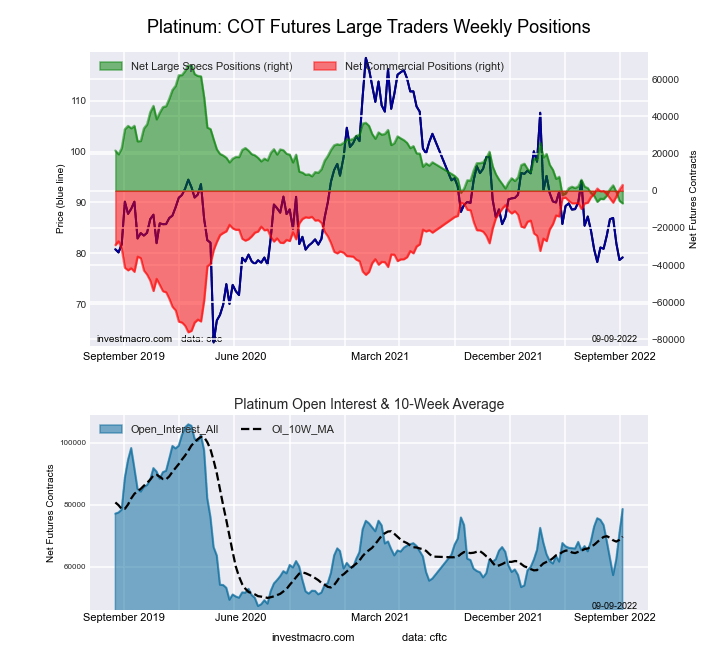
Platinum Futures COT ChartThe Platinum Futures large speculator standing this week was a net position of -2,541 contracts in the data reported through Tuesday. This was a weekly rise of 1,927 contracts from the previous week which had a total of -4,468 net contracts.

This week’s current strength score (the trader positioning range over the past three years, measured from 0 to 100) shows the speculators are currently Bearish-Extreme with a score of 4.6 percent. The commercials are Bullish-Extreme with a score of 96.2 percent and the small traders (not shown in chart) are Bearish with a score of 21.2 percent.

Platinum Futures StatisticsSPECULATORSCOMMERCIALSSMALL TRADERS
– Percent of Open Interest Longs:42.038.911.2
– Percent of Open Interest Shorts:45.741.45.0
– Net Position:-2,541-1,7084,249
– Gross Longs:28,64826,5517,673
– Gross Shorts:31,18928,2593,424
– Long to Short Ratio:0.9 to 10.9 to 12.2 to 1
NET POSITION TREND:
– Strength Index Score (3 Year Range Pct):4.696.221.2
– Strength Index Reading (3 Year Range):Bearish-ExtremeBullish-ExtremeBearish
NET POSITION MOVEMENT INDEX:
– 6-Week Change in Strength Index:-5.56.1-9.2


Palladium Futures:

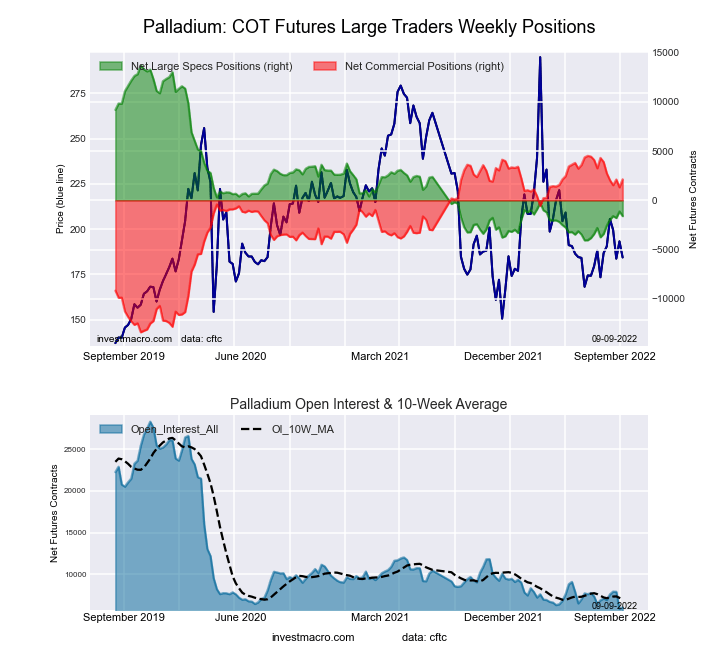
Palladium Futures COT ChartThe Palladium Futures large speculator standing this week was a net position of -2,560 contracts in the data reported through Tuesday. This was a weekly lift of 848 contracts from the previous week which had a total of -3,408 net contracts.

This week’s current strength score (the trader positioning range over the past three years, measured from 0 to 100) shows the speculators are currently Bearish-Extreme with a score of 8.4 percent. The commercials are Bullish-Extreme with a score of 90.1 percent and the small traders (not shown in chart) are Bearish with a score of 33.3 percent.

Palladium Futures StatisticsSPECULATORSCOMMERCIALSSMALL TRADERS
– Percent of Open Interest Longs:13.963.415.1
– Percent of Open Interest Shorts:50.823.917.8
– Net Position:-2,5602,743-183
– Gross Longs:9654,4001,051
– Gross Shorts:3,5251,6571,234
– Long to Short Ratio:0.3 to 12.7 to 10.9 to 1
NET POSITION TREND:
– Strength Index Score (3 Year Range Pct):8.490.133.3
– Strength Index Reading (3 Year Range):Bearish-ExtremeBullish-ExtremeBearish
NET POSITION MOVEMENT INDEX:
– 6-Week Change in Strength Index:8.4-9.916.3


Article By InvestMacroReceive our weekly COT Reports by Email

*COT Report: The COT data, released weekly to the public each Friday, is updated through the most recent Tuesday (data is 3 days old) and shows a quick view of how large speculators or non-commercials (for-profit traders) were positioned in the futures markets.

The CFTC categorizes trader positions according to commercial hedgers (traders who use futures contracts for hedging as part of the business), non-commercials (large traders who speculate to realize trading profits) and nonreportable traders (usually small traders/speculators) as well as their open interest (contracts open in the market at time of reporting).See CFTC criteria here.

3 Stocks Trading Near 52-Week Highs

By Ino.com

So far this year, the stock market has flashed more red signs than green due to various macroeconomic and geopolitical concerns. The immense volatility weighed heavily on equities and government bond yields.

The CBOE Volatility Index (VIX) gained 29.5% year-to-date.

However, the major stock indexes rose in the last trading session to end their best month since 2020, slashing some losses from a gloomy first half of the year. The S&P 500 gained 9.1% in July, while the Dow Jones Industrial Average rose 6.7%, reflecting their strongest month since November 2020. The Nasdaq Composite rose 12.4%, marking its best month since April 2020.

Chris Zaccarelli, chief investment officer for Independent Advisor Alliance, said, “We are seeing a relief rally in the stock market, as pessimism reached extreme levels, and as longer-term interest rates have been coming back down.”

Optimistic expectations from the upcoming earnings releases have also encouraged investors to take a breather from the idea of a slowing economy and further interest rate hikes.

Occidental Petroleum Corporation (OXY), Molina Healthcare, Inc. (MOH), and Greif, Inc. (GEF) are hovering near their 52-week highs and could be the ideal additions to your watchlist now given their strong fundamentals and momentum.

Occidental Petroleum Corporation (OXY)

OXY is engaged in acquiring, exploring, and developing oil and gas properties in the United States, Middle East, Africa, and Latin America.

The company operates through three segments: Oil and Gas, Chemical, Midstream, and Marketing. It develops, processes, transports, and markets oil and condensate, natural gas liquids (NGLs), and natural gas. It also manufactures basic chemicals.

On June 27, 2022, OXY’s subsidiary, 1PointFive, and Manulife Investment Management entered into a lease agreement for approximately 27,000 acres of timberland in Western Louisiana.

This agreement provides 1PointFive with access to subsurface pore space and surface rights to develop and operate a carbon sequestration hub, with access to permanently store industrial carbon emissions. This is expected to promote the company’s sustainability goals.

OXY’s net sales increased 57.7% year-over-year to $8.35 billion in the fiscal 2022 first quarter ended March 31, 2022. Its income from continuing operations rose 1,530.8% from the prior-year period to $4.88 billion.

The company’s adjusted income attributable to common stockholders and adjusted EPS came in at $2.13 billion and $2.12, up 1,664% and 1,513.3%, respectively, year-over-year.

The consensus EPS estimate of $3.03 for the second quarter (ended June 30, 2022) represents an 846.6% improvement year-over-year. The consensus revenue estimate of $9.81 billion for the to-be-reported quarter indicates a 63.2% increase from the same period last year.

The company has an impressive earnings surprise history; it surpassed the consensus EPS estimates in three of the trailing four quarters.

Over the past year, the stock has gained 145.5% to close the last trading session at $65.75. It is currently trading 11.2% below its 52-week high of $74.04, which it hit on May 31, 2022.

OXY’s POWR Ratings reflect solid prospects. The POWR Ratings assess stocks by 118 different factors, each with its own weighting.

It has an A grade for Momentum and a B for Growth and Quality. It is ranked #38 out of 97 stocks in the B-rated Energy – Oil & Gas industry. Click here to learn more about POWR Ratings.

Molina Healthcare, Inc. (MOH)

MOH provides managed health care services to low-income families and individuals under Medicaid and Medicare programs and through state insurance marketplaces. The company operates through four segments: Medicaid, Medicare, Marketplace, and Other.

It offers healthcare services through contracts with providers, independent physicians and physician groups, hospitals, and ancillary providers.

On July 13, 2022, MOH announced that it had agreed to acquire the assets of My Choice Wisconsin. MOH’s President and CEO Joe Zubretsky said, “The addition of My Choice Wisconsin to Molina’s expanding footprint is not only complementary to our existing Medicaid business in Wisconsin, but also representative of our strategic growth initiatives.”

During the fiscal second quarter (ended June 30, 2022), MOH’s total revenue increased 18.4% year-over-year to $8.05 billion. Its operating income rose 32.2% from the year-ago value to $361 million.

The company’s adjusted net income grew 33.7% from the same period last year to $266 million, while its adjusted EPS came in at $4.55, representing a 33.8% increase year-over-year.

Analysts expect MOH’s EPS and revenue for the fiscal third quarter (ending September 2022) to increase 50.5% and 11.4% year-over-year to $4.26 and $7.84 billion. The company has surpassed the consensus EPS estimates in three of the trailing four quarters.

Over the past year, the stock has gained 28.4% to close the last trading session at $327.72. It is currently trading 6.4% below its 52-week high of $350.19, which it hit on April 21, 2022.

MOH’s strong fundamentals are reflected in its POWR Ratings. The stock has an overall rating of A, which equates to a Strong Buy in the POWR Ratings system. MOH also has an A grade for Quality and a B grade for Value.

The stock is ranked #4 of 11 in the A-rated Medical – Health Insurance industry. Click here to learn more about POWR Ratings.

Greif, Inc. (GEF)

GEF is a global producer of industrial packaging products and services with operations in over 35 countries. The company operates through three segments: Global Industrial Packaging, Paper Packaging & Services, and Land Management.

It produces steel, plastic, fiber drums, intermediate bulk containers, containerboard, uncoated and coated recycled paperboard, tubes and cores, and a diverse mix of specialty products.

On June 23, 2022, the company’s Board of Directors announced a $150 million share repurchase program. GEF has entered into a $75 million accelerated share repurchase agreement with Bank of America, N.A. to repurchase its Class A stock shares and plans to repurchase an aggregate of $75 million shares of its Class A and Class B stock in open market purchases. This reflects the company’s strong cash flows and ability to boost shareholder returns.

For the fiscal second quarter ended April 30, 2022, GEF’s net sales increased 24.4% year-over-year to $1.67 billion. The company’s gross profit increased 27.4% year-over-year to $338.70 million. Also, its adjusted EBITDA increased 42.1% year-over-year to $251 million.

For the third quarter ended July 31, 2022, GEF’s EPS and revenue are expected to increase 3.4% and 7.1% year-over-year to $2 and $1.60 billion, respectively. It has surpassed the consensus EPS estimates in three of the trailing four quarters.

The stock has gained 16.1% over the past year to close the last trading session at $70.62. GEF is currently trading 1.9% below its 52-week high of $72, which it hit on November 10, 2021.

GEF’s POWR Ratings reflect this promising outlook. The stock has an overall rating of B, translating to a Buy in the POWR Ratings system. It also has a B grade for Value and Quality.

Within the A – rated Industrial – Packaging industry, it is ranked #3 out of 22 stocks. Click here to learn more about POWR Ratings.


About the Author

Shweta Kumari’s profound interest in financial research and quantitative analysis led her to pursue a career as an investment analyst. She uses her knowledge to help retail investors make educated investment decisions. Shweta graduated with a bachelor’s degree in accounting and finance and is currently pursuing the Chartered Accountancy course. Shweta is a regular contributor for StockNews.com.

By Ino.com – See our Trader Blog, INO TV Free & Market Analysis Alerts

Source: 3 Stocks Trading Near 52-Week Highs

SPY Set To Lose Its Crown

By Ino.com

Since 2017, the King of the Exchange Traded Fund world has slowly been losing ground to its closest competitors.

The SPDR S&P 500 ETF Trust (SPY), the undisputed ETF King since ETFs became popular, is set to lose its crown within the next few years. Well, perhaps it would be better to say that it will lose one of its crowns or maybe one of its world titles while still holding a few others. Let me explain…

The SPY ETF is and has been, with the exception of just a handful of months over the last 20-plus years, the largest Exchange Traded Fund in terms of assets under management. Currently, SPY has $365 billion under management.

In contrast, the next closest competitor, iShares Core S&P 500 ETF (IVV), has $298 billion, and then there is the Vanguard S&P 500 ETF (VOO) at $264 billion in assets.

The SPDR ETF has more than $65 billion in assets compared to the second largest ETF and more than $100 billion compared to the third largest ETF. So why are there predictions that its competitors will overtake it in the coming years?

First and foremost, since 2017, it has been losing ground to IVV and VOO, and based on results from the first half of 2022, the trend doesn’t appear to be changing. VOO has added $29.2 billion in assets year-to-date, while IVV has added $15.7 billion. On the other hand, SPY has lost $22.7 billion.

Also, it is essential to remember that these three ETFs we are comparing all due literally the same thing, track the S&P 500’s performance.

It is not as if we are comparing a NASDAQ-focused ETF and a S&P 500 ETF, these three funds are all built the same. They own the 500 stocks that make up the S&P 500 based on a market capitalization weighting. That matters because this shows that the three fund’s asset changes are not based on performance but on investor preference showing that they are pulling money from one fund in mass and adding it to the others.

Why is this shift occurring?

Simple! Cost.

Despite being the undisputed King of the ETF world, the SPY has one chink in its amour; it is expensive compared to the competition. Like really expensive. The SPY charges a 0.09% expense ratio. So in dollar terms, that would mean an investor with $10,000 in SPY pays $9.00 per year.

But IVV and VOO only charge 0.03% or $3.00 for every $10,000 invested. SPY is three times as expensive as the competition, which offers a nearly identical product. It makes no sense for long-term buy-and-hold investors to stick with SPY and pay the higher fee.

As for other types of investors, say those who trade or put on hedged positions or different complicated investing strategies, it does still make sense why they would use SPY instead of the alternatives. SPY still has the best liquidity.

The current average daily volume for SPY is 93 million shares trading hands per day. IVV’s average volume is 6.2 million, and VOO’s is 5.6 million. Even these figures back the thesis that long-term buy-and-hold investors are buying IVV and VOO while traders are trading SPY.

Traders don’t care as much about the higher cost when they have access to the type of liquidity SPY offers, allowing them to quickly and seamlessly get in and out of a position. This is why SPY may lose its crown as King of the ETFs from an asset standpoint.

Still, it will not likely lose its title as the most liquid ETF because while the competition may be within striking distance from an asset under management standpoint, they aren’t even in the same ballpark when it comes to average daily volume.

So if you are an investor in SPY, you need to ask yourself why. Do you need the liquidity, or have you just been complacent and not switched to one of the ETFs more suited for your type of investing?

Matt Thalman
INO.com Contributor
Follow me on Twitter @mthalman5513

Disclosure: This contributor did not hold a position in any investment mentioned above at the time this blog post was published. This article is the opinion of the contributor themselves. The above is a matter of opinion provided for general information purposes only and is not intended as investment advice. This contributor is not receiving compensation (other than from INO.com) for their opinion.

By Ino.com – See our Trader Blog, INO TV Free & Market Analysis Alerts

Source: SPY Set To Lose Its Crown

Mid-Week Technical Outlook: FX Movers & Shakers

By ForexTime 

– Financial markets were injected with fresh volatility this week as geopolitical tensions between the United States and China rocked sentiment.

Some action was witnessed across the FX markets yesterday as the mighty dollar regained some of its mojo amid the risk-off mood and hawkish Fed commentary. Even the Japanese Yen fought back briefly, enacting sweet revenge against other G10 currencies before later surrendering gains. Sterling seems to be on standby ahead of the Bank of England (BoE) rate decision on Thursday while oil prices remain under pressure as the OPEC+ meeting looms. After weakening on hawkish comments from Fed officials, gold is likely to trade within a tight range ahead of the US jobs report on Friday.

The second half of the week could be wild for markets given the string of high-risk events and potential market shakers. Situations like this could present fresh trading opportunities across FX, commodity, and equity markets.

Below we will discuss potential movers & shakers to watch out for this week and beyond using technical analysis.

DXY rebounds from 105.00 support

Dollar bulls drew support from the risk-off mood and hawkish comments from Fed officials on Tuesday. After staging a rebound from the 105.00 support level, prices are trading marginally above 106.00 as of writing. Should this level prove to be reliable support, a move back towards 107.30 and 109.14 could be on the cards.

Equally weighted USD Index rebounds

After rebounding from the 1.1700 level, the equally weighted USD Index has found itself back within a wide range. The upside momentum may take prices back towards 1.1950. Beyond this level, bulls could challenge 1.21840.

EURUSD trapped in a range

A classic breakout/down opportunity could be forming on the EURUSD with support at 1.0100 and resistance at 1.0270. A solid daily close above 1.0270 may open the doors towards 1.0350 and 1.0480. Alternatively, a selloff below 1.0100 could inspire a move back towards parity.

GBPUSD waits for BoE

Where the GBPUSD concludes this week may be heavily influenced by the BoE rate decision on Thursday. Key levels of interest can be found at 1.2060 and 1.2350. A move back above the 50-day Simple Moving Average may encourage an incline back towards 1.2350.

AUDUSD back within a range

It’s the same old story for the AUDUSD as prices trade within a very wide range. After yesterday’s steep selloff, prices are back under the 50-day Simple Moving Average. A decline back towards 0.6850 could be on the cards.

NZDUSD breakdown pending?

An appreciating dollar could drag the NZDUSD back below the 0.6220 support level. Such a move may open doors towards 0.6100 and potentially lower. If 0.6200 proves to be reliable support, prices may rebound back towards 0.6375.

USDCAD sticky around 1.2860

The subtitle says it all. Prices remain in a sticky range with 1.2860 acting as a key level of interest. Should this level prove to be reliable support, the next key level can be found at 1.3050. Weakness below 1.2860 may open the doors back towards the 100 and 200-day Simple Moving Average.

EURJPY set to rebound?

After rebounding from the 200-day Simple Moving Average, is the EURJPY primed for a major rebound? The trend remains bearish and prices are trading below the 50 and 100-day Simple Moving Average. Even the MACD is trading below zero, reinforcing the bearish bias on the EURJPY. Prices have the potential to bounce from the 134.50 region towards 138.00 which is below the 100-day SMA. Beyond this point, bulls may target 139.00 and 141.50.

Bonus: Gold

Gold is trading below the 50, 100, and 200-day Simple Moving Average while the MACD is trading below zero. However, prices are respecting a minor bullish channel with resistance at $1785. A strong break above this level could encourage a move towards $1809 and beyond. If the precious metal breaks under $1752, a decline towards $1724 and $1700 could be on the table.


Forex-Time-LogoArticle by ForexTime

ForexTime Ltd (FXTM) is an award winning international online forex broker regulated by CySEC 185/12 www.forextime.com


As tech giants face a financial downturn, some new players are focusing on people over profit

By Peter Bloom, University of Essex 

The tech industry has been rocked by recent economic woes. While once thought of as close to recession proof, companies from Netflix to Meta are suddenly experiencing serious financial setbacks. As the Washington Post reported last week: “Big tech is bracing for a possible recession, spooking other industries”. Meta (the company that owns Facebook) has seen its share prices drop by more than 50% this year, with its iconoclastic CEO, Mark Zuckerberg, “visibly frustrated” at recent company Q&As with employees.

There are a range of reasons for this downturn, including a troubling mix of reduced consumer spending and fears of an uncertain future. The tech-focused Nasdaq index has dropped 24% in value since January in this year alone, while lay-offs have been announced across the industry – with some reports counting more than 60,000 tech redundancies globally so far this year.

In addition to cutting staff, technology companies are passing on these problems to consumers. People are already facing higher prices for some streaming services, and more increases are expected. Netflix has raised prices for consumers in countries including the UK and the US. They are also trying to stop people from different households sharing passwords. Amazon has also been criticised for increasing its subscription fees recently for Prime delivery and streaming services.

Users have been cancelling subscriptions to cut costs. Many of these services have become heavily embedded in our lives, however, with new technologies fundamentally transforming the way people interact, communicate, work and entertain themselves in recent years.

But there are growing concerns about the way these companies operate, aside from their profit levels and cost burden at a time of belt-tightening. Many users resent the fact that they still have relatively little power over how these technologies are developed and consumed. Tech corporations largely set the prices and conditions for both users and workers.

While many consumers accept this state of affairs, others are attempting to challenge huge tech conglomerates with platforms that give consumers, creators and workers more power. This idea is extending into data use as well. Even before the economic downturn, people were raising serious concerns about the use of algorithms to shape what we listen to and watch, for example, as well as questioning business models based on profiting from user data.

Emerging tech alternatives

New tech startups such as browser provider Gener8 are seeking to target this consumer dissatisfaction. With tens of thousands of users already, this platform allows users to choose their privacy levels and get paid for the data collected from their search activity. They can also use these funds to directly support ethical projects of their choosing.

Across a range of other sectors, platform cooperatives want to revolutionise industries including transport and delivery by providing workers with fair wages and better conditions. Consumers are also given more say with the ability to jointly own, design and run these platforms according to their needs. Such initiatives are just starting to make inroads against their much more powerful for-profit corporate competitors.

This movement is also affecting the entertainment industry by attempting to challenge for-profit streaming services. Means TV was created by the media producers Naomi Burton and Nick Hayes – famous for their viral campaign ad for New York congresswoman Alexandria Ocasia-Cortez. It bills itself as the “world’s first worker-owned, anti-capitalist streaming service”, with a democratic, cooperative structure in which all decisions are made by its employees, cooperative contractors and content creators. Members pay a US$10 (£8.18) monthly fee, but there are also reduced rate options for those who cannot afford this amount.

One full-time employee told the Guardian that what makes Means TV so special is that the platform enables people to make TV and other media content with a small amount of money. Its subscription charges and donations directly fund artists so there are no pressures relating to advertising or corporate overheads.

The cooperative music streaming service Resonate applies the same concept to the music industry, in that it is owned by “artists, listeners and workers”. While less explicitly political than Means TV, Resonate still aims to provide consumers with a new level of power and control.

Under the logo “play fair, pay fair”, the platform gives users monthly credits to spend as they listen to music and after streaming the same track nine times, it is added to their library. It advertises itself as ad and bot-free, and doesn’t sell user data. Resonate’s payment system was also designed to pay artists fairly and more with each listen. By 2021, the service had almost 1,400 monthly users and could potentially handle another 2 million users, according its creators.

These are just a few examples of alternatives that, more than simply rivalling popular tech giants’ offerings, provide people with greater power over the technology they consume. And while these ethical alternatives are still relatively small, they could signal the beginning of an important new era of consumer power for the tech sector.The Conversation

About the Author:

Peter Bloom, Professor of Management, University of Essex

This article is republished from The Conversation under a Creative Commons license. Read the original article.


Trade Of The Week: Will BoE “Go Hard Or Go Home” On Rates

By ForexTime 

Take cover! Central banks across the globe have pulled out their big guns and heavy monetary artillery in the face of soaring inflation.

Last week, the Federal Reserve (Fed) raised interest rates by 75 basis points for the second straight month. In July, the Bank of Canada (BoC) hiked rates by a whooping 100 basis points! Even the European Central Bank (ECB) surprised markets with a 50-basis point hike – taking its policy rate out of negative territory in one clean move.

This week, the Bank of England (BoE) is expected to join the heavy hitters – raising rates by 50 basis points after hiking rates by 0.25% five consecutive times since December 2021. If this was a boxing ring, the short jobs against inflation have failed so the central bank is switching to haymakers and uppercuts for the knockout blow! The key question is whether the BoE will embrace the aggression or remain cautious towards rates?

Before we discuss what to expect from the BoE this week, let’s take a quick peek at the GBPUSD.

Things are looking interesting for the currency pair on the weekly charts as prices breakout from the bearish channel. A weaker dollar remains a key factor behind the Pounds recent rebound. If BoE hawks “go hard” on Thursday, this could propel the currency pair higher.

The low down…

Looking beyond the sunny weather and random bbq’s, a thunderstorm is brewing.

The outlook for the UK economy remains gloomy due to a combination of negative themes.

Inflation is through the roof with consumer prices hitting 9.4% in June – another new 40 year high thanks to soaring food and energy prices. Rising prices are squeezing millions of households, impacting consumption which remains a key engine of economic growth. The latest PMIs are not looking too pretty with manufacturing slumping to a 25-month low in July. Let’s not forget about political uncertainty and post-Brexit related drama’s adding to the already toxic cocktail. In a nutshell, economic conditions remain unfavourable with fears mounting over the UK falling into a recession.

Back in June, the central bank signalled that it would ‘act forcefully’ if the inflation menace refused to stand down. Traders are currently pricing in a 79% probability of a 50-basis point rate hike this month.

The week ahead…

The main risk event for Sterling will be the Bank of England rate decision on Thursday.

Given how markets expect the bank to move ahead with its biggest rate increase in 27 years, much attention will be directed towards the updated quarterly economic review and Governor Andrew Bailey’s press conference. These could offer some clues into the central banks thinking on inflation and UK economic outlook. More details are also expected to be released on the central banks strategy to reducing its £866 billion quantitative-easing portfolio.

Possible outcomes to BoE meeting

  • BoE hikes rates by 50-basis points. This decision could send the pound higher but gains may be capped if the central bank pulls a “one and done” by striking a cautious tone. This could feed expectations around no more aggressive hikes in 2022.
  • BoE hike rates by 50-basis points and sings a hawkish tone – fuelling speculation around more aggressive hikes down the road. Sterling rallies.
  • BoE hikes rates by 25-basis points. Concerns about the economic outlook keep hawks at bay with the central bank postponing aggressive hikes till September or Q4. Pound tumbles on this decision.

GBPUSD to break above 1.2350?

The GBPUSD turned bullish on the daily charts after prices conquered the 1.2060 lower high. Bulls are clearly in the vicinity with the next key point of interest at 1.2350. There have been fresh consistent highs and lows while the MACD in the process of cross above zero. A strong breakout and daily close above 1.2350 could signal a move towards 1.2500 and 1.2650, respectively. Should 1.2350 prove to be a tough nut to crack, prices may decline back towards the 50-day Simple Moving Average and 1.2060, respectively.


Forex-Time-LogoArticle by ForexTime

ForexTime Ltd (FXTM) is an award winning international online forex broker regulated by CySEC 185/12 www.forextime.com


Currency Speculators boost US Dollar Index bets to 4-week high, CAD bets rise

By InvestMacro | COT | Data Tables | COT Leaders | Downloads | COT Newsletter

Here are the latest charts and statistics for the Commitment of Traders (COT) data published by the Commodities Futures Trading Commission (CFTC).

The latest COT data is updated through Tuesday July 26th and shows a quick view of how large traders (for-profit speculators and commercial entities) were positioned in the futures markets. All currency positions are in direct relation to the US dollar where, for example, a bet for the euro is a bet that the euro will rise versus the dollar while a bet against the euro will be a bet that the euro will decline versus the dollar.

Weekly Speculator Changes

COT currency market speculator bets were mostly higher overall this week as seven out of the eleven currency markets we cover had higher positioning while the other five markets had lower speculator contracts.

Leading the gains for the currency markets was the Canadian dollar (9,102 contracts) with the British pound sterling (3,260 contracts), US Dollar Index (1,466 contracts), Brazilian real (1,237 contracts), Euro (1,161 contracts), Mexican peso (862 contracts) and Bitcoin (385 contracts) also showing positive weeks.

The currencies leading the declines in speculator bets this week was the Australian dollar (-4,237 contracts) with the Japanese yen (-2,256 contracts), New Zealand dollar (-515 contracts) and the Swiss franc (-387 contracts) also registering lower bets on the week.

Currency Notes:

Highlighting the forex markets COT data this week was the continued strength of the US Dollar Index. The speculative position for the US Dollar Index gained again this week for a second straight week and after falling in the previous three weeks. These gains bring the overall net bullish position back over the +40,000 contract level for the first time since June 28th and for the fourth time in the past seven weeks. The Dollar Index positioning has been super-strong much like the Dollar Index price that has been trading near its highest levels in approximately twenty years. The Dollar Index speculator positions have now been above the +30,000 contract level for fifteen straight weeks and has been in a bullish standing for fifty-six weeks and counting.

Canadian dollar positions gained this week for a second straight week and the net position hit a seven-week high. Canadian dollar speculator positions have, more or less, been fluctuating for almost a year and recently had a 5-week spell of bearish levels from May to June before becoming bullish again in late-June and July. The CAD speculator position has been in a small bullish level for the past seven weeks and is now at +15,769 contracts.

Euro bets rebounded a bit this week by just over +1,100 contracts and halted a three-week streak of declines. The Euro speculator position has been sharply down-trending over the past eight weeks and has fallen by a total of -93,856 contracts since June 7th. This drop in Euro bets reversed a +52,272 net contract level from May 31st to a total of -41,584 net contract level this week. The Euro exchange rate against the US Dollar (EURUSD) remains very close to parity at just over 1.200 currently after edging out a couple of weekly gains in forex market trading.


Data Snapshot of Forex Market Traders | Columns Legend
Jul-26-2022OIOI-IndexSpec-NetSpec-IndexCom-NetCOM-IndexSmalls-NetSmalls-Index
USD Index60,4569040,53593-43,31372,77847
EUR694,09980-41,5842218,6568122,92812
GBP225,88955-53,9903570,95972-16,96920
JPY229,21975-61,4813173,77372-12,29228
CHF44,08129-11,2992820,61076-9,31126
CAD144,1822615,76957-22,197506,42843
AUD156,47350-47,3854150,60157-3,21645
NZD46,47137-4,186647,60842-3,42212
MXN195,02547-29,8981526,859843,03956
RUB20,93047,54331-7,15069-39324
BRL41,6452911,71262-12,6103989875
Bitcoin14,95787-12178-118023918


Strength Scores

Strength Scores (a normalized measure of Speculator positions over a 3-Year range, from 0 to 100 where above 80 is extreme bullish and below 20 is extreme bearish) showed that the US Dollar Index (92.5 percent) continues to lead the strength scores and rose a bit this week as speculator net position increased. The Dollar Index is in a bullish extreme level at over 90 percent compared to its three-year range. Bitcoin (78.1 percent) comes in as the next highest in the currency markets in strength scores followed by the New Zealand Dollar (64.2 percent) and then the Brazil Real (61.9 percent). On the downside, the Mexican Peso (14.6 percent) comes in at the lowest strength level currently and is in a bearish extreme level (below 20 percent). The EuroFX (22.2 percent), Swiss Franc (27.9 percent) and the Japanese Yen (31.0 percent) round out the next lowest scores this week.


Strength Statistics:
US Dollar Index (92.5 percent) vs US Dollar Index previous week (90.1 percent)
EuroFX (22.2 percent) vs EuroFX previous week (21.9 percent)
British Pound Sterling (35.1 percent) vs British Pound Sterling previous week (32.8 percent)
Japanese Yen (31.0 percent) vs Japanese Yen previous week (32.4 percent)
Swiss Franc (27.9 percent) vs Swiss Franc previous week (28.8 percent)
Canadian Dollar (57.1 percent) vs Canadian Dollar previous week (46.8 percent)
Australian Dollar (40.9 percent) vs Australian Dollar previous week (44.8 percent)
New Zealand Dollar (64.2 percent) vs New Zealand Dollar previous week (65.1 percent)
Mexican Peso (14.6 percent) vs Mexican Peso previous week (14.2 percent)
Brazil Real (61.9 percent) vs Brazil Real previous week (60.7 percent)
Bitcoin (78.1 percent) vs Bitcoin previous week (71.1 percent)

Strength Trends

Strength Score Trends (or move index, calculates the 6-week changes in strength scores) showed that the British Pound Sterling (8.4 percent) leads the past six weeks trends for the currency markets this week. The Japanese Yen (5.1 percent) and the New Zealand Dollar (4.4 percent) fill out the only other positive movers in the latest trends data. The Brazilian Real (-34.9 percent) leads the downside trend scores currently while the next markets with lower trend scores were Bitcoin (-21.5 percent) followed by the Swiss Franc (-11.4 percent) and the EuroFX (-10.9 percent).


Strength Trend Statistics:
US Dollar Index (-6.6 percent) vs US Dollar Index previous week (1.9 percent)
EuroFX (-10.9 percent) vs EuroFX previous week (-28.6 percent)
British Pound Sterling (8.4 percent) vs British Pound Sterling previous week (9.8 percent)
Japanese Yen (5.1 percent) vs Japanese Yen previous week (20.0 percent)
Swiss Franc (-11.4 percent) vs Swiss Franc previous week (13.2 percent)
Canadian Dollar (-8.3 percent) vs Canadian Dollar previous week (8.7 percent)
Australian Dollar (-3.8 percent) vs Australian Dollar previous week (4.4 percent)
New Zealand Dollar (4.4 percent) vs New Zealand Dollar previous week (27.0 percent)
Mexican Peso (-1.5 percent) vs Mexican Peso previous week (-27.1 percent)
Brazil Real (-34.9 percent) vs Brazil Real previous week (-35.6 percent)
Bitcoin (-21.5 percent) vs Bitcoin previous week (-18.1 percent)


Individual Markets:

US Dollar Index Futures:

US Dollar Index Forex Futures COT ChartThe US Dollar Index large speculator standing this week reached a net position of 40,535 contracts in the data reported through Tuesday. This was a weekly advance of 1,466 contracts from the previous week which had a total of 39,069 net contracts.

This week’s current strength score (the trader positioning range over the past three years, measured from 0 to 100) shows the speculators are currently Bullish-Extreme with a score of 92.5 percent. The commercials are Bearish-Extreme with a score of 7.0 percent and the small traders (not shown in chart) are Bearish with a score of 46.9 percent.

US DOLLAR INDEX StatisticsSPECULATORSCOMMERCIALSSMALL TRADERS
– Percent of Open Interest Longs:84.94.18.6
– Percent of Open Interest Shorts:17.975.84.1
– Net Position:40,535-43,3132,778
– Gross Longs:51,3372,4925,227
– Gross Shorts:10,80245,8052,449
– Long to Short Ratio:4.8 to 10.1 to 12.1 to 1
NET POSITION TREND:
– Strength Index Score (3 Year Range Pct):92.57.046.9
– Strength Index Reading (3 Year Range):Bullish-ExtremeBearish-ExtremeBearish
NET POSITION MOVEMENT INDEX:
– 6-Week Change in Strength Index:-6.67.0-5.3


Euro Currency Futures:

Euro Currency Futures COT ChartThe Euro Currency large speculator standing this week reached a net position of -41,584 contracts in the data reported through Tuesday. This was a weekly boost of 1,161 contracts from the previous week which had a total of -42,745 net contracts.

This week’s current strength score (the trader positioning range over the past three years, measured from 0 to 100) shows the speculators are currently Bearish with a score of 22.2 percent. The commercials are Bullish-Extreme with a score of 81.3 percent and the small traders (not shown in chart) are Bearish-Extreme with a score of 12.4 percent.

EURO Currency StatisticsSPECULATORSCOMMERCIALSSMALL TRADERS
– Percent of Open Interest Longs:28.556.612.0
– Percent of Open Interest Shorts:34.553.98.7
– Net Position:-41,58418,65622,928
– Gross Longs:198,041393,06283,007
– Gross Shorts:239,625374,40660,079
– Long to Short Ratio:0.8 to 11.0 to 11.4 to 1
NET POSITION TREND:
– Strength Index Score (3 Year Range Pct):22.281.312.4
– Strength Index Reading (3 Year Range):BearishBullish-ExtremeBearish-Extreme
NET POSITION MOVEMENT INDEX:
– 6-Week Change in Strength Index:-10.913.4-19.2


British Pound Sterling Futures:

British Pound Sterling Futures COT ChartThe British Pound Sterling large speculator standing this week reached a net position of -53,990 contracts in the data reported through Tuesday. This was a weekly gain of 3,260 contracts from the previous week which had a total of -57,250 net contracts.

This week’s current strength score (the trader positioning range over the past three years, measured from 0 to 100) shows the speculators are currently Bearish with a score of 35.1 percent. The commercials are Bullish with a score of 71.6 percent and the small traders (not shown in chart) are Bearish with a score of 20.5 percent.

BRITISH POUND StatisticsSPECULATORSCOMMERCIALSSMALL TRADERS
– Percent of Open Interest Longs:15.374.57.8
– Percent of Open Interest Shorts:39.243.115.3
– Net Position:-53,99070,959-16,969
– Gross Longs:34,606168,26617,551
– Gross Shorts:88,59697,30734,520
– Long to Short Ratio:0.4 to 11.7 to 10.5 to 1
NET POSITION TREND:
– Strength Index Score (3 Year Range Pct):35.171.620.5
– Strength Index Reading (3 Year Range):BearishBullishBearish
NET POSITION MOVEMENT INDEX:
– 6-Week Change in Strength Index:8.4-6.0-3.1


Japanese Yen Futures:

Japanese Yen Forex Futures COT ChartThe Japanese Yen large speculator standing this week reached a net position of -61,481 contracts in the data reported through Tuesday. This was a weekly lowering of -2,256 contracts from the previous week which had a total of -59,225 net contracts.

This week’s current strength score (the trader positioning range over the past three years, measured from 0 to 100) shows the speculators are currently Bearish with a score of 31.0 percent. The commercials are Bullish with a score of 71.6 percent and the small traders (not shown in chart) are Bearish with a score of 28.5 percent.

JAPANESE YEN StatisticsSPECULATORSCOMMERCIALSSMALL TRADERS
– Percent of Open Interest Longs:19.168.910.3
– Percent of Open Interest Shorts:45.936.715.7
– Net Position:-61,48173,773-12,292
– Gross Longs:43,812157,96323,671
– Gross Shorts:105,29384,19035,963
– Long to Short Ratio:0.4 to 11.9 to 10.7 to 1
NET POSITION TREND:
– Strength Index Score (3 Year Range Pct):31.071.628.5
– Strength Index Reading (3 Year Range):BearishBullishBearish
NET POSITION MOVEMENT INDEX:
– 6-Week Change in Strength Index:5.1-6.28.9


Swiss Franc Futures:

Swiss Franc Forex Futures COT ChartThe Swiss Franc large speculator standing this week reached a net position of -11,299 contracts in the data reported through Tuesday. This was a weekly decline of -387 contracts from the previous week which had a total of -10,912 net contracts.

This week’s current strength score (the trader positioning range over the past three years, measured from 0 to 100) shows the speculators are currently Bearish with a score of 27.9 percent. The commercials are Bullish with a score of 76.3 percent and the small traders (not shown in chart) are Bearish with a score of 26.0 percent.

SWISS FRANC StatisticsSPECULATORSCOMMERCIALSSMALL TRADERS
– Percent of Open Interest Longs:18.561.719.6
– Percent of Open Interest Shorts:44.114.940.8
– Net Position:-11,29920,610-9,311
– Gross Longs:8,13827,1958,653
– Gross Shorts:19,4376,58517,964
– Long to Short Ratio:0.4 to 14.1 to 10.5 to 1
NET POSITION TREND:
– Strength Index Score (3 Year Range Pct):27.976.326.0
– Strength Index Reading (3 Year Range):BearishBullishBearish
NET POSITION MOVEMENT INDEX:
– 6-Week Change in Strength Index:-11.43.96.9


Canadian Dollar Futures:

Canadian Dollar Forex Futures COT ChartThe Canadian Dollar large speculator standing this week reached a net position of 15,769 contracts in the data reported through Tuesday. This was a weekly lift of 9,102 contracts from the previous week which had a total of 6,667 net contracts.

This week’s current strength score (the trader positioning range over the past three years, measured from 0 to 100) shows the speculators are currently Bullish with a score of 57.1 percent. The commercials are Bullish with a score of 50.2 percent and the small traders (not shown in chart) are Bearish with a score of 43.0 percent.

CANADIAN DOLLAR StatisticsSPECULATORSCOMMERCIALSSMALL TRADERS
– Percent of Open Interest Longs:32.242.923.4
– Percent of Open Interest Shorts:21.358.319.0
– Net Position:15,769-22,1976,428
– Gross Longs:46,41461,86933,790
– Gross Shorts:30,64584,06627,362
– Long to Short Ratio:1.5 to 10.7 to 11.2 to 1
NET POSITION TREND:
– Strength Index Score (3 Year Range Pct):57.150.243.0
– Strength Index Reading (3 Year Range):BullishBullishBearish
NET POSITION MOVEMENT INDEX:
– 6-Week Change in Strength Index:-8.36.7-1.3


Australian Dollar Futures:

Australian Dollar Forex Futures COT ChartThe Australian Dollar large speculator standing this week reached a net position of -47,385 contracts in the data reported through Tuesday. This was a weekly decrease of -4,237 contracts from the previous week which had a total of -43,148 net contracts.

This week’s current strength score (the trader positioning range over the past three years, measured from 0 to 100) shows the speculators are currently Bearish with a score of 40.9 percent. The commercials are Bullish with a score of 56.6 percent and the small traders (not shown in chart) are Bearish with a score of 44.6 percent.

AUSTRALIAN DOLLAR StatisticsSPECULATORSCOMMERCIALSSMALL TRADERS
– Percent of Open Interest Longs:19.265.412.4
– Percent of Open Interest Shorts:49.533.114.4
– Net Position:-47,38550,601-3,216
– Gross Longs:30,024102,39819,361
– Gross Shorts:77,40951,79722,577
– Long to Short Ratio:0.4 to 12.0 to 10.9 to 1
NET POSITION TREND:
– Strength Index Score (3 Year Range Pct):40.956.644.6
– Strength Index Reading (3 Year Range):BearishBullishBearish
NET POSITION MOVEMENT INDEX:
– 6-Week Change in Strength Index:-3.84.4-4.3


New Zealand Dollar Futures:

New Zealand Dollar Forex Futures COT ChartThe New Zealand Dollar large speculator standing this week reached a net position of -4,186 contracts in the data reported through Tuesday. This was a weekly decrease of -515 contracts from the previous week which had a total of -3,671 net contracts.

This week’s current strength score (the trader positioning range over the past three years, measured from 0 to 100) shows the speculators are currently Bullish with a score of 64.2 percent. The commercials are Bearish with a score of 42.1 percent and the small traders (not shown in chart) are Bearish-Extreme with a score of 12.3 percent.

NEW ZEALAND DOLLAR StatisticsSPECULATORSCOMMERCIALSSMALL TRADERS
– Percent of Open Interest Longs:37.357.04.8
– Percent of Open Interest Shorts:46.340.612.2
– Net Position:-4,1867,608-3,422
– Gross Longs:17,31126,4982,249
– Gross Shorts:21,49718,8905,671
– Long to Short Ratio:0.8 to 11.4 to 10.4 to 1
NET POSITION TREND:
– Strength Index Score (3 Year Range Pct):64.242.112.3
– Strength Index Reading (3 Year Range):BullishBearishBearish-Extreme
NET POSITION MOVEMENT INDEX:
– 6-Week Change in Strength Index:4.4-3.3-5.6


Mexican Peso Futures:

Mexican Peso Futures COT ChartThe Mexican Peso large speculator standing this week reached a net position of -29,898 contracts in the data reported through Tuesday. This was a weekly advance of 862 contracts from the previous week which had a total of -30,760 net contracts.

This week’s current strength score (the trader positioning range over the past three years, measured from 0 to 100) shows the speculators are currently Bearish-Extreme with a score of 14.6 percent. The commercials are Bullish-Extreme with a score of 84.0 percent and the small traders (not shown in chart) are Bullish with a score of 55.9 percent.

MEXICAN PESO StatisticsSPECULATORSCOMMERCIALSSMALL TRADERS
– Percent of Open Interest Longs:49.646.63.0
– Percent of Open Interest Shorts:64.932.91.4
– Net Position:-29,89826,8593,039
– Gross Longs:96,75290,9725,815
– Gross Shorts:126,65064,1132,776
– Long to Short Ratio:0.8 to 11.4 to 12.1 to 1
NET POSITION TREND:
– Strength Index Score (3 Year Range Pct):14.684.055.9
– Strength Index Reading (3 Year Range):Bearish-ExtremeBullish-ExtremeBullish
NET POSITION MOVEMENT INDEX:
– 6-Week Change in Strength Index:-1.51.5-0.8


Brazilian Real Futures:

Brazil Real Futures COT ChartThe Brazilian Real large speculator standing this week reached a net position of 11,712 contracts in the data reported through Tuesday. This was a weekly advance of 1,237 contracts from the previous week which had a total of 10,475 net contracts.

This week’s current strength score (the trader positioning range over the past three years, measured from 0 to 100) shows the speculators are currently Bullish with a score of 61.9 percent. The commercials are Bearish with a score of 39.0 percent and the small traders (not shown in chart) are Bullish with a score of 75.3 percent.

BRAZIL REAL StatisticsSPECULATORSCOMMERCIALSSMALL TRADERS
– Percent of Open Interest Longs:49.541.17.9
– Percent of Open Interest Shorts:21.471.35.8
– Net Position:11,712-12,610898
– Gross Longs:20,61417,1033,296
– Gross Shorts:8,90229,7132,398
– Long to Short Ratio:2.3 to 10.6 to 11.4 to 1
NET POSITION TREND:
– Strength Index Score (3 Year Range Pct):61.939.075.3
– Strength Index Reading (3 Year Range):BullishBearishBullish
NET POSITION MOVEMENT INDEX:
– 6-Week Change in Strength Index:-34.935.0-4.1


Bitcoin Futures:

Bitcoin Crypto Futures COT ChartThe Bitcoin large speculator standing this week reached a net position of -121 contracts in the data reported through Tuesday. This was a weekly lift of 385 contracts from the previous week which had a total of -506 net contracts.

This week’s current strength score (the trader positioning range over the past three years, measured from 0 to 100) shows the speculators are currently Bullish with a score of 78.1 percent. The commercials are Bullish with a score of 50.9 percent and the small traders (not shown in chart) are Bearish-Extreme with a score of 18.4 percent.

BITCOIN StatisticsSPECULATORSCOMMERCIALSSMALL TRADERS
– Percent of Open Interest Longs:65.43.07.8
– Percent of Open Interest Shorts:66.23.86.2
– Net Position:-121-118239
– Gross Longs:9,7784491,160
– Gross Shorts:9,899567921
– Long to Short Ratio:1.0 to 10.8 to 11.3 to 1
NET POSITION TREND:
– Strength Index Score (3 Year Range Pct):78.150.918.4
– Strength Index Reading (3 Year Range):BullishBullishBearish-Extreme
NET POSITION MOVEMENT INDEX:
– 6-Week Change in Strength Index:-21.548.18.0


Article By InvestMacroReceive our weekly COT Reports by Email

*COT Report: The COT data, released weekly to the public each Friday, is updated through the most recent Tuesday (data is 3 days old) and shows a quick view of how large speculators or non-commercials (for-profit traders) were positioned in the futures markets.

The CFTC categorizes trader positions according to commercial hedgers (traders who use futures contracts for hedging as part of the business), non-commercials (large traders who speculate to realize trading profits) and nonreportable traders (usually small traders/speculators) as well as their open interest (contracts open in the market at time of reporting).See CFTC criteria here.

Precious Metals Speculator bets lower as Silver bets go bearish for 1st time since 2019

By InvestMacro | COT | Data Tables | COT Leaders | Downloads | COT Newsletter

Here are the latest charts and statistics for the Commitment of Traders (COT) data published by the Commodities Futures Trading Commission (CFTC).

The latest COT data is updated through Tuesday July 26th and shows a quick view of how large traders (for-profit speculators and commercial entities) were positioned in the futures markets.

Weekly Speculator Changes: Week 30

COT precious metals speculator bets were lower again this week as just one out of the five metals markets we cover had higher positioning this week while the other four markets had lower contracts.

The only precious metals market to see higher speculator bets this week was Palladium with a gain of 343 contracts.

The metals leading the declines in speculator bets this week were Silver (-5,860 contracts) and Copper (-2,726 contracts) with Gold (-2,265 contracts) and Platinum (-186 contracts) also showing lower bets on the week.


Highlighting the metals COT data this week was the continued drop in speculator bets for the Silver contracts. Silver speculative bets have now fallen for seven consecutive weeks (a total decline of -21,904 contracts over that period) and for a whopping thirteen out of the past fourteen weeks (a total decline of -50,929 contracts over 14 weeks). This speculator sentiment weakness has now brought the overall net position into bearish territory (-4,500 contracts this week) for the first time since June 4th of 2019, a span of 164 weeks. The Silver position has only seen approximately 30 weeks in bearish territory over the past ten years with a seventeen-week streak of bearish positions in 2018 dominating this data. These negative net positions for Silver are rare and usually only persist for a short time so it will be interesting to see if this is some type of bottom for Silver speculators or if this will continue. The Silver futures price did get a boost this week and rose back over the $20 level ($18.54 weekly open vs $20.19 close) after hitting two-year lows recently just above the $18.00 price level.


Data Snapshot of Commodity Market Traders | Columns Legend
Jul-26-2022OIOI-IndexSpec-NetSpec-IndexCom-NetCOM-IndexSmalls-NetSmalls-Index
WTI Crude1,597,4512259,2600-283,48910024,22949
Gold487,5151092,6900-108,42210015,7320
Silver147,78414-4,5000-2,6531007,1534
Copper183,95815-26,5622326,83978-27724
Palladium7,1244-3,40843,89497-48616
Platinum73,42345-4,4682-171984,63927
Natural Gas976,1264-118,2904383,0285735,26264
Brent177,83722-41,4824240,5576192522
Heating Oil269,1272318,68470-33,5313614,84750
Soybeans583,850085,24140-57,57366-27,66824
Corn1,320,7682186,52854-138,89952-47,62916
Coffee199,536528,64164-28,867432262
Sugar722,469464,10350-65,756561,65310
Wheat301,674625198,06871-8,09368


Strength Scores

Strength scores (a measure of the 3-Year range of Speculator positions, from 0 to 100 where above 80 is extreme bullish and below 20 is extreme bearish) continue to illustrate how out of favor the metals markets have been and continue to be for speculators. Copper (23.2 percent) leads the metals market in strength scores and is just out of a bearish extreme reading (below 20 percent) and fell a few points from last week. On the downside, Gold (0.0 percent) and Silver (0.0 percent) continue to make new 3-year low levels and are followed by Platinum (2.0 percent) and Palladium (3.7 percent). All four of these markets are in bearish extreme positions (below 20 percent) and have been for multiple weeks.


Strength Statistics:
Gold (0.0 percent) vs Gold previous week (0.9 percent)
Silver (0.0 percent) vs Silver previous week (7.1 percent)
Copper (23.2 percent) vs Copper previous week (25.2 percent)
Platinum (2.0 percent) vs Platinum previous week (2.2 percent)
Palladium (3.7 percent) vs Palladium previous week (1.7 percent)

Strength Trends

Strength Score Trends (or move index, calculates the 6-week changes in strength scores) showed that Palladium (3.7 percent) had the only positive six-weeks trends for metals this week. Gold (-23.7 percent) leads the downside trend scores currently followed by Silver (-22.5 percent) with Copper (-9.2 percent) and Platinum (-9.1 percent) coming in next with lower trend scores.


Move Statistics:
Gold (-23.7 percent) vs Gold previous week (-30.8 percent)
Silver (-22.5 percent) vs Silver previous week (-19.5 percent)
Copper (-9.2 percent) vs Copper previous week (-14.5 percent)
Platinum (-9.1 percent) vs Platinum previous week (-13.9 percent)
Palladium (3.7 percent) vs Palladium previous week (-1.6 percent)


Individual Markets:

Gold Comex Futures:

Gold Futures COT ChartThe Gold Comex Futures large speculator standing this week equaled a net position of 92,690 contracts in the data reported through Tuesday. This was a weekly lowering of -2,265 contracts from the previous week which had a total of 94,955 net contracts.

This week’s current strength score (the trader positioning range over the past three years, measured from 0 to 100) shows the speculators are currently Bearish-Extreme with a score of 0.0 percent. The commercials are Bullish-Extreme with a score of 100.0 percent and the small traders (not shown in chart) are Bearish-Extreme with a score of 0.0 percent.

Gold Futures StatisticsSPECULATORSCOMMERCIALSSMALL TRADERS
– Percent of Open Interest Longs:49.629.18.8
– Percent of Open Interest Shorts:30.651.45.6
– Net Position:92,690-108,42215,732
– Gross Longs:241,661142,00742,821
– Gross Shorts:148,971250,42927,089
– Long to Short Ratio:1.6 to 10.6 to 11.6 to 1
NET POSITION TREND:
– Strength Index Score (3 Year Range Pct):0.0100.00.0
– Strength Index Reading (3 Year Range):Bearish-ExtremeBullish-ExtremeBearish-Extreme
NET POSITION MOVEMENT INDEX:
– 6-Week Change in Strength Index:-23.725.3-25.7


Silver Comex Futures:

Silver Futures COT ChartThe Silver Comex Futures large speculator standing this week equaled a net position of -4,500 contracts in the data reported through Tuesday. This was a weekly reduction of -5,860 contracts from the previous week which had a total of 1,360 net contracts.

This week’s current strength score (the trader positioning range over the past three years, measured from 0 to 100) shows the speculators are currently Bearish-Extreme with a score of 0.0 percent. The commercials are Bullish-Extreme with a score of 100.0 percent and the small traders (not shown in chart) are Bearish-Extreme with a score of 3.6 percent.

Silver Futures StatisticsSPECULATORSCOMMERCIALSSMALL TRADERS
– Percent of Open Interest Longs:37.042.015.1
– Percent of Open Interest Shorts:40.043.810.3
– Net Position:-4,500-2,6537,153
– Gross Longs:54,67162,08022,309
– Gross Shorts:59,17164,73315,156
– Long to Short Ratio:0.9 to 11.0 to 11.5 to 1
NET POSITION TREND:
– Strength Index Score (3 Year Range Pct):0.0100.03.6
– Strength Index Reading (3 Year Range):Bearish-ExtremeBullish-ExtremeBearish-Extreme
NET POSITION MOVEMENT INDEX:
– 6-Week Change in Strength Index:-22.519.8-4.3


Copper Grade #1 Futures:

Copper Futures COT ChartThe Copper Grade #1 Futures large speculator standing this week equaled a net position of -26,562 contracts in the data reported through Tuesday. This was a weekly reduction of -2,726 contracts from the previous week which had a total of -23,836 net contracts.

This week’s current strength score (the trader positioning range over the past three years, measured from 0 to 100) shows the speculators are currently Bearish with a score of 23.2 percent. The commercials are Bullish with a score of 77.9 percent and the small traders (not shown in chart) are Bearish with a score of 23.7 percent.

Copper Futures StatisticsSPECULATORSCOMMERCIALSSMALL TRADERS
– Percent of Open Interest Longs:28.547.47.7
– Percent of Open Interest Shorts:42.932.87.9
– Net Position:-26,56226,839-277
– Gross Longs:52,37787,14614,193
– Gross Shorts:78,93960,30714,470
– Long to Short Ratio:0.7 to 11.4 to 11.0 to 1
NET POSITION TREND:
– Strength Index Score (3 Year Range Pct):23.277.923.7
– Strength Index Reading (3 Year Range):BearishBullishBearish
NET POSITION MOVEMENT INDEX:
– 6-Week Change in Strength Index:-9.211.4-21.9


Platinum Futures:

Platinum Futures COT ChartThe Platinum Futures large speculator standing this week equaled a net position of -4,468 contracts in the data reported through Tuesday. This was a weekly lowering of -186 contracts from the previous week which had a total of -4,282 net contracts.

This week’s current strength score (the trader positioning range over the past three years, measured from 0 to 100) shows the speculators are currently Bearish-Extreme with a score of 2.0 percent. The commercials are Bullish-Extreme with a score of 98.2 percent and the small traders (not shown in chart) are Bearish with a score of 26.7 percent.

Platinum Futures StatisticsSPECULATORSCOMMERCIALSSMALL TRADERS
– Percent of Open Interest Longs:42.338.411.4
– Percent of Open Interest Shorts:48.338.75.1
– Net Position:-4,468-1714,639
– Gross Longs:31,02728,2178,349
– Gross Shorts:35,49528,3883,710
– Long to Short Ratio:0.9 to 11.0 to 12.3 to 1
NET POSITION TREND:
– Strength Index Score (3 Year Range Pct):2.098.226.7
– Strength Index Reading (3 Year Range):Bearish-ExtremeBullish-ExtremeBearish
NET POSITION MOVEMENT INDEX:
– 6-Week Change in Strength Index:-9.18.60.8


Palladium Futures:

Palladium Futures COT ChartThe Palladium Futures large speculator standing this week equaled a net position of -3,408 contracts in the data reported through Tuesday. This was a weekly increase of 343 contracts from the previous week which had a total of -3,751 net contracts.

This week’s current strength score (the trader positioning range over the past three years, measured from 0 to 100) shows the speculators are currently Bearish-Extreme with a score of 3.7 percent. The commercials are Bullish-Extreme with a score of 96.6 percent and the small traders (not shown in chart) are Bearish-Extreme with a score of 15.7 percent.

Palladium Futures StatisticsSPECULATORSCOMMERCIALSSMALL TRADERS
– Percent of Open Interest Longs:10.270.412.6
– Percent of Open Interest Shorts:58.015.719.4
– Net Position:-3,4083,894-486
– Gross Longs:7245,012898
– Gross Shorts:4,1321,1181,384
– Long to Short Ratio:0.2 to 14.5 to 10.6 to 1
NET POSITION TREND:
– Strength Index Score (3 Year Range Pct):3.796.615.7
– Strength Index Reading (3 Year Range):Bearish-ExtremeBullish-ExtremeBearish-Extreme
NET POSITION MOVEMENT INDEX:
– 6-Week Change in Strength Index:3.7-2.6-10.9


Article By InvestMacroReceive our weekly COT Reports by Email

*COT Report: The COT data, released weekly to the public each Friday, is updated through the most recent Tuesday (data is 3 days old) and shows a quick view of how large speculators or non-commercials (for-profit traders) were positioned in the futures markets.

The CFTC categorizes trader positions according to commercial hedgers (traders who use futures contracts for hedging as part of the business), non-commercials (large traders who speculate to realize trading profits) and nonreportable traders (usually small traders/speculators) as well as their open interest (contracts open in the market at time of reporting).See CFTC criteria here.