Archive for Forex and Currency News – Page 46

Speculators boost Yen bets, bring Euro & USD Index out of bearish levels

By InvestMacro

Here are the latest charts and statistics for the Commitment of Traders (COT) data published by the Commodities Futures Trading Commission (CFTC).

The latest COT data is updated through Tuesday May 7th and shows a quick view of how large market participants (for-profit speculators and commercial traders) were positioned in the futures markets. All currency positions are in direct relation to the US dollar where, for example, a bet for the euro is a bet that the euro will rise versus the dollar while a bet against the euro will be a bet that the euro will decline versus the dollar.

Weekly Speculator Changes led by Japanese Yen & Australian Dollar

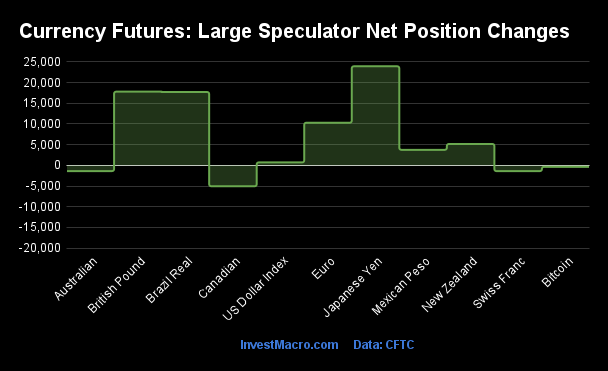
The COT currency market speculator bets were slightly lower this week as five out of the eleven currency markets we cover had higher positioning while the other six markets had lower speculator contracts.

Leading the gains for the currency markets was the Japanese Yen (33,466 contracts) with the Australian Dollar (18,719 contracts), the EuroFX (11,367 contracts), the British Pound (7,177 contracts) and the US Dollar Index (1,888 contracts) also showing a positive week.

The currencies with declines in speculator bets on the week were the Brazilian Real (-37,929 contracts), the Mexican Peso (-6,733 contracts), the Canadian Dollar (-6,020 contracts), the New Zealand Dollar (-2,640 contracts), Bitcoin (-789 contracts) and the Swiss Franc (-1 contract) also registering lower bets on the week.

Speculators boost Yen bets, bring Euro, USD Index out of bearish levels

Highlighting the COT currency’s data this week is that both the Euro and the US dollar index speculator positions were modestly boosted out of their bearish levels into small positive positions. Also, the Japanese yen and Australian dollar positions were well bid through Tuesday.

Here is this week’s COT currency roundup:

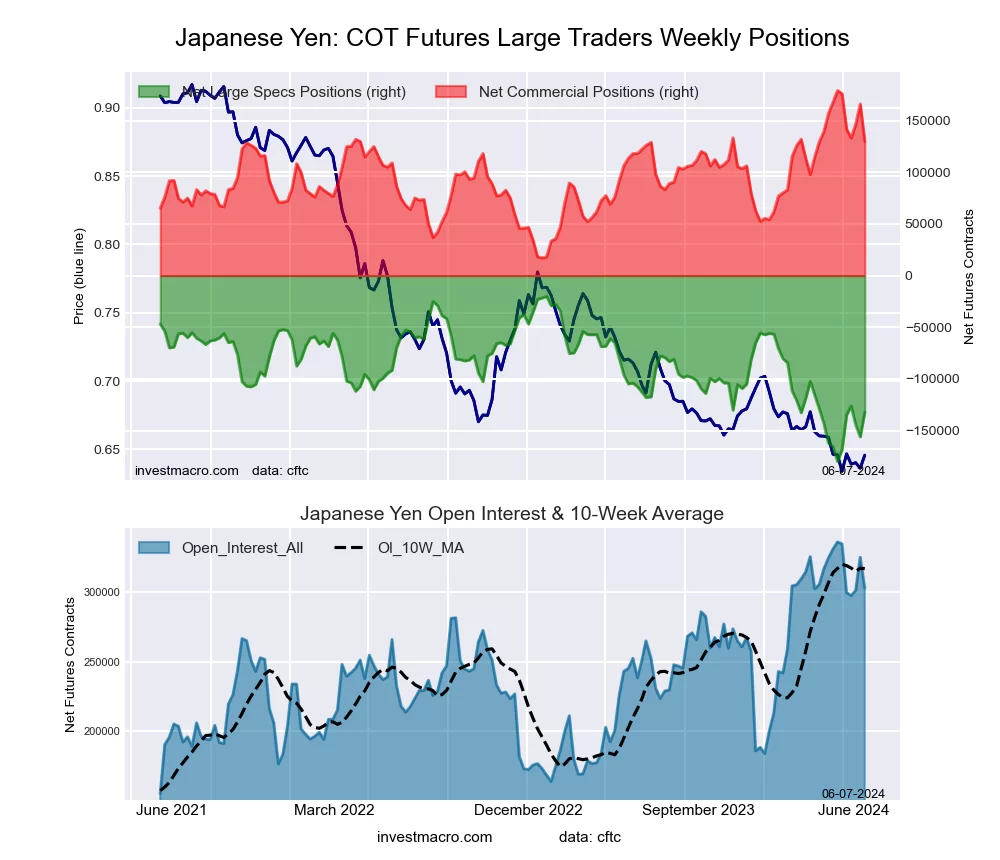
The Japanese yen contracts jumped this week by over +33,000 contracts which marked the highest one-week amount since 2020. The yen speculator position has now gained for two weeks in a row amid rumored currency intervention by the Japanese authorities that are trying to arrest deep declines in the yen. The USDJPY currency pair still trades over 155.00 which is close to over thirty-year highs for the US dollar against the yen.

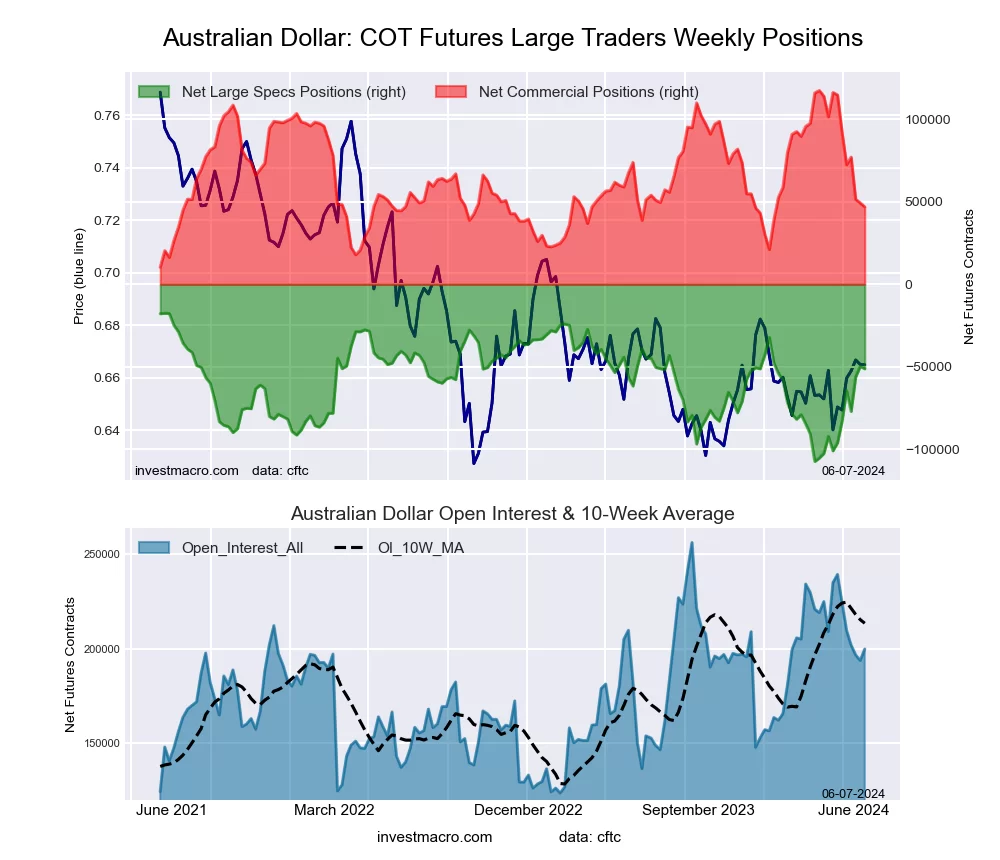
The Australian dollar speculator position rose strongly this week by over +18,000 contracts following a boost by +13,004 contracts on April 30th. The AUD speculator bets have now gained for three straight weeks and for six out of the past seven weeks. Recently, the speculator position for the Aussie had dropped to an all-time record low on March 19th at a total of -107,538 contracts. Since then, speculator bets have improved significantly and are currently at -64,516 contracts.

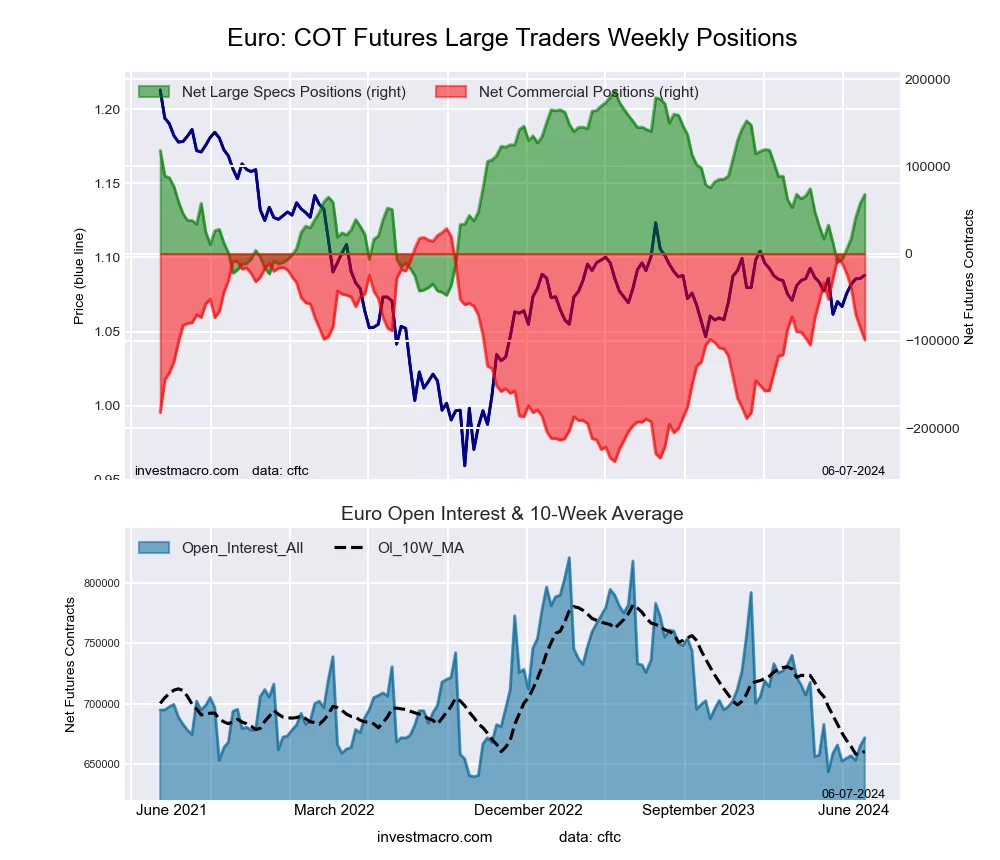
The Euro bounced back again this week with a gain of +11,367 contracts and a follows up a small rise last week. The improvement in the overall net position has brought the speculative standing back into bullish territory following two straight weeks in bearish territory. That was the first time the Euro contracts had been in bearish territory since September of 2022.

The US dollar index bets also came out of bearish territory this week for the first time in seven weeks. The USD Index bets rose by 1,888 contracts and gained for the fifth straight week. The contracts had been in bullish territory for a total of 142 straight weeks before dropping into a bearish position on March 26th.

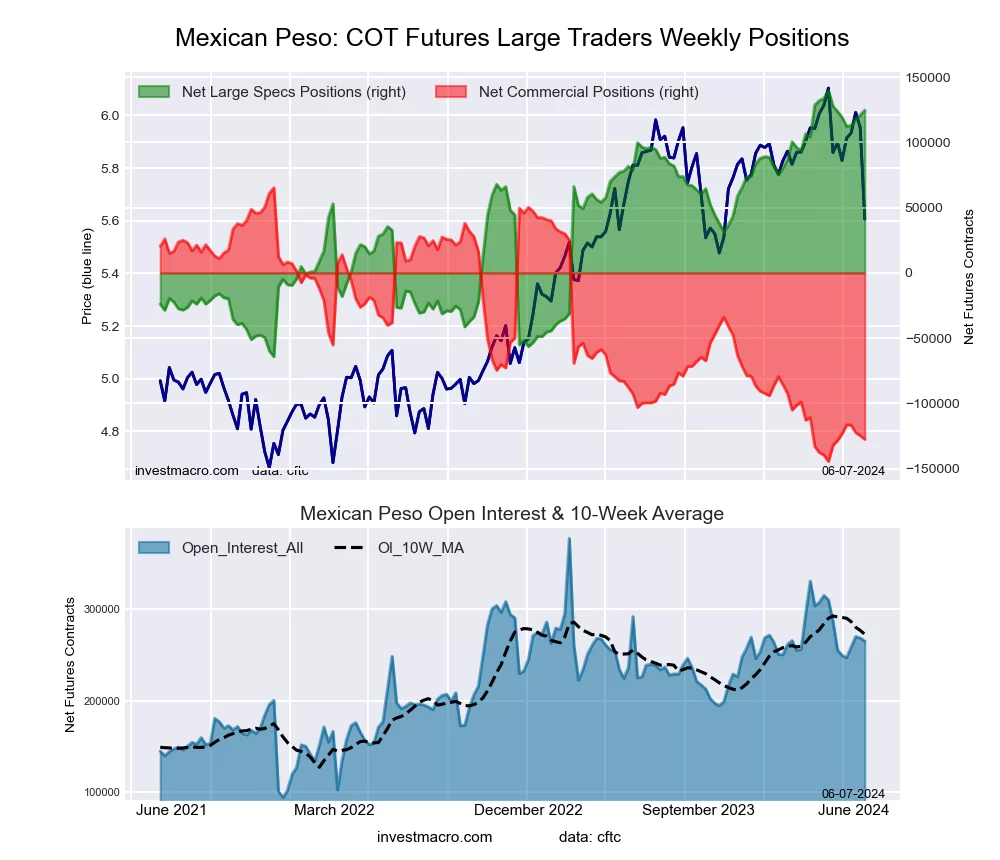
The Mexican Peso speculative position decreased this week for a fourth straight week but did so modestly (-6,733 contracts) and remains in a strong bullish level. The MXN speculator’s current standing (+112,312 contracts) remains above +100,000 contract level for 1oth consecutive week. The MXN peso exchange rate has bounced back with gains in the past two weeks after a steep pullback in the middle of April.

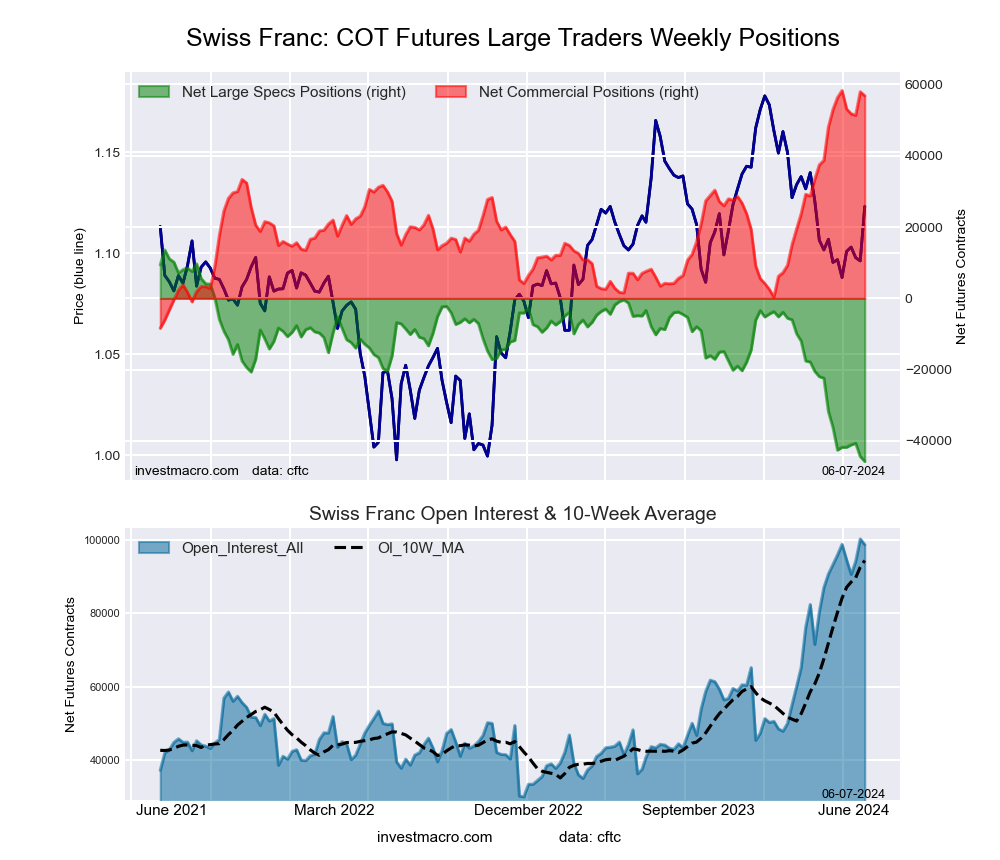
The Swiss franc position was virtually unchanged this week (-1 contract) but continues to remain near the lowest levels since 2019 at a total of -41,787 contracts. The franc is one of the most extremely bearish markets in the COT data we follow. The franc’s exchange rate against the US dollar has been on the decline with an approximate drop by over 8 percent since December 2023. The CHFUSD currently trades around the major levels near 1.1050 – 1.1100.


Currencies Net Speculators Leaderboard
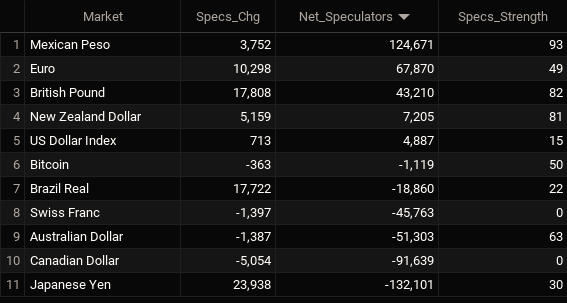
Legend: Weekly Speculators Change | Speculators Current Net Position | Speculators Strength Score compared to last 3-Years (0-100 range)


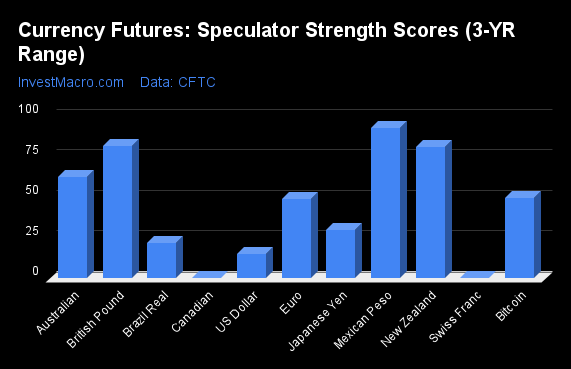
Strength Scores led by Mexican Peso & Bitcoin

COT Strength Scores (a normalized measure of Speculator positions over a 3-Year range, from 0 to 100 where above 80 is Extreme-Bullish and below 20 is Extreme-Bearish) showed that the Mexican Peso (87 percent) and the Bitcoin (55 percent) lead the currency markets this week. The British Pound (39 percent), Australian Dollar (39 percent) and the New Zealand Dollar (29 percent) come in as the next highest in the weekly strength scores.

On the downside, the Brazilian Real (0 percent) and the Swiss Franc (1 percent) come in at the lowest strength levels currently and are in Extreme-Bearish territory (below 20 percent). The next lowest strength scores are the US Dollar Index (9 percent) and the Canadian Dollar (10 percent).

Strength Statistics:
US Dollar Index (8.8 percent) vs US Dollar Index previous week (4.8 percent)
EuroFX (22.3 percent) vs EuroFX previous week (17.4 percent)
British Pound Sterling (38.8 percent) vs British Pound Sterling previous week (34.1 percent)
Japanese Yen (28.1 percent) vs Japanese Yen previous week (7.2 percent)
Swiss Franc (1.4 percent) vs Swiss Franc previous week (1.4 percent)
Canadian Dollar (10.3 percent) vs Canadian Dollar previous week (14.9 percent)
Australian Dollar (38.9 percent) vs Australian Dollar previous week (22.0 percent)
New Zealand Dollar (28.6 percent) vs New Zealand Dollar previous week (36.1 percent)
Mexican Peso (86.6 percent) vs Mexican Peso previous week (89.9 percent)
Brazilian Real (0.0 percent) vs Brazilian Real previous week (43.0 percent)
Bitcoin (54.6 percent) vs Bitcoin previous week (66.5 percent)


Australian Dollar & US Dollar Index top the 6-Week Strength Trends

COT Strength Score Trends (or move index, calculates the 6-week changes in strength scores) showed that the Australian Dollar (37 percent) and the US Dollar Index (5 percent) lead the past six weeks trends for the currencies. The Bitcoin (4 percent), the Japanese Yen (-4 percent) and the Mexican Peso (-10 percent) are the next highest positive movers in the latest trends data.

The Brazilian Real (-53 percent) leads the downside trend scores currently with the British Pound (-38 percent), Swiss Franc (-35 percent) and the New Zealand Dollar (-15 percent) following next with lower trend scores.

Strength Trend Statistics:
US Dollar Index (5.2 percent) vs US Dollar Index previous week (-1.5 percent)
EuroFX (-11.3 percent) vs EuroFX previous week (-23.5 percent)
British Pound Sterling (-37.8 percent) vs British Pound Sterling previous week (-54.5 percent)
Japanese Yen (-3.6 percent) vs Japanese Yen previous week (-32.8 percent)
Swiss Franc (-35.3 percent) vs Swiss Franc previous week (-37.9 percent)
Canadian Dollar (-14.4 percent) vs Canadian Dollar previous week (-19.8 percent)
Australian Dollar (37.0 percent) vs Australian Dollar previous week (22.0 percent)
New Zealand Dollar (-14.7 percent) vs New Zealand Dollar previous week (-23.7 percent)
Mexican Peso (-9.7 percent) vs Mexican Peso previous week (-4.7 percent)
Brazilian Real (-52.6 percent) vs Brazilian Real previous week (-11.4 percent)
Bitcoin (4.4 percent) vs Bitcoin previous week (31.6 percent)


Individual COT Forex Markets:

US Dollar Index Futures:

US Dollar Index Forex Futures COT ChartThe US Dollar Index large speculator standing this week reached a net position of 1,853 contracts in the data reported through Tuesday. This was a weekly increase of 1,888 contracts from the previous week which had a total of -35 net contracts.

This week’s current strength score (the trader positioning range over the past three years, measured from 0 to 100) shows the speculators are currently Bearish-Extreme with a score of 8.8 percent. The commercials are Bullish-Extreme with a score of 93.5 percent and the small traders (not shown in chart) are Bearish with a score of 29.1 percent.

Price Trend-Following Model: Uptrend

Our weekly trend-following model classifies the current market price position as: Uptrend. The current action for the model is considered to be: Hold – Maintain Long Position.

US DOLLAR INDEX StatisticsSPECULATORSCOMMERCIALSSMALL TRADERS
– Percent of Open Interest Longs:67.221.68.7
– Percent of Open Interest Shorts:62.929.45.2
– Net Position:1,853-3,3921,539
– Gross Longs:28,8819,2603,753
– Gross Shorts:27,02812,6522,214
– Long to Short Ratio:1.1 to 10.7 to 11.7 to 1
NET POSITION TREND:
– Strength Index Score (3 Year Range Pct):8.893.529.1
– Strength Index Reading (3 Year Range):Bearish-ExtremeBullish-ExtremeBearish
NET POSITION MOVEMENT INDEX:
– 6-Week Change in Strength Index:5.2-5.0-1.2


Euro Currency Futures:

Euro Currency Futures COT ChartThe Euro Currency large speculator standing this week reached a net position of 4,590 contracts in the data reported through Tuesday. This was a weekly gain of 11,367 contracts from the previous week which had a total of -6,777 net contracts.

This week’s current strength score (the trader positioning range over the past three years, measured from 0 to 100) shows the speculators are currently Bearish with a score of 22.3 percent. The commercials are Bullish-Extreme with a score of 80.9 percent and the small traders (not shown in chart) are Bearish-Extreme with a score of 7.2 percent.

Price Trend-Following Model: Downtrend

Our weekly trend-following model classifies the current market price position as: Downtrend. The current action for the model is considered to be: Hold – Maintain Short Position.

EURO Currency StatisticsSPECULATORSCOMMERCIALSSMALL TRADERS
– Percent of Open Interest Longs:26.160.111.5
– Percent of Open Interest Shorts:25.463.58.8
– Net Position:4,590-22,27917,689
– Gross Longs:170,594393,84575,156
– Gross Shorts:166,004416,12457,467
– Long to Short Ratio:1.0 to 10.9 to 11.3 to 1
NET POSITION TREND:
– Strength Index Score (3 Year Range Pct):22.380.97.2
– Strength Index Reading (3 Year Range):BearishBullish-ExtremeBearish-Extreme
NET POSITION MOVEMENT INDEX:
– 6-Week Change in Strength Index:-11.311.9-8.4


British Pound Sterling Futures:

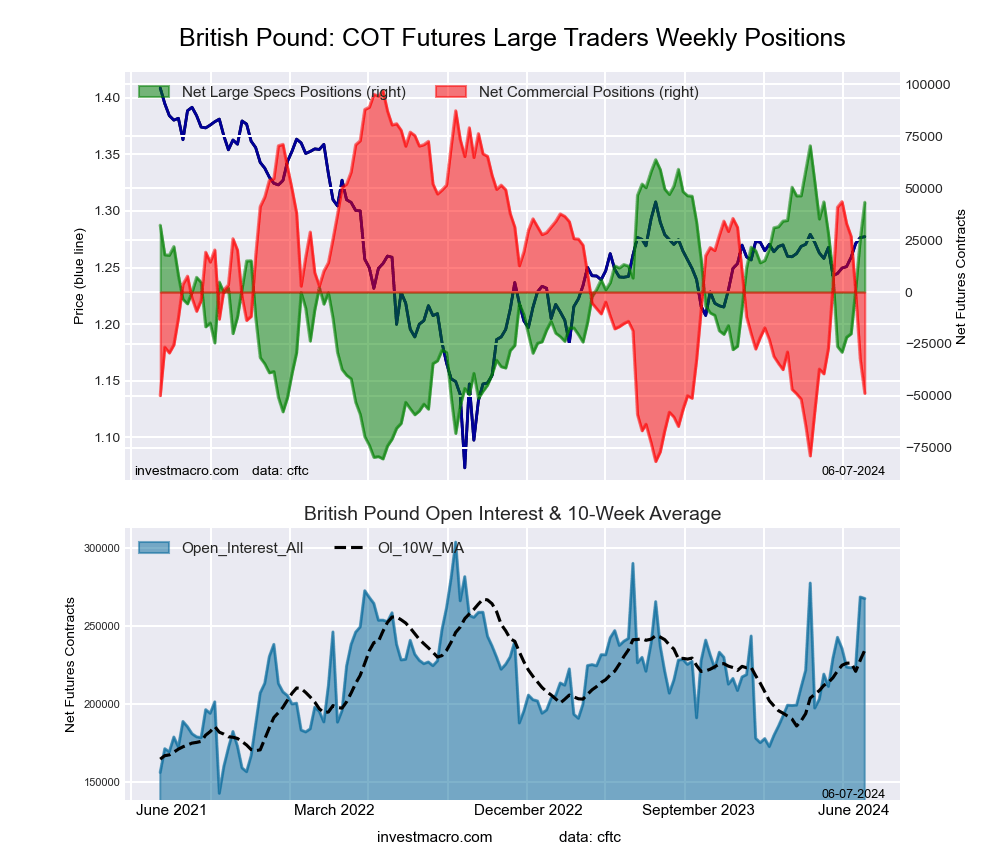
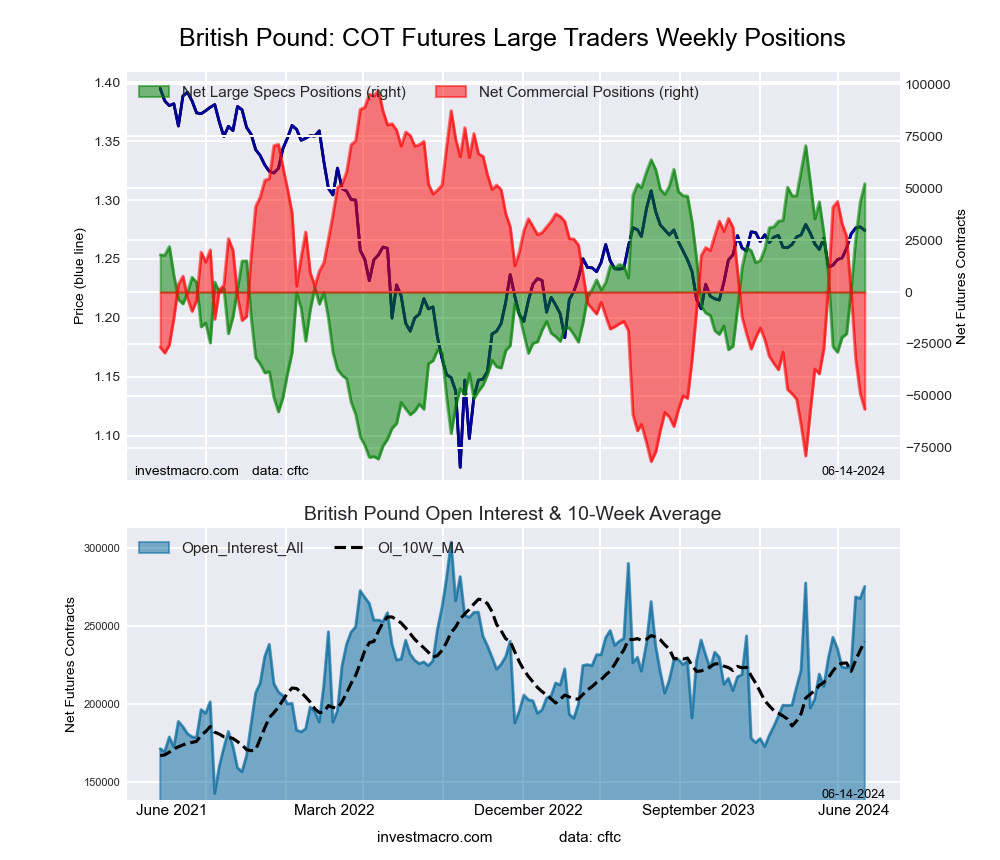
British Pound Sterling Futures COT ChartThe British Pound Sterling large speculator standing this week reached a net position of -21,813 contracts in the data reported through Tuesday. This was a weekly advance of 7,177 contracts from the previous week which had a total of -28,990 net contracts.

This week’s current strength score (the trader positioning range over the past three years, measured from 0 to 100) shows the speculators are currently Bearish with a score of 38.8 percent. The commercials are Bullish with a score of 64.1 percent and the small traders (not shown in chart) are Bearish with a score of 36.6 percent.

Price Trend-Following Model: Downtrend

Our weekly trend-following model classifies the current market price position as: Downtrend. The current action for the model is considered to be: Hold – Maintain Short Position.

BRITISH POUND StatisticsSPECULATORSCOMMERCIALSSMALL TRADERS
– Percent of Open Interest Longs:23.163.49.6
– Percent of Open Interest Shorts:32.948.714.6
– Net Position:-21,81332,970-11,157
– Gross Longs:51,777141,83521,445
– Gross Shorts:73,590108,86532,602
– Long to Short Ratio:0.7 to 11.3 to 10.7 to 1
NET POSITION TREND:
– Strength Index Score (3 Year Range Pct):38.864.136.6
– Strength Index Reading (3 Year Range):BearishBullishBearish
NET POSITION MOVEMENT INDEX:
– 6-Week Change in Strength Index:-37.839.2-26.0


Japanese Yen Futures:

Japanese Yen Forex Futures COT ChartThe Japanese Yen large speculator standing this week reached a net position of -134,922 contracts in the data reported through Tuesday. This was a weekly advance of 33,466 contracts from the previous week which had a total of -168,388 net contracts.

This week’s current strength score (the trader positioning range over the past three years, measured from 0 to 100) shows the speculators are currently Bearish with a score of 28.1 percent. The commercials are Bullish with a score of 76.9 percent and the small traders (not shown in chart) are Bullish with a score of 61.1 percent.

Price Trend-Following Model: Downtrend

Our weekly trend-following model classifies the current market price position as: Downtrend. The current action for the model is considered to be: Hold – Maintain Short Position.

JAPANESE YEN StatisticsSPECULATORSCOMMERCIALSSMALL TRADERS
– Percent of Open Interest Longs:11.773.112.5
– Percent of Open Interest Shorts:56.725.914.7
– Net Position:-134,922141,773-6,851
– Gross Longs:34,990219,30537,333
– Gross Shorts:169,91277,53244,184
– Long to Short Ratio:0.2 to 12.8 to 10.8 to 1
NET POSITION TREND:
– Strength Index Score (3 Year Range Pct):28.176.961.1
– Strength Index Reading (3 Year Range):BearishBullishBullish
NET POSITION MOVEMENT INDEX:
– 6-Week Change in Strength Index:-3.67.5-20.0


Swiss Franc Futures:

Swiss Franc Forex Futures COT ChartThe Swiss Franc large speculator standing this week reached a net position of -41,787 contracts in the data reported through Tuesday. This was a weekly lowering of -1 contracts from the previous week which had a total of -41,786 net contracts.

This week’s current strength score (the trader positioning range over the past three years, measured from 0 to 100) shows the speculators are currently Bearish-Extreme with a score of 1.4 percent. The commercials are Bullish-Extreme with a score of 92.2 percent and the small traders (not shown in chart) are Bearish with a score of 25.8 percent.

Price Trend-Following Model: Downtrend

Our weekly trend-following model classifies the current market price position as: Downtrend. The current action for the model is considered to be: Hold – Maintain Short Position.

SWISS FRANC StatisticsSPECULATORSCOMMERCIALSSMALL TRADERS
– Percent of Open Interest Longs:9.877.911.2
– Percent of Open Interest Shorts:53.921.723.1
– Net Position:-41,78753,109-11,322
– Gross Longs:9,23773,68410,557
– Gross Shorts:51,02420,57521,879
– Long to Short Ratio:0.2 to 13.6 to 10.5 to 1
NET POSITION TREND:
– Strength Index Score (3 Year Range Pct):1.492.225.8
– Strength Index Reading (3 Year Range):Bearish-ExtremeBullish-ExtremeBearish
NET POSITION MOVEMENT INDEX:
– 6-Week Change in Strength Index:-35.323.518.9


Canadian Dollar Futures:

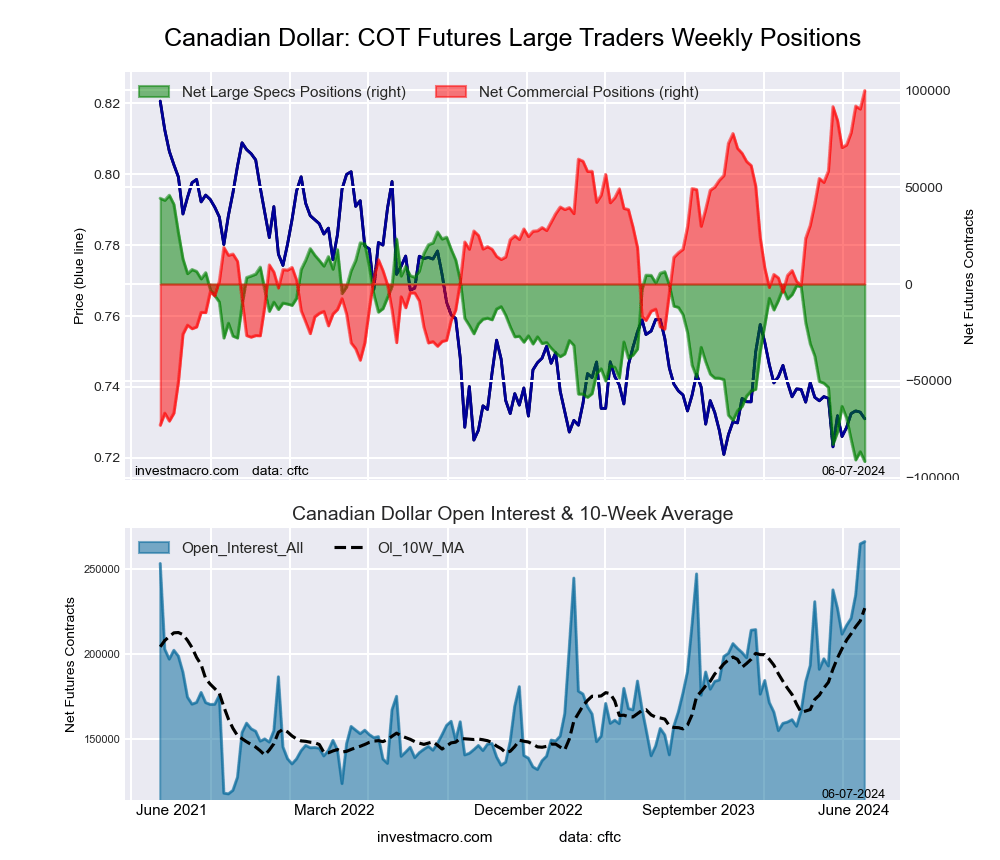
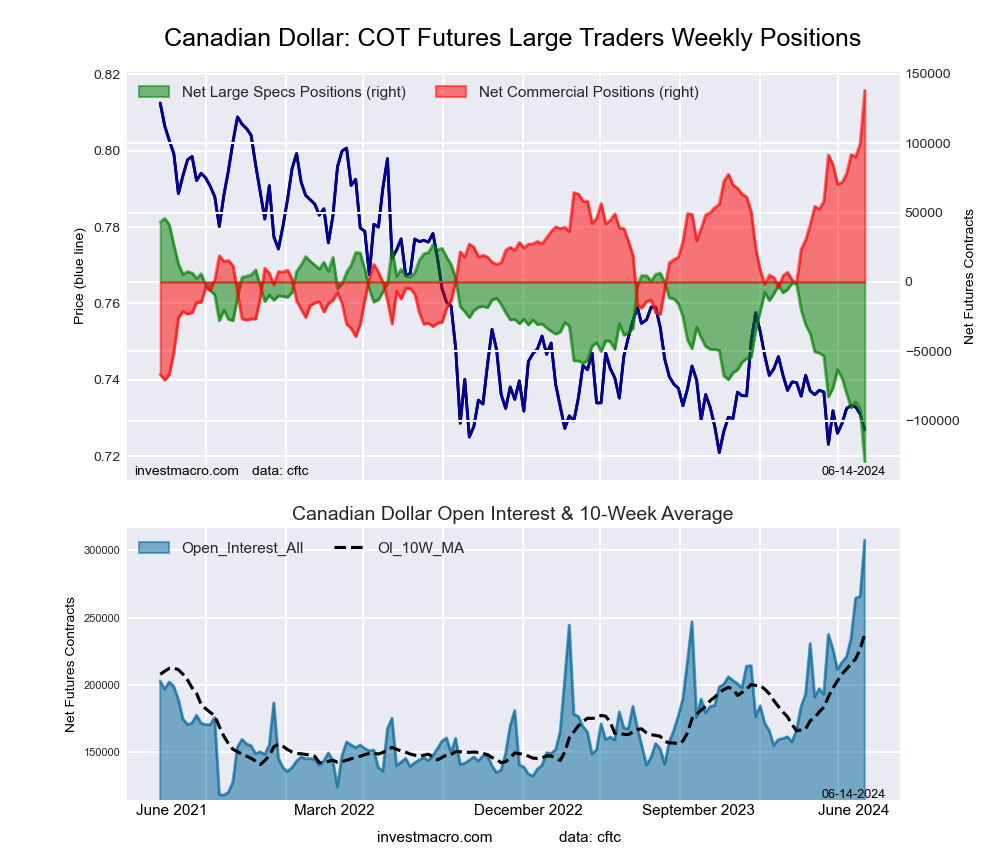
Canadian Dollar Forex Futures COT ChartThe Canadian Dollar large speculator standing this week reached a net position of -69,221 contracts in the data reported through Tuesday. This was a weekly fall of -6,020 contracts from the previous week which had a total of -63,201 net contracts.

This week’s current strength score (the trader positioning range over the past three years, measured from 0 to 100) shows the speculators are currently Bearish-Extreme with a score of 10.3 percent. The commercials are Bullish-Extreme with a score of 88.7 percent and the small traders (not shown in chart) are Bearish-Extreme with a score of 17.4 percent.

Price Trend-Following Model: Downtrend

Our weekly trend-following model classifies the current market price position as: Downtrend. The current action for the model is considered to be: Hold – Maintain Short Position.

CANADIAN DOLLAR StatisticsSPECULATORSCOMMERCIALSSMALL TRADERS
– Percent of Open Interest Longs:15.268.513.7
– Percent of Open Interest Shorts:47.135.314.9
– Net Position:-69,22171,845-2,624
– Gross Longs:32,945148,39029,719
– Gross Shorts:102,16676,54532,343
– Long to Short Ratio:0.3 to 11.9 to 10.9 to 1
NET POSITION TREND:
– Strength Index Score (3 Year Range Pct):10.388.717.4
– Strength Index Reading (3 Year Range):Bearish-ExtremeBullish-ExtremeBearish-Extreme
NET POSITION MOVEMENT INDEX:
– 6-Week Change in Strength Index:-14.410.03.6


Australian Dollar Futures:

Australian Dollar Forex Futures COT ChartThe Australian Dollar large speculator standing this week reached a net position of -64,516 contracts in the data reported through Tuesday. This was a weekly rise of 18,719 contracts from the previous week which had a total of -83,235 net contracts.

This week’s current strength score (the trader positioning range over the past three years, measured from 0 to 100) shows the speculators are currently Bearish with a score of 38.9 percent. The commercials are Bullish with a score of 66.8 percent and the small traders (not shown in chart) are Bearish with a score of 36.8 percent.

Price Trend-Following Model: Weak Downtrend

Our weekly trend-following model classifies the current market price position as: Weak Downtrend. The current action for the model is considered to be: Hold – Maintain Short Position.

AUSTRALIAN DOLLAR StatisticsSPECULATORSCOMMERCIALSSMALL TRADERS
– Percent of Open Interest Longs:23.664.49.5
– Percent of Open Interest Shorts:54.429.813.3
– Net Position:-64,51672,522-8,006
– Gross Longs:49,480135,02319,859
– Gross Shorts:113,99662,50127,865
– Long to Short Ratio:0.4 to 12.2 to 10.7 to 1
NET POSITION TREND:
– Strength Index Score (3 Year Range Pct):38.966.836.8
– Strength Index Reading (3 Year Range):BearishBullishBearish
NET POSITION MOVEMENT INDEX:
– 6-Week Change in Strength Index:37.0-33.211.1


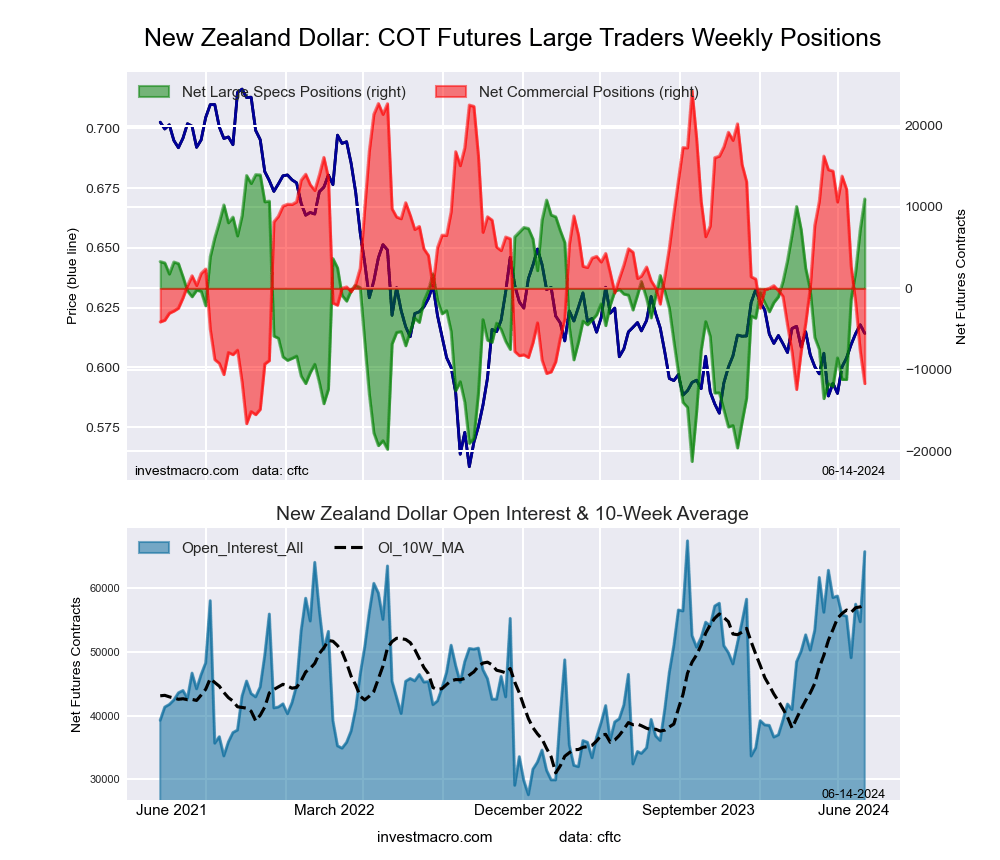
New Zealand Dollar Futures:

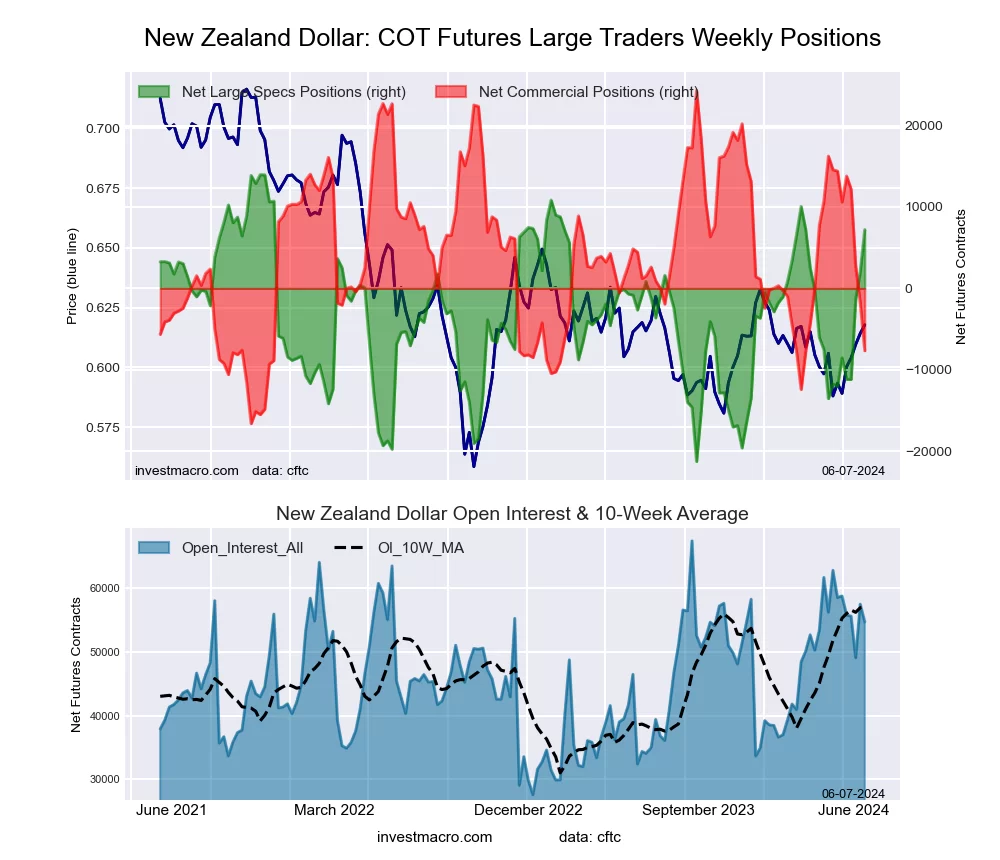
New Zealand Dollar Forex Futures COT ChartThe New Zealand Dollar large speculator standing this week reached a net position of -11,191 contracts in the data reported through Tuesday. This was a weekly fall of -2,640 contracts from the previous week which had a total of -8,551 net contracts.

This week’s current strength score (the trader positioning range over the past three years, measured from 0 to 100) shows the speculators are currently Bearish with a score of 28.6 percent. The commercials are Bullish with a score of 74.3 percent and the small traders (not shown in chart) are Bearish with a score of 20.6 percent.

Price Trend-Following Model: Downtrend

Our weekly trend-following model classifies the current market price position as: Downtrend. The current action for the model is considered to be: Hold – Maintain Short Position.

NEW ZEALAND DOLLAR StatisticsSPECULATORSCOMMERCIALSSMALL TRADERS
– Percent of Open Interest Longs:34.160.15.6
– Percent of Open Interest Shorts:54.235.410.3
– Net Position:-11,19113,792-2,601
– Gross Longs:19,06033,5313,124
– Gross Shorts:30,25119,7395,725
– Long to Short Ratio:0.6 to 11.7 to 10.5 to 1
NET POSITION TREND:
– Strength Index Score (3 Year Range Pct):28.674.320.6
– Strength Index Reading (3 Year Range):BearishBullishBearish
NET POSITION MOVEMENT INDEX:
– 6-Week Change in Strength Index:-14.714.8-11.5


Mexican Peso Futures:

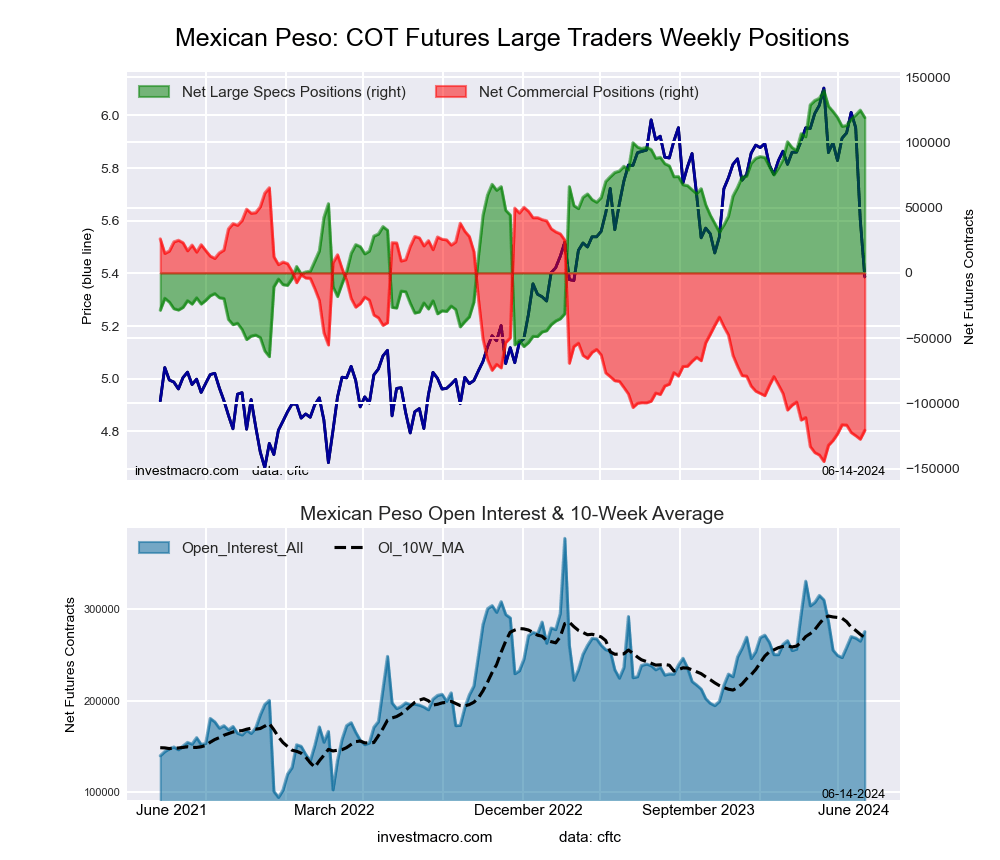
Mexican Peso Futures COT ChartThe Mexican Peso large speculator standing this week reached a net position of 112,312 contracts in the data reported through Tuesday. This was a weekly fall of -6,733 contracts from the previous week which had a total of 119,045 net contracts.

This week’s current strength score (the trader positioning range over the past three years, measured from 0 to 100) shows the speculators are currently Bullish-Extreme with a score of 86.6 percent. The commercials are Bearish-Extreme with a score of 13.4 percent and the small traders (not shown in chart) are Bearish with a score of 37.1 percent.

Price Trend-Following Model: Strong Uptrend

Our weekly trend-following model classifies the current market price position as: Strong Uptrend. The current action for the model is considered to be: Hold – Maintain Long Position.

MEXICAN PESO StatisticsSPECULATORSCOMMERCIALSSMALL TRADERS
– Percent of Open Interest Longs:55.740.92.8
– Percent of Open Interest Shorts:10.288.11.1
– Net Position:112,312-116,3744,062
– Gross Longs:137,564101,0756,829
– Gross Shorts:25,252217,4492,767
– Long to Short Ratio:5.4 to 10.5 to 12.5 to 1
NET POSITION TREND:
– Strength Index Score (3 Year Range Pct):86.613.437.1
– Strength Index Reading (3 Year Range):Bullish-ExtremeBearish-ExtremeBearish
NET POSITION MOVEMENT INDEX:
– 6-Week Change in Strength Index:-9.710.2-9.8


Brazilian Real Futures:

Brazil Real Futures COT ChartThe Brazilian Real large speculator standing this week reached a net position of -37,643 contracts in the data reported through Tuesday. This was a weekly lowering of -37,929 contracts from the previous week which had a total of 286 net contracts.

This week’s current strength score (the trader positioning range over the past three years, measured from 0 to 100) shows the speculators are currently Bearish-Extreme with a score of 0.0 percent. The commercials are Bullish-Extreme with a score of 100.0 percent and the small traders (not shown in chart) are Bearish with a score of 36.1 percent.

Price Trend-Following Model: Strong Downtrend

Our weekly trend-following model classifies the current market price position as: Strong Downtrend. The current action for the model is considered to be: Hold – Maintain Short Position.

BRAZIL REAL StatisticsSPECULATORSCOMMERCIALSSMALL TRADERS
– Percent of Open Interest Longs:16.279.93.8
– Percent of Open Interest Shorts:80.316.23.5
– Net Position:-37,64337,468175
– Gross Longs:9,54646,9662,236
– Gross Shorts:47,1899,4982,061
– Long to Short Ratio:0.2 to 14.9 to 11.1 to 1
NET POSITION TREND:
– Strength Index Score (3 Year Range Pct):0.0100.036.1
– Strength Index Reading (3 Year Range):Bearish-ExtremeBullish-ExtremeBearish
NET POSITION MOVEMENT INDEX:
– 6-Week Change in Strength Index:-52.654.1-22.4


Bitcoin Futures:

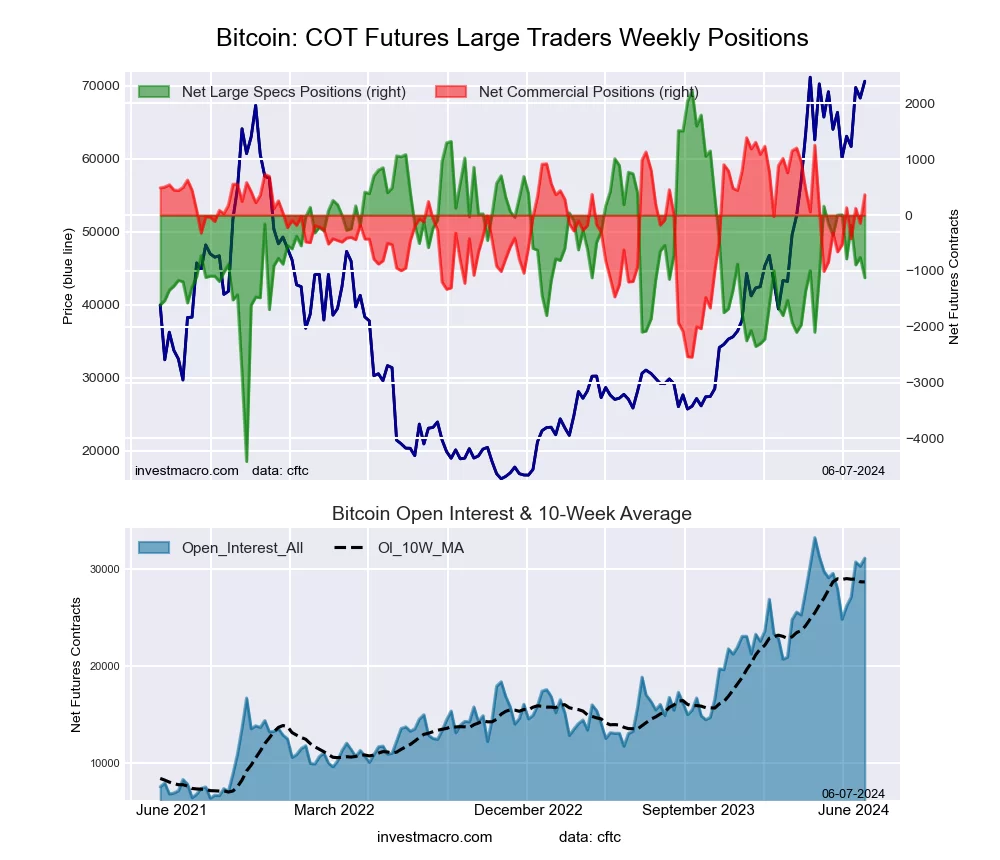
Bitcoin Crypto Futures COT ChartThe Bitcoin large speculator standing this week reached a net position of -783 contracts in the data reported through Tuesday. This was a weekly reduction of -789 contracts from the previous week which had a total of 6 net contracts.

This week’s current strength score (the trader positioning range over the past three years, measured from 0 to 100) shows the speculators are currently Bullish with a score of 54.6 percent. The commercials are Bullish with a score of 68.1 percent and the small traders (not shown in chart) are Bearish with a score of 27.7 percent.

Price Trend-Following Model: Uptrend

Our weekly trend-following model classifies the current market price position as: Uptrend. The current action for the model is considered to be: Hold – Maintain Long Position.

BITCOIN StatisticsSPECULATORSCOMMERCIALSSMALL TRADERS
– Percent of Open Interest Longs:79.44.56.1
– Percent of Open Interest Shorts:82.44.03.6
– Net Position:-783134649
– Gross Longs:20,7701,1811,588
– Gross Shorts:21,5531,047939
– Long to Short Ratio:1.0 to 11.1 to 11.7 to 1
NET POSITION TREND:
– Strength Index Score (3 Year Range Pct):54.668.127.7
– Strength Index Reading (3 Year Range):BullishBullishBearish
NET POSITION MOVEMENT INDEX:
– 6-Week Change in Strength Index:4.40.6-7.2


Article By InvestMacroReceive our weekly COT Newsletter

*COT Report: The COT data, released weekly to the public each Friday, is updated through the most recent Tuesday (data is 3 days old) and shows a quick view of how large speculators or non-commercials (for-profit traders) were positioned in the futures markets.

The CFTC categorizes trader positions according to commercial hedgers (traders who use futures contracts for hedging as part of the business), non-commercials (large traders who speculate to realize trading profits) and nonreportable traders (usually small traders/speculators) as well as their open interest (contracts open in the market at time of reporting). See CFTC criteria here.

Week Ahead: USDInd set for volatile week?

By ForexTime 

  • USDInd ↑ almost 4% year-to-date
  • Key US CPI report under spotlight
  • Watch out for Fed speeches
  • Trading within range on D1 charts
  • Levels of interest – 106.50, 105.60 & 105.00

The week ahead is jampacked with top-tier data and speeches by numerous policymakers.

But the spotlight shines on the incoming US inflation data which may rock FXTM’s USDInd:

Saturday, 11th May

  • CN50: China CPI, PPI

Monday, 13th May

  • AU200: Australia business confidence
  • NZD: New Zealand food prices, inflation expectations
  • USDInd: Fed speech
  • CHF: SNB President Thomas Jordan speech

Tuesday, 14th May

  • JP225: Japan PPI
  • GER40: Germany CPI, ZEW survey expectations
  • UK100: UK jobless claims, unemployment, BoE Economist Huw Pill speech
  • USDInd: US PPI, Fed Chair Jerome Powell speech

Wednesday, 15th May

  • CAD: Canada housing starts, existing home sales
  • CN50: China rate decision
  • EU50: Eurozone industrial production, GDP
  • USDInd: US CPI, retail sales, empire manufacturing, Fed speech

Thursday, 16th May

  • AU200: Australia unemployment
  • JP225: Japan GDP, industrial production
  • EUR: ECB publishes financial stability review
  • USDInd: Initial jobless claims, industrial production, Fed speech

Friday, 17th May

  • CN50: China property prices, retail sales, industrial production
  • HK50: Hong Kong GDP
  • EU50: Eurozone CPI
  • SG20: Singapore trade

The USDInd has been trapped within a range since mid-April with major resistance at 106.50 and support around 105.00.

Note: FXTM’s USDInd tracks how the dollar is performing against a basket of six different G10 currencies, including the Euro, British Pound, Japanese Yen, and Canadian dollar.

Digger deeper, the dollar has appreciated against every single G10 currency year-to-date.

Dollar bulls have been supported by cooling Fed cut bets in the face of sticky inflation and strong data.

With all the above said, here are 3 reasons why the USDInd could see significant moves:

    1) US April CPI report

The April Consumer Price Index (CPI) published on Wednesday may influence expectations around what the Fed does in the second half of 2024.  

Markets are forecasting:

  • CPI year-on-year (April 2023 vs. April 2024) to cool 3.4% from 3.5% in the prior month.
  • Core CPI year-on-year to cool to 3.6% to 3.8%.
  • CPI month-on-month (April 2024 vs March 2024) to remain unchanged at 0.4%.
  • Core CPI month-on-month to cool to 0.3% to 0.4%.

Headline inflation and the annual core inflation figures are expected to have ticked lower in April. But this is still some distance away from the Fed’s 2% target.

Nevertheless, further evidence of cooling prices may stimulate expectations around the Fed cutting interest rates in the second half of the year.

Traders are currently pricing in a 36% probability of a 25-basis point Fed cut by July with this jumping to 90% by September.

  • A softer-than-expected US CPI report could send the USDInd lower as Fed cut bets jump.
  • Should the inflation report print above market forecasts, this could boost the USDInd.


    2) Fed speeches + US data

A string of speeches from numerous Fed officials including Jerome Powell could pump the USDInd with fresh volatility. Given the recent mixed signals from US policymakers on the path of rates, the incoming speeches may provide investors with fresh clarity on what to expect from the Fed.

Much attention will also be directed towards the latest US retail sales, Producer Prices Index (PPI), and initial jobless claims to gauge the health of the US economy.

  • The USDInd could push higher if Fed officials strike a hawkish note and overall data supports the “higher for longer” narrative for rates.
  • If economic data disappoints and Fed officials sound more dovish, the USDInd may trade lower.


    3) Technical forces 

The USDInd is trading within a range on the daily charts with prices hovering near the 105.00 level. Still, the candlesticks are trading above the 50, 100, and 200-day SMA while the MACD trades above zero.

  • A solid breakdown and daily close below 105.00 could encourage a decline toward the 50-day SMA and 200-day SMA.
  • Should 105.00 prove to be reliable support, this could trigger a rebound to 105.60 and 106.50.


Forex-Time-LogoArticle by ForexTime

ForexTime Ltd (FXTM) is an award winning international online forex broker regulated by CySEC 185/12 www.forextime.com

USDSEK: Golden cross on the horizon?

By ForexTime 

  • USDSEK jumps on Riksbank cut
  • Currency pair in megaphone pattern
  • Key point of reference at golden 161.8 Fib level
  • Potential golden cross on horizon
  • Other key levels at 11.0678 and 10.8333

The USDSEK punched above 10.9 on Wednesday after Sweden’s central bank cut rates for the first time in eight years!

In an expected move, the Riksbank trimmed its policy rate by 25 basis points to 3.75% and signalled two more cuts in the second half of 2024. This makes Sweden’s Riksbank the second major one after the Swiss National Bank to cut interest rates.

As of writing, traders see a 67% probability of another 25 basis point Riksbank cut by June with this fully priced in by August.

The Riksbank dovish stance contrasts with the US Federal Reserve which has struggled to cut rates in the face of sticky inflation.

Incoming data from the US this week is likely to influence bets around when the Fed will join the rate cut club.

At 12:30, GMT, the Unemployment claims data out of the US is expected to show 212,00 individuals filed for unemployment for the first time during the past week. If so, this will signal a relatively healthy labor market and continue to weaken bets of near-term rate cuts.

Technically speaking,

USDSEK is in a broadening pattern, also known as a megaphone.

In a broadening pattern, price peaks and valleys, are bounded by two diverging trendlines.

USDSEK is in a 3-day rally (coming off the support of the megaphone) and may be heading for the upper trendline of the pattern at 11.0678.

Golden cross on the horizon?

Interestingly, the 50-day SMA is close to crossing above the 200-day SMA.

This price phenomenon is called a “golden cross” and is used as an early “warning” sign to show that price could rally further.

When we add the Fibonacci retracement tool, drawn from November 30th 2023 high (10.5387) to December 27th 2023 low (9.9043), we see 10.9309 at the golden fib (161.8%)  ratio acting as resistance and a point of reference.

A strong close above this level may open the floodgates for USDSEK bulls (those looking to see the minor pair rally).

However, USDSEK bears (those looking to see a decline in the pair) will have their eyes set on the following levels.

  • 10.8333: the 21-day SMA

  • 10.7079: the lower trendline of the broadening pattern

Finally, the Relative Strength Index, – an indicator that shows overbought and over-sold zones- is above the 50-point mid-way line and pointing upwards towards the overbought zone, signaling a bullish sentiment in the asset.


Forex-Time-LogoArticle by ForexTime

ForexTime Ltd (FXTM) is an award winning international online forex broker regulated by CySEC 185/12 www.forextime.com

Japanese yen weakens despite government warnings

By RoboForex Analytical Department

The USD/JPY pair is on the rise again this Wednesday, recovering more than half of its previous losses despite ongoing warnings from Japanese authorities about sharp fluctuations in the yen. Finance Minister Shunichi Suzuki reiterated today that the government is prepared to act against excessive currency volatility. Additionally, Bank of Japan Governor Kazuo Ueda noted that the BoJ is assessing the impact of yen movements on inflation to inform future decisions better.

Last week, the yen strengthened by 5.2%, a move that the market largely attributes to financial interventions. While there has been no official confirmation of these measures, the market’s interpretation is bolstered by data from the Bank of Japan, which indicates approximately 60 billion USD in expenditures. These actions are likely aimed at stabilising the national currency’s value

However, these interventions only provided a brief respite for the authorities. The yen’s decline remains primarily influenced by the significant interest rate differential between the US Federal Reserve and the Bank of Japan. With rates at 5.5% and 0%, respectively, this disparity continues to exert downward pressure on the yen, and as long as it persists, the currency is likely to remain weak.

USD/JPY technical analysis

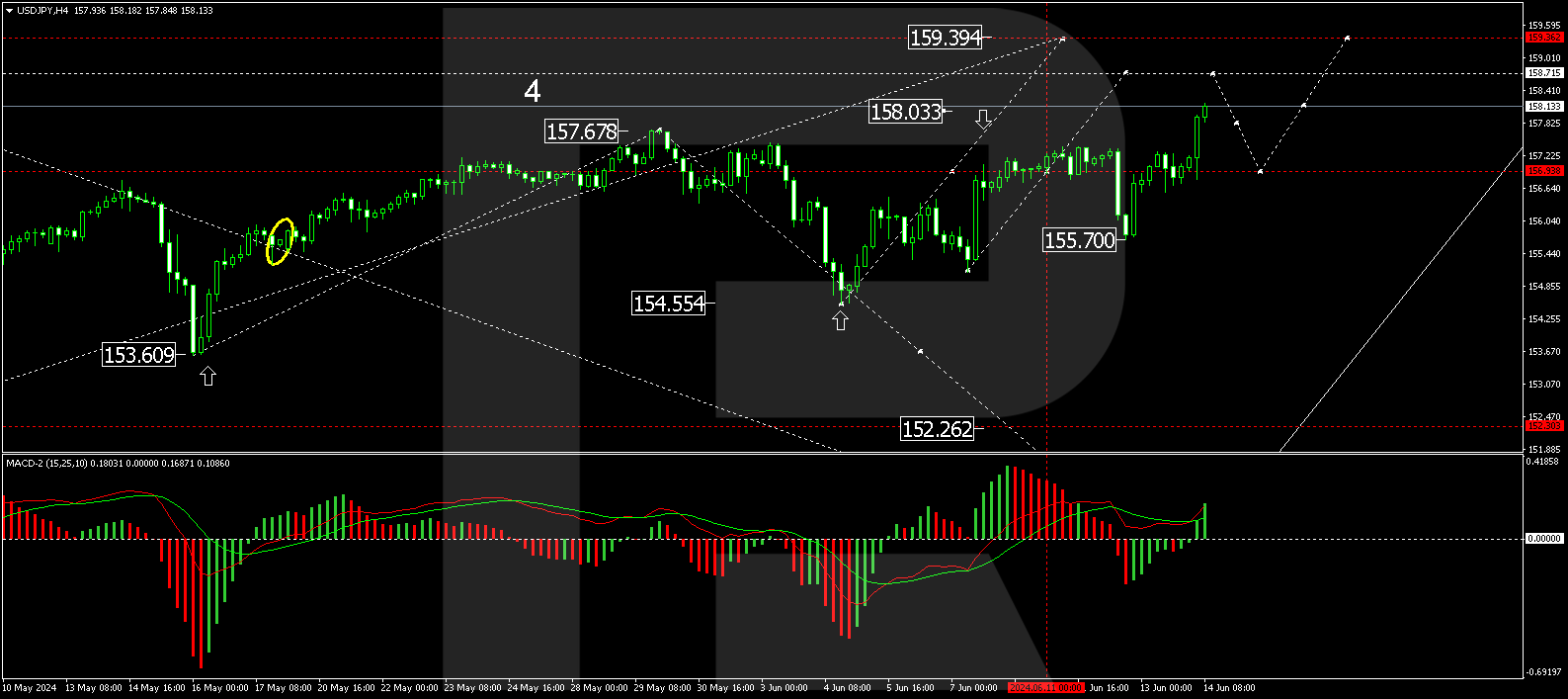
On the H4 chart, USD/JPY is currently forming a wave of decline towards 151.40. The local target of 151.86 has already been reached. The market is now correcting from the previous wave of decline and is expected to reach at least 156.00. After this correction, a new phase of decline towards 151.40 may begin. This scenario is technically supported by the MACD oscillator, whose signal line is below zero but directed upwards.

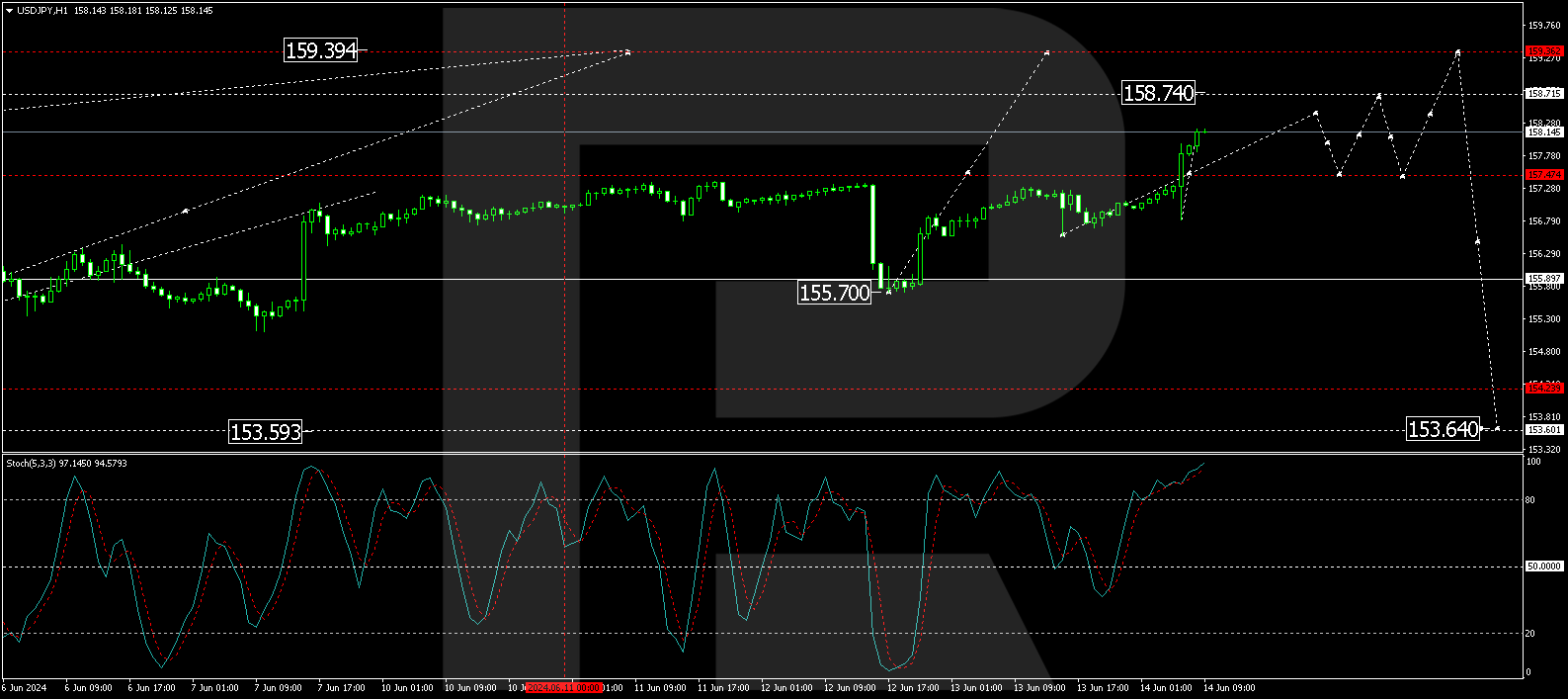
On the H1 chart, USD/JPY has formed a consolidation range around the 154.00 level, with an anticipated upward breakout leading to a correction towards 156.00. Currently, a growth link to 155.88 is forming. Following this, a potential decline back to 154.00 (testing from above) may occur before possibly rising again to 156.00. The Stochastic oscillator confirms this technical outlook, with its signal line above 80 and poised for a decline.


Disclaimer

Any forecasts contained herein are based on the author’s particular opinion. This analysis may not be treated as trading advice. RoboForex bears no responsibility for trading results based on trading recommendations and reviews contained herein.

FX Speculators reduce bearish bets for Yen, Canadian & Australian Dollars

By InvestMacro

Here are the latest charts and statistics for the Commitment of Traders (COT) data published by the Commodities Futures Trading Commission (CFTC).

The latest COT data is updated through Tuesday April 30th and shows a quick view of how large market participants (for-profit speculators and commercial traders) were positioned in the futures markets. All currency positions are in direct relation to the US dollar where, for example, a bet for the euro is a bet that the euro will rise versus the dollar while a bet against the euro will be a bet that the euro will decline versus the dollar.

Weekly Speculator Changes led by Canadian & Australian Dollars

The COT currency market speculator bets were higher this week as eight out of the eleven currency markets we cover had higher positioning while the other three markets had lower speculator contracts.

Leading the gains for the currency markets was the Canadian Dollar (13,249 contracts) with the Australian Dollar (13,004 contracts), the Japanese Yen (11,531 contracts), the New Zealand Dollar (3,496 contracts), EuroFX (3,212 contracts), the Swiss Franc (776 contracts), the US Dollar Index (178 contracts) and Bitcoin (6 contracts) also showing positive weeks.

The currencies seeing declines in speculator bets on the week were the Mexican Peso (-4,610 contracts), the British Pound (-2,757 contracts) and the Brazilian Real (-678 contracts).

Speculators reduce bearish bets for Yen, Canadian & Australian Dollars

This week’s COT currency’s data was mixed in the overall big picture and saw a pause in some of the major trends. There were many extremely weak currency positions (JPY, AUD, CAD, CHF, EUR) that saw a little turnaround for the week in their speculator bets while the extremely strong Mexican peso saw a little slide in its bullishness. The US dollar continues to remain in a strong speculative position overall versus just about all of the major currencies except the peso.

Here is this week’s COT currency roundup:

The British pound sterling speculator was one of the currencies that saw a weaker position on the week and contracts have now fallen for two consecutive weeks. The GBP bets have also dropped in six out of the last 7 weeks for a total 7-week change of -99,441 contracts — illuminating the deteriorating sentiment for the GBP. This has dropped the current speculator contract level to a new lowpoint since January 2023.

The Euro bounced back very slightly this week with a gain of +3,212 contracts. The overall net position, however, is now in bearish territory for a second straight week. This is the first time the Euro contracts have been bearish since September of 2022.

The Canadian dollar speculative position has bounced back with two weeks of gains following eight straight weeks of declines. The overall net position (currently at -63,201 contracts) remains extremely bearish with the current strength level at 15 percent of the past three-years range of positions.

Swiss franc speculator positions remain extremely bearish (1 percent strength score) and the overall net speculator position is greater than -40,000 contracts for a second consecutive week. The franc spec positioning is at the lowest levels since 2019.

The Japanese yen contracts got a little relief this week from the continued downtrend with a rise of +11,531 contracts. Previously, the JPY contracts had dropped in 13 out of 15 weeks for a -123,970 contract decline over those 15 weeks. The current speculative sentiment remains near the lowest standing since 2007. The Japanese authorities likely intervened in the currency markets earlier this week in order to pause the steep decline in the yen and the yen managed to end the week higher by approximately 3 percent vs the USD.

The Australian dollar speculator position saw improvement for a second straight week this week with a gain of +13,004 contracts through Tuesday. The Aussie spec position and sentiment have been historically bearish over the past few months with an all-time record low position reached on March 19th at a total of -107,538 contracts. The current positioning level sits at -83,235 contracts.

The Mexican Peso remains the one strong currency in the mix against the US dollar. The MXN speculative position has fallen for three straight weeks but remains in a very strong position with a current total of +119,045 contracts. The MXN speculator level has remained above the +100,000 level for nine consecutive weeks which is the first time that type of streak has taken place since late-2019 into early-2020. The MXN exchange rate versus the USD has experienced a pullback over the past month but remains slightly higher for 2024 so far and closed this week higher by over 1 percent.


Currencies Net Speculators Leaderboard

Legend: Weekly Speculators Change | Speculators Current Net Position | Speculators Strength Score compared to last 3-Years (0-100 range)


Strength Scores led by Mexican Peso & Bitcoin

COT Strength Scores (a normalized measure of Speculator positions over a 3-Year range, from 0 to 100 where above 80 is Extreme-Bullish and below 20 is Extreme-Bearish) showed that the Mexican Peso (90 percent) and Bitcoin (66 percent) lead the currency markets this week.

On the downside, the Swiss Franc (1 percent), the US Dollar Index (5 percent), the Japanese Yen (7 percent), the Canadian Dollar (15 percent) and the EuroFX (17 percent) come in at the lowest strength levels currently and are in Extreme-Bearish territory (below 20 percent).

Strength Statistics:
US Dollar Index (4.8 percent) vs US Dollar Index previous week (4.4 percent)
EuroFX (17.4 percent) vs EuroFX previous week (16.1 percent)
British Pound Sterling (34.1 percent) vs British Pound Sterling previous week (35.9 percent)
Japanese Yen (7.2 percent) vs Japanese Yen previous week (0.0 percent)
Swiss Franc (1.4 percent) vs Swiss Franc previous week (0.0 percent)
Canadian Dollar (14.9 percent) vs Canadian Dollar previous week (4.8 percent)
Australian Dollar (22.0 percent) vs Australian Dollar previous week (10.2 percent)
New Zealand Dollar (36.1 percent) vs New Zealand Dollar previous week (26.2 percent)
Mexican Peso (89.9 percent) vs Mexican Peso previous week (92.1 percent)
Brazilian Real (24.1 percent) vs Brazilian Real previous week (25.2 percent)
Bitcoin (66.5 percent) vs Bitcoin previous week (66.4 percent)


Bitcoin & Australian Dollar top the 6-Week Strength Trends
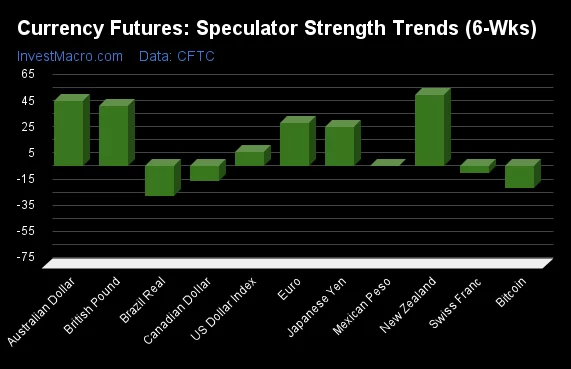
COT Strength Score Trends (or move index, calculates the 6-week changes in strength scores) showed that the Bitcoin (32 percent) and the Australian Dollar (22 percent) lead the past six weeks trends and are the only positive movers for the currencies.

The British Pound (-54 percent) leads the downside trend scores currently with the Swiss Franc (-38 percent), Japanese Yen (-33 percent) and the New Zealand Dollar (-24 percent) following next with lower trend scores.

Strength Trend Statistics:
US Dollar Index (-1.5 percent) vs US Dollar Index previous week (-13.5 percent)
EuroFX (-23.5 percent) vs EuroFX previous week (-35.9 percent)
British Pound Sterling (-54.5 percent) vs British Pound Sterling previous week (-64.1 percent)
Japanese Yen (-32.8 percent) vs Japanese Yen previous week (-48.5 percent)
Swiss Franc (-37.9 percent) vs Swiss Franc previous week (-44.0 percent)
Canadian Dollar (-19.8 percent) vs Canadian Dollar previous week (-34.6 percent)
Australian Dollar (22.0 percent) vs Australian Dollar previous week (-4.9 percent)
New Zealand Dollar (-23.7 percent) vs New Zealand Dollar previous week (-41.2 percent)
Mexican Peso (-4.7 percent) vs Mexican Peso previous week (9.5 percent)
Brazilian Real (-15.1 percent) vs Brazilian Real previous week (-11.7 percent)
Bitcoin (31.6 percent) vs Bitcoin previous week (15.0 percent)


Individual COT Forex Markets:

US Dollar Index Futures:
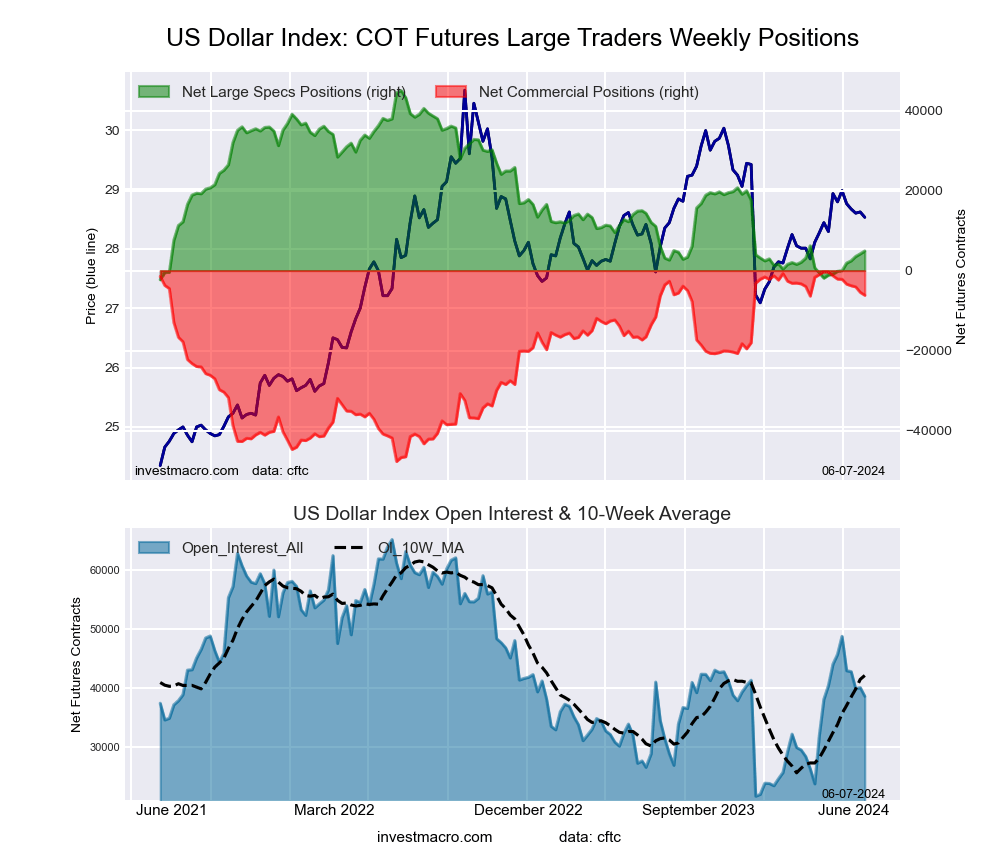
US Dollar Index Forex Futures COT ChartThe US Dollar Index large speculator standing this week totaled a net position of -35 contracts in the data reported through Tuesday. This was a weekly increase of 178 contracts from the previous week which had a total of -213 net contracts.

This week’s current strength score (the trader positioning range over the past three years, measured from 0 to 100) shows the speculators are currently Bearish-Extreme with a score of 4.8 percent. The commercials are Bullish-Extreme with a score of 96.0 percent and the small traders (not shown in chart) are Bearish with a score of 37.1 percent.

Price Trend-Following Model: Uptrend

Our weekly trend-following model classifies the current market price position as: Uptrend. The current action for the model is considered to be: Hold – Maintain Long Position.

US DOLLAR INDEX StatisticsSPECULATORSCOMMERCIALSSMALL TRADERS
– Percent of Open Interest Longs:68.920.39.0
– Percent of Open Interest Shorts:68.924.84.5
– Net Position:-35-2,1892,224
– Gross Longs:33,5939,8944,410
– Gross Shorts:33,62812,0832,186
– Long to Short Ratio:1.0 to 10.8 to 12.0 to 1
NET POSITION TREND:
– Strength Index Score (3 Year Range Pct):4.896.037.1
– Strength Index Reading (3 Year Range):Bearish-ExtremeBullish-ExtremeBearish
NET POSITION MOVEMENT INDEX:
– 6-Week Change in Strength Index:-1.5-1.014.1


Euro Currency Futures:

Euro Currency Futures COT ChartThe Euro Currency large speculator standing this week totaled a net position of -6,777 contracts in the data reported through Tuesday. This was a weekly advance of 3,212 contracts from the previous week which had a total of -9,989 net contracts.

This week’s current strength score (the trader positioning range over the past three years, measured from 0 to 100) shows the speculators are currently Bearish-Extreme with a score of 17.4 percent. The commercials are Bullish-Extreme with a score of 85.2 percent and the small traders (not shown in chart) are Bearish-Extreme with a score of 6.9 percent.

Price Trend-Following Model: Downtrend

Our weekly trend-following model classifies the current market price position as: Downtrend. The current action for the model is considered to be: Hold – Maintain Short Position.

EURO Currency StatisticsSPECULATORSCOMMERCIALSSMALL TRADERS
– Percent of Open Interest Longs:25.661.211.2
– Percent of Open Interest Shorts:26.762.88.5
– Net Position:-6,777-10,73717,514
– Gross Longs:167,185399,16373,035
– Gross Shorts:173,962409,90055,521
– Long to Short Ratio:1.0 to 11.0 to 11.3 to 1
NET POSITION TREND:
– Strength Index Score (3 Year Range Pct):17.485.26.9
– Strength Index Reading (3 Year Range):Bearish-ExtremeBullish-ExtremeBearish-Extreme
NET POSITION MOVEMENT INDEX:
– 6-Week Change in Strength Index:-23.523.7-13.2


British Pound Sterling Futures:

British Pound Sterling Futures COT ChartThe British Pound Sterling large speculator standing this week totaled a net position of -28,990 contracts in the data reported through Tuesday. This was a weekly lowering of -2,757 contracts from the previous week which had a total of -26,233 net contracts.

This week’s current strength score (the trader positioning range over the past three years, measured from 0 to 100) shows the speculators are currently Bearish with a score of 34.1 percent. The commercials are Bullish with a score of 70.1 percent and the small traders (not shown in chart) are Bearish with a score of 29.4 percent.

Price Trend-Following Model: Downtrend

Our weekly trend-following model classifies the current market price position as: Downtrend. The current action for the model is considered to be: Hold – Maintain Short Position.

BRITISH POUND StatisticsSPECULATORSCOMMERCIALSSMALL TRADERS
– Percent of Open Interest Longs:18.568.99.0
– Percent of Open Interest Shorts:30.850.415.2
– Net Position:-28,99043,560-14,570
– Gross Longs:43,668162,36621,215
– Gross Shorts:72,658118,80635,785
– Long to Short Ratio:0.6 to 11.4 to 10.6 to 1
NET POSITION TREND:
– Strength Index Score (3 Year Range Pct):34.170.129.4
– Strength Index Reading (3 Year Range):BearishBullishBearish
NET POSITION MOVEMENT INDEX:
– 6-Week Change in Strength Index:-54.556.6-37.2


Japanese Yen Futures:

Japanese Yen Forex Futures COT ChartThe Japanese Yen large speculator standing this week totaled a net position of -168,388 contracts in the data reported through Tuesday. This was a weekly rise of 11,531 contracts from the previous week which had a total of -179,919 net contracts.

This week’s current strength score (the trader positioning range over the past three years, measured from 0 to 100) shows the speculators are currently Bearish-Extreme with a score of 7.2 percent. The commercials are Bullish-Extreme with a score of 98.1 percent and the small traders (not shown in chart) are Bullish with a score of 58.3 percent.

Price Trend-Following Model: Downtrend

Our weekly trend-following model classifies the current market price position as: Downtrend. The current action for the model is considered to be: Hold – Maintain Short Position.

JAPANESE YEN StatisticsSPECULATORSCOMMERCIALSSMALL TRADERS
– Percent of Open Interest Longs:12.173.112.5
– Percent of Open Interest Shorts:62.420.514.8
– Net Position:-168,388176,122-7,734
– Gross Longs:40,435244,92041,917
– Gross Shorts:208,82368,79849,651
– Long to Short Ratio:0.2 to 13.6 to 10.8 to 1
NET POSITION TREND:
– Strength Index Score (3 Year Range Pct):7.298.158.3
– Strength Index Reading (3 Year Range):Bearish-ExtremeBullish-ExtremeBullish
NET POSITION MOVEMENT INDEX:
– 6-Week Change in Strength Index:-32.837.7-27.1


Swiss Franc Futures:

Swiss Franc Forex Futures COT ChartThe Swiss Franc large speculator standing this week totaled a net position of -41,786 contracts in the data reported through Tuesday. This was a weekly gain of 776 contracts from the previous week which had a total of -42,562 net contracts.

This week’s current strength score (the trader positioning range over the past three years, measured from 0 to 100) shows the speculators are currently Bearish-Extreme with a score of 1.4 percent. The commercials are Bullish-Extreme with a score of 100.0 percent and the small traders (not shown in chart) are Bearish-Extreme with a score of 2.2 percent.

Price Trend-Following Model: Downtrend

Our weekly trend-following model classifies the current market price position as: Downtrend. The current action for the model is considered to be: Hold – Maintain Short Position.

SWISS FRANC StatisticsSPECULATORSCOMMERCIALSSMALL TRADERS
– Percent of Open Interest Longs:11.279.39.2
– Percent of Open Interest Shorts:53.420.425.9
– Net Position:-41,78658,283-16,497
– Gross Longs:11,04078,4469,120
– Gross Shorts:52,82620,16325,617
– Long to Short Ratio:0.2 to 13.9 to 10.4 to 1
NET POSITION TREND:
– Strength Index Score (3 Year Range Pct):1.4100.02.2
– Strength Index Reading (3 Year Range):Bearish-ExtremeBullish-ExtremeBearish-Extreme
NET POSITION MOVEMENT INDEX:
– 6-Week Change in Strength Index:-37.937.3-16.4


Canadian Dollar Futures:

Canadian Dollar Forex Futures COT ChartThe Canadian Dollar large speculator standing this week totaled a net position of -63,201 contracts in the data reported through Tuesday. This was a weekly advance of 13,249 contracts from the previous week which had a total of -76,450 net contracts.

This week’s current strength score (the trader positioning range over the past three years, measured from 0 to 100) shows the speculators are currently Bearish-Extreme with a score of 14.9 percent. The commercials are Bullish-Extreme with a score of 87.9 percent and the small traders (not shown in chart) are Bearish-Extreme with a score of 6.8 percent.

Price Trend-Following Model: Downtrend

Our weekly trend-following model classifies the current market price position as: Downtrend. The current action for the model is considered to be: Hold – Maintain Short Position.

CANADIAN DOLLAR StatisticsSPECULATORSCOMMERCIALSSMALL TRADERS
– Percent of Open Interest Longs:16.068.213.4
– Percent of Open Interest Shorts:45.834.916.8
– Net Position:-63,20170,490-7,289
– Gross Longs:33,793144,35928,321
– Gross Shorts:96,99473,86935,610
– Long to Short Ratio:0.3 to 12.0 to 10.8 to 1
NET POSITION TREND:
– Strength Index Score (3 Year Range Pct):14.987.96.8
– Strength Index Reading (3 Year Range):Bearish-ExtremeBullish-ExtremeBearish-Extreme
NET POSITION MOVEMENT INDEX:
– 6-Week Change in Strength Index:-19.816.7-6.8


Australian Dollar Futures:

Australian Dollar Forex Futures COT ChartThe Australian Dollar large speculator standing this week totaled a net position of -83,235 contracts in the data reported through Tuesday. This was a weekly lift of 13,004 contracts from the previous week which had a total of -96,239 net contracts.

This week’s current strength score (the trader positioning range over the past three years, measured from 0 to 100) shows the speculators are currently Bearish with a score of 22.0 percent. The commercials are Bullish-Extreme with a score of 81.8 percent and the small traders (not shown in chart) are Bearish with a score of 31.1 percent.

Price Trend-Following Model: Weak Downtrend

Our weekly trend-following model classifies the current market price position as: Weak Downtrend. The current action for the model is considered to be: Hold – Maintain Short Position.

AUSTRALIAN DOLLAR StatisticsSPECULATORSCOMMERCIALSSMALL TRADERS
– Percent of Open Interest Longs:18.470.29.2
– Percent of Open Interest Shorts:55.529.013.3
– Net Position:-83,23592,394-9,159
– Gross Longs:41,293157,62920,613
– Gross Shorts:124,52865,23529,772
– Long to Short Ratio:0.3 to 12.4 to 10.7 to 1
NET POSITION TREND:
– Strength Index Score (3 Year Range Pct):22.081.831.1
– Strength Index Reading (3 Year Range):BearishBullish-ExtremeBearish
NET POSITION MOVEMENT INDEX:
– 6-Week Change in Strength Index:22.0-17.1-1.6


New Zealand Dollar Futures:

New Zealand Dollar Forex Futures COT ChartThe New Zealand Dollar large speculator standing this week totaled a net position of -8,551 contracts in the data reported through Tuesday. This was a weekly boost of 3,496 contracts from the previous week which had a total of -12,047 net contracts.

This week’s current strength score (the trader positioning range over the past three years, measured from 0 to 100) shows the speculators are currently Bearish with a score of 36.1 percent. The commercials are Bullish with a score of 66.5 percent and the small traders (not shown in chart) are Bearish with a score of 27.7 percent.

Price Trend-Following Model: Downtrend

Our weekly trend-following model classifies the current market price position as: Downtrend. The current action for the model is considered to be: Hold – Maintain Short Position.

NEW ZEALAND DOLLAR StatisticsSPECULATORSCOMMERCIALSSMALL TRADERS
– Percent of Open Interest Longs:36.657.75.5
– Percent of Open Interest Shorts:51.139.79.0
– Net Position:-8,55110,607-2,056
– Gross Longs:21,51433,9423,253
– Gross Shorts:30,06523,3355,309
– Long to Short Ratio:0.7 to 11.5 to 10.6 to 1
NET POSITION TREND:
– Strength Index Score (3 Year Range Pct):36.166.527.7
– Strength Index Reading (3 Year Range):BearishBullishBearish
NET POSITION MOVEMENT INDEX:
– 6-Week Change in Strength Index:-23.725.9-29.0


Mexican Peso Futures:

Mexican Peso Futures COT ChartThe Mexican Peso large speculator standing this week totaled a net position of 119,045 contracts in the data reported through Tuesday. This was a weekly decline of -4,610 contracts from the previous week which had a total of 123,655 net contracts.

This week’s current strength score (the trader positioning range over the past three years, measured from 0 to 100) shows the speculators are currently Bullish-Extreme with a score of 89.9 percent. The commercials are Bearish-Extreme with a score of 10.1 percent and the small traders (not shown in chart) are Bearish with a score of 38.5 percent.

Price Trend-Following Model: Weak Uptrend

Our weekly trend-following model classifies the current market price position as: Weak Uptrend. The current action for the model is considered to be: Hold – Maintain Long Position.

MEXICAN PESO StatisticsSPECULATORSCOMMERCIALSSMALL TRADERS
– Percent of Open Interest Longs:58.138.42.9
– Percent of Open Interest Shorts:10.387.91.2
– Net Position:119,045-123,3254,280
– Gross Longs:144,67995,7157,175
– Gross Shorts:25,634219,0402,895
– Long to Short Ratio:5.6 to 10.4 to 12.5 to 1
NET POSITION TREND:
– Strength Index Score (3 Year Range Pct):89.910.138.5
– Strength Index Reading (3 Year Range):Bullish-ExtremeBearish-ExtremeBearish
NET POSITION MOVEMENT INDEX:
– 6-Week Change in Strength Index:-4.74.6-0.2


Brazilian Real Futures:

Brazil Real Futures COT ChartThe Brazilian Real large speculator standing this week totaled a net position of 286 contracts in the data reported through Tuesday. This was a weekly fall of -678 contracts from the previous week which had a total of 964 net contracts.

This week’s current strength score (the trader positioning range over the past three years, measured from 0 to 100) shows the speculators are currently Bearish with a score of 24.1 percent. The commercials are Bullish with a score of 76.3 percent and the small traders (not shown in chart) are Bearish with a score of 34.8 percent.

Price Trend-Following Model: Downtrend

Our weekly trend-following model classifies the current market price position as: Downtrend. The current action for the model is considered to be: Hold – Maintain Short Position.

BRAZIL REAL StatisticsSPECULATORSCOMMERCIALSSMALL TRADERS
– Percent of Open Interest Longs:47.049.02.1
– Percent of Open Interest Shorts:46.749.32.0
– Net Position:286-32135
– Gross Longs:47,28149,3052,074
– Gross Shorts:46,99549,6262,039
– Long to Short Ratio:1.0 to 11.0 to 11.0 to 1
NET POSITION TREND:
– Strength Index Score (3 Year Range Pct):24.176.334.8
– Strength Index Reading (3 Year Range):BearishBullishBearish
NET POSITION MOVEMENT INDEX:
– 6-Week Change in Strength Index:-15.117.8-20.3


Bitcoin Futures:

Bitcoin Crypto Futures COT ChartThe Bitcoin large speculator standing this week totaled a net position of 6 contracts in the data reported through Tuesday. This was a weekly rise of 6 contracts from the previous week which had a total of 0 net contracts.

This week’s current strength score (the trader positioning range over the past three years, measured from 0 to 100) shows the speculators are currently Bullish with a score of 66.5 percent. The commercials are Bullish with a score of 51.2 percent and the small traders (not shown in chart) are Bearish with a score of 24.9 percent.

Price Trend-Following Model: Uptrend

Our weekly trend-following model classifies the current market price position as: Uptrend. The current action for the model is considered to be: Hold – Maintain Long Position.

BITCOIN StatisticsSPECULATORSCOMMERCIALSSMALL TRADERS
– Percent of Open Interest Longs:78.95.25.9
– Percent of Open Interest Shorts:78.97.33.8
– Net Position:6-530524
– Gross Longs:19,5691,2911,461
– Gross Shorts:19,5631,821937
– Long to Short Ratio:1.0 to 10.7 to 11.6 to 1
NET POSITION TREND:
– Strength Index Score (3 Year Range Pct):66.551.224.9
– Strength Index Reading (3 Year Range):BullishBullishBearish
NET POSITION MOVEMENT INDEX:
– 6-Week Change in Strength Index:31.6-45.4-7.3


Article By InvestMacroReceive our weekly COT Newsletter

*COT Report: The COT data, released weekly to the public each Friday, is updated through the most recent Tuesday (data is 3 days old) and shows a quick view of how large speculators or non-commercials (for-profit traders) were positioned in the futures markets.

The CFTC categorizes trader positions according to commercial hedgers (traders who use futures contracts for hedging as part of the business), non-commercials (large traders who speculate to realize trading profits) and nonreportable traders (usually small traders/speculators) as well as their open interest (contracts open in the market at time of reporting). See CFTC criteria here.

Target Thursdays: USDJPY, Copper & EURCAD

By ForexTime

  • USDJPY sees over 700-pip swing 
  • Copper selloff rewards bears
  • EURCAD hits all bearish targets

It has been an intense trading week for financial markets.

More action could be expected due to corporate earnings and the US jobs report on Friday.

In the meantime, check out how these trading setups performed this week:


    1) USDJPY joins monster movers!

  • Where and when was Target Price (TP) published?

In our trade of the week article published on Monday 29th April:

The USDJPY demanded our attention after tumbling over 500 pips from its multi-decade top.

We highlighted that “sustained weakness below 155.00 may open a path back towards 154.20 and 153.60.”


  • What happened since TP was published?

The Yen’s aggressive appreciation on Monday morning fueled speculation around possible intervention by Japanese authorities.

A second suspected bout of intervention took place on Wednesday right after the US markets closed, sending the USDJPY as low as 153.00.

When considering how the USDJPY hit an intra-week peak at 160.22, this means the major currency pair has experienced an over 700-pip swing! 


  • How much in potential profits?

Those who took advantage of the move below 155.00 would have been rewarded 140 pips.


    2) Copper slips below $4.5

  • Where and when was Target Price (TP) published?

After hitting a fresh two-year high this week, FXTM’s new commodity Copper is under pressure.

Although the fundamentals favour further upside, in our article on Tuesday – we cautioned that “a technical throwback could be in play on the H1 charts with prices testing potential support levels”


  • What happened since TP was published?

Since punching above the $4.65 level, prices have tumbled over 3% lower amid potential profit taking.


  • How much in potential profits?

Traders who entered at $4.54 and exited at the $4.50 level would have caught a near 1% move to the downside.


    3) EURCAD hits all bearish targets

  • Where and when was Target Price (TP) published?

This technical scenario (EURCAD) is based on the FXTM Signals that are posted twice a day (before the London and New York sessions) for all FXTM clients to follow.

It can be found in the MyFXTM profile under Trading Services… FXTM Trading Signals.


  • What happened since TP was published?

The EURCAD slipped this morning as Canadian Dollar drew support from the rebound in oil prices.


  • How much in potential profits?

EURCAD has hit all its profit targets.

Traders who entered at 1.46969 and exited at the final target level of 1.46795 would have gained 17 pips.

Feel like you missed out on these profits?

You can keep following our “Daily Market Analysis” for fresh trading ideas and opportunities across global financial markets.


Forex-Time-LogoArticle by ForexTime

ForexTime Ltd (FXTM) is an award winning international online forex broker regulated by CySEC 185/12 www.forextime.com

Japanese yen shows volatility amid speculation of intervention

By RoboForex Analytical Department

The USD/JPY pair is hovering around 155.00 on Monday, having earlier touched a new 34-year peak at 160.00. Market rumours suggest that the Japanese authorities might have intervened in the currency market, although there has been no official confirmation. Today’s market movement is particularly notable due to a public holiday in Japan, which has resulted in minimal market liquidity. This scenario made it relatively easy for investors to prompt significant changes in the quotes.

Last week, the Bank of Japan (BoJ) maintained its monetary policy foundation, keeping the interest rate steady at 0-0.1% per annum. Market participants were left disappointed, as they had anticipated a more pronounced reaction from the BoJ.

The primary driver of the yen’s ongoing weakness is the significant discrepancy between the interest rates set by the BoJ and the US Federal Reserve. This interest rate gap exerts substantial pressure on the yen, making any actual intervention largely ineffective. The BoJ, aware of this reality, has thus far limited its actions to verbal interventions to influence the yen’s value.

Technical analysis of USD/JPY

On the H4 chart of USD/JPY, a growth wave reaching the level of 160.16 was realised. The structure of the first impulse of decline to 154.70 is currently forming. Once this level is reached, a correction to 157.35 (testing from below) is anticipated, potentially followed by a new wave of decline towards 152.32, with the prospect of continuing the trend to 149.65. This scenario is technically supported by the MACD oscillator, which is positioned above zero at the highs but is expected to decline to new lows.

On the H1 chart, the upward growth wave to 160.16 has been completed. We are now observing the formation of the first impulse of the decline wave. The local target of this downside impulse at 155.15 has been achieved. We anticipate a corrective move to 157.35 (testing from below). Subsequently, the next phase of the downward trend to 154.65 is expected, which is the primary target. After completing this, a correction back to 157.35 may be considered. The Stochastic oscillator confirms this bearish outlook, with its signal line below 50 and pointing strictly downwards.


Disclaimer

Any forecasts contained herein are based on the author’s particular opinion. This analysis may not be treated as trading advice. RoboForex bears no responsibility for trading results based on trading recommendations and reviews contained herein.

Trade Of The Week: USDJPY monster move fuels intervention talk

By ForexTime 

  • USDJPY tumbles 500 pips!
  • Yen rebound sparks intervention talk
  • Watch out for Japan data & USD volatility
  • More wild swings on horizon?
  • Key level of interest at 155.00

Everybody is talking about the Japanese Yen, and why not?

Its dramatic reversal against the dollar has sparked talks around possible intervention by Japanese authorities.

However, with no announcements made so far and Japan’s top currency official having “no comments for now”, market watchers may be left scratching their heads for the time being. The thin liquidity thanks to a public holiday in Japan has also been flagged as a reason for such aggressive price moves.

Nevertheless, the USDJPY has earned a place in our “potential monster movers”, especially after we cautioned over possibly volatility last week.

What exactly happened?

On Monday morning, the USDJPY timebomb exploded after hitting an intraday peak of 160.22.

After a period of consolidation, prices collapsed roughly 500 pips within a 4-hour window.

What could happen next?

Investors will have their ears to the ground for any official announcements from Japanese authorities.

Attention will also be directed towards Japan’s Ministry of Finance’s monthly intervention data which will confirm whether intervention took place or not, and if so – by how much.

USDJPY set for more wild swings?

Given how this is an event-heavy week for the USD, more wild movements could be on the horizon for the USDJPY. Speculation around government intervention may add to the potent cocktail of themes that could lead to more volatile price movements.

With all the above said, keep an eye on these 3 factors:

    1) Key Japan data

Incoming data from Japan could add more fuel to the Yen’s volatility.

Investors will direct their focus towards the latest unemployment figures, industrial production, and retail sales which could offer fresh insight into the health of the economy. Should these reports also impact bets around when next the BoJ will hike rates in 2024, this could spark more currency movements.

Traders are currently pricing in a 25% probability of a 10-basis point hike in June with this jumping to roughly 80% in July.

  • Should overall data support the case around the BoJ hiking rates again in the Summer, this could boost the Yen – dragging the USDPY lower as a result.
  • Should data disappoint and rate hike bets cool, the USDPY may push higher as the Yen weakens.


    2) Dollar volatility

It’s a big week for the dollar thanks to the Fed rate decision and US jobs report.

Over the past few weeks, the dollar has appreciated as economic data and hawkish Fed officials cooled expectations around lower US interest rates in 2024.

Traders are only pricing in the first rate cut by November with the probability of another cut by December around 45%.

This is a big deal due to the wide gap between Japan’s and the United States’ interest rates, which has been behind the USDJPY’s upside.

  • The USDJPY could push higher if the Fed meeting and US data support the “higher for longer” argument on rates.​​​​​​​
  • Should the dollar weaken on disappointing data and a dovish Fed, this may send the USDJPY lower.


    3) Technical forces

The aggressively bearish daily candle signals further downside for the USDJPY.

However, for bears to truly seize control – a solid daily close below the 155.00 support is required.

The Relative Strength Index has already slipped back below 70, after being heavily overbought since early April.

  • Sustained weakness below 155.00 may open a path back towards 154.20 and 153.60.
  • Should prices push back above 157.25, this may encourage a move back towards 158.40 and 159.00.​​​​​​​

Bloomberg’s FX model forecasts a 77% chance that USDJPY will trade within the 152.35 – 159.04 range over the next one week.


Forex-Time-LogoArticle by ForexTime

ForexTime Ltd (FXTM) is an award winning international online forex broker regulated by CySEC 185/12 www.forextime.com

Japanese yen hits all-time low as BoJ meeting commences

By RoboForex Analytical Department

The USD/JPY pair reached an all-time high on Thursday, touching the 155.50 level. This development comes as the Bank of Japan (BoJ) starts its two-day monetary policy meeting with widespread expectations that the interest rate will remain unchanged at zero. Investors are keenly watching for any aggressive signals from the BoJ, as further declines in the yen could prompt Tokyo to intervene in the currency market. However, any such intervention is expected to provide only a short-term respite for the yen.

The primary driver behind the yen’s weakness remains the significant disparity in monetary policies between the Bank of Japan and the US Federal Reserve, particularly regarding interest rates. The current situation will likely persist if there is no shift in these policies.

Last week, BoJ Governor Kazuo Ueda indicated at the G-20 summit that the regulator might consider raising rates if the yen’s weakness leads to a sustained increase in import prices. The BoJ is closely monitoring inflation trends, and should the consumer price index approach the 2% target, the bank may adopt a more decisive stance.

The yen has been on a consistent downward trajectory since 13 March this year, showing few signs of interruption.

USD/JPY technical analysis

On the H4 chart, USD/JPY found support at 153.65, and the fifth wave of growth is unfolding. The pair is expected to reach 155.85 soon. Following this, a corrective move to at least 154.60 (testing from above) is anticipated, potentially followed by further growth towards 156.56. This target represents the primary objective of the growth wave. This bullish scenario is technically supported by the MACD oscillator, whose signal line is above zero and trending upwards.

On the H1 chart, USD/JPY has established support at 154.55, with the upward structure aiming for 155.85. Currently, the growth to 155.73 has been executed. A slight retracement to 155.20 (testing from above) may occur next. After reaching this level, the likelihood of an ascent to 155.85 will be reassessed. This technical outlook is confirmed by the Stochastic oscillator, whose signal line is currently above 80, poised for a drop to around 50.


Disclaimer

Any forecasts contained herein are based on the author’s particular opinion. This analysis may not be treated as trading advice. RoboForex bears no responsibility for trading results based on trading recommendations and reviews contained herein.

USDJPY: On intervention watch

By ForexTime 

  • Yen weakens to multi-year lows
  • Markets on intervention watch
  • BoJ decision & US data in focus
  • Major resistance at 161.8 golden Fib levels
  • Key levels of interest at 155.00, 154.20 & 21 day SMA

The Yen’s weakness to multi-year lows has left investors on high alert for possible currency intervention.

On Wednesday morning, USDJPY was a whisker away from the psychological 155 level as the dollar gained across the board. It’s worth noting that back in March, there was much discussion around Japanese authorities potentially intervening when the USDJPY pushed above 152. Since then, prices have jumped another 300 pips

Just yesterday, the Japanese Finance Minister issued his strongest warning of the chance of intervention.

So essentially, more volatility could be on the horizon for the USDJPY – especially with the upcoming Bank of Japan rate decision and key US data on Friday.

Shedding more light on the above:

    1) Bank of Japan rate decision

No Changes to monetary policy are expected, so the focus will be directed towards the BoJ’s inflation projections for the next three years. Investors will also be watching how hawkish/dovish Governor Kazuo Ueda sounds.

  • Should the BoJ strike a dovish note, this is likely to weaken the Yen further.
  • A hawkish-sounding BoJ that hints at a potential hike in June could boost the Yen.

Traders are currently pricing in a 40% probability of a 10-basis point hike by June with this jumping to 97% by July.

Note: April’s Tokyo CPI data will also be published on Friday and could influence expectations around what actions the BoJ takes beyond April.

    2) US Q1 GDP & March PCE report

These incoming US data may impact bets around when the Fed will start cutting rates in 2024. Ultimately, if these reports support the case for “higher for longer” rates, the dollar may appreciate and vice versa.

Focusing on the technicals…

From an Elliot wave perspective, USDJPY is in the 3rd impulse wave from the March 11th low at 146.483 and has the 161.8 golden fib level as a measured move objective.

The Relative Strength Index (RSI), an indicator computed to highlight overbought zones a condition where the market is saturated with buyers-, shows that USDJPY is overbought. This could limit upside gains with the threat of potential currency intervention inviting bears back into the scene.

  • A solid breakout and daily close above 155.00 may open a path toward the 161.8 golden Fibonacci level at 157.44
  • Should prices remain capped below 155.00, this may trigger a selloff towards 154.20 and the 21-day SMA at 152.96

Bloomberg’s FX model forecasts a 77.5% chance that USDJPY will trade within the 151.99 – 157.32 range over the next one week.


Forex-Time-LogoArticle by ForexTime

ForexTime Ltd (FXTM) is an award winning international online forex broker regulated by CySEC 185/12 www.forextime.com