Archive for Financial News – Page 81

Canadian Dollar Strengthens, But Its Outlook Hinges on Oil Prices and Trade Tariffs

By RoboForex Analytical Department 

The USD/CAD pair settled around 1.4393 after experiencing a volatile start to January. On Monday, the market showed interest in buying the Canadian dollar, which had earlier strengthened to a monthly high against the USD. This movement was driven by a weaker US dollar and a more favourable risk sentiment in global markets.

Factors influencing the Canadian dollar

The Loonie was boosted after US President Donald Trump called for an immediate interest rate cut by the Federal Reserve, which weighed on the USD. Additionally, enhanced risk appetite in the market supported currencies like the CAD.

However, the Canadian dollar’s ability to strengthen further is uncertain due to looming trade policy concerns. The potential of the US imposing 25% tariffs on Canadian imports in February 2025 has raised fears. This move could prompt the Bank of Canada to lower its interest rate by 25 basis points during its meeting.

Adding to the uncertainty is the continued decline in crude oil prices, a critical factor for the Canadian economy, given its reliance on commodities. The oil sector is particularly concerned about the potential impact of tariffs on Canada, Mexico, and China, as well as the broader implications for global energy demand and economic growth.

Technical analysis of USD/CAD

On the H4 chart, USD/CAD is in a broad consolidation range around the 1.4384 level. A short-term growth to 1.4455 is possible. After reaching this level, the pair may reverse and develop a downside wave targeting 1.4255. The MACD indicator supports this outlook, with its signal line positioned below the zero mark and signalling further potential for lower lows.

On the H1 chart, the pair completed a local decline wave to 1.4300 and then rebounded to 1.4377.  The market is forming a consolidation range near 1.4377. If the pair breaks upwards, the range could extend to 1.4455. Conversely, a downward breakout would open the potential for a move towards 1.4255. This scenario is supported by the Stochastic oscillator, which shows its signal line below the 80 mark and trending sharply downwards towards 20, indicating bearish momentum.

Conclusion

The Canadian dollar’s recent gains reflect short-term factors such as a weaker USD and improved market risk sentiment. However, its outlook remains uncertain, with oil prices and potential US trade tariffs presenting significant risks. Technically, the USD/CAD pair is consolidating, with key levels to watch at 1.4455 on the upside and 1.4255 on the downside. Market participants will closely monitor developments in US trade policy and the Bank of Canada’s upcoming rate decision for further direction.


Disclaimer

Any forecasts contained herein are based on the author’s particular opinion. This analysis may not be treated as trading advice. RoboForex bears no responsibility for trading results based on trading recommendations and reviews contained herein.

COT Metals Charts: Weekly Speculator Bets led higher by Gold & Copper

By InvestMacro

Here are the latest charts and statistics for the Commitment of Traders (COT) data published by the Commodities Futures Trading Commission (CFTC).

The latest COT data is updated through Tuesday January 21st and shows a quick view of how large traders (for-profit speculators and commercial entities) were positioned in the futures markets.

Weekly Speculator Changes led by Gold & Copper

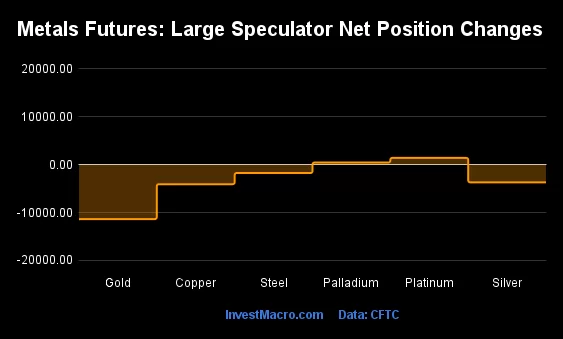
The COT metals markets speculator bets were overall higher this week as five out of the six metals markets we cover had higher positioning while the other one markets had lower speculator contracts.

Leading the gains for the metals was Gold (21,421 contracts) with Copper (4,825 contracts), Silver (1,400 contracts), Steel (649 contracts) and Palladium (294 contracts) also seeing positive weeks.

The only market with a decline in speculator bets this week was Platinum with a decrease by -952 contracts.


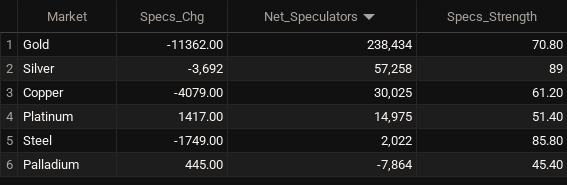
Metals Net Speculators Leaderboard

Legend: Weekly Speculators Change | Speculators Current Net Position | Speculators Strength Score compared to last 3-Years (0-100 range)


Strength Scores led by Gold & Steel

COT Strength Scores (a normalized measure of Speculator positions over a 3-Year range, from 0 to 100 where above 80 is Extreme-Bullish and below 20 is Extreme-Bearish) showed that Gold (94 percent) and Steel (89 percent) lead the metals markets this week.

On the downside, Palladium (43 percent) comes in at the lowest strength level currently.

Strength Statistics:
Gold (94.5 percent) vs Gold previous week (86.3 percent)
Silver (76.1 percent) vs Silver previous week (74.4 percent)
Copper (48.8 percent) vs Copper previous week (44.3 percent)
Platinum (50.5 percent) vs Platinum previous week (52.8 percent)
Palladium (43.1 percent) vs Palladium previous week (40.9 percent)
Steel (89.5 percent) vs Palladium previous week (86.7 percent)


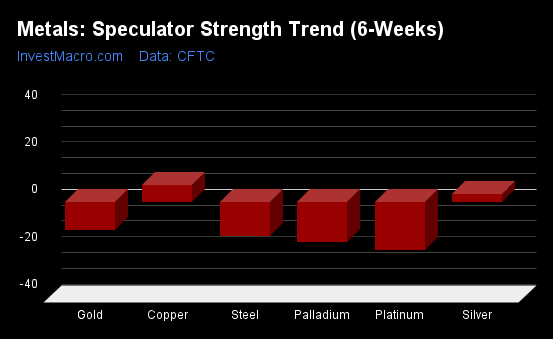
Gold & Silver top the 6-Week Strength Trends

COT Strength Score Trends (or move index, calculates the 6-week changes in strength scores) showed that Gold (10 percent) and Silver (8 percent) lead the past six weeks trends for metals.

Palladium (-15 percent) leads the downside trend scores currently.

Move Statistics:
Gold (9.6 percent) vs Gold previous week (7.5 percent)
Silver (8.0 percent) vs Silver previous week (3.6 percent)
Copper (5.3 percent) vs Copper previous week (1.3 percent)
Platinum (-0.5 percent) vs Platinum previous week (-11.6 percent)
Palladium (-14.7 percent) vs Palladium previous week (-19.7 percent)
Steel (5.3 percent) vs Steel previous week (-0.8 percent)


Individual Markets:

Gold Comex Futures:

Gold Futures COT ChartThe Gold Comex Futures large speculator standing this week recorded a net position of 300,784 contracts in the data reported through Tuesday. This was a weekly advance of 21,421 contracts from the previous week which had a total of 279,363 net contracts.

This week’s current strength score (the trader positioning range over the past three years, measured from 0 to 100) shows the speculators are currently Bullish-Extreme with a score of 94.5 percent. The commercials are Bearish-Extreme with a score of 4.7 percent and the small traders (not shown in chart) are Bullish with a score of 64.1 percent.

Price Trend-Following Model: Strong Uptrend

Our weekly trend-following model classifies the current market price position as: Strong Uptrend.

Gold Futures StatisticsSPECULATORSCOMMERCIALSSMALL TRADERS
– Percent of Open Interest Longs:59.016.68.9
– Percent of Open Interest Shorts:6.473.84.3
– Net Position:300,784-326,60825,824
– Gross Longs:337,28995,11650,638
– Gross Shorts:36,505421,72424,814
– Long to Short Ratio:9.2 to 10.2 to 12.0 to 1
NET POSITION TREND:
– Strength Index Score (3 Year Range Pct):94.54.764.1
– Strength Index Reading (3 Year Range):Bullish-ExtremeBearish-ExtremeBullish
NET POSITION MOVEMENT INDEX:
– 6-Week Change in Strength Index:9.6-10.716.4


Silver Comex Futures:

Silver Futures COT ChartThe Silver Comex Futures large speculator standing this week recorded a net position of 47,480 contracts in the data reported through Tuesday. This was a weekly lift of 1,400 contracts from the previous week which had a total of 46,080 net contracts.

This week’s current strength score (the trader positioning range over the past three years, measured from 0 to 100) shows the speculators are currently Bullish with a score of 76.1 percent. The commercials are Bearish with a score of 24.8 percent and the small traders (not shown in chart) are Bearish with a score of 45.6 percent.

Price Trend-Following Model: Weak Downtrend

Our weekly trend-following model classifies the current market price position as: Weak Downtrend.

Silver Futures StatisticsSPECULATORSCOMMERCIALSSMALL TRADERS
– Percent of Open Interest Longs:47.320.917.4
– Percent of Open Interest Shorts:17.660.37.8
– Net Position:47,480-62,97715,497
– Gross Longs:75,66033,47627,898
– Gross Shorts:28,18096,45312,401
– Long to Short Ratio:2.7 to 10.3 to 12.2 to 1
NET POSITION TREND:
– Strength Index Score (3 Year Range Pct):76.124.845.6
– Strength Index Reading (3 Year Range):BullishBearishBearish
NET POSITION MOVEMENT INDEX:
– 6-Week Change in Strength Index:8.0-3.5-15.4


Copper Grade #1 Futures:

Copper Futures COT ChartThe Copper Grade #1 Futures large speculator standing this week recorded a net position of 16,663 contracts in the data reported through Tuesday. This was a weekly advance of 4,825 contracts from the previous week which had a total of 11,838 net contracts.

This week’s current strength score (the trader positioning range over the past three years, measured from 0 to 100) shows the speculators are currently Bearish with a score of 48.8 percent. The commercials are Bullish with a score of 51.7 percent and the small traders (not shown in chart) are Bearish with a score of 48.4 percent.

Price Trend-Following Model: Weak Downtrend

Our weekly trend-following model classifies the current market price position as: Weak Downtrend.

Copper Futures StatisticsSPECULATORSCOMMERCIALSSMALL TRADERS
– Percent of Open Interest Longs:40.933.87.6
– Percent of Open Interest Shorts:33.243.85.3
– Net Position:16,663-21,7295,066
– Gross Longs:88,85573,47016,520
– Gross Shorts:72,19295,19911,454
– Long to Short Ratio:1.2 to 10.8 to 11.4 to 1
NET POSITION TREND:
– Strength Index Score (3 Year Range Pct):48.851.748.4
– Strength Index Reading (3 Year Range):BearishBullishBearish
NET POSITION MOVEMENT INDEX:
– 6-Week Change in Strength Index:5.3-4.2-5.2


Platinum Futures:

Platinum Futures COT ChartThe Platinum Futures large speculator standing this week recorded a net position of 14,608 contracts in the data reported through Tuesday. This was a weekly decline of -952 contracts from the previous week which had a total of 15,560 net contracts.

This week’s current strength score (the trader positioning range over the past three years, measured from 0 to 100) shows the speculators are currently Bullish with a score of 50.5 percent. The commercials are Bearish with a score of 46.7 percent and the small traders (not shown in chart) are Bullish with a score of 56.9 percent.

Price Trend-Following Model: Downtrend

Our weekly trend-following model classifies the current market price position as: Downtrend.

Platinum Futures StatisticsSPECULATORSCOMMERCIALSSMALL TRADERS
– Percent of Open Interest Longs:64.319.412.9
– Percent of Open Interest Shorts:45.046.75.0
– Net Position:14,608-20,6106,002
– Gross Longs:48,60514,6519,765
– Gross Shorts:33,99735,2613,763
– Long to Short Ratio:1.4 to 10.4 to 12.6 to 1
NET POSITION TREND:
– Strength Index Score (3 Year Range Pct):50.546.756.9
– Strength Index Reading (3 Year Range):BullishBearishBullish
NET POSITION MOVEMENT INDEX:
– 6-Week Change in Strength Index:-0.56.0-38.5


Palladium Futures:

Palladium Futures COT ChartThe Palladium Futures large speculator standing this week recorded a net position of -8,036 contracts in the data reported through Tuesday. This was a weekly advance of 294 contracts from the previous week which had a total of -8,330 net contracts.

This week’s current strength score (the trader positioning range over the past three years, measured from 0 to 100) shows the speculators are currently Bearish with a score of 43.1 percent. The commercials are Bullish with a score of 56.2 percent and the small traders (not shown in chart) are Bullish with a score of 67.8 percent.

Price Trend-Following Model: Downtrend

Our weekly trend-following model classifies the current market price position as: Downtrend.

Palladium Futures StatisticsSPECULATORSCOMMERCIALSSMALL TRADERS
– Percent of Open Interest Longs:37.445.111.6
– Percent of Open Interest Shorts:79.66.77.9
– Net Position:-8,0367,326710
– Gross Longs:7,1218,5932,213
– Gross Shorts:15,1571,2671,503
– Long to Short Ratio:0.5 to 16.8 to 11.5 to 1
NET POSITION TREND:
– Strength Index Score (3 Year Range Pct):43.156.267.8
– Strength Index Reading (3 Year Range):BearishBullishBullish
NET POSITION MOVEMENT INDEX:
– 6-Week Change in Strength Index:-14.715.8-10.3


Steel Futures Futures:

Steel Futures COT ChartThe Steel Futures large speculator standing this week recorded a net position of -1,534 contracts in the data reported through Tuesday. This was a weekly advance of 649 contracts from the previous week which had a total of -2,183 net contracts.

This week’s current strength score (the trader positioning range over the past three years, measured from 0 to 100) shows the speculators are currently Bullish-Extreme with a score of 89.5 percent. The commercials are Bearish-Extreme with a score of 11.2 percent and the small traders (not shown in chart) are Bearish with a score of 40.8 percent.

Price Trend-Following Model: Strong Downtrend

Our weekly trend-following model classifies the current market price position as: Strong Downtrend.

Steel Futures StatisticsSPECULATORSCOMMERCIALSSMALL TRADERS
– Percent of Open Interest Longs:25.667.11.0
– Percent of Open Interest Shorts:31.061.90.7
– Net Position:-1,5341,45777
– Gross Longs:7,22318,936281
– Gross Shorts:8,75717,479204
– Long to Short Ratio:0.8 to 11.1 to 11.4 to 1
NET POSITION TREND:
– Strength Index Score (3 Year Range Pct):89.511.240.8
– Strength Index Reading (3 Year Range):Bullish-ExtremeBearish-ExtremeBearish
NET POSITION MOVEMENT INDEX:
– 6-Week Change in Strength Index:5.3-5.58.0


Article By InvestMacroReceive our weekly COT Newsletter

*COT Report: The COT data, released weekly to the public each Friday, is updated through the most recent Tuesday (data is 3 days old) and shows a quick view of how large speculators or non-commercials (for-profit traders) were positioned in the futures markets.

The CFTC categorizes trader positions according to commercial hedgers (traders who use futures contracts for hedging as part of the business), non-commercials (large traders who speculate to realize trading profits) and nonreportable traders (usually small traders/speculators) as well as their open interest (contracts open in the market at time of reporting). See CFTC criteria here.

COT Bonds Charts: Speculator Bets led by 2-Year Bonds & SOFR 3-Months

By InvestMacro

Here are the latest charts and statistics for the Commitment of Traders (COT) reports data published by the Commodities Futures Trading Commission (CFTC).

The latest COT data is updated through Tuesday January 21st and shows a quick view of how large traders (for-profit speculators and commercial hedgers) were positioned in the futures markets.

Weekly Speculator Changes led by 2-Year Bonds & SOFR 3-Months

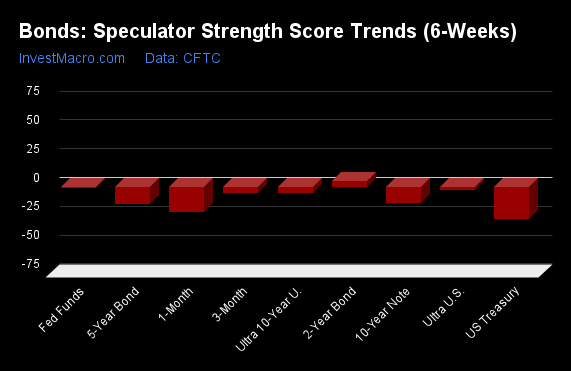
The COT bond market speculator bets were higher this week as five out of the nine bond markets we cover had higher positioning while the other four markets had lower speculator contracts.

Leading the gains for the bond markets was the 2-Year Bonds (82,829 contracts) with the SOFR 3-Months (48,520 contracts), the SOFR 1-Month (43,118 contracts), the US Treasury Bonds (24,404 contracts) and the Ultra Treasury Bonds (12,434 contracts) also recording positive weeks.

The bond markets with declines in speculator bets for the week were the Ultra 10-Year Bonds (-32,292 contracts), the 5-Year Bonds (-18,570 contracts), the 10-Year Bonds (-12,310 contracts) and with the Fed Funds (-4,075 contracts) also registering lower bets on the week.


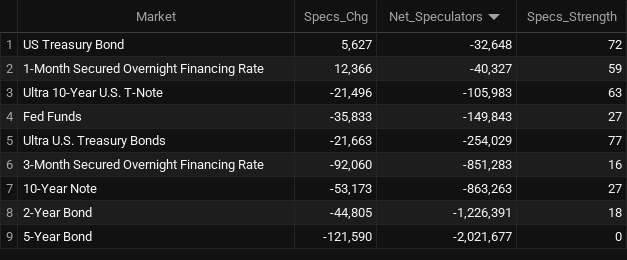
Bonds Net Speculators Leaderboard

Legend: Weekly Speculators Change | Speculators Current Net Position | Speculators Strength Score compared to last 3-Years (0-100 range)


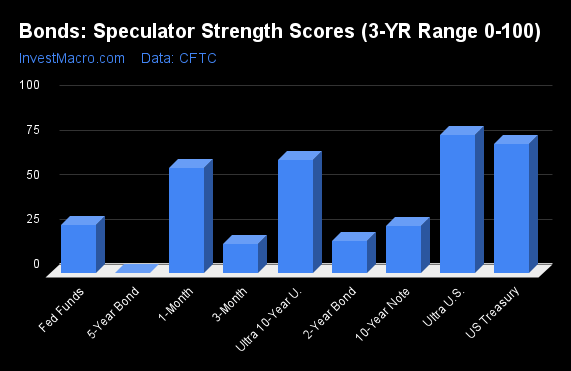
Strength Scores led by US Treasury Bonds & Ultra Treasury Bonds

COT Strength Scores (a normalized measure of Speculator positions over a 3-Year range, from 0 to 100 where above 80 is Extreme-Bullish and below 20 is Extreme-Bearish) showed that the US Treasury Bonds (92 percent) and the Ultra Treasury Bonds (87 percent) lead the bond markets this week. The SOFR 1-Month (77 percent) comes in as the next highest in the weekly strength scores.

On the downside, the Fed Funds (19 percent) and the 5-Year Bonds (10 percent) come in at the lowest strength level currently and are in Extreme-Bearish territory (below 20 percent).

Strength Statistics:
Fed Funds (19.4 percent) vs Fed Funds previous week (20.1 percent)
2-Year Bond (20.3 percent) vs 2-Year Bond previous week (14.9 percent)
5-Year Bond (9.9 percent) vs 5-Year Bond previous week (10.9 percent)
10-Year Bond (53.3 percent) vs 10-Year Bond previous week (54.4 percent)
Ultra 10-Year Bond (29.7 percent) vs Ultra 10-Year Bond previous week (38.8 percent)
US Treasury Bond (92.0 percent) vs US Treasury Bond previous week (83.5 percent)
Ultra US Treasury Bond (86.5 percent) vs Ultra US Treasury Bond previous week (81.8 percent)
SOFR 1-Month (77.3 percent) vs SOFR 1-Month previous week (66.6 percent)
SOFR 3-Months (25.5 percent) vs SOFR 3-Months previous week (23.0 percent)


10-Year Bonds & SOFR 1-Month top the 6-Week Strength Trends

COT Strength Score Trends (or move index, calculates the 6-week changes in strength scores) showed that the 10-Year Bonds (28 percent) and the SOFR 1-Month (26 percent) lead the past six weeks trends for bonds. The US Treasury Bonds (22 percent) are the next highest positive movers in the latest trends data.

The Fed Funds (-19 percent) and the SOFR 3-Months (-18 percent) lead the downside trend scores currently.

Strength Trend Statistics:
Fed Funds (-18.9 percent) vs Fed Funds previous week (-29.2 percent)
2-Year Bond (5.3 percent) vs 2-Year Bond previous week (-3.5 percent)
5-Year Bond (-0.3 percent) vs 5-Year Bond previous week (4.4 percent)
10-Year Bond (27.9 percent) vs 10-Year Bond previous week (30.6 percent)
Ultra 10-Year Bond (-18.7 percent) vs Ultra 10-Year Bond previous week (6.5 percent)
US Treasury Bond (22.3 percent) vs US Treasury Bond previous week (20.5 percent)
Ultra US Treasury Bond (-5.2 percent) vs Ultra US Treasury Bond previous week (-10.7 percent)
SOFR 1-Month (25.8 percent) vs SOFR 1-Month previous week (26.9 percent)
SOFR 3-Months (-17.8 percent) vs SOFR 3-Months previous week (-9.5 percent)


30-Day Federal Funds Futures:

Federal Funds 30-Day Bonds Futures COT ChartThe 30-Day Federal Funds large speculator standing this week reached a net position of -190,795 contracts in the data reported through Tuesday. This was a weekly lowering of -4,075 contracts from the previous week which had a total of -186,720 net contracts.

This week’s current strength score (the trader positioning range over the past three years, measured from 0 to 100) shows the speculators are currently Bearish-Extreme with a score of 19.4 percent. The commercials are Bullish with a score of 77.4 percent and the small traders (not shown in chart) are Bullish with a score of 78.7 percent.

Price Trend-Following Model: Downtrend

Our weekly trend-following model classifies the current market price position as: Downtrend. The current action for the model is considered to be: Hold – Maintain Short Position.

30-Day Federal Funds StatisticsSPECULATORSCOMMERCIALSSMALL TRADERS
– Percent of Open Interest Longs:10.070.91.8
– Percent of Open Interest Shorts:20.260.62.0
– Net Position:-190,795194,312-3,517
– Gross Longs:187,4011,329,52733,875
– Gross Shorts:378,1961,135,21537,392
– Long to Short Ratio:0.5 to 11.2 to 10.9 to 1
NET POSITION TREND:
– Strength Index Score (3 Year Range Pct):19.477.478.7
– Strength Index Reading (3 Year Range):Bearish-ExtremeBullishBullish
NET POSITION MOVEMENT INDEX:
– 6-Week Change in Strength Index:-18.918.05.8


Secured Overnight Financing Rate (3-Month) Futures:

SOFR 3-Months Bonds Futures COT ChartThe Secured Overnight Financing Rate (3-Month) large speculator standing this week reached a net position of -672,329 contracts in the data reported through Tuesday. This was a weekly lift of 48,520 contracts from the previous week which had a total of -720,849 net contracts.

This week’s current strength score (the trader positioning range over the past three years, measured from 0 to 100) shows the speculators are currently Bearish with a score of 25.5 percent. The commercials are Bullish with a score of 74.0 percent and the small traders (not shown in chart) are Bullish-Extreme with a score of 91.9 percent.

Price Trend-Following Model: Weak Uptrend

Our weekly trend-following model classifies the current market price position as: Weak Uptrend. The current action for the model is considered to be: Hold – Maintain Long Position.

SOFR 3-Months StatisticsSPECULATORSCOMMERCIALSSMALL TRADERS
– Percent of Open Interest Longs:12.362.60.3
– Percent of Open Interest Shorts:18.956.00.2
– Net Position:-672,329664,9387,391
– Gross Longs:1,234,1116,304,51028,896
– Gross Shorts:1,906,4405,639,57221,505
– Long to Short Ratio:0.6 to 11.1 to 11.3 to 1
NET POSITION TREND:
– Strength Index Score (3 Year Range Pct):25.574.091.9
– Strength Index Reading (3 Year Range):BearishBullishBullish-Extreme
NET POSITION MOVEMENT INDEX:
– 6-Week Change in Strength Index:-17.817.09.4


Individual Bond Markets:

Secured Overnight Financing Rate (1-Month) Futures:

SOFR 1-Month Bonds Futures COT ChartThe Secured Overnight Financing Rate (1-Month) large speculator standing this week reached a net position of 35,594 contracts in the data reported through Tuesday. This was a weekly advance of 43,118 contracts from the previous week which had a total of -7,524 net contracts.

This week’s current strength score (the trader positioning range over the past three years, measured from 0 to 100) shows the speculators are currently Bullish with a score of 77.3 percent. The commercials are Bearish with a score of 22.9 percent and the small traders (not shown in chart) are Bullish with a score of 54.0 percent.

Price Trend-Following Model: Uptrend

Our weekly trend-following model classifies the current market price position as: Uptrend.

SOFR 1-Month StatisticsSPECULATORSCOMMERCIALSSMALL TRADERS
– Percent of Open Interest Longs:24.859.60.0
– Percent of Open Interest Shorts:22.462.10.0
– Net Position:35,594-35,351-243
– Gross Longs:360,259866,138165
– Gross Shorts:324,665901,489408
– Long to Short Ratio:1.1 to 11.0 to 10.4 to 1
NET POSITION TREND:
– Strength Index Score (3 Year Range Pct):77.322.954.0
– Strength Index Reading (3 Year Range):BullishBearishBullish
NET POSITION MOVEMENT INDEX:
– 6-Week Change in Strength Index:25.8-25.80.6


2-Year Treasury Note Futures:

2-Year Treasury Bonds Futures COT ChartThe 2-Year Treasury Note large speculator standing this week reached a net position of -1,174,377 contracts in the data reported through Tuesday. This was a weekly advance of 82,829 contracts from the previous week which had a total of -1,257,206 net contracts.

This week’s current strength score (the trader positioning range over the past three years, measured from 0 to 100) shows the speculators are currently Bearish with a score of 20.3 percent. The commercials are Bullish with a score of 76.6 percent and the small traders (not shown in chart) are Bullish-Extreme with a score of 80.1 percent.

Price Trend-Following Model: Downtrend

Our weekly trend-following model classifies the current market price position as: Downtrend.

2-Year Treasury Note StatisticsSPECULATORSCOMMERCIALSSMALL TRADERS
– Percent of Open Interest Longs:13.276.86.3
– Percent of Open Interest Shorts:41.451.92.9
– Net Position:-1,174,3771,034,903139,474
– Gross Longs:547,5403,191,555260,164
– Gross Shorts:1,721,9172,156,652120,690
– Long to Short Ratio:0.3 to 11.5 to 12.2 to 1
NET POSITION TREND:
– Strength Index Score (3 Year Range Pct):20.376.680.1
– Strength Index Reading (3 Year Range):BearishBullishBullish-Extreme
NET POSITION MOVEMENT INDEX:
– 6-Week Change in Strength Index:5.3-6.2-0.6


5-Year Treasury Note Futures:

5-Year Treasury Bonds Futures COT ChartThe 5-Year Treasury Note large speculator standing this week reached a net position of -1,796,191 contracts in the data reported through Tuesday. This was a weekly decline of -18,570 contracts from the previous week which had a total of -1,777,621 net contracts.

This week’s current strength score (the trader positioning range over the past three years, measured from 0 to 100) shows the speculators are currently Bearish-Extreme with a score of 9.9 percent. The commercials are Bullish-Extreme with a score of 87.9 percent and the small traders (not shown in chart) are Bullish with a score of 76.6 percent.

Price Trend-Following Model: Downtrend

Our weekly trend-following model classifies the current market price position as: Downtrend.

5-Year Treasury Note StatisticsSPECULATORSCOMMERCIALSSMALL TRADERS
– Percent of Open Interest Longs:5.985.06.9
– Percent of Open Interest Shorts:35.057.94.9
– Net Position:-1,796,1911,671,310124,881
– Gross Longs:362,7685,245,706424,184
– Gross Shorts:2,158,9593,574,396299,303
– Long to Short Ratio:0.2 to 11.5 to 11.4 to 1
NET POSITION TREND:
– Strength Index Score (3 Year Range Pct):9.987.976.6
– Strength Index Reading (3 Year Range):Bearish-ExtremeBullish-ExtremeBullish
NET POSITION MOVEMENT INDEX:
– 6-Week Change in Strength Index:-0.3-0.73.1


10-Year Treasury Note Futures:

10-Year Treasury Notes Bonds Futures COT ChartThe 10-Year Treasury Note large speculator standing this week reached a net position of -580,245 contracts in the data reported through Tuesday. This was a weekly lowering of -12,310 contracts from the previous week which had a total of -567,935 net contracts.

This week’s current strength score (the trader positioning range over the past three years, measured from 0 to 100) shows the speculators are currently Bullish with a score of 53.3 percent. The commercials are Bearish with a score of 48.0 percent and the small traders (not shown in chart) are Bullish with a score of 67.9 percent.

Price Trend-Following Model: Downtrend

Our weekly trend-following model classifies the current market price position as: Downtrend.

10-Year Treasury Note StatisticsSPECULATORSCOMMERCIALSSMALL TRADERS
– Percent of Open Interest Longs:13.875.38.9
– Percent of Open Interest Shorts:26.063.48.6
– Net Position:-580,245565,04015,205
– Gross Longs:654,1813,575,799422,956
– Gross Shorts:1,234,4263,010,759407,751
– Long to Short Ratio:0.5 to 11.2 to 11.0 to 1
NET POSITION TREND:
– Strength Index Score (3 Year Range Pct):53.348.067.9
– Strength Index Reading (3 Year Range):BullishBearishBullish
NET POSITION MOVEMENT INDEX:
– 6-Week Change in Strength Index:27.9-30.6-10.1


Ultra 10-Year Notes Futures:

Ultra 10-Year Treasury Notes Bonds Futures COT ChartThe Ultra 10-Year Notes large speculator standing this week reached a net position of -172,524 contracts in the data reported through Tuesday. This was a weekly decline of -32,292 contracts from the previous week which had a total of -140,232 net contracts.

This week’s current strength score (the trader positioning range over the past three years, measured from 0 to 100) shows the speculators are currently Bearish with a score of 29.7 percent. The commercials are Bearish with a score of 49.5 percent and the small traders (not shown in chart) are Bullish-Extreme with a score of 81.7 percent.

Price Trend-Following Model: Weak Downtrend

Our weekly trend-following model classifies the current market price position as: Weak Downtrend.

Ultra 10-Year Notes StatisticsSPECULATORSCOMMERCIALSSMALL TRADERS
– Percent of Open Interest Longs:13.575.89.8
– Percent of Open Interest Shorts:21.166.012.0
– Net Position:-172,524221,503-48,979
– Gross Longs:306,0921,721,192223,196
– Gross Shorts:478,6161,499,689272,175
– Long to Short Ratio:0.6 to 11.1 to 10.8 to 1
NET POSITION TREND:
– Strength Index Score (3 Year Range Pct):29.749.581.7
– Strength Index Reading (3 Year Range):BearishBearishBullish-Extreme
NET POSITION MOVEMENT INDEX:
– 6-Week Change in Strength Index:-18.723.74.1


US Treasury Bonds Futures:

US Year Treasury Notes Long Bonds Futures COT ChartThe US Treasury Bonds large speculator standing this week reached a net position of 24,456 contracts in the data reported through Tuesday. This was a weekly boost of 24,404 contracts from the previous week which had a total of 52 net contracts.

This week’s current strength score (the trader positioning range over the past three years, measured from 0 to 100) shows the speculators are currently Bullish-Extreme with a score of 92.0 percent. The commercials are Bearish-Extreme with a score of 0.0 percent and the small traders (not shown in chart) are Bullish with a score of 64.4 percent.

Price Trend-Following Model: Downtrend

Our weekly trend-following model classifies the current market price position as: Downtrend.

US Treasury Bonds StatisticsSPECULATORSCOMMERCIALSSMALL TRADERS
– Percent of Open Interest Longs:23.764.011.2
– Percent of Open Interest Shorts:22.568.77.7
– Net Position:24,456-90,69966,243
– Gross Longs:456,1881,230,439214,843
– Gross Shorts:431,7321,321,138148,600
– Long to Short Ratio:1.1 to 10.9 to 11.4 to 1
NET POSITION TREND:
– Strength Index Score (3 Year Range Pct):92.00.064.4
– Strength Index Reading (3 Year Range):Bullish-ExtremeBearish-ExtremeBullish
NET POSITION MOVEMENT INDEX:
– 6-Week Change in Strength Index:22.3-19.7-3.2


Ultra US Treasury Bonds Futures:

Ultra US Year Treasury Notes Long Bonds Futures COT ChartThe Ultra US Treasury Bonds large speculator standing this week reached a net position of -229,988 contracts in the data reported through Tuesday. This was a weekly lift of 12,434 contracts from the previous week which had a total of -242,422 net contracts.

This week’s current strength score (the trader positioning range over the past three years, measured from 0 to 100) shows the speculators are currently Bullish-Extreme with a score of 86.5 percent. The commercials are Bearish-Extreme with a score of 18.3 percent and the small traders (not shown in chart) are Bearish-Extreme with a score of 11.5 percent.

Price Trend-Following Model: Downtrend

Our weekly trend-following model classifies the current market price position as: Downtrend.

Ultra US Treasury Bonds StatisticsSPECULATORSCOMMERCIALSSMALL TRADERS
– Percent of Open Interest Longs:8.281.49.8
– Percent of Open Interest Shorts:21.068.69.8
– Net Position:-229,988229,344644
– Gross Longs:147,4111,459,353175,998
– Gross Shorts:377,3991,230,009175,354
– Long to Short Ratio:0.4 to 11.2 to 11.0 to 1
NET POSITION TREND:
– Strength Index Score (3 Year Range Pct):86.518.311.5
– Strength Index Reading (3 Year Range):Bullish-ExtremeBearish-ExtremeBearish-Extreme
NET POSITION MOVEMENT INDEX:
– 6-Week Change in Strength Index:-5.216.8-32.3


Article By InvestMacroReceive our weekly COT Newsletter

*COT Report: The COT data, released weekly to the public each Friday, is updated through the most recent Tuesday (data is 3 days old) and shows a quick view of how large speculators or non-commercials (for-profit traders) were positioned in the futures markets.

The CFTC categorizes trader positions according to commercial hedgers (traders who use futures contracts for hedging as part of the business), non-commercials (large traders who speculate to realize trading profits) and nonreportable traders (usually small traders/speculators) as well as their open interest (contracts open in the market at time of reporting). See CFTC criteria here.

COT Soft Commodities Charts: Speculator Bets led by Corn & Wheat

By InvestMacro

Here are the latest charts and statistics for the Commitment of Traders (COT) reports data published by the Commodities Futures Trading Commission (CFTC).

The latest COT data is updated through Tuesday January 21st and shows a quick view of how large traders (for-profit speculators and commercial entities) were positioned in the futures markets.

Weekly Speculator Changes led by Corn & Wheat

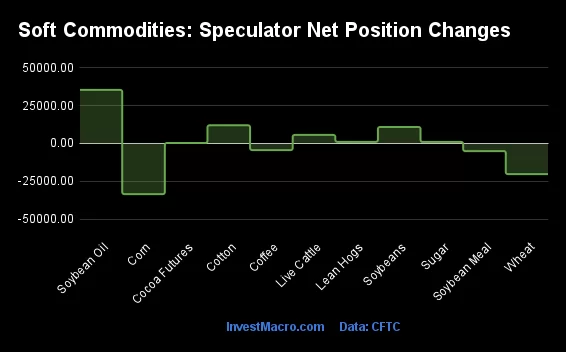
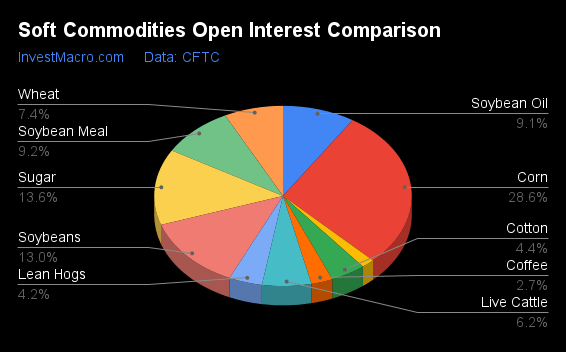
The COT soft commodities markets speculator bets were higher this week as seven out of the eleven softs markets we cover had higher positioning while the other four markets had lower speculator contracts.

Leading the gains for the softs markets was Corn (44,848 contracts) with Wheat (9,200 contracts), Soybean Oil (4,098 contracts), Soybeans (4,031 contracts), Coffee (1,649 contracts), Soybean Meal (1,428 contracts) and Cocoa (605 contracts) also showing positive weeks.

The markets with the declines in speculator bets this week were Sugar (-45,629 contracts), Lean Hogs (-6,566 contracts), Live Cattle (-4,553 contracts) and Cotton (-4,210 contracts) also registering lower bets on the week.


Soft Commodities Net Speculators Leaderboard
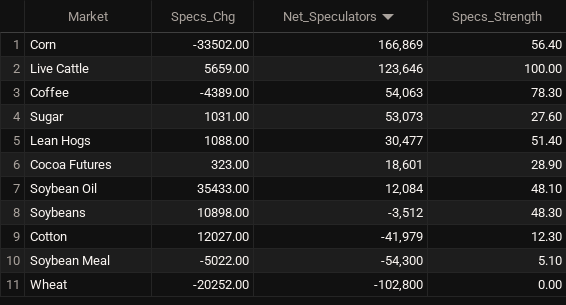
Legend: Weekly Speculators Change | Speculators Current Net Position | Speculators Strength Score compared to last 3-Years (0-100 range)


Strength Scores led by Coffee & Live Cattle

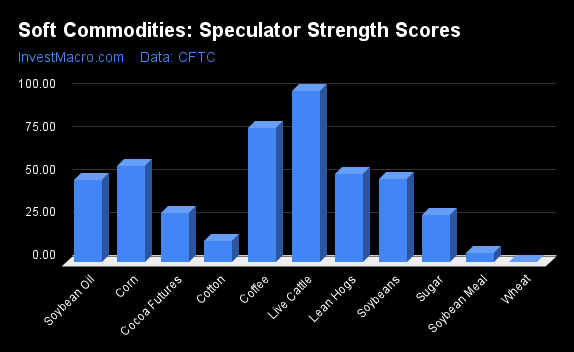
COT Strength Scores (a normalized measure of Speculator positions over a 3-Year range, from 0 to 100 where above 80 is Extreme-Bullish and below 20 is Extreme-Bearish) showed that Coffee (98 percent) and Live Cattle (96 percent) lead the softs markets this week. Corn (84 percent), Lean Hogs (82 percent) and Soybean Oil (63 percent) come in as the next highest in the weekly strength scores.

On the downside, Sugar (0 percent), Cotton (4 percent), Soybean Meal (16 percent) and Wheat (19 percent) come in at the lowest strength levels currently and are in Extreme-Bearish territory (below 20 percent).

Strength Statistics:
Corn (83.9 percent) vs Corn previous week (78.2 percent)
Sugar (0.0 percent) vs Sugar previous week (14.7 percent)
Coffee (98.3 percent) vs Coffee previous week (96.7 percent)
Soybeans (50.9 percent) vs Soybeans previous week (50.0 percent)
Soybean Oil (62.5 percent) vs Soybean Oil previous week (60.3 percent)
Soybean Meal (15.7 percent) vs Soybean Meal previous week (15.1 percent)
Live Cattle (95.6 percent) vs Live Cattle previous week (100.0 percent)
Lean Hogs (81.9 percent) vs Lean Hogs previous week (87.0 percent)
Cotton (4.2 percent) vs Cotton previous week (7.0 percent)
Cocoa (48.2 percent) vs Cocoa previous week (47.6 percent)
Wheat (19.2 percent) vs Wheat previous week (11.9 percent)


Soybeans & Corn top the 6-Week Strength Trends

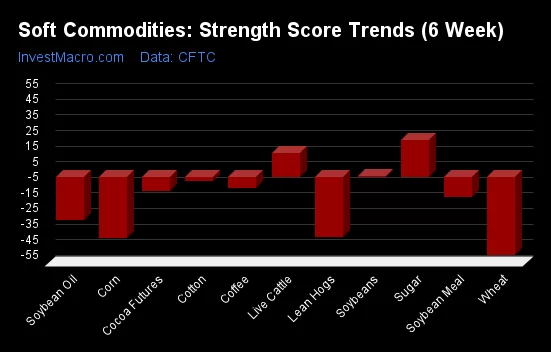
COT Strength Score Trends (or move index, calculates the 6-week changes in strength scores) showed that Soybeans (25 percent) and Corn (21 percent) lead the past six weeks trends for soft commodities. Live Cattle (15 percent) and Coffee (12 percent) are the next highest positive movers in the latest trends data.

Sugar (-41 percent) leads the downside trend scores currently with Lean Hogs (-17 percent), Cotton (-14 percent) and Wheat (-11 percent) following next with lower trend scores.

Strength Trend Statistics:
Corn (21.5 percent) vs Corn previous week (26.8 percent)
Sugar (-41.4 percent) vs Sugar previous week (-23.8 percent)
Coffee (11.9 percent) vs Coffee previous week (5.8 percent)
Soybeans (24.7 percent) vs Soybeans previous week (26.7 percent)
Soybean Oil (-2.4 percent) vs Soybean Oil previous week (4.1 percent)
Soybean Meal (0.3 percent) vs Soybean Meal previous week (1.6 percent)
Live Cattle (15.5 percent) vs Live Cattle previous week (25.3 percent)
Lean Hogs (-16.6 percent) vs Lean Hogs previous week (-11.7 percent)
Cotton (-13.8 percent) vs Cotton previous week (-14.9 percent)
Cocoa (0.5 percent) vs Cocoa previous week (-0.3 percent)
Wheat (-10.9 percent) vs Wheat previous week (-16.4 percent)


Individual Soft Commodities Markets:

CORN Futures:
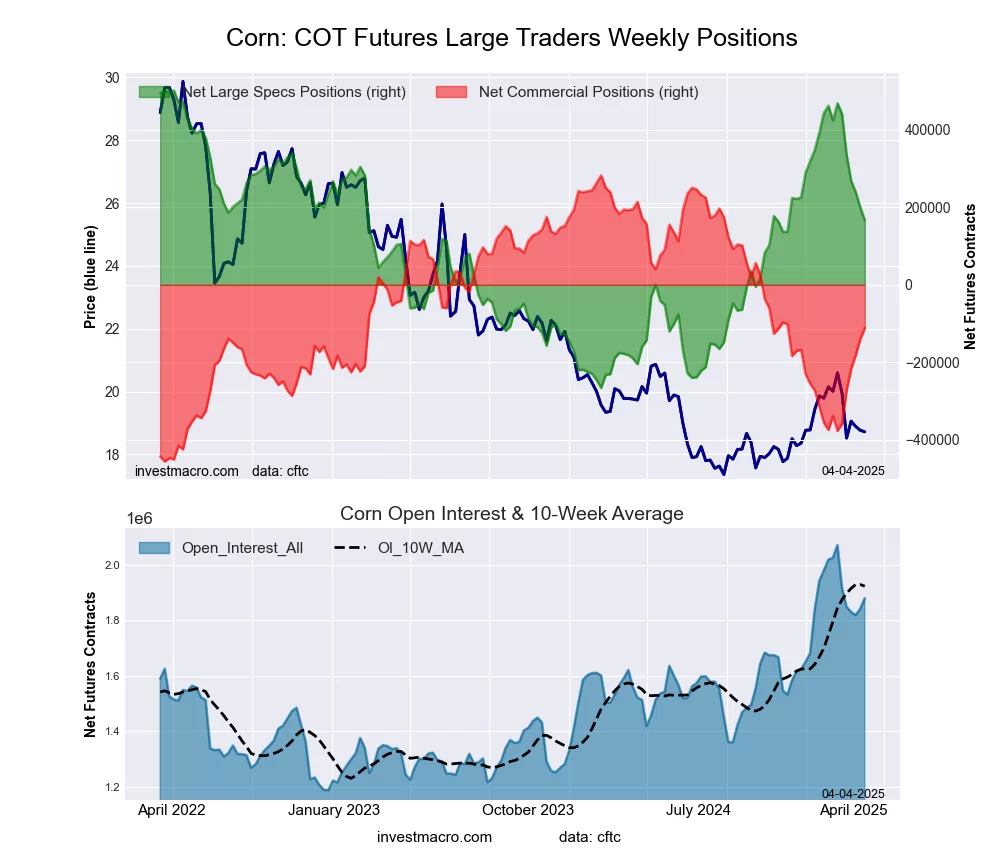
CORN Futures COT ChartThe CORN large speculator standing this week resulted in a net position of 392,923 contracts in the data reported through Tuesday. This was a weekly boost of 44,848 contracts from the previous week which had a total of 348,075 net contracts.

This week’s current strength score (the trader positioning range over the past three years, measured from 0 to 100) shows the speculators are currently Bullish-Extreme with a score of 83.9 percent. The commercials are Bearish with a score of 20.8 percent and the small traders (not shown in chart) are Bearish-Extreme with a score of 3.0 percent.

Price Trend-Following Model: Strong Uptrend

Our weekly trend-following model classifies the current market price position as: Strong Uptrend.

CORN Futures StatisticsSPECULATORSCOMMERCIALSSMALL TRADERS
– Percent of Open Interest Longs:30.241.76.2
– Percent of Open Interest Shorts:10.057.910.2
– Net Position:392,923-314,101-78,822
– Gross Longs:587,335810,136120,226
– Gross Shorts:194,4121,124,237199,048
– Long to Short Ratio:3.0 to 10.7 to 10.6 to 1
NET POSITION TREND:
– Strength Index Score (3 Year Range Pct):83.920.83.0
– Strength Index Reading (3 Year Range):Bullish-ExtremeBearishBearish-Extreme
NET POSITION MOVEMENT INDEX:
– 6-Week Change in Strength Index:21.5-17.3-50.2


SUGAR Futures:

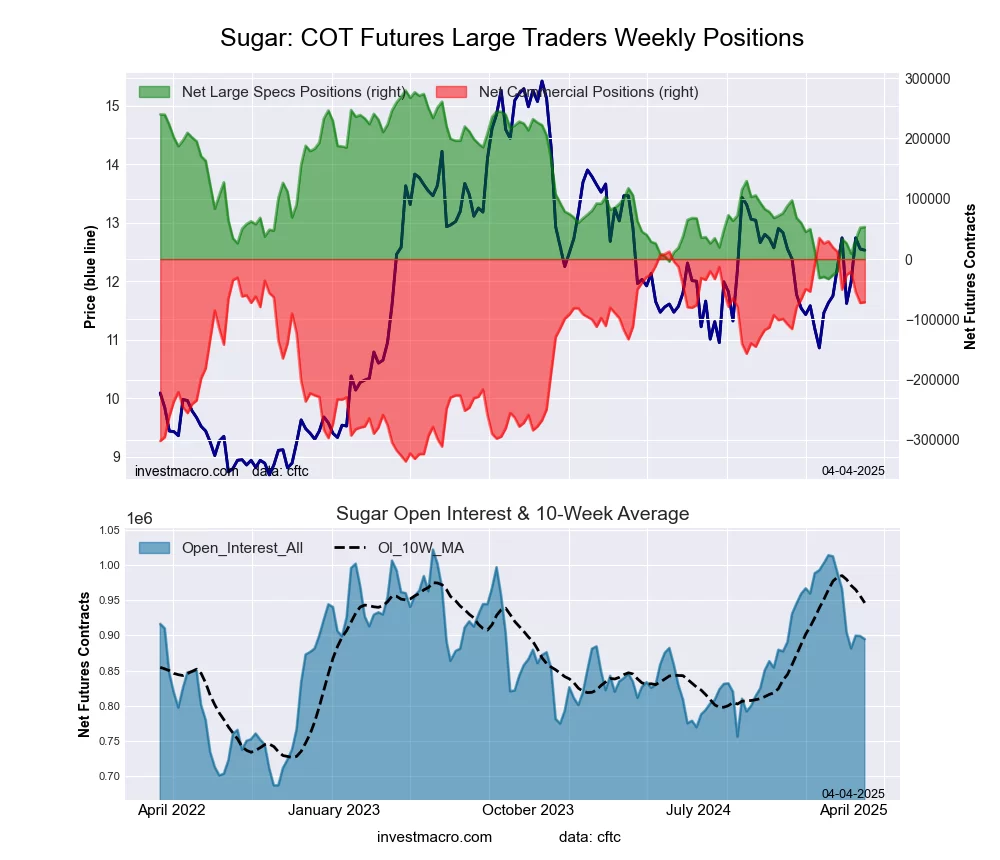
SUGAR Futures COT ChartThe SUGAR large speculator standing this week resulted in a net position of -31,467 contracts in the data reported through Tuesday. This was a weekly decline of -45,629 contracts from the previous week which had a total of 14,162 net contracts.

This week’s current strength score (the trader positioning range over the past three years, measured from 0 to 100) shows the speculators are currently Bearish-Extreme with a score of 0.0 percent. The commercials are Bullish-Extreme with a score of 100.0 percent and the small traders (not shown in chart) are Bearish-Extreme with a score of 15.1 percent.

Price Trend-Following Model: Strong Downtrend

Our weekly trend-following model classifies the current market price position as: Strong Downtrend.

SUGAR Futures StatisticsSPECULATORSCOMMERCIALSSMALL TRADERS
– Percent of Open Interest Longs:23.354.37.0
– Percent of Open Interest Shorts:26.550.77.3
– Net Position:-31,46734,888-3,421
– Gross Longs:231,219538,36169,175
– Gross Shorts:262,686503,47372,596
– Long to Short Ratio:0.9 to 11.1 to 11.0 to 1
NET POSITION TREND:
– Strength Index Score (3 Year Range Pct):0.0100.015.1
– Strength Index Reading (3 Year Range):Bearish-ExtremeBullish-ExtremeBearish-Extreme
NET POSITION MOVEMENT INDEX:
– 6-Week Change in Strength Index:-41.440.7-28.7


COFFEE Futures:

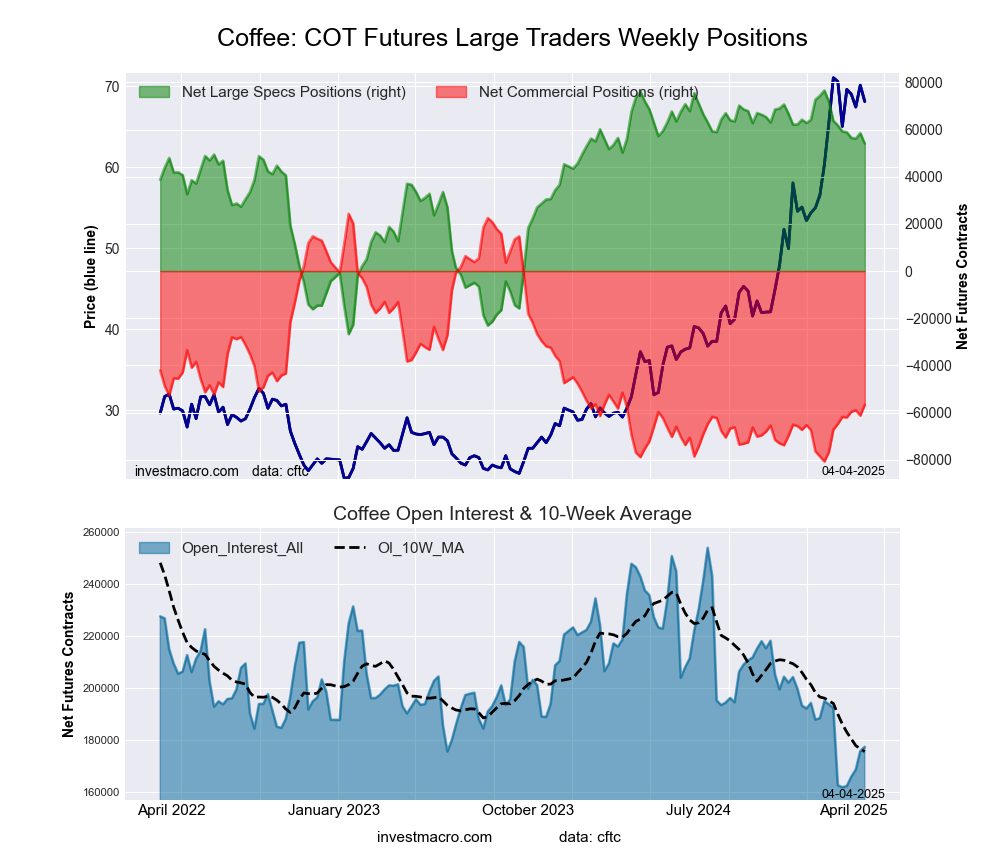
COFFEE Futures COT ChartThe COFFEE large speculator standing this week resulted in a net position of 74,291 contracts in the data reported through Tuesday. This was a weekly gain of 1,649 contracts from the previous week which had a total of 72,642 net contracts.

This week’s current strength score (the trader positioning range over the past three years, measured from 0 to 100) shows the speculators are currently Bullish-Extreme with a score of 98.3 percent. The commercials are Bearish-Extreme with a score of 0.3 percent and the small traders (not shown in chart) are Bullish-Extreme with a score of 82.1 percent.

Price Trend-Following Model: Strong Uptrend

Our weekly trend-following model classifies the current market price position as: Strong Uptrend.

COFFEE Futures StatisticsSPECULATORSCOMMERCIALSSMALL TRADERS
– Percent of Open Interest Longs:44.029.85.9
– Percent of Open Interest Shorts:4.671.53.7
– Net Position:74,291-78,5264,235
– Gross Longs:83,01156,21711,170
– Gross Shorts:8,720134,7436,935
– Long to Short Ratio:9.5 to 10.4 to 11.6 to 1
NET POSITION TREND:
– Strength Index Score (3 Year Range Pct):98.30.382.1
– Strength Index Reading (3 Year Range):Bullish-ExtremeBearish-ExtremeBullish-Extreme
NET POSITION MOVEMENT INDEX:
– 6-Week Change in Strength Index:11.9-13.018.4


SOYBEANS Futures:

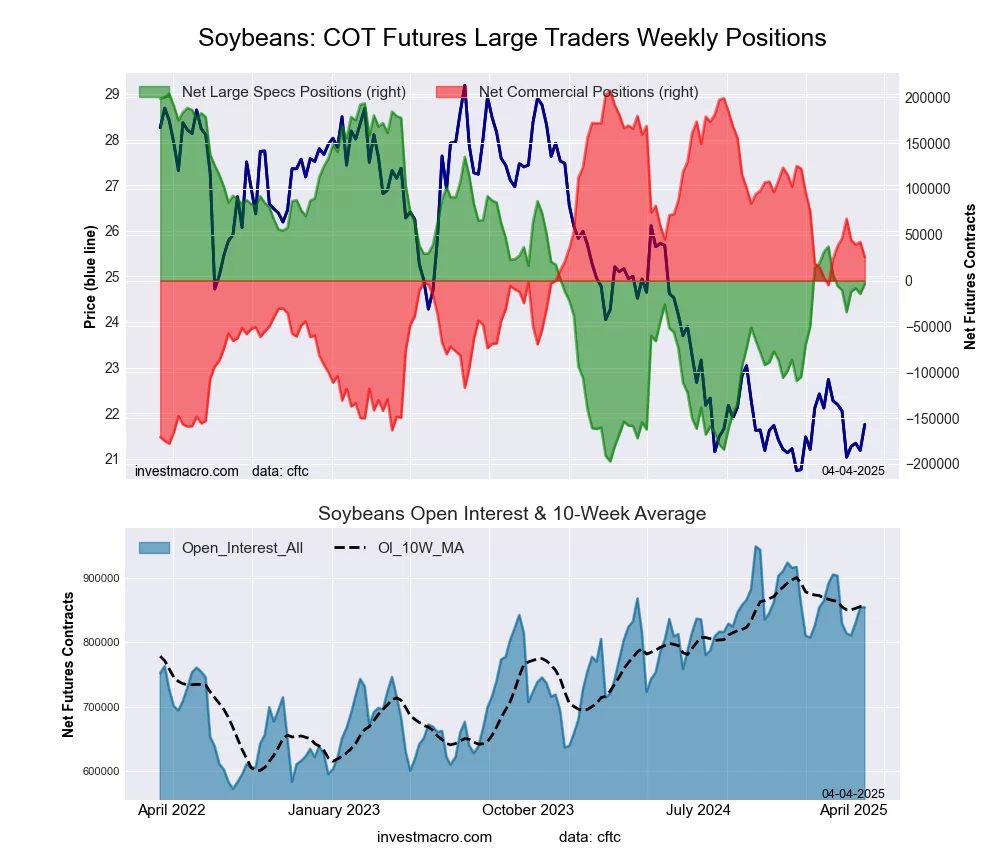
SOYBEANS Futures COT ChartThe SOYBEANS large speculator standing this week resulted in a net position of 18,549 contracts in the data reported through Tuesday. This was a weekly lift of 4,031 contracts from the previous week which had a total of 14,518 net contracts.

This week’s current strength score (the trader positioning range over the past three years, measured from 0 to 100) shows the speculators are currently Bullish with a score of 50.9 percent. The commercials are Bullish with a score of 52.4 percent and the small traders (not shown in chart) are Bearish with a score of 25.3 percent.

Price Trend-Following Model: Weak Downtrend

Our weekly trend-following model classifies the current market price position as: Weak Downtrend.

SOYBEANS Futures StatisticsSPECULATORSCOMMERCIALSSMALL TRADERS
– Percent of Open Interest Longs:21.956.74.6
– Percent of Open Interest Shorts:19.855.08.5
– Net Position:18,54914,875-33,424
– Gross Longs:187,255484,41739,381
– Gross Shorts:168,706469,54272,805
– Long to Short Ratio:1.1 to 11.0 to 10.5 to 1
NET POSITION TREND:
– Strength Index Score (3 Year Range Pct):50.952.425.3
– Strength Index Reading (3 Year Range):BullishBullishBearish
NET POSITION MOVEMENT INDEX:
– 6-Week Change in Strength Index:24.7-21.7-44.5


SOYBEAN OIL Futures:

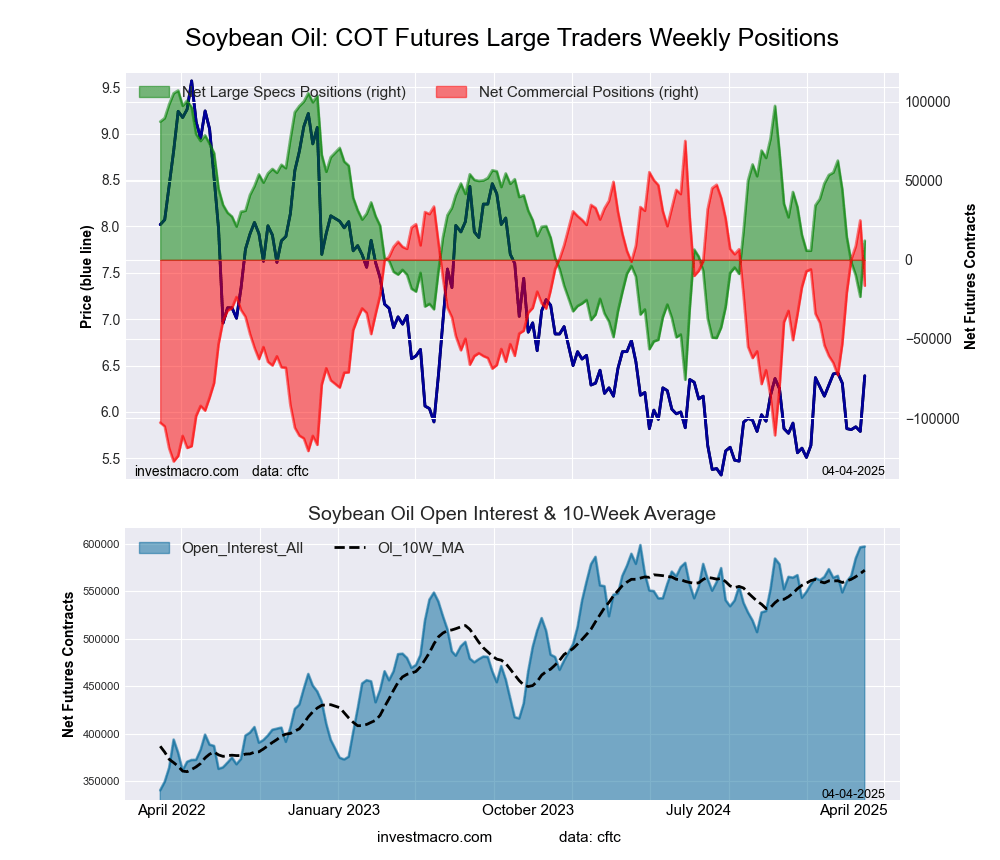
SOYBEAN OIL Futures COT ChartThe SOYBEAN OIL large speculator standing this week resulted in a net position of 38,501 contracts in the data reported through Tuesday. This was a weekly advance of 4,098 contracts from the previous week which had a total of 34,403 net contracts.

This week’s current strength score (the trader positioning range over the past three years, measured from 0 to 100) shows the speculators are currently Bullish with a score of 62.5 percent. The commercials are Bearish with a score of 43.3 percent and the small traders (not shown in chart) are Bearish-Extreme with a score of 18.9 percent.

Price Trend-Following Model: Strong Uptrend

Our weekly trend-following model classifies the current market price position as: Strong Uptrend.

SOYBEAN OIL Futures StatisticsSPECULATORSCOMMERCIALSSMALL TRADERS
– Percent of Open Interest Longs:22.055.55.2
– Percent of Open Interest Shorts:15.162.55.0
– Net Position:38,501-39,7321,231
– Gross Longs:123,527311,69829,376
– Gross Shorts:85,026351,43028,145
– Long to Short Ratio:1.5 to 10.9 to 11.0 to 1
NET POSITION TREND:
– Strength Index Score (3 Year Range Pct):62.543.318.9
– Strength Index Reading (3 Year Range):BullishBearishBearish-Extreme
NET POSITION MOVEMENT INDEX:
– 6-Week Change in Strength Index:-2.45.4-25.8


SOYBEAN MEAL Futures:

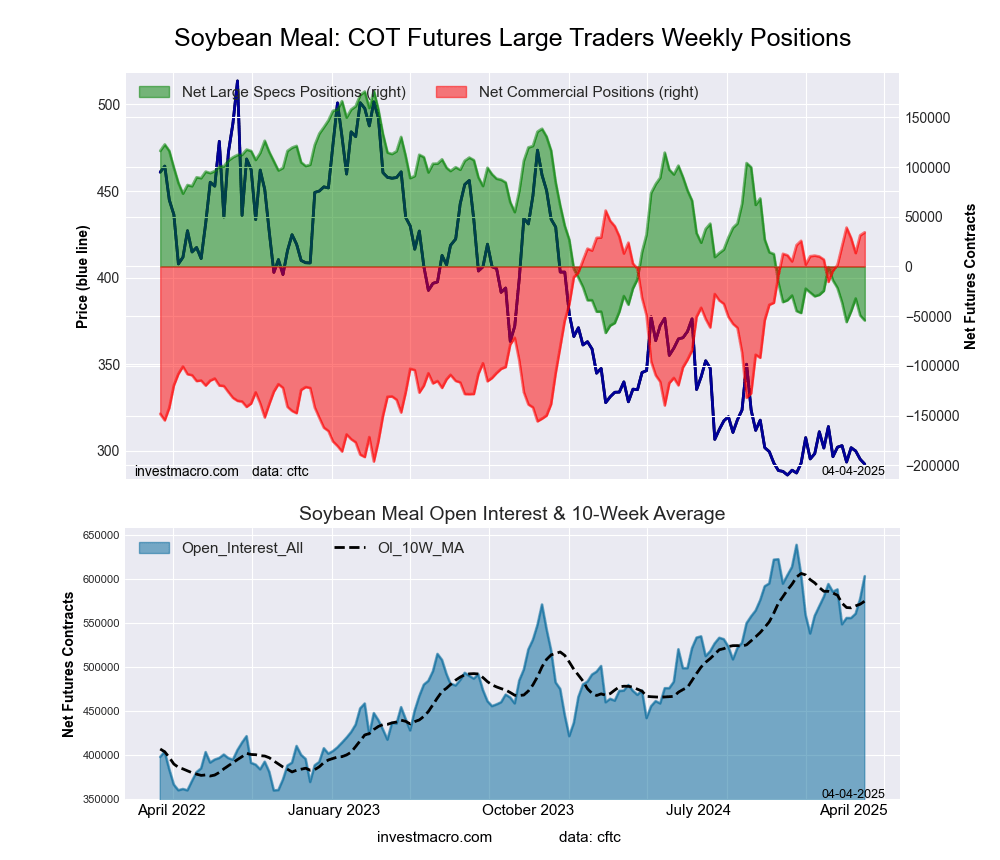
SOYBEAN MEAL Futures COT ChartThe SOYBEAN MEAL large speculator standing this week resulted in a net position of -28,598 contracts in the data reported through Tuesday. This was a weekly lift of 1,428 contracts from the previous week which had a total of -30,026 net contracts.

This week’s current strength score (the trader positioning range over the past three years, measured from 0 to 100) shows the speculators are currently Bearish-Extreme with a score of 15.7 percent. The commercials are Bullish-Extreme with a score of 81.7 percent and the small traders (not shown in chart) are Bearish with a score of 39.4 percent.

Price Trend-Following Model: Weak Downtrend

Our weekly trend-following model classifies the current market price position as: Weak Downtrend.

SOYBEAN MEAL Futures StatisticsSPECULATORSCOMMERCIALSSMALL TRADERS
– Percent of Open Interest Longs:17.449.78.8
– Percent of Open Interest Shorts:22.548.05.5
– Net Position:-28,5989,97418,624
– Gross Longs:99,189282,71050,002
– Gross Shorts:127,787272,73631,378
– Long to Short Ratio:0.8 to 11.0 to 11.6 to 1
NET POSITION TREND:
– Strength Index Score (3 Year Range Pct):15.781.739.4
– Strength Index Reading (3 Year Range):Bearish-ExtremeBullish-ExtremeBearish
NET POSITION MOVEMENT INDEX:
– 6-Week Change in Strength Index:0.32.0-25.2


LIVE CATTLE Futures:

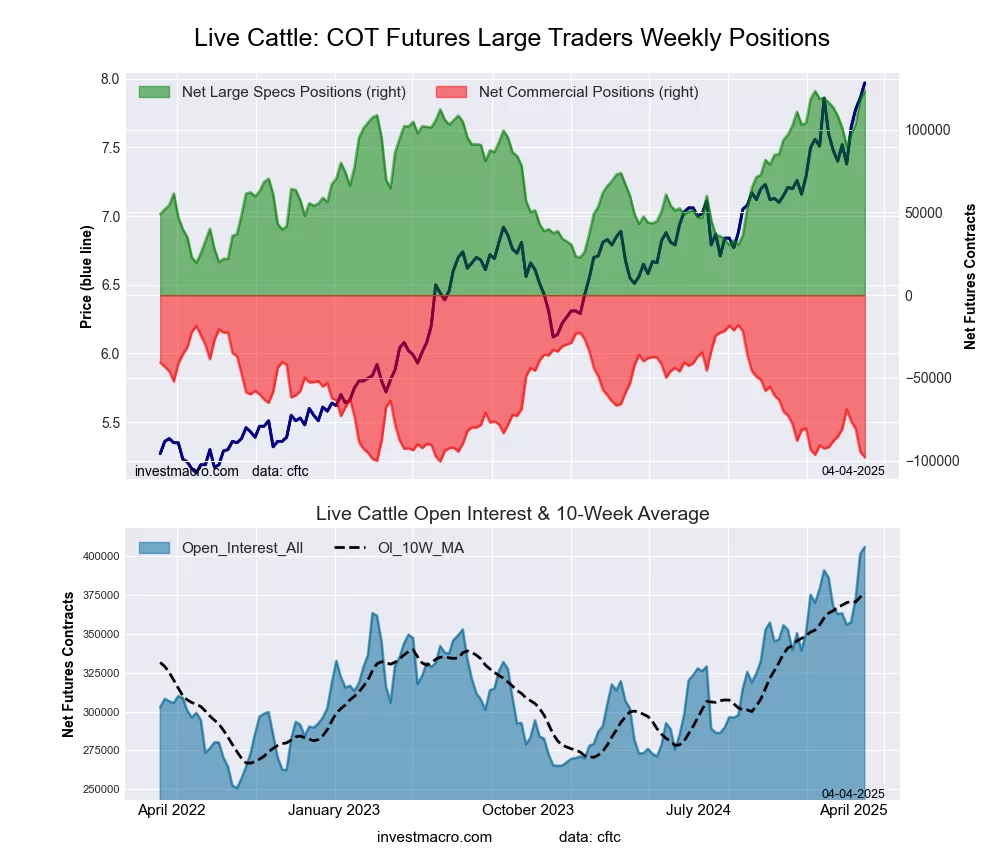
LIVE CATTLE Futures COT ChartThe LIVE CATTLE large speculator standing this week resulted in a net position of 118,732 contracts in the data reported through Tuesday. This was a weekly decline of -4,553 contracts from the previous week which had a total of 123,285 net contracts.

This week’s current strength score (the trader positioning range over the past three years, measured from 0 to 100) shows the speculators are currently Bullish-Extreme with a score of 95.6 percent. The commercials are Bearish-Extreme with a score of 11.7 percent and the small traders (not shown in chart) are Bearish-Extreme with a score of 0.0 percent.

Price Trend-Following Model: Strong Uptrend

Our weekly trend-following model classifies the current market price position as: Strong Uptrend.

LIVE CATTLE Futures StatisticsSPECULATORSCOMMERCIALSSMALL TRADERS
– Percent of Open Interest Longs:50.728.37.1
– Percent of Open Interest Shorts:19.452.314.5
– Net Position:118,732-90,810-27,922
– Gross Longs:192,157107,10626,966
– Gross Shorts:73,425197,91654,888
– Long to Short Ratio:2.6 to 10.5 to 10.5 to 1
NET POSITION TREND:
– Strength Index Score (3 Year Range Pct):95.611.70.0
– Strength Index Reading (3 Year Range):Bullish-ExtremeBearish-ExtremeBearish-Extreme
NET POSITION MOVEMENT INDEX:
– 6-Week Change in Strength Index:15.5-15.6-10.5


LEAN HOGS Futures:

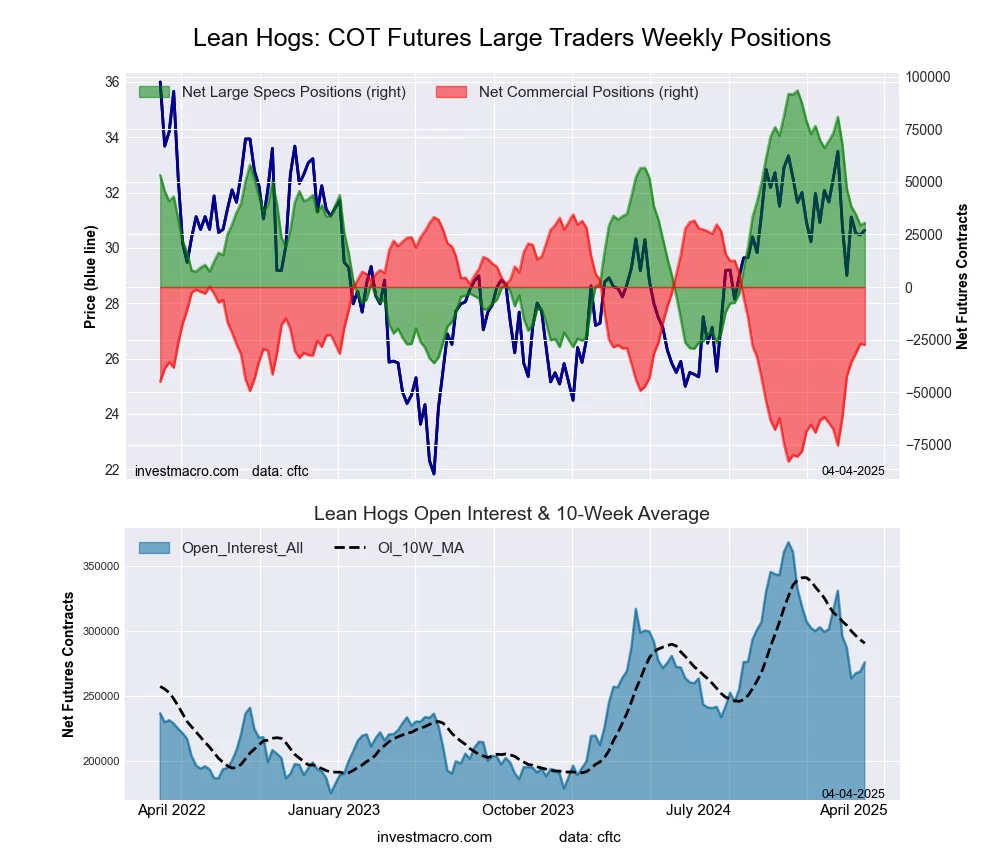
LEAN HOGS Futures COT ChartThe LEAN HOGS large speculator standing this week resulted in a net position of 69,976 contracts in the data reported through Tuesday. This was a weekly fall of -6,566 contracts from the previous week which had a total of 76,542 net contracts.

This week’s current strength score (the trader positioning range over the past three years, measured from 0 to 100) shows the speculators are currently Bullish-Extreme with a score of 81.9 percent. The commercials are Bearish-Extreme with a score of 16.6 percent and the small traders (not shown in chart) are Bearish with a score of 38.5 percent.

Price Trend-Following Model: Uptrend

Our weekly trend-following model classifies the current market price position as: Uptrend.

LEAN HOGS Futures StatisticsSPECULATORSCOMMERCIALSSMALL TRADERS
– Percent of Open Interest Longs:41.732.97.3
– Percent of Open Interest Shorts:18.653.99.4
– Net Position:69,976-63,497-6,479
– Gross Longs:126,35899,83122,147
– Gross Shorts:56,382163,32828,626
– Long to Short Ratio:2.2 to 10.6 to 10.8 to 1
NET POSITION TREND:
– Strength Index Score (3 Year Range Pct):81.916.638.5
– Strength Index Reading (3 Year Range):Bullish-ExtremeBearish-ExtremeBearish
NET POSITION MOVEMENT INDEX:
– 6-Week Change in Strength Index:-16.614.031.0


COTTON Futures:

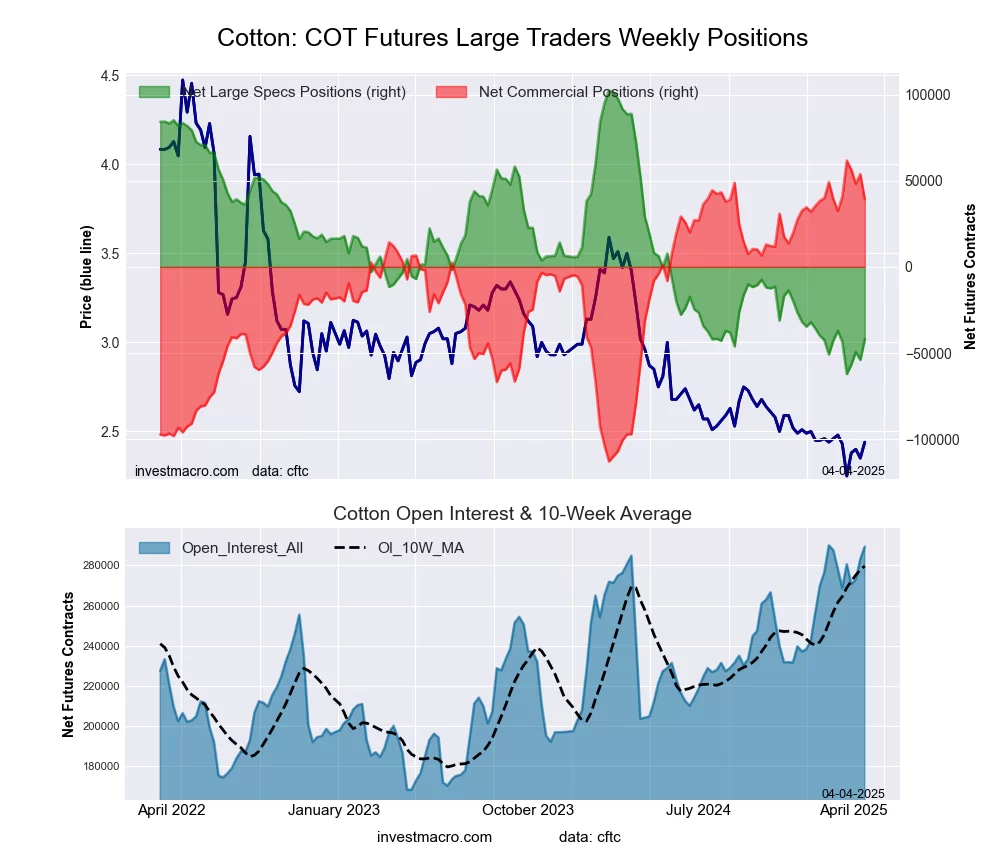
COTTON Futures COT ChartThe COTTON large speculator standing this week resulted in a net position of -39,951 contracts in the data reported through Tuesday. This was a weekly decrease of -4,210 contracts from the previous week which had a total of -35,741 net contracts.

This week’s current strength score (the trader positioning range over the past three years, measured from 0 to 100) shows the speculators are currently Bearish-Extreme with a score of 4.2 percent. The commercials are Bullish-Extreme with a score of 93.5 percent and the small traders (not shown in chart) are Bearish with a score of 26.4 percent.

Price Trend-Following Model: Strong Downtrend

Our weekly trend-following model classifies the current market price position as: Strong Downtrend.

COTTON Futures StatisticsSPECULATORSCOMMERCIALSSMALL TRADERS
– Percent of Open Interest Longs:24.648.95.7
– Percent of Open Interest Shorts:39.434.75.1
– Net Position:-39,95138,3351,616
– Gross Longs:66,257131,97315,453
– Gross Shorts:106,20893,63813,837
– Long to Short Ratio:0.6 to 11.4 to 11.1 to 1
NET POSITION TREND:
– Strength Index Score (3 Year Range Pct):4.293.526.4
– Strength Index Reading (3 Year Range):Bearish-ExtremeBullish-ExtremeBearish
NET POSITION MOVEMENT INDEX:
– 6-Week Change in Strength Index:-13.811.79.0


COCOA Futures:

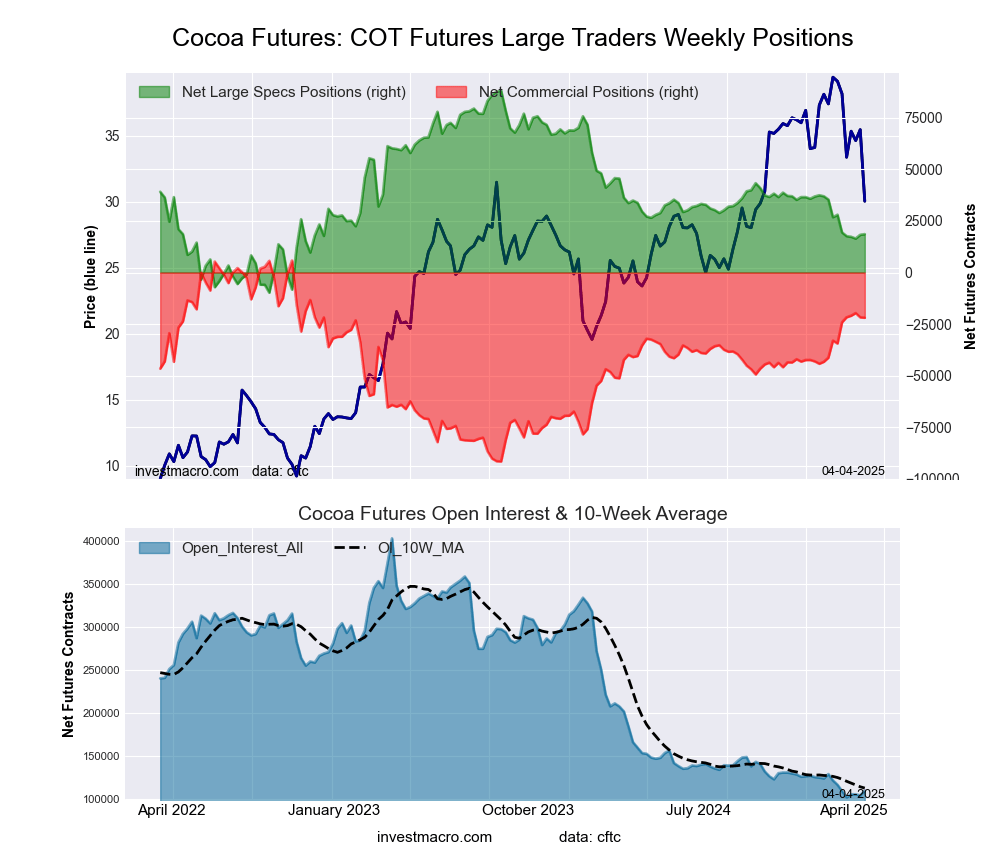
COCOA Futures COT ChartThe COCOA large speculator standing this week resulted in a net position of 37,465 contracts in the data reported through Tuesday. This was a weekly lift of 605 contracts from the previous week which had a total of 36,860 net contracts.

This week’s current strength score (the trader positioning range over the past three years, measured from 0 to 100) shows the speculators are currently Bearish with a score of 48.2 percent. The commercials are Bearish with a score of 48.6 percent and the small traders (not shown in chart) are Bullish with a score of 69.9 percent.

Price Trend-Following Model: Strong Uptrend

Our weekly trend-following model classifies the current market price position as: Strong Uptrend.

COCOA Futures StatisticsSPECULATORSCOMMERCIALSSMALL TRADERS
– Percent of Open Interest Longs:40.537.49.6
– Percent of Open Interest Shorts:10.473.04.1
– Net Position:37,465-44,2436,778
– Gross Longs:50,40846,55211,924
– Gross Shorts:12,94390,7955,146
– Long to Short Ratio:3.9 to 10.5 to 12.3 to 1
NET POSITION TREND:
– Strength Index Score (3 Year Range Pct):48.248.669.9
– Strength Index Reading (3 Year Range):BearishBearishBullish
NET POSITION MOVEMENT INDEX:
– 6-Week Change in Strength Index:0.5-0.61.1


WHEAT Futures:

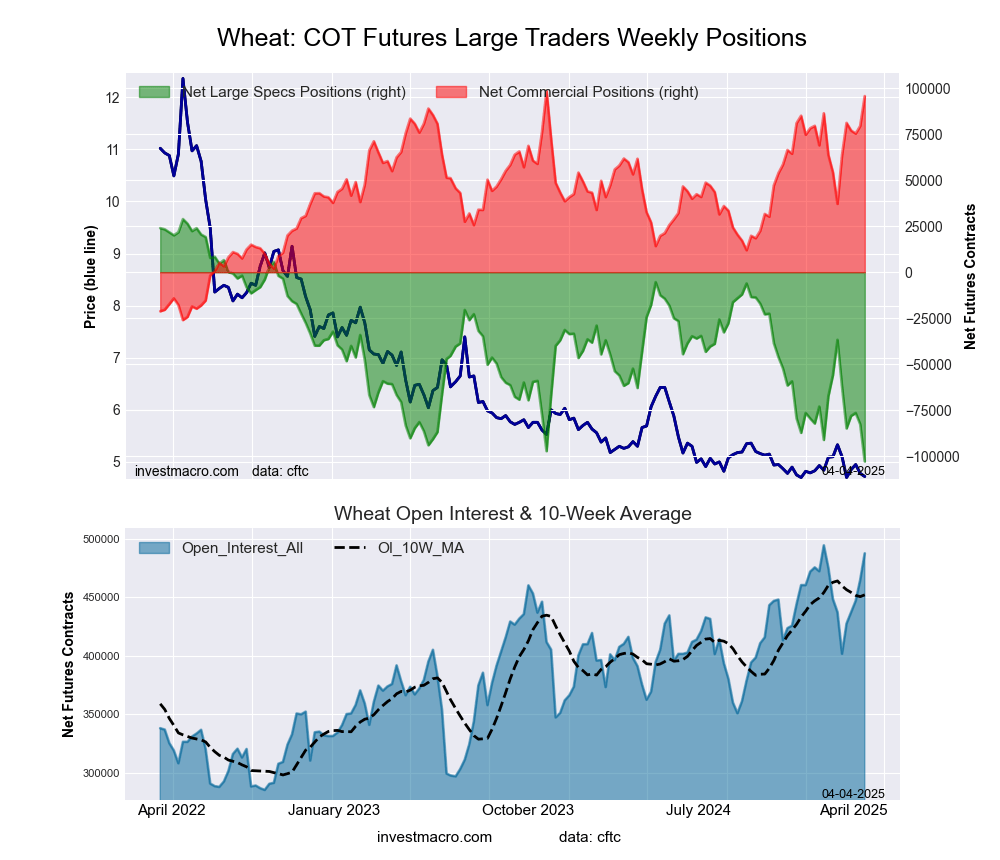
WHEAT Futures COT ChartThe WHEAT large speculator standing this week resulted in a net position of -73,009 contracts in the data reported through Tuesday. This was a weekly boost of 9,200 contracts from the previous week which had a total of -82,209 net contracts.

This week’s current strength score (the trader positioning range over the past three years, measured from 0 to 100) shows the speculators are currently Bearish-Extreme with a score of 19.2 percent. The commercials are Bullish with a score of 76.1 percent and the small traders (not shown in chart) are Bullish with a score of 79.6 percent.

Price Trend-Following Model: Downtrend

Our weekly trend-following model classifies the current market price position as: Downtrend.

WHEAT Futures StatisticsSPECULATORSCOMMERCIALSSMALL TRADERS
– Percent of Open Interest Longs:29.433.87.5
– Percent of Open Interest Shorts:44.919.26.6
– Net Position:-73,00968,8654,144
– Gross Longs:138,911159,61835,248
– Gross Shorts:211,92090,75331,104
– Long to Short Ratio:0.7 to 11.8 to 11.1 to 1
NET POSITION TREND:
– Strength Index Score (3 Year Range Pct):19.276.179.6
– Strength Index Reading (3 Year Range):Bearish-ExtremeBullishBullish
NET POSITION MOVEMENT INDEX:
– 6-Week Change in Strength Index:-10.93.750.8


Article By InvestMacroReceive our weekly COT Newsletter

*COT Report: The COT data, released weekly to the public each Friday, is updated through the most recent Tuesday (data is 3 days old) and shows a quick view of how large speculators or non-commercials (for-profit traders) were positioned in the futures markets.

The CFTC categorizes trader positions according to commercial hedgers (traders who use futures contracts for hedging as part of the business), non-commercials (large traders who speculate to realize trading profits) and nonreportable traders (usually small traders/speculators) as well as their open interest (contracts open in the market at time of reporting). See CFTC criteria here.

COT Stock Market Charts: Speculator Bets led by Nasdaq & DowJones Minis

By InvestMacro

Here are the latest charts and statistics for the Commitment of Traders (COT) data published by the Commodities Futures Trading Commission (CFTC).

The latest COT data is updated through Tuesday January 21st and shows a quick view of how large traders (for-profit speculators and commercial entities) were positioned in the futures markets.

Weekly Speculator Changes led by Nasdaq-Mini & DowJones-Mini

The COT stock markets speculator bets were slightly lower this week as three out of the seven stock markets we cover had higher positioning while the other four markets had lower speculator contracts.

Leading the gains for the stock markets was the Nasdaq-Mini (7,955 contracts) with the DowJones-Mini (881 contracts) and the Nikkei 225 (60 contracts) also showing positive weeks.

The markets with the declines in speculator bets this week were the S&P500-Mini (-45,173 contracts), the Russell-Mini (-19,932 contracts), the MSCI EAFE-Mini (-4,166 contracts) and with the VIX (-1,330 contracts) also registering lower bets on the week.


Stock Market Net Speculators Leaderboard

Legend: Weekly Speculators Change | Speculators Current Net Position | Speculators Strength Score compared to last 3-Years (0-100 range)


Strength Scores led by VIX & Nasdaq-Mini

COT Strength Scores (a normalized measure of Speculator positions over a 3-Year range, from 0 to 100 where above 80 is Extreme-Bullish and below 20 is Extreme-Bearish) showed that the VIX (71 percent) and the Nasdaq-Mini (68 percent) lead the stock markets this week. The Russell-Mini (68 percent) and DowJones-Mini (64 percent) come in as the next highest in the weekly strength scores.

On the downside, the MSCI EAFE-Mini (43 percent) comes in at the lowest strength level currently.

Strength Statistics:
VIX (70.9 percent) vs VIX previous week (72.1 percent)
S&P500-Mini (53.5 percent) vs S&P500-Mini previous week (60.2 percent)
DowJones-Mini (64.1 percent) vs DowJones-Mini previous week (62.7 percent)
Nasdaq-Mini (67.8 percent) vs Nasdaq-Mini previous week (55.5 percent)
Russell2000-Mini (67.6 percent) vs Russell2000-Mini previous week (81.2 percent)
Nikkei USD (56.7 percent) vs Nikkei USD previous week (56.1 percent)
EAFE-Mini (42.7 percent) vs EAFE-Mini previous week (48.1 percent)


VIX tops the 6-Week Strength Trends

COT Strength Score Trends (or move index, calculates the 6-week changes in strength scores) showed that the VIX (16 percent) leads the past six weeks trends for the stock markets.

The Nasdaq-Mini (-26 percent) leads the downside trend scores currently with the MSCI EAFE-Mini (-17 percent) coming in as the next market with lower trend scores.

Strength Trend Statistics:
VIX (15.5 percent) vs VIX previous week (5.9 percent)
S&P500-Mini (1.1 percent) vs S&P500-Mini previous week (11.6 percent)
DowJones-Mini (-14.2 percent) vs DowJones-Mini previous week (-14.7 percent)
Nasdaq-Mini (-26.5 percent) vs Nasdaq-Mini previous week (-29.7 percent)
Russell2000-Mini (-12.9 percent) vs Russell2000-Mini previous week (7.2 percent)
Nikkei USD (-6.8 percent) vs Nikkei USD previous week (-3.2 percent)
EAFE-Mini (-17.1 percent) vs EAFE-Mini previous week (5.4 percent)


Individual Stock Market Charts:

VIX Volatility Futures:

VIX Volatility Futures COT ChartThe VIX Volatility large speculator standing this week recorded a net position of -28,060 contracts in the data reported through Tuesday. This was a weekly reduction of -1,330 contracts from the previous week which had a total of -26,730 net contracts.

This week’s current strength score (the trader positioning range over the past three years, measured from 0 to 100) shows the speculators are currently Bullish with a score of 70.9 percent. The commercials are Bearish with a score of 29.6 percent and the small traders (not shown in chart) are Bullish-Extreme with a score of 88.8 percent.

Price Trend-Following Model: Strong Downtrend

Our weekly trend-following model classifies the current market price position as: Strong Downtrend.

VIX Volatility Futures StatisticsSPECULATORSCOMMERCIALSSMALL TRADERS
– Percent of Open Interest Longs:18.045.411.3
– Percent of Open Interest Shorts:25.738.410.6
– Net Position:-28,06025,4292,631
– Gross Longs:65,618165,57641,409
– Gross Shorts:93,678140,14738,778
– Long to Short Ratio:0.7 to 11.2 to 11.1 to 1
NET POSITION TREND:
– Strength Index Score (3 Year Range Pct):70.929.688.8
– Strength Index Reading (3 Year Range):BullishBearishBullish-Extreme
NET POSITION MOVEMENT INDEX:
– 6-Week Change in Strength Index:15.5-17.313.2


S&P500 Mini Futures:

SP500 Mini Futures COT ChartThe S&P500 Mini large speculator standing this week recorded a net position of -75,715 contracts in the data reported through Tuesday. This was a weekly reduction of -45,173 contracts from the previous week which had a total of -30,542 net contracts.

This week’s current strength score (the trader positioning range over the past three years, measured from 0 to 100) shows the speculators are currently Bullish with a score of 53.5 percent. The commercials are Bearish with a score of 26.5 percent and the small traders (not shown in chart) are Bullish-Extreme with a score of 91.2 percent.

Price Trend-Following Model: Strong Uptrend

Our weekly trend-following model classifies the current market price position as: Strong Uptrend.

S&P500 Mini Futures StatisticsSPECULATORSCOMMERCIALSSMALL TRADERS
– Percent of Open Interest Longs:13.071.413.7
– Percent of Open Interest Shorts:16.774.47.0
– Net Position:-75,715-60,433136,148
– Gross Longs:263,8151,453,774279,487
– Gross Shorts:339,5301,514,207143,339
– Long to Short Ratio:0.8 to 11.0 to 11.9 to 1
NET POSITION TREND:
– Strength Index Score (3 Year Range Pct):53.526.591.2
– Strength Index Reading (3 Year Range):BullishBearishBullish-Extreme
NET POSITION MOVEMENT INDEX:
– 6-Week Change in Strength Index:1.10.9-5.5


Dow Jones Mini Futures:

Dow Jones Mini Futures COT ChartThe Dow Jones Mini large speculator standing this week recorded a net position of 2,327 contracts in the data reported through Tuesday. This was a weekly boost of 881 contracts from the previous week which had a total of 1,446 net contracts.

This week’s current strength score (the trader positioning range over the past three years, measured from 0 to 100) shows the speculators are currently Bullish with a score of 64.1 percent. The commercials are Bearish with a score of 30.2 percent and the small traders (not shown in chart) are Bullish with a score of 73.2 percent.

Price Trend-Following Model: Strong Uptrend

Our weekly trend-following model classifies the current market price position as: Strong Uptrend.

Dow Jones Mini Futures StatisticsSPECULATORSCOMMERCIALSSMALL TRADERS
– Percent of Open Interest Longs:16.465.117.5
– Percent of Open Interest Shorts:13.571.913.6
– Net Position:2,327-5,5643,237
– Gross Longs:13,37753,19014,317
– Gross Shorts:11,05058,75411,080
– Long to Short Ratio:1.2 to 10.9 to 11.3 to 1
NET POSITION TREND:
– Strength Index Score (3 Year Range Pct):64.130.273.2
– Strength Index Reading (3 Year Range):BullishBearishBullish
NET POSITION MOVEMENT INDEX:
– 6-Week Change in Strength Index:-14.215.6-11.9


Nasdaq Mini Futures:

Nasdaq Mini Futures COT ChartThe Nasdaq Mini large speculator standing this week recorded a net position of 18,489 contracts in the data reported through Tuesday. This was a weekly boost of 7,955 contracts from the previous week which had a total of 10,534 net contracts.

This week’s current strength score (the trader positioning range over the past three years, measured from 0 to 100) shows the speculators are currently Bullish with a score of 67.8 percent. The commercials are Bearish-Extreme with a score of 14.2 percent and the small traders (not shown in chart) are Bullish-Extreme with a score of 89.2 percent.

Price Trend-Following Model: Uptrend

Our weekly trend-following model classifies the current market price position as: Uptrend.

Nasdaq Mini Futures StatisticsSPECULATORSCOMMERCIALSSMALL TRADERS
– Percent of Open Interest Longs:28.153.217.2
– Percent of Open Interest Shorts:20.867.610.1
– Net Position:18,489-36,65418,165
– Gross Longs:71,503135,40243,768
– Gross Shorts:53,014172,05625,603
– Long to Short Ratio:1.3 to 10.8 to 11.7 to 1
NET POSITION TREND:
– Strength Index Score (3 Year Range Pct):67.814.289.2
– Strength Index Reading (3 Year Range):BullishBearish-ExtremeBullish-Extreme
NET POSITION MOVEMENT INDEX:
– 6-Week Change in Strength Index:-26.514.27.4


Russell 2000 Mini Futures:

Russell 2000 Mini Futures COT ChartThe Russell 2000 Mini large speculator standing this week recorded a net position of -21,027 contracts in the data reported through Tuesday. This was a weekly decrease of -19,932 contracts from the previous week which had a total of -1,095 net contracts.

This week’s current strength score (the trader positioning range over the past three years, measured from 0 to 100) shows the speculators are currently Bullish with a score of 67.6 percent. The commercials are Bearish with a score of 25.5 percent and the small traders (not shown in chart) are Bullish with a score of 76.6 percent.

Price Trend-Following Model: Uptrend

Our weekly trend-following model classifies the current market price position as: Uptrend.

Russell 2000 Mini Futures StatisticsSPECULATORSCOMMERCIALSSMALL TRADERS
– Percent of Open Interest Longs:11.676.78.5
– Percent of Open Interest Shorts:16.476.14.3
– Net Position:-21,0272,54718,480
– Gross Longs:50,530334,23537,263
– Gross Shorts:71,557331,68818,783
– Long to Short Ratio:0.7 to 11.0 to 12.0 to 1
NET POSITION TREND:
– Strength Index Score (3 Year Range Pct):67.625.576.6
– Strength Index Reading (3 Year Range):BullishBearishBullish
NET POSITION MOVEMENT INDEX:
– 6-Week Change in Strength Index:-12.916.5-22.6


Nikkei Stock Average (USD) Futures:

Nikkei Stock Average (USD) Futures COT ChartThe Nikkei Stock Average (USD) large speculator standing this week recorded a net position of -2,758 contracts in the data reported through Tuesday. This was a weekly advance of 60 contracts from the previous week which had a total of -2,818 net contracts.

This week’s current strength score (the trader positioning range over the past three years, measured from 0 to 100) shows the speculators are currently Bullish with a score of 56.7 percent. The commercials are Bearish with a score of 45.4 percent and the small traders (not shown in chart) are Bearish with a score of 44.1 percent.

Price Trend-Following Model: Downtrend

Our weekly trend-following model classifies the current market price position as: Downtrend.

Nikkei Stock Average Futures StatisticsSPECULATORSCOMMERCIALSSMALL TRADERS
– Percent of Open Interest Longs:8.670.221.2
– Percent of Open Interest Shorts:33.945.320.7
– Net Position:-2,7582,70949
– Gross Longs:9377,6472,305
– Gross Shorts:3,6954,9382,256
– Long to Short Ratio:0.3 to 11.5 to 11.0 to 1
NET POSITION TREND:
– Strength Index Score (3 Year Range Pct):56.745.444.1
– Strength Index Reading (3 Year Range):BullishBearishBearish
NET POSITION MOVEMENT INDEX:
– 6-Week Change in Strength Index:-6.820.3-40.5


MSCI EAFE Mini Futures:

MSCI EAFE Mini Futures COT ChartThe MSCI EAFE Mini large speculator standing this week recorded a net position of -31,191 contracts in the data reported through Tuesday. This was a weekly lowering of -4,166 contracts from the previous week which had a total of -27,025 net contracts.

This week’s current strength score (the trader positioning range over the past three years, measured from 0 to 100) shows the speculators are currently Bearish with a score of 42.7 percent. The commercials are Bullish with a score of 59.7 percent and the small traders (not shown in chart) are Bearish with a score of 33.5 percent.

Price Trend-Following Model: Weak Downtrend

Our weekly trend-following model classifies the current market price position as: Weak Downtrend.

MSCI EAFE Mini Futures StatisticsSPECULATORSCOMMERCIALSSMALL TRADERS
– Percent of Open Interest Longs:8.688.22.6
– Percent of Open Interest Shorts:15.781.81.8
– Net Position:-31,19127,8993,292
– Gross Longs:37,252384,14611,192
– Gross Shorts:68,443356,2477,900
– Long to Short Ratio:0.5 to 11.1 to 11.4 to 1
NET POSITION TREND:
– Strength Index Score (3 Year Range Pct):42.759.733.5
– Strength Index Reading (3 Year Range):BearishBullishBearish
NET POSITION MOVEMENT INDEX:
– 6-Week Change in Strength Index:-17.118.4-10.6


Article By InvestMacroReceive our weekly COT Newsletter

*COT Report: The COT data, released weekly to the public each Friday, is updated through the most recent Tuesday (data is 3 days old) and shows a quick view of how large speculators or non-commercials (for-profit traders) were positioned in the futures markets.

The CFTC categorizes trader positions according to commercial hedgers (traders who use futures contracts for hedging as part of the business), non-commercials (large traders who speculate to realize trading profits) and nonreportable traders (usually small traders/speculators) as well as their open interest (contracts open in the market at time of reporting). See CFTC criteria here.
Oil continues to fall in price. The Australian dollar reached the maximum for 5 weeks

By JustMarkets

By the end of Thursday, the Dow Jones Index (US30) added more than 400 points and closed positive 0.92%. The S&P 500 Index (US500) gained 0.53% and hit a new record high, breaking the 6,100 mark. The Nasdaq Technology Index (US100) added 0.22%. Favorable corporate earnings results supported the overall market on Thursday. General Electric (GE) closed higher by more than 6% after reporting fourth-quarter adjusted earnings per share and announcing $7 billion in share repurchase plans. Moderna (MRNA) shares rose more than 10% and led the S&P 500 higher, adding to a 7% rally Wednesday after Oracle CEO Ellison spoke about the promise of artificial intelligence in early cancer diagnosis and the development of cancer vaccines. Netflix (NFLX) shares closed higher by more than 3% after Wolfe Research upgraded the stock to “outperform” from “perform” with a price target of $1,100. Electronic Arts (EA) fell more than 16% and topped the list of losers in the S&P 500 and Nasdaq 100 after the company reported preliminary third-quarter net revenues of $2.22 billion, weaker than consensus of $2.51 billion, and lowered its full-year net revenue guidance.

President Donald Trump reiterated in Davos his previous promises of tax cuts, tariffs on trading partners and increased energy production, and called on the Federal Reserve and other major central banks to cut interest rates. As for economic data, weekly US initial jobless claims rose 6,000 to a 6-week high of 223,000, indicating a weaker labor market than expected at 220,000.

The Mexican peso (USD/MXN) exchange rate rose to 20.4 per USD as the latest inflation data bolstered hawkish arguments from Bank of Mexico officials, dampening expectations of further monetary policy easing. While Mexico’s annual core inflation fell to 3.69% in mid-January, the lowest in four years, core inflation rebounded to 3.72%, beating estimates of 3.68%, signaling continued price pressures.

Equity markets in Europe were mostly up on Thursday. Germany’s DAX (DE40) rose by 0.74%, France’s CAC 40 (FR40) closed up 0.70%, Spain’s IBEX 35 (ES35) added 0.92%, and the UK’s FTSE 100 (UK100) closed positive 0.23%. In Europe, Puma shares fell about 20% after the German sportswear brand reported lower-than-expected fourth-quarter sales and lower annual profit, missing its 2024 earnings target.

The Bank of Norway decided to leave the discount rate at 4.5% on January 22, matching market expectations, but the head of Norges Bank said a rate cut is possible in March. Unemployment has risen slightly, but inflation is close to target. Although inflation is lower than expected, rising business costs may spur it again.

WTI crude oil fell to $74 a barrel on Thursday as President Donald Trump delivered a virtual speech at the Davos forum. In his speech, Trump announced plans to ask Saudi Arabia and OPEC to lower oil prices, emphasizing his administration’s energy priorities. Meanwhile, crude inventories fell by 1.02 million barrels, below market consensus that expected a 2.1 million barrel decline, and extended a 2 million barrel drop from the previous week.

Asian markets were predominantly up yesterday. Japan’s Nikkei 225 (JP225) added 0.79%, China’s FTSE China A50 (CHA50) rose by 0.64%, Hong Kong’s Hang Seng (HK50) gained 0.40%, and Australia’s ASX 200 (AU200) was negative 0.61%.

S&P Global’s Australian manufacturing PMI rose to 49.8 in January 2025 from 47.8 in December, according to flash data. This is the highest reading in 12 months, following 13 consecutive months of contraction. The index of business activity in the services sector fell to 50.4 in January 2025 from 50.8 in December 2024, according to flash data. That’s the lowest reading in six months, suggesting the sector’s growth is slowing. The Australian dollar climbed above $0.63 on Friday, hitting a five-week high after US President Donald Trump said after speaking with Chinese President Xi Jinping that he would prefer to strike a trade deal with China rather than impose tariffs. Given the close economic ties between Australia and China, it could have a significant impact on Australian markets. Trump also called on the US Federal Reserve to lower interest rates.

S&P 500 (US500) 6,118.71 +32.34 (+0.53%)

Dow Jones (US30) 44,565.07 +408.34 (+0.92%)

DAX (DE40) 21,411.53 +157.26 (+0.74%)

FTSE 100 (UK100) 8,565.20 +20.07 (+0.23%)

USD Index 108.13 -0.04 (-0.04%)

News feed for: 2025.01.24

  • Australia Manufacturing PMI (m/m) at 00:00 (GMT+2);
  • Australia Services PMI (m/m) at 00:00 (GMT+2);
  • Japan National Core Consumer Price Index at 01:30 (GMT+2);
  • Japan Manufacturing PMI (m/m) at 02:30 (GMT+2);
  • Japan Services PMI (m/m) at 02:30 (GMT+2);
  • Japan BOJ Policy Rate at 05:00 (GMT+2);
  • Japan Monetary Policy Statement at 05:00 (GMT+2);
  • Japan BOJ Outlook Report at 05:00 (GMT+2);
  • German Manufacturing PMI (m/m) at 10:30 (GMT+2);
  • German Services PMI (m/m) at 10:30 (GMT+2);
  • Eurozone Manufacturing PMI (m/m) at 11:00 (GMT+2);
  • Eurozone Services PMI (m/m) at 11:00 (GMT+2);
  • UK Manufacturing PMI (m/m) at 11:30 (GMT+2);
  • UK Services PMI (m/m) at 11:30 (GMT+2);
  • Eurozone ECB President Lagarde Speaks at 12:00 (GMT+2);
  • US Manufacturing PMI (m/m) at 16:45 (GMT+2);
  • US Services PMI (m/m) at 16:45 (GMT+2);
  • US Existing Home Sales (m/m) at 17:00 (GMT+2);
  • World Economic Forum Annual Meeting (Day 5).

By JustMarkets


This article reflects a personal opinion and should not be interpreted as an investment advice, and/or offer, and/or a persistent request for carrying out financial transactions, and/or a guarantee, and/or a forecast of future events.

Japanese Yen Strengthens as Interest Rate Reaches Highest Level Since 2008

By RoboForex Analytical Department 

The USD/JPY pair declined to 155.13 on Friday, as the yen gained robust support following the Bank of Japan’s (BoJ) decision to raise its interest rate during the January meeting.

BoJ’s interest rate hike and economic outlook

The BoJ increased the cost of borrowing by 25 basis points, bringing the benchmark interest rate to 0.5% per annum. This marks the highest rate in Japan since the 2008 global financial crisis, with monetary policymakers voting 8 to 1 in favour of the decision.

The central bank views Japan’s economic recovery as moderate and aligned with forecasts, estimating potential GDP growth at 0.5%. Additionally, the BoJ noted encouraging signs from companies, with many planning to offer substantial wage increases during spring negotiations. This development is seen as a positive factor for stabilising inflation, which remains a key focus for the BoJ.

However, the central bank expressed concern about rising import prices caused by the weak yen and increasing rice prices. Despite the interest rate hike, real rates in Japan remain deeply negative; however, conditions seem favourable for a shift into positive territory.

The BoJ is expected to maintain the current interest rate at its March meeting. For now, the central bank has fulfilled its immediate goals, and policymakers will assess the impact of higher borrowing costs on the economy.

Technical analysis of USD/JPY

On the H4 chart, USD/JPY experienced a pullback from 156.56 and continues to develop a downward wave targeting 154.20. After reaching this level, there is potential for a corrective growth wave back to 156.56. The MACD indicator supports this scenario, with its signal line below the zero mark and sharply downwards, confirming the bearish momentum.

On the H1 chart, the pair is currently in the middle of a fifth wave of decline, with a target of 154.20. The market is forming a compact consolidation range near 155.55. A downward breakout from this range would likely lead to further declines to 154.20. After reaching this level, a corrective wave to 156.56 (a test from below) is possible. Looking further ahead, the development of a continued downward wave towards 153.20 is also possible. The Stochastic oscillator supports this USD/JPY forecast, with its signal line below 20 and pointing strongly downwards, reinforcing expectations of further bearish movement.

Conclusion

The Bank of Japan’s interest rate hike has provided substantial support to the yen, with USD/JPY trending lower as the market absorbs the decision. While the BoJ is expected to hold rates steady in the near term, its actions have set the stage for further currency strength. Technically, the pair remains in a downtrend, with immediate targets at 154.20 and 153.20. Investors will closely monitor Japan’s inflation dynamics, wage negotiations, and import price trends for additional cues on the yen’s trajectory.


Disclaimer

Any forecasts contained herein are based on the author’s particular opinion. This analysis may not be treated as trading advice. RoboForex bears no responsibility for trading results based on trading recommendations and reviews contained herein.

Oil down 4 consecutive sessions since Trump’s inauguration. Natural gas prices rise again due to cold weather

By JustMarkets

The Dow Jones Index (US30) was up 0.30% at Wednesday’s close. The S&P 500 Index (US500) was up 0.61%. The Nasdaq Technology Index (US100) added 1.33%. US stocks closed solidly higher yesterday, helped by strong earnings and promising corporate developments while markets assessed the implications of President Trump’s policy changes. Netflix rose by 9.7% after reporting a record increase in new subscribers. Additionally, Procter & Gamble shares added 1.9% on strong quarterly results. Oracle increased by 6.7%, delivering a nearly 20% weekly gain after announcing a joint venture with SoftBank and OpenAI related to a $500 billion artificial intelligence investment initiative. Nvidia rose by 4.4% and Microsoft added 4.1%, joining the broader technology rally.

Equity markets in Europe were mostly up on Wednesday. Germany’s DAX (DE40) rose by 1.01%, France’s CAC 40 (FR40) closed higher by 0.86%, Spain’s IBEX 35 (ES35) fell by 0.37%, and the UK’s FTSE 100 (UK100) closed negative 0.04%. On Wednesday, the DAX Index closed above a new record high of 21,259, posting its eighth consecutive session of gains and outperforming its European peers. The index was boosted by strong earnings from Adidas and optimism about large-scale investments in artificial intelligence. In Davos, ECB President Christine Lagarde warned Europe to anticipate possible changes in US trade policy, including selective tariffs under President Trump. She advocated economic reforms, supported the ECB’s cautious approach to lowering interest rates and cited energy prices as the main inflationary problem.

WTI crude prices fell to as low as $75 a barrel on Thursday, retreating for a fifth straight session after an industry report showed a new rise in US crude inventories. API data showed a 1 million barrel increase in crude inventories last week, the first rise after five weeks of declines. Traders also continued to assess the potential impact on energy markets of President Trump’s proposed tariffs on China, the European Union, Canada and Mexico, as well as warnings of sanctions on Russia if President Putin does not work to end the war in Ukraine.

The US natural gas (XNG/USD) prices rose to $3.9/MMBtu as cold temperatures led to record demand. On January  21, the coldest day in five years, heating demand surged, pushing spot gas and electricity prices to multi-year highs. Analysts expect energy companies to draw more than 200 billion cubic feet of gas from storage for two consecutive weeks, reversing a small inventory surplus compared with the five-year average.

South African inflation rose slightly to 3% in December 2024, up from 2.9% in November, but below the 3.2% projection. This rate remains well below the Reserve Bank of South Africa’s preferred average target of 4.5%. Core inflation, which excludes volatile categories such as food, soft drinks, fuel and energy, fell to 3.6% in December 2024, the lowest since February 2022, down from 3.7% in November.

Asian markets traded without a single dynamic yesterday. Japan’s Nikkei 225 (JP225) added 1.58%, China’s FTSE China A50 (CHA50) was down 1.48%, Hong Kong’s Hang Seng (HK50) was down 1.63%, and Australia’s ASX 200 (AU200) was positive 0.33%.

Singapore’s annualized inflation rate for December 2024 was 1.6%, unchanged from the previous month and above market expectations of 1.5%. Meanwhile, the annual core inflation rate fell to 1.8%, the lowest in three years, down from a 1.9% rise in November but above market estimates of a 1.7% rise.

S&P 500 (US500) 6,086.37 +37.13 (+0.61%)

Dow Jones (US30) 44,156.73 +130.92 (+0.30%)

DAX (DE40) 21,254.27 +212.27 (+1.01%)

FTSE 100 (UK100) 8,545.13 +3.16 (+0.04%)

USD Index 108.25 (+0.17%)

News feed for: 2025.01.23

  • Japan Trade Balance (m/m) at 01:50 (GMT+2);
  • Singapore Inflation Rate at 07:00 (GMT+2);
  • Norway Norges Bank Interest Rate Decision at 11:00 (GMT+2);
  • Canada Retail Sales (m/m) at 15:30 (GMT+2);
  • US Natural Gas Storage (w/w) at 17:30 (GMT+2);
  • US Crude Oil Reserves (w/w) at 18:00 (GMT+2);
  • World Economic Forum Annual Meeting (Day 4).

By JustMarkets


This article reflects a personal opinion and should not be interpreted as an investment advice, and/or offer, and/or a persistent request for carrying out financial transactions, and/or a guarantee, and/or a forecast of future events.

The threat of tariffs by the US against Mexico, Canada, and China is adding uncertainty to financial markets

By JustMarkets

At the end of Tuesday, the Dow Jones Index (US30) was up 1.24%. The S&P 500 Index (US500) added 0.88%. The Nasdaq Technology Index (US100) increased by 0.58%. Yesterday, on his first day in office, Trump took a number of steps to advance his agenda, but refrained from immediately imposing tariffs as many expected. However, he later revealed plans to impose a 25% levy on Mexico and Canada, while avoiding mentioning China. First and foremost, the move would put pressure on the peso by depriving Mexican manufacturing, especially the auto sector, of a major source of demand, which could force the Bank of Mexico to accelerate rate cuts. Second, these tariffs will significantly reduce demand for Canada’s largest exports, which will reduce dollar inflows. Further pressure comes from Trump’s emphasis on increasing domestic energy production in the US, which could reduce Canadian energy exports, forcing producers to lower selling prices.

Canada’s annualized inflation rate for December 2024 fell to 1.8% from 1.9% in the previous month, slightly below market expectations, which had expected it to remain at 1.9%, and marked the lowest rate of price increases since September. As a result, inflation remained at or below the Bank of Canada’s (BoC) 2% average target for the fifth consecutive month, reinforcing expectations for further rate cuts this year.

Equity markets in Europe were mostly up on Tuesday. Germany’s DAX (DE40) rose by 0.25%, France’s CAC 40 (FR40) closed up 0.48%, Spain’s IBEX 35 (ES35) fell by 0.14%, and the UK’s FTSE 100 (UK100) closed positive 0.33%. The ZEW Economic Sentiment Indicator for Germany fell to 10.3 in January 2025 from 15.7 in December and well below the projection of 15.3 as the German economy contracted for the second consecutive year in 2024 and inflationary pressures are rising. If these trends continue this year, Germany will fall further and further behind other eurozone countries. In addition, political uncertainty is increasing due to the potentially difficult coalition-building process in Germany and the unpredictability of economic policies implemented by the new Trump administration.

Silver (XAG/USD) rose to $31 an ounce on Wednesday, hitting its highest level in six weeks, as US President Donald Trump’s tariff threats fueled demand for safe-haven assets. Silver is also supported by expectations of further interest rate cuts by the Federal Reserve this year, which could weaken the dollar and boost demand for commodities.

Asian markets were predominantly rising yesterday. Japan’s Nikkei 225 (JP225) added 0.32%, China’s FTSE China A50 (CHA50) was down 0.10%, Hong Kong’s Hang Seng (HK50) was up 0.91% and Australia’s ASX 200 (AU200) was positive 0.66%. Chinese stocks opened lower on Wednesday after US President Donald Trump said his team is discussing imposing 10% tariffs on goods imported from China, which could take effect as early as February 1. Trump’s comments overshadowed more positive developments Friday, when he held a friendly phone conversation with Chinese President Xi Jinping. At the World Economic Forum, Chinese Vice Premier Ding Xuexiang emphasized that there are no winners in the trade war and called for greater international economic cooperation.

Hong Kong’s annualized inflation rate stood at 1.4% in December 2024, unchanged for the third consecutive month and the lowest since May. On a month-on-month basis, consumer prices rose by 0.1% in December after stalling in the previous month.

Malaysia’s annualized inflation rate for December 2024 was 1.7%, slightly below market consensus and November’s 1.8%. Core consumer prices, excluding volatile fresh food and administrative costs, were 1.6% y/y in December, the lowest since January 2022.

The New Zealand dollar fell to $0.565 on Wednesday as investors priced in the country’s latest inflation data. New Zealand’s annualized inflation rate for the fourth quarter of 2024 remained at 2%, slightly higher than expected but still within the Reserve Bank of New Zealand’s (RBNZ) target range of 1-3%. On a quarterly basis, the Consumer Price Index rose by 0.5%, down slightly from a 0.6% increase in the previous period. The data suggests that price pressures remain largely subdued, reinforcing expectations of a 50bp rate cut at the Central Bank’s February meeting.

S&P 500 (US500) 6,049.24 +52.58 (+0.88%)

Dow Jones (US30) 44,025.81 +537.98 (+1.24%)

DAX (DE40) 21,042.00 +51.69 (+0.25%)

FTSE 100 (UK100) 8,548.29 +27.75 (+0.33%)

USD Index 108.01 −1.34 (−1.23%)

News feed for: 2025.01.22

  • Canada Producer Price Index (m/m) at 15:30 (GMT+2);
  • Eurozone ECB President Lagarde Speech at 17:15 (GMT+2);
  • World Economic Forum Annual Meeting (Day 3).

By JustMarkets


This article reflects a personal opinion and should not be interpreted as an investment advice, and/or offer, and/or a persistent request for carrying out financial transactions, and/or a guarantee, and/or a forecast of future events.

Gold Reaches 11-Month High as Global Demand for Safe Assets Surges

By RoboForex Analytical Department

Gold prices surged to an 11-month high, reaching 2,750 USD per troy ounce, a level last seen in November of the previous year. The metal’s rally reflects heightened demand for safe-haven assets amid escalating global trade tensions and a weakening US dollar.

Drivers of Gold’s rise

The growing appetite for Gold comes as fears of global ‘trade wars’ intensify. Investors seek refuge in safe assets following US President Donald Trump’s announcement of plans to overhaul the country’s tariff policies. The uncertainty surrounding potential escalations with Canada, Mexico, and China has rattled markets. The market eagerly awaits updates on these developments, but for now, the environment is ripe for Gold’s continued appeal.

In addition, Trump recently vowed to impose tariffs on the EU, though specifics remain unclear. The move is perceived as a potential tool for political leverage, raising further risks for global capital markets.

Another factor to watch is US inflation. Trump’s policies were initially expected to drive inflation, which supported the Federal Reserve’s elevated interest rates. While this would typically weigh on Gold, much will depend on the details of forthcoming economic measures.

Technical analysis of XAU/USD

On the H4 chart, XAU/USD formed a consolidation range around 2,689 USD before breaking out upwards to 2,724 USD. After testing 2,689 USD from above, the market resumed its upward movement, breaking through 2,724 USD and advancing towards the next target of 2,761 USD. A correction back to 2,689 USD remains possible in the future. The MACD indicator supports this scenario, with its signal line above the zero level and trending strongly upwards, reflecting bullish momentum.

On the H1 chart, the pair consolidated around 2,724 USD before breaking upwards to continue its growth wave. The immediate target is 2,761 USD and is expected to be reached soon. After hitting this level, a downward wave back to 2,724 USD could emerge, potentially extending to 2,689 USD as part of a correction. The Stochastic oscillator confirms this view, with its signal line above the 80 level but showing signs of preparing for a decline towards 20, indicating potential short-term bearish movement.

Conclusion

Gold’s rise to an 11-month high reflects its renewed safe-haven status amid escalating trade uncertainties and a softer US dollar. Technical indicators point to further gains towards 2,761 USD in the short term, though a correction to levels around 2,724 USD or 2,689 USD remains possible. Broader movements will depend on developments in US trade policy and inflation, with the market keenly focused on updates from Washington.


Disclaimer

Any forecasts contained herein are based on the author’s particular opinion. This analysis may not be treated as trading advice. RoboForex bears no responsibility for trading results based on trading recommendations and reviews contained herein.