Archive for Financial News – Page 68

COT Soft Commodities Charts: Speculator Bets led by Soybean Oil, Cotton & Soybeans

By InvestMacro

Here are the latest charts and statistics for the Commitment of Traders (COT) reports data published by the Commodities Futures Trading Commission (CFTC).

The latest COT data is updated through Tuesday April 1st and shows a quick view of how large traders (for-profit speculators and commercial entities) were positioned in the futures markets.

Weekly Speculator Changes led by Soybean Oil, Cotton & Soybeans

The COT soft commodities markets speculator bets were overall higher this week (through Tuesday) as seven out of the eleven softs markets we cover had higher positioning while the other four markets had lower speculator contracts.

Leading the gains for the softs markets was Soybean Oil (35,433 contracts) with Cotton (12,027 contracts), Soybeans (10,898 contracts), Live Cattle (5,659 contracts), Lean Hogs (1,088 contracts), Sugar (1,031 contracts) and Cocoa (323 contracts) also showing positive weeks.

The markets with the declines in speculator bets this week were Corn (-33,502 contracts), Wheat (-20,252 contracts), Soybean Meal (-5,022 contracts) and Coffee (-4,389 contracts) also recording lower bets on the week.


Soft Commodities Net Speculators Leaderboard

Legend: Weekly Speculators Change | Speculators Current Net Position | Speculators Strength Score compared to last 3-Years (0-100 range)


Strength Scores led by Live Cattle & Coffee

COT Strength Scores (a normalized measure of Speculator positions over a 3-Year range, from 0 to 100 where above 80 is Extreme-Bullish and below 20 is Extreme-Bearish) showed that Live Cattle (100 percent) and Coffee (78 percent) lead the softs markets this week. Corn (56 percent) and Lean Hogs (51 percent) come in as the next highest in the weekly strength scores.

On the downside, Wheat (0 percent), Soybean Meal (5 percent) and Cotton (12 percent) come in at the lowest strength levels currently and are in Extreme-Bearish territory (below 20 percent).

Strength Statistics:
Corn (56.4 percent) vs Corn previous week (60.7 percent)
Sugar (27.6 percent) vs Sugar previous week (27.2 percent)
Coffee (78.3 percent) vs Coffee previous week (82.5 percent)
Soybeans (48.3 percent) vs Soybeans previous week (45.6 percent)
Soybean Oil (48.1 percent) vs Soybean Oil previous week (28.7 percent)
Soybean Meal (5.1 percent) vs Soybean Meal previous week (7.2 percent)
Live Cattle (100.0 percent) vs Live Cattle previous week (94.6 percent)
Lean Hogs (51.4 percent) vs Lean Hogs previous week (50.6 percent)
Cotton (12.3 percent) vs Cotton previous week (4.9 percent)
Cocoa (28.9 percent) vs Cocoa previous week (28.6 percent)
Wheat (0.0 percent) vs Wheat previous week (15.4 percent)


Sugar & Live Cattle top the 6-Week Strength Trends

COT Strength Score Trends (or move index, calculates the 6-week changes in strength scores) showed that Sugar (24 percent) and Live Cattle (15 percent) lead the past six weeks trends for soft commodities. Soybeans (1 percent) are the next highest and the only other positive mover in the latest trends data.

Wheat (-50 percent) leads the downside trend scores currently with Lean Hogs (-39 percent), Corn (-39 percent) and Soybean Oil (-28 percent) following next with lower trend scores.

Strength Trend Statistics:
Corn (-39.3 percent) vs Corn previous week (-29.2 percent)
Sugar (23.6 percent) vs Sugar previous week (25.1 percent)
Coffee (-7.4 percent) vs Coffee previous week (-5.1 percent)
Soybeans (0.5 percent) vs Soybeans previous week (-5.3 percent)
Soybean Oil (-27.7 percent) vs Soybean Oil previous week (-43.0 percent)
Soybean Meal (-13.4 percent) vs Soybean Meal previous week (-14.5 percent)
Live Cattle (14.8 percent) vs Live Cattle previous week (4.4 percent)
Lean Hogs (-38.9 percent) vs Lean Hogs previous week (-33.8 percent)
Cotton (-3.0 percent) vs Cotton previous week (-7.0 percent)
Cocoa (-9.6 percent) vs Cocoa previous week (-8.7 percent)
Wheat (-50.2 percent) vs Wheat previous week (-20.2 percent)


Individual Soft Commodities Markets:

CORN Futures:

CORN Futures COT ChartThe CORN large speculator standing this week totaled a net position of 166,869 contracts in the data reported through Tuesday. This was a weekly lowering of -33,502 contracts from the previous week which had a total of 200,371 net contracts.

This week’s current strength score (the trader positioning range over the past three years, measured from 0 to 100) shows the speculators are currently Bullish with a score of 56.4 percent. The commercials are Bearish with a score of 46.7 percent and the small traders (not shown in chart) are Bearish with a score of 41.9 percent.

Price Trend-Following Model: Weak Uptrend

Our weekly trend-following model classifies the current market price position as: Weak Uptrend.

CORN Futures StatisticsSPECULATORSCOMMERCIALSSMALL TRADERS
– Percent of Open Interest Longs:22.042.76.8
– Percent of Open Interest Shorts:13.148.69.8
– Net Position:166,869-111,384-55,485
– Gross Longs:412,771801,895128,660
– Gross Shorts:245,902913,279184,145
– Long to Short Ratio:1.7 to 10.9 to 10.7 to 1
NET POSITION TREND:
– Strength Index Score (3 Year Range Pct):56.446.741.9
– Strength Index Reading (3 Year Range):BullishBearishBearish
NET POSITION MOVEMENT INDEX:
– 6-Week Change in Strength Index:-39.336.041.9


SUGAR Futures:

SUGAR Futures COT ChartThe SUGAR large speculator standing this week totaled a net position of 53,073 contracts in the data reported through Tuesday. This was a weekly advance of 1,031 contracts from the previous week which had a total of 52,042 net contracts.

This week’s current strength score (the trader positioning range over the past three years, measured from 0 to 100) shows the speculators are currently Bearish with a score of 27.6 percent. The commercials are Bullish with a score of 71.3 percent and the small traders (not shown in chart) are Bearish with a score of 43.7 percent.

Price Trend-Following Model: Strong Uptrend

Our weekly trend-following model classifies the current market price position as: Strong Uptrend.

SUGAR Futures StatisticsSPECULATORSCOMMERCIALSSMALL TRADERS
– Percent of Open Interest Longs:23.849.48.0
– Percent of Open Interest Shorts:17.957.45.9
– Net Position:53,073-71,58318,510
– Gross Longs:212,886441,58271,472
– Gross Shorts:159,813513,16552,962
– Long to Short Ratio:1.3 to 10.9 to 11.3 to 1
NET POSITION TREND:
– Strength Index Score (3 Year Range Pct):27.671.343.7
– Strength Index Reading (3 Year Range):BearishBullishBearish
NET POSITION MOVEMENT INDEX:
– 6-Week Change in Strength Index:23.6-22.612.8


COFFEE Futures:

COFFEE Futures COT ChartThe COFFEE large speculator standing this week totaled a net position of 54,063 contracts in the data reported through Tuesday. This was a weekly decline of -4,389 contracts from the previous week which had a total of 58,452 net contracts.

This week’s current strength score (the trader positioning range over the past three years, measured from 0 to 100) shows the speculators are currently Bullish with a score of 78.3 percent. The commercials are Bearish with a score of 22.9 percent and the small traders (not shown in chart) are Bullish with a score of 61.8 percent.

Price Trend-Following Model: Uptrend

Our weekly trend-following model classifies the current market price position as: Uptrend.

COFFEE Futures StatisticsSPECULATORSCOMMERCIALSSMALL TRADERS
– Percent of Open Interest Longs:38.136.95.2
– Percent of Open Interest Shorts:7.768.93.7
– Net Position:54,063-56,6632,600
– Gross Longs:67,66965,5499,234
– Gross Shorts:13,606122,2126,634
– Long to Short Ratio:5.0 to 10.5 to 11.4 to 1
NET POSITION TREND:
– Strength Index Score (3 Year Range Pct):78.322.961.8
– Strength Index Reading (3 Year Range):BullishBearishBullish
NET POSITION MOVEMENT INDEX:
– 6-Week Change in Strength Index:-7.47.7-8.1


SOYBEANS Futures:

SOYBEANS Futures COT ChartThe SOYBEANS large speculator standing this week totaled a net position of -3,512 contracts in the data reported through Tuesday. This was a weekly boost of 10,898 contracts from the previous week which had a total of -14,410 net contracts.

This week’s current strength score (the trader positioning range over the past three years, measured from 0 to 100) shows the speculators are currently Bearish with a score of 48.3 percent. The commercials are Bullish with a score of 52.8 percent and the small traders (not shown in chart) are Bullish with a score of 54.9 percent.

Price Trend-Following Model: Weak Uptrend

Our weekly trend-following model classifies the current market price position as: Weak Uptrend.

SOYBEANS Futures StatisticsSPECULATORSCOMMERCIALSSMALL TRADERS
– Percent of Open Interest Longs:18.652.95.0
– Percent of Open Interest Shorts:19.049.97.6
– Net Position:-3,51225,581-22,069
– Gross Longs:158,653451,51443,113
– Gross Shorts:162,165425,93365,182
– Long to Short Ratio:1.0 to 11.1 to 10.7 to 1
NET POSITION TREND:
– Strength Index Score (3 Year Range Pct):48.352.854.9
– Strength Index Reading (3 Year Range):BearishBullishBullish
NET POSITION MOVEMENT INDEX:
– 6-Week Change in Strength Index:0.5-3.125.8


SOYBEAN OIL Futures:

SOYBEAN OIL Futures COT ChartThe SOYBEAN OIL large speculator standing this week totaled a net position of 12,084 contracts in the data reported through Tuesday. This was a weekly gain of 35,433 contracts from the previous week which had a total of -23,349 net contracts.

This week’s current strength score (the trader positioning range over the past three years, measured from 0 to 100) shows the speculators are currently Bearish with a score of 48.1 percent. The commercials are Bullish with a score of 54.8 percent and the small traders (not shown in chart) are Bearish with a score of 30.6 percent.

Price Trend-Following Model: Strong Uptrend

Our weekly trend-following model classifies the current market price position as: Strong Uptrend.

SOYBEAN OIL Futures StatisticsSPECULATORSCOMMERCIALSSMALL TRADERS
– Percent of Open Interest Longs:21.452.95.3
– Percent of Open Interest Shorts:19.455.64.6
– Net Position:12,084-16,3384,254
– Gross Longs:127,743315,80631,759
– Gross Shorts:115,659332,14427,505
– Long to Short Ratio:1.1 to 11.0 to 11.2 to 1
NET POSITION TREND:
– Strength Index Score (3 Year Range Pct):48.154.830.6
– Strength Index Reading (3 Year Range):BearishBullishBearish
NET POSITION MOVEMENT INDEX:
– 6-Week Change in Strength Index:-27.728.0-23.4


SOYBEAN MEAL Futures:

SOYBEAN MEAL Futures COT ChartThe SOYBEAN MEAL large speculator standing this week totaled a net position of -54,300 contracts in the data reported through Tuesday. This was a weekly lowering of -5,022 contracts from the previous week which had a total of -49,278 net contracts.

This week’s current strength score (the trader positioning range over the past three years, measured from 0 to 100) shows the speculators are currently Bearish-Extreme with a score of 5.1 percent. The commercials are Bullish-Extreme with a score of 91.3 percent and the small traders (not shown in chart) are Bearish with a score of 45.3 percent.

Price Trend-Following Model: Weak Uptrend

Our weekly trend-following model classifies the current market price position as: Weak Uptrend.

SOYBEAN MEAL Futures StatisticsSPECULATORSCOMMERCIALSSMALL TRADERS
– Percent of Open Interest Longs:17.950.08.5
– Percent of Open Interest Shorts:26.944.35.2
– Net Position:-54,30034,38219,918
– Gross Longs:108,052301,21151,126
– Gross Shorts:162,352266,82931,208
– Long to Short Ratio:0.7 to 11.1 to 11.6 to 1
NET POSITION TREND:
– Strength Index Score (3 Year Range Pct):5.191.345.3
– Strength Index Reading (3 Year Range):Bearish-ExtremeBullish-ExtremeBearish
NET POSITION MOVEMENT INDEX:
– 6-Week Change in Strength Index:-13.413.0-0.9


LIVE CATTLE Futures:

LIVE CATTLE Futures COT ChartThe LIVE CATTLE large speculator standing this week totaled a net position of 123,646 contracts in the data reported through Tuesday. This was a weekly lift of 5,659 contracts from the previous week which had a total of 117,987 net contracts.

This week’s current strength score (the trader positioning range over the past three years, measured from 0 to 100) shows the speculators are currently Bullish-Extreme with a score of 100.0 percent. The commercials are Bearish-Extreme with a score of 3.0 percent and the small traders (not shown in chart) are Bearish-Extreme with a score of 7.5 percent.

Price Trend-Following Model: Uptrend

Our weekly trend-following model classifies the current market price position as: Uptrend.

LIVE CATTLE Futures StatisticsSPECULATORSCOMMERCIALSSMALL TRADERS
– Percent of Open Interest Longs:49.326.27.9
– Percent of Open Interest Shorts:18.850.414.2
– Net Position:123,646-97,973-25,673
– Gross Longs:200,105106,51131,867
– Gross Shorts:76,459204,48457,540
– Long to Short Ratio:2.6 to 10.5 to 10.6 to 1
NET POSITION TREND:
– Strength Index Score (3 Year Range Pct):100.03.07.5
– Strength Index Reading (3 Year Range):Bullish-ExtremeBearish-ExtremeBearish-Extreme
NET POSITION MOVEMENT INDEX:
– 6-Week Change in Strength Index:14.8-15.1-9.7


LEAN HOGS Futures:

LEAN HOGS Futures COT ChartThe LEAN HOGS large speculator standing this week totaled a net position of 30,477 contracts in the data reported through Tuesday. This was a weekly increase of 1,088 contracts from the previous week which had a total of 29,389 net contracts.

This week’s current strength score (the trader positioning range over the past three years, measured from 0 to 100) shows the speculators are currently Bullish with a score of 51.4 percent. The commercials are Bearish with a score of 47.3 percent and the small traders (not shown in chart) are Bullish with a score of 59.1 percent.

Price Trend-Following Model: Strong Downtrend

Our weekly trend-following model classifies the current market price position as: Strong Downtrend.

LEAN HOGS Futures StatisticsSPECULATORSCOMMERCIALSSMALL TRADERS
– Percent of Open Interest Longs:34.436.76.7
– Percent of Open Interest Shorts:23.446.67.8
– Net Position:30,477-27,410-3,067
– Gross Longs:94,942101,26418,487
– Gross Shorts:64,465128,67421,554
– Long to Short Ratio:1.5 to 10.8 to 10.9 to 1
NET POSITION TREND:
– Strength Index Score (3 Year Range Pct):51.447.359.1
– Strength Index Reading (3 Year Range):BullishBearishBullish
NET POSITION MOVEMENT INDEX:
– 6-Week Change in Strength Index:-38.940.814.8


COTTON Futures:

COTTON Futures COT ChartThe COTTON large speculator standing this week totaled a net position of -41,979 contracts in the data reported through Tuesday. This was a weekly advance of 12,027 contracts from the previous week which had a total of -54,006 net contracts.

This week’s current strength score (the trader positioning range over the past three years, measured from 0 to 100) shows the speculators are currently Bearish-Extreme with a score of 12.3 percent. The commercials are Bullish-Extreme with a score of 87.2 percent and the small traders (not shown in chart) are Bearish with a score of 33.5 percent.

Price Trend-Following Model: Strong Downtrend

Our weekly trend-following model classifies the current market price position as: Strong Downtrend.

COTTON Futures StatisticsSPECULATORSCOMMERCIALSSMALL TRADERS
– Percent of Open Interest Longs:24.449.65.0
– Percent of Open Interest Shorts:38.936.04.1
– Net Position:-41,97939,2672,712
– Gross Longs:70,529143,53114,587
– Gross Shorts:112,508104,26411,875
– Long to Short Ratio:0.6 to 11.4 to 11.2 to 1
NET POSITION TREND:
– Strength Index Score (3 Year Range Pct):12.387.233.5
– Strength Index Reading (3 Year Range):Bearish-ExtremeBullish-ExtremeBearish
NET POSITION MOVEMENT INDEX:
– 6-Week Change in Strength Index:-3.03.9-11.9


COCOA Futures:

COCOA Futures COT ChartThe COCOA large speculator standing this week totaled a net position of 18,601 contracts in the data reported through Tuesday. This was a weekly boost of 323 contracts from the previous week which had a total of 18,278 net contracts.

This week’s current strength score (the trader positioning range over the past three years, measured from 0 to 100) shows the speculators are currently Bearish with a score of 28.9 percent. The commercials are Bullish with a score of 71.5 percent and the small traders (not shown in chart) are Bullish with a score of 52.9 percent.

Price Trend-Following Model: Strong Downtrend

Our weekly trend-following model classifies the current market price position as: Strong Downtrend.

COCOA Futures StatisticsSPECULATORSCOMMERCIALSSMALL TRADERS
– Percent of Open Interest Longs:28.244.19.4
– Percent of Open Interest Shorts:11.164.26.4
– Net Position:18,601-21,9563,355
– Gross Longs:30,74748,18210,295
– Gross Shorts:12,14670,1386,940
– Long to Short Ratio:2.5 to 10.7 to 11.5 to 1
NET POSITION TREND:
– Strength Index Score (3 Year Range Pct):28.971.552.9
– Strength Index Reading (3 Year Range):BearishBullishBullish
NET POSITION MOVEMENT INDEX:
– 6-Week Change in Strength Index:-9.612.8-33.5


WHEAT Futures:

WHEAT Futures COT ChartThe WHEAT large speculator standing this week totaled a net position of -102,800 contracts in the data reported through Tuesday. This was a weekly decrease of -20,252 contracts from the previous week which had a total of -82,548 net contracts.

This week’s current strength score (the trader positioning range over the past three years, measured from 0 to 100) shows the speculators are currently Bearish-Extreme with a score of 0.0 percent. The commercials are Bullish-Extreme with a score of 97.6 percent and the small traders (not shown in chart) are Bullish-Extreme with a score of 96.4 percent.

Price Trend-Following Model: Weak Uptrend

Our weekly trend-following model classifies the current market price position as: Weak Uptrend.

WHEAT Futures StatisticsSPECULATORSCOMMERCIALSSMALL TRADERS
– Percent of Open Interest Longs:24.537.48.3
– Percent of Open Interest Shorts:45.617.86.8
– Net Position:-102,80095,6367,164
– Gross Longs:119,598182,31240,256
– Gross Shorts:222,39886,67633,092
– Long to Short Ratio:0.5 to 12.1 to 11.2 to 1
NET POSITION TREND:
– Strength Index Score (3 Year Range Pct):0.097.696.4
– Strength Index Reading (3 Year Range):Bearish-ExtremeBullish-ExtremeBullish-Extreme
NET POSITION MOVEMENT INDEX:
– 6-Week Change in Strength Index:-50.247.041.6


Article By InvestMacroReceive our weekly COT Newsletter

*COT Report: The COT data, released weekly to the public each Friday, is updated through the most recent Tuesday (data is 3 days old) and shows a quick view of how large speculators or non-commercials (for-profit traders) were positioned in the futures markets.

The CFTC categorizes trader positions according to commercial hedgers (traders who use futures contracts for hedging as part of the business), non-commercials (large traders who speculate to realize trading profits) and nonreportable traders (usually small traders/speculators) as well as their open interest (contracts open in the market at time of reporting). See CFTC criteria here.

COT Stock Market Charts: Speculator Bets led by S&P500 & Nasdaq

By InvestMacro

Here are the latest charts and statistics for the Commitment of Traders (COT) data published by the Commodities Futures Trading Commission (CFTC).

The latest COT data is updated through Tuesday April 1st and shows a quick view of how large traders (for-profit speculators and commercial entities) were positioned in the futures markets.

Weekly Speculator Changes led by S&P500 & Nasdaq

The COT stock markets speculator bets were higher this week (through Tuesday) as five out of the seven stock markets we cover had higher positioning while the other three markets had lower speculator contracts.

Leading the gains for the stock markets was the S&P500-Mini (34,340 contracts) with the Nasdaq-Mini (6,489 contracts), the MSCI EAFE-Mini (2,410 contracts), the DowJones-Mini (1,602 contracts) and the Nikkei 225 (540 contracts) also having positive weeks.

The markets with the declines in speculator bets this week were the Russell-Mini (-1,826 contracts) with the VIX (-1,367 contracts) also seeing lower bets on the week.


Stock Market Net Speculators Leaderboard

Legend: Weekly Speculators Change | Speculators Current Net Position | Speculators Strength Score compared to last 3-Years (0-100 range)


Strength Scores led by VIX & Nikkei 225

COT Strength Scores (a normalized measure of Speculator positions over a 3-Year range, from 0 to 100 where above 80 is Extreme-Bullish and below 20 is Extreme-Bearish) showed that the VIX (85 percent) and the Nikkei 225 (79 percent) lead the stock markets this week. The MSCI EAFE-Mini (76 percent) and S&P500-Mini (75 percent) come in as the next highest in the weekly strength scores.

On the downside, the DowJones-Mini (56 percent) comes in at the lowest strength level currently.

Strength Statistics:
VIX (85.3 percent) vs VIX previous week (86.5 percent)
S&P500-Mini (74.5 percent) vs S&P500-Mini previous week (68.4 percent)
DowJones-Mini (56.1 percent) vs DowJones-Mini previous week (53.5 percent)
Nasdaq-Mini (62.7 percent) vs Nasdaq-Mini previous week (52.6 percent)
Russell2000-Mini (70.3 percent) vs Russell2000-Mini previous week (71.5 percent)
Nikkei USD (79.1 percent) vs Nikkei USD previous week (74.5 percent)
EAFE-Mini (76.0 percent) vs EAFE-Mini previous week (72.6 percent)


VIX & Nikkei 225 top the 6-Week Strength Trends

COT Strength Score Trends (or move index, calculates the 6-week changes in strength scores) showed that the VIX (42 percent) leads the past six weeks trends for the stock markets. The Nikkei 225 (25 percent), the Russell-Mini (9 percent) and the Nasdaq-Mini (8 percent) are the next highest positive movers in the latest trends data.

The DowJones-Mini (-3 percent) leads the downside trend scores currently with the EAFE-Mini (-2 percent) coming in as the next market with lower trend scores.

Strength Trend Statistics:
VIX (42.0 percent) vs VIX previous week (44.4 percent)
S&P500-Mini (3.8 percent) vs S&P500-Mini previous week (-6.5 percent)
DowJones-Mini (-2.5 percent) vs DowJones-Mini previous week (-11.5 percent)
Nasdaq-Mini (8.3 percent) vs Nasdaq-Mini previous week (-7.4 percent)
Russell2000-Mini (8.6 percent) vs Russell2000-Mini previous week (11.7 percent)
Nikkei USD (25.1 percent) vs Nikkei USD previous week (17.9 percent)
EAFE-Mini (-2.4 percent) vs EAFE-Mini previous week (-14.2 percent)


Individual Stock Market Charts:

VIX Volatility Futures:

VIX Volatility Futures COT ChartThe VIX Volatility large speculator standing this week equaled a net position of -10,358 contracts in the data reported through Tuesday. This was a weekly reduction of -1,367 contracts from the previous week which had a total of -8,991 net contracts.

This week’s current strength score (the trader positioning range over the past three years, measured from 0 to 100) shows the speculators are currently Bullish-Extreme with a score of 85.3 percent. The commercials are Bearish-Extreme with a score of 14.8 percent and the small traders (not shown in chart) are Bullish with a score of 79.2 percent.

Price Trend-Following Model: Strong Uptrend

Our weekly trend-following model classifies the current market price position as: Strong Uptrend.

VIX Volatility Futures StatisticsSPECULATORSCOMMERCIALSSMALL TRADERS
– Percent of Open Interest Longs:29.442.89.0
– Percent of Open Interest Shorts:32.640.38.3
– Net Position:-10,3588,0552,303
– Gross Longs:94,853138,09329,211
– Gross Shorts:105,211130,03826,908
– Long to Short Ratio:0.9 to 11.1 to 11.1 to 1
NET POSITION TREND:
– Strength Index Score (3 Year Range Pct):85.314.879.2
– Strength Index Reading (3 Year Range):Bullish-ExtremeBearish-ExtremeBullish
NET POSITION MOVEMENT INDEX:
– 6-Week Change in Strength Index:42.0-40.51.4


S&P500 Mini Futures:

SP500 Mini Futures COT ChartThe S&P500 Mini large speculator standing this week equaled a net position of -19,022 contracts in the data reported through Tuesday. This was a weekly advance of 34,340 contracts from the previous week which had a total of -53,362 net contracts.

This week’s current strength score (the trader positioning range over the past three years, measured from 0 to 100) shows the speculators are currently Bullish with a score of 74.5 percent. The commercials are Bearish with a score of 26.5 percent and the small traders (not shown in chart) are Bullish with a score of 67.1 percent.

Price Trend-Following Model: Strong Downtrend

Our weekly trend-following model classifies the current market price position as: Strong Downtrend.

S&P500 Mini Futures StatisticsSPECULATORSCOMMERCIALSSMALL TRADERS
– Percent of Open Interest Longs:14.271.311.8
– Percent of Open Interest Shorts:15.173.98.2
– Net Position:-19,022-56,19975,221
– Gross Longs:300,3661,504,785249,432
– Gross Shorts:319,3881,560,984174,211
– Long to Short Ratio:0.9 to 11.0 to 11.4 to 1
NET POSITION TREND:
– Strength Index Score (3 Year Range Pct):74.526.567.1
– Strength Index Reading (3 Year Range):BullishBearishBullish
NET POSITION MOVEMENT INDEX:
– 6-Week Change in Strength Index:3.85.4-22.5


Dow Jones Mini Futures:

Dow Jones Mini Futures COT ChartThe Dow Jones Mini large speculator standing this week equaled a net position of -2,604 contracts in the data reported through Tuesday. This was a weekly boost of 1,602 contracts from the previous week which had a total of -4,206 net contracts.

This week’s current strength score (the trader positioning range over the past three years, measured from 0 to 100) shows the speculators are currently Bullish with a score of 56.1 percent. The commercials are Bearish with a score of 43.5 percent and the small traders (not shown in chart) are Bearish with a score of 47.7 percent.

Price Trend-Following Model: Strong Downtrend

Our weekly trend-following model classifies the current market price position as: Strong Downtrend.

Dow Jones Mini Futures StatisticsSPECULATORSCOMMERCIALSSMALL TRADERS
– Percent of Open Interest Longs:13.263.214.3
– Percent of Open Interest Shorts:16.758.315.7
– Net Position:-2,6043,625-1,021
– Gross Longs:9,84647,04510,660
– Gross Shorts:12,45043,42011,681
– Long to Short Ratio:0.8 to 11.1 to 10.9 to 1
NET POSITION TREND:
– Strength Index Score (3 Year Range Pct):56.143.547.7
– Strength Index Reading (3 Year Range):BullishBearishBearish
NET POSITION MOVEMENT INDEX:
– 6-Week Change in Strength Index:-2.58.9-27.4


Nasdaq Mini Futures:

Nasdaq Mini Futures COT ChartThe Nasdaq Mini large speculator standing this week equaled a net position of 15,178 contracts in the data reported through Tuesday. This was a weekly lift of 6,489 contracts from the previous week which had a total of 8,689 net contracts.

This week’s current strength score (the trader positioning range over the past three years, measured from 0 to 100) shows the speculators are currently Bullish with a score of 62.7 percent. The commercials are Bearish with a score of 22.9 percent and the small traders (not shown in chart) are Bullish with a score of 79.7 percent.

Price Trend-Following Model: Strong Downtrend

Our weekly trend-following model classifies the current market price position as: Strong Downtrend.

Nasdaq Mini Futures StatisticsSPECULATORSCOMMERCIALSSMALL TRADERS
– Percent of Open Interest Longs:28.454.216.6
– Percent of Open Interest Shorts:22.365.711.3
– Net Position:15,178-28,51213,334
– Gross Longs:70,420134,32341,232
– Gross Shorts:55,242162,83527,898
– Long to Short Ratio:1.3 to 10.8 to 11.5 to 1
NET POSITION TREND:
– Strength Index Score (3 Year Range Pct):62.722.979.7
– Strength Index Reading (3 Year Range):BullishBearishBullish
NET POSITION MOVEMENT INDEX:
– 6-Week Change in Strength Index:8.3-12.612.2


Russell 2000 Mini Futures:

Russell 2000 Mini Futures COT ChartThe Russell 2000 Mini large speculator standing this week equaled a net position of -17,171 contracts in the data reported through Tuesday. This was a weekly decline of -1,826 contracts from the previous week which had a total of -15,345 net contracts.

This week’s current strength score (the trader positioning range over the past three years, measured from 0 to 100) shows the speculators are currently Bullish with a score of 70.3 percent. The commercials are Bearish with a score of 29.4 percent and the small traders (not shown in chart) are Bearish with a score of 47.8 percent.

Price Trend-Following Model: Strong Downtrend

Our weekly trend-following model classifies the current market price position as: Strong Downtrend.

Russell 2000 Mini Futures StatisticsSPECULATORSCOMMERCIALSSMALL TRADERS
– Percent of Open Interest Longs:17.069.98.7
– Percent of Open Interest Shorts:21.167.86.7
– Net Position:-17,1718,8568,315
– Gross Longs:70,029288,40335,994
– Gross Shorts:87,200279,54727,679
– Long to Short Ratio:0.8 to 11.0 to 11.3 to 1
NET POSITION TREND:
– Strength Index Score (3 Year Range Pct):70.329.447.8
– Strength Index Reading (3 Year Range):BullishBearishBearish
NET POSITION MOVEMENT INDEX:
– 6-Week Change in Strength Index:8.6-4.0-17.2


Nikkei Stock Average (USD) Futures:

Nikkei Stock Average (USD) Futures COT ChartThe Nikkei Stock Average (USD) large speculator standing this week equaled a net position of -121 contracts in the data reported through Tuesday. This was a weekly boost of 540 contracts from the previous week which had a total of -661 net contracts.

This week’s current strength score (the trader positioning range over the past three years, measured from 0 to 100) shows the speculators are currently Bullish with a score of 79.1 percent. The commercials are Bearish with a score of 26.1 percent and the small traders (not shown in chart) are Bearish with a score of 46.3 percent.

Price Trend-Following Model: Strong Downtrend

Our weekly trend-following model classifies the current market price position as: Strong Downtrend.

Nikkei Stock Average Futures StatisticsSPECULATORSCOMMERCIALSSMALL TRADERS
– Percent of Open Interest Longs:7.469.019.5
– Percent of Open Interest Shorts:8.269.318.4
– Net Position:-121-46167
– Gross Longs:1,0689,9522,817
– Gross Shorts:1,1899,9982,650
– Long to Short Ratio:0.9 to 11.0 to 11.1 to 1
NET POSITION TREND:
– Strength Index Score (3 Year Range Pct):79.126.146.3
– Strength Index Reading (3 Year Range):BullishBearishBearish
NET POSITION MOVEMENT INDEX:
– 6-Week Change in Strength Index:25.1-18.4-5.9


MSCI EAFE Mini Futures:

MSCI EAFE Mini Futures COT ChartThe MSCI EAFE Mini large speculator standing this week equaled a net position of -9,613 contracts in the data reported through Tuesday. This was a weekly gain of 2,410 contracts from the previous week which had a total of -12,023 net contracts.

This week’s current strength score (the trader positioning range over the past three years, measured from 0 to 100) shows the speculators are currently Bullish with a score of 76.0 percent. The commercials are Bearish with a score of 27.1 percent and the small traders (not shown in chart) are Bullish with a score of 61.3 percent.

Price Trend-Following Model: Weak Uptrend

Our weekly trend-following model classifies the current market price position as: Weak Uptrend.

MSCI EAFE Mini Futures StatisticsSPECULATORSCOMMERCIALSSMALL TRADERS
– Percent of Open Interest Longs:11.285.62.9
– Percent of Open Interest Shorts:13.485.50.9
– Net Position:-9,6137218,892
– Gross Longs:49,736380,09312,869
– Gross Shorts:59,349379,3723,977
– Long to Short Ratio:0.8 to 11.0 to 13.2 to 1
NET POSITION TREND:
– Strength Index Score (3 Year Range Pct):76.027.161.3
– Strength Index Reading (3 Year Range):BullishBearishBullish
NET POSITION MOVEMENT INDEX:
– 6-Week Change in Strength Index:-2.4-3.322.3


Article By InvestMacroReceive our weekly COT Newsletter

*COT Report: The COT data, released weekly to the public each Friday, is updated through the most recent Tuesday (data is 3 days old) and shows a quick view of how large speculators or non-commercials (for-profit traders) were positioned in the futures markets.

The CFTC categorizes trader positions according to commercial hedgers (traders who use futures contracts for hedging as part of the business), non-commercials (large traders who speculate to realize trading profits) and nonreportable traders (usually small traders/speculators) as well as their open interest (contracts open in the market at time of reporting). See CFTC criteria here.

Today, investors focus on the Non-Farm Payrolls labor market report

By JustMarkets

The Dow Jones Index (US30) fell by 3.98% on Thursday. The S&P 500 Index (US500) lost 4.84%. The Nasdaq Technology Index (US100) closed negative 5.97%. The US indices suffered their biggest one-day drop since 2020 after US President Donald Trump announced comprehensive trade tariffs, sparking fears of an all-out trade war that could lead to a global recession. On Wednesday, President Trump announced sweeping new tariffs, imposing a 10% levy on all imports and significantly raising rates for countries deemed “bad players.” China will face an additional 34% tariffs on top of the 20% duties already in place. For the European Union, Japan, and other countries, tariffs will range from 20% to 49%. The broad tariffs will go into effect on April 5, and the country-specific tariff increases will begin on April 9. Trump has justified the tariffs by citing unfair trade practices and currency manipulation, arguing that the measures will rejuvenate American industry and reduce the national debt.

Today, the US will release important data on the US labor market, namely the Non-Farm Payrolls report. Analysts expect that the number of new jobs (NFP) will amount to 139k (slowing down from 151k last month). The unemployment rate will remain at 4.1%, and average wage growth will be 4.1% y/y, the same as in February. If the data comes out in line with analysts’ expectations, then a slight weakening of the US dollar, moderate support for gold, and a neutral/positive stock market would be the most likely scenario. A dovish scenario will occur if NFP data shows a sharp decline, with unemployment rising. Such data will indicate a sharp cooling of the labor market, and the market will expect a more aggressive Fed rate cut. In such a scenario, the US dollar would weaken sharply, which would have a positive impact on risk assets such as the euro and British pound sterling, as well as on carry trade currencies — the Japanese yen and the Swiss franc.

The Mexican peso strengthened to 19.97 per US dollar, thanks to Mexico’s exemption from the broader reciprocal tariffs announced by US President Trump. The exemption gives Mexico a comparative advantage over major trading partners such as China, the EU, and Japan, which face high duties, reducing trade uncertainty and boosting investor confidence.

Equity markets in Europe mostly fell yesterday. Germany’s DAX (DE40) fell by 3.01%, France’s CAC 40 (FR40) closed down 3.31%, Spain’s IBEX 35 (ES35) Index lost 1.19%, and the UK’s FTSE 100 (UK100) closed down 1.55%. Frankfurt’s DAX Index lost 3% on Thursday, the biggest daily decline since July 2024, as sharp losses in European and global markets. The global sell-off was triggered by US President Donald Trump’s sweeping tariff policy. The new “reciprocal tariffs” include a 10% prime rate on all imports from the United States, a 20% tariff on goods from the European Union, and a 25 percent levy on imported cars. Most sectors saw significant falls, with sportswear giants Adidas and Puma leading the way, falling more than 11%. Banks, technology companies, and auto stocks also came under significant pressure.

The Swiss franc strengthened to 0.87 per US dollar, the highest level since early November 2024, as investors rushed into safe-haven assets in response to US President Donald Trump’s more aggressive-than-expected tariffs on major trading partners. As part of his “retaliatory tariffs” strategy, President Trump imposed a 31% tax on Swiss imports, with the US accounting for a significant 19% of Swiss exports. The new tariffs are likely to hurt economic growth and inflation in Switzerland, increasing the likelihood that the Swiss National Bank (SNB) will cut its discount rate to zero in June, compared to previous expectations of keeping it at 0.25%.

WTI crude oil prices fell to $66 a barrel on Friday, extending a more than 6% drop from the previous session, amid continued pressure from OPEC+ and concerns over global trade. Eight key OPEC+ producers agreed to raise output by 411,000 barrels a day next month, well above the expected 140,000 and faster than planned. The group called the increase “equivalent to three monthly increases.” It comes amid broader market turmoil caused by higher-than-expected US tariffs announced on Wednesday, which prompted retaliatory measures from major economies. While energy imports remain unaffected, fears of a global trade war could slow economic growth and reduce fuel demand.

Asian markets were also trading lower yesterday. Japan’s Nikkei 225 (JP225) fell by 2.77%, China’s FTSE China A50 (CHA50) decreased by 0.13%, Hong Kong’s Hang Seng (HK50) lost 1.52%, and Australia’s ASX 200 (AU200) was negative 0.94%.

S&P 500 (US500) 5,396.52 −274.45 (−4.84%)

Dow Jones (US30) 40,545.93 −1,679.39 (−3.98%)

DAX (DE40) 21,717.39 −673.45 (−3.01%)

FTSE 100 (UK100) 8,474.74 −133.74 (−1.55%)

USD Index 101.94 −1.87 (−1.80%)

News feed for: 2025.04.04

  • Switzerland Unemployment Rate (m/m) at 08:45 (GMT+3);
  • US Nonfarm Payrolls (m/m) at 15:30 (GMT+3);
  • US Unemployment Rate (m/m) at 15:30 (GMT+3);
  • Canada Unemployment Rate (m/m) at 15:30 (GMT+3);
  • US Fed Chair Powell Speaks at 18:25 (GMT+3).

By JustMarkets


This article reflects a personal opinion and should not be interpreted as an investment advice, and/or offer, and/or a persistent request for carrying out financial transactions, and/or a guarantee, and/or a forecast of future events.

USD/JPY collapses to a 6-month low: safe-haven assets in demand

By RoboForex Analytical Department 

USD/JPY is at a six-month low near 145.57 on Friday after posting a 2% gain in the previous session.

Key factors driving the USD/JPY movement

US President Donald Trump’s sweeping duties have fuelled demand for safe-haven assets. This week, Trump announced a 10% base tariff on all imports, set to take effect on 5 April. Around 60 countries are expected to face higher duties, including China (54% tariff), the EU (20%), Japan (24%), India (27%) and Vietnam (46%).

The market reacted quickly and powerfully. A new wave of tariff measures signals potentially uncontained inflation and sluggish global GDP growth. At the same time, demand increased across the full spectrum of safe-haven assets, including the yen.

Statistics from Japan showed that personal spending fell less than expected in February, suggesting some resilience in the economy.

The 2025 baseline scenario suggests that the Bank of Japan will raise interest rates this year, although uncertainty surrounding global trade and domestic economic conditions casts a shadow over the outlook.

Technical outlook: USD/JPY

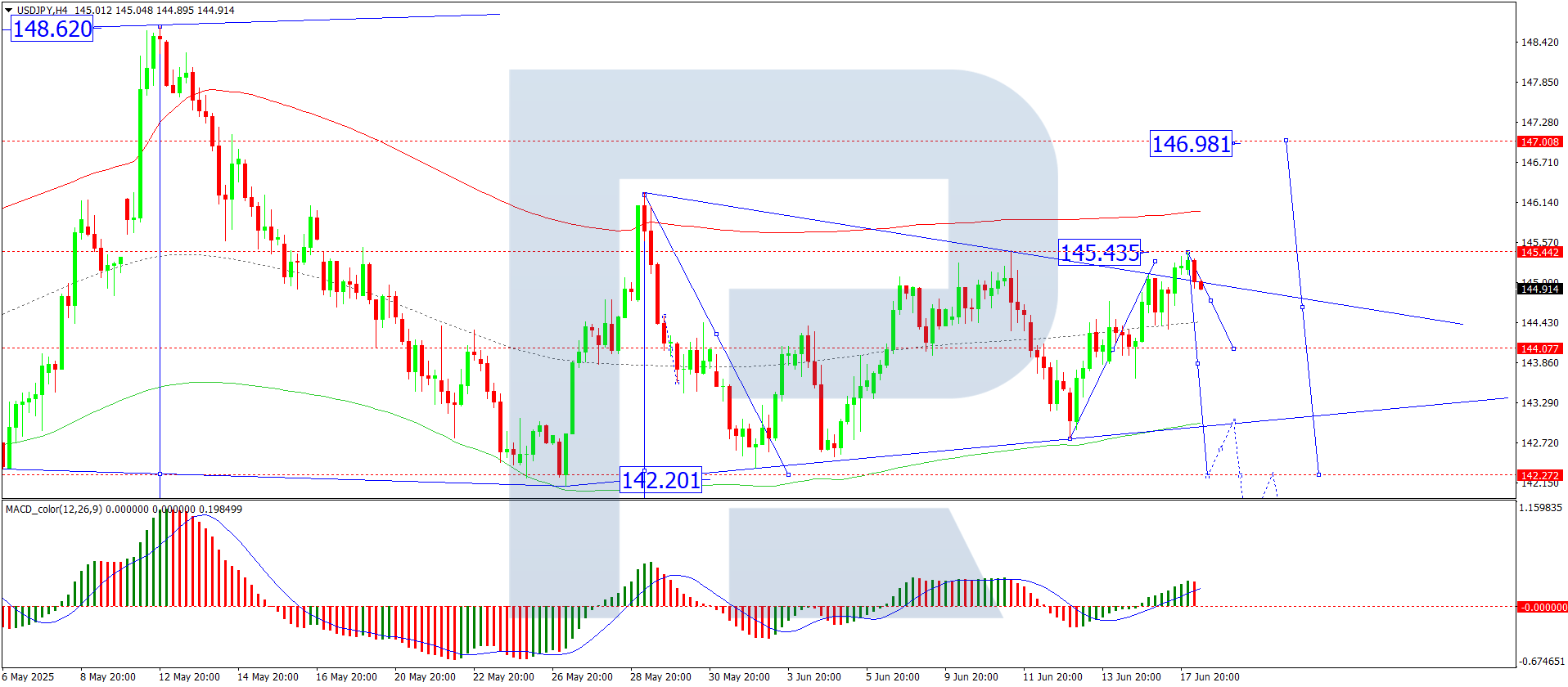
On the H4 chart, the USD/JPY pair has breached the 147.60 level to the downside and continues to form a wave towards the 144.76 level. The target is local. After reaching it, a correction to 147.60 is possible. Once the correction is complete, a further wave down to 144.12 is likely. Technically, this scenario is confirmed by the MACD indicator. Its signal line is below the zero level and is pointing sharply downwards.

On the H1 chart, USD/JPY has formed a consolidation range around 147.60. Following the downside breakout, the development of the third wave is underway. The target is at 144.76. Once this is reached, a corrective wave is likely. The first correction target is at 146.06. Technically, this scenario is confirmed by the Stochastic oscillator. Its signal line is below 50 and heading directly towards 20.

Conclusion

With trade war fears escalating and demand for safe-haven assets surging, USD/JPY remains under pressure. Technical indicators suggest further downside, though a short-term correction is possible. Traders should monitor 144.76 as the next key support, with BoJ policy signals and global trade developments likely to determine the pair’s next significant move.


Disclaimer

Any forecasts contained herein are based on the author’s particular opinion. This analysis may not be treated as trading advice. RoboForex bears no responsibility for trading results based on trading recommendations and reviews contained herein.


GBP/USD Hits 21-Week High: The Pound Outperforms Its Peers

By RoboForex Analytical Department 

The GBP/USD pair climbed to 1.3064 on Thursday, marking a 2.46% gain over the past four weeks and a 2.87% increase against the US dollar over the last 12 months. The British pound continues to strengthen, outperforming many of its major counterparts.

Key factors driving the GBP/USD rally

The UK is closely monitoring developments in US tariffs, which could have significant implications for its economy. While the new tariffs potentially threaten global trade, the UK remains in a relatively favourable position compared to the EU, Canada, China, and Mexico.

Reasons for the UK’s advantage:

  • The US baseline tariff rate for the UK is just 10% – the lowest among major US trading partners
  • The UK’s trade relationship with the US is relatively balanced, with a smaller share of reciprocal trade, reducing immediate risks

However, uncertainty looms. Policymakers anticipate a possible reversal of US tariffs, but the broader impact remains unpredictable, whether on inflation, global GDP, or trade dynamics.

Technical analysis of GBP/USD 

H4 chart perspective

  • The pair has broken through 1.2988, surging towards 1.3095
  • A pullback to retest 1.2988 (now acting as support) could occur before another upward push towards 1.3103.
  • MACD confirmation: the signal line remains above zero and is trending upwards, supporting bullish momentum

H1 chart perspective

  • After consolidating around 1.2988, the pair broke higher, targeting 1.3095
  • Once this level is reached, a correction back to 1.2988 could follow
  • Stochastic indicator: the signal line is above 80 but turning downwards, suggesting a potential near-term exhaustion.

Conclusion

The pound’s resilience against the dollar reflects both fundamental strength and technical momentum. While the UK benefits from a less exposed trade stance, traders should watch tariff developments and key technical levels to gauge the next significant move.

interest rate decisions.


Disclaimer

Any forecasts contained herein are based on the author’s particular opinion. This analysis may not be treated as trading advice. RoboForex bears no responsibility for trading results based on trading recommendations and reviews contained herein.


Most of the tariffs imposed by the Trump administration take effect today

By JustMarkets

On Tuesday, the Dow Jones (US30) Index was down 0.03%. The S&P 500 Index (US500) was up 0.38%. The Nasdaq Technology Index (US100) added 0.82%. Uncertainty over President Trump’s upcoming tariffs and weak economic data have kept investors on edge. On Wednesday, the White House will announce retaliatory tariffs and other fees. The possibility of 20% tariffs on most US imports has raised concerns, and analysts warn that the market may underestimate trade risks.

Despite ongoing trade uncertainty, the Mexican peso (MXN) is showing resilience, supported by easing US recession fears and President Sheinbaum’s success in securing a softer tariff stance from Washington. While the recent 50bps rate cut by the Bank of Mexico and signals of further easing could put pressure on the currency, stable local macroeconomic indicators such as business confidence holding above contractionary levels and stable gross fixed investment are keeping downside risks in check.

Equity markets in Europe were mostly up yesterday. Germany’s DAX (DE40) rose by 1.70%, France’s CAC 40 (FR40) closed 1.10% higher, Spain’s IBEX 35 (ES35) gained 1.23%, and the UK’s FTSE 100 (UK100) closed positive 0.61%. Eurozone inflation eased to 2.2% y/y, which may support expectations of an ECB rate cut, though risks from trade tensions remain.

Silver prices (XAG/USD) fell to $33.8 an ounce, retreating from a five-month high of $34.58 reached on March 28, as investors awaited President Donald Trump’s announcement of retaliatory tariffs to take effect on Wednesday. Market participants weighed fears of an escalating global trade war that could dampen industrial demand for silver against its appeal as a safe-haven source amid growing concerns about slowing economic growth.

WTI crude oil prices fell to around $71.2 a barrel on Tuesday amid concerns that President Donald Trump’s widening trade war will dampen energy demand. Trump has said the retaliatory tariffs he will announce on Wednesday will apply to all countries, not just those with the biggest trade imbalance with the US. However, potential supply risks could cushion oil’s fall after Trump’s latest threats against Russia and Iran.

Asian markets were predominantly up yesterday. Japan’s Nikkei 225 (JP225) was up 0.02%, China’s FTSE China A50 (CHA50) decreased by 0.27%, Hong Kong’s Hang Seng (HK50) was up 0.38%, and Australia’s ASX 200 (AU200) was positive 1.04%. Analysts at Goldman Sachs warned that manufacturing activity in China could come under pressure in the coming months due to additional trade barriers.

The New Zealand Dollar rose to USD 0.572 on Wednesday, posting gains for the second consecutive session despite the upcoming US announcement of retaliatory tariffs today. While New Zealand’s direct trade with the US is minimal, its economy remains highly sensitive to fluctuations in global trade due to its heavy reliance on exports. Domestically, expectations of further policy easing by the Reserve Bank of New Zealand remain, with markets expecting at least two rate cuts before the end of the year.

S&P 500 (US500) 5,633.07 +21.22 (+0.38%)

Dow Jones (US30) 41,989.96 −11.80 (−0.03%)

DAX (DE40) 22,539.98 +376.49 (+1.70%)

FTSE 100 (UK100) 8,634.80 +51.99 (+0.61%)

USD Index 104.22 +0.01 (+0.01%)

News feed for: 2025.04.02

  • US ADP Nonfarm Employment Change (m/m) at 15:15 (GMT+3);
  • US Crude Oil Reserves (w/w) at 17:30 (GMT+3).


By JustMarkets


This article reflects a personal opinion and should not be interpreted as an investment advice, and/or offer, and/or a persistent request for carrying out financial transactions, and/or a guarantee, and/or a forecast of future events.

EUR/USD Declines as Markets Await Signals of a Renewed Trade War

By RoboForex Analytical Department 

The EUR/USD pair continues its gradual decline, erasing its recent technical rebound and retreating to 1.0795. Traders remain cautious as key economic and political developments loom.

Key factors driving the EUR/USD movement

Today (2 April) marks a critical date for global markets as new US tariffs on trading partners take effect. Investors are closely watching for President Donald Trump’s final decision, which could escalate trade tensions.

Earlier, Treasury Secretary Scott Bessent hinted that these tariffs could serve as leverage, pushing partner countries to negotiate lower duties. Meanwhile, recent US economic data has added to the uncertainty:

  • Manufacturing activity contracted in March (the first decline of 2025)
  • Prices increased for the second consecutive month, reflecting tariff-driven inflationary pressures
  • Job openings declined in February, though layoffs remained low, indicating a potential cooling in the labour market

Market focus now shifts to Wednesday’s ADP employment report and Friday’s Non-Farm Payrolls (NFP) data, which will shape expectations for the Fed’s next interest rate decisions.

Technical outlook: EUR/USD

H4 chart analysis

  • The pair declined to 1.0784 before correcting to 1.0825
  • The next likely move is a continued downward trend towards 1.0695 (first target)
  • A pullback to 1.0825 (testing from below) may follow (second target)
  • MACD confirmation: the signal line remains below zero, pointing sharply downward and supporting further bearish momentum

H1 chart analysis

  • The pair is forming the fifth leg of a downward wave, targeting 1.0695
  • A short-term decline toward 1.0715 is expected today, possibly followed by a correction to 1.0772
  • Stochastic oscillator confirmation: the signal line is below 50 and trending downward towards 20, reinforcing bearish momentum


Conclusion

With trade war risks resurfacing and mixed US economic signals, the EUR/USD remains under pressure. A break below 1.0695 could open the door for deeper declines, while a rebound above 1.0825 may signal temporary relief. Traders should monitor US employment data and trade policy updates for fresh directional cues.


Disclaimer

Any forecasts contained herein are based on the author’s particular opinion. This analysis may not be treated as trading advice. RoboForex bears no responsibility for trading results based on trading recommendations and reviews contained herein.

“Liberation Day”: How markets might react to Trump’s April 2nd tariff announcement?

By ForexTime 

  • Trump set to announce “reciprocal” tariffs on Wednesday, April 2nd.
  • Markets fear worst-case scenario: average US tariff hiked to 35%
  • Higher tariffs may lead to US stagflation: revived inflation, slower economic growth
  • Tariff shocker could see US dollar and stock indexes fall, gold soars
  • Less-than-feared tariffs could see US dollar and stocks rebound


This Wednesday, US President Donald Trump is set to upend global trade with “reciprocal” tariffs.

Here we break down what traders and investors need to know ahead of such a pivotal announcement.


When will Trump announce “reciprocal” tariffs?

President Trump is set to announce his next batch of tariffs on Wednesday, April 2nd at 4:00 PM EST / 8:00PM GMT.

POTUS has even labelled April 2nd as “Liberation Day” in a social media post on March 20th:

Imagen
liberation Day Trump's Truth Social post


What do “reciprocal” tariffs mean?

As the word suggests, the US is likely looking to charge its trade partners the same tariffs as they charge the US.

This suggests “an eye for an eye” type of approach.

However, it may not be that straightforward.

When deciding the revised % tax rate to “reciprocate” with, the US administration may also incorporate the cost of non-tariff barriers, such as:

– regulations

– other taxes such as VAT charged domestically in other countries

– even currency exchange (forex/FX rates)

In other words, it’s hard to predict what the final % number will be, prior to the April 2nd announcement.


Wait, hasn’t Trump already announced tariffs this year?

Yes.

Since his second inauguration on January 20th, 2025, President Trump has imposed:

20% tax on all Chinese goods (10% in February, doubled in March)

25% tax on most imports from Canada and Mexico (delayed until April)

25% tax on steel and aluminum (imposed on March 12th)

25% tax on auto imports (starting on April 3rd with fully assembled imported vehicles; scope of taxable goods to be expanded in early May)

But the April 2nd announcement is the next “big one”, with potentially larger and broader tariffs to be announced.

Hence, the palpable tensions leading up to this mid-week announcement.

Markets have been especially volatile in recent weeks, with traders and investors guessing what Trump’s next tariff salvo would actually entail.

Even the S&P 500 dipped into a “technical correction”, TWICE, in March 2025!


Why is Trump doing this?

As a overall goal, Trump is looking to “fix” the trade imbalances between the US and its trading partners.

With these tariffs, Trump intends to:

– revive manufacturing jobs in the US

– raising revenue for the government

– align the policies of foreign governments with his administration’s goals


Who might be targeted?

In short, it’s not yet clear.

We know that President Trump has often targeted major trading partners, including China, the EU, Canada and Mexico.

However, recent weeks have seen various government officials, including Trump himself, use varying terms to describe which countries are set to be on the receiving end of these “reciprocal tariffs”.

These include phrases like “all countries”, to “country-specific”, to “15% of all countries”, and even “dirty 15”.

Just for context, it’s estimated that 15 countries accounted for over 75% of all US imports in 2024.

This “dirty 15” list may include:

– China

– Mexico

– Vietnam

– Ireland

– Germany

– Taiwan

– Japan

– South Korea

– Canada

– India

– Thailand

– Italy

– Switzerland

– Malaysia

– Indonesia


What’s the worst-case scenario?

As a catch-all headline number …

Bloomberg economists predict that the “maximum” damage could raise the average US tariff to 35%!

That would be 28 percentage points higher from the mid-single digit average at present (as of March 2025, after taking into account the already-imposed tariffs so far in Trump’s second term as POTUS).

For reference, when President Trump kicked off his second term, the average US tariff rate was around 2.5%.


Why are markets concerned?

Overall, Trump’s next tariff salvo may well be the most protectionist move by the US government in about a century (since the Smoot-Hawley Tariff Act of 1930)!

Higher US tariffs could actually reignite US inflation, while slowing down its economic growth.

According to a model by the Federal Reserve, US GDP could be negatively impacted by 4%, while lifting inflation by 2.5% over the next 2-3 years.

This points to a “stagflation”!

Furthermore, a slowdown in the world’s largest economy is bound to weigh down the global economy in tandem.


But wait, there could be more tariffs ahead!

White House Press Secretary Karoline Leavitt said on March 31st that President Trump may look to also impose sector-specific duties further down the line.

These could impact imports of:

– copper

– pharmaceuticals

– semiconductors

– lumber

However, these sectoral duties are apparently not the main focus on April 2nd.


How might markets react to the April 2nd announcement?

  • If Trump confirms the market’s “worst case” scenario, we could see:

– US assets FALLING (e.g. US500, US30, NAS100, US dollar etc.)
This would be based on the notion that US economic growth will be impacted negatively from these hiked tariffs.

– Safe havens SOAR (e.g. gold, Japanese Yen, Swiss Franc) and even potential gains for some non-USD currencies (such as the British Pound, with the UK seemingly not front-and-center in Trump’s tariff cross-hairs)


  • However, if President Trump’s “reciprocal” tariffs package prove to be not-as-bad-as-feared, that could see:

– US assets REBOUND (e.g. US500, US30, NAS100, US dollar etc.)
This would be based on the notion that the tariffs’ impact on US economic growth would be less severe.

– Safe havens DIP (e.g. gold, Japanese Yen, Swiss Franc) and even potential declines for some non-USD currencies (such as the British Pound) which have climbed as money flowed away from the US dollar in recent weeks.


Although uncertainty is running high leading up to the announcement, one thing is for sure …

Wednesday, April 2nd 2025 is set to be a big day for governments, businesses, investors, and traders around the world


Forex-Time-LogoArticle by ForexTime

ForexTime Ltd (FXTM) is an award winning international online forex broker regulated by CySEC 185/12 www.forextime.com

The RBA expectedly kept interest rates unchanged. Oil rose to a one-month high

By JustMarkets

On Monday, the Dow Jones (US30) rose by 1.00%. The S&P 500 Index (US500) gained 1.55%. The Nasdaq Technology Index (US100) was down 0.02%. Investors remain on edge, facing growing concerns about economic growth amid escalating trade tensions. Uncertainty over trade policy impacted sentiment after Trump announced broader tariffs than previously expected, including a 25% tax on all non-US manufactured vehicles that will take effect on April 2. The market anxiety caused traders to turn their attention to defensive assets.

The Canadian dollar weakened to 1.44 per US dollar, retreating from a one-month high of 1.426 reached on March 26, amid rising trade tensions and the looming threat of US tariffs. This aggressive US stance risks undermining Canada’s trade surplus as it potentially negates the benefits of the 2018 trade agreement. In anticipation of further complications, including possible retaliatory measures from the Canadian government, and amid weak GDP data and narrowing yield differentials driven by expectations of a looser Bank of Canada policy, market participants recalibrated risk in an environment where the trade conflict shows no signs of immediate de-escalation.

Equity markets in Europe were mostly down yesterday. Germany’s DAX (DE40) fell by 1.33%, France’s CAC 40 (FR40) closed down 1.58%, Spain’s IBEX 35 (ES35) lost 1.31%, and the UK’s FTSE 100 (UK100) closed down 0.88%. Uncertainty over the scale and scope of tariffs contributed to the negative sentiment. Meanwhile, a preliminary estimate of German consumer price inflation fell to 2.2% in March 2025, the lowest since November 2024, in line with market expectations. On the corporate front, stocks of automakers, banks, and technology companies saw the biggest declines.

WTI crude oil prices rose to around $71.6 a barrel on Tuesday, extending gains for the second straight session and near the highest level in more than a month, amid concerns over possible supply disruptions following US President Donald Trump’s latest threats against Russia and Iran. Trump has vowed to impose secondary tariffs of 25-50% on buyers of Russian oil if he believes Moscow is hindering his efforts to end the war in Ukraine by putting pressure on key importers such as India and China. He also threatened Iran with secondary tariffs and bombing until it signs an agreement to give up nuclear weapons.

Asian markets were mostly down yesterday. Japan’s Nikkei 225 (JP225) sharply fell by 4.05%, China’s FTSE China A50 (CHA50) was down 0.56%, Hong Kong’s Hang Seng (HK50) decreased by 1.31% and Australia’s ASX 200 (AU200) was negative 1.74%.

The Reserve Bank of Australia (RBA) kept the monetary rate unchanged at 4.1% at its April meeting, leaving borrowing costs unchanged after a 25 basis point cut at its February meeting, in line with market expectations. The board noted that monetary policy is well-placed to respond to international developments should they have a material impact on Australian activity and inflation.

China’s Caixin manufacturing PMI rose to 51.2 in March 2025 from February’s 50.8 and beat expectations of 51.1, the highest reading since last November, with output growth accelerating thanks to a steady increase in new orders amid improving demand conditions.

The Bank of Japan Tankan Index, which measures sentiment among large manufacturers, fell to 12 points in the first quarter of 2025 from 14 in the previous quarter, the lowest in a year, as concerns over US tariffs dampened sentiment. The decline adds uncertainty to the outlook for future interest rate hikes by the Bank of Japan, which could affect the timing of further policy adjustments.

S&P 500 (US500) 5,611.85 +30.91 (+0.55%)

Dow Jones (US30) 42,001.76 +417.86 (+1.00%)

DAX (DE40) 22,163.49 −298.03 (−1.33%)

FTSE 100 (UK100) 8,582.81 −76.04 (−0.88%)

USD Index 104.17 +0.13 (+0.12%)

News feed for: 2025.04.01

  • Japan Unemployment Rate (m/m) at 02:30 (GMT+3);
  • Japan Tankan Large Manufacturers Index (q/q) at 02:50 (GMT+3);
  • Japan Tankan Large Non-Manufacturers Index (q/q) at 02:50 (GMT+3);
  • Japan Manufacturing PMI (m/m) at 03:30 (GMT+3);
  • Australia RBA Interest Rate Decision (m/m) at 06:30 (GMT+3);
  • Australia RBA Monetary Policy Statement (m/m) at 06:30 (GMT+3);
  • Switzerland Retail Sales (m/m) at 09:30 (GMT+3)
  •  Switzerland Manufacturing PMI (m/m) at 10:30 (GMT+3);
  • German Manufacturing PMI (m/m) at 10:55 (GMT+3);
  • Eurozone Manufacturing PMI (m/m) at 11:00 (GMT+3);
  • UK Manufacturing PMI (m/m) at 11:30 (GMT+3);
  • Eurozone Consumer Price Index (m/m) at 12:00 (GMT+3);
  • Eurozone Unemployment Rate (m/m) at 12:00 (GMT+3);
  • Eurozone ECB President Lagarde Speaks at 15:30 (GMT+3);
  • Canada Manufacturing PMI (m/m) at 16:30 (GMT+3);
  • US ISM Manufacturing PMI (m/m) at 17:00 (GMT+3);

By JustMarkets


This article reflects a personal opinion and should not be interpreted as an investment advice, and/or offer, and/or a persistent request for carrying out financial transactions, and/or a guarantee, and/or a forecast of future events.

World stock indices sell off under the weight of new tariffs

By JustMarkets 

At the end of Friday, the Dow Jones Index (US30) fell by 1.69% (for the week -1.41%). The S&P 500 Index (US500) decreased by 1.97% (for the week -2.40%). The Nasdaq Technology Index (US100) was down 2.61% (for the week -3.79%). Stocks in the US fell sharply on Friday amid growing concerns about inflation and trade policy uncertainty. Technology giants led the decline, with Alphabet, Amazon, and Meta down more than 4% each and Microsoft down 3%. Worries about inflation intensified after the University of Michigan’s final consumer sentiment data for March showed the highest long-term inflation expectations since 1993. Meanwhile, the Core PCE Price Index, the Fed’s preferred measure of inflation, rose by 2.8% in February, exceeding expectations, and consumer spending rose by 0.4%. Investors expected further trade shocks as Trump’s 25% tariff on automobiles takes effect this week, raising fears of retaliation from key trading partners.

Bank of America expects a challenging reporting season, projecting a 1% decline in first-quarter revenue, down three percentage points from the previous quarter and 3% below consensus estimates.

The Canadian dollar weakened to 1.43 per US dollar amid rising trade tensions and weak GDP data weighing on the Loonie. Concerns stem from the prospect of additional US tariffs on Canadian auto parts and related exports. Measures could extend to key sectors such as auto components, raw materials, and lumber. Adding to this uncertainty, Prime Minister Mark Carney has warned that Canada is prepared to take retaliatory trade measures, adding to the trade conflict. Meanwhile, uncertainty over Bank of Canada policy — amid preliminary data on likely stagnant GDP growth in February — has led to expectations of looser monetary policy compared to the US Federal Reserve, further narrowing the yield differential.

Equity markets in Europe were mostly down on Friday. Germany’s DAX (DE40) was down 0.96% (for the week -2.66%), France’s CAC 40 (FR40) closed down 0.93% (for the week -2.33%), Spain’s IBEX 35 (ES35) lost 0.84% (for the week -0.89%), and the UK’s FTSE 100 (UK100) closed negative 0.08% (for the week +0.14%). European equities closed lower on Friday, continuing to be impacted by concerns over global economic growth following US President Donald Trump’s tariff announcement and less-than-encouraging US economic data, including PCE Core Price Index data. Inflation data in Spain and France showed weaker-than-expected results, with French inflation holding steady at 0.9% and Spanish inflation falling to 2.2%.

WTI crude oil prices fell by 0.8% on Friday to hit $69.4 per barrel, on concerns that ongoing trade tensions, especially between the US and key trading partners, could trigger a global recession. Despite this, oil prices recorded their third consecutive weekly gain, helped by US sanctions against Venezuela and Iran. The US crude stockpile data showed a 3.3 million barrel decline, indicating continued strong demand. The OPEC+ group, led by Saudi Arabia and Russia, will begin a gradual increase in production in April, and reports suggest the group is likely to continue raising output in May.

Asian markets were mostly down last week. Japan’s Nikkei 225 (JP225) was down 1.91%, China’s FTSE China A50 (CHA50) fell by 0.32%, Hong Kong’s Hang Seng (HK50) lost 1.36%, and Australia’s ASX 200 (AU200) was positive 0.16%. The Nikkei 225 Index (JP225) fell nearly 4% on Monday to its lowest level in six months, as investors reacted to weakness on Wall Street and prepared for new US tariffs that will take effect this week. President Donald Trump is set to impose 25% tariffs on imported cars, a major blow to Japan’s key auto export sector, and outlined plans for retaliatory trade duties. Domestically, investors digested mixed economic data, with industrial production in February beating expectations and retail sales falling short of projections. All sectors declined, with sharp losses in the technology, consumer discretionary, and industrial sectors.

South Korea, China, and Japan held their first economic dialogue in five years on Sunday, seeking to promote regional trade as the three Asian export powers suffer from tariffs imposed by US President Donald Trump. The dialogue aims to strengthen the implementation of the RCEP, in which all three countries are participating, and create a framework for enhanced trade cooperation among the three countries.

S&P 500 (US500) 5,580.94 −112.37 (−1.97%)

Dow Jones (US30) 41,583.90 −715.80 (−1.69%)

DAX (DE40) 22,461.52 −217.22 (−0.96%)

FTSE 100 (UK100) 8,658.85 −7.27 (−0.08%)

USD Index 104.01 −0.32 (−0.31%)

News feed for: 2025.03.31

  • Japan Industrial Production (m/m) at 02:50 (GMT+3);
  • Japan Retail Sales (m/m) at 02:50 (GMT+3);
  • China Manufacturing PMI (m/m) at 04:30 (GMT+3);
  • China Non-Manufacturing PMI (m/m) at 04:30 (GMT+3);
  • German Retail Sales (m/m) at 09:00 (GMT+3);
  • German Consumer Price Index (m/m) at 15:00 (GMT+3);
  • US Chicago PMI (m/m) at 16:45 (GMT+3).

By JustMarkets


This article reflects a personal opinion and should not be interpreted as an investment advice, and/or offer, and/or a persistent request for carrying out financial transactions, and/or a guarantee, and/or a forecast of future events.