Archive for Financial News – Page 59

COT Soft Commodities Charts: Speculator Bets led lower by Corn & Soybeans

By InvestMacro

Speculators OI Softs
Here are the latest charts and statistics for the Commitment of Traders (COT) reports data published by the Commodities Futures Trading Commission (CFTC).

The latest COT data is updated through Tuesday May 20th and shows a quick view of how large traders (for-profit speculators and commercial entities) were positioned in the futures markets.

Weekly Speculator Changes led lower by Corn & Soybeans

Speculators Nets Softs
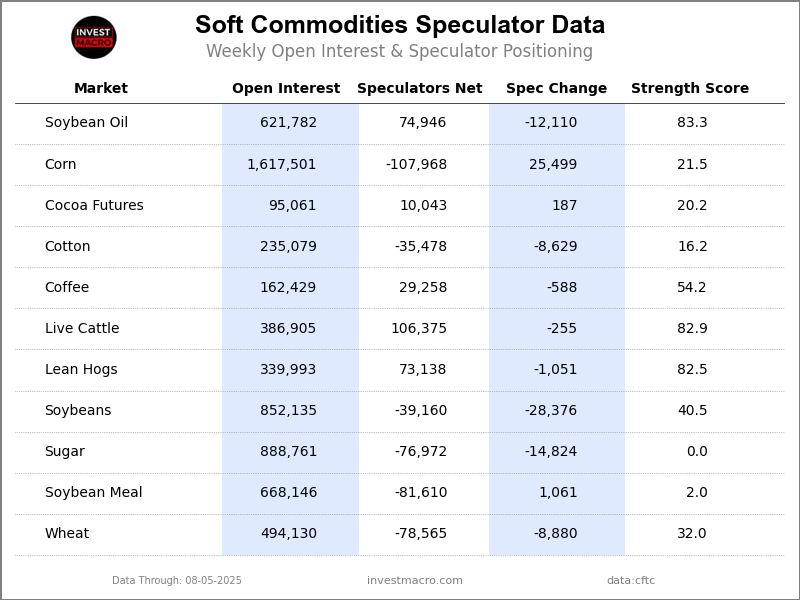
The COT soft commodities markets speculator bets were overall lower this week as three out of the eleven softs markets we cover had higher positioning while the other eight markets had lower speculator contracts.

Leading the gains for the softs markets was Wheat (18,474 contracts) with Lean Hogs (7,964 contracts) and Cocoa (3,048 contracts) also showing positive weeks.

The markets with the declines in speculator bets this week were Corn (-29,658 contracts), Soybeans (-17,265 contracts), Cotton (-11,613 contracts), Soybean Oil (-7,280 contracts), Soybean Meal (-7,245 contracts), Live Cattle (-7,231 contracts), Coffee (-2,770 contracts) and with Sugar (-499 contracts) also registering lower bets on the week.


Soft Commodities Data:

Speculators Table Softs
Legend: Weekly Speculators Change | Speculators Current Net Position | Speculators Strength Score compared to last 3-Years (0-100 range)


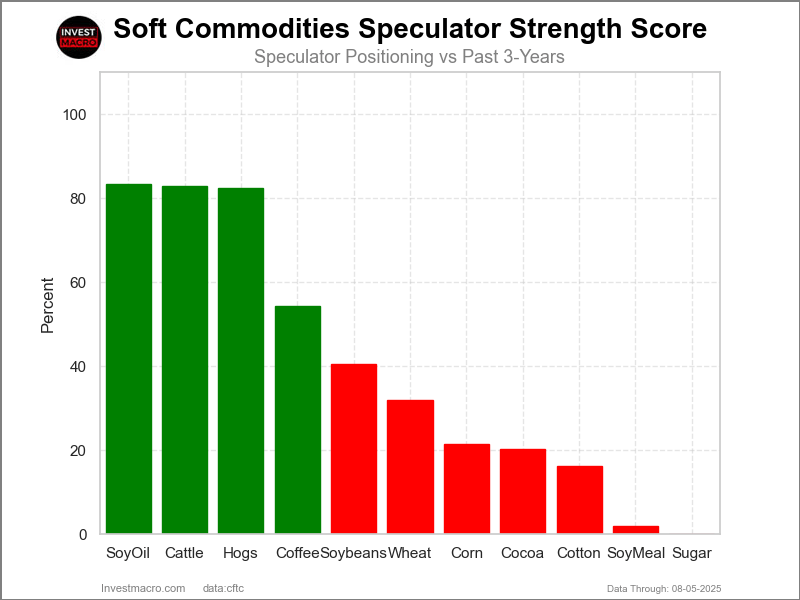
Strength Scores led by Live Cattle & Soybean Oil

Speculators Strength Softs
COT Strength Scores (a normalized measure of Speculator positions over a 3-Year range, from 0 to 100 where above 80 is Extreme-Bullish and below 20 is Extreme-Bearish) showed that Live Cattle (81 percent) and Soybean Oil (79 percent) lead the softs markets this week. Lean Hogs (70 percent), Coffee (68 percent) and Soybeans (63 percent) come in as the next highest in the weekly strength scores.

On the downside, Soybean Meal (4 percent) and Wheat (13 percent) come in at the lowest strength levels currently and are in Extreme-Bearish territory (below 20 percent). The next lowest strength scores are the Cotton (20 percent) and the Sugar (20 percent).

Strength Statistics:
Corn (34.6 percent) vs Corn previous week (38.7 percent)
Sugar (19.7 percent) vs Sugar previous week (19.8 percent)
Coffee (67.8 percent) vs Coffee previous week (70.5 percent)
Soybeans (62.8 percent) vs Soybeans previous week (67.2 percent)
Soybean Oil (78.8 percent) vs Soybean Oil previous week (82.8 percent)
Soybean Meal (3.5 percent) vs Soybean Meal previous week (6.5 percent)
Live Cattle (80.6 percent) vs Live Cattle previous week (87.5 percent)
Lean Hogs (70.1 percent) vs Lean Hogs previous week (64.0 percent)
Cotton (20.1 percent) vs Cotton previous week (27.1 percent)
Cocoa (34.4 percent) vs Cocoa previous week (31.2 percent)
Wheat (13.0 percent) vs Wheat previous week (0.0 percent)


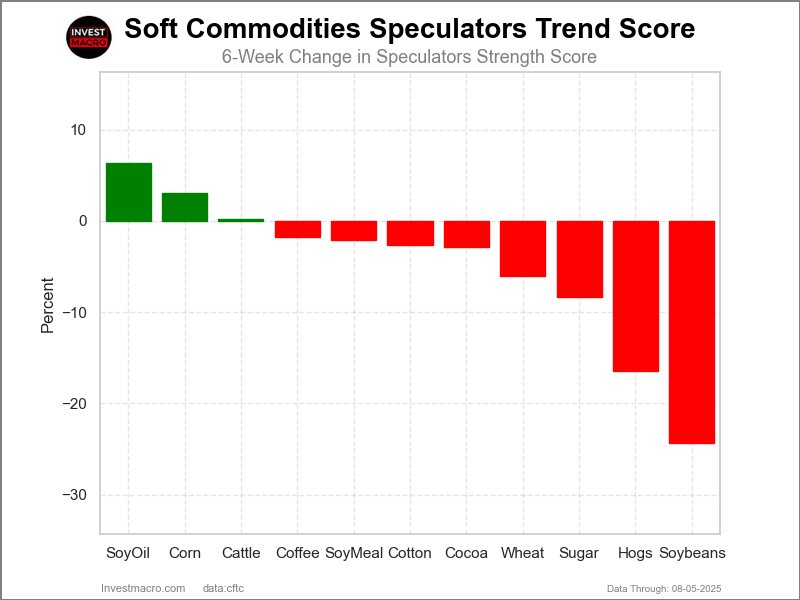
Lean Hogs & Soybeans top the 6-Week Strength Trends

Speculators Trend Softs
COT Strength Score Trends (or move index, calculates the 6-week changes in strength scores) showed that Lean Hogs (28 percent) and Soybeans (17 percent) lead the past six weeks trends for soft commodities. Soybean Oil (10 percent), Cocoa (6 percent) and Cotton (4 percent) are the next highest positive movers in the latest trends data.

Corn (-25 percent) leads the downside trend scores currently with Soybean Meal (-5 percent), Wheat (-5 percent) and Sugar (-5 percent) following next with lower trend scores.

Strength Trend Statistics:
Corn (-25.1 percent) vs Corn previous week (-20.2 percent)
Sugar (-5.2 percent) vs Sugar previous week (-7.7 percent)
Coffee (-0.2 percent) vs Coffee previous week (-7.7 percent)
Soybeans (16.6 percent) vs Soybeans previous week (17.6 percent)
Soybean Oil (10.1 percent) vs Soybean Oil previous week (34.3 percent)
Soybean Meal (-5.1 percent) vs Soybean Meal previous week (1.4 percent)
Live Cattle (-4.1 percent) vs Live Cattle previous week (-12.5 percent)
Lean Hogs (28.3 percent) vs Lean Hogs previous week (12.6 percent)
Cotton (3.6 percent) vs Cotton previous week (14.9 percent)
Cocoa (6.2 percent) vs Cocoa previous week (2.3 percent)
Wheat (-5.4 percent) vs Wheat previous week (-10.8 percent)


Individual Soft Commodities Markets:

CORN Futures:
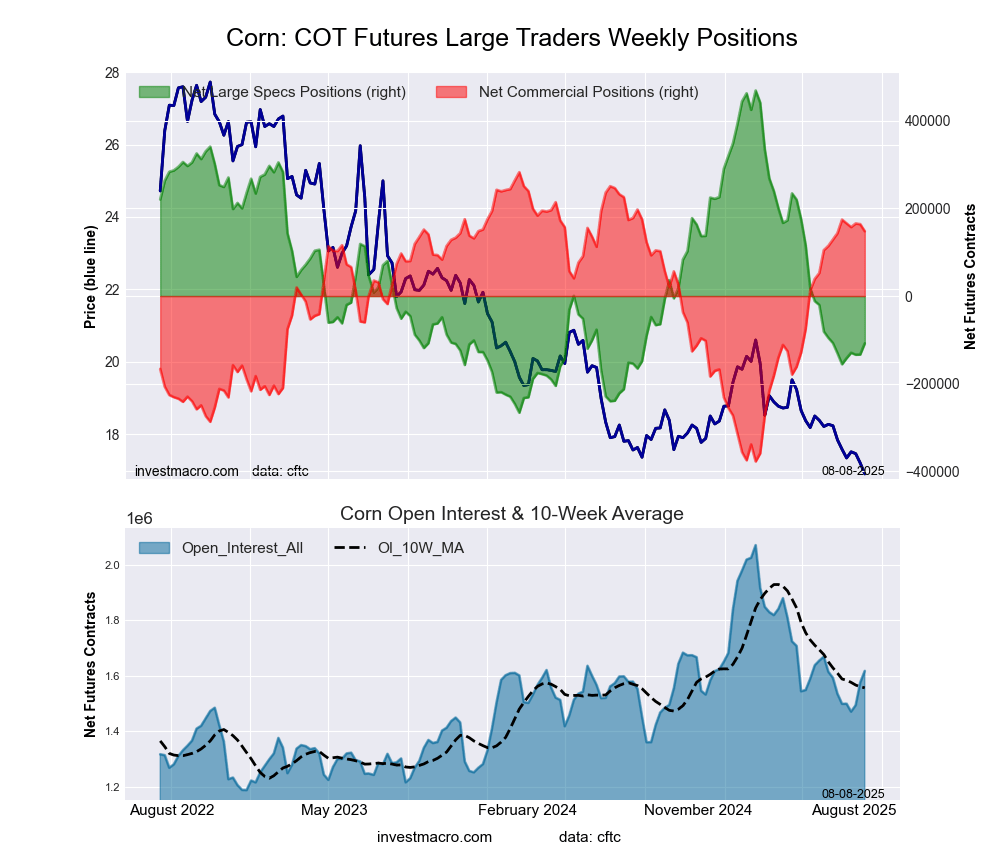
CORN Futures COT ChartThe CORN large speculator standing this week was a net position of -11,552 contracts in the data reported through Tuesday. This was a weekly decline of -29,658 contracts from the previous week which had a total of 18,106 net contracts.

This week’s current strength score (the trader positioning range over the past three years, measured from 0 to 100) shows the speculators are currently Bearish with a score of 34.6 percent. The commercials are Bullish with a score of 63.1 percent and the small traders (not shown in chart) are Bullish with a score of 74.6 percent.

Price Trend-Following Model: Strong Downtrend

Our weekly trend-following model classifies the current market price position as: Strong Downtrend.

CORN Futures StatisticsSPECULATORSCOMMERCIALSSMALL TRADERS
– Percent of Open Interest Longs:20.946.08.4
– Percent of Open Interest Shorts:21.643.610.1
– Net Position:-11,55239,014-27,462
– Gross Longs:342,329753,623137,875
– Gross Shorts:353,881714,609165,337
– Long to Short Ratio:1.0 to 11.1 to 10.8 to 1
NET POSITION TREND:
– Strength Index Score (3 Year Range Pct):34.663.174.6
– Strength Index Reading (3 Year Range):BearishBullishBullish
NET POSITION MOVEMENT INDEX:
– 6-Week Change in Strength Index:-25.125.022.9


SUGAR Futures:

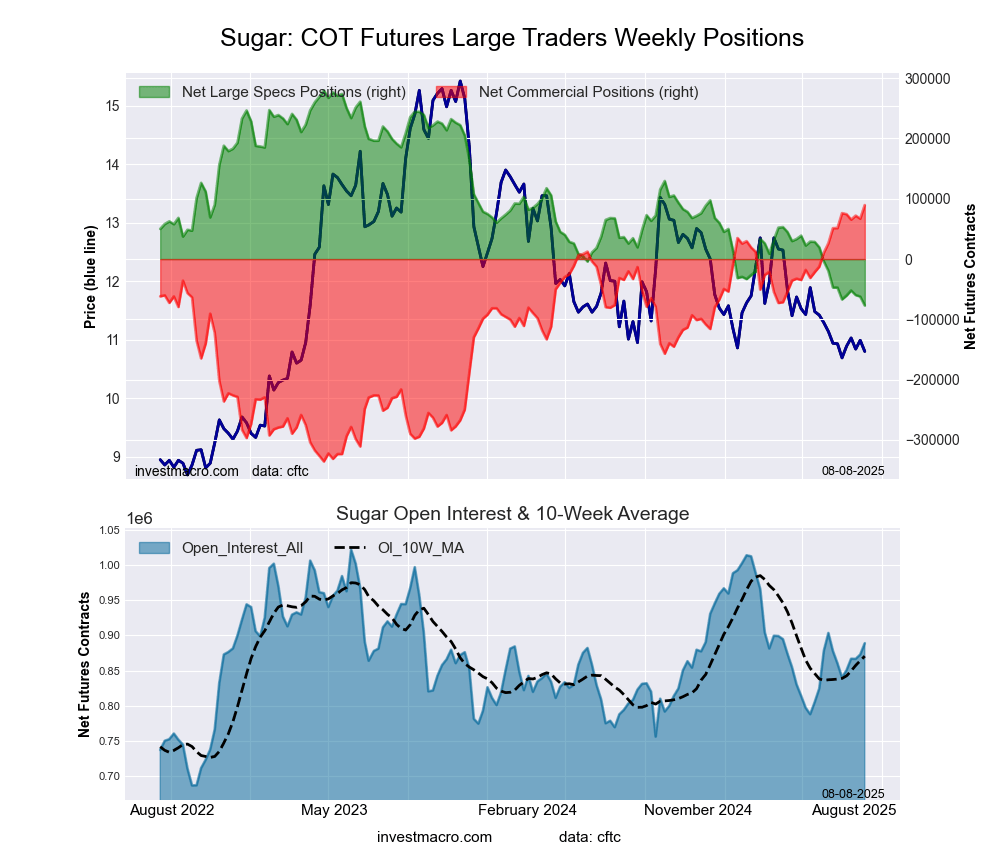
SUGAR Futures COT ChartThe SUGAR large speculator standing this week was a net position of 28,431 contracts in the data reported through Tuesday. This was a weekly decrease of -499 contracts from the previous week which had a total of 28,930 net contracts.

This week’s current strength score (the trader positioning range over the past three years, measured from 0 to 100) shows the speculators are currently Bearish-Extreme with a score of 19.7 percent. The commercials are Bullish-Extreme with a score of 84.7 percent and the small traders (not shown in chart) are Bearish-Extreme with a score of 11.4 percent.

Price Trend-Following Model: Weak Uptrend

Our weekly trend-following model classifies the current market price position as: Weak Uptrend.

SUGAR Futures StatisticsSPECULATORSCOMMERCIALSSMALL TRADERS
– Percent of Open Interest Longs:25.252.57.7
– Percent of Open Interest Shorts:21.655.28.6
– Net Position:28,431-21,672-6,759
– Gross Longs:202,598422,72662,245
– Gross Shorts:174,167444,39869,004
– Long to Short Ratio:1.2 to 11.0 to 10.9 to 1
NET POSITION TREND:
– Strength Index Score (3 Year Range Pct):19.784.711.4
– Strength Index Reading (3 Year Range):Bearish-ExtremeBullish-ExtremeBearish-Extreme
NET POSITION MOVEMENT INDEX:
– 6-Week Change in Strength Index:-5.28.8-22.1


COFFEE Futures:

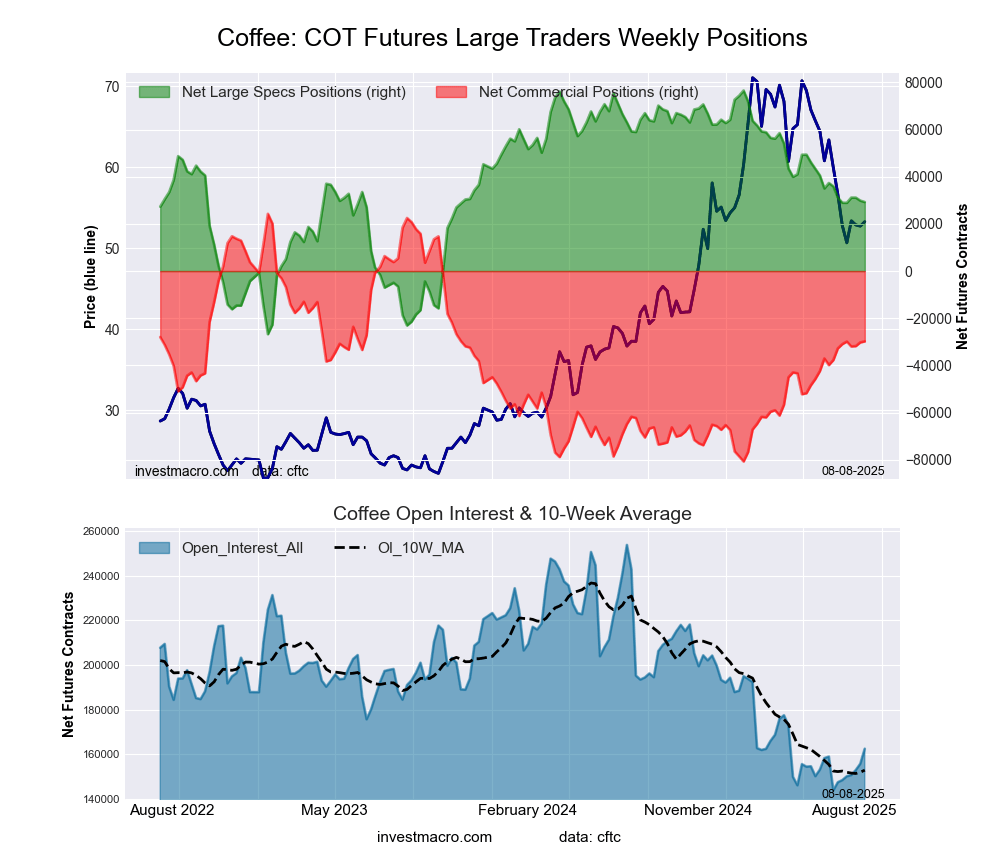
COFFEE Futures COT ChartThe COFFEE large speculator standing this week was a net position of 43,300 contracts in the data reported through Tuesday. This was a weekly reduction of -2,770 contracts from the previous week which had a total of 46,070 net contracts.

This week’s current strength score (the trader positioning range over the past three years, measured from 0 to 100) shows the speculators are currently Bullish with a score of 67.8 percent. The commercials are Bearish with a score of 33.4 percent and the small traders (not shown in chart) are Bullish with a score of 58.5 percent.

Price Trend-Following Model: Weak Uptrend

Our weekly trend-following model classifies the current market price position as: Weak Uptrend.

COFFEE Futures StatisticsSPECULATORSCOMMERCIALSSMALL TRADERS
– Percent of Open Interest Longs:36.038.35.4
– Percent of Open Interest Shorts:7.268.73.8
– Net Position:43,300-45,7022,402
– Gross Longs:54,09457,4478,093
– Gross Shorts:10,794103,1495,691
– Long to Short Ratio:5.0 to 10.6 to 11.4 to 1
NET POSITION TREND:
– Strength Index Score (3 Year Range Pct):67.833.458.5
– Strength Index Reading (3 Year Range):BullishBearishBullish
NET POSITION MOVEMENT INDEX:
– 6-Week Change in Strength Index:-0.2-0.614.3


SOYBEANS Futures:

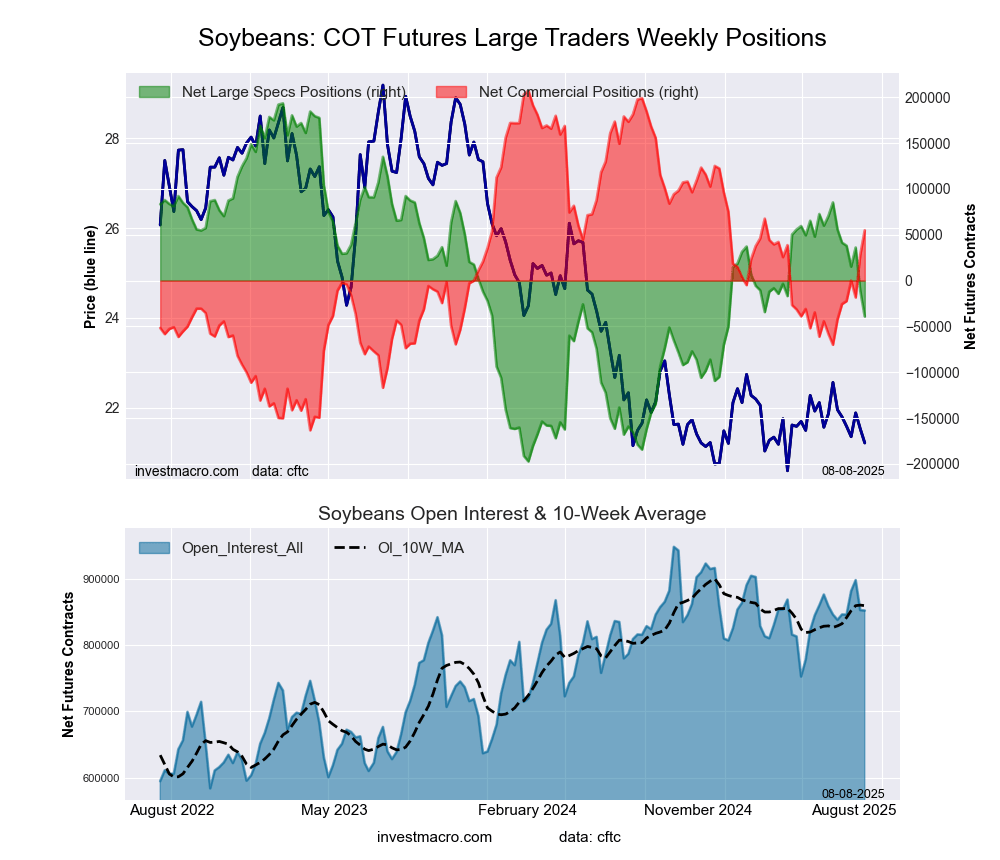
SOYBEANS Futures COT ChartThe SOYBEANS large speculator standing this week was a net position of 47,913 contracts in the data reported through Tuesday. This was a weekly decrease of -17,265 contracts from the previous week which had a total of 65,178 net contracts.

This week’s current strength score (the trader positioning range over the past three years, measured from 0 to 100) shows the speculators are currently Bullish with a score of 62.8 percent. The commercials are Bearish with a score of 34.7 percent and the small traders (not shown in chart) are Bullish with a score of 78.0 percent.

Price Trend-Following Model: Weak Downtrend

Our weekly trend-following model classifies the current market price position as: Weak Downtrend.

SOYBEANS Futures StatisticsSPECULATORSCOMMERCIALSSMALL TRADERS
– Percent of Open Interest Longs:21.349.35.9
– Percent of Open Interest Shorts:15.653.47.4
– Net Position:47,913-34,716-13,197
– Gross Longs:180,039416,36549,607
– Gross Shorts:132,126451,08162,804
– Long to Short Ratio:1.4 to 10.9 to 10.8 to 1
NET POSITION TREND:
– Strength Index Score (3 Year Range Pct):62.834.778.0
– Strength Index Reading (3 Year Range):BullishBearishBullish
NET POSITION MOVEMENT INDEX:
– 6-Week Change in Strength Index:16.6-19.822.3


SOYBEAN OIL Futures:

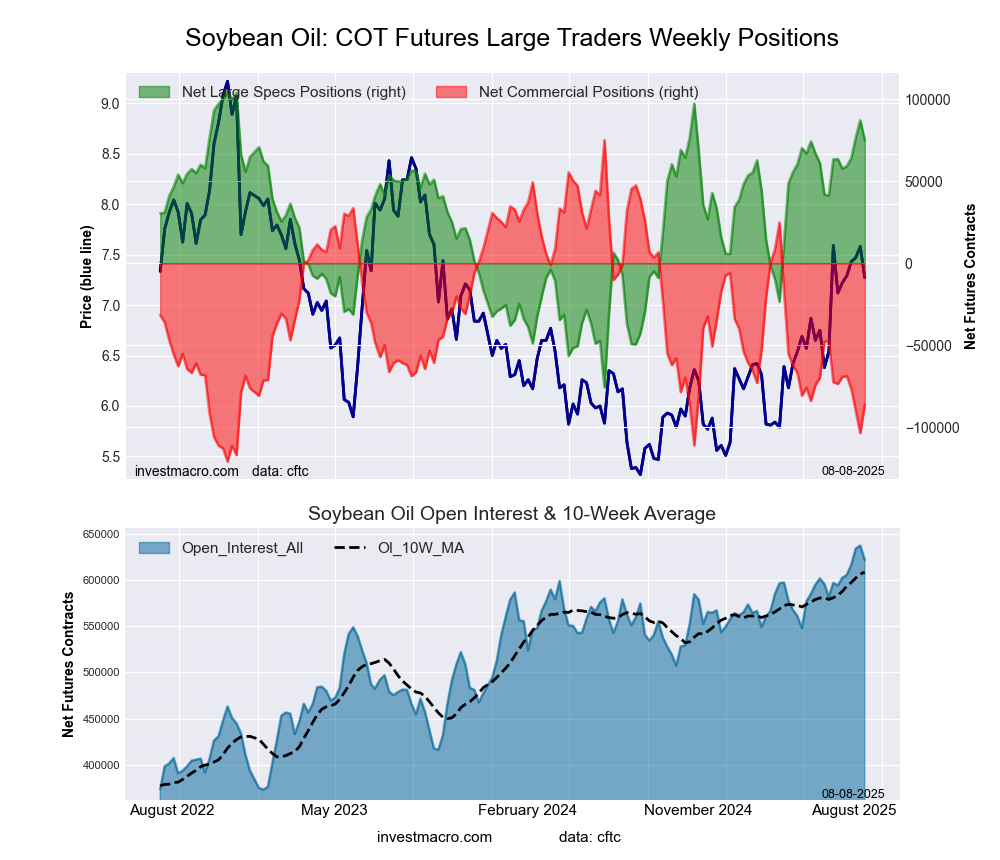
SOYBEAN OIL Futures COT ChartThe SOYBEAN OIL large speculator standing this week was a net position of 66,919 contracts in the data reported through Tuesday. This was a weekly fall of -7,280 contracts from the previous week which had a total of 74,199 net contracts.

This week’s current strength score (the trader positioning range over the past three years, measured from 0 to 100) shows the speculators are currently Bullish with a score of 78.8 percent. The commercials are Bearish with a score of 23.8 percent and the small traders (not shown in chart) are Bullish with a score of 52.4 percent.

Price Trend-Following Model: Strong Uptrend

Our weekly trend-following model classifies the current market price position as: Strong Uptrend.

SOYBEAN OIL Futures StatisticsSPECULATORSCOMMERCIALSSMALL TRADERS
– Percent of Open Interest Longs:25.544.25.4
– Percent of Open Interest Shorts:14.356.74.2
– Net Position:66,919-74,2327,313
– Gross Longs:151,778262,82232,354
– Gross Shorts:84,859337,05425,041
– Long to Short Ratio:1.8 to 10.8 to 11.3 to 1
NET POSITION TREND:
– Strength Index Score (3 Year Range Pct):78.823.852.4
– Strength Index Reading (3 Year Range):BullishBearishBullish
NET POSITION MOVEMENT INDEX:
– 6-Week Change in Strength Index:10.1-9.73.6


SOYBEAN MEAL Futures:

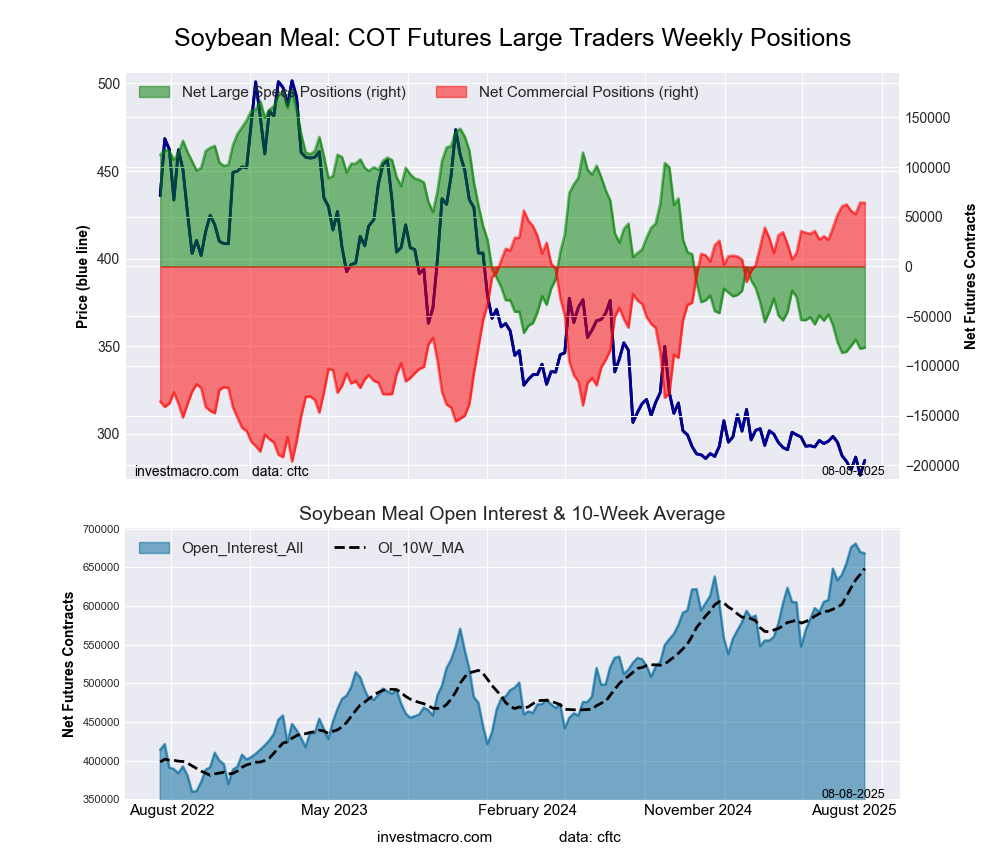
SOYBEAN MEAL Futures COT ChartThe SOYBEAN MEAL large speculator standing this week was a net position of -58,173 contracts in the data reported through Tuesday. This was a weekly lowering of -7,245 contracts from the previous week which had a total of -50,928 net contracts.

This week’s current strength score (the trader positioning range over the past three years, measured from 0 to 100) shows the speculators are currently Bearish-Extreme with a score of 3.5 percent. The commercials are Bullish-Extreme with a score of 91.8 percent and the small traders (not shown in chart) are Bullish with a score of 67.7 percent.

Price Trend-Following Model: Strong Downtrend

Our weekly trend-following model classifies the current market price position as: Strong Downtrend.

SOYBEAN MEAL Futures StatisticsSPECULATORSCOMMERCIALSSMALL TRADERS
– Percent of Open Interest Longs:20.448.39.1
– Percent of Open Interest Shorts:30.142.35.3
– Net Position:-58,17335,60622,567
– Gross Longs:121,724288,31954,354
– Gross Shorts:179,897252,71331,787
– Long to Short Ratio:0.7 to 11.1 to 11.7 to 1
NET POSITION TREND:
– Strength Index Score (3 Year Range Pct):3.591.867.7
– Strength Index Reading (3 Year Range):Bearish-ExtremeBullish-ExtremeBullish
NET POSITION MOVEMENT INDEX:
– 6-Week Change in Strength Index:-5.15.2-3.3


LIVE CATTLE Futures:

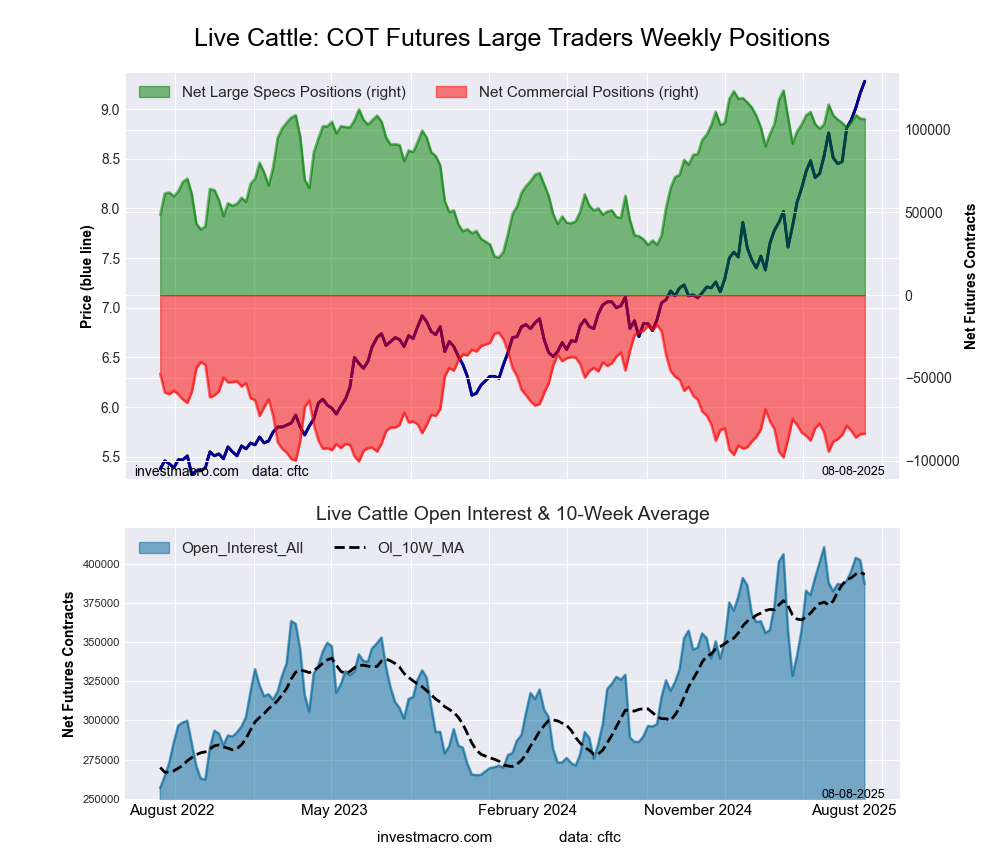
LIVE CATTLE Futures COT ChartThe LIVE CATTLE large speculator standing this week was a net position of 103,416 contracts in the data reported through Tuesday. This was a weekly decrease of -7,231 contracts from the previous week which had a total of 110,647 net contracts.

This week’s current strength score (the trader positioning range over the past three years, measured from 0 to 100) shows the speculators are currently Bullish-Extreme with a score of 80.6 percent. The commercials are Bearish with a score of 24.3 percent and the small traders (not shown in chart) are Bearish-Extreme with a score of 16.5 percent.

Price Trend-Following Model: Strong Uptrend

Our weekly trend-following model classifies the current market price position as: Strong Uptrend.

LIVE CATTLE Futures StatisticsSPECULATORSCOMMERCIALSSMALL TRADERS
– Percent of Open Interest Longs:49.727.67.8
– Percent of Open Interest Shorts:23.248.213.6
– Net Position:103,416-80,410-23,006
– Gross Longs:194,051107,93930,314
– Gross Shorts:90,635188,34953,320
– Long to Short Ratio:2.1 to 10.6 to 10.6 to 1
NET POSITION TREND:
– Strength Index Score (3 Year Range Pct):80.624.316.5
– Strength Index Reading (3 Year Range):Bullish-ExtremeBearishBearish-Extreme
NET POSITION MOVEMENT INDEX:
– 6-Week Change in Strength Index:-4.18.2-8.2


LEAN HOGS Futures:

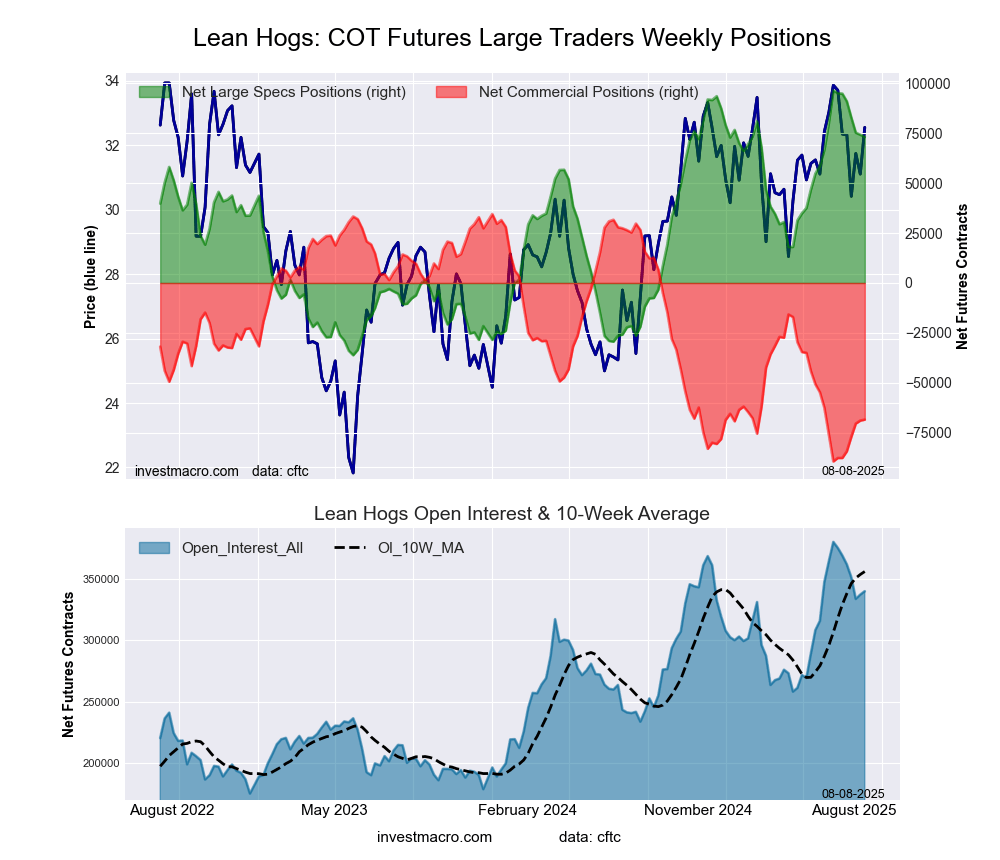
LEAN HOGS Futures COT ChartThe LEAN HOGS large speculator standing this week was a net position of 54,721 contracts in the data reported through Tuesday. This was a weekly rise of 7,964 contracts from the previous week which had a total of 46,757 net contracts.

This week’s current strength score (the trader positioning range over the past three years, measured from 0 to 100) shows the speculators are currently Bullish with a score of 70.1 percent. The commercials are Bearish with a score of 27.5 percent and the small traders (not shown in chart) are Bullish with a score of 53.3 percent.

Price Trend-Following Model: Weak Downtrend

Our weekly trend-following model classifies the current market price position as: Weak Downtrend.

LEAN HOGS Futures StatisticsSPECULATORSCOMMERCIALSSMALL TRADERS
– Percent of Open Interest Longs:39.131.77.3
– Percent of Open Interest Shorts:21.348.18.6
– Net Position:54,721-50,685-4,036
– Gross Longs:120,42797,71522,586
– Gross Shorts:65,706148,40026,622
– Long to Short Ratio:1.8 to 10.7 to 10.8 to 1
NET POSITION TREND:
– Strength Index Score (3 Year Range Pct):70.127.553.3
– Strength Index Reading (3 Year Range):BullishBearishBullish
NET POSITION MOVEMENT INDEX:
– 6-Week Change in Strength Index:28.3-29.8-10.5


COTTON Futures:

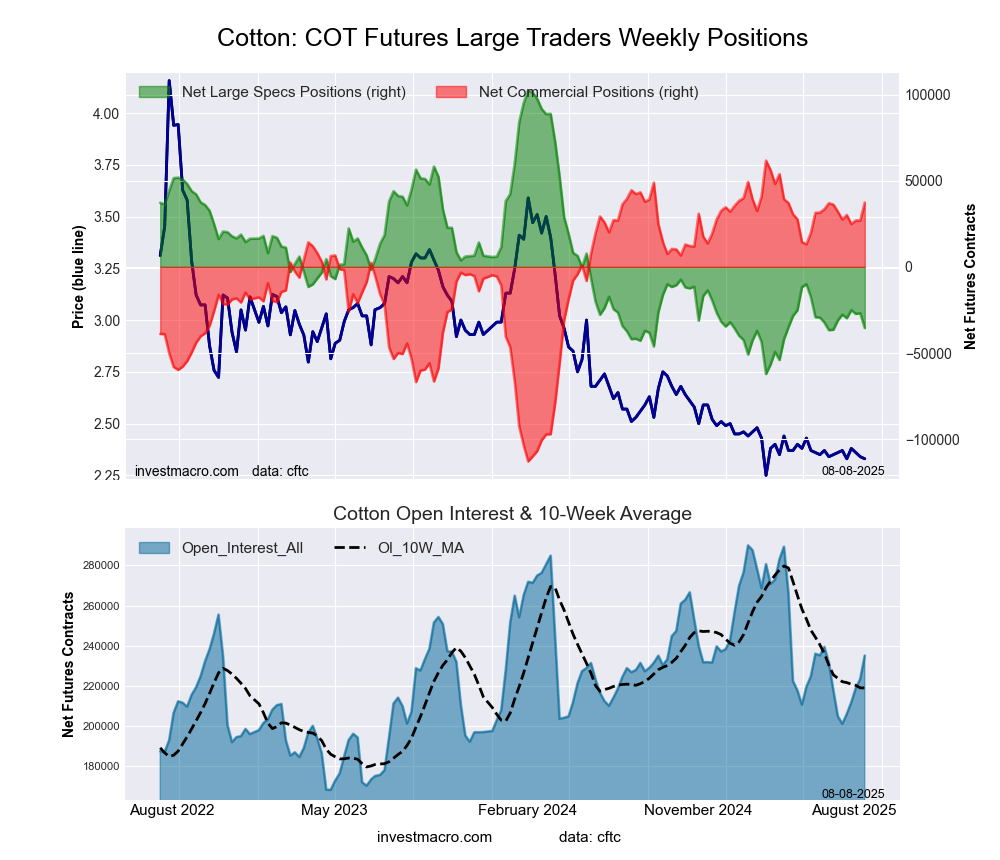
COTTON Futures COT ChartThe COTTON large speculator standing this week was a net position of -29,156 contracts in the data reported through Tuesday. This was a weekly reduction of -11,613 contracts from the previous week which had a total of -17,543 net contracts.

This week’s current strength score (the trader positioning range over the past three years, measured from 0 to 100) shows the speculators are currently Bearish with a score of 20.1 percent. The commercials are Bullish-Extreme with a score of 82.6 percent and the small traders (not shown in chart) are Bearish-Extreme with a score of 6.4 percent.

Price Trend-Following Model: Downtrend

Our weekly trend-following model classifies the current market price position as: Downtrend.

COTTON Futures StatisticsSPECULATORSCOMMERCIALSSMALL TRADERS
– Percent of Open Interest Longs:26.649.04.8
– Percent of Open Interest Shorts:38.935.75.7
– Net Position:-29,15631,346-2,190
– Gross Longs:62,669115,62511,274
– Gross Shorts:91,82584,27913,464
– Long to Short Ratio:0.7 to 11.4 to 10.8 to 1
NET POSITION TREND:
– Strength Index Score (3 Year Range Pct):20.182.66.4
– Strength Index Reading (3 Year Range):BearishBullish-ExtremeBearish-Extreme
NET POSITION MOVEMENT INDEX:
– 6-Week Change in Strength Index:3.6-3.3-1.3


COCOA Futures:

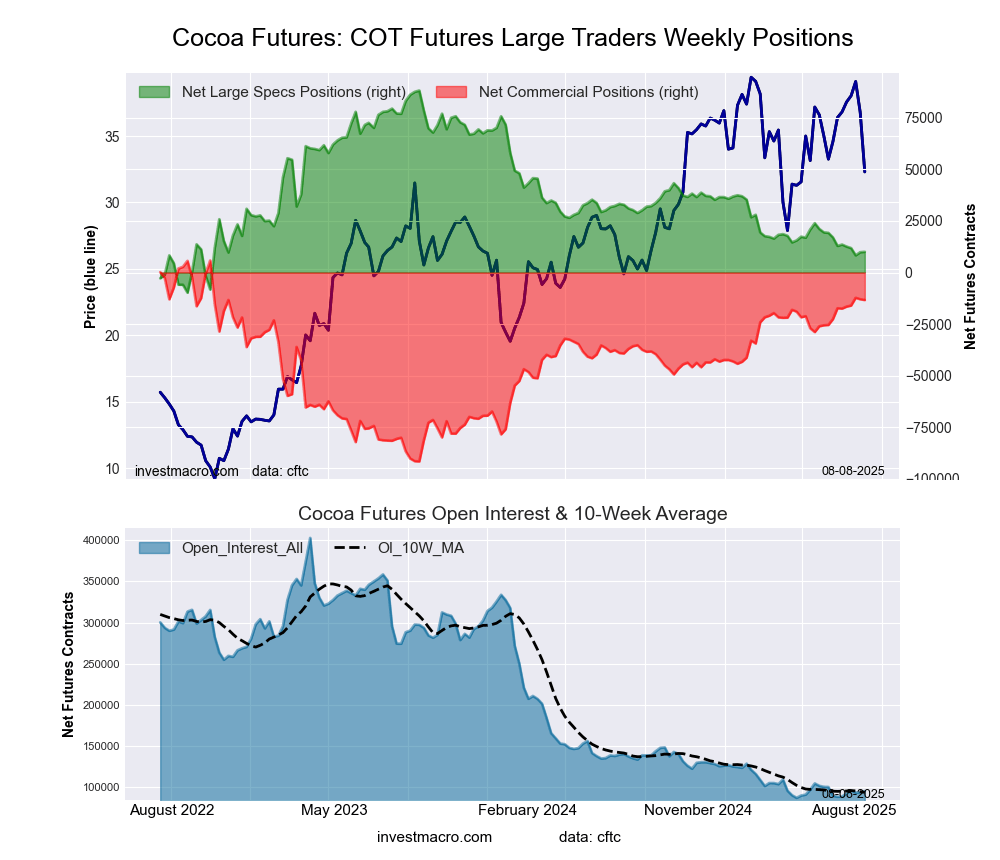
COCOA Futures COT ChartThe COCOA large speculator standing this week was a net position of 23,916 contracts in the data reported through Tuesday. This was a weekly increase of 3,048 contracts from the previous week which had a total of 20,868 net contracts.

This week’s current strength score (the trader positioning range over the past three years, measured from 0 to 100) shows the speculators are currently Bearish with a score of 34.4 percent. The commercials are Bullish with a score of 64.4 percent and the small traders (not shown in chart) are Bullish with a score of 70.5 percent.

Price Trend-Following Model: Weak Downtrend

Our weekly trend-following model classifies the current market price position as: Weak Downtrend.

COCOA Futures StatisticsSPECULATORSCOMMERCIALSSMALL TRADERS
– Percent of Open Interest Longs:34.734.510.3
– Percent of Open Interest Shorts:11.862.15.5
– Net Position:23,916-28,8754,959
– Gross Longs:36,24835,99610,742
– Gross Shorts:12,33264,8715,783
– Long to Short Ratio:2.9 to 10.6 to 11.9 to 1
NET POSITION TREND:
– Strength Index Score (3 Year Range Pct):34.464.470.5
– Strength Index Reading (3 Year Range):BearishBullishBullish
NET POSITION MOVEMENT INDEX:
– 6-Week Change in Strength Index:6.2-7.29.7


WHEAT Futures:

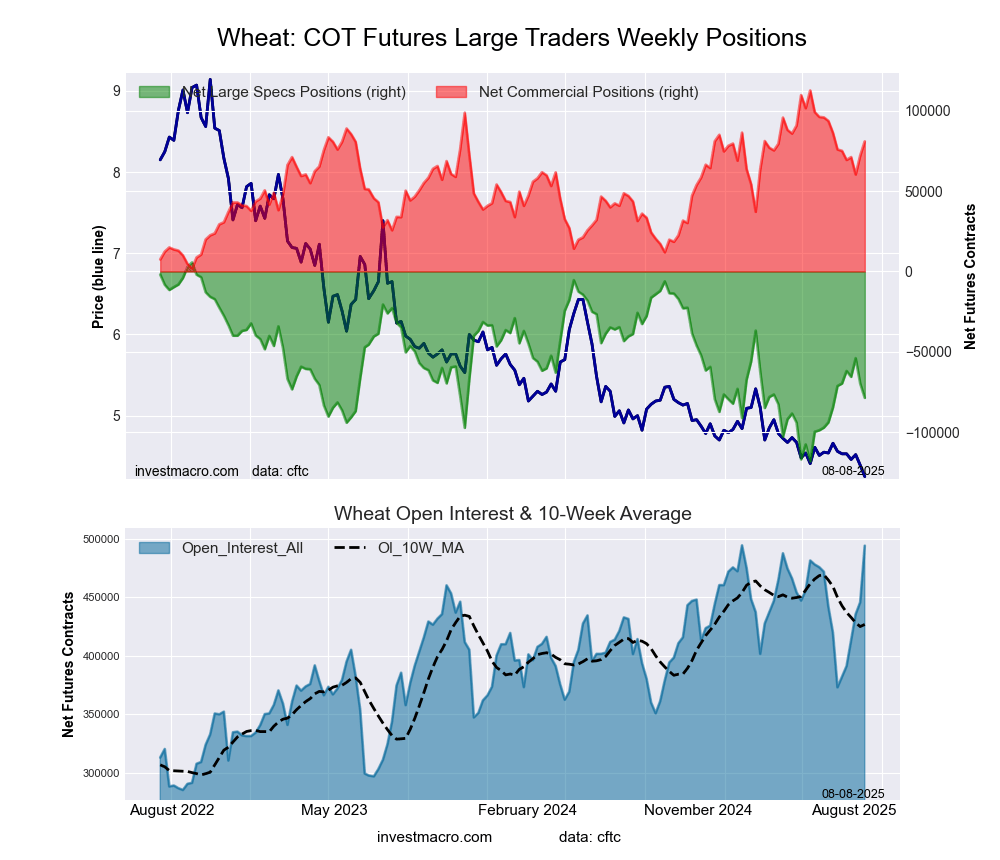
WHEAT Futures COT ChartThe WHEAT large speculator standing this week was a net position of -99,626 contracts in the data reported through Tuesday. This was a weekly increase of 18,474 contracts from the previous week which had a total of -118,100 net contracts.

This week’s current strength score (the trader positioning range over the past three years, measured from 0 to 100) shows the speculators are currently Bearish-Extreme with a score of 13.0 percent. The commercials are Bullish-Extreme with a score of 89.9 percent and the small traders (not shown in chart) are Bullish with a score of 59.6 percent.

Price Trend-Following Model: Downtrend

Our weekly trend-following model classifies the current market price position as: Downtrend.

WHEAT Futures StatisticsSPECULATORSCOMMERCIALSSMALL TRADERS
– Percent of Open Interest Longs:26.737.87.4
– Percent of Open Interest Shorts:47.617.17.2
– Net Position:-99,62699,080546
– Gross Longs:127,701180,85735,140
– Gross Shorts:227,32781,77734,594
– Long to Short Ratio:0.6 to 12.2 to 11.0 to 1
NET POSITION TREND:
– Strength Index Score (3 Year Range Pct):13.089.959.6
– Strength Index Reading (3 Year Range):Bearish-ExtremeBullish-ExtremeBullish
NET POSITION MOVEMENT INDEX:
– 6-Week Change in Strength Index:-5.48.4-19.0


Article By InvestMacroReceive our weekly COT Newsletter

*COT Report: The COT data, released weekly to the public each Friday, is updated through the most recent Tuesday (data is 3 days old) and shows a quick view of how large speculators or non-commercials (for-profit traders) were positioned in the futures markets.

The CFTC categorizes trader positions according to commercial hedgers (traders who use futures contracts for hedging as part of the business), non-commercials (large traders who speculate to realize trading profits) and nonreportable traders (usually small traders/speculators) as well as their open interest (contracts open in the market at time of reporting). See CFTC criteria here.

COT Stock Market Charts: Speculator Bets led by S&P500 & Russell-2000

By InvestMacro

Speculators OI Stocks COT Chart

Here are the latest charts and statistics for the Commitment of Traders (COT) data published by the Commodities Futures Trading Commission (CFTC).

The latest COT data is updated through Tuesday May 20th and shows a quick view of how large traders (for-profit speculators and commercial entities) were positioned in the futures markets.

Weekly Speculator Changes led by S&P500 & Russell-2000

Speculators Nets Stocks COT Chart

The COT stock markets speculator bets were higher this week as four out of the seven stock markets we cover had higher positioning while the other three markets had lower speculator contracts.

Leading the gains for the stock markets was the S&P500-Mini (25,625 contracts) with the Russell-Mini (22,609 contracts), the Nikkei 225 (2,025 contracts) and  the DowJones-Mini (1,033 contracts)also showing positive weeks.

The markets with the declines in speculator bets this week were with the Nasdaq-Mini (-5,017 contracts), the VIX (-1,675 contracts) and with the MSCI EAFE-Mini (-1,935 contracts) also registering lower bets on the week.


Stock Market Data:

Speculators Table Stocks COT Chart

Legend: Weekly Speculators Change | Speculators Current Net Position | Speculators Strength Score compared to last 3-Years (0-100 range)


Strength Scores led by Nikkei 225 & VIX

Speculators Strength Stocks COT Chart

COT Strength Scores (a normalized measure of Speculator positions over a 3-Year range, from 0 to 100 where above 80 is Extreme-Bullish and below 20 is Extreme-Bearish) showed that the Nikkei 225 (96 percent) and the VIX (94 percent) lead the stock markets this week. The MSCI EAFE-Mini (90 percent) and Russell-Mini (78 percent) come in as the next highest in the weekly strength scores.

The Nasdaq-Mini (62 percent) comes in at the lowest strength level currently but is above the 50 percent mid-point of the past 3 years.

Strength Statistics:
VIX (94.4 percent) vs VIX previous week (95.9 percent)
S&P500-Mini (61.6 percent) vs S&P500-Mini previous week (57.0 percent)
DowJones-Mini (73.6 percent) vs DowJones-Mini previous week (71.9 percent)
Nasdaq-Mini (61.7 percent) vs Nasdaq-Mini previous week (69.5 percent)
Russell2000-Mini (78.1 percent) vs Russell2000-Mini previous week (62.6 percent)
Nikkei USD (96.4 percent) vs Nikkei USD previous week (79.1 percent)
EAFE-Mini (90.4 percent) vs EAFE-Mini previous week (93.1 percent)


Nikkei 225 & VIX top the 6-Week Strength Trends

Speculators Trend Stocks COT Chart

COT Strength Score Trends (or move index, calculates the 6-week changes in strength scores) showed that the Nikkei 225 (35 percent) leads the past six weeks trends for the stock markets. The VIX (16 percent) and the MSCI EAFE-Mini (13 percent) are the next highest positive movers in the latest trends data.

The Nasdaq-Mini (-15 percent) leads the downside trend scores currently with the S&P500-Mini (-12 percent) coming in as the next market with lower trend scores.

Strength Trend Statistics:
VIX (15.7 percent) vs VIX previous week (14.0 percent)
S&P500-Mini (-12.4 percent) vs S&P500-Mini previous week (-18.8 percent)
DowJones-Mini (11.1 percent) vs DowJones-Mini previous week (15.8 percent)
Nasdaq-Mini (-15.1 percent) vs Nasdaq-Mini previous week (6.8 percent)
Russell2000-Mini (4.8 percent) vs Russell2000-Mini previous week (-7.6 percent)
Nikkei USD (35.0 percent) vs Nikkei USD previous week (25.1 percent)
EAFE-Mini (12.9 percent) vs EAFE-Mini previous week (17.2 percent)


Individual Stock Market Charts:

VIX Volatility Futures:

VIX Volatility Futures COT ChartThe VIX Volatility large speculator standing this week reached a net position of 4,424 contracts in the data reported through Tuesday. This was a weekly fall of -1,675 contracts from the previous week which had a total of 6,099 net contracts.

This week’s current strength score (the trader positioning range over the past three years, measured from 0 to 100) shows the speculators are currently Bullish-Extreme with a score of 94.4 percent. The commercials are Bearish-Extreme with a score of 6.5 percent and the small traders (not shown in chart) are Bullish with a score of 73.0 percent.

Price Trend-Following Model: Weak Uptrend

Our weekly trend-following model classifies the current market price position as: Weak Uptrend.

VIX Volatility Futures StatisticsSPECULATORSCOMMERCIALSSMALL TRADERS
– Percent of Open Interest Longs:26.843.58.0
– Percent of Open Interest Shorts:25.345.47.6
– Net Position:4,424-5,5851,161
– Gross Longs:80,402130,53323,915
– Gross Shorts:75,978136,11822,754
– Long to Short Ratio:1.1 to 11.0 to 11.1 to 1
NET POSITION TREND:
– Strength Index Score (3 Year Range Pct):94.46.573.0
– Strength Index Reading (3 Year Range):Bullish-ExtremeBearish-ExtremeBullish
NET POSITION MOVEMENT INDEX:
– 6-Week Change in Strength Index:15.7-15.41.7


S&P500 Mini Futures:

SP500 Mini Futures COT ChartThe S&P500 Mini large speculator standing this week reached a net position of -96,569 contracts in the data reported through Tuesday. This was a weekly gain of 25,625 contracts from the previous week which had a total of -122,194 net contracts.

This week’s current strength score (the trader positioning range over the past three years, measured from 0 to 100) shows the speculators are currently Bullish with a score of 61.6 percent. The commercials are Bearish with a score of 42.5 percent and the small traders (not shown in chart) are Bullish with a score of 55.3 percent.

Price Trend-Following Model: Weak Downtrend

Our weekly trend-following model classifies the current market price position as: Weak Downtrend.

S&P500 Mini Futures StatisticsSPECULATORSCOMMERCIALSSMALL TRADERS
– Percent of Open Interest Longs:11.774.311.3
– Percent of Open Interest Shorts:16.271.99.2
– Net Position:-96,56951,09745,472
– Gross Longs:246,5881,571,120239,544
– Gross Shorts:343,1571,520,023194,072
– Long to Short Ratio:0.7 to 11.0 to 11.2 to 1
NET POSITION TREND:
– Strength Index Score (3 Year Range Pct):61.642.555.3
– Strength Index Reading (3 Year Range):BullishBearishBullish
NET POSITION MOVEMENT INDEX:
– 6-Week Change in Strength Index:-12.49.12.7


Dow Jones Mini Futures:

Dow Jones Mini Futures COT ChartThe Dow Jones Mini large speculator standing this week reached a net position of 8,147 contracts in the data reported through Tuesday. This was a weekly lift of 1,033 contracts from the previous week which had a total of 7,114 net contracts.

This week’s current strength score (the trader positioning range over the past three years, measured from 0 to 100) shows the speculators are currently Bullish with a score of 73.6 percent. The commercials are Bearish with a score of 32.8 percent and the small traders (not shown in chart) are Bearish with a score of 27.4 percent.

Price Trend-Following Model: Weak Downtrend

Our weekly trend-following model classifies the current market price position as: Weak Downtrend.

Dow Jones Mini Futures StatisticsSPECULATORSCOMMERCIALSSMALL TRADERS
– Percent of Open Interest Longs:17.962.411.2
– Percent of Open Interest Shorts:7.667.116.8
– Net Position:8,147-3,719-4,428
– Gross Longs:14,11749,2978,830
– Gross Shorts:5,97053,01613,258
– Long to Short Ratio:2.4 to 10.9 to 10.7 to 1
NET POSITION TREND:
– Strength Index Score (3 Year Range Pct):73.632.827.4
– Strength Index Reading (3 Year Range):BullishBearishBearish
NET POSITION MOVEMENT INDEX:
– 6-Week Change in Strength Index:11.1-6.0-16.1


Nasdaq Mini Futures:

Nasdaq Mini Futures COT ChartThe Nasdaq Mini large speculator standing this week reached a net position of 14,530 contracts in the data reported through Tuesday. This was a weekly decrease of -5,017 contracts from the previous week which had a total of 19,547 net contracts.

This week’s current strength score (the trader positioning range over the past three years, measured from 0 to 100) shows the speculators are currently Bullish with a score of 61.7 percent. The commercials are Bearish with a score of 49.5 percent and the small traders (not shown in chart) are Bearish with a score of 33.8 percent.

Price Trend-Following Model: Weak Downtrend

Our weekly trend-following model classifies the current market price position as: Weak Downtrend.

Nasdaq Mini Futures StatisticsSPECULATORSCOMMERCIALSSMALL TRADERS
– Percent of Open Interest Longs:29.655.712.1
– Percent of Open Interest Shorts:24.457.015.9
– Net Position:14,530-3,723-10,807
– Gross Longs:82,637155,47533,720
– Gross Shorts:68,107159,19844,527
– Long to Short Ratio:1.2 to 11.0 to 10.8 to 1
NET POSITION TREND:
– Strength Index Score (3 Year Range Pct):61.749.533.8
– Strength Index Reading (3 Year Range):BullishBearishBearish
NET POSITION MOVEMENT INDEX:
– 6-Week Change in Strength Index:-15.128.7-32.3


Russell 2000 Mini Futures:

Russell 2000 Mini Futures COT ChartThe Russell 2000 Mini large speculator standing this week reached a net position of -5,747 contracts in the data reported through Tuesday. This was a weekly gain of 22,609 contracts from the previous week which had a total of -28,356 net contracts.

This week’s current strength score (the trader positioning range over the past three years, measured from 0 to 100) shows the speculators are currently Bullish with a score of 78.1 percent. The commercials are Bearish with a score of 29.7 percent and the small traders (not shown in chart) are Bearish-Extreme with a score of 14.1 percent.

Price Trend-Following Model: Downtrend

Our weekly trend-following model classifies the current market price position as: Downtrend.

Russell 2000 Mini Futures StatisticsSPECULATORSCOMMERCIALSSMALL TRADERS
– Percent of Open Interest Longs:16.772.55.4
– Percent of Open Interest Shorts:18.070.46.2
– Net Position:-5,7479,349-3,602
– Gross Longs:72,733315,93523,370
– Gross Shorts:78,480306,58626,972
– Long to Short Ratio:0.9 to 11.0 to 10.9 to 1
NET POSITION TREND:
– Strength Index Score (3 Year Range Pct):78.129.714.1
– Strength Index Reading (3 Year Range):BullishBearishBearish-Extreme
NET POSITION MOVEMENT INDEX:
– 6-Week Change in Strength Index:4.83.2-34.8


Nikkei Stock Average (USD) Futures:

The Nikkei Stock Average (USD) large speculator standing this week reached a net position of 1,904 contracts in the data reported through Tuesday. This was a weekly increase of 2,025 contracts from the previous week which had a total of -121 net contracts.

This week’s current strength score (the trader positioning range over the past three years, measured from 0 to 100) shows the speculators are currently Bullish-Extreme with a score of 96.4 percent. The commercials are Bearish-Extreme with a score of 15.4 percent and the small traders (not shown in chart) are Bearish with a score of 37.1 percent.

Price Trend-Following Model: Strong Uptrend

Our weekly trend-following model classifies the current market price position as: Strong Uptrend.

Nikkei Stock Average Futures StatisticsSPECULATORSCOMMERCIALSSMALL TRADERS
– Percent of Open Interest Longs:20.360.519.2
– Percent of Open Interest Shorts:2.575.422.1
– Net Position:1,904-1,590-314
– Gross Longs:2,1696,4802,056
– Gross Shorts:2658,0702,370
– Long to Short Ratio:8.2 to 10.8 to 10.9 to 1
NET POSITION TREND:
– Strength Index Score (3 Year Range Pct):96.415.437.1
– Strength Index Reading (3 Year Range):Bullish-ExtremeBearish-ExtremeBearish
NET POSITION MOVEMENT INDEX:
– 6-Week Change in Strength Index:35.0-26.7-5.5


MSCI EAFE Mini Futures:

MSCI EAFE Mini Futures COT ChartThe MSCI EAFE Mini large speculator standing this week reached a net position of 774 contracts in the data reported through Tuesday. This was a weekly reduction of -1,935 contracts from the previous week which had a total of 2,709 net contracts.

This week’s current strength score (the trader positioning range over the past three years, measured from 0 to 100) shows the speculators are currently Bullish-Extreme with a score of 90.4 percent. The commercials are Bearish-Extreme with a score of 18.5 percent and the small traders (not shown in chart) are Bearish with a score of 45.3 percent.

Price Trend-Following Model: Strong Uptrend

Our weekly trend-following model classifies the current market price position as: Strong Uptrend.

MSCI EAFE Mini Futures StatisticsSPECULATORSCOMMERCIALSSMALL TRADERS
– Percent of Open Interest Longs:9.388.12.4
– Percent of Open Interest Shorts:9.189.51.2
– Net Position:774-6,4475,673
– Gross Longs:43,477411,44111,284
– Gross Shorts:42,703417,8885,611
– Long to Short Ratio:1.0 to 11.0 to 12.0 to 1
NET POSITION TREND:
– Strength Index Score (3 Year Range Pct):90.418.545.3
– Strength Index Reading (3 Year Range):Bullish-ExtremeBearish-ExtremeBearish
NET POSITION MOVEMENT INDEX:
– 6-Week Change in Strength Index:12.9-7.5-14.9


Article By InvestMacroReceive our weekly COT Newsletter

*COT Report: The COT data, released weekly to the public each Friday, is updated through the most recent Tuesday (data is 3 days old) and shows a quick view of how large speculators or non-commercials (for-profit traders) were positioned in the futures markets.

The CFTC categorizes trader positions according to commercial hedgers (traders who use futures contracts for hedging as part of the business), non-commercials (large traders who speculate to realize trading profits) and nonreportable traders (usually small traders/speculators) as well as their open interest (contracts open in the market at time of reporting). See CFTC criteria here.
The Eurozone has seen a sharp contraction in the service sector. Bitcoin has surpassed the $110,800 mark

By JustMarkets 

At the end of Thursday, the Dow Jones index (US30) was virtually unchanged. The S&P500 Index (US500) was down 0.04%. The Nasdaq Technology Index (US100) closed higher by 0.15%. Wall Street remained cautious as a bill to cut taxes and increase defense spending now heads to the Senate and could add trillions to the $36 trillion national debt. The US Congressional Budget Office estimates spending at nearly $4 trillion, raising concerns about budget instability. Bond markets reflected this concern, with 30-year Treasury yields briefly hitting 5.14%, the highest level since 2023.

The US initial jobless claims fell 2,000 from the previous week to 227,000 for the period ended May 17, the lowest in four weeks and below market expectations for a rise to 230,000. The result extended a period of relative strength in the US labor market.

Bitcoin surpassed the $110,800 mark for the first time in history as the US government’s deregulation of cryptocurrencies reinforced the positive momentum since mid-April. Democrats in Congress dropped their opposition to a bill aimed at regulating stable cryptocurrencies, paving the way for legislation by the end of the week. The move reinforced expectations that government regulation of cryptocurrencies tied to the US dollar could spur the adoption of the asset class.

European stocks closed significantly lower on Thursday, following declines in global equities amid concerns over rising US debt and risks to European growth. Germany’s DAX (DE40) fell by 0.51%, France’s CAC 40 (FR40) closed down 0.58%, Spain’s IBEX35 (ES35) lost 0.25%, and the UK’s FTSE 100 (UK100) closed 0.54% yesterday. In Germany, the Ifo Business Climate Index rose to 87.5 in May, the highest reading since June 2024 and slightly above market expectations of 87.4, indicating some easing of recent uncertainty among companies. However, PMI data pointed to a renewed and sharper-than-expected contraction in the Eurozone’s private sector — the strongest in six months — driven by a moderate decline in service sector activity. Output declined in Germany and France, while the rest of the Eurozone continued to show positive growth.

WTI crude prices fell by 0.6% to settle at $61.2 a barrel on Thursday, pressured by reports that OPEC+ is considering increasing production in July, raising concerns about a potential supply glut. A production increase of 411,000 barrels per day is reportedly being discussed, although a final decision has yet to be made. Prices were further impacted by an unexpected 1.3 million barrel increase in US crude inventories last week, driven by higher imports and lower demand for the fuel.

The US natural gas prices (XNG/USD) fell more than 3% to $3.25/MMBtu after the EIA reported a larger-than-expected increase in storage inventories. Inventories rose by 120 billion cubic feet last week, exceeding forecasts of 115 Bcf and well above last year’s 78 Bcf and the five-year average of 87 Bcf. The growth was driven by mild weather that limited heating and cooling demand.

Asian markets were predominantly up yesterday. Japan’s Nikkei 225 (JP225) fell by 0.84%, China’s FTSE China A50 (CHA50) added 0.09%, Hong Kong’s Hang Seng (HK50) lost 1.19%, and Australia’s ASX 200 (AU200) was negative 0.45%.

On May 23, the People’s Bank of China (PBOC) injected CNY500 billion into financial institutions under a one-year medium-term credit line (MTL) to maintain sufficient liquidity in the country’s banking system. This month’s net injection of MLF was down from CNY600 billion in the previous month.

New Zealand retail sales in the three months to March 2025 rose 0.8% quarter-on-quarter, following an upwardly revised 1% increase, and beat market expectations for a 0.1% increase. On a year-on-year basis, retail sales rose 0.7%, the second increase since Q3 2022, following an upwardly revised 0.3% increase in the previous quarter.

Singapore’s annual inflation rate in April 2025 was 0.9%, unchanged from the previous two months but slightly above market expectations of 0.8%. The rate remained at its lowest level since February 2021. Singapore’s core consumer prices rose 0.7% year-on-year in April 2025, accelerating from a four-year low of 0.5% in the previous month and exceeding market forecasts of 0.5%. This was the highest core inflation rate since January, mainly driven by higher inflation in services and food.

S&P 500 (US500) 5,842.01 −2.60 (−0.044%)

Dow Jones (US30) 41,859.09 −1.35 (−0.0032%)

DAX (DE40) 23,999.17 −123.23 (−0.51%)

FTSE 100 (UK100) 8,739.26 −47.20 (−0.54%)

USD index 99.94 +0.38 (+0.38%)

News feed for: 2025.05.23

  • New Zealand Retail Sales (q/q) at 01:45 (GMT+3).
  • Japan National Core CPI (m/m) at 02:30 (GMT+3);
  • UK Retail Sales (m/m) at 09:00 (GMT+3);
  • German GDP (m/m) at 09:00 (GMT+3);
  • Canada Retail Sales (m/m) at 15:30 (GMT+3);
  • US New Home Sales (m/m) at 17:00 (GMT+3).

By JustMarkets


This article reflects a personal opinion and should not be interpreted as an investment advice, and/or offer, and/or a persistent request for carrying out financial transactions, and/or a guarantee, and/or a forecast of future events.

EUR/USD Could Climb as Dollar Faces Mounting Risks

By RoboForex Analytical Department 

The euro has regained strength against the dollar, with EUR/USD holding steady at 1.1312 on Friday.

Key drivers behind EUR/USD’s movement

The US dollar remains vulnerable as investor concerns over the US fiscal outlook persist. President Donald Trump’s proposed budget bill – featuring tax cuts and heightened defence spending – has stoked fears of surging national debt.

According to the Congressional Budget Office, the bill could inflate the US national debt by nearly $4 trillion, raising alarms over long-term fiscal stability.

Further pressuring the dollar, Moody’s recently downgraded the US credit rating from Aaa to Aa1, citing widening budget deficits and rising debt-servicing costs.

Meanwhile, investor appetite for US assets has waned amid sluggish progress in trade negotiations.

Although this week saw limited high-impact US data releases, the market has welcomed the brief lull. Today, traders will focus on April’s new home sales report for fresh directional cues.

Technical analysis: EUR/USD

H4 Chart:

EUR/USD dipped to 1.1255 before correcting to 1.1311, with a consolidation range nearing completion. We anticipate a downward expansion towards 1.1120, supported by the MACD indicator, whose signal line has exited the histogram zone and points decisively downward.

H1 Chart:

The pair is forming a downward impulse structure, followed by a correction to 1.1311. Today, a renewed decline towards 1.1240 appears likely. A break below this level could extend the downtrend to 1.1170. This scenario is corroborated by the Stochastic oscillator, with its signal line hovering above 80, poised to drop towards 20.

Conclusion

With the dollar weighed down by fiscal concerns and a credit rating downgrade, EUR/USD may extend its gains. Traders should monitor today’s US housing data for further momentum.


Disclaimer

Any forecasts contained herein are based on the author’s particular opinion. This analysis may not be treated as trading advice. RoboForex bears no responsibility for trading results based on trading recommendations and reviews contained herein.


Singapore could slip into a technical recession. Bitcoin has reached an all-time high

By JustMarkets

At the end of Wednesday, the Dow Jones Index (US30) decreased by 1.91%. The S&P 500 Index (US500) was down 1.61%. The Nasdaq Technology Index (US100) closed lower by 1.34%. The US stocks fell on Wednesday as a sharp rise in Treasury yields and renewed fiscal concerns weighed heavily on investor sentiment. Long-term bond yields rose after a weak $16 billion auction of 20-year Treasuries, and 30-year yields jumped to 5.08%, the highest level since 2023, amid heightened concerns that Washington’s proposed tax-and-spending bill could further widen the federal budget deficit.

Bitcoin surpassed the $109,500 mark for the first time ever, extending a rally since mid-April, as the advancement of legislation to regulate stablecoins in the US supported the outlook for digital assets. Democrats in Congress dropped their opposition to a bill aimed at regulating stablecoins, paving the way for its passage by the end of the week. The move reinforced expectations that government regulation of digital assets tied to the US dollar could spur adoption of the asset class.

Equity markets in Europe traded flat on Wednesday. Germany’s DAX (DE40) was up 0.36%. France’s CAC 40 (FR40) closed down 0.40%, Spain’s IBEX35 (ES35) fell by 0.11%, and the UK’s FTSE 100 (UK100) closed positive 0.06%. European equities closed unchanged, holding near two-month highs hit in the previous session, as a lack of new catalysts kept hopes alive that rising government spending in Europe would lead to increased investment among corporate giants.

Silver (XAG/USD) prices climbed above $33.1 an ounce on Wednesday, testing the highest level in three weeks, amid a weaker dollar and evidence of heavy buying by the industry. The dollar came under pressure despite a fresh rise in long-dated Treasury yields, reflecting lingering doubts about the exclusivity of US assets and consistent with the recent rush into precious metals in search of safety.

WTI crude oil prices reversed previous gains and are trading below $62 a barrel after an unexpected increase in US crude inventories. The EIA reported a 1.328 million barrel increase in crude inventories, contradicting expectations of a 1.85 million barrel decline.

Asian markets were predominantly up yesterday. Japan’s Nikkei 225 (JP225) fell by 0.61%, China’s FTSE China A50 (CHA50) gained 0.69%, Hong Kong’s Hang Seng (HK50) rose by 0.62%, and Australia’s ASX 200 (AU200) gained 0.52%. Japanese stocks hit a two-week low and followed a sharp sell-off on Wall Street overnight. Japan’s Core Machinery Orders, a key leading indicator of capital investment, unexpectedly rose 13% in March, well above expectations of a 1.6% decline. Despite the upbeat data, sentiment was dampened by weak economic signals elsewhere: manufacturing activity remained in contractionary territory in May, while growth in the services sector also slowed.

Malaysia’s annual inflation rate for April 2025 was 1.4%, unchanged from March and in line with market expectations. It remained the lowest since February 2021, with food prices rising the least in six months (2.3% vs. 2.5% in March). Core consumer prices, excluding volatile fresh food and administrative expenses, rose to 2.0% y/y in April after increasing 1.9% in the previous two months, the sharpest pace since November 2023.

Singapore could slip into a technical recession this year, a government official warned after final GDP data confirmed the economy shrank in the first quarter of 2025, even before US tariffs take effect. The country’s trade-dependent economy grew 3.9% y/y but contracted 0.6% q/q.

S&P 500 (US500) 5,844.61 −95.85 (−1.61%)

Dow Jones (US30) 41,860.44 −816.80 (−1.91%)

DAX (DE40) 24,122.40 +86.29 (+0.36%)

FTSE 100 (UK100) 8,786.46 +5.34 (+0.061%)

USD Index 99.61 −0.51 (−0.51%)

News feed for: 2025.05.22

  • Australia Manufacturing PMI (m/m) at 02:00 (GMT+3);
  • Australia Services PMI (m/m) at 02:00 (GMT+3);
  • Japan Manufacturing PMI (m/m) at 03:30 (GMT+3);
  • Japan Services PMI (m/m) at 03:30 (GMT+3);
  • Eurozone German Manufacturing PMI (m/m) at 10:30 (GMT+3);
  • Eurozone German Services PMI (m/m) at 10:30 (GMT+3);
  • Eurozone Manufacturing PMI (m/m) at 11:00 (GMT+3);
  • Eurozone Services PMI (m/m) at 11:00 (GMT+3);
  • Eurozone German ifo Business Climate (m/m) at 11:00 (GMT+3);
  • UK Manufacturing PMI (m/m) at 11:30 (GMT+3);
  • UK Services PMI (m/m) at 11:30 (GMT+3);
  • Eurozone ECB Monetary Policy Meeting Accounts at 14:30 (GMT+3);
  • US Initial Jobless Claims (w/w) at 15:30 (GMT+3);
  • US Manufacturing PMI (m/m) at 16:45 (GMT+3);
  • US Services PMI (m/m) at 16:45 (GMT+3);
  • US Existing Home Sales (m/m) at 17:00 (GMT+3);
  • US Natural Gas Storage (w/w) at 17:30 (GMT+3).

By JustMarkets


This article reflects a personal opinion and should not be interpreted as an investment advice, and/or offer, and/or a persistent request for carrying out financial transactions, and/or a guarantee, and/or a forecast of future events.

Sterling Strengthens Weak US Dollar and UK Inflation Provide Support

By RoboForex Analytical Department

The GBP/USD pair continues its upward trajectory, reaching 1.3429 by Thursday. It is now trading just below yesterday’s peak, its highest level since February 2022.

Key drivers behind GBP/USD’s rise

The rally follows the release of stronger-than-expected UK inflation data. The annual Consumer Price Index (CPI) accelerated to 3.5% in April, the highest reading since January 2024, exceeding both market forecasts (3.3%) and the Bank of England’s projection (3.4%). Contributing factors included:

  • An increase in Ofgem’s energy price cap
  • Higher vehicle tax rates

Notably, services sector inflation surged from 4.7% to 5.4%, signalling persistent underlying price pressures.

Market expectations for monetary policy easing have adjusted significantly. Investors now anticipate just one 25-basis-point rate cut by the end of 2025. The likelihood of a rate cut in August has fallen from 60% to 40%.

The Bank of England reduced interest rates by 25 basis points in May, although policymakers were divided on the decision.

Technical analysis: GBP/USD

H4 Chart:

  • The GBP/USD pair completed an upward wave, peaking at 1.3466
  • Today, we expect consolidation below this level
  • A downward breakout could initiate a decline towards 1.3131, with 1.3300 acting as the first target
  • The MACD indicator supports this view, with its signal line exiting the histogram zone and trending lower

H1 Chart:

  • The pair reached 1.3466 before correcting to 1.3388, establishing a consolidation range
  • A downward breakout today could see a move towards 1.3300
  • The Stochastic oscillator confirms this scenario, with its signal line below 80 and pointing decisively downward towards 20


Conclusion

Sterling’s strength persists amid weaker US dollar dynamics and persistent UK inflation. While technical indicators suggest a potential pullback, the broader trend remains influenced by monetary policy expectations and economic data.


Disclaimer

Any forecasts contained herein are based on the author’s particular opinion. This analysis may not be treated as trading advice. RoboForex bears no responsibility for trading results based on trading recommendations and reviews contained herein.

The German DAX hit an all-time high. Oil prices jumped above $63 per barrel

By JustMarkets 

At the end of Tuesday, the Dow Jones Index (US30) was down 0.27%. The S&P 500 Index (US500) decreased by 0.39%. The Nasdaq Technology Index (US100) closed lower by 0.38%. Sentiment turned cautious amid renewed uncertainty surrounding trade negotiations and political resistance to the tax plan. An extensive tech sell-off pressured markets, with Alphabet (-1.5%) falling after the Google I/O event, while Nvidia (-0.9%), Meta (-0.5%) and Apple (-0.9%) shares also declined. Additional pressure came from new warnings from JPMorgan and Fed officials, including St. Louis Fed President Alberto Musalem, who said tariffs could hamper economic growth and dampen inflation expectations.

The Canadian dollar strengthened at 1.39 per dollar, rebounding from a one-month low of 1.398 hit on May 14, as markets weighed inflation data for April and a weaker US currency. Canada’s Core Consumer Price Index slowed to a 1.7% annualized rate, the slowest pace in seven months, thanks to a 12.7% drop in energy costs following the repeal of a carbon tax and OPEC supply increases. However, the Bank of Canada’s preferred benchmark rate unexpectedly rose to 3.1%, the highest level in thirteen months, indicating continued underlying price pressures and speaking against imminent policy easing. Simultaneously, talks between US Vice President Vance and Prime Minister Carney bolstered hopes for a comprehensive trade agreement, reducing bilateral uncertainty.

Equity markets in Europe were mostly up on Tuesday. Germany’s DAX (DE40) was up 0.42%. France’s CAC 40 (FR40) closed 0.75% higher, Spain’s IBEX35 (ES35) gained 1.16%, and the UK’s FTSE 100 (UK100) closed positive 0.94%. Frankfurt’s DAX Index rose for the first time to surpass the 24,000 mark and set a new record high. The rally was fueled by strong performances from BMW, Infineon and Merck, which rose over 1.5%, while Bayer, RWE, and Fresenius Medical Care were up 2-4%. On the macroeconomic front, investor sentiment was supported by better-than-expected Eurozone consumer confidence data for May. In addition, producer prices in Germany fell for the second month in a row, and at a faster pace than expected.

WTI crude oil prices jumped above $63 a barrel on Wednesday following reports that Israel plans to strike Iranian nuclear facilities. While it is still unclear whether Israel has made a final decision, the news has already raised fears of possible supply disruptions in the key oil-producing region of the Middle East. There are growing fears that Iran may retaliate by closing the strategically important Strait of Hormuz, a key route for oil and fuel exports from major Gulf countries including Saudi Arabia, Kuwait, Iraq, and the UAE.

The US natural gas (XNG/USD) prices jumped more than 6% on Tuesday, topping $3.325/MMBtu, thanks to lower daily production and higher demand expectations for next week.

Asian markets were predominantly up yesterday. Japan’s Nikkei 225 (JP225) rose by 0.08%, China’s FTSE China A50 (CHA50) gained 0.56%, Hong Kong’s Hang Seng (HK50) added 1.49%, and Australia’s ASX 200 (AU200) posted a positive 0.58%. Hong Kong’s seasonally adjusted unemployment rate rose to 3.4% for the three months ending April 2025 from 3.2% in the previous period, remaining at the highest level in more than two years. The number of unemployed rose by about 6.6 thousand from the previous month to 124,900, the highest since November 2022.

The New Zealand dollar rose to around US$0.593 on Wednesday, helped by a weaker US dollar amid growing concerns about the US economy. Sentiment was boosted by encouraging domestic data. New Zealand posted a trade surplus of $1.43 billion in April, reversing a deficit of $0.01 billion in the same month last year. This was helped by double-digit export growth (25%), which outpaced import growth (1.8%). On the monetary policy front, the Reserve Bank of New Zealand is expected to cut the official money rate by 25 bps next week, but some investors suspect the central bank’s easing cycle is nearing an end, with rates hitting 2.83% by the end of the year.

S&P 500 (US500) 5,940.46 −23.14 (−0.39%)

Dow Jones (US30) 42,677.24 −114.83 (−0.27%)

DAX (DE40) 24,036.11 +101.13 (+0.42%)

FTSE 100 (UK100) 8,781.12 +81.81 (+0.94%)

USD Index 100.01 −0.41 (−0.41%)

News feed for: 2025.05.21

  • New Zealand Trade Balance (q/q) at 01:45 (GMT+3);
  • Japan Trade Balance (m/q) at 02:50 (GMT+3);
  • UK Consumer Price Index (m/m) at 09:00 (GMT+3);
  • UK Producer Price Index (m/m) at 09:00 (GMT+3);
  • US Crude Oil Reserves (w/w) at 17:30 (GMT+3).

By JustMarkets


This article reflects a personal opinion and should not be interpreted as an investment advice, and/or offer, and/or a persistent request for carrying out financial transactions, and/or a guarantee, and/or a forecast of future events.

The PBoC cut the prime rates for the first time in a long time. The RBA expectedly cut the rate by 0.25%

By JustMarkets 

At the end of Monday, the Dow Jones Index (US30) was up 0.32%. The S&P 500 Index (US500) added 0.09%. The Nasdaq Technology Index (US100) closed higher by 0.09%. Surprisingly, markets digested positively the downgrade of the US credit rating by Moody’s to Aa1. Treasury Secretary Scott Bessent downplayed the move and urged trading partners to engage during the 90-day tariff pause.

The Mexican peso rose to 19.40 per dollar, nearing a seven-month peak of 19.38 reached on May 14, as Moody’s downgrade of the US sovereign debt rating to Aa1 on May 16 and rising bets on an imminent Federal Reserve rate cut reduced the dollar’s appeal. The Bank of Mexico’s unanimous 50 basis point rate cut to 8.50% on May 15 amid core and core inflation at 3.9% and Q1 GDP growth of just 0.2% drove down yields in Mexico, but a weaker dollar largely supported the peso’s rise.

The Canadian dollar is holding near 1.40 per dollar, remaining near the one-month low of 1.398 hit on May 14, amid US dollar softness offsetting dovish expectations for the Bank of Canada. However, longs remain constrained by expectations of a dovish Bank of Canada rate after disappointing April jobs growth and a rise in the unemployment rate to 6.9% fueled speculation of a rate cut in June, dampening investor appetite for Canadian assets. Canada’s inflation report will be released today, where the same reading as last month is expected.

Equity markets in Europe were mostly up on Monday. Germany’s DAX (DE40) was up 0.70%. France’s CAC 40 (FR40) closed down 0.04%, Spain’s IBEX35 (ES35) gained 0.25%, and the UK’s FTSE 100 (UK100) closed higher 0.17%. The positive sentiment was boosted by a landmark agreement between the UK and the European Union, which calls for closer cooperation in key areas such as energy, trade, defense, travel, and fisheries. The Eurozone’s annual inflation rate for April 2025 was confirmed at 2.2%, just above the European Central Bank’s target of 2.0%.

The US natural gas (XNG/USD) prices fell more than 6% to below $3.10/MMBtu, the lowest since April 25, and extended last week’s decline of more than 12%, driven by weaker near-term demand and lower LNG exports. Warmer-than-normal weather in late May is expected to curb heating demand.

Asian markets were mostly falling yesterday. Japan’s Nikkei 225 (JP225) fell by 0.68%, China’s FTSE China A50 (CHA50) lost 0.42%, Hong Kong’s Hang Seng (HK50) decreased by 0.05%, and Australia’s ASX 200 (AU200) was negative 0.58%.

The People’s Bank of China (PBOC) cut key lending rates to a record low during its May meeting, matching market expectations and marking the first cut since October. The move followed wide-ranging monetary easing measures announced by Beijing earlier this month to support a sluggish economy and mitigate the potential impact of ongoing trade tensions with the US. The one-year prime rate (LPR), the benchmark for most corporate and household loans, was cut by 10 basis points to 3.0%, while the five-year LPR, which determines mortgage rates, was cut by the same amount to 3.5%. The offshore yuan fell to around 7.22 per dollar, posting a third straight session of losses and hitting a one-week low.

The Australian dollar slipped to $0.643 on Tuesday, rebounding from the previous session’s gains, after the Reserve Bank of Australia cut its key interest rate by 25 bps, as expected, and signaled that risks to the economy were diminishing. Policymakers noted that data for the March quarter confirmed further easing in inflation and pointed to reduced upside risks to inflation. Updated expectations indicated that core inflation is likely to remain near the middle of the 2-3% target range. The RBA also pointed to developments in global trade as a potential impediment to growth, which strengthened the case for additional rate cuts and put pressure on the Australian dollar.

S&P 500 (US500) 5,963.60 +5.22 (+0.09%)

Dow Jones (US30) 42,792.07 +137.33 (+0.32%)

DAX (DE40) 23,934.98 +167.55 (+0.70%)

FTSE 100 (UK100) 8,699.31 +14.75 (+0.17%)

USD Index 100.36 -0.73 (-0.73%)

News feed for: 2025.05.20

  • China PBoC Loan Prime Rate at 04:15 (GMT+3);
  • Australia RBA Interest Rate Decision at 07:00 (GMT+3);
  • Australia RBA Monetary Policy Statement at 07:00 (GMT+3);
  • Australia RBA Press Conference at 08:30 (GMT+3);
  • Canada Consumer Price Index (m/m) at 15:30 (GMT+3).

By JustMarkets


This article reflects a personal opinion and should not be interpreted as an investment advice, and/or offer, and/or a persistent request for carrying out financial transactions, and/or a guarantee, and/or a forecast of future events.

Euro Rises as US Dollar Comes Under Pressure Amid Budget Deficit Concerns

By RoboForex Analytical Department 

The EUR/USD pair climbed to 1.1243 on Tuesday, marking another attempt to break free from the narrow trading range it has occupied for over a week. This latest upward movement could prove more decisive than previous efforts.

Key drivers affecting EUR/USD

The US dollar came under sustained pressure in the previous session, driven by growing concerns over the widening US debt and budget deficit. These fears were exacerbated by a warning from Moody’s of a potential downgrade to the US credit rating.

Fiscal risks intensified following the House Budget Committee’s approval of President Donald Trump’s fiscal bill, which could add trillions of dollars to the deficit over the next decade. Despite criticism, the administration maintains that tax cuts will spur economic growth, boost revenues, and ultimately reduce the deficit.

Meanwhile, Raphael Bostic, President of the Federal Reserve Bank of Atlanta, reiterated expectations of a single rate cut this year, citing ongoing uncertainty arising from trade tariffs.

Today, market attention turns to the Eurozone’s preliminary consumer confidence index for May. No major US economic releases are scheduled.

Technical analysis: EUR/USD

H4 Chart:

The EUR/USD pair continues to consolidate around 1.1212, with the potential for an upward move towards 1.1300 (testing from below). The current uptrend is a corrective phase following the most recent decline. Once this correction concludes, a new downward wave may emerge, targeting 1.1029 as the initial objective. This outlook is supported by the MACD indicator, with its signal line remaining above zero and trending upwards.

H1 Chart:

The pair is forming a fifth-wave structure within the correction towards 1.1300. Traders should monitor whether this level is reached today. A resumption of the downtrend may follow, with 1.1166 as the next key level. The Stochastic oscillator supports this scenario, with its signal line above 50 and ascending towards 80.

Conclusion

The EUR/USD pair’s latest rally reflects dollar weakness prompted by fiscal concerns, while technical indicators suggest a potential reversal once the current correction has played out. With no major US releases, traders will look to Eurozone sentiment for further direction.


Disclaimer

Any forecasts contained herein are based on the author’s particular opinion. This analysis may not be treated as trading advice. RoboForex bears no responsibility for trading results based on trading recommendations and reviews contained herein.

Moody’s has downgraded the credit rating of the United States. PBoC intends to cut interest rates

By JustMarkets 

At the end of Friday, the Dow Jones Index (US30) increased by 0.78% (for the week +1.80%). The S&P 500 Index (US500) was down 0.70% (for the week +2.60%). The Nasdaq Technology Index (US100) closed higher by 0.43% (for the week +2.93%). Wall Street ended the week on a high note, with all three major indices posting solid weekly gains, helped by easing trade tensions between the US and China. However, soft consumer sentiment data somewhat dampened the rally: the University of Michigan Index fell to 50.8, the second lowest ever recorded, while annual inflation expectations jumped to 7.3%.

Moody’s Credit Ratings downgraded the US credit rating by one notch to Aa1 from Aaa amid concerns about rising debt and interest payments. The agency said it expects federal debt to increase to about 134% of GDP by 2035, up from 98% last year. At the same time, the federal budget deficit is expected to widen to nearly 9% of GDP by 2035, up from 6.4% in 2024, due to higher interest payments on debt, higher social spending, and lower government revenues from tax cuts.

Equity markets in Europe were mostly up on Friday. Germany’s DAX (DE40) rose by 0.30% (for the week +0.04%), setting a new all-time high. France’s CAC 40 (FR40) closed 0.42% higher (for the week +1.11%), Spain’s IBEX35 (ES35) gained 0.96% (+3.10% for the week), and the UK’s FTSE 100 (UK100) closed 0.59% higher (+1.52% for the week). The EU bloc is pushing for a more comprehensive deal with the US to reduce tariffs than those currently being discussed with the UK and China, adding that discussions are progressing positively.

WTI crude oil prices rose by 1.4% to settle at $62.5 a barrel on Friday, recording their second consecutive weekly gain of more than 2% as easing trade tensions between the US and China helped boost sentiment. A 90-day tariff truce between the world’s two biggest oil consumers helped ease fears of weakening demand. However, caution remained due to rising US crude inventories and the IEA’s expectations of a supply surplus in 2025 due to increased OPEC+ production. Analysts also lowered long-term oil price projections, citing trade policy uncertainty.

Asian markets were mostly up last week. Japan’s Nikkei 225 (JP225) rose by 0.15%, China’s FTSE China A50 (CHA50) gained 0.74%, Hong Kong’s Hang Seng (HK50) added 0.74%, and Australia’s ASX 200 (AU200) was positive 1.37%. Mainland equities declined for the second consecutive session as concerns over US tariffs continue to dampen sentiment. Market sentiment was further dampened by a sharp drop in Alibaba Group shares, down more than 4% in Hong Kong, after the e-commerce giant reported lower-than-expected quarterly earnings.

The foundation for China’s economic recovery “needs to be further strengthened” amid external uncertainties, the National Bureau of Statistics said in a statement. The remarks followed April activity data that showed mixed figures. China’s industrial production rose 6.1% y/y, beating expectations of 5.5% but slowing from March’s 7.7% growth, the fastest in nearly four years. Meanwhile, retail sales rose less than expected, reflecting weak domestic consumption and sluggish income growth. At the same time, the nation’s urban unemployment rate fell to a four-month low of 5.1% from 5.2% in March. Fixed asset investment for January-April, including real estate and infrastructure, rose 4.0%, below the 4.2% projections. China’s Central Bank is set to revise its benchmark lending rates, which have remained at record lows in recent months, as the economy faces domestic and external pressures. The People’s Bank of China (PBoC) is scheduled to meet tomorrow.

Hong Kong’s economy grew by 3.1% year-on-year in Q1 2025, in line with preliminary estimates and accelerated from an upwardly revised 2.5% in Q4 2024. Growth was mainly driven by strong external demand, especially in exports of goods and services, as businesses increased shipments in advance in anticipation of the upcoming tariff hike in the US. On a seasonally adjusted quarterly basis, GDP grew by 1.9%, the fastest pace in two years and an acceleration from the previous quarter’s upwardly revised 0.9%.

S&P 500 (US500) 5,958.38 +41.45 (+0.70%)

Dow Jones (US30) 42,654.74 +331.99 (+0.78%)

DAX (DE40) 23,767.43 +71.84 (+0.30%)

FTSE 100 (UK100) 8,684.56 +50.81 (+0.59%)

USD Index 100.98 +0.10 (+0.10%)

News feed for: 2025.05.19

  • New Zealand Producer Price Index (q/q) at 01:45 (GMT+3).
  • China Industrial Production (m/m) at 05:00 (GMT+3);
  • China Retail Sales (m/m) at 05:00 (GMT+3);
  • China Unemployment Rate (m/m) at 05:00 (GMT+3);
  • Eurozone Consumer Price Index (m/m) at 12:00 (GMT+3);
  • Switzerland SNB Chairman Schlegel speaks at 19:30 (GMT+3).

By JustMarkets


This article reflects a personal opinion and should not be interpreted as an investment advice, and/or offer, and/or a persistent request for carrying out financial transactions, and/or a guarantee, and/or a forecast of future events.