Archive for Financial News – Page 58

The US Court of International Trade ruled Trump’s tariffs illegal. The Bank of Mexico will extend its cycle of rate cuts

By JustMarkets

At the end of Wednesday, the Dow Jones Index (US30) fell by 0.56%. The S&P 500 Index (US500) fell by 0.58%. The Nasdaq technology Index (US100) closed down 0.51%. Stocks fell amid President Trump’s expansion of restrictions on chip software supplies to China.

According to the Fed, the announced tariff increase was much more significant and extensive than expected, and they noted considerable uncertainty regarding the direction of trade policy, as well as the magnitude, scale, timing, and duration of its economic consequences, according to the minutes of the May FOMC meeting. Policymakers viewed this uncertainty as unusually high and believed that the risks of a decline in employment and economic activity, as well as the risks of higher inflation, had increased. In May 2025, the Federal Reserve kept its benchmark interest rate at 4.25-4.50% for the third consecutive meeting, in line with expectations.

The US Court of International Trade ruled that the tariffs were illegal and ordered them to be repealed and permanently blocked, dealing a significant blow to the president’s economic agenda. The White House is expected to appeal the decision.

Nvidia reported better-than-expected first-quarter results on Wednesday, but the chipmaker warned of an $8 billion negative impact on its second-quarter expectations due to the US ban on chip sales to China. Nvidia (NVDA) shares rose more than 2% after the close of trading on the back of the report.

The Mexican peso (MXN) fell to 19.4 per US dollar from an eight-month high of 19.2 reached on May 23, under pressure from some strengthening of the dollar and the Bank of Mexico’s dovish expectations. At the same time, expectations that the Bank of Mexico will extend its cycle of rate cuts this year prevailed after the latest core inflation figures matched expectations. The Bank of Mexico has made three consecutive 50 bps rate cuts in the current cycle, lowering its benchmark rate to 8.5%.

European stock markets were mostly lower on Wednesday. Germany’s DAX (DE40) fell by 0.78%, France’s CAC 40 (FR40) closed down 0.49%, and Spain’s IBEX35 (ES35) lost 0. 98%, and the British FTSE 100 (UK100) closed down 0.59%. Median inflation expectations in the Eurozone rose for the second month in a row to 3.1% in April 2025, the highest since February 2024, compared to 2.9% in March. Uncertainty about inflation expectations for the next 12 months also increased, reaching the same level as in June 2024. At the same time, inflation expectations for the next three years remained unchanged at 2.5%.

WTI crude oil futures rose to around $62.6 per barrel, marking the second consecutive session of growth, helped by lower tariff risks and prospects for reduced supply. On Wednesday, the US Court of International Trade ruled that President Trump had exceeded his authority in imposing global tariffs, declaring them illegal and ordering them to be rescinded. Although the administration is expected to appeal, the ruling helped reduce trade uncertainty and improved the outlook for global oil demand.

The US natural gas prices rose to $3.40/MMBtu, the highest level in a week, thanks to lower production, rising demand, and expectations for hotter weather. Looking ahead, LNG supplies are expected to remain below April’s peak.

Asian markets were mostly down yesterday. Japan’s Nikkei 225 (JP225) fell by 0.01%, China’s FTSE China A50 (CHA50) dropped 0.03%, Hong Kong’s Hang Seng (HK50) lost 0. 53%, and Australia’s ASX 200 (AU200) showed a negative result of 0.13%. Hong Kong stocks rose to 23,360 at the start of trading on Thursday, recovering from the previous session’s decline. The growth was almost universal, led by technology, consumer, and financial companies. Sentiment improved after a strong rally in US futures after a federal court blocked President Donald Trump’s tariffs imposed on “Liberation Day”.

New Zealand’s ANZ Business Outlook Index fell sharply to 36.6 in May 2025 from 49.3 the previous month, reaching its lowest level since July 2024. The decline is the third consecutive month amid growing concerns about the impact of rising US tariffs.

S&P 500 (US500) 5,888.55 −32.99 (−0.56%)

Dow Jones (US30) 42,098.70 −244.95 (−0.58%)

DAX (DE40) 24,038.19 −188.30 (−0.78%)

FTSE 100 (UK100) 8,726.01 −52.04 (−0.59%)

USD Index 99.87 +0.35 (+0.35%)

News feed for: 2025.05.29

  • New Zealand ANZ Business Confidence (m/m) at 04:00 (GMT+3);
  • Japan Consumer Confidence (m/m) at 08:00 (GMT+3);
  • US Initial Jobless Claims (w/w) at 15:30 (GMT+3);
  • US GDP (q/q) at 15:30 (GMT+3);
  • US Pending Home Sales (m/m) at 17:00 (GMT+3);
  • US Natural Gas Storage (w/w) at 17:30 (GMT+3);
  • US Crude Oil Reserves (w/w) at 18:00 (GMT+3);
  • UK BOE Gov Bailey Speaks at 22:00 (GMT+3).

By JustMarkets


This article reflects a personal opinion and should not be interpreted as an investment advice, and/or offer, and/or a persistent request for carrying out financial transactions, and/or a guarantee, and/or a forecast of future events.

EUR/USD Extends Losses for Third Consecutive Day

By RoboForex Analytical Department 

The euro/dollar pair continues to decline on Thursday, edging closer to 1.1256 as the US dollar strengthens for a third straight session. This development follows a US federal court ruling that former President Donald Trump overstepped his authority by imposing retaliatory tariffs.

Key factors driving EUR/USD movement

The US Court of International Trade ruled that the tariffs were unlawful not only for the five companies that brought the lawsuit but also for all parties. The court ordered the immediate and permanent revocation of these tariffs, although the Trump administration is expected to appeal the decision.

Meanwhile, investors are closely monitoring debates in the US Senate over Trump’s expansive tax and budget bill, which is likely to face substantial amendments in the upper chamber.

Yesterday’s release of the Federal Reserve meeting minutes revealed a cautious, wait-and-see stance among officials. Policymakers are evaluating the economic repercussions of recent government measures and the ongoing tariff dispute, with noted concerns over rising inflation and unemployment risks.

Thursday’s market focus will shift to key economic data, including the second estimate of US Q1 GDP and the weekly US jobless claims report.

Technical analysis: EUR/USD

H4 Chart:

  • The pair formed a consolidation range around 1.1313 before breaking downward to 1.1210
  • A technical retracement to 1.1313 (testing from below) is anticipated today
  • If the price breaks downward from this range, the downtrend could extend towards 1.1080
  • Conversely, an upward breakout may signal a corrective move towards 1.1485
  • The MACD indicator supports this outlook, with its signal line below zero and pointing sharply downward.

H1 Chart:

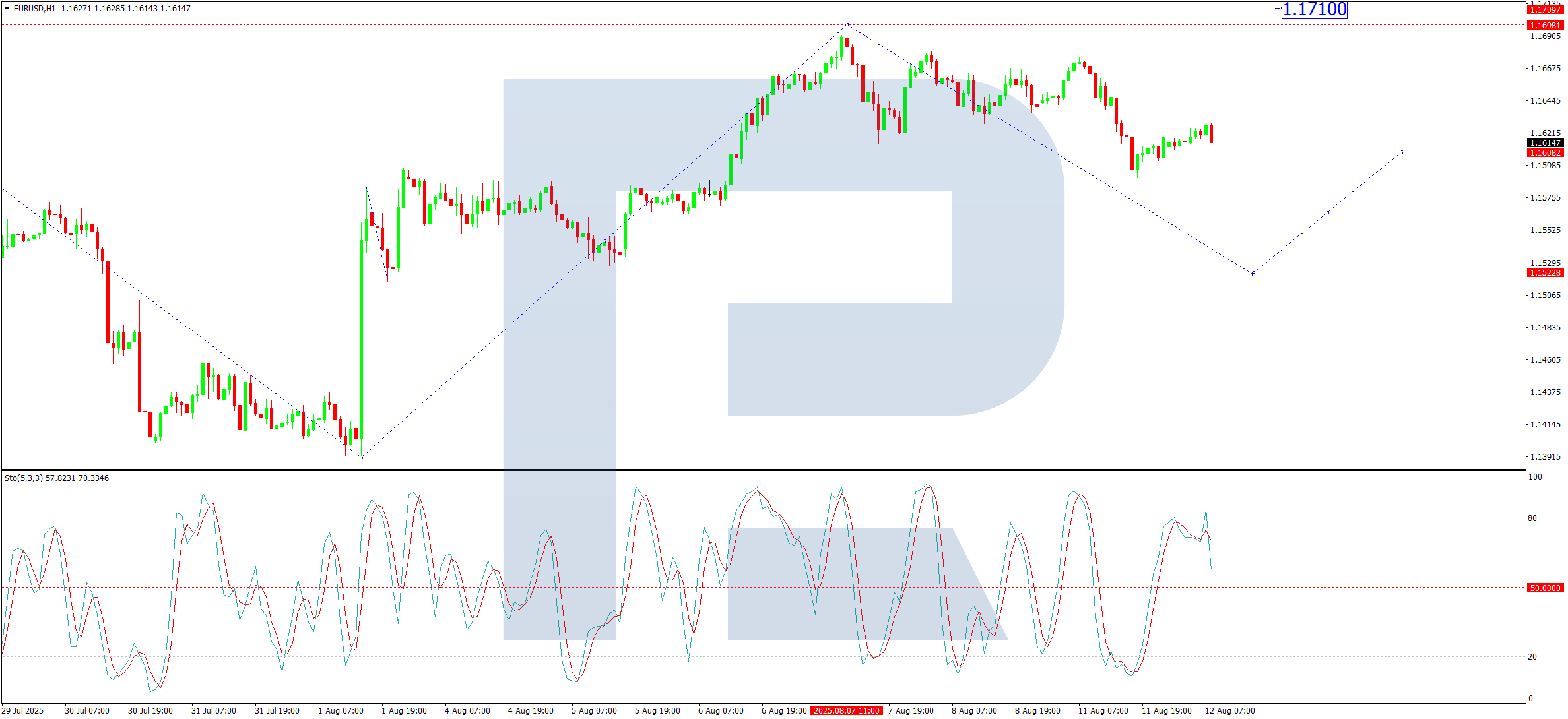
  • The market completed a downward wave to 1.1313, followed by consolidation and a further drop to 1.1210 in a double-wave extension structure
  • Today, a potential upside wave to 1.1260 is in play, with a possible continuation towards 1.1313
  • The Stochastic oscillator aligns with this scenario, with its signal line above 50 and rising towards 80


Conclusion

The EUR/USD remains under pressure amid dollar strength and political uncertainty, with technical indicators suggesting further downside potential unless a corrective rebound materialises.


Disclaimer

Any forecasts contained herein are based on the author’s particular opinion. This analysis may not be treated as trading advice. RoboForex bears no responsibility for trading results based on trading recommendations and reviews contained herein.

RBNZ expectedly cut the interest rate. Inflationary pressures in Australia remained at the same level

By JustMarkets 

At the end of Tuesday, the Dow Jones Index (US30) rose by 1.78%. The S&P 500 Index (US500) was up 2.05%. The Nasdaq Technology Index (US100) closed higher by 2.39%. The US stocks rose sharply on the first trading day of the week, following gains in Treasury securities as markets eased concerns that a new trade war could hamper the corporate outlook.

Tesla shares rose by 6.5% after CEO Elon Musk said he was going to refocus on his companies and reduce political involvement. Nvidia also added 3%, setting the pace for chipmakers ahead of its earnings release this week.

Equity markets in Europe were mostly up on Tuesday. Germany’s DAX (DE40) rose by 0.83%, France’s CAC 40 (FR40) closed down 0.02%, Spain’s IBEX35 (ES35) gained 0.13%, and the UK’s FTSE 100 (UK100) closed higher by 0.69%. European stocks closed solidly higher on Tuesday, extending the previous session’s sharp gains amid easing fears of a trade war with the United States and renewed support from the defense sector. On the economic front, GfK surveys and Eurozone sentiment indicators improved in May.

WTI crude oil prices dipped to $61 a barrel after earlier gains as traders await the OPEC+ meeting, which is expected to decide on an increase in oil production. Sources say OPEC+ is likely to approve a 411,000 bpd production increase in July, continuing a trend of accelerating supply growth after a similar increase scheduled for June.

Asian markets were mostly up yesterday. Japan’s Nikkei 225 (JP225) was up 0.51%, China’s FTSE China A50 (CHA50) decreased by 0.53%, Hong Kong’s Hang Seng (HK50) added 0.43% and Australia’s ASX 200 (AU200) was positive 0.56%.

The New Zealand dollar stabilized around $0.594 on Wednesday, after briefly falling to $0.592 following the Reserve Bank of New Zealand’s interest rate decision. As expected, the RBNZ cut the official money rate by 25 bps to 3.25% for the sixth consecutive time as inflation remains within the target range. The Central Bank also signaled that it has room for further rate cuts to support the economic recovery overshadowed by the US tariffs. The RBNZ now expects a monetary rate cut to 2.92% in the fourth quarter of 2025 and to 2.85% in the first quarter of 2026.

The Australian dollar fell to $0.643 on Wednesday, extending its recent decline despite stronger-than-expected inflation data. Monthly CPI for April came in at 2.4%, unchanged from the previous two months but slightly above market expectations of 2.3%. The data provided limited support for the currency as markets remain focused on the Reserve Bank of Australia’s dovish outlook. The Central Bank cut its policy rate by 25 basis points last week and is expected to continue easing in the coming months.

S&P 500 (US500) 5,921.54 +118.72 (+2.05%)

Dow Jones (US30) 42,343.65 +740.58 (+1.78%)

DAX (DE40) 24,226.49 +198.84 (+0.83%)

FTSE 100 (UK100) 8,778.05 +60.08 (+0.69%)

USD Index 99.60 +0.49 (+0.50%)

News feed for: 2025.05.28

  • Australia Consumer Price Index (m/m) at 04:30 (GMT+3);
  • New Zealand RBNZ Interest Rate Decision at 05:00 (GMT+3);
  • New Zealand RBNZ Rate Statement at 05:00 (GMT+3);
  • New Zealand RBNZ Press Conference at 06:00 (GMT+3);
  • German Unemployment Rate at 10:55 (m/m) (GMT+3);
  • US Richmond Manufacturing Index (m/m) at 17:00 (GMT+3);
  • US FOMC Meeting Minutes at 21:00 (GMT+3).

By JustMarkets


This article reflects a personal opinion and should not be interpreted as an investment advice, and/or offer, and/or a persistent request for carrying out financial transactions, and/or a guarantee, and/or a forecast of future events.

USD/JPY Rises Steadily as Yen Weakens Amid Bond Market Pressures

By RoboForex Analytical Department 

The USD/JPY pair extended its gains on Wednesday, climbing to 144.46 as the Japanese yen depreciated for the third consecutive session.

Key factors driving USD/JPY movement

Markets are closely scrutinising remarks from major central bankers and developments in the bond sector.

Bank of Japan (BoJ) Governor Kazuo Ueda noted that ongoing trade discussions with the US are contributing to heightened uncertainty in Japan’s economic outlook. He reiterated the central bank’s readiness to adjust monetary policy if necessary to achieve its inflation targets.

Meanwhile, Finance Minister Katsunobu Kato stated that authorities are closely monitoring the bond market. This comes after both the yen and Japanese government bond (JGB) yields fell sharply following reports that the Ministry of Finance might reduce the issuance of ultra-long-dated bonds.

The potential reduction in bond supply appears to be an effort to curb rising yields, particularly after last week’s disappointing 20-year bond auction, which saw the weakest demand in a decade. Investors are now turning their attention to an upcoming 40-year bond sale.

Additionally, subdued market volatility and a stable external backdrop have diminished demand for the yen as a safe-haven asset, further contributing to its decline.

Technical analysis: USD/JPY

H4 Chart:

On the H4 chart, USD/JPY completed a downward wave to 142.15 before initiating an upward move towards 145.50, which remains the primary target. Today, we anticipate the completion of this upward wave, followed by a potential pullback to 143.81. A broader consolidation phase around this level is also plausible. This scenario is supported by the MACD indicator, whose signal line remains above zero and continues to trend upwards.

H1 Chart:

On the H1 chart, the pair formed a consolidation range around 143.85 after an initial upward wave. A breakout above this range could see a push towards 145.50, with a possible retracement to 143.85 before resuming the uptrend. A sustained break above 145.50 may extend gains towards 147.20. The Stochastic oscillator aligns with this outlook, with its signal line above 50 and rising towards 80, indicating bullish momentum.


Conclusion

The USD/JPY uptrend remains intact, supported by both fundamental and technical factors. Traders will be watching bond market developments and central bank signals for further directional cues.


Disclaimer

Any forecasts contained herein are based on the author’s particular opinion. This analysis may not be treated as trading advice. RoboForex bears no responsibility for trading results based on trading recommendations and reviews contained herein.

AUD and NZD hit new 2025 highs against the US dollar. European indices continue to grow

By JustMarkets 

The US indices did not trade yesterday due to the bank holiday. The US stock futures jumped on Tuesday after President Donald Trump announced over the holiday weekend that he would delay the imposition of 50% tariffs on European Union goods, extending the deadline to July 9. The decision followed a volatile week for financial markets, driven by growing concerns over the US fiscal outlook and lingering trade uncertainty.

Equity markets in Europe were mostly rising on Monday. Germany’s DAX (DE40) rose by 1.69%, France’s CAC 40 (FR40) closed 1.21% higher, Spain’s IBEX35 (ES35) Index gained 0.83%, and the UK’s FTSE 100 (UK100) was not trading on Monday. Frankfurt’s DAX Index added 1.7% to 23,997 points on Monday, outperforming its regional peers, helped by US President Donald Trump’s decision to delay the imposition of 50% tariffs on EU goods until July 9, up from last Friday’s June 1 deadline. Germany, Europe’s largest economy and a major exporter, increasingly relies on the US as a key market for pharmaceuticals, machinery, cars, and automotive components such as engines and machine parts.

WTI crude prices fell to around $61.3 a barrel on Tuesday on fears of further OPEC+ supply increases. The group will meet later this week and is likely to finalize production targets for July, with reports suggesting a possible increase of 411,000 bpd. Earlier this month, OPEC+ agreed to accelerate oil production increases in June for the second consecutive month. Meanwhile, Iran on Monday refused to suspend uranium enrichment as part of a nuclear deal with the US, just days after Trump hinted that an agreement may be imminent. Iran’s president has said Iran will be fine even if the sides fail to reach an agreement. A failure of nuclear talks would mean continued sanctions against Iran, which would limit Iranian oil supplies and support oil prices.

Asian markets traded flat yesterday. Japan’s Nikkei 225 (JP225) rose by 1.00%, China’s FTSE China A50 (CHA50) lost 1.91%, Hong Kong’s Hang Seng (HK50) decreased by 1.35%, and Australia’s ASX 200 (AU200) was positive 0.01%.

The Bank of Japan (BoJ) should carefully assess the impact of rising food prices on core inflation, which is currently nearing the 2% target, Bank of Japan Governor Kazuo Ueda said. Ueda reiterated the Central Bank’s willingness to raise interest rates if data bolsters confidence in the economic recovery. Despite recent rate hikes and the end of a decade-long economic stimulus program, global uncertainties such as tariff hikes in the US have forced the BOJ to revise its growth expectations downward. Ueda warned that both upside and downside risks remain, especially in fiscal years 2025 and 2026.

In Australia, traders await key Australian inflation data this week, which could play a crucial role in determining the Reserve Bank of Australia’s (RBA) policy trajectory. Last week, the RBA cut the rate to 3.85% as expected and signaled the possibility of further easing in response to increasing economic headwinds and slowing inflation. Markets currently estimate a 65% probability of another rate cut in July, with expectations pointing to a total of 75 basis points of easing by the first quarter of 2026.

There is a high probability that the Reserve Bank of New Zealand (RBNZ) will continue to cut interest rates as early as tomorrow. A 0.25% cut from 3.5% to 3.25% is expected. In the absence of shock results, the New Zealand Dollar is likely to be driven by the bank’s updated expectations. With market pricing in the possibility of a move to below 3% later this year below the 3.1% level that the RBNZ expected three months ago, risks to the New Zealand dollar could be shifted to the upside if the bank fails to meet dovish expectations. The NZD/USD pair briefly touched highs for the year on Monday, rising to levels last seen just after the US presidential election.

S&P 500 (US500) 5,802.82 0 (0%)

Dow Jones (US30) 41,603.07 0 (0%)

DAX (DE40) 24,027.65 +398.07 (+1.68%)

FTSE 100 (UK100) 8,717.97 0 (0%)

USD Index 98.93 −0.18 (−0.18%)

News feed for: 2025.05.27

  • Switzerland Trade Balance (m/m) at 09:00 (GMT+3);
  • German GfK Consumer Climate (m/m) at 09:00 (GMT+3);
  • US Durable Goods Orders (m/m) at 15:30 (GMT+3);
  • US CB Consumer Confidence (m/m) at 17:00 (GMT+3);
  • Switzerland SNB Chairman Schlegel Speaks at 19:20 (GMT+3).

By JustMarkets


This article reflects a personal opinion and should not be interpreted as an investment advice, and/or offer, and/or a persistent request for carrying out financial transactions, and/or a guarantee, and/or a forecast of future events.

GBP/USD in a Strong Position: Sterling Rallies on Trade News and Robust Data

By RoboForex Analytical Department 

The GBP/USD pair surged to 1.3569 on Tuesday, reaching its highest level since February 2022, as the pound capitalised on positive trade developments and strong economic indicators.

Key factors driving GBP/USD movement

The pound’s rally stems from improved market sentiment following US President Donald Trump’s decision to postpone the imposition of 50% tariffs on EU imports until 9 July. Initially set to take effect on 1 June, the delay has granted diplomats additional time to pursue constructive dialogue and negotiate potential compromises.

This reprieve has boosted global risk appetite, providing further support for the pound, which also drew strength from robust domestic economic data.

UK retail sales rose by 1.2% in April, marking the fourth consecutive monthly increase. These figures underscore the resilience of consumers despite ongoing tax hikes and trade tensions.

Meanwhile, inflation remains elevated at 3.5%, exceeding forecasts and raising some concerns.

The base-case scenario suggests the Bank of England is likely to cut interest rates by 50 basis points by August, with a further reduction possible before the end of the year.

Technical analysis: GBP/USD

H4 Chart:

On the H4 chart, GBP/USD has formed a consolidation range below the 1.3590 level. Today, the pair broke downward out of this range, signalling the likely start of a bearish wave towards 1.3360. A breach of this level could extend the downtrend towards 1.3140, with 1.3360 as the initial target. This scenario is technically supported by the MACD indicator, whose signal line has exited the histogram area and is trending sharply downward.

H1 Chart:

On the H1 chart, GBP/USD previously consolidated around 1.3490 before breaking upward and nearly exhausting its bullish potential at 1.3590. Today, the pair formed a new consolidation range below 1.3590 before breaking downward again. We now anticipate a continuation of the bearish movement towards 1.3360. This outlook is corroborated by the Stochastic oscillator, whose signal line remains below 50 and is descending sharply towards 20.


Conclusion

The pound’s recent gains reflect a combination of improved risk sentiment and strong UK economic data. However, persistent inflation and expectations of BoE rate cuts introduce downside risks. Technically, GBP/USD shows bearish momentum, with key support levels at 1.3360 and 1.3140 in focus.


Disclaimer

Any forecasts contained herein are based on the author’s particular opinion. This analysis may not be treated as trading advice. RoboForex bears no responsibility for trading results based on trading recommendations and reviews contained herein.

Trump escalated trade tensions, threatening tariffs against Apple and the EU

By JustMarkets

The Dow Jones Index (US30) decreased by 0.61% (for the week -2.21%) on Friday. The S&P 500 Index (US500) was down 0.67% (for the week -1.70%). The Nasdaq Technology Index (US100) closed lower by 0.93% (for the week -1.05%). The US stocks declined on Friday after Donald Trump escalated trade tensions by threatening tariffs against Apple and the European Union. Apple shares fell 3%, bringing its value below $3 trillion, after Trump demanded that iPhones sold in the US be made domestically or face a 25% tariff. He also proposed a 50% tariff on all imports from the EU starting June 1 due to stalled trade talks, renewing fears of protectionist policies.

The US stock futures jumped on Monday after President Trump announced on Sunday that he would delay the imposition of 50% tariffs against the EU, extending the deadline to July 9. The move came after a turbulent week for markets, with growing concerns over the US fiscal outlook and trade tensions weighing heavily on investor sentiment.

The Canadian dollar (USD/CAD) strengthened to 1.375 per US dollar, the highest since October 2024, as bets that the Bank of Canada (BoC) will be less accommodative added to the impact of a weaker dollar. Canadian retail sales rose by 0.5% in April, following up on a 0.8% increase in March, signaling strength in Canadian consumers.

The Mexican peso (USD/MXN) rose to 19.3 per US dollar in May 2025, the strongest since last October, as budget concerns and tariff uncertainty in the US weakened the dollar. The dollar declined against major currencies after the US House of Representatives approved a bill that could increase the federal budget deficit by more than $3 trillion and days after Moody’s downgraded their debt rating due to unsustainable debt. On the domestic front, the latest data showed that Mexico’s GDP grew 0.2% in the first quarter. While this avoided a technical recession, it signaled underlying weakness in the Mexican economy and a more urgent need for Banxico to cut interest rates.

Equity markets in Europe were mostly falling on Friday. Germany’s DAX (DE40) fell by 1.54% (week ended -0.32%), France’s CAC 40 (FR40) closed down 1.65% (week ended -1.52%), Spain’s IBEX35 (ES35) fell by 1.18% (week ended +0.22%), and the UK’s FTSE 100 (UK100) closed negative 0.24% (week ended +0.38%). European stocks fell sharply on Friday after US President Trump said he recommends imposing tariffs of 50% on goods from the European Union, which could deprive demand from a key source of European exports. Shares of Mercedes Benz, BMW, Stellantis, Hermes and Inditex fell between 2% and 4.5%. Meanwhile, the likelihood of retaliatory measures from the European Commission put pressure on banks, with Intesa Sanpaolo, UniCredit, and BBVA down 3% each. On the data side, German Q1 GDP growth was revised upward to 0.4% from 0.2%, helped by strong manufacturing numbers and a surge in exports in March, suggesting the economy is resilient amid trade tensions.

WTI crude prices rose by 0.5% to settle at $61.50 a barrel on Friday, but still recorded their first weekly loss in three weeks, pressured by expectations of another OPEC+ production increase. The group is expected to increase output by 411,000 barrels a day in July, with discussions next week likely to confirm the move. Market sentiment deteriorated further on reports that OPEC+ may roll back the remainder of its voluntary 2.2 million bpd production cut by October.

Asian markets were mostly up last week. Japan’s Nikkei 225 (JP225) fell by 1.10%, China’s FTSE China A50 (CHA50) gained 0.43%, Hong Kong’s Hang Seng (HK50) rose by 0.92%, and Australia’s ASX 200 (AU200) posted a positive 0.21%.

Japan’s Index of leading economic indicators, which gauges the economic outlook for the coming months based on data such as job offers and consumer sentiment, was revised upward to 108.1 for March 2025 from a preliminary estimate of 107.7. However, the latest reading remains slightly below February’s 108.2 and is the lowest since last December due to deteriorating consumer sentiment.

The New Zealand dollar rose to around USD 0.602 on Monday, extending Friday’s 1.5% gain and nearing its highest level in seven months. The rally was largely driven by a broad-based decline in the US dollar, which weakened amid renewed trade tensions and growing concerns about the US fiscal outlook. However, tensions eased slightly when Trump announced on Sunday that he would extend the deadline for tariff talks with the EU until July 9. Domestically, traders are now awaiting Wednesday’s Reserve Bank of New Zealand (RBNZ) meeting, where the Central Bank is expected to cut the cash rate by 25 bps as inflation remains low. Markets currently expect rates to fall to around 3% or 2.75% by the end of the year.

S&P 500 (US500) 5,802.82 −39.19 (−0.67%)

Dow Jones (US30) 41,603.07 −256.02 (−0.61%)

DAX (DE40) 23,629.58 −369.59 (−1.54%)

FTSE 100 (UK100) 8,717.97 −21.29 (−0.24%)

USD Index 99.10 −0.86 (−0.86%)

News feed for: 2025.05.26

  • Hong Kong Trade Balance (m/m) at 11:30 (GMT+3);
  • Eurozone ECB President Lagarde Speaks at 17:30 (GMT+3).

By JustMarkets


This article reflects a personal opinion and should not be interpreted as an investment advice, and/or offer, and/or a persistent request for carrying out financial transactions, and/or a guarantee, and/or a forecast of future events.

Gold Halts Rally as US Signals Willingness to Discuss Trade Terms with EU

By RoboForex Analytical Department 

The price of gold fell on Monday to $3,346 per troy ounce, pausing its recent upward trend as investors assessed the implications of a phone call between the US and the EU.

Key factors driving gold’s movement

Demand for safe-haven assets weakened after US President Donald Trump announced plans to delay proposed 50% tariffs on European goods. While he had initially intended to impose the levies from 1 June, he set a new deadline of 9 July to allow time for negotiations with the European Union.

However, trade risks persist and remain a focal point for markets. Last Friday, Trump warned Apple Inc. that its products could face 25% tariffs if iPhones are manufactured outside the US.

Gold had surged nearly 5% last week amid escalating trade uncertainty and growing concerns over the US economic and fiscal outlook.

Adding to market apprehension, Trump’s new tax bill – already passed by the House of Representatives and now awaiting a Senate vote – could expand the US budget deficit by nearly $3 trillion over the next decade. A final vote is expected by August.

Technical analysis: XAU/USD

On the H4 chart, XAU/USD found support at 3,280 before rallying to 3,364. A corrective pullback towards 3,255 is possible today, followed by a potential upward move to 3,388. This scenario is supported by the MACD indicator, whose signal line has exited the histogram zone and is now pointing decisively downward.

On the H1 chart, the market has completed its local corrective target. A further decline to at least 3,255 is anticipated today, after which another upward wave may develop towards 3,388. Bullish momentum would likely be exhausted at that point, with the entire rally regarded as a correction within the broader downtrend. Once this correction concludes, a resumption of the downtrend may follow, with a potential decline to 3,222 and an eventual extension towards 3,060. This bearish outlook is corroborated by the Stochastic oscillator, whose signal line has dipped below 80 and is trending sharply downward towards 20.

Conclusion

Gold’s rally has stalled as markets digest shifting US-EU trade dynamics, though lingering risks and technical indicators suggest further volatility ahead.


Disclaimer

Any forecasts contained herein are based on the author’s particular opinion. This analysis may not be treated as trading advice. RoboForex bears no responsibility for trading results based on trading recommendations and reviews contained herein.

COT Metals Charts: Speculator Bets led higher by Platinum & Gold

By InvestMacro

Metals Open Interest COT Chart
Here are the latest charts and statistics for the Commitment of Traders (COT) data published by the Commodities Futures Trading Commission (CFTC).

The latest COT data is updated through Tuesday May 20th and shows a quick view of how large traders (for-profit speculators and commercial entities) were positioned in the futures markets.

Weekly Speculator Changes led by Platinum & Gold

Metals Net Positions COT Chart
The COT metals markets speculator bets were overall higher this week as four out of the six metals markets we cover had higher positioning while the other two markets had lower speculator contracts.

Leading the gains for the metals was Platinum (8,080 contracts) with Gold (2,772 contracts), Silver (2,288 contracts) and Palladium (2,109 contracts) also showing positive weeks.

The market leading the declines in speculator bets for the week was Steel (-618 contracts) and with Copper (-484 contracts) also registering lower bets on the week.


Metals Data:

Metals Table COT Chart
Legend: Weekly Speculators Change | Speculators Current Net Position | Speculators Strength Score compared to last 3-Years (0-100 range)


Strength Scores led by Silver & Steel

Metals Strength Scores COT Chart

COT Strength Scores (a normalized measure of Speculator positions over a 3-Year range, from 0 to 100 where above 80 is Extreme-Bullish and below 20 is Extreme-Bearish) showed that Silver (79 percent) and Steel (73 percent) lead the metals markets this week.

On the downside, Gold (42 percent) and Palladium (42 percent) come in at the lowest strength level currently.

Strength Statistics:
Gold (42.5 percent) vs Gold previous week (41.4 percent)
Silver (79.4 percent) vs Silver previous week (76.5 percent)
Copper (52.8 percent) vs Copper previous week (53.3 percent)
Platinum (57.1 percent) vs Platinum previous week (38.0 percent)
Palladium (41.8 percent) vs Palladium previous week (25.9 percent)
Steel (73.1 percent) vs Palladium previous week (76.1 percent)


Platinum & Palladium top the 6-Week Strength Trends

Metals Trends COT Chart

COT Strength Score Trends (or move index, calculates the 6-week changes in strength scores) showed that Platinum (43 percent) and Palladium (18 percent) lead the past six weeks trends for metals.

Gold (-14 percent) leads the downside trend scores currently with Steel (-11 percent) as the next market with lower trend scores.

Move Statistics:
Gold (-14.0 percent) vs Gold previous week (-29.3 percent)
Silver (4.5 percent) vs Silver previous week (-12.0 percent)
Copper (-3.0 percent) vs Copper previous week (-7.9 percent)
Platinum (43.0 percent) vs Platinum previous week (-13.4 percent)
Palladium (17.8 percent) vs Palladium previous week (-19.5 percent)
Steel (-10.5 percent) vs Steel previous week (-9.0 percent)


Individual Markets:

Gold Comex Futures:

Gold Futures COT ChartThe Gold Comex Futures large speculator standing this week equaled a net position of 163,981 contracts in the data reported through Tuesday. This was a weekly gain of 2,772 contracts from the previous week which had a total of 161,209 net contracts.

This week’s current strength score (the trader positioning range over the past three years, measured from 0 to 100) shows the speculators are currently Bearish with a score of 42.5 percent. The commercials are Bullish with a score of 51.2 percent and the small traders (not shown in chart) are Bullish-Extreme with a score of 100.0 percent.

Price Trend-Following Model: Uptrend

Our weekly trend-following model classifies the current market price position as: Uptrend.

Gold Futures StatisticsSPECULATORSCOMMERCIALSSMALL TRADERS
– Percent of Open Interest Longs:53.120.112.1
– Percent of Open Interest Shorts:16.564.34.6
– Net Position:163,981-197,64833,667
– Gross Longs:238,06290,25654,053
– Gross Shorts:74,081287,90420,386
– Long to Short Ratio:3.2 to 10.3 to 12.7 to 1
NET POSITION TREND:
– Strength Index Score (3 Year Range Pct):42.551.2100.0
– Strength Index Reading (3 Year Range):BearishBullishBullish-Extreme
NET POSITION MOVEMENT INDEX:
– 6-Week Change in Strength Index:-14.012.48.6


Silver Comex Futures:

Silver Futures COT ChartThe Silver Comex Futures large speculator standing this week equaled a net position of 50,042 contracts in the data reported through Tuesday. This was a weekly boost of 2,288 contracts from the previous week which had a total of 47,754 net contracts.

This week’s current strength score (the trader positioning range over the past three years, measured from 0 to 100) shows the speculators are currently Bullish with a score of 79.4 percent. The commercials are Bearish with a score of 20.5 percent and the small traders (not shown in chart) are Bullish with a score of 51.6 percent.

Price Trend-Following Model: Strong Uptrend

Our weekly trend-following model classifies the current market price position as: Strong Uptrend.

Silver Futures StatisticsSPECULATORSCOMMERCIALSSMALL TRADERS
– Percent of Open Interest Longs:50.123.919.0
– Percent of Open Interest Shorts:14.771.17.1
– Net Position:50,042-66,77916,737
– Gross Longs:70,89133,79826,826
– Gross Shorts:20,849100,57710,089
– Long to Short Ratio:3.4 to 10.3 to 12.7 to 1
NET POSITION TREND:
– Strength Index Score (3 Year Range Pct):79.420.551.6
– Strength Index Reading (3 Year Range):BullishBearishBullish
NET POSITION MOVEMENT INDEX:
– 6-Week Change in Strength Index:4.5-3.0-3.7


Copper Grade #1 Futures:

Copper Futures COT ChartThe Copper Grade #1 Futures large speculator standing this week equaled a net position of 21,038 contracts in the data reported through Tuesday. This was a weekly decrease of -484 contracts from the previous week which had a total of 21,522 net contracts.

This week’s current strength score (the trader positioning range over the past three years, measured from 0 to 100) shows the speculators are currently Bullish with a score of 52.8 percent. The commercials are Bullish with a score of 50.3 percent and the small traders (not shown in chart) are Bearish with a score of 32.2 percent.

Price Trend-Following Model: Uptrend

Our weekly trend-following model classifies the current market price position as: Uptrend.

Copper Futures StatisticsSPECULATORSCOMMERCIALSSMALL TRADERS
– Percent of Open Interest Longs:33.631.56.9
– Percent of Open Interest Shorts:23.442.95.7
– Net Position:21,038-23,4232,385
– Gross Longs:69,01564,58014,164
– Gross Shorts:47,97788,00311,779
– Long to Short Ratio:1.4 to 10.7 to 11.2 to 1
NET POSITION TREND:
– Strength Index Score (3 Year Range Pct):52.850.332.2
– Strength Index Reading (3 Year Range):BullishBullishBearish
NET POSITION MOVEMENT INDEX:
– 6-Week Change in Strength Index:-3.0-1.731.5


Platinum Futures:

Platinum Futures COT ChartThe Platinum Futures large speculator standing this week equaled a net position of 17,396 contracts in the data reported through Tuesday. This was a weekly lift of 8,080 contracts from the previous week which had a total of 9,316 net contracts.

This week’s current strength score (the trader positioning range over the past three years, measured from 0 to 100) shows the speculators are currently Bullish with a score of 57.1 percent. The commercials are Bullish with a score of 53.7 percent and the small traders (not shown in chart) are Bearish-Extreme with a score of 0.0 percent.

Price Trend-Following Model: Strong Uptrend

Our weekly trend-following model classifies the current market price position as: Strong Uptrend.

Platinum Futures StatisticsSPECULATORSCOMMERCIALSSMALL TRADERS
– Percent of Open Interest Longs:61.320.89.1
– Percent of Open Interest Shorts:40.142.19.0
– Net Position:17,396-17,517121
– Gross Longs:50,29317,0497,490
– Gross Shorts:32,89734,5667,369
– Long to Short Ratio:1.5 to 10.5 to 11.0 to 1
NET POSITION TREND:
– Strength Index Score (3 Year Range Pct):57.153.70.0
– Strength Index Reading (3 Year Range):BullishBullishBearish-Extreme
NET POSITION MOVEMENT INDEX:
– 6-Week Change in Strength Index:43.0-21.3-100.0


Palladium Futures:

Palladium Futures COT ChartThe Palladium Futures large speculator standing this week equaled a net position of -8,352 contracts in the data reported through Tuesday. This was a weekly lift of 2,109 contracts from the previous week which had a total of -10,461 net contracts.

This week’s current strength score (the trader positioning range over the past three years, measured from 0 to 100) shows the speculators are currently Bearish with a score of 41.8 percent. The commercials are Bullish with a score of 55.4 percent and the small traders (not shown in chart) are Bullish with a score of 64.5 percent.

Price Trend-Following Model: Weak Downtrend

Our weekly trend-following model classifies the current market price position as: Weak Downtrend.

Palladium Futures StatisticsSPECULATORSCOMMERCIALSSMALL TRADERS
– Percent of Open Interest Longs:28.446.511.9
– Percent of Open Interest Shorts:70.08.68.2
– Net Position:-8,3527,622730
– Gross Longs:5,7129,3442,386
– Gross Shorts:14,0641,7221,656
– Long to Short Ratio:0.4 to 15.4 to 11.4 to 1
NET POSITION TREND:
– Strength Index Score (3 Year Range Pct):41.855.464.5
– Strength Index Reading (3 Year Range):BearishBullishBullish
NET POSITION MOVEMENT INDEX:
– 6-Week Change in Strength Index:17.8-17.0-6.7


Steel Futures Futures:

Steel Futures COT ChartThe Steel Futures large speculator standing this week equaled a net position of -447 contracts in the data reported through Tuesday. This was a weekly decrease of -618 contracts from the previous week which had a total of 171 net contracts.

This week’s current strength score (the trader positioning range over the past three years, measured from 0 to 100) shows the speculators are currently Bullish with a score of 73.1 percent. The commercials are Bearish with a score of 27.9 percent and the small traders (not shown in chart) are Bearish with a score of 40.8 percent.

Price Trend-Following Model: Uptrend

Our weekly trend-following model classifies the current market price position as: Uptrend.

Steel Futures StatisticsSPECULATORSCOMMERCIALSSMALL TRADERS
– Percent of Open Interest Longs:27.567.11.0
– Percent of Open Interest Shorts:28.766.10.8
– Net Position:-44737077
– Gross Longs:10,20924,861362
– Gross Shorts:10,65624,491285
– Long to Short Ratio:1.0 to 11.0 to 11.3 to 1
NET POSITION TREND:
– Strength Index Score (3 Year Range Pct):73.127.940.8
– Strength Index Reading (3 Year Range):BullishBearishBearish
NET POSITION MOVEMENT INDEX:
– 6-Week Change in Strength Index:-10.510.18.8


Article By InvestMacroReceive our weekly COT Newsletter

*COT Report: The COT data, released weekly to the public each Friday, is updated through the most recent Tuesday (data is 3 days old) and shows a quick view of how large speculators or non-commercials (for-profit traders) were positioned in the futures markets.

The CFTC categorizes trader positions according to commercial hedgers (traders who use futures contracts for hedging as part of the business), non-commercials (large traders who speculate to realize trading profits) and nonreportable traders (usually small traders/speculators) as well as their open interest (contracts open in the market at time of reporting). See CFTC criteria here.


COT Bonds Charts: Speculator Bets led lower by SOFR 3-Months & 5-Year Bonds

By InvestMacro

Bonds Market Open Interest Comparison
Here are the latest charts and statistics for the Commitment of Traders (COT) reports data published by the Commodities Futures Trading Commission (CFTC).

The latest COT data is updated through Tuesday May 20th and shows a quick view of how large traders (for-profit speculators and commercial hedgers) were positioned in the futures markets.

Weekly Speculator Changes led lower by SOFR 3-Months & 5-Year Bonds

Bonds Market Net Speculators Positions
The COT bond market speculator bets were overall lower this week as four out of the nine bond markets we cover had higher positioning while the other five markets had lower speculator contracts.

Leading the gains for the bond markets was the 10-Year Bonds (38,920 contracts) with the SOFR 1-Month (20,104 contracts), the Ultra Treasury Bonds (15,087 contracts) and the US Treasury Bonds (5,596 contracts) also having positive weeks.

The bond markets with declines in speculator bets for the week were the SOFR 3-Months (-232,067 contracts), the 5-Year Bonds (-95,898 contracts), the Fed Funds (-51,861 contracts), the 2-Year Bonds (-45,099 contracts) and with the Ultra 10-Year Bonds (-8,837 contracts) also seeing lower bets on the week.


Bonds Data:

Bonds Market Speculators Data Table
Legend: Open Interest | Speculators Current Net Position | Weekly Specs Change | Specs Strength Score compared to last 3-Years (0-100 range)


Strength Scores led by Ultra Treasury Bonds & SOFR 1-Month

Bonds Market Strength Index Comparison
COT Strength Scores (a normalized measure of Speculator positions over a 3-Year range, from 0 to 100 where above 80 is Extreme-Bullish and below 20 is Extreme-Bearish) showed that the Ultra Treasury Bonds (80 percent) and the SOFR 1-Month (72 percent) lead the bond markets this week. The US Treasury Bonds (58 percent) comes in as the next highest in the weekly strength scores.

On the downside, the Ultra 10-Year Bonds (0 percent), the 5-Year Bonds (1 percent), the SOFR 3-Months (10 percent) and the 2-Year Bonds (15 percent) come in at the lowest strength level currently and are in Extreme-Bearish territory (below 20 percent).

Strength Statistics:
Fed Funds (30.4 percent) vs Fed Funds previous week (39.9 percent)
2-Year Bond (15.4 percent) vs 2-Year Bond previous week (18.6 percent)
5-Year Bond (0.9 percent) vs 5-Year Bond previous week (5.3 percent)
10-Year Bond (28.2 percent) vs 10-Year Bond previous week (24.5 percent)
Ultra 10-Year Bond (0.0 percent) vs Ultra 10-Year Bond previous week (2.7 percent)
US Treasury Bond (58.3 percent) vs US Treasury Bond previous week (56.4 percent)
Ultra US Treasury Bond (80.3 percent) vs Ultra US Treasury Bond previous week (74.6 percent)
SOFR 1-Month (72.2 percent) vs SOFR 1-Month previous week (67.2 percent)
SOFR 3-Months (9.8 percent) vs SOFR 3-Months previous week (21.8 percent)


10-Year Bonds & SOFR 1-Month top the 6-Week Strength Trends

Bonds Market Trend Index Comparison
COT Strength Score Trends (or move index, calculates the 6-week changes in strength scores) showed that the 10-Year Bonds (22 percent) and the SOFR 1-Month (22 percent) lead the past six weeks trends for bonds.

The Ultra 10-Year Bond (-55 percent), the US Treasury Bonds (-19 percent) and the Ultra Treasury Bonds (-18 percent) lead the downside trend scores.

Strength Trend Statistics:
Fed Funds (-9.3 percent) vs Fed Funds previous week (13.0 percent)
2-Year Bond (-4.9 percent) vs 2-Year Bond previous week (0.3 percent)
5-Year Bond (-11.6 percent) vs 5-Year Bond previous week (-7.2 percent)
10-Year Bond (21.9 percent) vs 10-Year Bond previous week (-2.6 percent)
Ultra 10-Year Bond (-54.7 percent) vs Ultra 10-Year Bond previous week (-66.4 percent)
US Treasury Bond (-18.7 percent) vs US Treasury Bond previous week (-15.6 percent)
Ultra US Treasury Bond (-17.5 percent) vs Ultra US Treasury Bond previous week (-2.7 percent)
SOFR 1-Month (22.3 percent) vs SOFR 1-Month previous week (8.7 percent)
SOFR 3-Months (-15.7 percent) vs SOFR 3-Months previous week (5.5 percent)


30-Day Federal Funds Futures:

Federal Funds 30-Day Bonds Futures COT ChartThe 30-Day Federal Funds large speculator standing this week came in at a net position of -131,330 contracts in the data reported through Tuesday. This was a weekly fall of -51,861 contracts from the previous week which had a total of -79,469 net contracts.

This week’s current strength score (the trader positioning range over the past three years, measured from 0 to 100) shows the speculators are currently Bearish with a score of 30.4 percent. The commercials are Bullish with a score of 61.7 percent and the small traders (not shown in chart) are Bullish-Extreme with a score of 92.9 percent.

Price Trend-Following Model: Downtrend

Our weekly trend-following model classifies the current market price position as: Downtrend.

30-Day Federal Funds StatisticsSPECULATORSCOMMERCIALSSMALL TRADERS
– Percent of Open Interest Longs:17.467.42.5
– Percent of Open Interest Shorts:23.562.41.4
– Net Position:-131,330107,99023,340
– Gross Longs:371,4411,439,97753,265
– Gross Shorts:502,7711,331,98729,925
– Long to Short Ratio:0.7 to 11.1 to 11.8 to 1
NET POSITION TREND:
– Strength Index Score (3 Year Range Pct):30.461.792.9
– Strength Index Reading (3 Year Range):BearishBullishBullish-Extreme
NET POSITION MOVEMENT INDEX:
– 6-Week Change in Strength Index:-9.36.221.4


Secured Overnight Financing Rate (3-Month) Futures:

SOFR 3-Months Bonds Futures COT ChartThe Secured Overnight Financing Rate (3-Month) large speculator standing this week came in at a net position of -976,935 contracts in the data reported through Tuesday. This was a weekly reduction of -232,067 contracts from the previous week which had a total of -744,868 net contracts.

This week’s current strength score (the trader positioning range over the past three years, measured from 0 to 100) shows the speculators are currently Bearish-Extreme with a score of 9.8 percent. The commercials are Bullish-Extreme with a score of 89.6 percent and the small traders (not shown in chart) are Bullish-Extreme with a score of 89.1 percent.

Price Trend-Following Model: Weak Uptrend

Our weekly trend-following model classifies the current market price position as: Weak Uptrend.

SOFR 3-Months StatisticsSPECULATORSCOMMERCIALSSMALL TRADERS
– Percent of Open Interest Longs:10.259.90.5
– Percent of Open Interest Shorts:19.151.20.4
– Net Position:-976,935966,62510,310
– Gross Longs:1,121,2066,592,08850,941
– Gross Shorts:2,098,1415,625,46340,631
– Long to Short Ratio:0.5 to 11.2 to 11.3 to 1
NET POSITION TREND:
– Strength Index Score (3 Year Range Pct):9.889.689.1
– Strength Index Reading (3 Year Range):Bearish-ExtremeBullish-ExtremeBullish-Extreme
NET POSITION MOVEMENT INDEX:
– 6-Week Change in Strength Index:-15.715.52.7


Individual Bond Markets:

Secured Overnight Financing Rate (1-Month) Futures:

SOFR 1-Month Bonds Futures COT ChartThe Secured Overnight Financing Rate (1-Month) large speculator standing this week came in at a net position of 15,032 contracts in the data reported through Tuesday. This was a weekly boost of 20,104 contracts from the previous week which had a total of -5,072 net contracts.

This week’s current strength score (the trader positioning range over the past three years, measured from 0 to 100) shows the speculators are currently Bullish with a score of 72.2 percent. The commercials are Bearish with a score of 29.0 percent and the small traders (not shown in chart) are Bullish with a score of 57.4 percent.

Price Trend-Following Model: Weak Downtrend

Our weekly trend-following model classifies the current market price position as: Weak Downtrend.

SOFR 1-Month StatisticsSPECULATORSCOMMERCIALSSMALL TRADERS
– Percent of Open Interest Longs:17.564.60.0
– Percent of Open Interest Shorts:16.365.40.4
– Net Position:15,032-10,453-4,579
– Gross Longs:227,059838,502566
– Gross Shorts:212,027848,9555,145
– Long to Short Ratio:1.1 to 11.0 to 10.1 to 1
NET POSITION TREND:
– Strength Index Score (3 Year Range Pct):72.229.057.4
– Strength Index Reading (3 Year Range):BullishBearishBullish
NET POSITION MOVEMENT INDEX:
– 6-Week Change in Strength Index:22.3-21.6-5.6


2-Year Treasury Note Futures:

2-Year Treasury Bonds Futures COT ChartThe 2-Year Treasury Note large speculator standing this week came in at a net position of -1,267,331 contracts in the data reported through Tuesday. This was a weekly decrease of -45,099 contracts from the previous week which had a total of -1,222,232 net contracts.

This week’s current strength score (the trader positioning range over the past three years, measured from 0 to 100) shows the speculators are currently Bearish-Extreme with a score of 15.4 percent. The commercials are Bullish-Extreme with a score of 83.7 percent and the small traders (not shown in chart) are Bullish with a score of 75.3 percent.

Price Trend-Following Model: Uptrend

Our weekly trend-following model classifies the current market price position as: Uptrend.

2-Year Treasury Note StatisticsSPECULATORSCOMMERCIALSSMALL TRADERS
– Percent of Open Interest Longs:14.076.25.9
– Percent of Open Interest Shorts:43.849.42.9
– Net Position:-1,267,3311,140,386126,945
– Gross Longs:592,2943,235,687250,064
– Gross Shorts:1,859,6252,095,301123,119
– Long to Short Ratio:0.3 to 11.5 to 12.0 to 1
NET POSITION TREND:
– Strength Index Score (3 Year Range Pct):15.483.775.3
– Strength Index Reading (3 Year Range):Bearish-ExtremeBullish-ExtremeBullish
NET POSITION MOVEMENT INDEX:
– 6-Week Change in Strength Index:-4.95.9-0.3


5-Year Treasury Note Futures:

5-Year Treasury Bonds Futures COT ChartThe 5-Year Treasury Note large speculator standing this week came in at a net position of -2,275,941 contracts in the data reported through Tuesday. This was a weekly decline of -95,898 contracts from the previous week which had a total of -2,180,043 net contracts.

This week’s current strength score (the trader positioning range over the past three years, measured from 0 to 100) shows the speculators are currently Bearish-Extreme with a score of 0.9 percent. The commercials are Bullish-Extreme with a score of 100.0 percent and the small traders (not shown in chart) are Bullish-Extreme with a score of 83.4 percent.

Price Trend-Following Model: Uptrend

Our weekly trend-following model classifies the current market price position as: Uptrend.

5-Year Treasury Note StatisticsSPECULATORSCOMMERCIALSSMALL TRADERS
– Percent of Open Interest Longs:8.080.76.1
– Percent of Open Interest Shorts:39.551.73.6
– Net Position:-2,275,9412,097,939178,002
– Gross Longs:579,5145,832,382439,625
– Gross Shorts:2,855,4553,734,443261,623
– Long to Short Ratio:0.2 to 11.6 to 11.7 to 1
NET POSITION TREND:
– Strength Index Score (3 Year Range Pct):0.9100.083.4
– Strength Index Reading (3 Year Range):Bearish-ExtremeBullish-ExtremeBullish-Extreme
NET POSITION MOVEMENT INDEX:
– 6-Week Change in Strength Index:-11.616.2-8.7


10-Year Treasury Note Futures:

10-Year Treasury Notes Bonds Futures COT ChartThe 10-Year Treasury Note large speculator standing this week came in at a net position of -851,431 contracts in the data reported through Tuesday. This was a weekly advance of 38,920 contracts from the previous week which had a total of -890,351 net contracts.

This week’s current strength score (the trader positioning range over the past three years, measured from 0 to 100) shows the speculators are currently Bearish with a score of 28.2 percent. The commercials are Bullish with a score of 72.6 percent and the small traders (not shown in chart) are Bullish with a score of 77.1 percent.

Price Trend-Following Model: Weak Uptrend

Our weekly trend-following model classifies the current market price position as: Weak Uptrend.

10-Year Treasury Note StatisticsSPECULATORSCOMMERCIALSSMALL TRADERS
– Percent of Open Interest Longs:9.676.18.4
– Percent of Open Interest Shorts:25.961.46.8
– Net Position:-851,431766,54084,891
– Gross Longs:503,7063,980,135438,754
– Gross Shorts:1,355,1373,213,595353,863
– Long to Short Ratio:0.4 to 11.2 to 11.2 to 1
NET POSITION TREND:
– Strength Index Score (3 Year Range Pct):28.272.677.1
– Strength Index Reading (3 Year Range):BearishBullishBullish
NET POSITION MOVEMENT INDEX:
– 6-Week Change in Strength Index:21.9-18.3-22.9


Ultra 10-Year Notes Futures:

Ultra 10-Year Treasury Notes Bonds Futures COT ChartThe Ultra 10-Year Notes large speculator standing this week came in at a net position of -328,444 contracts in the data reported through Tuesday. This was a weekly decrease of -8,837 contracts from the previous week which had a total of -319,607 net contracts.

This week’s current strength score (the trader positioning range over the past three years, measured from 0 to 100) shows the speculators are currently Bearish-Extreme with a score of 0.0 percent. The commercials are Bullish-Extreme with a score of 100.0 percent and the small traders (not shown in chart) are Bullish with a score of 78.1 percent.

Price Trend-Following Model: Weak Uptrend

Our weekly trend-following model classifies the current market price position as: Weak Uptrend.

Ultra 10-Year Notes StatisticsSPECULATORSCOMMERCIALSSMALL TRADERS
– Percent of Open Interest Longs:11.676.09.2
– Percent of Open Interest Shorts:25.560.510.9
– Net Position:-328,444368,159-39,715
– Gross Longs:276,2501,805,143218,835
– Gross Shorts:604,6941,436,984258,550
– Long to Short Ratio:0.5 to 11.3 to 10.8 to 1
NET POSITION TREND:
– Strength Index Score (3 Year Range Pct):0.0100.078.1
– Strength Index Reading (3 Year Range):Bearish-ExtremeBullish-ExtremeBullish
NET POSITION MOVEMENT INDEX:
– 6-Week Change in Strength Index:-54.776.0-21.9


US Treasury Bonds Futures:

US Year Treasury Notes Long Bonds Futures COT ChartThe US Treasury Bonds large speculator standing this week came in at a net position of -72,033 contracts in the data reported through Tuesday. This was a weekly gain of 5,596 contracts from the previous week which had a total of -77,629 net contracts.

This week’s current strength score (the trader positioning range over the past three years, measured from 0 to 100) shows the speculators are currently Bullish with a score of 58.3 percent. The commercials are Bearish with a score of 33.2 percent and the small traders (not shown in chart) are Bullish-Extreme with a score of 81.0 percent.

Price Trend-Following Model: Strong Downtrend

Our weekly trend-following model classifies the current market price position as: Strong Downtrend.

US Treasury Bonds StatisticsSPECULATORSCOMMERCIALSSMALL TRADERS
– Percent of Open Interest Longs:9.973.912.7
– Percent of Open Interest Shorts:13.875.07.8
– Net Position:-72,033-19,93491,967
– Gross Longs:184,1971,369,023235,851
– Gross Shorts:256,2301,388,957143,884
– Long to Short Ratio:0.7 to 11.0 to 11.6 to 1
NET POSITION TREND:
– Strength Index Score (3 Year Range Pct):58.333.281.0
– Strength Index Reading (3 Year Range):BullishBearishBullish-Extreme
NET POSITION MOVEMENT INDEX:
– 6-Week Change in Strength Index:-18.717.6-4.9


Ultra US Treasury Bonds Futures:

Ultra US Year Treasury Notes Long Bonds Futures COT ChartThe Ultra US Treasury Bonds large speculator standing this week came in at a net position of -246,135 contracts in the data reported through Tuesday. This was a weekly lift of 15,087 contracts from the previous week which had a total of -261,222 net contracts.

This week’s current strength score (the trader positioning range over the past three years, measured from 0 to 100) shows the speculators are currently Bullish-Extreme with a score of 80.3 percent. The commercials are Bearish with a score of 29.8 percent and the small traders (not shown in chart) are Bearish with a score of 25.7 percent.

Price Trend-Following Model: Strong Downtrend

Our weekly trend-following model classifies the current market price position as: Strong Downtrend.

Ultra US Treasury Bonds StatisticsSPECULATORSCOMMERCIALSSMALL TRADERS
– Percent of Open Interest Longs:5.979.99.4
– Percent of Open Interest Shorts:18.468.08.8
– Net Position:-246,135234,92411,211
– Gross Longs:117,1271,577,209184,656
– Gross Shorts:363,2621,342,285173,445
– Long to Short Ratio:0.3 to 11.2 to 11.1 to 1
NET POSITION TREND:
– Strength Index Score (3 Year Range Pct):80.329.825.7
– Strength Index Reading (3 Year Range):Bullish-ExtremeBearishBearish
NET POSITION MOVEMENT INDEX:
– 6-Week Change in Strength Index:-17.529.8-39.8


Article By InvestMacroReceive our weekly COT Newsletter

*COT Report: The COT data, released weekly to the public each Friday, is updated through the most recent Tuesday (data is 3 days old) and shows a quick view of how large speculators or non-commercials (for-profit traders) were positioned in the futures markets.

The CFTC categorizes trader positions according to commercial hedgers (traders who use futures contracts for hedging as part of the business), non-commercials (large traders who speculate to realize trading profits) and nonreportable traders (usually small traders/speculators) as well as their open interest (contracts open in the market at time of reporting). See CFTC criteria here.