Archive for Financial News – Page 52

EUR/USD extends rally for ninth consecutive day as dollar remains weak

By RoboForex Analytical Department 

The EUR/USD pair soared to 1.1801 on Wednesday, marking its ninth consecutive day of gains. The US dollar remains under heavy pressure due to expectations of a dovish shift in Federal Reserve policy and growing concerns over President Donald Trump’s fiscal strategy.

Fed maintains cautious stance while fiscal worries mount

On Tuesday, Fed Chair Jerome Powell reiterated that the central bank will maintain a wait-and-see approach, but he did not rule out a potential rate cut at the next meeting. Powell emphasised that future decisions would depend on economic data, adding that the Fed could have already cut rates were it not for inflationary pressures from Trump’s tariffs.

Meanwhile, the US Senate narrowly approved a massive tax and budget package expected to increase the national debt by 3.3 trillion USD. The bill now returns to the House of Representatives for final approval, fuelling further concerns over the US fiscal outlook.

Key data ahead to guide the market

Investors are now awaiting crucial US employment data:

  • Wednesday: ADP report on private sector employment
  • Thursday: June labour market statistics

These releases could provide further clarity on the Fed’s next policy steps.

Technical analysis of EUR/USD

On the H4 chart, EUR/USD has completed a growth wave to 1.1777, with a consolidation range forming around this level. Today, an upward expansion is expected to 1.1848, followed by a decline to 1.1750, marking the range boundaries. An upward breakout could extend the range to 1.1885, while a downward breakout would open the potential for a decline to 1.1430. The MACD indicator confirms this outlook, with its signal line above zero and exiting the histogram zone, suggesting an approaching correction as it nears the zero line.

On the H1 chart, EUR/USD continues forming a consolidation range around 1.1777. Today, an expansion upwards to 1.1848 is likely. However, it is essential to note that the growth potential is nearly exhausted, and the market may soon begin a downward trend towards 1.1660, with the potential to extend to 1.1616. The Stochastic oscillator confirms this scenario, with its signal line below 80 and pointing sharply downward towards 20, indicating the building of bearish momentum.

Conclusion

The EUR/USD maintains its strong rally amid dovish Fed expectations and US fiscal concerns, with resistance levels at 1.1848 and 1.1885. Support lies at 1.1750, 1.1660, and 1.1616. Upcoming employment data will be crucial in determining whether the pair sustains its upward trend or reverses into a corrective phase.


Disclaimer

Any forecasts contained herein are based on the author’s particular opinion. This analysis may not be treated as trading advice. RoboForex bears no responsibility for trading results based on trading recommendations and reviews contained herein.

The RBA intends to lower rates next week. The Singapore dollar strengthened to a 10-year high against the US dollar

By JustMarkets 

At the end of Monday, the Dow Jones Index (US30) rose by 0.63%. The S&P 500 Index (US500) added 0.52%. The Nasdaq (US100) Technology Index closed higher by 0.64%. The S&P 500 (US500) and Nasdaq (US100) indices updated their historical highs, helped by strong performance from tech giants such as Microsoft and Meta, which also reached new highs. Optimism increased amid signs of progress in trade negotiations, as evidenced by Canada’s recent decision to cancel a digital services tax targeting US technology companies, which eased tensions that had been weighing on the markets. Investors remain focused on July 9, when President Trump’s tariff reprieve expires, and hope that additional trade deals will help avoid tariff escalation.

European stock markets were mostly down on Monday. The German DAX (DE40) fell by 0.51%, the French CAC 40 (FR 40) closed down 0.33%, the Spanish IBEX35 (ES35) added 0.16%, and the British FTSE 100 (UK100) closed down 0.43%. Inflation in Germany surprised with a decline, falling to 2% year-on-year in June from 2.1% in May and against market expectations of 2.2%. A separate report showed that retail sales fell 1.6% in May after declining 0.6% in the previous month, indicating continued weakness in consumer demand.

WTI crude oil prices fell to $64.7 per barrel on Tuesday, posting a second consecutive day of losses amid concerns about oversupply amid OPEC+ plans to increase production. The group is reportedly planning to increase production by 411,000 barrels per day in August, following similar increases in May, June, and July. If confirmed, the total increase in supply from OPEC+ would be 1.78 million barrels per day this year, equivalent to more than 1.5% of total global demand.

Asian markets were mostly higher yesterday. Japan’s Nikkei 225 (JP225) rose by 0.84%, China’s FTSE China A50 (CHA50) added 0.09%, Hong Kong’s Hang Seng (HK50) fell by 0.87%, and Australia’s ASX 200 (AU200) showed a positive result of 0.33%.

The Australian dollar weakened to $0.656 on Tuesday after reaching seven-month highs in the previous session, as growing expectations of a rate cut at the Reserve Bank of Australia’s (RBA) July 2025 meeting put pressure on the currency. Markets are now pricing in a 95% probability that the Central Bank will cut its cash rate by 25 basis points to 3.60%, even if Wednesday’s retail sales data exceeds expectations. An additional argument in favor of easing monetary policy is the continued low consumer spending figures, which consistently fall short of the RBA’s expectations.

In early July, the Singapore dollar strengthened to around 1.27 per US dollar, its highest level since October 2014, supported by steady domestic policy adjustments, increased risk appetite, and a general weakening of the US dollar. The Monetary Authority of Singapore (MAS) recently took a balanced approach, slightly reducing the slope of the SGD nominal effective exchange rate corridor to reflect the slowdown in economic growth.

Annual inflation in Indonesia accelerated to 1.87% in June 2025 from 1.60% in May, slightly above market expectations of 1.83%, remaining within the Central Bank’s target range of 1.5% to 3.5%. Core inflation, which excludes food prices, fell to a five-month low of 2.37% from 2.4% in May and was below the consensus expectations of 2.44%.

S&P 500 (US500) 6,204.95 +31.88 (+0.52%)

Dow Jones (US30) 44,094.77 +275.50 (+0.63%)

DAX (DE40) 23,909.61 −123.61 (−0.51%)

FTSE 100 (UK100) 8,760.96 −37.95 (−0.43%)

USD Index 96.91 −0.49 (−0.51%)

News feed for: 2025.07.01

  • Japan Tankan Large Manufacturers (m/m) at 02:50 (GMT+3);
  • Japan Tankan Large Non-Manufacturers (m/m) at 02:50 (GMT+3);
  • Japan Manufacturing PMI (m/m) at 03:30 (GMT+3);
  • China Caixin Manufacturing PMI (m/m) at 04:45 (GMT+3);
  • Japan Consumer Confidence (m/m) at 08:00 (GMT+3);
  • Switzerland Retail Sales (m/m) at 09:30 (GMT+3);
  • Switzerland Manufacturing PMI (m/m) at 10:30 (GMT+3);
  • German Manufacturing PMI (m/m) at 10:55 (GMT+3);
  • German Unemployment Rate (m/m) at 10:55 (GMT+3);
  • Eurozone Manufacturing PMI (m/m) at 11:00 (GMT+3);
  • UK Manufacturing PMI (m/m) at 11:30 (GMT+3);
  • Eurozone Inflation Rate (m/m) at 12:00 (GMT+3);
  • Eurozone ECB President Lagarde Speaks at 16:30 (GMT+3);
  • UK BoE Gov Bailey Speech Speaks at 16:30 (GMT+3);
  • Japan BoJ Ueda Lagarde Speaks at 16:30 (GMT+3);
  • US Fed Chair Powell Speech Speaks at 16:30 (GMT+3);
  • US ISM Manufacturing PMI (m/m) at 17:00 (GMT+3);
  • US JOLTS Job Openings (m/m) at 17:00 (GMT+3).

By JustMarkets


This article reflects a personal opinion and should not be interpreted as an investment advice, and/or offer, and/or a persistent request for carrying out financial transactions, and/or a guarantee, and/or a forecast of future events.

US trade threats against Canada are putting pressure on the Canadian dollar. European indices returned to growth amid the postponement of tariffs

By JustMarkets 

On Friday, US stocks closed at record highs, thanks to optimism about upcoming trade agreements and growing expectations of interest rate cuts. At the end of Friday, the Dow Jones Index (US30) rose by 1.00% (+3.89% for the week). The S&P 500 Index (US500) added 0.52% (+3.41% for the week). The Nasdaq (US100) Tech Index closed up 0.39% (+4.17% for the week). Earlier in the day, markets rose on encouraging news of progress in trade with key partners, including a framework agreement with China. Although Trump’s unexpected comments about Canada briefly dampened sentiment, they failed to derail the broader rally.

As for Friday’s data, inflation expectations for the year ahead fell to 5% from 6.6% last month, which is even lower than the preliminary estimate of 5.1%. Long-term inflation expectations were also revised down to 4% from the preliminary 4.1% and compared to 4.2% in May.

The Canadian dollar (CAD) weakened to 1.37 per US dollar as new threats from the US regarding tariffs and trade policy uncertainty offset previous gains. President Trump’s announcement that he was ending all trade talks with Canada over a new digital services tax and his warning of inevitable retaliatory tariffs rattled exporters and undermined confidence in the economy’s imminent growth. Domestically, Canada’s economy contracted by 0.1% per month in April and May, highlighting its vulnerability to US tariffs and worsening the outlook for trade-sensitive sectors.

The Mexican peso (MXN) strengthened to 18.81 per US dollar, reaching ten-month highs amid easing geopolitical tensions, dovish signals from the Fed, and solid domestic fundamentals. Despite unemployment rising to 2.7% in May, the labor market remains historically tight, supporting consumption and incomes even with a slight contraction in GDP in Q1, supporting Banxico’s cautious accommodative stance.

Equity markets in Europe were mostly rising on Friday. The German DAX (DE40) rose by 1.62% (+3.40% for the week), the French CAC 40 (FR40) closed up 1.78% (+1.88% for the week), the Spanish IBEX35 (ES35) rose by 1.11% (+1.43% for the week), and the British FTSE 100 (UK100) closed up 0.72% (+0.28% for the week). The rally was supported by progress on the trade front, including the agreement between the US and China and the potential delay in the introduction of tariffs in Europe. On the corporate front, growth was broad-based, led by automakers. Porsche led the index with a 7.6% gain, followed by Daimler Truck Holding, BMW, Mercedes-Benz Group, Continental, and Volkswagen, with gains ranging from 3.9% to 6.1%.

WTI crude oil prices rose by 0.4% to $65.5 per barrel on Friday but posted their sharpest weekly decline in years amid a decline in geopolitical risk premiums. The market rose above $80 during the Iran-Israel conflict and then weakened after President Trump announced a ceasefire, easing concerns about supply disruptions from the region. The market refocused on fundamentals, including upcoming OPEC+ decisions and signs of strengthening summer demand.

Asian markets were mostly higher last week. Japan’s Nikkei 225 (JP225) rose by 4.94%, China’s FTSE China A50 (CHA50) added 0.62%, Hong Kong’s Hang Seng (HK50) increased by 4.07%, and Australia’s ASX 200 (AU200) showed a positive result of 0.10%.

The official PMI Index for China’s manufacturing sector from NBS rose to 49.7 in June 2025 from 49.5 in May, in line with expectations, but marking the third consecutive month of decline in business activity. The official PMI Index for China’s non-manufacturing sector from the NBS was 50.5 in June 2025, exceeding market consensus and May’s reading of 50.3. This was the highest reading since March, helped by the trade truce with the US and Beijing’s efforts to stimulate domestic demand and contain deflationary pressures.

The Australian dollar rose to $0.653 on Monday, helped by the continued weakening of the US dollar amid the Federal Reserve’s dovish stance and growing budget problems. In the domestic market, the monthly inflation rate calculated by the Melbourne Institute showed moderate growth in June, reversing the previous month’s decline and marking the fourth increase this year.

S&P 500 (US500) 6,173.07 +32.05 (+0.52%)

Dow Jones (US30) 43,819.27 +432.43 (+1.00%)

DAX (DE40) 24,033.22 +383.92 (+1.62%)

FTSE 100 (UK100) 8,798.91 +63.31 (+0.72%)

USD Index 97.25 +0.11 (+0.11%)

News feed for: 2025.06.30

  • Japan Industrial Production (m/m) at 02:50 (GMT+3);
  • China Manufacturing PMI (m/m) at 04:30 (GMT+3);
  • China Non-Manufacturing PMI (m/m) at 04:30 (GMT+3);
  • German Retail Sales (m/m) at 09:00 (GMT+3);
  • UK GDP (q/q) at 09:00 (GMT+3);
  • Switzerland KOF Leading Indicators (m/m) at 10:00 (GMT+3);
  • German Inflation Rate (m/m) at 15:00 (GMT+3);
  • Eurozone ECB President Lagarde Speaks at 20:30 (GMT+3).

By JustMarkets


This article reflects a personal opinion and should not be interpreted as an investment advice, and/or offer, and/or a persistent request for carrying out financial transactions, and/or a guarantee, and/or a forecast of future events.

COT Metals Charts: Speculator Bets mixed, led by Copper & Platinum

By InvestMacro

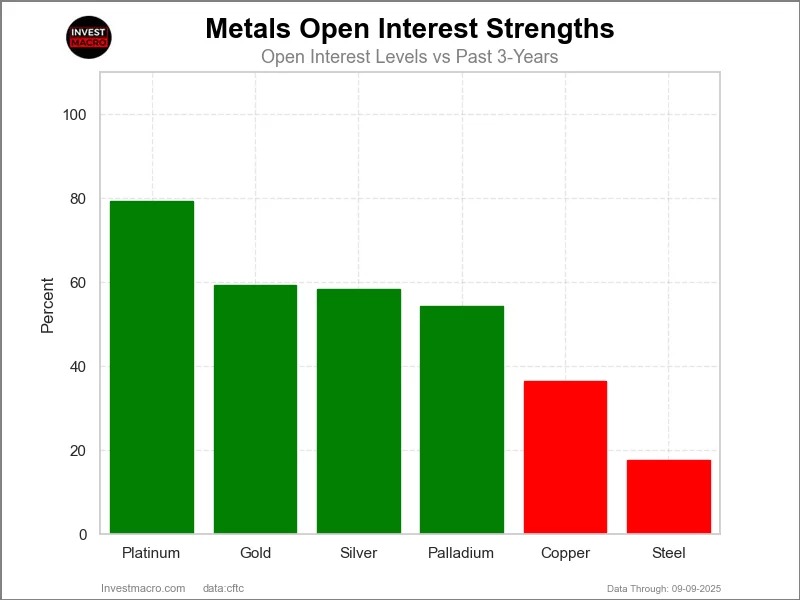
Metals Open Interest COT Chart
Here are the latest charts and statistics for the Commitment of Traders (COT) data published by the Commodities Futures Trading Commission (CFTC).

The latest COT data is updated through Tuesday June 24th and shows a quick view of how large traders (for-profit speculators and commercial entities) were positioned in the futures markets.

Weekly Speculator Changes led by Copper & Platinum

Metals Net Positions COT Chart
The COT metals markets speculator bets were mixed this week as three out of the six metals markets we cover had higher positioning while the other three markets had lower speculator contracts.

Leading the gains for the metals was Copper (5,633 contracts) with Platinum (1,985 contracts) and Palladium (740 contracts) also showing positive weeks.

The markets with declines in speculator bets for the week were Gold (-5,644 contracts), Silver (-4,227 contracts) and with Steel (-378 contracts) also registering lower bets on the week.


Metals Data:

Metals Table COT Chart
Legend: Weekly Speculators Change | Speculators Current Net Position | Speculators Strength Score compared to last 3-Years (0-100 range)


Strength Scores led by Silver & Platinum

Metals Strength Scores COT Chart
COT Strength Scores (a normalized measure of Speculator positions over a 3-Year range, from 0 to 100 where above 80 is Extreme-Bullish and below 20 is Extreme-Bearish) showed that Silver (95 percent) and Platinum (76 percent) lead the metals markets this week. Palladium (71 percent) comes in as the next highest in the weekly strength scores.

Strength Statistics:
Gold (54.3 percent) vs Gold previous week (56.4 percent)
Silver (94.7 percent) vs Silver previous week (100.0 percent)
Copper (60.6 percent) vs Copper previous week (55.4 percent)
Platinum (75.6 percent) vs Platinum previous week (70.9 percent)
Palladium (70.6 percent) vs Palladium previous week (65.1 percent)
Steel (64.7 percent) vs Palladium previous week (66.9 percent)


Palladium & Platinum top the 6-Week Strength Trends

Metals Trends COT Chart
COT Strength Score Trends (or move index, calculates the 6-week changes in strength scores) showed that Palladium (45 percent) and Platinum (38 percent) lead the past six weeks trends for metals. Silver (19 percent) is the next highest positive mover in the latest trends data.

Steel (-7 percent) leads the downside trend scores currently.

Move Statistics:
Gold (12.8 percent) vs Gold previous week (14.5 percent)
Silver (19.0 percent) vs Silver previous week (22.4 percent)
Copper (7.4 percent) vs Copper previous week (2.0 percent)
Platinum (37.6 percent) vs Platinum previous week (32.4 percent)
Palladium (44.7 percent) vs Palladium previous week (35.6 percent)
Steel (-7.1 percent) vs Steel previous week (-8.6 percent)


Individual Markets:

Gold Comex Futures:

Gold Futures COT ChartThe Gold Comex Futures large speculator standing this week equaled a net position of 195,004 contracts in the data reported through Tuesday. This was a weekly decrease of -5,644 contracts from the previous week which had a total of 200,648 net contracts.

This week’s current strength score (the trader positioning range over the past three years, measured from 0 to 100) shows the speculators are currently Bullish with a score of 54.3 percent. The commercials are Bearish with a score of 39.3 percent and the small traders (not shown in chart) are Bullish-Extreme with a score of 94.8 percent.

Price Trend-Following Model: Uptrend

Our weekly trend-following model classifies the current market price position as: Uptrend.

Gold Futures StatisticsSPECULATORSCOMMERCIALSSMALL TRADERS
– Percent of Open Interest Longs:58.916.912.6
– Percent of Open Interest Shorts:14.069.94.5
– Net Position:195,004-230,56035,556
– Gross Longs:256,07773,32355,009
– Gross Shorts:61,073303,88319,453
– Long to Short Ratio:4.2 to 10.2 to 12.8 to 1
NET POSITION TREND:
– Strength Index Score (3 Year Range Pct):54.339.394.8
– Strength Index Reading (3 Year Range):BullishBearishBullish-Extreme
NET POSITION MOVEMENT INDEX:
– 6-Week Change in Strength Index:12.8-14.219.1


Silver Comex Futures:

Silver Futures COT ChartThe Silver Comex Futures large speculator standing this week equaled a net position of 62,947 contracts in the data reported through Tuesday. This was a weekly reduction of -4,227 contracts from the previous week which had a total of 67,174 net contracts.

This week’s current strength score (the trader positioning range over the past three years, measured from 0 to 100) shows the speculators are currently Bullish-Extreme with a score of 94.7 percent. The commercials are Bearish-Extreme with a score of 3.8 percent and the small traders (not shown in chart) are Bullish with a score of 65.2 percent.

Price Trend-Following Model: Strong Uptrend

Our weekly trend-following model classifies the current market price position as: Strong Uptrend.

Silver Futures StatisticsSPECULATORSCOMMERCIALSSMALL TRADERS
– Percent of Open Interest Longs:48.423.118.8
– Percent of Open Interest Shorts:12.370.47.6
– Net Position:62,947-82,47719,530
– Gross Longs:84,49140,42232,867
– Gross Shorts:21,544122,89913,337
– Long to Short Ratio:3.9 to 10.3 to 12.5 to 1
NET POSITION TREND:
– Strength Index Score (3 Year Range Pct):94.73.865.2
– Strength Index Reading (3 Year Range):Bullish-ExtremeBearish-ExtremeBullish
NET POSITION MOVEMENT INDEX:
– 6-Week Change in Strength Index:19.0-17.95.4


Copper Grade #1 Futures:

Copper Futures COT ChartThe Copper Grade #1 Futures large speculator standing this week equaled a net position of 29,433 contracts in the data reported through Tuesday. This was a weekly boost of 5,633 contracts from the previous week which had a total of 23,800 net contracts.

This week’s current strength score (the trader positioning range over the past three years, measured from 0 to 100) shows the speculators are currently Bullish with a score of 60.6 percent. The commercials are Bearish with a score of 43.1 percent and the small traders (not shown in chart) are Bearish with a score of 31.6 percent.

Price Trend-Following Model: Strong Uptrend

Our weekly trend-following model classifies the current market price position as: Strong Uptrend.

Copper Futures StatisticsSPECULATORSCOMMERCIALSSMALL TRADERS
– Percent of Open Interest Longs:34.830.77.4
– Percent of Open Interest Shorts:20.346.36.3
– Net Position:29,433-31,7192,286
– Gross Longs:70,78162,51115,032
– Gross Shorts:41,34894,23012,746
– Long to Short Ratio:1.7 to 10.7 to 11.2 to 1
NET POSITION TREND:
– Strength Index Score (3 Year Range Pct):60.643.131.6
– Strength Index Reading (3 Year Range):BullishBearishBearish
NET POSITION MOVEMENT INDEX:
– 6-Week Change in Strength Index:7.4-6.4-3.2


Platinum Futures:

Platinum Futures COT ChartThe Platinum Futures large speculator standing this week equaled a net position of 25,212 contracts in the data reported through Tuesday. This was a weekly rise of 1,985 contracts from the previous week which had a total of 23,227 net contracts.

This week’s current strength score (the trader positioning range over the past three years, measured from 0 to 100) shows the speculators are currently Bullish with a score of 75.6 percent. The commercials are Bearish with a score of 25.4 percent and the small traders (not shown in chart) are Bullish with a score of 55.0 percent.

Price Trend-Following Model: Strong Uptrend

Our weekly trend-following model classifies the current market price position as: Strong Uptrend.

Platinum Futures StatisticsSPECULATORSCOMMERCIALSSMALL TRADERS
– Percent of Open Interest Longs:59.718.510.5
– Percent of Open Interest Shorts:34.748.45.6
– Net Position:25,212-30,1134,901
– Gross Longs:60,14318,64010,538
– Gross Shorts:34,93148,7535,637
– Long to Short Ratio:1.7 to 10.4 to 11.9 to 1
NET POSITION TREND:
– Strength Index Score (3 Year Range Pct):75.625.455.0
– Strength Index Reading (3 Year Range):BullishBearishBullish
NET POSITION MOVEMENT INDEX:
– 6-Week Change in Strength Index:37.6-37.38.6


Palladium Futures:

Palladium Futures COT ChartThe Palladium Futures large speculator standing this week equaled a net position of -4,508 contracts in the data reported through Tuesday. This was a weekly rise of 740 contracts from the previous week which had a total of -5,248 net contracts.

This week’s current strength score (the trader positioning range over the past three years, measured from 0 to 100) shows the speculators are currently Bullish with a score of 70.6 percent. The commercials are Bearish with a score of 22.9 percent and the small traders (not shown in chart) are Bullish-Extreme with a score of 83.5 percent.

Price Trend-Following Model: Strong Uptrend

Our weekly trend-following model classifies the current market price position as: Strong Uptrend.

Palladium Futures StatisticsSPECULATORSCOMMERCIALSSMALL TRADERS
– Percent of Open Interest Longs:41.739.013.8
– Percent of Open Interest Shorts:64.721.98.0
– Net Position:-4,5083,3591,149
– Gross Longs:8,1867,6612,714
– Gross Shorts:12,6944,3021,565
– Long to Short Ratio:0.6 to 11.8 to 11.7 to 1
NET POSITION TREND:
– Strength Index Score (3 Year Range Pct):70.622.983.5
– Strength Index Reading (3 Year Range):BullishBearishBullish-Extreme
NET POSITION MOVEMENT INDEX:
– 6-Week Change in Strength Index:44.7-48.115.7


Steel Futures Futures:

Steel Futures COT ChartThe Steel Futures large speculator standing this week equaled a net position of -1,074 contracts in the data reported through Tuesday. This was a weekly reduction of -378 contracts from the previous week which had a total of -696 net contracts.

This week’s current strength score (the trader positioning range over the past three years, measured from 0 to 100) shows the speculators are currently Bullish with a score of 64.7 percent. The commercials are Bearish with a score of 36.0 percent and the small traders (not shown in chart) are Bullish with a score of 54.3 percent.

Price Trend-Following Model: Weak Uptrend

Our weekly trend-following model classifies the current market price position as: Weak Uptrend.

Steel Futures StatisticsSPECULATORSCOMMERCIALSSMALL TRADERS
– Percent of Open Interest Longs:24.968.80.9
– Percent of Open Interest Shorts:28.265.90.5
– Net Position:-1,074932142
– Gross Longs:8,14322,470294
– Gross Shorts:9,21721,538152
– Long to Short Ratio:0.9 to 11.0 to 11.9 to 1
NET POSITION TREND:
– Strength Index Score (3 Year Range Pct):64.736.054.3
– Strength Index Reading (3 Year Range):BullishBearishBullish
NET POSITION MOVEMENT INDEX:
– 6-Week Change in Strength Index:-7.16.319.4


Article By InvestMacroReceive our weekly COT Newsletter

*COT Report: The COT data, released weekly to the public each Friday, is updated through the most recent Tuesday (data is 3 days old) and shows a quick view of how large speculators or non-commercials (for-profit traders) were positioned in the futures markets.

The CFTC categorizes trader positions according to commercial hedgers (traders who use futures contracts for hedging as part of the business), non-commercials (large traders who speculate to realize trading profits) and nonreportable traders (usually small traders/speculators) as well as their open interest (contracts open in the market at time of reporting). See CFTC criteria here.

COT Bonds Charts: Speculator Bets led by SOFR 3-Months & 10-Year Bonds

By InvestMacro

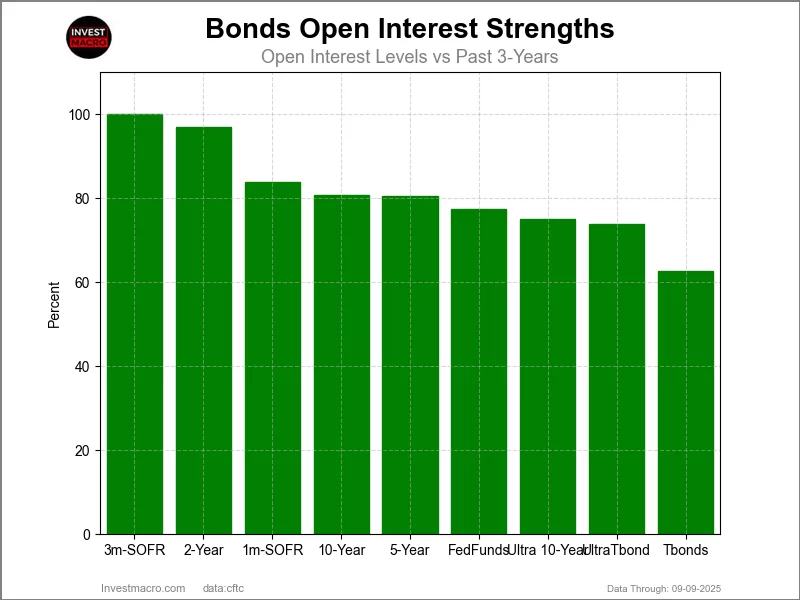
Bonds Market Open Interest Comparison
Here are the latest charts and statistics for the Commitment of Traders (COT) reports data published by the Commodities Futures Trading Commission (CFTC).

The latest COT data is updated through Tuesday June 24th and shows a quick view of how large traders (for-profit speculators and commercial hedgers) were positioned in the futures markets.

Weekly Speculator Changes led by SOFR 3-Months & 10-Year Bonds

Bonds Market Net Speculators Positions
The COT bond market speculator bets were overall lower this week as just two out of the nine bond markets we cover had higher positioning while the other seven markets had lower speculator contracts.

Leading the gains for the bond markets was the SOFR 3-Months (98,926 contracts) with the 10-Year Bonds (72,768 contracts) also showing a positive week.

The bond markets with declines in speculator bets for the week were the 2-Year Bonds (-63,807 contracts), the Fed Funds (-42,736 contracts), the US Treasury Bonds (-27,610 contracts), the 5-Year Bonds (-20,348 contracts), the Ultra Treasury Bonds (-19,812 contracts), the Ultra 10-Year Bonds (-19,423 contracts) and with the SOFR 1-Month (-1,812 contracts) also seeing lower bets on the week.


Bonds Data:

Bonds Market Speculators Data Table
Legend: Open Interest | Speculators Current Net Position | Weekly Specs Change | Specs Strength Score compared to last 3-Years (0-100 range)


Strength Scores led by Ultra Treasury Bonds & US Treasury Bonds

Bonds Market Strength Index Comparison
COT Strength Scores (a normalized measure of Speculator positions over a 3-Year range, from 0 to 100 where above 80 is Extreme-Bullish and below 20 is Extreme-Bearish) showed that the Ultra Treasury Bonds (93 percent) and the US Treasury Bonds (48 percent) lead the bond markets this week. The Fed Funds (45 percent) comes in as the next highest in the weekly strength scores.

On the downside, the Ultra 10-Year Bonds (1 percent) and the 2-Year Bonds (18 percent) come in at the lowest strength level currently and are in Extreme-Bearish territory (below 20 percent). The next lowest strength scores were the SOFR 3-Months (31 percent) and the SOFR 1-Month (33 percent).

Strength Statistics:
Fed Funds (44.9 percent) vs Fed Funds previous week (52.8 percent)
2-Year Bond (18.0 percent) vs 2-Year Bond previous week (22.5 percent)
5-Year Bond (0.3 percent) vs 5-Year Bond previous week (1.2 percent)
10-Year Bond (44.8 percent) vs 10-Year Bond previous week (37.8 percent)
Ultra 10-Year Bond (1.2 percent) vs Ultra 10-Year Bond previous week (6.6 percent)
US Treasury Bond (48.0 percent) vs US Treasury Bond previous week (57.6 percent)
Ultra US Treasury Bond (92.6 percent) vs Ultra US Treasury Bond previous week (100.0 percent)
SOFR 1-Month (33.0 percent) vs SOFR 1-Month previous week (33.5 percent)
SOFR 3-Months (31.1 percent) vs SOFR 3-Months previous week (26.0 percent)


10-Year Bonds & Ultra Treasury Bonds top the 6-Week Strength Trends

Bonds Market Trend Index Comparison
COT Strength Score Trends (or move index, calculates the 6-week changes in strength scores) showed that the 10-Year Bonds (20 percent) and the Ultra Treasury Bonds (19 percent) lead the past six weeks trends for bonds. The SOFR 3-Months (9 percent) are the next highest positive movers in the latest trends data.

The SOFR 1-Month (-34 percent) leads the downside trend scores currently with the Ultra 10-Year Bond (-13 percent) following next with lower trend scores.

Strength Trend Statistics:
Fed Funds (4.9 percent) vs Fed Funds previous week (19.6 percent)
2-Year Bond (-0.6 percent) vs 2-Year Bond previous week (3.8 percent)
5-Year Bond (-12.8 percent) vs 5-Year Bond previous week (-6.6 percent)
10-Year Bond (20.3 percent) vs 10-Year Bond previous week (19.3 percent)
Ultra 10-Year Bond (-13.0 percent) vs Ultra 10-Year Bond previous week (-17.5 percent)
US Treasury Bond (-8.4 percent) vs US Treasury Bond previous week (7.5 percent)
Ultra US Treasury Bond (19.4 percent) vs Ultra US Treasury Bond previous week (28.1 percent)
SOFR 1-Month (-34.2 percent) vs SOFR 1-Month previous week (-33.0 percent)
SOFR 3-Months (9.4 percent) vs SOFR 3-Months previous week (3.9 percent)


30-Day Federal Funds Futures:

Federal Funds 30-Day Bonds Futures COT ChartThe 30-Day Federal Funds large speculator standing this week totaled a net position of -52,710 contracts in the data reported through Tuesday. This was a weekly lowering of -42,736 contracts from the previous week which had a total of -9,974 net contracts.

This week’s current strength score (the trader positioning range over the past three years, measured from 0 to 100) shows the speculators are currently Bearish with a score of 44.9 percent. The commercials are Bearish with a score of 48.7 percent and the small traders (not shown in chart) are Bullish-Extreme with a score of 83.4 percent.

Price Trend-Following Model: Downtrend

Our weekly trend-following model classifies the current market price position as: Downtrend.

30-Day Federal Funds StatisticsSPECULATORSCOMMERCIALSSMALL TRADERS
– Percent of Open Interest Longs:15.463.52.2
– Percent of Open Interest Shorts:17.961.81.5
– Net Position:-52,71036,52116,189
– Gross Longs:333,3681,371,36247,669
– Gross Shorts:386,0781,334,84131,480
– Long to Short Ratio:0.9 to 11.0 to 11.5 to 1
NET POSITION TREND:
– Strength Index Score (3 Year Range Pct):44.948.783.4
– Strength Index Reading (3 Year Range):BearishBearishBullish-Extreme
NET POSITION MOVEMENT INDEX:
– 6-Week Change in Strength Index:4.9-7.015.4


Secured Overnight Financing Rate (3-Month) Futures:

SOFR 3-Months Bonds Futures COT ChartThe Secured Overnight Financing Rate (3-Month) large speculator standing this week totaled a net position of -563,811 contracts in the data reported through Tuesday. This was a weekly gain of 98,926 contracts from the previous week which had a total of -662,737 net contracts.

This week’s current strength score (the trader positioning range over the past three years, measured from 0 to 100) shows the speculators are currently Bearish with a score of 31.1 percent. The commercials are Bullish with a score of 69.5 percent and the small traders (not shown in chart) are Bullish with a score of 75.9 percent.

Price Trend-Following Model: Weak Uptrend

Our weekly trend-following model classifies the current market price position as: Weak Uptrend.

SOFR 3-Months StatisticsSPECULATORSCOMMERCIALSSMALL TRADERS
– Percent of Open Interest Longs:11.661.10.5
– Percent of Open Interest Shorts:16.755.90.6
– Net Position:-563,811578,846-15,035
– Gross Longs:1,274,7966,730,01555,134
– Gross Shorts:1,838,6076,151,16970,169
– Long to Short Ratio:0.7 to 11.1 to 10.8 to 1
NET POSITION TREND:
– Strength Index Score (3 Year Range Pct):31.169.575.9
– Strength Index Reading (3 Year Range):BearishBullishBullish
NET POSITION MOVEMENT INDEX:
– 6-Week Change in Strength Index:9.4-8.8-5.6


Individual Bond Markets:

Secured Overnight Financing Rate (1-Month) Futures:

SOFR 1-Month Bonds Futures COT ChartThe Secured Overnight Financing Rate (1-Month) large speculator standing this week totaled a net position of -144,015 contracts in the data reported through Tuesday. This was a weekly fall of -1,812 contracts from the previous week which had a total of -142,203 net contracts.

This week’s current strength score (the trader positioning range over the past three years, measured from 0 to 100) shows the speculators are currently Bearish with a score of 33.0 percent. The commercials are Bullish with a score of 65.8 percent and the small traders (not shown in chart) are Bullish with a score of 76.2 percent.

Price Trend-Following Model: Uptrend

Our weekly trend-following model classifies the current market price position as: Uptrend.

SOFR 1-Month StatisticsSPECULATORSCOMMERCIALSSMALL TRADERS
– Percent of Open Interest Longs:14.664.20.4
– Percent of Open Interest Shorts:24.854.30.1
– Net Position:-144,015139,5034,512
– Gross Longs:206,962908,6305,408
– Gross Shorts:350,977769,127896
– Long to Short Ratio:0.6 to 11.2 to 16.0 to 1
NET POSITION TREND:
– Strength Index Score (3 Year Range Pct):33.065.876.2
– Strength Index Reading (3 Year Range):BearishBullishBullish
NET POSITION MOVEMENT INDEX:
– 6-Week Change in Strength Index:-34.237.0-23.8


2-Year Treasury Note Futures:

2-Year Treasury Bonds Futures COT ChartThe 2-Year Treasury Note large speculator standing this week totaled a net position of -1,230,204 contracts in the data reported through Tuesday. This was a weekly decline of -63,807 contracts from the previous week which had a total of -1,166,397 net contracts.

This week’s current strength score (the trader positioning range over the past three years, measured from 0 to 100) shows the speculators are currently Bearish-Extreme with a score of 18.0 percent. The commercials are Bullish-Extreme with a score of 80.8 percent and the small traders (not shown in chart) are Bullish with a score of 68.8 percent.

Price Trend-Following Model: Strong Uptrend

Our weekly trend-following model classifies the current market price position as: Strong Uptrend.

2-Year Treasury Note StatisticsSPECULATORSCOMMERCIALSSMALL TRADERS
– Percent of Open Interest Longs:14.977.46.0
– Percent of Open Interest Shorts:44.550.83.0
– Net Position:-1,230,2041,105,559124,645
– Gross Longs:621,3783,219,037248,595
– Gross Shorts:1,851,5822,113,478123,950
– Long to Short Ratio:0.3 to 11.5 to 12.0 to 1
NET POSITION TREND:
– Strength Index Score (3 Year Range Pct):18.080.868.8
– Strength Index Reading (3 Year Range):Bearish-ExtremeBullish-ExtremeBullish
NET POSITION MOVEMENT INDEX:
– 6-Week Change in Strength Index:-0.6-0.74.7


5-Year Treasury Note Futures:

5-Year Treasury Bonds Futures COT ChartThe 5-Year Treasury Note large speculator standing this week totaled a net position of -2,463,629 contracts in the data reported through Tuesday. This was a weekly decrease of -20,348 contracts from the previous week which had a total of -2,443,281 net contracts.

This week’s current strength score (the trader positioning range over the past three years, measured from 0 to 100) shows the speculators are currently Bearish-Extreme with a score of 0.3 percent. The commercials are Bullish-Extreme with a score of 96.3 percent and the small traders (not shown in chart) are Bullish-Extreme with a score of 95.2 percent.

Price Trend-Following Model: Strong Uptrend

Our weekly trend-following model classifies the current market price position as: Strong Uptrend.

5-Year Treasury Note StatisticsSPECULATORSCOMMERCIALSSMALL TRADERS
– Percent of Open Interest Longs:7.683.46.7
– Percent of Open Interest Shorts:42.451.83.4
– Net Position:-2,463,6292,232,475231,154
– Gross Longs:535,4795,899,749472,709
– Gross Shorts:2,999,1083,667,274241,555
– Long to Short Ratio:0.2 to 11.6 to 12.0 to 1
NET POSITION TREND:
– Strength Index Score (3 Year Range Pct):0.396.395.2
– Strength Index Reading (3 Year Range):Bearish-ExtremeBullish-ExtremeBullish-Extreme
NET POSITION MOVEMENT INDEX:
– 6-Week Change in Strength Index:-12.810.022.8


10-Year Treasury Note Futures:

10-Year Treasury Notes Bonds Futures COT ChartThe 10-Year Treasury Note large speculator standing this week totaled a net position of -680,131 contracts in the data reported through Tuesday. This was a weekly rise of 72,768 contracts from the previous week which had a total of -752,899 net contracts.

This week’s current strength score (the trader positioning range over the past three years, measured from 0 to 100) shows the speculators are currently Bearish with a score of 44.8 percent. The commercials are Bullish with a score of 50.2 percent and the small traders (not shown in chart) are Bullish with a score of 73.6 percent.

Price Trend-Following Model: Strong Uptrend

Our weekly trend-following model classifies the current market price position as: Strong Uptrend.

10-Year Treasury Note StatisticsSPECULATORSCOMMERCIALSSMALL TRADERS
– Percent of Open Interest Longs:13.076.09.0
– Percent of Open Interest Shorts:26.964.17.1
– Net Position:-680,131583,28496,847
– Gross Longs:640,5243,736,423444,200
– Gross Shorts:1,320,6553,153,139347,353
– Long to Short Ratio:0.5 to 11.2 to 11.3 to 1
NET POSITION TREND:
– Strength Index Score (3 Year Range Pct):44.850.273.6
– Strength Index Reading (3 Year Range):BearishBullishBullish
NET POSITION MOVEMENT INDEX:
– 6-Week Change in Strength Index:20.3-27.13.7


Ultra 10-Year Notes Futures:

Ultra 10-Year Treasury Notes Bonds Futures COT ChartThe Ultra 10-Year Notes large speculator standing this week totaled a net position of -367,108 contracts in the data reported through Tuesday. This was a weekly decrease of -19,423 contracts from the previous week which had a total of -347,685 net contracts.

This week’s current strength score (the trader positioning range over the past three years, measured from 0 to 100) shows the speculators are currently Bearish-Extreme with a score of 1.2 percent. The commercials are Bullish-Extreme with a score of 92.2 percent and the small traders (not shown in chart) are Bullish with a score of 65.7 percent.

Price Trend-Following Model: Weak Uptrend

Our weekly trend-following model classifies the current market price position as: Weak Uptrend.

Ultra 10-Year Notes StatisticsSPECULATORSCOMMERCIALSSMALL TRADERS
– Percent of Open Interest Longs:10.779.19.1
– Percent of Open Interest Shorts:26.261.611.2
– Net Position:-367,108417,015-49,907
– Gross Longs:255,1431,881,625216,455
– Gross Shorts:622,2511,464,610266,362
– Long to Short Ratio:0.4 to 11.3 to 10.8 to 1
NET POSITION TREND:
– Strength Index Score (3 Year Range Pct):1.292.265.7
– Strength Index Reading (3 Year Range):Bearish-ExtremeBullish-ExtremeBullish
NET POSITION MOVEMENT INDEX:
– 6-Week Change in Strength Index:-13.022.8-26.7


US Treasury Bonds Futures:

US Year Treasury Notes Long Bonds Futures COT ChartThe US Treasury Bonds large speculator standing this week totaled a net position of -101,785 contracts in the data reported through Tuesday. This was a weekly fall of -27,610 contracts from the previous week which had a total of -74,175 net contracts.

This week’s current strength score (the trader positioning range over the past three years, measured from 0 to 100) shows the speculators are currently Bearish with a score of 48.0 percent. The commercials are Bearish with a score of 42.9 percent and the small traders (not shown in chart) are Bullish with a score of 73.1 percent.

Price Trend-Following Model: Downtrend

Our weekly trend-following model classifies the current market price position as: Downtrend.

US Treasury Bonds StatisticsSPECULATORSCOMMERCIALSSMALL TRADERS
– Percent of Open Interest Longs:8.876.613.3
– Percent of Open Interest Shorts:14.575.98.4
– Net Position:-101,78513,61888,167
– Gross Longs:155,3611,358,300236,647
– Gross Shorts:257,1461,344,682148,480
– Long to Short Ratio:0.6 to 11.0 to 11.6 to 1
NET POSITION TREND:
– Strength Index Score (3 Year Range Pct):48.042.973.1
– Strength Index Reading (3 Year Range):BearishBearishBullish
NET POSITION MOVEMENT INDEX:
– 6-Week Change in Strength Index:-8.49.9-8.9


Ultra US Treasury Bonds Futures:

Ultra US Year Treasury Notes Long Bonds Futures COT ChartThe Ultra US Treasury Bonds large speculator standing this week totaled a net position of -209,526 contracts in the data reported through Tuesday. This was a weekly reduction of -19,812 contracts from the previous week which had a total of -189,714 net contracts.

This week’s current strength score (the trader positioning range over the past three years, measured from 0 to 100) shows the speculators are currently Bullish-Extreme with a score of 92.6 percent. The commercials are Bearish-Extreme with a score of 15.9 percent and the small traders (not shown in chart) are Bearish with a score of 29.3 percent.

Price Trend-Following Model: Downtrend

Our weekly trend-following model classifies the current market price position as: Downtrend.

Ultra US Treasury Bonds StatisticsSPECULATORSCOMMERCIALSSMALL TRADERS
– Percent of Open Interest Longs:7.381.69.4
– Percent of Open Interest Shorts:18.471.48.5
– Net Position:-209,526192,46317,063
– Gross Longs:138,9961,544,513178,019
– Gross Shorts:348,5221,352,050160,956
– Long to Short Ratio:0.4 to 11.1 to 11.1 to 1
NET POSITION TREND:
– Strength Index Score (3 Year Range Pct):92.615.929.3
– Strength Index Reading (3 Year Range):Bullish-ExtremeBearish-ExtremeBearish
NET POSITION MOVEMENT INDEX:
– 6-Week Change in Strength Index:19.4-16.0-10.7


Article By InvestMacroReceive our weekly COT Newsletter

*COT Report: The COT data, released weekly to the public each Friday, is updated through the most recent Tuesday (data is 3 days old) and shows a quick view of how large speculators or non-commercials (for-profit traders) were positioned in the futures markets.

The CFTC categorizes trader positions according to commercial hedgers (traders who use futures contracts for hedging as part of the business), non-commercials (large traders who speculate to realize trading profits) and nonreportable traders (usually small traders/speculators) as well as their open interest (contracts open in the market at time of reporting). See CFTC criteria here.

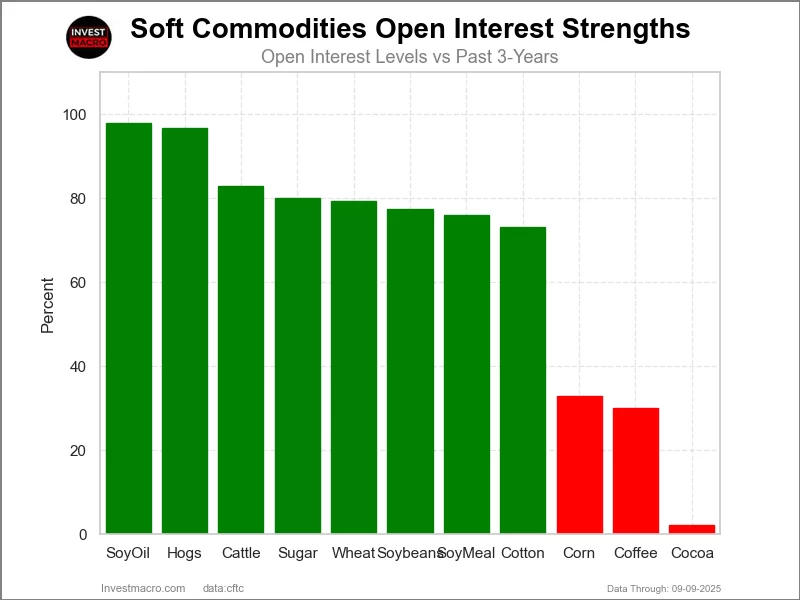
COT Soft Commodities Charts: Speculator Changes led by Wheat & Cotton

By InvestMacro

Speculators OI Softs
Here are the latest charts and statistics for the Commitment of Traders (COT) reports data published by the Commodities Futures Trading Commission (CFTC).

The latest COT data is updated through Tuesday June 24th and shows a quick view of how large traders (for-profit speculators and commercial entities) were positioned in the futures markets.

Weekly Speculator Changes led by Wheat & Cotton

Speculators Nets Softs
The COT soft commodities markets speculator bets were overall lower this week as just three out of the eleven softs markets we cover had higher positioning while the other eight markets had lower speculator contracts.

Leading the gains for the softs markets was Wheat (13,390 contracts) with Cotton (5,439 contracts) and Soybean Oil (157 contracts) also having positive weeks.

The markets with the declines in speculator bets this week were Soybeans (-29,353 contracts), Corn (-23,326 contracts), Soybean Meal (-16,876 contracts), Coffee (-4,750 contracts), Cocoa (-4,110 contracts), Live Cattle (-2,477 contracts), Lean Hogs (-1,312 contracts) and with Sugar (-79 contracts) also registering lower bets on the week.


Soft Commodities Data:

Speculators Table Softs
Legend: Weekly Speculators Change | Speculators Current Net Position | Speculators Strength Score compared to last 3-Years (0-100 range)


Strength Scores led by Lean Hogs & Live Cattle

Speculators Strength Softs
COT Strength Scores (a normalized measure of Speculator positions over a 3-Year range, from 0 to 100 where above 80 is Extreme-Bullish and below 20 is Extreme-Bearish) showed that Lean Hogs (99 percent) and Live Cattle (83 percent) lead the softs markets this week. Soybean Oil (77 percent), Soybeans (65 percent) and Coffee (56 percent) come in as the next highest in the weekly strength scores.

On the downside, Soybean Meal (0 percent), Sugar (0 percent), Corn (18 percent) and the Cotton (19 percent) come in at the lowest strength levels currently and are in Extreme-Bearish territory (below 20 percent).

Strength Statistics:
Corn (18.4 percent) vs Corn previous week (21.6 percent)
Sugar (0.0 percent) vs Sugar previous week (0.0 percent)
Coffee (56.1 percent) vs Coffee previous week (60.7 percent)
Soybeans (64.8 percent) vs Soybeans previous week (72.3 percent)
Soybean Oil (76.9 percent) vs Soybean Oil previous week (76.8 percent)
Soybean Meal (0.0 percent) vs Soybean Meal previous week (6.7 percent)
Live Cattle (83.1 percent) vs Live Cattle previous week (85.5 percent)
Lean Hogs (99.0 percent) vs Lean Hogs previous week (100.0 percent)
Cotton (18.9 percent) vs Cotton previous week (15.6 percent)
Cocoa (23.1 percent) vs Cocoa previous week (27.3 percent)
Wheat (37.1 percent) vs Wheat previous week (26.5 percent)


Wheat & Lean Hogs top the 6-Week Strength Trends

Speculators Trend Softs
COT Strength Score Trends (or move index, calculates the 6-week changes in strength scores) showed that Wheat (37 percent) and Lean Hogs (36 percent) lead the past six weeks trends for soft commodities.

Sugar (-23 percent) leads the downside trend scores currently with Corn (-20 percent), Coffee (-14 percent) and Soybean Meal (-10 percent) following next with lower trend scores.

Strength Trend Statistics:
Corn (-20.2 percent) vs Corn previous week (-30.4 percent)
Sugar (-23.3 percent) vs Sugar previous week (-21.3 percent)
Coffee (-14.4 percent) vs Coffee previous week (-13.0 percent)
Soybeans (-2.4 percent) vs Soybeans previous week (9.2 percent)
Soybean Oil (-5.9 percent) vs Soybean Oil previous week (-2.0 percent)
Soybean Meal (-9.9 percent) vs Soybean Meal previous week (-2.1 percent)
Live Cattle (-4.3 percent) vs Live Cattle previous week (0.0 percent)
Lean Hogs (36.4 percent) vs Lean Hogs previous week (44.4 percent)
Cotton (-8.2 percent) vs Cotton previous week (-16.1 percent)
Cocoa (-8.1 percent) vs Cocoa previous week (0.1 percent)
Wheat (37.1 percent) vs Wheat previous week (18.1 percent)


Individual Soft Commodities Markets:

CORN Futures:

CORN Futures COT ChartThe CORN large speculator standing this week totaled a net position of -130,570 contracts in the data reported through Tuesday. This was a weekly lowering of -23,326 contracts from the previous week which had a total of -107,244 net contracts.

This week’s current strength score (the trader positioning range over the past three years, measured from 0 to 100) shows the speculators are currently Bearish-Extreme with a score of 18.4 percent. The commercials are Bullish with a score of 78.9 percent and the small traders (not shown in chart) are Bullish-Extreme with a score of 91.5 percent.

Price Trend-Following Model: Strong Downtrend

Our weekly trend-following model classifies the current market price position as: Strong Downtrend.

CORN Futures StatisticsSPECULATORSCOMMERCIALSSMALL TRADERS
– Percent of Open Interest Longs:18.846.310.3
– Percent of Open Interest Shorts:27.436.911.2
– Net Position:-130,570143,528-12,958
– Gross Longs:289,305710,288158,516
– Gross Shorts:419,875566,760171,474
– Long to Short Ratio:0.7 to 11.3 to 10.9 to 1
NET POSITION TREND:
– Strength Index Score (3 Year Range Pct):18.478.991.5
– Strength Index Reading (3 Year Range):Bearish-ExtremeBullishBullish-Extreme
NET POSITION MOVEMENT INDEX:
– 6-Week Change in Strength Index:-20.219.821.3


SUGAR Futures:

SUGAR Futures COT ChartThe SUGAR large speculator standing this week totaled a net position of -47,220 contracts in the data reported through Tuesday. This was a weekly decrease of -79 contracts from the previous week which had a total of -47,141 net contracts.

This week’s current strength score (the trader positioning range over the past three years, measured from 0 to 100) shows the speculators are currently Bearish-Extreme with a score of 0.0 percent. The commercials are Bullish-Extreme with a score of 100.0 percent and the small traders (not shown in chart) are Bearish-Extreme with a score of 15.0 percent.

Price Trend-Following Model: Downtrend

Our weekly trend-following model classifies the current market price position as: Downtrend.

SUGAR Futures StatisticsSPECULATORSCOMMERCIALSSMALL TRADERS
– Percent of Open Interest Longs:23.453.38.5
– Percent of Open Interest Shorts:28.947.39.0
– Net Position:-47,22051,407-4,187
– Gross Longs:201,571458,22072,992
– Gross Shorts:248,791406,81377,179
– Long to Short Ratio:0.8 to 11.1 to 10.9 to 1
NET POSITION TREND:
– Strength Index Score (3 Year Range Pct):0.0100.015.0
– Strength Index Reading (3 Year Range):Bearish-ExtremeBullish-ExtremeBearish-Extreme
NET POSITION MOVEMENT INDEX:
– 6-Week Change in Strength Index:-23.321.4-9.0


COFFEE Futures:

COFFEE Futures COT ChartThe COFFEE large speculator standing this week totaled a net position of 31,154 contracts in the data reported through Tuesday. This was a weekly decrease of -4,750 contracts from the previous week which had a total of 35,904 net contracts.

This week’s current strength score (the trader positioning range over the past three years, measured from 0 to 100) shows the speculators are currently Bullish with a score of 56.1 percent. The commercials are Bearish with a score of 45.7 percent and the small traders (not shown in chart) are Bearish with a score of 45.3 percent.

Price Trend-Following Model: Strong Downtrend

Our weekly trend-following model classifies the current market price position as: Strong Downtrend.

COFFEE Futures StatisticsSPECULATORSCOMMERCIALSSMALL TRADERS
– Percent of Open Interest Longs:30.842.55.4
– Percent of Open Interest Shorts:9.764.74.3
– Net Position:31,154-32,7791,625
– Gross Longs:45,46762,5847,984
– Gross Shorts:14,31395,3636,359
– Long to Short Ratio:3.2 to 10.7 to 11.3 to 1
NET POSITION TREND:
– Strength Index Score (3 Year Range Pct):56.145.745.3
– Strength Index Reading (3 Year Range):BullishBearishBearish
NET POSITION MOVEMENT INDEX:
– 6-Week Change in Strength Index:-14.414.9-11.8


SOYBEANS Futures:

SOYBEANS Futures COT ChartThe SOYBEANS large speculator standing this week totaled a net position of 55,870 contracts in the data reported through Tuesday. This was a weekly fall of -29,353 contracts from the previous week which had a total of 85,223 net contracts.

This week’s current strength score (the trader positioning range over the past three years, measured from 0 to 100) shows the speculators are currently Bullish with a score of 64.8 percent. The commercials are Bearish with a score of 32.6 percent and the small traders (not shown in chart) are Bullish with a score of 77.7 percent.

Price Trend-Following Model: Weak Uptrend

Our weekly trend-following model classifies the current market price position as: Weak Uptrend.

SOYBEANS Futures StatisticsSPECULATORSCOMMERCIALSSMALL TRADERS
– Percent of Open Interest Longs:22.749.85.8
– Percent of Open Interest Shorts:16.054.97.4
– Net Position:55,870-42,557-13,313
– Gross Longs:190,265417,62148,705
– Gross Shorts:134,395460,17862,018
– Long to Short Ratio:1.4 to 10.9 to 10.8 to 1
NET POSITION TREND:
– Strength Index Score (3 Year Range Pct):64.832.677.7
– Strength Index Reading (3 Year Range):BullishBearishBullish
NET POSITION MOVEMENT INDEX:
– 6-Week Change in Strength Index:-2.42.5-0.3


SOYBEAN OIL Futures:

SOYBEAN OIL Futures COT ChartThe SOYBEAN OIL large speculator standing this week totaled a net position of 63,489 contracts in the data reported through Tuesday. This was a weekly advance of 157 contracts from the previous week which had a total of 63,332 net contracts.

This week’s current strength score (the trader positioning range over the past three years, measured from 0 to 100) shows the speculators are currently Bullish with a score of 76.9 percent. The commercials are Bearish with a score of 24.1 percent and the small traders (not shown in chart) are Bullish with a score of 71.4 percent.

Price Trend-Following Model: Strong Uptrend

Our weekly trend-following model classifies the current market price position as: Strong Uptrend.

SOYBEAN OIL Futures StatisticsSPECULATORSCOMMERCIALSSMALL TRADERS
– Percent of Open Interest Longs:22.647.36.3
– Percent of Open Interest Shorts:11.959.74.7
– Net Position:63,489-73,52210,033
– Gross Longs:134,185281,05237,716
– Gross Shorts:70,696354,57427,683
– Long to Short Ratio:1.9 to 10.8 to 11.4 to 1
NET POSITION TREND:
– Strength Index Score (3 Year Range Pct):76.924.171.4
– Strength Index Reading (3 Year Range):BullishBearishBullish
NET POSITION MOVEMENT INDEX:
– 6-Week Change in Strength Index:-5.95.32.2


SOYBEAN MEAL Futures:

SOYBEAN MEAL Futures COT ChartThe SOYBEAN MEAL large speculator standing this week totaled a net position of -76,064 contracts in the data reported through Tuesday. This was a weekly decline of -16,876 contracts from the previous week which had a total of -59,188 net contracts.

This week’s current strength score (the trader positioning range over the past three years, measured from 0 to 100) shows the speculators are currently Bearish-Extreme with a score of 0.0 percent. The commercials are Bullish-Extreme with a score of 98.3 percent and the small traders (not shown in chart) are Bullish with a score of 78.8 percent.

Price Trend-Following Model: Downtrend

Our weekly trend-following model classifies the current market price position as: Downtrend.

SOYBEAN MEAL Futures StatisticsSPECULATORSCOMMERCIALSSMALL TRADERS
– Percent of Open Interest Longs:17.251.29.5
– Percent of Open Interest Shorts:29.243.05.7
– Net Position:-76,06451,92724,137
– Gross Longs:109,147324,32560,487
– Gross Shorts:185,211272,39836,350
– Long to Short Ratio:0.6 to 11.2 to 11.7 to 1
NET POSITION TREND:
– Strength Index Score (3 Year Range Pct):0.098.378.8
– Strength Index Reading (3 Year Range):Bearish-ExtremeBullish-ExtremeBullish
NET POSITION MOVEMENT INDEX:
– 6-Week Change in Strength Index:-9.97.632.7


LIVE CATTLE Futures:

LIVE CATTLE Futures COT ChartThe LIVE CATTLE large speculator standing this week totaled a net position of 106,183 contracts in the data reported through Tuesday. This was a weekly decline of -2,477 contracts from the previous week which had a total of 108,660 net contracts.

This week’s current strength score (the trader positioning range over the past three years, measured from 0 to 100) shows the speculators are currently Bullish-Extreme with a score of 83.1 percent. The commercials are Bearish-Extreme with a score of 16.4 percent and the small traders (not shown in chart) are Bearish with a score of 29.2 percent.

Price Trend-Following Model: Uptrend

Our weekly trend-following model classifies the current market price position as: Uptrend.

LIVE CATTLE Futures StatisticsSPECULATORSCOMMERCIALSSMALL TRADERS
– Percent of Open Interest Longs:49.328.48.2
– Percent of Open Interest Shorts:21.950.913.2
– Net Position:106,183-86,980-19,203
– Gross Longs:190,895110,01531,781
– Gross Shorts:84,712196,99550,984
– Long to Short Ratio:2.3 to 10.6 to 10.6 to 1
NET POSITION TREND:
– Strength Index Score (3 Year Range Pct):83.116.429.2
– Strength Index Reading (3 Year Range):Bullish-ExtremeBearish-ExtremeBearish
NET POSITION MOVEMENT INDEX:
– 6-Week Change in Strength Index:-4.31.012.2


LEAN HOGS Futures:

LEAN HOGS Futures COT ChartThe LEAN HOGS large speculator standing this week totaled a net position of 94,956 contracts in the data reported through Tuesday. This was a weekly decline of -1,312 contracts from the previous week which had a total of 96,268 net contracts.

This week’s current strength score (the trader positioning range over the past three years, measured from 0 to 100) shows the speculators are currently Bullish-Extreme with a score of 99.0 percent. The commercials are Bearish-Extreme with a score of 1.4 percent and the small traders (not shown in chart) are Bearish with a score of 33.0 percent.

Price Trend-Following Model: Strong Uptrend

Our weekly trend-following model classifies the current market price position as: Strong Uptrend.

LEAN HOGS Futures StatisticsSPECULATORSCOMMERCIALSSMALL TRADERS
– Percent of Open Interest Longs:45.426.06.4
– Percent of Open Interest Shorts:20.149.38.4
– Net Position:94,956-87,562-7,394
– Gross Longs:170,37097,65424,195
– Gross Shorts:75,414185,21631,589
– Long to Short Ratio:2.3 to 10.5 to 10.8 to 1
NET POSITION TREND:
– Strength Index Score (3 Year Range Pct):99.01.433.0
– Strength Index Reading (3 Year Range):Bullish-ExtremeBearish-ExtremeBearish
NET POSITION MOVEMENT INDEX:
– 6-Week Change in Strength Index:36.4-35.1-28.7


COTTON Futures:

COTTON Futures COT ChartThe COTTON large speculator standing this week totaled a net position of -31,047 contracts in the data reported through Tuesday. This was a weekly lift of 5,439 contracts from the previous week which had a total of -36,486 net contracts.

This week’s current strength score (the trader positioning range over the past three years, measured from 0 to 100) shows the speculators are currently Bearish-Extreme with a score of 18.9 percent. The commercials are Bullish-Extreme with a score of 83.1 percent and the small traders (not shown in chart) are Bearish-Extreme with a score of 15.0 percent.

Price Trend-Following Model: Weak Downtrend

Our weekly trend-following model classifies the current market price position as: Weak Downtrend.

COTTON Futures StatisticsSPECULATORSCOMMERCIALSSMALL TRADERS
– Percent of Open Interest Longs:32.846.55.6
– Percent of Open Interest Shorts:48.030.86.1
– Net Position:-31,04732,063-1,016
– Gross Longs:67,27795,21111,433
– Gross Shorts:98,32463,14812,449
– Long to Short Ratio:0.7 to 11.5 to 10.9 to 1
NET POSITION TREND:
– Strength Index Score (3 Year Range Pct):18.983.115.0
– Strength Index Reading (3 Year Range):Bearish-ExtremeBullish-ExtremeBearish-Extreme
NET POSITION MOVEMENT INDEX:
– 6-Week Change in Strength Index:-8.27.18.6


COCOA Futures:

COCOA Futures COT ChartThe COCOA large speculator standing this week totaled a net position of 12,905 contracts in the data reported through Tuesday. This was a weekly decline of -4,110 contracts from the previous week which had a total of 17,015 net contracts.

This week’s current strength score (the trader positioning range over the past three years, measured from 0 to 100) shows the speculators are currently Bearish with a score of 23.1 percent. The commercials are Bullish with a score of 76.2 percent and the small traders (not shown in chart) are Bullish with a score of 64.6 percent.

Price Trend-Following Model: Weak Downtrend

Our weekly trend-following model classifies the current market price position as: Weak Downtrend.

COCOA Futures StatisticsSPECULATORSCOMMERCIALSSMALL TRADERS
– Percent of Open Interest Longs:31.238.312.0
– Percent of Open Interest Shorts:16.658.07.0
– Net Position:12,905-17,3304,425
– Gross Longs:27,51033,81510,574
– Gross Shorts:14,60551,1456,149
– Long to Short Ratio:1.9 to 10.7 to 11.7 to 1
NET POSITION TREND:
– Strength Index Score (3 Year Range Pct):23.176.264.6
– Strength Index Reading (3 Year Range):BearishBullishBullish
NET POSITION MOVEMENT INDEX:
– 6-Week Change in Strength Index:-8.19.9-19.0


WHEAT Futures:

WHEAT Futures COT ChartThe WHEAT large speculator standing this week totaled a net position of -71,192 contracts in the data reported through Tuesday. This was a weekly rise of 13,390 contracts from the previous week which had a total of -84,582 net contracts.

This week’s current strength score (the trader positioning range over the past three years, measured from 0 to 100) shows the speculators are currently Bearish with a score of 37.1 percent. The commercials are Bullish with a score of 67.2 percent and the small traders (not shown in chart) are Bearish with a score of 30.7 percent.

Price Trend-Following Model: Downtrend

Our weekly trend-following model classifies the current market price position as: Downtrend.

WHEAT Futures StatisticsSPECULATORSCOMMERCIALSSMALL TRADERS
– Percent of Open Interest Longs:26.040.68.2
– Percent of Open Interest Shorts:45.020.29.4
– Net Position:-71,19275,830-4,638
– Gross Longs:96,882151,40330,543
– Gross Shorts:168,07475,57335,181
– Long to Short Ratio:0.6 to 12.0 to 10.9 to 1
NET POSITION TREND:
– Strength Index Score (3 Year Range Pct):37.167.230.7
– Strength Index Reading (3 Year Range):BearishBullishBearish
NET POSITION MOVEMENT INDEX:
– 6-Week Change in Strength Index:37.1-32.8-57.1


Article By InvestMacroReceive our weekly COT Newsletter

*COT Report: The COT data, released weekly to the public each Friday, is updated through the most recent Tuesday (data is 3 days old) and shows a quick view of how large speculators or non-commercials (for-profit traders) were positioned in the futures markets.

The CFTC categorizes trader positions according to commercial hedgers (traders who use futures contracts for hedging as part of the business), non-commercials (large traders who speculate to realize trading profits) and nonreportable traders (usually small traders/speculators) as well as their open interest (contracts open in the market at time of reporting). See CFTC criteria here.

Natural gas prices fell to a five-week low. The Mexican peso is trading at a ten-month high

By JustMarkets 

At the end of Thursday, the Dow Jones Index (US30) rose by 0.94%. The S&P 500 Index (US500) rose by 0.01% and reached a new all-time high. The Nasdaq (US100) Technology Index closed higher by 0.97%. The US stocks rose on Thursday thanks to easing geopolitical tensions, strong performance by tech giants, and growing expectations of interest rate cuts. Meanwhile, fresh economic data showed that the US economy contracted more than expected in the first quarter, by 0.5% on an annualized basis, while the trade deficit unexpectedly widened due to a decline in exports.

The Mexican peso strengthened to 18.86 per dollar, reaching a ten-month high, despite the Bank of Mexico cutting its rate by 50 basis points to 8%. Global investors are shifting to high-yielding emerging market assets after the Fed’s signals of patience pushed the Dollar Index to two-year lows, while Mexico’s real interest rate outlook remains one of the most attractive in the G20, given core inflation of 4.5% year-on-year and core CPI of 4.2%.

European stock markets were mostly higher on Thursday. Germany’s DAX (DE40) rose by 0.64%, France’s CAC 40 (FR40) closed down 0.01%, the Spanish IBEX35 (ES35) added 0.03%, and the British FTSE 100 (UK100) closed positive 0.19%. On Thursday, European stocks showed mixed dynamics, holding on to the losses of the previous session, as markets continued to assess the prospects for fiscal and monetary policy in the EU’s largest economies. Defense companies continued yesterday’s growth as investors continued to assess their earnings growth after NATO countries agreed to increase defense spending to 5% of GDP by 2035.

The US natural gas prices (XNG/USD) fell to $3.42/MMBtu, a five-week low, under pressure from rising production and a larger-than-expected increase in storage inventories. According to the EIA, US utilities added 96 billion cubic feet of gas to storage for the week ending June 20, marking the 10th consecutive week of above-average injections.

Asian markets were mostly lower yesterday. Japan’s Nikkei 225 (JP225) rose by 1.65%, China’s FTSE China A50 (CHA50) fell by 0.34%, Hong Kong’s Hang Seng (HK50) lost 0.61%, and Australia’s ASX 200 (AU200) showed a negative result of 0.10%.

Core consumer prices in Tokyo in June 2025 were 3.1% year-on-year, down from May’s 3.6% growth and below market expectations of 3.3%. This is the first slowdown in core inflation since February, although the figure still significantly exceeds the Bank of Japan’s 2% target, supporting expectations of further interest rate hikes. Bank of Japan Governor Kazuo Ueda recently signaled that the Central Bank may continue to raise rates if sustained wage growth supports consumer spending.

On Thursday, the New Zealand dollar rose to $0.606, continuing its rally for the fifth consecutive day and reaching its highest level since October 2024, helped by the general weakening of the US dollar and the recovery of global risk appetite. New Zealand’s Consumer Confidence Index rose in June, although some of its components remain weak and the index is still in pessimistic territory.

S&P 500 (US500) 6,141.02 +48.86 (+0.80%)

Dow Jones (US30) 43,386.84 +404.41 (+0.94%)

DAX (DE40) 23,649.30 +150.97 (+0.64%)

FTSE 100 (UK100) 8,735.60 +16.85 (+0.19%)

USD Index 97.33 −0.35 (−0.36%)

News feed for: 2025.06.27

  • Japan Tokyo Core CPI (m/m) at 02:30 (GMT+3);
  • Japan Unemployment Rate (m/m) at 02:30 (GMT+3);
  • Japan Retail Sales (m/m) at 02:50 (GMT+3);
  • UK GDP (m/m) at 09:00 (GMT+3);
  • Canada GDP (m/m) at 15:30 (GMT+3);
  • US PCE Price index (m/m) at 15:30 (GMT+3);
  • US Michigan Inflation Expectations (m/m) at 17:00 (GMT+3).

By JustMarkets


This article reflects a personal opinion and should not be interpreted as an investment advice, and/or offer, and/or a persistent request for carrying out financial transactions, and/or a guarantee, and/or a forecast of future events.

Gold Prices Decline as Risk Appetite Grows, Reducing Safe-Haven Demand

By RoboForex Analytical Department 

Gold has fallen to $3,296 per troy ounce, despite a weaker US dollar, as investors remain focused on the potential easing of Federal Reserve (Fed) policy.

Market expectations suggest that Donald Trump could announce his nominee for Fed chair as early as September or October, with the likely candidate favouring a more accommodative monetary stance.

Jerome Powell, the current Fed chair, has indicated that the absence of new trade duties is helping to curb inflation, potentially paving the way for multiple rate cuts, provided no aggressive tariffs are introduced after 9 July.

Recent Statdata revisions showed the US economy contracted by 0.5% in Q1 (final estimate), reinforcing expectations of a rate cut. However, this weak performance was partially offset by a drop in jobless claims, which fell to a five-week low, alongside an 11-year high in durable goods orders.

Investors are now awaiting the release of the PCE index, the Fed’s preferred inflation gauge.

Further pressure on gold stems from easing geopolitical tensions in the Middle East, reducing demand for safe-haven assets. Over the past five trading sessions, gold has remained on track for a second consecutive weekly decline.

Technical Analysis: XAU/USD

H4 Chart:

The market remains within a broad consolidation range around $3,344. Today’s downward extension reached $3,291, with the potential for a corrective rebound to retest $3,344 (from below) before a possible decline towards $3,237. This scenario is supported by the MACD indicator, with its signal line below zero but turning upward.

H1 Chart:

A downward wave structure has formed, reaching $3,290. A corrective upward move towards $3,344 is anticipated today, maintaining the consolidation range. A breakout below this range could open further downside potential, targeting at least $3,237. The Stochastic oscillator corroborates this outlook, with its signal line below 20 and rising sharply towards 80.

Conclusion

Gold remains under pressure amid shifting Fed expectations and reduced geopolitical risks, with technical indicators suggesting further volatility ahead.


Disclaimer

Any forecasts contained herein are based on the author’s particular opinion. This analysis may not be treated as trading advice. RoboForex bears no responsibility for trading results based on trading recommendations and reviews contained herein.

Pound Hits Multi-Year High as Bank of England Signals Rate Cut Readiness

By RoboForex Analytical Department 

The GBP/USD pair surged to 1.3704, reaching its highest level since January 2022.

This rally was driven by a weakening US dollar, growing expectations of a Federal Reserve rate cut, and easing geopolitical tensions.

Market expectations for an imminent Fed rate reduction strengthened after Chair Jerome Powell suggested that weaker inflation or employment data could prompt faster action from the central bank.

In the UK, Bank of England (BoE) Governor Andrew Bailey and Deputy Governor Dave Ramsden signalled that interest rate cuts are on the horizon. They highlighted signs of a cooling labour market, including slowing wage growth and rising economic inactivity. However, Bailey cautioned about reliability issues in recent employment data.

Ramsden, who voted for a rate cut, cited the labour market slowdown as a key factor. He also warned of the risk of inflation falling below the BoE’s 2% target.

Meanwhile, markets are closely watching the truce between Israel and Iran, which has reduced fears of further escalation and potential inflationary shocks.

Technical Analysis: GBP/USD

H4 Chart:

On the H4 chart, GBP/USD formed a tight consolidation range around 1.3622 before breaking higher. The pair has now breached the upper boundary of a broader consolidation range, suggesting potential for further gains. The next upside target is 1.3880, supported by the MACD indicator, where the signal line remains above zero and trending upwards.

H1 Chart:

On the H1 chart, the pair completed an upward wave to 1.3723. A short-term pullback towards 1.3630 is possible before another potential rally towards 1.3810. This scenario is supported by the Stochastic oscillator, where the signal line is below 80 and descending towards 20.

Conclusion

The pound’s rally reflects dollar weakness and BoE rate cut expectations, while technical indicators suggest further upside potential after a possible brief correction.


Disclaimer

Any forecasts contained herein are based on the author’s particular opinion. This analysis may not be treated as trading advice. RoboForex bears no responsibility for trading results based on trading recommendations and reviews contained herein.

NATO countries agreed to increase defense spending. Oil prices stabilized at $65

By JustMarkets 

At the end of Wednesday, the Dow Jones (US30) Index fell by 0.25%. The S&P 500 (US500) Index fell by 0.01%. The Nasdaq (US100) Technology Index closed higher by 0.31%. Wall Street closed on a mixed note on Wednesday, as investors weighed steady developments related to the ceasefire in the Middle East and digested the second day of Fed Chairman Jerome Powell’s testimony to Congress. Fed Chairman Jerome Powell struck a cautious tone, signaling that while the Fed may manage potential inflation due to tariffs, it is not yet ready to cut rates despite growing pressure from President Trump and some lawmakers. Meanwhile, housing data showed that new home sales fell to their lowest level since October 2024 amid rising mortgage rates. Technology stocks led the market: Nvidia rose by 4.3%, Alphabet added 2.3%, and AMD increased by 3.6%. Tesla shares fell 3.8% due to weak European sales, and FedEx fell by 3.3% after publishing disappointing earnings expectations.

The Mexican peso strengthened to 18.9 per dollar, approaching the ten-month high of 18.886 reached on June 12, thanks to easing tensions in the Middle East and encouraging domestic inflation dynamics, which support the case for an earlier-than-expected rate cut by the Bank of Mexico.

European stock markets were mostly lower on Wednesday. The German DAX (DE40) fell by 0.61%, the French CAC 40 (FR40) closed down 0.76%, the Spanish IBEX35 (ES35) fell 1.59%, and the British FTSE 100 (UK100) closed down 0.46%. European stocks closed lower on Wednesday as markets continued to assess the impact of geopolitical tensions in the Middle East on energy prices and the outlook for European debt amid promises to increase defense spending. European NATO countries agreed to increase defense spending to 5% of GDP by 2030 during a summit in The Hague.

WTI oil prices rose more than 1% above $65 a barrel on Wednesday after falling nearly 13% in the previous two sessions, the sharpest two-day decline since 2022. Markets remain focused on events in the Middle East, where the US-brokered truce between Iran and Israel appears to be holding. As a step toward strengthening the truce, President Trump also signaled support for China, Iran’s largest oil buyer, to continue importing Iranian oil, which appears to undermine years of US sanctions against Tehran.

The US natural gas prices (XNG/USD) fell more than 1.5% to below $3.50/MMBtu, the lowest in two weeks, under pressure from rising production and significant injections into storage facilities. In June, average production in the lower 48 states was 105.5 billion cubic feet per day, slightly higher than in May but still below March’s record high due to spring maintenance work. Despite hotter-than-usual weather last week, analysts expect gas injections into storage to be above average, with inventories remaining about 6% above the five-year average.

Asian markets rose steadily yesterday. Japan’s Nikkei 225 (JP225) rose by 0.39%, China’s FTSE China A50 (CHA50) rose by 1.26%, Hong Kong’s Hang Seng (HK50) added 1.23%, and Australia’s ASX 200 (AU200) showed a positive result of 0.04%.

In China, Beijing presented new recommendations to stimulate consumption through financial instruments aimed at supporting jobs, increasing incomes, and strengthening the economy as a whole. Premier Li Keqiang also expressed confidence in maintaining relatively rapid growth and transitioning to a consumer-oriented economy. On Thursday, the offshore yuan strengthened to above 7.15 per dollar, reaching its highest level since early November 2024. The People’s Bank of China (PBoC) is establishing a new center in Shanghai to promote the digital yuan and is launching initiatives to encourage its use in global trade and finance.

On Thursday, the New Zealand dollar strengthened to 0.605 US dollars, showing its fourth consecutive day of growth. This was facilitated by improved risk sentiment amid the continuing truce between Israel and Iran. In the domestic market, the latest economic data, in particular better-than-expected GDP figures for the first quarter and an increase in the trade surplus, reinforced the view that the Reserve Bank of New Zealand is nearing the end of its current easing cycle.

S&P 500 (US500) 6,092.16 −0.02 (−0.01%)

Dow Jones (US30) 42,982.43 −106.59 (−0.25%)

DAX (DE40) 23,498.33 −143.25 (−0.61%)

FTSE 100 (UK100) 8,718.75 −40.24 (−0.46%)

USD Index 97.70 −0.16 (−0.16%)

News feed for: 2025.06.26

  • German GfK Consumer Climate (m/m) at 09:00 (GMT+3);
  • UK BOE Gov Bailey Speaks at 14:00 (GMT+3);
  • US GDP (q/q) at 15:30 (GMT+3);
  • US Initial Jobless Claims (w/w) at 15:30 (GMT+3);
  • US Durable Goods Orders (m/m) at 15:30 (GMT+3);
  • US Pending Home Sales (m/m) at 17:00 (GMT+3);
  • US Natural Gas Storage (w/w) at 17:30 (GMT+3).

By JustMarkets


This article reflects a personal opinion and should not be interpreted as an investment advice, and/or offer, and/or a persistent request for carrying out financial transactions, and/or a guarantee, and/or a forecast of future events.