Archive for Financial News – Page 238

Rare Earths Co. Sees More High-Grade Results in BC

Source: Streetwise Reports  (1/23/23)

An analyst says Defense Metals Corp. is well-positioned to benefit from demand for rare earth elements with its continued high-grade results in British Columbia.

Defense Metals Corp. (DEFN:TSX.V; DFMTF:OTCQB; 35D:FSE) continues to release high-grade results from its Wicheeda rare earth element (REE) deposit in British Columbia.

This week it released drill results from eight core holes totaling 2,104 meters. One hole, WI22-73, returned the second longest REE-mineralized intercept of the 2021 and 2022 Wicheeda drilling campaigns, which totaled more than 10,000 meters in 47 core holes.

“We think Defense Metals is well positioned to benefit from growing demand for rare earths used in electric vehicle batteries, metal alloys, and advanced technology applications,” wrote analyst Mark Reichman in a note for Noble Capital Markets on Wednesday.

“Data from the 2021 and 2022 drilling programs will be incorporated into a preliminary feasibility study (PFS) which is expected to be completed by the fourth quarter of 2023,” Reichman wrote. “In addition to [the] significant potential to expand the resource and extend the mine life beyond 19 years, we expect grade enhancement and the meaningful conversion of inferred to indicated and potentially measured resources.”

Reichman rated the stock Outperform with a target of CA$0.70. Its price on Thursday was CA$0.315.

The Catalyst: New Drill Results

Source: Defense Metals Corp.

The new results were from two explorations, three resource delineations, and three pit slope geotechnical core drill holes, the company said. Hole WI22-73 intercepted 1.42% total rare earth oxide (TREO) over 221.7 meters. Hole WI22-74 assayed 3.77% TREO over 30 meters and 2.52% TREO over 59 meters at mid-hole depths, the company said, with a broader zone average of 2.03% TREO over a 192-meter interval.

The 2022 drill program comprised of 18 core holes totaling 5,510 meters. Results have been announced for 16 holes. The results of the last two are expected shortly, Reichman wrote.

“We firmly believe Wicheeda is one of the best rare earths projects globally, and we eagerly look forward to advancing the project during 2023,” said Defense Metals Director Kristopher Raffle.

Three other holes, WI22-75, WI22-66, and WI22-65, all collared outside of the deposit, did not return significant REE mineralization.

Elements in High Demand

Defense Metals hopes to produce as much as 10% of the world’s light REEs to reduce reliance on China, which has about 85% of the world’s REE processing capacity. Political issues between the United States, China, and Taiwan put that vital supply at risk, as well as pressure from within China itself.

REEs are in high demand in the new green economy for purifying water, MRIs, fertilizers, weapons, research, wind turbines, computers, and permanent magnet motors for electric vehicles (EVs).

A preliminary economic assessment (PEA) for Wicheeda in 2021 showed an after-tax net present value of CA$512 million. Its 43-101 technical report showed a 5 million tonne indicated resource at 2.95% total rare earth oxides (TREO) and a 29.5 million tonne inferred resource averaging 1.83% TREO.

“DEFN is a best-of-breed North American REE developer that is well-positioned to its leverage growing global REE demand and government support to become part of a North American REE critical metals supply chain,” Gray wrote.

Wicheeda could help fill the resource gap with China, Reichman said. “The assay results released thus far have been outstanding,” he wrote last November.

Analyst Michael Gray of Agentis Capital recently initiated coverage on the company, saying Wicheeda was well-located with access to key infrastructure and “could become a globally significant producer” of REEs. He set a 12-month valuation of CA$3.50 for the stock.

“DEFN is a best-of-breed North American REE developer that is well-positioned to its leverage growing global REE demand and government support to become part of a North American REE critical metals supply chain,” Gray wrote.

The U.S. government in February announced a US$35 million grant to MP Materials Corp. to process REEs at its California facility. The company has agreed to invest US$700 million to create more than 350 jobs in the permanent magnet sector by 2024.

Gray said industries that use REEs are set to expand.

“The fundamentals for REE demand growth (are) very positive,” he wrote. “Demand is high, and forecasts suggest it will continue to grow, vis a vis the markets for EVs, wind turbines, and defense technologies.”

Reichman also noted the recent appointment of Len Clough, president and chief executive officer of Toro Pacific Management, to the board of directors to replace the departing Max Sali. Clough founded Toro, a capital markets advisory firm, in 2013, he said.

Ownership and Share Structure


Retail: 90%
Institutional: 5%
Insider: 5%
90%
5%
5%
*Share Structure as of 1/23/2023


About 5% of the company’s stock is owned by institutional entities, and about 5% is owned by insiders. The rest, 90%, is retail.

Currently, the analysts covering Defense Metals Corp. include Reichman and Gray. Newsletter writers Clive Maund and Bob Moriarty also follow the stock. You can see all the analyst and newsletter coverage by clicking “See More Live Data” in the data box above.

Defense Metals has a market cap of CA$65.43 million with 207.7 million shares outstanding, 164.9 million of them free floating. It trades in a 52-week range of CA$0.365 and CA$0.16.

Disclosures:

1) Steve Sobek wrote this article for Streetwise Reports LLC. He or members of his household own securities of the following companies mentioned in the article: None. He and members of his household are paid by the following companies mentioned in this article: None.

2) The following companies mentioned in this article are billboard sponsors of Streetwise Reports: Defense Metals Corp. Click here for important disclosures about sponsor fees. As of the date of this article, an affiliate of Streetwise Reports has a consulting relationship with Defense Metals Corp. Please click here for more information. The information provided above is for informational purposes only and is not a recommendation to buy or sell any security.

3) The article does not constitute investment advice. Each reader is encouraged to consult with his or her individual financial professional and any action a reader takes as a result of information presented here is his or her own responsibility. By opening this page, each reader accepts and agrees to Streetwise Reports’ terms of use and full legal disclaimer. This article is not a solicitation for investment. Streetwise Reports does not render general or specific investment advice and the information on Streetwise Reports should not be considered a recommendation to buy or sell any security. Streetwise Reports does not endorse or recommend the business, products, services or securities of any company mentioned on Streetwise Reports.

4) From time to time, Streetwise Reports LLC and its directors, officers, employees, or members of their families, as well as persons interviewed for articles and interviews on the site, may have a long or short position in securities mentioned. Directors, officers, employees or members of their immediate families are prohibited from making purchases and/or sales of those securities in the open market or otherwise from the time of the decision to publish an article until three business days after the publication of the article. The foregoing prohibition does not apply to articles that in substance only restate previously published company releases. As of the date of this article, officers and/or employees of Streetwise Reports LLC (including members of their household) own securities of Defense Metals Corp., a company mentioned in this article.


Inflation in Australia and New Zealand is on the rise. The US reporting season is gaining momentum

By JustMarkets

The US reporting season continues to gain momentum, but indices are reacting sluggishly. As the stock market closed yesterday, the Dow Jones Index (US30) increased by 0.31%, and the S&P 500 Index (US500) decreased by 0.07%. Technology Index NASDAQ (US100) lost 0.27%.

In the technology sector, gains in Apple (AAPL) stocks were offset by declines in Alphabet (GOOGL) stock. The US Department of Justice filed a lawsuit against Google, claiming that the search engine giant violated the antitrust laws by abusing its monopoly in advertising technology. Microsoft Corporation (MSFT), which ended the day just below opening levels, rose by 4% on the release of its report. The company’s quarterly earnings beat Wall Street estimates.

Investors are betting that the Fed will stop raising rates soon, pause briefly, and then begin cutting rates closer to the end of the year. Why are investors waiting for a rate cut? For investors, lower rates make borrowing less expensive and tend to raise the price of everything from stocks to bonds and digital assets. Fed officials predict that their key short-term rate, now at 4.5%, will eventually reach 5-5.25%. Futures markets show that most investors expect the rate to peak at 4.75-5%. Fed officials point to a robust labor market as a factor that can keep inflation high. Now at 3.5%, the unemployment rate is the lowest in 50 years. Businesses continue to raise wages to retain and attract workers, which boosts consumer spending. Employers, in turn, tend to pass on their higher labor costs to their customers in the form of higher prices. Both trends, the Fed fears, will keep inflation well above the 2% target. But the latest news suggests that the labor market is already starting to fall, and the Fed will be forced to stop raising rates.

Equity markets in Europe traded without a single dynamic on Tuesday. German DAX (DE30) yesterday declined by 0.07%, French CAC 40 (FR40) gained 0.26%, Spanish IBEX 35 (ES35) jumped by 0.33%, British FTSE 100 (UK100) yesterday closed the day down by 0.35%.

Yesterday, GfK Consumer Confidence data for Germany showed signs of further improvement. The seasonally adjusted S&P Global Eurozone PMI Composite Output Index was above the 50 mark, indicating that business activity in the region is recovering and the risk of recession is declining.

Norway’s gas riches are causing a wave of optimistic forecasts for the Norwegian krone. Danske Bank A/S and Bank of America Corp. believe the NOK currency is a bargain since Norway is now receiving trillions of kroner from energy exports. Over the past decade, the króna has lost about a third of its value against the euro. According to Morgan Stanley, the Norwegian currency is likely to rise 15% against the dollar this year.

Natural gas is rising cautiously amid projected colder weather. Growing rumors of cold weather approaching the United States and the rest of the Northern Hemisphere are boosting natural gas prices.

Asian markets also traded flat yesterday. Japan’s Nikkei 225 (JP225) added 0.57%, and China’s FTSE China A50 (CHA50) did not trade and will not trade until the end of the week due to the holidays. Hong Kong’s Hang Seng (HK50) also did not trade, India’s NIFTY 50 (IND50) decreased by 1.1%, and Australia’s S&P/ASX 200 (AU200) ended the day down by 0.06%.

The Australian dollar reached a 5-month high on inflation growth. Consumer prices jumped from 7.3% to 8.4% on an annualized basis. The core CPI quarterly reading was 1.9% in December, instead of the expected 1.6% and 1.8% previously. The preferred RBA average CPI was 6.9% annualized through the end of 2022. Interest rate futures markets raised the likelihood of a 25 basis point RBA hike at the February 7 monetary policy meeting.

In New Zealand, the Consumer Price Index rose to a 7.2% annualized rate in the fourth quarter, slightly above analysts’ expectations of 7.1% but below the RBNZ forecast of 7.5%. The data suggests that the RBNZ will raise interest rates by another 0.5% at its next meeting.

The key consumer price indicator in Singapore remained at 5.1% y/y, slightly higher than forecast. Overall inflation fell to 6.5% year-on-year from 6.7%. The central bank has previously stated that core inflation is likely to remain around 5% in early 2023. It also forecast a core inflation rate of between 3.5% and 4.5% in 2023, with the overall inflation rate ranging from 5.5% to 6.5%.

The Japanese prime minister said Sunday that he would appoint a new governor of the Bank of Japan next month, as Kuroda’s second five-year term expires on April 8.

S&P 500 (F) (US500) 4,016.95 −2.86 (−0.071%)

Dow Jones (US30) 33,733.96 +104.40 (+0.31%)

DAX (DE40) 15,093.11 −9.84 (−0.065%)

FTSE 100 (UK100) 7,757.36 −27.31 (−0.35%)

USD Index 101.94 -0.20 (-0.20%)

Important events for today:
  • – Australia Consumer Price Index (q/q) at 02:30 (GMT+2);
  • – Singapore Consumer Price Index (m/m) at 07:00 (GMT+2);
  • – German Ifo Business Climate (m/m) at 11:00 (GMT+2);
  • – Canada BoC Interest Rate Decision at 17:00 (GMT+2);
  • – Canada BoC Monetary Policy Report at 17:00 (GMT+2);
  • – US Crude Oil Reserves (w/w) at 17:30 (GMT+2);
  • – Canada BoC Press Conference at 18:00 (GMT+2).

By JustMarkets


This article reflects a personal opinion and should not be interpreted as an investment advice, and/or offer, and/or a persistent request for carrying out financial transactions, and/or a guarantee, and/or a forecast of future events.

Device transmits radio waves with almost no power – without violating the laws of physics

By Joshua R. Smith, University of Washington and Zerina Kapetanovic, Stanford University

This experimental setup shows an ultra-low-power wireless communications device that could one day be used in tiny remote sensors.
Zerina Kapetanovic, CC BY-ND

A new ultra-low-power method of communication at first glance seems to violate the laws of physics. It is possible to wirelessly transmit information simply by opening and closing a switch that connects a resistor to an antenna. No need to send power to the antenna.

Our system, combined with techniques for harvesting energy from the environment, could lead to all manner of devices that transmit data, including tiny sensors and implanted medical devices, without needing batteries or other power sources. These include sensors for smart agriculture, electronics implanted in the body that never need battery changes, better contactless credit cards and maybe even new ways for satellites to communicate.

Apart from the energy needed to flip the switch, no other energy is needed to transmit the information. In our case, the switch is a transistor, an electrically controlled switch with no moving parts that consumes a minuscule amount of power.

In the simplest form of ordinary radio, a switch connects and disconnects a strong electrical signal source – perhaps an oscillator that produces a sine wave fluctuating 2 billion times per second – to the transmit antenna. When the signal source is connected, the antenna produces a radio wave, denoting a 1. When the switch is disconnected, there is no radio wave, indicating a 0.

What we showed is that a powered signal source is not needed. Instead, random thermal noise, present in all electrically conductive materials because of the heat-driven motion of electrons, can take the place of the signal driving the antenna.

No free lunch

We are electrical engineers who research wireless systems. During the peer review of our paper about this research, published recently in Proceedings of the National Academy of Sciences, reviewers asked us to explain why the method did not violate the second law of thermodynamics, the main law of physics that explains why perpetual motion machines are not possible.

Perpetual motion machines are theoretical machines that can work indefinitely without requiring energy from any external source. The reviewers worried that if it were possible to send and receive information with no powered components, and with both the transmitter and receiver at the same temperature, that would mean that you could create a perpetual motion machine. Because this is impossible, it would imply that there was something wrong with our work or our understanding of it.

A graphic in the top half showing a horizontal cylinder on the left with a pipe extending to the right with a 90-degree bend upward connecting to an upside-down triangle with pairs of curved lines on either side, and in the bottom half the same but disconnected
Electrons that naturally move around inside a room-temperature resistor affect electrons in a connected antenna, which causes the antenna to generate radio waves. Connecting and disconnecting the antenna produces the ones and zeros of a binary signal.
Zerina Kapetanovic, CC BY-ND

One way the second law can be stated is that heat will flow spontaneously only from hotter objects to colder objects. The wireless signals from our transmitter transport heat. If there were a spontaneous flow of signal from the transmitter to the receiver in the absence of a temperature difference between the two, you could harvest that flow to get free energy, in violation of the second law.

The resolution of this seeming paradox is that the receiver in our system is powered and acts like a refrigerator. The signal-carrying electrons on the receive side are effectively kept cold by the powered amplifier, similar to how a refrigerator keeps its interior cold by continuously pumping heat out. The transmitter consumes almost no power, but the receiver consumes substantial power, up to 2 watts. This is similar to receivers in other ultra-low-power communications systems. Nearly all of the power consumption happens at a base station that does not have constraints on energy use.

A simpler approach

Many researchers worldwide have been exploring related passive communication methods, known as backscatter. A backscatter data transmitter looks very similar to our data transmitter device. The difference is that in a backscatter communication system, in addition to the data transmitter and the data receiver, there is a third component that generates a radio wave. The switching performed by the data transmitter has the effect of reflecting that radio wave, which is then picked up at the receiver.

An example of backscatter unpowered wireless communications.

A backscatter device has the same energy efficiency as our system, but the backscatter setup is much more complex, since a signal-generating component is needed. However, our system has lower data rate and range than either backscatter radios or conventional radios.

What’s next

One area for future work is to improve our system’s data rate and range, and to test it in applications such as implanted devices. For implanted devices, an advantage of our new method is that there is no need to expose the patient to a strong external radio signal, which can cause tissue heating. Even more exciting, we believe that related ideas could enable other new forms of communication in which other natural signal sources, such as thermal noise from biological tissue or other electronic components, can be modulated.

Finally, this work may lead to new connections between the study of heat (thermodynamics) and the study of communication (information theory). These fields are often viewed as analogous, but this work suggests some more literal connections between them.The Conversation

About the Author:

Joshua R. Smith, Professor of Electrical and Computer Engineering and of Computer Science and Engineering, University of Washington and Zerina Kapetanovic, Acting Assistant Professor of Electrical Engineering, Stanford University

This article is republished from The Conversation under a Creative Commons license. Read the original article.

Exploring Why The Economist Named this Biotech ‘One To watch’ in 2023

Source: Streetwise Reports  (1/23/23)

As more researchers delve into the medicinal potentials of once-verboten compounds, forward-thinking companies like Awakn Life Sciences Corp. are leading the charge to map their most useful aspects and open access for people who need help now. Read more to learn what catalysts Awakn has in store and why The Economist touched on this treatment as one of their top stories of 2023.

Addiction is a serious problem and one for which drugs are often largely to blame. However, drugs — which is to say, the right drugs, used in the right ways — can also play a large part in the solution.

Few companies are more convinced of the inevitability of this approach to treatment than Awakn Life Sciences Corp. (AWKN:NEO; AWKNF:OTCQB). Founded with the goal of bringing surcease of suffering to the 285 million people who struggle with alcohol addiction each year, the company is at the forefront of addressing this US$25B market.

Awakn was founded in 2020 by a team of experienced researchers and industry professionals who saw a need for more effective, personalized treatments for addiction and mental health disorders.

Awakn’s Treatment is Unique

Many current treatments, such as 12-step programs and other group counseling, are not tailored to the unique needs and characteristics of individual patients, making it difficult for them to achieve long-term recovery.

Currently, three medications are approved by the U.S. Food and Drug Administration to treat alcohol use disorder: acamprosate, disulfiram, and naltrexone. However, studies have found that most people attempting traditional therapies require between two and five attempts to actually shake their addiction.

The Economist touched on Awakn’s current clinics in a recent video, marking it as one of the five stories to watch out for in 2023. In it, Natasha Loder, the health policy editor for The Economist, said, “2023 is going to be a really pivotal year for psychedelic medicines.”

In addition, many existing treatments have not been thoroughly tested and validated through clinical research, leaving doubt about their effectiveness. Awakn has staked its reputation on developing trial-verified therapies that incorporate scheduled substances like the drug ketamine, which is a licensed medicine with well-established safety and efficacy as an analgesic and anesthetic.

In addition to its research and development efforts on the clinical side, Awakn is working to improve access to addiction and mental health care. The company is partnering with healthcare providers, payers, and other stakeholders to develop and implement innovative models of care that are more accessible and affordable for patients.

While the company has made large strides in deploying these methods in its own clinics, it is also bundling its technologies and techniques for licensed distribution to other providers.

The Economist touched on Awakn’s current clinics in a recent video, marking it as one of the five stories to watch out for in 2023. In it, Natasha Loder, the health policy editor for The Economist, said, “2023 is going to be a really pivotal year for psychedelic medicines.”

The Catalyst: Clinic Expansions and a Subsidized Phase III Trial

The past month has been quite busy for Awakn, with the expansion of its Oslo clinic and the announcement of a second Norwegian clinic in Trondheim. The company also announced that its ‘Ketamine for Reduction of Alcohol Relapse’ (KARE) trial has reached Phase III with the assistance of the UK’s National Health System (NHS) and will take place at seven sites across the Kingdom, where Awakn already operates two clinics in London and Bristol.

“More than two million UK adults have serious alcohol problems, yet only one in five get treatment. Unfortunately, three out of four people who quit alcohol will be back drinking heavily after a year,” explains Professor Celia Morgan from the University of Exeter. According to the latest report from Polaris Market Research, the global addiction treatment market was valued at US$8.28 billion in 2021 and is expected to grow at a CAGR of 6.4% during the forecast period.

“If this trial definitively establishes that ketamine and therapy works, we hope we can begin to see it used in NHS settings,” Morgan explains. It should be noted that the NHS spends over £3.5 billion per year treating alcohol addiction.

Awakn’s CEO Anthony Tennyson concurs: “With three Awakn clinics already open in the UK and more in Europe, we are already seeing the benefits of this treatment for our clients on an off-label basis.”

STIFEL GMP analyst Andrew Partheniou recently rated the company a speculative Buy on news of Awakn’s Phase III trial, stating in a report that “government funding for 66% of the total trial cost” is “significantly reducing AWKN’s out-of-pocket expense to just over US$1 million.”

“Awakn therapeutics for treating addiction have been proven to be highly efficacious. In our Phase II trial of AUD sufferers, our approach delivered 86% abstinence in the six months post-treatment versus 2% abstinence at the trial start and 25% in the current standard of care,” he continues.

“To put that in context, study participants went from being sober on average seven days a year to being sober on average 314 days a year on an annualized basis.”

“We are focused on addiction because there are few (if any) people whose lives have not been touched by addiction. Alcohol Use Disorder affects 285 million people globally. It destroys families, lives and, sadly, often kills.”

These positive developments follow the company’s 27% revenue growth in Q3 2022 and suggest that while the business is still in the nascent stages of growth, its underlying value proposition is well advanced and nearing a level of sustainable maturation.

STIFEL GMP analyst Andrew Partheniou recently rated the company a speculative Buy on news of Awakn’s Phase III trial, stating in a report that “government funding for 66% of the total trial cost” is “significantly reducing AWKN’s out-of-pocket expense to just over US$1 million.”

His report goes on to detail how “AWKN signed its third licensing agreement in North America, this time with Nushama, an operator in New York City. The offering is expected to be attractive to patients, providing better efficacy at a fraction of standard offerings (min. US$50k in NYC vs. AWKN at US$12.5k), with Nushama paying AWKN an annual fee and undisclosed royalty.”

Partheniou is optimistic that while clinic revenue could reach US$10 million by 2024, its real growth will come from licensing agreements. However, licensing and ketamine therapy aren’t the only tools that Awakn has to work with.

In a July report, H.C. Wainwright & Co. Analyst Patrick Trucchio focused on the company’s concurrent trials involving the equally ‘circumspect’ pharmaceutical MDMA. “We estimate (that MDMA-assisted therapy) could have blockbuster drug potential based on the significant unmet medical need and evidence generated to date pointing to the potential of MDMA-assisted therapy in a variety of mood disorders,” Trucchio explained.

“Moreover, Awakn’s MDMA-assisted therapy has generated promising Phase 2a data in AUD (alcohol use disorder), which follows the validation of the approach in PTSD in a late-stage program being conducted by MAPS, a non-profit organization based in the U.S.”

Awakn is currently pursuing four R&D programs, three live and one paused. The live programs focus on the following:

  • Ketamine combined with therapy to treat AUD, with Phase II complete and Phase III planned for 2023
  • Repurposing ketamine combined with therapy to treat behavioral addictions, with feasibility activity ongoing and Phase II planned for 2023
  • Developing MDMA in partnership with Catalent to address its known IP and pharmacokinetics challenges in order to increase the probability of developing MDMA into a successfully marketed drug to treat addictions with trauma as a causative factor.

The fourth, paused, program involves developing New Chemical Entity (NCE) candidates with properties similar to MDMA to treat addictions and mental health conditions with the poorest current standards of care, trauma as a causative factor, and the most significant total addressable markets.

Ownership and Share Structure

Awakn’s management owns 18.82% of the company’s 32,476,187 common shares.  Awakn also has 9,049,240 warrants, 2,971,746 stock options, and 35,172 DSUs outstanding for a fully diluted of 44,532,345.

OrbiMed Advisors LLC files as an insider, with a 7.40% equity stake (2,403,550 regular shares) and 989,583 warrants exercisable at prices of CA$1.80 or higher.

According to Reuters, 18.27% of shares are held by institutions and strategic investors, 8.35% by investment managers, and 9.93% by individual investors.

The company is covered by a myriad of analysts, including previously mentioned Andrew Partheniou of Stifel and Patrick Trucchio of H.C. Wainwright & Co. The company has also been reviewed by Jason McCarthy of Maxim Group and technical analyst Clive Maund of Clivemaund.com. You can click “See More Live Data” in the data box above to read more of what they are saying.

Other institutional investors of note include Iter Investments, Palo Santo, Negev Capital, Neo Kuma, TD Veen, JLS, and Ambria. The company’s market cap is US$ 7,354,000.

Disclosures:

1) Owen Ferguson wrote this article for Streetwise Reports LLC and provides services to Streetwise Reports as an independent contractor. They members of their household own securities of the following companies mentioned in the article: None. They or members of their household are paid by the following companies mentioned in this article: None.

2) The following companies mentioned in this article are billboard sponsors of Streetwise Reports: None. Click here for important disclosures about sponsor fees. The information provided above is for informational purposes only and is not a recommendation to buy or sell any security. As of the date of this article, an affiliate of Streetwise Reports has a consulting relationship with Awakn Life Sciences Corp. Please click here for more information.

3) The article does not constitute investment advice. Each reader is encouraged to consult with his or her individual financial professional and any action a reader takes as a result of information presented here is his or her own responsibility. By opening this page, each reader accepts and agrees to Streetwise Reports’ terms of use and full legal  disclaimer. This article is not a solicitation for investment. Streetwise Reports does not render general or specific investment advice and the information on Streetwise Reports should not be considered a recommendation to buy or sell any security. Streetwise Reports does not endorse or recommend the business, products, services or securities of any company mentioned on Streetwise Reports.

4) From time to time, Streetwise Reports LLC and its directors, officers, employees or members of their families, as well as persons interviewed for articles and interviews on the site, may have a long or short position in securities mentioned. Directors, officers, employees or members of their immediate families are prohibited from making purchases and/or sales of those securities in the open market or otherwise from the time of the decision to publish an article until three business days after the publication of the article. The foregoing prohibition does not apply to articles that in substance only restate previously published company releases. As of the date of this article, officers and/or employees of Streetwise Reports LLC (including members of their household) own securities of Awakn Life Sciences Corp., a company mentioned in this article.

5) This article does not constitute medical advice. Officers, employees and contributors to Streetwise Reports are not licensed medical professionals. Readers should always contact their healthcare professionals for medical advice.

Investors are waiting for tech giants’ reports. Indices are rising on lower inflationary pressures around the world

By JustMarkets

The US indices closed higher on Monday as shares of major technology companies and chipmakers were on the upside ahead of reports from tech giants. At Monday’s close, the Dow Jones Index (US30) increased by 0.73%, and the S&P 500 Index (US500) added 1.19%. NASDAQ Technology Index (US100) gained 2.01% yesterday.

Barclays Bank upgraded AMD (AMD), Qualcomm Incorporated (QCOM), and NVIDIA Corporation (NVDA) forecasts, raising shares by more than 9%, 6%, and 7%, respectively.

The Federal Reserve’s slowdown in interest rate hikes is becoming obvious. According to the latest Federal Reserve CME data, the US Federal Reserve is set to raise interest rates by 25 basis points at the FOMC meeting on February 1 and another 25 basis points at its next meeting in March. The US central bank will then hold rates until the fourth quarter. Investors also expect a US rate cut of about 50 basis points at the end of the year.

Stock markets in Europe mostly rose Monday. Germany’s DAX (DE30) gained 0.46%, France’s CAC 40 (FR40) added 0.52%, Spain’s IBEX 35 Index (ES35) jumped by 0.29%, Britain’s FTSE 100 (UK100) closed up by 0.18% yesterday.

According to Governing Council spokesman Klaas Knot, the European Central Bank should continue to raise interest rates by 0.5% at its next two meetings, and the time for slowing the pace of increases is “still a long way off.” The hawkish head of the Dutch central bank had already argued last week for the ECB to continue tightening policy, arguing that core inflation is still rising, even though the basic indicator is slowing.

China has been setting the trend for oil prices lately. The reopening of China’s economy has led to an increase in demand, which at the current supply level has given an impulse to oil prices. This week is a holiday week in China, so oil quotes will depend on the current demand/supply and the dynamics of the dollar index. Analysts expect a spike in COVID-19 cases after the holidays as the Chinese travel freely for the first time in three years.

Asian markets mostly rose yesterday. Japan’s Nikkei 225 (JP225) added 1.33%, and China’s FTSE China A50 (CHA50) was not trading and will not trade for the rest of the week due to the holiday. Hong Kong’s Hang Seng (HK50) was also not trading yesterday, India’s NIFTY 50 (IND50) increased by 0.50%, and Australia’s S&P/ASX 200 (AU200) ended the day up by 0.07%.

In Australia, the manufacturing PMI index dipped below the 50 mark for the first time. The index fell from 50.2 to 49.8. The service sector PMI rose from 47.3 to 48.3. Tomorrow’s quarterly CPI data will be scrutinized for clues to the Reserve Bank of Australia’s interest rate decision. A survey of economists suggests that the overall Consumer Price Index will rise from 7.6% to 7.8% year-over-year. Rising inflation will undoubtedly force the RBA to act more aggressively.

S&P 500 (F) (US500) 4,019.65 +47.04 (+1.18%)

Dow Jones (US30) 33,628.84 +253.35 (+0.76%)

DAX (DE40) 15,102.95 +69.39 (+0.46%)

FTSE 100 (UK100) 7,784.67 +14.08 (+0.18%)

USD Index 102.07 +0.06 (+0.06%)

Important events for today:
  • – Australia Manufacturing PMI (m/m) at 00:00 (GMT+2);
  • – Australia Services PMI (m/m) at 00:00 (GMT+2);
  • – Japan Manufacturing PMI (m/m) at 02:30 (GMT+2);
  • – Japan Services PMI (m/m) at 02:30 (GMT+2);
  • – French Manufacturing PMI (m/m) at 10:15 (GMT+2);
  • – French Services PMI (m/m) at 10:15 (GMT+2);
  • – Germany Manufacturing PMI (m/m) at 10:30 (GMT+2);
  • – Germany Services PMI (m/m) at 10:30 (GMT+2);
  • – Eurozone Manufacturing PMI (m/m) at 11:00 (GMT+2);
  • – Eurozone Services PMI (m/m) at 11:00 (GMT+2);
  • – UK Manufacturing PMI (m/m) at 11:30 (GMT+2);
  • – UK Services PMI (m/m) at 11:30 (GMT+2);
  • – Eurozone ECB President Lagarde Speaks at 11:45 (GMT+2);
  • – US Manufacturing PMI (m/m) at 16:45 (GMT+2);
  • – US Services PMI (m/m) at 16:45 (GMT+2);
  • – New Zealand Consumer Price Index (q/q) at 23:45 (GMT+2).

By JustMarkets


This article reflects a personal opinion and should not be interpreted as an investment advice, and/or offer, and/or a persistent request for carrying out financial transactions, and/or a guarantee, and/or a forecast of future events.

Positive US Rate Outlook Boosts Risk Sentiment

By ForexTime

Asian shares rose on Tuesday, following the positive cues from Wall Street overnight as growth stocks looked enticing ahead of major tech earnings. Mounting expectations over a less aggressive Federal Reserve stimulated appetite for risk, magnetising investors towards the equity space. However, markets in mainland China and Taiwan remain closed for the Lunar New Year holiday and reopen for trading on January 30. European futures are pointing to a positive open this morning after finishing higher in the previous session, and this could trickle back down to Wall Street later today.

In the currency space, the dollar ticked lower while the euro is lingering below 1.09 after yesterday’s attempted breakout. Oil bulls seem to be drawing strength from rising demand hopes as China’s economy reopens, while gold remains supported by US recession fears and bets of slower rate hikes in 2023.

The next few days promise to be eventful for equity markets thanks to corporate earnings, with Microsoft reporting its results after the bell today and Tesla releasing its earnings late Wednesday. It is also a data-heavy week with economic reports from Europe and the United States in sharp focus, including PMI surveys today and US fourth quarter GDP on Thursday. Regarding central bank meetings, all eyes will be on the Bank of Canada rate decision tomorrow which is expected to conclude with a 25-basis point rate hike.

EURUSD gearing up for a breakout?

This could be a volatile week for EURUSD thanks to key economic data and speeches from financial heavyweights.

The discussions around monetary policy among officials at the Federal Reserve and European Central Bank continue, with focus increasingly drawn to their policy meetings next week. On one side of the coin, the euro continues to draw strength from a weaker dollar, high inflation in the Eurozone, and a hawkish ECB. On the other side, repeated signs of easing inflation in the US have fueled speculation around a less aggressive Fed. The narrowing monetary policy divergence between the Fed and ECB could translate to further upside for the already bullish EURUSD.

Much attention will be directed towards not only the pending Eurozone and US January PMIs today, but also ECB President Lagarde’s speech which may influence the currency pair. Regarding the technical picture, prices remain bullish on the daily charts with resistance found at 1.09. A solid breakout and daily close above this point could signal a move toward the next key level of interest at 1.12.

Currency spotlight – GBPUSD

Yesterday was a choppy affair for the GBPUSD as prices bounced within a range just below 1.24. Nevertheless, the outlook remains bullish on the daily charts due to the recent series of consistent higher highs and higher lows. There could be some action on the GBPUSD this morning thanks to the UK and US January PMIs. However, bulls remain in a position of power with support found just above 1.23. If the currency pair has the strength to advance decisively beyond  1.24, an incline toward the 1.26 region could become reality. Should the upside lose steam and dip below 1.23, prices could sink back towards 1.2170.

Commodity spotlight – Gold

Gold bulls continue to draw confidence from US recession fears and expectations around a less aggressive Federal Reserve. The precious metal certainly remains on a roll, securing five consecutive weekly gains, and could push higher if the fundamental drivers remain unchanged. A weaker dollar and soft US economic data could further sweeten appetite for gold over the next few days. Looking at the technical picture, prices remain bullish making fresh 9-month highs this morning and could test $1950 and beyond.


Forex-Time-LogoArticle by ForexTime
ForexTime Ltd (FXTM) is an award winning international online forex broker regulated by CySEC 185/12 www.forextime.com

Inflation hasn’t increased US food insecurity overall, according to our new tracker

By Sam Polzin, Purdue University and Jayson Lusk, Purdue University 

Grocery prices soared by 11.8% in 2022 – the swiftest pace since the early 1980s. Rapid inflation is, naturally, leading to concerns that it’s getting harder for Americans to put food on the table.

Indeed, Feeding America, a nonprofit that supports and connects roughly 60,000 food banks and pantries nationwide, has said that at least half of its members are seeing more demand for their services. And many journalists are reporting about struggling parents waiting in long lines for free food.

We are experts on food and agricultural economics. Together we have created a new data dashboard that tracks U.S. food insecurity – the technical term for having trouble getting enough nutritious food – based on publicly available information.

The data we’re collecting ourselves, as well as the information that we’ve compiled from other sources, including the Census Bureau, isn’t yet reflecting a sharp uptick in households without enough to eat. U.S. food insecurity has remained at troubling and yet relatively flat levels.

Based on all the data we’ve included in our dashboard, we estimate that over the course of 2022 somewhere between 11% and 15% of those living in the U.S. struggled with securing their next meal.

This range relies, in part, on internet-based surveys that can often produce food insecurity estimates that are higher than official government data. Because it is expensive to reach a true random sample of Americans, cheaper online surveys are commonly unrepresentative of the U.S. population but still prove to be a key tool for measuring changes compared with previous online surveys.

Official estimates are delayed and possibly low

Food insecurity is officially assessed based on a series of survey questions developed by the U.S. Department of Agriculture Economic Research Service. Every December, the federal government uses this measure to assess food insecurity for the past year. Following extensive analysis, it releases that data in September of the next year.

The official food insecurity rate hovered around 10.5% from 2019 to 2021, according to the USDA.

During those same three years, however, other researchers detected both lower and much higher rates. Our average of these surveys suggests that national levels may have peaked at nearly 19% in the months following the onset of the COVID-19 pandemic the U.S. in March 2020.

Within about six months, food insecurity returned to the 10%-11% range, based on our average of available data.

A mismatch between the facts and the coverage

Why are reports of long lines at food banks and increased demand for free food apparently at odds with the relative stability in the national food insecurity rate?

One reason could be that food insecurity rates, which generally overlap with social and economic inequality, can differ sharply.

For example, Nassau County, which spans many of New York City’s largely affluent Long Island suburbs, had a food insecurity rate of 5.7% in 2020. In nearby Bronx County, New York state’s lowest-income county, the food insecurity rate was more than three times that, at 19.7%, according to Feeding America’s Map the Meal Gap study.

As a result, food security can get worse or better in particular communities without affecting the national rate.

Another explanation could be that government programs and nonprofits that help people get enough food are succeeding. The number of people getting Supplemental Nutrition Assistance Program benefits, sometimes referred to as “food stamps” and generally just called SNAP, increased by 2.8% from January to October 2022, to 42.3 million.

In some states, SNAP benefits remain at the elevated levels instituted when the COVID-19 pandemic began.

Survey data from our Consumer Food Insights reports also shows that the average length of time households receive SNAP benefits increased from 9.5 months to 12.4 months in 2022.

Nearly 7% of households were visiting food pantries in December 2022, according to the Census Bureau, up from 4.4% in 2019. At the same time, the USDA announced an additional US$2 billion in funding to emergency food providers to deal with elevated food costs.

The charitable food system is decentralized, making it hard if not impossible to determine whether the amount of food donated to Americans overall has changed. As Feeding America reports, the 2.5 billion meals that its network provided in the first half of 2022 came from a range of donors, with its corporate partners playing a big role.

The data further suggests that, while consumer confidence about the overall economy is at a historically low level, fears of an economic downturn don’t reflect the fact that many people still have more money saved up than they did before 2020. Similarly, unemployment, which dipped to 3.5% in December 2022, is at the historically low levels last seen before the COVID-19 pandemic.

Finally, researchers have found that incomes over time and accumulated savings are more closely tied to whether families will experience food insecurity than what their breadwinners currently earn. Because the disposable incomes of many Americans rose in 2020 and 2021, it will probably take a deeper economic shock than the nearly 12% increase in grocery prices registered between December 2021 and December 2022 to make food insecurity soar.

Getting clearer pictures

To be clear, we do not mean to suggest that food insecurity is not a serious issue or that having more than 1 in 10 Americans struggle to get enough to eat is acceptable.

Rather, we noticed that policy and research interest in food insecurity spiked in the year following COVID-19 shutdowns, resulting in much more data on the topic before dwindling in 2021. Today, the public is paying more attention to the topic again.

Food banks and SNAP benefits collectively have provided around $130 billion in annual economic relief for low-income Americans in recent years, a number that includes a sharp increase in benefits. We believe that these efforts are vital.

We propose that conducting and releasing more frequent high-quality surveys would help bring sustained attention to the issue, clarify trends and allow experts like us to make better predictions.

And because all food insecurity surveys are subject to sampling errors and offer only a snapshot regarding a single time frame, we believe that pooling the multiple surveys featured in our data dashboard can better inform policymakers and charities that seek to address food insecurity and rapidly respond when levels spike.The Conversation

About the Author:

Sam Polzin, Food and Agriculture Survey Scientist, Purdue University and Jayson Lusk, Professor of Agricultural Economics, Purdue University

This article is republished from The Conversation under a Creative Commons license. Read the original article.


Murrey Math Lines 23.01.2023 (EURUSD, GBPUSD)

By RoboForex.com

EURUSD, “Euro vs US Dollar”

On H4, the quotes are in the overbought area. The RSI is also nearing the overbought area. As a result, a downward breakaway of +1/8 (1.0864) should be expected, from where the price might fall to the support level of 8/8 (1.0741). The scenario can be cancelled by rising over the resistance level of +2/8 (1.0986), which might lead to reshuffling of Murrey lines and setting new goals for the price.

EURUSDH4
Risk Warning: the result of previous trading operations do not guarantee the same results in the future

On M15, an additional signal confirming the decline will be a breakaway of the lower border of VoltyChannel.

EURUSD_M15
Risk Warning: the result of previous trading operations do not guarantee the same results in the future

GBPUSDD

On H4, the quotes are above the 200-day Moving Average, which indicates an uptrend. However, the RSI demonstrates a divergence. This means that a bounce off 6/8 (1.2451) should be expected, followed by falling to the support level of 4/8 (1.2207). This movement will be interpreted as a correction of the uptrend. The scenario can be cancelled by an upward breakaway of 6/8 (1.2451), in which case the pair might continue growth and reach 7/8 (1.2573).

GBPUSDD_H4
Risk Warning: the result of previous trading operations do not guarantee the same results in the future

On M15, a breakaway of the lower border of VoltyChannel will increase the probability of falling.

GBPUSDD_M15

Article By RoboForex.com

Attention!
Forecasts presented in this section only reflect the author’s private opinion and should not be considered as guidance for trading. RoboForex LP bears no responsibility for trading results based on trading recommendations described in these analytical reviews.

Mass layoffs have begun in the United States. The Bank of Japan to continue its soft monetary policy

By JustMarkets

At the close of the stock market on Friday, Dow Jones (US30) gained 1.00% (-2.05% for the week), and S&P 500 (US500) increased by 1.89% (+0.30% for the week). The NASDAQ Technology Index (US100) jumped by 2.66% on Friday (+2.15% for the week).

The US government reached its $31.4 trillion borrowing limit on Thursday amid a spat between uncompromising Republicans and Democrats over raising the nation’s debt ceiling. But traders can be sure the politicians will eventually agree because they have no choice. It happens every year, and this time is no exception.

This week, investors will be treated to a wave of reports from major technology companies. Microsoft (MSFT), the second largest US company by market value, reports on Tuesday, followed by Tesla (TSLA) on Wednesday and Intel (INTC) on Thursday. The reporting season started sluggishly. According to Refinitiv, S&P 500 companies are expected to record a 2.9% drop in fourth-quarter earnings overall compared with the previous year.

Alphabet (GOOGL) said Friday that it is cutting about 12,000 jobs or 6% of its workforce. Last week, Microsoft on Wednesday said it would cut 10,000 jobs, while Amazon (AMZN) began notifying employees that it would cut 18,000 jobs. Apparently, the US job market is starting to fall, which will undoubtedly show up in the next labor market reports. For regular people losing their jobs is a serious blow. But for the stock market, it will be a boost as the US Federal Reserve will hold off on raising rates so as not to hurt the economy even more.

Stock markets in Europe were mostly up on Friday. German DAX (DE30) gained 0.76% (-0.52% for the week), French CAC 40 (FR 40) added 0.63% (-0.58% for the week), Spanish IBEX 35 (ES35) jumped by 1.38% (+0.13% for the week), British FTSE 100 (UK100) increased by 0.30% (-0.94% for the week).

In Canada, a federal government law designed to help the fossil fuel workforce transition to a greener economy has caused unions to be unhappy. The government of Alberta, Canada’s main oil-producing province, says the law will eliminate the oil and gas industry, which accounts for 5% of Canada’s GDP. Canada’s oil and gas sector employs about 185,000 people, and the bill could lead to significant job cuts.

The European Central Bank (ECB) is currently leading the charge against the US Federal Reserve. Last week, support for the euro was largely due to a sell-off in the dollar and a firm stance by ECB President Christine Lagarde on fighting inflation. The ECB head expressed concern that China’s opening will lead to higher energy prices in 2023, and the ECB will continue to raise interest rates to bring inflation down to 2%.

British Finance Minister Jeremy Hunt plans to extend the 5 pence reduction in gasoline prices for another year. On the one hand, this is good news because it will help reduce the cost of gasoline at gas stations. On the other hand, untargeted government spending may keep inflation high for longer, which will only make it harder for the Bank of England, which needs to keep raising rates while the economy is already in recession.

Inflation in Switzerland may have peaked, but it’s too soon to swear off new interest rate hikes, Swiss National Bank President Thomas Jordan said.

Asian markets mostly rose last week. Japan’s Nikkei 225 (JP225) gained 2.77% over the week, China’s FTSE China A50 (CHA50) gained 0.73%, Hong Kong’s Hang Seng (HK50) gained 1.04% over the week, India’s NIFTY 50 (IND50) added 0.16%, and Australia’s S&P/ASX 200 (AU200) was positive 1.69% over the week.

Bank of Japan Governor Haruhiko Kuroda on Friday defended the central bank’s decision to expand its trading range under its yield curve control program and pledged to continue the Bank of Japan’s soft monetary policy. Speaking at the World Economic Forum in Davos, Switzerland, Kuroda said it was “not wrong” for the BOJ’s board to widen its tolerance range for the yield on its 10-year government bond from 25 basis points to 50 basis points last month.

In the commodities market, cotton futures (+5.46%), gasoline (+4.23%), Brent crude oil (+2.79%), and WTI crude oil (+2.29%) showed the biggest gains last week. Futures on natural gas (-8.34%), palladium (-3.21%), cocoa (-2.94%), and platinum (-1.92%) showed the biggest drop.

S&P 500 (F) (US500) 3,972.61 +73.76 (+1.89%)

Dow Jones (US30) 33,375.49 +330.93 (+1.00%)

DAX (DE40) 15,033.56 +113.20 (+0.76%)

FTSE 100 (UK100) 7,770.59 +23.30 (+0.30%)

USD Index 101.99 -0.07 (-0.06%)

Important events for today:
  • – Japan Monetary Policy Meeting Minutes at 01:50 (GMT+2);
  • – Eurozone ECB President Lagarde Speaks at 19:45 (GMT+2).

By JustMarkets


This article reflects a personal opinion and should not be interpreted as an investment advice, and/or offer, and/or a persistent request for carrying out financial transactions, and/or a guarantee, and/or a forecast of future events.

Stock Market Speculators cut back on their VIX bearish bets

By InvestMacro

Here are the latest charts and statistics for the Commitment of Traders (COT) data published by the Commodities Futures Trading Commission (CFTC).

The latest COT data is updated through Tuesday January 17th and shows a quick view of how large traders (for-profit speculators and commercial entities) were positioned in the futures markets.

Weekly Speculator Changes led by VIX

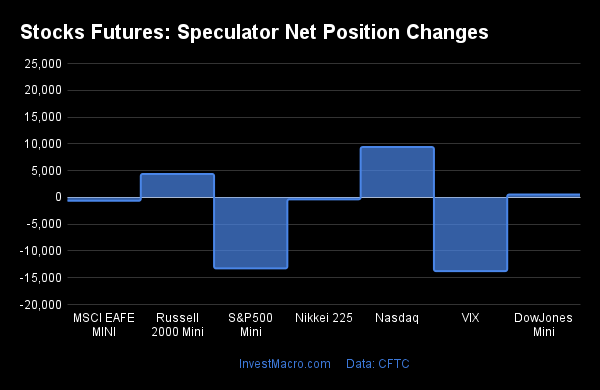
The COT stock markets speculator bets were lower this week as just one out of the six stock markets we cover had higher positioning while the other seven markets had lower speculator contracts.

The only market with gains for this week was the VIX with a rise of 20,452 contracts.

The markets with the declines in speculator bets this week were Nasdaq-Mini (-12,482 contracts) with the Russell-Mini (-4,787 contracts), MSCI EAFE-Mini (-14,869 contracts), S&P500-Mini (-13,644 contracts),  DowJones-Mini (-1,471 contracts) and the Nikkei 225 (-1,106 contracts) also registering lower bets on the week.


Data Snapshot of Stock Market Traders | Columns Legend
Jan-17-2023OIOI-IndexSpec-NetSpec-IndexCom-NetCOM-IndexSmalls-NetSmalls-Index
S&P500-Mini2,056,4724-226,81814231,16381-4,34525
Nikkei 22514,13810-3,825594,34051-51522
Nasdaq-Mini275,01557-20,6336430,54445-9,91133
DowJones-Mini82,66046-10,6132712,29074-1,67732
VIX326,90049-52,3557755,59522-3,24076
Nikkei 225 Yen37,043147,97159-2,2404-5,73168


Strength Scores led by VIX & Nasdaq-Mini

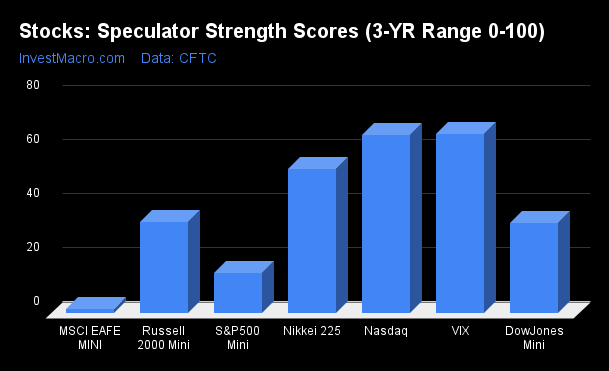
COT Strength Scores (a normalized measure of Speculator positions over a 3-Year range, from 0 to 100 where above 80 is Extreme-Bullish and below 20 is Extreme-Bearish) showed that the VIX (77 percent) and the Nasdaq-Mini (64 percent) lead the stock markets this week. The Nikkei 225 (59 percent) and Nikkei 225 Yen (59 percent) come in as the next highest in the weekly strength scores.

On the downside, the MSCI EAFE-Mini (9 percent) comes in at the lowest strength level currently and is in Extreme-Bearish territory (below 20 percent). The next lowest strength score is the S&P500-Mini (14 percent).

Strength Statistics:
VIX (76.5 percent) vs VIX previous week (62.4 percent)
S&P500-Mini (14.2 percent) vs S&P500-Mini previous week (16.7 percent)
DowJones-Mini (27.1 percent) vs DowJones-Mini previous week (29.3 percent)
Nasdaq-Mini (63.5 percent) vs Nasdaq-Mini previous week (70.5 percent)
Russell2000-Mini (32.0 percent) vs Russell2000-Mini previous week (34.7 percent)
Nikkei USD (59.3 percent) vs Nikkei USD previous week (64.6 percent)
EAFE-Mini (9.4 percent) vs EAFE-Mini previous week (27.2 percent)


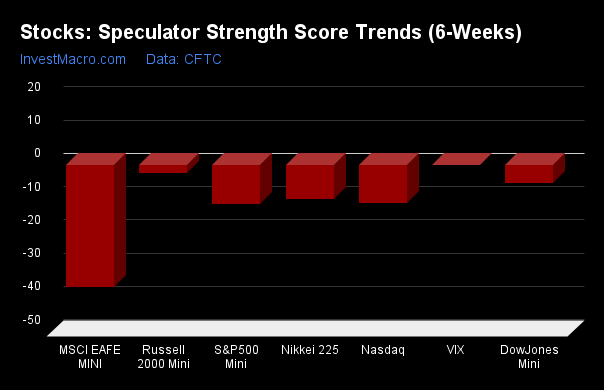
VIX & Nikkei 225 Yen top the 6-Week Strength Trends

COT Strength Score Trends (or move index, calculates the 6-week changes in strength scores) showed that the VIX (15 percent) leads the past six weeks trends for the stock markets. The Nikkei 225 Yen (8 percent), the Russell-Mini (6 percent) and the DowJones-Mini (1 percent) are the next highest positive movers in the latest trends data.

The MSCI EAFE-Mini (-26 percent) leads the downside trend scores currently with the Nasdaq-Mini (-19 percent) coming in as the next market with lower trend scores.

Strength Trend Statistics:
VIX (15.3 percent) vs VIX previous week (-3.6 percent)
S&P500-Mini (-4.3 percent) vs S&P500-Mini previous week (-1.7 percent)
DowJones-Mini (1.5 percent) vs DowJones-Mini previous week (-4.5 percent)
Nasdaq-Mini (-19.1 percent) vs Nasdaq-Mini previous week (-10.0 percent)
Russell2000-Mini (5.9 percent) vs Russell2000-Mini previous week (-0.3 percent)
Nikkei USD (-6.1 percent) vs Nikkei USD previous week (-3.9 percent)
EAFE-Mini (-25.5 percent) vs EAFE-Mini previous week (15.7 percent)


Individual Stock Market Charts:

VIX Volatility Futures:

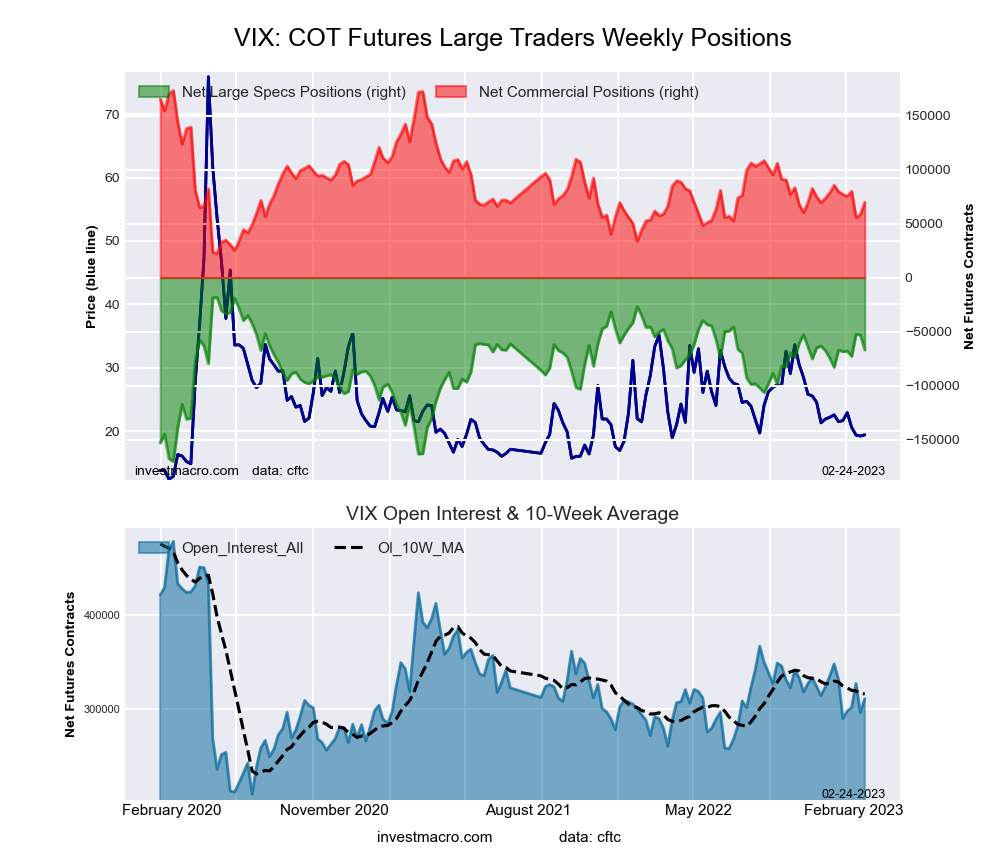
VIX Volatility Futures COT ChartThe VIX Volatility large speculator standing this week came in at a net position of -52,355 contracts in the data reported through Tuesday. This was a weekly boost of 20,452 contracts from the previous week which had a total of -72,807 net contracts.

This week’s current strength score (the trader positioning range over the past three years, measured from 0 to 100) shows the speculators are currently Bullish with a score of 76.5 percent. The commercials are Bearish with a score of 22.1 percent and the small traders (not shown in chart) are Bullish with a score of 75.6 percent.

VIX Volatility Futures StatisticsSPECULATORSCOMMERCIALSSMALL TRADERS
– Percent of Open Interest Longs:16.453.98.8
– Percent of Open Interest Shorts:32.436.99.8
– Net Position:-52,35555,595-3,240
– Gross Longs:53,609176,08128,892
– Gross Shorts:105,964120,48632,132
– Long to Short Ratio:0.5 to 11.5 to 10.9 to 1
NET POSITION TREND:
– Strength Index Score (3 Year Range Pct):76.522.175.6
– Strength Index Reading (3 Year Range):BullishBearishBullish
NET POSITION MOVEMENT INDEX:
– 6-Week Change in Strength Index:15.3-15.33.2


S&P500 Mini Futures:

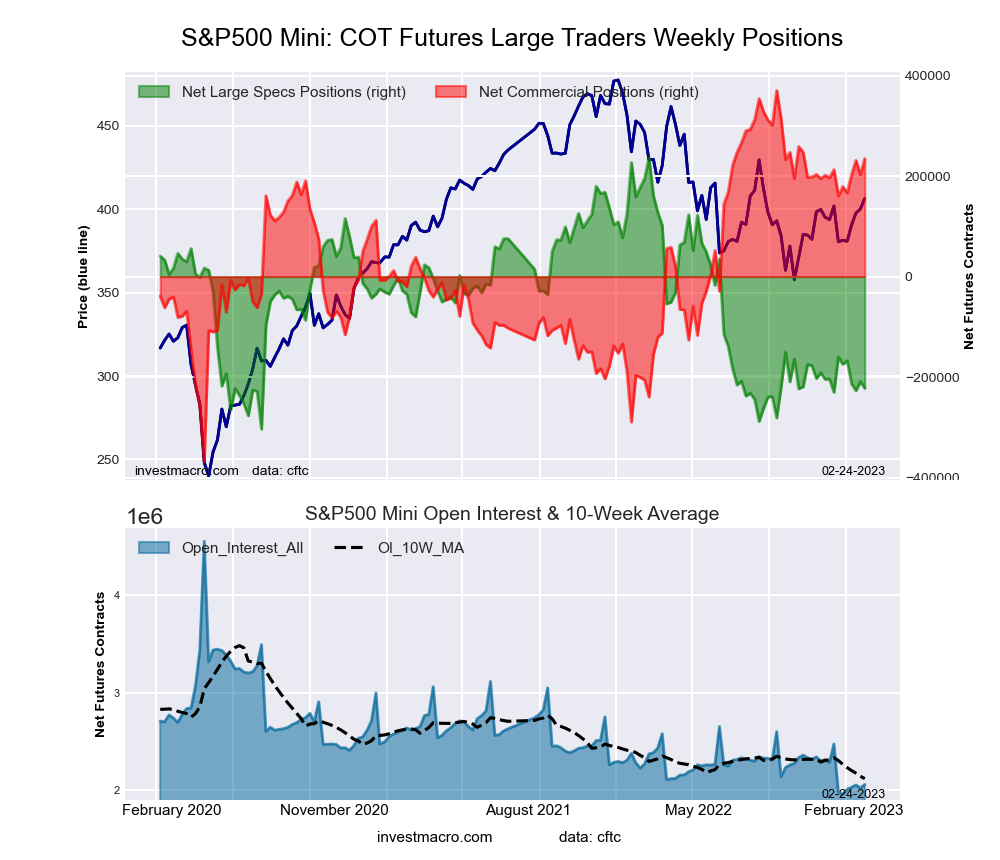
SP500 Mini Futures COT ChartThe S&P500 Mini large speculator standing this week came in at a net position of -226,818 contracts in the data reported through Tuesday. This was a weekly reduction of -13,644 contracts from the previous week which had a total of -213,174 net contracts.

This week’s current strength score (the trader positioning range over the past three years, measured from 0 to 100) shows the speculators are currently Bearish-Extreme with a score of 14.2 percent. The commercials are Bullish-Extreme with a score of 81.2 percent and the small traders (not shown in chart) are Bearish with a score of 25.5 percent.

S&P500 Mini Futures StatisticsSPECULATORSCOMMERCIALSSMALL TRADERS
– Percent of Open Interest Longs:12.773.811.4
– Percent of Open Interest Shorts:23.762.611.6
– Net Position:-226,818231,163-4,345
– Gross Longs:260,3371,518,121234,865
– Gross Shorts:487,1551,286,958239,210
– Long to Short Ratio:0.5 to 11.2 to 11.0 to 1
NET POSITION TREND:
– Strength Index Score (3 Year Range Pct):14.281.225.5
– Strength Index Reading (3 Year Range):Bearish-ExtremeBullish-ExtremeBearish
NET POSITION MOVEMENT INDEX:
– 6-Week Change in Strength Index:-4.34.7-2.4


Dow Jones Mini Futures:

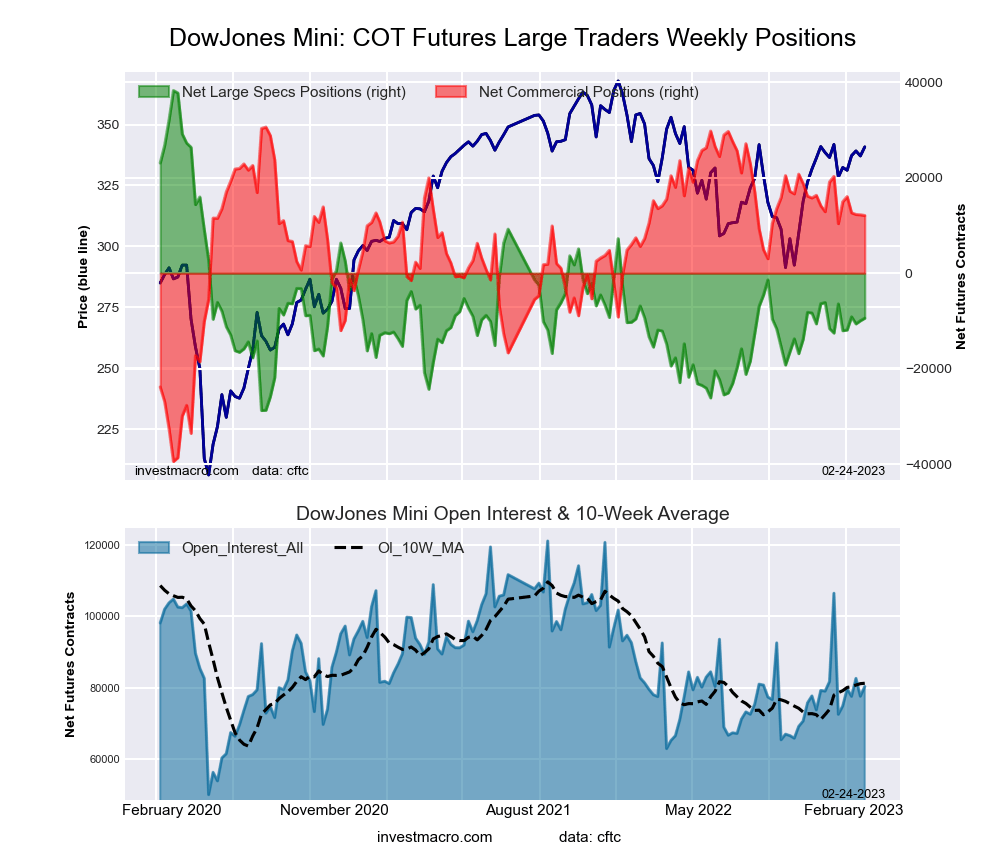
Dow Jones Mini Futures COT ChartThe Dow Jones Mini large speculator standing this week came in at a net position of -10,613 contracts in the data reported through Tuesday. This was a weekly decline of -1,471 contracts from the previous week which had a total of -9,142 net contracts.

This week’s current strength score (the trader positioning range over the past three years, measured from 0 to 100) shows the speculators are currently Bearish with a score of 27.1 percent. The commercials are Bullish with a score of 73.9 percent and the small traders (not shown in chart) are Bearish with a score of 32.2 percent.

Dow Jones Mini Futures StatisticsSPECULATORSCOMMERCIALSSMALL TRADERS
– Percent of Open Interest Longs:31.348.316.5
– Percent of Open Interest Shorts:44.133.518.5
– Net Position:-10,61312,290-1,677
– Gross Longs:25,84739,94813,654
– Gross Shorts:36,46027,65815,331
– Long to Short Ratio:0.7 to 11.4 to 10.9 to 1
NET POSITION TREND:
– Strength Index Score (3 Year Range Pct):27.173.932.2
– Strength Index Reading (3 Year Range):BearishBullishBearish
NET POSITION MOVEMENT INDEX:
– 6-Week Change in Strength Index:1.5-9.729.9


Nasdaq Mini Futures:

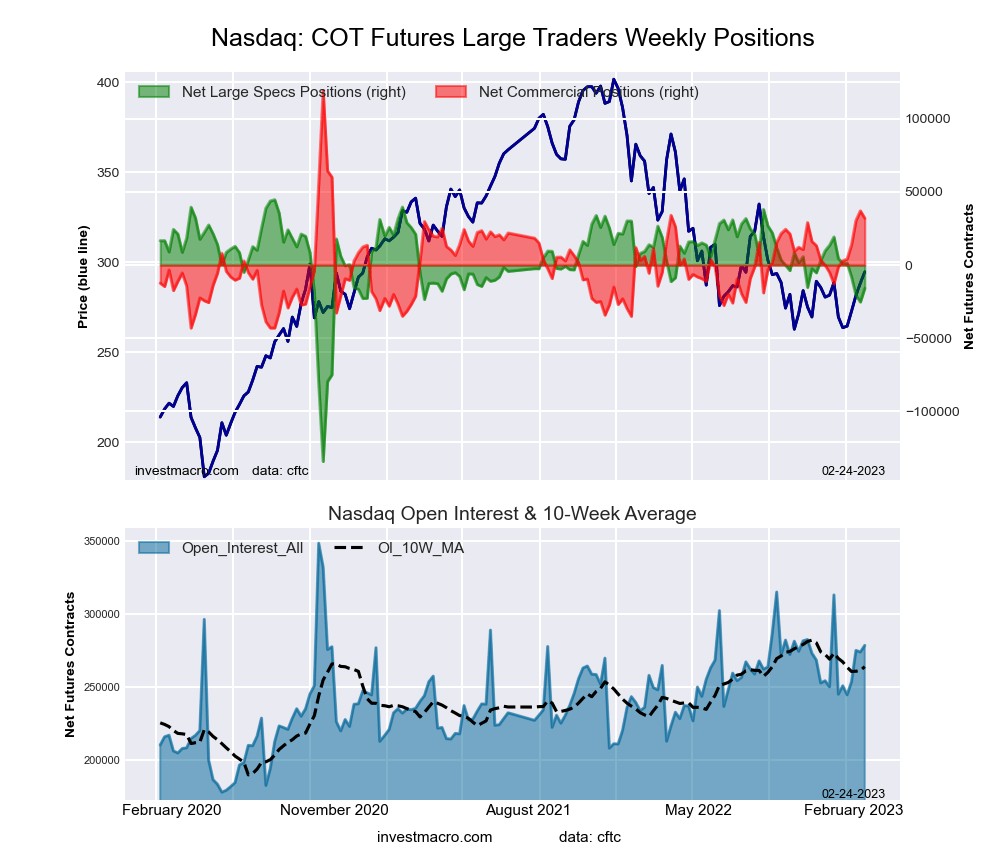
Nasdaq Mini Futures COT ChartThe Nasdaq Mini large speculator standing this week came in at a net position of -20,633 contracts in the data reported through Tuesday. This was a weekly lowering of -12,482 contracts from the previous week which had a total of -8,151 net contracts.

This week’s current strength score (the trader positioning range over the past three years, measured from 0 to 100) shows the speculators are currently Bullish with a score of 63.5 percent. The commercials are Bearish with a score of 45.3 percent and the small traders (not shown in chart) are Bearish with a score of 33.3 percent.

Nasdaq Mini Futures StatisticsSPECULATORSCOMMERCIALSSMALL TRADERS
– Percent of Open Interest Longs:22.462.911.9
– Percent of Open Interest Shorts:29.951.815.5
– Net Position:-20,63330,544-9,911
– Gross Longs:61,621172,92632,760
– Gross Shorts:82,254142,38242,671
– Long to Short Ratio:0.7 to 11.2 to 10.8 to 1
NET POSITION TREND:
– Strength Index Score (3 Year Range Pct):63.545.333.3
– Strength Index Reading (3 Year Range):BullishBearishBearish
NET POSITION MOVEMENT INDEX:
– 6-Week Change in Strength Index:-19.121.9-2.7


Russell 2000 Mini Futures:

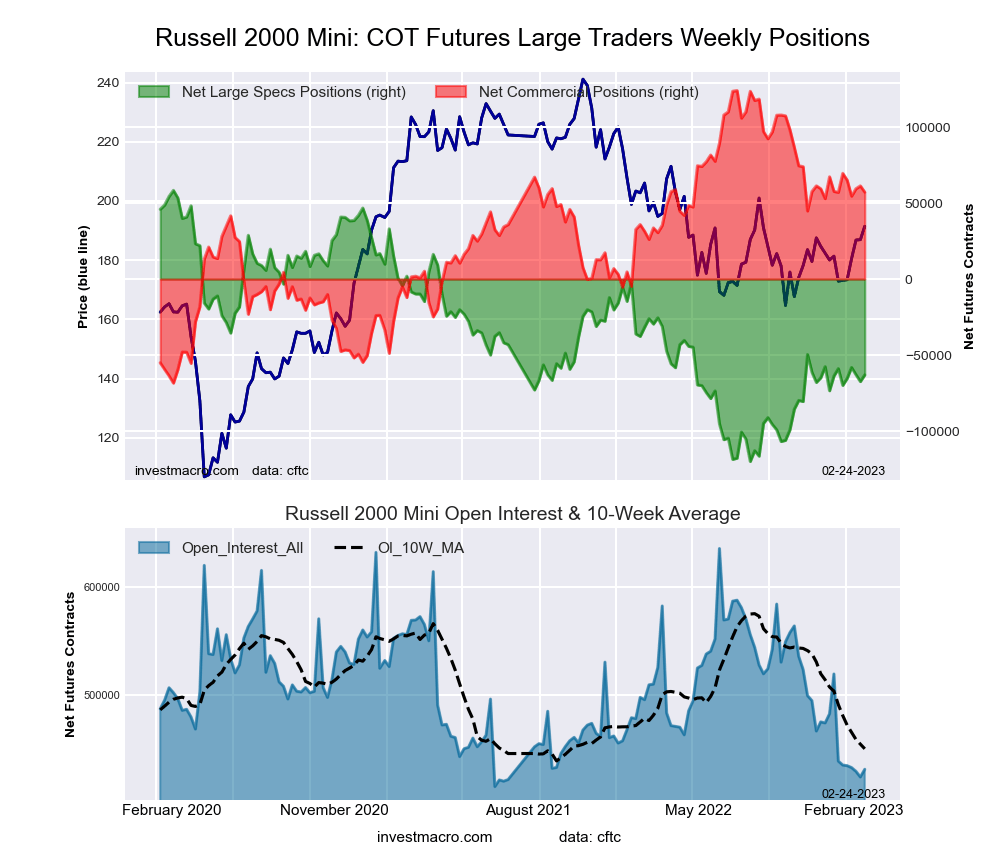
Russell 2000 Mini Futures COT ChartThe Russell 2000 Mini large speculator standing this week came in at a net position of -62,915 contracts in the data reported through Tuesday. This was a weekly fall of -4,787 contracts from the previous week which had a total of -58,128 net contracts.

This week’s current strength score (the trader positioning range over the past three years, measured from 0 to 100) shows the speculators are currently Bearish with a score of 32.0 percent. The commercials are Bullish with a score of 66.4 percent and the small traders (not shown in chart) are Bearish with a score of 37.4 percent.

Russell 2000 Mini Futures StatisticsSPECULATORSCOMMERCIALSSMALL TRADERS
– Percent of Open Interest Longs:10.482.75.7
– Percent of Open Interest Shorts:25.168.84.9
– Net Position:-62,91559,4233,492
– Gross Longs:44,629354,69824,352
– Gross Shorts:107,544295,27520,860
– Long to Short Ratio:0.4 to 11.2 to 11.2 to 1
NET POSITION TREND:
– Strength Index Score (3 Year Range Pct):32.066.437.4
– Strength Index Reading (3 Year Range):BearishBullishBearish
NET POSITION MOVEMENT INDEX:
– 6-Week Change in Strength Index:5.9-4.1-8.3


Nikkei Stock Average (USD) Futures:

Nikkei Stock Average (USD) Futures COT ChartThe Nikkei Stock Average (USD) large speculator standing this week came in at a net position of -3,825 contracts in the data reported through Tuesday. This was a weekly decrease of -1,106 contracts from the previous week which had a total of -2,719 net contracts.

This week’s current strength score (the trader positioning range over the past three years, measured from 0 to 100) shows the speculators are currently Bullish with a score of 59.3 percent. The commercials are Bullish with a score of 51.4 percent and the small traders (not shown in chart) are Bearish with a score of 21.9 percent.

Nikkei Stock Average Futures StatisticsSPECULATORSCOMMERCIALSSMALL TRADERS
– Percent of Open Interest Longs:18.161.220.6
– Percent of Open Interest Shorts:45.230.524.3
– Net Position:-3,8254,340-515
– Gross Longs:2,5608,6532,914
– Gross Shorts:6,3854,3133,429
– Long to Short Ratio:0.4 to 12.0 to 10.8 to 1
NET POSITION TREND:
– Strength Index Score (3 Year Range Pct):59.351.421.9
– Strength Index Reading (3 Year Range):BullishBullishBearish
NET POSITION MOVEMENT INDEX:
– 6-Week Change in Strength Index:-6.113.4-17.4


MSCI EAFE Mini Futures:

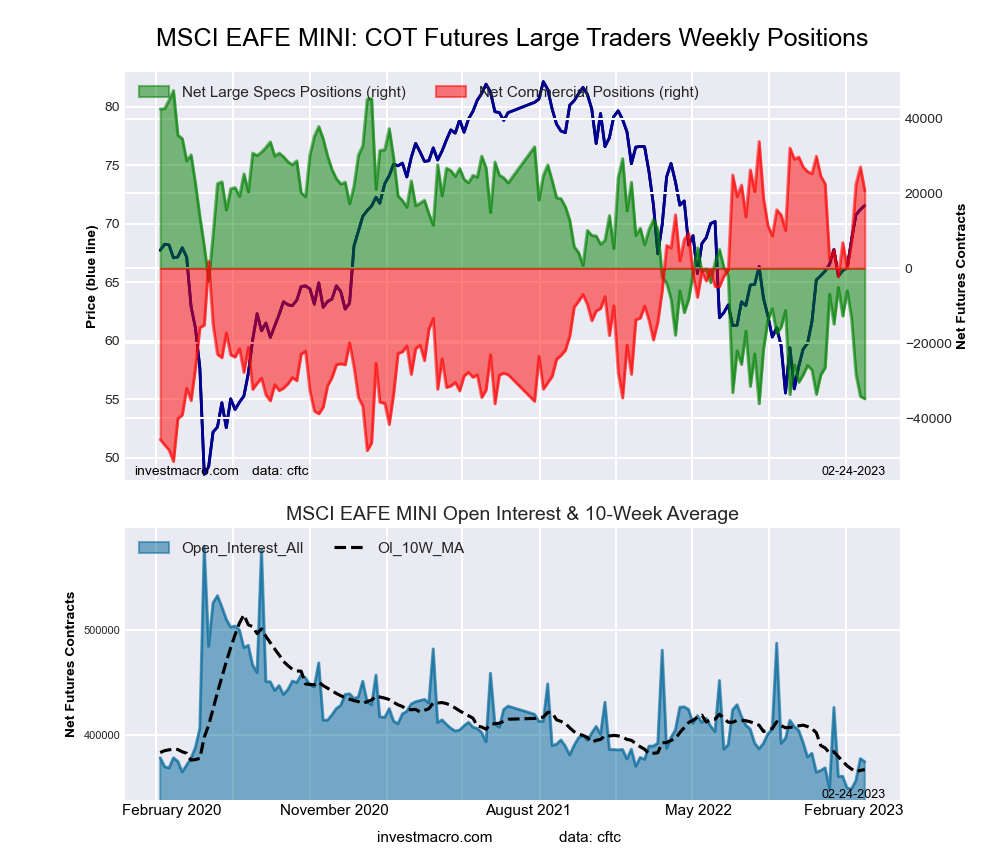
MSCI EAFE Mini Futures COT ChartThe MSCI EAFE Mini large speculator standing this week came in at a net position of -28,278 contracts in the data reported through Tuesday. This was a weekly decrease of -14,869 contracts from the previous week which had a total of -13,409 net contracts.

This week’s current strength score (the trader positioning range over the past three years, measured from 0 to 100) shows the speculators are currently Bearish-Extreme with a score of 9.4 percent. The commercials are Bullish-Extreme with a score of 86.7 percent and the small traders (not shown in chart) are Bullish with a score of 68.7 percent.

MSCI EAFE Mini Futures StatisticsSPECULATORSCOMMERCIALSSMALL TRADERS
– Percent of Open Interest Longs:5.291.13.2
– Percent of Open Interest Shorts:13.284.81.5
– Net Position:-28,27822,5165,762
– Gross Longs:18,717324,87211,276
– Gross Shorts:46,995302,3565,514
– Long to Short Ratio:0.4 to 11.1 to 12.0 to 1
NET POSITION TREND:
– Strength Index Score (3 Year Range Pct):9.486.768.7
– Strength Index Reading (3 Year Range):Bearish-ExtremeBullish-ExtremeBullish
NET POSITION MOVEMENT INDEX:
– 6-Week Change in Strength Index:-25.523.78.5


Article By InvestMacroReceive our weekly COT Newsletter

*COT Report: The COT data, released weekly to the public each Friday, is updated through the most recent Tuesday (data is 3 days old) and shows a quick view of how large speculators or non-commercials (for-profit traders) were positioned in the futures markets.

The CFTC categorizes trader positions according to commercial hedgers (traders who use futures contracts for hedging as part of the business), non-commercials (large traders who speculate to realize trading profits) and nonreportable traders (usually small traders/speculators) as well as their open interest (contracts open in the market at time of reporting). See CFTC criteria here.