Archive for Financial News – Page 214

Credit Suisse: How the Price of Credit-Default Swaps Provided a Warning

“… exceeded every high-water mark … of the past 15 years”

By Elliott Wave International

Credit-default swaps were invented in the mid-1990s but a lot of people did not become aware of them until around 2000, and that awareness increased dramatically during the 2008 financial crisis. As you may recall, so-called CDSs were all over the news then.

Today, these financial derivatives are in the news again.

In a nutshell, credit-default swaps are insurance against a debt default: The higher the perceived risk of default, the higher the premiums.

With that in mind, back in November, the Global Market Perspective, a monthly Elliott Wave International publication which covers 50-plus financial markets, showed this chart and said:

Just last month, Credit Suisse — the once-venerable Zurich-based global investment bank that [the Global Market Perspective] has warned about for years — saw prices for its credit-default swaps (CDS) shoot past 300, indicating investors’ increasing belief that the bank will default. As shown, CDS prices have exceeded every high-water mark set during every crisis of the past 15 years.

Since then, the price of those CDSs have approximately tripled, climbing north of 1000.

As a March 18 news item from The Financial Times noted:

Cost of insuring Credit Suisse debt dwarfs that of other banks
The price of Swiss lender’s credit default swaps climbs to record high this week

During the same weekend that news item published, Credit Suisse collapsed, and the Swiss government brokered a deal which involved rival UBS buying Credit Suisse for $3.2 billion.

Worries about the global banking sector are not confined to Credit Suisse.

Here’s a March 24 headline (CNBC):

Deutsche Bank shares slide after sudden spike in the cost of insuring against its default

Yet, at least one strategist expressed this (Yahoo! Finance, March 24):

Everything ‘really is fine with Deutsche Bank’ due to capital levels, [chief strategist] says

Other professional observers of the banking sector have also basically said “don’t worry, big banks are in good financial health.” But keep in mind that many of these same observers were caught off guard by what’s already occurred with failed banks.

Elliott Wave International has been warning of this persistent optimism. The time will likely soon arrive when even those who are now expressing the most optimism will shift to pessimism.

That will be the juncture of what Elliott Wave International calls the “point of recognition.”

You want to be prepared before then.

Now is the time to read Elliott Wave International’s special report “How Safe Is My Bank?,” which is valued at $49, yet, you can get it for free by following this link.

This article was syndicated by Elliott Wave International and was originally published under the headline Credit Suisse: How the Price of Credit-Default Swaps Provided a Warning. EWI is the world’s largest market forecasting firm. Its staff of full-time analysts led by Chartered Market Technician Robert Prechter provides 24-hour-a-day market analysis to institutional and private investors around the world.

Trade Of The Week: Another Volatile Week For Gold?

By ForexTime

Gold prices shed as much as 1% on Monday morning after closing above the psychological $2000 level last week. Prices later recovered thanks to a weaker dollar and heightened geopolitical tensions over Taiwan.

Appetite for the precious metal was hit by last Friday’s goldilocks US jobs report which boosted bets around the Federal Reserve raising rates by 25 basis points in May. US payrolls increased by 236k in March, printing in line with expectations while the unemployment rate dropped to near-record lows of 3.5%. The upwardly revised payrolls figure for February of 326k was the icing on the cake, as the overall jobs report eased concerns that the world’s largest economy is heading for a recession. Given how this development may offer support to the dollar and feed Fed hike expectations, gold bulls could be caged in the short term.

Nevertheless, gold prices have been on a tear over the past few weeks as the horrible combination of banking fears and recession concerns fuelled risk aversion. After securing a weekly close above the $2000 level for the first time since August 2020, the key question is whether bulls have what it takes to push prices to the all-time high at $2075.47. While the fundamentals favour further upside, bears could be inspired by the renewed focus on inflation as the banking turmoil cools. On the technical front, the relative strength index (RSI) is signaling that prices are overbought on both the daily and weekly timeframe.

Taking a quick peek at the technical picture, gold remains bullish with the weekly close above the $2000 level signaling further upside. However, anything could be on the table given how prices are flirting close to the 70 level on its 14-week RS1.

The lowdown….

The dollar found itself under renewed selling pressure early last week after disappointing economic data fuelled recession fears and slashed Fed hike bets.

This potent combination, along with falling Treasury yields was enough to propel gold way above the psychological $2000 level on Tuesday with prices reaching their highest level since March 2022 at $2032 mid-week. Gold struggled to preserve its bullish momentum on Thursday thanks to technical forces, with a stabilizing dollar amid risk aversion dragging prices back toward $2000. The recent price action re-confirms that this psychological level remains a pivotal point for bulls and bears. Expect the pending economic reports and risk events to influence whether gold concludes the week above or below this level.

All eyes on US CPI & Fed minutes 

It will be wise to keep an eye on the US CPI report published on Wednesday.

Inflation in the United States is projected to slow 5.2% in March year-on-year compared to the 6% figure witnessed in February. If expectations match reality, this will mark the ninth consecutive decline in inflation. However, all eyes will be on the Core CPI readings which exclude more volatile items such as food and energy. Core inflation year-on-year is expected to rise 5.6% in March compared to 5.5% in the previous month. Ultimately, persistent signs of easing inflationary pressures in the world’s largest economy may fuel speculation around the Fed pausing rate hikes sooner than expected. This could boost appetite for zero-yielding gold, pushing prices back towards $2032 and beyond.

Wednesday also sees the release of the Fed meeting minutes which concluded a 25-basis point rate hike. All eyes will be on the language of the minutes and whether any fresh clues are offered on future Fed rate moves. If the minutes strike a dovish tone similar to the March meeting, this could reinforce market expectations around the Fed’s hiking cycle nearing an end.

Other than the highly anticipated US CPI report and Fed meeting, there are key speeches from Fed officials and key economic data throughout the week that could influence gold prices. On the geopolitical front, heightened tensions around the Taiwan Strait has the potential to fuel risk aversion – supporting safe-haven assets.

Is gold heading for the all-time high?

Gold remains bullish on the daily charts as there have been consistently higher highs and higher lows. However, prices seem to be flirting around overbought conditions on the RSI. The weekly close above $2000 could encourage an incline back toward $2032. Beyond this point, the next levels of interest are $2070 and $2075. Should prices slip back under $2000, gold could retest $1950 and $1900, respectively.


Forex-Time-LogoArticle by ForexTime

ForexTime Ltd (FXTM) is an award winning international online forex broker regulated by CySEC 185/12 www.forextime.com

Technical Analysis of EUR/USD: Consolidation Range and Potential Directional Movements

By RoboForex Analytical Department

The EUR/USD currency pair is starting the new week of April balanced, hovering around 1.0900. Market activity was slowed down during the Easter holidays in the US and Europe, but investors are gradually returning to trades.

Last Friday, the US labor market statistics were released, and while they came out almost unnoticed, market participants will have a chance to account for the data in the quotes later. The unemployment rate in March saw a decrease to 3.5%, which was better than expected. Nonfarm payrolls (NFP) rose by 236 thousand against the forecasted 228 thousand and 326 thousand previously. The data from February were revised and came out better, which is a positive signal. The average hourly wage also grew by a stable 0.3% m/m.

Although for now, the risk that the economy could slow down has not found any reflection in the employment sector, this margin of safety is unlikely to last long.

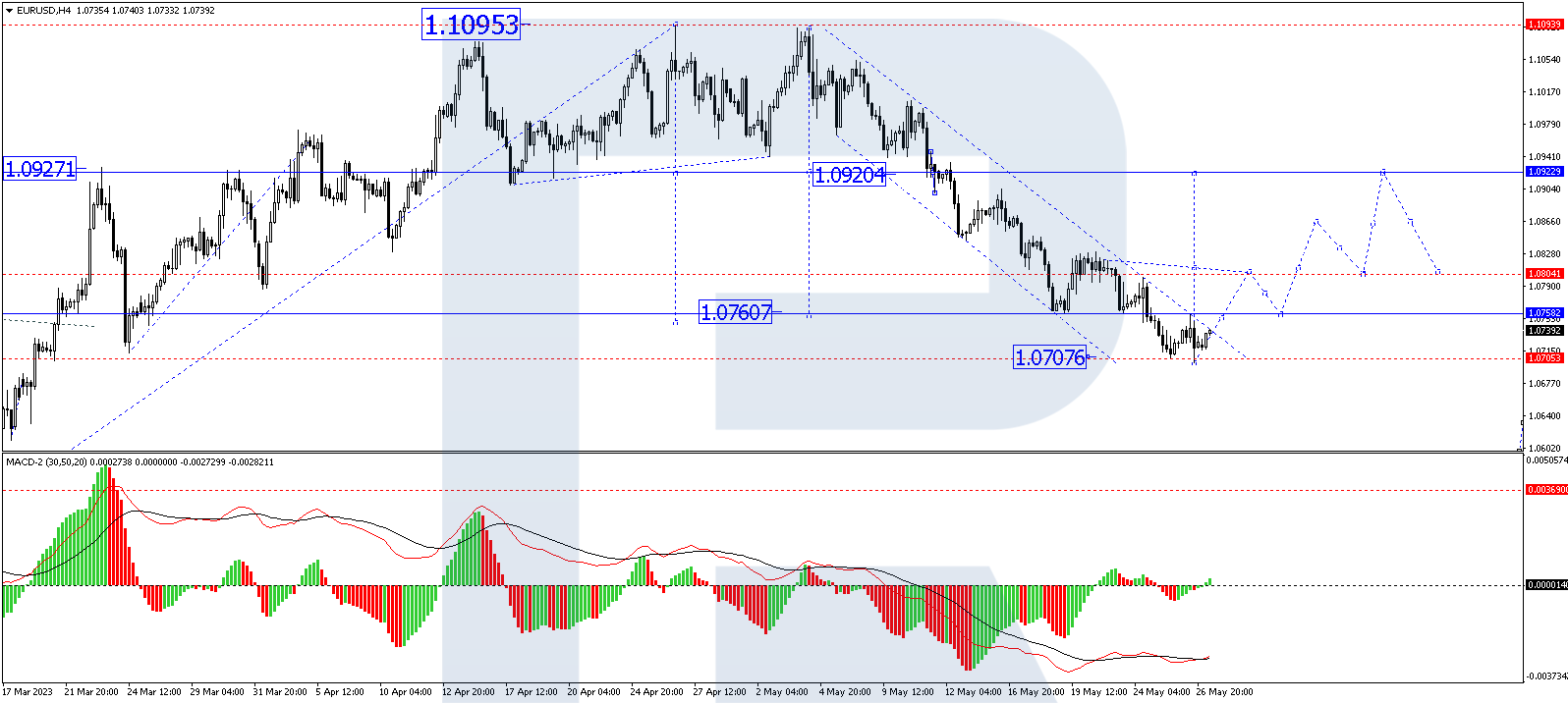
On the H4 chart, the EUR/USD currency pair has performed an impulse of decline to 1.0875. Currently, the market is forming a consolidation range under this level. There is a possibility of growth to 1.0930, followed by a decline to 1.0760, from where the wave could continue to 1.0720. Technically, this scenario is confirmed by the MACD indicator, which shows that its signal line is above the zero mark and directed strictly down to renew the lows.

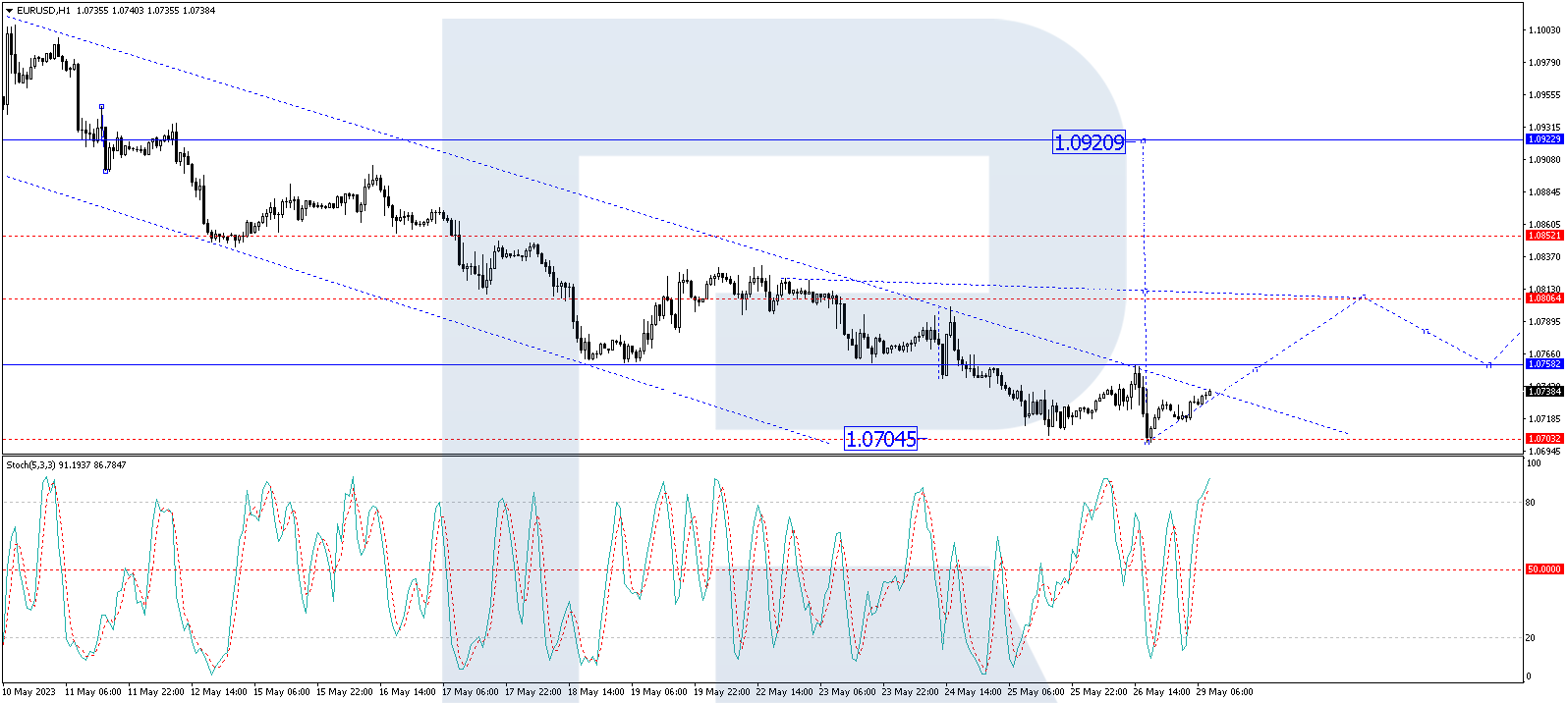
On the H1 chart, the EUR/USD currency pair has completed a structure of the declining wave to 1.0875. At the moment, a consolidation range is forming above this level. The price could break the range upwards and correct to 1.0924. Then, a decline to 1.0820 could follow, with the target being local. This scenario is technically confirmed by the Stochastic oscillator, which shows that its signal line is near 50, expected to grow to 80, and then drop to 20.

Disclaimer

Any forecasts contained herein are based on the author’s particular opinion. This analysis may not be treated as trading advice. RoboForex bears no responsibility for trading results based on trading recommendations and reviews contained herein.

The cryptocurrency market digest (BTC). Overview for 10.04.2023

By RoboForex.com

The BTC on Monday saw an increase to 28,272 USD. The weekly rise in the leading cryptocurrency amounts to 2.18%.

It should be noted that over three weeks starting on 23 March, trade volumes of the BTC have dropped almost five times, currently being about 75 thousand BTC a day. This fact might be a sign that the market is ready for a new rally. The quotes have been stuck in a rather narrow range for quite long, and this could also trigger nervous moves and attempts to break the resistance.

The technical picture of the BTC remains favourable, facilitating the return to 30,000 USD. The support is at 26,500 USD.

The capitalisation of the crypto market by today has risen to 1.185 trillion USD. The part taken by the BTC has increased to 46.2%. The part occupied by the ETH has dropped to 18.9%.

Capacity of Cardano network will grow

After the Ouribiros Leios update of the Cardano network, the speed of transaction processing must increase ten times. This can happen through the activation of nods that have not been used yet. They will get the function of making computations between blocks, while the result will be stored in the next blocks.

Coinbase will integrate The Lighting Network

The management of the Coinbase crypto exchange confirmed their plans to add The Lighting Network protocol on the trading platform. This can speed up transactions and make them cheaper. The integration is scheduled for the nearest future.

Article By RoboForex.com

Attention!
Forecasts presented in this section only reflect the author’s private opinion and should not be considered as guidance for trading. RoboForex LP bears no responsibility for trading results based on trading recommendations described in these analytical reviews.

The US labor market remains resilient. China simulates an attack on Taiwan

By JustMarkets

A Nonfarm Payrolls report on Friday showed that US nonfarm payrolls rose by 236,000 in March, in line with a forecast of 239,000. February’s data was revised upwards. 326,000 jobs were added instead of 311,000. The US unemployment rate fell to a record low of 3.5%. At the same time, annual payrolls rose at the slowest rate since June 2021. Although the employment report showed significant growth, some sectors saw moderate declines, particularly manufacturing, and construction. But overall, such data leaves the US Federal Reserve with room for another rate hike at the next meeting. The market currently estimates a 70% probability that the Fed will raise interest rates by 25 basis points in May. The US stock indices did not trade on Friday due to the holidays. By the end of the week, the Dow Jones Index (US30) increased by 1.77%, and the S&P 500 Index (US500) jumped by 1.20%. The NASDAQ Technology Index (US100) gained 0.47% in 5 days.

Tesla (TSLA) announced plans to build a new plant in Shanghai to produce energy storage products.

Equity markets in Europe were also closed Friday. By the end of the week, German DAX (DE30) gained 0.19%, French CAC 40 (FR40) added 0.74% over the week, Spanish IBEX 35 (ES35) gained 0.89%, British FTSE 100 (UK100) jumped by 1.59% over five trading days.

According to the ECB Governing Council spokesman Klaas Knot, Europe’s central bank should continue to raise borrowing costs, with a slower pace of tightening being justified. The Dutch banker also added that even if the ECB reaches an interest rate level that the bank believes will return inflation to 2% in the medium term, the ECB may have to hold interest rates at this peak level for a long time.

Last week Israel’s Central Bank softened the pace of monetary policy tightening, recognizing the potential risks to monetary policy posed by the government’s scandalous “judicial reform.” Sri Lanka kept rates unchanged after receiving a loan from the International Monetary Fund, while Australia, Romania, Chile, Poland, and India also kept borrowing costs unchanged.

Oil prices remained stable at the end of last week. Investors are weighing the prospect of supply cuts by OPEC+ producers in May against concerns about weakening global growth, which could reduce demand for the fuel. Investors are also watching the progress of negotiations between Iraq and “Kurdistan” to restart northern oil exports, which could bring more oil to the global market.

Asian markets mostly rallied last week. Japan’s Nikkei 225 (JP225) declined 2.43% over the week, China’s FTSE China A50 (CHA50) was little changed over the week, Hong Kong’s Hang Seng (HK50) gained 0.30% over the week, India’s NIFTY 50 (IND50) added 3.52%, and Australia’s S&P/ASX 200 (AU200) was positive 1.30% over the week.

An analysis of global financial conditions shows that Asian financial markets have tightened less than in the US, and most Asian currencies have strengthened against the US dollar. Except for Japan, the region’s financial stock index has risen since 10 March (the day of the Silicon Valley bank crash) compared to the US bank index’s fall of almost 10% over the same period. This suggests that the Asian economy remains relatively well insulated from the US and European economies. Economists believe one factor favoring the Asia-Pacific region is a generally softer turn in monetary policy, with central banks in Australia, South Korea, Indonesia, and India putting tightening cycles on hold.

According to analysts, Hong Kong and Thailand, which are benefiting from China’s reopening, as well as domestic service-oriented economies such as India and the Philippines, “look relatively more resilient” to the global shock. And Singapore will be the main beneficiary of growth in the region.

Japan is poised to sharply increase its spending on chips as it tries to consolidate its position in the global semiconductor market, as it cuts exports amid a US drive to curb China’s technological ambitions. Japan is expected to spend $7 billion on manufacturing equipment next year, up 82% from this year.

The Chinese military simulated spot strikes on Taiwan on the second day of exercises around the island on Sunday, with the island’s defense ministry reporting several air force sorties and keeping an eye on Chinese missile forces. The US embassy in Taiwan said on Sunday that the United States was closely monitoring China’s drills around Taiwan and was confident that it had enough resources and capabilities regionally to ensure peace and stability. For his part, French President Macron said after a visit to China that Europe should reduce its dependence on the United States and avoid becoming embroiled in a China-US confrontation over Taiwan.

In the commodities market, futures on coffee (+6.92%), WTI oil (+6.33%), Brent oil (+6.32%), sugar (+6.20%), gasoline (+4.55%), silver (+4.03%) and lumber (+2.99%) showed the biggest gains last week. Futures on natural gas (-8.17%), corn (-2.42%), and wheat (-2.42%) showed the biggest drop.

S&P 500 (F) (US500) 4,105.02 +0 (+0%)

Dow Jones (US30)33,485.29 +0 (+0%)

DAX (DE40) 15,597.89 +0 (+0%)

FTSE 100 (UK100) 7,741.56 +0 (+0%)

USD Index 102.10 +0.27 (+0.27%)

Important events for today:
  • – US FOMC Member Williams Speaks at 23:15 (GMT+3).

By JustMarkets


This article reflects a personal opinion and should not be interpreted as an investment advice, and/or offer, and/or a persistent request for carrying out financial transactions, and/or a guarantee, and/or a forecast of future events.

S&P500-Mini Speculators dropped their positions sharply to multi-year low

By InvestMacro

Here are the latest charts and statistics for the Commitment of Traders (COT) data published by the Commodities Futures Trading Commission (CFTC).

The latest COT data is updated through Tuesday April 4th and shows a quick view of how large traders (for-profit speculators and commercial entities) were positioned in the futures markets.

Weekly Speculator Changes are all lower

The COT stock markets speculator bets were lower this week as all of the markets we cover had lower speculator contracts.

The markets with the declines in speculator bets this week were the S&P500-Mini (-96,803 contracts), DowJones-Mini (-56 contracts), MSCI EAFE-Mini (-3,797 contracts), Nikkei 225 (-2,185 contracts), VIX (-14,909 contracts), Nasdaq-Mini (-11,037 contracts) and the Russell-Mini (-14,206 contracts) also registering lower bets on the week.

S&P500-Mini Speculators dropped their positions sharply to multi-year low

Highlighting the COT stocks data this week is the continued increases in bearish bets for the S&P500-Mini speculative positions.

The large speculator position in the S&P500-Mini futures dropped sharply this week and fell for the third straight week as well as for the fourth time out of the past five weeks. This week’s speculative decline by -96,803 contracts marks the largest one-week shortfall since last June and the S&P500-Mini bets have now been in a continuous bearish position for the past 42 consecutive weeks, also dating back to last June of 2022.

This week’s overall net speculator position standing of -321,459 contracts is now at the most bearish level since November 8th of 2011, a span dating back for 595 weeks. The speculator strength scores shows a bearish-extreme strength score level at 0 percent (or the absolute bottom) of its 3-year range. The speculator strength score trend (the past 6-weeks change of strength scores) shows a rising downtrend of -16 percent.

The COT speculator’s extreme bearish positioning does not portend a stock market downtrend though as the correlations between speculators and the stock markets are not nearly as strong as other futures markets (which are more trend-following). This can be due to the large amount of hedging positions throughout these markets.

The S&P500-Mini stock futures price has continued on its move higher after bottoming in October near the 3500 level. This week saw the S&P500-Mini futures close above the 4141 level and is up by approximately 18 percent since the most recent bottom in October.


Data Snapshot of Stock Market Traders | Columns Legend
Apr-04-2023OIOI-IndexSpec-NetSpec-IndexCom-NetCOM-IndexSmalls-NetSmalls-Index
S&P500-Mini2,219,51217-321,4590281,4728739,98736
Nikkei 22510,8332-3,279581,784411,49547
Nasdaq-Mini232,18632-18,3856512,556345,82964
DowJones-Mini88,29146-23,6251432,621100-8,9960
VIX355,00868-57,0867456,3912169595
Nikkei 225 Yen36,670136,595549,73037-16,32550


Strength Scores led by VIX & Nasdaq-Mini

COT Strength Scores (a normalized measure of Speculator positions over a 3-Year range, from 0 to 100 where above 80 is Extreme-Bullish and below 20 is Extreme-Bearish) showed that the VIX (74 percent) and the Nasdaq-Mini (65 percent) lead the stock markets this week. The Nikkei 225 (58 percent) and Nikkei 225 Yen (54 percent) come in as the next highest in the weekly strength scores.

On the downside, the S&P500-Mini (0 percent) and the DowJones-Mini (14 percent) come in at the lowest strength level currently and are in Extreme-Bearish territory (below 20 percent).

Strength Statistics:
VIX (73.6 percent) vs VIX previous week (83.9 percent)
S&P500-Mini (0.0 percent) vs S&P500-Mini previous week (17.4 percent)
DowJones-Mini (13.5 percent) vs DowJones-Mini previous week (13.7 percent)
Nasdaq-Mini (64.8 percent) vs Nasdaq-Mini previous week (70.9 percent)
Russell2000-Mini (37.8 percent) vs Russell2000-Mini previous week (46.3 percent)
Nikkei USD (57.9 percent) vs Nikkei USD previous week (69.4 percent)
EAFE-Mini (24.1 percent) vs EAFE-Mini previous week (28.8 percent)


VIX tops the 6-Week Strength Trends

COT Strength Score Trends (or move index, calculates the 6-week changes in strength scores) showed that the VIX (-1 percent) was the highest of the past six weeks trends for the stock markets.

The DowJones-Mini (-19 percent) leads the downside trend scores currently with the Nikkei 225 Yen (-17 percent) coming in as the next market with lower trend scores.

Strength Trend Statistics:
VIX (-0.7 percent) vs VIX previous week (9.7 percent)
S&P500-Mini (-15.6 percent) vs S&P500-Mini previous week (3.9 percent)
DowJones-Mini (-19.4 percent) vs DowJones-Mini previous week (-44.3 percent)
Nasdaq-Mini (-2.4 percent) vs Nasdaq-Mini previous week (8.6 percent)
Russell2000-Mini (-1.4 percent) vs Russell2000-Mini previous week (12.7 percent)
Nikkei USD (-6.6 percent) vs Nikkei USD previous week (6.2 percent)
EAFE-Mini (-1.9 percent) vs EAFE-Mini previous week (6.6 percent)


Individual Stock Market Charts:

VIX Volatility Futures:

VIX Volatility Futures COT ChartThe VIX Volatility large speculator standing this week recorded a net position of -57,086 contracts in the data reported through Tuesday. This was a weekly lowering of -14,909 contracts from the previous week which had a total of -42,177 net contracts.

This week’s current strength score (the trader positioning range over the past three years, measured from 0 to 100) shows the speculators are currently Bullish with a score of 73.6 percent. The commercials are Bearish with a score of 21.3 percent and the small traders (not shown in chart) are Bullish-Extreme with a score of 94.6 percent.

VIX Volatility Futures StatisticsSPECULATORSCOMMERCIALSSMALL TRADERS
– Percent of Open Interest Longs:20.353.78.1
– Percent of Open Interest Shorts:36.437.87.9
– Net Position:-57,08656,391695
– Gross Longs:72,161190,49428,808
– Gross Shorts:129,247134,10328,113
– Long to Short Ratio:0.6 to 11.4 to 11.0 to 1
NET POSITION TREND:
– Strength Index Score (3 Year Range Pct):73.621.394.6
– Strength Index Reading (3 Year Range):BullishBearishBullish-Extreme
NET POSITION MOVEMENT INDEX:
– 6-Week Change in Strength Index:-0.7-4.133.8


S&P500 Mini Futures:

SP500 Mini Futures COT ChartThe S&P500 Mini large speculator standing this week recorded a net position of -321,459 contracts in the data reported through Tuesday. This was a weekly decline of -96,803 contracts from the previous week which had a total of -224,656 net contracts.

This week’s current strength score (the trader positioning range over the past three years, measured from 0 to 100) shows the speculators are currently Bearish-Extreme with a score of 0.0 percent. The commercials are Bullish-Extreme with a score of 86.5 percent and the small traders (not shown in chart) are Bearish with a score of 35.7 percent.

S&P500 Mini Futures StatisticsSPECULATORSCOMMERCIALSSMALL TRADERS
– Percent of Open Interest Longs:7.476.213.6
– Percent of Open Interest Shorts:21.963.511.8
– Net Position:-321,459281,47239,987
– Gross Longs:163,7661,690,406300,962
– Gross Shorts:485,2251,408,934260,975
– Long to Short Ratio:0.3 to 11.2 to 11.2 to 1
NET POSITION TREND:
– Strength Index Score (3 Year Range Pct):0.086.535.7
– Strength Index Reading (3 Year Range):Bearish-ExtremeBullish-ExtremeBearish
NET POSITION MOVEMENT INDEX:
– 6-Week Change in Strength Index:-15.66.110.1


Dow Jones Mini Futures:

Dow Jones Mini Futures COT ChartThe Dow Jones Mini large speculator standing this week recorded a net position of -23,625 contracts in the data reported through Tuesday. This was a weekly fall of -56 contracts from the previous week which had a total of -23,569 net contracts.

This week’s current strength score (the trader positioning range over the past three years, measured from 0 to 100) shows the speculators are currently Bearish-Extreme with a score of 13.5 percent. The commercials are Bullish-Extreme with a score of 100.0 percent and the small traders (not shown in chart) are Bearish-Extreme with a score of 0.0 percent.

Dow Jones Mini Futures StatisticsSPECULATORSCOMMERCIALSSMALL TRADERS
– Percent of Open Interest Longs:16.268.314.7
– Percent of Open Interest Shorts:43.031.424.8
– Net Position:-23,62532,621-8,996
– Gross Longs:14,30260,31412,942
– Gross Shorts:37,92727,69321,938
– Long to Short Ratio:0.4 to 12.2 to 10.6 to 1
NET POSITION TREND:
– Strength Index Score (3 Year Range Pct):13.5100.00.0
– Strength Index Reading (3 Year Range):Bearish-ExtremeBullish-ExtremeBearish-Extreme
NET POSITION MOVEMENT INDEX:
– 6-Week Change in Strength Index:-19.430.5-37.3


Nasdaq Mini Futures:

Nasdaq Mini Futures COT ChartThe Nasdaq Mini large speculator standing this week recorded a net position of -18,385 contracts in the data reported through Tuesday. This was a weekly lowering of -11,037 contracts from the previous week which had a total of -7,348 net contracts.

This week’s current strength score (the trader positioning range over the past three years, measured from 0 to 100) shows the speculators are currently Bullish with a score of 64.8 percent. The commercials are Bearish with a score of 34.2 percent and the small traders (not shown in chart) are Bullish with a score of 64.2 percent.

Nasdaq Mini Futures StatisticsSPECULATORSCOMMERCIALSSMALL TRADERS
– Percent of Open Interest Longs:16.759.322.0
– Percent of Open Interest Shorts:24.653.919.5
– Net Position:-18,38512,5565,829
– Gross Longs:38,815137,75451,175
– Gross Shorts:57,200125,19845,346
– Long to Short Ratio:0.7 to 11.1 to 11.1 to 1
NET POSITION TREND:
– Strength Index Score (3 Year Range Pct):64.834.264.2
– Strength Index Reading (3 Year Range):BullishBearishBullish
NET POSITION MOVEMENT INDEX:
– 6-Week Change in Strength Index:-2.4-13.649.2


Russell 2000 Mini Futures:

Russell 2000 Mini Futures COT ChartThe Russell 2000 Mini large speculator standing this week recorded a net position of -56,956 contracts in the data reported through Tuesday. This was a weekly lowering of -14,206 contracts from the previous week which had a total of -42,750 net contracts.

This week’s current strength score (the trader positioning range over the past three years, measured from 0 to 100) shows the speculators are currently Bearish with a score of 37.8 percent. The commercials are Bullish with a score of 65.3 percent and the small traders (not shown in chart) are Bearish-Extreme with a score of 11.2 percent.

Russell 2000 Mini Futures StatisticsSPECULATORSCOMMERCIALSSMALL TRADERS
– Percent of Open Interest Longs:9.085.44.2
– Percent of Open Interest Shorts:20.672.85.3
– Net Position:-56,95661,943-4,987
– Gross Longs:44,007419,11120,784
– Gross Shorts:100,963357,16825,771
– Long to Short Ratio:0.4 to 11.2 to 10.8 to 1
NET POSITION TREND:
– Strength Index Score (3 Year Range Pct):37.865.311.2
– Strength Index Reading (3 Year Range):BearishBullishBearish-Extreme
NET POSITION MOVEMENT INDEX:
– 6-Week Change in Strength Index:-1.47.3-33.0


Nikkei Stock Average (USD) Futures:

Nikkei Stock Average (USD) Futures COT ChartThe Nikkei Stock Average (USD) large speculator standing this week recorded a net position of -3,279 contracts in the data reported through Tuesday. This was a weekly lowering of -2,185 contracts from the previous week which had a total of -1,094 net contracts.

This week’s current strength score (the trader positioning range over the past three years, measured from 0 to 100) shows the speculators are currently Bullish with a score of 57.9 percent. The commercials are Bearish with a score of 41.0 percent and the small traders (not shown in chart) are Bearish with a score of 47.1 percent.

Nikkei Stock Average Futures StatisticsSPECULATORSCOMMERCIALSSMALL TRADERS
– Percent of Open Interest Longs:7.752.939.4
– Percent of Open Interest Shorts:38.036.425.6
– Net Position:-3,2791,7841,495
– Gross Longs:8395,7284,266
– Gross Shorts:4,1183,9442,771
– Long to Short Ratio:0.2 to 11.5 to 11.5 to 1
NET POSITION TREND:
– Strength Index Score (3 Year Range Pct):57.941.047.1
– Strength Index Reading (3 Year Range):BullishBearishBearish
NET POSITION MOVEMENT INDEX:
– 6-Week Change in Strength Index:-6.6-0.216.3


MSCI EAFE Mini Futures:

MSCI EAFE Mini Futures COT ChartThe MSCI EAFE Mini large speculator standing this week recorded a net position of -16,486 contracts in the data reported through Tuesday. This was a weekly lowering of -3,797 contracts from the previous week which had a total of -12,689 net contracts.

This week’s current strength score (the trader positioning range over the past three years, measured from 0 to 100) shows the speculators are currently Bearish with a score of 24.1 percent. The commercials are Bullish with a score of 71.0 percent and the small traders (not shown in chart) are Bearish with a score of 49.7 percent.

MSCI EAFE Mini Futures StatisticsSPECULATORSCOMMERCIALSSMALL TRADERS
– Percent of Open Interest Longs:7.389.22.9
– Percent of Open Interest Shorts:11.586.71.3
– Net Position:-16,4869,9216,565
– Gross Longs:28,818351,92811,632
– Gross Shorts:45,304342,0075,067
– Long to Short Ratio:0.6 to 11.0 to 12.3 to 1
NET POSITION TREND:
– Strength Index Score (3 Year Range Pct):24.171.049.7
– Strength Index Reading (3 Year Range):BearishBullishBearish
NET POSITION MOVEMENT INDEX:
– 6-Week Change in Strength Index:-1.91.80.3


Article By InvestMacroReceive our weekly COT Newsletter

*COT Report: The COT data, released weekly to the public each Friday, is updated through the most recent Tuesday (data is 3 days old) and shows a quick view of how large speculators or non-commercials (for-profit traders) were positioned in the futures markets.

The CFTC categorizes trader positions according to commercial hedgers (traders who use futures contracts for hedging as part of the business), non-commercials (large traders who speculate to realize trading profits) and nonreportable traders (usually small traders/speculators) as well as their open interest (contracts open in the market at time of reporting). See CFTC criteria here.

Jobs report hints that Fed policy is paying off – and that a ‘growth recession’ awaits

By Christopher Decker, University of Nebraska Omaha 

The latest jobs report is in, and the good news is Federal Reserve policy on inflation appears to be working. The bad news is Fed policy on inflation appears to be working.

The March 2023 jobs report reveals that the U.S. economy added 236,000 jobs during the month – roughly in line with expectations. A trend does appear to be emerging as the U.S. central bank’s efforts to slow the economy down and tame inflation appear to finally be working on the labor market, with some companies feeling the effect of increased business costs.

While that will calm the nerves of monetary policymakers, it does raise the prospect of some economic pain ahead – not least for those who will indeed lose their jobs. And for the wider economy, it could also signal another slightly unwelcome phenomenon: the “growth recession.”

What is a growth recession?

Growth recessions occur when an economy enters a prolonged period of low growth – of say 0.5% to 1.5% – while also experiencing the other telltale signs of a recession, such as higher unemployment and lower consumer spending. The economy is still expanding, but it may feel just like a recession to regular people. Some economists consider the 2002 to 2003 period to have been a growth recession.

For now, the job market is still relatively robust. In March, the unemployment rate even edged downward very slightly to 3.5% from 3.6% the previous month.

Effectively, in terms of job additions, this still-healthy increase nevertheless does suggest a slowdown in hiring. The 236,000 jobs added in March is down from the 326,000 and 472,000 added in February and January, respectively.

A slowdown has been anticipated and suggested by other data for some time now. Eye-grabbing headlines about bank failures and layoffs in the tech sector also signal a slowdown.

Other data hint at more employment pain to come. The February Job Openings and Labor Turnover report from the Bureau of Labor Statistics posted a job openings number below 10 million for the first time since May 2021 – a downward trend that has been in place since December 2021, when openings peaked at 11.8 million.

Meanwhile, the U.S. Census Bureau recently reported that new manufacturing orders fell by 0.7% in February 2023. Indeed new orders declined in three of the last four reported months, and prior to that, orders growth had been sluggish at best.

In terms of sectors, job declines in construction – down by 9,000 – and manufacturing – down by 1,000 – are as expected, as both sectors are sensitive to interest rate increases.

It is quite likely that such declines will continue in coming months.

Other sectors posted substantial gains. Health services were up 50,800, and leisure gained 72,000. However, these gains are still smaller than in previous months.

What this means for Fed policy

This report seems to suggest that Fed actions to slow the economy are working, even though inflation still remains well ahead of its 2% target.

I believe this probably won’t significantly alter Fed policy. Indeed, it suggests that the year-old campaign of using aggressive interest rate hikes to tame inflation appears to be paying dividends. The slow drip of data proving this allows monetary policymakers to manage the economy as they try to provide a so-called “soft landing.”

If the April jobs report is similar to March’s, and barring any unusual events between now and its release in May, I expect the Fed to inch rates up very slowly, likely by another quarter basis point.

Where this leaves the economy as the year progresses, only time – and more data – will tell. But from where I stand, the economy looks to be heading toward a downturn by the fall. The question is whether it will take the form of a mild recession – which will include periods of economic shrinkage – or whether, as I suspect, it will be a low-growth recession. Either way, it will involve some pain.The Conversation

About the Author:

Christopher Decker, Professor of Economics, University of Nebraska Omaha

This article is republished from The Conversation under a Creative Commons license. Read the original article.

Week Ahead: SPX500_m braces for double whiplash

By ForexTime

Even as we await the pivotal US jobs report due later today (Friday, April 7), while noting that US stock markets have the day off on this Good Friday, traders and investors are also keenly aware of the slate of market-moving events due over the coming week.

The incoming US inflation data as well as the earnings announcements by Wall Street banks may trigger fresh volatility for the S&P 500 in the week ahead.

Monday, April 10

  • IMF/World Bank spring meetings
  • USD: Speech by New York Fed President John Williams
  • Markets closed in UK, Europe, Hong Kong, and Australia


Tuesday, April 11

  • AUD: Australia March business confidence, April consumer confidence
  • CNH: China March CPI and PPI
  • EUR: Eurozone February retail sales
  • USD: Fed Speak – speeches by Chicago Fed President Austan Goolsbee, Philadelphia Fed President Patrick Harker, and Minneapolis Fed President Neel Kashkari

Wednesday, April 12

  • CAD: Bank of Canada rate decision
  • USD: US March CPI, FOMC meeting minutes, speech by Richmond Fed President Thomas Barkin

Thursday, April 13

  • AUD: Australia March unemployment, April inflation expectations
  • CNH: China March external trade
  • EUR: Eurozone February industrial production; Germany March CPI (final)
  • GBP: UK February GDP, industrial production, trade balance; BOE chief economist Huw Pill speech
  • USD: US weekly initial jobless claims; March PPI

Friday, April 14

  • SPX500_m: US earnings season kicks off with Wall Street banks
  • USD: US March retail sales, industrial production; April consumer sentiment


Here’s a breakdown of these two major events that are set to influence the S&P 500 over the coming week:


1) US March consumer price index (CPI) due Wednesday, April 12

The CPI is the index used to measure overall inflation, i.e. the change in prices that consumers pay for goods and services.

And here’s what markets are forecasting for this tier-1 data:

  • CPI year-on-year (March 2023 vs. March 2022): 5.2%
    (an official 5.2% print would mark a slowdown from February’s 6% y/y figure)
  • Core CPI year-on-year: 5.6%
    (core CPI measures the changes in consumer prices excluding more volatile items such as food and energy, as their prices tend to fluctuate more)
  • CPI month-on-month (March 2023 vs. February 2023): 0.2%
    (an official 0.2% print would mark a slowdown from February’s 0.4% m/m figure)
  • Core CPI month-on-month: 0.4%
    (an official 0.4% print would mark a slowdown from February’s 0.5% m/m core CPI)


Overall, stock bulls (those hoping prices will move higher) want to see further evidence that US inflation is slowing down.

After all, stubbornly elevated inflation has been enemy #1 of the US central bank, the Federal Reserve.

And the Fed has raised US interest rates by 475 basis points over the past 12 months in a bid to quell inflation that was running at a multi-decade high.

And the S&P 500, with its higher concentration of US tech stocks, generally, does not like the prospects of US interest rates moving higher if the Fed is forced to prolong its fight against still-stubborn inflation with even more rate hikes.


How might the SPX500_m react to the US inflation data?

  • If the inflation numbers come in higher than market forecasts, then the SPX500_m may be dragged lower, as markets fear more incoming Fed rate hikes.
  • If the inflation numbers come in lower than market forecasts, then the SPX500_m may be pushed higher, should markets rejoice over the prospects of Fed being almost done with its rate hikes.


2) US bank earnings released on Friday, April 14th

Once every quarter, companies whose shares are listed on the US stock markets have to reveal to the public how well it performed financially during the previous quarter.

This period is known as “earnings season”.

And the official curtain raiser is the results out of JPMorgan, the largest US bank.

Also on Friday, other financial heavyweights such as Wells Fargo, BlackRock, and Citigroup are also due to announce their respective earnings.

Why are US bank earnings important for the S&P 500?

  • Financial stocks account for nearly 13% of the S&P 500.
    Given its weight, the market’s reactions to the earnings out of JPMorgan and its peers should have a big influence on how the SPX500_m fares overall leading into next weekend.
  • The health of US banks is widely used as a barometer for the health of the broader US economy. Hence, if US banks are struggling to earn profits, that may suggest deteriorating growth for the world’s largest economy, especially as recession fears are festering across global financial markets.
  • And lest we forget the recent US banking crisis.
    Q1 2023 was certainly a tumultuous time for US banks, as three regional banks collapsed (Silicon Valley Bank, Signature Bank, Silvergate) while the likes of First Republic Bank were left teetering.

    Then came Wall Street to the rescue.

    JPMorgan, Wells Fargo, and Citigroup were among the big US banks that pledged US$30 billion of cash for First Republic Bank in order to prevent yet another collapse.

Hence, any further commentary from these banking C-suites next week about potentially further contagion, or the risk of a wider US banking/financial crisis that ramps up the risk of a recession, would be closely scrutinised by the markets.

How might the SPX500_m react to the US banks’ earnings?

  • If the earnings exceed market expectations, then the SPX500_m may be pushed higher.
  • If the earnings disappoint, then the SPX500_m may be dragged lower.


Week Ahead: all still calm for US stock markets?

Let’s consider the VIX index, which measures how much volatility is expected for the S&P 500 over the next 30 days.

The VIX index is also more commonly known as the stock market’s “fear gauge”.

Note that the 30-day period ahead not only includes the upcoming CPI print and US earnings season, but also the Fed’s next decision on its interest rates due May 3rd.

Yet, the US stock market appears rather sanguine despite such looming event risks, with the VIX index rooted around its lowest levels so far this year.

With the VIX now at 18.40, that’s also lower than the 19.80 level that’s been its average reading over the past 30 years.

Still, that doesn’t mean that we’ll see guaranteed calm next week.

The vigilant trader and investor will certainly be paying close attention to the incoming CPI and earnings results, and awaiting potential opportunities that may be uncovered.


Key levels for SPX500_m

RESISTANCE:

  • 4146.9: latest cycle high
  • 4156.3: 50% Fibonacci retracement from 2022’s plummet (between record high in January 2022 and October’s trough).
  • 4197.3: February 2023 intraday high


SUPPORT:

  • 4070 – 4080: recent cycle low and early March intraday high
  • 50-day simple moving average (SMA)
  • 4,000: psychologically-important level, also close to the 38.2% Fib level

Forex-Time-LogoArticle by ForexTime

ForexTime Ltd (FXTM) is an award winning international online forex broker regulated by CySEC 185/12 www.forextime.com

Haruhiko Kuroda leaves the Bank of Japan. Global financial markets are closed today due to the Good Friday holiday

By JustMarkets

At the close of the stock market on Thursday, the Dow Jones Index (US30) increased by 0.01%, and the S&P 500 Index (US500) added 0.36%. The NASDAQ Technology Index (US100) gained 0.76% yesterday.

Weekly jobless claims in the US are falling. Initial jobless claims fell by 18,000 in the last week from 246,000, exceeding economists’ forecast of 200,000 applications and reinforcing expectations of a cooling labor market. An important monthly labor market report will be released today, namely the change in nonfarm payrolls. Analysts forecast that the US economy will add 238,000 jobs in March after an increase of 311,000 in February. The unemployment rate is forecast to remain at a low of 3.6%. With low liquidity due to the closure of other financial exchanges in Asia and Europe (Good Friday holiday), this report could cause a significant spike in volatility.

The Federal Reserve should stick to raising interest rates to reduce inflation while the labor market remains strong, given the high probability that recent financial stresses will continue to ease and in the absence of a marked tightening of credit conditions, St Louis Fed President James Bullard said on Thursday. Bullard previously said he had raised his estimate of how high the Fed’s benchmark overnight interest rate should rise by the end of 2023 to a range of 5.50%-5.75%.

Equity markets in Europe were mostly up yesterday. German DAX (DE30) gained 0.50%, French CAC 40 (FR40) added 0.12%, Spanish IBEX 35 (ES35) increased by 0.67%, and British FTSE 100 (UK100) closed with a 1.03% gain.

ECB spokesman Philip Lane said yesterday that if the ECB’s economic outlook remains unchanged by the May meeting (4 May), a rate hike would be appropriate. His comments followed a stronger-than-expected rise in industrial production in Germany in February, which, combined with strong business activity data on Wednesday, made the eurozone economy avoid recession in the first quarter. Analysts are now forecasting a 0.25% interest rate hike at each of the next 2 ECB meetings.

Natural gas futures resumed their downtrend, closing the current week down almost 10%. Natural gas is down for the 4th week in 5. The monthly contract has once again fallen below the key support level of $2, with new lows likely in the coming days. Natural gas storage in the US fell only slightly last week as cooler-than-normal weather led to sustained demand for heating. According to the EIA, the storage volume is now 32% higher than a year ago and nearly 20% higher than the five-year average.

Asian markets traded flat yesterday. Japan’s Nikkei 225 (JP225) decreased by 1.10%, China’s FTSE China A50 (CHA50) fell by 0.58%, and Hong Kong’s Hang Seng (HK50) added 0.01%, India’s NIFTY 50 (IND50) increased by 0.24%, and Australia’s S&P/ASX 200 (AU200) ended the day down by 0.31%.

Haruhiko Kuroda will hold his last press conference as head of Japan’s central bank today, ending a decade of soft monetary policy. Shock therapy was one of the key features of Kuroda’s monetary experiment, under which the Bank of Japan rolled out a massive asset purchase program in 2013.

Today is a Good Friday holiday. Most financial exchanges will be closed. Only the US futures and forex exchanges will be open part-time.

S&P 500 (F) (US500) 4,105.00 +14.62 (+0.36%)

Dow Jones (US30)33,485.29 +2.57 (+0.0077%)

DAX (DE40) 15,597.89 +77.72 (+0.50%)

FTSE 100 (UK100) 7,741.56 +78.62 (+1.03%)

USD Index 101.90 +0.05 (+0.04%)

Important events for today:
  • – US Nonfarm Payrolls (m/m) at 15:30 (GMT+3);
  • – US Unemployment Rate (m/m) at 15:30 (GMT+3).

By JustMarkets


This article reflects a personal opinion and should not be interpreted as an investment advice, and/or offer, and/or a persistent request for carrying out financial transactions, and/or a guarantee, and/or a forecast of future events.

RoboForex Increases Partner Commission for Gold, Silver, Oil, and US Indices

RoboForex, a regulated financial services broker, announces enhancements to its Partner programme. One of the main updates is an increased Partner commission for several trading instruments, including Gold, Silver, and Crude Oil.

The improvements of the Partner programme feature increased Partner commissions for several popular instruments: Gold (XAU/USD), Silver (XAG/USD), and Crude Oil (Brent, WTI). For example, the Pro account Partner commission for a lot of XAU/USD is now increased from $4 to $8. Same with Brent: the previous commission of $10 per lot is now increased to $20. Other instruments for which the Partner commission is more attractive are US500, USTech, and US30.

Moreover, the spreads for all the instruments above on ECN and Prime accounts have been enhanced and will be a welcome surprise for clients. All the updated information on spreads can be found in Contract Specifications.

This is not the first improvement made to the programme’s condition. In fact, RoboForex aims at making its Partner programme more attractive every year. For example, the commission on Affiliate accounts was increased from 50% to 70% in the beginning of 2022, while the overall commission size for the Partners can attain 84% including the Loyalty programme payments.

About the RoboForex Partner programme

The RoboForex Partner programme is one of the key products of the company that allows for receiving a stable income from attracting clients to RoboForex, thereby giving them access to its cutting-edge trading technologies and high-quality services. Through the programme, the broker offers clients up to 70% of its income and up to 20% in loyalty payments, which is a unique offer in the market.

Moreover, Partners get access to a 5-level Expert programme that offers a multi-level Partner reward – up to 35% of the company’s earnings on direct clients, and extra payments from commissions of sub-partners on various levels of the Affiliate network.

About RoboForex

RoboForex is a company which delivers brokerage services. The company provides traders who work on financial markets with access to its proprietary trading platforms. RoboForex Ltd has the brokerage licence FSC 000138/437. More detailed information about the Company’s products and activities can be found on the official website at roboforex.com.